Tamil Nadu 11th Biology Model Question Paper 3 English Medium

Students can Download Tamil Nadu 11th Biology Model Question Paper 3 English Medium Pdf, Tamil Nadu 11th Biology Model Question Papers helps you to revise the complete Tamilnadu State Board New Syllabus, helps students complete homework assignments and to score high marks in board exams.

TN State Board 11th Biology Model Question Paper 3 English Medium

General Instructions:

    1. The question paper comprises of four parts. Questions for Botany and Zoology are asked separately.
    2. You are to attempt all the parts. An internal choice of questions is provided wherever applicable.
    3. All questions of Part I, II, III and IV are to be attempted separately.
    4. Question numbers 1 to 8 in Part I are Multiple Choice Questions of one mark each. These are to be answered by choosing the most suitable answer from the given four alternatives and writing the option code and the corresponding answer.
    5. Question numbers 9 to 14 in Part II are two-marks questions. These are to be answered in about one or two sentences.
    6. Question numbers 15 to 19 in Part III are three-marks questions. These are to be answered in about three to five short sentences.
    7. Question numbers 20 and 21 in Part IV are five-marks questions. These are to be answered in detail. Draw diagrams wherever necessary.

Time: 3:00 Hours
Maximum Marks: 70

Bio – Botany [Maximum Marks: 35]

PART – 1

Answer all the questions. Choose the correct answer. [8 × 1 = 8]

Question 1.
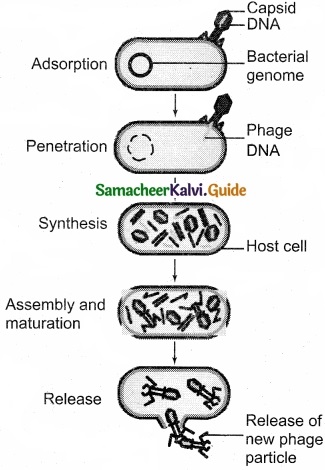
Identify the correct sequence regarding lytic cycle of viruses.
(i) Penetration
(ii) Adsorption
(iii) Assembly
(iv) Synthesis
(a) (ii), (i), (iv), (iii)
(b) (iii), (i), (ii), (iv)
(c) (ii), (iv), (i), (iii)
(d) (i), (iv), (ii), (iii)
Answer:
(a) (ii), (i), (iv), (iii)

Tamil Nadu 11th Biology Model Question Paper 3 English Medium

Question 2.
Zygote meiosis is characterisitic of ………………………
(a) Marchantia
(b) Fucus
(c) Funaria
(d) Chlamydomonas
Answer:
(d) Chlamydomonas

Question 3.
Pinus roots are in symbiotic relationship with ……………………
(a) Blue green algae
(b) Mycorrhiza
(c) Euglena
(d) Rhizobium
Answer:
(b) Mycorrhiza

Tamil Nadu 11th Biology Model Question Paper 3 English Medium

Question 4.
Climbers are also called as ……………………
(a) Herbs
(b) Trees
(c) Vines
(d) Shrubs
Answer:
(c) Vines

Question 5.
Arrangement of sepals and petals in flower bud is called ………………………
(a) Adhesion
(b) Aestivation
(c) Placentation
(d) Cohesion
Answer:
(b) Aestivation

Tamil Nadu 11th Biology Model Question Paper 3 English Medium

Question 6.
Cell cycle was discovered by ………………………
(a) Singer & Nicholson
(b) Prevost & Dumans
(c) Schleider & Schwann
(d) Boveri
Answer:
(b) Prevost & Dumans

Question 7.
Parenchyma storing calcium carbonate crystals are called ……………………
(a) Leucoplasts
(b) Elaioplasts
(c) Idioblasts
(d) Chromoplasts
Answer:
(c) Idioblasts

Tamil Nadu 11th Biology Model Question Paper 3 English Medium

Question 8.
Which of the following is a free – living bacterium?
(a) Rhizobium
(b) Clostridium
(c) Escherichia
(d) Cyanobacteria
Answer:
(b) Clostridium

PART – II

Answer any four of the following questions. [4 × 2 = 8]

Question 9.
Distinguish between deoxyviruses and riboviruses?
Answer:

Deoxyviruses

Riboviruses

1. Viruses having DNA are called deoxyviruses. E.g. Animal viruses except HIV1. Viruses having RNA are called riboviruses. E.g: Plant viruses except cauliflower mosaic virus (CMV)

Question 10.
What is plant morphology?
Answer:
Plant morphology also known as external morphology deals with the study of shape, size and structure of plants and their parts like (roots, stems, leaves, flowers, fruits and seeds).

Tamil Nadu 11th Biology Model Question Paper 3 English Medium

Question 11.
Differentiate Regional Flora from continental flora?
Answer:

Regional Flora

Continental Flora

1. Flora covering a large geographical area or a botanical region Eg: flora of Madras Presidency.1. Flora covering the entire continent. Eg: flora of Europaea.

Question 12.
Define C – Value?
Answer:
C-Value is the amount in picograms of DNA contained within a haploid nucleus.

Tamil Nadu 11th Biology Model Question Paper 3 English Medium

Question 13.
Expand and Define TP?
Answer:
TP stands for Turgor pressure. When a plant cell is placed in pure water (hypotonie solution) the diffusion of water into the cell takes place by endosmosis. It creates a positive hydrostatic pressure on the rigid cell wall by the cell membrane.

Hence forth the pressure exerted by the ccli membrane towards the cell wall is Turgor Pressure (TP).

Tamil Nadu 11th Biology Model Question Paper 3 English Medium

Question 14.
Mention the events of Photochernical phase of light reaction?
Answer:
Photocheinical Phase:

  1. Photolysis of water and oxygen evolution
  2. Electron transport and synthesis of assimilatory power.

PART – III

Answer any three questions in which question number 19 is compulsory. [3 × 3 = 9]

Question 15.
Name few fossil sites of India?
Answer:

Tamil Nadu 11th Biology Model Question Paper 3 English Medium

Question 16.
What is a liana? Mention its importance?
Answer:
Liana is a vine that is perennial and woody. Lianas are major components in the tree canopy layer of some tropical forests. e.g., Ventilago.

Question 17.
Enumerate the steps ino1ed in herbarium preparation?
Answer:
Preparation of herbarium specimen includes the following steps.

  1. Plant Collection
  2. Documentation of field site data
  3. Preparation of plant specimen
  4. Mounting herbarium specimen
  5. Herbarium labels
  6. Protection of herbarium sheets against mold and insects

Tamil Nadu 11th Biology Model Question Paper 3 English Medium

Question 18.
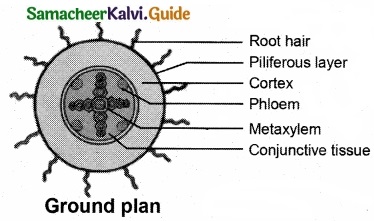
Draw and label the open vascular bundle?
Answer:

Tamil Nadu 11th Biology Model Question Paper 3 image 2

Question 19.
When does an essential mineral is considered as a “toxic”?
Answer:
Increase of mineral nutrients more than the normal concentration causes toxicity. A concentration, at which 10 % of the dry weight of tissue is reduced, is considered as toxic.

PART – IV

Answer all the questions. [2 × 5 = 10]

Question 20.
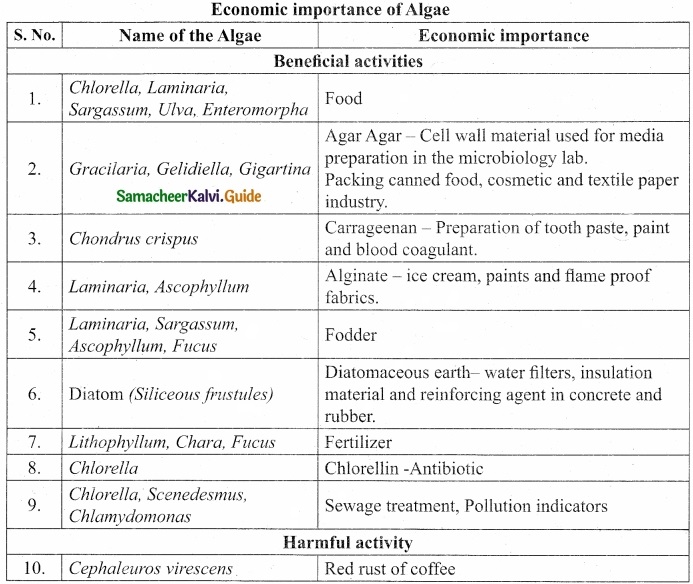
Tabulate the economic importance of algae?
Answer:

Tamil Nadu 11th Biology Model Question Paper 3 image 3

[OR]

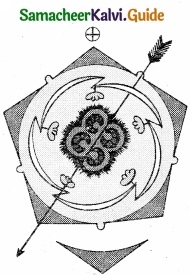
Explain Datura metal in botanical terms. Draw floral diagram?
Answer:
1. Habit:
Large, erect and stout herb.

2. Root:
Branched tap root system.

3. Stem:
Stem is hollow, green and herbaceous with strong odour.

4. Leaf:
Simple, alternate, petiolate, entire or deeply lobed, glabrous exstipulate showing unicostate reticulate venation.

5. Inflorescence:
Solitary and axillary cyme.

6. Flower:
Flowers are large, greenish white, bracteate, ebracteolate, pedicellate, complete, heterochlamydeous, pentamerous, regular actinomorphic, bisexual and hypogyncas.

Tamil Nadu 11th Biology Model Question Paper 3 image 9

7. Calyx:
Sepals 5, green synsepalous showing valvate aestivation. Calyx is mostly persistant, odd sepal is posterior in position.

8. Corolla:
Petals 5, greenish white, sympetalous, plicate (folded like a fan) showing twisted aestivation, funnel shaped with wide mouth and 10 lobed.

9. Androecium:
Stamens 5, free from one another, epipetalous, altemipefalous and are inserted in the middle of the corolla tube. Anthers are basifixed, dithecous, with long filament, introse and longitudinally dehiscent.

10. Gynoecium:
Ovary bicarpellary, syncarpous superior ovary, basically biloculear but tetralocular due to the formation of false septum. Carpels are obliquely placed and ovules on swollen axile placentation. Style simple long and filiform, stigma two lobed.

11. Fruit:
Spinescent capsule opening by four special valves with persistent calyx.

12. Seed:
Endospermous

13. Floral Formula:
Tamil Nadu 11th Biology Model Question Paper 3 image 4

Tamil Nadu 11th Biology Model Question Paper 3 English Medium

Question 21.
Describe the types of transpiration in plants?
Answer:
Types of Transpiration: Transpiration is of following three types:

1. Stomatal transpiration:
Stomata are microscopic structures present in high number on the lower epidermis of leaves. This is the most dominant form of transpiration and being responsible for most of the water loss (90 – 95%) in plants.

2. Lenticular transpiration:
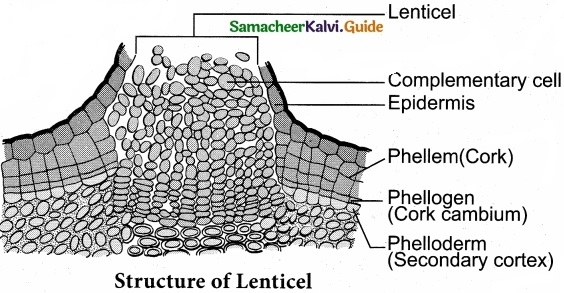
In stems of woody plants and trees, the epidermis is replaced by periderm because of secondary growth. In order to provide gaseous exchange between the living cells and outer atmosphere, some pores which looks like lens – shaped raised spots are present on the surface of the stem called Lenticels. The loss of water from lenticels is very insignificant as it amounts to only 0.1% of the total.

3. Cuticular transpiration:
The cuticle is a waxy or resinous layer of cutin, a fatty substance covering the epidermis of leaves and other plant parts. Loss of water through cuticle is relatively small and it is only about 5 to 10 % of the total transpiration. The thickness of cuticle increases in xerophytes and transpiration is very much reduced or totally absent.

[OR]

Describe the concept of Phytochrome?
Answer:
Phytochrome is a bluish biliprotein pigment responsible for the perception of light in photo physiological process. But at (1959) named this pigment and it exists in two interconvertible forms:

(I) Red light absorbing pigment which is designated as Pr and

(II) Far red light absorbing pigment which is designated as Pfr. The Pfr form absorbs red light in 660 nm and changes to Pfr. The Pfr form absorbs far red light in 730 nm and changes to Pr.

The Pr form is biologically inactive and it is stable whereas Pfr form is biologically active and it is very unstable. In short day plants, Pr promotes flowering and Pfr inhibits the flowering whereas in long day plants flowering is promoted by Pfr and inhibited by Pr form.

Pfr is always associated with hydrophobic area of membrane systems while Pr is found in diffused state in the cytoplasm. The interconversion of the two forms of phytochrome is mainly involved in flower induction and also additionally plays a role in seed germination and changes in membrane conformation.

Bio – Zoology [Maximum Marks: 35]

PART – I

Answer all the questions. Choose the correct answer. [8 × 1 = 8]

Question 1.
Entomology is concerned with the study of ……………………..
(a) Formation and properties of soil
(b) Agricultural practices
(c) Various aspects of human life
(d) Various aspects of insect
Answer:
(d) Various aspects of insect

Tamil Nadu 11th Biology Model Question Paper 3 English Medium

Question 2.
Which is the site of production of blood cells?
(a) Cartilage
(b) Bone marrow
(c) Blood
(d) Plasma
Answer:
(b) Bone marrow

Tamil Nadu 11th Biology Model Question Paper 3 English Medium

Question 3.
Match the List – I and List – II.

List – I

List – II

1. Lipase(i) Protein
2. Pepsin(ii) Lipid
3. Renin(iii) Starch
4. Ptyalin(iv) Cassein

(a) 1 – (ii), 2 – (i), 3 – (iv), 4 – (iii)
(b) 1 – (i), 2 – (ii), 3 – (iii), 4 – (iv)
(c) 1 – (iv), 2 – (iii), 3 – (i), 4 – (ii)
(d) 1 – (iii), 2 – (i), 3 – (iv), 4 – (ii)
Answer:
(a) 1 – (ii), 2 – (i), 3 – (iv), 4 – (iii)

Question 4.
ESV stands for ……………………..
(a) Endocard Systolic Volume
(b) End Systolic Volume
(c) Endocard Sound Volume
(d) Endocard Sinoatrial Volume
Answer:
(b) End Systolic Volume

Tamil Nadu 11th Biology Model Question Paper 3 English Medium

Question 5.
Which of the following statement is correct?
(a) The descending limb of loop of Henle is impermeable to water
(b) The ascending limb of loop of Henle is permeable to water
(c) The ascending limb of loop of Henle is impermeable to water
(d) The descending limb of loop of Henle is permeable to electrolytes
Answer:
(c) The ascending limb of loop of Henle is impermeable to water

Question 6.
Which of the following statements are incorrect?
(a) Basal epithelial cells are sensitive portions of the taste
(b) Basal epithelial cells are stem cells which divide and differentiate into new gustatory cells
(c) Gustatory hairs project form the tip of the gustatory cells
(d) Gustatory cells are sensory portion of the taste
Answer:
(a) Basal epithelial cells are sensitive portions of the taste

Question 7.
Serum Calcium level is regulated by …………………….
(a) Thyroxine
(b) FSH
(c) Pancreas Assertion is true, but reason is false
(d) Thyroid and Parathyroid
Answer:
(d) Thyroid and Parathyroid

Tamil Nadu 11th Biology Model Question Paper 3 English Medium

Question 8.
Ca+ metabolism is regulated by …………………..
(a) ACTH
(b) Thyroxin
(c) Parathormone
(d) Epinephrine
Answer:
(a) ACTH

PART – II

Answer any four of the following questions. [4 × 2 = 8]

Question 9.
What is Phylogenetic tree?
Answer:
A phylogenetic tree or evolutionary tree is a branching diagram or “tree”, showing the inferred evolutionary relationships upon similarities and differences in their physical or genetic characteristics.

Tamil Nadu 11th Biology Model Question Paper 3 English Medium

Question 10.
Write about Marbled cone snail?
Answer:
Marbled Cone Snail (Conus marmoreus):
This cone – shaped snail can deliver dangerous venom which may result in vision loss, respiratory failure, muscle paralysis and eventually death. There is no anti – venom available.

Question 11.
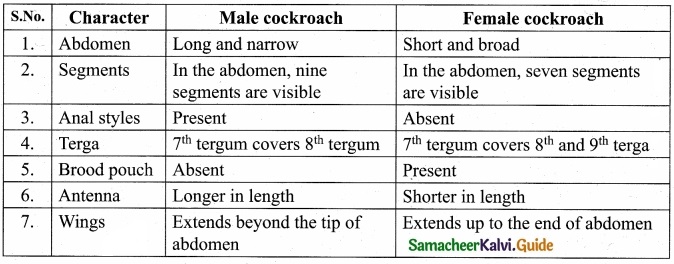
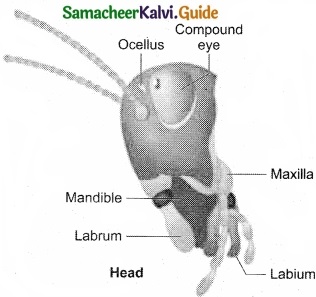
Differences between male and female cockroach?
Answer:

Tamil Nadu 11th Biology Model Question Paper 3 image 5

Question 12.
Define Floating ribs?
Answer:
The last 11th and 12th pairs of ribs are not connected ventrally. Therefore, they are called as ‘floating ribs’ or vertebral ribs.

Tamil Nadu 11th Biology Model Question Paper 3 English Medium

Question 13.
Write a note on Tetany?
Answer:
Tetany is caused due to the hyposecretion of parathyroid hormone (PTH). Due to hyposecretion of PTH serum calcium level decreases (Hypocalcemia), as a result serum phosphate level increases.

Calcium and phosphate excretion level decreses. Generalized convulsion, locking of jaws increased heart beat rate, increases body temperature, muscular spasm are the major symptoms of tetany.

Question 14.
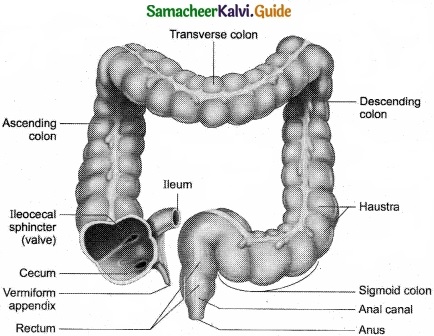
Draw the diagram of large intestine?
Answer:

Tamil Nadu 11th Biology Model Question Paper 3 image 6

PART – III

Answer any three questions in which question number 19 is compulsory. [3 × 3 = 9]

Question 15.
What is the need for classification?
Answer:
The basic need for classification are:

  1. To identify and differentiate closely related species.
  2. To know the variation among the species.
  3. To understand the evolution of the species.
  4. To create a phylogenetic tree among the different groups.

Tamil Nadu 11th Biology Model Question Paper 3 English Medium

Question 16.
Distinguish between Diploblastic and Triploblastic animals?
Answer:

S.No

Diploblastic animals

Triploblastic animals

1.The animals in which the cells are arranged in two embryonic layers, the ectoderm and endoderm are called diploblastic animals.The animals in which the cells are arranged in three embryonic layers, the ectoderm, mesoderm and endoderm are called triploblastic animals.
2.These are lower organisms, eg. Cnidaria, CtenophoraThese are higher organisms, eg. Platyhelminthes to mammalia.

Question 17.
Write a short note on connective tissue?
Answer:

  1. Connective tissue develops from the mesoderm.
  2. Connective tissue proper, Cartilage, bones and blood are the four main classes of connective tissues.
  3. Binding, support, protection, insulation and transportation of substances are the major functions of connective tissue.

Tamil Nadu 11th Biology Model Question Paper 3 English Medium

Question 18.
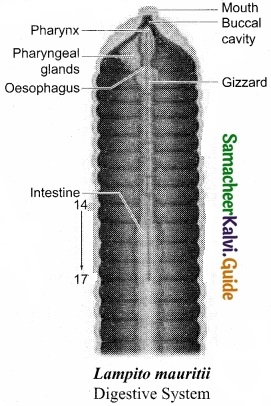
Draw the diagram of Lamnito mauritii?
Answer:

Tamil Nadu 11th Biology Model Question Paper 3 image 7

Question 19.
Define cross breedin?
Answer:
Breeding between a superior male of one breed with a superior female of another breed is known as cross breeding.

PART – IV

Answer all the questions. [2 × 5 = 10]

Question 20.
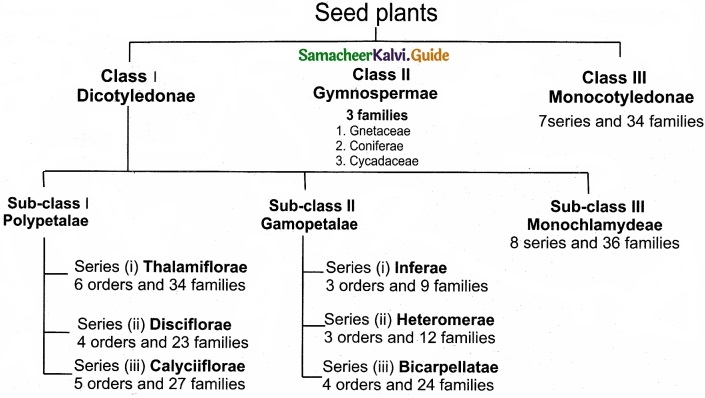
Who proposed the five kingdom classification? Represent the Five kingdom Classification in a tabular format?
Answer:
R.H. Whittaker (1969) proposed the Five kingdom Classification, the Kingdoms defined by him were Monera, Prgtista, Fungi, Plantae, and Animalia based on the cell structure, mode of nutrition, mode of reproduction and phylogenetic relationships. The table below gives a, comparative account of different characteristics of the five kingdoms.

Tamil Nadu 11th Biology Model Question Paper 3 image 8

[OR]

Explain the mechanism of breathing?
Answer:
The movement of air between the atmosphere and the lungs is known as ventilation or breathing. Inspiration and expiration are the two phases of breathing. Inspiration is the movement of atmospheric air into the lungs and expiration is the movement of alveolar air that diffuse out of the lungs.

Lungs do not contain muscle fibres but expands and contracts by the movement of the ribs and diaphragm. The diaphragm is a sheet of tissue which separates the thorax from the abdomen. In a relaxed state, the diaphragm is domed shaped.

Ribs are moved by the intercostal muscles. External and internal intercostal muscles found between the ribs and the diaphragm helps in creating pressure gradients.

Inspiration occurs if the pressure inside the lungs (intrapulmonary pressure) is less than the atmospheric pressure likewise expiration takes place when the pressure within the lungs is higher than the atmospheric pressure.

Inspiraton is initiated by the contraction of the diaphragm muscles and external intercostal muscles, which pulls the ribs and sternum upwards and outwards and increases the volume of the thoracic chamber in the dorso – ventral axis, forcing the lungs to expand the pulmonary volume.

The increase in pulmonary volume and decrease in the intrapulmonary pressure forces the fresh air from outside to enter the air passages into the lungs to equalize the pressure. This process is called inspiration.

Relaxation of the diaphragm allows the diaphragm and sternum to return to its dome shape and the internal intercostal muscles contract, pulling the ribs downward reducing the thoracic volume and pulmonary volume.

This results in an increase in the intrapulmonary pressure slightly above the atmospheric pressure causing the expulsion of air from the lungs. This process is called expiration.

Tamil Nadu 11th Biology Model Question Paper 3 English Medium

Question 21.
What are the benefits of regular exercise?
Answer:
Regular exercises can produce the following beneficial physiological changes:

  1. The muscles used in exercise grow larger and strongcr
  2. More enzymes are synthesized in the muscle fibre
  3. Ligaments and tendons become stronger
  4. Influences hormonal &tivity
  5. Prcvcnts Obesity
  6. Aesthetically bettcr with good physique
  7. Over all well-bcing with good quality of life
  8. Prevents depression, stress and anxiety
  9. The resting heart rate goes down
  10. Joints become more flexible
  11. Protection from hcart attack
  12. Improves cognitive functions
  13. Promotes confidence, esteem

During muscular exercise, there is an increase in metabolism. The O2 need of the muscles is increased. This requirement is met with more oxygen rich RBCs available to the active sites. There is an increase in heart rate and cardiac output. Along with balanced diet, physical activity plays a significant role in strengthening the muscles and bones.

[OR]

What are the types of chicken breeds in Poultry Farming?
Answer:
There are more than 100 breeds. The commonly farmed chicken breeds are categorized into five based on the purpose for which it is farmed. They are egg layers, broiler type, dual type, games and ornamental types.

1. Egg layers: These are farmed mainly for the production of egg.

Leghorn:
This is the most popular commercial breed in India and originated from Italy. They are small, compact with a single comb and wattles with white, brown or black colour.

They mature early and begin to lay eggs at the age of 5 or 6 months. Hence these are preferred in commercial farms. They can also thrive well in dry areas.

Chittagong:
It is the breed chiefly found in West Bengal. They are golden or light yellow coloured. The beak is long and yellow in colour. Ear lobes and wattles are small and red in colour. They are good egg layers and are delicious.

2. Broiler type: These are well known for fast growth and soft quality meat.

White Plymouth rock:
They have white plumage throughout the body. It is commonly used in broiler production. This is an American breed. It is a fast growing breed and well suitable for growing intensively in confined farms.

3. Dual purpose breeds: These are for both meat and egg production purpose.

Brahma:
It is a breed popularly known for its massive body having heavy bones, well feathered and proportionate body. Pea comb is one of the important breed characters. It has two common varieties namely, Light Brahma and Dark Brahma.

4. Game breeds: Since ancient times, special breed of roosters have been used for the sport of cockfighting.

Aseel:
This breed is white or black in colour. The hens are not good egg layers but are good in incubation of eggs. It is found in all states of India. Aseel is noted for its pugnacity, high stamina, and majestic gait and dogged fighting qualities. Although poor in productivity, this breed is well-known for their meat qualities.

5. Ornamental breeds: Ornamental chicken are reared as pets in addition to their use for egg production and meat.

Silkie:
It is a breed of chicken has a typical fluffy plumage, which is said to feel like silk and satin. The breed has numerous additional special characters, such as black skin and bones, blue earlobes, and five toes on each foot, while the majority chickens only have four.

They are exhibited in poultry shows, and come out in various colours. Silkies are well recognized for their calm, friendly temperament. Silkie chicken is especially simple to maintain as pets.

Tamil Nadu 11th Economics Model Question Paper 1 English Medium

Students can Download Tamil Nadu 11th Economics Model Question Paper 1 English Medium Pdf, Tamil Nadu 11th Economics Model Question Papers helps you to revise the complete Tamilnadu State Board New Syllabus, helps students complete homework assignments and to score high marks in board exams.

TN State Board 11th Economics Model Question Paper 1 English Medium

General Instructions:

  1. The question paper comprises of four parts.
  2. You are to attempt all the parts. An internal choice of questions is provided wherever applicable.
  3. All questions of Part I, II, III and IV are to be attempted separately.
  4. Question numbers 1 to 20 in Part I are Multiple Choice Questions of one mark each.
    These are to be answered by choosing the most suitable answer from the given four alternatives and writing the option code and the corresponding answer
  5. Question numbers 21 to 30 in Part II are two-mark questions. These are to be answered in about one or two sentences.
  6. Question numbers 31 to 40 in Part III are three-mark questions. These are to be answered in above three to five short sentences.
  7. Question numbers 41 to 47 in Part IV are five-mark questions. These are to be answered in detail Draw diagrams wherever necessary.

Time: 3:00 Hours
Maximum Marks: 90

PART – I

Choose the correct answer: [20 × 1 = 20]

Question 1.
The construction of demand line or supply line is the result of using ………………………
(a) Matrices
(b) Calculus
(c) Algebra
(d) Analytical geometry
Answer:
(d) Analytical geometry

Tamil Nadu 11th Economics Model Question Paper 1 English Medium

Question 2.
“Economics is the study of mankind in the ordinary business of life”. It is the statement of ………………………….
(a) Adam Smith
(b) Lionel Robbins
(c) Alfred Marshall
(d) Samuelson
Answer:
(c) Alfred Marshall

Question 3.
The Industry which was de – reserved in 1993?
(a) Railways
(b) Mining of copper and zinc
(c) Atomic energy
(d) Atomic minerals
Answer:
(b) Mining of copper and zinc

Tamil Nadu 11th Economics Model Question Paper 1 English Medium

Question 4.
A production function measures the relation between ……………………….
(a) Input prices and output prices
(b) Input prices and the quantity of output
(c) The quantity of inputs and the quantity of output
(d) The quantity of inputs and input prices
Answer:
(c) The quantity of inputs and the quantity of output

Question 5.
Mathematical Economics is the integration of ………………………..
(a) Mathematics and Economics
(b) Economics and Statistics
(c) Economics and Equations
(d) Graphs and Economics
Answer:
(a) Mathematics and Economics

Tamil Nadu 11th Economics Model Question Paper 1 English Medium

Question 6.
Mixed economy means ……………………………..
(a) Private sectors and banks
(b) Co – existence of public and private sectors
(c) Public sectors and banks
(d) Public sectors only
Answer:
(b) Co-existence of public and private sectors

Question 7.
Who is the Father of Economics?
(a) Max Muller
(b) Adam Smith
(c) Karl Marx
(d) Paul A Samuelson
Answer:
(b) Adam Smith

Tamil Nadu 11th Economics Model Question Paper 1 English Medium

Question 8.
Annual plans formed in the year ………………………….
(a) 1989 – 1991
(b) 1990 – 1992
(c) 2000 – 2001
(d) 1981 – 1983
Answer:
(b) 1990 – 1992

Question 9.
In investment proposals filed by MSMEs, TN ranks ………………………..
(a) I
(b) II
(c) III
(d) IV
Answer:
(b) II

Tamil Nadu 11th Economics Model Question Paper 1 English Medium

Question 10.
Which of the following is the way of Privatisation?
(a) Disinvestment
(b) Denationalization
(c) Franchising
(d) All the above
Answer:
(a) Disinvestment

Question 11.
Cost refer to ………………………..
(a) Price
(b) Value
(c) Fixed cost
(d) Cost of production
Answer:
(d) Cost of production

Tamil Nadu 11th Economics Model Question Paper 1 English Medium

Question 12.
Petrol and gold is the example of ………………………. market.
(a) Local
(b) Provincial
(c) National
(d) International
Answer:
(d) International

Question 13.
Money cost is also known as …………………………. cost.
(a) Explicit
(b) Implicit
(c) Social
(d) Real
Answer:
(a) Explicit

Tamil Nadu 11th Economics Model Question Paper 1 English Medium

Question 14.
Which of the following involves maximum exploitation of consumers?
(a) Perfect competition
(b) Monopoly
(c) Monopolistic competition
(d) Oligopoly
Answer:
(b) Monopoly

Question 15.
How do you term people employed in excess over and above the requirements?
(a) Unemployment
(b) Under employment (or) Disguised unemployment
(c) Full employment
(d) Self employment
Answer:
(b) Under employment (or) Disguised unemployment

Question 16.
The main objective of nationalisation of banks was ……………………….
(a) Private Social welfare
(b) Social Welfare
(c) To earn
(d) Industries monopoly
Answer:
(b) Social Welfare

Tamil Nadu 11th Economics Model Question Paper 1 English Medium

Question 17.
Which of the following is not a characteristic of land?
(a) Its limited supply
(b) It is mobile
(c) Heterogeneous
(d) Gift of Nature
Answer:
(b) It is mobile

Question 18.
Quasi – rent arises in ………………………..
(a) Man – made appliances
(b) Home made items
(c) Imported items
(d) None of these
Answer:
(a) Man – made appliances

Question 19.
The recommended nutritiofaal intake per person in rural areas.
(a) 2100 calories
(b) 2200 calories
(c) 2300 calories
(d) 2400 calories
Answer:
(d) 2400 calories

Tamil Nadu 11th Economics Model Question Paper 1 English Medium

Question 20.
The highest rate of tax under GST is ……………………….. (as on July 1,2017).
(a) 18%
(b) 24%
(c) 28%
(d) 32%
Answer:
(c) 28%

PART – II

Answer any seven question in which Question No. 30 is compulsory. [7 × 2 = 14]

Question 21.
What is meant by distribution?
Answer:
Distribution means division of income among the four factors of production in terms of rent to landlords, wage to labourer, interest to capital and profit to entrepreneurs. The theory of functional distribution deals with how the relative prices of these factors of production are determined. The theory of factor prices is popularly known as the theory of distribution.

Tamil Nadu 11th Economics Model Question Paper 1 English Medium

Question 22.
State the reasons for implementing LPG?
Answer:
Liberalization:

  1. Liberalization refers to removal of relaxation of governmental restrictions in all stages of industry.
  2. De-licensing, decontrol, deregulation, subsidies (incentives) and greater role for financial institutions are the various facets of liberalization.

Privatization:

  1. Privatization means transfer of ownership and management of enterprises from public sector to private sector.
  2. Denationalization, disinvestment and opening exclusive public sector enterprises to private sector are the gateways to privatization.

Globalization:
Globalization refers to the integration of the domestic (Indian) economy with the rest of the world. Import liberalization through reduction of tariff and non – tariffbarriers, opening the doors to Foreign Direct Investment (FDI) and Foreign Portfolio Investment (FPI) are some of the measures towards globalization.

Tamil Nadu 11th Economics Model Question Paper 1 English Medium

Question 23.
Why was structural reform implemented in Indian Economy?
Answer:

  1. Indian Economy responded to the crisis by introducing a set of policies known as Structural Reforms.
  2. These policies were aimed at correcting the weaknesses and rigidities in the various sectors of the economy such as industry, trade, fiscal and agriculture.

Question 24.
What is selling costs?
Answer:

  1. Selling Cost is the discussion of “ Product differentiation”.
  2. We can infer that the producer under monopolistic competition has to incur expenses to popularize his brand.
  3. This involved in selling the product is called selling cost.
  4. According to Prof. Chamberlin, selling cost is “ The cost incurred in order to alter the position or shape of the demand curve for a product”.

Question 25.
What are major ports in Tamil Nadu?
Answer:

  1. Tamil Nadu has three major ports; one each at Chennai, Ennore, and Thoothkudi as well as one intermediate port in Nagpattinam, and 23 minor ports.
  2. All the minor portsare managed by the Tamil Nadu Maritime Board, Chennai Port.
  3. Ennore port was recently converted from an intermediate port to a major port and handles all the coal and ore traffic in Tamil Nadu.

Tamil Nadu 11th Economics Model Question Paper 1 English Medium

Question 26.
Mention any four food crops which are favourable to Tamil Nadu?
Answer:

  1. Rice: Tamil Nadu is the India’s second biggest producer of rice.
  2. Banana and Coconut: Tamil Nadu ranks first in production of Banana and coconut.
  3. Cashewnut: Tamil Nadu ranks second in production of cashewnut.
  4. Pepper: Tamil Nadu ranks third in production of pepper.
  5. Sugarcane: Tamil Nadu ranks fourth in production of Sugarcane.

Question 27.
What is Selling cost?
Answer:

  1. Selling Cost is the discussion of “ Product differentiation”.
  2. We can infer that the producer under monopolistic competition has to incur expenses to popularize his brand.
  3. This involved in selling the product is called selling cost.
  4. According to Prof. Chamberlin, selling cost is “The cost incurred in order to alter the position or shape of the demand curve for a product”.

Tamil Nadu 11th Economics Model Question Paper 1 English Medium

Question 28.
What do you mean by Rural Development?
Answer:

  1. Rural Development is defined as an overall improvement in the economies and social well being of villagers and the institutional and physical environments in which they live.
  2. According to the World Bank “Rural Development is a strategy designed to improve the economic and social life of a specific group of people – rural poor.
  3. Rural Development is a process of improving the rural areas, rural people and rural living.

Question 29.
Define Rural economy?
Answer:

  1. Rural areas are geographical areas located outside towns and cities.
  2. Rural Economy refers to villages and rural community refers to people living in villages.

Tamil Nadu 11th Economics Model Question Paper 1 English Medium

Question 30.
Give the definition for ‘Real Cost’ ?
Answer:
Real Cost refers to the payment made to compensate the efforts and sacrifices of all factor owners for their services in production. Real Cost includes the efforts and sacrifices of landlords in the use of land, capitalists to save and invest, and workers in foregoing, leisure. Real cost are considered pains and sacrifices of labour as real cost of production.

PART – III

Answer any seven question in which Question No. 40 is compulsory. [7 × 3 = 21]

Question 31.
Enumerate the remedial measures to Rural poverty?
Answer:
Remedial measures:

  1. Since rural unemployment and rural poverty are interrelated, creation of employment opportunities would support elimination of poverty.
  2. Poverty alleviation schemes and programmes have been implemented, modified, consolidated, expanded and improved over time.
  3. However, unemployment, begging, rag-picking and slumming continues.
  4. Unless employment is given to all the people poverty cannot be eliminated.

Tamil Nadu 11th Economics Model Question Paper 1 English Medium

Question 32.
Write a short note on Marginal Revenue?
Answer:
1. Marginal Revenue [MR] is the addition to the total revenue by the sale of an additional unit of a commodity.

2. MR can be found out by dividing change in total revenue by the change in quantity sold out.

3. MR = ∆TR/∆Q where MR denotes Marginal Revenue, ∆TR denotes change in Total Revenue and ∆Q denotes change in total quantity.

4. The other method of estimating MR is:

MR = TRn – TRn-1 (or) TRn+1 – TRn
Where, MR denotes Marginal Revenue,
TRn denotes total revenue of nth item,
TRn-1, denotes Total Revenue of n – 1th item and
TRn+1 denotes Total Revenue of n + 1th item.
If TR = PQ , MR = dTR/dQ = P, which is equal to AR.

Tamil Nadu 11th Economics Model Question Paper 1 English Medium

Question 33.
Define opportunity cost and provide an example?
Answer:

  1. Opportunity cost refers to the cost of next best alternative use. In other words, it is the value of the next best alternative foregone.
  2. For example, a farmer can cultivate both paddy and sugarcane in a farm land.
  3. If he cultivates paddy, the opportunity cost of paddy output is the amount of sugarcane output given up.
  4. Opportunity Cost is also called as “Alternative Cost” or Transfer cost.

Question 34.
Explain the theory of “consumer’s surplus”?
Answer:
Alfred Marshall defines consumer’s surplus as “the excess of price which a person would be willing to pay a thing rather than go without the thing, over that which he actually does pay is the economic measure of this surplus satisfaction. This may be called consumers surplus”.

Tamil Nadu 11th Economics Model Question Paper 1 English Medium

Question 35.
List out the objectives of MUDRA Bank?
Answer:

  1. Regulate the lender and the borrower of microfinance and bring stability to the microfinance system.
  2. Extend finance and credit support to Micro Finance Institutions [MFI] and agencies that lend money to small businesses, retailers, self-help groups and individuals.
  3. Register all MFIs and introduce a system of performance rating and accreditation for the first time.
  4. Offer a Credit Guarantee scheme for providing guarantees to loans being offered to micro businesses.
  5. Introduce appropriate technologies to assist in the process of efficient lending, borrowing and monitoring of distributed capital.

Tamil Nadu 11th Economics Model Question Paper 1 English Medium

Question 36.
Explain about the period of Merchant capital?
Answer:
Period of Merchant Capital:

  1. The period of merchant capital was from 1757 to 1813.
  2. The only aim of the East India Company was to earn profit by establishing monopoly trade in the goods with India and the East India’s.
  3. During this period, India had been considered as the best hunting ground for capital by the East Indian company to develop industrial capitalism is Britain.
  4. When Bengal and South India came under political shake of the East India company in 1750s and 1760s, the objective of monopoly trade was fulfilled.
  5. The company administration succeeded in generating huge surpluses which were repatriated . to England, and the Indian leaders linked this problem of land revenue with that of the drain.
  6. Above all, the officers of the company were unscrupulous and corrupt.

Question 37.
Distinguish between rent and quasi – rent?
Answer:

Rent

Quasi – Rent

1. Rent accrues to land.1. Quasi – rent accrues to man – made appliance.
2. The supply of land is fixed forever.2. The supply of man made appliances is fixed for a short period only.
3. It enters into price.3. It does not enter into price.

Tamil Nadu 11th Economics Model Question Paper 1 English Medium

Question 38.
Explain the causes for Rural backwardness?

  1. The evils of brain-drain and rural-urban migration can be reduced if rural areas are developed.
  2. In order to better utilise the unused and under – utilised resources there is a need to develop the rural economy.
  3. Rural Development should minimise the gap between rural and urban areas in terms of the provision of infrastructural facilities. It was called as PURA by former President Abdul Kalam.
  4. In order to improve the nation’s status in the global arena in terms of the economic indicators like,
    • Human Development Index [HDI]
    • Woman Empowerment Index [WEI]
    • Gender Disparity Index [GDI]
    • Physical Quality of Life Index [PQLI] and
    • Gross National Happiness Index [GNHI] should be given due attention.

Question 39.
Discuss the long run cost curves with suitable diagram?
Answer:

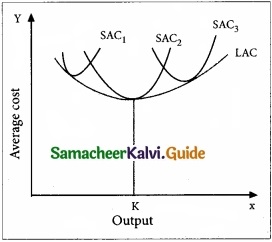
1. In the long run all factors of production become variable. The existing size of the firm can be increased in the case of long run. There are neither fixed inputs nor fixed costs in the long run.

2. LAG is given in diagram.

3. Long run average cost (LAC) is equal to long run total costs divided by the level of output.

LAC = LTC/Q

4. where, LAC denotes Long-Run Average Cost, LTC denotes Long-run Total Cost and Q denotes the quantity of output. The LAC curve is derived from short-run average cost curves. It is the locus of points denoting the least cost curve of producing the corresponding output. The LAC curve is called as ‘Plant Curve’ or ‘Boat shape Curve’ or ‘Planning Curve’ or ‘Envelop Curve’.

Tamil Nadu 11th Economics Model Question Paper 1 English Medium img 1

Tamil Nadu 11th Economics Model Question Paper 1 English Medium

Question 40.
State the importance of Rural Development?
Answer:
1. A major share of population lives in rural areas, and their development and contributions are very much supportive for the nation building activities. India cannot be developed by retaining rural as backward.

2. The rural economy Supports the urban sectors by way of supplying drinking water, milk, food and raw materials. Hence, the backwardness of the rural sector would be a major impediment to the overall progress of the economy.

3. Improvements in education, health and sanitation in villages can help avoid many urban problems namely, begging, rag-picking and road side slumming.

4. Development of agriculture and allied activities are necessary for providing gainful employment in rural areas and improving overall food production.

PART – IV

Answer all the questions. [7 × 5 = 35]

Question 41 (a).
Bring out Jawaharlal Nehru’s contribution to the idea of economic development?
Answer:

  1. Jawaharlal Nehru, one of the chief builders of Modem India, was the first Prime Minister of Independent India.
  2. He was a great patriot, thinker and statesman.

(I) Democracy and Secularism:

  1. Jawaharlal Nehru was a firm believer in democracy.
  2. He believed in free speech civil liberty, adult franchise and the Rule of Law and Parliamentary democracy.
  3. Secularism, is another signal contribution of Nehru to India.

(II) Planning:

  1. Jawaharlal Nehru was responsible for the introduction of planning in our country.
  2. Jawaharlal Nehru, the Plan was essentially an integrated approach for development.
  3. Nehru Spoke on the theme of planning.
  4. He said “the essence of planning is to find the best way to utilize all resources of manpower, of money and so on”.
  5. “Planning for Nehru was essentially linked up with Industrialization and eventual self¬reliance for the country’s economic growth on an self – accelerating growth.
  6. Nehru carried through this basis strategy of planned development.
  7. Nehru’s contribution to the advancement of science, research, technology and industrial development cannot be forgotten.
  8. It was dining is period, many IITs and Research Institutions were established.
  9. Nehru always in insited on “ scientific temper”.

[OR]

(b) Describe the Salient features of EXIM policy [2015 – 2020]
Answer:
The new EXIM policy has been formulated focusing on increasing in exports Scenario, boosting production and supporting the concepts like Make in India and Digital India.

Salient Features:

  1. Reduce export obligations by 25% and give boost to domestic manufacturing supporting the “Make in India” concept.
  2. As a step to Digital India concept, online procedure to upload digitally signed document by CA /CS / Cost Accountant are developed and further mobile app for filing tax, stamp duty has been developed.
  3. Repeated submission of physical copies of documents available on Exporter Importer Profile is not required.
  4. Export obligation period for export items related to defence, military store, aerospace and nuclear energy to be 24 months.
  5. EXIM policy 2015 – 2020 is expected to double the share of India in World Trade from present level of 3% by the year 2020. This appears to be too ambitions.

Tamil Nadu 11th Economics Model Question Paper 1 English Medium

Question 42 (a).
Explain basic problems of the economy with the help of production possibility curve?
Answer:
1. The problem of choice between relatively scarce commodities due to limited productive resources with the society can be illustrated with the help of a geometric device, is known as production possibility curve.

Production possibility curve shows the menu of choice along which a society can choose to substitute one good for another, assuming a given , state of technology and given total resources.

2. The explanation and analysis of production possibility curve is based upon certain assumptions, some of them are following:

  1. The time period does not change. It remains the same throughout the curve.
  2. Techniques of production are fixed.
  3. There is full employment in the economy.
  4. Only two goods can be produced from the given resources.
  5. Resources of production are fully mobile.
  6. The factors of production are given in quantity and quality.
  7. The low of diminishing returns operates in production.
  8. Every production possibility curve is based upon these assumptions. If some of these assumptions changes or negelected, then it affects the nature of production possibility curve.
  9. To draw this curve we take the help of production possibilities schedule, as shown below.

Production possibilities schedule:
1. The schedule suggests that if all resources are thrown into the production of food, a maximum of 500 tons of food can be produced, given the existing technology. If on the other hand, all resources are instead used for producing cars, 25 cars can be produced. In between these two extreme possibilities exist. If we are willing to give up some food, we can have some cars.

2. We can obtain a production possibility curve by drawing production possibilities schedule graphically. The quantity of food is shown on x – axis and the number of cars is shown on y – axis, the different six production possibilities are. being shown as point P1 P2 P3 P4 P5 & P6.

Tamil Nadu 11th Economics Model Question Paper 1 English Medium img 2

Problems of the economy:

1. The problem of choice:
The problem of choice arise because of the given limited resources and unlimited wants, may relate to the allocation of resources between the goods for the higher income group and the lower income group and the goods for the defense and the civilians. Since PPC is the locus of the combination of the goods the problem of choice will not arises when we choose any point on PPC.

2. Solution of central problems:
The central problems of an economy can be explained with the help of PPC. The solution of problem of what to produce involves the decision regarding the choice of location on the production possibility carves. A production combination represented by any point inside the PPC indicates that the economy is using inefficient methods of production and inefficient combination of resources.

[OR]

(b) Elucidate the law of diminishing marginal utility with diagram?
Answer:
Introduction:
H.H.Gossen, an Austrian Economist was the first to formulate this law in Economics in 1854. Therefore Jevons called this law as “ Gossen’s First Law of Consumption”. But credit goes to Marshall, because he perfected this law on the basis of Cardinal Analysis. This law is based on the characteristics of human wants, i.e. wants are satiable.

Definition:
Marshall states the law as “ the additional benefit which a person derives from a given increase of his stock of a thing, diminishes with every increase in the stock that he already has”.

Assumptions:

  1. Utility can be measured by cardinal numbers such as 1, 2, 3 and so on.
  2. The marginal utility of money of the consumer remains constant.
  3. The consumer should be a rational consumer and his aim is to attain maximum satisfaction with minimum expenditure.
  4. The units of the commodity consumed must be reasonable in size.
  5. The commodity consumed should be homogeneous or uniform in charcter like weight, quality, taste, colour etc.
  6. The consumption of goods must take place continuously at a given period of time.
  7. There should be no change in the taste, habits preferences, fashions, income and character of the consumer during the process of consumption.

Explanation:
The Law of Diminishing Marginal utility states that if a consumer continues to consume more and more units of the same commodity, its marginal utility diminishes. This means that the more we have of a thing, the less is the satisfaction or utility that we derive from the additional unit of it.

The Law of Diminishing Marginal utility:

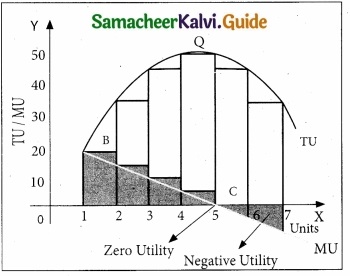
Tamil Nadu 11th Economics Model Question Paper 1 English Medium img 3

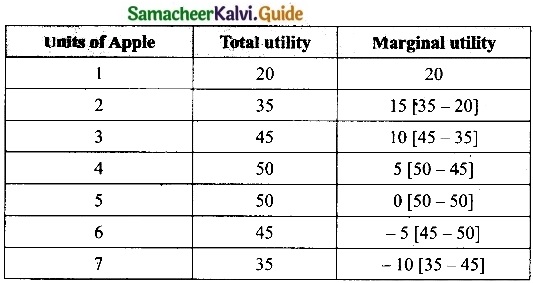
  1. In this table, we find that the total utility goes on increasing but at a diminishing rate.
  2. The law can be explained with a simple illustration.
  3. Consumer wants to consume 7 apples one after another.
  4. The utility from the first apple is 20.
  5. But the utility from the second apple will be less than that of the first [say 15].
  6. The third less than that of the second [say 10] and so on.
  7. Finally, the utility from the fifth apple becomes zero and the utilities from sixth and seventh apples are negative for disutility or disliking.
  8. This tendency is called the “ The Law of Diminishing Marginal Utility”.
  9. In this table we find on the other hand, marginal utility goes on diminishing.
  10. When marginal utility becomes zero, the total utility is maximum and when marginal utility becomes negative, the total utility diminishes.

Tamil Nadu 11th Economics Model Question Paper 1 English Medium img 4

X – axis represents number of apples consumed
Y – axis represents total utility and marginal utility
TU – represents total utility
MU- represents marginal utility

Criticisms:

  1. Utility cannot be measured numerically, because utility is subjective.
  2. This law is based on the unrealistic assumptions.
  3. This law is not applicable to indivisible commodities.

Tamil Nadu 11th Economics Model Question Paper 1 English Medium

Question 43 (a).
Explain the objectives of nationalization of commercial bank?
Answer:
The Government of India nationalized the commercial banks to achieve the following objectives:

  1. The main objective of nationalization was to attain Social Welfare. Sectors such as agriculture, small and village industries were in need of funds for their expansion and further economic development.
  2. Nationalisation of banks helped to curb private monopolies in order to ensure a smooth supply of credit to socially desirable sections.
  3. In India, nearly 70% of population lived in rural areas. Therefore it was needed to encourage the banking habit among the rural population.
  4. Nationalisation of banks was required to reduce the regional imbalances where the banking facilities were not available.
  5. Before Independence, the numbers of banks were certainly inadequate. After nationalization, new bank branches were opened in both rural and urban areas.
  6. Banks created credit facilities mainly to the agriculture sector and its allied activities after nationalization.
    After New Economic Policy 1991, the Indian banking Industry has been facing the new horizons of competitions, efficiency and productivity.

[OR]

(b) Explain the Agrarian crisis after reforms?
Answer:
(I) High input costs:

  1. The biggest input for farmers is seeds.
  2. Before liberalisation, farmers across the country had access to seeds from state government institutions.
  3. The institutions produced own seeds and were responsible for their quality and price.
  4. India’s seed market was opened up to global agri-businesses.
  5. The deregulation of many state government institutions were closed down in 2003.
  6. Seed prices shot up and fake seeds made an appearance in a big way.

(II) Cutback in agricultural subsidies:

  1. Farmers were encouraged to shift from growing a mixture of traditional crops to export oriented “cash crops” like chilli, cotton and tobacco.
  2. Liberalisation policies reduced the subsides on pesticide and fertilizer and elasticity.
  3. As a result prices have increased by 300%.

(III) Reduction of import duties:

  1. With a view to open India’s markets, the liberalization reforms also withdrew tariffs and duties on imports.
  2. By 2001, India completely removed restrictions on imports of almost 1500 items including food.

(IV) Paucity of credit facilities:

  1. The lending pattern of commercial banks, including nationalised bank, drastically changed. As a result, loan was not easily adequate.
  2. This has forced the farmers to. rely on moneylenders who charge exorbitant rate of interest.

Tamil Nadu 11th Economics Model Question Paper 1 English Medium

Question 44 (a).
Explain strong features of Indian economy?
Answer:
Strengths of Indian Economy:

1. India has a mixed economy:

  1. Indian economy is a typical example of mixed economy.
  2. This means both private and public sectors co-exist and function smoothly.
  3. The fundamental and heavy industrial units are being operated under the public sector.
  4. The liberalization of the economy, the private sector has gained importance.
  5. This makes it a perfect model for public – private partnership.

2. Agriculture plays the key role:

  1. Agriculture being the maximum pursued occupation in India.
  2. It plays an important role in its economy as well.
  3. Around 60% of the people in India depend upon agriculture for their livelihood.
  4. In fact, about 17% of our GDP today is contributed by the agriculture sector.
  5. Green revolution, ever green revolution and inventions is bio technology have made agriculture self sufficient and also surplus production.
  6. The export of agriculture products such as fruits, vegetables, spices, vegetable oils, tobacco, animal skin, etc. also add to forex earning through international trading.

3. An emerging market:

  1. Indian has emerged as vibrant economy sustaining stable GDP growth rate even in the midst of global downtrend.
  2. This has attracted significant foreign capital through FDI and FII.
  3. India has a high potential for prospective growth.
  4. This also makes it an emerging market for the world.

4. Emerging Economy:

  1. Emerging as a top economic giant among the world economy.
  2. India bags the seventh position in terms of nominal Gross Domestic Product [GDP] and third in terms of Purchasing Power Parity [PPP].
  3. As a result of rapid economic growth,. Indian economy has a place among the G20 countries.

5. Fat Growing Economy:

  1. Indias economy is well known for high and sustained growth.
  2. The world’s fastest growing economy in the year 2016-17 with the growth rate of 7.1% in GDP.

6. Fast Growing Service Sector:

  1. The service sector, contributes a lion’s share of the GDP in India.
  2. There has been a high rise growth in the technical sectors like information technology.

7. Large Domestic Consumption:

  1. With the faster growth rate in the economy the standard of living has improved a lot.
  2. The standard of living has considerably improved and life style has changed.

8. Rapid Growth of Urban Areas:

  1. Urbanization is a key ingredient of the growth of any economy.
  2. Improved connectivity is transport and communication, education and health have speeded up the pace of urbanization.

9. Stable Macro Economy:

  1. The Indian economy has been projected and considered as one of the most stable economies of the world.
  2. The current year’s Economic survey represents the Indian economy to be a “heaven of macroeconomic stability, resilience and optimism”.

10. Demographic dividend:

  1. This means that India is a pride owner of the maximum percentage of youth.
  2. The young population is not only motivated but skilled and trained enough to maximize the growth.
  3. Thus human capital plays a key role in maximizing the growth prospects is the country.
  4. This has invited foreign investments to the country and outsourcing opportunities too.

[OR]

(b) Explain the role of SSIs in economic development?
Answer:
1. Provide Employment:

  1. SSI’s use labour intensive techniques. Hence, they provide employment opportunities to a large number of people. Thus, they reduce the unemployment problem to a great extent.
  2. SSI’s provide employment to artisans, technically qualified persons and professionals, people engaged in traditional arts, people in villages and unorganized sectors.
  3. The employment-capital ratio is high for the SSI’s.

2. Bring Balanced Regional Development:

  1. SSI’s promote decentralized development of industries as most of the SSI’s are set up in backward and rural areas.
  2. They remove regional disparities by industrializing rural and backward areas and bring balanced regional development.
  3. They help to reduce the problems of congestion, slums, sanitation and pollution in cities. They are mostly found in outside city limits.
  4. They help in improving the standard of living of people residing in suburban and rural areas in India.
  5. The entrepreneurial talent is tapped in different regions and the income is also distributed instead of being concentrated in the hands of a few individuals or business families.

3. Help in Mobilization of Local Resources:

  1. SSI’s help to mobilize and utilize local resources like small savings, entrepreneurial talent etc., of the entrepreneurs, which might otherwise remain idle and unutilized.
  2. They pave way for promoting traditional family skills and handicrafts. There is a great demand for handicraft goods in developed countries.
  3. They help to improve the growth of local entrepreneurs and self-employed professionals in small towns and villages in India

4. Pave for Optimisation of Capital:

  1. SSI’s require less capital per unit of output. They provide quick return on investment due to shorter gestation period. The payback period is quite short in SSI’s.
  2. SSI’s function as a stabilizing force by providing high output – capital ratio as well as high employment – capital ratio.
  3. They encourage the people living in rural areas and small towns to mobilize savings and channelize them into industrial activities.

5. Promote Exports:

1. SSIs do not require sophisticated machinery. Hence, import the machines from abroad is not necessary. On the other hand, there is a great demand for goods produced by SSIs. Thus they reduce the pressure on the country’s balance of payments. However, with recent past large scale industries are able to borrow large funds with low interest rate and spend large sums on advertisements. Hence SSSs are gradually vanishing.

2. SSI’s earn valuable foreign exchange through exports from India.

6. Complement Large Scale Industries:

  1. SSI’s play a complementary role to large scale sector and support the large scale industries.
  2. SSI’s provide parts, components, accessories to large scale industries and meet the requirements of large scale industries through setting up units near the large scale units.
  3. SSI’s serve as ancillaries to large scale units.

7. Meet Consumer Demands:

  1. SSI’s produce wide range of products required by consumers in India.
  2. Hence, they serves as an anti-inflationary force by providing goods of daily use.

8. Develop Entrepreneurship:

  1. SSI’s help to develop a class of entrepreneurs in the society. They help the job seekers to become job givers.
  2. They promote self-employment and spirit of self-reliance in the society.
  3. SSI’s help to increase the per capita income of India in various ways.
  4. They facilitate development of backward areas and weaker sections of the society.
  5. SSI’s are adept in distributing national income in more efficient and equitable manner among the various participants of the society.

Tamil Nadu 11th Economics Model Question Paper 1 English Medium

Question 45 (a).
Elucidate the Laws of Returns to scale. Illustrate?
Answer:
Laws of Returns To Scale:
In the long – run, there is no fixed factor; all factors are variable. The laws of returns to scale explain the relationship between output and the scale of inputs in the long – run when all the inputs are increased in the same proportion.

Assumptions:
Laws of Returns to Scale are based on the following assumptions.

  1. All the factors of production, [such as land, labour and capital] are variable but organization is fixed.
  2. There is no change in technology.
  3. There is perfect competition in the market.
  4. Outputs or returns are measured in physical quantities.

Three Phases of Returns to Scale:

  1. Increasing Returns to Scale: In this case if all inputs are increased by one percent, output increase by more than one percent.
  2. Constant Returns to Scale: In this case if all inputs are increased by one percent, output increases exactly by one percent.
  3. Diminishing Returns to Scale: In this case if all inputs are increased by one percent, output increases by less than one percent.

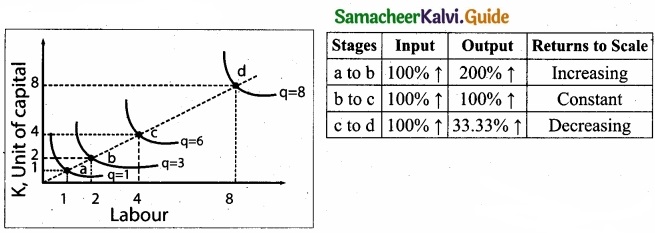
The three laws of returns to scale can be explained with the help of the diagram below.

Diagramatic Illustration:

Tamil Nadu 11th Economics Model Question Paper 1 English Medium img 4

In the figure, the movement from point a to point b represents increasing returns to scale. Because, between these two points output has doubled, but output has tripled. The law of constant returns to scale is implied by the movement from the point b to point c.

Because, between these two points inputs have doubled and output also has doubled. Decreasing returns to scale are denoted by the movement from the point c to point d since doubling the factors from 4 units to 8 units product less than the increase in inputs, that is by 33.33%.

[OR]

(b) Explain the internal and external economies of scale?
Answer:
Internal Economics of Scale:

  1. Internal Economies of scale refers to the advantages enjoyed by the production unit which causes a reduction in the cost of production of the commodity.
  2. For example, a firm enjoying the advantage of an application of most modem machinery, generation of internal capital, an improvement in managerial skill etc. are sure to reduce the cost of production. They are of various types:

(a) Technical Economies:

  1. When the size of the firm is large, large amount of capital can be used.
  2. There is a possibility to introduce up – to – date technologies; this improves productivity of the firm.
  3. Research and development strategies can be applied easily.

(b) Financial Economies:
Big firms can float shares in the market for capital expansion, while small firms cannot easily float shares in the market.

(c) Managerial Economies:
Large scale production facilitates specialization and delegation.

(d) Labour Economies:

  1. Large scale production implies greater and minute division of labour.
  2. This leads to specialization which enhances the quality.
  3. This increases the productivity of the firm.

(e) Marketing Economies:

  1. In the context of large scale production, the producers can both buy raw – materials in bulk at cheaper cost and can take the products to distant markets.
  2. They enjoy a huge bargaining power.

(f) Economies of survival:

  1. Product diversification is possible when there is large scale production.
  2. This reduces the risk in production.
  3. Even if the market for one product collapses, market for other commodities offsets it.

External Economies of Scale:

  1. External Economies of Scale refer to changes in any factor outside the firm causing an improvement in the production process.
  2. This can take place in the case of industry also.
  3. These are the advantages enjoyed by all the firms in industry due to the structural growth.
  4. Important external economies of scale are listed below :
    • Increased transport facilities
    • Banking facilities
    • Development of townships
    • Development of information and communication.

Tamil Nadu 11th Economics Model Question Paper 1 English Medium

Question 46 (a).
Explain the Rail Transport System in Tamil Nadu?
Answer:

  1. Tamil Nadu has a well – developed rail network as part of Southern Railway, Headquartered at Chennai.
  2. The present Southern Railway network extends over a large area of India’s Southern Peninsula, covering the States of Tamil Nadu, Kerala, Puducherry, minor portions of Karnataka and Andhra Pradesh.
  3. Tamil Nadu has a total railway track length of 6,693 km and there are 690 railway stations in the State. The system connects it with most major cities in India.
  4. Main rail junctions in the State include Chennai, Coimbatore, Erode, Madurai, Salem, Tiruchirapalli and Tirunelveli.
  5. Chennai has a well – established Suburban Railway network, a Mass Rapid Transport System and is currently developing a Metro system, with its first underground stretch operational since May 2017.

[OR]

(b) Illustrate the uses of Mathematical Methods in Economics?
Answer:
Uses of Mathematical Methods in Economics:

  1. Mathematical Methods help to present the economic problems in a more precise form.
  2. Mathematical Methods help to explain economic concepts.
  3. Mathematical Methods help to use a largl number of variables in economic analyses.
  4. Mathematical Methods help to quantity the impact or effect of any economic activity implemented by Government or anybody. There are of course many other uses.

Tamil Nadu 11th Economics Model Question Paper 1 English Medium

Question 47 (a).
If TC = 2.5q3 – 13q2 + 50q + 12 derive the MC function and AC function?

\(\frac{dc}{dq}\) = MC
AC = \(\frac{TC}{q}\)
\(\frac{dc}{dq}\) = 2.5(3)q2 – [13 × 2]q + 50
MC = 7.5 q2 – 26q + 50
AC = \(\frac { 2.5q^{ 3 }-13q^{ 2 }+50q+12 }{ q } \)
∴ AC = 2.5q3 – 13q + 50 + \(\frac{12}{q}\)

[OR]

(b) What are the ideas of information and communication technology used in Economics?
Answer:
Information and communication Technology [ICT] is the infrastructure that enables computing faster and accurate.
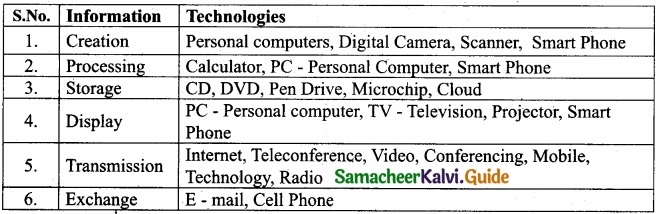
The following table gives an idea of range of technologies that fall under the category of ICT

Tamil Nadu 11th Economics Model Question Paper 1 English Medium img 6

The evaluation of ICT has five phases:
They are evaluation in:

  1. Computer
  2. PC – Personal Computer
  3. Micro Processor
  4. Internet
  5. Wireless links

In Economics, the uses of mathematical and statistical tools need the support of ICT for:

    1. Data Compiling
    2. Editing
    3. Manipulating
    4. Presenting the results

Tamil Nadu 11th Economics Model Question Paper 1 English Medium

Question 48 (a).
Discuss the important initiatives taken by the Government of India towards Industrial Policy?
Answer:
Important initiatives by the Government towards Industrial Policy:
The policy has brought changes in the following aspects of industrial regulation.

  1. Industrial de – licensing.
  2. De – reservation of the Industrial Sector.
  3. Public sector policy, (de – reservation and reform of PSES)
  4. Abolition of MRTP Act.
  5. Foreign Investment policy and foreign technology policy.

Industrial delicensing policy:

  1. The most important part of the new Industrial policy of 1991 was the end of the Industrial licensing or the license raj or red tapism.
  2. The Industrial licensing policies, private sector firms had to secure licenses to start an Industry.

De – reservation of the Industrial Sector:

  1. The public sector was given reservation especially in the capital goods and key Industries.
  2. Industrial deregulation, most of the Industrial Sectors were opened to the private sector as well.
  3. The new Industrial policy, only three sectors atomic energy, mining and railways will continue as reserved for public sector.

Reforms related to the Public Sector enterprises:

  1. Reforms in the public sector were aimed at enhancing efficiency and competitiveness of the sector.
  2. The government identified strategic and priority areas for the public sector concentrate.

Abolition of MRTP Act:

  1. The New Industrial Policy of 1991 has abolished the Monopoly and Restrictive Trade Practices Act 1969.
  2. In 2010, the Competition Commission has emerged as the watch dog in monitoring competitive practices in the economy.

Eoreign Investment Policy:

  1. Foreign investment including FDI and FPI were allowed.
  2. In 1991, the government announced a specified list of high technology and high investment priority Industries.
  3. Foreign direct investment upto 51 percent foreign equity.
  4. Foreign Investment Promotion Board has been set up to negotiate with International firms and approve direct Foreign Investment.

[OR]

(b) Analyse the causes for Rural Indebtedness?
Answer:
The Causes for Rural Indebtedness:

(I) Poverty of Farmers:

  1. The vicious circle of poverty forces the farmers to borrow for consumption and cultivation.
  2. Thus poverty, debt and high rates of interest hold the farmer in the grip of money lenders.

(II) Failure of Monsoon:

  1. Frequent failure of monsoon is a curse to the farmers and they have to suffer due to the failure of nature.
  2. Farmers find it difficult to identify good years to repay their debts.

(III) Litigation:

  1. Due to land disputes litigation in the court compels them to borrow heavily.
  2. Being uneducated and ignorant they are caught in the litigation process and dry away . their savings and resources.

(IV) Money Lenders and High Rate of Interest:
The rate of interest charged by the local money lenders is very high and the compounding of interest leads to perpetuate indebtedness of the farmer.

Tamil Nadu 11th Chemistry Model Question Paper 5 English Medium

Students can Download Tamil Nadu 11th Chemistry Model Question Paper 5 English Medium Pdf, Tamil Nadu 11th Chemistry Model Question Papers helps you to revise the complete Tamilnadu State Board New Syllabus, helps students complete homework assignments and to score high marks in board exams.

TN State Board 11th Chemistry Model Question Paper 5 English Medium

General Instructions:

  1. The question paper comprises of four parts.
  2. You are to attempt all the parts. An internal choice of questions is provided wherever applicable.
  3. All questions of Part I, II, III and IV are to be attempted separately.
  4. Question numbers 1 to 15 in Part I are Multiple Choice Questions of one mark each.
    These are to be answered by choosing the most suitable answer from the given four alternatives and writing the option code and the corresponding answer
  5. Question numbers 16 to 24 in Part II are two-mark questions. These are to be answered in about one or two sentences.
  6. Question numbers 25 to 33 in Part III are three-mark questions. These are to be answered in about three to five short sentences.
  7. Question numbers 34 to 38 in Part IV are five-mark questions. These are to be answered in detail Draw diagrams wherever necessary.

Time: 2:30 Hours
Maximum Marks: 70

PART – 1

Answer all the Questions: [15 × 1 = 15]
Choose the most suitable answer from the given four alternatives.

Question 1.
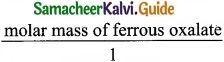
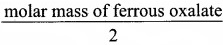
The equivalent mass of ferrous oxalate is …………………….
(a) Tamil Nadu 11th Chemistry Model Question Paper 5 English Medium img 1
(b) Tamil Nadu 11th Chemistry Model Question Paper 5 English Medium img 2
(c) Tamil Nadu 11th Chemistry Model Question Paper 5 English Medium img 3
(d) None of these
Solution:

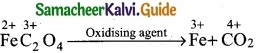
Tamil Nadu 11th Chemistry Model Question Paper 5 English Medium img 4

n = 1 + 2(1) = 3
Answer:
(c) Tamil Nadu 11th Chemistry Model Question Paper 5 English Medium img 3

Question 2.
Time independent Schnodinger wave equation is ………………….
(a) \(\widehat{\mathrm{H}} \psi=\mathrm{E} \psi\)
(b) \(\nabla^{2} \psi+\frac{8 \pi^{2} m}{h^{2}}(E+V) \psi=0\)
(c) \(\frac{\partial^{2} \Psi}{\partial x^{2}}+\frac{\partial^{2} \Psi}{\partial y^{2}}+\frac{\partial^{2} \Psi}{\partial z^{2}}+\frac{2 m}{h^{2}}(E-V) \psi=0\)
(d) All of these
Answer:
(a) \(\widehat{\mathrm{H}} \psi=\mathrm{E} \psi\)

Tamil Nadu 11th Chemistry Model Question Paper 5 English Medium

Question 3.
Choose the incorrect statement.
(а) The chemical symbol of nickel is Ni.
(b) An element is a material made up of different kind of atoms.
(c) The physical state of bromine is liquid.
(d) The physical and chemical properties of the elements are periodic functions of their atomic numbers.
Answer:
(b) An element is a material made up of different kind of atoms.

Question 4.
Assertion: Permanent hardness of water is removed by treatment with washing soda.
Reason: Washing soda reacts with soluble calcium and magnesium chlorides and sulphates in hard water to form insoluble carbonates.
(a) Both assertion and reason are true and reason is the correct explanation of assertion.
(b) Both assertion and reason are true but reason is not the correct explanation of assertion.
(c) Assertion is true but reason is false
(d) Both assertion and reason are false
Solution:
Ca2+ + Na2CO3 → CaCO3↓+ 2Na+
Answer:
(a) Both assertion and reason are true and reason is the correct explanation of assertion.

Question 5.
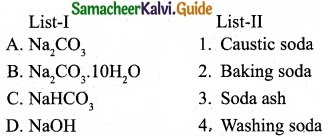
Match the following:

Tamil Nadu 11th Chemistry Model Question Paper 5 English Medium img 5

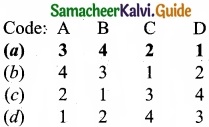
Answer:

Tamil Nadu 11th Chemistry Model Question Paper 5 English Medium img 6

Question 6.
Compressibility factor for CO2 at 400 K and 71.0 bar is 0.8697. The molar volume of CO2under these conditions is …………………………
(a) 22.04 dm3
(b) 2.24 dm3
(c) 0.41 dm3
(d) 19.5 dm3
Solution:
Compressibility factor (z) = \(\frac{PV}{nRT}\)
V = \(\frac{z × nRT}{p}\) = \(\frac{0.8697 \times 1 \times 8.314 \times 10^{-2} \mathrm{bar} \mathrm{dm}^{3} \mathrm{K}^{-1} \mathrm{mol}^{-1} \times 400 \mathrm{K}}{71 \mathrm{bar}}\)
V = 0.41 dm3
Answer:
(c) 0.41 dm3

Tamil Nadu 11th Chemistry Model Question Paper 5 English Medium

Question 7.
Thermodynamics is applicable to …………………….
(a) Macroscopic system only
(b) Microscopic system only
(c) Homogenous system only
(d) Heterogeneous system only
Answer:
(a) Macroscopic system only

Question 8.
In the reaction, Fe(OH)3 (s) ⇄ Fe3+ (aq) + 3OH(aq), if the concentration of OH ions is decreased by \(\frac{1}{4}\) times, then the equilibrium concentration of Fe3+ will …………………….
(a) Not changed
(b) Also decreased by \(\frac{1}{4}\) times
(c) Increase by 4 times
(d) Increase by 64 times
Solution:

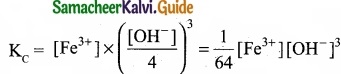
Tamil Nadu 11th Chemistry Model Question Paper 5 English Medium img 7

When concentration of OH ions declared by \(\frac{1}{4}\) times, then

Tamil Nadu 11th Chemistry Model Question Paper 5 English Medium img 8

To maintain KC as constant, concentration of Fe3+ will increase by 64 times.
Answer:
(d) Increase by 64 times

Question 9.
The degree of dissociation a is equal to ……………………
(a) \(\frac{i-1}{n-1}\)
(b) \(\frac{(1-i)n}{n-1}\)
(c) \(\frac{i+1}{n+1}\)
(d) \(\frac{(1+i)n}{n+1}\)
Answer:
(a) \(\frac{i-1}{n-1}\)

Tamil Nadu 11th Chemistry Model Question Paper 5 English Medium

Question 10.
The molecules having same hybridisation, shape and number of lone pair of electrons are ………………………..
(a) SeF4, XeO2F2
(b) SF4, XeF2
(c) XeOF4, TeF4
(d) SeCl4, XeF4
Solution:
SeF4, XeO2F2 – sp3d hybridisation
T-shaped, one lone pair on central atom.
Answer:
(a) SeF4, XeO2F2

Question 11.
Connect pair of compounds which give blue colouration/precipitate and white precipitate respectively, when their Lassaigne’s test is separately done.
(a) NH2NH2HCl and ClCH2 – CHO
(b) NH2CS NH2 and CH3 – CH2Cl
(c) NH2CH2 COOH and NH2 CONH2
(d) C6H5NH2 and ClCH2 – CHO
Answer:
(d) C6H5NH2 and ClCH2 – CHO

Tamil Nadu 11th Chemistry Model Question Paper 5 English Medium

Question 12.
4-hydroxy phenol oxidised in the presence of K2Cr2O7?H+ to give, …………………….
(a) Quinol
(b) Quinone
(c) Diol
(d) Alkane
Answer:
(b) Quinone

Question 13.
Methane gas is also called as ……………………
(a) Marsh gas
(b) Mass gas
(c) Molecular gas
(d) Model gas
Answer:
(a) Marsh gas

Question 14.
The catalyst used in Darzen halogenation of alcohol is ……………………..
(a) CCl4
(b) Acetone
(c) Pyridine
(d) Ethene
Answer:
(c) Pyridine

Tamil Nadu 11th Chemistry Model Question Paper 5 English Medium

Question 15.
Identify the wrong statement in the following.
(a) The clean water would have a BOD value of more than 5 ppm
(b) Greenhouse effect is also called as Global warming
(c) Minute solid particles in air is known as particulate pollutants
(d) Biosphere is the protective blanket of gases surrounding the earth
Answer:
(a) The clean water would have a BOD value of more than 5 ppm

PART – II

Answer any six questions in which question No. 20 is compulsory. [6 × 2 = 12]

Question 16.
First ionization potential of C-atom is greater than that of B-atom, where as the reverse is true for second ionization potential?
Answer:
G (Z = 6) 1s2 2s2 2px‘ 2py‘. The electron removal from p orbital is very difficult. So carbon has highest first ionization potential.
B (Z = 5) 1s2 2s2 2p1. In boron nuclear charge is less than that of carbon, so boron has lowest first ionization potential.
I.E1 C > I.E1B

But it is reverse in the case of second ionization energy. Because in case of B+ the electronic configuration is 1s2 2s2, which is completely filled and it has high ionization energy. But in C+ the electronic configuration is 1s2 2s2 2p1, one electron removal is easy so it has low ionization energy.

Tamil Nadu 11th Chemistry Model Question Paper 5 English Medium

Question 17.
Why H2O2 is used as mild antiseptic?
Answer:
The oxidising property of hydrogen peroxide and harmless nature of its products such as water and oxygen, leads to oxidation of pollutants in water and act as a mild antiseptic.

Question 18.
An alkali metal (x) forms a hydrated sulphate, X2SO4.10H2O. Is the metal more likely to be sodium (or) potassium?
Answer:
X forms X2SO4. 10H2O. The metal is more likely be sodium. So X is Na2SO4. 10H2O. It is otherwise called as Glauber’s salt.

Tamil Nadu 11th Chemistry Model Question Paper 5 English Medium

Question 19.
Define Zeroth law of thermodynamics (or) Law of thermal equilibrium?
Answer:
Zeroth law of thermodynamics states that ‘If two systems at different temperatures are separately in thermal equilibrium with a third one, then they tend to be in thermal equilibrium with themselves’.

Question 20.
2.82 g of glucose is dissolved in 30 g of water. Calculate the mole fraction of glucose and water?
Solution:
Mass of glucose = 2.82 g
No. of moles of glucose = \(\frac{2.82}{180}\) = 0.016
Mass of water = 30g = \(\frac{20}{18}\) = 1.67
xH2O = \(\frac{1.67}{1.67+0.016}\) = \(\frac{1.67}{1.686}\) = 0.99
∴xH2O + xxglucose = 1
0.99 + xglucose = 1
xglucose = 1 – 0.99 = 0.01

Tamil Nadu 11th Chemistry Model Question Paper 5 English Medium

Question 21.
Considering x-axis as molecular axis, which out of the following will form a sigma bond.

  1. 1s and 2py
  2. 2px and 2px
  3. 2px and 2py
  4. 1s and 2pz

Answer:
Along X-axis as molecular axis, only 2px and 2py can form a sigma bond

Tamil Nadu 11th Chemistry Model Question Paper 5 English Medium img 9

2px + 2py and 1s and 2p2 also cannot form σ bond.

Question 22.
What happen when nitrile undergoes acid hydrolysis?
Answer:
When alkyl nitrile undergoes acid hydrolysis to give amide, which on further hydrolysis to give carboxylic acid.

Tamil Nadu 11th Chemistry Model Question Paper 5 English Medium img 10

Question 23.
How ozone reacts with 2-methyl propene?
Answer:

Tamil Nadu 11th Chemistry Model Question Paper 5 English Medium img 11

Question 24.
What are Freons? Discuss their uses and environmental effects?
Answer:
Freons are the chlorofluoro derivatives of methane and ethane.
Freon is represented as Freon – cba
Where, c – number of carbon atoms, b = number of hydrogen atoms,
a = total number of fluorine atoms.

Tamil Nadu 11th Chemistry Model Question Paper 5 English Medium img 12

Uses of Freons:

  1. Freons are used as refrigerants in refrigerators and air conditioners.
  2. It is used as a propellant for aerosols and foams.
  3. It is used as propellant for foams, to spray out deodorants, shaving creams and insecticides.

Environmental effects of Freons:

1. Freon gas is a very powerful greenhouse gas which means that it traps the heat normally radiated from the earth out into the space. This causes the earth’s temperature to increase, resulting in rising sea levels, droughts, stronger storms, flash floods and a host of other very unpleasant effect. ,

2. As freon moves throughout the air, its chemical ingredients causes depletion of ozone layer. Depletion of ozone increases the amount of ultraviolet radiations that reaches the earths surface, resulting in serious risk to human health. High levels of ozone, in turn, causes respiratory problems and can also kill plants.

PART – III

Answer any six questions in which question No. 26 is compulsory. [6 × 3 = 18]

Question 25.
The first ionisation energy (IE1) and second ionisation energy (IE2) of elements X, Y and Z are given below.

Tamil Nadu 11th Chemistry Model Question Paper 5 English Medium img 13

Which one of the above elements is the most reactive metal, the least reactive metal and a noble gas?
Answer:
Noble gases: Ioniation energy ranging from 2372 KJ mol-1 to 1037 kJ mol-1.
For element X, the IE1, value is in the range of noble gas, moreover for this element both IE1 and IE2 are higher and hence X is the noble gas.

For Y, the first ionisation energy is low and second ionisation energy is very high and hence Y is most reactive metal.
For Z, both IE1 and IE2 are higher and hence it is least reactive.

Tamil Nadu 11th Chemistry Model Question Paper 5 English Medium

Question 26.
An isotope of hydrogen (A) reacts with diatomic molecule of element which occupies group number 16 and period number 2 to give compound (B) is used as a modulator in nuclear reaction. (A) adds on to a compound (C), which has the molecular formula C3H6 to give (D). Identify A, B, C and D?
Answer:
(I) An isotope of hydrogen Deuterium (A) reacts with diatomic molecule of element belongs to group number 16 and period number 2 oxygen O2 to give a compound (B) which is heavy water D2O. D2O is used as a moderator in nuclear reaction:

Tamil Nadu 11th Chemistry Model Question Paper 5 English Medium img 14

(II) Deuterium reacts with C3H6 propane (C) to give Deutero propane C2D6 (D).

Tamil Nadu 11th Chemistry Model Question Paper 5 English Medium img 15

Question 27.
Give the uses of gypsum?
Answer:

  1. The Alabaster variety qf gypsum was used by the sculptors.
  2. Gypsum is used in making drywalls or plaster boards.
  3. Gypsum is used in the production of Plaster of Paris, which is used as a sculpting material.
  4. Gypsum is used in making surgical and orthopedic casts.
  5. It plays an important role in agriculture as a soil additive, conditioner and fertilizer.
  6. Gypsum is used in toothpaste, shampoo and hair products.
  7. Calcium sulphate acts as a coagulator in making tofu.
  8. It is also used in baking as a dough conditioner.
  9. Gypsum is a component of Portland cement, where it acts as a hardening retarder to control the speed at which concrete sets.
  10. Gypsum is used to give colour to cosmetics and drugs.
  11. Gypsum plays a very important role in wine making.

Tamil Nadu 11th Chemistry Model Question Paper 5 English Medium

Question 28.
Define inversion temperature?
Answer:
The temperature below which a gas obey Joule-Thomson effect is called inversion temperature (Ti).
Ti = \(\frac{2a}{2Rb}\)

Question 29.
The vapour pressure of pure benzene (C6H6) at a given temperature is 640 mm Hg. 2.2g , of non-volatile solute is added to 40 g of benzene. The vapour pressure of the solution is 600 mm Hg. Calculate the molar mass of the solute?
Answer:

Tamil Nadu 11th Chemistry Model Question Paper 5 English Medium img 16

Question 30.
In CH4, NH3 and H2O, the central atom undergoes sp3 hybridisation-yet their bond angles are different, why?
Answer:

  1. In CH4, NH3 and H2O the central atom undergoes sp3 hybridisation. But their bond angles are different due to .the presence of lone pair of electrons.
  2. It can be explained by VSEPR theory. According to this theory, even though the hybridisation is same, the repulsive force between the bond pairs and lone pairs are not same.
  3. Bond pair – Bond pair < Bond pair – Lone pair < Lone pair -Lone pair
    So due to the varying repulsive force the bond pairs and lone pairs are distorted from regular geometry and organise themselves in such a way that repulsion will be minimum and stability will be maximum.
  4. In case of CH4, there are 4 bond pairs and no lone pair of electrons. So it remains in its regular geometry, i.e., tetrahedral with bond angle = 109° 28’.
  5. H2O has 2 bond pairs and 2 lone pairs. There is large repulsion between lp – lp. Again repulsion between lp – bp is more than that of 2 bond pairs. So 2 bonds are more restricted to form inverted V shape (eg;) bent shape molecule with a bond angle of 104° 35.
  6. NH3 has 3 bond pairs and 1 lone pair. There is repulsion between lp – bp. So 3 bonds are. more restricted to form pyramidal shape with bond angle equal to 107° 18’.

Tamil Nadu 11th Chemistry Model Question Paper 5 English Medium

Question 31.
How does hyper conjugation effect explain the stability of alkenes?
Answer:

  1. The relative stability of various classes of carbonium ions may be explained by the number of no bond resonance structures that can be written for them.
  2. Such structures are arrived by shifting the bonding electrons from an adjacent C – H bond to the electron deficient carbon.
  3. In this way, the positive charge originally on carbon is dispersed to the hydrogen. This manner of electron release by assuming no bond character in the adjacent C – H bond is called hyper conjugation or Baker – Nathan effect.
  4. The greater the hyper conjugation, the greater will be the stability of the compound.
    The increasing order of stability can be shown as:

Tamil Nadu 11th Chemistry Model Question Paper 5 English Medium img 17

5. Alkyl group increases in the C = C double bond carbon, hyper conjugation increases and stability of that organic compound also increases.

Tamil Nadu 11th Chemistry Model Question Paper 5 English Medium

Question 32.
What is BHC? How will you prepare BHC? Mention its uses?
Answer:

1. BHC is Benzene hexachloride.

2. Benzene reacts with three molecule of Cl2 in the presence of sunlight or UV light to yield BHC. This is also called as gammaxane or Lindane.

Tamil Nadu 11th Chemistry Model Question Paper 5 English Medium img 18

3. BHC is a powerful insecticide.

Tamil Nadu 11th Chemistry Model Question Paper 5 English Medium

Question 33.
Write a chemical reaction useful to prepare the following:

  1. Freon-12 from carbon tetrachloride.
  2. Carbon tetrachloride from carbon disulphide.

Answer:
1. Freon – 12 from carbon tetrachloride:
Freon – 12 is prepared by the action of hydrogen fluoride on carbon tetrachloride in the presence of catalytic amount of antimony pentachloride. This reaction is called “Swarts reaction.”

Tamil Nadu 11th Chemistry Model Question Paper 5 English Medium img 19

2. Carbon tetrachloride from carbon disulphide:
Carbon disulphide reacts with chlorine gas in the presence of anhydrous AlCl3 as catalyst to give carbon tetrachloride.

Tamil Nadu 11th Chemistry Model Question Paper 5 English Medium img 20

PART – IV

Answer all the questions. [5 × 5 = 25]

Question 34 (a).
(I) What is the difference between molecular mass and molar mass? Calculate the molecular mass and molar mass for carbon monoxide.
(II) What are competitive electron transfer reaction? Give example.

[OR]

(b) (I) State the trends in the variation of electronegativity in period and group.
(II) The electron gain enthalpy of chlorine is 348 kJ mol-1. How much energy in kJ is released when 17.5 g of chlorine is completely converted into Cl ions in the gaseous state?
Answer:
(a) (I) Molecular mass:

  1. Relative molecular mass is defined as the ratio of the mass of the molecule to the unified atomic mass unit.
  2. It can be calculated by adding the relative atomic masses of its constituent atoms.
  3. For carbon monoxide (CO)

Molecular mass = Atomic mass of carbon + Atomic mass of oxygen 12 + 16 = 28 u.

Molar mass:

  1. It is defined as the mass of one mole of a substance.
  2. The molar mass of a compound is equal to the sum of the relative atomic masses of its constituent expressed in g mol-1.
  3. For carbon monoxide (CO)

12 + 16 = 28 g mol-1.

Both molecular mass and molar mass are numerically same but the units are different.

(II) These are the reactions in which redox reactions take place in different vessels and it is an indirect redox reaction. There is a competition for the release of electrons among different metals.

Example:
Zn releases electrons to Cu and Cu releases electrons to Silver and so on.
Zn(s) + Cu2+ → Zn2+(aq) + Cu(s) (Here Zn – oxidised; Cu2+ – reduced)
Cu(s) + 2Ag+ → Cu2+(aq) + 2Ag(s) (Here Cu – oxidised; Ag+ – reduced)

[OR]

(b)
(I) Variation of electronegativity in a period:
The electronegativity increases across a period from left to right. Since the atomic radius decreases in a period, the attraction between the valence electron and the nucleus increases. Hence the tendency to attract shared pair of electrons increases, ‘therefore, electronegativity increases in a period.

(II) Water is amphoteric in nature and it behaves both as an acid as well as base. With acids stronger than itself (e.g., H2S) it behaves as a base and with bases stronger than itself (e.g., NH, ) it acts as an acid.

Tamil Nadu 11th Chemistry Model Question Paper 5 English Medium

Question 35 (a).
(I) Discuss the three types of Covalent hydrides?
(II) Write the chemical reactions to show the amphoteric nature of water?

[OR]

(b)
(I) Lithium forms monoxide with oxygen whereas sodium forms peroxide with oxygen. Why?
(II) Write about the uses of strontium?
Answer:
(a) (I)

  1. They are the compounds in which hydrogen is attached to another element by sharing of electrons.
  2. The most common examples of covalent hydrides are methane, ammonia, waterand hydrogen chloride.
  3. Molecular hydrides of hydrogen are further classified into three categories as,
    • Electron precise (CH4, C2H6, SiH4, GeH4)
    • Electron-deficient (B2H6) and
    • Electron-rich hydrides (NH3, H2O)
  4. Since most of the covalent hydrides consist of discrete, small molecules that have relatively weak intermolecular forces, they are generally gases or volatile liquids.

(II) Water is amphotenc in nature and it behaves both as an acid as well as base. With acids stronger than itself (e.g., H2S) it behaves as a base and with bases stronger than itself
(e.g., NH3) it acts as an acid.

  1. As a base: H2O(l) + H2S(aq) → H3O(aq) – HS(aq)
  2. As a acid: H2O(l) + NH3(aq) → OH(aq) + NH+(aq)

[OR]

(b) (I)

  1. The fact that a small cation can stabilize a small anion and a large cation can stabilize a large anion explains the formation and stability of the oxides.
  2. The size of Li+ ion is very small and it has a strong positive field around it. It can combine . with only small anion, O2- ion, resulting in the formation of monoxide Li2O.
  3. The Na+ ion is a larger cation and has a weak positive field around it and can stabilize a bigger peroxide ion, \(\mathrm{O}_{2}^{2-} \text { or }[-\mathrm{O}-\mathrm{O}-]^{2-}\) resulting in the formation of peroxide Na2O2.

(II)

  1. 90Sr is used in cancer therapy.
  2. \(^{87} \mathrm{Sr} /^{86} \mathrm{Sr}\) ratio is used in marine investigators as well as in teeth, tracking animal migrations or in criminal forensics.
  3. Dating of rocks.
  4. Strontium is used as a radioactive tracer in determining the ‘source of archaeological materials ’ such as timbers and coins.

Tamil Nadu 11th Chemistry Model Question Paper 5 English Medium

Question 36 (a).
(I) When the driver of an automobile applies brake, the passengers are pushed toward the front of the car but a helium balloon is pushed toward back of the car. Upon forward acceleration the passengers are pushed toward the front of the car. Why?
(II) Critical temperature of H2O, NH3 and CO2 are 647.4, 405.5 and 304.2 K, respectively. When we start cooling from a temperature of 700 K which will liquefy first and which will liquefy finally?

[OR]

(b)
(I) The following water gas shift reaction is an important industrial process for the production of hydrogen gas.
C0(g) + H2O(g) ⇄ CO2(g) + H2(g)
At a given temperature Kp = 2.7. If 0.13 mol of CO, 0.56 mol of water, 0.78 mol of CO2 and 0.28 mol of H2 are introduced into a 2L flask, find out in which direction must the reaction proceed to reach equilibrium.

(II)
2H2O(g) ⇄ 2H2(g) + O2(g) KC = 4.1 × 10-48 At 599 K
N2(g) + O2(g) ⇄ 2NO(g) KC = 1 × 10-30 at 1000 K
Predict the extent of the above two reactions.
Answer:
(a) (I)
1. When the driver of an automobile applies brake, the passengers are pushed toward the front of the car due to inertia of the body, but a helium balloon pushed toward back of the car. Helium balloon responds to the air around it. Helium molecules are lighter than air of our atmosphere, and so they move toward back by gravity as a result of the accelerating frame.

2. Upon forward acceleration, the passengers are pushed toward the front of the car,because the body in motion tends to stay in motion until acted upon by an outside force. Helium balloon is going to move opposite to this pseudo gravitational force.

(II) Critical temperature of a gas is defined as the temperature above which it cannot be liquefied even at high pressures.
∴ When cooling starts from 700 K, H2O will liquefied first, then followed by ammonia and finally carbon dioxide will liquefied.

[OR]

(b) (I)
CO(g) + H2O(g) ⇄ CO2(g) + H2(g)
Give KP = 2.7
[CO] = 0.13 mol, [H2O] = 0.56 mol
[CO2] = 0.78 mol; [H2] = 0.28 mol
V = 2L
KP = KC (RT)∆ng
2.7 = KC (RT)0
KC = 2.7
QC = \(\frac{\left[\mathrm{CO}_{2}\right]\left[\mathrm{H}_{2}\right]}{[\mathrm{CO}]\left[\mathrm{H}_{2} \mathrm{O}\right]}\) = \(\frac{\left(\frac{0.78}{2}\right)\left(\frac{0.28}{2}\right)}{\left(\frac{0.13}{2}\right)\left(\frac{0.56}{2}\right)}\)
Q = 3
Q > KC, Hence the reaction proceed in the reverse direction.

(II) In the reactions, decomposition of water at 500 K and oxidation of nitrogen at 1000 K, the value of KC is very less KC < 10-3. So reverse reaction is favoured.
∴ Products << reactants

Tamil Nadu 11th Chemistry Model Question Paper 5 English Medium

Question 37 (a).
(I) CuCl is more covalent than NaCl. Give reason?
(II) Draw and explain the molecular orbital diagram of Boron molecule?

[OR]

(b)
(I) 0.30 g of a substance gives 0.88 g of carbon dioxide and 0.54 g of water.
Calculate the percentage of carbon and hydrogen in it.

(II) Draw the fisher projection formula for tartaric acid.
Answer:
(a) (I)
1. Cations having ns2 np6 nd10 configuration show greater polarising power than the cations with ns2 np6 configuration. Hence they show greater covalent character.
2. CuCl is more covalent than NaCl. As compared to Na+ (1.13\(\overset { \circ }{ A } \)), Cu+ (0.6\(\overset { \circ }{ A } \)) is small and has 3s23p63d10 configuration.
3. Electronic configuration of Cu+: [Ar] 3s23p63d10
Electronic configuration of Na+: [He] 2s22p6
So CuCl is more covalent than NaCl.

(II)

Tamil Nadu 11th Chemistry Model Question Paper 5 English Medium img 20

1. Electronic configuration of B = 1s2 2s2 2p3
2. Electronic configuration of B2 = \(\sigma 1 s^{2} \sigma^{*} 1 s^{2} \sigma 2 s^{2} \sigma^{*} 2 s^{2} \pi 2 p_{x}^{1} \pi 2 p_{z}^{1}\)
3. Bond order = \(\frac { N_{ b }-N_{ a } }{ 2 } \) = \(\frac{6-4}{2}\) = 1
4. B2 molecule has two unpaired electrons hence it is paramagnetic.

[OR]

(b) (I) Weight of organic compound = 0.30 g
Weight of carbon-dioxide = 0.88 g
Weight of water = 0.54 g

Percentage of hydrogen:
18 g of water contains 2 g of hydrogen
∴ 0.54 g of water contain = \(\frac{2}{18}\) × 0.54g of hydrogen
∴% of hydrogen = \(\frac{2}{18}\) × \(\frac{0.54}{0.30}\) × 100 = \(\frac{2}{18}\) × \(\frac{54}{0.3}\)
% of H = 0.111 × 180 = 19.888 ~ 20%

Percentage of carbon:
44 g of water contains 12 g of hydrogen
0.88 g of water contain CO2 contains = \(\frac{12}{44}\) × 0.88g of hydrogen
∴ % of carbon = \(\frac{12}{44}\) × \(\frac{0.88}{0.30}\) × 100 = \(\frac{12}{44}\) × \(\frac{88}{0.3}\) = \(\frac{24}{0.3}\)
% of carbon = 80%

(II) Tamil Nadu 11th Chemistry Model Question Paper 5 English Medium img 22

Tamil Nadu 11th Chemistry Model Question Paper 5 English Medium

Question 38 (a).
An organic compound (A) of a molecular formula C6H6 which is a simple aromatic hydrocarbon. A undergoes hydrogenation to give a cyclic compound (B). A reacts with chlorine in the presence of UV – light to give C which is used as insecticide. Identify A, B and C. Explain the reactions with equation.

[OR]

(b) An organic compound (A) of molecular formula CH2 reacts with methyl magnesium iodide followed by acid hydrolysis to give (B) of molecular formula C2H6O. (B) on reaction with PCl gives (C).(C) on reaction with alcoholic KOH gives (D) an alkene as the product. Identify (A), (B), (C), (D) and explain the reactions involved.
Answer:

  1. Simple aromatic hydrocarbon, C6H6 is benzene.
  2. Benzene (A) reacts with H2 in the presence of Pt to give cyclohexane (B).

Tamil Nadu 11th Chemistry Model Question Paper 5 English Medium img 23

3. Benzene (A) reacts with Cl2 in presence of UV-light to give benzene hexachloride (C).

Tamil Nadu 11th Chemistry Model Question Paper 5 English Medium img 24

Tamil Nadu 11th Chemistry Model Question Paper 5 English Medium img 25

[OR]

(b) (I)
1. (A) Of molecular formula CH2O is identified as HCHO, formaldehyde.
2. Formaldehyde reacts with CH3MgI followed by hydrolysis to give ethanol, CH3-CH2OH B as the product.

Tamil Nadu 11th Chemistry Model Question Paper 5 English Medium img 26

Tamil Nadu 11th Biology Model Question Paper 2 English Medium

Students can Download Tamil Nadu 11th Biology Model Question Paper 2 English Medium Pdf, Tamil Nadu 11th Biology Model Question Papers helps you to revise the complete Tamilnadu State Board New Syllabus, helps students complete homework assignments and to score high marks in board exams.

TN State Board 11th Biology Model Question Paper 2 English Medium

General Instructions:

    1. The question paper comprises of four parts. Questions for Botany and Zoology are asked separately.
    2. You are to attempt all the parts. An internal choice of questions is provided wherever applicable.
    3. All questions of Part I, II, III and IV are to be attempted separately.
    4. Question numbers 1 to 8 in Part I are Multiple Choice Questions of one mark each. These are to be answered by choosing the most suitable answer from the given four alternatives and writing the option code and the corresponding answer.
    5. Question numbers 9 to 14 in Part II are two-marks questions. These are to be answered in about one or two sentences.
    6. Question numbers 15 to 19 in Part III are three-marks questions. These are to be answered in about three to five short sentences.
    7. Question numbers 20 and 21 in Part IV are five-marks questions. These are to be answered in detail. Draw diagrams wherever necessary.

Time: 3:00 Hours
Maximum Marks: 70

Bio – Botany [Maximum Marks: 35]

PART – I

Answer all the questions. Choose the correct answer. [8 × 1 = 8]

Question 1.
Red sea is red colour due to ……………………
(a) Dermacarpa sps
(b) Trichodesmium sps
(c) Scytonema sps
(d) Gloeocapsa sps.
Answer:
(b) Trichodesmium sps

Question 2.
Sago is obtained from …………………..
(a) Cycas revoluta
(b) Pinus roxburghil
(c) Pinus insularis
(d) Cedrus deodara
Answer:
(a) Cycas revoluta

Tamil Nadu 11th Biology Model Question Paper 2 English Medium

Question 3.
Plants growing on the water surface are called as …………………… type of aquatic plants.
(a) Emergent
(b) Submerged
(c) Free floating
(d) Mangroves
Answer:
(c) Free floating

Question 4.
Synapsis occur between
(a) mRNA and ribosomes
(b) Spindle fibres and centromeres
(c) Two homologous chromosomes
(d) A male and a female gamete
Answer:
(c) Two homologous chromosomes

Tamil Nadu 11th Biology Model Question Paper 2 English Medium

Question 5.
An example of feedback inhibition is ………………………
(a) Cyanide action on cytochrome
(b) Sulpha drug on folic acid synthesiser bacteria
(c) Allosteric inhibition of hexokinase by glucose-6-phosphate
(d) The inhibition of succinic dehydrogenase by malonate
Answer:
(c) Allosteric inhibition of hexokinase by glucose-6-phosphate

Question 6.
Rubber is a …………………..
(a) Latex
(b) Resin
(c) Alkaloid
(d) Drug
Answer:
(a) Latex

Question 7.
Identify the correct statement:
(I) Sulphur is essential for amino acids Cystine and Methionine
(II) Low level of N, K, S and Mo affect the cell division
(III) Non-leguminous plant Aims which contain bacterium Frankia
(IV) Denitrification carried out by Nitrosomonas and Nitrobacter
(a) (I), (II) are correct
(b) (I), (II), (III) are correct
(c) (I) only correct
(d) All are correct
Answer:
(b) (I), (II), (III) are correct

Tamil Nadu 11th Biology Model Question Paper 2 English Medium

Question 8.
Which step is irrelevant with respect to aerobic respiration?
(a) Glycolysis
(b) Pyruvate oxidate
(c) Fermentation
(d) TCA cycle
Answer:
(c) Fermentation

PART – II

Answer any four of the following questions. [4 × 2 = 8]

Question 9.
How milk is changed into curd, if a few drops of curd is added to it? What is the reason for its sourness?
Answer:
The change is brought by Lactobacillus lactis, a bacterium present in the curd. The sourness is due to the formation of lactic acid.

Tamil Nadu 11th Biology Model Question Paper 2 English Medium

Question 10.
What are pyrenoids? Mention its role?
Answer:
Pyrenoids are proteinaceous bodies found in chromatophores of algae and assist in the synthesis and storage of starch.

Question 11.
From which type of flowers does the aggregate fruit develops?
Answer:
Aggregate fruits develop from a single flower having an apocarpous pistil. Each of the free carpel is develops into a simple fruitlet. A collection of simple fruitlets makes an aggregate fruit.

Tamil Nadu 11th Biology Model Question Paper 2 English Medium

Question 12.
Define magnification. How will you calculate it?
Answer:
The optical increase in the size of an image is called magnification. It is calculated by the following formula;
Magnification = Tamil Nadu 11th Biology Model Question Paper 2 image 1

Question 13.
Define Diffusion Pressure Deficit (DPD)?
Answer:
The difference between the diffusion pressure of the solution and its solvent at a particular . temperature and atmospheric pressure is called as Diffusion Pressure Deficit (DPD).

Tamil Nadu 11th Biology Model Question Paper 2 English Medium

Question 14.
Name the two forms of phycobilins and also give an example?
Answer:
Phycobilins exists in two form. They are:

  1. Phycocyanin found in Cyanobacteria.
  2. Phycoerythrin found in red algae.

PART – III

Answer any three questions in which question number 19 is compulsory. [3 × 3 = 9]

Question 15.
Do you think shape of chloroplast is unique for algae? Justify your answer?
Answer:
Variation among the shape of the chloroplast is found in members of algae. It is Cup shaped (Chlartiydomonas), Discoid (Chara), Girdle shaped (Ulothrix), reticulate (Oedogonium), spiral (Spirogyra), stellate (Zygnema) and plate like (Mougeoutia).

Question 16.
Name few molecular markers used in molecular taxonomy?
Answer:
Allozymes, mitochondrial DNA, micro satellites, RFLP (Restriction Fragment Length Polymorphism), RAPD (Random amplified polymorphic DNA), AFLPs (Amplified Fragment Length Polymorphism), Single nucleotide Polymorphism – SNP, microchips or arrays.

Tamil Nadu 11th Biology Model Question Paper 2 English Medium

Question 17.
List out the criteria for being as essential minerals?
Answer:
Amon and Stout (1939) gave criteria required for essential minerals:

  1. Elements necessary for growth and development.
  2. They should have direct role in the metabolism of the plant.
  3. It cannot be replaced by other elements.
  4. Deficiency makes the plants impossible to complete their vegetative and reproductive phase.

Tamil Nadu 11th Biology Model Question Paper 2 English Medium

Question 18.
Draw a simplified diagram showing the various regions of root?
Answer:

Tamil Nadu 11th Biology Model Question Paper 2 image 2

Question 19.
What do you mean by the term – Basipetal transport and Acropetal transport?
Answer:
Basipetal means transport through phloem from shoot to root and acropetal means transport through xylem from root to shoot.

PART – IV

Answer all the questions. [2 × 5 = 10]

Question 20.
Describe in detail about the lytic cycle of phages with diagram?
Answer:
Lytic cycle:
During lytic cycle of phage, disintegration of host bacterial cell occurs and the progeny virions are released. The steps involved in the lytic cycle are as follows:

(I) Adsorption:
Phage (T4) particles interact with cell wall of host (E coli). The phage tail makes contact between the two, and tail fibres recognize the specific receptor sites present on bacterial cell surface. The lipopolysaccharides of tail fibres act as receptor in phages.

The process involving the recognition of phage to bacterium is called landing. Once the contact is established between tail fibres of phage and bacterial cell, tail fibres bend to anchor the pins and base plate to the cell surface. This step is called pinning.

(II) Penetration:
The penetration process involves mechanical and enzymatic digestion of the cell wall of the host. At the recognition site phage digests certain cell wall structure by viral enzyme (lysozyme). After pinning the tail sheath contracts (using ATP) and appears shorter and thicker.

After contraction of the base plate enlarges through which DNA is injected into the cell wall without using metabolic energy. The step involving injection of DNA particle alone into the bacterial cell is called Transfection. The empty protein coat leaving outside the cell is known as ‘ghost’.

Tamil Nadu 11th Biology Model Question Paper 2 image 3

(III) Synthesis:
This step involves the degradation of bacterial chromosome, protein synthesis and DNA replication. The phage nucleic acid takes over the host biosynthetic machinery. Host DNA gets inactivated and breaks down.

Phage DNA suppresses the synthesis of bacterial protein and directs the metabolism of the cell to synthesis the proteins of the phage particles and simultaneously replication of phage DNA also takes place.

(IV) Assembly and Maturation:
The DNA of the phage and protein coat are synthesized separately and are assembled to form phage particles. The process of assembling the phage particles is known as maturation. After 20 minutes of infection about 300 new phages are assembled.

(V) Release:
The phage particle gets accumulated inside the host cell and are released by the lysis of the host cell wall.

[OR]

Draw a flow chart depicting the Bentham and Hooker Classification?
Answer:

Tamil Nadu 11th Biology Model Question Paper 2 image 4

Tamil Nadu 11th Biology Model Question Paper 2 English Medium

Question 21.
With the help of diagram explain the possible route of water across root cells?
Answer:
There are three possible routes of water.
They are:-

  1. Apoplast
  2. Symplast and
  3. Transmembrane route.

1. Apoplast:
The apoplast (Greek: apo = away; plast = cell) consists of everything external to the plasma membrane of the living cell. The apoplast includes cell walls, extra cellular spaces and the interior of dead cells such as vessel elements and tracheids.

In the apoplast pathway, water moves exclusively through the cell wall or the non-living part of the plant without crossing any membrane. The apoplast is a continuous system.

Tamil Nadu 11th Biology Model Question Paper 2 image 5

2. Symplast:
The symplast (Greek: sym = within; plast = cell) consists of the entire mass of cytosol of all the living cells in a plant, as well as the plasmodesmata, the cytoplasmic channel that interconnects them.

In the symplastic route, water has to cross plasma membrane to enter the cytoplasm of outer root cell; then it will move within adjoining cytoplasm through plasmodesmata around the vacuoles without the necessity to cross more membrane, till it reaches xylem.

3. Transmembrane route:
In transmembrane pathway water sequentially enters a cell on one side and exits from the cell on the other side. In this pathway, water crosses at least two membranes for each cell. Transport across the tonoplast is also involved.

Mechanism of Water Absorption Kramer (1949) recognized two distinct mechanisms which independently operate in the absorption of water in plants. They are,

  1. Active absorption
  2. Passive absorption.

[OR]

Explain the types of parasitic mode of nutrition in angiosperms?
Parasitic mode of nutrition in angiosperms:
Answer:
Organisms deriving their nutrient from another organism (host) and causing disease to the host are called parasites.

a. Obligate or Total parasite – Completely depends on host for their survival and produces haustoria.

(I) Total stem parasite:
The leafless stem twine around the host and produce haustoria. Example: Cuscuta (Dodder), a rootless plant growing on Zizyphns, Citrus and so on.

(II) Total root parasite:
They do not have stem axis and grow in the roots of host plants produce haustoria. Example: Rajflesia, Orobanche and Balanophora.

b. Partial parasite – Plants of this group contain chlorophyll and synthesize carbohydrates. Water and mineral requirements are dependent on host plant.

(I) Partial Stem Parasite:
Example: Loranthus and Viscum (Mistletoe) Loranthus grows on fig and mango trees and absorb water and minerals from xylem.

(II) Partial root parasite:
Example: Santalum album (Sandal wood tree) in its juvenile stage produces haustoria which grows on roots of many plants.

Bio – Zoology [Maximum marks: 35]

PART – I

Answer all the questions. Choose the correct answer. [8 × 1 = 8]

Question 1.
Which is not a unit of taxonomic category?
(a) Series
(b) Glumaceae
(c) Class
(d) Phylum
Answer:
(b) Glumaceae

Tamil Nadu 11th Biology Model Question Paper 2 English Medium

Question 2.
Study of ticks and mites is ……………………
(a) Acarology
(b) Entomology
(c) Malacology
(d) Carcinology
Answer:
(a) Acarology

Tamil Nadu 11th Biology Model Question Paper 2 English Medium

Question 3.
Match the List – I and List – II.

List – I

List – II

1. Silver fish(i) Book lung
2. Scorphion(ii) Pharyngeal gills
3. Sea squirt(iii) Lungs
4. Dolphin(iv) Trachea

Answer:
(a) 1 – (iv), 2 – (i), 3 – (iii), 4 – (ii)
(b) 1 – (iv), 2 – (i), 3 – (ii), 4 – (iii)
(c) 1 – (i), 2 – (iii), 3 – (iv), 4 – (ii)
(d) 1 – (i), 2 – (iv), 3 – (iii), 4 – (ii)

Tamil Nadu 11th Biology Model Question Paper 2 English Medium

Question 4.
MSH stands for ……………………
(a) Melanocyte stimulating hormone
(b) Malic stimulating hormone
(c) Myosin stimulating hormone
(d) Metabolic stimulating hormone
Answer:
(a) Melanocyte stimulating hormone

Question 5.
Which of the following is an correct statement?
(a) Ehler’s – Danlos syndrome – Affects collagen and results in facial abnormalities.
(b) Rhabdomyosarconca – Life threatening soft tissue tumour of head, neck and urinogenital tract.
(c) Rheumatoid arthritis – Progressive inability to secrete saliva and tears.
(d) Alzheiner’s disease – A degenerative disorder of the nervous system that affects movement often including tremors.
Answer:
(b) Rhabdomyosarconca – Life threatening soft tissue tumour of head, neck and urinogenital tract.

Question 6.
Which of the following is an incorrect statement?
(a) The functions of frontal region are Behaviour, intelligence, memory and movement.
(b) The functions of parietal region is intelligence and memory.
(c) The functions of temporal region are speech, hearing and memory.
(d) The functions of occipital region is visual processing.
Answer:
(b) The functions of parietal region is intelligence and memory.

Tamil Nadu 11th Biology Model Question Paper 2 English Medium

Question 7.
Synovial fluid is present in …………………….
(a) Spinal cavity
(b) Cranial activity
(c) Freely movable joints
(d) Fixed joints
Answer:
(c) Freely movable joints

Question 8.
Glands responsible for secreting tears are ………………………….
(a) Glands of moll
(b) Lacrimal glands
(c) Meibomian glands
(d) Glands of Zeis
Answer:
(b) Lacrimal glands

PART – II

Answer any four of the following questions. [4 × 2 = 8]

Question 9.
Why are spongin and spicules important to a sponge?
Answer:
Spongin and spicules provide support and supports the soft body parts of the sponges. The spicules give the sponges rigidity and form to the sponges.

Question 10.
What is water vascular system?
Answer:
The system which helps in nutrition and respiration in echinoderms is called water vascular system. Water enters into the body through special organs.

Tamil Nadu 11th Biology Model Question Paper 2 English Medium

Question 11.
Difference between chordates and non-chordates?
Answer:

S.No

Chordates

Non-Chordates

1.Notochord is present.Absence of notochord.
2.Pharynx perforated by gill slits.Gill slits absent.
3.A post anal tail is present.Post anal tail is absent.

Question 12.
Draw the diagram of head region of Periplaneta americana?
Answer:

Tamil Nadu 11th Biology Model Question Paper 2 image 6

Question 13.
Name the different types of movement?
Answer:

  1. Amoeboid movement.
  2. Ciliary movement.
  3. Flagellar movement.
  4. Muscular movement.

Tamil Nadu 11th Biology Model Question Paper 2 English Medium

Question 14.
What is endomysium?
Answer:
The connective tissue surrounding the muscle fibre is called the endomysium.

PART – III

Answer any three questions in which question number 19 is compulsory. [3 × 3 = 9]

Question 15.
What are the classical taxonomical tools?
Answer:
Taxonomical tools are the tools for the study of classification of organisms.
They include:-

Taxonomical keys:
Keys are based on comparative analysis of the similarities and dissimilarities of organisms. There are separate keys for different taxonomic categories.

Museum:
Biological Museums have collection of preserved plants and animals for study and ready reference. Specimens of both extinct and living organisms can be studied.

Zoological parks:
These are places where wild animals are kept in protected environments under human care. It enables us to study their food habits and behavior.

Marine parks:
Marine organisms are maintained in protected environments.

Printed taxonomical tools:
It consist of identification cards, description, field guides and manuals.

Tamil Nadu 11th Biology Model Question Paper 2 English Medium

Question 16.
Differentiate Ehler’s – Danlos syndrome and stickler syndrome?
Answer:
Ehler’s – Danlos syndrome is the defect in the synthesis of collagen in the joints, heart valves, organ walls and arterial walls:
Stickler syndrome is a group of hereditary conditions affecting collagen and results in facial abnormalities.

Question 17.
Define Purkinje fibres?
Answer:
Two special cardiac muscle fibres originate from the auriculo ventricular node and are called the bundle of his which runs down into the interventricular septum and the fibres spread into the ventricles. These fibres are called the Purkinje fibres.

Tamil Nadu 11th Biology Model Question Paper 2 English Medium

Question 18.
Draw the diagram of pelvic girdle with lower limb?
Answer:

Tamil Nadu 11th Biology Model Question Paper 2 image 7

Tamil Nadu 11th Biology Model Question Paper 2 English Medium

Question 19.
What are the symptoms of acromegaly?
Answer:
Acromegaly is caused due to excessive secretion of growth hormone in adults. The symptoms of acromegaly are:

  1. Overgrowth of hand bones, feet bones, jaw bones.
  2. Malfunctioning of gonads.
  3. Enlargement of viscera, tongue, lungs, heart, liver, splean and endocrine glands like thyroid, or adrenal glands.

PART – IV

Answer all the questions. [2 × 5 = 10]

Question 20.
Describe the digestive system of Lamipto mauritii?
Answer:
The digestive system of the earthworm consists of the alimentary canal and the digestive glands. The alimentary canal runs as a straight tube throughout the length of the body from the mouth to anus.

The mouth opens into the buccal cavity which occupies the 1sstand 22nd segments. The buccal cavity leads into a thick muscular pharynx,which occupies the 3rd and 4th segments and is surrounded by the pharyngeal glands.

A small narrow tube, oesophagus lies in the 5th segment and continues into a muscular gizzard in the 6th segment. The gizzard helps in the grinding of soil particles and decaying leaves. Intestine starts from the 7th segment and continues till the last segment.

The dorsal wall of the intestine is folded into the cavity as the typhlosole. This fold contains blood vessels and increases the absorptive area of the intestine. The imier epithelium consists of columnar cells and glandular cells. The alimentary canal opens to the exterior through the anus.

Tamil Nadu 11th Biology Model Question Paper 2 image 8

The ingested organic rich soil passes through the digestive tract where digestive enzymes breakdown complex food into smaller absorbable units. The simpler molecules are absorbed through the intestinal membrane and are utilized.

The undigested particles along with earth are passed out through the anus, as worm castings or vermicasts. The pharyngeal or salivary gland cells and the glandular cells of the intestine are supposed to be the digestive glands which secrete digestive enzymes for digestion of food.

[OR]

What are the effects of smoking?
Answer:
Today due to curiosity, excitement or adventure youngsters start to smoke and later get addicted to smoking. Research says about 80% of the lung cancer is due to cigarette smoking. Smoking is inhaling the smoke from burning tobacco. There are thousands of known chemicals which includes nicotine, tar, carbon monoxide, ammonia, sulphur-dioxide and even small quantities of arsenic.

Carbon monoxide and nicotine damage the cardiovascular system and tar damages the gaseous exchange system. Nicotine is the chemical that causes addiction and is a stimulant which makes the heart beat faster and the narrowing of blood vessels results in raised blood pressure and coronary heart diseases.

Presence of carbon monoxide reduces oxygen supply. Lung cancer, mouth cancer and larynx is more common in smokers than non – smokers. Smoking also causes cancer of the stomach, pancreas and bladder and lowers sperm count in men.

Smoking can cause lunb diseases by damaging the airways and alveoli and results in emphysema and chronic bronchitis. These two diseases along with asthma are often referred as Chronic Obstructive Pulmonary Disease (COPD).

When a person smokes, nearly 85% of the smoke released is inhaled by the smoker himself and others in the vicinity, called passive smokers, are also affected. Guidance or counselling should be done in such users to withdraw this habit.

Tamil Nadu 11th Biology Model Question Paper 2 English Medium

Question 21.
Explain the structure of spinal cord?
Answer:
The spinal cord is a long, slender, cylindrical nervous tissue. It is protected by the vertebral column and surrounded by the three membranes as in the brain. The spinal cord that extends from the brain stem into the vertebral canal of the vertebral column up to the level of 1st or 22nd lumbar vertebra.

So the nerve roots of the remaining nerves are greatly elongated to exit the vertebral column at their appropriate space. The thick bundle of elongated nerve . roots within the lower vertebral canal is called the cauda equina (horse’s tail) because of its appearance.

In the cross section of spinal cord, there are two indentations: the posterior median sulcus and the anterior median fissure. Although there might be slight variations, the cross section of spinal cord is generally the same throughout its length. In contrast to the brain, the grey matter in the spinal cord forms an inner butterfly shaped region surrounded by the outer white matter.

The grey matter consists of neuronal cell bodies and their dendrites, intemeurons and glial cells. White matter consists of bundles of nerve fibres. In the center of the grey matter there is a central canal which is filled with CSF. Each half of the grey matter is divided into a dorsal horn, a ventral hom and a lateral horn.

The dorsal horn contains cell bodies of interneurons on which afferent neurons terminate. The ventral hom contains cell bodies of the efferent motor neurons supplying the skeletal muscle. Autonomic nerve fibres, supplying cardiac and smooth muscles and exocrine glands, originate from the cell bodies found in the lateral horn.

In the white matter, the bundles of nerve fibres form two types of tracts namely ascending tracts which carry’ sensory impulses to the brain and descending tracts which carry motor impulses from the brain to the spinal nerves at various levels of the spinal cord. The spinal cord shows two enlargements,one in the cervical region and another one in the lumbosacral region. The cervical enlargement serves the upper limb and lumbar enlargement serves the lower limbs.

Tamil Nadu 11th Biology Model Question Paper 2 image 9

[OR]

What are the stages involved in rearing of chicken?
Answer:
Stages involved in rearing:
There are some steps involved in rearing of chicken.

1. Selection of the best layer:
An active intelligent looking bird, with a bright comb, not obese should be selected.

2. Selection of eggs for hatching:
Eggs should be selected very carefully. Eggs should be fertile, medium sized, dark brown shelled and freshly laid eggs are preferred for rearing. Eggs should be washed, cleaned and dried.

3. Incubation and hatching:
The maintenance of newly laid eggs in optimum condition till hatching is called incubation. The fully developed chick emerges out of egg after an incubation period of 21 – 22 days.

There are two types of incubation namely natural incubation and artificial incubation. In the natural incubation method, only a limited number of eggs can be incubated by a mother hen. In artificial incubation, more number of eggs can be incubated in a chamber (Incubator).

4. Brooding:
Caring and management of young chicks for 4 – 6 weeks immediately after hatching is called brooding. It can also be categorized into two types namely natural and artificial brooding.

5. Housing of Poultry:
To protect the poultry from sun, rain and predators it is necessary to provide housing to poultry. Poultry house should be moisture proof, rat proof and it should be easily cleanable and durable.

6. Poultry feeding:
The diet of chicks should contain adequate amount of water,carbohydrates, proteins, fats, vitamins and minerals.

Tamil Nadu 11th Physics Model Question Paper 4 English Medium

Students can Download Tamil Nadu 11th Physics Model Question Paper 4 English Medium Pdf, Tamil Nadu 11th Physics Model Question Papers helps you to revise the complete Tamilnadu State Board New Syllabus, helps students complete homework assignments and to score high marks in board exams.

TN State Board 11th Physics Model Question Paper 4 English Medium

General Instructions:

  1. The question paper comprises of four parts.
  2. You are to attempt all the parts. An internal choice of questions is provided wherever applicable.
  3. All questions of Part I, II, III and IV are to be attempted separately.
  4. Question numbers 1 to 15 in Part I are Multiple Choice Questions of one mark each.
    These are to be answered by choosing the most suitable answer from the given four alternatives and writing the option code and the corresponding answer
  5. Question numbers 16 to 24 in Part II are two-mark questions. These are to be answered in about one or two sentences.
  6. Question numbers 25 to 33 in Part III are three-mark questions. These are to be answered in about three to five short sentences.
  7. Question numbers 34 to 38 in Part IV are five-mark questions. These are to be answered in detail Draw diagrams wherever necessary.

Time: 3 Hours
Maximum Marks: 70

PART – 1

Answer all the questions: [15 × 1 = 15]

Question 1.
In some region, the gravitational field is zero. The gravitational potential in this region is …………………….
(a) A variable
(b) A constant
(c) Zero
(d) Can’t be zero
Answer:
(b) A constant

Tamil Nadu 11th Physics Model Question Paper 4 English Medium

Question 2.
The angle between two vectors 2\(\hat { i } \) + 3\(\hat { j } \) + \(\hat { k } \) and -3\(\hat { j } \) + 6k is …………………..
(a) 0°
(b) 30°
(c) 60°
(d) 90°
Hint:
The angle between the two vector is 90°.
[cos θ = \(\frac{\overrightarrow{\mathrm{A}} \cdot \overrightarrow{\mathrm{B}}}{\mathrm{AB}}\)]
Answer:
(d) 90°

Question 3.
A stretched rubber has
(a) Increased kinetic energy
(b) Increased potential energy
(c) Decreased kinetic energy
(d) The axis of rotation
Answer:
(b) Increased potential energy

Tamil Nadu 11th Physics Model Question Paper 4 English Medium

Question 4.
The direction of the angular velocity vector is along ……………………..
(a) The tangent to the circular path
(b) The inward radius
(c) The outward radius
(d) The axis of rotation
Answer:
(d) The axis of rotation

Question 5.
For a satellite moving in an orbit around the earth, the ratio of kinetic energy to potential energy is …………………….
(a) \(\frac{1}{2}\)
(b) \(\frac { 1 }{ \sqrt { 2 } } \)
(c) 2
(d) \(\sqrt{2}\)
Hint:

Tamil Nadu 11th Physics Model Question Paper 4 English Medium img 1

Answer:
(a) \(\frac{1}{2}\)

Tamil Nadu 11th Physics Model Question Paper 4 English Medium

Question 6.
If the linear momentum of the object is increased by 0.1 %, then the kinetic energy is increased by ………………………..
(a) 0.1%
(b) 0.2%
(c) 0.4%
(d) 0.01%
Hint:
The relation b/w linear momentum and kinetic energy
P = \(\sqrt{2 \mathrm{mE}_{\mathrm{K}}} \Rightarrow \mathrm{E}_{\mathrm{K}}=\frac{\mathrm{P}^{2}}{2 \mathrm{m}}\)
If L is increased by 0.1% 1′ = P + \(\frac{0.1}{100}\)P

Tamil Nadu 11th Physics Model Question Paper 4 English Medium img 2

Answer:
(c) 0.4%

Question 7.
A block of mass 4 kg is suspended through two light spring balances A and B. Then A and B will read respectively ………………………
(a) 4 kg and 0 kg
(b) 0 kg and 4 kg
(c) 4 kg and 4 kg
(d) 2kg and 2 kg
Hint:
Tension is uniformly transmitted if the springs are massless.
Answer:
(c) 4 kg and 4 kg

Tamil Nadu 11th Physics Model Question Paper 4 English Medium

Question 8.
At the same temperature, the mean kinetic energies of molecules of hydrogen and oxygen are in the ratio of ………………………
(a) 1 : 1
(b) 1 : 16
(c) 8 : 1
(d) 16 : 1
Hint:
Average kinetic energy of a molecule is proportional to the absolute temperature.
Answer:
(a) 1 : 1

Question 9.
A uniform rope having mass m hangs vertically from a rigid support. A transverse wave pulse is produced at the lower end. Which of the following plots shows the correct variation of speed v with height h from the lower end?
(a) Tamil Nadu 11th Physics Model Question Paper 4 English Medium img 3
(b) Tamil Nadu 11th Physics Model Question Paper 4 English Medium img 4
(c) Tamil Nadu 11th Physics Model Question Paper 4 English Medium img 5
(d) Tamil Nadu 11th Physics Model Question Paper 4 English Medium img 6
Answer:

(d)Tamil Nadu 11th Physics Model Question Paper 4 English Medium img 6

Question 10.
In a simple hormonic oscillation, the acceleration against displacement for one complete oscillation will be ………………………
(a) An ellipse
(b) A circle
(c) A parabola
(d) A straight line
Answer:
(d) A straight line

Tamil Nadu 11th Physics Model Question Paper 4 English Medium

Question 11.
A shell is fired from a canon with velocity v m/s at an angle 0 with the horizontal direction. At the highest point in the path it explodes into two pieces of equal mass. One of the pieces retraces it path of the cannon and the speed in m/s of the other piece immediately after the. explosion is ………………………..
(a) 3v cos θ
(b) 2v cos θ
(c) \(\frac{3}{2}\)v cos θ
(d) \(\frac { \sqrt { 3 } }{ 2 } \) cos θ
Hint:
Velocity at the highest point = horizontal component of velocity = V cos θ
Momentum of shell before explosion = mv cos θ
Momentum of two pieces after explosion = \(\frac{m}{2}\) (- V cos θ) + \(\frac{m}{2}\) v
Law of conservation of momentum mv cos θ = –\(\frac{mv}{2}\)cos θ + \(\frac{m}{2}\) v
∴ V = 3V cos θ
Answer:
(a) 3v cos θ

Question 12.
In which process, the p – v indicator diagram is a straight line parallel to volume axis?
(a) Isothermal
(b) Adiabatic
(c) Isobaric
(d) Irreversible
Answer:
(c) Isobaric

Tamil Nadu 11th Physics Model Question Paper 4 English Medium

Question 13.
For a liquid to rise in capillary tube, the angle of contact should be ………………………….
(a) Acute
(b) Obtuse
(c) Right
(d) None of these
Answer:
(a) Acute

Question 14.
The increase in internal energy of a system is equal to the work done on the system which process does the system undergo?
(a) Isochoric
(b) Adiabatic
(c) Isobaric
(d) Isothermal
Answer:
(b) Adiabatic

Tamil Nadu 11th Physics Model Question Paper 4 English Medium

Question 15.
The change in frequency due to Doppler effect does not depend on …………………………
(a) The speed of the source
(b) The speed of the observer
(c) The frequency of the source
(d) Separation between the source and the observer
Answer:
(d) Separation between the source and the observer

PART – II

Answer any six questions in which Q. No 23 is compulsory. [6 × 2 = 12]

Question 16.
What are the advantages of SI system?
Answer:

  1. This system makes use of only one unit for one physical quantity, which means a rational system of units
  2. In this system, all the derived units can be easily obtained from basic and supplementary units, which means it is a coherent system of units.
  3. It is a metric system which means that multiples and submultiples can be expressed as powers of 10.

Tamil Nadu 11th Physics Model Question Paper 4 English Medium

Question 17.
Using the principle of homogunity of dimensions, check dimensionally the given equations are correct,
(a) \(\mathbf{T}^{2}=\frac{4 \pi^{2} r^{3}}{\mathbf{G}}\)
(b) \(T^{2}=\frac{4 \pi^{2} r^{3}}{G M}\)?
Answer:
Here G-gravitational constant
r – radius of orbit M – mass
Dimensional formula for T = T
Dimensional formula for r = L
Dimensional formula for G = M-1L3T-2
Dimensional formula for M = M
(a) T2 M° L° = [L3] [M L-3T-2]
T2 M° L° = L° MT2 – Not correct

(b) T2 = [L3][ML-3T2][M-1]
T2 = T2 – Dimensionally correct

Question 18.
Find out the workdone required to extract water from the well of depth 20 m. Weight of water and backet is 2.8 kg wt?
Answer:
Workdone, W = mgh
W = (Weight) × depth
= 2.8 × 20
W = 56 J

Tamil Nadu 11th Physics Model Question Paper 4 English Medium

Question 19.
Is a single isolated force possible in nature?
Answer:
No. According to Newton’s third law, for every action, there is an equal and opposite reaction. So, whatever case we consider, if there is an action there is always a reaction. So it is impossible.

Question 20.
State the factors on which the moment of inertia of a body depends?
Answer:

  1. Mass of body
  2. Size and shape of body
  3. Mass distribution w.r.t. axis of rotation
  4. Position and orientation of rotational axis

Question 21.
If a drop of water falls on a very hot iron, it takes long time to evaporate. Explain why?
Answer:
When a drop of water falls on a very hot iron it gets insulated from the hot iron due to a thin layer of water vapour which is a bad conductor of heat. It takes quite long to evaporate as heat is conducted from hot iron to the drop through the insulating layer of water vapour very slowly.

Tamil Nadu 11th Physics Model Question Paper 4 English Medium

Question 22.
What is meant by gravitational field. Give its unit?
Answer:
The gravitational field intensity \(\vec { E } \)1, at a point is defined as the gravitational force experienced by unit mass at that point. It’s unit N kg-1.

Question 23.
Why dimensional methods are applicable only up to three quantities?
Answer:
Understanding dimensions is of utmost importance as it helps us in studying the nature of physical quantities mathematically. The basic concept of dimensions is that we can add or subtract only those quantities which have same dimensions. Also, two physical quantities are equal if they have same dimensions, these basic ideas help us in deriving the new relation between physical quantities, it is just like units.

Tamil Nadu 11th Physics Model Question Paper 4 English Medium

Question 24.
Why does a porter bend forward while carrying a sack of rice on his back?
Answer:
When a porter carries a sack of rice, the line of action of his centre of gravity will go away from the body. It affects the balance, to avoid this he bends. By which centre of gravity will realign within the body again. So balance is maintained.

PART – III

Answer any six questions in which Q.No. 29 is compulsory. [6 × 3 = 18]

Question 25.
Explain variation of ‘g’ with latitude?
Answer:
When an object is on the surface for the Earth, it experiences a centrifugal force that depends on the latitude of the object on Earth. If the Earth were not spinning, the force on the object would have been mg. However, the object experiences an additional centrifugal force due to spinning of the Earth.
OPz, cos λ = \(\frac{PZ}{OP}\) = \(\frac{R’}{R}\)
R’ = R cos λ

Tamil Nadu 11th Physics Model Question Paper 4 English Medium img 7

where λ is is the latitude. The component of centrifugal acceleration experienced by the object in the direction opposite to g is
aPQ = ω2R cos λ = ω2R cos2 λ
Since R’ = R cos λ
Therefore, g’ = g – ω’2R cos2λ
From the above expression, we can infer that at equator, λ = 0, g’ = g – ω2R. The acceleration due to gravity is minimum. At poles λ = 90; g1 = g. it is maximum. At the equator, g’ is minimum.

Tamil Nadu 11th Physics Model Question Paper 4 English Medium

Question 26.
Cap you associate a vector with
(a) the length of a wire bent into a loop
(b) a plane area
(c) a sphere.
Answer:
(a) We cannot associate a vector with the length of a wire bent into a loop, this is cause the length of the loop does not have a definite direction.

(b) We can associate a vector with a plane area. Such a vector is called area vector and its direction is represented by a normal drawn outward to the area.

(c) The area of a sphere does not point in any difinite direction. However, we can associate a null vector with the area of the sphere. We cannot associate a vector with the volume of a sphere.

Tamil Nadu 11th Physics Model Question Paper 4 English Medium

Question 27.
What is mean by inertia? Explain its types with example?
Answer:
The inability of objects to move on its own or change its state of motion is called inertia.
Inertia means resistance to change its state. There are three types of inertia:

1. Inertia of rest: The inability of an object to change its state of rest is called inertia of rest.
Example:

  • When a stationary bus starts to move, the passengers experience a sudden backward push.
  • A book lying on the table will remain at rest until it is moved by some external agencies.

2. Inertia of motion: The inability of an object to change its state of uniform speed (constant speed) on its own is called inertia of motion.
Example:

  • When the bus is in motion, and if the brake is applied suddenly, passengers move forward and hit against the front seat.
  • An athlete running in a race will continue to run even after reaching the finishing point.

3. Inertia of direction: The inability of an object to change its direction of motion on its own is called inertia of direction.
Example:

  • When a stone attached to a string is in whirling motion, and if the string is cut suddenly, the stone will not continue to move in circular motion but moves tangential to the circle.
  • When a bus moving along a straight line takes a turn to the right. The passengers are thrown towards left.

Tamil Nadu 11th Physics Model Question Paper 4 English Medium

Question 28.
A light body and body with greater mass both are having equal kinetic energy. Among these two which one will have greater linear momentum?
Answer:
Given Data:
E1 – E2

Tamil Nadu 11th Physics Model Question Paper 4 English Medium img 8

then P2 > P1
i.e; a heavier body has greater linear momemtum.

Question 29.
Three particles of masses m1 = 1 kg, m2 = 2 kg and m3 = 3 kg are placed at the corners of an equilateral triangle of side lm as shown in Figure. Find the position of center of mass?
Answer:
The center of mass of an equilateral triangle lies at its geometrical center G.
The positions of the mass m1, m2 and m3 are at positions A, B and C as shown in the Figure. From the given position of the masses, the coordinates of the masses m1 and m2 are easily marked as (0,0) and (1,0) respectively.

To find the position of m3 the Pythagoras theorem is applied. As the ∆DBC is a right angle triangle,
BC2 = CD2 + DB2
CD2 = BC2 – DB2
CD2 = 12 – (\(\frac{1}{2}\))2 = 1 – (\(\frac{1}{4}\)) = \(\frac{3}{4}\)
CD = \(\frac { \sqrt { 3 } }{ 2 } \)

Tamil Nadu 11th Physics Model Question Paper 4 English Medium img 9

The position of mass m3 is or (0.5, 0.5\(\sqrt{3}\))
X coordìnate of center of mass,
yCM = \(\frac{m_{1} y_{1}+m_{2} y_{2}+m_{3} y_{3}}{m_{1}+m_{2}+m_{3}}\)
yCM = \(\frac { \sqrt { 3 } }{ 4 } \) m
∴ The coordinates of center of mass G (xCM, yCM) is (\(\frac{7}{12}\), \(\frac { \sqrt { 3 } }{ 4 } \))

Tamil Nadu 11th Physics Model Question Paper 4 English Medium

Question 30.
Define precision and accuracy. Explain with one example?
Answer:
The accuracy of a measurement is a measure of how close the measured value is to the true value of the quantity. Precision of a measurement is a closeness of two or more measured values to each other.

The true value of a certain length is near 5.678 cm. In one experiment, using a measuring instrument of resolution 0.1 cm, the measured value is found to be 5.5 cm. In another experiment using a measuring instrument of greater resolution, say 0.01 cm, the length is found to be 5.38 cm. We find that the first measurement is more accurate as it is closer to the true value, but it has lesser precision. On the contrary, the second measurement is less accurate, but it is more precise.

Question 31.
Derive an expression for total acceleration in the non uniform circular motion?
Answer:
If the speed of the object in circular motion is not constant, then we have non-uniform circular motion. For example, when the bob attached to a string moves in vertical circle, the speed of the bob is not the same at all time. Whenever the speed is not same in circular motion, the particle will have both centripetal and tangential acceleration as shown in the figure.

Tamil Nadu 11th Physics Model Question Paper 4 English Medium img 10

The resultant acceleration is obtained by vector sum of centripetal and tangential acceleration. Since centripetal acceleration is \(\frac { v^{ 2 } }{ r } \), the magnitude of this resultant acceleration is given by
aR = \(\sqrt{a_{t}^{2}+\left(\frac{v^{2}}{r}\right)^{2}}\)

This resultant acceleration makes an angle θ with the radius vector as shown in figure.
This angle is given by tan θ = \(\frac{a_{t}}{\left(v^{2} / r\right)}\)

Tamil Nadu 11th Physics Model Question Paper 4 English Medium

Question 32.
Calculate the value of adiabatic exponent for monoatomic molecule?
Answer:
Monoatomic molecule:
Average kinetic energy of a molecule = [\(\frac{3}{2}\)kT]
Total energy of a mole of gas = \(\frac{3}{2}\) kT × NA = \(\frac{3}{2}\)RT
For one mole, the molar specific heat at constant volume

Tamil Nadu 11th Physics Model Question Paper 4 English Medium img 11

Question 33.
At what temperature will the rms speed of oxygen molecules become just sufficient for escaping from the Earth’s surface, (mass of oxygen molecule : 2.76 × 10⁻²⁶kg Boltzmann’s constant (kB) = 1.38 × 10⁻²³ J mol-1 k-1
Answer:

Tamil Nadu 11th Physics Model Question Paper 4 English Medium img 12

PART – IV

Answer all the questions. [5 × 5 = 25]

Question 34 (a).
State kegler’s laws of planetary motion?
Answer:
1. Law of Orbits:
Each planet moves around the Sun in an elliptical orbit with the Sun at one of the foci.

2. Law of area:
The radial vector (line joining the Sun to a planet) sweeps equal areas in equal intervals of time.

3. Law of period:
The square of the time period of revolution of a planet around the Sun in its elliptical orbit is directly proportional to the cube of the semi-major axis of the ellipse.
T2 ∝ a3
\(\frac { T^{ 2 } }{ a^{ 3 } } \) = Constant

(b) The distance of planet Jupiter from the sun is 5.2 times that of the earth. Find the period of resolution of Jupiter around the sun?
Answer:
Here r1 = 5.2 re; TJ = ?; Te = 1 year

Tamil Nadu 11th Physics Model Question Paper 4 English Medium img 13
= 11.86 years

[OR]

(c) Explain the propagation of errors in multiplication?
Answer:
Error in the product of two quantities:
Let ∆A and ∆B be the absolute errors in the two quantities A, and B, respectively. Consider the product Z = AB,
The error AZ in Z is given by Z ± AZ = (A ± ∆A) (B ± ∆B)
= (AB) ± (A ∆ B) ± (B ∆ A) ± (∆A • ∆B)
Dividing L.H.S by Z and R.H.S by AB, we get,
1 ± \(\frac{∆Z}{Z}\) = 1 ± \(\frac{∆B}{B}\) ± \(\frac{∆A}{A}\) ± \(\frac{∆A}{A}\). \(\frac{∆B}{B}\)
As ∆A/A, ∆B/B are both small quantities, their product term \(\frac{∆A}{A}\).\(\frac{∆B}{B}\) can be neglected.
The maximum fractional error in Z is
\(\frac{∆Z}{Z}\) = ± (\(\frac{∆A}{A}\) + \(\frac{∆B}{B}\))

(d) The period of oscillation of a simple pendulum in the experiment is recorded as 2.63 s, 2.56 s, 2.42s, 271s and 2.80s respectively. Calculate the average absolute error?
Answer:
Mean absolute error = \(\frac{\Sigma\left|\Delta \mathrm{T}_{i}\right|}{n}\)
∆Tm = \(\frac{0.01+0.06+0.20+0.09+0.18}{5}\)
∆Tin = \(\frac{0.54}{5}\) = 0.108s = 0.1 1s (Rounded of 2nd decimal place).

Tamil Nadu 11th Physics Model Question Paper 4 English Medium

Question 35 (a).
Explain in detail the triangle law of vector addition?
Answer:
Let us consider two vectors \(\vec { A } \) and \(\vec { B } \) as shown in figure.

To find the resultant of the two vectors we apply the triangular law of addition as follows:

Represent the vectors \(\vec { A } \) and \(\vec { B } \) by the two adjacent sides of a triangle taken in the same order. Then the resultant is given by the third side of the triangle as shown in figure.

Tamil Nadu 11th Physics Model Question Paper 4 English Medium img 14

Tamil Nadu 11th Physics Model Question Paper 4 English Medium img 15

To explain further, the head of the first vector \(\vec { A } \) is connected to the tail of the second vector \(\vec { B } \). Let θ be the angle between \(\vec { A } \) and \(\vec { B } \). Then \(\vec { R } \) is the resultant vector connecting the tail of the first vector A to the head of the second vector B.

The magnitude of R (resultant) is given geometrically by the length of \(\vec { R } \) (OQ) and the direction of the resultant vector is the angle between \(\vec { R } \) and \(\vec { A } \). Thus we write \(\vec { R } \) = \(\vec { A } \) + \(\vec { B } \).

1. Magnitude of resultant vector:
The magnitude and angle of the resultant vector are determined by using triangle law of vectors as follows. From figure, consider the triangle ABN, which is obtained by extending the side OA to ON. ABN is a right angled triangle.

Tamil Nadu 11th Physics Model Question Paper 4 English Medium img 16

From figure, let R is the magnitude of the resultant of \(\vec { A } \) and \(\vec { B } \).
cos θ = \(\frac{AN}{B}\) ∴AN = B cos θ ans sin θ = \(\frac{BN}{B}\) ∴ BN = B sin θ
For ∆OBN, we have OB2 = ON2 + BN2

Tamil Nadu 11th Physics Model Question Paper 4 English Medium img 17

2. Direction of resultant vectors: If θ is the angle between \(\vec { A } \) and \(\vec { B } \), then

Tamil Nadu 11th Physics Model Question Paper 4 English Medium img 18

(b) State and prove Bernoulli’s theorem for a flow of incompressible, non-viscous, and streamlined flow of fluid?
Answer:
Bernoulli’s theorem:
According to Bernoulli’s theorem, the sum of pressure energy, kinetic energy, and potential energy per unit mass of an incompressible, non-viscous fluid in a streamlined flow remains a constant. Mathematically,
\(\frac { P }{ \rho } \) + \(\frac{1}{2}\)v2 + gh = Constant
This is known as Bernoulli’s equation.

Proof: Let us consider a flow of liquid through a pipe AB. Let V be the volume of the liquid when it enters A in a time t which is equal to the volume of the liquid leaving B in the same time. Let aA, vA and PA be the area of cross section of the tube, velocity of the liquid and pressure exerted by the liquid at A respectively.

Let the force exerted by the liquid at A is
FA = PAaA

Distance travelled by the liquid in time t is d = vat

Therefore, the work done is W = FAd = PAaAvAt
But aAvAt = aAd = V, volume of the liquid entering at A.

Thus, the work done is the pressure energy (at A), W = PAd = PAV
Pressure energy per unit volume at
A = \($\frac{\text { Pressure energy }}{\text { Volume }}$\) = \(\frac{P_{A} V}{V}\) = PA

Pressure energy per unit mass
A = \($\frac{\text { Pressure energy }}{\text { Mass }}$\) = \(\frac{P_{A} V}{m}\) = \(\frac{P_{A}}{\frac{m}{V}}=\frac{P_{A}}{\rho}\)

Since m is the mass of the liquid entering at A in a given time, therefore, pressure energy of the liquid at A is
EPA = PAV = PAV × (\(\frac{m}{m}\)) = m\(\frac { P_{ A } }{ \rho } \)

Potential energy of the liquid at A,
PEA = mg hA

Due to the flow of liquid, the kinetic energy of the liquid at A,
KEA = \(\frac{1}{2} m v_{\mathrm{A}^{2}}\)

Therefore, the total energy due to the flow of liquid at A,
EA = EPA + KEA + PEA
EA = m \(m \frac{P_{A}}{\rho}+\frac{1}{2} m v_{A}^{2}+m g h_{A}\)

Similarly, let aB, vB and PB be the area of cross section of the tube, velocity of the liquid and pressure exerted by the liquid at B. Calculating the total energy at FB, we get
EB = m \(m \frac{P_{B}}{\rho}+\frac{1}{2} m v_{B}^{2}+m g h_{B}\)
From the law of conservation of energy,
EA = EB

Tamil Nadu 11th Physics Model Question Paper 4 English Medium img 19

Thus, the above equation can be written as
\(\frac{P}{\rho g}+\frac{1}{2} \frac{v^{2}}{g}\) + h = Constant

The above equation is the consequence of the conservation of energy which is true until there is no loss of energy due to friction. But in practice, some energy is lost due to friction.

This arises due to the fact that in a fluid flow, the layers flowing with different velocities exert frictional forces on each other. This loss of energy is generally converted into heat energy. Therefore, Bernoulli’s relation is strictly valid for fluids with zero viscosity or non-viscous liquids. Notice that when the liquid flows through a horizontal pipe, then
h = 0 ⇒ \(\frac{P}{\rho g}+\frac{1}{2} \frac{v^{2}}{g}\) = Constant

Tamil Nadu 11th Physics Model Question Paper 4 English Medium

Question 36 (a).
What are the limitations of dimensional analysis?
Answer:
Limitations of Dimensional analysis

  1. This method gives no information about the dimensionless constants in the formula like 1, 2, …………….. π, e, etc.
  2. This method cannot decide whether the given quantity is a vector or a scalar.
  3. This method is not suitable to derive relations involving trigonometric, exponential and logarithmic functions.
  4. It cannot be applied to an equation involving more than three physical quantities.
  5. It can only check on whether a physical relation is dimensionally correct but not the correctness of the relation.

For example, using dimensional analysis, s = ut + \(\frac{1}{3}\)at2 is dimensionally correct whereas the correct relation is s = ut + \(\frac{1}{2}\)at2

(b) The escape velocity v of a body depends on

  1. The acceleration due to gravity ‘g’ of the planet
  2. The radius R of the planet. Establish dimensionally the relation for the escape velocity?

Answer:
\(v \propto g^{a} \mathrm{R}^{b} \Rightarrow v=k g^{a} \mathrm{R}^{b}\), K → dimensionally proportionality constant.
[v] = [g]a [R]b
[M0L1T-1] = [M0L1T-2]a [M0L1T10]b
equating powers
1 = a + b
-1 = -2a ⇒ a = \(\frac{1}{2}\)
b = 1 – a = 1 – \(\frac{1}{2}\) = \(\frac{1}{2}\)
∴ v = k\(\sqrt{gR}\)

[OR]

(c) Discuss the law of transverse vibrations In stretched string?
Answer:
Laws of transverse vibrations in stretched strings:
There are three laws of transverse vibrations of stretched strings which are given as follows:

(I) The law of length:
For a given wire with tension T (which is fixed) and mass per unit length p (fixed) the frequency varies inversely with the vibrating length. Therefore,
f ∝\(\frac{1}{l}\) ⇒ f = \(\frac{C}{2}\)
⇒1 × f = C, where C is constant

(II) The law of tension:
For a given vibrating length I (fixed) and mass per unit length p (fixed) the frequency varies directly with the square root of the tension T,
f ∝\(\sqrt{T}\)
⇒f = A\(\sqrt{T}\), where A is constant

(III) The law of mass:
For a given vibrating length l (fixed) and tension T (fixed) the frequency varies inverely with the square root of the mass per unit length µ,
f = \(\frac{1}{\sqrt{\mu}}\)
⇒f = \(\frac{B}{\sqrt{\mu}}\), where B is constant

(d) Explain how to determine the frequency of tuning for k using sonometer?
Answer:
Working: A transverse stationary or standing wave is produced and hence, at the knife edges P and Q, nodes are formed. In between the knife edges, anti-nodes are formed. If the length of the vibrating element is l then
l = \(\frac{\lambda}{2}\) ⇒ λ = 2l
Let f be the frequency of the vibrating element, T the tension of in the string and µ the mass per unit length of the string. Then using equation ,we get
f = \(\frac{v}{\lambda}=\frac{1}{2 l} \sqrt{\frac{T}{\mu}}\) in Hertz …………………. (1)

Let ρ be the density of the material of the string and d be the diameter of the string. Then the mass per unit length µ,

Tamil Nadu 11th Physics Model Question Paper 4 English Medium img 20

Tamil Nadu 11th Physics Model Question Paper 4 English Medium

Question 37.
(a) To move an object, which one is easier, push or pull? Explain?
Answer:
When a body is pushed at an arbitrary angle θ (o to \(\frac{π}{2}\)), the applied force F can be resolved into two components as F sin e parallel to the surface and F cos θ perpendicular to the surface as shown in figure. The total downward force acting on the body is mg + F cos θ. It implies that the normal force acting on the body increases. Since there is
no acceleration along the vertical direction the normal force N is equal to
Npush = mg + F cos θ ………………………. (1)
As a result the maximal static friction also increases and is equal to
\(f_{s}^{\max }=\mu_{r} N_{p u s h}=\mu_{s}(m g+F \cos \theta)\) ………………… (2)
Equation (2) shows that a greater force needs to be applied to push the object into motion.
When an object is pulled at an angle θ, the applied force is resolved into two components as shown in figure. The total downward force acting on the object is
Npull = mg – F cos θ ……………….. (3)

Tamil Nadu 11th Physics Model Question Paper 4 English Medium img 21

Equation (3) shows that the normal force needs is less than Npush. From equations (1) and (3), it is easier to pull an object than to push to make it move.

[OR]

(b) Derive an expression for the velocities of two objects colliding elastically in one dimension?
Answer:
Consider two elastic bodies of masses m1 and m2 moving in a straight line (along positive x direction) on a frictionless horizontal surface as shown in figure.

Tamil Nadu 11th Physics Model Question Paper 4 English Medium img 22
Tamil Nadu 11th Physics Model Question Paper 4 English Medium img 23

In order to have collision, we assume that the mass m1 moves, faster than mass m2 i.e., u1 > u2. For elastic collision, the total linear momentum and kinetic energies of the two bodies before and after collision must remain the same.

Tamil Nadu 11th Physics Model Question Paper 4 English Medium img 24

From the law of conservation of linear momentum,
Total momentum before collision (ρi) = Total momentum after collision (ρf)
m1u1 + m2u2 = m1v1 + m2 v1 …………………. (1)
or m1 (u1 – v1) = m2(v2 – u2) …………………… (2)
Furthur,

Tamil Nadu 11th Physics Model Question Paper 4 English Medium img 25

For elastic collision,
Total kinetic energy before collision KEi = Total kinetic energy after collision KEf
\(\frac{1}{2} m_{1} u_{1}^{2}+\frac{1}{2} m_{2} u_{2}^{2}=\frac{1}{2} m_{1} v_{1}^{2}+\frac{1}{2} m_{2} v_{2}^{2}\) ………………….. (3)
\(m_{1}\left(u_{1}^{2}-v_{1}^{2}\right)=m_{2}\left(v_{2}^{2}-u_{2}^{2}\right)\)
After simplifying and rearranging the terms,
Using the formula a2 – b2 = (a + b) (a – b), we can rewrite the above equation as
\(m_{1}\left(u_{1}+v_{1}\right)\left(u_{1}-v_{1}\right)=m_{2}\left(v_{2}+u_{2}\right)\left(v_{2}-u_{2}\right)\) ……………….. (4)
Dividing the equation (4) by (2) we get

Tamil Nadu 11th Physics Model Question Paper 4 English Medium img 26

Equation (5) can be written as
u1 – u2 = -(v1 – v2)
This means that for any elastic head on collision, the relative speed of the two elastic bodies after the collision has the same magnitude as before collision but in opposite direction. Further note that this result is independent of mass.
Rewriting the above equation for v1 and v2,
v1 = v2 + u2 – u1 …………………….. (6)
or v2 = u1 + v1 – u1 …………………….. (7)
To find the final velocities V1 and v2:
Substituting equation (5) in equation (2) gives the velocity of m1 as
m1 (u1 – v1) = m2 (u1 + v1 – u2 – u2)
m (u1 – v1) = m2 (u1 + v1 – 2u2)
m1u1 – m1v1 = m2u1 + m2v1 + 2m2u2
m1u1 – m2u1 + 2m2u2 = m1v1 + m2v1
(m1 – m2)u1 + 2m2u2 = (m1 + m2) v1
or v1 = \(\left(\frac{m_{1}-m_{2}}{m_{1}+m_{2}}\right)\) u1  + \(\left(\frac{2 m_{2}}{m_{1}+m_{2}}\right)\) u2
Similarly, by substituting (6) in equation (2) or substituting equation (8) in equation (7), we get the final m2 as
v2 = \(\left(\frac{2 m_{1}}{m_{1}+m_{2}}\right)\) u1 + \(\left(\frac{m_{2}-m_{1}}{m_{1}+m_{2}}\right)\) u2 …………………. (9)

Tamil Nadu 11th Physics Model Question Paper 4 English Medium

Question 38 (a).
Prove that at points near the surface of the Earth the gravitational potential energy of the object is v = mgh?
Answer:
When an object of mass m is raised to a height h, the potential energy stored in the object is mgh. This can be derived using the general expression for gravitational potential energy. Consider the Earth and mass system, with r, the distance between the mass m and the Earth’s centre. Then the gravitational potential energy.
U = –\(\frac{\mathrm{GM}_{e} m}{r}\) …………………… (1)

Tamil Nadu 11th Physics Model Question Paper 4 English Medium img 28

Here r = Re + h, where Re is the radius of the Earth, h is the height above the Earth’s surface

Tamil Nadu 11th Physics Model Question Paper 4 English Medium img 29

By using Binomial expansion and neglecting the higher order

Tamil Nadu 11th Physics Model Question Paper 4 English Medium img 30

Replace this value and we get,
U = \(-\frac{\mathrm{GM}_{e} m}{\mathrm{R}_{e}}\left(1-\frac{h}{\mathrm{R}_{e}}\right)\) ………………… (4)

We know that, for a mass m on the Earth’s surface,
\(\mathrm{G} \frac{\mathrm{M}_{e} m}{\mathrm{R}_{e}}=m g \mathrm{R}_{e}\) …………………… (5)

Substituting equation (4) in (5) we get,
U = -mgRe + mgh ………………….. (6)

It is clear that the first term in the above expression is independent of the height h. For example, if the object is taken from height h1 to h2, then the potential energy at h1 is
U(h1) = -mgRe + mgh1 …………………… (7)
and the potential energy at h2 is
U(h2) = -mgRe + mgh2 …………………… (8)

The potential energy differenqe between h1 and h2 is
U(h2) – U(h1) = mg(h1-h2) …………………. (9)

The term mgRe in equation (7) and (8) plays no role in the result. Hence in the equation (6) the first term can be omitted or taken to zero. Thus it can be stated that the gravitational potential energy stored in the particle of mass m at a height h from the surface of the Earth is U = mgh. On the surface of the Earth, U = 0, since h is zero.

[OR]

(b) Derive an expression for Radius of gyration?
Answer:
For bulk objects of regular shape with uniform mass distribution, the expression for moment of inertia about an axis involves their total mass and geometrical features like radius, length, breadth, which take care of the shape and the size of the objects.

But, we need an expression for the moment of inertia which could take care of not only the mass, shape and size of objects, but also its orientation to the axis of rotation. Such an expression should be general so that it is applicable even for objects of irregular shape and non-uniform distribution of mass. The general expression for moment of inertia is given as,
I = MK2

where, M is the total mass of the object and K is called the radius of gyration. The radius of gyration of an object is the perpendicular distance from the axis of rotation to an equivalent point mass, which would have the same mass as well as the same moment of inertia of the object.

As the radius of gyration is distance, its unit is m. Its dimension is L. A rotating rigid body with respect to any axis, is considered to be made up of point masses m1, m2, m3, . . . mn at perpendicular distances (or positions) r1, r2, r3 . . . rn respectively as shown in figure. The moment of inertia of that object can be written as,

I = \(\sum m_{1} r_{1}^{2}=m_{1} r_{1}^{2}+m_{2} r_{2}^{2}+m_{3} r_{3}^{2}+\ldots .+m_{n} r_{n}^{2}\)
If we take all the n number of individual masses to be equal
m = m1 = m, = m2 = m3 = ……………… = mn
then

Tamil Nadu 11th Physics Model Question Paper 4 English Medium img 31

I = MK2

where, nm is the total mass M of the body and K is the radius of gyration.

The expression for radius of gyration indicates that it is the root mean square (rms) distance of the particles of the body from the axis of rotation. In fact, the moment of inertia of any object could be expressed in the form, I = MK2

For example, let us take the moment of inertia of a uniform rod of mass M and length l. Its moment of inertia with respect to a perpendicular axis passing through the center of mass is,
I = \(\frac{1}{12}\)Ml2
In terms of radius of gyration, I = MK2
Hence, MK2 = \(\frac{1}{12}\)Ml2
K2 = \(\frac{1}{12}\)l2
K = \(\frac{1}{12}\) or K = \(\frac{1}{2 \sqrt{3}} l\) or K = (0.289)l

Tamil Nadu 11th Physics Model Question Paper 4 English Medium img 32

Tamil Nadu 11th Physics Model Question Paper 5 English Medium

Students can Download Tamil Nadu 11th Physics Model Question Paper 5 English Medium Pdf, Tamil Nadu 11th Physics Model Question Papers helps you to revise the complete Tamilnadu State Board New Syllabus, helps students complete homework assignments and to score high marks in board exams.

TN State Board 11th Physics Model Question Paper 5 English Medium

General Instructions:

  1. The question paper comprises of four parts.
  2. You are to attempt all the parts. An internal choice of questions is provided wherever applicable.
  3. All questions of Part I, II, III and IV are to be attempted separately.
  4. Question numbers 1 to 15 in Part I are Multiple Choice Questions of one mark each.
    These are to be answered by choosing the most suitable answer from the given four alternatives and writing the option code and the corresponding answer
  5. Question numbers 16 to 24 in Part II are two-mark questions. These are to be answered in about one or two sentences.
  6. Question numbers 25 to 33 in Part III are three-mark questions. These are to be answered in about three to five short sentences.
  7. Question numbers 34 to 38 in Part IV are five-mark questions. These are to be answered in detail Draw diagrams wherever necessary.

Time: 3 Hours
Maximum Marks: 70

PART – I

Answer all the questions: [15 × 1 = 15]

Question 1.
Two protons are travelling. along the same straight path but in opposite directions. The relative velocity between the two is ……………………
(a) c
(b) \(\frac{c}{2}\)
(c) 2c
(d) 0
Hint:
One of the velocity V1 = V; Other velocity V2 = -V
Relative velocity (Vrel) = \(\frac{V_{1}-V_{2}}{\left[1+\frac{V^{2}}{C^{2}}\right]}\) = \(\frac{V-(-V)}{\left[1+\frac{V^{2}}{C^{2}}\right]}\) = \(\frac{2v}{2}\)
V = C
Vrelative = C
Answer:
(a) c

Tamil Nadu 11th Physics Model Question Paper 5 English Medium

Question 2.
If the Earth stops rotating about its own axis, g remains unchanged at …………………..
(a) Equator
(b) Poles
(c) Latitude of 45°
(d) No where
Answer:
(b) Poles

Question 3.
When train stops, the passenger moves forward. It is due to ……………………
(a) Inertia of passenger
(b) Inertia of train
(c) Gravitational pull by Earth
(d) None of the above
Answer:
(a) Inertia of passenger

Tamil Nadu 11th Physics Model Question Paper 5 English Medium

Question 4.
A particle of mass m moves in the xy plane with a velocity v along the straight line AB. If the angular momention of the particle with respect to origin O is LA when it is at A and LB when it is at B, then …………………….
(a) LA = LB
(b) LA < LB
(c) LA > LB
(d) The relationship between LA and LB depends uopn the slope of the line AB

Tamil Nadu 11th Physics Model Question Paper 5 English Medium img 1

Hint:
Magnitude of L is, L = mvr sin ϕ = mvd
d = r sin ϕ is the distance of closest approach of the particle so the origin, as ‘d’ is same for both particles.
So, L A = LB
Answer:
(a) LA = LB

Question 5.
A couple produces ……………………….
(a) Pure rotation
(b) Pure translation
(c) Rotation and translation
(d) No motion
Answer:
(a) Pure rotation

Tamil Nadu 11th Physics Model Question Paper 5 English Medium

Question 6.
A body starting from rest has an acceleration of 20 ms~2 the distance travelled by it in the sixth second is ……………………..
(a) 110 m
(b) 130m
(c) 90m
(d) 50 m
Hint:
Distance travelled in nth second, u = 0
Sn = u + \(\frac{1}{2}\)a(2n – 1)
S6 = 0 + \(\frac{1}{2}\) × 20 × (2 × 6 – 1); S6 = 110 m
Answer:
(a) 110 m

Question 7.
A lift of mass 1000 kg, which is moving with an acceleration of 1m/s2 in upward direction has tension has developed in its string is ………………………
(a) 9800 N
(b) 10800 N
(c) 11000 N
(d) 10000 N
Hint:
Tension, T = mg + ma = m(g + a) = 1000 (10 + 1)
T = 11000 N
Answer:
(c) 11000 N

Tamil Nadu 11th Physics Model Question Paper 5 English Medium

Question 8.
The relation between acceleration and displacement of four particles are given below ………………………..
(a) ax = 2x
(b) ax = + 2x2
(c) ax = -2x2
(d) ax = -2x
Answer:
(d) ax = -2x

Question 9.
A sonometer wire is vibrating in the second overtone. In the wire there are, ……………………..
(a) Two nodes and two antinodes
(b) One node and two antinodes
(c) Four nodes and three antinodes
(d) Three nodes and three antinodes
Answer:
(d) Three nodes and three antinodes

Tamil Nadu 11th Physics Model Question Paper 5 English Medium

Question 10.
Which of the following is the graph between the light (h) of a projectile and time (t), when it is projected from the ground ………………………..
(a) Tamil Nadu 11th Physics Model Question Paper 5 English Medium img 2
(b) Tamil Nadu 11th Physics Model Question Paper 5 English Medium img 3
(c) Tamil Nadu 11th Physics Model Question Paper 5 English Medium img 4
(d) Tamil Nadu 11th Physics Model Question Paper 5 English Medium img 5
Answer:
(c) Tamil Nadu 11th Physics Model Question Paper 5 English Medium img 4

Question 11.
According to kinetic theory of gases, the rms velocity of the gas molecules is directly proportional to ………………………
(a) \(\sqrt{T}\)
(b) T3
(c) T
(d) T4
Hint:
The rms velocity, Vrms = \(\sqrt{3KT/m}\) ⇒ Vrms ∝ \(\sqrt{T}\)
Answer:
(a) \(\sqrt{T}\)

Question 12.
A body of mass m moving with velocity v collides head on with another body of mass 2m which is initially at rest. The ratio of K.E of colliding body before and after collision will be ……………………..
(a) 1 : 1
(b) 2 : 1
(c) 4 : 1
(d) 9 : 1
Hint:
KE of colliding bodies before collision = \(\frac{1}{2}\) mv2
After collision the mass = m + 2m = 3m
velocity becomes V’ = \(\left(\frac{m_{1}-m_{2}}{m_{1}+m_{2}}\right)\)v = \(\frac{mv}{3m}\) = \(\frac{v}{3}\)
KE after collision = \(\frac{1}{2}\)m (\(\frac{V}{3}\)2 = \(\frac{1}{9}\) (\(\frac{1}{2}\) mv2)
\(\frac{\mathrm{KE}_{\text {before }}}{\mathrm{KE}_{\text {after }}}=\frac{\frac{1}{2} \mathrm{mv}^{2}}{\frac{1}{9}\left(\frac{1}{2} \mathrm{mv}^{2}\right)}=9: 1\)
Answer:
(d) 9 : 1

Tamil Nadu 11th Physics Model Question Paper 5 English Medium

Question 13.
Four particles have velocity 1, 0, 2 and 3ms-1. The root mean square velocity of the particles is ……………………..
(a) 3.5 ms-1
(b) \(\sqrt{3.5}\) ms-1
(c) 1.5ms-1
(d) Zero
Hint:

Tamil Nadu 11th Physics Model Question Paper 5 English Medium img 6

Answer:
(b) \(\sqrt{3.5}\) ms-1

Tamil Nadu 11th Physics Model Question Paper 5 English Medium

Question 14.
Two vibrating tuning forks produce progressive waves given by y1 = 4 sin 500 πt and y2 = 2 sin 506 πt where t is in seconds Number of beat produced per minute is ………………………
(a) 360
(b) 180
(c) 3
(d) 60
Hint:

Tamil Nadu 11th Physics Model Question Paper 5 English Medium img 7
f2 – f1 = 3 = beats per sec and 3 × 60 = 180 beats per min

Answer:
(b) 180

Question 15.
Workdone by a simple pendulum in one complete oscillation is …………………………..
(a) Zero
(b) Jmg
(c) mg cos θ
(d) mg sin θ
Answer:
(a) Zero

PART – II

Answer any six questions in which Q. No 23 is compulsory. [6 × 2 = 12]

Question 16.
A girl is swinging in the sitting position. How will the period of the swing be changed if she stands up?
Answer:
This can be explained using the concept of a simple pendulum. We know that the time period of a simple pendulum is given by
T = 2π\(\sqrt{l/g}\) i.e; T ∝\(\sqrt{l}\)
When the girl stands up, the distance between the point of suspension and the centre of mass of the swinging body decreases i.e., l decreases, so T will also decrease.

Question 17.
A car starts to move from rest with uniform acceleration 10 ms-2 then after 2 sec, what is its velocity?
Answer:
a =10 ms-2;
t = 2s;
w = 0;
v = ?
v = u + at
v = 0 + 10 × 2
= 20 ms-1

Tamil Nadu 11th Physics Model Question Paper 5 English Medium

Question 18.
State Lami’s theorem?
Answer:
If a system of three concurrent and coplanar forces is in equilibrium, then Lami’s theorem states that the magnitude of each force of the system is proportional to sine of the angle between the other two forces. The constant of proportionality is same for all three forces.

Question 19.
Due to the action of constant torque, a wheel from rest makes n rotations in t seconds? Show that the angular acceleration of a wheel as \(\frac{4 \pi n}{t^{2}}\) rad s-2
Answer:
Initial angluar velocity ω0 = 0
Number of rotations in t seconds = n
angular displacement θ = 2πn
but, θ = ω0t + \(\frac{1}{2}\)αt2
2πn = \(\frac{1}{2}\)αt2
α = \(\frac{4 \pi n}{t^{2}}\)

Question 20.
Why a given sound is louder in a hall than in the open?
Answer:
In a hall, repeated reflections of sound take place from the walls and the ceiling. These reflected sounds mix with original sound which results in increase the intensity of sound. But in open, no such a repeated reflection is possible. .’. sound will not be louder as in hall.
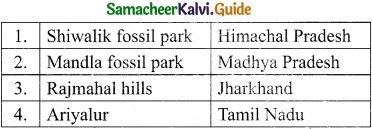
Tamil Nadu 11th Physics Model Question Paper 5 English Medium

Question 21.
What are the differences between connection and conduction?
Answer:
Conduction:
Conduction is the process of direct transfer of heat through matter due to temperature difference. When two objects are in direct contact with one another, heat will be transferred from the hotter object to the colder one. The objects which allow heat to travel easily through them are called conductors.

Convection:
Convection is the process in which heat transfer is by actual movement of molecules in fluids such as liquids and gases. In convection, molecules move freely from one place to another.

Question 22.
Why two holes are made to empty an oil tin?
Answer:
When oil comes out through a tin with one hole, the pressure inside the tin becomes less than the atmospheric pressure, soon the oil stops flowing out. When two holes are made in the tin, air keeps on entering the tin through the other hole and maintains pressure inside.

Tamil Nadu 11th Physics Model Question Paper 5 English Medium

Question 23.
If the length of the simple pendulum is increased by 44% from its original length, calculate the percentage increase in time period of the pendulum?
Answer:
Since T ∝ \(\sqrt{l}\) = Constant \(\sqrt{l}\)

Tamil Nadu 11th Physics Model Question Paper 5 English Medium img 8

∴ Tf = 1.2 Ti = Ti + 20% Ti

Question 24.
When do the real gases obey more correctly the gas equation PV = nRT?
Answer:
An ideal gas is one whose molecules have zero volume and no mutual force between them. At low pressure, the volume of a gas is large and so the volume occupied by the molecules is negligible in comparison to the volume of the gas.

At high temperature, the molecules have large velocities and so the intermolecular force has no influence on their motion. Hence at low pressure and high temperature, the behaviour of real gases approach the ideal gas behaviour.

PART – III

Answer any six questions in which Q.No. 29 is compulsory. [6 × 3 = 18]

Question 25.
A stone is thrown upwards with a speed v from the top of a tower. It reaches the ground with a velocity 3v. What is the height of the tower?
Answer:
From equation of motion,
v’ = u + at ……………….. (1)
h = ut + \(\frac{1}{2}\) at2
here, v’ = av; u = v; a = +g
Using equ. (1)
3v = v + gt ⇒ 3v – v = gt
t = \(\frac{2v}{g}\)

Substitute ‘t’ value in equ. (2)
h = v(\(\frac{2v}{g}\)) + \(\frac{1}{2}\)g(\(\frac{2v}{g}\))2 = \(\frac { 2v^{ 2 } }{ g } \) + \(\frac{1}{2}\)g (\(\frac{2v}{g}\))2
h = \(\frac { 2v^{ 2 } }{ g } \) + \(\frac { 2v^{ 2 } }{ g } \)
= \(\frac { 4v^{ 2 } }{ g } \) g = 10 ms-2
= \(\frac { 4v^{ 2 } }{ 10 } \); h = \(\frac { 2v^{ 2 } }{ 5 } \)

Tamil Nadu 11th Physics Model Question Paper 5 English Medium

Question 26.
An object is projected at an angle such that the horizontal range is 4 times of the maximum height. What is the angle of projection of the object?
Answer:
Given:
Horizontal range = 4 Hmax
Horizontal range = \(\frac{u^{2} \sin 2 \theta}{g}\) = \(\frac{2 u^{2} \sin \theta \cos \theta}{g}\)
Maximum height = \(\frac{u^{2} \sin ^{2} \theta}{2 g}\)
as given, \(\frac{2 u^{2} \sin \theta \cos \theta}{g}\) = \(\frac{4 u^{2} \sin ^{2} \theta}{2 g}\)
2 cos θ = 2 sin θ
tan θ = 1
∴ θ = 45°

Question 27.
A room contains oxygen and hydrogen molecules in the ratio 3 : 1. The temperature of the room is 27°C. The molar mass of 02 is 32 g mol-1 and for H2, 2 g mol-1. The value of gas constant R is 8.32 J mol-11 k-1. Calculate rms speed of oxygen and hydrogen molecule?
Answer:
(a) Absolute Temperature T = 27°C = 27 + 273 = 300 K.
Gas constant R = 8.32 J mol-1 K-1
For Oxygen molecule: Molar mass

M = 32 gm/mol = 32 × 10-3 kg mol-1
rms speed vrms = \(\sqrt { \frac { 3RT }{ M } } \) = \(\sqrt{\frac{3 \times 8.32 \times 300}{32 \times 10^{-3}}}\) = 483.73 ms-1 ~ 484ms-1

For Hydrogen molecule: Molar mass M = 2 × 10⁻³ kg mol-1
rms speed vrms = \(\sqrt { \frac { 3RT }{ M } } \) = \(\sqrt{\frac{3 \times 8.32 \times 300}{2 \times 10^{-3}}}\) = 1934 ms-1 = 1.93 K ms-1

Note that the rms speed is inversely proportional to \(\sqrt{M}\) and the molar mass of oxygen is 16 times higher than molar mass of hydrogen. It implies that the rms speed of hydrogen is 4 times greater than rms speed of oxygen at the same temperature. \(\frac{1934}{484}\) ~ 4.

Tamil Nadu 11th Physics Model Question Paper 5 English Medium

Question 28.
Explain about an angle of friction?
Answer:
The angle of friction is defined as the angle between the normal force (N) and the resultant force (R) of normal force and maximum friction force (\(f_{s}^{\max }\))

Tamil Nadu 11th Physics Model Question Paper 5 English Medium img 9

In the figure the resultant force is R = \(\sqrt{\left(f_{s}^{\max }\right)^{2}+\mathrm{N}^{2}}\)
tan θ = \(\frac{f_{s}^{\max }}{\mathrm{N}}\) ………………….. (1)

But from the frictional relation, the object begins to slide when \(f_{s}^{\max }=\mu_{\mathrm{s}} \mathrm{N}\)
or when \(\frac{f_{s}^{\max }}{\mathrm{N}}\) = µs ………………….. (2)

From equations (1) and (2) the coefficient of static friction is
µs = tan θ ……………………. (3)
The coefficient of static friction is equal to tangent of the angle of friction.

Tamil Nadu 11th Physics Model Question Paper 5 English Medium

Question 29.
How does resolve a vector into its component? Explain?
Answer:
component of a resolve:
In the Cartesian coordinate system any vector \(\vec { A } \) can be resolved into three components along x, y and z directions. This is shown in figure. Consider a 3-dimensional coordinate system. With respect to this a vector can be written in component form as
\(\vec { A } \) = Ax \(\hat { i } \) + Ay\(\hat { j } \) + Az\(\hat { k } \)
Components of a vector in 2 dimensions and 3 dimensions

Tamil Nadu 11th Physics Model Question Paper 5 English Medium img 10

Tamil Nadu 11th Physics Model Question Paper 5 English Medium img 11

Here Ax is the x-component of \(\vec { A } \), Ay is the y-component of \(\vec { A } \) and Az is the z component of \(\vec { A } \).
In a 2-dimensional Cartesian coordinate system (which is shown in the figure) the vector \(\vec { A } \) is given by
\(\vec { A } \) = Ax \(\hat { i } \) + Ay \(\hat { j } \)

If \(\vec { A } \) makes an angle θ with x axis, and Ax and Ay are the components of A along x-axis and y-axis respectively, then as shown in figure,
Ax θ = A cos θ, A = A sin θ
where ‘A’ is the magnitude (length) of the vector \(\vec { A } \), A = \(\sqrt{\mathrm{A}_{x}^{2}+\mathrm{A}_{y}^{2}}\)

Tamil Nadu 11th Physics Model Question Paper 5 English Medium img 12

Question 30.
Derive an expression for energy of an orbiting satellite?
Answer:
The total energy of the satellite is the sum of its kinetic energy and the gravitational potential energy. The potential energy of the satellite is,
U = \(-\frac{\mathrm{GM}_{s} \mathrm{M}_{\mathrm{E}}}{\left(\mathrm{R}_{\mathrm{E}}+h\right)}\) ………………….. (1)

Here Ms -mass of the satellite, ME -mass of the Earth, RE – radius of the Earth.
The Kinetic energy of the satellite is
K.E = \(\frac{1}{2}\) Msv2 ………………….. (2)

Here v is the orbital speed of the satellite and is equal to
v = \(\sqrt{\frac{\mathrm{GM}_{\mathrm{E}}}{\left(\mathrm{R}_{\mathrm{E}}+h\right)}}\)

Substituting the value of v in (2) the kinetic energy of the satellite becomes,
K.E = \(\frac{1}{2} \frac{\mathrm{GM}_{\mathrm{E}} \mathrm{M}_{s}}{\left(\mathrm{R}_{\mathrm{E}}+h\right)}\)

Therefore the total energy of the satellite is
E = \(\frac{1}{2}\) \(\frac{\mathrm{GM}_{\mathrm{E}} \mathrm{M}_{s}}{\left(\mathrm{R}_{\mathrm{E}}+h\right)}-\frac{\mathrm{GM}_{s} \mathrm{M}_{\mathrm{E}}}{\left(\mathrm{R}_{\mathrm{E}}+h\right)}\)
E = \(-\frac{\mathrm{GM}_{s} \mathrm{M}_{\mathrm{E}}}{\left(\mathrm{R}_{\mathrm{E}}+h\right)}\)
The total energy implies that the satellite is bound to the Earth by means of the attractive gravitational force.

Note:
As h approaches ∞, the total energy tends to zero. Its physical meaning is that the satellite is completely free from the influence of Earth’s gravity and is not bound to Earth at large distance.

Tamil Nadu 11th Physics Model Question Paper 5 English Medium

Question 31.
Explain in detail Newton’s law of cooling?
Answer:
Newton’s law of cooling:
Newton’s law of cooling body is directly proportional to the difference in the temperature between that body and its surroundings.
\(\frac{dQ}{dT}\) ∝(T – Ts) …………………. (1)
The negative sign indicates that the quantity of heat lost by liquid goes on decreasing with time. Where,

Tamil Nadu 11th Physics Model Question Paper 5 English Medium img 13

T = Temperature of the object
Ts = Temperature of the surrounding

From the graph in figure it is clear that the rate of cooling is high initially and decreases with falling temperature.

Let us consider an object of mass m and specific heat capacity s at temperature T. Let Ts be the temperature of the surroundings. If the temperature falls by a small amount dT in time dt, then the amount of heat lost is,
dQ = msdT …………………….. (2)

Dividing both sides of equation (2) by dt
\(\frac{dQ}{dT}\) = \(\frac{msdT}{dt}\) ………………….. (3)

From Newton’s law of cooling
\(\frac{dQ}{dT}\) ∝(T – Ts)
\(\frac{dQ}{dT}\) = -a(T – Ts) ………………………… (4)

Where a is some positive constant.
From equation (3) and (4)
-a (T – Ts) = ms\(\frac{dT}{dt}\)
\(\frac{d \mathrm{T}}{\mathrm{T}-\mathrm{T}_{s}}\) = -a\(\frac{a}{ms}\) dt …………………… (5)

Integrating equation (5) on both sides,

Tamil Nadu 11th Physics Model Question Paper 5 English Medium img 14

Where b1 is the constant of integration. Taking exponential both sides we get,
T = Ts + \(b_{2} e^{\frac{-a}{m s} t}\) …………………….. (6)
Here b2 = eb1 Constant

Tamil Nadu 11th Physics Model Question Paper 5 English Medium

Question 32.
Explain Laplace’s correction?
Answer:
Laplace’s correction: In 1816, Laplace satisfactorily corrected this discrepancy by assuming that when the sound propagates through a medium, the particles oscillate very rapidly such that the compression and rarefaction occur very fast.

Hence the exchange of heat produced due to compression and cooling effect due to rarefaction do not take place, because, air (medium) is a bad conductor of heat. Since, temperature is no longer considered as a constant here, sound propagation is an adiabatic process. By adiabatic considerations, the gas obeys Poisson’s law (not Boyle’s law as Newton assumed), which is
PVγ = Constant …………………. (1)
where, γ = \(\frac { C_{ p } }{ C_{ v } } \) which is the ratio between specific heat at constant pressure and specific heat at constant volume. Differentiating equation (1) on both the sides, we get
\(V^{ \gamma }dP+P(\gamma ^{ V\gamma -1 }dV)=0\)

or

\(\gamma \mathrm{P}=-\mathrm{V} \frac{d p}{d \mathrm{V}}=\mathrm{B}_{\mathrm{A}}\) ………………….. (2)
where, BA is the adiabatic bulk modulus of air. Now, substituting equation (2) in equation
V = \(\sqrt{\frac{B}{\rho}}\), the speed of sound in air is
vA = \(\sqrt{\frac{\mathrm{B}_{\mathrm{A}}}{\rho}}=\sqrt{\frac{\gamma \mathrm{P}}{\rho}}=\sqrt{\gamma v_{\mathrm{T}}}\)
Since air contains mainly, nitrogen, oxygen, hydrogen etc, (diatomic gas), we take γ = 1.47. Hence, speed of sound in air is vA = (\(\sqrt{1.4}\)) (280 m s-1) = 331.30 ms-1, which is very much closer to experimental data.

Tamil Nadu 11th Physics Model Question Paper 5 English Medium

Question 33.
Explain types of equilibrium?
Answer:
Tamil Nadu 11th Physics Model Question Paper 5 English Medium img 15

PART – IV

Answer all the questions. [5 × 5 = 25]

Question 34 (a).
What are the applications of dimensional analysis?
Verify s = ut + \(\frac{1}{2}\)at2 by dimensional analysis?
Answer:

Tamil Nadu 11th Physics Model Question Paper 5 English Medium img 16

Given equation is dimensionally correct as the dimensions on the both side are same. Applications of dimensional analysis

  1. Convert a physical quantity from one system of units to another.
  2. Check the dimensional correctness of a given physical equation.
  3. Establish relations among various physical quantities.

[OR]

(b) Explain the types of equilibrium with suitable examples?
Answer:
Translational motion – A book resting on a table.
Rotational equilibrium – A body moves in a circular path with constant velocity.
Static equilibrium – A wall-hanging, hanging on the wall.
Dynamic equilibrium – A ball decends down in a fluid with its terminal velocity.
Stable equilibrium – A table on the floor A pencil
Unstable equilibrium – standing on its tip.
Neutral equilibrium – A dice rolling on a game board.

Tamil Nadu 11th Physics Model Question Paper 5 English Medium

Question 35 (a)
Explain the motion of block connected by a string in vertical motion?
Answer:
When objects are connected by strings and a force F is applied either vertically or horizontally or along an inclined plane, it produces a tension T in the string, which affects the acceleration to an extent. Let us discuss various cases for the same.

Tamil Nadu 11th Physics Model Question Paper 5 English Medium img 17

Vertical motion:
Consider two blocks of masses m1 and m2 (m1 > m2) connected by a light and inextensible string that passes over a pulley as shown in Figure 1.

Let the tension in the string be T and acceleration a.

When the system is released, both the blocks start, Two blocks connected by a string moving, m2 vertically upward and m1 downward with same acceleration a. The gravitational force m1g on mass m1 is used in lifting the mass m2.

The upward direction is chosen as y direction. The free body diagrams of both masses are shown in Figure 2.

Tamil Nadu 11th Physics Model Question Paper 5 English Medium img 18

Applying Newton’s second law for mass m2
T\(\hat { j } \) – m2\(\hat { j } \)g = m2 a\(\hat { j } \)

The left hand side of the above equation is the total force that acts on m2 and the right hand side is the product of mass and acceleration of m2 in direction.

By comparing the components on both sides, we get
T -m2g = m2a ……………………. (1)

Similarly, applying Newton’s law second law of for mass m1
T\(\hat { j } \) – m1g\(\hat { j } \) = -m1a\(\hat { j } \)

As mass m1 moves downward (-\(\hat { j } \)), its accleration is along (-\(\hat { j } \))
By comparing the components on both sides, we get
T – m1g = -m1a
m1g – T = m1a …………………….. (2)

Adding equations (1) and (2), we get
m1g – m2g = m1a + m2a
(m1g – m2)g = (m1 + m2)a …………………….. (3)

From equation (3), the acceleration of both the masses is
a = \(\left(\frac{m_{1}-m_{2}}{m_{1}+m_{2}}\right)\)g ……………………… (4)

If both the masses are equal (m1 = m2), from equation (4)
a = 0

This shows that if the masses are equal, there is no acceleration and the system as a whole will be at rest. To find the tension acting on the string, substitute the acceleration from the equation (4)
T – m2g = m2 \(\left(\frac{m_{1}-m_{2}}{m_{1}+m_{2}}\right)\)g
T = m2g + m2\(\left(\frac{m_{1}-m_{2}}{m_{1}+m_{2}}\right)\)g ……………………… (5)
By taking m2g common in the RHS of equation (5)

Tamil Nadu 11th Physics Model Question Paper 5 English Medium img 19

Equation (4) gives only magnitude of accleration.

For mass m1 g the accleration vector is given by \(\vec{a}=-\left(\frac{m_{1}-m_{2}}{m_{1}+m_{2}}\right) g \hat{j}\)
For mass m2 g the accleration vector is given by \(\vec{a}=-\left(\frac{m_{1}-m_{2}}{m_{1}+m_{2}}\right) g \hat{j}\)

[OR]

(b) Derive the kinematic equation of motion for constant acceleration?
Answer:
Consider an object moving in a straight line with uniform or constant acceleration ‘a’. Let u be the velocity of the object at time t = 0, and v be velocity of the body at a later time t.

Velocity – time relation:

(I) The acceleration of the body at any instant is given by the first derivative of the velocity with respect to time,
a = \(\frac{dv}{dt}\) or dv = a dt
Integrating both sides with the condition that as time changes from 0 to t, the velocity changes from u to v. For the constant acceleration,

Tamil Nadu 11th Physics Model Question Paper 5 English Medium img 20

Displacement – time relation:

(II) The velocity of the body is given by the first derivative of the displacement with respect to time.
v = \(\frac{ds}{dt}\) or ds = vdt
and since v = u + at,
We get ds = (u + at)dt
Assume that initially at time t = 0, the particle started from the origin. At a later time t, the particle displacement is s. Further assuming that acceleration is time-independent, we have
\(\int_{0}^{s} d s=\int_{0}^{t} u d t+\int_{0}^{t} a t d t \text { or } s=u t+\frac{1}{2} a t^{2}\) ……………………. (2)
Velocity – displacement relation

(III) The acceleration is given by the first derivative of velocity with respect to time.
a = \(\frac{dv}{dt}\) = \(\frac{dv}{ds}\) \(\frac{ds}{dt}\) = \(\frac{dv}{ds}\) v [since ds/dt = v] where s is displacement traversed.
This is rewritten as a = \(\frac{1}{2}\) \(\frac { dv^{ 2 } }{ s } \) or ds = \(\frac{1}{2a}\) d(v2)
Integrating the above equation, using the fact when the velocity changes from u2 to v2, displacement changes from u2 to v2, we get

Tamil Nadu 11th Physics Model Question Paper 5 English Medium img 21

We can also derive the displacement s in terms of initial velocity u and final velocity v.
From equation we can write,
at = v – u
Substitute this in equation, we get
s = ut + \(\frac{1}{2}\) (v -u)t
s = \(\frac{(u+v)t}{2}\)

Tamil Nadu 11th Physics Model Question Paper 5 English Medium

Question 36 (a).
State and prove perpendicular axis theorem?
Answer:
Perpendicular axis theorem: This perpendicular axis theorem holds good only for plane laminar objects.

The theorem states that the moment of inertia of a plane laminar body about an axis perpendicular to its plane is equal to the sum of moments of inertia about two perpendicular axes lying in the plane of the body such that all the three axes are mutually perpendicular and have a common point.

Let the X and Y-axes lie in the plane and Z-axis perpendicular to the plane of the laminar object. If the moments of inertia of the body about X and Y-axes are Ix and IY respectively and Iz is the moment of inertia about Z-axis, then the perpendicular axis theorem could be expressed as,
Iz = Ix + Iy

To prove this theorem, let us consider a plane laminar object of negligible thickness on which lies the origin (O). The X and Y-axes lie on the plane and Z-axis is perpendicular to it as shown in figure. The lamina is considered to be made up of a large number of particles of mass m. Let us choose one such particle at a point P which has coordinates (x, y) at a distance r from O.

Tamil Nadu 11th Physics Model Question Paper 5 English Medium img 22

The moment of inertia of the particle about Z-axis is, mr2.
The summation of the above expression gives the moment of inertia of the entire lamina about Z-axis as,
Iz = Σ mr2
Here, r2 = x2 + y2
Then, Iz = Σm(x2 + y2)
Iz = Σmx2 + Σmy2
In the above expression, the term Σmx2 is the moment of inertia of the body about the Y-axis and similarly the term Σmy2 is the moment of inertia about X-axis. Thus,
IX = Σmy2 and IY = Σmx2
Substituting in the equation for IZ gives, IZ = IX + IY
Thus, the perpendicular axis theorem is proved.

[OR]

(b) Explain in detail the triangle law of addition?
Answer:
Let us consider two vectors \(\vec { A } \) and \(\vec { B } \) as shown in figure.

Tamil Nadu 11th Physics Model Question Paper 5 English Medium img 23

To find the resultant of the two vectors we apply the triangular law of addition as follows:

Represent the vectors \(\vec { A } \) and \(\vec { B } \) by the two adjacent sides of a triangle taken in the same order. Then the resultant is given by the third side of the triangle as shown in figure.

Tamil Nadu 11th Physics Model Question Paper 5 English Medium img 24

To explain further, the head of the first vector \(\vec { A } \) is connected to the tail of the second vector \(\vec { B } \). Let θ be the angle between A and B. Then R is the resultant vector connecting the tail of the first vector \(\vec { A } \) to the head of the second vector \(\vec { B } \).

The magnitude of \(\vec { R } \) (resultant) is given geometrically by the length of \(\vec { R } \)(OQ) and the direction of the resultant vector is the angle between \(\vec { R } \) and \(\vec { A } \). Thus we write \(\vec { R } \) = \(\vec { A } \) + \(\vec { B } \).
\(\overline { OQ } \) = \(\overline { OP } \) + \(\overline { PQ } \)

1. Magnitude of resultant vector:
The magnitude and angle of the resultant vector are determined by using triangle law of vectors as follows.

From figure, consider the triangle ABN, which is obtained by extending the side OA to ON. ABN is a right angled triangle.

Tamil Nadu 11th Physics Model Question Paper 5 English Medium img 25

From figure, let R is the magnitude of the resultant of \(\vec { A } \) and \(\vec { B } \).

For ∆OBN, we have OB2 = ON2 + BN2
⇒ R2 = (A + B cos θ)2 + (B sin θ)2
⇒ R2 = A2 + B2 cos2 θ + 2AB cos θ + B2sin2 θ
⇒ R2 = A2 + B2(cos2 θ + sin2 θ) + 2AB cos θ
⇒R2 = \(\sqrt{A^{2}+B^{2}+2 A B \cos \theta}\)

2. Direction of resultant vectors:
If θ is the angle between \(\vec { A } \) and \(\vec { B } \), then
|\(\vec { A } \) + \(\vec { B } \)| = \(\sqrt{A^{2}+B^{2}+2 A B \cos \theta}\)
If \(\vec { R } \) makes an angle α with \(\vec { A } \), then in ∆OBN,
tan α = \(\frac{BN}{ON}\) = \(\frac{BN}{OA+AN}\)
tan α = \(\frac{B \sin \theta}{A+B \cos \theta}\) ⇒ α = tan-1\(\left(\frac{B \sin \theta}{A+B \cos \theta}\right)\)

Tamil Nadu 11th Physics Model Question Paper 5 English Medium

Question 37 (a).
Explain in detail the various types of errors?
Answer:
The uncertainty in a measurement is called an error. Random error, systematic error and gross error are the three possible errors.

(I) Systematic errors:
Systematic errors are reproducible inaccuracies that are consistently in the same direction. These occur often due to a problem that persists throughout the .experiment. Systematic errors can be classified as follows.

(1) Instrumental errors:
When an instrument is not calibrated properly at the time of manufacture, instrumental errors may arise. If a measurement is made with a meter scale whose end is worn out, the result obtained will have errors. These errors can be corrected by choosing the instrument carefully.

(2) Imperfections in experimental technique or procedure:
These errors arise due to the limitations in the experimental arrangement. As an example, while performing experiments with a calorimeter, if there is no proper insulation, there will be radiation losses. This results in errors and to overcome these, necessary correction has to be applied

(3) Personal errors:
These errors are due to individuals performing the experiment, may be due to incorrect initial setting up of the experiment or carelessness of the individual making the observation due to improper precautions.

(4) Errors due to external causes:
The change in the external conditions during an experiment can cause error in measurement. For example, changes in temperature, humidity, or pressure during measurements may affect the result of the measurement.

(5) Least count error:
Least count is the smallest value that can be measured by the measuring instrument, and the error due to this measurement is least count error. The instrument’s resolution hence is the cause of this error. Least count error can be reduced by using a high precision instrument for the measurement.

(II) Random errors:
Random errors may arise due to random and unpredictable variations in experimental conditions like pressure, temperature, voltage supply etc. Errors may also be due to personal errors by the observer who performs the experiment. Random errors are sometimes called “chance error”.

When different readings are obtained by a person every time he repeats the experiment, personal error occurs. For example, consider the case of the thickness of a wire measured using a screw gauge. The readings taken may be different for different trials. In this case, a large number of measurements are made and then the arithmetic mean is taken.
If n number of trial readings are taken in an experiment, and the readings are
a1, a2, a3, ……………………….. an. The arithmetic mean is

Tamil Nadu 11th Physics Model Question Paper 5 English Medium img 26

[OR]

(b) To move an object, which one is easier, push or pull? Explain?
Answer:
When a body is pushed at an arbitrary angle θ (0 to \(\frac{π}{2}\)), the applied force F can be resolved into two components as F sin θ parallel to the surface and F cos θ perpendicular to the surface as shown in figure. The total downward force acting on the body is mg + F cos θ. It implies that the normal force acting on the body increases. Since there is no acceleration along the vertical direction the normal force N is equal to
Npush = mg + F cos θ …………………. (1)
As a result the maximal static friction also increases and is equal to
\(f_{s}^{\max }=\mu_{r} N_{\text {push }}=\mu_{s}(m g+F \cos \theta)\) …………………. (2)
Equation (2) shows that a greater force needs to be applied to push the object into motion.

Tamil Nadu 11th Physics Model Question Paper 5 English Medium img 27

When an object is pulled at an angle 0, the applied force is resolved into two components as shown in figure. The total downward force acting on the object is
Npull = mg – F cos θ …………………….. (3)

Tamil Nadu 11th Physics Model Question Paper 5 English Medium img 28

Tamil Nadu 11th Physics Model Question Paper 5 English Medium

Question 38 (a).
Describe the method of measuring angle of repose?
Answer:
Angle of Repose Consider an inclined plane on which an object is placed, as shown in figure. Let the angle which this plane makes with the horizontal be θ. For small angles of θ, the object may not slide down. As θ is increased, for a particular value of θ, the object begins to slide down. This value is called angle of repose. Hence, the angle of repose is the angle of inclined plane with the horizontal such that an object placed on it begins to slide.

Tamil Nadu 11th Physics Model Question Paper 5 English Medium img 29

Let us consider the various forces in action here. The gravitational force mg is resolved into components parallel (mg sin θ) and perpendicular (mg cos θ) to the inclined plane. The component of force parallel to the inclined plane (mg sin θ) tries to move the object down. The component of force perpendicular to the inclined plane (mg cos θ) is balanced by the Normal force (N).
N = mg cos θ ……………… (1)

When the object just begins to move, the static friction attains its maximum value
fs = \(f_{s}^{\max }\)

This friction also satisfies the relation
\(f_{s}^{\max }\) = µs = mg sin θ …………………… (2)

Equating the right hand side of equations (1) and (2),
\(\left(f_{s}^{\max }\right) / \mathrm{N}=\sin \theta / \cos \theta\)

From the definition of angle of friction, we also know that
tan θ = µs ……………………… (3) in which θ is the angle of friction.

Thus the angle of repose is the same as angle of friction. But the difference is that the angle of repose refers to inclined surfaces and the angle of friction is applicable to any type of surface.

[OR]

(b) A block of mass m slides down the plane inclined at an angle 60° with an acceleration g/2. Find the co-efficient of kinetic friction?
Answer:
Kinetic friction comes to play as the block is moving on the surface.
The forces acting on the mass are the normal force perpendicular to surface, downward gravitational force and kinetic friction along the surface.
Along the x-direction

Tamil Nadu 11th Physics Model Question Paper 5 English Medium img 30

Tamil Nadu 11th Physics Model Question Paper 5 English Medium img 30a
There is no motion along the y-direction as normal force is exactly balanced by the mg cos θ.
mg cos θ = N = mg/2

Tamil Nadu 11th Physics Model Question Paper 5 English Medium img 31

[OR]

(c) Write a note on triangulation method and radar method to measure larger distances?
Answer:
Triangulation method for the height of an accessible object:
Let AB = h be the height of the tree or tower to 6e measured. Let C be the point of observation at distance x from B. Place a range finder at C and measure the angle of elevation, ACB = θ as shown in figure.

From right angled triangle ABC,
tan θ = \(\frac{AB}{BC}\) = \(\frac{h}{x}\)
(or) height h = x tan θ
Knowing the distance x. the height h can be detennined.

Tamil Nadu 11th Physics Model Question Paper 5 English Medium img 32

RADAR method:
The word RADAR stands for radio detection and ranging. A radar can be used to measure accurately the distance of a nearby planet such as Mars. In this method, radio waves are sent from transmitters which, after reflection from the planet, are detected by the receiver.

By measuring, the time interval (t) between the instants the radio waves are sent and received, the distance of the planet can be determined as where v is the speed of the radio wave. As the time taken (t) is for the distance covered during the forward and backward path of the radio waves, it is divided by 2 to get the actual distance of the object. This method can also be used to determine the height, at which an aeroplane flies from the ground.

Tamil Nadu 11th Physics Model Question Paper 5 English Medium img 33

[OR]

(d) Jupiter is at a distance of 824.7 million km from the earth. Its angular diameter is measured to be 35.75”. Calculate the diameter of jupiter?
Answer:
Given,
Distance of Jupiter = 824.7 × 10⁶ km = 8.247 × 10¹¹ m
angular diameter = 35.72 × 4.85 × 10-6 rad = 173.242 × 10⁻⁶ rad
= 1.73 × 10⁻⁴rad
∴ Diameter of Jupiter D = θ × d = 1.73 × 10-4 rad × 8.247 × 1011 m
14.267 × 10⁷ m = 1.427 × 10⁸ m (or) 1.427 × 10⁵ km

Tamil Nadu 11th Maths Model Question Paper 4 English Medium

Students can Download Tamil Nadu 11th Maths Model Question Paper 4 English Medium Pdf, Tamil Nadu 11th Maths Model Question Papers helps you to revise the complete Tamilnadu State Board New Syllabus, helps students complete homework assignments and to score high marks in board exams.

TN State Board 11th Maths Model Question Paper 4 English Medium

General Instructions:

  1. The question paper comprises of four parts.
  2. You are to attempt all the parts. An internal choice of questions is provided wherever applicable.
  3. All questions of Part I, II, III and IV are to be attempted separately.
  4. Question numbers 1 to 20 in Part I are Multiple Choice Questions of one mark each.
    These are to be answered by choosing the most suitable answer from the given four alternatives and writing the option code and the corresponding answer
  5. Question numbers 21 to 30 in Part II are two-mark questions. These are to be answered in about one or two sentences.
  6. Question numbers 31 to 40 in Part III are three-mark questions. These are to be answered in above three to five short sentences.
  7. Question numbers 41 to 47 in Part IV are five-mark questions. These are to be answered in detail Draw diagrams wherever necessary.

Time: 2:30 Hours
Maximum Marks: 90

PART – I

I. Choose the correct answer. Answer all the questions: [20 × 1 = 20]

Question 1.
If n(A) = 2 and n(B∪C) = 3 then n[(A × B) ∪ (A × C)] is ………………..
(a) 23
(b) 32
(c) 6
(d) 5
Answer:
(c) 6

Tamil Nadu 11th Maths Model Question Paper 4 English Medium

Question 2.
For any two sets A and B, A∩(A∪B) = …………………….
(a) B
(b) ∅
(c) A
(d) none of these
Answer:
(c) A

Question 3.
cos 1° + cos 2° + cos 3° + cos 4° + cos 179° = …………………
(a) 0
(b) 1
(c) -1
(d) 89
Answer:
(a) 0

Tamil Nadu 11th Maths Model Question Paper 4 English Medium

Question 4.
The value of log9 27 is ……………………
(a) \(\frac{2}{3}\)
(b) \(\frac{3}{2}\)
(c) \(\frac{3}{4}\)
(d) \(\frac{4}{3}\)
Answer:
(b) \(\frac{3}{2}\)

Question 5.
The value of \(\frac{\sin 3 \theta+\sin 5 \theta+\sin 7 \theta+\sin 9 \theta}{\cos 3 \theta+\cos 5 \theta+\cos 7 \theta+\cos 9 \theta}\) = ………………..
(a) tan3θ
(b) tan6θ
(c) cot3θ
(d) cot6θ
Answer:
(b) tan6θ

Question 6.
In 3 fingers the number of ways 4 rings can be worn in ……………………. ways.
(a) 43 – 1
(b) 34
(c) 68
(d) 64
Answer:
(d) 64

Tamil Nadu 11th Maths Model Question Paper 4 English Medium

Question 7.
Everybody in a room shakes hands with everybody else. The total number of shake hands is 66. The number of persons in the room is ……………….
(a) 11
(b) 12
(c) 10
(d) 6
Answer:
(b) 12

Question 8.
The H.M of two positive number whose AM and G.M. are 16, 8 respectively is ………………..
(a) 10
(b) 6
(c) 5
(d) 4
Answer:
(d) 4

Tamil Nadu 11th Maths Model Question Paper 4 English Medium

Question 9.
The co-efficient of the term independent of x in the expansion of (2x+\(\frac{1}{3x}\))6 is …………………
(a) \(\frac{160}{27}\)
(b) \(\frac{160}{27}\)
(c) \(\frac{80}{3}\)
(d) \(\frac{80}{9}\)
Answer:
(a) \(\frac{160}{27}\)

Question 10.
The value of \(\left|\begin{array}{lll}
a & 0 & 0 \\
0 & b & 0 \\
0 & 0 & c
\end{array}\right|^{2}\) is ………………..
(a) abc
(b) -abc
(c) 0
(d) a2b2c2
Answer:
(d) a2b2c2

Tamil Nadu 11th Maths Model Question Paper 4 English Medium

Question 11.
The value of x for which the matrix A = \(\left[\begin{array}{cc}
e^{x-2} & e^{7+x} \\
e^{2+x} & e^{2 x+3}
\end{array}\right]\) is singular is …………………..
(a) 9
(b) 8
(c) 7
(d) 6
Answer:
(b) 8

Question 12.
If |\(\vec { a } \) + \(\vec { b } \)| = 60, |\(\vec { a } \) – \(\vec { b } \)| = 40 and |\(\vec { b } \)| = 46 then |\(\vec { a } \)| is …………………
(a) 42
(b) 12
(c) 22
(d) 32
Answer:
(c) 22

Tamil Nadu 11th Maths Model Question Paper 4 English Medium

Question 13.
Given \(\vec { a } \) = 2\(\vec { i } \) + \(\vec { j } \) – 8\(\vec { k } \) and \(\vec { b } \) = \(\vec { i } \) + 3\(\vec { j } \) – 4\(\vec { k } \) then |\(\vec { a } \) + \(\vec { b } \)| = ………………….
(a) 13
(b) \(\frac{13}{3}\)
(c) \(\frac{4}{13}\)
(d) \(\frac{3}{13}\)
Answer:
(a) 13

Question 14.
If f(x) = \(\left\{\begin{array}{ccc}
k x & \text { for } & x \leq 2 \\
3 & \text { for } & 2
\end{array}\right.\) is continous at x = 2 then the value of k is ……………………
(a) \(\frac{3}{4}\)
(b) 0
(c) 1
(d) \(\frac{4}{3}\)
Answer:
(c) 1

Tamil Nadu 11th Maths Model Question Paper 4 English Medium

Question 15.
If f: R→R is defined by f(x) = |x – 3| + |x – 4| for x∈R then \(\lim _{x \rightarrow 3^{-}}\) f(x) is equal to ………………..
(a) -2
(b) -1
(c) 0
(d) 1
Answer:
(c) 0

Question 16.
\(\lim _{x \rightarrow \infty}\left(\frac{x^{2}+5 x+3}{x^{2}+x+3}\right)^{x}\) is ………………..
(a) e4
(b) e2
(c) e3
(d) 1
Answer:
(a) e4

Tamil Nadu 11th Maths Model Question Paper 4 English Medium

Question 17.
\(\int \frac{e^{x}\left(x^{2} \tan ^{-1} x+\tan ^{-1} x+1\right)}{x^{2}+1}\) dx is ………………..
(a) e tan-1(x + 1)
(b) tan-1(ex) + c
(c) ex \(\frac{\left(\tan ^{-1} x\right)^{2}}{2}\) + c
(d) extan-1x + c
Answer:
(d) extan-1x + c

Question 18.
∫ \(\frac { secx }{ \sqrt { cos2x } } \) dx = …………………..
(a) tan-1(sin x) + c
(b) 2 sin-1(tan x) + c
(c) tan-1(cos x) + c
(d) sin-1 (tan x) + c
Answer:
(d) sin-1 (tan x) + c

Tamil Nadu 11th Maths Model Question Paper 4 English Medium

Question 19.
\(\int \frac{e^{6 \log x}-e^{5 \log x}}{e^{4 \log x}-e^{3 \log x}}\) dx = ………………..
(a) x + c
(b) \(\frac { x^{ 3 } }{ 3 } \) + c
(c) \(\frac { 3 }{ x^{ 3 } } \) + c
(d) \(\frac { 1 }{ x^{ 2 } } \) + c
Answer:
(b) \(\frac { x^{ 3 } }{ 3 } \) + c

Question 20.
It is given that the events A and B are such that P(A) = \(\frac{1}{4}\), P(A/B) = \(\frac{1}{2}\), P(B/A) = \(\frac{2}{3}\) then P(B) = …………………
(a) \(\frac{1}{6}\)
(b) \(\frac{1}{3}\)
(c) \(\frac{2}{3}\)
(d) \(\frac{1}{2}\)
Answer:
(b) \(\frac{1}{3}\)

PART – II

II. Answer any seven questions. Question No. 30 is compulsory. [7 × 2 = 14]

Question 21.
In the set Z of integers, define mRn if m – n is a multiple of 12. Prove that R is an equivalence relation?
Answer:
As m – m = 0 and 0 = 0 × 12, we have 0 is a multiple of 12; hence mRm proving that R is reflexive.
Let mRn. Then m – n = 12k for some integer k; thus n – m = 12(-k) and hence nRm.
This shows that R is symmetric.
Let mRn and nRp: then m – n = 12k and n – p = 12l for some integers k and l.
So m – p = 12(k + l) and hence mRp. This shows that R is transitive.
Thus R is an equivalence relation.

Tamil Nadu 11th Maths Model Question Paper 4 English Medium

Question 22.
Simplify:
\(\frac { 1 }{ 2+\sqrt { 3 } } \) + \(\frac { 3 }{ 4-\sqrt { 5 } } \) + \(\frac { 6 }{ 7-\sqrt { 8 } } \)
Answer:
Tamil Nadu 11th Maths Model Question Paper 4 English Medium img 1

Question 23.
Find the value of sin 22 \(\frac{1}{2}\)°?
Answer:
We know that cos θ = 1 – 2 sin2 \(\frac{θ}{2}\) ⇒ sin \(\frac{θ}{2}\) = ±\(\sqrt { \frac { 1-cos2\theta }{ 2 } } \)
Take θ = 45°, we get sin \(\frac{45°}{2}\) = ±\(\sqrt { \frac { 1-cos45°}{ 2 } } \), (taking positive sign only, since 22\(\frac{1}{2}\)° lies in the first quadrant)
Thus, sin 22\(\frac{1}{2}\)° = \(\sqrt{\frac{1-\frac{1}{\sqrt{2}}}{2}}=\frac{\sqrt{2-\sqrt{2}}}{2}\).

Tamil Nadu 11th Maths Model Question Paper 4 English Medium

Question 24.
The number of bacteria in a certain culture doubles every hour. If there were 30 bacteria present in the culture originally, how many bacteria will be present at the end of 2nd hour, 4th
hour and wth hour?
Answer:
No. of bacteria at the beginning = 30
No. of bacteria after 1 hour = 30 × 2 = 60
No. of bactena after 2 hours = 30 × 22 = 30 × 4 = 120
No. of bacteria after 4 hours = 30 × 24 = 30 × 16 = 480
No. of bacteria after nth hour = 30 × 2n

Tamil Nadu 11th Maths Model Question Paper 4 English Medium

Question 25.
If the sum of the distance of a moving point in a plane from the axis is 1, then find the locus of the point?
Answer:
Let coordinates of a moving point P be (x, y).
Given that the sum of the distances from the axis to the point is always 1.
∴|x| + |y| = 1 ⇒ x + y = 1
⇒- x- y = 1 ⇒ x + y = 1
⇒ x – y = 1
Hence, these equations give us the locus of the point P which is a square.
Tamil Nadu 11th Maths Model Question Paper 4 English Medium

Question 26.
If (a, a + b, a + b + c) is one set of direction ratios of the line joining (1, 0, 0) and (0, 1, 0) then find a set of values of a, b, c?
Answer:
Let A be the point (1, 0, 0) and B be the point (0, 1, 0) (i.e.,) \(\overline { OA } \) = \(\hat { i } \) and \(\overline { OB } \) = \(\hat { j } \).
Then \(\overline { AB } \) = \(\overline { OB } \) – \(\overline { OA } \) = \(\hat { j } \) – \(\hat { i } \) = –\(\hat { i } \) + \(\hat { j } \)
= (-1, 1, 0)
= (a, a + b, a + b + c)
⇒ a = -1, a + b = 1 and a + b + c = 0
⇒ a = -1, ⇒ -1 + b = 1; a + b + c = 0
⇒ b = 2; -1 + 2 + c = 0 ⇒ c + 1 = 0
⇒ c = -1
∴ a = -1, b = 2, c = -1.
Note: if we taken \(\overline { BA } \) then we get a = 1, b = -2 and c = 1.

Tamil Nadu 11th Maths Model Question Paper 4 English Medium

Question 27.
Find \(\frac{dy}{dx}\) for y = (x2 + 4x + 6)5
Answer:
Let u = x2 + 4x + 6
⇒ \(\frac{du}{dx}\) = 2x + 4
Now y = u5 = \(\frac{dy}{du}\) = 5u4
∴ \(\frac{dy}{dx}\) = \(\frac{dy}{du}\) × \(\frac{du}{dx}\) = 5u4 (2x + 4)
= 5(x2 + 4x + 6)4 (2x + 4)
= 5(2x + 4) (x2 + 4x + 6)4

Question 28.
Evaluate ∫\(\sqrt { 25x^{ 2 }-9 } \) dx?
Answer:
Tamil Nadu 11th Maths Model Question Paper 4 English Medium

Question 29.
A bag contains 5 white and 7 black balls. 3 balls are drawn at random. Find the probability that

  1. all are white
  2. one white and 2 black.

Answer:
Number of white balls = 5
Number of black balls = 7
Total number of balls = 12
Selecting 3 from 12 balls can be done in
12C3 = \(\frac{12 \times 11 \times 10}{3 \times 2 \times 1}\) = 220 ways
∴n(S) = 220

1. Let A be the selecting 3 white balls.
∴n(A) = 5C3 = 5C2 = \(\frac{5×3}{2×1}\) = 10
∴P(A) = \(\frac{n(A)}{n(S)}\) = \(\frac{10}{220}\) = \(\frac{1}{22}\)

2. Let B be the event of selecting one white and 2 black balls.
∴n(B) = 5C1 × 7C2 = (5) (\(\frac{7×6}{2×1}\)) = 5(21) = 105
∴P(B) = \(\frac{n(B)}{n(S)}\) = \(\frac{105}{220}\) = \(\frac{21}{44}\).

Tamil Nadu 11th Maths Model Question Paper 4 English Medium

Question 30.
If (k, 2), (2, 4) and (3, 2) are vertices of the triangle of area 4 square units then determine the value of k?
Answer:
Area of ∆ with vertices (k, 2) (2, 4) and (3, 2) = \(\frac{1}{2}\) \(\left|\begin{array}{lll}
k & 2 & 1 \\
2 & 4 & 1 \\
3 & 2 & 1
\end{array}\right|\) = 4 given
⇒ \(\left|\begin{array}{lll}
k & 2 & 1 \\
2 & 4 & 1 \\
3 & 2 & 1
\end{array}\right|\) = 2(4) = 8
(i.e.,) k(4 – 2) – 2(2 – 3) + 1(4 – 12) ± 8
(i.e.,) 2k – 2(-1) + 1(-8) = ± 8
(i.e.,) 2k + 2 – 8 = 8
(i.e.,) 2k = 8 + 8 – 2 = 14
k = 14/2 = 7
∴k = 7
So k = 7 (or) k = -1.

2k + 2 – 8 = -8
⇒2k = – 8 + 8 – 2
2k = – 2
k = -1

PART – III

III. Answer any seven questions. Question No. 40 is compulsory. [7 × 3 = 21]

Question 31.
In the set Z of integers define mRn if m – n is a multiple of 12. Prove that R is an equivalence relation?

Question 32.
Prove that \(\frac{sin4x+sin2x}{cos4x+cos2x}\) = tan 3x?

Tamil Nadu 11th Maths Model Question Paper 4 English Medium

Question 33.
A polygon has 90 diagonals. Find the number of its sides?

Question 34.
If n is an odd positive integer, prove that the coefficients of the middle terms in the expansion of (x + y)n are equal?

Question 35.
Find the equation of the line passing through the point (1, 5) and also divides the co-ordinate axes in the ratio 3 : 10?

Tamil Nadu 11th Maths Model Question Paper 4 English Medium

Question 36.
Prove that \(\left|\begin{array}{ccc}
1 & x & x \\
x & 1 & x \\
x & x & 1
\end{array}\right|^{2}=\left|\begin{array}{ccc}
1-2 x^{2} & -x^{2} & -x^{2} \\
-x^{2} & -1 & x^{2}-2 x \\
-x^{2} & x^{2}-2 x & -1
\end{array}\right|\)

Question 37.
If G is the centroid of a traiangle ABC prove that \(\overline { GA } \) + \(\overline { GB } \) + \(\overline { GC } \) = 0

Tamil Nadu 11th Maths Model Question Paper 4 English Medium

Question 38.
Find \(\frac{dy}{dx}\) for y = \(\sqrt { 1+tan2x } \)?

Question 39.
Evaluate \(\frac { \sqrt { x } }{ 1+\sqrt { x } } \) dx?

Question 40.
Find the relation between a and b if \(\underset { x\rightarrow 3 }{ lim } \) f(x) exists where f(x) = \(\left\{\begin{array}{cc}
a x+b & \text { if } x>3 \\
3 a x-4 b+1 \text { if } x<3
\end{array}\right.\)

PART – IV

IV. Answer all the questions. [7 × 5 = 35]

Question 41 (a).
From the curve y = |x|, draw(i) y = |x-1| + 1

  1. y = |x + 1| + 1
  2. y = |x + 2| – 3

[OR]

(b) Resolve into partial fraction \(\frac { x+4 }{ (x^{ 2 }-4)(x+1) } \)

Tamil Nadu 11th Maths Model Question Paper 4 English Medium

Question 42 (a).
Find the number of positive integers greater than 6000 and less than 7000 which arc divisible by 5, provided that no digit is to be repeated?

[OR]

(b) If nPr = nPr+1 and nCr = nCr-1, find the values of n and r?

Question 43 (a).
In a ∆ABC, prove that b2 sin 2C + c2 sin 2B = 2bc sin A?

[OR]

(b) Differentiate the following s(t) = \(\sqrt[4]{\frac{t^{3}+1}{t^{3}-1}}\)?

Tamil Nadu 11th Maths Model Question Paper 4 English Medium

Question 44 (a).
Find the equation of the lines make an angle 60° with the positive x axis and at a distance 5\(\sqrt{2}\) units measured from the point (4, 7) along the line x – y + 3 = 0

[OR]

(b) If y = A cos4x + B sin 4x, A and B are constants then Show that y2 + 16y = 0

Tamil Nadu 11th Maths Model Question Paper 4 English Medium

Question 45 (a).
Find the sum up to the 17th term of the series \(\frac{1^{3}}{1}+\frac{1^{3}+2^{3}}{1+3}+\frac{1^{3}+2^{3}+3^{3}}{1+3+5}\) + …………..

[OR]

(b) A shopkeeper in a Nuts and Spices shop makes gifi packs of cashew nuts, raisins and almonds?

  1. Pack I contains 100 gm of cashew nuts, 100 gm of raisins and 50 gm of almonds.
  2. Pack-II contains 200 gm of cashew nuts, 100 gm of raisins and 100 gm of almonds.
  3. Pack-III contains 250 gm of cashew nuts, 250 gm of raisins and 150 gm of almonds.
  4. The cost of 50 gm of cashew nuts is ₹50, 50 gm of raisins is ₹10. and 50gm of almonds is ₹60. What is the cost of each gift pack?

Tamil Nadu 11th Maths Model Question Paper 4 English Medium

Question 46 (a).
Find matrix C if A = \(\begin{bmatrix} 3 & 7 \\ 2 & 5 \end{bmatrix}\), B = \(\begin{bmatrix} -3 & 2 \\ 4 & -1 \end{bmatrix}\) and 5C + 28= A?

[OR]

(b) The probability that a new railway bridge will get an award for its design is 0.48, the probability that it will get an award for the efficient use of materials is 0.36, and that it will get both awards is 0.2. What is the probability, that

  1. it will get at least one of the two awards
  2. it will get only one of the awards.

Tamil Nadu 11th Maths Model Question Paper 4 English Medium

Question 47 (a).
\(\underset { \alpha \rightarrow 0 }{ lim } \) \(\frac { sin(\alpha ^{ n }) }{ (sin\alpha )^{ m } } \)

[OR]

(b) Evaluate I = sin-1 (\(\frac { 2x }{ (1+x)^{ 2 } } \)) dx?

Tamil Nadu 11th Chemistry Model Question Paper 1 English Medium

Students can Download Tamil Nadu 11th Chemistry Model Question Paper 1 English Medium Pdf, Tamil Nadu 11th Chemistry Model Question Papers helps you to revise the complete Tamilnadu State Board New Syllabus, helps students complete homework assignments and to score high marks in board exams.

TN State Board 11th Chemistry Model Question Paper 1 English Medium

General Instructions:

  1. The question paper comprises of four parts.
  2. You are to attempt all the parts. An internal choice of questions is provided wherever applicable.
  3. All questions of Part I, II, III and IV are to be attempted separately.
  4. Question numbers 1 to 15 in Part I are Multiple Choice Questions of one mark each.
    These are to be answered by choosing the most suitable answer from the given four alternatives and writing the option code and the corresponding answer
  5. Question numbers 16 to 24 in Part II are two-mark questions. These are to be answered in about one or two sentences.
  6. Question numbers 25 to 33 in Part III are three-mark questions. These are to be answered in about three to five short sentences.
  7. Question numbers 34 to 38 in Part IV are five-mark questions. These are to be answered in detail Draw diagrams wherever necessary.

Time: 2:30 Hours
Maximum Marks: 70

PART – I

Answer all the Questions: [15 × 1 = 15]
Choose the most suitable answer from the given four alternatives.

Question 1.
1 g of an impure sample of magnesium carbonate (containing no thermally decomposable impurities) on complete thermal decomposition gave 0.44 g of carbon dioxide gas. The percentage of impurity in the sample is …………………….
(a) 0%
(b) 4.4%
(c) 16%
(d) 8.4%
MgCO3 → MgO + CO2
MgCO3: (1 × 24) + (1 × 12) + (3 × 16) = 84g
CO2: (1 × 12) + (2 × 16) = 44g
100% pure 84 g MgCO3 on heating gives 44 g CO2
Given that 1 g of MgCO3 on heating gives 0.44 g CO2
Therefore, 84 g MgCO3 sample on heating gives 36.96 g CO2
Percentage of purity of the sample = \(\frac { 100% }{ 44gCO_{ 2 } } \) × 36.96 g CO2 = 84%
Percentage of impurity = 16%
Answer:
(c) 16%

Tamil Nadu 11th Chemistry Model Question Paper 1 English Medium

Question 2.
The electronic configuration of Eu (atomic no. 63) Gd (atomic no. 64) and Tb (atomic no. 65) are …………………….. [NEET – Phase II]
(a) [Xe] 4f6 5d1 6s2, [Xe] 4f7 5d1 6s2 and [Xe] 4f8 5d1 6s2
(b) [Xe] 4f7 6s2 [Xe] 4f8 6s2 and [Xe] 4f9 6s2
(c) [Xe] 4f7 6s2 [Xe] 4f7 5d1 6s2 and [Xe] 4f9 6s2
(d) [Xe] 4f 6 5d1 6s2, [Xe] 4f7 5d1 6s2 and [Xe] 4f9 6s2
Solution:
Eu : [Xe] 4f7, 5d0, 6s2
Gd : [Xe] 4f7, 5d1, 6s2
Tb : [Xe] 4f9, 5d0, 6s2
Answer:
(b) [Xe] 4f7 6s2 [Xe] 4f8 6s2 and [Xe] 4f9 6s2

Tamil Nadu 11th Chemistry Model Question Paper 1 English Medium

Question 3.
Match the following:

Tamil Nadu 11th Chemistry Model Question Paper 1 English Medium img 1

Answer:

Tamil Nadu 11th Chemistry Model Question Paper 1 English Medium img 2

Question 4.
Various successive ionization enthalpies (in kJ mol-1) of an element are given below.

Tamil Nadu 11th Chemistry Model Question Paper 1 English Medium img 3

The element is ……………………….
(a) Phosphorus
(b) Sodium
(c) Aluminium
(d) Silicon
Answer:
(c) Aluminium

Question 5.
Non-stoichiometric hydrides are formed by ……………………..
(a) Palladium, vanadium
(b) Carbon, nickel
(c) Manganese, lithium
(d) Nitrogen, chlorine
Answer:
(a) Palladium, vanadium

Tamil Nadu 11th Chemistry Model Question Paper 1 English Medium

Question 6.
Which is the function of sodium – potassium pump?
(a) Maintenance of ion balance
(b) Used in nerve impulse conduction
(c) Transmitting nerve signals
(d) Regulates the blood level
Answer:
(c) Transmitting nerve signals

Question 7.
∆S is expected to be maximum for the reaction ………………………
(a) Ca(s) + 1/2O2(g) → CaO(s)
(b) C(s) + O2(g) → CO2(g)
(c) N2(g) + O2(g) → 2NO(g)
(d) CaCO3(s) → CaO(s) + CO2(g)
Solution:
In CaCO3(s) → CaO(s) + CO2(g) entropy change is positive. In (a) and (b) entropy change is negative; in (c) entropy change is zero.
Answer:
(d) CaCO3(s) → CaO(s) + CO2(g)

Tamil Nadu 11th Chemistry Model Question Paper 1 English Medium

Question 8.
Which one of the following is a reversible reaction?
(a) Ripening of a banana
(b) Rusting of iron
(c) Tarnishing of silver
(d) Transport of oxygen by Hemoglobin in our body
Solution:
All the other three reactions are irreversible reactions. But the hemoglobin combines with O2 in lungs to form oxyhemoglobin. The oxyhemoglobin has a tendency to form hemoglobin by releasing O2. So it is a reversible reaction.
Answer:
(d) Transport of oxygen by Hemoglobin in our body

Question 9.
P1 and P2 are the vapour pressures of pure liquid components, 1 and 2 respectively of an ideal binary solution if x1 represents the mole fraction of component 1, the total pressure of the solution formed by 1 and 2 will be ………………………….
Solution:
(a) P1 + x1 (P2 – P1)
(b) P2 – x1 (P2 + P1)
(c) P1 – x2 (P1 – P2)
(d) P1 + x2 (P1 – P2)
Ptotal = P1 + P2
= P1x1 + P2 x2
= P1(1 – x2) + P2x2 [∵x1 + x2 = 1, x1 = 1 – x2]
= P1 – P1x2 + P2x2 = P1 – x2 = P1 – x2 (P1 – P2)
Answer:
(c) P1 – x2 (P1 – P2)

Tamil Nadu 11th Chemistry Model Question Paper 1 English Medium

Question 10.
Which of the following molecule contain no n bond?
(a) SO2

Tamil Nadu 11th Chemistry Model Question Paper 1 English Medium img 4

(b) NO2

Tamil Nadu 11th Chemistry Model Question Paper 1 English Medium img 5

(c) CO2

Tamil Nadu 11th Chemistry Model Question Paper 1 English Medium img 6

(d) H2O

Tamil Nadu 11th Chemistry Model Question Paper 1 English Medium img 7

Solution:
Water (H2O) contains only σ bonds and no π bonds.
Answer:
(d) H2O

Tamil Nadu 11th Chemistry Model Question Paper 1 English Medium img 7

Question 11.
IUPAC name of Tamil Nadu 11th Chemistry Model Question Paper 1 English Medium img 8 is …………………….
(a) Trimethylheptane
(b) 2 -Ethyl -3, 3- dimethyl heptane
(c) 3, 4, 4 – Trimethyloctane
(d) 2 – Butyl -2 -methyl – 3 – ethyl-butane.
Answer:
(c) 3, 4, 4 – Trimethyloctane

Question 12.
Which one of the following is an example for free radical initiators?
(a) Benzoyl peroxide
(b) Benzyl alcohol
(c) Benzyl acetate
(d) Benzaldehyde.
Answer:
(a) Benzoyl peroxide

Question 13.
Some meta-directing substituents in aromatic substitution are given. Which one is most – deactivating?
(a) – COOH
(b) – NO2
(C) – C ≡ N
(d) – SO3H
Answer:
(b) – NO2

Tamil Nadu 11th Chemistry Model Question Paper 1 English Medium

Question 14.
Consider the following statements.
(I) SN2 reaction is a bimolecular nucleophilic first order reaction.
(II) SN2 reaction take place in one step.
(III) SN2 reaction involves the formation of a carbocation. Which of the above statements is/are not correct?
(a) (II)
(b) (I) only
(c) (I) & (III)
(d) (III)
Answer:
(c) (I) & (III)

Question 15.
The questions given below consists of an assertion and the reason. Choose the correct option out of the choices given below each question.
Assertion (A): If BOD level of water in a reservoir is more than 5 ppm it is highly polluted.
Reason(R): High biological oxygen demand means high activity of bacteria in water.
(a) Both (A) and R are correct and (R) is the correct explanation of (A)
(b) Both (A) and R are correct and (R) is not the correct explanation of (A)
(c) Both (A) and R are not correct
(d) (A) is correct but( R) is not correct
Answer:
(d) (A) is correct but( R) is not correct

PART – II

Answer any six questions in which question No. 24 is compulsory. [6 × 2 = 12]

Question 16.
What is the actual configuration of copper (Z = 29)? Explain about its stability?
Answer:
Copper (Z = 29)
Expected configuration : 1s2 2s2 2p6 3s2 3p6 3d9 4s2
Actual configuration : 1s2 2s2 2p6 3s2 3p6 3d10 4s1
The reason is that fully filled orbitals have been found to have extra stability.

Copper has the electronic configuration [Ar] 3d10 4s1 and not [Ar] 3d9 4s2 due the symmetrical distribution and exchange energies of d electrons.

Symmetry leads to stability. The full filled configuration have symmetrical distribution of electrons and hence they are more stable than unsymmetrical configuration.

Tamil Nadu 11th Chemistry Model Question Paper 1 English Medium

Question 17.
What is screening effect?
Answer:
Screening effect:
The repulsive force between inner shell electrons and the valence electrons leads to a decrease in the electrostatic attractive forces acting on the valence electrons by the nucleus. Thus the inner shell elections act as a shield between the nucleus and the valence electrons. This effect is called shielding effect (or) screening effect.

Question 18.
Ice is less dense than water at 0°C. Justify this statement?
Answer:
In ice, each oxygen atom is surrounded tetrahedrally by through hydrogen bonds to four water molecules. That is, the presence of two hydrogen atoms and two lone electron pairs (on oxygen) in each water molecule results in a three-dimensional structure. The arrangements creates an open structure, which in turn accounts for the fact that ice is less dense than water at 0°C.

Tamil Nadu 11th Chemistry Model Question Paper 1 English Medium

Question 19.
Aerosol cans carry clear warning of heating of the can. Why?
Answer:
Aerosol cans carry clear warning of heating of the can. As the temperature rises, pressure in the can will increase and ambient temperatures about 120°F may lead to explosions.

So aerosol cans should always be stored in dry areas where they will not be exposed to excessive temperatures. You should never throw an aerosol can onto a fire, or leave it in the direct sunlight, even it is empty. This is because the pressure will build up so much that the can will burst. It is due to 2 reasons.

  1. The gas pressure increases.
  2. More of the liquefied propellant turns into a gas.

Question 20.
One mole of PCl5 is heated in one litre closed container. If 0.6 mole of chlorine is found at equilibrium, calculate the value of equilibrium constant?
Answer:
Given that [PCl5]initial = \(\frac { 1mol }{ dm^{ 3 } } \)
[Cl2]eq = 0.6 mol dm-3
PCl5⇄ PCl3 + Cl2
[PCl5]eq = 0.6 mole dm-3
[PCl5]eq = 0.4 mole dm-3
∴ KC = \(\frac{0.6×0.6}{0.4}\)
KC = 0.9

Tamil Nadu 11th Chemistry Model Question Paper 1 English Medium

Question 21.
Why do gases always tend to be less soluble in liquids as the temperature is raised?
Answer:
Mostly dissolution of gases in liquid is an exothermic process. It is because the fact that this process involves decrease of entropy.

Thus, increase of temperature tends to push the equilibrium towards backward direction as a result of which solubility of the gas decrease with rise in temperature.
(Gas + Solvent ⇄ Solution + Heat)

Question 22.
Give the general formula for the following classes of organic compounds?
(a) Aliphatic monohydric alcohol
(b) Aliphatic ketones
(c) Aliphatic amines.
Answer:
(a) Aliphatic monohydric alcohol
Tamil Nadu 11th Chemistry Model Question Paper 1 English Medium img 9

(b) Aliphatic ketones
Tamil Nadu 11th Chemistry Model Question Paper 1 English Medium img 10

(c) Aliphatic amines
Tamil Nadu 11th Chemistry Model Question Paper 1 English Medium img 11

Tamil Nadu 11th Chemistry Model Question Paper 1 English Medium

Question 23.
Identify which of the following shows +1 and -I effect?

(I) -NO2
(II) -SO3H
(III) -I
(IV) -OH
(V) CH3O
(VI) CH3-

Answer:
Tamil Nadu 11th Chemistry Model Question Paper 1 English Medium img 12

Question 24.
Write the products A & B for the following reaction?
Tamil Nadu 11th Chemistry Model Question Paper 1 English Medium img 13
Answer:
Tamil Nadu 11th Chemistry Model Question Paper 1 English Medium img 14

PART – III

Answer any six questions in which question No. 33 is compulsory. [6 × 3 = 18]

Question 25.
Balance by oxidation number method: Mg + HNO3 → Mg(N03)2 + NO2 + H2O.
Answer:
Step 1:
Tamil Nadu 11th Chemistry Model Question Paper 1 English Medium img 15

Step 2:
Mg + 2HNO3 → Mg(NO3)2 + NG2 + H2O

Step 3:
To balance the number of oxygen atoms and hydrogen atoms 2HNO3 is multiplied by 2.
Mg + 4HNO3 → Mg(NO3)2 + 2NO2 + H2O

Step 4:
To balance the number of hydrogen atoms, the H2O molecule is multiplied by 2.
Mg + 4HNO3 → Mg(NO3)2 + 2NO2 + 2H2O

Tamil Nadu 11th Chemistry Model Question Paper 1 English Medium

Question 26.
For each of the following, give the sub level designation, the allowable m values and the number of orbitals?
Answer:

  1. n = 4, l = 2
  2. n = 5, l = 3
  3. n = 7, l = 0

1. n = 4, l = 2
If l = 2, ‘m’values are -2,-1, 0, +1, +2. So, 5 orbitals such as dxy, dyz ,dxz, \(d_{ x^{ 2 }-y^{ 2 } }\) and \(d_{ z^{ 2 } }\)

2. n = 5, l = 3
If l = 3, ‘m’ values are -3, -2, -1, 0, +1, +2, +3
So, 7 orbitals such as \(\mathrm{f}_{\mathrm{z}}^{3}, \mathrm{f}_{\mathrm{xz}}^{2}, \mathrm{f}_{\mathrm{yz}}^{2}, \mathrm{f}_{\mathrm{xyz}}, \mathrm{f}_{\mathrm{z}\left(\mathrm{x}^{2}-\mathrm{y}^{2}\right)}, \mathrm{f}_{\mathrm{x}\left(\mathrm{x}^{2}-3 \mathrm{y}^{2}\right)}, \mathrm{f}_{\mathrm{y}\left(3 \mathrm{x}^{2}-\mathrm{z}^{2}\right)}\)

3. n = 7, l = 0
If l = 0, ‘m’ values are 0. Only one value. So, 1 orbital such as 7s orbital.

Tamil Nadu 11th Chemistry Model Question Paper 1 English Medium

Question 27.
Prove that ionization energy is a periodic property?
Answer:
Variation in a period:
On moving across a period from left to right, the ionization enthalpy value increases.
This is due to the following reasons:

  1. Increase of nuclear charge in a period
  2. Decrease of atomic size in a period

Because of these reasons, the valence electrons are held more tightly by the nucleus, thus ionization enthalpy increases. Hence, ionization energy is a periodic property.

Variation in a group:
As we move from top to bottom along a group, the ionization enthalpy decreases. This is due to the following reasons:

  1. A gradual increase in atomic size
  2. Increase of screening effect on the outermost electrons due. to the increase of number of inner electrons.

Hence, ionization enthalpy is a periodic property.

Tamil Nadu 11th Chemistry Model Question Paper 1 English Medium

Question 28.
Explain how heat absorbed at constant pressure is measured using coffee cup calorimeter with neat diagram?
Answer:

  1. Measurement of heat change at constant pressure can be done in a coffee cup calorimeter.
  2. We know that ∆H = qp (at constant P) and therefore, heat absorbed or evolved, qp at constant pressure is also called the heat of reaction or enthalpy of reaction, ∆Hr
  3. In an exothermic reaction, heat is evolved, and system loses heat to the surroundings. Therefore, qp will be negative and ∆Hr will Reaction also be negative. Mixture
  4. Similarly in an endothermic reaction, heat is absorbed, qp is positive and ∆Hr will also be positive.

Tamil Nadu 11th Chemistry Model Question Paper 1 English Medium img 16

Question 29.
Consider the following reactions,
(a) H2(g) + I2(g) ⇄ 2 HI(g)
(b) CaCO2(s) ⇄ CaO(s) + CO2(g)
(c) S(s) + 3F2(g) ⇄ SF6(g)
In each of the above reaction find out whether you have to increase (or) decrease the volume to increase the yield of the product?
Answer:
(a) H2(g) + I22(g) ⇄ 2HI(g)
In the above equilibrium reaction, volume of gaseous mdlecules is equal on both sides. So increase or decrease the volume will not affect the equilibrium and there will be no change in the yield of product.

(b) Tamil Nadu 11th Chemistry Model Question Paper 1 English Medium img 17
Volume is greater in product side. By decreasing the pressure, volume will increase thus, to get more of product CO2, the pressure should be decreased or volume should be increased.

(c) Tamil Nadu 11th Chemistry Model Question Paper 1 English Medium img 18
Volume is lesser in product side. So by increasing the pressure, equilibrium shifts to the product side.

Tamil Nadu 11th Chemistry Model Question Paper 1 English Medium

Question 30.
You are provided with a solid ‘A’ and three solutions of A dissolved in water one saturated, one unsaturated, and one super saturated. How would you determine each solution?
Answer:
(I) Saturated solution:
When maximum amount of solute is dissolved in a solvent, any more addition of solute will result in precipitation at a given temperature and pressure. Such a solution is called a saturated solution.

(II) Unsaturated solution:
When minimum amount of solute is dissolved in a solvent at a given temperature and pressure is called an unsaturated solution.

(III) Super saturated solution:
It is a solution that holds more solute than it normally could in its saturated form.

Example:

  1. A saturated solution where the addition of more compound would not dissolve in the solution. 359 g of NaCl in 1 litre of water at 25°C.
  2. An unsaturated solution has the capacity to dissolve more of the compound. 36 g of NaCl in 1 litre of water at 25°C.
  3. A super saturated solution is the solution in which crystals can start growing. 500 g of NaCl in 1 litre of water at 25°C.

Tamil Nadu 11th Chemistry Model Question Paper 1 English Medium

Question 31.
Explain about the salient features of molecular orbital theory?
Answer:

  • When atoms combine to fonn molecules, their individual atomic orbitals lose their identity and form new orbitals called molecular orbitals.
  • The shape of molecular orbitals depend upon the shapes of combining atomic orbitals.
  • The number of molecular orbitals formed is the same as the number of combining atomic orbitals. Half the number of molecular orbitals formed will have lower energy and are called bonding orbitals, while the remaining half molecular orbitals will have higher energy and are called anti-bonding molecular orbitals.
  • The bonding molecular orbitals are represented as σ (sigma), π (pi), δ (delta) and the corresponding anti-bonding orbitals are called C*, 7t* and 5*.
  • The electrons in the molecule are accommodated in the newly formed molecular orbitals. The filling of electrons in these orbitals follow Aufbau’s Principle, Pauli’s exclusion principle and Hund’s rule as in the case of filling of electrons in the atomic orbitals.
  • Bond order gives the number of covalent bonds between the two combining atoms.

The bond order of a molecule can be calculated using the following equation:
Bond order = \(\frac { N_{ b }-N_{ a } }{ 2 } \)
Nb = Number of electrons in bonding molecular orbitals.
Na = Number of electrons in anti-bonding molecular orbitals.
(vii) A bond order of zero value indicates that the molecule does not exist.

Tamil Nadu 11th Chemistry Model Question Paper 1 English Medium

Question 32.
Explain the types of addition reactions?
Answer:
Addition reactions are classified into three types they are,

  1. Electrophilic addition reaction
  2. Nucleophilic addition reaction
  3. Free radical addition reaction

1. Electrophilic addition reaction:
An electrophilic addition reaction can be described as an addition reaction in whifth a reactant with multiple bonds as in a double or triple bond undergoes has its n bond broken and two new a bond are formed.

Tamil Nadu 11th Chemistry Model Question Paper 1 English Medium img 19

(ethane) Br Bf

2. Nucleophilic addition reaction:
A nucleophilic addition reaction is an addition reaction where a chemical compound with an electron deficient or electrophilic double or triple bond, a n bond, reacts with a nucleophilic which is an electron rich reactant with the disappearance of the double bond and creation of two new single or a bonds.

Tamil Nadu 11th Chemistry Model Question Paper 1 English Medium img 20

3. Free radical addition reaction:
It is an addition reaction in organic chemistry involving free radicals. The addition may occur between a radical and a non radical or between two radicals.

Tamil Nadu 11th Chemistry Model Question Paper 1 English Medium img 21

Question 33.
Complete the following reaction and identify A, B and C?

Tamil Nadu 11th Chemistry Model Question Paper 1 English Medium img 22

Answer:

Tamil Nadu 11th Chemistry Model Question Paper 1 English Medium img 23

PART – IV

Answer all the questions. [5 × 5 = 25]

Question 34 (a).
(I) How many radial nodes for 2s, 4p, 5d and 4f orbitals exhibit? How many angular nodes?
(II) How many unpaired electrons are present in the ground state of

(a) Cr3+ (Z = 24)
(b) Ne (Z = 10)

[OR]

(b) (I) The electronic configuration of an atom is one of the important factor which affects the value of ionization potential and electron gain enthalpy. Explain?
(II) Explain why cation are smaller and anions are larger in radii than their parent atoms?
Answer:
(a) (I) Formula for total number of nodes = n – 1
For 2s orbital: Number of radial nodes = 1.
For 4p orbital: Number of radial nodes = n – l – 1.
= 4 – 1 – 1 = 2
Number of angular nodes = l
∴Number of angular nodes = l.
So, 4p orbital has 2 radial nodes and 1 angular node.

For 5d orbital:
Total number of nodes = n – 1
= 5 – 1 =4 nodes
Number of radial nodes = n – l – 1
= 5 – 2 – 1 = 2 radial nodes.
Number of angular nodes = l = 2
∴5d orbital have 2 radial nodes and 2 angular nodes.

For 4f orbital:
Total number of nodes = n – 1
= 4 – 1 = 3 nodes
Number of radial nodes = n – l – 1
= 4 – 3 – 1 = 0 node.
Number of angular nodes = l
= 3 nodes
∴ 5d orbital have 0 radial node and 3 angular nodes.

(II) (a) Cr (Z = 24) 1s2 2s2 2p6 3s2 3p6 3d5 4s1
Cr3+ – 1s2 2s2 2p6 3s2 3p6 3d4.
It contains 4 unpaired electrons.
(b) Ne(Z=10) 1s2 2s2 2p6. No unpaired electrons in it.

[OR]

(b) (I)

  • Electronic configuration of an atom affects the value of ionization potential and electron gain enthalpy.
  • Half filled valence shell electronic configuration and completely filled valence shell electronic configuration are more stable than partially filled electronic configuration.
  • For e.g. Beryllium (Z = 4) 1s2 2s2 (completely filled electronic configuration)
    Nitrogen (Z = 7) 1s2 2s2 2px1 2py1 2pz1 (half filled electronic configuration)
    Both beryllium and nitrogen have high ionization energy due to more stable nature.
  • In the case of beryllium (1s2 2s2), nitrogen (1s2 2s2 2p3) the addition of extra electron will disturb their stable electronic configuration and they have almost zero electron affinity.
  • Noble gases have stable ns2 np6 configuration and the addition of further electron is unfavorable and they have zero electron affinity.

(II) A cation is smaller than the parent atom because it has fewer electrons while its nuclear charge remains the same. The size of anion will be larger than that of parent atom because the addition of one or more electrons would result in increased repulsion among the electrons and a decrease in effective nuclear charge.

Tamil Nadu 11th Chemistry Model Question Paper 1 English Medium

Question 35 (a).
(I) Arrange NH3, H2O and HF in the order of increasing magnitude of hydrogen bonding and explain the basis for your arrangement?
(II) Can we use concentrated sulphuric acid and pure zinc in the preparation of dihydrogen?

[OR]

(b) (I) Beryllium halides are covalent whereas magnesium halides are ionic. Why?
(II) What happens when
Sodium metal is dropped in water?

  1. Sodium metal is heated in free supply of air?
  2. Sodium peroxide dissolves in water?

Answer:
(a) 1. Increasing magnitude of hydrogen bonding among NH3, H2O and HF is
HF > H2O > NH3

2. The extent of hydrogen bonding depends upon electronegativity and the number of hydrogne atoms available for bonding.

3. Among N, F and O the increasing order of their electronegativities are
N < O < F 4. Hence the expected order of the extent of hydrogen bonding is HF > H2O > NH3

(II) Conc. H2SO4 cannot be used because it acts as an oxidizing agent also and gets reduced to SO2.
Zn + 2H2SO4 (Conc) → ZnSO4 + 2H2O + SO2 Pure Zn is not used because it is non-porous and reaction will be slow. The impurities in Zn help in constitute of electrochemical couple and speed up reaction.

[OR]

(b)
(I) Beryllium ion (Be2+) is smaller in size and it is involved in equal sharing of electrons with halogens to form covalent bond, whereas magnesium ion (Mg2+) is bigger and it is involved in transfer of electrons to form ionic bond.

(II)

  1. 2Na + 2H2O → 2NaOH + H2
  2. 2Na + O2 → Na2O2
  3. Na2O2 + 2H2O → 2NaOH + H2O2

Tamil Nadu 11th Chemistry Model Question Paper 1 English Medium

Question 36 (a).
(I) Define Gibb’s free energy?
(II) You are given normal boiling points and standard enthalpies of vapourisation. Calculate the entropy of vapourisation of liquids listed below?
Answer:

Tamil Nadu 11th Chemistry Model Question Paper 1 English Medium img 24

[OR]

(b) (I) Define mole fraction.
(II) Differentiate between ideal solution and non-ideal solution.
Answer:
(a) (I) Gibbs free energy is defined as the part of total energy of a system that can be converted (or) available for conversion into work.
G = H – TS, where G = Gibb’s free energy
H – enthalpy;
T = temperature;
S = entropy

(II) For ethanol:
Given: Tb = 78.4°C = (78.4 + 273) = 351.4 K

Tamil Nadu 11th Chemistry Model Question Paper 1 English Medium img 25

[OR]

(b) (I) Mole fraction of a component is the ratio of number of moles of the component to the total number of moles of all components present in the solution.

Tamil Nadu 11th Chemistry Model Question Paper 1 English Medium img 26
(II)
Ideal Solution:

  1. An ideal solution is a solution in which each component obeys the Raoult’s law over entire range of concentration.
  2. For an ideal solution,
    ΔHmissing = 0, ΔVmixing = 0
  3. Example: Benzene and toulene n – Hexane and n – Heptane.

Non – Ideal Solution:

  1. The solution which do not obey Raults’s law over entire range of concentrations are called non-ideal solution.
  2. For an ideal solution,
    ΔHmixing ≠ 0, ΔVmixing ≠ 0
  3. Example: Ethyl alcohol and Cyclo hexane, Benzene and aceton.

Tamil Nadu 11th Chemistry Model Question Paper 1 English Medium

Question 37 (a).
(I) What is dipole moment?
(II) Describe Fajan’s rule?

[OR]

(b) (I) How does Huckel rule help to decide the aromatic character of a compound?
(II) Draw cis-trans isomers for the following compounds
(a) 2- chloro-2-butene
(b) CH3-CCl=CH-CH2CH3
Answer:
(a)
(I)

  1. The polarity of a covalent bond can be measured in terms of dipole moment which is defined as: m = q × 2d, where m is the dipole moment, q is the charge, 2d is the distance between the two charges.
  2. The dipole moment is a vector quantity and the direction of the dipole moment points from the negative charge to positive charge.
  3. The unit of dipole moment is Coulomb metre (C m). It is usually expressed in Debye unit (D).
  4. 1 Debye = 3.336 × 10⁻³o C m

(II)

1. The ability of a cation to polarise an anion is called its polarising ability and the tendency of ah anion to get polarised is called its polarisibility. The extent of polarisation in an ionic compound is given by the Fajans rule.

2. To show greater covalent character, both the cation and anion should have high charge on them. Higher the positive charge on the cation greater will be the attraction on the electron cloud of the anion. Similarly higher the magnitude of negative charge on anion, greater is its polarisability. For example, Na+ < Mg2+ < Al3+, the covalent character also follows the order:
NaCl < MgCl2 < AlCl3.

3. The smaller cation and larger anion show greater covalent character due to the greater extent of polarisation, e.g., LiCl is more covalent than NaCl.

4. Cation having ns2 np6 nd0 configuration shows greater polarising power than the cations with ns2 np6 configuration, e.g., CuCl is more covalent than NaCl.

[OR]

(b) (I) A compound is said to be aromatic, if it obeys the following rules:

  1. The molecule must be cyclic.
  2. The molecule must be co-planar.
  3. Complete delocalisation of rc-electrons in the ring.
  4. Presence of (4n + 2)π electrons in the ring where n is an integer (n = 0, 1, 2 …)

This is known as Huckel’s rule.
Example – Tamil Nadu 11th Chemistry Model Question Paper 1 English Medium img 28 – Benzene

  1. It is cyclic one.
  2. It is a co-planar molecule.
  3. It has six delocalised n electrons.
  4. 4n + 2 = 6

4n = 6 – 2
4n = 4
⇒ n = 1
It obey Huckel’s rule, with n = 1, hence benzene is aromatic in nature.

(II) (a) 2-Chloro-2-butene:

(b) Tamil Nadu 11th Chemistry Model Question Paper 1 English Medium img 29

Tamil Nadu 11th Chemistry Model Question Paper 1 English Medium

Question 38 (a).
(I) Reagents and the conditions used in the reactions are given below. Complete the table by writing down the product and the name of the reaction?
Answer:

Tamil Nadu 11th Chemistry Model Question Paper 1 English Medium img 30

(II) What is the IUPAC name of the insecticide DDT? Why is their use banned in most of the countries?

[OR]

(b) (I) Explain about green chemistry in day-to-day life?
(II) How acetaldehyde is commercially prepared by green chemistry?
Answer:
(a)
(I) Tamil Nadu 11th Chemistry Model Question Paper 1 English Medium img 31

(II)

  •  The IUPAC name of the insecticide DDT is p, p’-dichloro-diphenyl trichloroethane.
  • Even DDT is an effective insecticide. Now-adays it is banned because of its long term toxic effects.
  • DDT is very persistent in the environment and it has a high affinity for fatty tissues. As a result, DDT gets accumulated in animal tissue fat, in particular that of birds of prey with subsequent thinning of their eggs shells and impacting their rate of reproduction. That is why DDT is banned in most of the countries.

[OR]

(b)
(I)
1. Dry cleaning of clothes:
Solvents like tetrachloroethylene used in dry cleaning of clothes, pollute the ground water and are carcinogenic. In place of tetrachloro ethylene, liquefied CO2 with suitable detergent is an alternate solvent used. Liquefied CO2 is not harmful to the ground water. Nowadays H2O2 is used for bleaching clothes in laundry, gives better result and utilises less water.

2. Bleaching of paper:
Conventional method of bleaching was done with chlorine. Nowadays H2O2 can be used for bleaching paper in the presence of catalyst.

  1. Instead of petrol, methaftol is used as a fuel in automobiles.
  2. Neem based pesticides have been synthesised, which are more safer than the chlorinated hydrocarbons.

(II) Acetaldehyde is commericially prepared by one step oxidation of ethene in the presence of ionic catalyst in aqueous medium with 90% yield.

Tamil Nadu 11th Chemistry Model Question Paper 1 English Medium img 32

Tamil Nadu 11th Chemistry Model Question Paper 2 English Medium

Students can Download Tamil Nadu 11th Chemistry Model Question Paper 2 English Medium Pdf, Tamil Nadu 11th Chemistry Model Question Papers helps you to revise the complete Tamilnadu State Board New Syllabus, helps students complete homework assignments and to score high marks in board exams.

TN State Board 11th Chemistry Model Question Paper 2 English Medium

General Instructions:

  1. The question paper comprises of four parts.
  2. You are to attempt all the parts. An internal choice of questions is provided wherever applicable.
  3. All questions of Part I, II, III and IV are to be attempted separately.
  4. Question numbers 1 to 15 in Part I are Multiple Choice Questions of one mark each.
    These are to be answered by choosing the most suitable answer from the given four alternatives and writing the option code and the corresponding answer
  5. Question numbers 16 to 24 in Part II are two-mark questions. These are to be answered in about one or two sentences.
  6. Question numbers 25 to 33 in Part III are three-mark questions. These are to be answered in about three to five short sentences.
  7. Question numbers 34 to 38 in Part IV are five-mark questions. These are to be answered in detail Draw diagrams wherever necessary.

Time: 2:30 Hours
Maximum Marks: 70

PART – I

Answer all the Questions: [15 × 1 = 15]
Choose the most suitable answer from the given four alternatives.

Question 1.
An element X has the following isotopic composition 200X = 90 %, 100X = 8 % and 202X = 2 %.
The weighted average atomic mass of the element X is closest to ………………………….
(a) 201 u
(b) 202 u
(c) 199 u
(d) 200 u
\(\frac { (200\times 90)+(199\times 18)+(202\times 2) }{ 100 } \)
= 199.96 = 200 u
Answer:
(d) 200 u

Tamil Nadu 11th Chemistry Model Question Paper 2 English Medium

Question 2.
Which of the following is not used in writing electronic configuration of an atom?
(a) Aufbau principle
(b) Hund’s rule
(c) Pauli’s exclusion principle
(d) Heisenberg’s uncertainty principle
Answer:
(d) Heisenberg’s uncertainty principle

Question 3.
Assertion (A): Cr with electronic configuration [Ar]3d5 4s1 is more stable than [Ar] 3d4 4s2.
Reason (R): Half filled orbitals have been found to have extra stability than partially filled orbitals.
(a) A and R are correct and R is the correct explanation of A.
(b) A and R are correct but R is not the correct explanation of A.
(c) A is correct but R is wrong.
(d) A is wrong but R is correct.
Answer:
(a) A and R are correct and R is the correct explanation of A.

Tamil Nadu 11th Chemistry Model Question Paper 2 English Medium

Question 4.
The type of H-bonding present in ortho nitro phenol and p-nitro phenol are respectively ……………………..
(a) Inter molecular H-bonding and intra molecular H – bonding
(b) Intra molecular H-bonding and inter molecular H – bonding
(c) Intra molecular H – bonding and no H – bonding
(d) Intra molecular H – bonding and intra molecular H – bonding

Tamil Nadu 11th Chemistry Model Question Paper 2 English Medium img 1

Answer:
(b) Intra molecular H-bonding and inter molecular H – bonding

Question 5.
Match the following:

Tamil Nadu 11th Chemistry Model Question Paper 2 English Medium img 2

Answer:

Tamil Nadu 11th Chemistry Model Question Paper 2 English Medium img 3

Question 6.
Which of the following is the correct expression for the equation of state of van der Waals gas?
(a) \(\left(P+\frac{a}{n^{2} V^{2}}\right)\) (V – nb) = nRT
(b) \(\left(P+\frac{n a}{n^{2} V^{2}}\right)\) (V – nb) = nRT
(c) \(\left(P+\frac{a n^{2}}{V^{2}}\right)\) (V – nb) = nRT
(d) \(\left(P+\frac{n^{2} a^{2}}{V^{2}}\right)\) (V – nb) = nRT
Answer:
(c) \(\left(P+\frac{a n^{2}}{V^{2}}\right)\) (V – nb) = nRT

Tamil Nadu 11th Chemistry Model Question Paper 2 English Medium

Question 7.
In a reversible process, the change in entropy of the universe is ………………………
(a) > 0
(b) >0
(c) <0
(d) = 0
Answer:
(d) = 0

Question 8.
Which of the following is not a general characteristic of equilibrium involving physical process?
(a) Equilibrium is possible only in a closed system at a given temperature
(b) The opposing processes occur at the same rate and there is a dynamic but stable condition
(c) All the physical processes stop at equilibrium
(d) All measurable properties of the system remains constant
Solution:
Correct statement: Physical processes occurs at the same rate at equilibrium.
Answer:
(c) All the physical processes stop at equilibrium

Question 9.
Stomach acid, a dilute solution of HCl can be neutralised by reaction with Aluminium hydroxide
Al(OH)3 + 3HCl(aq) → AlCl3 + 3H2O
How many millilitres of 0.1 M Al(OH)3 solution are needed to neutralise 21 mL of 0.1 M HCl?
(a) 14 mL
(b) 7 mL
(c) 21 mL
(d) None of these
Solution:
M1 × V = M2 × V2
∵ 0.1 M Al(OH)3 gives 3 × 0.1 = 0.3 M OH ions
0.3 × V1 = 0.1 × 21
V1 = \(\frac{0.1×21}{0.3}\) = 7 ml
Answer:
(b) 7 mL

Tamil Nadu 11th Chemistry Model Question Paper 2 English Medium

Question 10.
Shape and hybridisation of IF5 are ……………………..
(a) Trigonal bipyramidal, sp3d2
(b) Trigonal bipyramidal, sp3d
(c) Square pyramidal, sp3d2
(d) Octahedral, sp3d2
Solution:
IF5 – 5 bond pair + 1 lone pair
∴ hybridisation sp3d2

Tamil Nadu 11th Chemistry Model Question Paper 2 English Medium img 4

Answer:
(c) Square pyramidal, sp3d2

Question 11.
Consider the following statements:

  1. It is not possible for the carbon to form either C4+ (or) C4- ions.
  2. Carbon can form ionic bonds.
  3. In compounds of carbon, it form covalent bonds.

Which of the above statement is/are not correct?
(a) (I) and (II)
(b) (III) only
(c) (I) only
(d) (II) only
Answer:
(d) (II) only

Tamil Nadu 11th Chemistry Model Question Paper 2 English Medium

Question 12.
For the following reactions
(A) CH3CH2CH2Br + KOH → CH3-CH + KBr + H2O
(B) (CH3)3CBr + KOH → (CH3)3 COH + KBr
(C) Tamil Nadu 11th Chemistry Model Question Paper 2 English Medium img 5
Which of the following statement is correct?
(a) (A) is elimination, (B) and (G) are substitution
(b) (A) is substitution, (B) and (C) are elimination
(c) (A) and (B) are elimination and (C) is addition reaction
(d) (A) is elimination, B is substitution and (C) is addition reaction.
Answer:
(d) (A) is elimination, B is substitution and (C) is addition reaction.

Question 13.
Which of the following compound used for metal cleaning solvent?
(a) Methylene chloride
(b) Methyl chloride
(c) Chloroform
(d) Ethane
Answer:
(a) Methylene chloride

Tamil Nadu 11th Chemistry Model Question Paper 2 English Medium

Question 14.
The number of possible isomers of C6H12 is ……………………..
(a) 2
(b) 3
(c) 5
(d) 6
Answer:
(c) 5

Question 15.
Ozone layer is depleted by the reactive ……………………..
(a) Hydrogen atom
(b) Oxygen atom
(c) Fluorine atom
(d) Chlorine atom
Answer:
(d) Chlorine atom

PART – II

Answer any six questions in which question No. 19 is compulsory. [6 × 2 = 12]

Question 16.
Calculate the average atomic mass of naturally occurring magnesium using the following data?
Tamil Nadu 11th Chemistry Model Question Paper 2 English Medium img 6
Answer:
Solution: Isotopes of Mg.
Atomic mass = Mg24 = 23.99 × 78.99/100 = 18.95
Atomic mass = Mg26 = 24.99 × 10/100 = 2.499
Atomic mass = Mg25 = 25.98 × 11.01/100 = 2,860
Average Atomic mass = 24.309
Average atomic mass of Mg = 24.309

Tamil Nadu 11th Chemistry Model Question Paper 2 English Medium

Question 17.
What are quantum numbers?
Answer:

  1. The electron in an atom can be characterized by a set of four quantum numbers, namely – principal quantum number (n), azimuthal quantum number (l), magnetic quantum number (m) and spin quantum number (s).
  2. When Schrodinger equation is solved for a wave function φ, the solution contains the first three quantum numbers n, 1 and m.
  3. The fourth quantum number arises due to the spinning of the electron about its own axis.

Question 18.
How 2-ethylanthraquinone helps to prepare hydrogen peroxide?
Answer:
On an industrial scale, hydrogen peroxide is prepared by auto oxidation of 2-alkyl anthraquinol.

Tamil Nadu 11th Chemistry Model Question Paper 2 English Medium img 7

Question 19.
Calculate the pressure exerted by 2 moles of sulphur hexafluoride in a steel vessel of volume 6 dm3 at 70°C assuming it is an ideal gas?
Answer:
We will use the ideal gas equation for this calculation as below:
P = \(\frac{nRT}{V}\) = image 7 = 9.39 atm.

Tamil Nadu 11th Chemistry Model Question Paper 2 English Medium

Question 20.
What are the important features of lattice enthalpy?
Answer:

  1. Higher lattice energy shows greater electrostatic attraction and therefore a stronger bond in the solid.
  2. The lattice enthalpy is greater for ions of higher charge and smaller radii.

Question 21.
What are aqueous and non-aqueous solution? Give example?
Answer:

  1. If the solute is dissolved in the solvent water, the resultant solution is called as an aqueous solution, e.g., salt in water.
  2. If the solute is dissolved in the solvent other than water such as benzene, ether, CCl4 etc, the resultant solution is called a non aqueous solution, e.g., Br2 in CCl4.

Question 22.
What is bond enthalpy? How they relate with bond strength?
Answer:
The bond enthalpy is defined as the minimum amount of energy required to break one mole of a particular bond in molecules in their gaseous state. Larger the bond enthalpy stronger will be the bond.

Tamil Nadu 11th Chemistry Model Question Paper 2 English Medium

Question 23.
What is triad system? Give example?
Answer:
(I) In this system hydrogen atom oscillates between three polyvalent atoms. It involves 1, 3 – migration of hydrogen atom from one polyvalent atom to other with in the molecule

(II) The most important type of triad system is keto-enol tautomerism and the two groups of tautomers are keto form and enol form.

(III) Tamil Nadu 11th Chemistry Model Question Paper 2 English Medium img 8

Question 24.
What is stone leprosy? How is it formed?
Answer:

  1. The attack on, the marble of buildings by acid rain is called stone leprosy.
  2. Acid rain causes extensive damage to buildings made up of marble.

CaCO + H2SO4 → CaSO4 + H2O + CO2

PART – III

Answer any six questions in which question No. 26 is compulsory. [6 × 3 = 18]

Question 25.
Calculate the equivalent mass of hydrated ferrous sulphate?
Answer:
Hydrated ferrous sulphate = FeSO4.7H2O
Ferrous sulphate – Reducing agent
Ferrous sulphate reacts with an oxidising agent in acid medium according to the equation.

Tamil Nadu 11th Chemistry Model Question Paper 2 English Medium img 9

16 parts by mass of oxygen oxidised 304 g of FeSO4.
8 parts by mass of oxygen will oxidise \(\frac{304}{16}\) × 8 parts by mass of FeSO4 = 152
Equivalent mass of Ferrous sulphate (Anhydrous) = 152
Equivalent mass of crystalline Ferrous sulphate FeSO4.7H2O = 152 + 126 = 278

Tamil Nadu 11th Chemistry Model Question Paper 2 English Medium

Question 26.
Calculate the uncertainty in position of an electron, if ∆v = 0.1% and v = 2.2 × 10⁶ ms-1.
Answer:
Mass of an electron = m = 9.1 × 10⁻³¹ kg.
∆v = Uncertainty in velocity = \(\frac{0.1}{100}\) × 2.2 × 10⁶ ms-1
∆v = 0.22 × 104 = 2.2 × 10³ ms-1
∆x. ∆v.m = \(\frac{h}{4π}\)

Tamil Nadu 11th Chemistry Model Question Paper 2 English Medium img 10

∆x = 2.635 × 10⁻⁸
Uncertainty in position = 2.635 × 10⁻⁸

Question 27.
Distinguish between diffusion and effusion?
Answer:
Diffusion:

  1. Diffusion is the spreading of molecules of a substance throughout a space or a second subsance.
  2. Diffusion refers to the ability of the gases to mix with each other.
  3. E.g; Spreading of something such as brown tea liquid spreading through the water in a tea cup.

Effusion:

  1. Effusion is the escape of gas molecules through a very small hole in a membrane into an evacuated area.
  2. Effusion is a ability of a gas to travel through a small pin-hole.
  3. E.g; Pouring out something like the soap studs bubbling out from a bucket of water.

Question 28.
For a chemical reaction the values of ∆H and ∆S at 300 K are – 10 kJ mol-1 and – 20 JK-1 mol-1 respectively. What is the value of ∆G of the reaction? Calculate the ∆G of a reaction at 600K assuming ∆H and ∆S values are constant. Predict the nature of the reaction?
Answer:
Given:
∆H = -10 kJ mol-1 = -10000 J mol-1
∆S = – 20 JK-1 mol-1
T = 300 K

∆G?
∆G = ∆H – T∆S
∆G = -10 kJ mol-1 – 300 K × (-20 × 10-3) kJ K-1 mol-1
∆G = (-10 + 6) kJ mol-1
∆G = – 4 kJ mol-1

At 600 K,
∆G = – 10 kJ mol-1 – 600 K × (-20 × 10-3) k-1 mol-1
∆G = (-10 + 12) kJ mol-1
∆G + 2 kJ mol-1
The value of ∆G is negative at 300K and the reaction is spontaneous, but at 600K the value ∆G becomes positive and the reaction is non-spontaneous.

Tamil Nadu 11th Chemistry Model Question Paper 2 English Medium

Question 29.
For the reaction: A2(g) + B2(g) ⇄ 2AB(g); H is -∆ve.
The following molecular scenes represent different reaction mixture (A – light grey, B-dark grey)

Tamil Nadu 11th Chemistry Model Question Paper 2 English Medium img 12

  1. Calculate the equilibrium constant Kp and Kc.
  2. For the reaction mixture represented by scene (x), (y) the reaction proceed in which directions?
  3. What is the effect of increase in pressure for the mixture at equilibrium?

Answer:

Tamil Nadu 11th Chemistry Model Question Paper 2 English Medium img 13

Kc > Q i.e; forward reaction is favoured.

(III) Since ∆ng = 2 -2 = 0, thus, pressure has no effect. So by increasing the pressure, equilibrium will not be affected.

Tamil Nadu 11th Chemistry Model Question Paper 2 English Medium

Question 30.
Derive the relationship between the relative lowering of vapour pressure and mole fraction of the solute?
Answer:

Tamil Nadu 11th Chemistry Model Question Paper 2 English Medium img 14

Question 31.
Differentiate between the principle of estimation of nitrogen in an organic compound by

  1. Dumas method
  2. Kjeldahl’s method

Answer:

1. Dumas method:
The organic compound is heated strongly with excess of CuO (Cupic Oxide) in an atmosphere of CO2 where free nitrogen, CO2 and H2O are obtained.

2. Kjeldahl’s method:
A known mass of the organic compound is heated strongly with cone. H2SO4, a little amount of potassium sulphate arid a little amount of mercury (as catalyst). As a result of reaction, the nitrogen present in the organic compound is converted to ammonium sulphate.

Tamil Nadu 11th Chemistry Model Question Paper 2 English Medium

Question 32.
In what way free radical affect the human body?
Answer:

  1. Free radicals can disrupt cell membranes.
  2. Increase the risk of many forms of cancer.
  3. Damage the interior lining of blood vessels.
  4. Eads to a high risk of heart disease and stroke.

Question 33.
Dissolved oxygen in water is responsible for aquatic life. What processes are responsible for the reduction in dissolved oxygen in water?
Answer:

  1. Organic matter such as leaves, grass, trash can pollute water. Microorganisms present in water can decompose these organic matter and consume dissolved oxygen in water.
  2. Eutrophication is a process by which water bodies receive excess nutrients that stimulates excessive plant growth.
  3. This enhanced plant growth in water bodies is called algal bloom.
  4. The growth of algae in extreme abundance covers the water surface and reduces the oxygen concentration in water. Thus, bloom-infeded water inhibits the growth of other living organisms in the water body.
  5. This process in which the nutrient rich water support a dense plant population, kills animal life by depriving it of oxygen and results in loss of biodiversity is known as eutrophication.

PART – IV

Answer all the questions. [5 × 5 = 25]

Question 34 (a).
(I) Calculate the equivalent mass of sulphuric acid?
(II) The reaction between aluminium and ferric oxide can generate temperatures up to 3273 K and is used in welding metals.
(Atomic mass of Al = 27 u Atomic mass of O = 16 u)
2Al + Fe2O3 → Al2O3 + 2Fe; If, in this process, 324 g of aluminium is allowed to react with 1.12 kg of ferric oxide.
(a) Calculate the mass of Al2O3 formed.
(b) How much of the excess reagent is left at the end of the reaction?

[OR]

(b) (I) Consider the following electronic arrangements for the d5 configuration?

(a) Tamil Nadu 11th Chemistry Model Question Paper 2 English Medium img 15

(b) Tamil Nadu 11th Chemistry Model Question Paper 2 English Medium img 16

(c) Tamil Nadu 11th Chemistry Model Question Paper 2 English Medium img 17

  1. Which of these represents the ground state?
  2. Which configuration has the maximum exchange energy?

(II) An ion with mass number 56 contains 3 units of positive charge and 30.4% more neutrons than electrons. Assign symbol to the ion?
Answer:
(a) (I) Equivalent mass of sulphuric acid:
Sulphuric acid = H2SO4
Molar mass of Sulphuric acid = 2 + 32 + 64 = 96
Basicity of Sulphuric acid = 2

Tamil Nadu 11th Chemistry Model Question Paper 2 English Medium img 18

= \(\frac{96}{2}\) = 49 g eq-1

(II) (a) Tamil Nadu 11th Chemistry Model Question Paper 2 English Medium img 19

As per balanced equation 54 g Al is required for 112 g of iron and 102 g of Al2O3.
54 g of Al gives 102 g of Al2O3.
∴ 324 g of Al will give \(\frac{102}{54}\) × 324 = 612 g of AlcO3

(b) 54 g of Al requires 160 g of Fe2O3 for welding reaction.
∴ 324 g of Al will require \(\frac{160}{54}\) × 324 = 960 g of Fe\(\frac{102}{54}\)O3
∴ Excess Fe2O3 -Unreacted Fe2O3 = 1120 – 960 = 160 g 160 g of exces reagent is left at the end of the reaction.

[0R]

(b)
(I) 1. Tamil Nadu 11th Chemistry Model Question Paper 2 English Medium img 20
2. Tamil Nadu 11th Chemistry Model Question Paper 2 English Medium img 21

(II) Let the no. of electrons in the ion = x
∴ The no. of the protons = x + 3 (as the ion has three units positive charge)
and the no. of neutrons = x + \(\frac{30.4x}{100}\) = x + 0.304 x
Now, mass number of ion = Number of protons + Number of neutrons
= (x + 3) + (x + 0.304 x)
∴ 56 = (x + 3) + (x + 0.304 x) or 2.304 x = 56 – 3 = 53
x = \(\frac{53}{2.304}\) = 23
Atomic number of the ion (or element) = 23 + 3 = 26
The element with atomic number 26 is iron (Fe) and the corresponding ion is Fe3+.

Tamil Nadu 11th Chemistry Model Question Paper 2 English Medium

Question 35 (a).
(I) State the Newland’s law of octaves?
(II) What are the two exceptions of block division in the periodic table?

[OR]

(b) (I) Complete the following reactions.
(a) Tamil Nadu 11th Chemistry Model Question Paper 2 English Medium img 22

(b) 2 BeCl2 + LiaH4 →?

(II) What happens when quick lime reacts with
(a) H2O and
(b) CO2?

(I) The Law of octaves states that, “when elements are arranged in the order of increasing atomic weights, the properties of the eighth element are a repetition of the properties of the first element”.

(II)

1. Helium has two electrons. Its electronic configuration is 1s2. As per the configuration, it is supposed to be placed in ‘s’ block, but actually placed in 18th group which belongs to ‘p’ block. Because it has a completely filled valence shell as the other elements present in 18th group. It also resembles with 18th group elements in other properties. Hence helium is placed with other noble gases.

2. The other exception is hydrogen. It has only one s-electron and hence can be placed in group 1. It can also gain an electron to achieve a noble gas arrangement and hence it can behave as halogens (17th group elements). Because of these assumptions, position of hydrogen becomes a special case. Finally, it is placed separately at the top of the periodic table.

[OR]

(b) (I) (a) Beryllium oxide is heated with carbon and chloride to get BeCl2

Tamil Nadu 11th Chemistry Model Question Paper 2 English Medium img 23

(b) Beryllium chloride is treated with LiAlH4 to get beryllium hydride.
2BeCl2 + LiAlH4 → 2BeH2 + Licl + Alcl3

(II) (a) CaO + H2O → Ca(OH)2 (calcium hydroxide)
(b) CaO + CO2 → CaO3 (calcium carbonate)

Tamil Nadu 11th Chemistry Model Question Paper 2 English Medium

Question 36 (a).
(I) State the first law of thermodynamics?
(II) Calculate the enthalpy of combustion of ethylene at 300 Kc at constant pressure, if its heat of combustion at constant volume (∆U) is -1406 kJ?

[OR]

(b)
(I) Explain how the equilibrium constant Kc predict the extent of a reaction? (3)
(II) Explain about the effect of catalyst in an equilibrium reaction? (2)
Answer:
(a) (I) The first law of thermodynamics states that “the total energy of an isolated system . remains constant though it may change from one form to another” (or) Energy can neither be created nor destroyed, but may be converted from one form to another.
(II) The complete ethylene combustion reaction can be written as,

C2H4(g) + 3O2(g) → 2CO2(g) + 2H2O(l)
ΔU = -1406 kJ
Δn = np(g) – nr(g)
Δn = 2 – 4 – 2
ΔH = ΔU + RTΔng
ΔH = -1406 + (8.314 × 10-3 × 300 × (-2)) ΔH = -1410.9 kJ

[OR]

(b) (I)

  1. The value of equilibrium constant KC tells us the extent of the reaction i.e., it indicatehow far the reaction has proceeded towards product formation at a given temperature.
  2. A large value of KC indicates that the reaction reaches equilibrium with high product yield on the other hand, lower value of KC indicates that the reaction reaches equilibrium with low product yield.
  3. If KC > 103, the reaction proceeds nearly to completion.
  4. If KC < 10-3 the reaction rarely proceeds.
  5. It the KC is in the range 10-3 to 103, significant amount of both reactants and products are present at equilibrium.

(II) Addition of catalyst does not affect the state of equilibrium. The catalyst increases the rate of both the forward and reverse reactions to the same extent. Hence it does not change the equilibrium composition of the reaction mixture.

Tamil Nadu 11th Chemistry Model Question Paper 2 English Medium

Question 37 (a).
(I) Briefly explain geometrical isomerism in alkenes by considering 2- butene as an example.
2 – butene: Geometrical isomerism: CH3 – CH = CH – CH

(II) What is meant by condensed structure? Explain with an example.

[OR]

(b)
(I) Why cut apple turns a brown colour?
(II) Predict the product for the following reaction,

1. Tamil Nadu 11th Chemistry Model Question Paper 2 English Medium img 25

2. Tamil Nadu 11th Chemistry Model Question Paper 2 English Medium img 26

3. Tamil Nadu 11th Chemistry Model Question Paper 2 English Medium img 27

Answer:
(a) (I)

  • Geometrical isomers are the stereoisomers which have different arrangement of groups or atoms around a rigid framework of double bonds. This type of isomerism occurs due to restricted rotation of double bonds or about single bonds in cyclic compounds.
  • In 2-butene, the carbon-carbon double bond is sp2 hybridised. The carbon-carbon double bond consists of a s bond and a p bond. The presence of p bond lock the molecule in one position. Hence, rotation around C = C bond is not possible.
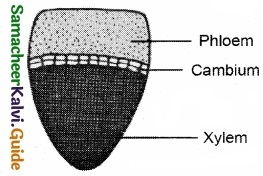
  • Tamil Nadu 11th Chemistry Model Question Paper 2 English Medium img 28
  • These two compounds are termed as geometrical isomers and are termed as cis and transform.
  • The cis isomer is the one in which two similar groups are on the same side of the double bond. The trans isomer is that in which two similar groups are on the opposite side of the double bond. Hence, this type of isomerism is called cis-trans isomerism.

(II) The bond line structure can be further abbreviated by omittiilg all the these dashes representing covalent bonds and by indicating the number of identical groups attached to an atom by a subscript. The resulting expression of the compound is called a condensed structural formula.
e.g., 1,3 – butadiene.

Tamil Nadu 11th Chemistry Model Question Paper 2 English Medium img 29

[OR]

(b) (I)

  1. Apples contains an enzyme called polyphenol oxidase (PPO) also known as tyrosinase.
  2. Cutting an apple exposes its cells to the atmospheric oxygen and oxidizes the phenolic compounds present in apples. This is called the “enzymatic browning” that turns a cut apple brown.
  3. In addition to apples, enzymatic browning is also evident in bananas, pears, avocados and even potatoes.

Tamil Nadu 11th Chemistry Model Question Paper 2 English Medium img 30

Tamil Nadu 11th Chemistry Model Question Paper 2 English Medium

Question 38 (a).
Suggest the route for the preparation of the following from benzene?

  1. 3 – chloro-nitrobenzene
  2. 4 – chlorotoluene
  3. Bromobenzene
  4. m – dinitrobenzene

[OR]

(b) A hydrocarbon C3H6 (A) reacts with HBr to form compound (B). Compound (B) reacts with aqueous potassium hydroxide to give (C) of molecular formula C3H6O. What are (A) (B) and (C). Explain the reactions?
Answer:
(a)
1. Preparation of 3 – chloronitro – benzene from benzene: Benzene undergoes nitration and followed by chlorination and it leads to the formation of 3 – chloronitrobenzene.
Tamil Nadu 11th Chemistry Model Question Paper 2 English Medium img 31

2. Preparation 4-chlorotoulene from benzene: Benzene undergoes Friedal craft’s alkylation followed by chlorination and it leads to the formation of 4 – chlorotoulene.
Tamil Nadu 11th Chemistry Model Question Paper 2 English Medium img 32

3. Preparation of Bromobenzene from benzene: Benzene undergo bromination to give bromobenzene.

Tamil Nadu 11th Chemistry Model Question Paper 2 English Medium img 33

4. Preparation of m-dinitrobenzene from benzene: Benzene undergo twice the time nitration to give m-dinitrobenzene.
Tamil Nadu 11th Chemistry Model Question Paper 2 English Medium img 34

[OR]

(b) Tamil Nadu 11th Chemistry Model Question Paper 2 English Medium img 35
1. The hydrocarbon with molecular formula C3H6 (A) is identified as propene,
CH – CH = CH2
2. Propene reacts with HBr to form bromopropane CH3 – CH2 – CH2Br as (B).Tamil Nadu 11th Chemistry Model Question Paper 2 English Medium img 36

3. 1 – bromopropane react with aqueous potassium hydroxide to give 1 – propanol CH3 – CH2 – CH2OH as (C).
4. 2 – bromo propane reacts with aqueous KOH to give 2-propanol as (C)Tamil Nadu 11th Chemistry Model Question Paper 2 English Medium img 37

Tamil Nadu 11th Physics Model Question Paper 3 English Medium

Students can Download Tamil Nadu 11th Physics Model Question Paper 3 English Medium Pdf, Tamil Nadu 11th Physics Model Question Papers helps you to revise the complete Tamilnadu State Board New Syllabus, helps students complete homework assignments and to score high marks in board exams.

TN State Board 11th Physics Model Question Paper 3 English Medium

General Instructions:

  1. The question paper comprises of four parts.
  2. You are to attempt all the parts. An internal choice of questions is provided wherever applicable.
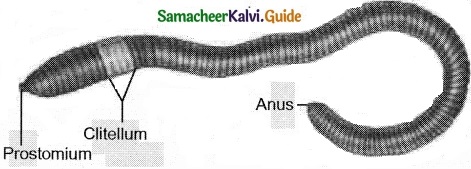
  3. All questions of Part I, II, III and IV are to be attempted separately.
  4. Question numbers 1 to 15 in Part I are Multiple Choice Questions of one mark each.
    These are to be answered by choosing the most suitable answer from the given four alternatives and writing the option code and the corresponding answer
  5. Question numbers 16 to 24 in Part II are two-mark questions. These are to be answered in about one or two sentences.
  6. Question numbers 25 to 33 in Part III are three-mark questions. These are to be answered in about three to five short sentences.
  7. Question numbers 34 to 38 in Part IV are five-mark questions. These are to be answered in detail Draw diagrams wherever necessary.

Time: 3 Hours
Maximum Marks: 70

PART – I

Answer all the questions: [15 × 1 = 15]

Question 1.
A new unit of length is chosen such that the speed of light in vacuum is unity. The distance between the Sun and the Earth in terms of the new unit, if light takes 8 minute and 20 sec to cover the distance is …………………..
(a) 100 new unit
(b) 300 new unit
(c) 500 new unit
(d) 700 new unit
Hint:
Speed is unity = 1 unit/sec
Time = 8 min and 20 sec = 500 sec
Distance b/w sun and earth = Speed × Time
= 1 × 500 = 500 unit
Answer:
(c) 500 new unit

Tamil Nadu 11th Physics Model Question Paper 3 English Medium

Question 2.
For a satellite moving in an orbit around the Earth, the ratio of kinetic energy to potential energy is ………………….
(a) 2
(b) 1 : 2
(c) 1 : \(\sqrt{2}\)
(d) \(\sqrt{2}\)
Hint:
\(\frac { GMm }{ R^{ 2 } } \) = mω2R
K.E = \(\frac{1}{2}\)Iω2 = \(\frac{1}{2}\)mR2ω2 = \(\frac{GMm}{2R}\)
P.E = – \(\frac{GMm}{R}\) ⇒ So \(\frac{K.E}{|P.E|}\) = \(\frac{1}{2}\)
Answer:
(b) 1 : 2

Question 3.
In the equilibrium position a body has ……………….
(a) Maximum potential energy
(b) Minimum potential energy
(c) Minimum kinetic energy
(d) Neither maximum nor minimum potential energy
Answer:
(c) Minimum kinetic energy

Tamil Nadu 11th Physics Model Question Paper 3 English Medium

Question 4.
The centrifugal force appears to exist ………………….
(a) Only in inertial frames
(b) Only in rotating frames
(c) In any accelerated frame
(d) Both in inertial and non-inertial frames
Answer:
(b) Only in rotating frames

Question 5.
A particle is moving with a constant velocity along a line parallel to positive x-axis. The magnitude of its angular momentum with respect to the origin is …………………..
(a) Zero
(b) Increasing with x
(c) Decreasing with x
(d) Remaining constant
Answer:
(d) Remaining constant

Question 6.
When 8 droplets of water of radius 0.5 mm combine to form a single droplet. The radius of it is …………………
(a) 4 mm
(b) 2 mm
(c) 1 mm
(d) 8 mm
Hint:
Volume of 8 droplets of water = 8 × \(\frac{4}{3}\) π(0.5)3
When each droplet combine to form one volume remains conserved
R3 = 8 × (0.5)3
R3 = (8 × (0.5)3)
R3 = 2 × 0.5 = 1 mm
Answer:
(c) 1 mm

Tamil Nadu 11th Physics Model Question Paper 3 English Medium

Question 7.
Pressure head in Bernoulli’s equation is …………………
(a) \(\frac { P_{ \rho } }{ g } \)
(b) \(\frac { P }{ \rho g } \)
(c) ρg
(d) Pρg
Answer:
(b) \(\frac { P }{ \rho g } \)

Question 8.
The angle between particle velocity and wave velocity in a transverse wave is ……………………
(a) Zero
(b) π/4
(c) π/2
(d) π
Answer:
(c) π/2

Question 9.
If the masses of the Earth and Sun suddenly double, the gravitational force between them will …………………….
(a) Remains the same
(b) Increase two times
(c) Increase four times
(d) Decrease two times
Answer:
(c) Increase four times

Question 10.
A mobile phone tower transmits a wave signal of frequency 900 MHz, the length of the transmitted from the mobile phone tower ……………………
(a) 0.33 m
(b) 300 m
(c) 2700 × 108m
(d) 1200 m
Hint:
f = 900 MHz = 900 × 106 Hz
Speed of wave (c) = 3 × 10⁶ ms-1
λ = \(\frac{v}{f}\) = \(\frac { 3\times 10^{ 8 } }{ 900\times 10^{ 6 } } \) = \(\frac{1}{3}\) = 0.33m
Answer:
(a) 0.33 m

Tamil Nadu 11th Physics Model Question Paper 3 English Medium

Question 11.
The displacement y of a wave travelling in the x direction is given by
y = (2 × 10⁻³) sin (300 t – 2x + \(\frac { \pi }{ 4 } \)), where x and y are measured in metres and t in second. The speed of the wave is …………………
(a) 150 ms-1
(b) 300 ms-1
(c) 450 ms-1
(d) 600 ms-1
Hint:
From standard equation of wave, Y = a sin (ωt – kx + ϕ)
ω = 300 ; k = 2
Speed of wave, V = \(\frac{ω}{k}\) = \(\frac{300}{2}\) = 150ms-1
Answer:
(a) 150 ms-1

Question 12.
The increase in internal energy of a system is equal to the workdone on the system. The process does the system undergoes is ……………………
(a) Isochoric
(b) Adiabatic
(c) Isobaric
(d) Isothermal
Answer:
(d) Isothermal

Question 13.
The minimum velocity with which a body of mass m must enter a vertical loop of radius R so that it can complete the loop is ……………………..
(a) \(\sqrt{2gR}\)
(b) \(\sqrt{3gR}\)
(c) \(\sqrt{5gR}\)
(d) \(\sqrt{gR}\)
Answer:
(c) \(\sqrt{5gR}\)

Tamil Nadu 11th Physics Model Question Paper 3 English Medium

Question 14.
If the rms velocity of the molecules of a gas in a container be doubled then the pressure of the gas will.
(a) Becomes 4 times of the previous value
(b) Becomes 2 times of its previous value
(c) Remains same
(d) Becomes \(\frac{1}{4}\) of its previous value
Hint:

Tamil Nadu 11th Physics Model Question Paper 3 English Medium img 1

Answer:
(a) Becomes 4 times of the previous value

Question 15.
Gravitational mass is proportional to gravitational ………………….
(a) Intensity
(b) Force
(c) Field
(d) All of these
Answer:
(b) Force

PART – II

Answer any six questions in which Q. No 23 is compulsory. [6 × 2 = 12]

Question 16.
Write any four postulates of Kinetic theory of gases?
Answer:

  1. A gas consists of a very large number of molecules. Each one is a perfectly identical elastic sphere.
  2. The molecules of a gas are in a state of continuous and random motion. They move in all directions with all possible velocities.
  3. The size of each molecule is very small as compared to the distance between them. Hence, the volume occupied by the molecule is negligible in comparison to the volume of the gas:
  4. There is no force of attraction or repulsion between the molecules and the walls of the container.

Tamil Nadu 11th Physics Model Question Paper 3 English Medium

Question 17.
Draw the free body diagram of the book at rest on the table?
Answer:

Tamil Nadu 11th Physics Model Question Paper 3 English Medium img 2

Question 18.
Three block are connected as shown in fig on a horizontal frictionless table. If m1 = 1 kg, m2 = 8 kg, m3 = 27 kg and T3 = 36 N then calculate tension T2?
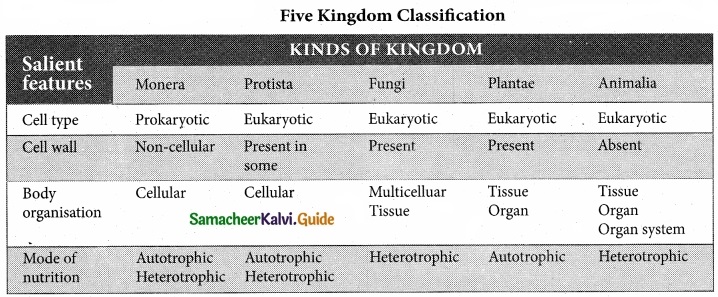
Answer:

Tamil Nadu 11th Physics Model Question Paper 3 English Medium img 3

Acceleration acquired by all blocks a = \(\frac { T_{ 3 } }{ m_{ 1 }+m_{ 2 }+m_{ 3 } } \) = \(\frac{36}{36}\) = 1ms-2
∴ Tension T2 = (m1 + m2) a
= (1 + 8) × 1 = 9N

Tamil Nadu 11th Physics Model Question Paper 3 English Medium

Question 19.
What is power? Give its dimensional formula?
Answer:
The rate of work done is called power. Dimensional formula of power is ML2 T-3

Question 20.
What are geostationary and polar satellites?
Answer:
Geostationary Satellite: It is the satellite which appears at a fixed position and at a definite height to an observer on Earth.
Polar Satellite: It is the satellite which revolves in polar orbit around the Earth.

Question 21.
An iceberg of density 900 kg m-3 is floating in water of density 1000 kg m-3. What is the percentage of volume of iceberg outside the water?
Answer:
Fraction of volume inside water = Relative density of the body
\(\frac { V’ }{ V } \) = \(\frac { \rho }{ \rho ‘ } \) = \(\frac{900}{1000}\) = 0.9
Fraction of volume outside water = 1 – 0.9 = 0.1
Percentage of volume outside water = 0.1 × 100 = 10%

Tamil Nadu 11th Physics Model Question Paper 3 English Medium

Question 22.
State stoke’s law and define terminal velocity?
Answer:
Stoke’s law:
When a body falls through a highly viscous liquid, it drags the layer of the liquid immediately in contact with it. This results in a relative motion between the different layers of the liquid. As a result of this, the falling body experiences a viscous force F.

Stoke performed many experiments on the motion of small spherical bodies in different fluids and concluded that the viscous force F acting on the spherical body depends on

  1. Coefficient of viscosity q of the liquid
  2. Radius a of the sphere and
  3. Velocity v of the spherical body

Dimensionally it can be proved that ∴ F = k ηav
Experimentally Stoke found that k = 6π
This is Stoke’s law

Terminal velocity:
Terminal velocity of a body is defined as the constant velocity acquired by a body while falling through a viscous liquid.

Tamil Nadu 11th Physics Model Question Paper 3 English Medium

Question 23.
The Earth without its atmosphere would be hospitably cold. Explain why?
Answer:
The lower layers of Earth’s atmosphere reflect infrared radiations from Earth back to the surface of Earth. Thus the heat radiation received by the earth from the Sun during the day are kept trapped by the atmosphere. If atmosphere of Earth were not there, its surface would become too cold to live.
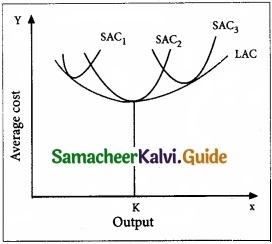
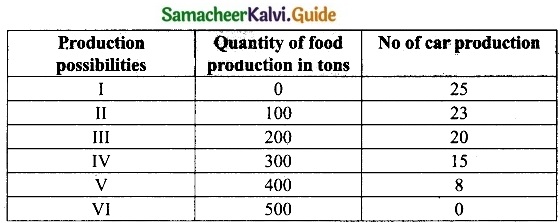
Question 24.
A body A is projected upwards with velocity v1 Another body B of same mass is proj eeted at an angle of 45°. Both reach the same height. Calculate the ratio of their initial kinetic energies?
Answer:
As A and B attain the same height therefore vertical component of initial velocity of B is equal to initial velocity of A
v2 cos 45° = V1 (or) \(\frac { v_{ 2 } }{ \sqrt { 2 } } \) = v1

Tamil Nadu 11th Physics Model Question Paper 3 English Medium img 4

PART – III

Answer any six questions in which Q.No. 29 is compulsory. [6 × 3 = 18]

Question 25.
Explain the rules for counting significant figures with examples?
Rules for counting significant figures:
Answer:

Tamil Nadu 11th Physics Model Question Paper 3 English Medium img 5

Question 26.
Elastic headon collision, consider two particles one is moving and another one is stationary with their respective masses m and \(\frac { M }{ m } \). A moving particle meets collides elastically on stationary particle in the opposite direction. Find the kinetic energy of the stationary particle after a collision?
Answer:
mass of the moving particle m1 = m (say)
mass of the stationary particle m1 = \(\frac { 1 }{ m } \) M
Velocity of the moving particle before collision = v1i (say)
Velocity of the stationary particle before collision = v2i = 0
Velocity of the stationary particle after collision = v2f (say)

Tamil Nadu 11th Physics Model Question Paper 3 English Medium img 6

Kinetic energy of the stationary particle after a collision

Tamil Nadu 11th Physics Model Question Paper 3 English Medium img 7

Question 27.
Calculate the angle for which a cyclist bends when he turns a circular path of length 34.3 m in \(\sqrt{22}\) s?
Answer:
Given Data:
l = 34.3 m, t = \(\sqrt{22}\) , g = 9.8 ms-2, θ = ?
If r is radius of circular path, then length of path = 2πr = 34.3 m
r = \(\frac { 33.4 }{ 2\pi } \) and time taken t = \(\sqrt{22}\)s

As tan θ = \(\frac { v^{ 2 } }{ rg } \)
∴ tan θ = (\(\frac { 34.3 }{ \sqrt { 22 } } \))2 × \(\frac { 2\pi }{ 34.3\times 9.8 } \)
tan θ = \(\frac { 34.3\times 34.3 }{ 22 } \) × \(\frac{2×22}{7×343×9.8}\) = \(\frac{34.3×2}{68.6}\) = 1 [∴θ = 45°]

Tamil Nadu 11th Physics Model Question Paper 3 English Medium

Question 28.
Explain how density, moisture affect the velocity of sound in gases?
Answer:
Effect of density:
Let us consider two gases with different densities having same temperature and pressure. Then the speed of sound in the two gases are

Tamil Nadu 11th Physics Model Question Paper 3 English Medium img 8

Taking ratio of equation (1) and equation (2) we get

Tamil Nadu 11th Physics Model Question Paper 3 English Medium img 9

For gases having same value of γ,
\(\frac { v_{ 1 } }{ v_{ 2 } } \) = \(\sqrt { \frac { \rho _{ 2 } }{ \rho _{ 1 } } } \)
Thus the velocity of sound in a gas is inversely proportional to the square root of the density of the gas.

Effect of moisture (humidity):
We know that density of moist air is 0.625 of that of dry air, which means the presence of moisture in air (increase in humidity) decreases its density. Therefore, speed of sound increases with rise in humidity. From equation:
v = \(\sqrt { \frac { \gamma \rho }{ \rho } } \)

Let ρ1, v1 = and ρ2, v2 be the density and speeds of sound in dry air and moist air, respectively.

Tamil Nadu 11th Physics Model Question Paper 3 English Medium img 10

Since P is the atmospheric pressure, it can be shown that
\(\frac { \rho _{ 2 } }{ \rho _{ 1 } } \) = \(\frac { P }{ p_{ 1 }+0.625p_{ 2 } } \)
where p1 and p2 are the partial pressures of dry air and water vapour respectively. Then

Tamil Nadu 11th Physics Model Question Paper 3 English Medium img 11

Question 29.
Explain
(a) Why there are no lunar eclipse and solar eclipse every month?
(b) Why do we have seasons on earth?
Answer:
(a) If the orbits of the Moon and Earth lie on the same plane, during full Moon of every month, we can observe lunar eclipse. If this is so during new Moon we can observe solar eclipse.

But Moon’s orbit is tilted 5° with respect to Earth’s orbit. Due to this 5° tilt, only during certain periods of the year, the Sun, Earth and Moon align in straight line leading to either lunar eclipse or solar eclipse depending on the alignment.

(b) The common misconception is that ‘Earth revolves around the Sun, so when the Earth is very far away, it is winter and when the Earth is nearer, it is summer’.

Actually, the seasons in the Earth arise due to the rotation of Earth around the Sun with 23.5° tilt. Due to this 23.5° tilt, when the northern part of Earth is farther to the Sun, the southern part is nearer to the Sun. So when it is summer in the northern hemisphere, the southern hemisphere experience winter.

Tamil Nadu 11th Physics Model Question Paper 3 English Medium

Question 30.
When a person breathes, his lungs can hold up to 5.5 1 of air at body temperature 37°C and atmospheric pressure (1 atm = 101 kPa). This air contains 21% oxygen, calculate the number of oxygen molecules in the lungs?
Answer:
We can treat the air inside the lungs as an ideal gas. To find the number of molecules, we can use the ideal gas law.
PV = NkT
Here volume is given in the Litre. 1 Litre is volume occupied by a cube of side 10 cm
1 Litre = 10 cm × 10 cm × 10 cm = 10-3m-3
N = \(\frac{PV}{kT}\) = \(\frac { 1.01\times 10^{ 5 }\times 5.5\times 10^{ -3 } }{ 1.38\times 10^{ -23 }\times 310 } \)
= 1.29 × 10²³ × \(\frac{21}{100}\)
Number of oxygen molecules = 2.7 × 10²² molecules

Question 31.
Give any five properties of vector product of two vectors?
Answer:
(I) The vector product of any two vectors is always another vector whose direction is perpendicular to the plane containing these two vectors, i.e., orthogonal to both the vectors \(\vec { A } \) and \(\vec { B } \), even though the vectors AandB may or may not be mutually orthogonal.

(II) The vector product of two vectors is not commutative, i.e., \(\vec { A } \) × \(\vec { B } \) ≠ \(\vec { B } \) × \(\vec { A } \) . But, \(\vec { A } \) × \(\vec { B } \) = –\(\vec { B } \) × \(\vec { A } \).

Here it is worthwhile to note that |\(\vec { A } \) × \(\vec { B } \)| = |\(\vec { B } \) × \(\vec { A } \)| = AB sin θ i.e., in the case of the product vectors \(\vec { A } \) × \(\vec { B } \) and \(\vec { B } \) × \(\vec { A } \), the magnitudes are equal but directions are opposite to each other.

(III) The vector product of two vectors will have maximum magnitude when sin 0 = 1, i.e., θ = 90° i.e., when the vectors \(\vec { A } \) and \(\vec { B } \) are orthogonal to each other.
(\(\vec { A } \) × \(\vec { B } \))max = AB\(\hat { n } \)

(IV) The vector product of two non-zero vectors will be minimum when sin 0 = 0, i.e., 0 = 0° or 180°
(\(\vec { A } \) × \(\vec { B } \))max = 0
i.e., the vector product of two non-zero vectors vanishes, if the vectors are either parallel or antiparallel.

(V) The self-cross product, i.e., product of a vector with itself is the null vector
\(\vec { A } \) × \(\vec { A } \) = AA sin 0°\(\hat { n } \) = \(\vec { 0 } \)
In physics the null vector \(\vec { 0 } \) is simply denoted as zero.

Tamil Nadu 11th Physics Model Question Paper 3 English Medium

Question 32.
Why does a porter bend forward w hile carrying a sack of rice on his back?
Answer:
When a porter carries a sack of rice, the line of action of his centre of gravity will go away from the body. It affects the balance, to avoid this he bends. By which centre of gravity will realign within the body again. So balance is maintained.

Question 33.
A piece of wood of mass m is floating erect in a liquid whose density is p. If it is slightly pressed down and released, then executes simple harmonic motion. Show that its time period of oscillation is T = 2π\(\sqrt{m/Agρ}\)
Answer:
Spring factor of liquid(k) = Aρg
Inertia factor of wood = m
Time period T = 2π = image 12
T = 2π\(\sqrt{m/Aρg}\)

PART – IV

Answer all the questions. [5 × 5 = 25]

Question 34 (a).
Describe the vertical oscillations of a spring?
Answer:
Vertical oscillations of a spring: Let us consider a massless spring with stiffness constant or force constant k attached to a ceiling as shown in figure. Let the length of the spring before loading mass m be L.

If the block of mass m is attached to the other end of spring, then the spring elongates by a length. Let F, be the restoring force due to stretching of spring. Due to mass m, the gravitational force acts vertically downward. We can draw free-body diagram for this system as shown in figure. When the system is under equilibrium,

Tamil Nadu 11th Physics Model Question Paper 3 English Medium img 12

F1 + mg = 0 ……………… (1)
But the spring elongates by small displacement 1, therefore,
F1 ∝ l ⇒ F1 = -kl ……………….. (2)
Substituting equation (2) in equation (1) we get
-kl + mg = 0
mg = kl or
\(\frac{m}{k}\) = \(\frac{l}{g}\) ………………….. (3)

Suppose we apply a very small external force on the mass such that the mass further displaces downward by a displacement y, then it will oscillate up and down. Now, the restoring force due to this stretching of spring (total extension of spring is y + 1) is
F2 ∝ (y + l)
F2 = -k(y + l) = -ky – kl …………………… (4)

Since, the mass moves up and down with acceleration \(\frac{d^{2} y}{d t^{2}}\), by drawing the free body diagram for this case we get
-ky – kl + mg = m \(\frac{d^{2} y}{d t^{2}}\) ……………………. (5)
The net force acting on the mass due to this stretching is
F = F2 + mg
F = -ky – kl + mg …………………… (6)
The gravitational force opposes the restoring force. Substituting equation (3) in equation (6), we get
F = – ky- kl + kl = -ky
Applying Newton’s law we get
m \(\frac{d^{2} y}{d t^{2}}\) = -ky
\(\frac{d^{2} y}{d t^{2}}\) = –\(\frac{k}{m}\)y ………………… (7)
The above equation is in the form of simple harmonic differential equation. Therefore, we get the time period as
T = 2π\(\sqrt{m/k}\) second ……………………. (8)
The time period can be rewritten using equation (3)
T = 2π\(\sqrt{m/k}\) = 2πl\(\frac{1}{g}\) second ……………………. (9)
The accleration due to gravity g can be computed by the formula
g = 4π2\((\frac { 1 }{ T } )^{ 2 }\)ms-2 …………………….. (10)

[OR]

(b) Derive poiseuille’s formula for the volume of a liquid flowing per second through a pipe under streamlined flow?
Answer:
Consider a liquid flowing steadily through a horizontal capillary tube. Let v = (\(\frac{1}{g}\)) be the volume of the liquid flowing out per second through a capillary tube. It depends on (1) coefficient of viscosity (η) of the liquid, (2) radius of the tube (r), and (3) the pressure gradient (\(\frac{P}{l}\)) . Then,
v ∝ηarb(\(\frac{P}{l}\))c
v = kηarb(\(\frac{P}{l}\))c …………………….. (1)

where, k is a dimensionless constant.
Therefore, [v] = \(\frac { Volume }{ Time } \) = [L3T-1]; [ \(\frac{dP}{dX}\) ] = \(\frac { Pressure }{ Distance } \) = [ML-2T-2]
[η] = [Ml-1T-1] and [r] = [L]

Substituting in equation (1)
[L3T-1] = [ML-1T-1]a[L]b [ML-2T-2]c
M0L3T-1 = Ma+bL-a+b-2cT-a-2c = -1

So, equating the powers of M, L and T on both sides, we get
a + c = 0, – a + b – 2c = 3, and – a – 2c = – 1

We have three unknowns a, b and c. We have three equations, on solving, we get
a = – 1, b = 4 and c = 1

Therefore, equation (1) becomes,
v = kη-1r4(\(\frac{P}{l}\))1

Experimentally, the value of k is shown to be , we have \(\frac{π}{8}\), we have
v = \(\frac{\pi r^{4} \mathrm{P}}{8 \eta /}\)

The above equation is known as Poiseuille’s equation for the flow of liquid through a narrow tube or a capillary tube. This relation holds good for the fluids whose velocities are lesser than the critical velocity (vc).

Tamil Nadu 11th Physics Model Question Paper 3 English Medium

Question 35 (a).
Describe briefly simple harmonic oscillation as a projection of uniform circular motion?
Answer:
Consider a particle of mass m moving with unifonn speed v along the circumference of a circle whose radius is r in anti-clockwise direction (as shown in figure). Let us assume that the origin of the coordinate system coincides with the center O of the circle.
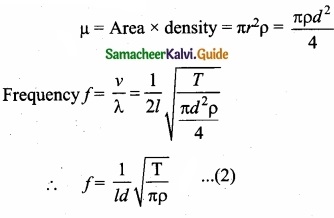
If ω is the angular velocity of the particle and θ the angular displacement of the particle at any instant of time t, then θ = ωt. By projecting the uniform circular motion on its diameter gives a simple harmonic motion.

This means that we can associate a map (or a relationship) between uniform circular (or revolution) motion to vibratory motion. Conversely, any vibratory motion or revolution can be mapped to unifonn circular motion. In other words, these two motions are similar in nature.
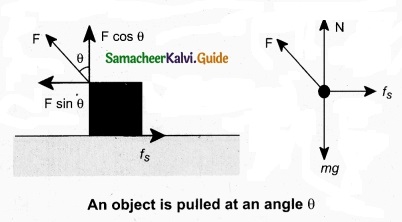
Let us first project the position of a particle moving on a circle, on to its vertical diameter or on to a line parallel to vertical diameter as shown in figure. Similarly, we can do it for horizontal axis or a line parallel to horizontal axis.
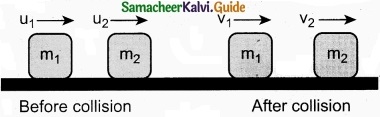
Tamil Nadu 11th Physics Model Question Paper 3 English Medium img 13

The projection of uniform circular motion on a diameter of SHM:
As a specific example, consider a spring mass system (or oscillation of pendulum). When the spring moves up and down (or pendulum moves to and fro), the motion of the mass or bob is mapped to points on the circular motion.

Thus, if a particle undergoes uniform circular motion then the projection of the particle on the diameter of the circle (or on a line parallel to the diameter) traces straight line motion which is simple harmonic in nature. The circle is known as reference circle of the simple harmonic motion. The simple harmonic motion can also be defined as the motion of the projection of a particle on any diameter of a circle of reference.

[OR]

(b) State and prove Bernoulli’s theorem for a flow of incompressible non viscous and stream lined flow of fluid?
Answer:
Bernoulli’s theorem:
According to Bernoulli’s theorem, the sum of pressure energy, kinetic energy, and potential energy per unit mass of an incompressible, non-viscous fluid in a streamlined flow remains a constant. Mathematically,
\(\frac{P}{ρ}\) + \(\frac{1}{2}\)v2 + gh – constant
This is known as Bernoulli’s equation.
Proof:
Let us consider a flow of liquid through a pipe AB. Let V be the volume of the liquid when it enters A in a time t. Which is equal to the volume of the liquid leaving B in the same time. Let aA, vA and PA be the area of cross section of the tube, velocity of the liquid and pressure exerted by the liquid at A respectively.

Let the force exerted by the liquid at A is
FA = PAaA

Distance travelled by the liquid in time t is d = vAt
Therefore, the work done is W = FAd = PAaAvAt
But aAvAt = aAd = V, volume of the liquid entering at A.

Thus, the work done is the pressure energy (at A), W = FAd = PAV

Pressure energy per unit volume at
A = \($\frac{\text { Pressure energy }}{\text { Volume }}$\) = \(\frac { P_{ A }V }{ V } \) = PA

Pressure energy per unit mass at
A = \($\frac{\text { Pressure energy }}{\text { Mass }}$\) = \(\frac { P_{ A }V }{ m } \) = \(\frac { P_{ A } }{ \frac { m }{ V } } \) = \(\frac { P_{ A } }{ \rho } \)

Since m is the mass of the liquid entering at A in a given time, therefore, pressure energy of the liquid at A is
EPA = PAV = PAV × (\(\frac{m}{m}\)) = m\(\frac { P_{ A } }{ \rho } \)

Potential energy of the liquid at A,
PEA = mghA

Due to the flow of liquid, the kinetic energy of the liquid at A,
KEA = \(\frac{1}{2}\)mv2A

Therefore, the total energy due to the flow of liquid at A,
EA = EPA + KEA + PEA
EA = \(m \frac{P_{A}}{\rho}+\frac{1}{2} m v_{A}^{2}+m g h_{A}\)

Similarly, let aB, VB and PB be the area of cross section of the tube, velocity of the liquid and pressure exerted by the liquid at B. Calculating the total energy at FB, we get .
\(\mathrm{E}_{\mathrm{B}}=m \frac{\mathrm{P}_{\mathrm{B}}}{\rho}+\frac{1}{2} m v_{\mathrm{B}}^{2}+m g h_{\mathrm{B}}\)
From the law of conservation of energy.
EA = EB

Tamil Nadu 11th Physics Model Question Paper 3 English Medium img 14

Thus, the above equation can be written as
\(\frac { P }{ \rho g } \) + \(\frac{1}{2}\) \(\frac { v^{ 2 } }{ g } \) + h = Constant

The above equation is the consequence of the conservation of energy which is true until there is no loss of energy due to friction. But in practice, some energy is lost due to friction. This arises due to the fact that in a fluid flow, the layers flowing with different velocities exert frictional forces on each other. This loss of energy is generally converted into heat energy. Therefore, Bernoulli’s relation is strictly valid for fluids with zero viscosity or non-viscous liquids. Notice that when the liquid flows through a horizontal pipe, then
h = 0 ⇒ \(\frac { P }{ \rho g } \) + \(\frac{1}{2}\) \(\frac { v^{ 2 } }{ g } \) = Constant

Tamil Nadu 11th Physics Model Question Paper 3 English Medium

Question 36 (a).
Explain perfect inelastic collision and derive an expression for loss of kinetic energy in perfect inelastic collision?
Answer:
In a perfectly inelastic or completely inelastic collision, the objects stick together permanently after collision such that they move with common velocity. Let the two bodies with masses m1 and m2 move with initial velocities u1 and u2 respectively before collision. Aft er perfect inelastic collision both the objects move together with a common velocity v as shown in figure.
Since, the linear momentum is conserved during collisions,

Tamil Nadu 11th Physics Model Question Paper 3 English Medium img 15

m1u1 + m2u2 = (m1 + m2) v

Tamil Nadu 11th Physics Model Question Paper 3 English Medium img 16

The common velocity can be computed by
v = \(\frac{m_{1} u_{1}+m_{2} u_{2}}{\left(m_{1}+m_{2}\right)}\) ………………….. (1)

Loss of kinetic energy in perfect inelastic collision;
In perfectly inelastic collision, the loss in kinetic energy during collision is transformed to another form of energy like sound, thermal, heat, light etc. Let KEi be the total kinetic energy before collision and KEf be the total kinetic energy after collision.
Total kinetic energy before collision,
KEe = \(\frac{1}{2} m_{1} u_{1}^{2}+\frac{1}{2} m_{2} u_{2}^{2}\) …………………… (2)
Total kinetic energy after collision,
KEf = \(\frac{1}{2}\left(m_{1}+m_{2}\right) v^{2}\) …………………….. (3)
Then the loss of kinetic energy is Loss of KE, ∆Q = KEf – KEi
= \(\frac{1}{2}\left(m_{1}+m_{2}\right) v^{2}-\frac{1}{2} m_{1} u_{1}^{2}-\frac{1}{2} m_{2} u_{2}^{2}\) ………………….. (4)
Substituting equation (1) in equation (4), and on simplifying (expand v by using the algebra (a + b)2 = a2 + b2 + 2ab), we get
Loss of KE, ∆Q = \(\frac{1}{2}\) \(\left(\frac{m_{1} m_{2}}{m_{1}+m_{2}}\right)\) (u1 – u2)2

[OR]

(b) Derive an expression for maximum height attained, time of flight, horizontal range for a projectile in oblique projection?
Answer:

Tamil Nadu 11th Physics Model Question Paper 3 English Medium img 17

Maximum height (hmax):
The maximum vertical distance travelled by the projectile during the journey is called maximum height. This is determined as follows:
For the vertical part of the motion
\(v_{y}^{2}=u_{y}^{2}+2 a_{y} s\)
Here, uy= u sin θ, a = -g, s = hmax, and at the maximum height v = 0

Time of flight (Tf):
The total time taken by the projectile from the point of projection till it hits the horizontal plane is called time of flight. This time of flight is the time taken by the projectile to go from point O to B via point A as shown in figure.
We know that sy = uyt + \(\frac{1}{2}\)ayt2
Here, sy = y = 0 (net displacement in y-direction is zero), uy = u sin θ, ay = -g, t = Tf, Then
0 = u sin θ Tf – \(\frac{1}{2} g \mathrm{T}_{f}^{2}\)
Tf = 2u \(\frac{sin θ}{g}\) …………………….. (2)

Horizontal range (R):
The maximum horizontal distance between the point of projection and the point on the horizontal plane where the projectile hits the ground is called horizontal range (R). This is found easily since the horizontal component of initial velocity remains the same. We can write.

Range R = Horizontal component of velocity % time of flight = u cos θ × Tf = \(\frac{u^{2} \sin 2 \theta}{g}\)
The horizontal range directly depends on the initial speed (u) and the sine of angle of projection (θ). It inversely depends on acceleration due to gravity ‘g’.

For a given initial speed u, the maximum possible range is reached when sin 2θ is
maximum, sin 2θ = 1. This implies 2θ = π/2 or θ = π/4
This means that if the particle is projected at 45 degrees with respect to horizontal, it attains maximum range, given by
Rmax = \(\frac { u^{ 2 } }{ g } \).

Tamil Nadu 11th Physics Model Question Paper 3 English Medium

Question 37 (a).
Explain the work-energy theorem in detail and also give three examples?
Answer:

  1. If the work done by the force on the body is positive then its kinetic energy increases.
  2. If the work done by the force on the body is negative then its kinetic energy decreases.
  3. If there is no work done by the force on the body then there is no change in its kinetic energy, which means that the body has moved at constant speed provided its mass remains constant.
  4. When a particle moves with constant speed in a circle, there is no change in the kinetic energy of the particle. So according to work energy principle, the work done by centripetal force is zero.

[OR]

(b) (i) Define molar specific heat capacity?
Answer:
Molar specific heat capacity is defined as heat energy required to increase the temperature of one mole of substance by IK or 1°C

(ii) Derive Mayer’s relation for an ideal gas?

Mayer’s relation: Consider p mole of an ideal gas in a container with volume V, pressure P and temperature T.

When the gas is heated at constant volume the temperature increases by dT. As no work is done by the gas, the heat that flows into the system will increase only the internal energy. Let the change in internal energy be dU.

If CV is the molar specific heat capacity at constant volume, from equation.
CV = \(\frac { 1 }{ \mu } \) \(\frac{dU}{dT}\) …………………… (1)
dU = µCV dT ………………… (2)

Suppose the gas is heated at constant pressure so that the temperature increases by dT. If ‘Q’ is the heat supplied in this process and ‘dV’ the change in volume of the gas.
Q = pCpdT ……………. (3)

If W is the workdone by the gas in this process, then
W = P dV ………………….. (4)

But from the first law of thermodynamics,
Q = dU + W ………………… (5)

Substituting equations (2), (3) and (4) in (5), we get,
For mole of ideal gas, the equation of state is given by
\(\mu \mathrm{C}_{\mathrm{p}} d \mathrm{T}=\mu \mathrm{C}_{\mathrm{v}} d \mathrm{T}+\mathrm{P} d \mathrm{V}\)

Since the pressure is constant, dP = 0
CpdT = CVdT + PdV
∴ Cp = CV + R (or) Cp – CV = R …………………… (6)
This relation is called Mayer’s relation It implies that the molar specific heat capacity of an ideal gas at constant pressure is greater than molar specific heat capacity at constant volume.
The relation shows that specific heat at constant pressure (sp) is always greater than specific heat at constant volume (sv).

Tamil Nadu 11th Physics Model Question Paper 3 English Medium

Question 38 (a).
Derive an expression of pressure exerted by the gas on the walls of the container?
Answer:
Expression for pressure exerted by a gas : Consider a monoatomic gas of N molecules each having a mass m inside a cubical container of side l.
The molecules of the gas are in random motion. They collide with each other and also with the walls of the container. As the collisions are elastic in nature, there is no loss of energy, but a change in momentum occurs.

Tamil Nadu 11th Physics Model Question Paper 3 English Medium img 18

The molecules of the gas exert pressure on the walls of the container due to collision on it. During each collision, the molecules impart certain momentum to the wall. Due to transfer of momentum, the walls experience a continuous force. The force experienced per unit area of the walls of the container determines the pressure exerted by the gas. It is essential to determine the total momentum transferred by the molecules in a short interval of time.

A molecule of mass m moving with a velocity \(\vec { v } \) having components (vx, vy, vz) hits the right side wall. Since we have assumed that the collision is elastic, the particle rebounds with same speed and its x-component is reversed. This is shown in the figure. The components of velocity of the molecule after collision are (-vx, vy, vz).

The x-component of momentum of the molecule before collision = mvx
The x-component of momentum of the molecule after collision = – mvx
The change in momentum of the molecule in x direction
= Final momentum – initial momentum = – mvx – mvx = – 2mvx
According to law of conservation of linear momentum, the change in momentum of the wall = 2 mvx
The number of molecules hitting the right side wall in a small interval of time ∆t.

Tamil Nadu 11th Physics Model Question Paper 3 English Medium img 19

The molecules within the distance of vx∆t from the right side wall and moving towards the right will hit the wall in the time interval ∆t. The number of molecules that will hit the right side wall in a time interval ∆t is equal to the product of volume (Avx∆t) and number density of the molecules (n).

Here A is area of the wall and n is number of molecules per \(\frac{N}{V}\) unit volume. We have assumed that the number density is the same throughout the cube.

Not all the n molecules will move to the right, therefore on an average only half of the n molecules move to the right and the other half moves towards left side.

The number of molecules that hit the right side wall in a time interval ∆t
= \(\frac{n}{2}\) Avx∆t
In the same interval of time ∆t, the total momentum transferred by the molecules
\(\Delta \mathrm{P}=\frac{n}{2} \mathrm{A} v_{x} \Delta t \times 2 m v_{x}=\mathrm{A} v_{x}^{2} m n \Delta t\) ………………….. (2)
From Newton’s second law, the change in momentum in a small interval of time gives rise to force.

The force exerted by the molecules on the wall (in magnitude)
F = \(\frac{∆p}{∆t}\) = nmAv2x ……………………. (3)

Pressure, P = force divided by the area of the wall
P = \(\frac{F}{A}\) = nmAv2x ……………………….. (4)
p = \(nm\bar{v}_{x}^{2}\)

Since all the molecules are moving completely in random manner, they do not have same . speed. So we can replace the term vnmAv2x by the average \(\bar { v } \)2x in equation (4).
P = nm\(\bar { v } \)2x ……………………. (5)

Since the gas is assumed to move in random direction, it has no preferred direction of motion (the effect of gravity on the molecules is neglected). It implies that the molecule has same average speed in all the three direction. So, \(\bar{v}_{x}^{2}\) = \(\bar{v}_{y}^{2}\) = \(\bar{v}_{z}^{2}\). The mean square speed is written as
\(\bar{v}^{2}\) = \(\bar{v}_{x}^{2}\) + \(\bar{v}_{y}^{2}\) + \(\bar{v}_{z}^{2}\) = 3\(\bar{v}_{x}^{2}\)
\(\bar{v}_{x}^{2}\) = \(\frac{1}{3}\) \(\bar{v}^{2}\)
Using this in equation (5), we get
P = \(\frac{1}{3} n m \bar{v}^{2} \quad \text { or } P=\frac{1}{3} \frac{N}{V} m \bar{v}^{2}\) ………………….. (6)

[OR]

(b) Discuss the simple pendulum in detail?
Answer:
Simple pendulum

Tamil Nadu 11th Physics Model Question Paper 3 English Medium img 20

A pendulum is a mechanical system which exhibits periodic motion. It has a bob with mass m suspended by a long string (assumed to be massless and inextensible string) and the other end is fixed on a stand. At equilibrium, the pendulum does not oscillate and hangs vertically downward.

Such a position is known as mean position or equilibrium position. When a pendulum is displaced through a small displacement from its equilibrium position and released, the bob of the pendulum executes to and fro motion. Let l be the length of the pendulum which is taken as the distance between the point of suspension and the centre of gravity of the bob. Two forces act on the bob of the pendulum at any displaced position.

  • The gravitational force acting on the body (\(\vec { F} \) = m\(\vec { g } \)) which acts vertically downwards.
  • The tension in the string T which acts along the string to the point of suspension.

Resolving the gravitational force into its components:

  1. Normal component: The component along the string but in opposition to the direction of tension, Fas = mg cos θ.
  2. Tangential component: The component perpendicular to the string i.e., along tangential direction of arc of swing, Fps = mg sin θ.

Therefore, The normal component of the force is, along the string,
\(\mathrm{T}-\mathrm{W}_{a s}=m \frac{v^{2}}{l}\)

Here v is speed of bob
T -mg cos θ = m \(\frac{v^{2}}{l}\)

From the figure, we can observe that the tangential component Wps of the gravitational force always points towards the equilibrium position i.e., the direction in which it always points opposite to the direction of displacement of the bob from the mean position. Hence, in this case, the tangential force is nothing but the restoring force. Applying Newton’s second law along tangential direction, we have
\(m \frac{d^{2} s}{d t^{2}}+\mathrm{F}_{p s}=0 \Rightarrow m \frac{d^{2} s}{d t^{2}}=-\mathrm{F}_{p s}\)
\(m \frac{d^{2} s}{d t^{2}}=-m g \sin \theta\) …………………. (1)

where, s is the position of bob which is measured along the arc. Expressing arc length in terms of angular displacement i.e.,
s = lθ ………………… (2)
then its acceleration, \(\frac{d^{2} s}{d t^{2}}=l \frac{d^{2} \theta}{d t^{2}}\) …………………. (3)

Substituting equation (3) in equation (1), we get
\(\begin{aligned}
l \frac{d^{2} \theta}{d t^{2}} &=-g \sin \theta \\
\frac{d^{2} \theta}{d t^{2}} &=-\frac{g}{l} \sin \theta
\end{aligned}\) ………………….. (4)

Because of the presence of sin θ in the above differential equation, it is a non-linear differential equation (Here, homogeneous second order). Assume “the small oscillation approximation”, sin θ ~ 0, the above differential equation becomes linear differential equation.
\(\frac{d^{2} \theta}{d t^{2}}=-\frac{g}{l} \theta\) …………………… (5)

This is the well known oscillatory differential equation. Therefore, the angular frequency of this oscillator (natural frequency of this system) is
ω2 = \(\frac{g}{l}\) …………………… (6)
∴ ω = \(\sqrt{g/l}\) in rad s-1 ……………….. (7)

The frequency of oscillation is
f = \(f=\frac{1}{2 \pi} \sqrt{\frac{g}{l}} \text { in } \mathrm{Hz}\) ………………… (8)
and time period of sscillations is
T = 2π\(\sqrt{l/g}\) in second. ……………….. (9)