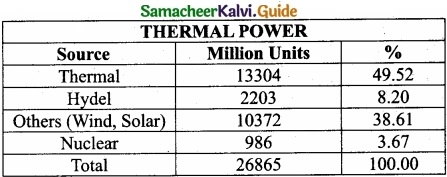
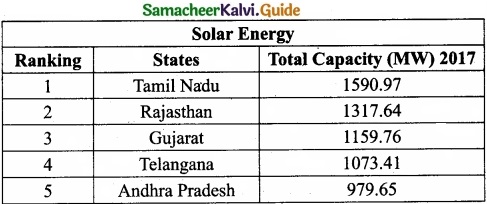
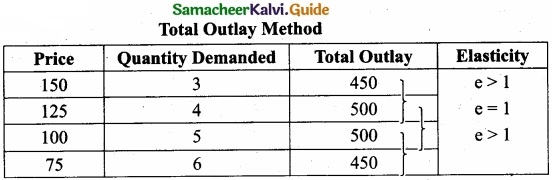
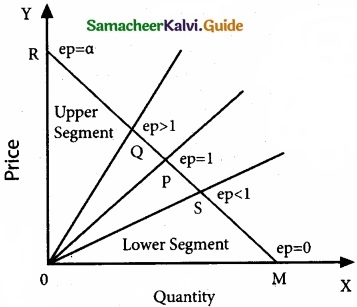
Tamil Nadu 11th Commerce Model Question Paper 2 English Medium

Students can Download Tamil Nadu 11th Commerce Model Question Paper 2 English Medium Pdf, Tamil Nadu 11th Commerce Model Question Papers helps you to revise the complete Tamilnadu State Board New Syllabus, helps students complete homework assignments and to score high marks in board exams.

TN State Board 11th Commerce Model Question Paper 2 English Medium

General Instructions:

  1. The question paper comprises of four parts.
  2. You are to attempt all the parts. An internal choice of questions is provided wherever applicable.
  3. All questions of Part I, II, III and IV are to be attempted separately.
  4. Question numbers 1 to 20 in Part I are Multiple Choice Questions of one mark each.
    These are to be answered by choosing the most suitable answer from the given four alternatives and writing the option code and the corresponding answer
  5. Question numbers 21 to 30 in Part II are two-mark questions. These are to be answered in about one or two sentences.
  6. Question numbers 31 to 40 in Part III are three-mark questions. These are to be answered in above three to five short sentences.
  7. Question numbers 41 to 47 in Part IV are five-mark questions. These are to be answered in detail Draw diagrams wherever necessary.

Time: 2:30 Hours
Maximum Marks: 90

PART – 1

Choose the correct answer. Answer all the questions. [20 × 1 = 20]

Question 1.
Wholesalers buy in ………………………… quantity of goods.
(a) Small
(b) Large
(c) Medium
(d) Limited
Answer:
(b) Large

Tamil Nadu 11th Commerce Model Question Paper 2 English Medium

Question 2.
Small scale fixed retailers include ……………………..
(a) General stores
(b) Pedlars
(c) Cheap jacks
(d) Hawkers
Answer:
(a) General stores

Question 3.
In India, GST became effective from ………………………
(a) 1st April 2017
(b) 1st January 2017
(c) 1st July 2017
(d) 1st March 2017
Answer:
(a) 1st April 2017

Tamil Nadu 11th Commerce Model Question Paper 2 English Medium

Question 4.
‘One share – one vote’ principle is followed in kind of organization.
(a) Co – operatives
(b) Partnership
(c) Company
(d) None of these
Answer:
(c) Company

Question 5.
……………………. is not a type of general insurance.
(a) Marine insurance
(b) Life insurance
(c) Fidelity insurance
(d) Fire insurance
Answer:
(b) Life insurance

Question 6.
Self – help groups convert the sayings into a common find known as ……………………..
(a) Common fund
(b) Group corpus fund
(c) Group fund
(d) None of the above
Answer:
(b) Group corpus fund

Tamil Nadu 11th Commerce Model Question Paper 2 English Medium

Question 7.
A major disadvantage of sole proprietorship is ……………………….
(a) Limited liability
(b) Unlimited liability
(c) Easy formation
(d) Quick decision
Answer:
(b) Unlimited liability

Question 8.
Which one of the following is not correctly matched?
(a) Mercantile agents – Functional middleman
(b) Merchant middleman – Wholesalers
(c) Retailer – Small quantities
(d) Wholesaler – Last middleman in the distribution
Answer:
(d) Wholesaler – Last middleman in the distribution

Question 9.
From which of the following deposit holders can get overdraft facilities?
(a) Savings deposits
(b) Current deposits
(c) Recurring deposits
(d) Fixed deposits
Answer:
(b) Current deposits

Tamil Nadu 11th Commerce Model Question Paper 2 English Medium

Question 10.
The role of government in logistics management is through ……………………….
(a) Legislations
(b) Governance
(c) Transport
(d) Distribution
Answer:
(d) Distribution

Question 11.
The local area banks are promoting ………………………
(a) Rural savings
(b) Business savings
(c) Industrial development
(d) Agricultural development
Answer:
(a) Rural savings

Question 12.
Way bill is a document issued by ………………………
(a) Railway transport
(b) Air transport
(c) Road transport
(d) Water transport
Answer:
(c) Road transport

Tamil Nadu 11th Commerce Model Question Paper 2 English Medium

Question 13.
The types of development banks are ……………………….
(I) IFCI
(II) State Bank of India
(III) MUDRA Bank
(IV) Karur Vysya Bank
(a) (I) and (II)
(b) (II) and (IV)
(c) (I) and (III)
(d) (II) and (IV)
Answer:
(c) (I) and (III)

Question 14.
Auxiliaries to trade is also called as ……………………..
(a) Trade
(b) Advertisement
(c) Warehousing
(d) Aids to trade
Answer:
(d) Aids to trade

Question 15.
Consumers co-operation was first successful in …………………………
(a) England
(b) USA
(c) Swiss
(d) India
Answer:
(a) England

Tamil Nadu 11th Commerce Model Question Paper 2 English Medium

Question 16.
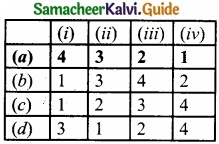
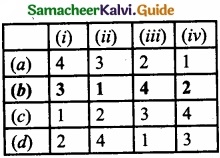
Match List – I with List – II and select the correct answer using the codes given below:

List – 1

List – 2

(i) Overdraft1. Debit card
(ii) ATM card2. Short term credit instrument
(iii) Time deposit3. Current deposits
(iv) Discounting of bills4. Fixed deposits

Answer:
Codes:

Tamil Nadu 11th Commerce Model Question Paper 2 English Medium img 1

Question 17.
Who is the first middleman in the channel of distribution?
(a) Wholesaler
(b) Producer
(c) Retailer
(d) Customer
Answer:
(a) Wholesaler

Question 18.
Find out which is not advantage of partnership from the following:
(a) Easy formation
(b) Division of work
(c) Limited liability
(d) Easy dissolution
Answer:
(c) Limited liability

Question 19.
Presently IRDAI headquarters is in ……………………….
(a) Hyderabad
(b) Chennai
(c) Mumbai
(d) Delhi
Answer:
(a) Hyderabad

Tamil Nadu 11th Commerce Model Question Paper 2 English Medium

Question 20.
The aggregate income under fine heads is termed as ……………………….
(a) Gross total income
(b) Total income
(c) Salary income
(d) None of the above
Answer:
(b) Total income

PART – II

Answer any seven questions in which question No. 30 is compulsory: [7 × 2 = 14]

Question 21.
Who are middlemen?
Answer:
The term ‘middlemen’ refers to all those who are in the link between the primary producer and the ultimate consumer in the exchange of goods or service.

Question 22.
Mention any four examples of MNC?
Answer:
A multinational company is one which is incorporated in one country, but it may be operated in many countries. Examples: Coca – Cola, International Business Machine (IBM), Sony Corporation and Microsoft Corporation.

Question 23.
There are various hindrances in business. The manufacturers and consumers do not know each other. But the goods are purchased and sold by these two persons. What kind of hindrance is this? How is it removed?
Answer:
This is ‘hindrance of a person’. Manufacturers do not know the consumer, who is using the products, produced by him. This difficulty or hindrance is removed by the traders.

Tamil Nadu 11th Commerce Model Question Paper 2 English Medium

Question 24.
Give any three functions of warehouses?
Answer:

  1. Storage
  2. Price stabilization
  3. Equalization of demand and supply

Question 25.
What is meant by private company?
Answer:
Private limited company is a type of company which is formed with minimum two shareholders and two directors, the minimum requirement with respect to authorised or paid up capital of Rs. 1,00,000 has been omitted by the Companies (Amendment) Act, 2015 w.e.f. 29th of May, 2015.

Another crucial condition of a private limited company is that it by its articles of association restricts the right to transfer its shares and also prohibits any invitation to the public to subscribe for any securities of the company.

Question 26.
Is low taxes possible in co – operative society?
Answer:
Yes, Low taxes are possible in co – operative society because it is a non-profit enterprise, and government provides various exemptions and tax concessions.

Question 27.
Write any two advantages of water transport?
Answer:

  1. It is considered as the cheapest mode of transport among the other modes of transport.
  2. It is most suitable for heavy loads.

Tamil Nadu 11th Commerce Model Question Paper 2 English Medium

Question 28.
What are the non-corporate enterprises?
Answer:

  1. Sole trading concern
  2. Partnership firm
  3. Joint Hindu family business

Question 29.
Mention any three differences between warehouse warrant and warehouse receipt?
Answer:

Warehouse Warrant

Warehouse Receipt

1. It is a document of title of goods.1. It is not a document of title of goods.
2. It is not only an acknowledgement for the receipt of goods but also gives an authority to get delivery of goods.2. It is only an acknowledgement  the receipt of goods.
3. It can be given as a collateral security for getting loan.3. Ita cannot be given as collateral security

Question 30.
Mention any four kinds of partners?
Answer:

  1. Active partner
  2. Sleeping partner
  3. Nominal partner
  4. Partner in profits only

PART – III

Answer any seven questions in which question No. 40 is compulsory: [7 × 3 = 21]

Question 31.
List the five heads of income?
Answer:
The five heads of income are:

  1. Income from‘Salaries’ [Sections 15 – 17];
  2. Income from ‘House Property’ [Sections 22 – 27];
  3. Income from ‘Profits and Gains of Business or Profession’ [Sections 28 – 44];
  4. Income from ‘Capital Gains’ [Sections 45 – 55]; and
  5. Income from ‘Other Sources’ [Sections 56 – 59].

Tamil Nadu 11th Commerce Model Question Paper 2 English Medium

Question 32.
Explain the concept of business?
Answer:
Business refers to any human activity undertaken on a regular basis with the object to earn profit through production, distribution, sale or purchase of goods and services.

Business activities are connected with raising, producing or processing of goods. Industry creates form utility to goods by bringing materials into the form which is useful for intermediate consumption or final consumption by consumers.

Question 33.
Explain any three features of Self – Help Group?
Answer:

  1. The motto of every group members should be “saving first – credit latter”.
  2. Self Help Group is homogeneous in terms of economic status.
  3. The ideal size of a Self Help Group ranges between 10 and 20 members.

Question 34.
Explain the features of general stores?
Answer:
General Stores sell a wide variety of products under one roof, most commonly found in a local market and residential areas to satisfy the day – to – day needs of the customers residing in nearby localities. They remain open for long hours at convenient timings and often provide credit facilities to their regular customers.

Question 35.
How is it possible to maintain secrecy in sole proprietorship?
Answer:
In sole proprietorship, the trader is the sole owner of the business. Since he/she manages all the affairs of the business, the secrecy can be maintained easily.

Tamil Nadu 11th Commerce Model Question Paper 2 English Medium

Question 36.
What is the importance of bonded warehouses?
Answer:
Bonded warehouses are those warehouses which are licensed by government. It is used to accept the storage of imported goods which are cleared for non – payment of customs duty by the importer. Strict supervision and control is imposed by customs authorities on their functioning.

Question 37.
Describe any three advantages of international trade?
Answer:
Advantages of international trade:

  1. Optimum use of natural resources: International trade operates on a simple principle that a country can produce more efficiently and trade the surplus production.
  2. Economic development: International trade helps the developing countries in achieving rapid economic development by importing machinery, technology and talent.
  3. Generation of employment: International business generates employment opportunities by assisting the expansion and growth of agricultural and industrial activities.

Tamil Nadu 11th Commerce Model Question Paper 2 English Medium

Question 38.
What are the advantages of MNC?
Answer:
1. Low Cost Labour:
MNC set up their facilities in low cost countries and produce goods/services at lower cost.

2. Quality Products:
The resource, experience and expertise of MNCs in the sphere of research and development enables the host country to establish its research and development system which helps it in producing quality goods and services at least possible cost.

Question 39.
India is an agricultural country. It has so many villages. Agriculture is inevitable to our country. What kind of insurance is needed to safeguard agriculture?
Answer:
Crop insurance is taken for safeguarding the agriculture. This policy is to provide financial support to farmers in case of a crop failure due to drought or flood. It generally covers all risks of loss or damages relating to production of rice, wheat, millets, oil seeds and pulses.

Question 40.
Why is balance of payment prepared?
Answer:
Balance of payments help in framing monetary, fiscal and trade policies of country. Government keenly observes balance of payment position of its important trade partners in making policy decisions. It reveals whether a country produces enough economic output to pay for its growth.

PART – IV

Answer all the questions: [7 × 5 = 35]

Question 41 (a).
Memorandum of Association is a legal document prepared to form and register a joint stock company. It reveals the powers and activities, the company is permitted to undertake. What are the contents of memorandum of Association? Explain?
Answer:
1. Name Clause:
The name clause requires you to state the legal and recognized name of the company. You are allowed to register a company name only if it does not bear any similarities with the name of an existing company.

2. Situation Clause:
The registered office clause requires you to show the physical location of the registered office of the company. You are required to keep all the company registers in this office in addition to using the office in handling all the outgoing and incoming communication correspondence.

3. Objective Clause:
The objective clause requires you to summarize the main objectives for establishing the company with reference to the requirements for shareholding and use of financial resources.

You also need to state ancillary objectives; that is, those objectives that are required to facilitate the achievement of the main objectives.

4. Liability Clause:
The liability clause requires you to state the extent to which shareholders of the company are liable to the debt obligations of the company in the event of the company dissolving.

You should show that shareholders are liable only their shareholding and/or to their commitment to contribute to the dissolution costs upon liquidation of a company limited by guarantee.

5. Capital Clause:
The capital clause requires you to state the company’s authorized share capital, the ’ different categories of shares and the nominal value (the minimum value per share) of the shares. You are also required to list the company’s assets under this clause.

6. Association Clause:
The association clause confirms that shareholders bound by the MOA are willingly associating and forming a company. You require seven members to sign an MOA for a public company and not less than two people for a MOA of a private company. You must conduct the signing in the presence of witness who must also append his signature.

[OR]

(b) Explain any five rights of partners?
Answer:

  1. Right to take part in business: Every partner has a right to take part in the management of the business.
  2. Right to be consultant: Every partner has the right to be consulted in all the matters concerning the firm. The decision of the majority will prevail in all the routine matters.
  3. Right of access to books, record and document: Every partner has the right of access to all records and books of accounts, and to examine and copy them.
  4. Right to share profit: Every partner is entitled to share the profits in the agreed ratio. If no profit-sharing ratio is specified in the deed, they must be shared equally.
  5. Right to receive interest: A partner’ has the right to receive interest on loans advanced by him to the firm at the agreed rate, and where no rate is stipulated, interest @ 6% p.a. allowed.

Tamil Nadu 11th Commerce Model Question Paper 2 English Medium

Question 42 (a).
Explain the contents of prospectus?
Answer:
Prospectus means a document inviting the public to buy its shares or debentures. It also applies to advertisements inviting deposits from the public.

Contents:

  1. The prospectus contains the main objectives of the company.
  2. The name and address of the signatories of the Memorandum of Association.
  3. The name, address and occupation of directors and managing directors.
  4. The number and classes of shares and debentures.
  5. The qualification share of directors.
  6. The name and address of the vendors of any property acquired by the company.
  7. Particulars about the directors, secretaries and the treasures and their remuneration.
  8. The amount for the minimum subscription.
  9. The estimated amount of preliminary expenses.
  10. Name and address of the auditors, bankers and solicitors of the company,
  11. Time and place where copies of balance sheets, profits and loss account and the auditor’s report may be inspected.

[OR]

(b) Write a note on Consumer Co – operative Society?
Answer:
A Consumer Co – operative Society is organized by consumers. It sells quality goods at better prices to the consumers.

Features:

  1. It can sell the goods at a lesser price rather than the traditional retail stores.
  2. They also supply essential goods through Public Distribution System (PDS).
  3. Nationally, the most widely used co – operative form is the credit union.
  4. Credit unions are essentially co – operatives of people that use banking services.
  5. It purchases goods directly from the manufacturers, which helps to fix the lower price. – Example – Students Co – operative Stores, Supermarkets, etc.

Tamil Nadu 11th Commerce Model Question Paper 2 English Medium

Question 43 (a).
Goods were exchanged for goods prior to invention of money. Each party must have surplus goods for exchange. What does it mean? What are the constraints of that system?
Answer:
The system in which the goods were exchanged for goods was called ‘barter system’. The barter system has many constraints. They are:

  1. Lack of double coincidence of Wants: Unless two persons who have surplus have the demand for the goods possessed by each other, barter could not materialize. If this “coincidence of wants” does not exist, Barter cannot take place.
  2. Non – existence of common measure of value: Barter system could not determine the value of commodities to be exchanged as they lacked commonly acceptable measures to evaluate each and every commodity.
  3. Lack of direct contact between producer and consumers: It was not possible for buyers and sellers to meet face to face in many contexts for exchanging the commodities for commodities.
  4. Lack of surplus stock: Absence of surplus stock was one of the impediments in barter system. If the buyers and sellers do not have surplus then no barter was possible.

[OR]

(b) Describe any five objectives of business?
Answer:
1. Economic Objectives:
Economic objectives of business refer to the objective of earning profit and also other objectives that are necessary to be pursued to achieve the profit objective, which includes creation of customers, regular innovations and best possible use of available resources.

2. Social Objectives:
Social objective are those objectives of business, which are desired to be achieved for the benefit of the society. Since business operates in a society by utilizing its scarce resources, the society expects something in return for its welfare.

3. Organizational Objectives:
The organizational objectives denote those objectives an organization intends to accomplish during the course of its existence in the economy like expansion and modernization, supply of quality goods to consumers, customers’ satisfaction, etc.

4. Human Objectives:
Human objectives refer to the objectives aimed at the well – being as well as fulfillment of expectations of employees as also of people who are disabled, handicapped and deprived of proper education and training.

The human objectives of business may thus include economic well – being of the employees, social and psychological satisfaction of employees and development of human resources.

5. National Objectives:
Being an important part of the country, every business must have the objective of fulfilling national goals and aspirations.

Tamil Nadu 11th Commerce Model Question Paper 2 English Medium

Question 44 (a).
Banks can be classified as follows:

  1. Based on the functions of banks
  2. Based on the status given by RBI
  3. Based on the ownership pattern

What are the banks based on functions or organization? Explain any five kinds of banks.
Answer:
1. Commercial banks:
Banks which accept deposits from the public and grant loans to traders, individuals, agriculture, industries, transport, etc. in order to earn profit. Their lending is in comparatively small amounts and mostly for short and medium period. e.g., State Bank of India.

2. Development Banks:
Huge finance required for investment, expansion and modernisation of big industries and others are granted by a separate type of banks called development Banks. They are also called industrial banks, e.g., IFCI, SIDBI.

3. Co – operative Banks:
All Co – operative banks in India are owned by its customers or members who are farmers, small traders and others. Co – operative banks in India are either urban based or rural based. e.g.,NAFED, Tamil Nadu State Apex Co-operative Bank – Head Office, Chennai.

4. Foreign Banks:
Banks which have registered office in a foreign country and branches in Ipdia are called foreign banks, e.g., Bank of America – USA.

5. Regional Rural Banks (RRBs):
The RRBs were formed under the Regional Rural Bank Act 1976, jointly by the Central Government, State Government, and a sponsor bank. e.g., Pandian Grama Bank.

[OR]

(b) In India Joint Hindu Family Business is a distinct form of organisation. A person can become member by his birth. What are the features of Joint Hindu Family Business? Explain any five features?
Answer:
Features of Joint Hindu Family Business are:

  1. Governed by Hindu Law
  2. Management
  3. Membership by birth
  4. Liability
  5. Permanent existence
  6. Implied authority of Karta
  7. Minor as a co – parcener
  8. Dissolution

Explanation:

  1. Governed by Hindu law: The business of the Joint Hindu Family is controlled and managed by the hindu law.
  2. Membership by birth: The membership of the family can be acquired only by birth. As soon as a male child is bom in the family, the child becomes a member.
  3. Liability: Except the Kartha, the liability of all other members is limited to their shares in the business.
  4. Minor also as a co-parcener: In a Joint Hindu Family firm even a new bom baby can be a co-parcener.
  5. Dissolution: It can be dissolved only at the will of the members of the family.

Tamil Nadu 11th Commerce Model Question Paper 2 English Medium

Question 45 (a).
Explain any five types of Cooperative societies?
Answer:
Types of Co – operative societies:

1. Consumers Co – operative:
Consumer Co – operatives are organized by consumers that want to achieve better prices or quality in the goods or services they purchase. In contrast to traditional retail stores or service providers, a consumer co – operative exists to deliver goods or services rather than to maximize profit from selling those goods or services.

2. Producers Co – operative:
Producer co – operatives are created by producers and owned and operated by producers. Producers can decide to work together or as separate entities to help increase marketing possibilities and production efficiency.

3. Marketing Co – operative:
Co – operative marketing societies are associations of small producers formed for the purpose of marketing their produce. The marketing co-operatives perform certain marketing functions such as grading, warehousing, advertising etc.

4. Credit Co – operative:
Cooperative credit societies are societies formed for providing short-term financial help to their members. Agriculturists, artisans, industrial workers, salaried employees, etc., form these credit societies.

5. Housing Co – operative:
These co – operative housing societies are meant to provide residential accommodation to their members on ownership basis or on rent.

People who intend to build houses of their own join together and form housing societies. These societies advance loans to members, repayable over a period of 15 to 20 years.

[OR]

(b) Partnership is formed by an agreement. It may be oral or written. The agreement is called partnership deed. Explain the contents of partnership deed.
Answer:
The contents of partnership deed include:

  1. Name: Name of the Firm.
  2. Nature of Business: Nature of the proposed business to be carried on by the partners.
  3. Duration of Partnership: Duration of the partnership business whether it is to be run for a fixed period of time or whether it is to be dissolved after completing a particular venture.
  4. Capital Contribution: The capital is to be contributed by the partners. It must be remembered that capital contribution is not necessary to become a partner for, one can contribute his organising power, business acumen, managerial skill, etc., instead of capital.
  5. Withdrawal from the Firm: The amount that can be withdrawn from the firm by each partner.
  6. Profit/Loss Sharing: The ratio in which the profits or losses are to be shared. If the profit sharing ratio is not specified in the deed, all the partners must share the profits and bear the losses equally.
  7. Interest on Capital: Whether any interest is to be allowed on capital and if so, the rate of interest.
  8. Rate of Interest on Drawing: Rate of interest on drawings, if any.
  9. Loan from Partners: Whether loans can be accepted from the partners and if so the rate of interest payable thereon.
  10. Account Keeping: Maintenance of accounts and audit.
  11. Salary and Commission to Partners: Amount of salary or commission payable to partners for their services. (Unless this is specifically provided, no partner is entitled to any salary).
  12. Retirement: Matters relating to retirement of a partner. The arrangement to be made for paying out the amount due to a retired or deceased partner must also be stated.
  13. Goodwill Valuation: Method of valuing goodwill on the admission, death or retirement of a partner.
  14. Distribution of Responsibility: Distribution of managerial responsibilities. The work that is entrusted to each partner is better stated in the deed itself.
  15. Dissolution Procedure: Procedure for dissolution of the firm and the mode of settlement of accounts thereafter.
  16. Arbitration of Dispute: Arbitration in case of disputes among partners. The deed should provide the method for settling disputes or difference of opinion. This clause will avoid costly litigations.

Tamil Nadu 11th Commerce Model Question Paper 2 English Medium

Question 46 (a).
Explain the various primary functions of commercial banks?
Answer:
The primary functions of a commercial bank are of three types. They are:

(I) Accepting Deposits – The basic deposit accounts offered by commercial banks are listed below:

1. Demand Deposits: These deposits are repayable on demand on any day. These consist of –

  • Savings Deposits: General public deposit their savings into this account. This account can be opened in one individual’s name or more than one name.
  • Current Deposits: This account is suitable for business institutions. Individuals too . can open this account. A higher minimum balance should be kept in this account.

2. Time Deposits: These are repayable after a period. These include –

  • Fixed Deposits (FD): Certain amount is deposited for a fixed period for a fixed rate of interest.
  • Recurring Deposits (RD): Certain sum is deposited into the account every month for one year or five years or the agreed period. Interest rate is more than savings deposits and almost equal to fixed deposits.

(II) Granting Loans and Advances: Commercial banks lend money in order to earn interest.

1. Advances

  • Overdraft: It is a credit facility extended mostly to current account holding business community customers.
  • Cash Credit: It is a secured credit facility given mostly to business institutions. Stock in hand, raw materials, other tangible assets, etc., are provided as collateral.
  • Discounting of Bills: Business customers approach banks to discount the commercial bills of exchanges and provide money.

2. Loans – Short term and medium term loans are provided by commercial banks against eligible collaterals to business concerns. Examples – housing loan, consumer loan, vehicle loan, educational loan, jewel loan, etc.

3. Creation of Credit – Apart from the currency money issued by the RBI, the credit money in circulation created by commercial banks influence economic activities of a country to a large extent. Credit money of commercial banks is far greater in volume than the currency money.

[OR]

(b) What are the advantages of warehousing?
Answer:

  1. It safeguards the stock for the merchants who do not have storage place.
  2. Warehouses reduce the distribution cost of the traders by storing the goods in bulk and allow the trader to take the goods in small lots to his shop.
  3. It helps in selection of channel of distribution. The producer will prefer whether to appoint a wholesaler or retailer.
  4. It assists in maintaining the continuous sale and avoid the possibilities of “Out of Stock”.
  5. It creates employment opportunities for both skilled and unskilled workers to improve their standard of living.

Tamil Nadu 11th Commerce Model Question Paper 2 English Medium

Question 47 (a).
Explain the features of a government company?
Answer:
The features of a government company are:
1. Registration Under the Companies Act:
A Government company is formed through registration under the Companies Act, 1956; and is subject to the provisions of this Act, like any other company.

However, the Central Government may direct that any of the provisions of the Companies Act shall not apply to a Government company or shall apply with certain modifications.

2. Executive Decision of Government:
A Government, company is created by an executive decision of the Government, without seeking the approval of the Parliament or the State Legislature.

3. Separate Legal Entity:
A Government company is a legal entity separate from the Government. It can acquire property; can make contracts and can file suits, in its own name.

4. Whole or Majority Capital Provided by Government:
The whole or majority (at least 51%) of the capital of a Government company is provided by the Government; but the revenues of the company are not deposited into the treasury.

5. Majority of Government Directors:
Being in possession of a majority of share capital, the Government has authority to appoint majority of directors, on the Board of Directors of a government company.

[OR]

(b) What are the advantages of co – operatives? Explain any five?
Answer:
Advantages of co – operatives:
1. Voluntary organisation:
The membership of a co – operative society is open to all. Any person with common interest can become a member. The membership fee is kept low so that everyone would be able to join and benefit from co – operative societies.

2. Easy formation:
Co – operatives can be formed much easily when compared to a company. Any 10 members who have attained majority can join together for forming a co – operative spciety by observing simple legal formalities.

3. Democracy:
A co – operative society is run on the principle of ‘one man one vote’. It implies that all members have equal rights in managing the affairs of the enterprises.

4. Equal distribution of surplus:
The surplus generated by the co – operative societies is distributed in an equitable manner among members. Therefore all the members of the co – operative society are benefitted.

5. Limited liability:
The liability of the members in a co – operative spciety is limited to the extent of their capital contribution. They cannot be personally held liable for the debts of the society.

Tamil Nadu 11th Commerce Model Question Paper 1 English Medium

Students can Download Tamil Nadu 11th Commerce Model Question Paper 1 English Medium Pdf, Tamil Nadu 11th Commerce Model Question Papers helps you to revise the complete Tamilnadu State Board New Syllabus, helps students complete homework assignments and to score high marks in board exams.

TN State Board 11th Commerce Model Question Paper 1 English Medium

General Instructions:

  1. The question paper comprises of four parts.
  2. You are to attempt all the parts. An internal choice of questions is provided wherever applicable.
  3. All questions of Part I, II, III and IV are to be attempted separately.
  4. Question numbers 1 to 20 in Part I are Multiple Choice Questions of one mark each.
    These are to be answered by choosing the most suitable answer from the given four alternatives and writing the option code and the corresponding answer
  5. Question numbers 21 to 30 in Part II are two-mark questions. These are to be answered in about one or two sentences.
  6. Question numbers 31 to 40 in Part III are three-mark questions. These are to be answered in above three to five short sentences.
  7. Question numbers 41 to 47 in Part IV are five-mark questions. These are to be answered in detail Draw diagrams wherever necessary.

Time: 2:30 Hours
Maximum Marks: 90

PART – I

Choose the correct answer. Answer all the questions. [20 × 1 = 20]

Question 1.
………………….. is considered as an artificial person.
(a) Sole trader
(b) Joint Hindu family business
(c) Joint Stock company
(d) Co – operative societies
Answer:
(c) Joint Stock company

Tamil Nadu 11th Commerce Model Question Paper 1 English Medium

Question 2.
A contract with or by a minor is a ……………………
(a) Valid contract
(b) Void contract
(c) Voidable contract
(d) Voidable at the option of either party
Answer:
(b) Void contract

Question 3.
The largest commercial bank of India is ……………………….
(a) ICICI
(b) SBI
(c) PNB
(d) RBI
Answer:
(b) SBI

Tamil Nadu 11th Commerce Model Question Paper 1 English Medium

Question 4.
Which one of the following is correctly matched?
(a) Overdraft – More than one person
(b) RBI – Lender of last resort
(c) Partnership – Motor transport
(d) Life Insurance – Current Account
Answer:
(b) RBI – Lender of last resort

Question 5.
Hindrance of risk is removed by ……………………..
(a) Transport
(b) Warehouse
(c) Insurance
(d) None of these
Answer:
(c) Insurance

Question 6.
A mador disadvantage of a sole proprietorship is ……………………..
(a) Limited liability
(b) Unlimited liability
(c) Easy formation
(d) Quick decision
Answer:
(b) Unlimited liability

Tamil Nadu 11th Commerce Model Question Paper 1 English Medium

Question 7.
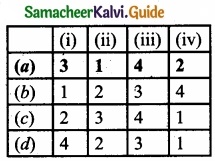
Match the List – I with List – II and select the correct answer using the codes given below:

List – I

List – II

(i) PWD1. Public corporation
(ii) ONGC2. Joint enterprise
(iii) Ramesh Brothers3. Departmental undertaking
(iv) Maruthi Suzuki4. Partnership firm

Answer:
Codes:

Tamil Nadu 11th Commerce Model Question Paper 1 English Medium img 1

Question 8.
Trade and Commerce was common to ……………………. dynasty.
(a) Pallava
(b) Chola
(c) Pandiya
(d) Chera
Answer:
(c) Pandiya

Tamil Nadu 11th Commerce Model Question Paper 1 English Medium

Question 9.
The external source of funds are ……………………
(I) Shares and debentures
(II) Retained earnings
(III) Collection from receivables
(IV) Borrowings from banks
(a) (I) and (II)
(b) (II) and (III)
(c) (I) and (IV)
(d) (I) and (III)
Answer:
(c) (I) and (IV)

Question 10.
What kind of tax is the GST?
(a) Direct tax
(b) Indirect tax
(c) On the type of goods and services
(d) None of these
Answer:
(b) Indirect tax

Tamil Nadu 11th Commerce Model Question Paper 1 English Medium

Question 11.
In 1969, there were …………………….. private banks which were nationalised.
(a) 19
(b) 14
(c) 20
(d) 15
Answer:
(b) 14

Question 12.
Wholesalers deal in quantity of goods.
(a) Small
(b) Large
(c) Medium
(d) Limited
Answer:
(b) Large

Question 13.
The persons who enter into partnership are collectively called as …………………..
(a) Partners
(b) Shareholders
(c) Owners
(d) Firm
Answer:
(d) Firm

Tamil Nadu 11th Commerce Model Question Paper 1 English Medium

Question 14.
Producers co – operatives are established and operated by …………………….
(a) Producers
(b) Consumers
(c) Traders
(d) Wholesalers
Answer:
(a) Producers

Question 15.
ONGC is a public enterprise. Identify the form of organisation.
(a) Public corporations
(b) Departmental undertaking
(c) Multinational corporations
(d) Government company
Answer:
(a) Public corporations

Question 16.
…………………….. is a document acknowledging the receipt of goods by a carrier.
(a) Waybill
(b) Consignment note
(c) Charter party
(d) Bill of lading
Answer:
(a) Waybill

Tamil Nadu 11th Commerce Model Question Paper 1 English Medium

Question 17.
Which company has minimum paid up capital of Rs 5,00,000?
(a) Government company
(b) Public company
(c) Private company
(d) Foreign company
Answer:
(c) Private company

Question 18.
From the following which is not a direct tax?
(a) Income tax
(b) Wealth tax
(c) GST
(d) Capital gains tax
Answer:
(c) GST

Question 19.
Business units can reduce expenditure by outsourcing front office work like ………………………
(a) Paperwork
(b) File work
(c) Billing
(d) Manufacturing
Answer:
(b) File work

Tamil Nadu 11th Commerce Model Question Paper 1 English Medium

Question 20.
The year in which income earned is known as …………………………
(a) Assessment year
(b) Previous year
(c) Light year
(d) Calendar year
Answer:
(b) Previous year

PART – II

Answer any seven questions in which question No. 30 is compulsory: [7 × 2 = 14]

Question 21.
Define commerce?
Answer:
According to Evelyn Thomas, “Commercial operations deal with the buying and selling of goods, the exchange of commodities and the contribution of finished products”.

Question 22.
What is unlimited liability?
Answer:
Unlimited liability is a feature of sole trading business. When the sole trader’s business assets are not sufficient to pay off the business debts, he has to pay from his personal property.

Tamil Nadu 11th Commerce Model Question Paper 1 English Medium

Question 23.
Franchising is the practice of the right to use a firm’s business model and brand for a prescribed period of time. Who are the parties involved in franchising?
Answer:
There are two parties to a franchising agreement. They are:

  1. Franchisor – The owner of a business who provides the franchise.
  2. Franchisee – The individual who gets the right to operate the business or use the trademark.

Question 24.
Give any three functions of warehouses?
Answer:

  1. Storage
  2. Price stabilization
  3. Equalization of demand and supply

Tamil Nadu 11th Commerce Model Question Paper 1 English Medium

Question 25.
A company is a large scale organization. Compared to sole trader and partnership organization, more profit can be received from the company. Mention any two advantages of a company?
Answer:
1. Large Capital:
A company can secure large capital compared to a sole trader or partnership. Large amount of capital is necessary for conducting business on a large scale.

2. Limited Liability:
The liability of a shareholder is limited. The risk of loss is limited to the unpaid amount on the face value of shares held. In the case of a company limited by shares, the liability of a shareholder is restricted to the unpaid amount on the shares held by him.

Tamil Nadu 11th Commerce Model Question Paper 1 English Medium

Question 26.
Give any two advantages of MNC?
Answer:
1. Low Cost Labour:
MNC set up their facilities in low cost countries and produce goods/services at lower cost.

2. Quality Products:
The resource, experience and expertise of MNCs in the sphere of research and development enables the host country to establish its research and development . system which helps it in producing quality goods and services at least possible cost.

Question 27.
List out any four types of indirect taxes levied in India?
Answer:

  1. CGST
  2. SGST
  3. UGST
  4. IGST

Tamil Nadu 11th Commerce Model Question Paper 1 English Medium

Question 28.
It was launched by the RBI in 2013. The transactions are settled on real time basis. What does it mean? Write a short note about this?
Answer:
Real Time Gross Settlement Systems (RTGS) was launched by the RBI in 2013. The transactions are settled on real time basis. Gross settlement means the transaction is settled between one bank and another bank without adding any other transactions.

Question 29.
State the different types of Public Sector Enterprises?
Answer:

  1. Coal India Ltd
  2. Gas Authority of India Ltd
  3. Tamil Nadu State Transport Corporation
  4. Steel Authority of India Ltd

Tamil Nadu 11th Commerce Model Question Paper 1 English Medium

Question 30.
Who is a sleeping partner?
Answer:
A sleeping partner is the one who contributes capital and shares in the profits or losses of the firm but does not take part in the management of the business.

PART – III

Answer any seven questions in which question No. 40 is compulsory: [7 × 3 = 21]

Question 31.
Explain the features of general stores?
Answer:
General Stores sell a wide variety of products under one roof, most commonly found in a local market and residential areas to satisfy the day – to – day needs of the customers residing in nearby localities.

They remain open for long hours at convenient timings and often provide credit facilities to their regular customers.

Tamil Nadu 11th Commerce Model Question Paper 1 English Medium

Question 32.
Explain the characteristics of business?
Answer:
The essential characteristics of business are as follows:

  1. Production or Procurement of Goods: Goods must be produced or procured in order to satisfy human wants.
  2. Sale, Transfer or Exchange: There must be sale or exchange of goods or services.
  3. Profit Motive: An important feature of business is profit motive. Business is an economic activity by which human beings make their living.
  4. Dealing in Goods and Services: Goods produced or procured may be consumer goods like cloth, pen, brush, bag, etc., or producer-goods like plant and machinery.

Question 33.
All the affairs of a Joint Hindu Family are controlled by the manager. The other members are co-parceners. What is the other name of the manager in Joint Hindu Family? How does he control the business?
Answer:
The other name of the manager in the Joint Hindu family is ‘Karta’. The Karta is the senior most male member of the family. He controls and manages the business of the Joint Hindu family.

Tamil Nadu 11th Commerce Model Question Paper 1 English Medium

Question 34.
Income tax provides the method to compare the total income of an assessee. It is divided into five heads. What are the five heads of incomp under total income?
Answer:
The five heads of income are:

  1. Income from ‘Salaries’ [Sections 15 – 17];
  2. Income from ‘House Property’ [Sections 22 – 27];
  3. Income from ‘Profits and Gains of Business or Profession’ [Sections 28 – 44];
  4. Income from ‘Capital Gains’ [Sections 45 – 55]; and
  5. Income from ‘Other Sources’ [Sections 56 – 59]

Question 35.
Generally, the liability of the partners in a firm is unlimited. But in service sector, the liability is limited. What is the name of the partnership? Write a short note about this?
Answer:
The name of the partnership is Limited Liability Partnership. It is popular in service sector and in the small scale enterprises. Limited liability partnership means for paying the debts of the firm, only the assets of the business will be utilised. Example – cost accountants firm, lawyers, engineers, etc.

Tamil Nadu 11th Commerce Model Question Paper 1 English Medium

Question 36.
Mention any three features of government company?
Answer:
Features of government company: .

  1. Registrations under the companies Act: A government company is formed under the Companies Act 1956.
  2. Own staff: A government company has its own staff except government officials who are sent to it on deputation.
  3. Majority of the capital provided by the government: The whole or majority (at least 51%) of the capital of a government company is provided by the government.

Question 37.
What is bill of lading?
Answer:
Bill of Lading is a document containing the terms and conditions of the contract of carriage. It is issued by the shipping company and signed by the captain of the ship.

It acknowledges the receipt of the goods described in it on board the ship. It also serves as an official receipt of goods. It is a document of title of goods.

Question 38.
What do you mean by the concept of business ethics?
Answer:
Business exists to supply goods and services to the people from social point of view but from individual point of view, the primary objective of any business unit is to make profit.

The individual objective should not be in conflict with societal objective. These two objectives normally contradict each other, as one business enterprise may be good in individual objective and bad at social objective and vice versa.

Tamil Nadu 11th Commerce Model Question Paper 1 English Medium

Question 39.
Define Retailer?
Answer:
According to S. Evelyn Thomas “the retailer is the last of the many links in the economic chain whereby the consumer’s wants are satisfied smoothly and efficiently by retailers”.

Question 40.
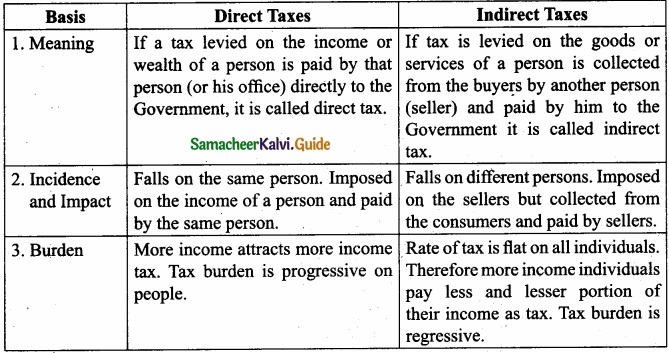
Write any three differences between Direct taxes and Indirect taxes?
Answer:

Tamil Nadu 11th Commerce Model Question Paper 1 English Medium img 2

PART – IV

Answer all the questions: [7 × 5 = 35]

Question 41 (a).
What are the features of public corporation? Explain any five?
Answer:
1. Special Statute:
A public corporation is created by a special Act of the Parliament or the State Legislature. The Act defines its powers, objectives, functions and relations with the ministry and the Parliament (or State Legislature).

2. Separate Legal Entity:
A public corporation is a separate legal entity with perpetual succession and common seal. It has an existence, independent of the Government. It can own property; can make contracts and file suits, in its own name.

3. Capital Provided by the Government:
The capital of a public corporation is provided by – the Government or by agencies controlled by the government. However, many public corporations have also begun to raise money from the capital market.

4. Financial Autonomy:
A public corporation enjoys financial autonomy. It prepares its own budget; and has authority to retain and utilize its earnings for its business.

5. Management by Board of Directors:
Its management is vested in a Board of Directors, appointed or nominated by the Government. But there is no Governmental interference in the day – to – day working of the corporation.

[OR]

(b) Explain the organizational structure of RBI?
Answer:
The head office of the RBI is situated in Mumbai. This central office has 33 departments in 2017. It has four zonal offices in Mumbai, Delhi, Calcutta and Chennai functioning under local boards with deputy governors as their heads. It also has 19 regional offices and 11 sub – offices (2017).

The RBI is governed by a central board of directors. The 21 member board is appointed by the Qovemment of India. It consists of:

  1. One Governor and four deputy governors appointed for a period of four years.
  2. Ten Directors from various fields.
  3. Two Government officials.
  4. Four Directors – one each from local boards.

Tamil Nadu 11th Commerce Model Question Paper 1 English Medium

Question 42 (a).
Sole proprietorship is a form of business organization in which an individual introduces his own capital, uses his own skill and intelligence in the management of the business. Explain the characteristics of a sole trader?
Answer:
Business owned and controlled by a single person is known as sole trading business.
The following are the characteristics of a sole trader:

  1. Ownership by one man: This is owned by single person. The sole trader contributes the required capital.
  2. Freedom of work and Quick decisions: The sole trader is the owner, so he need not consult with others. Hence he can take quick decision.
  3. Unlimited liability: When his business assets are not sufficient to pay off the business debts he has to pay from his personal property.
  4. Enjoying Entire Profit: All the benefits earned by the sole trader is enjoyed by him alone.
  5. Absence of Government Regulation: A sole trading concern is free from Government regulations. No legal formalities are to be observed in its formation and management,
  6. Maintenance of Secrecy: Since the trader manages all the affairs of the business, the secrecy can be maintained easily.

[OR]

(b) Partnership is the relation between persons who have agreed to share the profits of a business carried on by all. It is the result of an agreement. Closing of business is also by an agreement. It is called Dissolution of Partnership. Explain the dissolution of partnership firm without the order of the court?
Answer:
Dissolution of a partnership firm takes place in two ways:

  1. Without the order of the court and
  2. By the order of the court A.

Without the order of the court:

1. By agreement or mutual consent:
A firm may be dissolved when all the partners agree to close the affairs of the firm.

2. By insolvency of all the partners but one:
If any one of the partners is adjudged as insolvent, it is necessary to dissolve the firm.

3. When the objective becomes illegal:
When the business carried on by the partnership becomes illegal, the partnership firm is automatically dissolved.

4. By notice of dissolution:
In the case of partnership at will, if any partner gives in writing to close the firm, the firm will be dissolved.

5. On certain contingencies:

  • On the expiry of the period of the firm.
  • On the completion of a business.
  • On the death of a partner.
  • On the retirement of a partner.
  • On the insolvency of a partner.

Tamil Nadu 11th Commerce Model Question Paper 1 English Medium

Question 43 (a).
Explain the various types of warehouses?
Answer:
1. Private Warehouses:
Private warehouses are built and owned by private business enterprises in order to store the products produced by them.

2. Government Warehouses:
They are created and operated by the Government to implement the programmes of the Government.

3. Public Warehouse:
It is open for public at large. Most of the business organisations, especially small and medium scale units cannot afford to have their own warehouses.

4. Co – operative Warehouses:
There are warehouses owned and managed by the marketing co – operative societies or agricultural co-operative societies. They are setup to provide warehousing facilities to their members.

5. Bonded Warehouses:
Bonded warehouses are those warehouses, which are licensed by the government to accept storage of imported goods which are not cleared due to non¬payment of customs duty by the importer.

[OR]

(b) Insurance is a contract between the insurer and the insured under which the insurer undertakes to compensate-the insured for the loss arising from the risk insured. Explain the principles of insurance?
Answer:
1. Utmost Good Faith:
According to this principle, both insurer and insured should enter into contract in good faith. Insured should provide all the information that impacts the subject matter. Insurer should provide all the details regarding insurance contract.

2. Insurable Interest:
The insured must have an insurable interest in the subject matter of insurance. Insurable interest means some pecuniary interest in the subject matter of the insurance contract.

3. Indemnity:
Indemnity means security or compensation against loss or damages. In insurance, the insured would be compensated with the amount equivalent to the actual loss and not the amount exceeding the loss. This principle ensures that the insured does not make any profit out of the insurance. This principle of indemnity is applicable to property insurance alone.

4. Causa Proxima:
The word ‘Causa proxima’ means ‘nearest cause’. According to this principle, when the loss is the result of two or more cause, the proximate cause, i.e. the direct. The direct, the most dominant and most effective cause of loss should be taken into consideration. The insurance company is not liable for the remote cause.

5. Contribution:
The same subject matter may be insured with more than one insurer then it is known as ‘Double Insurance’. In such a case, the insurance claim to be paid to the insured must be shared on contributed by all insurers in proportion to the sum assured by each one of them.

6. Subrogation:
Subrogation means ‘stepping the shoes on others’. According to this principle, once the claim of the insured has been settled, the ownership right of the subject matter of insurance passes on to the insurer.

7. Mitigation:
In case of a mishap, the insured must take off all possible steps to reduce or mitigate the loss or damage to the subject matter of insurance.

Tamil Nadu 11th Commerce Model Question Paper 1 English Medium

Question 44 (a).
Write short notes on:

  1. Owner’s funds
  2. Borrowed funds

Answer:
1. Owner’s Funds:
Owner’s funds mean funds which are provided by the owner of the enteiprises who may be an individual, or partners or shareholders of a company.

The profits reinvested in the business (ploughing back of profit or retained earnings) come under owner’s funds. These funds are not required to be refunded during the life time of business enterprise. It provides the owner the right to control the management of the enterprise.

2. Borrowed Funds:
The term ‘borrowed funds’ denotes the funds raised through loans or borrowings. For example, debentures, loans from banks and financial institutions, public deposits, trade credit, lease financing, commercial papers, factoring, etc., represent borrowed funds.

  • These borrowed sources of funds provide specific period before which the fund is to be returned.
  • Borrower is under legal obligation to pay interest at given rate at regular intervals to the lender.
  • Generally borrowed funds are obtained on the security of certain assets like bonds, land, building, stock, vehicles, machinery, documents of title to the goods, and the like.

[OR]

(b) What is meant by consumers co-operative store? Explain its merits in brief?
Answer:
A consumers co-operative store is a retail organisation owned, managed and controlled by the
consumers themselves to obtain products of daily use at reasonable low prices. Its objective is to eliminate profits to middlemen by establishing a direct contact with the manufacturers.

People belonging to middle and low income groups, at least 25 persons have to come together to form a voluntary association and get it registered under the Cooperative Societies Act.

The capital of a co-operative store is raised by issuing shares to members. The management of the store is democratic and entrusted to an elected managing committee, where “one man one vote” is the rule.

The co – operative stores are very famous in Tamil Nadu. For example, Kamadhenu and Chinthamani co-operative supermarkets in Chennai, Karpagam in Vellore, etc. .

Tamil Nadu 11th Commerce Model Question Paper 1 English Medium

Question 45 (a).
Describe the agency functions of commercial banks?
Answer:
Banks act as agents of customers and provide certain services:

1. Transfer of Funds:
Banks issue demand drafts, bankers’ cheques, travelers’ cheques, etc. and help in transfer of funds from one place to another.

2. Periodic Payment of Premiums, Rent, etc:
After instruction from the customers, banks undertake the monthly payment of insurance premium, rent, telephone bills, etc., from the accounts of customers.

3. Collection and Payment of Cheques:
On behalf of customers, bank collect the cheques deposited into the accounts of customers from other banks and deposit cash in the customers’ accounts.

4. Acting as Executors, Trustees and Attorneys:
Banks act as executors of will of the customers and implement their will after their death.

5. Conduct Share Market transactions:
A Demat account should be opened with Depository Participant and that demat account should be linked with savings bank account by the customer.

6. Preparation of Income Tax Return:
Banks prepare the annual income tax return on behalf of the customers and provide income tax related advice to them.

7. Dealing in Foreign Exchange:
Banks buy and sell foreign currencies on behalf of customers.

8. Acting as Correspondent:
Banks act as correspondent of customers and receive travel, ticket, passport, etc.

[OR]

(b) Explain the services rendered by retailers to consumers?
Answer:
1. Regular Supply of Goods:
Retailers maintain a ready stock of various products of different manufacturers for sale to consumers.

2. New Products Information:
The retailers provide important information about the new arrival of products through their personal.

3. Credit Facilities:
Sometimes retailers provide credit facilities to their customers and enable them to increase their level of consumption.

4. Wide Selection:
Retailers generally keep stock of a variety of products of different manufacturers.

5. Miscellaneous Services:

  • Retailers provide free door delivery services to the customers.
  • They provide after sale service to customers.
  • They allow cash discounts on their sales.

Tamil Nadu 11th Commerce Model Question Paper 1 English Medium

Question 46 (a).
Write a note on e-commerce models?
Answer:
1. Business to customers (B2C):
This is fastest growing segment in e-commerce space. Under this model, business concern sells directly to consumers.

2. Business to Business (B2B):
Under the model, business concerns transact with one another through internet. For instance, Snapdeal, Flipkart, Alibaba, Indiamart, Trade India.com etc.

3. Consumer to consumer (C2C):
Under this model, customers sell directly to other customers through online classified advertisement or through auction or through mobile or through market places.

Example, Indian ventures in C2C are Kraftly App (buying and selling anythings) which deals in handmade products of a wide range. Onceagainstore. com is a website that buys pre-owned women’s fashion products. Other players are Quikr, OLX, ebay, etc.

4. Customer to Business (C2B):
This model is reverse to auction model. Products like • automobile, electronic items, furniture and similar product are traded by customer through websites. Naukri.com and Monster.com are examples of Indian companies operating in this domain.

5. Business to Government (B2G):
This model envisages selling products and services by business consumer to Government organization. For instance TCS operates the passport application process for the Government of India as part off-line process.

[OR]

(b) Explain any four personal investment avenues?
Answer:
1. Public Provident Fund (PPF):
It is the safest long – term investment option for the investors in India. It is totally tax- free. PPF account can be opened in bank or post office. The money deposited cannot be withdrawn before 15 years and an investor can earn compound interest from this account.

However the investor can extend the time frame for the next five years if the investor does not opt to withdraw the amount matured for payment at maturity date. PPF investor can take loan against PPF account when he/she experiences financial difficulties.

2. Mutual Funds:
An individual investor who wants to invest in equities and bond With a balance of risk and return generally can invest in mutual funds. Nowadays people invest in stock markets through a mutual fund. Systematic investment plan is one of the best investment options in India.

3. Direct Equity or Share Purchase:
An individual can opt for investment in shares. But he has to analyse the market price of various shares traded in stock exchange, reputation of the company, consistency in the payment of dividend, the nature of the project undertaken by the company, growth prospects of industry in which a company is operating, before investing in shares. If the investment is made for a long time, it may yield good return.

4. Real Estate Investment:
Real estate is one of the fastest growing sectors in India. Buying a flat or plot is supposed to be the best decision amongst the investment options. The value of the real asset may increase substantially depending upon the area of location and other support facilities available therein.

Tamil Nadu 11th Commerce Model Question Paper 1 English Medium

Question 47 (a).
What are the functions of wholesalers?
Answer:
Following are the functions of wholesalers:

  1. Collection of Goods: Wholesaler collects the goods from manufacturers or producers in bulk.
  2. Storage of Goods: Wholesaler collects and stores them safely in warehouses, till they are sold out.
  3. Distribution: Wholesaler sells goods to different retailers. Thus he performs the function of distribution.
  4. Financing: Wholesalers provide financial support to producers and manufacturers by providing money in advance to them.
  5. Risk Taking: Wholesaler buys finished goods from the producer and keeps them in the warehouses till the time they are sold and assumes the risk arising from price, spoilage of goods, and changes in demand.
  6. Grading, Packing and Packaging: Wholesaler classifies the goods into different categories.
  7. Providing Information: Wholesalers provide valuable information to retailers and producers.
  8. Transportation: A wholesaler arranges for the transport of goods from producers to his warehouse and from the warehouse to retailer.

[OR]

(b) Explain the characteristics of a supermarket?
Answer:

  1. Supermarkets are generally situated at the main shopping centres.
  2. The goods kept on racks with clearly labelled price and quality tags in such stores.
  3. The customers move into the store to pickup goods of their requirements, bring them to the cash counter, make payment and take home delivery.
  4. The goods are sold on cash basis only. No credit facilities are made available.
  5. Supermarkets are organized on departmerftal basis.
  6. It requires huge investment.

Tamil Nadu 11th Economics Model Question Paper 4 English Medium

Students can Download Tamil Nadu 11th Economics Model Question Paper 4 English Medium Pdf, Tamil Nadu 11th Economics Model Question Papers helps you to revise the complete Tamilnadu State Board New Syllabus, helps students complete homework assignments and to score high marks in board exams.

TN State Board 11th Economics Model Question Paper 4 English Medium

General Instructions:

  1. The question paper comprises of four parts.
  2. You are to attempt all the parts. An internal choice of questions is provided wherever applicable.
  3. All questions of Part I, II, III and IV are to be attempted separately.
  4. Question numbers 1 to 20 in Part I are Multiple Choice Questions of one mark each.
    These are to be answered by choosing the most suitable answer from the given four alternatives and writing the option code and the corresponding answer
  5. Question numbers 21 to 30 in Part II are two-mark questions. These are to be answered in about one or two sentences.
  6. Question numbers 31 to 40 in Part III are three-mark questions. These are to be answered in above three to five short sentences.
  7. Question numbers 41 to 47 in Part IV are five-mark questions. These are to be answered in detail Draw diagrams wherever necessary.

Time: 3:00 Hours
Maximum Marks: 90

PART – I

Choose the correct answer. Answer all the questions: [20 × 1 = 20]

Question 1.
The cost incurred by producing one more unit of output is ……………………. cost.
(a) Variable
(b) Fixed
(c) Marginal
(d) Total
Answer:
(c) Marginal

Tamil Nadu 11th Economics Model Question Paper 4 English Medium

Question 2.
Ordinal utility can be measured by ……………………
(a) Ranking
(b) Numbering
(c) Wording
(d) None of these
Answer:
(a) Ranking

Question 3.
A production function measures the relation between ……………………..
(a) Input prices and output prices
(b) Input prices and the quantity of output
(c) The quantity of inputs and the quantity of output
(d) The quantity of inputs and input prices
Answer:
(c) The quantity of inputs and the quantity of output

Question 4.
If average product is decreasing, then marginal product ……………………
(a) Must be greater than average product
(b) Must be less than average product
(c) Must be increasing
(d) Both (a) & (c)
Answer:
(b) Must be less than average product

Tamil Nadu 11th Economics Model Question Paper 4 English Medium

Question 5.
Price discrimination will always lead to ………………………
(a) Increase in output
(b) Increase in profit
(c) Different prices
(d) (b) and (c)
Answer:
(d) (b) and (c)

Question 6.
Which of the following is a micro – economics statement?
(a) The real domestic output increased by 2.5 percent last year.
(b) Unemployment was 9.8 percent of the labour force last year.
(c) The price of wheat determines its demand
(d) The general price level increased by 4 percent last year.
Answer:
(c) The price of wheat determines its demand

Tamil Nadu 11th Economics Model Question Paper 4 English Medium

Question 7.
The marginal productivity theory was developed by ……………………
(a) Clark
(b) Wickseed
(c) Walras
(d) All
Answer:
(c) Walras

Question 8.
The chief exponent of the cardinal utility approach was …………………..
(a) J.R. Hicks
(b) R.G. D. Allen
(c) Marshall
(d) Stigler
Answer:
(c) Marshall

Tamil Nadu 11th Economics Model Question Paper 4 English Medium

Question 9.
Keynesian Theory of interest is popularly known as ……………………
(a) Abstinence theory
(b) Liquidity preference theory
(c) Loanable funds theory
(d) Agio theory
Answer:
(b) Liquidity preference theory

Question 10.
Total revenue is equal to total output sold multiplied by ………………….
(a) Price
(b) Total cost
(c) Marginal revenue
(d) Marginal cost
Answer:
(a) Price

Tamil Nadu 11th Economics Model Question Paper 4 English Medium

Question 11.
In which of the following is not a type of market structure price will be very high?
(a) Perfect competition
(b) Monopoly
(c) Duopoly
(d) Oligopoly
Answer:
(b) Monopoly

Question 12.
The Father of Green Revolution in India was ……………………..
(a) M.S. Swaminathan
(b) Gandhi
(c) Visweswaraiah
(d) N.R. Viswanathan
Answer:
(a) M.S. Swaminathan

Question 13.
A Statement of equality between two quantities is called ……………………
(a) Inequality
(b) Equality
(c) Equations
(d) Functions
Answer:
(c) Equations

Tamil Nadu 11th Economics Model Question Paper 4 English Medium

Question 14.
Product obtained from additional factors of production is terms as ………………….
(a) Marginal product
(b) Total product
(c) Average product
(d) Annual product
Answer:
(a) Marginal product

Question 15.
Rent is the reward for the use of ……………………..
(a) Capital
(b) Labour
(c) Land
(d) Organization
Answer:
(c) Land

Question 16.
Revenue received from the sale of additional unit is termed as …………………….. revenue.
(a) Profit
(b) Average
(c) Marginal
(d) Total
Answer:
(c) Marginal

Tamil Nadu 11th Economics Model Question Paper 4 English Medium

Question 17.
Tamil Nadu is rich in ……………………
(a) Forest resource
(b) Human resource
(c) Mineral resource
(d) All the above
Answer:
(d) All the above

Question 18.
The New foreign trade policy was announced in the year ……………………….
(a) 2000
(b) 2002
(c) 2010
(d) 2015
Answer:
(a) 2000

Tamil Nadu 11th Economics Model Question Paper 4 English Medium

Question 19.
The PQLI was developed by ……………………..
(a) Planning Commission
(b) Nehru
(c) Morris
(d) Morrisd.Biswajeet
Answer:
(c) Morris

Question 20.
In India’s total cement production, Tamil Nadu ranks ……………………….
(a) Third
(b) Fourth
(c) First
(d) Second
Answer:
(a) Third

PART – II

Answer any seven question in which Question No. 30 is compulsory. [7 × 2 = 14]

Question 21.
State the meaning of privatization?
Answer:
Privatization means transfer of ownership and management of enterprises from public sector to private sector.

Tamil Nadu 11th Economics Model Question Paper 4 English Medium

Question 22.
What are the reasons for upward sloping supply curve?
Answer:

  1. A supply curve represents the data given in the supply schedule. As the price of the commodity increases, the quantum supplied of the commodity also increases. Thus the supply curve has a positive slope from left to right.
  2. The quantum supplied of commodity x is represented on X axis. And the price of the commodity is represented on the Y axis. The points such as e, d, c, b and a on the supply curve SS’, represent various quantities at different prices.

Question 23.
Give a short note on Sen’s “choice of Technique”?
Answer:
Sen’s “Choice of Technique” was a research work where he argued that in a labour surplus economy; generation of employment cannot be increased at the initial stage by the adaptation of capital – intensive technique.

Tamil Nadu 11th Economics Model Question Paper 4 English Medium

Question 24.
What are major ports in Tamil Nadu?
Answer:

  1. Tamil Nadu has three major ports; one each at Chennai, Ennore, and Thoothukudi as well as one intermediate port in Nagpattinam, and 23 minor ports.
  2. All the minor ports are managed by the Tamil Nadu Maritime Board, Chennai Port.
  3. Ennore port was recently converted from an intermediate port to a major port and handles all the coal and ore traffic in Tamil Nadu.

Tamil Nadu 11th Economics Model Question Paper 4 English Medium

Question 25.
Define cost function?
Answer:
The function relationship between cost and output is expressed as ‘Cost Function’.
A Cost Function may be written as
C = f(Q)
Eg. TC = Q3 – 18Q2 + 91Q + 12
Where, C = Cost and Q = Quantity of output. Cost functions are derived functions because they are derived from Production Functions.

Question 26.
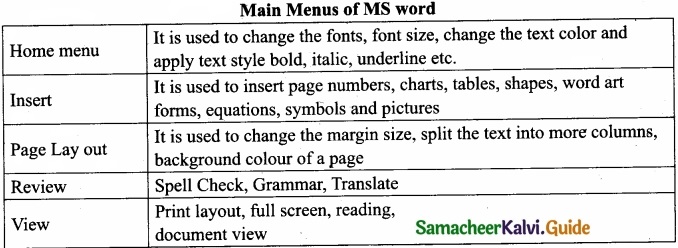
What are the main menus of MS word?
Answer:

Tamil Nadu 11th Economics Model Question Paper 4 English Medium img 1

Where, C = Cost and Q = Quantity of output. Cost functions are derived functions because they are derived from Production Functions.

Tamil Nadu 11th Economics Model Question Paper 4 English Medium

Question 27.
If 62 = 34 + 4 x what is x?
Answer:
62 – 34 = 4x ⇒ 28 = 4x
28 ÷ 5 – 4 = 1x
∴ x = 7

Question 28.
Define‘Rent’?
Answer:
Rent is the price or reward given for the use of land or house or a machine to the owner. But, in Economics, “Rent” or “Economic Rent” refers to that part of payment made by a tenant to his land lords for the use of land only.

Tamil Nadu 11th Economics Model Question Paper 4 English Medium

Question 29.
What are conditions for producer’s equilibrium?
Answer:

  1. Producer equilibrium implies the situation where producer maximizes his output.
  2. It is also known as optimum combination of the factors of production.
  3. In short, the producer manufactures a given amount of output with ‘least cost combination of factors’, with his given budget.

Question 30.
Write three policy initiative introduced in 1991 – 92 to correct the fiscal imbalance?
Answer:
The important policy initiatives introduced in the budget for the year 1991 – 92 for correcting the fiscal imbalance were:

  1. Reduction in fertilizer subsidy.
  2. Abolition of subsidy on sugar.
  3. Disinvestment of a part of the government’s equity holdings in select public sector undertakings.

PART – III

Answer any seven question in which Question No. 40 is compulsory. [7 × 3 = 21]

Question 31.
Describe the performance of Tamil Nadu economy in health?
Answer:

  1. Tamil Nadu has a three – tier health infrastructure comprising hospitals, primary health centres, health units, community health centres and sub – centres.
  2. As of March 2015, the State had 34 district hospitals, 229 sub – divisional hospitals, 1,254 primary health centres, 7,555 sub – centres and 313 community health centres.

Tamil Nadu 11th Economics Model Question Paper 4 English Medium

Question 32.
Explain the difference between internal and external economies?
Answer:

Internal Economies of Scale

External Economies of Scale

1. Expansion of the firm itself.1. Expansion of the industry.
2. Lower long run average cost.2. Benefits most all firms.
3. Efficiencies from larger scale production.3. Agglomeration economies are important.
4. Range of economies (e.g.,) Technical and Financial.4. Helps to explain the rapid growth of many cities.

Question 33.
State and explain the elasticity of supply?
Answer:

  1. Elasticity of supply may be defined as the degree of responsiveness of change in supply to change in price on the part of sellers.
  2. It is Mathematically expressed as,

Elasticity of supply = Proportionate change in supply / Proportionate change in price
es = \(\frac { \Delta Q_{ S } }{ Qs } \)/\(\frac { \Delta P }{ P } \)
es = \(\frac { \Delta Q_{ S } }{ \Delta P } \) × \(\frac { P }{ Q_{ S } } \)
Where Qs represents the supply, P represents price, ∆ denotes a change.

Tamil Nadu 11th Economics Model Question Paper 4 English Medium

Question 34.
Write a note on mineral resources in TamilNadu?
Answer:
Mineral Resources in Tamil Nadu:

  1. Tamil Nadu has a few mining projects based on Titanium, Lignite, Magnesite, Graphite, Limestone, Granite and Bauxite.
  2. The first one is the Neyveli Lignite Corporation that has led development of large industrial complex around Neyveli in Cuddalore district with Thermal Power Plants, Fertilizer and Carbonisation plants.
  3. Magnesite mining is at Salem from which mining of Bauxite ores are carried out at Yercaud, and this region is also rich in iron ore at Kanjamalai.
  4. Molybdenum is found in Dharmapuri, and is the only source in the country.

Question 35.
What are the motives of demand for money?
Answer:
Motives of Demand for Money:
According to Keynes, there are three motives for liquidity preference. They are:

1. The Transaction Motive :

  • The transaction motive relates to the desire of the people to hold cash for the current transactions.
  • The amount saved under this motive depends on the level of income. Mt = f(y)

2. The Precautionary Motive:

  • The precautionary motive relates to the desire of the people to hold cash to meet unexpected or unforeseen expenditures such as sickness, accidents, fire and theft.
  • The amount saved for this motive also depends on the level of income. Mp – f(r)

3. The Speculative Motive:
The speculative motive relates to the desire of the people to hold cash in order to take advantage of market movements regarding the future changes in the price of bonds and securities in the capital market. The amount saved for this motive depends on the rate of interest.

MS = f(i). There is inverse relation between liquidity preference and rate of interest.

Tamil Nadu 11th Economics Model Question Paper 4 English Medium

Question 36.
State Ambedkar’s Economic Ideas on agricultural economics?
Answer:
In the 1918, Ambedkar published a paper “Small Holding in India and their Remedies”. Citing Adam Smith’s “Wealth of Nations”, he made a fine distinction between “Consolidation of Holdings” and Enlargement of Holdings”.

Question 37.
What are the functions of Entrepreneur?
Answer:
Functions of an Entrepreneur:

  1. Initiation: An organizer is the initiator of the business, by considering the situation and availability of resources and planning the entire process of business of production.
  2. Innovation: A successful entrepreneur is always an innovator. He introduces new methods in the production process.
  3. Co – ordination: An organizer applies a particular combination of the factor of production to start and run the business or production.
  4. Control, Direction and Supervision: An organiser controls so that nothing prevents the organisation from achieving its goal. He directs the factors to get better results and supervises for the efficient functioning of all the factors involved in the process of production.
  5. Risk – taking and uncertainty – bearing: There are risk – taking and uncertainty-bearing obstacles. Risks may be insured but uncertainties cannot be insured. They reduce the profit.

Tamil Nadu 11th Economics Model Question Paper 4 English Medium

Question 38.
Explain GSDP in Tamil Nadu?
Answer:

  1. The Gross State Domestic Product (GSDP) refers to the total money value of all the goods and services produced annually in the state.
  2. Tamil nadu is the second largest economy in India with a GSDP of $ 207.8 billion in 2016 – 2017 according to the Directorate of Economics and Statistics, Tamil Nadu.
  3. The GSDP of Tamil Nadu is equal to the GDP of Kuwait on nominal term and GDP of UAE on PPP terms. Per capita GSDP would be better for intercountry or interstate comparisons.
  4. Tamil Nadu GSDP = $207.8 billion in 2016 – 17.

Question 39.
Briefly explain the concept of consumer’s equilibrium?
Answer:
The consumer reaches equilibrium at the point where the budget line is tangent on the indifference curve. T is the point of equilibrium as budget line AB is tangent on indifference curve IC3 the upper IC which implies maximum possible level of satisfaction.

At equilibrium point, the slope of IC refers to MRSXY and the slope of BL (Budget Line) refers to ratio of price of X to price of Y i.e. Px / Py . Therefore MRSx,y = Px / Py.

Tamil Nadu 11th Economics Model Question Paper 4 English Medium

Question 40.
List out the kinds of wages:
Answer:
Wages are divided into four types.

  1. Nominal Wages or Money Wages: Nominal wages are referred to the wages paid in terms of money.
  2. Real Wages: Real wages are the wages paid in terms of goods and services. Hence, real wages are the purchasing power of money wages.
  3. Piece Wages: Wages that are paid on the basis of quantum of work done.
  4. Time Wages: Wages that are paid on the basis of the amount of time that the worker works.

PART – IV

Answer all the questions. [7 × 5 = 35]

Question 41 (a).
Write a brief note on the Gandhian economic ideas?
Answer:
Gandhian Economics is based on ethical foundations. Gandhi wrote “ Economics that hurts the moral well-being of an individual or a nation is immoral, and therefore , Sinful”. Gandhi repeated the same belief “ that economy is untrue which ignores or disregards moral values”.

Salient features of Gandhian Economic Thought:

(I) Village Republics:

  • India lives in villages.
  • He was interested in developing the villages as self – sufficient units.
  • He opposed extensive use of machinery, urbanization and industrialization.

(II) On Machinery:

  • Gandhi described machinery as ‘Great sin’. He said that “Books could be written to demonstrate its evils”.
  • It is necessary to realize that machinery is bad.
  • Instead of welcoming machinery as a boon, we should look upon it as an evil.
  • It would ultimately cease.

(III) Industrialism:

  • Gandhi considered industrialism as a curse on mankind.
  • He thought industrialism depended entirely on a country’s capacity to exploit.

(IV) Decentralization:
Gandhi advocated a decentralized economy i. e., production at a large number of places on a small scale or production in the people’s homes.

(V) Village Sarvodaya:

  • According to Gandhi, “ Real India was to be found in villages and not in towns or cities”.
  • He suggested, self – dependent villages.

(VI) Bread Labour:

  • Gandhi realized the dignity of human labour.
  • He believed that God created man to eat his bread by the sweat of his brow.
  • Bread labour or body labour was the expression that Gandhi used to mean manual labour.

(VII) The Doctrine of Trusteeship:
Trusteeship provides a means of transforming the present capitalist order of society into an egalitarian one.

(VIII) On the Food Problem:

  • Gandhi was against any sort of food controls.
  • Once India was begging for food grain, but now India tops the world with very large production of food grains, fruits, vegetables, milk, egg, meat etc.

(IX) On Population:

  • Gandhi opposed the method of population control through contraceptives.
  • He was, however, in favour of birth control through Brahmacharya or self – control.
  • He considered self – control as a sovereign remedy to the problem of Over population.

(X) On Prohibition:

  • Gandhi regarded the use of liquor as a disease rather than a vice.
  • He felt that it was better for India to be poor than to have thousands of drunkards.
  • Many states depend on revenue from liquor sales.

[OR]

(b) Analyse the causes for Rural Indebtedness?
Answer:
The Causes for Rural Indebtedness:

(I) Poverty of Farmers:

  • The vicious circle of poverty forces the farmers to borrow for consumption and cultivation.
  • Thus poverty, debt and high rates of interest hold the farmer in the grip of money lenders.

(II) Failure of Monsoon:

  • Frequent failure of monsoon is a curse to the farmers and they have to suffer due to the failure of nature.
  • Farmers find it difficult to identify good years to repay their debts.

(III) Litigation:

  • Due to land disputes litigation in the court compels them to borrow heavily.
  • Being uneducated and ignorant they are caught in the litigation process and dry away their savings and resources.

(IV) Money Lenders and High Rate of Interest:
The rate of interest charged by the local money lenders is very high and the compounding of interest leads to perpetuate indebtedness of the farmer.

Tamil Nadu 11th Economics Model Question Paper 4 English Medium

Question 42 (a).
Explain various divisions of Economics?
Answer:
Economics sub divisions are:

(I) Consumption:

  • Human wants coming under consumption is the starting point of economic activity.
  • In this section the characteristics of human wants based on the behaviour of the consumer, the diminishing marginal utility and consumer’s surplus are dealt with.
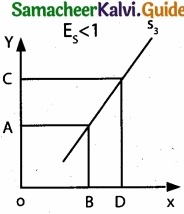
(II) Production:

  • Production is the process of transformation of inputs into output.
  • This division covers the characteristics and role of the factors of production namely land, labour, capital and organization.

(III) Exchange:

  • Exchange is concerned with price determination in different market forms.
  • This division covers trade and commerce.
  • Consumption is possible only if the produced commodity is placed in the hands of the consumer.

(IV) Distribution:

  • Production is the result of the coordination of factors of production.
  • Since a commodity is produced with the efforts of land, labour, capital and organization, the produced wealth has to be distributed among the cooperating factors.
  • The reward for factors of production is studied in this division under rent, wages, interest and profit.
  • Distribution studies about the pricing of factors of production.

[OR]

(b) Explain the law of demand and its exceptions?
Answer:
Definitions:
The Law of Demand says as “the quantity demanded increases with a fall in price and diminishes with a rise in price”. – Marshall
“The Law of Demand states that people will buy more at lower price and buy less at higher prices, other things remaining the same”. – Samuelson Assumptions of Law of Demand:

  1. The income of the consumer remains constant.
  2. The taste, habit and preference of the consumer remain the same.
  3. The prices of other related goods should not change.
  4. There should be no substitutes for the commodity in study.
  5. The demand for the commodity must be continuous.
  6. There should not be any change in the quality of the commodity.

Given these assumptions, the law of demand operates. If there is change even in one of these assumptions, the law will not operate.

Explanation:
The law of demand explains the relationship between the price of a commodity and the quantity demanded of it. This law states that quantity demanded of a commodity expands with a fall in price and contracts with a rise in price.

In other words, a rise in price of a commodity is followed by a contraction demand and a fall in price is followed by extension in demand. Therefore, the law of demand states that there is an inverse relationship between the price and the quantity demanded of a commodity.

Tamil Nadu 11th Economics Model Question Paper 4 English Medium img 2

Exceptions to the law of demand:
Normally, the demand curve slopes downwards from left to right. But there are some unusual demand curves which do not obey the law and the reverse occurs.

A fall in price brings about a contraction of demand and a rise in price results in an extension of demand. Therefore the demand curve slopes upwards from left to right. It is known as exceptional demand curve.

In the above diagram, DD is the demand curve which slopes upwards from left to right. It shows that when price is OP1,, OQ1, is the demand and when the price rises to OP2, demand also extends to OQ2.

Tamil Nadu 11th Economics Model Question Paper 4 English Medium img 3

Tamil Nadu 11th Economics Model Question Paper 4 English Medium

Question 43 (a).
Describe the degree of price discrimination?
Answer:
Degrees of Price Discrimination:
Price discrimination has become widespread in almost all monopoly markets. According to A.C.Pigou, there are three degrees of price discrimination.

(I) First degree price discrimination:
A monopolist charges the maximum price that a buyer is willing to pay. This is called as perfect price discrimination. This price wipes out the entire consumer’s surplus. This is maximum exploitation of consumers. Joan Robinson named it as “Perfect Discriminating Monopoly”.

(II) Second degree price discrimination:
Under this degree, buyers are charged prices in such a way that a part of their consumer’s surplus is taken away by the sellers. This is called as imperfect price discrimination. Joan Robinson named it as “Imperfect Discriminating Monopoly”.

Under this degree, buyers are divided into different groups and a different price is charged for each group. For example, in cinema theatres, prices are charged for same film show from viewers of different classes. In a theatre the difference between the first row of first class and the last row in the second class is smaller as compared to the differences in charges.

(III) Third degree price discrimination:
The monopolist splits the entire market into a few sub – market and charges different price in each sub – market. The groups are divided on the basis of age, sex and location. For example, railways charge lower fares from senior citizens. Students get discounts in museums, and exhibitions.

[OR]

(b) Write a short note on Total Revenue?
Answer:
Total revenue is the amount of income received by the firm from the sale of its products. It is obtained by multiplying the price of the commodity by the number of units sold.

Tamil Nadu 11th Economics Model Question Paper 4 English Medium img 4

Tamil Nadu 11th Economics Model Question Paper 4 English Medium img 5

where, TR denotes Total Revenue, P denotes Price and Q denotes Quantity sold.
For example, a cell – phone company sold 100 cell – phones at the price of ₹500 each.
TR is ₹50,000. (TR = 500 × 100 = 50,000).

When price is constant, the behaviour of TR is shown in the above table and diagram, assuming P = 5. When P = 5; TR = PQ

When price is declining with increase in quantity sold. (Eg. Imperfect Competition on the goods market) the behaviour of TR is shown in the following table and diagram. TR can be obtained from Demand fuction: If Q = 11 – P,
When P = 1, Q = 10

Tamil Nadu 11th Economics Model Question Paper 4 English Medium img 6

Tamil Nadu 11th Economics Model Question Paper 4 English Medium img 7

TR = PQ = 1 × 10 = 10
When P = 3, Q = 8, TR = 24
When P = 0, Q = 1, TR = 10

Tamil Nadu 11th Economics Model Question Paper 4 English Medium

Question 44 (a).
Discuss the problems of Rural Economy?
Answer:
Rural areas are facing number of problems relating to,

  1. People
  2. Agriculture
  3. Infrastructure
  4. Economy
  5. Society and Culture
  6. Leadership and
  7. Administration.

(I) People Related Problems:
The problems related to individuals and their standard of living consist of illiteracy, lack of technical know how, low level of confidence, dependence on sentiments and beliefs etc.

(II) Agriculture Related Problems:
The problems related to agriculture include as follows,

  • Lack of expected awareness, knowledge, skill and attitude.
  • Unavailability of inputs.
  • Poor marketing facility.

(III) Infrastructural Related problems:
Poor infrastructure facilities like, water, electricity, transport, educational institutions, communication, health, employment, storage facility, banking and insurance are found in rural areas.

(IV) Economics related problems:
The economic problems related to rural areas are,

  • Inability to adopt high cost technology
  • High cost of inputs
  • Under privileged rural industries.
  • Low income
  • Indebtedness
  • Existence of inequality in land holdings and assets

(V) Leadership Related Problems:
The Specific leadership related problems found in rural areas are:

  • Leadership among the hands of inactive and incompetent people
  • Self – interest of leaders
  • Biased political will
  • Less bargaining power
  • Negation skills and dominance of political leaders

(VI) Administrative Problems:
The rural administrative problems are,

  • Political interference
  • Lack of motivation and interest
  • Low wages in villages
  • Improper utilization of budget
  • Absence of monitoring
  • Implementation of rural development programme.

[OR]

(b) Mention the causes for Rural poverty?
Answer:
Causes for Rural Poverty:
1. Unequal distribution of Land:
The distribution of land is highly skewed in rural areas. Therefore, majority of rural people work as hired labour to support their families.

2. Lack of Non – Farm Employment:
Non – farm employment opportunities do not match the increasing labour force. The excess supply of labour in rural areas reduces the wages and increases the incidence of poverty.

3. Lack of public sector Investment:
The root cause of rural poverty in our country is lack of public sector investment on human resource development.

4. Inflation:
Steady increase in prices affects the purchasing power of the rural poor leading to rural poverty.

5. Low productivity:
Low productivity of rural labour and farm activities is a cause as well as the effect of poverty.

6. Unequal Benefit of Growth:
Major gains of economic development are enjoyed by the urban rich people leading to concentration of wealth. Due to defective economic structure and policies, gains of growth are not reaching the poor and the contributions of poor people are not accounted properly.
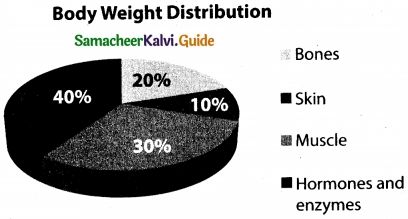
7. Low Rate of Economic Growth:
The rate of growth of India is always below the target and it has benefited the rich. The poor are always denied of the benefits of the achieved growth and development of the country.


8. More Emphasis on Large Industries:
Huge investment in large industries catering to the needs of middle and upper classes in urban areas are made in India. Such industries are capital-intensive and do not generate more employment opportunities. Therefore, poor are not in a position to get employed and to come out from the poverty in villages.

9. Social evils:
Social evils prevalent in the society like custom, beliefs, etc., increase unproductive expenditure.

Tamil Nadu 11th Economics Model Question Paper 4 English Medium

Question 45 (a).
Bring out the relationship between TR, AR, MR and Elasticity of demand?
Answer:
Relationship among TR, AR and MR Curves:
When marginal revenue is positive, total revenue rises, when MR is zero the total revenue becomes maximum. When marginal revenue becomes negative total revenue starts falling. When AR and MR both are falling, then MR falls at a faster rate than AR.

TR, AR, MR and Elasticity of demand:

  1. The relationship among AR, MR and elasticity of demand (e) is stated as follows.
    MR = AR (e – 1/e)
  2. The relationship between The AR curve and MR curve depends upon the elasticity of AR curve [AR = DD = Price]

Tamil Nadu 11th Economics Model Question Paper 4 English Medium img 8

  • When price elasticity of demand is greater than one, MR is positive and TR is increasing.
  • When price elasticity of demand is less than one, MR is negative and TR is decreasing.
  • When price elasticity of demand is equal to one, MR is equal to Zero and TR is maximum and constant.

It is to be noted that, the output range of 1 to 5 units, the price elasticity of demand is greater than one according to total outlay method. Hence, TR is increasing and MR is positive.
TR, AR, MR & Elasticity

Tamil Nadu 11th Economics Model Question Paper 4 English Medium img 9

At the output range of 5 to 6 units, the price elasticity of demand is equal to one. Hence, TR is maximum and MR is equals to zero. At the output range of 6 units to 10 units, the price elasticity of demand is less than unity. Hence, TR is decreasing and MR is negative.

[OR]

(b) Explain the monetary and financial sector reforms?
Answer:
Monetary reforms aimed at doing away with interest rate distortions and rationalizing the structure of lending rates. The new policy tried in many ways to make the banking system more efficient. Some of the measures undertaken were:

(I) Reserve Requirements:

  • Reduction in Statutory liquidity ratio [SLR] and the cash reserve ratio [CRR] were the recommendations by the Narasimham Committee Report, 1991.
  • It was proposed to cut down the SLR from 38.5 percent to 25 percent within a time span of three years.

(II) Interest Rate Liberalisation:
RBI controlled:

  • The interest rates payable on deposits. The interest rate which could be charged for bank loans.
  • Greater competition among public sector, private sector and foreign banks and elimination of administrative constraints.
  • Liberalisation of bank branch licensing policy in order to rationalize the existing branch network.
  • Banks were given freedom to relocate branches and open specialized branches.
  • Guidelines for opening new private sector banks.
  • New accounting norms regarding classification of. assets and provisions of bad debt were introduced in tune with the Narasimham Committee Report.

Tamil Nadu 11th Economics Model Question Paper 4 English Medium

Question 46 (a).
Examine the law of variable proportions with the help of a diagram?
Answer:
The law states that if all other factors are fixed and one input is varied in the short run, the total output will increase at an increasing rate at first instance^ be constant at a point and then eventually decrease. Marginal product will become negative at last.

According to G.Stigler, “As equal increments of one input are added, the inputs of other productive services being held constant, beyond a certain point, the resulting increments of product will decrease, i.e., the marginal product will diminish”.

Assumptions:
The Law of Variable Proportions is based on the following assumptions.

  • Only one factor is variable while others are held constant.
  • All units of the variable factor are homogeneous.
  • The product is measured in physical units.
  • There is no change in the state of technology.
  • There is no change in the price of the product.

Total Product (TP)
Total product refers to the total amount of commodity produced by the combination of all inputs in a given period of time.

Summation of marginal products, i.e.
TP = ΣMP
where, TP = Total Product,
MP = Marginal Product

Average Product (AP)
Average Product is the result of the total product divided by the total units of the input employed. In other words, it refers to the output per unit of the input.
Mathematically, AP = TP/N
Where, AP = Average Product
TP = Total Product
N = Total units of inputs employed

Marginal Product (MP)
Marginal Product is the addition or the increment made to the total product when one more unit of the variable input is employed. In other words, it is the ratio of the change in the total product to the change in the units of the input. It is expressed as
MP = ∆TP/∆N

where,
MP = Marginal Product
∆TP = Change in total product
∆N = Change in units of input It is also expressed as
MP = TP(n) – TP (n – 1)
Where, MP = Marginal Product
TP(n) = Total product of employing nth unit of a factor.
TP(n – 1) = Total product of employing the previous unit of a factor, that is, (n – 1)th unit of a factor.
The Law of Variable Proportions is explained with the help of the following schedule and diagram:

Tamil Nadu 11th Economics Model Question Paper 4 English Medium img 10

Tamil Nadu 11th Economics Model Question Paper 4 English Medium img 11

In above table, units of variable factor (labour) are employed along with other fixed factors of production. The table illustrates that there are three stages of production. Though total product increases steadily at first instant, constant at the maximum point and then diminishes, it is always positive forever.

While total product increases, marginal product increases up to a point and then decreases. Total product increases up to the point where the marginal product is zero. When total product tends to diminish marginal product becomes negative.

In diagram, the number of workers is measured on X axis while TPL, APL and MPL are denoted on Y axis. The diagram explains the three stages of production as given in the above table.

Stage I:
In the first stage MPL increases up to third labourer and it is higher than the average product, so that total product is increasing at an increasing rate. The tendency of total product to increase at an increasing rate stops at the point A and it begins to increase at a decreasing rate. This point is known as ‘Point of Inflexion’.

Stage II:
In the second stage, MPL decreases up to sixth unit of labour where MPL curve intersects the X – axis. At fourth unit of labor MPL = APL. After this, MPL curve is lower than the APL. TPL increases at a decreasing rate.

Stage III:
Third stage of production shows that the sixth unit of labour is marked by negative MPL, the APL continues to fall but remains positive. After the sixth unit, TPL declines with the employment of more units of variable factor, labour.

[OR]

(b) What are the types of elasticity of supply?
Answer:
There are five types of elasticity of supply

1. Relatively Elastic Supply:
The co – efficient of elastic supply is greater than 1 [ES > 1], One percent change in the price of a commodity causes more than one percent change in the quantity supplied of the commodity.

Tamil Nadu 11th Economics Model Question Paper 4 English Medium img 12

2. Unitary Elastic Supply:
The co – efficient of elastic supply is equal to 1 [Eg = 1]. One percent change in the price of a commodity causes an equal [one percent ] change in the quantity supplied of the commodity.

Tamil Nadu 11th Economics Model Question Paper 4 English Medium img 13

3. Relatively Inelastic Supply:
The co-efficient of elasticity is less than one [ES < 1]. One percent change in the price of a commodity causes and less than one percent change in the quantity supply supplied of the commodity.

Tamil Nadu 11th Economics Model Question Paper 4 English Medium img 14

4. Perfectly Inelastic Supply:
The co – efficient of elasticity is equal to zero [ES = 0], One percent change in the price of a commodity causes no change in the quantity supplied of the commodity.

Tamil Nadu 11th Economics Model Question Paper 4 English Medium img 15

5. Perfectly Elastic Supply:
The co – efficient of elasticity of supply is infinity [ES = 3]. One percent change in the price of a commodity causes an infinite change in the quantity supplied of the commodity.

Tamil Nadu 11th Economics Model Question Paper 4 English Medium img 16

Tamil Nadu 11th Economics Model Question Paper 4 English Medium

Question 47 (a).
Analyse the causes for Rural Indebtedness?
Answer:
The Causes for Rural Indebtedness:
(I) Poverty of Farmers:

  • The vicious circle of poverty forces the farmers to borrow for consumption and cultivation.
  • Thus poverty, debt and high rates of interest hold the farmer in the grip of money lenders.

(II) Failure of Monsoon:

  • Frequent failure of monsoon is a curse to the farmers and they have to suffer due to the failure of nature.
  • Farmers find it difficult to identify good years to repay their debts.

(III) Litigation:

  • Due to land disputes litigation in the court compels them to borrow heavily.
  • Being uneducated and ignorant they are caught in the litigation process and dry away their savings and resources.

(IV) Money Lenders and High Rate of Interest:
The rate of interest charged by the local money lenders is very high and the compounding of interest leads to perpetuate indebtedness of the farmer.

[OR]

(b) Explain the public transport system in Tamil Nadu?
Answer:
Transport:
Tamil Nadu has a well established transportation system that connects all parts of the State. This is partly responsible for the investment in the State.

Tamil Nadu is served by an extensive road network in terms of its spread and quality, providing links between urban centres, agricultural market-places and rural habitations in the countryside. However, there is scope for improvement.

Road Transport:

  1. There are 28 national highways in the State covering a total distance of 5,036 km.
  2. The State has a total road length of 167,000 km, of which 60,628 km are maintained by Highways Department.

Rail Transport:

  1. Tamil Nadu has a well-developed rail network as part of Southern Railway, Head quartered at Chennai.
  2. Tamil Nadu has a total railway track length of 6,693 km and there are 690 railway stations in the State.
  3. Main rail junctions in the State include Chennai, Coimbatore, Erode, Madurai, Salem, Tiruchirapalli and Tirunelveli.
  4. Chennai has a well – established suburban Railway network, a Mass Rapid Transport system and is currently developing a Metro System, with its first underground stretch operational since May 2017.

Air Transport:

  1. Tamil Nadu has four major international airports.
  2. Chennai International Airport is currently the third largest airport in India.
  3. Other international Airports in Tamil Nadu include Coimbatore International Airports, Madurai International Airport and Tiruchirapalli International Airport.
  4. It also has domestic airports at Tuticorin, Salem, and Madurai.
  5. Increased industrial activity has given rise to an increase in passenger traffic as well as freight movement which has been growing at over 18% per year.

Ports:

  1. Tamil Nadu has three major ports; one each at Chennai, Ennore and Tuticorin, as well as one intermediate port in Nagapattinam, and 23 minor ports.
  2. The ports are currently capable of handling over 73 million metric tonnes of cargo annually (24 % share of India).
  3. All the minor ports are managed by the Tamil Nadu Maritime Board, Chennai Port.
  4. This is an artificial harbour and the second principal port in the country for handling containers.
  5. It is currently being upgraded to have a dedicated terminal for cars capable of handling 4,00,000 vehicles.
  6. Ennore port was recently converted from an intermediate port to a major port and handles all the coal and ore traffic in Tamil Nadu.

Tamil Nadu 11th English Model Question Paper 2

Students can Download Tamil Nadu 11th English Model Question Paper 2 Pdf, Tamil Nadu 11th English Model Question Papers helps you to revise the complete Tamilnadu State Board New Syllabus, helps students complete homework assignments and to score high marks in board exams.

TN State Board 11th English Model Question Paper 2

General Instructions:

  1. The question paper comprises of four parts.
  2. You are to attempt all the parts. An internal choice of questions is provided wherever applicable.
  3. All questions of Part I, II, III and IV are to be attempted separately.
  4. Question numbers 1 to 20 in Part I are Multiple Choice Questions of one mark each.
    These are to be answered by choosing the most suitable answer from the given four alternatives and writing the option code and the corresponding answer
  5. Question numbers 21 to 30 in Part II are two-mark questions. These are to be answered in about one or two sentences.
  6. Question numbers 31 to 40 in Part III are three-mark questions. These are to be answered in above three to five short sentences.
  7. Question numbers 41 to 47 in Part IV are five-mark questions. These are to be answered in detail Draw diagrams wherever necessary.

Time: 3:00 Hours
Maximum Marks: 90

PART – I

I. Answer all the questions. [20 × 1 = 20]
Choose the correct synonym for the underlined words from the options given.

Question 1.
The face shone bright through the delicate shroud.
(a) linen
(b) veil
(c) fabric
(d) saree
Answer:
(b) veil

Question 2.
The basket of apples rolled across the concourse.
(a) carriage
(b) cavalry
(c) courtyard
(d) candour
Answer:
(c) courtyard

Tamil Nadu 11th English Model Question Paper 2

Question 3.
The ordinary man seldom forgets things.
(a) often
(b) rarely
(c) frequently
(d) random
Answer:
(b) rarely

Choose the correct antonyms for the underlined words from the options given.

Question 4.
We were so amused with the quick response from the three year old.
(a) annoyed
(b) pleased
(c) happy
(d) entertained
Answer:
(a) annoyed

Question 5.
I cherished the moist imprint as the last sign of physical presence.
(a) dry
(b) clammy
(c) sultry
(d) soggy
Answer:
(a) dry

Question 6.
Her lips moved in inaudible prayer.
(a) indistinct
(b) muted
(c) audible
(d) altered
Answer:
(c) audible

Question 7.
Choose the unclipped form of “lunch”.
(a) lunchtime
(b) luncher
(c) lunchent
(d) luncheon
Answer:
(d) luncheon

Question 8.
Choose the right definition for the given term “fratricide”.
(a) The fear of the future
(b) One who makes major changes in the education system
(c) Killing small babies
(d) The murder of your sibling
Answer:
(d) The murder of your sibling

Question 9.
Choose the meaning of the idiom ‘Add insult to injury’.
(a) Hear from the authoritative source
(b) Everything about the case
(c) To worsen an unfavourable situation
(d) To see that two agree on something
Answer:
(c) To worsen an unfavourable situation

Tamil Nadu 11th English Model Question Paper 2

Question 10.
Choose the meaning of the foreign word in the sentence.
I saw an old lady wearing a babushka walking down the street.
(a) gown or night dress
(b) scarf or head covering
(c) rain coat
(d) baboons dress
Answer:
(b) scarf or head covering

Question 11.
Choose the word from the options given to form a compound word with “ran”.
(a) down
(b) floor
(c) sack
(d) town
Answer:
(c) sack

Question 12.
Form a new word by adding a suitable suffix to the root word, “nourish”.
(a) ly
(b) ile
(c) ment
(d) ness
Answer:
(c) ment

Question 13.
Choose the expanded form of “CPWD”.
(a) Centralised Public Works Department
(b) Central Public Works Director
(c) Central Public Works Department
(d) Central Private Works Department
Answer:
(c) Central Public Works Department

Question 14.
The correct syllabification of the word “circumstance” is………..
(a) cir-cum-stan-ces
(b) cir-cum-stance
(c) cir-cu-m-stance
(d) circ-um-stance
Answer:
(b) cir-cum-stance

Question 15.
The fear of being in the dark is known as…………
(a) Nyctophobia
(b) Topophobia
(c) Chronophobia
(d) Acronymania
Answer:
(a) Nyctophobia

Question 16.
Fill in the blank with the suitable preposition.
Aijun saw the train moving ……….. the lady with a cell phone on the track.
(a) for
(b) beneath
(c) towards
(d) from
Answer:
(c) towards

Question 17.
Add a suitable question tag to the following statement.
I haven’t answered your questions, ……….. ?
(d) haven’t I
(b) have I
(c) will I
(d) shan’t I
Answer:
(b) have I

Tamil Nadu 11th English Model Question Paper 2

Question 18.
Substitute the underlined word with the appropriate polite alternative.
John is jobless at the moment so I don’t think he can afford to come on holiday with us.
(a) firing
(b) hiring
(c) after jobs
(d) between jobs
Answer:
(d) between jobs

Question 19.
Substitute the phrasal verb in the sentence with a single word.
Monisha takes after her dad.
(a) follows
(b) receives
(c) resembles
(d) remembers
Answer:
(c) resembles

Question 20.
Fill in the blank with a suitable relative pronoun
This is the stream ……….. was contaminated with plastics.
(a) which
(b) that
(c) what
(d) whose
Answer:
(a) which

PART – II

II. Answer any seven of the following: [7 × 2 = 14]
(i) Read the following sets of poetic lines and answer any four of the following. [4 × 2 = 8]

Question 21.
“Cocktail face with all their conforming smiles
Like a fixed portrait smile”
(a) What is meant by ‘conforming smiles’?
(b) Mention the figure of speech employed in the first line.
Answer:
(a) The conforming smile symbolizes the artificial and stiff smile meant only for appearances or occasions.
(b) Metaphor

Question 22.
“I am just glad as glad can be
That I am not them, that they are not me.
With all my heart I do admire
Athletes who sweat for fun or hire”
(a) Who does he admire? Why?
(b) Pick out the rhyming words.
Answer:
(a) The poet admires athletes who play games and sweat for fun and money.
(b) ‘be, me’ and ‘admire, hire’ are the rhyming words.

Question 23.
“He’s outwardly respectable (They say he cheats at cards)
And his footprints are not found in any file of Scotland Yard’s”
(a) Identify the poem and the poet.
(b) Whose footprints are not found in any file of Scotland Yard’s?
Answer:
(a) The poem is ‘Macavity – The Mystery Cat’ written by T.S. Eliot.
(b) Macavity’s footprints are not found in any file of Scotland Yard’s.

Tamil Nadu 11th English Model Question Paper 2

Question 24.
“Let’s choose executors and talk of wills.
And yet not so – for what can we bequeath
Save our deposed bodies to the ground?”
(a) What do you mean by ‘deposed bodies’?
(b) Why should they choose executors and talk about the wills?
Answer:
(a) It means dead bodies.
(b) As the king’s death is nearing the king wants to talk about executors and wills.

Question 25.
“Our pride springs from the way we live.”
(a) Under normal circumstances what makes one feel proud?
(b) What is unique about the pride mentioned above?
Answer:
(а) One’s material wealth, high social standing and popularity makes one feel proud.
(b) The sense of pride springs from the way the people live their lives and not from positions or possessions.

Question 26.
“And much it grieved my heart to think
What Man has made of Man.”
(а) What grieves the poet?
(b) What is the significance of the second line?
Answer:
(a) Man’s greed to exploit natural resources and man’s moving away from nature gives ‘grief’ to the poet.
(b) The poet is unhappy with unnatural aspects of industrial revolution, the misery caused by wars, greedy and aggressive behaviour causing suffering in humans.

(ii) Do as directed (any three) [3 × 2 = 6]

Question 27.
Rewrite the following dialogue in reported form.
Paul : Do you know that Mrs. Kalpana was awarded the Best Teacher Trophy this year by the Rotary club?
Shanmugam : Is that so? I am glad. She is a deserving teacher.
Answer:
Paul asked Shanmugam if he knew that Mrs. Kalpana was awarded the Best Teacher Trophy that year by the Rotary club. Shanmugam enquired if that was so and that he was glad about it as she was a deserving teacher.

Question 28.
Rewrite the following sentence in its passive form.
He buys a portrait.
Answer:
A portrait is bought by him.

Question 29.
Priya did not start early. She was late to school. (Combine using ‘If’)
Answer:
If Priya had started early she wouldn’t have been late to school.

Tamil Nadu 11th English Model Question Paper 2

Question 30.
Convert the following complex sentence into a simple sentence.
This is the place where the meeting will be held.
Answer:
This is the venue of the meeting.

PART – III

III. Answer any seven of the following: [7 × 3 = 21]
(i) Explain any two of the following with Reference to the Context: [2 × 3 = 6]

Question 31.
There was a time indeed.
They used to shake hands with their hearts
But that’s gone, son
Answer:
Reference: This line is from the poem “Once upon a time” written by Gabriel Okara.

Context: The poet speaks about the falsity concealed behind smiles and the lack of innocence of childhood.

Explanation: The poet, Okara observes a marked change in the altitude of Africans. Those who were once so genuine, warm and sincere, have now suddenly turned cold and hostile towards him. He realizes that the early values like sincerity, good-naturedness, simplicity, whole-heartedness, hospitality, friendliness, originality and uniqueness have now drastically changed. The earlier warmth has gone.

Question 32.
We are proud of the position we
Hold; humble as we are
Answer:
Reference: These lines are from the poem “Everest is not the Only Peak” written by Kulothungan.

Context: The poet admits that he is proud of people’s humble positions because their pride springs not from positions or possessions but the way they live.

Explanation: The poet just doesn’t bother the height of the peak one reaches. It could even be a hillock. Their life knows no bending. What matters is how one reaches that spot. If merit and competence have paved the way for their success and positions, however humble they are, the poet admires them.

Question 33.
“For God’s sake let us sit upon the ground
And tell sad stories of the death of kings:”
Answer:
Reference: These lines are from the poem “The Hollow Crown” by William Shakespeare. The poem is an excerpt from the play “Richard II”.

Context: This poem speaks of the vanity of life and how Death is the ultimate conqueror.

Explanation: King Richard started feeling distressed about his impending death. He realises his possessions will be reduced to a patch of land. His will bequeathing his wealth to his son will be treated like dust. He recalls how kings get slain in battlefield and cries on losing his belongings. The king feels he is also an ordinary mortal deceived by the jester ‘death’. He also needs to taste grief and needs the support of friends during distress.

Tamil Nadu 11th English Model Question Paper 2

(ii) Answer any two of the following questions briefly: [2 x 3 = 6]

Question 34.
What was Mary Kom’s first impression about America?
Answer:
America was cold and beautiful. What little she saw was very pleasing to her eyes. Americans were enormously nice too. She felt that this would be the place and event that would change her life.

Question 35.
What is the difference between a physical and mental tight corner?
Answer:
Physical tight comers are those situations which threaten the life of An individual. Mental tight comers are worries for which no solution is in sight. It upsets the individuals and confounds them.

Question 36.
How does Arignar Anna highlight the duties and responsibilities of graduates to the society?
Answer:
The graduates must acquire the means of a decent living. But it should be the only objective. As their education is funded by the tax from poor people, they have on obligation to pay back to the society if not in cash in terms of service. They must bring light into the dark alleys, sunshine into dingy places, solace into the affiliated hope unto the despondent and a new life into every one.

(iii) Answer any three of the following: [3 × 3 = 9]

Question 37.
Study the pie-chart and answer the questions that follow:
Tamil Nadu 11th English Model Question Paper 2 1
Questions.

  1. What percent of body weight constitutes of skin?
  2. Forty percent of the body weight constitutes of ………..
  3. Bones take up ……… percent of the body weight.

Answer:

  1. Ten percent of the body weight constitutes of skin.
  2. Hormones and enzymes
  3. Twenty

Question 38.
Build a dialogue of minimum three exchanges between a two friends.
Answer:
Mani : What’s wrong, Tarun? You look terrible!
Tarun : My car slid into a tree, because the roads were slippery.
Mani : Slippery roads and speed don’t mix Tarun. You should be careful.
Tarun : 1 know. But I have one more problem. I didn’t have my driver’s license with me.
Mani : Why were you driving without your license?
Tarun : Well, 1 lost my wallet some days ago, while I was travelling in the bus to work.

Tamil Nadu 11th English Model Question Paper 2

Question 39.
Describe the process of Assembling a piece of furniture.
Answer:

  1. Arrange the pieces of furniture to be assembled on the floor neatly.
  2. Follow the instructions given in the manual.
  3. Take inventory of all of the parts and pieces of your new furniture before you start building it.
  4. Keep aside the tools you required to fix the furniture.
  5. Reread all instructions and double check your handiwork before you proceed to the next step in the instruction manual.
  6. Screw in all the parts as seen in the manual tightly. Check for any loose contacts.
  7. Many furniture companies have videos and FAQ’s on their sites that are useful.
  8. Now the furniture is ready for use.

Question 40.
Complete the proverbs using the words given below.
(a) Appearances can be ……….. (funny, deceptive, tricky)
(b) Better ……….. than never, (late, soon, forget)
(c) Don’t ………. the hand that feeds you. (admire, thank, bite)
Answer:
(a) deceptive
(b) late
(c) bite

PART – IV

IV. Answer the following: [7 x 5 = 35]

Question 41.
“….But, when it’s my own – well, I think hysterics are fully justified’ – How?
Answer:
The author had planned to go to England with all his family members. He arrived at the Logan airport at Boston. When they were checking in, he suddenly remembered that he forgot to use his frequent flier card (British Airways). He also remembered how he had left it in a bag. He tried to open the bag. The zip was jammed. He tried to open it by force. After several attempts, it gave away spilling all the contents in a sprawling corridor in the airport. He ignored the flying documents, silver coins and even passport.

He worried about the tobacco box which was rolling away crazily disgorging its content on the way. He cried “My Tobacco” remembering how expensive it would be to buy tobacco for his pipe in England. Just then he realized that he was bleeding profusely. He had made a gash on his finger while trying to open the zip of his bag by force. He cried hysterically on seeing his own blood, “My finger” My finger”. In general, he was not comfortable flowing other’s blood. But when it came to spilling his own blood “hysterics” was really justified.

[OR]

How do Universities mould students apart from imparting academic education to them?
Answer:
Universities mould students by providing various opportunities to develop their soft skills and to develop values which would contribute to the process of nation building. They enable graduates to develop patience and perseverance. They help them develop faith in their own inherent ability to shoulder responsibilities. They are oriented to become citizens of democracy and repay to the society quality services which would reform the lives of the poor people.

They develop true spirit of democracy among young graduates. They enable appreciation of others point of view. The graduates are also provided opportunities to adjust with difference through amicable discussions. The universities, apart from imparting education mould the students’ character and personality too.

Tamil Nadu 11th English Model Question Paper 2

Question 42.
Give reasons to prove that the future generations remember easily the Victor more than the Vanquished with relevant references from King Richard’s speech.
Answer:
Unusually future generations remember victors. But there are rare instances of just rulers falling due to the conspiracy and greed of an aggressor. On such occasions, future generations remember the vanquished. A Shiva devotee king was very generous. His enemies entered his kingdom under the guise of Shiva devotees in saffron clothes and slew the king and captured his kingdom. Alexander, King Richard was a just ruler. He was loved by his subjects and loyal nobles.

He was defeated by his rebellious cousin simply because he wanted to be a king. When Richard was thinking about the welfare of his subjects, Bolingbroke was secretly raising an army to dethrone him. People who are mad after power resort to unjust means. So, British subjects respected and loved the vanquished but were helpless. Defeated Porus had fought so valiantly and wanted to be treated with respect befitting a king. Alexander himself respected him and returned his kingdom and sealed a life time friendship with him. From King Richard’s speech one understands that he was good at heart but in the strategy of war, he was not good.

Like a crooked end of a straight walking stick, a ruler has to have some secret deals with neighbouring countries to be protected during crisis. Bolingbroke turned out to be a more assertive and Shrewd king. But people would remember a just and noble person more even if defeated.

[OR]

When humanity fails to live in harmony with Nature, its effects are felt around the world. Justify.
Answer:
Man, the worst predator, kills for no reason. Man has to protect forests and live in harmony with nature. Instead man is callous. He kills elephants for their tusks, Rhinoceros for their horn, and polar bears for their fur. Huge trees, in Rainforests, which have been protecting lives of many species and insects, are being felled for timber and industrialization. Due to the increase in the denudation of forests, global warming has increased. Water levels in the ocean is increasing.

Heat waves are threatening the lives of people. Polar ice is melting. Scientists fear that if this persists, there will be hostility caused by water-sharing. Like Karnataka and Tamil Nadu, there will be political unrest and community conflicts demanding share in drinking water and water for irrigation purposes. In South Africa, zero water day is fast approaching. The scarcity of portable water is going to be a huge humanitarian crisis. As we have failed to protect the national resources, carbon foot print is expanding to alarming levels.

Delhi experiences difficulty as planes struggle to land or take off dufe to thick smog in and around Delhi. As toxic waste is released by Sterlyte and other industries people in Thoothukudi are becoming victims of cancer and other lung related disorders. Atomic power plants also retain potential hazards like radio-activity. Thus humanity’s failure to live in harmony with nature is threatening to wipe out human race.

Question 43.
Write a paragraph (150 words) by developing the following hints.
Miss Meadows – upset – remains gloomy – in class – taxes the students – sing sad – the girls sense her change – Basil – She thinks of the letter – called by headmistress – telegram – happy and returns to the class with vigour and good cheer.
Answer:
The Singing Lesson, written by Katherine Mansfield, is all about a surprising d&y of a music teacher’s life. Miss Meadows, a music teacher, receives a letter from her fiance which states quite plainly that Basil, her fiance, isn’t ready to marry her and feels that the marriage would fill him with disgust. Naturally she’s filled with despair, anger and sadness. Her usual calm and cheery demeanor turns gloomy and angry that day and this change doesn’t go unnoticed by her students.

During the lesson she’s rather harsh with her students. She tells them that today they would be practising a lament. Then she tells them that they must feel the despair, the pain and the sorrow in order to perform the piece perfectly. During the lesson she’s informed by another colleague that Basil, her fiance, has sent a telegram for her. Her first thought is that Basil has committed suicide! Yes, you read that right. It’s because the school has a rule; telegram can be sent to the workers during working hours only in case of death or emergency situation. But in the telegram Basil had asked her to ignore the first letter and that he had bought the hat-stand which they had been thinking of lately. In short, the marriage is happening.

The content of the telegram definitely lights up her mood. She returns and continues her class, now practicing a cheerful song, singing with expressions, more loudly and cheerfully than any of her students.

Tamil Nadu 11th English Model Question Paper 2

[OR]

Jack and Jill – call their house – a little nest – like birds make their nests – all collected free of cost – Jack and Jill – made their nest – right from villa – bought in instalment – take years to own.
Answer:
The Never Never Nest is a comic one-act play about a young couple who make full use of the buy-now-pay-later system. Jack and Jill were a young married couple who had a small baby. One day Aunt Jane visited them and was surprised to find that even though Jack’s salary was not high, they lived in a beautiful house with all comforts. She began to wonder whether, as a wedding gift she had given them 2000 pounds instead of 20 pounds. Otherwise how did Jack and Jill buy all these things? Then Jane understood that though they had everything, nothing really belonged to them. They bought everything on instalments.

Only a steering wheel of the car, a wheel and two cylinders had been paid for. The total amount to be paid towards instalments was more than their earnings. Aunt Jane was shocked at the way Jack and Jill ran their family. Before she left, she gave ten pounds to Jill and told them to make at least one article completely theirs, using that money. While Jack went with aunt Jane to the bus stop, Jill sent the money to Dr. Martin. Jack came back and said that he wanted to pay .two months instalments on the car using the aunt’s gift. But Jill said that by paying this money to Dr. Martin, their baby would become completely theirs.

Question 44.
Write a summary or Make notes of the following passage.
The interior maintenance of a house reflect the personality of the people who live in it. Attractive home furnishings set the stage for pleasant living. A home should have unity within each room and throughout the house. Each room should, harmonize with each other. The colour and styling of each room, particularly, should fit into the colour and styling of the rooms which run out of it. However, furnishings and surroundings expressive of just the right note of restfulness, or elegant simplicity are not often assembled by accident.

Most of the home decorators plan extensively by trying colour schemes, finding ingenious ways to make the best of what you have. They shop around to search out the right purchases at prices you can afford to pay. There is a keen pleasure in striving for the perfect result, and great satisfaction in achieving it.

A successful house and successful rooms will depend upon the proper relationship of each element used in it to the others and to the whole. Therefore, in selecting each piece it is well to consider the background, the usage, the ‘draperies, the floor covering, the upholstering materials, the woods, shapes, colour scheme, and the “feeling” you prefer for the room.

Work and plan to enjoy your house. Limit the expenditures of time, effort and money to the extent of your abilities. Elegance and delicate things may be a drain you can afford only in a limited way. If you can’t afford outside help, select a house and furnishings that require less care. Plan your activities so that tumult and upset are limited to a few rooms-an activity room or a bedroom, or a comer of the dining room.

You’ll get more pleasure out of a house if you have a hobby connected with it – collecting antiques or glass, gardening or indoor flower growing ceramics, art, cooking, decorating, flower arrangements, etc. And you’ll get more satisfaction and a great deal of help from studying household activities.

You can select a pleasing combination of colours from a wallpaper, a fabric, a flower or scene, or even a picture in a magazine. It is a good idea to make up a colour scheme. Let one colour predominate. Limit a colour scheme to two or three colours, with white or gray tones.
Answer:
Summary
No. of words given in the original passage: 369
No. of words to be written in the summary: 369/3 = 123 ±5
Rough Draft
The maintenance of the house reflects the personality of the people who live in that. So the distinctive decoration is as important as one attire in good clothes. A unity in the home can only be seen if the rooms in the house have a degree of harmony, colour and styling. Furniture is a working strategy for the pleasant living. If there is an expression of oneself then one will have a mental satisfaction every time one enter one’s home.

To attain such satisfaction one need to pore over plants, try colour schemes, window shopping to search the best thing for one’s home. Most of the home decorators plan extensively By trying colour schemes, finding ingenious ways to make the best of what you have. They shop around to search out the right purchases at prices you can afford to pay. There is a keen pleasure in striving for the perfect result, and great satisfaction in achieving it.

Fair Draft
Interior design of One’s Home
The interior furnishings of’ a house reflect the personality of the people who live in it. It is as important as one dresses in good clothes. A unity in the home can only be seen if the rooms in the house have a degree of harmony, colour and styling. Furniture also enhances one’s perception on pleasant living. One will have a mental satisfaction every time one enter one’s home.

To attain such satisfaction one need to plan extensively, try colour schemes, window shopping to search the best thing for one’s home within their budget. Home decorators helps one decide on these matters. One can get more pleasure out of a house if they have a hobby connected with it like collecting antiques, gardening, art, cooking, decorating, flower arrangements, etc.

No. of words in the summary: 129

Tamil Nadu 11th English Model Question Paper 2

[OR]

Notes
Title: Interior design of One’s Home
Answer:
Home reflects:

  • personality of house-owner
  • unity & harmony bet. rooms
  • colour & styling sh’d be uniform

Elements of decoration:

  • selection of colour schemes
  • draperies, rugs, upholstery, woods

Plan to enjoy the House:

  • limit time, effort & money
  • select furnish’gs which require little care
  • hobby connected with house-great pleasure.

Choice of Colours:

  • one colour sh’d predominate
  • calm colours for restfulness; intense for liveliness
  • colours sh’d harmonise with furniture, draperies, carpets

Abbreviations used: bet. – between; sh’d – should; fumish’gs – furnishings;

Question 45.
Read the following advertisement and prepare a resume/bio-data/CV considering yourself fulfilling the conditions specified.
[Write XXXX for your name and YYYY for your address]
Wanted
Computer Operator – Diploma holder with computer knowledge, fluency in English and good communication skills, Minimum 3 Years Experience.
Apply with your bio-data to : Post Box No : 545
C/o. The Hindu
Trichy- 620001.
Answer:

25.09.XXXX

From
XXXX
YYYY

To
Post box No. 545
C/o The Hindu
Trichy – 620001

Sir,
Sub: Applying for the post of Computer Operator – Reg.
I hereby apply for the post of Computer Operator vacant in your esteemed concern. I have the necessary qualification. My particulars are furnished below for your kind consideration. Bio-data

Name: XXXX
Father’s Name : Mr. R. Karthick
Address: YYYY
Qualification : B.Sc. Computer Science, 1st class, Madurai Kamaraj University
Technical Qualification : Tally, C++, PGDCA
Experience : Seven years of service in Aircel
Age: 28
Languages known : Tamil, English
Joining date : Can join immediately
Reference : My previous employer
Mr. Raj (9876543210)
I look forward to receiving your call letter. I shall offer my services to the best of my superiors’ satisfaction sir.

Yours sincerely
XXXX
Address on the Envelope
To
Post box No. 545
C/o. The Hindu
Trichy-620001

Tamil Nadu 11th English Model Question Paper 2

[OR]

Write an essay in about 150 words on ‘Cyber safety’.
Answer:
Cyber safety
Every child needs to be taught the basics of cyber safety. All of us are aware of the fact that ‘Blue Whale’ game cost lives of many young ones across the globe. Children who are befriended through social websites reveal personal information unwittingly and are exploited by persons who have access to their personal details. Children must be advised to refrain from sharing things with total strangers. Even adults are exploited through social websites and their budding lives are at stake. So, students must not evince keen interest in making friends with strangers online. If children do not do anything that is shameful to admit to parents, cyber crimes will be reduced to minimum.

Question 46.
Read the following sentences, spot the errors and rewrite the sentences correctly.
(a) There is nothing much selfish you can do than come to work sick.
(b) Elimination for child labour is undoubtedly one of the biggest challenge of our country.
(c) Today democracy is often assume to be a liberal form of governance.
(d) In the traditional sense prayer means communicating on God Almighty.
(e) Some of them have been converted into museums but libraries.
Answer:
(a) There is nothing more selfish you can do than come to work sick.
(b) Elimination of child labour is undoubtedly one of the biggest challenge of our country.
(c) Today democracy is often assumed to be a liberal form of governance.
(d) In the traditional sense prayer means communicating with God Almighty.
(e) Some of them have been converted into museums and libraries.

[OR]

Fill in the blanks appropriately.
(a) The Police tried ……….. to information from the boot leggar who used to sell ………. liqour. (illicit/ elicit)
(b) All citizens ………. obey the laws of the land. (Fill in with a modal verb)
(c) We ……….. go grocery shopping, (use semi-modal)
(d) ………. he is rich, he lives in a small house. (Use a suitable link word)
Answer:
(a) elicit, illicit
(b) must
(c) need to
(d) Although

Tamil Nadu 11th English Model Question Paper 2

Question 47.
Identify each of the following sentences with the fields given below.
(a) The board has decided to give the shareholders a dividend of 25 percent.
(b) A salaried employee in the highest slab pays income tax at 33.66 percent.
(c) For programming, people use the binary system.
(d) Every plant organ has a definite form and structure and performs certain specific functions.
(e) “My goal is winning a Grand Slam”, says Sania Mirza.
(Botany, Sports, Taxation, Business, Computer)
Answer:
(a) Business
(b) Taxation
(c) Computer
(d) Botany
(e) Sports

[OR]

Read the following passage carefully and answer the questions that follow.
Once upon a time a frog croaked in Bingle Bog all the night beginning from dusk to dawn. All the creatures hated his loud and unpleasant voice but still they did not have any other option. The voice came out from the sumac tree where every night the frog sang till morning.

He was so determined and also shameless that neither stones, prayers or sticks nor the insults or complaints could divert him from singing. One night, a nightingale started casting her melody in the moonlight to which both the frog and the other creatures were left dumbstruck. The whole bog remained, rapt and admired her voice and applauded her when she ended. The frog was obviously jealous of his rival and had finally decided to eliminate her.

So, the next night when the nightingale was again preparing to sing, the frog’s croak disturbed her. On being asked about himself by the nightingale he answered that he owned the sumac tree and he had been known for his splendid voice. Also he said that he had written a number of songs for the Bog Trumpet. The nightingale asked him whether he liked her song or not.

The frog said that the song wasn’t bad but too long and it lacked some force. The nightingale was greatly impressed that such a critic had discussed her song. She said that she was happy that the song was her own creation. To this the frog said that she needed a proper training to obtain a strong voice otherwise she would remain a beginner only. He also said that he would train her but would charge some fee.

Now, the nightingale was flushed with confidence and was a huge sensation, attracting animals from miles away and the frog with a great accuracy charged all of them admission fee. The frog began her vocal training despite of the bad and rainy weather where even the nightingale had first refused to sing. But the frog forced her to sing for six hours continuously till she was shivering and her voice had become rough and unclear. But, somehow her neck got clear the next day and she was able to sing again collecting a breathless crowd including rich ladies kings queens etc. To all this, the frog had both sweet and bitter feelings. Sweet because he was earning lots of money and bitter because of jealously as his rival was earning name and fame.

Every day, the frog scolded her to practice even longer finding out her little mistakes like nervousness not laying more trills and frills etc. He reminded her that she still owed him sixty shillings and that’s why the crowd should increase. But the condition of nightingale was getting worse. Her tired and uninspired song could no longer attract the crowd. She could not resist this as she had become used to applause and thus had become miserable too.

The heartless frog scolded her even then calling her a brainless bird. She trembled, puffed up, burst a vein and died. The frog said that he had tried to teach her but she was foolish, nervous and tensed and moreover much prone to influence. Then, once again the frog’s fog horn started blearing unrivalled in the bog.

The moral of the poem is that being inspired and influenced by someone much unknown and strange is indeed a foolish work. The nightingale could have very well, judged that how could the frog with such a harsh voice be music maestro and she had to suffer for her misjudgement. Many people in the human society also try to take advantage of the innocence or ignorance of the people.
Questions.

  1. How do you know that the frog was of a determined nature?
  2. A bog is a
  3. What did the nightingale become?
  4. Pick out one word from the passage which means ‘genius’.
  5. What is the moral of the story?

Answer:

  1. He was so determined and also shameless that neither stones, prayers or sticks nor the insults or complaints could divert him from singing.
  2. quagmire.
  3. The nightingale became a huge sensation.
  4. Maestro’ is the word which means genius.
  5. The moral of the story is that being inspired and influenced by someone much unknown and strange is indeed a foolish work.

Tamil Nadu 11th English Model Question Paper 2

Tamil Nadu 11th English Model Question Paper 1

Students can Download Tamil Nadu 11th English Model Question Paper 1 Pdf, Tamil Nadu 11th English Model Question Papers helps you to revise the complete Tamilnadu State Board New Syllabus, helps students complete homework assignments and to score high marks in board exams.

TN State Board 11th English Model Question Paper 1

General Instructions:

  1. The question paper comprises of four parts.
  2. You are to attempt all the parts. An internal choice of questions is provided wherever applicable.
  3. All questions of Part I, II, III and IV are to be attempted separately.
  4. Question numbers 1 to 20 in Part I are Multiple Choice Questions of one mark each.
    These are to be answered by choosing the most suitable answer from the given four alternatives and writing the option code and the corresponding answer
  5. Question numbers 21 to 30 in Part II are two-mark questions. These are to be answered in about one or two sentences.
  6. Question numbers 31 to 40 in Part III are three-mark questions. These are to be answered in above three to five short sentences.
  7. Question numbers 41 to 47 in Part IV are five-mark questions. These are to be answered in detail Draw diagrams wherever necessary.

Time: 3:00 Hours
Maximum Marks: 90

PART – I

I. Answer all the questions. [20 × 1 = 20]
Choose the correct synonym for the underlined words from the options given.

Question 1.
A peaceful pallor spread on his face.
(a) paleness
(b) rosiness
(c) ruddy
(d) rejuvenation
Answer:
(a) paleness

Question 2.
It was indeed a sensational bid.
(a) astounded
(b) ordinary
(c) sensitive
(d) exciting
Answer:
(a) astounded

Tamil Nadu 11th English Model Question Paper 1

Question 3.
I had a sumptuous meal to sate my hunger.
(a) sadden
(b) suppress
(c) satisfy
(d) struggle
Answer:
(c) satisfy

Choose the correct antonym for the underlined words from the options given.

Question 4.
The vessels dropped and scattered all over.
(a) speckled
(b) sprinkled
(c) gathered
(d) grew
Answer:
(c) gathered

Question 5.
There a curious smothering noise from my friend.
(a) suppressed
(b) expressed
(c) smoothened
(d) suffocated
Answer:
(b) expressed

Question 6.
Her face was wrinkled and weird.
(a) smooth
(b) creased
(c) lined
(d) crippled
Answer:
(a) smooth

Question 7.
Choose the clipped form of “percolate”.
(a) perk
(b) per
(c) perc
(d) colate
Answer:
(a) perk

Question 8.
Choose the right definition for the given term “plagiarist”.
(a) A student of bees
(b) One who accumulates; one who collects
(c) One who purloins the words, writings, or ideas of another, and passes them off as his own; a literary thief
(d) One who is tenacious of a strict adherence to official formalities
Answer:
(c) One who purloins the words, writings, or ideas of another, and passes them off as his own; a literary thief

Question 9.
Choose the meaning of the idiom ‘Beat around the bush’.
(a) Indirectly talking about an issue
(b) Do or say something exactly right
(c) To go to bed
(d) Without any hesitation; instantly
Answer:
(a) Indirectly talking about an issue

Question 10.
Choose the meaning of the foreign word in the sentence.
I’d like to learn taekwondo though it might not be the best option for me.
(a) Japanese language
(b) Chinese preparation
(c) Floor dancing
(d) Kick fist martial art
Answer:
(d) Kick fist martial art

Tamil Nadu 11th English Model Question Paper 1

Question 11.
Choose the word from the options given to form a compound word with “goat”.
(a) male
(b) female
(c) scape
(d) major
Answer:
(c) scape

Question 12.
Form a new word by adding a suitable suffix to the root word, “hero”?
(a) ity
(b) ism
(c) ness
(d) ish
Answer:
(b) ism

Question 13.
Choose the expanded form of “NSC”.
(a) National Savings Certificate
(b) National Service Certificate
(c) National Savings Career
(d) National Service Certificate
Answer:
(a) National Savings Certificate

Question 14.
The correct syllabification of the word “psychology” is…………..
(a) psych-ol-ogy
(b) psy-chol-ogy
(c) ps-ycho-logy
(d) psy-chol-o-gy
Answer:
(d) psy-chol-o-gy

Question 15.
A craze for establishing banks is known as …………..
(a) Etymology
(b) Stampomania
(c) Eulogomania
(d) bancomania
Answer:
(d) bancomania

Question 16.
Fill in the blank with the suitable preposition.
Ramesh went……….. Tom’s place to settle the bills.
(a) to
(b) on
(c) in
(d) from
Answer:
(a) to

Question 17.
Add a suitable question tag to the following statement.
He never fails in his duty,………..?
(a) isn’t he
(b) won’t-he
(c) will he
(d) does he
Answer:
(d) does he

Question 18.
Substitute the underlined word with the appropriate polite alternative.
Sagar’s cat had to be killed because it had cancer.
(a) put in
(b) put down
(c) put up
(d) put out
Answer:
(b) put down

Tamil Nadu 11th English Model Question Paper 1

Question 19.
Substitute the phrasal verb in the sentence with a single word.
However hard she tried, she could not figure out the meaning of the proverb.
(a) appreciate
(b) condemn
(c) understand
(d) faint
Answer:
(c) understand

Question 20.
Fill in the blank with a suitable relative pronoun
The children ……… shouted in the street are not from our school.
(a) which
(b) whose
(c) who
(d) that
Answer:
(c) who

PART – II

II. Answer any seven of the following: [7 × 2 = 14]
(i) Read the following sets of poetic lines and answer any four of the following. [4 × 2 = 8]

Question 21.
“I have learned to wear many faces like dresses”
(а) State the figure of speech in the above line.
(b) Who does the term ‘I’ refer to?
Answer:
(a) Simile
(b) 1 refers to the poet, Gabriel Okara.

Question 22.
“ When swollen eye meets gnarled fist
When snaps the knee, and cracks the wrist”
(a) What is the figure of speech employed in the second line.
(b) Why are the eyes swollen?
Answer:
(a) Onomatopoeia
(b) The eyes are swollen as they were injured by the opponent.

Question 23.
“Or the greenhouse glass is broken, and the trellis past repair
Ay, there’s the wonder of the thing! Macavity’s not there!”
(a) What is a greenhouse and a trellis?
(b) What is a wonder after the greenhouse glass is broken?
Answer:
(a) Greenhouse is a glass building in which plants that need protection from cold weather are grown. Trellis is a framework of light wooden or metal bars used as a support for fruit trees or creeper.
(b) Macavity is to be found nowhere when one finds out that the greenhouse glass is broken.

Question 24.
“Let’s talk of graves, of worms, and epitaphs,
Make dust our paper, and with rainy eyes
Write sorrow on the bosom of the earth.”
(a) What do you understand by rainy eyes?
(b) Identify the figure of speech in the first line.
Answer:
(a) Eyes shedding tears is said to be rainy eyes.
(b) Metaphor

Tamil Nadu 11th English Model Question Paper 1

Question 25.
“And I must think, do all I can,
That there was pleasure there…”
(a) What did the poet notice about the twigs?
(b) What was the poet’s thought about then?
Answer:
(a) The budding twigs spread out their fan to catch the breezy air.
(b) The poet thought the twigs were experiencing the j oy of their contact with the breezy air.

Question 26.
“The height you reach is not that we care;”
(a) How different is the poet’s perception of success?
(b) How does the poet use the word ‘height’?
Answer:
(a) Those who reach great heights in terms of scholarship, wealth and positions are not deemed great. Those who have competence and merit alone are respected.
(b) In terms of mountain climbing, climbing Everest is said to be the highest achievement.
But even scaling a small hillock is an achievement. Every human effort to succeed needs to be appreciated.

(ii) Do as directed (any three) [3 × 2 = 6]

Question 27.
Rewrite the following dialogue in reported form.
Kiran : Will you exchange the defective torch I had bought from you yesterday?
Shopkeeper : Do you have the receipt with you?
Answer:
Kiran asked the shopkeeper if he would exchange the defective torch he had bought from him the day before. The shopkeeper enquired if Kiran had the receipt with him.

Question 28.
Rewrite the following sentence in its passive form.
She had already cooked the food.
Answer:
The food had already been cooked by her.

Question 29.
Convert the following complex sentence to a compound sentence.
I called for Arjun who came at once.
Answer:
I called for Aijun and he came at once.

Question 30.
Hurry up. You will miss the flight. (Combine using ‘Unless’)
Answer:
Unless you hurry up, you will miss the flight.

PART – III

III. Answer any seven of the following: [7 × 3 = 21]
(i) Explain any two of the following with Reference to the Context: [2 × 3 = 6]

Question 31.
“Have I not reason to lament What Man has made of Man?”
Answer:
Reference: These lines are from the poem “Lines Written in Early Spring” written by William Wordsworth.

Context: Amidst happy nature, William Wordsworth couldn’t help feeling sad. At that occasion, he said these words.

Explanation: The mixed feelings of happiness and sadness is well brought out in these lines. He was inspired by a small woodland grove, a landscape of beauty. He came upon this spot when walking near Alford village. While sensing the blissful mood and happiness of birds, plants, creepers and the murmuring brook, he juxtaposed what humans did to their kind in Napoleonic wars.

Tamil Nadu 11th English Model Question Paper 1

Question 32.
“I am just glad as glad can he
That I am not them, that they are not me. ”
Answer:
Reference: The poet Ogden Nash says these words in the poem “Confession of a Bom Spectator’.

Context: While discussing about the athletes he admires, the poet says these words.

Explanation: The poet was a bom spectator. Right from his boyhood, he had seen boys aspire for sports championships. He had wondered at their ability to specialize in horse riding, to play hockey or basketball. He had seen young ones trying to play center in the football or be a tackle or offender in a game like kabaddi. But he has been absolutely glad that he is not them and they are not him.

Question 33.
We deem it our duty and mission in life,
To bless and praise the deserving ones
Answer:
Reference: These lines are from the poem “Everest is not the Only Peak” written by Kulothungan.

Context: The poet says these words highlighting the virtues of unsung heroes.

Explanation: The unsung heroes adhere to their ethical principles in life. Even if they have not reached great heights. They consider it their duty and mission to identify deserving people with natural talents and appreciate them.

(ii) Answer any two of the following questions briefly: [2 × 3 = 6]

Question 34.
Why was the author left with his grandmother in the village?
Answer:
The author was left with his grandmother in the village because his parents had to go to the city for work.

Question 35.
What difficulty did Mary Kom experience while eating Chinese preparation?
Answer:
Once Mary Kom and her team mates were given chopsticks to eat their food in China. Other friends, asked for spoons and managed. But Mary Kom ended up using both her hands to hold the chopsticks to pick up the food and push it into her mouth. She managed the complex work and satisfied her hunger.

Question 36.
What were the contents of Bryson’s bag?
Answer:
The contents of the bag were frequent flyer card, newspaper cuttings, loose papers, tobacco pipe, magazines, passport, English money and film.

(iii) Answer any three of the following: [3 × 3 = 9]

Question 37.
Re-arrange the shuffled words and frame into meaningful sentences, (change to pie chart/graph or table)

  1. pillars/there/human life/man/of/woman/and/are/two
  2. uppermost/soil layer/is/earth/the/of/the
  3. it/palnts/which/supports/food/provide/all/living things/to/planet/on/this

Answer:

  1. There are two pillars of human life – man and woman.
  2. Soil is the uppermost layer of the earth.
  3. It supports plants which provide food to all living things on this planet.

Question 38.
Describe the process of pitching a tent.
Answer:

  1. Select a location free of debris and an area that is as level as possible for your camp site. Lay down your footprint or ground cloth.
  2. Position the tent over the footprint with the doors facing away from the wind for the best ventilation.
  3. Lay out the poles and assemble them.
  4. Insert the tent poles and secure it to take up the tension in the poles.
  5. Pull the tent upright.

Tamil Nadu 11th English Model Question Paper 1

Question 39.
Expand the following news headlines:

  1. Scientists Develop Synthetic Cornea.
  2. World Leaders Meet at Geneva.
  3. ATMs Without Security Guards to Close.

Answer:

  1. A newly developed implant made of plastic may soon offer patients the chance to see again as Scientists from Germany have developed synthetic corneas.
  2. German Chancellor Angela Merkel and US President Donald Trump will converge upon the snowy Swiss town of Davos this week for the World Economic Forum’s Annual Meeting.
  3. The Prime Minister Shri Narendra Modi has requested all ATM’S without proper security to be closed down.

Question 40.
Complete the proverbs choosing the suitable words given in brackets.

  1. A stitch in ………. saves nine, (tear, time, line)
  2. A thing begun is ……….. done, (half, full, not)
  3. Beauty is in the ………… of the beholder, (imagination, mind, eye)

Answer:

  1. time
  2. half
  3. eye

PART – IV

IV. Answer the following: [7 × 5 = 35]

Question 41.
Describe Mary Kom’s personal experiences during her first International Championship match from the time of selection to winning the medal.
Answer:
Mary Kom flew to Pennsylvania, USA to compete under 48 kg World Women’s Boxing Championship in 2001. On landing, she rushed to the sports arena and weighed. She was lucky as she could rest enough to face her opponent the following day. As soon as she won her opponent in the first match, she gained enormous confidence. Her fear of facing new opponents in the ring vanished completely. While her team-mates went on losing one after another, she went on to reach the finals.

She was even hopeful of winning gold. She had defeated Nadia Hokmi of Poland by RSC. She also defeated Jamie Behai of Canada by 21-9. The greatest disadvantage just before finals was that she lost her appetite. She was not accustomed to American food. However hard she tried, she could not eat. She lost her weight. She was just 46 kg before the finals. This cost her, her long cherished dream of gold medal and she lost to Hula Sahin of Turkey 13-5. She won her silver but was very sad. But the biggest thing she took home from Pennsylvania was not the medal but the conviction that she could take on any boxer in the world.

[OR]

Trace the thoughts that went on in the mind of the narrator when picture after picture was put up and sold at the auction.
Answer:
The author was enthusiastically participating in the bid at Christie with very little money on him. He sailed smooth for a long time raising the stakes on many paintings and carefully staying behind other competitors. It was fun watching till he got trapped in a net, set by his own tongue. When one particular painting was offered for 4000 guineas, the bidders maintained an uncomfortable silence when the author heard himself foolishly saying “and fifty”. The auctioneer banged the hammer finalizing the deal in the narrator’s favour.

It was then the narrator realized with alarm that he had no money on him. Suddenly he lost interest in fun- bidding. He started thinking fast for a way out of the tight comer he had created for himself. Many small and big paintings were offered and sold out fast. The Barbizon pictures were selling fast like hot cakes for 2000 to 3000 guineas. The author was running over the names of friends, relatives and even money lenders who might bail him out of the tight comer. He even speculated on the possibility of confessing his poverty to the staff of Christie and request them to put up the picture again for sale. Such a genuine mistake could have been rectified at the early stages of auction.

As he had enthusiastically participated in the bid for many paintings, the auctioneers wouldn’t buy his justification for the “genuine mistake”. As bidders stood in a queue to hand in their cheques/cash to collect their paintings, the narrator stood deliberately at the end. He never felt such a fool or had colder feet all his life.

Tamil Nadu 11th English Model Question Paper 1

Question 42.
According to the poet what contributes most to the injuries sustained by the athletes?
Answer:
According to the poet, zealous athletes play so rough that they do not even consider one another’s feelings in their dealings with other players. The players are mostly goaded by prize money or glory from the media’s light on them. They maim each other as they romp. Cracking vertebrae and spines don’t stop the rough players. Most of the players don’t have sportsmanship.

They don’t treat success and failure equally. In order to get the light of fame on their face, they are ready to permanently disable a rival player too. The crazy desire for championship titles and the light of fame on them leads them to ignore swollen eyes, snapping of knee joints or cracking of wrists. In short, the poet believes the apathy of zealous players and obvious indifference to the pain and debilitating injury contribute most to the injuries sustained by athletes.

[OR]

Explain how ‘Lines Written in Early Spring’ stresses the fact that Nature is meant for Man’s joy and pleasure to be preserved by Man.
Answer:
Nature’s holy plan is to offer joy and peace to all forms of life on earth. He firmly believes that man is meant to spend his days blissfully taking part in the vitality and joy surrounding him. The poet believes that the harmonious, peaceful and happy co-existence of birds, plants, trees and brooks soothes the troubled mind of man. But he remembered the depravity of man which was evident in Napoleonic wars. He was fed up with man’s capacity to destroy innocent lives and property.

The poet is unhappy with unnatural aspects of industrial revolution, the misery caused by wars, greedy and aggressive behaviour causing suffering in humans. Man has lost his sensitivity to listen to the joyful lessons of nature and has gone to the extent of denuding the forest which really sustains life on earth. The poet stands to reason that nature functions on God’s plan but the man changes the holy plan wrecking the natural joy of human life.

Question 43.
Write an essay of about 150 words by developing the following hints.
C.V. Burgess-master craftsman-reveals-few names-first patient Joe-wife Emily- surgical room-Emily apprehensive-two children-Dorothea-Dentist hospital becomes play area-snobbish woman-whole play resolves-dramatic irony of patients’ guess- the dentists’ room -opening the tool cabinet-The groaning noise-vexation of Emily- Joe add to the dramatic irony-nurse moves about-feigned seriousness-the fact of the misplacement of key-which adds comic.
Answer:
C.V. Burgess is a master craftsman who reveals only a’few names. The first patient Joe and his wife Emily are the most dominant characters. Joe is inside the surgical room. Emily is anxious about the husband. Among the two children the dramatist uses only the girl’s name Dorothea and the Dentist hospital becomes a play area for Dorothea and the little boy who claim the same magazine for reading. The snobbish woman who goes on showing her photo album gives us an impression if she came to see the doctor or to show her photos. The whole play revolves around the dramatic irony of patients’ guess as to what happened inside the dentists’ room and what really happened.

The pliers, hack saw and the huge hammer were taken inside the dentist’s room only for opening the tool cabinet. But the patients wondered how these would’be used in dental surgery. The groaning noise from inside the dentist’s rooms and the vexation of Emily Joe add to the fear of the patients waiting. A few women patients leave the waiting room scared of subjecting themselves to the torture of having their bad teeth extracted with carpentry tools. The nurse moves about with all feigned seriousness without disclosing the fact of the misplacement of key.

Tamil Nadu 11th English Model Question Paper 1

[OR]

Narrator – wants – photograph – photographer wait for an hour – comments – angry – called on Saturday – proof – Narrator shocked – photograph – not like him – worthless bauble.
Answer:
‘With the Photographer’ by Stephen Leacock is narrated in the first person. The narrator while sitting in the photographer’s studio begins, to read some magazines and sees how other people look and the narrator begins to feel insecure about his appearance. It is also noticeable that the photographer takes a dislike to his face judging it to be wrong.

What should have been a simple process of taking a photograph becomes something of a nightmare for the narrator. How confident the narrator becomes is noticeable when he returns to the photographer’s studio the following Saturday. He realises that the photograph that has been taken of him looks nothing like him. This angers the narrator as he was simply looking for a photograph that would show his likeness. He accepts that he may not be to everybody’s liking when it comes to his physical appearance but is angered by the changes made. The photographer has retouched the photograph so much that the narrator does not recognise himself.

The end of the story is also interesting as the reader realises that it is just a worthless bauble when he begins to cry. He has been judged solely by his appearance by the photographer whose job was to simply take a life like photograph.

Question 44.
Write a summary or Make notes of the following passage.
Goa is a vibrant, living entity and more than just a geographical sunspot on the western coast of India. Famous for its silver sands and mesmeric sunsets, its recorded history datesback to the 3rd century B.C. It is blessed with marvelous weather, fabulous beaches, picturesque hill-top forts, gracious people and awe inspiring cathedrals. Arombol, 50 km north of Panaji, is a unique beach, which is both rocky and sandy.

It was a sweet water pond right near the seashore that’s very pleasant to bask in. Goa not only has almost 120 km long silver beaches but also offers long, wide and picturesque rivers and scenic lakes. Aqua sports hold great attraction for tourists to Goa. Some of the most popular aqua sports are swift rides on water scooters and speedboats at the Bay of Doha Paula. The best time to visit Goa, the ideal Serene Beach Resort is during the relatively cool winter months between late September and mid-March.
Answer:
Summary
No. of words given in the original passage: 160
No. of words to be written in the summary: 160/3 = 51 ± 5
Rough Draft
Goa is in the western coast of India. It is famous for silver sands, sunsets, weather, beaches, forts, gracious people and eathedrals. Arombol is a rocky and sandy beach with a small water pond with sweet water. Aqua sports like swift rides on water scooters and speedboats are available at the Bay of Dona Paula. It is good to visit Goa between late September and mid March.

Fair Draft
Goa
Goa is in the western coast of India. It is famous for silver sands, sunsets, weather, beaches, forts, gracious people and cathedrals. Arombol is a rocky and sandy beach with a small water pond with sweet water. Aqua sports like swift rides on water scooters and speedboats are available at the Bay of Dona Paula. It is good to visit Goa between late September and mid March.

No. of words in the summary: 67

Tamil Nadu 11th English Model Question Paper 1

[OR]

Note-making
Title: Goa
Answer:
Location:
western coast of India

Tourist attraction:
silver sands, sunsets, weather, beaches, forts, gracious people and cathedrals Arombol beach – sweet water pond Aqua sports held at at the Bay of Dona Paula

Best time to visit:
between late September and mid-March

Question 45.
Read the following advertisement and respond to it with a resume/bio-data/CV considering yourself fulfilling the conditions specified:
[Write XXXX for your name and YYYY for your address]
Wanted:
Applications are invited for the post of a Typist in a reputed school of Madurai. The . candidate must have at least 5 years of experience. The applicant must have a pleasant personality. He/she should be good in English. Attractive salary. Interested candidates should apply to The Principal, AKS International, Indirapuram, Madurai within 10 days with detailed resume.

14th January, 2020

From
Savitha
2, Gandhi street
Madurai
To
The Correspondent
AKS International School
Indirapuram
Madurai
Respected Sir/Madam,
Sub: Application for the post of a Typist
With reference to your advertisement dated 8th January 2019,1 hereby wish to apply for the post of a typist. I have rich experience and can communicate well with a pleasing personality. If given an opportunity, I will satisfy my superiors to the best of my ability.
Please find enclosed my resume for your kind perusal.

Yours sincerely,
Savitha
Address on the Envelope To
The Correspondent
AKS International School
Indirapuram
Madurai

Resume:
Name : Savitha Rajeev
Date Of Birth : 8th May, 1991
Marital Status : Married
Husband’s Name : Mr. Rajeev
Address For Communication : Yyy
Contact Number – Mobile: 9988776655
Residence : 22445566
Mother Tongue : Tamil
Language Known : English and Tamil
Educational Background:
Tamil Nadu 11th English Model Question Paper 1 1
Professional Experience:
Tamil Nadu 11th English Model Question Paper 1 2
Hobbies : Photograph, Gardening, Reading, Travelling.
Expected Salary : 27,000/ per month
Salary Drawn : 23,000/ per month
Reference : 1. Mr. Ravi (Manager -no. 9998887777
2. Mrs. Rani (Manager-Raj Enterprises) 9900000222

Declaration
I hereby declare that the above given information is true to my knowledge.
Station: YYY
Date. 14.01.2020

Savitha
Signature of the Applicant

Tamil Nadu 11th English Model Question Paper 1

[OR]

Write an essay in about 150 words on ‘Convincing the public not to discriminate against those with AIDS’.
Answer:
Abolish discrimination against those with AIDS
People living with HIV infection and AIDS should have the same basic rights and responsibilities as those which apply to all citizens of the country. They have the same rights to liberty and autonomy, security of the person and to freedom of movement as the rest of the population. No restrictions should be placed on the free movement of HIV-infected people, and they may not be segregated, isolated or quarantined in prisons, schools, hospitals or elsewhere merely because of their HIV-positive status.

Only a sexual relationship without proper precautions will be a risk factor. Therefore they should be accepted whole heartedly without any discrimination. People with HIV infection or AIDS are entitled to the right to make their own decisions about any matter that affects marriage and child-bearing – although counselling about the consequences of their decisions should be provided. Due to the fear of isolation, ignorance, denial, and discrimination, people will allow HIV to develop into AIDS, further decreasing life expectancy, since the body’s immune system function will have been significantly lowered.

Along with family bonds and intimate relationships, a spiritual relationship is also strained. Fear and vulnerability included fear of punishment from God, fear of being discovered as HIV/ AIDS-positive and fear of the future and death. They should be given the love, warmth, psycho-social and emotional support.

Question 46.
Read the following sentences, spot the errors and rewrite the sentences correctly.
(a) People of diverse cultures lives in India.
(b) There is many people who exhibit unity on diversity.
(c) Water is needed to irrigating the fields.
(d) We live in times when incomes is rising.
(e) The opening ceremony for the 2016 Summer Olympic Games took place in Maracan stadium.
Answer:
(a) People of diverse cultures lives in India.
(b) There are many people who exhibit unity on diversity.
(c) Water is needed to irrigate the fields.
(d) We live in times when incomes are rising.
(e) The opening ceremony of the 2016 Summer Olympic Games took place in Maracana stadium.

Tamil Nadu 11th English Model Question Paper 1

[OR]

Fill in the blanks appropriately.
(a) They could ……….. untie the ………. (knot / not)
(.b) The world ………….. avoid war in the larger interest of human race. (Fill in with a modal verb)
(c) Every student …………. respect the national symbols, (use semi-modal)
(d) ……….. you have the hall ticket you can enter the examination hall. (Use a suitable link word).
Answer:
(a) not, knot
(b) should
(c) must
(d) If

Question 47.
Identify each of the following sentences with the fields given below.
(a) The flight was cancelled due to fog.
(b) Spicy food can cause acidity in the stomach.
(c) Meena stumbled upon a chance to practice running a race.
(d) The company has recommended a dividend of 75 percent.
(e) The monitor is not working. Get it repaired.
(Sports, Weather, Commerce, Nutrition and Dietetics, Computer)
Answer:
(a) Weather
(b) Nutrition and Dietetics
(c) Sports
(d) Commerce
(e) Computer

Tamil Nadu 11th English Model Question Paper 1

[OR]

Read the following passage carefully and answer the questions that follow.
For millions of people in India, river Ganga is the most sacred river. It is considered as mother and goddess. It is also a lifeline to millions of Indians who live along its course and depend on it for their daily needs. River Ganga is the third largest river in the world by the amount of water that flows through it. It is the longest river in India. The river water of Ganga is used for irrigation, transportation and fishing. The Gangetic plain formed by river Ganga is one of the most fertile lands on earth.

This is why almost 10% of the world population lives here and earns its livelihood. The Ganga, in India is the most worshipped body of water. The irony here is that in spite of being the most worshipped river, it is also the dirtiest one. It carries some metals thrown out by tanneries, waste produced by industries and urban waste from different cities. All this has made river Ganga the fifth most polluted river in the world. Another major reason that adds to the Ganga river pollution is the coal based power plants on its banks which burn tons of coal every year and produce tons of fly ash. This ash mixed with domestic waste water is released, in the river.

This bad situation calls for an urgent need to make efforts to reduce pollution and revive river Ganga. To achieve these objectives, Government of India has started a programme named “Namami Ganga Programme”. The main pillars of this programme are sewage treatment, river surface cleaning, afforestation, riverfront development and public awareness. The importance of the success of ‘Namami Gange Programme’ can be seen through the following lines; “If Ganga dies, India dies. If Ganga thrives, India thrives. No Ganga, No India.”
Questions.

  1. For whom is river Ganga a lifeline?
  2. For what purpose is the Ganga river water used?
  3. Most people in India consider the Gan^a as
  4. What are the pollutants that make the river dirty?
  5. Write any two pillars of the “Namami Gange”?

Answer:

  1. River Ganga is a lifeline for millions of Indians.
  2. The Ganga river water used for irrigation, transportation and fishing.
  3. Goddess
  4. Metals thrown out by tanneries, waste produced by industries and urban waste from different cities makes the river dirty.
  5. The pillars of this programme are sewage treatment, river surface cleaning, afforestation, riverfront development and public awareness.

Tamil Nadu 11th English Model Question Paper 1

Tamil Nadu 11th Chemistry Model Question Paper 3 English Medium

Students can Download Tamil Nadu 11th Chemistry Model Question Paper 3 English Medium Pdf, Tamil Nadu 11th Chemistry Model Question Papers helps you to revise the complete Tamilnadu State Board New Syllabus, helps students complete homework assignments and to score high marks in board exams.

TN State Board 11th Chemistry Model Question Paper 3 English Medium

General Instructions:

  1. The question paper comprises of four parts.
  2. You are to attempt all the parts. An internal choice of questions is provided wherever applicable.
  3. All questions of Part I, II, III and IV are to be attempted separately.
  4. Question numbers 1 to 15 in Part I are Multiple Choice Questions of one mark each.
    These are to be answered by choosing the most suitable answer from the given four alternatives and writing the option code and the corresponding answer
  5. Question numbers 16 to 24 in Part II are two-mark questions. These are to be answered in about one or two sentences.
  6. Question numbers 25 to 33 in Part III are three-mark questions. These are to be answered in about three to five short sentences.
  7. Question numbers 34 to 38 in Part IV are five-mark questions. These are to be answered in detail Draw diagrams wherever necessary.

Time: 2:30 Hours
Maximum Marks: 70

PART – I

Answer all the Questions: [15 × 1 = 15]
Choose the most suitable answer from the given four alternatives.

Question 1.
40 ml of methane is completely burnt using 80ml of oxygen at room temperature. The volume of gas left after cooling to room temperature. The volume of gas left after cooling to room temperature is …………………….
(a) 40 ml of CO2 gas
(b) 40 ml of CO2 gas and 80 ml of H2O gas
(c) 60 ml of CO2 gas and 60 ml H2O gas
(d) 120 ml of CO2 gas
Solution:
CH4(g) + 2O2(g) → CO2(g) + 2H2O(l)

Tamil Nadu 11th Chemistry Model Question Paper 3 English Medium img 1 - Copy

Since the product was cooled to room temperature, water exists mostly as liquid. Hence, option (a) is correct.
Answer:
(a) 40 ml of CO2 gas

Tamil Nadu 11th Chemistry Model Question Paper 3 English Medium

Question 2.
What are the values of n, l, m and s for 3px electron?
(a) 3, 2, 1,0
(b) 3, 1,-1, +\(\frac{1}{2}\)
(c) 3, 2, +1, –\(\frac{1}{2}\)
(d) 3, 0, 0, +\(\frac{1}{2}\)
Solution:
3px electron; n = 3 (main shell)
for px orbital, l = 1, m = -1, s = \(\frac{1}{2}\)
Answer:
(b) 3, 1,-1, +\(\frac{1}{2}\)

Tamil Nadu 11th Chemistry Model Question Paper 3 English Medium

Question 3.
Which of the following statements is incorrect in relation to ionization enthalpy?
(a) Ionization enthalpy increases for each successive electron.
(b) The greatest increase in ionization enthalpy is experienced on removal of electrons from core noble gas configuration.
(c) End of valence electrons is marked by a big jump in ionization enthalpy.
(d) Removal of electron from orbitals bearing lower n value is easier than from orbital having high n value.
Answer:
(d) Removal of electron from orbitals bearing lower n value is easier than from orbital having high n value.

Question 4.
Match the List-I and List-II using the correct code given below the list.

Tamil Nadu 11th Chemistry Model Question Paper 3 English Medium img 2

Answer:

Tamil Nadu 11th Chemistry Model Question Paper 3 English Medium img 3

Question 5.
Lithium shows diagonal relationship with ………………………
(a) Sodium
(b) Magnesium
(c) Calcium
(d) Ahuninium
Answer:
(b) Magnesium

Tamil Nadu 11th Chemistry Model Question Paper 3 English Medium

Question 6.
The variation of volume V, with temperature T, keeping pressure constant is called the coefficient of thermal expansion ie α = \(\frac{1}{V}\) \((\frac { \partial V }{ \partial T } )\)
(a) T
(b) 1/T
(c) P
(d) None of these
Solution:

Tamil Nadu 11th Chemistry Model Question Paper 3 English Medium img 4

Answer:
(b) 1/T

Question 7.
Heat of combustion is always …………………….
(a) Positive
(b) Negative
(c) Zero
(d) Either positive or negative
Answer:
(b) Negative

Question 8.
If in a mixture where Q = K, then what happens?
(a) The reaction shift towards products
(b) The reaction shift towards reactants
(c) Nothing appears to happen, but forward and reverse reactions are continuing at the same rate
(d) Nothing happens
Answer:
(c) Nothing appears to happen, but forward and reverse reactions are continuing at the same rate

Tamil Nadu 11th Chemistry Model Question Paper 3 English Medium

Question 9.
Which one of the following gases has the lowest value of Henry’s law constant?
(a) N2
(b) He
(c) CO2
(d) H2
Solution:
Carbon dioxide; most stable gas and has lowest value of Henry’s Law constant.
Answer:
(c) CO2

Question 10.
In the molecule OA = C = OB, the formal charge on OA, C and OB are respectively.
(a) – 1, 0, + 1
(b) + 1, 0, -1
(c) – 2, 0, + 2
(d) 0, 0, 0
Solution:

Tamil Nadu 11th Chemistry Model Question Paper 3 English Medium img 5

Formal charge of OA/OB = NV – (Ne + \(\frac { N_{ b } }{ 2 } \)) = 6 – (4 + \(\frac{4}{2}\)) = 6 – 6 = 0
Formal charge of C = 4 – (0 + \(\frac{8}{2}\)) = 4 – 4 = 0
Answer:
(d) 0, 0, 0

Question 11.
In the hydrocarbon CH3 – CH3 – CH = CH – CH2 – C = CH the state of hybridisation of carbon 1, 2, 3, 4 and 7 are in the following sequence.
(a) sp, sp, sp3, sp2, sp3
(b) sp2, sp, sp3, sp2, sp3
(c) sp, sp, sp2, sp, sp3
(d) None of these
Answer:
(a) sp, sp, sp3, sp2, sp3

Tamil Nadu 11th Chemistry Model Question Paper 3 English Medium

Question 12.
Enzyme present in apple is ………………………..
(a) Polyphenol oxidase
(b) Polyphenol reductase
(c) Polyphenol
(d) Polyphenol hydrolase
Answer:
(a) Polyphenol oxidase

Question 13.
The correct statement regarding the comparison of staggered and eclipsed conformations of ethane is ………………………….
(a) The eclipsed conformation of ethane is more stable than staggered conformation even though the eclipsed conformation has torsional strain.
(b) The staggered conformation of ethane is more stable than eclipsed conformation, because staggered conformation has no torsional strain.
(c) The staggered conformation of ethane is less stable than eclipsed conformation, because staggered conformation has torsional strain.
(d) The staggered conformation of ethane is less stable than eclipsed conformation, because staggered conformation has no torsional strain.
Answer:
(b) The staggered conformation of ethane is more stable than eclipsed conformation, because staggered conformation has no torsional strain.

Tamil Nadu 11th Chemistry Model Question Paper 3 English Medium

Question 14.
In Finkelstein reaction, the mechanism followed is ……………………….
(a) SN1
(b) E1
(c) E2
(d) SN2
Answer:
(d) SN2

Question 15.
Which sequence for greenhouse gases is based on GWP?
(a) CFC > N2O > CO2 > CH4
(b) CFC > CO2 > N2O > CH4
(c) CFC > N2O > CH4 > CO2
(d) CFC > CH4 > N2O > CO2
Answer:
(c) CFC > N2O > CH4 > CO2

PART – II

Answer any six questions in which question No. 24 is compulsory. [6 × 2 = 12]

Question 16.
Define Avogadro Number?
Answer:
Avogadro number is the number of atoms present in one mole of an element or number of molecules present in one mole of a compound. The value of Avogadro number (N) = 6.023 × 10²³.

Tamil Nadu 11th Chemistry Model Question Paper 3 English Medium

Question 17.
Explain the meaning of the symbol 4P. Write all the four quantum numbers for these electrons?
Answer:
4f2: It means that the element has 2 electrons in outermost 4f shell.
Quantum number values are, Tamil Nadu 11th Chemistry Model Question Paper 3 English Medium img 6 - Copy
n = principal quantum number = 4
l = azimuthal quantum number = 3
m = magnetic quantum number = – 3, -2
s = spin quantum number = +\(\frac{1}{2}\), –\(\frac{1}{2}\)

Question 18.
Is the definition given below for ionization enthalpy is correct?
“Ionization enthalpy is defined as the energy required to remove the most loosely bound electron from the valence shell of an atom”?
Answer:
No, It is not correct. Thq accurate and absolute definition is as follows:
Ionization energy is defined as the minimum amount of energy required to remove the most loosely bound electron from the valence shell of the isolated neutral gaseous atom in its ground state.

Tamil Nadu 11th Chemistry Model Question Paper 3 English Medium

Question 19.
What are the uses of calcium hydroxide?
Calcium hydroxide is used
Answer:

  1. In the preparation of mortar, a building material.
  2. In white wash due to its disinfectant nature.
  3. In glass making and tanning industry.
  4. For the preparation of bleaching powder and for the purification of sugar.

Question 20.
30.4 kJ is required to melt one mole of sodium chloride. The entropy change during melting is 28.4 JK-1 mol-1. Calculate the melting point of sodium chloride?
Answer:
Given:
∆Hf = 30.4 kJ = 30400 J mol-1
∆Sf (NaCl) = 28.4 kJ-1 mol-1
Tf = ?
∆Sf = \(\frac{\Delta \mathrm{H}_{\mathrm{f}}}{\Delta \mathrm{T}_{\mathrm{f}}}\); Tf = \(\frac{\Delta \mathrm{H}_{\mathrm{f}}}{\Delta \mathrm{S}_{\mathrm{f}}}\)
Tf = \(\frac{30400 \mathrm{J} \mathrm{mol}^{-1}}{28.4 \mathrm{JK}^{-1} \mathrm{mol}^{-1}}\) = 1070.4 K

Tamil Nadu 11th Chemistry Model Question Paper 3 English Medium

Question 21.
How is a gas-solution equilibrium exist?
Answer:
When a gas dissolves in a liquid under a given pressure, there will be an equilibrium between gas molecules in the gaseous state and those dissolved in the liquid.
Example: In carbonate beverages the following equilibrium exists.
CO2(g) ⇄ CO2 (solution).

Question 22.
What type of hybridisations are possible in the following geometeries?

  1. Octahedral
  2. Tetrahedral
  3. Square planar

Answer:

  1. Octahedral geometry is possible by sp3d2 (or) d2sp3 hybridisation.
  2. Tetrahedral geometry is possible by sp3 hybridisation.
  3. Square planar geometry is possible by dsp2 hybridisation.

Tamil Nadu 11th Chemistry Model Question Paper 3 English Medium

Question 23.
How will you prepare Lassaigne’s extract?
Lassagine’s extract preparation:
Answer:

  1. A small piece of Na dried by pressing between the folds of filter paper is taken in a fusion tube and it is gently heated. When it melts to a shining globule, a pinch of organic compound is added.
  2. The tube is heated till reaction ceases and become red hot. Then it is plunged in 50 ml of distilled water taken in a china dish and the bottom of the tube is broken by striking it against the dish.
  3. The contents of the dist is boiled for 10 minutes and then it is filtered. The filtrate is known as Lassaigne’s extract.

Tamil Nadu 11th Chemistry Model Question Paper 3 English Medium

Question 24.
Complete the reactions and identify the products?

Tamil Nadu 11th Chemistry Model Question Paper 3 English Medium img 7

Answer:

Tamil Nadu 11th Chemistry Model Question Paper 3 English Medium img 8

PART – III

Answer any six questions in which question No. 32 is compulsory. [6 × 3 = 18]

Question 25.
The balanced equation for a reaction is given below 2x + 3y → 41 + m
When 8 moles of x react with 15 moles of y, then

  1. Which is the limiting reagent?
  2. Calculate the amount of products formed.
  3. Calculate the amount of excess reactant left at the end of the reaction.

Answer:
2x + 3y → 41 + m
1. 2x reacts with 3y to give products.
8x reacts with 15y means, y is the excess because 8 moles of x should react with 4 × 3y = 12y moles of y to give products.
In this reaction 15y moles are used.
Therefore, 3 moles of y is excess and x is the limiting agent.

2. When 8 moles of x react with 12 moles of y, the product formed will be 4 × 41 i.e. 161 and 4m as product.
8x+ 12y → 161 + 4m

3. At the end of the reaction, the excess reactant left is 3 moles of y.

Tamil Nadu 11th Chemistry Model Question Paper 3 English Medium

Question 26.
Which would you expect to have a higher melting point, magnesium oxide or magnesium fluoride? Explain your reasoning.
Answer:

  1. Magnesium oxide has very strong ionic bonds as compared to magnesium fluoride.
  2. Mg2+ and O2- have charges of +2 and -2, respectively.
  3. Oxygen ion is smaller than fluoride ion.
  4. The smaller the ionic radii, the smaller the bond length in MgO and the bond is stronger than MgF2.
  5. Due to more strong bond nature in MgO, it has high melting point than MgF2.

Tamil Nadu 11th Chemistry Model Question Paper 3 English Medium

Question 27.
A sample of solid KClO3 (potassium chlorate) was heated in a test tube to obtain O2 according to the reaction
2KClO3(s) → 2KCl + 3O2
The oxygen gas was collected by downward displacement of water at 295 K. The total pressure of the mixture is 772 mm of Hg. The vapour pressure of water is 26.7 mm of Hg at 300K. What is the partial pressure of the oxygen gas?
Answer:

Tamil Nadu 11th Chemistry Model Question Paper 3 English Medium img 9

Question 28.
List the characteristics of entropy?
Characteristics of entropy:
Answer:

  • Entropy is a thermodynamic state function that is a measure of the randomness or disorderliness of the system.
  • In general, the entropy of gaseous system is greater than liquids and greater than solids. The symbol of entropy is S.
  • Entropy is defined as “for a reversible change taking place at a constant temperature (T), the change in entropy (∆S) of the system is equal to heat energy absorbed or evolved (q) by the system divided by the constant temperature (T).
    \(\Delta S_{\mathrm{sys}}=\frac{q_{\mathrm{rev}}}{T}\)
  • If heat is absorbed, then ∆S is positive and there will be increase in entropy. If heat is evolved, ∆S is negative and there is a decrease in entropy,
  • The change in entropy of a process represented by ∆S and is given by the equation,
    ∆Ssys = Sf – Si
  • If Sf > Si, ∆S is positive, the reaction is spontaneous and reversible.
    If Sf < Si, ∆S is negative, the reaction is non-spontaneous and irreversible.
  • Unit of entropy: SI unit of entropy is J K-1.

Tamil Nadu 11th Chemistry Model Question Paper 3 English Medium

Question 29.
Derive the values of KC and KP for the synthesis of HI.
Answer:
H2(g) + I2(g) ⇄ 2HI(g)
Let us consider the formation of HI in which V moles of hydrogen, ‘b’ moles of iodine gas are allowed to react in an container of volume ‘V’.
Let ‘x’ moles of each of H2 and I2 react together to form 2x moles of HI.

Tamil Nadu 11th Chemistry Model Question Paper 3 English Medium img 10

Applying mass of action

Tamil Nadu 11th Chemistry Model Question Paper 3 English Medium img 11

Caluculation of KP: KP = KC.RT∆ng
Here ∆ng = np – nr = 2 -2 = 0
Hence, KP = KC
KP = \(\frac{4 x^{2}}{(a-x)(b-x)}\)

Tamil Nadu 11th Chemistry Model Question Paper 3 English Medium

Question 30.
Describe the classification of organic compounds based on their structure?
Answer:
Classification of organic compounds based on the structure

Tamil Nadu 11th Chemistry Model Question Paper 3 English Medium img 12

Question 31.
For the following bond cleavages use curved-arrows to show the electron flow and classify each as homolytic or heterolytic fission. Identify reactive intermediate produced as free radical, carbocation and carbanion?

Tamil Nadu 11th Chemistry Model Question Paper 3 English Medium img 13

Answer:

Tamil Nadu 11th Chemistry Model Question Paper 3 English Medium img 14

Tamil Nadu 11th Chemistry Model Question Paper 3 English Medium

Question 32.
An alkyl halide with molecular formula C6H12Br on dehydrohalogenation gave two isomeric alkenes X and,Y with molecular formula C6H12. On reductive ozonolysis, X and Y gave four compounds CH3COCH3, CH3CHO, CH3CH2CHO and (CH3)2 CHCHO. Find the alkyl halide?
Answer:

  1. C6 H13 Br is 3 – Bromo – 4 – methylpentane. Tamil Nadu 11th Chemistry Model Question Paper 3 English Medium img 15
  2. 3 – Bromo – 4 – methylpentane on dehydration give two isomers X and Y as follows:

Tamil Nadu 11th Chemistry Model Question Paper 3 English Medium img 16

Therefore C6H13 Br is 3 – Bromo – 4 – methylpentane

Tamil Nadu 11th Chemistry Model Question Paper 3 English Medium

Question 33.
What do you mean by ozone hole? What are its consequences?
Answer:
Depletion of ozone layer creates some sort of holes in the blanket of ozone which surrounds us in the atmosphere and this is known as ozone hole.

  1. With the depletion of the ozone layer, UV radiations filters into the troposphere which leads to ageing of skin, cataract, sunburn, skin cancer etc.
  2. By killing many of the phytoplanktons, it can damage the fish productivity.
  3. Evaporation rate increases through the surface and stomata of leaves which can decrease the moisture content of the soil.

PART – IV

Answer all the questions. [5 × 5 = 25]

Question 34 (a).
(I) Balance the following equations by ion electron method?
KMnO4 + SnCl2 + HCl → MnCl2 + SnCl4 + H2O + KCl
(II) Boric acid, H3BO3 is a mild antiseptic and is often used as an eye wash. A sample contains 0.543 mol H3BO3. What is the mass of boric acid in the sample?

[OR]

(b)
(I) How many unpaired electrons are present in the ground state of Fe3+ (z = 26), Mn2+ (z = 25) and argon (z = 18)?
(II) Explain about the significance of de Broglie equation?
Answer:
KMnO4 + SnCl2 + HCl → MnCl2 + SnCl4 + H2O + KCl
Oxidation half reaction: (loss of electron)

Tamil Nadu 11th Chemistry Model Question Paper 3 English Medium img 17

Reduction of halfa reaction: (gain of electron)

Tamil Nadu 11th Chemistry Model Question Paper 3 English Medium img 18

Add H2O to balance oxygen atoms

Tamil Nadu 11th Chemistry Model Question Paper 3 English Medium img 19

Add Hcl to balance hydrogen atoms
KMnO4 + 5e + 8 HCl → MnCl2 + 4H2O …………………. (4)

To equalize the number of electrons equation (1) × 5 and equation (2) × 2

Tamil Nadu 11th Chemistry Model Question Paper 3 English Medium img 20

(II) Molecular mass of H3BO3 = (1 × 3) + (11 × 1) + (16 × 3) = 62
Boric acid sample contains 0.543 mole.
Mass of 0.543 mole of Boric acid = Molecular mass x mole
= 62 × 0.543
= 33.66 g

[OR]

(b) (I) Fe → Fe3+ + 3e
Fe (Z = 26)
Fe3+ = number of electrons = 23
1s2 2s2 2p6 3s2 3p6 3d6 4s2 for Fe atom.
1s2 2s2 2p6 3s2 3p6 3d5 for Fe3+ ion.
So, it contain 5 unpaired electrons.
Mn (Z = 25) Electronic configuration is
1s2 2s2 2p5 3s2 3p6 4s2 3d5
Mn → Mn2+ + 2e
Number of unpaired electrons in Mn2+ = 5
Ar (Z = 18). Electronic configuration is
1s2 2s2 2p6 3s2 3p6.
All orbitals are completely filled. So, no unpaired electrons in it.

(II) Significance of de Broglie equation:

  1. λ = \(\frac{h}{mv}\) This equation implies that a moving particle can be considered as a wave and a wave can exhibit the properties of a particle.
  2. For a particle with high linear momentum (mv) the wavelength will be so small and cannot be observed.
  3. For a microscopic particle such as an electron, the mass is of the order of 10-31 kg, hence the wavelength is much larger than the size of atom and it becomes significant.
  4. For the electron, the de Broglie wavelength is significant and measurable while for the iron ball it is too small to measure, hence it becomes insignificant.

Tamil Nadu 11th Chemistry Model Question Paper 3 English Medium

Question 35 (a).
(I) Mention any two anomalous properties of second period elements?
(II) Arrange Na+, Mg2+ and Al3+ in the increasing order of ionic radii. Give reason?

[OR]

(b)
(I) How do you expect the metallic hydrides to be useful for hydrogen storage?
(II) Write a note about ortho water and para water?
Answer:
(a) (I) Anomalous properties of second period elements:

  1. In the 1st group, lithium forms compounds with more covalent character while the other elements of this group form only ionic compounds.
  2. In the 2nd group, beryllium forms compounds with more covalent character while the other elements of this family form only ionic compounds.

(II) Na+, Mg2+ and Al3+ are isoelectronic cations.

Tamil Nadu 11th Chemistry Model Question Paper 3 English Medium img 21

The cation with the greater positive charge will have a smaller radius because of the greater attraction of the electrons to the nucleus. Hence the increasing order of ionic radii is, \(\mathbf{r}_{\mathrm{Na}^{+}}\), > \(\mathbf{r}_{\mathrm{Mg}^{2+}}\), > \(\mathbf{r}_{\mathrm{Al}^{3+}}\).

[OR]

(b)
(I) In metallic hydrides, hydrogen is adsorbed as H-atoms. Due to the adsorption of H atoms the metal lattice expands and become unstable. Thus, when metallic hydride is heated, it decomposes to form hydrogen and finely divided metal. The hydrogen evolved can be used as fuel.

(II)
1. Water exists in space in the interstellar clouds, in proto-planetary disks, in the comets and icy satellites on the solar system, and on the Earth.
2. In particular, the ortho-to-para ratio (OPR) of water in space has recently received attention. Like hydrogen, water can also be classified into ortho – H2O and para – H2O, in which the directions are antiparallel.

Tamil Nadu 11th Chemistry Model Question Paper 3 English Medium img 22

3. At the temperature conditions of the Earth (300 K), the OPR of H2O is 3.
4. At low temperatures below (< 50 K) the amount of para – H2O increases. It is known that the OPR of water in interstellar clouds and comets has more para – H2O (OPR = 2.5) than on Earth.

Tamil Nadu 11th Chemistry Model Question Paper 3 English Medium

Question 36 (a).
Derive the values of critical constants from the Van der Waals constants?

[OR]

(b) Derive the values of Kp and KC for dissociation of PCl5?
Answer:
(a) Derivation of critical constants from the Van der Waals constants:
Van der Waals equation is,
\(\left(P+\frac{a n^{2}}{V^{2}}\right)\) (V – nb) = nRT for 1 mole.
From this equation, the values of critical constant PC, VC and TC are derived in terms of a and b the Vander Waals constants.

Tamil Nadu 11th Chemistry Model Question Paper 3 English Medium img 23

The above equation (4) is an cubic equation of V, which can have three roots. At the critical point, all the three values of V are equal to the critical volume Vc. i.e. V = VC
i.e; V = VC
V – VC = 0 ………………… (5)
(V – VC)3 ………………….. (6)
(V3 – 3VCV2) + 3VC2V – VC3 …………………. (7)
As the equation (4) is identical with equation (7), comparing the ‘V’ terms in (4) and (7),

Tamil Nadu 11th Chemistry Model Question Paper 3 English Medium img 24
Tamil Nadu 11th Chemistry Model Question Paper 3 English Medium img 24a

Divide equation (11) by (10)

Tamil Nadu 11th Chemistry Model Question Paper 3 English Medium img 25

When equation (12) is substituted in (10)

Tamil Nadu 11th Chemistry Model Question Paper 3 English Medium img 26

Substituting the values of VC and PC in equation (9)

Tamil Nadu 11th Chemistry Model Question Paper 3 English Medium img 27

Critical constants a and b can be calculated rising Vander Waals constants as follows:

Tamil Nadu 11th Chemistry Model Question Paper 3 English Medium img 28
(b) Consider that V moles of PCl5is taken in container of volume‘V’
Let x moles of PCl5 be dissociated into x moles of PCl3 and x moles of Cl2.

Tamil Nadu 11th Chemistry Model Question Paper 3 English Medium img 29

Applying law of mass action

Tamil Nadu 11th Chemistry Model Question Paper 3 English Medium img 30

Kp caluculation: Kp = KC. \(\mathrm{RT}^{\mathrm{An}}\); ∆ng = 2 – 1 = 1
We know that PV = nRT
RT = \(\frac{PV}{n}\)
Where ‘n’ is the total number of moles at equilibrium
n = a – x + x + x = a + x

Tamil Nadu 11th Chemistry Model Question Paper 3 English Medium img 31

Tamil Nadu 11th Chemistry Model Question Paper 3 English Medium

Question 37 (a).
(I) Solubility of a solid solute in a liquid solvent increases with increase in temperature. Justify this statement?
(II) Explain how non-ideal solutions shows positive deviation from Raoult’s law?

[OR]

(b)
(I) How will you distinguish between electrophiles and nucleophiles?
(II) Complete the following reactions and identify the products?
(a) Tamil Nadu 11th Chemistry Model Question Paper 3 English Medium img 32
(b) Tamil Nadu 11th Chemistry Model Question Paper 3 English Medium img 33
Answer:
(a) (I) When the temperature is increased,the average kinetic energy of the molecules of the solute and the solvent increases. The increase in the kinetic energy facilitates the solvent molecules to break the intermolecular attractive forces that keep the solute molecules together and hence the solubility increases.
(II)

  1. Let us consider the positive deviation shown by a solution of ethyl alcohol and water
  2. In this solution, the hydrogen bonding interaction between ethanol and water is weaker than those hydrogen bonding interactions amongst themselves (ethyl alcohol-ethyl alco¬hol and water-water interaction).
  3. This results in the increased evaporation of both components from the aqueous solution of ethanol.
  4. Consequently, the vapour pressure of the solution is greater than the vapour pressure
    predicted by Raoult’s law.
  5. Here, the mixing process is endothermic i.e., DHmixing > 0 and there will be a slight increase in volume (DVmixing > 0)
  6. Tamil Nadu 11th Chemistry Model Question Paper 3 English Medium img 34

(b)
(I)
Electrophiles:

  1. They are electron deficient.
  2. They are cations.
  3. They are lewis acids.
  4. Accept an electron pair.
  5. Attack on electron rich sites.

Nucleophiles:

  1. They are electron rich.
  2. They are anions.
  3. They are lewis bases.
  4. Donate an electron pair.
  5. Attack on electron deficient sites.

(II)
(a) Tamil Nadu 11th Chemistry Model Question Paper 3 English Medium img 36
(b) Tamil Nadu 11th Chemistry Model Question Paper 3 English Medium img 37

Tamil Nadu 11th Chemistry Model Question Paper 3 English Medium

Question 38 (a).
(I) Is it possible to prepare methane by Kolbe’s electrolytic method?
(II) Explain how 2-butyne reacts with
(a) Lindlar’s catalyst
(b) Sodium in liquid ammonia.

[OR]

(b) (I) Discuss the aromatic nucleophilic substitution reactions of chlorobenzene?
(II) CCl4 > CHCl3 > CH2C12 > CH3Cl is the decreasing order of boiling point in haloalkanes. Give reason?
Answer:
(a) (I) Kolbe’s electrolytic method is suitable for the preparation of symmetrical alkanes, that is alkanes containing even number of carbon atoms. Methane has only one carbon, hence it cannot be prepared by Kolbe’s electrolytic method.
(II) (a) 2-butyne reacts with Lindlar’s catalyst: 2-butyne can be reduced to cis – 2 butene using CaCO3 supported in Pd -metal partially deactivated with sulphur.
This reaction is stereo specific giving only the cis – 2 – butene.

Tamil Nadu 11th Chemistry Model Question Paper 3 English Medium img 38

(b) 2-butyne reacts with sodium in liquid ammonia:
2-butyne can also be reduced to trans – 2 – butene using sodium in liquid ammonia. This reaction is stereospecific giving only the trans – 2 – butene.

Tamil Nadu 11th Chemistry Model Question Paper 3 English Medium img 39

[OR]

(b) (I) Aromatic nucleophilic substitution reactions:
Dow’s process:

1. Tamil Nadu 11th Chemistry Model Question Paper 3 English Medium img 40

2. Tamil Nadu 11th Chemistry Model Question Paper 3 English Medium img 41

3. Tamil Nadu 11th Chemistry Model Question Paper 3 English Medium img 42

(II) The boiling point of chloro, bromo and iodoalkanes increases with increase in the number of halogen atoms. So the correct decreasing order of boiling point of haloalkanes is:
CCl4 > CHCl3 > CH2Cl2 > CH3Cl.

Tamil Nadu 11th Chemistry Model Question Paper 4 English Medium

Students can Download Tamil Nadu 11th Chemistry Model Question Paper 4 English Medium Pdf, Tamil Nadu 11th Chemistry Model Question Papers helps you to revise the complete Tamilnadu State Board New Syllabus, helps students complete homework assignments and to score high marks in board exams.

TN State Board 11th Chemistry Model Question Paper 4 English Medium

General Instructions:

  1. The question paper comprises of four parts.
  2. You are to attempt all the parts. An internal choice of questions is provided wherever applicable.
  3. All questions of Part I, II, III and IV are to be attempted separately.
  4. Question numbers 1 to 15 in Part I are Multiple Choice Questions of one mark each.
    These are to be answered by choosing the most suitable answer from the given four alternatives and writing the option code and the corresponding answer
  5. Question numbers 16 to 24 in Part II are two-mark questions. These are to be answered in about one or two sentences.
  6. Question numbers 25 to 33 in Part III are three-mark questions. These are to be answered in about three to five short sentences.
  7. Question numbers 34 to 38 in Part IV are five-mark questions. These are to be answered in detail Draw diagrams wherever necessary.

Time: 2:30 Hours
Maximum Marks: 70

PART – I

Answer all the Questions: [15 × 1 = 15]
Choose the most suitable answer from the given four alternatives.

Question 1.
When 6.3 g of sodium bicarbonate is added to 30 g of acetic acid solution, the residual solution is found to weigh 33 g. The number of moles of carbon dioxide released in the reaction is ……………………
(a) 3
(b) 0.75
(c) 0.075
(d) 0.3
Solution:

Tamil Nadu 11th Chemistry Model Question Paper 4 English Medium img 1

The amount of CO2 released, x = 3.3 g
No. of moles of CO2 released = 3.3/4.4 = 0.075 mol
Answer:
(c) 0.075

Tamil Nadu 11th Chemistry Model Question Paper 4 English Medium

Question 2.
Two electrons occupying the same orbital are distinguished by …………………
(a) Azimuthal quantum number
(b) Spin quantum number
(c) Magnetic quantum number
(d) Orbital quantum number
Solution:
Spin quantum number For the first electron ms = + \(\frac{1}{2}\)
For the second electron ms = – \(\frac{1}{2}\)
Answer:
(b) Spin quantum number

Question 3.
Statement – 1: Ionization enthalpy of N is greater than that of O.
Statement – II: N has exactly half filled electronic configuration which is more stable than electronic configuration of O.
(a) Statement – I is wrong but statement – II is correct
(b) Statement – I is correct but statement – II is wrong.
(c) Statement – I and II are correct and statement – II is the correct explanation of statement – I.
(d) Statement – I and II are correct but statement – II is not the correct explanation of statement – I.
Answer:
(c) Statement – I and II are correct and statement – II is the correct explanation of statement – I.

Question 4.
Water gas is …………………….
(a) H2O(g)
(b) CO + H2O
(c) CO + H2
(d) CO + N2
Answer:
(c) CO + H2

Tamil Nadu 11th Chemistry Model Question Paper 4 English Medium

Question 5.
Among the following the least thermally stable is ……………………
(a) K2CO3
(b) Na2CO3
(c) BaCO3
(d) Li2CO3
Li2CO3 is least stable.
Answer:
(d) Li2CO3

Question 6.
Match the following.

Tamil Nadu 11th Chemistry Model Question Paper 4 English Medium img 2

Answer:

Tamil Nadu 11th Chemistry Model Question Paper 4 English Medium img 3

Question 7.
C(diamond) → C(graphite), ∆H = -ve, this indicates that …………………
(a) Graphite is more stable than diamond
(b) Graphite has more energy than diamond
(c) Both are equally stable
(d) Stability cannot be predicted
Answer:
(a) Graphite is more stable than diamond

Tamil Nadu 11th Chemistry Model Question Paper 4 English Medium

Question 8.
In the equilibrium, 2A(g) ⇄ 2B(g) + C2(g)
the equilibrium concentrations of A, B and C2 at 400 K are 1 × 10⁻⁴M, 2.0 × 10⁻³M, 1.5 × 10⁴M respectively. The value of KC for the equilibrium at 400 K is ……………………..
(a) 0.06
(b) 0.09
(c) 0.62
(d) 3 × 10⁻²
Solution:
[A] = 1 × 10⁻⁴M; [B] = 2 × 10⁻³M; [C] = 1.5 × 10⁻⁴M
2A(g) ⇄ 2B(g) + C2(g)

Tamil Nadu 11th Chemistry Model Question Paper 4 English Medium img 4

= 6.0 × 10-2 = 0.06
Answer:
(a) 0.06

Question 9.
Which of the following is a non-aqueous solution?
(a) Salt solution
(b) Sugar solution
(c) Br2 in CCl4
(d) Ethanol dissolved in water
Answer:
(c) Br2 in CCl4

Question 10.
Which of the following molecule does not exist due to its zero bond order?
(a) \(\mathrm{H}_{2}^{-}\)
(b) \(\mathrm{He}_{2}^{+}\)
(c) He2
(d) \(\mathrm{H}_{2}^{+}\)
Answer:
(c) He2

Tamil Nadu 11th Chemistry Model Question Paper 4 English Medium

Question 11.
Which of the following is optically active?
(a) 3 – Chloropentane
(b) 2 – Chloropropane
(c) Meso – tartaric acid
(d) Glucose
Answer:
(d) Glucose

Question 12.
Which of the following represent a set of nucleophiles?
(a) BF3, H2O, NH2-
(b) AlCl3, BF3, NH3
(c) CN, RCH2, ROH
(d) H+, RNH3+, CCl2
Answer:
(c) CN, RCH2, ROH

Tamil Nadu 11th Chemistry Model Question Paper 4 English Medium

Question 13.
Propyne on passing through red hot iron tube gives ……………………
(a) Tamil Nadu 11th Chemistry Model Question Paper 4 English Medium img 5
(b) Tamil Nadu 11th Chemistry Model Question Paper 4 English Medium img 6
(c) Tamil Nadu 11th Chemistry Model Question Paper 4 English Medium img 7
(d) one of these
Answer:
(a) Tamil Nadu 11th Chemistry Model Question Paper 4 English Medium img 5

Question 14.
Consider the following statements:

(I) E2 reaction is a bimolecular elimination reaction of second order
(II) E2 reaction takes place in two steps.
(III) E2 reaction generally Jakes place in primary alkyl halides.

Which of the above statements is/are not correct?
(a) (I) only
(b) (II) only
(c) (III) only
(d) (I) & (III)
Answer:
(II) E2 reaction takes place in two steps.

Tamil Nadu 11th Chemistry Model Question Paper 4 English Medium

Question 15.
Photo chemical smog formed in congested metropolitan cities mainly consists of ………………….
(a) Ozone, SO2 and hydrocarbons
(b) Ozone, PAN and NO2
(c) PAN, smoke and SO2
(d) Hydrocarbons, SO2 and CO2
Answer:
(b) Ozone, PAN and NO2

PART – II

Answer any six questions in which question No. 23 is compulsory. [6 × 2 = 12]

Question 16.
Why interstitial hydrides have a lower density than the parent metal?
Answer:

  1. d block elements form metallic or interstitial hydrides, on heating with dihydrogen under pressure.
  2. Hydrogen atom being small in size occupy some in the metallic lattice producing distortion without any change in its type.
  3. The densities of these hydrides are lower than those of metals from which they are formed since the crystal lattice expands due to the inclusion of dihydrogen.

Tamil Nadu 11th Chemistry Model Question Paper 4 English Medium

Question 17.
Prove that calcium oxide is a basic oxide?
Answer:
Calcium oxide is a basic oxide. It combines with acidic oxides at high temperature.

  1. Tamil Nadu 11th Chemistry Model Question Paper 4 English Medium img 8
  2. Tamil Nadu 11th Chemistry Model Question Paper 4 English Medium img 9

Question 18.
Give the mathematical expression that relates gas volume and moles. Describe in words what the mathematical expression means?
Answer:

  1. The mathematical relationship between the volume of a gas and the number of moles is V ∝ n
  2. \(\frac { V_{ 1 } }{ n_{ 1 } } \) = \(\frac { V_{ 2 } }{ n_{ 2 } } \) Constant, where V1 and n1 are the volume and number of moles of a gas and V2 and n2
    and n2 are the values of volume and number of moles of same gas at a different set of conditions.
  3. If the volume of the gas increase then the number of moles of the gas also increases.
  4. At a certain temperature and pressure, the volume of a gas is directly proportional to the number of the moles of the gas.

Tamil Nadu 11th Chemistry Model Question Paper 4 English Medium

Question 19.
Why pressure has no effect on the synthesis of HI?
Answer:
When the total number of moles of gaseous reactants and gaseous products are equal, the change in pressure has no effect on system at equilibrium.
H2(g) + I2(g) ⇄ 2HI(g)
Here the number of moles of reactants and products are equal. So the pressure has no effect on such equilibrium with ∆ng = 0.

Question 20.
Draw the lewis structure of PCl5 and SF6
Answer:

Tamil Nadu 11th Chemistry Model Question Paper 4 English Medium img 10

Tamil Nadu 11th Chemistry Model Question Paper 4 English Medium img 10a

Question 21.
How are naphthalene and camphor purified?
Answer:

1. Naphthalene, camphor and benzoic acid when heated, pass directly from solid to vapour without melting. On cooling the vapours will give back solid. This phenomenon is known as sublimation. This technique is used to purify naphthalene, camphor from non volatile impurities.

2. Substances to be purified is taken in a beaker. It is covered with a watch glass. The beaker is heated for a while and the resulting vapours condense on the bottom of the watch glass. Then the watch glass is removed and the crystals are collected.

Tamil Nadu 11th Chemistry Model Question Paper 4 English Medium

Question 22.
How will you convert ethyl chloride into
(I) Ethane
(II) n – butane
Answer:
(I) Conversion of ethyl chloride into ethane:

Tamil Nadu 11th Chemistry Model Question Paper 4 English Medium img 11

(II) Conversion of ethyl chloride into n – butane:
Wurtz reaction:

Tamil Nadu 11th Chemistry Model Question Paper 4 English Medium img 12

Question 23.
Chloroform is kept with a little ethyl alcohol in a dark coloured bottle, why?
Answer:
(I) Chloroform is slowly oxidised by air in the presence of light to an extremely poisonous gas, carboxyl chloride (phosgene), it is therefore stored in closed dark coloured bottles completely filled so that air is kept out.

(II) With the use of 1 % ethanol we can stabilise chloroform, because ethanol can convert the poisonous COCl2 gas into non poisonous diethyl carbonate.
COCl2 + 2C2H5OH → CO(OC2H5)2 + 2HCl.

Tamil Nadu 11th Chemistry Model Question Paper 4 English Medium

Question 24.
How does classical smog differ from photochemical smog?
Answer:
Classical smog:

  1. Classical smog is caused by coal-smoke and fog.
  2. It occurs in cold humid climate.
  3. The chemical composition is the mixture of SO2, SO3 gases and humidity.
  4. Chemically it is reducing in nature because of high concentration of SO2 and so it is also called reducing smog.
  5. It is primarily responsible for acid rain.
  6. It also causes bronchial irritation.

Photochemical smog:

  1. Photochemical smog is cause by photochemical oxidants.
  2. It occurs in warm, dry and sunny climate.
  3. The chemical composition is the mixture of NO2 and O3 gases.
  4. Chemically it is oxidising in nature because of high concentration of oxidising agents such as NO2 and O3 and so it is also called oxidising smog.
  5. It causes irritation to eyes, skin and lungs and increase the chances of asthma.
  6. It causes corrosion of metals, stones and painted surfaces.

PART – III

Answer any six questions in which question No. 28 is compulsory. [6 × 3 = 18]

Question 25.
An ice cube at 0°C is placed in some liquid water at 0°C, the ice cube sinks – Why?
Answer:

  1. In an ice cube, each atom is surrounded tetrahedrally by four water molecules through hydrogen bond and its density is low.
  2. Liquid water at 0°C has the density as 999.82 kg/cm3. Maximum density is attained by water only at 4°C as 1000 kg/cm3.
  3. When the temperature changed from 4°C to 0°C, the density of water decreases rather than increases. This is called anomalous expansion of water.
  4. The reason for this phenomenon lies in the structure of ice lattice and hydrogen bonding in water,
  5. At 0°C, ice cube sinks in liquid water at 0°C because of the lesser density and greater volume of water.

Tamil Nadu 11th Chemistry Model Question Paper 4 English Medium

Question 26.
Write the chemical equations for the reactions involved in Solvay process of preparation of sodium carbonate?
Answer:
Solvay process:
The Solvay process is represented by the below chemical equations:

Tamil Nadu 11th Chemistry Model Question Paper 4 English Medium img 14

Question 27.
Explain whether a gas approaches ideal behaviour or deviates from ideal behaviour if
(a) It Is compressed to a smaller volume at constant temperature
(b) The temperature is raised while keeping the volume constant
(c) More gas is introduced into the same volume and at the same temperature
Answer:
(a) If a gas is compressed to a smaller volume at constant temperature, pressure is increased. At high pressure with a smaller volume, the gas deviates from ideal behaviour.

(b) If a gas temperature is raised keeping the volume constant, the pressure of the gas will increase. At high pressure, the gas deviates from ideal behaviour.

(c) If more gas is introduced into the same volume and at the same temperature, the number of moles are increasing. If the volume remains same, the increased number of moles collide with each other and kinetic energy increases and pressure decreases. At increased pressure, the gas deviates from ideal behaviour.

Tamil Nadu 11th Chemistry Model Question Paper 4 English Medium

Question 28.
Calculate \(\Delta \mathrm{H}_{\mathrm{r}}^{0}\) for the reaction
CO2(g) + H2(g) → CO(g) + H2O (g)
given that \(\Delta \mathrm{H}_{\mathrm{f}}^{0}\) for CO2(g), CO(g) and H2O(g) are – 393.5, – 111.31 and – 242 kJ mol-1 respectively.
Answer:
Given:
\(\Delta \mathrm{H}_{\mathrm{f}}^{0}\) CO2 = -393.5 KJ mol-1

Tamil Nadu 11th Chemistry Model Question Paper 4 English Medium img 15

Question 29.
Draw the M.O diagram for oxygen molecule and calculate its bond order and show that O2 is paramagnetic?
Answer:
(I) Electronic configuration of O atom is 1s2 2s2 2p4

(II) Electronic configuration of O2 molecule is
Tamil Nadu 11th Chemistry Model Question Paper 4 English Medium img 17

(III) Bond order = \(\frac { N_{ b }-N_{ a } }{ 2 } \) = \(\frac{10-6}{2}\) = 2

(IV) Molecule has two unpaired electrons, hence it is paramagnetic.
Tamil Nadu 11th Chemistry Model Question Paper 4 English Medium img 16

Tamil Nadu 11th Chemistry Model Question Paper 4 English Medium

Question 30.
Give the principle involved in the estimation of halogen in an organic compound by Carius method?
Answer:
Estimation of halogens: Carius method
(I) A known mass of the organic compound is heated with fuming HNO3 and AgNO3.

(II) C, H and S gets oxidised to CO2, H2O and SO2 and halogen combines with AgNO3 to form a precipitate of silver halide.

Tamil Nadu 11th Chemistry Model Question Paper 4 English Medium img 18

(III) The precipate AgX is filtered, washed, dried and weighted.

(IV) From the mass of AgX and the mass of organic compound taken, the percentage of halogen are caluculated.
(V) Tamil Nadu 11th Chemistry Model Question Paper 4 English Medium img 19

Question 31.
What polymerisation? Explain with suitable example?
Answer:
A polymer is a larga molecule formed by the combination of large number of small molecules (monomers). This process is known as polymerisation, a few examples are:

Tamil Nadu 11th Chemistry Model Question Paper 4 English Medium img 20

Question 32.
Compare \(\mathbf{S}_{\mathrm{N}^{1}}\) and \(\mathbf{S}_{\mathrm{N}^{2}}\) reaction mechanisms?
Answer:

Tamil Nadu 11th Chemistry Model Question Paper 4 English Medium img 21

Question 33.
From where does ozone come in the photochemical smog?
Answer:
(I) Photochemical smog is formed by the combination of smoke, dust and fog with air pollutants in the presence of sunlight.

(II) Chemically it is oxidising in nature because of high concentration of oxidising agents such as NO2 and O3. So it is also called oxidising smog.

(III) Photochemical smog is formed by following reactions:
N2 + O2 2NO
2NO + O2 2NO2

Tamil Nadu 11th Chemistry Model Question Paper 4 English Medium img 22

(O) + O2 O3
O3 + NO NO2 + (O)

Tamil Nadu 11th Chemistry Model Question Paper 4 English Medium img 22

(IV) NO and O3 are strong oxidising agents and they can react with unbumt hydrocarbons in polluted air to form formaldehyde, acrolein and PAN.

PART – IV

Answer all the questions. [5 × 5 = 25]

Question 34 (a).
(I) An atom of an element contains 35 electrons and 45 neutrons. Deduce

  1. The number of protons
  2. The electronic configuration for the element
  3. All the four quantum numbers for the last electron

(II) How many unpaired electrons are present in the ground state of Fe2+ (z = 26), Mn2+ (z = 25) and argon (z=18)?

[OR]

(b)
(I) Explain why hydrogen is not placed with the halogen in the periodic table.
(II) Complete the following reactions.
Al4C3 + D2O → ?
CaC2 + D2O → ?
Mg3N2, + D2O → ?
Ca3P2 + D2O → ?
Answer:
(a) (I) An element X contains 35 electrons and 45 neutrons

  1. The number of protons must be equal to the number of electrons. So the number of protons = 35.
  2. Number of electrons = 35. So the electronic configuration is 1s2 2s2 2p6 3s2 3p6 4s2 3d10 4p5.
  3. The last electron i.e. 5th electron in 4p orbital has the following quantum numbers. n = 4, l = 1, m = +1, s = –\(\frac{1}{2}\)

(II) Fe → Fe2+ + 3e
Fe (Z = 26) Fe3+ = number of electrons = 23
1s2 2s2 2p6 3s2 3p6 3d6 4s2 for Fe atom.
1s2 2s2 2p6 3s2 3p6 3d5 for Fe3+ ion.
So, it contain 5 unpaired electrons.
Mn (Z = 25). Electronic configuration is
1s2 2s2 2p6 3s2 3p6 3d5
Mn → Mn2+ + 2e
Number of unpaired electrons in Mn2+ = 5
Ar (Z = 18). Electronic configuration is 1s2 2s2 2p6 3s2 3p6.
All orbitals are completely filled. So, no unpaired electrons in it.

[OR]

(b) (I)

  1. Hydrogen resembles alkali metals as well as halogens.
  2. Hydrogen resembles more alkali metals than halogens.
  3. Electron affinity of hydrogen is much less than that of halogen atom. Hence the tendency to form hydride ion is low compared to that of halogens.
  4. In most of its compounds hydrogen exists in +1 oxidation state. Therefore it is reasonable to place the hydrogen in group 1 along with alkali metals as shown in the latest periodic table published by IUPAC.

(II)

Tamil Nadu 11th Chemistry Model Question Paper 4 English Medium img 23

Tamil Nadu 11th Chemistry Model Question Paper 4 English Medium

Question 35 (a).
(I) Why alkafr metals have high chemical reactivity? How this changes along the group?
(II) Distinguish between alkali metals and alkaline earth metals?

[OR]

(b)
(I) The size of a weather balloon becomes larger and larger as it ascends up into larger altitude?
(II) Explain the graphical representation of Charles’ law?
Answer:
(a) (I) Alkali metals exhibit high chemical reactivity because of their low ionization enthalpy and their larger size.
The reactivity of alkali metals increases from Li to Cs, since the value of ionization energy decreases down the group (Li to Cs). All the alkali metals are highly reactive towards the more electronegative elements such as oxygen and halogens.

(II)
Alkali Metals:

  1. Alkali metals are soft.
  2. They have a single electron in the valence shell and their electronic configuration is [noble gas] ns1.
  3. They have low melting points.
  4. Hydroxides are strongly basic.
  5. Carbonates do not decompose.
  6. Nitrates give corresponding nitrites and oxygen as products.
  7. They show +1 oxidation states.
  8. Their carbonates are soluble in water except Li2CO3.
  9. Except Li, alkali metals do not form complex compounds.

Alkaline earth metals:

  1. Alkaline earth metals are hard.
  2. They have two electrons in the valence shell and their electronic configuration is [noble gas] ns2.
  3. They have relatively high melting points.
  4. Hydroxides are less basic.
  5. Carbonates decompose to form oxide, when heated to high temperatures.
  6. Nitrates give corresponding oxides, nitrogen dioxide and oxygen as products.
  7. They show +2 oxidation states.
  8. Their carbonates are insoluble in water.
  9. They can form complex compounds.

[OR]

(b)
(I) The volume of the gas is inversely proportional to pressure at a given temperature according to Boyle’s law. As the weather balloon ascends, the pressure tends to decrease.
As a result, the volume of the gas inside the balloon or the size of the balloon is likely to increase.

(II)

  1. Variation of volume of the gas sample with temperature at constant pressure.
  2. Each line (iso bar) represents the variation of volume with temperature at certain pressure. The pressure increases from P1 to P5.
  3. i.e. P1 < P2 < P3 < P4 < P5. When these lines are extrapolated to zero volume, they intersect at a temperature of -273.15°C.
  4. All gases are becoming liquids, if they are cooled to sufficiently low temperatures.
  5. In other words, all gases occupy zero volume at absolute zero. So the volume of a gas can be measured over only a limited temperature range.

Tamil Nadu 11th Chemistry Model Question Paper 4 English Medium img 25

Tamil Nadu 11th Chemistry Model Question Paper 4 English Medium

Question 36 (a).
(I) Why standard entropy of an elementary substance is not zero whereas standard enthalpy of formation is taken as zero?
(II) Derive the relationship between standard free energy (∆G°) and equilibrium constant (Keq)

[OR]

(b)
(I) 2.56g of Sulphur is dissolved in 100 g of carbon disulphide. The solution boils at 319. 692 K. What is the molecular formula of Sulphur in solution. The boiling point of CS2 is 319. 450K. Given that Kb for CS2 = 2.42 K kg mol-1
(II) Show that the sum of mole fraction of a solution is equal to one?
Answer:
(a) (I) A substance has a perfectly ordered arrangement only at absolute zero. Hence, entropy is zero only at absolute zero. Enthalpy of formation is the heat change involved in the formation of one mole of the substance from its elements. An element formed from its constituents means no heat change.

(II)

1. In a reversible process, system is at all times in perfect equilibrium with its surroundings.

2. A reversible chemical reaction can proceed in either direction simultaneously, so that a dynamic equilibrium is set up.

3. This means that the reactions in both the directions should proceed with decrease in free energy, which is impossible.

4. It is possible only if at equilibrium, the free energy of a systepi is minimum.

5. Lets consider a general equilibrium reaction,
A + B ⇄ C + D
The free energy change of the above reaction in any state (∆G) is related to the standard free energy change of the reaction (∆G°) according to the following equation.
∆G = ∆G° +RTIn Q ………………. (1)
where Q is reaction quotient and is defined as the ratio of concentrajion of the products to the concentration of the reactants under non-equilibrium condition.

6. When equilibrium is attained, there is no further free energy change i.e. ∆G = 0 and Q becomes equal to equilibrium constant. Hence the above equation becomes, ∆G° =-RTln Keq ……………… (2)
This equation is known as Van’t Hoff equation.
∆G° = -2.303 RTlogKeq ………………. (3)
We also know that,
∆G° = ∆H° -T∆S° = – RT In K …………….. (4)

[OR]

W2 = 2.56 g; W1 = 100 g
T = 319.692; Kb = 2.42 K kg mol-1
∆Tb = (319.692 – 319.450) K = 0.242 K
M2 = image 28
M2 = 256 g mol-1
Molecular mass of sulphur in solution = 256 g mol-1
Atomic mass of one mole of sulphur atom = 32
No. of atoms in a molecule of sulphur = \(\frac{256}{2}\) = 8
Hence, molecular formula of sulphur is S8.

(II) Consider a solution containing two components A and B whose mole fractions are xA and xB respectively. Let the number of moles of two components A and B are nA
and nB respectively.

Tamil Nadu 11th Chemistry Model Question Paper 4 English Medium img 26

Tamil Nadu 11th Chemistry Model Question Paper 4 English Medium

Question 37 (a).
(I) Explain about the procedure and calculation behind the carius method of estimation of sulphur?
(II) What is the difference between distillation, distillation under reduced pressure and steam distillation?

[OR]

(b)
(I) An organic compound (A) of a molecular formula C2H4 which is a simple alkene. A reacts with dil H2SO4 to give B. A again reacts with Cl2 to give C. Identify A, B and C and write the equations.
(II) Why chloro acetic acid is stronger acid than acetic acid?
Answer:
(a) (I) Carius method

  • Procedure: A known mass of the organic compound is taken in a clean carius tube and few mL of fuming HNO3 is added and then the tube is sealed. It is then placed in an iron tube and heated for 5 hours. The tube is allowed to cool and a hole is made to allow gases to escape.
  • The carius tube is broken and the content collected in a beaker. Excess of BaCl2 is added to the beaker. H2SO4 formed is converted to BaSO4 (white ppt.) The precipitate is filtered, washed, dried and weight. From the mass of BaSO4, percentage of S is calculated.

(II) Calculation:
Mass of organic compound = Wg
233 g of BaSO4 contains 32 g of sulphur
Percentage of sulphur = (\(\frac{32}{233}\) × \(\frac{x}{w}\) × 100)%

(II) Distillation is used in case of volatile liquid mixed with a non-volatile impurities.
Distillation under reduced pressure:
This method is used to purify such liquids which have very high boiling points and which decompose at or below their boiling points.
Steam distillation is used to purify steam volatile liquids associated with water immiscible impurities.

[OR]

(b) (I)

  1. C2H4 is CH2 = CH2 is a simple alkene. A is ethylene.
  2. Ethylene (A) reacts with dil H2SO4 to give ethanol (B)

Tamil Nadu 11th Chemistry Model Question Paper 4 English Medium img 27

3. Ethylene (A) reacts with Cl2 to give 1, 2 dichloro ethane (C)

Tamil Nadu 11th Chemistry Model Question Paper 4 English Medium img 28

(II) Chloro acetic acid: image 31
Chloro acetic acid has Cl – group and it has high electronegativity and shows -I effect. Therefore Cl – atom to facilitate the dissociation of O – H bond very fastly. Whereas in the case of acetic acid, has CH3 group and it shows +1 effect, therefore dissociation of O – H bond will be more difficult. Thus chloro acetic acid is stronger acid than acetic acid.

Tamil Nadu 11th Chemistry Model Question Paper 4 English Medium

Question 38 (a).
(I) Write a chemical reaction useful to prepare the following:

  1. Freon – 12 from carbon tetrachloride.
  2. Carbon tetrachloride from carbon disulphide.

(II) What are ambident nucleophiles? Explain with an example.

[OR]

(I) Write about hydrosphere (or) Why Earth is called as Blue planet?
(II) Even though the use of pesticides increases the crop production, they adversely affect the living organisms. Explain the function and the adverse effects of the pesticides.
Answer:
1. Freon-12 from carbon tetrachloride:
Freon-12 is prepared by the action of hydrogen fluoride on carbon tetrachloride in the presence of catalytic amount of antimony pentachloride. This reaction is called “Swarts reaction.”

Tamil Nadu 11th Chemistry Model Question Paper 4 English Medium img 29

2. Carbon tetrachloride from carbon disulphide:
Carbon disulphide reacts with chlorine gas in the presence of anhydrous AlCl3 as catalyst to give carbon tetrachloride.

Tamil Nadu 11th Chemistry Model Question Paper 4 English Medium img 30

(II) Nucleophiles which can attack through two different sites are called ambident nucleophiles. For example, cyanide group is a resonance hybrid of two contributing structures and therefore it can act as a nucleophile in two different ways:

Tamil Nadu 11th Chemistry Model Question Paper 4 English Medium img 31

It can attack through carbon to form cyanides and through nitrogen to form isocyanides or carbylamines.

[OR]

(b)

  1. Hydrosphere include all types of water sources like oceans, seas, rivers, lakes, streams, underground water, polar ice – caps, clouds etc.
  2. It covers about 75% of the earth’s surface. Hence earth is called as Blue planet:

(II) Pesticides are the chemicals that are used to kill or stop the growth of unwanted organims. But these pesticides can affect the health of human beings. Pesticides are classified as

  1. Insecticides
  2. Fungicides and
  3. Herbicides.

1. Insecticides:
Insecticides like DDT, BHC, Aldrin can stay in soil for a long period of time and are absorbed by soil. They contaminate root crops like carrot, radish..

2. Fungicides:
Organomercury compounds dissociate in soil to produce mercury which is highly toxic.

3. Herbicides:
They are used to control unwanted plants and are also known as weed killers. Eg, Sodium chlorate, sodium nitrate. They are toxic to mammals.

Tamil Nadu 11th Maths Model Question Paper 5 English Medium

Students can Download Tamil Nadu 11th Maths Model Question Paper 5 English Medium Pdf, Tamil Nadu 11th Maths Model Question Papers helps you to revise the complete Tamilnadu State Board New Syllabus, helps students complete homework assignments and to score high marks in board exams.

TN State Board 11th Maths Model Question Paper 5 English Medium

General Instructions:

  1. The question paper comprises of four parts.
  2. You are to attempt all the parts. An internal choice of questions is provided wherever applicable.
  3. All questions of Part I, II, III and IV are to be attempted separately.
  4. Question numbers 1 to 20 in Part I are Multiple Choice Questions of one mark each.
    These are to be answered by choosing the most suitable answer from the given four alternatives and writing the option code and the corresponding answer
  5. Question numbers 21 to 30 in Part II are two-mark questions. These are to be answered in about one or two sentences.
  6. Question numbers 31 to 40 in Part III are three-mark questions. These are to be answered in above three to five short sentences.
  7. Question numbers 41 to 47 in Part IV are five-mark questions. These are to be answered in detail Draw diagrams wherever necessary.

Time: 2:30 Hours
Maximum Marks: 90

PART – I

I. Choose the correct answer. Answer all the questions. [20 × 1 = 20]

Question 1.
If n((A × B) ∩ (A × C)) = 8 and n(B ∩ C) = 2 then n(A) = …………………
(a) 6
(b) 4
(c) 8
(d) 16
Answer:
(b) 4

Tamil Nadu 11th Maths Model Question Paper 5 English Medium

Question 2.
The value of log3 \(\frac{1}{81}\) is ……………….
(a) -2
(b) -8
(c) -4
(d) -9
Answer:
(c) -4

Question 3.
The value of log3 11 log11 13 log13 15 log15 27 log27 81 is ……………………
(a) 1
(b) 2
(c) 3
(d) 4
Answer:
(d) 4

Tamil Nadu 11th Maths Model Question Paper 5 English Medium

Question 4.
The value of sin(45° + θ) – cos (45° – θ) is …………………..
(a) 2 cos θ
(b) 1
(c) 0
(d) 2 sin θ
Answer:
(c) 0

Question 5.
If tanα and tan β are the roots of x2 + ax + b = 0 then \(\frac{\sin (\alpha+\beta)}{\sin \alpha \sin \beta}\) is equal to ……………………..
(a) \(\frac{b}{a}\)
(b) \(\frac{a}{b}\)
(c) –\(\frac{a}{b}\)
(d) –\(\frac{b}{a}\)
Answer:
(c) –\(\frac{a}{b}\)

Tamil Nadu 11th Maths Model Question Paper 5 English Medium

Question 6.
If a2 – aC2 = a2 – aC4 then the value of a is …………………….
(a) 2
(b) 3
(c) 4
(d) 5
Answer:
(b) 3

Question 7.
If nPr = 840, nCr= 35 then n = …………………..
(a) 1
(b) 6
(c) 5
(d) 4
Answer:
(a) 1

Tamil Nadu 11th Maths Model Question Paper 5 English Medium

Question 8.
If 2x2 + 3xy – cy2 = 0 represents a pair of perpendicular lines then c = …………………….
(a) -2
(b) \(\frac{1}{2}\)
(c) – \(\frac{1}{2}\)
(d) 2
Answer:
(d) 2

Question 9.
The number of terms in the expansion of [(a + b)2]18 = …………………..
(a) 19
(b) 18
(c) 36
(d) 37
Answer:
(d) 37

Tamil Nadu 11th Maths Model Question Paper 5 English Medium

Question 10.
The point on the line 2x – 3y = 5 is equidistance from (1, 2) and (3, 4) is …………………..
(a) (7, 3)
(b) (4, 1)
(c) (1,-1)
(d) (3, 4)
Answer:
(b) (4, 1)

Question 11.
Let A and B be two symmetric matrices of same order. Then which one of the following statement is not true?
(a) A + B is a symmetric matrix
(b) AB is a symmetric matrix
(c) (AB) = (BA)T
(d) ATB = ABT
Answer:
(d) ATB = ABT

Tamil Nadu 11th Maths Model Question Paper 5 English Medium

Question 12.
If [3 -1 2] B = [5, 6] then the order of B is ………………….
(a) 3 × 2
(b) 2 × 3
(c) 3 × 1
(d) 1 × 1
Answer:
(a) 3 × 2

Question 13.
1f \(\underset { x\rightarrow 0 }{ lim } \) \(\frac{sin px}{tan 3x}\) = 4 then the value of p is …………………….
(a) 6
(b) 9
(c) 12
(d) 4
Answer:
(c) 12

Tamil Nadu 11th Maths Model Question Paper 5 English Medium

Question 14.
For \(\vec { a } \) = \(\vec { i } \) + \(\vec { j } \) – 2\(\vec { k } \), \(\vec { b } \) = \(\vec { i } \) + 2\(\vec { j } \) + \(\vec { k } \) and \(\vec { c } \) = \(\vec { i } \) – 2\(\vec { j } \) + 2\(\vec { k } \) the unit vector parallal to is \(\vec { a } \)
+ \(\vec { b } \) + \(\vec { c } \) is ……………………….
(a) \(\frac{\vec{i}+\vec{j}-\vec{k}}{\sqrt{3}}\)
(b) \(\frac{\vec{i}+\vec{j}+\vec{k}}{\sqrt{3}}\)
(c) \(\frac{\vec{i}+\vec{j}+\vec{k}}{3}\)
(d) \(\frac{\vec{i}-\vec{j}+\vec{k}}{\sqrt{6}}\)
Answer:
(b) \(\frac{\vec{i}+\vec{j}+\vec{k}}{\sqrt{3}}\)

Tamil Nadu 11th Maths Model Question Paper 5 English Medium

Question 15.
The differential co-efficient of log10 x with respect to logx 10 is …………………….
(a) 1
(b) -(log10x)2
(c) (logx10)2
(d) \(\frac { x^{ 2 } }{ 100 } \)
Answer:
(b) -(log10x)2

Question 16.
\(\frac{d}{dx}\)(ex+5logx) is …………………..
(a) exx4(x + 5)
(b) exx(x + 5)
(c) ex + \(\frac{5}{x}\)
(d) ex – \(\frac{5}{x}\)
Answer:
(a) exx4(x + 5)

Question 17.
If f(x) = x tan-1x thenf'(1) = ……………………..
(a) 1 + \(\frac { \pi }{ 4 } \)
(b) \(\frac{1}{2}\) + \(\frac { \pi }{ 4 } \)
(c) \(\frac{1}{2}\) – \(\frac { \pi }{ 4 } \)
(d) 2
Answer:
(b) \(\frac{1}{2}\) + \(\frac { \pi }{ 4 } \)

Tamil Nadu 11th Maths Model Question Paper 5 English Medium

Question 18.
∫cosec xdx = …………………….
(a) log tan \(\frac{x}{2}\) + c
(b) -log (cosec x + cot x) + c
(c) log (cosecx – cot x) + c
(d) all of them
Answer:
(d) all of them

Question 19.
Ten coins are tossed; The probability of getting atleast 8 heads is …………………..
(a) \(\frac{7}{64}\)
(b) \(\frac{7}{32}\)
(c) \(\frac{7}{128}\)
(d) \(\frac{7}{16}\)
Answer:
(c) \(\frac{7}{128}\)

Tamil Nadu 11th Maths Model Question Paper 5 English Medium

Question 20.
Two items are chosen from a lot containing twelve items of which four are defective. Then the probability that atleast one of the item is defective is …………………..
(a) \(\frac{19}{33}\)
(b) \(\frac{17}{33}\)
(c) \(\frac{23}{33}\)
(d) \(\frac{13}{34}\)
Answer:
(a) \(\frac{19}{33}\)

PART – II

II. Answer any seven questions. Question No. 30 is compulsory. [7 × 2 = 14]

Question 21.
For a set A, A × A contains 16 elements and two of its elements are (1, 3) and (0, 2). Find the elements of A?
Answer:
A × A = 16 elements = 4 × 4
⇒ A has 4 elements
∴ A = {0, 1, 2, 3}

Tamil Nadu 11th Maths Model Question Paper 5 English Medium

Question 22.
Prove that \(\frac{\tan \theta+\sec \theta-1}{\tan \theta-\sec \theta+1}\) = \(\frac{1+sinθ}{cosθ}\)
Answer:
Tamil Nadu 11th Maths Model Question Paper 5 English Medium img 1

Question 23.
How many triangles can be formed by joining 15 points on the plane, in which no line joining any three points?
Answer:
No. of non-collincar points = 15
To draw a Triangle we need 3 points
∴ Selecting 3 from 15 points can be done in 15C3 ways.
∴ No. of Tnangle formed 15C3
= \(\frac{15 \times 14 \times 13}{3 \times 2 \times 1}\) = 455

Tamil Nadu 11th Maths Model Question Paper 5 English Medium

Question 24.
Find the equation of the straight lines passing through (8, 3) and having intercepts whose sum is 1?
Answer:
Givc sum of the intercepts = 1
⇒ when x intercept a then y intercept = 1 – a
Equation of the line is \(\frac{x}{a}\) + \(\frac{y}{1-a}\) = 1
The line passes through (8, 3) ⇒ \(\frac{8}{a}\) + \(\frac{3}{1-a}\) = 1
(i.e) 8 (1 – a) + 3a = a(1 – a)
8 – 8a + 3a = a – a2
a2 – 6a + 8 =0
(a – 2)(a – 4) = 0 ⇒a = 2 or 4
1. When a = 2 equation of the line is \(\frac{x}{2}\) + \(\frac{y}{-2}\) = 1 (i.e) \(\frac{x}{2}\) – y = 1 ⇒ x – 2y = 2
2.When a = 4 equation of the line is \(\frac{x}{4}\) + \(\frac{y}{1-4}\) = 1 (i.e) \(\frac{x}{4}\) – \(\frac{y}{3}\) = 1 ⇒ 3x – 4y = 12

Tamil Nadu 11th Maths Model Question Paper 5 English Medium

Question 25.
Find the values of p, q, r, & s if \(\left[\begin{array}{ccc}
p^{2}-1 & 0 & -31-q^{3} \\
7 & r+1 & 9 \\
-2 & 8 & s-1
\end{array}\right]=\left[\begin{array}{rrr}
1 & 0 & -4 \\
7 & \frac{3}{2} & 9 \\
-2 & 8 & -\pi
\end{array}\right]\)
Answer:
When two matrices (of some order) are equal then their correspondings entries are equal.
Tamil Nadu 11th Maths Model Question Paper 5 English Medium

Tamil Nadu 11th Maths Model Question Paper 5 English Medium

Question 26.
Find |\(\vec { a } \) × \(\vec { b } \)| where \(\vec { a } \) = 3\(\vec { i } \) + 4\(\vec { j } \) and \(\vec { b } \) = \(\vec { i } \) + \(\vec { j } \) + \(\vec { k } \)
Answer:
Tamil Nadu 11th Maths Model Question Paper 5 English Medium

Question 27.
At the given point x0 discover whether the given function is continous or discontinous citing the reasons for your answer?
Answer:
Tamil Nadu 11th Maths Model Question Paper 5 English Medium

Tamil Nadu 11th Maths Model Question Paper 5 English Medium

Question 28.
Evaluate y = xe-x2
Answer:
Tamil Nadu 11th Maths Model Question Paper 5 English Medium

Question 29.
Evaluate ∫\(\frac{1}{x logx}\) dx?
Answer:
Tamil Nadu 11th Maths Model Question Paper 5 English Medium

Question 30.
Evaluate [((256)-1/2)-1/4]3
Answer:
Tamil Nadu 11th Maths Model Question Paper 5 English Medium

PART – III

III. Answer any seven questions. Question No. 40 Is compulsory. [7 × 3 = 21]

Question 31.
Find the largest possible domain for the real valued functionsf defined by f(x) = \(\sqrt { x^{ 2 }-5x+6 } \)

Question 32.
Show that tan 75° + cot 75° = 4?

Tamil Nadu 11th Maths Model Question Paper 5 English Medium

Question 33.
There are 10 bulbs in a room. Each one of them can be operated independently. Find the number of ways in which the room can be illuminated?

Question 34.
Find the \(\sqrt [ 3 ]{ 126 } \) approximately to two decimal places?

Question 35.
Find the equation of the line passing through the point of intersection 2x + y = 5 and x + 3y + 8 = O and parallel to the line 3x + 4y = 7?

Question 36.
If \(\left|\begin{array}{ccc}
a & b & a \alpha+b \\
b & c & b \alpha+c \\
a \alpha+b & b \alpha+c & 0
\end{array}\right|\) = 0 prove that a, b, c are in G.P. or a is a root of ax2 + 2bx + c =0

Question 37.
Evaluate \(\underset { x\rightarrow 3 }{ lim } \)\(\frac { x^{ 2 }-9 }{ x-3 } \) ¡f it exists by finding f(3) and f(3+)

Tamil Nadu 11th Maths Model Question Paper 5 English Medium

Question 38.
Find the derivative of tan-1 (1 + x2) with respect x2 + x + 1?

Question 39.
Evaluate: ∫x5ex2 dx

Question 40.
Prove that the line segment joining the mid points of the adjacent sides of a quadrilateral from parllelogram?

PART – IV

IV. Answer all the questions. [7 × 5 = 35]

Question 41.
(a) Graph the functions f(x) = x3 and g(x) = \(\sqrt [ 3 ]{ x } \) on the same coordinate plane. Find fog and graph it on the plane as well. Explain your results.

[OR]

(b) 1f x = -2 is one root of x3 – x2 – 17x = 22 then find the other roots of the equation?

Tamil Nadu 11th Maths Model Question Paper 5 English Medium

Question 42.
(a) lf A + B + C= it prove that cosA + cos B + cosC = 1 + 4 sin (\(\frac{A}{2}\)) sin (\(\frac{B}{2}\) sin (\(\frac{C}{2}\))

[OR]

(b) If A = \(\left[\begin{array}{lll}
1 & 2 & 2 \\
2 & 1 & 2 \\
2 & 2 & 1
\end{array}\right]\) show that A2 – 4A – 5I = O

Tamil Nadu 11th Maths Model Question Paper 5 English Medium

Question 43.
(a) If n+1C8 : (n-3)P4 = 57 : 16, find the value of n?

[OR]

(b) If the letters of the word IITJEE arc permuted in all possible ways and the strings thus formed are arranged in the lexicographic order, find the rank of the word IITJEE?

Tamil Nadu 11th Maths Model Question Paper 5 English Medium

Question 44.
(a) The line \(\frac{x}{a}\) + \(\frac{y}{b}\)= 1 moves in such a way that \(\frac { 1 }{ a^{ 2 } } \) + \(\frac { 1 }{ b^{ 2 } } \) = \(\frac { 1 }{ c^{ 2 } } \) where c is a constant. Find the locus of the foot of the perpendicular from the origin on the given line?

[OR]

(b) Show that the equation 4x2 + 4xy + y2 – 6x – 3y – 4 = 0 represents a pair of parallel lines. Find the distance between them?

Question 45 (a).
Prove that \(\left|\begin{array}{lll}
1 & x^{2} & x^{3} \\
1 & y^{2} & y^{3} \\
1 & z^{2} & z^{3}
\end{array}\right|\) = (x – y) (y – z) (z – x) (xy + yz + zx)

(b) Evaluate \(\underset { x\rightarrow \infty }{ lim } \) \(\frac{3}{x-2}\) – \(\frac{2 x+11}{x^{2}+x-6}\)

Tamil Nadu 11th Maths Model Question Paper 5 English Medium

Question 46.
(a) Evaluate \(\frac{1}{6 x-7-x^{2}}\)

(b) Evaluate ∫etan-1x (\(\frac { 1+x+x^{ 2 } }{ 1+x^{ 2 } } \)) dx

Tamil Nadu 11th Maths Model Question Paper 5 English Medium

Question 47 (a).
Suppose the chances of hitting a target by a person X is 3 times in 4 shots, by Y is 4 times in 5 shots, and by Z is 2 times in 3 shots. They fire simultaneously exactly one time. What is the probability that the target is damaged by exactly 2 hits?

[OR]

(b) Firm manufactures PVC pipes in three plants viz. X, Y and Z. The daily production volumes from the three firms X, Y and Z are respectively 2000 units, 3000 units and 5000 units. It is known from the past experience that 3% of the output from plant X, 4% from plant Y and 2% from plant Z are defective. A pipe is selected at random from a day’s total production,

  1. find the probability that the selected pipe is a defective one.
  2. if the selected pipe ¡s a defective, then what is the probability that it was produced by plant Y?

Tamil Nadu 11th Physics Model Question Paper 1 English Medium

Students can Download Tamil Nadu 11th Physics Model Question Paper 1 English Medium Pdf, Tamil Nadu 11th Physics Model Question Papers helps you to revise the complete Tamilnadu State Board New Syllabus, helps students complete homework assignments and to score high marks in board exams.

TN State Board 11th Physics Model Question Paper 1 English Medium

General Instructions:

  1. The question paper comprises of four parts.
  2. You are to attempt all the parts. An internal choice of questions is provided wherever applicable.
  3. All questions of Part I, II, III and IV are to be attempted separately.
  4. Question numbers 1 to 15 in Part I are Multiple Choice Questions of one mark each.
    These are to be answered by choosing the most suitable answer from the given four alternatives and writing the option code and the corresponding answer
  5. Question numbers 16 to 24 in Part II are two-mark questions. These are to be answered in about one or two sentences.
  6. Question numbers 25 to 33 in Part III are three-mark questions. These are to be answered in about three to five short sentences.
  7. Question numbers 34 to 38 in Part IV are five-mark questions. These are to be answered in detail Draw diagrams wherever necessary.

Time: 3 Hours
Maximum Marks: 70

PART – I

Answer all the questions: [15 × 1 = 15]

Question 1.
A cyclist moving on a circular track of radius 40 m completes half a revolution in 40 sec average velocity is ………………..
(a) 0
(b) 2 m/s
(c) 4 m/s
(d) 2π m/s
Hint:
Displacement of the cyclist in half revolution is
d = diameter of the circular track
i.e., d= 80 m
Time taken, t = 40 s
Average velocity, V = Tamil Nadu 11th Physics Model Question Paper 1 English Medium img 1 = \(\frac{80}{40}\)
V = 2 m/s
Answer:
(b) 2 m/s

Tamil Nadu 12th Computer Science Model Question Paper 1 English Medium

Question 2.
A wheel has angular acceleration of 3.0 rad/s2 and an initial angular speed of 2.00 rad/s. In a time of 2 seconds it has rotated through an angle of (in radian) ………………..
(a) 10
(b) 12
(c) 4
(d) 6
Answer:
(a) 10

Question 3.
If the origin of co-ordinate system lies at the centre of mass. The sum of the moments of the masses of the system about the centre of mass is …………………
(a) May be greater than zero
(b) May be less than zero
(c) May be equal to zero
(d) Always zero
Answer:
(d) Always zero

Tamil Nadu 12th Computer Science Model Question Paper 1 English Medium

Question 4.
Dimensional formula for co-efficient of viscousity
(a) ML-2 T-2
(b) ML-2 T-1
(c) ML-1 T-1
(d) M-1 L-1 T-1
Answer:
(c) ML-1 T-1

Question 5.
Action and reaction …………………
(a) Acts on same object
(b) Acts on two different objects
(c) Have resultant not zero
(d) Acts on the same direction
Answer:
(b) Acts on two different objects

Tamil Nadu 12th Computer Science Model Question Paper 1 English Medium

Question 6.
A spring is stretched by applying load to its free end. The strain produced in the spring is …………………
(a) Volumetric
(b) Shear
(c) Longitudinal
(d) Longitudinal and shear
Answer:
(d) Longitudinal and shear

Question 7.
A rope is wound around a hollow cylinder of mass 3 kg and radius 40 cm. What is the angular acceleration of the cylinder if the rope is pulled with a force 30 N?
(a) 0.25 rad s-2
(b) 25 rad s-2
(c) 5 ms-2
(d) 25 ms-2
Tamil Nadu 11th Physics Model Question Paper 1 English Medium img 2
Hint:
τ = F × r
Iα = F × r
MR2 × α = 30 × \(\frac{40}{100}\); \(\frac { 3\times 40\times 40\times \alpha }{ 100\times 100 } \) = 12
\(\frac { 3\times 16\times \alpha }{ 100 } \) = 12; α = 25 rad/s2
Answer:
(b) 25 rad s-2

Tamil Nadu 12th Computer Science Model Question Paper 1 English Medium

Question 8.
The potential energy of a simple harmonic oscillator when the particle is half way to its end point is (E is total energy) ………………
(a) \(\frac{2}{3}\) E
(b) \(\frac{1}{3}\) E
(c) \(\frac{1}{4}\) E
(d) \(\frac{1}{2}\) E
Hint:
PE = \(\frac{1}{2}\) kx2
⇒ \(P E_{V_{2}}=\frac{1}{2} K\left(\frac{A}{2}\right)^{2}=\frac{1}{4}\left(\frac{1}{2} K A^{2}\right)\)
Answer:
(c) \(\frac{1}{4}\) E

Question 9.
A particle executes simple harmonic motion with an angular velocity and maximum acceleration of 3.5 rad/s and 7.5 m/s2 respectively. Amplitude of the oscillation is ………………
(a) 0.36
(b) 0.28
(c) 0.61
(d) 0.53
Hint:
x = A sin ωt
∴ a = \(\frac { d^{ 2 }x }{ dt^{ 2 } } \) = -Aω2 sinωt
∴Maximum acceleration |amax| = Aω2
Now Aω2 = 7.5
A = \(\frac { 7.5 }{ \omega ^{ 2 } } \) = \(\frac { 7.5 }{ (3.5)^{ 2 } } \) = 0.61
Answer:
(c) 0.61

Tamil Nadu 12th Computer Science Model Question Paper 1 English Medium

Question 10.
If the tension and diameter of a sonometer wire of fundamental frequency n is doubled and density is halved, then its fundamental frequency will become ………………….
(a) \(\frac{n}{4}\)
(b) \(\sqrt{2n}\)
(c) n
(d) \(\frac { n }{ \sqrt { 2 } } \)
Hint:
Tamil Nadu 11th Physics Model Question Paper 1 English Medium img 3
Answer:
(c) n

Question 11.
The theory of refrigerator is based on …………….
(a) Joule-Thomson effect
(b) Newton’s particle theory
(c) Joule’s effect
(d) None of the above
Answer:
(d) None of the above

Tamil Nadu 12th Computer Science Model Question Paper 1 English Medium

Question 12.
Work done by 0.1 mole of a gas at 27°C to double its volume at constant pressure is ………………..
(a) 54 cal
(b) 60 cal
(c) 546 cal
(d) 600 cal
Hint:
Workdone (W) = – p.dv = nRT
= 0.1 × (0.2 cal) × (273 + 27) = 0.1 × 2 × 300
W = 60 cal
Answer:
(b) 60 cal

Question 13.
When a lift is moving upwards with acceleration a, then time period of simple pendulum in it will ………………..
(a) 2π\(\sqrt { \frac { 1 }{ g+a } } \)
(b) 2π\(\sqrt { \frac { g+a }{ l } } \)
(c) \(\frac{1}{2π}\)\(\sqrt { \frac { 1 }{ g+a } } \)
(d) \(\frac{1}{2π}\)\(\sqrt { \frac { g+a }{ l } } \)
Answer:
(a) 2π\(\sqrt { \frac { 1 }{ g+a } } \)

Question 14.
A disc is rotating with angular speed ω. If a child sits on it, what is conserved?
(a) Linear momentum
(b) Angular momentum
(c) Kinetic energy
(d) Potential energy
Answer:
(b) Angular momentum

Tamil Nadu 12th Computer Science Model Question Paper 1 English Medium

Question 15.
The vectors \(\vec { A } \) and \(\vec { B } \) are such that |\(\vec { A } \) + \(\vec { B } \)| = |\(\vec { A } \) – \(\vec { B } \)|. The angle between the two vector is ………………..
(a) 45°
(b) 60°
(c) 75°
(d) 90°
Hint:
The angle between two vector is always 90°.
Answer:
(d) 90°

PART – II

Answer any six questions in which Q. No 23 is compulsory. [6 × 2 = 12]

Question 16.
Velocity – time graph of a moving object is shown below. What is the acceleration of the object? Also draw displacement – time graph for the motion of the object?
Answer:
The given graph shows that the velocity of the object is constant. That is, the velocity of the object is not changing, so the acceleration of the object is zero. Since the acceleration of an object is given by
Tamil Nadu 11th Physics Model Question Paper 1 English Medium img 4
Tamil Nadu 11th Physics Model Question Paper 1 English Medium img 5
Displacement – time graph for the motion of the object is shown in the figure above.

Question 17.
Can a body subjected to a uniform acceleration always move in a straight line?
Answer:
It will be a straight line in one dimensional motion but not applicable for two dimensional motion because the projectile has a parabolic path but it has a uniform acceleration.

Tamil Nadu 12th Computer Science Model Question Paper 1 English Medium

Question 18.
Calculate the viscous force on a ball of radius 1mm moving through a liquid of viscosity 0.2 Nsm-2 at a speed of 0.07 ms
Answer:
Radius of the ball (a) = 1mm = 1 × 10⁻³m
Co-effecient of viscosity of liquid (η) = 0.2 Nsm-2
Speed of the ball (v) = 0.07 ms-1
According to Stoke’s law
Viscous force F = 6 π η av
= 6 × 3.14 × 1 × 10-3 × 0.2 × 0.07
= 0.26376 × 10-3 = 2.64 × 10⁻⁴N

Question 19.
Calculate the work done by a force of 30 N in lifting a load of 2 kg to a height of 10 m (g = 10ms-2)
Answer:
Given data: F = 30 N, load (m) 2 kg; height = 10m, g = 10 ms-2
Gravitational forcc F = mg = 30 N
The distance moved h = 10 m
Work done on the object W = Fh = 30 × 10 = 300 J

Tamil Nadu 12th Computer Science Model Question Paper 1 English Medium

Question 20.
Why are shockers used in automobiles like car?
Answer:
In the event of jump or jerk, the lime of action of force increases. Since the product of force aid time is constant in a given situation. therefore the force decreases.

Question 21.
Assuming the earth to be a sphere of uniform mass density, how much would a body weigh half way down to the centre of the earth if it weighted 250 N on the surface?
Answer:
As gd = g (1 – \(\frac{d}{R}\)) ⇒ mgd = mg(1 – \(\frac{d}{R}\))
Here d = \(\frac{R}{2}\)
∴mgd = (250) × (1 – \(\frac { R/2 }{ R } \)) = 250 × \(\frac{1}{2}\) = 125N

Tamil Nadu 12th Computer Science Model Question Paper 1 English Medium

Question 22.
How do you deduce that two vectors are perpendicular?
Answer:
If two vectors \(\vec { A } \) and \(\vec { B } \) are perpendicular to each other than their scalar product \(\vec { A } \).\(\vec { B } \) = O because cos 90° = 0. Then the vectors \(\vec { A } \) and \(\vec { B } \) are said to be mutually orthogonal.

Question 23.
An air bubble of radius r in water is at a depth of h below the water surface at some instant. If P is atmospheric pressure and d and T are the density and surface tension of ater respectively. Calculate the pressure P inside the bubble?
Answer:
Excess ot pressure inside the air bubble in water = \(\frac{2T}{r}\)
∴ Total pressure inside the air bubble
= atmospheric pressure + pressure due to liquid column + Excess pressure due to surface tension
= P + hρg + \(\frac{2T}{r}\)

Tamil Nadu 12th Computer Science Model Question Paper 1 English Medium

Question 24.
Define beats?
Answer:
Formation of beats: When two or more waves superimpose each other with slightly different frequencies, then a sound of periodically varying amplitude at a point is observed. This phenomenon is known as beats. The number of amplitude maxima per second is called beat frequency. If we have two sources, then their difference in frequency gives the beat frequency. Number of beats per second.
n = |f1 – f2| per second.

PART – III

Answer any six questions in which Q.No. 29 is compulsory. [6 × 3 = 18]

Question 25.
Define centripetal acceleration and give any two examples?
Answer:
The acceleration that is directed towards the centre of the circle along the radius and perpendicular to the velocity of the particle is known as centripetal or radial or normal acceleration.
Example:-

  1. In the case of planets revolving round the Sun or the moon revolving round the earth, the centripetal force is provided by the gravitational force of attraction between them.
  2. For an electron revolving round the nucleus in a circular path, the electrostatic force of attraction between the electron and the nucleus provides the necessary centripetal force.

Tamil Nadu 12th Computer Science Model Question Paper 1 English Medium

Question 26.
Write any six properties of vector product of two vectors?
Answer:
(I) The vector product of any two vectors is always another vector whose direction is perpendicular to the plane containing these two vectors, i.e., orthogonal to both the vectors \(\vec { A } \) and \(\vec { B } \), even though the vectors \(\vec { A } \) and \(\vec { B } \) may or may not be mutually orthogonal.

(II) The vector product of two vectors is not commutative, i.e., \(\vec { A } \) × \(\vec { B } \) ≠ \(\vec { B } \) × \(\vec { A } \). But, \(\vec { A } \) × \(\vec { B } \) = – \(\vec { B } \) × \(\vec { A } \) .
Here it is worthwhile to note that |\(\vec { A } \) × \(\vec { B } \)| = |\(\vec { B } \) × \(\vec { A } \)| = AB sin θ i.e., in the case of the product vectors \(\vec { A } \) × \(\vec { B } \) and \(\vec { B } \) × \(\vec { A } \), the magnitudes are equal but directions are opposite to each other.

(III) The vector product of two vectors will have maximum magnitude when sin θ = 1, i.e., θ = 90° i.e., when the vectors \(\vec { A } \) and \(\vec { B } \) are orthogonal to each other.
(\(\vec { A } \) × \(\vec { B } \))max = AB\(\hat { n } \)

(IV) The vector product of two non-zero vectors will be minimum when sin θ = 0, i.e., θ = 0° or θ = 180°
(\(\vec { A } \) × \(\vec { B } \))min = 0
i.e., the vector product of two non-zero vectors vanishes, if the vectors are either parallel or antiparallel.

(V) The self-cross product, i.e., product of a vector with itself is the null vector
\(\vec { A } \) × \(\vec { A } \) = AA sin 0° \(\hat { n } \) = \(\vec { 0 } \)
In physics the null vector \(\vec { 0 } \) is simply denoted as zero.

(VI) The self-vector products of unit vectors are thus zero.
\(\hat { i } \) × \(\hat { i } \) = \(\hat { j } \) × \(\hat { j } \) = \(\hat { k } \) × \(\hat { k } \) = 0

Tamil Nadu 12th Computer Science Model Question Paper 1 English Medium

Question 27.
Show that the pressure of the gas is equal to two third of mean kinetic energy per unit volume?
Answer:
The internal energy of the gas is given by
U = \(\frac{3}{2}\) NkT
The above equation can also be written as
U = \(\frac{3}{2}\) PV
Since PV = NkT
P = \(\frac{2}{3}\) \(\frac{U}{V}\) = \(\frac{2}{3}\) u
From the equation (1), we can state that the pressure of the gas is equal to two thirds of internal energy per unit volume or internal energy density (u = \(\frac{U}{V}\))
Writing pressure in terms of mean kinetic energy density using equation.
P = \(\frac{1}{3}\) nm\(\overline { V^{ 2 } } \) = \(\frac{1}{3}\) ρ\(\overline { V^{ 2 } } \)
where ρ = nm = mass density (Note n is number density)
Multiply and divide R.H.S of equation (2) by 2, we get
P = \(\frac{2}{3}\)(\(\frac{ρ}{2}\) \(\overline { V^{ 2 } } \))
P = \(\frac{2}{3}\) \(\overline { KE } \)
From the equation (3), pressure is equal to \(\frac{2}{3}\) of mean kinetic energy per unit volume.

Tamil Nadu 12th Computer Science Model Question Paper 1 English Medium

Question 28.
Derive an expression for gravitational potential energy?
Answer:
The gravitational tbrce is a conservative force and hence we can define a gravitational potential energy associated with this conservative force field.
Two masses m1 and m2, are initially separated by a distance r’. Assuming m1 to be fixed in its position. work must be done on m2 to move the distance from r’ to r.
Tamil Nadu 11th Physics Model Question Paper 1 English Medium img 6
Tamil Nadu 11th Physics Model Question Paper 1 English Medium img 7
To move the mass m2, through an infinitesimal displacement d\(\vec { r } \) from \(\vec { r } \) to \(\vec { r } \) + d\(\vec { r } \) , work has to be done externally. This infinitesimal work is given by
dW = \(\vec { F } \)ext . d\(\vec { r } \) ……………….. (1)
The work is done against the gravitational force, therefore,
\(\vec { F } \)ext = \(\frac { Gm_{ 1 }m_{ 2 } }{ r^{ 2 } } \hat { r } \) ………………. (2)
Substituting equation (2) in (1), we get
dW = \(\frac { Gm_{ 1 }m_{ 2 } }{ r^{ 2 } } \hat { r } \).d\(\vec { r } \) ………………… (3)
d\(\vec { r } \) = dr \(\hat { r } \) ⇒ dW = \(\frac { Gm_{ 1 }m_{ 2 } }{ r^{ 2 } } \hat { r } \).(dr \(\hat { r } \))
\(\hat { r } \).\(\hat { r } \) = 1 (Since both are unit vectors)
∴ dW = \(\frac { Gm_{ 1 }m_{ 2 } }{ r^{ 2 } } \) dr …………….. (4)
Thus the total work done for displacing the particle from r’ to r is
Tamil Nadu 11th Physics Model Question Paper 1 English Medium img 8
This work done W gives the gravitational potential energy difference of the system of masses and m1 and m2 when the separation between them are r and r’ respectively.
Tamil Nadu 11th Physics Model Question Paper 1 English Medium img 9
Tamil Nadu 11th Physics Model Question Paper 1 English Medium img 10

Question 29.
A satellite orbiting the Earth in a circular orbit of radius 1600 km above the surface of the Earth. What is the acceleration experienced by satellite due to Earth’s gravitational force?
Answer:
g’ = g(1 – \(\frac { 2h }{ R_{ e } } \))
= g(\(\frac { 1-2\times 1600\times 10^{ 3 } }{ 6400\times 10^{ 3 } } \)) = g(1 – \(\frac{2}{4}\))
g’ = g (1 – \(\frac{1}{2}\)) = \(\frac{g}{2}\)
g’ = g (1- \(\frac{1}{2}\)) = \(\frac{g}{2}\)
g’ = \(\frac{8}{2}\) (or) g’ = \(\frac{9.8}{2}\) = 4.9ms-2

Tamil Nadu 12th Computer Science Model Question Paper 1 English Medium

Question 30.
Explain the v ariation of a g with latitude?
Answer:
When an object is on the surface fo the Earth, it experiences a centrifugal force that depends on the latitude of the object on Earth. If the Earth were not spinning, the force on the object would have been mg. However, the object experiences an additional centrifugal force due to spinning of the Earth.
This centrifugal force is given by mωR’.
\(\mathrm{OP}_{z}, \cos \lambda=\frac{\mathrm{PZ}}{\mathrm{OP}}=\frac{\mathrm{R}^{\prime}}{\mathrm{R}}\)
R’ = R cos λ
where λ is the latitude. The component of centrifugal acceleration experienced by the object in the direction opposite to g is
\(a_{\mathrm{PQ}}=\omega^{2} \mathrm{R} \cos \lambda=\omega^{2} \mathrm{R} \cos ^{2} \lambda\)
Since R’ = R cos λ
Tamil Nadu 11th Physics Model Question Paper 1 English Medium img 11
Therefore, g = g – ω2R cos2 λ
From the above expression, we can infer that at equator, λ = 0, g’ = g – ω2R. The acceleration due to gravity is minimum. At poles λ = 90; g’ = g, it is maximum. At the equator, g’ is minimum.

Tamil Nadu 12th Computer Science Model Question Paper 1 English Medium

Question 31.
A bullet of mass 50g is fired from below into a suspended object of mass 450 g. The object rises through a height of 1.8 m with bullet remaining inside the object. Find the speed of the bullet. Take g = 10 ms-2
Answer:
m1 = 50 g = 0.05 kg; m2 = 450 g = 0.45 kg
The speed of the bullet is u1 The second body is at rest (u2 = 0). Let the common velocity of the bullet and the object after the bullet is embedded into the object is v.
v = \(\frac{m_{1} u_{1}+m_{2} u_{2}}{\left(m_{1}+m_{2}\right)}\)
v = \(\frac{0.05 u_{1}+(0.45 \times 0)}{(0.05+0.45)}\) = \(\frac{0.05}{0.50}\)u1
The combined velocity is the initial velocity for the vertical upward motion of the combined bullet and the object. From second equation of motion,
v = \(\sqrt{2gh}\)
v = \(\sqrt{2 \times 10 \times 1.8}\) = \(\sqrt{36}\)
v = 6 ms-1
Substituting this in the above equation, the value of u1 is
6 = \(\frac{0.05}{0.50}\)u1 or u1 = \(\frac{0.05}{0.50}\) × 6 = 10 × 6
u1 = 60ms-1
Tamil Nadu 11th Physics Model Question Paper 1 English Medium img 12

Question 32.
If the piston of a container is pushed fast inward. Will the ideal gas equation be valid in the intermediate stage? If not, why?
Answer:
When the piston is compressed so quickly that there is no time to exchange heat to the surrounding, the temperature of the gas increases rapidly. In this intermediate stage the ideal gas equation be not valid. Because this equation can be relates the pressure, volume and temperature of thermodynamic system at equilibrium.

Tamil Nadu 12th Computer Science Model Question Paper 1 English Medium

Question 33.
Calculate how many times more intense is 90 dB sound compared to 40 dB sound?
Answer:
Given Data:
L = log \(\frac { I }{ I_{ 0 } } \) = log I – log I0
We get 90 dB = 9 B = log I1 – log I0 ……………….. (1)
40 dB = 4 B = logI2 – logI0 ………………….. (2)
Subtract (2) from (1)
50 dB = 5B = log I1 – logI2
5 = log10 (\(\frac{I_{1}}{I_{2}}\))
\(\frac{I_{1}}{I_{2}}\) = 105

PART – IV

Answer all the questions. [ 5 × 5 = 25]

Question 34 (a)
Obtain an expression for the time period T of a simple pendulum. The time period T depends on

  1. Mass of the bob(m)
  2. Length of the pendulum (l)
  3. Acceleration due to gravity (g) at the place where the pendulum is suspended, (constant k = 2π)

Answer:
Example:
An expression for the time period T of a simple pendulum can be obtained by using this method as follows.
Let true period T depend upon

  1. Mass m of the bob
  2. Length l of the pendulum and
  3. Acceleration due to gravity g at the place where the pendulum is suspended. Let the constant involved is k = 2π.

Solution:
Tamil Nadu 11th Physics Model Question Paper 1 English Medium img 13
Here k is the dimensionless constant. Rewriting the above equation with dimensions.
Tamil Nadu 11th Physics Model Question Paper 1 English Medium img 14
Comparing the powers of M, L and T on both sides, a = 0, b + c = 0, -2c = 1
Solving for a, b and c ⇒ a = 0, b = 1/2, and c = -1/2
From the above equation
T = \(\mathrm{k} \mathrm{m}^{0} l^{1}=g^{-1}-2\)
T = \(k\left(\frac{1}{g}\right)^{1}\) = \(k \sqrt{1 / g}\)
Experimentally k = 2π, hence
T = \(2 \pi \sqrt{1 / g}\)

[OR]

(b) Obtain an expression for the escape speed in detail?
Answer:
Consider an object of mass M on the surface of the Earth. When it is thrown up with an initial speed vi the initial total energy of the object is
\(\mathrm{E}_{i}=\frac{1}{2} \mathrm{M} v_{i}^{2}-\frac{\mathrm{GMM}_{\mathrm{E}}}{\mathrm{R}_{\mathrm{E}}}\) ………………. (1)
where, ME is the mass of the Earth and RE the radius of the Earth.
The term \(-\frac{\mathrm{GMM}_{\mathrm{E}}}{\mathrm{R}_{\mathrm{E}}}\) is the potential energy of the mass M.
When the object reaches a height far away from Earth and hence treated as approaching infinity, the gravitational potential energy becomes zero [U(∞) = 0] and the kinetic energy becomes zero as well. Therefore the final total energy of the object becomes zero. This is for minimum energy and for minimum speed to escape. Otherwise kinetic energy can be nonzero.
EF = 0
Ei = Ef ……………….. (2)
Substituting (1) in (2) we get,
Tamil Nadu 11th Physics Model Question Paper 1 English Medium img 15
Consider the escape speed, the minimum speed required by an object to escape Earth’s gravitational field, hence replace vi with ve i.e..
Tamil Nadu 11th Physics Model Question Paper 1 English Medium img 16

From equation (4) the escape speed depends on two factors acceleration due to gravity and radius of the Earth. It is completely independent of the mass of the object. By substituting the values of g (9.8 ms-2) and Re = 6400 km, the escape speed of the Earth is ve = 11.2 kms-1. The escape speed is independent of the direction in which the object is thrown. Irrespective of whether the object is thrown vertically up, radially outwards or tangentially it requires the same initial speed to escape Earth’s gravity.

Tamil Nadu 12th Computer Science Model Question Paper 1 English Medium

Question 35 (a).
Derive an expression for loss of kinetic energy in perfect inelastic collision?
Answer:
In perfectly inelastic collision, the loss in kinetic energy during collision is transformed to another form of energy like sound, thermal, heat, light etc. Let KEi be the total kinetic energy before collision and KEf be the total kinetic energy after collision.
Total kinetic energy before collision,
\(\mathrm{KE}_{i}=\frac{1}{2} m_{1} u_{1}^{2}+\frac{1}{2} m_{2} u_{2}^{2}\) …………….. (1)
Total kinetic energy after collision
KEf = \(\frac{1}{2}\) (m1 + m2)v2 …………….. (2)
Then the loss of kinetic energy is
Loss of KE, ∆Q = KEf – KEi = \(\frac{1}{2}\) (m1 + m2)v2 – \(\frac{1}{2}\) m1 u12 – \(\frac{1}{2}\) m2 u22 ………………. (3)
Substituting equation v = \(\frac{m_{1} u_{1}+m_{2} u_{2}}{\left(m_{1}+m_{2}\right)}\) in equation (3), and on simplying (expand v by using the algebra) (a + b)2 = a2 + b2 + 2ab, we get
Loss of KE, ∆Q = \(\frac{1}{2}\) \(\left(\frac{m_{1} m_{2}}{m_{1}+m_{2}}\right)\) (u1 – u2)2

(b) A shell of mass 200 gm is ejected from a gun of mass 4 kg by an explosion that generates 1.05 kJ of energy. Calculate the initial velocity of the shell?
Answer:
Given Data :
m = 200 gm = 0.2 kg; M = 4 kg.
Energy generated = 1.05 KJ = 1.05 × 10³ J
According to law of Conservation of linear momentum
mv = Mv’
∴v’ = (\(\frac{m}{M}\)) v
Total K.E of the gun and bullet
Tamil Nadu 11th Physics Model Question Paper 1 English Medium img 17
Tamil Nadu 11th Physics Model Question Paper 1 English Medium img 17-1

[OR]

(c) State parallel axis theorem?
Answer:
Parallel axis theorem: Parallel axis theorem states that the moment of inertia of a body about any axis is equal to the sum of its moment of inertia about a parallel axis through its center of mass and the product of the mass of the body and the square of the perpendicular distance between the two axes.

If IC is the moment of inertia of the body of mass M about an axis passing through the center of mass, then the moment of inertia I about a parallel axis at a distance d from it is given by the relation,
I = IC + Md2

(d) Calculate the moment of inertia of uniform circular disc of mass 500 G radius 10 cm about

  1. The diameter of the disc
  2. The axis, tangent to the disc and parallel to its diameter
  3. The axis through the centre of the disc and perpendicular to its plane

Answer:
1. Given Data: M = 500 g = 0.5 kg. R = 10 cm = 10 × 10-2 m
Moment of inertia of disc about diameter = Id = \(\frac{1}{4}\) MR2
Id = \(\frac{1}{4}\) × 0.5 × 0.1 kg m2 = 0.0125 kg m2

2. Apply a parallel axes theorem, moment of inertia of the disc about a tangent to the disc and parallel to the diameter of the disc
= \(\frac{1}{4}\) MR2 + MR2 = \(\frac{5}{4}\) MR2 = \(\frac{5}{4}\) × 0.5 × 1
= 0.0625 kgm2

3. Moment of inertia of the disc about an axis passing through the centre of disc and perpendicular to the plane of the disc
= \(\frac{1}{2}\) MR2 = \(\frac{1}{2}\) × 0.5 × 0.1 = 0.025 kgm2

Tamil Nadu 12th Computer Science Model Question Paper 1 English Medium

Question 36 (a).
Prove the law of conservation of linear momentum. Use it to find the recoil velocity of a gun when a bullet is fired from it?
Answer:
In nature, conservation laws play a very important role. The dynamics of motion of bodies can be analysed very effectively using conservation laws. There are three conservation laws in mechanics. Conservation of total energy, conservation of total linear momentum, and conservation of angular momentum. By combining Newton’s second and third laws, we can derive the law of conservation of total linear momentum.

When two particles interact with each other, they exert equal and opposite forces on each other. The particle 1 exerts force \(\vec { F } \)12 on particle 2 and particle 2 exerts an exactly equal and opposite force \(\vec { F } \)12 on particle 1 according to Newton’s third law.
\(\vec { F } \)21 = –\(\vec { F } \)12 …………… (1)
In terms of momentum of particles, the force on each particle (Newton’s second law) can be written as
\(\vec { F } \)12 = \(\frac{d \bar{p}_{1}}{d t}\) and \(\vec { F } \)21 = \(\frac{d \vec{p}_{2}}{d t}\) ……………… (2)

Here \(\vec { P } \)1 is the momentum of particle 1 which changes due to the force \(\vec { F } \)12 exerted by particle 2. Further \(\vec { P } \)2 is the momentum of particle 2. This changes due to \(\vec { F } \)21 exerted by particle 1.
Substitute equation (2) in equation (1)
Tamil Nadu 11th Physics Model Question Paper 1 English Medium img 18

It implies that \(\vec { P } \)1 + \(\vec { P } \)2 = (constant vector always)

\(\vec { P } \)1 + \(\vec { P } \)2 is the total linear momentum of the two particles ( \(\vec { P } \)tot = \(\vec { P } \)1 + \(\vec { P } \)2). It is also called as total linear momentum of the system. Flere, the two particles constitute the system. From this result, the law of conservation of linear momentum can be stated as follows.

If there are no external forces acting on the system, then the total linear momentum of the system ( \(\vec { P } \)tot) is always a constant vector. In other words, the total linear momentum of the system is conserved in time. Here the word ‘conserve’ means that \(\vec { P } \)1 and \(\vec { P } \)2 can vary,
in such a way that \(\vec { P } \)1 + \(\vec { P } \)2 is a constant vector.

The forces \(\vec { F } \)12 and \(\vec { F } \)12 are called the internal forces of the system, because they act only between the two particles. There is no external force acting on the two particles from outside. In such a case the total linear momentum of the system is a constant vector or is conserved.

To find the recoil velocity of a gun when a bullet is fired from it:
Consider the firing of a gun. Here the system is Gun + bullet. Initially the gun and bullet are at rest, hence the total linear momentum of the system is zero. Let \(\vec { P } \)1 be the momentum of the bullet and \(\vec { P } \)2 the momentum of the gun before firing. Since initially both are at rest.
Tamil Nadu 11th Physics Model Question Paper 1 English Medium img 19
\(\vec { P } \)1 = 0, \(\vec { P } \)2 = 0.

Total momentum before firing the gun is zero, \(\vec { P } \)1 + \(\vec { P } \)2 = 0

According to the law of conservation of linear momentum, total linear momemtum has to be zero after the firing also.

When the gun is fired, a force is exerted by the gun on the bullet in forward direction. Now the momentum of the bullet changes from \(\vec { P } \)1 + \(\vec { P } \)2. To conserve the total linear momentum of the system, the momentum of the gun must also change from \(\vec { P } \)2 to \(\vec { P } \)2. Due to the conservation of linear momentum, \(\vec { P } \)1+ \(\vec { P } \)2‘= 0. It implies that \(\vec { P } \)1‘ = –\(\vec { P } \)2 the momentum of the gun is exactly equal, but in the opposite direction to the momentum of the bullet. This is the reason after firing, the gun suddenly moves backward with the momentum \(\vec { P } \)2. It is called ‘recoil momentum’. This is an example of conservation of total linear momentum.

[OR]

(b) Derive an expression for escape speed?
Answer:
Consider an object of mass M on the surface of the Earth. When it is thrown up with an initial speed v;, the initial total energy of the object is
\(E_{i}=\frac{1}{2} M v_{i}^{2}-\frac{G M M_{E}}{R_{E}}\) ………………. (1)
where, ME is the mass of the Earth and RE the radius of the Earth. The term \(-\frac{\mathrm{GMM}_{\mathrm{E}}}{\mathrm{R}_{\mathrm{E}}}\) is the potential energy of the mass M.

When the object reaches a height far away from Earth and hence treated as approaching infinity, the gravitational potential energy becomes zero [U(∞) = 0] and the kinetic energy becomes zero as well. Therefore the final total energy of the object becomes zero. This is for minimum energy and for minimum speed to escape. Otherwise kinetic energy can be nonzero.
Ef = 0

According to the law of energy conservation,
Ei – Ef = 0 …………….. (2)

Substituting (1) in (2) we get,
\(\frac{1}{2} \mathrm{M} v_{i}^{2}-\frac{\mathrm{GMM}_{\mathrm{E}}}{\mathrm{R}_{\mathrm{F}}}=0\)
\(\frac{1}{2} \mathrm{M} v_{i}^{2}=\frac{\mathrm{GMM}_{\mathrm{E}}}{\mathrm{R}_{\mathrm{E}}}\) …………….. (3)

Consider the escape speed, the minimum speed required by an object to escape Earth’s gravitational field, hence replace vi with ve, i.e.,
Tamil Nadu 11th Physics Model Question Paper 1 English Medium img 20

From equation (4) the escape speed depends on two factors acceleration due to gravity and radius of the Earth. It is completely independent of the mass of the object. By substituting the values of g (9.8 ms-2) and Re = 6400 km, the escape speed of the Earth is ve = 11.2 kms-1. The escape speed is independent of the direction in which the object is thrown. Irrespective of whether the object is thrown vertically up, radially outwards or tangentially it requires the same initial speed to escape Earth’s gravity.

Tamil Nadu 12th Computer Science Model Question Paper 1 English Medium

Question 37 (a).
Explain in detail Newton’s law of cooling?
Answer:
Newton’s law of cooling: Newton’s law of cooling states that the rate of loss of heat of a body is directly proportional to the difference in the temperature between that body and its surroundings.
\(\frac{dQ}{dt}\) ∝ (T – Ts) …………….. (1)

The negative sign indicates that the quantity of heat lost by liquid goes on decreasing with time. Where,

T = Temperature of the object
Ts = Temperature of the surrounding

From the graph in figure it is clear that the rate of cooling is high initially and decreases with falling temperature.

Let us consider an object of mass m and specific heat capacity s at temperature T. Let Ts be the temperature of the surroundings. If the temperature falls by a small amount of T in time dt, then the amount of heat lost is,
dQ = msdT ………………. (2)
Dividing both sides of equation (2) by dt
\(\frac{dQ}{dt}\) = \(\frac{msdT}{dt}\) ……………….. (3)
From Newton’s of cooling
\(\frac{dQ}{dt}\) ∝ (T – Ts)
\(\frac{dQ}{dt}\) = -a(T – Ts) ……………….. (4)
Tamil Nadu 11th Physics Model Question Paper 1 English Medium img 21
Where a is some positive constant.
From equation (3) and (4)
Tamil Nadu 11th Physics Model Question Paper 1 English Medium img 22
Integrating equation (5) on both sides,
Tamil Nadu 11th Physics Model Question Paper 1 English Medium img 23
Where b1 is the constant of integration. Taking exponential both sides, we get
\(\mathrm{T}=\mathrm{T}_{\mathrm{s}}+b_{2} e^{\frac{-a}{m s}}\) ……………. (6)
Here b2 = eb1 = Constant

[OR]

(b) Derive an expression for pressure exerted by the gas on the wall of the container?
Answer:
Expression for pressure exerted by a gas:
Consider a monoatomic gas of N molecules each having a mass m inside a cubical container of side l.
The molecules of the gas are in random motion. They collide with each other and also with the walls of the container. As the collisions are elastic in nature, there is no loss of energy, but a change in momentum occurs.

Tamil Nadu 11th Physics Model Question Paper 1 English Medium img 24

The molecules of the gas exert pressure on the walls of the container due to collision on it. During each collision. the molecules impart certain momentum to the wall. Due to transfer of momentum, the walls experience a continuous force. The force experienced per unit area of the walls of the container determines the pressure exerted by the gas. It is essential to determine the total momentum transferred by the molecules in a short interval of time.

A molecule of mass in moving with a velocity \(\vec { v } \) having components (vx vy, vz) hits the right side wall. Since we have assumed that the collision is elastic, the particle rebounds with sanie speed and its x-component is reversed. This is shown in the figure. The components of velocity of the molecule after collision are (-vx, vy, vz)
The x-component of momentum of the molecule bêfore collision = mvx
The x-component of momentum of the molecule after collision = -mvx
The change in momentum of the molecule in x direction
= Final momentum – initial momentum = -mvx – mvx = -2mvx
According to law of conservation of linear momentum, the change in momentum of the wall = 2mvx

The number of molecules hitting the right side wall in a small interval of time ∆t.

The molecules within the distance of vx ∆t from the right side wall and moving towards the right will hit the wall in the time interval &. The number of molecules that will hit the right side wall in a time interval ∆t is equal to the product of volume (Avx∆t) and number density of the molecules n). Here A is area of the wall and ii is number of molecules per
unit volume \(\frac{N}{V}\) We have assumed that the number density is the same throughout the cube.

Not all the n molecules will move to the right, therefore on an average only half of the n molecules move to the right and the other half moves towards left side.

Te no.of molecules that hit the right side wall in a time interval ∆t

Tamil Nadu 11th Physics Model Question Paper 1 English Medium img 25

= \(\frac{n}{2} \mathrm{A} v_{x} \Delta t\) ……………….. (1)
In the same interval of time ∆t, the total momentum transferred by the molecules
\(\Delta \mathrm{P}=\frac{n}{2} \mathrm{A} v_{x} \Delta t \times 2 m v_{x}=\mathrm{A} v_{x}^{2} m n \Delta t\) ……………….. (2)

From Newton’s second law, the change in momentum in a small interval of time gives rise to force.
The force exerted by the molecules on the wall (in magnitude)

F = \(\frac{\Delta p}{\Delta t}=n m \mathrm{A} v_{x}^{2}\) ……………….. (3)
Pressure P = force divided by the area of the wall

P = \(\frac{F}{A}\) = nmv2x …………………. (4)
Since all the molecules are moving completely in random manner, they do not have same speed. So we can replace the term v2x by the average \(\bar{v}_{x}^{2}\) in equation (4)

P = nm\(\bar{v}_{x}^{2}\) ………………… (5)

Since the gas is assumed to move in random direction, it has no preferred direction of motion (the effect of gravity on the molecules is neglected). It implies that the molecule has same average speed in all the three direction. So, \(\bar{v}_{x}^{2}\) = \(\bar{v}_{y}^{2}\) = \(\bar{v}_{z}^{2}\). The mean square speed is written as

\(\bar{v}^{2}\) = \(\bar{v}_{x}^{2}\) + \(\bar{v}_{y}^{2}\) + \(\bar{v}_{z}^{2}\) = 3\(\bar{v}_{x}^{2}\)
\(\bar{v}_{x}^{2}\) = \(\frac{1}{3}\) \(\bar{v}^{2}\)
Using this in equation (5), we get
P = \(\frac{1}{3}\)nm \(\bar{v}^{2}\) or P = \(\frac{1}{3}\) \(\frac{N}{V}\) m\(\bar{v}^{2}\) as [n = \(\frac{N}{V}\)] ……………… (6)

Tamil Nadu 12th Computer Science Model Question Paper 1 English Medium

Question 38 (a).
Explain with graphs the difference between work done by a constant force and by a variable force. Arrive at an expression for power and velocity. Give some examples for the same?
Answer:
Work done by a constant force: When a constant force F acts on a body, the small work done (dW) by the force in producing a small displacement dr is given by the relation,
dW = (F cos θ) dr ………………. (1)
The total Work done in producing a displacement from initial position ri to final position rf is,
Tamil Nadu 11th Physics Model Question Paper 1 English Medium img 26
The graphical representation of the work done by a constant force is shown in figure given below. The area under the graph shows the work done by the constant force.

Work done by a variable force:
When the component of a variable force F acts on a body, the small work done (dW) by the force in producing a small displacement dr is given by the relation.
Tamil Nadu 11th Physics Model Question Paper 1 English Medium img 28
dW = F cos θ dr [F cos θ is the component of the variable force F]
where, F and θ are variables. The total work done for a displacement from initial position ri to final position rf is given by the relation,
W = \(\int_{r_{i}}^{r_{f}} d \mathrm{W}=\int_{r_{i}}^{r_{f}} \mathrm{F} \cos \theta d r\) ………………. (4)

A graphical representation of the work done by a variable force is shown in figure given below. The area under the graph is the work done by the variable force.

Expression for power and velocity

The work done by a force \(\vec { F } \) for a displacement \(\bar { dr } \) is
W = ∫\(\vec { F } \).\(\vec { dr } \) ……………. (1)
Left hand side of the equation (1) can be written as
W = ∫dW = ∫\(\frac{dW}{dt}\) (multiplied and divided by dt) ………………… (2)
Since, velocity is \(\vec { v } \) = \(\frac{d \vec{r}}{d t}\); \(\vec { dr } \) = \(\vec { v } \) dt. Right hand side of the equation (I) can be written as
Tamil Nadu 11th Physics Model Question Paper 1 English Medium img 29
Substituting equation (2) and equation (3) in equation (1), we get
Tamil Nadu 11th Physics Model Question Paper 1 English Medium img 30
This relation is true for any arbitrary value of di. This implies that the term within the bracket must be equal to zero, i.e.,
\(\frac{dW}{dt}\) – \(\vec { F } \).\(\vec { v } \) = 0 Or \(\frac{dW}{dt}\) = \(\vec { F } \).\(\vec { v } \)
Hence power P = \(\vec { F } \).\(\vec { v } \)

[OR]

(b) Explain in detail Newton’s law of cooling?
Answer:
Newton’s law of cooling: Newton’s law of cooling states that the rate of loss of heat of a body is directly proportional to the difference in the temperature between that body and its surroundings.
\(\frac{dQ}{dt}\) ∝ (T – Ts)
The negative sign indicates that the quantity of heat lost by liquid goes on decreasing with time. Where,
T = Temperature of the object
Ts = Temperature of the surrounding
From the graph in figure it is clear that the rate of cooling is high initially and decreases with falling temperature.
Let us consider an object of mass m and specific heat capacity s at temperature T. Let Ts be the temperature of the surroundings. If the temperature falls by a small amount dT in
time dt, then the amount of heat lost is,
dQ = msdT ………………. (2)
Dividing both sides of equation (2) by dt
Tamil Nadu 11th Physics Model Question Paper 1 English Medium img 31
\(\frac{dQ}{dt}\) = \(\frac{msdT}{dt}\) ……………….. (3)
From Newton’s law of cooling
\(\frac{dQ}{dt}\) ∝ (T – Ts)
\(\frac{dQ}{dt}\) -a(T – Ts) …………………. (4)
Where a is a positive constant.
From equation (3) and (4)
– a(T – Ts) = ms \(\frac{dT}{dt}\)
\(\frac{d T}{T-T_{s}}\) = -a\(\frac{a}{ms}\) dt ………………. (5)
Integrating equation (5) on both sides,
Tamil Nadu 11th Physics Model Question Paper 1 English Medium img 32
Where b1 is the constant of integration. Taking exponential both sides we get,
\(\mathrm{T}=\mathrm{T}_{s}+b_{2} e^{\frac{-a}{m s}}\) ………………… (6)
Here b2 = eb1 = constant

Tamil Nadu 11th Physics Model Question Paper 2 English Medium

Students can Download Tamil Nadu 11th Physics Model Question Paper 2 English Medium Pdf, Tamil Nadu 11th Physics Model Question Papers helps you to revise the complete Tamilnadu State Board New Syllabus, helps students complete homework assignments and to score high marks in board exams.

TN State Board 11th Physics Model Question Paper 2 English Medium

General Instructions:

  1. The question paper comprises of four parts.
  2. You are to attempt all the parts. An internal choice of questions is provided wherever applicable.
  3. All questions of Part I, II, III and IV are to be attempted separately.
  4. Question numbers 1 to 15 in Part I are Multiple Choice Questions of one mark each.
    These are to be answered by choosing the most suitable answer from the given four alternatives and writing the option code and the corresponding answer
  5. Question numbers 16 to 24 in Part II are two-mark questions. These are to be answered in about one or two sentences.
  6. Question numbers 25 to 33 in Part III are three-mark questions. These are to be answered in about three to five short sentences.
  7. Question numbers 34 to 38 in Part IV are five-mark questions. These are to be answered in detail Draw diagrams wherever necessary.

Time: 3 Hours
Maximum Marks: 70

PART – I

Answer all the questions: [15 × 1 = 15]

Question 1.
If the error in the measurement of radius is 2%, then the error in the determination of volume of the sphere will be ………………..
(a) 8%
(b) 2%
(c) 4%
(d) 6%
Hint:
Volume of the sphere, V = \(\frac{4}{3}\) πr3
\(\frac{∆V}{V}\) × 100 = 3 × (\(\frac{∆r}{r}\) × 100) = 3 × 2%
\(\frac{∆V}{V}\) × 100 = 6%
Answer:
(d) 6%

Tamil Nadu 11th Physics Model Question Paper 2 English Medium

Question 2.
A ball is dropped from a building. It takes 4s to reach the ground. The height of the building is (use g= 10 m/s2)
(a) 20 m
(b) 40 m
(c) 80 m
(d) 75 m
Hint:
s = ut + \(\frac{1}{2}\) at2 s = h, g = a, u = 0
h = \(\frac{1}{2}\) gt2
h = \(\frac{1}{2}\) × 10 × (4)2; h = 80m
Answer:
(c) 80 m

Question 3.
For inelastic collision between two spherical rigid bodies ……………………
(a) the total kinetic energy is conserved
(b) the total mechanical energy is not conserved
(c) the linear momentum is not conserved
(d) the linear momentum is conserved
Answer:
(d) the linear momentum is conserved

Tamil Nadu 11th Physics Model Question Paper 2 English Medium

Question 4.
Two rods OA and OB of equal length and mass are lying on xy plane as shown in figure. Let Ix, Iy and Iz be the moments of inertia of the the rods about x, y and z axis respectively, then …………………….
(a) Ix = Iy > Iz
(b) Ix > Iy > Iz
(c) Ix = Iy < Iz
(d) Iz > Iy > Ix

Tamil Nadu 11th Physics Model Question Paper 2 English Medium img 1

Hint:
Ix = Iy = 2\(\left[\frac{\mathrm{M} l^{2}}{3} \sin ^{2} 45^{\circ}\right]\) = \(\frac { ml^{ 2 } }{ 3 }\)
Iz = \(\left[\frac{m l^{2}}{3}\right]\) = \(\frac { 2ml^{ 2 } }{ 3 }\)
Answer:
(c) Ix = Iy < Iz

Question 5.
The motion of a rocket is based on the principle of conservation of ………………….
(a) Linear momentum
(b) Mass
(c) Angular momentum
(d) Kinetic energy
Answer:
(a) Linear momentum

Tamil Nadu 11th Physics Model Question Paper 2 English Medium

Question 6.
The work done by the Sun’s gravitational force on the Earth is ………………….
(a) Always zero
(b) Always positive
(c) Can be positive or negative
(d) Always negative
Answer:
(c) Can be positive or negative

Question 7.
A given glass tube having uniform cross section is filled with water and is mounted on a rotatable shaft as shown. If the tube is rotated with a constant angular velocity ω, then …………………
(a) Water levels in both sections A and B go up
(b) Water level in section A goes up and that in B comes down
(c) Water level in section B goes up and that in A comes down
(d) Water level remain same in both
Answer:
(a) Water levels in both sections A and B go up

Tamil Nadu 11th Physics Model Question Paper 2 English Medium img 2

Question 8.
The efficiency of a heat engine working between the freezing point and boiling point of water is …………………..
(a) 6.25%
(b) 20%
(c) 26.8%
(d) 12.5%
Hint:
Freezing point of water TL = 0°C = 273K
Boiling point of water TH – 100°C = 373K
∴ Efficiency, η = 1 – \(\frac { T_{ L } }{ T_{ H } } \) = 1- \(\frac{273}{373}\) = 0.2861; η = 26.8%.
Answer:
(c) 26.8%

Tamil Nadu 11th Physics Model Question Paper 2 English Medium

Question 9.
Two waves represented by the following equation are travelling in the same medium
y1 = 5 sin 2π (75 t – 0.25 x), y2 = 10 sin 2π (150 – 0.25 x)
The intensity ratio of the two waves is ………………….
(a) 1 : 2
(b) 1 : 4
(c) 1 : 8
(d) 1 : 16
Hint:
I ∝ A2 ⇒ \(\frac { I_{ 1 } }{ I_{ 2 } }\) = (\(\frac { A_{ 1 } }{ A_{ 2 } }\))2 = (\(\frac{5}{2}\))2 = \(\frac{1}{4}\)
Answer:
(b) 1 : 4

Question 10.
A man pushes a wall and fails to displace it. He does …………………..
(a) Negative work
(b) Positive but not maximum work
(c) No work at all
(d) Maximum work
Answer:
(c) No work at all

Tamil Nadu 11th Physics Model Question Paper 2 English Medium

Question 11.
A car moving on a horizontal road may be thrown out of the road in taking a turn …………………
(а) By the gravitational force
(b) Due to lack of sufficient centripetal force
(c) Due to rolling frictional force between tyre and road
(d) Due to the reaction of the ground
Answer:
(b) Due to lack of sufficient centripetal force

Question 12.
The volume of a gas expands by 0.25 m3 at a constant pressure of 103 N/m, the workdone is equal to ……………………..
(a) 250 W
(b) 2.5 W
(c) 250 N
(d) 250 J
Hint:
Workdone = P. ∆V = 103 × 0.25 = 250 J
Answer:
(d) 250 J

Tamil Nadu 11th Physics Model Question Paper 2 English Medium

Question 13.
When three springs of spring constants k1, k2, k3 connected in parallel, then the resultant spring constant is ……………………
(a) K = k1 + k2 + k3
(b) \(\frac{1}{K}\) = \(\frac { 1 }{ k_{ 1 } } +\frac { 1 }{ k_{ 2 } } +\frac { 1 }{ k_{ 3 } } \)
(c) K = \(\frac { 1 }{ k_{ 1 } } +\frac { 1 }{ k_{ 2 } } +\frac { 1 }{ k_{ 3 } } \)
(d) K = k1 – k2 – k3
Answer:
(a) K = k1 + k2 + k3

Question 14.
The distance of the two planets from Sun are 1013 and 1012 m respectively. The ratio of time period of the planets is …………………..
(a) 100
(b) \(\frac { 1 }{ \sqrt { 10 } } \)
(c) \(\sqrt{10}\)
(d) 10\(\sqrt{10}\)
Hint:
According to Kepler’s third law of planetary motion.
\(\frac { T_{ 1 } }{ T_{ 2 } } \) = \(\sqrt{\frac{R_{1}^{3}}{R_{2}^{3}}}\) = \(\sqrt{\frac{\left(10^{13}\right)^{3}}{\left(10^{12}\right)^{3}}}\) = \(\sqrt{\frac{10^{39}}{10^{36}}}\) = \(\sqrt{10^{3}}\) = 10\(\sqrt{10}\)
Answer:
(d) 10\(\sqrt{10}\)

Tamil Nadu 11th Physics Model Question Paper 2 English Medium

Question 15.
The dimensional formula of planck’s constant is ………………..
(a) [M L2 T-1]
(b) [M L2 T-3]
(c) [M L T-1]
(d) [M L3 T-3]
Answer:
(a) [M L2 T-1]

PART – II

Answer any six questions in which Q. No 23 is compulsory. [6 × 2 = 12]

Question 16.
A particle is moving along a circular track of radius lm with uniform speed. What is the ratio of the distance covered and the displacement in half revolution?
Answer:
Distance covered by a particle = π × 1 = πm
Displacement covered by a particle = 2 × 1 = 2m
Ratio between distance and displacement

Tamil Nadu 11th Physics Model Question Paper 2 English Medium

Question 17.
Give one argument in favour of the fact that frictional force is a non-conservative force?
Answer:
The direction of the frictional force is opposite to the direction of motion. When a body is moved, say from A to B and then back to A, work is required to be done both during forward and backward motion. So, the net workidone in a round trip is not zero. Hence, the frictional force is a non-conservative force.

Question Question 18.
Why does a gas not have a unique value of specific heat?
Answer:
This is because a gas can be heated under different conditions of pressure and volume. The amount of heat required to raise the temperature of unit mass through unit degree is different under different conditions of heating.

Question 19.
A boat which has a speed of 5 km/h in still water crosses a river of width 1 km along the shortest path in 15 min. Calculate the velocity of river water in km/h?
Answer:
Resultant velocity = \(\frac{1km}{(15/60)h}\) = 4 km/h
If v is velocity of river, then v2 + 42 = 52 ⇒ v = \(\sqrt{2-16}\) =3 km/h

Tamil Nadu 11th Physics Model Question Paper 2 English Medium

Question 20.
In a dark room would you be able to tell whether a given note had been produced by a Piano or a Violin?
Answer:
Yes, in a dark room we can easily identify a sound produced by a Piano or a Violin by using the knowledge of timber or quality of sound. The two sources even though having the same intensity and fundamental frequency will be associated with different number of overtones of different relative intensities. These overtones combine and produce different sounds which enables us to identify them.

Question 21.
What is mean by P – V diagram?
Answer:
PV diagram is a graph between pressure P and volume V of the system. The P-V diagram is used to calculate the amount of work done by the gas during expansion or on the gas during compression.

Question 22.
Why does a parachute descend slowly?
Answer:
The surface area of a parachute is much larger as compared to the surface area of stone. So, the air resistance in the case of a parachute is much larger than in the case of a stone. This explains as to why parachute descends slowly.

Tamil Nadu 11th Physics Model Question Paper 2 English Medium

Question 23.
What is Brownian motion?
Answer:
The motion of the particles in a random and zig-zag mannar in a fluid is called Brownian motion.

Question 24.
Write a note on reverberation?
Answer:
The persistence of audible sound after the source has ceased to emit sound is called reverberation.

PART – III

Answer any six questions in which Q.No. 29 is compulsory. [6 × 3 = 18]

Question 25.
Write the rules for determining significant figure?
Answer:
Rules for counting significant figures:

Tamil Nadu 11th Physics Model Question Paper 2 English Medium img 3

Question 26.
Explain Joule’s experiment of the mechanical equivalent of heat?
Answer:
Joule’s mechanical equivalent of heat:
The temperature of an object can be increased by heating it or by doing some work on it. In the eighteenth century, James Prescott Joule showed that mechanical energy can be converted into internal energy and vice versa. In his experiment, two masses were attached with a rope and a paddle wheel as shown in Figure. When these masses fall through a distance h due to gravity, both the masses lose potential energy equal to 2 mgh.

When the masses fall, the paddle wheel turns. Due to the turning of wheel inside water, frictional force comes in between the water and the paddle wheel. This causes a rise in temperature of the water. This implies that gravitational potential energy is converted to internal energy of water.

The temperature of water increases due to the work done by the masses. In fact, Joule was able to show that the mechanical work has the same effect as giving heat. He found that to raise 1 g of an object by 1°C , 4.186 J of energy is required. In earlier days the heat was measured in calorie. 1 cal = 4.186 J This is called Joule’s mechanical equivalent of heat.

Tamil Nadu 11th Physics Model Question Paper 2 English Medium img 4

Question 27.
How do you classify the physical quantities on the basis of dimension?
Answer:
(I) Dimensional variables:
Physical quantities, which possess dimensions and have variable values are called dimensional variables. Examples are length, velocity, and acceleration etc.

(II) Dimensionless variables:
Physical quantities which have no dimensions, but have variable values are called dimensionless variables. Examples are specific gravity, strain, refractive index etc.

(III) Dimensional Constant:
Physical quantities which possess dimensions and have constant values are called dimensional constants. Examples are Gravitational constant, Planck’s constant etc.

(IV) Dimensionless Constant:
Quantities which have constant values and also have no dimensions are called dimensionless constants. Examples are n, e, numbers etc.

Tamil Nadu 11th Physics Model Question Paper 2 English Medium

Question 28.
State laws of simple pendulum?
Answer:
Law of length:
For a given value of acceleration due to gravity, the time period of a simple pendulum is directly proportional to the square root of length of the pendulum.
T ∝ \(\sqrt{l}\)

Law of acceleration:
For a fixed length, the time period of a simple pendulum is inversely proportional to square root of acceleration due to gravity.
T ∝ \(\frac { 1 }{ \sqrt { g } } \)

Question 29.
Explain super position principle for gravitational field?
Answer:
The total gravitational field at a point due to all the masses is given by the vector sum of the gravitational field due to the individual masses. This principle is known as superposition of
\(\overrightarrow{\mathrm{E}}_{\text {total }}=\overrightarrow{\mathrm{E}}_{1}+\overrightarrow{\mathrm{E}}_{2}+\ldots \overrightarrow{\mathrm{E}}_{n}=-\frac{\mathrm{G} m_{1}}{r_{1}^{2}} \hat{r}_{1}-\frac{\mathrm{G} m_{2}}{r_{2}^{2}} \hat{r}_{2}-\ldots \cdot \frac{\mathrm{G} m_{n}}{r_{n}^{2}} \hat{r}_{n}\)
\(\overrightarrow{\mathrm{E}}_{\mathrm{total}}=-\sum_{i=1}^{n} \frac{\mathrm{G} m_{n}}{r_{n}^{2}} \hat{r}_{n}\)

Tamil Nadu 11th Physics Model Question Paper 2 English Medium

Question 30.
Write a note on static friction?
Answer:
Static Friction:
Static friction is the force which opposes the initiation of motion of an object on the surface. The magnitude of static frictional force fs lies between
0 ≤ fs ≤ µsN
where, µs – coefficient of static friction
N – Normal force then, equation shows that fs can take any value from 0 & µsN. If object is at rest, when no external force acts on it then fs = 0. If object is at rest, also external force acts on it, then fs = Fext
But still the static friction fs is less than µsN when object begins to slide, the static friction (fs) acting on the object attains maximum.

Question 31.
A small metal ball falls in liquid with a terminal velocity of V. If a ball of radius twice of first ball but same mass falls through a same medium, calculate the terminal velocity with which it falls?
Answer:
Given v = \(\frac{2 r^{2} \rho g}{9 \eta}\)
mass = \(\frac{4}{3}\) πr3 ρ = \(\frac{4}{3}\)π(2r)3 ρ1 or ρ1 = \(\frac{ρ}{8}\)
Terminal velocity of second ball is
v1 = \(\frac{2(2 r)^{2}\left(\frac{\rho}{8}\right) g}{9 \eta}\) = \(\frac{v}{2}\)
v1 = \(\frac{v}{2}\)

Tamil Nadu 11th Physics Model Question Paper 2 English Medium

Question 32.
Derive an expression for co-efficient of performance of refrigerator?
Answer:
Coefficient of performance (COP) (β):
COP is a measure of the efficiency of a refrigerator. It is defined as the ratio of heat extracted from the cold body (sink) to the external work done by the compressor W.
COP = β = \(\frac { Q_{ L } }{ W } \) …………………… (1)
From the equation QL + W = QH
β = \(\frac{Q_{L}}{Q_{H}-Q_{L}}\)
β = \(\frac{1}{\frac{\mathrm{Q}_{\mathrm{H}}}{\mathrm{Q}_{\mathrm{L}}}-1}\) ………………. (2)
But we know that \(\frac { Q_{ H } }{ Q_{ L } } \) = \(\frac { T_{ H } }{ T_{ L } } \)
Substituting this equation (1) we get β = \(\frac{1}{\frac{T_{H}}{T_{L}}-1}\) = \(\frac{\mathrm{T}_{\mathrm{L}}}{\mathrm{T}_{\mathrm{H}}-\mathrm{T}_{\mathrm{L}}}\)

Tamil Nadu 11th Physics Model Question Paper 2 English Medium

Question 33.
Derive an expression for Laplace’s correction?
Answer:
Laplace’s correction:
In 1816, Laplace satisfactorily corrected this discrepancy by assuming that when the sound propagates through a medium, the particles oscillate very rapidly such that the compression and rarefaction occur very fast. Hence the exchange of heat produced due to compression and cooling effect due to rarefaction do not take place, because, air (medium) is a bad conductor of heat.

Since, temperature is no longer considered as a constant here, sound propagation is an adiabatic process. By adiabatic considerations, the gas obeys Poisson’s law (not Boyle’s law as Newton assumed), which is
PVγ = Constant …………… (4)

where, γ = \(\frac { C_{ p } }{ C_{ v } } \) which is the ratio between specific heat at constant pressure and specific heat at constant volume.

Differentiating equation (4) on both the sides, we get
\(\mathrm{V}^{\gamma} d \mathrm{P}+\mathrm{P}\left(\gamma \mathrm{V}^{\gamma-1} d \mathrm{V}\right)=0\)
or
\(\gamma \mathrm{P}=-\mathrm{V} \frac{d p}{d \mathrm{V}}=\mathrm{B}_{\mathrm{A}}\) ………………… (5)

where, BA is the adiabatic bulk modulus of air. Now, substituting equation (5) in equation
V = \(\sqrt{\frac{B}{\rho}}\), the speed of sound in air is
va = \(\sqrt{\frac{B_{A}}{\rho}}=\sqrt{\frac{\gamma P}{\rho}}=\sqrt{\gamma v_{T}}\)

Since air contains mainly, nitrogen, oxygen, hydrogen etc, (diatomic gas), we take γ = 1.47. Hence, speed of sound in air is va = (\(\sqrt{1.4}\)) (280m s-1) = 331.30 m s-1, which is very much closer to experimental data.

PART – IV

Answer all the questions. [5 × 5 = 25]

Question 34 (a).
Explain different types of error?
Answer:
The uncertainty in a measurement is called an error. Random error, systematic error and gross error are the three possible errors.

(I) Systematic errors:
Systematic errors are reproducible inaccuracies that are consistently in the same direction. These occur often due to a problem that persists throughout the experiment. Systematic errors can be classified as follows

(i) Instrumental errors:
When an instrument is not calibrated properly at the time of manufacture, instrumental errors may arise. If a measurement is made with a meter scale whose end is worn out, the result obtained will have errors. These errors can be corrected by choosing the instrument carefully.

(ii) Imperfections in experimental technique or procedure:
These errors arise due to the limitations in the experimental arrangement. As an example, while performing experiments with a calorimeter, if there is no proper insulation, there will be radiation losses. This results in errors and to overcome these, necessary correction has to be applied

(iii) Personal errors:
These errors are due to individuals performing the experiment, may be due to incorrect initial setting up of the experiment or carelessness of the individual making the observation due to improper precautions.

(iv) Errors due to external causes:
The change in the external conditions during an experiment can cause error in measurement. For example, changes in temperature, humidity, or pressure during measurements may affect the result of the measurement.

(v) Least count error:
Least count is the smallest value that can be measured by the measuring instrument, and the error due to this measurement is least count error. The instrument’s resolution hence is the cause of this error. Least count error can be reduced by using a high precision instrument for the measurement.

(II) Random errors:
Random errors may arise due to random and unpredictable variations in experimental conditions like pressure, temperature, voltage supply etc. Errors may also be due to personal errors by the observer. Who performs the experiment. Random errors are sometimes called “chance error”. When different readings are obtained by a person every time he repeats the experiment, personal error occurs.

For example, consider the case of the thickness of a wire measured using a screw gauge. The readings taken may be different for different trials. In this case, a large number of measurements are made and then the arithmetic mean is taken.

If n number of trial readings are taken in an experiment, and the readings are
a1, a2, a3, ………………. an. The arthematic mean is
\(a_{m}=\frac{a_{1}+a_{2}+a_{3}+\ldots \ldots \ldots a_{n}}{n}\) (or) \(a_{m}=\frac{1}{n} \sum_{i=1}^{i=n} a_{i}\)

[OR]

(b) By using equations of motion, derive an expression for range and maximum height reached by the object thrown at an oblique angle θ with respect to the horizontal direction?
Answer:
Tamil Nadu 11th Physics Model Question Paper 2 English Medium img 5

This projectile motion takes place when the initial velocity is not horizontal, but at some angle with the vertical, as shown in Figure.

(Oblique projectile):
Examples:

  1. Water ejected out of a hose pipe held obliquely.
  2. Cannot fired in a battle ground.

Consider an object thrown with initial velocity at an angle 0 with the horizontal.
Then,
\(\vec { u } \) = ux\(\hat { i } \) + uy\(\hat { j } \)
where ux = u cos θ is the horizontal component and uy = u sin θ the vertical component of velocity.

Since the acceleration due to gravity is in the direction opposite to the direction of vertical component uy, this component will gradually reduce to zero at the maximum height of the projectile.

At this maximum height, the same gravitational force will push the projectile to move downward and fall to the ground. There is no acceleration along the x direction throughout the motion. So, the horizontal component of the velocity (ux = u cos θ) remains the same till the object reaches the ground.

Hence after the time f, the velocity along horizontal motion vx = ux + axt = ux = u cos θ.
The horizontal distance travelled by projectile in time t is sx = uxt + \(\frac{1}{2}\)axt2
Here, sx = x, ux = u cos θ, ax = 0.

Tamil Nadu 11th Physics Model Question Paper 2 English Medium img 6

Thus, x = u cos θ.t or t = \(\frac{x}{u cosθ}\) …………….. (1)
Next, for the vertical motion vy= uy + ayt
Here uy = u sin θ, ay = – g (acceleration due to gravity acts opposite to the motion).
Thus, vy = u sin θ – gt
The vertical distance travelled by the projectile in the same time t is
Here, sy = y, uy = u sin θ, ax = – g Then,
y = u sin θ t – \(\frac{1}{2}\)gt2 ……………….. (2)
Subsitute the value of t from equation (i) and equation (ii), we have
y = \(u \sin \theta \frac{x}{u \cos \theta}-\frac{1}{2} g \frac{x^{2}}{u^{2} \cos ^{2} \theta}\)
y = \(x \tan \theta-\frac{1}{2} g \frac{x^{2}}{u^{2} \cos ^{2} \theta}\) ………………… (3)
Thus the path followed by the projectile is an inverted parabola.

Maximum height (hmax):
The maximum vertical distance travelled by the projectile during the journey is called maximum height. This is determined as follows:
For the vertical part of the motion
\(v_{y}^{2}=u_{y}^{2}+2 a_{y} s\)
Here, uy = u sin θ, a = -g, s = hmax, and at the maximum height vy = 0
Hence, (0)2 = u2 sin2 θ = 2ghmax
or
hmax = \(\frac{u^{2} \sin ^{2} \theta}{2 g}\) …………….. (4)

Time of flight (Tf):
The total time taken by the projectile from the point of projection till it hits the horizontal plane is called time of flight.
This time of flight is the time taken by the projectile to go from point O to B via point A as shown in figure.
We know that sy = uyt + \(\frac{1}{2}\) ayt2
Here, sy = y = 0 (net displacement in y-direction is zero), uy = u sin θ, ay = -g, t = Tf.
Then 0 = u sinθ Tf – \(\frac{1}{2}\)gT2f
Tf = 2u \(\frac{sin θ}{g}\) …………………. (5)

Horizontal range (R):
The maximum horizontal distance between the point of projection and the point on the horizontal plane where the projectile hits the ground is called horizontal range (R). This is found easily since the horizontal component of initial velocity remains the same. We can write

Range R = Horizontal component of velocity x time of flight = u cos θ × Tf = \(\vec{r}_{1} \times \vec{r}_{2}\)

The horizontal range directly depends on the initial speed (u) and the sine of angle of projection (θ). It inversely depends on acceleration due to gravity ‘g’.

For a given initial speed u, the maximum possible range is reached when sin 2θ is maximum,
sin 2θ = 1. This implies 2θ = π/2
or θ = \(\frac{π}{4}\)
This means that if the particle is projected at 45 degrees with respect to horizontal, it attains maximum range is given by.
Rmax = \(\frac { u^{ 2 } }{ g }\) ……………….. (6)

Tamil Nadu 11th Physics Model Question Paper 2 English Medium

Question 35 (a).
Explain in detail the triangle law of vector addition?
Answer:
Let us consider two vectors \(\vec { A } \) and \(\vec { B } \) as shown in figure.

To find the resultant of the two vectors we apply the triangular law of addition as follows: Represent the vectors \(\vec { A } \) and \(\vec { B } \) by the two adjacent sides of a triangle taken in the same order. Then the resultant is given by the third side of the triangle as shown in figure.

Tamil Nadu 11th Physics Model Question Paper 2 English Medium img 7

To explain further, the head of the first vector \(\vec { A } \) is connected to the tail of the second vector \(\vec { B } \). Let 0 be the angle between A and B. Then R is the resultant vector connecting the tail of the first vector \(\vec { A } \) to the head of the second vector \(\vec { B } \).

The magnitude of R (resultant) is given geometrically by the length of \(\vec { R } \)(OQ) and the direction of the resultant vector is the angle between R and A. Thus we write \(\vec { R } \) = \(\vec { A } \) + \(\vec { B } \).
\(\overline { OQ } \) = \(\overline { OP } \) + \(\overline { PQ } \)

(I) Magnitude of resultant vector:
The magnitude and angle of the resultant vector are determined by using triangle law of vectors as follows.
From figure, consider the triangle ABN, which is obtained by extending the side OA to ON. ABN is a right angled triangle.

Tamil Nadu 11th Physics Model Question Paper 2 English Medium img 8

From figure, let R is the magnitude of the resultant of \(\vec { A } \) and \(\vec { B } \).
cos θ = \(\frac{AN}{B}\) ∴ AN = B cos θ and sin θ = \(\frac{BN}{B}\) ∴BN = B sin θ
For ∆OBN, we have OB2 = ON2 + BN2
⇒ R2 = (A + B cos θ)2 + (B sin θ)2
⇒ R2 = A2 + B2 cos2 θ + 2AB cos θ + B2 sin2 θ
⇒ R2 = A2 + B 2 (cos2 θ + sin2 θ) + 2AB cos θ
⇒ R2 = \(\sqrt{A^{2}+B^{2}+2 A B \cos \theta}\)

(II) Direction of resultant vectors:
If θ is the angle between \(\vec { A } \) and \(\vec { B } \), then
|\(\vec { A } \) + \(\vec { B } \)| = \(\sqrt{A^{2}+B^{2}+2 A B \cos \theta}\)
IF \(\vec { R } \) makes an angle α with \(\vec { A } \), then in ∆OBN,
tan α = \(\frac{BN}{ON}\) = \(\frac{BN}{OA + AN}\)
tan α = \(\frac{B \sin \theta}{A+B \cos \theta}\) ⇒ α = tan-1(\(\frac{B \sin \theta}{A+B \cos \theta}\))

[OR]

(b) Arrive at an expression for velocity of objects in one dimensional elastic collision?
Answer:
Consider two elastic bodies of masses m1 and m2 moving in a straight line (along positive x direction) on a frictionless horizontal surface as shown in figure.

Tamil Nadu 11th Physics Model Question Paper 2 English Medium img 9

Tamil Nadu 11th Physics Model Question Paper 2 English Medium img 10

In order to have collision, we assume that the mass m1 moves faster than mass m2 i.e., u1 > u2. For elastic collision, the total linear momentum and kinetic energies of the two bodies before and after collision must remain the same.

Tamil Nadu 11th Physics Model Question Paper 2 English Medium img 11

From the law of conservation of linear momentum,
Total momentum before collision (ρi) = Total momentum after collision (ρf)
m1u1 + m2u2 = m1u1 + m2v1 ………………. (1)
or m1 (u1 – v1) = m2(v2 – u2) ………………. (2)
Further,

Tamil Nadu 11th Physics Model Question Paper 2 English Medium img 12

Total kinetic energy before collision KEi = Total kinetic energy after collision KEf
\(\frac{1}{2} m_{1} u_{1}^{2}+\frac{1}{2} m_{2} u_{2}^{2}=\frac{1}{2} m_{1} v_{1}^{2}+\frac{1}{2} m_{2} v_{2}^{2}\) ……………….. (3)
After simplifying and rearranging terms,
\(m_{1}\left(u_{1}^{2}-v_{1}^{2}\right)=m_{2}\left(v_{2}^{2}-u_{2}^{2}\right)\)
Using the formula a2 – b2 = (a + b) (a – b), we can rewrite the above equation as
m1(u1 + v1) = m2(v2 + u2) (v2 – u2) …………………. (4)
Dividing equation (4) by (2) gives,
\(\frac{m_{1}\left(u_{1}+v_{1}\right)\left(u_{1}-v_{1}\right)}{m_{1}\left(u_{1}-v_{1}\right)}=\frac{m_{2}\left(v_{2}+u_{2}\right)\left(v_{2}-u_{2}\right)}{m_{2}\left(v_{2}-u_{2}\right)}\)
u1 + v1 = v2 + u1
Rearranging, u1 – u2 = v2 – v1 ………………… (5)
Equation (5) can be written as
u1 – u2 = -(v1 – v2)
This means that for any elastic head on collision, the relative speed of the two elastic bodies after the collision has the same magnitude as before collision but in opposite direction. Further note that this result is independent of mass.
Rewriting the above equation for v1 and v2,
v1 = v2 + u2 – u1 …………………. (6)
or v2 = u1 + v1 – u1 ………………. (7)

To find the final velocities v1 and v2:
Substituting equation (7) in equation (2) gives the velocity of m1 as
m1 (u1 – v1) = m2 (u1 + v1 – u2 – u2)
m1 (u1 – v1) = m2 (u1 + v1 – 2a2)
m1u1 – m1v1 = m2u1 + m2v1 + 2m2u2
m1u1 = m2u1 + 2m2u2 = m1v1 + m2v1
(m1 – m2) u1 + 2m2u2 = (m1 + m2)v1
or v1 = \(\left(\frac{m_{1}-m_{2}}{m_{1}+m_{2}}\right)\) u1 + \(\left(\frac{2 m_{2}}{m_{1}+m_{2}}\right)\) u2 ……………. (8)
Similarly, by substituting (6) in equation (2) or substituting equation (8) in equation (7), we get the final velocity of m2 as
v2 = \(\left(\frac{2 m_{1}}{m_{1}+m_{2}}\right)\) u1 + \(\left(\frac{m_{2}-m_{1}}{m_{1}+m_{2}}\right)\) u2 ………………. (9)

Tamil Nadu 11th Physics Model Question Paper 2 English Medium

Question 36 (a).
Discuss the variation of g with change in altitude and depth?
Answer:
When an object is on the surface fo the Earth, it experiences a centrifugal force that depends on the latitude of the object on Earth. If the Earth were not spinning, the force on the objecf would have been mg. Elowever, the object experiences an additional centrifugal force due to spinning of the Earth.

Tamil Nadu 11th Physics Model Question Paper 2 English Medium img 13

This centrifugal force is given by mω2R’.
\(\mathrm{OP}_{z}, \cos \lambda=\frac{\mathrm{PZ}}{\mathrm{OP}}=\frac{\mathrm{R}^{\prime}}{\mathrm{R}}\)
R’ = R cos λ
where λ is the latitude. The component of centrifugal acceleration experienced by the object in the direction opposite to g is
\(a_{\mathrm{PQ}}=\omega^{2} \mathrm{R} \cos \lambda=\omega^{2} \mathrm{R} \cos ^{2} \lambda\)
Since R’ = R cos λ

Therefore, g’ = g – ω22 R cos2 λ
From the above expression, we can infer that at equator, λ = 0, g’ = g – ω2R. The acceleration due to gravity is minimum. At poles λ = 90; g’ = g, it is maximum. At the equator, g’ is minimum.

Variation of g with depth:
Consider a particle of mass m which is in a deep mine on the Earth. (Example: coal mines in Neyveli). Assume the depth of the mine as d. To calculate g’ at a depth d, consider the following points. The part of the Earth which is above the radius (Re – d) do not contribute to the acceleration. The result is proved earlier and is given as

Tamil Nadu 11th Physics Model Question Paper 2 English Medium img 14

g’ = \(\frac{\mathrm{GM}^{\prime}}{\left(\mathrm{R}_{\mathrm{e}}-d\right)^{2}}\) ………………. (1)
Here M’ is the mass of the Earth of radius (Re – d) Assuming the density of the earth ρ be constant,
ρ = \(\frac{M}{V}\) …………………. (2)

where M is the mass of the Earth and V its volume, Thus,

Tamil Nadu 11th Physics Model Question Paper 2 English Medium img 15

Here also g’ < g. As depth increases, g’ decreases. It is very interesting to know that acceleration due to gravity is maximum on the surface of the Earth but decreases when we go either upward or downward.

[OR]

(b) Explain in detail the maxwell Boltzmann distribution function?
Answer:
Maxwell-Boltzmann: In speed distribution function:-
Consider an atmosphere, the air molecules-are moving in random directions. The speed of each molecule is not the same even though macroscopic parameters like temperature and pressure are fixed. Each molecule collides with every other molecule and they exchange their speed.

In the previously we calculated the rms speed of each molecule and not the speed of each molecule which is rather difficult. In this scenario we can find the number of gas molecules that move with the speed of 5 ms-1 to 10 ms-1 or 10 ms-1
to 15 ms-1 etc. In general our interest is to find how many gas molecules have the range of speed from v to v + dv. This is given by Maxwell’s speed distribution function.

Tamil Nadu 11th Physics Model Question Paper 2 English Medium img 16

The above expression is graphically shown as follows:

From the figure (1), it is clear that, for a given temperature the number of molecules having lower speed increases parabolically but decreases exponentially after reaching most probable speed. The rms speed, average speed and most probable speed are indicated in the figure (1). It can be seen that the rms speed is greatest among the three.

  1. The area under the graph will give the total number of gas molecules in the system.
  2. Figure 2 shows the speed distribution graph for two different temperatures.

As temperature increases, the peak of the curve is shifted to the right. It implies that the average speed of each molecule will increase. But the area under each graph is same since it represents the total number of gas molecules.

Tamil Nadu 11th Physics Model Question Paper 2 English Medium img 17

Tamil Nadu 11th Physics Model Question Paper 2 English Medium

Question 37 (a).
What is meant by simple harmonic motion?
Answer:
A particle is said to execute simple harmonic motion if it moves to and fro about a mean position under the action of a restoring force which is directly proportional to its displacement from the mean position and is always directed towards the mean position.

(b) The acceleration due to gravity on the surface of the moon is 1.7 ms-2. What is the time period of simple pendulum on the moon if its time period on the Earth is 3.5 s? Given g on Earth = 9.8 ms-2?
Answer:
Tamil Nadu 11th Physics Model Question Paper 2 English Medium img 18

(c) A man with wrist watch on his hand falls from the top of the tower. Does the watch , give correct time during the free fall?
Answer:
Yes. Because the working of a wrist watch does pot depend on gravity at that place but depends on spring action.

[OR]

(d) State Wien’s law?
Answer:
When the animals feed cold, they curl their bodies into the ball so as to decrease the surface area of their bodies. As total energy radiated by a body varies directly as the surface area of the body, the loss of heat due to radiation would be reduced.

(e) Normal human body of the temperature is 98.6°F. During high fever if the temperature increases to 104°F. What is the change in peak wavelength that emitted by our body (Assume human body is a black body)?
Answer:
Normal human body temperature (T) = 98.6°F.
Convert Fahrenheit into Kelvin, \(\frac{F-32}{180}\) = \(\frac{K-273}{100}\)
So, T = 98.6°F = 310K
From Wien’s displacement law
Maximum wavelength λmax = \(\frac{b}{T}\) = \(\frac { 2.898\times 10^{ -3 } }{ 313 } \)
λmax = 9348 × 10-9 m
λmax = 9348 nm (at 98.6°F)
During high fever, human body temperature
T = 104°F = 313K
Peak wavelength λmax = \(\frac{b}{T}\) = \(\frac { 2.898\times 10^{ -3 } }{ 313 } \)
λmax = 9259 × 10-9 m
λmax = 9259 (at 104°F)

(f) Animals curl into a ball, when they feel very cold. Why?
Answer:
When animals feel cold, they curl their bodies into the ball so as to decrease the surface area of their bodies. As total energy radiated by a body varies directly as the surface area of the body, the loss of heat due to radiation would be reduced.

Tamil Nadu 11th Physics Model Question Paper 2 English Medium

Question 38 (a).
Explain the horizontal oscillations of spring?
Answer:
Horizontal oscillations of a spring-mass system: Consider a system containing a block of mass m attached to a massless spring with stiffness constant or force constant or spring constant k placed on a smooth horizontal surface (frictionless surface) as shown in figure.

Let x0 be the equilibrium position or mean position of mass m when it is left undisturbed. Suppose the mass is displaced through a small displacement x towards right from its equilibrium position and then released, it will oscillate back and forth about its mean position x0. Let F be the restoring force (due to stretching of the spring) which is proportional to the amount of displacement of block. For one dimensional motion, . mathematically, we have.
F ∝ x
F = -kx ……………… (1)

where negative sign implies that the restoring force will always act opposite to the direction of the displacement. This equation is called Hooke’s law. Notice that, the restoring force is linear with the displacement (i.e., the exponent of force and displacement are unity).

This is not always true; in case if we apply a very large stretching force, then the amplitude of oscillations becomes very large (which means, force is proportional to displacement containing higher powers of x) and therefore, the oscillation of the system is not linear and hence, it is called non-linear oscillation.

We restrict ourselves only to linear oscillations throughout our discussions, which means Hooke’s law is valid (force and displacement have a linear relationship). From Newton’s second law, we can write the equation for the particle executing simple harmonic motion.

\(m \frac{d^{2} x}{d t^{2}}=-k x\) ……………….. (1)
\(\frac{d^{2} x}{d t^{2}}=-\frac{k}{m} x\) ……………….. (2)
Comparing the equation with simple harmonic motion equation, we get
ω2 = \(\frac{k}{m}\) ………………….. (3)

which means the angular frequency or natural frequency of the oscillator is
ω = \(\sqrt{\frac{k}{m}} \mathrm{rad} s^{-1}\) ……………….. (4)

The frequency of the oscillation is
f = \(\frac{\omega}{2 \pi}=\frac{1}{2 \pi} \sqrt{\frac{k}{m}} \mathrm{Hertz}\) …………………… (5)
and the time period of the oscillation is
T = \(\frac{1}{f}\) = 2π \(\sqrt{m/k}\) seconds …………………. (6)

[OR]

(b) What is capillarity? Obtain an expression for the surface tension of a liquid by capillary rise method?
Answer:
In a liquid whose angle of contact with solid is less than 90° suffers capillar rise. On the other hand, in a liquid whose angle of contact is greater than 90°, suffers capillary fall. The rise or fall of a liquid in a narrow tube is called capillarity or capillary action.

Tamil Nadu 11th Physics Model Question Paper 2 English Medium img 20

Practical application of capillarity:

  1. Due to capillary action, oil rises in the cotton within an earthen lamp. Likewise, sap raises from the roots of a plant to its leaves and branches.
  2. Absorption of ink by a blotting paper.
  3. Capillary action is also essential for the tear fluid from the eye to drain constantly.
  4. Cotton dresses are preferred in summer because cotton dresses have fine pores which act as capillaries for sweat.

Surface Tension by capillary rise method:
The pressure difference across a curved liquid air interface is the basic factor behind the rising up of water in a narrow tube (influence of gravity is ignored). The capillary rise is more dominant in the case of very fine tubes.

But this phenomenon is the outcome of the force of surface tension. In order to arrive a relation between the capillary rise (h) and surface tension (T), consider a capillary tube which is held vertically in a beaker containing water, the water rises in the capillary tube to a height h due to surface tension.

The surface tension force FT acts along the tangent at the point of contact downwards and its reaction force upwards. Surface tension T, it resolved into two components

  1. Horizontal component T sin θ and
  2. Vertical component T cos θ acting upwards, all along the whole circumference of the meniscus.

Total upward force = (T cos θ) (2nr) = 2nrT cos θ)

where θ is the angle of contact, r is the radius of the tube. Let ρ be the density of water and h be the height to which the liquid rises inside the tube. Then,

Tamil Nadu 11th Physics Model Question Paper 2 English Medium img 21

The upward force supports the weight of the liquid column above the free surface, therefore,

Tamil Nadu 11th Physics Model Question Paper 2 English Medium img 22

If the capillary is a very fine tube of radius (i.e., radius is very small) then \(\frac{r}{3}\) can be neglected when it is compared to the height h. Therefore,
T = \(\frac{r \rho g h}{2 \cos \theta}\)
Liquid rises through a height h
h = \(\frac{2 \mathrm{T} \cos \theta}{r \rho g} \Rightarrow h \alpha \frac{1}{r}\)
This implies that the capillary rise (h) is inversely proportional to the radius (r) of the tube, i.e., the smaller the radius of thd tube greater will be the capillarity.