Samacheer Kalvi 9th Social Science Guide Geography Chapter 2 Lithosphere – II Exogenetic Processes

Tamilnadu State Board New Syllabus Samacheer Kalvi 9th Social Science Guide Pdf Geography Chapter 2 Lithosphere – II Exogenetic Processes Text Book Back Questions and Answers, Important Questions, Notes.

Tamilnadu Samacheer Kalvi 9th Social Science Solutions Geography Chapter 2 Lithosphere – II Exogenetic Processes

Samacheer Kalvi 9th Social Science Lithosphere – II Exogenetic Processes Text Book Back Questions and Answers

I. Choose the best answer

Question 1.
The disintegration or decomposition of rocks is generally called as ___________
(a) weathering
(b) erosion
(c) transportation
(d) deposition
Answer:
(a) weathering

Samacheer Kalvi 9th Social Science Guide Geography Chapter 2 Lithosphere – II Exogenetic Processes

Question 2.
The process of the levelling up of land by means of natural agents.
(a) aggradation
(b) degradation
(c) gradation
(d) none
Answer:
(c) gradation

Question 3.
_______ is seen in the lower course of the river.
(a) Rapids
(b) Alluvial fan
(c) Delta
(d) Gorges
Answer:
(c) Delta

Question 4.
Karst topography is formed due to the action of _________
(a) Glacier
(b) Wind
(c) Sea waves
(d) Ground Water
Answer:
(d) Ground Water

Question 5.
Which one of the following is not a depositional feature of a glacier?
(a) cirque
(b) Moraines
(c) Drumlins
(d) Eskers
Answer:
(a) cirque

Question 6.
Deposits of fine silt blown by wind is called as ___________
(a) Loess
(b) Barchans
(c) Hamada
(d) Ripples
Answer:
(a) Loess

Question 7.
Stacks are formed by __________.
(a) Wave erosion
(b) River erosion
(c) Glacial erosion
(d) Wind deposion
Answer:
(a) Wave erosion

Samacheer Kalvi 9th Social Science Guide Geography Chapter 2 Lithosphere – II Exogenetic Processes

Question 8.
______ erosion is responsible for the formation of cirque
(a) wind
(b) glacial
(c) river
(d) underground water
Answer:
(b) glacial

Question 9.
Which one of the following is a second order land form?
(a) Asia
(b) Deccan Plateau
(c) Kulu valley
(d) Marina Beach.
Answer:
(b) Deccan Plateau

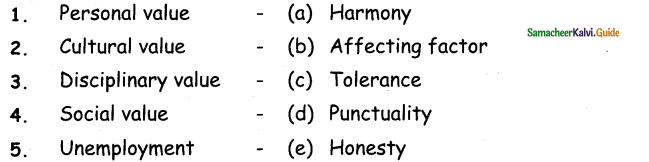
II. Match the following

Question 1.

  1. Distributaries – (i) glacial action
  2. Mushroom rock – (ii) action of sea wave
  3. Eskers – (iii) Lower course of river
  4. Stalactites – (iv) Aeolian process
  5. Cliff – (v) karst topography

Answer:

  1. – iii
  2. – iv
  3. – i
  4. – v
  5. – ii

III. Consider the given statements and choose the right option given below:

Question 1.
(i) ‘I’ Shaped valley is an erosional feature of the river
(ii) ‘U’ Shaped valley is an erosional feature of the glacier
(iii) ‘V’ Shaped valley is an erosional feature of the glacier
(a) (i), (ii) & (iii) are right
(b) (i) & (ii) are right
(c) (i) & (iii) are right
(d) only (i) is right
Answer:
(ii) is correct

Samacheer Kalvi 9th Social Science Guide Geography Chapter 2 Lithosphere – II Exogenetic Processes

Question 2.
Statement I: Running water is an important agent of gradation
Statement II: The work of the river depends on the slope of land on which it flows
(a) Statement I is false II is true
(b) Statement I and II are false
(c) Statement I is true II is false
(d) Statement I and II are true
Answer:
(d) Statement I and II are true

Question 3.
Statement: Limestone regions have less underground water.
Reason: Water does not percolate through limestone.
(a) The statement is right, reason is wrong.
(b) The statement is wrong, Reason is right.
(c) The statement and reason are wrong.
(d) The statement and reason are right.
Answer:
(c) The statement and reason are wrong.

IV. Answer in brief:

Question 1.
Define weathering.
Answer:
Weathering is the disintegration and decomposition of materials of the earth’s crust by their exposure to the atmosphere.

Question 2.
What do you mean by biological weathering?
Answer:
Biological weathering occurs due to the penetration and expansion of plant & roots, earthworms, burrowing animals (rabbits, rats), and some human activities.

Samacheer Kalvi 9th Social Science Guide Geography Chapter 2 Lithosphere – II Exogenetic Processes

Question 3.
Mention the three courses of a river with any two landforms associated with each course.
Answer:
The course of a river is divided into

  1. The Upper course – V-shaped valleys, gorges
  2. The middle course – Alluvial fans, flood plains
  3. The lower course – Delta and Estuary.

Question 4.
What are the ox-bow lakes?
Answer:

  1. Meanders in due course of time become almost a complete circle with narrow necks.
  2. This in turn gets abandoned and forms a lake.
  3. This is called an oxbow lake.

Question 5.
How does a sea cave differ from a sea arch?
Answer:
(a) Sea Arch:

  1. When two caves approach one another from either side of a headland and unite them from an arch.
  2. Eg: Neil Island, Andaman, and Nicobar

(b) Cave:

  1. Caves are hollows that are formed by the dissolution of limestone rocks when carbon dioxide in the air turns into carbonic acid after its reaction with water.
  2. They vary in size and shape.
  3. Eg: Guptadham caves in Western Bihar.

Question 6.
List out any four Karst topographical areas found in India.
Answer:

  1. Guptadham caves – Western Bihar
  2. Pandav caves Pachmuri – Madhya Pradesh
  3. Kutumsar – Bastar district in Chattisgarh
  4. Borra caves of Visakhapatnam – Andhra Pradesh

Samacheer Kalvi 9th Social Science Guide Geography Chapter 2 Lithosphere – II Exogenetic Processes

Question 7.
What do you mean by a hanging valley?
Answer:

  1. Hanging valleys are typically formed when the main valley has been widened and deepened by glacial erosion, leaving the side valley cut off abruptly from the main valley below.
  2. The steep drop from the hanging valley to the main valley floor usually creates cascading waterfalls – Eg. Yosemite falls, California, USA.

Question 8.
Define
(a) Moraine
(b) Drumlin
(c) Esker.
Answer:
(a) Moraine:

  • Landforms formed by the glacial deposits of valley (or) continental glaciers are termed as moraines.
  • They are of various shapes and sizes, like the ground, terminal, and lateral moraines, etc.

(b) Drumlin: Drumlins are deposits of glacial moraines that resemble giant inverted teaspoons (or) half cut eggs.
(c) Esker: Long narrow ridges composed of boulders gravel and sand deposited by streams of melting water which run parallel to a glacier are called eskers.

Samacheer Kalvi 9th Social Science Guide Geography Chapter 2 Lithosphere – II Exogenetic Processes

Question 9.
Mention the various features formed by wind erosion.
Answer:
Some of the erosional landforms of wind are
(a) Mushroom rocks
(b) Inselbergs and
(c) Yardangs.

(a) Mushroom rocks:

  1. When a rock’s bottom is soft, the sand-laden winds blow against it and wear it down.
  2. By the constant wearing down action of the wind, the bottom gets eroded away to form a mushroom like structure.

(b) Inselbergs:

  1. Certain hard rocks like igneous rocks are more resistant to wind action.
  2. Such isolated residual hills rising abrupt by from their surroundings are turned as inselbergs.

(c) Yardangs:

  1. In arid regions, certain rocks have hard and soft layers arranged vertically.
  2. When winds blow over these rocks, the soft layers get eroded leaving irregular crests. These are called yardangs.

Question 10.
What is a wave-cut platform?
Answer:
Flat surface found at the foot of the sea cliffs are called as wave-cut platforms, the wave-cut platform is also referred to as beach, shelf, terrace, and plain.

V. Give Reasons.

Question 1.
Chemical weathering is predominant in hot and humid zones.
Answer:
Chemical weathering predominant in hot and humid zones because

  1. Heat speeds up chemical weathering.
  2. Minerals can react with oxygen in the atmosphere or water from rain – even occasional rain in arid zones – to change their chemical composition.
  3. Metallic silicate minerals such as iron-containing olivine, oxidize to form hematite, a red coloured iron oxide that coats rocks.
  4. It is present in desert sands as laterite soil.
  5. With continuing heat and moisture, hematite hydrates to form yellow coloured iron oxide, limonite.

Samacheer Kalvi 9th Social Science Guide Geography Chapter 2 Lithosphere – II Exogenetic Processes

Question 2.
Silt deposits are less at estuaries than deltas.
Answer:
Silt deposits are less at estuaries than deltas because the waves keep on eroding the deposits.
e.g., River Narmada & Tapti.

Question 3.
The snow line is at the sea level in polar regions.
Answer:

  1. The snow line is an irregular line located along the ground surface where the accumulation of snowfall equals ablation (melting and evaporation).
  2. This line varies greatly in altitude and depends on several influences.
  3. Where temperatures are low, as near the poles, the snowline is quite low in elevation.
  4. Where temperatures are high, as near the Equator the snowline is very high.
  5. Therefore snowline is at the sea level in polar regions.

Question 4.
Wind can possibly erode the rocks from all sides.
Answer:
Wind can possibly erode the rocks from all sides, because

  1. when a rock’s bottom is soft, the constant wearing down action of the wind, the bottom gets eroded away to form a mushroom-like structure.
  2. Certain hard rocks like igneous rocks are more resistant to wind action. Isolated residual hills are formed from their surroundings.
  3. When winds blow over the hard and soft layers of rocks the soft layers get eroded leaving irregular crests.

Question 5.
In limestone regions, surface drainage is rarely found.
Answer:

  • The rainwater mixes with CO2 and enters into the limestone region it dissolves and destroys much of the lime stone.
  • Subterranean drainage may limit surface water with few to no rivers.
  • The ability of water to penetrate the rock lowers. Joints and bedding planes make the rock permeable. So surface drainage is rarely found.

VI. Distinguish between:

Question 1.
Physical and chemical weathering.
Answer:
Physical weathering

  1. It is the breakdown of rocks without changing their chemical composition, through the action of physical forces.
  2. The constant freezing and thawing of rocks during the night and day leads to the expansion and contraction of rocks.
  3. Exfoliation, block disintegration, granular disintegration etc., are the different types of weathering.

Chemical weathering

  1. Disintegration and decomposition of rocks due to chemical reactions is called chemical weathering.
  2. This is predominantly high in the hot and humid regions such as the equatorial, tropical and sub tropical zones.
  3. Chemical weathering takes place through the processes of oxidation, carbonation, solution and hydration.

Samacheer Kalvi 9th Social Science Guide Geography Chapter 2 Lithosphere – II Exogenetic Processes

Question 2.
Delta and Estuary
Answer:
Delta

  1. A triangular shpaed low lying area formed by the river at its mouth is called delta.
  2. Deltas have fine deposits of sediments enriched with minerals.
  3. Eg: Cauvery delta in Tamil Nadu.

Estuary

  1. Estuary is formed, where the rivers meet the sea.
  2. Deposition of silt by the river is not possible here since the waves keep on eroding the deposits.
  3. Eg: River Narmada and Tapti.

Question 3.
Stalactite and stalagmite.
Answer:
Stalactites:

  1. When the water containing dissolved calcite gradually drips from the ceiling of the caves, water evaporates and the remaining calcite hangs from the ceiling. Thus stalactites are formed.
  2. Remember stalactites with ‘C’ meaning coming from ceiling.
  3. Limestone stalactites form extremely slowly, usually less than 10 cm every 1000 years.

Stalagmites:

  1. When the calcite deposits rise upward like a pillar stalagmites are formed.
  2. Remember stalagmites with ‘G’ coming from the ground.
  3. The stalagmite formation occurs only under certain conditions within the underground cavern.

Question 4.
Longitudinal and Transverse sand dunes.
Answer:
Longitudinal sand dune:

  1. Longitudinal dunes are long narrow ridges of sand.
  2. They extend in a direction parallel to the prevailing winds.
  3. These dunes are called seifs in Sahara.

Transverse sand dune:

  1. Transverse dunes are asymmetrical in shape.
  2. They are formed by alternate slow and fast winds.
  3. These winds blow from the same direction.

Samacheer Kalvi 9th Social Science Guide Geography Chapter 2 Lithosphere – II Exogenetic Processes

Question 5.
Inselbergs and yardangs
Answer:
Inselbergs:

  1. Inselberg means an Island mountain.
  2. It is an isolated residual hills rising abruptly from their surroundings.
  3. Eg. Uluru or Ayers rock, Australia

Yardangs:

  1. Yardangs are formed in arid regions.
  2. Here, certain rocks have hard and soft layers arranged vertically.
  3. When winds blow over these rocks, the soft layers get eroded leaving irregular crests called Yardangs.

Question 6.
Spit and bar.
Answer:
Spit:

  1. A spit is a ridge or embankment of sediment, attached to the land on one end and terminating in open water on the other end.
  2. Spits are common at the mouth of estuaries. Eg. Kakinada spit

Bar:

  1. A bar is an elongated deposit of sand, shingle or mud found in the sea, almost parallel to the shoreline.
  2. Where a spit grows across a bay, a bar is formed.

VII. Answer in a Paragraph:

Question 1.
Write a note on weathering classify and explain.
Answer:

  1. Weathering is the disintegration and decomposition of materials of the earth’s crust by their exposure to the atmosphere.
  2. The movement of huge volumes of weathered rock material down the slope due to gravity is called mass movement or mass wastage.
  3. The nature and magnitude of weathering differs from place to place and region to region
  4. There are three types of weathering called physical weathering, Chemical weathering and Biological weathering

(a) Physical weathering:

  1. It is the breakdown of rocks without changing their chemical composition, through the action of physical forces.
  2. The constant freezing and thawing of rocks during the night and day leads to expansions and contractions of rocks.
  3. Exfoliation, block disintegration, granular disintegration, etc., are the different types of weathering.
  4. The alternate heating and cooling on rounded rock surfaces leads to the peeling of rocks, layer by layer. This is called exfoliation.
  5. Granular disintegration takes place in crystalline rocks where the grains of the rocks became loose and fall out.
  6. Block disintegration is caused due to repeated expansion and contraction of rocks day and night.

(b) Chemical weathering:

  1. Disintegration and decomposition of rocks due to chemical reactions is called chemical weathering.
  2. Chemical weathering takes place through the processes of oxidation carbonation, solution and Hydration.
  3. Oxygen in the atmosphere reacts with the iron found in rocks, forming iron oxide. This process is known as oxidation.
  4. Carbonation in the mixing of water with the atmospheric carbon di – oxide forming carbonic acid.
  5. Solution is the process of dissolution of rock substances in water. This results in the loosening of the rock particles.
  6. Certain chemicals in the rock enlarge in size in humid conditions, resulting in the development of cracks and the rock wears down. This is known as hydration.
  7. Biological weathering: Biological weathering occurs due to the penetration and expansion of plant roots, earthworms, burrowing animals (rabbits, rats) and some human activities.

Samacheer Kalvi 9th Social Science Guide Geography Chapter 2 Lithosphere – II Exogenetic Processes

Question 2.
Explain the erosional landforms formed by underground water.
Answer:
Most erosion takes place due to the process of solution. When rainwater mixes with carbon-di-oxide and enters a limestone region, it dissolves and destroys much of the limestone. As a result, landforms such as Terra Rossa, Lappies, sinkholes, swallow holes, dolines, uvalas, poljes, caves and caverns are formed.

Terra Rossa (Italian term for Red soil): The deposition of red clay soil on the surface of the Earth is due to the dissolution of limestone content in rocks. The redness of the soil is due to the presence of iron oxide.

Lappies: When the joints of limestone rocks are corrugated by groundwater, long furrows are formed and these are called LAPPIES.

Sinkhole: Funnel-shaped depressions formed due to the dissolution of limestone rock is called sinkholes. Their average depth ranges between three and nine meters.

Caves and Caverns: Caves and caverns are subterranean features of karst topography. Caves are hollows that are formed by the dissolution of limestone rocks when carbon dioxide in air turns into carbonic acid after its reaction with water. They vary in size and shape. Caverns are the caves with irregular floors, e.g., Guptadham caves in Western Bihar.
All types of deposits in the caves and caverns are collectively called speleothems which include travertines, tufa, dripstones.
Swallow Holes, Uvalas, Dolines, Poljis are other erosional Features of karst regions that predominate in other parts of the world.

Question 3.
What is a glacier? Explain its types,
Answer:
(a) Glacier:

  1. A glacier is a large mass of ice that moves slowly over the land, from its place of accumulation. It is also known as ‘River of ice’.
  2. The place of accumulation is called snowfield.
  3. The height above which there is a permanent snow cover in the higher altitude or latitude is called snowline.
  4. The gradual transformation of snow into granular ice is called ‘fim’ or ‘neve’ and finally it becomes solid glacial ice.
  5. The large mass of ice creates pressure at its bottom and generates heat. Due to this, the glacier melts a little and starts to move.

(b) Types of glaciers: Glaciers are broadly divided into two types based on the place of occurrence, such as Continental glacier and Valley glacier.

Samacheer Kalvi 9th Social Science Guide Geography Chapter 2 Lithosphere – II Exogenetic Processes

Question 4.
Describe the depositional work of winds.
Answer:
Deposition occurs when the speed of the wind is reduced by the presence of obstacles like bushes, forests, and rock structures. The sediments carried by wind get deposited on both the windward and leeward sides of these obstacles.
Some of the depositional landforms are sand dunes, barchans, and loess.

Sand Dune: In deserts, during sandstorms, the wind carries loads of sand. When the speed of wind decreases, the huge amount of sand gets deposited. These mounds or hills of sand are called sand dunes. There are different types of sand dunes.

Barchan: Barchans are isolated, crescent-shaped sand dunes. They have gentle slopes on the windward side and steep slopes on the leeward side.
Transverse Dunes: Transverse dunes are asymmetrical in shape. They are formed by alternate slow and fast winds that blow from the same direction.

Longitudinal Dunes: Longitudinal dunes are long narrow ridges of sand, which extend in a direction parallel to the prevailing winds. These dunes are called Seifs in Sahara.

Loess: The term loess refers to the deposits of fine silt and porous sand over a vast region. Extensive loess deposits are found in Northern and Western China, the Pampas of Argentina, in Ukraine, and in the Mississippi Valley of the United States.

Samacheer Kalvi 9th Social Science Guide Geography Chapter 2 Lithosphere – II Exogenetic Processes

VIII. Map Skill

Question 1.
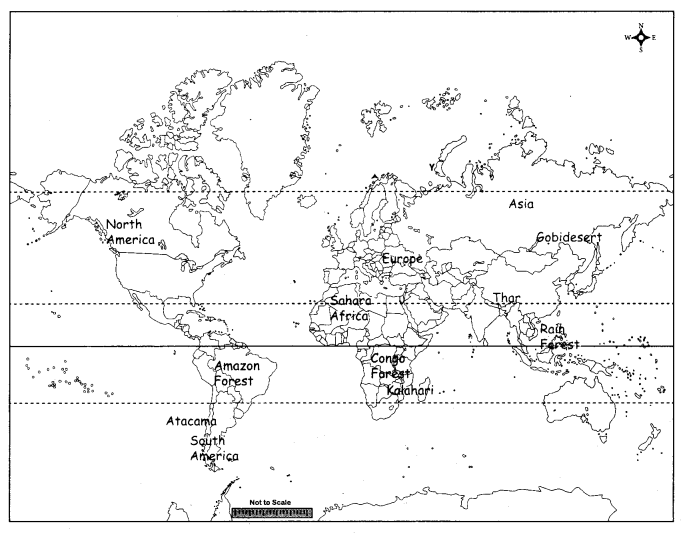
On the given outline map of the world, mark the following.

  1. Any two deltas
  2. A Karst region
  3. Any two hot and cold deserts

Samacheer Kalvi 9th Social Science Guide Geography Chapter 2 Lithosphere – II Exogenetic Processes

IX. HOTS Questions.

Question 1.
Is wind the only gradational agent in the desert?
Answer:

  1. Deserts are areas with little or no rainfall.
  2. Therefore we find only limited or non-existent plant (animal) life.
  3. Due to the lack of moisture, chemical weathering is almost absent.
  4. Mechanical weathering is the dominant activity.
  5. Wind obviously becomes the only major agent of erosion, transportation, and deposition.
  6. Wind can blow without any obstructions of trees etc.
  7. Wind is also supplied with a fine dust which helps carve the landforms.
  8. Flowing water is an occasional agent of erosion whenever there are heavy showers followed by flash floods.
  9. Such showers are very rare.

Samacheer Kalvi 9th Social Science Guide Geography Chapter 2 Lithosphere – II Exogenetic Processes

Question 2.
Underground water is more common in limestone areas than surface runoff. Why?
Answer:

  1. The underground flow of water is more common than surface water in the limestone areas.
  2. It is because the chief constituent of limestone is calcium carbonate which is soluble in pure water.
  3. It is easily soluble in carbonated water.
  4. Surface runoffs and infiltration into the ground start the solution process along with the fractures and joints.

Question 3.
The river channels in the lower course are wider than the upper course.
Answer:

  1. In the lower course of the river the gradient is gentler than in the upper course.
  2. The river has more energy and the volume amount of water is high.
  3. In the lower course, there is more lateral (sideways) erosion.
  4. The channel is wide and deep.
  5. The river has less friction to overcome which means that the river can flow faster.
  6. As the river erodes sideways, it swings from side to side forming large bends called meanders.
  7. Erosion is the most dominant action of the river in the upper course.
  8. In the lower course, the river moving downstream across a broad, level plain is loaded with debris brought down from its upper and middle courses.
  9. Therefore the river channels are wider in the lower course compared to the upper course.

X. Give geographical terms for the following

(a) Chemical alteration of carbonate rocks on limestone region.
Answer:
Karst topography

(b) Flat surfaces near cliffs.
Answer:
Wave cut platforms

(c) Erosion + Transportation + Deposition
Answer:
Gradation

(d) The bottom line of a snowfield.
Answer:
Snowline

Intext Activity

Question 1.
Take a trough filled with sand, empty a portion of sand in the middle and fill it with sugar. Now level the sand over the sugar. Pour water into the trough and observe what happens. The sugar dissolves and forms a depression. This is similar to the formation of a sinkhole.
Answer:
Activity to be done by the students themselves.

Question 2.
Fake Snow
Materials needed

  • A cup of Baking Soda
  • Shaving Cream

Method

  • Pour one cup of baking soda
  • Spray the shaving cream

The snow will start forming almost immediately.
Answer:
Activity to be done by the students themselves

Question 3.
Discuss in small groups the effects of global warming
Answer:
Activity to be done by the students themselves

Intext Hots

Question 1.
Is weathering a pre-requisite in the formation of soil?
Answer:
(a) Weathering is a key part of the process of soil formation, and the soil is critical to our existence on Earth.

(b) Soil is a complex mixture of minerals (approximately 45%), organic matter (approximately 5%), and empty space (approximately 50%, filled to varying degrees with air and water).

The mineral content of soils is variable but is dominated by clay minerals and quartz, along with minor amounts of feldspar and small fragments of rock. The types of weathering that take place within a region have a major influence on soil composition and texture. For example, in a warm climate, where chemical weathering dominates, soils tend to be richer in clay

(c) Soils develop because of the weathering of materials on Earth’s surface, including the mechanical breakup of rocks, and the chemical weathering of minerals. Chemical weathering reactions (especially the formation of clay minerals) and biochemical reactions proceed

Samacheer Kalvi 9th Social Science Guide Geography Chapter 2 Lithosphere – II Exogenetic Processes

Question 2.
The snowline of Alps is 2700 metre whereas the snowline of Greenland is just 600 metre. Find out the reason.
Answer:

  1. Snowline is the altitude which delimits the low levels of permanent snow.
  2. Snowline changes due to a lot of factors including their distance from the equator or tropics.
  3. Alps mountain range is closer to tropics and shows snowline of 2700 metres.
  4. Greenland is near the North Pole and it’s the biggest reason for a snowline of 600 metres.

Samacheer Kalvi 9th Social Science Outbreak of World War II and Its Aftermath Additional Important Questions and Answers

I. Choose the correct answer

Question 1.
The breakdown of rocks without changing their chemical composition is called
(a) physical weathering
(b) chemical weathering
(c) Aggradation
(d) Degradation
Answer:
(a) physical weathering

Question 2.
Mixing of water with the atmospheric carbon-di-oxide is known as
(a) Oxidation
(b) Carbonation
(c) Exfoliation
(d) Solution
Answer:
(b) Carbonation

Question 3.
Hydration comes under
(a) Physical weathering
(b) Biological weathering
(c) Chemical weathering
(d) mass movement
Answer:
(c) Chemical weathering

Samacheer Kalvi 9th Social Science Guide Geography Chapter 2 Lithosphere – II Exogenetic Processes

Question 4.
The shallow fast flowing water in a stream is called a
(a) Waterfall
(b) Plunge pool
(c) Rapid
(d) Gorge
Answer:
(c) Rapid

Question 5.
Where the rivers meet the sea is formed.
(a) Delta
(b) Flood plains
(c) Estuary
(d) Alluvial fan
Answer:
(c) Estuary

Question 6.
Karst Topography is found mainly in regions characterised by
(a) Alluvial fans
(b) Glacial outwash plains
(c) Limestone bedrock
(d) Loess
Answer:
(c) Limestone bedrock

Samacheer Kalvi 9th Social Science Guide Geography Chapter 2 Lithosphere – II Exogenetic Processes

Question 7.
The Grand Canyon was formed by
(a) River erosion
(b) Rain erosion
(c) Wind erosion
(d) Karst topography
Answer:
(a) River erosion

Question 8.
Sinkholes and caves are created when limestone formations are dissolved by
(a) Weak carbonic acid contained in the ground
(b) Strong hydrochloric acid from my runoff
(c) Strong hypochlorite from acid rain
(d) Weak Sulphuric acid from animal remains
Answer:
(a) Weak carbonic acid contained in ground

Question 9.
Which structure is most similar to an alluvial fan in formation and composition
(a) River
(b) Watershed
(c) Delta
(d) Lake
Answer:
(c) Delta

Question 10.
What type of erosion produces rounded valleys?
(a) River
(b) Wind
(c) Wave
(d) Glacial
Answer:
(d) Glacial

Question 11.
Speleothems means
(a) Travertines
(b) Tufa
(c) Dripstones
(d) All the three
Answer:
(d) All the three

Samacheer Kalvi 9th Social Science Guide Geography Chapter 2 Lithosphere – II Exogenetic Processes

Question 12.
Stalactites and stalagmites meet together to form
(a) Columns
(b) Cirque
(c) Matterhorn
(d) Arete
Answer:
(a) Columns

II. Match the Following

Question 1.

  1. Physical weathering – (a) Oxidation
  2. Chemical weathering – (b) Rock slide
  3. Biological weathering – (c) Solar energy
  4. Mass movement – (d) Exfoliation
  5. External process – (e) Human activities

Answer:

  1. – (d)
  2. – (a)
  3. – (e)
  4. – (b)
  5. – (c)

Question 2.

  1. Upper course – (a) Mouth
  2. Origin of a river – (b) Flood plains
  3. River joining the sea – (c) Delta
  4. Middle course – (d) Spurs
  5. Lower course – (e) Source

Answer:

  1. – (d)
  2. – (e)
  3. – (a)
  4. – (b)
  5. – (c)

Question 3.

  1. Alluvial fan – (a) Subsurface water
  2. Flood plains – (b) Foothills
  3. Delta – (c) Non-porous
  4. Ground water – (d) Triangular shaped
  5. Impermeable rocks – (e) River banks

Answer:

  1. – (b)
  2. – (e)
  3. – (d)
  4. – (a)
  5. – (c)

Question 4.

  1. Cirque Arete – (a) Large
  2. Arete – (b) Party
  3. Matterhorn – (c) Bowl-shaped arm chair
  4. Glacier – (d) Pyramidal peaks
  5. Fjords – (e) Narrow knife like ridges

Answer:

  1. – (c)
  2. – (e)
  3. – (d)
  4. – (a)
  5. – (b)

Samacheer Kalvi 9th Social Science Guide Geography Chapter 2 Lithosphere – II Exogenetic Processes

Question 5.

  1. Beach – Old man of Hoy, Scotland
  2. Sea stack – Flat surface
  3. Sea Arch – A ridge Juhu
  4. Wave cut platform – Mumbai
  5. Spit – Neil Island

Answer:

  1. – (d)
  2. – (a)
  3. – (e)
  4. – (b)
  5. – (c)

III. Answer in Brief

Question 1.
Explain the Exogenetic process with a diagram.
Answer:
All deformation on the face of the Earth is due to the continuous influence of various forces on the earth’s surface.

Question 2.
How is the structure of the earth’s surface controlled?
Answer:

  1. The earth is a dynamic system that undergoes various changes due to internal and external processes.
  2. The continuous interactions of these two processes control the structure of the earth’s surface.

Question 3.
Mention the cause for external and internal processes.
Answer:

  1. The external processes are the consequence of solar energy and gravitational forces.
  2. The internal processes are an outcome of the earth’s internal heat.

Question 4.
What is the mass movement?
Answer:
The movement of huge volumes of weathered rock materials down the slope due to gravity is called mass movement or mass wastage.
Example:

  • Rockslide
  • landslide
  • debris fall
  • mudflow.

Samacheer Kalvi 9th Social Science Guide Geography Chapter 2 Lithosphere – II Exogenetic Processes

Question 5.
What is Exfoliation?
Answer:
The alternate heating and cooling on rounded rock surfaces lead to the peeling of rocks, layer by layer like an onion.
This is called exfoliation. Sheeting and shattering are the other forms of exfoliation.

Question 6.
Define soil.
Answer:

  1. The disintegrated rock materials, in due course of time, are weathered further to form soil
  2. Soil is a mixture of disintegrated rocky material and decayed organic matter called humus.

Question 7.
Mention the agents of chemical weathering.
Answer:
The agents of chemical weathering are oxygen, carbon-di-oxide, and hydrogen.

Question 8.
What is gradation?
Answer:

  1. Gradation is the process of levelling of the land by means of natural agents like rivers, groundwater, winds, glaciers, and sea waves.
  2. These agents produce various gradational relief features in due course of time.
  3. Graduation takes place in two ways (a) degradation and aggradation.

Question 9.
What is the primary function of a river?
Answer:
The primary functions of a river are

  1. erosion
  2. transportation
  3. deposition.

Samacheer Kalvi 9th Social Science Guide Geography Chapter 2 Lithosphere – II Exogenetic Processes

Question 10.
How are springs caused?

  1. The permeable rocks allow water to percolate.
  2. This percolated water in course of time returns to the surface in the form of springs, geysers, hot springs, etc.

Question 11.
Explain the term, Terra Rossa.
Answer:

  1. Terra Rossa is the Italian term for Red soil.
  2. The deposition of red clay soil on the surface of the Earth is due to the dissolution of limestone content in rocks.
  3. The redness of the soil is due to the presence of iron oxide.

Question 12.
How are stalactites formed?
Answer:

  1. When the water containing dissolved calcite gradually drips from the ceiling of the caves, water evaporates and the remaining calcite hangs from the ceiling.
  2. Thus Stalactites are formed.

Question 13.
What is a continental glacier?
Answer:
Thick sheets of ice that covers vast areas of a continent are called a continental glacier.

Question 14.
What is a valley glacier?
Answer:
The glacier which takes its origin from a snow-covered mountain range is known as a valley glacier.

Question 15.
What is a matter horn?
Answer:
The pyramidal peaks formed when three or more cirques meet together are referred to as Matterhoms.

Question 16.
How are mushrooms formed?
Answer:

  1. Rocks are made up of hard and soft layers.
  2. When a rock’s bottom is soft, the sand-laden winds blow against it and wear it down.
  3. By the constant wearing down action of the wind, the bottom gets eroded away to form a mushroom-like structure.
  4. This is called a mushroom or pedestal rock.
  5. Such rocks are found near Jodhpur in Rajasthan.

Question 17.
Define waves.
Answer:

  1. A steady up (crest) and down (trough) movement of surface water are called waves.
  2. Sea waves are the most powerful agents of gradation.
  3. Their erosional, transportation and depositional processes are confined to a very narrow belt along the coastal areas.

Samacheer Kalvi 9th Social Science Guide Geography Chapter 2 Lithosphere – II Exogenetic Processes

Question 18.
What is snowline?
Answer:
The height above which there is a permanent snow cover in the higher altitude or latitude is

IV. Answer in as Paragraph.

Question 1.
Write about the erosional and depositional landforms of waves.
Answer:
(a) Erosional landforms of waves.

  1. Sea Cave: Prolonged wave attack on the base of a cliff erodes rock materials, which results in the formation of caves.
  2. Sea Arch: When two caves approach one another from either side of a headland and unite, they form an arch.
  3. Sea Stack: Further erosion by waves ultimately leads to the total collapse of arch. The seaword portion of the headland will remain as a pillar of rock known as stack.
  4. Sea Cliffs: Sea cliffs are strep rock faces formed when sea waves dash against them. The rocks get eroded to form steep vertical walls.
  5. Wave cut platforms: Flat surface found at the foot of sea cliffs are called wave cut platforms.

(b) Depositional landforms of waves.

  1. Beach: Sand and gravel are moved and deposited by waves along the shore to form j beaches. This is the most dominant and constructive work of the sea. Eg. Marina beach, Chennai.
  2. Bar: A bar is an elongated deposit of sand, shingler or mud found in the sea, almost j parallel to the shoreline.
  3. Spit: A spit is a ridge or embankment of sediment, attached to the land on one end j and terminating in open water on the other end.

V. Distinguish between

Question 1.
Distinguish between Granular disintegration and Block disintegration
Answer:
Granular Disintegration:

  1. Granular disintegration takes place in crystalline rocks.
  2. Here the grains of the rocks become loose and fall out.

Block Disintegration:

  1. Repeated expansion and contradiction of rocks during day and night respectively causes stress on the joints of the rocks.
  2. This results in Block disintegration.

Samacheer Kalvi 9th Social Science Guide Geography Chapter 2 Lithosphere – II Exogenetic Processes

Question 2.
Distin guish between Oxidation and Carbonation
Answer:
Oxidation:

  1. Oxygen in the atmosphere reacts with the iron found in rocks.
  2. It leads to the formation of iron-oxide.
  3. This process is known as oxidation.
  4. It results in the weakening of rocks.

Carbonation:

  1. Carbonation is the mixing of water with the atmospheric carbon-di-oxide.
  2. As a result carbonic acid is formed.
  3. Carbonation is important in the formation of caves, in limestone region.
  4. When the carbonic acid reacts with the carbonate rocks, the rocks get disintegrated.

Question 3.
Distinguish between Solution and Hydration
Answer:

Solution:

  1. Solution is the process of a dissolution of rock substances in water.
  2. This process loosens the rock particles.
  3. This in turn breaks down the rocks.

Hydration:

  1. Certain chemicals in the rock enlarge in size in humid conditions.
  2. These minerals found in the rock swell resulting in the development of cracks.
  3. This type of weathering is called hydration.

Question 4.
Distinguish between Degradation and Aggredation
Answer:
Degradation:

  1. Gradation is the process of levelling of the land by means of natural agents.
  2. Degradation or denudation is the wearing down of the land surface by various natural agents.

Aggredation

  1. Natural agents like rivers, ground water, winds, glaciers and sea waves cause gradation.
  2. Aggradation is building up of landforms due to national agents.

Question 5.
Distinguish between Tributary and Distributary
Answer:
Tributary

  1. Small streams that join the main river is called tributary.
  2. Eg: River Bhavani

Distributary

  1. River channels that get separated from the main river is called a distributary.
  2. Eg: River Kollidam

Samacheer Kalvi 9th Social Science Guide Geography Chapter 2 Lithosphere – II Exogenetic Processes

Question 6.
Distinguish between Gorges and Canyons
Answer:
Gorges:

  1. When the river flows through a mountainous region made up of hard rocks, it forms a valley with almost vertical sides called gorge.
  2. In India, deep gorges have been formed by Brahmaputra and Indus with the Himalayas,

Canyons:

  1. A deep gorge with steep sides that runs for hundreds of kilometres is referred to as a canyon.
  2. Grand canyon of the river Colorado in the USA is an example.

Question 7.
Distinguish between Lappies and Sinkholes
Answer:
Lappies:

  1. The joints of limestone rocks are corrugated by groundwater.
  2. This results in the formation of long furrows called Lappies.

Sinkholes:

  1. Funnel-shaped depression formed due to the dissolution of limestone rock is called sinkholes.
  2. Their average depth ranges between three and nine meters.

Question 8.
Distinguish between V-shaped valley and U-shaped valley
Answer:
V-shaped valley:

  1. It is an erosional landform of a river.
  2. A V-shaped valley is formed by the vertical erosion of the river.
  3. The valley is deepened and widened.

U-shaped valley:

  1. It is an erosional landform of a glacier.
  2. When the glacier moves down along a river valley the valley, further gets eroded deep and wide.
  3. Thus U-shaped valley is formed.

Question 9.
Distinguish between Moraines and Outwash plain
Answer:
Moraines

  1. Landforms formed by the glacial deposits of the valley or continental glaciers are termed as moraines.
  2. They are of various shapes and sizes, like the ground, terminal, and lateral moraines etc.

Outwash plain

  1. An outwash plain consists of glacial sediments deposited by the melting ice at the terminus of a glacier.
  2. It appears as an extensive accumulation of sand, gravel, and silt.

Question 10.
Distinguish between Barchans and Loess
Answer:
Barchans:

  1. Barchans are isolated crescent-shaped sand dunes.
  2. They have gentle slopes on the windward side and steep slopes on the leeward side.

Loess:

  1. The term loess refers to the deposits of fine silt and porous sand over a vast region.
  2. Extensive loess deposits are found in Northern and Western China, the Pampas of Argentina, in Ukraine, and in the Mississippi valley of the United States.

VI. Give reasons

Question 1.
Physical weathering causes cracks on the surface of the earth.
Answer:

  1. The constant freezing and thawing of the rocks during the night and day leads to the expansion and contraction of rocks under physical weathering.
  2. So cracks are formed and disintegration occurs.

Question 2.
The predominant action of a river in the middle course is transportation. Why?
Answer:

  1. The river enters the plain in its middle course.
  2. The volume of water increases with the confluence of many tributaries.
  3. This increases the load of the river.
  4. Thus, the predominant action of a river is transportation.

Question 3.
Flood plains are fertile,
Answer:

  1. Fine sediments are deposited on river banks when a river floods.
  2. These sediments make the region rich and fertile.
  3. Hence flood plains are fertile,

Question 4.
Most erosion takes place due to the process of the solution with underground water.
Answer:
Most of the erosion takes place due to the process of the solution because

  1. When rain water mixes with carbon-di-oxide and enters into a limestone region, it dissolves and destroys much of the limestone.
  2. As a result landforms such as Terrarossa, Lappies, sinkholes, swallow holes, Uvalas, poljes, caves, and caverns are formed.

VII. Consider the given statements and choose the right option given below:

Question 1.
Statement I: The Earth undergoes various changes due to internal and external processes.
Statement II: The external processes are the consequence of solar energy and gravitational forces.
Answer:
(i) Statement I and II are true.
(ii) Statement I is true, II is false.?
(iii) Statement II is true, I is false.
(iv) Statement I and II are false.
Answer:
(i) Statement I and II are true.

Samacheer Kalvi 9th Social Science Guide Geography Chapter 2 Lithosphere – II Exogenetic Processes

Question 2.
Statement: The Agents of chemical weathering are Oxygen, Carbon dioxide, and Hydrogen.
Reason: Chemical weathering is predominantly high in the hot and humid regions.
Answer:
(i) Statement is true, Reason is wrong
(ii) Statement is wrong, Reason is true
(iii) Statement and Reason are wrong
(iv) Statement and Reason are true
Answer:
(iv) Statement and Reason are true

Question 3.
Statement: Erosion is the most dominant action of the river with the upper course.
Reason: Deep gorges have been formed by Brahmaputra and Indus in the Himalayas.
Answer:
(i) Statement and Reason are true
(ii) Statement and Reason are wrong
(iii) Statement is true, Reason is wrong
(iv) Reason is true, statement is wrong
Answer:
(i) Statement and Reason are true

Question 4.
Statement I: Groundwater is an active agent in limestone regions.
Statement II: Deposition of red clay soil on the surface of the earth is known as Lappies.
Answer:
(i) Statement I & II are true.
(ii) Statement I is true and Statement II is wrong
(iii) Both the statements are wrong.
(iv) Statement I is wrong and Statement II is true
Answer:
(ii) Statement I is true and Statement II is wrong]

VIII. Hots

Question 1.
Glaciers do not form deep narrow valleys. Why?
Answer:

  1. The Glaciers form U-shaped valleys with steep, straight sides and a flat or rounded bottom.
  2. It is in contrast to the valleys carved by rivers to be V-shaped in cross-section.
  3. Glaciated valleys are formed when a glacier travels across and down a slope, carving the valley by the action of scouring.
  4. So glaciers do not form deep narrow valleys.

Question 2.
What are Swallow holes, Uvalas, Dolines, Travertines, Tufa, dripstones?
Answer:
(a) Swallow holes: It is a depression in the ground communicating with a subterranean passage (especially in limestone) and formed by solution or by a collapse of a cavern roof.

(b) Uvalas: It is a local term used by people in some regions in Croatia, Bosnia and Herzegovina, Montenegro, and Serbia. In geoscience, it denotes a closed karst depression, a terrain form usually of elongated or compound structure and of larger size than that of sinkholes.

(c) Dolines: Dolines are funnel-shaped depressions of the ground surface formed by solution in limestone regions.

(d) Travertines: Travertine is a form of limestone deposited by mineral springs, especially hot springs. It is formed by a process of rapid precipitation of calcium carbonate, often at the mouth of a hot spring or in a limestone cave.

(e) Tufa: It is a variety of limestone formed when carbonate minerals precipitate out of ambient temperature water.

(f) Dripstones: Rock deposited by precipitation from dripping water such as that which forms stalactites and stalagmites.

Samacheer Kalvi 9th Social Science Guide Geography Chapter 2 Lithosphere – II Exogenetic Processes

Question 3.
What are the uses of limestone?
Answer:

  1. Limestone is a sedimentary rock.
  2. It has numerous uses, such as:

(a) a building material
(b) an essential component of concrete
(c) aggregate for the base of roads.
(d) white pigment or filler in products such as toothpaste or paints.
(e) chemical feed stock for the production of lime.
(f) a soil conditioner or a popular decorative addition to rock gardens.

IX. Give geographical terms for the following

  1. The river falls vertically from a steep slope ________
  2. Shallow fast flowing water in a stream ________
  3. River forming sweeping loops and bends ________
  4. Caves with irregular floors ________
  5. Calcite deposits rising upwards like a pillar ________
  6. The gradual transformation of snow into granular ice ________
  7. Glacial valleys that are partly submerged in the sea ________

Answers:

  1. Waterfall
  2. Rapid
  3. Meanders
  4. Caverns
  5. Stalagmite
  6. Firn or Neve
  7. Fjords

Samacheer Kalvi 5th Maths Guide Term 3 Chapter 1 Geometry Ex 1.1

Students can download 5th Maths Term 3 Chapter 1 Geometry Ex 1.1 Questions and Answers, Notes, Samacheer Kalvi 5th Maths Guide Pdf helps you to revise the complete Tamilnadu State Board New Syllabus, helps students complete homework assignments and to score high marks in board exams.

Tamilnadu Samacheer Kalvi 5th Maths Solutions Term 3 Chapter 1 Geometry Ex 1.1

Question 1.
How much wire will be needed to make a rectangle of length 6 cm and breadth 3 cm?
Answer:
Perimeter 6 + 3 + 6 + 3 = 18 cm

Question 2.
If the length of a rectangle is 14 m and its breadth is 10 m, what is its perimeter?
Answer:
Perimeter: 14 + 10 + 14 + 10 = 48m

Samacheer Kalvi 5th Maths Guide Term 3 Chapter 1 Geometry Ex 1.1

Question 3.
Each side of a square is 7 m long. Find its perimeter.
Answer:
Perimeter: 7 + 7 + 7 + 7 = 28m

Question 4.
If we take 2 rounds of a field, that is 340 m long and 160 m wide. Find the distance covered ¡n kilometers?
Answer:
Perimeter: 340 + 160 + 340 + 160 = 1000 m = 1 km
2 rounds = 2 × 1 = 2km

Samacheer Kalvi 5th Maths Guide Term 3 Chapter 1 Geometry Ex 1.1

Question 5.
Sanju completes 10 rounds around a square park every day. If one side of the park ¡s 110 m, then find the distance covered by sanju in a day in terms of kilometers and metres.
Answer:
Perimeter = 4 × 110 m = 440 m
10 rounds = 440 × 10 = 4400 m = \(\frac{4400}{1000}\) = 4.4 km

Samacheer Kalvi 9th English Guide Supplementary Chapter 7 The Christmas Truce

Tamilnadu State Board New Syllabus Samacheer Kalvi 9th English Guide Pdf Supplementary Chapter 7 The Christmas Truce Text Book Back Questions and Answers, Summary, Notes.

Tamilnadu Samacheer Kalvi 9th English Solutions Supplementary Chapter 7 The Christmas Truce

9th English Guide The Christmas Truce Textbook Questions and Answers

A. Choose the correct answer.

Question 1.
The story is set during the ……………………
(a) World War I
(b) World War II
(c) Kargil War
(d) Indo-China War
Answer:
(b) World War II

Samacheer Kalvi 9th English Guide Supplementary Chapter 7 The Christmas Truce

Question 2.
The story is about the celebration of …………………….. festival.
(a) Deepavali
(b) Pongal
(c) Ramzan
(d) Christmas
Answer:
(d) Christmas

Question 3.
Tom called the incidents that happened there as a …………………..
(a) fairy tale
(b) poetry
(c) tragedy
(d) comedy
Answer:
(a) fairy tale

Samacheer Kalvi 9th English Guide Supplementary Chapter 7 The Christmas Truce

Question 4.
The Germans had placed Christmas trees in front of their ……………………
(a) houses
(b) trenches
(c) tanks
(d) cars
Answer:
(b) trenches

Question 5.
One of the German soldiers worked as a ………………….. at Victoria Station.
(a) tea-seller
(b) ticket-checker
(c) porter
(d) shop keeper
Answer:
(c) porter

Samacheer Kalvi 9th English Guide Supplementary Chapter 7 The Christmas Truce

Question 6.
This letter was written on ……………….. day.
(a) New year
(b) Deepavali
(c) Christmas
(d) Pongal
Answer:
(c) Christmas

Question 7.
This incident took place in the year ……………………
(a) 1944
(b) 1814
(c) 1947
(d) 1914
Answer:
(d) 1914

Samacheer Kalvi 9th English Guide Supplementary Chapter 7 The Christmas Truce

Question 8.
The British and the enemy soldiers were on the battlefields of …………………….
(a) Russia
(b) France
(c) America
(d) Germany
Answer:
(b) France

Question 9.
As darkness fell on our Christmas Eve the …………………… stopped entirely.
(a) fighting
(b) talking
(c) singing
(d) shooting
Answer:
(d) shooting

Samacheer Kalvi 9th English Guide Supplementary Chapter 7 The Christmas Truce

Question 10.
The narrator’s friend was ……………………
(a) Tom
(b) Janet
(c) John
(d) Jacob
Answer:
(c) John

Question 11.
One of the Germans worked as a ………………….. at the Hotel Cecil.
(a) porter
(b) doctor
(c) servant
(d) waiter
Answer:
(d) waiter

Samacheer Kalvi 9th English Guide Supplementary Chapter 7 The Christmas Truce

Question 12.
To our astonishment, we saw …………………….. figures rise from a trench.
(a) three
(b) no
(c) two
(d) a few
Answer:
(c) two

Question 13.
The ………………… were better dressed, with fresh uniforms for the holiday.
(a) Germans
(b) Americans
(c) English
(d) Indians
Answer:
(a) Germans

Samacheer Kalvi 9th English Guide Supplementary Chapter 7 The Christmas Truce

Question 14.
The narrator himself traded for a leather equipment belt.
(a) penknife
(b) jackknife
(c) dagger
(d) butter knife
Answer:
(b) jackknife

Question 15.
There was even some talk of a ………………… match.
(a) cricket
(b) basketball
(c) volleyball
(d) football
Answer:
(d) football

Samacheer Kalvi 9th English Guide Supplementary Chapter 7 The Christmas Truce

Question 16.
One of the English boys walked with a spiked …………………….
(a) boots
(b) helmet
(c) hat
(d) shoes
Answer:
(b) helmet

B. Identify the character, speaker, or both of the following lines.

  1. Our first complete silence in months!
  2. Come and see! See what the Germans are doing!
  3. Hold your fire.
  4. You no shoot, we no shoot.
  5. My God, why cannot we have peace and all go home?

Answers:

  1. The narrator
  2. The narrator
  3. The English captain
  4. A German officer
  5. An older German

Additional Questions & Answers

Question 1.
Yet I could not sleep before writing to you …………………..
Answer:
Narrator

Samacheer Kalvi 9th English Guide Supplementary Chapter 7 The Christmas Truce

Question 2.
Come and see! Narrator’s friend …………………..
Answer:
John

Question 3.
See what the Germans are doing. Narrator’s friend
Answer:
John

Question 4.
“Christmas trees!” Narrator’s friend
Answer:
John

Samacheer Kalvi 9th English Guide Supplementary Chapter 7 The Christmas Truce

Question 5.
“What is it?”
Answer:
Narrator

Question 6.
You come over here.
Answer:
One of the British soldiers

Question 7.
“Because many have worked in England.”
Answer:
One German

Samacheer Kalvi 9th English Guide Supplementary Chapter 7 The Christmas Truce

Question 8.
I am not lying you.
Answer:
Narrator

Question 9.
But we must ask our hearts.
Answer:
Older German

Question 10.
‘Send officer to talk’.
Answer:
A German

C. Answer the following questions in about 100 – 120 words.

Question 1.
Narrate the Christmas celebration as happened in the war field.
Answer:
On Christmas eve, the soldiers had their first good freeze. Everything was tinged white with frost and a bright sun shone. It was perfect Christmas weather. Clusters of tiny lights were shining all along the German line and they had placed Christmas trees, lit by candles, lanterns, like beacons of goodwill. The Germans began singing, “ Stille Nacht.” The British applauded the Germans. Both the troops crossed the barbed wires and were in No Man’s Land.

They shared their joy, greeted, and wished each other. They exchanged wonderful presents with all that they had, badges, tea, coffee, buttons, knife, etc… The Christmas celebration was wonderful as joy prevailed everywhere and they longed for peace.

(OR)

The British and Germans celebrated Christmas during a temporary cessation of world war I. On Christmas Eve, the Germans invited the British to come out to celebrate Christmas. The Germans placed Christmas trees in front of their trenches, lit by candle or lantern, like beacons of goodwill. They sang, “Silent Night, Holy Night.” It was lovelier and more meaningful.

The British soldiers applauded the Germans. Then the British soldiers sang “The first Nowell, the angel did say” Britain and Germany were harmonizing across ‘No man’s Land.’ They exchanged gifts – tea with coffee, com meat for sausage. The narrator traded a jackknife for a leather equipment belt to keep as a fine souvenir. “Why cannot we have peace and all go home?” was a far cry of every soldier.

“Peace begins with a smile” – Mother Teresa.
“Never wage a war but peace”.

D. Think and Answer.

Question 1.
Do you envision a similar truce taking place in any wars or fighting today? Explain.
Answer:
Yes. I feel the same enmity is between India and Pakistan borders. Both countries were united before the British left India. People who lived as brothers and sisters are now partitioned and called different nationalities. The bond of ‘ brotherhood still exists.

Samacheer Kalvi 9th English Guide Supplementary Chapter 7 The Christmas Truce

Question 2.
Today, much of what we know about the truce comes from soldier’s postcards home. In the post-card given below, write a short message home, imagine that you took part in the 1914 Christmas Truce.
Answer:

Post Card

Christmas Day, 1914.

Dear Mom,

I can’t help writing to you about what happened here. You may wonder that we had a break on the battlefield. It was because of Christmas Eve. To our surprise, the Germans came out of their trenches. They called us to come to the ground between the trench called ‘No man’s Land’. They had the preparation for the Christmas celebration. They placed the Christmas trees in front of the trench lit with candles and lanterns.

The Germans sang ‘Silent Night, Holy Night”. It was very lovely. We applauded their singing. Then we sang “The First Nowell, the angel did say. ”They responded with their applause. We exchanged our gifts in food, buttons, etc. No one wanted war but peace. Even the Germans want to end the war and go home. We hope to see you all soon.

Your loving son,
Sam.

Samacheer Kalvi 9th English Guide Supplementary Chapter 6 Mother’s Voice

Tamilnadu State Board New Syllabus Samacheer Kalvi 9th English Guide Pdf Supplementary Chapter 6 Mother’s Voice Text Book Back Questions and Answers, Summary, Notes.

Tamilnadu Samacheer Kalvi 9th English Solutions Supplementary Chapter 6 Mother’s Voice

9th English Guide Mother’s Voice Textbook Questions and Answers

A. Choose the best answer.

Question 1.
Mother was excited because …………………….
(a) her son would be home in the spring
(b) he son was coming back to earth
(c) it was her first visit to the moon
(d) her son was going to another galaxy
Answer:
(c) it was her first visit to the moon

Samacheer Kalvi 9th English Guide Supplementary Chapter 6 Mother's Voice

Question 2.
On weekdays, as Mother went about the chores ……………………..
(a) she constantly thought of her son
(b) she was always tired
(c) her singing would be soft and almost inaudible
(d) her singing was muted and a little sad
Answer:
(d) her singing was muted and a little sad

Question 3.
…………………… occupies more than a hundred square kilometers on the moon.
(a) Selenopolis
(b) Metropolis
(c) Astrodrome
(d) Orchards
Answer:
(a) Selenopolis

Samacheer Kalvi 9th English Guide Supplementary Chapter 6 Mother's Voice

Question 4.
The Community of Nations Square is where people …………………….
(a) live on the moon
(b) work on the moon
(c) walk on the moon
(d) of different nationalities come after work
Answer:
(d) of different nationalities come after work

Question 5.
They are planning an expedition to a neighbouring ……………………..
(a) galaxy
(b) country
(c) planet
(d) star
Answer:
(a) galaxy

Samacheer Kalvi 9th English Guide Supplementary Chapter 6 Mother's Voice

Question 6.
The mother was not able to understand why people wanted to leave the moon because …………………….
(a) it was better to remain as a part of solar-system
(b) it was better to remain on the earth
(c) it was not possible to come back
(d) it was a place to enjoy life
Answer:
(d) it was a place to enjoy life

Additional Questions and Answers

Question 1.
The astronaut’s mother looked around and admired the ……………………..
(a) landscape
(b) waterscape
(c) moonscape
(d) escape
Answer:
(c) moonscape

Samacheer Kalvi 9th English Guide Supplementary Chapter 6 Mother's Voice

Question 2.
His mother had a young ringing ……………………
(a) noise
(b) voice
(c) choice
(d) toy
Answer:
(b) voice

Question 3.
His mother was a great …………………..
(a) dancer
(b) singer
(c) runner
(d) winner
Answer:
(b) singer

Samacheer Kalvi 9th English Guide Supplementary Chapter 6 Mother's Voice

Question 4.
The astronaut almost told her mother about the ………………….
(a) excursion
(b) execution
(c) expedition
(d) entertainment
Answer:
(c) expedition

Question 5.
A moving pavement was covered with ………………… plastic strips.
(a) pink
(b) red
(c) yellow
(d) green
Answer:
(d) green

Samacheer Kalvi 9th English Guide Supplementary Chapter 6 Mother's Voice

Question 6.
The enormous lily – shaped tent over a crater was atleast a …………………… in diameter.
(a) mile
(b) hectametre
(c) kilometre
(d) few yards
Answer:
(c) kilometre

Question 7.
It is quite an exotic experience to have a swim on the …………………….
(a) Earth
(b) Mars
(c) Galaxy
(d) Moon
Answer:
(d) Moon

Samacheer Kalvi 9th English Guide Supplementary Chapter 6 Mother's Voice

Question 8.
At the ……………………. there were two spaceships the size of the Ostankino TV tower,
(a) aerodrome
(b) syndrome
(c) astrodome
(d) helipad
Answer:
(c) astrodome

Question 9.
The astronauts’ mother pleaded him to come atleast in the ………………………
(a) Autumn
(b) Spring
(c) Summer
(d) Winter
Answer:
(a) autumn

Samacheer Kalvi 9th English Guide Supplementary Chapter 6 Mother's Voice

Question 10.
The mother thought that her son might be lost to his ………………….. forever.
(a) friends
(b) playmates
(c) relatives
(d) neigbours
Answer:
(c) relatives

B. Identify the characters or speaker of the following lines.

  1. It’s so easy to walk here, son!
  2. They’re planning an expedition to a neighboring galaxy.
  3. Why should people go off into the unknown?
  4. I don’t know when we’ll see each other again.
  5. Operator on duty, …………. report to the office.

Answers:

  1. Mother
  2. Son
  3. Mother
  4. Son
  5. A voice from the loud Speaker

C. Answer the following question in about 100 – 120 words.

Question 1.
Write a paragraph listing all the sentimental and the scientific reasons given by the mother against the expedition to the neighbouring galaxy?
Answer:
The mother’s sentimental and scientific reasons against the expedition to the neighboring galaxies are that a moon is a beautiful place, easy to walk on. There are lots of fruits on earth. The river Dnieper is better to swim. She asked her son why people should go off into the unknown and ask for trouble. She also suggested that it is advisable for people to settle on the moon first and then on the planets in the solar system.

She philosophized that the moon has the same gravitational field as their native earth, under the native sun. She sentimentally invited her son to come in the autumn for the apples, pears, and watermelons. She persuaded him to come to their deepened pond to fish and indicated that the pond was now full of fish.

(OR)

The astronauts’ mother admired the moonscape. She wondered that the moon was a beautiful place. But she thought of her orchards to bloom and yield fruits. She was excited to see the enormous lily – shaped tent over a crater. Though it might be an exotic experience to swim on the moon she prefers the river Deeper on the Earth. She was against the expedition to a neighbouring galaxy.

She asked why people should go off into unknown places. She did not want them to invite trouble. The astronauts were interested in more expeditions. Mother wanted the people to settle properly on the moon first, and then on the planets in the solar system before going further.

According to her life on Earth was a miracle. She wanted him to return to the Earth atleast in Autumn. But he had made all arrangements to go to another planet. The astronaut could not help it even though he would not hear his mother’s voice.

‘There’s something cool about being involved in new missions to other planets’.

D. Think and answer.

“The explorer in this story is travelling to another galaxy. The final destination is an unknown planet in another galaxy. The travel will take many years’. What qualities and life skills do you think an explorer-like him must possess? Why? Do you have any of these skills and qualities? Explain.
Answer:
The qualities and life skills an explorer-like him need to possess:
Regardless of one’s position, an astronaut needs certain qualities for the selection process and space travel.

Intelligence:
Astronauts need above-average intelligence.

Adaptability:
Astronauts have many responsibilities in space.

Education:
The basic requirement is a bachelor’s degree in engineering, biological science,

physical science or mathematics followed by three years of professional experience (or 100 hours of pilot – in – command time in jet aircraft) candidate also must pass NASA’s astronaut physical examination.

Physical requirements:

  • Distant visual acuity: 20/100 or better uncorrected, correctable to 20/20 each eye.
  • Blood Pressure: 140/90 measure in a sitting position.
  • Height between 62 and 75 inches. (5″ 2″ and 6″ 3″)

Mental Endurance:
An astronaut has to undergo a psychological evaluation to determine the fitness to fly on a mission of NASA or ISRO.

About myself:
Regarding intelligence, I am an average student at present. I shall maintain it in my higher studies too to prove to be a candidate with a high IQ. I am good at maths and physical requirements science, subjects including computer science my blood pressure is normal.

  • I have a 20/20 normal eye. sight in both eyes.
  • I may have a normal height of 5 feet 5 inches when turn out to be a youth.

Mental Endurance:
I possess mental endurance. I have never been short-tempered. I have the adaptability and the responsibilities to perform the allotted duties.

E. Based on the understanding of the story, discuss in groups, and make a note of the following settings.

Setting:
The story of a young astronaut who wants to hear his mother’s voice which is still young and ringing. The astronaut and his mother are on the moon. She has gone there for the first time. She admires the moonscape. However, she wants to live on the earth. She is also against people who are interested in the exploration of neighbouring planets.

The astronaut is ready to leave for another planet. It may take many years to reach the destination. The mother is worried that her son will lose his friends and relatives. Characters A young astronaut The mother of the astronaut People who are on the moon.

Plot:
The moon is the plot. The astronaut and his mother are on the moon. She is astonished to see strange space ships and people planning to go on an expedition to the neighbouring galaxy. The long . tunnels and enormous lily-shaped tent over a center with a diameter of one kilometer surprise the mother. She admires the moonscape. She also praises the wonderful life on the earth.

Conclusion:
The mother is excited to see the strange things as the moon. She is also surprised to see the people. who are busy to leave for another planet. The mother wonders why the people are planning to other planets ever before setting on the moon.

She pleads with her son to visit the earth during Autumn. But the astronaut is quite sure that he cannot see his mother again. He has got the command to leave for another planet. The mother who longs to see her son will have only a disappointment. It will take a long number of years for the mother and her son to meet again.

Samacheer Kalvi 9th English Guide Supplementary Chapter 5 Little Cyclone: The Story of a Grizzly Cub

Tamilnadu State Board New Syllabus Samacheer Kalvi 9th English Guide Pdf Supplementary Chapter 5 Little Cyclone: The Story of a Grizzly Cub Text Book Back Questions and Answers, Summary, Notes.

Tamilnadu Samacheer Kalvi 9th English Solutions Supplementary Chapter 5 Little Cyclone: The Story of a Grizzly Cub

9th English Guide Little Cyclone: The Story of a Grizzly Cub Textbook Questions and Answers

A. Use the following phrases in sentences of your own.

1. Earn one’s name (to become well known or famous or popular)
Kamal earned his name in politics as powerful public speaker.

2. in the rear of (cat the back of)
There is a church in the rear of this college

3. to see one fight (to make someone fight with)
The youth irritated a little monkey to see him fight

Samacheer Kalvi 9th English Guide Supplementary Chapter 5 Little Cyclone: The Story of a Grizzly Cub

4. devoid of (without)
The letter was devoid of warmth and feeling

5. air and manner (impression and polite behavior)
All were attracted by the air and manners of the new Principal.

6. quick as a flash (extremely fast)
Quick as flash, the prisoner said, “No, I won’t”

7. in wild haste (very quickly)
The thief escaped in wild haste.

Samacheer Kalvi 9th English Guide Supplementary Chapter 5 Little Cyclone: The Story of a Grizzly Cub

8. make a pass (to fly over or close by something)
The bird made a pass at me as I got close its nest.

B. Now refer a dictionary and find idioms on the following animals, birds and insects. Learn their meanings and share what you have learnt with your class. Try to frame illustrative sentences with those. Find opportunities to use them in your everyday conversations.

Samacheer Kalvi 9th English Guide Supplementary Chapter 5 Little Cyclone The Story of a Grizzly Cub
Answer:

C. Based on your reading, answer the following questions in a paragraph of about 100 -150 words each.

Question 1.
Describe the appearance of the little cyclone.
Answer:
Little Cyclone is a grizzly cub from Alaska. He earned his name by the vigour of his resistance to ill-treatment. He was a curious and amusing little cub. It had fluffy hair, two big black eyes which sparkled like jet beads, short and fat nose, and high shoulders. But his claws were strong and dangerous and he had a truly grizzly spirit. He did not show any fear to his opponents. He was bom full of courage and devoid of all sense of fear. He was a queer-looking gray fellow with a broad head. He could fight any other bear on three seconds’ notice.

(OR)

Little Cyclone was a grizzly cub from ALASKA in America. He was different like the other grizzlies. He too was bom with courage and devoid of all sense of fear. Little cyclone was as droll and roguish looking cub as ever stepped.

He had a grizzly gray full moon of fluffy hair. His eyes were big and they sparkled like jet beads behind a pudgy nose. It was absurdly short for a bear. He was little more than a big bale of gray for set up on four posts of the same material. He had the true grizzly spirit.

He was a newcomer at the Bear’s Nursery in the New. York zoological park. Every newcomer would be badly scared during the first day and very timed the next day. But cyclone was different. He had no sense of fear.

When the box was opened he stalked deliberately to the centre stage, halted, and looked calmly about him. He told the other bears that he was from Alaska and anyone could come and take from him. He put everyone down in the attack. From then on his position was assured. He was treated with respect.

“Might is right even in a fight”

Samacheer Kalvi 9th English Guide Supplementary Chapter 5 Little Cyclone: The Story of a Grizzly Cub

Question 2.
What does the fight Little Cyclone and his brother put up, tell you about the nature of grizzly?
Answer:
Title: Little Cyclone: The story of a grizzly cub
Author: William Temple Homaday
Characters: Little Cyclone and his brother
Theme: Unity is strength. Fear kills even heroes

The grizzly cub was famous for its courage and vigour of its resistance to ill-treatment. Once when the mother was fired at the cub and its brother ran away. When they were found sleeping with the mother grasped by the captor, the next morning. Both the cubs fought against the captor. One of the cubs made a fight so fierce and terrible. The captor could not withstand it and let the cub go.

Though the other cub fought desperately the captor seized him and carried him away. He was established with collar, chain, and post in the rear of the saloon. The public irritated the little grizzly cub with a long pole. Before he could become insane, he was rescued by the zoological society’s field agent. He was shipped to New York and later sent to the Bear’s Nursery at the New York zoological park.

He had every chance to prove his courage there. He was a daring newcomer in the Nursery. He conscientiously met every attack genuine or feigned that was made upon him. In less than an hour, every bear understood his vigour and strength. From that time on cyclone’s position was assured and all respected him. Grizzlies dare any bear without fear. They are different. They are born full of courage and devoid of all sense of fear.

“Fear kills but the spirit of courage revives”

(OR)

A grizzly cub is different. It is born full of courage. It is full of courage and devoid of all sense of fear. It has the vigour of resistance to ill-treatment. When the mother was fired at in the forest. The cubs ran away and came back later. They slept with their mother who was dead. The next morning they were awakened by the grasp hands of a man. They bit and scratched him. One of them fought so fiercely and terrible. The captor became nervous and let him go.

The other grizzly bear fought desperately but the captor seized him and chained him to a post. The people wanted to see the fight. So they poked it with the pole. But he was rescued by the zoological society and shipped to the Bear’s Nursery at the New York zoological park.

The grizzly bear dared every other bear in the Nursery. He met conscientiously every true or feigned attack. In less than an hour, every bear understood his vigour and strength. From that time on grizzly’s position was assured and all respected him.

Samacheer Kalvi 9th English Guide Supplementary Chapter 5 Little Cyclone: The Story of a Grizzly Cub

Question 3.
“If any of you fellows think there is anything coming to you from me, come and take it”. How did Little Cyclone prove this?
Answer:
When Little Cyclone’s travelling box was opened, he found himself free in the Bear Nursery in New York. He walked stiffly with pride to the centre of the stage, halted, and calmly looked about him. His air and manner said as plainly as English, “I’m a grizzly from Alaska, and I’ve come to stay. If any of you fellows think there is anything coming to you from me, come and take it’. Usually, a newcomer would be badly scared during his first day in the Nursery and very timid during the next. But grizzlies are different. They are born full of courage and devoid of all sense of fear.

Naturally, it is a good test of courage and temper to turn a new bear into that roistering crowd. But Little Cyclone was fearless and quick in attacking his opponents on three seconds’ notice.

(OR)

Little cyclone was a grizzly cub from he was known for his vigour of his resistance to ill-treatment. He was seized by a captor. The people tried to make him insane by their violent torture. Luckily he was rescued by the zoological society. It was shipped to the Bear’s Nursery at New York zoological park. When the box was opened, he found himself free there. He stalked deliberately to the stage.

Little czar, a European bear walked up and aimed a blow at Cyclone’s left ear. Quick as a flash, Cyclone outshot him with his right leg on his head. Czar was amazed and confused. He fled in wild haste. Another black bear got a fierce counter charge. He quitted the field scrambling to the top of the cliff.

Cyclone met every real or fake attack meticulously. Soon every bear understood that queer gray fellow could fight any other on three second’s notice. “If any of you fellows think there is anything coming to you from me, come and take it”, said Cyclone openly. Every daring action of Cyclone against his fellow bears in the Nursery proves that grizzly is different.

Obviously, little Cyclone was born full of courage. Little cyclone was born full of courage. Little Cyclone became great because it was devoid of all sense of fears. No wonder that a grizzly bear has no fear and none can go anywhere near.

“Dare to share that there’s a bear devoid of fear”.

Samacheer Kalvi 9th English Guide Supplementary Chapter 5 Little Cyclone: The Story of a Grizzly Cub

Question 4.
The confrontation of Little Czar and Little Cyclone?
Answer:
Title: Little Cyclone: The story of a grizzly bear
Author: William Temple Homaday
Characters: Little Cyclone and Little Czar
Theme: Storm before calm

Little Cyclone was a grizzly cub from Alaska. He earned his name by the vigour of his resistance to ill-treatment. Grizzlies are different. They are born full of courage and devoid of all sense of fears. The zoological society rescued him from the clutches of the captor and the violent people the society shipped him to the Bear’s Nursery at the New York zoological park.

He was a newcomer to the nursery. Usually, a newcomer would be scared and timid. But little cyclone was different. He challenged every fellow bear in the Nursery. Little czar was a European brown bear cub. He was saucy and good-natured.

He took Little Cyclone like any other newcomer. He walked up to Cyclone with pride and overconfidence. He thought that he could defeat the cyclone easily. With all his strength and courage he aimed a sample blow at Cyclone’s left ear.

Cyclone reacted as quick as flash. He couldn’t wait even a second. He outshot Czar with his right paw. Only a grizzle could strike like that. It was too heavy to bear. It caught the little Cyclone’s right leg outshot czar on his head.

Czar had never expected this sort of hard and quick treatment for his attack. He was totally amused and confused. So he fled in wild haste. All of them understood that no one could fight against little Cyclone. That time onwards Cyclone’s position was assured with great respect.

Fear tears the heart and brings out tears.
Courage endears the heart and brings out cheers.

(OR)

Little cyclone was a grizzly cub from Alaska. He earned his name by the vigour of his resistance to ill-treatment. Cyclone was seized by a captor and ill-treated along with the people. The zoological society rescued him and took him to the Bear’s Nursery in New York. His fellow bears were ready to test his strength and courage. They thought that Cyclone would be scared and timid.

Little Cyclone was different. He had no fear but full of courage. He challenged the other bears to come and take from him as they wished. The fellow bears wanted to subdue him and his activities. But little Cyclone overcame everyone.

Little czar was a European brown bear cub. He was saucy and good-natured. He walked up and aimed a sample blow at cyclone’s left ear. Cyclone outshot Czar on his head with his right paw. He was amazed and confused.

The highy anticipated encounter between Cyclone and Czar ended in a ‘tit for that’ manner. The reaction was heavier than the action. From that time onwards Cyclone’s status was assured. He was treated with respect by all. Being a fine-spirited, dignified little grizzly bear never attacked anyone nor had a fight anymore.

“Confidence is the key to success.”

D. Telling the story again.

Little Cyclone was a grizzly cub from ………………….. (1) ………………….. earned his name ………………….. (2) ………………….. When his mother was fired at, they ………………….. (3) ………………….. The next day at sunrise the two orphans found themselves at ………………….. (4) ………………….. One of them escaped ………………….. (5) ………………….. So the captor let him go. But the other cub was ………………….. (6) ………………….. and taken to the ………………….. (7) ………………….. at New York. Zoological Park had ………………….. (8) ………………….. Usually, a newcomer is badly scared on his first day but ………………….. (9) ………………….. When the box was opened he stood up with courage ………………….. (10) …………………… Cyclone courageously met every ………………….. (11) ………………….. In less than an hour, all the other bears understood ………………….. (12) ………………….. From then on Little Cyclone’s position was ………………….. (13) …………………..

Answer:

  1. Alaska, who
  2. by the vigour of his resistance to ill-treatment.
  3. ran away as fast as their stumpy legs could carry them.
  4. the rough grasp of human hands.
  5. after a fierce and terrible fight,
  6. seized
  7. Zoological Park
  8. Bears’ Nursery
  9. grizzly bears are different
  10. and walked stiffly with pride to the center of the stage, halted, and calmly looked about him.
  11. attack real or faked.
  12. that Cyclone could strike quick and hard and fight any other bear on three seconds notice.
  13. assured with respect and dignity.

E. Choose the correct answer:

Question 1.
Little Cyclone is a grizzly cub who earned his name by …………………….
(a) his appearance and behaviour
(b) his viguor of resistance to ill-treatment
(c) his speed and courage
(d) he escaped from a cyclone
Answer:
(b) his viguor of resistance to ill-treatment

Samacheer Kalvi 9th English Guide Supplementary Chapter 5 Little Cyclone: The Story of a Grizzly Cub

Question 2.
The nervous captor let one bear go because …………………….
(a) he was afraid of bears
(b) he did not have proper equipment to seize him.
(c) the bear fought so fiercely
(d) the bear escaped and ran away.
Answer:
(c) the bear fought so fiercely

Question 3.
Little Cyclone was rescued by the ……………………..
(a) members of the Blue Cross
(b) friendly hands of the Zoological Society
(c) members of the National Zoo
(d) volunteers from New York
Answer:
(b) friendly hands of the Zoological Society

Samacheer Kalvi 9th English Guide Supplementary Chapter 5 Little Cyclone: The Story of a Grizzly Cub

Question 4.
Little Czar was a ………………….
(a) good-natured European brown bear.
(b) grizzly cub from Alaska
(c) furry little Polar bear
(d) North American black bear
Answer:
(a) good-natured European brown bear.

Question 5.
Little Cyclone will fight any other bear in ……………………
(a) 10 minutes notice
(b) 15 minutes notice
(c) 3 seconds notice
(d) 10 seconds notice
Answer:
(c) 3 seconds notice

Samacheer Kalvi 9th English Guide Supplementary Chapter 4 The Cat and the Pain-killer

Tamilnadu State Board New Syllabus Samacheer Kalvi 9th English Guide Pdf Supplementary Chapter 4 The Cat and the Pain-killer Text Book Back Questions and Answers, Summary, Notes.

Tamilnadu Samacheer Kalvi 9th English Solutions Supplementary Chapter 4 The Cat and the Pain-killer

9th English Guide The Cat and the Pain-killer Textbook Questions and Answers

A. Choose the most suitable option.

Question 1.
Tom was disturbed because …………………..
(a) he didn’t sleep well
(b) his scores were low at school
(c) his friend Becky Thatcher stopped coming to school
(d) he had picked up a fight with Becky Thatcher
Answer:
(c) his friend Becky Thatcher stopped coming to school

Samacheer Kalvi 9th English Guide Supplementary Chapter 4 The Cat and the Pain-killer

Question 2.
Aunt was an experimenter in ……………………
(a) trying new recipes
(b) designing fashionable frocks
(c) modern gardening techniques
(d) trying out new medicines
Answer:
(d) trying out new medicines

Question 3.
Tom used the pain-killer to …………………….
(a) take care of his health
(b) mend the crack on the sitting room floor
(c) cure Becky Thatcher
(d) help his aunt
Answer:
(b) mend the crack on the sitting room floor

Samacheer Kalvi 9th English Guide Supplementary Chapter 4 The Cat and the Pain-killer

Question 4.
Peter sprang a couple of yards in the air as ……………………..
(a) he had a teaspoon of the pain-killer
(b) his tail was caught in the mouse trap
(c) Tom threw him out of the window
(d) Aunt gave him a push
Answer:
(a) he had a teaspoon of the pain-killer

Question 5.
Finally Aunt Polly said to Tom that he ……………………..
(a) need not take any more medicine
(b) has to go to school regularly
(c) should not meet any of his friends
(d) must take medicines every day
Answer:
(a) need not take any more medicine

B. Identify the character or speaker of the following lines.

Question 1.
He banged against furniture, upsetting flower-pots and making general havoc?
Answer:
Peter, the cat

Samacheer Kalvi 9th English Guide Supplementary Chapter 4 The Cat and the Pain-killer

Question 2.
She stood petrified with astonishment peering over her glasses.
Answer:
Aunt Polly

Question 3.
‘That is, I believe they do’
Answer:
Tom

Question 4.
‘What has that got to do that with it?’
Answer:
Tom

Samacheer Kalvi 9th English Guide Supplementary Chapter 4 The Cat and the Pain-killer

Question 5.
‘I done it out of pity for him.’
Answer:
Tom

C. Based on your reading, rearrange the following sentences in the correct sequence.

1. Since all her methods failed, finally she gave him a pain-killer.
2. He told his aunt that Peter had no aunt, so he gave him the medicine.
3. The pain-killer triggered adverse reactions on Peter.
4. It jumped out of the open window.
5. Tom was dull and depressed.
6. This incident upset Aunt Polly and she questioned him.
7. But, Tom gave that pain-killer to the cat Peter.
8. So, Aunt Polly tried diff erent types of remedies on him.

Answers:
5, 8, 1, 7, 3, 4, 6, 2

5. Tom was dull and depressed.
8. So, Aunt Polly tried diff erent types of remedies on him.
1. Since all her methods failed, finally she gave him a pain-killer.
7. But, Tom gave that pain-killer to the cat Peter.
3. The pain-killer triggered adverse reactions on Peter.
4. It jumped out of the open window.
6. This incident upset Aunt Polly and she questioned him.
2. He told his aunt that Peter had no aunt, so he gave him the medicine.

D. Based on your understanding of the story, write the answers to the following questions in a sentence or two.

Question 1.
Why did Tom lose the charm of his life?
Answer:
Tom’s friend Becky Thatcher stopped coming to school. So he lost the charm of his life.

Samacheer Kalvi 9th English Guide Supplementary Chapter 4 The Cat and the Pain-killer

Question 2.
Why did Aunt Polly try different remedies on Tom?
Answer:
Aunt Polly was an incurable experimenter in these things, so she began to try all manners of remedies on Tom.

Question 3.
How did medicine diminish?
Answer:
Tom professed to be fond of pain-killer. So he asked for it often. He used to pour it into a crack in the sitting room floor. Thus the medicine diminished.

Samacheer Kalvi 9th English Guide Supplementary Chapter 4 The Cat and the Pain-killer

Question 4.
Did Tom compel Peter to have the pain-killer?
Answer:
No, Tom did not compel peter to have the pain killer.

Question 5.
Why did Peter wish to taste the pain-killer?
Answer:
Peter wished to taste the pain-killer because he wanted it.

Samacheer Kalvi 9th English Guide Supplementary Chapter 4 The Cat and the Pain-killer

Question 6.
How did Aunt Polly discover the reason for peter’s absurd behavior?
Answer:
Aunt Polly bend down and took the teaspoon and held it out. Thus she discovered the reason for Peter’s absurd behaviour.

Question 7.
What was the reason given by Tom for giving the pain-killer to the cat?
Answer:
Tom said that the cat had no aunt. So he gave it the medicine.

Samacheer Kalvi 9th English Guide Supplementary Chapter 4 The Cat and the Pain-killer

Question 8.
Why did Aunt Polly’s eyes water?
Answer:
Aunt Polly felt that she had done cruelty to the boy. she began to soften and felt sorry, so her eyes watered.

Additional Questions & Answers

Question 1.
Why did Tom put his hoop and bat away?
Answer:
Tom put his hoop and bat away because there was no joy in them anymore.

Question 2.
What happened when there was no joy in hoop and bat anymore?
Answer:
When there was no joy in hoop and bat anymore, Tom’s aunt Polly was concerned.

Samacheer Kalvi 9th English Guide Supplementary Chapter 4 The Cat and the Pain-killer

Question 3.
What was aunt Polly infatuated with?
Answer:
Aunt polly was infatuated with patent medicines and all new methods of producing health or mending it.

Question 4.
What was aunt Polly in patent medicines and new methods of healing?
Answer:
Aunt polly was an incurable experimenter in this thing.

Samacheer Kalvi 9th English Guide Supplementary Chapter 4 The Cat and the Pain-killer

Question 5.
What was a windfall to aunt Polly?
Answer:
Tom’s low condition was a windfall to her.

Question 6.
What happened to the boy after the treatment?
Answer:
Notwithstanding all this, the boy grew more and more and more and more sad and pale and dejected.

Question 7.
What did aunt Polly fill Tom up everyday with?
Answer:
Aunt polly filled Tom up everyday with quack cure-alls.

Samacheer Kalvi 9th English Guide Supplementary Chapter 4 The Cat and the Pain-killer

Question 8.
Why did Tom become a nuisance to aunt Polly?
Answer:
Tom asked aunt Polly for pain killer so often that he became a nuisance to her.

Question 9.
How did she end it?
Answer:
She ended it by telling him to help himself and quit bothering her.

Question 10.
Who begged for pain killer? Why?
Answer:
Peter, the cat begged for pain killer for a taste.

Samacheer Kalvi 9th English Guide Supplementary Chapter 4 The Cat and the Pain-killer

Question 11.
Why did Tom give the pain killer to Peter?
Answer:
Peter asked Tom for the pain killer. So he gave it to him.

Question 12.
What was the reaction of the old lady over the strange behaviour of Peter?
Answer:
Over the strange behaviour of Peter, the cat, the old lady petrified with astonishment, peer-ing her glasses.

Samacheer Kalvi 9th English Guide Supplementary Chapter 4 The Cat and the Pain-killer

Question 13.
What did Tom do on seeing the strange behaviour of the cat?
Answer:
On seeing the strange behaviour of the cat, Tom lay on the floor expiring with laughter.

Question 14.
What did Tom tell aunt Polly for the cat’s act?
Answer:
Tom told aunt Polly that cats always act so why they were having a good time.

Samacheer Kalvi 9th English Guide Supplementary Chapter 4 The Cat and the Pain-killer

Question 15.
What did aunt Polly advise Tom finally?
Answer:
Finally, Aunt Polly advised Tom that if he could not be a good boy, for once, he needn’t take any more medicine.

E. Answer the following questions in about 80-100 words.

Question 1.
Describe the different types of remedies tried by Aunt Polly on Tom?
Answer:
Tom’s aunt was the type of person who was infatuated with patent medicines and new ways of producing health or mending it. The first remedy aunt Polly tried on Tom was the water treatment. She stood him up in the woodshed and drowned him with a deluge of cold water; then she scrubbed him down with a towel like a file; then she rolled him up in a wet sheet and put him under blankets till he sweated his soul clean.

The boy remained as dismal as a hearse. Aunt Polly began to assist the water with a slim oatmeal diet and blister plasters. When she heard of Pain-killer, she ordered a lot at once. She tasted it and it was simply fired in a liquid form. She gave Tom a teaspoonful pain-killer and watched with anxiety for the result.

(OR)

Aunt Polly was infatuated with patent medicines and all-new healing methods. She was an incurable experimenter. She tried all manners of remedies on Tom. The water treatment was new. Tom’s low condition was a windfall to her. She kept him out at daylight, drowned him in cold water, and then rubbed him hard with a file like a towel.

He was put under blankets. He became upset. She gave hot baths, sitz baths, shower baths, and plunges. He remained bored. She added to water with a slim oatmeal diet and blister – plasters. To his capacity, she filled him with quack cure-alls.

He became fed up. He thought over various plans of relief. He preferred a pain killer. He asked for it. It was a nuisance to aunt Polly. But finally, she told him to help himself and quit bothering her. “Too much of anything is good for nothing”.

Samacheer Kalvi 9th English Guide Supplementary Chapter 4 The Cat and the Pain-killer

Question 2.
Narrate the funny sequence between Tom Sawyer and Peter, the cat?
Answer:
Title: The cat and the pain killer.
Author: Samuel Langhorne Clemens (1835-1910) [Pen name: Mark Twain]
Character: Tom Sawyer and Peter, the cat.
Theme: “Cruelty to an animal is inhumane”.

(OR)

Aunt Polly had given Tom, the pain killer. One day he was in the act of dosing the crack in the floor with it. Aunt Polly’s cat, Peter was begging for the pain killer. Tom agreed to give him the painkiller on his risks. Tom opened his mouth and poured it. Peter sprang a couple of yards in the air. Then he delivered a war-whoop and set off round and round the room.

He banged against furniture upsetting flower – pots and making general confusion. Next danced around on his hind feet in a frenzy of enjoyment with his head over his shoulder. His voice proclaimed his joy. Then he went tearing around the house again spreading chaos and destruction in his path.

Aunt Polly entered and saw him throw double somersaults delivering a mighty hurrah. He went through the window carrying the other flower pots with him. The old lady stood petrified with astonishment. Tom lay on the floor expiring with laughter.

“One man’s suffering is another man’s enjoyment”

(OR)

One day Tom was dosing the crack to heal it. Aunt’s cat Peter noticed it and begged Tom for it. Tom gave it to peter on his risk. When Tom poured it in his mouth, he sprang in the air and then delivered a war-whoop. He went round and round the room banging against furniture, upsetting flower pots, and making general confusion.

Next, he danced on his hind feet in a frenzied of excitement. He held his head over his shoulder and voice proclaiming his happiness. He went tearing around the house again spreading chaos. Aunt entered and saw him throw somersaults with a mighty hurrah. He sailed through the window carrying the other flower pots with him. The old lady stood petrified with astonishment. Tom lay on the floor expiring with laughter.

“One’s torture is other’s laughter”

F. Complete the summary of the extract using the appropriate words from the box below.

Tom Sawyer felt (1) ……………… as Becky Thatcher had stopped coming to (2) ……………… His Aunt Polly was very concerned about his (3) …………….. condition. So, she began to try various (4) …………….. on him. Tom became fed up with his Aunt’s brand of remedies and (5) to like the pain-killer. He started to ask for it very often. But, Tom used the medicine to mend the (6) ……………….. on the floor. One day, Tom gave the pain-killer to his Aunt’s cat, (7) …………… The (8) …………………. had an adverse effect on the cat and it started to jump around the room. Aunt Polly entered the room in time to see the cat throw a few (9) …………….. and sail through the open window. She found the (10) ……………… with a little pain-killer sticking to it and knew that Tom had treated the cat with it. She realized that what was (11) ……………. to the cat should be the same to the boy too and (12) ………….. giving medicines to him.

Answers:

  1. dejected
  2. school
  3. health
  4. remedies
  5. pretended
  6. crack
  7. Peter
  8. pain-killer
  9. summersets
  10. teaspoon
  11. cruelty
  12. stopped

G. In the story we find a lot of American slang usage of English, Complete the tabular column with standard English. One has been done for you.

Samacheer Kalvi 9th English Guide Supplementary Chapter 4 The Cat and the Pain-killer
Answer:
Samacheer Kalvi 9th English Guide Supplementary Chapter 4 The Cat and the Pain-killer

H. Complete the mind map based on the inputs from the extract.

Samacheer Kalvi 9th English Guide Supplementary Chapter 4 The Cat and the Pain-killer

Answer:

  1. stopped
  2. unhappy
  3. was concerned
  4. all manners of remedies on Tom
  5. the pain killer
  6. Peter
  7. petrified

Samacheer Kalvi 9th English Guide Supplementary Chapter 3 Earthquake

Tamilnadu State Board New Syllabus Samacheer Kalvi 9th English Guide Pdf Supplementary Chapter 3 Earthquake Text Book Back Questions and Answers, Summary, Notes.

Tamilnadu Samacheer Kalvi 9th English Solutions Supplementary Chapter 3 Earthquake

9th English Guide Earthquake Textbook Questions and Answers

A. Fill in the blanks with words from the text.

  1. The name of the narrator is ……………………..
  2. There were …………….. villages in the valley.
  3. Brij went to Pauri to buy his ………………….
  4. The soldiers had set up a ……………………
  5. Bhuli had been buried under the debris for …………… hours

Answers:

  1. M.S. Mahadevan
  2. 670
  3. school books
  4. make shift camp
  5. 116

B. Based on your understanding of the story, choose the right answers from the options.

Question 1.
Brij started a tea shop because he wanted to ………………….
(a) start a company
(b) serve the people
(c) go on a pilgrimage
(d) become a tour guide
Answer:
(b) serve the people

Samacheer Kalvi 9th English Guide Supplementary Chapter 3 Earthquake

Question 2.
Molthi was completely devastated because of ……………………
(a) a high-intensity earthquake
(b) thunder and hail storm,
(c) drought and famine
(d) flash floods.
Answer:
(a) a high-intensity earthquake

Question 3.
The brother searched everywhere and looked dejected because
(a) he couldn’t find his house
(b) he couldn’t locate his sister.
(c) he was hungry and didn’t eat for a few days
(d) he lost his school books.
Answer:
(b) he couldn’t locate his sister.

Samacheer Kalvi 9th English Guide Supplementary Chapter 3 Earthquake

Question 4.
The boy had great reverence and respect for Army officers as they …………………..
(a) were brave and courageous
(b) worked day and night
(c) saved his sister from death
(d) all the above
Answer:
(c) saved his sister from death

Question 5.
Brij finally offered the traveller a ………………….
(a) cup of milk
(b) cup of tea
(c) glass of water
(d) cup of coffee
Answer:
(b) cup of tea

C. Identify the character or speaker of the following lines.

  1. Greetings, traveller. You looked tired and cold.
  2. Tomorrow, we will go back to Pauri.
  3. Whom are you looking for?
  4. My men have been on their feet for days.
  5. May God be with you!

Answers:

  1. Narrator/ Briji
  2. Brij’s uncle
  3. Army officer
  4. Army officer
  5. Narrator/ Briji

D. Answer the following questions in a paragraph of about 80 to 100 words.

Question 1.
Explain the efforts taken by the Army Officer to save the baby?
Answer:
The officer came with three soldiers armed with spades and crowbars. Without a word, the men began to remove the debris. They laboured doggedly. When it was completely dark, someone brought a few lit petromax lamps. Two hours r later, a soldier called out, “ Sir”. He stood in the middle of a small hollow. The wall had caved in at that spot. Brij recognised a part of the door. Beneath it, was a little foot. Feverishly, the soldiers began to clear the hollow. Then they lifted the door. It was a miracle. They rescued the baby alive after a hundred and sixteen hours. A ragged cheer went up and she was carried to a make-shift hospital.

(OR)

The narrator went away to buy school books. That night there was an earthquake and they felt it. Brij, the narrator returned home to Molthi with his uncle. Help arrived only after four days. Brij’s little sister Bhuli was missing. The soldiers cleared the debris, they had made a makeshift. Brij was crying and searching but in vain.

The army officer told him that it was of no use. Some brought a few lit petromax lamps, a soldier stood in the middle of a hollow. The narrator saw a small door when the soldier cleared the hollow, and lifted the door. Some said that she was alive, it was a miracle. She was taken to the makeshift and hospitalized. Thus the little baby was saved.

“Confidence is the key to success”

Samacheer Kalvi 9th English Guide Supplementary Chapter 3 Earthquake

Question 2.
Brij has become a symbol of love and humanity. Explain?
Answer:
Title: Earthquake
Author: M.S. Mahadevan
Character: Brij, army officer, bhuli, soldiers.
Theme: “Love is divine”

One night there was an earthquake in brijs village. Molthi, when he was away at Pauri. He stayed there with his uncle at night. Brij’s returned home the next day. everything had gone into the earth. Help arrived only after four days. The army rescue team tried to clear the area and save people. But Brij’s little sister Bhuli was missing. Brij was searching, crying and searching.

The army officer told him that it was impossible. It already set dark. Some brought a few lit petromax lamps. Brij did not lose his lope. After two hours the soldier recognized a part of the door in the hollow. He lifted the door and found the baby alive.

She had been buried under the debris for 116 hours. She had survived the earthquake and the cold night’s. She was wrapped in a warm blanket and carried to the officer. But he was gone. He even did not know his name,. Brij’s sheer effort brought his sister back alive. Really he was a symbol of love and humanity.

“Love your neighbour as yourself”

(OR)

One night there was an earthquake at Molthi. It was Brij’s village. He had gone away to Pauri. He returned home the next day. The whole village had gone into the earth. Help came only after four days. The rescue team tried to clear the debris. Brij was searching and crying. The army officer had lost his hope. The soldiers were engaged in the rescue work. It was night and a few lit petromax lamps.

Soldiers found out a cave in the wall. When the soldier cleared the hollow, they lifted the door. Someone said that the child was alive. She was wrapped in a warm blanket and carried to the makeshift hospital. Brij and his sister went to live with his uncle. Bhuli started going to school. She was a gift to brij for his love and concern. Brij has become a symbol of love and humanity.

“Love is supreme to hope and faith”

E. Answer the following questions based on the reading of the story. Do not forget to go back to the passage whenever necessary to find and confirm the answers.

Samacheer Kalvi 9th English Guide Supplementary Chapter 3 Earthquake
Answer:
Samacheer Kalvi 9th English Guide Supplementary Chapter 3 Earthquake img 2

Samacheer Kalvi 9th English Guide Supplementary Chapter 2 The Fun They Had

Tamilnadu State Board New Syllabus Samacheer Kalvi 9th English Guide Pdf Supplementary Chapter 2 The Fun They Had Neighbour Text Book Back Questions and Answers, Summary, Notes.

Tamilnadu Samacheer Kalvi 9th English Solutions Supplementary Chapter 2 The Fun They Had

9th English Guide The Fun They Had Textbook Questions and Answers

A. Identify the character or speaker of the following lines.

  1. She was given test after test in geography ………………………
  2. He was a round little man with a red face and a whole box of tools with dials and wires ……………………
  3. She had been hoping they would take the teacher away altogether ……………………..
  4. They learned the same things, so they could help one another with the home work and talk about it ………………….
  5. They had a special building and all the kids went there …………………..

Answers:

  1. Margie
  2. Country Inspector
  3. Margie
  4. Students of the old school
  5. Tommy

B. Fill in the blanks with the clues given below to complete the paragraph.

Samacheer Kalvi 9th English Guide Supplementary Chapter 2 The Fun They Had

Tommy and Margie found something about the (1) ………………….. of the past. Tommy found a (2) ………………….. which has been printed on paper. The book was old and the pages were (3) ………………….. At present, the (4) ………………….. were moving on a television screen. The television had over (5) ………………….. He had found the old book in the (6) ………………….. of his house. While reading Tommy found that it was about the old schools. Margie hated school because she was having problems with learning (7) ………………….. The mechanical teacher was black and large with a screen. Margie hated the slot where she had to insert her homework or (8) ………………….. Margie did not understand how a (9) ………………….. could be a teacher and how the students were taught the (10) ………………….. Then it was (11) ………………….. for Margie and Tommy. Margie went to the schoolroom in her (12) ………………….. where the mechanical teacher stood. She was thinking about the old school and how much fun the children had, (13) ………………….. time together.

Answers:

  1. schools
  2. real book
  3. yellow and crinkly
  4. words
  5. million of books
  6. attic
  7. geography
  8. test papers
  9. person
  10. same thing
  11. time
  12. house
  13. learning and spending

C. Bring out the difference between your school and Margie’s school in the given tabular column. An example is done for you.

Samacheer Kalvi 9th English Guide Supplementary Chapter 2 The Fun They Had
Answer:
Samacheer Kalvi 9th English Guide Supplementary Chapter 2 The Fun They Had

D. Complete the following based on your reading. Answers:

  1. The old book was found by …………………..
  2. Margie was surprised to see the old book because …………………..
  3. The mechanical teacher was giving Margie …………………..
  4. Margie had to study always at the same time every day, because her mother said little girls …………………..
  5. The geography sector in mechanical teacher was …………………..

Answers:

  1. Tommy
  2. the words stood still instead of moving.
  3. test after test in geography.
  4. learned better if they learned at regular hours.
  5. geared a little too quickly.

Think and Write:

E. On the basis of reading and using your own ideas, answer the following in about 125 – 150 words each.

Question 1.
Describe Margie’s mechanical teacher and her classroom in your own words.
Answer:
Tommy found the book on 17 May 2157. It was a very old book. The pages were yellow and crinkly, and it was awfully funny to read the words that stood still instead of moving the way they were supposed to, on a screen. The mechanical teacher had been giving her test after test in geography and she had been doing worse and worse until her mother had shaken her head sorrowfully and sent for the county inspector.

Samacheer Kalvi 9th English Guide Supplementary Chapter 2 The Fun They Had

Question 2.
Why did Margie hate her school? What was she thinking about at the end of the story?
Answer:
Margie hated her school because it was not fun. She was doing badly in the geography tests. Her mechanical teacher was giving her test after test. Her mother sent for the country inspector. Margie hoped that the inspector would take the mechanical teacher away.

She was disappointed when the country inspector managed to assemble all the parts of the mechanical teacher. She hated inserting her homework and test papers in the slot of the mechanical teacher. She did not like to write her answers in a punch code.

Margie thought that the old type of school must have fun. She imagined all the kids from the whole neighbourhood coming together laughing and shouting in the schoolyard. She thought that they would sit together in the classroom and go home together at the end of the day.

They learned the same thing and helped one another with the homework and talked about it. The teacher ‘ were human being, all these aspects made her believe that the type of school must have fun.

“Everybody is doing the same old thing”

Samacheer Kalvi 9th English Guide Supplementary Chapter 2 The Fun They Had

Question 3.
What was strange about the ‘book’? Why did Margie find it strange?
Answer:
The pages of the ‘book’ were yellow and crinkly. It was awfully funny to read words that stood still, unlike moving on a screen. When Margie turned back to the previous page, the page had the same words on it, when she read it the first time. All these things were strange for Margie, as she used to read-only telebooks through a computer screen, without any knowledge of a real book.

Samacheer Kalvi 8th Maths Guide Chapter 7 Information processing InText Questions

Tamilnadu State Board New Syllabus Samacheer Kalvi 8th Maths Guide Pdf Chapter 7 Information processing InText Questions Text Book Back Questions and Answers, Notes.

Tamilnadu Samacheer Kalvi 8th Maths Solutions Chapter 7 Information processing InText Questions

Recap (Text Book Page No. 232 & 233)

Question 1.
Find the number of all possible triangles that can be formed from the triangle given below.
Samacheer Kalvi 8th Maths Guide Chapter 7 Information Processing InText Questions 1Answer:
Single Triangles ⇒ 5
Combination of 2 ⇒ 4
Combination of 3 ⇒ 2
Big triangle ⇒ 1
= 12

Samacheer Kalvi 8th Maths Guide Chapter 7 Information processing InText Questions

Question 2.
Use the numbers given in the figure to form a 3 × 3 magic square.
Samacheer Kalvi 8th Maths Guide Chapter 7 Information Processing InText Questions 2
Answer:
Samacheer Kalvi 8th Maths Guide Chapter 7 Information Processing InText Questions 3

Question 3.
Convert the tree diagram into a numeric expression.
Samacheer Kalvi 8th Maths Guide Chapter 7 Information Processing InText Questions 4
Answer:
(10 × 5) + (9 × 4)
= 50 + 36
= 86

Samacheer Kalvi 8th Maths Guide Chapter 7 Information processing InText Questions

Question 4.
(i) Find the total time taken by the bus to reach from A to E via B , C and D.
(ii) Find which is the shortest route from A to E.
Samacheer Kalvi 8th Maths Guide Chapter 7 Information Processing InText Questions 5
Answer:
(i) Route ⇒ A → B → C → D → E
Time taken ⇒ (7 + 5 + 3 + 6) hrs = 21 hrs

(ii)

Available rootsTime taken
(a) A → B → C → D → E7 + 5 + 3 + 6 = 21 hrs
(b) A → B → D → E7 + 4 + 6  = 17 hrs
(c) A → B → C → E7 + 5 + 8 = 20 hrs

Shortest route ⇒ A → B → D → E

Samacheer Kalvi 8th Maths Guide Chapter 7 Information processing InText Questions

Question 5.
Connect the Fibonacci squares through diagonals by curve from corner to corner across each square to draw a Golden Spiral.
Samacheer Kalvi 8th Maths Guide Chapter 7 Information Processing InText Questions 6
Fibonacci Squares

Question 6.
When you plan to buy a shirt, one shop offers a discount of ₹ 200 on MRP ₹ 1000 and another shop offers 15% discount on the same MRP. Where would you buy?
Answer:
Price in 1st shop = ₹ 1000 – ₹ 200 = ₹800
Samacheer Kalvi 8th Maths Guide Chapter 7 Information Processing InText Questions 7
In shop 1.

Samacheer Kalvi 8th Maths Guide Chapter 7 Information processing InText Questions

Question 7.
Amazing park is offers a package deal of 5 entrance passes for ₹ 130. If one entrance pass normally costs ₹ 30, how much will you save by taking advantage of this special deal?
Answer:
Cost of one entrance pass = ₹ 30
∴ Cost of 5 entrance passes = ₹ 5 × 30
= ₹ 150
But special deal price = ₹ 130
Amount of saving = 150 – 130 = ₹ 20

Activity (Text Book Page No. 237)

Question 1.
Determine the number of two digit numbers that can be formed using the digits 1, 3 and 5 with repetition of digits allowed.
The activity consists of two parts
(i) Choose a one’s digit.
(ii) Choose a ten’s digit.
Complete the table given beside
Samacheer Kalvi 8th Maths Guide Chapter 7 Information Processing InText Questions 8
Answer:
Samacheer Kalvi 8th Maths Guide Chapter 7 Information Processing InText Questions 9

Samacheer Kalvi 8th Maths Guide Chapter 7 Information processing InText Questions

Question 2.
Find the three digit numbers that can be formed using the digits 1, 3 and 5 without repetition of digits.
Complete the tree diagram given below to the numbers
Samacheer Kalvi 8th Maths Guide Chapter 7 Information Processing InText Questions 10
Answer:
Samacheer Kalvi 8th Maths Guide Chapter 7 Information Processing InText Questions 11

Samacheer Kalvi 8th Maths Guide Chapter 7 Information processing InText Questions

Activity (Text Book Page No. 242)

Question 1.
Samacheer Kalvi 8th Maths Guide Chapter 7 Information Processing InText Questions 12
(i)
Samacheer Kalvi 8th Maths Guide Chapter 7 Information Processing InText Questions 13
(ii)
Samacheer Kalvi 8th Maths Guide Chapter 7 Information Processing InText Questions 14
(iii)
Samacheer Kalvi 8th Maths Guide Chapter 7 Information Processing InText Questions 15
Answer:
Samacheer Kalvi 8th Maths Guide Chapter 7 Information Processing InText Questions 15

Samacheer Kalvi 8th Maths Guide Chapter 7 Information processing InText Questions

Question 2.
Samacheer Kalvi 8th Maths Guide Chapter 7 Information Processing InText Questions 17
Answer:
(i)
Samacheer Kalvi 8th Maths Guide Chapter 7 Information Processing InText Questions 16
(ii)
Samacheer Kalvi 8th Maths Guide Chapter 7 Information Processing InText Questions 18
(iii)
Samacheer Kalvi 8th Maths Guide Chapter 7 Information Processing InText Questions 19
Answer:
Samacheer Kalvi 8th Maths Guide Chapter 7 Information Processing InText Questions 18

Samacheer Kalvi 8th Maths Guide Chapter 7 Information processing InText Questions

Question 3.
Samacheer Kalvi 8th Maths Guide Chapter 7 Information Processing InText Questions 20
(i)
Samacheer Kalvi 8th Maths Guide Chapter 7 Information Processing InText Questions 21
(ii)
Samacheer Kalvi 8th Maths Guide Chapter 7 Information Processing InText Questions 22
(iii)
Samacheer Kalvi 8th Maths Guide Chapter 7
Answer:
Samacheer Kalvi 8th Maths Guide Chapter 7 Information Processing InText Questions 22

Samacheer Kalvi 8th Maths Guide Chapter 7 Information processing InText Questions

Question 4.
Samacheer Kalvi 8th Maths Guide Chapter 7 Information Processing InText Questions 24
(i)
Samacheer Kalvi 8th Maths Guide Chapter 7 Information Processing InText Questions 25
(ii)
Samacheer Kalvi 8th Maths Guide Chapter 7 Information Processing InText Questions 26
(iii)
Samacheer Kalvi 8th Maths Guide Chapter 7 Information Processing InText Questions 27
Answer:
Samacheer Kalvi 8th Maths Guide Chapter 7 Information Processing InText Questions 25

Samacheer Kalvi 8th Maths Guide Chapter 7 Information processing InText Questions

Question 5.
Samacheer Kalvi 8th Maths Guide Chapter 7 Information Processing InText Questions 28
(i)
Samacheer Kalvi 8th Maths Guide Chapter 7 Information Processing InText Questions 29
(ii)
Samacheer Kalvi 8th Maths Guide Chapter 7 Information Processing InText Questions 30
(iii)
Samacheer Kalvi 8th Maths Guide Chapter 7 Information Processing InText Questions 31
Answer:
Samacheer Kalvi 8th Maths Guide Chapter 7 Information Processing InText Questions 30

Samacheer Kalvi 8th Maths Guide Chapter 7 Information processing InText Questions

Try These (Text Book Page No. 243)

Question 1.
Find any five SETs among these set of cards (repetition of cards allowed).
a.
Samacheer Kalvi 8th Maths Guide Chapter 7 Information Processing InText Questions 32

b.
Samacheer Kalvi 8th Maths Guide Chapter 7 Information Processing InText Questions 33

c.
Samacheer Kalvi 8th Maths Guide Chapter 7 Information Processing InText Questions 34

d.
Samacheer Kalvi 8th Maths Guide Chapter 7 Information Processing InText Questions 35

e.
Samacheer Kalvi 8th Maths Guide Chapter 7 Information Processing InText Questions 36

f.
Samacheer Kalvi 8th Maths Guide Chapter 7 Information Processing InText Questions 37

g.
Samacheer Kalvi 8th Maths Guide Chapter 7 Information Processing InText Questions 38

h.
Samacheer Kalvi 8th Maths Guide Chapter 7 Information Processing InText Questions 39

i.
Samacheer Kalvi 8th Maths Guide Chapter 7 Information Processing InText Questions 40

j.
Samacheer Kalvi 8th Maths Guide Chapter 7 Information Processing InText Questions 41
Answer:
(i) (a), (c), (h)
(ii) (e), (g), (j)
(iii) (a), (b), (d)
(iv) (f), (i), (j)
(v) (f), (i), (h)

Samacheer Kalvi 8th Maths Guide Chapter 7 Information processing InText Questions

Question 2.
This is an example for a magic square in SETs. Can you make another two?
Samacheer Kalvi 8th Maths Guide Chapter 7 Information Processing InText Questions 42
Answer:
Repeat one square with every thing 2 another square with everything 3.

Activity (Text Book Page No. 250)

Using the given Table I, find the pattern, answer the following questions and colour the values in the given Table Il. One is done for you.
Table – 1
Samacheer Kalvi 8th Maths Guide Chapter 7 Information Processing InText Questions 43
Question 1.
Where are the even Fibonacci Numbers?
Colour both the term n and where F(n) is even in yellow.
Do you find any pattern?
Every Third Fibonacci number is a multiple of 2(even).
Answer:
i.e., a multiple of F(3) or 2 = F(3)

Samacheer Kalvi 8th Maths Guide Chapter 7 Information processing InText Questions

Question 2.
Where there are Fibonacci numbers which are multiple of 3?
Colour both the term n and where F(n) is multiple of 3 in red.
Write down the pattern you find
Every 4th Fibonacci number is a multiple of 3.
Answer:
i.e., a multiple of F(4) or 3 = F(4)

Question 3.
What about the multiple of 5?
Colour both the term n and where F(n) is multiple of 5 in blue. ‘
Write down the pattern you find.
Every …………………………… i.e ………………………………
Answer:
Every 5th Fibonacci number i.e a multiple of F(5) or 5 = F(5)

Question 4.
What about the multiple of 8?
Colour both the term n where F(n) is multiple of 8 in green.
Write down the pattern you find.
Every …………………………… i.e ………………………………
Answer:
Every 6th Fibonacci number i.e a multiple of F(6) or 8 = F(6)

Samacheer Kalvi 8th Maths Guide Chapter 7 Information processing InText Questions

Table 2.
Samacheer Kalvi 8th Maths Guide Chapter 7 Information Processing InText Questions 44
From the above activity, we conclude that
Every Fibonacci number is a factor of (a term number of) Fibonacci numbers in multiples
Samacheer Kalvi 8th Maths Guide Chapter 7 Information Processing InText Questions 45
From the above table, we get a general rule as Every kth Fibonacci number is a multiple of F(k).
Answer:
Table 2.
Samacheer Kalvi 8th Maths Guide Chapter 7 Information Processing InText Questions 46
R – Red
Y – Yellow
B – Blue
G – Green

Samacheer Kalvi 8th Maths Guide Chapter 7 Information processing InText Questions

Activity (Text Book Page No. 258)

Code 1: Pigpen

I. Fill in the blank boxes and decode
The Pigpen code looks like meaningless writing, but it is quite easy to catch on to. Each letter is represented by the part of the “Pigpen” that surrounds it.
The first code uses the following key. To complete the code, you need to work out how to use the key to decode the message.
Samacheer Kalvi 8th Maths Guide Chapter 7 Information Processing InText Questions 47

Samacheer Kalvi 8th Maths Guide Chapter 7 Information Processing InText Questions 48
Answer:
Samacheer Kalvi 8th Maths Guide Chapter 7 Information Processing InText Questions 49
To decode
Samacheer Kalvi 8th Maths Guide Chapter 7 Information Processing InText Questions 50

Samacheer Kalvi 8th Maths Guide Chapter 7 Information processing InText Questions

Code 2: Polybius Square Cipher

II. Fill in the blanks
A Polybius Square is a table that allows someone to convert letters into numbers. Use the Polybius square rows and column values to find the code
Samacheer Kalvi 8th Maths Guide Chapter 7 Information Processing InText Questions 51

Samacheer Kalvi 8th Maths Guide Chapter 7 Information Processing InText Questions 52
Answer:
Using this a set of numbers can be used to denote a letter and vise versa
(4, 2) represent T, (3, 4) represent H, (5, 5) represent E
Likewise, when we solve for the remaining. we get
THE NAME OF TREASURE DOES NOT HAVE BAND D .
Since clue 2 gives that the treasure item does not have the letters b & d, therefore “exam pad” & “geometry box” cannot be the treasure item.
Hence, the treasure item is “gift voucher”

Samacheer Kalvi 8th Maths Guide Chapter 7 Information processing InText Questions

Code 3: Atbash Cipher
III. Find the code using the key as shown in given figure:
Atbash cipher is a substitution cipher with just one specific key where all the letters are reversed that is A to Z and Z to A.

Samacheer Kalvi 8th Maths Guide Chapter 7 Information Processing InText Questions 54
Answer:
The given Cipher is:
GSV ILLN MFNYVI RH Z NFOGRKOV LU ULFI ZMW HVEVM
Decoded Message:
THE ROOM NUMBER IS A MULTIPLE OF FOUR AND SEVEN
Since room number is a multiple of 4 & 7,
The room number is 4 × 7 = 28.

Samacheer Kalvi 8th Maths Guide Chapter 7 Information processing InText Questions

Code 4: Using a Key – Reflection Table
IV Use the reflection table which is given below and find the correct word by using a reflected alphabet.
Samacheer Kalvi 8th Maths Guide Chapter 7 Information Processing InText Questions 55
J V A Q B J – _______
P B Z C H G R E G N O Y R – _______
P U N V E – ________
P H O O B N E Q – ________
Answer:
J V A Q B J – WINDOW
P B Z C H G R E G N O Y R – COMPUTER TABLE
P U N V E – CHAIR
P H O O B N E Q – CUPBOARD

After finding the codes, the teacher then asks students to rearrange the clues one by one
CLUES
1. ————————————————-
2. ————————————————-
3. ————————————————-
4. ————————————————-
Answer:
The 4 clues are:
1. Water bottle, Gift voucher, Exam pad, Geometry box
2. The name of the treasure does not have b’ & ‘d’
3. The room is a multiple of four and seven – 28
4. Window, Computer table, Chair, Cupboard

RESULT
(i) The room in which the treasure took place = ________ .
(ii) The place of the treasure = ________ .
(iii) The identity of the treasure = ________ .
(Hint:- If you answered the question number 6 in Exercise 4.3, you can compare and verify your results) The gift voucher contains (20 full marks awarded).
Answer:
The room in which the treasure took place = 28
The place of treasure = Chair
Identity of treasure = Gift voucher.

Samacheer Kalvi 8th Maths Guide Chapter 7 Information processing InText Questions

Try These (Text Book Page No. 260)

Question 1.
Use Pigpen Cipher code and write the code for your name _______ and your chapter names
(i) LIFE MATHEMATICS
(ii) ALGEBRA
(iii) GEOMETRY
(iv) INFORMATION PROCESSING
Answer:
For Pigpen, we should first construct the Criss Cross pattern & then fill with alphabets.
Step 1:
Samacheer Kalvi 8th Maths Guide Chapter 7 Information Processing InText Questions 56

Step 2: Fill the above with all the alphabets from A to Z.
Samacheer Kalvi 8th Maths Guide Chapter 7 Information Processing InText Questions 57

Step 3: So, the secret code is got by the outline of each letter in the above patterns.
Samacheer Kalvi 8th Maths Guide Chapter 7 Information Processing InText Questions 58
similarly for all the others. Therefore pigpen code is
Samacheer Kalvi 8th Maths Guide Chapter 7 Information Processing InText Questions 60

Let us now write the given words with Pigpen code.
Samacheer Kalvi 8th Maths Guide Chapter 7 Information Processing InText Questions 61

Samacheer Kalvi 8th Maths Guide Chapter 7 Information processing InText Questions

Question 2.
Decode the following Shifting and Substitutmg secret codes given below. Which one is easier for you?
(i) Shifting method:- M N S G H M F HR H L O N R R H A K D
Samacheer Kalvi 8th Maths Guide Chapter 7 Information Processing InText Questions 62
Answer:
Decode using shifting method. Let us shift & see by trial & error method.
Let us substitute ‘b’ for ‘a’, ‘e’ for ‘b’ & so on
Samacheer Kalvi 8th Maths Guide Chapter 7 Information Processing InText Questions 63
Message : M N S G H M F H R H L O N R R H A K D
Decoded text : NOTHING IS IMPOSSIBLE
Samacheer Kalvi 8th Maths Guide Chapter 7 Information Processing InText Questions 64
We find that Pigpen code has been used, by substituting for the symbols from the table that we constructed earlier, we go the message.
NOTHING IS IMPOSSIBLE

Samacheer Kalvi 8th Maths Guide Chapter 7 Information processing InText Questions

Question 3.
Write a short message to a friend and get them to decipher it.(Use any one shifting and substituting code method)
Answer:
Student can choose and tr on their own.

Activity (Text Book Page No. 264)

Consider that you are going to a store with your total budget of ₹ 220 to buy things without changing the quantity of the items given in the list below with the following conditions.
Samacheer Kalvi 8th Maths Guide Chapter 7 Information Processing InText Questions 65
Conditions:
(i) First you have to complete the price list given.
(ii) You have to buy three items as per the given price list but within your budget ₹ 220.
(iii) You wont carry exceeding 5kg because you have to walk home carrying them, so they cannot be bulky.

Now, answer the following questions:
1. In how many ways can you buy your items? Complete the price lists given below. One is done for you.
2. Which one is the best purchase price list and why?

Samacheer Kalvi 8th Maths Guide Chapter 7 Information Processing InText Questions 66
Answer:
Samacheer Kalvi 8th Maths Guide Chapter 7 Information Processing InText Questions 67

Samacheer Kalvi 8th Maths Guide Chapter 7 Information processing InText Questions

Samacheer Kalvi 8th Maths Guide Chapter 7 Information Processing InText Questions 68
Answer:
Samacheer Kalvi 8th Maths Guide Chapter 7 Information Processing InText Questions 69

Samacheer Kalvi 8th Maths Guide Chapter 7 Information Processing InText Questions 70
Answer:
Samacheer Kalvi 8th Maths Guide Chapter 7 Information Processing InText Questions 71

Samacheer Kalvi 8th Maths Guide Chapter 7 Information processing InText Questions

Samacheer Kalvi 8th Maths Guide Chapter 7 Information Processing InText Questions 72
Answer:
Samacheer Kalvi 8th Maths Guide Chapter 7 Information Processing InText Questions 73

Samacheer Kalvi 8th Maths Guide Chapter 7 Information processing InText Questions

Samacheer Kalvi 8th Maths Guide Chapter 7 Information Processing InText Questions 74
Answer:
Samacheer Kalvi 8th Maths Guide Chapter 7 Information Processing InText Questions 75

Samacheer Kalvi 8th Maths Guide Chapter 7 Information processing InText Questions

Activity (Text Book Page No. 265)

Consider that you want to buy 12 litres of the same quality of edible oil at your budget price of ₹ 250 per litre. In a supermarket, there are a lot of offers on various oil brands. Some of the offers are given below. Complete the table and find which one is the best offer for you and how much you will save for your total purchase.
Samacheer Kalvi 8th Maths Guide Chapter 7 Information Processing InText Questions 76
Best offer price for you ___________
Amount that you saved for your total purchase ___________
Answer:
Best offer price for you ₹ 137.50
Amount that you saved for your total purchase ₹ 1350

Samacheer Kalvi 8th Maths Guide Chapter 7 Information processing InText Questions

Try These (Text Book Page No. 266)

The teacher divides the class into four groups and setup a mock market in the class room and ask the students to involve in role play as Iwo groups of businessmen and two groups of consumers. Consumers have to buy products at different shops and prepare a price list.

The Iwo supermarkets iii which the two groups buy are Star Food Mart and Super Provisions. Th is week they each have got a special deal on some products. At Star Food Mart. you can buy items at discount prices. At Super Provisions, there are some “BUY ONE GET ONE” deals. Have a look at their deal:
Samacheer Kalvi 8th Maths Guide Chapter 7 Information Processing InText Questions 77

Samacheer Kalvi 8th Maths Guide Chapter 7 Information Processing InText Questions 78

Now answer the following questions.
I. Here is your shopping list:
4 bottles of Protein Milk (200 ml size) 2 packets of Peanut candies(200 gm), 1 packet of Chocolate biscuits, 1 packet of Badam nuts (500 gm)
Answer:
price of Star Food Mart
Samacheer Kalvi 8th Maths Guide Chapter 7 Information Processing InText Questions 80

(i) If you buy all the items in one shop, where will you get the best price?
Answer:
In star Food Mart

(ii) If you buy the items from the two shops, how will you do it to spend the least amount of money?
Answer:
Badam nuts from super provisions and other items from Star Food Mart.

Samacheer Kalvi 8th Maths Guide Chapter 7 Information processing InText Questions

II. You have H 000/- to spend to buy the following shopping list:
6 bottles of Protein Milk (200 ml size), 3 packets of Peanut candies(200 gm), 3 packets of Chocolate biscuits, 1 packet of Badam nuts (250 gm).
Answer:
Comparing two stores
Samacheer Kalvi 8th Maths Guide Chapter 7 Information Processing InText Questions 81

(i) How can you do this so that you dont go over your budget amount ₹ 1000?
Answer:
We can buy them from any one shop.

(ii) Which shop offers you the best value for money on each item?
Answer:
Star Food Mart

Samacheer Kalvi 8th Maths Guide Chapter 7 Information processing InText Questions

(iii) Is the “BUY ONE GET ONE” deal at Super Provisions the same as “50% off” deal?
Answer:
Yes

Samacheer Kalvi 8th Maths Guide Chapter 7 Information processing Ex 7.4

Tamilnadu State Board New Syllabus Samacheer Kalvi 8th Maths Guide Pdf Chapter 7 Information processing Ex 7.4 Text Book Back Questions and Answers, Notes.

Tamilnadu Samacheer Kalvi 8th Maths Solutions Chapter 7 Information processing Ex 7.4

Question 1.
Find the best buy of the following purchases:
(i) A pack of 5 chocolate bars for ₹ 175 or 3 chocolate bars for ₹ 114?
Answer:
Samacheer Kalvi 8th Maths Guide Answers Chapter 7 Information Processing Ex 7.4 1
Best buy is a packet of 5 chocolate bars for ₹ 175

Samacheer Kalvi 8th Maths Guide Chapter 7 Information processing Ex 7.4

(ii) Basker buy 1\(\frac { 1 }{ 2 }\) dozen of eggs for 81 and Aruna buy 15 eggs for ₹ 64.50?
Answer:
Samacheer Kalvi 8th Maths Guide Answers Chapter 7 Information Processing Ex 7.4 2
Best buy is 15 eggs for ₹ 64.5

Question 2.
Using the given picture find the total special offer price of fresh sweets and bakery products to buy \(\frac { 1 }{ 2 }\) kg laddu, 1 kg cake, 6 pockets of bread.
Samacheer Kalvi 8th Maths Guide Answers Chapter 7 Information Processing Ex 7.4 3
Answer:
Samacheer Kalvi 8th Maths Guide Answers Chapter 7 Information Processing Ex 7.4 4

Samacheer Kalvi 8th Maths Guide Chapter 7 Information processing Ex 7.4

Question 3.
Using the given picture prepare a price list.
Suppose you planto buy 1\(\frac { 1 }{ 2 }\) kg of apple, 2 kg of pomegranate, 2 kg of banana, 3 kg of mango, \(\frac { 1 }{ 2 }\) kg of papaya, 3 kg of onion, \(\frac { 1 }{ 2 }\) kg of tomato, and 1 kg of carrot in shop 1, how much will you save compared to shop 2.
Shop 1
Samacheer Kalvi 8th Maths Guide Answers Chapter 7 Information Processing Ex 7.4 5

Shop 2
Samacheer Kalvi 8th Maths Guide Answers Chapter 7 Information Processing Ex 7.4 6
Answer:
Samacheer Kalvi 8th Maths Guide Answers Chapter 7 Information Processing Ex 7.4 7
Samacheer Kalvi 8th Maths Guide Answers Chapter 7 Information Processing Ex 7.4 8
Price in shop 2 – Shop 1 = 715 – 675.75
= ₹ 39.25
We can save ₹ 39.25 in shop 1 compared to shop 2.

Samacheer Kalvi 8th Maths Guide Chapter 7 Information processing Ex 7.4

Question 4.
You want to buy some grocery items as per your shopping list that are given in the picture with their price. Also you have a bag that capacity of carrying 7 kg. Using weight ratio approach tabulate to find the total price and how much can
you buy more grocery items within your budget of ₹ 1000 and not exceeding 7 kg.
Shopping list
1. 2kg of red chili
2. 2 kg of coriander
3. 1 kg of garlic
4. 1 kg of tamarind
5. 2 kg of toor dal

Red chilli
Samacheer Kalvi 8th Maths Guide Answers Chapter 7 Information Processing Ex 7.4 9
₹ 141/1 kg

Coriander
Samacheer Kalvi 8th Maths Guide Answers Chapter 7 Information Processing Ex 7.4 10
₹ 130/1 kg

Garlic
Samacheer Kalvi 8th Maths Guide Answers Chapter 7 Information Processing Ex 7.4 11
₹ 82/1 kg

Tamarind
Samacheer Kalvi 8th Maths Guide Answers Chapter 7 Information Processing Ex 7.4 12
₹ 99/1 kg

Toor dal
Samacheer Kalvi 8th Maths Guide Answers Chapter 7 Information Processing Ex 7.4 13
₹ 78/1 kg
Answer:
Samacheer Kalvi 8th Maths Guide Answers Chapter 7 Information Processing Ex 7.4 14

Samacheer Kalvi 8th Maths Guide Chapter 7 Information processing Ex 7.4

Objective Type Questions

Question 5.
Online or television advertisements influence people on spending decisions by
(a) using special music
(b) making them think that they need the item
(c) using attractive pictures
(d) all the above
Answer:
(d) all the above

Question 6.
When I go shopping, I will buy
(a) something that looks attractive
(b) something my friend has
(c) something that I need to purchase
(d) the first thing I see in the store
Answer:
(c) something that I need to purchase

Samacheer Kalvi 8th Maths Guide Chapter 7 Information processing Ex 7.4

Question 7.
The best shopping choice is to
(a) shop at brand name stores always buy
(b) compare the choices before buying
(c) the same thing my friends bought
(d) buy at a regular shop always
Answer:
(b) compare the choices before buying