Samacheer Kalvi 9th Social Science Guide Geography Chapter 8 Disaster Management: Responding to Disasters

Tamilnadu State Board New Syllabus Samacheer Kalvi 9th Social Science Guide Pdf Geography Chapter 8 Disaster Management: Responding to Disasters Text Book Back Questions and Answers, Important Questions, Notes.

Tamilnadu Samacheer Kalvi 9th Social Science Solutions Geography Chapter 8 Disaster Management: Responding to Disasters

Samacheer Kalvi 9th Social Science Disaster Management: Responding to Disasters Text Book Back Questions and Answers

I. Choose the best answer

Question 1.
One among the following is not the first responder in case of a disaster.
(a) police officers
(b) firefighters
(c) insurance agents
(d) emergency medical technicians
Answer:
(c) insurance agents

Samacheer Kalvi 9th Social Science Guide Geography Chapter 8 Disaster Management: Responding to Disasters

Question 2.
‘Drop, Cover, Hold’ is a mock drill a vowal for
(a) Fire
(b) Earthquake
(c) Tsunami.
(d) Riot
Answer:
(b) Earthquake

Question 3.
When you happen to see a fire break out. You will make a call to
(a) 114
(b) 112
(c) 115
(d) 118
Answer:
(b) 112

Question 4.
Which of the following statements is untrue?
(a) ‘Stop, Drop, Roll’ is for fire.
(b) ‘Drop, Cover, Hold’ is for an earthquake.
(c) ‘If sea water recedes back, run to higher places’ is for flood.
(d) ‘If gunshots are heard, drop to the ground and cover the head with hand’ is for riot.
Answer:
(c) ‘If sea water recedes back, run to higher places’ is for flood.

Question 5.
Which of the following statements belongs to responding to earthquake?
(a) Avoid any place where police or security forces action is in progress.
(b) Know the height of your street above sea level and the distance of your street from the coast.
(c) Stay away from glass, windows, outside doors and walls, and anything that could fall.
(d) Before opening a door, feel it with the back of your hand.
Answer:
(c) Stay away from glass, windows, outside doors and walls, and anything that could fall.

II. Answer in brief

Question 1.
Who are the community’s first responders to disaster?
Answer:
On a daily basis, police officers, firefighters, and emergency medical technicians are our community’s first responders, whether during fire, flood or acts of terrorism.

Samacheer Kalvi 9th Social Science Guide Geography Chapter 8 Disaster Management: Responding to Disasters

Question 2.
What are the four phases of the Disaster Management Cycle?
Answer:
The four phases of the disaster management cycle.

  1. Mitigation
  2. Preparedness
  3. Response
  4. Recovery

Samacheer Kalvi 9th Social Science Guide Geography Chapter 8 Disaster Management Responding to Disasters

Question 3.
Though Japan has the densest seismic network, Indonesia has the most number of earthquakes. Why?
Answer:
Japan is in a very active seismic area and it has the densest seismic network in the world.
Indonesia is in a very active seismic zone, but because it is larger than Japan, it has more earthquakes.

Samacheer Kalvi 9th Social Science Guide Geography Chapter 8 Disaster Management: Responding to Disasters

Question 4.
How many males and females die per day due to fire in India?

  1. On average, in India, every year, about 25,000 persons die due to fires and related causes.
  2. Female accounts for about 66% of those killed in fire accidents.
  3. It is estimated that about 42 females and 21 males die every day in India due to fire.

Question 5.
What should you do after a Tsunami?
Answer:

  1. You should continue using a weather radio or staying tuned to a Coast Guard emergency frequency station or a local radio or television station for updated emergency information.
  2. Check yourself for injuries and get first aid if necessary, before helping injured or trapped persons.
  3. If someone needs to be rescued, call professionals with the right equipment to help.
  4. Help people who require special assistance, like Infants, elderly people, those without transportation, large families who may need additional help in an emergency situation, people with disabilities, and the people who care for them.
  5. Stay out of a building if water remains around it. Tsunami water, like floodwater, can undermine foundations, causing buildings to sink, floors to crack, or walls to collapse.
  6. Check for gas leaks. If you smell gas or hear a blowing or hissing noise, open a window and get everyone outside quickly.

III. Answer in Paragraph.

Question 1.
Write a short note on Tsunami.
Answer:
A tsunami can kill or injure people and damage or destroy buildings and infrastructure as waves come forth and recede. A tsunami is a series of enormous ocean waves caused by earthquakes, underwater landslides, volcanic eruptions or asteroids. Tsunamis can travel 700-800 km per hour, with waves 10-30 meters high. It causes flooding and disrupts transportation, power, communications, and water supply.

Samacheer Kalvi 9th Social Science Guide Geography Chapter 8 Disaster Management: Responding to Disasters

Question 2.
What do you do if you are indoors during an earthquake?
Answer:
During an earthquake, if you are indoor:

  1. DROP to the ground; take COVER by getting under a sturdy table or another piece of furniture and HOLD ON until the shaking stops. If there is no table or desk near you, cover your face and head with your arms and crouch in an inside comer of the building.
  2. Protect yourself by staying under the lintel of an inner door, in the comer of a room, under a table, or even under a bed.
  3. Stay away from glass windows outside doors and walls, and anything that could fall, (such as lighting fixtures or furniture).
  4. Stay inside until the shaking stops and afterward it is safe to go outside.

Question 3.
How do you respond to Tsunami?
Answer:

  1. You should find out if your home, school, workplace or other frequently visited locations are in tsunami hazard areas along the sea-shore.
  2. Plan evacuation routes from your home, school, workplace, or any other place you could be, where tsunamis poses a risk.
  3. Use a weather radio or stay tuned to a local radio or television station to keep informed of local watches and warnings.
  4. Discuss tsunamis with your family. Everyone should be aware of what to do when a tsunami strikes. Discussing tsunamis ahead of time will help reduce fear and save precious time in an emergency. Review flood safety and precautionary measures with your family.

Samacheer Kalvi 9th Social Science Guide Geography Chapter 8 Disaster Management: Responding to Disasters

Question 4.
Write three sentences about what to do during a fire.
Answer:

  1. Evacuate calmly and quickly whenever a fire alarm or carbon monoxide alarm sounds.
  2. Before opening the door, feel it with the back of your hand. If the door is hot, do not open it.
  3. If you encounter smoke during your evacuation, stay low to the floor.
  4. Know the locations of fire extinguishers, fire alarm pull stations, and exits.

Intext Hots

Question 1.
Why should you cut off all the branches of trees below 3 meters of height standing near your house?
Answer:

  1. Large trees, up to 70 feet or more should be planted at least 20 feet from the home, medium-sized trees up to 70 feet tall, 15 feet from the home, and small trees 30 feet tall or less, 8 to 10 feet from the home.
  2. If the branches and limbs extend part the propriety line trimming and cutting up to the property line allowed.

Samacheer Kalvi 9th Social Science Disaster Management: Responding to Disasters Additional Important Questions and Answers

I. Choose the best answer

Question 1.
Find out the correct statements.
(a) The place on the earth’s surface above the focus is epicenter.
(b) During an earthquake, be chosen to building
(c) Stay inside until the shaking stops.
(d) Fire causes injuring to people and animals.
Answer:
(c) Stay inside until the shaking stops and d. Fire causes injuring to people and animals.

Samacheer Kalvi 9th Social Science Guide Geography Chapter 8 Disaster Management: Responding to Disasters

Question 2.
Match the following:

  1. Firefighters – (i) 10 – 30 mt high
  2. Seismograph – (ii) Respiratory hazard
  3. Tsunami – (iii) Forests
  4. Smoke – (iv) First responder
  5. Wild Fire – (v) Earthquake

Answer:

  1. – (iv)
  2. – (v)
  3. – (i)
  4. – (ii)
  5. – (iii)

II. Very short answer

Question 1.
What is a disaster?
Answer:
A disaster is “a catastrophe that causes great damage or loss of life and property”.

Question 2.
What is meant by stop, drop, and roll?
Answer:

  1. To escape a fire, stop, drop, and roll.
  2. In case your clothes bum, stop running, drop on the floor, and roll to stop fire from spreading.

III. Short answer

Question 1.
What do you mean by Disaster Response?
Answer:
Disaster response entails restoring physical facilities, rehabilitation of affected population, restoration of lost livelihoods and reconstruction efforts to restore the infrastructure lost or damaged. The Response Phase focuses primarily on emergency relief: saving lives, providing first aid, restoring damaged systems (communications and transportation), meeting the basic life requirements of those impacted by disaster (food, water and shelter) and providing mental health and spiritual support and care.

Question 2.
How is the Earthquake caused?
Answer:

  1. Earthquake is a sudden vibration of the part of the earth caused by plate movements.
  2. It occurs along the plate boundaries.
  3. The place inside the earth where an earthquake originates is the focus.
  4. The point on the earth’s surface above the focus is epicenter.
  5. The damage caused by the earthquake is the highest near the epicenter.
  6. The earthquake is measured by an instrument is called Seismograph.
  7. It is recorded on the Richter scale.

Samacheer Kalvi 9th Social Science Guide Geography Chapter 8 Disaster Management: Responding to Disasters

Question 3.
What is to be done after a Tsunami?
Answer:

  1. You should continue using a Weather Radio or staying tuned to a Coast Guard emergency frequency station or a local radio or television station for updated emergency information.
  2. Check yourself for injuries and get first aid if necessary before helping the injured or trapped.
  3. If someone needs to be rescued, call professionals with the right equipment to help.
  4. Help people who require special assistance Infants, elderly people, those without transportation, large families who may need additional help in an emergency situation, people with disabilities, and the people who care for them.
  5. Stay out of a building if water remains around it. Tsunami water, like floodwater, can undermine foundations, causing buildings to sink, floors to crack, or walls to collapse.
  6. Check for gas leaks. If you smell gas or hear a blowing or hissing noise, open a window and get everyone outside quickly.

Question 4.
Write about Fire Safety Do’s and Don’ts.
Answer:
Fire Safety Do’s and Don’ts

  1. Know your building’s evacuation plan.
  2. Evacuate calmly and quickly, whenever a fire alarm or carbon monoxide alarm sounds.
  3. Before opening a door, feel it with the back of your hand. If the door is hot, do not open it.
  4. If you encounter smoke during your evacuation, stay low to the floor.
  5. Know the outside rally point for your building.
  6. Know the locations of fire extinguishers, fire alarm pull stations, and exits.

Samacheer Kalvi 9th Social Science Guide Geography Chapter 8 Disaster Management: Responding to Disasters

Question 5.
What should be done during a fire?
Answer:

  1. Stay calm.
  2. Pull the nearest fire alarm or call 112.
  3. Give your name and the location of the fire. Do not hang up until the police dispatcher tells you to do so.
  4. Leave the building immediately.
  5. Inform others as you pass them to leave the building immediately.
  6. Walk – don’t run – to the nearest exit.
  7. Never use elevators – an elevator may become a trap.

IV. Answer in one or two sentences

Question 1.
Why do you think you should cover your head with one hand and hold the table with the other hands during an earthquake?
Answer:
it is mainly to protect the head and neck from gently damaged.

Question 2.
During an earthquake, why should we exit through the staircase and not use elevators?
Answer:
Because the earthquake likely to knock out electrical power, the elevator machinery will not work.

Question 3.
Suppose you are in a room of a strong building without any furniture when an earthquake occurs. What would you do to protect yourself from the earthquake?
Answer:
if doors are opened, stand under a doorway or in a comer inside the room. Cover your face and head with your arms.

Samacheer Kalvi 9th Social Science Guide Geography Chapter 8 Disaster Management: Responding to Disasters

Question 4.
Reason out why should you stay away from buildings with glass panes during an earthquake.
Answer:
At jolting of the earthquake bursting and breaking of the wall, glass panes may happen. So it is better to be away from it.

Samacheer Kalvi 11th Business Maths Guide Chapter 10 Operations Research Ex 10.3

Tamilnadu State Board New Syllabus Samcheer Kalvi 11th Business Maths Guide Pdf Chapter 10 Operations Research Ex 10.3 Text Book Back Questions and Answers, Notes.

Tamilnadu Samacheer Kalvi 11th Business Maths Solutions Chapter 10 Operations Research Ex 10.3

Samacheer Kalvi 11th Business Maths Operations Research Ex 10.3 Text Book Back Questions and Answers

Choose the correct answer.

Question 1.
The critical path of the following network is:
Samacheer Kalvi 11th Business Maths Guide Chapter 10 Operations Research Ex 10.3 Q1
(a) 1-2-4-5
(b) 1-3-5
(c) 1-2-3-5
(d) 1-2-3-4-5
Answer:
(d) 1-2-3-4-5
Hint:
1-2-4-5 ⇒ EFT = 20 + 12 + 10 = 42
1-3-5 ⇒ EFT = 25 + 8 = 33
1-2-3-5 ⇒ EFT = 20 + 10 + 8 = 38
1-2-3-4-5 ⇒ EFT = 20 + 10 + 5 + 10 = 45

Question 2.
Maximize: z = 3x1 + 4x2 subject to 2x1 + x2 ≤ 40, 2x1 + 5x2 ≤ 180, x1, x2 ≥ 0. In the LPP, which one of the following is feasible comer point?
(a) x1 = 18, x2 = 24
(b) x1 = 15, x2 = 30
(c) x1 = 2.5, x2 = 35
(d) x1 = 20.5, x2 = 19
Answer:
(c) x1 = 2.5, x2 = 35
Hint:
z = 3x1 + 4x2
Let us solve the equations
2x1 + x2 = 40 ………(1)
2x1 + 5x2 = 180 ……….(2)
(1) – (2) ⇒ -4x2 = -140
x2 = 35
We have 2x1 + x2 =40
2x1 + 35 = 40
2x1 = 5
x1 = 2.5

Samacheer Kalvi 11th Business Maths Guide Chapter 10 Operations Research Ex 10.3

Question 3.
One of the conditions for the activity (i, j) to lie on the critical path is:
(a) Ej – Ei = Lj – Li = tij
(b) Ei – Ej = Lj – Li = tij
(c) Ej – Ei = Li – Lj = tij
(d) Ej – Ei = Lj – Li ≠ tij
Answer:
(a) Ej – Ei = Lj – Li = tij

Question 4.
In constructing the network which one of the following statement is false?
(a) Each activity is represented by one and only one arrow, (i.e) only one activity can connect any two nodes.
(b) Two activities can be identified by the same head and tail events.
(c) Nodes are numbered to identify an activity uniquely. Tail node (starting point) should be lower than the head node (end point) of an activity.
(d) Arrows should not cross each other.
Answer:
(b) Two activities can be identified by the same head and tail events.

Samacheer Kalvi 11th Business Maths Guide Chapter 10 Operations Research Ex 10.3

Question 5.
In a network while numbering the events which one of the following statement is false?
(a) Event numbers should be unique.
(b) Event numbering should be carried out on a sequential basis from left to right.
(c) The initial event is numbered 0 or 1.
(d) The head of an arrow should always bear a number lesser than the one assigned at the tail of the arrow.
Answer:
(d) The head of an arrow should always bear a number lesser than the one assigned at the tail of the arrow.

Question 6.
A solution which maximizes or minimizes the given LPP is called:
(a) a solution
(b) a feasible solution
(c) an optimal solution
(d) none of these
Answer:
(a) a solution

Samacheer Kalvi 11th Business Maths Guide Chapter 10 Operations Research Ex 10.3

Question 7.
In the given graph the coordinates of M1 are
Samacheer Kalvi 11th Business Maths Guide Chapter 10 Operations Research Ex 10.3 Q7
(a) x1 = 5, x2 = 30
(b) x1 = 20, x2 = 16
(c) x1 = 10, x2 = 20
(d) x1 = 20, x2 = 30
Answer:
(c) x1 = 10, x2 = 20
Hint:
4x1 + 2x2 = 80 (or) 2x1 + x2 = 40
2x1 + x2 = 40 ……(1)
2x1 + 5x2 = 120 ……(2)
(1) – (2) ⇒ -4x2 = -80
x2 = 20
But, 2x1 + x2 = 40
2x1 + 20 = 20
x1 = 10

Question 8.
The maximum value of the objective function Z = 3x + 5y subject to the constraints x > 0, y > 0 and 2x + 5y ≤ 10 is:
(a) 6
(b) 15
(c) 25
(d) 31
Answer:
(b) 15
Hint:
Let 2x + 5y = 10
Samacheer Kalvi 11th Business Maths Guide Chapter 10 Operations Research Ex 10.3 Q8
Samacheer Kalvi 11th Business Maths Guide Chapter 10 Operations Research Ex 10.3 Q8.1
∴ Maximum Value = 15

Samacheer Kalvi 11th Business Maths Guide Chapter 10 Operations Research Ex 10.3

Question 9.
The minimum value of the objective function Z = x + 3y subject to the constraints 2x + y ≤ 20, x + 2y ≤ 20, x > 0 and y > 0 is:
(a) 10
(b) 20
(c) 0
(d) 5
Answer:
(c) 0
Hint:
O(0, 0) is a comer point.
So Z = 0 + 3(0) = 0
∴ Minimum value is 0

Question 10.
Which of the following is not correct?
(a) Objective that we aim to maximize or minimize
(b) Constraints that we need to specify
(c) Decision variables that we need to determine
(d) Decision variables are to be unrestricted
Answer:
(d) Decision variables are to be unrestricted

Samacheer Kalvi 11th Business Maths Guide Chapter 10 Operations Research Ex 10.3

Question 11.
In the context of network, which of the following is not correct?
(a) A network is a graphical representation.
(b) A project network cannot have multiple initial and final nodes
(c) An arrow diagram is essentially a closed network
(d) An arrow representing an activity may not have a length and shape
Answer:
(d) An arrow representing an activity may not have a length and shape

Question 12.
The objective of network analysis is to:
(a) Minimize total project cost
(b) Minimize total project duration
(c) Minimize production delays, interruption and conflicts
(d) All the above
Answer:
(b) Minimize total project duration

Samacheer Kalvi 11th Business Maths Guide Chapter 10 Operations Research Ex 10.3

Question 13.
Network problems have advantage in terms of project:
(a) Scheduling
(b) Planning
(c) Controlling
(d) All the above
Answer:
(d) All the above

Question 14.
In critical path analysis, the word CPM mean:
(a) Critical path method
(b) Crash projecf management
(c) Critical project management
(d) Critical path management
Answer:
(a) Critical path method

Samacheer Kalvi 11th Business Maths Guide Chapter 10 Operations Research Ex 10.3

Question 15.
Given an L.P.P maximize Z = 2x1 + 3x2 subject to the constrains x1 + x2 ≤ 1, 5x1 + 5x2 ≥ 0 and x1 ≥ 0, x2 ≥ 0 using graphical method, we observe:
(a) No feasible solution
(b) unique optimum solution
(c) multiple optimum solution
(d) none of these
Answer:
(a) No feasible solution

Samacheer Kalvi 11th Business Maths Guide Chapter 10 Operations Research Ex 10.2

Tamilnadu State Board New Syllabus Samcheer Kalvi 11th Business Maths Guide Pdf Chapter 10 Operations Research Ex 10.2 Text Book Back Questions and Answers, Notes.

Tamilnadu Samacheer Kalvi 11th Business Maths Solutions Chapter 10 Operations Research Ex 10.2

Samacheer Kalvi 11th Business Maths Operations Research Ex 10.2 Text Book Back Questions and Answers

Question 1.
Draw the network for the project whose activities with their relationships are given below:
Activities A, D, E can start simultaneously; B, C > A; G, F > D, C; H > E, F.
Solution:
Given: (i) A, D, E can start simultaneously.
(iii) A < B, C; C, D < G, F; E, F < H
Working rule:
A < B, C implies activity A is the immediate predecessor of activities B and C.
i.e., for activities B and C to occur, activity ‘A’ has to be completed.
Similarly for activities G, F to occur D and C has to completed for activity H to occur E and F has to be completed.
Step-1:
Samacheer Kalvi 11th Business Maths Guide Chapter 10 Operations Research Ex 10.2 Q1
(∵ A, D and E are independents events)
Step-2:
Samacheer Kalvi 11th Business Maths Guide Chapter 10 Operations Research Ex 10.2 Q1.1
Note: Activities B, G and H are not a part of any activities immediate predecessor. So they have to merge into the lost node 5.

Samacheer Kalvi 11th Business Maths Guide Chapter 10 Operations Research Ex 10.2

Question 2.
Draw the event oriented network for the following data:
Samacheer Kalvi 11th Business Maths Guide Chapter 10 Operations Research Ex 10.2 Q2
Solution:
Step-1:
Samacheer Kalvi 11th Business Maths Guide Chapter 10 Operations Research Ex 10.2 Q2.1
Step-2:
Samacheer Kalvi 11th Business Maths Guide Chapter 10 Operations Research Ex 10.2 Q2.2
Step-3:
Samacheer Kalvi 11th Business Maths Guide Chapter 10 Operations Research Ex 10.2 Q2.3

Question 3.
Construct the network for the projects consisting of various activities and their precedence relationships are as given below:
A, B, C can start simultaneously: A < F, E; B < D, C; E, D < G
Solution:
Step-1:
Samacheer Kalvi 11th Business Maths Guide Chapter 10 Operations Research Ex 10.2 Q3
Step-2:
Samacheer Kalvi 11th Business Maths Guide Chapter 10 Operations Research Ex 10.2 Q3.1
Step-3:
Samacheer Kalvi 11th Business Maths Guide Chapter 10 Operations Research Ex 10.2 Q3.2

Samacheer Kalvi 11th Business Maths Guide Chapter 10 Operations Research Ex 10.2

Question 4.
Construct the network for each the projects consisting of various activities and their precedence relationships are as given below:
Samacheer Kalvi 11th Business Maths Guide Chapter 10 Operations Research Ex 10.2 Q4
Solution:
Step-1:
Samacheer Kalvi 11th Business Maths Guide Chapter 10 Operations Research Ex 10.2 Q4.1
Step-2:
Samacheer Kalvi 11th Business Maths Guide Chapter 10 Operations Research Ex 10.2 Q4.2
Step-3:
Samacheer Kalvi 11th Business Maths Guide Chapter 10 Operations Research Ex 10.2 Q4.3

Question 5.
Construct the network for the project whose activities are given below.
Samacheer Kalvi 11th Business Maths Guide Chapter 10 Operations Research Ex 10.2 Q5
Calculate the earliest start time, earliest finish time, latest start time and latest finish time of each activity. Determine the critical path and the project completion time.
Solution:
Samacheer Kalvi 11th Business Maths Guide Chapter 10 Operations Research Ex 10.2 Q5.1
Forward pass:
E1 = 0 + 3 = 3
E2 = E1 + t12 = 8 + 3 = 11
E3 = 3 + 12 = 15
E4 = E2 + 6 (or) E3 + 3 = 11 + 6 (or) 15 + 3 = 18
[We must select a maximum value for forwarding pass]
E4 = 15 + 3 = 18
E2 = E2 + 3 = 11 + 3 = 14
E6 = E3 + 8 = 15 + 8 = 23
E7 = E6 + 8 = 23 + 8 = 31
Backward pass:
L7 = 31
L6 = L7 – 8 = 31 – 8 = 23
L5 = L7 – 3 = 31 – 3 = 28
L4 = L7 – 5 = 31 – 5 = 26
L3 = L6 – 8 = 23 – 8 = 15
L2 = L5 – 3 (or) L4 – 6 = (28 – 3) (or) (26 – 6) = 25 (or) 20
[We must select a minimum value for a backward pass and maximum value for forwarding pass]
L1 = L2 – 8 (or) L3 – 12 = 20 – 8 (or) 15 – 12 = 12 (or) 3 = 3
L0 = 0
Samacheer Kalvi 11th Business Maths Guide Chapter 10 Operations Research Ex 10.2 Q5.2
Critical path 0-1-3-6-7 and the duration is 31 works.

Samacheer Kalvi 11th Business Maths Guide Chapter 10 Operations Research Ex 10.2

Question 6.
A project schedule has the following characteristics:
Samacheer Kalvi 11th Business Maths Guide Chapter 10 Operations Research Ex 10.2 Q6
Construct the network and calculate the earliest start time, earliest finish time, latest start time, and latest finish time of each activity and determine the Critical path of the project and duration to complete the project.
Solution:
Samacheer Kalvi 11th Business Maths Guide Chapter 10 Operations Research Ex 10.2 Q6.1
Forward pass:
E1 = 0
E2 = 0 + 4 = 4
E3 = 0 + 1 = 1
E4 = (E2 + 1) (or) (E3 + 1) = (4 + 1) (or) (1 + 1) = 5 (or) 2
[whichever is maximum we must select forward pass]
∴ E4 = 5
E5 = 1 + 6 = 7
E6 = 7 + 4 = 11
E7 = 8 + 7 = 15
E8 = (E7 + 2) (or) (E6 + 1)
= (15 + 2) or (11 + 1)
= 17 or 12 [whichever is maximum]
∴ E8 = 17
E9 = 5 + 5 = 10
E10 = (E9 + 7) (or) (E8 + 5)
= (10 + 7) (or) (17 + 5)
= 17 (or) 22 [Which is maximum]
E10 = 22
Backward pass:
L10 = 22
L9 = 22 – 7 = 15
L8 = 22 – 5 = 17
L7 = 17 – 2 = 15
L6 = 17 – 1 = 16
L5 = (16 – 4) (or) (15 – 8) [whichever is minimum]
L5 = 7
L4 = 15 – 5 = 10
L3 = (10 – 1) (or) (7 – 6) [whichever is minimum]
L3 = 1
L2 = 10 – 1 = 9
L1 = 0
We can also find the critical path by this method, which also helps us to counter check the solution obtained by the table method.
Samacheer Kalvi 11th Business Maths Guide Chapter 10 Operations Research Ex 10.2 Q6.2
So critical path is 1-3-5-7-8-10 as it takes 22 units to complete the project.
Samacheer Kalvi 11th Business Maths Guide Chapter 10 Operations Research Ex 10.2 Q6.3
Samacheer Kalvi 11th Business Maths Guide Chapter 10 Operations Research Ex 10.2 Q6.4

Question 7.
Draw the network and calculate the earliest start time, earliest finish time, latest start time, and latest finish time of each activity and determine the Critical path of the project and duration to complete the project.
Samacheer Kalvi 11th Business Maths Guide Chapter 10 Operations Research Ex 10.2 Q7
Solution:
Samacheer Kalvi 11th Business Maths Guide Chapter 10 Operations Research Ex 10.2 Q7.1
Forward pass:
E1 = 0
E2 = 0 + 6 = 6
E3 = 0 + 5 = 5
E4 = 6 + 10 = 16
E5 = (E4 + 6) (or) (E3 + 4)
E5 = (16 + 6) (or) (5 + 4) [whichever is maximum]
E5 = 22
E6 = (E5 + 9)(or) (E4 + 2)
E6 = (22 + 9) (or) (4 + 2) [whichever is maximum]
E6 = 31
Backward pass:
L6 = 31
L5 = 31 – 9 = 22
L4 = 22 – 6 (or) 31 – 2 [whichever is minimum]
L4 = 16
L3 = 22 – 4 = 18
L2 = 16 – 10 = 6
L1 = 6 – 6 = 0
Samacheer Kalvi 11th Business Maths Guide Chapter 10 Operations Research Ex 10.2 Q7.2
Samacheer Kalvi 11th Business Maths Guide Chapter 10 Operations Research Ex 10.2 Q7.3
∴ EFT and LFT are the same on 1-2, 2-4, 4-5, 5-6, the vertical path is 1-2-4-5-6 and duration is 31 days to complete.

Samacheer Kalvi 11th Business Maths Guide Chapter 10 Operations Research Ex 10.2

Question 8.
The following table gives the activities of a project and their duration in days.
Samacheer Kalvi 11th Business Maths Guide Chapter 10 Operations Research Ex 10.2 Q8
Construct the network and calculate the earliest start time, earliest finish time, latest start time, and latest finish time of each activity and determine the critical path of the project and duration to complete the project.
Solution:
Samacheer Kalvi 11th Business Maths Guide Chapter 10 Operations Research Ex 10.2 Q8.1
Forward pass:
E1 = 0
E2 = 0 + 5 = 5
E3 = (0 + 8) (or) (5 + 6) [whichever is maximum]
E3 = 11
E4 = (11 + 5) (or) (5 + 7) [whichever is maximum]
E4 = 16
E5 = (11 + 4) (or) (16 + 8) [whichever is maximum]
E5 = 24
Backward pass:
L5 = 24
L4 = 24 – 8 = 16
L3 = (24 – 4) (or) (16 – 5) [whichever is minimum]
L3 = 11
L2 = (11 – 6) (or) (16 – 7) [whichever is minimum]
L2 = 5
L1 = (5 – 5) (or) (11 – 8) = 0 [whichever is minimum]
Samacheer Kalvi 11th Business Maths Guide Chapter 10 Operations Research Ex 10.2 Q8.2
Samacheer Kalvi 11th Business Maths Guide Chapter 10 Operations Research Ex 10.2 Q8.3
EFT and LFT are the same on 1-2, 2-3, 3-4, and 4-5
So critical path is 1-2-3-4-5 and the time taken is 24 days.

Question 9.
A project has the following time schedule
Samacheer Kalvi 11th Business Maths Guide Chapter 10 Operations Research Ex 10.2 Q9
Construct the network and calculate the earliest start time, earliest finish time, latest start time, and latest finish time of each activity and determine the critical path of the project and duration to complete the project.
Solution:
Samacheer Kalvi 11th Business Maths Guide Chapter 10 Operations Research Ex 10.2 Q9.1
Forward pass:
E1 = 0
E2 = 0 + 7 = 7
E3 = 7 + 14 = 21
E4 = 7 + 5 = 12
E5 = (21 + 11) (or) (2 + 7) = 32 [whichever is maximum]
E6 = 0 + 6 = 6
E7 = 6 + 11 = 17
E8 = 32 + 4 = 36
Backward pass:
L8 = 36
L7 = 36 – 18 = 18
L6 = 18 – 11 = 7
L5 = 35 – 4 = 31
L4 = 32 – 7 = 25
L3 = 32 – 11 = 21
L2 = (21 – 14) (or) (25 – 5) [whichever is minimum]
L2 = 7
L1 = 7 – 7 = 0
Samacheer Kalvi 11th Business Maths Guide Chapter 10 Operations Research Ex 10.2 Q9.2
EFT and LFT are same is 1-2, 2-3, 3-5, 5-8.
Hence the critical path is 1-2-3-5-8 and the time to complete is 36 days.

Samacheer Kalvi 11th Business Maths Guide Chapter 10 Operations Research Ex 10.2

Question 10.
The following table uses the activities in construction projects and relevant information.
Samacheer Kalvi 11th Business Maths Guide Chapter 10 Operations Research Ex 10.2 Q10
Draw the network for the project, calculate the earliest start time, earliest finish time, latest start time, and latest finish time of each activity, and find the critical path. Compute the project duration.
Solution:
Samacheer Kalvi 11th Business Maths Guide Chapter 10 Operations Research Ex 10.2 Q10.1
Forward pass:
E1 = 0
E2 = 0 + 22 = 22
E3 = (0 + 27) (or) (22 + 12) = 34 [Maximum of both]
E4 = (22 + 14) (or) (34 + 16) = 40
E5 = 40 + 12 = 52
Backward pass:
L5 = 32
L4 = 52 – 12 = 40
L3 = 40 – 6 = 34
L2 = (40 – 14) (or) (34 – 12) = 22 [Minimum of both]
L1 = 22 – 22 = 0
Samacheer Kalvi 11th Business Maths Guide Chapter 10 Operations Research Ex 10.2 Q10.2
EFT and LFT are the same for 1-2, 2-3, 3-4, and 4-5.
So critical path is 1-2-3-4-5 time to complete is 52 days.

Samacheer Kalvi 11th Business Maths Guide Chapter 10 Operations Research Ex 10.1

Tamilnadu State Board New Syllabus Samcheer Kalvi 11th Business Maths Guide Pdf Chapter 10 Operations Research Ex 10.1 Text Book Back Questions and Answers, Notes.

Tamilnadu Samacheer Kalvi 11th Business Maths Solutions Chapter 10 Operations Research Ex 10.1

Samacheer Kalvi 11th Business Maths Operations Research Ex 10.1 Text Book Back Questions and Answers

Question 1.
A company produces two types of pens A and B. Pen A is of superior quality and pen B is of lower quality. Profits on pens A and B are ₹5 and ₹3 per pen respectively. Raw materials required for each pen A is twice as that of pen B. The supply of raw material is sufficient only for 1000 pens per day. Pen A requires a special clip and only 400 such clips are available per day. For pen B, only 700 clips are available per day. Formulate this problem as a linear programming problem.
Solution:
(i) Variables: Let x1 and x2 denotes the number of pens in type A and type B.

(ii) Objective function:
Profit on x1 pens in type A is = 5x1
Profit on x2 pens in type B is = 3x2
Total profit = 5x1 + 3x2
Let Z = 5x1 + 3x2, which is the objective function.
Since the B total profit is to be maximized, we have to maximize Z = 5x1 + 3x2

Samacheer Kalvi 11th Business Maths Guide Chapter 10 Operations Research Ex 10.1

(iii) Constraints:
Raw materials required for each pen A is twice as that of pen B.
i.e., for pen A raw material required is 2x1 and for B is x2.
Raw material is sufficient only for 1000 pens per day
∴ 2x1 + x2 ≤ 1000
Pen A requires 400 clips per day
∴ x1 ≤ 400
Pen B requires 700 clips per day
∴ x2 ≤ 700

(iv) Non-negative restriction:
Since the number of pens is non-negative, we have x1 > 0, x2 > 0.
Thus, the mathematical formulation of the LPP is
Maximize Z = 5x1 + 3x2
Subj ect to the constrains
2x1 + x2 ≤ 1000, x1 ≤ 400, x2 ≤ 700, x1, x2 ≥ 0

Samacheer Kalvi 11th Business Maths Guide Chapter 10 Operations Research Ex 10.1

Question 2.
A company produces two types of products say type A and B. Profits on the two types of product are ₹ 30/- and ₹ 40/- per kg respectively. The data on resources required and availability of resources are given below.
Samacheer Kalvi 11th Business Maths Guide Chapter 10 Operations Research Ex 10.1 Q2
Formulate this problem as a linear programming problem to maximize the profit.
Solution:
(i) Variables: Let x1 and x2 denote the two types products A and B respectively.

(ii) Objective function:
Profit on x1 units of type A product = 30x1
Profit on x2 units of type B product = 40x2
Total profit = 30x1 + 40x2
Let Z = 30x1 + 40x2, which is the objective function.
Since the profit is to be maximized, we have to maximize Z = 30x1 + 40x2

Samacheer Kalvi 11th Business Maths Guide Chapter 10 Operations Research Ex 10.1

(iii) Constraints:
60x1 + 120x2 ≤ 12,000
8x1 + 5x2 ≤ 600
3x1 + 4x2 ≤ 500

(iv) Non-negative constraints:
Since the number of products on type A and type B are non-negative, we have x1, x2 ≥ 0
Thus, the mathematical formulation of the LPP is
Maximize Z = 30x1 + 40x2
Subject to the constraints,
60x1 + 120x2 ≤ 12,000
8x1 + 5x2 ≤ 600
3x1 + 4x2 ≤ 500
x1, x2 ≥ 0

Samacheer Kalvi 11th Business Maths Guide Chapter 10 Operations Research Ex 10.1

Question 3.
A company manufactures two models of voltage stabilizers viz., ordinary and autocut. All components of the stabilizers are purchased from outside sources, assembly and testing is carried out at company’s own works. The assembly and testing time required for the two models are 0.8 hour each for ordinary and 1.20 hours each for auto-cut. Manufacturing capacity 720 hours at present is available per week. The market for the two models has been surveyed which suggests maximum weekly sale of 600 units of ordinary and 400 units of auto-cut. Profit per unit for ordinary and auto-cut models has been estimated at ₹ 100 and ₹ 150 respectively. Formulate the linear programming problem.
Solution:
(i) Variables : Let x1 and x2 denote the number of ordinary and auto-cut voltage stabilized.

(ii) Objective function:
Profit on x1 units of ordinary stabilizers = 100x1
Profit on x2 units of auto-cut stabilized = 150x2
Total profit = 100x1 + 150x2
Let Z = 100x1 + 150x2, which is the objective function.
Since the profit is to be maximized. We have to
Maximize, Z = 100x1 + 15x2

Samacheer Kalvi 11th Business Maths Guide Chapter 10 Operations Research Ex 10.1

(iii) Constraints: The assembling and testing time required for x1 units of ordinary stabilizers = 0.8x1 and for x2 units of auto-cut stabilizers = 1.2x2
Since the manufacturing capacity is 720 hours per week. We get 0.8x1 + 1.2x2 ≤ 720
Maximum weekly sale of ordinary stabilizer is 600
i.e., x1 ≤ 600
Maximum weekly sales of auto-cut stabilizer is 400
i.e., x2 ≤ 400

(iv) Non-negative restrictions:
Since the number of both the types of stabilizer is non-negative, we get x1, x2 ≥ 0.
Thus, the mathematical formulation of the LPP is,
Maximize Z = 100x2 + 150x2
Subject to the constraints
0.8x1 + 1.2x2 ≤ 720, x1 ≤ 600, x2 ≤ 400, x1, x2 ≥ 0

Samacheer Kalvi 11th Business Maths Guide Chapter 10 Operations Research Ex 10.1

Question 4.
Solve the following linear programming problems by graphical method.
(i) Maximize Z = 6x1 + 8x2 subject to constraints 30x1 + 20x2 ≤ 300; 5x1 + 10x2 ≤ 110; and x1, x2 ≥ 0.
(ii) Maximize Z = 22x1 + 18x2 subject to constraints 960x1 + 640x2 ≤ 15360; x1 + x2 ≤ 20 and x1, x2 ≥ 0.
(iii) Minimize Z = 3x1 + 2x2 subject to the constraints 5x1 + x2 ≥ 10; x1 + x2 > 6; x1+ 4x2 ≥ 12 and x1, x2 ≥ 0.
(iv) Maximize Z = 40x1 + 50x2 subject to constraints 3x1 + x2 ≤ 9; x1 + 2x2 ≤ 8 and x1, x2 ≥ 0.
(v) Maximize Z = 20x1 + 30x2 subject to constraints 3x1 + 3x2 ≤ 36; 5x1 + 2x2 ≤ 50; 2x1 + 6x2 ≤ 60 and x1, x2 ≥ 0.
(vi) Minimize Z = 20x1 + 40x2 subject to the constraints 36x1 + 6x2 ≥ 108; 3x1 + 12x2 ≥ 36; 20x1 + 10x2 ≥ 100 and x1, x2 ≥ 0.
Solution:
(i) Given that 30x1 + 20x2 ≤ 300
Let 30x1 + 20x2 = 300
Samacheer Kalvi 11th Business Maths Guide Chapter 10 Operations Research Ex 10.1 Q4
Therefore
3x1 + 2x2 = 30
Samacheer Kalvi 11th Business Maths Guide Chapter 10 Operations Research Ex 10.1 Q4.1
Also given that 5x1 + 10x2 ≤ 110
Let 5x1 + 10x2 = 110
x1 + 2x2 = 22
Samacheer Kalvi 11th Business Maths Guide Chapter 10 Operations Research Ex 10.1 Q4.2
To get point of intersection, (i.e., the to get eo-ordinates of B)
3x1 + 2x2 = 30 …….(1)
x1 + 2x2 = 22 ……..(2)
(1) – (2) ⇒ 2x1 = 8
x1 = 4
x1 = 4 substitute in (1),
x1 + 2x2 = 22
4 + 2x2 = 22
2x2 = 18
x2 = 9
i.e., B is (4, 9)
The feasible region satisfying all the given conditions is OABC.
The co-ordinates of the points are O(0, 0), A(10, 0), B(4, 9), C(0, 11).
Samacheer Kalvi 11th Business Maths Guide Chapter 10 Operations Research Ex 10.1 Q4.3
The maximum value of Z occurs at B.
∴ The optimal solution is x1 = 4, x2 = 9 and Zmax = 96

Samacheer Kalvi 11th Business Maths Guide Chapter 10 Operations Research Ex 10.1

(ii) Given that 960x1 + 640x2 ≤ 15360
Let 960x1 + 640x2 = 15360
3x1 + 2x2 = 48
Samacheer Kalvi 11th Business Maths Guide Chapter 10 Operations Research Ex 10.1 Q4.4
Also given that x1 + x2 ≤ 20
Let x1 + x2 = 20
Samacheer Kalvi 11th Business Maths Guide Chapter 10 Operations Research Ex 10.1 Q4.5
To get point of intersection
3x1 + 2x2= 48 …..(1)
x1 + x2 = 20 ……(2)
(2) × -2 ⇒ -2x1 – 2x2 = -40 …..(3)
(1) + (3) ⇒ x1 = 8
x1 = 8 substitute in (2),
8 + x2 = 20
x2 = 12
Samacheer Kalvi 11th Business Maths Guide Chapter 10 Operations Research Ex 10.1 Q4.6
The feasible region satisfying all the given conditions is OABC.
The co-ordinates of the comer points are O(0, 0), A(16, 0), B(8,12) and C(0, 16).
Samacheer Kalvi 11th Business Maths Guide Chapter 10 Operations Research Ex 10.1 Q4.7
The maximum value of Z occurs at B(8, 12).
∴ The optimal solution is x1 = 8, x2 = 12 and Zmax = 392

Samacheer Kalvi 11th Business Maths Guide Chapter 10 Operations Research Ex 10.1

(iii) Given that 5x1 + x2 ≥ 10
Let 5x1 + x2 = 10
Samacheer Kalvi 11th Business Maths Guide Chapter 10 Operations Research Ex 10.1 Q4.8
Also given that x1 + x2 ≥ 6
Let x1 + x2 = 6
Samacheer Kalvi 11th Business Maths Guide Chapter 10 Operations Research Ex 10.1 Q4.9
Also given that x1 + 4x2 ≥ 12
Let x1 + 4x2 = 12
Samacheer Kalvi 11th Business Maths Guide Chapter 10 Operations Research Ex 10.1 Q4.10
To get C
5x1 + x2 = 10 ……..(1)
x1 + x2 = 6 ………(2)
(1) – (2) ⇒ 4x1 = 4
⇒ x1 = 1
x = 1 substitute in (2)
⇒ x1 + x2 = 6
⇒ 1 + x2 = 6
⇒ x2 = 5
∴ C is (1, 5)
To get B
x1 + x2 = 6
x1 + 4x2 = 12
(1) – (2) ⇒ -3x2 = -6
x2 = 2
x2 = 2 substitute in (1), x1 = 4
∴ B is (4, 2)
Samacheer Kalvi 11th Business Maths Guide Chapter 10 Operations Research Ex 10.1 Q4.11
The feasible region satisfying all the conditions is ABCD.
The co-ordinates of the comer points are A(12, 0), B(4, 2), C(1, 5) and D(0, 10).
Samacheer Kalvi 11th Business Maths Guide Chapter 10 Operations Research Ex 10.1 Q4.12
The minimum value of Z occours at C(1, 5).
∴ The optimal solution is x1 = 1, x2 = 5 and Zmin = 13

Samacheer Kalvi 11th Business Maths Guide Chapter 10 Operations Research Ex 10.1

(iv) Given that 3x1 + x2 ≤ 9
Let 3x1 + x2 = 9
Samacheer Kalvi 11th Business Maths Guide Chapter 10 Operations Research Ex 10.1 Q4.13

Samacheer Kalvi 11th Business Maths Guide Chapter 10 Operations Research Ex 10.1 Q4.14
Also given that x1 + 2x2 ≤ 8
Let x1 + 2x2 = 8
Samacheer Kalvi 11th Business Maths Guide Chapter 10 Operations Research Ex 10.1 Q4.15
3x1 + x2 = 9 ………(1)
x1 + 2x2 = 8 ……..(2)
(1) × 2 ⇒ 6x1 + 2x2 = 18 ……..(3)
(2) + (3) ⇒ -5x1 = -10
x1 = 2
x1 = 2 substitute in (1)
3(2) + x2 = 9
x2 = 3
The feasible region satisfying all the conditions is OABC.
The co-ordinates of the corner points are O(0, 0), A(3, 0), B(2, 3), C(0, 4)
Samacheer Kalvi 11th Business Maths Guide Chapter 10 Operations Research Ex 10.1 Q4.16
The maximum value of Z occurs at (2, 3).
∴ The optimal solution is x1 = 2, x2 = 3 and Zmax = 230

Samacheer Kalvi 11th Business Maths Guide Chapter 10 Operations Research Ex 10.1

(v) Given that 3x1 + 3x2 ≤ 36
Let 3x1 + 3x2 = 36
Samacheer Kalvi 11th Business Maths Guide Chapter 10 Operations Research Ex 10.1 Q4.17
Also given that 5x1 + 2x2 ≤ 50
Let 5x1 + 2x2 = 50
Samacheer Kalvi 11th Business Maths Guide Chapter 10 Operations Research Ex 10.1 Q4.18
x1 + x2 = 12 ……(1)
5x1 + 2x2 = 50 ……….(2)
(1) × 2 ⇒ 2x1 + 2x2 = 24 ………(3)
(2) – (3) ⇒ 3x1 = 26
x1 = \(\frac{26}{3}\) = 8.66
put x1 = \(\frac{26}{3}\) substitute in (1)
x1 + x2 = 12
x2 = 12 – x1
x2 = 26 – \(\frac{26}{3}\) = \(\frac{10}{3}\) = 3.33
Also given that 2x1 + 6x2 ≤ 60
Let 2x1 + 6x2 = 60
x1 + 3x2 = 30
Samacheer Kalvi 11th Business Maths Guide Chapter 10 Operations Research Ex 10.1 Q4.19
x1 + x2 = 12 …….(1)
x1 + 3x2 = 30 …….(2)
(1) – (2) ⇒ -2x2 = -18
x2 = 9
x2 = 9 substitute in (1) ⇒ x1 = 3
Samacheer Kalvi 11th Business Maths Guide Chapter 10 Operations Research Ex 10.1 Q4.20
The feasible region satisfying all the given conditions is OABCD.
The co-ordinates of the comer points are O(0, 0), A(10, 0), B(\(\frac{26}{3}, \frac{10}{3}\)), and C = (3, 9) and D (0, 10)
Samacheer Kalvi 11th Business Maths Guide Chapter 10 Operations Research Ex 10.1 Q4.21
The maximum value of Z occurs at C(3, 9)
∴ The optimal solution is x1 = 3, x2 = 9 and Zmax = 330

Samacheer Kalvi 11th Business Maths Guide Chapter 10 Operations Research Ex 10.1

(vi) Given that 36x1 + 6x2 ≥ 108
Let 36x1 + 6x2 = 108
6x1 + x2 = 18
Samacheer Kalvi 11th Business Maths Guide Chapter 10 Operations Research Ex 10.1 Q4.22
Also given that 3x1 + 12x2 ≥ 36
Let 3x1 + 12x2 = 36
x1 + 4x2 = 12
Samacheer Kalvi 11th Business Maths Guide Chapter 10 Operations Research Ex 10.1 Q4.23
Also given that 20x1 + 10x2 ≥ 100
Let 20x1 + 10x2 = 100
2x1 + x2 = 10
Samacheer Kalvi 11th Business Maths Guide Chapter 10 Operations Research Ex 10.1 Q4.24

Samacheer Kalvi 11th Business Maths Guide Chapter 10 Operations Research Ex 10.1 Q4.25
The feasible region satisfying all the conditions is ABCD.
The co-ordinates of the comer points are A(12, 0), B(4, 2), C(2, 6) and D(0, 18).
Samacheer Kalvi 11th Business Maths Guide Chapter 10 Operations Research Ex 10.1 Q4.26
The minimum value of Z occurs at B(4, 2)
∴ The optimal solution is x1 = 4, x2 = 2 and Zmin = 160

Samacheer Kalvi 9th Social Science Guide Geography Chapter 7 Mapping Skills

Tamilnadu State Board New Syllabus Samacheer Kalvi 9th Social Science Guide Pdf Geography Chapter 7 Mapping Skills Text Book Back Questions and Answers, Important Questions, Notes.

Tamilnadu Samacheer Kalvi 9th Social Science Solutions Geography Chapter 7 Mapping Skills

Samacheer Kalvi 9th Social Science Mapping Skills Text Book Back Questions and Answers

I. Choose the best answer.

Question 1.
The new phase in topographical surveying in the 20’h century is __________
(a) toposheets
(b) aerial photography
(c) maps
(d) satellite imagery
Answer:
(d) satellite imagery

Samacheer Kalvi 9th Social Science Guide Geography Chapter 7 Mapping Skills

Question 2.
indicates the purpose or theme of the map.
(a) Title
(b) Scale
(c) Direction
(d) Legend
Answer:
(a) Title

Question 3.
Standard symbols that are used in maps to convey a definite meaning are called __________
(a) conventional signs and symbols
(b) coordinates
(c) grid references
(d) directions
Answer:
(a) conventional signs and symbols

Question 4.
Which one of the following maps show us a very large area with less details?
(a) Large scale
(b) Thematic
(c) Physical
(d) Small scale
Answer:
(d) Small scale

Samacheer Kalvi 9th Social Science Guide Geography Chapter 7 Mapping Skills

Question 5.
GPS consists of a constellation of satellites.
(a) 7
(b) 24
(c) 32
(d) 64
Answer:
b) 24

II. Match the following

  1. The art and science of mapping – (a) USA
  2. Thematic mapping – (b) Geoid
  3. Actual shape of the earth – (c) Inmarsat
  4. A satellite – (d) Political map
  5. NAVSTAR – (e) Cartography

Answer:

  1. – (e)
  2. – (d)
  3. – (b)
  4. – (c)
  5. – (a)

III. Consider the given statements and choose the right option given below

Question 1.
Assertion (A): The points at which the vertical and horizontal lines of the grid intersect are called coordinates.
Reason (R): The lines that run horizontally and vertically are called Northings and Eastings respectively.
(a) Both (A) and (R) are true ; (R) explains (A)
(b) Both (A) and (R) are true ; (R) does not explain (A)
(c) (A) is correct; (R) is false
(d) (A) is false ; (R) is true
Answer:
(a) Both (A) and (R) are true ; (R) explains (A)

Samacheer Kalvi 9th Social Science Guide Geography Chapter 7 Mapping Skills

Question 2.
Assertion (A): The legend of a map does not help us to understand the information in a map.
Reason (R): It is usually placed at the left or right corner at the bottom of the map.
(a) (A) is false ; (R) is true
(b) Both (A) and (R) are true ; (R) does not explain (A)
(c) (A) is correct; (R) is false
(d) Both (A) and (R) are true ; (R) explains (A)
Answer:
(a) (A) is false ; (R) is true

IV. Answer in Brief.

Question 1.
Name the different methods to represent the Earth.
Answer:
The three methods in widest use are as follows:

  1. Projection on the surface of a cylinder
  2. Projection on to the surface of a cone
  3. Projection directly onto a flat plane called planar or zenithal or azimuthal projection.

Question 2.
What is a map?
Answer:

  1. A map is the basic tool of a geographer.
  2. It illustrates the earth’s surface clearly and effectively through a combination of drawings, words and symbols.
  3. Thus, maps form an integral part of teaching geography.
  4. A map is a location guide.

Question 3.
What are the three components of a map?
Answer:
Title, scale, and directions are the three components of a map.

Question 4.
The distance between the two cities A and B is 5 km. It is represented by a line of 5 cm on the map. Calculate the distance and give the answer in RF.
Answer:
Representative Fraction (R.F.) = \(\frac { Distance on the map }{ Distance on the ground }\) = \(\frac { 5 Cm }{ 5 km }\) = 1:1,00,000

Samacheer Kalvi 9th Social Science Guide Geography Chapter 7 Mapping Skills

Question 5.
Mention a few surveying instruments.
Answer:
Chain, Prismatic compass, Plane table, Dumpy level, Abney level, Clinometer, Theodolite, Total Station, and GNSS are some of the surveying instruments.

Question 6.
Define remote sensing.
Answer:

  1. Remote Sensing refers to the observation and measurement of earthly objects without touching them.
  2. ‘Remote’ means far away and ‘Sensing’ means observing or collecting information.

Question 7.
What are the components of remote sensing?
Answer:
Components of remote sensing are:

  • Energy source
  • Transmission path
  • Target
  • Sensor

V. Give Reasons.

Question 1.
Satellite imageries stimulate map making.
Answer:

  1. Cartographic object extraction from digital imagery is a fundamental operation for GIS updates.
  2. Remote sensing is a multidisciplinary technique of electronic and analog image acquisition and exploitation which includes aerial photography.
  3. The images thus acquired by remote sensing are further processed to extract the different features.

Question 2.
A map is the basic tool of a geographer.
Answer:

  1. It illustrates the earth’s surface clearly and effectively through a combination of drawings, words and symbols.
  2. Thus, maps form an integral part of teaching geography. A map is a location guide.

Question 3.
Grid references are essential to finding the exact location of places on a map.
Answer:
The location of a place can be simply defined by its latitude and longitude. In normal practice, the latitude is stated first, and then comes the longitude. The latitude and longitude of a place can be expressed in units of degree, minutes, and seconds.

A grid is a set of lines with alphanumeric codes for defining a location on a map in many topographical sheets. The lines that run horizontally from left to right of the map are known as northings, whereas, the lines that run vertically from the top to the bottom of the map are called eastings. The points at which the vertical and horizontal lines of the grid intersect are called coordinates which are identified by numbers or letters.

VI. Distinguish between the following

Question 1.
Globe and Map.
Answer:
Map:

  1. Gives a two-dimensional presentation of a region.
  2. It is easy to use and portable.
  3. The region can be easily identified.
  4. It presents a distributed view as it is flat.

Globe:

  1. Gives a three-dimensional presentation of the entire world.
  2. It is not that easy to carry.
  3. It is called duplicate earth.
  4. It is more accurate.

Samacheer Kalvi 9th Social Science Guide Geography Chapter 7 Mapping Skills

Question 2.
Large scale map and small scale map.
Answer:
Large Scale Map

  1. It shows only small area.
  2. But it shows in great detail.

Small Scale Map

  1. It shows a large area.
  2. But it shows in less detail.

Question 3.
Aerial photographs and Satellite imageries
Aerial photographs:

  1. Surveying can be planned and executed in a shorter time economically.
  2. It covers a small area and needs permission from authorities.

Satellite imageries:

  1. High cost of satellite systems. Takes at least 10 years to plan, construct test and launch.
  2. It allows a global coverage and does not require permission.

Question 4.
GIS and GPS
Answer:
GIS:

  1. The Geographic Information System is a computer program that process data linked to certain places or locations.
  2. GIS finds its strongest use in resources management, telecommunications and urban and regional planning.

GPS:

  1. The Global Position System is a network that locates certain places here on earth.
  2. Weather forecasting, earthquake monitoring and environmental protection can be done effectively by using GPS.

VII. Answer in paragraph

Question 1.
What do you mean by the term ‘scale of the map’? Explain its classification.
Answer:
Scale makes it possible to reduce the size of the whole earth to show it on a piece of paper. A scale is a ratio between the actual distance on the map to the actual distance on the ground. Scales can be represented in three methods. They are the Statement, Representative Fraction (R.F) and Linear or Graphical scale methods.

Statement scale
The statement scale describes the relationship of map distance to ground distance in words, such as one centimetre to ten kilometres. It is expressed as 1cm =10 km.

The Representative Fraction (R.F)
It describes the proportion or ratio of the map distance to ground distance. It is usually abbreviated as R.F. It is stated as 1/100000 (or) 1:100000. This means that one unit on the map represents 100,000 of the same unit on the ground. This unit may be an inch or a centimetre or any other linear measurement unit. Thus, Representative Fraction (R.F.) = Distance on the map/ Distance on the ground.

Samacheer Kalvi 9th Social Science Guide Geography Chapter 7 Mapping Skills

Question 2.
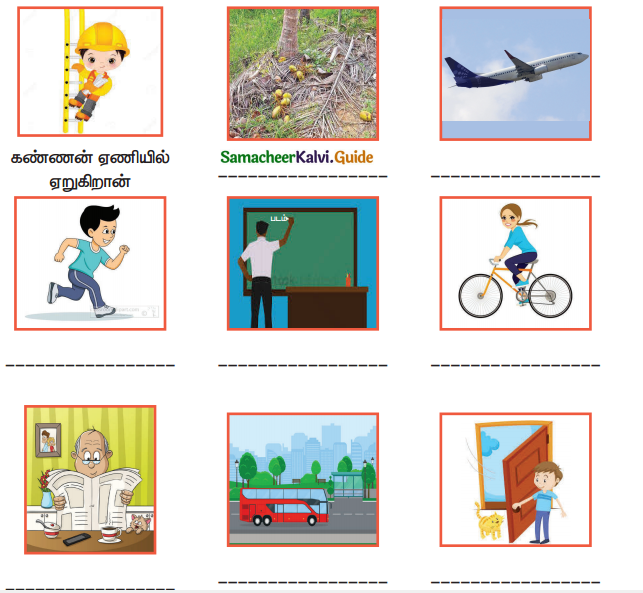
Write a note on directions with a relevant diagram.
Answer:
Samacheer Kalvi 9th Social Science Guide Geography Chapter 7 Mapping Skills

  1. Maps are drawn normally with north orientation.
  2. North direction in a map is always towards the North Pole of the earth.
  3. If you position yourself looking at the North Pole, on your right will be the east; your left will be the west; at your back will be south.
  4. These four main directions are called the cardinal directions.
  5. Direction is usually indicated on a map by a North-South line, with the North direction represented by an arrow head.

Question 3.
Explain the major uses of GPS? Explain about anyone.
Answer:
The Global Positioning System (GPS) is a U.S. owned utility that provides users with positioning, navigation, and timing services (PNT). This system consists of three segments: the space segment, the control segment, and the user segment.

Space Segment: This is formed by a Satellite Constellation with enough satellites to ensure that the users will have at least 4 simultaneous satellites in view from any point at the Earth Surface at any time.

Question 4.
Bhuvan has tremendous uses for scientists, policymakers, and the general public. Justify
Answer:

  1. Bhuvan (Sanskrit for Earth) is a free internet-based computer application launched by the Indian Space Research Organization (ISRO) on August 12th, 2009.
  2. It enables visualization of Indian Remote Sensing (IRS) images taken over a year ago, by ISRO’s seven satellites, including CartoSat-1 and CartoSat-2.
  3. Using Bhuvan connected to the Internet, one can explore places of interest, scenes of events in the news, or parts around the world they may never visit in person, by either entering the names of places or coordinates (latitudes and longitudes).
  4. Bhuvan has tremendous uses for scientists, academicians, policymakers, or the general public.

VIII. Map Exercise

Question 1.
With the help of an atlas, mark the following on the outline map of Tamil Nadu.
(a) The latitude and longitude of Chennai.
(b) Mark the city located at 10° N, 78°E.
(c) Locate the city approximately on 11°N and 76°E.
(d) Find the latitude and longitude of Kanyakumari and mark it.

Samacheer Kalvi 9th Social Science Guide Geography Chapter 7 Mapping Skills

IX. HOTS

Question 1.
Can you imagine a world without satellites?
Answer:
No, we cannot imagine a world without satellites.

  1. Our lives would change in so many ways. Millions of people would be affected as they can’t speak through mobile phones or send messages, TV shows would be missed, important information cannot be passed on quickly, and so on.
  2. Scientific studies would be greatly restricted.
  3. Army people would face difficulty in coordinating for international operations.
  4. Spying would be impossible.
  5. There will be navigation issues, communication issues, etc.

Samacheer Kalvi 9th Social Science Guide Geography Chapter 7 Mapping Skills

Question 2.
Imagine you are a cartographer. Draw the map of your area.
Hints:

  1. Cartographers spend most of their time collecting and verily data used in creating maps.
  2. A Cartographer will also collect and analyze geographical data, such as population density, demographic characteristics, and animal precipitation patterns.
  3. As a cartographer, I will be involved with the scientific, technological, and artistic aspects of developing and producing maps.
  4. It will present complex information as diagrams, charts, and spreadsheets as well as in the form of conventional maps.
  5. A map of the area is to be drawn by the student.

Intext Activity

Question 1.
Imagine you are standing in India facing north, find in which direction are the following located using the map given below
Answer:

  1. Saudi Arabia West
  2. Myanmar East
  3. China North
  4. Indian ocean South
  5. Kazakhstan North
  6. Sumatra South East
  7. Afghanistan West

Samacheer Kalvi 9th Social Science Guide Geography Chapter 7 Mapping Skills

Samacheer Kalvi 9th Social Science Mapping Skills Additional Important Questions and Answers

I. Choose the best answer

Question 1.
The foundation for map-making in Indian war laid during the period ______
(a) Aryan
(b) Vedic
(c) Gupta
(d) Chola
Answer:
(b) Vedic

Samacheer Kalvi 9th Social Science Guide Geography Chapter 7 Mapping Skills

Question 2.
International boundaries are marked in ______ colour codes.
(a) Brown
(b) Blue
(c) Red
(d) Pink
Answer:
(d) Pink

Question 3.
A synoptic chart means
(a) Weather map
(b) Travelogue
(c) Thematic map
(d) General maps
Answer:
(a) Weather map

Question 4.
Aerial photographs were taken by Felix Nadar in __________
(a) 1850
(b) 1852
(c) 1858
(d) 1860
Answer:
(c) 1858

Question 5.
GPS technology has tremendous applications in __________
(a) Mobile phones
(b) Watches
(c) ATMs
(d) All the these
Answer:
(d) All the these

II. Consider the given statements and choose the right option given below.

Question 1.
Assertion (A): GNSS promotes the safety and convenience of transport.
Reason (R): GNSS applications are used in tracking or mapping vehicles, ships, and aircraft.
(a) Both (A) and (R) are true; (R) explains (A)
(b) Both (A) and (R) are true; (R) does not explain (A)
(c) (A) is correct; (R) is False
(d) (A) is false; (R) is true
Answer:
(a) Both (A) and (R) are true; (R) explains (A)

Samacheer Kalvi 9th Social Science Guide Geography Chapter 7 Mapping Skills

Question 2.
Statement (I): Surveying is done to measure the angle, direction, area, height and distance of an object.
Statement (II): A topographical map is the technique of meteorologists to display all the weather data.
(a) Statement (I) is true; (II) is false
(b) Statement (II) is true; (I) is false
(c) Statement (I) and (II) correct
(d) Statement (I) and (II) Wrong
Answer:
(a) Statement (I) is true; (II) is false

III. Match the following

  1. Azimuthal – (a) Water towers
  2. Light Blue – (b) Rope – stretchers
  3. Travelogue – (c) Journalist
  4. Egypt – (d) Polar projection
  5. Felix Nadar – (e) Tourist map

Answer:

  1. – (d)
  2. – (a)
  3. – (e)
  4. – (b)
  5. – (c)

IV. Answer in Brief.

Question 1.
Give a short account of ‘Imago Mundi’ the Babylonian Map of the World.
Answer:
More commonly known as the Babylonian Map of the World, the Imago Mundi is considered the oldest surviving world map. It is currently on display at the British Museum in London. It dates back to between 700 and 500 BC(BCE) and was found in a town called Sippar in Iraq.

The carved map depicts Babylon at the centre. Nearby are places like Assyria and Elam, all surrounded by a “Salt Sea” forming a ring around the cities. Outside the ring, eight islands or regions are carved onto the tablet. The map is accompanied by a cuneiform text describing Babylonian mythology in the regions depicted on the stone.

Samacheer Kalvi 9th Social Science Guide Geography Chapter 7 Mapping Skills

Question 2.
Who is a cartographer?
Answer:
A cartographer is one who measures, analyzes and interprets geographical information to create ‘ maps and charts for political, cultural and educational purposes.

Question 3.
Mention the three types of map symbols.
Answer:

  1. Point Symbols – Buildings, dipping tanks, trigonometrical beacons
  2. Line Symbols – Railways, roads, power lines, telephone lines
  3. Area Symbols – Cultivated lands, ponds, orchards and vineyards

Question 4.
What is a travelogue?
Answer:
A travelogue includes all the information required by a tourist like communication, transportation, hotels, tourist spots, health centres, ATMs, petrol stations etc.

Question 5.
Name the three types of Map Symbols.
Answer:
There are three types of map symbols;

  1. Point Symbols – buildings, dipping tanks, trigonometrical beacons
  2. Line Symbols – railways, roads, power lines, telephone lines
  3. Area Symbols – Cultivated lands, ponds, orchards, and vineyards

Question 6.
Mention the disadvantages of Remote sensing.
Answer:

  1. It is difficult to prepare large scale maps from obtained satellite data.
  2. The technique is very expensive for small areas requiring one-time analysis.

Question 7.
Mention the advantages of GIS.
Answer:
The advantages of GIS are

  1. Maps produced by GIS analysis can be used to pinpoint problem areas.
  2. GIS finds its strongest use in resources management, telecommunications, and urban and regional planning.
  3. GIS helps in planning the land-use requirements. The local government uses GIS for taxation and planning.

Question 8.
Write about the hardware and software functions of a GIS.
Answer:
The hardware and software functions of a GIS are,

  1. Data input and verification
  2. Compilation
  3. Storage
  4. Updating and changing
  5. Management and exchange
  6. Manipulation
  7. Retrieval and presentation
  8. Analysis and combination

Question 9.
What is meant by cybercartography?
Answer:
Cyber cartography is a term that is used to define all the aspects of the current state of Web and virtual mapping.

Question 10.
What is a survey?
Answer:
Surveying is done to measure the angle, direction, area, height and distance of an object or place on the surface of the earth using instruments. Surveying techniques are used to obtain the field data and to prepare maps. Knowledge of surveying helps one in map-making, particularly in the preparation of physical maps.

Question 11.
What are the advantages of Bhuvan?
Answer:

  1. Bhuvan, due to 3D rendering, gives the impression of moving through real space through the entire globe.
  2. Students can use Bhuvan to understand subjects ranging from Sciences to History of places.
  3. It provides information on natural resources and timely information on disasters.
  4. Administrators use it for monitoring various developmental schemes.

V. Give Reasons

Question 1.
“It is not possible to show all the data of an area on a map”.
Answer:
The details that are to be shown may vary according to requirement. Therefore, it is essential to consider the scale and purpose while preparing maps.

Samacheer Kalvi 9th Social Science Guide Geography Chapter 7 Mapping Skills

Question 2.
Surveys help to prepare physical maps.
Answer:

  1. Surveying is done to measure the angle, direction, area, height and distance of an object or place on the surface of the earth using instruments.
  2. Surveying techniques are used to obtain the field data and to prepare maps.
  3. Hence knowledge of surveying helps to prepare physical maps.

VI. Answer in paragraph

Question 1.
Write a note on Grid reference.
Answer:

  1. The location of a place can be simply defined by its latitude and longitude.
  2. In normal practice, latitude is stated first and then comes the longitude.
  3. The latitude and longitude of a place can be expressed in units of degree, minutes and seconds.
  4. A grid is a set of lines with alphanumeric codes for defining a location on a map in many topographical sheets.
  5. The lines that run horizontally from left to right of the map are known as northings.
  6. The lines that run vertically from the top to the bottom of the map are called eastings.
  7. The points at which the vertical and horizontal lines of the grid intersect are called coordinates which are identified by numbers or letters.

Question 2.
What are the colour codes used with map symbols?
Answer:

  1. Brown: land or earth features – contour lines, eroded areas, prominent rock outcrops, sand areas and dunes, secondary or gravel roads
  2. Light Blue: water features – canals, coastlines, dams, lakes, marshes, swamps and levees, ponds, rivers and water towers.
  3. Dark Blue: national waterways
  4. Green: vegetation features – cultivated fields, golf courses, nature and game reserve boundaries, orchards and vineyards, recreation grounds, woodland
  5. Black: construction features – roads, tracks, railways, buildings, bridges, cemeteries, communication towers, dam walls, excavations and mine dumps, telelphone lines, power lines, windpumps, boundaries
  6. Red: construction features – national, arterial and main roads, lighthouses and marine lights
  7. Pink: international boundaries

Question 3.
Explain the types of maps.
Answer:
(a) On the basis of scale, maps can be classified into:

  1. Large scale maps: Large amount of detail; can only show a small area.
  2. Small scale map: Small amount of detail; can show a large area,

(b) On the basis of utility and purpose, they are classified as:

  1. General maps / Topographic Maps (physical and political maps)
  2. Thematic map (spatial variations of single phenomena)
  3. Special purpose maps (Braille maps for blind people, maps for neo literates, military maps, navigational charts, etc).

Question 4.
Write a short note on
(a) Topographical Maps and
(b) Weather Maps
Answer:
(a) Topographical Maps

  1. Topographical maps show main features like landforms, water features, forests, settlements, agricultural fields, other land use, transportation and communication networks.
  2. These maps are general purpose maps and are drawn at quite large scales.
  3. The Survey of India prepares the topographical maps in India for the entire country.

(b) Weather Maps

  1. A weather map is the technique of meteorologists to display all the weather data recorded at various stations of a country at a particular point of time into a compact outline map using symbols and isolines.
  2. A weather map, otherwise called a synoptic chart, helps in weather analysis and weather forecast of the country/region for the next two to three days.

Question 5.
Explain the process of remote sensing.
Answer:
Remote Sensing

  1. The EMR (Electro-Magnetic Radiation) or solar radiation is the primary source of energy for remote sensing.
  2. Sunlight travels from the sun through the atmosphere, before it reaches the earth’s surface. In the atmosphere, the sun’s rays are not obstructed by any object.
  3. When solar radiation falls on the earth’s surface, some of its energy is absorbed. While some is transmitted through the surface, the rest is reflected. Surfaces naturally emit radiation in the form of heat.
  4. Sensors in the satellite record the reflected and emitted radiation. Each surface/object possesses a characteristic spectral signature, a unique pattern of reflecting sunlight.
  5. The energy recorded by the sensor has to be transmitted to a ground station where the data are processed into an image.
  6. The processed image is interpreted either visually by human interpreters or by computer-aided techniques called digital image processing to identify and distinguish between the different spectral signatures to get information about objects/places.
  7. Finally, we understand and apply the extracted information in mapping the area or assist in solving a particular problem.
Samacheer Kalvi 9th Social Science Guide Geography Chapter 7 Mapping Skills

Question 6.
What are the advantages and disadvantages of Remote Sensing?
Answer:
(a) Advantages of Remote sensing:

  1. It is the only practical way to obtain data from inaccessible regions, e.g. Antarctica, Amazon forest.
  2. It helps in constructing cheap base maps in the absence of detailed land surveys.
  3. It detects the spread of natural calamities such as floods, forest fires, and volcanic eruptions so that immediate rescue operations and planning can be carried out.

(b) Disadvantages of Remote sensing:

  1. It is difficult to prepare large scale maps from obtained satellite data.
  2. The technique is very expensive for small areas requiring one-time analysis.

Question 7.
How is remote sensing useful in disaster management?
Answer:

  1. Remote sensing technology is highly used in disaster management to study the effects of earthquakes, tsunamis, cyclones, volcanic eruption, floods, and wildfires.
  2. The preliminary data is retrieved from satellites like LANDSAT, CARTOSAT, OCEANSAT, etc.
  3. Fire and flood details can be extracted and delivered to relevant authorities within two hours of satellite image capture.
  4. E.g. major earthquakes in China and New Zealand, bushfire in Victoria, and floods in Kerala.
  5. Dynamic phenomena such as floods, movement of wild animals, shoreline changes, finding lost ships, and planes.
  6. Researchers use satellite imageries for these.

Question 8.
Explain the Global Navigation Satellite System (GNSS).
Answer:

  1. In the 21st century, GNSS has become a part of our lives to promote the safety and convenience of transport.
  2. Global Navigation Satellite System (GNSS) is a satellite system connected with a small electronic receiver or tracker to locate, monitor and track a user’s vehicle wherever in the world.
  3. It can also set up instant alerts when a driver of a vehicle speeds or deviates from a particular area.
  4. GNSS applications are used in tracking or mapping vehicles, ships and aircraft.
  5. group of satellites (Space Segment) working with a network of ground stations (Control Segment) provide location data.
  6. The receiver (User Segment) converts satellite signals into location, speed and time data
  7. Examples of GNSS:
    • Europe’s Galileo
    • USA’s NAVSTAR Global Positioning System (GPS)
    • Russia’s Global’naya Navigatsionnaya Sputnikovaya Sistema (GLONASS)
    • China’s BeiDou Navigation Satellite System
    • India’s NAVIC satellite system

Question 9.
Explain the Geographical Information System (GIS).
Answer:

  1. Geographic Information System is a computer-based tool for managing a large amount of data collected for a given geographic region through remote sensing, GPS, and other sources.
  2. The Geographic Information’System is a combination of computer hardware, software, geographic data, and personnel.
  3. G – Geographic – A particular area; I – Information – facts in order; S – System – arrangement
  4. GIS was first recognised in the late 1950s by Waldo Tobler and Roger Tomlinson (Canada).
  5. Prime examples of importing GIS for public welfare are Google Maps, Yahoo Maps, and Google Earth.
  6. The key ingredient is the location. We must have a coordinate, an address, or a distance from a known point that helps us to link the information to a location on a map.
  7. Each type of data of an area is stored as a separate ‘layer’ of the map.
  8. In GIS, layers may be used some times and removed according to need.
  9. Examples are hospitals, schools, water bodies, parks, and ATMs.
  10. The computers can create maps showing any combination of data.

Samacheer Kalvi 9th Social Science Guide Geography Chapter 7 Mapping Skills

Question 10.
Write a note on Google Earth.
Answer:

  1. Google Earth is a web-based computer application.
  2. Google Earth is a virtual globe that renders a 3D representation of the Earth.
  3. It combines the power of Google Search with maps, satellite imageries, aerial photographs, GIS data, and 3D buildings to visualize the world.
  4. Google Earth allows users to see cities and buildings looking perpendicularly down or at a tilted angle.
  5. Google Earth allows users to search for addresses of some countries, enter coordinates, or simply use the mouse to browse a location.
  6. Google Earth also has a Digital Elevation Model (DEM) data for many major cities.
  7. This means one can view Mount Everest or buildings in three dimensions, instead of 2D.

Samacheer Kalvi 9th Social Science Guide Geography Chapter 7 Mapping Skills

Question 11.
Distinguish between Airborne remote sensing and spaceborne remote sensing.
Answer:
Airborne remote sensing:

  1. In airborne remote sensing, downward or sideward looking sensors are mounted on an aircraft to obtain images of the earth’s surface.
  2. An advantage of airborne remote sensing is the capability of offering very high spatial resolution images (20 cm or less)

Spaceborne remote sensing:

  1. In space-borne remote sensing, sensors are mounted on board a spacecraft (space shuttle or satellite) orbiting the earth.
  2. At present their one several remote sensing satellites proving imagery for research and operational applications.

Samacheer Kalvi 11th Business Maths Guide Chapter 9 Correlation and Regression Analysis Ex 9.3

Tamilnadu State Board New Syllabus Samcheer Kalvi 11th Business Maths Guide Pdf Chapter 9 Correlation and Regression Analysis Ex 9.3 Text Book Back Questions and Answers, Notes.

Tamilnadu Samacheer Kalvi 11th Business Maths Solutions Chapter 9 Correlation and Regression Analysis Ex 9.3

Samacheer Kalvi 11th Business Maths Correlation and Regression Analysis Ex 9.3 Text Book Back Questions and Answers

Choose the correct answer.

Question 1.
An example of a positive correlation is:
(a) Income and expenditure
(b) Price and demand
(c) Repayment period and EMI
(d) Weight and Income
Answer:
(a) Income and expenditure

Question 2.
If the values of two variables move in the same direction then the correlation is said to be:
(a) Negative
(b) Positive
(c) Perfect positive
(d) No correlation
Answer:
(b) Positive

Samacheer Kalvi 11th Business Maths Guide Chapter 9 Correlation and Regression Analysis Ex 9.3

Question 3.
If the values of two variables move in the opposite direction then the correlation is said to be:
(a) Negative
(b) Positive
(c) Perfect positive
(d) No correlation
Answer:
(a) Negative

Question 4.
Correlation co-efficient lies between:
(a) 0 to ∞
(b) -1 to +1
(c) -1 to 0
(d) -1 to ∞
Answer:
(b) -1 to +1

Samacheer Kalvi 11th Business Maths Guide Chapter 9 Correlation and Regression Analysis Ex 9.3

Question 5.
If r(X, Y) = 0 the variables X and Y are said to be:
(a) Positive correlation
(b) Negative correlation
(c) No correlation
(d) Perfect positive correlation
Answer:
(c) No correlation

Question 6.
The correlation coefficient from the following data N = 25, ΣX = 125, ΣY = 100, ΣX2 = 650, ΣY2= 436, ΣXY = 520:
(a) 0.667
(b) -0.006
(c) -0.667
(d) 0.70
Answer:
(a) 0.667
Hint:
Samacheer Kalvi 11th Business Maths Guide Chapter 9 Correlation and Regression Analysis Ex 9.3 Q6

Samacheer Kalvi 11th Business Maths Guide Chapter 9 Correlation and Regression Analysis Ex 9.3

Question 7.
From the following data, N = 11, ΣX = 117, ΣY = 260, ΣX2 = 1313, ΣY2 = 6580, ΣXY = 2827. the correlation coefficient is:
(a) 0.3566
(b) -0.3566
(c) 0
(d) 0.4566
Answer:
(a) 0.3566
Hint:
Samacheer Kalvi 11th Business Maths Guide Chapter 9 Correlation and Regression Analysis Ex 9.3 Q7

Samacheer Kalvi 11th Business Maths Guide Chapter 9 Correlation and Regression Analysis Ex 9.3 Q7.1

Question 8.
The correlation coefficient is:
Samacheer Kalvi 11th Business Maths Guide Chapter 9 Correlation and Regression Analysis Ex 9.3 Q8
Answer:
(b) r(X, Y) = \(\frac{cov(x, y)}{\sigma_{x} \sigma_{y}}\)

Samacheer Kalvi 11th Business Maths Guide Chapter 9 Correlation and Regression Analysis Ex 9.3

Question 9.
The variable whose value is influenced or is to be predicted is called:
(a) dependent variable
(b) independent variable
(c) regressor
(d) explanatory variable
Answer:
(a) dependent variable

Question 10.
The variable which influences the values or is used for prediction is called:
(a) Dependent variable
(b) Independent variable
(c) Explained variable
(d) Regressed
Answer:
(b) Independent variable

Samacheer Kalvi 11th Business Maths Guide Chapter 9 Correlation and Regression Analysis Ex 9.3

Question 11.
The correlation coefficient:
Samacheer Kalvi 11th Business Maths Guide Chapter 9 Correlation and Regression Analysis Ex 9.3 Q11
Answer:
(a) \(r=\pm \sqrt{b_{x y} \times b_{y x}}\)

Question 12.
The regression coefficient of X on Y:
Samacheer Kalvi 11th Business Maths Guide Chapter 9 Correlation and Regression Analysis Ex 9.3 Q12
Answer:
(a) \(b_{x y}=\frac{\mathrm{N} \Sigma d x d y-(\Sigma d x)(\Sigma d y)}{\mathrm{N} \Sigma d y^{2}-(\Sigma d y)^{2}}\)

Samacheer Kalvi 11th Business Maths Guide Chapter 9 Correlation and Regression Analysis Ex 9.3

Question 13.
The regression coefficient of Y on X:
Samacheer Kalvi 11th Business Maths Guide Chapter 9 Correlation and Regression Analysis Ex 9.3 Q13
Answer:
(c) \(b_{y x}=\frac{\mathrm{N\Sigma} d x d y-(\Sigma d x)(\Sigma d y)}{\mathrm{N} \Sigma d x^{2}-(\Sigma d x)^{2}}\)

Question 14.
When one regression coefficient is negative, the other would be:
(a) Negative
(b) Positive
(c) Zero
(d) None of these
Answer:
(a) Negative

Samacheer Kalvi 11th Business Maths Guide Chapter 9 Correlation and Regression Analysis Ex 9.3

Question 15.
If X and Y are two variates, there can be at most:
(a) one regression line
(b) two regression lines
(c) three regression lines
(d) more regression lines
Answer:
(b) two regression lines

Question 16.
The lines of regression of X on Y estimates:
(a) X for a given value of Y
(b) Y for a given value of X
(c) X from Y and Y from X
(d) none of these
Answer:
(a) X for a given value of Y

Samacheer Kalvi 11th Business Maths Guide Chapter 9 Correlation and Regression Analysis Ex 9.3

Question 17.
Scatter diagram of the variate values (X, Y) give the idea about:
(a) functional relationship
(b) regression model
(c) distribution of errors
(d) no relation
Answer:
(a) functional relationship

Question 18.
If regression co-efficient of Y on X is 2, then the regression co-efficient of X on Y is:
(a) ≤ \(\frac{1}{2}\)
(b) 2
(c) > \(\frac{1}{2}\)
(d) 1
Answer:
(a) ≤ \(\frac{1}{2}\)

Samacheer Kalvi 11th Business Maths Guide Chapter 9 Correlation and Regression Analysis Ex 9.3

Question 19.
If two variables move in a decreasing direction then the correlation is:
(a) positive
(b) negative
(c) perfect negative
(d) no correlation
Answer:
(a) positive

Question 20.
The person suggested a mathematical method for measuring the magnitude of the linear relationship between two variables say X and Y is:
(a) Karl Pearson
(b) Spearman
(c) Croxton and Cowden
(d) Ya Lun Chou
Answer:
(a) Karl Pearson

Samacheer Kalvi 11th Business Maths Guide Chapter 9 Correlation and Regression Analysis Ex 9.3

Question 21.
The lines of regression intersect at the point:
(a) (X, Y)
(b) \((\overline{\mathrm{X}}, \overline{\mathrm{Y}})\)
(c) (0, 0)
(d) (σx, σy)
Answer:
(b) \((\overline{\mathrm{X}}, \overline{\mathrm{Y}})\)

Question 22.
The term regression was introduced by:
(a) R.A Fisher
(b) Sir Francis Galton
(c) Karl Pearson
(d) Croxton and Cowden
Answer:
(b) Sir Francis Galton

Samacheer Kalvi 11th Business Maths Guide Chapter 9 Correlation and Regression Analysis Ex 9.3

Question 23.
If r = -1, then correlation between the variables:
(a) perfect positive
(b) perfect negative
(c) negative
(d) no correlation
Answer:
(b) perfect negative

Question 24.
The coefficient of correlation describes:
(a) the magnitude and direction
(b) only magnitude
(c) only direction
(d) no magnitude and no direction
Answer:
(a) the magnitude and direction

Samacheer Kalvi 11th Business Maths Guide Chapter 9 Correlation and Regression Analysis Ex 9.3

Question 25.
If Cov(x, y) = -16.5, \(\sigma_{x}^{2}\) = 2.89, \(\sigma_{y}^{2}\) = 100. Find correlation coeffient.
(a) -0.12
(b) 0.001
(c) -1
(d) -0.97
Answer:
(d) -0.97

Samacheer Kalvi 9th Social Science Guide Geography Chapter 6 Man and Environment

Tamilnadu State Board New Syllabus Samacheer Kalvi 9th Social Science Guide Pdf Geography Chapter 6 Man and Environment Text Book Back Questions and Answers, Important Questions, Notes.

Tamilnadu Samacheer Kalvi 9th Social Science Solutions Geography Chapter 6 Man and Environment

Samacheer Kalvi 9th Social Science Man and Environment Text Book Back Questions and Answers

I. Choose the correct answer

Question 1.
All externa Influences and factors that affect the growth and development of living organisms is __________
(a) Environment
(b) Ecosystem
(c) Biotic factors
(d) Abiotic factors
Answer:
(a) Environment

Samacheer Kalvi 9th Social Science Guide Geography Chapter 6 Man and Environment

Question 2.
The ‘World Population Day’ is observed on __________ every year.
(a) August 11th
(b) September 11th
(c) July 11th
(d) January 11th
Answer:
(c) July 11th

Question 3.
The statistical study of human population is __________
(a) Demography
(b) Morphology
(c) Etymology
(d) Seismography
Answer:
(a) Demography

Question 4.
The extraction of valuable minerals and other geological minerals from the mines, is __________
(a) Fishing
(b) Lumbering
(c) Mining
(d) Agriculture
Answer:
(c) Mining

Samacheer Kalvi 9th Social Science Guide Geography Chapter 6 Man and Environment

Question 5.
The Secondary sector of the economy produces __________ from raw materials.
(a) Semi finished goods
(b) Finished goods
(c) Economic goods
(d) raw materials
Answer:
(b) Finished goods

Question 6.
Gradual increase of the earth’s temperature by the Green house gases in the atmosphere is called __________
(a) Acid rain
(b) thermal pollution
(c) Global warming
(d) Deforestation
Answer:
(c) Global warming

II. Mitch the following

  1. Loudspeaker – (a) Push factor
  2. Rio de Janeiro, Brazil – (b) Pull factor
  3. Cruciform settlement – (c) noice pollution
  4. Natural disaster – (d) T- shaped settlement
  5. Better living conditions – (e) Earth Summit, 1992

Answer:

  1. – (c)
  2. – (e)
  3. – (d)
  4. – (a)
  5. – (b)

III. Consider the given statements and choose the right option given below

Question 1.
Assertion(A): Ozone layer in the stratosphere is considered as a protective shield.
Reason(R): It prevents the UV radiation from reaching the earth’s surface.
(a) A and R are correct and A explains R
(b) A and R are correct, but A does not explain R
(c) A is incorrect but R is correct
(d) Both A and R are incorrect
Answer:
(a) A and R are correct and A explains R

Samacheer Kalvi 9th Social Science Guide Geography Chapter 6 Man and Environment

Question 2.
Assertion(A): In tertiary activities, instead of producing goods by themselves, they are in the process of production.
Reason(R): People in Tertiary activities are purely eco friendly.
(a) Both A and R are incorrect
(b) A and R are correct but A does not explain R
(c) A is correct and R is incorrect
(d) A and R are correct and A explains R
Answer:
(c) A is correct and R is incorrect

IV. Answer the following in brief

Question 1.
What do you mean by the term ‘density’ of population’?
Answer:
Density of population refers to the number of people living per square kilometre. An area is said to be sparsely populated when it has a large area with less number of people. Similarly, smaller the area with a large number of people, it is said to be densely populated.

Question 2.
What is ‘black death’?
Answer:

  1. The Black death is estimated to have killed 30 – 60 percent of Europe’s total population during the 14th century.
  2. The dominant explanation for black death is attributed to the outbreak of plague.

Samacheer Kalvi 9th Social Science Guide Geography Chapter 6 Man and Environment

Question 3.
Where do we have high and low densities of population?
Answer:
Areas of high density (above 50 people per sq.km) – East Asia, South Asia, northwest Europe & Eastern North America.
Areas of low density (less than 10 people per sq.km) – Central Africa, Western Australia, Northern Russia, Canada, etc.

Question 4.
Write any two ways of how the locals and the government restored Palk Bay.
Answer:

  1. Saplings of native species of plants and trees are being grown planet and cared for
  2. Live colonies of coral from the Gulf of Mannar Biosphere Reserve are being transplanted to Palk Bay. The existing mangroves and the region are being mapped and the way land is used around the mangrove is being studied.
  3. Along with awareness programmes, the communities are also being provided with livelihood training, so they can earn an income in more ways than just fishing.

Question 5.
Define.

  1. Population growth
  2. Infant Mortality Rate
  3. Census
  4. Sustainable Development.

Answer:

  1. Population growth refers to an increase in the number of people who reside in a particular area during a particular period.
  2. The number of deaths under one year of age for every 1000 live births in a year is known as Infant Mortality Rate
  3. Census is an official enumeration of population carried out periodically. It records information about the characteristics of population such as age, sex, literacy and occupation.
  4. “Sustainable development is development that meets the needs of the present without compromising the ability of future generation to meet their own needs”.

V. Give reasons for the following.

Question 1.
Deforestation is encouraged throughout the world.
Answer:
Deforestation results in many effects like floods and droughts, loss of soil fertility, air pollution, extinction of species, global warming, spread of deserts, depletion of water resource, melting of ice caps and glaciers, rise in sea level and depletion of ozone layer. Therefore, reforestation is encouraged throughout the world in order to conserve our mother Earth.

Question 2.
Acid rain destroys the ecosystem.
Answer:

  1. Acid rain has many ecological effect, but none is greater than its impact on lakes, streams, wetlands and other aquatic environments.
  2. Acid-rain makes water acidic, and causes them to absorb the aluminium that makes its way from soil into lakes and streams.
  3. It limits the nutrients available to the plants and expose them to toxic substances that are released from soil.

Samacheer Kalvi 9th Social Science Guide Geography Chapter 6 Man and Environment

Question 3.
The economy of the quaternary sector is called the knowledge economy.
Answer:
The quaternary sector deals with the activities related to Research and Development, as well as knowledge. For e g. Services like consultation, education, and banking. Hence, it is called a knowledge economy.

Question 4.
Population growth has to be brought under control.
Answer:

  1. Urgent steps need to be taken to stabilise the population for sustainable development goals to be achieved.
  2. Through education awareness of the problems faced due to population explosion like pollution, scarcity of resources, conflict low standard of living and disruption in the ecological balance.

Question 5.
Sustainable development growth has been set to protect the planet.
Answer:
The excessive usage of natural and manmade resources deplete its availability for the future generation. Hence conservation and awareness are the two important terms that can bring sustainability to our living: When we use the word sustainability to mean maintain, it means to maintain it forever. This is because our actions have a lasting effect on the environment and we should protect it for our future generations.

VI. Distinguish the following

Question 1.
Birth Rate and Death Rate.
Answer:
Birth rate:
The number of live birth per 1000 children in a country during a year.

Death Rate:
The number of death per 1000 people in a country during a year.

Question 2.
Rural settlement and urban settlement
Answer:
Rural settlement:

  1. An area located in the outskirts, is known as rural.
  2. Villages and hamlets constitute ‘rural areas.

Urban settlement:

  1. A settlement where the population is very high and has the features of a built environment, is known as urban.
  2. Cities and towns constitute urban areas.

Samacheer Kalvi 9th Social Science Guide Geography Chapter 6 Man and Environment

Question 3.
Primary activities and Secondary activities
Answer:
Primary Activities:

  1. Primary activities pertain to the extraction of raw materials from the earth’s surface.
  2. For example: Food gathering, hunting, lumbering, fishing, cattle rearing, mining and agriculture.

Secondary Activities:

  1. Secondary activities transform raw materials into finished goods.
  2. For example: Iron and steel industries, automobile manufacturing etc.,

VII. Answer in a paragraph

Question 1.
Explain the factors affecting the distribution of the population.
Answer:
The world population is not uniformly distributed, owing to the following factors.

  • Physical Factors: Physical factors include temperature, rainfall, soil, relief, water, natural vegetation, distribution of minerals and availability of energy resources.
  • Historical Factors: Regions with historical importance (river valley civilizations), war and constant invasions fall under historical factors responsible for population distribution.
  • Economic Factors: Educational institutions, employment opportunities, manufacturing industries, luxurious amenities, trade and commerce and other facilities encourage dense population in an area.

Question 2.
Describe the patterns of rural settlement with neat diagrams.
Answer:
Samacheer Kalvi 9th Social Science Guide Geography Chapter 6 Man and Environment

VIII. Map Skill

Question A.
On the outline map of the world mark the following.

  1. An area of high density of population in Europe.
  2. An area of low density of population in Australia.
  3. PalkBay.
  4. A fracking banned country.
  5. England – A country affected by ‘black death’
  6. Denmark – First country where the modem census was conducted.
  7. River Hwang Ho.

Answer:

Samacheer Kalvi 9th Social Science Guide Geography Chapter 6 Man and Environment

Question B.
On the outline map of Tamil Nadu mark the following.

  1. A metropolitan city
  2. A district with 7857 people per sq. km.
  3. Gulf of Mannar
  4. Palk Strait

Answer:

Samacheer Kalvi 9th Social Science Guide Geography Chapter 6 Man and Environment

IX. Hots

Question 1.
Study your area and write down its settlement pattern.
Answer:

  1. A settlement pattern refers to the way that buildings and houses are distributed in a rural settlement.
  2. Settlement patterns are of interest to geographers, historians and anthropologists for the insight they offer in how a community has developed over time.

Linear:
In a linear settlement pattern, the buildings are arranged in lines. These lines often follow the route of a road or body of water.

Dispersed:
In a dispersed settlement pattern, the buildings are scattered over a wide area. Dispersed settlement patterns are often associated with agricultural activity and are frequently surrounded by farmland.

Nucleated:
In a nucleated settlement pattern, the buildings are grouped around a central core. Nucleated settlement patterns are usually associated with patterns of agriculture in which the settlement is surrounded two or three fields, and each field divided into strips that were formed b individual farmers.

Samacheer Kalvi 9th Social Science Man and Environment Additional Important Questions and Answers

I. Choose the correct answer

Question 1.
The percentage of people in a given population who can read and write a language refer to ______
(a) Infant mortality
(b) Literacy rate
(c) Sex ratio
(d) Populationdensity
Answer:
(b) Literacyrate

Samacheer Kalvi 9th Social Science Guide Geography Chapter 6 Man and Environment

Question 2.
In India the first census was carried out in the year ________
(a) 1800
(b) 1821
(c) 1872
(d) 1880
Answer:
(c) 1872

Question 3.
At the Confluence of river this pattern is developed ________
(a) Starlike
(b) Triangular
(c) Nebular
(d) Circular
Answer:
(b) Triangular

Question 4.
Automobile manufacturing comes under this economic activity
(a) Primary
(b) Tertiary
(c) Secondary
(d) Quaternary
Answer:
(c) Secondary

Question 5.
Van Mahotsav week celebrated during
(a) 1st July to 7th July
(b) 1st June to 7th June
(c) 1st January to 7th January
(d) 1st December to 7th December
Answer:
(a) 1st July to 7th July

Question 6.
News paper and Cardboard belong to
a) Wet waste
(b) Dry waste
(c) Rejected waste
(d) e – waste
Answer:
(b) Dry waste

Samacheer Kalvi 9th Social Science Guide Geography Chapter 6 Man and Environment

Question 7.
Palk Bay is the home of
(a) Coconut trees
(b) Dry waste
(c) Mangrove trees
(d) e – waste
Answer:
(c) Mangrove trees

Consider the given statement and choose the right option given below.

Question 8.
Assertion(A): Deforestation results in floods and drought.
Reason(R): Under deforestation trees are cut down clearing the forests.
(a) Both A and R are correct
(b) Bpth A and R are wrong
(c) A is correct but R does not explain A
(d) A and R are correct and A explains R
Answer:
(d) A and R are correct and A explains R

Question 9.
Assertion(A): Urbanisation is one of the environmental issues.
Reason(R) : As the town expands, it mounts more pressure on transport system, water supplies leading to air pollution, water pollution etc.
(a) (A) and (R) are correct, (R) explain (A)
(b) (A) and (R) are correct, (R) does not explain (A)
(c) Both (A) and (R) are correct
(d) Both (A) and (R) are wrong
Answer:
(a) (A) and (R) are correct, (R) explain (A)

II. Match the following

  1. Monuments – (i) Low density
  2. Denmark – (ii) Rectangular Pattern
  3. Northern Russia – (iii) Madurai
  4. Plain Areas – (iv) Man – Made
  5. Metropolitan – (v) Census

Answer:

  1. – (iv)
  2. – (v)
  3. – (i)
  4. – (ii)
  5. – (iii)

III. Answer the following in brief

Question 1.
Classify the Environment.
Answer:
Environment can be classified as

  1. Natural Environment
  2. Human Environment and
  3. Man Made Environment

Question 2.
What is demography?
Answer:

  1. In ancient Greek, ‘demos’ means people and ‘graphis’ means study of measurement.
  2. So ‘Demography’ is the statistical study of human population.

Samacheer Kalvi 9th Social Science Guide Geography Chapter 6 Man and Environment

Question 3.
What is National Increase of population?
Answer:
National increase of population is the difference between the birth rate and death rate.

Question 4.
What is population change?
Answer:
Population change refers to an increase or decrease in the population of an area influenced by the number of births, deaths and migration.

Question 5.
Why do we observe the The World Population Day?
Answer:

  1. The World Population Day is observed on 11th July every year.
  2. It seeks to raise awareness of global population issues.
  3. The United Nations Development Programme started celebrating this event from the year 1989.

Question 6.
Mention about the official population policy implemented in 1952.
Answer:

  1. India has an official population policy implemented in 1952.
  2. India was the first country to announce such a policy.
  3. The main objective of this policy was to slow down the rate of population growth, through . promotion of various birth control measures.

Question 7.
Explain the Quinary Activities.
Answer:

  1. The activities that focus on the creation, rearrangement, and interpretation of new and existing ideas are called quinary activities.
  2. It includes the highest levels of decision making in a society or economy.
  3. Eg. Senior business executives, scientists and policymakers in the Government.

Question 8.
Explain the term afforestation.
Answer:

  1. Afforestation is the process of planting trees or sowing seeds on barren land devoid of any trees to create a forest.
  2. Therefore afforestation is the creation of a new forest.

Question 9.
What is forest management?
Answer:

  1. Forest Management seeks to achieve a balance between the society’s increasing demands for forest products, its benefits and the preservation of forest health and diversity too.
  2. This balance is critical to the survival of forests and to the prosperity of forest dependent communities.

Samacheer Kalvi 9th Social Science Guide Geography Chapter 6 Man and Environment

Question 10.
What are natural pollutants?
Answer:
The natural pollutants are volcanic eruptions, wind erosion, pollen disposal, evaporation of organic compounds and radioactive elements etc.,

Question 11.
What are man made pollutants?
Answer:
Man made pollutants refer to vehicular emission, industrial wastes, smoke from thermal power plants and refineries badly affects the environment.

Question 12.
Mention any three ways to conserve Water.
Answer:

  1. To conserve water do not dump in or around rivers. Clean up rivers that have a lot of trash in and around them.
  2. Never dispose of cooking fats and oils by proving them down the sink.
  3. Turn off water while brushing teeth, washing, gardening and sharing.

Question 13.
Mention the preventive measures of land pollution.
Answer:

  1. Things used for domestic purposes can be reused and recycled.
  2. Organic waste matter should be disposed off far away from the settlements.
  3. Inorganic wastes can be separated, reclaimed and recycled.

Question 14.
What is Smog?
Answer:

  1. Smog is a mixture of smoke, gases and chemicals.
  2. It causes a smoky dark atmosphere, especially over cities.
  3. It decreases visibility and creates haze throughout the area.

Question 15.
Mention the problems of Urbanisation.
Answer:

  1. As the town expands, it mounts more pressure on transport system, water supplies, sewage and profuse disposal.
  2. The overall development creates problems like air pollution, water pollution, traffic congestion and noise pollution etc.
  3. This disturbed environment affects the human beings as mental illness, heart troubles, breathing problems etc.

Question 16.
Why is Sustainability important?
Answer:

  1. The excessive usage of natural and manmade resources deplete its availability for the future generation.
  2. We need to look after our planet, our resources and our people to ensure that we can hand over our planet to our children to live in true sustainability.
  3. Hence conservation and awareness are the two important terms that can bring sustainability to our living.
  4. When we use the word sustainability to mean maintain, it means to maintain it forever.
  5. This is because our actions have a lasting effect on the environment and we should protect it for our future generations.

IV. Distinguish the following

Question 1.
Internal Migration and International Migration.
Answer:
Internal Migration:

  1. The movement of people within a country i.e. between states, districts, villages, etc is called as Internal migration.

International Migration:

  1. The movement of people from one country to another, across international borders is called as International migration.

Samacheer Kalvi 9th Social Science Guide Geography Chapter 6 Man and Environment

Question 2.
Land Pollution and Noise Pollution.
Answer:
Land Pollution:

  1. Land pollution is contaminating the land surface of the earth through dumping of urban waste matter.
  2. It arises from the breakage of underground storage tanks, application of pesticides and percolation of contaminated surface water, oil and fuel dumping.
  3. One of the preventive measures. Inorganic wastes can be separated, reclaimed and recycled.

Noise Pollution:

  1. Noise pollution is basically a problem of urban areas, industrial areas, transport areas due to bombardment, traffic etc.
  2. It has an impact on the habitat of animals migration and health of inhabitants.
  3. One of the control measures planting trees along the compound walls to protect houses.

Question 3.
Push factors and pull factors
Answer:
Push Factors:

  1. In sufficient jobs and few opportunities.
  2. Primitive conditions
  3. Pollution
  4. Poor infrastructural facilities

Pull factors:

  1. Better job opportunities.
  2. Better living conditions
  3. Clean environment
  4. Better infrastructural facilities

V. Give reasons for the following

Question 1.
Fracking’affect the environment.
Answer:

  1. Fracking not only pollutes water and air but also pollutes the soil.
  2. The oil spills during fracking can harm the soil and the surrounding vegetation.
  3. The use of high pressure at the time of soil extraction and the storage of waste water on site may cause earthquakes.

Question 2.
Segregate bio degrable
Answer:

  1. We should segregate biodegradable and non-biodegradable wastes so that we can easily notice and separate all biodegradable which can be used as a fertilizer. While nonbiodegradable can be recycled.
  2. Segregate of wastes in important for properly disposing of the huge amount of garbage in an environmentally conscious manner.

VI. Answer in a paragraph.

Question 1.
Explain the classification of the Environment.
Answer:
(a) Natural Environment
(b) Human Environment
(c) Man made Environment

Samacheer Kalvi 9th Social Science Guide Geography Chapter 6 Man and Environment

(a) Natural Environment : Natural components of environment such as Lithosphere, atmosphere, hydrosphere and biosphere.

(b) Human Environment : This is the interaction between man as an individual, with his family, occupation and society. It is also related to various cultural aspects such as education, religion, economics and politics.

(c) Man made Environment :

  1. This has been created by man himself for the purpose of fulfilling his needs and to make his life more convenient and easy.
  2. For example, building, transport, park, industries, monument, etc.
  3. To bring an equilibrium between man and the environment, man has to study the distribution of population, availability of resources, development in technology etc.

Samacheer Kalvi 9th Social Science Guide Geography Chapter 6 Man and Environment

Question 2.
Explain the term density of population.
Answer:

  1. Density of population refers to the number of people living per sq. km. An area is said to be sparsely populated when it has a large area with less number of people. Similarly, smaller the area with a large number of people, it is said to be densely populated.
  2. Population Density = \(\frac { Total Population }{ Total land area }\)

The world’s population density is divided into three main groups.
(a) Areas of high density (above 50 people per sq.km) – East Asia, South Asia, North West Europe & Eastern North America.

(b) Areas of moderate density (10 to 50 people per sq.km) – The sub tropical regions like Angola, Congo, Nigeria and Zambia in Africa.

(c) Areas of low density (less than 10 people per sq.km) – Central Africa, Western Australia, Northern Russia, Canada, etc…

Question 3.
What is ‘Migration’? and explain its types.
Answer:

  1. Migration is defined as the permanent or semi-permanent change of home of an individual or a group of people over a significant distance from their place of birth.
  2. The causes of migration may be physical (climate, drought, flood, earthquake, volcanic eruption, epidemics etc.), social inequalities, economic opportunities, technology, education, cultural clashes, war or political issues.
  3. There are two types of migration:

(a) Internal Migration – The movement of people.within a country i.e. between states, districts, villages, etc is called as Internal migration.

(b) International Migration – The movement of people from one country to another, across international borders is called as International migration.

Question 4.
What are Urban Settlements? apd explain its types.
Answer:

  1. Urban is the term related to cities and towns where people are primarily engaged in non-agricultural activities.
  2. The factors responsible for urbanization are better employment opportunities, suitable conditions for business, education, transport, etc.
  3. Urban centres are classified as towns, cities, metropolitan cities, mega cities, conurbation, etc., depending on the size and services available and functions rendered to it.

(a) Town : A town is generally larger than a village, but smaller than a city. It has a population of less than 1 lakh. E.g.: Arakkonam.

(b) City : Cities are much larger than towns and have a greater number of economic
functions. The population in cities are estimated to be more than 1 lakh. E.g.: Coimbatore

(c) Metropolitan Cities : Cities accommodating population between 10 lakhs and 50 lakhs are metropolitan cities. E.g.: Madurai

(d) Mega cities : Cities with more than 50 lakh population are called Megacities. E.g.: Chennai

(e) Conurbation : A conurbation is a region comprising of a number of cities, large towns and other urban areas. E.g.: Delhi

Question 5.
What are the effects of Deforestation?
Answer:

  1. Deforestation results in many effects like floods and droughts, loss of soil fertility, air pollution, extinction of species, global warming, spread of deserts, depletion of water resource, melting of ice caps and glaciers, rise in sea level and depletion of ozone layer
  2. The United Nations Conference on Environment and Development (UNCED) by name Earth Summit Conference held at Rio de Janeiro, Brazil, on June 1992 concluded that all member countries should reduce their emission of carbon dioxide, methane and other green house gases thought to be responsible for global warming.

Question 6.
How can we conserve forests?
Answer:

  1. Conservation of forests can be done through the regulation of cutting of trees.
  2. Control over forest fire: Through regular monitoring and controlling the movement of the people forest fire can be prevented.
  3. Reforestation and afforestation: Reforestation involves the replanting or regeneration of areas of forest which have previously been damaged or destroyed.
    Sometimes forests are able to regenerate naturally. Afforestation is the process of planting trees or sowing seeds on barren land devoid of any trees to create a forest.
  4. Proper use of forest products: We depend on forests for our survival from the air we breathe, to the wood we use.
    Besides providing habitats for animals and livelihoods for humans, forest products are one of the most essential things in our day to day life. Therefore we must use forest products properly.
  5. Sustainable forest management: The use of forest and forest lands in a way and at a rate, that maintains their biodiversity, productivity, regeneration capacity, vitality and their potential to fulfill the global levels should not cause damage to other eco systems.

Samacheer Kalvi 9th Social Science Guide Geography Chapter 6 Man and Environment

Question 7.
Write short note on
(a) Green House Effect
(b) Add Rain
Answer:
(a) Green house :

  1. Global warming is caused by the increase of green house gases such as carbondioxide, methane, water vapour and Chloro Fluoro Carbons(CFC), carbon monoxide, photo chemical oxidants and hydrocarbons.
  2. They are responsible for the heat retention ability of the atmosphere.
  3. Global warming causes climatic change, ozone layer depletion, rise in sea level and drowning of coastal inhabited land, melting of ice, etc.,
  4. They are posing an even greater threat to human existence and so, man must start thinking of protecting the environment from pollution.

(b) Acid Rain :

  1. When pollutants combine with water vapour in the presence of sunlight and oxygen, they form dilute sulphuric and nitric acids in the atmosphere.
  2. When this mixture precipitates from the atmosphere, 0 is called acid rain.
  3. The gases that cause acid rain are sulphur-di-oxide, nitrogen oxides, carbon-di-oxide and other minute bio-products, caused by the burning of fossil fuels.

Question 8.
W rite a note on Ozone layer.
Answer:

  1. Ozone is a poisonous gas made up of molecules consisting of three oxygen atoms (03).
    This gas is extremely rare in the atmosphere, representing just three out of every 10 million molecules.
  2. The ozone layer is not really a layer at all, but has become known as such because most ozone particles are scattered between 19 and 30 kilometre up in the earth’s atmosphere, in a region called the stratosphere.
  3. Ozone layer in the atmosphere absorbs most of the harmful ultraviolet radiation from the sun.
  4. It also screens out the deadly UV-C radiation the ozone shield is this essential to protect life.

Question 9.
Explain the term Fracking.
Answer:

  1. The modem technology applied to extract oil and gas while fracturing the rocks artificially with the use of pressurized liquid is called fracking.
  2. Fracking fluid is a mixture of water, sand and thickening agents.
  3. The first successful implementation of the process was done in 1950.
  4. Methane is one of the most important chemicals used in fracking process.
  5. It is estimated that four percent of methane escapes into the atmosphere during extraction.
  6. Methane is 25 times stronger than carbon di-oxide in terms of trapping heat.
  7. The spills of this gas is detrimental to the air quality of the surrounding fracking sites
  8. Pollutants decrease the availability of clean air for workers and local residents.

Samacheer Kalvi 9th Social Science Guide Geography Chapter 6 Man and Environment

Question 10.
How to dispose a Waste?
Answers:

  1. Do not litter your surroundings. Use a proper waste bin to store your wastes.
  2. People should practise to segregate degradable and non-degradable wastes and should dispose
    them in proper coloured bins. Wastage is generally classified into three types. They are

(a) Wet Waste: It comes from the kitchen/cooking/food, etc.

(b) Dry Recyclable Waste : Such as newspapers, cardboard, packing plastics, bottles, cans, etc., should go to a different bin.

(c) Rejected Waste: which does not belong to the above two categories, including bio waste like diapers and bandages, etc.

(d) Sewage: sewage slude is produced by waste water treatment processes. Due to rapid urbanization, there has been an increase in municipal waste water.

Electronic Waste (e-waste):

  1. It can be defined as any electrical goods, devices or components that you no longer want or have already thrown away. For example, computers, televisions, mobiles and fax machines.
  2. This waste can take many years to break down.
  3. It can contain toxic chemicals such as mercury, lead and lithium that leach into the ground and cause illness.
  4. Instead of sending e-waste to the dump, components from electronics can be reused to make new products.

Question 11.
Explain the term sustainable development. Why should we balance the economic, social and environmental factors of sustainability in equal harmony?
Answer:

  1. “Sustainable development is development that meets the needs of the present without compromising the ability of future generation to meet their own needs”.
  2. For sustainable development tp be achieved, it is crucial to harmonize three core elements: economic growth, social aspects and environmental protection.
  3. These elements are interconnected and are crucial for the well-being of individuals and societies.
  4. To achieve true sustainability, we need to balance the economic ,social and environmental factors of sustainability in equal harmony.

Samacheer Kalvi 9th Social Science Guide Geography Chapter 6 Man and Environment

Social Sustainability :

  1. The ability of a social system such as a country, family or organization to function at a defined level of social well being and harmony is called social sustainability.
  2. The balancing capacity of a government in maintaining peaceful existence towards other countries and at the same time providing the requirements of its citizens without affecting the environment creates social sustainability.

Economic Sustainability :

  1. The economic sustainability is successfully implemented through strong Public Distrubution System.
  2. Economic sustainability ensures that our economic growth maintains a healthy balance with our ecosystem.

Environmental Sustainability :

  1. It is the ability of the environment to support a defined level of environmental quality and natural resource extraction rates forever to mankind.
  2. Unnecessary disturbances to the environment should be avoided whenever possible.

Samacheer Kalvi 9th Social Science Guide Geography Chapter 5 Biosphere

Tamilnadu State Board New Syllabus Samacheer Kalvi 9th Social Science Guide Pdf Geography Chapter 5 Biosphere Text Book Back Questions and Answers, Important Questions, Notes.

Tamilnadu Samacheer Kalvi 9th Social Science Solutions Geography Chapter 5 Biosphere

Samacheer Kalvi 9th Social Science Biosphere Text Book Back Questions and Answers

I. Choose the correct answer

Question 1.
The coldest biome on Earth is __________
(a) Tundra
(b) Taiga
(c) Desert
(d) Oceans
Answer:
(a) Tundra

Samacheer Kalvi 9th Social Science Guide Geography Chapter 5 Biosphere

Question 2.
This is the smallest unit of biosphere __________
(a) Ecosystems
(b) Biome
(c) Environment
(d) None of the above
Answer:
(d) Ecosystems

Question 3.
Nutrients are recycled in the atmosphere with the help of certain micro organisms, referred to as __________
(a) Producers
(b) Decomposers
(c) Consumers
(d) None of the above
Answer:
(d) None of the above

Question 4.
To which climatic conditions are Xerophytic plants specifically adapted to?
(a) Saline and sandy
(b) Limited moisture availability
(c) Cold temperature
(d) Humid
Answer:
(a) Saline and sandy

Question 5.
Why is the usage of rainforest biomes for large scale agriculture unsustainable?
a) because it is too wet.
b) because the temperature is too warm,
c) because the soil is too thin.
d) because the soil is poor.
Answer:
d) because the soil is poor

Questions 6-8 are assertion type questions. Directions :
(a) Both assertion (A) and reason(R) are true; R explains A
(b) Both assertion(A) and reason(R) are true; R does not explain A
(c) A is true; R is false
(d) Both A and R are false

Question 6.
A: Heterotrophs do not produce their own food.
R : They depend on autotrophs for their nourishment.
Answer:
(a) Both assertion (A) and reason(R) are true; R explains A

Question 7.
A : Hotspots are the regions characterised by numerous endemic plants and animal species
living in a vulnerable environment.
R : To manage and focus on conservation work more effectively, researchers identified hotspots.
Answer:
(a) Both assertion (A) and reason(R) are true; R explains A

Samacheer Kalvi 9th Social Science Guide Geography Chapter 5 Biosphere

Question 8.
A: The number of gorillas in Africa has plummeted by 60% in the past twenty years.
R : Non intervention of human beings in the forest areas.
Answer:
(c) A is true; R is false

II. Fill in the Blanks

  1. An area where animals, plants and micro organisms live and interact with one another is known _____
  2. __________ are also called Heterotrophs.
  3. __________ is a system of interlocking and independent food chains,
  4. __________ is an extensive large ecosystem.
  5. The vegetative type commonly found in desert biomes is called __________
  6. __________ is an aquatic biome that is found where freshh water and salt water mix

Answer:

  1. Eco System
  2. consumers
  3. Food web
  4. A Biome
  5. Xerophytes
  6. Estuary

III. Answer the following in brief

Question 1.
What is Biosphere?
Answer:
The biosphere is a life-supporting layer that exists on the earth’s surface. This layer on earth encompasses the Lithosphere, Hydrosphere, and Atmosphere. It includes flora and fauna that thrive on or near the earth’s surface.

Samacheer Kalvi 9th Social Science Guide Geography Chapter 5 Biosphere

Question 2.
What is an ecosystem?
Answer:

  1. An ecosystem is a community, where all living organisms live and interact with one another and also with their non-living environment such as land, soil, air, water etc.
  2. Ecosystems range in size from the smallest units (Eg: bark of a tree) that can sustain life to the global ecosystem or ecosphere. (Eg: Cropland, Pond ecosystem, Forest ecosystem, Desert ecosystem etc.).
  3. Biosphere harbours all ecosystems on the earth and sustains life forms including mankind.

Question 3.
What does the term ‘biodiversity’’ mean?
Answer:
Biodiversity or biological diversity refers to a wide variety of living organisms (plants, animals and other microorganisms) which live in a habitat. It is highly influenced by topography, climate as well as human activities.

Question 4.
What is meant by loss of bio diversity?
Answer:

  1. The extinction of species (flora and fauna) due to human and natural influences is called loss of biodiversity.
  2. The biodiversity loss has a great impact on mankind and also affects land, water, air etc.
  3. Habitat destruction due to deforestation, population explosion, pollution and global warming are the major cause for loss of biodiversity.
  4. Sometimes, habitat loss is so severe or happens so quickly that it results in a species being eliminated from the planet.

Samacheer Kalvi 9th Social Science Guide Geography Chapter 5 Biosphere

Question 5.
Mention the various terrestrial biomes.
Answer:
The major terrestrial biomes of the world are:

  1. Tropical Forest Biomes
  2. Tropical Savanna Biomes
  3. Desert Biomes
  4. Temperate Grassland Biomes
  5. Tundra Biomes

IV. Give reasons for the following

Question 1.
Producers are also called autotrophs.
Answer:
Producers are self-nourishing components of the ecosystem. Hence they are called Autotrophs. They are found both on land and water, e.g. Plants, Algae, Bacteria, etc.

Question 2.
Biosphere provides a stable ecosystem.
Answer:

  1. Ecosystems range in size from the smallest units that can sustain life to the global ecosystem or ecosphere.
  2. The biosphere harbours all ecosystems on the earth and sustains life forms including mankind. Therefore Biosphere provides a stable ecosystem.

V. Distinguish between the following.

Question 1.
Producers and Decomposers.
Answer:
Producers:

  1. Producers are self-nourishing components of the ecosystem.
  2. Hence they are called Autotrophs.
  3. They are found both on land and in water. Eg. Plants, Algae, Bacteria etc.

Decomposers:

  1. Decomposers are some organisms that are incapable of preparing its own food.
  2. They live on dead and decaying plants and animals.
  3. Hence they are called Saprotrophs. Eg. Fungus, mushrooms etc.

Samacheer Kalvi 9th Social Science Guide Geography Chapter 5 Biosphere

Question 2.
Terrestrial biomes and Aquatic biomes.
Answer:
Terrestrial biomes:

  1. Terrestrial biomes is a group of living organisms that live and interact with one another on land. They are
  2. mainly determined by temperature and rainfall.
  3. Some of the major terrestrial biomes of the world are:
    • Tropical Forest Biomes
    • Tropical Savanna Biomes
    • Desert Biomes
    • Temperate Grassland Biomes
    • Tundra Biomes

Aquatic biomes:

  1. Aquatic biome is a group of living organisms that live and interact with one. another and its aquatic environment for nutrients and shelter.
  2. Like terrestrial biomes, aquatic biomes are influenced by a series of abiotic factors.
  3. It is broadly classified as:
    1. fresh water biomes and
    2. marine biomes.

Question 3.
Tropical vegetation and Desert vegetation.
Answer:
Tropical vegetation:

  1. Tropical forests have the highest biodiversity and primary productivity of any of the terrestrial biomes.
  2. These regions have very dense forests.
  3. The chief trees found here are rubber, bamboo, ebony, etc.

Desert vegetation:

  1. Due to the lack of rainfall and arid conditions, these regions do not possess any vegetation but have a special vegetation type called Xerophytes.
  2. As the soil is sandy and saline, deserts remain agriculturally unproductive.
  3. Drought resistant thorny scrubs and bushes, palms are found here.

Samacheer Kalvi 9th Social Science Guide Geography Chapter 5 Biosphere

Question 4.
Savannas and Tundra.
Answer:
Savannas:

  1. Tropical Savannas are generally found between tropical forests and deserts.
  2. Tropical Savanna biomes are found between 10° to 20° North and South latitudes.
  3. This biome is generally hot and dry and experiences moderate to low rainfall.
  4. The grass which grow here are tall and sharp.

Tundra:

  1. 1. Tundra low lands are found where the ground remains frozen.
  2. 2. Greenland, Arctic and Antarctic region and Northern parts of Asia, Canada, Europe fall in this Biome.
  3. 3. These regions are also called Barren lands.
  4. This biome experiences long severe winter and short cool summer.

VI. Answer the following in a paragraph

Question 1.
Explain the various components of the ecosystem.
Answer:
An ecosystem is a community, where all living organisms live and interact with one another and also with their non-living environment such as land, soil, air, water etc. Ecosystems range in size from the smallest units (e.g. bark of a tree) that can sustain life to the global ecosystem or ecosphere. (e.g. Cropland, Pond ecosystem, Forest ecosystem, Desert ecosystem etc.). Biosphere harbours all ecosystems on the earth and sustains life forms including mankind.
Components of the ecosystem:
An ecosystem consists of three basic components, namely
(A) Abiotic components
(B) Biotic components and
(C) Energy component

A) Abiotic Components: Abiotic components include the non-living, inorganic, physical and chemical factors in the environment, e.g. Land, Air, Water, Calcium, Iron etc.

B) Biotic Components: Biotic components include plants, animals and microorganisms. Biotic components can be classified into three categories:

  • Producers are self-nourishing components of the ecosystem. Hence they are called Autotrophs. They are found both on land and water, e.g. Plants, Algae, Bacteria etc.
  • Consumers are those that depend on producers, directly or indirectly. Hence they are called Heterotrophs.

C) Energy Components: All organisms in the biosphere use energy to work and convert one form of energy into another. The Sun is the ultimate source of energy for the biosphere as a whole. The solar energy gets transformed into other forms of energy through the various components in the ecosystem. The producers, consumers and decomposers contribute a lot to the energy flow in an ecosystem.

Samacheer Kalvi 9th Social Science Guide Geography Chapter 5 Biosphere

Question 2.
Write a paragraph on the functions of an ecosystem.
Answer:

  1. The living organisms form an interacting set of flora and fauna which are organized into trophic levels, food chains and food webs.
  2. The functioning of an ecosystem depends on the pattern of the energy flow, as it helps in the distribution and circulation of the organic and inorganic matter within an ecosystem.
  3. Energy flow generally takes place in a hierarchical order in an ecosystem through various levels.
  4. These levels are called trophic levels.
  5. The chain of transformation of energy from one group of organisms to another, through various trophic levels is called a food chain.
  6. A system of interlocking and interdependent food chains is called a food web.

Question 3.
Explain about the aquatic biomes on Earth.
Answer:
An aquatic biome is a group of living organisms that live and interact with one another and its aquatic environment for nutrients and shelter. Like terrestrial biomes, aquatic biomes are influenced by a series of abiotic factors. It is broadly classified as freshwater biomes and marine biomes.

A. Freshwater Biomes: It comprises lakes, ponds, rivers, streams, wetlands etc. It is influenced by various abiotic components such as the volume of water, water flow, the composition of oxygen, temperature, etc. Humans rely on freshwater biomes for drinking water, crop irrigation, sanitation and industry. Water lily, lotus, duckweeds etc. are the common plants found here. Trout, salmon, turtles, crocodiles etc. are the animals found here.

B. Marine Biomes: They are the largest aquatic biomes on earth. They are continuous bodies of saltwater and provide a wide range of habitats for marine plants and animals. Coral reefs are the second kind of marine biomes within the ocean. Estuaries, coastal areas where salt water and fresh water mix, form a third unique marine biome. As water provides maximum mobility to marine organisms, nutrients are circulated more quickly and efficiently here than the terrestrial biomes. Apart from animals, plants such as kelp, algae, phytoplankton etc. also grow in water. Aquatic biomes are not only important for plants and animals, but also for humans. Humans use aquatic biomes for water, food and leisure activities. Some of the threats and issues to aquatic biomes are overfishing, pollution and a rise in sea level.

Samacheer Kalvi 9th Social Science Guide Geography Chapter 5 Biosphere

VII. Find out the dates for the following

Question 1.

  1. World Wild Life Day – _______
  2. International Day of Forest – _______
  3. World Water Day – _______
  4. Earth Day – _______
  5. World Environment Day – _______
  6. World Oceans Day – _______

Answer:

  1. 3rd March
  2. 21st March
  3. 22nd March
  4. 22nd April
  5. June 5th
  6. 8th June

VIII. Map Study

Question 1.
Locate the following on the world outline map.

  1. Prairies
  2. Downs
  3. Tundra Biomes
  4. Equatorial Biomes

Samacheer Kalvi 9th Social Science Guide Geography Chapter 5 Biosphere

IX. Picture Study

Question 1.
Narrate the given web of Arctic Thundra in your own words

Samacheer Kalvi 9th Social Science Guide Geography Chapter 5 Biosphere

Answer:

  1. Sun → Lichen → Lemming → Wolf
  2. Sun → Lichen → Caribou → Wolf
  3. Sun → Grasses → Arctic Hare → Hawk
  4. Sun → Grasses → Arctic Hare → Polar Bear
  5. Sun → Grasses → Arctic Hare → Wolf
  6. Sun → Grasses → Lemming → Hawk
  7. Sun → Grasses → Lemming → Wolf
  8. Sun → Grasses → Musk Ox
  9. Sun → Artie Wildflower → Leming → Hawk
  10. Sun → Artie Wildflower → Leming → Wolf
  11. Sun → Artie Wildflower → Caribou → Polar Bear
  12. Sun → Artie Wildflower → Caribou → Wolf

Intext Activity

Question 1.
Narrate the forest ecosystem in your own words.
Answer:

  1. A forest ecosystem is a large area of land that’s covered in trees and other woody plants and filled with living animals. There are three main types of forests: tropical rain forests, deciduous forests, and coniferous forests.
  2. Tropical rain forests are found near the equator (the center of Earth), where they are warm all year round. It usually rains in rain forests every day, and there are many different species of animals that live in the different levels of the rain forest.
  3. Deciduous forests are made up of trees that shed their leaves in autumn. Worms, snails, and spiders enjoy their rich soil, and they have warm summers and cold winters. In the winter, animals that live in deciduous forests hibernate, or sleep through the winter, and birds migrate to warmer areas in the world. Raccoons, rabbits, and squirrels are common animals found in deciduous forests.
  4. Coniferous forests have vegetation composed primarily of cone-bearing needle-leaved or scale-leaved evergreen trees, found in areas that have long winters and moderate to high annual precipitation.

Samacheer Kalvi 9th Social Science Guide Geography Chapter 5 Biosphere

Question 2.
Find the etymology of Herbivores, carnivores, omnivores and scavengers using dictionary
Answer:
Etymology

  1. Herbivores Meaning – Plant Eating
  2. Herba Meaning – Plant / Vorare – Swallow
  3. Carnivores Meaning – Flesh Eating
  4. Cami Meaning – Flesh / Vorare – Swallow
  5. Omnivores Meaning – feeding on a variety of food of both plant and animal origin
  6. Omni Meaning – All / Vorare – Swallow
  7. Scavengers Meaning – an animal that feeds on carrion, dead plant material or refuse.
  8. Scavage Meaning – search or inspect through rubbish things

Samacheer Kalvi 9th Social Science Biosphere Additional Important Questions and Answers

I. Fill in the Blanks

  1. All living things large or small are grouped into _________
  2. The area in which an animal, plant or micro organisms lives is called its _________
  3. The chain of transformation of energy from one group of organisms to another through various trophic levels is called a _________
  4. The Extinction of spices is called _________
  5. In Temperate Grass Lands Biome higher precipitation leads to _________ grass.
  6. In Temperate Grassland Biomes lower precipitation leads to _________ grass.
  7. Tundra Biomes are also called _________
  8. Lakes, ponds, rivers, streams, wetlands together known as _________ biomes.
  9. In aquatic ecosystem, there is abundant water with limited _________ supply.
  10. Terrestrial animals use only 1 – 2% of energy to obtain _________
  11. The wide variety of living organisms that are found on the planet is called _________
  12. The study about freshwater ecosystem is called _________
  13. The study of the sources, development and history of a word is called _________
  14. There are _________ Biosphere Reserves in India.

Answer:

  1. Species
  2. habitat
  3. Food chain
  4. Loss of Biodiversity
  5. tall and soft
  6. short and soft
  7. Barren Lands
  8. Fresh water
  9. oxygen
  10. oxygen
  11. biodiversity
  12. Limnology
  13. Etymology
  14. 18

II. Choose the correct answer

Question 1.
The life-supporting layer is known as ________
(a) Atmosphere
(b) Hydrosphere
(c) Lithosphere
(d) Biosphere
Answer:
(d) Biosphere

Samacheer Kalvi 9th Social Science Guide Geography Chapter 5 Biosphere

Question 2.
The branch of science that deals with an ecosystem are called ________
(a) Etymology
(b) Geology
(c) Limnology
(d) Ecology
Answer:
(d) Ecology

Question 3.
Abiotic components include ________
(a) Non-living things
(b) Living things
(c) only plants
(d) only animals
Answer:
(a) Non-living things

Question 4.
Zebra and goat come under ______ consumers.
(a) Primary
(b) Secondary
(c) Tertiary
(d) None of the above
Answer:
(a) Primary

Question 5.
A healthy ecosystem provides _________
a) clean water
b) enriched soil
c) raw materials
d) All of the above
Answer:
(d) All of the above

Questions 6-8 are assertion type questions:
Directions
(a) Both assertion (A) and reason (R) are true; R explains A
(b) Both assertion(A) and reason (R) are true; R does not explain A
(c) A is true; R is false
(d) Both A and R are false

Samacheer Kalvi 9th Social Science Guide Geography Chapter 5 Biosphere

Question 6.
Assertion (A): A stable biosphere has to be conserved.
Reason (R): The loss of biodiversity affects land, water, air etc.
Answer:
(a) Both assertion (A) and reason (R) are true; R explains A

Question 7.
Assertion (A): In temperate grassland biomes pastoral industry becomes the main occupation.
Reason (R): Apart from wheat cultivation, tall and short soft grass are grown in the
temperate grassland biomes.
Answer:
(a) Both assertion (A) and reason (R) are true; R explains A

Question 8.
Assertion (A): Biosphere Reserves are established in India.
Reason (R): Today’s loss of biodiversity is habitat alteration caused by human activities.
Answer:
(a) Both assertion (A) and reason(R) are true; R explains A

III. Match the following

  1. World wild life day – (i) 8th June
  2. International day of forest – (ii) 22nd April
  3. World water day – (iii) 3rd March
  4. Earth day – (iv) 22nd March
  5. (e) World oceans day – (v) 21st March

Answer:

  1. – (iii)
  2. – (v)
  3. – (iv)
  4. – (ii)
  5. – (i)

IV. Give short answers

Question 1.
What is considered a hotspot?
Answer:
An ecological region that has lost more than 70% of its original habitat is considered a hot spot.

Samacheer Kalvi 9th Social Science Guide Geography Chapter 5 Biosphere

Question 2.
In India where do we find hot spots?
Answer:
Hotspots in India are the Himalayas, Western Ghats, Indo Burma Region and Sundaland.

Question 3.
Mention the human settlement in the Tropical Forest Biomes.
Answer:

  1. The Tropical Forest Biomes have very dense forests.
  2. So human settlements are found scattered here,
  3. They sustain their livelihood through food gathering, fishing, lumbering and shifting cultivation.

Question 4.
What threat is posed by the savanna grasslands?
Answer:

  1. Of late, parts of the savanna grasslands are being converted into farmlands.
  2. This poses a great threat to a wide range of fauna.
  3. For Eg. The population of the big cats like cheetah, lion etc. are dwindling drastically.

Question 5.
What has been identified by the U.S. National Cancer Institute?
Answer:

  1. The U.S. National Cancer Institute has identified about 70% of the plants used for treating cancer.
  2. There are found only in rain forests.

Question 6.
Name the common animals found in the Tropical Savanna Biomes.
Answer:

  1. In the Tropical Savanna biomes the lion, leopard, tiger, deer, zebra, giraffe etc. are the common animals found.
  2. Flora such as Rhodes grass, red oats grass, lemon grass etc. are found in this biome.

Question 7.
Write about Oasis.
Answer:

  1. An oasis is a fertile fresh water source found in deserts and semi-arid regions.
  2. Oases are fed by springs.
  3. Crops like date palms, figs, citrus fruits, maize etc. are cultivated near these oases.

Samacheer Kalvi 9th Social Science Guide Geography Chapter 5 Biosphere

Question 8.
Mention the different names of the Temperate grass lands.
Answer:

  1. Temperate grass lands are called differently in different parts of the world.
  2. They are Prairies – North America, Steppes – Eurasia Pampas – Argentina and Uruguay Downs – Australia and Newzealand

Question 9.
What is a Biosphere Reserve?
Answer:
A Biosphere Reserve is a special ecosystem or specialised environment with flora and fauna that require protection and nurturing. There are 18 Bioshpere Reserves in India.

Question 10.
Explain the following terms
(a) Herbivorous
(b) Carnivorus
(c) Ommivorous
(d) Scavengers
Answer:
(a) Herbivorous: A herbivores is an animal that gets its energy from eating plants and only plants. Many herbivores have special digestive systems that let them digest all kinds of plants including grasses. Eg.-, deer, rabbits, cows, sheep, goats, elephants, giraffes, horses and pandas.

(b) Carnivores: A Carnivore is an animal that gets food from killing and eating other animals. Or they scavenge their dead flesh. Eg., Hyenas, Wolves, Mountains lions, Polar Bears.

(c) Omnivores: An omnivore is a kind of animal that eats either other animals or plants Eg. Raccoons, pigs, rats, chickens, crows etc.

(d) Scavengers: Scavengers feed partly or wholly on the bodies of dead animals. Eg., Jackals, Leopards, Lions, Vulture etc.

V. Distinguish the following

Question 1.
Tropical Grasslands and Temperate grassland.
Answer:
Tropical grasslands:

  1. Tropical grasslands are generally found between tropical forests and desserts.
  2. This biome is generally hot and dry and experiences moderate to low rainfall.
  3. The grass which grow here are tall and sharp.

Temperate grasslands:

  1. Temperate grasslands are usually found in the interior of the continents and are characterized by large seasonal temperature variations, with warm summer and cold winter.
  2. The type of grassland in these regions strongly depends upon precipitation.
  3. Higher precipitation leads to tall and soft grass and lower precipitation leads to short and soft grass.

Samacheer Kalvi 9th Social Science Guide Geography Chapter 5 Biosphere

VI. Give reasons for the following

Question 1.
In tropical savannas the chief occupation is herding.
Answer:
The tropical savannas biomes are generally hot and dry and experience moderate to low rainfall. Tall and sharp grass is grown. Hence the chief occupation of the people here is herding.

Question 2.
Tropical Forest Biomes have economic importance.
Answer:

  1. The Amazon basin, Congo basin and Indonesian islands, under this biomie, have very dense forests and so have great economic importance.
  2. The chief trees found here are rubber, bamboo, ebony etc.

Question 3.
Why do people in Tundra region shift their settlement frequently?
Answer:
The harsh environment makes people change their settlement frequently. People are nomadic, depending on hunting and fishing. The population here is very sparse.

VII. Answer in detail

Question 1.
Write a note on Biodiversity.
Answer:
(a) Biodiversity :

  1. Biodiversity or biological diversity refers to a wide variety of living organisms (plants, animals and other micro organisms) which live in a habitat.
  2. It is highly influenced by topography climate as well as human activities.
  3. It represents the strength of the biological resources of a place on earth.
  4. In biodiversity, each species, no matter how big or small, has an important role to play in the ecosystem.
  5. It maintains the ecological balance and facilitates social benefits such as tourism, education, research etc. over an area.

(b) Loss of biodiversity:

  1. The extinction of species (flora and fauna) due to human and natural influences is called loss of biodiversity.
  2. The biodiversity loss has a great impact on mankind and also affects land, water, air etc.
  3. Habitat destruction due to deforestation, population explosion, pollution and global warming are the major cause for loss of biodiversity.
  4. Sometimes, habitat loss is so severe or happens so quickly that it results in a species being eliminated from the planet.
  5. Scientists are still trying to decide what caused the mass extinction of dinosaurs.

Samacheer Kalvi 9th Social Science Guide Geography Chapter 5 Biosphere

Question 2.
Explain the need for conservation.
Answer:

  1. The biosphere extends from the deep ocean trenches to lush rain forests.
  2. People play an important role in maintaining the flow of energy in the biosphere.
  3. At the same time, the primary cause of today’s loss of biodiversity is habitat alteration caused by human activities.
  4. The ever increasing population results in over exploitation of biological resources.
  5. This has an adverse impact on flora and fauna on earth.
  6. There are places on earth that are both biologically rich and deeply threatened.
  7. Hence it is man’s duty to conserve and care for the earth and make it a better place to live in.

Samacheer Kalvi 9th Social Science Guide Geography Chapter 4 Hydrosphere

Tamilnadu State Board New Syllabus Samacheer Kalvi 9th Social Science Guide Pdf Geography Chapter 4 Hydrosphere Text Book Back Questions and Answers, Important Questions, Notes.

Tamilnadu Samacheer Kalvi 9th Social Science Solutions Geography Chapter 4 Hydrosphere

Samacheer Kalvi 9th Social Science Hydrosphere Text Book Back Questions and Answers

I. Choose the correct answer

Question 1.
The Sunda Trench lies in the ______ ocean.
(a) Atlantic
(b) Pacific
(c) Indian
(d) Antarctic
Answer:
(c) Indian

Question 2.
The temperature of the ocean waters generally ______ at greater depth.
(a) increases
(b) decreases
(c) remains constant
(d) none of the above
Answer:
(b) decreases

Samacheer Kalvi 9th Social Science Guide Geography Chapter 4 Hydrosphere

Question 3.
Ocean currents are produced due to ______
a) due to rotation of earth
b) due to variation in temperature
c) due to earth’s movement
d) all the above
Answer:
(d) all the above

Question 4.
Consider the following statements.
1. Most of the fishing grounds occur in areas where the continental shelf is wide.
2. Fishing is well developed in warm tropical waters.
3. Mixing of warm and cold currents facilitates plant nutrients for fish.
4. Inland fishing became significant in India.
(a) 1 and 2 are correct
(b) 1 and 3 are correct
(c) 2,3 and 4 are correct
(d) 1,2 and 3 are correct
Answer:
(b) 1 and 3 are correct

Question 5.
The oceanic ridge comes into existence due to
(a) convergence of tectonic plates
(b) divergence of tectonic plates
(c) lateral movements of plates
(d) stearing of plates.
Answer:
(b) divergence of tectonic plates

Question 6.
Which of the following indicates the correct sequence of the topography beneath the surface of the sea?
(a) Continental shelf-Continental slope-Sea plain-Sea trench.
(b) Continental slope-Continental shelf-Sea plain-Sea trench.
(c) Sea plain-Continental slope-Continental shelf-Sea trench.
(d) Continental slope-Sea plain-Continental shelf-Sea trench.
Answer:
(a) Continental shelf-Continental slope-Sea plain-Sea trench.

Samacheer Kalvi 9th Social Science Guide Geography Chapter 4 Hydrosphere

Question 7.
Which of the following is not correctly matched?
(a) Gulf Stream – Pacific Ocean
(b) Labrador current – North Atlantic Ocean
(c) Canary current – Mediterranean sea
(d) Mozambique current – Indian Ocean
Answer:
(a) and (c)

Question 8.
The amount of planktons to be found in the ocean is determined by
1. Depth of the water.
2. Ocean currents.
3. Temperature and Salinity.
4. Length of day and night.
(a) 1 and 2 are correct
(b) 1,2 and 3 are correct
(c) 1,3 and 4 are correct
(d) All are correct.
Answer:
(b) 1,2 and 3 are correct

II. Questions are of Assertion (A), Reason (R) type.

(A) both A and R are correct and R explains A.
(B) both A and R are correct but R does not explain A.
(C) A is correct but R is false.
(D) A is false R is correct

Question 1.
Assertion (A) : Oceans are always shown in blue in maps.
Reason(R) : It indicates the natural colour of the oceans.
Answer:
(A) both A and R are correct and R explains A.

Question 2.
Assertion(A) : Flat topped seamounts are known as Guyots.
Reason(R) : All guyot features are of volcanic origin.
Answer:
(A) both A and R are correct and R explains A.

Samacheer Kalvi 9th Social Science Guide Geography Chapter 4 Hydrosphere

Question 3.
Assertion(A) : Submarine canyons are deep gorges on the ocean floor.
Reason(R) : They are mainly restricted to continental shelf, slope and rise
Answer:
(B) both A and R are correct but R does not explain A.

Question 4.
Assertion (A) : Atolls are more common in the Atlantic ocean.
Reason(R) :The marine population at the depth is less.
Answer:
A is false R is correct

III. Match the following

  1. Mariana trench – (i) Decreases salinity in the oceans
  2. Great Barrier Reef – (ii) Along the coast of Japan
  3. Sargasso sea – (iii) Deepest point in the Pacific
  4. Spring tides – (iv) Australia
  5. Heavy rains – (v) Second order landform
  6. Kuroshio current – (vi) North Atlantic Ocean
  7. Continental slope – (vii) On full and new moon days

Answer:

  1. – (iii)
  2. – (iv)
  3. – (vi)
  4.  – (vii)
  5. – (i)
  6. – (ii)
  7. – (v)

IV. Answer the following in brief

Question 1.
What do you mean by the term Hydrosphere?
Answer:

  1. Hydrosphere consists of water in various forms found on the earth.
  2. Over 97% of the water on the Earth’s surface is confined to oceans.
  3. Less than 3% of water is held on land as glaciers, ice caps, groundwater, rivers, lakes, and also as the water vapour in air.

Question 2.
What is hydrological cycle?
Answer:

  1. The Earth’s water is not static.
  2. It is always in motion.
  3. This continuous movement of water on, above and below the earth’s surface is called the Hydrological Cycle.

Question 3.
Mention the various relief features of ocean floor.
Answer:
The ocean basins are characterised by the following major relief features:

  1. Continental shelf
  2. Continental slope
  3. Continental rise
  4. Deep sea plain or Abyssal plain
  5. Oceanic deep
  6. Oceanic ridge

Question 4.
What are the factors that generate the ocean currents?
Answer:
The factors that generate ocean currents are:

  1. Earth’s rotation
  2. Prevailing winds and
  3. Differences in temperature and salinity of ocean water.

Question 5.
Write a brief note on sea waves.
Answer:

  1. Of all the movements of the oceans, sea waves are considered to be the strongest.
  2. Sea waves are ripples on water caused when winds blow over the sea.
  3. The height of these waves depends on the speed of wind, its duration and the direction from which they blow.
  4. Sometimes waves are also caused by tremors felt on the ocean floor.
  5. Such waves are quite destructive and called Tsunami.

V. Give reasons for the following

Question 1.
The northern hemisphere and the southern hemisphere are called land and water hemispheres respectively.
Answer:

  1. The Northern Hemisphere holds 61 % of land.
  2. The Southern Hemisphere holds 81% of water.
  3. It is because of this pattern of land and water distribution, the Northern hemisphere is called as the land hemisphere and the Southern hemisphere is called as the water hemisphere.

Question 2.
Continental shelf provides good Ashing ground.
Answer:

  1. The continental shelf is shallower, thus enables sunlight to penetrate through the water.
  2. This encourages abundant growth of grass, sea weeds and plankton.
  3. Hence these zones become the richest fishing grounds in the world.
  4. Example: The Grand bank of New foundland

Samacheer Kalvi 9th Social Science Guide Geography Chapter 4 Hydrosphere

VI. Distinguish the following

Question 1.
Spring tide and Neap tide.
Answer:
Spring tide:

  1. When the Sun, Moon and Earth are aligned in the same line, the collective gravitation pull of the sun and moon on earth’s water strengthens to form a high tide known as spring tide.
  2. Such tides always occur on full moon and new moon days.

Neap tide:

  1. When the sun and the moon are at right angles, their gravitational forces work against each other, causing a low tide called neap tide.
  2. A neap tide occurs between two spring tides i.e., twice a month, when the first and last quarter moon appears.

Question 2.
Abyssal plains and Ocean deeps.
Answer:
Abyssal plains:

  1. The deep sea plains or abyssal plains are underwater plains found on the deep ocean floor.
  2. These plains are usually covered by the thick layer of sediments composed of clay, silt and sand, brought by the rivers.
  3. These are often characterized by features like abyssal hills, sea mounts, guyots, coral, atoll etc.

Ocean deeps:

  1. Trenches are the deepest part of the oceans and occupy about 7% of the total relief of the ocean floor.
  2. Ocean deep are sediment free, most trenches are V-shaped with steep sides.
  3. Epicentre of the great earthquakes are all found in the trenches.

VII. Answer in a paragraph

Question 1.
Write a paragraph on the origin of oceans.
Answer:

  1. The ocean is a continuous body of salt water that forms the major part of hydrosphere.
  2. Geoscientists believe that the oceans were formed on Earth nearly three billion years ago.
  3. It is difficult to believe that in the beginning there was no water on our planet.
  4. In due course of time, when the Earth started cooling, steam escaped from the interior and entered the atmosphere to form clouds.
  5. At first, the clouds brought incessant rains.
  6. The rain water filled the depressions for tens of thousands of years and eventually a super ocean was formed.

Samacheer Kalvi 9th Social Science Guide Geography Chapter 4 Hydrosphere

Question 2.
Write a note on continental shelf and continental slope.
Answer:
(A) Continental Shelf:

  1. A shallow and gently sloping platform extending out from the adjoining continental land mass into the sea is called Continental Shelf.
  2. It i-s almost a uniform zone of sea bed with a gentle gradient.
  3. It is significant in promoting richest fishing grounds.
  4. Since the continental shelf in shallower, thus enables sunlight to penetrate through the water. This encourages abundant growth of grass, sea weeds and plankton to feed fishes.
  5. The continental shelves have extensive deposits of minerals and mineral fuels.
  6. Hence, this zone becomes accessible for oil drilling and mining activities.
    E.g. The Grand Banks of Newfoundland.

(B) Continental Slope

  1. A steep siope which descends from the edge of the continental shelf to the deep ocean-bed is called continental slope.
  2. It forms a boundary between the Continental Crust and the oceanic crust.
  3. This zone is free from deposits as they are steep.
  4. The most important characteristic of continental slope is the presence of deep canyons and trenches.
  5. Due to the low penetration of sunlight, the slope has nearly freezing temperature.
  6. Hence aquatic life has very slow rate of metabolism.

Question 3.
What do you mean by ocean currents? Explain its types.
Answer:

  1. The movement of oceanic water on the surface and at the depths in a definite direction is called ocean current.
  2. Ocean currents are in clockwise motion in the northern hemisphere and in the anti-clockwise motion in the southern hemisphere.
  3. The factors that generate ocean currents are:
    Earth’s rotation, Prevailing winds and Differences in temperature and salinity of ocean water.
  4. On the basis of temperature, ocean currents are classified as warm currents and cold currents.
  5. The movement of ocean currents from the low latitudes (tropical zones) towards high latitudes (temperate and polar zones) is called warm current. Example Gulf Stream in Atlantic Ocean, North Equatorial Current in Pacific Ocean.

Question 4.
Explain the influences of the marine resources on mankind.
Answer:

  1. The biotic and abiotic resources found in the oceanic water and at the bottoms are called marine resources.
  2. The ocean’s resources play a vital role in sustaining the needs of society.
  3. A diverse array of marine organisms is used for food, medicine, cosmetics, and a wealth of industrial applications.
  4. The world’s demand for energy, minerals and water have become increasingly dependent on non-living marine resources.
  5. Fishes, plankton, sea grass, Coral etc. are biological resources.
  6. Petroleum, Naturalgas, Metallic Minerals, sand, gravel etc. are mineral resources.
  7. Energy fuels, Tidal energy, wave Energy etc. are energy resources.

Intext Hots

Question 1.
71% of the earth is covered by water, but very little can be used by humans. Why?
Answer:
Though 71% of the Earth is covered by water, 97.5% of the Earth’s water is in the oceans in the form of saltwater that cannot be used. About 2% of the water is found in the form of glaciers and ice sheets. Thus, only 0.5% of Earth’s water is available for human use. It makes fresh water a critical resource.

Samacheer Kalvi 9th Social Science Guide Geography Chapter 4 Hydrosphere

Question 2.
The oceans are salty. Why?
Answer:

  1. Salt in the ocean comes from rocks on land.
  2. The rain that falls on the land contains some dissolved carbon dioxide from the surrounding air. This causes the rainwater to be slightly acidic due to carbonic acid (which forms from carbon dioxide and water).
  3. As the rain erodes the rock, acids in the rainwater break down the rock. This process creates ions, or electrically charged atomic particles. These ions are carried away in runoff to streams and rivers and ultimately to the ocean.
  4. Many of the dissolved ions are used by organisms in the ocean and are removed from the water. Others are not used up and are left for long periods of time where their concentrations increase over time.
  5. Two of the most prevalent ions in seawater are chloride and sodium. Together, they make up over 90 percent of all dissolved ions in the ocean. Sodium and Chloride are ‘salty’. So, the oceans are salty.

Question 3.
What will happen if the seas and oceans contain only fresh water?
Answer:

  1. All of the organisms in the sea are adapted to salt water. If they were suddenly immersed in fresh water, too much water would diffuse into their bodies and they would die.
  2. The global ecosystem would collapse, and the oceans and atmosphere would eventually revert to their composition before the evolution of photosynthesis: Almost no oxygen and lots of carbon dioxide.
  3. The ocean currents will be completely disturbed. Hence it will trigger profound climatic changes at the global scale.

Samacheer Kalvi 9th Social Science Hydrosphere Additional Important Questions and Answers

I. Choose the correct answer

Question 1.
The deepest point in the Arctic ocean is _____
(a) Java Trench
(b) Fram basin
(c) Puerto Rico
(d) South Sandwich Trench
Answer:
(b) Fram basin

Samacheer Kalvi 9th Social Science Guide Geography Chapter 4 Hydrosphere

Question 2.
Hawaii islands are located on the ocean.
(a) Pacific
(b) Indian
(c) Atlantic
(d) Arctic
Answer:
(a) Pacific

Question 3.
The height of the waves depends on _____
(a) speed of wind
(b) Its duration
(c) the direction
(d) All of the above
Answer:
(d) All of the above

Question 4.
Marine resources consists of resources.
(a) Biological
(b) Mineral
(c) Energy
(d) All of the above
Answer:
(d) All of the above

Question 5.
A very long narrow depression on the ocean floor is called _____
(a) Guyot
(b) Ridge
(c) Trench
(d) atoll
Answer:
c) Trench

Question 6.
Consider the following statements.
1. There are four major processes involved in the water cycle.
2. The ground water gets collected below the earth’s surface
3. The Northern hemisphere holds 81% of land
4. The ocean floor is flat.
(a) 1 and 2 are correct
(b) 2 and 3 are correct
(c) 2 is correct
(d) 2,3 and 4 are correct
Answer:
(c) 2 is correct

Samacheer Kalvi 9th Social Science Guide Geography Chapter 4 Hydrosphere

Question 7.
Consider the following statements.
1. Sylvia Earle is a famous American oceano-grapher
2. The continental shelves have extensive deposits of mineral fuels.
3. Submarine fans are located in continental slope.
4. Abyssal plains are otherwise called shallow sea plains
(a) 1 and 2 are correct
(b) 2 and 4 are correct
(c) 3 and 4 are correct
(d) 1,2, and 3 are correct
Answer:
(a) 1 and 2 are correct

Question 8.
Consider the following statements.
1. Dragon Hole is the deepest known underwater sink hole in the world.
2. Epicentre of the great earthquakes are found in Aby ssal plains.
3. Fathom means an imaginary line joining the points of equal salinity.
4. Salinity’ is maximum at the poles.
(a) 1 is correct
(b) 1 and 2 are correct
(c) 4 is correct
(d) 2 and 3 correct
Answer:
(a) 1 is correct

Question 9.
Assertion (A) : The Ocean water is dynamic
Reason (R) : Waves and currents are in horizontal motion w hile tides have vertical motion.
(a) Both A and R are correct
(b) Both A and R are wrong
(c) A is correct and R gives the explanation of A
(d) A is correct but R is wrong
Answer:
(c) A is correct and R gives the explanation of A

Samacheer Kalvi 9th Social Science Guide Geography Chapter 4 Hydrosphere

Question 10.
Assertion (A) : The gravitational pull of the sun and moon on earth cause tides on sea water.
Reason (R) : Neap tides are caused when the first and last quarter moon appears.
(a) Both A and B are wrong
(b) A is correct, R gives the correct explanation of A
(c) A is false R is correct
(d) A is correct R does not give correct explanation of A
Answer:
(b) A is correct, R gives the correct explanation of A

Question 11.
Assertion (A) : The energy of the falling wave water is used to turn hydro turbines to generate power.
Reason (R) : Gulf of Khambat is one of the potential Tidal energy Zones.
(a) A and R are correct, but R does not explain A
(b) A and B are false
(c) A is correct R gives correct explanation of A
(d) A is false, R is correct
Answer:
(a) A and R are correct, but R does not explain A

Question 12.
Assertion (A) : On the basis of temperature, ocean currents can be classified as warm currents and cold currents.
Reason (R) : The movement of ocean current from the low latitudes towards high latitudes cause cold current.
(a) Both A and R are correct, R gives the correct explanation of A
(b) Both A and R are false
(c) A is correct but R does not explain A
(d) A is correct, R is false.
Answer:
(d) A is correct, R is false

Question 13.
Assertion (A) : The mid ocean ridge is probably the most extensive single feature of the earth’s topography.
Reason (R) : The Mid – Atlantic Ridge is the largest unbroken oceanic ridge,
(a) A is correct, R explains A
(b) A is correct R is wrong
(c) A is false, R is correct
(d) Both A and R are false
Answer:
(a) A is correct, R explains A

Samacheer Kalvi 9th Social Science Guide Geography Chapter 4 Hydrosphere

Question 14.
Assertion(A) : Salinity is higher in closed ocean basins.
Reason(R) : Enclosed ocean bhsins undergo little mixing with the open ocean.
(a) Both A and R are correct, R gives the correct explanation of A
(b) Both A and R are false
(c) A is correct but R does not explain A
(d) A is correct, R is false.
Answer:
(a) Both A and R are correct, R gives the correct explanation of A

II. Match the following

  1. Finland – (i) Atlantic Ocean
  2. Land Hemisphere – (ii) Fishing grounds
  3. Green land – (iii) Equal depths
  4. New foundland – (iv) Kerala
  5. Iso bath – (v) Goa
  6. Vizhinjam – (vi) Land of Thousand Lakes
  7. NIO – (vii) Northern Hemisphere

Answer:

  1. – (vi)
  2. – (vii)
  3. – (i)
  4. – (ii)
  5. – (iii)
  6. – (iv)
  7. – (v)

III. Answer the following in brief:

Question 1.
Mention the four spheres of the earth.
Answer:

  1. The earth consists of four spheres
  2. They are
    1. Lithosphere
    2. Atmosphere
    3. Hydrosphere
    4. Biosphere

Question 2.
Why is earth called a Blue planet?
Answer:

  1. One of the most indispensable natural resources on earth is water.
  2. The Earth is also called the Blue planet, as it holds water in abundance.
  3. Thus stands unique among all other planets.

Question 3.
Mention the three major processes involved in the water cycle.
Answer:

  1. The three major processes involved in the water cycle are evaportation, condensation and precipitation.
  2. Water changes its form constantly i.e. Ice, water and water vapour.

Question 4.
Explain the term
(a) Water Table
(b) Aquifers
Answer:
(a) Water table is a level below the ground, where water is found collected beneath the Earth’s surface.
(b) Aquifers are porous rock strata filled with water, found below the earth’s surface.

Samacheer Kalvi 9th Social Science Guide Geography Chapter 4 Hydrosphere

Question 5.
What is Hypsometric curve?
Answer:

  1. Hypsometric curve is a graphic representation which shows the height of a certain place found on land and the height of ocean features at sea.
  2. ‘Hypso’ means height in Greek.

Question 6.
Write a note on ONGC.
Answer:

  1. Oil and Natural Gas Corporation (ONGC) is India’s largest oil and gas exploration and production company.
  2. Its latest estimate is that about 20 million tons of oil reserves are found west of Mumbai High off shore.

Question 7.
Explain the terms
(a) Isobath
(b) Isohaline
Answer:
(a) Isobath – An imaginary line on a map joining the points of equal depths.
(b) Isohaline – An imaginary line on a map joining the points of equal salinity in oceans.

Question 8.
What role is played by NIO (National Institute of Oceanography)
Answer:

  1. National Institute of Oceanography (NIO) was established on 1st January 1966.
  2. The headquarters of NIO is located at Dona paule, Goa.
  3. It conducts research and observations to understand Oceanic features, Ocean engineering, Marine Archaeology etc.,

Question 9.
Where do we see the Great Barrier Reef?
Answer:

  1. The Great Barrier reef is the world’s largest coral reef system composed of2,900 individual reefs and 900 islands stretching for about 2,000 kilometres.
  2. The reef is located in the Coral sea, off the coast of Queensland, Australia.
  3. These coral reefs are built by billions of tiny organisms, known as coral polyps.
  4. This sprawling coral reef system is one of the most biologically diverse places on the planet.

Question 10.
What do you mean by the ocean salinity?
Answer:

  1. The degree of concentration of salts in the sea water is called salinity.
  2. It is usually expressed in terms of parts per thousand (ppt or %o).
  3. Salinity varies both horizontally and vertically.
  4. The influence of temperature on ocean salinity depends upon the heating up of the surface water, which varies from tropics to polar regions.

IV. Distinguish the following

Question 1.
Pacific ocean and Atlantic ocean.
Answer:
Pacific ocean:

  1. Pacific ocean is spread between the western coast of America to the fareast coast (China)
  2. It has less sea traffic
  3. It is larger in Size.
  4. Deepest point – Mariana Trench (10,924 m)

Atlantic ocean:

  1. Atlantic ocean is spread between Europe and eastern coast of America.
  2. It has served as an important sea route for trade in the earlier countries and has contributed to the discovery of America.
  3. It has stronger ocean currents.
  4. Deepest point – Puerto Rico Trench (8,605 m)

V. Give reasons for the following

Question 1.
Abyssal plains in the Atlantic and Indian Oceans tend to be extensive than the Pacific
Ocean. Why?
Answer:

  1. Abyssal plains in the Atlantic and Indian Oceans tend to be extensive than the Pacific Ocean.
  2. Because, majority of the world’s largest rivers empty their sediments into either Atlantic or Indian Ocean.
  3. E.g. Amazon, Ganga and Brahmaputra rivers.

Samacheer Kalvi 9th Social Science Guide Geography Chapter 4 Hydrosphere

Question 2.
The ocean waters are saline in nature.
Answer:

  1. After years and years of river inflow and evaporation, the salt content of the lake water built up to the present levels.
  2. The same process made the seas salty.
  3. Rivers carry dissolved salts to the ocean.
  4. Water evaporates from the oceans to fall again as rain and to feed the rivers, but the salt remains in the oceans. Therefore the ocean waters are saline in nature.

VI. Answer in a paragraph

Question 1.
Write a note on Fresh Water.
Answer:

  1. Rain water is considered to be the purest form of water, as it contains very less proportion of salts when compared to the oceans and seas.
  2. Hence it is called fresh water.
  3. A major part of fresh water is found in the frozen state in the form of ice caps and glaciers.
  4. Around 0.5 tol% of it, is found in the liquid state as rivers, streams, lakes, ponds etc.
  5. Surface water may also penetrate through porous rocks and gets collected beneath the Earth’s surface.
  6. This is called groundwater.

Question 2.
Explain the terms
(a) Continental Rise
(b) Oceanic ridge
Answer:
(a) Continental Rise

  1. At the base of the continental slope is a gently sloping layer of sediments which merge into the deep-sea floor.
  2. This underwater feature found between continental slope and abyssal plains is called the continental rise.
  3. It consists of submarine fans which are similar to the alluvial fans found on land.

(b) Oceanic Ridge

  1. Oceanic ridge is a continuous submarine mountain chain.
  2. They are made of young basaltic rock formed when two tectonic plates moves apart.
  3. The mid-ocean ridge is probably the most extensive single feature of the earth’s topography.
  4. Two of the most well laiown mid- ocean ridges are the Mid-Atlantic Ridge and the East Pacific Ridge.
  5. The Mid-Atlantic Ridge is the largest unbroken oceanic ridge.

Samacheer Kalvi 9th Social Science Guide Geography Chapter 4 Hydrosphere

Question 3.
Why should we conserve marine resourses?
Answer:

  1. Oceans are the life blood of planet earth and mankind.
  2. The humankind depends on the marine resources for its survival.
  3. They are also essential for the economic prosperity, social well-being and quality of life.
  4. Oceans have extensive deposits of oil reserves.
  5. Besides a major fishing ground, it helps in generating non-conventional energy, development of many ports and harbours for trade activities.
  6. Coastal tourism also attracts people around the world.
  7. Loss of biodiversity, loss of habitats, contamination through dangerous substances, and the impacts of climate change – all these are a threat to the marine environment.

Samacheer Kalvi 9th Social Science Guide Geography Chapter 3 Atmosphere

Tamilnadu State Board New Syllabus Samacheer Kalvi 9th Social Science Guide Pdf Geography Chapter 3 Atmosphere Text Book Back Questions and Answers, Important Questions, Notes.

Tamilnadu Samacheer Kalvi 9th Social Science Solutions Geography Chapter 3 Atmosphere

Samacheer Kalvi 9th Social Science Atmosphere Text Book Back Questions and Answers

I. Choose the best answers

Question 1.
_____ is the most important gas for the survival of living organisms.
(a) Helium
(b) Carbon-di-oxide
(c) Oxygen
(d) Methane
Answer:
(c) Oxygen

Question 2.
The lowest layer of the atmosphere is _______
(a) troposphere
(b) tratosphere
(c) Exosphere
(d) mesosphere
Answer:
(a) troposphere

Samacheer Kalvi 9th Social Science Guide Geography Chapter 3 Atmosphere

Question 3.
_______ reflects radio waves.
(a) Exosphere
(b) Ionosphere
(c) Mesosphere
(d) Statosphere
Answer:
(c) Mesosphere

Question 4.
The average global surface temperature is .
(a) 12° C
(b) 13° C
(c) 14° C
(d) 15° C
Answer:
(b) 13° C

Question 5.
The process of change of state of water from gaseous to liquid state is called _____
(a) Precipitation
(b) Eveaporation
(c) Transpiration
(d) Condensation
Answer:
(a) Precipitation

Question 6.
The _____ is the chief energy source of the Earth.
(a) Sun
(b) Moon
(c) Stars
(d) Clouds
Answer:
(a) Sun

Question 7.
All types of clouds are found in the ______ .
(a) Troposphere
(b) Ionosphere
(c) Mesosphere
(d) Exosphere
Answer:
(a) Troposphere

Question 8.
_____ clouds are found in the earth
(a) Sun
(b) Moon
(c) Stars
(d) Clouds
Answer:
(a) Sun

Question 9.
The Monsoons are _______
(a) Prevailing winds
(b) Periodic winds
(c) local winds
(d) none of the above.
Answer:
(b) Periodic winds

Question 10.
Dew in the form of ice crystals is called _________
(a) frost
(b) fog
(c) mist
(d) Sleet
Answer:
(a) frost

Question 11.
______ is called the eye of the storm/ cyclone.
(a) Pressure
(b) Wind
(c) Cyclones
(d) Snows
Answer:
(a) Pressure

Samacheer Kalvi 9th Social Science Guide Geography Chapter 3 Atmosphere

Question 12.
The vertical movement of air is called _____
(a) Wind
(b) Storm
(c) Air current
(d) Drift
Answer:

II. Match the following

  1. Meteorology – (i) wind speed
  2. Climatology – (ii) direction of wind
  3. Anemometer – (iii) cirrus
  4. Wind Vane – (iv) study of climate
  5. Mare’s Tail – (v) study of weather
  6. Leeward side – (vi) Australia
  7. Willy willy – (vii) rain shadow region

Answer:

  1. – v
  2. – iv
  3. – i
  4. – ii
  5. – iii
  6. – vii
  7. – vi

III. Answer the following Briefly:

Question 1.
Define the atmosphere.
Answer:
The blanket of air that surrounds the Earth is called the atmosphere.

Question 2.
Name the different atmospheric layers.
Answer:

  1. The atmosphere is thick near the earth’s surface and thins out until it eventually merges with space.
  2. The five Atmospheric layers are
    • Troposphere
    • Stratosphere
    • Mesosphere
    • Thermosphere
    • Exosphere.

Question 3.
Mention the factors that affect the climate.
Answer:
The factors that affect the climate are

  • Distance from the equator
  • Altitude
  • Nearness to the sea
  • Nature of the prevailing winds
  • Mountain barrier
  • Cloud cover
  • Ocean currents
  • Natural vegetation

Question 4.
Write a short note on the Lapse rate.
Answer:
The lapse rate is the rate at which Earth’s atmospheric temperature decreases with an increase in altitude, or increases with the decrease in altitude. Lapse rate arises from the word lapse, in the sense of a gradual change.

Question 5.
What are the processes responsible for heating the atmosphere?
Answer:

  • Isotherms are imaginary lines drawn on maps, connecting points that have equal temperatures.
  • Temperature varies from place to place, season to season, and continent to continent.

Question 6.
Mention the planetary wind system of the earth.
Answer:

  1. The winds which constantly blow in the same direction throughout the year are called the Planetary winds.
  2. They are also called as permanent winds or the prevailing winds.
  3. These winds include Trade winds, Westerlies, and Polar Easterlies.

Question 7.
Write a short note on:
(a) Trade Winds
(b) Roaring Forties.
Answer:
(a) Trade winds:

  1. Trade winds blow from the subtropical high-pressure belt to the Equatorial low-pressure belt in both the hemispheres.
  2. They blow with great regularity, force and in a constant direction throughout the year. They are very helpful to traders.

(b) Roaring forties:

  1. Westerlies are the permanent winds.
  2. They blow from South West to North East in the Northern hemisphere and North West to South East in the Southern hemisphere.
  3. The velocity of westerlies become so vigourous and fast to be called Roaring forties at 40°.

Question 8.
How are clouds formed?
Answer:

  1. Cool moisture-laden air gets collected around particles like dust, salt content from the sea, smoke etc and forms clouds.
  2. Sometimes mixing of warmer and cooler air also produces clouds.
  3. A visible mass of condensed water vapour floating in the air above the ground level is called a cloud.

Question 9.
What are the different types of rainfall?
Answer:
Based on the mechanisms of raising the air, there are three types of rainfall.

  1. Convectional rainfall
  2. Frontal (or) cyclonic rainfall
  3. Orographic rainfall

Question 10.
What is Precipitation? What are the different types of precipitation?
Answer:

  1. Falling down of condensed water vapour in different forms is called Precipitation.
  2. The main forms of precipitation are Drizzle, rain, sleet, snow, hail, etc.

Samacheer Kalvi 9th Social Science Guide Geography Chapter 3 Atmosphere

Question 11.
Write short notes on

  1. Drizzle
  2. Rain
  3. Sleet
  4. Snow
  5. Heat

Answer:

1. Drizzle:

  • Falling of numerous uniform minute droplets of water with a diameter of less than 0.5 is called a drizzle mm from low clouds.
  • Sometimes drizzles are combined with fog and hence reduce visibility.

2. Rain:

  • Rain is the most widespread and important form of precipitation in places having temperatures above the freezing point.
  • It occurs only when there is abundant moisture in the air. The diameter of a raindrop is more than 5 mm.

3. Sleet:

  • Sleet refers to precipitation in the form of pellets made up of transparent and translucent ice.
  • This precipitation is a mixture of snow and rain.

4. Snow:

  • Snow is formed when condensation occurs below the freezing point.
  • It is the precipitation of opaque and semi-opaque ice crystals.
  • When these ice crystals collide and stick together, it becomes snowflakes.

5. Heat:

  • Is the energy which makes objects hot, while temperature measures the intensity of heat.

Question 12.
How are Cyclones classified?
Answer:

  1. Cyclones are centres of low pressure where, winds from the surrounding high pressure area converge towards the centre in a spiral form.
  2. Cyclones can be classified,into
    • Tropical cyclones
    • Temperate cyclones
    • Extra tropical cyclones.

IV. Give reason

Question 1.
Cyclones cause huge loss of life and property
Answer:

  • Because they are formed due to the differential heating of land and sea.
  • Due to heavy rain, strong wind & large storm.
  • The destruction depends mainly on its intensity, its size, and its location,
  • After the cyclone, the devastation continues.

Question 2.
Cloudy days are warmer than cloudless days.
Answer:

  1. Clouds reflect a large amount of radiation from the sun.
  2. This prevents the entry of heat to the earth’s surface.
  3. So in areas generally of the cloudless sky like the deserts, the temperature is very high.
  4. On the other hand under a cloudy sky the temperature is low.

Question 3.
Fog is dangerous for traffic
Answer:

  1. Fog is a cloud form at the surface of the earth made of tiny water droplets suspended in the air.
  2. Visibility is the greatest problem with fog.
  3. Fog creates dangerous driving conditions and so it is dangerous for traffic.

Samacheer Kalvi 9th Social Science Guide Geography Chapter 3 Atmosphere

Question 4.
Convectional rainfall is also called 4’0 clock rain.
Answer:

  1. In the equatorial regions, convectional rainfall is received almost daily in the afternoon.
  2. It generally happens regularly at 4 p.m. throughout the year.
  3. For this reason, it is called 4’o clock rainfall.
  4. This type of rain is common in the hot and wet tropical rain forests of Central Africa, the Amazon basin of South America, and the islands of Southeast Asia.
  5. Continuous heating of the earth in the day causes hot convectional currents to raise. Water keeps on evaporating and rising up.
  6. On reaching the upper layers of the atmosphere they cool, condense, and form cumulo¬nimbus clouds.
  7. In the late afternoon, the clouds burst into a heavy downpour often accompanied by thunder and lightning.
  8. It usually occurs at about 4 p.m, so convectional rain is called 4 o’clock rain and occurs daily in the equatorial regions.

Question 5.
Polar Easterlies are cold and dry. Why it is so?
Answer:

  • Polar Easterlies blow from the high-pressure areas of the Polar highs at the North and South Poles towards low-pressure areas within westerlies at high altitudes.
  • When air moves near the poles, cold temperatures shrink the air. So Polar Easterlies are cold and dry.

V. Distinguish between the following

Question 1.
Weather and climate
Answer:
Weather:

  1. Weather is the study of atmospheric conditions for short duration over small areas.
  2. The weather changes very often; hour to hour and day to day.
  3. A place can experience different types of weather conditions in a day. Weather data is collected every day in the observatories
  4. Study of weather is called Meteorology

Climate:

  1. Climate is the study of the average weather condition observed over a long period of time for a larger area.
  2. Climate is more or less permanent and remains the same always.
  3. A place can experience almost the same type of climate
    Climate is the average of weather data
  4. The study of climate is called Climatology

Question 2.
Land breeze and sea breeze
Answer:
Land Breeze:

  1. During the night, the land cools more rapidly than the ocean.
  2. Cool air sinks and forms high pressure
  3. The wind blows from land to sea during the night, this is called a land breeze.

Sea Breeze:

  1. During the day, the landmasses get heated more rapidly than the oceans.
  2. Heated air ascends and this causes low pressure on the adjoining ocean.
  3. Therefore, the wind blows from the ocean to land in the afternoon. This is called a sea breeze.

Question 3.
Windward side and Leeward side.
Answer:
Windward Side:

  1. The windward side is the side of a mountain which faces the prevailing wind.
  2. It receives heavy rainfall

Leeward Side:

  1. The leeward side of the mountain is the side sheltered from the wind.
  2. It receives very less rainfall

Question 4.
Tropical cyclones and Temperate cyclones.
Answer:
Tropical Cyclones:

  1. Tropical cyclones develop in the Inter-Tropical Convergence Zone (ITCZ)
  2. They are formed due to the differential heating of land and sea.
  3. They are known as ‘cyclones’ in the Indian ocean, typhoons in the western pacific ocean, ‘hurricanes’ in the Atlantic and eastern Pacific Ocean, ‘baguios’ in-Phillippines, and willy willy’ in Australia.
  4. They often cause heavy loss of life and property

Temperate Cyclone:

  1. Temperate cyclones are formed along a front where hot and cold air masses meet in mid-latitudes between 35° and 65° N and S.
  2. Temperate cyclones do not become weak like tropical cyclones on reaching the land.
  3. They commonly occur over the North Atlantic Ocean, northwest Europe, Mediterranean basin.
  4. In India, it is called Western disturbances

Samacheer Kalvi 9th Social Science Guide Geography Chapter 3 Atmosphere

VI. Paragraph Questions

Question 1.
Write a paragraph about the structure of the atmosphere.
Answer:
Atmospheric layers:

  1. The atmosphere is thick near the earth surface and thins out until it eventually merges with space.
  2. The five atmospheric layers are Troposphere, Stratosphere, Mesosphere, Thermosphere and Exosphere.

(a) Troposphere:

  1. The lowest layer of the atmosphere is the troposphere.
  2. This layer extends upto 8 kms at the poles and upto 18 kms at the equator.
  3. The temperature decreases with increasing height.
  4. It is called weather making a layer.

(b) Stratosphere:

  1. Stratosphere lies above the troposphere.
  2. It extends to a height of about 50 km above earth’s surface.
  3. Since this layer is a concentration of ozone molecules, it is also referred to as the ozonosphere.
  4. Large jet planes normally fly here.

(c) Mesosphere:

  1. The mesosphere extends between 50 km and 80 km.
  2. The temperature increases with increasing height.
  3. Radial waves transmitted from earth are reflected back to earth from this layer
  4. Most of the meteors nearing the earth, get burned here.

(d) Thermosphere:

  1. The thermosphere exists above the Mesosphere.
  2. It extends to about 600 km.
  3. The composition of gases in the lower thermosphere is more or less uniform, hence it is called ‘Homosphere’.
  4. The upper portion of the thermosphere has an uneven composition of gases and hence it is referred to as ‘Heterosphere’.

(e) Exosphere:

  1. The uppermost layer of the atmosphere is called the exosphere.
  2. This layer is extremely rarefied with gases and gradually merges with the outer space.
  3. This zone is characterised by aurora Australis and aurora borealis.

Question 2.
Explain the different types of permanent winds.
Answer:
The winds which constantly flow in the same direction throughout the year are called Planetary winds. They are also called as Permanent winds or the prevailing winds. These winds include
(a) Tradewinds
(b) Westerlies
(c) Polar Easterlies.

(a) Tradewinds:

  1. Trade winds blow from the subtropical high-pressure belt to the equatorial low-pressure belt in both the hemispheres.
  2. They blow with great regularity, force and in a constant direction throughout the year.
  3. These winds were very helpful to traders who depended on the winds while sailing in the seas. Hence they have named Trade winds.
  4. As they travel over vast oceans, they collect more moisture and bring heavy rainfall, to the East Coast of the continents of the tropics.
  5. As they move westwards, they become dry and do not give rainfall.

(b) Westerlies:

  1. Westerlies are the permanent winds that blow from the tropical high-pressure belt to the sub polar low-pressure belt in both the hemispheres.
  2. They blow from South West to North East in the northern hemisphere and North West to South East in the Southern hemisphere.
  3. The velocity of westerlies become so vigorous and fast to be called Roaring Forties at 40°, Furious Fifties at 50°, and Screaming Sixties at 60° latitudes.

(c) Polar Easterlies:

  1. Polar Easterlies are cold and dry polar winds.
  2. They blow from the polar high pressure belt to the sub polar low pressure belt.
  3. These are weak winds blowing from North East-direction in the Northern Hemisphere and South East-direction in the Southern Hemisphere.

Samacheer Kalvi 9th Social Science Guide Geography Chapter 3 Atmosphere

Question 3.
How are clouds classified? Explain them.
Answer:
Clouds are classified, according their height, with following types. They are (a) High clouds (6 – 20 km ht) (b) Middle clouds (2.5 km – 6 km ht) (c) Low clouds (ground surface to 2.5 km ht)

(a) High clouds:

  1. (i) Cirrus: Detached clouds in the form of white, delicate fibrous silky filaments formed at the high sky (8,000 meters to 12,000 meters) are called Cirrus clouds. These clouds are dry and do not give rainfall.
  2. Cirro – Cumulus: They are white patched, sheet or layer like clouds composed of ice crystals.
  3. Cirro – Stratus: Smooth, milky transparent whitish clouds composed of tiny ice crystals.

(b) Middle clouds:

  1. Alto stratus: Thin sheets of grey or blue coloured clouds in uniform appearance, consisting of frozen water droplets.
  2. Alto cumulus: Clouds fitted closely together in parallel bands known as ‘sheep clouds’ or wool pack clouds.
  3. Nimbo Stratus: These are clouds of dark colour very close to the ground surface associated with rain, show or sleet.

(c) low stand

  1. Strato – cumulus: Grey (or) whitish layer of non-fibrous low clouds found in rounded patches at a height of 2500 to 3000 metres, associated with fair or clear weather .
  2. Stratus: Dense, low lying fog – like clouds associated with rain or snow.
  3. Cumulus: Dome shaped with a flat face often resembling a Cauliflower associated with fair weather.
  4. Cumulo Nimbus: Fluffy thick towering thunderstorm cloud capable of producing heavy rain, snow, hailstorm as tornadoes.

Question 4.
How are cyclones formed? How are they classified?
Answer:

  1. Cyclones are centres of low pressure where, winds from the surrounding high pressure area converge towards the centre in a spiral form.
  2. Due to the rotation of the Earth, the cyclonic winds with northern hemisphere move in anti clockwise direction, where as they move in clockwise direction in the southern hemisphere.
  3. Cyclones can be classified as:
    • Tropical cyclones
    • Temperate cyclones and
    • Extra tropical cyclones.

(a) Tropical cyclones:

  1. They develop in the Inter Tropical Convergence Zone (ITCZ).
  2. They are formed due to the differential heating of land and sea.
  3. Tropical cyclones are known as ‘cyclones’ in Indian ocean, typhoons in the western Pacific ocean, hurricanes in the Atlantic and Eastern Pacific ocean.
  4. Tropical cyclones often cause heavy loss of life and property on the coasts and become weak after reaching the land masses.

(b) Temperate cyclones:

  1. These cyclones are formed along a front where hot and cold air masses meet in mid-latitudes between 35° and 65° N and S.
  2. Temperate cyclones do not become weak on reaching the land.
  3. It commonly occurs over the North Atlantic Ocean, North West Europe, Mediterranean basin.
  4. In India, it is called western disturbances.

(c) Extra Tropical cyclone:

  1. It occurs in the latitude between 30° and 60° in both the hemispheres.
  2. They are also called as Mid Latitude Cyclones.
  3. They produce mild showers to heavy gales, thunderstorms, blizzards and tornadoes.

Question 5.
Explain the different forms of precipitation.
Answer:

  1. Falling down of condensed water vapour in different forms is called precipitation.
  2. The climatic conditions / factors influencing the forms of percipitation mainly are:- temperature, altitude, cloud type, atmospheric conditions, precipitation process.
  3. The main forms of precipitation include (a) Drizzle (b) Rain (c) Sleet (d) Snow (e) Hail etc.

(a) Drizzle:

  1. Falling of numerous uniform minute droplets of water with diameter of less than 0.5 mm is called a drizzle.
  2. Drizzle combined with fog reduces visibility.

(b) Rain:

  1. Rain is the most widespread and important form of precipitation in places having temperature above the freezing point.
  2. It occurs only when there is abundant moisture in the air.
  3. The diameter of a raindrop is more than 5 mm.

(c) Sleet:

  1. Sleet refers to a precipitation, in the form of pellets made up of transparent and translucent ice.
  2. This Precipitation is a mixture of snow and rain

(d) Snow:

  1. Snow is formed when
  2. It is the precipitation of opaque and semi opaque ice crystals
  3. When these ice crystels and stocks to gether, it become snowflakes

(e) Hails

  1. Hails are of ice (grater than 2 cm in diameter) falling from the sky, during a rainstrome or thunderstrome

(f) Hailstones:

  1. Hails are a form of a solid percipitation where small pieces of ice fall downwards
  2. These are destructive and dreded forms of solid precipitation beacuse they destroy agriculture human lives

Samacheer Kalvi 9th Social Science Guide Geography Chapter 3 Atmosphere

VII. Activity

Question 1.
Prepare chart of cloud at various atomosphiric layers.
Answer:
Samacheer Kalvi 9th Social Science Guide Geography Chapter 3 Atmosphere

Question 2.
Collecting Proverbs clouds and rain related Proverbs Ans.
Answer:
Proverbs :
Clouds:
Example:

  1. The sun always shines above the clouds – Paul F. Davis
  2. There is divinity in the clouds – Lailah Gifty Akita

Rains:
Example:

  1. After rain comes sunshine. – German Proverb
  2. If a dog’s prayers were answered, bones would rain from the skies.  – Japanese

Question 3.
Poem on ‘clouds’, ‘rain’
Answer:
Clouds in the sky on the deep blue horizon
Sail in the wind and are lit by the sun
As while as the snowfall that lies on the mountain
Changing and moving like avalanche run
In circles they’re rolling by
And differen t patterns form,
For as the pass they rise and fall
Like smoke they dance and play.

Question 4.
Report writing observe the clouds for a week. Write your report about the shape and colours of clouds.
Answer:
Activity to be done by the students them selves

Question 5.
Working models
(a) Rain Gauge
(b) Wind vane
Answer:
Activity to be done by the students themselves

Question 6.
Preparing bar diagram
Answer:
Collect the data of temperature of Kanyakumari, Delhi, Allahabad, and Ifanagar for a day. Also collect the data of rainfall recived by jaisakmer (Rajastan), Mawsynram (Meghalaya), Nagapattinam, Colmbatatore for a day.
Answer:
Activity to be done by the students themselves

Question 7.
Become a budding Meterologisi: Record the local weather condition of your place for a week
Answer:
Activity to be done by the students themselves

Intext Activities

Question 1.
Connect the following places with their latitudes and the temperature observed
Answer:

CityLatitudeTemperature [In August]
Kanyakumari – Tamil Nadu8.0883° N30° C
Delhi-India28.38N34° C
Moscow – Russia55.7558° N22° C

Question 2.
Connect the following places with Altitude and the temperature
Answer:

CityAltitude (height)Temperature [In May]
Madurai- Tamilnadu101 m28.8° C
Uthagamandalam – Tamilnadu2,240 m36° C
Simla -Himachal Pradesh2,276 m2° C

Intext Hots

Question 1.
Why is Troposphere called as weather making layer?
Answer:

  1. The troposphere is the lowest layer of the atmosphere.
  2. In this layer, temperature decreases at the rate of 1 degree C for every 165 m ascent. The troposphere is the densest zone of the atmosphere. Three-fourths of the atmosphere is found within 11 km of the surface of the Earth, including most of the oxygen we need to breathe. –
  3. The average thickness (altitude or height from the surface of the Earth) of the troposphere is 13 km. The thickness varies from about 8 km at the poles to 18 km near the equator. The troposphere is also known as the weather-making zone because all physical processes of weather, like wind, clouds, storms, rainfall, mist, fog and hail, occur here.

Question 2.
Cuddalore and Nagarpattinam are always  affected by cyclones. Why?
Answer:

  1. Cclone is one of the dangerous natural hazards which causes great disasters.
  2. It is a rotating air mass around a low atmospheric pressure point. It creates in low pressure region.
  3. Oceans are the best places for cyclone generation and the plates near the coastal regions are the most cyclone affected regions.
  4. Cuddalore and Nagapattinam are also situated in coastal region of the south India, that’s why these two places are a regular victim of the cyclone.

Samacheer Kalvi 9th Social Science Atmosphere Additional Important Questions and Answers

I. Choose the best answer

The upper limit of the troposphere is called as __________
(a) Tropopause
(b) Stratopause
(c) Mesopause
(d) None of these
Answer:
(a) Tropopause

Question 2.
Large jet planes normally fly here __________
(a) Troposphere
(b) Stratosphere
(c) Mesosphere
(d) Thermosphere
Answer:
(b) Stratosphere

Samacheer Kalvi 9th Social Science Guide Geography Chapter 3 Atmosphere

Question 3.
This gas is chemically inactive in atmosphere.
(a) Oxygen
(b) Nitrogen
(c) Neon
(d) Helium
Answer:
(b) Nitrogen

Question 4.
The atmospheric layer, which lies beyond the exosphere is __________
(a) Heterosphere
(b) Mesosphere
(c) Magnetosphere
(d) Homosphere
Answer:
(c) Magnetosphere

Question 5.
Daniel Ruthurford discovered __________ in atmosphere.
(a) Oxygen
(b) Nitrogen
(c) Neon
(d) Helium
Answer:
(b) Nitrogen

Question 6.
The Limit of Clouds is upto __________
(a) Statosphere
(b) Homosphere
(c) Troposphere
(d) Mesosphere
Answer:
(c) Troposphere

Question 7.
There is cut off signal when NASA rocket reaches in the region of __________
(a) D-Layer
(b) Stratosphere
(c) Ozone layer
(d) Mesosphere
Answer:
(a) D-Layer

Question 8.
A layer of Ions inside the Mesosphere is called
(a) F-layer
(b) D-Layer
(c) Ozone layer
(d) both (b) and (c)
Answer:
(b) D-Layer

Question 9.
A layer located in stratosphere which absorbs ultraviolet rays of sun called
(a) Ozone layer
(b) F-layer
(c) D-layer
(d) E-layer
Answer:
(a) Ozone layer

Question 10.
The part of atmosphere which is consisted of variable gases with unknown composition is called
(a) Stratosphere
(b) Heterosphere
(c) Homosphere
(d) None of them
Answer:
(b) Heterosphere

Question 11.
The part of atmosphere which contains gases with known composition is called
(a) Homosphere
(b) Thermosphere
(c) Heterosphere
(d) None of these
Answer:
(a) Homosphere

Question 12.
Atmosphere is divided into two main vertical regions the upper portion is Heterospshere and the lower is ______
(a) Troposphere
(b) Mesosphere
(c) Homosphere
(d) None of these
Answer:
(c) Homosphere

Question 13.
When the wind is deflected due to the rotation of the earth, it is called
(a) Geostropic wind
(b) Polar wind
(c) Westerlies
(d) Trade wind
Answer:
(a) Geostropic wind

Samacheer Kalvi 9th Social Science Guide Geography Chapter 3 Atmosphere

Question 14.
Which one of the following is most destructive?
(a) Cyclone
(b) Tornado
(c) Typhoon
(d) Willy Willy
Answer:
(a) Cyclone

Question 15.
Increase in carbon di-oxide in atmosphere causes
(a) Rise in earth’s temperature
(b) Fall in earth’s temperature
(c) Uniform earth’s temperature
(d) Increase in ultra violet rays
Answer:
(a) Rise in earth’s temperature

Question 16.
Which of the following occur more frequently than the other three in the Indian ocean
(a) Typhoons
(b) Tornado
(c) Hurricanes
(d) Cyclones
Answer:
(d) Cyclones

Question 17.
In the earth’s atmosphere, the atmospheric pressure
(a) increases with height
(b) decreases with height
(c) remains constant
(d) First increases, them decreases with the height
Answer:
(b) decreases with height

Question 18.
The wind system is the equatorial area is known as
(a) Westerlies
(b) trades
(c) Doldrums
(d) Monsoons
Answer:
(b) trades

Question 19.
Hurricanes are cyclonic storms in the
(a) Indian Ocean
(b) South China Sea
(c) West Indies and Gulf of Mexico
(d) West Pacific oceans
Answer:
(c) West Indies and Gulf of Mexico

Samacheer Kalvi 9th Social Science Guide Geography Chapter 3 Atmosphere

Question 20.
Warm dry winds blowing down the east slopes of Rockies are known as _____
(a) Mistral
(b) Norwesters
(c) Foehn
(d) Chinook
Answer:
(d) Chinook

Question 22.
The Doldrums is an area of ______
(a) Low temperature
(b) Low pressure
(c) Low rainfall
(d) low humidity
Answer:
(b) Low pressure

Question 23.
Which of the following affects atmospheric pressure?
(a) Altitude
(b) Temperature
(c) Earth Rotation
(d) All the above
Answer:
(d) All the above

Question 24.
The weight of water vapour per unit weight of air is _____
(a) Specific gravity
(b) Relative humidity
(c) Absolute humidity
(d) None of the above
Answer:
(a) Specific gravity

Question 25.
Humidity of the atmosphere is measured by
(a) Anemometer
(b) Thermometer
(c) Hygrometer
(d) Windvane
Answer:
(c) Hygrometer

Question 26.
Temperature ______ from the equator to pole.
(a) increases
(b) no change
(c) decreases
(d) stable.
Answer:
(c) decreases

Samacheer Kalvi 9th Social Science Guide Geography Chapter 3 Atmosphere

Question 27.
The pressure belt extends from 5°N and 5°S latitudes.
(a) Equatorial low
(b) Subtropical high
(c) Sub-polar low
(d) Polar high
Answer:
(a) Equatorial low

II. Match the Following

Question 1.

  1. Oxygen – (i) Insulation
  2. CO2 – (ii) Protects
  3. Nitrogen – (iii) Living organisms
  4. Ozone – (iv) Nuclei
  5. Solid particles – (v) Chemically inactive

Answer:

  1. – (iii)
  2. – (i)
  3. – (v)
  4. – (ii)
  5. – (iv)

Question 2.

  1. Daniel Rutherford – (i) Turn
  2. Joseph Priestly – (ii) Ions
  3. Tropos – (iii) Upper most
  4. Thermosphere – (iv) Oxygen
  5. Exosphere – (ii) Nitrogen

Answer:

  1. – (v)
  2. – (iv)
  3. – (i)
  4. – (ii)
  5. – (iii)

Question 3.

  1. Altitude – (i) Re-Radiation
  2. Trees – (ii) Horizontal movement
  3. Terrestrial radiation – (iii) Lapse Rate
  4. Temperature – (iv) Water Vapour
  5. Advection – (v) Thermometer

Answer:

  1. – (iii)
  2. – (iv)
  3. – (i)
  4. – (v)
  5. – (ii)

Question 4.

  1. Doldrums – (i) Sub tropical High Pressure
  2. Horse latitude – (ii) Horizontal movement
  3. Wind – (iii) Zone of calm
  4. Air current – (iv) Direction of the wind
  5. Windvane – (v) Vertical movement

Answer:

  1. – (iii)
  2. – (i)
  3. – (ii)
  4. – (v)
  5. – (iv)

Samacheer Kalvi 9th Social Science Guide Geography Chapter 3 Atmosphere

Question 5.

  1. Planetary winds – (i) Screaming Sixties
  2. Waterlies – (ii) India
  3. Polar Easterlies – (iii) Permanent winds
  4. Tropical Monsoon winds – (iv) Coriolis Force
  5. William Ferrel – (v) Cold and Day

Answer:

  1. – (iii)
  2. – (i)
  3. – (v)
  4. – (ii)
  5. – (iv)

Question 6.

  1. Cyclones – (i) Atlantic
  2. Typhoons – (ii) Australia
  3. Hurricanes – (iii) Indian ocean
  4. Baguios – (iv) Western Pacific ocean
  5. Willy willy – (v) Philippines

Answer:

  1. – (iii)
  2. – (iv)
  3. – (i)
  4. – (v)
  5. – (ii)

Question 7.

  1. Thane – (i) Chennai
  2. Vardah – (ii) Mahabalipuram
  3. Ockhi – (iii) Nagapattinam
  4. Roanu – (iv) Cuddalore
  5. Nilam – (v) Kanyakumari

Answer:

  1. – (iv)
  2. – (i)
  3. – (v)
  4. – (iii)
  5. – (ii)

Question 8.

  1. Cirrus – (i) Middle clouds
  2. Nimbo stratus – (ii) Precipitation
  3. Cumulus – (iii) High clouds
  4. Condensed water vapour – (iv) Mixture of Snow and rain
  5. Sleet – (v) Low clouds

Answer:

  1. – (iii)
  2. – (i)
  3. – (v)
  4. – (ii)
  5. – (iv)

III. Consider the statements given below and answer the questions that follow

Question 1.
Statement: The Earth is surrounded by a blanket of air called atmosphere. Reason: Atmosphere is held close to the earth by gravitational attraction. Choose the correct answer based on the Statement and Reason.
(i) Statement and Reason both are wrong.
(ii) Reason is true, Statement is wrong.
(iii) Both statement and Reason are.correct.
(iv) Statement is true, Reason is wrong.
Answer:
(iii) Both statement and Reason are correct

Question 2.
Statement: The Normal Lapse Rate is related to Altitude.
Reason: Places at lower latitudes have a lower temperature.
Choose the correct answer
(i) Both Statement and Reason are true
(ii) Statement is true Reason is wrong
(iii) Statement and Reason are wrong
(iv) Statement is true
Answer:
(ii) Statement is true Reason is wrong

Samacheer Kalvi 9th Social Science Guide Geography Chapter 3 Atmosphere

Question 3.
Statement I: Temperature measures the intensity of heat Statement II: The Atmosphere acts an insulator Choose the correct answer
(i) Statement I is true, II is wrong.
(ii) Statement II is true, I is wrong.
(iii) Statement I and II are true
(iv) Statement I and II both are wrong.
Answer:
(iii) Statement I and II are true

Question 4.
Statement: Tropical cyclones often cause heavy loss of life and property Reason: In 2016, Vardah devastated Chennai.
Choose the correct answer
(i) Statement is true, Reason is wrong.
(ii) Reason is true, Statement is wrong.
(iii) Statement and Reason are true.
(iv) Statement and Reason are wrong.
Answer:
(iii) Statement and Reason are true

IV. Answer the following briefly

Question 1.
Write about the weather making layer
Answer:

  1. The weather making layer in Troposphere.
  2. Almost all weather phenomenon take place in this layer, hence called weather making layer.
  3. It is the lowest layer of the atmosphere.
  4. Herp the temperature decreases with increasing height.

Question 2.
What is Magnetosphere?
Answer:

  1. Magnetosphere lies beyond the exosphere.
  2. It is the earth’s magnetic belt, where proton and electrons, carrying out from the sun are trapped by the earth.
  3. The magnetic field extends to around 64,000 km above the Earth.

Question 3.
Why is Heterosphere called so?
Answer:

  1. The upper portion of the thermosphere has uneven composition of gases
  2. Hence it is referred as Heterosphere.

Question 4.
Write about the nature of the prevailing winds?
Answer:

  1. The winds change the climate of a place based on from where they blow.
  2. When wind blows from a warm region, it makes the place warm and cold, when blows from a colder region.
  3. The on-shore winds cause rainfall making the place cool where as the off-shore winds bring dry weather.

Question 5.
Write a note on
(a) mountain barriers
(b) ocean currents.
Answer:
(a) Mountain barriers:

  1. The location of the mountains influence the climate of a place.
  2. The mountain chains act as natural barrier for the wind.
  3. Sometimes they prevent the entry of cold winds into the country (or) the escape of monsoon winds, thus having a great influence over the climate.

(b) Ocean currents:

  1. The warm ocean currents raise the temperature of the nearby coastal areas, while the cold current lower the temperature of a place.

Question 6.
What is meant by Albedo?
Answer:
Albedo is the fraction of solar energy reflected from the earth back into space without reaching or heating the earth’s surface.

Question 7.
What is known as heat budget of the earth?
Answer:

  1. There is a balance between insolation and radiation.
  2. This balance is termed as a heat budget of the earth.

Question 8.
What is advection?
Answer:
Advection is the transfer of heat through the horizontal movement of air.

Question 9.
Write about Frigid zone?
Answer:

  1. The Frigid zone is found between Arctic circle (66V20 N) and North Pole (90°N) in the Northern
  2. hemisphere
  3. It stretches out between Antarctic circle (66/2° S) and South Pole (90°s) in the Southern hemisphere.
  4. The sun’s rays fall slanting in this Zone.
  5. These are the coldest regions of the world.
  6. The surface remains permanently frozen under thick snow

Question 10.
Define the atmospheric pressure?
Answer:

  1. The atmospheric pressure is the weight exerted by air or a particular area of the earth surface.
  2. It is measured with a mercury barometer and the unit of measurement is millibar (mb)

Question 11.
What is an isobar?
Answer:

  1. An isobar is an imaginary line drawn through places having equal atmospheric pressure reduced to sea level.
  2. The distribution of atmospheric pressure on the surface of the earth is not uniform. It varies both vertically and horizontally.

Question 12.
What is vertical distribution of air pressure?
Answer:

  1. Air Pressure decreases with altitude above sea level.
  2. At high altitudes the air pressure is less.
  3. Since they are compressed by layers above them.
  4. The air pressure decreases by 34 millibars per 300 metres increase in height.

Samacheer Kalvi 9th Social Science Guide Geography Chapter 3 Atmosphere

Question 13.
What is horizontal distribution of air pressure?
Answer:

  1. The rotation of the earth and the incoming insolation creates a number of pressure belts.
  2. The horizontal distribution of atmospheric air pressure is not uniform.
  3. It varies from time to time and place to place due to
    • air temperature
    • earth’s rotation
    • pressure of water vapour etc.

Question 14.
Write a note on wind.
Answer:

  1. The horizontal movement of air along the surface of the earth is called wind.
  2. The winds always flow from a high pressure area to a low pressure area.
  3. Wind is mostly named after the direction from which it blows.
  4. An anemometer records wind speed whilea ‘wind vane’ measures the direction of the wind.

Question 15.
What is Cariolies effect
Answer:
The rotation of the earth causes ddeflection of winds from their original path

Question 16.
What is Ferrels’ law?
Answer:

  1. Winds are deflected to the right in the northern hemisphere and to the left in the southern hemisphere.
  2. This is known as Ferrel’s law.

Question 17.
What are variable winds?
Answer:

  1. The disturbance and the changes in the local weather cause variations in the prevailing winds.
  2. These winds are known as the variable winds.
  3. Variable winds usually end up with the development of cyclones, anticyclones and storms.

Question 18.
What is a Front?
Answer:

  1. A front is the boundary separating warm and cold air masses.
  2. One type of air is usually denser than the other, with different temperatures and humidity.
  3. This meeting of air types causes rain, snow, cold days, hot days and windy days.

Question 19.
What are mid-latitude cyclones?
Answer:

  1. Extra tropical cyclones occur in the latitudes between 30° and 60° in both the hemispheres.
  2. They are also called mid latitude cyclones.
  3. They collect energy from temperature differences which are found in higher latitudes.
  4. Extra tropical cyclones produce mild showers to heavy gales, thunderstorms, blizzards and tornadoes.

Question 20.
How are the cyclones in the Indian ocean region named?
Answer:

  1. Deliberations for naming cyclones in the Indian ocean region began in 2000.
  2. A formula was agreed upon in 2004.
  3. Eight countries in the region Bangladesh, India, Maldives, Myanmar, Oman, Pakistan, SriLanka and Thailand contributed a set of names which are assigned sequentially whenever a cyclonic storm develops.

Question 21.
What are local winds?
Answer:

  1. Local winds are the winds that blow only in a particular locality for a short period of time.
  2. The effect of these local winds are experienced only in that particular area.
  3. They are mostly seasonal and have local names like Foehn (Alps, Europe), Sirocco (North Coast of Africa), Chinook (Rockies – North America), Loo (Thar desert-India), Mistral (Mediterranean sea in France) and Bora (Mediterranean sea in Italy).

Question 22.
Explain the term humidity.
Answer:

  1. Humidity is an important aspect of the atmosphere.
  2. It affects both weather and climate.
  3. The amount of water vapour present in the atmosphere is referred to as humidity.
  4. Humidity of the atmosphere is high when it has large quantities of water vapour.

Question 23.
Explain absolute humidity and relative humidity.
Answer:

  1. The amount of water vapour in the atmosphere is called absolute humidity.
  2. The ratio between the amount of water vapour on the atmosphere and the amount of water vapour it can hold is relative humidity

Question 24.
What are the units used to measure the temperature?
Answer:
Temperature is a measure of the warmth of an object expressed in terms of Celsius or Fahrenheit, measured with thermometer.

Samacheer Kalvi 9th Social Science Guide Geography Chapter 3 Atmosphere

Question 25.
How is the atmospheric pressure measured?
Answer:
The atmospheric pressure is the weight exerted by air on a particular area of the earth’s surface. It is measured with a mercury barometer and the unit of measurement is millibar(mb)

IV. Distinguish between

Question 1.
Distinguish between Equable climate and Continental climate
Answer:
Equable climate:

  1. Places near the coast experience equable climate
  2. Here the winds from the sea influence the climate
  3. The annual and daily range of temperature is low
  4. Mumbai has equable climate

Continental climate:

  1. Places located in the land far from sea experience continental climate.
  2. These places do not experience the moderating influence of the sea.
  3. The annual and daily range of temperature is very high
  4. Delhi has continental or extreme type of climate

Question 2.
Distinguish between Conduction and Convection climate
Answer:
Conduction:

  1. Conduction is a process in which transfer of heat takes place between objects by direct contact
  2. It represents how heat travels between objects in direct contact
  3. The reason is due to temperature difference
  4. It occurs in solids through molecular collisions

Convection:

  1. Convection refers to the form of heat transfer in which energy transition occurs within the fluid
  2. Represents how heat passes through fluids.
  3. The reason is due to density difference.
  4. It occurs in fluids by actual flow of matter

Question 3.
Distinguish between Torrid zone and Temperate zone climate
Answer:
Torrid zone:

  1. It is located between the Tropic of Cancer (23 V2°N) and Tropic of Capricorn 23V2°S).
  2. Torrid zone experiences vertical sun rays almost throughout the year and is hot.

Temperate zone:

  1. The temperate zone stretches out between 1 Tropic of Cancer (23 V2°N) and Arctic circle (66V20N) with Northern Hemisphere and between Tropic of Capricorn (23V2°S) and Antarctic circle (66V2°S) in the southern hemisphere.
  2. The sun’s rays never fall vertical in this region.

Question 4.
Distinguish between The Equatorial Low Pressure Belt and The subtropical High Pressure Belt climate
Answer:
The Equatorial Low Pressure Belt:

  1. This felt extends from equator to 5°S latitudes
  2. At the equator, the earth gets heated by the vertical sun rays and in turn heats the air in contact with it.
  3. The heated air expands and raises upwards resulting in a low pressure belt.

The Sub-tropical High Pressure Belt:

  1. The sub-tropical high pressure belts extend from the tropics to about 35° latitudes in both the hemispheres.
  2. The air that raises with equatorial region, becomes cold and heavy, and starts to descend in the sub-tropical regions.
  3. This results in sub-tropical high pressure belts referred as Horse latitude.

Question 5.
Distinguish between Trade winds and Westerlies
Answer:
Trade winds:

  1. Trade winds blow from the sub-tropical! high pressure belt to the Equatorial low pressure belt in both the hemispheres.
  2. They blow with grant regularity, force and in a constant direction throughout the year,
  3. These winds were very helpful to traders, hence named Trade winds.

Westerlies:

  1. Westerlies blow from the tropical high pressure belt to the
  2. sub polar low pressure belt in both the hemispheres. The velocity of westerlies become vigrous and fast.
  3. Due to their speed they are named as Roaring Forties, Furious Fifties and Screaming Sixties.

Question 6.
Distinguish between Cyclones and Anticyclones
Answer:
Cyclones:

  1. Cyclones are centres of low pressure.
  2. The winds converge towards the centre in a spiral form.
  3. They can be classified’ into Tropical cyclones, Temperate cyclones and Extra tropical cyclones.

Anticyclones:

  1. Anticyclones are an area of high pressure region found in the centre surrounded by low presssure on all sides.
  2. The wind move outwards to the low pressure areas in a spiral form.
  3. Anticyclones are often accompanied by cold and heat waves.

Samacheer Kalvi 9th Social Science Guide Geography Chapter 3 Atmosphere

Question 7.
Distinguish between Convectional Rainfall and Orographic Rainfall
Answer:
Convectional Rainfall:

  1. Convectional rainfall occurs regularly in the equatorial regions.
  2. It is also called 4 o’clock rainfall.
  3. When air near the earth’s surface is heated, it rises and expands resulting in the formation of convectional air currents.

Orographic Rainfall:

  1. When air is forced to rise against a mountain, orographic rainfall takes place.
  2. It is also called Relief rainfall
  3. The mountain barriers lying across the direction of airflow, force the moisture laden air rise along the mountain slope.

V. Give Reasons

Question 1.
Nitrogen and oxygen are called permanent gases of the atmosphere.
Answer:

  1. Atmosphere is a mixture of gases, water vapour and dust particles in different proportions.
  2. Nitrogen (78%) and oxygen (21 %) are permanent gases of the atmosphere.
  3. They constitute 99% of the total composition.
  4. Their percentages always remain the same without any change. Therefore nitrogen and oxygen are called permanent gases of the atmosphere.

Question 2.
Atmosphere is held close to the earth.
Answer:

  1. The blanket of air that surrounds the earth is called the atmosphere.
  2. It is held close to the earth by gravitational attraction.

Question 3.
Exosphere is characterised by aurora Australis and aurora borealis.
Answer:

  1. Exosphere is characterised by aurora Australis and aurora borealis.
  2. An aurora is referred to as polar light. Northern lights (Aurora Borealis) or Southern lights (Aurora Australis) is a natural light display in the Earth’s sky, predominantly seen in the high altitude regions (around the Arctic and Antartic).
  3. Auroras are produced when the magnetosphere is sufficiently disturbed by the solar wind due to magnetic storms, that are seen as unique/multicoloured fireworks hanging in the polar sky during mid night.
  4. Most auroras occur in a band known as the auroral zone.

Question 4.
The places near the equator are warmer than the places which are far away from the equator.
Answer:

  1. The sun’s rays fall vertically on the equator.
  2. The rays are inclined on the regions away from the equator and near the poles due to the spherical shape of the earth.
  3. The vertical rays heat up the earth more than the inclined rays.
  4. Thus, the places near the equator are warmer than the places which are far away from the equator.

Samacheer Kalvi 9th Social Science Guide Geography Chapter 3 Atmosphere

Question 5.
The places at higher altitude have a lower temperature.
Answer:

  1. Altitude refers to the height above sea level
  2. The temperature decreases at the rate of 1°C as we cross every 165 meters in height.
  3. This is called Normal lapse rate.
  4. So places at the higher altitude have a lower temperature.

Question 6.
Sub-tropical high pressure belts referred an the Horse Latitudes.
Answer:

  1. In olden days vessels with cargo of horses passing through sub-tropical high pressure belts found difficulty in sailing under-ealm conditions.
  2. With little water and food left for the humans, sailors used to throw the horses into the sea in order to make the vessels lighter.
  3. Henceforth these belts or latitudes are also called horse latitudes.

Question 7.
Cyclonic winds move in anticlockwise direction with northern hemisphere.
Answer:

  1. Cyclones are centres of low pressure, where winds from the surrounding high pressure area converge towards the centre in a spiral form.
  2. Due to the rotation of the earth, the cyclonic winds in the northern hemisphere move in anticlockwise direction.
  3. Where as they move in clockwise direction in the southern hemisphere.

Question 8.
Hailstroms is one of the most feared weather phenomenon.
Answer:

  1. Any thunderstorm which is associated with full of hailstones is known as hailstorm.
  2. Hailstorm is one of the most feared weather phenomenon because it has the potential to destroy plant, trees, crops, animals and human life.

VI. Paragraph Questions

Question 1.
Write about the composition of the Atmosphere.
Answer:

  1. Atmosphere is a mixture of gases, water vapour and dust particles in different proportions.
  2. Nitrogen (78%) and Oxygen (21%) are permanent gases of atmosphere.
  3. They constitute 99% of the total composition and their percentages always remain the same without any change.
  4. The remaining one percentage is occupied by Argon (0.93%) Carbon di-oxide (0.03%), Neon (0.0018%), Helium (0.0005%), Ozone (0.00006%) and Hydrogen (0.00005%).
  5. Krypton, Xenon and Methane are also present in trace.
  6. Water vapour (0-0.4%) is also found in the atmosphere, which plays an important role in predicting weather phenomenon.
  7. The other solid particles present in the atmosphere includes dust particles, salt particles, pollen grains, smoke, soot, volcanic ashes etc.
  8. Oxygen is most important for living organisms
  9. CO2 absorbs heat and keeps the atmosphere warm by insulation and radiation
  10. Nitrogen acts as a diluent and is chemically inactive.
  11. Ozone helps in protecting the earth from radiation.
  12. The solid particles in the atmosphere acts as nuclei on

Question 2.
Explain the factors that influence weather and climate.
Answer:
There are many factors that influence weather and climate. They are given below:

(a) Latitude or the Distance from the Equator:

  1. The vertical rays heat up the earth more than the inclined rays.
  2. Thus the place near the equator where the sun’s rays fall vertically are warmer than the places which are far away from the equator.

(b) Altitude:

  1. Altitude refers to the height above sea level. Temperature decreases at the rate of 1 °C as we cross every 165 metres in height. This is called Normal Lapse Rate.
  2. So places in the higher altitude have a lower temperature.

(c) Nearness to the sea:

  1. The climate of a place varies according to its nearness to the sea.
  2. Places near the coast experience equable climate due to the influence of the winds from the sea.
  3. Places located in the land, far from the sea, does not experience the moderating influence of the sea, such places experience a continental type of climate.

(d) Nature of the prevailing winds:

  1. The winds change the climate of a place based on, from where they blow.
  2. When wind blows from a warm region, it makes the place warm and cold, when blows from a colder region.
  3. The on shore winds cause rainfall making the place and where as the off-shore winds bring dry weather.

(e) Mountain barriers:

  1. The location of the mountains influence the climate of a place.
  2. The mountain chains act as natural barrier for the wind.
  3. Sometimes they prevent the entry of cold winds into the country or the escape of monsoon winds.

(f) Cloud cover:

  1. Clouds reflect a large amount of radiation from the sun.
  2. This prevents the entry of heat to the earth’s surface.
  3. In areas generally of cloudless sky like the deserts, temperature is very high.
  4. On the otherhand under cloudy sky, the temperature is low.

(g) Ocean Currents:

  1. The warm ocean currents raise the temperature of the nearby coastal areas, while the cold current lower the temperature of the place.

(h) Natural vegetation:

  1. The trees release water vapour into the air and makes it cool.
  2. Thus forest areas have lower range of temperature throughout the year in contrast to non- forested areas.

Samacheer Kalvi 9th Social Science Guide Geography Chapter 3 Atmosphere

Question 3.
What are the significance of clouds?
Answer:

  1. Large amount of water evaporates each day from the surface of the sea.
  2. This is the principle source of atmospheric moisture.
  3. Cool moisture laden air, gets collected around particles like dust, salt content from the sea, smoke etc., and forms clouds.
  4. Sometimes mixing of warmer and cooler air also produces clouds.
  5. A visible mass of condensed water vapour floating in the air above the ground level is called a cloud.
  6. The three layers of atmosphere such as troposphere, stratosphere and mesosphere are specific locations of clouds.
  7. According to their height, clouds are classified into the following types
    • High clouds – (6 – 20 km height)
    • Middle clouds (2.5 km – 6 km)
    • Low clouds (Ground surface to 2.5 km height)
  8. These major types of clouds are further divided into different types, based on their shape qnd structure.
  9. Clouds reflect a large amount of radiation from the earth surface.
  10. This prevents entry of heat of the earth’s surface.
  11. So, in areas generally of cloudless sky, like the deserts, temperature is very high.
  12. On the other hand, under cloudy day, the temperature is low.