Tamil Nadu 11th Accountancy Model Question Paper 1 English Medium

Students can Download Tamil Nadu 11th Accountancy Model Question Paper 1 English Medium Pdf, Tamil Nadu 11th Accountancy Model Question Papers helps you to revise the complete Tamilnadu State Board New Syllabus, helps students complete homework assignments and to score high marks in board exams.

TN State Board 11th Accountancy Model Question Paper 1 English Medium

General Instructions:

  1. The question paper comprises of four parts.
  2. You are to attempt all the parts. An internal choice of questions is provided wherever applicable.
  3. All questions of Part I, II, III and IV are to be attempted separately.
  4. Question numbers 1 to 20 in Part I are Multiple Choice Questions of one mark each.
    These are to be answered by choosing the most suitable answer from the given four alternatives and writing the option code and the corresponding answer
  5. Question numbers 21 to 30 in Part II are two-mark questions. These are to be answered in about one or two sentences.
  6. Question numbers 31 to 40 in Part III are three-mark questions. These are to be answered in above three to five short sentences.
  7. Question numbers 41 to 47 in Part IV are five-mark questions. These are to be answered in detail Draw diagrams wherever necessary.

Time: 3:00 Hours
Maximum Marks: 90

PART – I

Answer all the questions. Choose the correct answer: [20 × 1 = 20]

Question 1.
Which one is the function of Accounting?
(a) Decision making
(b) Systematic records
(c) Legal evidence
(d) Preparation of balance sheet
Answer:
(a) Decision making

Tamil Nadu 11th Accountancy Model Question Paper 1 English Medium

Question 2.
………………….. is the capability of a person or an enterprise to pay the debts.
(a) Solvency
(b) Creditor
(c) Bad debts
(d) Income
Answer:
(a) Solvency

Question 3.
The first step in the accounting process is …………………….. and recording.
(a) Book – keeping
(b) Identifying
(c) Accountancy
(d) Journal
Answer:
(b) Identifying

Tamil Nadu 11th Accountancy Model Question Paper 1 English Medium

Question 4.
………………………. concept implies that only those transactions, which can be expressed in terms of money are recorded in the accounts.
(a) Money measurement concept
(b) Business entity concept
(c) Going concern concept
(d) Cost concept
Answer:
(a) Money measurement concept

Question 5.
CDM expands ……………………..
(a) Cash Deposit Machine
(b) Credit Debts Method
(c) Commerce Document Mode
(d) None of these
Answer:
(a) Cash Deposit Machine

Tamil Nadu 11th Accountancy Model Question Paper 1 English Medium

Question 6.
Which one is the owner’s equity?
(a) Creditors
(b) Bank
(c) Capital
(d) Debtors
Answer:
(c) Capital

Question 7.
The process of recording in the ledger is called ………………………
(a) Journal
(b) Journalising
(c) Ledger
(d) Posting
Answer:
(d) Posting

Question 8.
Total of debit = Total of credit = ?
(a) Debit balance
(b) Credit balance
(c) Nil balance
(d) To balance bld
Answer:
(c) Nil balance

Tamil Nadu 11th Accountancy Model Question Paper 1 English Medium

Question 9.
Which one is in correct order (ascending)?
(a) Journal, ledger, trial balance
(b) Trial balance, journal, ledger
(c) Ledger, journal, trial balance
(d) Trial balance, ledger, journal
Answer:
(a) Journal, ledger, trial balance

Question 10.
Subsidiary books (special journal) for entering ……………………..
(a) Cash transactions
(b) Non – cash transactions
(c) Both
(d) Journal proper
Answer:
(b) Non – cash transactions

Question 11.
………………………. serves as both journal and ledger.
(a) Cash book
(b) Sales book
(c) Purchases book
(d) All of these
Answer:
(a) Cash book

Tamil Nadu 11th Accountancy Model Question Paper 1 English Medium

Question 12.
Cash book shows debit balance means ……………………..
(a) Favourable balance
(b) Overdraft
(c) Negative balance
(d) None of these
Answer:
(a) Favourable balance

Question 13.
The total of sales book ₹9,240 was debited in the sales account as ₹9,420.
(a) Error of commission
(b) Error of omission
(c) Error of partial omission
(d) Error of principle
Answer:
(a) Error of commission

Question 14.
……………………… assets have a long span of life.
(a) Bank
(b) Cash
(c) Debtors
(d) Fixed assets
Answer:
(d) Fixed assets

Tamil Nadu 11th Accountancy Model Question Paper 1 English Medium

Question 15.
The amount of depreciation goes on decreasing year after year …………………….
(a) Revaluation method
(b) Written down value method
(c) Straight line method
(d) Depletion method
Answer:
(b) Written down value method

Question 16.
Overhaul expenses is an example for …………………………
(a) Capital expenditure
(b) Revenue expenditure
(c) Deferred revenue expenditure
(d) Capital receipts
Answer:
(a) Capital expenditure

Tamil Nadu 11th Accountancy Model Question Paper 1 English Medium

Question 17.
……………………….. is the arrangement of various assets and liabilities in a proper order.
(a) Marshalling
(b) Balance sheet
(c) Assets
(d) Liabilities
Answer:
(a) Marshalling

Question 18.
Income tax paid by the business is not a business expenditure and is treated as ………………………..
(a) Capital
(b) Drawings
(c) Revenue
(d) Expense
Answer:
(b) Drawings

Question 19.
……………………….. is the programming software.
(a) DOS
(b) Windows
(c) UBUNTU
(d) PASCAL
Answer:
(d) PASCAL

Tamil Nadu 11th Accountancy Model Question Paper 1 English Medium

Question 20.
………………………. is the application software.
(a) PASCAL
(b) COBOL
(c) DOS
(d) MS – Office
Answer:
(d) MS – Office

PART – II

Answer any seven questions in which question No. 21 is compulsory: [7 × 2 = 14]

Question 21.
Define Accounting?
Answer:
American Accounting Association has defined accounting as “the process of identifying, measuring and communicating economic information to permit informed judgements and decisions by users of the information.”

Tamil Nadu 11th Accountancy Model Question Paper 1 English Medium

Question 22.
What are source documents?
Answer:
Source documents are the authentic evidences of financial transactions. These documents show the nature of transactions the date, the amount and the parties involved. Source documents include cash receipts, invoice, debit note, credit note, pay-in-slip, salary bills, wage bills, cheque record slips etc.

Question 23.
What are the methods of preparation of trial balance?
Answer:

  1. Balance method
  2. Total method
  3. Total and balance method

Tamil Nadu 11th Accountancy Model Question Paper 1 English Medium

Question 24.
Mention four types of subsidiary books?
Answer:

  1. Purchases book
  2. Sales book
  3. Purchases return book
  4. Sales return book

Question 25.
What is meant by Bank overdraft?
Answer:
It is not possible to have unfavourable cash balance in the cash book. But, it is possible to have unfavourable balance in the bank account. When the business is not having sufficient money in its bank account, it can borrow money from the bank.

Question 26.
What is meant by rectification of errors?
Answer:
Correction of errors in the books of accounts is not done by erasing, rewriting or striking the figures which are incorrect. Correcting the errors that has occured is called rectification. Appropriate entry is passed or suitable explanatory note is written in the respective account or accounts to neutralise the effect of errors.

Tamil Nadu 11th Accountancy Model Question Paper 1 English Medium

Question 27.
What is meant by depreciation?
Answer:
The process of allocation of the relevant cost of fixed asset over its useful life is known as depreciation. It is an allocation of cost against the benefit derived from a fixed asset during an accounting period.

Question 28.
What is meant by revenue expenditure?
Answer:
The expenditure incurred for day to day running of the business or for maintaining the earning capacity of the business is known as revenue expenditure. It is recurring in nature. It is incurred to generate revenue for a particular accounting period.

Tamil Nadu 11th Accountancy Model Question Paper 1 English Medium

Question 29.
Prepare Trading account in the books of Siva Shankar from the following figures:
Opening Stock ₹1,500; Šales ₹4,600; Purchases ₹3,500; Closing Stock ₹1,300:
Answer:
Tamil Nadu 11th Accountancy Model Question Paper 1 English Medium img 1

Question 30.
What is CAS?
Answer:
Computerised Accounting System (CAS) refers to the system of maintaining accounts using computers. It involves the processing of accounting transactions through the use of hardware and software in order to keep and produce accounting records and reports.

PART – III

Answer any seven questions in which question No. 31 is compulsory: [7 × 3 = 21]

Question 31.
How can we classify the components of CAS?
Answer:

  1. Hardware
  2. Software
  3. People
  4. Procedure
  5. Data
  6. Connectivity

Tamil Nadu 11th Accountancy Model Question Paper 1 English Medium

Question 32.
Classify the following items into capital or revenue?

  1. ₹50,000 spent for railway siding.
  2. Loss on sale of old furniture ₹200.
  3. Carriage paid on goods sold ₹500.

Answer:

  1. Capital
  2. Revenue
  3. Revenue

Question 33.
An asset is purchased for ₹50,000. The rate of depreciation is 15% p.a. Calculate the annual depreciation for the first two years under diminishing balance method?
Answer:
Caluculation of depreciation for first two years. (On diminishing balance method).Tamil Nadu 11th Accountancy Model Question Paper 1 English Medium img 2

Tamil Nadu 11th Accountancy Model Question Paper 1 English Medium

Question 34.
On 1st January, 2016, provision for doubtful debts account had a balance of ₹3,000. On December 31, 2016 sundry debtors amounted to ₹80,000. During the year, bad debts
to be written off were ₹2,000. A provision for 5% was required for next year. Pass adjusting journal entries?
Answer:
Tamil Nadu 11th Accountancy Model Question Paper 1 English Medium img 3

Question 35.
The following errors were located after the preparation of the trial balance. Rectify them.

  1. Paid ₹50 to Anitha was wrongly debited to Vanitha account.
  2. Sale of furniture for ₹500 was credited to sales account.
  3. Purchased goods from Natarajan on credit for ₹750 was wrongly passed through sales book.

Answer:
Tamil Nadu 11th Accountancy Model Question Paper 1 English Medium img 4

Tamil Nadu 11th Accountancy Model Question Paper 1 English Medium

Question 36.
From the following particulars of Siva and company, prepare a bank reconciliation statement as on 31st December, 2017.

  1. Credit balance as per cash book ₹12,000.
  2. A cheque of ₹1,200 issued and presented for payment to the bank, wrongly credited in the cash book as ₹2,100.
  3. Debit side of bank statement was undercast by ₹100.

Answer:
Bank Reconciliation Statement of Siva & company as on 31st December, 2017
Tamil Nadu 11th Accountancy Model Question Paper 1 English Medium img 5

Question 37.
Enter the following transactions in a single column cash book of Seshadri for May, 2017?
Tamil Nadu 11th Accountancy Model Question Paper 1 English Medium img 6
Answer:
Tamil Nadu 11th Accountancy Model Question Paper 1 English Medium img 7

Tamil Nadu 11th Accountancy Model Question Paper 1 English Medium

Question 38.
Prepare the trial balance from the following information:
Bank loan ₹3,00,000; Stock ₹2,70,000; Capital ₹2,50,000; Purchases ₹1,80,000; Debtors ₹4,00,000; ₹Sales 3,00,000.
Answer:
Tamil Nadu 11th Accountancy Model Question Paper 1 English Medium img 8

Question 39.
Prepare Anand’s account from the following data:
Tamil Nadu 11th Accountancy Model Question Paper 1 English Medium img 9

Answer:

Tamil Nadu 11th Accountancy Model Question Paper 1 English Medium img 10

Tamil Nadu 11th Accountancy Model Question Paper 1 English Medium

Question 40.
Complete the followings:
Tamil Nadu 11th Accountancy Model Question Paper 1 English Medium img 11

Answer:
Completed informations:
Tamil Nadu 11th Accountancy Model Question Paper 1 English Medium img 12

PART – IV

Answer all the questions: [7 × 5 = 35]

Question 41 (a).
Mr. Vivek took a loan of ₹2,00,000 from State Bank of India, Chennai and number of installments is 84 months. Calculate the rate assuming payments ₹3,300 per month using appropriate function?
Answer:
Procedure:
1. Open a new spread sheet in MS – Excel

2. Enter values in the cells as given below
Tamil Nadu 11th Accountancy Model Question Paper 1 English Medium img 35

3. Compare RATE in the cell B6 by the formula
= RATE (B1, B2, B3, B4, B5) * 12
Answer 10%

[OR]

(b) From the following information, prepare bank reconciliation statement as on 31st December, 2017 to find out the balance as per bank statement?
Tamil Nadu 11th Accountancy Model Question Paper 1 English Medium img 36
Answer:
Tamil Nadu 11th Accountancy Model Question Paper 1 English Medium img 13

Tamil Nadu 11th Accountancy Model Question Paper 1 English Medium

Question 42 (a).
From the following information prepare an analytical Petty cash book under imprest system?Tamil Nadu 11th Accountancy Model Question Paper 1 English Medium img 37

Answer:
Tamil Nadu 11th Accountancy Model Question Paper 1 English Medium img 14a

[OR]

(b) Rectify the following errors assuming that the trial balance is yet to be prepared?

  1. Sales book was undercast by ₹400.
  2. Sales returns book was overcast by ₹500.
  3. Purchases book was undercast by ₹600.
  4. Purchases returns book was overcast by ₹700.
  5. Bills receivable book was undercast by ₹800.

Answer:

  1. Sales account should be credited with ₹400.
  2. Sales returns account should be credited with ₹500.
  3. Purchases account should be debited with ₹600.
  4. Purchases returns account should be debited with ₹700.
  5. Bills receivable account should be debited with ₹800.

Tamil Nadu 11th Accountancy Model Question Paper 1 English Medium

Question 43 (a).
From the following transactions prepare three column cash book of Udhayakumar?Tamil Nadu 11th Accountancy Model Question Paper 1 English Medium img 15

Answer:
Tamil Nadu 11th Accountancy Model Question Paper 1 English Medium img 16a

[OR]

(b) Ramu Brothers purchased a machine on 1st July 2016 at a cost of ₹14,000 and spent ₹1,000 on its installation. The firm writes off depreciation at 10% of original cost every year. The books are closed on 31st December every year. Give journal entries and prepare machinery account and depreciation account for 2 years?
Answer:
Tamil Nadu 11th Accountancy Model Question Paper 1 English Medium img 21
Tamil Nadu 11th Accountancy Model Question Paper 1 English Medium img 22Tamil Nadu 11th Accountancy Model Question Paper 1 English Medium img 23Tamil Nadu 11th Accountancy Model Question Paper 1 English Medium img 24

Tamil Nadu 11th Accountancy Model Question Paper 1 English Medium

Question 44 (a).
Prepare necessary subsidiary books in the books of Niranjan from the following transactions for the month of February, 2017?
Tamil Nadu 11th Accountancy Model Question Paper 1 English Medium img 38

Answer:
Tamil Nadu 11th Accountancy Model Question Paper 1 English Medium img 17Tamil Nadu 11th Accountancy Model Question Paper 1 English Medium img 18Tamil Nadu 11th Accountancy Model Question Paper 1 English Medium img 19Tamil Nadu 11th Accountancy Model Question Paper 1 English Medium img 20

(b) Classify the following receipts into capital and revenue?

  1. Sale proceeds of goods ₹75,000.
  2. Loan borrowed from bank ₹2,50,000.
  3. Sale of investment ₹1,20,000.
  4. Commission received ₹30,000.
  5. ₹1,400 wages paid in connection with the erection of new machinery.

Answer:

  1. Revenue
  2. Capital
  3. Capital
  4. Revenue
  5. Capital

Tamil Nadu 11th Accountancy Model Question Paper 1 English Medium

Question 45 (a).
Prepare the trial balance from the following balances of Babu as on 31st March, 2016?
Tamil Nadu 11th Accountancy Model Question Paper 1 English Medium img 39
Answer:
Tamil Nadu 11th Accountancy Model Question Paper 1 English Medium img 25

(b) From the following information, prepare Profit & Loss account for the year ending 31st December,2016?Tamil Nadu 11th Accountancy Model Question Paper 1 English Medium img 26

Answer:
Tamil Nadu 11th Accountancy Model Question Paper 1 English Medium img 27

Tamil Nadu 11th Accountancy Model Question Paper 1 English Medium

Question 46 (a).
Prepare Anand’s account from the following details?
Tamil Nadu 11th Accountancy Model Question Paper 1 English Medium img 40
Answer:
Tamil Nadu 11th Accountancy Model Question Paper 1 English Medium img 28

[OR]

(b) From the following adjustments, pass adjusting entries?

  1. Outstanding wages ₹5,000.
  2. Depreciation on machinery ₹1,000.
  3. Interest on capital @ 5% on capital ₹20,000.
  4. Interest on drawings ₹50.
  5. Write off bad debts ₹500.

Answer:
Tamil Nadu 11th Accountancy Model Question Paper 1 English Medium img 29

Tamil Nadu 11th Accountancy Model Question Paper 1 English Medium

Question 47 (a).
Pass Journal entries for the following transactions for the month of March, 2018?
Tamil Nadu 11th Accountancy Model Question Paper 1 English Medium img 41
Answer:
Tamil Nadu 11th Accountancy Model Question Paper 1 English Medium img 30

[OR]

(b) Prepare accounting equation from the following transactions and show balance sheet also?

  1. Raj started business with cash ₹40,000.
  2. Opened bank account with a deposit of ₹30,000.
  3. Bought goods from Han on credit for ₹12,000
  4. Raj withdrew cash for personal use ₹1,000.
  5. Bought furniture by using debit card ₹10,000.

Answer:
Tamil Nadu 11th Accountancy Model Question Paper 1 English Medium img 31a

Tamil Nadu 11th Accountancy Model Question Paper 1 English Medium img 32a

Samacheer Kalvi 10th Tamil Guide Chapter 1.4 உரைநடையின் அணிநலன்கள்

Students can Download 10th Tamil Chapter 1.4 உரைநடையின் அணிநலன்கள் Questions and Answers, Summary, Notes, Samacheer Kalvi 10th Tamil Guide Pdf helps you to revise the complete Tamilnadu State Board New Syllabus, helps students complete homework assignments and to score high marks in board exams.

Tamilnadu Samacheer Kalvi 10th Tamil Solutions Chapter 1.4 உரைநடையின் அணிநலன்கள்

கற்பவை கற்றபின்

Question 1.
நீங்கள் படித்தவற்றுள் நினைவில் நீங்கா இடம் பெற்ற இலக்கியத் தொடர்கள், நயங்களை எழுதுக.
Answer:
Samacheer Kalvi 10th Tamil Guide Chapter 1.4 உரைநடையின் அணிநலன்கள் - 3

Samacheer Kalvi 10th Tamil Guide Chapter 1.4 உரைநடையின் அணிநலன்கள்

Question 2.
கொடுத்த தலைப்பில் பேசுவோம்.
Answer:
தலைப்பு : நேரம்
தவிர்க்க வேண்டிய சொல் : கடிகாரம்
குறிப்பு : ஒரு நிமிடம் பேச வேண்டும். தமிழ்ச்சொற்களை மட்டும் பயன்படுத்த வேண்டும். ஐந்து வினாடிகளுக்கு மேல் இடைவெளி இருத்தல் கூடாது.

இது போன்று வேறு வேறு தலைப்புகளில் வகுப்பறையில் பேசிப் பழகுக.
Samacheer Kalvi 10th Tamil Guide Chapter 1.4 உரைநடையின் அணிநலன்கள் - 4
Answer:
என்பர் தமிழ்ச் சான்றோர். காலம் நமக்காக காத்திருப்பதில்லை. நான் செலவழித்த மணித்துளிகள் மீண்டும் கிடைப்பதில்லை. குறித்த நேரத்தில் குறித்த செயலைச் செய்பவன் பிறரால் மதிக்கப்படத் தக்கவன். காந்தியடிகளிடம் காணப்படும் சிறந்த பண்புகளில் ஒன்று காலம் தவறாமை. குறித்த நேரத்தில் குறித்த செயலைச் செய்வதற்காகவே காந்தியடிகள் தன் இடையில் (இடுப்பு) எப்பொழுதும் நேர

காலம் தவறாமையைக் கடைபிடிப்பீர்!
காலத்தை வீண் செய்யாதீர்!!
காலம் நம்மை வாழ்த்தும்.

Samacheer Kalvi 10th Tamil Guide Chapter 1.4 உரைநடையின் அணிநலன்கள்

பாடநூல் வினாக்கள்

நெடுவினா

Question 1.
ஒரு பக்க அளவில் உரையாடல் எழுதுக.
Answer:
சூழல் – வெளிநாட்டிலிருந்து உங்கள் இல்லத்திற்கு வந்திருக்கும் உறவினரின் மகளுக்குத் தமிழ் மொழியைப் பேச மட்டுமே தெரியும். ஆங்கில இலக்கியம் படித்த அவரிடம் தமிழ் உரைநடையின் சிறப்புப் பற்றி உரையாடுதல்.

பங்குபெறுவோர் – தமிழன், உறவினர் மகள்

உறவினர் மகள் : வணக்கம் ஐயா.
தமிழன் : வணக்கம்
உறவினர் மகள் : உரையாடல், உரைநடை என்றால் என்ன?
தமிழன் : நீயும் நானும் பேசினால் உரையாடல். அதையே எழுதினால் உரைநடை.
உறவினர் மகள் : உரைநடை வளர்ச்சி பற்றி உங்கள் கருத்து யாது?
தமிழன் : உரைநடையில் எதுகை மோனை போன்ற அணிகளோ இல்லை. ஆனால்
அடுக்கு மொழிகள் உண்டு. கவிதையானது செயற்கைத் தன்மை கொண்டது.
உரைநடையோ இயல்பான ஒழுங்கில் அமையும்.

Samacheer Kalvi 10th Tamil Guide Chapter 1.4 உரைநடையின் அணிநலன்கள்

உறவினர் மகள் : தமிழ் உரைநடையின் வேறு வகைகள் உண்டா ?
தமிழன் : உண்டு. பொதுவாக உரைநடையினை ஆறு பிரிவுகளாகப் பிரிக்கலாம். விளக்க உரைநடை, அளவை உரைநடை, எடுத்துரை உரைநடை, வருணனை உரைநடை, நாடக உரைநடை, சிந்தனை உரைநடை.
உறவினர் மகள் : எனக்கு வருணனை உரைநடையைப் பற்றி கூற முடியுமா?
தமிழன்
கூறுகிறேன். வருணனை உரைநடை என்பது புலனுணர்வு அனுபவங்களை வருணனையாக விவரிப்பது. மக்கள், உயிரினங்கள், பொருள்கள் ஆகியவற்றை
வருணிப்பது.
உறவினர் மகள் : உரைநடையில் ஓசை இன்பம் ஏற்படுமா?
தமிழன் : எதுகை, மோனைச் சொற்களை மிகுதியாகப் பயன்படுத்தி உரையாசிரியர்கள் பலர் உரையெழுதி உள்ளனர். எடுத்துக்காட்டாக இரா. பி. சேதுபிள்ளையின் தமிழின்பம் என்னும் நூலைக் கூறலாம்.
உறவினர் மகள் : உரைநடையில் இலக்கிய உத்திகள் உண்டா ?
தமிழன் : உண்டு. மு.வ. உரைநடையில் உவமை, எதுகை, மோனை சொல்லாட்சி போன்ற நான்கு உலக உத்திகளைக் கையாண்டுள்ளார்.
உறவினர் மகள் : உரைநடையில் மோனை நயம் உள்ளதா?
தமிழன் : உள்ளது. சான்றாக, இரா.பி. சேதுபிள்ளையின் ‘தமிழ் விருந்து’ என்னும் நூலில் ‘கலையும் கற்பனையும்’ என்ற தலைப்பில் அமைந்த கட்டுரையில்,
‘மலையிலே மழை பொழிந்து வெள்ளம் பொங்கி எழுகின்றது.
அருவியாய் விழுந்து ஆறாய் பாய்கிறது’ என்பதை அறிய முடிகிறது.
உறவினர் மகள் : மோனையும், இயைபும் வருவதுபோல் உரைநடை சொல்லுங்கள் ஐயா!
தமிழன் : சொல்கிறேன். இரா.பி.சேதுபிள்ளையின் ‘உமறுப்புலவர்’ எனும் கட்டுரையில், பாண்டிய நாட்டில் பருவமழை பெய்யாது ஒழிந்தது, பஞ்சம் வந்தது, பசி நோயும் மிகுந்தது.
உறவினர் மகள் : ஐயா கடைசியாக, முரண் நயம் பற்றி மட்டும் கூறுங்கள் ஐயா!
தமிழன் : முரண் என்பது முரண்பட்ட இரண்டுச் சொற்கள் அருகருகே அடுக்கி வருதல். இரா.பி.சேதுபிள்ளையின் ‘ஊரும் பேரும்’ என்னும் நூலில், வாழ்வும் தாழ்வும் நாடு நகரங்களும் உண்டு. சீரும் சிறப்பும் உற்று விளங்கிய சில நகரங்கள் இக்காலத்தில் புகைபடிந்த ஓவியங்கள் போல் பொலிவிழந்து உள்ளது.
உறவினர் மகள் : மிக்க நன்றி ஐயா. தங்களிடமிருந்து உரைநடையின் சிறப்பினை நன்கு அறிந்து கொண்டேன்.
தமிழன் : வணக்கம்!

Samacheer Kalvi 10th Tamil Guide Chapter 1.4 உரைநடையின் அணிநலன்கள்

கூடுதல் வினாக்கள்

பலவுள் தெரிக

Question 1.
முதல் தமிழ்க்கணினி உருவாக்கப்பட்ட ஆண்டு
அ) 1983
ஆ) 1938
இ) 1893
ஈ) 1980
Answer:
அ) 1983

Question 2.
முதல் தமிழ்க் கணினிக்குச் சூட்டப்பட்ட பெயர்
அ) திருவள்ளுவர்
ஆ) தொல்காப்பியர்
இ) அகத்தியர்
ஈ) கம்ப ர்
Answer:
அ) திருவள்ளுவர்

Samacheer Kalvi 10th Tamil Guide Chapter 1.4 உரைநடையின் அணிநலன்கள்

Question 3.
புதிய உரைநடை என்னும் நூலினை எழுதியவர்
அ) க. அப்பாதுரை
ஆ) எழில் முதல்வன்
இ) பாவாணர்
ஈ) இளங்குமரனார்
Answer:
ஆ) எழில் முதல்வன்

Question 4.
எழில் முதல்வனின் இயற்பெயர்
அ) மா. இராமலிங்கம்
ஆ) க. அப்பாதுரை
இ) பாவாணர்
ஈ) இளங்குமரனார்
Answer:
அ) மா. இராமலிங்கம்

Question 5.
எழில் முதல்வனின் சாகித்திய அகாதெமி பரிசு பெற்ற நூல்
அ) புதிய உரைநடை
ஆ) இனிக்கும் நினைவுகள்
இ) யாதுமாகி நின்றாய்
ஈ) எங்கெங்கு காணினும்
Answer:
அ) புதிய உரைநடை

Samacheer Kalvi 10th Tamil Guide Chapter 1.4 உரைநடையின் அணிநலன்கள்

Question 6.
எழில் முதல்வன் கற்றல் கற்பித்தல் பணியை மேற்கொண்ட கல்லூரி
அ) புதுக்கல்லூரி
ஆ) மாநிலக் கல்லூரி
இ) இராணி மேரிக்கல்லூரி
ஈ) குடந்தை அரசு ஆடவர் கல்லூரி
Answer:
ஆ) மாநிலக் கல்லூரி

Question 7.
சங்கப் புலவரிடம் இணையத் தமிழன் எவ்விலக்கியங்களைக் குறித்து உரையாடிக் கொண்டிருந்தான்?
அ) சங்க இலக்கியம்
ஆ) பக்தி இலக்கியம்
இ) உரைநடை இலக்கியம்
ஈ) சிற்றிலக்கியம்
Answer:
இ) உரைநடை இலக்கியம்

Samacheer Kalvi 10th Tamil Guide Chapter 1.4 உரைநடையின் அணிநலன்கள்

Question 8.
“உவமையும் பொருளும் வேற்றுமை ஒழிவித்து ஒன்றென மாட்டின் அது உருவகமாகும்” – என்றவர்
அ) தொல்காப்பியர்
ஆ) பவணத்தியார்
இ) தண்டி
ஈ) அகத்தியர்
Answer:
இ) தண்டி

Question 9.
“இயற்கை பதித்து வைத்த இரண்டு பெரிய நிலைக் கண்ணாடிகளைப் போல் வடபுறமும் தென்புறமும் நீர் நிறைந்த கண்மாய்கள்” என்று குறிஞ்சிமலர் நூலில் நா. பார்த்தசாரதி பயன்படுத்திய நயம்
அ) உவமை
ஆ) உருவகம்
இ) எடுத்துக்காட்டு உவமையணி
ஈ) சிற்றிலக்கியம்
Answer:
அ) உவமை

Samacheer Kalvi 10th Tamil Guide Chapter 1.4 உரைநடையின் அணிநலன்கள்

Question 10.
எடுத்துக்காட்டு உவமையணியை உரைநடையில் பயன்படுத்துகையில் அதனை எப்படி அழைப்பர்?
அ) இலக்கணை
ஆ) இணை ஒப்பு
இ) முரண்படு மெய்ம்மை
ஈ) சொல்முரண்
Answer:
ஆ) இணை ஒப்பு

Question 11.
குடிசையின் ஒருபக்கம் கோபுரங்கள் மறுபக்கம்; பசித்த வயிறுகள் ஒரு பக்கம் புளிச் சேப்பக்காரர்கள் மறுபக்கம்; மெலிந்த எலும்புக் கூடுகள் ஒருபக்கம் பருத்த தொந்திகள் மறுபக்கம் – தோழர் ப. ஜீவானந்தம் உரைநடை எதற்கு எடுத்துக்காட்டு?
அ) எதிரிணை இயைபு
ஆ) முரண்படு மெய்ம்மை
இ) இலக்கணை
ஈ) சொல்முரண்
Answer:
அ) எதிரிணை இயைபு

Samacheer Kalvi 10th Tamil Guide Chapter 1.4 உரைநடையின் அணிநலன்கள்

Question 12.
உணர்வுகளைத் தூண்டி எழுப்புவதில் வெற்றிபெறுவன?
Answer:
அ) உவமையை விட உருவகமே
ஆ) உருவகத்தை விட உவமையே
இ) எதுகையை விட மோனையே
ஈ) கேள்வியிலே பதில் இருப்பது போல
Answer:
அ) உவமையை விட உருவகமே

நெடுவினா

Question 1.
உணர்ச்சிகளைக் காட்ட உவமை கொண்ட மொழிநடையே ஏற்ற கருவி என்பதை நிறுவுக.
Answer:
Samacheer Kalvi 10th Tamil Guide Chapter 1.4 உரைநடையின் அணிநலன்கள் - 1
முன்னுரை:

உணர்ச்சிகளைக் காட்ட உவமை கொண்ட மொழிநடையே ஏற்ற கருவியாக விளங்குவதால் தற்காலத்திலும் இதனைப் பயன்படுத்துவதைப் பல இலக்கியங்களில் காண முடிகிறது.

குறிஞ்சிமலர் என்னும் நூலில் நா. பார்த்தசாரதி:

‘திருப்பரங்குன்றத்தின் அழகைப் பார்ப்பதற்கென்றே இயற்கை பதித்து வைத்த இரண்டு பெரிய நிலைக் கண்ணாடிகளைப் போல் வடபுறமும் தென்புறமும் நீர் நிறைந்த கண்மாய்கள்’ என்று, ‘குறிஞ்சி மலர்’ என்னும் நூலில் நா. பார்த்தசாரதி உவமையைப் பயன்படுத்தியுள்ளார்.

இக்கால இலக்கியங்களில் உவமையை விட உருவகமே உணர்வுகளைத் தூண்டி எழுப்புவதில் வெற்றி பெறுகின்றது. முகநிலவில் வியர்வை முத்துகள் துளிர்த்தன’ என்று உருவகமாக எழுதுகிறார்கள்.

Samacheer Kalvi 10th Tamil Guide Chapter 1.4 உரைநடையின் அணிநலன்கள்

அறிஞர் அண்ணாவின் உரைநடை:

‘களம்புகத் துடித்து நின்ற உனக்கு, வெற்றிச்சாறு கிடைத்துவிட்டது, உண்டு மகிழ்ந்தாய் உன் புன்னகை தான் அதற்குச் சான்று’ என்பது இக்காலத்தில் வாழ்ந்த அறிஞர் அண்ணாவின் உரைநடை ஆகும்.
எடுத்துக்காட்டு உவமை அணியும் இணை ஒப்பும்:

“புறந்தூய்மை நீரான் அமையும் அகந்தூய்மை வாய்மையால் காணப் படும்”
என்னும் குறட்பாவில் உவம உருபு மறைந்து வருவதால் எடுத்துக்காட்டு உவமையணி என்பர். இவ்வணியை உரைநடையில் பயன்படுத்துகையில் இணை ஒப்பு’ என்று கூறுவர்.

மழையும் புயலும் என்னும் நூலில் வ. ராமசாமி:

‘ஊர் கூடிச் செக்குத் தள்ள முடியுமா? என்று கேட்கிறார்கள். ஊர் கூடின பிறகு தான் செக்குத் தள்ள வேண்டும் என்று காத்திருப்பவர்களின் காரியம் கை கூடாது, புரோகிதருக்காக அமாவாசை காத்திருப்பதில்லை ‘ என்று எழுத்தாளர் வ. ராமசாமி ‘மழையும் புயலும்’ என்னும் நூலில் குறிப்பிட்டுள்ளார்.

முடிவுரை:

ஒன்றை விளக்குவதற்கு அதனோடு தொடர்புடைய பிறிதொன்றைக் கூறி விளக்குவதே உவமை என்பர். அந்த வகையில் அக்காலத்தில் செய்யுள்களில் பயன்படுத்தப்பட்ட உவமை, இக்காலத்தில் உரைநடையிலும் பெருமளவில் பயன்படுத்தப்படுகிறது. இது உணர்ச்சிகளைக் காட்ட ஏற்ற கருவியாகவும் விளங்குகிறது.

Samacheer Kalvi 10th Tamil Guide Chapter 1.4 உரைநடையின் அணிநலன்கள்

Question 2.
பின்வரும் குறிப்புகளைக் கொண்டு கட்டுரை வடிவில் விடை தருக.
சங்கப் பாடல்களுக்குப் பின் தோன்றிய இலக்கிய வடிவங்கள் – இலக்கியங்களின் கற்பனையும் இலக்கணையும் – மோனையும் எதுகையும் – சொற்களின் அளவும் அழகும் – முரண்பாடு மெய்ம்மையும், எதிரிணை இசைவும் – கேள்விலேயே பதில் – சொல்லையும் கருத்தையும் வைக்கும் முறை.
Answer:
Samacheer Kalvi 10th Tamil Guide Chapter 1.4 உரைநடையின் அணிநலன்கள் - 2
முன்னுரை:

சங்க இலக்கியம் நம் பாட்டனார் தோப்பாகவும், இடைக்கால இலக்கியம் நம் தந்தையார் தோட்டமாகவும், இக்கால இலக்கியம் நம் பூங்காவாகவும் விளங்குகிறது. தோப்பு ஈந்த பயன்களையும் தோட்டம் தந்த நயங்களையும் பூங்காவின் அழகினையும் ஒன்று சேர்த்து உரைநடையின் அணிநலன்களாக அவை விளங்குவதைக் காண்போம்.

சங்கப் பாடல்களுக்குப் பின் தோன்றிய இலக்கிய வடிவங்கள்:

சங்கப் பாடல்களுக்குப் பின், தமிழ் இலக்கியம் அற இலக்கியங்களாகி, காப்பியங்களாகி, சிற்றிலக்கியங்களாகி, சந்தக் கவிதைகளாகி, புதுக்கவிதைகளாகி, இன்றைய நிலையில் நவீன கவிதைகளில் வந்து நிற்கிறது. உரைநடையின் வளர்ச்சியில் சிறுகதை, கட்டுரை, புதினம் என்ற வடிவங்கள் உருவாகியுள்ளன.

இலக்கியங்களில் கற்பனையும் இலக்கணையும்:

அஃறிணைப் பொருள்களையும் உயர்திணையாகக் கருதிக் கற்பனை செய்து எழுதுவது இலக்கணத்தில் உண்டு. தொல்காப்பியர், ‘ஞாயிறு, திங்கள், நெஞ்சம் போன்ற அஃறிணைப் பொருள்கள். சொல்லுந போலவும், கேட்குந போலவும் சொல்லியாங்கு அமையும்’ (செய்யுளியல், 192) என்று எழுதும் திறத்தைக் குறிப்பிட்டிருக்கிறார். உயிர் இல்லாத பொருட்களை உயிர் உள்ளன போலவும், உணர்வு இல்லாத பொருள்களை உணர்வுடையன போலவும் கற்பனை செய்வதுண்டு என்று எடுத்துக்காட்டியிருக்கிறார். இதனை உரைநடையில் இலக்கணை’ என்று கூறுவர்.

சான்று:

“சோலையில் புகுவேன்; மரங்கள் கூப்பிடும்: விழுந்து வைக்கும், ஆலமரநிழலில் அமர்வேன்’, ஆல், என் விழுதைப் பார். அந்த அரசுக்கு இஃது உண்டா ? என்னும். அரசு கண்ணிற்படும். ‘யான் விழுதின்றி வானுற ஓங்கி நிற்கிறேன், என்னை மக்கள் சுற்றிச் செல்கிறார்கள், காண்’ என்னும். வேம்பு என் நிழல் நலஞ்செய்யும். என் பூவின் குணங்களைச் சொல்கிறேன் வா’ என்னும். அத்தி, நாகை, விளா, மா, வில்வம் முதலிய மரங்கள் விளியாமலிருக்குமோ? சிந்தனையில் அவைகளின் நுட்பங்கள் விளங்கும். மலை என்னை அடிக்கடி அழைக்கும். மலைமீது இவர்வேன் ஒரிடத்தில் அமர்வேன் மேலும் கீழும் பார்ப்பேன் சுற்றுமுற்றும் பார்ப்பேன். மனம் அமைதி எய்தும்.

என்ற தமிழ்த்தென்றல் திரு.வி. கல்யாண சுந்தரனாரின் எழுத்துகள் அஃறிணைப் பொருள்களை உயர்திணையாகக் கருதி எழுதப்பட்டிருப்பதற்குச் சான்றாகிறது.

இலக்கியங்களில் மோனையும் எதுகையும்.

மோனையும் எதுகையும் செய்யுளில் வருமாயின் இனிய ஓசையின்பம் விளையும். இவற்றினை உரைநடையிலும் பயன்படுத்துவர்.

‘சான்றாக, ‘தென்றல் அசைந்துவரும் தென்தமிழ் நாட்டில் அமைந்த திருக்குற்றாலம், மலைவளம் படைத்த பழம்பதியாகும். அம்மலையிலே, கோங்கும் வேங்கையும் ஓங்கி வளரும் குரவமும் முல்லையும் நறுமணங் கமழும்! கோலமாமயில் தோகை விரித்தாடும்; தேனுண்ட வண்டுகள் தமிழ்ப் பாட்டிசைக்கும்; இத்தகைய மலையினின்று விரைந்து வழித்திறங்கும் வெள்ளருவி வட்டச் சாலையிலே வீழ்ந்து பொங்கும் பொழுது சிதறும் நீர்த்திவலைகள் பாலாவியோற் பரந்தெழுந்து மஞ்சினோடு சேர்ந்து கொஞ்சிக் குலாவும்’ என்று சொல்லின் செல்வர் இரா.பி. சே. தமிழன்பம் என்னும் நூலில் எழுதியுள்ளமையைக் கூறலாம்.

சொற்களின் அளவும் அழகும்:

வெளிப்பாட்டிற்கும் சொல்லப்படும் கருத்திற்கு அழுத்தம் தரவும் உரைநடையில் சொல்லையோ கருத்தையோ திரும்பத்திரும்பச் சொல்வதுண்டு. சொற்களை அளவாகப் பயன்படுத்தி உரைநடையை அழகு செய்ய மு. வரதராசனார், தம் நாட்டுப்பற்று என்னும் கட்டுரைத் தொகுப்பில், ‘வாழ்க்கை நடத்துவதற்குப் பொருள்கள் பல வேண்டும். அரிசி, காய், கனி முதலியவை வேண்டும். உடை, வீடு முதலியவை வேண்டும். காசும் காகித நோட்டும் வேண்டும், இன்னும் பல வேண்டும். இவற்றை ஆளும் அறிவும் வேண்டும்’ என்று எழுதியிருக்கிறார்.

முரண்பாடு மெய்ம்மை:

படிப்பவருக்கு முரண்படுவது போல இருப்பினும் உண்மையில் முரண்படாத – மெய்ம்மையைச் சொல்லுவது முரண்பாடு மெய்ம்மை’ ஆகும்.
Samacheer Kalvi 10th Tamil Guide Chapter 1.4 உரைநடையின் அணிநலன்கள்

சான்று:
‘இந்த உலகத்தில் பயம் என்ற ஒன்றிற்குத் தவிர வேறு எதற்கு நாம் பயப்பட வேண்டும்?’ சொல்லும் முறையில் அழுத்தம் கொடுப்பதற்காக எதிரும் புதிருமான முரண்படும் கருத்துகளை அமைத்து எழுதுவதை எதிரிணை இசைவு’ என்பர்.

‘குடிசைகள் ஒரு பக்கம்; கோபுரங்கள் மறுபக்கம்; பசித்த வயிறுகள் ஒரு பக்கம்; புளிச்சேப்பக்கார்கள் மறுபக்கம்; மெலிந்த எலும்புக்கூடுகள் ஒரு பக்கம்; பழுத்த தொந்திகள் மறுபக்கம்; கேடு கெட்ட இந்தச் சமுதாயத்திற்கு என்றைக்கு விமோசனம்? தோழர்களே, சிந்தியுங்கள்! என்று தோழர் ப. ஜீவானந்தம் எழுதியிருப்பது இதற்கு எடுத்துக்காட்டாக அமைகிறது.

கேள்விலேயே பதில்:

விடைத்தர வேண்டிய தேவை இல்லாமல் கேள்விலேயே பதில் இருப்பதைப் போலவும் எழுதுவது உணர்ச்சி வெளிப்பாட்டுக்கு உதவக் கூடியதாக இருக்கிறது. சான்றாக, ‘அவர் (பெரியார் ஈ. வெ. ரா) பேசாத நாள் உண்டா ? குரல் கேட்காத ஊர் உண்டா ? அவரிடம் சிக்கித் திணறாத பழமை உண்டா ? எதைக் கண்டு அவர் திகைத்தார்? எந்தப் புராணம் அவரிடம் தாக்குதலைப் பெறாதது? …….. எனவே தான் பெரியாருடைய பெரும் பணியை நான் ஒரு தனி மனிதனின் வரலாறு என்றல்ல ஒரு சகாப்தம். ஒரு கால கட்டம்- ஒரு திருப்பம் – என்று கூறுகிறேன்’ என்னும் பெரியாரைப் பற்றிய அறிஞர் அண்ணாவின் கூற்றினைக் கூறலாம்.

Samacheer Kalvi 10th Tamil Guide Chapter 1.4 உரைநடையின் அணிநலன்கள்

சொல்லையும் கருத்தையும் வைக்கும் முறை:

உரைநடையில் சொல்லையோ கருத்தையோ அடுத்தடுத்து வைக்கும் முறையிலே உள்ள சிறப்பினை உச்சநிலை’ என்பர்.
‘இந்தியா தான் என்னுடைய மோட்சம்! இந்தியாவின் நன்மைதான் என் நன்மை. இந்தியா தான் என் இளமையின் மெத்தை என் யௌவனத்தின் நந்த வனம் என் கிழக்காலத்தின் காசி’ என்று பாரதி என்னும் தமிழ்க்கவிஞர் நம் நாட்டை உயர்த்திக் கூறுவதைச் சான்றாகக் கூறலாம்.

முடிவுரை:

ஈராயிரம் ஆண்டுகட்கு மேலாக எல்லா வளத்துடனும் காலமாற்றத்திற்கு ஏற்றவாறு தகவமைத்துக் கொள்கின்ற நம் தாய்மொழியாகிய தமிழ், தற்கால உரைநடை வடிவத்திலும் மிகுந்த செழுமையுடன் விளங்குவதை அறிய முடிகிறது.ம் பார்க்கும் கருவியைத் தொங்கவிட்டிருப்பார்.

Tamil Nadu 11th Accountancy Model Question Paper 4 English Medium

Students can Download Tamil Nadu 11th Accountancy Model Question Paper 4 English Medium Pdf, Tamil Nadu 11th Accountancy Model Question Papers helps you to revise the complete Tamilnadu State Board New Syllabus, helps students complete homework assignments and to score high marks in board exams.

TN State Board 11th Accountancy Model Question Paper 4 English Medium

General Instructions:

  1. The question paper comprises of four parts.
  2. You are to attempt all the parts. An internal choice of questions is provided wherever applicable.
  3. All questions of Part I, II, III and IV are to be attempted separately.
  4. Question numbers 1 to 20 in Part I are Multiple Choice Questions of one mark each.
    These are to be answered by choosing the most suitable answer from the given four alternatives and writing the option code and the corresponding answer
  5. Question numbers 21 to 30 in Part II are two-mark questions. These are to be answered in about one or two sentences.
  6. Question numbers 31 to 40 in Part III are three-mark questions. These are to be answered in above three to five short sentences.
  7. Question numbers 41 to 47 in Part IV are five-mark questions. These are to be answered in detail Draw diagrams wherever necessary.

Time: 3:00 Hours
Maximum Marks: 90

PART – I

Answer all the questions. Choose the correct answer: [20 × 1 = 20]

Question 1.
On the basis of ledger balances the …………………….. are prepared.
(a) Trading A/c
(b) Financial statement
(c) Profit and loss A/c
(d) Balance sheet
Answer:
(b) Financial statement

Tamil Nadu 11th Accountancy Model Question Paper 4 English Medium

Question 2.
Accounting is a basic necessity for all ……………………
(a) Human being
(b) Governments
(c) Enterprises
(d) Customers
Answer:
(c) Enterprises

Question 3.
What is GAAP?
(a) Generally Accepted Accounting Principles
(b) Government Accepted Accounting Principles
(c) Generally Accounting and Accountancy Principles
(d) None of these
Answer:
(a) Generally Accepted Accounting Principles

Tamil Nadu 11th Accountancy Model Question Paper 4 English Medium

Question 4.
……………………… concept assumes that business enterprise and its owners are two separate independent entities.
(a) Business concern
(b) Business entity concepts
(c) Going Concern concept
(d) Matching concept
Answer:
(b) Business entity concepts

Question 5.
Which of the following is a personal account?
(a) Debtors
(b) Stationary
(c) Cash
(d) Sales
Answer:
(a) Debtors

Question 6.
Which of the following is a real account?
(a) Wages
(b) Salaries
(c) Bank account
(d) Shares and debentures of companies
Answer:
(d) Shares and debentures of companies\

Tamil Nadu 11th Accountancy Model Question Paper 4 English Medium

Question 7.
Which of the following accounts is expected to have a debit balance?
(a) Assets
(b) Loss
(c) Expense
(d) All of these
Answer:
(d) All of these

Question 8.
A collection or group of all accounts of a business enterprises is known as …………………………
(a) Balance sheet
(b) Trial balance
(c) Ledger
(d) Journal
Answer:
(c) Ledger

Tamil Nadu 11th Accountancy Model Question Paper 4 English Medium

Question 9.
Which account usually has debit balance?
(a) Discount received
(b) Purchase returns
(c) Purchases
(d) Owner equity
Answer:
(c) Purchases

Question 10.
A trial balance is a …………………… ?
(a) Nominal account
(b) Personal account
(c) Real account
(d) None
Answer:
(d) None

Question 11.
Which of the following is not only a subsidiary books of account?
(a) Purchase book
(b) Sales book
(c) Purchase return book
(d) Cash book
Answer:
(d) Cash book

Tamil Nadu 11th Accountancy Model Question Paper 4 English Medium

Question 12.
If a cheque issued by us is dishonoured the credit is given to ……………………..
(a) Customer’s A/c
(b) Bank A/c
(c) Supplier’s A/c
(d) None
Answer:
(c) Supplier’s A/c

Question 13.
Cheques issued but not presented to bank …………………….
(a) Cash book – Add
(b) Cash book (Cr) – Add
(c) Bank statement (Cr) – Add
(d) Bank statement (Dr) subtract
Answer:
(a) Cash book – Add

Question 14.
Generally, one – sided errors are revealed by ……………………..
(a) Credit balance
(b) Debit balance
(c) Balance sheet
(d) Trial balance
Answer:
(d) Trial balance

Tamil Nadu 11th Accountancy Model Question Paper 4 English Medium

Question 15.
Two – sided errors are not revealed by ……………………..
(a) Debit balance
(b) Trial balance
(c) Credit balance
(d) Balance sheet
Answer:
(b) Trial balance

Question 16.
The amount which is expected to be realised at the end of the estimated useful life of an asset is known as ………………………….
(a) Life of an asset
(b) Actual cost of asset
(c) Other factors
(d) Scrap value of an asset
Answer:
(d) Scrap value of an asset

Tamil Nadu 11th Accountancy Model Question Paper 4 English Medium

Question 17.
There are various methods used for providing depreciation on …………………………
(a) Life of an asset
(b) Actual cost of asset
(c) Fixed asset
(d) Other factors
Answer:
(c) Fixed asset

Question 18.
Revenue receipts are ……………………. in the business.
(a) Non – recurring
(b) Recurring
(c) Neither of the above
(d) All the above
Answer:
(b) Recurring

Tamil Nadu 11th Accountancy Model Question Paper 4 English Medium

Question 19.
Income statement is divided into …………………….. parts.
(a) One
(b) Two
(c) Three
(d) Four
Answer:
(b) Two

Question 20.
Components of CAS can be classified into ………………………. categories.
(a) One
(b) Two
(c) Six
(d) Three
Answer:
(c) Six

PART – II

Answer any seven questions in which question No. 21 is compulsory: [7 × 2 = 14]

Question 21.
Discuss briefly the branches of accounting?
Answer:
The various branches of accounting are:

1. Financial Accounting:
It involves recording of financial transactions and events.

2. Cost Accounting:
It involves the collection, recording, classification and appropriate allocation of expenditure for the determination of the costs of products or services and for the presentation of data for the purposes of cost control and managerial decision making.

3. Management Accounting:
It is concerned with the presentation of accounting information in such a way as to assist management in decision making and in the day-to-day operations of an enterprise.

4. Social Responsibility Accounting:
It is concerned with presentation of accounting information by business entities and other organizations from the view point of the society by showing the social costs incurred such as environmental pollution by the enterprise and social benefits such as infrastructure development and employment opportunities created by them.

5. Human Resources Accounting:
It is concerned with identification, qualification and reporting of investments made in human resources of an enterprise.

Tamil Nadu 11th Accountancy Model Question Paper 4 English Medium

Question 22.
State the principles of double entry system of book – keeping?
Answer:

  1. In every business transaction, there are two aspects.
  2. The two aspects involved are the benefit or value receiving aspect and benefit or value giving aspect.
  3. These two aspects involve minimum two accounts; atleast one debit and atleast one credit.
  4. For every debit, there is a corresponding and equivalent credit. If one account is debited . the other account must be credited.

Question 23.
Journalise the following transactions?
Tamil Nadu 11th Accountancy Model Question Paper 4 English Medium img 1

Answer:
Tamil Nadu 11th Accountancy Model Question Paper 4 English Medium img 2

Tamil Nadu 11th Accountancy Model Question Paper 4 English Medium

Question 24.
What are the objectives of preparing trial balance (any two)?
Answer:

  1. Test of arithmetical accuracy: Trial balance is the means by which the arithmetical accuracy of the book-keeping work is checked.
  2. Basis for preparing final accounts: Financial statements, namely, trading and profit and loss account and balance sheet are prepared on the basis of summary of ledger balances obtained from the trial balance.

Question 25.
What is Journal proper?
Answer:
Journal proper is a residuary book which contains records of transactions, which do not find a place in the subsidiary »books such as cash book, purchases book, sales book, purchases returns book, sales returns book, bills receivable books and bills payable book.

Question 26.
What is Cash Book?
Answer:
Cash book is the book in which only cash transactions are recorded in the chronological order. The cash book is the book of original entry or prime entry as cash transactions are recorded for the first time in it. Cash transactions here may include bank transactions also.

Tamil Nadu 11th Accountancy Model Question Paper 4 English Medium

Question 27.
Give any two expenses which may be paid by the banker as per standing instruction?
Answer:

  1. Insurance premium paid by the bank as per the standing instruction.
  2. Loan instalment, paid by the bank as per the instruction.

Question 28.
What is meant by error of partial omission?
Answer:
When the accountant has failed to record a part of the transaction, it is known as error of partial omission. This error usually occurs in posting. This error affects only one account.

Question 29.
What is Sinking Fund method?
Answer:
This method is adopted especially when it is desired not merely to write off an asset but also to provide enough funds to replace an asset at the end of its working life.

Tamil Nadu 11th Accountancy Model Question Paper 4 English Medium

Question 30.
What is capital expenditure?
Answer:
It is an expenditure incurred during an accounting period, the benefits of which will be available for more than one accounting period.

PART – III

Answer any seven questions in which question No. 31 is compulsory: [7 × 3 = 21]

Question 31.
Write any three differences among the readymade software, customised software and tailor made software?
Answer:

Basis

Readymade SoftwareCustomised Software

Tailor made Software

1. Nature of businessSmall, conventional businessLarge, medium businessLarge
2. Cost of installation and maintenanceLowRelatively highHigh
3. Expected level of secrecy (software and data)LowRelatively highRelatively high

Tamil Nadu 11th Accountancy Model Question Paper 4 English Medium

Question 32.
Abstracts from the trial balance as on 31st March, 2016?
Answer:
Tamil Nadu 11th Accountancy Model Question Paper 4 English Medium img 4
Adjustments:

  1. Additional bad debts ₹2,000.
  2. Create 5% provision for bad and doubtful debts. You are required to pass adjusting entries.

Answer:
Tamil Nadu 11th Accountancy Model Question Paper 4 English Medium img 5
Tamil Nadu 11th Accountancy Model Question Paper 4 English Medium img 6

Tamil Nadu 11th Accountancy Model Question Paper 4 English Medium

Question 33.
A firm purchased a plant for ₹40,000. Erection charges amounted to ₹2,000. Effective life of the plant is 5 years. Calculate the amount of depreciation per year under straight line method?
Answer:
Caluculation of amount of depreciation:

Tamil Nadu 11th Accountancy Model Question Paper 4 English Medium img 7

Question 34.
Complete the missing items:
Tamil Nadu 11th Accountancy Model Question Paper 4 English Medium img 8

Answer:
Tamil Nadu 11th Accountancy Model Question Paper 4 English Medium img 9

Tamil Nadu 11th Accountancy Model Question Paper 4 English Medium

Question 35.
Give journal entries for the following transactions and post them to cash A/c and sales A/c?
Tamil Nadu 11th Accountancy Model Question Paper 4 English Medium img 10

Answer:
Tamil Nadu 11th Accountancy Model Question Paper 4 English Medium img 11

Tamil Nadu 11th Accountancy Model Question Paper 4 English Medium img 12

Tamil Nadu 11th Accountancy Model Question Paper 4 English Medium img 13

Question 36.
The following balances are extracted from the books of Murali, as on 31st March, 2017. Prepare Trial balance?
Tamil Nadu 11th Accountancy Model Question Paper 4 English Medium img 14

Answer:
Tamil Nadu 11th Accountancy Model Question Paper 4 English Medium img 15

Tamil Nadu 11th Accountancy Model Question Paper 4 English Medium

Question 37.
Enter the following transactions in the purchase book of M/s. Subhashree Electric Co., which deals in electric goods?
Tamil Nadu 11th Accountancy Model Question Paper 4 English Medium img 16

Answer:
Tamil Nadu 11th Accountancy Model Question Paper 4 English Medium img 17

Question 38.
Briefly explain about contra entry with examples?
Answer:
When the two accounts involved in a transactions are cash account and bank account, then both the aspects are entered in cash book itself. As both the debit and credit aspect of a transaction are recorded in the cash book, such entries are called contra entries.

Example: When cash is paid into bank, it is recorded in the bank column on the debit side and in the cash column on the credit side of the cash book.

Tamil Nadu 11th Accountancy Model Question Paper 4 English Medium

Question 39.
Rectify the following errors:

  1. Sales returns book is overcast by ₹1,000.
  2. Purchases book is undercast by ₹2,000.
  3. Purchase returns book is overcast by ₹500.

Answer:

  1. Sales returns account should be credited with ₹1,000.
  2. Purchases account should be debited with ₹2,000.
  3. Purchase returns account should be debited with ₹500.

Tamil Nadu 11th Accountancy Model Question Paper 4 English Medium

Question 40.
Classify the following receipts into capital and revenue:

  1. Sale proceeds of goods ₹75,000.
  2. Loan borrowed from bank ₹2,50,000.
  3. Sale of investment ₹1,20,000.

Answer:

  1. Revenue
  2. Capital
  3. Capital

PART – IV

Answer all the questions: [7 × 5 = 35]

Question 41(a).
Jayaseeli is a sole proprietor having a provisions store. Following are the transactions?
Tamil Nadu 11th Accountancy Model Question Paper 4 English Medium img 18

Answer:
Tamil Nadu 11th Accountancy Model Question Paper 4 English Medium img 19

[OR]

(b) Show the accounting equation on the basis of the following:

  1. Started business with cash ₹60,000
  2. Purchased goods fof cash ₹20,000
  3. Sold goods for cash (costing ₹10,000) for ₹15,000
  4. Paid rent by cash ₹500
  5. Cash withdrawn for personal use ₹5,000

Answer:
Tamil Nadu 11th Accountancy Model Question Paper 4 English Medium img 20a

Tamil Nadu 11th Accountancy Model Question Paper 4 English Medium

Question 42 (a).
Pass journal entries and prepare ledger accounts in the books of Thamizhanban?Tamil Nadu 11th Accountancy Model Question Paper 4 English Medium img 21

Answer:
Tamil Nadu 11th Accountancy Model Question Paper 4 English Medium img 22

Tamil Nadu 11th Accountancy Model Question Paper 4 English Medium img 23

Tamil Nadu 11th Accountancy Model Question Paper 4 English Medium img 24

Tamil Nadu 11th Accountancy Model Question Paper 4 English Medium img 25`

Tamil Nadu 11th Accountancy Model Question Paper 4 English Medium img 26

Tamil Nadu 11th Accountancy Model Question Paper 4 English Medium img 27

[OR]

(b) Prepare Trial balance from the following ledger abstract of Rathna Kumar?Tamil Nadu 11th Accountancy Model Question Paper 4 English Medium img 28

Answer:
Tamil Nadu 11th Accountancy Model Question Paper 4 English Medium img 29

Tamil Nadu 11th Accountancy Model Question Paper 4 English Medium

Question 43 (a).
Record the following transactions in the purchases book of Shanthi furniture mart:Tamil Nadu 11th Accountancy Model Question Paper 4 English Medium img 30

Answer:
Tamil Nadu 11th Accountancy Model Question Paper 4 English Medium img 31

[OR]

(b) Enter the following transactions of Fathima in the cash book with cash, bank and discount columns for the month of May, 2017?
Tamil Nadu 11th Accountancy Model Question Paper 4 English Medium img 32

Answer:
Tamil Nadu 11th Accountancy Model Question Paper 4 English Medium img 33a

Tamil Nadu 11th Accountancy Model Question Paper 4 English Medium

Question 44 (a).
From the following information, prepare bank reconciliation statement as on 31st December, 2017 to find out the balance as per bank statement?
Tamil Nadu 11th Accountancy Model Question Paper 4 English Medium img 34

Answer:

Tamil Nadu 11th Accountancy Model Question Paper 4 English Medium img 35

[OR]

(b) Rectify the following errors:

  1. Sales book is undercast by ₹100
  2. Sales book is overcast by ₹200
  3. Purchases book is undercast by ₹300
  4. Purchases book is overcast by ₹400
  5. Purchases returns book is undercast by ₹500

Answer:

  1. Sales account should be credited with ₹100
  2. Sales account should be debited with ₹200
  3. Purchases account should be debited with ₹300
  4. Purchases account should be credited with ₹400
  5. Purchases returns account should be credited with ₹500

Tamil Nadu 11th Accountancy Model Question Paper 4 English Medium

Question 45 (a).
On 1st April 2015, Kumar purchased a machine for ₹80,000 and spent ₹20,000 on its installation. The residual value at the end of its expected useful life of 8 years is estimated at ₹4,000. On 30th September 2017, the machine is sold for v50,000. Depreciation is to be provided according to straight line method. Prepare machinery account. Accounts are closed on 31st December every year?
Answer:
Tamil Nadu 11th Accountancy Model Question Paper 4 English Medium img 36

Tamil Nadu 11th Accountancy Model Question Paper 4 English Medium img 37
= Total  cost = Cost price of machine + installation
= 80,000 + 20,000
= 1,00,000
= \(\frac{12,000}{1,00,000}\) × 100
= 12%

[OR]

(b) State whether the following are capital, revenue or deferred revenue?

  1. Legal fees paid to the lawyer after acquiring a land ₹20,000.
  2. Heavy advertising cost of ₹12,00,000 spent on introducing a new product.
  3. Renewal of factory licence ₹12,000.
  4. A sum of ₹4,000 was spent on painting the factory.
  5. Carriage paid on goods sold.

Answer:

  1. Capital
  2. Deferred revenue
  3. Revenue
  4. Revenue
  5. Revenue

Tamil Nadu 11th Accountancy Model Question Paper 4 English Medium

Question 46 (a).
The following is the extract of a trial balance as on 31st December, 2017. Prepare Trading account:Tamil Nadu 11th Accountancy Model Question Paper 4 English Medium img 38

Answer:
Tamil Nadu 11th Accountancy Model Question Paper 4 English Medium img 39

(b) From the following information, prepare profit and loss account for the year ended 31st December, 2017?
Tamil Nadu 11th Accountancy Model Question Paper 4 English Medium img 40

Answer:
Tamil Nadu 11th Accountancy Model Question Paper 4 English Medium img 41

Tamil Nadu 11th Accountancy Model Question Paper 4 English Medium

Question 47 (a).
From the following information, prepare final account of Mr. Jain for the year ended 31st December, 2016?Tamil Nadu 11th Accountancy Model Question Paper 4 English Medium img 42

Adjustments:

  1. Salaries outstanding ₹600
  2. Depreciation on furniture ₹1,000
  3. Interest on capital₹1,000
  4. Closing Stock ₹14,000

Answer:
Tamil Nadu 11th Accountancy Model Question Paper 4 English Medium img 43
Tamil Nadu 11th Accountancy Model Question Paper 4 English Medium img 44

[OR]

(b) What are the differences among the three types of software? (Any five)
Answer:
Tamil Nadu 11th Accountancy Model Question Paper 4 English Medium img 45

Samacheer Kalvi 10th Tamil Guide Chapter 1.3 இரட்டுற மொழிதல்

Students can Download 10th Tamil Chapter 1.3 இரட்டுற மொழிதல் Questions and Answers, Summary, Notes, Samacheer Kalvi 10th Tamil Guide Pdf helps you to revise the complete Tamilnadu State Board New Syllabus, helps students complete homework assignments and to score high marks in board exams.

Tamilnadu Samacheer Kalvi 10th Tamil Solutions Chapter 1.3 இரட்டுற மொழிதல்

கற்பவை கற்றபின்

Question 1.
அ) காலை நேரம் ஒரு நிகழ்ச்சிக்காகத் தொடர்வண்டியில் வந்து இறங்கினார் தமிழறிஞர் கி.வா. ஜகந்நாதன். அவரை மாலையிட்டு வரவேற்றனர். அப்போது கி.வா.ஜ., “அடடே! காலையிலேயே மாலையும் வந்துவிட்டதே!” என்றார். எல்லோரும் அந்தச் சொல்லின் சிலேடைச் சிறப்பை மிகவும் சுவைத்தனர்.

ஆ) இசை விமரிசகர் சுப்புடுவின் விமரிசனங்களில் நயமான சிலேடைகள் காணப்படும். ஒரு முறை ஒரு பெரிய வித்துவானுடைய இசைநிகழ்ச்சியை விமர்சனம் செய்யும் போது அவர் குறிப்பிட்டது: “அன்று கச்சேரியில் அவருடைய காதிலும் கம்மல், குரலிலும் கம்மல்.”

இ) தமிழறிஞர் கி.ஆ.பெ. விசுவநாதன் பல் மருத்துவத்தில் சிறப்புப் பட்டம் பெற்ற நண்பர் ஒருவரை அறிமுகம் செய்து வைத்தபோது “இவர் பல்துறை வித்தகர்” என்று குறிப்பிட்டார்.

இவைபோன்ற பல சிலேடைப் பேச்சுகளை நீங்கள் கேட்டிருப்பீர்கள். அவற்றைத் தொகுத்துச் சொல்நயங்களைப் பதிவு செய்து கலந்துரையாடுக.
Answer:
ஆசிரியர் : இன்று வகுப்பிற்கு புதிதாக வந்த மாணவன் எங்கே?
மாணவன் : இதோ, உள்ளேன் ஐயா. (மாணவன் வகுப்பின் கடைசி இருக்கையிலிருந்து கூறுகிறான்)
ஆசிரியர் : உன் பெயர் என்ன?
மாணவன் : கவியரசன்.
ஆசிரியர் : அப்படியானால் உனக்கு இருக்க வேண்டிய நீண்ட வாலையும் கூர்மையான நகங்களையும் காணவில்லையே.
[மாணவர்கள் அனைவரும் காரணம் புரியாமல் சிரிக்கின்றனர். அதற்கு ஆசிரியர் கூறிய விளக்கம் பின்வருமாறு அமைந்தது.] ‘கவி என்றால் குரங்கு என்று இன்னொரு பொருளும் உண்டு. ஆகவேதான் நீ குரங்குகளின் அரசனானால் உன் வாலையும், கூரிய நகங்களையும் எங்கே என்றேன்’ என விளக்கினார்.

Samacheer Kalvi 10th Tamil Guide Chapter 1.3 இரட்டுற மொழிதல்

Question 2.
மொழியின் சிறப்புகளைப் பாடும் கவிதைகளுள் உங்களுக்குப் பிடித்தவற்றை வகுப்பறையில் படித்துக்காட்டுக.
Answer:
Samacheer Kalvi 10th Tamil Guide Chapter 1.3 இரட்டுற மொழிதல் - 4

பாடநூல் வினாக்கள்

பலவுள் தெரிக

Question 1.
‘மெத்த வணிகலன்’ என்னும் தொடரில் தமிழழகனார் குறிப்பிடுவது
அ) வணிகக் கப்பல்களும் ஐம்பெரும் காப்பியங்களும்
ஆ) பெரும் வணிகமும் பெரும் கலன்களும்
இ) ஐம்பெரும் காப்பியங்களும் அணிகலன்களும்
ஈ) வணிகக் கப்பல்களும் அணிகலன்களும்
Answer:
அ) வணிகக் கப்பல்களும் ஐம்பெரும் காப்பியங்களும்

Samacheer Kalvi 10th Tamil Guide Chapter 1.3 இரட்டுற மொழிதல்

குறுவினா

Question 1.
தற்கால உரைநடையில் சிலேடை அமையும் நயத்திற்கு ஓர் எடுத்துக்காட்டுத் தருக.
Answer:
ஒரு சொல்லோ, சொற்றொடரோ இருபொருள்பட வருவது இரட்டுற மொழிதல் அணி என்பர். இதனை சிலேடை அணி என்றும் அழைப்பர்.
எ.கா: சீனிவாசன் பாற்கடலில் துயில் கொள்கிறான்.

– இத்தொடர் எவ்வித மாற்றமுமின்றி இரண்டு விதமான பொருளைத் தருகிறது.

  • சீனியில் (சர்க்கரை) வாசம் செய்யும் எறும்பு பாலில் இறந்து மிதக்கிறது.
  • சீனிவாசகனாகிய திருமால் பாற்கடலில் துயில் கொள்கிறார்.

சிறுவினா

Question 1.
தமிழழகனார் தமிழையும் கடலையும் இரட்டுறமொழியும் பாங்கினை விளக்குக.
Answer:
Samacheer Kalvi 10th Tamil Guide Chapter 1.3 இரட்டுற மொழிதல் - 3

கூடுதல் வினாக்கள்

பலவுள் தெரிக

Question 1.
‘தமிழ், ஆழி இரண்டுக்கும் பொருள்படும் படியான’ – இரட்டுற மொழிதலணி அமைய பாடிய ஆசிரியர் யார்?
அ) தேவநேயப் பாவாணர்
ஆ) பாவலரேறு பெருஞ்சித்திரனார்
இ) தமிழழகனார்
ஈ) எழில் முதல்வன்
Answer:
இ) தமிழழகனார்

Samacheer Kalvi 10th Tamil Guide Chapter 1.3 இரட்டுற மொழிதல்

Question 2.
கடல் தரும் சங்குகளின் வகைகள் எத்தனை?
அ) இரண்டு
ஆ) மூன்று
இ) நான்கு
ஈ) ஐந்து
Answer:
ஆ) மூன்று

Question 3.
கடல் தன் அலையால் எதைத் தடுத்து நிறுத்திக் காக்கிறது?
அ) மணல்
ஆ) சங்கு
இ) கப்பல்
ஈ) மீனவர்கள்
Answer:
ஆ) சங்கு

Question 4.
முத்தினையும் அமிழ்தினையும் தருவதாகச் சந்தக்கவிமணி தமிழழகனார் குறிப்பிடுவது எதை?
அ) மூங்கில்
ஆ) கடல்
இ) மழை
ஈ) தேவர்கள்
Answer:
ஆ) கடல்

Samacheer Kalvi 10th Tamil Guide Chapter 1.3 இரட்டுற மொழிதல்

Question 5.
தமிழ் அணிகலன்களாகப் பெற்றவை எவை?
அ) சங்க இலக்கியங்கள்
ஆ) ஐம்பெருங்காப்பியங்கள்
இ) ஐஞ்சிறு காப்பியங்கள்
ஈ) நீதி இலக்கியங்கள்
Answer:
ஆ) ஐம்பெருங்காப்பியங்கள்

Question 6.
இரட்டுறமொழிதல் அணியின் வேறுபெயர் யாது?
அ) வேற்றுமை அணி
ஆ) பிறிதுமொழிதல் அணி
இ) சொற்பொருள் பின்வருநிலையணி
Answer:
ஈ) சிலேடை அணி

Question 7.
ஒரு சொல்லோ, சொற்றொடரோ இருபொருள்பட வருவது எது?
அ) இரட்டுறமொழிதல் அணி
ஆ) வேற்றுமை அணி
இ) உவமை அணி
ஈ) உருவக அணி
Answer:
அ) இரட்டுறமொழிதல் அணி

Samacheer Kalvi 10th Tamil Guide Chapter 1.3 இரட்டுற மொழிதல்

Question 8.
சந்தக்கவிமணி எனக் குறிப்பிடப்படும் தமிழழகனாரின் இயற்பெயர் என்ன?
அ) சண்முகமணி
ஆ) சண்முகசுந்தரம்
இ) ஞானசுந்தரம்
ஈ) ஆறுமுகம்
Answer:
ஆ) சண்முகசுந்தரம்

Question 9.
தமிழழகனார் எத்தனை சிற்றிலக்கிய நூல்களைப் படைத்துள்ளார்?
அ) பத்து
ஆ) பன்னிரண்டு
இ) பதினான்கு
ஈ) பதினாறு
Answer:
ஆ) பன்னிரண்டு

Question 10.
முத்தமிழ் துய்ப்பதால் என்னும் பாடல் இடம் பெற்றுள்ள தொகுப்பு யாது?
அ) எட்டுத்தொகை
ஆ) பத்துப்பாட்டு
இ) சிற்றிலக்கியங்கள்
ஈ) தனிப்பாடல் திரட்டு
Answer:
ஈ) தனிப்பாடல் திரட்டு

Samacheer Kalvi 10th Tamil Guide Chapter 1.3 இரட்டுற மொழிதல்

குறுவினா

Question 1.
ஐம்பெருங்காப்பியங்கள் யாவை?
Answer:
சிலப்பதிகாரம், மணிமேகலை, சீவகசிந்தாமணி, வளையாபதி, குண்டலகேசி.

Question 2.
கடலிலிருந்து கிடைக்கும் பொருட்கள் யாவை?
Answer:

  • முத்தும், அமிழ்தமும் கிடைக்கிறது.
  • வெண்சங்கு, சலஞ்சலம், பாஞ்சசன்யம் ஆகிய மூன்று வகையான சங்குகள் கிடைக்கிறன.

Samacheer Kalvi 10th Tamil Guide Chapter 1.3 இரட்டுற மொழிதல்

Question 3.
தமிழ்மொழி குறித்து தமிழழகனார் கூறிய செய்தி யாது?
Answer:

  • தமிழ் இயல், இசை, நாடகம் முத்தமிழாய் வளர்ந்தது.
  • முதல், இடை, கடை ஆகிய முச்சங்கங்களால் வளர்க்கப்பட்டது.
  • ஐம்பெருங் காப்பியங்களை அணிகலன்களாகப் பெற்றது.
  • சங்கப்புலவர்களால் காக்கப்பட்டது.

Question 4.
இரட்டுற மொழிதல் அணி என்றால் என்ன? அதன் வேறுபெயர் யாது?
Answer:

  • ஒரு சொல்லோ சொற்றொடரோ இருபொருள்பட வருவது இரட்டுறமொழிதல் அணி எனப்படும்.
  • வேறுபெயர் – சிலேடை அணி.

Samacheer Kalvi 10th Tamil Guide Chapter 1.3 இரட்டுற மொழிதல்

Question 5.
சிலேடைகள் எத்தனை வகைப்படும்? அவை யாவை?
Answer:
சிலேடைகள் இரண்டு வகைப்படும். அவை:

  • செம்மொழிச் சிலேடை
  • பிரிமொழிச் சிலேடை

Tamil Nadu 11th Commerce Model Question Paper 5 English Medium

Students can Download Tamil Nadu 11th Commerce Model Question Paper 5 English Medium Pdf, Tamil Nadu 11th Commerce Model Question Papers helps you to revise the complete Tamilnadu State Board New Syllabus, helps students complete homework assignments and to score high marks in board exams.

TN State Board 11th Commerce Model Question Paper 5 English Medium

General Instructions:

  1. The question paper comprises of four parts.
  2. You are to attempt all the parts. An internal choice of questions is provided wherever applicable.
  3. All questions of Part I, II, III and IV are to be attempted separately.
  4. Question numbers 1 to 20 in Part I are Multiple Choice Questions of one mark each.
    These are to be answered by choosing the most suitable answer from the given four alternatives and writing the option code and the corresponding answer
  5. Question numbers 21 to 30 in Part II are two-mark questions. These are to be answered in about one or two sentences.
  6. Question numbers 31 to 40 in Part III are three-mark questions. These are to be answered in above three to five short sentences.
  7. Question numbers 41 to 47 in Part IV are five-mark questions. These are to be answered in detail Draw diagrams wherever necessary.

Time: 2:30 Hours
Maximum Marks: 90

PART – I

Choose the correct answer. Answer all the questions. [20 × 1 = 20]

Question 1.
The document which authorises to deliver the goods either in part or full is called …………………..
(a) Warehouse warrant
(b) Dock receipt
(c) Dock warrant
(d) None of these
Answer:
(c) Dock warrant

Tamil Nadu 11th Commerce Model Question Paper 5 English Medium

Question 2.
Which of the following is not correctly matched?
(a) Franchisee – An agent who buys the accounts receivables
(b) Factor – Trade mark of the seller
(c) Logistics – Knowledge process outsourcing
(d) BPO – Extension of transportation
Answer:
(d) BPO – Extension of transportation

Question 3.
WTO was established on ……………………..
(a) 1-1-1996
(b) 1-1-1997
(c) 1-1-1995
(d) 1-1-1994
Answer:
(c) 1-1-1995

Tamil Nadu 11th Commerce Model Question Paper 5 English Medium

Question 4.
Charter Party is a document related to which of the following transport?
(a) Air Transport
(b) Ocean Transport
(c) Railway Transport
(d) Motor transport
Answer:
(b) Ocean Transport

Question 5.
Charter party may also be known as ………………………
(a) Bill of lading
(b) Voyage charter
(c) Airway note
(d) Way bill
Answer:
(b) Voyage charter

Tamil Nadu 11th Commerce Model Question Paper 5 English Medium

Question 6.
Occupation of a bank official is …………………………
(a) Employment
(b) Business
(c) Profession
(d) Sole trader
Answer:
(a) Employment

Question 7.
Who is not an intermediary in the export trade from the following?
(a) Indent house
(b) Forwarding agent
(c) Commission agent
(d) Export trading house
Answer:
(a) Indent house

Question 8.
What is IGST?
(a) Integrated Goods and Services Tax
(b) Indian Goods and Services Tax
(c) Initial Goods and Services Tax
(d) All the above
Answer:
(a) Integrated Goods and Services Tax

Tamil Nadu 11th Commerce Model Question Paper 5 English Medium

Question 9.
Dock Receipt is a document issued by ………………………….
(a) Dock authorities
(b) Warehouse keeper
(c) Owner of the goods
(d) Manufacturer
Answer:
(a) Dock authorities

Question 10.
………………………… is not a type of general insurance.
(a) Marine insurance
(b) Life insurance
(c) Fidelity insurance
(d) Fire insurance
Answer:
(b) Life insurance

Question 11.
Trade middleman who acts as a link between wholesaler and customers refers to a ………………………..
(a) Producer
(b) Broker
(c) Retailer
(d) Customer
Answer:
(c) Retailer

Tamil Nadu 11th Commerce Model Question Paper 5 English Medium

Question 12.
……………………… are mobile traders who deal in low priced articles with no fixed place of business.
(a) Shopping malls
(b) Super markets
(c) Street stalls
(d) Itinerant traders
Answer:
(d) Itinerant traders

Question 13.
Public deposits are the deposits which are raised directly from ………………………
(a) The public
(b) The director
(c) The auditors
(d) The owners
Answer:
(a) The public

Question 14.
Income Tax is ………………………..
(a) A business tax
(b) A direct tax
(c) An indirect tax
(d) None of these
Answer:
(a) A business tax

Tamil Nadu 11th Commerce Model Question Paper 5 English Medium

Question 15.
Which bank has the power to issue bank notes?
(a) Central bank
(b) Commercial bank
(c) Co – operative banks
(d) Foreign banks
Answer:
(a) Central bank

Question 16.
The compensation given for a breach of contract is …………………………..
(a) Damage
(b) Remuneration
(c) Money
(d) Cheque
Answer:
(a) Damage

Tamil Nadu 11th Commerce Model Question Paper 5 English Medium

Question 17.
Which one of the following is not correctly matched?
(a) Sony Corporation – MNC
(b) Post and Telegraph – Departmental undertaking
(c) IDBI – Agricultural bank
(d) Steel Authority of India Ltd – Government company
Answer:
(c) IDBI – Agricultural bank

Question 18.
Find out which is not the classification of manufacturing Industries?
(a) Micro industries
(b) Synthetic industry
(c) Processing industry
(d) Assembling industry
Answer:
(a) Micro industries

Tamil Nadu 11th Commerce Model Question Paper 5 English Medium

Question 19.
Match List – I with List – II and select the correct answer using the codes given below:

List – I

List – II

(i) Indian Bank1. Private sector bank
(ii) Karur vysya bank2. Government company
(iii) Indian Airlines3. Nationalised bank
(iv) Coal India Ltd4. Public corporation

Answer:
Codes:

Tamil Nadu 11th Commerce Model Question Paper 5 English Medium img 1

Question 20.
Socially responsible business provides goods at ……………………..
(a) High price
(b) Low price
(c) Reasonable price
(d) Moderate price
Answer:
(c) Reasonable price

PART – II

Answer any seven questions in which question No. 30 is compulsory. [7 × 2 = 14]

Question 21.
Give the meaning of crop insurance?
Answer:
This policy is to provide financial support to fanners in case of a crop failure due to drought or flood. It generally covers all risks of loss or damages relating to production of rice, wheat, millets, oil seeds and pulses etc.

Tamil Nadu 11th Commerce Model Question Paper 5 English Medium

Question 22.
Mention any four examples of public corporation?
Answer:
Examples of public corporation:

  1. Life Insurance Corporation of India
  2. The Indian Airlines
  3. The Air India International
  4. Food Corporation of India

Question 23.
What is meant by foreign bank?
Answer:
Banks which have registered office in a foreign country and branches in India are called foreign banks.

Tamil Nadu 11th Commerce Model Question Paper 5 English Medium

Question 24.
What is GATT?
Answer:
The General Agreement on Tariffs and Trade. (GATT) was signed at Geneva on 30th October 1947 by 23 countries. It came into effect on 1st January 1948.

Question 25.
Describe any two advantages of water transport?
Answer:
Advantages of water transport:

  1. It is the cheapest mode of transport.
  2. It is most suitable for heavy loads.

Question 26.
A transport which is useful in hilly and remote areas. It is a means of transport in naval lifting device. What does it mean?
Answer:
It is the type of transport called pack animals. Animals like horse, mule, donkey, camel and elephant are known as pack animals. They are used for carrying small loads in backward areas, hilly tracks, forest regimes and deserts. They serve areas which are inaccessible to modem means of transport.

Tamil Nadu 11th Commerce Model Question Paper 5 English Medium

Question 27.
What is unlimited liability?
Answer:
The liability of the proprietor for the debts of the business is unlimited. The creditors have the right to recover their dues even from the personal property of the proprietor in case the business assets are not sufficient to pay their debts.

Question 28.
What are the services included in service business?
Answer:
Educational, medical, hospitality and banking are the services included in service businesses. Bank service is the nerve center of industry and commerce in a country.

Tamil Nadu 11th Commerce Model Question Paper 5 English Medium

Question 29.
What is meant by Marine Insurance?
Answer:
Marine insurance is a contract of insurance under which the insurer undertakes to indemnify the insured against marine losses. The insured pays the premium for the insurer’s guarantee to make good the looses arising from marine perils. Marine perils may be damage of ship, fire, etc.

Question 30.
What is credit co – operatives?
Answer:
Co – operative credit societies are societies formed for providing short-term financial help to their members. Agriculturists, artisans, industrial workers, salaried employees, etc., form these credit societies.

PART – III

Answer any seven questions in which question No. 40 is compulsory. [7 × 3 = 21]

Question 31.
The functions of commercial banks are:
(a) Primary functions
(b) Secondary functions. Secondary functions may be of agency and general utility functions? Describe any three utility services?
Answer:
General utility functions:

  1. Accepting bills on behalf of customers: Banks accept bills on behalf of customers and make payments to the foreign exporter.
  2. Issue of demand drafts and Banker’s cheques: Demand drafts and banker’s cheques are issued to the public and customers.
  3. Safety lockers: Valuable documents, jewels can be kept in a vault provided by the bank for rent.

Tamil Nadu 11th Commerce Model Question Paper 5 English Medium

Question 32.
Goods are manufactured in one place and it may be demanded throughout the world. Goods may reach the consumers by a number of middlemen. Who is the first middleman in the trade? Explain any three features of that middleman?
Answer:
The first middleman in the trade or distribution is called wholesaler. A wholesaler buys goods directly from manufacturers and sells them to the retailers.

Features:

  1. Wholesalers buy goods directly from producers.
  2. Wholesalers buy goods in large quantities and sell in small quantities.
  3. Wholesalers sell different varieties of a particular kind of product.

Question 33.
The importer places the order either directly or through an indent house. It is known as indent. Indent may be of three types. What are the three types of indents? Explain?
Answer:
There are three types of indent:

  1. Open Indent: It gives complete freedom to exporter to choose type of goods, price, quality, method of packing, etc.
  2. Closed Indent: It does not give any freedom to exporter. Importer specifies the type of goods, price, quality, etc.
  3. Confirmatory Indent: An indent is to be confirmed by importer/his agent and the final indent is sent by importer thereafter.

Tamil Nadu 11th Commerce Model Question Paper 5 English Medium

Question 34.
Explain the differences between Direct tax and Indirect tax?
Answer:

Tamil Nadu 11th Commerce Model Question Paper 5 English Medium img 2

Question 35.
Mention the importance of banking service?
Answer:
Banking service is the nerve center of industry and commerce in a country. It plays a vital role by providing the money required for their regular functioning and development. There are many types of banks rendering different types of services.

Question 36.
This organisation is useful to the farmers in a village. It helps in the purpose of cultivation. Identify the form of organisation and briefly explain about it?
Answer:
This form of organisation is ‘co-operative farming societies’. The societies in a village collect their land together for the purpose of cultivation, purchase the inputs for cultivation and market the crops for the sales.

Tamil Nadu 11th Commerce Model Question Paper 5 English Medium

Question 37.
State the meaning of retail trade?
Answer:
Retail trade deals with the distribution of goods in small quantities to the end consumers. It represents the final stage in the distribution where goods are transferred from the hands of manufacturers or wholesalers to the users. If the sales are made directly to the end consumers it will be considered as retailing.

Question 38.
What is the classification of foreign trade?
Answer:
Types of Foreign Trade:

  1. Import Trade: Import trade means buying goods from a foreign country for domestic use.
  2. Export Trade: Export trade means the sale of domestic goods to foreign countries.
  3. Entrepot Trade: Entrepot trade means importing of goods from one country and exporting the same to foreign countries.

Question 39.
What are the various rules regarding damages?
Answer:
Generally in the following cases, the court grants specific performance:

  1. When the act agreed to be done is such that compensation in money for its non-performance is not sufficient.
  2. When it is probable that compensation in money cannot be received for the non-performance of the act agreed to be done.
  3. When there is no standard for ascertaining the actual damage caused by the non-performance of the act agreed to be done.

Tamil Nadu 11th Commerce Model Question Paper 5 English Medium

Question 40.
The scheme was introduced by the RBI in August 1996. These are small private sector banks established in rural and semi urban areas. What is the name of the bank? Explain?
Answer:
Local Area Bank (LAB) scheme was introduced by the RBI in August 1996. LABs are small private sector banks established in rural and semi-urban areas. Each bank serves two or three adjoining districts only. Their main objective is to mobilise rural savings (accept deposits) and invest them in the same areas.

Examples:

  1. Coastal Local Area Bank, Vijayawada, Andhra Pradesh.
  2. Subhadra Local Area Bank Limited, Kolhapur, Maharashtra

PART – IV

Answer all the questions. [7 × 5 = 35]

Question 41.
(a) Discuss the advantages of transport?
Answer:
Advantages of railway transport:

  1. Railways are well suited for carrying heavy and bulky goods over long distances.
  2. It can provide long distance travel throughout the day and night with unbroken services.

Advantages of inland waterways:

  1. It is considered as the cheapest mode of transport among the other modes of transport.
  2. It is most suitable for heavy loads.

Advantages of air transport:

  1. It provides a regular, convenient, efficient and quick service.
  2. Perishable goods like fruits, vegetables, egg, meat, etc., can be transported quickly.

[OR]

(b) Discuss the causes of risk?
Answer:
Business risk arises due to a variety of causes which are classified as follows:
1. Natural Causes:
Human beings have little control over natural calamities like flood, earthquake, lightning, heavy rains, famine, etc. These result in heavy loss of life, property, and income in business.

2. Human Causes:
Human causes include such unexpected events like dishonesty, carelessness or negligence of employees, stoppage of work due to power failure, strikes, riots, management inefficiency, etc.

3. Economic Causes:
These include uncertainties relating to demand for goods, competition, price, collection of dues from customers, change of technology or method of production, etc. Financial problems like rise in interest rate for borrowing, levy of higher taxes,, etc., also come under this type of causes as they result in higher unexpected cost of operation of business.

4. Other Causes:
These are unforeseen events like political disturbances, mechanical failures such as the bursting of boiler, fluctuations in exchange rates, etc. which lead to the possibility of business risks.

Tamil Nadu 11th Commerce Model Question Paper 5 English Medium

Question 42 (a).
Sole proprietorship is a form of business organisation in which an individual introduces his own capital, uses his own skill and intelligence in the management of the business? Explain the characteristics of a sole trader?
Answer:
Business owned and controlled by a single person is known as sole trading business.

The following are the characteristics of a sole trader:

  1. Ownership by one man: This is owned by single person. The sole trader contributes the required capital.
  2. Freedom of work and Quick decisions: The sole trader is the owner, so he need not consult with others. Hence he can take quick decision.
  3. Unlimited liability: When his business assets are not sufficient to pay off the business debts he has to pay from his personal property.
  4. Enjoying Entire Profit: All the benefits earned by the sole trader is enjoyed by him alone.
  5. Absence of Government Regulation: A sole trading concern is free from Government regulations. No legal formalities are to be observed in its formation and management.
  6. Maintenance of Secrecy: Since the trader manages all the affairs of the business, the secrecy can be maintained easily.

[OR]

(b) Partnership is the relation between persons who have agreed to share the profits of a business carried on by all. It is the result of an agreement. Closing of business is also by an agreement. It is called Dissolution of Partnership. Explain the dissolution of partnership firm without the order of the court?
Answer:
Dissolution of a partnership firm takes place in two ways:

  1. Without the order of the court and
  2. By the order of the court

1. Without the order of the court:

  1. By agreement or mutual consent: A firm may be dissolved when all the partners agree to close the affairs of the firm.
  2. By insolvency of all the partners but one: If any one of the partners is adjudged as insolvent, it is necessary to dissolve the firm.
  3. When the objective becomes illegal: When the business carried on by the partnership becomes illegal, the partnership firm is automatically dissolved.
  4. By notice of dissolution: In the case of partnership at will, if any partner gives in writing to close the firm, the firm will be dissolved.
  5. On certain contingencies:
    • On the expiry of the period of the firm.
    • On the completion of a business.
    • On the death of a partner.
    • On the retirement of a partner.
    • On the insolvency of a partner.

Tamil Nadu 11th Commerce Model Question Paper 5 English Medium

Question 43 (a).
What are the features of public corporation?
Answer:
1. Special Statute:
A public corporation is created by a special Act of the Parliament or the State Legislature. The Act defines its powers, objectives, functions and relations with the ministry and the Parliament (or State Legislature).

2. Separate Legal Entity:
A public corporation is a separate legal entity with perpetual succession and common seal It has an existence, independent of the Government. It can own property; can make contracts and file suits, in its own name.

3. Capital Provided by the Government:
The capital of a public corporation is provided by the Government or by agencies controlled by the government. However, many public corporations have also begun to raise money from the capital market.

4. Financial Autonomy:
A public corporation enjoys financial autonomy. It prepares its own budget; and has authority to retain and utilize its earnings for its business.

5. Management by Board of Directors:
Its management is vested in a Board of Directors, appointed or nominated by the Government. But there is no Governmental interference in the day-to-day working of the corporation.

[OR]

(b) Partnership is formed according to Partnership Act. There are various kinds of partners based on capital and administration. Explain any five kinds of partners?
Answer:
Partnership is formed by agreement. In this partnership, the member in a firm is called as partner. There are various kinds of partners. They are as follows:

1. Active partner:
A partner who takes an active part in the conduct of the partnership business is known as an active partner.

2. Sleeping or Dormant partner:
A partner contributes capital and shares in the profits or losses of the firm, but does not take part in the management of the business is known as sleeping partner.

3. Nominal partner:
Such a partner neither contributes any capital nor is he entitled to manage the affairs of the business. He lends only his name to strengthen the firm.

4. Partner in profits only:
When a person joins a firm as a partner on the condition that he is entitled to share profits in the firm, he is called as a partner in profits only.

5. Secret partner:
A secret partner is one whose association is not known to the general public.

Tamil Nadu 11th Commerce Model Question Paper 5 English Medium

Question 44 (a).
Explain various types of insurance?
Answer:
Insurance covers various types of risks. All contract of insurance can be broadly classified as follows:

  1. Life Insurance (or) Life Assurance
  2. Non – life Insurance (or) General Insurance

It can be further classified into:

  1. Fire Insurance
  2. Marine Insurance
  3. Health Insurance and
  4. Miscellaneous Insurance

1. Life Insurance:
Life Insurance may be defined as a contract in which the insurance company called insurer undertakes to insure the life of a person called assured in exchange of a sum of money called premium which may be paid in one lump sum or monthly, quarterly, half yearly or yearly and promises to pay a certain sum of money either on the death of the assured or on expiry of certain period.

2. Non – Life Insurance or General insurance:
It refers as the insurance not related to human but related to properties.

3. Fire Insurance:
Fire insurance is a contract whereby the insurer, in consideration of the premium paid, undertakes to make good any loss or damage caused by a fire during a specified period upto the amount specified in the policy.

4. Marine Insurance:
Marine insurance is a contract of insurance under which the insurer undertakes to indemnify the insured in the manner and to the extent thereby agreed against marine losses. The insured pays the premium in consideration of the insurer’s (underwriter’s) guarantee to make good the losses arising from marine perils or perils of the sea.

5. Health Insurance:
In mid 80’s, most of the hospitals in India were government owned and treatment was free of cost. With the advent of Private Medical Care, the need for Health Insurance was felt and various Insurance Companies introduced Health Insurance as a Product. Presently the health insurance exists primarily in the form of ‘Mediclaim policy’.

[OR]

(b) Explain the functions of retailers?
Answer:

  1. Buying: A retailer buys a wide variety of goods from different wholesalers after estimating customer’s demand.
  2. Storage: A retailer maintains a ready stock of goods and displays them in the shop.
  3. Selling: The retailer sells the goods in small quantities according to the demand taste and preference of consumers.
  4. Grading and Packing: The retailer grades the goods which are not graded by manufacturers and wholesalers.
  5. Risk – bearing: A retailer always keeps stock of goods in anticipation of demand and bears the risk of loss due to fire, theft, spoilage, price fluctuations, etc.
  6. Transportation: Retailers often carry goods from manufacturers to their retail outlets.
  7. Financing: Some retailers grant credit facilities to his customers and provide the facility of return or exchange of goods.

Tamil Nadu 11th Commerce Model Question Paper 5 English Medium

Question 45 (a).
Explain any four personal investment avenues?
Answer:
1. Public Provident Fund (PPF):
It is the safest long – term investment option for the investors in India. It is totally tax – free. PPF account can be opened in bank or post office. The money deposited cannot be withdrawn before 15 years and an investor can earn compound interest from this account.

However the investor can extend the time frame for the next five years if the investor does not opt to withdraw the amount matured for payment at maturity date. PPF investor can take loan against PPF account when he/she experiences financial difficulties.

2. Mutual Funds:
An individual investor who wants to invest in equities and bond with a balance of risk and return generally can invest in mutual funds. Nowadays people invest in stock markets through a mutual fund. Systematic investment plan is one of the best investment options in India.

3. Direct Equity or Share Purchase:
An individual can opt for investment in shares. But he has to analyse the market price of various shares traded in stock exchange, reputation of the company, consistency in the payment of dividend, the nature of the project undertaken by the company, growth prospects of industry in which a company is operating, before investing in shares. If the investment is made for a long time, it may yield good return.

4. Real Estate Investment:
Real estate is one of the fastest growing sectors in India. Buying a flat or plot is supposed to be the best decision amongst the investment options. The value of the real asset may increase substantially depending upon the area of location and other support facilities available therein.

[OR]

(b) Explain any four warehousing documents?
Answer:
Warehouses means a place where goods are stored for future use. For keeping the goods, the various documents are needed; they are as follows:

  1. Warehousing Warrants: It is a document issued in favour of goods by the warehouse keeper. It is also used as a document of title to goods.
  2. Warehouse Keeper’s receipt: It is a document issued by the warehouse keeper, which acknowledges there receipt of goods from the owner of the goods.
  3. Dock Warrant: Dock warrant is a document of title of goods issued by the dock authorities. This document certifies that the dock authorities hold the goods.
  4. Dock Receipt: Dock receipt is an acknowledgement of receipt of goods issued by the dock authorities to the owner of the goods. It is not a document of title to goods.
  5. Delivery Order: This is a document through which the depositor directs the warehouse keepers to deliver the goods to the party mentioned in the document.

Tamil Nadu 11th Commerce Model Question Paper 5 English Medium

Question 46 (a).
Industry means, which is connected with conversion of raw materials into finished goods. It may be of various types. Explain: (a) Analytical industry (b) Genetic industry and (c) Construction industry?
Answer:

  1. Analytical Industry: It analyses and separates different elements from the same materials, as in the case of oil refinery.
  2. Genetic Industries: These industries remain engaged in breeding plants and animals for their use in further reproduction. The seeds, nursery companies, poultry, diary, piggery, hatcheries, nursery, fisheries, apiary etc are classic examples of genetic industries.
  3. Construction Industries: These industries are involved in the ,construction of building, dams, bridges, roads, as well as tunnels and canals.

[OR]

(b) Explain the procedure for the registration of partnership firm?
Answer:

  1. Name of the firm.
  2. The principal place of business.
  3. Name of other places where the firm carried on business.
  4. Names and addresses of all the partners.
  5. The date on which each partner joined the firm.
  6. The duration of the firm.

This statement signed by all the partners should be produced to the Registrar of Firms along with the necessary registration fee of Rs.3. Any change in the above particulars must be communicated to the Registrar within 14 days of such alteration.

Tamil Nadu 11th Commerce Model Question Paper 5 English Medium

Question 47 (a).
Partnership is formed by agreement. It is desirable to have a written agreement. What is the name of the agreement? Explain the contents of it?
Answer:

  1. Name: Name of the Firm.
  2. Nature of Business: Nature of the proposed business to be carried on by the partners.
  3. Duration of Partnership: Duration of the partnership business whether it is to be run for a fixed period of time or whether it is to be dissolved after completing a particular venture,
  4. Capital Contribution: The capital is to be contributed by the partners. It must be remembered that capital contribution is not necessary to become a partner for, one contribute his organizing power, business acumen, managerial skill etc., instead of capital.
  5. Withdrawal from the Firm: The amount that can be withdrawn from the firm by each partner.
  6. Profit/Loss Sharing: The ratio in which the profits or losses are to be shared. If the profit sharing ratio is not specified in the deed, all the partners must share the profits and bear the losses equally.
  7. Interest on Capital: Whether any interest is to be allowed on capital and if so, the rate of interest.
  8. Rate of Interest on Drawing: Rate of interest on drawings, if any.
  9. Loan from Partners: Whether loans can be accepted from the partners and if so the rate of interest payable thereon.
  10. Account Keeping: Maintenance of accounts and audit.
  11. Salary and Commission to Partners: Amount of salary or commission payable to partners for their services. (Unless this is specifically provided, no partner is entitled to any salary).
  12. Retirement: Matters relating to retirement of a partner. The arrangement to be made for paying out the amount due to a retired or deceased partner must also be stated.
  13. Goodwill Valuation: Method of valuing goodwill on the admission, death or retirement of a partner.
  14. Distribution of Responsibility: Distribution of managerial responsibilities. The work that is entrusted to each partner is better stated in the deed itself.
  15. Dissolution Procedure: Procedure for dissolution of the firm and the mode of settlement of accounts thereafter.
  16. Arbitration of Dispute: Arbitration in case of disputes among partners. The deed should provide the method for settling disputes or difference of opinion. This clause will avoid costly litigations.

[OR]

(b) Explain any five principles of co – operatives?
Answer:
1. Voluntary and Open Membership:
Co – operatives are voluntary organisations, open to all people able to use its services and willing to accept the responsibilities of membership, without gender, social, racial, political or religious discrimination.

2. Democratic Member Control:
Co – operatives are democratic organisations controlled by their members those who buy the goods or use the services of the co – operative who actively participate in setting policies and making decisions.

3. Member’s Economic Participation:
Members contribute equally to, and democratically control, the capital of the co – operative. This benefits members in proportion to the business they conduct with the co-operative rather than on the capital invested.

4. Autonomy and Independence:
Co – operatives are autonomous, self – help organisations controlled by their members. If the co – operative enters into agreements with other organisations or raises capital from external sources, it is done so based on terms that ensure democratic control by the members and maintains the co – operative’s autonomy.

5. Education, Training, and Information:
Co – operatives provide education and training for members, elected representatives, managers and employees so they can contribute effectively to the development of their cooperative. Members also inform the general public about the nature and benefits of cooperatives.

Tamil Nadu 11th Accountancy Model Question Paper 3 English Medium

Students can Download Tamil Nadu 11th Accountancy Model Question Paper 3 English Medium Pdf, Tamil Nadu 11th Accountancy Model Question Papers helps you to revise the complete Tamilnadu State Board New Syllabus, helps students complete homework assignments and to score high marks in board exams.

TN State Board 11th Accountancy Model Question Paper 3 English Medium

General Instructions:

  1. The question paper comprises of four parts.
  2. You are to attempt all the parts. An internal choice of questions is provided wherever applicable.
  3. All questions of Part I, II, III and IV are to be attempted separately.
  4. Question numbers 1 to 20 in Part I are Multiple Choice Questions of one mark each.
    These are to be answered by choosing the most suitable answer from the given four alternatives and writing the option code and the corresponding answer
  5. Question numbers 21 to 30 in Part II are two-mark questions. These are to be answered in about one or two sentences.
  6. Question numbers 31 to 40 in Part III are three-mark questions. These are to be answered in above three to five short sentences.
  7. Question numbers 41 to 47 in Part IV are five-mark questions. These are to be answered in detail Draw diagrams wherever necessary.

Time: 3:00 Hours
Maximum Marks: 90

PART – I

Answer all the questions. Choose the correct answer: [20 × 1 = 20]

Question 1.
One of the major role of an accountant is ……………………..
(a) Record keeper
(b) Owner
(c) Employee
(d) Investors
Answer:
(a) Record keeper

Tamil Nadu 11th Accountancy Model Question Paper 3 English Medium

Question 2.
…………………….. is the amount invested by the owner or proprietor in an organisation.
(a) Capital
(b) Drawings
(c) Goods
(d) Asset
Answer:
(a) Capital

Question 3.
………………………… is analytical in nature.
(a) Book – keeping
(b) Accounting
(c) Journal
(d) Ledger
Answer:
(b) Accounting

Tamil Nadu 11th Accountancy Model Question Paper 3 English Medium

Question 4.
………………………. Accounts are closed at the end of accounting period.
(a) Periodicity
(b) Dual aspect
(c) Matching
(d) Cost
Answer:
(a) Periodicity

Question 5.
……………………. is a negotiable instrument.
(a) Pay – in – slip
(b) Cheque
(c) Voucher
(d) Invoice
Answer:
(b) Cheque

Tamil Nadu 11th Accountancy Model Question Paper 3 English Medium

Question 6.
Rectifying entries are passed to make correction of errors in ……………………… accounting.
(a) Single entry
(b) Opening entry
(c) Rectifying entry
(d) Closing entry
Answer:
(c) Rectifying entry

Question 7.
A journal entry has more than one debit or more than one credit or both is called as ………………………
(a) Single entry
(b) Opening entry
(c) Compound entry
(d) Closing entry
Answer:
(c) Compound entry

Question 8.
…………………….. is normally prepared at the end of the accounting period.
(a) Trial balance
(b) Journal
(c) Ledger
(d) Proper journal
Answer:
(a) Trial balance

Tamil Nadu 11th Accountancy Model Question Paper 3 English Medium

Question 9.
The page number of the ledger in which the supplier’s account appears is recorded in …………………….. column.
(a) Date
(b) Particulars
(c) Invoice number
(d) Ledger folio
Answer:
(d) Ledger folio

Question 10.
……………………… motivates the debtor to make the payment at an earlier date to avail discount facility.
(a) Trade discount
(b) Cash discount
(c) Sales
(d) Purchases
Answer:
(b) Cash discount
Tamil Nadu 11th Accountancy Model Question Paper 3 English Medium

Question 11.
The two accounts involved in a transaction are cash account and bank account is called as ………………………
(a) Contra entry
(b) Single entry
(c) Compound entry
(d) Opening entry
Answer:
(a) Contra entry

Question 12.
…………………….. are recorded on the debit side of cash book.
(a) Cash receipts
(b) Cash payments
(c) Expenses paid
(d) Salary paid
Answer:
(a) Cash receipts

Question 13.
Favourable balance as per bank statement will appear as a …………………………
(a) Credit balance
(b) Debit balance
(c) Unfavourable
(d) Cash book
Answer:
(a) Credit balance

Tamil Nadu 11th Accountancy Model Question Paper 3 English Medium

Question 14.
Sales book is overcast by ? 200 is an example of …………………………
(a) Errors of casting
(b) Principle error
(c) Compensating error
(d) Suspense account
Answer:
(a) Errors of casting

Question 15.
Fixed installment method is otherwise called ………………………….
(a) Straight line
(b) Written down value
(c) Diminishing balance
(d) Annuity
Answer:
(a) Straight line

Question 16.
……………………. gives benefit for more than one accounting period.
(a) Capital expenditure
(b) Revenue expenditure
(c) Revenue receipt
(d) None of these
Answer:
(a) Capital expenditure

Tamil Nadu 11th Accountancy Model Question Paper 3 English Medium

Question 17.
……………………… are assets of a relatively permanent nature used in the operations of business and not intended for sale.
(a) Fixed assets
(b) Current assets
(c) Liquid assets
(d) None of these
Answer:
(a) Fixed assets

Question 18.
Goodwill is an example of ………………………
(a) Intangible fixed asset
(b) Fixed asset
(c) Current asset
(d) Furniture
Answer:
(b) Fixed asset

Question 19.
The decrease in book value of fixed assets due to usage or passage of time is called ………………………….
(a) Depreciation
(b) Prepaid
(c) Accrued
(d) Bad debts
Answer:
(a) Depreciation

Tamil Nadu 11th Accountancy Model Question Paper 3 English Medium

Question 20.
Which one is matched correctly?
(a) Finacle – banking software
(b) DOS – programming software
(c) COBOL – operating software
(d) MS – Office – specific purpose software
Answer:
(a) Finacle – banking software

PART – II

Answer any seven questions in which question No. 21 is compulsory: [7 × 2 = 14]

Question 21.
Who are the parties interested in accounting information?
Answer:

  1. Internal users and
  2. External users

Tamil Nadu 11th Accountancy Model Question Paper 3 English Medium

Question 22.
What is meant by accounting concepts?
Answer:
Accounting concepts are the basic assumptions or conditions upon which accounting has been laid. Accounting concepts are the results of broad consensus. The word concept means a notion or abstraction which is generally accepted.

Question 23.
What is real account?
Answer:
All accounts relating to tangible and intangible properties and possessions are called real accounts. In case of real accounts, the rule is debit what comes in and credit what goes out.

Tamil Nadu 11th Accountancy Model Question Paper 3 English Medium

Question 24.
What is a ledger?
Answer:
Ledger is known as principal book of accounts. It is a book which contains all sets of accounts, namely, personal, real and nominal accounts.

Question 25.
What is trial balance?
Answer:
Trial balance is a statement containing the debit and credit balances of all ledger accounts on a particular date. It is arranged in the form of debit and credit columns placed side by side and prepared with the object of checking the arithmetical accuracy of entries made in the books of accounts and to facilitate preparation of financial statements.

Tamil Nadu 11th Accountancy Model Question Paper 3 English Medium

Question 26.
Give the format of Purchase Book?
Answer:
Tamil Nadu 11th Accountancy Model Question Paper 3 English Medium img 1

Question 27.
What is Cash discount?
Answer:
Cash discount is allowed to the parties making prompt payment within the stipulated period of time or early payment. It is discount allowed (loss) for the creditor and discount received (gain) for the debtor who makes payment.

Question 28.
Rectify the following errors?

  1. Sales book was undercast by ₹100.
  2. Purchases returns book was overcast by ₹200.

Answer:

  1. Sales account should be credited with ₹100.
  2. Purchases returns account should be debited with ₹200

Tamil Nadu 11th Accountancy Model Question Paper 3 English Medium

Question 29.
A company purchased a building for ₹50,000. The useful life of the building is 10 years and the residual value is ₹2000. Find out the amount and rate of depreciation under straight line method?
Answer:
Tamil Nadu 11th Accountancy Model Question Paper 3 English Medium img 2

Question 30.
From the following information, prepare Trading account for the year ended 31.12.2016. Opening stock ₹10,000; Purchases ₹26,100; Sales ₹40,600; Closing Stock ₹13,500?
Answer:
Tamil Nadu 11th Accountancy Model Question Paper 3 English Medium img 3

PART – III

Answer any seven questions in which question No. 31 is compulsory: [7 × 3 = 21]

Question 31.
What are the components of computerised accounting system?
Answer:

  1. Hardware
  2. Software
  3. People
  4. Procedure
  5. Data and
  6. Connectivity

Tamil Nadu 11th Accountancy Model Question Paper 3 English Medium

Question 32.
The following are the extracts from the trial balance. Sundry debtors ₹30,000; bad debts ₹5,000;
Additional information:

  1. Write off bad debts ₹3,000.
  2. Create 10% provision for bad and doubtful debts. You are required to pass necessary adjusting entries and show how these items will appear in profit and loss account and balance sheet.

Answer:
Tamil Nadu 11th Accountancy Model Question Paper 3 English Medium img 4Tamil Nadu 11th Accountancy Model Question Paper 3 English Medium img 5Tamil Nadu 11th Accountancy Model Question Paper 3 English Medium img 6

Tamil Nadu 11th Accountancy Model Question Paper 3 English Medium

Question 33.
Classify the following items into capital and revenue:

  1. ₹50,000 spent for railway siding.
  2. Loss on sale of old furniture.
  3. Carriage paid on goods sold.

Answer:

  1. Capital
  2. Revenue
  3. Revenue

Question 34.
A firm purchased a plant on 01.01.2018 for ₹9,000 and spent ₹1,000 as erection charges. Calculate the amount of depreciation for the year 2018 @ 15% per annum under the written down value method. Accounts are closed on 31st March every year?
Answer:
Original cost = 9,000 + 1,000 = 10,000
Rate of depreciation = 15%
Date of purchase = 01.01.2018
Number of months used = 01.01.2018 to 3 1.03.2018 = 3 months
Amount of depreciation = 15% on 10,000 for 3 months
= 10,000 × 15/100×3/12
= ₹375.

Tamil Nadu 11th Accountancy Model Question Paper 3 English Medium

Question 35.
Rectify the following errors discounted after the preparation of the trial balance:

  1. Rent paid was carried forward to the next page ₹500 short.
  2. Wages paid was carried forward ₹250 excess.
  3. The sales book was overcast by ₹1,500.

Answer:

  1. Rent account should be debited with ₹500.
  2. Wages account should be credited with ₹250.
  3. Sales account should be debited with ₹1,500.

Tamil Nadu 11th Accountancy Model Question Paper 3 English Medium

Question 36.
Expand the following terms:

  1. ATM
  2. CDM
  3. POS
  4. NEFT
  5. RTGS
  6. L.F

Answer:

  1. Automated Teller Machine (ATM)
  2. Cash Deposit Machine (CDM)
  3. Point of Sale (POS)
  4. National Electronic Funds Transfer (NEFT)
  5. Real Time Gross Settlement (RTGS)
  6. Ledger folio (L.F.)

Question 37.
Complete the followings:

  1. Total of debit > Total of credit = ?
  2. Total of credit > Total of debit = ?
  3. Total of debit = Total of credit = ?

Answer:

  1. Debit balance
  2. Credit balance
  3. Nil balance

Tamil Nadu 11th Accountancy Model Question Paper 3 English Medium

Question 38.
Define bill of exchange?
Answer:
According to the Negotiable Instruments Act, 1881, “Bill of exchange” is an instrument in writing containing an unconditional order, signed by the maker, directing a certain person to pay a certain sum of money only to, or to the order of a certain person or to the bearer of the instrument.

Question 39.
Write any three advantages of Petty cash book?
Answer:

  1. There can be better control over petty payments.
  2. There is saving of time of the main cashier.
  3. Cash book is not loaded with many cash payments.

Tamil Nadu 11th Accountancy Model Question Paper 3 English Medium

Question 40.
From the followings prepare a bank reconciliation statement of Jayakumar as on 31st December, 2016?

  1. Balance as per cash book ₹7,130.
  2. Cheque deposited but not cleared ₹1,000.
  3. A customer has deposited ₹800 into the bank directly.

Answer:
Tamil Nadu 11th Accountancy Model Question Paper 3 English Medium img 7

PART – IV

Answer all the questions: [7 × 5 = 35]

Question 41 (a).
Complete the missing informations:
Tamil Nadu 11th Accountancy Model Question Paper 3 English Medium img 8

Answer:
Tamil Nadu 11th Accountancy Model Question Paper 3 English Medium img 9

[OR]

(b) Prepare Ledger accounts directly from the following informations:Tamil Nadu 11th Accountancy Model Question Paper 3 English Medium img 31

Answer:
Tamil Nadu 11th Accountancy Model Question Paper 3 English Medium img 12Tamil Nadu 11th Accountancy Model Question Paper 3 English Medium img 13Tamil Nadu 11th Accountancy Model Question Paper 3 English Medium img 14Tamil Nadu 11th Accountancy Model Question Paper 3 English Medium img 15Tamil Nadu 11th Accountancy Model Question Paper 3 English Medium img 16

Tamil Nadu 11th Accountancy Model Question Paper 3 English Medium

Question 42 (a).
Show the effect of following business transactions on the accounting equation:

  1. Anbu started business with cash ₹20,000; goods ₹12,000; and machine ₹8,000;
  2. Goods purchased from Ramani on credit ₹7,000;
  3. Payment made to Ramani’s in full settlement ₹6,900;
  4. Sold goods to Rajan on credit costing ₹5,400 for ₹6,000;

Answer:
Tamil Nadu 11th Accountancy Model Question Paper 3 English Medium img 17a

(b) From the following balances extracted from the books of Raj an a trader on automobiles, prepare Trial Balance as on 31stMarch, 2017?
Tamil Nadu 11th Accountancy Model Question Paper 3 English Medium img 32

Answer:
Tamil Nadu 11th Accountancy Model Question Paper 3 English Medium img 18

Tamil Nadu 11th Accountancy Model Question Paper 3 English Medium

Question 43 (a).
Prepare Purchases Book and Sales Book in the books of Santhosh Textiles Ltd., from the following transactions given for April, 2017?
Tamil Nadu 11th Accountancy Model Question Paper 3 English Medium img 19

Answer:
Tamil Nadu 11th Accountancy Model Question Paper 3 English Medium img 20Tamil Nadu 11th Accountancy Model Question Paper 3 English Medium img 21

[OR]

(b) Enter the following transactions in a single column Cash Book of Pradeep for April, 2017?Tamil Nadu 11th Accountancy Model Question Paper 3 English Medium img 33

Answer:
Tamil Nadu 11th Accountancy Model Question Paper 3 English Medium img 22a

Tamil Nadu 11th Accountancy Model Question Paper 3 English Medium

Question 44 (a).
From the following data, ascertain the cash book balance as on 31st December, 2017?Tamil Nadu 11th Accountancy Model Question Paper 3 English Medium img 34

Answer:
Tamil Nadu 11th Accountancy Model Question Paper 3 English Medium img 23

[OR]

(b) Pass journal entries to rectify the following errors located after the preparation of the trial balance. Assume that there exists a suspense account?

  1. The total of sales book was undercast by ₹2,000.
  2. The purchase of machinery for ₹3,000 was entered in the purchases book.
  3. A credit sale of goods for ₹45 to Mathi was posted in his account as ₹54.
  4. The purchases returns book was overcast by ₹200.
  5. The total of sales book ₹1,122 were wrongly posted in the ledger as ₹1,222.

Answer:
Tamil Nadu 11th Accountancy Model Question Paper 3 English Medium img 24

Tamil Nadu 11th Accountancy Model Question Paper 3 English Medium

Question 45 (a).
M/s Ramco Textile Mills purchased machinery on 1st April, 2014 for 2,00,000 on credit from M/s. Nila and Co., and spent ₹10,000 on its installation. Depreciation is provided at 10% per annum on the written down value method. Prepare machinery account and depreciation account for the first three years. Books are closed on 31st March every year?
Answer:
Tamil Nadu 11th Accountancy Model Question Paper 3 English Medium img 25

[OR]

(b) State whether the following are capital or revenue items:

  1. ₹5,000 spent towards addition to buildings.
  2. Second-hand motor car purchased for ₹30,000 and paid ₹2,000 as repairs immediately.
  3. ₹10,000 was spent on painting the new factory.
  4. Freight and cartage on the new machine ₹150, erection charges ₹200.
  5. ₹150 spent on repairs before using a second-hand car purchased recently.

Answer:

  1. Capital expenditure
  2. Capital expenditure
  3. Capital expenditure
  4. Capital expenditure
  5. Capital expenditure

Tamil Nadu 11th Accountancy Model Question Paper 3 English Medium

Question 46 (a).
From the following particulars, prepare Profit and Loss account for the year ended 31st December, 2017?Tamil Nadu 11th Accountancy Model Question Paper 3 English Medium img 35

Answer:

Tamil Nadu 11th Accountancy Model Question Paper 3 English Medium img 27

[OR]

(b) What are the features of Capital Expenditure?
Answer:
The following are the features of Capital expenditure:

  1. It gives benefits for more than one accounting period.
  2. It includes acquisition of fixed assets and all expenditure incurred upto the point an asset is ready for use.
  3. It contributes to the revenue earning capacity of the business.
  4. It is non-recurring in nature.
  5. It is shown on the assets side of the balance sheet.

Tamil Nadu 11th Accountancy Model Question Paper 3 English Medium

Question 47 (a).
The following balances were extracted from the books of Thomas as on 31st March, 2018. Dr?Tamil Nadu 11th Accountancy Model Question Paper 3 English Medium img 28

Adjustments:

  1. Closing Stock ₹9,000.
  2. Provide depreciation @ 10% on machinery.
  3. Interest accrued on investments ₹2,000

Prepare Trading A/c, Profit and Loss A/c and Balance Sheet as on 31st March, 2018. In the Books of Thomas
Dr. Trading A/c and Profit and Loss Account for the year ended 31st March, 2018 Cr.

Answer:
Tamil Nadu 11th Accountancy Model Question Paper 3 English Medium img 29Tamil Nadu 11th Accountancy Model Question Paper 3 English Medium img 30

[OR]

(b) Write any five advantages of computerised accounting system?
Answer:

  • Faster Processing: Computers require far less time than human beings in performing a particular task. Therefore, accounting data are processed faster using a computerised accounting system.
  • Accurate Information: There is less space for error because only one account entry is needed for each transaction unlike repeated posting of the same accounting data in manual system.
  • Reliability: Computer systems are immune to boredom, tiredness or fatigue. Therefore, these can perform repetitive functions effectively and are highly reliable.
  • Easy Availability of Information: The data are easily available and can be communicated to different users at the same time.
  • Up-to-date Information: Account balances will always be up-to-date since the records are automatically updated as and when accounting data are entered or stored.

Tamil Nadu 11th Accountancy Model Question Paper 2 English Medium

Students can Download Tamil Nadu 11th Accountancy Model Question Paper 2 English Medium Pdf, Tamil Nadu 11th Accountancy Model Question Papers helps you to revise the complete Tamilnadu State Board New Syllabus, helps students complete homework assignments and to score high marks in board exams.

TN State Board 11th Accountancy Model Question Paper 2 English Medium

General Instructions:

  1. The question paper comprises of four parts.
  2. You are to attempt all the parts. An internal choice of questions is provided wherever applicable.
  3. All questions of Part I, II, III and IV are to be attempted separately.
  4. Question numbers 1 to 20 in Part I are Multiple Choice Questions of one mark each.
    These are to be answered by choosing the most suitable answer from the given four alternatives and writing the option code and the corresponding answer
  5. Question numbers 21 to 30 in Part II are two-mark questions. These are to be answered in about one or two sentences.
  6. Question numbers 31 to 40 in Part III are three-mark questions. These are to be answered in above three to five short sentences.
  7. Question numbers 41 to 47 in Part IV are five-mark questions. These are to be answered in detail Draw diagrams wherever necessary.

Time: 3:00 Hours
Maximum Marks: 90

PART – I

Answer all the questions. Choose the correct answer: [20 × 1 = 20]

Question 1.
Which one of the following is not a branch of accounting?
(a) Financial accounting
(b) Management accounting
(c) Human resources accounting
(d) None of the above
Answer:
(d) None of the above

Tamil Nadu 11th Accountancy Model Question Paper 2 English Medium

Question 2.
Financial position of a business is ascertained on the basis of ……………………….
(a) Journal
(b) Trial balance
(c) Balance sheet
(d) Ledger
Answer:
(c) Balance sheet

Question 3.
The profounder of double entry system of book – keeping?
(a) J.R. Batli boi
(b) Luca Pacioli
(c) Old Kesal
(d) Menhar
Answer:
(b) Luca Pacioli

Tamil Nadu 11th Accountancy Model Question Paper 2 English Medium

Question 4.
The concept which assumes that a business will last indefinitely is ………………………..
(a) Business entity
(b) Going concern
(c) Periodicity
(d) Conservation
Answer:
(b) Going concern

Question 5.
A firm has assets of ₹1,00,000 and the external liabilities of ₹60,000. Its capital would be ………………………….
(a) ₹1,60,000
(b) ₹60,000
(c) ₹1,00,000
(d) ₹40,000
Answer:
(d) ₹40,000

Question 6.
The incorrect accounting equation is ………………………
(a) Assets = Liabilities + Capital
(b) Assets = Capital + Liabilities
(c) Liabilities = Assets + Capital
(d) Capital = Assets – Liabilities
Answer:
(c) Liabilities = Assets + Capital

Tamil Nadu 11th Accountancy Model Question Paper 2 English Medium

Question 7.
J.F means ………………………….
(a) Ledger page number
(b) Journal page number
(c) Voucher number
(d) Order number
Answer:
(b) Journal page number

Question 8.
The process of finding the net amount from the totals of debit and credit columns in a ledger is known as ……………………….
(a) Casting
(b) Posting
(c) Journalising
(d) Balancing
Answer:
(d) Balancing

Question 9.
The trial balance contains the balances of ………………………..
(a) Only personal accounts
(b) Only real account
(c) Only nominal accounts
(d) All accounts
Answer:
(d) All accounts

Tamil Nadu 11th Accountancy Model Question Paper 2 English Medium

Question 10.
Which of the following is/are the objective(s) of preparing trial balance?
(a) Serving as the summary of all the ledger accounts.
(b) Helping in the preparation of final accounts.
(c) Examining arithmetical accuracy of accounts.
(d) (a), (b) and (c)
Answer:
(d) (a), (b) and (c)

Question 11.
Sales book is used to record ……………………..
(a) All sales of goods
(b) All credit sales of assets
(c) All credit sales of goods
(d) All sales of assets and goods
Answer:
(c) All credit sales of goods

Question 12.
The total of the sales book is posted periodically to the credit of ………………………
(a) Sales account
(b) Cash account
(c) Purchases account
(d) Journal proper
Answer:
(a) Sales account

Tamil Nadu 11th Accountancy Model Question Paper 2 English Medium

Question 13.
When a firm maintains a simple cash book, it need not maintain ………………………..
(a) Sales a/c in the ledger
(b) Purchases a/c in the ledger
(c) Capital a/c in the ledger
(d) Cash a/c in the ledger
Answer:
(d) Cash a/c in the ledger

Question 14.
Debit balance in the bank column of the cash book means …………………………
(a) Credit balance as per bank statement
(b) Debit balance as per bank statement
(c) Overdraft as per cash book
(d) None of the above
Answer:
(a) Credit balance as per bank statement

Tamil Nadu 11th Accountancy Model Question Paper 2 English Medium

Question 15.
The difference in trial balance is taken to ……………………….
(a) The capital a/c
(b) The trading a/c
(c) The suspense a/c
(d) The Profit and loss a/c
Answer:
(c) The suspense a/c

Question 16.
Under the written down value method of depreciation, the amount of depreciation is …………………………
(a) Uniform in all the years
(b) Decreasing every year
(c) Increasing every year
(d) None of the above
Answer:
(b) Decreasing every year

Tamil Nadu 11th Accountancy Model Question Paper 2 English Medium

Question 17.
Interest on bank deposits is ………………………..
(a) Capital receipt
(b) Revenue receipt
(c) Capital expenditure
(d) Revenue expenditure
Answer:
(b) Revenue receipt

Question 18.
Net profit of the business increases the …………………………
(a) Drawings
(b) Receivables
(c) Debts
(d) Capital
Answer:
(d) Capital

Question 19.
Closing stock is valued at ………………………
(a) Cost price
(b) Market price
(c) Cost price or market price whichever is higher
(d) Cost price or net realisable value whichever is lower
Answer:
(d) Cost price or net realisable value whichever is lower

Tamil Nadu 11th Accountancy Model Question Paper 2 English Medium

Question 20.
Which one is not a component of computer system?
(a) Input unit
(b) Output unit
(c) Data
(d) CPU
Answer:
(c) Data

PART – II

Answer any seven questions in which question No. 21 is compulsory. [7 × 2 = 14]

Question 21.
Mention two objectives of Accounting?
Answer:

  1. To keep a systematic record of financial transactions and events.
  2. To ascertain the profit or loss of the business enterprise.

Tamil Nadu 11th Accountancy Model Question Paper 2 English Medium

Question 22.
What is Compound entry?
Answer:
Compound entry is an entry in which more than two accounts are involved. Either more than one account is debited or more than one account is credited or both.

Question 23.
What is Balance method?
Answer:
In this method, the balance of every ledger account either debit or credit, as the case may be, is recorded in the trial balance against the respective accounts. The balance method is widely used, as it helps in the preparation of financial statements.

Question 24.
Who is drawee?
Answer:
The person who has to make the payment or who accepts to make the payment is called the drawee, i.e., a debtor.

Tamil Nadu 11th Accountancy Model Question Paper 2 English Medium

Question 25.
What are the types of petty cash book?
Answer:

  1. Simple petty cash book
  2. Analytical petty cash book.

Question 26.
Write two examples for error of principle?
Answer:

  1. Sale of old furniture on credit for ₹500 was entered in the sales book.
  2. Wages of ₹600 paid for installation of a new machine is debited to wages account,

Tamil Nadu 11th Accountancy Model Question Paper 2 English Medium

Question 27.
Write any two objectives of providing depreciation?
Answer:

  1. To find out the true profit or loss.
  2. To present the true and fair view of financial position.

Question 28.
Write any two examples of revenue receipt?
Answer:

  1. Rent received
  2. Proceeds from sale of goods.

Question 29.
What is outstanding expenses?
Answer:
Expenses which have been incurred in the accounting period but not paid till the end of the accounting period are called outstanding expenses.

Tamil Nadu 11th Accountancy Model Question Paper 2 English Medium

Question 30.
Write any four features of computerised accounting system (CAS)?
Answer:

  1. Simple and integrated
  2. Speed
  3. Accuracy
  4. Reliability

PART – III

Answer any seven questions in which question No. 31 is compulsory. [7 × 3 = 21]

Question 31.
Explain the meaning of accounting?
Answer:
Accounting is the systematic process of identifying, measuring, recording, classifying, summarising, interpreting and communicating financial information. Accounting gives information on;

  1. The resources available
  2. How the available resources have been employed, and
  3. The results achieved by their use.

Tamil Nadu 11th Accountancy Model Question Paper 2 English Medium

Question 32.
Show accounting equation from the following information:

  1. Started business with cash ₹80,000.
  2. Goods bought on credit from Raj ₹10,000.
  3. Purchased furniture for cash ₹6,000.

Answer:
Tamil Nadu 11th Accountancy Model Question Paper 2 English Medium img 1a

Question 33.
Enter the following transactions in a single column cash book of Pandeeswari for the month of June, 2017?
Tamil Nadu 11th Accountancy Model Question Paper 2 English Medium img 32
Answer:
Tamil Nadu 11th Accountancy Model Question Paper 2 English Medium img 2a

Tamil Nadu 11th Accountancy Model Question Paper 2 English Medium

Question 34.
Prepare a Sales Account from the following transactions?
Tamil Nadu 11th Accountancy Model Question Paper 2 English Medium img 33
Answer:
Tamil Nadu 11th Accountancy Model Question Paper 2 English Medium img 3

Question 35.
From the following balances of Arjun, prepare the Trial Balance as on 31st March, 2018?Tamil Nadu 11th Accountancy Model Question Paper 2 English Medium img 34
Answer:
Tamil Nadu 11th Accountancy Model Question Paper 2 English Medium img 4

Tamil Nadu 11th Accountancy Model Question Paper 2 English Medium

Question 36.
From the following particulars of Siva and Company, prepare a bank reconciliation statement as on 31st December, 2017?

  1. Credit balance as per cash book ₹12,000.
  2. A cheque of ₹1,200 issued and presented for payment to the bank, wrongly credited in the cash book as ₹2,100.
  3. Debit side of bank statement was undercast by ₹100.

Answer:
Tamil Nadu 11th Accountancy Model Question Paper 2 English Medium img 5

Question 37.
The following errors was detected before preparation of trial balance. Rectify them?

  1. The total of rent received account is carried forward ₹900 short.
  2. The total of salary account is carried forward ₹1,100 short.
  3. Sales returns book is over cast ₹800.

Answer:

  1. Rent received account is to be credited with ₹900.
  2. Salary account is to be debited with ₹1,100.
  3. Sales returns account should be credited with ₹800.

Tamil Nadu 11th Accountancy Model Question Paper 2 English Medium

Question 38.
Find out the rate of depreciation under straight line method from the following details: Original cost of the asset ₹10,000; Estimated life of the asset 10 years; Estimated scrap value at the end ₹2,000?
Answer:
Tamil Nadu 11th Accountancy Model Question Paper 2 English Medium img 6

Question 39.
State whether they are capital and revenue:

  1. Construction of buildings ₹10,00,000.
  2. Repairs to furniture ₹50,000.
  3. White – washing the building ₹80,000.

Answer:

  1. Capital expenditure
  2. Revenue expenditure
  3. Revenue expenditure

Tamil Nadu 11th Accountancy Model Question Paper 2 English Medium

Question 40.
Pass adjusting entries for the following?

  1. The Closing stock was valued at ₹5,000;
  2. Outstanding salaries ₹150;
  3. Insurance prepaid ₹450;

Answer:
Tamil Nadu 11th Accountancy Model Question Paper 2 English Medium img 7

PART – IV

Answer all the questions. [7 × 5 = 35]

Question 41 (a).
Bragathish is a trader dealing in electronic goods who commenced his business in 2015, for the following transactions took place in the month of March, 2018. Pass Journal entries?Tamil Nadu 11th Accountancy Model Question Paper 2 English Medium img 35

Answer:
Tamil Nadu 11th Accountancy Model Question Paper 2 English Medium img 8

[OR]

(b) The following errors were located after the preparation of the trial balance. Assume that there exists a suspense account. Pass journal entries to rectify them?

  1. The total of purchases book was undercast by ₹100.
  2. The total of the discount column on the debit side of cash book ₹575 were not posted.
  3. The total of one page of the sales book for ₹5,975 were carried forward to the next page as ₹5,795.
  4. Salaries ₹1,800 were posted as ₹18,000.
  5. Purchase of goods on credit from Mukilan for ₹150 have been posted to his account as ₹1,500.

Answer:
Tamil Nadu 11th Accountancy Model Question Paper 2 English Medium img 9

Tamil Nadu 11th Accountancy Model Question Paper 2 English Medium

Question 42 (a).
Show the effect of following business transactions on the accounting equation:

  1. Anbu started business with cash ₹20,000; goods ₹12,000 and machine ₹8,000.
  2. Purchased goods from Ramani on credit ₹7,000.
  3. Payment made to Ramani in full settlement ₹6,900.
  4. Sold goods to Raj an on credit costing ₹5,400 for ₹6,000.
  5. Received from Raj an ₹5,800 in full settlement of his account.

Answer:
Tamil Nadu 11th Accountancy Model Question Paper 2 English Medium img 43a

(b) A furniture costing ₹5,000 was purchased on 01.01.2016, the installation charges being ₹1,000. The furniture is to be depreciated @ 10% p.a. on the diminishing balance method. Pass Journal entries for the first two years?
Answer:
Tamil Nadu 11th Accountancy Model Question Paper 2 English Medium img 11

Tamil Nadu 11th Accountancy Model Question Paper 2 English Medium

Question 43 (a).
Journalise the following transactions and past them to the ledger?Tamil Nadu 11th Accountancy Model Question Paper 2 English Medium img 36

Answer:
Tamil Nadu 11th Accountancy Model Question Paper 2 English Medium img 12
Tamil Nadu 11th Accountancy Model Question Paper 2 English Medium img 13Tamil Nadu 11th Accountancy Model Question Paper 2 English Medium img 14Tamil Nadu 11th Accountancy Model Question Paper 2 English Medium img 15Tamil Nadu 11th Accountancy Model Question Paper 2 English Medium img 16Tamil Nadu 11th Accountancy Model Question Paper 2 English Medium img 17

Tamil Nadu 11th Accountancy Model Question Paper 2 English Medium img 18

[OR]

(b) Classify the following receipts into capital or revenue?

  1. Sale proceeds of goods ₹75,000
  2. Loan borrowed from hank ₹2,50,000
  3. Sale of investment ₹1,20,000
  4. Commission received ₹30,000
  5. ₹1,400 wages paid in connection with the erection of new machinery

Answer:

  1. Revenue
  2. Capital
  3. Capital
  4. Revenue
  5. Capital

Tamil Nadu 11th Accountancy Model Question Paper 2 English Medium

Question 44 (a).
Prepare trail balance as on 31st January, 2017?Tamil Nadu 11th Accountancy Model Question Paper 2 English Medium img 37

Answer:
Tamil Nadu 11th Accountancy Model Question Paper 2 English Medium img 19

(b) From the following information, prepare Trading and Profit & Loss A/c of Abdul Rahuman for the year ending 31st December, 2016 and Balance Sheet as on that date. The closing stock on 31st December, 2016 was valued ₹2,000?Tamil Nadu 11th Accountancy Model Question Paper 2 English Medium img 38

Answer:
Tamil Nadu 11th Accountancy Model Question Paper 2 English Medium img 20Tamil Nadu 11th Accountancy Model Question Paper 2 English Medium img 21

Tamil Nadu 11th Accountancy Model Question Paper 2 English Medium

Question 45 (a).
Prepare purchase book and Purchase returns book from the following of Robert Funiture Mart?Tamil Nadu 11th Accountancy Model Question Paper 2 English Medium img 22

Answer:
Tamil Nadu 11th Accountancy Model Question Paper 2 English Medium img 23
Tamil Nadu 11th Accountancy Model Question Paper 2 English Medium img 24

[OR]

(b) The following trial balance was extracted from the books of Arun Traders as on 31st March, 2018?
Tamil Nadu 11th Accountancy Model Question Paper 2 English Medium img 25

Adjustments:

  1. Depreciate plant & machinery @ 20%.
  2. Wages outstanding amounts to ₹750.
  3. Half of repairs and maintenance paid is for the next year.
  4. Closing stock was valued at ₹15,000.
    Prepare Trading and Profit and Loss A/c for the year ending 31st March, 2018 and Balance sheet as on that date.

Answer:
Tamil Nadu 11th Accountancy Model Question Paper 2 English Medium img 26Tamil Nadu 11th Accountancy Model Question Paper 2 English Medium img 27

Tamil Nadu 11th Accountancy Model Question Paper 2 English Medium

Question 46 (a).
Prepare Three Column Cash book in the books of Thiru Durairaj?Tamil Nadu 11th Accountancy Model Question Paper 2 English Medium img 39

Answer:
Tamil Nadu 11th Accountancy Model Question Paper 2 English Medium img 28a

[OR]

(b) Enter the following transactions in Ahamed’s Cash book discount and Cash columns?Tamil Nadu 11th Accountancy Model Question Paper 2 English Medium img 40

Answer:
Tamil Nadu 11th Accountancy Model Question Paper 2 English Medium img 29a

Tamil Nadu 11th Accountancy Model Question Paper 2 English Medium

Question 47 (a).
From the following particulars of Raheem traders, prepare a bank reconciliation statement as on 31st March, 2018?

  1. Overdraft as per cash book ₹2,500.
  2. Debit side of cash book was undercast by ₹700.
  3. Amount received by bank through RTGS amounting ₹2,00,000 omitted in the cash book.
  4. Two cheques issued for ₹1,800 and ₹2,000 on 29th March 2018. Only the second cheque is presented for payment,
  5. Insurance premium on car for ₹1,000 paid by the bank as per standing instructions not recorded in the cash book.

Answer:
Tamil Nadu 11th Accountancy Model Question Paper 2 English Medium img 30

[OR]

(b) Prepare an analytical petty cash book under imprest system?Tamil Nadu 11th Accountancy Model Question Paper 2 English Medium img 41

Answer:
Tamil Nadu 11th Accountancy Model Question Paper 2 English Medium img 31a

Samacheer Kalvi 10th Tamil Guide Chapter 1.5 எழுத்து சொல்

Students can Download 10th Tamil Chapter 1.5 எழுத்து சொல் Questions and Answers, Summary, Notes, Samacheer Kalvi 10th Tamil Guide Pdf helps you to revise the complete Tamilnadu State Board New Syllabus, helps students complete homework assignments and to score high marks in board exams.

Tamilnadu Samacheer Kalvi 10th Tamil Solutions Chapter 1.5 எழுத்து சொல்

கற்பவை கற்றபின்

Question 1.
தேன், நூல், பை, மலர், வா – இத் தனிமொழிகளுடன் சொற்களைச் சேர்த்துத் தொடர்மொழிகளாக்குக.
Answer:
தேன் – தேன் மருந்துப் பொருளாக பயன்படுகிறது.
நூல் – நூல் பல கல்.
பை – பை நிறைய பணம் இருந்தது.
மலர் – மலர் பறித்து வந்தேன்.
வா – விரைந்து வா.

Samacheer Kalvi 10th Tamil Guide Chapter 1.5 எழுத்து சொல்

Question 2.
வினை அடியை விகுதிகளுடன் இணைத்துத் தொழிற்பெயர்களை உருவாக்குக.
காண், சிரி, படி, தடு. எ.கா: காண் – காட்சி, காணுதல், காணல், காணாமை
Answer:
சிரி – சிரிப்பு, சிரித்தல், சிரிக்காமை
படி – படிப்பு, படித்தல், படிக்காமை
தடு – தடுப்பு, தடுத்தல், தடுக்காமை

Question 3.
தனிமொழி, தொடர்மொழி ஆகியவற்றைக் கொண்டு உரையாடலைத் தொடர்க.
அண்ணன் : எங்கே செல்கிறாய்? (தொடர்மொழி)
தம்பி :………………………….. (தனிமொழி)
அண்ணன் : ………………………….. வாங்குகிறாய்? (தொடர்மொழி)
தம்பி :………………………….. (தொடர்மொழி)
அண்ணன் : …………………………..(தனிமொழி)
தம்பி : ………………………….. (தொடர்மொழி)
அண்ணன் : …………………………..
தம்பி : …………………………..
Answer:
அண்ணன் : எங்கே செல்கிறாய்? (தொடர்மொழி)
தம்பி : கடைக்கு (தனிமொழி)
அண்ணன் : இப்பொழுது என்ன வாங்குகிறாய்? (தொடர்மொழி)
தம்பி :: பருப்பு வாங்குகிறேன். (தொடர்மொழி)
அண்ணன் : எதற்கு? (தனிமொழி)
தம்பி : பருப்பு சோறு செய்ய அம்மா வாங்கி வரச் சொன்னார்கள் (தொடர்மொழி)
அண்ணன் : இன்று பருப்பு சோறு வேண்டாமென்று அம்மாவிடம் சொல்வோம் (தொடர்மொழி)
தம்பி : சரி இன்று அம்மாவைப் பிரியாணி செய்து தரச்சொல்வோம். (தொடர்மொழி)

Question 4.
மலை என்னை அடிக்கடி அழைக்கும். மலை மீது ஏறுவேன்; ஓரிடத்தில் அமர்வேன்; மேலும் கீழும் பார்ப்பேன்; சுற்றுமுற்றும் பார்ப்பேன். மனம் அமைதி எய்தும்.
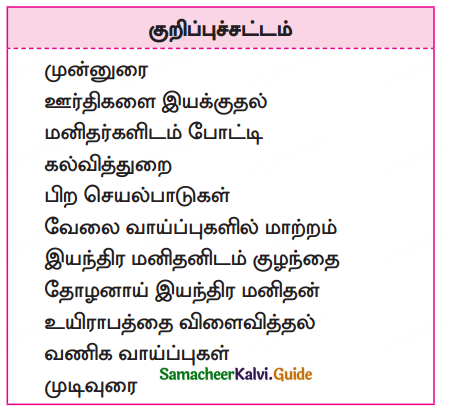
Answer:
இத்தொடர்களில் உள்ள வினைமுற்றுகளைத் தனியே எடுத்தெழுதித் தொழிற்பெயர்களாக மாற்றுக.

  • அழைக்கும் – அழைத்தல்
  • ஏறுவேன் – ஏறுதல்
  • அமர்வேன் – அமர்தல்
  • பார்ப்பேன் – பார்த்தல்
  • எய்தும் – எய்தல்

Samacheer Kalvi 10th Tamil Guide Chapter 1.5 எழுத்து சொல்

Question 5.
கட்டு, சொட்டு, வழிபாடு, கேடு, கோறல் – இத்தொழிற்பெயர்களை வகைப்படுத்துக.
Answer:
கட்டு : முதனிலைத் தொழிற்பெயர்
சொட்டு : முதனிலைத் தொழிற்பெயர்
வழிபாடு : விகுதி பெற்ற தொழிற்பெயர்
கேடு : முதனிலை திரிந்த தொழிற்பெயர்
கோறல் : விகுதி பெற்ற தொழிற்பெயர்

மொழியை ஆள்வோம்

படித்துச் சுவைக்க.

பாடலில், மரம் என்னும் சொல், இடத்திற்கேற்ப பொருள் தருவதாய் 11 இடங்களில் இடம்பெற்றுள்ளது. பொருள்களைப் பொருத்திப் படித்து சுவைக்க.
Samacheer Kalvi 10th Tamil Guide Chapter 1.5 எழுத்து சொல் - 11
Answer:
பாடலின் பொருள்:
“அரசன் குதிரையில் ஏறி
வேலைத் தோளில் வைத்து
அரசன் புலியைக் கண்டு
வேலினால் புலியைக் குத்தி
காட்டு வழியே சென்று
வளமனைக் கேட்கும் போது
அரசனைக் கண்ட மாதர்
ஆலமரமுடன் ஆரத்தி எடுத்தார்.”
Samacheer Kalvi 10th Tamil Guide Chapter 1.5 எழுத்து சொல் - 3

Samacheer Kalvi 10th Tamil Guide Chapter 1.5 எழுத்து சொல்

பாடநூல் வினாக்கள்

பலவுள் தெரிக

Question 1.
‘கேட்டவர் மகிழப் பாடிய பாடல் இது’ – தொடரில் இடம்பெற்றுள்ள தொழிற்பெயரும் வினையாலணையும் பெயரும் முறையே அ) பாடிய; கேட்டவர்
ஆ) பாடல்; பாடிய
இ) கேட்டவர்; பாடிய
ஈ) பாடல்; கேட்டவர்
Answer:
ஈ) பாடல்; கேட்டவர்

Samacheer Kalvi 10th Tamil Guide Chapter 1.5 எழுத்து சொல்

குறுவினா

Question 1.
‘வேங்கை’ என்பதைத் தொடர்மொழியாகவும், பொதுமொழியாகவும் வேறுபடுத்திக் காட்டுக.
Answer:
வேங்கை : வேங்கை என்னும் மரத்தைக் குறிக்கும் (தனிமொழி)
வேம் + கை : வேகின்ற கை எனவும் பொருள் தருகிறது (தொடர்மொழி)

Question 2.
“உடுப்பதூஉம் உண்பதூஉம் காணின் பிறர்மேல்
வடுக்காண் வற்றாகும் கீழ்”
– இக்குறளில் அமைந்துள்ள அளபெடையின் வகையைச் சுட்டி, அதன் இலக்கணம் தருக.
Answer:

  • உடுப்பதூஉம் உண்பதூஉம் : இன்னிசை அளபெடை வந்துள்ளது.
  • செய்யுளில் ஓசை குறையாத இடத்தும் இனிய ஓசைக்காக அளபெடுப்பது இன்னிசை அளபெடையாகும்.
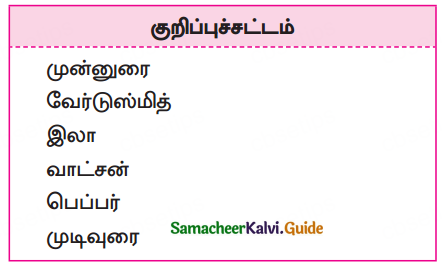
சிறுவினா

Question 1.
‘அறிந்தது, அறியாதது, புரிந்தது, புரியாதது, தெரிந்தது, தெரியாதது, பிறந்தது, பிறவாதது’
Answer:
இவை அனைத்தையும் யாம் அறிவோம். அதுபற்றி உமது அறிவுரை எமக்குத் தேவை இல்லை. எல்லாம் எமக்குத் தெரியும். இக்கூற்றில் வண்ண எழுத்துகளில் உள்ள வினைமுற்றுகளைத் தொழிற்பெயர்களாக மாற்றி எழுதுக.
Samacheer Kalvi 10th Tamil Guide Chapter 1.5 எழுத்து சொல் - 1

Samacheer Kalvi 10th Tamil Guide Chapter 1.5 எழுத்து சொல்

கூடுதல் வினாக்கள்

பலவுள் தெரிக

Question 1.
குறுக்கங்கள் எத்தனை வகைப்படும்?
அ) மூன்று
ஆ) நான்கு
இ) ஐந்து
ஈ) இரண்டு
Answer:
ஆ) நான்கு

Question 2.
எஃஃகிலங்கிய, உரனசைஇ – இச்சொற்களில் உள்ள அளபெடைகள்
அ) ஒற்றளபெடை, சொல்லிசை அளபெடை
ஆ) இன்னிசை அளபெடை, சொல்லிசை அளபெடை
இ) சொல்லிசை அளபெடை, ஒற்றளபெடை
ஈ) ஒற்றளபெடை, இன்னிசை அளபெடை
Answer:
அ) ஒற்றளபெடை, சொல்லிசை அளபெடை

Question 3.
ஒற்றளபெடையில் அளபெடுக்கும் ஒற்றெழுத்துகளின் எண்ணிக்கை எத்தனை?
அ) 11)
ஆ) 13
இ) 15
ஈ) 12
Answer:
அ) 11

Samacheer Kalvi 10th Tamil Guide Chapter 1.5 எழுத்து சொல்

Question 4.
பொருத்துக.
i) ஓ ஒதல் வேண்டும் – 1. இன்னிசை அளபெடை
ii) கெடுப்பதூஉம் 2. செய்யுளிசை அளபெடை
iii) உரனசைஇ – 3. ஒற்றளபெடை
iv) எஃஃகிலங்கிய – 4. சொல்லிசை அளபெடை
அ) i.2 ii.1 ili.4 iv.3
ஆ) i.4 ii.3 ili.2 iv.1
இ) i.2 ii.3 iii.4 iv.1
ஈ) ii.4 iii.1 iv.2
Answer:
அ) i.2 ii.1 iii.4 iv.3

Question 5.
வேறுபட்ட ஒன்றினைத் தேர்வு செய்க.
அ) உறாஅர்
ஆ) கெடுப்பதூஉம்
இ) வரனசைஇ
ஈ) எஃஃகிலங்கிய
Answer:
ஈ) எஃஃகிலங்கிய

Question 6.
பொருத்தமற்ற ஒன்றினைத் தேர்வு செய்க.
அ) ஓஒதல்
ஆ) உறாஅர்க்கு
இ) படாஅபறை
ஈ) தம்பீஇ
Answer:
ஈ) தம்பீஇ

Samacheer Kalvi 10th Tamil Guide Chapter 1.5 எழுத்து சொல்

Question 7.
பொதுமொழிக்குரிய சான்றினைத் தேர்வு செய்க.
அ) படி
ஆ) வேங்கை
இ) கண்ண ன்
ஈ) கண்ணன் வந்தான்
Answer:
ஆ) வேங்கை

Question 8.
எட்டு = எள் + து எனப் பிரிந்து தரும் பொருள்
அ) எட்டு
ஆ) எள்ளை உண்
இ) வேகின்ற கை
ஈ) எள்ளை எடு
Answer:
ஆ) எள்ளை உண்

Question 9.
பொருத்துக.
1. நடத்தல் – அ) எதிர்மறைத் தொழிற்பெயர்
2. கொல்லாமை – ஆ) வினையாலணையும் பெயர்
3. கேடு – இ) தொழிற்பெயர்
4. வந்தவர் – ஈ) முதனிலைத் திரிந்த தொழிற்பெயர்
அ) 1.ஆ 2.அ 3.ஈ 4.இ
ஆ) 1.இ 2.அ 3.ஈ. 4.ஆ
இ) 1.இ 2.ஆ 3.ஈ. 4.அ
ஈ) 1.இ 2.அ 3.ஆ 4.ஈ
Answer:
ஆ) 1.இ 2.அ 3.ஈ. 4.ஆ

Question 10.
எதிர்மறைத் தொழிற்பெயர் சான்றினைத் தேர்ந்தெடுக்க.
அ) கொல்லாமை
ஆ) வாழ்க்கை
இ) நடத்தல்
ஈ) சூடு
Answer:
அ) கொல்லாமை

Samacheer Kalvi 10th Tamil Guide Chapter 1.5 எழுத்து சொல்

Question 11.
மொழியின் சிறப்புகளை அறிய துணை செய்வது
அ) கவிதை
ஆ) இலக்கணம்
இ) உரைநடை
ஈ) எதுவுமில்லை
Answer:
ஆ) இலக்கணம்

Question 12.
சார்பெழுத்துகளின் எண்ணிக்கை
அ) முப்பது
ஆ) பன்னிரண்டு
இ) பத்து
ஈ) ஒன்பது
Answer:
இ) பத்து

Question 13.
உயிரளபெடை எத்தனை வகைப்படும்?
அ) இரண்டு
ஆ) மூன்று
இ) ஐந்து
ஈ) ஆறு
Answer:
ஆ) மூன்று

Samacheer Kalvi 10th Tamil Guide Chapter 1.5 எழுத்து சொல்

Question 14.
நெட்டெழுத்து அளபெடுப்பது என்பது என்ன?
அ) செய்யுளிசை அளபெடை
ஆ) இன்னிசை அளபெடை
இ) சொல்லிசை அளபெடை
ஈ) எதுவுமில்லை
Answer:
அ) செய்யுளிசை அளபெடை

Question 15.
சொல் திரிந்து அளபெடுப்பது என்பது யாது?
அ) செய்யுளிசை அளபெடை
ஆ) சொல்லிசை அளபெடை
இ) இன்னிசை அளபெடை
ஈ) எதுவுமில்லை
Answer:
ஆ) சொல்லிசை அளபெடை

Question 16.
மொழி என்பது எத்தனை வகை?
அ) இரண்டு
ஆ) மூன்று
இ) ஐந்து
ஈ) ஆறு
Answer:
ஆ) மூன்று

Samacheer Kalvi 10th Tamil Guide Chapter 1.5 எழுத்து சொல்

Question 17.
“அந்தமான்” என்பது எவ்வகை மொழி?
அ) தொடர் மொழி
ஆ) தனி மொழி
இ) பொது மொழி
ஈ) எதுவுமில்லை
Answer:
இ) பொது மொழி

Question 18.
பொருத்திக் காட்டுக.
1. அந்தமான் – அ) தொடர்மொழி
2. கண் – ஆ) தொழிற்பெயர்
3. நடத்தை – இ) பொதுமொழி
4. கண்ணன் வந்தான் – ஈ) தனிமொழி
அ) 1.ஆ 2.ஈ 3.அ 4.இ
ஆ) 1.ஈ 2.அ 3.ஆ 4.இ
இ) 1.இ 2.ஈ 3.ஆ 4.அ
ஈ) 1.இ 2.ஆ 3.ஈ 4.அ
Answer:
இ) 1.இ 2.ஈ 3.ஆ 4.அ

Question 19.
உறாஅர்க்கு, வரனசைஇ – அளபெடை வகை
அ) சொல்லிசை, இன்னிசை
ஆ) ஒற்றளபெடை, சொல்லிசை
இ) செய்யுளிசை, சொல்லிசை
ஈ) இன்னிசை, சொல்லிசை
Answer:
இ) செய்யுளிசை, சொல்லிசை

Samacheer Kalvi 10th Tamil Guide Chapter 1.5 எழுத்து சொல்

Question 20.
தொழிலைச் செய்யும் கருத்தாவைக் குறிப்பது
அ) தொழிற்பெயர்
ஆ) முதனிலை திரிந்த தொழிற்பெயர்
இ) முதனிலைத் தொழிற்பெயர்
ஈ) வினையாலணையும் பெயர்
Answer:
ஈ) வினையாலணையும் பெயர்]

Question 21.
மூவிடத்திற்கும் உரியது ………….; படர்க்கைக்கே உரியது ………….
அ) தொழிற்பெயர், வினையாலணையும் பெயர்
ஆ) வினையாலணையும் பெயர், தொழிற்பெயர்
இ) உரிச்சொற்றொடர், வினையாலணையும் பெயர்
ஈ) இவற்றில் எதுவுமில்லை
Answer:
ஆ) வினையாலணையும் பெயர், தொழிற்பெயர்

Question 22.
‘நடத்தல்’ என்னும் சொல்லில் ‘நட’ என்பது
அ) வினையடி
ஆ) விகுதி
இ) தொழிற்பெயர்
ஈ) இடைநிலை
Answer:
அ) வினையடி

Samacheer Kalvi 10th Tamil Guide Chapter 1.5 எழுத்து சொல்

Question 23.
‘வேம் + கை’ என்பதன் பொருள்
அ) வேட்கை
ஆ) வேங்கை
இ) வேகின்ற கை
ஈ) வேகாத கை
Answer:
ஈ) வேகாத கை

Question 24.
‘வாழ்க்கை ‘ என்னும் சொல்லுக்குரிய விகுதியைக் குறிப்பிடுக.
அ) வாழ்
ஆ) க்
இ) கை
ஈ) ஐ
Answer:
இ) கை

Question 25.
அளபெடுத்தல் என்பதன் பொருள்
அ) நீண்டு ஒலித்தல்
ஆ) குறுகி ஒலித்தல்
இ) அளவாக ஒலித்தல்
ஈ) ஒலித்தல் இல்லை
Answer:
அ) நீண்டு ஒலித்தல்

Samacheer Kalvi 10th Tamil Guide Chapter 1.5 எழுத்து சொல்

Question 26.
‘நசைஇ’ என்பதன் பொருள்
அ) விருப்பம்
ஆ) விரும்பி
இ) துன்பம்
ஈ) கவனித்து
Answer:
ஆ) விரும்பி

குறுவினா

Question 1.
சார்பெழுத்துகள் எத்தனை வகைப்படும்? அவை யாவை?
Answer:
சார்பெழுத்துகள் பத்து வகைப்படும். அவை:

  • உயிர்மெய்
  • ஆய்தம்
  • உயிரளபெடை
  • ஒற்றளபெடை
  • குற்றியலுகரம்
  • ஆய்தக் குறுக்கம்
  • ஐகாரக்குறுக்கம்
  • ஒளகாரக்குறுக்கம்
  • மகரக்குறுக்கம்
  • குற்றியலிகரம்

Question 2.
குறுக்கங்கள் எத்தனை வகைப்படும்?
Answer:
குறுக்கங்கள் நான்கு வகைப்படும். அவை:

  • ஐகாரக்குறுக்கம்
  • மகரக்குறுக்கம்
  • ஔகாரக் குறுக்கம்
  • ஆய்தக் குறுக்கம்

Samacheer Kalvi 10th Tamil Guide Chapter 1.5 எழுத்து சொல்

Question 3.
அளபெடை எத்தனை வகைப்படும்? அவை யாவை?
Answer:
அளபெடை இரண்டு வகைப்படும். அவை: உயிரளபெடை, ஒற்றளபெடை.

Question 4.
உயிரளபெடை எத்தனை வகைப்படும்? அவை யாவை?
Answer:
உயிரளபெடை மூன்று வகைப்படும்.
அவை: செய்யுளிசை அளபெடை, இன்னிசை அளபெடை, சொல்லிசை அளபெடை.

Question 5.
உயிரளபெடை என்றால் என்ன? சான்று தருக.
Answer:

  • செய்யுளில் ஓசை குறையும் போது அந்த ஓசையை நிறைவு செய்ய உயிர் நெடில் எழுத்துகள் ஏழும் அளபெடுக்கும்.
  • அளபெடுக்கும் போது அவற்றுக்கு இனமான குறில் எழுத்துகள் பக்கத்தில் வரும்.
  • சான்று: உழாஅர்.

Question 6.
செய்யுளிசை அளபெடை / இசைநிறை அளபெடை என்றால் என்ன? சான்று தருக.
Answer:

  • செய்யுளின் ஓசை குறையும் போது அதனை நிறைவு செய்ய நெட்டெழுத்துகள் அளபெடுக்கும். (ஈரசை கொண்ட சீர்களில் மட்டும் வரும்)
  • சான்று: உழாஅர் (உழா/அர்)

Question 7.
செய்யுளிசை அளபெடைக்கு மூன்று சான்று தருக.
Answer:

  • ஓஒதல் வேண்டும் – மொழி முதல்
  • உறாஅர்க்கு உறுநோய் – மொழி இடை
  • நல்ல படாஅ பறை – மொழி இறுதி

Samacheer Kalvi 10th Tamil Guide Chapter 1.5 எழுத்து சொல்

Question 8.
இன்னிசை அளபெடை என்றால் என்ன? சான்று தருக.
Answer:

  • செய்யுளில் ஓசை குறையாத இடத்திலும் இனிய ஓசைக்காக அளபெடுப்பது இன்னிசை அளபெடை எனப்படும்.
  • சான்று: கெடுப்பதூஉம் (கெடுப்/பதூ/உம்)
    (மூவசை கொண்ட சீர்களில் மட்டும் வரும் )

Question 9.
சொல்லிசை அளபெடை என்றால் என்ன? சான்று தருக.
Answer:

  • செய்யுளில் ஒரு பெயர்ச்சொல் எச்சச்சொல்லாகத் திரிந்து அளபெடுப்பது சொல்லிசையளபெடை ஆகும்.
  • சான்று: வரனசைஇ, உரனசைஇ.

Question 10.
ஒற்றளபெடை என்றால் என்ன? சான்று தருக.
Answer:

  • செய்யுளில் ஓசை குறையும் போது அதனை நிறைவு செய்ய சில மெய்யெழுத்துகளும், ஆய்த எழுத்தும் அளபெடுப்பது ஒற்றளபெடையாகும்.
  • சான்று: எஃஃகிலங்கிய, எங்ங்கிறைவன்.

Question 11.
ஒற்றளபெடையில் அளபெடுக்கும் மெய்யெழுத்துகள் மற்றும் ஆய்த எழுத்து ஆகியவற்றை எழுதுக.
Answer:

  • மெய் எழுத்துகள் – ங், ஞ், ண், ந், ம், ன், வ், ய், ல், ள் (பத்து)
  • ஆய்த எழுத்து – ஃ (ஒன்று)
  • மொத்த எழுத்துகள் – 11

Samacheer Kalvi 10th Tamil Guide Chapter 1.5 எழுத்து சொல்

Question 12.
சொல் என்றால் என்ன?
Answer:
ஓர் எழுத்து தனித்தோ, பல எழுத்துகள் சேர்ந்தோ பொருள் தருமாயின் அது சொல் எனப்படும்.
(சொல்லின் வேறுபெயர்கள் – பதம், மொழி, கிளவி)

Question 13.
மொழி எத்தனை வகைப்படும்? அவை யாவை?
Answer:
மொழி மூன்று வகைப்படும்.
அவை: தனிமொழி, தொடர்மொழி, பொதுமொழி.

Question 14.
தனிமொழி என்றால் என்ன? சான்று தருக.
Answer:

  • ஒரு சொல் தனித்து நின்று பொருள் தருவது தனிமொழி எனப்படும்.
  • சான்று: கண், படி.

Question 15.
தொடர்மொழி என்றால் என்ன? சான்று தருக.
Answer:

  • இரண்டு அல்லது அதற்கு மேற்பட்ட தனிமொழிகள் தொடர்ந்து வந்து பொருள் தருவது தொடர்மொழி ஆகும்.
  • சான்று: கண்ணன் வந்தான்.

Question 16.
பொதுமொழி என்றால் என்ன? சான்று தருக.
Answer:

  • ஒரு சொல் தனித்து நின்று ஒரு பொருளையும் அச்சொல்லே பிரிந்து நின்று வேறு பொருளையும் தருவது பொதுமொழி ஆகும்.
  • தனிமொழிக்கும் தொடர்மொழிக்கும் பொதுவாய் அமையும்.
  • சான்று: எட்டு.
    எட்டு – எண்ணைக் குறிக்கிறது. எள் + து – எள்ளை உண்.

Samacheer Kalvi 10th Tamil Guide Chapter 1.5 எழுத்து சொல்

Question 17.
தொழிற்பெயர் என்றால் என்ன? சான்று தருக.
Answer:

  • ஒரு வினை அல்லது செயலைக் குறிக்கும் பெயரானது எண், இடம், பால், காலம் ஆகியவற்றைக் குறிப்பாகவோ வெளிப்படையாகவோ உணர்த்தாமல் வருவது தொழிற்பெயர் எனப்படும்.
  • எ.கா: ஈதல், வாழ்க்கை .

Question 18.
விகுதி பெற்ற தொழிற்பெயர் என்றால் என்ன? சான்று தருக.
Answer:

  • வினையடியுடன் விகுதி சேர்வதால் உருவாகும் தொழிற்பெயர் விகுதி பெற்ற தொழிற்பெயர் ஆகும்.
  • சான்று: நடத்தல். நட – வினையடி, தல் – விகுதி.

Question 19.
எதிர்மறைத் தொழிற்பெயர் என்றால் என்ன? சான்று தருக.
Answer:

  • எதிர்மறைப் பொருளில் வருவது எதிர்மறைத் தொழிற்பெயர் எனப்படும்.
  • சான்று: நடவாமை, கொல்லாமை.

Question 20.
தொழிற்பெயர் எத்தனை வகைப்படும்? அவை யாவை?
Answer:
தொழிற்பெயர் இரண்டு வகைப்படும். அவை:

  • முதனிலைத் தொழிற்பெயர்
  • முதனிலை திரிந்த தொழிற்பெயர்

Question 21.
முதனிலைத் தொழிற்பெயர் என்றால் என்ன? சான்று தருக.
Answer:

  • விகுதி பெறாமல் வினைப் பகுதியே தொழிற்பெயராதல் முதனிலைத் தொழிற் பெயராகும்.
  • சான்று: தட்டு, உரை, அடி.
  • இச்சொற்கள் முறையே தட்டுதல், உரைத்தல், அடித்தல் என்று பொருள்படும் போது முதனிலைத் தொழிற்பெயர்களாகின்றன.

Samacheer Kalvi 10th Tamil Guide Chapter 1.5 எழுத்து சொல்

Question 22.
முதனிலை திரிந்த தொழிற்பெயர் என்றால் என்ன? சான்று தருக.
Answer:

  • முதனிலை திரிந்த தொழிற்பெயர் என்பது விகுதி பெறாமல் முதனிலை திரிந்து வருவது. முதனிலை திரிந்த தொழிற்பெயராகும்.
  • சான்று: கெடு – கேடு, சுடு – சூடு.
    கேடு, சூடு (கெடு, சுடு என்னும் முதனிலைகள் கேடு, சூடு எனத் திரிந்து வந்துள்ளது)

Question 23.
வினையாலணையும் பெயர் என்றால் என்ன? சான்று தருக.
Answer:

  • வினையைக் குறிக்காமல் வினை செய்தவரைக் குறிக்கும்.
  • ஒரு வினைமுற்று பெயரின் தன்மையை அடைந்து வேற்றுமை உருபு ஏற்றும் ஏற்காமலும் வேறொரு பயனிலையைக் கொண்டு முடியும்.
  • தன்மை, முன்னிலை, படர்க்கை ஆகிய மூவிடங்களிலும் வரும்.
  • மூன்று காலங்களிலும் வரும்.
  • சான்று: வந்தவர்.

Samacheer Kalvi 10th Tamil Guide Chapter 1.5 எழுத்து சொல்

Question 24.
தொழிற்பெயருக்கும் வினையாலணையும் பெயருக்கும் உள்ள வேறுபாடுகளைக் கூறு.
Answer:
Samacheer Kalvi 10th Tamil Guide Chapter 1.5 எழுத்து சொல் - 2

சிறுவினா

Question 1.
மொழியின் வகைகளை எடுத்துக்காட்டுடன் விளக்குக.
Answer:
மொழிவகைகள்:
மூன்று வகைப்படும்.
அவை: தனிமொழி, தொடர்மொழி, பொதுமொழி என்பன.

தனிமொழி:

  • ஒரு சொல் தனித்து நின்று பொருள் தருவது தனிமொழி எனப்படும்.
  • எ.கா: கண், மரம்.

தொடர்மொழி:

  • இரண்டு அல்லது அதற்கு மேற்பட்ட தனிமொழிகள் தொடர்ந்து வந்து பொருள் தருவது தொடர்மொழி ஆகும்.
  • எ.கா: கண்ண ன் வந்தான்.

Samacheer Kalvi 10th Tamil Guide Chapter 1.5 எழுத்து சொல்

பொதுமொழி:

  • ஒரு சொல் தனித்து நின்று ஒரு பொருளையும் அச்சொல்லே பிரிந்து நின்று வேறு பொருளையும் ! தருவது பொதுமொழி ஆகும்.
  • தனிமொழிக்கும் தொடர்மொழிக்கும் பொதுவாய் அமையும்.
  • சான்று: எட்டு
    எட்டு – எண்ணைக் குறிக்கிறது. எள் + து – எள்ளை உண்.

Question 2.
சொல்லின் செயல்களைக் குறிப்பிடுக.
Answer:

  • இரு திணைகளையும் ஐந்து பால்களையும் குறிக்கும்.
  • மூவகை இடங்களிலும் வரும்.
  • உலக வழக்கிலும் செய்யுள் வழக்கிலும் வரும்.
  • வெளிப்படையாகவும் குறிப்பாகவும் விளங்கும்.

மொழிபெயர்ப்பு:

Question 1.
If you talk to a man in a language he understands, that goes to his head. If you talk to him in his own
language that goes to his heart. – Nelson Mandela
Answer:
நீங்கள் ஒரு மனிதனிடம் ஏதாவது ஒரு மொழியில் பேசினால் அதை அவன் புரிந்து கொண்டு அவன் மூளைக்குச் செல்கிறது. ஆனால் அவனுடைய மொழியில் பேசினால் அது அவன் நெஞ்சத்தைத்
தொடும். – நெல்சன் மண்டேலா

Question 2.
Language is the road map of a culture. It tells you where its people come from and where they are going. Rita Mae Brown
Answer:
மொழியே கலாச்சாரத்தின் வழிகாட்டி. அதுவே மக்கள் எங்கிருந்து வந்தார்கள் மற்றும் எங்குப் போகிறார்கள் என்பதைச் சொல்லும். – ரிட்டா மே பிரவுண்

சந்தக் கவிதையில் வந்த பிழைகளைத் திருத்துக.

“தேணிலே ஊரிய செந்தமிழின் – சுவை
தேரும் சிலப்பதி காறமதை
ஊனிலே எம்முயிர் உல்லலவும் – நிதம்
ஓதி யுனர்ந்தின் புருவோமே” – கவிமணி தேசிக விநாயகனார்.
Answer:

திருத்தம்:

“தேனிலே ஊறிய செந்தமிழின் – சுவை
தேறும் சிலப்பதி காமதை
ஊனிலே எம்முயிர் உள்ளளவும் – நிதம்
ஓதி யுர்ந்தின் புறுவோமே”

Samacheer Kalvi 10th Tamil Guide Chapter 1.5 எழுத்து சொல்

கீழ்க்காணும் சொற்களின் கூட்டப்பெயர்களைக் கண்டுபிடித்து எழுதுக.
(குவியல், குலை, மந்தை, கட்டு)
Answer:

  • கல் – குவியல் (கற்குவியல்)
  • பழம் – குலை (பழக்குலை)
  • புல் – கட்டு (புற்கட்டு)
  • ஆடு – மந்தை (ஆட்டுமந்தை)

வினைமுற்றை வினையாலணையும் பெயராக மாற்றித் தொடர்களை இணைத்து எழுதுக.

Question 1.
கலையரங்கத்தில் எனக்காகக் காத்திருக்கிறார். அவரை அழைத்து வாருங்கள்.
Answer:
எ.கா: கலையரங்கத்தில் எனக்காகக் காத்திருக்கிறவரை அழைத்து வாருங்கள்.

Question 2.
ஊட்டமிகு உணவு உண்டார். அவர் நீண்ட வாழ்நாள் பெற்றார்.
Answer:
ஊட்டமிகு உணவு உண்டவர் நீண்ட வாழ்நாள் பெற்றார்.

Question 3.
நேற்று என்னைச் சந்தித்தார். அவர் என் நண்பர்.
Answer:
நேற்று என்னைச் சந்தித்தவர் என் நண்பர்.

Samacheer Kalvi 10th Tamil Guide Chapter 1.5 எழுத்து சொல்

Question 4.
பொது அறிவு நூல்களைத் தேடிப் படித்தார். போட்டித் தேர்வில் வென்றார்.
Answer:
பொது அறிவு நூல்களைத் தேடிப் படித்தவர் போட்டித் தேர்வில் வென்றார்.

தொடர்களில் உள்ள வண்ணச் சொற்களுக்குப் பதிலாக அதே பொருளுடைய வேறு சொற்களைப் பயன்படுத்தி தொடர்களை மீள எழுதுக.

Question 1.
உலகில் வாழும் மக்களில் சிலர் கனியிருக்கக் காய் புசித்தலைப்போல, இன்சொல் இருக்க வன்சொல் பேசி இன்னற்படுகின்றனர்.
Answer:
புவியில் வாழும் மானுடர்கள் சிலர் பழமிருக்கக் காய் உண்பதைப்போல இன்சொல் இருக்க வன்சொல் பேசி துன்பப்படுகின்றனர்.

Quesiton 2.
வள்ளல் குமணன் வறுமையால் வாடிவந்த புலவனுக்குத் தனது தலையைக் கொடுத்து மங்காப் புகழ் பெற்றான்.
Answer:
வள்ளல் குமணன் துன்பத்தால் வாடிவந்த அறிஞர்களுக்குத் தனது தலையை ஈந்து மங்காப் பெருமை பெற்றான்.

Question 3.
நளனும் அவனது துணைவியும் நிடதநாட்டுக்கு வந்ததைக் கண்டு, அந்நாட்டு மக்கள் மழைமுகில் கண்ட மஞ்ஞை போலக் களி கொண்டனர்.
Answer:
நளனும் அவனது மனைவியும் நிடதநாட்டுக்கு வந்ததைக் கண்டு, அந்நாட்டு மக்கள் மழைமேகம் கண்ட மயிலைப் போல மகிழ்ச்சி கொண்டனர்.

Samacheer Kalvi 10th Tamil Guide Chapter 1.5 எழுத்து சொல்

Question 4.
சோலையிற் பூத்த மணமலர்களில் சுரும்புகள் மொய்த்துப் பண்பாடி மதுவுண்டன.
Answer:
நந்தவனத்தில் பூத்த மணமலர்களில் வண்டுகள் மொய்த்துப் பண்பாடி தேனை உண்டன.

Question 5.
பசுப்போல் சாந்தமும் புலிபோல் தீரமும் யானை போல உழைப்பும் மனிதனுக்கு வேண்டும்.
Answer:
ஆப்போல் அமைதியும் வேங்கை போல் வீரமும் களிறு போல உழைப்பும் மனிதனுக்கு வேண்டும்.

கட்டுரை எழுதுக.

குமரிக் கடல்முனையையும் வேங்கட மலைமுகட்டையும் எல்லையாகக் கொண்ட தென்னவர் திருநாட்டிற்குப் புகழ் தேடித்தந்த பெருமை, தகைசால் தமிழன்னையைச் சாரும். எழில்சேர் கன்னியாய் என்றும் திகழும் அவ்வன்னைக்கு, பிள்ளைத் தமிழ் பேசி, சதகம் சமைத்து, பரணி பாடி, கலம்பகம் கண்டு, உலாவந்து, அந்தாதி கூறி, கோவை யாத்து, அணியாகப் பூட்டி அழகூட்டி அகம்மிக மகிழ்ந்தனர் செந்நாப் புலவர்கள்.

இக்கருத்தைக் கருவாகக் கொண்டு ‘சான்றோர் வளர்த்த தமிழ்’ என்னும் தலைப்பில் கட்டுரை எழுதுக.
Answer:
Samacheer Kalvi 10th Tamil Guide Chapter 1.5 எழுத்து சொல் - 4
Samacheer Kalvi 10th Tamil Guide Chapter 1.5 எழுத்து சொல் - 5
உலகில் மனித இனம் என்று தோன்றியதோ, அன்றே தமிழ் மொழியும் தோன்றியது. அன்று முதல் இன்று வரை தமிழ்மொழி இளமையாகவே இருந்துவருகின்றது. ஒவ்வொரு காலக்கட்டத்திலும் வாழ்ந்த சான்றோர்களால் தமிழ் சிறப்புற்று நிற்கின்றது.

சங்கத்தமிழ்:

‘தமிழ்’ என்ற சொல் தொல்காப்பியப் பாயிரத்தில் இடம்பெறுகின்றது. கிபி. 2 ஆம் நூற்றாண்டிற்கு முன் தோன்றிய இலக்கியங்கள் சங்க இலக்கியங்கள் ஆகும். அவையே சங்கத்தமிழ் தரும் களஞ்சியம் ஆகும். கபிலர், பரணர், ஒளவையார், நக்கீரர், நல்லந்துவனார் முதலிய எண்ண ற்றத் தமிழ்ச் சான்றோர்களால் பாட்டும் தொகையும் உருவாக்கப்பட்டு சங்கத்தமிழ் வளர்க்கப்பட்டது.

அறத்தமிழ்:

சங்ககாலத்திற்குப் பின் தோன்றிய காலத்தில் பொய்யும் குற்றமும் தோன்ற ஆரம்பித்தது. அதனைப் போக்க திருவள்ளுவர், சமண முனிவர்கள், விளம்பிநாகனார், கபிலர், கணிமேதாவியார் ஆகிய பல சான்றோர் பெருமக்கள் அறநூல்களைப் படைத்து, அறத்தமிழை வளர்த்தனர்.

Samacheer Kalvi 10th Tamil Guide Chapter 1.5 எழுத்து சொல்

காப்பியத்தமிழ்:

ஐம்பெருங்காப்பியங்களும், ஐஞ்சிறுகாப்பியங்களும் காப்பியத் தமிழை வளர்த்தன. இளங்கோவடிகள், சீத்தலைச்சாத்தனார், திருத்தக்கத்தேவர் ஆகிய சான்றோர்கள் காப்பியத் தமிழைத் தழைக்கச் செய்தனர்.

சிற்றிலக்கியம்:

(பரணி, சதகம், பிள்ளைத்தமிழ்) சிற்றிலக்கியங்கள் 96 வகைப்படும். அவை வழி சிற்றிலக்கிய வகைகள் பெருகி சிற்றிலக்கியத் தமிழை வளர்த்தனர். ஒருவரைக் குழந்தையாகப் பாவித்து, 10 பருவங்களில் வளாச்சி நிலையைப் பாடுவது பிள்ளைத்தமிழ் ஆகும். ஒட்டக்கூத்தர், குமரகுருபரர் ஆகியோர் பிள்ளைத்தமிழ் பாடி வளர்த்தனர். சதகம் (100) பாடல்களைக் கொண்டது சதகம். ஆத்மநாத தேசிகர், கார்மேகக் கவிஞர் ஆகியோர் சதகம் பாடினார். ஒட்டக்கூத்தர், செயங்கொண்டார் பரணி இலக்கியத்தை வளர்த்தனர்.

சமயத்தமிழ்:

சைவம், வைணவம், கிறித்தவம், இஸ்லாம், சமணம், பௌத்தம் ஆகியசமயங்களும் தமிழ்வளர்க்கும் பணியில் ஈடுபட்டு சமயத்தமிழை வளர்த்தனர். திருநாவுக்கரசர், வீரமாமுனிவர், உமறுப்புலவர் ஆகியோர் சமயத்தமிழை வளர்த்தனர். இதற்கு பன்னிரு திருமுறைகள், நாலாயிரத்திவ்வியப் பிரபந்தம், சீறாப்புராணம், தேம்பாவணி சான்றாகும்.

Samacheer Kalvi 10th Tamil Guide Chapter 1.5 எழுத்து சொல்

முடிவுரை:

காலந்தோறும் தமிழ், தன்னை வளர்ப்பவர்களால் தன்னைப் புதுப்பித்துக் கொண்டு வளர்ந்தும் சிறந்தும் வருகின்றது என்பதை இலக்கிய வரலாறுகள் நமக்கு உணர்த்துகின்றன.
Samacheer Kalvi 10th Tamil Guide Chapter 1.5 எழுத்து சொல் - 6

நயம் பாராட்டுக.

தேனினும் இனியநற் செந்தமிழ் மொழியே
தென்னாடு விளங்குறத் திகழுந்தென் மொழியே
ஊனினும் ஒளிர்வுறும் ஒண்டமிழ் மொழியே
உணர்வினுக் குணர்வதாய் ஒளிர்தமிழ் மொழியே
வானினும் ஓங்கிய வண்டமிழ் மொழியே
மாந்தருக் கிருகணா வயங்குநன் மொழியே
தானனி சிறப்புறுந் தனித்தமிழ் மொழியே
தழைத்தினி தோங்குவாய் தண்டமிழ் மொழியே – கா. நமச்சிவாயர்

Samacheer Kalvi 10th Tamil Guide Chapter 1.5 எழுத்து சொல்

திரண்ட கருத்து:

‘வாழைக்கு அழகு குருத்து
செய்யுளுக்கு அழகு திரண்ட கருத்து’

“தேனினும் இனிமையான செம்மை பெற்ற மொழி தமிழ் மொழி. தென்னாட்டில் சிறந்து விளங்குகின்ற மொழி தமிழ்மொழி. ஒளி வீசி அறிவும், செறிவும் நுட்பமும் கொண்ட மொழி தமிழ்மொழி உணர்வோடு உணர்வான மொழி, வானினும் உயர்ந்த வளம்மிக்க மொழி தமிழ். தழைத்து ஓங்குவாய் குளிர்ச்சி தங்கிய தமிழ் மொழியே” என தமிழ்மொழியைச் சிறப்பித்துக் கூறியுள்ளார் க. நமச்சிவாயர்.

தொடை நயம்:

‘தொடையற்ற பாட்டு
நடையற்றுப் போகும்’

செய்யுளானது எதுகை, மோனை, இயைபு, முரண் முதலியவற்றால் தொகுக்கப்படுவது தொடை எனப்படும். இப்பாடலில் தொடை நயங்கள் சிறப்பாகக் கையாளப்பட்டுள்ளன.

‘மோனை நயம்:

‘மோனையற்ற பாட்டு
சேனையற்ற நாடு’

செய்யுளில் அடிதோறும் அல்லது சீர்தோறும் முதலாம் எழுத்து ஒன்றிவரத் தொடுப்பது மோனைத் தொடை.
ஒண்டமிழ், ஒளிர்தமிழ், ஒளிர்வுறும்,
தனித்தமிழ், தண்டமிழ் ஆகிய மோனைச் சொற்கள் பாடலில் சிறப்பாக அமைந்துள்ளது.

எதுகை நயம்:

‘வீரத்துக்கு அழகு வேங்கை
செய்யுளுக்கு அழகு எதுகை’

செய்யுளில் அடிதோறும் அல்லது சீர்தோறும் இரண்டாம் எழுத்து ஒன்றி வரத் தொடுப்பது எதுகைத் தொடை.
தேனினும், ஊனினும், வானினும் ஆகிய எதுகைச் சொற்கள் பாடலில் சிறப்பாக அமைந்துள்ளது.

Samacheer Kalvi 10th Tamil Guide Chapter 1.5 எழுத்து சொல்

இயைபு நயம்:

‘பாடலின் இயைபு
படிப்போர்க்கு வியப்பு’

செய்யுளில் கடைசி எழுத்தோ சீரோ அசையோ ஒன்றிவரத் தொடுப்பது இயைபுத் தொடை ஆகும். ‘மொழியே’ என்னும் சொல் அடிதோறும் வந்து இயைபாக அமைந்துள்ளது. அடிதோறும் மூன்றாம் சீரில் செந்தமிழ், ஒண்டமிழ், ஒளிர்தமிழ், வண்டமிழ், தனித்தமிழ், தண்டமிழ் என்னும் சொற்கள் வந்து பாடலுக்கு இயைபாக அமைந்துள்ளன.

அணி நயம்:

‘கோவிலுக்கு அழகு மணி
செய்யுளுக்கு அழகு அணி’

இப்பாடலில் ‘மொழி’ என்ற சொல் ஒரே பொருளில் பலமுறை வந்து சொற்பொருட் பின்வரு நிலையணியைக் கொண்டுள்ளது.
பாவகை : எண்சீர் கழிநெடிலடி ஆசிரிய விருத்தம்.

மொழியோடு விளையாடு

சொற்களை இணைத்துப் புதிய சொற்களை உருவாக்குக.

தேன் , விளக்கு, மழை, விண், மணி, விலங்கு, செய், மேகலை, வான், பொன், பூ. எ.கா: பூமணி
Answer:
புதிய சொற்கள்:
Samacheer Kalvi 10th Tamil Guide Chapter 1.5 எழுத்து சொல் - 7

குறிப்புகளைக் கொண்டு வினாவிலேயே விடை இருப்பது போன்று வினாத்தொடர்கள் அமைக்க.

குறளின்பம், சுவைக்காத இளநீர், காப்பியச் சுவை, மனிதகுல மேன்மை, விடுமுறைநாள்
Answer:
எ.கா: குறளின்பத்தில் திளைக்காத தமிழன் உண்டா ?
சுவைக்காத இளநீர் : மன்னன் சுவைக்காத இளநீர் உண்டோ ?
காப்பியச் சுவை : கம்பர் காலத்தில் காப்பியச் சுவை உச்சநிலையில் இருந்ததோ?
மனிதகுல மேன்மை : இந்நூற்றாண்டில் மனிதகுல மேன்மை சிறப்புற்று விளங்குகிறதோ?
விடுமுறைநாள் : தேரோட்டம் அன்று விடுமுறை நாள் என அறிவிக்கப்படுமா?

எண்ணுப்பெயர்களைக் கண்டு, தமிழ் எண்களில் எழுதுக.
Samacheer Kalvi 10th Tamil Guide Chapter 1.5 எழுத்து சொல் - 12
Answer:
Samacheer Kalvi 10th Tamil Guide Chapter 1.5 எழுத்து சொல் - 8

அகராதியில் காண்க.
அடவி, அவல், சுவல், செறு, பழனம், புறவு.
Answer:
அடவி – காடு, திரள், தொகுதி, சோலை
அவல் – பள்ளம், விளைநிலம், குளம், நெல் இடியல்
சுவல் – பிடரி, முதுகு, மேடு, தொல்லை
செறு – வயல், குளம், பாத்தி, கோபம்
பழனம் – வயல், மருதநிலம், பொய்கை
புறவு – புறா, சிறுகாடு, முல்லைக்கொடி, பயிரிடும் நிலம்

Samacheer Kalvi 10th Tamil Guide Chapter 1.5 எழுத்து சொல்

காட்சியைக் கண்டு கவினுற எழுதுக.

Samacheer Kalvi 10th Tamil Guide Chapter 1.5 எழுத்து சொல் - 13
Answer:
Samacheer Kalvi 10th Tamil Guide Chapter 1.5 எழுத்து சொல் - 9

நிற்க அதற்குத் தக

Samacheer Kalvi 10th Tamil Guide Chapter 1.5 எழுத்து சொல் - 10

Samacheer Kalvi 10th Tamil Guide Chapter 1.5 எழுத்து சொல்

இதில் நீங்கள் செல்லும் வழி யாது? உங்கள் நண்பருக்குக் காட்டும் வழி யாது?
…………………………………………………………………………………………………………………………………………………………………..
…………………………………………………………………………………………………………………………………………………………………..
…………………………………………………………………………………………………………………………………………………………………..
Answer:
நாங்கள் இன்சொல் வழியையே பின்பற்றுவோம். எங்கள் நண்பருக்கும் அவ்வழியையே காட்டி அவர்களையும் அவ்வழியின் படி நடக்கச் செய்வோம்.

கலைச்சொல் அறிவோம்

  • Vowel – உயிரெழுத்து
  • Consonant – மெய்யெழுத்து
  • Homograph – ஒப்பெழுத்து
  • Monolingual – ஒரு மொழி
  • Conversation – உரையாடல்
  • Discussion – கலந்துரையாடல்

Tamil Nadu 11th Accountancy Model Question Paper 5 English Medium

Students can Download Tamil Nadu 11th Accountancy Model Question Paper 5 English Medium Pdf, Tamil Nadu 11th Accountancy Model Question Papers helps you to revise the complete Tamilnadu State Board New Syllabus, helps students complete homework assignments and to score high marks in board exams.

TN State Board 11th Accountancy Model Question Paper 5 English Medium

General Instructions:

  1. The question paper comprises of four parts.
  2. You are to attempt all the parts. An internal choice of questions is provided wherever applicable.
  3. All questions of Part I, II, III and IV are to be attempted separately.
  4. Question numbers 1 to 20 in Part I are Multiple Choice Questions of one mark each.
    These are to be answered by choosing the most suitable answer from the given four alternatives and writing the option code and the corresponding answer
  5. Question numbers 21 to 30 in Part II are two-mark questions. These are to be answered in about one or two sentences.
  6. Question numbers 31 to 40 in Part III are three-mark questions. These are to be answered in above three to five short sentences.
  7. Question numbers 41 to 47 in Part IV are five-mark questions. These are to be answered in detail Draw diagrams wherever necessary.

Time: 3:00 Hours
Maximum Marks: 90

PART – I

Answer all the questions. Choose the correct answer: [20 × 1 = 20]

Question 1.
Two or more business units forming a single entity is known as ……………………….
(a) Joint
(b) Merger
(c) Link
(d) Compound
Answer:
(b) Merger

Tamil Nadu 11th Accountancy Model Question Paper 5 English Medium

Question 2.
……………………… is irrecoverable debts.
(a) Debtors
(b) Creditors
(c) Bad debts
(d) Loan
Answer:
(c) Bad debts

Question 3.
The word convention refers ………………………
(a) Traditions
(b) Trade
(c) Business
(d) Accounting
Answer:
(a) Traditions

Question 4.
Outsider’s equity is otherwise called as ………………………
(a) Capital
(b) Liabilities
(c) Debtors
(d) Assets
Answer:
(b) Liabilities

Tamil Nadu 11th Accountancy Model Question Paper 5 English Medium

Question 5.
Owner’s equity is otherwise called as ………………………..
(a) Capital
(b) Creditors
(c) Debtors
(d) Assets
Answer:
(a) Capital

Question 6.
Net position of an account can be ascertained from ……………………….
(a) Journal
(b) Ledger
(c) Trial balance
(d) Balance sheet
Answer:
(b) Ledger

Tamil Nadu 11th Accountancy Model Question Paper 5 English Medium

Question 7.
Total of credit > total of debit = ……………………….
(a) Debit balance
(b) Credit balance
(c) Nil balance
(d) Trial balance
Answer:
(b) Credit balance

Question 8.
Which one of the following account would usually have a debit balance?
(a) Account payable
(b) Cash
(c) Owner equity
(d) Bank loan
Answer:
(b) Cash

Question 9.
Which of the following will be placed in the credit column of the trial balance?
(a) Purchases
(b) Accounts payable
(c) Salaries payable
(d) None
Answer:
(d) None

Tamil Nadu 11th Accountancy Model Question Paper 5 English Medium

Question 10.
Suspense account in the trial balance is entered in the …………………….
(a) Trading A/c
(b) Profit & loss A/c
(c) Balance sheet
(d) None
Answer:
(c) Balance sheet

Question 11.
Goods are returned by customers are recorded in ……………………….
(a) Sales book
(b) Sales returns book
(c) Journal proper
(d) Purchase book
Answer:
(b) Sales returns book

Tamil Nadu 11th Accountancy Model Question Paper 5 English Medium

Question 12.
If a cheque sent for collection is dishonoured, the debit is given to ……………………….
(a) Suppliers A/c
(b) Bank A/c
(c) Customers A/c
(d) None
Answer:
(c) Customers A/c

Question 13.
A bank pass book is a copy of ……………………….
(a) The cash column of a customer’s cash book
(b) The bank column of a customer’s cash book
(c) The customer’s account in the bank’s ledger
(d) None
Answer:
(c) The customer’s account in the bank’s ledger

Question 14.
Generally, one – sided errors are revealed by ………………………
(a) Credit balance
(b) Debit balance
(c) Trial balance
(d) Balance sheet
Answer:
(c) Trial balance

Tamil Nadu 11th Accountancy Model Question Paper 5 English Medium

Question 15.
When a transaction is incorrectly recorded, it is known as ……………………….
(a) Error of principle
(b) Error of commission
(c) Error of omission
(d) Compensating error
Answer:
(b) Error of commission

Question 16.
Straight line method otherwise called ………………………..
(a) Original cost method
(b) Written down value method
(c) Annuity method
(d) Depletion method
Answer:
(a) Original cost method

Tamil Nadu 11th Accountancy Model Question Paper 5 English Medium

Question 17.
Which one is matched correctly?
(a) Land purchased – capital expenditure
(b) Goods purchased – capital expenditure
(c) Issue of debentures – revenue receipts
(d) Rent received – Capital receipts
Answer:
(a) Land purchased – capital expenditure

Question 18.
Which one is not matched correctly?
(a) Trading account – wages
(b) Profit and loss account salaries
(c) Capital – asset
(d) Creditors liabilities
Answer:
(c) Capital – asset

Tamil Nadu 11th Accountancy Model Question Paper 5 English Medium

Question 19.
Interest on capital is to be debited in ………………………
(a) Profit and loss A/c
(b) Capital A/c
(c) Balance sheet
(d) Trading A/c
Answer:
(a) Profit and loss A/c

Question 20.
There are three components namely input unit, CPU and ……………………….
(a) Data
(b) Secondary storage
(c) Output unit
(d) Primary storage
Answer:
(c) Output unit

PART – II

Answer any seven questions in which question No. 30 is compulsory: [7 × 2 = 14]

Question 21.
List any two functions of accounting?
Answer:

  1. Measurement and
  2. Forecasting

Tamil Nadu 11th Accountancy Model Question Paper 5 English Medium

Question 22.
Define book – keeping?
Answer:
“Book-keeping is an art of recording business dealings in a set of books”. – J.R. Batli boi.

Question 23.
What is meant by journalising?
Answer:
Record of business transactions in the journal is known as Journal entry. The process of recording the transactions in journal is called as journalising.

Tamil Nadu 11th Accountancy Model Question Paper 5 English Medium

Question 24.
Complete the accounting equation?

  1. Assets = Capital + liabilities; ₹1,00,000 = ₹80,000 + ?
  2. Assets = Capital + liabilities; ₹2,00,000 = ? + ₹40,000

Answer:
Assets = Capital + liabilities

  1. ₹1,00,000 = ₹80,000 + ₹20,000
  2. ₹2,00,000 = ₹1,60,000 + ₹40,000.

Question 25.
Prepare furniture account from the following transactions?
Tamil Nadu 11th Accountancy Model Question Paper 5 English Medium img 1
Answer:
Tamil Nadu 11th Accountancy Model Question Paper 5 English Medium img 2

Tamil Nadu 11th Accountancy Model Question Paper 5 English Medium

Question 26.
What is trade discount?
Answer:
Trade discount is a deduction given by the supplier to the buyer on the list price or catalogue price of the goods.

Question 27.
What is meant by rectification of errors?
Answer:
Depending on the stage at which errors are located, they are subsequently rectified at the respective stage itself.

Tamil Nadu 11th Accountancy Model Question Paper 5 English Medium

Question 28.
A firm purchased a plant for ₹40,000. Erection charges amounted to ₹2,000. Effective life of the plant is 5 years. Calculate the amount of depreciation per year under straight line method?
Answer:
Amount of depreciation = Tamil Nadu 11th Accountancy Model Question Paper 5 English Medium img 3
= Cost of plant + erection charges
= ₹40,000 + 2,000
= ₹42,000
= \(\frac{42,000-0}{5 years}\)
= ₹8,400

Question 29.
What is Capital receipt?
Answer:
Receipt which is not revenue in nature is called capital receipt. It is non-recurring in nature.

Tamil Nadu 11th Accountancy Model Question Paper 5 English Medium

Question 30.
What are wasting assets?
Answer:
These are the assets which get exhausted gradually in the process of excavation.
Example: mines and quarries.

PART – III

Answer any seven questions in which question No. 40 is compulsory. [7 × 3 = 21]

Question 31.
What are the methods of codification?
Answer:

  1. Sequential codes
  2. Block codes
  3. Mnemonic codes

Tamil Nadu 11th Accountancy Model Question Paper 5 English Medium

Question 32.
The trial balance on March 31, 2016 shows the following:
Sundry debtors ₹30,000; Bad debts ₹1,200. It is found that 3% of sundry debtors is doubtful of recovery andis to be provided for Pass adjusting entry and show it how will be appeared in final accounts?
Answer:

Tamil Nadu 11th Accountancy Model Question Paper 5 English Medium img 4

Tamil Nadu 11th Accountancy Model Question Paper 5 English Medium img 5

Tamil Nadu 11th Accountancy Model Question Paper 5 English Medium img 6

Tamil Nadu 11th Accountancy Model Question Paper 5 English Medium

Question 33.
Find out the amount of sales from the following information:
Opening stock ₹30,000; Purchases less returns ₹2,00,000; Closing stock ₹20,000; Gross profit margin (oh sales) 30%?
Answer:
Cost of goods sold = opening stock + net purchases – closing stock
= 30,000 + 2,00,000 – 20,000 = 2,10,000
Tamil Nadu 11th Accountancy Model Question Paper 5 English Medium img 7

Therefore, percentage of gross profit on cost of goods sold is 30/70 × 100 = 42.85%.
Gross profit = ₹2,10,000 × 30/70
= ₹90,000.
Sales = Cost of goods sold + Gross profit = 2,10,000 + 90,000 = 3,00,000.

Tamil Nadu 11th Accountancy Model Question Paper 5 English Medium

Question 34.
A company has purchased a machinery for ₹1,80,000 and spent ₹10,000 for its installation. The estimated life of the machinery is 5 years with a residual value of ₹15,000. Find out the amount of depreciation to be provided every year?
Answer:
Amount of depreciation = Tamil Nadu 11th Accountancy Model Question Paper 5 English Medium img 8 = \(\frac{1,90,00-15,000}{5}\)
= \(\frac{1,75,00}{5}\)
= ₹35,000 per year.

Question 35.
State the account/s affected in each of the following errors:

  1. Goods sold to Vasu on credit for ₹1,000 was not recorded in the sales book.
  2. The total of sales book ₹2,500 was posted twice.

Answer:

  1. Sales account should be credited with ₹1,000.
  2. Sales account should be debited with ₹2,500.

Tamil Nadu 11th Accountancy Model Question Paper 5 English Medium

Question 36.
Classify the following into personal, real and nominal accounts,

  1. Capital
  2. Buildings
  3. Carriage inwards
  4. Cash
  5. Commission received
  6. Bank

Answer:

  1. Capital – Personal account
  2. Buildings – Real account
  3. Carriage inwards – Nominal account
  4. Cash – Real account
  5. Commission received – Nominal account
  6. Bank – Personal account

Tamil Nadu 11th Accountancy Model Question Paper 5 English Medium

Question 37.
Prepare Machinery A/c from the following transactions:
Tamil Nadu 11th Accountancy Model Question Paper 5 English Medium img 9

Answer:
Tamil Nadu 11th Accountancy Model Question Paper 5 English Medium img 10

Question 38.
State which account should be debited and which account should be credited?

  1. Carriage outwards
  2. Carriage inwards
  3. Sales
  4. Purchases
  5. Bad debts
  6. Interest paid

Answer:

  1. Carriage outwards – debited
  2. Carriage inwards – debited
  3. Sales – credited
  4. Purchases – debited
  5. Bad debts – debited
  6. Interest paid – debited

Tamil Nadu 11th Accountancy Model Question Paper 5 English Medium

Question 39.
Mention the subsidiary books in which the following transactions are recorded?

  1. Sale of goods for cash
  2. Sale of goods on credit
  3. Asset purchased on credit

Answer:

  1. Sale of goods for cash – cash book
  2. Sale of goods on credit – sales book
  3. Asset purchased on credit – j oumal proper

Tamil Nadu 11th Accountancy Model Question Paper 5 English Medium

Question 40.
From the following particulars of Veera traders, prepare a bank reconciliation statement as on 31st December, 2017?

  1. Credit balance as per bank statement ₹6,000.
  2. Amount received by,bank through NEFT for ₹3,500 entered twice in the cash book.
  3. Cheque dishonoured amounting to ₹2,500, not entered in cash book.

Answer:
Tamil Nadu 11th Accountancy Model Question Paper 5 English Medium img 11

PART – IV

Answer all the questions: [7 × 5 = 35]

Question 41 (a).
Write any five objectives of Accounting?
Answer:

  1. To keep a systematic record of financial transactions and events.
  2. To ascertain the profit or loss of the business enterprise.
  3. To ascertain the financial position or status of the enterprise.
  4. To provide information to various stakeholders for their requirements.
  5. To protect the properties of an enterprise.

[OR]
(b) What are the differences between Book-keeping and Accounting?
Answer:
Tamil Nadu 11th Accountancy Model Question Paper 5 English Medium img 12

Tamil Nadu 11th Accountancy Model Question Paper 5 English Medium

Question 42 (a).
Journalise the following transactions in the books of Ramesh who is dealing in computers:Tamil Nadu 11th Accountancy Model Question Paper 5 English Medium img 13

Answer:
Tamil Nadu 11th Accountancy Model Question Paper 5 English Medium img 14

[OR]

(b) Show the accounting equation on the basis of the following transactions for Rani, who is dealing in automobiles.

  1. Started business with cash ₹80,000.
  2. Goods bought on credit from Ramesh ₹10,000.
  3. Purchased furniture for cash ₹6,000.
  4. Paid creditors by cash ₹8,000.
  5. Paid rent by cash ₹500.

Answer:
Tamil Nadu 11th Accountancy Model Question Paper 5 English Medium img 15a

Tamil Nadu 11th Accountancy Model Question Paper 5 English Medium

Question 43 (a).
Prepare direct ledgers from the following transactions?Tamil Nadu 11th Accountancy Model Question Paper 5 English Medium img 16

Answer:
Tamil Nadu 11th Accountancy Model Question Paper 5 English Medium img 17Tamil Nadu 11th Accountancy Model Question Paper 5 English Medium img 18Tamil Nadu 11th Accountancy Model Question Paper 5 English Medium img 19Tamil Nadu 11th Accountancy Model Question Paper 5 English Medium img 20Tamil Nadu 11th Accountancy Model Question Paper 5 English Medium img 21
Tamil Nadu 11th Accountancy Model Question Paper 5 English Medium img 22

[OR]

(b) Prepare Trial Balance of Murali as on 31.03.2017 from the following information?

Tamil Nadu 11th Accountancy Model Question Paper 5 English Medium img 23

Answer:

Tamil Nadu 11th Accountancy Model Question Paper 5 English Medium img 24

Tamil Nadu 11th Accountancy Model Question Paper 5 English Medium

Question 44 (a).
From the following transactions write up the Sales Day Book of Kamala Stores, a furniture shop?Tamil Nadu 11th Accountancy Model Question Paper 5 English Medium img 25

Answer:
Tamil Nadu 11th Accountancy Model Question Paper 5 English Medium img 26

[OR]

(b) Enter the following transactions in a simple cash book of Kunal:Tamil Nadu 11th Accountancy Model Question Paper 5 English Medium img 27

Answer:
Tamil Nadu 11th Accountancy Model Question Paper 5 English Medium img 28

Tamil Nadu 11th Accountancy Model Question Paper 5 English Medium

Question 45 (a).
From the following information, prepare Bank Reconciliation Statement to find out balance as per bank statement as on 31st March, 2017?
Tamil Nadu 11th Accountancy Model Question Paper 5 English Medium img 29

Answer:
Tamil Nadu 11th Accountancy Model Question Paper 5 English Medium img 30

[OR]

(b) Rectify the following errors:

  1. Sales book is undercast by ₹100.
  2. Sales book is overcast by ₹200.
  3. Purchase book is undercast by ₹300.
  4. Purchase book is overcast by ₹400.
  5. Purchase return boojt is undercast by ₹100.

Answer:

  1. Sales account should be credited with ₹100,
  2. Sales account should be debited with ₹200.
  3. Purchase account should be debited with ₹300.
  4. Purchase account should be credited with ₹400.
  5. Purchase return account should be credited with ₹100.

Tamil Nadu 11th Accountancy Model Question Paper 5 English Medium

Question 46 (a).
A firm purchased a machine for ₹1,00,000 on 01.07.2015. Depreciation is written off at 20% on reducing balance method. The firm closes its books on 31st December each year. Show the Machinery account upto 31.12.2017?
Workings:
Tamil Nadu 11th Accountancy Model Question Paper 5 English Medium img 31

Answer:
Tamil Nadu 11th Accountancy Model Question Paper 5 English Medium img 32

[OR]

(b) Prepare Trading and Profit and Loss account for the year ended 31st March, 2016 and the Balance Sheet as on that date from the following informations?Tamil Nadu 11th Accountancy Model Question Paper 5 English Medium img 33

Adjustments:

  1. Closing Stock on 31st March, 2016 ₹2,100.
  2. Commission received in advance ₹400.
  3. Advertisement paid in advance ₹150.
  4. Wages outstanding ₹2,000.

Answer:
Tamil Nadu 11th Accountancy Model Question Paper 5 English Medium img 34

Tamil Nadu 11th Accountancy Model Question Paper 5 English Medium

Question 47 (a).
Enter the following transactions in the three column cash book of Chozhan?Tamil Nadu 11th Accountancy Model Question Paper 5 English Medium img 36

Answer:
Tamil Nadu 11th Accountancy Model Question Paper 5 English Medium img 38a

[OR]

(b) Prepare Analytical Petty Cash Book from the following particulars under Imprest system?

Tamil Nadu 11th Accountancy Model Question Paper 5 English Medium img 37

Answer:
Tamil Nadu 11th Accountancy Model Question Paper 5 English Medium img 39a

Samacheer Kalvi 10th Maths Guide Chapter 7 Mensuration Ex 7.5

Students can download Maths Chapter 7 Mensuration Ex 7.5 Questions and Answers, Notes, Samacheer Kalvi 10th Maths Guide Pdf helps you to revise the complete Tamilnadu State Board New Syllabus, helps students complete homework assignments and to score high marks in board exams.

Tamilnadu Samacheer Kalvi 10th Maths Solutions Chapter 7 Mensuration Ex 7.5

Multiple Choice Questions

Question 1.
The curved surface area of a right circular cone of height 15 cm and base diameter 16 cm is
(1) 60π cm2
(2) 68π cm2
(3) 120π cm2
(4) 136π cm2
Solution:
(4) 13671 cm2
Hint:
Here, h = 15 cm, r = 8 cm
Samacheer Kalvi 10th Maths Guide Chapter 7 Mensuration Ex 7.5 Q1
C.S.A of a cone = πrl sq. units. = π × 8 × 17 = 136π cm3

Question 2.
If two solid hemispheres of same base radius r units are joined together along with their bases, then the curved surface area of this new solid is
(1) 4πr2 sq. units
(2) 6πr2 sq. units
(3) 3πr2 sq. units
(4) 8πr2 sq. units
Answer:
(1) 4πr2 sq. units
Hint:
When you joined two hemispheres together, the solid sphere is formed
C.S.A of the new solid = C.S.A of a sphere = 4πr2 sq. units.

Samacheer Kalvi 10th Maths Guide Chapter 7 Mensuration Ex 7.5

Question 3.
The height of a right circular cone whose radius is 5 cm and slant height is 13 cm will be
(1) 12 cm
(2) 10 cm
(3) 13 cm
(4) 5 cm
Solution:
(1) 12 cm
Hint:
Here r = 5 cm and l = 13 cm
Samacheer Kalvi 10th Maths Guide Chapter 7 Mensuration Ex 7.5 Q3

Question 4.
If the radius of the base of a right circular cylinder is halved keeping the same height, then the ratio of the volume of the cylinder thus obtained to the volume of original cylinder is _________
(1) 1 : 2
(2) 1 : 4
(3) 1 : 6
(4) 1 : 8
Answer:
(2) 1 : 4
Hint:
Let the radius of the cylinder be “r” and the height be “h”
Radius of the new cylinder = \(\frac{r}{2}\) (Height will be same)
Volume of the new cylinder : Volume of the original cylinder
= \(\pi r_{1}^{2} h: \pi r_{2}^{2} h\) (πh is same)
= \(r_{1}^{2}: r_{2}^{2}\)
= \(\left(\frac{r}{2}\right)^{2}: r^{2}\)
= \(\frac{r^{2}}{4}: r^{2}=\frac{1}{4}: 1\)
= 1 : 4

Samacheer Kalvi 10th Maths Guide Chapter 7 Mensuration Ex 7.5

Question 5.
The total surface area of a cylinder whose radius is \(\frac{1}{3}\) of its height is _______
(1) \(\frac{9 \pi h^{2}}{8}\) sq. units
(2) 24πh2 sq.units
(3) \(\frac{8 \pi h^{2}}{8}\) sq.units
(4) \(\frac{56 \pi h^{2}}{8}\) sq.units
Answer:
(3) \(\frac{8 \pi h^{2}}{8}\) sq.units
Hint:
Let the height of the cylinder be “h”
Radius of the cylinder = \(\frac{1}{3}\) h
T.S.A of the cylinder = 2πr(h + r)
Samacheer Kalvi 10th Maths Guide Chapter 7 Mensuration Ex 7.5 Q5

Question 6.
In a hollow cylinder, the sum of the external and internal radii is 14 cm and the width is 4 cm. If its height is 20 cm, the volume of the material in it is
(1) 5600π cm3
(2) 11200π cm3
(3) 56π cm3
(4) 3600π cm3
Solution:
(2) 112007π cm3
Hint:
Here, let the external radius be “R” and the internal radius be “r”
R + r = 14 ……(1)
Width (R – r) = 4 ……(2)
Height of the hollow cylinder = 20 cm
Volume of the hollow cylinder = πh × (R2 – r2)
= πh(R + r) (R – r)
= π × 20 (14) × 4
= π × 1120
= 1120π cm3

Samacheer Kalvi 10th Maths Guide Chapter 7 Mensuration Ex 7.5

Question 7.
If the radius of the base of a cone is tripled and the height is doubled then the volume is ______
(1) made 6 times
(2) made 18 times
(3) made 12 times
(4) unchanged
Answer:
(2) made 18 times
Hint:
Radius of a cone = r
Height of a cone = h
Volume of the cone = \(\frac{1}{3}\) πr2h cu. units
When the radius is increased three-time (tripled) and the height is doubled
Radius is 3r and the height is 2h
Volume of the new cone
Samacheer Kalvi 10th Maths Guide Chapter 7 Mensuration Ex 7.5 Q7
Volume is increased 18 times.

Question 8.
The total surface area of a hemisphere is how many times the square of its radius.
(1) π
(2) 4π
(3) 3π
(4) 2π
Solution:
(3) 3π
Hint:
T.S.A of the hemisphere = 3πr2
The square of the radius is 3π times.

Samacheer Kalvi 10th Maths Guide Chapter 7 Mensuration Ex 7.5

Question 9.
A solid sphere of radius x cm is melted and cast into a shape of a solid cone of the same radius. The height of the cone is _______
(1) 3x cm
(2) x cm
(3) 4x cm
(4) 2x cm
Answer:
(3) 4x cm
Hint:
Radius of a sphere = Radius of a cone = x cm
Volume of a cone = Volume of a sphere
Samacheer Kalvi 10th Maths Guide Chapter 7 Mensuration Ex 7.5 Q9

Question 10.
A frustum of a right circular cone is of height 16cm with radii of its ends as 8cm and 20cm. Then, the volume of the frustum is
(1) 3328π cm3
(2) 3228π cm3
(3) 3240πcm3
(4) 3340π cm3
Solution:
(1) 3328π cm3
Hint:
Here, h = 16 cm, r = 8 cm, R = 20 cm
Volume of the frustum
Samacheer Kalvi 10th Maths Guide Chapter 7 Mensuration Ex 7.5 Q10

Samacheer Kalvi 10th Maths Guide Chapter 7 Mensuration Ex 7.5

Question 11.
A shuttlecock used for playing badminton has the shape of the combination of ______
(1) a cylinder and a sphere
(2) a hemisphere and a cone
(3) a sphere and a cone
(4) frustum of a cone and a hemisphere
Answer:
(4) frustum of a cone and a hemisphere
Hint:
Samacheer Kalvi 10th Maths Guide Chapter 7 Mensuration Ex 7.5 Q11

Question 12.
A spherical ball of radius r1 units is melted to make 8 new identical balls each of radius r2 units. Then r1 : r2 is _______
(1) 2 : 1
(2) 1 : 2
(3) 4 : 1
(4) 1 : 4
Answer:
(1) 2 : 1
Hint:
Volume of the first sphere : Volume of second sphere = 8 : 1
Samacheer Kalvi 10th Maths Guide Chapter 7 Mensuration Ex 7.5 Q12

Samacheer Kalvi 10th Maths Guide Chapter 7 Mensuration Ex 7.5

Question 13.
The volume (in cm3) of the greatest sphere that can be cut off from a cylindrical log of wood of base radius 1 cm and height 5 cm is ________
(1) \(\frac{4}{3} \pi\)
(2) \(\frac{10}{3} \pi\)
(3) 5π
(4) \(\frac{20}{3} \pi\)
Answer:
(1) \(\frac{4}{3} \pi\)
Hint:
Radius of the sphere = 1 cm
Volume of the Sphere = \(\frac{4}{3}\) πr3 cu. units
= \(\frac{4}{3}\) × π × 1 × 1 × 1 cm3
= \(\frac{4}{3}\) π cm3

Question 14.
The height and radius of the cone of which the frustum is a part are h1 units and r1 units respectively. Height of the frustum is h2 units and the radius of the smaller base is r2 units. If h2 : h1 = 1 : 2 then r2 : r1 is ______
(1) 1 : 3
(2) 1 : 2
(3) 2 : 1
(4) 3 : 1
Answer:
(2) 1 : 2
Hint:
h2 : h1 = 1 : 2
h1 : h2 = 2 : 1
Ratio of their volumes
Samacheer Kalvi 10th Maths Guide Chapter 7 Mensuration Ex 7.5 Q14
Volume is 2 : 1 the ratio of their radius also 2 : 1
r1 : r2 = 2 : 1 But r2 : r1 = 1 : 2

Samacheer Kalvi 10th Maths Guide Chapter 7 Mensuration Ex 7.5

Question 15.
The ratio of the volumes of a cylinder, a cone and a sphere, if each has the same diameter and same height is
(1) 1 : 2 : 3
(2) 2 : 1 : 3
(3) 1 : 3 : 2
(4) 3 : 1 : 2
Solution:
(4) 3 : 1 : 2
Hint:
Volume of (cylinder : cone : sphere)
Samacheer Kalvi 10th Maths Guide Chapter 7 Mensuration Ex 7.5 Q15
Samacheer Kalvi 10th Maths Guide Chapter 7 Mensuration Ex 7.5 Q15.1