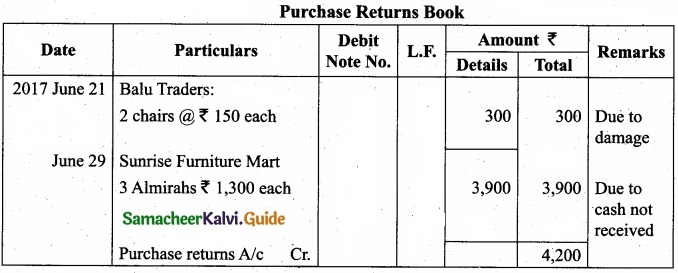
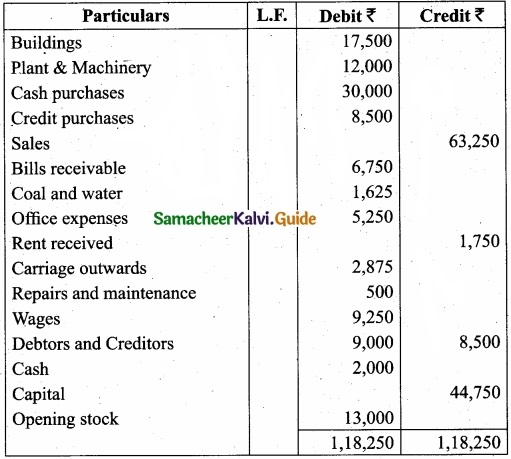
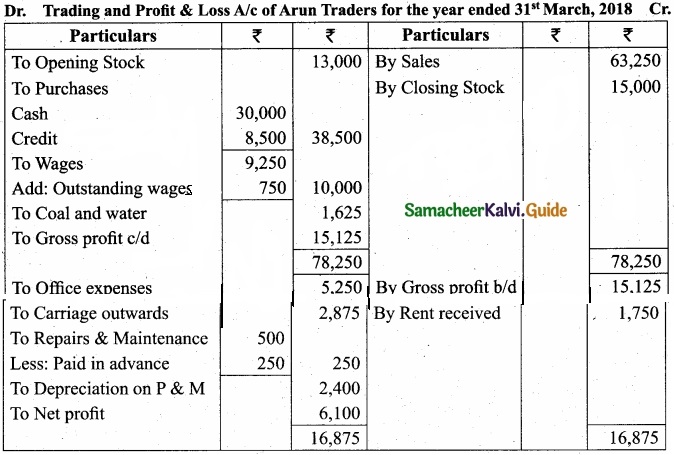
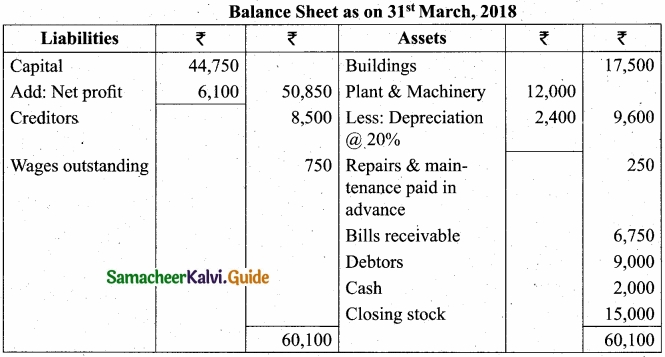
Tamil Nadu 11th Accountancy Model Question Paper 4 English Medium

Students can Download Tamil Nadu 11th Accountancy Model Question Paper 4 English Medium Pdf, Tamil Nadu 11th Accountancy Model Question Papers helps you to revise the complete Tamilnadu State Board New Syllabus, helps students complete homework assignments and to score high marks in board exams.

TN State Board 11th Accountancy Model Question Paper 4 English Medium

General Instructions:

  1. The question paper comprises of four parts.
  2. You are to attempt all the parts. An internal choice of questions is provided wherever applicable.
  3. All questions of Part I, II, III and IV are to be attempted separately.
  4. Question numbers 1 to 20 in Part I are Multiple Choice Questions of one mark each.
    These are to be answered by choosing the most suitable answer from the given four alternatives and writing the option code and the corresponding answer
  5. Question numbers 21 to 30 in Part II are two-mark questions. These are to be answered in about one or two sentences.
  6. Question numbers 31 to 40 in Part III are three-mark questions. These are to be answered in above three to five short sentences.
  7. Question numbers 41 to 47 in Part IV are five-mark questions. These are to be answered in detail Draw diagrams wherever necessary.

Time: 3:00 Hours
Maximum Marks: 90

PART – I

Answer all the questions. Choose the correct answer: [20 × 1 = 20]

Question 1.
On the basis of ledger balances the …………………….. are prepared.
(a) Trading A/c
(b) Financial statement
(c) Profit and loss A/c
(d) Balance sheet
Answer:
(b) Financial statement

Tamil Nadu 11th Accountancy Model Question Paper 4 English Medium

Question 2.
Accounting is a basic necessity for all ……………………
(a) Human being
(b) Governments
(c) Enterprises
(d) Customers
Answer:
(c) Enterprises

Question 3.
What is GAAP?
(a) Generally Accepted Accounting Principles
(b) Government Accepted Accounting Principles
(c) Generally Accounting and Accountancy Principles
(d) None of these
Answer:
(a) Generally Accepted Accounting Principles

Tamil Nadu 11th Accountancy Model Question Paper 4 English Medium

Question 4.
……………………… concept assumes that business enterprise and its owners are two separate independent entities.
(a) Business concern
(b) Business entity concepts
(c) Going Concern concept
(d) Matching concept
Answer:
(b) Business entity concepts

Question 5.
Which of the following is a personal account?
(a) Debtors
(b) Stationary
(c) Cash
(d) Sales
Answer:
(a) Debtors

Question 6.
Which of the following is a real account?
(a) Wages
(b) Salaries
(c) Bank account
(d) Shares and debentures of companies
Answer:
(d) Shares and debentures of companies\

Tamil Nadu 11th Accountancy Model Question Paper 4 English Medium

Question 7.
Which of the following accounts is expected to have a debit balance?
(a) Assets
(b) Loss
(c) Expense
(d) All of these
Answer:
(d) All of these

Question 8.
A collection or group of all accounts of a business enterprises is known as …………………………
(a) Balance sheet
(b) Trial balance
(c) Ledger
(d) Journal
Answer:
(c) Ledger

Tamil Nadu 11th Accountancy Model Question Paper 4 English Medium

Question 9.
Which account usually has debit balance?
(a) Discount received
(b) Purchase returns
(c) Purchases
(d) Owner equity
Answer:
(c) Purchases

Question 10.
A trial balance is a …………………… ?
(a) Nominal account
(b) Personal account
(c) Real account
(d) None
Answer:
(d) None

Question 11.
Which of the following is not only a subsidiary books of account?
(a) Purchase book
(b) Sales book
(c) Purchase return book
(d) Cash book
Answer:
(d) Cash book

Tamil Nadu 11th Accountancy Model Question Paper 4 English Medium

Question 12.
If a cheque issued by us is dishonoured the credit is given to ……………………..
(a) Customer’s A/c
(b) Bank A/c
(c) Supplier’s A/c
(d) None
Answer:
(c) Supplier’s A/c

Question 13.
Cheques issued but not presented to bank …………………….
(a) Cash book – Add
(b) Cash book (Cr) – Add
(c) Bank statement (Cr) – Add
(d) Bank statement (Dr) subtract
Answer:
(a) Cash book – Add

Question 14.
Generally, one – sided errors are revealed by ……………………..
(a) Credit balance
(b) Debit balance
(c) Balance sheet
(d) Trial balance
Answer:
(d) Trial balance

Tamil Nadu 11th Accountancy Model Question Paper 4 English Medium

Question 15.
Two – sided errors are not revealed by ……………………..
(a) Debit balance
(b) Trial balance
(c) Credit balance
(d) Balance sheet
Answer:
(b) Trial balance

Question 16.
The amount which is expected to be realised at the end of the estimated useful life of an asset is known as ………………………….
(a) Life of an asset
(b) Actual cost of asset
(c) Other factors
(d) Scrap value of an asset
Answer:
(d) Scrap value of an asset

Tamil Nadu 11th Accountancy Model Question Paper 4 English Medium

Question 17.
There are various methods used for providing depreciation on …………………………
(a) Life of an asset
(b) Actual cost of asset
(c) Fixed asset
(d) Other factors
Answer:
(c) Fixed asset

Question 18.
Revenue receipts are ……………………. in the business.
(a) Non – recurring
(b) Recurring
(c) Neither of the above
(d) All the above
Answer:
(b) Recurring

Tamil Nadu 11th Accountancy Model Question Paper 4 English Medium

Question 19.
Income statement is divided into …………………….. parts.
(a) One
(b) Two
(c) Three
(d) Four
Answer:
(b) Two

Question 20.
Components of CAS can be classified into ………………………. categories.
(a) One
(b) Two
(c) Six
(d) Three
Answer:
(c) Six

PART – II

Answer any seven questions in which question No. 21 is compulsory: [7 × 2 = 14]

Question 21.
Discuss briefly the branches of accounting?
Answer:
The various branches of accounting are:

1. Financial Accounting:
It involves recording of financial transactions and events.

2. Cost Accounting:
It involves the collection, recording, classification and appropriate allocation of expenditure for the determination of the costs of products or services and for the presentation of data for the purposes of cost control and managerial decision making.

3. Management Accounting:
It is concerned with the presentation of accounting information in such a way as to assist management in decision making and in the day-to-day operations of an enterprise.

4. Social Responsibility Accounting:
It is concerned with presentation of accounting information by business entities and other organizations from the view point of the society by showing the social costs incurred such as environmental pollution by the enterprise and social benefits such as infrastructure development and employment opportunities created by them.

5. Human Resources Accounting:
It is concerned with identification, qualification and reporting of investments made in human resources of an enterprise.

Tamil Nadu 11th Accountancy Model Question Paper 4 English Medium

Question 22.
State the principles of double entry system of book – keeping?
Answer:

  1. In every business transaction, there are two aspects.
  2. The two aspects involved are the benefit or value receiving aspect and benefit or value giving aspect.
  3. These two aspects involve minimum two accounts; atleast one debit and atleast one credit.
  4. For every debit, there is a corresponding and equivalent credit. If one account is debited . the other account must be credited.

Question 23.
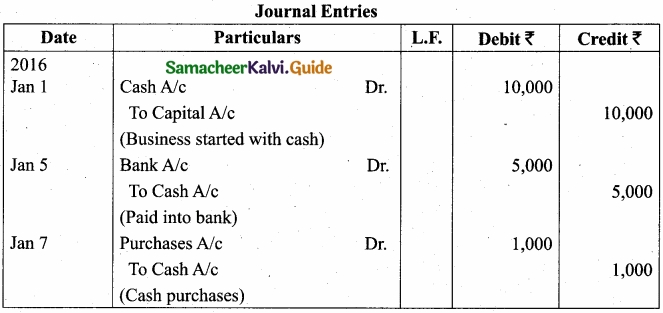
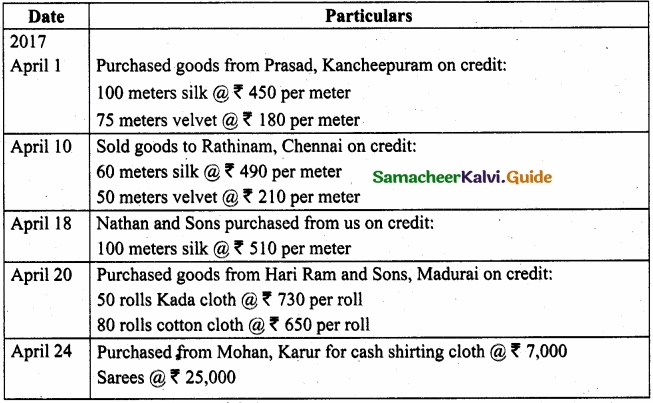
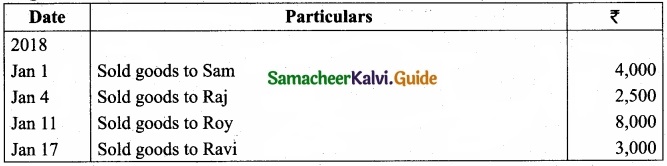
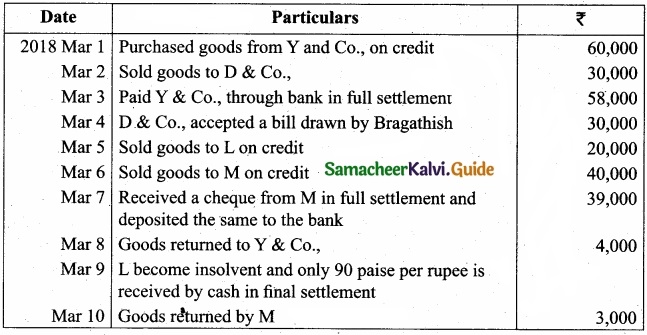
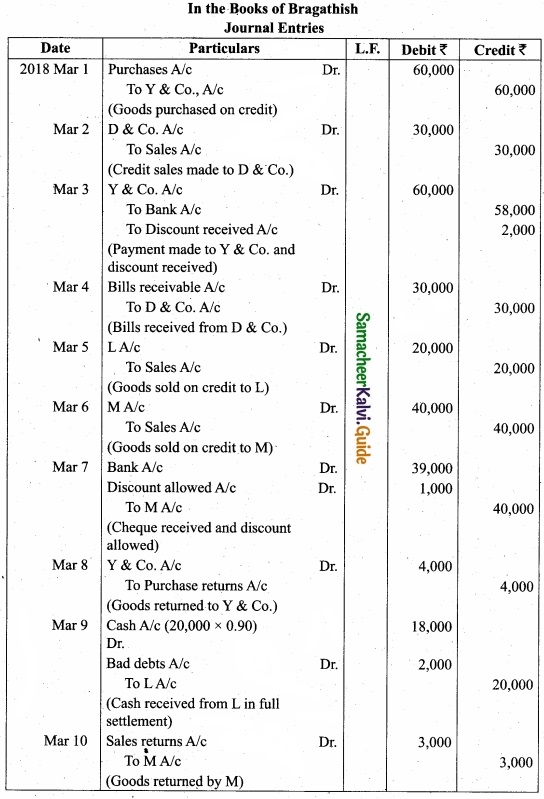
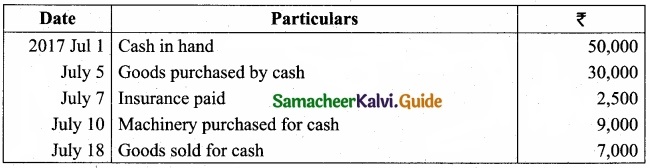
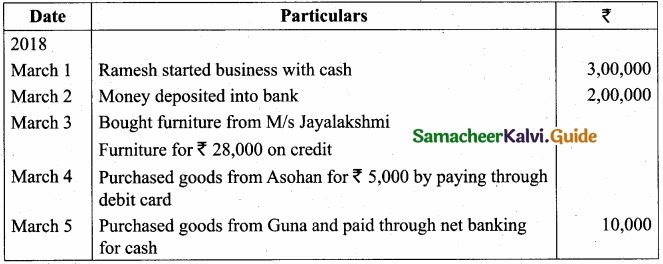
Journalise the following transactions?
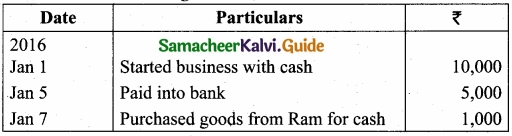
Tamil Nadu 11th Accountancy Model Question Paper 4 English Medium img 1

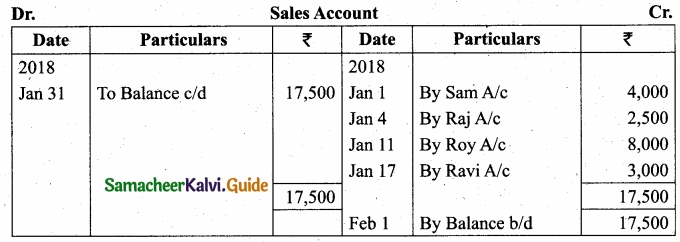
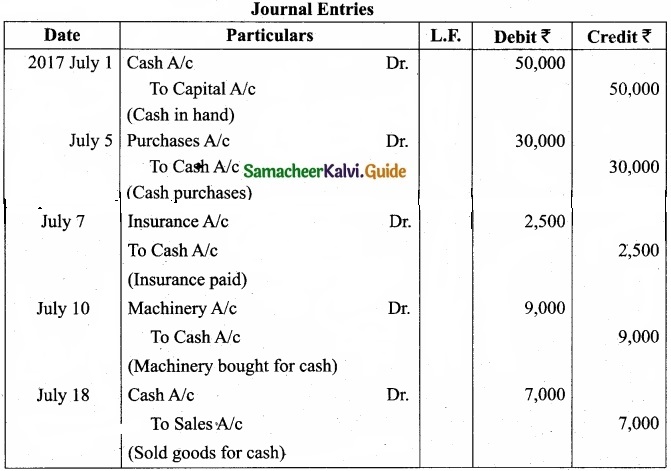
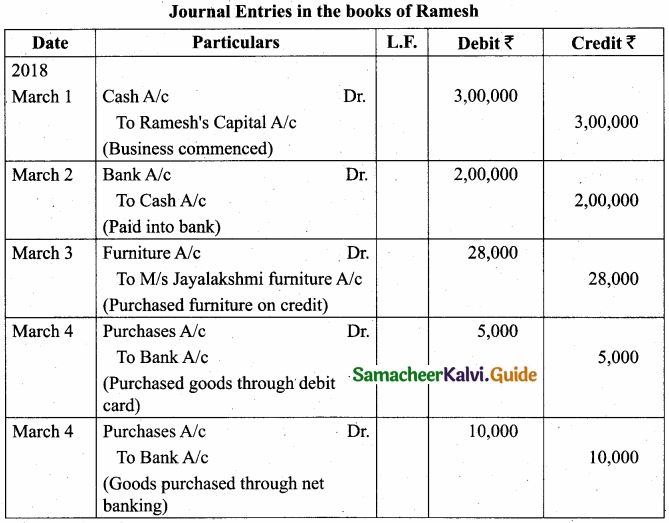
Answer:
Tamil Nadu 11th Accountancy Model Question Paper 4 English Medium img 2

Tamil Nadu 11th Accountancy Model Question Paper 4 English Medium

Question 24.
What are the objectives of preparing trial balance (any two)?
Answer:

  1. Test of arithmetical accuracy: Trial balance is the means by which the arithmetical accuracy of the book-keeping work is checked.
  2. Basis for preparing final accounts: Financial statements, namely, trading and profit and loss account and balance sheet are prepared on the basis of summary of ledger balances obtained from the trial balance.

Question 25.
What is Journal proper?
Answer:
Journal proper is a residuary book which contains records of transactions, which do not find a place in the subsidiary »books such as cash book, purchases book, sales book, purchases returns book, sales returns book, bills receivable books and bills payable book.

Question 26.
What is Cash Book?
Answer:
Cash book is the book in which only cash transactions are recorded in the chronological order. The cash book is the book of original entry or prime entry as cash transactions are recorded for the first time in it. Cash transactions here may include bank transactions also.

Tamil Nadu 11th Accountancy Model Question Paper 4 English Medium

Question 27.
Give any two expenses which may be paid by the banker as per standing instruction?
Answer:

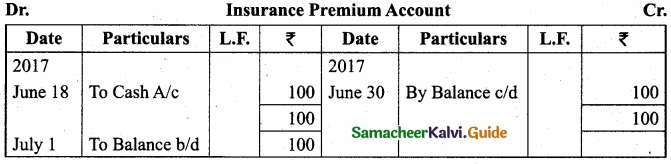
  1. Insurance premium paid by the bank as per the standing instruction.
  2. Loan instalment, paid by the bank as per the instruction.

Question 28.
What is meant by error of partial omission?
Answer:
When the accountant has failed to record a part of the transaction, it is known as error of partial omission. This error usually occurs in posting. This error affects only one account.

Question 29.
What is Sinking Fund method?
Answer:
This method is adopted especially when it is desired not merely to write off an asset but also to provide enough funds to replace an asset at the end of its working life.

Tamil Nadu 11th Accountancy Model Question Paper 4 English Medium

Question 30.
What is capital expenditure?
Answer:
It is an expenditure incurred during an accounting period, the benefits of which will be available for more than one accounting period.

PART – III

Answer any seven questions in which question No. 31 is compulsory: [7 × 3 = 21]

Question 31.
Write any three differences among the readymade software, customised software and tailor made software?
Answer:

Basis

Readymade SoftwareCustomised Software

Tailor made Software

1. Nature of businessSmall, conventional businessLarge, medium businessLarge
2. Cost of installation and maintenanceLowRelatively highHigh
3. Expected level of secrecy (software and data)LowRelatively highRelatively high

Tamil Nadu 11th Accountancy Model Question Paper 4 English Medium

Question 32.
Abstracts from the trial balance as on 31st March, 2016?
Answer:

Tamil Nadu 11th Accountancy Model Question Paper 4 English Medium img 4
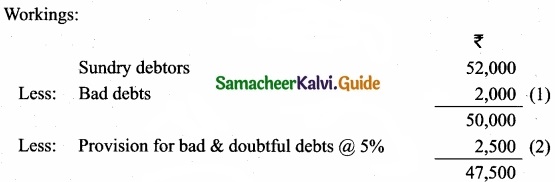
Adjustments:

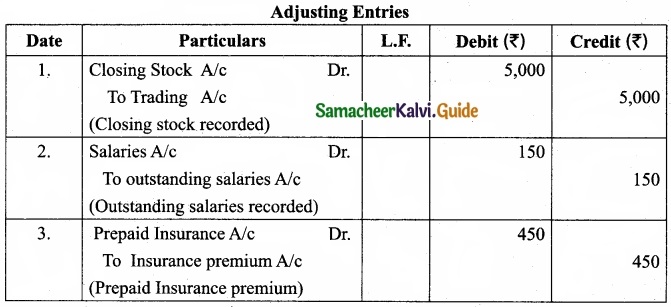
  1. Additional bad debts ₹2,000.
  2. Create 5% provision for bad and doubtful debts. You are required to pass adjusting entries.

Answer:
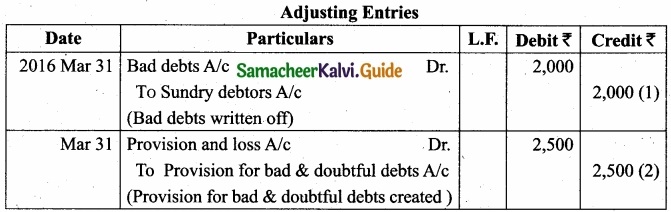
Tamil Nadu 11th Accountancy Model Question Paper 4 English Medium img 5
Tamil Nadu 11th Accountancy Model Question Paper 4 English Medium img 6

Tamil Nadu 11th Accountancy Model Question Paper 4 English Medium

Question 33.
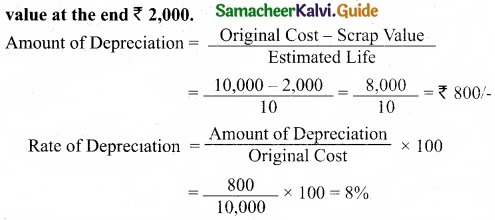
A firm purchased a plant for ₹40,000. Erection charges amounted to ₹2,000. Effective life of the plant is 5 years. Calculate the amount of depreciation per year under straight line method?
Answer:
Caluculation of amount of depreciation:
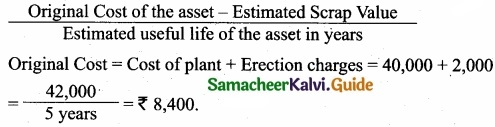
Tamil Nadu 11th Accountancy Model Question Paper 4 English Medium img 7

Question 34.
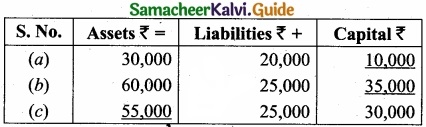
Complete the missing items:
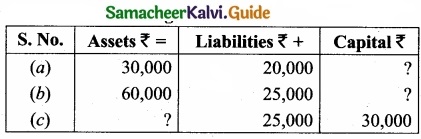
Tamil Nadu 11th Accountancy Model Question Paper 4 English Medium img 8

Answer:
Tamil Nadu 11th Accountancy Model Question Paper 4 English Medium img 9

Tamil Nadu 11th Accountancy Model Question Paper 4 English Medium

Question 35.
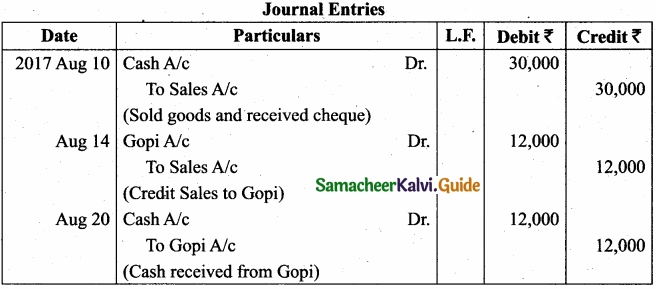
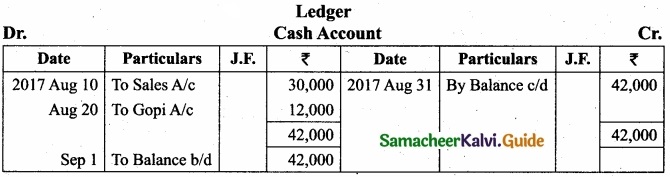
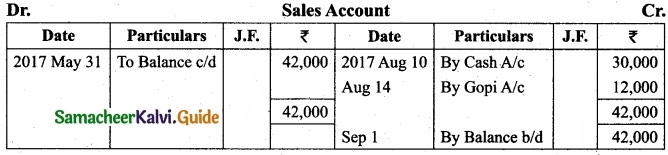
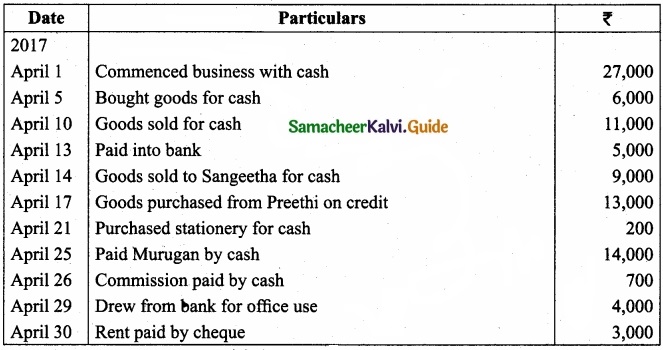
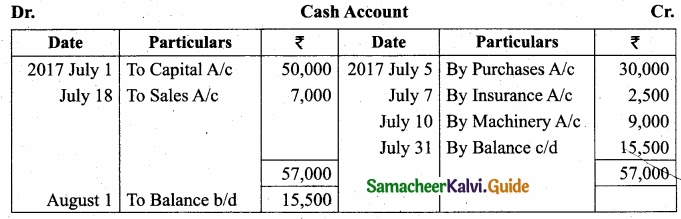
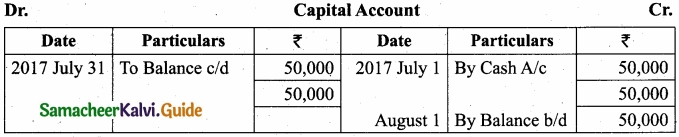
Give journal entries for the following transactions and post them to cash A/c and sales A/c?

Tamil Nadu 11th Accountancy Model Question Paper 4 English Medium img 10

Answer:
Tamil Nadu 11th Accountancy Model Question Paper 4 English Medium img 11

Tamil Nadu 11th Accountancy Model Question Paper 4 English Medium img 12

Tamil Nadu 11th Accountancy Model Question Paper 4 English Medium img 13

Question 36.
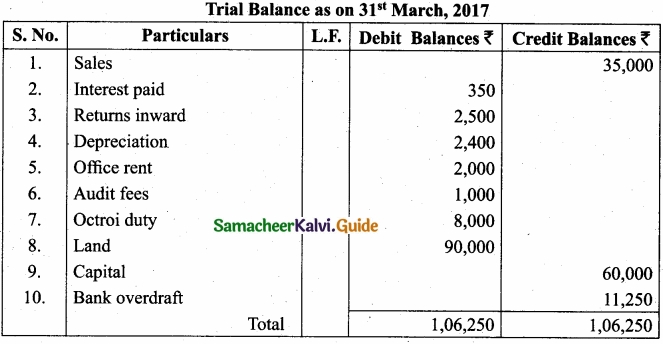
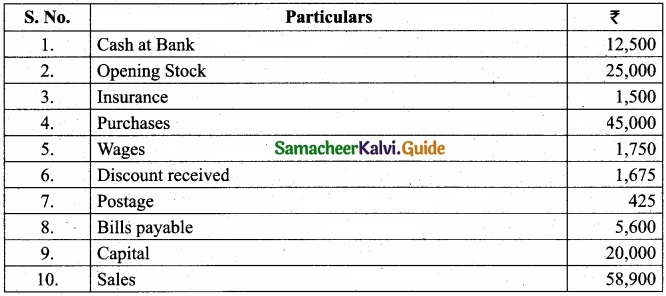
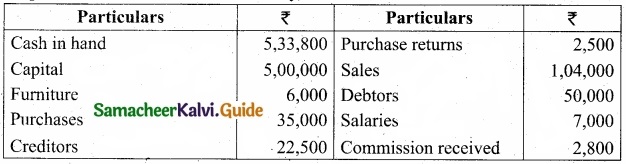
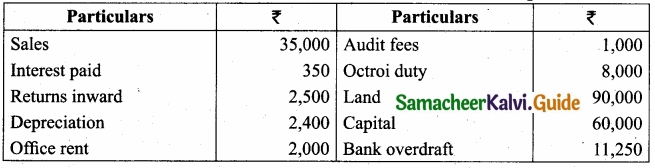
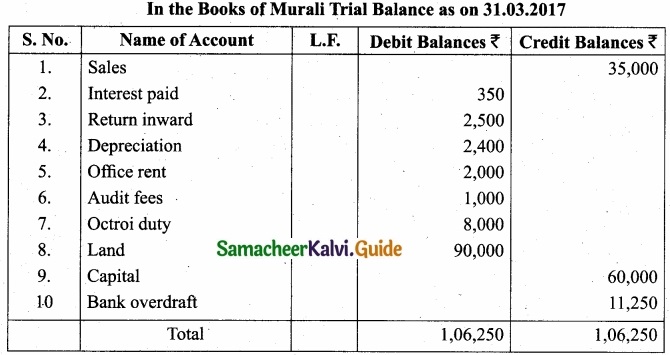
The following balances are extracted from the books of Murali, as on 31st March, 2017. Prepare Trial balance?
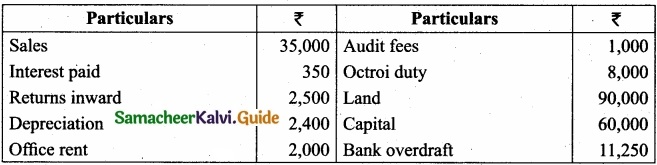
Tamil Nadu 11th Accountancy Model Question Paper 4 English Medium img 14

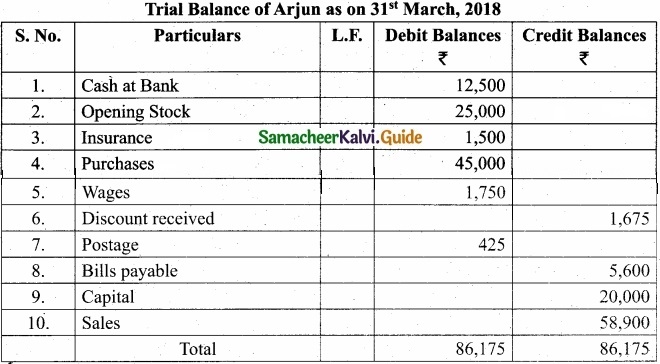
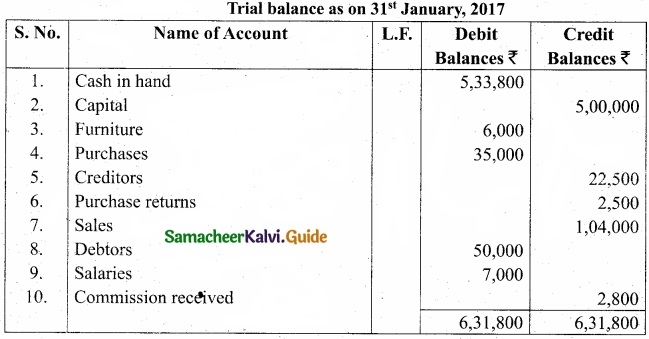
Answer:
Tamil Nadu 11th Accountancy Model Question Paper 4 English Medium img 15

Tamil Nadu 11th Accountancy Model Question Paper 4 English Medium

Question 37.
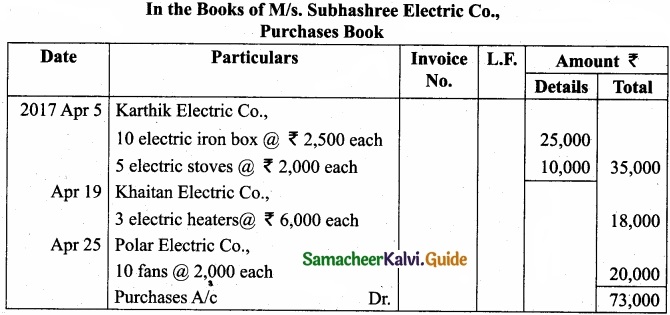
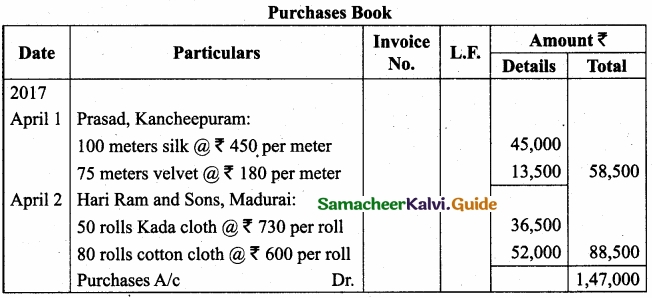
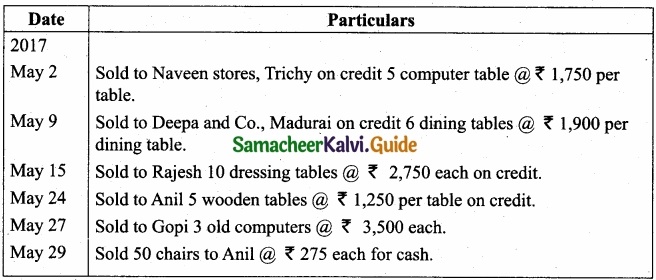
Enter the following transactions in the purchase book of M/s. Subhashree Electric Co., which deals in electric goods?
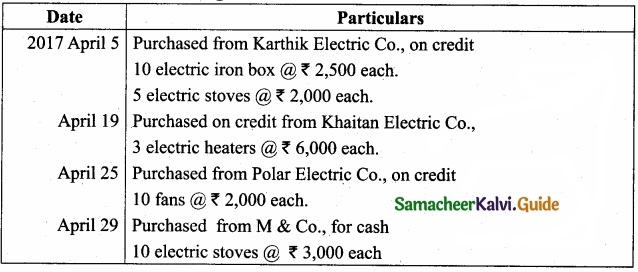
Tamil Nadu 11th Accountancy Model Question Paper 4 English Medium img 16

Answer:
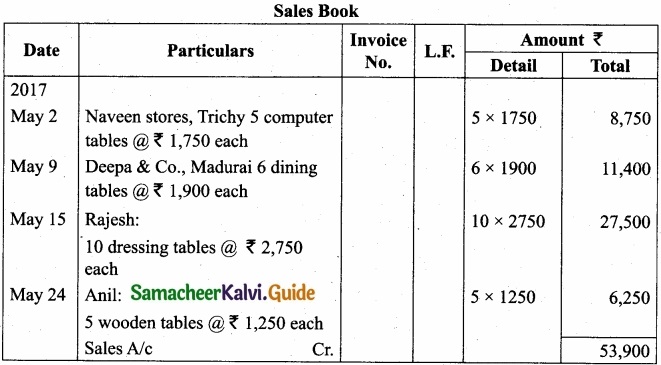
Tamil Nadu 11th Accountancy Model Question Paper 4 English Medium img 17

Question 38.
Briefly explain about contra entry with examples?
Answer:
When the two accounts involved in a transactions are cash account and bank account, then both the aspects are entered in cash book itself. As both the debit and credit aspect of a transaction are recorded in the cash book, such entries are called contra entries.

Example: When cash is paid into bank, it is recorded in the bank column on the debit side and in the cash column on the credit side of the cash book.

Tamil Nadu 11th Accountancy Model Question Paper 4 English Medium

Question 39.
Rectify the following errors:

  1. Sales returns book is overcast by ₹1,000.
  2. Purchases book is undercast by ₹2,000.
  3. Purchase returns book is overcast by ₹500.

Answer:

  1. Sales returns account should be credited with ₹1,000.
  2. Purchases account should be debited with ₹2,000.
  3. Purchase returns account should be debited with ₹500.

Tamil Nadu 11th Accountancy Model Question Paper 4 English Medium

Question 40.
Classify the following receipts into capital and revenue:

  1. Sale proceeds of goods ₹75,000.
  2. Loan borrowed from bank ₹2,50,000.
  3. Sale of investment ₹1,20,000.

Answer:

  1. Revenue
  2. Capital
  3. Capital

PART – IV

Answer all the questions: [7 × 5 = 35]

Question 41(a).
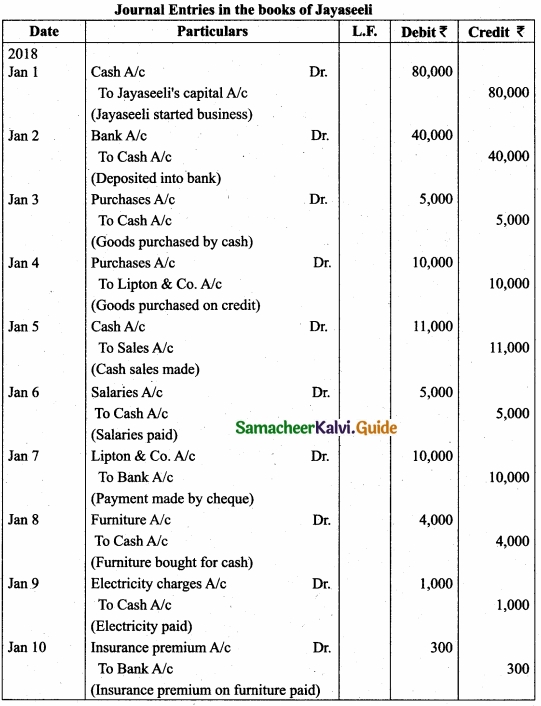
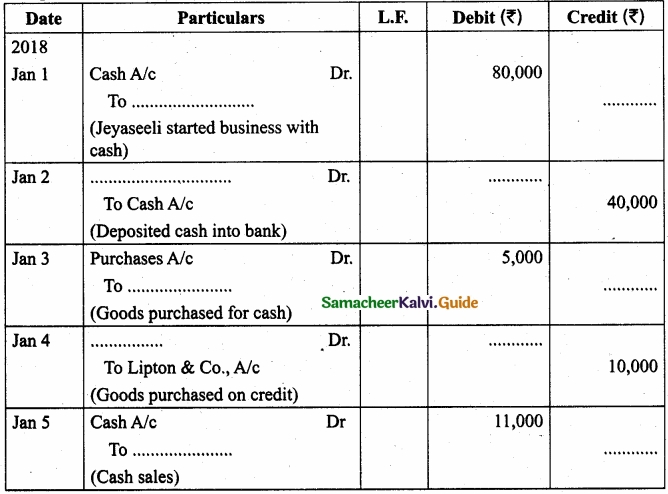
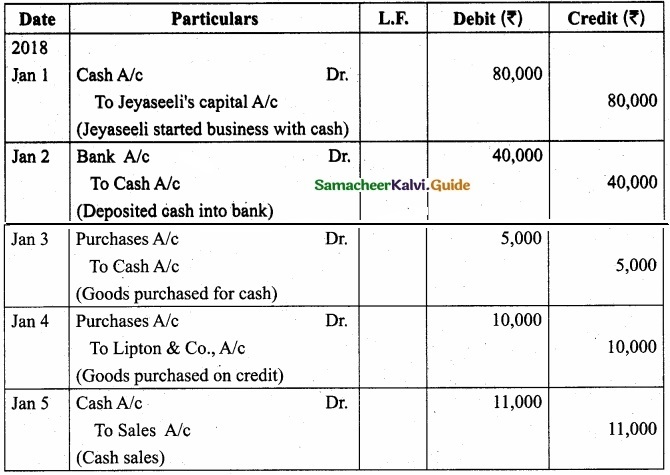
Jayaseeli is a sole proprietor having a provisions store. Following are the transactions?
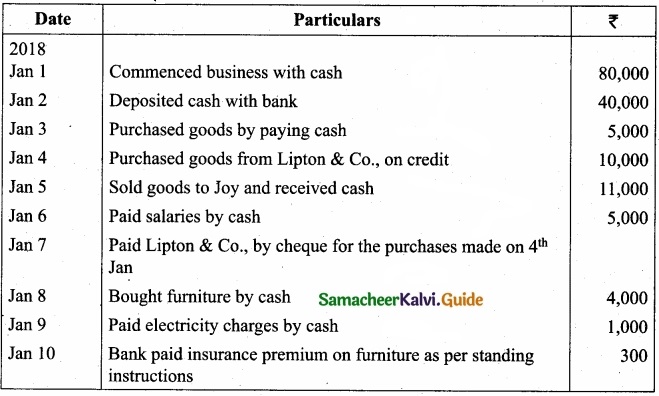
Tamil Nadu 11th Accountancy Model Question Paper 4 English Medium img 18

Answer:
Tamil Nadu 11th Accountancy Model Question Paper 4 English Medium img 19

[OR]

(b) Show the accounting equation on the basis of the following:

  1. Started business with cash ₹60,000
  2. Purchased goods fof cash ₹20,000
  3. Sold goods for cash (costing ₹10,000) for ₹15,000
  4. Paid rent by cash ₹500
  5. Cash withdrawn for personal use ₹5,000

Answer:
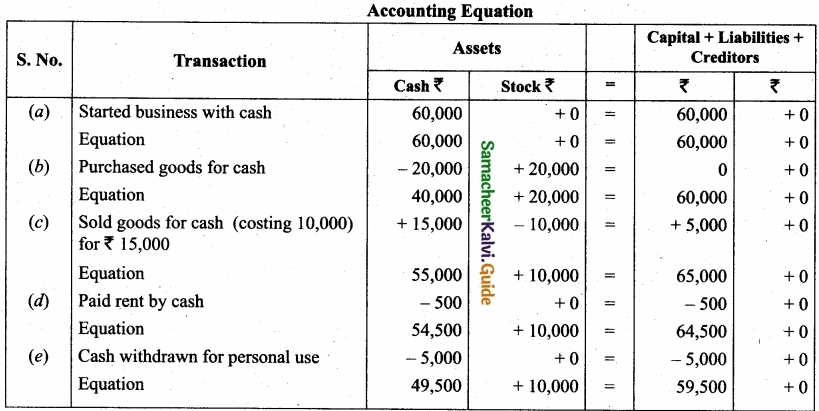
Tamil Nadu 11th Accountancy Model Question Paper 4 English Medium img 20a

Tamil Nadu 11th Accountancy Model Question Paper 4 English Medium

Question 42 (a).
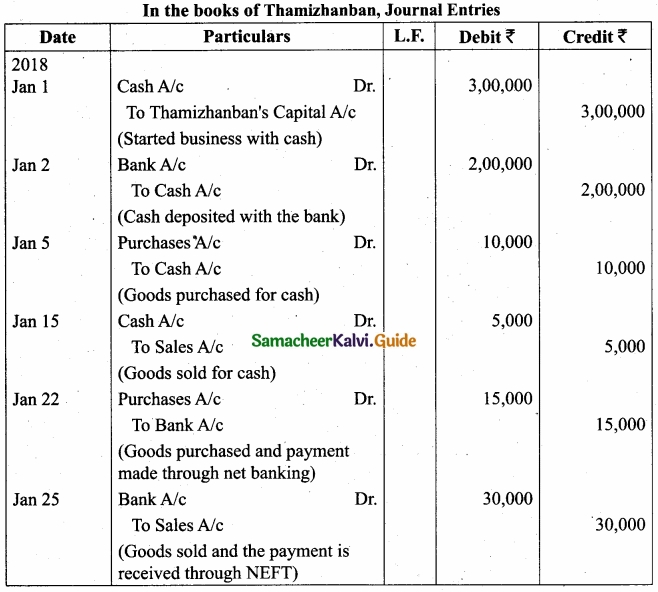
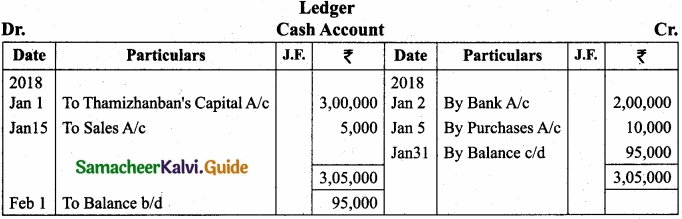
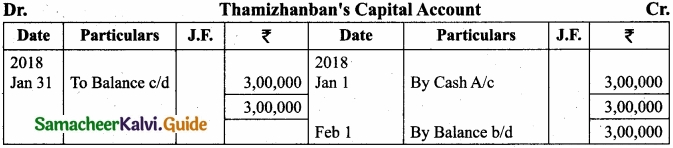
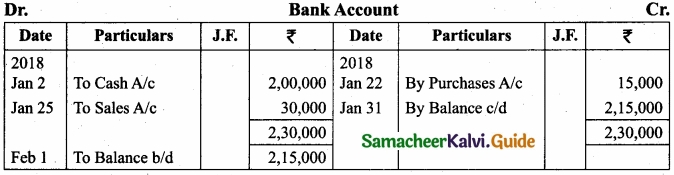
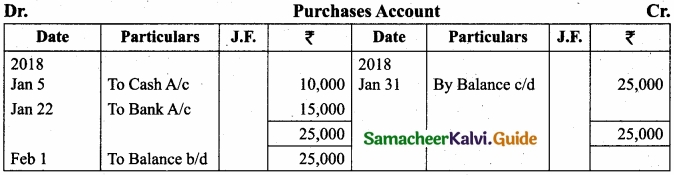
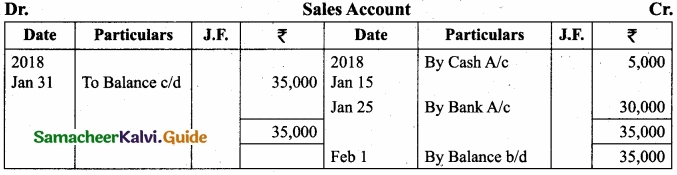
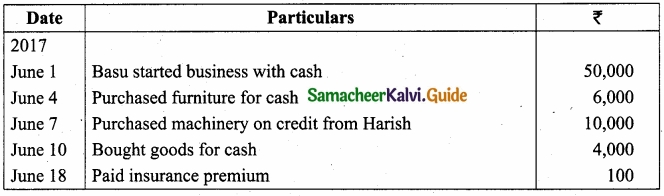
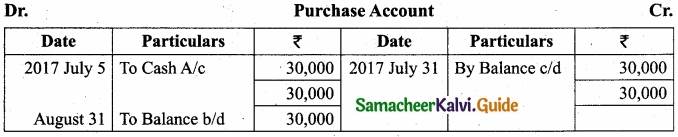
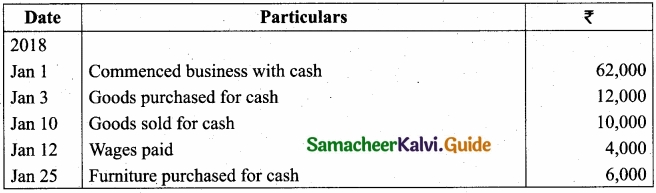
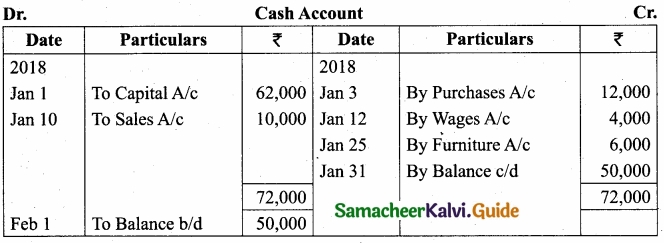
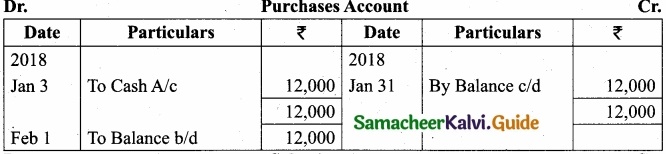
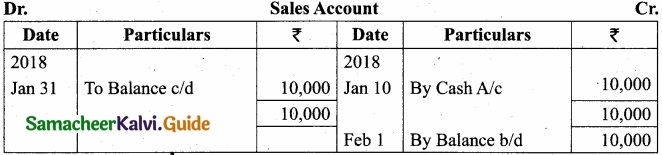
Pass journal entries and prepare ledger accounts in the books of Thamizhanban?Tamil Nadu 11th Accountancy Model Question Paper 4 English Medium img 21
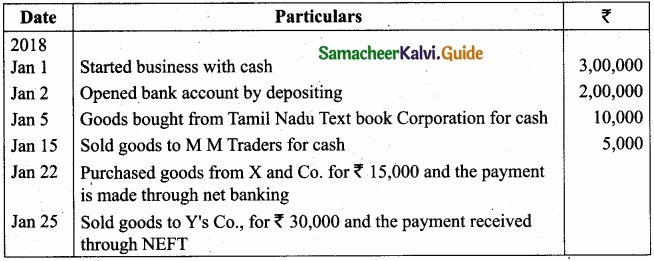
Answer:
Tamil Nadu 11th Accountancy Model Question Paper 4 English Medium img 22

Tamil Nadu 11th Accountancy Model Question Paper 4 English Medium img 23

Tamil Nadu 11th Accountancy Model Question Paper 4 English Medium img 24

Tamil Nadu 11th Accountancy Model Question Paper 4 English Medium img 25`

Tamil Nadu 11th Accountancy Model Question Paper 4 English Medium img 26

Tamil Nadu 11th Accountancy Model Question Paper 4 English Medium img 27

[OR]

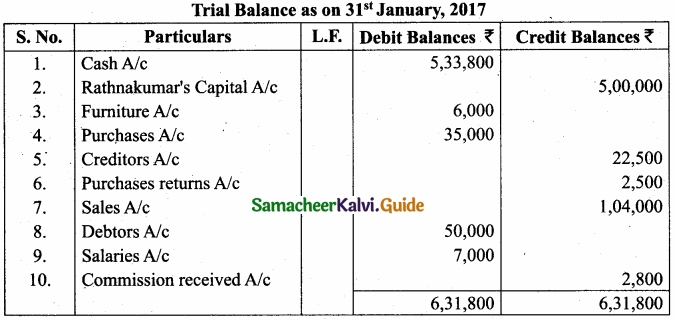
(b) Prepare Trial balance from the following ledger abstract of Rathna Kumar?Tamil Nadu 11th Accountancy Model Question Paper 4 English Medium img 28
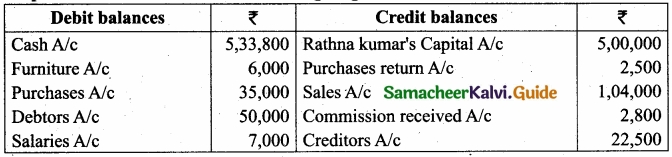
Answer:
Tamil Nadu 11th Accountancy Model Question Paper 4 English Medium img 29

Tamil Nadu 11th Accountancy Model Question Paper 4 English Medium

Question 43 (a).
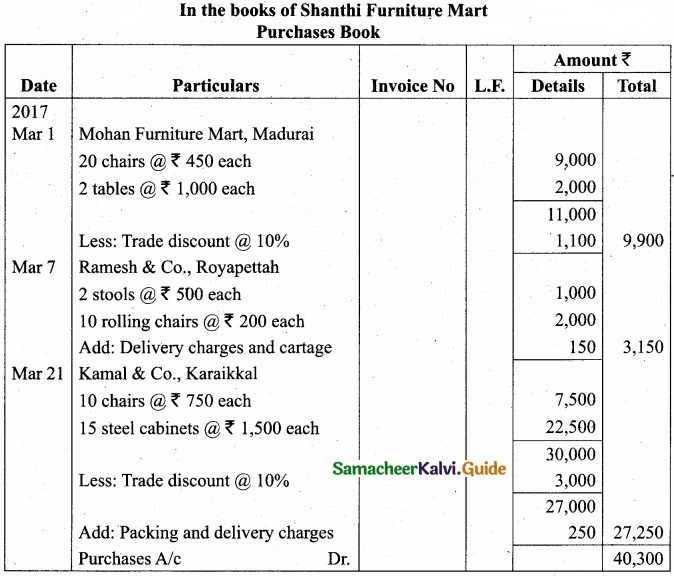
Record the following transactions in the purchases book of Shanthi furniture mart:Tamil Nadu 11th Accountancy Model Question Paper 4 English Medium img 30
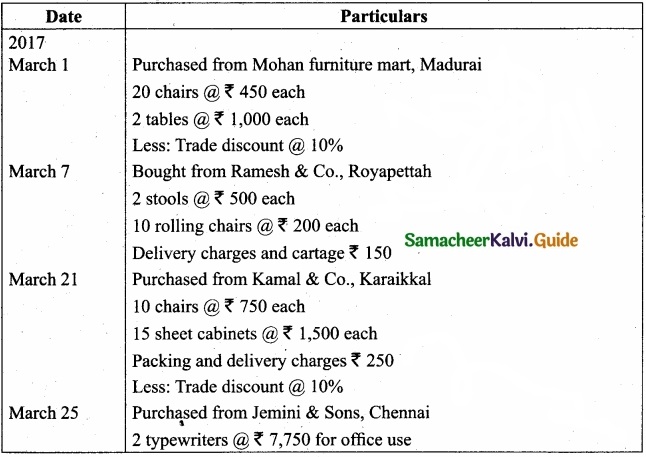
Answer:
Tamil Nadu 11th Accountancy Model Question Paper 4 English Medium img 31

[OR]

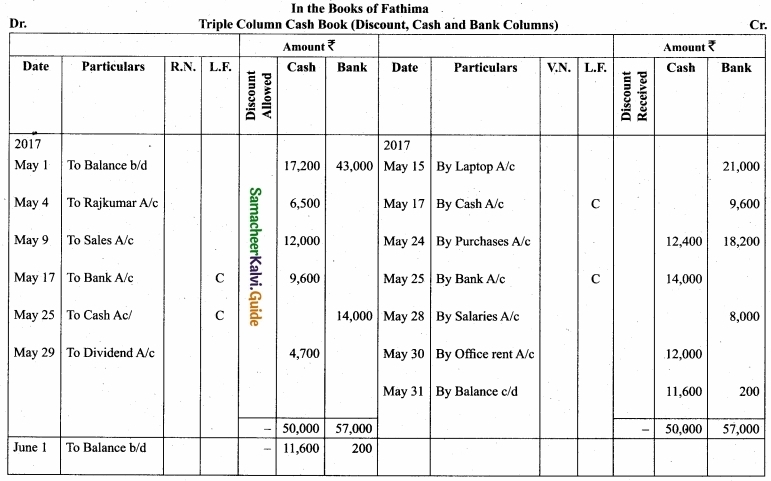
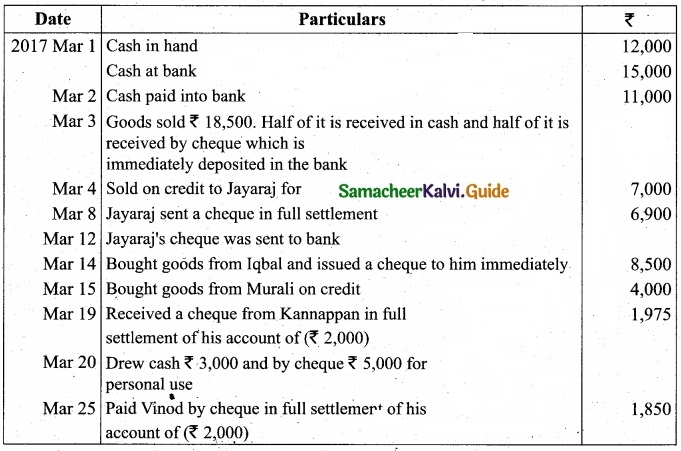
(b) Enter the following transactions of Fathima in the cash book with cash, bank and discount columns for the month of May, 2017?
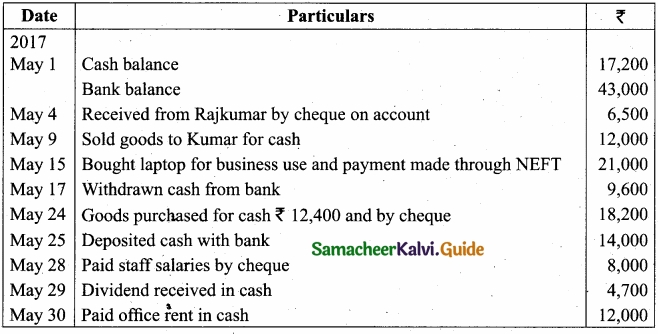
Tamil Nadu 11th Accountancy Model Question Paper 4 English Medium img 32

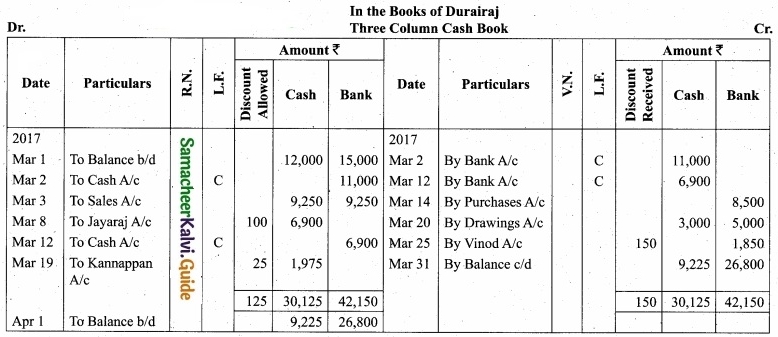
Answer:
Tamil Nadu 11th Accountancy Model Question Paper 4 English Medium img 33a

Tamil Nadu 11th Accountancy Model Question Paper 4 English Medium

Question 44 (a).
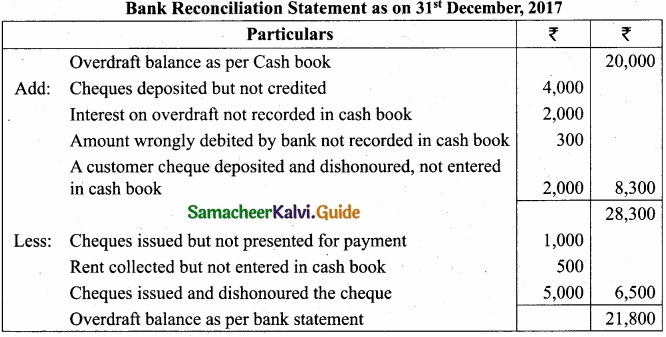
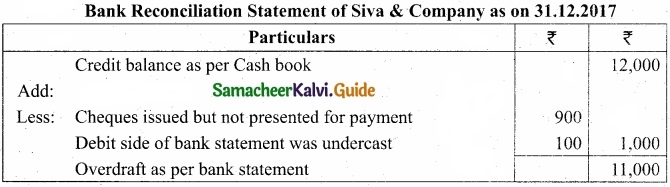
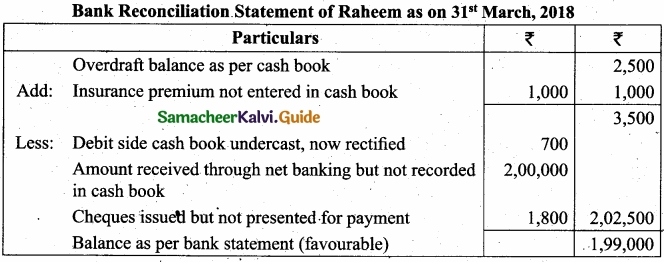
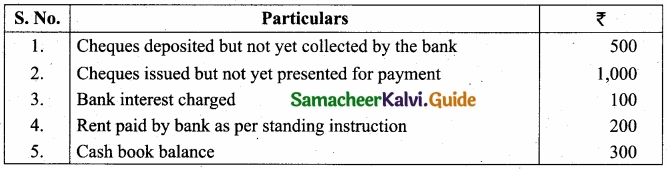
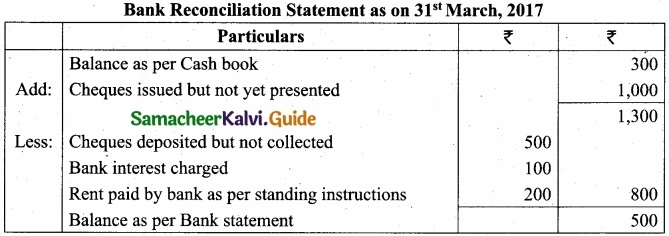
From the following information, prepare bank reconciliation statement as on 31st December, 2017 to find out the balance as per bank statement?
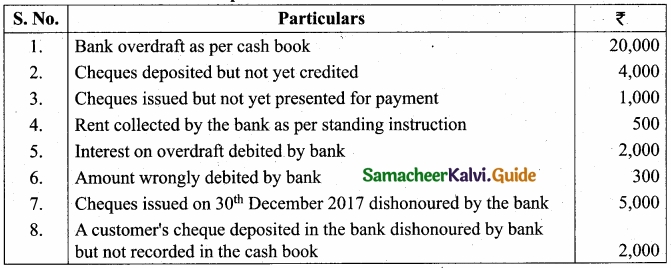
Tamil Nadu 11th Accountancy Model Question Paper 4 English Medium img 34

Answer:

Tamil Nadu 11th Accountancy Model Question Paper 4 English Medium img 35

[OR]

(b) Rectify the following errors:

  1. Sales book is undercast by ₹100
  2. Sales book is overcast by ₹200
  3. Purchases book is undercast by ₹300
  4. Purchases book is overcast by ₹400
  5. Purchases returns book is undercast by ₹500

Answer:

  1. Sales account should be credited with ₹100
  2. Sales account should be debited with ₹200
  3. Purchases account should be debited with ₹300
  4. Purchases account should be credited with ₹400
  5. Purchases returns account should be credited with ₹500

Tamil Nadu 11th Accountancy Model Question Paper 4 English Medium

Question 45 (a).
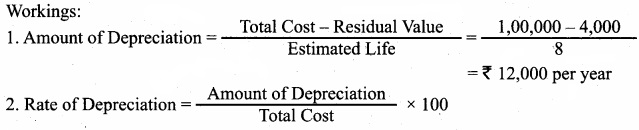
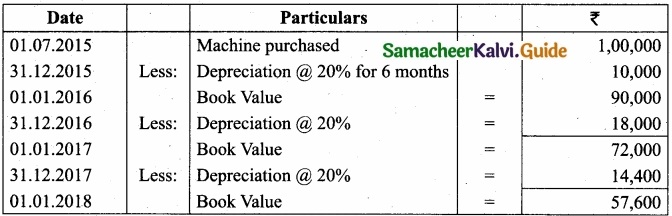
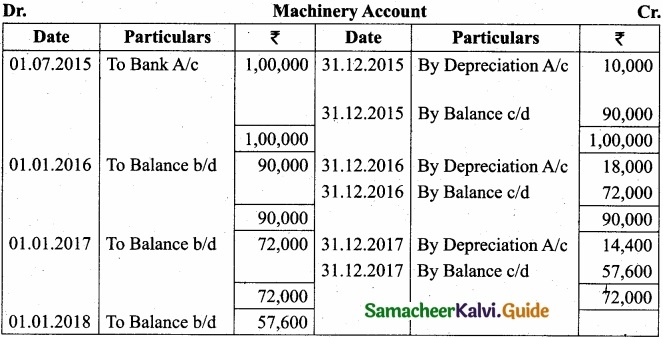
On 1st April 2015, Kumar purchased a machine for ₹80,000 and spent ₹20,000 on its installation. The residual value at the end of its expected useful life of 8 years is estimated at ₹4,000. On 30th September 2017, the machine is sold for v50,000. Depreciation is to be provided according to straight line method. Prepare machinery account. Accounts are closed on 31st December every year?
Answer:
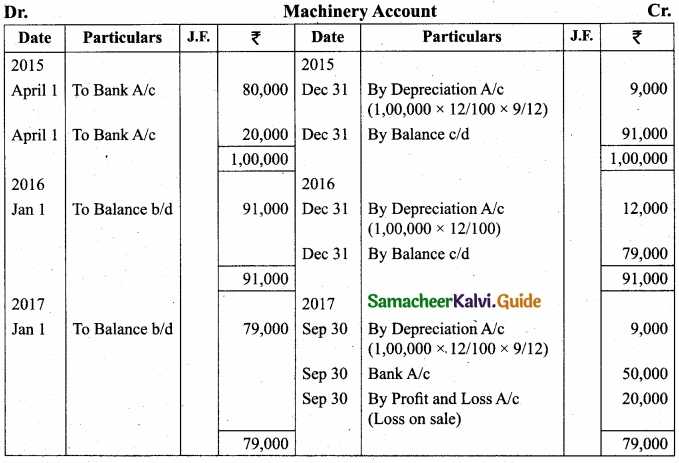
Tamil Nadu 11th Accountancy Model Question Paper 4 English Medium img 36

Tamil Nadu 11th Accountancy Model Question Paper 4 English Medium img 37
= Total  cost = Cost price of machine + installation
= 80,000 + 20,000
= 1,00,000
= \(\frac{12,000}{1,00,000}\) × 100
= 12%

[OR]

(b) State whether the following are capital, revenue or deferred revenue?

  1. Legal fees paid to the lawyer after acquiring a land ₹20,000.
  2. Heavy advertising cost of ₹12,00,000 spent on introducing a new product.
  3. Renewal of factory licence ₹12,000.
  4. A sum of ₹4,000 was spent on painting the factory.
  5. Carriage paid on goods sold.

Answer:

  1. Capital
  2. Deferred revenue
  3. Revenue
  4. Revenue
  5. Revenue

Tamil Nadu 11th Accountancy Model Question Paper 4 English Medium

Question 46 (a).
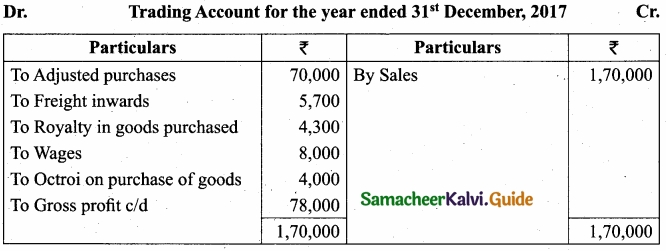
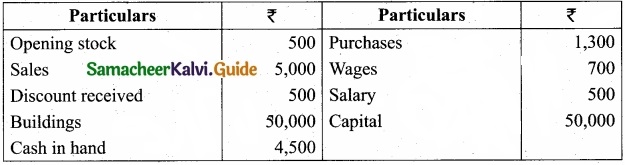
The following is the extract of a trial balance as on 31st December, 2017. Prepare Trading account:Tamil Nadu 11th Accountancy Model Question Paper 4 English Medium img 38
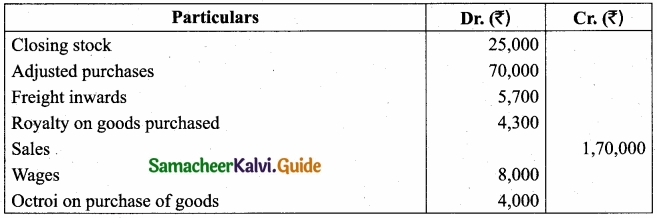
Answer:
Tamil Nadu 11th Accountancy Model Question Paper 4 English Medium img 39

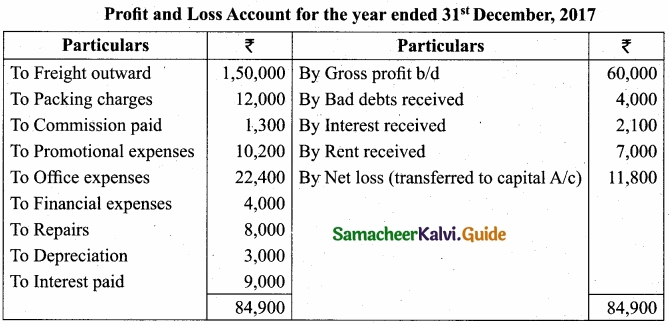
(b) From the following information, prepare profit and loss account for the year ended 31st December, 2017?
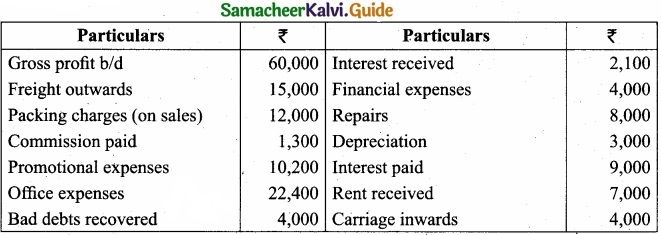
Tamil Nadu 11th Accountancy Model Question Paper 4 English Medium img 40

Answer:
Tamil Nadu 11th Accountancy Model Question Paper 4 English Medium img 41

Tamil Nadu 11th Accountancy Model Question Paper 4 English Medium

Question 47 (a).
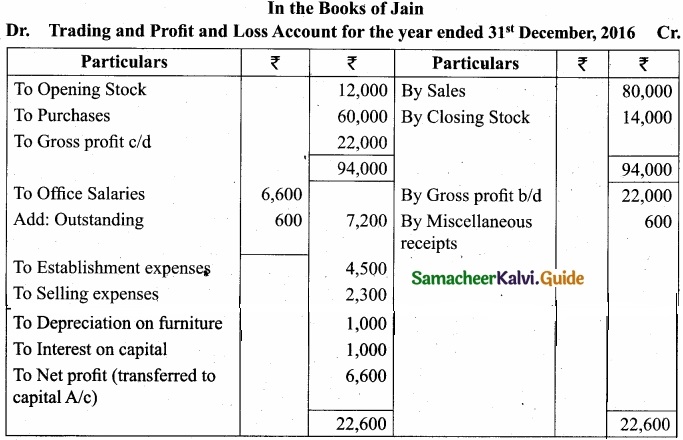
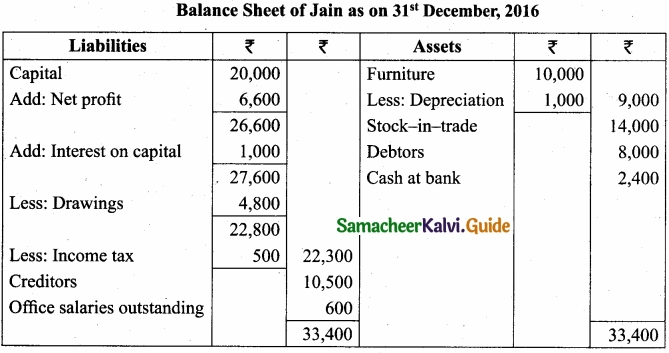
From the following information, prepare final account of Mr. Jain for the year ended 31st December, 2016?Tamil Nadu 11th Accountancy Model Question Paper 4 English Medium img 42
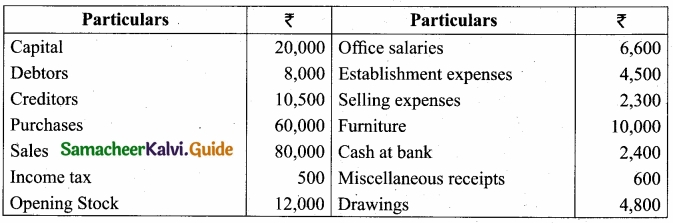
Adjustments:

  1. Salaries outstanding ₹600
  2. Depreciation on furniture ₹1,000
  3. Interest on capital₹1,000
  4. Closing Stock ₹14,000

Answer:
Tamil Nadu 11th Accountancy Model Question Paper 4 English Medium img 43
Tamil Nadu 11th Accountancy Model Question Paper 4 English Medium img 44

[OR]

(b) What are the differences among the three types of software? (Any five)
Answer:
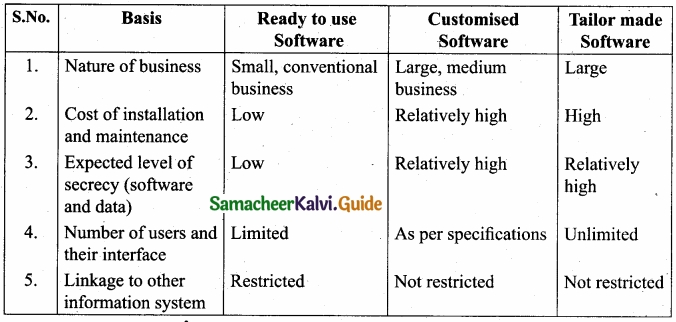
Tamil Nadu 11th Accountancy Model Question Paper 4 English Medium img 45

Samacheer Kalvi 10th Tamil Guide Chapter 1.3 இரட்டுற மொழிதல்

Students can Download 10th Tamil Chapter 1.3 இரட்டுற மொழிதல் Questions and Answers, Summary, Notes, Samacheer Kalvi 10th Tamil Guide Pdf helps you to revise the complete Tamilnadu State Board New Syllabus, helps students complete homework assignments and to score high marks in board exams.

Tamilnadu Samacheer Kalvi 10th Tamil Solutions Chapter 1.3 இரட்டுற மொழிதல்

கற்பவை கற்றபின்

Question 1.
அ) காலை நேரம் ஒரு நிகழ்ச்சிக்காகத் தொடர்வண்டியில் வந்து இறங்கினார் தமிழறிஞர் கி.வா. ஜகந்நாதன். அவரை மாலையிட்டு வரவேற்றனர். அப்போது கி.வா.ஜ., “அடடே! காலையிலேயே மாலையும் வந்துவிட்டதே!” என்றார். எல்லோரும் அந்தச் சொல்லின் சிலேடைச் சிறப்பை மிகவும் சுவைத்தனர்.

ஆ) இசை விமரிசகர் சுப்புடுவின் விமரிசனங்களில் நயமான சிலேடைகள் காணப்படும். ஒரு முறை ஒரு பெரிய வித்துவானுடைய இசைநிகழ்ச்சியை விமர்சனம் செய்யும் போது அவர் குறிப்பிட்டது: “அன்று கச்சேரியில் அவருடைய காதிலும் கம்மல், குரலிலும் கம்மல்.”

இ) தமிழறிஞர் கி.ஆ.பெ. விசுவநாதன் பல் மருத்துவத்தில் சிறப்புப் பட்டம் பெற்ற நண்பர் ஒருவரை அறிமுகம் செய்து வைத்தபோது “இவர் பல்துறை வித்தகர்” என்று குறிப்பிட்டார்.

இவைபோன்ற பல சிலேடைப் பேச்சுகளை நீங்கள் கேட்டிருப்பீர்கள். அவற்றைத் தொகுத்துச் சொல்நயங்களைப் பதிவு செய்து கலந்துரையாடுக.
Answer:
ஆசிரியர் : இன்று வகுப்பிற்கு புதிதாக வந்த மாணவன் எங்கே?
மாணவன் : இதோ, உள்ளேன் ஐயா. (மாணவன் வகுப்பின் கடைசி இருக்கையிலிருந்து கூறுகிறான்)
ஆசிரியர் : உன் பெயர் என்ன?
மாணவன் : கவியரசன்.
ஆசிரியர் : அப்படியானால் உனக்கு இருக்க வேண்டிய நீண்ட வாலையும் கூர்மையான நகங்களையும் காணவில்லையே.
[மாணவர்கள் அனைவரும் காரணம் புரியாமல் சிரிக்கின்றனர். அதற்கு ஆசிரியர் கூறிய விளக்கம் பின்வருமாறு அமைந்தது.] ‘கவி என்றால் குரங்கு என்று இன்னொரு பொருளும் உண்டு. ஆகவேதான் நீ குரங்குகளின் அரசனானால் உன் வாலையும், கூரிய நகங்களையும் எங்கே என்றேன்’ என விளக்கினார்.

Samacheer Kalvi 10th Tamil Guide Chapter 1.3 இரட்டுற மொழிதல்

Question 2.
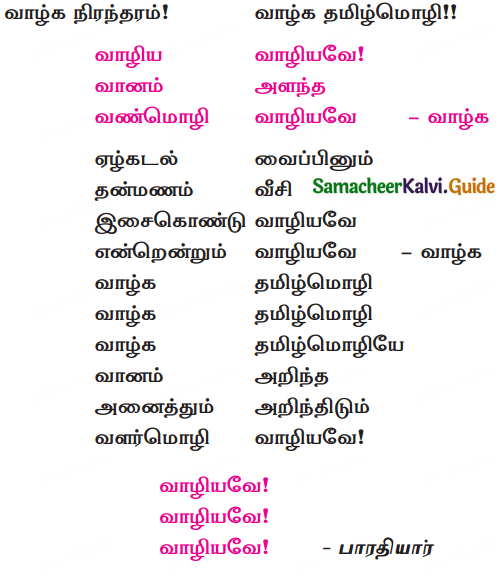
மொழியின் சிறப்புகளைப் பாடும் கவிதைகளுள் உங்களுக்குப் பிடித்தவற்றை வகுப்பறையில் படித்துக்காட்டுக.
Answer:
Samacheer Kalvi 10th Tamil Guide Chapter 1.3 இரட்டுற மொழிதல் - 4

பாடநூல் வினாக்கள்

பலவுள் தெரிக

Question 1.
‘மெத்த வணிகலன்’ என்னும் தொடரில் தமிழழகனார் குறிப்பிடுவது
அ) வணிகக் கப்பல்களும் ஐம்பெரும் காப்பியங்களும்
ஆ) பெரும் வணிகமும் பெரும் கலன்களும்
இ) ஐம்பெரும் காப்பியங்களும் அணிகலன்களும்
ஈ) வணிகக் கப்பல்களும் அணிகலன்களும்
Answer:
அ) வணிகக் கப்பல்களும் ஐம்பெரும் காப்பியங்களும்

Samacheer Kalvi 10th Tamil Guide Chapter 1.3 இரட்டுற மொழிதல்

குறுவினா

Question 1.
தற்கால உரைநடையில் சிலேடை அமையும் நயத்திற்கு ஓர் எடுத்துக்காட்டுத் தருக.
Answer:
ஒரு சொல்லோ, சொற்றொடரோ இருபொருள்பட வருவது இரட்டுற மொழிதல் அணி என்பர். இதனை சிலேடை அணி என்றும் அழைப்பர்.
எ.கா: சீனிவாசன் பாற்கடலில் துயில் கொள்கிறான்.

– இத்தொடர் எவ்வித மாற்றமுமின்றி இரண்டு விதமான பொருளைத் தருகிறது.

  • சீனியில் (சர்க்கரை) வாசம் செய்யும் எறும்பு பாலில் இறந்து மிதக்கிறது.
  • சீனிவாசகனாகிய திருமால் பாற்கடலில் துயில் கொள்கிறார்.

சிறுவினா

Question 1.
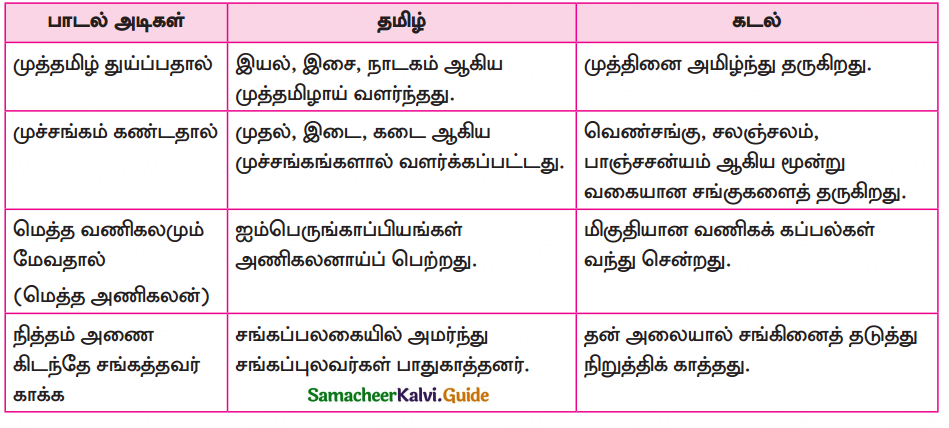
தமிழழகனார் தமிழையும் கடலையும் இரட்டுறமொழியும் பாங்கினை விளக்குக.
Answer:
Samacheer Kalvi 10th Tamil Guide Chapter 1.3 இரட்டுற மொழிதல் - 3

கூடுதல் வினாக்கள்

பலவுள் தெரிக

Question 1.
‘தமிழ், ஆழி இரண்டுக்கும் பொருள்படும் படியான’ – இரட்டுற மொழிதலணி அமைய பாடிய ஆசிரியர் யார்?
அ) தேவநேயப் பாவாணர்
ஆ) பாவலரேறு பெருஞ்சித்திரனார்
இ) தமிழழகனார்
ஈ) எழில் முதல்வன்
Answer:
இ) தமிழழகனார்

Samacheer Kalvi 10th Tamil Guide Chapter 1.3 இரட்டுற மொழிதல்

Question 2.
கடல் தரும் சங்குகளின் வகைகள் எத்தனை?
அ) இரண்டு
ஆ) மூன்று
இ) நான்கு
ஈ) ஐந்து
Answer:
ஆ) மூன்று

Question 3.
கடல் தன் அலையால் எதைத் தடுத்து நிறுத்திக் காக்கிறது?
அ) மணல்
ஆ) சங்கு
இ) கப்பல்
ஈ) மீனவர்கள்
Answer:
ஆ) சங்கு

Question 4.
முத்தினையும் அமிழ்தினையும் தருவதாகச் சந்தக்கவிமணி தமிழழகனார் குறிப்பிடுவது எதை?
அ) மூங்கில்
ஆ) கடல்
இ) மழை
ஈ) தேவர்கள்
Answer:
ஆ) கடல்

Samacheer Kalvi 10th Tamil Guide Chapter 1.3 இரட்டுற மொழிதல்

Question 5.
தமிழ் அணிகலன்களாகப் பெற்றவை எவை?
அ) சங்க இலக்கியங்கள்
ஆ) ஐம்பெருங்காப்பியங்கள்
இ) ஐஞ்சிறு காப்பியங்கள்
ஈ) நீதி இலக்கியங்கள்
Answer:
ஆ) ஐம்பெருங்காப்பியங்கள்

Question 6.
இரட்டுறமொழிதல் அணியின் வேறுபெயர் யாது?
அ) வேற்றுமை அணி
ஆ) பிறிதுமொழிதல் அணி
இ) சொற்பொருள் பின்வருநிலையணி
Answer:
ஈ) சிலேடை அணி

Question 7.
ஒரு சொல்லோ, சொற்றொடரோ இருபொருள்பட வருவது எது?
அ) இரட்டுறமொழிதல் அணி
ஆ) வேற்றுமை அணி
இ) உவமை அணி
ஈ) உருவக அணி
Answer:
அ) இரட்டுறமொழிதல் அணி

Samacheer Kalvi 10th Tamil Guide Chapter 1.3 இரட்டுற மொழிதல்

Question 8.
சந்தக்கவிமணி எனக் குறிப்பிடப்படும் தமிழழகனாரின் இயற்பெயர் என்ன?
அ) சண்முகமணி
ஆ) சண்முகசுந்தரம்
இ) ஞானசுந்தரம்
ஈ) ஆறுமுகம்
Answer:
ஆ) சண்முகசுந்தரம்

Question 9.
தமிழழகனார் எத்தனை சிற்றிலக்கிய நூல்களைப் படைத்துள்ளார்?
அ) பத்து
ஆ) பன்னிரண்டு
இ) பதினான்கு
ஈ) பதினாறு
Answer:
ஆ) பன்னிரண்டு

Question 10.
முத்தமிழ் துய்ப்பதால் என்னும் பாடல் இடம் பெற்றுள்ள தொகுப்பு யாது?
அ) எட்டுத்தொகை
ஆ) பத்துப்பாட்டு
இ) சிற்றிலக்கியங்கள்
ஈ) தனிப்பாடல் திரட்டு
Answer:
ஈ) தனிப்பாடல் திரட்டு

Samacheer Kalvi 10th Tamil Guide Chapter 1.3 இரட்டுற மொழிதல்

குறுவினா

Question 1.
ஐம்பெருங்காப்பியங்கள் யாவை?
Answer:
சிலப்பதிகாரம், மணிமேகலை, சீவகசிந்தாமணி, வளையாபதி, குண்டலகேசி.

Question 2.
கடலிலிருந்து கிடைக்கும் பொருட்கள் யாவை?
Answer:

  • முத்தும், அமிழ்தமும் கிடைக்கிறது.
  • வெண்சங்கு, சலஞ்சலம், பாஞ்சசன்யம் ஆகிய மூன்று வகையான சங்குகள் கிடைக்கிறன.

Samacheer Kalvi 10th Tamil Guide Chapter 1.3 இரட்டுற மொழிதல்

Question 3.
தமிழ்மொழி குறித்து தமிழழகனார் கூறிய செய்தி யாது?
Answer:

  • தமிழ் இயல், இசை, நாடகம் முத்தமிழாய் வளர்ந்தது.
  • முதல், இடை, கடை ஆகிய முச்சங்கங்களால் வளர்க்கப்பட்டது.
  • ஐம்பெருங் காப்பியங்களை அணிகலன்களாகப் பெற்றது.
  • சங்கப்புலவர்களால் காக்கப்பட்டது.

Question 4.
இரட்டுற மொழிதல் அணி என்றால் என்ன? அதன் வேறுபெயர் யாது?
Answer:

  • ஒரு சொல்லோ சொற்றொடரோ இருபொருள்பட வருவது இரட்டுறமொழிதல் அணி எனப்படும்.
  • வேறுபெயர் – சிலேடை அணி.

Samacheer Kalvi 10th Tamil Guide Chapter 1.3 இரட்டுற மொழிதல்

Question 5.
சிலேடைகள் எத்தனை வகைப்படும்? அவை யாவை?
Answer:
சிலேடைகள் இரண்டு வகைப்படும். அவை:

  • செம்மொழிச் சிலேடை
  • பிரிமொழிச் சிலேடை

Tamil Nadu 11th Commerce Model Question Paper 5 English Medium

Students can Download Tamil Nadu 11th Commerce Model Question Paper 5 English Medium Pdf, Tamil Nadu 11th Commerce Model Question Papers helps you to revise the complete Tamilnadu State Board New Syllabus, helps students complete homework assignments and to score high marks in board exams.

TN State Board 11th Commerce Model Question Paper 5 English Medium

General Instructions:

  1. The question paper comprises of four parts.
  2. You are to attempt all the parts. An internal choice of questions is provided wherever applicable.
  3. All questions of Part I, II, III and IV are to be attempted separately.
  4. Question numbers 1 to 20 in Part I are Multiple Choice Questions of one mark each.
    These are to be answered by choosing the most suitable answer from the given four alternatives and writing the option code and the corresponding answer
  5. Question numbers 21 to 30 in Part II are two-mark questions. These are to be answered in about one or two sentences.
  6. Question numbers 31 to 40 in Part III are three-mark questions. These are to be answered in above three to five short sentences.
  7. Question numbers 41 to 47 in Part IV are five-mark questions. These are to be answered in detail Draw diagrams wherever necessary.

Time: 2:30 Hours
Maximum Marks: 90

PART – I

Choose the correct answer. Answer all the questions. [20 × 1 = 20]

Question 1.
The document which authorises to deliver the goods either in part or full is called …………………..
(a) Warehouse warrant
(b) Dock receipt
(c) Dock warrant
(d) None of these
Answer:
(c) Dock warrant

Tamil Nadu 11th Commerce Model Question Paper 5 English Medium

Question 2.
Which of the following is not correctly matched?
(a) Franchisee – An agent who buys the accounts receivables
(b) Factor – Trade mark of the seller
(c) Logistics – Knowledge process outsourcing
(d) BPO – Extension of transportation
Answer:
(d) BPO – Extension of transportation

Question 3.
WTO was established on ……………………..
(a) 1-1-1996
(b) 1-1-1997
(c) 1-1-1995
(d) 1-1-1994
Answer:
(c) 1-1-1995

Tamil Nadu 11th Commerce Model Question Paper 5 English Medium

Question 4.
Charter Party is a document related to which of the following transport?
(a) Air Transport
(b) Ocean Transport
(c) Railway Transport
(d) Motor transport
Answer:
(b) Ocean Transport

Question 5.
Charter party may also be known as ………………………
(a) Bill of lading
(b) Voyage charter
(c) Airway note
(d) Way bill
Answer:
(b) Voyage charter

Tamil Nadu 11th Commerce Model Question Paper 5 English Medium

Question 6.
Occupation of a bank official is …………………………
(a) Employment
(b) Business
(c) Profession
(d) Sole trader
Answer:
(a) Employment

Question 7.
Who is not an intermediary in the export trade from the following?
(a) Indent house
(b) Forwarding agent
(c) Commission agent
(d) Export trading house
Answer:
(a) Indent house

Question 8.
What is IGST?
(a) Integrated Goods and Services Tax
(b) Indian Goods and Services Tax
(c) Initial Goods and Services Tax
(d) All the above
Answer:
(a) Integrated Goods and Services Tax

Tamil Nadu 11th Commerce Model Question Paper 5 English Medium

Question 9.
Dock Receipt is a document issued by ………………………….
(a) Dock authorities
(b) Warehouse keeper
(c) Owner of the goods
(d) Manufacturer
Answer:
(a) Dock authorities

Question 10.
………………………… is not a type of general insurance.
(a) Marine insurance
(b) Life insurance
(c) Fidelity insurance
(d) Fire insurance
Answer:
(b) Life insurance

Question 11.
Trade middleman who acts as a link between wholesaler and customers refers to a ………………………..
(a) Producer
(b) Broker
(c) Retailer
(d) Customer
Answer:
(c) Retailer

Tamil Nadu 11th Commerce Model Question Paper 5 English Medium

Question 12.
……………………… are mobile traders who deal in low priced articles with no fixed place of business.
(a) Shopping malls
(b) Super markets
(c) Street stalls
(d) Itinerant traders
Answer:
(d) Itinerant traders

Question 13.
Public deposits are the deposits which are raised directly from ………………………
(a) The public
(b) The director
(c) The auditors
(d) The owners
Answer:
(a) The public

Question 14.
Income Tax is ………………………..
(a) A business tax
(b) A direct tax
(c) An indirect tax
(d) None of these
Answer:
(a) A business tax

Tamil Nadu 11th Commerce Model Question Paper 5 English Medium

Question 15.
Which bank has the power to issue bank notes?
(a) Central bank
(b) Commercial bank
(c) Co – operative banks
(d) Foreign banks
Answer:
(a) Central bank

Question 16.
The compensation given for a breach of contract is …………………………..
(a) Damage
(b) Remuneration
(c) Money
(d) Cheque
Answer:
(a) Damage

Tamil Nadu 11th Commerce Model Question Paper 5 English Medium

Question 17.
Which one of the following is not correctly matched?
(a) Sony Corporation – MNC
(b) Post and Telegraph – Departmental undertaking
(c) IDBI – Agricultural bank
(d) Steel Authority of India Ltd – Government company
Answer:
(c) IDBI – Agricultural bank

Question 18.
Find out which is not the classification of manufacturing Industries?
(a) Micro industries
(b) Synthetic industry
(c) Processing industry
(d) Assembling industry
Answer:
(a) Micro industries

Tamil Nadu 11th Commerce Model Question Paper 5 English Medium

Question 19.
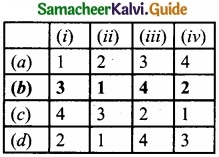
Match List – I with List – II and select the correct answer using the codes given below:

List – I

List – II

(i) Indian Bank1. Private sector bank
(ii) Karur vysya bank2. Government company
(iii) Indian Airlines3. Nationalised bank
(iv) Coal India Ltd4. Public corporation

Answer:
Codes:

Tamil Nadu 11th Commerce Model Question Paper 5 English Medium img 1

Question 20.
Socially responsible business provides goods at ……………………..
(a) High price
(b) Low price
(c) Reasonable price
(d) Moderate price
Answer:
(c) Reasonable price

PART – II

Answer any seven questions in which question No. 30 is compulsory. [7 × 2 = 14]

Question 21.
Give the meaning of crop insurance?
Answer:
This policy is to provide financial support to fanners in case of a crop failure due to drought or flood. It generally covers all risks of loss or damages relating to production of rice, wheat, millets, oil seeds and pulses etc.

Tamil Nadu 11th Commerce Model Question Paper 5 English Medium

Question 22.
Mention any four examples of public corporation?
Answer:
Examples of public corporation:

  1. Life Insurance Corporation of India
  2. The Indian Airlines
  3. The Air India International
  4. Food Corporation of India

Question 23.
What is meant by foreign bank?
Answer:
Banks which have registered office in a foreign country and branches in India are called foreign banks.

Tamil Nadu 11th Commerce Model Question Paper 5 English Medium

Question 24.
What is GATT?
Answer:
The General Agreement on Tariffs and Trade. (GATT) was signed at Geneva on 30th October 1947 by 23 countries. It came into effect on 1st January 1948.

Question 25.
Describe any two advantages of water transport?
Answer:
Advantages of water transport:

  1. It is the cheapest mode of transport.
  2. It is most suitable for heavy loads.

Question 26.
A transport which is useful in hilly and remote areas. It is a means of transport in naval lifting device. What does it mean?
Answer:
It is the type of transport called pack animals. Animals like horse, mule, donkey, camel and elephant are known as pack animals. They are used for carrying small loads in backward areas, hilly tracks, forest regimes and deserts. They serve areas which are inaccessible to modem means of transport.

Tamil Nadu 11th Commerce Model Question Paper 5 English Medium

Question 27.
What is unlimited liability?
Answer:
The liability of the proprietor for the debts of the business is unlimited. The creditors have the right to recover their dues even from the personal property of the proprietor in case the business assets are not sufficient to pay their debts.

Question 28.
What are the services included in service business?
Answer:
Educational, medical, hospitality and banking are the services included in service businesses. Bank service is the nerve center of industry and commerce in a country.

Tamil Nadu 11th Commerce Model Question Paper 5 English Medium

Question 29.
What is meant by Marine Insurance?
Answer:
Marine insurance is a contract of insurance under which the insurer undertakes to indemnify the insured against marine losses. The insured pays the premium for the insurer’s guarantee to make good the looses arising from marine perils. Marine perils may be damage of ship, fire, etc.

Question 30.
What is credit co – operatives?
Answer:
Co – operative credit societies are societies formed for providing short-term financial help to their members. Agriculturists, artisans, industrial workers, salaried employees, etc., form these credit societies.

PART – III

Answer any seven questions in which question No. 40 is compulsory. [7 × 3 = 21]

Question 31.
The functions of commercial banks are:
(a) Primary functions
(b) Secondary functions. Secondary functions may be of agency and general utility functions? Describe any three utility services?
Answer:
General utility functions:

  1. Accepting bills on behalf of customers: Banks accept bills on behalf of customers and make payments to the foreign exporter.
  2. Issue of demand drafts and Banker’s cheques: Demand drafts and banker’s cheques are issued to the public and customers.
  3. Safety lockers: Valuable documents, jewels can be kept in a vault provided by the bank for rent.

Tamil Nadu 11th Commerce Model Question Paper 5 English Medium

Question 32.
Goods are manufactured in one place and it may be demanded throughout the world. Goods may reach the consumers by a number of middlemen. Who is the first middleman in the trade? Explain any three features of that middleman?
Answer:
The first middleman in the trade or distribution is called wholesaler. A wholesaler buys goods directly from manufacturers and sells them to the retailers.

Features:

  1. Wholesalers buy goods directly from producers.
  2. Wholesalers buy goods in large quantities and sell in small quantities.
  3. Wholesalers sell different varieties of a particular kind of product.

Question 33.
The importer places the order either directly or through an indent house. It is known as indent. Indent may be of three types. What are the three types of indents? Explain?
Answer:
There are three types of indent:

  1. Open Indent: It gives complete freedom to exporter to choose type of goods, price, quality, method of packing, etc.
  2. Closed Indent: It does not give any freedom to exporter. Importer specifies the type of goods, price, quality, etc.
  3. Confirmatory Indent: An indent is to be confirmed by importer/his agent and the final indent is sent by importer thereafter.

Tamil Nadu 11th Commerce Model Question Paper 5 English Medium

Question 34.
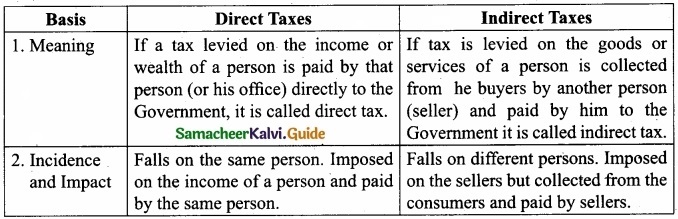
Explain the differences between Direct tax and Indirect tax?
Answer:

Tamil Nadu 11th Commerce Model Question Paper 5 English Medium img 2

Question 35.
Mention the importance of banking service?
Answer:
Banking service is the nerve center of industry and commerce in a country. It plays a vital role by providing the money required for their regular functioning and development. There are many types of banks rendering different types of services.

Question 36.
This organisation is useful to the farmers in a village. It helps in the purpose of cultivation. Identify the form of organisation and briefly explain about it?
Answer:
This form of organisation is ‘co-operative farming societies’. The societies in a village collect their land together for the purpose of cultivation, purchase the inputs for cultivation and market the crops for the sales.

Tamil Nadu 11th Commerce Model Question Paper 5 English Medium

Question 37.
State the meaning of retail trade?
Answer:
Retail trade deals with the distribution of goods in small quantities to the end consumers. It represents the final stage in the distribution where goods are transferred from the hands of manufacturers or wholesalers to the users. If the sales are made directly to the end consumers it will be considered as retailing.

Question 38.
What is the classification of foreign trade?
Answer:
Types of Foreign Trade:

  1. Import Trade: Import trade means buying goods from a foreign country for domestic use.
  2. Export Trade: Export trade means the sale of domestic goods to foreign countries.
  3. Entrepot Trade: Entrepot trade means importing of goods from one country and exporting the same to foreign countries.

Question 39.
What are the various rules regarding damages?
Answer:
Generally in the following cases, the court grants specific performance:

  1. When the act agreed to be done is such that compensation in money for its non-performance is not sufficient.
  2. When it is probable that compensation in money cannot be received for the non-performance of the act agreed to be done.
  3. When there is no standard for ascertaining the actual damage caused by the non-performance of the act agreed to be done.

Tamil Nadu 11th Commerce Model Question Paper 5 English Medium

Question 40.
The scheme was introduced by the RBI in August 1996. These are small private sector banks established in rural and semi urban areas. What is the name of the bank? Explain?
Answer:
Local Area Bank (LAB) scheme was introduced by the RBI in August 1996. LABs are small private sector banks established in rural and semi-urban areas. Each bank serves two or three adjoining districts only. Their main objective is to mobilise rural savings (accept deposits) and invest them in the same areas.

Examples:

  1. Coastal Local Area Bank, Vijayawada, Andhra Pradesh.
  2. Subhadra Local Area Bank Limited, Kolhapur, Maharashtra

PART – IV

Answer all the questions. [7 × 5 = 35]

Question 41.
(a) Discuss the advantages of transport?
Answer:
Advantages of railway transport:

  1. Railways are well suited for carrying heavy and bulky goods over long distances.
  2. It can provide long distance travel throughout the day and night with unbroken services.

Advantages of inland waterways:

  1. It is considered as the cheapest mode of transport among the other modes of transport.
  2. It is most suitable for heavy loads.

Advantages of air transport:

  1. It provides a regular, convenient, efficient and quick service.
  2. Perishable goods like fruits, vegetables, egg, meat, etc., can be transported quickly.

[OR]

(b) Discuss the causes of risk?
Answer:
Business risk arises due to a variety of causes which are classified as follows:
1. Natural Causes:
Human beings have little control over natural calamities like flood, earthquake, lightning, heavy rains, famine, etc. These result in heavy loss of life, property, and income in business.

2. Human Causes:
Human causes include such unexpected events like dishonesty, carelessness or negligence of employees, stoppage of work due to power failure, strikes, riots, management inefficiency, etc.

3. Economic Causes:
These include uncertainties relating to demand for goods, competition, price, collection of dues from customers, change of technology or method of production, etc. Financial problems like rise in interest rate for borrowing, levy of higher taxes,, etc., also come under this type of causes as they result in higher unexpected cost of operation of business.

4. Other Causes:
These are unforeseen events like political disturbances, mechanical failures such as the bursting of boiler, fluctuations in exchange rates, etc. which lead to the possibility of business risks.

Tamil Nadu 11th Commerce Model Question Paper 5 English Medium

Question 42 (a).
Sole proprietorship is a form of business organisation in which an individual introduces his own capital, uses his own skill and intelligence in the management of the business? Explain the characteristics of a sole trader?
Answer:
Business owned and controlled by a single person is known as sole trading business.

The following are the characteristics of a sole trader:

  1. Ownership by one man: This is owned by single person. The sole trader contributes the required capital.
  2. Freedom of work and Quick decisions: The sole trader is the owner, so he need not consult with others. Hence he can take quick decision.
  3. Unlimited liability: When his business assets are not sufficient to pay off the business debts he has to pay from his personal property.
  4. Enjoying Entire Profit: All the benefits earned by the sole trader is enjoyed by him alone.
  5. Absence of Government Regulation: A sole trading concern is free from Government regulations. No legal formalities are to be observed in its formation and management.
  6. Maintenance of Secrecy: Since the trader manages all the affairs of the business, the secrecy can be maintained easily.

[OR]

(b) Partnership is the relation between persons who have agreed to share the profits of a business carried on by all. It is the result of an agreement. Closing of business is also by an agreement. It is called Dissolution of Partnership. Explain the dissolution of partnership firm without the order of the court?
Answer:
Dissolution of a partnership firm takes place in two ways:

  1. Without the order of the court and
  2. By the order of the court

1. Without the order of the court:

  1. By agreement or mutual consent: A firm may be dissolved when all the partners agree to close the affairs of the firm.
  2. By insolvency of all the partners but one: If any one of the partners is adjudged as insolvent, it is necessary to dissolve the firm.
  3. When the objective becomes illegal: When the business carried on by the partnership becomes illegal, the partnership firm is automatically dissolved.
  4. By notice of dissolution: In the case of partnership at will, if any partner gives in writing to close the firm, the firm will be dissolved.
  5. On certain contingencies:
    • On the expiry of the period of the firm.
    • On the completion of a business.
    • On the death of a partner.
    • On the retirement of a partner.
    • On the insolvency of a partner.

Tamil Nadu 11th Commerce Model Question Paper 5 English Medium

Question 43 (a).
What are the features of public corporation?
Answer:
1. Special Statute:
A public corporation is created by a special Act of the Parliament or the State Legislature. The Act defines its powers, objectives, functions and relations with the ministry and the Parliament (or State Legislature).

2. Separate Legal Entity:
A public corporation is a separate legal entity with perpetual succession and common seal It has an existence, independent of the Government. It can own property; can make contracts and file suits, in its own name.

3. Capital Provided by the Government:
The capital of a public corporation is provided by the Government or by agencies controlled by the government. However, many public corporations have also begun to raise money from the capital market.

4. Financial Autonomy:
A public corporation enjoys financial autonomy. It prepares its own budget; and has authority to retain and utilize its earnings for its business.

5. Management by Board of Directors:
Its management is vested in a Board of Directors, appointed or nominated by the Government. But there is no Governmental interference in the day-to-day working of the corporation.

[OR]

(b) Partnership is formed according to Partnership Act. There are various kinds of partners based on capital and administration. Explain any five kinds of partners?
Answer:
Partnership is formed by agreement. In this partnership, the member in a firm is called as partner. There are various kinds of partners. They are as follows:

1. Active partner:
A partner who takes an active part in the conduct of the partnership business is known as an active partner.

2. Sleeping or Dormant partner:
A partner contributes capital and shares in the profits or losses of the firm, but does not take part in the management of the business is known as sleeping partner.

3. Nominal partner:
Such a partner neither contributes any capital nor is he entitled to manage the affairs of the business. He lends only his name to strengthen the firm.

4. Partner in profits only:
When a person joins a firm as a partner on the condition that he is entitled to share profits in the firm, he is called as a partner in profits only.

5. Secret partner:
A secret partner is one whose association is not known to the general public.

Tamil Nadu 11th Commerce Model Question Paper 5 English Medium

Question 44 (a).
Explain various types of insurance?
Answer:
Insurance covers various types of risks. All contract of insurance can be broadly classified as follows:

  1. Life Insurance (or) Life Assurance
  2. Non – life Insurance (or) General Insurance

It can be further classified into:

  1. Fire Insurance
  2. Marine Insurance
  3. Health Insurance and
  4. Miscellaneous Insurance

1. Life Insurance:
Life Insurance may be defined as a contract in which the insurance company called insurer undertakes to insure the life of a person called assured in exchange of a sum of money called premium which may be paid in one lump sum or monthly, quarterly, half yearly or yearly and promises to pay a certain sum of money either on the death of the assured or on expiry of certain period.

2. Non – Life Insurance or General insurance:
It refers as the insurance not related to human but related to properties.

3. Fire Insurance:
Fire insurance is a contract whereby the insurer, in consideration of the premium paid, undertakes to make good any loss or damage caused by a fire during a specified period upto the amount specified in the policy.

4. Marine Insurance:
Marine insurance is a contract of insurance under which the insurer undertakes to indemnify the insured in the manner and to the extent thereby agreed against marine losses. The insured pays the premium in consideration of the insurer’s (underwriter’s) guarantee to make good the losses arising from marine perils or perils of the sea.

5. Health Insurance:
In mid 80’s, most of the hospitals in India were government owned and treatment was free of cost. With the advent of Private Medical Care, the need for Health Insurance was felt and various Insurance Companies introduced Health Insurance as a Product. Presently the health insurance exists primarily in the form of ‘Mediclaim policy’.

[OR]

(b) Explain the functions of retailers?
Answer:

  1. Buying: A retailer buys a wide variety of goods from different wholesalers after estimating customer’s demand.
  2. Storage: A retailer maintains a ready stock of goods and displays them in the shop.
  3. Selling: The retailer sells the goods in small quantities according to the demand taste and preference of consumers.
  4. Grading and Packing: The retailer grades the goods which are not graded by manufacturers and wholesalers.
  5. Risk – bearing: A retailer always keeps stock of goods in anticipation of demand and bears the risk of loss due to fire, theft, spoilage, price fluctuations, etc.
  6. Transportation: Retailers often carry goods from manufacturers to their retail outlets.
  7. Financing: Some retailers grant credit facilities to his customers and provide the facility of return or exchange of goods.

Tamil Nadu 11th Commerce Model Question Paper 5 English Medium

Question 45 (a).
Explain any four personal investment avenues?
Answer:
1. Public Provident Fund (PPF):
It is the safest long – term investment option for the investors in India. It is totally tax – free. PPF account can be opened in bank or post office. The money deposited cannot be withdrawn before 15 years and an investor can earn compound interest from this account.

However the investor can extend the time frame for the next five years if the investor does not opt to withdraw the amount matured for payment at maturity date. PPF investor can take loan against PPF account when he/she experiences financial difficulties.

2. Mutual Funds:
An individual investor who wants to invest in equities and bond with a balance of risk and return generally can invest in mutual funds. Nowadays people invest in stock markets through a mutual fund. Systematic investment plan is one of the best investment options in India.

3. Direct Equity or Share Purchase:
An individual can opt for investment in shares. But he has to analyse the market price of various shares traded in stock exchange, reputation of the company, consistency in the payment of dividend, the nature of the project undertaken by the company, growth prospects of industry in which a company is operating, before investing in shares. If the investment is made for a long time, it may yield good return.

4. Real Estate Investment:
Real estate is one of the fastest growing sectors in India. Buying a flat or plot is supposed to be the best decision amongst the investment options. The value of the real asset may increase substantially depending upon the area of location and other support facilities available therein.

[OR]

(b) Explain any four warehousing documents?
Answer:
Warehouses means a place where goods are stored for future use. For keeping the goods, the various documents are needed; they are as follows:

  1. Warehousing Warrants: It is a document issued in favour of goods by the warehouse keeper. It is also used as a document of title to goods.
  2. Warehouse Keeper’s receipt: It is a document issued by the warehouse keeper, which acknowledges there receipt of goods from the owner of the goods.
  3. Dock Warrant: Dock warrant is a document of title of goods issued by the dock authorities. This document certifies that the dock authorities hold the goods.
  4. Dock Receipt: Dock receipt is an acknowledgement of receipt of goods issued by the dock authorities to the owner of the goods. It is not a document of title to goods.
  5. Delivery Order: This is a document through which the depositor directs the warehouse keepers to deliver the goods to the party mentioned in the document.

Tamil Nadu 11th Commerce Model Question Paper 5 English Medium

Question 46 (a).
Industry means, which is connected with conversion of raw materials into finished goods. It may be of various types. Explain: (a) Analytical industry (b) Genetic industry and (c) Construction industry?
Answer:

  1. Analytical Industry: It analyses and separates different elements from the same materials, as in the case of oil refinery.
  2. Genetic Industries: These industries remain engaged in breeding plants and animals for their use in further reproduction. The seeds, nursery companies, poultry, diary, piggery, hatcheries, nursery, fisheries, apiary etc are classic examples of genetic industries.
  3. Construction Industries: These industries are involved in the ,construction of building, dams, bridges, roads, as well as tunnels and canals.

[OR]

(b) Explain the procedure for the registration of partnership firm?
Answer:

  1. Name of the firm.
  2. The principal place of business.
  3. Name of other places where the firm carried on business.
  4. Names and addresses of all the partners.
  5. The date on which each partner joined the firm.
  6. The duration of the firm.

This statement signed by all the partners should be produced to the Registrar of Firms along with the necessary registration fee of Rs.3. Any change in the above particulars must be communicated to the Registrar within 14 days of such alteration.

Tamil Nadu 11th Commerce Model Question Paper 5 English Medium

Question 47 (a).
Partnership is formed by agreement. It is desirable to have a written agreement. What is the name of the agreement? Explain the contents of it?
Answer:

  1. Name: Name of the Firm.
  2. Nature of Business: Nature of the proposed business to be carried on by the partners.
  3. Duration of Partnership: Duration of the partnership business whether it is to be run for a fixed period of time or whether it is to be dissolved after completing a particular venture,
  4. Capital Contribution: The capital is to be contributed by the partners. It must be remembered that capital contribution is not necessary to become a partner for, one contribute his organizing power, business acumen, managerial skill etc., instead of capital.
  5. Withdrawal from the Firm: The amount that can be withdrawn from the firm by each partner.
  6. Profit/Loss Sharing: The ratio in which the profits or losses are to be shared. If the profit sharing ratio is not specified in the deed, all the partners must share the profits and bear the losses equally.
  7. Interest on Capital: Whether any interest is to be allowed on capital and if so, the rate of interest.
  8. Rate of Interest on Drawing: Rate of interest on drawings, if any.
  9. Loan from Partners: Whether loans can be accepted from the partners and if so the rate of interest payable thereon.
  10. Account Keeping: Maintenance of accounts and audit.
  11. Salary and Commission to Partners: Amount of salary or commission payable to partners for their services. (Unless this is specifically provided, no partner is entitled to any salary).
  12. Retirement: Matters relating to retirement of a partner. The arrangement to be made for paying out the amount due to a retired or deceased partner must also be stated.
  13. Goodwill Valuation: Method of valuing goodwill on the admission, death or retirement of a partner.
  14. Distribution of Responsibility: Distribution of managerial responsibilities. The work that is entrusted to each partner is better stated in the deed itself.
  15. Dissolution Procedure: Procedure for dissolution of the firm and the mode of settlement of accounts thereafter.
  16. Arbitration of Dispute: Arbitration in case of disputes among partners. The deed should provide the method for settling disputes or difference of opinion. This clause will avoid costly litigations.

[OR]

(b) Explain any five principles of co – operatives?
Answer:
1. Voluntary and Open Membership:
Co – operatives are voluntary organisations, open to all people able to use its services and willing to accept the responsibilities of membership, without gender, social, racial, political or religious discrimination.

2. Democratic Member Control:
Co – operatives are democratic organisations controlled by their members those who buy the goods or use the services of the co – operative who actively participate in setting policies and making decisions.

3. Member’s Economic Participation:
Members contribute equally to, and democratically control, the capital of the co – operative. This benefits members in proportion to the business they conduct with the co-operative rather than on the capital invested.

4. Autonomy and Independence:
Co – operatives are autonomous, self – help organisations controlled by their members. If the co – operative enters into agreements with other organisations or raises capital from external sources, it is done so based on terms that ensure democratic control by the members and maintains the co – operative’s autonomy.

5. Education, Training, and Information:
Co – operatives provide education and training for members, elected representatives, managers and employees so they can contribute effectively to the development of their cooperative. Members also inform the general public about the nature and benefits of cooperatives.

Tamil Nadu 11th Accountancy Model Question Paper 3 English Medium

Students can Download Tamil Nadu 11th Accountancy Model Question Paper 3 English Medium Pdf, Tamil Nadu 11th Accountancy Model Question Papers helps you to revise the complete Tamilnadu State Board New Syllabus, helps students complete homework assignments and to score high marks in board exams.

TN State Board 11th Accountancy Model Question Paper 3 English Medium

General Instructions:

  1. The question paper comprises of four parts.
  2. You are to attempt all the parts. An internal choice of questions is provided wherever applicable.
  3. All questions of Part I, II, III and IV are to be attempted separately.
  4. Question numbers 1 to 20 in Part I are Multiple Choice Questions of one mark each.
    These are to be answered by choosing the most suitable answer from the given four alternatives and writing the option code and the corresponding answer
  5. Question numbers 21 to 30 in Part II are two-mark questions. These are to be answered in about one or two sentences.
  6. Question numbers 31 to 40 in Part III are three-mark questions. These are to be answered in above three to five short sentences.
  7. Question numbers 41 to 47 in Part IV are five-mark questions. These are to be answered in detail Draw diagrams wherever necessary.

Time: 3:00 Hours
Maximum Marks: 90

PART – I

Answer all the questions. Choose the correct answer: [20 × 1 = 20]

Question 1.
One of the major role of an accountant is ……………………..
(a) Record keeper
(b) Owner
(c) Employee
(d) Investors
Answer:
(a) Record keeper

Tamil Nadu 11th Accountancy Model Question Paper 3 English Medium

Question 2.
…………………….. is the amount invested by the owner or proprietor in an organisation.
(a) Capital
(b) Drawings
(c) Goods
(d) Asset
Answer:
(a) Capital

Question 3.
………………………… is analytical in nature.
(a) Book – keeping
(b) Accounting
(c) Journal
(d) Ledger
Answer:
(b) Accounting

Tamil Nadu 11th Accountancy Model Question Paper 3 English Medium

Question 4.
………………………. Accounts are closed at the end of accounting period.
(a) Periodicity
(b) Dual aspect
(c) Matching
(d) Cost
Answer:
(a) Periodicity

Question 5.
……………………. is a negotiable instrument.
(a) Pay – in – slip
(b) Cheque
(c) Voucher
(d) Invoice
Answer:
(b) Cheque

Tamil Nadu 11th Accountancy Model Question Paper 3 English Medium

Question 6.
Rectifying entries are passed to make correction of errors in ……………………… accounting.
(a) Single entry
(b) Opening entry
(c) Rectifying entry
(d) Closing entry
Answer:
(c) Rectifying entry

Question 7.
A journal entry has more than one debit or more than one credit or both is called as ………………………
(a) Single entry
(b) Opening entry
(c) Compound entry
(d) Closing entry
Answer:
(c) Compound entry

Question 8.
…………………….. is normally prepared at the end of the accounting period.
(a) Trial balance
(b) Journal
(c) Ledger
(d) Proper journal
Answer:
(a) Trial balance

Tamil Nadu 11th Accountancy Model Question Paper 3 English Medium

Question 9.
The page number of the ledger in which the supplier’s account appears is recorded in …………………….. column.
(a) Date
(b) Particulars
(c) Invoice number
(d) Ledger folio
Answer:
(d) Ledger folio

Question 10.
……………………… motivates the debtor to make the payment at an earlier date to avail discount facility.
(a) Trade discount
(b) Cash discount
(c) Sales
(d) Purchases
Answer:
(b) Cash discount
Tamil Nadu 11th Accountancy Model Question Paper 3 English Medium

Question 11.
The two accounts involved in a transaction are cash account and bank account is called as ………………………
(a) Contra entry
(b) Single entry
(c) Compound entry
(d) Opening entry
Answer:
(a) Contra entry

Question 12.
…………………….. are recorded on the debit side of cash book.
(a) Cash receipts
(b) Cash payments
(c) Expenses paid
(d) Salary paid
Answer:
(a) Cash receipts

Question 13.
Favourable balance as per bank statement will appear as a …………………………
(a) Credit balance
(b) Debit balance
(c) Unfavourable
(d) Cash book
Answer:
(a) Credit balance

Tamil Nadu 11th Accountancy Model Question Paper 3 English Medium

Question 14.
Sales book is overcast by ? 200 is an example of …………………………
(a) Errors of casting
(b) Principle error
(c) Compensating error
(d) Suspense account
Answer:
(a) Errors of casting

Question 15.
Fixed installment method is otherwise called ………………………….
(a) Straight line
(b) Written down value
(c) Diminishing balance
(d) Annuity
Answer:
(a) Straight line

Question 16.
……………………. gives benefit for more than one accounting period.
(a) Capital expenditure
(b) Revenue expenditure
(c) Revenue receipt
(d) None of these
Answer:
(a) Capital expenditure

Tamil Nadu 11th Accountancy Model Question Paper 3 English Medium

Question 17.
……………………… are assets of a relatively permanent nature used in the operations of business and not intended for sale.
(a) Fixed assets
(b) Current assets
(c) Liquid assets
(d) None of these
Answer:
(a) Fixed assets

Question 18.
Goodwill is an example of ………………………
(a) Intangible fixed asset
(b) Fixed asset
(c) Current asset
(d) Furniture
Answer:
(b) Fixed asset

Question 19.
The decrease in book value of fixed assets due to usage or passage of time is called ………………………….
(a) Depreciation
(b) Prepaid
(c) Accrued
(d) Bad debts
Answer:
(a) Depreciation

Tamil Nadu 11th Accountancy Model Question Paper 3 English Medium

Question 20.
Which one is matched correctly?
(a) Finacle – banking software
(b) DOS – programming software
(c) COBOL – operating software
(d) MS – Office – specific purpose software
Answer:
(a) Finacle – banking software

PART – II

Answer any seven questions in which question No. 21 is compulsory: [7 × 2 = 14]

Question 21.
Who are the parties interested in accounting information?
Answer:

  1. Internal users and
  2. External users

Tamil Nadu 11th Accountancy Model Question Paper 3 English Medium

Question 22.
What is meant by accounting concepts?
Answer:
Accounting concepts are the basic assumptions or conditions upon which accounting has been laid. Accounting concepts are the results of broad consensus. The word concept means a notion or abstraction which is generally accepted.

Question 23.
What is real account?
Answer:
All accounts relating to tangible and intangible properties and possessions are called real accounts. In case of real accounts, the rule is debit what comes in and credit what goes out.

Tamil Nadu 11th Accountancy Model Question Paper 3 English Medium

Question 24.
What is a ledger?
Answer:
Ledger is known as principal book of accounts. It is a book which contains all sets of accounts, namely, personal, real and nominal accounts.

Question 25.
What is trial balance?
Answer:
Trial balance is a statement containing the debit and credit balances of all ledger accounts on a particular date. It is arranged in the form of debit and credit columns placed side by side and prepared with the object of checking the arithmetical accuracy of entries made in the books of accounts and to facilitate preparation of financial statements.

Tamil Nadu 11th Accountancy Model Question Paper 3 English Medium

Question 26.
Give the format of Purchase Book?
Answer:
Tamil Nadu 11th Accountancy Model Question Paper 3 English Medium img 1

Question 27.
What is Cash discount?
Answer:
Cash discount is allowed to the parties making prompt payment within the stipulated period of time or early payment. It is discount allowed (loss) for the creditor and discount received (gain) for the debtor who makes payment.

Question 28.
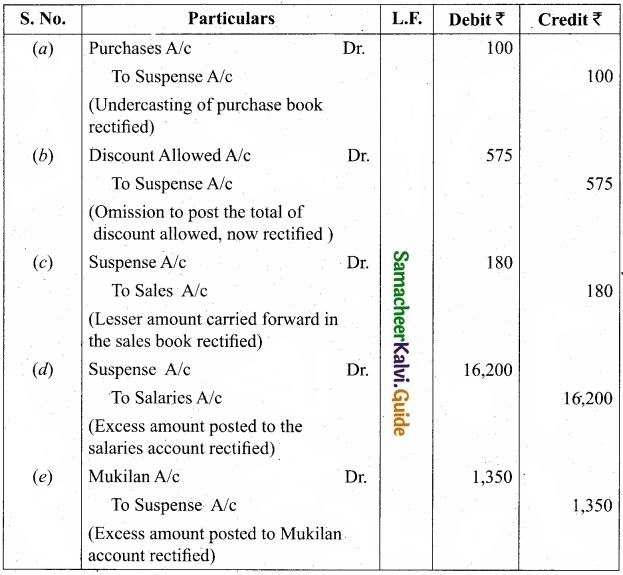
Rectify the following errors?

  1. Sales book was undercast by ₹100.
  2. Purchases returns book was overcast by ₹200.

Answer:

  1. Sales account should be credited with ₹100.
  2. Purchases returns account should be debited with ₹200

Tamil Nadu 11th Accountancy Model Question Paper 3 English Medium

Question 29.
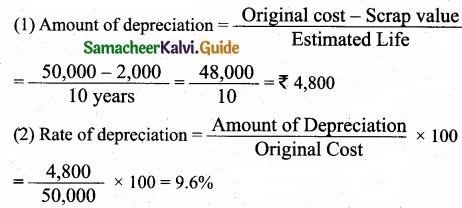
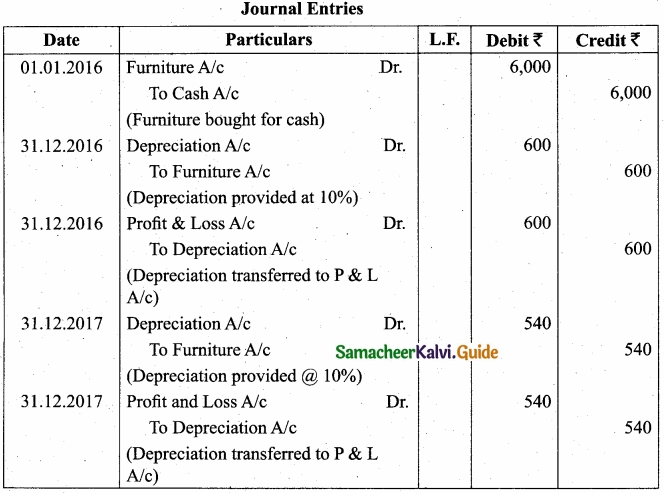
A company purchased a building for ₹50,000. The useful life of the building is 10 years and the residual value is ₹2000. Find out the amount and rate of depreciation under straight line method?
Answer:
Tamil Nadu 11th Accountancy Model Question Paper 3 English Medium img 2

Question 30.
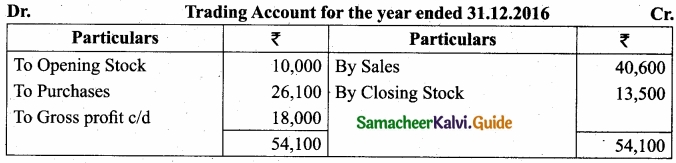
From the following information, prepare Trading account for the year ended 31.12.2016. Opening stock ₹10,000; Purchases ₹26,100; Sales ₹40,600; Closing Stock ₹13,500?
Answer:
Tamil Nadu 11th Accountancy Model Question Paper 3 English Medium img 3

PART – III

Answer any seven questions in which question No. 31 is compulsory: [7 × 3 = 21]

Question 31.
What are the components of computerised accounting system?
Answer:

  1. Hardware
  2. Software
  3. People
  4. Procedure
  5. Data and
  6. Connectivity

Tamil Nadu 11th Accountancy Model Question Paper 3 English Medium

Question 32.
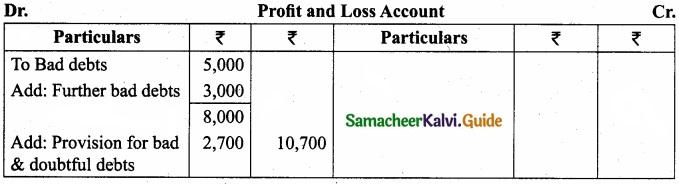
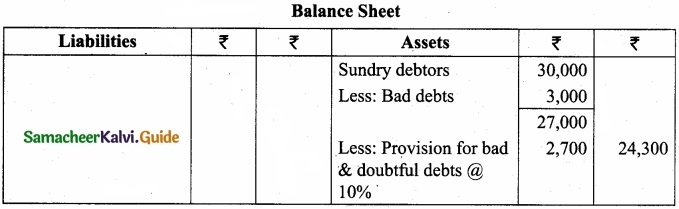
The following are the extracts from the trial balance. Sundry debtors ₹30,000; bad debts ₹5,000;
Additional information:

  1. Write off bad debts ₹3,000.
  2. Create 10% provision for bad and doubtful debts. You are required to pass necessary adjusting entries and show how these items will appear in profit and loss account and balance sheet.

Answer:
Tamil Nadu 11th Accountancy Model Question Paper 3 English Medium img 4Tamil Nadu 11th Accountancy Model Question Paper 3 English Medium img 5Tamil Nadu 11th Accountancy Model Question Paper 3 English Medium img 6

Tamil Nadu 11th Accountancy Model Question Paper 3 English Medium

Question 33.
Classify the following items into capital and revenue:

  1. ₹50,000 spent for railway siding.
  2. Loss on sale of old furniture.
  3. Carriage paid on goods sold.

Answer:

  1. Capital
  2. Revenue
  3. Revenue

Question 34.
A firm purchased a plant on 01.01.2018 for ₹9,000 and spent ₹1,000 as erection charges. Calculate the amount of depreciation for the year 2018 @ 15% per annum under the written down value method. Accounts are closed on 31st March every year?
Answer:
Original cost = 9,000 + 1,000 = 10,000
Rate of depreciation = 15%
Date of purchase = 01.01.2018
Number of months used = 01.01.2018 to 3 1.03.2018 = 3 months
Amount of depreciation = 15% on 10,000 for 3 months
= 10,000 × 15/100×3/12
= ₹375.

Tamil Nadu 11th Accountancy Model Question Paper 3 English Medium

Question 35.
Rectify the following errors discounted after the preparation of the trial balance:

  1. Rent paid was carried forward to the next page ₹500 short.
  2. Wages paid was carried forward ₹250 excess.
  3. The sales book was overcast by ₹1,500.

Answer:

  1. Rent account should be debited with ₹500.
  2. Wages account should be credited with ₹250.
  3. Sales account should be debited with ₹1,500.

Tamil Nadu 11th Accountancy Model Question Paper 3 English Medium

Question 36.
Expand the following terms:

  1. ATM
  2. CDM
  3. POS
  4. NEFT
  5. RTGS
  6. L.F

Answer:

  1. Automated Teller Machine (ATM)
  2. Cash Deposit Machine (CDM)
  3. Point of Sale (POS)
  4. National Electronic Funds Transfer (NEFT)
  5. Real Time Gross Settlement (RTGS)
  6. Ledger folio (L.F.)

Question 37.
Complete the followings:

  1. Total of debit > Total of credit = ?
  2. Total of credit > Total of debit = ?
  3. Total of debit = Total of credit = ?

Answer:

  1. Debit balance
  2. Credit balance
  3. Nil balance

Tamil Nadu 11th Accountancy Model Question Paper 3 English Medium

Question 38.
Define bill of exchange?
Answer:
According to the Negotiable Instruments Act, 1881, “Bill of exchange” is an instrument in writing containing an unconditional order, signed by the maker, directing a certain person to pay a certain sum of money only to, or to the order of a certain person or to the bearer of the instrument.

Question 39.
Write any three advantages of Petty cash book?
Answer:

  1. There can be better control over petty payments.
  2. There is saving of time of the main cashier.
  3. Cash book is not loaded with many cash payments.

Tamil Nadu 11th Accountancy Model Question Paper 3 English Medium

Question 40.
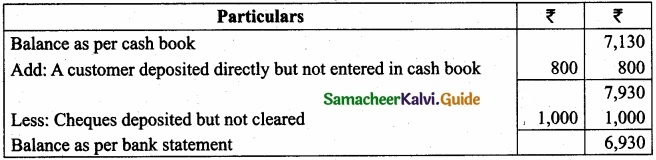
From the followings prepare a bank reconciliation statement of Jayakumar as on 31st December, 2016?

  1. Balance as per cash book ₹7,130.
  2. Cheque deposited but not cleared ₹1,000.
  3. A customer has deposited ₹800 into the bank directly.

Answer:
Tamil Nadu 11th Accountancy Model Question Paper 3 English Medium img 7

PART – IV

Answer all the questions: [7 × 5 = 35]

Question 41 (a).
Complete the missing informations:
Tamil Nadu 11th Accountancy Model Question Paper 3 English Medium img 8

Answer:
Tamil Nadu 11th Accountancy Model Question Paper 3 English Medium img 9

[OR]

(b) Prepare Ledger accounts directly from the following informations:Tamil Nadu 11th Accountancy Model Question Paper 3 English Medium img 31

Answer:
Tamil Nadu 11th Accountancy Model Question Paper 3 English Medium img 12Tamil Nadu 11th Accountancy Model Question Paper 3 English Medium img 13Tamil Nadu 11th Accountancy Model Question Paper 3 English Medium img 14Tamil Nadu 11th Accountancy Model Question Paper 3 English Medium img 15Tamil Nadu 11th Accountancy Model Question Paper 3 English Medium img 16

Tamil Nadu 11th Accountancy Model Question Paper 3 English Medium

Question 42 (a).
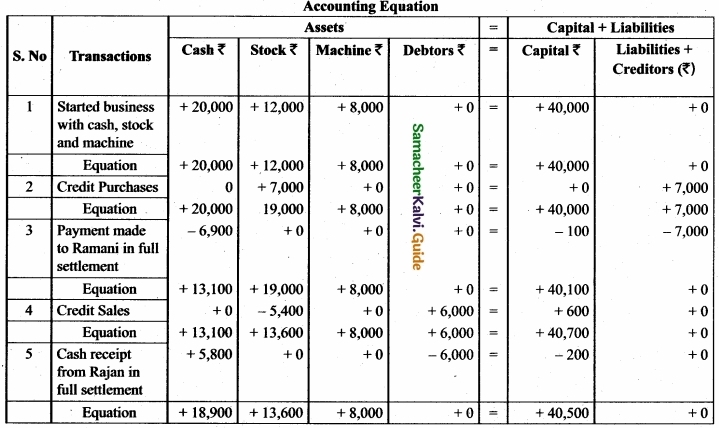
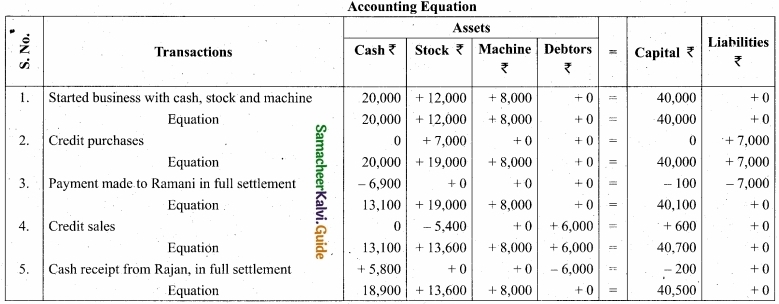
Show the effect of following business transactions on the accounting equation:

  1. Anbu started business with cash ₹20,000; goods ₹12,000; and machine ₹8,000;
  2. Goods purchased from Ramani on credit ₹7,000;
  3. Payment made to Ramani’s in full settlement ₹6,900;
  4. Sold goods to Rajan on credit costing ₹5,400 for ₹6,000;

Answer:
Tamil Nadu 11th Accountancy Model Question Paper 3 English Medium img 17a

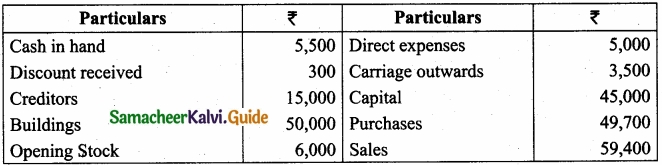
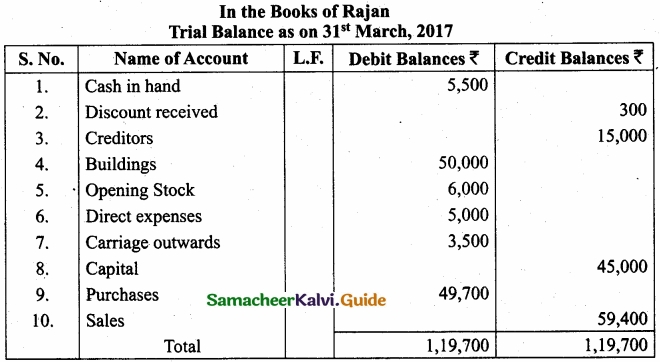
(b) From the following balances extracted from the books of Raj an a trader on automobiles, prepare Trial Balance as on 31stMarch, 2017?
Tamil Nadu 11th Accountancy Model Question Paper 3 English Medium img 32

Answer:
Tamil Nadu 11th Accountancy Model Question Paper 3 English Medium img 18

Tamil Nadu 11th Accountancy Model Question Paper 3 English Medium

Question 43 (a).
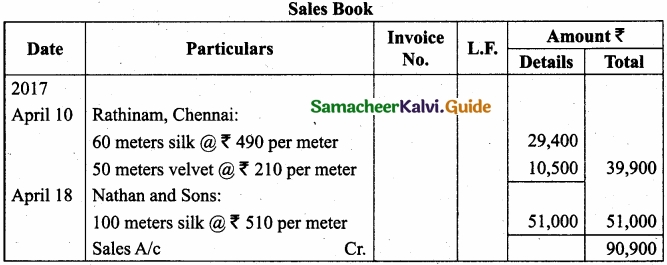
Prepare Purchases Book and Sales Book in the books of Santhosh Textiles Ltd., from the following transactions given for April, 2017?
Tamil Nadu 11th Accountancy Model Question Paper 3 English Medium img 19

Answer:
Tamil Nadu 11th Accountancy Model Question Paper 3 English Medium img 20Tamil Nadu 11th Accountancy Model Question Paper 3 English Medium img 21

[OR]

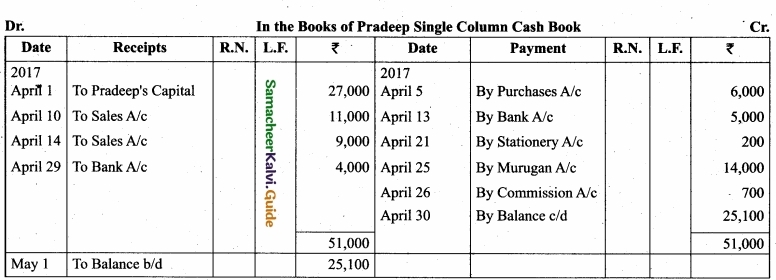
(b) Enter the following transactions in a single column Cash Book of Pradeep for April, 2017?Tamil Nadu 11th Accountancy Model Question Paper 3 English Medium img 33

Answer:
Tamil Nadu 11th Accountancy Model Question Paper 3 English Medium img 22a

Tamil Nadu 11th Accountancy Model Question Paper 3 English Medium

Question 44 (a).
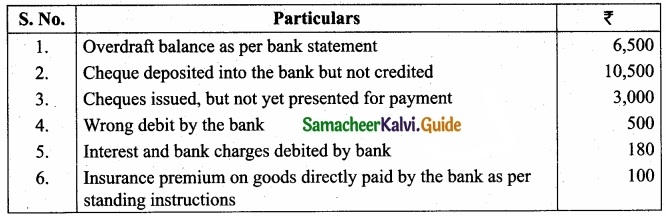
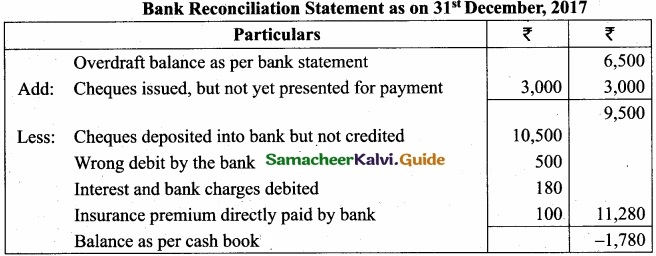
From the following data, ascertain the cash book balance as on 31st December, 2017?Tamil Nadu 11th Accountancy Model Question Paper 3 English Medium img 34

Answer:
Tamil Nadu 11th Accountancy Model Question Paper 3 English Medium img 23

[OR]

(b) Pass journal entries to rectify the following errors located after the preparation of the trial balance. Assume that there exists a suspense account?

  1. The total of sales book was undercast by ₹2,000.
  2. The purchase of machinery for ₹3,000 was entered in the purchases book.
  3. A credit sale of goods for ₹45 to Mathi was posted in his account as ₹54.
  4. The purchases returns book was overcast by ₹200.
  5. The total of sales book ₹1,122 were wrongly posted in the ledger as ₹1,222.

Answer:
Tamil Nadu 11th Accountancy Model Question Paper 3 English Medium img 24

Tamil Nadu 11th Accountancy Model Question Paper 3 English Medium

Question 45 (a).
M/s Ramco Textile Mills purchased machinery on 1st April, 2014 for 2,00,000 on credit from M/s. Nila and Co., and spent ₹10,000 on its installation. Depreciation is provided at 10% per annum on the written down value method. Prepare machinery account and depreciation account for the first three years. Books are closed on 31st March every year?
Answer:
Tamil Nadu 11th Accountancy Model Question Paper 3 English Medium img 25

[OR]

(b) State whether the following are capital or revenue items:

  1. ₹5,000 spent towards addition to buildings.
  2. Second-hand motor car purchased for ₹30,000 and paid ₹2,000 as repairs immediately.
  3. ₹10,000 was spent on painting the new factory.
  4. Freight and cartage on the new machine ₹150, erection charges ₹200.
  5. ₹150 spent on repairs before using a second-hand car purchased recently.

Answer:

  1. Capital expenditure
  2. Capital expenditure
  3. Capital expenditure
  4. Capital expenditure
  5. Capital expenditure

Tamil Nadu 11th Accountancy Model Question Paper 3 English Medium

Question 46 (a).
From the following particulars, prepare Profit and Loss account for the year ended 31st December, 2017?Tamil Nadu 11th Accountancy Model Question Paper 3 English Medium img 35

Answer:

Tamil Nadu 11th Accountancy Model Question Paper 3 English Medium img 27

[OR]

(b) What are the features of Capital Expenditure?
Answer:
The following are the features of Capital expenditure:

  1. It gives benefits for more than one accounting period.
  2. It includes acquisition of fixed assets and all expenditure incurred upto the point an asset is ready for use.
  3. It contributes to the revenue earning capacity of the business.
  4. It is non-recurring in nature.
  5. It is shown on the assets side of the balance sheet.

Tamil Nadu 11th Accountancy Model Question Paper 3 English Medium

Question 47 (a).
The following balances were extracted from the books of Thomas as on 31st March, 2018. Dr?Tamil Nadu 11th Accountancy Model Question Paper 3 English Medium img 28

Adjustments:

  1. Closing Stock ₹9,000.
  2. Provide depreciation @ 10% on machinery.
  3. Interest accrued on investments ₹2,000

Prepare Trading A/c, Profit and Loss A/c and Balance Sheet as on 31st March, 2018. In the Books of Thomas
Dr. Trading A/c and Profit and Loss Account for the year ended 31st March, 2018 Cr.

Answer:
Tamil Nadu 11th Accountancy Model Question Paper 3 English Medium img 29Tamil Nadu 11th Accountancy Model Question Paper 3 English Medium img 30

[OR]

(b) Write any five advantages of computerised accounting system?
Answer:

  • Faster Processing: Computers require far less time than human beings in performing a particular task. Therefore, accounting data are processed faster using a computerised accounting system.
  • Accurate Information: There is less space for error because only one account entry is needed for each transaction unlike repeated posting of the same accounting data in manual system.
  • Reliability: Computer systems are immune to boredom, tiredness or fatigue. Therefore, these can perform repetitive functions effectively and are highly reliable.
  • Easy Availability of Information: The data are easily available and can be communicated to different users at the same time.
  • Up-to-date Information: Account balances will always be up-to-date since the records are automatically updated as and when accounting data are entered or stored.

Tamil Nadu 11th Accountancy Model Question Paper 2 English Medium

Students can Download Tamil Nadu 11th Accountancy Model Question Paper 2 English Medium Pdf, Tamil Nadu 11th Accountancy Model Question Papers helps you to revise the complete Tamilnadu State Board New Syllabus, helps students complete homework assignments and to score high marks in board exams.

TN State Board 11th Accountancy Model Question Paper 2 English Medium

General Instructions:

  1. The question paper comprises of four parts.
  2. You are to attempt all the parts. An internal choice of questions is provided wherever applicable.
  3. All questions of Part I, II, III and IV are to be attempted separately.
  4. Question numbers 1 to 20 in Part I are Multiple Choice Questions of one mark each.
    These are to be answered by choosing the most suitable answer from the given four alternatives and writing the option code and the corresponding answer
  5. Question numbers 21 to 30 in Part II are two-mark questions. These are to be answered in about one or two sentences.
  6. Question numbers 31 to 40 in Part III are three-mark questions. These are to be answered in above three to five short sentences.
  7. Question numbers 41 to 47 in Part IV are five-mark questions. These are to be answered in detail Draw diagrams wherever necessary.

Time: 3:00 Hours
Maximum Marks: 90

PART – I

Answer all the questions. Choose the correct answer: [20 × 1 = 20]

Question 1.
Which one of the following is not a branch of accounting?
(a) Financial accounting
(b) Management accounting
(c) Human resources accounting
(d) None of the above
Answer:
(d) None of the above

Tamil Nadu 11th Accountancy Model Question Paper 2 English Medium

Question 2.
Financial position of a business is ascertained on the basis of ……………………….
(a) Journal
(b) Trial balance
(c) Balance sheet
(d) Ledger
Answer:
(c) Balance sheet

Question 3.
The profounder of double entry system of book – keeping?
(a) J.R. Batli boi
(b) Luca Pacioli
(c) Old Kesal
(d) Menhar
Answer:
(b) Luca Pacioli

Tamil Nadu 11th Accountancy Model Question Paper 2 English Medium

Question 4.
The concept which assumes that a business will last indefinitely is ………………………..
(a) Business entity
(b) Going concern
(c) Periodicity
(d) Conservation
Answer:
(b) Going concern

Question 5.
A firm has assets of ₹1,00,000 and the external liabilities of ₹60,000. Its capital would be ………………………….
(a) ₹1,60,000
(b) ₹60,000
(c) ₹1,00,000
(d) ₹40,000
Answer:
(d) ₹40,000

Question 6.
The incorrect accounting equation is ………………………
(a) Assets = Liabilities + Capital
(b) Assets = Capital + Liabilities
(c) Liabilities = Assets + Capital
(d) Capital = Assets – Liabilities
Answer:
(c) Liabilities = Assets + Capital

Tamil Nadu 11th Accountancy Model Question Paper 2 English Medium

Question 7.
J.F means ………………………….
(a) Ledger page number
(b) Journal page number
(c) Voucher number
(d) Order number
Answer:
(b) Journal page number

Question 8.
The process of finding the net amount from the totals of debit and credit columns in a ledger is known as ……………………….
(a) Casting
(b) Posting
(c) Journalising
(d) Balancing
Answer:
(d) Balancing

Question 9.
The trial balance contains the balances of ………………………..
(a) Only personal accounts
(b) Only real account
(c) Only nominal accounts
(d) All accounts
Answer:
(d) All accounts

Tamil Nadu 11th Accountancy Model Question Paper 2 English Medium

Question 10.
Which of the following is/are the objective(s) of preparing trial balance?
(a) Serving as the summary of all the ledger accounts.
(b) Helping in the preparation of final accounts.
(c) Examining arithmetical accuracy of accounts.
(d) (a), (b) and (c)
Answer:
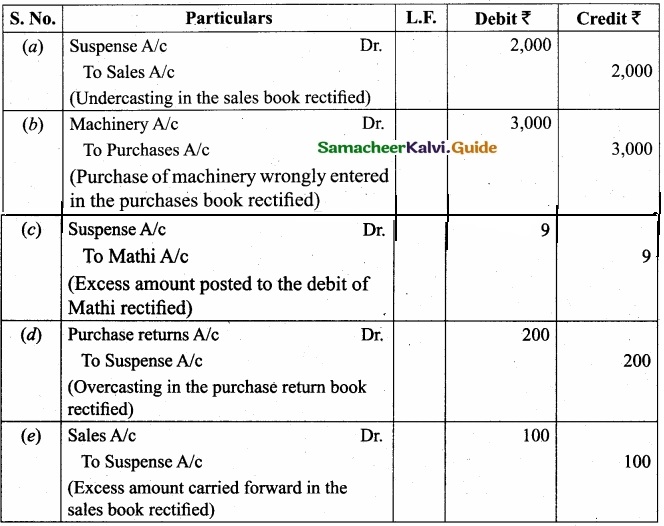
(d) (a), (b) and (c)

Question 11.
Sales book is used to record ……………………..
(a) All sales of goods
(b) All credit sales of assets
(c) All credit sales of goods
(d) All sales of assets and goods
Answer:
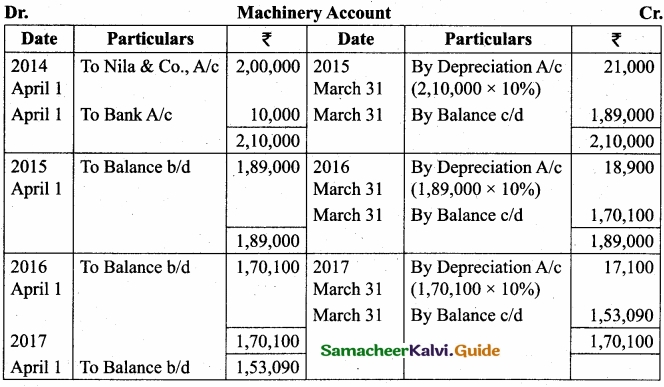
(c) All credit sales of goods

Question 12.
The total of the sales book is posted periodically to the credit of ………………………
(a) Sales account
(b) Cash account
(c) Purchases account
(d) Journal proper
Answer:
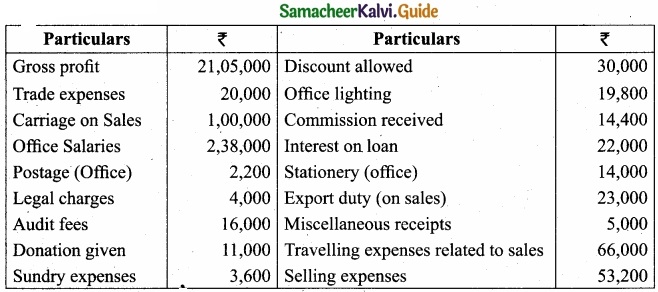
(a) Sales account

Tamil Nadu 11th Accountancy Model Question Paper 2 English Medium

Question 13.
When a firm maintains a simple cash book, it need not maintain ………………………..
(a) Sales a/c in the ledger
(b) Purchases a/c in the ledger
(c) Capital a/c in the ledger
(d) Cash a/c in the ledger
Answer:
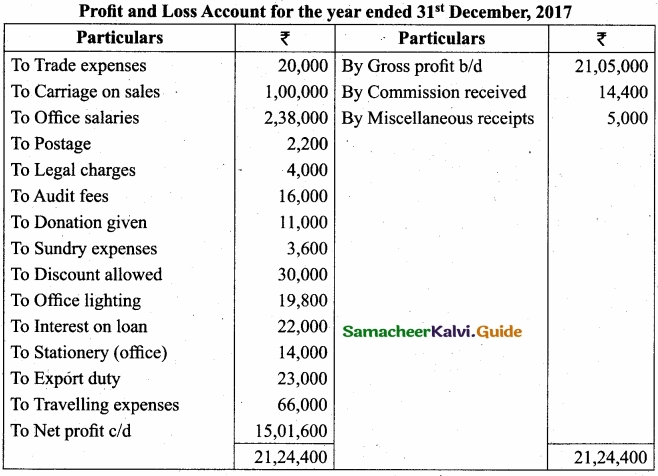
(d) Cash a/c in the ledger

Question 14.
Debit balance in the bank column of the cash book means …………………………
(a) Credit balance as per bank statement
(b) Debit balance as per bank statement
(c) Overdraft as per cash book
(d) None of the above
Answer:
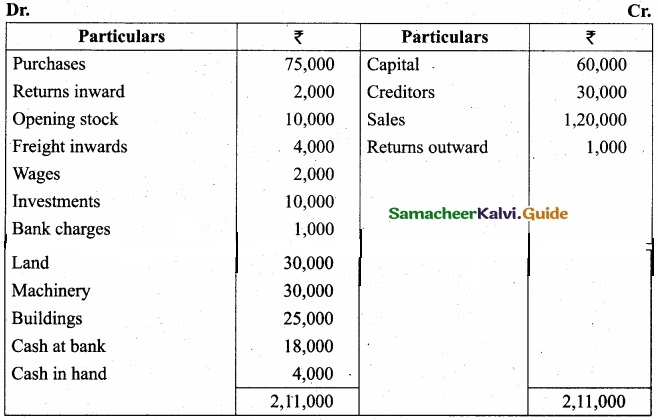
(a) Credit balance as per bank statement

Tamil Nadu 11th Accountancy Model Question Paper 2 English Medium

Question 15.
The difference in trial balance is taken to ……………………….
(a) The capital a/c
(b) The trading a/c
(c) The suspense a/c
(d) The Profit and loss a/c
Answer:
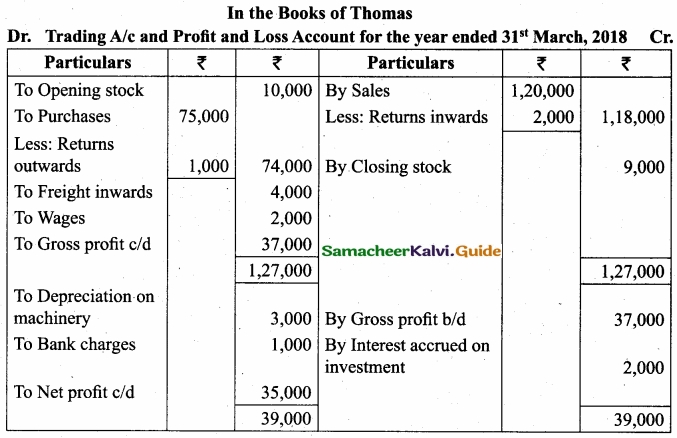
(c) The suspense a/c

Question 16.
Under the written down value method of depreciation, the amount of depreciation is …………………………
(a) Uniform in all the years
(b) Decreasing every year
(c) Increasing every year
(d) None of the above
Answer:
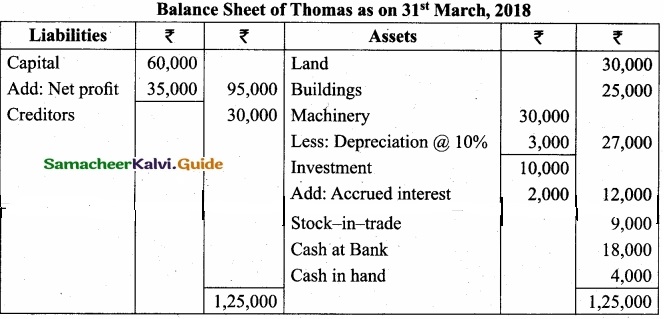
(b) Decreasing every year

Tamil Nadu 11th Accountancy Model Question Paper 2 English Medium

Question 17.
Interest on bank deposits is ………………………..
(a) Capital receipt
(b) Revenue receipt
(c) Capital expenditure
(d) Revenue expenditure
Answer:
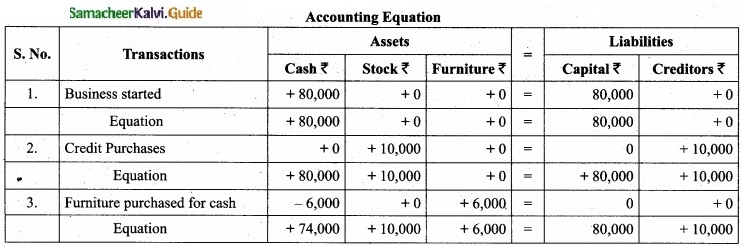
(b) Revenue receipt

Question 18.
Net profit of the business increases the …………………………
(a) Drawings
(b) Receivables
(c) Debts
(d) Capital
Answer:
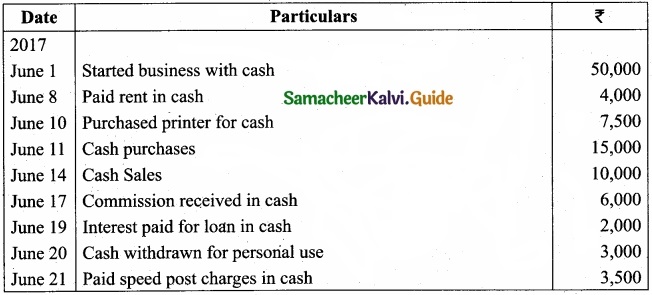
(d) Capital

Question 19.
Closing stock is valued at ………………………
(a) Cost price
(b) Market price
(c) Cost price or market price whichever is higher
(d) Cost price or net realisable value whichever is lower
Answer:
(d) Cost price or net realisable value whichever is lower

Tamil Nadu 11th Accountancy Model Question Paper 2 English Medium

Question 20.
Which one is not a component of computer system?
(a) Input unit
(b) Output unit
(c) Data
(d) CPU
Answer:
(c) Data

PART – II

Answer any seven questions in which question No. 21 is compulsory. [7 × 2 = 14]

Question 21.
Mention two objectives of Accounting?
Answer:

  1. To keep a systematic record of financial transactions and events.
  2. To ascertain the profit or loss of the business enterprise.

Tamil Nadu 11th Accountancy Model Question Paper 2 English Medium

Question 22.
What is Compound entry?
Answer:
Compound entry is an entry in which more than two accounts are involved. Either more than one account is debited or more than one account is credited or both.

Question 23.
What is Balance method?
Answer:
In this method, the balance of every ledger account either debit or credit, as the case may be, is recorded in the trial balance against the respective accounts. The balance method is widely used, as it helps in the preparation of financial statements.

Question 24.
Who is drawee?
Answer:
The person who has to make the payment or who accepts to make the payment is called the drawee, i.e., a debtor.

Tamil Nadu 11th Accountancy Model Question Paper 2 English Medium

Question 25.
What are the types of petty cash book?
Answer:

  1. Simple petty cash book
  2. Analytical petty cash book.

Question 26.
Write two examples for error of principle?
Answer:

  1. Sale of old furniture on credit for ₹500 was entered in the sales book.
  2. Wages of ₹600 paid for installation of a new machine is debited to wages account,

Tamil Nadu 11th Accountancy Model Question Paper 2 English Medium

Question 27.
Write any two objectives of providing depreciation?
Answer:

  1. To find out the true profit or loss.
  2. To present the true and fair view of financial position.

Question 28.
Write any two examples of revenue receipt?
Answer:

  1. Rent received
  2. Proceeds from sale of goods.

Question 29.
What is outstanding expenses?
Answer:
Expenses which have been incurred in the accounting period but not paid till the end of the accounting period are called outstanding expenses.

Tamil Nadu 11th Accountancy Model Question Paper 2 English Medium

Question 30.
Write any four features of computerised accounting system (CAS)?
Answer:

  1. Simple and integrated
  2. Speed
  3. Accuracy
  4. Reliability

PART – III

Answer any seven questions in which question No. 31 is compulsory. [7 × 3 = 21]

Question 31.
Explain the meaning of accounting?
Answer:
Accounting is the systematic process of identifying, measuring, recording, classifying, summarising, interpreting and communicating financial information. Accounting gives information on;

  1. The resources available
  2. How the available resources have been employed, and
  3. The results achieved by their use.

Tamil Nadu 11th Accountancy Model Question Paper 2 English Medium

Question 32.
Show accounting equation from the following information:

  1. Started business with cash ₹80,000.
  2. Goods bought on credit from Raj ₹10,000.
  3. Purchased furniture for cash ₹6,000.

Answer:
Tamil Nadu 11th Accountancy Model Question Paper 2 English Medium img 1a

Question 33.
Enter the following transactions in a single column cash book of Pandeeswari for the month of June, 2017?
Tamil Nadu 11th Accountancy Model Question Paper 2 English Medium img 32
Answer:
Tamil Nadu 11th Accountancy Model Question Paper 2 English Medium img 2a

Tamil Nadu 11th Accountancy Model Question Paper 2 English Medium

Question 34.
Prepare a Sales Account from the following transactions?
Tamil Nadu 11th Accountancy Model Question Paper 2 English Medium img 33
Answer:
Tamil Nadu 11th Accountancy Model Question Paper 2 English Medium img 3

Question 35.
From the following balances of Arjun, prepare the Trial Balance as on 31st March, 2018?Tamil Nadu 11th Accountancy Model Question Paper 2 English Medium img 34
Answer:
Tamil Nadu 11th Accountancy Model Question Paper 2 English Medium img 4

Tamil Nadu 11th Accountancy Model Question Paper 2 English Medium

Question 36.
From the following particulars of Siva and Company, prepare a bank reconciliation statement as on 31st December, 2017?

  1. Credit balance as per cash book ₹12,000.
  2. A cheque of ₹1,200 issued and presented for payment to the bank, wrongly credited in the cash book as ₹2,100.
  3. Debit side of bank statement was undercast by ₹100.

Answer:
Tamil Nadu 11th Accountancy Model Question Paper 2 English Medium img 5

Question 37.
The following errors was detected before preparation of trial balance. Rectify them?

  1. The total of rent received account is carried forward ₹900 short.
  2. The total of salary account is carried forward ₹1,100 short.
  3. Sales returns book is over cast ₹800.

Answer:

  1. Rent received account is to be credited with ₹900.
  2. Salary account is to be debited with ₹1,100.
  3. Sales returns account should be credited with ₹800.

Tamil Nadu 11th Accountancy Model Question Paper 2 English Medium

Question 38.
Find out the rate of depreciation under straight line method from the following details: Original cost of the asset ₹10,000; Estimated life of the asset 10 years; Estimated scrap value at the end ₹2,000?
Answer:
Tamil Nadu 11th Accountancy Model Question Paper 2 English Medium img 6

Question 39.
State whether they are capital and revenue:

  1. Construction of buildings ₹10,00,000.
  2. Repairs to furniture ₹50,000.
  3. White – washing the building ₹80,000.

Answer:

  1. Capital expenditure
  2. Revenue expenditure
  3. Revenue expenditure

Tamil Nadu 11th Accountancy Model Question Paper 2 English Medium

Question 40.
Pass adjusting entries for the following?

  1. The Closing stock was valued at ₹5,000;
  2. Outstanding salaries ₹150;
  3. Insurance prepaid ₹450;

Answer:
Tamil Nadu 11th Accountancy Model Question Paper 2 English Medium img 7

PART – IV

Answer all the questions. [7 × 5 = 35]

Question 41 (a).
Bragathish is a trader dealing in electronic goods who commenced his business in 2015, for the following transactions took place in the month of March, 2018. Pass Journal entries?Tamil Nadu 11th Accountancy Model Question Paper 2 English Medium img 35

Answer:
Tamil Nadu 11th Accountancy Model Question Paper 2 English Medium img 8

[OR]

(b) The following errors were located after the preparation of the trial balance. Assume that there exists a suspense account. Pass journal entries to rectify them?

  1. The total of purchases book was undercast by ₹100.
  2. The total of the discount column on the debit side of cash book ₹575 were not posted.
  3. The total of one page of the sales book for ₹5,975 were carried forward to the next page as ₹5,795.
  4. Salaries ₹1,800 were posted as ₹18,000.
  5. Purchase of goods on credit from Mukilan for ₹150 have been posted to his account as ₹1,500.

Answer:
Tamil Nadu 11th Accountancy Model Question Paper 2 English Medium img 9

Tamil Nadu 11th Accountancy Model Question Paper 2 English Medium

Question 42 (a).
Show the effect of following business transactions on the accounting equation:

  1. Anbu started business with cash ₹20,000; goods ₹12,000 and machine ₹8,000.
  2. Purchased goods from Ramani on credit ₹7,000.
  3. Payment made to Ramani in full settlement ₹6,900.
  4. Sold goods to Raj an on credit costing ₹5,400 for ₹6,000.
  5. Received from Raj an ₹5,800 in full settlement of his account.

Answer:
Tamil Nadu 11th Accountancy Model Question Paper 2 English Medium img 43a

(b) A furniture costing ₹5,000 was purchased on 01.01.2016, the installation charges being ₹1,000. The furniture is to be depreciated @ 10% p.a. on the diminishing balance method. Pass Journal entries for the first two years?
Answer:
Tamil Nadu 11th Accountancy Model Question Paper 2 English Medium img 11

Tamil Nadu 11th Accountancy Model Question Paper 2 English Medium

Question 43 (a).
Journalise the following transactions and past them to the ledger?Tamil Nadu 11th Accountancy Model Question Paper 2 English Medium img 36

Answer:
Tamil Nadu 11th Accountancy Model Question Paper 2 English Medium img 12
Tamil Nadu 11th Accountancy Model Question Paper 2 English Medium img 13Tamil Nadu 11th Accountancy Model Question Paper 2 English Medium img 14Tamil Nadu 11th Accountancy Model Question Paper 2 English Medium img 15Tamil Nadu 11th Accountancy Model Question Paper 2 English Medium img 16Tamil Nadu 11th Accountancy Model Question Paper 2 English Medium img 17

Tamil Nadu 11th Accountancy Model Question Paper 2 English Medium img 18

[OR]

(b) Classify the following receipts into capital or revenue?

  1. Sale proceeds of goods ₹75,000
  2. Loan borrowed from hank ₹2,50,000
  3. Sale of investment ₹1,20,000
  4. Commission received ₹30,000
  5. ₹1,400 wages paid in connection with the erection of new machinery

Answer:

  1. Revenue
  2. Capital
  3. Capital
  4. Revenue
  5. Capital

Tamil Nadu 11th Accountancy Model Question Paper 2 English Medium

Question 44 (a).
Prepare trail balance as on 31st January, 2017?Tamil Nadu 11th Accountancy Model Question Paper 2 English Medium img 37

Answer:
Tamil Nadu 11th Accountancy Model Question Paper 2 English Medium img 19

(b) From the following information, prepare Trading and Profit & Loss A/c of Abdul Rahuman for the year ending 31st December, 2016 and Balance Sheet as on that date. The closing stock on 31st December, 2016 was valued ₹2,000?Tamil Nadu 11th Accountancy Model Question Paper 2 English Medium img 38

Answer:
Tamil Nadu 11th Accountancy Model Question Paper 2 English Medium img 20Tamil Nadu 11th Accountancy Model Question Paper 2 English Medium img 21

Tamil Nadu 11th Accountancy Model Question Paper 2 English Medium

Question 45 (a).
Prepare purchase book and Purchase returns book from the following of Robert Funiture Mart?Tamil Nadu 11th Accountancy Model Question Paper 2 English Medium img 22

Answer:
Tamil Nadu 11th Accountancy Model Question Paper 2 English Medium img 23
Tamil Nadu 11th Accountancy Model Question Paper 2 English Medium img 24

[OR]

(b) The following trial balance was extracted from the books of Arun Traders as on 31st March, 2018?
Tamil Nadu 11th Accountancy Model Question Paper 2 English Medium img 25

Adjustments:

  1. Depreciate plant & machinery @ 20%.
  2. Wages outstanding amounts to ₹750.
  3. Half of repairs and maintenance paid is for the next year.
  4. Closing stock was valued at ₹15,000.
    Prepare Trading and Profit and Loss A/c for the year ending 31st March, 2018 and Balance sheet as on that date.

Answer:
Tamil Nadu 11th Accountancy Model Question Paper 2 English Medium img 26Tamil Nadu 11th Accountancy Model Question Paper 2 English Medium img 27

Tamil Nadu 11th Accountancy Model Question Paper 2 English Medium

Question 46 (a).
Prepare Three Column Cash book in the books of Thiru Durairaj?Tamil Nadu 11th Accountancy Model Question Paper 2 English Medium img 39

Answer:
Tamil Nadu 11th Accountancy Model Question Paper 2 English Medium img 28a

[OR]

(b) Enter the following transactions in Ahamed’s Cash book discount and Cash columns?Tamil Nadu 11th Accountancy Model Question Paper 2 English Medium img 40

Answer:
Tamil Nadu 11th Accountancy Model Question Paper 2 English Medium img 29a

Tamil Nadu 11th Accountancy Model Question Paper 2 English Medium

Question 47 (a).
From the following particulars of Raheem traders, prepare a bank reconciliation statement as on 31st March, 2018?

  1. Overdraft as per cash book ₹2,500.
  2. Debit side of cash book was undercast by ₹700.
  3. Amount received by bank through RTGS amounting ₹2,00,000 omitted in the cash book.
  4. Two cheques issued for ₹1,800 and ₹2,000 on 29th March 2018. Only the second cheque is presented for payment,
  5. Insurance premium on car for ₹1,000 paid by the bank as per standing instructions not recorded in the cash book.

Answer:
Tamil Nadu 11th Accountancy Model Question Paper 2 English Medium img 30

[OR]

(b) Prepare an analytical petty cash book under imprest system?Tamil Nadu 11th Accountancy Model Question Paper 2 English Medium img 41

Answer:
Tamil Nadu 11th Accountancy Model Question Paper 2 English Medium img 31a

Samacheer Kalvi 10th Tamil Guide Chapter 1.5 எழுத்து சொல்

Students can Download 10th Tamil Chapter 1.5 எழுத்து சொல் Questions and Answers, Summary, Notes, Samacheer Kalvi 10th Tamil Guide Pdf helps you to revise the complete Tamilnadu State Board New Syllabus, helps students complete homework assignments and to score high marks in board exams.

Tamilnadu Samacheer Kalvi 10th Tamil Solutions Chapter 1.5 எழுத்து சொல்

கற்பவை கற்றபின்

Question 1.
தேன், நூல், பை, மலர், வா – இத் தனிமொழிகளுடன் சொற்களைச் சேர்த்துத் தொடர்மொழிகளாக்குக.
Answer:
தேன் – தேன் மருந்துப் பொருளாக பயன்படுகிறது.
நூல் – நூல் பல கல்.
பை – பை நிறைய பணம் இருந்தது.
மலர் – மலர் பறித்து வந்தேன்.
வா – விரைந்து வா.

Samacheer Kalvi 10th Tamil Guide Chapter 1.5 எழுத்து சொல்

Question 2.
வினை அடியை விகுதிகளுடன் இணைத்துத் தொழிற்பெயர்களை உருவாக்குக.
காண், சிரி, படி, தடு. எ.கா: காண் – காட்சி, காணுதல், காணல், காணாமை
Answer:
சிரி – சிரிப்பு, சிரித்தல், சிரிக்காமை
படி – படிப்பு, படித்தல், படிக்காமை
தடு – தடுப்பு, தடுத்தல், தடுக்காமை

Question 3.
தனிமொழி, தொடர்மொழி ஆகியவற்றைக் கொண்டு உரையாடலைத் தொடர்க.
அண்ணன் : எங்கே செல்கிறாய்? (தொடர்மொழி)
தம்பி :………………………….. (தனிமொழி)
அண்ணன் : ………………………….. வாங்குகிறாய்? (தொடர்மொழி)
தம்பி :………………………….. (தொடர்மொழி)
அண்ணன் : …………………………..(தனிமொழி)
தம்பி : ………………………….. (தொடர்மொழி)
அண்ணன் : …………………………..
தம்பி : …………………………..
Answer:
அண்ணன் : எங்கே செல்கிறாய்? (தொடர்மொழி)
தம்பி : கடைக்கு (தனிமொழி)
அண்ணன் : இப்பொழுது என்ன வாங்குகிறாய்? (தொடர்மொழி)
தம்பி :: பருப்பு வாங்குகிறேன். (தொடர்மொழி)
அண்ணன் : எதற்கு? (தனிமொழி)
தம்பி : பருப்பு சோறு செய்ய அம்மா வாங்கி வரச் சொன்னார்கள் (தொடர்மொழி)
அண்ணன் : இன்று பருப்பு சோறு வேண்டாமென்று அம்மாவிடம் சொல்வோம் (தொடர்மொழி)
தம்பி : சரி இன்று அம்மாவைப் பிரியாணி செய்து தரச்சொல்வோம். (தொடர்மொழி)

Question 4.
மலை என்னை அடிக்கடி அழைக்கும். மலை மீது ஏறுவேன்; ஓரிடத்தில் அமர்வேன்; மேலும் கீழும் பார்ப்பேன்; சுற்றுமுற்றும் பார்ப்பேன். மனம் அமைதி எய்தும்.
Answer:
இத்தொடர்களில் உள்ள வினைமுற்றுகளைத் தனியே எடுத்தெழுதித் தொழிற்பெயர்களாக மாற்றுக.

  • அழைக்கும் – அழைத்தல்
  • ஏறுவேன் – ஏறுதல்
  • அமர்வேன் – அமர்தல்
  • பார்ப்பேன் – பார்த்தல்
  • எய்தும் – எய்தல்

Samacheer Kalvi 10th Tamil Guide Chapter 1.5 எழுத்து சொல்

Question 5.
கட்டு, சொட்டு, வழிபாடு, கேடு, கோறல் – இத்தொழிற்பெயர்களை வகைப்படுத்துக.
Answer:
கட்டு : முதனிலைத் தொழிற்பெயர்
சொட்டு : முதனிலைத் தொழிற்பெயர்
வழிபாடு : விகுதி பெற்ற தொழிற்பெயர்
கேடு : முதனிலை திரிந்த தொழிற்பெயர்
கோறல் : விகுதி பெற்ற தொழிற்பெயர்

மொழியை ஆள்வோம்

படித்துச் சுவைக்க.

பாடலில், மரம் என்னும் சொல், இடத்திற்கேற்ப பொருள் தருவதாய் 11 இடங்களில் இடம்பெற்றுள்ளது. பொருள்களைப் பொருத்திப் படித்து சுவைக்க.
Samacheer Kalvi 10th Tamil Guide Chapter 1.5 எழுத்து சொல் - 11
Answer:
பாடலின் பொருள்:
“அரசன் குதிரையில் ஏறி
வேலைத் தோளில் வைத்து
அரசன் புலியைக் கண்டு
வேலினால் புலியைக் குத்தி
காட்டு வழியே சென்று
வளமனைக் கேட்கும் போது
அரசனைக் கண்ட மாதர்
ஆலமரமுடன் ஆரத்தி எடுத்தார்.”
Samacheer Kalvi 10th Tamil Guide Chapter 1.5 எழுத்து சொல் - 3

Samacheer Kalvi 10th Tamil Guide Chapter 1.5 எழுத்து சொல்

பாடநூல் வினாக்கள்

பலவுள் தெரிக

Question 1.
‘கேட்டவர் மகிழப் பாடிய பாடல் இது’ – தொடரில் இடம்பெற்றுள்ள தொழிற்பெயரும் வினையாலணையும் பெயரும் முறையே அ) பாடிய; கேட்டவர்
ஆ) பாடல்; பாடிய
இ) கேட்டவர்; பாடிய
ஈ) பாடல்; கேட்டவர்
Answer:
ஈ) பாடல்; கேட்டவர்

Samacheer Kalvi 10th Tamil Guide Chapter 1.5 எழுத்து சொல்

குறுவினா

Question 1.
‘வேங்கை’ என்பதைத் தொடர்மொழியாகவும், பொதுமொழியாகவும் வேறுபடுத்திக் காட்டுக.
Answer:
வேங்கை : வேங்கை என்னும் மரத்தைக் குறிக்கும் (தனிமொழி)
வேம் + கை : வேகின்ற கை எனவும் பொருள் தருகிறது (தொடர்மொழி)

Question 2.
“உடுப்பதூஉம் உண்பதூஉம் காணின் பிறர்மேல்
வடுக்காண் வற்றாகும் கீழ்”
– இக்குறளில் அமைந்துள்ள அளபெடையின் வகையைச் சுட்டி, அதன் இலக்கணம் தருக.
Answer:

  • உடுப்பதூஉம் உண்பதூஉம் : இன்னிசை அளபெடை வந்துள்ளது.
  • செய்யுளில் ஓசை குறையாத இடத்தும் இனிய ஓசைக்காக அளபெடுப்பது இன்னிசை அளபெடையாகும்.

சிறுவினா

Question 1.
‘அறிந்தது, அறியாதது, புரிந்தது, புரியாதது, தெரிந்தது, தெரியாதது, பிறந்தது, பிறவாதது’
Answer:
இவை அனைத்தையும் யாம் அறிவோம். அதுபற்றி உமது அறிவுரை எமக்குத் தேவை இல்லை. எல்லாம் எமக்குத் தெரியும். இக்கூற்றில் வண்ண எழுத்துகளில் உள்ள வினைமுற்றுகளைத் தொழிற்பெயர்களாக மாற்றி எழுதுக.
Samacheer Kalvi 10th Tamil Guide Chapter 1.5 எழுத்து சொல் - 1

Samacheer Kalvi 10th Tamil Guide Chapter 1.5 எழுத்து சொல்

கூடுதல் வினாக்கள்

பலவுள் தெரிக

Question 1.
குறுக்கங்கள் எத்தனை வகைப்படும்?
அ) மூன்று
ஆ) நான்கு
இ) ஐந்து
ஈ) இரண்டு
Answer:
ஆ) நான்கு

Question 2.
எஃஃகிலங்கிய, உரனசைஇ – இச்சொற்களில் உள்ள அளபெடைகள்
அ) ஒற்றளபெடை, சொல்லிசை அளபெடை
ஆ) இன்னிசை அளபெடை, சொல்லிசை அளபெடை
இ) சொல்லிசை அளபெடை, ஒற்றளபெடை
ஈ) ஒற்றளபெடை, இன்னிசை அளபெடை
Answer:
அ) ஒற்றளபெடை, சொல்லிசை அளபெடை

Question 3.
ஒற்றளபெடையில் அளபெடுக்கும் ஒற்றெழுத்துகளின் எண்ணிக்கை எத்தனை?
அ) 11)
ஆ) 13
இ) 15
ஈ) 12
Answer:
அ) 11

Samacheer Kalvi 10th Tamil Guide Chapter 1.5 எழுத்து சொல்

Question 4.
பொருத்துக.
i) ஓ ஒதல் வேண்டும் – 1. இன்னிசை அளபெடை
ii) கெடுப்பதூஉம் 2. செய்யுளிசை அளபெடை
iii) உரனசைஇ – 3. ஒற்றளபெடை
iv) எஃஃகிலங்கிய – 4. சொல்லிசை அளபெடை
அ) i.2 ii.1 ili.4 iv.3
ஆ) i.4 ii.3 ili.2 iv.1
இ) i.2 ii.3 iii.4 iv.1
ஈ) ii.4 iii.1 iv.2
Answer:
அ) i.2 ii.1 iii.4 iv.3

Question 5.
வேறுபட்ட ஒன்றினைத் தேர்வு செய்க.
அ) உறாஅர்
ஆ) கெடுப்பதூஉம்
இ) வரனசைஇ
ஈ) எஃஃகிலங்கிய
Answer:
ஈ) எஃஃகிலங்கிய

Question 6.
பொருத்தமற்ற ஒன்றினைத் தேர்வு செய்க.
அ) ஓஒதல்
ஆ) உறாஅர்க்கு
இ) படாஅபறை
ஈ) தம்பீஇ
Answer:
ஈ) தம்பீஇ

Samacheer Kalvi 10th Tamil Guide Chapter 1.5 எழுத்து சொல்

Question 7.
பொதுமொழிக்குரிய சான்றினைத் தேர்வு செய்க.
அ) படி
ஆ) வேங்கை
இ) கண்ண ன்
ஈ) கண்ணன் வந்தான்
Answer:
ஆ) வேங்கை

Question 8.
எட்டு = எள் + து எனப் பிரிந்து தரும் பொருள்
அ) எட்டு
ஆ) எள்ளை உண்
இ) வேகின்ற கை
ஈ) எள்ளை எடு
Answer:
ஆ) எள்ளை உண்

Question 9.
பொருத்துக.
1. நடத்தல் – அ) எதிர்மறைத் தொழிற்பெயர்
2. கொல்லாமை – ஆ) வினையாலணையும் பெயர்
3. கேடு – இ) தொழிற்பெயர்
4. வந்தவர் – ஈ) முதனிலைத் திரிந்த தொழிற்பெயர்
அ) 1.ஆ 2.அ 3.ஈ 4.இ
ஆ) 1.இ 2.அ 3.ஈ. 4.ஆ
இ) 1.இ 2.ஆ 3.ஈ. 4.அ
ஈ) 1.இ 2.அ 3.ஆ 4.ஈ
Answer:
ஆ) 1.இ 2.அ 3.ஈ. 4.ஆ

Question 10.
எதிர்மறைத் தொழிற்பெயர் சான்றினைத் தேர்ந்தெடுக்க.
அ) கொல்லாமை
ஆ) வாழ்க்கை
இ) நடத்தல்
ஈ) சூடு
Answer:
அ) கொல்லாமை

Samacheer Kalvi 10th Tamil Guide Chapter 1.5 எழுத்து சொல்

Question 11.
மொழியின் சிறப்புகளை அறிய துணை செய்வது
அ) கவிதை
ஆ) இலக்கணம்
இ) உரைநடை
ஈ) எதுவுமில்லை
Answer:
ஆ) இலக்கணம்

Question 12.
சார்பெழுத்துகளின் எண்ணிக்கை
அ) முப்பது
ஆ) பன்னிரண்டு
இ) பத்து
ஈ) ஒன்பது
Answer:
இ) பத்து

Question 13.
உயிரளபெடை எத்தனை வகைப்படும்?
அ) இரண்டு
ஆ) மூன்று
இ) ஐந்து
ஈ) ஆறு
Answer:
ஆ) மூன்று

Samacheer Kalvi 10th Tamil Guide Chapter 1.5 எழுத்து சொல்

Question 14.
நெட்டெழுத்து அளபெடுப்பது என்பது என்ன?
அ) செய்யுளிசை அளபெடை
ஆ) இன்னிசை அளபெடை
இ) சொல்லிசை அளபெடை
ஈ) எதுவுமில்லை
Answer:
அ) செய்யுளிசை அளபெடை

Question 15.
சொல் திரிந்து அளபெடுப்பது என்பது யாது?
அ) செய்யுளிசை அளபெடை
ஆ) சொல்லிசை அளபெடை
இ) இன்னிசை அளபெடை
ஈ) எதுவுமில்லை
Answer:
ஆ) சொல்லிசை அளபெடை

Question 16.
மொழி என்பது எத்தனை வகை?
அ) இரண்டு
ஆ) மூன்று
இ) ஐந்து
ஈ) ஆறு
Answer:
ஆ) மூன்று

Samacheer Kalvi 10th Tamil Guide Chapter 1.5 எழுத்து சொல்

Question 17.
“அந்தமான்” என்பது எவ்வகை மொழி?
அ) தொடர் மொழி
ஆ) தனி மொழி
இ) பொது மொழி
ஈ) எதுவுமில்லை
Answer:
இ) பொது மொழி

Question 18.
பொருத்திக் காட்டுக.
1. அந்தமான் – அ) தொடர்மொழி
2. கண் – ஆ) தொழிற்பெயர்
3. நடத்தை – இ) பொதுமொழி
4. கண்ணன் வந்தான் – ஈ) தனிமொழி
அ) 1.ஆ 2.ஈ 3.அ 4.இ
ஆ) 1.ஈ 2.அ 3.ஆ 4.இ
இ) 1.இ 2.ஈ 3.ஆ 4.அ
ஈ) 1.இ 2.ஆ 3.ஈ 4.அ
Answer:
இ) 1.இ 2.ஈ 3.ஆ 4.அ

Question 19.
உறாஅர்க்கு, வரனசைஇ – அளபெடை வகை
அ) சொல்லிசை, இன்னிசை
ஆ) ஒற்றளபெடை, சொல்லிசை
இ) செய்யுளிசை, சொல்லிசை
ஈ) இன்னிசை, சொல்லிசை
Answer:
இ) செய்யுளிசை, சொல்லிசை

Samacheer Kalvi 10th Tamil Guide Chapter 1.5 எழுத்து சொல்

Question 20.
தொழிலைச் செய்யும் கருத்தாவைக் குறிப்பது
அ) தொழிற்பெயர்
ஆ) முதனிலை திரிந்த தொழிற்பெயர்
இ) முதனிலைத் தொழிற்பெயர்
ஈ) வினையாலணையும் பெயர்
Answer:
ஈ) வினையாலணையும் பெயர்]

Question 21.
மூவிடத்திற்கும் உரியது ………….; படர்க்கைக்கே உரியது ………….
அ) தொழிற்பெயர், வினையாலணையும் பெயர்
ஆ) வினையாலணையும் பெயர், தொழிற்பெயர்
இ) உரிச்சொற்றொடர், வினையாலணையும் பெயர்
ஈ) இவற்றில் எதுவுமில்லை
Answer:
ஆ) வினையாலணையும் பெயர், தொழிற்பெயர்

Question 22.
‘நடத்தல்’ என்னும் சொல்லில் ‘நட’ என்பது
அ) வினையடி
ஆ) விகுதி
இ) தொழிற்பெயர்
ஈ) இடைநிலை
Answer:
அ) வினையடி

Samacheer Kalvi 10th Tamil Guide Chapter 1.5 எழுத்து சொல்

Question 23.
‘வேம் + கை’ என்பதன் பொருள்
அ) வேட்கை
ஆ) வேங்கை
இ) வேகின்ற கை
ஈ) வேகாத கை
Answer:
ஈ) வேகாத கை

Question 24.
‘வாழ்க்கை ‘ என்னும் சொல்லுக்குரிய விகுதியைக் குறிப்பிடுக.
அ) வாழ்
ஆ) க்
இ) கை
ஈ) ஐ
Answer:
இ) கை

Question 25.
அளபெடுத்தல் என்பதன் பொருள்
அ) நீண்டு ஒலித்தல்
ஆ) குறுகி ஒலித்தல்
இ) அளவாக ஒலித்தல்
ஈ) ஒலித்தல் இல்லை
Answer:
அ) நீண்டு ஒலித்தல்

Samacheer Kalvi 10th Tamil Guide Chapter 1.5 எழுத்து சொல்

Question 26.
‘நசைஇ’ என்பதன் பொருள்
அ) விருப்பம்
ஆ) விரும்பி
இ) துன்பம்
ஈ) கவனித்து
Answer:
ஆ) விரும்பி

குறுவினா

Question 1.
சார்பெழுத்துகள் எத்தனை வகைப்படும்? அவை யாவை?
Answer:
சார்பெழுத்துகள் பத்து வகைப்படும். அவை:

  • உயிர்மெய்
  • ஆய்தம்
  • உயிரளபெடை
  • ஒற்றளபெடை
  • குற்றியலுகரம்
  • ஆய்தக் குறுக்கம்
  • ஐகாரக்குறுக்கம்
  • ஒளகாரக்குறுக்கம்
  • மகரக்குறுக்கம்
  • குற்றியலிகரம்

Question 2.
குறுக்கங்கள் எத்தனை வகைப்படும்?
Answer:
குறுக்கங்கள் நான்கு வகைப்படும். அவை:

  • ஐகாரக்குறுக்கம்
  • மகரக்குறுக்கம்
  • ஔகாரக் குறுக்கம்
  • ஆய்தக் குறுக்கம்

Samacheer Kalvi 10th Tamil Guide Chapter 1.5 எழுத்து சொல்

Question 3.
அளபெடை எத்தனை வகைப்படும்? அவை யாவை?
Answer:
அளபெடை இரண்டு வகைப்படும். அவை: உயிரளபெடை, ஒற்றளபெடை.

Question 4.
உயிரளபெடை எத்தனை வகைப்படும்? அவை யாவை?
Answer:
உயிரளபெடை மூன்று வகைப்படும்.
அவை: செய்யுளிசை அளபெடை, இன்னிசை அளபெடை, சொல்லிசை அளபெடை.

Question 5.
உயிரளபெடை என்றால் என்ன? சான்று தருக.
Answer:

  • செய்யுளில் ஓசை குறையும் போது அந்த ஓசையை நிறைவு செய்ய உயிர் நெடில் எழுத்துகள் ஏழும் அளபெடுக்கும்.
  • அளபெடுக்கும் போது அவற்றுக்கு இனமான குறில் எழுத்துகள் பக்கத்தில் வரும்.
  • சான்று: உழாஅர்.

Question 6.
செய்யுளிசை அளபெடை / இசைநிறை அளபெடை என்றால் என்ன? சான்று தருக.
Answer:

  • செய்யுளின் ஓசை குறையும் போது அதனை நிறைவு செய்ய நெட்டெழுத்துகள் அளபெடுக்கும். (ஈரசை கொண்ட சீர்களில் மட்டும் வரும்)
  • சான்று: உழாஅர் (உழா/அர்)

Question 7.
செய்யுளிசை அளபெடைக்கு மூன்று சான்று தருக.
Answer:

  • ஓஒதல் வேண்டும் – மொழி முதல்
  • உறாஅர்க்கு உறுநோய் – மொழி இடை
  • நல்ல படாஅ பறை – மொழி இறுதி

Samacheer Kalvi 10th Tamil Guide Chapter 1.5 எழுத்து சொல்

Question 8.
இன்னிசை அளபெடை என்றால் என்ன? சான்று தருக.
Answer:

  • செய்யுளில் ஓசை குறையாத இடத்திலும் இனிய ஓசைக்காக அளபெடுப்பது இன்னிசை அளபெடை எனப்படும்.
  • சான்று: கெடுப்பதூஉம் (கெடுப்/பதூ/உம்)
    (மூவசை கொண்ட சீர்களில் மட்டும் வரும் )

Question 9.
சொல்லிசை அளபெடை என்றால் என்ன? சான்று தருக.
Answer:

  • செய்யுளில் ஒரு பெயர்ச்சொல் எச்சச்சொல்லாகத் திரிந்து அளபெடுப்பது சொல்லிசையளபெடை ஆகும்.
  • சான்று: வரனசைஇ, உரனசைஇ.

Question 10.
ஒற்றளபெடை என்றால் என்ன? சான்று தருக.
Answer:

  • செய்யுளில் ஓசை குறையும் போது அதனை நிறைவு செய்ய சில மெய்யெழுத்துகளும், ஆய்த எழுத்தும் அளபெடுப்பது ஒற்றளபெடையாகும்.
  • சான்று: எஃஃகிலங்கிய, எங்ங்கிறைவன்.

Question 11.
ஒற்றளபெடையில் அளபெடுக்கும் மெய்யெழுத்துகள் மற்றும் ஆய்த எழுத்து ஆகியவற்றை எழுதுக.
Answer:

  • மெய் எழுத்துகள் – ங், ஞ், ண், ந், ம், ன், வ், ய், ல், ள் (பத்து)
  • ஆய்த எழுத்து – ஃ (ஒன்று)
  • மொத்த எழுத்துகள் – 11

Samacheer Kalvi 10th Tamil Guide Chapter 1.5 எழுத்து சொல்

Question 12.
சொல் என்றால் என்ன?
Answer:
ஓர் எழுத்து தனித்தோ, பல எழுத்துகள் சேர்ந்தோ பொருள் தருமாயின் அது சொல் எனப்படும்.
(சொல்லின் வேறுபெயர்கள் – பதம், மொழி, கிளவி)

Question 13.
மொழி எத்தனை வகைப்படும்? அவை யாவை?
Answer:
மொழி மூன்று வகைப்படும்.
அவை: தனிமொழி, தொடர்மொழி, பொதுமொழி.

Question 14.
தனிமொழி என்றால் என்ன? சான்று தருக.
Answer:

  • ஒரு சொல் தனித்து நின்று பொருள் தருவது தனிமொழி எனப்படும்.
  • சான்று: கண், படி.

Question 15.
தொடர்மொழி என்றால் என்ன? சான்று தருக.
Answer:

  • இரண்டு அல்லது அதற்கு மேற்பட்ட தனிமொழிகள் தொடர்ந்து வந்து பொருள் தருவது தொடர்மொழி ஆகும்.
  • சான்று: கண்ணன் வந்தான்.

Question 16.
பொதுமொழி என்றால் என்ன? சான்று தருக.
Answer:

  • ஒரு சொல் தனித்து நின்று ஒரு பொருளையும் அச்சொல்லே பிரிந்து நின்று வேறு பொருளையும் தருவது பொதுமொழி ஆகும்.
  • தனிமொழிக்கும் தொடர்மொழிக்கும் பொதுவாய் அமையும்.
  • சான்று: எட்டு.
    எட்டு – எண்ணைக் குறிக்கிறது. எள் + து – எள்ளை உண்.

Samacheer Kalvi 10th Tamil Guide Chapter 1.5 எழுத்து சொல்

Question 17.
தொழிற்பெயர் என்றால் என்ன? சான்று தருக.
Answer:

  • ஒரு வினை அல்லது செயலைக் குறிக்கும் பெயரானது எண், இடம், பால், காலம் ஆகியவற்றைக் குறிப்பாகவோ வெளிப்படையாகவோ உணர்த்தாமல் வருவது தொழிற்பெயர் எனப்படும்.
  • எ.கா: ஈதல், வாழ்க்கை .

Question 18.
விகுதி பெற்ற தொழிற்பெயர் என்றால் என்ன? சான்று தருக.
Answer:

  • வினையடியுடன் விகுதி சேர்வதால் உருவாகும் தொழிற்பெயர் விகுதி பெற்ற தொழிற்பெயர் ஆகும்.
  • சான்று: நடத்தல். நட – வினையடி, தல் – விகுதி.

Question 19.
எதிர்மறைத் தொழிற்பெயர் என்றால் என்ன? சான்று தருக.
Answer:

  • எதிர்மறைப் பொருளில் வருவது எதிர்மறைத் தொழிற்பெயர் எனப்படும்.
  • சான்று: நடவாமை, கொல்லாமை.

Question 20.
தொழிற்பெயர் எத்தனை வகைப்படும்? அவை யாவை?
Answer:
தொழிற்பெயர் இரண்டு வகைப்படும். அவை:

  • முதனிலைத் தொழிற்பெயர்
  • முதனிலை திரிந்த தொழிற்பெயர்

Question 21.
முதனிலைத் தொழிற்பெயர் என்றால் என்ன? சான்று தருக.
Answer:

  • விகுதி பெறாமல் வினைப் பகுதியே தொழிற்பெயராதல் முதனிலைத் தொழிற் பெயராகும்.
  • சான்று: தட்டு, உரை, அடி.
  • இச்சொற்கள் முறையே தட்டுதல், உரைத்தல், அடித்தல் என்று பொருள்படும் போது முதனிலைத் தொழிற்பெயர்களாகின்றன.

Samacheer Kalvi 10th Tamil Guide Chapter 1.5 எழுத்து சொல்

Question 22.
முதனிலை திரிந்த தொழிற்பெயர் என்றால் என்ன? சான்று தருக.
Answer:

  • முதனிலை திரிந்த தொழிற்பெயர் என்பது விகுதி பெறாமல் முதனிலை திரிந்து வருவது. முதனிலை திரிந்த தொழிற்பெயராகும்.
  • சான்று: கெடு – கேடு, சுடு – சூடு.
    கேடு, சூடு (கெடு, சுடு என்னும் முதனிலைகள் கேடு, சூடு எனத் திரிந்து வந்துள்ளது)

Question 23.
வினையாலணையும் பெயர் என்றால் என்ன? சான்று தருக.
Answer:

  • வினையைக் குறிக்காமல் வினை செய்தவரைக் குறிக்கும்.
  • ஒரு வினைமுற்று பெயரின் தன்மையை அடைந்து வேற்றுமை உருபு ஏற்றும் ஏற்காமலும் வேறொரு பயனிலையைக் கொண்டு முடியும்.
  • தன்மை, முன்னிலை, படர்க்கை ஆகிய மூவிடங்களிலும் வரும்.
  • மூன்று காலங்களிலும் வரும்.
  • சான்று: வந்தவர்.

Samacheer Kalvi 10th Tamil Guide Chapter 1.5 எழுத்து சொல்

Question 24.
தொழிற்பெயருக்கும் வினையாலணையும் பெயருக்கும் உள்ள வேறுபாடுகளைக் கூறு.
Answer:
Samacheer Kalvi 10th Tamil Guide Chapter 1.5 எழுத்து சொல் - 2

சிறுவினா

Question 1.
மொழியின் வகைகளை எடுத்துக்காட்டுடன் விளக்குக.
Answer:
மொழிவகைகள்:
மூன்று வகைப்படும்.
அவை: தனிமொழி, தொடர்மொழி, பொதுமொழி என்பன.

தனிமொழி:

  • ஒரு சொல் தனித்து நின்று பொருள் தருவது தனிமொழி எனப்படும்.
  • எ.கா: கண், மரம்.

தொடர்மொழி:

  • இரண்டு அல்லது அதற்கு மேற்பட்ட தனிமொழிகள் தொடர்ந்து வந்து பொருள் தருவது தொடர்மொழி ஆகும்.
  • எ.கா: கண்ண ன் வந்தான்.

Samacheer Kalvi 10th Tamil Guide Chapter 1.5 எழுத்து சொல்

பொதுமொழி:

  • ஒரு சொல் தனித்து நின்று ஒரு பொருளையும் அச்சொல்லே பிரிந்து நின்று வேறு பொருளையும் ! தருவது பொதுமொழி ஆகும்.
  • தனிமொழிக்கும் தொடர்மொழிக்கும் பொதுவாய் அமையும்.
  • சான்று: எட்டு
    எட்டு – எண்ணைக் குறிக்கிறது. எள் + து – எள்ளை உண்.

Question 2.
சொல்லின் செயல்களைக் குறிப்பிடுக.
Answer:

  • இரு திணைகளையும் ஐந்து பால்களையும் குறிக்கும்.
  • மூவகை இடங்களிலும் வரும்.
  • உலக வழக்கிலும் செய்யுள் வழக்கிலும் வரும்.
  • வெளிப்படையாகவும் குறிப்பாகவும் விளங்கும்.

மொழிபெயர்ப்பு:

Question 1.
If you talk to a man in a language he understands, that goes to his head. If you talk to him in his own
language that goes to his heart. – Nelson Mandela
Answer:
நீங்கள் ஒரு மனிதனிடம் ஏதாவது ஒரு மொழியில் பேசினால் அதை அவன் புரிந்து கொண்டு அவன் மூளைக்குச் செல்கிறது. ஆனால் அவனுடைய மொழியில் பேசினால் அது அவன் நெஞ்சத்தைத்
தொடும். – நெல்சன் மண்டேலா

Question 2.
Language is the road map of a culture. It tells you where its people come from and where they are going. Rita Mae Brown
Answer:
மொழியே கலாச்சாரத்தின் வழிகாட்டி. அதுவே மக்கள் எங்கிருந்து வந்தார்கள் மற்றும் எங்குப் போகிறார்கள் என்பதைச் சொல்லும். – ரிட்டா மே பிரவுண்

சந்தக் கவிதையில் வந்த பிழைகளைத் திருத்துக.

“தேணிலே ஊரிய செந்தமிழின் – சுவை
தேரும் சிலப்பதி காறமதை
ஊனிலே எம்முயிர் உல்லலவும் – நிதம்
ஓதி யுனர்ந்தின் புருவோமே” – கவிமணி தேசிக விநாயகனார்.
Answer:

திருத்தம்:

“தேனிலே ஊறிய செந்தமிழின் – சுவை
தேறும் சிலப்பதி காமதை
ஊனிலே எம்முயிர் உள்ளளவும் – நிதம்
ஓதி யுர்ந்தின் புறுவோமே”

Samacheer Kalvi 10th Tamil Guide Chapter 1.5 எழுத்து சொல்

கீழ்க்காணும் சொற்களின் கூட்டப்பெயர்களைக் கண்டுபிடித்து எழுதுக.
(குவியல், குலை, மந்தை, கட்டு)
Answer:
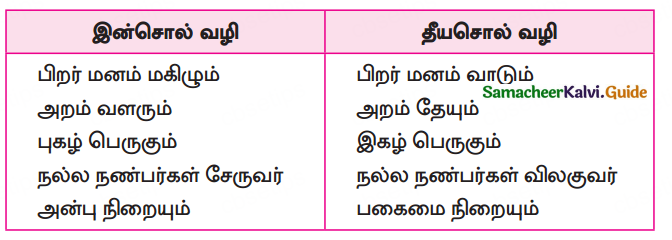
  • கல் – குவியல் (கற்குவியல்)
  • பழம் – குலை (பழக்குலை)
  • புல் – கட்டு (புற்கட்டு)
  • ஆடு – மந்தை (ஆட்டுமந்தை)

வினைமுற்றை வினையாலணையும் பெயராக மாற்றித் தொடர்களை இணைத்து எழுதுக.

Question 1.
கலையரங்கத்தில் எனக்காகக் காத்திருக்கிறார். அவரை அழைத்து வாருங்கள்.
Answer:
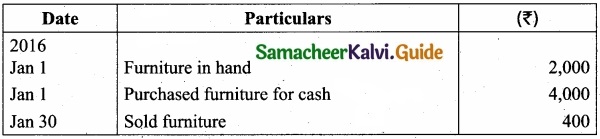
எ.கா: கலையரங்கத்தில் எனக்காகக் காத்திருக்கிறவரை அழைத்து வாருங்கள்.

Question 2.
ஊட்டமிகு உணவு உண்டார். அவர் நீண்ட வாழ்நாள் பெற்றார்.
Answer:
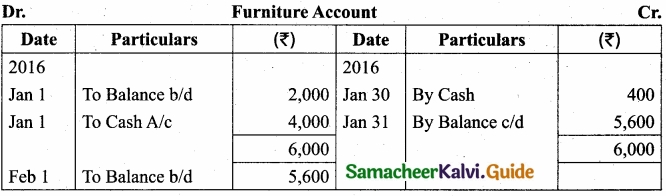
ஊட்டமிகு உணவு உண்டவர் நீண்ட வாழ்நாள் பெற்றார்.

Question 3.
நேற்று என்னைச் சந்தித்தார். அவர் என் நண்பர்.
Answer:
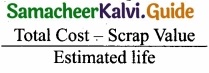
நேற்று என்னைச் சந்தித்தவர் என் நண்பர்.

Samacheer Kalvi 10th Tamil Guide Chapter 1.5 எழுத்து சொல்

Question 4.
பொது அறிவு நூல்களைத் தேடிப் படித்தார். போட்டித் தேர்வில் வென்றார்.
Answer:
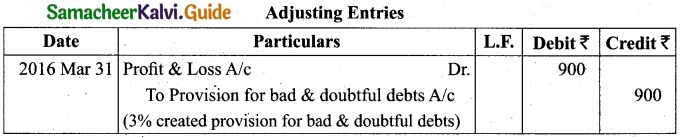
பொது அறிவு நூல்களைத் தேடிப் படித்தவர் போட்டித் தேர்வில் வென்றார்.

தொடர்களில் உள்ள வண்ணச் சொற்களுக்குப் பதிலாக அதே பொருளுடைய வேறு சொற்களைப் பயன்படுத்தி தொடர்களை மீள எழுதுக.

Question 1.
உலகில் வாழும் மக்களில் சிலர் கனியிருக்கக் காய் புசித்தலைப்போல, இன்சொல் இருக்க வன்சொல் பேசி இன்னற்படுகின்றனர்.
Answer:

புவியில் வாழும் மானுடர்கள் சிலர் பழமிருக்கக் காய் உண்பதைப்போல இன்சொல் இருக்க வன்சொல் பேசி துன்பப்படுகின்றனர்.

Quesiton 2.
வள்ளல் குமணன் வறுமையால் வாடிவந்த புலவனுக்குத் தனது தலையைக் கொடுத்து மங்காப் புகழ் பெற்றான்.
Answer:

வள்ளல் குமணன் துன்பத்தால் வாடிவந்த அறிஞர்களுக்குத் தனது தலையை ஈந்து மங்காப் பெருமை பெற்றான்.

Question 3.
நளனும் அவனது துணைவியும் நிடதநாட்டுக்கு வந்ததைக் கண்டு, அந்நாட்டு மக்கள் மழைமுகில் கண்ட மஞ்ஞை போலக் களி கொண்டனர்.
Answer:
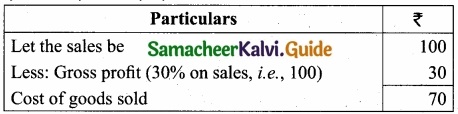
நளனும் அவனது மனைவியும் நிடதநாட்டுக்கு வந்ததைக் கண்டு, அந்நாட்டு மக்கள் மழைமேகம் கண்ட மயிலைப் போல மகிழ்ச்சி கொண்டனர்.

Samacheer Kalvi 10th Tamil Guide Chapter 1.5 எழுத்து சொல்

Question 4.
சோலையிற் பூத்த மணமலர்களில் சுரும்புகள் மொய்த்துப் பண்பாடி மதுவுண்டன.
Answer:
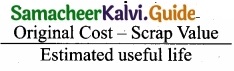
நந்தவனத்தில் பூத்த மணமலர்களில் வண்டுகள் மொய்த்துப் பண்பாடி தேனை உண்டன.

Question 5.
பசுப்போல் சாந்தமும் புலிபோல் தீரமும் யானை போல உழைப்பும் மனிதனுக்கு வேண்டும்.
Answer:
ஆப்போல் அமைதியும் வேங்கை போல் வீரமும் களிறு போல உழைப்பும் மனிதனுக்கு வேண்டும்.

கட்டுரை எழுதுக.

குமரிக் கடல்முனையையும் வேங்கட மலைமுகட்டையும் எல்லையாகக் கொண்ட தென்னவர் திருநாட்டிற்குப் புகழ் தேடித்தந்த பெருமை, தகைசால் தமிழன்னையைச் சாரும். எழில்சேர் கன்னியாய் என்றும் திகழும் அவ்வன்னைக்கு, பிள்ளைத் தமிழ் பேசி, சதகம் சமைத்து, பரணி பாடி, கலம்பகம் கண்டு, உலாவந்து, அந்தாதி கூறி, கோவை யாத்து, அணியாகப் பூட்டி அழகூட்டி அகம்மிக மகிழ்ந்தனர் செந்நாப் புலவர்கள்.

இக்கருத்தைக் கருவாகக் கொண்டு ‘சான்றோர் வளர்த்த தமிழ்’ என்னும் தலைப்பில் கட்டுரை எழுதுக.
Answer:
Samacheer Kalvi 10th Tamil Guide Chapter 1.5 எழுத்து சொல் - 4
Samacheer Kalvi 10th Tamil Guide Chapter 1.5 எழுத்து சொல் - 5
உலகில் மனித இனம் என்று தோன்றியதோ, அன்றே தமிழ் மொழியும் தோன்றியது. அன்று முதல் இன்று வரை தமிழ்மொழி இளமையாகவே இருந்துவருகின்றது. ஒவ்வொரு காலக்கட்டத்திலும் வாழ்ந்த சான்றோர்களால் தமிழ் சிறப்புற்று நிற்கின்றது.

சங்கத்தமிழ்:

‘தமிழ்’ என்ற சொல் தொல்காப்பியப் பாயிரத்தில் இடம்பெறுகின்றது. கிபி. 2 ஆம் நூற்றாண்டிற்கு முன் தோன்றிய இலக்கியங்கள் சங்க இலக்கியங்கள் ஆகும். அவையே சங்கத்தமிழ் தரும் களஞ்சியம் ஆகும். கபிலர், பரணர், ஒளவையார், நக்கீரர், நல்லந்துவனார் முதலிய எண்ண ற்றத் தமிழ்ச் சான்றோர்களால் பாட்டும் தொகையும் உருவாக்கப்பட்டு சங்கத்தமிழ் வளர்க்கப்பட்டது.

அறத்தமிழ்:

சங்ககாலத்திற்குப் பின் தோன்றிய காலத்தில் பொய்யும் குற்றமும் தோன்ற ஆரம்பித்தது. அதனைப் போக்க திருவள்ளுவர், சமண முனிவர்கள், விளம்பிநாகனார், கபிலர், கணிமேதாவியார் ஆகிய பல சான்றோர் பெருமக்கள் அறநூல்களைப் படைத்து, அறத்தமிழை வளர்த்தனர்.

Samacheer Kalvi 10th Tamil Guide Chapter 1.5 எழுத்து சொல்

காப்பியத்தமிழ்:

ஐம்பெருங்காப்பியங்களும், ஐஞ்சிறுகாப்பியங்களும் காப்பியத் தமிழை வளர்த்தன. இளங்கோவடிகள், சீத்தலைச்சாத்தனார், திருத்தக்கத்தேவர் ஆகிய சான்றோர்கள் காப்பியத் தமிழைத் தழைக்கச் செய்தனர்.

சிற்றிலக்கியம்:

(பரணி, சதகம், பிள்ளைத்தமிழ்) சிற்றிலக்கியங்கள் 96 வகைப்படும். அவை வழி சிற்றிலக்கிய வகைகள் பெருகி சிற்றிலக்கியத் தமிழை வளர்த்தனர். ஒருவரைக் குழந்தையாகப் பாவித்து, 10 பருவங்களில் வளாச்சி நிலையைப் பாடுவது பிள்ளைத்தமிழ் ஆகும். ஒட்டக்கூத்தர், குமரகுருபரர் ஆகியோர் பிள்ளைத்தமிழ் பாடி வளர்த்தனர். சதகம் (100) பாடல்களைக் கொண்டது சதகம். ஆத்மநாத தேசிகர், கார்மேகக் கவிஞர் ஆகியோர் சதகம் பாடினார். ஒட்டக்கூத்தர், செயங்கொண்டார் பரணி இலக்கியத்தை வளர்த்தனர்.

சமயத்தமிழ்:

சைவம், வைணவம், கிறித்தவம், இஸ்லாம், சமணம், பௌத்தம் ஆகியசமயங்களும் தமிழ்வளர்க்கும் பணியில் ஈடுபட்டு சமயத்தமிழை வளர்த்தனர். திருநாவுக்கரசர், வீரமாமுனிவர், உமறுப்புலவர் ஆகியோர் சமயத்தமிழை வளர்த்தனர். இதற்கு பன்னிரு திருமுறைகள், நாலாயிரத்திவ்வியப் பிரபந்தம், சீறாப்புராணம், தேம்பாவணி சான்றாகும்.

Samacheer Kalvi 10th Tamil Guide Chapter 1.5 எழுத்து சொல்

முடிவுரை:

காலந்தோறும் தமிழ், தன்னை வளர்ப்பவர்களால் தன்னைப் புதுப்பித்துக் கொண்டு வளர்ந்தும் சிறந்தும் வருகின்றது என்பதை இலக்கிய வரலாறுகள் நமக்கு உணர்த்துகின்றன.
Samacheer Kalvi 10th Tamil Guide Chapter 1.5 எழுத்து சொல் - 6

நயம் பாராட்டுக.

தேனினும் இனியநற் செந்தமிழ் மொழியே
தென்னாடு விளங்குறத் திகழுந்தென் மொழியே
ஊனினும் ஒளிர்வுறும் ஒண்டமிழ் மொழியே
உணர்வினுக் குணர்வதாய் ஒளிர்தமிழ் மொழியே
வானினும் ஓங்கிய வண்டமிழ் மொழியே
மாந்தருக் கிருகணா வயங்குநன் மொழியே
தானனி சிறப்புறுந் தனித்தமிழ் மொழியே
தழைத்தினி தோங்குவாய் தண்டமிழ் மொழியே – கா. நமச்சிவாயர்

Samacheer Kalvi 10th Tamil Guide Chapter 1.5 எழுத்து சொல்

திரண்ட கருத்து:

‘வாழைக்கு அழகு குருத்து
செய்யுளுக்கு அழகு திரண்ட கருத்து’

“தேனினும் இனிமையான செம்மை பெற்ற மொழி தமிழ் மொழி. தென்னாட்டில் சிறந்து விளங்குகின்ற மொழி தமிழ்மொழி. ஒளி வீசி அறிவும், செறிவும் நுட்பமும் கொண்ட மொழி தமிழ்மொழி உணர்வோடு உணர்வான மொழி, வானினும் உயர்ந்த வளம்மிக்க மொழி தமிழ். தழைத்து ஓங்குவாய் குளிர்ச்சி தங்கிய தமிழ் மொழியே” என தமிழ்மொழியைச் சிறப்பித்துக் கூறியுள்ளார் க. நமச்சிவாயர்.

தொடை நயம்:

‘தொடையற்ற பாட்டு
நடையற்றுப் போகும்’

செய்யுளானது எதுகை, மோனை, இயைபு, முரண் முதலியவற்றால் தொகுக்கப்படுவது தொடை எனப்படும். இப்பாடலில் தொடை நயங்கள் சிறப்பாகக் கையாளப்பட்டுள்ளன.

‘மோனை நயம்:

‘மோனையற்ற பாட்டு
சேனையற்ற நாடு’

செய்யுளில் அடிதோறும் அல்லது சீர்தோறும் முதலாம் எழுத்து ஒன்றிவரத் தொடுப்பது மோனைத் தொடை.
ஒண்டமிழ், ஒளிர்தமிழ், ஒளிர்வுறும்,
தனித்தமிழ், தண்டமிழ் ஆகிய மோனைச் சொற்கள் பாடலில் சிறப்பாக அமைந்துள்ளது.

எதுகை நயம்:

‘வீரத்துக்கு அழகு வேங்கை
செய்யுளுக்கு அழகு எதுகை’

செய்யுளில் அடிதோறும் அல்லது சீர்தோறும் இரண்டாம் எழுத்து ஒன்றி வரத் தொடுப்பது எதுகைத் தொடை.
தேனினும், ஊனினும், வானினும் ஆகிய எதுகைச் சொற்கள் பாடலில் சிறப்பாக அமைந்துள்ளது.

Samacheer Kalvi 10th Tamil Guide Chapter 1.5 எழுத்து சொல்

இயைபு நயம்:

‘பாடலின் இயைபு
படிப்போர்க்கு வியப்பு’

செய்யுளில் கடைசி எழுத்தோ சீரோ அசையோ ஒன்றிவரத் தொடுப்பது இயைபுத் தொடை ஆகும். ‘மொழியே’ என்னும் சொல் அடிதோறும் வந்து இயைபாக அமைந்துள்ளது. அடிதோறும் மூன்றாம் சீரில் செந்தமிழ், ஒண்டமிழ், ஒளிர்தமிழ், வண்டமிழ், தனித்தமிழ், தண்டமிழ் என்னும் சொற்கள் வந்து பாடலுக்கு இயைபாக அமைந்துள்ளன.

அணி நயம்:

‘கோவிலுக்கு அழகு மணி
செய்யுளுக்கு அழகு அணி’

இப்பாடலில் ‘மொழி’ என்ற சொல் ஒரே பொருளில் பலமுறை வந்து சொற்பொருட் பின்வரு நிலையணியைக் கொண்டுள்ளது.
பாவகை : எண்சீர் கழிநெடிலடி ஆசிரிய விருத்தம்.

மொழியோடு விளையாடு

சொற்களை இணைத்துப் புதிய சொற்களை உருவாக்குக.

தேன் , விளக்கு, மழை, விண், மணி, விலங்கு, செய், மேகலை, வான், பொன், பூ. எ.கா: பூமணி
Answer:
புதிய சொற்கள்:
Samacheer Kalvi 10th Tamil Guide Chapter 1.5 எழுத்து சொல் - 7

குறிப்புகளைக் கொண்டு வினாவிலேயே விடை இருப்பது போன்று வினாத்தொடர்கள் அமைக்க.

குறளின்பம், சுவைக்காத இளநீர், காப்பியச் சுவை, மனிதகுல மேன்மை, விடுமுறைநாள்
Answer:
எ.கா: குறளின்பத்தில் திளைக்காத தமிழன் உண்டா ?
சுவைக்காத இளநீர் : மன்னன் சுவைக்காத இளநீர் உண்டோ ?
காப்பியச் சுவை : கம்பர் காலத்தில் காப்பியச் சுவை உச்சநிலையில் இருந்ததோ?
மனிதகுல மேன்மை : இந்நூற்றாண்டில் மனிதகுல மேன்மை சிறப்புற்று விளங்குகிறதோ?
விடுமுறைநாள் : தேரோட்டம் அன்று விடுமுறை நாள் என அறிவிக்கப்படுமா?

எண்ணுப்பெயர்களைக் கண்டு, தமிழ் எண்களில் எழுதுக.
Samacheer Kalvi 10th Tamil Guide Chapter 1.5 எழுத்து சொல் - 12
Answer:
Samacheer Kalvi 10th Tamil Guide Chapter 1.5 எழுத்து சொல் - 8

அகராதியில் காண்க.
அடவி, அவல், சுவல், செறு, பழனம், புறவு.
Answer:
அடவி – காடு, திரள், தொகுதி, சோலை
அவல் – பள்ளம், விளைநிலம், குளம், நெல் இடியல்
சுவல் – பிடரி, முதுகு, மேடு, தொல்லை
செறு – வயல், குளம், பாத்தி, கோபம்
பழனம் – வயல், மருதநிலம், பொய்கை
புறவு – புறா, சிறுகாடு, முல்லைக்கொடி, பயிரிடும் நிலம்

Samacheer Kalvi 10th Tamil Guide Chapter 1.5 எழுத்து சொல்

காட்சியைக் கண்டு கவினுற எழுதுக.

Samacheer Kalvi 10th Tamil Guide Chapter 1.5 எழுத்து சொல் - 13
Answer:
Samacheer Kalvi 10th Tamil Guide Chapter 1.5 எழுத்து சொல் - 9

நிற்க அதற்குத் தக

Samacheer Kalvi 10th Tamil Guide Chapter 1.5 எழுத்து சொல் - 10

Samacheer Kalvi 10th Tamil Guide Chapter 1.5 எழுத்து சொல்

இதில் நீங்கள் செல்லும் வழி யாது? உங்கள் நண்பருக்குக் காட்டும் வழி யாது?
…………………………………………………………………………………………………………………………………………………………………..
…………………………………………………………………………………………………………………………………………………………………..
…………………………………………………………………………………………………………………………………………………………………..
Answer:
நாங்கள் இன்சொல் வழியையே பின்பற்றுவோம். எங்கள் நண்பருக்கும் அவ்வழியையே காட்டி அவர்களையும் அவ்வழியின் படி நடக்கச் செய்வோம்.

கலைச்சொல் அறிவோம்

  • Vowel – உயிரெழுத்து
  • Consonant – மெய்யெழுத்து
  • Homograph – ஒப்பெழுத்து
  • Monolingual – ஒரு மொழி
  • Conversation – உரையாடல்
  • Discussion – கலந்துரையாடல்

Tamil Nadu 11th Accountancy Model Question Paper 5 English Medium

Students can Download Tamil Nadu 11th Accountancy Model Question Paper 5 English Medium Pdf, Tamil Nadu 11th Accountancy Model Question Papers helps you to revise the complete Tamilnadu State Board New Syllabus, helps students complete homework assignments and to score high marks in board exams.

TN State Board 11th Accountancy Model Question Paper 5 English Medium

General Instructions:

  1. The question paper comprises of four parts.
  2. You are to attempt all the parts. An internal choice of questions is provided wherever applicable.
  3. All questions of Part I, II, III and IV are to be attempted separately.
  4. Question numbers 1 to 20 in Part I are Multiple Choice Questions of one mark each.
    These are to be answered by choosing the most suitable answer from the given four alternatives and writing the option code and the corresponding answer
  5. Question numbers 21 to 30 in Part II are two-mark questions. These are to be answered in about one or two sentences.
  6. Question numbers 31 to 40 in Part III are three-mark questions. These are to be answered in above three to five short sentences.
  7. Question numbers 41 to 47 in Part IV are five-mark questions. These are to be answered in detail Draw diagrams wherever necessary.

Time: 3:00 Hours
Maximum Marks: 90

PART – I

Answer all the questions. Choose the correct answer: [20 × 1 = 20]

Question 1.
Two or more business units forming a single entity is known as ……………………….
(a) Joint
(b) Merger
(c) Link
(d) Compound
Answer:
(b) Merger

Tamil Nadu 11th Accountancy Model Question Paper 5 English Medium

Question 2.
……………………… is irrecoverable debts.
(a) Debtors
(b) Creditors
(c) Bad debts
(d) Loan
Answer:
(c) Bad debts

Question 3.
The word convention refers ………………………
(a) Traditions
(b) Trade
(c) Business
(d) Accounting
Answer:
(a) Traditions

Question 4.
Outsider’s equity is otherwise called as ………………………
(a) Capital
(b) Liabilities
(c) Debtors
(d) Assets
Answer:
(b) Liabilities

Tamil Nadu 11th Accountancy Model Question Paper 5 English Medium

Question 5.
Owner’s equity is otherwise called as ………………………..
(a) Capital
(b) Creditors
(c) Debtors
(d) Assets
Answer:
(a) Capital

Question 6.
Net position of an account can be ascertained from ……………………….
(a) Journal
(b) Ledger
(c) Trial balance
(d) Balance sheet
Answer:
(b) Ledger

Tamil Nadu 11th Accountancy Model Question Paper 5 English Medium

Question 7.
Total of credit > total of debit = ……………………….
(a) Debit balance
(b) Credit balance
(c) Nil balance
(d) Trial balance
Answer:
(b) Credit balance

Question 8.
Which one of the following account would usually have a debit balance?
(a) Account payable
(b) Cash
(c) Owner equity
(d) Bank loan
Answer:
(b) Cash

Question 9.
Which of the following will be placed in the credit column of the trial balance?
(a) Purchases
(b) Accounts payable
(c) Salaries payable
(d) None
Answer:
(d) None

Tamil Nadu 11th Accountancy Model Question Paper 5 English Medium

Question 10.
Suspense account in the trial balance is entered in the …………………….
(a) Trading A/c
(b) Profit & loss A/c
(c) Balance sheet
(d) None
Answer:
(c) Balance sheet

Question 11.
Goods are returned by customers are recorded in ……………………….
(a) Sales book
(b) Sales returns book
(c) Journal proper
(d) Purchase book
Answer:
(b) Sales returns book

Tamil Nadu 11th Accountancy Model Question Paper 5 English Medium

Question 12.
If a cheque sent for collection is dishonoured, the debit is given to ……………………….
(a) Suppliers A/c
(b) Bank A/c
(c) Customers A/c
(d) None
Answer:
(c) Customers A/c

Question 13.
A bank pass book is a copy of ……………………….
(a) The cash column of a customer’s cash book
(b) The bank column of a customer’s cash book
(c) The customer’s account in the bank’s ledger
(d) None
Answer:
(c) The customer’s account in the bank’s ledger

Question 14.
Generally, one – sided errors are revealed by ………………………
(a) Credit balance
(b) Debit balance
(c) Trial balance
(d) Balance sheet
Answer:
(c) Trial balance

Tamil Nadu 11th Accountancy Model Question Paper 5 English Medium

Question 15.
When a transaction is incorrectly recorded, it is known as ……………………….
(a) Error of principle
(b) Error of commission
(c) Error of omission
(d) Compensating error
Answer:
(b) Error of commission

Question 16.
Straight line method otherwise called ………………………..
(a) Original cost method
(b) Written down value method
(c) Annuity method
(d) Depletion method
Answer:
(a) Original cost method

Tamil Nadu 11th Accountancy Model Question Paper 5 English Medium

Question 17.
Which one is matched correctly?
(a) Land purchased – capital expenditure
(b) Goods purchased – capital expenditure
(c) Issue of debentures – revenue receipts
(d) Rent received – Capital receipts
Answer:
(a) Land purchased – capital expenditure

Question 18.
Which one is not matched correctly?
(a) Trading account – wages
(b) Profit and loss account salaries
(c) Capital – asset
(d) Creditors liabilities
Answer:
(c) Capital – asset

Tamil Nadu 11th Accountancy Model Question Paper 5 English Medium

Question 19.
Interest on capital is to be debited in ………………………
(a) Profit and loss A/c
(b) Capital A/c
(c) Balance sheet
(d) Trading A/c
Answer:
(a) Profit and loss A/c

Question 20.
There are three components namely input unit, CPU and ……………………….
(a) Data
(b) Secondary storage
(c) Output unit
(d) Primary storage
Answer:
(c) Output unit

PART – II

Answer any seven questions in which question No. 30 is compulsory: [7 × 2 = 14]

Question 21.
List any two functions of accounting?
Answer:

  1. Measurement and
  2. Forecasting

Tamil Nadu 11th Accountancy Model Question Paper 5 English Medium

Question 22.
Define book – keeping?
Answer:
“Book-keeping is an art of recording business dealings in a set of books”. – J.R. Batli boi.

Question 23.
What is meant by journalising?
Answer:
Record of business transactions in the journal is known as Journal entry. The process of recording the transactions in journal is called as journalising.

Tamil Nadu 11th Accountancy Model Question Paper 5 English Medium

Question 24.
Complete the accounting equation?

  1. Assets = Capital + liabilities; ₹1,00,000 = ₹80,000 + ?
  2. Assets = Capital + liabilities; ₹2,00,000 = ? + ₹40,000

Answer:
Assets = Capital + liabilities

  1. ₹1,00,000 = ₹80,000 + ₹20,000
  2. ₹2,00,000 = ₹1,60,000 + ₹40,000.

Question 25.
Prepare furniture account from the following transactions?
Tamil Nadu 11th Accountancy Model Question Paper 5 English Medium img 1
Answer:
Tamil Nadu 11th Accountancy Model Question Paper 5 English Medium img 2

Tamil Nadu 11th Accountancy Model Question Paper 5 English Medium

Question 26.
What is trade discount?
Answer:
Trade discount is a deduction given by the supplier to the buyer on the list price or catalogue price of the goods.

Question 27.
What is meant by rectification of errors?
Answer:
Depending on the stage at which errors are located, they are subsequently rectified at the respective stage itself.

Tamil Nadu 11th Accountancy Model Question Paper 5 English Medium

Question 28.
A firm purchased a plant for ₹40,000. Erection charges amounted to ₹2,000. Effective life of the plant is 5 years. Calculate the amount of depreciation per year under straight line method?
Answer:
Amount of depreciation = Tamil Nadu 11th Accountancy Model Question Paper 5 English Medium img 3
= Cost of plant + erection charges
= ₹40,000 + 2,000
= ₹42,000
= \(\frac{42,000-0}{5 years}\)
= ₹8,400

Question 29.
What is Capital receipt?
Answer:
Receipt which is not revenue in nature is called capital receipt. It is non-recurring in nature.

Tamil Nadu 11th Accountancy Model Question Paper 5 English Medium

Question 30.
What are wasting assets?
Answer:
These are the assets which get exhausted gradually in the process of excavation.
Example: mines and quarries.

PART – III

Answer any seven questions in which question No. 40 is compulsory. [7 × 3 = 21]

Question 31.
What are the methods of codification?
Answer:

  1. Sequential codes
  2. Block codes
  3. Mnemonic codes

Tamil Nadu 11th Accountancy Model Question Paper 5 English Medium

Question 32.
The trial balance on March 31, 2016 shows the following:
Sundry debtors ₹30,000; Bad debts ₹1,200. It is found that 3% of sundry debtors is doubtful of recovery andis to be provided for Pass adjusting entry and show it how will be appeared in final accounts?
Answer:

Tamil Nadu 11th Accountancy Model Question Paper 5 English Medium img 4

Tamil Nadu 11th Accountancy Model Question Paper 5 English Medium img 5

Tamil Nadu 11th Accountancy Model Question Paper 5 English Medium img 6

Tamil Nadu 11th Accountancy Model Question Paper 5 English Medium

Question 33.
Find out the amount of sales from the following information:
Opening stock ₹30,000; Purchases less returns ₹2,00,000; Closing stock ₹20,000; Gross profit margin (oh sales) 30%?
Answer:
Cost of goods sold = opening stock + net purchases – closing stock
= 30,000 + 2,00,000 – 20,000 = 2,10,000
Tamil Nadu 11th Accountancy Model Question Paper 5 English Medium img 7

Therefore, percentage of gross profit on cost of goods sold is 30/70 × 100 = 42.85%.
Gross profit = ₹2,10,000 × 30/70
= ₹90,000.
Sales = Cost of goods sold + Gross profit = 2,10,000 + 90,000 = 3,00,000.

Tamil Nadu 11th Accountancy Model Question Paper 5 English Medium

Question 34.
A company has purchased a machinery for ₹1,80,000 and spent ₹10,000 for its installation. The estimated life of the machinery is 5 years with a residual value of ₹15,000. Find out the amount of depreciation to be provided every year?
Answer:
Amount of depreciation = Tamil Nadu 11th Accountancy Model Question Paper 5 English Medium img 8 = \(\frac{1,90,00-15,000}{5}\)
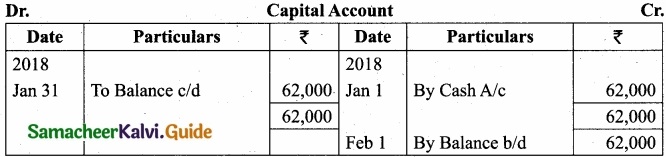
= \(\frac{1,75,00}{5}\)
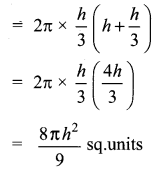
= ₹35,000 per year.

Question 35.
State the account/s affected in each of the following errors:

  1. Goods sold to Vasu on credit for ₹1,000 was not recorded in the sales book.
  2. The total of sales book ₹2,500 was posted twice.

Answer:

  1. Sales account should be credited with ₹1,000.
  2. Sales account should be debited with ₹2,500.

Tamil Nadu 11th Accountancy Model Question Paper 5 English Medium

Question 36.
Classify the following into personal, real and nominal accounts,

  1. Capital
  2. Buildings
  3. Carriage inwards
  4. Cash
  5. Commission received
  6. Bank

Answer:

  1. Capital – Personal account
  2. Buildings – Real account
  3. Carriage inwards – Nominal account
  4. Cash – Real account
  5. Commission received – Nominal account
  6. Bank – Personal account

Tamil Nadu 11th Accountancy Model Question Paper 5 English Medium

Question 37.
Prepare Machinery A/c from the following transactions:
Tamil Nadu 11th Accountancy Model Question Paper 5 English Medium img 9

Answer:
Tamil Nadu 11th Accountancy Model Question Paper 5 English Medium img 10

Question 38.
State which account should be debited and which account should be credited?

  1. Carriage outwards
  2. Carriage inwards
  3. Sales
  4. Purchases
  5. Bad debts
  6. Interest paid

Answer:

  1. Carriage outwards – debited
  2. Carriage inwards – debited
  3. Sales – credited
  4. Purchases – debited
  5. Bad debts – debited
  6. Interest paid – debited

Tamil Nadu 11th Accountancy Model Question Paper 5 English Medium

Question 39.
Mention the subsidiary books in which the following transactions are recorded?

  1. Sale of goods for cash
  2. Sale of goods on credit
  3. Asset purchased on credit

Answer:

  1. Sale of goods for cash – cash book
  2. Sale of goods on credit – sales book
  3. Asset purchased on credit – j oumal proper

Tamil Nadu 11th Accountancy Model Question Paper 5 English Medium

Question 40.
From the following particulars of Veera traders, prepare a bank reconciliation statement as on 31st December, 2017?

  1. Credit balance as per bank statement ₹6,000.
  2. Amount received by,bank through NEFT for ₹3,500 entered twice in the cash book.
  3. Cheque dishonoured amounting to ₹2,500, not entered in cash book.

Answer:
Tamil Nadu 11th Accountancy Model Question Paper 5 English Medium img 11

PART – IV

Answer all the questions: [7 × 5 = 35]

Question 41 (a).
Write any five objectives of Accounting?
Answer:

  1. To keep a systematic record of financial transactions and events.
  2. To ascertain the profit or loss of the business enterprise.
  3. To ascertain the financial position or status of the enterprise.
  4. To provide information to various stakeholders for their requirements.
  5. To protect the properties of an enterprise.

[OR]
(b) What are the differences between Book-keeping and Accounting?
Answer:
Tamil Nadu 11th Accountancy Model Question Paper 5 English Medium img 12

Tamil Nadu 11th Accountancy Model Question Paper 5 English Medium

Question 42 (a).
Journalise the following transactions in the books of Ramesh who is dealing in computers:Tamil Nadu 11th Accountancy Model Question Paper 5 English Medium img 13

Answer:
Tamil Nadu 11th Accountancy Model Question Paper 5 English Medium img 14

[OR]

(b) Show the accounting equation on the basis of the following transactions for Rani, who is dealing in automobiles.

  1. Started business with cash ₹80,000.
  2. Goods bought on credit from Ramesh ₹10,000.
  3. Purchased furniture for cash ₹6,000.
  4. Paid creditors by cash ₹8,000.
  5. Paid rent by cash ₹500.

Answer:
Tamil Nadu 11th Accountancy Model Question Paper 5 English Medium img 15a

Tamil Nadu 11th Accountancy Model Question Paper 5 English Medium

Question 43 (a).
Prepare direct ledgers from the following transactions?Tamil Nadu 11th Accountancy Model Question Paper 5 English Medium img 16

Answer:
Tamil Nadu 11th Accountancy Model Question Paper 5 English Medium img 17Tamil Nadu 11th Accountancy Model Question Paper 5 English Medium img 18Tamil Nadu 11th Accountancy Model Question Paper 5 English Medium img 19Tamil Nadu 11th Accountancy Model Question Paper 5 English Medium img 20Tamil Nadu 11th Accountancy Model Question Paper 5 English Medium img 21
Tamil Nadu 11th Accountancy Model Question Paper 5 English Medium img 22

[OR]

(b) Prepare Trial Balance of Murali as on 31.03.2017 from the following information?

Tamil Nadu 11th Accountancy Model Question Paper 5 English Medium img 23

Answer:

Tamil Nadu 11th Accountancy Model Question Paper 5 English Medium img 24

Tamil Nadu 11th Accountancy Model Question Paper 5 English Medium

Question 44 (a).
From the following transactions write up the Sales Day Book of Kamala Stores, a furniture shop?Tamil Nadu 11th Accountancy Model Question Paper 5 English Medium img 25

Answer:
Tamil Nadu 11th Accountancy Model Question Paper 5 English Medium img 26

[OR]

(b) Enter the following transactions in a simple cash book of Kunal:Tamil Nadu 11th Accountancy Model Question Paper 5 English Medium img 27

Answer:
Tamil Nadu 11th Accountancy Model Question Paper 5 English Medium img 28

Tamil Nadu 11th Accountancy Model Question Paper 5 English Medium

Question 45 (a).
From the following information, prepare Bank Reconciliation Statement to find out balance as per bank statement as on 31st March, 2017?
Tamil Nadu 11th Accountancy Model Question Paper 5 English Medium img 29

Answer:
Tamil Nadu 11th Accountancy Model Question Paper 5 English Medium img 30

[OR]

(b) Rectify the following errors:

  1. Sales book is undercast by ₹100.
  2. Sales book is overcast by ₹200.
  3. Purchase book is undercast by ₹300.
  4. Purchase book is overcast by ₹400.
  5. Purchase return boojt is undercast by ₹100.

Answer:

  1. Sales account should be credited with ₹100,
  2. Sales account should be debited with ₹200.
  3. Purchase account should be debited with ₹300.
  4. Purchase account should be credited with ₹400.
  5. Purchase return account should be credited with ₹100.

Tamil Nadu 11th Accountancy Model Question Paper 5 English Medium

Question 46 (a).
A firm purchased a machine for ₹1,00,000 on 01.07.2015. Depreciation is written off at 20% on reducing balance method. The firm closes its books on 31st December each year. Show the Machinery account upto 31.12.2017?
Workings:
Tamil Nadu 11th Accountancy Model Question Paper 5 English Medium img 31

Answer:
Tamil Nadu 11th Accountancy Model Question Paper 5 English Medium img 32

[OR]

(b) Prepare Trading and Profit and Loss account for the year ended 31st March, 2016 and the Balance Sheet as on that date from the following informations?Tamil Nadu 11th Accountancy Model Question Paper 5 English Medium img 33

Adjustments:

  1. Closing Stock on 31st March, 2016 ₹2,100.
  2. Commission received in advance ₹400.
  3. Advertisement paid in advance ₹150.
  4. Wages outstanding ₹2,000.

Answer:
Tamil Nadu 11th Accountancy Model Question Paper 5 English Medium img 34

Tamil Nadu 11th Accountancy Model Question Paper 5 English Medium

Question 47 (a).
Enter the following transactions in the three column cash book of Chozhan?Tamil Nadu 11th Accountancy Model Question Paper 5 English Medium img 36

Answer:
Tamil Nadu 11th Accountancy Model Question Paper 5 English Medium img 38a

[OR]

(b) Prepare Analytical Petty Cash Book from the following particulars under Imprest system?

Tamil Nadu 11th Accountancy Model Question Paper 5 English Medium img 37

Answer:
Tamil Nadu 11th Accountancy Model Question Paper 5 English Medium img 39a

Samacheer Kalvi 10th Maths Guide Chapter 7 Mensuration Ex 7.5

Students can download Maths Chapter 7 Mensuration Ex 7.5 Questions and Answers, Notes, Samacheer Kalvi 10th Maths Guide Pdf helps you to revise the complete Tamilnadu State Board New Syllabus, helps students complete homework assignments and to score high marks in board exams.

Tamilnadu Samacheer Kalvi 10th Maths Solutions Chapter 7 Mensuration Ex 7.5

Multiple Choice Questions

Question 1.
The curved surface area of a right circular cone of height 15 cm and base diameter 16 cm is
(1) 60π cm2
(2) 68π cm2
(3) 120π cm2
(4) 136π cm2
Solution:
(4) 13671 cm2
Hint:
Here, h = 15 cm, r = 8 cm
Samacheer Kalvi 10th Maths Guide Chapter 7 Mensuration Ex 7.5 Q1
C.S.A of a cone = πrl sq. units. = π × 8 × 17 = 136π cm3

Question 2.
If two solid hemispheres of same base radius r units are joined together along with their bases, then the curved surface area of this new solid is
(1) 4πr2 sq. units
(2) 6πr2 sq. units
(3) 3πr2 sq. units
(4) 8πr2 sq. units
Answer:
(1) 4πr2 sq. units
Hint:
When you joined two hemispheres together, the solid sphere is formed
C.S.A of the new solid = C.S.A of a sphere = 4πr2 sq. units.

Samacheer Kalvi 10th Maths Guide Chapter 7 Mensuration Ex 7.5

Question 3.
The height of a right circular cone whose radius is 5 cm and slant height is 13 cm will be
(1) 12 cm
(2) 10 cm
(3) 13 cm
(4) 5 cm
Solution:
(1) 12 cm
Hint:
Here r = 5 cm and l = 13 cm
Samacheer Kalvi 10th Maths Guide Chapter 7 Mensuration Ex 7.5 Q3

Question 4.
If the radius of the base of a right circular cylinder is halved keeping the same height, then the ratio of the volume of the cylinder thus obtained to the volume of original cylinder is _________
(1) 1 : 2
(2) 1 : 4
(3) 1 : 6
(4) 1 : 8
Answer:
(2) 1 : 4
Hint:
Let the radius of the cylinder be “r” and the height be “h”
Radius of the new cylinder = \(\frac{r}{2}\) (Height will be same)
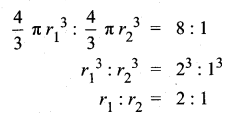
Volume of the new cylinder : Volume of the original cylinder
= \(\pi r_{1}^{2} h: \pi r_{2}^{2} h\) (πh is same)
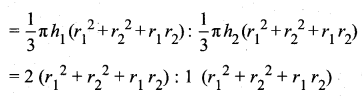
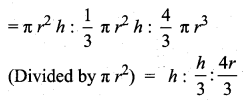
= \(r_{1}^{2}: r_{2}^{2}\)
= \(\left(\frac{r}{2}\right)^{2}: r^{2}\)
= \(\frac{r^{2}}{4}: r^{2}=\frac{1}{4}: 1\)
= 1 : 4

Samacheer Kalvi 10th Maths Guide Chapter 7 Mensuration Ex 7.5

Question 5.
The total surface area of a cylinder whose radius is \(\frac{1}{3}\) of its height is _______
(1) \(\frac{9 \pi h^{2}}{8}\) sq. units
(2) 24πh2 sq.units
(3) \(\frac{8 \pi h^{2}}{8}\) sq.units
(4) \(\frac{56 \pi h^{2}}{8}\) sq.units
Answer:
(3) \(\frac{8 \pi h^{2}}{8}\) sq.units
Hint:
Let the height of the cylinder be “h”
Radius of the cylinder = \(\frac{1}{3}\) h
T.S.A of the cylinder = 2πr(h + r)
Samacheer Kalvi 10th Maths Guide Chapter 7 Mensuration Ex 7.5 Q5

Question 6.
In a hollow cylinder, the sum of the external and internal radii is 14 cm and the width is 4 cm. If its height is 20 cm, the volume of the material in it is
(1) 5600π cm3
(2) 11200π cm3
(3) 56π cm3
(4) 3600π cm3
Solution:
(2) 112007π cm3
Hint:
Here, let the external radius be “R” and the internal radius be “r”
R + r = 14 ……(1)
Width (R – r) = 4 ……(2)
Height of the hollow cylinder = 20 cm
Volume of the hollow cylinder = πh × (R2 – r2)
= πh(R + r) (R – r)
= π × 20 (14) × 4
= π × 1120
= 1120π cm3

Samacheer Kalvi 10th Maths Guide Chapter 7 Mensuration Ex 7.5

Question 7.
If the radius of the base of a cone is tripled and the height is doubled then the volume is ______
(1) made 6 times
(2) made 18 times
(3) made 12 times
(4) unchanged
Answer:
(2) made 18 times
Hint:
Radius of a cone = r
Height of a cone = h
Volume of the cone = \(\frac{1}{3}\) πr2h cu. units
When the radius is increased three-time (tripled) and the height is doubled
Radius is 3r and the height is 2h
Volume of the new cone
Samacheer Kalvi 10th Maths Guide Chapter 7 Mensuration Ex 7.5 Q7
Volume is increased 18 times.

Question 8.
The total surface area of a hemisphere is how many times the square of its radius.
(1) π
(2) 4π
(3) 3π
(4) 2π
Solution:
(3) 3π
Hint:
T.S.A of the hemisphere = 3πr2
The square of the radius is 3π times.

Samacheer Kalvi 10th Maths Guide Chapter 7 Mensuration Ex 7.5

Question 9.
A solid sphere of radius x cm is melted and cast into a shape of a solid cone of the same radius. The height of the cone is _______
(1) 3x cm
(2) x cm
(3) 4x cm
(4) 2x cm
Answer:
(3) 4x cm
Hint:
Radius of a sphere = Radius of a cone = x cm
Volume of a cone = Volume of a sphere
Samacheer Kalvi 10th Maths Guide Chapter 7 Mensuration Ex 7.5 Q9

Question 10.
A frustum of a right circular cone is of height 16cm with radii of its ends as 8cm and 20cm. Then, the volume of the frustum is
(1) 3328π cm3
(2) 3228π cm3
(3) 3240πcm3
(4) 3340π cm3
Solution:
(1) 3328π cm3
Hint:
Here, h = 16 cm, r = 8 cm, R = 20 cm
Volume of the frustum
Samacheer Kalvi 10th Maths Guide Chapter 7 Mensuration Ex 7.5 Q10

Samacheer Kalvi 10th Maths Guide Chapter 7 Mensuration Ex 7.5

Question 11.
A shuttlecock used for playing badminton has the shape of the combination of ______
(1) a cylinder and a sphere
(2) a hemisphere and a cone
(3) a sphere and a cone
(4) frustum of a cone and a hemisphere
Answer:
(4) frustum of a cone and a hemisphere
Hint:
Samacheer Kalvi 10th Maths Guide Chapter 7 Mensuration Ex 7.5 Q11

Question 12.
A spherical ball of radius r1 units is melted to make 8 new identical balls each of radius r2 units. Then r1 : r2 is _______
(1) 2 : 1
(2) 1 : 2
(3) 4 : 1
(4) 1 : 4
Answer:
(1) 2 : 1
Hint:
Volume of the first sphere : Volume of second sphere = 8 : 1
Samacheer Kalvi 10th Maths Guide Chapter 7 Mensuration Ex 7.5 Q12

Samacheer Kalvi 10th Maths Guide Chapter 7 Mensuration Ex 7.5

Question 13.
The volume (in cm3) of the greatest sphere that can be cut off from a cylindrical log of wood of base radius 1 cm and height 5 cm is ________
(1) \(\frac{4}{3} \pi\)
(2) \(\frac{10}{3} \pi\)
(3) 5π
(4) \(\frac{20}{3} \pi\)
Answer:
(1) \(\frac{4}{3} \pi\)
Hint:
Radius of the sphere = 1 cm
Volume of the Sphere = \(\frac{4}{3}\) πr3 cu. units
= \(\frac{4}{3}\) × π × 1 × 1 × 1 cm3
= \(\frac{4}{3}\) π cm3

Question 14.
The height and radius of the cone of which the frustum is a part are h1 units and r1 units respectively. Height of the frustum is h2 units and the radius of the smaller base is r2 units. If h2 : h1 = 1 : 2 then r2 : r1 is ______
(1) 1 : 3
(2) 1 : 2
(3) 2 : 1
(4) 3 : 1
Answer:
(2) 1 : 2
Hint:
h2 : h1 = 1 : 2
h1 : h2 = 2 : 1
Ratio of their volumes
Samacheer Kalvi 10th Maths Guide Chapter 7 Mensuration Ex 7.5 Q14
Volume is 2 : 1 the ratio of their radius also 2 : 1
r1 : r2 = 2 : 1 But r2 : r1 = 1 : 2

Samacheer Kalvi 10th Maths Guide Chapter 7 Mensuration Ex 7.5

Question 15.
The ratio of the volumes of a cylinder, a cone and a sphere, if each has the same diameter and same height is
(1) 1 : 2 : 3
(2) 2 : 1 : 3
(3) 1 : 3 : 2
(4) 3 : 1 : 2
Solution:
(4) 3 : 1 : 2
Hint:
Volume of (cylinder : cone : sphere)
Samacheer Kalvi 10th Maths Guide Chapter 7 Mensuration Ex 7.5 Q15
Samacheer Kalvi 10th Maths Guide Chapter 7 Mensuration Ex 7.5 Q15.1

Tamil Nadu 11th Biology Model Question Paper 5 English Medium

Students can Download Tamil Nadu 11th Biology Model Question Paper 5 English Medium Pdf, Tamil Nadu 11th Biology Model Question Papers helps you to revise the complete Tamilnadu State Board New Syllabus, helps students complete homework assignments and to score high marks in board exams.

TN State Board 11th Biology Model Question Paper 5 English Medium

General Instructions:

    1. The question paper comprises of four parts. Questions for Botany and Zoology are asked separately.
    2. You are to attempt all the parts. An internal choice of questions is provided wherever applicable.
    3. All questions of Part I, II, III and IV are to be attempted separately.
    4. Question numbers 1 to 8 in Part I are Multiple Choice Questions of one mark each. These are to be answered by choosing the most suitable answer from the given four alternatives and writing the option code and the corresponding answer.
    5. Question numbers 9 to 14 in Part II are two-marks questions. These are to be answered in about one or two sentences.
    6. Question numbers 15 to 19 in Part III are three-marks questions. These are to be answered in about three to five short sentences.
    7. Question numbers 20 and 21 in Part IV are five-marks questions. These are to be answered in detail. Draw diagrams wherever necessary.

Time: 3:00 Hours
Maximum Marks: 70

Bio – Botany [Maximum Marks: 35]

PART – I

Answer all the questions. Choose the correct answer. [8 × 1 = 8]

Question 1.
The term bacterium was coined by ………………………
(a) Stanley
(b) Ehrenberg
(c) Gram
(d) Koch
Answer:
(b) Ehrenberg

Tamil Nadu 11th Biology Model Question Paper 5 English Medium

Question 2.
Which of the following components provides sticky character to the bacterial cell?
(a) Cell wall
(b) Nuclear membrane
(c) Plasma membrane
(d) Glycocalyx
Answer:
(d) Glycocalyx

Question 3.
Number of floral parts per whorl is called ……………………
(a) Curosity
(b) Atrocity
(c) Merosity
(d) Porosity
Answer:
(c) Merosity

Tamil Nadu 11th Biology Model Question Paper 5 English Medium

Question 4.
“The evolution and classification of flowering plants” – book was written by ………………..
(a) Engler & Prantl
(b) Bentham & Hooker
(c) Cronquist
(d) Theophrasthus
Answer:
(c) Cronquist

Question 5.
Lainpbrush chromosomes occur at ………………….. stage of meiotic Prophase I.
(a) Leptotene
(b) Diplotene
(c) Zygotene
(d) Pachytene
Answer:
(b) Diplotene

Question 6.
Who is called as father of plant physiology?
(a) J.C. Bose
(b) Stephen Hales
(c) Dixon
(d) Unger
Answer:
(b) Stephen Hales

Question 7.
Pitcher plant is the common name for ……………………..
(a) Drosera
(b) Nepenthes
(c) Utricularia
(d) Dionaea
Answer:
(b) Nepenthes

Tamil Nadu 11th Biology Model Question Paper 5 English Medium

Question 8.
Chemiosmotic theory was proposed by ………………………
(a) Mitchell
(b) Hatch & Slack
(c) Calvin
(d) Priestley
Answer:
(a) Mitchell

PART – II

Answer any four of the following questions. [4 × 2 = 8]

Question 9.
What is mycorrhiza?
Answer:
The symbiotic association between fungal mycelium and roots of plants is called as mycorrhiza.

Tamil Nadu 11th Biology Model Question Paper 5 English Medium

Question 10.
Why do roots modify their structure? Name the types of root modification?
Answer:
Roots modify their structure to perform secondary functions. The two types of root modification are tap root modification and fibrous root modification.

Question 11.
Name any 4 sub classes of Liliopsida?
Answer:

  1. Alismatidae
  2. Arecidae
  3. Commelinidae
  4. Zingiberidae

Question 12.
How vacuoles helps to maintain the structure of a plant cell?
Answer:
The major function of plant vacuole is to maintain water pressure known as turgor pressure, which maintains the plant structure.

Tamil Nadu 11th Biology Model Question Paper 5 English Medium

Question 13.
Compare Active transport with Passive transport?
Answer:
Tamil Nadu 11th Biology Model Question Paper 5 image 1

Question 14.
How will you define Quantasomes?
Answer:
Quantasomes are the morphological expression of physiological photosynthetic units, located on the inner membrane of thylakoid lamellae.

PART – III

Answer any three questions in which question number 19 is compulsory. [3 × 3 = 9]

Question 15.
Classify lichens based on morphology?
Answer:

  1. Leprose – Absence of distinct fungal layer
  2. Crustose – Crust – like
  3. Foliose – Leaf – like
  4. Fruticose – Branched pendulous shrub – like

Tamil Nadu 11th Biology Model Question Paper 5 English Medium

Question 16.
“Roots perform photosynthesis”-Justify with example?
Answer:
Roots of some climbing or epiphytic plants develop chlorophyll and turn green which help in photosynthesis. These roots are called as photosynthetic roots, e.g,,Tinospora.

Question 17.
Differentiate Apocarpous and Syncarpous ovary?
Answer:

  1. Apocarpous: A pistil contains two or more distinct carpels. Example: Annona
  2. Syncarpous: A pistil contains two or more carpels which are connate. Example: Citrus and Tomato

Tamil Nadu 11th Biology Model Question Paper 5 English Medium

Question 18.
Draw & label the ground plan of T.S. of Dicot root?
Answer:

Tamil Nadu 11th Biology Model Question Paper 5 image 2

Question 19.
What do you mean by Respiratory substrate? Give example?
Answer:
Respiration is a biological process in which oxidation of various food substances like carbohydrates, proteins and fats take place and as a result of this, energy is produced where O2 is taken in and CO2 is liberated. The organic substances which are oxidised during respiration are called respiratory substrates.

PART – IV

Answer all the questions. [2 × 5 = 10]

Question 20.
Define phyllotaxy. Explain its type?
Answer:
The mode of arrangement of leaves on the stem is known as phyllotaxy (Greek. Phyllon = leaf; taxis = arrangement). Phyllotaxy is to avoid over crowding of leaves and expose the leaves maximum to the sunlight for photosynthesis. The four main types of phyllotaxy are:

  1. Alternate
  2. Opposite
  3. Temate and
  4. Whorled.

1. Alternate phyllotaxy:
In this type there is only one leaf per node and the leaves on the successive nodes are arranged alternate to each other. Spiral arrangement of leaves show vertical rows are called orthostichies. They are two types:

  • Alternate spiral: In which the leaves are arranged alternatively in a spiral manner. e.g., Hibiscus and Ficus.
  • Alternate distichous or Bifarious: In which the leaves are organized alternatively in two rows on either side of the stem, e.g., Monoon longifolium (.Polyalthia longifolia).

2. Opposite phyllotaxy:
In this type each node possess two leaves opposite to each other. They are organized in two different types:

(I) Opposite superposed:
The pair of leaves arranged in succession are in the same direction, that is two opposite leaves at a node lie exactly above those at the lower node, e.g., Psidium (Guava), Eugenia jambolana (Jamun) and Quisqualis (Rangoon creeper).

(II) Opposite decussate:
In this type of phyllotaxy one pair of leaves is placed at right angles to the next upper or lower pair of leaves, e.g., Calotropis, Zinnia and Ocimum

3. Ternate phyllotaxy:
In this type there are three leaves attached at each node, e.g., Nerium.

4. Whorled (verticillate) type of phyllotaxy:
In this type more than three leaves are present in a whorl at each node forming a circle or whorl, e.g., Allamanda and Alstonia scholaris.

[OR]

Distinguish between prokaryotes and eukaryotes?
Answer:

Tamil Nadu 11th Biology Model Question Paper 5 image 3

Tamil Nadu 11th Biology Model Question Paper 5 English Medium

Question 21.
Explain the insectivorous mode of nutrition in angiosperms?
Answer:
Insectivorous mode of nutrition:
Plants which are growing in nitrogen deficient areas develop insectivorous habit to resolve nitrogen deficiency.

1. Nepenthes (Pitcher plant):
Pitcher is a modified leaf and contains digestive enzymes. Rim of the pitcher is provided with nectar glands and acts as an attractive lid. When insect is trapped, proteolytic enzymes will digest the insect.

2. Drosera (Sundew):
It consists of long club shaped tentacles which secrete sticky digestive fluid which looks like a sundew.

3. Utricularia (Bladder wort):
Submerged plant in which leaf is modified into a bladder to collect insect in water.

4. Dionaea (Venus fly trap):
Leaf of this plant modified into a colourful trap. Two folds of lamina consist of sensitive trigger hairs and when insects touch the hairs it will close.

[OR]

List out the physiological effects of Abscissic acid?
Answer:

  1. It helps in reducing transpiration rate by closing stomata. It inhibits K+ uptake by guard cells and promotes the leakage of malic acid. It results in closure of stomata.
  2. It spoils chlorophylls, proteins and nucleic acids of leaves making them yellow.
  3. Inhibition of cell division and cell elongation.
  4. ABA is a powerful growth inhibitor. It causes 50% inhibition of growth in Oat coleoptile.
  5. It induces bud and seed dormancy.
  6. It promotes the abscission of leaves, flowers and fruits by forming abscission layers.
  7. ABA plays an important role in plants during water stress and during drought conditions. It results in loss of turgor and closure of stomata.
  8. It has anti – auxin and anti – gibberellin property.
  9. Abscisic acid promotes senescence in leaves by causing loss of chlorophyll pigment decreasing the rate of photosynthesis and changing the rate of proteins and nucleic acid synthesis.

Bio – Zoology [Maximum Marks: 35]

PART – I

Answer all the questions. Choose the correct answer. [8 × 1 = 8]

Question 1.
Cladogram consists the following characters …………………….
(a) Physiological and Biochemical
(b) Evolutionary and Phylogenetic
(c) Taxonomic and systematic
(d) None of the above
Answer:
(b) Evolutionary and Phylogenetic

Tamil Nadu 11th Biology Model Question Paper 5 English Medium

Question 2.
The limbless amphibian is ………………………
(a) Hyla
(b) Rana
(c) Icthyophis
(d) Salamander
Answer:
(c) Icthyophis

Question 3.
ECG stands for …………………….
(a) Electro Cardiogram
(b) Electro Caplaris gram
(c) Electro Carrying gram
(d) Electro ensephalo gram
Answer:
(a) Electro Cardiogram

Tamil Nadu 11th Biology Model Question Paper 5 English Medium

Question 4.
Match the List – I and List – II

List – I

List – II

1. Tidal Volume(i) 1100 to 1200 ml
2. Residual Volume(ii) 500 ml
3. Expiratory reserve Volume(iii) 2500 to 3000 ml
4. Inspiratory reserve Volume(iv) 1000 to 1100 ml

(a) 1 – (i), 2 – (ii), 3 – (iii), 4 – (iv)
(b) 1 – (ii), 2 – (i), 3 – (iv), 4 – (iii)
(c) 1 – (ii), 2 – (iv), 3 – (i), 4 – (iii)
(d) 1 – (iv), 2 – (iii), 3 – (i), 4 – (ii)
Answer:
(b) 1 – (ii), 2 – (i), 3 – (iv), 4 – (iii)

Question 5.
Which of the following is correct statement?
(a) All the reptiles have a three chambered heart.
(b) All mammals are viviparous.
(c) All cyclostomes do not posses jaws and paired fin.
(d) All pisces have gills covered by a operculum.
Answer:
(c) All cyclostomes do not posses jaws and paired fin.

Tamil Nadu 11th Biology Model Question Paper 5 English Medium

Question 6.
Which of the following is incorrect statement with regard to peripheral neural system ?
(a) Its pathways innervate skeletal muscles.
(b) Its pathways are usually voluntary.
(c) Its pathways always involve four neurons.
(d) Some of its pathways are referred to as reflex arcs.
Answer:
(c) Its pathways always involve four neurons.

Question 7.
Centers for sense of smell are located …………………..
(a) Cerebellum
(b) Midbrain
(c) Olfactory lobes
(d) Cerebrum
Answer:
(c) Olfactory lobes

Tamil Nadu 11th Biology Model Question Paper 5 English Medium

Question 8.
Excess secretion of cortisol leads to ………………………
(a) Addison’s disease
(b) Grave’s disease
(c) Cushing’s syndrome
(d) Gull’s disease
Answer:
(c) Cushing’s syndrome

PART – II

Answer any four of the following questions. [4 × 2 = 8]

Question 9.
Write about the classification of Lampito maurittii?
Answer:
Classification:

  1. Phylum: Annelida
  2. Class: Oligochaeta
  3. Order: Haplotaxida
  4. Genus: Lampito
  5. Species: mauritii

Tamil Nadu 11th Biology Model Question Paper 5 English Medium

Question 10.
Define indigestion?
Answer:
Indigestion is the digestive disorder in which the food is not properly digested leading to a feeling of fullness of stomach.

Question 11.
Write about muscle fatigue?
Answer:
Muscle fatigue is the inability of a muscle to contract after repeated muscle contractions. This is due to lack of ATP ancl accumulation of lactic acid by anaerobic breakdown of glucose.

Tamil Nadu 11th Biology Model Question Paper 5 English Medium

Question 12.
Difference between neutrophils and esinophils?
Answer:

Neutrophils

Eosinophils

1. Neutrophils are polymorphonuclear cells with 3-4 lobes of nucleus connected with delicate threads.1. Eosinophils have distinctly bilobed nucleus and the lobes are joined by thin strands.
2. Neutrophils constitute about 60%-65% of the total WBCs.2. Eosinophils constitute about 2-3% of the total WBCs.

Tamil Nadu 11th Biology Model Question Paper 5 English Medium

Question 13.
Draw and label the parts of LS of kidney?
Answer:

Tamil Nadu 11th Biology Model Question Paper 5 image 4

Question 14.
What are the functions of glucagon?
Answer:
Glucagon is a polypeptide hormone. It is a potent hyperglycaemic hormone that acts on the liver and promotes the breakdown of glycogen to glucose (Glycogenolysis), synthesis of glucose from lactic acid and from non-carbohydrate molecules (gluconeogenesis).

Releases glucose from the liver cells, increasing the blood glucose levels. Since glucagon reduces the cellular uptake and utilisation of glucose it is called a hyperglycemic hormone. Prolonged hyperglycemia leads to the disorder called diabetes mellitus.

PART – III

Answer any three questions in which question number 19 is compulsory. [3 × 3 = 9]

Question 15.
Bioluminence is advantageous to ctenophores?
Answer:
Ctenophores are exclusively marine. They emit light. It helps the animals in finding food, mate and excape from the predators.

Tamil Nadu 11th Biology Model Question Paper 5 English Medium

Question 16.
How do earthworms breathe?
Answer:
In earthworms, respiration takes place through the body wall by the moist skin diffusion, oxygen diffuses through the skin into the blood while carbon dioxide from the blood diffuse out.

Tamil Nadu 11th Biology Model Question Paper 5 English Medium

Question 17.
What is Vermicompost?
Answer:
Vermicompost is the compost produced by the action of earthworms in association with all other organisms in the compost unit.

Question 18.
Differentiate between elastic fibres and elastic connective tissue?
Answer:

S.No

Elastic fibres

Elastic connective tissue

1.It contains elastin and other proteins and glycoproteins.It contains high proportion of elastic fibres.
2.It attaches muscles and bones and one bone to another bone.It is found in the walls of large arteries, ligaments associated with vertebral column and within the walls of the bronchial tubes.
3.It withstands tensile stress when pulling force is applied in one direction or in many direction.It allows recoil of tissues after stretching.

Tamil Nadu 11th Biology Model Question Paper 5 English Medium

Question 19.
Draw the graph of a normal ECG?
Answer:

Tamil Nadu 11th Biology Model Question Paper 5 image 5

PART – IV

Answer all the questions. [2 × 5 = 10]

Question 20.
Distinguish between chordates and non – chordates?
Answer:

Chordates

Non – chordates

1. Notochord is present1. Absence of notochord
2. Dorsal, hollow and single nerve cord2. Double ventral solid nerve cord
3. Pharynx perforated by gill slits3. Gill slits absent
4. Heart is ventrally placed .4. Heart is dorsal or laterally placed or absent
5. A post anal tail is present5. Post anal tail is absent
6. Alimentary canal placed ventral to the nerve cord6. Alimentary canal is placed dorsal to the nerve cord

[OR]

Write an essay on digestion of food and role of digestive enzymes?
Answer:
The process of digestion converts the solid food into absorbable and assimilable forms. This is accomplished by mechanical and chemical processes.

Digestion in the buccal cavity:
The smell, sight and taste as well as the mechanical stimulation of food in the mouth, triggers a reflex action which results in the secretion of saliva. The mecnanical digestion starts in the mouth by grinding and chewing of food.

It is called mastication. The saliva contain water, electrolytes (Na+, K+, Cl , HCO2), salivary amylase (ptyalin), antibacterial agent lysozyme and a lubricating agent mucus (a glycoprotein).

The mucus in saliva prepares the food for swallowing by moistening, softening, lubricating and adhering the masticated food into a bolus. About 30 percent of polysaccharide, starch is hydrolyzed by the salivary amylase enzyme into disaccharides (maltose).

The bolus is then passed into the pharynx and then into the oesophagus by swallowing or deglutition. The bolus further passes down through the oesophagus to the stomach by successive Waves of muscular contraction called peristalsis. The gastro oesphageal sphincter controls the passage of food into the stomach.

Digestion in the stomach:
Food remains in the stomach for 4 to 5 hours, the rhythmic peristaltic movement churns and mixes the food with gastric juice and make it into a creamy liquid called chyme. The gastric secretion is partly controlled by autonomic reflexes. The secretion of gastric juice begins when the food is in the mouth.

The gastric juice contains HCl and proefizymes. The proenzyme pepsinogen, on exposure to HCl gets converted into the active enzyme pepsin which converts proteins into proteoses and peptones (peptides). The HCl provides an acidic medium (pH 1.8) which is optimum for pepsin, kills bacteria and other harmful organisms and avoids putrifaction.

The mucus and bicarbonates present in the gastric juice play an important role in lubrication and protection of the mucosal epithelium from the eroding nature of the highly acidic HCl. Another proteolytic enzyme found in gastric juice of infants is rennin helps in the digestion of milk protein, caseinogen to casein in the presence of calcium ions.

This enzyme secretion gradually reduces with aging. Digestion in the small intestine: The bile, pancreatic juice and intestinal juice are the secretions released into the small intestine. Movements generated by the muscularis layer of the small intestine helps in the thorough mixing of the food with various secretions in the intestine and thereby facilitate digestion.

The pancreatic juice contains enzymes such as trypsinogen, chymotrypsinogen, carboxypeptidases, pancreatic amalyses, pancreatic lipases and nucleases. Trypsinogen is activated by an enzyme, enterokinase, secreted by the intestinal mucosa into active trypsin, which in turn activates the enzyme chymotrypsinogen in the pancreatic juice.

The hile contains bile pigments (bilirubin and biliverdin) as the break down products of hemoglobin of dead RBCs, bile salts, cholesterol and phospholipids but has no enzymes. Bile helps in emulsification of fats. Bile salts reduce the surface tension of fat droplets and break them into small globules. Bile also activates lipases to digest lipids.

Proteins and partially digested proteins in the chyme on reaching the intestine are acted upon by the proteolytic enzymes of pancreatic juice. Trypsin hydrolyses proteins into polypeptides and peptones, while chymotrypsin hydrolyses peptide bonds associated with specific amino acids.

The pancreatic amylase converts glycogen and starch into maltose. Lipase acts on emulsified fat (triglycerides) and hydrolyses them into free fatty acid and monoglycerides. Monoglycerides are further hydrolysed to fatty acid and glycerol. Nucleases in the pancreatic juice break the nucleic acid into nucleotides and nucleosides.

The secretions of the Brunner’s gland along with the secretions of the intestinal glands constitute the intestinal juice or succus entericus. The enzymes in the intestinal juice such as maltase, lactase, sucrase (invertase), dipeptidases, lipases, nucleosidases act on the breakdown products of bile and pancreatic digestion.

Tamil Nadu 11th Biology Model Question Paper 5 image 6

The mucus along with the bicarbonate ions from the pancreas provides an alkaline medium (pH 7.8) for the enzymatic action. As a result of digestion, all macromolecules of food are converted into their corresponding monomeric units.

  • Carbohydrates → monosaccharides
    (glucose, fructose, galactose)
  • Proteins → amino acids
  • Lipids → fatty acids and glycerol

The simple substances thus formed are absorbed in the jejunum and ileum region of the small intestine. The undigested and unabsorbed substances are propelled into the large intestine.

The activities of the gastro – intestinal tract are carried out by the neural and hormonal control for proper coordination of different parts. Gastric and intestinal secretions are stimulated by neural signals. Hormonal control of the secretion of digestive juices is carried out by local hormones produced by the gastric and intestinal mucosa.

Tamil Nadu 11th Biology Model Question Paper 5 English Medium

Question 21.
Explain the types of movement?
Answer:
The different types of movements that occur in the cells of our body are amoeboid, ciliary, flagellar and muscular movement.

Amoeboid movement:
Cells such as macrophages exhibit amoeboid movement for engulfing pathogens by pseudopodia formed by the streaming movement of the cytoplasm. Ciliary movement – This type of movement occurs in the respiratory passages and genital tracts which are lined by ciliated epithelial cells.

Flagellar movement:
This type of movement occurs in the cells which are having flagella or whip – like motile organelle. The sperm cells show flagellar movement.

Muscular movement:
The movement of hands, legs, jaws, tongue are caused by the contraction and relaxation of the muscle which is termed as the muscular movement.

[OR]

What are the major hypothalamic hormones and also explain their functions?
Answer:
Tamil Nadu 11th Biology Model Question Paper 5 image 8

Tamil Nadu 11th Economics Model Question Paper 2 English Medium

Students can Download Tamil Nadu 11th Economics Model Question Paper 2 English Medium Pdf, Tamil Nadu 11th Economics Model Question Papers helps you to revise the complete Tamilnadu State Board New Syllabus, helps students complete homework assignments and to score high marks in board exams.

TN State Board 11th Economics Model Question Paper 2 English Medium

General Instructions:

  1. The question paper comprises of four parts.
  2. You are to attempt all the parts. An internal choice of questions is provided wherever applicable.
  3. All questions of Part I, II, III and IV are to be attempted separately.
  4. Question numbers 1 to 20 in Part I are Multiple Choice Questions of one mark each.
    These are to be answered by choosing the most suitable answer from the given four alternatives and writing the option code and the corresponding answer
  5. Question numbers 21 to 30 in Part II are two-mark questions. These are to be answered in about one or two sentences.
  6. Question numbers 31 to 40 in Part III are three-mark questions. These are to be answered in above three to five short sentences.
  7. Question numbers 41 to 47 in Part IV are five-mark questions. These are to be answered in detail Draw diagrams wherever necessary.

Time: 3:00 Hours
Maximum Marks: 90

PART – I

Choose the correct answer. Answer all the questions: [20 × 1 = 20]

Question 1.
In the first five year plan, the top priority was given to ………………. sector?
(a) Service
(b) Industrial
(c) Agriculture
(d) Bank
Answer:
(b) Industrial

Tamil Nadu 11th Economics Model Question Paper 2 English Medium

Question 2.
Which union Territory has the highest sex ratio?
(a) Chandigarh
(b) Pondicherry
(c) Lakshadweep
(d) Andaman & Nicobar
Answer:
(b) Pondicherry

Question 3.
Data processing is done by ………………..
(a) PC alone
(b) Calculator alone
(c) Both PC and Calculator
(d) Pen drive
Answer:
(c) Both PC and Calculator

Tamil Nadu 11th Economics Model Question Paper 2 English Medium

Question 4.
In India’s total cement production, Tamil Nadu ranks …………………
(a) Third
(b) Fourth
(c) First
(d) Second
Answer:
(a) Third

Question 5.
Wage is an example for …………. cost of the production.
(a) Fixed
(b) Variable
(c) Marginal
(d) Opportunity
Answer:
(b) Variable

Question 6.
Innovation Theory of profit was given by ………………
(a) Hawley
(b) Schumpeter
(c) Keynes
(d) Knight
Answer:
(b) Schumpeter

Tamil Nadu 11th Economics Model Question Paper 2 English Medium

Question 7.
Which of the following is wrongly matched?
(a) Gateway of Tamil Nadu – Thoothukudi
(b) Home textile city – Erode
(c) Steel city – Salem
(d) Pump city – Coimbatore
Answer:
(b) Home textile city – Erode

Question 8.
VKRV Rao was a student of ……………
(a) JM Keynes
(b) Colin Clark
(c) Adam Smith
(d) Alfred Marshal
Answer:
(a) JM Keynes

Question 9.
Group equilibrium is analysed in ………………….
(a) Monopolistic competition
(b) Monopoly
(c) Duopoly
(d) Pure competition
Answer:
(a) Monopolistic competition

Tamil Nadu 11th Economics Model Question Paper 2 English Medium

Question 10.
………………… have exchange value and their ownership rights can be established and exchanged.
(a) Goods
(b) Services
(c) Markets
(d) Revenue
Answer:
(a) Goods

Question 11.
Which feature is identified with mral areas?
(a) Low population density
(b) High population density
(c) Low natural resources
(d) Low human resources
Answer:
(a) Low population density

Question 12.
The number of births per thousand population is called as ………….
(a) Crude death rate
(b) Mortality rate
(c) Morbidity rate
(d) Crude Birth Rate
Answer:
(d) Crude Birth Rate

Tamil Nadu 11th Economics Model Question Paper 2 English Medium

Question 13.
“Wages as a sum of money are paid under contract by an employer to a worker for services rendered.” Who said this?
(a) Benham
(b) Marshall
(c) Walker
(d) J. S. Mill
Answer:
(a) Benham

Question 14.
Identify the formula of estimating average variable cost ……………
(a) TC/Q
(b) TVC/Q
(c) TFC/Q
(d) TAC/Q
Answer:
(b) TVC/Q

Tamil Nadu 11th Economics Model Question Paper 2 English Medium

Question 15.
Data processing is done by …………..
(a) Pc alone
(b) Calculator alone
(c) Both pc and calculator
(d) Penen drive
Answer:
(c) Both pc and calculator

Question 16.
HDI was constructed based on …………..
(a) Life expectancy index
(b) Education index
(c) GDP per capita
(d) All the above
Answer:
(d) All the above

Question 17.
The command Ctrl + M is applied for ……………….
(a) Saving
(b) Copying
(c) Getting new slide
(d) Deleting a slide
Answer:
(c) Getting new slide

Tamil Nadu 11th Economics Model Question Paper 2 English Medium

Question 18.
Ryotwari System was initially introduced in ……………….
(a) Kerala
(b) Bengal
(c) Tamil Nadu
(d) Maharashtra
Answer:
(c) Tamil Nadu

Question 19.
Loanable funds theory of interest is called ………….
(a) Classical theory
(b) Modern theory
(c) Traditional theory
(d) Neo – classical theory
Answer:
(d) Neo – classical theory

Tamil Nadu 11th Economics Model Question Paper 2 English Medium

Question 20.
The main theme of the Twelth Five year plan ………………..
(a) Faster and more inclusive, growth
(b) Growth with social justice
(c) Socialistic pattern of society
(d) Faster, more inclusive and sustainable growth
Answer:
(d) Faster, more inclusive and sustainable growth

PART – II

Answer any seven question in which Question No. 30 is compulsory. [7 × 2 = 14]

Question 21.
Define disinvestment?
Answer:
Disinvestment means selling of government securities of Public Sector Undertakings [PSUs] to other PSUs or Private Sectors or banks. This process has not been fully implemented.

Tamil Nadu 11th Economics Model Question Paper 2 English Medium

Question 22.
Give the definition for “Real cost”?
Answer:
Real Cost refers to the payment made to compensate the efforts and sacrifices of all factor owners for their services in production. Real Cost includes the efforts and sacrifices of landlords in the use of land, capitalists to save and invest, and workers in foregoing leisure. Real cost are considered pains and sacrifices of labour as real cost of production.

Tamil Nadu 11th Economics Model Question Paper 2 English Medium

Question 23.
Define Labour?
Answer:

  1. Labour is the active factor of production.
  2. In common parlance, labour means manual labour or unskilled work. But in Economics the term ‘labour’ has a wider meaning.
  3. It refers to any work undertaken for securing an income or reward. Such work may be manual or intellectual. For example, the work done by an agricultural worker or a cook dr rickshaw puller or a mason is manual.
  4. The work of a doctor or teacher or an engineer is intellectual.
  5. In short, labour in economics refers to any type of work performed by a labourer for earning an income.

Tamil Nadu 11th Economics Model Question Paper 2 English Medium

Question 24.
What is the difference between HDI and PQLI?
Answer:

HDI

 PQLI

1. The Inclusion of Income.1. The exclusion of Income.
2. Both Physical and financial attributes of development2. Only the physical aspects of life.

Question 25.
Classify the factors of production?
Answer:

  1. Land
  2. Labour
  3. Capital and
  4. Organisation

1. Land:
In Economics, land means all gifts of Nature owned and controlled by human beings which yield an income.

2. Labour:
Labour means manual labour or unskilled work.

3. Capital:
“Capital consists of all kinds of wealth other than free gifts of nature, which yield income”. Bohm – Bawerk defines it as ‘a produced means of production’.

4. Organisation:
The man behind organizing the business is called as ‘Organizer’ or ‘Entrepreneur’.

Tamil Nadu 11th Economics Model Question Paper 2 English Medium

Question 26.
State the meaning of Indifference curves?
Answer:

  1. The Consumer is rational and his aim is to derive maximum satisfaction.
  2. Utility cannot be cardinally measured, but can be ranked or compared or ordered by ordinal number. Such as I, II, III and so on.
  3. Indifference curve approach is based on the concept “Diminishing Marginal Rate of Substitution”.
  4. The consumer is consistent this assumption is called as the assumption of transitivity.

Question 27.
Define micro economics?
Answer:

  1. Micro economics is the study of the economic actions of individual units say households, firms or industries.
  2. It studies how business firms operate under different market conditions.
  3. The combined actions of buyers and sellers determine prices.
  4. Micro economics covers:
    • Value theory [product pricing and factor pricing]
    • Theory of economic welfare.

Tamil Nadu 11th Economics Model Question Paper 2 English Medium

Question 28.
Define Rent?
Answer:
Rent is the price or reward given for the use of land or house or a machine to the owner. But, in Economics, “Rent” or “Economic Rent” refers to that part of payment made by a tenant to his land lords for the use of land only.

Question 29.
What are the characteristics of land?
Answer:

  1. Land is a primary factor of production
  2. Land is a passive factor of production
  3. Land is the free gift of nature
  4. Land has no cost of production
  5. Land is fixed in supply. It is inelastic in supply
  6. Land is permanent
  7. Land is immovable
  8. Land is heterogeneous as it differs in fertility
  9. Land has alternative uses
  10. Land is subject to Law of Diminishing Returns.

Tamil Nadu 11th Economics Model Question Paper 2 English Medium

Question 30.
Give the meaning of deductive method?
Answer:

  1. Deductive method is also named as analytical or abstract method.
  2. It consists in deriving conclusions from general truths.
  3. It takes few general principles and applies them to draw conclusions.
  4. The classical and neo – classical school of economists notably, Ricardo, JS Mill, Malthus Marshall, Pigou applied the deductive method in their economic investigations

PART – III

Answer any seven question in which Question No. 40 is compulsory. [7 × 3 = 21]

Question 31.
What are the features of a market?
Answer:
A market has the following characteristic features:

  1. Buyers and sellers of a commodity or a service.
  2. A commodity to be bought and sold.
  3. Price agreeable to buyer and seller.
  4. Direct or indirect exchange.

Tamil Nadu 11th Economics Model Question Paper 2 English Medium

Question 32.
Write a note on Mineral resources in Tamil Nadu?
Answer:
Mineral Resources in Tamil Nadu:

  1. Tamil Nadu has a few mining projects based on Titanium, Lignite, Magnesite, Graphite, Limestone, Granite and Bauxite.
  2. The first one is the Neyveli Lignite Corporation that has led development of large industrial complex around Neyveli in Cuddalore district with Thermal Power Plants, Fertilizer and Carbonisation plants.
  3. Magnesite mining is at Salem from which mining of Bauxite ores are carried out at Yercaud, and this region is also rich in iron ore at Kanjamalai.
  4. Molybdenum is found in Dharmapuri, and is the only source in the country.

Tamil Nadu 11th Economics Model Question Paper 2 English Medium

Question 33.
State the features of duopoly?
Answer:

  1. Each seller is fully aware of his rival’s motive and actions.
  2. Both sellers may collude, (they agree on all matters regarding the sale of the commodity).
  3. They may enter into cut – throat competition.
  4. There is no perfect differentiation.
  5. They fix the price for their product with a view to maximising their profit.

Question 34.
Mention the relationship between marginal utility and total utility?
Answer:

Marginal utility

Total utility

1. Marginal utility goes on diminishing.1. Total utility goes on Increasing.
2. Marginal utility becomes zero’2. Total utility maximum.
3. Marginal utility becomes negative.3. Total utility diminishes.

Tamil Nadu 11th Economics Model Question Paper 2 English Medium

Question 35.
Explain different types of economic activities?
Answer:
The seven types of economic activities are:

1. Micro Economics:
Micro Economics is the study of the economic actions of individuals . say households, firms or industries.

Micro economics covers:

  1. Value theory [product pricing and factor pricing]
  2. Theory of economic welfare.

2. Macro – Economics:

  1. Macro economics is the obverse of micro economics.
  2. The general theory of employment, Interest and money published by Keynes is the basis of modem macro economics.

3. International Economics:

  1. In the modem world, no country can grow in isolation.
  2. Every country is having links with the other countries through foreign capital, investment [foreign direct investment] and international trade.

4. Public Economics:

  1. Public finance is concerned with the income or revenue raising and expenditure incurring activities.
  2. The scope of public finance covers public expenditure, public revenue, public debt and financial administration.

5. Developmental Economics:
The development economics deals with features of developed nations, obstacles for development, economic and non- economic factors influencing development, various growth models and strategies.

6. Health Economics:

  1. Health economics is an area of applied economics.
  2. It covers health indicators , preventive and curative measures, medical research and education, rural health mission, drug price control, neo -natal care, maternity and child health, budgetary allocation for health.

7. Environmental Economics:

  1. Depletion of natural resources stock and pollution result from rapid economic development.
  2. Environmental economics is a study of inter disciplinary tools for the problems of ecology, economy and environment.

Tamil Nadu 11th Economics Model Question Paper 2 English Medium

Question 36.
Discuss the long run cost curves with suitable diagram?
Answer:
1. In the long run all factors of production become variable. The existing size of the firm can be increased in the case of long run. There are neither fixed inputs nor fixed costs in the long run.

2. LAC is given in diagram.

3. Long run average cost (LAC) is equal to long run total costs divided by the level of output.
LAC = LTC/Q

4. where, LAC denotes Long – Run Average Cost, LTC denotes Long – run Total Cost and Q denotes the quantity of output. The LAC curve is derived from short – run average cost curves. It is the locus of points denoting the least cost curve of producing the corresponding output. The LAC curve is called as ‘Plant Curve’ or ‘Boat shape Curve’ or ‘Planning Curve’ or ‘Envelop Curve’.

Tamil Nadu 11th Economics Model Question Paper 2 English Medium img 1

Tamil Nadu 11th Economics Model Question Paper 2 English Medium

Question 37.
Elucidate different features of services?
Answer:
Along with goods, services, are produced and consumed. They are generally, possess the following:

(I) Intangible:

  1. Intangible things are not physical obj ects but exist in connection to other things for example, brand image, good will etc.
  2. The intangible things are converted and stored into tangible items such as recording a music piece into a pen – drive.

(II) Heterogeneous:

  1. Services vary across regions or cultural backgrounds.
  2. A single type service yields multiple experiences, e.g., music, consulting physicians etc.

(III) Inseparable from their makers:
Services are inextricably connected to their makes. For example, labour and labourers are inseparable.

(IV) Perishable:

  1. Services cannot be stored as inventories like assets.
  2. For example it is useless to possess a ticket for a cricket match once the match is over.
  3. It cannot be stored and it has no value in exchange.

Tamil Nadu 11th Economics Model Question Paper 2 English Medium

Question 38.
State the Dynamic Theory of Profit?
Answer:
Dynamic Theory of Profit:

  1. This theory was propounded by the American economist J.B.Clark in 1900.
  2. Profit is the reward for dynamic changes in society.
  3. Static society is one where everything is stationary or stagnant and there is no change at all.
  4. There is no role for an entrepreneur in a static society.
  5. According to Clark, the following five main changes are taking place in a dynamic society.
    • Population is increasing
    •  Volume of Capital is increasing
    • Methods of production are improving
    • Forms of industrial organization are changing
    • The wants of consumer are multiplying

Question 39.
State the reasons for nationalization of commercial banks?
Answer:

  1. After Independence, the Government of India adopted planned economic development.
  2. Five year plans came into existence since 1951.
  3. The main objective of the economic planning aimed at social welfare.
  4. Before Independence commercial banks were in the private sector.
  5. These commercial banks failed in helping the Government to achieve social objectives of planning.
  6. Therefore, the government decided to nationalize 14 major commercial banks on 19 July 1969.
  7. In 1980, again the government took over another 6 commercial banks.

Tamil Nadu 11th Economics Model Question Paper 2 English Medium

Question 40.
Write a short note on Welfare Economics given by Amartya Sen?
Answer:

  1. Amartya Kumar Sen. has included the concept of entitlement items like nutrition, food, medical and health care, employment, security of food supply in times of famine etc.
  2. He considered famine as arising out of the failure of establishing a system of entitlements.

PART – IV

Answer all the questions. [7 × 5 = 35]

Question 41 (a).
Briefly explain the subsistence theory of wages?
Answer:
The subsistence theory of wages:

  1. Subsistence theory of wages is one of the oldest theories of wages.
  2. According to this theory, wage must be equal to the subsistence level of the labourer and his family.
  3. Subsistence means the minimum amount of food, clothing and shelter which workers and their family require for existence.
  4. If workers are paid higher wages than the subsistence level, the workers would be better off and they will have large families.
  5. Hence, the population would increase.
  6. When the population increases, the supply of labourer would increase and therefore, wages will come down.
  7. If wages are lower than the subsistence level, there would be a reduction in population and thereby the supply of labour falls and wages increase to the subsistence level.

[OR]

(b) Elucidate the loanable funds theory of Interest?
Answer:

  1. The Loanable Funds Theory, also known as the “Neo – Classical Theory,” was developed by Swedish economists like Wicksell, Bertil, Ohlin,.Viner, Gunnar Myrdal and others.
  2. According to this theory, interest is the price paid for the use of loanable funds.
  3. The rate of interest is determined by the equilibrium between demand for and supply of loanable funds in the credit market.

Demand for loanable funds:
The demand for loanable funds depends upon the following:

(I) Demand for Investment [I]

  1. The most important factor responsible for the loanable funds is the demand for investment.
  2. Bulk of the demand for loanable funds comes from business firms which borrow money for purchasing capital goods.

(II) Demand for consumption [C]
The demand for loanable funds comes from individuals who borrow money for consumption purposes also.

(III) Demand for Hoarding [H]

  1. The next demand for loanable funds comes from hoarders. Demand for hoarding money arises because of people’s preference for liquidity, idle cash balances and so on.
  2. The demand for C, I and H varies inversely with interest rate.

Supply of Loanable funds:
The supply of loanable funds depends upon the following four sources:

1. Savings [S]:
Loanable funds comes from savings. According to this theory, savings may be of two types, namely,

  1. Savings planned by individuals are called “ex – ante – savings
  2. The unplanned savings are called ‘ex-post savings”.

2. Bank Credit [BC]:
The bank credit is another source of loanable funds. Commercial banks create credit and supply loanable funds to the investors.

3. Dishoarding [DH]:
Dishoarding means bringing out the hoarded money into use and thus it constitutes a source of supply of loanable funds.

4. Disinvestment [DI]:
Disinvestment is the opposite of investment. Disinvestment means not providing sufficient funds for depreciation of equipment.

It gives rise to the supply of loanable funds. All the four sources of supply of loanable funds vary directly with the interest rate.

Tamil Nadu 11th Economics Model Question Paper 2 English Medium

Question 42 (a).
Illustrate the uncertainty Bearing Theory of profit?
Answer:
Uncertainty theory was propounded by the American economist Frank H.Knight. Profit is the reward for “ uncertainty bearing”. He distinguishes between “ Insurable” and “non – insurable” risks.

Insurable Risks:

  1. Certain risks are measurable or calculable.
  2. Some of the examples of these risks are the risk of fire, theft and natural disasters.
  3. Such risks are compensated by the Insurance companies.

Non – Insurable Risks:

  1. There are some risks which are immeasurable or incalculable.
  2. The examples of these risks are competition, market condition, technology change and public policy.
  3. No Insurance Company can undertake these risks.
  4. The term “risks” covers the first type of events (measurable – insurable)
  5. The term “uncertainty” covers the second type of events (unforeseeable or incalculable or not measurable or non-insurable).
  6. According to Knight, profit does not arise.
  7. On account of risk-taking, because the entrepreneur can guard himself against a risk by taking a suitable insurance policy.
  8. Uncertain events cannot be guarded against in that way.
  9. An entrepreneur takes himself the burden of facing an uncertain event, he secures remuneration.
  10. That remuneration is “profit”.

[OR]

(b) Write a brief note on the Gandhian economic ideas?
Answer:
Gandhian Economics is based on ethical foundations. Gandhi wrote “ Economics that hurts the moral well-being of an individual or a nation is immoral, and therefore , Sinful”. Gandhi repeated the same belief “ that economy is untrue which ignores or disregards moral values”.

Salient features of Gandhian Economic Thought:

(I) Village Republics:

  1. India lives in villages.
  2. He was interested in developing the villages as self – sufficient units.
  3. He opposed extensive use of machinery, urbanization and industrialization.

(II) On Machinery:

  1. Gandhi described machinery as ‘Great sin’. He said that “Books could be written to demonstrate its evils”.
  2. It is necessary to realize that machinery is bad.
  3. Instead of welcoming machinery as a boon, we should look upon it as an evil.
  4. It would ultimately cease.

(III) Industrialism:

  1. Gandhi considered industrialism as a curse on mankind.
  2. He thought industrialism depended entirely on a country’s capacity to exploit.

(IV) Decentralization:
Gandhi advocated a decentralized economy i.e., production at a large number of places on a small scale or production in the people’s homes.

(V) Village Sarvodaya:

  1. According to Gandhi, “Real India was to be found in villages and not in towns or cities”.
  2. He suggested, self – dependent villages.

(VI) Bread Labour:

  1. Gandhi realized the dignity of human labour.
  2. He believed that God created man to eat his bread by the sweat of his brow.
  3. Bread labour or body labour was the expression that Gandhi used to mean manual labour.

(VII) The Doctrine of Trusteeship:
Trusteeship provides a means of transforming the present capitalist order of society into an egalitarian one.

(VIII) On the Food Problem:

  1. Gandhi was against any sort of food controls.
  2. Once India was begging for food grain, but now India tops the world with very large production of food grains, fruits, vegetables, milk, egg, meat etc.

(IX) On Population:

  1. Gandhi opposed the method of population control through contraceptives.
  2. He was, however, in favour of birth control through Brahmacharya or self – control.
  3. He considered self – control as a sovereign remedy to the problem of over population,

(X) On Prohibition:

  1. Gandhi regarded the use of liquor as a disease rather than a vice.
  2. He felt that it was better for India to be poor than to have thousands of drunkards.
  3. Many states depend on revenue from liquor sales.

Tamil Nadu 11th Economics Model Question Paper 2 English Medium

Question 43 (a).
Explain the various sources of energy in Tamil Nadu?
Answer:
Tamil Nadu tops in power generation among the Southern States as seen in the table.

Tamil Nadu 11th Economics Model Question Paper 2 English Medium img 2

Tamil Nadu 26,865 MW in 1st Rank in the energy level. Tamil Nadu is in the forefront of all other Indian States in installed capacity. Muppandal wind farm is a renewable energy source, supplying the villagers with electricity for work.

Wind farms were built in Nagercoil and Tuticorin apart from already existing ones around Coimbatore, Pollachi, Dharapuram and Udumalaipettai. These areas generate about half of India’s 2,000 megawatts of wind energy or two percent of the total power output of India.

Nuclear Energy:
The Kalpakkam Nuclear Power Plant and the Koodankulam Nuclear Power Plant are the major nuclear energy plants for the energy grid.

Tamil Nadu 11th Economics Model Question Paper 2 English Medium img 3

Thermal power:

  1. In Tamil Nadu the share of thermal power in total energy sources is very high and the thermal power plants are at Athippattu (North Chennai) Ennore, Mettur, Neyveli and Thoothukudi.
  2. The generation of power under various sources is given below.

Tamil Nadu 11th Economics Model Question Paper 2 English Medium img 4

Hydel Energy:

  1. There are about 20 hydro – electric units in Tamil Nadu.
  2. The prominent units are Hundah, Mettur, Periyar, Maravakaiidy, Parson Valley etc.

Solar Energy:

  1. Tamil Nadu tops in solar power generation in India as’seen in following table
  2. Southern Tamil Nadu is considered as one of the most suitable regions in the country for developing solar power projects.

Tamil Nadu 11th Economics Model Question Paper 2 English Medium img 5

Wind Energy:

  1. Tamil Nadu has the highest installed wind energy capacity in India.
  2. The State has very high quality of offshore wind energy potential off the Tirunelveli coast and southern Thoothukudi and Rameswaram coast.

[OR]

(b) A firm has the revenue function. R = 600 q – 0.03 q2 and the cost function is C = 150 q + 60,000, where q is the number of units produced, find AR, AC, MR and MC?
Answer:
(I) Average Revenue = \(\frac{R}{q}\)
\(\frac { 600q-0.03{ q }^{ 2 } }{ q } \) = \(\frac{600q}{q}\) – \(\frac { 0.03{ q }^{ 2 } }{ q } \)
AR = 600 – 0.03q

(II) Average cost = \(\frac{C}{q}\)
= \(\frac{150q+60000}{q}\)
= \(\frac{150q}{q}\) + \(\frac{60000}{q}\)
AC = 150 + \(\frac{60000}{q}\)

(III) Marginal Revenue = \(\frac{dR}{dq}\)
R = 600q – 0.03q2
\(\frac{dR}{dq}\) = 600 – (0.03)(2q)
MR = 600 – 0.06q

(IV) Marginal Cost = \(\frac{dC}{dq}\)
C = 150q + 60000
MC = 150

Tamil Nadu 11th Economics Model Question Paper 2 English Medium

Question 44 (a).
Explain the causes for Rural Backwardness?
Answer:

  1. The evils of brain – drain and rural – urban migration can be reduced if rural areas are developed.
  2. In order to better utilise the unused and under – utilised resources there is a need to develop the rural economy.
  3. Rural Development should minimise the gap between rural and. urban areas in terms of the provision of infrastructural facilities. It was called as PURA by former President Abdul Kalam.
  4. In order to improve the nation’s status in the global arena in terms of the economic indicators like,
    • Human Development Index [HDI]
    • Woman Empowerment Index [WEI]
    • Gender Disparity Index [GDI]
    • Physical Quality of Life Index [PQLI] and
    • Gross National Happiness Index [GNHI] should be given due attention.

[OR]

(b) The features of Rural Economy are peculiar. Argue?
Answer:
Features of Rural Economy:

(I) Village is an Institution:
The village is a Primary Institution and it satisfies almost all the needs of the rural community. The rural people have a feeling of belongingness and a sense of unity towards each other.

(II) Dependence on Agriculture:
The rural economy depends much on nature and agricultural activities. Agriculture and allied activities are the main occupation in rural areas.

(III) Life of Rural people:
Lifestyles in villages are very simple. Public services like education, housing, health and sanitation, transport and communication, banking, roads and markets are limited and unavailable. The standards of living of majority of rural people are poor and pitiable. In terms of methods of production, social organization and political mobilization, rural sector is extremely backward and weak.

(IV) Population Density:
Population density, measured by number of persons living per sq.km is very low and houses are scattered in the entire villages.

(V) Employment:
There exists unemployment, seasonal unemployment and under employment in rural areas.

(VI) Poverty:
Poverty is a condition where the basic needs of the people like food, clothing and shelter are not being met.

(VII) Indebtedness:
People in rural areas are highly indebted owing to poverty and underemployment, lack of farm and non – farm employment opportunities, low wage employment, seasonality in production, poor marketing network etc.

(VIII) Rural Income:
The Income of the rural people is constrained as the rural economy is not sufficiently vibrant to provide them.

(IX) Dependency:
Rural households are largely dependent on social grants and remittances from family members working in urban areas and cities.

(X) Dualism:
Dualism means the co – existence of two extremely different features like developed and under developed. These characteristics are very common in rural areas.

(XI) Inequality:
The distributions of income, wealth and assets are highly skewed among rural people. Land, livestock and other assets are owned by a few people.

(XII) Migration:
Rural people are forced to migrate from villages to urban areas in order to seek gainful employment for their livelihood.

Tamil Nadu 11th Economics Model Question Paper 2 English Medium

Question 45 (a).
Compare productivity of any two food crops between Tamil Nadu and India?
Answer:
Productivity position of Tamil Nadu and India

  1. The Government of Tamil Nadu lays emphasis on agricultural production and productivity.
  2. Tamil Nadu tops in productivity, in food crops as well as non-food crops among the states in India.

Productivity position of Tamil Nadu in India

  1. Tamil Nadu ranks first in maize, cumbu, groundnut, oil seeds and cotton.
  2. Tamil Nadu ranks second in rice and coconut.
  3. Tamil Nadu ranks third in sugarcane, sunflower and Jowar.

Tamil Nadu 11th Economics Model Question Paper 2 English Medium img 6

[OR]

(b) Describe the “MSMES”?
Answer:

  • The Micro, Small and Medium Enterprises are defined under the MSMED Act 2006.
  • The enterprises are classified as Manufacturing and Service enterprises based on the investment in plant and machinery and equipment (excluding land and building).
  • Tamil Nadu accounts of 15.07% Micro, Small and Medium Enterprises (MSMEs) in the country (the highest among all States) with 6.89 lakhs registered MSMEs.
  • Producing over 8000 varieties of product for a total investment of more than ₹32,008 crore.
  • MSMEs produce a wide variety of products in almost all sectors.
  • The prominent among them are the engineering, electrical, chemicals, plastics, steel paper, matches, textiles, hosiery and garments sector.
  • Around 15.61 lakh entrepreneurs have registered, providing employment opportunities to about 99.7 lakhs persons with total investment of Rs. 1,68,331 crore.

Tamil Nadu 11th Economics Model Question Paper 2 English Medium

Question 46 (a).
Write a short note on Marginal Revenue?
Answer:

  1. Marginal Revenue [MR] is the addition to the total revenue by the sale of an additional unit of a commodity.
  2. MR can be found out by dividing change in total revenue by the change in quantity sold out.
  3. MR = ∆TR/AQ where MR denotes Marginal Revenue, ∆TR denotes change in Total Revenue and ∆Q denotes change in total quantity.
  4. The other method of estimating MR is:

MR = TRn – TRn – 1 (or) TRn+1 – TRn
Where, MR denotes Marginal Revenue,
TR denotes total revenue of nth item,
TRn-1 denotes Total Revenue of n – 1th item and
TRn+1 denotes Total Revenue of n + 1th item.
If TR = PQ , MR = dTR/dQ = P, which is equal to AR.

[OR]

(b) Describe the degrees of price discrimination?
Answer:
Degrees of Price Discrimination:
Price discrimination has become widespread in almost all monopoly markets. According to A.C.Pigou, there are three degrees of price discrimination.

(I) First degree price discrimination:
A monopolist charges the maximum price that a buyer is willing to pay. This is called as perfect price discrimination. This price wipes out the entire consumer’s surplus. This is maximum exploitation of consumers. Joan Robinson named it as “Perfect Discriminating Monopoly”.

(II) Second degree price discrimination:
Under this degree, buyers are charged prices in such a way that a part of their consumer’s surplus is taken away by the sellers. This is called as imperfect price discrimination. Joan Robinson named it as “Imperfect Discriminating Monopoly”.

Under this degree, buyers are divided into different groups and a different price is charged for each group. For example, in cinema theatres, prices are charged for same film show from viewers of different classes. In a theatre the difference between the first row of first class and the last row in the second class is smaller as compared to the differences in charges..

(III) Third degree price discrimination:
The monopolist splits the entire market into a few sub – market and charges different price in each sub – market. The groups are divided on the basis of age, sex and location. For example, railways charge lower fares from senior citizens. Students get discounts in museums, and exhibitions.

Tamil Nadu 11th Economics Model Question Paper 2 English Medium

Question 47 (a).
Elaborate the nature and scope of Economics?
Answer:
Economics nature:

  1. The nature of a subject refers to its contents and how and why they find a place in the subject.
  2. This nature is understood by studying the various definitions given by the notable economists.
  3. The existence of multiplicity of the definitions makes some scholars comment that a search for a clear definition of economics is an exercise in futility.
  4. “Political economy is said to have strangled itself with definitions.”
  5. Their presence makes studying a subject interesting, exciting, enjoyable or worthwhile.
  6. In fact their presence in a social science subject is a clear sign of the growth of the science.
  7. It indicates that there exists freedom for people associated with such as science to formulate fresh definitions.

Scope of economics:

  1. The scope of the subject of economics refers to on the subject matter of economics.
  2. It throws light on whether it is an art or science and if science, whether it is a positive science or a normative science.

Economics subject matter:

  1. Economics focuses on the behaviour and interactions among economic agents, individuals and group belonging to an economic system.
  2. Economics studies the ways in which people use the available resources to satisfy their multiplicity of wants.
  3. The activities of rational or normal human beings are the subject-matter of economics.

[OR]

(b) Explain the Internal and external economics of scale?
Answer:
Internal Economics of Scale:

  1. Internal Economies of scale refers to the advantages enjoyed by the production unit which causes a reduction in the cost of production of the commodity.
  2. For example, a firm enjoying the advantage of an application of most modem machinery, generation of internal capital, an improvement in managerial skill etc. are sure to reduce the cost of production. They are of various types:

(a) Technical Economies:

  1. When the size of the firm is large, large amount of capital can be used.
  2. There is a possibility to introduce up – to – date technologies this improves productivity of the firm.
  3. Research and development strategies can be applied easily.

(b) Financial Economies:
Big firms can float shares in the market for capital expansion, while small firms cannot easily float shares in the market.

(c) Managerial Economies:
Large scale production facilitates specialization and delegation.

(d) Labour Economies:

  1. Large scale production implies greater and minute division of labour.
  2. This leads to specialization which enhances the quality.
  3. This increases the productivity of the firm.

(e) Marketing Economies:

  1. In the context of large scale production, the producers can both buy raw-materials in bulk at cheaper cost and can take the products to distant markets.
  2. They enjoy a huge bargaining power.

(f) Economies of survival:

  1. Product diversification is possible when there is large scale production.
  2. This reduces the risk in production.
  3. Even if the market for one product collapses, market for other commodities offsets it.

External Economies of Scale:

  1. External Economies of Scale refer to changes in any factor outside the firm causing an improvement in the production process.
  2. This can take place in the case of industry also.
  3. These are the advantages enjoyed by all the firms in industry due to the structural growth.
  4. Important external economies of scale are listed below :
    • Increased transport facilities
    • Banking facilities
    • Development of townships
    • Development of information and communication.