Samacheer Kalvi 10th Maths Guide Chapter 7 Mensuration Ex 7.2

Students can download Maths Chapter 7 Mensuration Ex 7.2 Questions and Answers, Notes, Samacheer Kalvi 10th Maths Guide Pdf helps you to revise the complete Tamilnadu State Board New Syllabus, helps students complete homework assignments and to score high marks in board exams.

Tamilnadu Samacheer Kalvi 10th Maths Solutions Chapter 7 Mensuration Ex 7.2

Question 1.
A 14 m deep well with inner diameter 10 m is dug and the earth taken out is evenly spread all around the well to form an embankment of width 5 m. Find the height of the embankment.
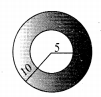
Samacheer Kalvi 10th Maths Guide Chapter 7 Mensuration Ex 7.2 Q1
Answer:
Radius of the well (r1) = 5 m
Depth of the well (h) = 14 m
Width of the embankment = 5 m
Outer radius (R) = 5 + 5 = 10 m
Let the height of the embankment be “H”
Volume of Earth in the embankment = Volume of the well
πH(R2 – r2) = \(\pi r_{1}^{2} h\)
H(102 – 52) = 5 × 5 × 14
H (100 – 25) = 5 × 5 × 14
H = \(\frac{5 \times 5 \times 14}{75}\) = 4.67 m
Height of the embankment = 4.67 m

Samacheer Kalvi 10th Maths Guide Chapter 7 Mensuration Ex 7.2

Question 2.
A cylindrical glass with diameter 20 cm has water to a height of 9 cm. A small cylindrical metal of radius 5 cm and height 4 cm is immersed it completely. Calculate the rise of the water in the glass?
Answer:
Radius of the cylindrical glass (r) = 10 cm
Height of the water (h) = 9 cm
Radius of the cylindrical metal (R) = 5 cm
Height of the metal (H) = 4 cm
Let the height of the water raised be “h”
Volume of the water raised in the cylinder = Volume of the cylindrical metal
πr2h = πr2H
10 × 10 × h = 5 × 5 × 4
h = \(\frac{5 \times 5 \times 4}{10 \times 10}\) = 1 cm
Raise of water in the glass = 1 cm

Samacheer Kalvi 10th Maths Guide Chapter 7 Mensuration Ex 7.2

Question 3.
If the circumference of a conical wooden piece is 484 cm then find its volume when its height is 105 cm.
Answer:
Circumference of the wooden piece = 484 cm
2πr = 484
2 × \(\frac{22}{7}\) × r = 484 cm
r = \(\frac{484 \times 7}{2 \times 22}\)
r = 77 cm
Height of the wooden piece (h) = 105 cm
Volume of the conical wooden piece = \(\frac{1}{3} \pi r^{2} h\) cu.units
= \(\frac{1}{3} \times \frac{22}{7} \times 77 \times 77 \times 105 \mathrm{cm}^{3}\)
= 22 × 11 × 77 × 35 cm3
= 652190 cm3
Volume of the wooden piece = 652190 cm3

Samacheer Kalvi 10th Maths Guide Chapter 7 Mensuration Ex 7.2

Question 4.
A conical container is fully filled with petrol. The radius is 10m and the height is 15 m. If the container can release the petrol through its bottom at the rate of 25 cu. meter per minute, in how many minutes the container will be emptied. Round off your answer to the nearest minute.
Answer:
The radius of the conical container (r) = 10 m
Height of the container (h) = 15 m
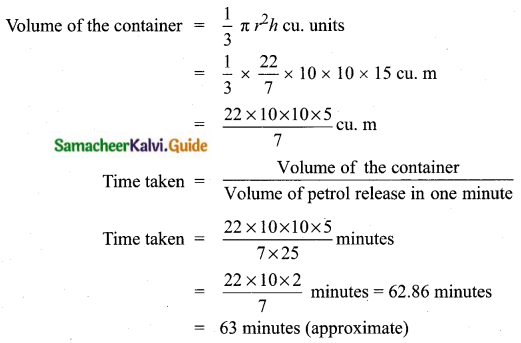
Samacheer Kalvi 10th Maths Guide Chapter 7 Mensuration Ex 7.2 Q4

Question 5.
A right-angled triangle whose sides are 6 cm, 8 cm and 10 cm is revolved about the sides containing the right angle in two ways. Find the difference in volumes of the two solids so formed.
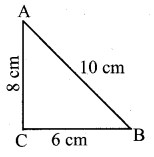
Samacheer Kalvi 10th Maths Guide Chapter 7 Mensuration Ex 7.2 Q5
Answer:
Three sides of a triangle are 6 cm, 8 cm and 10 cm.
Case (i): If the triangle is revolved about the side 6 cm, the cone will be formed with radius 6 cm and height 8 cm.
Volume of the cone = \(\frac{1}{3} \pi r^{2} h\) cu. units
= \(\frac{1}{3}\) × π × 6 × 6 × 8 = 96π cm3
Case (ii): If the triangle is revolved about the side 8 cm, the cone will be formed with radius 8 cm and height 6 cm.
Volume of the cone = \(\frac{1}{3}\) × π × 8 × 8 × 6 = 128π cm3
Difference in volume of the two solids = (128π – 96π) cm3 = 32π cm3 = 32 × \(\frac{22}{7}\) cm3 = 100.57 cm3
The difference in the volume of the two solids = 100.57 cm3

Question 6.
The volumes of two cones of same base radius are 3600 cm3 and 5040 cm3. Find the ratio of heights.
Answer:
Let the radius of the two cones be ‘r’
Let the height of the two cones be h1 and h2
Ratio of their volumes = 3600 : 5040 (÷ 10)
\(\frac{1}{3} \pi r^{2} h_{1}: \frac{1}{3} \pi r^{2} h_{2}\) = 360 : 504 (÷4)
h1 : h2 = 90 : 126 (÷3)
= 30 : 42 (÷3)
= 10 : 14 (÷2)
h1 : h2 = 5 : 7
Ratio of heights = 5 : 7

Samacheer Kalvi 10th Maths Guide Chapter 7 Mensuration Ex 7.2

Question 7.
If the ratio of radii of two spheres is 4 : 7, find the ratio of their volumes.
Answer:
Let the ratio of their radii is r1 : r2
r1 : r2 = 4 : 7
Ratio of their volumes
V1 : V2 = \(\frac{4}{3} \pi r_{1}^{3}: \frac{4}{3} \pi r_{2}^{3}\)
= \(r_{1}^{3}: r_{2}^{3}\)
= 43 : 73
Ratio of their volumes = 64 : 343

Question 8.
A solid sphere and a solid hemisphere have an equal total surface area. Prove that the ratio of their volume is 3√3 : 4.
Answer:
Total surface area of a sphere = \(4 \pi r_{1}^{2}\) sq. units
Total surface area of a hemisphere = \(3 \pi r_{2}^{2}\) sq. units
Ratio of Total surface area = \(4 \pi r_{1}^{2}: 3 \pi r_{2}^{2}\)
1 = \(\frac{4 \pi r_{1}^{2}}{3 \pi r_{2}^{2}}\) (Same Surface Area)
1 = \(\frac{4 r_{1}^{2}}{3 r_{2}^{2}}\)
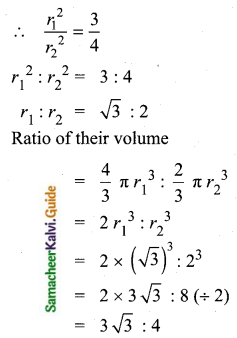
Samacheer Kalvi 10th Maths Guide Chapter 7 Mensuration Ex 7.2 Q8
Ratio of their volumes = 3√3 : 4
Hence it is proved.

Samacheer Kalvi 10th Maths Guide Chapter 7 Mensuration Ex 7.2

Question 9.
The outer and the inner surface areas of a spherical copper shell are 576π cm2 and 324π cm2 respectively. Find the volume of the material required to make the shell.
Answer:
Outer surface area of a spherical shell = 576π cm2
4πR2 = 576π
4 × R2 = 576
R2 = \(\frac{576}{4}\) = 144
R = √144 = 12 cm
Inner surface area of a spherical shell = 324π cm2
4πr2 = 324π
4r2 = 324
r2 = 81
r = √81 = 9
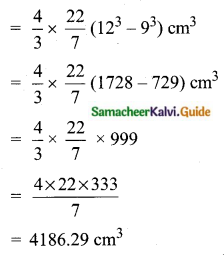
Volume of the material required = Volume of the hollow hemisphere = \(\frac{4}{3}\) π(R3 – r3) cm3
Samacheer Kalvi 10th Maths Guide Chapter 7 Mensuration Ex 7.2 Q9
Volume of the material required = 4186.29 cm3

Question 10.
A container open at the top is in the form of a frustum of a cone of height 16 cm with radii of its lower and upper ends are 8 cm and 20 cm respectively. Find the cost of milk which can completely fill a container at the rate of ₹ 40 per litre.
Answer:
Height of the frustrum (h) = 16 cm
Radius of the upper part (R) = 20 cm
Radius of the lower part (r) = 8 cm
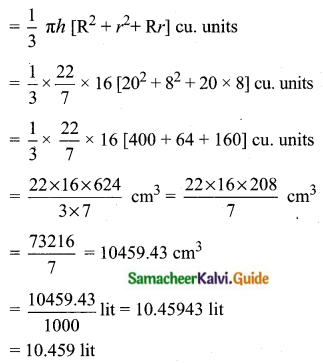
Volume of the frustum
Samacheer Kalvi 10th Maths Guide Chapter 7 Mensuration Ex 7.2 Q10
Cost of milk in the container = 10.459 × 40 = ₹ 418.36
Cost of the milk = ₹ 418.36
Tamil Nadu 11th Maths Model Question Paper 3 English Medium

Students can Download Tamil Nadu 11th Maths Model Question Paper 3 English Medium Pdf, Tamil Nadu 11th Maths Model Question Papers helps you to revise the complete Tamilnadu State Board New Syllabus, helps students complete homework assignments and to score high marks in board exams.

TN State Board 11th Maths Model Question Paper 3 English Medium

General Instructions:

  1. The question paper comprises of four parts.
  2. You are to attempt all the parts. An internal choice of questions is provided wherever applicable.
  3. All questions of Part I, II, III and IV are to be attempted separately.
  4. Question numbers 1 to 20 in Part I are Multiple Choice Questions of one mark each.
    These are to be answered by choosing the most suitable answer from the given four alternatives and writing the option code and the corresponding answer
  5. Question numbers 21 to 30 in Part II are two-mark questions. These are to be answered in about one or two sentences.
  6. Question numbers 31 to 40 in Part III are three-mark questions. These are to be answered in above three to five short sentences.
  7. Question numbers 41 to 47 in Part IV are five-mark questions. These are to be answered in detail Draw diagrams wherever necessary.

Time: 2:30 Hours
Maximum Marks: 90

PART – 1

I. Choose the correct answer. Answer all the questions: [20 × 1 = 20]

Question 1.
Let R be the universal relation on a set X with more than one element then R is ………………
(a) Not reflexive
(b) Not symmetric
(c) Transitive
(d) None of the above
Answer:
(c) Transitive

Question 2.
The value of logab logbc logca is …………………..
(a) 2
(b) 1
(c) 3
(d) 4
Answer:
(b) 1

Tamil Nadu 11th Maths Model Question Paper 3 English Medium

Question 3.
If log \(\log _{\sqrt{ }}\) 0.25 = 4 then the value of x is ………………..
(a) 0.5
(b) 2.5
(c) 1.5
(d) 1.25
Answer:
(a) 0.5

Question 4.
The product of r consecutive positive integers is divisible by ………………..
(a) r!
(b) (r-1)!
(c) (r+l)!
(d) rr
Answer:
(a) r!

Tamil Nadu 11th Maths Model Question Paper 3 English Medium

Question 5.
The value of tan75° – cot 75° is ……………….
(a) 1
(b) 2 + \(\sqrt{3}\)
(c) 2 – \(\sqrt{3}\)
(d) 2\(\sqrt{3}\)
Answer:
(d) 2\(\sqrt{3}\)

Question 6.
If (1 +x2)2(1 + x)2 = a0 + a1 x + a2x2 …. + xn+4 and if a0, a1, a2, are in AP, then n is …………………..
(a) 1
(b) 2
(c) 3
(d) 4
Answer:
(c) 3

Tamil Nadu 11th Maths Model Question Paper 3 English Medium

Question 7.
If nC12 = nC5 then nC2 = …………………
(a) 72
(b) 306
(c) 152
(d) 153
Answer:
(d) 153

Question 8.
The line (p + 2q)x + (p- 3q)y =p – q for different values of p and q passes through the point …………………
(a) (\(\frac{3}{5}\), \(\frac{2}{5}\))
(b) (\(\frac{2}{5}\), \(\frac{2}{5}\))
(c) (\(\frac{3}{5}\), \(\frac{3}{5}\))
(d) (\(\frac{2}{5}\), \(\frac{3}{5}\))
Answer:
(d) (\(\frac{2}{5}\), \(\frac{3}{5}\))

Tamil Nadu 11th Maths Model Question Paper 3 English Medium

Question 9.
The number of terms in the expansion of [(a + b)2]18 = ………………..
(a) 19
(b) 18
(c) 36
(d) 37
Answer:
(d) 37

Question 10.
A line passes through the point (2, 2) and is perpendicular to the line 3x + y = 5 then its y intercept is …………………
Answer:
(a) \(\frac{3}{4}\)
(b) \(\frac{4}{3}\)
(c) 5
(d) \(\frac{1}{3}\)

Question 11.
If a and b are the roots of the equation x2 – kx + 16 = 0 satisfy a2 + b2 = 32, then the value of k is ………………..
(a) 10
(b) -8
(c) -8, 8
(d) 6
Answer:
(c) -8, 8

Tamil Nadu 11th Maths Model Question Paper 3 English Medium

Question 12.
If A is a square matrix of order 3 then |kA| = ………………….
(a) k |A|
(b) k2|A|
(c) k3|A|
(d) k|A3|
Answer:
(c) k3|A|

Question 13.
If ABCD is a parallelogram then \(\bar { AB } \) + \(\bar { AD } \) + \(\bar { CD } \) + \(\bar { CD } \) = ………………..
(a) 2(\(\bar { AB } \) + \(\bar { AD } \))
(b) 4\(\bar { AC } \)
(c) 4\(\bar { BD } \)
(d) \(\bar { o } \)
Answer:
(d) \(\bar { o } \)

Tamil Nadu 11th Maths Model Question Paper 3 English Medium

Question 14.
\(\lim _{x \rightarrow 0}\) x cot x = ………………….
(a) 0
(b) 1
(c) -1
(d) ∞
Answer:
(b) 1

Question 15.
If x = \(\frac { 1-t^{ 2 } }{ 1+t^{ 2 } } \) and y = \(\frac { 2t }{ 1+t^{ 2 } } \) then \(\frac{dy}{dx}\) = ………………..
(a) \(\frac{y}{x}\)
(b) \(\frac{-y}{x}\)
(c) –\(\frac{x}{y}\)
(d) \(\frac{x}{y}\)
Answer:
(c) –\(\frac{x}{y}\)

Tamil Nadu 11th Maths Model Question Paper 3 English Medium

Question 16.
If y = \(\frac { (1-x)^{ 2 } }{ x^{ 2 } } \) then \(\frac{dy}{dx}\) is …………………..
(a) \(\frac { 2 }{ x^{ 2 } } \) + \(\frac { 2 }{ x^{ 3 } } \)
(b) –\(\frac { 2 }{ x^{ 2 } } \) + \(\frac { 2 }{ x^{ 3 } } \)
(c) –\(\frac { 2 }{ x^{ 2 } } \) – \(\frac { 2 }{ x^{ 3 } } \)
(d) –\(\frac { 2 }{ x^{ 3 } } \) + \(\frac { 2 }{ x^{ 2 } } \)
Answer:
(d) –\(\frac { 2 }{ x^{ 3 } } \) + \(\frac { 2 }{ x^{ 2 } } \)

Question 17.
If y = \(\frac{sinx+cosx}{sinx-cosx}\) then \(\frac{dy}{dx}\) at x = \(\frac { \pi }{ 2 } \) is ………………….
(a) 1
(b) 0
(c) -2
(d) 2
Answer:
(c) -2

Tamil Nadu 11th Maths Model Question Paper 3 English Medium

Question 18.
\(\int \frac{\sin ^{8} x-\cos ^{8} x}{1-2 \sin ^{2} x \cos ^{2} x}\) dx is ……………………
(a) \(\frac{1}{2}\) sin2x + c
(b) –\(\frac{1}{2}\) sin2x + c
(c) \(\frac{1}{2}\) cos 2x + c
(d) – \(\frac{1}{2}\) cos 2x + c
Answer:
(b) –\(\frac{1}{2}\) sin2x + c

Question 19.
An urn contains 5 red and 5 black balls. A balls is drawn at random, its colour is noted and is returned to the urn. Moreover, 2 additional balls of the colour drawn are put in the urn and then a ball is drawn at random. The probability that the second ball drawn is red will be ………………
(a) \(\frac{5}{12}\)
(b) \(\frac{1}{2}\)
(c) \(\frac{7}{12}\)
(d) \(\frac{1}{4}\)
Answer:
(b) \(\frac{1}{2}\)

Tamil Nadu 11th Maths Model Question Paper 3 English Medium

Question 20.
Let A and B be two events such that P(\(\bar { AUB } \)) = \(\frac{1}{6}\) , Then the events A and B are P(A∩B) = 1/4 and P(\(\bar { A } \)) = 1/4 is ………………
(a) Equally likely but not independent
(b) Independent but not equally likely
(c) Independent and equally likely
(d) Mutually inclusive and dependent
Answer:
(b) Independent but not equally likely

PART – II

II. Answer any seven questions. Question No. 30 is compulsory. [7 × 2 = 14]

Question 21.
Let A and B are two sets such that n(A) = 3 and n(B) = 2. If (x, 1), (y, 2) and (z, 1) are in A × B, find A and B where x, y, z are distinct elements?
Answer:
n(A) = 3 ⇒ set A contains 3 elements
n(B) = 2 ⇒ set B contains 2 elements
we are given (x, 1), (y, 2), (z, 1) are elements in A × B
⇒ A = {x, y, z} and B = {1, 2}

Tamil Nadu 11th Maths Model Question Paper 3 English Medium

Question 22.
Solve |5x — 12| ← 2
Answer:
5x – 12 > -2 (or) 5x – 12 < 2 ⇒ 5x > -2 + 12 (= 10)
⇒ x > \(\frac{10}{5}\) = 2
x > 2
(or)
5x < 2 + 12 (= 14)
⇒ x < \(\frac{14}{5}\)
so 2 < x < \(\frac{14}{5}\)

Question 23.
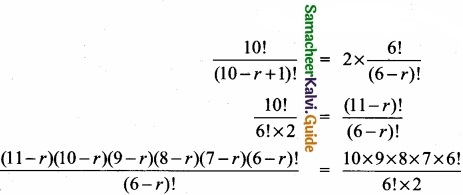
If 10Pr-1 = 2 × 6 Pr, find r?
Answer:
10Pr-1 = 2 × 6Pr
Tamil Nadu 11th Maths Model Question Paper 3 English Medium img 1
⇒ (11 – r) (10 – r) (9 – r) (8 – r) (7 – r) = 10 × 9 × 4 × 7
= 5 × 2 × 3 × 3 × 2 × 2 × 7
= 7 × 6 × 5 × 4 × 3
⇒ 11 – r = 7
11 – 7 = r
r = 4

Tamil Nadu 11th Maths Model Question Paper 3 English Medium

Question 24.
The number of bacteria in a certain culture doubles every hour. If there were 30 bacteria present in the culture originally, how many bacteria will be present at the end of 2nd hour, 4th hour and nth hour?
Answer:
No. of bacteria at the beginning = 30
No. of bacteria after 1 hour = 30 × 2 = 60
No. of bacteria after 2 hours = 30 × 22 = 30 × 4 = 120
No. of bacteria after 4 hours = 30 × 24 = 30 × 16 = 480
No. of bacteria after nth hour = 30 × 2n

Question 25.
Find |A| if A = \(\left[\begin{array}{ccc}
0 & \sin \alpha & \cos \alpha \\
\sin \alpha & 0 & \sin \beta \\
\cos \alpha & -\sin \beta & 0
\end{array}\right]\)
Answer:
\(\left[\begin{array}{ccc}
0 & \sin \alpha & \cos \alpha \\
\sin \alpha & 0 & \sin \beta \\
\cos \alpha & -\sin \beta & 0
\end{array}\right]\)
= 0M11 – sin αM12 + cos αM13
= 0 – sin α(0 – cos α sin β) + cos α(- sin α sin β – 0) = 0

Tamil Nadu 11th Maths Model Question Paper 3 English Medium

Question 26.
Find the value of λ for which the vectors \(\vec { a } \) = 3\(\hat { i } \) + 2\(\hat { j } \) + 9\(\hat { k } \) and \(\vec { a } \) = \(\hat { i } \) + λ\(\hat { j } \) +3\(\hat { k } \) are parallel?
Answer:
Given \(\vec { a } \) and \(\vec { b } \) are parallel ⇒\(\vec { a } \) = t\(\vec { b } \) (where t is a scalar)
(i.e.,) 3\(\hat { i } \) + 2\(\hat { j } \) + 9\(\hat { k } \) = t\(\hat { i } \) + λ\(\hat { j } \) + 3\(\hat { k } \))
equating \(\hat { i } \) components we get 3 = t
equating \(\hat { j } \) components
(i.e); 2 = tλ
2 = 3λ ⇒λ = 2/3

Tamil Nadu 11th Maths Model Question Paper 3 English Medium

Question 27.
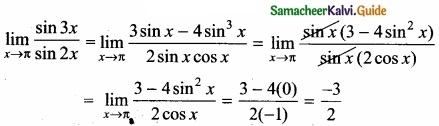
Evaluate \(\underset { x\rightarrow \pi }{ lim } \) \(\frac{sin 3x}{sin 2x}\)
Answer:
Tamil Nadu 11th Maths Model Question Paper 3 English Medium img 2

Question 28.
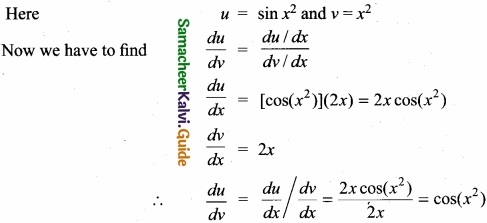
Find the derivative of sinx2 with respect to x2?
Answer:
Tamil Nadu 11th Maths Model Question Paper 3 English Medium img 3

Question 29.
Let the matrix M = \(\begin{bmatrix} x & y \\ z & 1 \end{bmatrix}\) if x, y and z are chosen at random from the set {1, 2, 3}, and repetition is allowed (i.e., x = y = z), what is the probability that the given matrix M is a singular matrix?
Answer:
If the given matnx M is singular, then = \(\begin{vmatrix} x & y \\ z & 1 \end{vmatrix}\) = 0
That is, x – yz = 0
Hence the possible ways of selecting (x, y, z) are
{(1, 1, 1), (2, 1, 2), (2, 2, 1), (3, 1, 3), (3, 3, 1)} = A (say)
The number of favourable cases n(A) = 5
The total number of cases are n(S) = 33 = 27
The probability of the given matrix is a singular matrix is
P(A) = \(\frac{n(A)}{n(S)}\) = \(\frac{5}{27}\)

Tamil Nadu 11th Maths Model Question Paper 3 English Medium

Question 30.
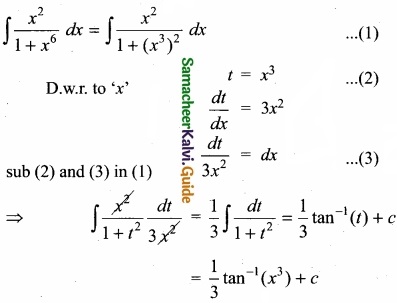
Evaluate \(\frac { x^{ 2 } }{ 1+x^{ 6 } } \)
Answer:
Tamil Nadu 11th Maths Model Question Paper 3 English Medium img 4

PART – III

III. Answer any seven questions. Question No. 40 is compulsory. [7 × 3 = 21]

Question 31.
If f, g, h are real valued functions defined on R, then prove that (f + g) o h = f o h + g o h. What can you say about fo(g + h)? Justify your answer?

Question 32.
Solve \(\frac{4}{x+1}\) ≤ 3 ≤ \(\frac{6}{x+1}\), x > 0?

Tamil Nadu 11th Maths Model Question Paper 3 English Medium

Question 33.
Prove that cos-1 \(\frac{4}{5}\) + tan-1 \(\frac{3}{5}\) = tan-1 \(\frac{27}{11}\)?

Question 34.
There are 15 candidates for an examination. 7 candidates are appearing for mathematics examination while the remaining 8 are appearing for different subjects. In how many ways
can they be seated in a row so that no two mathematics candidates are together?

Question 35.
Prove that if a, b, c are in H.P. if and only if \(\frac{a}{c}\) = \(\frac{a-b}{b-c}\)?

Tamil Nadu 11th Maths Model Question Paper 3 English Medium

Question 36.
If (-4, 7) is one vertex of a rhombus and if the equation of one diagonal is 5x – y + 7 = 0, then find the equation of another diagonal?

Question 37.
Verify the existence of \(\underset { x\rightarrow 1 }{ lim } \) f(x), where f(x) = \(\left\{\begin{aligned}
\frac{|x-1|}{x-1}, & \text { for } x \neq 1 \\
0, & \text { for } x=1
\end{aligned}\right.\)

Question 38.
If y = sin-1 x then find y?

Tamil Nadu 11th Maths Model Question Paper 3 English Medium

Question 39.
Evaluate cot2 x + tan2 x?

Question 40.
Show that
\(\left|\begin{array}{ccc}
2 b c-a^{2} & c^{2} & b^{2} \\
c^{2} & 2 c a-b^{2} & a^{2} \\
b^{2} & a^{2} & 2 a b-c^{2}
\end{array}\right|=\left|\begin{array}{ccc}
a & b & c \\
b & c & a \\
c & a & b
\end{array}\right|^{2}\)

PART – IV

IV. Answer all the questions. [7 × 5 = 35]

Question 41 (a).
The total cost of airfare on a given route is comprised of the base cost C and the fuel surcharge S in rupee. Both C and S are functions of the mileage m; C(m) = 0.4m + 50 and S(m) = 0.03m. Determine a function for the total cost of a ticket in terms of the mileage and find the airfare for flying ¡600 miles?

[OR]

(b) Evaluate \(\sqrt { x^{ 2 }+x+1 } \)?

Tamil Nadu 11th Maths Model Question Paper 3 English Medium

Question 42 (a).
Determine the region in the plane determined by the inequalities y ≥ 2x and -2x + 3y ≤ 6?

[OR]

(b) If y(cos-1 x)2, prove that (1-x2) \(\frac { d^{ 2 }y }{ dx^{ 2 } } \) – x \(\frac{dy}{dx}\) – 2 = 0. Hence find y2 when x = 0?

Question 43(a).
Prove that nCr + nCr-1 = n+1Cr

[OR]

(b) If the binomial coefficients of three consecutive terms in the expansion of (a + x)n are in the ratio 1 : 7 : 42, then find n?

Tamil Nadu 11th Maths Model Question Paper 3 English Medium

Question 44 (a).
(a) Prove that

  1. sin A + sin( 120° + A) + sin (240° + A) = O
  2. cos A+ cos (120° + A) + cos (120° – A) = O

[OR]

(b) A box contains two white balls, three black balls and four red balls. In how many ways can three balls be drawn from the box, if at least one black ball is to be included in the draw?

Question 45 (a).
Show that \(\left|\begin{array}{ccc}
a^{2}+x^{2} & a b & a c \\
a b & b^{2}+x^{2} & b c \\
a c & b c & c^{2}+x^{2}
\end{array}\right|\) is divisible by x4?

[OR]

(b) \(\left[\begin{array}{ccc}
0 & p & 3 \\
2 & q^{2} & -1 \\
r & 1 & 0
\end{array}\right]\) is skew-symmetric, find the values of p, q and r?

Tamil Nadu 11th Maths Model Question Paper 3 English Medium

Question 46 (a).
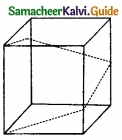
In a shopping mall there is a hail of cuboid shape with dimension 800 × 800 × 720 units, which needs to be added the facility of an escalator in the path as shown by the dotted line in the figure. Find

  1. The minimum total length of the escalator
  2. The heights at which the escalator changes its direction
  3. The slopes of the escalator at the turning points.

Tamil Nadu 11th Maths Model Question Paper 3 English Medium img 5-1

[OR]

(b) Evaluate \(\lim _{x \rightarrow a} \frac{\sqrt{x-b}-\sqrt{a-b}}{x^{2}-a^{2}}(a>b)\)

Tamil Nadu 11th Maths Model Question Paper 3 English Medium

Question 47 (a).
Evaluate ∫\(\frac { 3x+5 }{ x^{ 2 }+4x+7 } \) dx

[OR]

(b) A factory has two Machines – I and II. Machine-I produces 60% of items and Machine-II produces 40% of the items of the total output. Further 2% of the items produced by Machine-I are defective whereas 4% produced by Machine-II are defective. If an itci is drawn at random what is the probability that it is defective?

Samacheer Kalvi 10th Maths Guide Chapter 7 Mensuration Ex 7.1

Students can download Maths Chapter 7 Mensuration Ex 7.1 Questions and Answers, Notes, Samacheer Kalvi 10th Maths Guide Pdf helps you to revise the complete Tamilnadu State Board New Syllabus, helps students complete homework assignments and to score high marks in board exams.

Tamilnadu Samacheer Kalvi 10th Maths Solutions Chapter 7 Mensuration Ex 7.1

Question 1.
The radius and height of a cylinder are in the ratio 5 : 7 and its curved surface area is 5500 sq.cm. Find its radius and height.
Answer:
Let the radius be 5x and the height be 7x
C.S.A of a cylinder = 5500 sq.cm.
2πrh = 5500
2 × \(\frac{22}{7}\) × 5x × 7x = 5500
2 × 22 × 5 × x2 = 5500
x2 = \(\frac{5500}{2 \times 22 \times 5}\)
x2 = 25 cm
x = 5 cm
Radius of the cylinder = 5 × 5 = 25 cm
Height of the cylinder = 7 × 5 = 35 cm

Samacheer Kalvi 10th Maths Guide Chapter 7 Mensuration Ex 7.1

Question 2.
A solid iron cylinder has total surface area of 1848 sq.m. Its curved surface area is five-sixth of its total surface area. Find the radius and height of the iron cylinder.
Answer:
T.S.A of the cylinder =1848 sq.cm
2πr(h + r) = 1848 ……. (1)
Curved surface area = \(\frac{5}{6}\) × 1848 sq.cm
2πrh = 5 × 308
2πrh = 1540 sq.m ……… (2)
Substitute the value of2πrh in (1)
2πr(h + r) = 1848
2πrh + 2πr2 = 1848
1540 + 2πr2 = 1848
2πr2 = 1848 – 1540
2 × \(\frac{22}{7}\) × r2 = 308
r2 = \(\frac{308 \times 7}{2 \times 22}\) = 49
r = 7
Radius of the cylinder = 7m
2πrh = 1540
2 × \(\frac{22}{7}\) × 7 × h = 1540
h = \(\frac{1540}{2 \times 22}\) = 35 m
Radius of the cylinder = 7 m
Height of the cylinder = 35 m

Samacheer Kalvi 10th Maths Guide Chapter 7 Mensuration Ex 7.1

Question 3.
The external radius and the length of a hollow wooden log are 16 cm and 13 cm respectively. If its thickness is 4 cm then find its T.S.A.
Answer:
External radius of the wooden log (R) = 16 cm
Thickness = 4 cm
Internal radius (r) = 16 – 4 = 12 cm
Length of the wooden log (h) = 13 cm
T.S.A of the hollow cylinder = 2π (R + r) (R – r + h) sq.cm
= 2 × \(\frac{22}{7}\) × (16 + 12) (16 – 12 + 13) sq.cm
= 2 × \(\frac{22}{7}\) × 28 × 17 sq.cm
= 2 × 22 × 4 × 17 sq.cm.
= 2992 sq.cm.
T.S.A of the hollow wooden = 2992 sq.cm.

Samacheer Kalvi 10th Maths Guide Chapter 7 Mensuration Ex 7.1

Question 4.
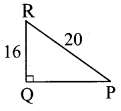
A right angled triangle PQR where ∠Q = 90° is rotated about QR and PQ. If QR = 16 cm and PR = 20 cm, compare the curved surface areas of the right circular cones so formed by the triangle.
Answer:
Samacheer Kalvi 10th Maths Guide Chapter 7 Mensuration Ex 7.1 Q4
In the Right Triangle
QP2 = PR2 – QR2= 202 – 162 = 400 – 256 = 144
QP = √144 = 12 cm
When PQ is rotated r = 12, l = 20
C.S.A of the cone = πrl sq. units = π × 12 × 20 cm2 = 240π cm2
When QR is rotated r = 16, l = 20
C.S.A of the cone = nrl sq. units = π × 16 × 20 = 320π cm2
C.S.A. of a cone when rotated about QR is larger.

Question 5.
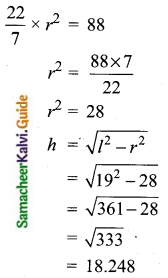
4 persons live in a conical tent whose slant height is 19 cm. If each person requires 22 cm2 of the floor area, then find the height of the tent.
Answer:
Slant height of a cone (r) = 19 cm
Floor area for 4 persons = 4 × 22 cm2
πr2 = 88 cm
Samacheer Kalvi 10th Maths Guide Chapter 7 Mensuration Ex 7.1 Q5
Height of the tent = 18.25 cm

Question 6.
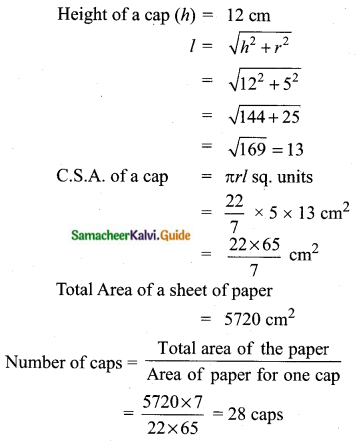
A girl wishes to prepare birthday caps in the form of right circular cones for her birthday party, using a sheet of paper whose area is 5720 cm2, how many caps can be made with radius 5 cm and height 12 cm.
Answer:
Radius of a cap (r) = 5 cm
Samacheer Kalvi 10th Maths Guide Chapter 7 Mensuration Ex 7.1 Q6

Question 7.
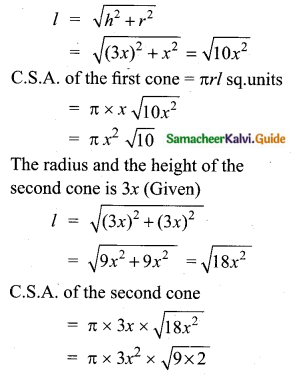
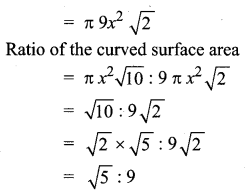
The ratio of the radii of two right circular cones of the same height is 1 : 3. Find the ratio of their curved surface area when the height of each cone is 3 times the radius of the smaller cone.
Answer:
Let the radius of the first cone be ‘x’ and the Height of the cone be 3x
Samacheer Kalvi 10th Maths Guide Chapter 7 Mensuration Ex 7.1 Q7
Samacheer Kalvi 10th Maths Guide Chapter 7 Mensuration Ex 7.1 Q7.1

Question 8.
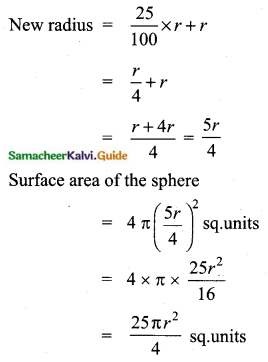
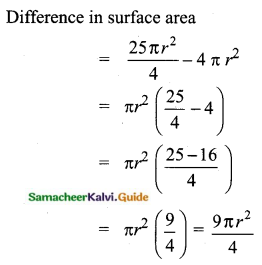
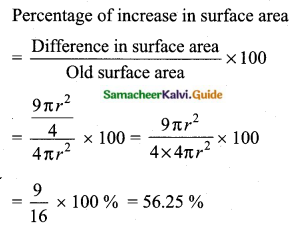
The radius of a sphere increases by 25%. Find the percentage increase in its surface area.
Answer:
Let the radius of the be “r”
Surface area of the sphere = 4πr2 sq.units …….. (1)
If the radius is increased by 25%
Samacheer Kalvi 10th Maths Guide Chapter 7 Mensuration Ex 7.1 Q8
Samacheer Kalvi 10th Maths Guide Chapter 7 Mensuration Ex 7.1 Q8.1
Samacheer Kalvi 10th Maths Guide Chapter 7 Mensuration Ex 7.1 Q8.2
Percentage of increase in surface area = 56.25 %

Question 9.
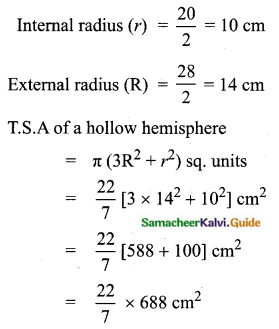
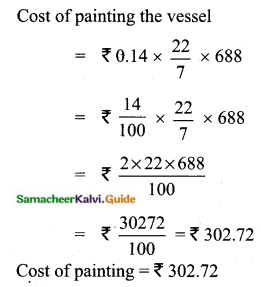
The internal and external diameters of a hollow hemispherical vessel are 20 cm and 28 cm respectively. Find the cost to paint the vessel all over at ₹ 0.14 per cm2.
Answer:
Samacheer Kalvi 10th Maths Guide Chapter 7 Mensuration Ex 7.1 Q9
Samacheer Kalvi 10th Maths Guide Chapter 7 Mensuration Ex 7.1 Q9.1

Question 10.
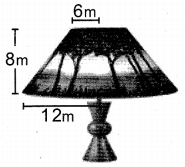
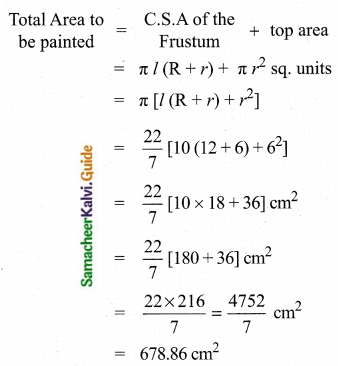
The frustum shaped outer portion of the table lamp has to be painted including the top part. Find the total cost of painting the lamp if the cost of painting 1 sq.cm is ₹ 2.
Samacheer Kalvi 10th Maths Guide Chapter 7 Mensuration Ex 7.1 Q10
Answer:
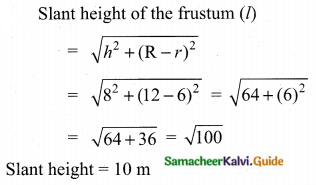
The slant height of the frustum (l)
Samacheer Kalvi 10th Maths Guide Chapter 7 Mensuration Ex 7.1 Q10.1
Samacheer Kalvi 10th Maths Guide Chapter 7 Mensuration Ex 7.1 Q10.2
Cost of painting = ₹ 678.86 × 2 = ₹ 1357.72

Samacheer Kalvi 6th Social Science Guide Civics Term 1 Chapter 1 Understanding Diversity

Students can download 6th Social Science Term 1 Civics Chapter 1 Understanding Diversity Questions and Answers, Notes, Samacheer Kalvi 6th Social Science Guide Pdf helps you to revise the complete Tamilnadu State Board New Syllabus, helps students complete homework assignments and to score high marks in board exams.

Tamilnadu Samacheer Kalvi 6th Social Science Civics Solutions Term 1 Chapter 1 Understanding Diversity

Samacheer Kalvi 6th Social Science Understanding Diversity Text Book Back Questions and Answers

A. Choose the correct answer

Question 1.
India consists of ……………. states and ……………. Union territories.
(a) 27,9
(b) 29,7
(c) 28,7
(d) 28,9
Answer:
(b) 29,7

Question 2.
India is known as a
(a) Continent
(b) Subcontinent
(c) Island
(d) None of these
Answer:
(b) Sub continent

Samacheer Kalvi 6th Social Science Guide Civics Term 1 Chapter 1 Understanding Diversity

Question 3.
Mawsynram, the land of highest rainfall is located in …………….
(a) Manipur
(b) Sikkim
(c) Nagaland
(d) Meghalaya
Answer:
(d) Meghalaya

Question 4.
Which one of the following religion is not practised in India
(a) Sikhism
(b) Islam
(c) Zoroastrianism
(d) Confucianism
Answer:
(d) Confucianism

Question 5.
Recognised official languages of India, as per VUIth schedule of Indian constitution …………….
(a) 25
(b) 23
(c) 22
(d) 26
Answer:
(c) 2

Question 6.
Onam festival celebrated in
(a) Kerala
(b) Tamil Nadu
(c) Punjab
(d) Karnataka
Answer:
(a) Kerala

Samacheer Kalvi 6th Social Science Guide Civics Term 1 Chapter 1 Understanding Diversity

Question 7.
Mohiniyattam is a classical dance of …………….
(a) Kerala
(b) Tamil Nadu
(c) Manipur
(d) Karnataka
Answer:
(a) Kerala

Question 8.
Discovery of India’ a book was written by
(a) Rajaji
(b) V.O.C
(c) Nethaji
(d) Jawaharlal Nehru
Answer:
(d) Jawaharlal Nehru

Question 9.
The phrase ‘Unity in Diversity’ was coined by …………….
(a) Jawaharlal Nehru
(b) Ambedkar
(c) Mahathma Gandhi
(d) Rajaji
Answer:
(a) JawahalalNehru

Question 10.
V.A. Smith called India as __________
(a) Great Democracy
(b) Unique land of diversities
(c) Ethnological museum
(d) Secular nation
Answer:
(c) Ethnological museum

II. Fill in the blanks

  1. Geographical features and climatic conditions determine the ……………. activities of a region.
  2. Jaisalmer, the land of lowest rainfall is located in …………….
  3. Tamil was declared as classical language in the year …………….
  4. Bihu festival is celebrated in …………….

Answer:

  1. economic
  2. Rajasthan
  3. 2004
  4. Assam

III. Match the following

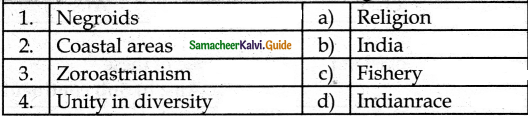
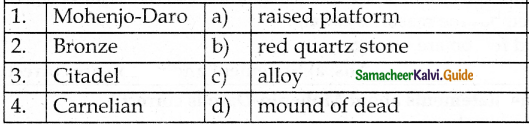
Samacheer Kalvi 6th Social Science Guide Civics Term 1 Chapter 1 Understanding Diversity

Answer:
1. – d
2. – c
3. – a
4. – b

IV. Answer the following questions

Question 1.
Define diversity.
Answer:
We, the Indians come from different backgrounds, belong to different cultures, worship in different ways. This is known as diversity.

Question 2.
What are the types of diversity?
Answer:

  1. Landform and lifestyle diversity
  2. Social diversity
  3. Religious diversity
  4. Linguistic diversity
  5. Cultural diversity

Samacheer Kalvi 6th Social Science Guide Civics Term 1 Chapter 1 Understanding Diversity

Question 3.
Why is India called a subcontinent?
Answer:
A continent is a very large area of land with various physical features such as mountains, plateaus, plains, rivers and seas, and various types of weather patterns. India has all of them. So India is known as a subcontinent.

Question 4.
Write the names of three major festivals celebrated in India.
Answer:

  1. Deepavali
  2. Christmas
  3. Ramzan

Question 5.
List out some of the classical dances of India,
Answer:

  1. Tamil Nadu – Bharatanatyam
  2. Kerala – Kathakali
  3. Karnataka – Yakshagana
  4. Odisha – Odissi
  5. Andhra Pradesh – Kuchipudi
  6. Manipur – Manipuri
  7. Assam – Sattriya

Question 6.
Why is India called the land of unity in diversity?
Answer:
Though diversity is visible in every aspect of life in India, we are united by the spirit of patriotism.

V. Answer the following in detail

Question 1.
Explain Linguistic diversity and cultural diversity.
Answer:
Linguistic Diversity:

  1. According to the census of India 2001, India has 122 major languages and 1599 other languages.
  2. Four major Indian language families are Indo-Aryan, Dravidian, Austroasiatic, and Sino Tibetian. Tamil is the oldest Dravidian language.
  3. Historically, the Portuguese, the Dutch, the British, the Danish and the French came to India for trade and their occupation of India or some parts of it has left behind a certain impact upon the culture and language of the people.
  4. In due course, English has emerged as an important language and a medium of instruction in schools and colleges.
  5. (It is widely used in official communication and daily life.

Cultural Diversity:

  1. The term ‘culture’ refers to the customs and practices of people, their language, their dress code, cuisine, religion, social habits, music, art, and architecture.
  2. The culture of a group of people is reflected in their social behaviour and interactions.
  3. The group identity fostered by social patterns is unique to a group.
  4. Art and architecture are an integral part of every community.
  5. It develops as a part of the culture and tradition of a community.

Samacheer Kalvi 6th Social Science Guide Civics Term 1 Chapter 1 Understanding Diversity

Question 2.
“‘India is a land of diversity, yet we are all united”. Explain.
Answer:

  1. Diversity is visible in every aspect of life in India.
  2. Even then, we are united by the spirit of patriotism.
  3. Symbols such as the National Flag and National Anthem remind us of our great nation and need to stay united.
  4. We come together when we celebrate Independence Day, Republic Day and Gandhi Jayanthi every year.
  5. India has a multi-cultural society.
  6. India evolved as a single nation through common beliefs, customs, and cultural practices.
  7. The freedom struggle and the drafting of our constitution stand as ample evidence , to the spirit of unity of India.

VI. Projects and Activities (For Students)

  1. “The occupation of people depends on the landform of a place” Give some examples.
  2. Read about a state of your choice and make an album to show the culture and tradition of people who live in that state.
  3. Collect the pictures to show the and and architecture of Tamilnadu.

VII. HOTS

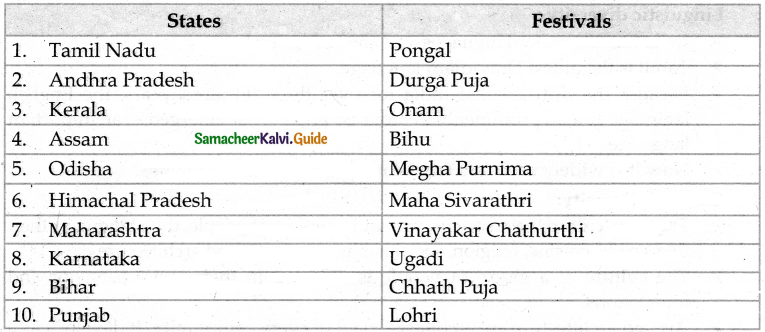
List out the various festivals celebrated in different states.
Samacheer Kalvi 6th Social Science Guide Civics Term 1 Chapter 1 Understanding Diversity

VIII. Life Skill

Suggest measures to bring unity in your school.

  1. Uniform dress
  2. Celebrating festivals of all religions.
    • Deepavali
    • Christmas
    • Ramzan
    • Pongal
  3. Conducting community prayers.
  4. Inter – dining
  5. Celebration of School Day
  6. Other extracurricular activities.
  7. Conducting L.D.S meetings.

Samacheer Kalvi 6th Social Science Understanding Diversity Additional Important Questions and Answers

I. Choose the correct answer

Question 1.
The oldest Dravidian language is …………….
(a) Hindi
(b) Tamil
(c) Sanskrit
(d) Telugu
Answer:
(b) Tamil

Question 2.
Punjab is well-known as for_______ dance.
(a) Bihu
(b) Dandia
(c) Bhangra
(d) Dumhal
Answer:
(c) Bhangra

Samacheer Kalvi 6th Social Science Guide Civics Term 1 Chapter 1 Understanding Diversity

Question 3.
Tamil was declared as a classical language in …………….
(a) 2002
(b) 2004
(c) 2012
(d) 2008
Answer:
(b) 2004

II. Fill in the blanks

  1. Gurunanak Jayanthi is celebrated by the ……………..
  2. India became independent in the year ……………..
  3. The first Prime Minister of independent India is ……………..
  4. The fundamental unit of a society is the ……………..
  5. The folk dance of Punjab is ……………..

Answer:

  1. Sikhs
  2. 1947
  3. Jawaharlal Nehru
  4. Family
  5. Bhangra

III. Answer in brief

Question 1.
What is meant by family? What are the types of the family?
Answer:
Family is the fundamental unit of society. Joint families and nuclear families are the two types of families.

Question 2.
Define community.
Answer:
Our community is made up of peasants, labourers, artisans, parents, teachers, students, and many others.

Question 3.
What is a continent?
Answer:
A continent is a very large area of land with various physical features such as mountains, plateaus, plains, rivers and seas and various types of weather patterns.

Samacheer Kalvi 6th Social Science Guide Civics Term 1 Chapter 1 Understanding Diversity

Question 4.
Name the religions which flourish in India.
Answer:
Hinduism, Islam, Christianity, Sikhism, Buddhism, Jainism and Zoroastrianism flourish in India.

Question 5.
Mention the religions of India.
Answer:

  1. Hinduism
  2. Islam
  3. Christianity
  4. Sikhism
  5. Buddhism
  6. Jainism and Zoroastrianism are the religion of India.

Question 6.
Mention the people who came to India for trade.
Answer:
The Portuguese, the Dutch, the British, the Danish and the French came to India for trade.

Samacheer Kalvi 6th Social Science Guide Civics Term 1 Chapter 1 Understanding Diversity

Question 7.
Mention any four folk dances of India.
Answer:

  1. Tamil Nadu – Karagattam, Oyillattam, Kummi, Thappattam
  2. Kerala – Mohiniattam
  3. Punjab – Bhangra
  4. Gujarat – Dandia

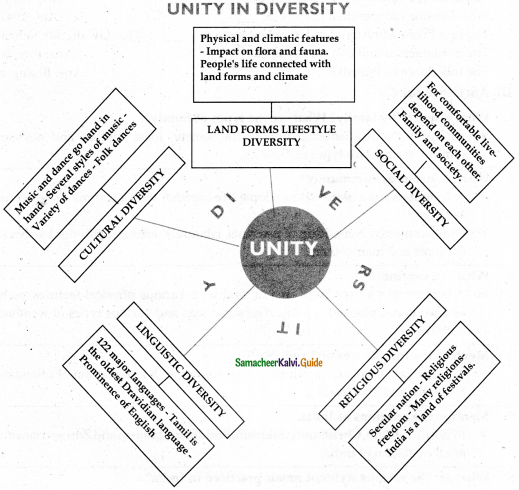
IV. Mind Map

Samacheer Kalvi 6th Social Science Guide Civics Term 1 Chapter 1 Understanding Diversity

Tamil Nadu 11th Maths Model Question Paper 2 English Medium

Students can Download Tamil Nadu 11th Maths Model Question Paper 2 English Medium Pdf, Tamil Nadu 11th Maths Model Question Papers helps you to revise the complete Tamilnadu State Board New Syllabus, helps students complete homework assignments and to score high marks in board exams.

TN State Board 11th Maths Model Question Paper 2 English Medium

General Instructions:

  1. The question paper comprises of four parts.
  2. You are to attempt all the parts. An internal choice of questions is provided wherever applicable.
  3. All questions of Part I, II, III and IV are to be attempted separately.
  4. Question numbers 1 to 20 in Part I are Multiple Choice Questions of one mark each.
    These are to be answered by choosing the most suitable answer from the given four alternatives and writing the option code and the corresponding answer
  5. Question numbers 21 to 30 in Part II are two-mark questions. These are to be answered in about one or two sentences.
  6. Question numbers 31 to 40 in Part III are three-mark questions. These are to be answered in above three to five short sentences.
  7. Question numbers 41 to 47 in Part IV are five-mark questions. These are to be answered in detail Draw diagrams wherever necessary.

Time: 2:30 Hours
Maximum Marks: 90

PART – 1

I. Choose the correct answer. Answer all the questions: [20 × 1 = 20]

Question 1.
Let R be the set of all real numbers. Consider the following subsets of the plane R × R:
S= {(x, y) : y = x + 1 and 0 < x < 2} and T = {(x, y): x – y is an integer}
Then which of the following is true?
(a) T is an equivalence relation but S is not an equivalence relation.
(b) Neither S nor T is an equivalence relation
(c) Both S and T are equivalence relation
(d) S is an equivalence relation but T is not an equivalence relation.
Answer:
(a) T is an equivalence relation but S is not an equivalence relation.

Tamil Nadu 11th Maths Model Question Paper 2 English Medium

Question 2.
If the set A has m elements the set B has n elements and the number of elements in A × B is …………………
(a) m + n
(b) mn
(c) \(\frac{m}{n}\)
(d) m2
Answer:
(b) mn

Question 3.
If \(\frac{ax}{(x+2)(2x-3)}\) = \(\frac{2}{x+2}\) + \(\frac{3}{2x-3}\) then a = ……………….
(a) 8
(b) 7
(c) 5
(d) 4
Answer:
(b) 7

Tamil Nadu 11th Maths Model Question Paper 2 English Medium

Question 4.
The number of solutions of x2 + |x – 1| = 1 is ………………….
(a) 1
(b) 0
(c) 2
(d) 3
Answer:
(c) 2

Question 5.
If a, 8, b are in A.P. a, 4, b are in G.P. and a, x, b are in H.P then x = ………………..
(a) 2
(b) 1
(c) 4
(d) 16
Answer:
(a) 2

Tamil Nadu 11th Maths Model Question Paper 2 English Medium

Question 6.
If 10 lines are drawn in a plane such that no two of them are parallel and no three are concurrent, then the total number of points of intersection are ……………….
(a) 45
(b) 40
(c) 10!
(d) 210
Answer:
(a) 45

Question 7.
The value of e2logx = …………………..
(a) 2x
(b) x2
(c) \(\sqrt{x}\)
(d) \(\frac{x}{2}\)
Answer:
(b) x2

Tamil Nadu 11th Maths Model Question Paper 2 English Medium

Question 8.
The nth term of the sequence 1, 2, 4, 7, 11 …. is …………………
(a) n3 + 3n2 + 2n
(b) n3 – 3n2 + 3n
(c) n\(\frac{(n+1)(n+2)}{3}\)
(d) \(\frac { n^{ 2 }-n+2 }{ 2 } \)
Answer:
(d) \(\frac { n^{ 2 }-n+2 }{ 2 } \)

Question 9.
The last term in the expansion (2+\(\sqrt{3}\))8 is ………………
(a) 81
(b) 27
(c) 9
(d) 3
Answer:
(a) 81

Tamil Nadu 11th Maths Model Question Paper 2 English Medium

Question 10.
A line perpendicular to the line 5x -y = 0 forms a triangle with the coordinate axes. If the area of the triangle is 5sq.units, then its equation is …………………..
(a) x + 5y ± 5\(\sqrt{2}\) = 0
(b) x – 5y ± 5\(\sqrt{2}\) = 0
(c) 5x + y ± 5\(\sqrt{2}\) = 0
(d) 5x – y ± 5\(\sqrt{2}\) = 0
Answer:
(a) x + 5y ± 5\(\sqrt{2}\) = 0

Question 11.
A factor of the determinant \(\left|\begin{array}{ccc}
x & -6 & -1 \\
2 & -3 x & x-3 \\
-3 & 2 x & x+2
\end{array}\right|\) is ……………….
(a) x + 3
(b) 2x – 1
(c) x – 2
(d) x – 3
Answer:
(a) x + 3

Tamil Nadu 11th Maths Model Question Paper 2 English Medium

Question 12.
If λ\(\vec { a } \) + 2λ\(\vec { j } \) + 2λ\(\vec { k } \) is a unit vector then the value of λ is ………………
(a) \(\frac{1}{3}\)
(b) \(\frac{1}{4}\)
(c) \(\frac{1}{9}\)
(d) \(\frac{1}{2}\)
Answer:
(a) \(\frac{1}{3}\)

Question 13.
One of the diagonals of parallelogram ABCD with \(\vec { a } \) and \(\vec { b } \) are adjacent sides is \(\vec { a } \) + \(\vec { b } \). The other diagonal BD is ………………….
(a) \(\vec { a } \) – \(\vec { b } \)
(b) \(\vec { a } \) – \(\vec { b } \)
(c) \(\vec { a } \) + \(\vec { b } \)
(d) \(\frac{\vec{a}+\vec{b}}{2}\)
Answer:
(b) \(\vec { a } \) – \(\vec { b } \)

Tamil Nadu 11th Maths Model Question Paper 2 English Medium

Question 14.
If (1, 2, 4) and (2, -3λ, -3) are the initial and terminal points of the vector \(\vec { i } \) + 5\(\vec { j } \) – 7\(\vec { k } \) then the value of λ …………………..
(a) \(\frac{7}{3}\)
(b) –\(\frac{7}{3}\)
(c) \(\frac{5}{3}\)
(d) \(\frac{-5}{3}\)
Answer:
(b) –\(\frac{7}{3}\)

Question 15.
If y = mx + c and f(0) =f'(0) = 1 then f(2) = …………………..
(a) 1
(b) 2
(c) 3
(d) 4
Answer:
(c) 3

Tamil Nadu 11th Maths Model Question Paper 2 English Medium

Question 16.
The derivative of (x + \(\frac{1}{x}\))2 w.r.to. x is ………………..
(a) 2x – \(\frac { 2 }{ x^{ 3 } } \)
(b) 2x + \(\frac { 2 }{ x^{ 3 } } \)
(c) 2(x + \(\frac{1}{x}\))
(d) 0
Answer:
(a) 2x – \(\frac { 2 }{ x^{ 3 } } \)

Question 17.
If f(x) is \(\left\{\begin{array}{cc}
a x^{2}-b, & -1<x<1 \\
\frac{1}{|x|}, & \text { elsewhere }
\end{array}\right.\) is differentiable at x = 1, then …………………
(a) a = \(\frac{1}{2}\), b = \(\frac{-3}{2}\)
(b) a = \(\frac{-1}{2}\), b = \(\frac{3}{2}\)
(c) a = \(\frac{-1}{2}\), b = \(\frac{-3}{2}\)
(d) a = \(\frac{1}{2}\), b = \(\frac{3}{2}\)
Answer:
(c) a = \(\frac{-1}{2}\), b = \(\frac{-3}{2}\)

Tamil Nadu 11th Maths Model Question Paper 2 English Medium

Question 18.
∫\(\frac { \sqrt { tanx } }{ sin2x } \) dx is ………………
(a) \(\sqrt{tanx}\) + c
(b) 2\(\sqrt{tanx}\) + c
(c) \(\frac{1}{2}\) \(\sqrt{tanx}\) + c
(d) \(\frac{1}{4}\) \(\sqrt{tanx}\) + c
Answer:
(a) \(\sqrt{tanx}\) + c

Question 19.
An urn contains 5 red and 5 black balls. A balls is drawn at random, its colour is noted and is returned to the urn. Moreover, 2 additional balls of the colour drawn are put in the urn and then a ball is drawn at random. The probability that the second ball drawn is red will be ………………….
(a) \(\frac{5}{12}\)
(b) \(\frac{1}{2}\)
(c) \(\frac{7}{12}\)
(d) \(\frac{1}{4}\)
Answer:
(b) \(\frac{1}{2}\)

Tamil Nadu 11th Maths Model Question Paper 2 English Medium

Question 20.
It is given that the events A and B are such that P(A) = \(\frac{1}{4}\), P(A/B) = \(\frac{1}{2}\), and P(B/A) = \(\frac{2}{3}\) then
P(B) = ………………….
(a) \(\frac{1}{6}\)
(b) \(\frac{1}{3}\)
(c) \(\frac{2}{3}\)
(d) \(\frac{1}{2}\)
Answer:
(b) \(\frac{1}{3}\)

PART – II

II. Answer any seven questions. Question No. 30 is compulsory. [7 × 2 = 14]

Question 21.
If n(P(A)) = 1024, n(A∪B) = 15 and n(P(B)) = 32 then find n(A∩B)
Answer:
n(P(A)) = 1024 = 210 ⇒ n(A) = 10
n(A∪B) = 15
n(P(B)) = 32 = 25 ⇒ n(B) = 5
We know n(A∪B) = n(A) + n(B) – n(A∩B)
(i.e) 15 = 10 + 5 – n(A∩B)
⇒ n(A∩B) = 15 – 15 = 0

Tamil Nadu 11th Maths Model Question Paper 2 English Medium

Question 22.
Simplify (343)2/3
Answer:
(343)2/3 = (73)2/3 = 73×2/3 = 72 = 49

Question 23.
Show that cos36° cos 72° cos 108° cos 144° = \(\frac{1}{16}\)
Answer:
LHS = cos36° cos(90° – 18°) cos(90° – 18°) cos(90° + 18°) cos(180° – 36°)
= sin2 18° cos2 36°
= (\(\frac { \sqrt { 5-1 } }{ 4 } \))2 (\(\frac { \sqrt { 5+1 } }{ 4 } \))2 = \(\frac{1}{16}\) = RHS

Tamil Nadu 11th Maths Model Question Paper 2 English Medium

Question 24.
Find the number of ways of selecting 9 balls from 6 red balls, 5 white balls and 5 blue balls if each selection consists of 3 balls of each colour?
Answer:
There are 6 red balls, 5 white balls and 5 blue balls.
We have to select 3 balls of each colour.
∴Number of ways of selection = 6C3 × 5C3 × 5C3
= \(\frac { 6! }{ 3!3! } \) × \(\frac { 5! }{ 3!2! } \) × \(\frac { 5! }{ 3!2! } \)
= 20 × 10 × 10 = 2000

Question 25.
Find |A| if A = \(\left[\begin{array}{ccc}
0 & \sin \alpha & \cos \alpha \\
\sin \alpha & 0 & \sin \beta \\
\cos \alpha & -\sin \beta & 0
\end{array}\right]\)
Answer:
\(\left[\begin{array}{ccc}
0 & \sin \alpha & \cos \alpha \\
\sin \alpha & 0 & \sin \beta \\
\cos \alpha & -\sin \beta & 0
\end{array}\right]\)
= 0M11 – sin αM12 + cos αM13
= 0 – sin α(0 – cos α sin β) + cos α (-sin α sin β – 0) = 0

Tamil Nadu 11th Maths Model Question Paper 2 English Medium

Question 26.
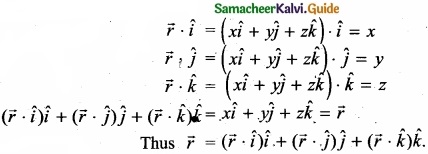
For any vector prove that \(\vec { r } \) = [\(\vec { r } \).\(\vec { i } \)) + (\(\vec { r } \).\(\vec { j } \))j + [\(\vec { r } \).\(\vec { k } \)}k
Answer:
Let \(\vec { r } \) = x\(\hat { i } \) + y\(\hat { j } \) + z\(\hat { k } \)
Tamil Nadu 11th Maths Model Question Paper 2 English Medium img 1 - Copy

Tamil Nadu 11th Maths Model Question Paper 2 English Medium

Question 27.
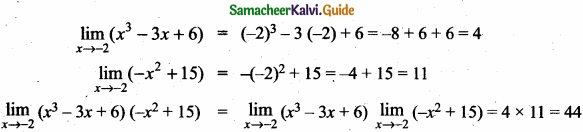
Calculate \(\lim _{x \rightarrow-2}\) (x3 – 3x + 6) (-x2 + 15)
Answer:
Tamil Nadu 11th Maths Model Question Paper 2 English Medium

Question 28.
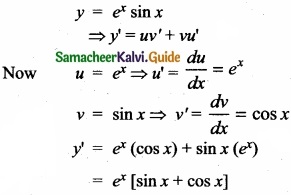
Evaluate y = ex sin x
Answer:
Tamil Nadu 11th Maths Model Question Paper 2 English Medium

Question 29.
Integrate the following with respect to x
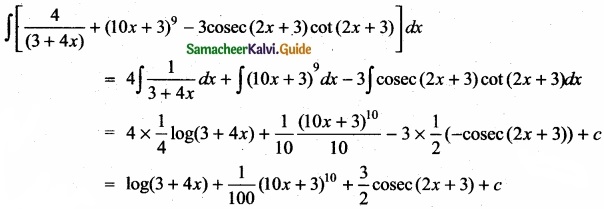
\(\frac{4}{3+4x}\) + (10x + 3)9 – 3 cosec(2x + 3) cot (2x + 3)
Answer:
Tamil Nadu 11th Maths Model Question Paper 2 English Medium

Tamil Nadu 11th Maths Model Question Paper 2 English Medium

Question 30.
P(A) = 0.6, P (B) = 0.5 and P(A∩B) = 0.2 find P(A/B)
Answer:
Given that P(A) = 0.6, P(B) = 0.5, and P(A∩B) = 0.2
P(A/B) = \(\frac { p(A∩B) }{ p(B) } \) = \(\frac{0.2}{0.5}\) = \(\frac{2}{5}\)

PART – III

III. Answer any seven questions. Question No. 40 is compulsory. [7 × 3 = 21]

Question 31.
A quadratic polynomial has one of its zeros 1 + \(\sqrt{5}\) and it satisfies p(1) = 2. Find the quadratic polynomial?

Question 32.
Prove that

  1. tan-1 (\(\frac{1}{7}\)) + tan-1(\(\frac{1}{13}\)) = tan-1(\(\frac{2}{9}\))
  2. cos-1\(\frac{4}{5}\) + tan-1\(\frac{3}{5}\) = tan-1\(\frac{27}{11}\)

Tamil Nadu 11th Maths Model Question Paper 2 English Medium

Question 33.
The product of three increasing numbers in GP is 5832. If we add 6 to the second number and 9 to the third number, then resulting numbers form an AP. Find the numbers in GP?

Question 34.
Find the equation of the line passing through the point (5, 2) and perpendiular to the line joining the points (2, 3) and (3, -1)?

Tamil Nadu 11th Maths Model Question Paper 2 English Medium

Question 35.
Find the area of the triangle whose vertices are (0,0), (1,2) and (4,3)?

Question 36.
If \(\vec { a } \), \(\vec { b } \), \(\vec { c } \) are three vectors such that \(\vec { a } \) + 2\(\vec { b } \) + \(\vec { c } \) = 0 and |\(\vec { a } \)| = 3, |\(\vec { b } \)| = 4, |\(\vec { c } \)| = 7 fimd the angle between \(\vec { a } \) and \(\vec { b } \)

Question 37.
Evaluate: \({ \underset { x\rightarrow 0 }{ lim } }\) \(\frac { 3^{ x }-1 }{ \sqrt { 1+x-1 } } \)

Tamil Nadu 11th Maths Model Question Paper 2 English Medium

Question 38.
Find \(\frac{dy}{dx}\) for y = tan-1 \((\frac { cosx+sinx }{ cosx-sinx } )\)

Question 39.
Evaluate: ∫x5 ex2

Question 40.
How many automobile license plates can be made, if each plate contains two different letters followed by three different digits?

PART – IV

IV. Answer all the questions. [7 × 5 = 35]

Question 41.
(a) If f : R – {-1, 1} → R is defined by f(x) = \(\frac { x }{ x^{ 2 }-1 } \), verify whether f is one-to-one or not?

[OR]

(b) Solve: log2 x + log4 x + log8 x = 11

Tamil Nadu 11th Maths Model Question Paper 2 English Medium

Question 42.
(a) Prove that \(\frac{\sin x+\sin 3 x+\sin 5 x+\sin 7 x}{\cos x+\cos 3 x+\cos 5 x+\cos 7 x}\) = tan 4x

[OR]

(b) If x + y + z = xyz, then prove that \(\frac { 2x }{ 1-x^{ 2 } } \) + \(\frac { 2y }{ 1-y^{ 2 } } \) + \(\frac { 2z }{ 1-z^{ 2 } } \) = \(\frac { 2x }{ 1-x^{ 2 } } \) \(\frac { 2y }{ 1-y^{ 2 } } \) \(\frac { 2z }{ 1-z^{ 2 } } \)

Question 43.
(a) If the letters of the word GARDEN are permuted in all possible ways and the strings thus formed are arranged in the dictionary order, then and the ranks of the words

  1. GARDEN
  2. DANGER

[OR]

(b) \(\underset { x\rightarrow a }{ lim } \) \(\frac{\sqrt{x-b}-\sqrt{a-b}}{x^{2}-a^{2}}\) (a>b)

Tamil Nadu 11th Maths Model Question Paper 2 English Medium

Question 44.
(a) If the binomial coefficients of three consecutive terms in the expansion of (a + x)n are in the ratio 1 : 7 : 42 then find n?

[OR]

(b) Evalute \(\sqrt { x^{ 2 }+y^{ 2 } } \) = tan-1(\(\frac{y}{x}\))

Question 45.
Let \(\vec { a } \), \(\vec { b } \), \(\vec { c } \) be three vectors such that |\(\vec { a } \)| = 3, |\(\vec { b } \)| = 4, |\(\vec { c } \)| = 5 and each one of them being perpendicular to the sum of the other two, find |\(\vec { a } \) + \(\vec { b } \) + \(\vec { c } \)|.

[OR]

(b) Evaluate ∫sec3 2xdx

Tamil Nadu 11th Maths Model Question Paper 2 English Medium

Question 46.
(a) Find all the equations of the straight lines in the family of the lines y = mx – 3, for which m and the x-coordinate of the point of intersection of the lines with x – y = 6 are integers?

[OR]

(b) There are two identical boxes containing respectively 5 white and 3 red balls, 4 white and 6 red balls. A box is chosen at random and a ball is drawn from it

  1. Find the probability that the ball is white
  2. If the ball is white, what is the probability that it from the first box?

Tamil Nadu 11th Maths Model Question Paper 2 English Medium

Question 47 (a).
If Ai Bi, Ci are the cofactors of ai, bi, ci, respectively, i = 1 to 3 in

[OR]

(b) Express the matrix \(\left(\begin{array}{ccc}
3 & 3 & -1 \\
-2 & -2 & 1 \\
-4 & -5 & 2
\end{array}\right)\) as the sum of symmetric martix and a skew-symmetric martix?

Samacheer Kalvi 6th Social Science Guide Geography Term 1 Chapter 2 Land and Oceans

Students can download 6th Social Science Term 1 Geography Chapter 2 Land and Oceans Questions and Answers, Notes, Samacheer Kalvi 6th Social Science Guide Pdf helps you to revise the complete Tamilnadu State Board New Syllabus, helps students complete homework assignments and to score high marks in board exams.

Tamilnadu Samacheer Kalvi 6th Social Science Geography Solutions Term 1 Chapter 2 Land and Oceans

Samacheer Kalvi 6th Social Science Land and Oceans Text Book Back Questions and Answers

A. Choose the correct answer

Question 1.
Which of the following is the smallest ocean on Earth?
(a) The Pacific Ocean
(b) The Indian Ocean
(c) The Atlantic Ocean
(d) The Arctic Ocean
Answer:
(d) The Arctic Ocean

Question 2.
The Malacca Strait connects
(a) The Pacific and Atlantic Oceans
(b) The Pacific and Southern Oceans
(c) The Pacific and Indian Oceans
(d) The Pacific and Arctic Oceans
Answer:
(c) The Pacific and Indian Oceans

Samacheer Kalvi 6th Social Science Guide Geography Term 1 Chapter 2 Land and Oceans

Question 3.
Which of the following oceans is the busiest ocean?
(a) The Pacific Ocean
(b) The Atlantic Ocean
(c) The Indian Ocean
(d) The Arctic Ocean
Answer:
(b) The Atlantic Ocean

Question 4.
The frozen continent is
(a) North America
(b) Australia
(c) Antarctica
(d) Asia
Answer:
(c) Antarctica

Question 5.
A narrow strip of water that connects two large water bodies?
(a) A Strait
(b) An Isthmus
(c) An Island
(d) A Trench
Answer:

B. Fill in the blanks

  1. The world’s largest continent is …………….
  2. ……………. is the mineral-rich plateau in India.
  3. The largest ocean is …………….
  4. Deltas are ……………. order landforms ……………..
  5. The Island continent is …………….

Answer:

  1. Asia
  2. Chotanagpur Plateau
  3. The Pacific ocean
  4. Third
  5. Australia

C. Circle the odd one out

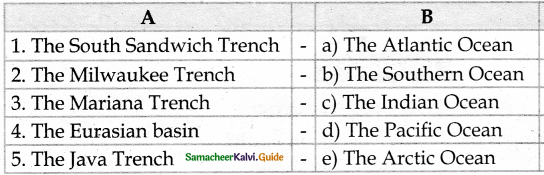
Samacheer Kalvi 6th Social Science Guide Geography Term 1 Chapter 2 Land and Oceans

D. Match the following

Samacheer Kalvi 6th Social Science Guide Geography Term 1 Chapter 2 Land and Oceans
Answer:
1. – b
2. – a
3. – d
4. – e
5. – c

E. (i) Consider the following statements

1. Plains are formed by rivers.
2. The ‘South Sandwich Trench’ is found in the Indian Ocean.
3. Plateaus have steep slopes.
Choose the correct answer using the codes given below.
(a) 1 and 3
(b) 2 and 3
(c) 1, 2 and 3
(d) 2 only
Answer:
(a) 1 and 3

(ii) Consider the following statements

Statement I : Mountains are second order landforms.
Statement II : The Mariana Trench is the deepest trench in the world.
Which of the statement(s) is/are true?
(a) I is true; II is wrong
(b) I is wrong; II is true
(c) Both the statements are true
(d) Statements I and II are wrong.
Answer:
(c) Both the statements are true

F. Answer in a word

Question 1.
Which is the highest plateau in the world?
Answer:
Tibetan Plateau.

Question 2.
Name a second-order landform.
Answer:
Mountains or Plateaus or Plains

Question 3.
Which ocean is named after a country?
Answer:
Indian Ocean.

Samacheer Kalvi 6th Social Science Guide Geography Term 1 Chapter 2 Land and Oceans

Question 4.
Name the island located in the Arabian Sea.
Answer:
Lakshadweep islands

Question 5.
What is the deepest part of the ocean called?
Answer:
Trench

G. Answer in brief

Question 1.
What is a continent?
Answer:
The vast landmasses on Earth are called Continents.

Question 2.
Name the continents which surround the Atlantic Ocean.
Answer:
The Atlantic ocean is bounded by North America and South America in the West, and ( Europe and Africa in the East)

Question 3.
What are the oceans?
Answer:
Oceans are a vast expanse of water.

Samacheer Kalvi 6th Social Science Guide Geography Term 1 Chapter 2 Land and Oceans

Question 4.
List out the names of continents according to their size
Answer:
From the largest to the smallest, they are Asia, Africa, North America, South America,  Antarctica, Europe, and Australia.

Question 5.
Name the oceans which surround North America and South America.
Answer:
North America: On the west by the Pacific Ocean, on the east by Atlantic ocean and on the north by Arctic ocean
South America: On the west by the Pacific Ocean, on the east by Atlantic ocean.

H. Distinguish between

Question 1.
A Mountain and a Plateau?
Answer:
Mountains

  1. A landform that rises over 600 meters above its surroundings and has steep slopes is called a mountain.
  2. Example: Himalayas

Plateaus

  1. Plateaus are the elevated portions of the Earth that have flat surfaces bounded by steep slopes. The elevation of plateaus maybe a few hundred metres or several thousand metre.
  2. Example: Chotanagpur Plateau

Samacheer Kalvi 6th Social Science Guide Geography Term 1 Chapter 2 Land and Oceans

Question 2.
An ocean and a sea
Answer:

Ocean

  1. Oceans are a vast expanse of water.
  2. Eg. the Pacific Ocean

Sea

  1. Seas are water bodies partially or fully enclosed by land.
  2. Eg: Bay of Ben, Arabian Sea.

I. Answer the following questions in detail

Question 1.
Mention the classification of landforms.
Answer:
First-order landforms:

  1. Continents and oceans are grouped as first-order landforms.
  2. The vast landmasses on Earth are called Continents and huge water bodies are called Oceans.
  3. There are seven continents in the world. They are Asia, Africa, North America, South America, Antarctica, Europe and Australia.
  4. The five oceans are the Pacific, Atlantic, Indian, Southern, and Arctic Oceans.

Second-order landforms:

  1. Mountains, Plateaus, and Plains are grouped as second-order landforms.
  2. A landform that rises 600 meters above its surroundings and has steep slopes is called a mountain. Example:
  3. The Himalayas, the Rocky Mountains, and the Andes.
  4. Plateaus are the elevated portions of the Earth that have flat surfaces bounded by steep slopes. Example:
  5. Tibetan plateau and Deccan plateau.
  6. Plains are flat and relatively low-lying lands. These plains are used extensively for agriculture. Example: Indo – Gangetic plain.

Third-order landforms:

  1. Third-order landforms are formed on mountains, plateaus, and plains mainly by erosional and depositional activities of rivers, glaciers, winds, and waves.
  2. Example: Valleys, beaches, and sand dunes.

Question 2.
Write a note on plateaus.
Answer:
Ocean:

  • An ocean is a vast expanse of water.
  • Oceans are very deep.
  • Example: The Pacific Ocean

Sea:

  • A sea is a water body partially or fully enclosed by land.
  • Seas are not so deep as oceans
  • Example: The Arabian sea

Question 3.
Plains are highly populated. Give reasons.
Answer:

  1. Plains are flat and relatively low-lying lands.
  2. Plains are formed by rivers and their tributaries and distributaries.
  3. Plains are used extensively for agriculture due to the availability of water and fertile soil.
  4. Plains are most suitable for human inhabitation. Hence, they are highly populated.

Samacheer Kalvi 6th Social Science Guide Geography Term 1 Chapter 2 Land and Oceans

Question 4.
Give the important features of the Pacific Ocean,
Answer:

  1. The Pacific Ocean is the largest and deepest ocean on Earth.
  2. It covers about one-third of the Earth’s total area.
  3. It is bounded by Asia and Australia in its west and North America and South America in its east.
  4. On its apex is the Bering Strait. It connects the Pacific Ocean with the Arctic Ocean.
  5. The deepest point Mariana Trench is located in the Pacific Ocean.
  6. A chain of volcanoes is located around the Pacific Ocean.

Question 5.
Write above the importance of oceans.
Answer:

  1. Oceans are the first order landform.
  2. 71% of the earth’s surface is covered with water.
  3. Oceans influence man in various ways, from the climate he experiences to the food he eats.
  4. Oceans are a major source of salt, valuable minerals, petroleum, pearls, and diamonds.
  5. Ocean currents affect the climate of neighbouring areas.
  6. Ocean trade plays an important role in the world economy.
  7. Ocean currents can be converted into electricity.

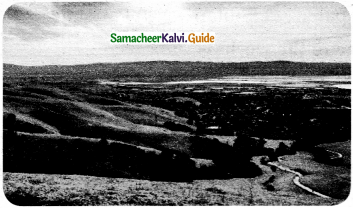
J. Picture Study

Question 1.
Name the landform.
Answer:
Sand dune

Question 2.
What order of a landform is this?
Answer:
Third-order landform

Question 3.
By which activity of river is this landform formed?
Answer:
Deposition
Samacheer Kalvi 6th Social Science Guide Geography Term 1 Chapter 2 Land and Oceans

K. (i) Activity (Activity to be done by students)

Trip to the nearby area to appreciate the physical features of any kind of landform.
Conduct a quiz on landforms and oceans.

(ii) Activity

Question 1.
Give examples for the following using an Atlas.
Answer:

  1. Bay: Hudson Bay, Bay of Bengal, Bay of Biscay
  2. Gulf: the Persian Gulf, Gulf of Kutch, Gulf of Mannar
  3. Island: Srilanka, Australia, Maldives
  4. Straits: Palk strait, Bering strait, Magellan strait

Question 2.
Map reading (with the help of an atlas)
Answer:

  1. A sea in the east of India – Bay of Bengal
  2. Continents in the west of Atlantic Ocean – North America, South America
  3. Continents in the south of Arctic Ocean – Europe, Asia
  4. A strait between India and Sri Lanka – Palk strait
  5. Oceans which surround Australia – Indian ocean, Pacific ocean
  6. Find out the Isthmusses – Isthmus of Panama, Isthmus of Avalon, Isthmus of La Dune

Samacheer Kalvi 6th Social Science Land and Oceans Additional Important Questions and Answers

I. Choose the correct answer

Question 1.
International Mountain Day is ……………..
(a) June 15
(b) April 11
(c) November 11
(d) December 11
Answer:
(d) December 11

Question 2.
Andes mountain is located in
(a) North America
(b) South America
(c) Asia
(d) Europe
Answer:
(b) South Amei leaf

Samacheer Kalvi 6th Social Science Guide Geography Term 1 Chapter 2 Land and Oceans

Question 3.
The highest plateau in the world is …………….
(a) Ladakh plateau
(b) Tibetan plateau
(c) Deccan plateau
(d) Chotanagpur plateau
Answer:
(b) Tibetan plateau

Question 4.
The International Mountain Day is
(a) December 10th
(b) December 11th
(c) December 12th
(d) December 13th
Answer:
(b) December 11th

Question 5.
It connects the Pacific Ocean with the Arctic ocean.
(a) Bering strait
(b) Magellan strait
(c) Gibraltar strait
(d) Palk strait
Answer:
(a) Bering strait

II. Fill in the blanks

  1. The sea around Pangea is called ……………….
  2. The smallest continent is ……………….
  3. The smallest ocean is ……………….
  4. ………………. is called the Roof of the world
  5. The deepest point in the Indian ocean is ……………….

Answer:

  1. Panthalasa
  2. Australia
  3. Arctic ocean
  4. Tibetan Plateau
  5. Java trench

III. Answer in brief

Question 1.
What is an Isthmus?
Answer:
A narrow strip of land which connects two large landmasses or separates two large water bodies is called an Isthmus.

Question 2.
What are the Second-order landforms?
Answer:
The Second-order landforms are categorised as mountains, plateaus, and plains.

Samacheer Kalvi 6th Social Science Guide Geography Term 1 Chapter 2 Land and Oceans

Question 3.
Bring out the importance of mountains.
Answer:

  1. Mountains are the source of rivers.
  2. They block the moisture-bearing winds and cause rainfall.
  3. They provide shelter to flora and fauna.
  4. They promote tourism.
  5. During summer people go to mountain regions to enjoy the pleasing cool weather.
  6. There are a number of hill stations in the mountains.

Question 4.
Mention some of the early civilizations.
Answer:
The Indus valley civilization, the Mesopotamian civilization, The Egyptian civilization, and the Chinese civilization. Where some of the early civilizations?

Question 5.
Write a few lines about The Indian Ocean.
Answer:

  1. The Indian Ocean is the third largest ocean on the earth.
  2. It is named after India.
  3. It is triangular in shape.
  4. The Andaman and Nicobar Islands, Lakshadweep, Maldives, Sri Lanka, and Mauritius are the islands located in the Indian Ocean.
  5. Java Trench is the deepest point in this ocean.

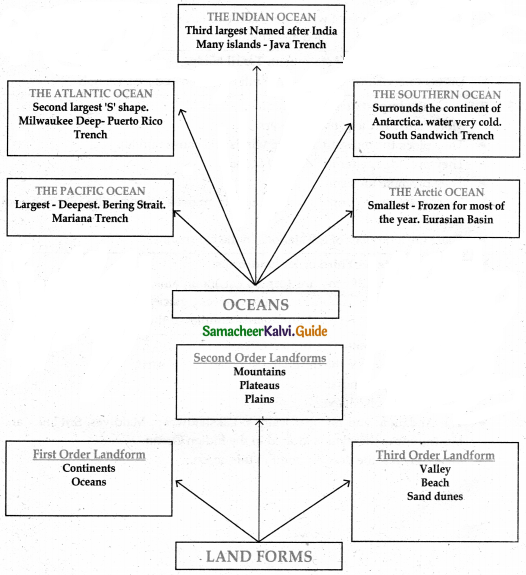
IV. Mind Map

Samacheer Kalvi 6th Social Science Guide Geography Term 1 Chapter 2 Land and Oceans


Samacheer Kalvi 6th Social Science Guide History Term 1 Chapter 4 Ancient Cities of Tamilagam

Students can download 6th Social Science Term 1 History Chapter 4 Ancient Cities of Tamilagam Questions and Answers, Notes, Samacheer Kalvi 6th Social Science Guide Pdf helps you to revise the complete Tamilnadu State Board New Syllabus, helps students complete homework assignments and to score high marks in board exams.

Tamilnadu Samacheer Kalvi 6th Social Science History Solutions Term 1 Chapter 4 Ancient Cities of Tamilagam

Samacheer Kalvi 6th Social Science Ancient Cities of Tamilagam Text Book Back Questions and Answers

I. Choose the correct answer

Question 1.
Which of the following region has a city more than 6500 years old?
(a) Iraq
(b) Indus valley
(c) Tamilagam
(d) Thondaimandalam
Answer:
(a) Iraq

Question 2.
Which one of the following is a Tamil city?
(a) Iraq
(b) Harappa
(c) Mohenjo-Daro
(d) Kancheepuram
Answer:
(d) Kancheepuram

Samacheer Kalvi 6th Social Science Guide History Term 1 Chapter 4 Ancient Cities of Tamilagam

Question 3.
Which city is not related to the Bay of Bengal?
(a) Poompuhar
(b) Thondi
(c) Korkai
(d) Kancheepuram
Answer:
(b) Madurai

Question 4.
The water management system of Tamils are known from
a. Kallanai
b. Tanks in Kancheepuram
c. Prakirama Pandyan Tank
d. River Cauvery
(a) (a) is correct
(b) (b) is correct
(c) (c) is correct
(d) (a) and (b) are correct
Answer:
(d) (a) and (b) are correct

Question 5.
Which is not the oldest city among the following ones?
(a) Madurai
(b) Kancheepuram
(c) Poompuhar
(d) Chennai
Answer:
(a) Madurai

Question 6.
Which city is related to Keezhadi excavation?
(a) Madurai
(b) Kancheepuram
(c) Poompuhar
(d) Harappa
Answer:
(a) Madurai

II. Tick the appropriate answer. Match the statement with the reason

Question 1.
Statement: Goods were imported and exported from the city of Poompuhar.
Reason: the Bay of Bengal was suitable for trading with neighbouring countries.
(a) Statement is correct, but the reason is wrong.
(b) Statement and its reason are correct.
(c) Statement is wrong, but the reason is correct.
(d) Both are wrong.
Answer:
(b) Statement and its reason are correct.

Question 2.
(a) Thirunavukkarasar said “kalviyil karaiillatha”. This statement refers to the city of Kancheepuram.
(b) Hieun Tsang said, “Kancheepuram is one among the seven sacred places of  India”.
(c) Kalidasa said, “Kancheepuram is the best city among the cities”
(a) only a is correct (b) the only b is correct
(c) the only c is correct (d) All are correct
Answer:
(d) All are correct!

Samacheer Kalvi 6th Social Science Guide History Term 1 Chapter 4 Ancient Cities of Tamilagam

Question 3.
Find out the correct statement
(a) Naalangadi – Night shop
(b) Allangdi – Day -time shop
(c) Ancient Roman coin factory was found at Poompuhar.
(d) Pearls were exported from Uvari near Korkai.
Answer:
(d) Pearls were exported from Uvari near Korkai

Question 4.
Find out the wrong statement.
(a) Megasthanese has mentioned Madurai in his account.
(b) Hien Tsang came to the Tamil city of Kancheepuram.
(c) Kovalan and Kannagi lived in Kancheepuram.
(d) Iraq is mentioned in Pattinapalai.
Answer:
(c) Kovalan and Kannagi lived in Kancheepuram.

Question 5.
Find out the correct pair
(a) Koodal Nagar – Poompuhar
(b) Thoonga Nagaram – Harappa
(c) City of Education – Madurai
(d) City of Temples – Kancheepuram
Answer:
(d) City of Temples – Kancheepuram

Question 6.
Find out the wrong pair
(a) Vadamalai – Gold
(c) Southern Sea – Pearls
(b) Western Ghats – Sandal
(d) Eastern Sea – Ahil
Answer:
(d) Eastern Sea – Ahil

III. Fill in the blanks

  1. Kanchi Kailasanathar temple was built by ……………..
  2. …………….. is known as the city of temples.
  3. Masathuvan means ……………..

Answer:

  1. Raja Simh
  2. Kanchi
  3. A big trader

IV. State True or False:

  1. Cultural relationship with the outside world developed in Poompuhar because of its trade relationship with it.
  2. Women also purchased from Allangadi of Madurai without fear.
  3. Many rock-cut temples were made during the Pallava period.
  4. Bodhi Dharma belonged to Kancheepuram.

Answer:

  1. True
  2. True
  3. False
  4. True

V. Answer in one word

Question 1.
What do you know about the term ‘export’?
Answer:
Exports are goods and services produced in one country and purchased by the citizens of another country.

Samacheer Kalvi 6th Social Science Guide History Term 1 Chapter 4 Ancient Cities of Tamilagam

Question 2.
Mention the epic and the Sangam poem you read in this lesson.
Answer:

  1. The epic is Silapthikaram (or) Manimegalai.
  2. Sangam Literature is Pattinappaalai.

Question 3.
Which is the oldest city in Thondai Nadu?
Answer:
Kanchi is the oldest city in Thondai Nadu.

Question 4.
Point out anyone difference between a village and a city.
Answer:
A village will have a small group of settlements whereas a city will have a large group of settlements.

Samacheer Kalvi 6th Social Science Guide History Term 1 Chapter 4 Ancient Cities of Tamilagam

Question 5.
Which civilization is associated with the city Lothal?
Answer:
The Indus Valley Civilisation is associated with the city Lothal.

Question 6.
Name the oldest civilization of the world
Answer:
Mesopotamian civilization is the earliest civilization in the world.

VI. Answer the following

Question 1.
Write a brief note on ancient cities in India?
Answer:

  1. Harappa and Mohenjodaro were prominent cities of ancient India.
  2. They developed along the banks of the river Indus.
  3. They were the symbol of urban civilization.
  4. They had very good town planning, a well-constructed house, well-maintained drainage system.
  5. They had very good civic sense.
  6. They developed pottery, ornaments as well as a script which is yet to be deciphered.

Samacheer Kalvi 6th Social Science Guide History Term 1 Chapter 4 Ancient Cities of Tamilagam

Question 2.
Mention the ancient cities of Tamil Nadu.
Answer:

  1. In Tamizhagam the well-known cities were Madurai, Kanchi, and Poompuhar.
  2. Poompuhar is one of the oldest towns in ancient Tamizhagam.
  3. Madurai has been one of the oldest cities in India.
  4. It is known as “Sangam Valartha Nagaram”
  5. Kanchi is the oldest town in Thondai Nadu.
  6. Scholars like Dharmabalar, Jothibalar, Sumathi, and Bodhi Dharma were born in Kanchi.

Question 3.
Discuss the sources available to know about Tamil cities?
Answer:

  1. Tamil literature, accounts of foreign travellers, and archaeological finds provide information about the ancient towns of Tamizhagam.
  2. Sangam Tamil Literature Pattinappaalai and Tamil epics Silappathikaram and Manimegalai have references about Poompuhar.
  3. Madurai is proudly associated with three Sangams.
  4. The fame of Madurai can be attested from the accounts of the Greek historian Megasthenes.
  5. Chanakya mentions Madurai in his famous work Arthashastra.
  6. The Chinese Traveller Hieun Tsang writes about the greatness of Kanchi.
  7. Poet Kalidasa refers to Kanchi as the best of the towns.

Question 4.
Write about the kings who ruled Madurai.

  1. Pandyas, the Cholas and later the Kalabras ruled Madurai in the ancient
  2. During medieval times, later Cholas and later Pandyas followed by the Nayaks ruled this historic town.

Question 5.
Mention the other names of Madurai?
Answer:

  1. Sangam Valartha Nagaram
  2. Thoonga Nagaram (the city that never sleeps).
  3. Koodal Nagar are the other names of Madurai

Samacheer Kalvi 6th Social Science Guide History Term 1 Chapter 4 Ancient Cities of Tamilagam

Question 6.
What is the difference between Naalaugadi and Allangadi?
Answer:
Naalangadi

  1. It is Day Marget.
  2. It works only in the day time.

Allangadi

  1. It is the evening Market.
  2. It works only in the Evening,

Question 7.
Name the scholars who were born at Kancheepuram
Answer:
Scholars like Dharmabalar, Jothibalar, Sumathi, and Bodhi Dharma were bom in Kanchi.

Question 8.
Which is known as the city of lakes? Why?
Answer:

  1. Water management played an important role in the agrarian society of those times.
  2. Hundreds of lakes were created for storing water around the town of Kanchi.
  3. These lakes were well connected with canals.
  4. During the later period, Kanchi came to be known as the district of lakes.

VII. HOTS

Question 1.
Write a short note on Iraq.
Answer:

  1. Modem Iraq was called Mesopotamia in the ancient period. It was the birthplace of Sumerian civilization.
  2. Iraq is watered by two rivers namely Euphrates and Tigris.
  3. It is an important trading centre.
  4. Pattinappaalai speaks about the trade relations of Iraq With other countries.

Samacheer Kalvi 6th Social Science Guide History Term 1 Chapter 4 Ancient Cities of Tamilagam

Question 2.
Write a paragraph about the city of Poompuhar with special reference to trade.
Answer:

  1. Poompuhar was a port.
  2. Big traders and sea traders had settled down there.
  3. Numerous merchants from foreign countries such as Greece and Rome landed at Poompuhar.
  4. Brisk seaborne trade took place in Puhar.
  5. Foreign traders stayed on indefinitely at Puhar.
  6. There is evidence of foreign settlements in the town.

Question 3.
Write about the accounts given by scholars about Kanchi.
Answer:

  1. Poet Kalidasa says “Kanchi is the best of the towns”.
  2. Poet Thirunavukarasar praises Kanchi as “Kalviyil Karaiillatha Kanchi.
  3. Hieun Tsang has said,”Kanchi can be counted as one among the seven sacred places like Budh Gaya and Sanchi”.

Question 4.
City of temple Gives short notes.
Answer:

  1. Kanchi is also known as the Temple city.
  2. The famous Kailasanathar temple is at Kanchi.
  3. There are a large number of cave temples in Kanchi. So Kanchi is known as the Temple city.

Question 5.
Kancheepuram was famous for education. Prove this statement
Answer:

  1. Several schools were established in great numbers in Kanchi.
  2. There were Jainpallis and Viharas.
  3. The Chinese traveller Hieun Tsang visited Kanchi Kadigai to continue his studies
  4. Tamil poet saint Thirunavukarasar praises Kanchi as’Kalviyil karaiillatha Kanchi’.

VIII. Student Activity

  1. Make an album about Keezhadi excavations.
  2. Poompuhar was famous for trading activities. Discuss.
  3. Collect the pictures of Pallava temple architecture.
  4. Prepare a Booklet describing the famous lakes of Tamilnadu.
  5. Make a booklet about the famous cities of Tamilnadu.
  6. Go to the library and find out the places of importance in your district.

IX. Answer Grid

Question 1.
Poompuhar was located on which riverbank?
Answer:
Cauvery

Question 2.
Name the ancient city which had Tamil Sangam.
Answer:
Madurai

Samacheer Kalvi 6th Social Science Guide History Term 1 Chapter 4 Ancient Cities of Tamilagam

Question 3.
Name a Sangam literary work.
Answer:
Pattinappaalai

Question 4.
Which Greek historian gave accounts about the Pandya kingdom?
Answer:
Megasthanese

Question 5.
To which the Tamil Kingdom did the southern districts of Tamil Nadu belong to during the Sangam Age?
Answer:
Pandyas.

Question 6.
Name the Chinese traveller who stayed and studied in Nalanda University.
Answer:
Hieun Tsang

Question 7.
Thirunavukarasar mentioned Kanchi as _______
Answer:
Kalviyil karaiillatha Kanchi

Question 8.
What is the name of the evening market during the Sangam Age?
Answer:
Allangadi

Samacheer Kalvi 6th Social Science Guide History Term 1 Chapter 4 Ancient Cities of Tamilagam

Question 9.
Name the temple built by Pallava king Rajasimha at Kanchi.
Answer:

  1. Kailasanathar
  2. Temple.

Question 10.
Which district is known as the district of lakes?
Answer:
Kanchi

Question 11.
What is trade?
Answer:
The act of buying and selling goods and services is called trade.

Question 12.
Name a port located on the shore of the Bay of Bengal
Answer:
Chennai.

X. Life Skill (For Students)

1. Make a handout that shows the importance of the place where you live.

Samacheer Kalvi 6th Social Science Ancient Cities of Tamilagam Additional Important Questions and Answers

I. Choose the correct answer

Question 1.
The earliest civilization in the world is …………….
(a) Egyptian Civilization
(b) Chinese civilization
(c) Indus valley civilization
(d) Mesopotamian civilization
Answer:
(d) Mesopotamian civilization

Question 2.
Name the place related to the export of Sandal.
(a) the Western Ghats
(b) Southern Sea
(c) Eastern Sea
(d) Elam
Answer:
(a) the Western Ghats

Samacheer Kalvi 6th Social Science Guide History Term 1 Chapter 4 Ancient Cities of Tamilagam

Question 3.
Kailasanathar temple was built by …………….
(a) Mahendra varman
(b) Narasimha Varman
(c) Raja Simha
(d) Aparajitha
Answer:
(c) Raja Simha

Question 4.
Ahil was a
(a) Port
(b) Fragrant wood
(c) Educated centre
(d) Ornament
Answer:
(b) Fragrant wood

Question 5.
Puhar served as the port of ……………
(a) Chera kingdom
(b) Chola kingdom
(c) Pandya kingdom
(d) Kalabras
Answer:
(b) Chola kingdom

II. Fill in the blanks

  1. Sea traders are known by the name ……………
  2. Chanakya was Chandragupta’s ……………
  3. The Buddhist monk Manimegalai spent the last part of her life at ……………

Answer:

  1. Maanaigan
  2. Minister
  3. Kanchi

Samacheer Kalvi 6th Social Science Guide History Term 1 Chapter 4 Ancient Cities of Tamilagam

III. State True or False

  1. The lead female character of Silappathikaram is Manimegalai
  2. The present-day Thanjavur was once part of Chera Nadu
  3. Poompuhar served as the port of the early Chola kingdom
  4. Silappathikaram speaks about the greatness of Poompuhar
  5. Many cave temples were built during the Pallava period

Answer:

  1. False
  2. False
  3. True
  4. True
  5. True

IV. Answer the following

Question 1.
How was Poompuhar different from other towns?
Answer:
Each social group had a separate settlement
Streets were broad and straight, dotted with well-designed houses.
There was also a dockyard

V. Mind map

Samacheer Kalvi 6th Social Science Guide History Term 1 Chapter 4 Ancient Cities of Tamilagam


Samacheer Kalvi 10th Tamil Guide Chapter 1.2 தமிழ்சொல் வளம்

Students can Download 10th Tamil Chapter 1.2 தமிழ்சொல் வளம் Questions and Answers, Summary, Notes, Samacheer Kalvi 10th Tamil Guide Pdf helps you to revise the complete Tamilnadu State Board New Syllabus, helps students complete homework assignments and to score high marks in board exams.

Tamilnadu Samacheer Kalvi 10th Tamil Solutions Chapter 1.2 தமிழ்சொல் வளம்

கற்பவை கற்றபின்

Question 1.
பின்வரும் நிலவகைகளின் பெயர்களுக்கான காரணங்களைக் கேட்டறிந்து வகுப்பறையில் பகிர்க.
தரிசு, சிவல், கரிசல், முரம்பு, புறம்போக்கு, சுவல், அவல்.
Answer:
தரிசு நிலம் : பயிர் செய்யாத நிலம்
சிவல் நிலம் : செந்நிலம் அல்லது சிவந்த நிலம்
கரிசல் நிலம் : கரிய நிறமுடைய மண் கொண்ட நிலம் கரிசல் நிலம் (அ) கரிந்த பாலை நிலம்
முரம்பு நிலம் : பருக்கைக் கற்கள் கொண்ட மேட்டு நிலம்
புறம்போக்கு நிலம் : ஊர்ப்புறத்தே குடிகள் வாழ்தலில்லாத நிலம்
சுவல் நிலம் : மேட்டு நிலம்
அவல் நிலம் : ‘அவல்’ என்பதன் பொருள் ‘பள்ளம்’. ஆகவே பள்ளமான நிலப்பகுதி அவல் என அழைக்கப்படுகிறது. விளை நிலமாகவும் அமைகிறது.

Samacheer Kalvi 10th Tamil Guide Chapter 1.2 தமிழ்சொல் வளம்

Question 2.
ஒரு பொருள் தரும் பல சொற்களைப் பட்டியலிடுக.
எ.கா: சொல்லுதல் – பேசுதல், விளம்புதல், செப்புதல், உரைத்தல், கூறல், இயம்பல், மொழிதல்
Answer:
அ) மலர்தல் – அவிழ்தல், அலர்தல், நெகிழ்தல், விள்ளல், விரிதல்.
ஆ) ஞாயிறு – I சூரியன், கதிரவன், வெய்யோன், பகலவன், பரிதி.
இ) அரசன் – கோ, கொற்றவன், வேந்தன், ராஜா, கோன்.
ஈ) அழகு – அணி, வடிவு, பொலிவு, எழில்.
உ) அடி- கழல், கால், தாள், பதம், பாதம்.
ஊ) தீ – அக்கினி, நெருப்பு, தழல்.
எ) அச்சம் – பயம், பீதி, உட்கு .
ஏ) துன்பம் – இன்னல், அல்லல், இடும்பை
ஐ) அன்பு – கருணை , நேசம், ஈரம், பரிவு, பற்று.
ஓ) செய்யுள் – பா, கவிதை, யாப்பு.
ஓ) பெண் – நங்கை, வனிதை, மங்கை.
ஔ) வயல் – கழனி, பழனம், செய்.

Samacheer Kalvi 10th Tamil Guide Chapter 1.2 தமிழ்சொல் வளம்

பாடநூல் வினாக்கள்

பலவுள் தெரிக

Question 1.
‘காய்ந்த இலையும் காய்ந்த தோகையும்’ நிலத்துக்கு நல்ல உரங்கள். இத்தொடரில் அடிக்கோடிட்ட பகுதி குறிப்பிடுவது
அ) இலையும் சருகும்
ஆ) தோகையும் சண்டும்
இ) தாளும் ஓலையும்
ஈ) சருகும் சண்டும்
Answer:
ஈ) சருகும் சண்டும்

Question 2.
வேர்க்கடலை, மிளகாய் விதை, மாங்கொட்டை ஆகியவற்றைக் குறிக்கும் பயிர்வகை
அ) குலை வகை
ஆ) மணி வகை
இ) கொழுந்து வகை
ஈ) இலை வகை
Answer:
ஆ) மணி வகை

Samacheer Kalvi 10th Tamil Guide Chapter 1.2 தமிழ்சொல் வளம்

குறுவினா

Question 1.
ஒரு தாற்றில் பல சீப்பு வாழைப்பழங்கள் உள்ளன.
ஒரு சீப்பில் பல தாறு வாழைப்பழங்கள் உள்ளன.
ஒரு சீப்பில் பல வாழைப்பழங்கள் உள்ளன.

மேற்கண்ட தொடர்களில் சரியான தொடர்களைச் சுட்டிக்காட்டி, எஞ்சிய பிழையான தொடரிலுள்ள பிழைக்கான காரணத்தை எழுதுக.
Answer:
Samacheer Kalvi 10th Tamil Guide Chapter 1.2 தமிழ்சொல் வளம் - 1

சிறுவினா

Quesiton 1.
‘புளியங்கன்று ஆழமாக நடப்பட்டுள்ளது.’
இதுபோல் இளம் பயிர் வகை ஐந்தின் பெயர்களைத் தொடர்களில் அமைக்க.
Answer:
பிள்ளை – தென்னம் பிள்ளை வாங்கி வந்தேன் .
வடலி – காட்டில் பனை வடலியைப் பார்த்தேன்.
நாற்று – நெல் நாற்று நட்டேன்.
கன்று – வாழைக்கன்று நட்டேன்.
பைங்கூழ் – சோளப் பைங்கூழ் பசுமையாக உள்ளது.

நெடுவினா

Question 1.
தமிழின் சொல்வளம் பற்றியும் புதிய சொல்லாக்கத்திற்கான தேவை குறித்தும் தமிழ் மன்றத்தில் பேசுவதற்கான உரைக் குறிப்புகளை எழுதுக.
Answer:
Samacheer Kalvi 10th Tamil Guide Chapter 1.2 தமிழ்சொல் வளம் - 2
குறிப்புச்சட்டம் –
அறிமுகவுரை சொல்வளம் சொல்லாக்கத்திற்கான தேவை நிறைவுரை அறிமுகவுரை: வணக்கம்! அன்னைமொழியே! அழகார்ந்த செந்தமிழே! எனப் போற்றப்படும் தமிழ்மொழி பிறமொழிகளுக்கெல்லாம் தலைச்சிறந்த மொழியாகும். அம்மொழியின் சொல்வளத்தைப் பற்றிக் காண்போம்.

Samacheer Kalvi 10th Tamil Guide Chapter 1.2 தமிழ்சொல் வளம்

சொல்வளம்:

  • இலக்கியச் செம்மொழிகளுக்கெல்லாம் பொதுவேனும், தமிழ்மட்டும் அதில் தலை சிறந்ததாகும்.
  • தமிழ்ச்சொல் வளத்தைப் பலதுறைகளிலும் காணலாம்.
  • ஒருபொருட் பல சொல் வரிசைகள் தமிழைத் தவிர வேறு எந்தத் திராவிட மொழிகளின் அகராதிகளிலும் காணப்படவில்லை .
  • “பிற திராவிட மொழிகளுக்குரியனவாகக் கருதப்படும் சொற்களும் தமிழில் உள்” என்கிறார் கால்டுவெல்.

சொல்லாக்கத்திற்கான தேவை:

  • சொல்லாக்கத்திற்கான தேவை என்பது அதன் பயன்பாட்டு முறையைக் கொண்டே அமைகிறது.
  • இன்றைய அறிவியல் வளர்ச்சிக்கேற்ப நூல்களைப் புதிய சொல்லாக்கத்துடன் படைத்தல் வேண்டும்.
  • இலக்கிய மேன்மைக்கும் மக்கள் அறிவுடையவர்களாக உயர்வதற்கும், புதிய சொல்லாக்கம் தேவை.
  • மொழி என்பது உலகின் போட்டி போராட்டத்திற்கு ஒரு போர்க்கருவியாகும். அக்கருவி காலத்திற்கேற்ப மாற்றப்பட வேண்டும்.
  • தமிழின் பெருமையும் மொழியின் சிறப்பும் குன்றாமல் இருக்க தமிழில் புதிய சொல்லாக்கம் தேவை.
  • உலகின் பிற ஆய்வுச் சிந்தனைகளைத் தமிழ்ப்படுத்தி எழுதும் போது பிறமொழி அறியாத தமிழரும்
  • அவற்றைக் குறித்து அறிந்துகொள்ள முடியும்.
  • மொழியே கலாச்சாரத்தின் வழிகாட்டி. அதை நிலைநாட்ட புதிய சொல்லாக்கம் தேவை.
  • மக்களிடையே பரந்த மனப்பான்மையையும், ஆளுமையையும் நிலைநாட்ட புதிய சொல்லாக்கம் தேவைப்படுகிறது.
  • பிறமொழிச் சொற்கள் கலவாமல் இருக்க காலத்திற்கேற்ப புதிய கலைச்சொல்லாக்கம் ஏற்படுத்த வேண்டும்.

Samacheer Kalvi 10th Tamil Guide Chapter 1.2 தமிழ்சொல் வளம்

நிறைவுரை:

மென்மையான தமிழை மேன்மையான தமிழாக்க அறிவியல் தொழில்நுட்பச் சொற்களைத் தமிழ்ப்படுத்தி தமிழின் பெருமையை உலகிற்குக் கொண்டு செல்வோம்.
Samacheer Kalvi 10th Tamil Guide Chapter 1.2 தமிழ்சொல் வளம் - 3

கூடுதல் வினாக்கள்

பலவுள் தெரிக

Question 1.
மரஞ்செடியினின்று பூ கீழே விழுந்த நிலையைக் குறிக்கும் சொல் எது?
அ) அரும்பு
ஆ) மலர்
இ) வீ
ஈ) செம்மல்
Answer:
இ) வீர

Samacheer Kalvi 10th Tamil Guide Chapter 1.2 தமிழ்சொல் வளம்

Question 2.
திராவிட மொழிகளின் ஒப்பியல் இலக்கணம் என்னும் நூலை எழுதியவர் யார்?
அ) பாவாணர்
ஆ) கால்டுவெல்
இ) இரா. இளங்குமரனார்
ஈ) திரு.வி.க
Answer:
ஆ) கால்டுவெல்

Question 3.
திருவள்ளுவர் தவச்சாலை அமைந்துள்ள இடம் எது?
அ) அல்லூர்
ஆ) திருவள்ளூர்
இ) கல்லூர்
ஈ) நெல்லூர்
Answer:
அ) அல்லூர்

Question 4.
குச்சியின் பிரிவு எச்சொல்லால் அழைக்கப்படுகிறது? அ) போத்து
ஆ) குச்சி
இ) இணுக்கு
ஈ) சினை
Answer:
இ) இணுக்கு

Samacheer Kalvi 10th Tamil Guide Chapter 1.2 தமிழ்சொல் வளம்

Question 5.
பொருத்துக.
1. தாள் – அ) குத்துச்செடி, புதர் முதலியவற்றின் அடி
2. தண்டு – ஆ) நெட்டி, மிளகாய்ச்செடி முதலியவற்றின் அடி
3. கோல் – இ) தண்டு, கீரை முதலியவற்றின் அடி
4. தூறு – ஈ) நெல், கேழ்வரகு முதலியவற்றின் அடி
அ) 1.ஈ 2.இ 3.ஆ 4.அ
ஆ) 1.ஆ 2.அ 3.ஈ 4-இ
இ) 1.இ 2.ஈ 3.அ 4.ஆ
ஈ) 1.அ 2.இ 3.ஆ 4.ஈ
Answer:
அ) 1.ஈ 2.இ 3.ஆ 4.அ

Question 6.
பொருத்துக.
1. தட்டு – அ) கரும்பின் அடி
2. கழி – ஆ) புளி, வேம்பு முதலியவற்றின் அடி
3. கழை – இ) கம்பு, சோளம்
முதலியவற்றின் அடி – ஈ) மூங்கிலின் அடி
அ) 1.ஆ 2.அ 3.ஈ. 4.இ
ஆ) 1.இ 2.அ 3.ஈ. 4.ஆ
இ) 1.ஈ 2.இ 3.அ 4.ஆ
ஈ) 1.இ 2.அ 3.ஆ 4.ஈ
Answer:
ஆ) 1.இ 2.அ 3.ஈ 4.ஆ

Samacheer Kalvi 10th Tamil Guide Chapter 1.2 தமிழ்சொல் வளம்

Question 7.
பொருத்துக.
1. கவை – அ) அடிமரத்தினின்று பிரியும் மாபெரும் கிளை
2. கொம்பு – ஆ) கிளையின் பிரிவு
3. சினை – இ) கவையின் பிரிவு
4. போத்து – ஈ) சினையின் பிரிவு
அ) 1.அ 2.இ 3.ஆ 4.ஈ
ஆ) 1.ஈ 2.இ 3.அ 4.ஆ
இ) 1.ஆ 2.அ 3.ஈ. 4.இ
ஈ) 1.இ 2.ஆ 3.அ 4.ஈ
Answer:
அ) 1.அ 2.இ 3.ஆ 4.ஈ

போத்து 8.
பொருந்தாதவற்றைக் கண்டறிக.
அ) தூறு
ஆ) கழி
இ) கழை
ஈ) கவை
Answer:
ஈ) கவை

Samacheer Kalvi 10th Tamil Guide Chapter 1.2 தமிழ்சொல் வளம்

Question 9.
பொருந்தாதவற்றைக் கண்டறிக.
அ) தாள்
ஆ) தண்டு
இ) கிளை
ஈ) கோல்
Answer:
இ) கிளை

Question 10.
பொருந்தாதவற்றைக் கண்டறிக.
அ) கவை
ஆ) தட்டு
இ) கொம்பு
ஈ) சினை
Answer:
ஆ) தட்டு

Question 11.
பொருந்தாத இணையைக் கண்டறிக.
அ) கவை – குச்சியின் பிரிவு
ஆ) கொம்பு – கவையின் பிரிவு
இ) போத்து – சினையின் பிரிவு
ஈ) குச்சி – போத்தின் பிரிவு
Answer:
அ) கவை-குச்சியின் பிரிவு

Samacheer Kalvi 10th Tamil Guide Chapter 1.2 தமிழ்சொல் வளம்

Question 12.
வேறுபட்ட குழுவினைக் கண்டறிக.
அ) தாள், தண்டு, கோல், தூறு
ஆ) கவை, கொம்பு, கிளை, சினை
இ) சுள்ளி, விறகு, வெங்கழி, கட்டை
ஈ) கழி, குச்சு, இணுக்கு, கழை
Answer:
ஈ) கழி, குச்சு, இணுக்கு, கழை

Question 13.
பொருத்துக.
1. இலை – அ) தென்னை , பனை முதலியவற்றின் இலை
2. தாள் – ஆ) சோளம், கம்பு முதலியவற்றின் அடி
3. தோகை – இ) புளி, வேம்பு முதலியவற்றின் இலை
4. ஓலை – ஈ) நெல், புல் முதலியவற்றின் இலை
அ) 1.ஈ 2.இ 3.அ 4.ஆ
ஆ) 1.இ 2.ஈ 3.ஆ 4.அ
இ) 1.ஆ 2.அ 3.ஈ 4.இ
ஈ) 1.இ 2.ஈ 3.அ 4.ஆ
Answer:
ஆ) 1.இ 2.ஈ 3.ஆ 4.அ

Question 14.
பொருத்தமற்ற ஒன்றைக் கண்டறிக.
அ) சண்டு
ஆ) சருகு
இ) தோகை
ஈ) கட்டை
Answer:
ஈ) கட்டை

Samacheer Kalvi 10th Tamil Guide Chapter 1.2 தமிழ்சொல் வளம்

Question 15.
பொருந்தாத இணையைக் கண்டறிக.
அ) சண்டு – காய்ந்த தாளும் தோகையும்
ஆ) சருகு – காய்ந்த இலை
இ) தாள் – புலி, வேம்பு முதலியவற்றின் இலை
ஈ) தோகை – சோளம், கம்பு முதலியவற்றின் இலை
Answer:
இ) தாள் – புலி, வேம்பு முதலியவற்றின் இலை

Question 16.
வேறுபட்ட குழுவினைக் கண்டறிக.
அ) தோகை, ஓலை, சண்டு, சருகு
ஆ) துளிர், முறி, கொழுந்து, கொழுந்தாடை
இ) பூம்பிஞ்சு, பிஞ்சு, வடு, கவ்வை
ஈ) கருக்கல், கச்சல், கொத்து, குலை
Answer:
ஈ) கருக்கல், கச்சல், கொத்து, குலை

Question 17.
தும்பி – இச்சொல்லின் பொருள்
அ) தும்பிக்கை
ஆ) வண்டு
இ) துந்துபி
ஈ) துன்பம்
Answer:
ஆ) வண்டு

Samacheer Kalvi 10th Tamil Guide Chapter 1.2 தமிழ்சொல் வளம்

Question 18.
தாவரங்களின் இலை வகைகளைக் குறிக்கும் சொற்களுள் – சரியானவற்றைச் தேர்ந்தெடு.
அ) இலை, தாள், தோகை, ஒலை, சண்டு, சருகு
ஆ) இலை, தோகை, தாள், தளிர், குருத்து, அரும்பு
இ) தாள், தோகை, தூறு, தட்டு, தண்டு, ஓலை
ஈ) இலை, தாள், ஓலை, தளிர், கொழுந்து, சண்டு
Answer:
அ) இலை, தாள், தோகை, ஒலை, சண்டு, சருகு

Question 19.
‘நாடும் மொழியும் நமதிரு கண்கள்’ என்று பாடியவர் யார்?
அ) பாரதியார்
ஆ) பாரதிதாசன் இ) பெருஞ்சித்திரனார்
ஈ) தேவநேயப் பாவாணர்
Answer:
அ) பாரதியார்

Question 20.
சொல்லாராய்ச்சியில் பாவாணரும் வியந்த பெருமகனார் யார்?
அ) தேவநேயப் பாவாணர்
ஆ) இளங்குமரனார்
இ) திரு.வி.கலியாணசுந்தரனார்
ஈ) மறைமலையடிகள்
Answer:
ஆ) இளங்குமரனார்

Samacheer Kalvi 10th Tamil Guide Chapter 1.2 தமிழ்சொல் வளம்

Question 21.
பாவாணர் நூலகம் ஒன்றை உருவாக்கியவர் யார்?
அ) தேவநேயப் பாவாணர்
ஆ) இளங்குமரனார்
இ) திரு.வி.க
ஈ) மறைமலையடிகள்
Answer:
ஆ) இளங்குமரனார்

Question 22.
தமிழ்வழித் திருமணங்களை நடத்தி வருபவர் யார்?
அ) தேவநேயப் பாவாணர்
ஆ) பெருஞ்சித்திரனார்
இ) இளங்குமரனார்
ஈ) பெருந்தேவனார்
Answer:
இ) இளங்குமரனார்

Question 23.
விழிகளை இழக்க நேரிட்டால் கூட தாய்த்தமிழினை இழந்துவிடக் கூடாது என்று எண்ணியவர் யார்?
அ) ஜி. யு. போப்
ஆ) வீரமாமுனிவர்
இ) இளங்குமரனார்
ஈ) பெருங்குமரனார்
Answer:
இ) இளங்குமரனார்

Samacheer Kalvi 10th Tamil Guide Chapter 1.2 தமிழ்சொல் வளம்

Question 24.
இளங்குமரனார் யார் போல இமைகளை மூடியபடி எழுதும் ஆற்றலைக் கற்றுக் கொண்டவர்?
அ) திரு.வி.க
ஆ) பாவாணர்
இ) மு.வ
ஈ) ஜீவா
Answer:
அ) திரு.வி.க

Question 25.
இமைகளை மூடியபடி எழுதும் ஆற்றலைக் கற்றுக்கொண்டவர்
அ) தமிழழகனார்
ஆ) அப்பாத்துரையார்
இ) தேவநேயப் பாவாணர்
ஈ) இரா.இளங்குமரனார்
Answer:
ஈ) இரா.இளங்குமரனார்

Question 26.
விழிகளை மூடியபடி எழுதும் ஆற்றல் வாய்ந்த வர்கள் ………… …………
அ) திரு.வி.க., இளங்குமரனார்
ஆ) தமிழழகனார், அப்பாத்துரையார்
இ) தேவநேயப் பாவாணர், கால்டுவெல்
ஈ) பெருஞ்சித்திரனார், சுந்தரனார்
Answer:
அ) திரு.வி.க., இளங்குமரனார்

Samacheer Kalvi 10th Tamil Guide Chapter 1.2 தமிழ்சொல் வளம்

Question 27.
‘தமிழ்த்தென்றல்’ என்று போற்றப்பட்டவர் யார்?
அ) இளங்குமரனார்
ஆ) பெருந்தேவனார்
இ) திரு.வி.க
ஈ) ம.பொ .சி
Answer:
இ) திரு.வி.க

Question 28.
உலகிலேயே ஒரு மொழிக்காக உலக மாநாடு நடத்திய முதல் நாடு எது? மாநாட்டுக்குரிய அம்முதல் மொழியும் தமிழே என்று கூறியவர் யார்?
அ) மலேசியா, க. அப்பாத்துரையார்
ஆ) சிங்கப்பூர், தேவநேயப் பாவாணர்
இ) இந்தியா, இளங்குமரனார் ஈ) கனடா, ஜி.யு. போப்
Answer:
அ) மலேசியா, க. அப்பாத்துரையார்

Question 29.
‘பன்மொழிப் புலவர்’ என்றழைக்கப்பட்டவர் யார்?
அ) க.அப்பாத்துரையார்
ஆ) தேவநேயப் பாவாணர்
இ) இளங்குமரனார்
ஈ) ஜி.யு.போப்
Answer:
அ) க.அப்பாத்துரையார்

Samacheer Kalvi 10th Tamil Guide Chapter 1.2 தமிழ்சொல் வளம்

Question 30.
சம்பா நெல்லின் உள் வகைகள் எத்தனை?
அ) 30
ஆ) 60
இ) 40
ஈ) 80
Answer:
ஆ) 60

Question 31.
‘மொழி ஞாயிறு’ என்றழைக்கப்பட்டவர் யார்? அ) க.அப்பாத்துரை
ஆ) தேவநேயப் பாவாணர்
இ) இளங்குமரனார்
ஈ) ஜி.யு.போப்
Answer:
ஆ) தேவநேயப் பாவாணர்

Question 32.
‘தமிழ்ச்சொல் வளம்’ என்னும் கட்டுரை இடம் பெற்றுள்ள நூல் எது?
அ) சொல்லாய்வுக் கட்டுரைகள், தேவநேயப் பாவாணர்
ஆ) தேவநேயம், இளங்குமரனார்
இ) மொழி மரபு, மு.வ ஈ) ஆய்வியல் நெறிமுறைகள், பொற்கோ
Answer:
அ) சொல்லாய்வுக் கட்டுரைகள், தேவநேயப் பாவாணர்

Question 33.
பொருத்திக் காட்டுக.
i) சுள்ளி – 1. காய்ந்த குச்சு (குச்சி)
iii) விறகு – 2. காய்ந்த சிறுகிளை
iii) வெங்கழி – 3. காய்ந்த கொம்பும் கவையும் அடியும்
iv) கட்டை – 4. காய்ந்த கழி
அ) 1, 2, 4, 3
ஆ) 2, 1. 3, 4
இ) 1, 3, 4, 2
ஈ) 4, 3, 2, 1
Answer:
அ) 1, 2, 4, 3

Samacheer Kalvi 10th Tamil Guide Chapter 1.2 தமிழ்சொல் வளம்

Question 34.
பொருத்திக் காட்டுக.
i) இளநீர் – 1. வாழைப்பிஞ்சு
ii) நுழாய் – 2. இளநெல்
iii) கருக்கல் – 3. இளம்பாக்கு
iv) கச்ச ல் – 4. முற்றாத தேங்காய்
அ) 4, 3, 2, 1
ஆ) 2, 3, 4, 1
இ) 1, 2, 3, 4
ஈ) 3, 4, 2, 1
Answer:
அ) 4, 3, 2, 1

Question 35.
பொருத்திக் காட்டுக.
i) சிவியல் – சூட்டினால் பழுத்த பிஞ்சு
ii) அளியல் – பதராய்ப் போன மிளகாய்
iii) சொண்டு – குளுகுளுத்த பழம்
iv) வெம்பல் – சுருங்கிய பழம்
அ) 4, 3, 2, 1
ஆ) 3, 2, 1, 4
இ) 1, 3, 4, 2
ஈ) 1, 3, 4, 2
Answer:
அ) 4, 3, 2, 1

Samacheer Kalvi 10th Tamil Guide Chapter 1.2 தமிழ்சொல் வளம்

Question 36.
ஒரு நாட்டு வளத்திற்குத் தக்கபடியே, அந்நாட்டு மக்களுக்கு எது அமைந்திருக்கும்? அ) அன்பொழுக்கம்
ஆ) அறிவொழுக்கம்
இ) களவொழுக்கம்
ஈ) கற்பொழுக்கம்
Answer:
ஆ) அறிவொழுக்கம்

Question 37.
செந்தமிழ்ச் சொற்பிறப்பியல் அகரமுதலித் திட்ட இயக்குநராகப் பணியாற்றியவர் யார்?
அ) தேவநேயப் பாவாணர்
ஆ) வெள்ளைவாரணார்
இ) இளங்குமரனார்
ஈ) பெருந்தேவனார்
Answer:
அ) தேவநேயப் பாவாணர்

Question 38.
உலகத் தமிழ்க் கழகத்தை நிறுவித் தலைவராக இருந்தவர் யார்?
அ) தனிநாயகம் அடிகள்
ஆ) தேவநேயப் பாவாணர்
இ) இளங்குமரனார்
ஈ) மு. வரதராசனார்
Answer:
ஆ) தேவநேயப் பாவாணர்

Question 39.
போர்ச்சுகீசு நாட்டின் தலைநகர் எது?
அ) லெபனான்
ஆ) லிசுபன்
இ) கெய்ரோ
ஈ) ஹராரே
Answer:
ஆ) லிசுபன்

Samacheer Kalvi 10th Tamil Guide Chapter 1.2 தமிழ்சொல் வளம்

Question 40.
இந்திய மொழிகளிலேயே மேலை நாட்டு எழுத்துருவில் முதலில் அச்சேறிய மொழி எது?
அ) இந்தி
ஆ) தமிழ்
இ) தெலுங்கு
ஈ) வங்காளம்
Answer:
ஆ) தமிழ்

Question 41.
கார்டிலா என்னும் போர்ச்சுகீசிய நூல் தமிழில் மொழிபெயர்க்கப்பட்டதைக் குறிப்பிடுவது எது?
அ) ஆறாம் உலகத் தமிழ் மாநாட்டு மலர்
ஆ) நான்காம் உலகத் தமிழ் மாநாட்டு மலர்
இ) செம்மொழி மாநாட்டு மலர்
ஈ) தமிழிலக்கிய வரலாறு மு.வ.
Answer:
அ) ஆறாம் உலகத் தமிழ் மாநாட்டு மலர்

Question 42.
கொழுந்தாடை என்பது யாது?
அ) நெல், புல் ஆகியவற்றின் கொழுந்து
ஆ) புளி, வேம்பு முதலியவற்றின் கொழுந்து
இ) தென்னை, பனை முதலியவற்றின் கொழுந்து
ஈ) கரும்பின் நுனிப்பகுதி
Answer:
ஈ) கரும்பின் நுனிப்பகுதி

Samacheer Kalvi 10th Tamil Guide Chapter 1.2 தமிழ்சொல் வளம்

குறுவினா

Question 1.
தாவரத்தின் அடிப்பகுதியைக் குறிப்பதற்கான சொற்கள் யாவை?
Answer:
தாள், தண்டு , கோல், தூறு, தட்டு, கழி, கழை, அடி.

Question 2.
தாவரங்களின் அடியிலிருந்து பிரிந்து செல்லும் பிரிவுகளுக்கு வழங்கப்படும் சொற்கள் யாவை?
Answer:
கவை, கொம்பு, கொப்பு, கிளை, சினை, போத்து, குச்சி, இணுக்கு.

Question 3.
தாவரங்களின் காய்ந்த பகுதிகளுக்கு வழங்கப்படும் சொற்கள் யாவை?
Answer:
சுள்ளி, விறகு, வெங்கழி, கட்டை.

Question 4.
தாவரங்களின் இலை வகைகளைக் குறிக்கும் சொற்கள் யாவை?
Answer:
இலை, தாள், தோகை, ஓலை, சண்டு, சருகு.

Question 5.
தாவரங்களின் நுனிப்பகுதியைக் குறிக்கும் சொற்கள் யாவை? (கொழுந்து வகை)
Answer:

  • துளிர் அல்லது தளிர்
  • குருத்து
  • முறி அல்லது கொழுந்து
  • கொழுந்துதாடை

Samacheer Kalvi 10th Tamil Guide Chapter 1.2 தமிழ்சொல் வளம்

Question 6.
பூவின் நிலைகளைக் குறிக்கும் சொற்கள் யாவை?
Answer:
அரும்பு, போது, மலர், வீ, செம்மல்.

Question 7.
தாவரங்களின் பிஞ்சு வகைகளுக்கு வழங்கப்படும் சொற்கள் யாவை?
Answer:
பூம்பிஞ்சு, பிஞ்சு, வடு, மூசு, கவ்வை, குரும்பை, முட்டுக்குரும்பை, இளநீர், நுழாய், கருக்கல், கச்சல்.

Question 8.
தாவரங்களின் குலை வகைகளைக் குறிப்பதற்கான சொற்கள் யாவை?
Answer:
கொத்து, குலை, தாறு, கதிர், அலகு அல்லது குரல், சீப்பு.

Samacheer Kalvi 10th Tamil Guide Chapter 1.2 தமிழ்சொல் வளம்

Question 9.
கெட்டுப்போன காய்க்கும் கனிக்கும் தாவரத்திற்கேற்ப வழங்கப்படும் சொற்கள் யாவை?
Answer:
சூம்பல், சிவியல், சொத்தை, வெம்பல், அளியல், அழுகல், சொண்டு, தேரைக்காய், அல்லிக்காய், ஒல்லிக்காய், கோட்டான்காய் (அ) கூகைக்காய்.

Question 10.
பழங்களின் மேற்பகுதியினைக் குறிக்க வழங்கும் சொற்கள் யாவை?
Answer:
தொலி, தோல், தோடு, ஓடு, குடுக்கை, மட்டை, உமி, கொம்மை.

Question 11.
தானியங்களுக்கு வழங்கப்படும் சொற்கள் யாவை?
Answer:
கூலம், பயறு, கடலை, விதை, காழ், முத்து, கொட்டை, தேங்காய், முதிரை.

Question 12.
தாவரங்களின் இளமைப் பெயர்களை எழுது.
Answer:
நாற்று, கன்று, குருத்து, பிள்ளை , குட்டி, பைங்கூழ், மடலி (அ) வடலி.

Question 13.
கோதுமையின் வகைகளில் சிலவற்றைக் கூறு.
Answer:
சம்பாக்கோதுமை, குண்டுக்கோதுமை, வாற்கோதுமை.

Samacheer Kalvi 10th Tamil Guide Chapter 1.2 தமிழ்சொல் வளம்

Question 14.
சம்பா நெல் வகைகளை எழுதுக.
Answer:
ஆவிரம்பூச்சம்பா, ஆனைக் கொம்பன் சம்பா, குண்டுச் சம்பா, குதிரைவாலிச் சம்பா, சிறுமணிச்சம்பா, சீரகச்சம்பா முதலிய அறுபது வகைகள் சம்பாவில் உள்ளன.

Question 15.
இரா. இளங்குமரனாரின் தமிழ்ப்பணியைத் தரம் உயர்த்திய நல்முத்துகள் யாவை?
Answer:

  • இலக்கண வரலாறு
  • தமிழிசை இயக்கம்
  • தனித்தமிழ் இயக்கம்
  • பாவாணர் வரலாறு
  • குண்டலகேசி உரை
  • யாப்பருங்கலம் உரை
  • புறத்திரட்டு உரை
  • திருக்குறள் தமிழ் மரபுரை
  • காக்கைப் பாடினிய உரை
  • தேவநேயம்

முதலியன இரா. இளங்குமரனாரின் தமிழ்ப்பணியைத் தரமுயர்த்திய நல்முத்துகளாகும்.

Samacheer Kalvi 10th Tamil Guide Chapter 1.2 தமிழ்சொல் வளம்

Question 16.
உலகத்தமிழ் மாநாடு குறித்து க. அப்பாத்துரையார் கூறுவன யாவை?
Answer:
“உலகத்திலேயே ஒரு மொழிக்காக உலக மாநாடு நடத்திய முதல் நாடு மலேசியா. அம்மாநாட்டுக்குரிய முதல் மொழியும் தமிழே!” என்று க. அப்பாத்துரையார் கூறுகின்றார்.

சிறுவினா

Question 1.
தேவநேயப்பாவாணர் பற்றி நீவீர் அறிந்தவற்றை எழுதுக.
Answer:
பெயர் : தேவநேயப் பாவாணர்
சிறப்புப்பெயர் : மொழிஞாயிறு
படைப்புகள் : இலக்கணக் கட்டுரைகள், மொழியாராய்ச்சிக் கட்டுரைகள், சொல்லாய்வுக் கட்டுரைகள்.
பணி : செந்தமிழ்ச் சொற்பிறப்பியல் அகர முதலித் திட்ட இயக்குநர், உலகத் தமிழ்க் கழகத் தலைவர்

Question 2.
இரா. இளங்குமரனார் குறித்து நீவீர் அறிந்தவற்றைக் கூறுக.
Answer:
பெயர் : இரா. இளங்குமரனார்
தமிழ்ப்பற்று : விழிகளை இழக்க நேரிட்டால் கூட தாய்த்தமிழினை இழந்துவிடக் கூடாது என்றார்.
திரு.வி.க வழி : தமிழ்த்தென்றல் திரு.வி.க. போல் இமைகளை மூடியபடி எழுதும் ஆற்றலைக் கொண்டவர்.
சிறந்த நூல்கள் : இலக்கண வரலாறு, தமிழிசை இயக்கம், தனித்தமிழ் இயக்கம், பாவாணர் வரலாறு, குண்டலகேசி உரை, யாப்பருங்கலம் உரை, திருக்குறள் தமிழ் மரபுரை, புறத்திரட்டு உரை, காக்கைப் பாடினிய உரை, தேவநேயம்
பிற செய்திகள் : திருவள்ளுவர் தவச்சாலை மற்றும் பாவாணர் நூலகத்தை அமைத்தார்.

Samacheer Kalvi 10th Tamil Guide Chapter 1.2 தமிழ்சொல் வளம்

Question 3.
கார்டிலா – நூல் குறிப்பு வரைக.
Answer:

  • 1554-ல் போர்ச்சுகீசு நாட்டில் தமிழில் முதன்முதலில் மொழிபெயர்க்கப்பட்ட நூல்.
  • ரோமன் வரிவடிவில் அச்சிடப்பட்ட நூல்.
  • இதனை Carthila de lingoa Tamul e Portugues என்பர்.
  • இந்திய மொழிகளுள் மேலை நாட்டு மொழிகளில் அச்சிடப்பட்ட முதல் நூல் தமிழ்மொழி நூலே.

Question 4.
எந்தெந்தத் தாவரங்களின் அடிப்பகுதி என்னென்ன பெயர்களால் அழைக்கப்படுகிறது எனப் பட்டியலிடுக.
Question

  • தாள் – நெல், கேழ்வரகு முதலியவற்றின் அடி
  • தண்டு – கீரை, வாழையின் அடி
  • கோல் – நெட்டி, மிளகாய்ச் செடியின் அடி
  • துறு – குத்துச்செடி, புதர் முதலியவற்றின் அடி
  • தட்டு (அ) தட்டை – கம்பு, சோளம் முதலியவற்றின் அடி
  • கழி – கரும்பின் அடி
  • கழை – மூங்கிலின் அடி
  • அடி – புளி, வேம்புவின் அடி

Question 5.
தாவரங்களின் அடியிலிருந்து பிரிந்து செல்லும் பிரிவுகளுக்கு வழங்கும் சொற்களையும் அவை
தாவரங்களின் எப்பகுதிக்குப் பொருந்தும் என்பதையும் எழுது.
Answer:

  • கவை – மரத்தினின்று பிரியும் மாபெரும் கிளை
  • கொம்பு (அ) கொப்பு – கவையின் பிரிவு
  • கிளை – கொம்பின் பிரிவு
  • சினை – கிளையின் பிரிவு
  • போத்து – சினையின் பிரிவு
  • குச்சி – போத்தின் பிரிவு
  • இணுக்கு – குச்சியின் பிரிவு

Samacheer Kalvi 10th Tamil Guide Chapter 1.2 தமிழ்சொல் வளம்

Question 6.
எந்தெந்தத் தாவரங்களின் இலைகள் என்னென்ன பெயர்களால் அழைக்கப்படுகின்றன என்பதைப்
பட்டியலிடுக.
Answer:

  • புளி, வேம்பு – இலை
  • தென்னை, பனை – ஓலை
  • நெல், புல் – தாள்
  • காய்ந்த இலை – சருகு
  • சோளம், கரும்பு – தோகை

Question 7.
தாவரங்களின் பிஞ்சு வகைகளுக்கு வழங்கப்படும் பெயர்களையும் அவை எத்தாவரப் பிஞ்சுகளுக்குப்
பொருந்தும் என்பதையும் கூறு.
Answer:
(பூம்பிஞ்சு -பூவோடு கூடிய இளம்பிஞ்சு, பிஞ்சு – இளம்காய்)

  • வடு – மாம்பிஞ்சு
  • இளநீர் – முற்றாத தேங்காய்
  • மூசு – பலாப்பிஞ்சு
  • நுழாய் – இளம்பாக்கு
  • கவ்வை – எள் பிஞ்சு
  • கருக்கல் – இளநெல்
  • குரும்பை – தென்னை, பனை பிஞ்சு
  • கச்சல் – வாழைப்பிஞ்சு

Samacheer Kalvi 10th Tamil Guide Chapter 1.2 தமிழ்சொல் வளம்

Question 8.
எந்தெந்தத் தாவரங்களின் குலைகள் என்னென்ன பெயர்களால் அழைக்கப்படுகின்றன எனப் பட்டியலிடுக.
Answer:

  • கொத்து – அவரை, துவரை
  • கதிர் – கேழ்வரகு, சோளக் கதிர்
  • குலை – கொடி முந்திரி
  • அலகு (அ) குரல் – நெல், தினைக் கதிர்
  • தாறு – வாழைக்குலை
  • சீப்பு – வாழைத் தாற்றின் பகுதி

Question 9.
கெட்டுப்போன காய்க்கும் கனிக்கும் தாவரத்திற்கேற்ப வழங்கப்படும் பெயர்கள் யாவை?
Answer:

  • சூம்பல் – நுனியில் சுருங்கிய காய்
  • சிவியல் – சுருங்கிய பழம்
  • சொத்தை – புழுபூச்சி அரித்த காய் (அ) கனி
  • வெம்பல் – சூட்டினால் பழுத்த பிஞ்சு
  • அளியல் – குளுகுளுத்த பழம்
  • அழுகல் – குளுகுளுத்து நாறிய பழம் (அ) காய்
  • சொண்டு – பதறாய்ப் போன மிளகாய்
  • கோடான்காய் (அ) கூகைக்காய் – கோட்டான் அமர்ந்ததினால் கெட்ட காய்
  • தேரைக்காய் – தேரை அமர்ந்ததினால் கெட்டகாய்
  • அல்லிக்காய் – தேரை அமாந்ததினால் கெட்ட தேங்காய்
  • ஒல்லிக்காய் – தென்னையில் கெட்ட காய்

Question 10.
பழங்களின் மேற்பகுதியினைக் குறிக்க அவற்றின் தன்மைக்கேற்ப தாவரங்களுக்கு வழங்கப்படும் சொற்களை எழுதுக.
Answer:

  • தொலி – மிக மெல்லியது
  • குடுக்கை – சுரையின் ஓடு
  • தோல் – திண்ணமானது
  • மட்டை – தேங்காய் நெற்றின் மேற்பகுதி
  • தோடு – வன்மையானது
  • உமி – நெல், கம்பு ஆகியவற்றின் மூடி
  • ஓடு – மிக வன்மையானது
  • கொம்மை – வரகு, கேழ்வரகு உமி

Samacheer Kalvi 10th Tamil Guide Chapter 1.2 தமிழ்சொல் வளம்

Question 11.
தானியங்களுக்குத் தாவரத்திற்கேற்ப வழங்கப்படும் சொற்கள் யாவை?
Answer:

  • கூலம் – நெல், புல் தானியங்கள்
  • பயறு – அவரை, உளுந்து
  • கடலை – வேர்க்கடலை
  • விதை – கத்தரி, மிளகாய் வித்து, கொண்டைக் கடலை
  • காழ் – புளி, காஞ்சிரை வித்து
  • முத்து – வேம்பு, ஆமணக்கு வித்து
  • கொட்டை – மா, பனை வித்து
  • தேங்காய் – தென்னை வித்து
  • முதிரை – அவரை, துவரை பயறுகள்

Question 12.
தாவரங்களின் இளம் பருவத்திற்கான சொற்களையும் அதற்குரிய தாவரங்களின் பெயர்களையும் எழுது.
Answer:

  • நாற்று – நெல், கத்திரியின் இளநிலை
  • கன்று – மா, புளி, வாழையின் இளநிலை
  • குருத்து – வாழையின் இளநிலை
  • பிள்ளை – தென்னையின் இளநிலை
  • குட்டி – விளாவின் இளநிலை .
  • மடலி (அ) வடலி – பனையின் இளநிலை
  • பைங்கூழ் – நெல், சோளத்தின் இளநிலை

Question 13.
தமிழ்ச் சொல் வளம் குறித்து கால்டுவெல் குறிப்பிடும் கருத்தை எழுதுக.
Answer:
தமிழல்லாத திராவிட மொழிகளின் அகராதிகளை ஆராயும்போது, தமிழிலுள்ள ஒருபொருட் பலசொல் வரிசைகள் அவற்றில் இல்லாக்குறை எந்தத் தமிழறிஞர்க்கும் மிகத் தெளிவாகத் தோன்றும்.

தமிழில் மட்டும் பயன்படுத்தப்பட்டுத் தமிழுக்கே சிறப்பாக உரியனவாகக் கருதப்படும் சொற்கள் மட்டுமன்றித் தெலுங்கு, கன்னடம் முதலிய பிற திராவிட மொழிகளுக்குரியனவாகக் கருதப்படும் சொற்களும் தமிழில் உள என்கிறார் கால்டுவெல்.

Samacheer Kalvi 10th Tamil Guide Chapter 1.2 தமிழ்சொல் வளம்

Question 14.
எவற்றை அமைத்துக்கொள்வது, சிறந்த மதிநுட்பமும் பண்பாடும் உடைய மக்கட்கே இயலும்?
Answer:
திருந்திய மக்களை மற்ற உயிரினின்றும் பிரித்துக் காட்டுவது மொழியாதலின், அதுவே ஒரு நாட்டாரின் அல்லது இனத்தாரின் நாகரிகத்தை அளந்தறிவதற்கும் சிறந்த வழியாகும்.

பொருளைக் கூர்ந்து நோக்கி நுண்பாகுபாடு செய்து அவற்றிற்கேற்பப் பருப்பொருட் சொற்களும், நுண்பொருட்சொற்களும் அமைத்துக்கொள்வது, சிறந்த மதிநுட்பமும் பண்பாடும் உடைய மக்கட்கே இயலும்.

Question 15.
பழங்காலத்தில் விளைந்த அளவு இக்காலத்தில் விளையாதவை எவை? விளைந்து வருபவை எவை?
Answer:
பழங்காலத்தில் விளைந்த அளவு பொன்னும் மணியும் முத்தும் பவளமும் இன்று விளையாவிடினும் அருமையான கூலங்களும் சிறுகூலங்களும் இன்றும் தென்றமிழ் நாட்டில் விளைந்து வருகின்றன.

நெடுவினா

Question 1.
தமிழ், சொல் வளமுடையதென்றும் தமிழ்நாடு பொருள் வளமுடையதென்றும் தெளிவாக விளங்குவதற்கான காரணங்கள் சிலவற்றைத் தொகுத்தெழுதுக.
Answer:
Samacheer Kalvi 10th Tamil Guide Chapter 1.2 தமிழ்சொல் வளம் - 4

முன்னுரை:

தமிழ், சொல் வளமுடையது, தமிழ்நாடு பொருள் வளமுடையது என்பதைப் பாவாணர், சொல்லாய்வுக் கட்டுரைகள் என்ற நூலில், ‘தமிழ்ச் சொல்வளம்’ என்னும் கட்டுரையில் எடுத்துரைக்கிறார்.

தாவரங்களின் அடிப்பகுதிப் பெயர்:

  • தாள் – நெல், கேழ்வரகு முதலியவற்றின் அடி
  • தண்டு – கீரை, வாழையின் அடி
  • கோல் – நெட்டி, மிளகாய்ச் செடியின் அடி
  • தூறு- குத்துச்செடி, புதர் முதலியவற்றின் அடி
  • தட்டு (அ) தட்டை – கம்பு, சோளம் முதலியவற்றின் அடி
  • கழி – கரும்பின் அடி
  • கழை – மூங்கிலின்
  • அடி – புளி, வேம்புவின் அடி

Samacheer Kalvi 10th Tamil Guide Chapter 1.2 தமிழ்சொல் வளம்

அடிப்பகுதிபிரிவு பெயர்:

  • கவை – மரத்தினின்று பிரியும் மாபெரும் கிளை
  • கொம்பு (அ) கொப்பு – கவையின் பிரிவு
  • கிளை – கொம்பின் பிரிவு
  • சினை – கிளையின் பிரிவு
  • போத்து – சினையின் பிரிவு
  • குச்சி – போத்தின் பிரிவு
  • இணுக்கு – குச்சியின் பிரிவு

தாவர இலைப் பெயர்:

  • புளி, வேம்பு – இலை
  • தென்னை – பனை
  • நெல், புல் – தா ள்
  • காய்ந்த இலை – சருகு
  • சோளம், கரும்பு – தோகை

தாவரங்களின் பிஞ்சுவகைப் பெயர்:
(பூம்பிஞ்சு -பூவோடு கூடிய இளம்பிஞ்சு, பிஞ்சு – இளம்காய்)

  • வடு – மாம்பிஞ்சு
  • இளநீர் – முற்றாத தேங்காய்
  • மூசு – பலாப்பிஞ்சு
  • நுழாய் – இளம்பாக்கு
  • கவ்வை – எள் பிஞ்சு
  • கருக்கல் – இளநெல்
  • குரும்பை – தென்னை, பனை பிஞ்சு
  • கச்சல் – வாழைப்பிஞ்சு

தாவரங்களின் குலைப் பெயர்:

  • கொத்து – அவரை, துவரை
  • கதிர் – கேழ்வரகு, சோளக் கதிர்
  • குலை – கொடி முந்திரி
  • அலகு (அ) குரல் – நெல், தினைக் கதிர்
  • தாறு – வாழைக்குலை
  • சீப்பு – வாழைத் தாற்றின் பகுதி

Samacheer Kalvi 10th Tamil Guide Chapter 1.2 தமிழ்சொல் வளம்

கெட்டுப்போன காய், கனிப்பெயர்:

  • சூம்பல் – நுனியில் சுருங்கிய காய்
  • சிவியல் – சுருங்கிய பழம்
  • சொத்தை – புழுபூச்சி அரித்த காய் (அ) கனி
  • வெம்பல் – சூட்டினால் பழுத்த பிஞ்சு
  • அளியல் – குளுகுளுத்த பழம்
  • அழுகல் – குளுகுளுத்து நாறிய பழம் (அ) காய்
  • சொண்டு – பதறாய்ப் போன மிளகாய்
  • கோடான்காய் (அ) கூகைக்காய் – கோட்டான் அமர்ந்ததினால் கெட்ட காய்
  • தேரைக்காய் – தேரை அமர்ந்ததினால் கெட்டகாய்
  • அல்லிக்காய் – தேரை அமாந்ததினால் கெட்ட தேங்காய்
  • ஒல்லிக்காய் – தென்னையில் கெட்ட காய்

Samacheer Kalvi 10th Tamil Guide Chapter 1.2 தமிழ்சொல் வளம்

முடிவுரை:

மேற்குறித்த பெயர்கள் மூலம், தமிழின் சொல்வளத்தையும் தமிழ்நாட்டின் பொருள் வளத்தையும் நன்கு அறிய முடிகின்றது.

Tamil Nadu 11th Maths Model Question Paper 1 English Medium

Students can Download Tamil Nadu 11th Maths Model Question Paper 1 English Medium Pdf, Tamil Nadu 11th Maths Model Question Papers helps you to revise the complete Tamilnadu State Board New Syllabus, helps students complete homework assignments and to score high marks in board exams.

TN State Board 11th Maths Model Question Paper 1 English Medium

General Instructions:

  1. The question paper comprises of four parts.
  2. You are to attempt all the parts. An internal choice of questions is provided wherever applicable.
  3. All questions of Part I, II, III and IV are to be attempted separately.
  4. Question numbers 1 to 20 in Part I are Multiple Choice Questions of one mark each.
    These are to be answered by choosing the most suitable answer from the given four alternatives and writing the option code and the corresponding answer
  5. Question numbers 21 to 30 in Part II are two-mark questions. These are to be answered in about one or two sentences.
  6. Question numbers 31 to 40 in Part III are three-mark questions. These are to be answered in above three to five short sentences.
  7. Question numbers 41 to 47 in Part IV are five-mark questions. These are to be answered in detail Draw diagrams wherever necessary.

Time: 2:30 Hours
Maximum Marks: 90

PART – 1

I. Choose the correct answer. Answer all the questions: [20 × 1 = 20]

Question 1.
For non empty sets A and B if A ⊂ B then (A × B) n (B × A) is equal to ………………….
(a) A ∩ B
(b) A × A
(c) B × B
(d) none of these
Answer:
(b) A × A

Tamil Nadu 12th Computer Science Model Question Paper 1 English Medium

Question 2.
The solution set of the inequality |x – 1| ≥ |x – 3| is ………………..
(a) [0, 2]
(b) [2, ∞)
(c) (0, 2)
(d) (-∞, 2)
Answer:
(b) [2, ∞)

Question 3.
The numer of solutions of x2 + |x – 1| = 1 is …………………
(a) 1
(b) 0
(c) 2
(d) 3
Answer:
(c) 2

Tamil Nadu 12th Computer Science Model Question Paper 1 English Medium

Question 4.
Which of the following is not true?
(a) sin θ = – \(\frac{3}{4}\)
(b) cos θ = -1
(c) tan θ = 25
(d) sec θ = \(\frac{1}{4}\)
Answer:
(d) sec θ = \(\frac{1}{4}\)

Question 5.
Let fk(x) = \(\frac{1}{k}\) [sink x + cos2 x] where x ∈ R and k ≥ 1. Then f4(x) – f6(x) = …………………
(a) \(\frac{1}{4}\)
(b) \(\frac{1}{12}\)
(c) \(\frac{1}{6}\)
(d) \(\frac{1}{3}\)
Answer:
(b) \(\frac{1}{12}\)

Tamil Nadu 12th Computer Science Model Question Paper 1 English Medium

Question 6.
If A and B are coefficients of xn in the expansion of (1 + x)2n and (1 + x)2n-1 respectively then \(\frac{A}{B}\) =
(a) \(\frac{1}{2}\)
(b) \(\frac{1}{n}\)
(c) 1
(d) 2
Answer:
(d) 2

Question 7.
The value of 15C8 + 15C9 – 15C6 – 15C7 is …………………
(a) 0
(b) 1
(c) 2
(d) 3
Answer:
(a) 0

Tamil Nadu 12th Computer Science Model Question Paper 1 English Medium

Question 8.
The slope of the line which makes an angle 45° with the line 3x -y = – 5 are …………………
(a) 1, -1
(b) \(\frac{1}{2}\), -2
(c) 1, \(\frac{1}{2}\)
(d) 2, \(\frac{-1}{2}\)
Answer:
(b) \(\frac{1}{2}\), -2

Question 9.
The sum of the binomial co-efficients is ………………….
(a) 2n
(b) 2n
(c) n2
(d) 1
Answer:
(b) 2n

Tamil Nadu 12th Computer Science Model Question Paper 1 English Medium

Question 10.
If the square of the matrix \(\begin{pmatrix} \alpha & \beta \\ \gamma & -\alpha \end{pmatrix}\) satisfy the relation
(a) 1 + α2 + βγ = 0
(b) 1 – α2 – βγ = 0
(c) 1 – α2 + βγ = 0
(d) 1 + α2 – βγ = 0
Answer:
(b) 1 – α2 – βγ = 0

Question 11.
The value of x for which the matrix A = \(\begin{bmatrix} e^{ x-2 } & e^{ 7+x } \\ e^{ 2+x } & e^{ 2x+3 } \end{bmatrix}\) is singular is ………………….
(a) 9
(b) 8
(c) 7
(d) 6
Answer:
(b) 8

Tamil Nadu 12th Computer Science Model Question Paper 1 English Medium

Question 12.
If A = \(\begin{pmatrix} \lambda & 1 \\ -1 & -\lambda \end{pmatrix}\) then for what value of λ, A2 = 0?
(a) 0
(b) ±1
(c) -1
(d) 1
Answer:
(b) ±1

Question 13.
limx→1 \(\frac { xe^{ x }-sinx }{ x } \) is ……………….
(a) 1
(b) 2
(c) 3
(d) 0
Answer:
(d) 0

Question 14.
If the points whose position vectors 10\({ \vec { i } }\) + 3\({ \vec { j } }\) + 12\({ \vec { i } }\) – 5\({ \vec { j } }\) and a\({ \vec { i } }\) + 11\({ \vec { j } }\) are collinear then the value of a is ……………….
(a) 3
(b) 5
(c) 6
(d) 8
Answer:
(d) 8

Question 15.
If y = mx + c and f(0) = f'(0) = 1 then f(2) = ………………..
(a) 1
(b) 2
(c) 3
(d) 4
Answer:
(c) 3

Tamil Nadu 12th Computer Science Model Question Paper 1 English Medium

Question 16.
limx→1 \(\frac { e^{ x }-e }{ x-1 } \) = ……………….
(a) 1
(b) e
(c) ∞
(d) 0
Answer:
(b) e

Question 17.
∫23x+5 dx is ………………..
(a) \(\frac { 3(2^{ 3x+5 }) }{ log2 } \) + c
(b) \(\frac { 2^{ 3x+5 } }{ 2log(3x+5) } \) + c
(c) \(\frac { 2^{ 3x+5 } }{ 2log3 } \) + c
(d) \(\frac { 2^{ 3x+5 } }{ 3log2 } \) + c
Answer:
(d) \(\frac { 2^{ 3x+5 } }{ 3log2 } \) + c

Question 18.
∫x2 cos xdx is ………………..
(a) x2sinx + 2xcosx – 2 sinx + c
(b) x2 – 2xcosx – 2sinx + c
(c) -x2 + 2xcosx + 2sinx + c
(d) -x2 – 2xcosx + 2 sinx + c
Answer:
(a) x2sinx + 2xcosx – 2 sinx + c

Tamil Nadu 12th Computer Science Model Question Paper 1 English Medium

Question 19.
∫\(\frac { x }{ 1+x^{ 2 } } \) dx = ………………
(a) tan-1 x + c
(b) log (1 + x2) + c
(c) log x + c
(d) \(\frac{1}{2}\) log (1 + x2) + c
Answer:
(d) \(\frac{1}{2}\) log (1 + x2) + c

Question 20.
Ten coins are tossed. The probability of getting atleast 8 heads is …………….
(a) \(\frac{7}{64}\)
(b) \(\frac{7}{32}\)
(c) \(\frac{7}{128}\)
(d) \(\frac{7}{16}\)
Answer:
(c) \(\frac{7}{128}\)

PART – II

II. Answer any seven questions. Question No. 30 is compulsory. [7 × 2 = 14]

Question 21.
To secure an A grade one must obtain an average of 90 marks or more in 5 subjects each of maximum 100 marks. If A scored 84, 87, 95, 91 in first four subjects, what is the minimum mark be scored in the fifth subject to get an A grade in the course?
Answer:
Required marks = 5 × 90 = 450
Total marks obtained in 4 subjects = 84 + 87 + 95 + 91 = 357
So required marks in the fifth subject = 450 – 357 = 93.

Tamil Nadu 12th Computer Science Model Question Paper 1 English Medium

Question 22.
Prove that (1 + tan1°) (1 + tan2°) (1 + tan 3°) …. (1 + tan 44°) is a multiple of 4?
Answer:
45°= 1 + 44 (or) 2 + 43 (or) 3 + 42 (or) 22 + 23
So we have 22 possible pairs
sa the product is (2) (22) = 44
which is ÷ by 4

Question 23.
Find the distinct permutations of the letters of the word MISSISSIPPI?
Answer:
MISSISSIPPI
Number of letters = 11
Here M-1 time, I-4timcs, S-4times, P-2timcs
So total number of arrangement is of this word = \(\frac { 11! }{ 4!4!2! } \)
\(\frac { 11\times 10\times 9\times 8\times 7\times 6\times 5\times 4! }{ 4\times 3\times 2\times 1\times 2\times 1\times 4! } \) = 34650

Tamil Nadu 12th Computer Science Model Question Paper 1 English Medium

Question 24.
Compare |A| using Sarrus rule if A = \(\left[\begin{array}{ccc}
3 & 4 & 1 \\
0 & -1 & 2 \\
5 & -2 & 6
\end{array}\right]\)
Answer:
Tamil Nadu 11th Maths Model Question Paper 1 English Medium img 1
|A| = [3(-1) (6) + 4(2)(5) + 1(0)(-2)] -[5(-1)(1) + (-2)(2)3 + 6(0)(4)] = [-18 + 40 + 0] – [-5 – 12 + 0] = 22 + 17 = 39.

Question 25.
If |\({ \vec { a } }\)|, |\({ \vec { b } }\)| = 6, |\({ \vec { c } }\)| =7 and \({ \vec { a } }\) + \({ \vec { b } }\) + \({ \vec { c } }\) = 0 find \({ \vec { a } }\).\({ \vec { b } }\) + \({ \vec { b } }.\) \({ \vec { c } }\) + \({ \vec { c } }\).\({ \vec { a } }\)
Answer:
Given \(\bar { a } \)+\(\bar { b } \)+\(\bar { c } \) = 0
⇒ (\(\bar { a } \)+\(\bar { b } \)+\(\bar { c } \))2 = 0
(i.e;) |\(\bar { a } \)|2 + |\(\bar { b } \)|2 + |\(\bar { c } \)|2 + 2 [\(\bar { a } \).\(\bar { b } \)+\(\bar { b } \).\(\bar { c } \)+\(\bar { c } \).\(\bar { a } \)) = 0
⇒ 52+62+72+2(\(\bar { a } \).\(\bar { b } \)+\(\bar { b } \).\(\bar { c } \)+\(\bar { c } \).\(\bar { a } \)) = 0
⇒2(\(\bar { a } \).\(\bar { b } \)+\(\bar { b } \).\(\bar { c } \)+\(\bar { c } \).\(\bar { a } \)) = – 25 – 36 – 49 = -110
⇒\(\bar { a } \).\(\bar { b } \)+\(\bar { b } \).\(\bar { c } \)+\(\bar { c } \).\(\bar { a } \) = \(\frac{-110}{2}\) = -55

Tamil Nadu 12th Computer Science Model Question Paper 1 English Medium

Question 26.
Find \(\lim _{ t\rightarrow 0 }{ \frac { \sqrt { t^{ 2 }+9-3 } }{ t^{ 2 } } } \)
Answer:
We can’t apply the quotient Iieorem it.:iiediatcly. Use the algebra technique of rationalising the numerator.
Tamil Nadu 11th Maths Model Question Paper 1 English Medium

Question 27.
Evaluate y = e-x.log x?
Answer:
y = e-x log x = uv(say)
Here u = e-x and v = log x
⇒ u’ = -e-x and v’ = uv’ + vu’
Now y = uv ⇒y’ = uv’ + vu’
(i.e). \(\frac{dy}{dx}\) = e-x(\(\frac{1}{x}\)) + log x(- e-x)
= e-x(\(\frac{1}{x}\) – log x)

Tamil Nadu 12th Computer Science Model Question Paper 1 English Medium

Question 28.
Evaluate ∫\(\frac { 1 }{ \sqrt { 1+(4x)^{ 2 } } } \) dx
Answer:
Let I = ∫\(\frac { 1 }{ \sqrt { 1+4x^{ 2 } } } \)dx = ∫\(\frac { 1 }{ \sqrt { 1+(2x^{ 2 }) } } \) dx
Putting 2x = t ⇒ 2 dx = dt ⇒ dx = \(\frac{1}{2}\) dt
Thus, I = \(\frac{1}{2}\)∫\({ \frac { 1 }{ \sqrt { 1^{ 2 }+t^{ 2 } } } }\) dt
I = \(\frac{1}{2}\) log |t+\(\sqrt { t^{ 2 }+1 } \) + c = \(\frac{1}{2}\) log |2x + \(\sqrt { (2x)^{ 2 }+1 } \)| + c
I = \(\frac{1}{2}\) log |2x+\(\sqrt { 4^{ 2 }+1 } \)| + c.

Question 29.
Nine coins are tossed once. Find the probablity to get atleast 2 heads?
Answer:
Let S be the sample and A be the event of getting at least two heads.
Therefore, the event \(\bar { A } \) denotes, getting at most one head.
n(S) = 29 = 521, n(\(\bar { A } \)) = 9C0 + 9C1 = 1 + 9 = 10
P(\(\bar { A } \)) = \(\frac{10}{512}\) = \(\frac{5}{256}\)
P(A) = 1- P(\(\bar { A } \)) = 1 – \(\frac{5}{256}\) = \(\frac{251}{256}\)

Tamil Nadu 11th Maths Model Question Paper 1 English Medium img 3

Tamil Nadu 12th Computer Science Model Question Paper 1 English Medium

Question 30.
If P(A) denotes the power set of A, then find n(P(P(ϕ))))?
Answer:
Since P(∅) contains 1 element, P(P(∅)) contains 21 elements and hence P(P(P(∅))) contains 22 elements. That is, 4 elements.

PART – III

III. Answer any seven questions. Question No. 40 is compulsory. [7 × 3 = 21]

Question 31.
A simple cipher takes a number and codes it, using the function f(x) = 3x – 4. Find the inverse of this function, determine whether the inverse is also a function and verify the symmetrical property about the line y = x (by drawing the lines)?

Question 32.
Show that 4 sin A sin (60° + A). sin(60° – A) = sin 3A?

Tamil Nadu 12th Computer Science Model Question Paper 1 English Medium

Question 33.
How many strings of length 6 can be formed using letters of the word FLOWER if (i) either starts with F or ends with R?

Question 34.
Find the distance of the line 4x – y = 0 from the point P(4, 1) measured along the line making an angle 135° with the positive x- axis?

Tamil Nadu 12th Computer Science Model Question Paper 1 English Medium

Question 35.
Using factor theorem prove that \(\left|\begin{array}{lll}
x+1 & 3 & 5 \\
2 & x+2 & 5 \\
2 & 3 & x+4
\end{array}\right|\) = (x – 1)2 + ( x+ 9)

Question 36.
Find the unit vectors perpendicular to each of the vectors \({ \vec { a } }\) + \({ \vec { b } }\) and \({ \vec { a } }\) – \({ \vec { b } }\). Where \({ \vec { a } }\) = \({ \vec { i } }\) + \({ \vec { j } }\) + \({ \vec { k } }\) and b = \({ \vec { i } }\) + 2\({ \vec { j } }\) + 3\({ \vec { k } }\)?

Tamil Nadu 12th Computer Science Model Question Paper 1 English Medium

Question 37.
If y = tan-1 \(\left(\frac{1+x}{1-x}\right)\), find y’?

Question 38.
Evaluate ∫\(\frac { x }{ \sqrt { 1+x^{ 2 } } } \) dx?

Question 39.
If A and B are two events such that P(A∪B) = 0.7, P(A∩B) = 0.2 and P(B) = 0.5 then show that A and B are independent?

Tamil Nadu 12th Computer Science Model Question Paper 1 English Medium

Question 40.
Resolve into partial fractions \(\frac { 2x^{ 2 }+5x-11 }{ x^{ 2 }+2x-3 } \)

PART – IV

IV. Answer all the questIons [7 × 5 = 35]

Question 41.
(a) A photocopy store charges Rs. 1.50 per copy for the first 10 copies and Rs. 1.00 per copy after the 10th copy. Let x be the number of copies, and let y be the total cost of photocopying.
(a) Draw graph of the cost as x goes from 0 to 50 copies?
(b) Find the cost of making 40 copies

[OR]

(b) If the difference of the roots of the equation 2x2 – (a + 1)x + a – 1 = 0 is equal to their product then prove that a =2?

Tamil Nadu 12th Computer Science Model Question Paper 1 English Medium

Question 42.
(a) Prove that tan 70° – tan 20° – 2 tan 40° = 4 tan 10°?

[OR]

(b) In a ∆ABC, if a = 2\(\sqrt{3}\), b = 2\(\sqrt{2}\) and C = 75° find the other side and the angles?

Question 43.
(a) Use induction to prove that n3 – 7n + 3, is divisible by 3, for all natural numbers n?

[OR]

(b) Evaluate y = (x2 + 1) \(\sqrt [ 3 ]{ x^{ 2 }+2 } \)?

Tamil Nadu 12th Computer Science Model Question Paper 1 English Medium

Question 44.
(a) Show that f(x) f(y) = f(x + y), where f(x) = \(\left[\begin{array}{ccc}
\cos x & -\sin x & 0 \\
\sin x & \cos x & 0 \\
0 & 0 & 1
\end{array}\right]\)

[OR]

(b) The chances of X, Y and Z becoming managers of a certain company are 4 : 2 : 3. The probabilities that bonus scheme will be introduced if X, Y and Z become managers are 0.3, 0.5 and 0.4 respectively. 1f the bonus scheme has been introduced, what is the probability that Z was appointed as the manager?

Tamil Nadu 12th Computer Science Model Question Paper 1 English Medium

Question 45.
(a) If the equation λx2 – 10xy + 12y2 + 5x – 16y – 3 = O represents a pair of straight lines, find

  1. The value of λ and the separate equations of the lines
  2. Angle between the lines

[OR]

(b) Show that

  1. \(\lim _{n \rightarrow \infty} \frac{1+2+3+\ldots+n}{3 n^{2}+7 n+2}=\frac{1}{6}\)
  2. \(\lim _{n \rightarrow \infty} \frac{1^{2}+2^{2}+\ldots+(3 n)^{2}}{(1+2+\ldots+5 n)(2 n+3)}=\frac{9}{25}\)
  3. \(\lim _{n \rightarrow \infty} \frac{1}{1.2}+\frac{1}{2.3}+\frac{1}{3.4}+\ldots .+\frac{1}{n(n+1)}=1\)

Tamil Nadu 12th Computer Science Model Question Paper 1 English Medium

Question 46.
(a) A man repays an amount of ₹3250 by paying ₹20 in the first month and then increases the payment by ₹15 per month. How long will it take him to clear the amount?

[OR]

(b) Find the area of the triangle whose vertices are A (3, -1, 2), B (1, -1, -3) and C (4, -3, 1)?

Tamil Nadu 12th Computer Science Model Question Paper 1 English Medium

Question 47.
(a) Evaluate (x + 1) \(\sqrt { 2x+3 } \)?
[OR]

(b) Evaluate ∫cosec2x dx?

Samacheer Kalvi 6th Social Science Guide History Term 1 Chapter 3 Indus Civilisation

Students can download 6th Social Science Term 1 History Chapter 3 Indus Civilisation Questions and Answers, Notes, Samacheer Kalvi 6th Social Science Guide Pdf helps you to revise the complete Tamilnadu State Board New Syllabus, helps students complete homework assignments and to score high marks in board exams.

Tamilnadu Samacheer Kalvi 6th Social Science History Solutions Term 1 Chapter 3 Indus Civilisation

Samacheer Kalvi 6th Social Science Indus Civilisation Text Book Back Questions and Answers

I. Choose the correct answer

Question 1.
What metals were known to the people of Indus Civilisation?
(a) Copper, bronze, silver, gold, but not iron
(b) Copper, silver, iron, but not bronze
(c) Copper, gold, iron, but not silver
(d) Copper, silver, iron, but not gold
Answer:
(a) Copper, bronze, silver, gold, but not iron

Samacheer Kalvi 6th Social Science Guide History Term 1 Chapter 3 Indus Civilisation

Question 2.
Indus Civilisation belonged to.
(a) Old Stone age
(b) Medieval stone age.
(c) New stone age
(d) Metal age
Answer:
(d) Metal age

Question 3.
River Valleys are said to be the cradle of civilisation because ………………..
(a) Soil is very fertile.
(b) They experience good climate.
(c) They are useful for transportation.
(d) Many civilizations flourished on river valleys.
Answer:
(d) Many civilizations flourished on river valleys.

II. Match the statement with the Reason. Tick the appropriate answer:

Question 1.
Statement : Harappan civilisation is said to be an urban civilisation.
Reason : It has well planned cities with advanced drainage system.
(a) Statement and reason are correct.
(b) Statement is wrong.
(c) Statement is true, but the reason is wrong.
(d) Both statement and reason are wrong.
Answer:
(a) Statement and reason are correct

Question 2.
Statement : Harappan civilization belongs to BronzeAge.
Reason : Harappans did not know the use of iron.
(a) Statement and reason are correct.
(b) Statement is wrong.
(c) Statement is correct, but the reason is wrong.
(d) Both statement and reason are wrong.
Answer:
(a) Statement and reason are correct

Question 3.
Statement : The engineering skill of Harappans was remarkable.
Reason : Building of docks after a careful study of tides, waves and currents.
(a) Statement and reason are correct.
(b) Statement is wrong.
(c) Statement is correct, but the reason is wrong.
(d) Both statement and reason are wrong.
Answer:
(a) Statement and reason are correct.

Question 4.
Which of the following statement about mohanjadaro is correct?
(a) Gold ornaments were unknown.
(b) Houses were made of burnt bricks.
(c) Implements were made of iron.
(d) Great Bath was made water tight with the layers f natural bitumen.
Answer:
(b) Houses were made burnt brick.
(d) Greal Bath was made water tight with thc laye of natural bitnmen.

Question 5.
Consider the following statements.
1. Uniformity in layout of town, streets, and brick sizes
2. An elaborate and well laid out drainage system
3. Granaries constituted an important part of Harappan cities Which of the above statements are correct?
(a) 1&2
(b) 1&3
(c) 2&3
(d) all the three
Answer:
(d) all the three

Question 6.
Circle the odd one.
Answer:

  1. Oxen
  2. Sheep
  3. Buffaloes
  4. Pigs
  5. Horses

Samacheer Kalvi 6th Social Science Guide History Term 1 Chapter 3 Indus Civilisation

Question 7.
Find out the wrong pair.
(a) ASI – John Marshall
(b) Citadel – Granaries
(c) Lothal – dockvard
(d) Harappan Civilisation – River Cauvery
Answer:
(d) Harappan – River Cauvery

III. Fill in the blanks

  1. ……………… is the oldest civilisation.
  2. Archaeological Survey of India was founded by ………………
  3. ……………… were used to store grains.
  4. Group of people form ………………

Answer:

  1. Mesopotamian civilisation.
  2. Alexander Cunningham.
  3. Granaries.
  4. Community.

IV. State True or False

  1. Mehergarh is a Neolithic site.
  2. Archaeological survey of India is responsible for preservation of cultural monuments in the country.
  3. Granaries were used to store grains.
  4. The earliest form of writings was developed by the Chinese.

Answer:

  1. True
  2. True
  3. True
  4. False

V. Match the following

Samacheer Kalvi 6th Social Science Guide History Term 1 Chapter 3 Indus Civilisation
Answer:
1. – d
2. – c
3. – a
4. – b

VI. Answer in one or two sentences

Question 1.
What are the uses of metal?
Answer:

  1. Gold and Silver were used to make ornaments.
  2. They used copper and bronze to make weapons and vessels.
  3. Bronze was used to make statues. ( Example: Statue of a dancing girl.)

Question 2.
Make a list of baked and raw foods that we eat.
Answer:

  1. Baked foods: Rice, wheat, vegetables, greens, roots, mutton, fish etc
  2. Raw Foods: Fruits, some vegetables and nuts

Samacheer Kalvi 6th Social Science Guide History Term 1 Chapter 3 Indus Civilisation

Question 3.
Do we have the practice of worshipping animate and trees?
Answer:
Yes, people belonging to some religions worship animals and trees.

Question 4.
River valleys are cradles of civilization. Why?
Answer:

  1. In the river valleys, the soil is fertile.
  2. Freshwater is available for drinking, watering livestock, and irrigation.
  3. Easy movement of people and goods is possible.

So people settled in the river valleys. Many civilizations flourished on river valleys. Florence river valleys are called cradles of civilization.

Question 5.
Just because a toy move doesn’t mean instead batteries?
Answer:
They used wheels.

Question 6.
Dog was the first animal to be tamed. Why?
Answer:

  1. Dogs prevented the entry of dangerous animals by its sniffing skill.
  2. Dogs helped the people in their hunting activities.

Samacheer Kalvi 6th Social Science Guide History Term 1 Chapter 3 Indus Civilisation

Question 7.
If you were an Archaeologist, what will you do?
Answer:
If I were an archaeologist I would go to Adichanallur which is located in our district and do excavation there.

Question 8.
Name any two Indus sites located on the Indian border
Answer:

  1. Kalibangan
  2. Lothal

Question 9.
In Indus civilization, which features you like the most? Why?
Answer:

  1. I like the drainage system very much.
  2. Most of the drains were covered with slabs or bricks. Even after nearly 5000 years many of the modern cities don’t have covered drains.
  3. It is said that each house had its own soak pit, which collected all the sediments and allowed only the water to flow into the street drain. I like this system very much.

Question 10.
What instrument is used nowadays to weigh things?
Answer:
Electronic weighing machine.

VII. Answer the following

Question 1.
What method is used to explore buried buildings nowadays?
Answer:

  1. To see under the ground, the archaeologists may uSe a magnetic scanner.
  2. The presence and absence of archaeological remains can be detected by the Radar and Remote Sensing Method.

Samacheer Kalvi 6th Social Science Guide History Term 1 Chapter 3 Indus Civilisation

Question 2.
Why Indus Civilisation Is called Bronze Age civilization?
Answer:

  1. Bronze is an alloy.
  2. This period is characterized by the articles made of bronze?
  3. So Indus Valley Civilization is also known as bronze age civilization.

Question 3.
Indus civilization is called urban civilization. Give reasons.
Answer:
The reasons are.

  1. Well conceived town planning.
  2. Astonishing masonry and architecture.
  3. Priority for hygiene and public health.
  4. Standardized weights and measures.
  5. Solid agricultural and artisanal base.

Question 4.
Can you point out the special feature of their drainage system?
Answer:

  1. They had well-covered drains. The drains were covered with slabs or bricks,
  2. Each drain had a gentle slope, so that water could flow.
  3. Manholes were provided at regular intervals to clear the drains.
  4. House drains passed below many lanes before finally emptying into the drains.
  5. Every house had its own soak pit, which collected all the sediments and allowed only the water to flow into the street drain.

Question 5.
What do you know about the Great Bath?
Answer:

  1. The Great Bath is one of the earliest public tanks.
  2. It is a waterproof structure.
  3. The bath was lined with bricks.
  4. It was made watertight using layers of natural bitumen.
  5. There were rooms on three sides.
  6. The water was drained after use.
  7. There were steps on both sides of the pool.

Samacheer Kalvi 6th Social Science Guide History Term 1 Chapter 3 Indus Civilisation

Question 6.
How do you know that Indus people trade with other
Answer:

  1. King Naram – the sin of the Akkadian empire has written about buying jewellery from the land of Melukha which is a region of the Indus valley.
  2. The same types of seals found in Mesopotamia have been also found in the Indus area.
  3. A naval dockyard has been discovered in Lothal in Gujarat. All these things show that the Indus people traded with other countries.

VIII. HOTS

Question 1.
Observe the following features of Indus civilization and compare that with the present day.
Answer:
(a) Lamp post:

  1. In the Indus cities, street lights were an important feature. The lamp posts were made of stones.
  2. Now we have iron lamp posts and cement lamp posts.

(b) Burnt bricks:

  1. The houses were built using burnt brick. The bricks were of uniform size.
  2. The bricks were burnt because burnt bricks are strong, hard, durable, resistant to fire, and will not dissolve in water.
  3. The present-day buildings are also constructed with burnt bricks.

(c) Underground drainage system:

  1. The Indus cities had an underground drainage system. They were covered with slabs or bricks. Holes were provided at regular intervals to clean the drains.
  2. Even in some of the modern cities, there is no underground drainage system. This system is being introduced gradually now. In Tamil Nadu, there is an underground drainage system almost in all the corporations.

(d) Weights and measurements:

  1. Standardized weights and measures were used by the Indus valley people. They used sticks with marks to measure length.
  2. Now we have various types of weighing machines and scales.

(e) Dockyard:

  1. Lothal was a port in Gujarat. There was a naval dockyard in Lothal. It shows the maritime activities of the Indus people.
  2. Now, dockyards are found almost in all ports. Apart from loading, unloading and repairing of ships new ships are built in these yards.
  3. Example: Mazagaon dock at Mumbai.

Question 2.
Agriculture was one of their occupations, How can you prove this? (with the findings)
Answer:

  1. Agriculture might have been their main occupation since they settled near the Indus river bank.
  2. We find the terracotta plough which might have been used for agriculture.
  3. They used granaries to store food grain.
  4. A granary with walls made of mud, bricks, which are still in good condition, has been discovered in Rakhigarhi, a village in Haryana belonging to the Mature Harappan phase.

Question 3.
Many potteries and their pieces have been discovered from Indus sites. What do you know from that?
Answer:

  1. It shows that they know the art of making pottery.
  2. The broken pieces of pottery have animal figures on them.
  3. It shows that they reared various animals. It also shows their skill in painting.

Question 4.
A naval dockyard has been discovered In Lothal, What does it convey?
Answer:

  1. The Dockyard at Lothal is considered as the first naval dockyard of the world,
  2. It has favourable features in terms of height, width, and length compared to the modem dockyards of Mumbai and Visakhapatnam.
  3. Boats of 60-75 tonnes capacity and 20-25 metres in length could enter Lothal DOCK.
  4. It was designed in such a manner as to ensure berthing 20-30 boats, a fairly large size.
  5. Large foreign and Indian ships could enter the harbour without any difficulty

Samacheer Kalvi 6th Social Science Guide History Term 1 Chapter 3 Indus Civilisation

Question 5.
Can you guess what happened to the Harappans?
Answer:
The Harappans might have disappeared due to the following reasons.

  1. Repeated floods.
  2. Ecological changes.
  3. Invasions.
  4. Natural calamity.
  5. Climatic changes.
  6. Deforestation.
  7. An epidemic.

IX. Activity (For Students)

1. Prepare a scrapbook. (Containing more information about objects collected from Mohenjo – Daro, and Harappa.)

2. You are a young archaeologist working at a site that was once an Indus city. What will you collect?

3. Make flashcards.
(Take square cards and stick a picture in one card and the information for the same picture in another card. Circulate among the groups and tell them to match the picture with information.)

4. Draw your imaginary town planning in a chart.

5. Make a model of anyone structure of Indus Civilisation using clay, broken pieces of bangles, matchsticks, woollen thread, and ice cream sticks.

6. Can you imagine how toys have changed through the ages?
Collect toys made of Clay → stone → wood → metal → plastic → fur → electric → electronic → ???

7 . Crossword puzzle
Samacheer Kalvi 6th Social Science Guide History Term 1 Chapter 3 Indus Civilisation
Top to Bottom:

1. Director-General of ASI
2. Is older than Mohenjo – Daro
3. This is age civilization
4. Each house had a

Left to Right

5. Place used to store grains
6. A dockyard has been found
7. is unknown to Indus people
8. It is used to make watertight.

Right to Left

9. From this we can get a lot of information
10. This is responsible for research

X. Rapid Fire Quiz (Do it in groups)

Question 1.
Which crop did Indus people use to make clothes?
Answer:
Cotton.

Question 2.
Which was the first Indus city discovered?
Answer:
Harappa.

Question 3.
Where was the Indus civilization?
Answer:
The Indus valley.

Samacheer Kalvi 6th Social Science Guide History Term 1 Chapter 3 Indus Civilisation

Question 4.
Which animal was used to pull carts?
Answer:
Bullocks.

Question 5.
Which metal was unknown to the Indus people?
Answer:
Iron

Question 6.
What was used to make pots?
Answer:
Wheel.

Question 7.
Which is considered the largest civilization among four ancient civilizations of the world?
Answer:
The Indus valley civilization.

XI. Life skill

  1. Making an animal or a pot out of clay.
  2. Making terracotta toy with movable limbs.
  3. Pot painting (with geometric pattern).
  4. Make informational charts and posters.

X. Answer Grid

Question 1.
What did Charles Masson see?
Answer:
Some mysterious brick mounds

Question 2.
List three things people used which we use today?
Answer:

  1. Toys
  2. Carts
  3. Jewels

Samacheer Kalvi 6th Social Science Guide History Term 1 Chapter 3 Indus Civilisation

Question 3.
What else has been found?
Answer:
Burnt bricks

Question 4.
Can you say three things unknown to Indus people?
Answer:

  1. Gun.
  2. Paper.
  3. Ink.

Question 5.
Which metal was unknown to the Indus people?
Answer:
Iron.

Question 6.
Which is the oldest civilization in the world?
Answer:

  1. Mesopotamian
  2. Civilization

Question 7.
Why the dog was the first animal to be tamed?
Answer:
It helped them in hunting.

Question 8.
Who were the first people to grow cotton?
Answer:
Sumerians.

Samacheer Kalvi 6th Social Science Guide History Term 1 Chapter 3 Indus Civilisation

Question 9.
Which institution is responsible for archaeological research?
Answer:
The Archaeological Survey of India

Question 10.
Was there any river valley civilization found in Tamil Nadu?
Answer:
No

Samacheer Kalvi 6th Social Science Guide History Term 1 Chapter 3 Indus Civilisation

Question 11.
Name any two Harappan sites which were found on the Indian border?
Answer:

  1. Lothal
  2. Kalibangan

Question 12.
Can we say the Indus cities as cities of children?
Answer:
Yes.

Samacheer Kalvi 6th Social Science Indus Civilisation Additional Important Questions and Answers

I. Choose the correct answer

Question 1.
The headquarters of the Archaeological Survey of India is located in ……………
(a) Chennai
(b) Mumbai
(c) Kolkata
(d) Delhi
Answer:
(d) Delhi

Question 2.
The dancing girl statue was made out of
(a) gold
(b) silver
(c) bronze
(d) iron
Answer:
(c) bronze

Samacheer Kalvi 6th Social Science Guide History Term 1 Chapter 3 Indus Civilisation

Question 3.
The word ‘civilization’ comes from the ancient Latin word ‘civis’ which means ……………
(a) City
(b) Village
(c) People
(d) Govern
Answer:
(c) People

Question 4.
The first metal discovered and used by humans was ……………..
(a) Iron
(b) Copper
(c) Bronze
(d) Silver
Answer:
(b) Copper

II. Match the statement with the reason. Tick the appropriate answer

Question 1.
Which of the following statements is true.
(a) Copper was the first metal used by humans.
(b) Horse was used by the Indus people to pull carts.
(c) Mohenjo – Daro was older than Harappa.
(d) Harappan civilization is a rural civilization.
Answer:
(a) Copper was the first metal used by humans.

Question 2.
Consider the following statements.
1. The streets of the Indus area have a grid pattern.
2. There is no evidence of the presence of palaces.
3. There are evidence of the presence of places of worship. Which of the above statements are correct?
(a) 1 and 2
(b) 1 and 3
(c) 2 and 3
(d) All the three
Answer:
(a) 1 and 2

Samacheer Kalvi 6th Social Science Guide History Term 1 Chapter 3 Indus Civilisation

Question 3.
Circle the odd one:
Answer:

  1. Harappa
  2. Mohenjodaro
  3. Lahore
  4. Lothal
  5. Kalibangan

III. Fill in the blanks

  1. In 1924, the Director-General of ASI was ……………..
  2. The Archaeological Survey of India was started in ……………..
  3. The earliest form of writing was developed by the ……………..
  4. The great pyramid of Giza was built by king ……………..
  5. Granaries were used to store.

Answer:

  1. Sir John Marshall
  2. 1861
  3. Sumerians
  4. Khufu
  5. Foodgrains

IV. Answer the following questions

Question 1.
Why did people settle near rivers?
Answer:
People settled near rivers because

  1. The soil is fertile.
  2. Freshwater is available for drinking, watering livestock, and irrigation.
  3. Easy movement of people and goods is possible.

Question 2.
Why do we say that the Indus people were the first to make cotton clothes?
Answer:

  1. Cotton fabrics were in common use.
  2. Clay spindles unearthed suggest that yam was spun.

Question 3.
Write about the occupations of the Indus people.
Answer:

  1. Agriculture, handicrafts, pottery making, jewellery making, weaving, carpentry, and trading were practiced.
  2. There were merchants, traders, and artisans.
  3. They reared cattle and other animals.

Samacheer Kalvi 6th Social Science Guide History Term 1 Chapter 3 Indus Civilisation

Question 4.
Who built the Pyramid of Giza?
Answer:

  1. The Pyramid of Giza was built by King Khufu in 2500 BCE.
  2. It was built with limestone (15 tons each)

V. Mind Map

Samacheer Kalvi 6th Social Science Guide History Term 1 Chapter 3 Indus Civilisation