Samacheer Kalvi 6th Social Science Guide Economics Term 2 Chapter 1 Economics-An Introduction

Students can download 6th Social Science Term 2 Economics Chapter 1 Economics-An Introduction Questions and Answers, Notes, Samacheer Kalvi 6th Social Science Guide Pdf helps you to revise the complete Tamilnadu State Board New Syllabus, helps students complete homework assignments and to score high marks in board exams.

Tamilnadu Samacheer Kalvi 6th Social Science Economics Solutions Term 2 Chapter 1 Economics-An Introduction

Samacheer Kalvi 6th Social Science Economics-An Introduction Text Book Back Questions and Answers

I. Fill in the blanks

  1. The producers of food grains are ……………..
  2. Collection of honey is a …………….. occupation.
  3. The conversion of raw materials into finished goods is called ……………..
  4. According to Gandhiji the villages are …………….. of the nation.
  5. The percentage of population in the cities of Tamil Nadu is ……………..

Answer:

  1. Farmers
  2. Primary
  3. Secondary activities
  4. backbone
  5. 47%

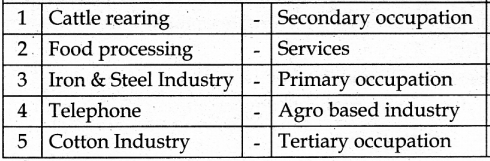
II. Match the following

Samacheer Kalvi 6th Social Science Guide Economics Term 2 Chapter 1 Economics-An Introduction
Answer:
1. – c
2. – d
3. – a
4. – b
5. – d

III. Match and find the odd pair
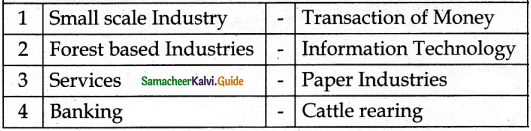
Samacheer Kalvi 6th Social Science Guide Economics Term 2 Chapter 1 Economics-An Introduction
Answer:
1. – d
2. – c
3. – b
4. – a

IV. Choose the correct answer

  1. Agriculture is a (primary / Secondary) occupation.
  2. Economic activities are divided on the basis of (ownership / use)
  3. Sugar Industries are (Primary / Secondary) activity.
  4. Agro based industry (Cotton / Furniture)
  5. Dairy farming is a (Public sector/Co-operative sector)

Answer:

  1. Primary
  2. use
  3. Secondary
  4. Cotton
  5. Co-operative sector

V. Answer the following questions

Question 1.
Sandhai – Define
Answer:
In villages once in a week or month, all things are sold in a particular place at a specific time to meet the needs of the people. That is called Sandai.

Question 2.
What is called the barter system?
Answer:
A system of exchanging goods for other goods is called a barter system. Example: Exchange a bag or rice for enough clothes.

Question 3.
What is trade?
Answer:
Trade involves the transfer of goods or services from one person to another often in exchange of money.

Samacheer Kalvi 6th Social Science Guide Economics Term 2 Chapter 1 Economics-An Introduction

Question 4.
What is Savings?
Answer:
The amount from the income which is left for future needs after consumption is called sayings.

Question 5.
What was the necessity for the invention of money?
Answer:

  1. When traders exchange commodities there arises a difference in the value of the commodity.
  2. To solve this problem people invented money.

Question 6.
What was the reason for the development of settlements near water bodies?
Answer:

  1. Rivers act as the main source for the cultivation of crops.
  2. So early man settled permanently near the rivers.

Samacheer Kalvi 6th Social Science Guide Economics Term 2 Chapter 1 Economics-An Introduction

Question 7.
What are called secondary occupation?
Answer:
The raw materials obtained from the primary activities are converted into finished products is called a secondary occupation.

Question 8.
Name the city-centered industries.
Answer:
Cement, iron, and Aluminium industries, seafood processing are some of the city centered industries.

VI. Answer the following in detail

Question 1.
List out the important primary occupations of your district.
Answer:

  1. Agriculture
  2. Cattle rearing
  3. Collection of fruits, nuts, honey, and medicinal herbs.

Samacheer Kalvi 6th Social Science Guide Economics Term 2 Chapter 1 Economics-An Introduction

Question 2.
Mention the manufacturing industries found in your district.
Answer:

  1. Cotton textiles
  2. Spinning and weaving
  3. Food processing industries
  4. Beedi production
  5. Wind power generations

Question 3.
How are the industries classified on the basis of raw materials?
Answer:
On the basis of raw materials industries are classified as

  1. Agro-Based Industries – Cotton textiles, Sugar mills, and Food processing.
  2. Forest-Based Industries – Paper mills, Furniture making, Building materials.
  3. Mineral Based Industries – Cement, Iron, Aluminium Industries.
  4. Marine Based Industries – Seafood processing.

Question 4.
Write down the occupations in the service sector.
Answer:
The service sector serves the people to fulfill their daily needs like:

  1. Transport – Roadways, Railways, Waterways, Airways.
  2. Communication – Post, Telephone, Information Technology.
  3. Trade – Procurement of goods, selling.
  4. Banking – Money Transaction, Banking Services.

Samacheer Kalvi 6th Social Science Guide Economics Term 2 Chapter 1 Economics-An Introduction

Question 5.
What do you know about the features of cities?
Answer:

  1. A city is a large human settlement.
  2. The high density of population.
  3. Four-way roads, flyovers, skyscrapers, parks.
  4. Educational institution, hospital, Government offices.
  5. Private and public industries and technological institutions.
  6. Employment opportunities permanent monthly income, basic requirements are

VII. Fill in the tabular column given below
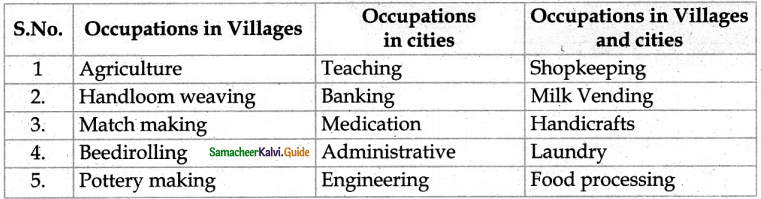
Samacheer Kalvi 6th Social Science Guide Economics Term 2 Chapter 1 Economics-An Introduction

Activity:
Write the lyrics of Bharathiyar’s Samacheer Kalvi 6th Social Science Guide Economics Term 2 Chapter 1 Economics-An Introduction Analyze the lyrics and write down the commodities which were exchanged in yesteryears with the help of the teacher.

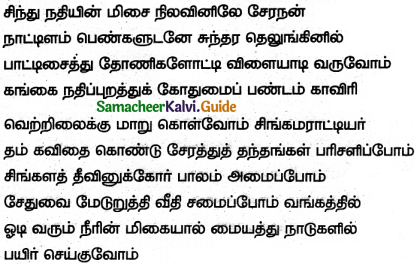
Samacheer Kalvi 6th Social Science Guide Economics Term 2 Chapter 1 Economics-An Introduction
(1) Wheat
(2) Betel
(3) Tusk

VIII. Stick picture

Samacheer Kalvi 6th Social Science Guide Economics Term 2 Chapter 1 Economics-An Introduction

Samacheer Kalvi 6th Social Science Economics-An Introduction Additional Important Questions and Answers

I. Fill in the blanks Answer

  1. The permanent settlements near the rivers were called ……………
  2. More than …………… percentage of the world’s population live in cities.
  3. The …………… sector serves the people to fulfill their daily needs.
  4. One who uses the products is called ……………
  5. …………… are the real shadow of cities.

Answer:

  1. Villages
  2. 50
  3. Service
  4. Consumer
  5. Villages

II. Choose the correct answer

Question 1.
Tertiary activities are also called as sector ……………
(a) Private
(b) Service
(c) Public
Answer:
(b) Service

Question 2.
Secondary and tertiary activities are …………… centred activities.
(a) City
(b) Town
(c) Village
Answer:
(a) City

Question 3.
…………… is the main occupation in villages.
(a) Mining
(b) Fishing
(c) Farming
Answer:
(c) Farming

III. Answer the following questions

Question 1.
Sandhai – Define
Answer:
In villages, once in a week or month, things are sold in a particular place at a specific time to meet the needs of the people. That is called Sandhai.

Question 2.
What is called the barter system?
Answer:

  1. A system of exchanging goods for other goods is called a barter system.
  2. Example: Exchange a bag or rice for enough clothes.

Samacheer Kalvi 6th Social Science Guide Economics Term 2 Chapter 1 Economics-An Introduction

Question 3.
What are consumer goods?
Answer:
The finished goods which are brought from the market to fulfill the daily needs of the consumers are called consumer goods.

Question 4.
Who are cultivators?
Answer:
Persons who are involved in farming and grazing are called cultivators or farmers.

Question 5.
How are industries classified?
Answer:
Industries are classified on the basis of the:

  1. Availability of raw materials
  2. Capital
  3. Ownership

Question 6.
Name the sectors that are helpful in the economic development of our country.
Answer:
Agriculture and Industries are helpful in the economic development of our country.

IV. Mind map
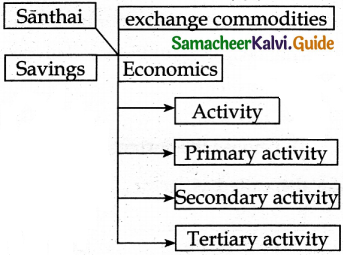
Samacheer Kalvi 6th Social Science Guide Economics Term 2 Chapter 1 Economics-An Introduction

Tamil Nadu 11th Physics Model Question Paper 5 English Medium

Students can Download Tamil Nadu 11th Physics Model Question Paper 5 English Medium Pdf, Tamil Nadu 11th Physics Model Question Papers helps you to revise the complete Tamilnadu State Board New Syllabus, helps students complete homework assignments and to score high marks in board exams.

TN State Board 11th Physics Model Question Paper 5 English Medium

General Instructions:

  1. The question paper comprises of four parts.
  2. You are to attempt all the parts. An internal choice of questions is provided wherever applicable.
  3. All questions of Part I, II, III and IV are to be attempted separately.
  4. Question numbers 1 to 15 in Part I are Multiple Choice Questions of one mark each.
    These are to be answered by choosing the most suitable answer from the given four alternatives and writing the option code and the corresponding answer
  5. Question numbers 16 to 24 in Part II are two-mark questions. These are to be answered in about one or two sentences.
  6. Question numbers 25 to 33 in Part III are three-mark questions. These are to be answered in about three to five short sentences.
  7. Question numbers 34 to 38 in Part IV are five-mark questions. These are to be answered in detail Draw diagrams wherever necessary.

Time: 3 Hours
Maximum Marks: 70

PART – I

Answer all the questions: [15 × 1 = 15]

Question 1.
Two protons are travelling. along the same straight path but in opposite directions. The relative velocity between the two is ……………………
(a) c
(b) \(\frac{c}{2}\)
(c) 2c
(d) 0
Hint:
One of the velocity V1 = V; Other velocity V2 = -V
Relative velocity (Vrel) = \(\frac{V_{1}-V_{2}}{\left[1+\frac{V^{2}}{C^{2}}\right]}\) = \(\frac{V-(-V)}{\left[1+\frac{V^{2}}{C^{2}}\right]}\) = \(\frac{2v}{2}\)
V = C
Vrelative = C
Answer:
(a) c

Tamil Nadu 11th Physics Model Question Paper 5 English Medium

Question 2.
If the Earth stops rotating about its own axis, g remains unchanged at …………………..
(a) Equator
(b) Poles
(c) Latitude of 45°
(d) No where
Answer:
(b) Poles

Question 3.
When train stops, the passenger moves forward. It is due to ……………………
(a) Inertia of passenger
(b) Inertia of train
(c) Gravitational pull by Earth
(d) None of the above
Answer:
(a) Inertia of passenger

Tamil Nadu 11th Physics Model Question Paper 5 English Medium

Question 4.
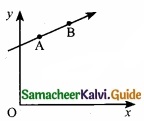
A particle of mass m moves in the xy plane with a velocity v along the straight line AB. If the angular momention of the particle with respect to origin O is LA when it is at A and LB when it is at B, then …………………….
(a) LA = LB
(b) LA < LB
(c) LA > LB
(d) The relationship between LA and LB depends uopn the slope of the line AB

Tamil Nadu 11th Physics Model Question Paper 5 English Medium img 1

Hint:
Magnitude of L is, L = mvr sin ϕ = mvd
d = r sin ϕ is the distance of closest approach of the particle so the origin, as ‘d’ is same for both particles.
So, L A = LB
Answer:
(a) LA = LB

Question 5.
A couple produces ……………………….
(a) Pure rotation
(b) Pure translation
(c) Rotation and translation
(d) No motion
Answer:
(a) Pure rotation

Tamil Nadu 11th Physics Model Question Paper 5 English Medium

Question 6.
A body starting from rest has an acceleration of 20 ms~2 the distance travelled by it in the sixth second is ……………………..
(a) 110 m
(b) 130m
(c) 90m
(d) 50 m
Hint:
Distance travelled in nth second, u = 0
Sn = u + \(\frac{1}{2}\)a(2n – 1)
S6 = 0 + \(\frac{1}{2}\) × 20 × (2 × 6 – 1); S6 = 110 m
Answer:
(a) 110 m

Question 7.
A lift of mass 1000 kg, which is moving with an acceleration of 1m/s2 in upward direction has tension has developed in its string is ………………………
(a) 9800 N
(b) 10800 N
(c) 11000 N
(d) 10000 N
Hint:
Tension, T = mg + ma = m(g + a) = 1000 (10 + 1)
T = 11000 N
Answer:
(c) 11000 N

Tamil Nadu 11th Physics Model Question Paper 5 English Medium

Question 8.
The relation between acceleration and displacement of four particles are given below ………………………..
(a) ax = 2x
(b) ax = + 2x2
(c) ax = -2x2
(d) ax = -2x
Answer:
(d) ax = -2x

Question 9.
A sonometer wire is vibrating in the second overtone. In the wire there are, ……………………..
(a) Two nodes and two antinodes
(b) One node and two antinodes
(c) Four nodes and three antinodes
(d) Three nodes and three antinodes
Answer:
(d) Three nodes and three antinodes

Tamil Nadu 11th Physics Model Question Paper 5 English Medium

Question 10.
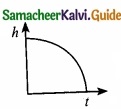
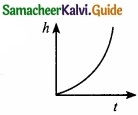
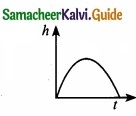
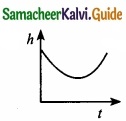
Which of the following is the graph between the light (h) of a projectile and time (t), when it is projected from the ground ………………………..
(a) Tamil Nadu 11th Physics Model Question Paper 5 English Medium img 2
(b) Tamil Nadu 11th Physics Model Question Paper 5 English Medium img 3
(c) Tamil Nadu 11th Physics Model Question Paper 5 English Medium img 4
(d) Tamil Nadu 11th Physics Model Question Paper 5 English Medium img 5
Answer:
(c) Tamil Nadu 11th Physics Model Question Paper 5 English Medium img 4

Question 11.
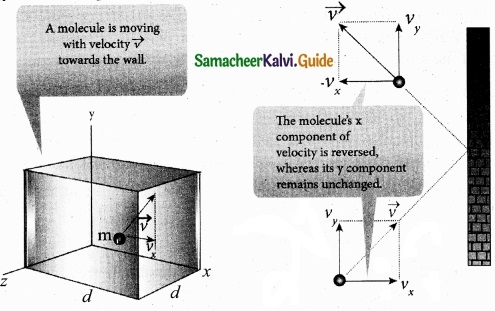
According to kinetic theory of gases, the rms velocity of the gas molecules is directly proportional to ………………………
(a) \(\sqrt{T}\)
(b) T3
(c) T
(d) T4
Hint:
The rms velocity, Vrms = \(\sqrt{3KT/m}\) ⇒ Vrms ∝ \(\sqrt{T}\)
Answer:
(a) \(\sqrt{T}\)

Question 12.
A body of mass m moving with velocity v collides head on with another body of mass 2m which is initially at rest. The ratio of K.E of colliding body before and after collision will be ……………………..
(a) 1 : 1
(b) 2 : 1
(c) 4 : 1
(d) 9 : 1
Hint:
KE of colliding bodies before collision = \(\frac{1}{2}\) mv2
After collision the mass = m + 2m = 3m
velocity becomes V’ = \(\left(\frac{m_{1}-m_{2}}{m_{1}+m_{2}}\right)\)v = \(\frac{mv}{3m}\) = \(\frac{v}{3}\)
KE after collision = \(\frac{1}{2}\)m (\(\frac{V}{3}\)2 = \(\frac{1}{9}\) (\(\frac{1}{2}\) mv2)
\(\frac{\mathrm{KE}_{\text {before }}}{\mathrm{KE}_{\text {after }}}=\frac{\frac{1}{2} \mathrm{mv}^{2}}{\frac{1}{9}\left(\frac{1}{2} \mathrm{mv}^{2}\right)}=9: 1\)
Answer:
(d) 9 : 1

Tamil Nadu 11th Physics Model Question Paper 5 English Medium

Question 13.
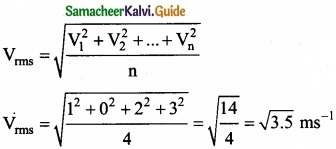
Four particles have velocity 1, 0, 2 and 3ms-1. The root mean square velocity of the particles is ……………………..
(a) 3.5 ms-1
(b) \(\sqrt{3.5}\) ms-1
(c) 1.5ms-1
(d) Zero
Hint:

Tamil Nadu 11th Physics Model Question Paper 5 English Medium img 6

Answer:
(b) \(\sqrt{3.5}\) ms-1

Tamil Nadu 11th Physics Model Question Paper 5 English Medium

Question 14.
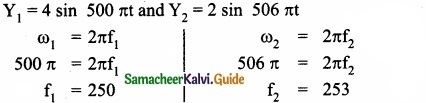
Two vibrating tuning forks produce progressive waves given by y1 = 4 sin 500 πt and y2 = 2 sin 506 πt where t is in seconds Number of beat produced per minute is ………………………
(a) 360
(b) 180
(c) 3
(d) 60
Hint:

Tamil Nadu 11th Physics Model Question Paper 5 English Medium img 7
f2 – f1 = 3 = beats per sec and 3 × 60 = 180 beats per min

Answer:
(b) 180

Question 15.
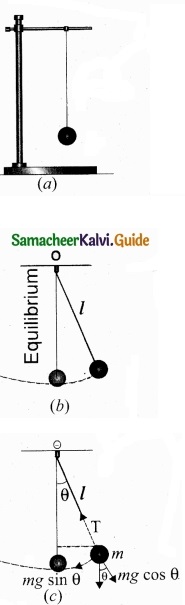
Workdone by a simple pendulum in one complete oscillation is …………………………..
(a) Zero
(b) Jmg
(c) mg cos θ
(d) mg sin θ
Answer:
(a) Zero

PART – II

Answer any six questions in which Q. No 23 is compulsory. [6 × 2 = 12]

Question 16.
A girl is swinging in the sitting position. How will the period of the swing be changed if she stands up?
Answer:
This can be explained using the concept of a simple pendulum. We know that the time period of a simple pendulum is given by
T = 2π\(\sqrt{l/g}\) i.e; T ∝\(\sqrt{l}\)
When the girl stands up, the distance between the point of suspension and the centre of mass of the swinging body decreases i.e., l decreases, so T will also decrease.

Question 17.
A car starts to move from rest with uniform acceleration 10 ms-2 then after 2 sec, what is its velocity?
Answer:
a =10 ms-2;
t = 2s;
w = 0;
v = ?
v = u + at
v = 0 + 10 × 2
= 20 ms-1

Tamil Nadu 11th Physics Model Question Paper 5 English Medium

Question 18.
State Lami’s theorem?
Answer:
If a system of three concurrent and coplanar forces is in equilibrium, then Lami’s theorem states that the magnitude of each force of the system is proportional to sine of the angle between the other two forces. The constant of proportionality is same for all three forces.

Question 19.
Due to the action of constant torque, a wheel from rest makes n rotations in t seconds? Show that the angular acceleration of a wheel as \(\frac{4 \pi n}{t^{2}}\) rad s-2
Answer:
Initial angluar velocity ω0 = 0
Number of rotations in t seconds = n
angular displacement θ = 2πn
but, θ = ω0t + \(\frac{1}{2}\)αt2
2πn = \(\frac{1}{2}\)αt2
α = \(\frac{4 \pi n}{t^{2}}\)

Question 20.
Why a given sound is louder in a hall than in the open?
Answer:
In a hall, repeated reflections of sound take place from the walls and the ceiling. These reflected sounds mix with original sound which results in increase the intensity of sound. But in open, no such a repeated reflection is possible. .’. sound will not be louder as in hall.

Tamil Nadu 11th Physics Model Question Paper 5 English Medium

Question 21.
What are the differences between connection and conduction?
Answer:
Conduction:
Conduction is the process of direct transfer of heat through matter due to temperature difference. When two objects are in direct contact with one another, heat will be transferred from the hotter object to the colder one. The objects which allow heat to travel easily through them are called conductors.

Convection:
Convection is the process in which heat transfer is by actual movement of molecules in fluids such as liquids and gases. In convection, molecules move freely from one place to another.

Question 22.
Why two holes are made to empty an oil tin?
Answer:
When oil comes out through a tin with one hole, the pressure inside the tin becomes less than the atmospheric pressure, soon the oil stops flowing out. When two holes are made in the tin, air keeps on entering the tin through the other hole and maintains pressure inside.

Tamil Nadu 11th Physics Model Question Paper 5 English Medium

Question 23.
If the length of the simple pendulum is increased by 44% from its original length, calculate the percentage increase in time period of the pendulum?
Answer:
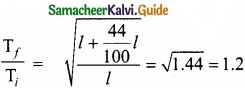
Since T ∝ \(\sqrt{l}\) = Constant \(\sqrt{l}\)

Tamil Nadu 11th Physics Model Question Paper 5 English Medium img 8

∴ Tf = 1.2 Ti = Ti + 20% Ti

Question 24.
When do the real gases obey more correctly the gas equation PV = nRT?
Answer:
An ideal gas is one whose molecules have zero volume and no mutual force between them. At low pressure, the volume of a gas is large and so the volume occupied by the molecules is negligible in comparison to the volume of the gas.

At high temperature, the molecules have large velocities and so the intermolecular force has no influence on their motion. Hence at low pressure and high temperature, the behaviour of real gases approach the ideal gas behaviour.

PART – III

Answer any six questions in which Q.No. 29 is compulsory. [6 × 3 = 18]

Question 25.
A stone is thrown upwards with a speed v from the top of a tower. It reaches the ground with a velocity 3v. What is the height of the tower?
Answer:
From equation of motion,
v’ = u + at ……………….. (1)
h = ut + \(\frac{1}{2}\) at2
here, v’ = av; u = v; a = +g
Using equ. (1)
3v = v + gt ⇒ 3v – v = gt
t = \(\frac{2v}{g}\)

Substitute ‘t’ value in equ. (2)
h = v(\(\frac{2v}{g}\)) + \(\frac{1}{2}\)g(\(\frac{2v}{g}\))2 = \(\frac { 2v^{ 2 } }{ g } \) + \(\frac{1}{2}\)g (\(\frac{2v}{g}\))2
h = \(\frac { 2v^{ 2 } }{ g } \) + \(\frac { 2v^{ 2 } }{ g } \)
= \(\frac { 4v^{ 2 } }{ g } \) g = 10 ms-2
= \(\frac { 4v^{ 2 } }{ 10 } \); h = \(\frac { 2v^{ 2 } }{ 5 } \)

Tamil Nadu 11th Physics Model Question Paper 5 English Medium

Question 26.
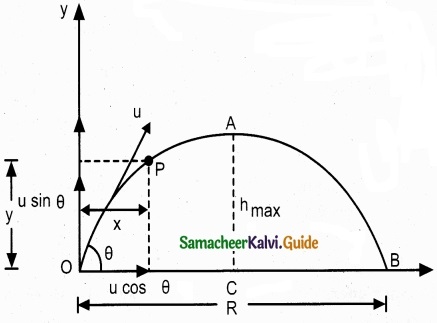
An object is projected at an angle such that the horizontal range is 4 times of the maximum height. What is the angle of projection of the object?
Answer:
Given:
Horizontal range = 4 Hmax
Horizontal range = \(\frac{u^{2} \sin 2 \theta}{g}\) = \(\frac{2 u^{2} \sin \theta \cos \theta}{g}\)
Maximum height = \(\frac{u^{2} \sin ^{2} \theta}{2 g}\)
as given, \(\frac{2 u^{2} \sin \theta \cos \theta}{g}\) = \(\frac{4 u^{2} \sin ^{2} \theta}{2 g}\)
2 cos θ = 2 sin θ
tan θ = 1
∴ θ = 45°

Question 27.
A room contains oxygen and hydrogen molecules in the ratio 3 : 1. The temperature of the room is 27°C. The molar mass of 02 is 32 g mol-1 and for H2, 2 g mol-1. The value of gas constant R is 8.32 J mol-11 k-1. Calculate rms speed of oxygen and hydrogen molecule?
Answer:
(a) Absolute Temperature T = 27°C = 27 + 273 = 300 K.
Gas constant R = 8.32 J mol-1 K-1
For Oxygen molecule: Molar mass

M = 32 gm/mol = 32 × 10-3 kg mol-1
rms speed vrms = \(\sqrt { \frac { 3RT }{ M } } \) = \(\sqrt{\frac{3 \times 8.32 \times 300}{32 \times 10^{-3}}}\) = 483.73 ms-1 ~ 484ms-1

For Hydrogen molecule: Molar mass M = 2 × 10⁻³ kg mol-1
rms speed vrms = \(\sqrt { \frac { 3RT }{ M } } \) = \(\sqrt{\frac{3 \times 8.32 \times 300}{2 \times 10^{-3}}}\) = 1934 ms-1 = 1.93 K ms-1

Note that the rms speed is inversely proportional to \(\sqrt{M}\) and the molar mass of oxygen is 16 times higher than molar mass of hydrogen. It implies that the rms speed of hydrogen is 4 times greater than rms speed of oxygen at the same temperature. \(\frac{1934}{484}\) ~ 4.

Tamil Nadu 11th Physics Model Question Paper 5 English Medium

Question 28.
Explain about an angle of friction?
Answer:
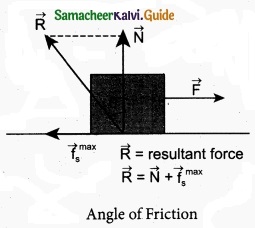
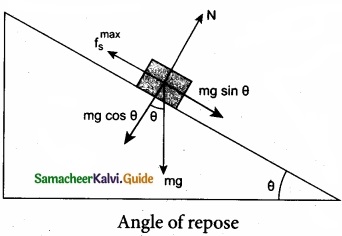
The angle of friction is defined as the angle between the normal force (N) and the resultant force (R) of normal force and maximum friction force (\(f_{s}^{\max }\))

Tamil Nadu 11th Physics Model Question Paper 5 English Medium img 9

In the figure the resultant force is R = \(\sqrt{\left(f_{s}^{\max }\right)^{2}+\mathrm{N}^{2}}\)
tan θ = \(\frac{f_{s}^{\max }}{\mathrm{N}}\) ………………….. (1)

But from the frictional relation, the object begins to slide when \(f_{s}^{\max }=\mu_{\mathrm{s}} \mathrm{N}\)
or when \(\frac{f_{s}^{\max }}{\mathrm{N}}\) = µs ………………….. (2)

From equations (1) and (2) the coefficient of static friction is
µs = tan θ ……………………. (3)
The coefficient of static friction is equal to tangent of the angle of friction.

Tamil Nadu 11th Physics Model Question Paper 5 English Medium

Question 29.
How does resolve a vector into its component? Explain?
Answer:
component of a resolve:
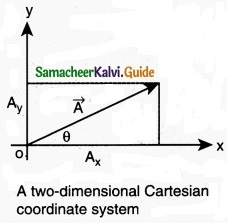
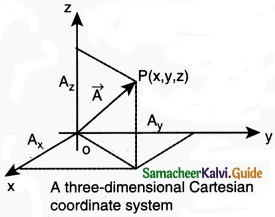
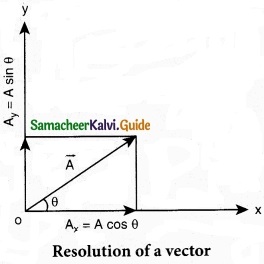
In the Cartesian coordinate system any vector \(\vec { A } \) can be resolved into three components along x, y and z directions. This is shown in figure. Consider a 3-dimensional coordinate system. With respect to this a vector can be written in component form as
\(\vec { A } \) = Ax \(\hat { i } \) + Ay\(\hat { j } \) + Az\(\hat { k } \)
Components of a vector in 2 dimensions and 3 dimensions

Tamil Nadu 11th Physics Model Question Paper 5 English Medium img 10

Tamil Nadu 11th Physics Model Question Paper 5 English Medium img 11

Here Ax is the x-component of \(\vec { A } \), Ay is the y-component of \(\vec { A } \) and Az is the z component of \(\vec { A } \).
In a 2-dimensional Cartesian coordinate system (which is shown in the figure) the vector \(\vec { A } \) is given by
\(\vec { A } \) = Ax \(\hat { i } \) + Ay \(\hat { j } \)

If \(\vec { A } \) makes an angle θ with x axis, and Ax and Ay are the components of A along x-axis and y-axis respectively, then as shown in figure,
Ax θ = A cos θ, A = A sin θ
where ‘A’ is the magnitude (length) of the vector \(\vec { A } \), A = \(\sqrt{\mathrm{A}_{x}^{2}+\mathrm{A}_{y}^{2}}\)

Tamil Nadu 11th Physics Model Question Paper 5 English Medium img 12

Question 30.
Derive an expression for energy of an orbiting satellite?
Answer:
The total energy of the satellite is the sum of its kinetic energy and the gravitational potential energy. The potential energy of the satellite is,
U = \(-\frac{\mathrm{GM}_{s} \mathrm{M}_{\mathrm{E}}}{\left(\mathrm{R}_{\mathrm{E}}+h\right)}\) ………………….. (1)

Here Ms -mass of the satellite, ME -mass of the Earth, RE – radius of the Earth.
The Kinetic energy of the satellite is
K.E = \(\frac{1}{2}\) Msv2 ………………….. (2)

Here v is the orbital speed of the satellite and is equal to
v = \(\sqrt{\frac{\mathrm{GM}_{\mathrm{E}}}{\left(\mathrm{R}_{\mathrm{E}}+h\right)}}\)

Substituting the value of v in (2) the kinetic energy of the satellite becomes,
K.E = \(\frac{1}{2} \frac{\mathrm{GM}_{\mathrm{E}} \mathrm{M}_{s}}{\left(\mathrm{R}_{\mathrm{E}}+h\right)}\)

Therefore the total energy of the satellite is
E = \(\frac{1}{2}\) \(\frac{\mathrm{GM}_{\mathrm{E}} \mathrm{M}_{s}}{\left(\mathrm{R}_{\mathrm{E}}+h\right)}-\frac{\mathrm{GM}_{s} \mathrm{M}_{\mathrm{E}}}{\left(\mathrm{R}_{\mathrm{E}}+h\right)}\)
E = \(-\frac{\mathrm{GM}_{s} \mathrm{M}_{\mathrm{E}}}{\left(\mathrm{R}_{\mathrm{E}}+h\right)}\)
The total energy implies that the satellite is bound to the Earth by means of the attractive gravitational force.

Note:
As h approaches ∞, the total energy tends to zero. Its physical meaning is that the satellite is completely free from the influence of Earth’s gravity and is not bound to Earth at large distance.

Tamil Nadu 11th Physics Model Question Paper 5 English Medium

Question 31.
Explain in detail Newton’s law of cooling?
Answer:
Newton’s law of cooling:
Newton’s law of cooling body is directly proportional to the difference in the temperature between that body and its surroundings.
\(\frac{dQ}{dT}\) ∝(T – Ts) …………………. (1)
The negative sign indicates that the quantity of heat lost by liquid goes on decreasing with time. Where,

Tamil Nadu 11th Physics Model Question Paper 5 English Medium img 13

T = Temperature of the object
Ts = Temperature of the surrounding

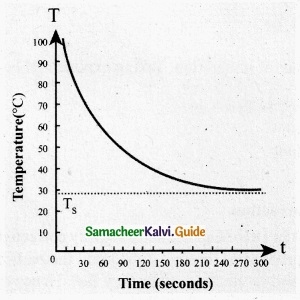
From the graph in figure it is clear that the rate of cooling is high initially and decreases with falling temperature.

Let us consider an object of mass m and specific heat capacity s at temperature T. Let Ts be the temperature of the surroundings. If the temperature falls by a small amount dT in time dt, then the amount of heat lost is,
dQ = msdT …………………….. (2)

Dividing both sides of equation (2) by dt
\(\frac{dQ}{dT}\) = \(\frac{msdT}{dt}\) ………………….. (3)

From Newton’s law of cooling
\(\frac{dQ}{dT}\) ∝(T – Ts)
\(\frac{dQ}{dT}\) = -a(T – Ts) ………………………… (4)

Where a is some positive constant.
From equation (3) and (4)
-a (T – Ts) = ms\(\frac{dT}{dt}\)
\(\frac{d \mathrm{T}}{\mathrm{T}-\mathrm{T}_{s}}\) = -a\(\frac{a}{ms}\) dt …………………… (5)

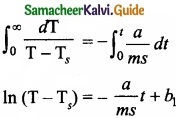
Integrating equation (5) on both sides,

Tamil Nadu 11th Physics Model Question Paper 5 English Medium img 14

Where b1 is the constant of integration. Taking exponential both sides we get,
T = Ts + \(b_{2} e^{\frac{-a}{m s} t}\) …………………….. (6)
Here b2 = eb1 Constant

Tamil Nadu 11th Physics Model Question Paper 5 English Medium

Question 32.
Explain Laplace’s correction?
Answer:
Laplace’s correction: In 1816, Laplace satisfactorily corrected this discrepancy by assuming that when the sound propagates through a medium, the particles oscillate very rapidly such that the compression and rarefaction occur very fast.

Hence the exchange of heat produced due to compression and cooling effect due to rarefaction do not take place, because, air (medium) is a bad conductor of heat. Since, temperature is no longer considered as a constant here, sound propagation is an adiabatic process. By adiabatic considerations, the gas obeys Poisson’s law (not Boyle’s law as Newton assumed), which is
PVγ = Constant …………………. (1)
where, γ = \(\frac { C_{ p } }{ C_{ v } } \) which is the ratio between specific heat at constant pressure and specific heat at constant volume. Differentiating equation (1) on both the sides, we get
\(V^{ \gamma }dP+P(\gamma ^{ V\gamma -1 }dV)=0\)

or

\(\gamma \mathrm{P}=-\mathrm{V} \frac{d p}{d \mathrm{V}}=\mathrm{B}_{\mathrm{A}}\) ………………….. (2)
where, BA is the adiabatic bulk modulus of air. Now, substituting equation (2) in equation
V = \(\sqrt{\frac{B}{\rho}}\), the speed of sound in air is
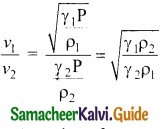
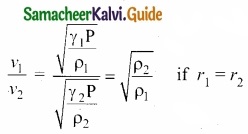
vA = \(\sqrt{\frac{\mathrm{B}_{\mathrm{A}}}{\rho}}=\sqrt{\frac{\gamma \mathrm{P}}{\rho}}=\sqrt{\gamma v_{\mathrm{T}}}\)
Since air contains mainly, nitrogen, oxygen, hydrogen etc, (diatomic gas), we take γ = 1.47. Hence, speed of sound in air is vA = (\(\sqrt{1.4}\)) (280 m s-1) = 331.30 ms-1, which is very much closer to experimental data.

Tamil Nadu 11th Physics Model Question Paper 5 English Medium

Question 33.
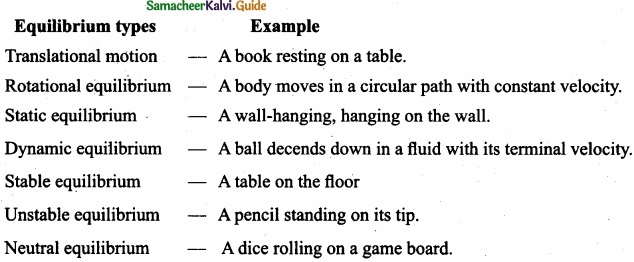
Explain types of equilibrium?
Answer:
Tamil Nadu 11th Physics Model Question Paper 5 English Medium img 15

PART – IV

Answer all the questions. [5 × 5 = 25]

Question 34 (a).
What are the applications of dimensional analysis?
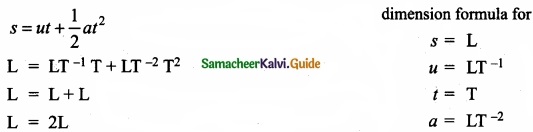
Verify s = ut + \(\frac{1}{2}\)at2 by dimensional analysis?
Answer:

Tamil Nadu 11th Physics Model Question Paper 5 English Medium img 16

Given equation is dimensionally correct as the dimensions on the both side are same. Applications of dimensional analysis

  1. Convert a physical quantity from one system of units to another.
  2. Check the dimensional correctness of a given physical equation.
  3. Establish relations among various physical quantities.

[OR]

(b) Explain the types of equilibrium with suitable examples?
Answer:
Translational motion – A book resting on a table.
Rotational equilibrium – A body moves in a circular path with constant velocity.
Static equilibrium – A wall-hanging, hanging on the wall.
Dynamic equilibrium – A ball decends down in a fluid with its terminal velocity.
Stable equilibrium – A table on the floor A pencil
Unstable equilibrium – standing on its tip.
Neutral equilibrium – A dice rolling on a game board.

Tamil Nadu 11th Physics Model Question Paper 5 English Medium

Question 35 (a)
Explain the motion of block connected by a string in vertical motion?
Answer:
When objects are connected by strings and a force F is applied either vertically or horizontally or along an inclined plane, it produces a tension T in the string, which affects the acceleration to an extent. Let us discuss various cases for the same.

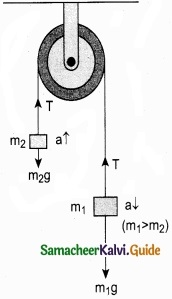
Tamil Nadu 11th Physics Model Question Paper 5 English Medium img 17

Vertical motion:
Consider two blocks of masses m1 and m2 (m1 > m2) connected by a light and inextensible string that passes over a pulley as shown in Figure 1.

Let the tension in the string be T and acceleration a.

When the system is released, both the blocks start, Two blocks connected by a string moving, m2 vertically upward and m1 downward with same acceleration a. The gravitational force m1g on mass m1 is used in lifting the mass m2.

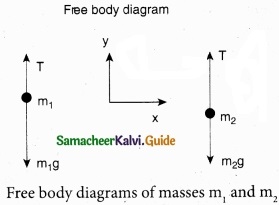
The upward direction is chosen as y direction. The free body diagrams of both masses are shown in Figure 2.

Tamil Nadu 11th Physics Model Question Paper 5 English Medium img 18

Applying Newton’s second law for mass m2
T\(\hat { j } \) – m2\(\hat { j } \)g = m2 a\(\hat { j } \)

The left hand side of the above equation is the total force that acts on m2 and the right hand side is the product of mass and acceleration of m2 in direction.

By comparing the components on both sides, we get
T -m2g = m2a ……………………. (1)

Similarly, applying Newton’s law second law of for mass m1
T\(\hat { j } \) – m1g\(\hat { j } \) = -m1a\(\hat { j } \)

As mass m1 moves downward (-\(\hat { j } \)), its accleration is along (-\(\hat { j } \))
By comparing the components on both sides, we get
T – m1g = -m1a
m1g – T = m1a …………………….. (2)

Adding equations (1) and (2), we get
m1g – m2g = m1a + m2a
(m1g – m2)g = (m1 + m2)a …………………….. (3)

From equation (3), the acceleration of both the masses is
a = \(\left(\frac{m_{1}-m_{2}}{m_{1}+m_{2}}\right)\)g ……………………… (4)

If both the masses are equal (m1 = m2), from equation (4)
a = 0

This shows that if the masses are equal, there is no acceleration and the system as a whole will be at rest. To find the tension acting on the string, substitute the acceleration from the equation (4)
T – m2g = m2 \(\left(\frac{m_{1}-m_{2}}{m_{1}+m_{2}}\right)\)g
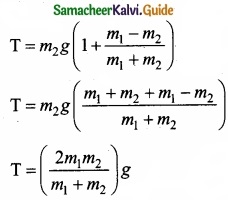
T = m2g + m2\(\left(\frac{m_{1}-m_{2}}{m_{1}+m_{2}}\right)\)g ……………………… (5)
By taking m2g common in the RHS of equation (5)

Tamil Nadu 11th Physics Model Question Paper 5 English Medium img 19

Equation (4) gives only magnitude of accleration.

For mass m1 g the accleration vector is given by \(\vec{a}=-\left(\frac{m_{1}-m_{2}}{m_{1}+m_{2}}\right) g \hat{j}\)
For mass m2 g the accleration vector is given by \(\vec{a}=-\left(\frac{m_{1}-m_{2}}{m_{1}+m_{2}}\right) g \hat{j}\)

[OR]

(b) Derive the kinematic equation of motion for constant acceleration?
Answer:
Consider an object moving in a straight line with uniform or constant acceleration ‘a’. Let u be the velocity of the object at time t = 0, and v be velocity of the body at a later time t.

Velocity – time relation:

(I) The acceleration of the body at any instant is given by the first derivative of the velocity with respect to time,
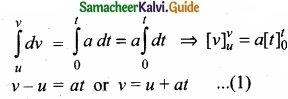
a = \(\frac{dv}{dt}\) or dv = a dt
Integrating both sides with the condition that as time changes from 0 to t, the velocity changes from u to v. For the constant acceleration,

Tamil Nadu 11th Physics Model Question Paper 5 English Medium img 20

Displacement – time relation:

(II) The velocity of the body is given by the first derivative of the displacement with respect to time.
v = \(\frac{ds}{dt}\) or ds = vdt
and since v = u + at,
We get ds = (u + at)dt
Assume that initially at time t = 0, the particle started from the origin. At a later time t, the particle displacement is s. Further assuming that acceleration is time-independent, we have
\(\int_{0}^{s} d s=\int_{0}^{t} u d t+\int_{0}^{t} a t d t \text { or } s=u t+\frac{1}{2} a t^{2}\) ……………………. (2)
Velocity – displacement relation

(III) The acceleration is given by the first derivative of velocity with respect to time.
a = \(\frac{dv}{dt}\) = \(\frac{dv}{ds}\) \(\frac{ds}{dt}\) = \(\frac{dv}{ds}\) v [since ds/dt = v] where s is displacement traversed.
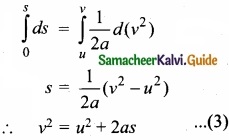
This is rewritten as a = \(\frac{1}{2}\) \(\frac { dv^{ 2 } }{ s } \) or ds = \(\frac{1}{2a}\) d(v2)
Integrating the above equation, using the fact when the velocity changes from u2 to v2, displacement changes from u2 to v2, we get

Tamil Nadu 11th Physics Model Question Paper 5 English Medium img 21

We can also derive the displacement s in terms of initial velocity u and final velocity v.
From equation we can write,
at = v – u
Substitute this in equation, we get
s = ut + \(\frac{1}{2}\) (v -u)t
s = \(\frac{(u+v)t}{2}\)

Tamil Nadu 11th Physics Model Question Paper 5 English Medium

Question 36 (a).
State and prove perpendicular axis theorem?
Answer:
Perpendicular axis theorem: This perpendicular axis theorem holds good only for plane laminar objects.

The theorem states that the moment of inertia of a plane laminar body about an axis perpendicular to its plane is equal to the sum of moments of inertia about two perpendicular axes lying in the plane of the body such that all the three axes are mutually perpendicular and have a common point.

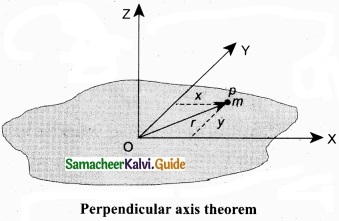
Let the X and Y-axes lie in the plane and Z-axis perpendicular to the plane of the laminar object. If the moments of inertia of the body about X and Y-axes are Ix and IY respectively and Iz is the moment of inertia about Z-axis, then the perpendicular axis theorem could be expressed as,
Iz = Ix + Iy

To prove this theorem, let us consider a plane laminar object of negligible thickness on which lies the origin (O). The X and Y-axes lie on the plane and Z-axis is perpendicular to it as shown in figure. The lamina is considered to be made up of a large number of particles of mass m. Let us choose one such particle at a point P which has coordinates (x, y) at a distance r from O.

Tamil Nadu 11th Physics Model Question Paper 5 English Medium img 22

The moment of inertia of the particle about Z-axis is, mr2.
The summation of the above expression gives the moment of inertia of the entire lamina about Z-axis as,
Iz = Σ mr2
Here, r2 = x2 + y2
Then, Iz = Σm(x2 + y2)
Iz = Σmx2 + Σmy2
In the above expression, the term Σmx2 is the moment of inertia of the body about the Y-axis and similarly the term Σmy2 is the moment of inertia about X-axis. Thus,
IX = Σmy2 and IY = Σmx2
Substituting in the equation for IZ gives, IZ = IX + IY
Thus, the perpendicular axis theorem is proved.

[OR]

(b) Explain in detail the triangle law of addition?
Answer:
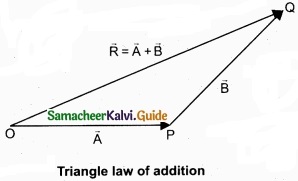
Let us consider two vectors \(\vec { A } \) and \(\vec { B } \) as shown in figure.

Tamil Nadu 11th Physics Model Question Paper 5 English Medium img 23

To find the resultant of the two vectors we apply the triangular law of addition as follows:

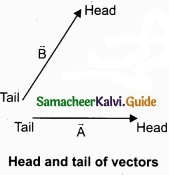
Represent the vectors \(\vec { A } \) and \(\vec { B } \) by the two adjacent sides of a triangle taken in the same order. Then the resultant is given by the third side of the triangle as shown in figure.

Tamil Nadu 11th Physics Model Question Paper 5 English Medium img 24

To explain further, the head of the first vector \(\vec { A } \) is connected to the tail of the second vector \(\vec { B } \). Let θ be the angle between A and B. Then R is the resultant vector connecting the tail of the first vector \(\vec { A } \) to the head of the second vector \(\vec { B } \).

The magnitude of \(\vec { R } \) (resultant) is given geometrically by the length of \(\vec { R } \)(OQ) and the direction of the resultant vector is the angle between \(\vec { R } \) and \(\vec { A } \). Thus we write \(\vec { R } \) = \(\vec { A } \) + \(\vec { B } \).
\(\overline { OQ } \) = \(\overline { OP } \) + \(\overline { PQ } \)

1. Magnitude of resultant vector:
The magnitude and angle of the resultant vector are determined by using triangle law of vectors as follows.

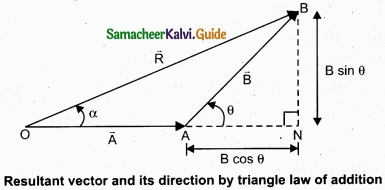
From figure, consider the triangle ABN, which is obtained by extending the side OA to ON. ABN is a right angled triangle.

Tamil Nadu 11th Physics Model Question Paper 5 English Medium img 25

From figure, let R is the magnitude of the resultant of \(\vec { A } \) and \(\vec { B } \).

For ∆OBN, we have OB2 = ON2 + BN2
⇒ R2 = (A + B cos θ)2 + (B sin θ)2
⇒ R2 = A2 + B2 cos2 θ + 2AB cos θ + B2sin2 θ
⇒ R2 = A2 + B2(cos2 θ + sin2 θ) + 2AB cos θ
⇒R2 = \(\sqrt{A^{2}+B^{2}+2 A B \cos \theta}\)

2. Direction of resultant vectors:
If θ is the angle between \(\vec { A } \) and \(\vec { B } \), then
|\(\vec { A } \) + \(\vec { B } \)| = \(\sqrt{A^{2}+B^{2}+2 A B \cos \theta}\)
If \(\vec { R } \) makes an angle α with \(\vec { A } \), then in ∆OBN,
tan α = \(\frac{BN}{ON}\) = \(\frac{BN}{OA+AN}\)
tan α = \(\frac{B \sin \theta}{A+B \cos \theta}\) ⇒ α = tan-1\(\left(\frac{B \sin \theta}{A+B \cos \theta}\right)\)

Tamil Nadu 11th Physics Model Question Paper 5 English Medium

Question 37 (a).
Explain in detail the various types of errors?
Answer:
The uncertainty in a measurement is called an error. Random error, systematic error and gross error are the three possible errors.

(I) Systematic errors:
Systematic errors are reproducible inaccuracies that are consistently in the same direction. These occur often due to a problem that persists throughout the .experiment. Systematic errors can be classified as follows.

(1) Instrumental errors:
When an instrument is not calibrated properly at the time of manufacture, instrumental errors may arise. If a measurement is made with a meter scale whose end is worn out, the result obtained will have errors. These errors can be corrected by choosing the instrument carefully.

(2) Imperfections in experimental technique or procedure:
These errors arise due to the limitations in the experimental arrangement. As an example, while performing experiments with a calorimeter, if there is no proper insulation, there will be radiation losses. This results in errors and to overcome these, necessary correction has to be applied

(3) Personal errors:
These errors are due to individuals performing the experiment, may be due to incorrect initial setting up of the experiment or carelessness of the individual making the observation due to improper precautions.

(4) Errors due to external causes:
The change in the external conditions during an experiment can cause error in measurement. For example, changes in temperature, humidity, or pressure during measurements may affect the result of the measurement.

(5) Least count error:
Least count is the smallest value that can be measured by the measuring instrument, and the error due to this measurement is least count error. The instrument’s resolution hence is the cause of this error. Least count error can be reduced by using a high precision instrument for the measurement.

(II) Random errors:
Random errors may arise due to random and unpredictable variations in experimental conditions like pressure, temperature, voltage supply etc. Errors may also be due to personal errors by the observer who performs the experiment. Random errors are sometimes called “chance error”.

When different readings are obtained by a person every time he repeats the experiment, personal error occurs. For example, consider the case of the thickness of a wire measured using a screw gauge. The readings taken may be different for different trials. In this case, a large number of measurements are made and then the arithmetic mean is taken.
If n number of trial readings are taken in an experiment, and the readings are
a1, a2, a3, ……………………….. an. The arithmetic mean is

Tamil Nadu 11th Physics Model Question Paper 5 English Medium img 26

[OR]

(b) To move an object, which one is easier, push or pull? Explain?
Answer:
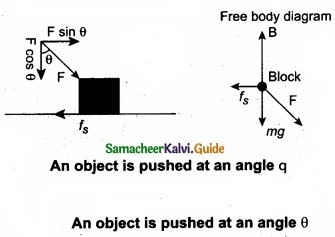
When a body is pushed at an arbitrary angle θ (0 to \(\frac{π}{2}\)), the applied force F can be resolved into two components as F sin θ parallel to the surface and F cos θ perpendicular to the surface as shown in figure. The total downward force acting on the body is mg + F cos θ. It implies that the normal force acting on the body increases. Since there is no acceleration along the vertical direction the normal force N is equal to
Npush = mg + F cos θ …………………. (1)
As a result the maximal static friction also increases and is equal to
\(f_{s}^{\max }=\mu_{r} N_{\text {push }}=\mu_{s}(m g+F \cos \theta)\) …………………. (2)
Equation (2) shows that a greater force needs to be applied to push the object into motion.

Tamil Nadu 11th Physics Model Question Paper 5 English Medium img 27

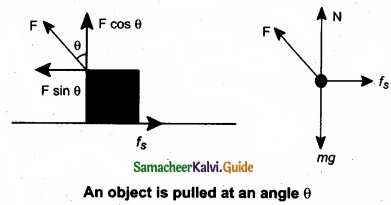
When an object is pulled at an angle 0, the applied force is resolved into two components as shown in figure. The total downward force acting on the object is
Npull = mg – F cos θ …………………….. (3)

Tamil Nadu 11th Physics Model Question Paper 5 English Medium img 28

Tamil Nadu 11th Physics Model Question Paper 5 English Medium

Question 38 (a).
Describe the method of measuring angle of repose?
Answer:
Angle of Repose Consider an inclined plane on which an object is placed, as shown in figure. Let the angle which this plane makes with the horizontal be θ. For small angles of θ, the object may not slide down. As θ is increased, for a particular value of θ, the object begins to slide down. This value is called angle of repose. Hence, the angle of repose is the angle of inclined plane with the horizontal such that an object placed on it begins to slide.

Tamil Nadu 11th Physics Model Question Paper 5 English Medium img 29

Let us consider the various forces in action here. The gravitational force mg is resolved into components parallel (mg sin θ) and perpendicular (mg cos θ) to the inclined plane. The component of force parallel to the inclined plane (mg sin θ) tries to move the object down. The component of force perpendicular to the inclined plane (mg cos θ) is balanced by the Normal force (N).
N = mg cos θ ……………… (1)

When the object just begins to move, the static friction attains its maximum value
fs = \(f_{s}^{\max }\)

This friction also satisfies the relation
\(f_{s}^{\max }\) = µs = mg sin θ …………………… (2)

Equating the right hand side of equations (1) and (2),
\(\left(f_{s}^{\max }\right) / \mathrm{N}=\sin \theta / \cos \theta\)

From the definition of angle of friction, we also know that
tan θ = µs ……………………… (3) in which θ is the angle of friction.

Thus the angle of repose is the same as angle of friction. But the difference is that the angle of repose refers to inclined surfaces and the angle of friction is applicable to any type of surface.

[OR]

(b) A block of mass m slides down the plane inclined at an angle 60° with an acceleration g/2. Find the co-efficient of kinetic friction?
Answer:
Kinetic friction comes to play as the block is moving on the surface.
The forces acting on the mass are the normal force perpendicular to surface, downward gravitational force and kinetic friction along the surface.
Along the x-direction

Tamil Nadu 11th Physics Model Question Paper 5 English Medium img 30

Tamil Nadu 11th Physics Model Question Paper 5 English Medium img 30a
There is no motion along the y-direction as normal force is exactly balanced by the mg cos θ.
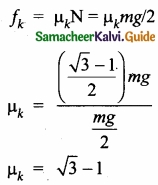
mg cos θ = N = mg/2

Tamil Nadu 11th Physics Model Question Paper 5 English Medium img 31

[OR]

(c) Write a note on triangulation method and radar method to measure larger distances?
Answer:
Triangulation method for the height of an accessible object:
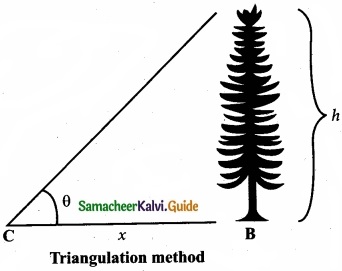
Let AB = h be the height of the tree or tower to 6e measured. Let C be the point of observation at distance x from B. Place a range finder at C and measure the angle of elevation, ACB = θ as shown in figure.

From right angled triangle ABC,
tan θ = \(\frac{AB}{BC}\) = \(\frac{h}{x}\)
(or) height h = x tan θ
Knowing the distance x. the height h can be detennined.

Tamil Nadu 11th Physics Model Question Paper 5 English Medium img 32

RADAR method:
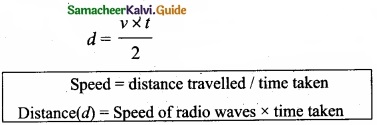
The word RADAR stands for radio detection and ranging. A radar can be used to measure accurately the distance of a nearby planet such as Mars. In this method, radio waves are sent from transmitters which, after reflection from the planet, are detected by the receiver.

By measuring, the time interval (t) between the instants the radio waves are sent and received, the distance of the planet can be determined as where v is the speed of the radio wave. As the time taken (t) is for the distance covered during the forward and backward path of the radio waves, it is divided by 2 to get the actual distance of the object. This method can also be used to determine the height, at which an aeroplane flies from the ground.

Tamil Nadu 11th Physics Model Question Paper 5 English Medium img 33

[OR]

(d) Jupiter is at a distance of 824.7 million km from the earth. Its angular diameter is measured to be 35.75”. Calculate the diameter of jupiter?
Answer:
Given,
Distance of Jupiter = 824.7 × 10⁶ km = 8.247 × 10¹¹ m
angular diameter = 35.72 × 4.85 × 10-6 rad = 173.242 × 10⁻⁶ rad
= 1.73 × 10⁻⁴rad
∴ Diameter of Jupiter D = θ × d = 1.73 × 10-4 rad × 8.247 × 1011 m
14.267 × 10⁷ m = 1.427 × 10⁸ m (or) 1.427 × 10⁵ km

Samacheer Kalvi 6th Social Science Guide History Term 3 Chapter 3 The Age of Empires: Guptas and Vardhanas

Students can download 6th Social Science Term 3 History Chapter 3 The Age of Empires: Guptas and Vardhanas Questions and Answers, Notes, Samacheer Kalvi 6th Social Science Guide Pdf helps you to revise the complete Tamilnadu State Board New Syllabus, helps students complete homework assignments and to score high marks in board exams.

Tamilnadu Samacheer Kalvi 6th Social Science History Solutions Term 3 Chapter 3 The Age of Empires: Guptas and Vardhanas

Samacheer Kalvi 6th Social Science The Age of Empires: Guptas and Vardhanas Text Book Back Questions and Answers

I. Choose the correct Answer

Question 1.
………………. was the founder of Gupta dynasty.
(a) Chandragupta I
(b) Sri Gupta
(c) Vishnu Gopa
(d) Vishnugupta
Answer:
(b) Sri Gupta

Question 2.
Prayog Prashasti was composed by ________
(a) Kalidasa
(b) Amarasimha
(c) Harisena
(d) Dhanvantri
Answer:
(c) Harisena

Samacheer Kalvi 6th Social Science Guide History Term 3 Chapter 3 The Age of Empires: Guptas and Vardhanas

Question 3.
The monolithic iron pillar of Chandragupta is at ………………
(a) Mehrauli
(b) Bhitari
(c) Gadhva
(d) Mathura
Answer:
(a) Mehrauli

Question 4.
________ was the first Indian to explain the process Of surgery.
(a) Charaka
(b) Sushruta
(c) Dhanvantri
(d) Agnivasa
Answer:
(b) Sushrutal

Question 5.
……………… was the Gauda ruler of Bengal.
(a) Sasanka
(b) Maitraka
(c) Rajavardhana
(d) Pulikesin II
Answer:
(a) Sasanka

II. Match the statement with the reason and tick the appropriate answer

Question 1.
Assertion (A) : Chandragupta I crowned himself as a monarch of a large kingdom after eliminating various small states in Northern India.
Reason (R) : Chandragupta I married Kumaradevi of Lichchavi family.
(a) Both A and R are true and R is the correct explanation of A.
(b) Both A and R are correct but R is not correct explanation of A.
(c) A is correct but R is not correct.
(d) A is not correct but R is correct.
Answer:
(a) Both A and R are true and R is the correct explanation of A

Samacheer Kalvi 6th Social Science Guide History Term 3 Chapter 3 The Age of Empires: Guptas and Vardhanas

Question 2.
Statement I : Chandragupta II did not have cordial relationship with the rules of South India.
Statement II : The divine theory of kingship was practised by the Gupta rulers.
(a) Statement I is wrong but statement II is correct.
(b) Statement II is wrong but statement I is correct.
(c) Both the statements are correct.
(d) Both the statements are wrong.
Answer:
(a) Statement I is wrong but statement II is correct.

Question 3.
Which of the following is arranged in chronological order?
(a) Srigupta – Chandragupta I – Samudragupta – Vikramaditya
(b) Chandragupta I – Vikramaditya – Srigupta – Samudragupta
(c) Srigupta – Samudragupta – Vikramaditya – Chandragupta I
(d) Vikramaditya – Srigupta – Samudragupta – Chandragupta I
Answer:
(a) Srigupta – Chandragupta I – Samudragupta -Vikramaditya

Samacheer Kalvi 6th Social Science Guide History Term 3 Chapter 3 The Age of Empires: Guptas and Vardhanas

Question 4.
Consider the following statements and find out which of the following statements (s) is/are correct.
(1) Lending money at high rate of interest was practised.
(2) Pottery and mining were the most flourishing industries,
(a) 1. is correct
(b) 2. is correct
(c) Both 1 and 2 are correct
(d) Both 1 and 2 are wrong
Answer:
(a) 1. is correct

Question 5.
Circle the odd one
Samacheer Kalvi 6th Social Science Guide History Term 3 Chapter 3 The Age of Empires Guptas and Vardhanas
Answer:
Samudragupta.
Samacheer Kalvi 6th Social Science Guide History Term 3 Chapter 3 The Age of Empires Guptas and Vardhanas

Answer:
Harshacharita.

III. Fill in the blanks Answer

  1. ……………., the king of Ceylon, was a contemporary of Samudragupta.
  2. A Buddhist monk from China ……………., visited India during the reign of Chandragupta II.
  3. ……………. invasion led to the downfall of the Gupta Empire.
  4. ……………. was the main revenue to the Government.
  5. The official language of the Guptas was …………….
  6. ……………., the Pallava king was defeated by Samudragupta.
  7. ……………. was the popular king of the Vardhana dynasty.
  8. Harsha shifted his capital from ……………. to Kanauj.

Answer:

  1. Reign of
  2. Fahien
  3. Huns
  4. Land tax
  5. Sanskrit
  6. Vishnugopa
  7. Harsha Vardhana
  8. Thaneswar

IV. State whether True or False

  1. Dhanvantri was a famous scholar in the field of medicine.
  2. The structural temples built during the Gupta period resemble the Indo – Aryan style.
  3. Sati was not in practice in the Gupta Empire.
  4. Harsha belonged to the Hinayana school of thought.
  5. Harsha was noted for his religious intolerance.

Answer:

  1. True
  2. False
  3. False
  4. False
  5. False

V. Match the following

Question 1.
Samacheer Kalvi 6th Social Science Guide History Term 3 Chapter 3 The Age of Empires Guptas and Vardhanas
Answer:
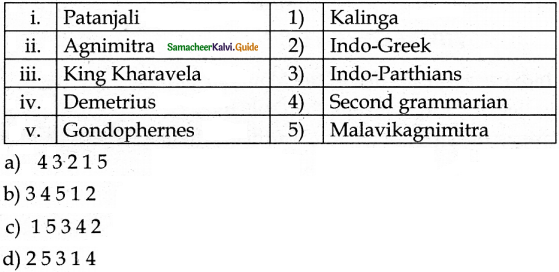
b) 2, 4, 1, 3, 5

Question 2.
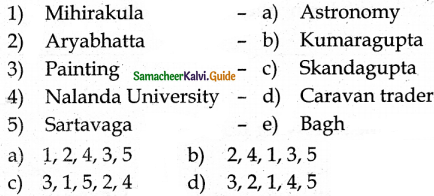
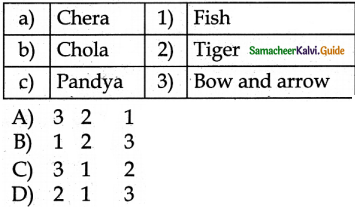
Samacheer Kalvi 6th Social Science Guide History Term 3 Chapter 3 The Age of Empires Guptas and Vardhanas
Answer:
c) 3, 5, 1, 2, 4

VI. Answer in one or two sentences

Question 1.
Who was given the title Kaviraja? Why?
Answer:

  1. The title Kaviraja was given to Samudragupta.
  2. He was a great lover of poetry and music.
  3. In one of the gold coins, he is portrayed playing the harp (Veenai)

Question 2.
What were the subjects taught at Nalanda University?
Answer:

  1. At Nalanda University Buddhism was the main subject of study.
  2. Other subjects like Yoga, Vedic literature, and medicine were also taught.

Question 3.
Explain the Divine Theory of Kingship.
Answer:

  1. The divine theory of Kingship meant that the king is the representative of God on earth.
  2. He is answerable only to God and not to anyone else.

Question 4.
Highlight the achievements of Guptas in metallurgy.
Answer:

  1. Mining and metallurgy were the most flourishing industries during the Gupta period.
  2. The most important evidence of development in metallurgy was the Mehrauli Iron Pillar installed by King Chandragupta in Delhi.
  3. This monolithic iron pillar has lasted through the centuries without rusting.

Samacheer Kalvi 6th Social Science Guide History Term 3 Chapter 3 The Age of Empires: Guptas and Vardhanas

Question 5.
Who were the Huns?
Answer:

  1. Huns were the nomadic tribe, who under their great Attila were terrorizing Rome and Constantinople.
  2. They came to India through Central Asia, defeated Skandagupta, and spread across central India.
  3. Their chief Toromana crowned himself asking.
  4. After him, his son Mihirakula ruled and got finally defeated by Yasodharman, ruler of Malwa.

Question 6.
Name the three kinds of tax collected during Harsha’s reign.
Answer:
A Bhaga, Hiranya, and Bali were three kinds of tax collected during Harsha’s reign.

Question 7.
Name the books authored by Harsha.
Answer:
The books authored by Harsha were Ratnavali, Nagananda, and Priyadharshika.

VII. Answer the following briefly

Question 1.
Write a note on Prashasti.
Answer:

  1. Prashasti is a Sanskrit word, meaning communication or in praise of.
  2. Court poets flattered their kings listing out their achievements.
  3. These accounts were later engraved on pillars so that the people could read them.

Question 2.
Give an account of Samudragupta’s military conquests.
Answer:

  1. Samudragupta was a great general and he carried on a vigorous campaign all over the country.
  2. He defeated the Pallava king Vishnugopa.
  3. He conquered nine kingdoms in northern India.
  4. He reduced 12 rulers of southern India to the status of feudatories and to pay tribute.
  5. He received homage from the rulers of East Bengal, Assam, Nepal, the eastern part of Punjab, and various tribes of Rajasthan.

Question 3.
Describe the land classification during the Gupta period.
Answer:
Classification of land during the Gupta period.

  1. Kshetra – Cultivable land
  2. Khila – Wasteland
  3. Aprahata – Jungle (or) Forest land
  4. Vasti – Habitable land
  5. Gapata saraha – Pastoral and

Samacheer Kalvi 6th Social Science Guide History Term 3 Chapter 3 The Age of Empires: Guptas and Vardhanas

Question 4.
Write about Sresti and Sarthavaha traders.
Answer:

  1. Sresti: Sresti traders were usually settled at a standard place.
  2. Sarthavaha: Sarthavaha traders caravan traders who carried their goods to different places.

Question 5.
Highlight the contribution of Guptas to architecture.
Answer:

  1. From the earlier tradition of rock – out shrines, the Guptas were the first to construct temples.
  2. These temples, adorned with towers and elaborate carvings, were dedicated to all Hindu deities.
  3. The most notable rock-cut caves are found at Ajanta and Ellora, Bagh, and Udaygiri.
  4. The structural temples built during this period resemble the Dravidian style.

Question 6.
Name the works of Kalidasa.
Answer:

  1. Kalidasa’s famous dramas were Sakunthala, Malavikagnimitra and Vikramaoorvashiyam.
  2. Other significant works were Meghaduta, Raghuvamsa, Kumarasambava and Ritusamhara

Question 7.
Estimate Harshvardhana as a poet and a dramatist.
Answer:

  1. Harsha himself was a poet and dramatist.
  2. Around him gathered the best of poets and artists.
  3. His popular works are Ratnavali, Nagananda and Priyadharshika
  4. is royal court was adorned by Banabhatta, Mayura, Hardatta, and Jayasena.

VIII. HOTs

Question 1.
The gold coins issued by Gupta kings indicate ………………
Answer:
(a) the availability of gold mines in the kingdom
(b) the ability of the people to work with gold
(c) the prosperity of the kingdom
(d) the extravagant nature of kings.
Answer:
(c) the prosperity of the kingdom

Question 2.
The famous ancient paintings at Ajanta were painted on __________
a. walls of caves
b. ceilings of temples
c. Rocks
d. papyrus
Answer:
a. walls of caves

Samacheer Kalvi 6th Social Science Guide History Term 3 Chapter 3 The Age of Empires: Guptas and Vardhanas

Question 3.
Gupta period is remembered for ……………….
(a) renaissance in literature and art
(b) expeditions to southern India
(c) invasion of Huns
(d) religious tolerance
Answer:
(a) renaissance in literature and art

Question 4.
What did Indian scientists achieve in astronomy and mathematics during the Gupta period?
Answer:

  1. The invention of zero and the consequent evolution of the decimal system was the legacy of Guptas to the modem world.
  2. Aryabhatta, Varahamihira, and Brahmagupta were the foremost astronomers and mathematicians of the time.
  3. Aryabhatta, in his book ‘ Surya Siddhanta’, explained the true causes of solar and lunar eclipses.
  4. He was the first Indian astronomer to declare that the earth revolves around its own axis.
  5. Dhanvantri was a famous scholar in the field of medicine.
  6. He was a specialist in Ayurveda.
  7. Charaka was a medical scientist.
  8. Susruta was the first Indian to explain the process of surgery.

IX. Student activity (For Students)

  1. Stage any one of the dramas of Kalidasa in the classroom.
  2. Compare and contrast the society of Guptas with that of Mauryas.

X. Life Skills (For Students)

  1. Collect information about the contribution of Aryabhatta, Varahamihira and Brahmagupta to astronomy.
  2. Visit a nearby ISRO centre to know more about satellite launching.

XI. Answer Grid

Question 1.
Who was Toromana?
Answer:
Toromana was the chief of White Huns.

Question 2.
Name the high-ranking officials of the Gupta Empire.
Answer:
Dandanayakas and Maha dandanayakas.

Samacheer Kalvi 6th Social Science Guide History Term 3 Chapter 3 The Age of Empires: Guptas and Vardhanas

Question 3.
Name the Gupta kings who performed AsVamedha yagna.
Answer:
Samudragupta and Kumaragupta I

Question 4.
Name the book which explained the causes for the lunar and solar eclipses,
Answer:
Surya Siddhanta

Question 5.
Name the first Gupta king to find a place on coins.
Answer:
Samudragupta

Question 6.
Which was the main source of information to know about the Samudragupta’s reign?
Answer:
Allahabad Pillar

Samacheer Kalvi 6th Social Science Guide History Term 3 Chapter 3 The Age of Empires: Guptas and Vardhanas

Question 7.
Harsha was the worshipper in the beginning.
Answer:
Shiva

Question 8.
University reached its fame during the Harsha period.
Answer:
The Nalanda

Samacheer Kalvi 6th Social Science The Post-Mauryan India Additional Important Questions and Answers

I. Choose the Correct Answer:

Question 1.
The successor of Sri Gupta ……………
(a) Kumaragupta I
(b) Skandagupta
(c) Vishnugupta
(d) Ghatotkacha
Answer:
(d) Ghatotkacha

Question 2.
Sri Gupta was succeeded by _______
(a) Chandra Gupta
(b) Samundra Gupta
(c) Ghatotkacha
(d) Skanda Gupta
Answer:
(c) Ghatotkacha

Question 3.
The Huhs chief crowned himself as king.
(a) Yasodharman
(b) Attila
(c) Mihirakula
(d) Toromana
Answer:
(d) Toromana

Samacheer Kalvi 6th Social Science Guide History Term 3 Chapter 3 The Age of Empires: Guptas and Vardhanas

Question 4.
Srimeghavarman was the ruler of _______
(a) Singapore
(b) Ceylon
(c) Malaysia
(b) Hansena
Answer:
(b) Ceylon

Question 5.
The place Harsha went to participate in the great Kumbhamela held.
(a) Allahabad
(b) Kasi
(c) Ayodhya
(d) Prayag
Answer:
(d) Prayag

II. Match the statement with the reason and tick the appropriate answer

Question 1.
Assertion (A) : The last of the great Guptas Narasimha Gupta I was paying tribute to Mihirakula.
Reason (R) : He stopped paying tribute to Mihirakula’s hostility towards Buddhism.
(a) Both A and R are true and R is the correct explanation of A.
(b) Both A and R are correct but R is not the correct explanation of A.
(c) A is correct but R is not correct
(d) A is not correct but R is correct
Answer:
(b) Both A and R are correct but R is not the correct explanation of A

Question 2.
Statement I : Criminal law was not more severe than that of the Gupta age.
Statement II : Death punishment was the punishment for violation of the laws and for plotting against the king.
(a) Statement I is wrong but statement II is correct
(b) Statement II is wrong but statement I is correct.
(c) Both the statements are correct.
(d) Both the statements are wrong.
Answer:
d) Both the statements are wrong

III. Fill in the blanks

  1. In the assembly at ……………. Harsha distributed his wealth.
  2. The capital of China ……………. was a great center of art and learning.
  3. ……………. was the wife of Chandragupta I.
  4. The military campaigns of kings were financed through revenue ……………..
  5. The peasants were required to pay various taxes and were reduced to the position of ……………..

Answer:

  1. Prayag
  2. Xian
  3. Kumaradevi
  4. Surpluses
  5. serfs

IV. Match the following

Samacheer Kalvi 6th Social Science Guide History Term 3 Chapter 3 The Age of Empires Guptas and Vardhanas
Answer:
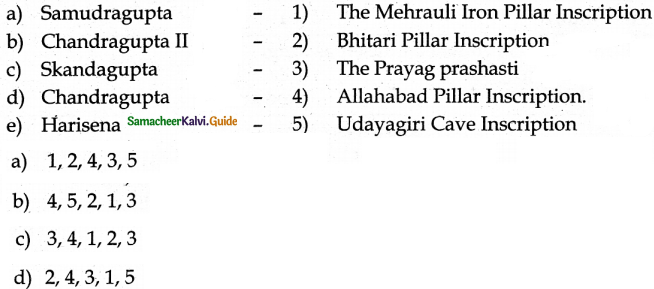
b) 4, 5, 2, 1, 3

V. Answer in one or two sentences

Question 1.
Write a note on ‘Lichchhavi’.
Answer:

  1. Lichchhavi was an old gana – Sanga and its territory lay between the Ganges and the Nepal Terai.
  2. Chandragupta, I married Kumaradevi of the famous and powerful lichchhavi family.

Question 2.
How did Chandragupta I crown himself the monarch of a larger kingdom?
Answer:

  1. Chandragupta, I married Kumaradevi of the famous and powerful Lichchhavi family.
  2. With the support of this family, Chandragupta eliminated various small states and| crowned himself the monarch of a larger kingdom.

Question 3.
What did the travel accounts of Fahien provide information about the condi¬tions of the people of Magadha?
Answer:

  1. According to Fahien the people of Magadha were happy and prosperous.
  2. Gaya was desolated. Kapilvasthu had become a jungle, but at Pataliputra people were rich and prosperous.

VII. Answer the following briefly

Question 1.
Name the officials employed by the Gupta rulers.
Answer:

  1. High – ranking officials were called dandanayakas and mahadandnayakas.
  2. The provinces known as deshas or bhuktis were administered by the governors designated as Uparikas. The districts such as vaishyas, were controlled by vishyapatis. At the village level, gramika and gramadhyaksha were the functionaries.
  3. The military designations.
  4. Baladhikrita (Commander of infantry)
  5. Mahabaladhikrita (Commander of the cavalry)
  6. Dutakas (spies)

Samacheer Kalvi 6th Social Science Guide History Term 3 Chapter 3 The Age of Empires: Guptas and Vardhanas

Question 2.
Mention the importance of Fahien’s travel accounts.
Answer:

  1. During the reign of Chandragupta II, the Buddhist monk Fahien visited India.
  2. His travel accounts provided us information about the socio-economic, religious and moral conditions of the people of the Gupta age.
  3. According to Fahien, the people of Magadha were happy and prosperous.
  4. Justice was mildly administered and there was no death penalty.
  5. Gaya was desolated, Kapilavasthu had become a jungle, but at Pataliputra, people were rich and prosperous.

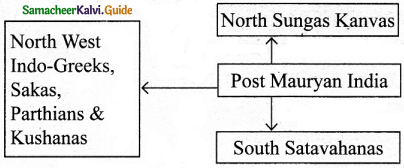
VIII. Mind map
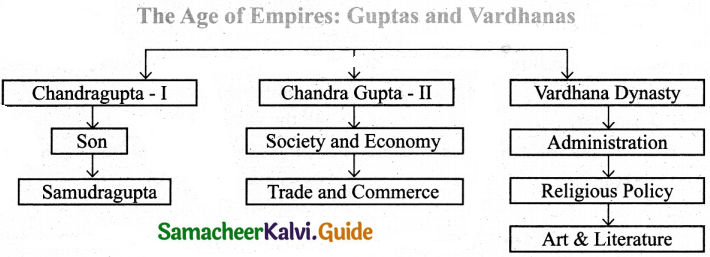
Samacheer Kalvi 6th Social Science Guide History Term 3 Chapter 3 The Age of Empires Guptas and Vardhanas

Tamil Nadu 11th Maths Model Question Paper 4 English Medium

Students can Download Tamil Nadu 11th Maths Model Question Paper 4 English Medium Pdf, Tamil Nadu 11th Maths Model Question Papers helps you to revise the complete Tamilnadu State Board New Syllabus, helps students complete homework assignments and to score high marks in board exams.

TN State Board 11th Maths Model Question Paper 4 English Medium

General Instructions:

  1. The question paper comprises of four parts.
  2. You are to attempt all the parts. An internal choice of questions is provided wherever applicable.
  3. All questions of Part I, II, III and IV are to be attempted separately.
  4. Question numbers 1 to 20 in Part I are Multiple Choice Questions of one mark each.
    These are to be answered by choosing the most suitable answer from the given four alternatives and writing the option code and the corresponding answer
  5. Question numbers 21 to 30 in Part II are two-mark questions. These are to be answered in about one or two sentences.
  6. Question numbers 31 to 40 in Part III are three-mark questions. These are to be answered in above three to five short sentences.
  7. Question numbers 41 to 47 in Part IV are five-mark questions. These are to be answered in detail Draw diagrams wherever necessary.

Time: 2:30 Hours
Maximum Marks: 90

PART – I

I. Choose the correct answer. Answer all the questions: [20 × 1 = 20]

Question 1.
If n(A) = 2 and n(B∪C) = 3 then n[(A × B) ∪ (A × C)] is ………………..
(a) 23
(b) 32
(c) 6
(d) 5
Answer:
(c) 6

Tamil Nadu 11th Maths Model Question Paper 4 English Medium

Question 2.
For any two sets A and B, A∩(A∪B) = …………………….
(a) B
(b) ∅
(c) A
(d) none of these
Answer:
(c) A

Question 3.
cos 1° + cos 2° + cos 3° + cos 4° + cos 179° = …………………
(a) 0
(b) 1
(c) -1
(d) 89
Answer:
(a) 0

Tamil Nadu 11th Maths Model Question Paper 4 English Medium

Question 4.
The value of log9 27 is ……………………
(a) \(\frac{2}{3}\)
(b) \(\frac{3}{2}\)
(c) \(\frac{3}{4}\)
(d) \(\frac{4}{3}\)
Answer:
(b) \(\frac{3}{2}\)

Question 5.
The value of \(\frac{\sin 3 \theta+\sin 5 \theta+\sin 7 \theta+\sin 9 \theta}{\cos 3 \theta+\cos 5 \theta+\cos 7 \theta+\cos 9 \theta}\) = ………………..
(a) tan3θ
(b) tan6θ
(c) cot3θ
(d) cot6θ
Answer:
(b) tan6θ

Question 6.
In 3 fingers the number of ways 4 rings can be worn in ……………………. ways.
(a) 43 – 1
(b) 34
(c) 68
(d) 64
Answer:
(d) 64

Tamil Nadu 11th Maths Model Question Paper 4 English Medium

Question 7.
Everybody in a room shakes hands with everybody else. The total number of shake hands is 66. The number of persons in the room is ……………….
(a) 11
(b) 12
(c) 10
(d) 6
Answer:
(b) 12

Question 8.
The H.M of two positive number whose AM and G.M. are 16, 8 respectively is ………………..
(a) 10
(b) 6
(c) 5
(d) 4
Answer:
(d) 4

Tamil Nadu 11th Maths Model Question Paper 4 English Medium

Question 9.
The co-efficient of the term independent of x in the expansion of (2x+\(\frac{1}{3x}\))6 is …………………
(a) \(\frac{160}{27}\)
(b) \(\frac{160}{27}\)
(c) \(\frac{80}{3}\)
(d) \(\frac{80}{9}\)
Answer:
(a) \(\frac{160}{27}\)

Question 10.
The value of \(\left|\begin{array}{lll}
a & 0 & 0 \\
0 & b & 0 \\
0 & 0 & c
\end{array}\right|^{2}\) is ………………..
(a) abc
(b) -abc
(c) 0
(d) a2b2c2
Answer:
(d) a2b2c2

Tamil Nadu 11th Maths Model Question Paper 4 English Medium

Question 11.
The value of x for which the matrix A = \(\left[\begin{array}{cc}
e^{x-2} & e^{7+x} \\
e^{2+x} & e^{2 x+3}
\end{array}\right]\) is singular is …………………..
(a) 9
(b) 8
(c) 7
(d) 6
Answer:
(b) 8

Question 12.
If |\(\vec { a } \) + \(\vec { b } \)| = 60, |\(\vec { a } \) – \(\vec { b } \)| = 40 and |\(\vec { b } \)| = 46 then |\(\vec { a } \)| is …………………
(a) 42
(b) 12
(c) 22
(d) 32
Answer:
(c) 22

Tamil Nadu 11th Maths Model Question Paper 4 English Medium

Question 13.
Given \(\vec { a } \) = 2\(\vec { i } \) + \(\vec { j } \) – 8\(\vec { k } \) and \(\vec { b } \) = \(\vec { i } \) + 3\(\vec { j } \) – 4\(\vec { k } \) then |\(\vec { a } \) + \(\vec { b } \)| = ………………….
(a) 13
(b) \(\frac{13}{3}\)
(c) \(\frac{4}{13}\)
(d) \(\frac{3}{13}\)
Answer:
(a) 13

Question 14.
If f(x) = \(\left\{\begin{array}{ccc}
k x & \text { for } & x \leq 2 \\
3 & \text { for } & 2
\end{array}\right.\) is continous at x = 2 then the value of k is ……………………
(a) \(\frac{3}{4}\)
(b) 0
(c) 1
(d) \(\frac{4}{3}\)
Answer:
(c) 1

Tamil Nadu 11th Maths Model Question Paper 4 English Medium

Question 15.
If f: R→R is defined by f(x) = |x – 3| + |x – 4| for x∈R then \(\lim _{x \rightarrow 3^{-}}\) f(x) is equal to ………………..
(a) -2
(b) -1
(c) 0
(d) 1
Answer:
(c) 0

Question 16.
\(\lim _{x \rightarrow \infty}\left(\frac{x^{2}+5 x+3}{x^{2}+x+3}\right)^{x}\) is ………………..
(a) e4
(b) e2
(c) e3
(d) 1
Answer:
(a) e4

Tamil Nadu 11th Maths Model Question Paper 4 English Medium

Question 17.
\(\int \frac{e^{x}\left(x^{2} \tan ^{-1} x+\tan ^{-1} x+1\right)}{x^{2}+1}\) dx is ………………..
(a) e tan-1(x + 1)
(b) tan-1(ex) + c
(c) ex \(\frac{\left(\tan ^{-1} x\right)^{2}}{2}\) + c
(d) extan-1x + c
Answer:
(d) extan-1x + c

Question 18.
∫ \(\frac { secx }{ \sqrt { cos2x } } \) dx = …………………..
(a) tan-1(sin x) + c
(b) 2 sin-1(tan x) + c
(c) tan-1(cos x) + c
(d) sin-1 (tan x) + c
Answer:
(d) sin-1 (tan x) + c

Tamil Nadu 11th Maths Model Question Paper 4 English Medium

Question 19.
\(\int \frac{e^{6 \log x}-e^{5 \log x}}{e^{4 \log x}-e^{3 \log x}}\) dx = ………………..
(a) x + c
(b) \(\frac { x^{ 3 } }{ 3 } \) + c
(c) \(\frac { 3 }{ x^{ 3 } } \) + c
(d) \(\frac { 1 }{ x^{ 2 } } \) + c
Answer:
(b) \(\frac { x^{ 3 } }{ 3 } \) + c

Question 20.
It is given that the events A and B are such that P(A) = \(\frac{1}{4}\), P(A/B) = \(\frac{1}{2}\), P(B/A) = \(\frac{2}{3}\) then P(B) = …………………
(a) \(\frac{1}{6}\)
(b) \(\frac{1}{3}\)
(c) \(\frac{2}{3}\)
(d) \(\frac{1}{2}\)
Answer:
(b) \(\frac{1}{3}\)

PART – II

II. Answer any seven questions. Question No. 30 is compulsory. [7 × 2 = 14]

Question 21.
In the set Z of integers, define mRn if m – n is a multiple of 12. Prove that R is an equivalence relation?
Answer:
As m – m = 0 and 0 = 0 × 12, we have 0 is a multiple of 12; hence mRm proving that R is reflexive.
Let mRn. Then m – n = 12k for some integer k; thus n – m = 12(-k) and hence nRm.
This shows that R is symmetric.
Let mRn and nRp: then m – n = 12k and n – p = 12l for some integers k and l.
So m – p = 12(k + l) and hence mRp. This shows that R is transitive.
Thus R is an equivalence relation.

Tamil Nadu 11th Maths Model Question Paper 4 English Medium

Question 22.
Simplify:
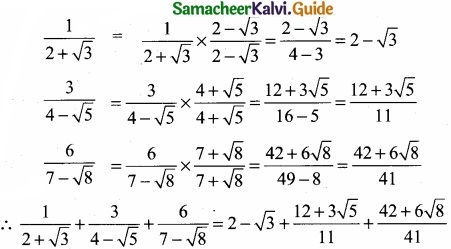
\(\frac { 1 }{ 2+\sqrt { 3 } } \) + \(\frac { 3 }{ 4-\sqrt { 5 } } \) + \(\frac { 6 }{ 7-\sqrt { 8 } } \)
Answer:
Tamil Nadu 11th Maths Model Question Paper 4 English Medium img 1

Question 23.
Find the value of sin 22 \(\frac{1}{2}\)°?
Answer:
We know that cos θ = 1 – 2 sin2 \(\frac{θ}{2}\) ⇒ sin \(\frac{θ}{2}\) = ±\(\sqrt { \frac { 1-cos2\theta }{ 2 } } \)
Take θ = 45°, we get sin \(\frac{45°}{2}\) = ±\(\sqrt { \frac { 1-cos45°}{ 2 } } \), (taking positive sign only, since 22\(\frac{1}{2}\)° lies in the first quadrant)
Thus, sin 22\(\frac{1}{2}\)° = \(\sqrt{\frac{1-\frac{1}{\sqrt{2}}}{2}}=\frac{\sqrt{2-\sqrt{2}}}{2}\).

Tamil Nadu 11th Maths Model Question Paper 4 English Medium

Question 24.
The number of bacteria in a certain culture doubles every hour. If there were 30 bacteria present in the culture originally, how many bacteria will be present at the end of 2nd hour, 4th
hour and wth hour?
Answer:
No. of bacteria at the beginning = 30
No. of bacteria after 1 hour = 30 × 2 = 60
No. of bactena after 2 hours = 30 × 22 = 30 × 4 = 120
No. of bacteria after 4 hours = 30 × 24 = 30 × 16 = 480
No. of bacteria after nth hour = 30 × 2n

Tamil Nadu 11th Maths Model Question Paper 4 English Medium

Question 25.
If the sum of the distance of a moving point in a plane from the axis is 1, then find the locus of the point?
Answer:
Let coordinates of a moving point P be (x, y).
Given that the sum of the distances from the axis to the point is always 1.
∴|x| + |y| = 1 ⇒ x + y = 1
⇒- x- y = 1 ⇒ x + y = 1
⇒ x – y = 1
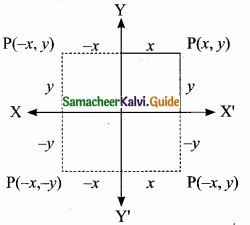
Hence, these equations give us the locus of the point P which is a square.
Tamil Nadu 11th Maths Model Question Paper 4 English Medium

Question 26.
If (a, a + b, a + b + c) is one set of direction ratios of the line joining (1, 0, 0) and (0, 1, 0) then find a set of values of a, b, c?
Answer:
Let A be the point (1, 0, 0) and B be the point (0, 1, 0) (i.e.,) \(\overline { OA } \) = \(\hat { i } \) and \(\overline { OB } \) = \(\hat { j } \).
Then \(\overline { AB } \) = \(\overline { OB } \) – \(\overline { OA } \) = \(\hat { j } \) – \(\hat { i } \) = –\(\hat { i } \) + \(\hat { j } \)
= (-1, 1, 0)
= (a, a + b, a + b + c)
⇒ a = -1, a + b = 1 and a + b + c = 0
⇒ a = -1, ⇒ -1 + b = 1; a + b + c = 0
⇒ b = 2; -1 + 2 + c = 0 ⇒ c + 1 = 0
⇒ c = -1
∴ a = -1, b = 2, c = -1.
Note: if we taken \(\overline { BA } \) then we get a = 1, b = -2 and c = 1.

Tamil Nadu 11th Maths Model Question Paper 4 English Medium

Question 27.
Find \(\frac{dy}{dx}\) for y = (x2 + 4x + 6)5
Answer:
Let u = x2 + 4x + 6
⇒ \(\frac{du}{dx}\) = 2x + 4
Now y = u5 = \(\frac{dy}{du}\) = 5u4
∴ \(\frac{dy}{dx}\) = \(\frac{dy}{du}\) × \(\frac{du}{dx}\) = 5u4 (2x + 4)
= 5(x2 + 4x + 6)4 (2x + 4)
= 5(2x + 4) (x2 + 4x + 6)4

Question 28.
Evaluate ∫\(\sqrt { 25x^{ 2 }-9 } \) dx?
Answer:
Tamil Nadu 11th Maths Model Question Paper 4 English Medium

Question 29.
A bag contains 5 white and 7 black balls. 3 balls are drawn at random. Find the probability that

  1. all are white
  2. one white and 2 black.

Answer:
Number of white balls = 5
Number of black balls = 7
Total number of balls = 12
Selecting 3 from 12 balls can be done in
12C3 = \(\frac{12 \times 11 \times 10}{3 \times 2 \times 1}\) = 220 ways
∴n(S) = 220

1. Let A be the selecting 3 white balls.
∴n(A) = 5C3 = 5C2 = \(\frac{5×3}{2×1}\) = 10
∴P(A) = \(\frac{n(A)}{n(S)}\) = \(\frac{10}{220}\) = \(\frac{1}{22}\)

2. Let B be the event of selecting one white and 2 black balls.
∴n(B) = 5C1 × 7C2 = (5) (\(\frac{7×6}{2×1}\)) = 5(21) = 105
∴P(B) = \(\frac{n(B)}{n(S)}\) = \(\frac{105}{220}\) = \(\frac{21}{44}\).

Tamil Nadu 11th Maths Model Question Paper 4 English Medium

Question 30.
If (k, 2), (2, 4) and (3, 2) are vertices of the triangle of area 4 square units then determine the value of k?
Answer:
Area of ∆ with vertices (k, 2) (2, 4) and (3, 2) = \(\frac{1}{2}\) \(\left|\begin{array}{lll}
k & 2 & 1 \\
2 & 4 & 1 \\
3 & 2 & 1
\end{array}\right|\) = 4 given
⇒ \(\left|\begin{array}{lll}
k & 2 & 1 \\
2 & 4 & 1 \\
3 & 2 & 1
\end{array}\right|\) = 2(4) = 8
(i.e.,) k(4 – 2) – 2(2 – 3) + 1(4 – 12) ± 8
(i.e.,) 2k – 2(-1) + 1(-8) = ± 8
(i.e.,) 2k + 2 – 8 = 8
(i.e.,) 2k = 8 + 8 – 2 = 14
k = 14/2 = 7
∴k = 7
So k = 7 (or) k = -1.

2k + 2 – 8 = -8
⇒2k = – 8 + 8 – 2
2k = – 2
k = -1

PART – III

III. Answer any seven questions. Question No. 40 is compulsory. [7 × 3 = 21]

Question 31.
In the set Z of integers define mRn if m – n is a multiple of 12. Prove that R is an equivalence relation?

Question 32.
Prove that \(\frac{sin4x+sin2x}{cos4x+cos2x}\) = tan 3x?

Tamil Nadu 11th Maths Model Question Paper 4 English Medium

Question 33.
A polygon has 90 diagonals. Find the number of its sides?

Question 34.
If n is an odd positive integer, prove that the coefficients of the middle terms in the expansion of (x + y)n are equal?

Question 35.
Find the equation of the line passing through the point (1, 5) and also divides the co-ordinate axes in the ratio 3 : 10?

Tamil Nadu 11th Maths Model Question Paper 4 English Medium

Question 36.
Prove that \(\left|\begin{array}{ccc}
1 & x & x \\
x & 1 & x \\
x & x & 1
\end{array}\right|^{2}=\left|\begin{array}{ccc}
1-2 x^{2} & -x^{2} & -x^{2} \\
-x^{2} & -1 & x^{2}-2 x \\
-x^{2} & x^{2}-2 x & -1
\end{array}\right|\)

Question 37.
If G is the centroid of a traiangle ABC prove that \(\overline { GA } \) + \(\overline { GB } \) + \(\overline { GC } \) = 0

Tamil Nadu 11th Maths Model Question Paper 4 English Medium

Question 38.
Find \(\frac{dy}{dx}\) for y = \(\sqrt { 1+tan2x } \)?

Question 39.
Evaluate \(\frac { \sqrt { x } }{ 1+\sqrt { x } } \) dx?

Question 40.
Find the relation between a and b if \(\underset { x\rightarrow 3 }{ lim } \) f(x) exists where f(x) = \(\left\{\begin{array}{cc}
a x+b & \text { if } x>3 \\
3 a x-4 b+1 \text { if } x<3
\end{array}\right.\)

PART – IV

IV. Answer all the questions. [7 × 5 = 35]

Question 41 (a).
From the curve y = |x|, draw(i) y = |x-1| + 1

  1. y = |x + 1| + 1
  2. y = |x + 2| – 3

[OR]

(b) Resolve into partial fraction \(\frac { x+4 }{ (x^{ 2 }-4)(x+1) } \)

Tamil Nadu 11th Maths Model Question Paper 4 English Medium

Question 42 (a).
Find the number of positive integers greater than 6000 and less than 7000 which arc divisible by 5, provided that no digit is to be repeated?

[OR]

(b) If nPr = nPr+1 and nCr = nCr-1, find the values of n and r?

Question 43 (a).
In a ∆ABC, prove that b2 sin 2C + c2 sin 2B = 2bc sin A?

[OR]

(b) Differentiate the following s(t) = \(\sqrt[4]{\frac{t^{3}+1}{t^{3}-1}}\)?

Tamil Nadu 11th Maths Model Question Paper 4 English Medium

Question 44 (a).
Find the equation of the lines make an angle 60° with the positive x axis and at a distance 5\(\sqrt{2}\) units measured from the point (4, 7) along the line x – y + 3 = 0

[OR]

(b) If y = A cos4x + B sin 4x, A and B are constants then Show that y2 + 16y = 0

Tamil Nadu 11th Maths Model Question Paper 4 English Medium

Question 45 (a).
Find the sum up to the 17th term of the series \(\frac{1^{3}}{1}+\frac{1^{3}+2^{3}}{1+3}+\frac{1^{3}+2^{3}+3^{3}}{1+3+5}\) + …………..

[OR]

(b) A shopkeeper in a Nuts and Spices shop makes gifi packs of cashew nuts, raisins and almonds?

  1. Pack I contains 100 gm of cashew nuts, 100 gm of raisins and 50 gm of almonds.
  2. Pack-II contains 200 gm of cashew nuts, 100 gm of raisins and 100 gm of almonds.
  3. Pack-III contains 250 gm of cashew nuts, 250 gm of raisins and 150 gm of almonds.
  4. The cost of 50 gm of cashew nuts is ₹50, 50 gm of raisins is ₹10. and 50gm of almonds is ₹60. What is the cost of each gift pack?

Tamil Nadu 11th Maths Model Question Paper 4 English Medium

Question 46 (a).
Find matrix C if A = \(\begin{bmatrix} 3 & 7 \\ 2 & 5 \end{bmatrix}\), B = \(\begin{bmatrix} -3 & 2 \\ 4 & -1 \end{bmatrix}\) and 5C + 28= A?

[OR]

(b) The probability that a new railway bridge will get an award for its design is 0.48, the probability that it will get an award for the efficient use of materials is 0.36, and that it will get both awards is 0.2. What is the probability, that

  1. it will get at least one of the two awards
  2. it will get only one of the awards.

Tamil Nadu 11th Maths Model Question Paper 4 English Medium

Question 47 (a).
\(\underset { \alpha \rightarrow 0 }{ lim } \) \(\frac { sin(\alpha ^{ n }) }{ (sin\alpha )^{ m } } \)

[OR]

(b) Evaluate I = sin-1 (\(\frac { 2x }{ (1+x)^{ 2 } } \)) dx?

Tamil Nadu 11th Chemistry Model Question Paper 1 English Medium

Students can Download Tamil Nadu 11th Chemistry Model Question Paper 1 English Medium Pdf, Tamil Nadu 11th Chemistry Model Question Papers helps you to revise the complete Tamilnadu State Board New Syllabus, helps students complete homework assignments and to score high marks in board exams.

TN State Board 11th Chemistry Model Question Paper 1 English Medium

General Instructions:

  1. The question paper comprises of four parts.
  2. You are to attempt all the parts. An internal choice of questions is provided wherever applicable.
  3. All questions of Part I, II, III and IV are to be attempted separately.
  4. Question numbers 1 to 15 in Part I are Multiple Choice Questions of one mark each.
    These are to be answered by choosing the most suitable answer from the given four alternatives and writing the option code and the corresponding answer
  5. Question numbers 16 to 24 in Part II are two-mark questions. These are to be answered in about one or two sentences.
  6. Question numbers 25 to 33 in Part III are three-mark questions. These are to be answered in about three to five short sentences.
  7. Question numbers 34 to 38 in Part IV are five-mark questions. These are to be answered in detail Draw diagrams wherever necessary.

Time: 2:30 Hours
Maximum Marks: 70

PART – I

Answer all the Questions: [15 × 1 = 15]
Choose the most suitable answer from the given four alternatives.

Question 1.
1 g of an impure sample of magnesium carbonate (containing no thermally decomposable impurities) on complete thermal decomposition gave 0.44 g of carbon dioxide gas. The percentage of impurity in the sample is …………………….
(a) 0%
(b) 4.4%
(c) 16%
(d) 8.4%
MgCO3 → MgO + CO2
MgCO3: (1 × 24) + (1 × 12) + (3 × 16) = 84g
CO2: (1 × 12) + (2 × 16) = 44g
100% pure 84 g MgCO3 on heating gives 44 g CO2
Given that 1 g of MgCO3 on heating gives 0.44 g CO2
Therefore, 84 g MgCO3 sample on heating gives 36.96 g CO2
Percentage of purity of the sample = \(\frac { 100% }{ 44gCO_{ 2 } } \) × 36.96 g CO2 = 84%
Percentage of impurity = 16%
Answer:
(c) 16%

Tamil Nadu 11th Chemistry Model Question Paper 1 English Medium

Question 2.
The electronic configuration of Eu (atomic no. 63) Gd (atomic no. 64) and Tb (atomic no. 65) are …………………….. [NEET – Phase II]
(a) [Xe] 4f6 5d1 6s2, [Xe] 4f7 5d1 6s2 and [Xe] 4f8 5d1 6s2
(b) [Xe] 4f7 6s2 [Xe] 4f8 6s2 and [Xe] 4f9 6s2
(c) [Xe] 4f7 6s2 [Xe] 4f7 5d1 6s2 and [Xe] 4f9 6s2
(d) [Xe] 4f 6 5d1 6s2, [Xe] 4f7 5d1 6s2 and [Xe] 4f9 6s2
Solution:
Eu : [Xe] 4f7, 5d0, 6s2
Gd : [Xe] 4f7, 5d1, 6s2
Tb : [Xe] 4f9, 5d0, 6s2
Answer:
(b) [Xe] 4f7 6s2 [Xe] 4f8 6s2 and [Xe] 4f9 6s2

Tamil Nadu 11th Chemistry Model Question Paper 1 English Medium

Question 3.
Match the following:

Tamil Nadu 11th Chemistry Model Question Paper 1 English Medium img 1

Answer:

Tamil Nadu 11th Chemistry Model Question Paper 1 English Medium img 2

Question 4.
Various successive ionization enthalpies (in kJ mol-1) of an element are given below.

Tamil Nadu 11th Chemistry Model Question Paper 1 English Medium img 3

The element is ……………………….
(a) Phosphorus
(b) Sodium
(c) Aluminium
(d) Silicon
Answer:
(c) Aluminium

Question 5.
Non-stoichiometric hydrides are formed by ……………………..
(a) Palladium, vanadium
(b) Carbon, nickel
(c) Manganese, lithium
(d) Nitrogen, chlorine
Answer:
(a) Palladium, vanadium

Tamil Nadu 11th Chemistry Model Question Paper 1 English Medium

Question 6.
Which is the function of sodium – potassium pump?
(a) Maintenance of ion balance
(b) Used in nerve impulse conduction
(c) Transmitting nerve signals
(d) Regulates the blood level
Answer:
(c) Transmitting nerve signals

Question 7.
∆S is expected to be maximum for the reaction ………………………
(a) Ca(s) + 1/2O2(g) → CaO(s)
(b) C(s) + O2(g) → CO2(g)
(c) N2(g) + O2(g) → 2NO(g)
(d) CaCO3(s) → CaO(s) + CO2(g)
Solution:
In CaCO3(s) → CaO(s) + CO2(g) entropy change is positive. In (a) and (b) entropy change is negative; in (c) entropy change is zero.
Answer:
(d) CaCO3(s) → CaO(s) + CO2(g)

Tamil Nadu 11th Chemistry Model Question Paper 1 English Medium

Question 8.
Which one of the following is a reversible reaction?
(a) Ripening of a banana
(b) Rusting of iron
(c) Tarnishing of silver
(d) Transport of oxygen by Hemoglobin in our body
Solution:
All the other three reactions are irreversible reactions. But the hemoglobin combines with O2 in lungs to form oxyhemoglobin. The oxyhemoglobin has a tendency to form hemoglobin by releasing O2. So it is a reversible reaction.
Answer:
(d) Transport of oxygen by Hemoglobin in our body

Question 9.
P1 and P2 are the vapour pressures of pure liquid components, 1 and 2 respectively of an ideal binary solution if x1 represents the mole fraction of component 1, the total pressure of the solution formed by 1 and 2 will be ………………………….
Solution:
(a) P1 + x1 (P2 – P1)
(b) P2 – x1 (P2 + P1)
(c) P1 – x2 (P1 – P2)
(d) P1 + x2 (P1 – P2)
Ptotal = P1 + P2
= P1x1 + P2 x2
= P1(1 – x2) + P2x2 [∵x1 + x2 = 1, x1 = 1 – x2]
= P1 – P1x2 + P2x2 = P1 – x2 = P1 – x2 (P1 – P2)
Answer:
(c) P1 – x2 (P1 – P2)

Tamil Nadu 11th Chemistry Model Question Paper 1 English Medium

Question 10.
Which of the following molecule contain no n bond?
(a) SO2

Tamil Nadu 11th Chemistry Model Question Paper 1 English Medium img 4

(b) NO2

Tamil Nadu 11th Chemistry Model Question Paper 1 English Medium img 5

(c) CO2

Tamil Nadu 11th Chemistry Model Question Paper 1 English Medium img 6

(d) H2O

Tamil Nadu 11th Chemistry Model Question Paper 1 English Medium img 7

Solution:
Water (H2O) contains only σ bonds and no π bonds.
Answer:
(d) H2O

Tamil Nadu 11th Chemistry Model Question Paper 1 English Medium img 7

Question 11.
IUPAC name of Tamil Nadu 11th Chemistry Model Question Paper 1 English Medium img 8 is …………………….
(a) Trimethylheptane
(b) 2 -Ethyl -3, 3- dimethyl heptane
(c) 3, 4, 4 – Trimethyloctane
(d) 2 – Butyl -2 -methyl – 3 – ethyl-butane.
Answer:
(c) 3, 4, 4 – Trimethyloctane

Question 12.
Which one of the following is an example for free radical initiators?
(a) Benzoyl peroxide
(b) Benzyl alcohol
(c) Benzyl acetate
(d) Benzaldehyde.
Answer:
(a) Benzoyl peroxide

Question 13.
Some meta-directing substituents in aromatic substitution are given. Which one is most – deactivating?
(a) – COOH
(b) – NO2
(C) – C ≡ N
(d) – SO3H
Answer:
(b) – NO2

Tamil Nadu 11th Chemistry Model Question Paper 1 English Medium

Question 14.
Consider the following statements.
(I) SN2 reaction is a bimolecular nucleophilic first order reaction.
(II) SN2 reaction take place in one step.
(III) SN2 reaction involves the formation of a carbocation. Which of the above statements is/are not correct?
(a) (II)
(b) (I) only
(c) (I) & (III)
(d) (III)
Answer:
(c) (I) & (III)

Question 15.
The questions given below consists of an assertion and the reason. Choose the correct option out of the choices given below each question.
Assertion (A): If BOD level of water in a reservoir is more than 5 ppm it is highly polluted.
Reason(R): High biological oxygen demand means high activity of bacteria in water.
(a) Both (A) and R are correct and (R) is the correct explanation of (A)
(b) Both (A) and R are correct and (R) is not the correct explanation of (A)
(c) Both (A) and R are not correct
(d) (A) is correct but( R) is not correct
Answer:
(d) (A) is correct but( R) is not correct

PART – II

Answer any six questions in which question No. 24 is compulsory. [6 × 2 = 12]

Question 16.
What is the actual configuration of copper (Z = 29)? Explain about its stability?
Answer:
Copper (Z = 29)
Expected configuration : 1s2 2s2 2p6 3s2 3p6 3d9 4s2
Actual configuration : 1s2 2s2 2p6 3s2 3p6 3d10 4s1
The reason is that fully filled orbitals have been found to have extra stability.

Copper has the electronic configuration [Ar] 3d10 4s1 and not [Ar] 3d9 4s2 due the symmetrical distribution and exchange energies of d electrons.

Symmetry leads to stability. The full filled configuration have symmetrical distribution of electrons and hence they are more stable than unsymmetrical configuration.

Tamil Nadu 11th Chemistry Model Question Paper 1 English Medium

Question 17.
What is screening effect?
Answer:
Screening effect:
The repulsive force between inner shell electrons and the valence electrons leads to a decrease in the electrostatic attractive forces acting on the valence electrons by the nucleus. Thus the inner shell elections act as a shield between the nucleus and the valence electrons. This effect is called shielding effect (or) screening effect.

Question 18.
Ice is less dense than water at 0°C. Justify this statement?
Answer:
In ice, each oxygen atom is surrounded tetrahedrally by through hydrogen bonds to four water molecules. That is, the presence of two hydrogen atoms and two lone electron pairs (on oxygen) in each water molecule results in a three-dimensional structure. The arrangements creates an open structure, which in turn accounts for the fact that ice is less dense than water at 0°C.

Tamil Nadu 11th Chemistry Model Question Paper 1 English Medium

Question 19.
Aerosol cans carry clear warning of heating of the can. Why?
Answer:
Aerosol cans carry clear warning of heating of the can. As the temperature rises, pressure in the can will increase and ambient temperatures about 120°F may lead to explosions.

So aerosol cans should always be stored in dry areas where they will not be exposed to excessive temperatures. You should never throw an aerosol can onto a fire, or leave it in the direct sunlight, even it is empty. This is because the pressure will build up so much that the can will burst. It is due to 2 reasons.

  1. The gas pressure increases.
  2. More of the liquefied propellant turns into a gas.

Question 20.
One mole of PCl5 is heated in one litre closed container. If 0.6 mole of chlorine is found at equilibrium, calculate the value of equilibrium constant?
Answer:
Given that [PCl5]initial = \(\frac { 1mol }{ dm^{ 3 } } \)
[Cl2]eq = 0.6 mol dm-3
PCl5⇄ PCl3 + Cl2
[PCl5]eq = 0.6 mole dm-3
[PCl5]eq = 0.4 mole dm-3
∴ KC = \(\frac{0.6×0.6}{0.4}\)
KC = 0.9

Tamil Nadu 11th Chemistry Model Question Paper 1 English Medium

Question 21.
Why do gases always tend to be less soluble in liquids as the temperature is raised?
Answer:
Mostly dissolution of gases in liquid is an exothermic process. It is because the fact that this process involves decrease of entropy.

Thus, increase of temperature tends to push the equilibrium towards backward direction as a result of which solubility of the gas decrease with rise in temperature.
(Gas + Solvent ⇄ Solution + Heat)

Question 22.
Give the general formula for the following classes of organic compounds?
(a) Aliphatic monohydric alcohol
(b) Aliphatic ketones
(c) Aliphatic amines.
Answer:
(a) Aliphatic monohydric alcohol
Tamil Nadu 11th Chemistry Model Question Paper 1 English Medium img 9

(b) Aliphatic ketones
Tamil Nadu 11th Chemistry Model Question Paper 1 English Medium img 10

(c) Aliphatic amines
Tamil Nadu 11th Chemistry Model Question Paper 1 English Medium img 11

Tamil Nadu 11th Chemistry Model Question Paper 1 English Medium

Question 23.
Identify which of the following shows +1 and -I effect?

(I) -NO2
(II) -SO3H
(III) -I
(IV) -OH
(V) CH3O
(VI) CH3-

Answer:
Tamil Nadu 11th Chemistry Model Question Paper 1 English Medium img 12

Question 24.
Write the products A & B for the following reaction?
Tamil Nadu 11th Chemistry Model Question Paper 1 English Medium img 13
Answer:
Tamil Nadu 11th Chemistry Model Question Paper 1 English Medium img 14

PART – III

Answer any six questions in which question No. 33 is compulsory. [6 × 3 = 18]

Question 25.
Balance by oxidation number method: Mg + HNO3 → Mg(N03)2 + NO2 + H2O.
Answer:
Step 1:
Tamil Nadu 11th Chemistry Model Question Paper 1 English Medium img 15

Step 2:
Mg + 2HNO3 → Mg(NO3)2 + NG2 + H2O

Step 3:
To balance the number of oxygen atoms and hydrogen atoms 2HNO3 is multiplied by 2.
Mg + 4HNO3 → Mg(NO3)2 + 2NO2 + H2O

Step 4:
To balance the number of hydrogen atoms, the H2O molecule is multiplied by 2.
Mg + 4HNO3 → Mg(NO3)2 + 2NO2 + 2H2O

Tamil Nadu 11th Chemistry Model Question Paper 1 English Medium

Question 26.
For each of the following, give the sub level designation, the allowable m values and the number of orbitals?
Answer:

  1. n = 4, l = 2
  2. n = 5, l = 3
  3. n = 7, l = 0

1. n = 4, l = 2
If l = 2, ‘m’values are -2,-1, 0, +1, +2. So, 5 orbitals such as dxy, dyz ,dxz, \(d_{ x^{ 2 }-y^{ 2 } }\) and \(d_{ z^{ 2 } }\)

2. n = 5, l = 3
If l = 3, ‘m’ values are -3, -2, -1, 0, +1, +2, +3
So, 7 orbitals such as \(\mathrm{f}_{\mathrm{z}}^{3}, \mathrm{f}_{\mathrm{xz}}^{2}, \mathrm{f}_{\mathrm{yz}}^{2}, \mathrm{f}_{\mathrm{xyz}}, \mathrm{f}_{\mathrm{z}\left(\mathrm{x}^{2}-\mathrm{y}^{2}\right)}, \mathrm{f}_{\mathrm{x}\left(\mathrm{x}^{2}-3 \mathrm{y}^{2}\right)}, \mathrm{f}_{\mathrm{y}\left(3 \mathrm{x}^{2}-\mathrm{z}^{2}\right)}\)

3. n = 7, l = 0
If l = 0, ‘m’ values are 0. Only one value. So, 1 orbital such as 7s orbital.

Tamil Nadu 11th Chemistry Model Question Paper 1 English Medium

Question 27.
Prove that ionization energy is a periodic property?
Answer:
Variation in a period:
On moving across a period from left to right, the ionization enthalpy value increases.
This is due to the following reasons:

  1. Increase of nuclear charge in a period
  2. Decrease of atomic size in a period

Because of these reasons, the valence electrons are held more tightly by the nucleus, thus ionization enthalpy increases. Hence, ionization energy is a periodic property.

Variation in a group:
As we move from top to bottom along a group, the ionization enthalpy decreases. This is due to the following reasons:

  1. A gradual increase in atomic size
  2. Increase of screening effect on the outermost electrons due. to the increase of number of inner electrons.

Hence, ionization enthalpy is a periodic property.

Tamil Nadu 11th Chemistry Model Question Paper 1 English Medium

Question 28.
Explain how heat absorbed at constant pressure is measured using coffee cup calorimeter with neat diagram?
Answer:

  1. Measurement of heat change at constant pressure can be done in a coffee cup calorimeter.
  2. We know that ∆H = qp (at constant P) and therefore, heat absorbed or evolved, qp at constant pressure is also called the heat of reaction or enthalpy of reaction, ∆Hr
  3. In an exothermic reaction, heat is evolved, and system loses heat to the surroundings. Therefore, qp will be negative and ∆Hr will Reaction also be negative. Mixture
  4. Similarly in an endothermic reaction, heat is absorbed, qp is positive and ∆Hr will also be positive.

Tamil Nadu 11th Chemistry Model Question Paper 1 English Medium img 16

Question 29.
Consider the following reactions,
(a) H2(g) + I2(g) ⇄ 2 HI(g)
(b) CaCO2(s) ⇄ CaO(s) + CO2(g)
(c) S(s) + 3F2(g) ⇄ SF6(g)
In each of the above reaction find out whether you have to increase (or) decrease the volume to increase the yield of the product?
Answer:
(a) H2(g) + I22(g) ⇄ 2HI(g)
In the above equilibrium reaction, volume of gaseous mdlecules is equal on both sides. So increase or decrease the volume will not affect the equilibrium and there will be no change in the yield of product.

(b) Tamil Nadu 11th Chemistry Model Question Paper 1 English Medium img 17
Volume is greater in product side. By decreasing the pressure, volume will increase thus, to get more of product CO2, the pressure should be decreased or volume should be increased.

(c) Tamil Nadu 11th Chemistry Model Question Paper 1 English Medium img 18
Volume is lesser in product side. So by increasing the pressure, equilibrium shifts to the product side.

Tamil Nadu 11th Chemistry Model Question Paper 1 English Medium

Question 30.
You are provided with a solid ‘A’ and three solutions of A dissolved in water one saturated, one unsaturated, and one super saturated. How would you determine each solution?
Answer:
(I) Saturated solution:
When maximum amount of solute is dissolved in a solvent, any more addition of solute will result in precipitation at a given temperature and pressure. Such a solution is called a saturated solution.

(II) Unsaturated solution:
When minimum amount of solute is dissolved in a solvent at a given temperature and pressure is called an unsaturated solution.

(III) Super saturated solution:
It is a solution that holds more solute than it normally could in its saturated form.

Example:

  1. A saturated solution where the addition of more compound would not dissolve in the solution. 359 g of NaCl in 1 litre of water at 25°C.
  2. An unsaturated solution has the capacity to dissolve more of the compound. 36 g of NaCl in 1 litre of water at 25°C.
  3. A super saturated solution is the solution in which crystals can start growing. 500 g of NaCl in 1 litre of water at 25°C.

Tamil Nadu 11th Chemistry Model Question Paper 1 English Medium

Question 31.
Explain about the salient features of molecular orbital theory?
Answer:

  • When atoms combine to fonn molecules, their individual atomic orbitals lose their identity and form new orbitals called molecular orbitals.
  • The shape of molecular orbitals depend upon the shapes of combining atomic orbitals.
  • The number of molecular orbitals formed is the same as the number of combining atomic orbitals. Half the number of molecular orbitals formed will have lower energy and are called bonding orbitals, while the remaining half molecular orbitals will have higher energy and are called anti-bonding molecular orbitals.
  • The bonding molecular orbitals are represented as σ (sigma), π (pi), δ (delta) and the corresponding anti-bonding orbitals are called C*, 7t* and 5*.
  • The electrons in the molecule are accommodated in the newly formed molecular orbitals. The filling of electrons in these orbitals follow Aufbau’s Principle, Pauli’s exclusion principle and Hund’s rule as in the case of filling of electrons in the atomic orbitals.
  • Bond order gives the number of covalent bonds between the two combining atoms.

The bond order of a molecule can be calculated using the following equation:
Bond order = \(\frac { N_{ b }-N_{ a } }{ 2 } \)
Nb = Number of electrons in bonding molecular orbitals.
Na = Number of electrons in anti-bonding molecular orbitals.
(vii) A bond order of zero value indicates that the molecule does not exist.

Tamil Nadu 11th Chemistry Model Question Paper 1 English Medium

Question 32.
Explain the types of addition reactions?
Answer:
Addition reactions are classified into three types they are,

  1. Electrophilic addition reaction
  2. Nucleophilic addition reaction
  3. Free radical addition reaction

1. Electrophilic addition reaction:
An electrophilic addition reaction can be described as an addition reaction in whifth a reactant with multiple bonds as in a double or triple bond undergoes has its n bond broken and two new a bond are formed.

Tamil Nadu 11th Chemistry Model Question Paper 1 English Medium img 19

(ethane) Br Bf

2. Nucleophilic addition reaction:
A nucleophilic addition reaction is an addition reaction where a chemical compound with an electron deficient or electrophilic double or triple bond, a n bond, reacts with a nucleophilic which is an electron rich reactant with the disappearance of the double bond and creation of two new single or a bonds.

Tamil Nadu 11th Chemistry Model Question Paper 1 English Medium img 20

3. Free radical addition reaction:
It is an addition reaction in organic chemistry involving free radicals. The addition may occur between a radical and a non radical or between two radicals.

Tamil Nadu 11th Chemistry Model Question Paper 1 English Medium img 21

Question 33.
Complete the following reaction and identify A, B and C?

Tamil Nadu 11th Chemistry Model Question Paper 1 English Medium img 22

Answer:

Tamil Nadu 11th Chemistry Model Question Paper 1 English Medium img 23

PART – IV

Answer all the questions. [5 × 5 = 25]

Question 34 (a).
(I) How many radial nodes for 2s, 4p, 5d and 4f orbitals exhibit? How many angular nodes?
(II) How many unpaired electrons are present in the ground state of

(a) Cr3+ (Z = 24)
(b) Ne (Z = 10)

[OR]

(b) (I) The electronic configuration of an atom is one of the important factor which affects the value of ionization potential and electron gain enthalpy. Explain?
(II) Explain why cation are smaller and anions are larger in radii than their parent atoms?
Answer:
(a) (I) Formula for total number of nodes = n – 1
For 2s orbital: Number of radial nodes = 1.
For 4p orbital: Number of radial nodes = n – l – 1.
= 4 – 1 – 1 = 2
Number of angular nodes = l
∴Number of angular nodes = l.
So, 4p orbital has 2 radial nodes and 1 angular node.

For 5d orbital:
Total number of nodes = n – 1
= 5 – 1 =4 nodes
Number of radial nodes = n – l – 1
= 5 – 2 – 1 = 2 radial nodes.
Number of angular nodes = l = 2
∴5d orbital have 2 radial nodes and 2 angular nodes.

For 4f orbital:
Total number of nodes = n – 1
= 4 – 1 = 3 nodes
Number of radial nodes = n – l – 1
= 4 – 3 – 1 = 0 node.
Number of angular nodes = l
= 3 nodes
∴ 5d orbital have 0 radial node and 3 angular nodes.

(II) (a) Cr (Z = 24) 1s2 2s2 2p6 3s2 3p6 3d5 4s1
Cr3+ – 1s2 2s2 2p6 3s2 3p6 3d4.
It contains 4 unpaired electrons.
(b) Ne(Z=10) 1s2 2s2 2p6. No unpaired electrons in it.

[OR]

(b) (I)

  • Electronic configuration of an atom affects the value of ionization potential and electron gain enthalpy.
  • Half filled valence shell electronic configuration and completely filled valence shell electronic configuration are more stable than partially filled electronic configuration.
  • For e.g. Beryllium (Z = 4) 1s2 2s2 (completely filled electronic configuration)
    Nitrogen (Z = 7) 1s2 2s2 2px1 2py1 2pz1 (half filled electronic configuration)
    Both beryllium and nitrogen have high ionization energy due to more stable nature.
  • In the case of beryllium (1s2 2s2), nitrogen (1s2 2s2 2p3) the addition of extra electron will disturb their stable electronic configuration and they have almost zero electron affinity.
  • Noble gases have stable ns2 np6 configuration and the addition of further electron is unfavorable and they have zero electron affinity.

(II) A cation is smaller than the parent atom because it has fewer electrons while its nuclear charge remains the same. The size of anion will be larger than that of parent atom because the addition of one or more electrons would result in increased repulsion among the electrons and a decrease in effective nuclear charge.

Tamil Nadu 11th Chemistry Model Question Paper 1 English Medium

Question 35 (a).
(I) Arrange NH3, H2O and HF in the order of increasing magnitude of hydrogen bonding and explain the basis for your arrangement?
(II) Can we use concentrated sulphuric acid and pure zinc in the preparation of dihydrogen?

[OR]

(b) (I) Beryllium halides are covalent whereas magnesium halides are ionic. Why?
(II) What happens when
Sodium metal is dropped in water?

  1. Sodium metal is heated in free supply of air?
  2. Sodium peroxide dissolves in water?

Answer:
(a) 1. Increasing magnitude of hydrogen bonding among NH3, H2O and HF is
HF > H2O > NH3

2. The extent of hydrogen bonding depends upon electronegativity and the number of hydrogne atoms available for bonding.

3. Among N, F and O the increasing order of their electronegativities are
N < O < F 4. Hence the expected order of the extent of hydrogen bonding is HF > H2O > NH3

(II) Conc. H2SO4 cannot be used because it acts as an oxidizing agent also and gets reduced to SO2.
Zn + 2H2SO4 (Conc) → ZnSO4 + 2H2O + SO2 Pure Zn is not used because it is non-porous and reaction will be slow. The impurities in Zn help in constitute of electrochemical couple and speed up reaction.

[OR]

(b)
(I) Beryllium ion (Be2+) is smaller in size and it is involved in equal sharing of electrons with halogens to form covalent bond, whereas magnesium ion (Mg2+) is bigger and it is involved in transfer of electrons to form ionic bond.

(II)

  1. 2Na + 2H2O → 2NaOH + H2
  2. 2Na + O2 → Na2O2
  3. Na2O2 + 2H2O → 2NaOH + H2O2

Tamil Nadu 11th Chemistry Model Question Paper 1 English Medium

Question 36 (a).
(I) Define Gibb’s free energy?
(II) You are given normal boiling points and standard enthalpies of vapourisation. Calculate the entropy of vapourisation of liquids listed below?
Answer:

Tamil Nadu 11th Chemistry Model Question Paper 1 English Medium img 24

[OR]

(b) (I) Define mole fraction.
(II) Differentiate between ideal solution and non-ideal solution.
Answer:
(a) (I) Gibbs free energy is defined as the part of total energy of a system that can be converted (or) available for conversion into work.
G = H – TS, where G = Gibb’s free energy
H – enthalpy;
T = temperature;
S = entropy

(II) For ethanol:
Given: Tb = 78.4°C = (78.4 + 273) = 351.4 K

Tamil Nadu 11th Chemistry Model Question Paper 1 English Medium img 25

[OR]

(b) (I) Mole fraction of a component is the ratio of number of moles of the component to the total number of moles of all components present in the solution.

Tamil Nadu 11th Chemistry Model Question Paper 1 English Medium img 26
(II)
Ideal Solution:

  1. An ideal solution is a solution in which each component obeys the Raoult’s law over entire range of concentration.
  2. For an ideal solution,
    ΔHmissing = 0, ΔVmixing = 0
  3. Example: Benzene and toulene n – Hexane and n – Heptane.

Non – Ideal Solution:

  1. The solution which do not obey Raults’s law over entire range of concentrations are called non-ideal solution.
  2. For an ideal solution,
    ΔHmixing ≠ 0, ΔVmixing ≠ 0
  3. Example: Ethyl alcohol and Cyclo hexane, Benzene and aceton.

Tamil Nadu 11th Chemistry Model Question Paper 1 English Medium

Question 37 (a).
(I) What is dipole moment?
(II) Describe Fajan’s rule?

[OR]

(b) (I) How does Huckel rule help to decide the aromatic character of a compound?
(II) Draw cis-trans isomers for the following compounds
(a) 2- chloro-2-butene
(b) CH3-CCl=CH-CH2CH3
Answer:
(a)
(I)

  1. The polarity of a covalent bond can be measured in terms of dipole moment which is defined as: m = q × 2d, where m is the dipole moment, q is the charge, 2d is the distance between the two charges.
  2. The dipole moment is a vector quantity and the direction of the dipole moment points from the negative charge to positive charge.
  3. The unit of dipole moment is Coulomb metre (C m). It is usually expressed in Debye unit (D).
  4. 1 Debye = 3.336 × 10⁻³o C m

(II)

1. The ability of a cation to polarise an anion is called its polarising ability and the tendency of ah anion to get polarised is called its polarisibility. The extent of polarisation in an ionic compound is given by the Fajans rule.

2. To show greater covalent character, both the cation and anion should have high charge on them. Higher the positive charge on the cation greater will be the attraction on the electron cloud of the anion. Similarly higher the magnitude of negative charge on anion, greater is its polarisability. For example, Na+ < Mg2+ < Al3+, the covalent character also follows the order:
NaCl < MgCl2 < AlCl3.

3. The smaller cation and larger anion show greater covalent character due to the greater extent of polarisation, e.g., LiCl is more covalent than NaCl.

4. Cation having ns2 np6 nd0 configuration shows greater polarising power than the cations with ns2 np6 configuration, e.g., CuCl is more covalent than NaCl.

[OR]

(b) (I) A compound is said to be aromatic, if it obeys the following rules:

  1. The molecule must be cyclic.
  2. The molecule must be co-planar.
  3. Complete delocalisation of rc-electrons in the ring.
  4. Presence of (4n + 2)π electrons in the ring where n is an integer (n = 0, 1, 2 …)

This is known as Huckel’s rule.
Example – Tamil Nadu 11th Chemistry Model Question Paper 1 English Medium img 28 – Benzene

  1. It is cyclic one.
  2. It is a co-planar molecule.
  3. It has six delocalised n electrons.
  4. 4n + 2 = 6

4n = 6 – 2
4n = 4
⇒ n = 1
It obey Huckel’s rule, with n = 1, hence benzene is aromatic in nature.

(II) (a) 2-Chloro-2-butene:

(b) Tamil Nadu 11th Chemistry Model Question Paper 1 English Medium img 29

Tamil Nadu 11th Chemistry Model Question Paper 1 English Medium

Question 38 (a).
(I) Reagents and the conditions used in the reactions are given below. Complete the table by writing down the product and the name of the reaction?
Answer:

Tamil Nadu 11th Chemistry Model Question Paper 1 English Medium img 30

(II) What is the IUPAC name of the insecticide DDT? Why is their use banned in most of the countries?

[OR]

(b) (I) Explain about green chemistry in day-to-day life?
(II) How acetaldehyde is commercially prepared by green chemistry?
Answer:
(a)
(I) Tamil Nadu 11th Chemistry Model Question Paper 1 English Medium img 31

(II)

  •  The IUPAC name of the insecticide DDT is p, p’-dichloro-diphenyl trichloroethane.
  • Even DDT is an effective insecticide. Now-adays it is banned because of its long term toxic effects.
  • DDT is very persistent in the environment and it has a high affinity for fatty tissues. As a result, DDT gets accumulated in animal tissue fat, in particular that of birds of prey with subsequent thinning of their eggs shells and impacting their rate of reproduction. That is why DDT is banned in most of the countries.

[OR]

(b)
(I)
1. Dry cleaning of clothes:
Solvents like tetrachloroethylene used in dry cleaning of clothes, pollute the ground water and are carcinogenic. In place of tetrachloro ethylene, liquefied CO2 with suitable detergent is an alternate solvent used. Liquefied CO2 is not harmful to the ground water. Nowadays H2O2 is used for bleaching clothes in laundry, gives better result and utilises less water.

2. Bleaching of paper:
Conventional method of bleaching was done with chlorine. Nowadays H2O2 can be used for bleaching paper in the presence of catalyst.

  1. Instead of petrol, methaftol is used as a fuel in automobiles.
  2. Neem based pesticides have been synthesised, which are more safer than the chlorinated hydrocarbons.

(II) Acetaldehyde is commericially prepared by one step oxidation of ethene in the presence of ionic catalyst in aqueous medium with 90% yield.

Tamil Nadu 11th Chemistry Model Question Paper 1 English Medium img 32

Samacheer Kalvi 6th Social Science Guide History Term 3 Chapter 2 The Post-Mauryan India

Students can download 6th Social Science Term 3 History Chapter 2 The Post-Mauryan India Questions and Answers, Notes, Samacheer Kalvi 6th Social Science Guide Pdf helps you to revise the complete Tamilnadu State Board New Syllabus, helps students complete homework assignments and to score high marks in board exams.

Tamilnadu Samacheer Kalvi 6th Social Science History Solutions Term 3 Chapter 2 The Post-Mauryan India

Samacheer Kalvi 6th Social Science The Post-Mauryan India Text Book Back Questions and Answers

I. Choose the correct answer

Question 1.
The last Mauryan emperor was killed by ……………
(a) Pushyamitra
(b) Agnimitra
(c) Vasudeva
(d) Narayana
Answer:
(a) Pushyamitra

Question 2.
___________ was the founder Of Satavahana dynasty.
(a) Simuka
(b) Satakarani
(c) Kanha
(d) Sivasvati
Answer:
(a) Simuka

Samacheer Kalvi 6th Social Science Guide History Term 3 Chapter 2 The Post-Mauryan India

Question 3.
…………… was the greatest of all the Kushana emperors.
(a) Kanishka
b) Kadphises I
(c) Kadphises II
(d) Pan – Chiang
Answer:
(a) Kanishka

Question 4.
The Kantara School of Sanskrit flourished in the
(a) Deccan
(b) North-west India
(c) Punjab
(d) Gangetic valley
Answer:
(a) Deccan

Samacheer Kalvi 6th Social Science Guide History Term 3 Chapter 2 The Post-Mauryan India

Question 5.
Sakas ruled over Gandhara region …………… as their capital.
(a) Sirkap
(b) Taxila
(c) Mathura
(d) Purushpura
Answer:
(a) Sirkap

II. Match the statement with the reason and tick the appropriate answer

Question 1.
Assertion (A) : Colonies of Indo – Greeks and Indo – Parthians were established along the north-western part of India.
Reason (R) : The Bactrian and Parthian settlers gradually intermarried and intermixed with the indigenous population.
(a) Both A and R are correct and R is the correct explanation of A.
(b) Both A and R are correct but R is not the correct explanation of A.
(c) A is correct but R is not correct.
(d) A is not correct but R is correct
Answer:
(a) Both A and R are correct and R is the correct explanation of A

Question 2.
Statement I : Indo – Greek rulers introduced die system and produced coins with inscription and symbols, engraving figures on them.
Statement II : Indo – Greek rule was ended by the Kushanas.
(a) Statement I is wrong, but statement II is correct.
(b) Statement II is wrong, but statement I is correct
(c) Both the statements are correct.
(d) Both the statements are wrong.
Answer:
(b) Statement II is wrong, but statement I is correct

Question 3.
Circle the odd one
Samacheer Kalvi 6th Social Science Guide History Term 3 Chapter 2 The Post-Mauryan India
Answer:
Kanishka

Question 4.
Answer the following in a word:

Question 1.
Who was the last Sunga ruler?
Answer:
Devabhuti

Question 2.
Who was the most important and famous king of Sakas?
Answer:
Rudradaman

Samacheer Kalvi 6th Social Science Guide History Term 3 Chapter 2 The Post-Mauryan India

Question 3.
Who established Kanva dynasty in Magadha?
Answer:
Vasudeva

Question 4.
Who converted Gondophemes into Christianity?
Answer:
St.Thomas

III. Fill in the blanks

  1. …………… was the founder of Indo – Parthian Kingdom.
  2. In the South, Satavahanas became independent after …………… death.
  3. Hala is famous as the author of ……………
  4. …………… was the last ruler of Kanva dynasty.
  5. Kushana’s later capital was ……………

Answer:

  1. Arsaces
  2. Susarman
  3. Sattasai (Saptasati)
  4. Susarman
  5. Peshawar(Purushpura)

IV. State whether True or False Answer

  1. Magadha continued to be a great centre of Buddhist culture True even after the fall of the Mauryan Empire.
  2. We get much information about Kharavela from Hathigumba True inscription.
  3. Simuka waged a successful war against Magadha.
  4. Buddhacharita was written by Asvaghosha.

Answer:

  1. True
  2. True
  3. False
  4. True

V. Match the following

Samacheer Kalvi 6th Social Science Guide History Term 3 Chapter 2 The Post-Mauryan India
Answer:
b) 3451 2

VI. Find out the wrong statement from the following

(1) The Kushanas formed a section of the yueh-chi tribes who inhabited north-western China.
(2) Kanishka made Jainism the state religion and built many monasteries.
(3) The Great Stupa of Sanchi and the railings which enclose it belog to the Sunga period.
(4) Pan – Chiang was the Chinese general defeated by Kanishka.
Answer:
2) Kanishka made Jainism the state religion and built many monasteries.

VII. Answer in one or two sentences

Question 1.
What happened to the last Mauryan emperor?
Answer:

  1. The last Mauryan emperor was Brihadratha.
  2. He was assassinated by his own general, Pushyamitra Sunga.

Question 2.
Write a note on Kalidasa’s Malavikagnimitra.
Answer:

  1. Pushyamitra’s son Agnimitra is said to be the hero of Kalidasa’s Malavikagnimitra.
  2. This drama also refers to the victory of Vasumitra, Agnimitra’s son, over the
    Greeks on the banks of the Sindhu river.

Samacheer Kalvi 6th Social Science Guide History Term 3 Chapter 2 The Post-Mauryan India

Question 3.
Name the ruler of Kanva dynasty.
Answer:

  1. Vasudeva
  2. Bhumi Mitra
  3. Narayana
  4. Susarman.

Question 4.
Highlight the literary achievements of Satavahanas.
Answer:

  1. The Satavahana king Hala was himself a great scholar of Sanskrit.
  2. The Kantara school of Sanskrit flourished in the Deccan in Second Century B.C.
  3. Hala is famous as the author of Sattasai (Saptasati), 700 stanzas in Prakrit.

Question 5.
Name the places where Satavahana’smounments are situated.
Answer:

  1. Gandhara
  2. Madhura
  3. Amaravati
  4. BodhGaya
  5. Sanchi
  6. Bharhut

Question 6.
Give an account of the achievements of Kadphises
Answer:

  1. Kadphises I was the first famous military and political leader of the Kushanas.
  2. He overthrew the Indo-Greek and Indo-Parthian rulers.
  3. He established himself as a sovereign ruler of Bactria.
  4. He extended his power in Kabul, Gandhara and up to the Indus.

Samacheer Kalvi 6th Social Science Guide History Term 3 Chapter 2 The Post-Mauryan India

Question 7.
Name the Buddhist saints and scholars who adorned the court of Kanishka
Answer:

  1. Asvaghosha
  2. Vasumitra
  3. Nagarjuna

VIII. Answer the following

Question 1.
Who invaded India after the decline of the Mauryan empire.
Answer:

  1. The break-up of the Mauryan empire resulted in the invasions of Sakas, Scythians, Parthians, Indo-Greeks or Bactria Greeks, and Kushanas from the north-west.
  2. In the South, Satavahanas became independent after Asoka’s death.
  3. There were Sunga and Kanvas in the north before the emergence of the Gupta dynasty.
  4. Chedis (Kalinga) declared their independence.
  5. Though Magadha ceased to be the premier state of India, it continued to be a great center of Buddhist culture.

Question 2.
Give an account of the conquests of Pushyamitra Sunga.
Answer:

  1. The last Mauryan emperor, Brihadratha, was assassinated by his own general, Pushyamitra Sunga.
  2. He established his Sunga dynasty in Magadha. His capital was Pataliputra.
  3. Pushyamitra successfully repulsed the invasion of Bactria king Menander. He also conquered Vidarbha.
  4. He was a staunch follower of Vedic religion. He performed two Asvamedbayagnas (horse sacrifices) to assert his imperial authority.

Samacheer Kalvi 6th Social Science Guide History Term 3 Chapter 2 The Post-Mauryan India

Question 3.
Write a note on GautamiputraSatakarni
Answer:

  1. GautamiputraSatakarni was the greatest ruler of the family.
  2. In the Nasik prashasti, published by his mother GautamiBalasri, Gautamiputra Satakami is described as the destroyer of Sakas, Yavanas (Greeks), and Pahlavis (Parthians).
  3. The extent of the empire is also mentioned in the record.
  4. Their domain included Maharashtra, north Konkan, Berar, Gujarat, Kathiawar, and Malwa.
  5. His ship coins are suggestive of Andhras’ skill in seafaring and their naval power.
  6. The Bogor inscriptions suggest that South India played an important role in the process of early state formation in Southeast Asia.

Question 4.
What do you know of the Gondopharid dynasty?
Answer:

  1. Indo-Parthians came after the Indo-Greeks and the Indo-Scythians who were, in turn, defeated by the Kushanas in the second half of the first century A.D.
  2. Indo-Parthian kingdom or Gondopharid dynasty was founded by Gondophemes.
  3. The domain of Indo-Parthians comprised Kabul and Gandhara.
  4. The name of Gonodophemes is associated with the Christian apostle St. Thomas.
  5. According to Christian tradition, St.Thomas visited the court of Gondophemes and converted him to Christianity.

Question 5.
Who was considered the best known Indo-Greek king? Why?
Answer:

  1. Menander was one of the best known Indo-Greek kings.
  2. He is said to have ruled a large kingdom in the north-west of the country.
  3. His coins were found over an extensive area ranging from Kabul valley and Indus river to western Uttar Pradesh.
  4. MilindaPanha, a Buddhist text, is a discourse between Bactrian king Milinda and the learned Buddhist scholar Nagasena.
  5. This Milinda is identified with Menander.
  6. Menander is believed to have become a Buddhist and promoted Buddhism.

Samacheer Kalvi 6th Social Science Guide History Term 3 Chapter 2 The Post-Mauryan India

Question 6.
Who was Sakas?
Answer:

  1. The Indo-Greek rule in India was ended by the Sakas. Sakas as nomads came in huge number and spread all over northern and western India.
  2. The Sakas were against the tribe of Turki nomads.
  3. Sakas were Scythians, nomadic ancient Iranians, and known as Sakas in Sanskrit.
  4. Saka rule was founded by Maos or Mogain in the Gandhara region and his capital was ‘Sirkap’. His name is mentioned in Mora inscription. His coins bear images of Buddha and Siva.
  5. Rudradaman was the most important and famous king of Sakas. His Junagadh/ Gimar inscription was the first inscription in chaste Sanskrit.
  6. In India, the Sakas were assimilated into Indian society. They began to adopt Indian names and practice Indian religious beliefs.
  7. The Sakas appointed kshetras or satraps as provincial governors to administer their territories.

Question 7.
Give an account of the religious policy of Kanishka.
Answer:

  1. Kanishka was an ardent Buddhist.
  2. His empire was a Buddhist empire.
  3. He adopted Buddhism under the influence of Asvaghosha, a celebrated monk from Pataliputra.
  4. He was as equal as the exponent and champion of Mahayanism.
  5. He made Buddhism the state religion.
  6. He built many stupas and monasteries in Mathura, Taxila, and many other parts of his kingdom.
  7. He sent Buddhist missionaries to Tibet, China, and many countries of Central Asia for the propagation of Buddha’s gospel.
  8. He organised the fourth Buddhist Council at Kundalavana near Srinagar to sort out the differences between the various schools of Buddhism. It was only in this council that Buddhism was split into Hinayanism and Mahayanism.

IX. HOTS

Question 1.
The importance of the Gandhara School of Art.
Answer:

  1. The Gandhara School of Indian Art is heavily indebted to Greek influence.
  2. The Greeks were good cave builders.
  3. The Mahay ana Buddhists learnt the art of carving out caves from them.
  4. They became skilled in rock-cut architecture.
  5. This Gandhara art flourished during Kanishka time. The most favourite subject was the carving of Sculptures of Buddha.

Question 2.
Provide an account of trade and commerce during the Post-Mauryan period in South India.
Answer:

  1. Kadphises II maintained a friendly relationship with the emperors of China and Rome.
  2. He encouraged trade and commerce with foreign countries.
  3. His coins contained the inscribed figures of Lord Siva and his imperial titles.
  4. The inscriptions in the coins were in the Kharosthi language.

X. Activity (For Students)

  1. Prepare an album with centres of archaeological monuments of Satavahanas and Kushanas.
  2. Arrange a debate in the classroom on the cultural contribution of Indo-Greeks, Sakas, and Kushanas.

XI. Answer Grid

Question 1.
Who wrote Brihastkatha?
Answer:
Gunadhya

Question 2.
Name the Satavahana ruler who performed two Asvamedha sacrifices.
Answer:
Satakarni

Question 3.
How many years did the Satavahanas rule the Deccan?
Answer:
450 years

Samacheer Kalvi 6th Social Science Guide History Term 3 Chapter 2 The Post-Mauryan India

Question 4.
Who laid the foundation of the Saka era?
Answer:
Mao’s (or) Mogain

Question 5.
What was the favourite subject of Gandhara artists?
Answer:
Carving of Sculptures of Buddha

Question 6.
Where did Kanishka organise the fourth Buddhist Council?
Answer:
Kundalavana (near Srinagar)

Samacheer Kalvi 6th Social Science The Post-Mauryan India Additional Important Questions and Answers

I. Choose the Correct Answer:

Question 1.
The Chinese Buddhist monk and traveller who wrote si-yu-ki …………….
(a) Fahien
(b) Hiuen Tsang
(c) Yuch – Chi
(d) Pan – Chiang
Answer:
(b) Hiuen Tsang

Question 2.
Asvahosha wrote
(a) Brihastkatha
(b) Mahabhasya
(c) Buddhacharita
(d) Harshacharita
Answer:
(c) Buddhacharita

Samacheer Kalvi 6th Social Science Guide History Term 3 Chapter 2 The Post-Mauryan India

Question 3.
During the Sunga period stone was replaced by railings.
(a) wood
(b) iron
(c) copper
(d) brick
Answer:
(a) wood

Question 4.
MilindaPanha is a Buddhist
(a) Statue
(b) Cave
(c) Text
(d) Monastry
Answer:
(c) Text

Question 5.
……………. gradually gained ascendancy and became the court language.
(a) Sanskrit
(b) Kharasthi
(c) Kannada
(d) Prakrit
Answer:
(a) Sanskrit

II. Match the statement with the reason and tick the appropriate answer

Question 1.
Assertion (A): The Greek rulers of Bactria and Parthia started encroaching into the northwestern borderlands of India.
Reason (R): There was a decline in the Mauryan empire.
(a) Both A and R are correct and R is the correct explanation of A.
(b) Both A and R are correct and R is not the correct explanation of A.
(c) A is correct but R is not correct.
(d) Both the statements are wrong.
Answer:
(a) Both A and R are correct and R is the correct explanation of A

Samacheer Kalvi 6th Social Science Guide History Term 3 Chapter 2 The Post-Mauryan India

Question 2.
Statement I: The Mahayana Buddhists learned the art of carving out caves from the Greeks.
Statement II: The Greeks were good cave builders.
(a) Statement I is wrong, but statement II is correct.
(b) Statement II is wrong, but the statement I is correct.
(c) Both the statements are correct.
(d) Both the statements are wrong.
Answer:
(c) Both the statements are correct.

III. Fill in the blanks

  1. Simuka’s successor was his brother …………….
  2. A bronze statue of the standing Buddha was discovered in …………….
  3. The Indo – Greek rule in India was ended by the ……………..
  4. The Saka ruler Mogain’s capital was ……………..
  5. Rudradaman’s ……………. inscription was the first inscription in chaste Sanskrit.

Answer:

  1. Krishna
  2. OC – EO
  3. Sakas
  4. Sirkap
  5. Junagadh / Girnar

IV. True or False

  1. Satakarni was Simuka’s nephew.
  2. A stone seal discovered in Nakhon Pathom was in Thailand.
  3. Mao’s name is mentioned in the Mora inscription.
  4. The Kushanas appointed satraps as provincial governors.
  5. Kushana rulers were Buddhists.

Answer:

  1. True
  2. True
  3. True
  4. False
  5. True

V. Answer in one or two sentences

Question 1.
Write a short note on king Kharavela of Kalinga
Answer:

  1. King Kharavela was a contemporary of the Sungas.
  2. Hathigumba Inscription gave information about Kharavela.

Question 2.
Who laid the foundation of the Satavahana dynasty?
Answer:

  1. The last Kanva ruler Susarman was assassinated by his powerful feudatory chief of Andhra named Simuka.
  2. Simuka laid the foundation of the Satavahana dynasty.

Samacheer Kalvi 6th Social Science Guide History Term 3 Chapter 2 The Post-Mauryan India

Question 3.
How did the Sakas assimilate into Indian Society?
Answer:

  1. The Sakas began to adopt Indian names.
  2. They practiced Indian religious beliefs.

Question 4.
Under whom did the satrapies Bactria and Parthia become independent,
Answer:
Satrapies Bactria became independent under the leadership of Diodotus I and Parthia under Arsaces.

VII. Answer the following

Question 1.
Write a note on the Conquests of Kanishka.
Answer:

  1. Kanishka conquered and annexed Kashmir.
  2. He waged a successful war against Magadha.
  3. He also waged a war against a ruler of Parthia to maintain safety and integrity in his vast empire on the western and south-western border.
  4. After the conquest of Kashmir and Gandhara, he turned his attention towards China.
  5. He defeated the Chinese general Pan-Chiang and safeguarded the northern borders of India from Chinese intrusion.
  6. His empire extended from Kashmir down to Benaras, and the Vindhya mountain in the south. It included Kashgar, Yarkand touching the borders of Persia and Parthia.

VIII. Mind map
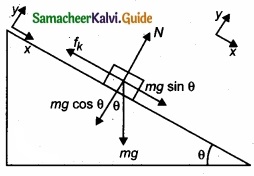
Samacheer Kalvi 6th Social Science Guide History Term 3 Chapter 2 The Post-Mauryan India

Samacheer Kalvi 6th Social Science Guide History Term 3 Chapter 1 Society and Culture in Ancient Tamizhagam: The Sangam Age

Students can download 6th Social Science Term 3 History Chapter 1 Society and Culture in Ancient Tamizhagam: The Sangam Age Questions and Answers, Notes, Samacheer Kalvi 6th Social Science Guide Pdf helps you to revise the complete Tamilnadu State Board New Syllabus, helps students complete homework assignments and to score high marks in board exams.

Tamilnadu Samacheer Kalvi 6th Social Science History Solutions Term 3 Chapter 1 Society and Culture in Ancient Tamizhagam: The Sangam Age

Samacheer Kalvi 6th Social Science Society and Culture in Ancient Tamizhagam: The Sangam Age Text Book Back Questions and Answers

I. Choose the correct answer

Question 1.
Pattini cult in Tamil Nadu was introduced by …………….
(a) PandyanNeduncheliyan
(b) CheranSenguttuvan
(c) IlangoAdigal
(d) Mudathirumaran
Answer:
(b) CheranSenguttuvan

Question 2.
Which dynasty was not in power during the Sangam Age?
(a) Pandyas
(b) Cholas
(c) Pallavas
(d) Cheras
Answer:
(c) Paliavas

Samacheer Kalvi 6th Social Science Guide History Term 3 Chapter 1 Society and Culture in Ancient Tamizhagam: The Sangam Age

Question 3.
The rule of Pandyas was followed by ……………..
(a) Satavahanas
(b) Cholas
(c) Kalabhras
(d) Pallavas
Answer:
(c) Kalabhras

Question 4.
The lowest unit of administration during the Sangam Age was
(a) Mandalam
(b) Nadu
(c) Ur
(d) Pattinam
Answer:
(c) Ur

Question 5.
What was the occupation of the inhabitants of the Kurinji region?
(a) Plundering
(b) Cattle rearing
(c) Hunting and gathering
(d) Agriculture
Answer:
(c) Hunting and gathering

II. Read the statement and tick the appropriate answer

Question 1.
Assertion (A) : The assembly of the poets was known as Sangam.
Reason (R) : Tamil was the language of Sangam literature.
(a) Both A and R are true. R is the correct explanation of A.
(b) Both A and R are true. R is not the correct explanation of A.
(c) A is true but R is false.
(d) Both A and R is not true.
Answer:
(a) Both A and R are true. R is the correct explanation of A

Question 2.
Which of the following statements are not true?
a. Karikala won the battle of Talayalanganam.
b. The Pathitrupathu provides information about Chera Kings.
c. The earliest literature of the Sangam age was written mostly in the form of prose
a. 1 only
b. 1 and 3 only
c. 2 only
Answer:
(b) 1 and 3 only

Samacheer Kalvi 6th Social Science Guide History Term 3 Chapter 1 Society and Culture in Ancient Tamizhagam: The Sangam Age

Question 3.
The ascending order of the administrative division in the ancient Tamizhagam was
(a) Ur < Nadu < Kurram < Mandalam
(b) Ur < Kurram < Nadu < Mandalam
(c) Ur < Mandalam < Kurram < Nadu
(d) Nadu < Kurram < Mandalam < Ur
Answer:
(b) Ur < Kurram < Nadu < Mandalam

Question 4.
Match the following dynasties with the Royal Insignia
Samacheer Kalvi 6th Social Science Guide History Term 3 Chapter 1 Society and Culture in Ancient Tamizhagam The Sangam Age
Answer:
A) 3 2 1

III. Fill in the blanks

  1. The battle of Venni was won by ………………
  2. The earliest Tamil grammar work of the Sangam period was ………………
  3. ……………… built Kallanai across the river Kaveri.
  4. The chief of the army was known as ……………….
  5. Land revenue was called ………………

Answer:

  1. Karikal Valavan
  2. Tholkappiyam
  3. Karikalan
  4. Thanai thalaivan
  5. Irai

IV. True or False

  1. Caste system developed during the Sangam period.
  2. Kizhar was the village chief.
  3. Puhar was the general term for city.
  4. Coastal region was called Marudham.

Answer:

  1. False
  2. True
  3. False
  4. False

V. Match

Samacheer Kalvi 6th Social Science Guide History Term 3 Chapter 1 Society and Culture in Ancient Tamizhagam The Sangam Age

Answer:
1. – d
2. – a
3. – b
4. – c

VI. Answer in one or two sentences

Question 1.
Name any two literary sources to reconstruct the history of ancient Tamizhagam?
Answer:
Tholkappiyam, Ettuthogai, and Patthupattu are some of the literary sources to reconstruct the history of ancient Tamizhagam.

Question 2.
What was Natukkal or Virakkal?
Answer:

  1. The ancient Tamils had great respect for the heroes who died on the battlefield.
  2. The hero stones were created to commemorate heroes who sacrificed their lives in war. These hero stones were known as Natukkal or Virakkal.

Samacheer Kalvi 6th Social Science Guide History Term 3 Chapter 1 Society and Culture in Ancient Tamizhagam: The Sangam Age

Question 3.
Name five things mentioned in the Sangam literature.
Answer:

  1. Kurinji.
  2. Mullai.
  3. Marutham.
  4. Neithal.
  5. Palai.

Question 4.
Name any two archaeological sites related to Sangam period.
Answer:
The excavated materials from Adichanallur, Arikamedu, Kodumanal, Puhar, Korkai, Alankulam, Urariyur etc.

Question 5.
Name the seven patrons (KadaiyeluVallalgal).
Answer:
The seven patrons were

  1. Pari
  2. Kari
  3. Ori
  4. Pegan
  5. Ay
  6. Adiyaman
  7. Nalli

Question 6.
Name any three Tamil poetic works of Kalahhra period.
Answer:
Periapuranam, Seevakachinthamani, and Kundalakesi were written during the Kalabhra

VII. Answer the following

Question 1.
Discuss the status of women in the Sangam Society.
Answer:

  1. In the Sangam Society, there were learned and wise women.
  2. Forty women poets had lived
  3. Marriage was a matter of choice.
  4. Chastity (Karpu) was considered the highest virtue.
  5. In their Parents’ property sons and daughters had equal shares.

VIII. HOTS

Question 1.
KarikalValavan is regarded as the greatest Chola king. Justify.
Answer:

  1. KarikalValavan or Karikalan was the most famous of the Chola kings.
  2. He defeated the combined army of the Cheras, Pandyas and the eleven Velir Chieftains who supported them at Venni, a small village in the Thanjavur region.
  3. He converted forests into cultivable lands.
  4. He built Kallanai across the river Kaveri to develop agriculture.
  5. Their port Puhar attracted merchants from various regions of the Indian Ocean.
  6. The Pattinapaalai a poetic work in the pathinenkeezhkanakku gives elaborate information of the trading activity during the rule of Karikalan.

Question 2.
The period ilabhra is not a dark age. Give reasons.
Answer:

  1. Following the Sangam period, the Kalabhras had occupied Tamil Country for about two and half centuries.
  2. There is evidence of their rule in literary texts.
  3. The literary sources for this period include Tamil Navalar Charithai, Yapemkalam and Periapuranam.
  4. Seevakachinthamani and Kundalakesi were also written during this period.
  5. In Tamizhagam, Jainism and Buddhism became prominent during this period
  6. Introduction of Sanskrit and Prakrit languages had resulted in the development of a new script called Vattezhuththu.
  7. Many works under Pathinenkeezhkanakku were composed.
  8. Trade and commerce continued to flourish during this period.
  9. So the Kalabhra period is not a dark age, as it is portrayed.

X. Life skill (For Students)

Collect and paste the pictures of landscape and find out the eco – region to which belongs. Write the important crops grown and occupation of the people there.

XI. Answer Grid

Question 1.
Mention two epics of the Sangam period.
Answer:

  1. Silapathikaram
  2. Manimegalai

Question 2.
Name the two groups of officials who assisted the king.
Answer:

  1. Aimperunguzhu
  2. Enberayam

Question 3.
Name any two women poets of the Sangam period.
Answer:

  1. Awaiyar, Velli
  2. Veethiyar

Samacheer Kalvi 6th Social Science Guide History Term 3 Chapter 1 Society and Culture in Ancient Tamizhagam: The Sangam Age

Question 4.
Name any three major ports of Sangam age.
Answer:

  1. Musiri
  2. Tondi
  3. Korkai

Question 5.
What constituted Muthamizh?
Answer:

  1. Iyal
  2. Isai
  3. Naatakam

Question 6.
Silapathikaram was written by ……………
Answer:
Ilango Adigal

Samacheer Kalvi 6th Social Science Guide History Term 3 Chapter 1 Society and Culture in Ancient Tamizhagam: The Sangam Age

Question 7.
Talayalanganam is related to whish Pandya king?
Answer:
Nedunchezhiyan

Question 8.
Which ecoregion was called menpulam?
Answer:
Marutham

Question 9.
The lighthouses in the ports are called ……………
Answer:

  1. Kalangari
  2. flangu Sudar

Samacheer Kalvi 6th Social Science Society and Culture in Ancient Tamizhagam: The Sangam Age Additional Important Questions and Answers

I. Choose the Correct Answer:

Question 1.
According to Prof.George L.Hart Tanial is as old as ……………
(a) Chinese
(b) Greek
(c) Latin
(d) English
Answer:
(c) Latin

Question 2.
The epic character from Silappathikaram
(a) Pallavas
(b) Cheras
(c) Pandyas
(d) Cholas
Answer:
(d) Cholas

Question 3.
…………… is the port of Pandvas.
(a) Puhar
(b) Korgai
(c) Muziri
(d) Tondi
Answer:
(b) Korgai

Samacheer Kalvi 6th Social Science Guide History Term 3 Chapter 1 Society and Culture in Ancient Tamizhagam: The Sangam Age

Question 4.
Bow and arrow as the symbol of
(a) Kalabhras
(b) Cholas
(c) Cheras
(d) Pandyas
Answer:
(c) Cheras

II. Read the statement and tick the appropriate answer

Question 1.
Assertion (A) : The Kalabhra period is not a dark age.
Reason (R) : It is known about the literary sources, new script and flourishing of trade and commerce.
(a) Both A and R are true. R is not the correct explanation of A.
(b) Both A and R are true. R is the correct explanation of A
(c) A is true but R is false.
(d) Both A and R is not true.
Answer:
(b) Both A and R are true. R is the correct explanation of A.

Question 2.
Which of the following statements are not true?
(1) Pandyas garlanded Fig (Athi) flower.
(2) The deity of the kurinji people is Indiran.
(3) The author of ‘Natural History’ is Pliny the younger
(a) 1, 2 and 3
(b) 2 and 3
Answer:
(b) 2 and 3

III. Answer the following

Question 1.
What were the ornaments made of?
Answer:

  1. Gold
  2. Silver
  3. Pearls
  4. Precious stones
  5. Conch shells
  6. Beads

Question 2.
What were the main imports?
Answer:

  1. Topaz
  2. Tin
  3. Wine
  4. Glass
  5. Horses

Samacheer Kalvi 6th Social Science Guide History Term 3 Chapter 1 Society and Culture in Ancient Tamizhagam: The Sangam Age

Question 3.
What do you know about Indian silk?
Answer:

  1. The silk supplied by Indians, merchants to the Roman Empire was very important. .
  2. The Roman emperor Aurelian declared it to be worth its weight in gold.

Question 4.
What is the Royal Insignia?
Answer:

  1. Sceptre
  2. Drum
  3. White umbrella

VII. Answer the following

Question 1.
Explain the Religious Beliefs and Social Divisions in the Sangam Society. The primary deity of the Tamils was Seyon or Murugan.
Answer:

  1. The other worshipped gods were Sivan, Mayon (Vishnu), Indiran, Varunan and Kotravai.
  2. The Hero stone (natukkal) worship was in practice
  3. Buddhism and Jainism also co-existed.
  4. As it did in northern India caste did not develop in Tamizhagam.
  5. Varuna system came to the Dravidian south comparatively late.

Samacheer Kalvi 6th Social Science Guide History Term 3 Chapter 1 Society and Culture in Ancient Tamizhagam: The Sangam Age

Question 2.
What was said by George L Hart about the Tamil language?
Answer:

  1. George L. Hart, Professor of Tamil language at the University of California, has said that Tamil is as old as Latin.
  2. The language arose as an entirely independent tradition with no influence of other languages.

VII. Mind map
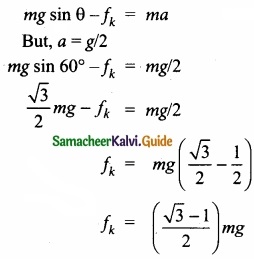
Samacheer Kalvi 6th Social Science Guide History Term 3 Chapter 1 Society and Culture in Ancient Tamizhagam The Sangam Age

Samacheer Kalvi 10th Maths Guide Chapter 7 Mensuration Ex 7.3

Students can download Maths Chapter 7 Mensuration Ex 7.3 Questions and Answers, Notes, Samacheer Kalvi 10th Maths Guide Pdf helps you to revise the complete Tamilnadu State Board New Syllabus, helps students complete homework assignments and to score high marks in board exams.

Tamilnadu Samacheer Kalvi 10th Maths Solutions Chapter 7 Mensuration Ex 7.3

Question 1.
A vessel is in the form of a hemispherical bowl mounted by a hollow cylinder. The diameter is 14 cm and the height of the vessel is 13 cm. Find the capacity of the vessel.
Answer:
Radius of a hemisphere = Radius of the cylinder
Samacheer Kalvi 10th Maths Guide Chapter 7 Mensuration Ex 7.3 Q1
Samacheer Kalvi 10th Maths Guide Chapter 7 Mensuration Ex 7.3 Q1.1

Question 2.
Nathan, an engineering student was asked to make a model shaped like a cylinder with two cones attached at its two ends. The diameter of the model is 3 cm and its length is 12 cm. If each cone has a height of 2 cm, find the volume of the model that Nathan made.
Answer:
Radius of the cone = Radius of the cylinder
Samacheer Kalvi 10th Maths Guide Chapter 7 Mensuration Ex 7.3 Q2
r = \(\frac{3}{2}\) cm
Height of the cone (H) = 2 cm
Height of the cylinder (h) = 12 – (2 + 2) cm = 8 cm
Volume of the model = Volume of the cylinder + Volume of 2 cones
Samacheer Kalvi 10th Maths Guide Chapter 7 Mensuration Ex 7.3 Q2.1

Samacheer Kalvi 10th Maths Guide Chapter 7 Mensuration Ex 7.3

Question 3.
From a solid cylinder whose height is 2.4 cm and the diameter 1.4 cm, a cone of the same height and same diameter is carved out. Find the volume of the remaining solid to the nearest cm3.
Answer:
Radius of a cylinder = Radius of a cone r = 0.7 cm
Height of a cylinder = Height of a cone (h) = 2.4 cm
Samacheer Kalvi 10th Maths Guide Chapter 7 Mensuration Ex 7.3 Q3
Volume of the remaining solid = Volume of the cylinder – Volume of a cone
Samacheer Kalvi 10th Maths Guide Chapter 7 Mensuration Ex 7.3 Q3.1
Volume of the remaining soild = 2.46 cm3

Question 4.
A solid consisting of a right circular cone of height 12 cm and radius 6 cm standing on a hemisphere of radius 6 cm is placed upright in a right circular cylinder full of water such that it touches the bottom. Find the volume of the water displaced out of the cylinder, if the radius of the cylinder is 6 cm and height is 18 cm.
Samacheer Kalvi 10th Maths Guide Chapter 7 Mensuration Ex 7.3 Q4
Answer:
Radius of a cone = Radius of a hemisphere = Radius of a cylinder
r = 6 cm
Height of a cone (h) = 12 cm
Volume of the water displaced = Volume of the solid inside = Volume of the cone + Volume of the hemisphere
Samacheer Kalvi 10th Maths Guide Chapter 7 Mensuration Ex 7.3 Q4.1
Volume of water displaced = 905. 14 cm3.

Samacheer Kalvi 10th Maths Guide Chapter 7 Mensuration Ex 7.3

Question 5.
A capsule is in the shape of a cylinder with two hemispheres stuck to each of its ends. If the length of the entire capsule is 12 mm and the diameter of the capsule is 3 mm, how much medicine it can hold?
Answer:
Radius of a hemisphere = Radius of a Cylinder
Samacheer Kalvi 10th Maths Guide Chapter 7 Mensuration Ex 7.3 Q5
r = \(\frac{3}{2}\) mm = 1.5 mm
Height of the cylinderical portion = 12 mm – (1.5 mm + 1.5 mm) = (12 – 3) mm = 9 mm
Volume of the capsule
Samacheer Kalvi 10th Maths Guide Chapter 7 Mensuration Ex 7.3 Q5.1
Volume of the capsule = 77.8 cu. mm

Question 6.
As shown in figure a cubical block of side 7 cm is surmounted by a hemisphere. Find the surface area of the solid.
Samacheer Kalvi 10th Maths Guide Chapter 7 Mensuration Ex 7.3 Q6
Answer:
Side of a cube (a) = 7 cm
Radius of a hemisphere (r) = \(\frac{7}{2}\) cm
Surface area of the solid = T.S.A of the cube + C.S.A of the hemisphere – Area of the base of the hemisphere
Samacheer Kalvi 10th Maths Guide Chapter 7 Mensuration Ex 7.3 Q6.1

Samacheer Kalvi 10th Maths Guide Chapter 7 Mensuration Ex 7.3

Question 7.
A right circular cylinder just encloses a sphere of radius r units. Calculate
(i) the surface area of the sphere
(ii) the curved surface area of the cylinder
(iii) the ratio of the areas obtained in (i) and (ii).
Answer:
(i) Surface area of sphere = 4πr2 sq. units
Samacheer Kalvi 10th Maths Guide Chapter 7 Mensuration Ex 7.3 Q7

Question 8.
A shuttlecock used for playing badminton has the shape of a frustum of a cone is mounted on a hemisphere. The diameters of the frustum are 5 cm and 2 cm. The height of the entire shuttlecock is 7 cm. Find its external surface area.
Answer:
Samacheer Kalvi 10th Maths Guide Chapter 7 Mensuration Ex 7.3 Q8
Samacheer Kalvi 10th Maths Guide Chapter 7 Mensuration Ex 7.3 Q8.1

Tamil Nadu 11th Chemistry Model Question Paper 2 English Medium

Students can Download Tamil Nadu 11th Chemistry Model Question Paper 2 English Medium Pdf, Tamil Nadu 11th Chemistry Model Question Papers helps you to revise the complete Tamilnadu State Board New Syllabus, helps students complete homework assignments and to score high marks in board exams.

TN State Board 11th Chemistry Model Question Paper 2 English Medium

General Instructions:

  1. The question paper comprises of four parts.
  2. You are to attempt all the parts. An internal choice of questions is provided wherever applicable.
  3. All questions of Part I, II, III and IV are to be attempted separately.
  4. Question numbers 1 to 15 in Part I are Multiple Choice Questions of one mark each.
    These are to be answered by choosing the most suitable answer from the given four alternatives and writing the option code and the corresponding answer
  5. Question numbers 16 to 24 in Part II are two-mark questions. These are to be answered in about one or two sentences.
  6. Question numbers 25 to 33 in Part III are three-mark questions. These are to be answered in about three to five short sentences.
  7. Question numbers 34 to 38 in Part IV are five-mark questions. These are to be answered in detail Draw diagrams wherever necessary.

Time: 2:30 Hours
Maximum Marks: 70

PART – I

Answer all the Questions: [15 × 1 = 15]
Choose the most suitable answer from the given four alternatives.

Question 1.
An element X has the following isotopic composition 200X = 90 %, 100X = 8 % and 202X = 2 %.
The weighted average atomic mass of the element X is closest to ………………………….
(a) 201 u
(b) 202 u
(c) 199 u
(d) 200 u
\(\frac { (200\times 90)+(199\times 18)+(202\times 2) }{ 100 } \)
= 199.96 = 200 u
Answer:
(d) 200 u

Tamil Nadu 11th Chemistry Model Question Paper 2 English Medium

Question 2.
Which of the following is not used in writing electronic configuration of an atom?
(a) Aufbau principle
(b) Hund’s rule
(c) Pauli’s exclusion principle
(d) Heisenberg’s uncertainty principle
Answer:
(d) Heisenberg’s uncertainty principle

Question 3.
Assertion (A): Cr with electronic configuration [Ar]3d5 4s1 is more stable than [Ar] 3d4 4s2.
Reason (R): Half filled orbitals have been found to have extra stability than partially filled orbitals.
(a) A and R are correct and R is the correct explanation of A.
(b) A and R are correct but R is not the correct explanation of A.
(c) A is correct but R is wrong.
(d) A is wrong but R is correct.
Answer:
(a) A and R are correct and R is the correct explanation of A.

Tamil Nadu 11th Chemistry Model Question Paper 2 English Medium

Question 4.
The type of H-bonding present in ortho nitro phenol and p-nitro phenol are respectively ……………………..
(a) Inter molecular H-bonding and intra molecular H – bonding
(b) Intra molecular H-bonding and inter molecular H – bonding
(c) Intra molecular H – bonding and no H – bonding
(d) Intra molecular H – bonding and intra molecular H – bonding

Tamil Nadu 11th Chemistry Model Question Paper 2 English Medium img 1

Answer:
(b) Intra molecular H-bonding and inter molecular H – bonding

Question 5.
Match the following:

Tamil Nadu 11th Chemistry Model Question Paper 2 English Medium img 2

Answer:

Tamil Nadu 11th Chemistry Model Question Paper 2 English Medium img 3

Question 6.
Which of the following is the correct expression for the equation of state of van der Waals gas?
(a) \(\left(P+\frac{a}{n^{2} V^{2}}\right)\) (V – nb) = nRT
(b) \(\left(P+\frac{n a}{n^{2} V^{2}}\right)\) (V – nb) = nRT
(c) \(\left(P+\frac{a n^{2}}{V^{2}}\right)\) (V – nb) = nRT
(d) \(\left(P+\frac{n^{2} a^{2}}{V^{2}}\right)\) (V – nb) = nRT
Answer:
(c) \(\left(P+\frac{a n^{2}}{V^{2}}\right)\) (V – nb) = nRT

Tamil Nadu 11th Chemistry Model Question Paper 2 English Medium

Question 7.
In a reversible process, the change in entropy of the universe is ………………………
(a) > 0
(b) >0
(c) <0
(d) = 0
Answer:
(d) = 0

Question 8.
Which of the following is not a general characteristic of equilibrium involving physical process?
(a) Equilibrium is possible only in a closed system at a given temperature
(b) The opposing processes occur at the same rate and there is a dynamic but stable condition
(c) All the physical processes stop at equilibrium
(d) All measurable properties of the system remains constant
Solution:
Correct statement: Physical processes occurs at the same rate at equilibrium.
Answer:
(c) All the physical processes stop at equilibrium

Question 9.
Stomach acid, a dilute solution of HCl can be neutralised by reaction with Aluminium hydroxide
Al(OH)3 + 3HCl(aq) → AlCl3 + 3H2O
How many millilitres of 0.1 M Al(OH)3 solution are needed to neutralise 21 mL of 0.1 M HCl?
(a) 14 mL
(b) 7 mL
(c) 21 mL
(d) None of these
Solution:
M1 × V = M2 × V2
∵ 0.1 M Al(OH)3 gives 3 × 0.1 = 0.3 M OH ions
0.3 × V1 = 0.1 × 21
V1 = \(\frac{0.1×21}{0.3}\) = 7 ml
Answer:
(b) 7 mL

Tamil Nadu 11th Chemistry Model Question Paper 2 English Medium

Question 10.
Shape and hybridisation of IF5 are ……………………..
(a) Trigonal bipyramidal, sp3d2
(b) Trigonal bipyramidal, sp3d
(c) Square pyramidal, sp3d2
(d) Octahedral, sp3d2
Solution:
IF5 – 5 bond pair + 1 lone pair
∴ hybridisation sp3d2

Tamil Nadu 11th Chemistry Model Question Paper 2 English Medium img 4

Answer:
(c) Square pyramidal, sp3d2

Question 11.
Consider the following statements:

  1. It is not possible for the carbon to form either C4+ (or) C4- ions.
  2. Carbon can form ionic bonds.
  3. In compounds of carbon, it form covalent bonds.

Which of the above statement is/are not correct?
(a) (I) and (II)
(b) (III) only
(c) (I) only
(d) (II) only
Answer:
(d) (II) only

Tamil Nadu 11th Chemistry Model Question Paper 2 English Medium

Question 12.
For the following reactions
(A) CH3CH2CH2Br + KOH → CH3-CH + KBr + H2O
(B) (CH3)3CBr + KOH → (CH3)3 COH + KBr
(C) Tamil Nadu 11th Chemistry Model Question Paper 2 English Medium img 5
Which of the following statement is correct?
(a) (A) is elimination, (B) and (G) are substitution
(b) (A) is substitution, (B) and (C) are elimination
(c) (A) and (B) are elimination and (C) is addition reaction
(d) (A) is elimination, B is substitution and (C) is addition reaction.
Answer:
(d) (A) is elimination, B is substitution and (C) is addition reaction.

Question 13.
Which of the following compound used for metal cleaning solvent?
(a) Methylene chloride
(b) Methyl chloride
(c) Chloroform
(d) Ethane
Answer:
(a) Methylene chloride

Tamil Nadu 11th Chemistry Model Question Paper 2 English Medium

Question 14.
The number of possible isomers of C6H12 is ……………………..
(a) 2
(b) 3
(c) 5
(d) 6
Answer:
(c) 5

Question 15.
Ozone layer is depleted by the reactive ……………………..
(a) Hydrogen atom
(b) Oxygen atom
(c) Fluorine atom
(d) Chlorine atom
Answer:
(d) Chlorine atom

PART – II

Answer any six questions in which question No. 19 is compulsory. [6 × 2 = 12]

Question 16.
Calculate the average atomic mass of naturally occurring magnesium using the following data?
Tamil Nadu 11th Chemistry Model Question Paper 2 English Medium img 6
Answer:
Solution: Isotopes of Mg.
Atomic mass = Mg24 = 23.99 × 78.99/100 = 18.95
Atomic mass = Mg26 = 24.99 × 10/100 = 2.499
Atomic mass = Mg25 = 25.98 × 11.01/100 = 2,860
Average Atomic mass = 24.309
Average atomic mass of Mg = 24.309

Tamil Nadu 11th Chemistry Model Question Paper 2 English Medium

Question 17.
What are quantum numbers?
Answer:

  1. The electron in an atom can be characterized by a set of four quantum numbers, namely – principal quantum number (n), azimuthal quantum number (l), magnetic quantum number (m) and spin quantum number (s).
  2. When Schrodinger equation is solved for a wave function φ, the solution contains the first three quantum numbers n, 1 and m.
  3. The fourth quantum number arises due to the spinning of the electron about its own axis.

Question 18.
How 2-ethylanthraquinone helps to prepare hydrogen peroxide?
Answer:
On an industrial scale, hydrogen peroxide is prepared by auto oxidation of 2-alkyl anthraquinol.

Tamil Nadu 11th Chemistry Model Question Paper 2 English Medium img 7

Question 19.
Calculate the pressure exerted by 2 moles of sulphur hexafluoride in a steel vessel of volume 6 dm3 at 70°C assuming it is an ideal gas?
Answer:
We will use the ideal gas equation for this calculation as below:
P = \(\frac{nRT}{V}\) = image 7 = 9.39 atm.

Tamil Nadu 11th Chemistry Model Question Paper 2 English Medium

Question 20.
What are the important features of lattice enthalpy?
Answer:

  1. Higher lattice energy shows greater electrostatic attraction and therefore a stronger bond in the solid.
  2. The lattice enthalpy is greater for ions of higher charge and smaller radii.

Question 21.
What are aqueous and non-aqueous solution? Give example?
Answer:

  1. If the solute is dissolved in the solvent water, the resultant solution is called as an aqueous solution, e.g., salt in water.
  2. If the solute is dissolved in the solvent other than water such as benzene, ether, CCl4 etc, the resultant solution is called a non aqueous solution, e.g., Br2 in CCl4.

Question 22.
What is bond enthalpy? How they relate with bond strength?
Answer:
The bond enthalpy is defined as the minimum amount of energy required to break one mole of a particular bond in molecules in their gaseous state. Larger the bond enthalpy stronger will be the bond.

Tamil Nadu 11th Chemistry Model Question Paper 2 English Medium

Question 23.
What is triad system? Give example?
Answer:
(I) In this system hydrogen atom oscillates between three polyvalent atoms. It involves 1, 3 – migration of hydrogen atom from one polyvalent atom to other with in the molecule

(II) The most important type of triad system is keto-enol tautomerism and the two groups of tautomers are keto form and enol form.

(III) Tamil Nadu 11th Chemistry Model Question Paper 2 English Medium img 8

Question 24.
What is stone leprosy? How is it formed?
Answer:

  1. The attack on, the marble of buildings by acid rain is called stone leprosy.
  2. Acid rain causes extensive damage to buildings made up of marble.

CaCO + H2SO4 → CaSO4 + H2O + CO2

PART – III

Answer any six questions in which question No. 26 is compulsory. [6 × 3 = 18]

Question 25.
Calculate the equivalent mass of hydrated ferrous sulphate?
Answer:
Hydrated ferrous sulphate = FeSO4.7H2O
Ferrous sulphate – Reducing agent
Ferrous sulphate reacts with an oxidising agent in acid medium according to the equation.

Tamil Nadu 11th Chemistry Model Question Paper 2 English Medium img 9

16 parts by mass of oxygen oxidised 304 g of FeSO4.
8 parts by mass of oxygen will oxidise \(\frac{304}{16}\) × 8 parts by mass of FeSO4 = 152
Equivalent mass of Ferrous sulphate (Anhydrous) = 152
Equivalent mass of crystalline Ferrous sulphate FeSO4.7H2O = 152 + 126 = 278

Tamil Nadu 11th Chemistry Model Question Paper 2 English Medium

Question 26.
Calculate the uncertainty in position of an electron, if ∆v = 0.1% and v = 2.2 × 10⁶ ms-1.
Answer:
Mass of an electron = m = 9.1 × 10⁻³¹ kg.
∆v = Uncertainty in velocity = \(\frac{0.1}{100}\) × 2.2 × 10⁶ ms-1
∆v = 0.22 × 104 = 2.2 × 10³ ms-1
∆x. ∆v.m = \(\frac{h}{4π}\)

Tamil Nadu 11th Chemistry Model Question Paper 2 English Medium img 10

∆x = 2.635 × 10⁻⁸
Uncertainty in position = 2.635 × 10⁻⁸

Question 27.
Distinguish between diffusion and effusion?
Answer:
Diffusion:

  1. Diffusion is the spreading of molecules of a substance throughout a space or a second subsance.
  2. Diffusion refers to the ability of the gases to mix with each other.
  3. E.g; Spreading of something such as brown tea liquid spreading through the water in a tea cup.

Effusion:

  1. Effusion is the escape of gas molecules through a very small hole in a membrane into an evacuated area.
  2. Effusion is a ability of a gas to travel through a small pin-hole.
  3. E.g; Pouring out something like the soap studs bubbling out from a bucket of water.

Question 28.
For a chemical reaction the values of ∆H and ∆S at 300 K are – 10 kJ mol-1 and – 20 JK-1 mol-1 respectively. What is the value of ∆G of the reaction? Calculate the ∆G of a reaction at 600K assuming ∆H and ∆S values are constant. Predict the nature of the reaction?
Answer:
Given:
∆H = -10 kJ mol-1 = -10000 J mol-1
∆S = – 20 JK-1 mol-1
T = 300 K

∆G?
∆G = ∆H – T∆S
∆G = -10 kJ mol-1 – 300 K × (-20 × 10-3) kJ K-1 mol-1
∆G = (-10 + 6) kJ mol-1
∆G = – 4 kJ mol-1

At 600 K,
∆G = – 10 kJ mol-1 – 600 K × (-20 × 10-3) k-1 mol-1
∆G = (-10 + 12) kJ mol-1
∆G + 2 kJ mol-1
The value of ∆G is negative at 300K and the reaction is spontaneous, but at 600K the value ∆G becomes positive and the reaction is non-spontaneous.

Tamil Nadu 11th Chemistry Model Question Paper 2 English Medium

Question 29.
For the reaction: A2(g) + B2(g) ⇄ 2AB(g); H is -∆ve.
The following molecular scenes represent different reaction mixture (A – light grey, B-dark grey)

Tamil Nadu 11th Chemistry Model Question Paper 2 English Medium img 12

  1. Calculate the equilibrium constant Kp and Kc.
  2. For the reaction mixture represented by scene (x), (y) the reaction proceed in which directions?
  3. What is the effect of increase in pressure for the mixture at equilibrium?

Answer:

Tamil Nadu 11th Chemistry Model Question Paper 2 English Medium img 13

Kc > Q i.e; forward reaction is favoured.

(III) Since ∆ng = 2 -2 = 0, thus, pressure has no effect. So by increasing the pressure, equilibrium will not be affected.

Tamil Nadu 11th Chemistry Model Question Paper 2 English Medium

Question 30.
Derive the relationship between the relative lowering of vapour pressure and mole fraction of the solute?
Answer:

Tamil Nadu 11th Chemistry Model Question Paper 2 English Medium img 14

Question 31.
Differentiate between the principle of estimation of nitrogen in an organic compound by

  1. Dumas method
  2. Kjeldahl’s method

Answer:

1. Dumas method:
The organic compound is heated strongly with excess of CuO (Cupic Oxide) in an atmosphere of CO2 where free nitrogen, CO2 and H2O are obtained.

2. Kjeldahl’s method:
A known mass of the organic compound is heated strongly with cone. H2SO4, a little amount of potassium sulphate arid a little amount of mercury (as catalyst). As a result of reaction, the nitrogen present in the organic compound is converted to ammonium sulphate.

Tamil Nadu 11th Chemistry Model Question Paper 2 English Medium

Question 32.
In what way free radical affect the human body?
Answer:

  1. Free radicals can disrupt cell membranes.
  2. Increase the risk of many forms of cancer.
  3. Damage the interior lining of blood vessels.
  4. Eads to a high risk of heart disease and stroke.

Question 33.
Dissolved oxygen in water is responsible for aquatic life. What processes are responsible for the reduction in dissolved oxygen in water?
Answer:

  1. Organic matter such as leaves, grass, trash can pollute water. Microorganisms present in water can decompose these organic matter and consume dissolved oxygen in water.
  2. Eutrophication is a process by which water bodies receive excess nutrients that stimulates excessive plant growth.
  3. This enhanced plant growth in water bodies is called algal bloom.
  4. The growth of algae in extreme abundance covers the water surface and reduces the oxygen concentration in water. Thus, bloom-infeded water inhibits the growth of other living organisms in the water body.
  5. This process in which the nutrient rich water support a dense plant population, kills animal life by depriving it of oxygen and results in loss of biodiversity is known as eutrophication.

PART – IV

Answer all the questions. [5 × 5 = 25]

Question 34 (a).
(I) Calculate the equivalent mass of sulphuric acid?
(II) The reaction between aluminium and ferric oxide can generate temperatures up to 3273 K and is used in welding metals.
(Atomic mass of Al = 27 u Atomic mass of O = 16 u)
2Al + Fe2O3 → Al2O3 + 2Fe; If, in this process, 324 g of aluminium is allowed to react with 1.12 kg of ferric oxide.
(a) Calculate the mass of Al2O3 formed.
(b) How much of the excess reagent is left at the end of the reaction?

[OR]

(b) (I) Consider the following electronic arrangements for the d5 configuration?

(a) Tamil Nadu 11th Chemistry Model Question Paper 2 English Medium img 15

(b) Tamil Nadu 11th Chemistry Model Question Paper 2 English Medium img 16

(c) Tamil Nadu 11th Chemistry Model Question Paper 2 English Medium img 17

  1. Which of these represents the ground state?
  2. Which configuration has the maximum exchange energy?

(II) An ion with mass number 56 contains 3 units of positive charge and 30.4% more neutrons than electrons. Assign symbol to the ion?
Answer:
(a) (I) Equivalent mass of sulphuric acid:
Sulphuric acid = H2SO4
Molar mass of Sulphuric acid = 2 + 32 + 64 = 96
Basicity of Sulphuric acid = 2

Tamil Nadu 11th Chemistry Model Question Paper 2 English Medium img 18

= \(\frac{96}{2}\) = 49 g eq-1

(II) (a) Tamil Nadu 11th Chemistry Model Question Paper 2 English Medium img 19

As per balanced equation 54 g Al is required for 112 g of iron and 102 g of Al2O3.
54 g of Al gives 102 g of Al2O3.
∴ 324 g of Al will give \(\frac{102}{54}\) × 324 = 612 g of AlcO3

(b) 54 g of Al requires 160 g of Fe2O3 for welding reaction.
∴ 324 g of Al will require \(\frac{160}{54}\) × 324 = 960 g of Fe\(\frac{102}{54}\)O3
∴ Excess Fe2O3 -Unreacted Fe2O3 = 1120 – 960 = 160 g 160 g of exces reagent is left at the end of the reaction.

[0R]

(b)
(I) 1. Tamil Nadu 11th Chemistry Model Question Paper 2 English Medium img 20
2. Tamil Nadu 11th Chemistry Model Question Paper 2 English Medium img 21

(II) Let the no. of electrons in the ion = x
∴ The no. of the protons = x + 3 (as the ion has three units positive charge)
and the no. of neutrons = x + \(\frac{30.4x}{100}\) = x + 0.304 x
Now, mass number of ion = Number of protons + Number of neutrons
= (x + 3) + (x + 0.304 x)
∴ 56 = (x + 3) + (x + 0.304 x) or 2.304 x = 56 – 3 = 53
x = \(\frac{53}{2.304}\) = 23
Atomic number of the ion (or element) = 23 + 3 = 26
The element with atomic number 26 is iron (Fe) and the corresponding ion is Fe3+.

Tamil Nadu 11th Chemistry Model Question Paper 2 English Medium

Question 35 (a).
(I) State the Newland’s law of octaves?
(II) What are the two exceptions of block division in the periodic table?

[OR]

(b) (I) Complete the following reactions.
(a) Tamil Nadu 11th Chemistry Model Question Paper 2 English Medium img 22

(b) 2 BeCl2 + LiaH4 →?

(II) What happens when quick lime reacts with
(a) H2O and
(b) CO2?

(I) The Law of octaves states that, “when elements are arranged in the order of increasing atomic weights, the properties of the eighth element are a repetition of the properties of the first element”.

(II)

1. Helium has two electrons. Its electronic configuration is 1s2. As per the configuration, it is supposed to be placed in ‘s’ block, but actually placed in 18th group which belongs to ‘p’ block. Because it has a completely filled valence shell as the other elements present in 18th group. It also resembles with 18th group elements in other properties. Hence helium is placed with other noble gases.

2. The other exception is hydrogen. It has only one s-electron and hence can be placed in group 1. It can also gain an electron to achieve a noble gas arrangement and hence it can behave as halogens (17th group elements). Because of these assumptions, position of hydrogen becomes a special case. Finally, it is placed separately at the top of the periodic table.

[OR]

(b) (I) (a) Beryllium oxide is heated with carbon and chloride to get BeCl2

Tamil Nadu 11th Chemistry Model Question Paper 2 English Medium img 23

(b) Beryllium chloride is treated with LiAlH4 to get beryllium hydride.
2BeCl2 + LiAlH4 → 2BeH2 + Licl + Alcl3

(II) (a) CaO + H2O → Ca(OH)2 (calcium hydroxide)
(b) CaO + CO2 → CaO3 (calcium carbonate)

Tamil Nadu 11th Chemistry Model Question Paper 2 English Medium

Question 36 (a).
(I) State the first law of thermodynamics?
(II) Calculate the enthalpy of combustion of ethylene at 300 Kc at constant pressure, if its heat of combustion at constant volume (∆U) is -1406 kJ?

[OR]

(b)
(I) Explain how the equilibrium constant Kc predict the extent of a reaction? (3)
(II) Explain about the effect of catalyst in an equilibrium reaction? (2)
Answer:
(a) (I) The first law of thermodynamics states that “the total energy of an isolated system . remains constant though it may change from one form to another” (or) Energy can neither be created nor destroyed, but may be converted from one form to another.
(II) The complete ethylene combustion reaction can be written as,

C2H4(g) + 3O2(g) → 2CO2(g) + 2H2O(l)
ΔU = -1406 kJ
Δn = np(g) – nr(g)
Δn = 2 – 4 – 2
ΔH = ΔU + RTΔng
ΔH = -1406 + (8.314 × 10-3 × 300 × (-2)) ΔH = -1410.9 kJ

[OR]

(b) (I)

  1. The value of equilibrium constant KC tells us the extent of the reaction i.e., it indicatehow far the reaction has proceeded towards product formation at a given temperature.
  2. A large value of KC indicates that the reaction reaches equilibrium with high product yield on the other hand, lower value of KC indicates that the reaction reaches equilibrium with low product yield.
  3. If KC > 103, the reaction proceeds nearly to completion.
  4. If KC < 10-3 the reaction rarely proceeds.
  5. It the KC is in the range 10-3 to 103, significant amount of both reactants and products are present at equilibrium.

(II) Addition of catalyst does not affect the state of equilibrium. The catalyst increases the rate of both the forward and reverse reactions to the same extent. Hence it does not change the equilibrium composition of the reaction mixture.

Tamil Nadu 11th Chemistry Model Question Paper 2 English Medium

Question 37 (a).
(I) Briefly explain geometrical isomerism in alkenes by considering 2- butene as an example.
2 – butene: Geometrical isomerism: CH3 – CH = CH – CH

(II) What is meant by condensed structure? Explain with an example.

[OR]

(b)
(I) Why cut apple turns a brown colour?
(II) Predict the product for the following reaction,

1. Tamil Nadu 11th Chemistry Model Question Paper 2 English Medium img 25

2. Tamil Nadu 11th Chemistry Model Question Paper 2 English Medium img 26

3. Tamil Nadu 11th Chemistry Model Question Paper 2 English Medium img 27

Answer:
(a) (I)

  • Geometrical isomers are the stereoisomers which have different arrangement of groups or atoms around a rigid framework of double bonds. This type of isomerism occurs due to restricted rotation of double bonds or about single bonds in cyclic compounds.
  • In 2-butene, the carbon-carbon double bond is sp2 hybridised. The carbon-carbon double bond consists of a s bond and a p bond. The presence of p bond lock the molecule in one position. Hence, rotation around C = C bond is not possible.
  • Tamil Nadu 11th Chemistry Model Question Paper 2 English Medium img 28
  • These two compounds are termed as geometrical isomers and are termed as cis and transform.
  • The cis isomer is the one in which two similar groups are on the same side of the double bond. The trans isomer is that in which two similar groups are on the opposite side of the double bond. Hence, this type of isomerism is called cis-trans isomerism.

(II) The bond line structure can be further abbreviated by omittiilg all the these dashes representing covalent bonds and by indicating the number of identical groups attached to an atom by a subscript. The resulting expression of the compound is called a condensed structural formula.
e.g., 1,3 – butadiene.

Tamil Nadu 11th Chemistry Model Question Paper 2 English Medium img 29

[OR]

(b) (I)

  1. Apples contains an enzyme called polyphenol oxidase (PPO) also known as tyrosinase.
  2. Cutting an apple exposes its cells to the atmospheric oxygen and oxidizes the phenolic compounds present in apples. This is called the “enzymatic browning” that turns a cut apple brown.
  3. In addition to apples, enzymatic browning is also evident in bananas, pears, avocados and even potatoes.

Tamil Nadu 11th Chemistry Model Question Paper 2 English Medium img 30

Tamil Nadu 11th Chemistry Model Question Paper 2 English Medium

Question 38 (a).
Suggest the route for the preparation of the following from benzene?

  1. 3 – chloro-nitrobenzene
  2. 4 – chlorotoluene
  3. Bromobenzene
  4. m – dinitrobenzene

[OR]

(b) A hydrocarbon C3H6 (A) reacts with HBr to form compound (B). Compound (B) reacts with aqueous potassium hydroxide to give (C) of molecular formula C3H6O. What are (A) (B) and (C). Explain the reactions?
Answer:
(a)
1. Preparation of 3 – chloronitro – benzene from benzene: Benzene undergoes nitration and followed by chlorination and it leads to the formation of 3 – chloronitrobenzene.
Tamil Nadu 11th Chemistry Model Question Paper 2 English Medium img 31

2. Preparation 4-chlorotoulene from benzene: Benzene undergoes Friedal craft’s alkylation followed by chlorination and it leads to the formation of 4 – chlorotoulene.
Tamil Nadu 11th Chemistry Model Question Paper 2 English Medium img 32

3. Preparation of Bromobenzene from benzene: Benzene undergo bromination to give bromobenzene.

Tamil Nadu 11th Chemistry Model Question Paper 2 English Medium img 33

4. Preparation of m-dinitrobenzene from benzene: Benzene undergo twice the time nitration to give m-dinitrobenzene.
Tamil Nadu 11th Chemistry Model Question Paper 2 English Medium img 34

[OR]

(b) Tamil Nadu 11th Chemistry Model Question Paper 2 English Medium img 35
1. The hydrocarbon with molecular formula C3H6 (A) is identified as propene,
CH – CH = CH2
2. Propene reacts with HBr to form bromopropane CH3 – CH2 – CH2Br as (B).Tamil Nadu 11th Chemistry Model Question Paper 2 English Medium img 36

3. 1 – bromopropane react with aqueous potassium hydroxide to give 1 – propanol CH3 – CH2 – CH2OH as (C).
4. 2 – bromo propane reacts with aqueous KOH to give 2-propanol as (C)Tamil Nadu 11th Chemistry Model Question Paper 2 English Medium img 37

Tamil Nadu 11th Physics Model Question Paper 3 English Medium

Students can Download Tamil Nadu 11th Physics Model Question Paper 3 English Medium Pdf, Tamil Nadu 11th Physics Model Question Papers helps you to revise the complete Tamilnadu State Board New Syllabus, helps students complete homework assignments and to score high marks in board exams.

TN State Board 11th Physics Model Question Paper 3 English Medium

General Instructions:

  1. The question paper comprises of four parts.
  2. You are to attempt all the parts. An internal choice of questions is provided wherever applicable.
  3. All questions of Part I, II, III and IV are to be attempted separately.
  4. Question numbers 1 to 15 in Part I are Multiple Choice Questions of one mark each.
    These are to be answered by choosing the most suitable answer from the given four alternatives and writing the option code and the corresponding answer
  5. Question numbers 16 to 24 in Part II are two-mark questions. These are to be answered in about one or two sentences.
  6. Question numbers 25 to 33 in Part III are three-mark questions. These are to be answered in about three to five short sentences.
  7. Question numbers 34 to 38 in Part IV are five-mark questions. These are to be answered in detail Draw diagrams wherever necessary.

Time: 3 Hours
Maximum Marks: 70

PART – I

Answer all the questions: [15 × 1 = 15]

Question 1.
A new unit of length is chosen such that the speed of light in vacuum is unity. The distance between the Sun and the Earth in terms of the new unit, if light takes 8 minute and 20 sec to cover the distance is …………………..
(a) 100 new unit
(b) 300 new unit
(c) 500 new unit
(d) 700 new unit
Hint:
Speed is unity = 1 unit/sec
Time = 8 min and 20 sec = 500 sec
Distance b/w sun and earth = Speed × Time
= 1 × 500 = 500 unit
Answer:
(c) 500 new unit

Tamil Nadu 11th Physics Model Question Paper 3 English Medium

Question 2.
For a satellite moving in an orbit around the Earth, the ratio of kinetic energy to potential energy is ………………….
(a) 2
(b) 1 : 2
(c) 1 : \(\sqrt{2}\)
(d) \(\sqrt{2}\)
Hint:
\(\frac { GMm }{ R^{ 2 } } \) = mω2R
K.E = \(\frac{1}{2}\)Iω2 = \(\frac{1}{2}\)mR2ω2 = \(\frac{GMm}{2R}\)
P.E = – \(\frac{GMm}{R}\) ⇒ So \(\frac{K.E}{|P.E|}\) = \(\frac{1}{2}\)
Answer:
(b) 1 : 2

Question 3.
In the equilibrium position a body has ……………….
(a) Maximum potential energy
(b) Minimum potential energy
(c) Minimum kinetic energy
(d) Neither maximum nor minimum potential energy
Answer:
(c) Minimum kinetic energy

Tamil Nadu 11th Physics Model Question Paper 3 English Medium

Question 4.
The centrifugal force appears to exist ………………….
(a) Only in inertial frames
(b) Only in rotating frames
(c) In any accelerated frame
(d) Both in inertial and non-inertial frames
Answer:
(b) Only in rotating frames

Question 5.
A particle is moving with a constant velocity along a line parallel to positive x-axis. The magnitude of its angular momentum with respect to the origin is …………………..
(a) Zero
(b) Increasing with x
(c) Decreasing with x
(d) Remaining constant
Answer:
(d) Remaining constant

Question 6.
When 8 droplets of water of radius 0.5 mm combine to form a single droplet. The radius of it is …………………
(a) 4 mm
(b) 2 mm
(c) 1 mm
(d) 8 mm
Hint:
Volume of 8 droplets of water = 8 × \(\frac{4}{3}\) π(0.5)3
When each droplet combine to form one volume remains conserved
R3 = 8 × (0.5)3
R3 = (8 × (0.5)3)
R3 = 2 × 0.5 = 1 mm
Answer:
(c) 1 mm

Tamil Nadu 11th Physics Model Question Paper 3 English Medium

Question 7.
Pressure head in Bernoulli’s equation is …………………
(a) \(\frac { P_{ \rho } }{ g } \)
(b) \(\frac { P }{ \rho g } \)
(c) ρg
(d) Pρg
Answer:
(b) \(\frac { P }{ \rho g } \)

Question 8.
The angle between particle velocity and wave velocity in a transverse wave is ……………………
(a) Zero
(b) π/4
(c) π/2
(d) π
Answer:
(c) π/2

Question 9.
If the masses of the Earth and Sun suddenly double, the gravitational force between them will …………………….
(a) Remains the same
(b) Increase two times
(c) Increase four times
(d) Decrease two times
Answer:
(c) Increase four times

Question 10.
A mobile phone tower transmits a wave signal of frequency 900 MHz, the length of the transmitted from the mobile phone tower ……………………
(a) 0.33 m
(b) 300 m
(c) 2700 × 108m
(d) 1200 m
Hint:
f = 900 MHz = 900 × 106 Hz
Speed of wave (c) = 3 × 10⁶ ms-1
λ = \(\frac{v}{f}\) = \(\frac { 3\times 10^{ 8 } }{ 900\times 10^{ 6 } } \) = \(\frac{1}{3}\) = 0.33m
Answer:
(a) 0.33 m

Tamil Nadu 11th Physics Model Question Paper 3 English Medium

Question 11.
The displacement y of a wave travelling in the x direction is given by
y = (2 × 10⁻³) sin (300 t – 2x + \(\frac { \pi }{ 4 } \)), where x and y are measured in metres and t in second. The speed of the wave is …………………
(a) 150 ms-1
(b) 300 ms-1
(c) 450 ms-1
(d) 600 ms-1
Hint:
From standard equation of wave, Y = a sin (ωt – kx + ϕ)
ω = 300 ; k = 2
Speed of wave, V = \(\frac{ω}{k}\) = \(\frac{300}{2}\) = 150ms-1
Answer:
(a) 150 ms-1

Question 12.
The increase in internal energy of a system is equal to the workdone on the system. The process does the system undergoes is ……………………
(a) Isochoric
(b) Adiabatic
(c) Isobaric
(d) Isothermal
Answer:
(d) Isothermal

Question 13.
The minimum velocity with which a body of mass m must enter a vertical loop of radius R so that it can complete the loop is ……………………..
(a) \(\sqrt{2gR}\)
(b) \(\sqrt{3gR}\)
(c) \(\sqrt{5gR}\)
(d) \(\sqrt{gR}\)
Answer:
(c) \(\sqrt{5gR}\)

Tamil Nadu 11th Physics Model Question Paper 3 English Medium

Question 14.
If the rms velocity of the molecules of a gas in a container be doubled then the pressure of the gas will.
(a) Becomes 4 times of the previous value
(b) Becomes 2 times of its previous value
(c) Remains same
(d) Becomes \(\frac{1}{4}\) of its previous value
Hint:

Tamil Nadu 11th Physics Model Question Paper 3 English Medium img 1

Answer:
(a) Becomes 4 times of the previous value

Question 15.
Gravitational mass is proportional to gravitational ………………….
(a) Intensity
(b) Force
(c) Field
(d) All of these
Answer:
(b) Force

PART – II

Answer any six questions in which Q. No 23 is compulsory. [6 × 2 = 12]

Question 16.
Write any four postulates of Kinetic theory of gases?
Answer:

  1. A gas consists of a very large number of molecules. Each one is a perfectly identical elastic sphere.
  2. The molecules of a gas are in a state of continuous and random motion. They move in all directions with all possible velocities.
  3. The size of each molecule is very small as compared to the distance between them. Hence, the volume occupied by the molecule is negligible in comparison to the volume of the gas:
  4. There is no force of attraction or repulsion between the molecules and the walls of the container.

Tamil Nadu 11th Physics Model Question Paper 3 English Medium

Question 17.
Draw the free body diagram of the book at rest on the table?
Answer:

Tamil Nadu 11th Physics Model Question Paper 3 English Medium img 2

Question 18.
Three block are connected as shown in fig on a horizontal frictionless table. If m1 = 1 kg, m2 = 8 kg, m3 = 27 kg and T3 = 36 N then calculate tension T2?
Answer:

Tamil Nadu 11th Physics Model Question Paper 3 English Medium img 3

Acceleration acquired by all blocks a = \(\frac { T_{ 3 } }{ m_{ 1 }+m_{ 2 }+m_{ 3 } } \) = \(\frac{36}{36}\) = 1ms-2
∴ Tension T2 = (m1 + m2) a
= (1 + 8) × 1 = 9N

Tamil Nadu 11th Physics Model Question Paper 3 English Medium

Question 19.
What is power? Give its dimensional formula?
Answer:
The rate of work done is called power. Dimensional formula of power is ML2 T-3

Question 20.
What are geostationary and polar satellites?
Answer:
Geostationary Satellite: It is the satellite which appears at a fixed position and at a definite height to an observer on Earth.
Polar Satellite: It is the satellite which revolves in polar orbit around the Earth.

Question 21.
An iceberg of density 900 kg m-3 is floating in water of density 1000 kg m-3. What is the percentage of volume of iceberg outside the water?
Answer:
Fraction of volume inside water = Relative density of the body
\(\frac { V’ }{ V } \) = \(\frac { \rho }{ \rho ‘ } \) = \(\frac{900}{1000}\) = 0.9
Fraction of volume outside water = 1 – 0.9 = 0.1
Percentage of volume outside water = 0.1 × 100 = 10%

Tamil Nadu 11th Physics Model Question Paper 3 English Medium

Question 22.
State stoke’s law and define terminal velocity?
Answer:
Stoke’s law:
When a body falls through a highly viscous liquid, it drags the layer of the liquid immediately in contact with it. This results in a relative motion between the different layers of the liquid. As a result of this, the falling body experiences a viscous force F.

Stoke performed many experiments on the motion of small spherical bodies in different fluids and concluded that the viscous force F acting on the spherical body depends on

  1. Coefficient of viscosity q of the liquid
  2. Radius a of the sphere and
  3. Velocity v of the spherical body

Dimensionally it can be proved that ∴ F = k ηav
Experimentally Stoke found that k = 6π
This is Stoke’s law

Terminal velocity:
Terminal velocity of a body is defined as the constant velocity acquired by a body while falling through a viscous liquid.

Tamil Nadu 11th Physics Model Question Paper 3 English Medium

Question 23.
The Earth without its atmosphere would be hospitably cold. Explain why?
Answer:
The lower layers of Earth’s atmosphere reflect infrared radiations from Earth back to the surface of Earth. Thus the heat radiation received by the earth from the Sun during the day are kept trapped by the atmosphere. If atmosphere of Earth were not there, its surface would become too cold to live.

Question 24.
A body A is projected upwards with velocity v1 Another body B of same mass is proj eeted at an angle of 45°. Both reach the same height. Calculate the ratio of their initial kinetic energies?
Answer:
As A and B attain the same height therefore vertical component of initial velocity of B is equal to initial velocity of A
v2 cos 45° = V1 (or) \(\frac { v_{ 2 } }{ \sqrt { 2 } } \) = v1

Tamil Nadu 11th Physics Model Question Paper 3 English Medium img 4

PART – III

Answer any six questions in which Q.No. 29 is compulsory. [6 × 3 = 18]

Question 25.
Explain the rules for counting significant figures with examples?
Rules for counting significant figures:
Answer:

Tamil Nadu 11th Physics Model Question Paper 3 English Medium img 5

Question 26.
Elastic headon collision, consider two particles one is moving and another one is stationary with their respective masses m and \(\frac { M }{ m } \). A moving particle meets collides elastically on stationary particle in the opposite direction. Find the kinetic energy of the stationary particle after a collision?
Answer:
mass of the moving particle m1 = m (say)
mass of the stationary particle m1 = \(\frac { 1 }{ m } \) M
Velocity of the moving particle before collision = v1i (say)
Velocity of the stationary particle before collision = v2i = 0
Velocity of the stationary particle after collision = v2f (say)

Tamil Nadu 11th Physics Model Question Paper 3 English Medium img 6

Kinetic energy of the stationary particle after a collision

Tamil Nadu 11th Physics Model Question Paper 3 English Medium img 7

Question 27.
Calculate the angle for which a cyclist bends when he turns a circular path of length 34.3 m in \(\sqrt{22}\) s?
Answer:
Given Data:
l = 34.3 m, t = \(\sqrt{22}\) , g = 9.8 ms-2, θ = ?
If r is radius of circular path, then length of path = 2πr = 34.3 m
r = \(\frac { 33.4 }{ 2\pi } \) and time taken t = \(\sqrt{22}\)s

As tan θ = \(\frac { v^{ 2 } }{ rg } \)
∴ tan θ = (\(\frac { 34.3 }{ \sqrt { 22 } } \))2 × \(\frac { 2\pi }{ 34.3\times 9.8 } \)
tan θ = \(\frac { 34.3\times 34.3 }{ 22 } \) × \(\frac{2×22}{7×343×9.8}\) = \(\frac{34.3×2}{68.6}\) = 1 [∴θ = 45°]

Tamil Nadu 11th Physics Model Question Paper 3 English Medium

Question 28.
Explain how density, moisture affect the velocity of sound in gases?
Answer:
Effect of density:
Let us consider two gases with different densities having same temperature and pressure. Then the speed of sound in the two gases are

Tamil Nadu 11th Physics Model Question Paper 3 English Medium img 8

Taking ratio of equation (1) and equation (2) we get

Tamil Nadu 11th Physics Model Question Paper 3 English Medium img 9

For gases having same value of γ,
\(\frac { v_{ 1 } }{ v_{ 2 } } \) = \(\sqrt { \frac { \rho _{ 2 } }{ \rho _{ 1 } } } \)
Thus the velocity of sound in a gas is inversely proportional to the square root of the density of the gas.

Effect of moisture (humidity):
We know that density of moist air is 0.625 of that of dry air, which means the presence of moisture in air (increase in humidity) decreases its density. Therefore, speed of sound increases with rise in humidity. From equation:
v = \(\sqrt { \frac { \gamma \rho }{ \rho } } \)

Let ρ1, v1 = and ρ2, v2 be the density and speeds of sound in dry air and moist air, respectively.

Tamil Nadu 11th Physics Model Question Paper 3 English Medium img 10

Since P is the atmospheric pressure, it can be shown that
\(\frac { \rho _{ 2 } }{ \rho _{ 1 } } \) = \(\frac { P }{ p_{ 1 }+0.625p_{ 2 } } \)
where p1 and p2 are the partial pressures of dry air and water vapour respectively. Then

Tamil Nadu 11th Physics Model Question Paper 3 English Medium img 11

Question 29.
Explain
(a) Why there are no lunar eclipse and solar eclipse every month?
(b) Why do we have seasons on earth?
Answer:
(a) If the orbits of the Moon and Earth lie on the same plane, during full Moon of every month, we can observe lunar eclipse. If this is so during new Moon we can observe solar eclipse.

But Moon’s orbit is tilted 5° with respect to Earth’s orbit. Due to this 5° tilt, only during certain periods of the year, the Sun, Earth and Moon align in straight line leading to either lunar eclipse or solar eclipse depending on the alignment.

(b) The common misconception is that ‘Earth revolves around the Sun, so when the Earth is very far away, it is winter and when the Earth is nearer, it is summer’.

Actually, the seasons in the Earth arise due to the rotation of Earth around the Sun with 23.5° tilt. Due to this 23.5° tilt, when the northern part of Earth is farther to the Sun, the southern part is nearer to the Sun. So when it is summer in the northern hemisphere, the southern hemisphere experience winter.

Tamil Nadu 11th Physics Model Question Paper 3 English Medium

Question 30.
When a person breathes, his lungs can hold up to 5.5 1 of air at body temperature 37°C and atmospheric pressure (1 atm = 101 kPa). This air contains 21% oxygen, calculate the number of oxygen molecules in the lungs?
Answer:
We can treat the air inside the lungs as an ideal gas. To find the number of molecules, we can use the ideal gas law.
PV = NkT
Here volume is given in the Litre. 1 Litre is volume occupied by a cube of side 10 cm
1 Litre = 10 cm × 10 cm × 10 cm = 10-3m-3
N = \(\frac{PV}{kT}\) = \(\frac { 1.01\times 10^{ 5 }\times 5.5\times 10^{ -3 } }{ 1.38\times 10^{ -23 }\times 310 } \)
= 1.29 × 10²³ × \(\frac{21}{100}\)
Number of oxygen molecules = 2.7 × 10²² molecules

Question 31.
Give any five properties of vector product of two vectors?
Answer:
(I) The vector product of any two vectors is always another vector whose direction is perpendicular to the plane containing these two vectors, i.e., orthogonal to both the vectors \(\vec { A } \) and \(\vec { B } \), even though the vectors AandB may or may not be mutually orthogonal.

(II) The vector product of two vectors is not commutative, i.e., \(\vec { A } \) × \(\vec { B } \) ≠ \(\vec { B } \) × \(\vec { A } \) . But, \(\vec { A } \) × \(\vec { B } \) = –\(\vec { B } \) × \(\vec { A } \).

Here it is worthwhile to note that |\(\vec { A } \) × \(\vec { B } \)| = |\(\vec { B } \) × \(\vec { A } \)| = AB sin θ i.e., in the case of the product vectors \(\vec { A } \) × \(\vec { B } \) and \(\vec { B } \) × \(\vec { A } \), the magnitudes are equal but directions are opposite to each other.

(III) The vector product of two vectors will have maximum magnitude when sin 0 = 1, i.e., θ = 90° i.e., when the vectors \(\vec { A } \) and \(\vec { B } \) are orthogonal to each other.
(\(\vec { A } \) × \(\vec { B } \))max = AB\(\hat { n } \)

(IV) The vector product of two non-zero vectors will be minimum when sin 0 = 0, i.e., 0 = 0° or 180°
(\(\vec { A } \) × \(\vec { B } \))max = 0
i.e., the vector product of two non-zero vectors vanishes, if the vectors are either parallel or antiparallel.

(V) The self-cross product, i.e., product of a vector with itself is the null vector
\(\vec { A } \) × \(\vec { A } \) = AA sin 0°\(\hat { n } \) = \(\vec { 0 } \)
In physics the null vector \(\vec { 0 } \) is simply denoted as zero.

Tamil Nadu 11th Physics Model Question Paper 3 English Medium

Question 32.
Why does a porter bend forward w hile carrying a sack of rice on his back?
Answer:
When a porter carries a sack of rice, the line of action of his centre of gravity will go away from the body. It affects the balance, to avoid this he bends. By which centre of gravity will realign within the body again. So balance is maintained.

Question 33.
A piece of wood of mass m is floating erect in a liquid whose density is p. If it is slightly pressed down and released, then executes simple harmonic motion. Show that its time period of oscillation is T = 2π\(\sqrt{m/Agρ}\)
Answer:
Spring factor of liquid(k) = Aρg
Inertia factor of wood = m
Time period T = 2π = image 12
T = 2π\(\sqrt{m/Aρg}\)

PART – IV

Answer all the questions. [5 × 5 = 25]

Question 34 (a).
Describe the vertical oscillations of a spring?
Answer:
Vertical oscillations of a spring: Let us consider a massless spring with stiffness constant or force constant k attached to a ceiling as shown in figure. Let the length of the spring before loading mass m be L.

If the block of mass m is attached to the other end of spring, then the spring elongates by a length. Let F, be the restoring force due to stretching of spring. Due to mass m, the gravitational force acts vertically downward. We can draw free-body diagram for this system as shown in figure. When the system is under equilibrium,

Tamil Nadu 11th Physics Model Question Paper 3 English Medium img 12

F1 + mg = 0 ……………… (1)
But the spring elongates by small displacement 1, therefore,
F1 ∝ l ⇒ F1 = -kl ……………….. (2)
Substituting equation (2) in equation (1) we get
-kl + mg = 0
mg = kl or
\(\frac{m}{k}\) = \(\frac{l}{g}\) ………………….. (3)

Suppose we apply a very small external force on the mass such that the mass further displaces downward by a displacement y, then it will oscillate up and down. Now, the restoring force due to this stretching of spring (total extension of spring is y + 1) is
F2 ∝ (y + l)
F2 = -k(y + l) = -ky – kl …………………… (4)

Since, the mass moves up and down with acceleration \(\frac{d^{2} y}{d t^{2}}\), by drawing the free body diagram for this case we get
-ky – kl + mg = m \(\frac{d^{2} y}{d t^{2}}\) ……………………. (5)
The net force acting on the mass due to this stretching is
F = F2 + mg
F = -ky – kl + mg …………………… (6)
The gravitational force opposes the restoring force. Substituting equation (3) in equation (6), we get
F = – ky- kl + kl = -ky
Applying Newton’s law we get
m \(\frac{d^{2} y}{d t^{2}}\) = -ky
\(\frac{d^{2} y}{d t^{2}}\) = –\(\frac{k}{m}\)y ………………… (7)
The above equation is in the form of simple harmonic differential equation. Therefore, we get the time period as
T = 2π\(\sqrt{m/k}\) second ……………………. (8)
The time period can be rewritten using equation (3)
T = 2π\(\sqrt{m/k}\) = 2πl\(\frac{1}{g}\) second ……………………. (9)
The accleration due to gravity g can be computed by the formula
g = 4π2\((\frac { 1 }{ T } )^{ 2 }\)ms-2 …………………….. (10)

[OR]

(b) Derive poiseuille’s formula for the volume of a liquid flowing per second through a pipe under streamlined flow?
Answer:
Consider a liquid flowing steadily through a horizontal capillary tube. Let v = (\(\frac{1}{g}\)) be the volume of the liquid flowing out per second through a capillary tube. It depends on (1) coefficient of viscosity (η) of the liquid, (2) radius of the tube (r), and (3) the pressure gradient (\(\frac{P}{l}\)) . Then,
v ∝ηarb(\(\frac{P}{l}\))c
v = kηarb(\(\frac{P}{l}\))c …………………….. (1)

where, k is a dimensionless constant.
Therefore, [v] = \(\frac { Volume }{ Time } \) = [L3T-1]; [ \(\frac{dP}{dX}\) ] = \(\frac { Pressure }{ Distance } \) = [ML-2T-2]
[η] = [Ml-1T-1] and [r] = [L]

Substituting in equation (1)
[L3T-1] = [ML-1T-1]a[L]b [ML-2T-2]c
M0L3T-1 = Ma+bL-a+b-2cT-a-2c = -1

So, equating the powers of M, L and T on both sides, we get
a + c = 0, – a + b – 2c = 3, and – a – 2c = – 1

We have three unknowns a, b and c. We have three equations, on solving, we get
a = – 1, b = 4 and c = 1

Therefore, equation (1) becomes,
v = kη-1r4(\(\frac{P}{l}\))1

Experimentally, the value of k is shown to be , we have \(\frac{π}{8}\), we have
v = \(\frac{\pi r^{4} \mathrm{P}}{8 \eta /}\)

The above equation is known as Poiseuille’s equation for the flow of liquid through a narrow tube or a capillary tube. This relation holds good for the fluids whose velocities are lesser than the critical velocity (vc).

Tamil Nadu 11th Physics Model Question Paper 3 English Medium

Question 35 (a).
Describe briefly simple harmonic oscillation as a projection of uniform circular motion?
Answer:
Consider a particle of mass m moving with unifonn speed v along the circumference of a circle whose radius is r in anti-clockwise direction (as shown in figure). Let us assume that the origin of the coordinate system coincides with the center O of the circle.

If ω is the angular velocity of the particle and θ the angular displacement of the particle at any instant of time t, then θ = ωt. By projecting the uniform circular motion on its diameter gives a simple harmonic motion.

This means that we can associate a map (or a relationship) between uniform circular (or revolution) motion to vibratory motion. Conversely, any vibratory motion or revolution can be mapped to unifonn circular motion. In other words, these two motions are similar in nature.

Let us first project the position of a particle moving on a circle, on to its vertical diameter or on to a line parallel to vertical diameter as shown in figure. Similarly, we can do it for horizontal axis or a line parallel to horizontal axis.

Tamil Nadu 11th Physics Model Question Paper 3 English Medium img 13

The projection of uniform circular motion on a diameter of SHM:
As a specific example, consider a spring mass system (or oscillation of pendulum). When the spring moves up and down (or pendulum moves to and fro), the motion of the mass or bob is mapped to points on the circular motion.
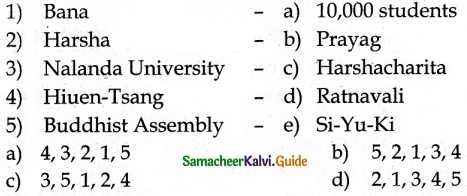
Thus, if a particle undergoes uniform circular motion then the projection of the particle on the diameter of the circle (or on a line parallel to the diameter) traces straight line motion which is simple harmonic in nature. The circle is known as reference circle of the simple harmonic motion. The simple harmonic motion can also be defined as the motion of the projection of a particle on any diameter of a circle of reference.
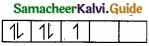
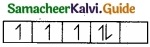
[OR]

(b) State and prove Bernoulli’s theorem for a flow of incompressible non viscous and stream lined flow of fluid?
Answer:
Bernoulli’s theorem:
According to Bernoulli’s theorem, the sum of pressure energy, kinetic energy, and potential energy per unit mass of an incompressible, non-viscous fluid in a streamlined flow remains a constant. Mathematically,
\(\frac{P}{ρ}\) + \(\frac{1}{2}\)v2 + gh – constant
This is known as Bernoulli’s equation.
Proof:
Let us consider a flow of liquid through a pipe AB. Let V be the volume of the liquid when it enters A in a time t. Which is equal to the volume of the liquid leaving B in the same time. Let aA, vA and PA be the area of cross section of the tube, velocity of the liquid and pressure exerted by the liquid at A respectively.

Let the force exerted by the liquid at A is
FA = PAaA

Distance travelled by the liquid in time t is d = vAt
Therefore, the work done is W = FAd = PAaAvAt
But aAvAt = aAd = V, volume of the liquid entering at A.

Thus, the work done is the pressure energy (at A), W = FAd = PAV

Pressure energy per unit volume at
A = \($\frac{\text { Pressure energy }}{\text { Volume }}$\) = \(\frac { P_{ A }V }{ V } \) = PA

Pressure energy per unit mass at
A = \($\frac{\text { Pressure energy }}{\text { Mass }}$\) = \(\frac { P_{ A }V }{ m } \) = \(\frac { P_{ A } }{ \frac { m }{ V } } \) = \(\frac { P_{ A } }{ \rho } \)

Since m is the mass of the liquid entering at A in a given time, therefore, pressure energy of the liquid at A is
EPA = PAV = PAV × (\(\frac{m}{m}\)) = m\(\frac { P_{ A } }{ \rho } \)

Potential energy of the liquid at A,
PEA = mghA

Due to the flow of liquid, the kinetic energy of the liquid at A,
KEA = \(\frac{1}{2}\)mv2A

Therefore, the total energy due to the flow of liquid at A,
EA = EPA + KEA + PEA
EA = \(m \frac{P_{A}}{\rho}+\frac{1}{2} m v_{A}^{2}+m g h_{A}\)

Similarly, let aB, VB and PB be the area of cross section of the tube, velocity of the liquid and pressure exerted by the liquid at B. Calculating the total energy at FB, we get .
\(\mathrm{E}_{\mathrm{B}}=m \frac{\mathrm{P}_{\mathrm{B}}}{\rho}+\frac{1}{2} m v_{\mathrm{B}}^{2}+m g h_{\mathrm{B}}\)
From the law of conservation of energy.
EA = EB

Tamil Nadu 11th Physics Model Question Paper 3 English Medium img 14

Thus, the above equation can be written as
\(\frac { P }{ \rho g } \) + \(\frac{1}{2}\) \(\frac { v^{ 2 } }{ g } \) + h = Constant

The above equation is the consequence of the conservation of energy which is true until there is no loss of energy due to friction. But in practice, some energy is lost due to friction. This arises due to the fact that in a fluid flow, the layers flowing with different velocities exert frictional forces on each other. This loss of energy is generally converted into heat energy. Therefore, Bernoulli’s relation is strictly valid for fluids with zero viscosity or non-viscous liquids. Notice that when the liquid flows through a horizontal pipe, then
h = 0 ⇒ \(\frac { P }{ \rho g } \) + \(\frac{1}{2}\) \(\frac { v^{ 2 } }{ g } \) = Constant

Tamil Nadu 11th Physics Model Question Paper 3 English Medium

Question 36 (a).
Explain perfect inelastic collision and derive an expression for loss of kinetic energy in perfect inelastic collision?
Answer:
In a perfectly inelastic or completely inelastic collision, the objects stick together permanently after collision such that they move with common velocity. Let the two bodies with masses m1 and m2 move with initial velocities u1 and u2 respectively before collision. Aft er perfect inelastic collision both the objects move together with a common velocity v as shown in figure.
Since, the linear momentum is conserved during collisions,

Tamil Nadu 11th Physics Model Question Paper 3 English Medium img 15

m1u1 + m2u2 = (m1 + m2) v

Tamil Nadu 11th Physics Model Question Paper 3 English Medium img 16

The common velocity can be computed by
v = \(\frac{m_{1} u_{1}+m_{2} u_{2}}{\left(m_{1}+m_{2}\right)}\) ………………….. (1)

Loss of kinetic energy in perfect inelastic collision;
In perfectly inelastic collision, the loss in kinetic energy during collision is transformed to another form of energy like sound, thermal, heat, light etc. Let KEi be the total kinetic energy before collision and KEf be the total kinetic energy after collision.
Total kinetic energy before collision,
KEe = \(\frac{1}{2} m_{1} u_{1}^{2}+\frac{1}{2} m_{2} u_{2}^{2}\) …………………… (2)
Total kinetic energy after collision,
KEf = \(\frac{1}{2}\left(m_{1}+m_{2}\right) v^{2}\) …………………….. (3)
Then the loss of kinetic energy is Loss of KE, ∆Q = KEf – KEi
= \(\frac{1}{2}\left(m_{1}+m_{2}\right) v^{2}-\frac{1}{2} m_{1} u_{1}^{2}-\frac{1}{2} m_{2} u_{2}^{2}\) ………………….. (4)
Substituting equation (1) in equation (4), and on simplifying (expand v by using the algebra (a + b)2 = a2 + b2 + 2ab), we get
Loss of KE, ∆Q = \(\frac{1}{2}\) \(\left(\frac{m_{1} m_{2}}{m_{1}+m_{2}}\right)\) (u1 – u2)2

[OR]

(b) Derive an expression for maximum height attained, time of flight, horizontal range for a projectile in oblique projection?
Answer:

Tamil Nadu 11th Physics Model Question Paper 3 English Medium img 17

Maximum height (hmax):
The maximum vertical distance travelled by the projectile during the journey is called maximum height. This is determined as follows:
For the vertical part of the motion
\(v_{y}^{2}=u_{y}^{2}+2 a_{y} s\)
Here, uy= u sin θ, a = -g, s = hmax, and at the maximum height v = 0

Time of flight (Tf):
The total time taken by the projectile from the point of projection till it hits the horizontal plane is called time of flight. This time of flight is the time taken by the projectile to go from point O to B via point A as shown in figure.
We know that sy = uyt + \(\frac{1}{2}\)ayt2
Here, sy = y = 0 (net displacement in y-direction is zero), uy = u sin θ, ay = -g, t = Tf, Then
0 = u sin θ Tf – \(\frac{1}{2} g \mathrm{T}_{f}^{2}\)
Tf = 2u \(\frac{sin θ}{g}\) …………………….. (2)

Horizontal range (R):
The maximum horizontal distance between the point of projection and the point on the horizontal plane where the projectile hits the ground is called horizontal range (R). This is found easily since the horizontal component of initial velocity remains the same. We can write.

Range R = Horizontal component of velocity % time of flight = u cos θ × Tf = \(\frac{u^{2} \sin 2 \theta}{g}\)
The horizontal range directly depends on the initial speed (u) and the sine of angle of projection (θ). It inversely depends on acceleration due to gravity ‘g’.

For a given initial speed u, the maximum possible range is reached when sin 2θ is
maximum, sin 2θ = 1. This implies 2θ = π/2 or θ = π/4
This means that if the particle is projected at 45 degrees with respect to horizontal, it attains maximum range, given by
Rmax = \(\frac { u^{ 2 } }{ g } \).

Tamil Nadu 11th Physics Model Question Paper 3 English Medium

Question 37 (a).
Explain the work-energy theorem in detail and also give three examples?
Answer:

  1. If the work done by the force on the body is positive then its kinetic energy increases.
  2. If the work done by the force on the body is negative then its kinetic energy decreases.
  3. If there is no work done by the force on the body then there is no change in its kinetic energy, which means that the body has moved at constant speed provided its mass remains constant.
  4. When a particle moves with constant speed in a circle, there is no change in the kinetic energy of the particle. So according to work energy principle, the work done by centripetal force is zero.

[OR]

(b) (i) Define molar specific heat capacity?
Answer:
Molar specific heat capacity is defined as heat energy required to increase the temperature of one mole of substance by IK or 1°C

(ii) Derive Mayer’s relation for an ideal gas?

Mayer’s relation: Consider p mole of an ideal gas in a container with volume V, pressure P and temperature T.

When the gas is heated at constant volume the temperature increases by dT. As no work is done by the gas, the heat that flows into the system will increase only the internal energy. Let the change in internal energy be dU.

If CV is the molar specific heat capacity at constant volume, from equation.
CV = \(\frac { 1 }{ \mu } \) \(\frac{dU}{dT}\) …………………… (1)
dU = µCV dT ………………… (2)

Suppose the gas is heated at constant pressure so that the temperature increases by dT. If ‘Q’ is the heat supplied in this process and ‘dV’ the change in volume of the gas.
Q = pCpdT ……………. (3)

If W is the workdone by the gas in this process, then
W = P dV ………………….. (4)

But from the first law of thermodynamics,
Q = dU + W ………………… (5)

Substituting equations (2), (3) and (4) in (5), we get,
For mole of ideal gas, the equation of state is given by
\(\mu \mathrm{C}_{\mathrm{p}} d \mathrm{T}=\mu \mathrm{C}_{\mathrm{v}} d \mathrm{T}+\mathrm{P} d \mathrm{V}\)

Since the pressure is constant, dP = 0
CpdT = CVdT + PdV
∴ Cp = CV + R (or) Cp – CV = R …………………… (6)
This relation is called Mayer’s relation It implies that the molar specific heat capacity of an ideal gas at constant pressure is greater than molar specific heat capacity at constant volume.
The relation shows that specific heat at constant pressure (sp) is always greater than specific heat at constant volume (sv).

Tamil Nadu 11th Physics Model Question Paper 3 English Medium

Question 38 (a).
Derive an expression of pressure exerted by the gas on the walls of the container?
Answer:
Expression for pressure exerted by a gas : Consider a monoatomic gas of N molecules each having a mass m inside a cubical container of side l.
The molecules of the gas are in random motion. They collide with each other and also with the walls of the container. As the collisions are elastic in nature, there is no loss of energy, but a change in momentum occurs.

Tamil Nadu 11th Physics Model Question Paper 3 English Medium img 18

The molecules of the gas exert pressure on the walls of the container due to collision on it. During each collision, the molecules impart certain momentum to the wall. Due to transfer of momentum, the walls experience a continuous force. The force experienced per unit area of the walls of the container determines the pressure exerted by the gas. It is essential to determine the total momentum transferred by the molecules in a short interval of time.

A molecule of mass m moving with a velocity \(\vec { v } \) having components (vx, vy, vz) hits the right side wall. Since we have assumed that the collision is elastic, the particle rebounds with same speed and its x-component is reversed. This is shown in the figure. The components of velocity of the molecule after collision are (-vx, vy, vz).

The x-component of momentum of the molecule before collision = mvx
The x-component of momentum of the molecule after collision = – mvx
The change in momentum of the molecule in x direction
= Final momentum – initial momentum = – mvx – mvx = – 2mvx
According to law of conservation of linear momentum, the change in momentum of the wall = 2 mvx
The number of molecules hitting the right side wall in a small interval of time ∆t.

Tamil Nadu 11th Physics Model Question Paper 3 English Medium img 19

The molecules within the distance of vx∆t from the right side wall and moving towards the right will hit the wall in the time interval ∆t. The number of molecules that will hit the right side wall in a time interval ∆t is equal to the product of volume (Avx∆t) and number density of the molecules (n).

Here A is area of the wall and n is number of molecules per \(\frac{N}{V}\) unit volume. We have assumed that the number density is the same throughout the cube.

Not all the n molecules will move to the right, therefore on an average only half of the n molecules move to the right and the other half moves towards left side.

The number of molecules that hit the right side wall in a time interval ∆t
= \(\frac{n}{2}\) Avx∆t
In the same interval of time ∆t, the total momentum transferred by the molecules
\(\Delta \mathrm{P}=\frac{n}{2} \mathrm{A} v_{x} \Delta t \times 2 m v_{x}=\mathrm{A} v_{x}^{2} m n \Delta t\) ………………….. (2)
From Newton’s second law, the change in momentum in a small interval of time gives rise to force.

The force exerted by the molecules on the wall (in magnitude)
F = \(\frac{∆p}{∆t}\) = nmAv2x ……………………. (3)

Pressure, P = force divided by the area of the wall
P = \(\frac{F}{A}\) = nmAv2x ……………………….. (4)
p = \(nm\bar{v}_{x}^{2}\)

Since all the molecules are moving completely in random manner, they do not have same . speed. So we can replace the term vnmAv2x by the average \(\bar { v } \)2x in equation (4).
P = nm\(\bar { v } \)2x ……………………. (5)

Since the gas is assumed to move in random direction, it has no preferred direction of motion (the effect of gravity on the molecules is neglected). It implies that the molecule has same average speed in all the three direction. So, \(\bar{v}_{x}^{2}\) = \(\bar{v}_{y}^{2}\) = \(\bar{v}_{z}^{2}\). The mean square speed is written as
\(\bar{v}^{2}\) = \(\bar{v}_{x}^{2}\) + \(\bar{v}_{y}^{2}\) + \(\bar{v}_{z}^{2}\) = 3\(\bar{v}_{x}^{2}\)
\(\bar{v}_{x}^{2}\) = \(\frac{1}{3}\) \(\bar{v}^{2}\)
Using this in equation (5), we get
P = \(\frac{1}{3} n m \bar{v}^{2} \quad \text { or } P=\frac{1}{3} \frac{N}{V} m \bar{v}^{2}\) ………………….. (6)

[OR]

(b) Discuss the simple pendulum in detail?
Answer:
Simple pendulum

Tamil Nadu 11th Physics Model Question Paper 3 English Medium img 20

A pendulum is a mechanical system which exhibits periodic motion. It has a bob with mass m suspended by a long string (assumed to be massless and inextensible string) and the other end is fixed on a stand. At equilibrium, the pendulum does not oscillate and hangs vertically downward.

Such a position is known as mean position or equilibrium position. When a pendulum is displaced through a small displacement from its equilibrium position and released, the bob of the pendulum executes to and fro motion. Let l be the length of the pendulum which is taken as the distance between the point of suspension and the centre of gravity of the bob. Two forces act on the bob of the pendulum at any displaced position.

  • The gravitational force acting on the body (\(\vec { F} \) = m\(\vec { g } \)) which acts vertically downwards.
  • The tension in the string T which acts along the string to the point of suspension.

Resolving the gravitational force into its components:

  1. Normal component: The component along the string but in opposition to the direction of tension, Fas = mg cos θ.
  2. Tangential component: The component perpendicular to the string i.e., along tangential direction of arc of swing, Fps = mg sin θ.

Therefore, The normal component of the force is, along the string,
\(\mathrm{T}-\mathrm{W}_{a s}=m \frac{v^{2}}{l}\)

Here v is speed of bob
T -mg cos θ = m \(\frac{v^{2}}{l}\)

From the figure, we can observe that the tangential component Wps of the gravitational force always points towards the equilibrium position i.e., the direction in which it always points opposite to the direction of displacement of the bob from the mean position. Hence, in this case, the tangential force is nothing but the restoring force. Applying Newton’s second law along tangential direction, we have
\(m \frac{d^{2} s}{d t^{2}}+\mathrm{F}_{p s}=0 \Rightarrow m \frac{d^{2} s}{d t^{2}}=-\mathrm{F}_{p s}\)
\(m \frac{d^{2} s}{d t^{2}}=-m g \sin \theta\) …………………. (1)

where, s is the position of bob which is measured along the arc. Expressing arc length in terms of angular displacement i.e.,
s = lθ ………………… (2)
then its acceleration, \(\frac{d^{2} s}{d t^{2}}=l \frac{d^{2} \theta}{d t^{2}}\) …………………. (3)

Substituting equation (3) in equation (1), we get
\(\begin{aligned}
l \frac{d^{2} \theta}{d t^{2}} &=-g \sin \theta \\
\frac{d^{2} \theta}{d t^{2}} &=-\frac{g}{l} \sin \theta
\end{aligned}\) ………………….. (4)

Because of the presence of sin θ in the above differential equation, it is a non-linear differential equation (Here, homogeneous second order). Assume “the small oscillation approximation”, sin θ ~ 0, the above differential equation becomes linear differential equation.
\(\frac{d^{2} \theta}{d t^{2}}=-\frac{g}{l} \theta\) …………………… (5)

This is the well known oscillatory differential equation. Therefore, the angular frequency of this oscillator (natural frequency of this system) is
ω2 = \(\frac{g}{l}\) …………………… (6)
∴ ω = \(\sqrt{g/l}\) in rad s-1 ……………….. (7)

The frequency of oscillation is
f = \(f=\frac{1}{2 \pi} \sqrt{\frac{g}{l}} \text { in } \mathrm{Hz}\) ………………… (8)
and time period of sscillations is
T = 2π\(\sqrt{l/g}\) in second. ……………….. (9)