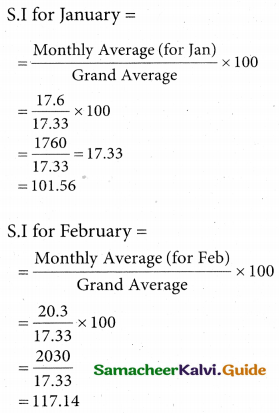
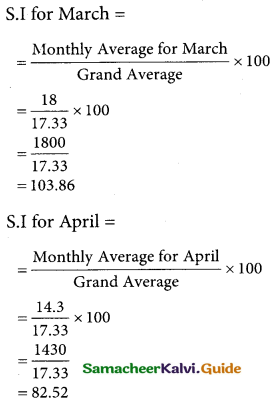
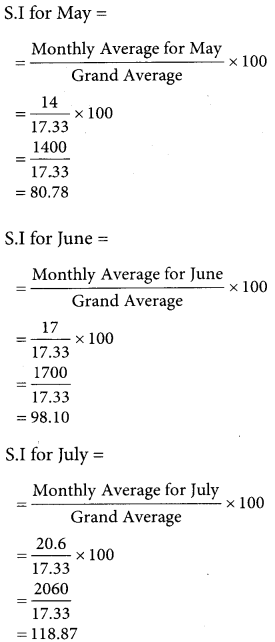
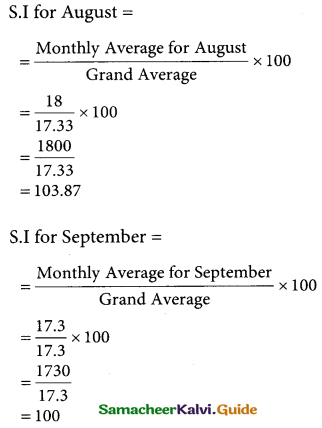
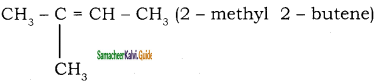
Samacheer Kalvi 11th Chemistry Guide Chapter 14 Haloalkanes and Haloarenes

Tamilnadu State Board New Syllabus Samacheer Kalvi 11th Chemistry Guide Pdf Chapter 14 Haloalkanes and Haloarenes Text Book Back Questions and Answers, Notes.

Tamilnadu Samacheer Kalvi 11th Chemistry Solutions Chapter 14 Haloalkanes and Haloarenes

11th Chemistry Guide Haloalkanes and Haloarenes Text Book Back Questions and Answers

Textbook Evaluation:

I. Choose the best answer:

Question 1.
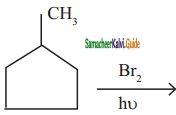
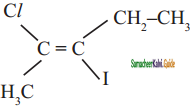
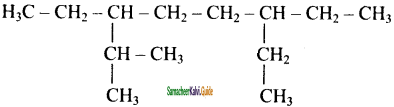
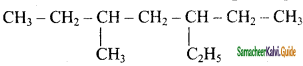
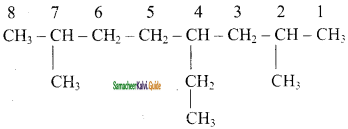
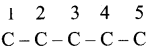
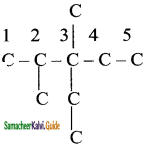
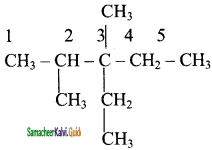
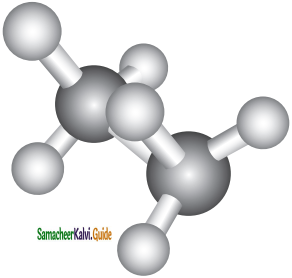
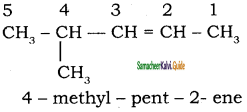
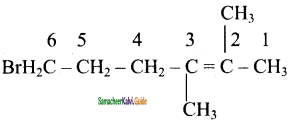
The IUPAC name of Samacheer Kalvi 11th Chemistry Guide Chapter 14 Haloalkanes and Haloarenes 1 is
a) 2 – Bromo pent – 3 – ene
b) 4 – Bromo pent – 2 – ene
c) 2 – Bromo pent – 4 – ene
d) 4 – Bromo pent – 1 – ene
Answer:
b) 4 – Bromo pent – 2 – ene

Question 2.
Of the following compounds, which has the highest boiling point?
a) n – Butyl chloride
b) Isobutyl chloride
c) t – Butyl chloride
d) n – Propyl chloride
Answer:
a) n – Butyl chloride

Question 3.
Arrange the following compounds in increasing order of their density
A) CCl4
B) CHCl3
C) CH2Cl2
D) CH3Cl
a) D < C < B < A
b) C > B > A > D
c) A < B < C < D
d) C > A > B > D
Answer:
a) D < C < B < A

Question 4.
With respect to the position of – Cl in the compound CH3 – CH = CH – CH2 – Cl, it is classified as
a) Vinyl
b) Allyl
c) Secondary
d) Aralkyl
Answer:
b) Allyl

Question 5.
What should be the correct IUPAC name of diethyl chloromethane?
a) 3 – Chloro pentane
b) 1 – Chloropentane
c) 1 – Chloro – 1, 1 – diethyl methane
d) 1- Chloro-1-ethyl propane
Answer:
a) 3 – Chloro pentane

Samacheer Kalvi 11th Chemistry Guide Chapter 14 Haloalkanes and Haloarenes

Question 6.
C – X bond is strongest in
a) Chloromethane
b) Iodomethane
c) Bromomethane
d) Fluoromethane
Answer:
d) Fluoromethane

Question 7.
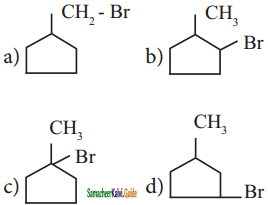
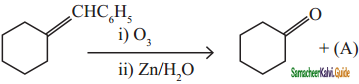
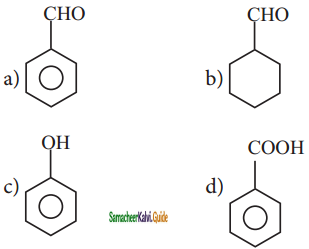
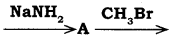
In the reaction Samacheer Kalvi 11th Chemistry Guide Chapter 14 Haloalkanes and Haloarenes 2 X is ______.

Samacheer Kalvi 11th Chemistry Guide Chapter 14 Haloalkanes and Haloarenes 3
Answer:
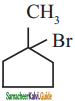
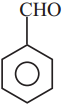
b) Samacheer Kalvi 11th Chemistry Guide Chapter 14 Haloalkanes and Haloarenes 4

Question 8.
Which of the following compounds will give racemic mixture on nucleophilic substitution by OH ion?
i) Samacheer Kalvi 11th Chemistry Guide Chapter 14 Haloalkanes and Haloarenes 5

ii) Samacheer Kalvi 11th Chemistry Guide Chapter 14 Haloalkanes and Haloarenes 6

iii) Samacheer Kalvi 11th Chemistry Guide Chapter 14 Haloalkanes and Haloarenes 7
a) (i)
b) (ii) and (iii)
c) (iii)
d) (i) and (ii)
Answer:
c) (iii)

Question 9.
The treatment of ethyl formate with excess of RMgX gives
a) Samacheer Kalvi 11th Chemistry Guide Chapter 14 Haloalkanes and Haloarenes 8

b) Samacheer Kalvi 11th Chemistry Guide Chapter 14 Haloalkanes and Haloarenes 9
c) R – CHO
d) R – O – R
Answer:
c) R – CHO

Question 10.
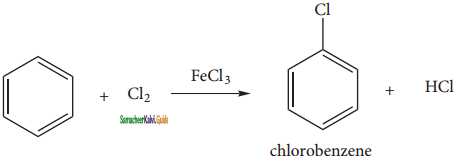
Benzene reacts with Cl2 in the presence of FeCl3 and in absence of sunlight to form
a) Chlorobenzene
b) Benzyl chloride
c) Benzal chloride
d) Benzene hexachloride
Answer:
a) Chlorobenzene

Samacheer Kalvi 11th Chemistry Guide Chapter 14 Haloalkanes and Haloarenes

Question 11.
The name of C2F4C12 is
a) Freon – 112
b) Freon – 113
c) Freon – 114
d) Freon – 115
Answer:
c) Freon – 114

Question 12.
Which of the following reagent is helpful to differentiate ethylene dichloride and ehtylidene chloride?
a) Zn / methanol
b) KQH / ethanol
c) aqueous KOH
d) ZnCl2 / Con HCl
Answer:
c) aqueous KOH

Question 13.
Match the compounds given in Column I with suitable items given in Column II:

Column I (Compound)Column II (Uses)
A. Iodoform1. Fire extinguisher
B. Carbon tetra chloride2. Insecticide
C. CFC3. Antiseptic
D. DDT4. Refrigerants

Code
a) A → 2 B → 4 C → 1 D → 3
b) A → 3 B → 2 C → 4 D → 1
c) A → 1 B → 2 C → 3 D → 4
d) A → 3 B → 1 C → 4 D → 2
Answer:
d) A → 3 B → 1 C → 4 D → 2

Question 14.
Assertion:
Inmonohaloarenes, electrophilic substitution occurs at ortho and para positions.
Reason:
Halogen atom is a ring deactivator.
Assertion and Reason type questions.
Directions:
In the following questions, a statement of assertion (A) is followed by a statement of reason (R) mark the correct choice as
(i) If both assertion and reason are true and reason is the correct explanation of assertion.
(ii) If both assertion and reason are true but reason is not the correct explanation of assertion.
(iii) If assertion is true but reason is false.
(iv) If both assertion and reason are false.
a) (i)
b) (ii)
c) (iii)
d) (iv)
Answer:
b) (ii)

Question 15.
Consider the reaction,
CH3CH2CH2Br + NaCN → CH3CH2CH2CN + NaBr This reaction will be the fastest in
a) ethanol
b) methanol
c) DMF (N, N’ – dimethyl formamide)
d) water
Answer:
c) DMF (N, N’ – dimethyl formamide)

Samacheer Kalvi 11th Chemistry Guide Chapter 14 Haloalkanes and Haloarenes

Question 16.
Freon – 12 manufactured from tetrachloro methane by
a) Wurtz reaction
b) Swarts reaction
c) Haloform reaction
d) Gattermann reaction
Answer:
b) Swarts reaction

Question 17.
The most easily hydrolysed molecules under SN1 condition is
a) allyl chloride
b) ethyl chloride
c) isopropyl chloride
d) benzyl chloride
Answer:
a) allyl chloride

Question 18.
The carbon cation formed in SN1 reaction of alkyl halide in the slow step is
a) sp3 hybridized
b) sp2 hybridized
c) sp hybridized
d) none of these
Answer:
b) sp2 hybridized

Question 19.
The major products obtained when chlorobenzene is nitrated with HNO3 and con H2SO4
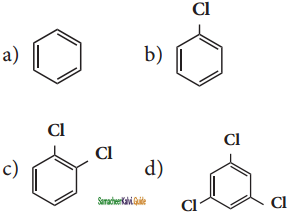
a) 1 – chloro – 4 – nitrobenzene
b) 1 – chloro – 2 – nitrobenzene
c) 1 – chloro – 3 – nitrobenzene
d) 1 – chloro – 1 – nitrobenzene
Answer:
a) 1 – chloro – 4 – nitrobenzene

Question 20.
Which one of the following is most reactive towards nucleophilic substitution reaction?
a) Samacheer Kalvi 11th Chemistry Guide Chapter 14 Haloalkanes and Haloarenes 10
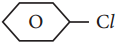
b) Samacheer Kalvi 11th Chemistry Guide Chapter 14 Haloalkanes and Haloarenes 11

c) Samacheer Kalvi 11th Chemistry Guide Chapter 14 Haloalkanes and Haloarenes 12

d) Samacheer Kalvi 11th Chemistry Guide Chapter 14 Haloalkanes and Haloarenes 13
Answer:
d) Samacheer Kalvi 11th Chemistry Guide Chapter 14 Haloalkanes and Haloarenes 13

Samacheer Kalvi 11th Chemistry Guide Chapter 14 Haloalkanes and Haloarenes

Question 21.
Ethylidene chloride on treatment with aqueous KOH gives
a) acetaldehyde
b) ethylene glycol
c) formaldehyde
d) glycoxal
Answer:
a) acetaldehyde

Question 22.
The raw material for Raschig process
a) chloro benzene
b) phenol
c) benzene
d) anisole
Answer:
c) benzene

Question 23.
Chloroform reacts with nitric acid to produce
a) nitro toluene
b) nitro glycerine
c) chloropicrin
d) chloropicric acid
Answer:
c) chloropicrin

Question 24.
Acetone Samacheer Kalvi 11th Chemistry Guide Chapter 14 Haloalkanes and Haloarenes 14 X, X is
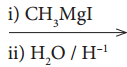
a) 2 – propanol
b) 2 – methyl – 2 – propanol
c) 1 – propanol
d) acetonol
Answer:
b) 2 – methyl – 2 – propanol

Question 25.
Silverpropionate when refluxed with Bromine in carbon tetrachloride gives
a) propionic acid
b) chloroethane
c) Bromo ethane
d) chloro propane
Answer:
c) bromo ethane

Samacheer Kalvi 11th Chemistry Guide Chapter 14 Haloalkanes and Haloarenes

II. Write brief answer to the following questions:

Question 26.
Classify the following compounds in the form of alkyl, allylic, vinyl, benzylic halides.
i) CH3 – CH = CH – Cl

ii) C6H5CH2I

iii) Samacheer Kalvi 11th Chemistry Guide Chapter 14 Haloalkanes and Haloarenes 15

iv) CH2 = CH – Cl
Answer:
i) CH3 – CH = CH – Cl = Allylic halide

ii) C6H5CH2I = Benzylic halide

iii) Samacheer Kalvi 11th Chemistry Guide Chapter 14 Haloalkanes and Haloarenes 15 = Alkyl halide

iv) CH2 = CH – Cl = Vinyl halide

Question 27.
Why chlorination of methane is not possible in dark?
Answer:
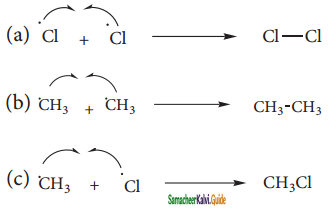
The reaction of chlorine and methane is a free radical reaction under the influence of light energy. Chlorine molecule first split into two Cl atoms or radicals. These are both very reactive species in contact with methane they form methyl radical and HCl.

Methyl radical further reacts with Cl to give CH3Cl and another Cl atom thus of a chain reaction. So this reaction takes place only under the influence of light. Hence the reaction does not take place in dark condition.

Question 28.
How will you prepare n propyl iodide from n – propyl bromide?
Answer:
Finkelstein reaction,
nCH3 – CH2 – CH2 – Br + NaI Samacheer Kalvi 11th Chemistry Guide Chapter 14 Haloalkanes and Haloarenes 16 n – CH3 – CH2 – CH2 – I + NaBr
n – propyl iodide                                              n- propyl bromide

Question 29.
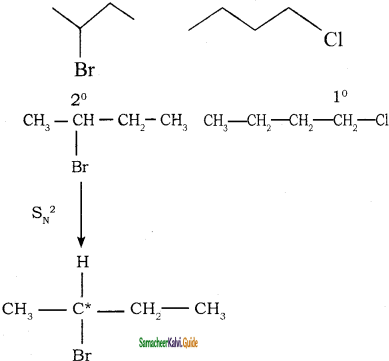
Which alkyl halide from the following pair is
i) chiral
ii) undergoes faster SN2 reaction?
Samacheer Kalvi 11th Chemistry Guide Chapter 14 Haloalkanes and Haloarenes 17
Answer:
Samacheer Kalvi 11th Chemistry Guide Chapter 14 Haloalkanes and Haloarenes 18
It contains one chiral carbon atom.
2 – bromo butane undergoes SN2 mechanism faster than 1- Chloro butane.

Question 30.
How does chlorobenzene react with sodium in the presence of ether? What is the name of the reaction?
Answer:
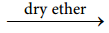
Haloarenes react with sodium metal in dry ether, two aryl groups combine to give biaryl products.
This reaction is called fittig reaction.
C6H5Cl + 2Na + Cl – C6H5 Samacheer Kalvi 11th Chemistry Guide Chapter 14 Haloalkanes and Haloarenes 19 C6H5 – C6H5 + 2NaCl
Chlorobenzene                                      Biphenyl

Samacheer Kalvi 11th Chemistry Guide Chapter 14 Haloalkanes and Haloarenes

Question 31.
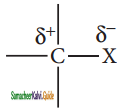
Give reasons for polarity of C – X bond in halo alkane.
Answer:
Carbon halogen bond is a polar bond as halogens are more electro negative than carbon. The carbon atom exhibits a partial positive charge (δ+) and halogen atom a partial negative charge (δ)
Samacheer Kalvi 11th Chemistry Guide Chapter 14 Haloalkanes and Haloarenes 20

The C -X bond is formed by overlap of sp3 orbital of carbon atom with half-filled p- orbital of the halogen atom. The atomic size of halogen increases from fluorine to iodine, which increases the C – X bond length. Larger the size, greater is the bond length, and weaker is the bond formed. The bond strength of C – X decreases from C – F to C – I in CH3X.

Question 32.
Why is it necessary to avoid even traces of moisture during the use of Grignard reagent?
Answer:
Grignard reagents are mostly reactive and react with the source of product to give hydrocarbons. Even alcohols, amines, H2O are sufficiently acidic to convert them to corresponding hydrocarbons.
R Mg X + H2O → RH + Samacheer Kalvi 11th Chemistry Guide Chapter 14 Haloalkanes and Haloarenes 21

Due to its high reactivity, it is necessary to avoid even traces of moisture from Grignard reagent.

Question 33.
What happens when acetyl chloride is treated with an excess of CH3MgI?
Answer:
Samacheer Kalvi 11th Chemistry Guide Chapter 14 Haloalkanes and Haloarenes 22

Samacheer Kalvi 11th Chemistry Guide Chapter 14 Haloalkanes and Haloarenes 23

Question 34.
Arrange the following alkyl halide in increasing order of bond enthalpy of RX.
CH3Br, CH3F, CH3Cl, CH3I
Answer:
The order is:
CH3I < CH3Br < CH3Cl < CH3F.

Question 35.
What happens when chloroform reacts with oxygen in the presence of sunlight?
Answer:
2 CHCl3 + O2 → 2 COCl2 + 2 HCl

Samacheer Kalvi 11th Chemistry Guide Chapter 14 Haloalkanes and Haloarenes

Question 36.
Write down the possible isomers of C5H11Br and give their IUPAC and common names.
Answer:
C5H11Br – Possible isomers
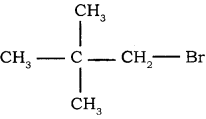
1. CH3 – CH2 – CH2 – CH2 – CH2 – Br → 1 – bromo pentane

2. Samacheer Kalvi 11th Chemistry Guide Chapter 14 Haloalkanes and Haloarenes 24 → 2 – bromo pentane

3. Samacheer Kalvi 11th Chemistry Guide Chapter 14 Haloalkanes and Haloarenes 25 → 3 – bromo pentane

4.  Samacheer Kalvi 11th Chemistry Guide Chapter 14 Haloalkanes and Haloarenes 26 → 1 – bromo 2, 2 – dimethyl propane

5. Samacheer Kalvi 11th Chemistry Guide Chapter 14 Haloalkanes and Haloarenes 27 → 1 – bromo 3 – methyl butane
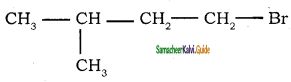
6. Samacheer Kalvi 11th Chemistry Guide Chapter 14 Haloalkanes and Haloarenes 28 → 2 – bromo 3 – methyl butane

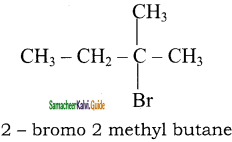
7. Samacheer Kalvi 11th Chemistry Guide Chapter 14 Haloalkanes and Haloarenes 29 → 2 – bromo 2 – methyl butane

8. Samacheer Kalvi 11th Chemistry Guide Chapter 14 Haloalkanes and Haloarenes 30 → 1 – bromo 2- methyl butane

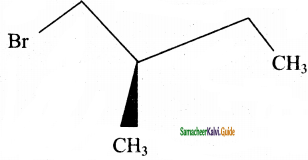
9. Samacheer Kalvi 11th Chemistry Guide Chapter 14 Haloalkanes and Haloarenes 31 → (2S) – 1 – bromo 2 – methyl butane

10. Samacheer Kalvi 11th Chemistry Guide Chapter 14 Haloalkanes and Haloarenes 32 → (2R) – 1 – bromo 2 – methyl butane
Question 37.
Mention any three methods of preparation of haloalkanes from alcohols.
Answer:
Haloalkanes are prepared by the following methods.
1) From alcohols:
Alcohols can be converted into halo alkenes by reacting it with any one of the following reagent.
1. Hydrogen halide
2. Phosphorous halides
3. Thionyl chloride.

a) Reaction with hydrogen halide:

Samacheer Kalvi 11th Chemistry Guide Chapter 14 Haloalkanes and Haloarenes 33

Mixture of con. HCl and anhydrous ZnCl2 is called Lucas Reagent.

Samacheer Kalvi 11th Chemistry Guide Chapter 14 Haloalkanes and Haloarenes 34

The order of reactivity of halo acids with alcohol is in the order HI > HBr > HCl.
The order of reactivity of alcohols with halo acid is tertiary > secondary > primary.

b) Reaction with phosphorous halides:
Alcohols react with PX5 or PX3 to form haloalkanes.
Example:
CH3CH2OH + PCl5 → CH3CH2Cl + POCl3 + HCl
Ethane                      Chloro ethane

3CH3CH2OH + PCl3 → 3 CH3CH2Cl + H3PO3
Ethanol                       Chloro ethane

c) Reaction with Thionyl chloride(Sulphonyl Chloride)
CH3CH3OH + SOCl2 Samacheer Kalvi 11th Chemistry Guide Chapter 14 Haloalkanes and Haloarenes 35 CH3CH2Cl + SO2↑ + HCl↑
Ethanol                                      Chloro ethane

Question 38.
Compare SN1 and SN2 reaction mechanisms.
Answer:

SN1SN2
Rate lawUnimolecular (Substrate only)Biomolecular (substrate and nucleophile)
“Big Barrier”Carbocation stabilitySteric hindrance
Alkyl halide (electrophile)3° > 2° > 1° 1° > 2° > 3°
NucleophileWeak (generally neutral)Strong (generally bearing a negative charge)
SolventPolar protic (e.g., alcohols)Polar aprotic (e.g., DMSO, acetone)
Stereo ChemistryMix of retention and inversioninversion

Question 39.
Reagents and the conditions used in the reactions are given below. Complete the table by writing down the product and the name of the reaction.
Samacheer Kalvi 11th Chemistry Guide Chapter 14 Haloalkanes and Haloarenes 36
Answer:
Samacheer Kalvi 11th Chemistry Guide Chapter 14 Haloalkanes and Haloarenes 37

Question 40.
Discuss the aromatic nucleophilic substitutions reaction of chlorobenzene.
Answer:
The halogen of haloarenes can be substituted by OH, NH2 or CN with appropriate nucleophilic reagents at high temperature and pressure.
Example:
(i) Chlorobenzene reacts with ammonium at 250 and at 50 atm to give aniline.
C6H5Cl + 2NH3 Samacheer Kalvi 11th Chemistry Guide Chapter 14 Haloalkanes and Haloarenes 38 C6H5NH2 + NH4Cl
Chlorobenzene                  Aniline

(ii) Chlorobenzcne reacts with CuCN in presence of pyridine at 250 to give phenyl cyanide.
C6H5Cl + CuCN Samacheer Kalvi 11th Chemistry Guide Chapter 14 Haloalkanes and Haloarenes 39 C6H5CN + CuCl
Chlorobenzene                Phenyl cyanide

(iii) Dows process:
C6H5Cl + NaOH Samacheer Kalvi 11th Chemistry Guide Chapter 14 Haloalkanes and Haloarenes 40 C6H5OH + NaCl
Chlorobenzene                   Phenol
This reaction is known as Dow’s process.

Samacheer Kalvi 11th Chemistry Guide Chapter 14 Haloalkanes and Haloarenes

Question 41.
Account for the following:
(i) t – butyl chloride reacts with aqueous KOH by SN1 mechanism while n – butyl chloride reacts with SN2 mechanism.
(ii) p – dichloro benzene has higher melting point than those of o – and m – dichloro benzene.
Answer:
(i) t – butyl chloride reacts with aqueous KOH by SN1 mechanism while n – butyl chloride reacts with SN2 mechanism.
It general, SN1 reaction proceeds through the formation, of carbocation, The tert- butyl chloride readily loses Cl ion to form stable 3° carbocation. Therefore, it reacts with aqueous KOH by SN1 mechanism as:
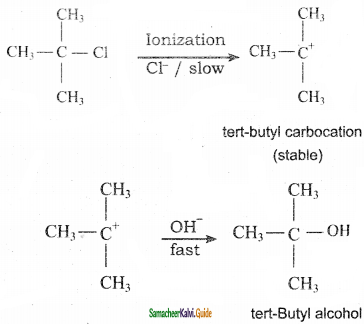
Samacheer Kalvi 11th Chemistry Guide Chapter 14 Haloalkanes and Haloarenes 41

On the other hand n-Butyl chloride does not undergo ionization to form n-Butyl carbocation (1°) because it is not stable. Therefore, it prefers to undergo reaction by SN2 mechanism, which occurs is one step through a transition state involving nucleophilic attack of OH ion from the backside with simultaneous expulsion of Cl ion from the front side.
Samacheer Kalvi 11th Chemistry Guide Chapter 14 Haloalkanes and Haloarenes 42

SN1 mechanism follows the reactivity order as 3° > 2°> 1° while SN2 mechanism follows the reactivity order as 1° > 2° > 3°. Therefore, tert-butyl chloride (3°) reacts by SN1 mechanism while n-butyl chloride (1°) reacts by SN2 mechanism. (ii) p – dichloro benzene has higher melting point than those of o – and m – dicholoro benzene. The higher melting point of p – isomer is due to its symmetry which leads to more close packing of its molecules in the crystal lattice and consequently strong intermolecular attractive force which requires more energy for melting. p – Dihalo benzene > o – Dichloro benzene> m – Dichioro benzene
Melting point: 323 K 256 K 249 K

Question 42.
In an experiment methyl iodide in ether is allowed to stand over magnesium pieces. Magnesium dissolves and product is formed.
a) Name of the product and write the equation for the reaction.
b) Why all the reagents used in the reaction should be dry? Explain.
c) How is acetone prepared from the product obtained in the experiment?
Answer:
a) Name of the product and write the equation for the reaction.
CH3I + Mg Samacheer Kalvi 11th Chemistry Guide Chapter 14 Haloalkanes and Haloarenes 43 CH3MgI

b) Why all the reagents used in the reaction should be dry? Explain.
All the reagents used in the reaction should be dry because reagent reacts with H20 to produce alkane. This is the reason that everything has to be very dry during the preparation of Grignard reagents.
CH3 – MgI + H2O → CH4 +Samacheer Kalvi 11th Chemistry Guide Chapter 14 Haloalkanes and Haloarenes 44
Methane

c) How is acetone prepared from the product obtained in the experiment?
Samacheer Kalvi 11th Chemistry Guide Chapter 14 Haloalkanes and Haloarenes 45

Question 43.
Write a chemical reaction useful to prepare the following.
i) Freon – 12 from Carbon tetrachloride
ii) Carbon tetrachloride from carbon disulphide.
Answer:
i) Freon – 12 from Carbon tetrachloride:
Freon – 12 is prepared by the action of hydrogen fluoride on carbon tetrachloride in the presence of catalytic amount of antimony pentachloride.
CCl4 + 2HF Samacheer Kalvi 11th Chemistry Guide Chapter 14 Haloalkanes and Haloarenes 46 2HCl + CCl2F2
Carbon tetrachloride            Freon – 12

ii) Carbon tetrachloride from carbon disulphide.
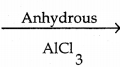
Carbon disulphide reacts with chlorine gas in the presence of anhydrous AlCl3 as catalyst giving carbon tetra chloride.
CS2 + 3 Cl2 Samacheer Kalvi 11th Chemistry Guide Chapter 14 Haloalkanes and Haloarenes 47 CCl4 + S2Cl2
Carbon disulfide                Carbon tetrachloride

Question 44.
What are Freons? Discuss their uses and environmental effects.
Answer:
The chloro fluoro derivatives of methane and ethane are called freons.
Nomenclature:
Freon is represented as Freon – cba
Where a = number of carbon atoms – 1;
b = number of hydrogen atoms + 1
a = total number of fluorine atoms
Samacheer Kalvi 11th Chemistry Guide Chapter 14 Haloalkanes and Haloarenes 48

Uses:
i) Freons are used as a refrigerants in refrigerators and air conditioners.
ii) It is used as a propellant for aerosols and foams
iii) It is used as propellant for foams to spray out deodorants, shaving creams, and insecticides.

Question 45.
Predict the products when bromo ethane is treated with the following.
i) KNO2 ii) AgNO2
Answer:
i) KNO2:
Bromo ethane reacts with alcoholic solution of NaNO2 or KNO2 to form ethyl nitrite.
CH3CH2Br + KNO2 → CH3CH2 – O – N = O + KBr
Bromoethane Ethyl nitrite

ii)AgNO2:
Bromo ethane reacts with alcoholic solution of AgNO2 to form nitro ethane.
CH3CH2Br + AgNO2 → CH3CH2 NO2 + AgBr
Bromoethane                Nitro ethane

Samacheer Kalvi 11th Chemistry Guide Chapter 14 Haloalkanes and Haloarenes

Question 46.
Explain the mechanism of SN1 reaction by highlighting the stereochemistry behind it.
Answer:
Samacheer Kalvi 11th Chemistry Guide Chapter 14 Haloalkanes and Haloarenes 49
In SN1 reactions, if the alkyl halide is optically active, the product obtained in a racemic mixture. The intermolecular carbocation formed in slowest step being sp2 hybridised is planar species. Therefore the attack of the nucleophile OH on it, can occur from both the faces with equal case forming a mixture of two enantiomers. Thus SN1 reaction of optically active alkyl halides are accompained by racemisation.

Question 47.
Write short notes on the following.
i) Raschig process
ii) Dows process
iii) Darzen’s process
Answer:
i) Raschig process:
Chloro benzene is commercially prepared by passing a mixture of benzene vapour, air and HCl overheated cupric chloride, this reaction is called the Raschig process,
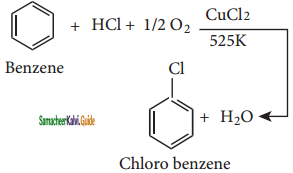
Samacheer Kalvi 11th Chemistry Guide Chapter 14 Haloalkanes and Haloarenes 50

ii) Dows Process:
C6H5Cl + NaOH Samacheer Kalvi 11th Chemistry Guide Chapter 14 Haloalkanes and Haloarenes 51 C6H5OH + NaCl
This reaction is known as Dows process.

iii) Darzen’s process:
CH3CH2OH + SOCl Samacheer Kalvi 11th Chemistry Guide Chapter 14 Haloalkanes and Haloarenes 51 CH3CH2Cl + SO2↑ + HCl↑
Ethanol Chloro ethane
This reaction is known as Darzen’s process.

Question 48.
Starting from CH3MgI, How will you prepare the following?
i) Acetic acid
ii) Acetone
iii) Ethyl acetate
iv) Iso propyl alcohol
v) Methyl cyanide
Answer:
i) Acetic acid:
Solid carbon dioxide reacts with methyl magnesium iodide to form addition product which on hydrolysis yields aceti acid.
Samacheer Kalvi 11th Chemistry Guide Chapter 14 Haloalkanes and Haloarenes 52

ii) Acetone:
Acetyl chloride reacts with methyl magnesium iodide and followed by acid hydrolysis to give acetone.
Samacheer Kalvi 11th Chemistry Guide Chapter 14 Haloalkanes and Haloarenes 53

iii) Ethyl Acetate:
Ethyl chloroformate reacts with methyl magnesium iodide to form ethyl acetate.
Samacheer Kalvi 11th Chemistry Guide Chapter 14 Haloalkanes and Haloarenes 54

iv) Isopropyl alcohol:
Aldehydes (Acetaldehyde) other than formaldehyde, react with methyl magnesium iodide to give addition product which on hydrolysis yields isopropyl alcohol.
Samacheer Kalvi 11th Chemistry Guide Chapter 14 Haloalkanes and Haloarenes 55

v) Methyl cyanide:
Methyl magnesium iodide reacts with cyanogen chloride to give methyl cyanide.
Samacheer Kalvi 11th Chemistry Guide Chapter 14 Haloalkanes and Haloarenes 56

Samacheer Kalvi 11th Chemistry Guide Chapter 14 Haloalkanes and Haloarenes

Question 49.
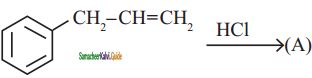
Complete the following reactions.
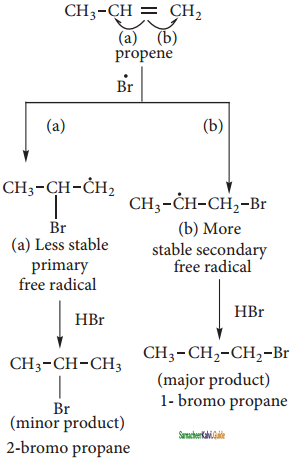
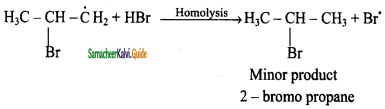
i) CH3 – CH = CH2 + HBr Samacheer Kalvi 11th Chemistry Guide Chapter 14 Haloalkanes and Haloarenes 57
ii) CH3 – CH2 – Br + NaSH Samacheer Kalvi 11th Chemistry Guide Chapter 14 Haloalkanes and Haloarenes 58
iii) C6H5Cl + Mg Samacheer Kalvi 11th Chemistry Guide Chapter 14 Haloalkanes and Haloarenes 59
iv) CHCl3 + HNO3 Samacheer Kalvi 11th Chemistry Guide Chapter 14 Haloalkanes and Haloarenes 60
v) CCl4 + H2O Samacheer Kalvi 11th Chemistry Guide Chapter 14 Haloalkanes and Haloarenes 60
Answer :
i) CH3 – CH = CH2 + HBr Samacheer Kalvi 11th Chemistry Guide Chapter 14 Haloalkanes and Haloarenes 57 CH3 – CH2 – CH2 – Br
Propene                                                   n – propyl bromide

ii) CH3 – CH2 – Br + NaSH Samacheer Kalvi 11th Chemistry Guide Chapter 14 Haloalkanes and Haloarenes 58 CH3 – CH2 – SH + NaBr
Propyl bromide                                     Ethanethiol

iii) C6H5Cl (Chloro benzene) + Mg Samacheer Kalvi 11th Chemistry Guide Chapter 14 Haloalkanes and Haloarenes 59 C6H5MgCl (Phenyl magnesium chloride)

iv) CHCl3 + HNO3 Samacheer Kalvi 11th Chemistry Guide Chapter 14 Haloalkanes and Haloarenes 60 CCl3NO2 + H
Chloroform                               Chloropicrin

v) CCl4 (Carbon tetrachloride) + H2O Samacheer Kalvi 11th Chemistry Guide Chapter 14 Haloalkanes and Haloarenes 60COCl2 (Carbonyl chloride) + 2HCl

Question 50.
Explain the preparation of the following compounds.
i) DDT
ii) Chloroform
iii) Biphrnyl
iv) Chloropicrin
v) Freon – 12
Answer:
i) DDT:
DDT can be prepared by heating a mixture of chlorobenzene with chloral (Trichloro acetaldehyde) in the presence of con.H2SO4.
Samacheer Kalvi 11th Chemistry Guide Chapter 14 Haloalkanes and Haloarenes 61

ii) Chloroform:
Preparation:
Chloroform is prepared in the laboratory by the reaction between ethyl alcohol with bleaching powder followed by the distillation of the product chloroform. Bleaching powder act as a source of chlorine and calcium hydroxide. This reaction is called haloform reaction. The reaction proceeds in three steps as shown below.

Step – 1: Oxidation
CH3CH2OH + Cl2 → CH3CHO + 2HCl
Ethyl alcohol           Ethanal (Acetaldehyde)

Step – 2: Chlorination
CH3CHO + 3Cl2 → CCl3CHO + 3HCl
Acetaldehyde        Trichloro acetaldehyde

Step – 3: Hydrolysis
2CCl3CHO + Ca(OH)2 → 2CHCl3 + (HCOO)2 Ca
Chloral                         chloroform

iii) Biphenyl:
Chloro benzene react with sodium metal in dry ether, to give biphenyl. This reaction is called fitting reaction.
C6H5Cl + 2 Na + Cl – C6H5 Samacheer Kalvi 11th Chemistry Guide Chapter 14 Haloalkanes and Haloarenes 65 C6H5 – C6H5 + 2NaCl
Chloro benzene                                          Biphenyl

iv) Chloropicrin:
Chloroform reacts with nitric acid to form chloropicrin. (Trichloro nitro methane)
CHCl3 + HNO3 Samacheer Kalvi 11th Chemistry Guide Chapter 14 Haloalkanes and Haloarenes 66 CCl3NO2 + H2O
Chloroform                   Chloropicrin

v) Freon – 12
Freon – 12 is prepared by the action of hydrogen fluoride on carbon tetrachloride in the presence of catalytic amount of antimony pentachloride
CCl4 + 2 HF Samacheer Kalvi 11th Chemistry Guide Chapter 14 Haloalkanes and Haloarenes 67 2 HCl + CCl2F2
Carbon tetrachloride                     Freon – 12

Samacheer Kalvi 11th Chemistry Guide Chapter 14 Haloalkanes and Haloarenes

Question 51.
An organic compound (A) with molecular formula C2H5Cl reacts with KOH gives compounds (B) and with alcoholic KOH gives compound (C). Identify (A), (B), (C).
Answer:
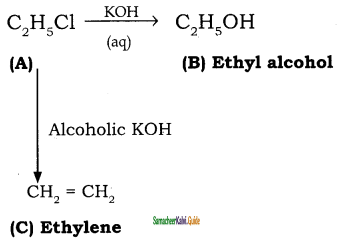
Samacheer Kalvi 11th Chemistry Guide Chapter 14 Haloalkanes and Haloarenes 62

Question 52.
Simplest alkene (A) reacts with HCl to form compound (B). Compound (B) reacts with ammonia to form compound (C) of molecular formula C2H7N. Compound (C) undergoes carbylamine test. Identify (A),
(B) and (C).
Answer:
CH2 = CH2 + HCl → C2H5Cl
(A) Ethylene              (B) Ethyl chloride

C2H5Cl + NH3    →    C2H5NH2 + HCl
(C) Ethyl chloride      (B) Ethyl amine

Question 53.
A hydrocarbon C3H6(A) reacts with HBr to form compound (B). Compound (B) reacts with aqueous potassium hydroxide to give (C) of molecular formula C3H6O. What are the (A), (B) and (C). Explain the reactions.
Answer:
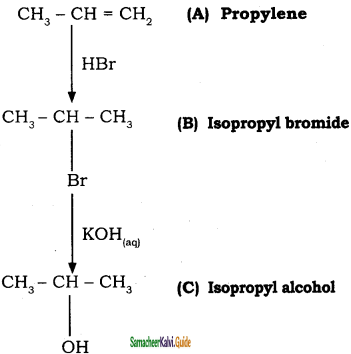
Samacheer Kalvi 11th Chemistry Guide Chapter 14 Haloalkanes and Haloarenes 63

Question 54.
Two isomers (A) and (B) have the same molecular formula C2H4Cl2. Compound (A) reacts with aqueous KOH gives compound (C) of molecular formula C2H4O. Compound (B) reacts with aqueous KOH gives compound (D) of molecular formula C2H6O2. Identify (A), (B), (C) and (D).
Answer:
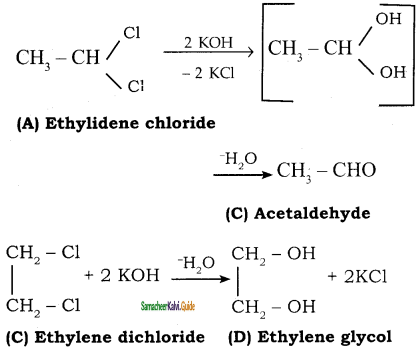
Samacheer Kalvi 11th Chemistry Guide Chapter 14 Haloalkanes and Haloarenes 64

Samacheer Kalvi 11th Chemistry Guide Chapter 14 Haloalkanes and Haloarenes

11th Chemistry Guide Haloalkanes and Haloarenes Additional Questions and Answers

I. Choose the best answer:

Question 1.
Which of the following is 1° alkyl halide
a) R – CH2 – X
b) R2CHX
C) R3C – X
d) R – H
Answer:
a) R – CH2 – X

Question 2.
2° halide among the following
a) isopropyl chloride
b) iso – butyl chloride
c) n – propyl chloride
d) n – butyl chloride
Answer:
a) isopropyl chloride

Question 3.
Ethylidene dibromide is
a) CH3CH2Br
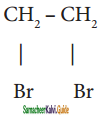
b) Br – CH2 – CH2 – Br
c) CH3 – CHBr2
d) CH2 = CH Br
Answer:
c) CH3 – CHBr2

Question 4.
Which of the following is gemdihalide?
a) CH3CHBrCH2Br
b) CH3CHBr2
c) CH3CHBrCH2CH2Br
d) BrCH2CH2Br
Answer:
b) CH3CHBr2

Question 5.
Vicinal dihalide is
a) CH3CH2Br
b) Br – CH2 – CH2 – Br
c) CH3 – CHBr2
d) CH2 = CHBr
Answer:
b) Br – CH2 – CH2 – Br

Samacheer Kalvi 11th Chemistry Guide Chapter 14 Haloalkanes and Haloarenes

Question 6.
The reagent used to get alkyl halide from alcohol
a) PCl5
b) SOCl2
c) Both a and b
d) Cl2
Answer:
c) Both a and b

Question 7.
For the preparation of alkyl halides from alcohols which among the following cannot be used
a) PCl5
b) SOCl2
c) PCl3
d) NaCl
Answer:
d) NaCl

Question 8.
In the preparation of alkyl halide from alkane and halogen which of the following reaction involved
a) Electrophilic addition
b) Nucleophilic addition
c) Electrophilic substitution
d) Nucleophilic substitution
Answer:
a) Electrophilic addition

Question 9.
In the preparation of alkyl halide from alkane and halogen which of the following reaction involved
a) Free radical substitution
b) Nucleophilic addition
c) Electrophilic substitution
d) Nucleophilic substitution
Answer:
a) Free radical substitution

Question 10.
Grignard reagent is formed when alkyl halide reacts with which one of the following
a) Mg in alcohol
b) Mg in acid
c) Mg in dry ether
d) MgO
Answer:
c) Mg in dry ether

Samacheer Kalvi 11th Chemistry Guide Chapter 14 Haloalkanes and Haloarenes

Question 11.
When alkyl halide reacts with moist Ag2O gives
a) alcohol
b) ether
c) alkane
d) Alkene
Answer:
a) alcohol

Question 12.
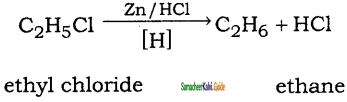
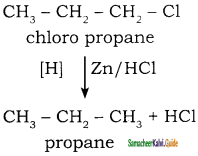
Alkyl halide on reduction with Zn + HCl gives
a) alcohol
b) alkene
c) alkane
d) ether
Answer:
c) alkane

Question 13.
Cyanide is formed as the major product of the reaction when alkyl halide is treated with one of the following :
a) AgNO2
b) KNO2
c) AgCN
d) KCN
Answer:
c) AgCN

Question 14.
Which of the reactions are most common in alkyl halides
a) Nucleophilic addition
b) Electrophilic addition
c) Nucleophilic substitution
d) Electrophilic substitution
Answer:
c) Nucleophilic substitution

Question 15.
Treatment of ammonia with excess of ethyl chloride will yield
a) Diethyl amine
b) Ethane
c) Tetra ethyl ammonium chloride
d) methyl amine
Answer:
c) Tetra ethyl ammonium chloride

Samacheer Kalvi 11th Chemistry Guide Chapter 14 Haloalkanes and Haloarenes

Question 16.
In chloro ethane the carbon bearing halogen is bonded to ________.
a) three, primary
b) two, secondary
c) one, tertiary
d) two, primary
Answer:
d) two, primary

Question 17.
Which of the fallowing is used as refrigerant?
a) CH3COCH3
b) CCl4
c) C2H5Cl
d) CF4
Answer:
c) C2H5Cl

Question 18.
SN1reaction occurs through the intermediate formation of
a) carbocation
b) carbanion
c) free radicals
d) transition
Answer:
a) carbocation

Question 19.
The rate of SN2 reaction is maximum when the solvent is
a) Methyl alcohol
b) Water
c) Dimethyl sulphoxide
d) Benzene
Answer:
c) Dimethyl sulphoxide

Question 20.
The most reactive nucleophile among the following is
a) CH3O
b) C6H5O
c) (CH3)2CHO
d) (CH3)3CO
Answer:
a) CH3O

Samacheer Kalvi 11th Chemistry Guide Chapter 14 Haloalkanes and Haloarenes

Question 21.
The correct order of reactivity towards nucleophilic substitution reaction is
a) CH3F > CH3Cl > CH3Br > CH3I
b) CH3I > CH3Br > CH3Cl > CH3F
C) CH3I > CH3Cl > CH3Br > CH3F
d) CH3I > CH3Br > CH3F > CH3Cl
Answer:
b) CH3I > CH3Br > CH3Cl > CH3F

Question 22.
In SN2 reactions the order of reactivity of the halides.
CH3X, C2H5X , n – C3H7X, n- C4H9X is
a) CH3X > C2H5X > n – C3H7X > n – C4H9X
b) C2H5X > n – C3H7X > n – C4H9X > CH3X
c) C2H5X > n – C3H7X > n – C4H9X < CH3X
d) n – C4H9X > n – C3H7X > C2H5X > CH3X
Answer:
a) CH3X > C2H5X > n – C3H7X > n – C4H9X

Question 23.
SN2 mechanism proceeds through the formation of a
a) carbocation
b) transition state
c) free radical
d) carbanion
Answer:
b) transition state

Question 24.
In Dow’s process the starting raw material is
a) Phenol
b) Chloro benzene
c) Aniline
d) Diazobenzene
Answer:
b) Chloro benzene

Question 25.
Chloro benzene is prepared commercially by
a) Dow’s process
b) Decon’s process
c) Raschig process
d) Etard’s process
Answer:
c) Raschig process

Samacheer Kalvi 11th Chemistry Guide Chapter 14 Haloalkanes and Haloarenes

Question 26.
Chloro benzene is ________ reactive than benzene towards electrophilic substitution and directs incoming electrophile to the ______ position.
a) more, ortho & para
b) less, ortho & para
c) more, meta
d) less, meta
Answer:
b) less, ortho & para

Question 27.
The raw material for raschig; process is
a) chloro benzene
b) phenol
c) benzene
d) anisol
Answer:
c) benzene

Question 28.
Chloro benzene on treatment with sodium in dry ether gives diphenyl. The name of the reaction is
a) Fitting reaction
b) Wurtz fittig reaction
c) Wurtz reaction
d) Sandmeyer reaction
Answer:
a) Fitting reaction

Question 29.
An organic compound which produces a bluish green coloured flame on heating in the presence of copper is,
a) chloro benzene
b) benzaldehyde
c) aniline
d) benzoic acid
Answer:
a) chloro benzene

Question 30.
The raw materials for the commercial manufacture of DDT are
a) chloro benzene and chloroform
b) chloro benzene and chloro methane
c) chloro benzene and chloral
d) chloro benzene and iodoform
Answer:
c) chloro benzene and chloral

Samacheer Kalvi 11th Chemistry Guide Chapter 14 Haloalkanes and Haloarenes

Question 31.
Iodoform is used as
a) anaesthetic
b) antiseptic
c) analgesic
d) anti febrin
Answer:
b) antiseptic

Question 32.
The following is used in paint removing
a) CHCl3
b) CH2Cl2
c) CCl4
d) CH3CI
Answer:
b) CH2Cl2

Question 33.
In fire extinguishers, following is used
a) CHCl3
b) CS2
c) CCl4
d) CH2Cl2
Answer:
c) CCl4

Question 34.
The following is used for metal cleaning and finishing
a) CHCl3
b) CHI3
c) CH2Cl2
d) C6H6
Answer:
c) CH2Cl2

Question 35.
First chlorinated insecticide
a) DDT
b) Gammaxene
c) Iodoform
d) Freon
Answer:
a) DDT

Samacheer Kalvi 11th Chemistry Guide Chapter 14 Haloalkanes and Haloarenes

Question 36.
The following is used as anaesthetic
a) C2H4
b) CHCl3
c) CH2Cl2
d) DDT
Answer:
b) CHCl3

Question 37.
Freon – 12 is
a) CF3Cl
b) CHCl2F
c) CF2Cl2
d) DDT
Answer:
c) CF2Cl2

Question 38.
The name of DDT
a) p, p’ – dichloro diphenyl trichloro ethane
b) p, p’ – dichloro diphenyl trichloro ethene
C) p, p’ – dichloro diphenyl tnchloro benzene
d) p, p’ – tetra chloro ethane
Answer:
a) p, p’ – dichloro diphenyl trichloro ethane

Question 39.
Freon R – 22 is
a) CHClF2
b) CCl2F2
c) CH3Cl
d) CH2Cl2
Answer:
a) CHClF2

Question 40.
Molecular formula of DDT has
a) 5 Cl atoms
b) 4 Cl atoms
c) 3 Cl atoms
d) 2 Cl atoms
Answer:
a) 5 Cl atoms

Samacheer Kalvi 11th Chemistry Guide Chapter 14 Haloalkanes and Haloarenes

Question 41.
What is DDT among the following
a) Green house gas
b) A fertilizer
c) Bio degradable pollutant
d) Non – Bio degradable pollutant
Answer:
d) Non – Bio degradable pollutant

Question 42.
The IUPAC name of (CH3)3CHCH2Br is
a) 1 – bromo – 2 – methyl propane
b) 2 – bromo – 2 -methyl propane
c) 1 – bromo – 1 – methyl propane
d) 2 – bromo – 1 -methylpropane
Answer:
a) 1 – bromo – 2 – methyl propane

Question 43.
IUPAC name of allyl chloride is
a) 1 – chloro ethane
b) 3 – chloro- 1 – propyne
c) 3 – chloro – 1 – propene
d) 1 – chloro propane
Answer:
c) 3 – chloro – 1 – propene

Question 44.
The number of structural isomers possible with the formula C4H9Cl are
a) 5
b) 4
c) 3
d) 2
Answer:
b) 4

Question 45.
Density is highest for
a) CH3Cl
b) CH2Cl2
c) CHCl3
d) CCl4
Answer:
d) CCl4

Samacheer Kalvi 11th Chemistry Guide Chapter 14 Haloalkanes and Haloarenes

Question 46.
C2H5OH Samacheer Kalvi 11th Chemistry Guide Chapter 14 Haloalkanes and Haloarenes 68 X. In this reaction ‘X’ is
a) Ethanol
b) Ethylene chloride
c) ethylidene chloride
d) ethyl chloride
Answer:
d) ethyl chloride

Question 47.
Thionyl chloride is preferred in the preparation of chloro compound from alcohol since
a) Both the byproducts are gases and they escape out leaving product in pure state
b) It is a chlorinating agent
c) It is an oxidising agent
d) All other reagents are unstable
Answer:
a) Both the byproducts are gases and they escape out leaving product in pure state

Question 48.
The only alkene which gives primary alkyl halides on hydro halogenation
a) C2H4
b) C3H6
c) C4H8
d) C5H10
Answer:
a) C2H4

Question 49.
– OH cannot be replaced by – Cl if we use
a) PCl5
b) PCl3
c) S2Cl2
d) SOCl2
Answer:
c) S2Cl2

Question 50.
In the hydrohalogenation of ethylene for adding HCl, the catalyst used is
a) Anhydrous AlCl3
b) Conc. Sulphuric acid
c) Dilute Sulphuric acid
d) Anhydrous ZnCl2
Answer:
a) Anhydrous AlCl3

Samacheer Kalvi 11th Chemistry Guide Chapter 14 Haloalkanes and Haloarenes

Question 51.
Which one of the following has the lowest boiling point?
a) CH3Cl
b) C2H5Cl
c) C2H5Br
d) C2H5I
Answer:
a) CH3Cl

Question 52.
Chloroethane is reacted with alcoholic potassium hydroxide. The product formed is
a) C2H6O
b) C2H6
c) C2H4
d) C2H4O
Answer:
c) C2H4

Question 53.
What is X in the following reaction? C2H5Cl + X → C2H5OH + KCl
a) KHCO3
b) alc. KOH
c) aq. KOH
d) K2CO3
Answer:
c) aq. KOH

Question 54.
Which of the following acids will give maximum yield of alkyl chloride in Hunsdiecker reaction
a) CH3CH2CH2COOH
b) (CH3)2CHCOOH
c) (CH3)3CCOOH
d) C6H5CH (CH3)COOH
Answer:
a) CH3CH2CH2COOH

Question 55.
In the reaction sequence
C2H5Cl + KCN X. What is the molecular formula of X is
a) C2H5CN
b) C2H5NC
c) C2H5OH
d) C2H4O
Answer:
a) C2H5CN

Samacheer Kalvi 11th Chemistry Guide Chapter 14 Haloalkanes and Haloarenes

Question 56.
Ethyl chloride on heating with silver cyanide forms a compound X. The functional isomer of X is
a) C2H5NC
b) C2H5NCN
c) H3C – NH – CH3
d) C2H5NH2
Answer:
b) C2H5NCN

Question 57.
With Zn – Cu couple and C2H5OH, ethyl Iodide reacts to give
a) ethers
b) diethyl ether
c) Iodoform
d) Ethane
Answer:
d) Ethane

Question 58.
Ethyl bromide on boiling with alcoholic solutions of sodium hydroxide forms
a) Ethane
b) ethylene
c) ethyl alcohol
d) all of these
Answer:
b) ethylene

Question 59.
Following major compound is formed when ethyl chloride react with silver nitrite
a) Nitro ethane
b) Ethyl nitrite
c) Ethylene
d) Acetaldehyde
Answer:
b) Ethyl nitrite

Question 60.
Which of the following represents Williamson’s synthesis?
a) CH3COOH + PCl3
b) CH3 – CH2 – Cl + CH3COOH →
c) CH3 – CH2 – ONa + CH3 – CH2 – Cl →
d) CH3 – CH2 – OH + Na →
Answer:
c) CH3 – CH2 – ONa + CH3 – CH2 – Cl →

Samacheer Kalvi 11th Chemistry Guide Chapter 14 Haloalkanes and Haloarenes

Question 61.
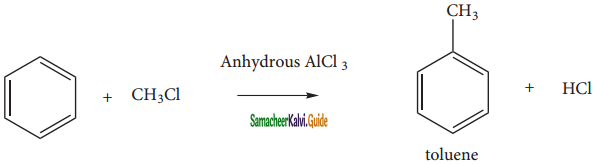
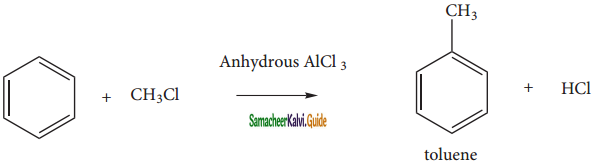
The reaction of alkyl halide with benzene in presence of anhydrous A1Cl3 gives alkyl benzene the reaction is known as
a) Friedel – craft’s reaction
b) Carbylamine reaction
c) Gattermann reaction
d) Wurtz reaction
Answer:
a) Friedel – craft’s reaction

Question 62.
A Grignard’s reagent reacts with water to give
a) ether
b) alkanes
c) amine
d) Alcohol
Answer:
b) alkanes

Question 63.
C2H5Cl + Mg → C2H5 MgCl in this reaction the solvent is
a) C2H5OH
b) Water
c) Dry ether
d) Acetone
Answer:
c) Dry ether

Question 64.
For a nucleophilic substitution reaction the rate was found in the order RI > RBr > RCl > RF then the reaction could be
a) SN1 only
b) SN2 only
c) Either SN1 or SN2
d) Neither SN1 or SN2
Answer:
c) Either SN1 or SN2

Question 65.
SN2 reaction leads to
a) inversion of configuration
b) retention of configuration
c) partial racemisation
d) no racemisation
Answer:
a) inversion of configuration

Samacheer Kalvi 11th Chemistry Guide Chapter 14 Haloalkanes and Haloarenes

Question 66.
Which of the following alkyl halide is hydrolysed by SN1 mechanism
a) CH3Cl
b) CH3 – CH2 – Cl
c) CH3 – CH2 – CH2 – Cl
d) (CH3)3CCl
Answer:
d) (CH3)3CCl

Question 67.
SN1 reaction is favoured by
a) non – polar solvents
b) Bulky group on the carbon atom attached to the halogen atom
c) Small groups on the carbon atom attached to halogen atom
d) All of the above
Answer:
b) Bulky group on the carbon atom attached to the halogen atom

Question 68.
Which of the following is not stereospecific
a) SN1
b) SN2
c) E2
d) Addition of Br2 to ethylene in CCl4
Answer:
a) SN1

Question 69.
Which of the following factors does not favour SN1 mechanism
a) Strong base
b) Polar solvent
c) Low. conc. of nucleophile
d) 3° halide
Answer:
c) Low. conc. of nucleophile

Question 70.
The order of reactivity of various alkyl halides toward SN1 reaction is
a) 3° > 2° > 1°
b) 1° > 2° > 3°
c) 3° = 2° = 1°
d) 1° > 3° > 2°
Answer:
a) 3° > 2° > 1°

Samacheer Kalvi 11th Chemistry Guide Chapter 14 Haloalkanes and Haloarenes

Question 71.
In aryl halides carbon atom holding halogen is
a) sp2 hybridised
b) sp hybridised
c) sp3 hybndised
d) sp3d hybridised
Answer:
a) sp2 hybridised

Question 72.
Chloro benzene can be prepared by reacting benzene diazonlum chloride with
a) HCl
b) Cu2Cl2 / HCl
c) Cl2 / AlCl3
d) HNO2
Answer:
b) Cu2Cl2 / HCl

Question 73.
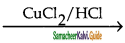
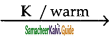
Samacheer Kalvi 11th Chemistry Guide Chapter 14 Haloalkanes and Haloarenes 69 + Cl2 Samacheer Kalvi 11th Chemistry Guide Chapter 14 Haloalkanes and Haloarenes 70 X, X is
a) Chloro benzene
b) m – dichloro benzene
c) benzene hexachioride
d) p – dichlorobenzene
Answer:
a) Chloro benzene

Question 74.
The following is an example of Sandmeyer reaction
a) C6H5N2+ Cl Samacheer Kalvi 11th Chemistry Guide Chapter 14 Haloalkanes and Haloarenes 71 C6H5Cl
b) C6H5N2+ Cl Samacheer Kalvi 11th Chemistry Guide Chapter 14 Haloalkanes and Haloarenes 72 C6H5OH
c) C6H5N2+ Cl Samacheer Kalvi 11th Chemistry Guide Chapter 14 Haloalkanes and Haloarenes 73 C6H5F
d) C6H5N2+ Cl Samacheer Kalvi 11th Chemistry Guide Chapter 14 Haloalkanes and Haloarenes 74 C6H5Cl
Answer:
a) C6H5N2+ Cl Samacheer Kalvi 11th Chemistry Guide Chapter 14 Haloalkanes and Haloarenes 71 C6H5Cl

Question 75.
Chlorobenzene on reaction with CH3Cl in presence of AlCl3 gives
a) toulene
b) m – chloro toulene
c) only o – chloro toulene
d) mixture of o – and p – chlorotoulene
Answer:
d) mixture of o – and p – chlorotoulene

Samacheer Kalvi 11th Chemistry Guide Chapter 14 Haloalkanes and Haloarenes

Question 76.
2C6H5Cl + 2Na → X, X is
a) toulene
b) biphenyl
C) phenyl ethane
d) 1 – chloro – 2 – phenyl ethane
Answer:
b) biphenyl

Question 77.
Chlorobenzene on fusing with solid NaOH gives
a) benzene
b) benzoic acid
c) phenol
d) benzene chloride
Answer:
c) phenol

Question 78.
Chlorobenzene on nitration gives major product of
a) 1 – chloro – 4 – nitro benzene
b) 1 – chloro – 3 – nitro benzene
c) 1, 4 – dinitro benzene
d) 2, 4, 6 – tri nitro benzene
Answer:
a) 1 – chloro – 4 – nitro benzene

Question 79.
The reaction C6H5I + 2 Na + CH3I → C6H5CH3 + 2 NaI is
a) Wurtz reaction
b) Fittig reaction
c) Wurtz-Fittig reaction
d) Sandmeyer reaction
Answer:
c) Wurtz-Fittig reaction

Question 80.
R – Cl + Nal Samacheer Kalvi 11th Chemistry Guide Chapter 14 Haloalkanes and Haloarenes 75 R – I + NaCl. This reaction is
a) Wurtz reaction
b) Fittig reaction
c) Finkelstein reaction
d) Frankland reaction
Answer:
c) Finkelstein reaction

Samacheer Kalvi 11th Chemistry Guide Chapter 14 Haloalkanes and Haloarenes

Question 81.
C2H5OH + SOCl2 Samacheer Kalvi 11th Chemistry Guide Chapter 14 Haloalkanes and Haloarenes 76 x + y + z. In this reaction x, y and z respectively are
a) C2H4Cl2, SO2, HCl
b) C2H5Cl, SO2, HCl
c) C2H5Cl, SOCl, HCl
d) C2H4, SO2, Cl2
Answer:
b) C2H5Cl, SO2, HCl’

Question 82.
C2H5Cl + AgOH → A + AgCl.
A + CH3COCl → C + HCl. “C” is
a) Ethyl acetate
b) Methyl acetate
c) butanone – 2
d) propanone
Answer:
a) Ethyl acetate

Question 83.
The compound (B) in the below reaction is:
C2H5Cl Samacheer Kalvi 11th Chemistry Guide Chapter 14 Haloalkanes and Haloarenes 77 A Samacheer Kalvi 11th Chemistry Guide Chapter 14 Haloalkanes and Haloarenes 78 B
a) ethylene chloride
b) acetic acid
c) propionic acid
d) ethyl cyanide
Answer:
c) propionic acid

Question 84.
Chloro ethane reacts with X to form diethyl ether. What is X?
a) NaOH
b) H2SO4
c) C2H5ONa
d) Na2S2O3
Answer:
c) C2H5ONa

Question 85.
1 – chlorobutane on reaction with alcoholic potash gives
a) 1 – butene
b) 1 – butanol
c) 1 – butyne
d) 2 – butanol
Answer:
a) 1 – butene

Samacheer Kalvi 11th Chemistry Guide Chapter 14 Haloalkanes and Haloarenes

Question 86.
Propane nitrile may be prepared by heating
a) Propyl alcohol with KCN
b) ethyl chloride with KCN
c) Propyl chloride with KCN
d) ethyl chloride with KCN
Answer:
d) ethyl chloride with KCN

Question 87.
CH3CH = CH2 Samacheer Kalvi 11th Chemistry Guide Chapter 14 Haloalkanes and Haloarenes 79 A Samacheer Kalvi 11th Chemistry Guide Chapter 14 Haloalkanes and Haloarenes 141 B, B is
a) propanol – 2
b) propanal – 1
c) propanol – 1
d) propanal – 2
Answer:
c) propanol – 1

Question 88.
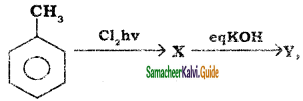
Samacheer Kalvi 11th Chemistry Guide Chapter 14 Haloalkanes and Haloarenes 80 Y is
Samacheer Kalvi 11th Chemistry Guide Chapter 14 Haloalkanes and Haloarenes 81
Answer:
c) Samacheer Kalvi 11th Chemistry Guide Chapter 14 Haloalkanes and Haloarenes 82

Question 89.
The correct order of increasing boiling points is
a) 1 – chloropropane < isopropylchloride < 1 – chlorobutane
b) isopropylchloride < 1 – chloropropane < 1 – chlorobutane
c) 1 – chlorobutane < isopropylchloride < 1 – chloropropane
d) 1 – chlorobutane < 1 – chloropropane < isopropylchloride
Answer:
b) isopropylchloride < 1 – chloropropane < 1 – chlorobutane

Question 90.
The correct order of decreasing SN2 reactivity
a) RCH2X > R2CHX > R3CX
b) RCH2X > R3CX > R2CHX
c) R2CHX > R3CX > RCH2X
d) R3CX > R2CHX > RCH2X
Answer:
a) RCH2X > R2CHX > R3CX

Samacheer Kalvi 11th Chemistry Guide Chapter 14 Haloalkanes and Haloarenes

II. Very short question and answer (2 Marks):

Question 1.
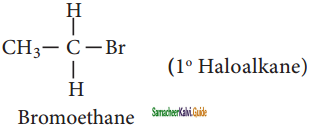
What are haloalkanes? Give example.
Answer:
Mono halogen derivatives of alkanes are called haloalkanes. Haloalkanes are represented by general formula R – X, Where, R is an alkyl group (CnH2n + 1) – and X is a halogen atom (X = F, Cl, Br or I). Haloalkanes are further classified into primary, secondary, tertiary haloalkane on the basis of type of carbon atom to which the halogen is attached.
Example:
Samacheer Kalvi 11th Chemistry Guide Chapter 14 Haloalkanes and Haloarenes 83

Question 2.
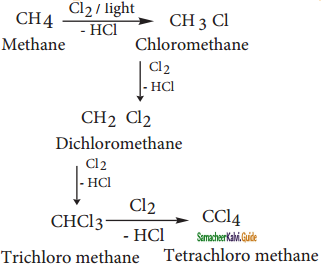
How will you convert methane into tetra chloro methane?
Answer:
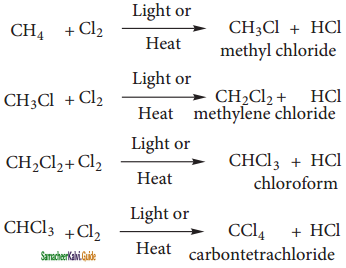
Chlorination of methane gives different products which have differences in the boiling points. Hence, these can be separated by fractional distillation.
Samacheer Kalvi 11th Chemistry Guide Chapter 14 Haloalkanes and Haloarenes 84

Question 3.
What is Finkelstein reaction?
Answer:
Chloro or bromoalkane on heating with a concentrated solution of sodium iodide in dry acetone gives iodo alkanes. This reaction is called as Finkelstein reaction.
CH3CH2Br + NaI Samacheer Kalvi 11th Chemistry Guide Chapter 14 Haloalkanes and Haloarenes 85 CH3CH2I + NaI
Bromo ethane Iodoethane

Question 4.
What is Swartz reaction?
Answer:
Chloro or bromo alkanes on heating with metallic fluorides like AgF or SbF3 gives fluoro alkanes. This reaction is called Swarts reaction.
CH3CH2Br + AgF Samacheer Kalvi 11th Chemistry Guide Chapter 14 Haloalkanes and Haloarenes 86 CH3CH2F + AgBr
Bromo ethane Fluoro ethane

Question 5.
What is Hunsdiecker reaction?
Answer:
Silver salts of fatty acids when refluxed with bromine in CCl4 gives bromo alkane.
CH3CH2COOAg + Br2 Samacheer Kalvi 11th Chemistry Guide Chapter 14 Haloalkanes and Haloarenes 87 CH3CH2Br + CO2 + AgBr
Silver propionate Bromo ethane

Samacheer Kalvi 11th Chemistry Guide Chapter 14 Haloalkanes and Haloarenes

Question 6.
How is ehtyl magnesium bromide prepared from ethyl bromide?
Answer:
When a solution of ethyl bromide in ether is treated with magnesium, we get ethyl magnesium bromide.
CH3 – CH2 – Br + Mg Samacheer Kalvi 11th Chemistry Guide Chapter 14 Haloalkanes and Haloarenes 88 CH3CH2MgBr
Ethyl bromide Ethyl magnesium bromide

Question 7.
How will you convert ethyl bromide into ethyl lithium?
Answer:
Ethyl bromide reacts with active metals like sodium, lead etc in the presence of dry ether to form ethyl lithium.
CH3 CH2 Br + 2Li Samacheer Kalvi 11th Chemistry Guide Chapter 14 Haloalkanes and Haloarenes 88 CH3 CH2Li + LiBr
Ethyl bromide Ethyl Lithium

Question 8.
How is TEL prepared from ethyl bromide?
Answer:
When ethyl bromide reacts with Na / Pb alloy to give TEL.
4CH3 CH2 Br + 4Na/Pb → (CH3CH2)4Pb + 4NaBr + 3Pb
Ethyl bromide Sodium-lead alloy Tetra ethyl lead (TEL)

Question 9.
What are organic metallic compounds? Give example.
Answer:
Organo metallic compounds are organic compounds in which there is a direct carbon-metal bond
Example:
CH3 Mg I – Methyl magnesium iodide
CH3CH2Mg Br – Ethyl magnesium bromide

Question 10.
How is methane prepared from Grignard reagent?
Answer:
Compounds like water, alcohols and amines which contain active hydrogen atom react with Grignard reagents to form alkanes.
CH3MgI + HO – H → CH4 + Mg I (OH)

CH3MgI + C2H5OH         Samacheer Kalvi 11th Chemistry Guide Chapter 14 Haloalkanes and Haloarenes 86 CH4 + MgI (OC2H5)
Ethyl alcohol                Methane

Samacheer Kalvi 11th Chemistry Guide Chapter 14 Haloalkanes and Haloarenes

Question 11.
What are Haloarenes? Give a suitable example.
Answer:
Haloarenes are the compounds in which the halogen is directly attached to the benzene ring.
Example:
Samacheer Kalvi 11th Chemistry Guide Chapter 14 Haloalkanes and Haloarenes 89

Question 12.
How is chloro benzene prepared from benzene by direct halogenation?
Answer:
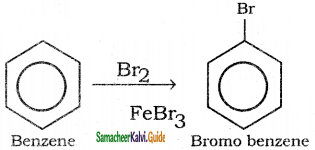
Chloro benzene is prepared by the direct chlorination of benzene in the presence of lewis acid catalyst like FeCl3.
Samacheer Kalvi 11th Chemistry Guide Chapter 14 Haloalkanes and Haloarenes 90

Question 13.
Write a note on Sand Meyer reaction.
Answer:
When aqueous solution of benzene diazonium chloride is warmed with Cu2Cl in HCl gives chioro benzene.
Samacheer Kalvi 11th Chemistry Guide Chapter 14 Haloalkanes and Haloarenes 91

Question 14.
How is Iodo benzene prepared from benzene diazonium chloride?
Answer:
Iodo benzene is prepared by warming benzene diazonium chloride with an aqueous KI solution.
C6H5N2Cl + Kl    Samacheer Kalvi 11th Chemistry Guide Chapter 14 Haloalkanes and Haloarenes 92      C6H5I + N2 + KCl
Benzene dizonium chloride        Iodo benzene

Question 15.
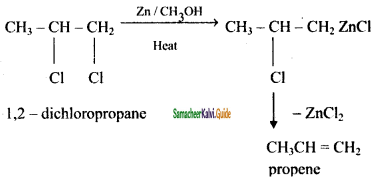
What happens when ethylidene dichloride is treated with Zinc dust in methanol?
Answer:
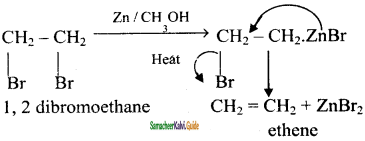
Gem dihalides and vic – dihalides on treatment with zinc dust in methanol give alkenes.
CH3 – CHCl2 + Zn Samacheer Kalvi 11th Chemistry Guide Chapter 14 Haloalkanes and Haloarenes 93 CH2 = CH2 + ZnCl2
Ethylidene dichloride                     Ethylene

Samacheer Kalvi 11th Chemistry Guide Chapter 14 Haloalkanes and Haloarenes

Question 16.
How will you convert chloroform into methylene chloride?
Answer:
a) Reduction of chloroform in the presence of Zn + HCl gives methylene chloride.
CHCl3 (chloroform) Samacheer Kalvi 11th Chemistry Guide Chapter 14 Haloalkanes and Haloarenes 94 CH2Cl (Methylene chloride) + HCl
b) Reduction of chloroform using H2/Ni
CHCl3 (chloroform) Samacheer Kalvi 11th Chemistry Guide Chapter 14 Haloalkanes and Haloarenes 95 CH2Cl2 (Methylene chloride) + HCl

Question 17.
Write the chlorination reaction of methane.
Answer:
Chlorination of methane gives methylene chloride
CH4 Samacheer Kalvi 11th Chemistry Guide Chapter 14 Haloalkanes and Haloarenes 96 CH3Cl Samacheer Kalvi 11th Chemistry Guide Chapter 14 Haloalkanes and Haloarenes 97 CH2Cl2
Methane                                               Methylene chloride

Question 18.
How is chloroform prepared from carbon tetrachloride?
Answer:
Carbon tetrachloride is reduced by iron powder in dilute HCl medium to form chloroform
CCl4 (carbon tetrachloride) + 2[H] Samacheer Kalvi 11th Chemistry Guide Chapter 14 Haloalkanes and Haloarenes 98 CHCl3 (chloroform) + HCl

Samacheer Kalvi 11th Chemistry Guide Chapter 14 Haloalkanes and Haloarenes

III. Short question and answers (3 Marks):

Question 1.
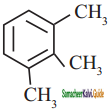
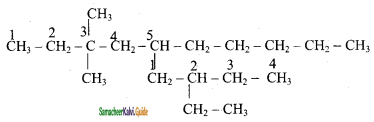
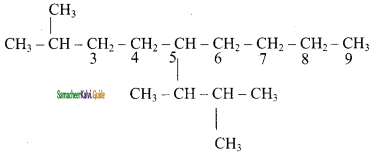
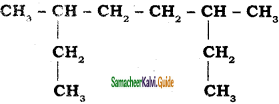
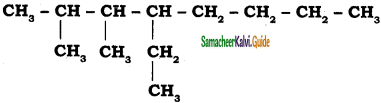
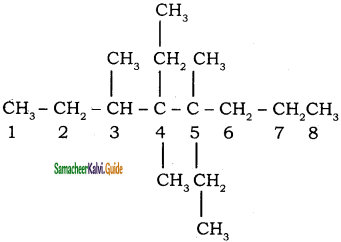
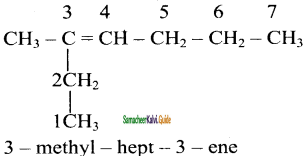
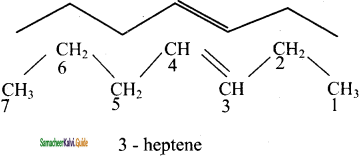
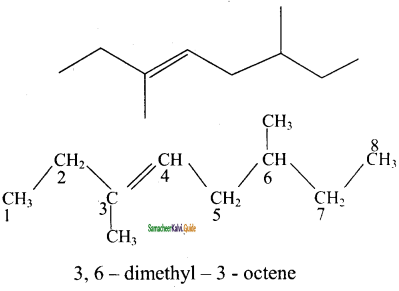
write IUPAC name of the following.
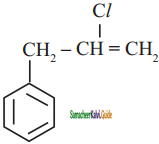
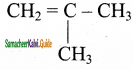
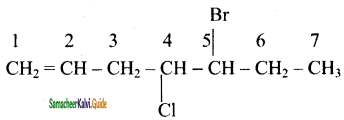
i) Samacheer Kalvi 11th Chemistry Guide Chapter 14 Haloalkanes and Haloarenes 99

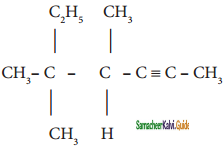
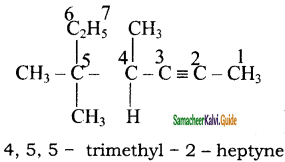
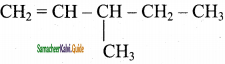
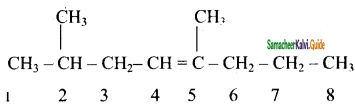
ii) Samacheer Kalvi 11th Chemistry Guide Chapter 14 Haloalkanes and Haloarenes 100

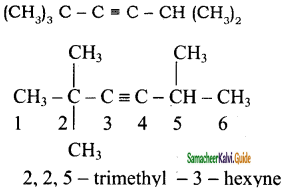
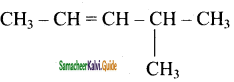
iii) Samacheer Kalvi 11th Chemistry Guide Chapter 14 Haloalkanes and Haloarenes 101
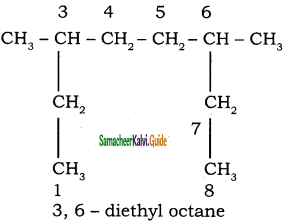
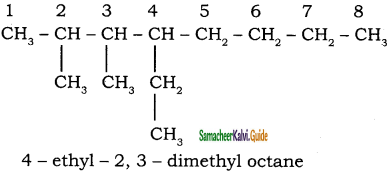
Answer:
i) Samacheer Kalvi 11th Chemistry Guide Chapter 14 Haloalkanes and Haloarenes 102

ii) Samacheer Kalvi 11th Chemistry Guide Chapter 14 Haloalkanes and Haloarenes 103

iii) Samacheer Kalvi 11th Chemistry Guide Chapter 14 Haloalkanes and Haloarenes 104

Question 2.
Write the structure of the following compounds.
i) 1 – Bromo – 4 – ethyl cyclohexane
ii) 1, 4 – Dichlorobut – 2 – ene
iii) 2 – chloro – 3 – methyl pentane
Answer:
i) 1 -Bromo – 4 – ethyl cyclohexane:
Samacheer Kalvi 11th Chemistry Guide Chapter 14 Haloalkanes and Haloarenes 105

ii) 1, 4 – Dichlorobut – 2 – ene
– Cl – CH2 – CH = CH – CH2 – Cl

iii) 2 – chloro – 3 – methyl pentane
Samacheer Kalvi 11th Chemistry Guide Chapter 14 Haloalkanes and Haloarenes 106

Question 3.
Write any three methods of preparation of chloro ethane from ethanol.
Answer:
a) Reaction with hydrogen halide:
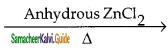
Ethanol is heated with HCl in presence of anhydrous ZnCl2 to give ethyl chloride.
CH3CH2OH + HCl Samacheer Kalvi 11th Chemistry Guide Chapter 14 Haloalkanes and Haloarenes 107 CH3CH2Cl + H2O
Ethanol Chloroethane

b) Reaction with phosphorous halides:
Ethanol reacts with PCl5 or PCl3 it gives ethyl chloride.
CH3CH2OH + PCl5 → CH3CH2Cl + POCl3 + HCl
Ethanol                      Chloro ethane

3 CH3CH2OH + PCl3 → 3CH3CH2Cl + H 3PO3
Ethanol                        Chloro ethane

C) Reaction with thionyl chloride (Sulphonyl chloride):
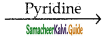
When ethanol reacts with SOCl2 in presence of pyridine, it gives chloro ethane.
CH3CH2OH + SOCl2 Samacheer Kalvi 11th Chemistry Guide Chapter 14 Haloalkanes and Haloarenes 108 CH3CH2Cl + SO2 + HCl
Ethanol                                            Chloro ethane

Question 4.
What happens when haloalkane reacts with aqueous alkali or most silver oxide?
Answer:
Ethyl bromide reacts with aqueous solution of KOH or moist silver oxide (Ag2O/H2O) to form ethanol.
CH3 – CH2 – Br + KOH (aq) Samacheer Kalvi 11th Chemistry Guide Chapter 14 Haloalkanes and Haloarenes 109 CH3CH2 – OH + KBr
Bromoethane                                   Ethyl alcohol

CH3 – CH2 – Br   +   AgOH(aq)   Samacheer Kalvi 11th Chemistry Guide Chapter 14 Haloalkanes and Haloarenes 109 CH3CH2 – OH + AgBr
Bromoethane         Moist silver oxide            Ethanol

Question 5.
Explain the ammonolysis reaction of bromo ethane.
Answer:
Ethyl bromide reacts with alcoholic ammonia solution to form ethylamine.
CH3 – CH2 – Br + H – NH2 → CH3 CH2 – NH2 + HBr
Bromo ethane                        Ethyl amine

Samacheer Kalvi 11th Chemistry Guide Chapter 14 Haloalkanes and Haloarenes 110
However, with excess of ethyl bromide, secondary and tertiary amines along with quaternary ammonium salts are obtained.

Samacheer Kalvi 11th Chemistry Guide Chapter 14 Haloalkanes and Haloarenes

Question 6.
What happens when bromoethane reacts with alcoholic KCN and alcoholic AgCN?
Answer:
Reaction with alcoholic KCN:
Ethyl bromide reacts with alcoholic KCN solution to form ethyl cyanides.
CH3 – CH2 – Br + KCN → CH3 – CH2 – CN + KBr
Bromoethane                    Ethyl cyanide

Reaction with alcoholic AgCN:
Haloalkanes react with alcoholic AgCN solution to form alkyl isocyanide.
CH3CH2Br + AgCN → CH3CH2NC + AgBr
Bromoethane           Ethyl isocyanide

Question 7.
How are the following compounds prepared from bromo ethane?
i) Ethane thiol
(ii) Diethyl ether
Answer:
i) Ethane thiol:
Ethyl bromide reacts with sodium or potassium hydrogen sulphide to form thio alcohols.
CH3CH2Br Samacheer Kalvi 11th Chemistry Guide Chapter 14 Haloalkanes and Haloarenes 111 CH3CH2SH + NaBr
Bromo ethane                           Ethane thiol

ii) Diethyl ether:
Ethyl bromide, when boiled with sodium alkoxide gives diethyl ether. This method can be used to prepare mixed (unsymmetrical) ethers also.
CH3 – CH2Br +      NaOCH2CH3      Samacheer Kalvi 11th Chemistry Guide Chapter 14 Haloalkanes and Haloarenes 112    CH3CH2 – O – CH2CH3 + NaBr
Bromo ethane        Sodium ethoxide                 diethyl ether

Question 8.
How is ethane prepared from the following compounds?
i) Bromo ethane ii) Iodo ethane
Answer:
i) From bromo ethane:
Ethyl bromide is reduced to ethane by treating with H2 in the presence of metal catalyst like nickel, palladium etc or with hydroiodic acid in the presence of red phosphrous.
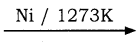
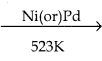
Ni(or)Pd
CH3CH2Br + H2 Samacheer Kalvi 11th Chemistry Guide Chapter 14 Haloalkanes and Haloarenes 113 CH3 – CH3 + HBr
Bromo ethane                              Ethane

ii) From iodo ethane:
Iodo ethane is reduced with H2 in presence of Red P it gives ethane.
CH3CH2I + HI Samacheer Kalvi 11th Chemistry Guide Chapter 14 Haloalkanes and Haloarenes 114 CH3 – CH3 + I2
Iodo ethane                         Ethane

Question 9.
Write the uses of carbon tetra chloride.
Answer:

  1. Carbon tetrachloride is used as dry cleaning agent.
  2. It is used as a solvent for oils, fats and waxes
  3. As the vapour of CCl4 is non-combustible, it is used under the name pyrene for extinguishing the fire in oil or petrol.

Question 10.
Write the uses of Grignard reagents.
Answer:

  1. Grignard reagents are synthetically very useful compounds. These reagents are converted to various organic compounds like alcohols, carboxylic acids, aldehydes and ketones.
  2. The alkyl group being electron rich acts as a carbanion or a nucleophile.
  3. They would attack polarized molecules at a point of low electron density. The following reactions illustrate the synthetic uses of Grignard reagent.

Samacheer Kalvi 11th Chemistry Guide Chapter 14 Haloalkanes and Haloarenes

Question 11.
What is Balz – Schiemann reaction?
Answer:
Fluoro benzene is prepared by treating benzene diazonium chloride with fluoro boric acid. This reaction produces diazonium fluoroborate which on heating produces fluorobenzene. This reaction is called Balz – schiemann reaction.
C6H5N2Cl + HBF4 Samacheer Kalvi 11th Chemistry Guide Chapter 14 Haloalkanes and Haloarenes 115 C6H5N2 + BF4 Samacheer Kalvi 11th Chemistry Guide Chapter 14 Haloalkanes and Haloarenes 116 C6H5 F + BF3 + N2
Benzene diazonium chloride                                          Fluorobenzene

Question 12.
Write the uses of chloro benzene.
Answer:

  • Chloro benzene is used in the manufacture of pesticides like DDT
  • It is used as high boiling solvent in organic synthesis.
  • It is used as fibre – swelling agent in textile processing.

Question 13.
How is ethylidene dichloride prepared from
(i) Acetaldehyde
(ii) Acetylene
Answer:
i) Treating acetaldehyde with PCl5:
CH3CHO (Acetaldehyde) + PCl5 → CH3CHCl2 (Ethylidene dichloride) + POCl

ii) Adding hydrogen chloride to acetylene
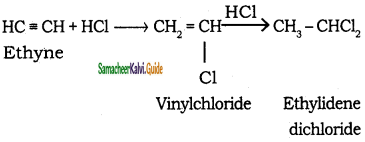
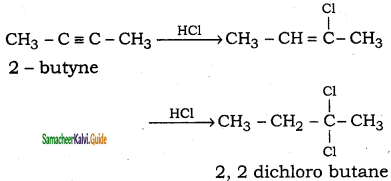
Samacheer Kalvi 11th Chemistry Guide Chapter 14 Haloalkanes and Haloarenes 117

Question 14.
How is ethylene dichloride prepared from (i) Chloride (ii) PCl5?
Answer:
i) Addition of chlorine to ethylene
Samacheer Kalvi 11th Chemistry Guide Chapter 14 Haloalkanes and Haloarenes 118

ii) Action of PCl5 (or HCl) on ethylene glycol

Samacheer Kalvi 11th Chemistry Guide Chapter 14 Haloalkanes and Haloarenes 119

Question 15.
What happens when the following compounds are treated with alcoholic KOH?
i) Ethylidene dichloride
ii) Ethylene dichloride
Answer:
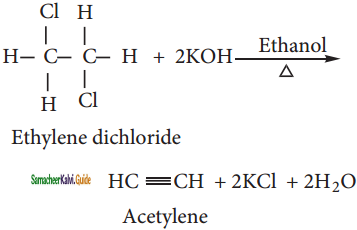
i) Ethylidene dichloride:
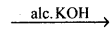
Samacheer Kalvi 11th Chemistry Guide Chapter 14 Haloalkanes and Haloarenes 120

ii) Ethylene dichloride:
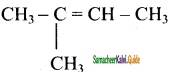
Samacheer Kalvi 11th Chemistry Guide Chapter 14 Haloalkanes and Haloarenes 121

Samacheer Kalvi 11th Chemistry Guide Chapter 14 Haloalkanes and Haloarenes

Question 16.
Write the uses of methylene chloride.
Answer:
Methylene chloride is used as

  1. aerosol spray propellant
  2. solvent in paint remover
  3. process solvent in the manufacture of drugs
  4. a metal cleaning solvent

Question 17.
How are the following compounds prepared from chlorobenzene?
i) Benzene
ii) Phenyl magnesium chloride
Answer:
i) C6H6 (Benzene):
Chlorbenzene undergoes reduction with Ni – Al alloy in the presence of NaOH gives benzene.
C6H5Cl + 2(H) Samacheer Kalvi 11th Chemistry Guide Chapter 14 Haloalkanes and Haloarenes 122 C6H6 + HCl
Chloro benzene              Benzeneide

ii) Phenyl Magnesium chloride:
Chloro benzene reacts with magnesium to form phenyl magnesium chloride in tetra hydrofuran (THF).
C6H5Cl (Chloro benzene) + Mg Samacheer Kalvi 11th Chemistry Guide Chapter 14 Haloalkanes and Haloarenes 123 C6H5MgCl (Phenyl magnesium chloride)

Samacheer Kalvi 11th Chemistry Guide Chapter 14 Haloalkanes and Haloarenes

IV. Long question and answers (5 Marks):

Question 1.
Explain the SN2 mechanism of haloalkanes with suitable example.
Answer:
S2 stands for bimolecular nucleophilic substitution
“S” stands for substitution
“N” stands for nucleophilic
“2” stands for bimolecular (two molecules are involved in the rate determining step)
The rate of SN2 reaction depends upon the concentration of both alkyl halide and the nucleophile.
Rate of reaction = k2 [alkyihalide] [nucleophile]
This SN2 reaction follows second order kinetics and occurs in one step.

This reaction involves the formation of a transition state in which both the reactant molecules are partially bonded to each other. The attack of nucleophile occurs from the back side and the halide ion leaves from the front side. The carbon at which substitution ocurs ha inverted configuration during the course of reaction just as an umbrella has tendency to invert in a wind storm. This inversion of configuration is called Walden inversion; after paul walden who first discovered the inversion of configuration of a compound in SN2 reaction.

We understand SN2 reaction mechanism by taking an example of reaction between chloromethane and aqueous KOH. SN2 reaction of an optically active haloalkane is always accompanied by inversion of configuration at the asymmetric centre.

Samacheer Kalvi 11th Chemistry Guide Chapter 14 Haloalkanes and Haloarenes 124


Samacheer Kalvi 11th Chemistry Guide Chapter 14 Haloalkanes and Haloarenes

Question 2.
Explain the SN1 mechanism of haloalkanes with suitable examples.
Answer:
SN1 stands for unimolecular nucleophilic substitution
‘S’ stands for substitution
‘N’ stands for nucleophilic
‘1’ stands for unimolecular (one molecule is involved in the rate determining step)
The rate of the following SN1 reaction depends upon the concentration of aikyl halide (RX) and is independent of the concentration of the nucleophile (OH-).
Rate of the reaction = k[alkyl halide]
R – Cl + OH → R – OH + Cl
This SN1 reaction follows first order kinetics and occurs in two steps.
We understand SN1 reaction mechanism by taking a reaction between tertiary hutyl bromide with aqueous KOH.
Samacheer Kalvi 11th Chemistry Guide Chapter 14 Haloalkanes and Haloarenes 125

This reaction takes place in two steps aas shown below.

Step – 1:
Formation of carbocation:
Samacheer Kalvi 11th Chemistry Guide Chapter 14 Haloalkanes and Haloarenes 126
t – butyl bromide

The polar C – Br bond breaks forming a carbocation and bromide ion. This step is slow and hence it is the rate determining step.

Step 2:
Nucleophilic attack on carbocation
The carbocation immediately reacts with the nucleophile. This step is fast and hence does not affect the rate of the reactions.
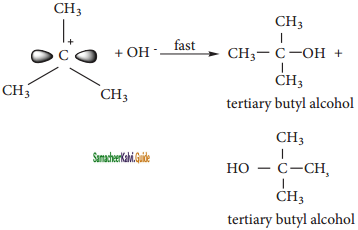
Samacheer Kalvi 11th Chemistry Guide Chapter 14 Haloalkanes and Haloarenes 127

As shown above, the nucleophilic reagent OH~ can attack carbocation from both the sides, they will be mirror image of each other.

In the above example the substrate tert-butyl bromide is not optically active, hence the obtained product is optically inactive. If halo alkane substrate is optically active then, the product obtained will be optically inactive racemic mixture. As nucleophilic reagent OH- can attack carbocation from both the sides, to form equal proportion of dextro and levorotatory optically active isomers which form optically inactive racemic mixture.

Example :
Hydrolysis of optically active 2- bromo butane gives racemic mixture of ±butan-2-ol.

Question 3.
Explain the E2 reaction mechanism with suitable example.
Answer:
E2 stands for bimolecular elimination reaction
‘E’ stands for elimination
‘2’ stands for bimolecular
The rate of E2 reaction depends on the concentration of alkyl halide and base

Rate = k2 [alkyl halide] [base]
It is therefore, a second-order reaction generally primary alkyl halide undergoes this reaction in the presence of alcoholic KOH. E2 is a one-step process in which the abstraction of the proton from the p carbon and expulsion of halide from the carbon occurs simultaneously. The mechanism is shown below.
Samacheer Kalvi 11th Chemistry Guide Chapter 14 Haloalkanes and Haloarenes 128

Samacheer Kalvi 11th Chemistry Guide Chapter 14 Haloalkanes and Haloarenes

Question 4.
Explain the E1 reaction mechanism with suitable example.
Answer:
E1 stands for unimolecular elimination reaction
‘E’ stands for elimination ‘1’ stands for unimolecular
The rate of E1 reaction depends on the concentration of alkyl halide only and hence
rate = k [alkyl halide]
Generally, tertiary alkyl halide which undergoes elimination reaction by this mechanism in the presence of alcoholic KOH following first order kinetics is a two step process. The mechanism is shown by taking following example.
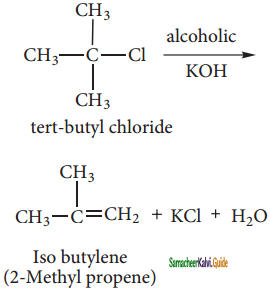
Samacheer Kalvi 11th Chemistry Guide Chapter 14 Haloalkanes and Haloarenes 129

step – 1:
Heterolytic fission to yield a carbocation:
Samacheer Kalvi 11th Chemistry Guide Chapter 14 Haloalkanes and Haloarenes 130

Step – 2:
Elimination of a proton from the β – carbon to produce an alkene:
Samacheer Kalvi 11th Chemistry Guide Chapter 14 Haloalkanes and Haloarenes 131

Question 5.
How are the following compounds prepared from Methyl magnesium iodide?
(i) Ethanol
(ii) Tert-butyl alcohol
(iii) Acetaldehyde
Answer:
(i) Ethanol:
Formaldehyde reacts with methyl magnesium iodide to give addition products which on hydrolysis yield ethanol.
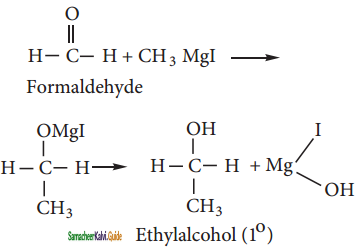
Samacheer Kalvi 11th Chemistry Guide Chapter 14 Haloalkanes and Haloarenes 132

(ii) Tert-butyl alcohol:
Acetone reacts with methyl magnesium iodide to give an additional product which on hydrolysis yields tert butyl alcohol.
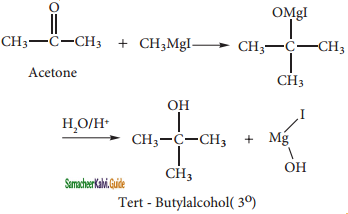
Samacheer Kalvi 11th Chemistry Guide Chapter 14 Haloalkanes and Haloarenes 133

(iii) Acetaldehyde:
Ethyl formate reacts with methyl magnesium iodide and followed by acid hydrolysis, it forms Acetaldehyde.
Samacheer Kalvi 11th Chemistry Guide Chapter 14 Haloalkanes and Haloarenes 134

Question 6.
How is ethylene dichloride converted into
i) Acetaldehyde
ii) Ethylene glycol
ii) Ethylene
Answer:
i) Acetaldehyde:
(Hydrolysis with aqueous NaOH or KOH)
Ethylidene chloride reacts with aqueous KOH to give acetaldehyde.
Samacheer Kalvi 11th Chemistry Guide Chapter 14 Haloalkanes and Haloarenes 135

ii) Ethylene glycol :
Ethylene chloride reacts with aqueous KOH, it gives glycol.
Samacheer Kalvi 11th Chemistry Guide Chapter 14 Haloalkanes and Haloarenes 136

iii) Ethylene:
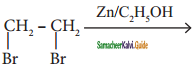
Ethylene dichloride is heated with Zinc in presence of methanol gives ehtylene.
Samacheer Kalvi 11th Chemistry Guide Chapter 14 Haloalkanes and Haloarenes 137

Samacheer Kalvi 11th Chemistry Guide Chapter 14 Haloalkanes and Haloarenes

Question 7.
How are the following compounds prepared from chloroform?
(i) Phosgene
(ii) Methylene chloride
(iii) Methyl isocyanide
Answer:
(i) Phosgene:
Chloroform undergoes oxidation in the presence of light and air to form phosgene (carbonyl chloride)
Samacheer Kalvi 11th Chemistry Guide Chapter 14 Haloalkanes and Haloarenes 138
Since phosgene is very poisonous, its presence makes chloroform unfit for use as an anaesthetic.

(ii) Methylene chloride:
Chloroform undergoes reduction with zinc and HCl in the presence of ethyl alcohol to form methylene chloride.
CHCl3 (Chloroform) + 2(H) Samacheer Kalvi 11th Chemistry Guide Chapter 14 Haloalkanes and Haloarenes 139 CH2Cl2 (Methylene chloride)+ Cl2

(iii) Methyl isocyanide:
Chloroform reacts with aliphatic or aromatic primary amine and alcoholic caustic potash, to give foul-smelling alkyl isocyanide (carbylamines).
CH3NH2     +     CHCl2 + 3KOH → CH3NC + 3KCl + 3H2O
Methylamine Chloroform          Methyl isocyanide

Question 8.
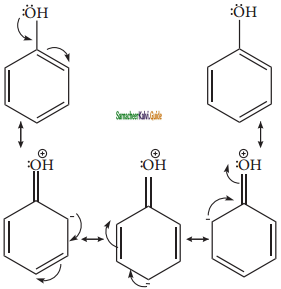
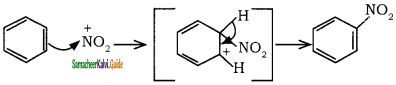
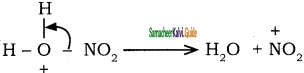
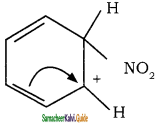
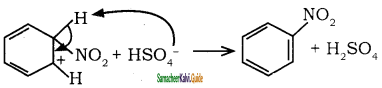
Discuss the aromatic electrophilic substitutions reaction of chlorobenzene.
Answer:
Samacheer Kalvi 11th Chemistry Guide Chapter 14 Haloalkanes and Haloarenes 140

Samacheer Kalvi 12th Business Maths Guide Chapter 9 Applied Statistics Ex 9.2

Tamilnadu State Board New Syllabus Samacheer Kalvi 12th Business Maths Guide Pdf Chapter 9 Applied Statistics Ex 9.2 Text Book Back Questions and Answers, Notes.

Tamilnadu Samacheer Kalvi 12th Business Maths Solutions Chapter 9 Applied Statistics Ex 9.2

Question 1.
Define Index Number.
Solution:
Index Numbers are the indicators which reflect the changes over a specified period of time in price of different commodities, production, sales, cost of living etc.

“An Index Number is a device which shows by its variations the change in a magnitude which is not capable of accurate measurements in it-self or of direct valuation in practice”. – Whel-don

“An Index number is a statistical measure of fluctuations in a variable arranged in the form of a series and using a base. Period for maxing H comparisons” – Lawrence J Kalpan.

Samacheer Kalvi 12th Business Maths Guide Chapter 9 Applied Statistics Ex 9.2

Question 2.
State the uses of Index Number.
Solution:
(1) Index number is an important tool for formulating decision and management p policies.
(2) It helps in studying the trends and tendencies.
(3) It determines the inflation and deflation in an Economy.

Question 3.
Mention the classification of Index Number.
Solution:
Index number can be classified as follows,
(i) Price Index Number:
It measures the general changes in the retail or wholesale price level of a particular or group of commodities.

(ii) Quantity Index Number:
These are indices of measure the changes in the quantity of goods manufactured in a factory.

(iii) Cost of living Index Number:
These are intended to study the effect of change in the price level on the cost of living of different classes of people.

Question 4.
Define Laspeyre’s Price index number.
Solution:
Laspeyre’s Price index number
P\(_{ 01 }^{L}\) ⥪ \(\frac { Σp_1q_0 }{Σp_0q_0}\) × 100
where P1 = Current year price
p0 = base year price
q0 = base year quantity

Question 5.
Explain Paasche’s price index number.
Solution:
Paasches price index number
P\(_{ 01 }^{L}\) = \(\frac { Σp_1q_1 }{Σp_0q_1}\) × 100
where P1 = current year price
q1 = current year quantity
p0 = base year price
q0 = base year quantity

Samacheer Kalvi 12th Business Maths Guide Chapter 9 Applied Statistics Ex 9.2

Question 6.
Write note on Fisher’s price index number.
Solution:
Fishers price index number
PF = \(\sqrt { P^L×P^P}\)
P\(_{ 01 }^{F}\) = \(\sqrt { \frac{Σp_1p_0×Σp_1q_1}{Σp_0q_0×Σp_0q_1}}\) × 100
where P1 = current year price
q1 = current year quantity
p0 = base year price
q0 = base year quantity

Question 7.
State the test of adequacy of index number.
Solution:
There are two tests which are used to test the adequacy for an index number. The two tests are as follows
(i) Time Reversal Test
(ii) Factory Reversal Test

Question 8.
Define Time Reversal Test.
Solution:
It is an important test for testing the consistency of a good index number. This test maintains time consistency by working both forward and backward with respect to time (here time refers to base year and current year). Symbolically the following relationship should be satisfied. P01 × p10 = 1

Fisher’s index number formula satisfies the above relationship
P\(_{ 01 }^{F}\) = \(\sqrt { \frac{Σp_1p_0×Σp_1q_1}{Σp_0q_0×Σp_0q_1}}\)

when the base year and current year are interchanged, we get
P\(_{ 10 }^{F}\) = \(\sqrt { \frac{Σp_0q_1×Σp_0q_0}{Σp_1q_1×Σp_1q_0}}\)
P\(_{ 01 }^{F}\) × P\(_{ 10 }^{F}\) = 1

Question 9.
Explain factor reversal test.
Solution:
This is another test for testing the consistency of a good index number. The product of price index number and quantity index number from the base year to the current year should be equal to the true value ratio. That is, the ratio between the total value of current period and total
value of the base period is known as true value ratio. Factor Reversal Test is given by,
Samacheer Kalvi 12th Business Maths Guide Chapter 9 Applied Statistics Ex 9.2 1
where P01 is the relative change in price
Q01 is the relative change in quantity.

Question 10.
Define true value ratio.
Solution:
\(\frac { Σp_1q_1 }{Σp_0q_0}\) is the ratio of the total value in the current period to the total value in the base period and this ratio is called the true value ratio.

Samacheer Kalvi 12th Business Maths Guide Chapter 9 Applied Statistics Ex 9.2

Question 11.
Discuss about cost of Living Index Number.
Solution:
Cost of living index numbers are generally designed to represent the average change over time in the prices paid by the ultimate consumer for a specified quantity of goods and services cost of living index number is also known as consumer price index number.

It is well known that a given change in the level of prices (retail) affects the cost of living of different classes of people in different manners. The general index number fails to reveal this. Therefore it is essential to construct a cost of living index number which helps us in determining the effect of rise and fall in prices on different classes of consumers living in different areas.

Question 12.
Define family budget method.
Solution:
In this method, the weights are calculated by multiplying prices and quantity of the base year.
(i.e.) V = Σp0q0. The formula is given by,
Cost of Living Index Number = \(\frac { Σpv }{Σv}\)
where P = \(\frac { p_1 }{p_0}\) × 100 is the price relative.
v = Σp0q0 is the value relative.

Question 13.
State the uses of cost of Living Index Number.
Solution:
(i) It indicates whether the real wages of workers are rising or falling for a given time.
(ii) It is used by the administrators for regulating dearness allowance or grant of bonus to the workers.

Question 14.
Calculate by a suitable method, the index number of price from the following data:
Samacheer Kalvi 12th Business Maths Guide Chapter 9 Applied Statistics Ex 9.2 2
Solution:
Samacheer Kalvi 12th Business Maths Guide Chapter 9 Applied Statistics Ex 9.2 3

Question 15.
Calculate price index number for 2005 by (a) Laspeyre’s (b) Paasche’s method
Samacheer Kalvi 12th Business Maths Guide Chapter 9 Applied Statistics Ex 9.2 4
Solution:
Samacheer Kalvi 12th Business Maths Guide Chapter 9 Applied Statistics Ex 9.2 5

Samacheer Kalvi 12th Business Maths Guide Chapter 9 Applied Statistics Ex 9.2

Question 16.
Calculate price index number for 2005 by (a) Laspeyre’s (b) Paasche’s method
Samacheer Kalvi 12th Business Maths Guide Chapter 9 Applied Statistics Ex 9.2 6
Solution:
Samacheer Kalvi 12th Business Maths Guide Chapter 9 Applied Statistics Ex 9.2 7
Samacheer Kalvi 12th Business Maths Guide Chapter 9 Applied Statistics Ex 9.2 8

Question 17.
Using the following data, construct Fisher’s Ideal index and show how it satisfies Factor Reversal Test and Time Reversal Test?
Samacheer Kalvi 12th Business Maths Guide Chapter 9 Applied Statistics Ex 9.2 9
Solution:
Samacheer Kalvi 12th Business Maths Guide Chapter 9 Applied Statistics Ex 9.2 10
Samacheer Kalvi 12th Business Maths Guide Chapter 9 Applied Statistics Ex 9.2 11

Samacheer Kalvi 12th Business Maths Guide Chapter 9 Applied Statistics Ex 9.2

Question 18.
Using the following data, construct Fisher’s Ideal index and show how it satisfies Factor Reversal Test and Time Reversal Test?
Samacheer Kalvi 12th Business Maths Guide Chapter 9 Applied Statistics Ex 9.2 12
Solution:
Samacheer Kalvi 12th Business Maths Guide Chapter 9 Applied Statistics Ex 9.2 13

Question 19.
Calculate Fisher’s index number to the following data. Also show that it satisfies Time Reversal Test.
Samacheer Kalvi 12th Business Maths Guide Chapter 9 Applied Statistics Ex 9.2 14
Solution:
Samacheer Kalvi 12th Business Maths Guide Chapter 9 Applied Statistics Ex 9.2 15
Samacheer Kalvi 12th Business Maths Guide Chapter 9 Applied Statistics Ex 9.2 16

Question 20.
Th following are the group index numbers and the group weights of an average working class family’s budget. Construct the cost of living index number:
Samacheer Kalvi 12th Business Maths Guide Chapter 9 Applied Statistics Ex 9.2 17
Solution:
Samacheer Kalvi 12th Business Maths Guide Chapter 9 Applied Statistics Ex 9.2 18

Question 21.
Construct the cost of living Index number for 2015 on the basis of 2012 from the following data using family budget method.
Samacheer Kalvi 12th Business Maths Guide Chapter 9 Applied Statistics Ex 9.2 19
Solution:
Samacheer Kalvi 12th Business Maths Guide Chapter 9 Applied Statistics Ex 9.2 20

Samacheer Kalvi 12th Business Maths Guide Chapter 9 Applied Statistics Ex 9.2

Question 22.
Calculate the cost of living index by aggregate expenditure method:
Samacheer Kalvi 12th Business Maths Guide Chapter 9 Applied Statistics Ex 9.2 21
Solution:
Samacheer Kalvi 12th Business Maths Guide Chapter 9 Applied Statistics Ex 9.2 22

Samacheer Kalvi 12th Business Maths Guide Chapter 9 Applied Statistics Ex 9.1

Tamilnadu State Board New Syllabus Samacheer Kalvi 12th Business Maths Guide Pdf Chapter 9 Applied Statistics Ex 9.1 Text Book Back Questions and Answers, Notes.

Tamilnadu Samacheer Kalvi 12th Business Maths Solutions Chapter 9 Applied Statistics Ex 9.1

Question 1.
Define Time series.
Solution:
A Time Series consists of data arranged chronologically – Croxton & Cowden
When quantitative data are arranged in the order of their occurrence, the resulting series is called the Time Series – Wessel & Wallet.

A time series consists of a set of observations arranged in chronological order (either ascending or descending). Times Series has an important objective to identify the variations and try to eliminate the variations and also helps us to estimate or predict the future values.

Samacheer Kalvi 12th Business Maths Guide Chapter 9 Applied Statistics Ex 9.1

Question 2.
What is the need for studying time series?
Solution:
Time series analysis is one of the statistical methods used to determine the patterns in data collected for a period of time. Generally, each of us should know about the past data to observe and understand the changes that have taken place in the past and current time. One can also identify the regular or irregular occurrence of any specific feature over a time period in a time series data.

Question 3.
State the uses of time series.
Solution:
It helps in the analysis of the past behavior.
It helps in forecasting and for future plans.
It helps in the evaluation of current achievements.
It helps in making comparative studies between one time period and others.
Therefore time series helps us to study and analyze the time related data which involves in business fields, economics, industries, etc.

Question 4.
Mention the components of the time series.
Solution:
There are four types of components in a time series. They are as follows
(i) Secular Trend
(ii) Seasonal variations
(iii) Cyclic variations
(iv) Irregular variations

Samacheer Kalvi 12th Business Maths Guide Chapter 9 Applied Statistics Ex 9.1

Question 5.
Define secular trend.
Solution:
It is a general tendency of time series to increase or decrease or stagnates during a long period of time, an upward tendency is usually observed in population of a country, production, sales, prices in industries,income or individuals etc., A downward tendency is observed in deaths, epidemics, prices of electronic gadgets, water sources, mortality rate etc. It is not necessarily that the increase or decrease should be in the same direction throughout the given period of time.

Question 6.
Write a brief note on seasonal variations
Solution:
As the name suggests, tendency movements are due to nature which repeat themselves periodically in every seasons. These variations repeat themselves in less than one year time. It is measured in an interval of time. Seasonal variations may be influenced by natural force, social customs and traditions. These variations are the results of such factors which uniformly and regularly rise and fall in the magnitude. For example, selling of umbrellas’ and raincoat in the rainy season, sales of cool drinks in summer season, crackers in Deepawali season, purchase of dresses in a festival season, sugarcane in Pongal season.

Question 7.
Explain cyclic variations.
Solution:
These variations are not necessarily uniformly periodic in nature. That is, they may or may not follow exactly similar patterns after equal intervals of time. Generally one cyclic period ranges from 7 to 9 years and there is no hard and fast rule in the fixation of year for a cyclic period. For example, every business cycle has a Start-Boom – Depression. Recover, maintenance during booms and depressions, changes in government monetary policies, changes in interest rates.

Question 8.
Explain the stratified random sampling with a suitable example.
Solution:
These variations do not have particular pattern and there is no regular period of time of their occurrences. These are accidently changes which are purely random or unpredictable. Normally they are short-term variations, but its occurrence sometimes has its effect so intense that they may give rise to new cyclic or other movements of variations. For example floods, wars, earthquakes, Tsunami, strikes, lockouts etc.

Samacheer Kalvi 12th Business Maths Guide Chapter 9 Applied Statistics Ex 9.1

Question 9.
Define seasonal index.
Solution:
Seasonal Index for every season (monthly or quarterly) is calculated as follows
Seasonal Index (S.I) = \(\frac { Seasonal Average }{Grand Average}\) × 100
If the data is given monthwise
Seasonal Index = \(\frac { Monthly Average }{Grand Average}\) × 100
If quarterly data is given
Seasonal Index = \(\frac { Quarterly Average }{Grand Average}\) × 100

Question 10.
Explain the method of fitting a straight line.
Solution:
(i) The straight line trend is represented by the equation Y = a + bX …………. (1)
Where Y is the actual value, X is time, a, b are constants.
(ii) The constants ‘a and ‘b’ are estimated by solving the following two normal Equations
ΣY = n a + b ΣX ………… (2)
ΣXY = a ΣX + b ΣX² …………… (3)
Where ‘n’ = number of years given in the data.
(iii) By taking the mid-point of the time as the ori-gin, we get ΣX = 0
(iv) When ΣX = 0, the two normal equations reduces to
ΣY = na + b(0) ; a = \(\frac { ΣY }{n}\) = \(\bar { Y}\)
ΣXY = a(0) + bΣX² ; b = \(\frac { ΣXY }{ΣX^2}\)
The constant ‘a’ gives the mean of Y and ‘b gives the rate of change (slope),
(v) By substituting the values of ‘a and ‘b’ in the trend equation (1), we get the Line of Best Fit.

Question 11.
State the two normal equations used in fitting a straight line.
Solution:
The constants ‘a’ and ‘b’ are estimated by solving the following two normal Equations
ΣY = n a + b ΣX ………… (2)
ΣXY = a ΣX + b ΣX² …………. (3)
Where ‘n’ = number of years given in the data.

Samacheer Kalvi 12th Business Maths Guide Chapter 9 Applied Statistics Ex 9.1

Question 12.
State the different methods of measuring trend.
Solution:
Following are the methods by which we can measure the trend.
(i) Freehand or Graphic Method
(ii) Method of Semi-Averages
(iii) Method of Moving Averages

Question 13.
Compute the average seasonal movement for the following series
Samacheer Kalvi 12th Business Maths Guide Chapter 9 Applied Statistics Ex 9.1 1
Solution:
Computation of seasonal. Index by the method of simple averages.
Samacheer Kalvi 12th Business Maths Guide Chapter 9 Applied Statistics Ex 9.1 2
Samacheer Kalvi 12th Business Maths Guide Chapter 9 Applied Statistics Ex 9.1 3

Question 14.
The following figures relates to the profits of a commercial concern for 8 years
Samacheer Kalvi 12th Business Maths Guide Chapter 9 Applied Statistics Ex 9.1 4
Find the trend of profits by the method of three yearly moving averages.
Solution:
Samacheer Kalvi 12th Business Maths Guide Chapter 9 Applied Statistics Ex 9.1 5

Samacheer Kalvi 12th Business Maths Guide Chapter 9 Applied Statistics Ex 9.1

Question 15.
Find the trend of production by the method of a five-yearly period of moving average for the following data:
Samacheer Kalvi 12th Business Maths Guide Chapter 9 Applied Statistics Ex 9.1 6
Solution:
I Computation of five – yearly moving averages
Samacheer Kalvi 12th Business Maths Guide Chapter 9 Applied Statistics Ex 9.1 7

Question 16.
The following table gives the number of small- scale units registered with the Directorate of Industries between 1985 and 1991. Show the growth on a trend line by the free hand method.
Samacheer Kalvi 12th Business Maths Guide Chapter 9 Applied Statistics Ex 9.1 8
Solution:
Samacheer Kalvi 12th Business Maths Guide Chapter 9 Applied Statistics Ex 9.1 9

Question 17.
The annual production of a commodity is given as follows:
Samacheer Kalvi 12th Business Maths Guide Chapter 9 Applied Statistics Ex 9.1 10
Fit a straight line trend by the method of least squares
Solution:
Samacheer Kalvi 12th Business Maths Guide Chapter 9 Applied Statistics Ex 9.1 11
Therefore the required equation of the straight line
Y = a + bx
Y = 169.428 + 3.285 X
⇒ Y = 169.428 + 3.285 (x – 1998)

Samacheer Kalvi 12th Business Maths Guide Chapter 9 Applied Statistics Ex 9.1

Question 18.
Determine the equation of a straight line which best fits the following data
Samacheer Kalvi 12th Business Maths Guide Chapter 9 Applied Statistics Ex 9.1 12
Compute the trend values for all years from 2000 to 2004
Solution:
Computation of trend values by the method of least squares (ODD Years)
Samacheer Kalvi 12th Business Maths Guide Chapter 9 Applied Statistics Ex 9.1 13
Therefore, the required equation of the straight line trend is given by
Y = a + bX
Y = 54 + 5.4X
Y = 54 + 5.4 (x – 2002)
The trend value can be obtained by when x = 2000
Yt = 54 + 5.4 (2000 – 2002)
Y = 54+ 5.4 (-2)
= 54 – 10.8
= 43.2
When x = 2001
Yt = 54 + 5.4 (2001 – 2002)
Y = 54 + 5.4 (-1)
= 54 – 5.4
= 48.6
When x = 2002
Yt = 54 + 5.4 (2002 – 2002)
V = 54 + 5.4 (0)
= 54
When x = 2003
Yt = 54 + 5.4 (2003 – 2002)
Y = 54 + 5.4 (1)
= 54 + 5.4
= 59.4
When x = 2004
Yt = 54 + 5.4 (2004 – 2002)
Y = 54 + 5.4(2)
= 54 + 10.8
= 64.8

Question 19.
The sales of a commodity in tones varied from January 2010 to December 2010 as follows: in year 2010 Sales (in tones)
Samacheer Kalvi 12th Business Maths Guide Chapter 9 Applied Statistics Ex 9.1 14
Fit a trend line by the method of semi-average.
Solution:
Since the number of years is even (twelve). We can equally divide the given data it two equal parts and obtain averages of first six months and last six.
Samacheer Kalvi 12th Business Maths Guide Chapter 9 Applied Statistics Ex 9.1 15
Samacheer Kalvi 12th Business Maths Guide Chapter 9 Applied Statistics Ex 9.1 16

Samacheer Kalvi 12th Business Maths Guide Chapter 9 Applied Statistics Ex 9.1

Question 20.
Use the method of monthly averages to find the monthly indices for the following data of production of a commodity for the years 2002, 2003 and 2004.
Samacheer Kalvi 12th Business Maths Guide Chapter 9 Applied Statistics Ex 9.1 28
Solution:
Samacheer Kalvi 12th Business Maths Guide Chapter 9 Applied Statistics Ex 9.1 17
Samacheer Kalvi 12th Business Maths Guide Chapter 9 Applied Statistics Ex 9.1 18
Samacheer Kalvi 12th Business Maths Guide Chapter 9 Applied Statistics Ex 9.1 19
Samacheer Kalvi 12th Business Maths Guide Chapter 9 Applied Statistics Ex 9.1 20
Samacheer Kalvi 12th Business Maths Guide Chapter 9 Applied Statistics Ex 9.1 21
Samacheer Kalvi 12th Business Maths Guide Chapter 9 Applied Statistics Ex 9.1 22

Samacheer Kalvi 12th Business Maths Guide Chapter 9 Applied Statistics Ex 9.1

Question 21.
Use the method of monthly averages to find T the monthly indices for the following data of production of a commodity for the years 2002, 2003 and 2004.
Samacheer Kalvi 12th Business Maths Guide Chapter 9 Applied Statistics Ex 9.1 23
Solution:
Computation of Seasonal Index by the method of simple averages
Samacheer Kalvi 12th Business Maths Guide Chapter 9 Applied Statistics Ex 9.1 24
Samacheer Kalvi 12th Business Maths Guide Chapter 9 Applied Statistics Ex 9.1 25

Question 22.
The following table shows the number of salesmen working for a certain concern:
Samacheer Kalvi 12th Business Maths Guide Chapter 9 Applied Statistics Ex 9.1 26
Use the method of least squares to fit a straight line and estimate the number of salesmen in 1997
Solution:
Computation of trend values by the method of least squares (ODD Years)
Samacheer Kalvi 12th Business Maths Guide Chapter 9 Applied Statistics Ex 9.1 27
Therefore, the required equation of the straight line trend is given by
Y = a + bX
Y = 48.8 + 2X
(i.e) Y = 48.8 + 2 (x – 1994)
When x = 1992
Yt = 48.8 + 2 (1992 – 1994)
Y = 48.8 + 2 (-2)
= 48.8 – 4
= 44.8
When x = 1993
Yt = 48.8 + 2 (1993 – 1994)
Y = 48.8 + 2 (-1)
= 48.8 – 2
= 46.8
When x = 1994
Yt = 48.8 + 2 (1994 – 1994)
Y = 48.8 + 2(0)
= 48.8
When x = 1995
Yt = 48.8 + 2 (1995 – 1994)
Y = 48.8 + 2(1)
= 50.8
When x = 1996
Yt = 48.8 + 2 (1996 – 1994)
Y = 48.8 + 2 (2)
= 48.8 + 4
= 52.8
When x = 1997
Yt = 48.8 + 2 (1997 – 1994)
Y = 48.8 + 2 (3)
= 48.8 + 6
= 54.8

Samacheer Kalvi 12th Business Maths Guide Chapter 9 Applied Statistics Ex 9.1

Samacheer Kalvi 12th Business Maths Guide Chapter 8 Sampling Techniques and Statistical Inference Miscellaneous Problems

Tamilnadu State Board New Syllabus Samacheer Kalvi 12th Business Maths Guide Pdf Chapter 8 Sampling Techniques and Statistical Inference Miscellaneous Problems Text Book Back Questions and Answers, Notes.

Tamilnadu Samacheer Kalvi 12th Business Maths Solutions Chapter 8 Sampling Techniques and Statistical Inference Miscellaneous Problems

Question 1.
Explain the types of sampling.
Solution:
There are two types of sampling. They are
(1) Non-Random sampling or Non-probability sampling
(2) Random sampling or probability sampling Random sampling refers to selection of samples from the population in a random manner. A random sample is one where each and every item in the population has an equal chance of being selected.

“Every member of a parent population has had equal chances of being included “Dr. Yates.

“A random sample is a sample selected in such a way that every item in the population has an equal chance of being included”-Harver.

The different types of probability sampling are
(1) sampling random sampling
(2) stratified random sampling
(3) systematic sampling

Samacheer Kalvi 12th Business Maths Guide Chapter 8 Sampling Techniques and Statistical Inference Miscellaneous Problems

Question 2.
Write short note on sampling distribution and standard error.
Solution:
sampling distribution:
Sampling distribution of a statistic is the frequency distribution which is formed with various values of a statistic computed from different samples of the same size drawn from the same population.

For instance if we draw a sample a size n from a given finite population of N, then the total number of possible samples is
Ncn = \(\frac { N! }{n!(N-n)!}\) = k(say)

Standard Error:
The standard deviation of the sampling distribution of a statistic is known as its standard Error abbreviated as S.E. The standard Error (S.E) of some of the well-known statistics, for large samples, are given below, where n is the samples size, σ² is the population variance.

Samacheer Kalvi 12th Business Maths Guide Chapter 8 Sampling Techniques and Statistical Inference Miscellaneous Problems

Question 3.
Explain the procedures of testing of hypothesis
Solution:
The following are the steps involved in hypothesis testing problems:
1. Null hypothesis: Set up the null hypothesis H0

2. Alternative hypothesis: Set up the alternative hypothesis. This will enable us to decide whether we have to use two tailed test or single tailed test (right or left tailed)

3. Level of significance: Choose the appropriate level of significant (a) depending on the reliability of the estimates and permissible risk. This is to be fixed before sample is drawn, i.e., a is fixed in advance.

4. Test statistic : Compute the test statistic
Z = \(\frac { t-E(t) }{\sqrt{var(t)}}\) = \(\frac { t-E(t) }{S.E(t)}\) N(0, 1) as n → ∞

5. Conclusion: We compare the computed value of Z in step 4 with the significant value or critical value or table value Zα at the given level of significance.
(i) If |Z | < Zα i.e., if the calculated value of is less than critical value we say it is not significant. This may due to fluctuations of sampling and sample data do not provide us sufficient evidence against the null hypothesis which may therefore be accepted.

(ii) If |Z |> Zα i.e., if the calculated value of Z is greater than critical value Zα then we say it is significant and the null hypothesis is rejected at level of significance α.

Samacheer Kalvi 12th Business Maths Guide Chapter 8 Sampling Techniques and Statistical Inference Miscellaneous Problems

Question 4.
Explain in detail about the test of significance for single mean.
Solution:
Let xi , (i = 1, 2, 3, …, n) is a random sample of size from a normal population with mean µ and variance σ² then the sample mean is distributed normally with mean and variance
\(\frac { σ^2 }{n}\), i.e \(\bar { x }\) N(µ, \(\frac { σ^2 }{n}\))

Thus for large samples, the standard normal variate corresponding to \(\bar { x }\) is
Z = \(\frac {\bar { x } -µ }{\frac{σ}{√n}}\) N (0, 1)

Under the null hypothesis that the sample has been drawn from a population with mean and variance σ², i.e., there is no significant difference between the sample mean (\(\bar { x }\)) and the population mean (α), the test statistic (for large samples) is:
Z = \(\frac {\bar { x } -µ }{\frac{σ}{√n}}\)

Question 5.
Determine the standard error of proportion for a random sample of 500 pineapples was taken from a large consignment and 65 were found to be bad?
Solution:
sample size n = 500
No. of bad pine apples = 65
sample proportion = P = \(\frac { 65 }{500}\) = 0.13
Q = 1 – p ⇒ Q = 1 – 0.13
∴ Q = 0.87
The S.E for sample proportion is given by
S.E = \(\sqrt{\frac { PQ }{N}}\) = \(\sqrt{\frac { (0.13)(0.87) }{500}}\)
= \(\sqrt{\frac { 0.1131 }{500}}\) = \(\sqrt{0.0002262}\)
= 0.01504
∴ S.E = 0.015
Hence the standard error for sample proportion is S.E = 0.015

Samacheer Kalvi 12th Business Maths Guide Chapter 8 Sampling Techniques and Statistical Inference Miscellaneous Problems

Question 6.
A sample of 100 students are drawn from a school The mean weight and variance of the sample are 67.45 kg and 9 kg respectively find (a) 95% and (b) 66% confidence intervals for estimating the mean weight of the students.
Solution:
sample size n = 100
The sample mean = \(\bar { x }\) = 67.45
The sample variance S² = 9
The sample standard deviation S = 3
S.E = \(\frac { S }{√n}\) = \(\frac { 3 }{\sqrt{100}}\) = \(\frac { 3 }{10}\) = 0.3

(a) The 95% confidence limits for µ are given by
\(\bar { x }\) – z\(\frac { α }{2}\) S.E < µ < \(\bar { x }\) + z\(\frac { α }{2}\) S.E
67.45 – (1.96 × 0.3) ≤ µ ≤ 67.45 + (1.96 × 0.3) 67.45 – 0.588 ≤ µ ≤ 67.45 + 0.588
66.862 ≤ µ ≤ 68.038
The confidential limits is (66.86, 68.04)

(b) The 99% confidence limits for estimating µ are given by
\(\bar { x }\) – z\(\frac { α }{2}\) S.E ≤ µ ≤ \(\bar { x }\) + z\(\frac { α }{2}\) S.E
67.45 – (2.58 × 0.3) ≤ µ ≤ 67.45 + (2.58 × 0.3)
67.45 – 0.774 ≤ µ ≤ 67.45 + 0.774
66.676 ≤ µ ≤ 68.224
∴ The 99% confidence limits is (66.68, 68.22)

Samacheer Kalvi 12th Business Maths Guide Chapter 8 Sampling Techniques and Statistical Inference Miscellaneous Problems

Question 7.
The mean I.Q of a sample of 1600 children was 99. it is likely that this was a random sample from a population with mean I.Q 100 and standard deviation 15? (Test at 5% level of significance)
Solution:
sample size n = 1600
\(\bar { x }\) = 99
sample mean
Population mean µ = 100
population S.D σ = 15
under the Null hypothesis H0 : µ = 100
Alternative hypothesis H1 : µ = 100 (two tails)
Level of significance µ = 0.05
Samacheer Kalvi 12th Business Maths Guide Chapter 8 Sampling Techniques and Statistical Inference Miscellaneous Problems 1
z = -2.666
z = -2.67
Calculated value |z| = 2.67
critical value at 5% level of significance is
z\(\frac { α }{2}\) = 1.96
Inference:
Since the calculated value is greater than table value i.e z ⇒ z\(\frac { α }{2}\) at 5% level of significance, the null hypothesis is rejected. Therefore we conclude that the sample mean differs, significantly from the population mean.

Samacheer Kalvi 12th Business Maths Guide Chapter 8 Sampling Techniques and Statistical Inference Miscellaneous Problems

Samacheer Kalvi 12th Business Maths Guide Chapter 8 Sampling Techniques and Statistical Inference Ex 8.3

Tamilnadu State Board New Syllabus Samacheer Kalvi 12th Business Maths Guide Pdf Chapter 8 Sampling Techniques and Statistical Inference Ex 8.3 Text Book Back Questions and Answers, Notes.

Tamilnadu Samacheer Kalvi 12th Business Maths Solutions Chapter 8 Sampling Techniques and Statistical Inference Ex 8.3

Choose the correct Answer:

Question 1.
A ……………… may be finite or infinite according as the number of observation or items in it is finite or infinite
(a) Population
(b) census
(c) parameter
(d) none of these
Solution:
(a) population

Samacheer Kalvi 12th Business Maths Guide Chapter 8 Sampling Techniques and Statistical Inference Ex 8.3

Question 2.
A …………….. of statistical individuals in a population is called a sample.
(a) Infinite set
(b) finite subset
(c) finite set
(d) entire set
Solution:
(b) finite subset

Question 3.
A finite subset of statistical individuals in a population is called ………………
a) a sample
(b) a population
(c) universe
(d) census
Solution:
(a) a sample

Question 4.
Any statistical measure computed from sample data is known as ……………..
(a) Parameter
(b) random sample
(c) Infinite measure
(d) uncountable
Solution:
(b) random sample

Question 5.
A ………………. is one where each item in the universe has an equal chance of known opportu¬nity of being selected
(a) Parameter
(b) random sample
(c) statistic
(d) entire data
Solution:
(b) random sample

Question 6.
A random sample is a sample selected in such a way that every item in the population has an equal chance of being included
(a) Harper
(b) fisher
(c) karl pearson
(d) Dr. yates
Solution:
(a) Harper

Samacheer Kalvi 12th Business Maths Guide Chapter 8 Sampling Techniques and Statistical Inference Ex 8.3

Question 7.
Which one of the following is probability sampling
(a) Purposive sampling
(b) judgement sampling
(c) sample random sampling
(d) Convenience sampling
Solution:
(c) sample random sampling

Question 8.
In simple random sampling of drawing any unit, the probability of drawing any unit at the draw is ?
(a) \(\frac { n }{N}\)
(b) \(\frac { 1 }{N}\)
(c) \(\frac { N }{n}\)
(d) n
Solution:
(b) \(\frac { 1 }{N}\)

Question 9.
In ……………. the heterogeneous groups divided into homogeneous groups
(a) Non-probability sample
(b) a sample random sample
(c) a stratified random sample
(d) Systematic sample
Solution:
(c) a stratified random sample

Question 10.
Errors in sampling are of
(a) Two types
(b) three types
(c) four types
(d) five types
Solution:
(a) Two types

Question 11.
The method of obtaining the most likely value of the population parameter using statistic is called
(a) estimate
(b) estimate
(c) biased estimate
(d) standard error
Solution:
(d) standard error

Samacheer Kalvi 12th Business Maths Guide Chapter 8 Sampling Techniques and Statistical Inference Ex 8.3

Question 12.
An estimator is a sample statistic used to estimate a
(a) population parameter
(b) biased estimate
(c) sample size
(d) census
Solution:
(a) population parameter

Question 13.
…………… is a relative property, which states that one estimate is efficient relative to another.
(a) efficiency
(b) sufficiency
(c) unbiased
(d) consistency.
Solution:
(a) efficiency

Question 14.
If probability p[|\(\bar { θ }\) – θ|< ∈|< ∈|] 1 → µ as n → α for any positive then \(\bar { θ }\) is said to estimator of θ
(a) efficient
(b) sufficient
(c) unbiased
(d) consistent
Solution:
(d) Consistent

Question 15.
An estimator is said to be ………….. if it contains all the information in the data about the parameter it estimates.
(a) efficient
(b) sufficient
(c) unbiased
(d) consistent
Solution:
(b) sufficient

Samacheer Kalvi 12th Business Maths Guide Chapter 8 Sampling Techniques and Statistical Inference Ex 8.3

Question 16.
An estimate of a population parameter given by two numbers between which the parameter would be expected to lie called an ………….. interval estimate of the parameter
(a) point estimate
(b) interval estimate
(c) standard error
(d) confidence
Solution:
(b) interval estimate

Question 17.
A ……………… is a statement or an assertion about the population parameter
(a) hypothesis
(b) statistic
(c) sample
(d) census
Solution:
(a) hypothesis

Question 18.
Type I error is
(a) Accept H0 when it is true
(b) Accept H0 when it is false
(c) Reject H0 when it is true
(d) Reject H0 when it is false
Solution:
(c) Reject H0 when it is true

Question 19.
Type II error is?
(a) Accept H0 when it is wrong
(b) Accept H0 when it is when it is true
(c) Reject H0 when it is true
(d) Reject H0 when it is false
Solution:
(a) Accept H0 when it is wrong

Samacheer Kalvi 12th Business Maths Guide Chapter 8 Sampling Techniques and Statistical Inference Ex 8.3

Question 20.
The standard error of sample mean is?
(a) \(\frac { σ }{\sqrt{2n}}\)
(b) \(\frac { σ }{n}\)
(c) \(\frac { σ }{√n}\)
(d) \(\frac { σ^2 }{√n}\)
Solution:
(c) \(\frac { σ }{√n}\)

Samacheer Kalvi 12th Business Maths Guide Chapter 8 Sampling Techniques and Statistical Inference Ex 8.2

Tamilnadu State Board New Syllabus Samacheer Kalvi 12th Business Maths Guide Pdf Chapter 8 Sampling Techniques and Statistical Inference Ex 8.2 Text Book Back Questions and Answers, Notes.

Tamilnadu Samacheer Kalvi 12th Business Maths Solutions Chapter 8 Sampling Techniques and Statistical Inference Ex 8.2

Question 1.
Mention two branches of statistical inference?
Solution:
(i) Estimation (ii) Testing of Hypothesis

Samacheer Kalvi 12th Business Maths Guide Chapter 8 Sampling Techniques and Statistical Inference Ex 8.2

Question 2.
What is an estimator?
Solution:
Any sample statistic which is used to estimate an unknown population parameter is called an estimator ie., an estimator is a sample statistic used to estimate a population parameter.

Question 3.
What is an estimate?
Solution:
When we observe a specific numerical value of our estimator, we call that value is an estimate. In other words, an estimate is a specific value of a statistic.

Question 4.
What is point estimation?
Solution:
When a single value as an estimate, the estimate is called a point estimate of the population parameter. In other words, an estimate of a population parameter given by a single number is called as point estimation.

Samacheer Kalvi 12th Business Maths Guide Chapter 8 Sampling Techniques and Statistical Inference Ex 8.2

Question 5.
What is interval estimation?
Solution:
Generally, there are situation where point estimation is not desirable and we are interested in finding limits within which the parameter would be expected to lie is called an interval estimation.

Question 6.
What is confidence interval?
Solution:
Let us choose a small value of a which is known as level of significance (1% or 5%) and determine two constants says c1 and c2 such that p(c1 < θ < c2|t) = 1 – α

The quantities c1 and c2 so determined are known as the confidence Limits and the interval [c1, c2] with in which the unknown value of the population parameter is expected to lie is known as confidence interval.(1 – α)is called as confidence coefficient.

Samacheer Kalvi 12th Business Maths Guide Chapter 8 Sampling Techniques and Statistical Inference Ex 8.2

Question 7.
What is null hypothesis? Give an example.
Solution:
According to prof R. A. fisher, “Null hypothesis is the hypothesis which is tested for possible rejection under the assumption that it is true”, and it is denoted by H0.

For example: If we want to find the population mean has a specified value µ0, then the null hypothesis H0 is set as follows H0 : µ = µ0

Question 8.
Define alternative hypothesis.
Solution:
Any hypothesis which is complementry to the null hypothesis is called as the alternative hypothesis and is usually denoted by H1.

For example: If we want to test the null hypothesis that the population has specified mean µ i.e., H0 : µ = µ0 then the alternative hypothesis could be any one among the following:
(i) H1 : µ ≠ µ0 (µ > or µ < µ0)
(ii) H1 : µ > µ0
(iii) H1 : µ < µ0

Question 9.
Define critical region.
Solution:
A region corresponding to a test statistic in the sample space which tends to rejection of H0 is called critical region or region of rejection.

Samacheer Kalvi 12th Business Maths Guide Chapter 8 Sampling Techniques and Statistical Inference Ex 8.2

Question 10.
Define critical value.
Solution:
The value of test statistic which separates the critical (or rejection) region and the acceptance region is called the critical value or significant value. It depend upon.
(i) The level of significance
(ii) The alternative hypothesis whether it is two-tailed or single tailed

Question 11.
Define level of significance.
Solution:
The probability of type 1 error is known as level. of significance and it is denoted by The level of significance is usually employed in testing of hypothesis are 5% and 1%. The level of significance is always fixed in advanced before collecting the sample information.

Question 12.
What is type I error
Solution:
There is every chance that a decision regarding a null hypothesis may be correct or may not be correct. The error of rejecting H0 when it is true is called type I error.

Samacheer Kalvi 12th Business Maths Guide Chapter 8 Sampling Techniques and Statistical Inference Ex 8.2

Question 13.
What is single tailed test.
Solution:
When the hypothesis about the population parameter is rejected only for the value of sample statistic falling into one of the tails of the sampling distribution, then it is known as one-tailed test. Here H1 : µ > µ0 and H1 : µ < µ0 are known as one tailed alternative.

Question 14.
A sample of 100 items, draw from a universe with mean value 64 and S.D 3, has a mean value 63.5. Is the difference in the mean significant?
Solution:
sample size n = 100 ; sample mean \(\bar { x}\) = 63.5
sample SD S = 3;
population mean µ = 64 population SD σ = 3
Null Hypothesis H0 : µ = 64 (the sample has been drawn from the population mean µ = 64 and SD σ = 3)
Alternative Hypothesis H1 : µ ≠ 64 (two tail) i.e the sample has not been drawn from the population mean µ = 64 and SD σ = 3
The level of significance α = 5% = 0.05
Test statistic
z = \(\frac { 63.5-64}{\frac{3}{\sqrt{100}}}\) = \(\frac { -0.5 }{(\frac{3}{10})}\) = \(\frac { -0.5 }{0.3}\) = -1.667
|z| = 1.667
∴ calculated z = 1.667
critical value at 5% level of
significance is z\(\frac { α }{2}\) = 1.96
Inference:
At 5% level of significance Z < Z\(\frac { α }{2}\) since the calculated value is less than the table value the null hypothesis is accepted.

Question 15.
A sample of 400 individuals is found to have a mean height of 67.47 inches. Can it be reasonably regarded as a sample from a large population with mean height of 67.39 inches and standard deviation 1.30 inches?
Solution:
sample size n = 400; sample mean \(\bar { x}\) = 67.47 inches
sample SD S = 1.30 inches population mean
µ = 67.39 inches
population SD σ = 1.30 inches
Null Hypothesis H0 : µ = 67.39 inches (the sample has been drawn from the population mean µ = 67.39 inches; population SD σ = 1.30 inches)
Alternative Hypothesis H1 = µ ≠ 67.39 inches(two tail)
i.e the sample has not been drawn from the population mean µ = 67.39 inches and SD σ = 1.30 inches
The level of significance α = 5% = 0.05
Test static:
Samacheer Kalvi 12th Business Maths Guide Chapter 8 Sampling Techniques and Statistical Inference Ex 8.2 1
Thus the calculated and the significant value or Z\(\frac { α }{2}\) = 1.96
table value comparing the calculated and table values
Z\(\frac { α }{2}\) (i.e.,) 1.2308 < 1.96
Inference: since the calculated value is less than value i.e Z > Z\(\frac { α }{2}\) at 5% level of significance, the null hypothesis is accepted Hence we conclude that the data doesn’t provide us any evidence against the null hypothesis. Therefore, the sample has been drawn from the population mean µ = 67.39 inches and SD σ = 1.30 inches.

Samacheer Kalvi 12th Business Maths Guide Chapter 8 Sampling Techniques and Statistical Inference Ex 8.2

Question 16.
The average score on a nationally administered aptitude test was 76 and the corresponding standard deviation was 8. In order to evaluate a state’s education system, the scores of 100 of the state’s students were randomly selected. These students had an average score of 72. Test at a significance level of 0.05 if there is a significant difference between the state scores and the national scores.
Solution:
sample size n = 100
sample mean \(\bar { x}\) = 72
sample SD S = 8
population mean µ = 76
under the Null hypothesis H0 : p = 76
Against the alternative hypothesis H0 : µ ≠ 76 (two mail)
Level of significance µ = 0.05
Test statistic:
Samacheer Kalvi 12th Business Maths Guide Chapter 8 Sampling Techniques and Statistical Inference Ex 8.2 2
since alternative hypothesis is of two tailed test we can take |Z| = 5.
∴ critical value 5% level of significance is z > z\(\frac { α }{2}\) = 1.96
Inference:
Since the calculated value is less than table value i.e z > z\(\frac { α }{2}\) at 5% level of significance the null hypothesis H0 is rejected Therefore, we conclude that there is significant difference between the sample mean and population mean µ = 76 and SD σ = 8.

Question 17.
The mean breaking strength of cables supplied by a manufacturer is 1,800 with a standard deviation 100. By a new technique in the manufacturing process it is claimed that the breaking strength of the cables has increased. In order to test this claim a sample of 50 cables is tested. It is found that the mean breaking strength is 1,850. Can you support the claim at 0.01 level of significance.
Solution:
Sample size n = 50
Sample mean \(\bar { x}\) = 1800
Sample SD S = 100
population mean µ = 1850
Null hypothesis H0 : µ = 1850
Level of significance µ = 0.01
Samacheer Kalvi 12th Business Maths Guide Chapter 8 Sampling Techniques and Statistical Inference Ex 8.2 3
= -3.5355
∴ z = -3.536
calculated value |z| = 3.536
Critical value at 1% level of significance is z\(\frac { α }{2}\) = 2.58
Inference:
Since the calculated value is greater than table (ie) z > z\(\frac { α }{2}\) at 1% level of significance, the null hypothesis is rejected, therefore we conclude that we is rejected, Therefore we conclude that we can not support we conclude that we can support the claim of 0.01 of significance.

Samacheer Kalvi 12th Business Maths Guide Chapter 8 Sampling Techniques and Statistical Inference Ex 8.2

Samacheer Kalvi 12th Business Maths Guide Chapter 8 Sampling Techniques and Statistical Inference Ex 8.1

Tamilnadu State Board New Syllabus Samacheer Kalvi 12th Business Maths Guide Pdf Chapter 8 Sampling Techniques and Statistical Inference Ex 8.1 Text Book Back Questions and Answers, Notes.

Tamilnadu Samacheer Kalvi 12th Business Maths Solutions Chapter 8 Sampling Techniques and Statistical Inference Ex 8.1

Question 1.
What is population?
Solution:
The group of individuals considered under study is called as population. The word population here refers not only to people but to all items that have been chosen for the study.

Samacheer Kalvi 12th Business Maths Guide Chapter 8 Sampling Techniques and Statistical Inference Ex 8.1

Question 2.
What is sample?
Solution:
A selection of a group of observation/individuals/population in such a way that is represents the population is called as sample.

Question 3.
What is statistic?
Solution:
Statistic: Any statistical measure computed from sample is known as statistic.

Question 4.
Define parameter.
Solution:
Parameter: The statistical constants of the population like mean (µ),variance (σ²) are referred as population parameters.

Question 5.
What is sampling distribution of a statistic?
Solution:
Sampling distribution of a statistic is the frequency distribution which is formed with various of a statistic computed from different samples of the same size drawn from the same population.

Question 6.
What is standard error?
Solution:
The standard deviation of the sampling distribution of a statistic is known as its Standard Error abbreviated as S.E.

Samacheer Kalvi 12th Business Maths Guide Chapter 8 Sampling Techniques and Statistical Inference Ex 8.1

Question 7.
Explain in detail about simple random sampling with a suitable example.
Solution:
In this technique the samples are selected in such a way that each and every unit in the population has an equal and independent chance of being selected as a sample. Simple random sampling may be done, with or without replacement of a samples selected. In a simple random sampling with replacement there is a possibility of selecting the same sample any number of times. So, simple random sampling without replacement is followed. Thus in simple random sampling from a population of N units ,the probability of drawing any unit at the first draw is \(\frac { 1 }{N}\), the probability of drawing any unit in the second draw from among the available (N – 1) units is \(\frac { 1 }{(N-1)}\), and so on.

For example, if we want to select 10 students, out of 100 students, then we must write the names/roll number of all the 100 students on slips of the same size and mix them, then we make a blindfold selection of 10 students. This method is called unrestricted random sampling, because units are selected from the population without any restriction. This method is mostly used in lottery draws. If the population or universe is infinite, this method is inapplicable.

Question 8.
Explain the stratified random sampling with a suitable example.
Solution:
In stratified random sampling, first divide the population into sub-populations, which are called strata. Then,the samples are selected from each of the strata through random techniques. The collection of all the samples from all strata gives the stratified random samples.

When the population is heterogeneous or different segments or groups with respect to the variable or characteristic under study, then stratified Random sampling methos is studied. First, the population is divided into homogeneous number of sun-groups of strata before the sample is drawn. A sample from each stratum at random. Following steps are involved for selecting random sample in a stratified random sampling method.

(a) The population is divided into different classes so that each stratum will consist of more or less homogeneous elements. The strata are so designed that they do not overlap each other.

(b) After the population is stratified,a sample of a specified size is drawn at random from each stratum using Lottery Method or table of random number method.

Question 9.
Explain in detail about systematic random sampling with example.
Solution:
In a systematic sampling, randomly select the first sample from the first k units. Then every k th members, starting with the first selected sample, is included in the sample.

Systematic sampling is a commonly used technique,if the complete and up-to-date list of the sampling units is available. We can arrange the items in numerical, alphabetical, selecting the first at random, the rest being automatically selected according to some pre-determined pattern. A systematic is formed by selecting every item from the population, where k refers to the sample interval. The sampling interval can be determined by divided the size of the population by the size of the sample to be chosen.

That is K = \(\frac { N }{n}\), where k is an integer.
k = sampling interval, size of the population, sample size
Procedure for selection of samples by systematic sampling method

(i) If we want to select a sample of 10 students from a class of 100 students,the sampling interval is Calculated as k = \(\frac { N }{n}\) = \(\frac { 100 }{10}\) = 10
Thus sampling interval = 10 denotes that for every 10 samples one sample

(ii) The first sample is selected from the first 10(sampling interval) samples through selection procedures.

(iii) If the selected first random sample is 5, then the rest of the samples are automatically selected by incriminating the value of the sampling interval 9k = 10. i.e, 5, 15, 25, 35, 45, 55, 65, 75, 85, 95.

Samacheer Kalvi 12th Business Maths Guide Chapter 8 Sampling Techniques and Statistical Inference Ex 8.1

Question 10.
Explain in detail about sampling error.
Solution:
Sampling Error:
Error, which arise in the normal course of investigation or enumeration on account of chance, are called sampling errors, sampling errors are inherent in the method of sampling. They may arise accidentally without any bias or prejudice. Sampling Errors arise primarily due to the following reasons:
(a) Faulty selection of the sample instead of correct sample by defective sampling technique.
(b) The investigator substitutes a convenient sample if the original sample is not available while investigation.
(c) In area surveys,while dealing with border lines it depends upon the investigator whether to include them in the sample or not. This is known as faulty demarcation of sampling units.

Question 11.
Explain in detail about non-sampling error.
Solution:
Non-sampling Errors:
The errors that arise due to human factors which always vary from one investigator to another in selecting, estimating or using measuring instruments (tape, scale) are called Non¬sampling errors. It may arise in the following ways:
(a) Due to neglience and carelessness of the part of either investigator or respondents
(b) Due to lack of trained and qualified investigators.
(c) Due to framing of a wrong questionnaire.
(d) Due to apply wrong statistical measure.
(e) Due to incomplete investigation and sample survey.

Question 12.
State any two merits of simple random sampling.
Solution:
Merits:
1. Personal bias is completely eliminated.
2. This method is economical as it saves time, money and labour.
3. The method requires minimum knowledge about the population in advance.

Question 13.
State any three merits of stratified random sampling.
Solution:
Merits:
(a) A random stratified sample is superior to a sample random sample because it ensures representation of all groups and thus it is more representative of the population which is being sampled.
(b) A stratified random sample can be kept small in size without losing its accuracy
(c) it is easy to administer, if the population under study is sub divided
(d) It reduces the time and expenses in dividing the strata into geographical divisions, since the government itself had the geographical areas.

Question 14.
State any two demerits of systematic random sampling.
Solution:
Demerits:
1. Systematic samples are not random samples.
2. If N is not multiple of n-then the sampling interval (k) cannot be an integer, thus sample selection becomes difficult.

Question 15.
State any two merits for systematic random sampling.
Solution:
Merits:
1. This is simple and convenient method.
2. This method distributes the sample more evenly over the entire listed population.
3. The time and work is reduced much.

Samacheer Kalvi 12th Business Maths Guide Chapter 8 Sampling Techniques and Statistical Inference Ex 8.1

Question 16.
Using the following Tippet’s random number table
Samacheer Kalvi 12th Business Maths Guide Chapter 8 Sampling Techniques and Statistical Inference Ex 8.1 1
Draw a sample of 10 three digit numbers which are even numbers.
Solution:
There are many ways to select 10 random samples from the given Tippets random number number table since the population size is three digit numbers, Here the door numbers must be even (ie) the unit digit must be even. Here we consider column wise selection of random numbers starting from first column.

So the first sample is 416 and other 9 samples are 056, 664, 952, 748, 524, 914, 154, 340 and 140.
Tippets random number Table
Samacheer Kalvi 12th Business Maths Guide Chapter 8 Sampling Techniques and Statistical Inference Ex 8.1 2

Question 17.
A wholesaler in apples claims that only 4% of the apples supplied by him are defective. A random sample of 600 apples contained 36 defective apples. Calculate the standard error concerning of good apples.
Solution:
sample size = 600; Number of success = 600 – 36
= 564
sample proportion p = \(\frac { 564 }{600}\) = 0.94
600
population proportion (p) = probability of getting good apple
= 96%
= \(\frac { 96 }{100}\) {∵ 4% of the apples 100 are defective}
P = 0.96
Q = 1 – p = 1 – 0.96
Q = 0.04
The S.E for a sample proporation is given by
S.E = \(\sqrt{\frac { PQ }{N}}\) = \(\sqrt{\frac { (0.96)(0.04) }{600}}\)
\(\sqrt{\frac { 0.0384 }{600}}\) = \(\sqrt{0.000064}\)
∴ S.E = 0.008
Hence the standard error foe sample proportion is S.E = 0.008

Samacheer Kalvi 12th Business Maths Guide Chapter 8 Sampling Techniques and Statistical Inference Ex 8.1

Question 18.
A sample of 1000 students whose mean weight is 119 lbs (pounds) from a school in Tamil Nadu State was taken and their average weight was found to be 120 lbs with a standard deviation of 30 lbs. Calculate standard error of mean.
Solution:
Given n = 1000; \(\bar{x}\) = 119 lbs (pounds)
s = 30 lbs is known in this problem.
since σ is unknown, so we consider \(\bar{σ}\) = s and µ = 120 lbs
S.E = \(\frac { \bar{σ} }{√n}\) = \(\frac { s }{√n}\) = \(\frac { 30 }{\sqrt{1000}}\)
= \(\frac { 30 }{31.623}\) = 0.9487
Therefore the standard error for the average weight of large group of students of 120 lbs is 0.9487

Question 19.
A random sample of 60 observations was drawn from a large population and its standard deviation was found to be 2.5. Calculate the suitable standard error that this sample is taken from a population with standard deviation 3?
Solution:
Sample size n = 60
Sample S.D S = 2.5
population S.D a = 3
The standard error for sample S.D is given by
\(\sqrt{\frac { σ^2 }{2n}}\) = \(\sqrt{\frac { (3)^2 }{2(60)}}\) = \(\frac { 3 }{\sqrt{120}}\)
= \(\frac { 3 }{10.954}\) = 0.27387
= 0.2739
Thus standard error for sample S.D = 0.2739

Question 20.
In a sample of 400 population from a village 230 are found to be eaters of vegetarian items and the rest non-vegetarian items. Compute the standard error assuming that both vegetarian and non-vegetarian foods are equally popular in that village?
Solution:
sample size n = 400
case (i):
sample proporation of vegetarian p = \(\frac { 3 }{10.954}\) = \(\frac { 230 }{400}\)
p = 0.575
q = 1 – p
= 1 – 0.575
q = 0.425
Sample error S.E= \(\sqrt{\frac { pq }{n}}\)
= \(\sqrt{\frac { 0.575×0.425 }{400}}\) = \(\sqrt{\frac { 0.223125 }{400}}\)
\(\sqrt{0.0005578125}\)
S.E = 0.2361

Case(ii):
sample size n = 400
since both vegetarian and non- vegetarian foods are equally popular in that village
sample proparation of vegetarian p = \(\frac { 1 }{2}\) = 0.5
q = 1 -p ⇒ q = 1 – 0.5
q = 0.5
Samacheer Kalvi 12th Business Maths Guide Chapter 8 Sampling Techniques and Statistical Inference Ex 8.1 3

Samacheer Kalvi 12th Business Maths Guide Chapter 8 Sampling Techniques and Statistical Inference Ex 8.1

Samacheer Kalvi 12th Business Maths Guide Chapter 7 Probability Distributions Ex 7.4

Tamilnadu State Board New Syllabus Samacheer Kalvi 12th Business Maths Guide Pdf Chapter 7 Probability Distributions Ex 7.4 Text Book Back Questions and Answers, Notes.

Tamilnadu Samacheer Kalvi 12th Business Maths Solutions Chapter 7 Probability Distributions Ex 7.4

Choose the correct answer

Question 1.
Normal distribution was invented by
(a) Laplace
(b) De-Moivre
(c) Gauss
(d) all the above
Solution:
(b) Demoivre

Samacheer Kalvi 12th Business Maths Guide Chapter 7 Probability Distributions Ex 7.4

Question 2.
If X ~ N(9, 81) the standard normal variate Z will be
(a) Z = \(\frac { X-81 }{9}\)
(b) Z = \(\frac { X-9 }{81}\)
(c) Z = \(\frac { X-9 }{9}\)
(d) Z = \(\frac { 9-X }{9}\)
Solution:
(b) Z = \(\frac { X-9 }{81}\)
Hint:
Here µ = 9
σ² = 81
∴ σ = 9
Z = \(\frac { X-µ }{σ}\) = \(\frac { X-9 }{9}\)

Question 3.
If Z is a standard normal variate, the proportion of items lying between Z = -0.5 and Z = -3.0 is
(a) 0.4987
(b) 0.1915
(c) 0.3072
(d) 0.3098
Solution:
(c) 0.3072
Hint:
Samacheer Kalvi 12th Business Maths Guide Chapter 7 Probability Distributions Ex 7.4 1
p(-3.0 < z < -0.5)
= p(0.5 < z < 3.0) – p(0 < z < o.5)
= 0.4987 – 0.1915 = 0.3072

Question 4.
If X ~ N(µ, σ2), the maximum probability at the point of inflexion of normal distribution
(a) (\(\frac { 1 }{\sqrt{2π}}\))e\(\frac { -1 }{2}\)
(b) (\(\frac { 1 }{\sqrt{2π}}\))e\(\frac { 1 }{2}\)
(c) (\(\frac { 1 }{σ\sqrt{2π}}\))e\(\frac { -1 }{2}\)
(d) (\(\frac { 1 }{\sqrt{2π}}\))
Solution:
(c) (\(\frac { 1 }{σ\sqrt{2π}}\))e\(\frac { -1 }{2}\)

Question 5.
In a parametric distribution the mean is equal to variance is
(a) binomial
(b) normal
(c) poisson
(d) all the above
Solution:
(c) poisson

Question 6.
In turning out certain toys in a manufacturing company, the average number of defectives is 1%. The probability that the sample of 100 toys there will be 3 defectives is
(a) 0.0613
(b) 0.613
(c) 0.00613
(d) 0.3913
Solution:
(a) 0.0613
Hint:
Given
p = 0.01 and n = 100
λ = np = 0.01 × 100 = 1
p(x = x) = \(\frac { e^{-λ}λ^x }{x!}\)
p(x = x) = \(\frac { e^{-1}(1)^3 }{3!}\) = \(\frac { 0.3678 }{6}\) = 0.0613

Samacheer Kalvi 12th Business Maths Guide Chapter 7 Probability Distributions Ex 7.4

Question 7.
The parameters of the normal distribution
f(x) (\(\frac { 1 }{\sqrt{72π}}\)) \(\frac { e^{-(x-10)^2} }{72}\) – ∞ < x < ∞
(a) (10, 6)
(b) (10, 36)
(c) (6, 10)
(d) (36, 10)
Solution:
(b) (10, 36)
Hint:
Samacheer Kalvi 12th Business Maths Guide Chapter 7 Probability Distributions Ex 7.4 2
Here σ = 6 and µ = 10
∴ σ = (6)² = 36

Question 8.
A manufacturer produces switches and experiences that 2 per cent switches are defective. The probability that in a box of 50 switches, there are at most two defective is:
(a) 2.5 e-1
(b) e-1
(c) 2 e-1
(d) none of the above
Solution:
(a) 2.5 e-1
Hint:
Samacheer Kalvi 12th Business Maths Guide Chapter 7 Probability Distributions Ex 7.4 3

Question 9.
An experiment succeeds twice as often as it fails. Die chance that in the next six trials, there shall be at least four successes is
(a) 240/729
(b) 489/729
(c) 496/729
(d) 251/729
Solution:
(c) 496/729
Hint:
p = 2 q ⇒ p = 2(1 – p)
p (2 – 2p) ⇒ 3p = 2
p = 2/3 and q = 1 – p ⇒ q = 1 – 2/3
q = 1/3 and n = 6
p(X = x) = ncxpxqn-x
p(x ≥ 4) = p(x = 4) + p(x = 5) + p(x = 6)
Samacheer Kalvi 12th Business Maths Guide Chapter 7 Probability Distributions Ex 7.4 4

Question 10.
If for a binomial distribution b(n, p) mean = 4 and variance = 4/3, the probability, P(X ≥ 5) is equal to:
(a) (2/3)6
(b) (2/3)5( 1/3)
(c) (1/3)6
(d) 4(2/3)6
Solution:
(d) 4(2/3)6
Hint:
In a binomial distribution
mean np = 4 → (1)
variance npq = 4/3 → (2)
(2) ÷ (1) ⇒ npq = 4/3 ⇒ q = 1/3
p = (1 – q) ⇒ p = 1 – 1/3
∴ p = 2/3
p(X = x) = ncrpxqn-x
p(x ≥ 5) = p(x = 5) + p(x = 6)
Samacheer Kalvi 12th Business Maths Guide Chapter 7 Probability Distributions Ex 7.4 5

Samacheer Kalvi 12th Business Maths Guide Chapter 7 Probability Distributions Ex 7.4

Question 11.
The average percentage of failure in a certain examination is 40. The probability that out of a group of 6 candidates atleast 4 passed in the examination are:
(a) 0.5443
(b) 0.4543
(c) 0.5543
(d) 0.4573
Solution:
(b) 0.4543
Hint:
given:
n = 6
q = 40/100 = 2/5
p = 1 – q = 1 – 2/5 = 3/5
p(X = x) = ncxpxqn-x
p(x ≥ 4) = p(x = 4) + p(x = 5) + p(x = 6)
Samacheer Kalvi 12th Business Maths Guide Chapter 7 Probability Distributions Ex 7.4 6
= \(\frac { 8505 }{5^6}\) = \(\frac { 1701 }{3125}\)
= 0.54432

Question 12.
Forty percent of the passengers who fly on a certain route do not check in any luggage. The planes on this route seat 15 passengers. For a full flight, what is the mean of the number of passengers who do not check in any luggage?
(a) 6.00
(b) 6.45
(c) 7.20
(d) 7.50
Solution:
(a) 6.00
Hint:
Given
P = \(\frac { 40 }{100}\) and n = 15
Mean np = \(\frac { 40 }{100}\) × 15
= 0.4 × 15
= 6.00

Question 13.
Which of the following statements is/are true regarding the normal distribution curve?
(a) it is symmetrical and bell shaped curve
(b) it is asymptotic in that each end approaches the horizontal axis but never reaches it
(c) its mean, median and mode are located at the same point
(d) all of the above statements are true.
Solution:
(d) all of these above statements are true

Question 14.
Which of the following cannot generate a Poisson distribution?
(a) The number of telephone calls received in a ten-minute interval
(b) The number of customers arriving at a petrol station
(c) The number of bacteria found in a cubic feet of soil
(d) The number of misprints per page
Solution:
(b) The number of customers arriving a petrol station

Samacheer Kalvi 12th Business Maths Guide Chapter 7 Probability Distributions Ex 7.4

Question 15.
The random variable X is normally distributed with a mean of 70 and a standard deviation of 10. What is the probability that X is between 72 and 84?
(a) 0.683
(b) 0.954
(c) 0.271
(d) 0.340
Solution:
(d) 0.340
Hint:
In a normal distribution
S.D(σ) = 10
mean(µ) = 70 and
Samacheer Kalvi 12th Business Maths Guide Chapter 7 Probability Distributions Ex 7.4 7
= p(0.2 < z < 1.4) – p(0 < z < 0.2)
= 0.4192 – 0.0793
= 0.3399

Question 16.
The starting annual salaries of newly qualified chartered accountants (CA’s) in South Africa follow a normal distribution with a mean of Rs 180,000 and a standard deviation of Rs 10,000. What is the probability that a randomly selected newly qualified CA will earn between Rs 165,000 and Rs 175,000 per annum?
(a) 0.819
(b) 0.242
(c) 0.286
(d) 0.533
Solution:
(b) 0.242
Hint:
In a normal distribution
µ = 180,000 and σ = 10,000
z = \(\frac { X-µ }{σ}\) = \(\frac { X-180000 }{10000}\)
p(165,000 < x < 1,75,000) = ?
when x = 165,000
z = \(\frac { 165000-180000 }{10000}\) = \(\frac { 15000 }{10000}\)
z = -1.5
Samacheer Kalvi 12th Business Maths Guide Chapter 7 Probability Distributions Ex 7.4 8
when x = 175,000
z = \(\frac { 175000-180000 }{10000}\) = \(\frac { -5000 }{10000}\) = \(\frac { -1 }{2}\)
z = -0.5
p(165,000 < x < 175,000)
= p(-1.5 < z < -0.5)
= p(0.5 < z < 1.5)
= p(0 < z < 1.5) – p(0 < z < 0.5)
= 0.4332 – 0.1915 = 0.2417

Question 17.
In a large statistics class the heights of the students are normally distributed with a mean of 172 cm and a variance of 25 cm. What proportion of students are between 165 cm and 181 cm in height?
(a) 0.954
(b) 0.601
(c) 0.718
(d) 0.883
Solution:
(d) 0.883
Hint:
Samacheer Kalvi 12th Business Maths Guide Chapter 7 Probability Distributions Ex 7.4 9
In a normal distribution
µ = 172; σ² = 25 then σ = 5
z = \(\frac { x-µ }{σ}\) = \(\frac { x-172 }{5}\)
p(165 < x < 181) = ?
when x = 165 z = \(\frac { 165-172 }{5}\) = \(\frac { -7 }{5}\) = -1.4
when x = 181 z = \(\frac { 181-172 }{5}\) = \(\frac { 9}{5}\) = 1.8
p(165 < x < 181) = p(-1.4 < z < 1.8)
= p(-1.4 < z < 0) + p(0 < z < 1.8)
= p(0 < z < 1.4) + p(0 < z < 1.8)
= 0.4192 + 0.4641
= 0.8833

Samacheer Kalvi 12th Business Maths Guide Chapter 7 Probability Distributions Ex 7.4

Question 18.
A statistical analysis of long-distance” telephone calls indicates that the length of these calls is normally distributed with a mean of 240 seconds and a standard deviation of 40 seconds. What proportion of calls lasts less than 180 seconds?
(a) 0.214
(b) 0.094
(c) 0933
(d) 0.067
Solution:
(d) 0.067
Hint:
In a normal distribution
Samacheer Kalvi 12th Business Maths Guide Chapter 7 Probability Distributions Ex 7.4 10
µ = 240 and σ = 40
Samacheer Kalvi 12th Business Maths Guide Chapter 7 Probability Distributions Ex 7.4 11

Question 19.
Cape town is estimated to have 21% of homes whose owners subscribe to the satelite service, DSTV. If a random sample of your home in taken, what is the probability that all four home subscribe to DSTV?
(a) 0.2100
(b) 0.5000
(c) 0.8791
(d) 0.0019
Solution:
(d) 0.0019
Hint:
p = \(\frac { 21 }{100}\) = 0.21
p(x = 4) = (0.21) × (0.21) × (0.21) × (0.21)
= 0.00194481

Question 20.
Using the standard normal table, the sum of the probabilities to the right of z = 2.18 and to the left of z = -1.75 is:
(a) 0.4854
(b) 0.4599
(c) 0.0146
(d) 0.0547
Solution:
(d) 0.0547
Hint:
Samacheer Kalvi 12th Business Maths Guide Chapter 7 Probability Distributions Ex 7.4 12
p(z < – 1.75) + p(z > 2.18)
= p(-∞ < z < 0) – p(-1.75 < z < 0) + p(0 < z < ∞) – p(0 < z < 2.19)
= 0.5 – p(0 < z < 1.75) + 0.5 – p(0 < z < 2.18)
= (0.5 – 0.4599) + (0.5 – 0.4854)
= 0.0401 + 0.0146
= 0.0547

Question 21.
The time until first failure of a brand of inkjet printers is normally distributed with a mean of 1,500 hours and a standard deviation of 200 hours. What proportion of printers fails before 1000 hours?
(a) 0.0062
(b) 0.0668
(c) 0.8413
(d) 0.0228
Solution:
(a) 0.0062
Hint:
Samacheer Kalvi 12th Business Maths Guide Chapter 7 Probability Distributions Ex 7.4 13

Question 22.
The weights of newborn human babies are normally distributed with a mean of 3.2 kg and a standard deviation of 1.1 kg. What is the probability that a randomly selected newborn baby weighs less than 2.0 kg?
(a) 0.138
(b) 0.428
(c) 0.766
(d) 0.262
Solution:
(a) 0.138
Hint:
Samacheer Kalvi 12th Business Maths Guide Chapter 7 Probability Distributions Ex 7.4 14

Samacheer Kalvi 12th Business Maths Guide Chapter 7 Probability Distributions Ex 7.4

Question 23.
Monthly expenditure on their credit cards, by credit card holders from a certain bank, follows a normal distribution with a mean of Rs 1,295.00 and a standard deviation of Rs 750.00. What proportion of credit card holders spend more than Rs 1,500.00 on their credit cards per month?
(a) 0.487
(b) 0.392
(c) 0.500
(d) 0.791
Solution:
(b) 0.392
Hint:
In a normal distribution
Samacheer Kalvi 12th Business Maths Guide Chapter 7 Probability Distributions Ex 7.4 15
mean m = 1295 and S.D σ = 7.50
p(x > 1500) = ?
when x = 1500
z = \(\frac { 1500-1295 }{750}\) = \(\frac { 205 }{750}\) = 0.273
(ie) p(x > 1500) = p(z > 0.273)
= 0.5 – p(0 < z < 0.273)
= 0.5 – 0.1064
= 0.3936

Question 24.
Let z be a standard normal variable. If the area to the right of z is 0.8413, then the value of z must be:
(a) 1.00
(b) -1.00
(c) 0.00
(d) -0.41
Solution:
(b) -1.00
Hint:
Samacheer Kalvi 12th Business Maths Guide Chapter 7 Probability Distributions Ex 7.4 16
p(-c < z < ∞) = 0.8413
p(-c < z < 0) + 0.5 = 0.8413
p(-c < z < 0) = 0.813 – 0.5 = 0.3413
p(0 < z < c) = 0.3413 ⇒ c = 1.00
∴ -c = -1.00

Question 25.
If the area to the left of a value of z (z has a standard normal distribution) is 0.0793, what is the value of z?
(a) -1.41
(b) 1.41
(c) -2.25
(d) 2.25
Solution:
(a) -1.41
Hint:
Samacheer Kalvi 12th Business Maths Guide Chapter 7 Probability Distributions Ex 7.4 17
p(z < -c) = 0.0793 ie p(z > c) = 0.0793
p(0 < z < ∞) – p(0 < z < c) = 0.0793
0. 5 – p(0 < z < c) = 0.0793
p(0 < z < c) = 0.5 – 0.0793
p(0 < z < c) = 0.4207
c = 1.41
then -c = -1.41

Samacheer Kalvi 12th Business Maths Guide Chapter 7 Probability Distributions Ex 7.4

Question 26.
If P(Z > z) = 0.8508 what is the value of z (z has a standard normal distribution)?
(a) -0.48
(b) 0.48
(c) -1.04
(d) 1.04
Solution:
(c) -1.04
Hint:
since the area is greater than 0.5 then the z must be negative
Samacheer Kalvi 12th Business Maths Guide Chapter 7 Probability Distributions Ex 7.4 18
p(z < Z) = 0.8508
p(-z < Z < 0) + p(0 < z < ∞) = 0.8508
p(-z < Z < 0) + 0.5 = 0.8508
p(-z < Z < 0) = 0.8508 – 0.5 = 0.3508
p(0 < Z < z) = 0.3508
z = 1.04 then -z = -1.04

Question 27.
If P(Z > z) = 0.5832 what is the value of z (z has a standard normal distribution)?
(a) -0.48
(b) 0.48
(c) 1.04
(d) -0.21
Solution:
(d) -0.21
Hint:
p(z > Z) = 0.5832
since area >0.5 then then z must be negative
Samacheer Kalvi 12th Business Maths Guide Chapter 7 Probability Distributions Ex 7.4 19
p(- z < Z < ∞) = 0.5832
p(-z < Z < 0) + p(0 < Z < ∞) = 0.5832
p(-z < Z < 0) + 0.5 = 0.5832
p(-z < Z < 0) = 0.0832
z = 0.21
then -z = -0.21

Question 28.
In a binomial distribution, the probability of success is twice as that of failure. Then out of 4 trials, the probability of no success is
(a) 16/81
(b) 1/16
(c) 2/27
(d) 1/81
Solution:
(d) 1/81
Hint:
In a binomial distribution
p = 2q ⇒ p = 2(1 – p)
p = 2 – 2p ⇒ 3p = 2 ⇒ p = 2/ 3
q = 1 – p = 1 – 2/3
∴ q = 1/3
p(X = x) = ncxpxqn-x = 4cx (\(\frac { 2 }{3}\))x (\(\frac { 1 }{3}\))4-x
p(X = 0) = 4c0 (\(\frac { 2 }{3}\))0 (\(\frac { 1 }{3}\))4-0
= (1)(1)(\(\frac { 1 }{3}\))4 = \(\frac { 1 }{81}\)

Samacheer Kalvi 12th Business Maths Guide Chapter 7 Probability Distributions Ex 7.4

Samacheer Kalvi 11th Bio Zoology Guide Chapter 12 Trends in Economic Zoology

Tamilnadu State Board New Syllabus Samacheer Kalvi 11th Bio Zoology Guide Pdf Chapter 12 Trends in Economic Zoology Text Book Back Questions and Answers, Notes.

Tamilnadu Samacheer Kalvi 11th Bio Zoology Guide Chapter Chapter 12 Trends in Economic Zoology

11th Bio Zoology Guide Trends in Economic Zoology Text Book Back Questions and Answers

Part I

Question 1.
Which one of the following is not related to vermiculture?
a) Maintains soil fertility
b) Break down of inorganic matter
c) Gives porosity, aeration and moister holding capacity
d) Degradation of non biodegradable solid waste

a) a and b is correct
b) c and d is correct
c) b and d is not correct
d) a and c is not correct
Answer:
c) b and d is not correct

Question 2.
Which one of the following is not an endemic species of earthworm?
a) Perionyx
b) Lampito
c) Eudrillus
d) Octochaetona
Answer:
c) Eudrillus

Samacheer Kalvi 11th Bio Zoology Guide Chapter 12 Trends in Economic Zoology

Question 3.
Match the following
1) Bombyxmori-
a) Champa – I) Muga
2) Antheraeaassamensis
b) Mulberry – II) Eri
3) Antheraeamylitta-
c) Arjun – III) Tassar
4) Attacus ricini –
d) Castor – IV) Mulberry

Select the correct one
a) 1-b-IV
b) 2-a-I
c) 3-c -III
d) 4-d-II
Answer:
c) 3-c -III

Question 4.
Silk is obtained from
a) Laccifer lacca
b) Nosema bombycis
c) Attacus ricird
d) Attacus mylitta
Answer:
c) Attacus ricird

Samacheer Kalvi 11th Bio Zoology Guide Chapter 12 Trends in Economic Zoology

Question 5.
Assertion: Nuptial flight is a unique flight taken by the queen bee followed by serveral drones.
Reason: The queen bee produces a chemical substance called pheromone. The drones in that area are attracted to the pheromone and then mating takes place.
a) Assertion and reason is correct but not related
b) Assertion and reason is incorrect but related
c) Assertion and reason is correct but related
d) Assertion and reason is incorrect but not related
Answer:
c) Assertion and reason is correct but related

Question 6.
Rearing of honey bee is called
a) Sericulture
b) Lac culture
c) Vermiculture
d) Apiculture
Answer:
d) Apiculture

Samacheer Kalvi 11th Bio Zoology Guide Chapter 12 Trends in Economic Zoology

Question 7.
Which of the statement regarding Lac insect
a) A microscopic, resinous crawling scale insect
b) Inserts its proboscis into plant tissue suck juices and grows
c) Secretes lac from the hind end of body.
d) The male lac insect is responsible for large scale production of lac.
Answer:
d) The male lac insect is responsible for large scale production of lac.

Question 8.
Aquaponics is a technique which is
a) A combination of aquaculture and fish culture
b) A combination of aquaculture and hydroponics
c) A combination of vermiculture and hydroponics
d) A combination of aquaculture and prawn culture
Answer:
b) A combination of aquaculture and hydroponics

Samacheer Kalvi 11th Bio Zoology Guide Chapter 12 Trends in Economic Zoology

Question 9.
Prawn belongs to the class
a) Crustacea
b) Annelida
c) Coelenterata
d) Echinodermata
Answer:
a) Crustacea

Question 10.
Pearl oyster belongs to the class
a) Gastropoda
b) Cephalopoda
c) Scaphapoda
d) Pelecypoda
Answer:
d) Pelecypoda

Samacheer Kalvi 11th Bio Zoology Guide Chapter 12 Trends in Economic Zoology

Question 11.
Inland fisheries are
a) deep sea fishing
b) capturing fishes from sea coast
c) Raising and capturing fishes in fresh water
d) oil extraction from fish
Answer:
c) Raising and capturing fishes in fresh water

Question 12.
Induced breeding technique is used in
a) Marine fishery
b) Capture fishery
c) Culture fishery
d) Inland fishery
Answer:
d) Inland fishery

Samacheer Kalvi 11th Bio Zoology Guide Chapter 12 Trends in Economic Zoology

Question 13.
Isinglass is used in
a) Preparation
b) Clearing of wines
c) Distillation of wines
d) Preservation of wines
Answer:
b) Clearing of wines

Question 14.
Animal husbandry is the science of rearing, feeding and caring, breeding and disease control of animals. It ensures supply of proper nutrition to our growing population through activities like increased production and improvement of animal products like milk, eggs, meat, honey etc.
a) Poultry production depends upon the photoperiod. Discuss
b) Polyculture of fishes is of great importance.
Answer:
a) Poultry production depends upon the photoperiod:

  • The photoperiod stimulates the growth and breeding of birds.
  • It increases the life span of birds
  • As it increases the metabolic rate the egg-laying fowl’s wifi lay more eggs.
  • The light induces the endocrine glands and increases hormone secretion.
  • The light intensity depends on its wavelengths.

b) Polyculture of fishes is of great importance:

  • In polyculture, fishes will not fight for food.
  • No deficiency of oxygen.
  • In this culture the upper layer fishes feeds on phy to and zooplanktons the middle layer fishes feeds on
  • submerged plants and fishes lives in the deeper layers feeds on bottom dwellers debris of plants and animals.
  • In polyculture the fishes use the maximum food to convert it into meat.
  • Fishes have high growth rate in short periods.
    Eg.: Catlacatla, cirrhinus mrigla labeorohita are cultured through polyculture.

Samacheer Kalvi 11th Bio Zoology Guide Chapter 12 Trends in Economic Zoology

Question 15.
Assertion: The best quality of pearl is known as lingha pearl and obtained from marine oysters.
Reason: Nacre is secreted continuously by the epithelial layer of the mantle and deposited around the foreign particle
a) Assertion is true Reason is false
b) Assertion and Reason is false
c) Asserion is false but Reason is true
d) Assertion and Reason are true
Answer:
d) Assertion and Reason are true

Question 16.
Choose the correctly matched pair
a) Egg layers-Brahma
c) Dual purpose-White plymouth rock
b) Broiler types -Leghorn
d) Ornamental breeds -Silkie
Answer:
d) Ornamental breeds -Silkie

Samacheer Kalvi 11th Bio Zoology Guide Chapter 12 Trends in Economic Zoology

Question 17.
Write the advantages of vermicomposting.
Answer:

  1. Vermicomposting provides excellent organic manure for sustainable agro-practices.
  2. Marketing of vermicompost can provide a supplementary income.
  3. Vermicompost is rich in essential plant nutrients.
  4. It improves soil structure, texture, aeration, and water holding capacity and prevents soil erosion.
  5. It is rich in nutrients and an eco-friendly amendment to soil for farming and terrace gardening,
  6. It enhances seed germination and ensures good plant growth.

Question 18.
Name the three castes in a honey bee colony.
Answer:

  1. Queen bee
  2. Drone
  3. Worker bee

Samacheer Kalvi 11th Bio Zoology Guide Chapter 12 Trends in Economic Zoology

Question 19.
Name the following

  1. The largest bee in the colony:
  2. The kind of flight which the new virgin queen takes along with the drones out of the hive:

Answer:

  1. The largest bee in the colony – The queen bee
  2. The kind of flight which the new virgin queen takes along with the drones out of the hive – Nuptial flight.

Question 20.
What are the main duties of a worker bee?
Answer:
Each worker has to perform different types of work in her lifetime. During the first half of her life, she becomes a nurse bee attending to indoor duties such as secretion of royal jelly, prepares bee- bread to feed the larvae, feeds the queen, takes care of the queen and drones, secretes beeswax, builds combs, cleans and fans the beehive. Then she becomes a soldier and guards the beehive. In the second half of her life lasting for three weeks, she searches and gathers the pollen, nectar, propolis, and water.

Samacheer Kalvi 11th Bio Zoology Guide Chapter 12 Trends in Economic Zoology

Question 21.
What happens to the drones after the mating flight?
Answer:
The drones are attracted to the pheromones of the queen bee and mating taking place The drone dies after copulation

Question 22.
Give the economic importance of silkworm?
Answer:

  1. Rearing of silkworm on a commercial scale is called sericulture.
  2. It is an agro-based industry comprising of
    • Cultivation of food plants for the silkworms.
    • Rearing of silkworms.
    • Reeling and spinning of silk.
  3. Silk fibres are utilized in preparing silk clothes.
  4. Silk is used in industries and for military purposes.
  5. Silk is used in the manufacture of fishing fibres, parachutes, cartridge bags, insulation coils for telephone, wireless receivers, tyres of racing cars, filter fibres, in medical dressings and suture materials.

Samacheer Kalvi 11th Bio Zoology Guide Chapter 12 Trends in Economic Zoology

Question 23.
What are the nutritive values of fishes?
Answer:

  • Fishes form a rich source of protein food.
  • It is a good stable food to tide over the nutritional needs of man.
  • Fish species such as sardines mackeral, tuna herrings have high amino acid concentrations.
  • They have histidine which is responsible for the meaty flavor of the flesh.
  • It is rich in omega 3 fatty acids.
  • Minerals such as calcium magnesium phosphorus potassium iron-manganese iodine and copper is present in fishes.

Question 24.
Give the economic importance of prawn fishery?
Answer:
The flesh of prawns is palatable and rich in glycogen, a protein with low-fat content.

Samacheer Kalvi 11th Bio Zoology Guide Chapter 12 Trends in Economic Zoology

Question 25.
Give the economic importance of lac insect.
Answer:

  • Lac is used as a sealing wax and adhesive for optical instruments.
  • It is a good insulator.
  • It is used in the preparations of shoe and leather polishes and as a protective coating of wood.
  • It is used in laminating paper board photographs, plastic moulded articles.
  • Used as a filling material for gold ornaments.

Question 26.
List any three common uses of shellac.
Answer:

  1. Shellac with denatured alcohol is used to remove dust on the walls.
  2. Coating of metals with shellac prevents rusting.
  3. Shellac coating on citrus fruits increases their shelf life.

Samacheer Kalvi 11th Bio Zoology Guide Chapter 12 Trends in Economic Zoology

Question 27.
Name any two trees on which lac insect grows?
Answer:

  1. Acacia catechu
  2. Acacia nilotica

Question 28.
What is seed lac?
Answer:
The lac after grinding the dust particles are removed. The resultant lac is called ‘seed lac’.

Question 29.
Define cross-breeding?
Answer:
Breeding between a superior male of one breed with a superior female of another breed is known as cross-breeding.

Samacheer Kalvi 11th Bio Zoology Guide Chapter 12 Trends in Economic Zoology

Question 30.
What are the advantages of artificial insemination?
Answer:

  • It increases the rate of conception.
  • It avoids genital diseases.
  • Semen can be collected from injured bulls which have desirable traits.
  • Superior animals located apart can be bred successfully.

Question 31.
Discuss the various techniques adopted in cattle breeding?
Answer:
There are two methods of animal breeding, namely inbreeding and outbreeding.
1. Inbreeding:
Breeding between animals of the same breed for 4-6 generations is called inbreeding.

2. Outbreeding:
The breeding between unrelated animals is called outbreeding. It is done in three ways;

  • Outcrossing: It is the breeding between unrelated animals of the same breed but having no common ancestry. The offspring of such a cross is called an outcross.
  • Crossbreeding: Breeding between a superior male of one breed with a superior female of another breed. The cross-bred progeny has superior traits (hybrid vigour or heterosis).
  • Interspecific hybridization: In this method of breeding mating is between male and females of two different species.

Samacheer Kalvi 11th Bio Zoology Guide Chapter 12 Trends in Economic Zoology

Question 32.
Mention the advantages of MOET.
Answer:
The advantage of this technology is to produce high milk-yielding females and high-quality meat-yielding bulls in a short time.

Question 33.
Write the peculiar characters of the duck.
Answer:
The peculiarity of ducks:
The ducks body is fully covered with oily feathers. They have a layer of fat under their skin which prevents it from getting wet. They lay eggs at night or in the morning. The ducks feed on rice bran, kitchen wastes, waste fish, and snails.

Part – II

11th Bio Zoology Guide Trends in Economic Zoology Additional Important Questions and Answers

I. Choose The Best Options

Question 1.
What is the primary use of earthworm?
a) Vermicompost
b) Increase the agriculture
c) To increase the fish culture
d) All the above
Answer:
a) Vermicompost

Question 2.
Who has proposed the term vermi tech?
a) Sultan Ismail
b) Darwin
c) Linnaeus
d) Albert William
Answer:
a) Sultan Ismail

Samacheer Kalvi 11th Bio Zoology Guide Chapter 12 Trends in Economic Zoology

Question 3.
……………………. are the biological indicators of soil fertility?
a) Vermicast
b) Earthworm
c) Vermi excreta
d) Vermicompost
Answer:
b) Earthworm

Question 4.
Which of the following is the earthworm of the native soil?
a) Periyonx Eisenia
b) Eudrilus eugeniae lampito mauritii
c) Periyonyx excavatus, octohaetona
d) all the above
Answer:
c) Periyonyx excavates, octohaetona

Samacheer Kalvi 11th Bio Zoology Guide Chapter 12 Trends in Economic Zoology

Question 5.
Which is called commercial fibre?
a) Silk fibre
b) Nylon fibre
c) Cofton fibre
d) Jute fibre
Answer:
a) Silk fibre

Question 6.
Who has known the utility of silk even before 3000 years?
a) Europe
b) African’s
c) China
d) India
Answer:
c) China

Samacheer Kalvi 11th Bio Zoology Guide Chapter 12 Trends in Economic Zoology

Question 7.
…………………… More than countries in the world are practicing sericulture?
a) 29
b) 40
c) 10
d) 15
Answer:
a) 29

Question 8.
Match and find the correct sequences.
I. Bombyx mori – a) Erisilk
II. Antheraea assamensis – b) Tisaarsilk
III. Antheraea mylitta – c) Mugasilk
IV. Attacus ricini – d) Mulberry silk
Samacheer Kalvi 11th Bio Zoology Guide Chapter 12 Trends in Economic Zoology 1
Answer:
a) I – d, II – c, III – b, IV – a

Samacheer Kalvi 11th Bio Zoology Guide Chapter 12 Trends in Economic Zoology

Question 9.
Match the silk moth with their respective leaves.
I. Bombyx mori – a) Castor
II. Antheraea assamensis – b) Arjun
III. Antheraea mylitta – c) Champa
IV. Attacus ricini – d) Mulberry
Samacheer Kalvi 11th Bio Zoology Guide Chapter 12 Trends in Economic Zoology 2
Samacheer Kalvi 11th Bio Zoology Guide Chapter 12 Trends in Economic Zoology 3
Answer:
a) I -d, II – c, III – b, IV – a

Question 10.
Find the unrelated pair regarding the silk production and its states.
a) Karnataka – Mulberry silk
b) Manipur – Muga silk
c) West bengal – Tasar silk
d) Arunachala pradesh – Muga silk
Answer:
d) Arunachala pradesh – Muga silk

Samacheer Kalvi 11th Bio Zoology Guide Chapter 12 Trends in Economic Zoology

Question 11.
Name the branches that involve agriculture and industry.
a) Vermiculture
b) Pisciculture
c) Sericulture
d) Poultry
Answer:
c) Sericulture

Question 12.
Life span of Bombyxmori
a) 2-3 days
b) 2 – 4 days
c) 2-5 days
d) 4 – 7 days
Answer:
a) 2 – 3 days

Question 13.
What is the number of eggs laid by Bombyx mori once?
a) 500 – 800
b) 400 – 500
c) 400 – 450
d) 600-700
Answer:
b) 400 – 500

Samacheer Kalvi 11th Bio Zoology Guide Chapter 12 Trends in Economic Zoology

Question 14.
What is the length of matured silkworm?
a) 7.5 cm
b) 7cm
c) 8.5 cm
d) 8 cm
Answer:
a) 7.5 cm

Question 15.
What would be the length of silk fibre in a cocoon?
a) 1000-1100 m
b) 1000-1200 m
c) 1000-1500m
d) 1000 – 1300m
Answer:
b) 1000 – 1200m

Samacheer Kalvi 11th Bio Zoology Guide Chapter 12 Trends in Economic Zoology

Question 16.
What is meant by mariculture?
a) Rearing of mulberry plants
b) Rearing of castor plants
c) Vermiculture
d) Apiculture
Answer:
a) Rearing of mulberry plants

Question 17.
What is meant by voltinism?
a) No of broods raised
b) Cocoon
c) Spinneret
d) None of the above
Answer:
a) No of broods raised

Samacheer Kalvi 11th Bio Zoology Guide Chapter 12 Trends in Economic Zoology

Question 18.
What is the ideal period for mulberry culture?
a) January, February, and November, December
b) March, April and June, July
c) June, July, and Nov, December
d) October, November and December, January
Answer:
c) June, July, and November, December

Question 19.
Find the odd one out.
a) Healthy silk moths are allowed to mate for 4 hours
b) Female lays about 400 eggs in 24 hours
c) The small larvae hatch between 7-10 days after incubation
d) The optimum temperature for rearing silk moth is 25°C – 30°C
Answer:
d) The optimum temperature for rearing silk moth is 25°C – 30°C

Samacheer Kalvi 11th Bio Zoology Guide Chapter 12 Trends in Economic Zoology

Question 20.
Silkmoth matured in about days
a) 40 days
b) 45 days
c) 50 days
d) 35 days
Answer:
b) 4 5 days

Question 21.
The cocoon is soaked in hot water in temperature for minutes.
a) 95°C – 97°C -10 -15 minute
b) 95°C – 97°C – 5 -10 minutes
c) 90°C – 95°C – 7 -10 minutes
d) 100°C – 105°C – 2 – 5 minutes
Answer:
a) 95°C – 97°C -10 -15 minute

Samacheer Kalvi 11th Bio Zoology Guide Chapter 12 Trends in Economic Zoology

Question 22.
The areas where a lot of beehives can be placed.
a) Honey culture
b) Apiculture
c) Apiaries
d) all the above
Answer:
c) apiaries

Question 23.
The nectar got from the flowers is converted into honey by the enzyme.
a) Invertase
b) Zymase
c) Lipase
d) None of the above
Answer:
a) Invertase

Samacheer Kalvi 11th Bio Zoology Guide Chapter 12 Trends in Economic Zoology

Question 24.
Find whether the following is true or false and find the correct sequence.
I) There is only one queen bee in a colony
II) Worker bees are around 5000 – 10000
III) The queen bee in its lifetime in 2 – 4 years lays 20 lakhs eggs.
IV) When the queen loses its fertility another worker bee becomes a queen by taking royal Jelly.
a) I – true, II – False, III – False, IV – true
b) I – true, II – False, III – true, IV – True
c) I – false, II – true, III – true, IV – true
d) I – false, II – true, III – false, IV – false
Answer:
a) I – true, II – false, III -false, IV – true.

Question 25.
How many days are needed for the worker bee to becoming mature done?
a) 15 days
b) 21 days
c) 20 days
d) 18 days
Answer:
b) 21 days

Samacheer Kalvi 11th Bio Zoology Guide Chapter 12 Trends in Economic Zoology

Question 26.
What is the life span of a worker bees?
a) 6 weeks
b) 5 weeks
c) 7 weeks
d) 3 weeks
Answer:
a) 6 weeks

Question 27.
What are drones?
a) a male bee from unfertilised egg
b) a female bee from fertilised egg
c) a queen bee from fertilised egg
d) a worker bee after eating royal jelly becomes a queen
Answer:
a) a male bee from unfertilised egg

Samacheer Kalvi 11th Bio Zoology Guide Chapter 12 Trends in Economic Zoology

Question 28.
Find the wrong pair?
a) Drone cell – Comb queen bee
b) King of honeycomb – Drone
c) Swarming – Worker bee flying with the queen bee
d) Male bee – After mating it will die
Answer:
a) Drone cell – Comb queen bee

Question 29.
Read the following statement and find the correct sequence.
I) The honeycomb is built from the abdominal secretion of a worker bee
II) The chamber of the honeycomb are hexagonal in shape
III) The young stages of honey bees accommodate the lower and central cells of the hive
IV) In Apis dorsata the brood of hive cells are similar in size and shape
a) I – false, II – false, III – true, IV – true
b) I – true, II – true, III – false, IV – false
c) I – true, II – true, III – true, IV – true
d) I – false, II – true, III – true, IV – false
Answer:
c) I – true, II – true, III – true, IV – true

Samacheer Kalvi 11th Bio Zoology Guide Chapter 12 Trends in Economic Zoology

Question 30.
Assertion A: The pure wax is white in colour.
Reason: B The pure wax contains carotenoids pigments.
a) Assertion A true Reason B true
b) Assertion A false, Reason B false
c) Assertion A true Reason B false
d) Assertion A false, Reason B true
Answer:
c) Assertion A true Reason B false.

Question 31.
Find the correct sequence in the following.
I) Bee wax is secreted by the abdomen of the worker bees.
II) The resinous chemical substance present in the wax is called propolis.
III) The pure wax is white in colour.
IV) The yellow of the wax is due to the carotenoid pigments.
a) I – true, II – true, III – true, IV – false
b) I – false, II – false, III – true, IV – true
c) I – true, II – false, III – true, IV – true
d) I – true, II – true, III – true, IV – true
Answer:
d) I – true, II – true, III – true, IV – true

Samacheer Kalvi 11th Bio Zoology Guide Chapter 12 Trends in Economic Zoology

Question 32.
Find whether the statement regarding Lac insect is true or false
I) Tachardia lacca produces lac.
II) The Lac insect is a parasite on host plant karanagalli, karuvelai
III) The female lac insects are small
IV) The female lac insects after fertilisation lays about 200 to 500 eggs
a) I – true, II – false, III – false, IV – true
b) I – true, II – true, III – true, IV – false
c) I – true, II – true, III – false, IV – true
d) I – true, II – false, III – true, IV – false
Answer:
c) I – true, II – true, III – false, IV – true

Question 33.
What is the ideal salinity for fish culture in brackish water?
a) 0.5-30ppt
b) 0.1-25ppt
c) 0.1-30ppt
d) 1-10ppt
Answer:
a) 0.5 – 30 ppt

Samacheer Kalvi 11th Bio Zoology Guide Chapter 12 Trends in Economic Zoology

Question 34.
Which one of the following is correct pair?
a) Exotic breed – cyprinus carpiols
b) Apiculture – Reeling
c) Seri culture – Propolis
d) Milch breed – Malvi
Answer:
a) Exotic breed – cyprinus Carpio

Question 35.
Name the exotic fishes of India.
a) Catlacatla
b) Lapeorohita
c) Cirrhina mirgala
d) Cyprinus carbeo
Answer:
d) Cyprinus carbeo

Samacheer Kalvi 11th Bio Zoology Guide Chapter 12 Trends in Economic Zoology

Question 36.
Name the vitamin found in fishoil?
a) A and E
b) A and D
c) A and C
d) A and K
Answer:
b) A and D

Question 37.
Ising glass is received from the part of the fish
a) Dried gills
b) Dried stomach
c) Dried air sacs
d) Dried liver
Answer:
c) Dried air sacs

Question 38.
What is the nutritive value of crustaceans?
a) Rich in glycogen protein with low-fat content
b) Rich in protein low in glycogen
c) Rich in glycogen low in fat content
d) Rich in protein and fat
Answer:
a) Rich in glycogen protein with low-fat content

Samacheer Kalvi 11th Bio Zoology Guide Chapter 12 Trends in Economic Zoology

Question 39.
These are freshwater prawns.
a) Penaeus indicus
b) Macrobrachium rosenbergi
c) Penaeus monodon
d) Metapenaeus
Answer:
b) Macrobrochium rosenbergi

Question 40.
What is the optimum temperature and PH for prawn culture in a hatching tank
a) 24°C – 30°C PH – 7 – 8
b) 20°C – 22°C PH -10 -12
c) 20°C – 23°C PH – 5 – 6
d) 19°C – 20°C PH – 9 -10
Answer:
a) 24°C – 30°C – PH – 7 – 8

Samacheer Kalvi 11th Bio Zoology Guide Chapter 12 Trends in Economic Zoology

Question 41.
Find the correct statement regarding the preparations of prawn form.
I) For algal growth, and for the subsequent stocking of prawns it is essential to drain off the water and sundry the bottom.
II) Lime should be applied to absorb excess C02 and to supply calcium which is required for moulting.
III) Fertilizers like rice, bran, poultry and cattle dung are used to increase the fertility of the soil.
IV) Preservation of prawns is done by peeling and deveining or by cooking and peeling
a) I – true, II – true, III – false, IV – false
b) I – false, II – true, III – true, IV – true
c) I – true, II – true, III – true, IV – true
d) I – true, II – false, III – true, IV – false
Answer:
c) I – true, II – true, III -true, IV – true

Question 42.
Where is pearl cultured in India for the first time?
a) Thoothukudi 1973
b) Visahapattinum 1974
c) Rameshwaram 1975
d) Kulchall973
Answer:
a) Thoothukudi 1973

Samacheer Kalvi 11th Bio Zoology Guide Chapter 12 Trends in Economic Zoology

Question 43.
Where are pearl oysters seen?
a) Kanyakumari coastal region a Bay of Kutch
b) Rameshwaram coastal area and Bay of Mannar
c) Nagapatinum coastal area and Thoothukudi
d) Visahapatinum coastal area and Chennai
Answer:
a) Kanyakumari coastal region a Bay of Kutch

Question 44.
The pearl oysters belongs to ‘L’ genus produce Quality pearls.
a) Gastropoda
b) Pinctata
c) Pelecypoda
d) Cephalopoda
Answer:
b) Pinctata

Question 45.
……………………….. ulturing pearl in freshwater.
a) Lamellidens
b) Mytilus
c) Loligo
d) Dentalium
Answer:
a) Lamellidens

Samacheer Kalvi 11th Bio Zoology Guide Chapter 12 Trends in Economic Zoology

Question 46.
The marine oysters are composed of
a) Calcium carbonate
b) Sodium carbonate
c) Potassium carbonate
d) Magnesium carbonate
Answer:
a) Calcium carbonate

Question 47.
The process of killing the silkworm cocoons is called
a) Reeling
b) Stifling
c) Spinning
d) rearing
Answer:
b) Stifling

Question 48.
Assertion A: The pearl oysters got from the sea are valuable
Reason B: The pearl oysters got from freshwater is not valuable
a) Assertion A true, B false
b) Assertion A and B reason all true
c) Assertion A false, Reason B true
d) Assertion A and Bare false
Answer:
b) Assertion A and B reason all true

Samacheer Kalvi 11th Bio Zoology Guide Chapter 12 Trends in Economic Zoology

Question 49.
What is the name of the breed that produces mule?
a) Outbreeding
b) Crossbreeding
c) Interspecific hybridization
d) Outbreeding
Answer:
c) Interspecific hybridization

Question 50.
Assertion X: 6 – 8 eggs can be produced by induction in an artificial method
Reason Y: The embryos at 8 – 32 celled stages are transferred to a surrogate mother.
a) Assertion x false y true
b) Assertion X true, Y false
c) Assertion X false, Y false
d) Assertion X and Y are true
Answer:
d) Assertion X and Y are true

Question 51.
Which of the cattle breed yields more milk than what they eat?
a) Vechur
b) Kankeyem
c) Gir
d) Ongole
Answer:
a) Vechur

Samacheer Kalvi 11th Bio Zoology Guide Chapter 12 Trends in Economic Zoology

Question 52.
Which of the following is not a milch breed?
a) Sindhi
b) Malvi
c) Jersey
d) Gir
Answer:
b) Malvi

Question 53.
Which of the following belongs to America?
a) Silkie
b) White Plymouth rock
c) Chittagong
d) Aseel
Answer:
b) White Plymouth rock

Samacheer Kalvi 11th Bio Zoology Guide Chapter 12 Trends in Economic Zoology

Question 54.
Name the poultry which is noted for its pugnacity?
a) Leghorn
b) Silkie
c) Brahma
d) Aseel
Answer:
d) Aseel

Question 55.
Find the odd one out
a) Leghorn – Italy
b) Chittagong – good egg yielder
c) White Plymouth rock – American breed
d) Aseel-ornamental breed
Answer:
d) Aseel – ornamental breed

Samacheer Kalvi 11th Bio Zoology Guide Chapter 12 Trends in Economic Zoology

Question 56.
Which among the following is a wild duck?
a) Syhlet
b) Muscori
c) Pekin
d) Mallard
Answer:
d) Mallard

Question 57.
Find the wrong statement about Duck.
a) The body is covered with oily feathers.
b) The fat layer beneath their skin prevents it from getting wet
c) They lay eggs at mid-day
d) The ducks feed on rice bran kitchen wastes and snails
Answer:
c) They lay eggs at midday

(2 marks)

II. Very Short Answer

Question 1.
What is Economic Zoology?
Answer:
Economic zoology is a branch of science that deals with economically useful animals. It involves the study of the application of animals for human welfare.

Question 2.
How are animals classified on the basis of their economic importance?
Answer:

  • Animals for food and food products.
  • Economically beneficial animals.
  • Animals of aesthetic importance.
  • Animals for scientific research.

Samacheer Kalvi 11th Bio Zoology Guide Chapter 12 Trends in Economic Zoology

Question 3.
Name the endemic earthworms of India.
Answer:

  1. Periy ony x excavatus
  2. Lampito Mauritius
  3. Octo chactona serrata

Question 4.
Name the exotic species of an earthworm?
Answer:

  • Eiseniafetida,
  • Eudrilus eugeniae

Samacheer Kalvi 11th Bio Zoology Guide Chapter 12 Trends in Economic Zoology

Question 5.
Why are earthworms called ‘friends of farmers’?
Answer:
Earthworms play a vital role in maintaining soil fertility. Hence, they are called ‘friends of farmers’.

Question 6.
What decides the economic success of the industries?
Answer:

  • It depends on the animals and their products.
  • It depends on the proper production management and development of the next generation of farm animals.

Question 7.
What is meant by vermiculture?
Answer:
It is the process of using earthworm to decompose organic food waste into a nutrient-rich material capable of supplying necessary nutrients which help to sustain plant growth.

Samacheer Kalvi 11th Bio Zoology Guide Chapter 12 Trends in Economic Zoology

Question 8.
What is meant by vermicast?
Answer:
The organic matter of soil is decomposed by earthworm and becomes nutritious rich manure for plant growth.

Question 9.
What is meant by vermicompost?
Answer:
Vermicompost is composed of vermicast which contains nutrients plant growth promoters and organic matters.

Question 10.
What is meant by vermitech?
Answer:
The application of earthworm in the technology of composting and bioremediation of soil and other activities is called vermitech.

Samacheer Kalvi 11th Bio Zoology Guide Chapter 12 Trends in Economic Zoology

Question 11.
What are the pests of earthworms?
Answer:
Ants, springtails, centipedes, slugs, mites, certain beetle larvae, birds, rats, snakes, mice, toads and other insects or animals which feed on worms.

Question 12.
What are the special characters of vermicompost?
Answer:

  • Aeration
  • draining of water
  • retains water.

Question 13.
What is meant by vermiwash?
Answer:

  • Vermi wash is a liquid collected after the passage of water through a coloumn of vermibed.
  • It is useful as foliar spray to enhance plant growth and field.

Question 14.
What is sericulture?
Answer:
Sericulture is an agro-based industry which denotes commercial production of silk through silkworm rearing.

Samacheer Kalvi 11th Bio Zoology Guide Chapter 12 Trends in Economic Zoology

Question 15.
What is meant by sericulture?
Answer:
Sericulture denotes commercial production of silk through silk worm rearing.

Question 16.
What is meant by moriculture?
Answer:
The cultivation of mulberry plant which is used as a food for silk worm is called moriculture.

Question 17.
Which is the suitable period for mulberry cultivation?
Answer:
June, July, November, and December

Question 18.
What are the stages involved in rearing process of silk worm?
Answer:
Disinfection of rearing house Incubation of eggs Brushing, young larval rearing Late age larval rearing.

Samacheer Kalvi 11th Bio Zoology Guide Chapter 12 Trends in Economic Zoology

Question 19.
What is meant by stifling?
Answer:
The process of killing the cocoon is called stifling.

Question 20.
What is meant by reeling?
Answer:
The process of removing the threads from the killed cocoon is called reeling.

Question 21.
What is cooking?
Answer:
The process of soaking cocoons in hot water (95° – 97°) for 10 – 15 minutes to soften the gum that binds the silk threads together is called cooking.

Samacheer Kalvi 11th Bio Zoology Guide Chapter 12 Trends in Economic Zoology

Question 22.
What are Uzi files?
Answer:
These files which can attack silkworm.

Question 23.
What is meant by cooking?
Answer:
The cocoons are soaked in hot water at 95° – 97°c for 10 -15 minutes to soften the gum that binds, the silk threads together are called cooking.

Samacheer Kalvi 11th Bio Zoology Guide Chapter 12 Trends in Economic Zoology

Question 24.
What is spun silk?
Answer:
The silk produced from silk wastes used for producing spun silk.

Question 25.
What are apiaries?
Answer:
They are areas where a lot of beehives can be placed.

Question 26.
Name the bees used for Apiculture.
Answer:

  • Apis dorsata – Rock bee
  • Apis florea – Little bee
  • Apis indica – Indian bee
  • Apismellifera – European bee
  • Apis adamsoni – African bee

Question 27.
Name the types of beehives which are in practice in India?
Answer:

  • Langstroth
  • Newton

Question 28.
What is meant by swarming?
Answer:
The mass emergence of larvae of Lacinsect from the egg in search of a host plant is called swarming.

Samacheer Kalvi 11th Bio Zoology Guide Chapter 12 Trends in Economic Zoology

Question 29.
What is meant by nuptial flight?
Answer:
A unique flight that takes place by the queen bee followed by several drones is called “nuptial flight”.

Question 30.
Which is called as king of the colony? Why is called so?
Answer:
The king of colony is drone hence the sole duty of the drone is to fertilize the vergin queen.

Question 31.
Name the sugar component present in the honey?
Answer:
levulose, dextrose maltose.

Samacheer Kalvi 11th Bio Zoology Guide Chapter 12 Trends in Economic Zoology

Question 32.
What are the uses of honey?
Answer:

  • It is used as an antiseptic
  • Laxative
  • Sedative
  • It is used in the preparation of cakes bread and biscuits.

Question 33.
What is meant by Lac culture?
Answer:
The culture of lac insect using techniques for the procurement of Lac on large scale is known as Lac culture.

Question 34.
Name the host plants on which Lac insects live?
Answer:
Karanagalli – Acacia catechu Karuvelai – Acacia nilotica Kumbadiri – Schleichera oleosa.

Samacheer Kalvi 11th Bio Zoology Guide Chapter 12 Trends in Economic Zoology

Question 35.
What is meant by hyper parasitism?
Answer:

  • Hyper parasitism is a condition in which a secondary parasite develops within a previously existing parasite.
  • The caterpillars feed upon lac insects showing hyper – parasitism.

Question 36.
What is meant by inoculation?
Answer:
The process of introducing lac insects to the host plant is called inoculation.

Samacheer Kalvi 11th Bio Zoology Guide Chapter 12 Trends in Economic Zoology

Question 37.
What is meant by Harvesting?
Answer:
The collection of Lac from the host plant is known as harvesting.

Question 38.
What is meant by ‘Arilac’?
Answer:
The Immature lac insects produce a lac which is called ‘arilac’.

Samacheer Kalvi 11th Bio Zoology Guide Chapter 12 Trends in Economic Zoology

Question 39.
What is meant by sticklac?
Answer:
Lac cut from the host plant is called ‘stick lac’.

Question 40.
What is seed Lac?
Answer:
The Lac scraped collected grounded and the dust particles are removed to produce a lac called seedlac.

Question 41.
What is meant by Shellac?
Answer:
The seedlac is sundried and then melted to produce “Shellac”.

Samacheer Kalvi 11th Bio Zoology Guide Chapter 12 Trends in Economic Zoology

Question 42.
What is meant by aqua ponies?
Answer:
Aquaponics is a technique which is a combination of aquaculture and growing plants in non – soil media and nutrient-laden water.

Question 43.
What are the organisms farming through aqual culture?
Answer:
Fish molluscs crustaceans and aquatic plants are farming through aquaculture.

Question 44.
How aquaculture is classified on the basis of it source?
Answer:

  • Freshwater aquaculture
  • Brackish water aquaculture
  • Marine water aquaculture.

Question 45.
What is meant by Brackish water culture?
Answer:
Culturing of animals in the water having salinity range 0.5 – 30ppt are called brackish water cultures.

Samacheer Kalvi 11th Bio Zoology Guide Chapter 12 Trends in Economic Zoology

Question 46.
Name the fishes cultured through brackish water culture?
Answer:
Milkfish, Sea bass, Grey mullet Kari meen.

Question 47.
What is meant by metahaline culture?
Answer:
Culturing of animals in the salinity ranges from 36 – 40o% is called metahaline culture (eg) Artemia salina.

Question 48.
What are the organisms rearing through aquaculture?
Answer:

  1. Molluscs
  2. Aquatic plants
  3. Crustaceans

Question 49.
Give notes on fishes of brackish water?
Answer:
Brackish water fishes spend most of its life in river mouths backwaters mangrove swamps and coastal lagoons.

Samacheer Kalvi 11th Bio Zoology Guide Chapter 12 Trends in Economic Zoology

Question 50.
What is meant by mariculture?
Answer:
Culturing of animals in the water salinity ranges from 35- 35% is called mariculture.

Question 51.
Give short notes on Artemia salina?
Answer:
It is a metahaline organism. It lives in high saline waters because of its high osmoregulatory capacity.

Question 52.
What is meant by composite fish culture?
Answer:
Few selected fishes belonging to different species are stocked together in proper proportion in the pond is called composite culture.

Samacheer Kalvi 11th Bio Zoology Guide Chapter 12 Trends in Economic Zoology

Question 53.
What are the organisms cultured through composite fish culture?
Answer:

  • Catla Catla
  • Labeo rohita
  • Cirrhina mirgala.

Question 54.
What is meant by exotic fish culture?
Answer:
The fishes imported in to a country for fish culture are called exotic fishes and such fish culture is known as exotic fish culture.

Question 55.
Name the exotic fishes cultured in India?
Answer:

  • Cyprinus carpio
  • Oreochromis mossambicus.

Question 56.
What is meant by fish meal?
Answer:
Fish meal is prepared from fish waste after extracting oil from the fish.

Samacheer Kalvi 11th Bio Zoology Guide Chapter 12 Trends in Economic Zoology

Question 57.
What is meant by Ising glass?
Answer:

  • Ising glass is high-grade collagen produced from dried air bladder.
  • It is used for clarification of wine beer and vinegar.

Question 58.
What is meant by outbreeding?
Answer:
It is the breeding of unrelated animals. They do not have common ancestry for 4-6 generations.

Question 59.
What is the use of outbreeding?
Answer:
Outbreeding helps to produce hybrids with superior qualities and helps to create new breeds. New and favourable genes can be introduced into a population through outbreeding.

Samacheer Kalvi 11th Bio Zoology Guide Chapter 12 Trends in Economic Zoology

Question 60.
What is meant by outcrossing?
Answer:
It is the breeding between unrelated animals of the same breed but having no common ancertry.

Question 61.
What is meant by artificial insemination?
Answer:
Artificial insemination is a technique in which the semen collected from the male is injected to the reproductive tract of the selected female.

Samacheer Kalvi 11th Bio Zoology Guide Chapter 12 Trends in Economic Zoology

Question 62.
What is meant by recovery period?
Answer:
Nucleated oysters are attached with floating rafts suspended into a depth of 2 to 3 metres for about 6 to 7 days is called the recovery period.

Question 63.
What is the composition of pearl?
Answer:

  • Water-2-4%
  • Calcium carbonate-90%
  • Organic matter-3.5-5.9%
  • residue-0.1-0.8%

Question 64.
Name the species of prawn?
Answer:
Penaues indicus, Penaeus monodon, Metapenaeus dobsoni, Macrobrachium rosenbergil.

Samacheer Kalvi 11th Bio Zoology Guide Chapter 12 Trends in Economic Zoology

Question 65.
Where are pearl oysters cultured?
Answer:
Kanyakumari Bay of Kutch.

Question 66.
What is meant by Linga pearl or best quality pearl?
Answer:
The pearl oysters in habit the ridges of rock-forming extensive pearl banks. These pearl beds produce the best quality of pearl or Linga pearl.

Question 67.
What are the types of cultivable fish?
Answer:

  • Indigenous or native freshwater fish. (cg) Catla, Labeo
  • Saltwater fishes acclimatized for freshwater.
  • Exotic fishes or imported from other countries. (eg) Common Carps.

Question 68.
What is Hapa?
Answer:
Hatching hapas are rectangular through shaped tanks made up of mosquito net cloth supported by bampoo poles and fixed in the river.

Samacheer Kalvi 11th Bio Zoology Guide Chapter 12 Trends in Economic Zoology

Question 69.
What are the advantages of composite fish farming?
Answer:

  •  All available niches are fully utilized.
  • Compatible species do not harm each other.
  • No competition among different species.

Question 70.
What is meant by animal husbandry?
Answer:
Animal husbandry is the practise of breeding and raising livestock cattle like cows, buffaloes goats and birds that are useful to human beings.

Question 71.
What is meant by breed?
Answer:
A group of animals related by descent and with similar characters like general appearance features size etc as said to belong to a breed.

Samacheer Kalvi 11th Bio Zoology Guide Chapter 12 Trends in Economic Zoology

Question 72.
How can we classify cattle on the basis of their utility?
Answer:

  1. Milch breeds
  2. Draught purpose breeds
  3. Dual-purpose breeds.

Question 73.
What are characteristic features of healthy cattle?
Answer:

  • They appear bright
  • Alert
  • Active
  • Shiny coat.

Question 74.
What are the characteristic features of unhealthy cattle?
Answer:

  • They appear dull
  • Restless
  • Change posture frequently with a drop in milk yield.

Question 75.
Name the important cattle disease?
Answer:

  • Rinder pest
  • Cowpox
  • Anthrax
  • hemorrhagic fever.

Question 76.
What is meant by poultry?
Answer:
It is the rearing and propagation of chicken ducks turkeys geese quail and guinea fowls.

Samacheer Kalvi 11th Bio Zoology Guide Chapter 12 Trends in Economic Zoology

Question 77.
What are the types of chicken breeds based on their utility?
Answer:

  • They are egg layers
  • Broiler type
  • Dual type
  • Games and
  • ornamental types.

Question 78.
Name the native ducks.
Answer:

  • Indian Runner
  • Syhletmeta.

Question 79.
Name the exotic ducks.
Answer:

  • Muscari
  • Pekin
  • Aylesbury
  • Campbell

Question 80.
What are the three stages of sericulture?
Answer:

  1. Cultivation of food plants for the silkworm.
  2. rearing of silkworm.
  3. reeling and spinning of silk.

Question 81.
What is meant by apiculture?
Answer:
Care and management of honey bees on a commercial scale for the production of honey is called apiculture.

Samacheer Kalvi 11th Bio Zoology Guide Chapter 12 Trends in Economic Zoology

Question 82.
What is the importance of aquaponics?
Answer:
It maintains the ecosystem balance by recycling the waste and excretory products produced by the fish.

Question 83.
What is meant by aquaponics?
Answer:
Aquaponics is a technique which is a combination of aquaculture and growing plants in non-soil media and nutrient-laden water.

Samacheer Kalvi 11th Bio Zoology Guide Chapter 12 Trends in Economic Zoology

Question 84.
Based on the water resources where are aquatic organisms cultured? Give examples.
Answer:

  1. Freshwater culture
  2. Brackish water culture, Marine culture, Cultured organism, Fishes, Prawns, Crabs and oysters.

Question 85.
What are the objectives of animal breeding?
Answer:

  • To improve growth rate
  • enhancing the production of milk meat egg etc.
  • Increasing the quality of the animal products
  • Improved resistance to disease.
  • Increased reproductive rate.

3 marks

III. Short answers

Question 1.
What is meant by vermiculture?
Answer:
It is the process of using earthworm to decompose organic food waste into a nutrient-rich material capable of supplying necessary nutrients which help to sustain plant growth.

Question 2.
What is meant by worm casting?
Answer:
The worm castings are pure worm waste and nutrient-rich organic soil and composed of castings, bits of bedding, and other organic matter.

Samacheer Kalvi 11th Bio Zoology Guide Chapter 12 Trends in Economic Zoology

Question 3.
Why earthworms are called as ‘Farmers of friends’
Answer:

  • They support bacteria fungi which are essential for sustaining healthy soil.
  • The breakdown of organic matter by the activity of the earthworms.
  • It increases porosity aeration, drainage of the soil.

Question 4.
What are the three main components of sericulture?
Answer:

  1. Cultivation of food plants for the silkworms.
  2. Rearing of silkworms.
  3. Reeling and spinning of silk.

Question 5.
Name the predators of earthworms?
Answer:

  • Ants,
  • centipedes,
  • Slugs,
  • Birds,
  • Rats,
  • Snakes.

Question 6.
Name the honey bees used in apiculture.
Answer:

  • Apis dorsate,
  • Apis florea
  • Apis indica
  • Apis mellifera
  • Apisadamsoni

Question 7.
Whatisprobolis?
Answer:
The wax is masticated and mixed with the secretions of the cephalic glands to convert it into a plastic resinous substance called probolis.

Samacheer Kalvi 11th Bio Zoology Guide Chapter 12 Trends in Economic Zoology

Question 8.
What are the uses of silk?
Answer:
Uses of Silk:-
1. Silk fibers are utilized in preparing silk clothes. Silk fibers are now combined with other natural or synthetic fibers to manufacture clothes like Teri-Silk, Cot-Silk etc. Silk is dyed and printed to prepare ornamented fabrics. They are generally made from Eri-silk or spun silk.

2. Silk is used in industries and for military purposes.

3. It is used in the manufacture of fishing fibers, parachutes, cartridge bags, insulation coils for telephone, wireless receivers, tyres of racing cars, filter fibres, medical dressings, and suture materials.

Question 9.
Describe the structure of Beehive?
Answer:

  • The house of honey bees is a beehive.
  • The hive consists of hexagonal cells made up of wax secreted by the abdomen of a worker bee.

Samacheer Kalvi 11th Bio Zoology Guide Chapter 12 Trends in Economic Zoology 4

  • These hives are found hanging vertically from the rocks. building or branches of trees.
  • The young stages of honey bee accommodate the lower and central cells of the hive.
  • In the rock bees hives there are separate cells for queens, worker and drones.

Question 10.
Explain the structure of a beehive?
Answer:
Structure of a Bee Hive. The house of honey bees is termed a beehive or comb. The hive consists of hexagonal cells made up of wax secreted by the abdomen of worker bees arranged in opposite rows on a common base. These hives are found hanging vertically from the rocks, buildings or branches of trees. The young stages of honey bees accommodate the lower and central cells of the hive called the brood cells.

In Apis dorsata, the brood cells are similar in size and shape but in other species, brood cells are of three types viz., queen cell for queens, worker cell for workers, and drone cells for drones. The cells are intended for the storage of honey and pollen in the upper portion of the comb whereas the lower portions are for brood rearing.

Question 11.
What is meant by inbreeding? What are its effects?
Answer:
Breeding between animals of the same breed for 4 – 6 generations is called inbreeding.
Effects:

  1. It increases homozygosity.
  2. Exposes the harmful recessive genes.
  3. Reduces fertility.
  4. It produces inbreeding depression.

Question 12.
How animals are classified based on their economic importance.
Answer:

  • Animals for food and food products.
  • Economically beneficial animals.
  • Animals of aesthetic importance.
  • Animals for scientific research.

Question 13.
Give an account of earthworm based on their habitat.
Answer:
First group:

  • The humus formers dwell on the surface and feed on organic matter.
  • They are darker in colour.
  • These worms are used for vermicomposting.

Second group:
The humus feeders are burrowing worms that are useful in making the soil porous and mixing and distributing humus throughout the soil.

Samacheer Kalvi 11th Bio Zoology Guide Chapter 12 Trends in Economic Zoology

Question 14.
What are the uses of honey wax?
Answer:

  • It is used for making candles.
  • It is used for making waterproofing materials.
  • It is used for making home appliances polishes for leather.
  • It is used in pharmaceutical industries.

Question 15.
What is meant by Hyper parasitism?
Answer:
A condition in which a secondary parasite develops within a previously existing parasite.

Samacheer Kalvi 11th Bio Zoology Guide Chapter 12 Trends in Economic Zoology

Question 16.
What are the economic importance of Lac?
Answer:

  • It is used as sealing wax.
  • It is used as a good insulator.
  • It is used in preparations of shoe and leather polishes.
  • It is a protective coating of wood.
  • It is used in preparation of plastic moulded articles.
  • It is used as filling material for gold ornament.

Question 17.
Name the breeds of cattle?
Answer:

  • Milch breeds – Sindhi Jersey
  • Draught breeds – KangeyamMalvi
  • Dual-purpose breeds – Ongole Hariana

Question 18.
What is meant by Milch breed?
Answer:
They are high milk yielders with extended lactation. (eg) Sindhi, brown swiss.

Samacheer Kalvi 11th Bio Zoology Guide Chapter 12 Trends in Economic Zoology

Question 19.
What is Dual purpose?
Answer:
Cows are meant for yielding more milk and bullocks are used for better drought purpose, (eg) Ongole Hariana

Question 20.
What is draught purpose breeds?
Answer:
Bullocks are good for draught purposes (eg) Malvi.

Question 21.
What are the characteristic features of healthy cattle?
Answer:
A healthy animal eats drinks and sleeps well regularly.
Healthy cattle appear bright.
Alert and active in their movement with a shiny coat.

Samacheer Kalvi 11th Bio Zoology Guide Chapter 12 Trends in Economic Zoology

Question 22.
What are the external factors affecting fish culture?
Answer:

  1. Temperature,
  2. Light,
  3. Rain,
  4. Flood,
  5. Water current,
  6. Turbidity of water,
  7. pH

Question 23.
What is Aquaponics?
Answer:
Aquaponics is a technique which is a combination of aquaculture (growing fish)’ and hydroponics (growing plants in non-soil media and nutrient-laden water).

Question 24.
Name the species of prawn.
Answer:

  • Penaeus indicus,
  • Penaeus monodon,
  • Metapenaeus dobson,
  • Macrobrachium rosenbergii.

Question 25.
What are the three types of aquaculture on the basis of the source?
Answer:
On the basis of source, aquaculture can be classified into three categories. They are

  1. Freshwater aquaculture
  2. Brackish water aquaculture
  3. Marine water aquaculture.

Question 26.
What are the benefits of poultry farming?
Answer:

  • It does not require high capital for the construction and maintenance of poultry farming.
  • It does not require a big space.
  • It ensures the high return on investment.
  • It provides fresh and nutritious food and has a huge global demand.
  • It provides employment opportunities for the people.

Question 27.
What are the uses of dairy products?
Answer:

  • Milk is a rich source of vitamin A, B2, B1
  • It is a complete food for infants.
  • Dairy products such as yoghurt cheese butter ice cream condensed milk, milk powder are produced from milk.

Samacheer Kalvi 11th Bio Zoology Guide Chapter 12 Trends in Economic Zoology

Question 28.
What is the importance of meat?
Answer:

  • Meat is rich in protein.
  • It also contains minerals like iron zinc vitamins and selenium.

Question 29.
What is Mariculture?
Answer:
Culturing of animals in the water salinity ranges from 30 – 35% is called Mariculture. Some fishes like Chanos sp, Mugil cephalus are cultured here.

Question 30.
What are poultry diseases?
Answer:
Ranikhet, Coccidiosis, Fowl pox.

5 Marks

IV. Give Detailed Answers

Question 1.
How are vermicompost produced?
Answer:
Types of Movements:

  • Vermicompost is the compost produced by the action of earthworm in association with all other organisms in the compost unit.
  • Vermicompost bed may be selected on upland or an elevated level.
  • We have to construct a cement pit of 3 x 2 x 1m size over the ground surface using bricks.
  • The vermibed should not be exposed to direct sunlight.
  • The first layer of vermibed contains gravel at about 5 cm in height followed by coarses and to a thickness of 3.5 cm which will facilitate the draniage of excess water.
  • The unit can now be loaded with digested biomass or animal dung.
  • Earthworms such as periyonyx excavatus Eisenia fetida or Eudrilus eugeniae are introduced on the top.
  • Earthworms release their castings on the surface.
  • Vermiwash is a liquid collected after the passage of water through a column of vermibed. It is useful as a foliar spray to enhance plant growth.

Samacheer Kalvi 11th Bio Zoology Guide Chapter 12 Trends in Economic Zoology 5

Question 2.
Describe the life cycle of bombyx mon?
Answer:

  • This moth is unisexual.
  • Just after emergence male moth copulates with females for 2-3 hours.
  • Just after copulation female starts laying about 400-500 eggs.
  • The eggs after ten days of incubation hatch into larva called a caterpillar.
  • The newly hatched caterpillar is about 3mm in length and is pale yellowish-white colour.
  • The mandibulate type of mouthparts adapted to feed easily on the mulberry leaves.

Samacheer Kalvi 11th Bio Zoology Guide Chapter 12 Trends in Economic Zoology 6

  • After 1st, 2nd, 3rd and 4th moulting caterpillars get transformed into 2nd, 3rd, 4th and 5th instars respectively.
  • It develops salivary glands, stops feeding and undergoes pupation.
  • The cafter pillars stop feeding and moves towards the comer among the leaves and secrete a sticky fluid through their silk gland.
  • The secreted fluid comes out through spinnerret which hardens on exposure to air and is wrapped around the body of cater pillar in the forms of a covering called a cocoon.
  • The length of continous thread secreted a caterpillar for the formation of cocoon is about 1000 -1200 metres.
  • The pupal period lasts for 10-12 days and the pupae cut through the cocoon and emerge into adult moth.
  • In larvel stages the larvae moults for 3 or 4 times or 5 times and become a matured moth.

Samacheer Kalvi 11th Bio Zoology Guide Chapter 12 Trends in Economic Zoology

Question 3.
What are the uses of vermicompost?
Answer:

  • Vermicompost is rich in essential plant nutrients.
  • It improves soil structure texture aeration and water holding capacity and prevents soil erosion.
  • Vermicompost is rich in nutrients and an eco-friendly amendment soil for farming and terrace gardening.
  • It enhances seed germination and ensures good plant growth.

Question 4.
What are the reasons for culturing carps in India?
Answer:
Major carps have proved to be best suited for culture in India because the carps

  1. Feed on zooplankton and phytoplankton, decaying weeds, debris, and other aquatic plants.
  2. They can survive in turbid water with slightly higher temperatures.
  3. Can tolerate O2 variations in water.
  4. Can be transported from one place to another easily.
  5. They are highly nutritive and palatable.

Question 5.
What are the uses of silk?
Answer:

  • Silk fibres are utilized in preparing silk cloths.
  • Silk fibres are combined with natural or synthetic fibres to manufacture Teri – silk and cot silk.
  • Silk is dyed and printed to prepare ornamental fabrics.
  • Silk is used in industries and for military purposes.
  • It is used in the manufacturing of fishing fibres, parachutes insulation coils for telephones.
  • They are used in the preparation of tyre of racing cars, filter fibres in medical dressings and as suture materials.

Samacheer Kalvi 11th Bio Zoology Guide Chapter 12 Trends in Economic Zoology

Question 6.
Name the pests and diseases of the silkworm.
Answer:
1. Predators:
They feed on silkworms.

  • Birds,
  • ants,
  • crows,
  • kites,
  • rats.

2. Diseases:

  • Pebrin – It is a disease caused by protozoa Nosema bombycis.
  • Flacherie – It occurs in the mature larvae caused by bacteria like streptococcus and staphylococcus.
  • Grasserie – It is aviral disease caused by Bombyx mori nuclear polyhedrosis virus.
  • White Muscardine – It is caused by fungus Beauveria bassiana.

Question 7.
Describe the social organziation of honey bee.
Answer:

  • In honey bee a highly organized division of labour is found.
  • There are three type of honey bees seen in the colony.
  • There are one queen 10000 – 30000 workers and few hundred drones in a colony.

Samacheer Kalvi 11th Bio Zoology Guide Chapter 12 Trends in Economic Zoology 7

Queen bee:

  • It feeds on royal Jelly.
  • It is only function is to lay eggs throughout its life span.
  • During breeding season in winter, a unique flight takes place by the queen bee followed by several drones is called nuptial flight.
  • After mating the queen bee lays about 15 lakh eggs in two to four years.

Worker bee:

  • These are sterile females.
  • Worker bee lives in a worker well and it takes, about 21 days to develop from the egg to adult, and its life span is about six weeks.

Works:

  • It secretes royal Jelly.
  • Prepares bee – bread to feed the larvae.
  • Takes care of the queen and drones.
  • Secretes bee wax.
  • In last three weeks she searches and gathers the pollen nectar.

Drones:

  • The drone develops from an unfertilized egg.
  • It lives in a chamber called a drone cell.
  • The only duty of the drone is to fertilize the queen and it is called as the king of the colony.

Question 8.
Describe the structure of the Langstroth beehive?
Answer:

  • Stand – It is a basal part of the hive and are adjusted to make a slope for rainwater to drain.
  • Bottom board – It is situated above the stand. It has two gates one gate is an entrance the other acts as an exit.
  • Brood chamber – It is an important part of the hive. It is provided with 5 to 10 frames arranged one above the other through which the workers can easily pass.
  • The frame is composed of wax – sheet which is held in a vertical position up by a couple of wires.
  • It is strong that can be used repeatedly.
  • Super – It is a chamber without cover and base. It is provided with many frames to provide additional space for expansion of the hive.
  • Inner cover – It is a wooden piece used for covering the super with many holes for proper ventilation.
  • Top cover – It is meant for protecting the colonies from rains. It is covered with a sheet which is plain and sloping.

Samacheer Kalvi 11th Bio Zoology Guide Chapter 12 Trends in Economic Zoology 8

Question 9.
Give an account of equipments of beehives and its uses.
Answer:

  • Queen Excluder – It is utilized to prevent the entry of queen bee from the brood chamber into the super chamber.
  • Comb foundation – It is a sheet of bee wax.
  • Bee gloves – They are used by keepers for protecting their hands.
  • Bee veil – It is a device to protect the beekeeper from a bee sting.
  • Smoker – It is used to scare the bees during honey collecting.
  • Hive Tool – It helps in scraping excess propolis or wax.
  • Un capping knife – It helps in removing the cap from the combs.
  • Bee brush – It is used to brush off bees from honeycombs.
  • Queen introducing cage – It is made of wire nets used for keeping the queen for 24 hours with worker bees.
  • Feeder – It is a basin with sugar syrub covered by grass to feed the bees during the drought season.
  • Honey extractor – This spins the combs rapidly to extract honey.
  • Hive entrance guard – It is a device which prevents the escape of the queen during the warming season.

Samacheer Kalvi 11th Bio Zoology Guide Chapter 12 Trends in Economic Zoology

Question 10.
Describe the process of rearing silkworms?
Answer:

  • A typical rearing house 6 m x 4m x 3.5m is constructed on an elevated place under shade to accommodate 100 dfls.
  • The windows and ventilators should be covered with a nylon net to restrict the entry of uziflies and other insects.
  • The selected healthy silk moths are allowed to mate for 4 hours.
  • The female moth is kept in a dark plastic bed it lays about 400 eggs in 24 hours.
  • The small larvae hatch between 7 – 10 days.
  • The larvae are kept in trays at a temperature of about 20°C-25°C.
  • As the larvae grow they are transferred to fresh leaves on clean trays.
  • Their maturity is achieved in about 45 days.
  • At this stage the salivary glands start secreting silk to spin cocoons.

Question 11.
What is meant by aquaponics? Describe its methods?
Answer:
1. Deepwater culture – Aquaponics is a technique which is a combination of aquaculture and growing plants in non – soil media.

  • It is a raft-based method.

Samacheer Kalvi 11th Bio Zoology Guide Chapter 12 Trends in Economic Zoology 9

  • In this method, the raft floats in water plants are kept in the holes of the raft and the root floats in water. Fast-growing plants are cultivated.

2. Media-based method – It involves growing plants in inert planting media likely pellets or shales.
This method is applicable for home and hobby scale system. Large number of fruiting plants leafy green plants herbs can be cultivated.

3. Nutrient film technique – It involves the passage of nutrient-rich water through a narrow trough or pvc pipe.
Plants are kept in the holes of the pipe to allow the roots to be in free contact with the water stream.

4. Aquavertica or vertical aquaponics – Plants are stacked in top of each other in tower systems.
This method is suitable for growing leafy green, strawberries and crops that do not need supporting solid substratum to grow.

Question 12.
Describe the structure of honey bee hive?
Answer:

  • The house of honey bee is termedas bee hive or comb.
  • The hive consists of hexagonal cells made up of wax secreted by the abdomen of worker bee arranged in opposite rows on a common base.
  • These hives are found hanging vertically from the rocks building or branches of trees.
  • The young stages of honey bees accomodate the lower and central cells of the hive called the brood cells.
  • There are separate cells for queen. Drones and workers.
  • In the upper portion of the comb honey and pollen are stored.
  • In the lower portion are for brood rearing.

Question 13.
What is Natural breeding of fishes?
Answer:
Natural breeding (Bundh breeding): These are special types of ponds where natural riverine conditions or any natural water resources are managed for the breeding of culturable fishes. These bundhs are constructed in large low-lying areas that can accommodate large quantity of rainwater. The shallow area of such bundhs is used as a spawning ground.

Question 14.
What are the characteristic features of cultivable fishes.
Answer:

  • Fishes should have high growth rate in short period for culture.
  • They should accept a supplementary diet.
  • They should be hardly enough to resist some common diseases and infection of parasites.
  • Fishes proposed for polyculture should be able to live together without interferring or attaching other
    fishes.
  • They should have high conversion efficiency so that they can effectively utilize the food.

Samacheer Kalvi 11th Bio Zoology Guide Chapter 12 Trends in Economic Zoology

Question 15.
Why carps have proved to be best suited for culture in India?
Answer:

  • Feed on zooplanktons and phytoplanktons decaying weeds debris and other aquatic plants.
  • They can survive in turbid water with slightly higher temperatures.
  • Can tolerate O2 variations in water.
  • Can be transported from one place to another easily.
  • They are highly nutritive and palatable.

Question 16.
Give an account of induced breeding.
Answer:

  • To improve the quality of fish seed by the artificial method of fertilization is developed.
  • The gonadotrophin (FSH+ LH) secreted by the pituitary gland influences the maturation of gonads and spawning in fishes.
  • The pituitary gland is removed from a healthy mature fish.
  • The pituitary extract is prepared by homogenizing in 0.3% saline and centrifuged for 15 minutes at 8000rpm.
  • The supernatant is injected at the base of the caudal fin.
  • Male and Female fishes start to releasing gametes and are fertilized.

Samacheer Kalvi 11th Bio Zoology Guide Chapter 12 Trends in Economic Zoology

Question 17.
What are the types of prawn fishery?
Answer:

  1. Shallow water prawn fishery – This is located on the west coast restricted to shallow waters.
  2. Estuaries prawn fishery – In the backwater areas of the western coast, Ennur pulicat chilka lake and Estuaries of Ganga and Brahmaputra culture is done.
  3. Freshwater prawn fishery – Prawns are caught from the rivers and lakes throughout India.
  4. Marine prawn fishery – Prawn belongs to the family, penaeidae are caught along the Indian coast.

Question 18.
Give an account of the culture of freshwater prawns?
Answer:

  • Macrobrachium rosenbergii is seen in rivers fields and low – saline estuaries.
  • For fertilization, one pair of prawn are kept in a separate tank.
  • After mating the eggs are laid.
  • Temperature 24°C – 30°C and PH 7-8 should be maintained in the hatching tank.
  • The hatched larvae are supplied with artificial feed.
  • Young ones 5cm length can be reared in fresh or slightly brackish water ponds and harvesting of prawns can be done twice a year.

Samacheer Kalvi 11th Bio Zoology Guide Chapter 12 Trends in Economic Zoology 10

Question 19.
What are the methods of animal breeding?
Answer:
Methods of Animal breeding:
There are two methods of animal breeding, namely inbreeding and outbreeding:

1. Inbreeding: Breeding between animals of the same breed for 4-6 generations is called inbreeding. Inbreeding increases homozygosity and exposes the harmful recessive genes.

Continuous inbreeding reduces fertility and even productivity, resulting in “inbreeding depression”. This can be avoided by breeding selected animals of the breeding population and they should be mated with superior animals of the same breed but unrelated to the breeding population. It helps to restore fertility and yield.

2. Outbreeding: The breeding between unrelated animals is called outbreeding. Individuals produced do not have common ancestors for 4-6 generations.

Outbreeding helps to produce new and favourable traits, to produce hybrids, with superior qualities, and helps to create new breeds. New and favourable genes can be introduced into a population through outbreeding

Samacheer Kalvi 11th Bio Zoology Guide Chapter 12 Trends in Economic Zoology

Question 20.
What are the types of cultivable fish Types of cultivable fishes?
Answer:
Types of Cultivable fishes:

  • Indigenous / Native freshwater fishes, (eg) Major Carps Catla Labeo Clarias.
  • Saltwater fishes acclimatized for freshwater. (eg)Chanos, Mullet
  • Exotic fishes. Imported from other countries, (eg) Common Carps.

Characteristic features of Carps:

  • Feed on Zooplanktons and phytoplanktons decaying weeds debris and other aquatic plants.
  • They can survive in turbid water with slightly higher temperatures.
  • Can tolerate 02 variations in water.
  • Can be transported from one place to other.
  • They are highly nutritive and palatable easily

Samacheer Kalvi 11th Bio Zoology Guide Chapter 12 Trends in Economic Zoology 11

Question 21.
Give an account of the management of fish farms?
Answer:
To culture fish one should have an idea about different stages of fish culture such as topographic situation quality source physical-chemical and biological factors of water.
Stages of fish farming:
Breeding Pond:
The first step in fish culture is the breeding of fishes therefore for proper breeding special types of ponds are prepared called breeding ponds. These ponds are prepared near the rivers of natural water resources.
a) Natural breeding:
These bundhs are constructed in large low-lying areas that can accommodate a large quantity of rainwater.
b) Induced breeding:

  • This involves the removal of ova and sperm from female and male by artificial mechanical process and the eggs are fertilized.
  • The fertilized eggs are removed from the spawning place and kept in hatching hapas. Fish seeds: The fish seed is collected from breeding ponds and transferred to the hatching pits.

Samacheer Kalvi 11th Bio Zoology Guide Chapter 12 Trends in Economic Zoology 12

3. Hatching Pit:
The fertilized eggs are kept in hatching pits. The hatching pits should be nearer to the breeding grounds should be smaller in size with good quality water.
There are two types of hatching pits:

  1. Hatcheries: These are small-sized ponds in which unfertilized eggs are transferred and hatching happens.
  2. Hatching hapas: These are rectangular trough-shaped tanks made up of mosquito net cloth supported by bamboo poles and fixed in the river.

4. Nursery Pond:
The newly hatched fries are transported from the hatching happa to nursery ponds where they grow into fingerlings.

5. Rearing Pond:
This pond is long and narrow and this pond should be free from toxicants and predators. The fingerlings are transferred to the stocking ponds.

6. Stocking Ponds:

  • This pond should be devoid of weeds and predatory fishes.
  • Proper organic manuring should be done to the production with cow dung.

7. Harvesting:

  • Well-grown fishes are taken out for marketing is harvesting.
  • Small-sized fishes are again released into the stocking ponds for further growth.
  • The harvested fishes are preserved and then marketed.

Samacheer Kalvi 11th Bio Zoology Guide Chapter 12 Trends in Economic Zoology

Question 22.
a) What is meant by composite fish farming?
b) What are the significance?
c) What are the fishes cultured through composite fish farming.
Answer:
a. Composite fish farming: Few selected fishes belonging to different species are stocked together in proper proportion in a pond is called composite fish farming.

b. Merits :

  • All available niches are fully utilized.
  • Compatible species do not harm each other.
  • No competition among different species is found.

c. Fishes that are cultured :

  • Catla Catla
  • Labeo rohita
  • Cirrhinus mrigala

Question 23.
Give an account of the economic importance of fish.
Answer:
1. Fishes form a rich source of protein food the sardines, mackerel tuna herrings have high amino acid concentrations.
2. These fishes have histidine and omega falty acids.
3. Minerals such as calcium magnesium phosphorus potassium and copper and present.
a) Fish Oil:

  • It is an important fish product it is derived from fish liver and from the fish body.
  • This is rich in vitamin A and O and iodine.
  • It is used in the manufacture of laundry soap paints and cosmetics.

b) Fish Meal:

  • It is prepared from fish waste after extracting oil from the fish.
  • These dried wastes are used to prepare food for pig, poultry and cattle.
  • The wastes obtained during the preparation of fish meal are used as manure.

c) Ising glass:

  • It is high-grade collagen produced from dried air bladder of cat fish and carps.
  • It is used for clarification of wine beer and vinegar.

Question 24.
Give notes on
a) Pearl Culture
b) Formation of pearl.
Answer:
a) Pearl Culture:

  • Pearl is a white shining globular concretion found within the shell of an oyster.
  • In India it was cultured for the first time in 1973 at Thoothukudi.
  • High-quality pearls are obtained from Genus Pinctada that can be cultured in the salinity range of 30 ppt in racks raft and long-line method.
  • The pearl oysters in habit the ridges of rocks or dead coral forming the best quality pearl.

b) Pearl Formation:

  • When a foreign particle accidentally enters into the space between the mantle and shell of the oysters it adheres to the mantle.
  • The mantle epithelium encloses its likes sac and starts to secrete concentric layers of nacre around it as a defensive mechanism.
  • The repeated layers of calcium carbonate make the hard and glossy pearl that are separated and graded.

Question 25.
Give an account of artificial pearl culture?
Answer:

  • Oysters are caught by a special type of cages.
  • This cage is dipped into a sand cement mixture providing a rough surface to the cages and are suspended at a depth of 6 meters.

2. Rearing of oysters:

  • The collected oysters are placed into the culture cages for a period of 10 – 20 days.
  • These cages are protected from enemies like octopus, Eel and devil fishes.

3. Insertion of nucleus:
a) Fitness of oysters for operation:
The selected oysters for the insertion of nucleus should be healthy and strong enough to overcome the stress during operation.
b) Preparation of graft tissues:

  • The piece of tissue which is inserted inside the mantle is called as “graft” tissue.
  • It is essential to keep the outer surface in contact with the inserted nucleus as nacre secreting cells are found only on the outer surface.

c) Preparation of nucleus:

  • Any small particle may function as a nucleus to initiate pearl formation.
  • If it is calcareous the deposition of nacre was found to be more on the calcareous nucleus.

d) Insertion of the nucleus:
For the insertion of nucleus, oysters are fixed in a desk clamb and mantle folds are smoothly touched to expose the foot followed by an incision into the epithelium of the foot and the nucleus is inserted.

e) Post Operation Care:

  • Nucleated oysters are placed into cages and suspended into 2-3 metres of depth for 6-7 days.
  • These periods are known as “Recovery Period”.
  • These oysters are kept for 3-6 years undisturbed.

f) Harvesting of Pearl:
After the completion of 3 years pearl oysters are harvested. It is usually done during December to February.
Samacheer Kalvi 11th Bio Zoology Guide Chapter 12 Trends in Economic Zoology 13
g) Clearing of Pearls:
After taking out the pearls from the oyster’s shell. They are washed properly cleared with the soap solution.

Samacheer Kalvi 11th Bio Zoology Guide Chapter 12 Trends in Economic Zoology

Question 26.
What is inbreeding? What are its merits and demerits?
Answer:
Breeding between animals of the same breed for 4-6 generations is called inbreeding.
Merits:

  • It increases homozygosity.
  • It exposes the harmful recessive genes. Demerits:

1. Continuous inbreeding reduces fertility
2. And results in inbreeding depression. Avoiding inbreeding depression:
This can be avoided by breeding selected animals be mated with superior animals of the same breed but unrelated to the breeding population.

Question 27.
What is Dairying and Dairy Operation?
Answer:
Dairying is the production and marketing of milk and its products. The dairy operation consists of proper maintenance of cattle, the collection, and processing of milk, and its by-products.

Question 28.
What are the types of outbreeding?
Answer:
1. Out Crossing:
It is the breeding between unrelated animals of the same breed but having no common ancestry.
Out Cross: This method is suitable for breeding animals that are below average in productivity.

2. Crossbreeding:

  • Breeding between a superior male of one breed with a superior female of another breed.
  • The cross-breed progeny has superior traits. This is called hybrid vigour or heterosis.

3. Interspecific hybridization:

  • Mating between male and female of two different species.
  • The progeny obtained from such crosses are different from their parents.
  • Mule is produced by the crosses between male donkey and a female horse.

Samacheer Kalvi 11th Bio Zoology Guide Chapter 12 Trends in Economic Zoology 14

Question 29.
Give an account of Multiple Ovulation embryo transfer technology? MOET.
Answer:
MOET:

  • This method is applied when the success rate of crossing is low even after artificial insemination.
  • In this method, the follicle-stimulating hormone is administered to cows for inducing follicular maturation and superovulation.
  • Instead of one egg per cycle, 6-8 eggs can be produced.
  • The eggs are carefully recovered non-surgically from the genetic mother and fertilized artificially.
  • The embryos at the 8 – 32 celled stage are recovered and transferred to a surrogate mother.
  • This technology can be applied to cattle sheep and buffaloes.
  • It can produce high milk-yielding females and high-quality meat-yielding bulls in a short time.

Samacheer Kalvi 11th Bio Zoology Guide Chapter 12 Trends in Economic Zoology

Question 30.
a) What is meant by dairying?
b) Classify them on the basis of their utility.
c) Give an account of dairy products.
Answer
a) Dairying:

  • It is the production and marketing of milk and its products.
  • The dairy operation consists of maintenance of cattle the collection, processing of the milk, and its by-products.
  • These are 26 well-defined breeds of cattle and 6 breeds of buffaloes in India.

b) Classification of Cattle

  1. Dairy breeds: They are high milk yielder with extended lactation, (eg) Sindhi, Jersey Sahiwal
  2. Drought breed: Bullocks are good for draught purposes, (eg) Kangeyam Malvi.
  3. Dual-purpose breeds: Cows are meant for yielding more milk and bullocks are used for better drought purposes (eg) Ongole Hariana.

c) Uses of dairy product:
1. Milk: Milk is a rich source of vitamin A, B2, B and deficient in Vitamin C.
Dairy products such as yoghurt cheese butter ice cream condensed milk powder are produced from milk.
2. Meat: Meat is rich in protein and also contains minerals like iron zinc vitamins and selenium.
3. Land Management: Grazing of live stocks sometimes used as a way to control weeds.
4. Manure: Manure can be spread on agriculture fields to increase crop yields.

Question 31.
Describe the types of Chicken breeds?
Answer:
1. Egg layers: These are farmed mainly for the production of eggs.
Leghorn:

  • It is originated in Italy. They are small compact with a single comb.
  • They mature early and begin to lay eggs at the age of 5 or 6 months.

Chittagong:

  • They are good egg layers and are delicious.
  • They are found in West Bengal.

2. Selection of eggs for hatching:
Eggs should be fertile medium-sized dark brown shelled and freshly laid eggs are preferred for rearing.

3. Incubation and hatching:

  • The maintenance of newly laid eggs in optimum condition till hatching is called incubation.
  • The fully developed chick emerges out of egg after an incubation period of 21 – 22 days.
  • There are two types of incubation namely natural incubation and artificial incubation.
  • In the Natural incubation method, only a limited number of eggs can be incubated by a mother hen.
  • In artificial incubation, more eggs can be incubated.

4. Brooding:

  • Caring and management of young chicks for 4 – 6 weeks immediately after hatching is called brooding.
  • They are natural and artificial brooding. The housing of Poultry:
  • To protect the poultry from the sun.
  • Rain and predators it is necessary to provide housing to poultry.
  • Poultry house should be moisture-proof rat-proof and it should be easily cleanable and durable.
    5. Poultry feeding:
    The diet of chicks should contain an adequate amount of water carbohydrates proteins fats vitamins and minerals.

Poultry Products:

  • The main products of poultry farmings are eggs and meat.
  • The primary aim of poultry farming is to obtain eggs.

C. Poultry by-products:

  • The feathers: They are used for making pillows and quilts.
  • Droppings: The droppings are rich in nitrogen potash and phosphates.
  • The by-products of poultry are used as good sources of nutrients for meat-producing animals and poultry.
  • These by-products supply proteins fats Vitamins and minerals.
    Poultry diseases: Ranikhet coccidiosis Fowl Pox is a common poultry disease.

Merits:

  1. They can adapt themselves to all types of environmental conditions.
  2. And for the breed for feed efficiency.
  3. Growth rate and resistance to diseases.
  4. They are exhibited in poultry shows they are calm friendly and can be maintained as pets.

Samacheer Kalvi 11th Bio Zoology Guide Chapter 12 Trends in Economic Zoology

Question 32.
What are the types of poultry farming? What are the stages involved in rearing? What are the poultry by-products?
Answer:
Types:

  1. Organic method
  2. Yarding method
  3. Battery cage method
  4. Furnished cage method.

Samacheer Kalvi 11th Bio Zoology Guide Chapter 12 Trends in Economic Zoology 15

Stages involved in rearing:
1. Selection of the best layer.

  • An active intelligent-looking bird with a bright comb not obese should be selected.
  • They are golden or light yellow coloured.

2. Broiler type :

  • White Plymouthrock is a fast-growing breed and soft quality meat.
  • They have white plumage throughout the body. This is an American breed. It is a fast-growing breed.

3. Dual Purpose breed:
It is known for its massive body having heavy bones. Well feathered and Peacomb is one of the important breed characters.

4. Game breeds:
Aseel:

  • The hens are not good egg layers but are good in the incubation of eggs.
  • Aseel is noted for its pugnacity high stamina majestic gait.
  • This breed is well known for its meat qualities.

5. Ornamental breeds:
Silkie:

  • They are reared as pets and for egg production and meat.
  • The chicken has a fluffy plumage which is said to feel like silk and satin.
  • It has black skin and bones blue ear lobes and five toes on each foot.

Question 33.
Write a note on milk products?
Answer:
Milk products:
Milk is produced by dairy animals which is an emulsion of fat and lactose. Milk also contains enzymes which are destroyed during pasteurization.

Milk is a rich source of vitamin A, B„ Bp and deficient in Vitamin C. Due to its high nutrition value, it serves as a complete food for infants. Dairy products such as yoghurt, cheese, butter, ice cream, condensed milk, curd, and milk powder processed from milk make dairy, a highly farming attraction.

Samacheer Kalvi 11th Chemistry Guide Chapter 13 Hydrocarbons

Tamilnadu State Board New Syllabus Samacheer Kalvi 11th Chemistry Guide Pdf Chapter 13 Hydrocarbons Text Book Back Questions and Answers, Notes.

Tamilnadu Samacheer Kalvi 11th Chemistry Solutions Chapter 13 Hydrocarbons

11th Chemistry Guide Hydrocarbons Text Book Back Questions and Answers

Textbook Evaluation:

I. Choose the best answer:

Question 1.
The correct statement regarding the comparison of staggered and eclipsed conformations of ethane, is
a) The eclipsed conformation of ethane is more stable than staggered conformation even though the eclipsed conformation has torsional strain.
b) The staggered conformation of ethane is more stable than eclipsed conformation, because staggered conformation has no torsional strain.
c) The staggered conformation of ethane is less stable than eclipsed conformation, because staggered conformation has torsional strain.
d) The staggered conformation of ethane is less stable than eclipsed conformation, because staggered conformation has no torsional strain.
Answer:
b) The staggered conformation of ethane is more stable than eclipsed conformation, because staggered conformation has no torsional strain.

Question 2.
C2H5 Br + 2Na Samacheer Kalvi 11th Chemistry Guide Chapter 13 Hydrocarbons 1 C4H10 + 2NaBr.
The above reaction is an example of which of the following
a) Reimer Tiemann reaction
b) Wurtz reaction
c) Aldol condensation
d) Hoffmann reaction
Answer:
b) Wurtz reaction

Question 3.
An alkyl bromide (A) reacts with sodium in ether to form 4, 5 – diethyloctane, the compound (A) is
a) CH3(CH2)3Br

b) CH3(CH2)5Br

c) CH3(CH2)3 CH(Br)CH3

d) Samacheer Kalvi 11th Chemistry Guide Chapter 13 Hydrocarbons 2
Answer:
d) Samacheer Kalvi 11th Chemistry Guide Chapter 13 Hydrocarbons 2

Question 4.
The C – H bond and C – C bond in ethane are formed by which of the following types of overlap
a) sp3 – s and sp3 – sp3
b) sp2 – s and sp2 – sp2
c) sp – sp and sp – sp
d) p – s and p – p
Answer:
a) sp3 – s and sp3 – sp3

Question 5.
In the following reaction,
Samacheer Kalvi 11th Chemistry Guide Chapter 13 Hydrocarbons 3

Samacheer Kalvi 11th Chemistry Guide Chapter 13 Hydrocarbons 4
Answer:
c) Samacheer Kalvi 11th Chemistry Guide Chapter 13 Hydrocarbons 27

Samacheer Kalvi 11th Chemistry Guide Chapter 13 Hydrocarbons

Question 6.
Which of the following is optically active
a) 2 – methyl pentane
b) citric acid
c) Glycerol
d) none of these
Answer:
a) 2 – methyl pentane

Question 7.
The compound formed at anode in the electrolysis of an aqueous solution of potassium acetate are
a) CH4 and H2
b) CH4 and CO2
c) C2H6 and CO2
d) C2H4 and Cl2
Answer:
c) C2H6 and CO2

Question 8.
The general formula for cyclo alkanes
a) CnHn
b) CnH2n
C) CnH2n-2
d) CnH2n + 2
Answer:
b) CnH2n

Question 9.
The compound that will react most readily with gaseous bromine has the formula
a) C3H6
b) C2H2
c) C4H10
d) C2H4
Answer:
a) C3H6

Question 10.
Which of the following compounds shall not produce propene by reaction with HBr followed by elimination (or) only direct elimination reaction
a) Samacheer Kalvi 11th Chemistry Guide Chapter 13 Hydrocarbons 5
b) CH3 – CH2 – CH2 – OH
c) H2C = C = O
d) CH3 – CH2 – CH2Br
Answer:
c) H2C = C = O

Samacheer Kalvi 11th Chemistry Guide Chapter 13 Hydrocarbons

Question 11.
Which among the following alkenes on reductive ozonolysis produces only propanone?
a) 2 – Methyl propene
b) 2 – Methyl but – 2 – ene
c) 2, 3 – Dimethyl but – 1- ene
d) 2, 3 – Dimethyl but – 2 – ene
Answer:
d) 2, 3 – Dimethyl but – 2 – ene

Question 12.
The major product formed when 2 – bromo – 2 – methyl butane is refluxed with ethanolic KOH is
a) 2 – methylbut – 2- ene
b) 2 – methyl butan – 1 – ol
c) 2 – methyl but – 1 – ene
d) 2 – methyl butan – 2- ol
Answer:
a) 2 – methylbut – 2- ene

Question 13.
Major product of the below mentioned reaction is, (CH3)2 C = CH2 Samacheer Kalvi 11th Chemistry Guide Chapter 13 Hydrocarbons 6
a) 2 – chloro – 1 – iode – 2 – methyl propane
b) 1 – chloro – 2 – iodo – 2 – methyl propane
c) 1, 2 – dichloro – 2 – methyl propane
d) 1, 2 – diiodo – 2 – methyl propane
Answer:
a) 2 – chloro – 1 – iode – 2 – methyl propane

Question 14.
The IUPAC name of the following compound is
Samacheer Kalvi 11th Chemistry Guide Chapter 13 Hydrocarbons 7
a) trans – 2- chloro – 3- iodo – 2- pentane
b) cis – 3- iodo – 4 chloro – 3 – pentane
c) trans – 3 – iodo – 4 – chloro – 3 – pentene
d) cis – 2 – chloro – 3 iodo – 2 – pentene
Answer:
a) trans – 2- chloro – 3- iodo – 2- pentane

Question 15.
Cis – 2- butene and trans – 2 – butene are
a) conformational isomers
b) structural isomers
c) configurational isomers
d) optical isomers
Answer:
c) configurational isomers

Samacheer Kalvi 11th Chemistry Guide Chapter 13 Hydrocarbons

Question 16.
Identify the compound (A) in the following reaction

Samacheer Kalvi 11th Chemistry Guide Chapter 13 Hydrocarbons 8

Samacheer Kalvi 11th Chemistry Guide Chapter 13 Hydrocarbons 9
Answer:
a) Samacheer Kalvi 11th Chemistry Guide Chapter 13 Hydrocarbons 28

Question 17.
Samacheer Kalvi 11th Chemistry Guide Chapter 13 Hydrocarbons 11Samacheer Kalvi 11th Chemistry Guide Chapter 13 Hydrocarbons 10 CH ≡ CH , where A is,
a) Zn
b) conc. H2SO4
c) alc. KOH
d) dil. H2SO4
Answer:
c) alc. KOH

Question 18.
Consider the nitration of benzene using mixed con H2SO4 and HNO3 if a large quantity of KHSO4 is added to the mixture, the rate of nitration will be
a) unchanged
b) doubled
c) faster
d) slower
Answer:
d) slower

Question 19.
In which of the following molecules, all atoms are co-planar
a) Samacheer Kalvi 11th Chemistry Guide Chapter 13 Hydrocarbons 12

b) Samacheer Kalvi 11th Chemistry Guide Chapter 13 Hydrocarbons 13

c) Samacheer Kalvi 11th Chemistry Guide Chapter 13 Hydrocarbons 14
d) both (a) and (b)
Answer:
d) both (a) and (b)

Question 20.
Propyne on passing through red hot iron tube gives
a) Samacheer Kalvi 11th Chemistry Guide Chapter 13 Hydrocarbons 15

b) Samacheer Kalvi 11th Chemistry Guide Chapter 13 Hydrocarbons 16

c) Samacheer Kalvi 11th Chemistry Guide Chapter 13 Hydrocarbons 17
d) none of these
Answer:
a) Samacheer Kalvi 11th Chemistry Guide Chapter 13 Hydrocarbons 15

Samacheer Kalvi 11th Chemistry Guide Chapter 13 Hydrocarbons

Question 21.
Samacheer Kalvi 11th Chemistry Guide Chapter 13 Hydrocarbons 18 is

a) Samacheer Kalvi 11th Chemistry Guide Chapter 13 Hydrocarbons 19

b) Samacheer Kalvi 11th Chemistry Guide Chapter 13 Hydrocarbons 20

c) both (a) and (b)

d) Samacheer Kalvi 11th Chemistry Guide Chapter 13 Hydrocarbons 21
Answer:
d) Samacheer Kalvi 11th Chemistry Guide Chapter 13 Hydrocarbons 21

Question 22.
Which one of the following is non aromatic?
a) Samacheer Kalvi 11th Chemistry Guide Chapter 13 Hydrocarbons 22

b) Samacheer Kalvi 11th Chemistry Guide Chapter 13 Hydrocarbons 23

c) Samacheer Kalvi 11th Chemistry Guide Chapter 13 Hydrocarbons 24

d) Samacheer Kalvi 11th Chemistry Guide Chapter 13 Hydrocarbons 25
Answer:
d) Samacheer Kalvi 11th Chemistry Guide Chapter 13 Hydrocarbons 25

Question 23.
Which of the following compounds will not undergo Friedal – crafts reaction easily?
a) Nitro benzene
b) Toluene
c) Cumene
d) Xylene
Answer:
a) Nitro benzene

Question 24.
Some meta-directing substituents in aromatic substitution are given. Which one is most deactivating?
a) – COOH
b) – NO2
c) -C ≡ N
d) -SO3H
Answer:
b) – NO2

Question 25.
Which of the following can be used as the halide component for friedal – crafts reaction?
a) Chloro benzene
b) Bromo benzene
c) Chloro ethene
d) Isopropyl chloride
Answer:
d) Isopropyl chloride

Samacheer Kalvi 11th Chemistry Guide Chapter 13 Hydrocarbons

Question 26.
An alkane isobtainedbydecarboxylation of sodium propionate. Same alkane can be prepared by
a) Catalytic hydrogenation of propene
b) action of sodium metal on iodomethane
c) reduction of 1 – chloro propane
d) reduction of bromomethane
Answer:
b) action of sodium metal on iodomethane

Question 27.
Which of the following is aliphatic saturated hydrocarbon
a) C8H18
b) C9H18
c) C8H14
d) All of these
Answer:
a) C8H18

Question 28.
Identify the compound ‘Z’ in the following reaction
Samacheer Kalvi 11th Chemistry Guide Chapter 13 Hydrocarbons 26
a) Formaldehyde
b) Acetaldehyde
c) Formic acid
d) none of these
Answer:
a) Formaldehyde

Question 29.
Peroxide effect (Kharasch effect) can be studied in case of
a) Oct – 4 – ene
b) hex – 3 – ene
c) pent – 1 – ene
d) but – 2 – ene
Answer:
c) pent – 1 – ene

Question 30.
2 – butyne on chlorination gives
a) 1 – chloro butane
b) 1, 2 – dichloro butane
c) 1, 1, 2, 2 – tetrachlorobutane
d) 2, 2, 3, 3 – tetra chloro butane
Answer:
d) 2, 2, 3, 3 – tetra chloro butane

Samacheer Kalvi 11th Chemistry Guide Chapter 13 Hydrocarbons

II. Write brief answer to the following questions:

Question 31.
Give IUPAC names for the following compounds
1) CH3 – CH = CH – CH = CH – C ≡ C – CH3

2) Samacheer Kalvi 11th Chemistry Guide Chapter 13 Hydrocarbons 29

3) (CH3)3 C – C ≡ C – CH(CH3)2

4) ethyl isopropyl acetylene

5) CH ≡ C – C ≡ C – C ≡ CH
Answer:
1) Samacheer Kalvi 11th Chemistry Guide Chapter 13 Hydrocarbons 30

2) Samacheer Kalvi 11th Chemistry Guide Chapter 13 Hydrocarbons 31

3) Samacheer Kalvi 11th Chemistry Guide Chapter 13 Hydrocarbons 32

4) ethyl isopropyl acetylene
Samacheer Kalvi 11th Chemistry Guide Chapter 13 Hydrocarbons 33

5) Samacheer Kalvi 11th Chemistry Guide Chapter 13 Hydrocarbons 34

Question 32.
Identify the compound A, B, C and D in the following series of reactions
Samacheer Kalvi 11th Chemistry Guide Chapter 13 Hydrocarbons 35
Answer:
Samacheer Kalvi 11th Chemistry Guide Chapter 13 Hydrocarbons 36

Question 33.
Write short notes on ortho, para directors in aromatic electrophilic substitution reactions.
Answer:
All the activating groups are ‘ortho-para’ directors.
Example: – OH, – NH2, -NHR, -NHCOCH3, -OCH3 -CH3 – C2H5 etc.
Let us consider the directive influences of phenolic (-OH) group. Phenol is the resonance hybrid of following structures.
Samacheer Kalvi 11th Chemistry Guide Chapter 13 Hydrocarbons 37

In these resonance structures, the (-) charge residue is present on ortho and para position of ring structure. It is quite evident that the lone pair of electron on the atom which is attached to the ring involves in resonance and makes the ring more electron rich than benzene. The electron density at ortho and para positions increases as compared to the meta position. Therefore phenolic group activates the benzene ring for electrophilic attack at ‘ortho’ and ‘para positions and hence -OH group is an ortho-para director and activator.

In aryl halides, the strong -I effect of the halogens (electron withdrawing tendency) decreases the electron density of benzene ring, thereby deactivating for electrophilic attack. However the presence of lone pair on halogens involved in the resonance with pi electrons of benzene ring, increases electron density at ortho and para position. Hence the halogen group is an ortho-para director and deactivator.

Samacheer Kalvi 11th Chemistry Guide Chapter 13 Hydrocarbons

Question 34.
How is propyne prepared from an alkene dihalide?
Answer:
Samacheer Kalvi 11th Chemistry Guide Chapter 13 Hydrocarbons 38

Question 35.
An alkylhalide with molecular formula C6H13Br on dehydro halogenation gave two isomeric alkenes X and Y with molecular formula C6H12. On reductive ozonolysis, X and Y gave four compounds CH3COCH3, CH3CHO, CH3CH,CHO and (CH3)2 CHCHO. Find the alkyihalide.
Answer:
Samacheer Kalvi 11th Chemistry Guide Chapter 13 Hydrocarbons 39

Question 36.
Describe the mechanism of Nitration of benzene.
Answer:
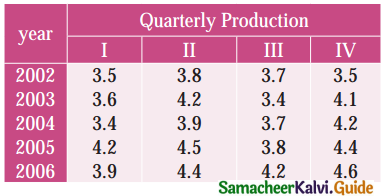
It is prepared by the action of a mixture of con. HNO3 and con. H2SO4 (nitrating mixture) on benzene maintaining the temperature below 333 K.
Nitration:
Samacheer Kalvi 11th Chemistry Guide Chapter 13 Hydrocarbons 40

Sulphuric acid generates the electrophile – NO2+, nitronium ion-from nitric acid. This is an example of aromatic electrophilic substitution reaction.
Samacheer Kalvi 11th Chemistry Guide Chapter 13 Hydrocarbons 41

The generation of nitronium ion
H2SO4 + HONO2Samacheer Kalvi 11th Chemistry Guide Chapter 13 Hydrocarbons 42 + HSO4
Samacheer Kalvi 11th Chemistry Guide Chapter 13 Hydrocarbons 43

To the nitronium ion (being an electron deficient species) the π bond of benzene, donates a pair of electrons forming a 6-bond. A species with a + ve charge is formed as an intermediate. This is called ‘arenium ion’ and is stabilised by Resonance.
Samacheer Kalvi 11th Chemistry Guide Chapter 13 Hydrocarbons 44

In the last step, the hydrogen atom attached to the carbon carrying the nitro group is pulled out as a proton, by the Lewis base HSO4, so that stable aromatic system is formed.
Samacheer Kalvi 11th Chemistry Guide Chapter 13 Hydrocarbons 45

Question 37.
How does Huckel rule help to decide the aromatic character of a compound.
Answer:
In 1865, August Kekule suggested that benzene consists of a cyclic planar structure of six carbon with alternate single and double bonds.
There were two objections:
Benzene forms only one ortho disubstituted products whereas the Kekule’s structure predicts two o-di substituted products as shown below.
Samacheer Kalvi 11th Chemistry Guide Chapter 13 Hydrocarbons 46

Kekule’s structure failed to explain why benzene with three double bonds did not give addition reactions like other alkenes.To overcome this objection, Kekule suggested that benzene was mixture of two forms (1 and 2) which are in rapid equilibrium.
Samacheer Kalvi 11th Chemistry Guide Chapter 13 Hydrocarbons 47

Resonance description of benzene:
The phenomenon in which two or more structures can be written for a substance which has identical position of atoms is called resonance. The actual structure of the molecule is said to be resonance hybrid of various possible alternative structures. In benzene, Kekule’s structures I & II represented the resonance structure, and structure III is the resonance hybrid of structure I & II.
The structures 1 and 2 exist only in theory. The actual structure of benzene is the hybrid of two hypothetical resonance structures.
Samacheer Kalvi 11th Chemistry Guide Chapter 13 Hydrocarbons 48

Spectroscopic measurements:
Spectroscopic measurements show that benzene is planar and all of its carbon- carbon bonds are of equal length 1.40 Å. This value lies between carbon-carbon single bond length 1.54 Å and carbon- carbon double bond length 1.34 Å.

Molecular orbital structure:
The structure of benzene is best de¬scribed in terms of the molecular orbital theory. All the six carbon atoms of benzene are sp2 hybridized. Six sp2 hybrid orbitals of carbon linearly overlap with six 1 s orbitals of hydrogen atoms to form six C – H sigma bonds. Overlap between the remaining sp2 hybrid orbitals of carbon forms six C – C sigma bonds.
Samacheer Kalvi 11th Chemistry Guide Chapter 13 Hydrocarbons 49
Formation of Sigma bond in benzene

All the σ bonds in benzene lie in one plane with bond angle 120°. Each carbon atom in benzene possess an un hybridized p-orbital containing one electron. The lateral overlap of their p-orbital produces 3 π- bond. The six electrons of the p-orbitals cover all the six carbon atoms and are said to be delocalised. Due to delocalization, strong π-bond is formed which makes the molecule stable. Hence unlike alkenes and alkynes benzene undergoes substitution reactions rather addition reactions under normal conditions.

Samacheer Kalvi 11th Chemistry Guide Chapter 13 Hydrocarbons 50

All carbon atoms have the delocalized π MO is formed by p-orbitais the overlap of six p-orbitals.

Representation of benzene:
Hence, there are three ways in which benzene can be represented.
Samacheer Kalvi 11th Chemistry Guide Chapter 13 Hydrocarbons 51

Samacheer Kalvi 11th Chemistry Guide Chapter 13 Hydrocarbons

Question 38.
Suggest the route for the preparation of the following from benzene.
1) 3 – chloro nitrobenzene
2) 4 – chlorotoluene
3) Bromo benzene
4) m – dinitro benzene
Answer:
1) 3 – chloro nitrobenzene
Samacheer Kalvi 11th Chemistry Guide Chapter 13 Hydrocarbons 52

2) 4 – chlorotoluene
Samacheer Kalvi 11th Chemistry Guide Chapter 13 Hydrocarbons 53

3) Bromo benzene
Samacheer Kalvi 11th Chemistry Guide Chapter 13 Hydrocarbons 54

4) m – dinitro benzene
Samacheer Kalvi 11th Chemistry Guide Chapter 13 Hydrocarbons 55

Question 39.
Suggest a simple chemical test to distinguish propane and propene.
Answer:
Propene decolourises Br2/H2O it forms dibromo compound but propane does not react with Br2/ H2O.

Question 40.
What happens when Isobutylene is treated with acidified potassium permanganate?
Answer:
Samacheer Kalvi 11th Chemistry Guide Chapter 13 Hydrocarbons 56

Question 41.
How will you convert ethyl chloride into
(i) ethane
(ii) n – butane
Answer:
(i) ethane
Samacheer Kalvi 11th Chemistry Guide Chapter 13 Hydrocarbons 57

(ii) n – butane
Samacheer Kalvi 11th Chemistry Guide Chapter 13 Hydrocarbons 58

Samacheer Kalvi 11th Chemistry Guide Chapter 13 Hydrocarbons

Question 42.
Describe the conformers of n – butane.
Answer:
Conformations of n-Butane:
n-Butane may be considered as a derivative of ethane, as one hydrogen on each carbon is replaced by a methyl group

Eclipsed conformation:
In this conformation, the distance between the two methyl group is minimum. So there is maximum repulsion between them and it is the least stable conformer.

Anti or staggered form:
In this conformation, the distance between the two methyl groups is maximum and so there is minimum repulsion between them. And it is the most stable conformer.

The following potentially energy diagram shows the relative stabilities of various conformers of n-butane.
Samacheer Kalvi 11th Chemistry Guide Chapter 13 Hydrocarbons 59

Question 43.
Write the chemical equations for combustion of propane.
Answer:
C3H8(g) + 5O2(g) ) → 3CO2(g) + 4H2O(l)
propane

Question 44.
Explain Markovnikoff’s rule with suitable example.
Answer:
Markovnikoff ‘s rule:
“When an unsymmetrical alkene reacts with hydrogen halide, the hydrogen adds to the carbon that has more number of hydrogen and halogen add to the carbon having fewer hydrogen”. This rule can also be stated as in the addition reaction of alkene/alkyne, the most electro negative part of the reagent adds on to the least hydrogen attached doubly bonded carbon.

Addition of water: (Hydration of alkenes)
Normally, water does not react with alkenes. In the presence of concentrated sulphuric acid, alkenes react with water to form alcohols. This reaction follows carbocation mechanism and Markovnikoff’s rule.
Samacheer Kalvi 11th Chemistry Guide Chapter 13 Hydrocarbons 60

Question 45.
What happens when ethylene is passed ‘ through cold dilute alkaline potassium permanganate.
Answer:
CH2 = CH + H2O + (O) Samacheer Kalvi 11th Chemistry Guide Chapter 13 Hydrocarbons 61 CH2OH – CH2OH
Ethylene                                                                Ethylene glycol

Samacheer Kalvi 11th Chemistry Guide Chapter 13 Hydrocarbons

Question 46.
Write the structures of following alkanes.
1) 2, 3 – Dimethyl – 6 – (2 – methyl propyl) decane
2) 5 – (2 – Ethyl butyl ) – 3, 3, – dimethyldecane
3) 5 – (1, 2 – Dimethyl propyl) – 2 – methylnonane
Answer:
1) 2, 3 – Dimethyl – 6 – (2 – methyl propyl) decane
Samacheer Kalvi 11th Chemistry Guide Chapter 13 Hydrocarbons 62

2) 5 – (2 – Ethyl butyl ) – 3, 3, – dimethyldecane
Samacheer Kalvi 11th Chemistry Guide Chapter 13 Hydrocarbons 63

3) 5 – (1, 2 – Dimethyl propyl) – 2 – methylnonane
Samacheer Kalvi 11th Chemistry Guide Chapter 13 Hydrocarbons 64

Question 47.
How will you prepare propane from a sodium salt of fatty acid?
Answer:
Samacheer Kalvi 11th Chemistry Guide Chapter 13 Hydrocarbons 65

Question 48.
Samacheer Kalvi 11th Chemistry Guide Chapter 13 Hydrocarbons 66
Identify A and B
Answer:
A) Samacheer Kalvi 11th Chemistry Guide Chapter 13 Hydrocarbons 67

b) Samacheer Kalvi 11th Chemistry Guide Chapter 13 Hydrocarbons 68

Question 49.
Complete the following :

i) 2 – butyne  Samacheer Kalvi 11th Chemistry Guide Chapter 13 Hydrocarbons 69

ii) CH2 = CH2 Samacheer Kalvi 11th Chemistry Guide Chapter 13 Hydrocarbons 70

iii) Samacheer Kalvi 11th Chemistry Guide Chapter 13 Hydrocarbons 71

iv) CaC2 Samacheer Kalvi 11th Chemistry Guide Chapter 13 Hydrocarbons 72
Answer:
i) 2 – butyne Samacheer Kalvi 11th Chemistry Guide Chapter 13 Hydrocarbons 69
Samacheer Kalvi 11th Chemistry Guide Chapter 13 Hydrocarbons 73

ii) CH2 = CH2 Samacheer Kalvi 11th Chemistry Guide Chapter 13 Hydrocarbons 70
Samacheer Kalvi 11th Chemistry Guide Chapter 13 Hydrocarbons 74

iii) Samacheer Kalvi 11th Chemistry Guide Chapter 13 Hydrocarbons 71
Samacheer Kalvi 11th Chemistry Guide Chapter 13 Hydrocarbons 75

iv) CaC2 Samacheer Kalvi 11th Chemistry Guide Chapter 13 Hydrocarbons 72
CaC2 + 2H2O → Ca(OH)2 + C2H2
Calcium Carbide                  Acetylene

Question 50.
How will distinguish 1 – butyne and 2 – butyne?
Answer:
Samacheer Kalvi 11th Chemistry Guide Chapter 13 Hydrocarbons 76
1 – butyne reacts with ammoniacal AgNO3 solution it forms white precipitate of silver acetylide but, 2 – butyne doesnot reacts with ammoniacal AgNO3 solution.

Samacheer Kalvi 11th Chemistry Guide Chapter 13 Hydrocarbons

11th Chemistry Guide Hydrocarbons Additional Questions and Answers

I. Choose the best answer:

Question 1.
The IUPAC name of neopentane is
a) 2 – methyl butane
b) 2, 2 – dimethyl propane
c) 2 – methyl propane
d) 2, 2- dimethyl butane
Answer:
b) 2, 2 – dimethyl propane

Question 2.
Alkanes are also known as
a) olefins
b) unsaturated aliphatic hydrocarbons
c) saturated aromatic hydrocarbon
d) paraffins
Answer:
d) paraffins

Question 3.
The compressed gas available in cooking gas cylinders is a mixture of:
a) C6H6 + C6H5CH3
b) C2H4 + C2H2
c) C2H4 + CH4
d) C4H10 + C3H8
Answer:
d) C4H10 + C3H8

Question 4.
The gas supplied in cylinders for cooking is
a) marsh gas
b) LPG
c) mixture CH4 and C2H6
d) mixture of ethane and propane
Answer:
d) mixture of ethane and propane

Question 5.
Adam’s catalyst is:
a) platinum metal
b) palladium
c) nickel metal
d) PtO2
Answer:
d) PtO2

Samacheer Kalvi 11th Chemistry Guide Chapter 13 Hydrocarbons

Question 6.
Soda lime is
a) NaOH
b) NaOH + CaO
c) CaO
d) Na2CO3
Answer:
b) NaOH + CaO

Question 7.
Methyl bromide is converted into ethane by heating it in ether medium with
a) Al
b) Mg
c) Na
d) Cu
Answer:
c) Na

Question 8.
Hydrocarbon which is liquid at room temperature is
a) Pentane
b) Butane
c) Propane
d) Ethane
Answer:
a) Pentane

Question 9.
Pyrolysis of Methane and respectively are
a) Exothermic & Endothermic
b) Endothermic & Exothermic
c) Both are endothermic
d) Both are exothermic
Answer:
c) Both are endothermic

Question 10.
Select the correct statement about alkanes
a) they are polar in nature
b) they are soluble in water
c) they are non – combustible
d) their dipole moment is zero
Answer:
d) their dipole moment is zero

Samacheer Kalvi 11th Chemistry Guide Chapter 13 Hydrocarbons

Question 11.
Final products of complete oxidation of hydrocarbon is
a) Acid
b) Dihydric alcohol
c) Aldehyde
d) H2O + CO2
Answer:
d) H2O + CO2

Question 12.
Isomerisation in alkane can be brought by using
a) Al2O3
b) Fe2O3
c) Anh.AlCl3/ HCl at 200°C
d) Cone. H2SO4
Answer:
c) Anh.AlCl3/ HCl at 200°C

Question 13.
In aromatization of n – hexane, the catalyst used is
a) Cr2O3
b) V2O5
c) Mo2O3
d) All
Answer:
d) All

Question 14.
The most oxidized form of ethane is
a) CO2
b) HCHO
c) HCOOH
d) CH3COOH
Answer:
a) CO2

Question 15.
The following substance is used as anti knocking compound
a) TEL
b) Lead tetrachioride
c) Lead acetate
d) C2H2PbCl
Answer:
a) TEL

Samacheer Kalvi 11th Chemistry Guide Chapter 13 Hydrocarbons

Question 16.
Conformational isomers are due to
a) Free rotation about C – C single bond
b) Frozen rotation about C – C single bond
e) Frozen rotation about C – C double bond
d) Restricted rotation about C – C single bond
Answer:
a) Free rotation about C – C single bond

Question 17.
The most stable conformation of ethane is
a) Eclipsed
b) Skew
c) Staggered
d) All are equally stable
Answer:
c) Staggered

Question 18.
IUPAC name of the following compound
Samacheer Kalvi 11th Chemistry Guide Chapter 13 Hydrocarbons 77
a) 3 – methyl hexane
b) 3 – Ethyl pentane
c) 2, 3 – dimethyl pentane
d) 2, 2 – dimethyl pentane
Answer:
a) 3 – methyl hexane

Question 19.
The number of sigma bonds formed in ethane by the overlapping of sp3 – sp3 orbitals
a) 7
b) 5
c) 1
d) 4
Answer:
c) 1

Question 20.
How many types of carbon atoms are present in 2, 2, 3 – trimethyl pentane
a) one
b) Two
c) Three
d) Four
Answer:
d) Four

Samacheer Kalvi 11th Chemistry Guide Chapter 13 Hydrocarbons

Question 21.
The correct IUPAC name of the following alkane is
Samacheer Kalvi 11th Chemistry Guide Chapter 13 Hydrocarbons 78
a) 3, 6 – diethyl – 2- methyloctane
b) 5 – isopropyl – 3- ethyloctane
c) 3 – ethyl – 5- isopropyloctane
d) 3 – isopropyl – 6 – ethyloctane
Answer:
a) 3, 6 – diethyl – 2- methyloctane

Question 22.
In Wurtz reaction, n – hexane is obtained from
a) n – propyl chloride
b) n – butyl chloride
c) Ethyl chloride
d) isopropyl chloride
Answer:
a) n – propyl chloride

Question 23.
When sodium acetate is heated with sodalime the reaction is called
a) Dehydration
b) Decarboxylation
c) Dehydrogenation
d) Dehydrohalogenation
Answer:
b) Decarboxylation

Question 24.
The following substance reacts with water to give ethane
a) CH4
b) C2H5MgBr
c) C2H4OH
d) C2H5OC2H5
Answer:
b) C2H5MgBr

Question 25.
Reaction of ROH with R’ MgX produces
a) RH
b) R’H
c) R – R
d) R’ – R”
Answer:
b) R’H

Samacheer Kalvi 11th Chemistry Guide Chapter 13 Hydrocarbons

Question 26.
The solvent used in Wurtz reacton is
a) C2H5OH(aq)
b) CH3COOH
c) H2O
d) C2H5OC2H5(dry)
Answer:
d) C2H5OC2H5(dry)

Question 27.
Arrange the following in the decreasing order of their boiling points
i) n – butane
ii) 2 – methylbutane
iii) n – pentane
iv) 2 – methylbutane
a) i > ii > iii > iv
b) ii > iii > iv > i
c) iv > iii > ii > i
d) iii > ii > iv > i
Answer:
d) iii > ii > iv > i

Question 28.
The compound with the highest boiling point is
a) n – Hexane
b) n – Pentane
c) 2, 2 – dimethyl propane
d) 2 – methyl butane
Answer:
a) n – Hexane

Question 29.
The increasing order of reduction of alkyl halides with zinc and dilute HCl is
a) R – Cl < R – I < R – Br
b) R – Cl < R – Br < R – I
c) R – I < R – Br < R – Cl
d) R – Br < R – I < R – Cl
Answer:
b) R – Cl < R – Br < R – I

Question 30.
The volume of oxygen required for the complete combustion of 4 lit of ethane is
a) 4 lit
b) 8 lit
c) 12 lit
d) 14 lit
Answer:
d) 14 lit

Samacheer Kalvi 11th Chemistry Guide Chapter 13 Hydrocarbons

Question 31.
The dihedral angle between the hydrogen atoms of 2 methyl groups in staggered conformation of ethane is
a) 0°
b) 60°
c) 120°
d) 240°
Answer:
b) 60°

Question 32.
The distances between the hydrogen nuclei in staggered and eclipsed form in ethane respectively are
a) 2.55 Å & 2.29 Å
b) 1.54 Å & 1.34 Å
c) 3.5 Å & 2.5 Å
d) 2.29 Å & 2.55 Å
Answer:
a) 2.55 Å & 2.29 Å

Question 33.
Energy barrier between staggered and eclipsed form in ethane is
a) 0.6 kcal / mole
b) 2.9 kcal / mole
c) 12 kcal / mole
d) 14 cal / mole
Answer:
b) 2.9 kcal / mole

Question 34.
IUPAC name of the following compound
Samacheer Kalvi 11th Chemistry Guide Chapter 13 Hydrocarbons 79
a) 3 – Ethyl, 5 – methyl heptane
b) 5 – Ethyl, 3 – methyl heptane
c) 2 – Ethyl, 5 – methyl heptane
d) 4 – Ethyl, 5 – methyl heptane
Answer:
a) 3 – Ethyl, 5 – methyl heptane

Question 35.
Ethylene is converted to ethane in the presence of Ni at 300°C. In this reaction the hybridization of carbon changes from
a) sp to sp2
b) sp2 to sp3
c) sp3 to sp
d) sp to sp3
Answer:
b) sp2 to sp3

Samacheer Kalvi 11th Chemistry Guide Chapter 13 Hydrocarbons

Question 36.
In which of the following reactions in the preparation of ethane a new C – C bond is formed
a) Sabatier – Senderen’s reaction
b) Reduction of ethyl iodide
c) Decarboxylation
d) Kolbe’s electrolysis
Answer:
d) Kolbe’s electrolysis

Question 37.
Select the correct statements
a) eclipsed and staggered ethanes give different products on reaction with chlorine in presence of light
b) the conformational isomers can be isolated at room temperature
c) torsional strain is minimum in ethane at dihedral angles 60°, 180° and 300°
d) steric strain is minimum in gauche form of n – butane
Answer:
c) torsional strain is minimum in ethane at dihedral angles 60°, 180° and 300°

Question 38.
The fully eclipsed conformation of n – butane is least stable due to the presence of
a) bond opposition strain only
b) steric strain only
c) bond opposition strain as well as steric strain
d) no strain is present in the molecule
Answer:
c) bond opposition strain as well as steric strain

Question 39.
Vinyl group among the following is
a) (CH3)2 CH –
b) HC ≡ C –
c) H2C = CH – CH2
d) CH2 = CH –
Answer:
d) CH2 = CH –

Question 40.
The alkene that exhibits geometrical isomerism is
a) propene
b) 2 – methyl propene
c) 2 – butene
d) 2 – methyl – 2 – butene
Answer:
c) 2 – butene

Samacheer Kalvi 11th Chemistry Guide Chapter 13 Hydrocarbons

Question 41.
Samacheer Kalvi 11th Chemistry Guide Chapter 13 Hydrocarbons 80
a) 5 – methylocta – 1, 3, 5, 7 – tetraene
b) 4 – methylocta – 1, 3, 5, 7 – tetraene
c) 4 – butenylocta -1, 3- diene
d) octa – 1, 5 – diene
Answer:
b) 4 – methylocta – 1, 3, 5, 7 – tetraene

Question 42.
CH2 = C (CH2CH2CH3)2
a) 2 – Propyl pent – 1 – ene
b) 2 – Propyl pent – 2- ene
c) 2 – Propyl pent – 3 – ene
d) 3 – Propyl pent – 1- ene
Answer:
a) 2 – Propyl pent – 1 – ene

Question 43.
The number of sigma (σ) and pi (π) bonds in the following structure are
a) σ bonds – 33 π bonds – 2
b) σ bonds – 22 π bonds – 2
c) σ bonds – 42 π bonds – 2
d) σ bonds – 40 π bonds – 3
Answer:
a) σ bonds – 33 π bonds – 2

Question 44.
In dehydrohalogenation, hydrogen and halogen are removed from
a) the same carbon atom
b) from adjacent carbon atoms
c) from isolate carbon atoms
d) from any two carbon atoms
Answer:
b) from adjacent carbon atoms

Question 45.
Ethylene readily undergoes the following type of reaction.
a) Elimination
b) Addition
c) Rearrangement
d) Substitution
Answer:
b) Addition

Samacheer Kalvi 11th Chemistry Guide Chapter 13 Hydrocarbons

Question 46.
Baeyer’s reagent is
a) Aqueous bromine solution
b) Neutral permanganate solution
c) Acidified permanganate solution
d) Alkaline potassium permanganate solution
Answer:
d) Alkaline potassium permanganate solution

Question 47.
Baeyer’s reagent oxidizes ethylene to
a) Ethylene chlorohydrin
b) Ethyl alcohol
c) CO2 and H2O
d) Ethane – 1, 2 – diol
Answer:
d) Ethane – 1, 2 – diol

Question 48.
On reductive ozonolysis ethylene gives
a) Aldehyde
b) Ketone
c) Carboxylic acid
d) Ether
Answer:
a) Aldehyde

Question 49.
Polythene is obtained by the polymerization of
a) Styrene
b) A mixture of ethylene and styrene
c) Acetylene
d) Ethene
Answer:
c) Acetylene

Question 50.
Polytetrafluoroethylene is commercially known as
a) Teflon
b) Freon
c) Lewisite
d) Westron
Answer:
a) Teflon

Samacheer Kalvi 11th Chemistry Guide Chapter 13 Hydrocarbons

Question 51.
Polythens is
a) (- H2C = CH2 -)n
b) (- HC = CH – )n
c) (- H3C – CH3 – )n
d) (- H2C – CH2 -)n
Answer:
d) (- H2C – CH2 -)n

Question 52.
When ethanol vapours are passed over alumina heated at 350°C, the main product obtained is
a) C2H6
b) C2H4
c) C2H2
d) C2H5OC2H5
Answer:
b) C2H4

Question 53.
Dehydrohalogenation of ethyl chloride in presence of ale. KOH produces the following
a) HC ≡ CH + KCl + H2O
b) CH4 + KCl + H2O
c) CH2 = CH2 + KCl + H2O
d) C2H4 + HCl
Answer:
c) CH2 = CH2 + KCl + H2O

Question 54.
Ethylene is prepared by
a) Dehalogenation of chloroform
b) Pyrolysis of ethane at 450°C
c) Dehydration of methanol with Al2O3 / 350°C
d) Methyl chloride on reduction
Answer:
b) Pyrolysis of ethane at 450°C

Question 55.
The peroxide effect involves
a) Ionic mechanism
b) Free – radical mechanism
c) Heterolytic fission of double bond
d) Homolytic fission of double bond
Answer:
b) Free – radical mechanism

Samacheer Kalvi 11th Chemistry Guide Chapter 13 Hydrocarbons

Question 56.
In which of the following will Kharasch effect operate?
a) CH3 – CH2 – CH = CH2 + HCl
b) CH3 – CH2 – CH = CH2 + HBr
c) CH3 – CH = CH – CH3 + HBr
d) CH3 – CH2 – CH = CH2 + HI
Answer:
b) CH3 – CH2 – CH = CH2 + HBr

Question 57.
Anti Markownikoff addition of HBr is not observed in
a) Propene
b) Butene – 1
c) Butene – 2
d) pentene – 2
Answer:
c) Butene – 2

Question 58.
Conditions used for the formation of ethylene glycol from ethylene
a) bromine water
b) cold alkaline KMnO4
c) dil H2SO4, 60°C
d) Ag / 200°C
Answer:
b) cold alkaline KMnO4

Question 59.
The olefin which on ozonolysis gives CH3CH2CHO and CH3CHO is
a) 1 – butene
b) 2 – butene
c) 1 – pentene
d) 2 – pentene
Answer:
d) 2 – pentene

Question 60.
In the following reaction, A and B respectively are,
Samacheer Kalvi 11th Chemistry Guide Chapter 13 Hydrocarbons 81
a) C2H4 and alcoholic KOH / ∆
b) C2H5Cl and aqueous KOH / ∆
c) C2H5OH and aq KOH / ∆
d) C2H2 and Br2
Answer:
a) C2H4 and alcoholic KOH / ∆

Samacheer Kalvi 11th Chemistry Guide Chapter 13 Hydrocarbons

Question 61.
The number of possible alkynes with molecular formula C5H8 is
a) 3
b) 4
c) 5
d) 6
Answer:
a) 3

Question 62.
The number of open chain structural isomers possible with molecular formula C5H8 is
a) 7
b) 6
c) 5
d) 4
Answer:
a) 7

Question 63.
Alkynes exhibit.
a) Chain isomerism
b) Position isomerism
c) Functional isomerism
d) All the above
Answer:
d) All the above

Question 64.
The IUPAC name of the compound having the formula CH ≡ C – CH = CH2
a) Butene – 2 – ye
b) But – 2- yne – 3 – ene
c) 3 – butane 1 – ene
d) But – 1 – ene – 3 – yne
Answer:
d) But – 1 – ene – 3 – yne

Question 65.
Acetylene can be obtained by the electrolysis of the following compound
a) Potassium fumerate
b) Potassium succinate
c) Potassium acetate
d) Potassium formate
Answer:
a) Potassium fumerate

Samacheer Kalvi 11th Chemistry Guide Chapter 13 Hydrocarbons

Question 66.
The gas obtained when ethylene chloride reacts with alcoholic potash and sodamide is
a) C2H4
b) C2H6
c) C2H2
d) C2H5Cl
Answer:
c) C2H2

Question 67.
PVC is the polymer of the following
a) Ethyl chloride
b) Vinyl Chloride
c) Allyl Chloride
d) Ethynyl chloride
Answer:
b) Vinyl Chloride

Question 68.
Which of the following possess acidic hydrogen
a) C2H6
b) C2H4
c) C2H2
d) CH4
Answer:
c) C2H2

Question 69.
Hydrocarbon which gives oxyacetylene flame
a) ethane
b) ethene
c) ethyne
d) ethanol
Answer:
c) ethyne

Question 70.
The isomer of propyne
a) Allene
b) Propene
c) Cyclo propane
d) Propane
Answer:
a) Allene

Samacheer Kalvi 11th Chemistry Guide Chapter 13 Hydrocarbons

Question 71.
Bond angle between C – C in alkyne
a) 109°.28′
b) 120°
c) 180°
d) 60°
Answer:
c) 180°

Question 72.
The molecule having linear structure is
a) Methane
b) Ethylene
c) Acetylene
d) Water
Answer:
c) Acetylene

Question 73.
The C – C bond length is shortest in
a) C2H6
b) C3H8
c) C6H6
d) C2H4
Answer:
b) C3H8

Question 74.
The hydrolysis of Mg2C3 produces
a) acetylene
b) propyne
c) butyne
d) ethylene
Answer:
b) propyne

Question 75.
1 – pentyne and 2 – pentyne can be distinguished by
a) Silver mirror test
b) Iodoform test
c) Addition of H2
d) Baeyers test
Answer:
a) Silver mirror test

Samacheer Kalvi 11th Chemistry Guide Chapter 13 Hydrocarbons

Question 76.
Acetylene on reaction with silver nitrate shows
a) Oxidizing property
b) Reducing property
c) Basic nature
d) Acidic nature
Answer:
d) Acidic nature

Question 77.
The acidic nature of hydrogens in acetylene cannot be explained by the reaction with
a) Sodium metal
b) Ammonical cuprous chloride solution
c) Ammonical silver nitrate solution
d) HCN
Answer:
d) HCN

Question 78.
Westron is the solvent obtained by the reaction of chlorine with
a) Ethylene
b) Ethyne
c) Ethane
d) Methane
Answer:
b) Ethyne

Question 79.
CH ≡ CHSamacheer Kalvi 11th Chemistry Guide Chapter 13 Hydrocarbons 82 is
a) CH2 = CH – CH = CH2
b) HC ≡ C – CH3
c) CH2 = CH – CH3
d) CH3 – CH2 – CH3
Answer:
b) HC ≡ C – CH3

Question 80.
Hydration of ethyne to ethanal takes place through the formation of
a) CH3CH(OH)2
b) CH2 = CHOH
c) CH2 = CHO
d) CH ≡ C
Answer:
b) CH2 = CHOH

Samacheer Kalvi 11th Chemistry Guide Chapter 13 Hydrocarbons

Question 81.
Samacheer Kalvi 11th Chemistry Guide Chapter 13 Hydrocarbons 83 B is
a) Acetylene
b) Acetaldehyde
c) Acetone
d) Acetic acid
Answer:
b) Acetaldehyde

Question 82.
Samacheer Kalvi 11th Chemistry Guide Chapter 13 Hydrocarbons 84 is
a) Ethyl chloride
b) 1, 2 dichloro ethene
c) Vinyl chloride
d) Ethylidine chloride
Answer:
c) Vinyl chloride

Question 83.
Samacheer Kalvi 11th Chemistry Guide Chapter 13 Hydrocarbons 85 The Polymer ‘B’ is
a) orlon
b) PVC
c) nylon
d) Teflon
Answer:
b) PVC

Question 84.
Benzene is ______ molecule.
a) Tetrahedral
b) Planar
c) Trigonal
d) Square planar
Answer:
b) Planar

Question 85.
Bond length of C – C in benzene.
a) 1.34 Å
b) 1.39 Å
c) 1.54 Å
d) 1.20 Å
Answer:
c) 1.54 Å

Samacheer Kalvi 11th Chemistry Guide Chapter 13 Hydrocarbons

Question 86.
The resonance energy Benzene is
a) 36 kcal / mol
b) 85.8 kJ / mole
c) 150.48 kJ / mole
d) Both (a) and (c)
Answer:
d) Both (a) and (c)

Question 87.
In Huckel’s (4n + 2) π rule for aromaticity, ‘n’ represents
a) Number of carbon atoms
b) Number of rings
c) Whole number
d) Fractional number (or) integer (or) zero
Answer:
c) Whole number

Question 88.
Coal tar is obtained as a by product during
a) Destructive distillation of wood
b) Destructive distillation of coal
c) Destructive distillation of bones
d) steam distillation of light oil
Answer:
b) Destructive distillation of coal

Question 89.
Gammaxene is ________ isomer of benzene hexa chloride.
a) α
b) β
c) γ
d) δ
Answer:
c) γ

Question 90.
The empirical formula of benzene and acetylene is/are
a) CH2, CH
b) CH2, CH2
c) CH, CH
d) CH3, CH3
Answer:
c) CH, CH

Samacheer Kalvi 11th Chemistry Guide Chapter 13 Hydrocarbons

Question 91.
Chemical name of the insecticide gammaxene is
a) DDT
b) Benzene hexa chloride
c) Chloral
d) Hexa chloro ethane
Answer:
b) Benzene hexa chloride

Question 92.
Which is non benzenoidal aromatic compound?
a) Benzene
b) Pyridine
c) Toluene
d) Phenol
Answer:
b) Pyridine

Question 93.
Benzene is purified by
a) distillation
b) fractional distillation
c) Evaporation
d) sublimation
Answer:
b) fractional distillation

Question 94.
Preparation of benzene from phenol is
a) Reduction
b) Oxidation
c) Addition
d) Dehydrogenation
Answer:
a) Reduction

Question 95.
The true statement about benzene is
a) Because of unsaturation benzene easily undergoes addition reactions
b) There are two types C – C bonds in benzene molecule
c) There is a cyclic delocalization of pi – electrons in benzene
d) Mono substitution of benzene gives three isomeric products
Answer:
c) There is a cyclic delocalization of pi – electrons in benzene

Samacheer Kalvi 11th Chemistry Guide Chapter 13 Hydrocarbons

Question 96.
– COOH group in electrophilic substitution directs the incoming group to
a) o – position
b) p – position
c) m – position
d) o – and p – position
Answer:
c) m – position

Question 97.
Which of the following is not meta directing group?
a) -SO3H
b) – NO2
c) – CN
d) – NH2
Answer:
d) – NH2

Question 98.
Which among the following is very strong o – , p – directing group?
a) – Cl
b) – OR
c) – NH2
d) – NHR
Answer:
d) – NHR

Question 99.
Cyclo butadiene is said to be
a) Aromatic
b) Aliphatic
c) anti aromatic
d) heterocyclic
Answer:
c) anti aromatic

Question 100.
In the reaction Samacheer Kalvi 11th Chemistry Guide Chapter 13 Hydrocarbons 86
the attacking species is
a) Cl2
b) Cl+
c) Cl
d) FeCl4
Answer:
b) Cl+

Samacheer Kalvi 11th Chemistry Guide Chapter 13 Hydrocarbons

Question 101.
The electrophile in Acetylation of Benzene
Samacheer Kalvi 11th Chemistry Guide Chapter 13 Hydrocarbons 87
Answer:
b) Samacheer Kalvi 11th Chemistry Guide Chapter 13 Hydrocarbons 88

Question 102.
The ratio of sigma and pi bonds in benzene is
a) 4 : 1
b) 2 : 3
c) 6 : 1
d) 1 : 1
Answer:
a) 4 : 1

Question 103.
Benzene reacts with _______ to yield acetophenone.
a) CH3COCl + AlCl3
b) C6H5COCl + AlCl3
c) RCOCl + AlCl3
d) C2H5COCl + AlCl3
Answer:
a) CH3COCl + AlCl3

Question 104.
The order of activites of the various O and P director is
a) – O > – OH > – OCOCH3 > – COCH3
b) – OH > – O > – OCOCH3 > – COCH3
c) – OH > – O > – COCH3 > – OCOCH3
d) -O > – COCH3 > -OCOCH3 > -OH
Answer:
a) – O > – OH > – OCOCH3 > – COCH3

Samacheer Kalvi 11th Chemistry Guide Chapter 13 Hydrocarbons

II. Very short question and answers (2 Marks):

Question 1.
What are alkanes? Give example.
Answer:
Alkanes are saturated hydrocarbons represented by the general formula CnH2n + 2 where ‘n’ is the number of carbon atoms in the molecule. Methane CH4, is- the first member of alkane family. The successive members are ethane C2H6, propane C3H8,butane C4H10, pentane C5H12 and so on. It is evident that each member differs from its proceeding or succeeding member by a -CH2 group.

Question 2.
Give the IUPAC name of the following alkane.
a) Samacheer Kalvi 11th Chemistry Guide Chapter 13 Hydrocarbons 89

b) Samacheer Kalvi 11th Chemistry Guide Chapter 13 Hydrocarbons 90
Answer:
a) Samacheer Kalvi 11th Chemistry Guide Chapter 13 Hydrocarbons 91

b) eer Kalvi 11th Chemistry Guide Chapter 13 Hydrocarbons 92

Question 3.
Draw the structural formula for 4,5 – diethyl – 3, 4, 5 – trimethyl octane.
Answer:
Samacheer Kalvi 11th Chemistry Guide Chapter 13 Hydrocarbons 93

Question 4.
How is methane prepared from sodium acetate?
Answer:
When a mixture of sodium salt of carboxylic acid and soda lime (sodium hydroxide + calcium oxide) is heated, alkane is formed. The alkane formed has one carbon atom less than carboxylic acid. This process of eliminating carboxylic
group is known as decarboxylation.
CH3COONa + NaOH Samacheer Kalvi 11th Chemistry Guide Chapter 13 Hydrocarbons 94 CH4 + Na2CO3
Sodium acetate                            Methane

Samacheer Kalvi 11th Chemistry Guide Chapter 13 Hydrocarbons

Question 5.
Write a short note on Kolbe’s Electrolytic method.
Answer:
When sodium or potassium salt of carboxylic acid is electrolyzed, a higher alkane is formed. The decarboxylative dimerization of two carboxylic acid occurs. This method is suitable for preparing symmetrical alkanes(R-R).
Samacheer Kalvi 11th Chemistry Guide Chapter 13 Hydrocarbons 95

Question 6.
How will you convert chloro propane into propane?
Answer:
When chloro propane is reduced with Zn / HCl it gives propane.
Example:
Samacheer Kalvi 11th Chemistry Guide Chapter 13 Hydrocarbons 96

Question 7.
Explain the combustion reaction of alkane with suitable example.
Answer:
A combustion reaction is a chemical reaction between a substances and oxygen with evolution of heat and light (usually as a flame). In the presence of sufficient oxygen, alkanes undergoes combustion when ignited and produces carbondioxide and water.

The combustion reaction is expressed as follows.
Example:
CH4 + 2O2 → CO2 + 2H2O
∆H° = -890.4 KJ

When alkanes burn in insufficient supply of oxygen, they form carbonmonoxide and carbon black.
2CH4 + 3O2 Samacheer Kalvi 11th Chemistry Guide Chapter 13 Hydrocarbons 97 2CO + 4H2O
CH4 + O2 → C + 2H2O

Question 8.
How are the following compound prepared by Aromatisation method?
(i) Benzene
(ii) Toluene
Answer:
(i) Benzene
n-Hexane passed over Cr2O3 supported on alumina at 873 k gives benzene.
Samacheer Kalvi 11th Chemistry Guide Chapter 13 Hydrocarbons 98

(ii) Toluene
Samacheer Kalvi 11th Chemistry Guide Chapter 13 Hydrocarbons 99Samacheer Kalvi 11th Chemistry Guide Chapter 13 Hydrocarbons 100

Samacheer Kalvi 11th Chemistry Guide Chapter 13 Hydrocarbons

Question 9.
What happens when methane reacts with steam?
Answer:
Methane reacts with steam at 1273K in the presence of Nickel and decomposes to form carbon monoxide and hydrogen gas.
CH4(g) + H2O(g) Samacheer Kalvi 11th Chemistry Guide Chapter 13 Hydrocarbons 100 CO(g) + 3H2
Production of H2 gas from methane is known as steam reforming process and it is a well-established industrial process for the production of H2 gas from hydrocarbons.

Question 10.
Explain the Isomerisation reaction with suitable example.
Answer:
Isomerisation is a chemical process by which a compound is transformed into any its isomeric forms. Normal alkanes can be converted into branched alkanes in the presence of AlCl3 and HCl at 298 k.
Samacheer Kalvi 11th Chemistry Guide Chapter 13 Hydrocarbons 101
This process is of great industrial importance. The quality of gasoline is improved by isomerising its components.

Question 11.
What are alkenes? Give example.
Answer:
Alkenes are unsaturated hydrocarbons that contain carbon-carbon double bond. They are represented by the general formulae CnH2n where ‘n’ stands for number of carbon atoms in the molecule. Alkenes are also known as olefins (in Latin – oil maker) because the first member ethene combines with chlorine gas to form an oily liquid as a product.
Example:
Ethylene (C2H4)

Question 12.
Explain the Geometrical isomerism of alkene with suitable example.
Answer:
It is a type of stereoisomerism and it is also called cis-trans isomerism. Such type of isomerism results due to the restricted rotation of doubly bounded carbon atoms.
If the similar groups lie on the same side, then the geometrical isomers are called Cis-isomers. When the similar groups lie on the opposite side, it is called a Trans isomer.
Example:
The geometrical isomers of 2-Butene is expressed as follows
Samacheer Kalvi 11th Chemistry Guide Chapter 13 Hydrocarbons 102

Samacheer Kalvi 11th Chemistry Guide Chapter 13 Hydrocarbons

Question 13.
Write the test for Alkene.
Answer:
Bromine in water is reddish brown colour. When small about of bromine water is added to an alkene, the solution is decolourised as it forms dibromo compound. So, this is the characteristic test for unsaturated compounds.
Example:
Samacheer Kalvi 11th Chemistry Guide Chapter 13 Hydrocarbons 103

Question 14.
Mention uses of Alkenes.
Answer:

  • Alkenes find many diverse applications in industry. They are used as starting materials in the synthesis of alcohols, plastics, liquors, detergents and fuels
  • Ethene is the most important organic feed stock in the polymer industry. E.g,’ PVC, Sarans and polyethylene. These polymer are used in the manufacture of floor tiles, shoe soles, synthetic fibres,raincoats, pipes etc.

Question 15.
How is propyne prepared from propylidine chloride?
Answer:

Samacheer Kalvi 11th Chemistry Guide Chapter 13 Hydrocarbons 104

Question 16.
How is ethyne prepared from CaC2?
Answer:
Ethyne can be manufactured in large scale
by action of calcium carbide with water.
Samacheer Kalvi 11th Chemistry Guide Chapter 13 Hydrocarbons 105
Calcium carbide needed for this reaction is prepared by heating quick lime and coke in an electric furance at 3273 K
CaO + 3C Samacheer Kalvi 11th Chemistry Guide Chapter 13 Hydrocarbons 106 CaC2 + CO

Samacheer Kalvi 11th Chemistry Guide Chapter 13 Hydrocarbons

Question 17.
Write the reaction of propyne using Br2.
Answer:
Samacheer Kalvi 11th Chemistry Guide Chapter 13 Hydrocarbons 107
When Br2 in CCl4 (Reddishbrown) is added to an aikyne, the colour is decolounsed. This is the test for unsaturation.

Question 18.
Mention the uses of alkynes.
Answer:

  1. Acetylene is used in oxy acetylene torch used for welding and cutting metals.
  2. It is used for manufacture of PVC, polyvinyl acetate, polyvinyl ether, orlon and neoprene rubbers.

Samacheer Kalvi 11th Chemistry Guide Chapter 13 Hydrocarbons

III. Short question and answers (3 Marks):

Question 1.
How are the following conversions carried out?
(i) propene → propane
(ii) ethene → ethane
(iii) prop – 1 – yne → propane
Answer:
(i) propene → propane
CH3 – CH = CH2 + H2 Samacheer Kalvi 11th Chemistry Guide Chapter 13 Hydrocarbons 108 CH3 – CH2 – CH3
propene                                     propane

(ii) ethene → ethane
CH2 = CH2 + H2 Samacheer Kalvi 11th Chemistry Guide Chapter 13 Hydrocarbons 109 CH3 – CH3
ethene                               ethane

(iii) prop – 1 – yne → propane
CH3 – C ≡ CH + 2H2 Samacheer Kalvi 11th Chemistry Guide Chapter 13 Hydrocarbons 108 CH3 – CH2 – CH3
prop – 1 – yne                            propane

Question 2.
write the IUPAC name of the following compounds.
Samacheer Kalvi 11th Chemistry Guide Chapter 13 Hydrocarbons 110
Answer:
Samacheer Kalvi 11th Chemistry Guide Chapter 13 Hydrocarbons 111

Samacheer Kalvi 11th Chemistry Guide Chapter 13 Hydrocarbons

Question 3.
Write the structural formula for the following compounds.
(i) 3 – Ethyl – 4, 5 – dipropyl octane
(ii) 2, 3 – Dimethyl pentane
(iii) 4 – Ethyl – 2,7 – Dimethyl octane
Answer:
(i) 3 – Ethyl – 4, 5 – dipropyl octane
Samacheer Kalvi 11th Chemistry Guide Chapter 13 Hydrocarbons 112

(ii) 2, 3 – Dimethyl pentane
Samacheer Kalvi 11th Chemistry Guide Chapter 13 Hydrocarbons 113

(iii) 4 – Ethyl – 2,7 – Dimethyl octane
Samacheer Kalvi 11th Chemistry Guide Chapter 13 Hydrocarbons 114

Question 4.
Write a short note on
(i) Wurtz reaction
(ii) Corey – House Mechanism
Answer:
(i) Wurtz reaction:
When a solution of halo alkanes in dry ether is treated with sodium metal, higher alkanes are produced. This reaction is used to prepare higher alkanes with even number of carbon atoms.
Example:
CH3 – Br + 2Na + Br – CH3 Samacheer Kalvi 11th Chemistry Guide Chapter 13 Hydrocarbons 115 CH3 – CH3 + NaBr
methyl bromide                                        ethane

(ii)Corey-House Mechanism:
An alkyl halide and lithium di alkyl cuprate are reacted to give higher alkane.
Example:
CH3CH2Br + (CH3)2LiCu → CH3CH2CH3 + CH3Cu + LiBr
Ethyl bromide

Samacheer Kalvi 11th Chemistry Guide Chapter 13 Hydrocarbons

Question 5.
How is methane prepared from Grignard reagent?
Answer:
Methyl chloride reacts with magnesium in presence of dry ether gives methyl magnesium chloride. Then methyl magnesium chloride reacts with water to give methane.
CH3 – Cl + Mg Samacheer Kalvi 11th Chemistry Guide Chapter 13 Hydrocarbons 116 CH3MgCl
chloromethane                 methyl magnesium chloride

CH3MgCl + H2O → CH4 + Mg(OH)Cl
methane

Question 6.
What is meant by pyrolysis? Explain the pyrolysis reaction of Ethane and propane.
Answer:
Pyrolysis is defined as the thermal decomposition of organic compound into smaller fragments in the absence of air through the application of heat. ‘Pyro’ means ‘fire’ and ‘lysis’ means ‘separating’. Pyrolysis of alkanes also named as cracking.

In the absence of air, when alkane vapours are passed through red-hot metal it breaks down into simpler hydrocarbons.

1) Samacheer Kalvi 11th Chemistry Guide Chapter 13 Hydrocarbons 204

2) 2CH3 – CH3 Samacheer Kalvi 11th Chemistry Guide Chapter 13 Hydrocarbons 117  CH2 = CH2 + 2CH4
Ethane                                 Ethylene

Question 7.
Mention the uses of alkanes.
Answer:
The exothermic nature of alkane combustion reaction explains the extensive use of alkanes as fuels. Methane present in natural gas is used in home heating. Mixture of propane and butane are known as LPG gas which is used for domestic cooking purpose. GASOLINE is a complex mixture of many hydrocarbons used as a fuel for internal combustion engines.

Carbon black is used in the manufacture of ink, printer ink and black pigments. It is also used s fillers.
Samacheer Kalvi 11th Chemistry Guide Chapter 13 Hydrocarbons 118

Question 8.
Write all possible structural isomers with the molecular formula C4H10 and name them.
Answer:
(i) CH3 – CH = CH – CH3 2 – butene
(ii) CH2 = CH – CH2 – CH3 1 – butene
(iii) Samacheer Kalvi 11th Chemistry Guide Chapter 13 Hydrocarbons 119 2 – mehyl – 1 – propene
structures (i) 8s (ii) are position isomers, structures (i) & (iii), (ii) 8s (iii) are chain isomers.

Samacheer Kalvi 11th Chemistry Guide Chapter 13 Hydrocarbons

Question 9.
How is ethene prepared by Kolbe’s electrolytic method?
Answer:
When an aqueous solution of potassium succinate is electrolyzed between two platinum electrodes, ethene is produced at the anode.
Samacheer Kalvi 11th Chemistry Guide Chapter 13 Hydrocarbons 120

Question 10.
How are the following compounds prepared by ozonolysis method?
(i) Formaldehyde
(ii) Acetaldehyde
Answer:
(i) Formaldehyde:
Samacheer Kalvi 11th Chemistry Guide Chapter 13 Hydrocarbons 121

(ii) Acetaldehyde:
Samacheer Kalvi 11th Chemistry Guide Chapter 13 Hydrocarbons 122

Question 11.
How ozone reacts with 2 – methyl propene?
Answer:
Samacheer Kalvi 11th Chemistry Guide Chapter 13 Hydrocarbons 123
When 2 – methyl propene reacts with ozone to give ozonoid. Ozonide is treated with Zn/H2O gives acetone.

Question 12.
How is acetylene prepared from ethylene?
Answer:
This process involves two steps:
(i) Halogenation of alkenes to form vicinal dihalides
(ii) Dehalogenation of vicinal dihalides to form alkynes.
Samacheer Kalvi 11th Chemistry Guide Chapter 13 Hydrocarbons 124

Samacheer Kalvi 11th Chemistry Guide Chapter 13 Hydrocarbons

Question 13.
How is acetylene prepared by Kolbe’s electrolytic method?
Answer:
Electrolysis of sodium or potassium salt of maleic or fumaric acid yields alkynes.
Samacheer Kalvi 11th Chemistry Guide Chapter 13 Hydrocarbons 125

Question 14.
Write Ozonolysis reaction of Propyne?
Answer:
Samacheer Kalvi 11th Chemistry Guide Chapter 13 Hydrocarbons 126

Question 15.
How is BHC prepared? Give its uses.
Answer:
Chlorination of Benzene:
Benzene reacts with three molecules of Cl2 in the presence of sun light or UV light to yield Benzene Hexa Chloride (BHC) C6H6Cl6. This is known as gammaxane or Lindane which is a powerful insecticide.
Samacheer Kalvi 11th Chemistry Guide Chapter 13 Hydrocarbons 127

Question 16.
How propane is prepared form 1, 2 – dichloro propane?
Answer:
Samacheer Kalvi 11th Chemistry Guide Chapter 13 Hydrocarbons 128

Samacheer Kalvi 11th Chemistry Guide Chapter 13 Hydrocarbons

Question 17.
Explain the polymerization reaction of alkenes.
Answer:
A polymer is a large molecule formed by the combination of larger number of small molecules. The process is known as polymensation. Alkenes undergo polymerisation at high temperature and pressure, in the presence of a catalyst.
Example:
red hot
Samacheer Kalvi 11th Chemistry Guide Chapter 13 Hydrocarbons 129

Question 18.
Write a note on acidic nature of Alkynes.
Answer:
An alkyne shows acidic nature only if it contains terminal hydrogen. This can be explained by considering sp hybrid orbitals of carbon atom in alkynes. The percentage of S-character of sp hybrid orbital (50%) is more than sp2 hybrid orbital of alkene (33%) and sp3 hybrid orbital of alkane (25%). Because of this, Carbon becomes more electronegative facilitating donation of H+ ions to bases. So hydrogen attached to triply bonded carbon atoms is acidic but not the others.
Samacheer Kalvi 11th Chemistry Guide Chapter 13 Hydrocarbons 130

Question 19.
Write a short note on
(i) Wurtz – Fittig reactions
(ii) Friedel Craft’s reaction
Answer:
(i) Wurtz – Fittig reactions:
When a solution of bromo benzene and iodo methane in dry ether is treated with metallic sodium, toluene is formed.
Samacheer Kalvi 11th Chemistry Guide Chapter 13 Hydrocarbons 131

(ii) Friedel Craft’s reaction:
When benzene is treated with methyl chloride in the presence of anhydrous aluminium chloride, toluene is formed.
Samacheer Kalvi 11th Chemistry Guide Chapter 13 Hydrocarbons 132

Samacheer Kalvi 11th Chemistry Guide Chapter 13 Hydrocarbons

IV. Long Question and answers (5 Marks):

Question 1.
How to draw structural formula for given IUPAC name with suitable example.
Answer:
After you learn the rules for naming alkanes, it is relatively easy to reverse the procedure and translate the name of an alkane into a structural formula. The example below show how this is done.
Let us draw the structural formula for
3 – ethyl – 2, 3 – dimethyl pentane
Step 1:
The parent hydrocarbon is pentane. Draw the chain of five carbon atoms and number it. .
Samacheer Kalvi 11th Chemistry Guide Chapter 13 Hydrocarbons 133

Step 2:
Complete the carbon skeleton by attaching the alkyl group as they are specified in the name. An ethyl group is attached to carbon 3 and two methyl groups are attached to carbon 2 and 3.
Samacheer Kalvi 11th Chemistry Guide Chapter 13 Hydrocarbons 134

Step 3:
Add hydrogen atoms to the carbon skeleton so that each carbon atoms has four bonds.
Samacheer Kalvi 11th Chemistry Guide Chapter 13 Hydrocarbons 135

Question 2.
Explain the conformations of ethane.
Answer:
The two tetrahedral methyl groups can rotate about the carbon – carbon bond axis yielding several arrangements called conformers. The extreme conformations are staggered and eclipsed conformation. There can be number of other arrangements between staggered and eclipsed forms and their arrangements are known as skew forms.
Eclipsed conformation:
Samacheer Kalvi 11th Chemistry Guide Chapter 13 Hydrocarbons 136

In this conformation, the hydrogen’s of one carbon are directly behind those of the other. The repulsion between the atoms is maximum and it is the least stable conformer.

Staggered conformation:
Samacheer Kalvi 11th Chemistry Guide Chapter 13 Hydrocarbons 137

In this conformation, the hydrogen’s of both the carbon atoms are far apart from each other. The repulsion between the atoms is minimum and it is the most stable conformation.

Skew conformation:

The infinite numbers of possible intermediate conformations between the two extreme conformations are referred as skew conformations. The stabilities of various conformations of ethane are:
Staggered > Skew > Eclipsed
The potential energy difference between the staggered and eclipsed conformation of ethane is around 12.5 kJmol-1. The various conformations can be represented by new man projection formula.
Samacheer Kalvi 11th Chemistry Guide Chapter 13 Hydrocarbons 138

Eclipsed Skew Staggered newmann projection formula for Ethane.

Samacheer Kalvi 11th Chemistry Guide Chapter 13 Hydrocarbons

Question 3.
Explain the steps involved in the mechanism of halogenations of alkane.
Halogenation:
A Halogenation reaction is the chemical reaction between an alkane and halogen in which one or more hydrogen atoms are substituted by the halogens.

Chlorination and Bromination are two widely used halogenation reactions. Fluorination is too quick and iodination too slow. Methane reacts with chlorine in the presence of light or when heated as follows.
Samacheer Kalvi 11th Chemistry Guide Chapter 13 Hydrocarbons 139

Mechanism:
The reaction proceeds through the free radical chain mechanism. This mechanism is characterized by three steps initiation, propagation and termination.

(i) Chain Initiation:
The chain is initiated by UV light leading to homolytic fission of chlorine molecules into free radicals (chlorine atoms).
Samacheer Kalvi 11th Chemistry Guide Chapter 13 Hydrocarbons 140

Here we choose Cl – Cl bond for fission because C – C & C – H bonds are stronger than Cl – Cl.

ii) Propagation:
It proceeds as follows
a) Chlorine free radial attacks the methane molecule and breaks the C – H bond resulting in the generation of methyl free radical
Samacheer Kalvi 11th Chemistry Guide Chapter 13 Hydrocarbons 141

b) The methyl free radical thus obtained attacks the second molecule of chlorine to give chloromethane (CH3Cl) and a chlorine free radical as follows.
Samacheer Kalvi 11th Chemistry Guide Chapter 13 Hydrocarbons 142

c) This chlorine free radical then cycles back to step a) and both step a) and b) are repeated many times and thus chain of reaction is set up.

iii) Chain termination:
After sometimes, the reactions stops due to consumption of reactant and the chain is terminated by the combination of free radicals.
Samacheer Kalvi 11th Chemistry Guide Chapter 13 Hydrocarbons 143

Question 4.
Write the IUPAC name of the following compounds.
1) CH3 – CH = CH2
2) CH3 – CH = CH – CH3
3) Samacheer Kalvi 11th Chemistry Guide Chapter 13 Hydrocarbons 144
4) Samacheer Kalvi 11th Chemistry Guide Chapter 13 Hydrocarbons 145
Answer:
Samacheer Kalvi 11th Chemistry Guide Chapter 13 Hydrocarbons 146

Samacheer Kalvi 11th Chemistry Guide Chapter 13 Hydrocarbons

Question 5.
Write the IUPAC name of the following compounds.
Samacheer Kalvi 11th Chemistry Guide Chapter 13 Hydrocarbons 147
Answer:
1) Samacheer Kalvi 11th Chemistry Guide Chapter 13 Hydrocarbons 148

2) Samacheer Kalvi 11th Chemistry Guide Chapter 13 Hydrocarbons 149

3) Samacheer Kalvi 11th Chemistry Guide Chapter 13 Hydrocarbons 150

4) Samacheer Kalvi 11th Chemistry Guide Chapter 13 Hydrocarbons 151

Question 6.
Draw the structures for the following alkenes.
(i) 6 – Bromo – 2, 3 – dimethyl – 2 – hexene
(ii) 5 – Bromo – 4 – chloro – 1 -heptene
(iii) 2, 5 – dimethyl – 4 – octene
(iv) 4 – Methyl – 2 – pentene
Answer:
(i) 6- Bromo – 2, 3-dimethyl – 2 -hexene
Samacheer Kalvi 11th Chemistry Guide Chapter 13 Hydrocarbons 152

(ii) 5 – Bromo – 4 – chloro – 1 -heptene
Samacheer Kalvi 11th Chemistry Guide Chapter 13 Hydrocarbons 153

(iii) 2, 5 – dimethyl – 4 – octene
Samacheer Kalvi 11th Chemistry Guide Chapter 13 Hydrocarbons 154

(iv) 4 – Methyl – 2 – pentene
Samacheer Kalvi 11th Chemistry Guide Chapter 13 Hydrocarbons 155

Samacheer Kalvi 11th Chemistry Guide Chapter 13 Hydrocarbons

Question 7.
Draw the structure and write down the IUPAC name for the isomerism exhibited by the molecular formulae:
(i) C5H12 – Pentene (3 isomers)
(ii) C6H14 – Hexene (5 isomers)
(iii) C5H12 – Pentene (3 isomers)
Answer:
(i) C5H12 – Pentene
a) CH3 – CH2 – CH2 – CH = CH2
1 – Pentene

b) Samacheer Kalvi 11th Chemistry Guide Chapter 13 Hydrocarbons 156
2 – methyl – 2 – butene

c) CH3CH = CH – CH2CH3
2 – pentene

(ii) C6H14 – Hexene
a) CH3 – CH2 – CH2 – CH2 – CH = CH2
1 – hexane

b) CH3 – CH2 – CH2 – CH = CH – CH3
2 – hexane

c) CH3 – CH2 – CH = CH – CH3 – CH2
3 – hexane

d) Samacheer Kalvi 11th Chemistry Guide Chapter 13 Hydrocarbons 157

e) Samacheer Kalvi 11th Chemistry Guide Chapter 13 Hydrocarbons 158

Question 8.
How are the following conversions carried out?
(i) ethanol → ethene
(ii) 2- butyne cis → 2 – butene and trans – 2 – butane
(iii) 1 – bromopropane → prop – 1 – ene
(iv) 1 – 2 – dibromoethane – ethene
Answer:
1) ethanol → ethene
C2H5OH Samacheer Kalvi 11th Chemistry Guide Chapter 13 Hydrocarbons 159 H2C = H2C
ethanol ethane

(ii) 2 – butyne → cis – 2 – butene
H3C – C ≡ C – CH3 + H2 Samacheer Kalvi 11th Chemistry Guide Chapter 13 Hydrocarbons 160

2 – butane → trans – 2 – butane
Samacheer Kalvi 11th Chemistry Guide Chapter 13 Hydrocarbons 161

(iii) 1 – bromopropane → prop – 1 – ene
H3C – CH2 – CH2 – Br Samacheer Kalvi 11th Chemistry Guide Chapter 13 Hydrocarbons 162 H3C – CH = CH2 + KBr + H2O
1 – bromopropane → prop – 1 – ene

(iv) 1 – 2 – dibromoethane – ethene
Samacheer Kalvi 11th Chemistry Guide Chapter 13 Hydrocarbons 163
1 – 2 – dibromoethane – ethene

Samacheer Kalvi 11th Chemistry Guide Chapter 13 Hydrocarbons

Question 9.
Write the mechanism involved in the addition of HBr to alkene in the presence of organic peroxide.
Answer:
Anti-Markovnikoff’s Rule (Or) Peroxide Effect (Or) KharaschAddition:
The addition of HBr to an alkene in the presence of organic peroxide takes place in the direction opposite to that predicted by Markovnikoff’s rule.
CH3 – CH = CH2 + HBr Samacheer Kalvi 11th Chemistry Guide Chapter 13 Hydrocarbons 164 CH3 – CH2 – CH3 – CH2 – CH2 – Br
prop – 1 – ene                                                          1 – bromopropane

Mechanism:
The reaction proceeds via free radical mechanism.

Step 1:
The week O – O single bond linkages of peroxides undergoes homolytic cleavage to generate free radical.
Samacheer Kalvi 11th Chemistry Guide Chapter 13 Hydrocarbons 165

Step 2:
The radicals abstract H from HBr thus generating bromine radical.
Samacheer Kalvi 11th Chemistry Guide Chapter 13 Hydrocarbons 166

Step 3:
The Bromine radical adds to the double bond in the way to form more stable alkyl free radical.
Samacheer Kalvi 11th Chemistry Guide Chapter 13 Hydrocarbons 167

Step 4:
Addition of HBr to secondary free radical
Samacheer Kalvi 11th Chemistry Guide Chapter 13 Hydrocarbons 168

Step 5:
Addition of HBr to primary free radical
Samacheer Kalvi 11th Chemistry Guide Chapter 13 Hydrocarbons 169

Question 10.
How are the following conversions carried out?
Answer:
(i) Propene → 2 – Propanol
(ii) ethene → ethylene glycol
(iii) 2 – butene → Acetic acid
(iv) 2 – methyl – 1 – propene → Acetone
Answer:
(i) Propene → 2 – Propanol
Samacheer Kalvi 11th Chemistry Guide Chapter 13 Hydrocarbons 170

(ii) ethene → ethylene glycol
Samacheer Kalvi 11th Chemistry Guide Chapter 13 Hydrocarbons 171

(iii) 2 – butene → Acetic acid
Samacheer Kalvi 11th Chemistry Guide Chapter 13 Hydrocarbons 172

(iv) 2 – methyl – 1 – propene → Acetone
Samacheer Kalvi 11th Chemistry Guide Chapter 13 Hydrocarbons 173 Samacheer Kalvi 11th Chemistry Guide Chapter 13 Hydrocarbons 174

Samacheer Kalvi 11th Chemistry Guide Chapter 13 Hydrocarbons

Question 11.
An organic compound (A) C2H4 decolourises bromine water. (A) on reaction with chlorine gives (B) A reacts with HBr to give (C). Identity (A), (B), (C). Explain th. reactions.
Answer:
Samacheer Kalvi 11th Chemistry Guide Chapter 13 Hydrocarbons 175
Result:
(A) – ethylene
(B) – 1, 2 – dichloroethane
(C) – ethyl bromide

Question 12.
How are the following conversions carried out?
(i) 2 – butyne → 2, 2 – dichlorobutane
(ii) 1 – butyne → 2, 2 – dibromobutane
(iii) ethyne → acetaldehyde
(iv) Propyne → propan – 2 – one
Answer:
(i) 2 – butyne → 2, 2 – dichlorobutane
Samacheer Kalvi 11th Chemistry Guide Chapter 13 Hydrocarbons 176

(ii) 1 – butyne → 2, 2 – dibromobutane
Samacheer Kalvi 11th Chemistry Guide Chapter 13 Hydrocarbons 177

(iii) ethyne → acetaldehyde
Samacheer Kalvi 11th Chemistry Guide Chapter 13 Hydrocarbons 178

(iv) Propyne → propan – 2 – one
Samacheer Kalvi 11th Chemistry Guide Chapter 13 Hydrocarbons 179

Question 13.
How are the following compounds prepared from ethyne?
(i) Formic acid
(ii) Vinyl ethylene
(iii) Benzene
Answer:
(i) Formic acid
Samacheer Kalvi 11th Chemistry Guide Chapter 13 Hydrocarbons 180

(ii) Vinyl ethylene
2CH ≡ CH Samacheer Kalvi 11th Chemistry Guide Chapter 13 Hydrocarbons 181 CH2 = CH – C ≡ CH (Vinyl ethylene)

(iii) Benzene
Samacheer Kalvi 11th Chemistry Guide Chapter 13 Hydrocarbons 182

Question 14.
Explain the Huckel’s rule of Aromaticity.
Answer:
Huckel proposed that aromaticity is a function of electronic structure. A compound may be aromatic, if it obeys the following rules (Huckel’s rule)
i) The molecule must be co-planar
ii) Complete delocalization of n electron in the ring
iii) Presence of (4n+2) n electrons in the ring where n is an integer (n = 0,1,2….)
This is known as Huckle’s rule.
Some of the examples which obey Huckel rule.

1. The benzene ring is planar with delocalized π electrons (6)
It obeys Huckel’s rule because 4n + 2 = (4 × 1) + 2 = 6π electrons.
Hence, it is an aromatic compound
Samacheer Kalvi 11th Chemistry Guide Chapter 13 Hydrocarbons 183

2. It has planar ring structure with delocalized π electrons (10).
Applying Huckle’s rule (4 × 2) + 2 = 10π electrons.
Hence it is an aromatic compound
Samacheer Kalvi 11th Chemistry Guide Chapter 13 Hydrocarbons 184
Naphthalene

3. It has a planar ring structure with delocalized π electrons(14).
Applying Huckle’s rule (4 × 3) + 2 = 14π electrons.
Samacheer Kalvi 11th Chemistry Guide Chapter 13 Hydrocarbons 185

4. It has planar ring structure but the π electrons are not delocalized.
Applying Huckle’s rule (4 × 1) + 2 = 6π electrons.
But it has only 4electrons. So it is not an aromatic compound
Samacheer Kalvi 11th Chemistry Guide Chapter 13 Hydrocarbons 186

5. It has a tub shaped ring structure. It does not obey Huckel’s rule.
Applying Huckle’s rule 4n + 2 = 8π electrons if n = 2
So it is not an aromatic compound.
Samacheer Kalvi 11th Chemistry Guide Chapter 13 Hydrocarbons 187

Samacheer Kalvi 11th Chemistry Guide Chapter 13 Hydrocarbons

Question 15.
Explain the Kekule’s structure of benzene.
Answer:
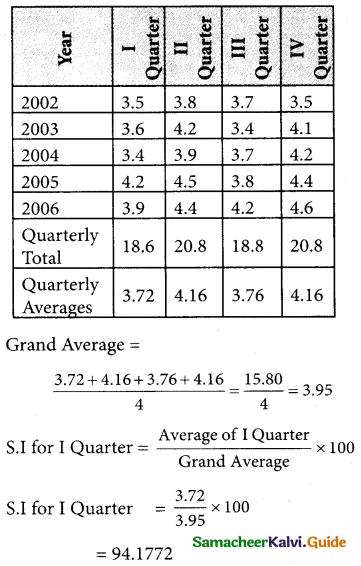
In 1865, August Kekule suggested that benzene consists of a cyclic planar structure of six carbon with alternate single and double bonds.
There were two objections:
(i) Benzene forms only one orthodisubstituted products whereas the Kekule’s structure predicts two o-di substituted products as shown below.
Samacheer Kalvi 11th Chemistry Guide Chapter 13 Hydrocarbons 188
Presence of double bond between the substituents

Samacheer Kalvi 11th Chemistry Guide Chapter 13 Hydrocarbons 189
Presence of single bond between the substituents

(ii) Kekule’s structure failed to explain why benzene with three double bonds did not give addition reactions like other alkenes.To overcome this objection, Kekule suggested that benzene was mixture of two forms (1 and 2) in rapid equilibrium.
Samacheer Kalvi 11th Chemistry Guide Chapter 13 Hydrocarbons 190

Question 16.
Explain the resonance in benzene.
Answer:
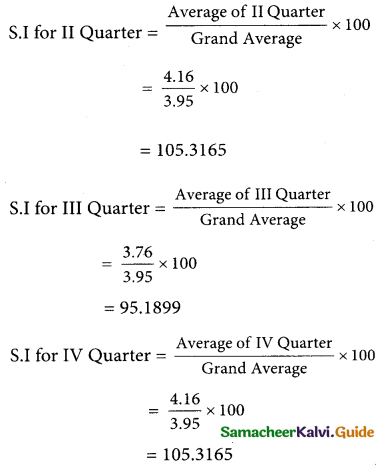
The phenomenon in which two or more structures can be written for a substance which has identical portions of atoms in called resonance. The actual structure of the molecule is said to be resonance hybrid of various possible alter nature structures. In benzene, Kekule’s structures I & II represented the resonance structure, and structure III is the resonance hybrid of structure I & II.
Samacheer Kalvi 11th Chemistry Guide Chapter 13 Hydrocarbons 191

The structures 1 and 2 exist only in theory. The actual structure of benzene is the hybrid of two hypothetical resonance structures.

Samacheer Kalvi 11th Chemistry Guide Chapter 13 Hydrocarbons

Question 17.
Write the industrial preparation of benzene from coal tar.
Answer:
Coal tar is a viscous liquid obtained by the pyrolysis of coal. During fractional distillation, coal tar is heated and distills away its volatile compounds namely benzene, toluene, xylene in the temperature range of 350 to 443 K. These vapours are collected at the upper part of the fractionating column
Samacheer Kalvi 11th Chemistry Guide Chapter 13 Hydrocarbons 192

Question 18.
How is benzene prepared from
(i) Acetylene
(ii) Decarboxylation
(iii) Phenol
Answer:
(i) From acetylene
Acetylene on passing through a red -hot tube trimerises to give benzene. We havealready studied this concept in polymerization of alkynes.
Samacheer Kalvi 11th Chemistry Guide Chapter 13 Hydrocarbons 193

(ii) Decarboxylation of aromatic acid.
When sodium benzonate is heated with sodalime, benzene vapours distil over.
C6H5COONa + NaOH Samacheer Kalvi 11th Chemistry Guide Chapter 13 Hydrocarbons 194 C6H6 + Na2CO3

(iii) Preparation of benzene from Phenol
When phenol vapours are passed over zinc dust, then it is reduced to benzene.
C6H6OH + Zn Samacheer Kalvi 11th Chemistry Guide Chapter 13 Hydrocarbons 195 C6H6 + ZnO

Question 19.
Explain Electrophilic substitution reaction of benzene.
Answer:
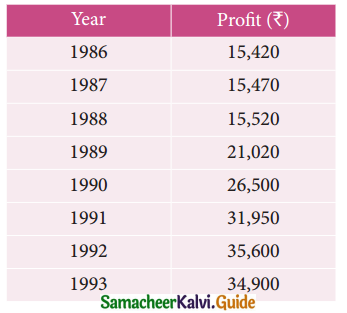
(i) nitration:
When benzene is heated at 330K with a nitrating mixture (Con. HNO3 + Con. H2SO4), nitro benzene is formed by replacing of hydrogen atom by nitronium ion NO2+ (electrophile).
Samacheer Kalvi 11th Chemistry Guide Chapter 13 Hydrocarbons 196
Concentrated H2SO4 is added to produce nitronium ion NO2+.

(ii) Halogenation:
Benzene reacts with halogens (X2 = Cl2, Br2,) in the presence of Lewis acid such as FeCl3, FeBr3 orAlCl3 and give corresponding halo benzene.
Samacheer Kalvi 11th Chemistry Guide Chapter 13 Hydrocarbons 197

(iii) Sulphonation:
Benzene reacts with fuming sulphuric acid (Con. H2SO4 + SO3) and gives benzene sulphonic acid. The electrophile SO3 is a molecule.
Samacheer Kalvi 11th Chemistry Guide Chapter 13 Hydrocarbons 198

(iv) Friedel craft’s alkylation: (methylation)
When benzene is treated with a alkyl halide in the presence of only AlCl3, alkyl benzene is formed.
Samacheer Kalvi 11th Chemistry Guide Chapter 13 Hydrocarbons 199

(v) Friedel craft’s acylatlon: (Acetylation)
When benzene is treated with acetyichioride in the presence of AlCl3, acyl benzene is formed.
Samacheer Kalvi 11th Chemistry Guide Chapter 13 Hydrocarbons 200

Samacheer Kalvi 11th Chemistry Guide Chapter 13 Hydrocarbons

Question 20.
How is benzene converted into
a) Cyclo hezane
b) maleic anhydride
c) 1, 4 cyclo hexadiene
Answer:
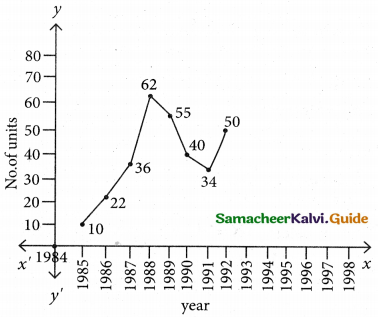
a) Cyclo hexane:
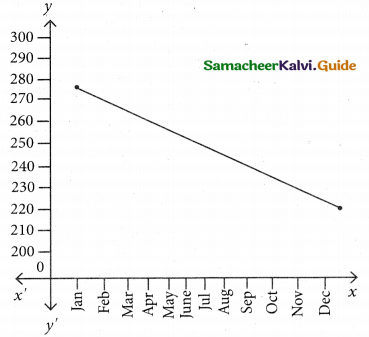
Benzene reacts with hydrogen in the presence of Platinum or Palladium to yield Cyclohexane. This is known as hydrogenation.
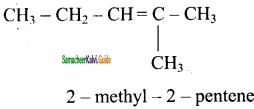
Samacheer Kalvi 11th Chemistry Guide Chapter 13 Hydrocarbons 201

b) maleic anhydride:
Although benzene is very stable to strong oxidizing agents, it quickly undergoes vapour phase oxidation by passing its vapour mixed with oxygen over V2O5 at 773k. The ring breaks to give maleic anhydride.
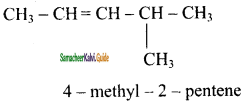
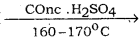
Samacheer Kalvi 11th Chemistry Guide Chapter 13 Hydrocarbons 202

c) 1, 4 cyclo hexadiene:
Benzene can be reduced to non- conjugated dienes 1, 4 – cyclohexadiene by treatment with Na or Li in a mixture of liquid ammonia and alcohol. It is the convenient method to prepare cyclicdienes.
Samacheer Kalvi 11th Chemistry Guide Chapter 13 Hydrocarbons 203