Samacheer Kalvi 11th Accountancy Guide Chapter 1 Introduction to Accounting

Tamilnadu State Board New Syllabus Samacheer Kalvi 11th Accountancy Guide Pdf Chapter 1 Introduction to Accounting Text Book Back Questions and Answers, Notes.

Tamilnadu Samacheer Kalvi 11th Accountancy Solutions Chapter 1 Introduction to Accounting

11th Accountancy Guide Introduction to Accounting Text Book Back Questions and Answers

I. Multiple Choice Questions

Choose the correct answer.

Question 1.
The root of financial accounting system is
(a) Social accounting
(b) Stewardship accounting
(c) Management accounting
(d) Responsibility accounting
Answer:
(b) Stewardship accounting

Samacheer Kalvi 11th Accountancy Guide Chapter 1 Introduction to Accounting

Question 2.
Which one of the following is not a main objective of accounting?
(a) Systematic recording of transactions
(b) Ascertainment of the profitability of the business
(c) Ascertainment of the financial position of the business
(d) Solving tax disputes with tax authorities
Answer:
(d) Solving tax disputes with tax authorities

Question 3.
Which one of the following is not a branch of accounting?
(a) Financial accounting
(b) Management accounting
(c) Human resources accounting
(d) None of the above
Answer:
(d) None of the above

Question 4.
Financial position of a business is ascertained on the basis of
(a) Journal
(b) Trial balance
(c) Balance Sheet
(d) Ledger
Answer:
(c) Balance Sheet

Question 5.
Who is considered to be the internal user of the financial information?
(a) Creditor
(b) Employee
(c) Customer
(d) Government
Answer:
(b) Employee

II. Very Short Answer Type Questions

Question 1.
Define accounting.
Answer:
According to the American Institute of Certified Public Accountants “Accounting is the art of recording, classifying and summarising in a significant manner and in terms of money, transactions and events which are in part, at least of a financial character and interpreting the results thereof’.

Question 2.
List any two functions of accounting.
Answer:
Measurement:
The main function of accounting is to keep systematic record of transactions, post them to the ledger and ultimately prepare the final accounts.

Comparison:
Accounting helps to compare the actual performance with the planned performance. It is also possible to compare with the accounting policies. Effective measures can be taken to enhance the efficiency of various operations.

Samacheer Kalvi 11th Accountancy Guide Chapter 1 Introduction to Accounting

Question 3.
What are the steps involved in the process of accounting?
Answer:

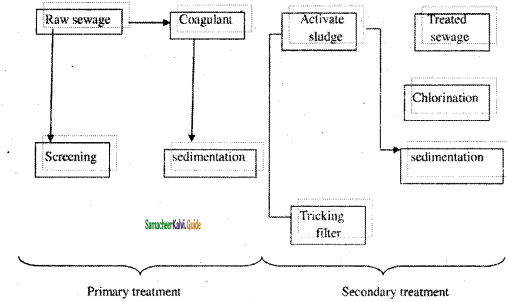
Samacheer Kalvi 11th Accountancy Guide Chapter 1 Introduction to Accounting 1

Question 4.
Who are the parties interested in accounting information?
Answer:
The following are the parties interested in accounting information
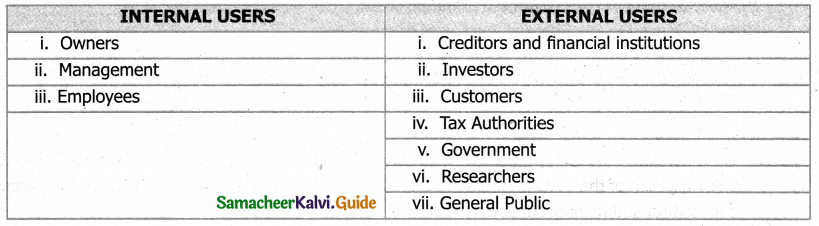
Samacheer Kalvi 11th Accountancy Guide Chapter 1 Introduction to Accounting 2

Question 5.
Name any two bases of recording accounting information.
Answer:
Cash Basis:
The actual amount of cash received and cash paid is recorded in this. Any kind of income received and expenditure paid will be entered in this.

Accrual or Mercantile Basis:
The income which is not received but has been earned or accrued and the expenses incurred, which is paid and not recorded, is known as Accrual or Mercantile Basis.

III. Short Answer Questions

Question 1.
Explain the meaning of accounting.
Answer:
Accounting is the systematic process of identifying, measuring, recording, classifying, summarizing, interpreting and communicating financial information. Accounting gives information on:
1. The resources available.
2. How the available resources have been employed and
3. The results achieved by their use.

Question 2.
Discuss briefly the branches of accounting.
Answer:
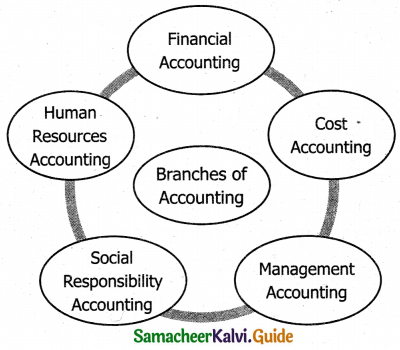
Samacheer Kalvi 11th Accountancy Guide Chapter 1 Introduction to Accounting 3
The following are the branches of accounting:
Financial Accounting:
It involves recording of financial transactions and events. It provides financial informations to the users for taking decisions.

Cost Accounting:
It involves the collection, recording, classification and appropriate allocation of expenditure for the determination of the costs of products or services and for the presentation of data for the purposes of cost control and managerial decision making.

Management Accounting:
It is concerned with the presentation of accounting information in such a way as to assist management in decision making and in the day-to-day operations of an enterprise.

Social Responsibility Accounting:
It is concerned with presentation of accounting information by business entities and other organisations from the view point of the society by showing the social costs incurred such as environmental pollution by the enterprise and social benefits such as infrastructure development and employment opportunities created by them.

Human Resources Accounting:
It is concerned with identification, quantification and reporting of investments made in human resources of an enterprise.

Samacheer Kalvi 11th Accountancy Guide Chapter 1 Introduction to Accounting

Question 3.
Discuss in detail the importance of accounting.
Answer:

Samacheer Kalvi 11th Accountancy Guide Chapter 1 Introduction to Accounting 4
Systematic records:
1. All the transactions of an enterprise which are financial in nature are recorded in a systematic way in the books of accounts.
2. The records are classified under common heads and summaries are prepared.

Preparation of financial statement:
1. Results of business operations and the financial position of the concern can be ascertained from accounting periodically through the preparation of financial statements namely, income statement or trading and profit and loss account and balance sheet.

2. This helps in distribution of profits to the owners and to provide funds for future growth of the business.

Assessment of progress:
Analysis and interpretation of financial data can be done to assess the progress made in different areas and to identify the areas of weaknesses.

Aid to decision making:
1. Management of a firm has to make routine and strategic decisions while discharging its functions.
2. Accounting provides the relevant data to make appropriate decisions. Future policies and programmes can be planned by the management based on the accounting data provided.

Satisfies legal requirements:
Various legal requirements like maintenance of Provident Fund (PF) for employees, Employees State Insurance (ESI) contributions, Tax Deducted at Source (TDS), filing of tax returns are properly fulfilled with the help of accounting.

Information to interested groups:
Accounting supplies appropriate information to different interested groups like owners, management, creditors, employees, financial institutions, tax authorities and the government.

Legal evidence:
Accounting records are generally accepted as evidence in courts of law and other legal authorities in the settlement of disputes.

Computation of tax Accounting:
Records are the basic source for computation and settlement of income tax and other taxes.

Settlement during merger:
When two or more business units decide to merger, accounting records provide information for deciding the terms of merger and any compensation payable as a consequence of merger.

Question 4.
Why are the following parties interested in accounting information?
Answer:
Investors:
Investor is a person who is interested in investing their funds in an organization. They are the persons in need of the financial situation of the concern. They are more concerned about future earnings and risk bearing capacity of the organization which will affect the return to the investors.

Government:
The scarce resources of the country are used by business enterprises. Government also administers prices of certain commodities. In such cases, government agencies have to ensure that the guidelines for pricing are followed.

Question 5.
Discuss the role of an accountant in the modern business world:
Answer:

Samacheer Kalvi 11th Accountancy Guide Chapter 1 Introduction to Accounting 5
Record keeper:
The accountant maintains a systematic record of financial transactions. He also prepares the financial statements and other financial reports.

Provider of information to the management:
The accountant assists the management by providing financial information required for decision making and for exercising control.

Protector of business assets:
The accountant maintains records of assets owned by the business which enables the management to protect and exercise control over these assets. He advises the management about insurance of various assets and the maintenance of the same.

Financial advisor:
The accountant analyses financial information and advises the business managers regarding opportunities, strategies for cost savings, capital budgeting, provision for future growth and development, expansion of enterprise, etc.

Tax manager:
The accountant ensures that tax returns are prepared and filed correctly on time and payment of tax is made on time. The accountant can advise the managers regarding tax management, reducing tax burden, availing tax exemptions, etc.

Public relation officer:
The accountant provides accounting information to various interested users for analysis as per their requirements.

11th Accountancy Guide Introduction to Accounting Additional Important Questions and Answers

I. Multiple Choice Questions

Question 1.
The incomplete system of accounting is …………….
(a) Double Entry system
(b) Single Entry system
(c) Double account system
(d) none
Answer:
(b) Single Entry system

Question 2.
Accounts of persons with whom the business deals is known as …………….
(a) Personal Account
(b) Real Account
(c) Nominal Account
(d) Profit & Loss Account
Answer:
(a) Personal Account

Samacheer Kalvi 11th Accountancy Guide Chapter 1 Introduction to Accounting

Question 3.
Business transactions may be classified into …………….
(a) One
(b) Two
(c) Three
(d) Four
Answer:
(b) Two

Question 4.
The main aim of the proprietor is to earn …………….
(a) Profit
(b) Loss
(c) Cash
(d) Capital
Answer:
(a) Profit

Question 5.
Unsold stock lying in a business on a particular date are known as …………….
(a) Sales
(b) Loss
(c) Cash
(d) Stock
Answer:
(d) Stock

Question 6.
Any written or printed document in support of a business transaction is called …………….
(a) Receipt
(b) Credit Note
(c) Debit Note
(d) Voucher
Answer:
(a) Receipt

Question 7.
Withdrawn from the business by the owner for the personal use is called …………..
(a) Capital
(b) Drawings
(c) Purchases
(d) Sales
Answer:
(b) Drawings

Question 8.
……………… involves recording of transaction and events which are financial in nature.
(a) Financial accounting
(b) Management accounting
(c) Human resources accounting
(d) None of the above
Answer:
(a) Financial accounting

Question 9.
An activity which involves transfer of money or money’s worth from one person to another person is called as ……………
(a) Transactions
(b) Assets
(c) Liabilities
(d) Capital
Answer:
(a) Transactions

Question 10.
Good will is an example of …………….
(a) Liabilities
(b) Tangible assets
(c) Intangible assets
(d) Capital
Answer:
(c) Intangible assets

Question 11.
……………… developed double entry book keeping system.
(a) Luca Pacioli
(b) Kautilya
(c) Philip Kotler
(d) None of the above
Answer:
(a) Luca Pacioli

Question 12.
………….. refers to choosing a desirable course of action from alternative courses of actions.
(a) Control
(b) Forecasting
(c) Decision Making
(d) None of the above
Answer:
(c) Decision Making

Samacheer Kalvi 11th Accountancy Guide Chapter 1 Introduction to Accounting

Question 13.
The amount invested by the owner in the business is called …………….
(a) Capital
(b) Drawings
(c) Purchases
(d) Sales
Answer:
(a) Capital

Question 14.
A person who owns a business is called as …………………
(a) Borrower
(b) Landlord
(c) Owner
(d) Sales man
Answer:
(c) Owner

Question 15.
Records of debit and credit were found in ……………
(a) 15th Century
(b) 13th Century
(c) 12th Century
(d) 20th Century
Answer:
(b) 13th Century

Question 16.
……………. is said to be the root of accounting.
(a) Cost Accounting
(b) Stewardship Accounting
(c) Management Accounting
(d) None of the above
Answer:
(b) Stewardship Accounting

II. Very Short Answer Questions

Question 1.
What do you mean by Transaction?
Answer:
A business activity which involves transfer of money or money’s worth (goods, services, ideas) from one person to another person.

Question 2.
What is an Voucher?
Answer:
Any written or printed document in support of a business transaction is called a voucher. Examples: Cash receipt, invoice, cash memo, bank pay-in-slip etc.

Question 3.
What are goods?
Answer:
It includes articles, things or commodities in which a business is dealing with. Examples: Furniture will be goods for those who deal in furniture.

Question 4.
What is mean by solvency?
Answer:
Solvency is the capability of a person or an enterprise to pay the debts.

Question 5.
What do you mean by depreciation?
Answer:
Depreciation refers to the decrease in the value of fixed assets due to usage and passage of time.

Question 6.
What are bad debts?
Answer:
It is a loss to the business arising out of failure of a debtor to pay the dues. It is irrecoverable debt.

Samacheer Kalvi 11th Accountancy Guide Chapter 1 Introduction to Accounting

Question 7.
What do you mean by accounting cycle?
Answer:
An accounting cycle is a complete sequence of accounting process, that begins with the recording of business transactions and ends with the preparation of final accounts.

III. Short Answer Questions

Question 1.
Briefly explain the attributes of account emerge.
Answer:
The following are the main attributes of accounting.
1. Accounting is an art. It requires the expertise and skill of accountants design accounting system and policies, to decide the accounting process in order to suit the requirements of an organization.

2. The transactions or events of a business must be recorded in monetary terms.

3. Accounting process involves recording, classifying and summarizing of transactions and analysis and interpretation of the results.

4. The results of such analysis must be communicated to the persons who are interested in such information.

IV. Long Answer Questions

Question 1.
Explain the steps involved in the process of accounting cycle.
Answer:
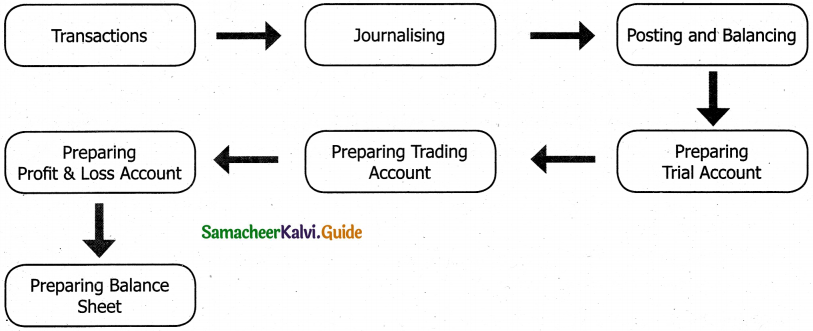
Samacheer Kalvi 11th Accountancy Guide Chapter 1 Introduction to Accounting 6
Identifying the transactions and journalizing:
1. The first step in the accounting process is identifying the financial transactions of a business.
2. All the monetary transactions are recorded in the books of original entry called journals.
3. Recording the transactions in the journal is called journalizing.
4. Entries are made in the journals on the basis of source documents in the chronological order, i.e., the order of occurrence of the transactions.

Posting and Balancing:
1. Transferring the entries from the journal to the ledger is called posting.
2. In the ledger, entries are made in each account after classifying them under common heads.
3. Finding the difference between the total of the debit column and credit column of all the ledger accounts is called balancing.

Preparation of trial balance:
1. The list of ledger balances namely trial balance is prepared as the next step.
2. On the basis of ledger balances the financial statements are prepared.

Preparation of trading account:
1. Next step is preparation of trading account for a particular accounting period.
2. All the direct revenues and direct expenses are transferred to trading account.
3. The balance in the trading account is the gross profit or gross loss.

Preparation of profit and loss account:
1. It is prepared next for a particular accounting period. Alt the indirect revenues and indirect expenses along with gross profit or gross loss are transferred to profit and loss account.
2. The balance in the profit and loss account is the net profit or net loss.

Preparation of balance sheet:
1. A statement showing the balances of assets and liabilities namely balance sheet is prepared as the final step in the accounting process.
2. It is prepared on a particular date, normally, on the last day of the accounting period.
3. The closing balances of an accounting year are taken as the opening balances for the next accounting year.
4. The transactions identified and recorded for the next year are followed by posting and other steps.
5. The results are communicated to the users of accounting information for the purpose of analysis and decision making.

Question 2.
Explain the Objectives of Accounting.
Answer:
Following are the objectives of accounting:

  1. To keep a systematic record of financial transactions and events
  2. To ascertain the profit or loss of the business enterprise
  3. To ascertain the financial position or status of the enterprise
  4. To provide information to various stakeholders for their requirement
  5. To protect the properties of an enterprise and
  6. To ascertain the solvency and liquidity position of an enterprise.

Samacheer Kalvi 11th Accountancy Guide Chapter 1 Introduction to Accounting

Question 3.
Explain the Functions of Accounting.
Answer:
The main functions of accounting are as follows:
Measurement:
1. The main function of accounting is to keep systematic record of transactions, post them to the ledger and ultimately prepare the final accounts.

2. Accounting works as a tool for measuring the performance of the business enterprises. It also shows the financial position of the business enterprises.

Forecasting:
With the help of the various tools of accounting, future performance and financial position of the business enterprises can be forecasted.

Comparison:
Accounting helps to compare the actual performance with the planned performance. Through comparison of the actual financial results of the business enterprises with projected figures and standards, effective measures can be taken to enhance the efficiency of various operations.

Decision making:
Accounting provides relevant information to the management for planning, evaluation of performance and control. This will help them to take various decisions concerning cost, price, sales, level of activity, etc.

Control:
As accounting works as a tool of control, the strengths and weaknesses are identified to provide feedback on various measures adopted. It serves as a tool for evaluating compliance of business policies and programmes.

Assistance to government:
Government needs full information on the financial aspects of the business for various purposes such as taxation, grant of subsidy, etc. Accounting provides relevant information about the business to exercise government control on business enterprises.

Question 4.
Write a note on the Evolution of Accounting.
Answer:
1. In the earliest days of civilisation, accounting was done by stewards who managed the properties of wealthy people.

2. The stewardship accounting is said to be the root of accounting.

3. In 1494, Luca Pacioli an Italian developed double-entry book-keeping system.

4. To safeguard the interest of owners and investors, the business establishments required detailed information about business which paved the way for development of comprehensive financial accounting information system.

5. In the 20th century, the need for analysis of financial information for managerial decision making caused emergence of Management Accounting as a separate branch of accounting.

6. Though accounting was individual centric in the initial stage of evolution of accounting, it has gradually developed into Social Responsibility Accounting in the 21st century.

Question 5.
Write a note on Transaction.
Answer:
An activity which involves transfer of money or money’s worth (goods,services, ideas) from one person to another, is known as Transaction. It is of two types, namely.
Cash transaction:
It is a transaction which involves immediate cash receipt or immediate cash payment.

Credit transaction:
It is a transaction in which cash is not received or paid immediately, but will be received or paid later.

Samacheer Kalvi 11th Accountancy Guide Chapter 1 Introduction to Accounting

Question 6.
Who are ail the internal users of Accounting Information?
Answer:
The internal users are owners, management and employees who are within the organization.
Owners:
1. The owners of a business provide capital to be used in the business.

2. They are interested to know whether the business has earned profit or not during a particular period and also its financial position on a particular date.

3. They want accounting reports in order to have an appraisal of performance and also for an assessment of future prospects to ensure that they will get their expected returns from the business and get back their capital.

Management:
1. Accounting data are the basis for most of the decisions made by the management.

2. The trends in sales and purchases, relationship of expenses to the sales, efficiency of employees, comparative profitability of different departments, capital structure and solvency position are some of the vital data required by management for planning and controlling the business operations.

3. Financial statements and other reports prepared under financial accounting provide this information to the management.

Employees:
The employees are interested in the profit earning capacity of the business which will affect their remuneration, working conditions and retirement benefits and stability and growth of the enterprise.

Question 7.
Explain the External Users of Accounting Information.
Answer:
External users are the persons who are in the outside of the organisation but make use of the information for their own purpose. The following are the external users:
Creditors and Financial Institutions:
1. Suppliers of goods and services, commercial banks, public deposit holders and debenture holders are included in this category,
2. They are interested in knowing the liquidity position and repaying capacity of the business to ensure the safety of getting the amount due to them or interest and the principal amount.

Investors:
1. Persons who are interested in investing their funds in an organisation should know about the financial condition of a business unit while making their investment decisions.
2. They are more concerned about future earnings and risk bearing capacity of the organisation.

Customers:
1. Customers who buy and use the products and services of business enterprises are interested in knowing the details of the products and the prices charged to them.
2. They are interested in knowing the stability and profitability of an enterprise to ensure continued supply of the products or services by the enterprise.

Tax authorities and other regulatory bodies:
1. Accounting information helps the tax authorities in computing income tax and taxes on goods and services and other taxes to be collected from business units.
2. Other regulatory bodies also require information about revenues, expenses and other financial aspects of business to ensure that the enterprises comply with statutory requirements.

Government:
The scarce resources of the country are used by business enterprises. Information about performance of business units in different industries helps the government in policy formulation, for development of trade and industry, allocation of scarce resources, grant of subsidy, etc. Government also administers prices of certain commodities.

Researchers:
Researchers to carry out their research can use accounting information and make use of the published financial statements for analysis and evaluation.

General public:
From accounting information, the general public at large can get a view of the earning capacity and stability of the enterprise as well as the social responsibility measures undertaken by the enterprise particularly in its area of operation and also the employment opportunities provided to the local people.
Samacheer Kalvi 11th Accountancy Guide Chapter 1 Introduction to Accounting

Samacheer Kalvi 12th Business Maths Guide Chapter 10 Operations Research Miscellaneous Problems

Tamilnadu State Board New Syllabus Samacheer Kalvi 12th Business Maths Guide Pdf Chapter 10 Operations Research Miscellaneous Problems Text Book Back Questions and Answers, Notes.

Tamilnadu Samacheer Kalvi 12th Business Maths Solutions Chapter 10 Operations Research Miscellaneous Problems

Question 1.
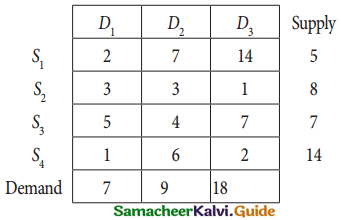
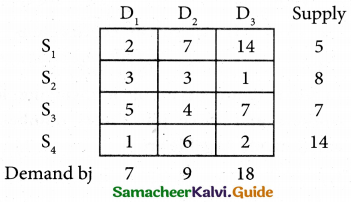
The following table summarizes the supply, demand and cost information for four factors S1, S2, S3, S4 Shipping goods to three warehouses D1, D2, D3.
Samacheer Kalvi 12th Business Maths Guide Chapter 10 Operations Research Miscellaneous Problems 1
Find an initial solution by using north west corner rule. What is the total cost for this solution?
Solution:
The given transportation table is
Samacheer Kalvi 12th Business Maths Guide Chapter 10 Operations Research Miscellaneous Problems 2
Here total supply = 5 + 8 + 7+14 = 34
Total amount =7 + 9 + 18 = 34
(i.e) Total supply = Total demand.
∴ The given problem is balanced transformation problem.
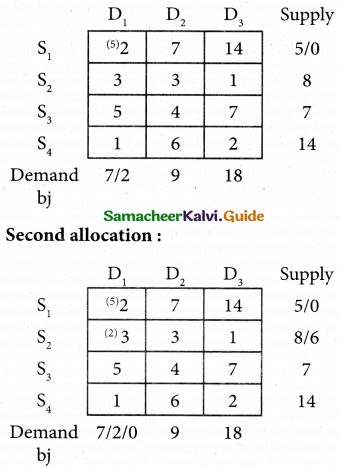
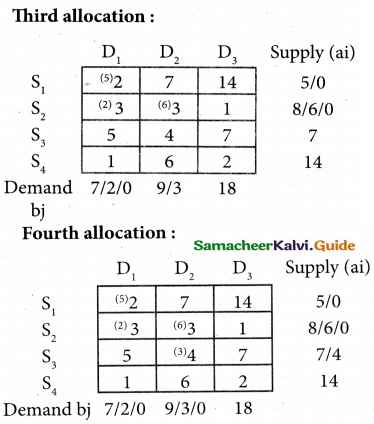
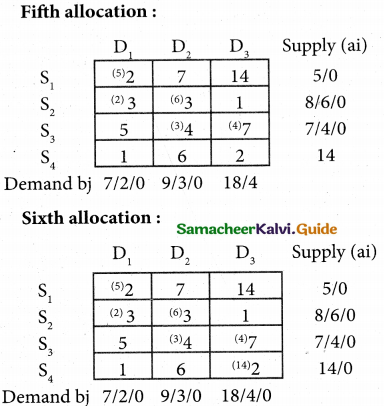
We can find an initial basic feasible solution to the given problem.
First allocation:
Samacheer Kalvi 12th Business Maths Guide Chapter 10 Operations Research Miscellaneous Problems 3
Samacheer Kalvi 12th Business Maths Guide Chapter 10 Operations Research Miscellaneous Problems 4
Samacheer Kalvi 12th Business Maths Guide Chapter 10 Operations Research Miscellaneous Problems 5
Transportation schedule:
S1 → D1; S2 → D1; S2 → D2;
S3 → D2; S3 → D3; S4 → D3
The transportation cost:
= (5 × 2) + (2 × 3) + (6 × 3) + (3 × 4) + (4 × 7) + (14 × 2)
= 10 + 6 + 18 + 12 + 28 + 28
= 102

Samacheer Kalvi 12th Business Maths Guide Chapter 10 Operations Research Miscellaneous Problems

Question 2.
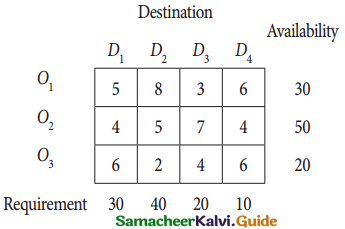
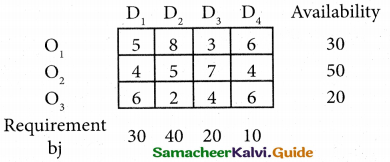
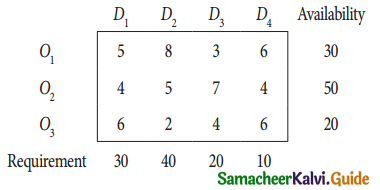
Consider the following transportation problem
Samacheer Kalvi 12th Business Maths Guide Chapter 10 Operations Research Miscellaneous Problems 6
Determine an initial basic feasible solution using (a) Least cost method (b) Vogel’s approximation method.
Solution:
(a) Least cost method
Given transportation table is
Samacheer Kalvi 12th Business Maths Guide Chapter 10 Operations Research Miscellaneous Problems 7
Total Availability = Total Requirement = 100
∴ The given problem is balanced transformation problem.
Hence there exists a feasible solution to the given problem
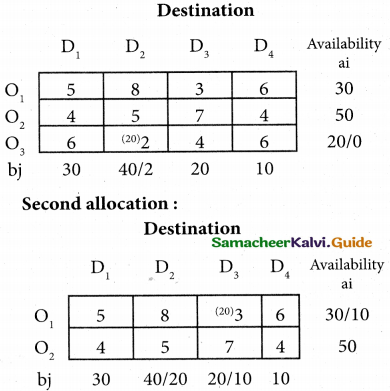
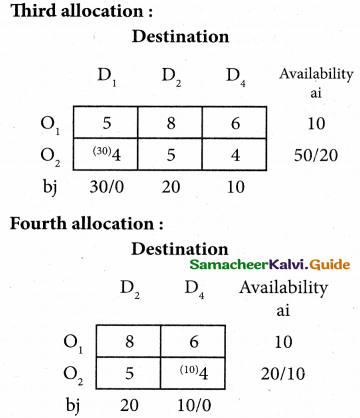
First allocation:
Samacheer Kalvi 12th Business Maths Guide Chapter 10 Operations Research Miscellaneous Problems 8
Samacheer Kalvi 12th Business Maths Guide Chapter 10 Operations Research Miscellaneous Problems 9
Samacheer Kalvi 12th Business Maths Guide Chapter 10 Operations Research Miscellaneous Problems 10
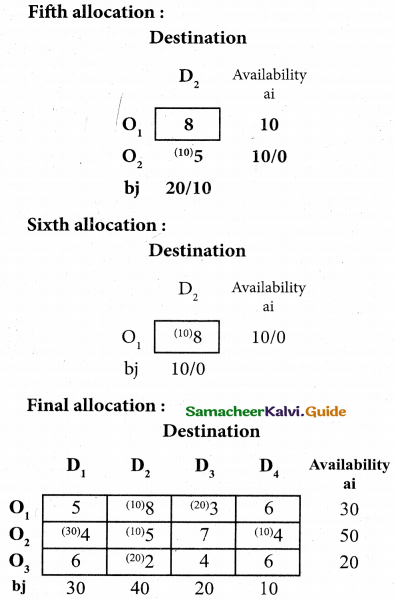
Here
x12 = 10; x13 = 20; x21 = 30;
x22 = 10; x24 = 10; x32 = 20
Transportation Scheme:
O1 → D2; O1 → D3; O2 → D1;
O2 → D2; O2 → D4; O3 → D2
The transportation cost:
=(10 × 8) + (20 × 3) + (30 × 4) + (10 × 5) + (10 × 4) + (20 × 2)
= 80 + 60 + 120 + 50 + 40 + 40
= 390

(ii) Vogel’s approximation method:
Here Σai = Σbj = 100
∴ The given problem is balanced transformation problem.
Hence there exists a feasible solution to the given problem
First allocation:
Samacheer Kalvi 12th Business Maths Guide Chapter 10 Operations Research Miscellaneous Problems 11
Samacheer Kalvi 12th Business Maths Guide Chapter 10 Operations Research Miscellaneous Problems 12
Samacheer Kalvi 12th Business Maths Guide Chapter 10 Operations Research Miscellaneous Problems 13
Here
x11 = 30; x13 = 20; x22 = 20;
x24 = 10; x32 = 20
Transportation Scheme:
O1 → D1; O2 → D3; O2 → D2;
O2 → D4; O3 → D2;
Total transportation cost:
= (30 × 5) + (20 × 3) + (20 × 5) + (10 × 4) + (20 × 2)
= 150 + 60 + 100 + 40 + 40
= 390

Samacheer Kalvi 12th Business Maths Guide Chapter 10 Operations Research Miscellaneous Problems

Question 3.
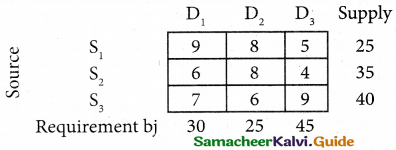
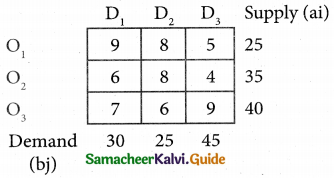
Determine an initital basic feasible solution to the following transportation problem by using (i) North West Corner rule (ii) least cost method.
Samacheer Kalvi 12th Business Maths Guide Chapter 10 Operations Research Miscellaneous Problems 14
Solution:
(i) North West Corner rule:
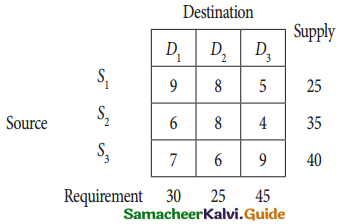
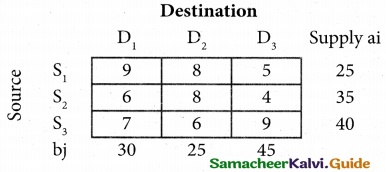
The given transportation table is
Samacheer Kalvi 12th Business Maths Guide Chapter 10 Operations Research Miscellaneous Problems 15
Total supply = 25 + 35 + 40 = 100
Total Requirement = 30 + 25 + 45 + 100
(i.e) Total supply = Total requirement.
∴ The given problem is balanced transformation problem.
Hence there exists a feasible solution to the given problem
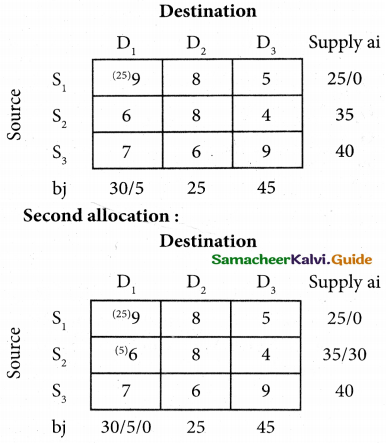
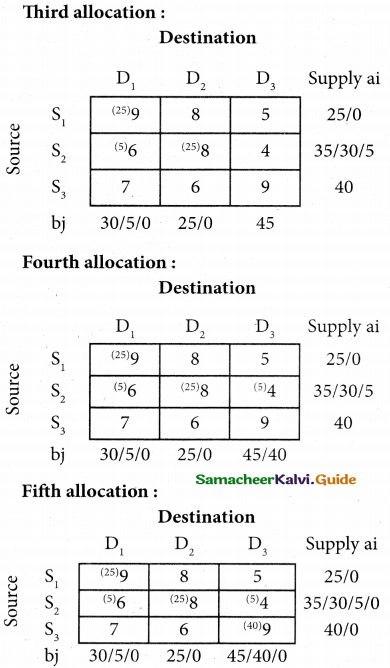
First allocation:
Samacheer Kalvi 12th Business Maths Guide Chapter 10 Operations Research Miscellaneous Problems 16
Samacheer Kalvi 12th Business Maths Guide Chapter 10 Operations Research Miscellaneous Problems 17
Transformation schedule:
S1 → D1; S2 → D1; S2 → D2;
S3 → D3; S3 → D3;
The transformation cost:
= (25 × 9) + (5 × 6) + (25 × 8) + (5 × 4) + (40 × 9)
= 225 + 30 + 200 + 20 + 360 = 835

(ii) Least cost method
The given transportation table is
Samacheer Kalvi 12th Business Maths Guide Chapter 10 Operations Research Miscellaneous Problems 18
(i.e) Total supply = Total requirement = 100
∴ The given problem is balanced transformation problem.
Hence there exists a feasible solution to the given problem
First allocation:
Samacheer Kalvi 12th Business Maths Guide Chapter 10 Operations Research Miscellaneous Problems 19
Samacheer Kalvi 12th Business Maths Guide Chapter 10 Operations Research Miscellaneous Problems 20
Transportation schedule:
S1 → D3; S2 → D3; S3 → D1
S3 → D2;
The transportation cost:
= (10 × 5) + (35 × 4) + (15 × 7) + (25 × 6) + (40 × 9)
= 50 + 140 + 105 + 150 + 360 = 805

Samacheer Kalvi 12th Business Maths Guide Chapter 10 Operations Research Miscellaneous Problems

Question 4.
Explain Vogel’s approximation method by obtaining initial basic feasible solution of the following transportation problem.
Samacheer Kalvi 12th Business Maths Guide Chapter 10 Operations Research Miscellaneous Problems 21
Solution:
The given transportation table is
Samacheer Kalvi 12th Business Maths Guide Chapter 10 Operations Research Miscellaneous Problems 22
Here Σai = Σbj =17
(i.e) Total supply = Total Demand
∴ The given problem is balanced transformation problem.
Hence there exists a feasible solution to the given problem
First allocation:
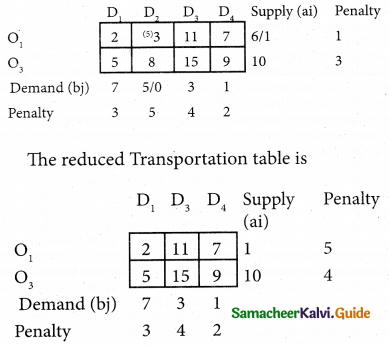
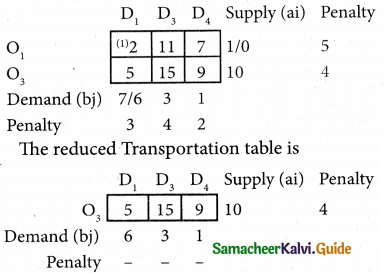
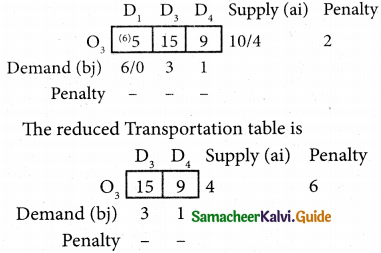
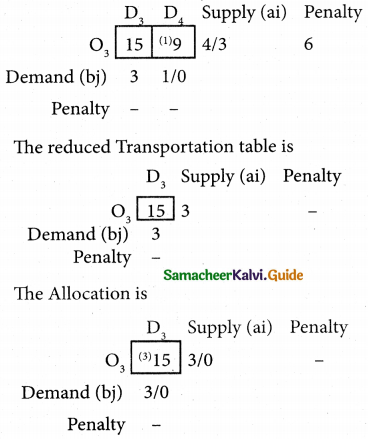
Samacheer Kalvi 12th Business Maths Guide Chapter 10 Operations Research Miscellaneous Problems 23
Samacheer Kalvi 12th Business Maths Guide Chapter 10 Operations Research Miscellaneous Problems 24
Samacheer Kalvi 12th Business Maths Guide Chapter 10 Operations Research Miscellaneous Problems 25
Here
x11 = 1; x12 = 5; x24 = 1;
x31 = 6; x33 = 15;
Transportation schedule:
O1 → D1; O1 → D2; O2 → D4
O3 → D1; O3 → D3
The transportation cost:
=(1 × 2) + (5 × 3) + (1 × 1) + (6 × 5) + (3 × 15) + (1 × 9)
= 2 + 15 + 1 + 30 + 45 + 9
= 102

Samacheer Kalvi 12th Business Maths Guide Chapter 10 Operations Research Miscellaneous Problems

Question 5.
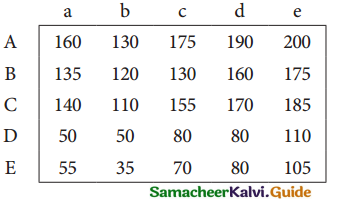
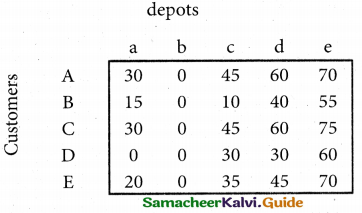
A car hire company has one car at each of five depots a,b,c,d and e. A customer in each of the fine towers A, B, C, D and E requires a car. The distance (in miles) between the depots (origins) and the towers (destinations) where the customers are given the following distance matrix.
Samacheer Kalvi 12th Business Maths Guide Chapter 10 Operations Research Miscellaneous Problems 26
How should the cars be assigned to the customers so as to minimize the distance travelled?
Solution:
Here the number of rows and columns are equal.
∴ The given assignment problem is balanced.
Step 1.
Select the smallest element in each row and subtract this from all the elements in its row.
Samacheer Kalvi 12th Business Maths Guide Chapter 10 Operations Research Miscellaneous Problems 27

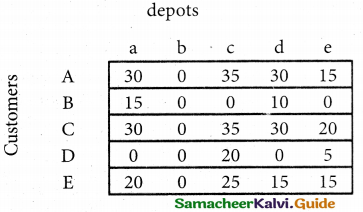
Step 2.
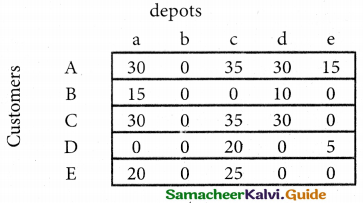
Select the smallest element in each column and subtract this from all the elements in its column.
Samacheer Kalvi 12th Business Maths Guide Chapter 10 Operations Research Miscellaneous Problems 28

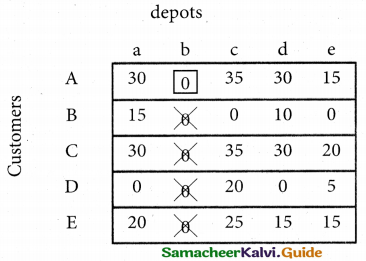
Step 3. (Assignment)
Examine the rows with exactly one zero, mark the zero by □ mark other zeros, in its column by X
Samacheer Kalvi 12th Business Maths Guide Chapter 10 Operations Research Miscellaneous Problems 29

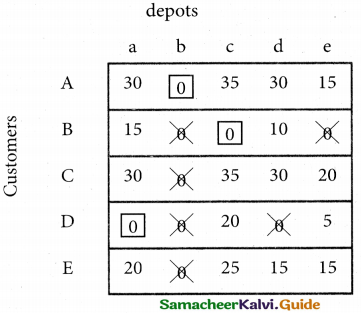
Step 4.
Now Examine the rows with exactly one zero, mark the zero by □ mark other zeros, in its column by X
Samacheer Kalvi 12th Business Maths Guide Chapter 10 Operations Research Miscellaneous Problems 30

Step 5.
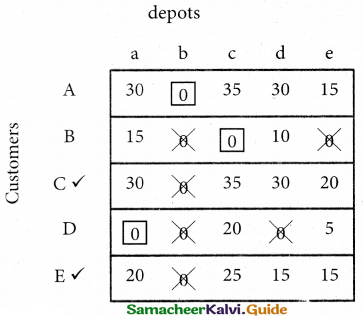
Cover all the zeros of table 4 with three lives. Since three assignments were made please note that check [✓] Row C and E which have no assignment.
Samacheer Kalvi 12th Business Maths Guide Chapter 10 Operations Research Miscellaneous Problems 31

Step 6.
Develop the new revised tableau. Examine those elements that are not covered by a line in Table 5. Take the smallest element in each row and subtract from the uncovered cells, depots
Samacheer Kalvi 12th Business Maths Guide Chapter 10 Operations Research Miscellaneous Problems 32

Step 7.
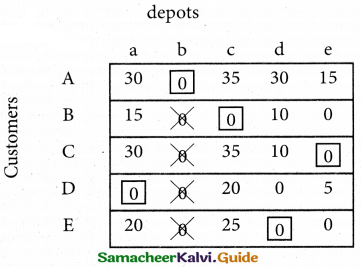
Go to step 3 and repeat the procedure until you arrive at an optimal assignments.
depots

Step 8.
Determine an assignment
Samacheer Kalvi 12th Business Maths Guide Chapter 10 Operations Research Miscellaneous Problems 33
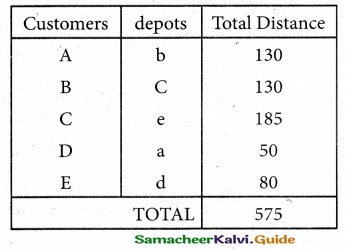
Here all the five assignments have been made. The optimal assignment schedule and total distance is
Samacheer Kalvi 12th Business Maths Guide Chapter 10 Operations Research Miscellaneous Problems 34
∴ The optimum Distance (minimum) 575 kms

Samacheer Kalvi 12th Business Maths Guide Chapter 10 Operations Research Miscellaneous Problems

Question 6.
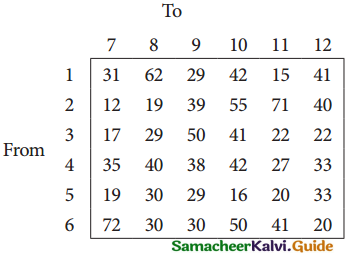
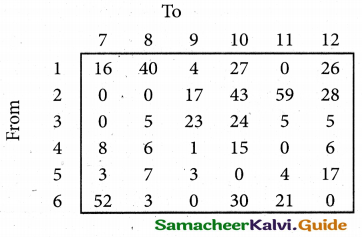
A natural truck – rental service has a surplus of one truck in each of the cities 1, 2, 3, 4, 5 and 6 and a deficit of one truck in each of the cities 7, 8, 9, 10, 11 and 12. The distance (in kilometers) between the cities with a surplus and the cities with
Samacheer Kalvi 12th Business Maths Guide Chapter 10 Operations Research Miscellaneous Problems 35
How should the truck be dispersed so as to minimize the total distance travelled?
Solution:
Here the number of rows and columns are equal.
∴ The given assignment problem is balanced.
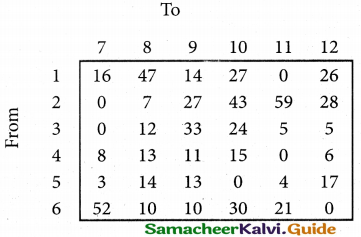
Step 1.
Select the smallest element in each row and subtract this from all the elements in its row.
Samacheer Kalvi 12th Business Maths Guide Chapter 10 Operations Research Miscellaneous Problems 36

Step 2.
Select the smallest element in each column and subtract this from all the elements in its column.
Samacheer Kalvi 12th Business Maths Guide Chapter 10 Operations Research Miscellaneous Problems 37

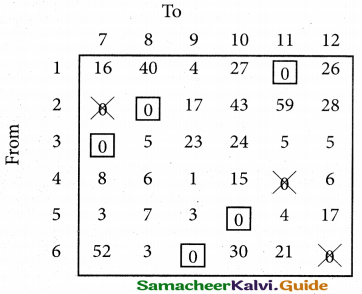
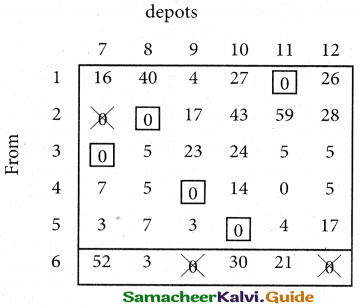
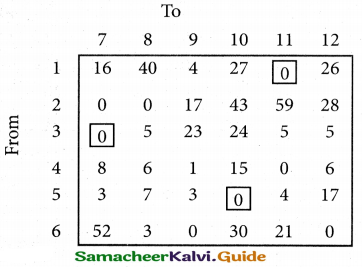
Step 3.
Examine the rows with exactly one zero, mark the zero by □ mark other zeros, in its column by X
Samacheer Kalvi 12th Business Maths Guide Chapter 10 Operations Research Miscellaneous Problems 38

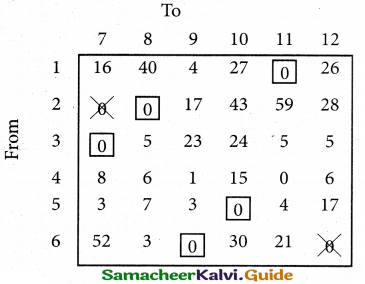
Step 4.
Examine the Columns with exactly one zero. If there is exactly one zero, mark that zero by □ mark other zeros in its rows by X
Samacheer Kalvi 12th Business Maths Guide Chapter 10 Operations Research Miscellaneous Problems 39

Step 5.
Cover all the zeros of table 4 with five lines. Since three assignments were made
Samacheer Kalvi 12th Business Maths Guide Chapter 10 Operations Research Miscellaneous Problems 40

Step 6.
Develop the new revised tableau. Examine those elements that are not covered by a line in Table 5. Take the smallest element. This is l(one) in our case. By subtracting 1 from the uncovered cells.
Samacheer Kalvi 12th Business Maths Guide Chapter 10 Operations Research Miscellaneous Problems 41

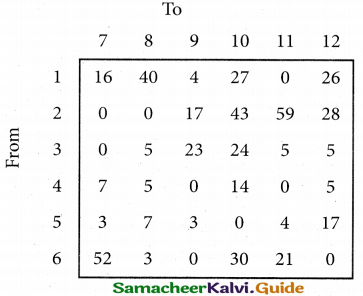
Step 7.
Go to step 3 and repeat the procedure until you arrive at an optimal assignments.

Step 8.
Determine an assignment
Samacheer Kalvi 12th Business Maths Guide Chapter 10 Operations Research Miscellaneous Problems 42
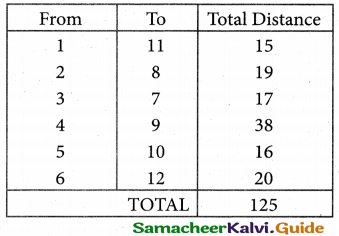
Here all the six assignments have been made. The optimal assignment schedule and total distance is
Samacheer Kalvi 12th Business Maths Guide Chapter 10 Operations Research Miscellaneous Problems 43
∴The optimum Distance (minimum) = 125 kms

Samacheer Kalvi 12th Business Maths Guide Chapter 10 Operations Research Miscellaneous Problems

Question 7.
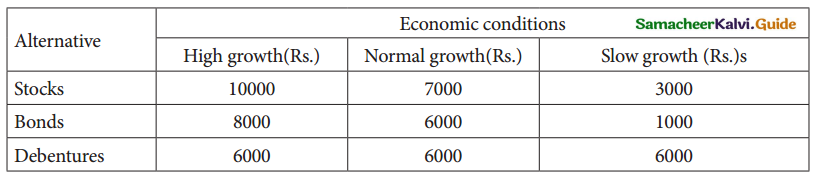
A person wants to invest in one of three alternative investment plans: Stock, Bonds and Debentures. It is assumed that the person wishes to invest all of the funds in a plan. The pay – off matrix based on three potential economic conditions is given in the following table
Samacheer Kalvi 12th Business Maths Guide Chapter 10 Operations Research Miscellaneous Problems 44
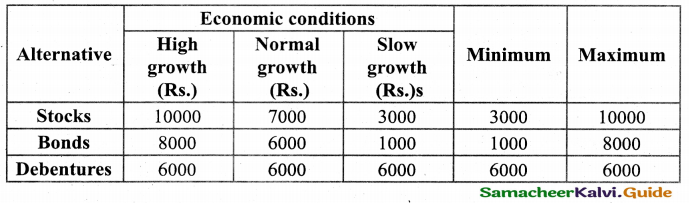
Solution:
Samacheer Kalvi 12th Business Maths Guide Chapter 10 Operations Research Miscellaneous Problems 45
(i) Maximin
Max (3000, 1000, 6000) = 6000. Since the maximum pay of is 6000, the alternative ‘Debentures’, is selected.

(ii) Minimax
Min (10000, 8000, 6000) = 6000, Since the minimum pay-off is 6000. the alternative ‘Debentures’ is selected.

Samacheer Kalvi 12th Business Maths Guide Chapter 10 Operations Research Miscellaneous Problems

Samacheer Kalvi 12th Business Maths Guide Chapter 10 Operations Research Ex 10.4

Tamilnadu State Board New Syllabus Samacheer Kalvi 12th Business Maths Guide Pdf Chapter 10 Operations Research Ex 10.4 Text Book Back Questions and Answers, Notes.

Tamilnadu Samacheer Kalvi 12th Business Maths Solutions Chapter 10 Operations Research Ex 10.4

Choose the correct answer

Question 1.
The transportation problem is said to be unbalanced if
(a) Total supply ≠ Total demand
(b) Total supply = Total demand
(c) m = n
(d) m + n – 1
Solution:
(a) Total supply ≠ Total demand

Samacheer Kalvi 12th Business Maths Guide Chapter 10 Operations Research Ex 10.4

Question 2.
In a non – degenerate solution number of allocation is
(a) Equal to m + n – 1
(b) Equal to m + n + 1
(c) Not equal to m + n – 1
(d) Not equal to m + n + 1
Solution:
(a) Equal to m + n – 1

Question 3.
In a degenerate solution number of allocations is
(a) Equal to m + n – 1
(b) Not equal to m + n – 1
(c) Less then m + n – 1
(d) Greater then m + n – 1
Solution:
(c) Less then m + n – 1

Question 4.
The Penalty in VAM represents difference between the first
(a) Two largest costs
(b) Largest and Smallest costs
(c) smallest two costs
(d) None of these
Solution:
(c) smallest two costs

Samacheer Kalvi 12th Business Maths Guide Chapter 10 Operations Research Ex 10.4

Question 5.
Number of basic allocation in any row or column in an assignment problem can be
(a) Exactly one
(b) At least one
(c) At most one
(d) None of these
Solution:
(a) Exactly one

Question 6.
North – West Corner refers to
(a) Top left corner
(b) Top right corner
(c) Bottom right corner
(d) Bottom left corner
Solution:
(a) Top left corner

Samacheer Kalvi 12th Business Maths Guide Chapter 10 Operations Research Ex 10.4

Question 7.
Solution for transportation problem using method is nearer to an optimal
(a) NWCM
(b) LCM
(c) VAM
(d) Row Minima
Solution:
(c) VAM

Question 8.
In an assignment problem the value of iedsion variable xij is
(a) 1
(b) 0
(c) 1 or 0
(d) none of them
Solution:
(c) 1 or 0

Samacheer Kalvi 12th Business Maths Guide Chapter 10 Operations Research Ex 10.4

Question 9.
If number of sources is not equal to number of destinations, the assignment problem is called
(a) balanced
(b) unsymmetric
(c) symmetric
(d) unbalanced
Solution:
(d) unbalanced

Question 10.
The purpose of a dummy row or column in an assignment problem is to
(a) prevent a solution from becoming degenerate
(b) balance between total activities and total resources
(c) provide a means of representing a dummy problem
(d) None of the above
Solution:
(b) balance between total activities and total resources

Samacheer Kalvi 12th Business Maths Guide Chapter 10 Operations Research Ex 10.4

Question 11.
The solution for an assignment problem is optimal if
(a) each row and each column has no assignment
(b) each row and each column has atleast one assignment
(c) each row and each column has atmost one assignment
(d) each row and each column has exactly one assignment
Solution:
(d) each row and each column has exactly one assignment

Question 12.
In an assignment problem involving four workers and three jobs, total number of assignments possible are
(a) 4
(b) 3
(c) 7
(d) 12
Solution:
(b) 3

Samacheer Kalvi 12th Business Maths Guide Chapter 10 Operations Research Ex 10.4

Question 13.
Decision theory is concerned with
(a) analysis of information that is available
(b) decision making under certainty
(c) selecting optimal decisions in sequential problem
(d) All of the above
Solution:
(d) All of the above

Question 14.
A type of decision – making environment is
(a) certainty
(b) uncertainty
(c) risk
(d) all of the above
Solution:
(d) all of the above

Samacheer Kalvi 12th Business Maths Guide Chapter 10 Operations Research Ex 10.4

Samacheer Kalvi 12th Business Maths Guide Chapter 10 Operations Research Ex 10.3

Tamilnadu State Board New Syllabus Samacheer Kalvi 12th Business Maths Guide Pdf Chapter 10 Operations Research Ex 10.3 Text Book Back Questions and Answers, Notes.

Tamilnadu Samacheer Kalvi 12th Business Maths Solutions Chapter 10 Operations Research Ex 10.3

Question 1.
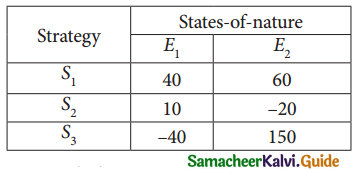
Given the following pay – off matrix (in rupees) for three strategies and two states for nature.
Samacheer Kalvi 12th Business Maths Guide Chapter 10 Operations Research Ex 10.3 1
Select a strategy using each of the following rule (i) Maximin (ii) Minimax
Solution:
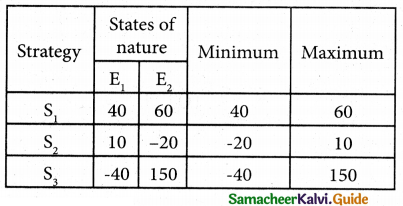
Samacheer Kalvi 12th Business Maths Guide Chapter 10 Operations Research Ex 10.3 2
(i) Max min
Max ( 40, -20, -40) = 40. Since the maximum pay-off is 40, the alternative S, is selected.

(ii) Minimax
min (60, 10, 150) = 10, Since the minimum payoff is 10. the alternative S2 is selected.

Samacheer Kalvi 12th Business Maths Guide Chapter 10 Operations Research Ex 10.3

Question 2.
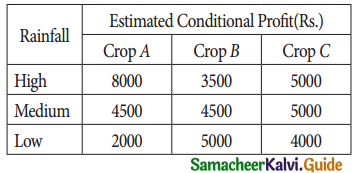
A farmer wants to decide which of three crops he should plant on his 100 – acre farm. The profit from each is dependent on the rainfall during the growing season. The farmer has categorized the amount of rainfall as high medium and low. His estimated profit for each is shown in the table.
Samacheer Kalvi 12th Business Maths Guide Chapter 10 Operations Research Ex 10.3 3
In the farmer wishes to plant only crop, decide which should be his best crop using (i) Maximin (ii) Minimax
Solution:
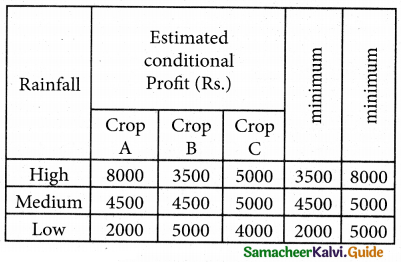
Samacheer Kalvi 12th Business Maths Guide Chapter 10 Operations Research Ex 10.3 4
(i) Maximin
Max ( 3500, 4500, 2000) = 4500. Since the maximum pay-off is 4500, the alternative ‘Medium’, is selected.

(ii) Minimax
min (8000, 5000, 5000) = 5000, Since the minimum pay-off is 5000. the alternatives both ‘Medium’ and ‘Low’ are selected.

Samacheer Kalvi 12th Business Maths Guide Chapter 10 Operations Research Ex 10.3

Question 3.
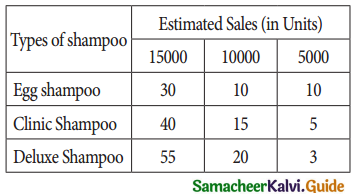
The research department of Hindustan Ltd. has recommended to pay marketing department to launch a shampoo of three different types. The marketing types of shampoo to be launched under the following T estimated pay-offs for various level of sales.
Samacheer Kalvi 12th Business Maths Guide Chapter 10 Operations Research Ex 10.3 5
What will be the marketing manager’s decision if (i) Maximin and (ii) Minimax principle applied?
Solution:
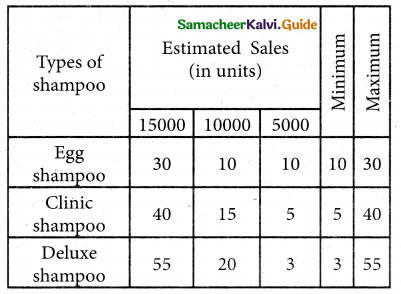
Samacheer Kalvi 12th Business Maths Guide Chapter 10 Operations Research Ex 10.3 6
(i) Maximin
Max ( 10, 5, 3) = 10. Since the maximum pay of is 10, “Egg Shampoo”, is selected.

(ii) Minimax
min (30, 40, 55) = 30, Since the minimum pay-off is 30. the alternative “Egg Shampoo” is selected

Samacheer Kalvi 12th Business Maths Guide Chapter 10 Operations Research Ex 10.3

Question 4.
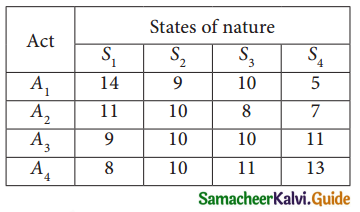
Following pay – off matrix, which is the optimal decision under of the following rule (i) maximin (ii) minimax
Samacheer Kalvi 12th Business Maths Guide Chapter 10 Operations Research Ex 10.3 7
Solution:
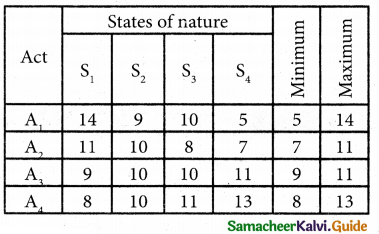
Samacheer Kalvi 12th Business Maths Guide Chapter 10 Operations Research Ex 10.3 8
(i) Maximin
Max ( 5, 7, 9, 8) = 5. Since the maximum pay-off is 5, the alternative A1 is selected.

(ii) Minimax
min (14, 11, 11, 13) = 11, Since the minimum pay-off is 11. the alternative alternatives A2 and A3 are selected.

Samacheer Kalvi 12th Business Maths Guide Chapter 10 Operations Research Ex 10.3

Samacheer Kalvi 12th Business Maths Guide Chapter 10 Operations Research Ex 10.2

Tamilnadu State Board New Syllabus Samacheer Kalvi 12th Business Maths Guide Pdf Chapter 10 Operations Research Ex 10.2 Text Book Back Questions and Answers, Notes.

Tamilnadu Samacheer Kalvi 12th Business Maths Solutions Chapter 10 Operations Research Ex 10.2

Question 1.
What is the Assignment problem?
Solution:
Suppose that we have ‘m1 jobs to be performed on ‘n’ machines. The cost of assigning each job to each machine is Cij (i = 1, 2, … n and j = 1, 2, … , n). Our objective is to assign the different jobs to the different machines (one job per machine) to minimize the overall cost. This is known as assignment problem.

Samacheer Kalvi 12th Business Maths Guide Chapter 10 Operations Research Ex 10.2

Question 2.
Give mathematical form of assignment problem.
Solution:
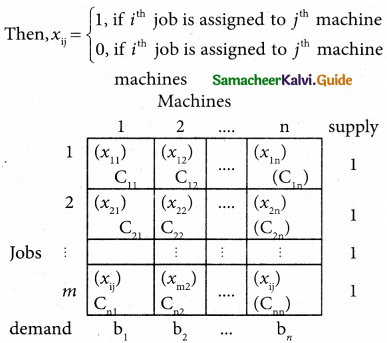
Consider the problem of assigning n jobs to n machines (one job to one machine). Let Cij be the cost of assigning ith job to the jth machine and xij represents the assignment of ith job to the jth machine.
Samacheer Kalvi 12th Business Maths Guide Chapter 10 Operations Research Ex 10.2 1
xij is missing in any cell means that no assignment is made between the pair of job and machine.(i.e) xij = 0.
xij is presents in any cell means that an assignment is made their. In such cases xij = 1
The assignment model can written in LPP as follows
Minimize Z = \(\sum_{i=1}^{m}\) \(\sum_{j=1}^{n}\) Cij xij
Subject to the constrains
\(\sum_{i=1}^{n}\) xij = 1, j = 1, 2, …. n
\(\sum_{j=1}^{n}\) xij = 1, i = 1,2,….n and xij =0 (or) 1 for all i, j

Question 3.
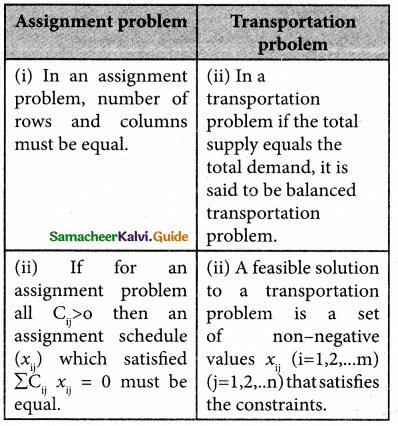
What is the difference between Assignment Problem and Transportation Problem?
Solution:
Samacheer Kalvi 12th Business Maths Guide Chapter 10 Operations Research Ex 10.2 2

Samacheer Kalvi 12th Business Maths Guide Chapter 10 Operations Research Ex 10.2

Question 4.
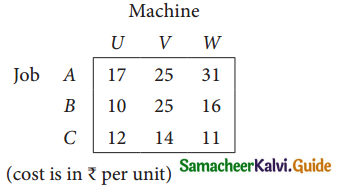
Three jobs A, B and C one to be assigned to three machines U, V and W. The processing cost for each job machine combination is shown in the matrix given below. Determine the allocation that minimizes the overall processing cost.
(cost is in Rs per unit)
Samacheer Kalvi 12th Business Maths Guide Chapter 10 Operations Research Ex 10.2 3
Solution:
Here the number of rows and columns are equal.
∴ The given assignment problem is balanced.
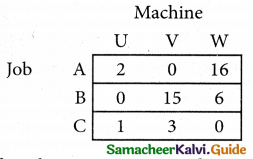
Step 1.
Select the smallest element in each row and subtract this from all the elements in its row.
Samacheer Kalvi 12th Business Maths Guide Chapter 10 Operations Research Ex 10.2 4
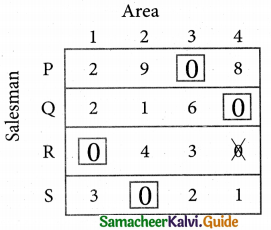
Look for atleast one zero in each row and each column.
Here each and every row and columns having exactly one zero No need step 2 go to step 3.

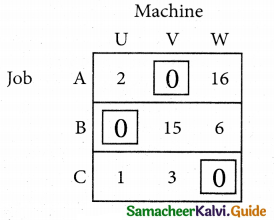
Step 3.
Samacheer Kalvi 12th Business Maths Guide Chapter 10 Operations Research Ex 10.2 5
Mark the zero by □ Mark other zeros in its column by X.
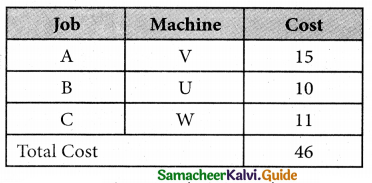
Since each row and each column contains exactly one assignment, all the three machine have been assigned a job.
Samacheer Kalvi 12th Business Maths Guide Chapter 10 Operations Research Ex 10.2 6
The Optimal assignment (minimum) cost = 46

Samacheer Kalvi 12th Business Maths Guide Chapter 10 Operations Research Ex 10.2

Question 5.
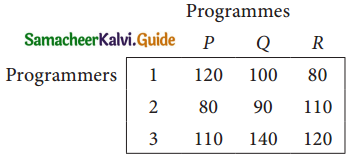
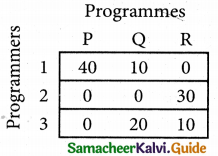
A computer centre has got three expert programmers. The centre needs three application programmes to be developed. The head of the computer centre, after studying carefully the programmes to be developed, estimates the computer time in minitues required by the experts to the application programme as follows.
Samacheer Kalvi 12th Business Maths Guide Chapter 10 Operations Research Ex 10.2 7
Assign the programmers to the programme in such a way that the total computer time is least.
Solution:
Here the number of rows and columns are equal.
∴ The given assignment problem is balanced.
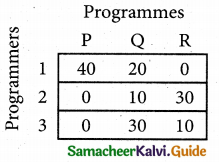
Step 1.
Select the smallest element in each row and subtract this from all the elements in its row.
Samacheer Kalvi 12th Business Maths Guide Chapter 10 Operations Research Ex 10.2 8

Step 2.
Select the smallest element in each column and subtract this from all the elements in its column.
Samacheer Kalvi 12th Business Maths Guide Chapter 10 Operations Research Ex 10.2 9

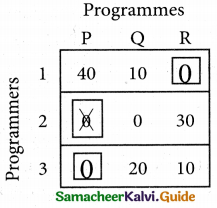
Step 3. (Assignment)
Examine the rows with exactly one zero, mark the zero by □. Mark other zeros in its column by X.
Samacheer Kalvi 12th Business Maths Guide Chapter 10 Operations Research Ex 10.2 10

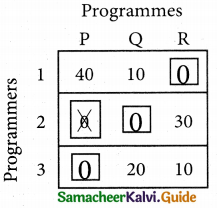
Step: 4
Now examine the columns with exactly one zero mark the zero by □. Mark other zeros in its row by X.
Samacheer Kalvi 12th Business Maths Guide Chapter 10 Operations Research Ex 10.2 11
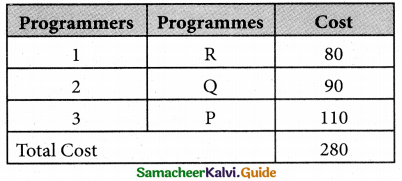
Thus all the three assignment have been made. The optimal assignment schedule and total cos is
Samacheer Kalvi 12th Business Maths Guide Chapter 10 Operations Research Ex 10.2 12
The optimal assignment (minimum) cost = Rs 280

Samacheer Kalvi 12th Business Maths Guide Chapter 10 Operations Research Ex 10.2

Question 6.
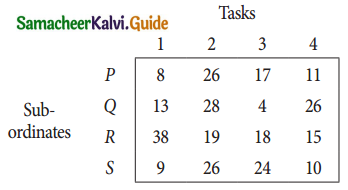
A departmental head has four subordinates and four tasks to be performed. The subordinates differ in efficiency and the tasks differ in their intrinsic difficulty. His estimates of the time man would take to perform each task is given below.
Samacheer Kalvi 12th Business Maths Guide Chapter 10 Operations Research Ex 10.2 13
How should the tasks to allocated to subordinates so as to minimize the total man-hours?
Solution:
Here the number of rows and columns are equal.
∴ The given assignment problem is balanced.
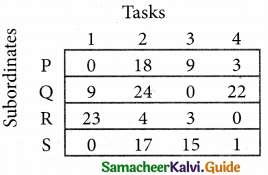
Step 1.
Select the smallest element in each row and subtract this from all the elements in its row.
Samacheer Kalvi 12th Business Maths Guide Chapter 10 Operations Research Ex 10.2 14

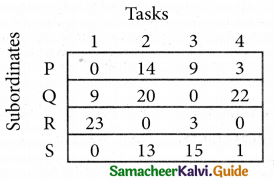
Step 2.
Select the smallest element in each column and subtract this from all the elements in its column.
Samacheer Kalvi 12th Business Maths Guide Chapter 10 Operations Research Ex 10.2 15

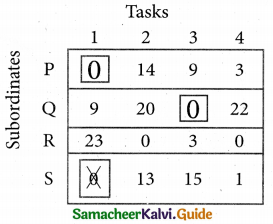
Step 3. (Assignment)
Examine the rows with exactly one zero Mark the zero by □. Mark other zeros in its row by X.
Samacheer Kalvi 12th Business Maths Guide Chapter 10 Operations Research Ex 10.2 16

Step 4.
Now examine the columns with exactly one zero. Mark the zero by □ Mark other zeros in its row by X.
Samacheer Kalvi 12th Business Maths Guide Chapter 10 Operations Research Ex 10.2 17

Step 5.
Cover all the zeros of table 4 with three lines, since three assignments were made check (✓) row S since it has no assignment.
Samacheer Kalvi 12th Business Maths Guide Chapter 10 Operations Research Ex 10.2 18

Step 6.
Develop the new revised tableau. Examine those elements that are not covered by a line in table 5. Take the smallest element. This is 1 (one) our case. By subtracting 1 from the uncovered cells.
Samacheer Kalvi 12th Business Maths Guide Chapter 10 Operations Research Ex 10.2 19
[Adding 1 to elements (Q, S, R) that line at the intersection of two lines]

Step 7.
Go to step 3 and repeat the procedure until you arrive at an optimal assignment.

Step 8.
Determine an assignment.
Samacheer Kalvi 12th Business Maths Guide Chapter 10 Operations Research Ex 10.2 20
Thus all the four assignment have been made. The optimal assignment schedule and total time is
Samacheer Kalvi 12th Business Maths Guide Chapter 10 Operations Research Ex 10.2 21
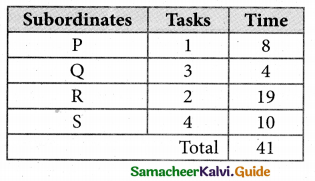
The optimum time (minimum) = 41 Hrs.

Samacheer Kalvi 12th Business Maths Guide Chapter 10 Operations Research Ex 10.2

Question 7.
Find the optimal solution for the assignment problem with the following cost matrix.
Samacheer Kalvi 12th Business Maths Guide Chapter 10 Operations Research Ex 10.2 22
Solution:
Here the number of rows and columns are equal.
∴ The given assignment problem is balanced.
Step 1.
Select the smallest element in each row and subtract this from all the elements in its row.
Samacheer Kalvi 12th Business Maths Guide Chapter 10 Operations Research Ex 10.2 23

Step 2.
Select the smallest element in each column and sub tract this from all the elements in its column.
Samacheer Kalvi 12th Business Maths Guide Chapter 10 Operations Research Ex 10.2 24

Step 3. (Assignment)
Examine the rows with exactly one zero. Mark the zero by □ Mark other zeros in its column by X
Samacheer Kalvi 12th Business Maths Guide Chapter 10 Operations Research Ex 10.2 25
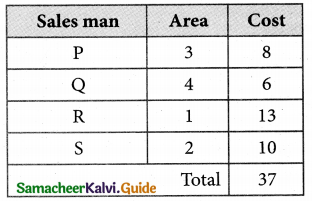
Thus all the four assignments have been made. The optimal assignment schedule and total cost.
Samacheer Kalvi 12th Business Maths Guide Chapter 10 Operations Research Ex 10.2 26
The Optimum cost (minimum) = Rs 37

Samacheer Kalvi 12th Business Maths Guide Chapter 10 Operations Research Ex 10.2

Question 8.
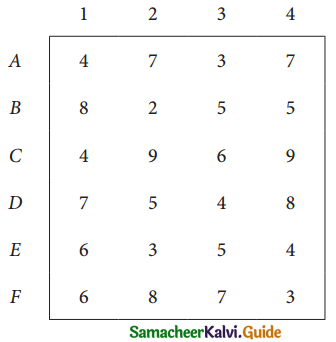
Assign four trucks 1, 2, 3 and 4 to vacant spaces A, B, C, D, E and F so that distance travelled is minimized. The matrix below shows the distance.
Samacheer Kalvi 12th Business Maths Guide Chapter 10 Operations Research Ex 10.2 27
Solution:
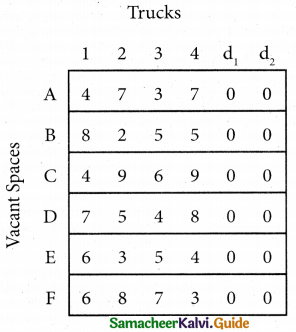
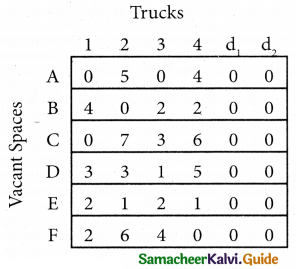
Since the number of columns is less than the number of rows, the given assignment problem is unbalanced one. To balance it, introduce two dummy columns with all the entries zeros.
The revised assignment problem is
Samacheer Kalvi 12th Business Maths Guide Chapter 10 Operations Research Ex 10.2 28
Here only 4 tasks can be assigned to 4 vacant spaces.
Step 1.
It is not necessary, since each row contains zero entry. Go to step 2.

Step 2.
Select the smallest element in each column and subtract this from all the elements in its column.
Samacheer Kalvi 12th Business Maths Guide Chapter 10 Operations Research Ex 10.2 29

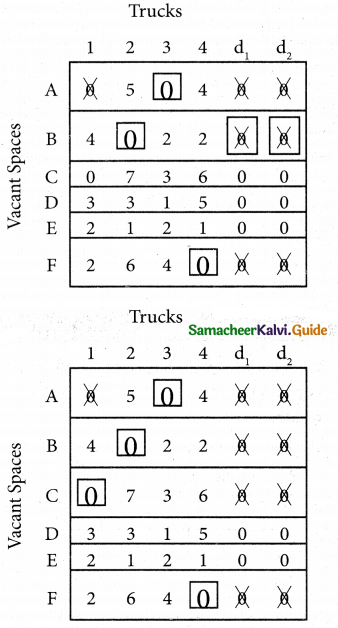
Step 3. (Assignment)
Since each row contains more than one zeros. Go to step 4.

Step 4.
Examine the columns with exactly one zero, mark the zero by □ Mark other zeros in its rows by X.
Samacheer Kalvi 12th Business Maths Guide Chapter 10 Operations Research Ex 10.2 30

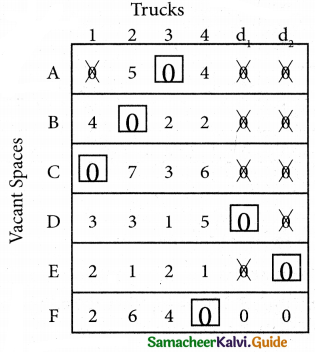
Step 5.
Here all the four assignments have been made we can assign d1 for D then we will get d2 for E.
Samacheer Kalvi 12th Business Maths Guide Chapter 10 Operations Research Ex 10.2 31
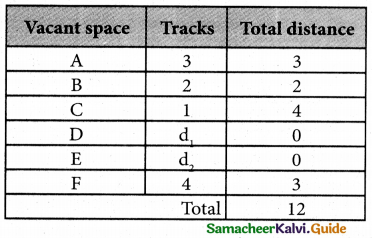
The optimal assignment schedule and total distance is
Samacheer Kalvi 12th Business Maths Guide Chapter 10 Operations Research Ex 10.2 32
∴ The Optimum Distant (minimum) = 12 units

Samacheer Kalvi 12th Business Maths Guide Chapter 10 Operations Research Ex 10.2

Samacheer Kalvi 12th Business Maths Guide Chapter 10 Operations Research Ex 10.1

Tamilnadu State Board New Syllabus Samacheer Kalvi 12th Business Maths Guide Pdf Chapter 10 Operations Research Ex 10.1 Text Book Back Questions and Answers, Notes.

Tamilnadu Samacheer Kalvi 12th Business Maths Solutions Chapter 10 Operations Research Ex 10.1

Question 1.
What is transportation problem?
Solution:
The objective of transportation problem is to determine the amount to be transported from each origin to each destinations such that the total transportation cost is minimized.

Samacheer Kalvi 12th Business Maths Guide Chapter 10 Operations Research Ex 10.1

Question 2.
Write mathematical form of transportation problem.
Solution:
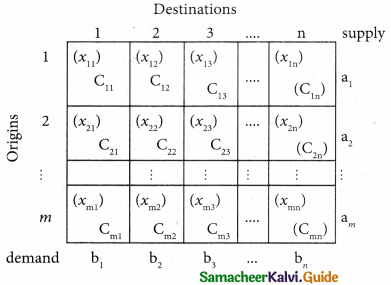
Let there be m origins and n destinations. Let the amount of supply at th i th origin is ai. Let the demand at j th destination is bj.
The cost of transporting one unit of an item from origin i to destination j is Cij and is known for all combination (i,j). Quantity transported from origin i to destination j be xij.

The objective is to determine the quantity xij to be transported over all routes (i,j) so as to minimize the total transportation cost. The supply limits at the origins and the demand requirements at the destinations must be satisfied.
The above transportation problem can be written in the following tabular form:
Samacheer Kalvi 12th Business Maths Guide Chapter 10 Operations Research Ex 10.1 1
Now the linear programming model representing the transportation problem is given by
The objective function is Minimize Z = \(\sum_{\mathbf{i}=\mathbf{1}}^{\mathbf{m}}\), \(\sum_{\mathbf{j}=\mathbf{1}}^{\mathbf{n}}\) cij xij
Subject to the constraints
\(\sum_{\mathbf{j}=\mathbf{1}}^{\mathbf{n}}\) = xij = ai, i = 1, 2 …….. m (supply constraints)
\(\sum_{\mathbf{i}=\mathbf{1}}^{\mathbf{m}}\) = xij = bj, i = 1, 2 …….. n (demand constraints)
xij ≥ 0 for all i, j (non- negative restrictions)

Question 3.
What is feasible solution and non degenerate solution in transportation problem?
Solution:
Feasible Solution:
A feasible solution to a transportation problem is a set of non-negative values xij (i = 1, 2, … m, j = 1, 2, … n) that satisfies the constraints.

Non degenerate basic feasible solution:
If a basic feasible solution to a transportation problem contains exactly m + n – 1 allocations in independent positions, it is called a Non degenerate basic feasible solution. Here m is the number of rows and n is the number of columns in a transportation problem.

Question 4.
What do you mean by balanced transportation problem?
Solution:
In a transportation problem if the total supply equals the total demand (Σai = Σbj) then it is said to be balanced transportation problem.

Samacheer Kalvi 12th Business Maths Guide Chapter 10 Operations Research Ex 10.1

Question 5.
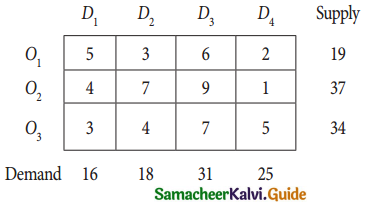
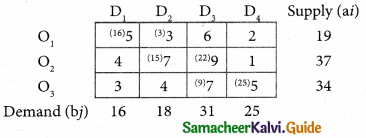
Find an intial basic feasible solution of the following problem using north west corner rule.
Samacheer Kalvi 12th Business Maths Guide Chapter 10 Operations Research Ex 10.1 2
Solution:
Here total Supply 19 + 37 + 34 = 90
Total demand = 16 + 18 + 31 + 25 = 90
(i.e) Total supply = Total demand
∴ The given problem is balanced transportation problem
∴ we can final an initial basic feasible solution to due given problem.

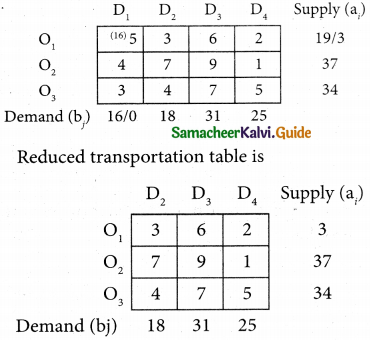
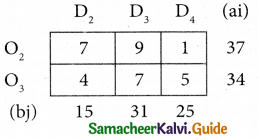
From the above table we can choose the cell in the North west corner. Here the cell is (Q1, D1). Allocate as much as possible in this cell so that either the capacity of first row is exhausted or the destination requirement of the first column’s exhausted.
(i.e) x11 = min (19, 16) = 16
Samacheer Kalvi 12th Business Maths Guide Chapter 10 Operations Research Ex 10.1 3
Now the cell in the north west corner is (O1, D2) Allocate as much as possible in the first cell so that either the capacity of second row is exhausted or the destination requirement of the first column is exhausted.
(i.e) x12 = min (3, 18) = 3
Samacheer Kalvi 12th Business Maths Guide Chapter 10 Operations Research Ex 10.1 4
Reduced transportation table is
Samacheer Kalvi 12th Business Maths Guide Chapter 10 Operations Research Ex 10.1 5
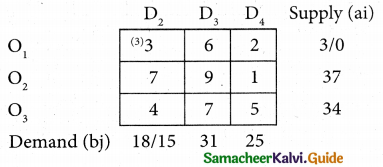
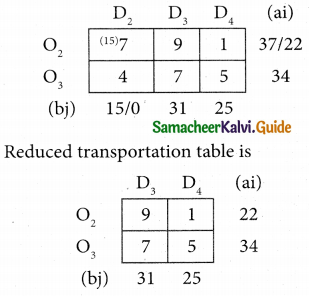
Now the cell in the north west corner is (O2, D2)
x22 = min (37, 15) = 15
Samacheer Kalvi 12th Business Maths Guide Chapter 10 Operations Research Ex 10.1 6
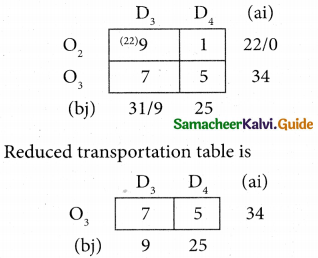
Now the cell in the north west corner is (O2, D3)
x23 = min (22, 31) = 9
Samacheer Kalvi 12th Business Maths Guide Chapter 10 Operations Research Ex 10.1 7
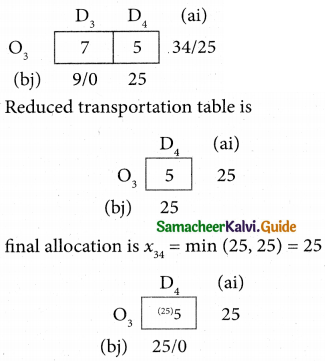
Now the cell in the north west corner is (O3, D3)
x33 = min (34, 9) = 9
Samacheer Kalvi 12th Business Maths Guide Chapter 10 Operations Research Ex 10.1 8
Thus we have the following allocations
Samacheer Kalvi 12th Business Maths Guide Chapter 10 Operations Research Ex 10.1 9
Transportation schedule:
O1 → D1, O1, → D2, O2 → D2; O2 → D3 O3 → D3; O3 → D4
= (16 × 5) + (3 × 3) + (15 × 7) + (22 × 9) + (9 × 7) + (25 × 5)
= 80 + 9 + 105 + 198 + 63 + 125
= 580

Samacheer Kalvi 12th Business Maths Guide Chapter 10 Operations Research Ex 10.1

Question 6.
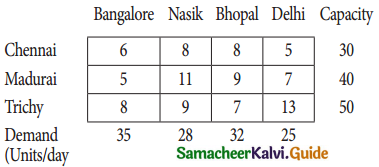
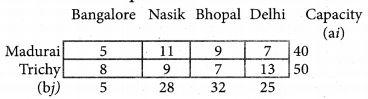
Determine an intial basic feasible solution of the following transportation problem by north west corner method.
Samacheer Kalvi 12th Business Maths Guide Chapter 10 Operations Research Ex 10.1 10
Solution:
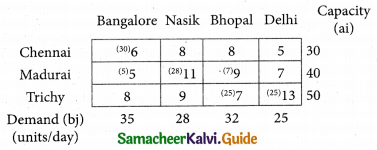
Here total capacity (ai) = 30 + 40 + 50 = 120
Total demand (bj) = 35 + 28 + 32 + 25 = 120
(i.e) Total capacity = Total demand
∴ The given problem is balanced transportation.
∴ We can find an initial basic feasible solution to the given problem.
Samacheer Kalvi 12th Business Maths Guide Chapter 10 Operations Research Ex 10.1 11
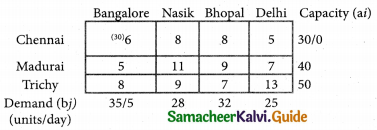
From the above table we can choose the cell in the North west corner. Here the cell is (chennai, Bangalore)
x11 = min (30, 35) = 30
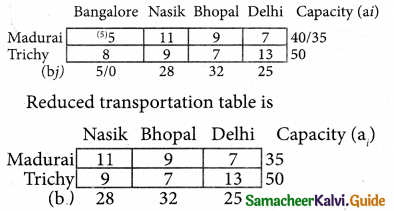
Reduced transportation table is
Samacheer Kalvi 12th Business Maths Guide Chapter 10 Operations Research Ex 10.1 12
Now the cell in the North west corner is (Madurai, Bangalore)
x21 = min(40, 5) = 5
Samacheer Kalvi 12th Business Maths Guide Chapter 10 Operations Research Ex 10.1 13
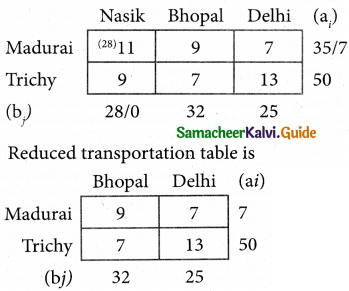
From the above table we can choose the cell in the North west corner. Here the cell is (Nasik, Madurai)
x22 = min (35, 28) = 28
Samacheer Kalvi 12th Business Maths Guide Chapter 10 Operations Research Ex 10.1 14
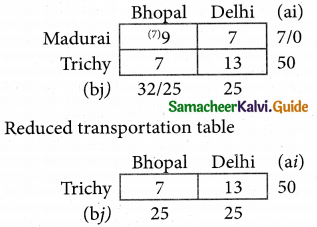
From the above table we can choose the cell in the North west corner. Here the cell is (Bhopal, Madurai)
x22 = min (7, 32) = 7
Samacheer Kalvi 12th Business Maths Guide Chapter 10 Operations Research Ex 10.1 15
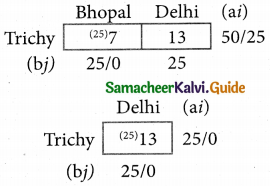
From the above table we can choose the cell in the North west corner. Here the cell is (Trichy, Bhopal)
x33 = min (50, 25) = 25
Reduced transportation table is
Samacheer Kalvi 12th Business Maths Guide Chapter 10 Operations Research Ex 10.1 16
x34 = min (25, 25) = 25
Thus we have the following allocations
Samacheer Kalvi 12th Business Maths Guide Chapter 10 Operations Research Ex 10.1 17
Transportation Schedule:
Chennai → Bangalore; Madurai → Bangalore;
Madurai → Naisk; Madurai → Bhopal
Trichy → Bhopal; Trichy → Delhi
The total transportation cost =
(30 × 6) + (5 × 5) + (28 × 11) + (7 × 9) + (25 × 7) + (25 × 13)
= 180 + 25 + 308 + 63 + 175 + 325
= 1076

Samacheer Kalvi 12th Business Maths Guide Chapter 10 Operations Research Ex 10.1

Question 7.
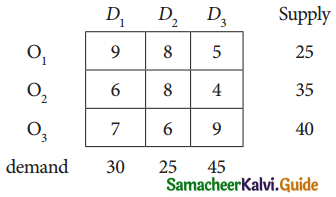
Obtain an initial basic feasible solution to the following transportation problem by using least-cost method.
Samacheer Kalvi 12th Business Maths Guide Chapter 10 Operations Research Ex 10.1 18
Solution:
The given transportation table is
Samacheer Kalvi 12th Business Maths Guide Chapter 10 Operations Research Ex 10.1 19
Total supply = 25 + 35 + 40 = 100
Total demand = 30 + 25 + 45 = 100
(i.e) Total supply = Total demand
∴ The given problem is a balanced transportation problem.
Hence there exists a feasible solution to the given problem.
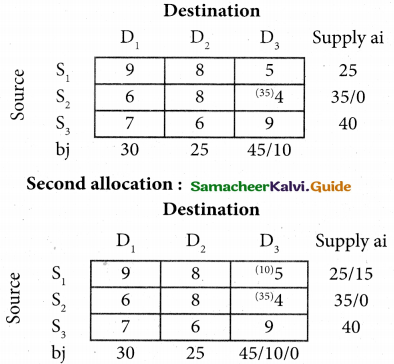
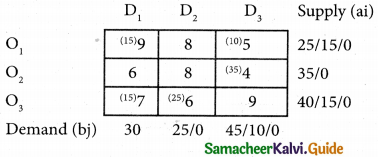
The least cos is 4 corresponds to the cell (O2, D3)
Allocate min (35, 45) = 35 units to this cell
Samacheer Kalvi 12th Business Maths Guide Chapter 10 Operations Research Ex 10.1 20
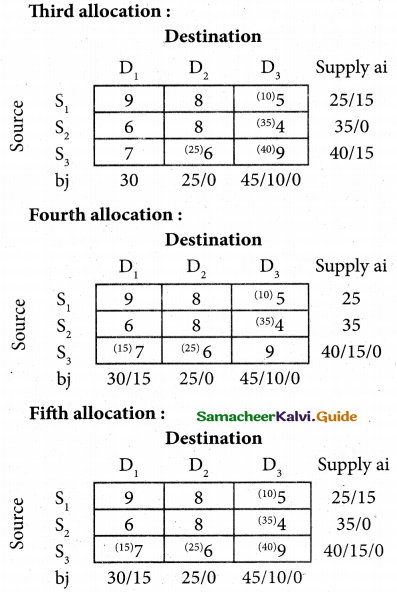
The least cost corresponds to the cell (O1, D3)
Allocate min (25, 10) = 10 units to this cell
Samacheer Kalvi 12th Business Maths Guide Chapter 10 Operations Research Ex 10.1 21
The least cost is 6 corresponds to the cell (O3, D2)
Allocate min (40, 25) = 25 units to this cell
Samacheer Kalvi 12th Business Maths Guide Chapter 10 Operations Research Ex 10.1 22
The least cost is 7 corresponds to the cell (O3, D1)
Allocate min (15, 30) = 15
Samacheer Kalvi 12th Business Maths Guide Chapter 10 Operations Research Ex 10.1 23
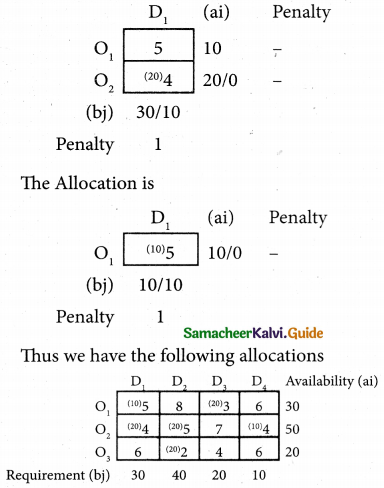
Thus we have the following allocations
Samacheer Kalvi 12th Business Maths Guide Chapter 10 Operations Research Ex 10.1 24
Transportation Schedule:
O1 → D1; O1, → D3; O2 → D3; O3 → DI; O3 → D2
Total Transportation cost
= (15 × 9) + (10 × 5) + (35 × 4) + (15 × 7) + (25 × 6)
= 135 + 50 + 140 + 105 + 150
= 580

Samacheer Kalvi 12th Business Maths Guide Chapter 10 Operations Research Ex 10.1

Question 8.
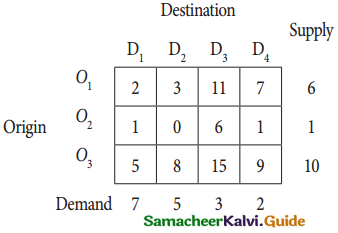
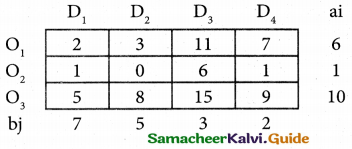
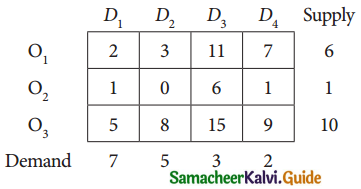
Explain vogel’s approximation method by obtaining initial feasible solution of the following transportation problem.
Samacheer Kalvi 12th Business Maths Guide Chapter 10 Operations Research Ex 10.1 25
Solution:
Here Σ ai = 6 + 1 + 10 = 17
Σ bj = 7 + 5 + 3 + 2 = 17
Σ ai = Σ bj
(i.e) Total supply = Total Demand
∴ The given problem is balanced transportation problem
Hence there exists a feasible solution to the given problem.
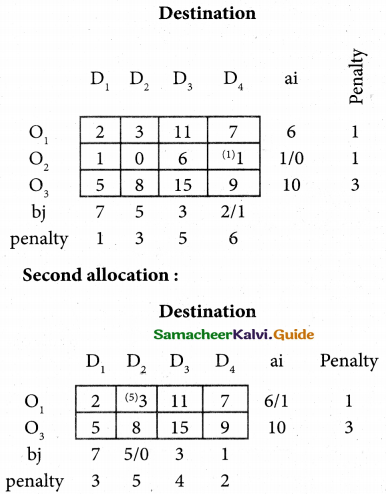
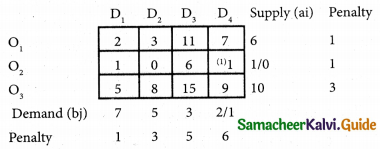
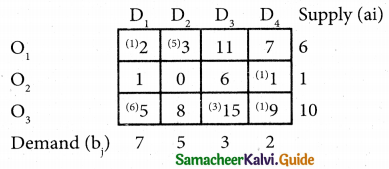
First let us find the difference (penalty) between the first two smallest costs in each row and column and write them in brackets against the respective rows and columns.
Samacheer Kalvi 12th Business Maths Guide Chapter 10 Operations Research Ex 10.1 26
Choose the largest difference. Here the largest difference is 6 which corresponds to column D4
In this column choose the least cost. Here the least cost corresponds to (O2, D4)
Allocate min (1, 2) = 1 unit to this cell the reduced transportation table is
Samacheer Kalvi 12th Business Maths Guide Chapter 10 Operations Research Ex 10.1 27
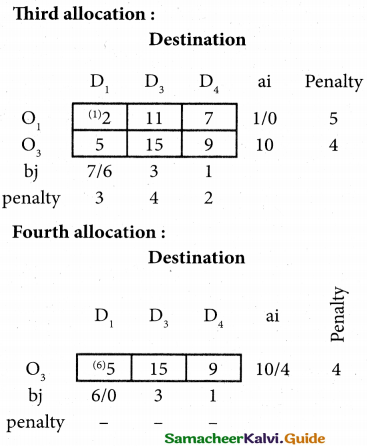
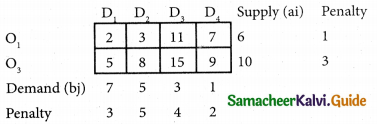
choose the largest difference 5 which corresponds to column D2. Here the least cost corresponds to (O1, D2).
Allocate min (6, 5) = 5 units in this cell
Samacheer Kalvi 12th Business Maths Guide Chapter 10 Operations Research Ex 10.1 28
Choose the largest difference 5 which corresponds to row O1. Here the least cost corresponds to (O1, D1)
Allocate min (1, 7) = 1 unit in this cell
Samacheer Kalvi 12th Business Maths Guide Chapter 10 Operations Research Ex 10.1 29
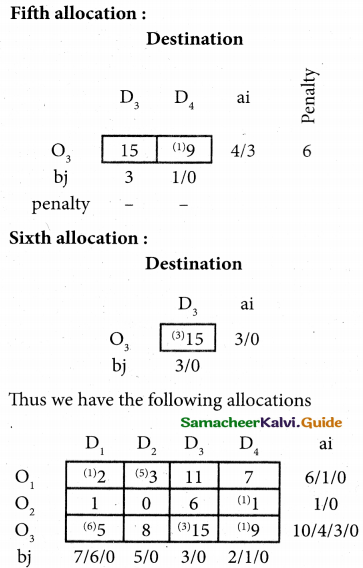
Choose the largest difference 4 which corresponds to row O3. Here least cost corresponds to (10, 6) = 6 units in this cell.
Samacheer Kalvi 12th Business Maths Guide Chapter 10 Operations Research Ex 10.1 30
Choose the largest difference 6 which corresponds to row O3. Here the least cost corresponds to (O3, D4).
Allocate min (4, 1) = 1
Samacheer Kalvi 12th Business Maths Guide Chapter 10 Operations Research Ex 10.1 31
Thus we have the following allocations
Samacheer Kalvi 12th Business Maths Guide Chapter 10 Operations Research Ex 10.1 32
Transportation schedule
O1 → D1; O1 → D2; O2 → D4;
O3 → D1; O3 → D3; O3 → D4
Total transportation cost:
= (1 × 2) + (5 × 3) + (1 × 1) + (6 × 5) + (3 × 15) + (1 × 9)
= 2 + 15 + 1 + 30 + 45 + 9
= 102

Samacheer Kalvi 12th Business Maths Guide Chapter 10 Operations Research Ex 10.1

Question 9.
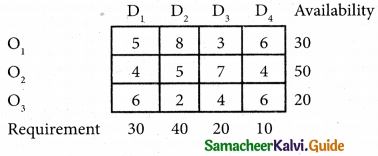
Consider the following transportation problem.
Samacheer Kalvi 12th Business Maths Guide Chapter 10 Operations Research Ex 10.1 33
Determine initital basic feasible solution by VAM
Solution:
Given Transportation problem is
Samacheer Kalvi 12th Business Maths Guide Chapter 10 Operations Research Ex 10.1 34
Here Σ ai = Σ bj = 100
∴ The given problem is balanced transportation problem.
Hence there exists a feasible solution to the given problem.
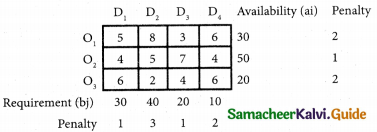
First let us find the difference (penalty) between the first two smallest costs in each row and column and write them in brackets against the respective rows and columns
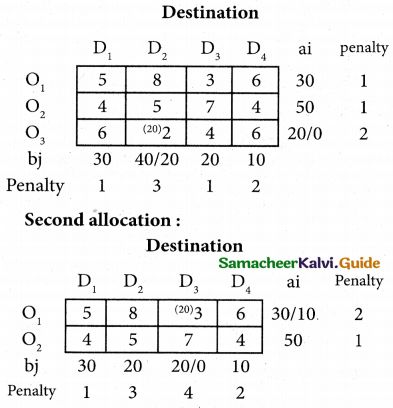
Samacheer Kalvi 12th Business Maths Guide Chapter 10 Operations Research Ex 10.1 35
Choose the largest difference. Here the difference is 3 which corresponds to D2
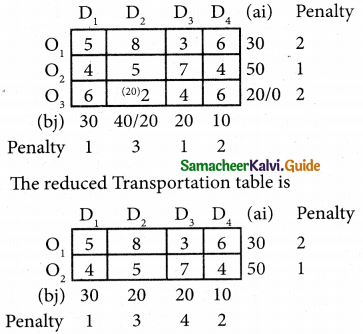
In this column choose the least cost. Here the least cos corresponds to (O3, D2)
Allocate min (20, 40) = 20 units to this cell
Samacheer Kalvi 12th Business Maths Guide Chapter 10 Operations Research Ex 10.1 36
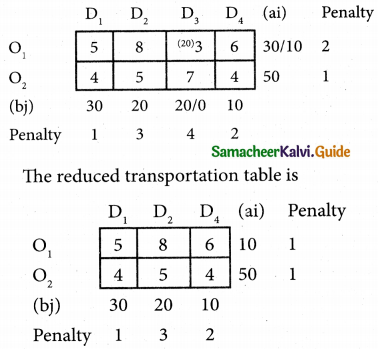
Choose the largest difference is 4 which corresponds to column D3. In this column choose the least cost. Here the least cost corresponds to (O1, D3).
Allocate min (30, 20) = 20 units to this cell
Samacheer Kalvi 12th Business Maths Guide Chapter 10 Operations Research Ex 10.1 37
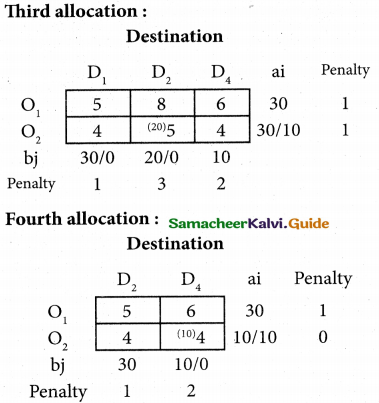
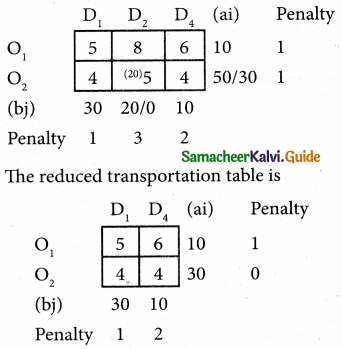
Choose the largest different is 3 which corresponds to column D2. In this column choose the least cost. Here the least cost corresponds to (O2, D2)
Allocate min (50, 20) = 20 units to this cell
Samacheer Kalvi 12th Business Maths Guide Chapter 10 Operations Research Ex 10.1 38
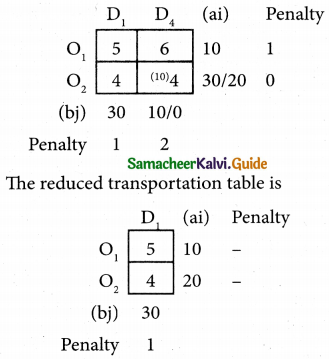
Choose the largest difference is 2 which corresponds to column D4. In this column choose the least cost. Here the least cost corresponds to (O2, D4).
Allocate min (30, 10) = 10 units to this cell
Samacheer Kalvi 12th Business Maths Guide Chapter 10 Operations Research Ex 10.1 39
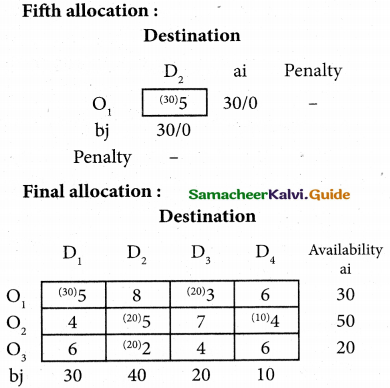
Allocate min (20, 30) = 20 units to this cell
Samacheer Kalvi 12th Business Maths Guide Chapter 10 Operations Research Ex 10.1 40
Here
x11 = 10
x13 = 20
x21 = 20
x22 = 20
x24 = 10
x32 = 20
Transportation schedule
O1 → D1; O1 → D3; O2 → D1;
O2 → D2; O2 → D4; O3 → D2
The transportation cost
= (10 × 5) + (20 × 3) + (20 × 4) + (20 × 5) + (10 × 4) + (20 × 2)
= 50 + 60 + 80 + 100 + 40 + 40
= 370

Samacheer Kalvi 12th Business Maths Guide Chapter 10 Operations Research Ex 10.1

Question 10.
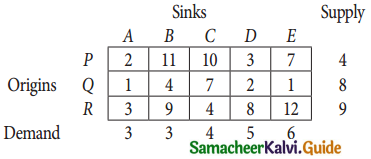
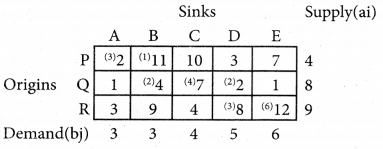
Determine basic feasible solution to the following transportation problem using North west Corner rule.
Samacheer Kalvi 12th Business Maths Guide Chapter 10 Operations Research Ex 10.1 41
Solution:
Here total supply = 4 + 8 + 9 = 21
Total demand = 3 + 3 + 4 + 5+ 6 = 21
(i.e) Total supply = Total demand
∴ The given problem is balanced transportation problem.
∴ we can find an initial basic feasible solution to the given problem.
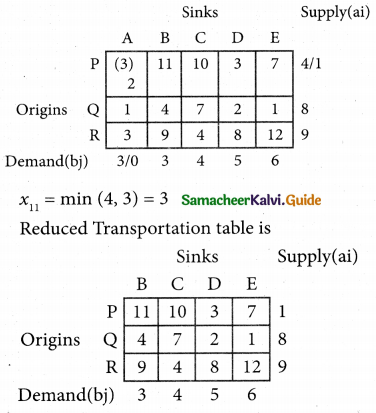
From the above table we can choose the cell in the North west corner. Here the cell is (P, A)
Allocate as much as possible in this cell so that either the capacity of first row is exhausted or the destination requirement of the first column is exhausted.
Samacheer Kalvi 12th Business Maths Guide Chapter 10 Operations Research Ex 10.1 42
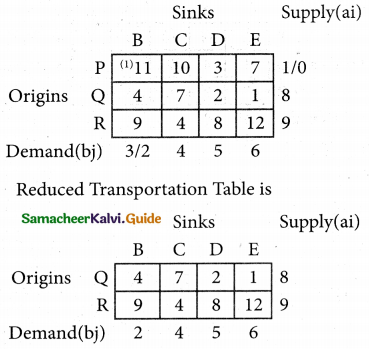
Form the above table we can choose the cell in North west corner. Here the cell is (P,B)
x = min (1, 3) = 1
Samacheer Kalvi 12th Business Maths Guide Chapter 10 Operations Research Ex 10.1 43
From the above table we can choose the cell in north west corner. Here the cell is (Q, B)
x = min (2, 8) = 2
Samacheer Kalvi 12th Business Maths Guide Chapter 10 Operations Research Ex 10.1 44
From the above table, we can choose the cell in North west corner. Here the cell is (Q, C)
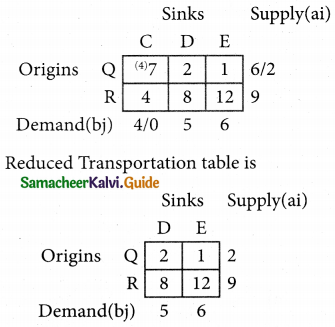
Samacheer Kalvi 12th Business Maths Guide Chapter 10 Operations Research Ex 10.1 45
From the above table, we can choose the cell in North west corner. Here the cell is (Q, D)
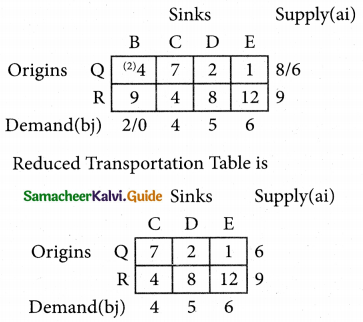
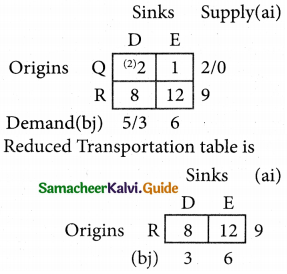
x = min (2, 5) = 2
Samacheer Kalvi 12th Business Maths Guide Chapter 10 Operations Research Ex 10.1 46
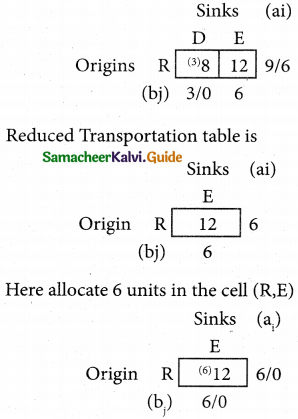
From the above table, we can choose the cell in North west corner. Here the cell is (R, D)
x = min (9, 3) = 3
Samacheer Kalvi 12th Business Maths Guide Chapter 10 Operations Research Ex 10.1 47
Thus we have the following table
Samacheer Kalvi 12th Business Maths Guide Chapter 10 Operations Research Ex 10.1 48
Transportation Schedule:
P → A; P → B; Q → B; Q → C; Q → D R → D; R → E
Total transportation cost:
= (3 × 2) + (1 × 11) + (2 × 4) + (4 × 7) + (2 × 2) + (3 × 8) + (6 × 2)
= 6 + 11 + 8 + 28 + 4 + 24 + 72
= 153

Samacheer Kalvi 12th Business Maths Guide Chapter 10 Operations Research Ex 10.1

Question 11.
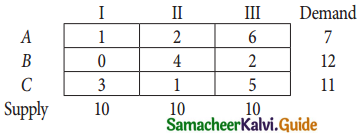
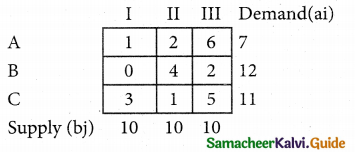
Find the initial basic feasible solution of the following transportation problem:
Samacheer Kalvi 12th Business Maths Guide Chapter 10 Operations Research Ex 10.1 49
Using
(i) North West corner tule
(ii) Least Cost method
(iii) Vogel’s approximation method
Solution:
(i) North west corner rule:
Here the total supply = 10 + 10 + 10 = 30
Total demand = 7 + 12 + 11 = 30
(i.e) Total supply = Total demand
The given problem is balanced transportation problem.
∴ we can find an initial basic feasible solution to the given problem.
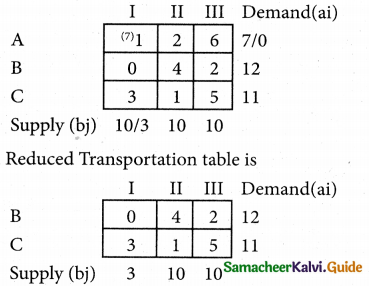
From the above table we can choose the cell in the North west corner. Here the cell is (A, I)
x11 = min (7, 10) = 7
Samacheer Kalvi 12th Business Maths Guide Chapter 10 Operations Research Ex 10.1 50
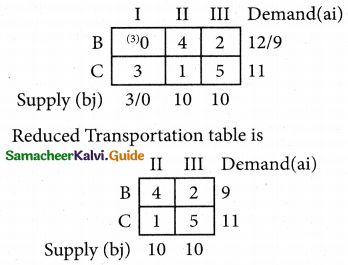
From the above table we can choose the cell in the north west corner. Here the cell is (B, I)
x = min (3, 12) = 3
Samacheer Kalvi 12th Business Maths Guide Chapter 10 Operations Research Ex 10.1 51
From the above table we can choose the cell in the North west corner. Here the cell is (B, II)
x = min (9, 10) = 9
Samacheer Kalvi 12th Business Maths Guide Chapter 10 Operations Research Ex 10.1 52
Here the cell in the North west corner is (C, II)
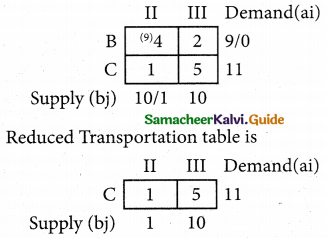
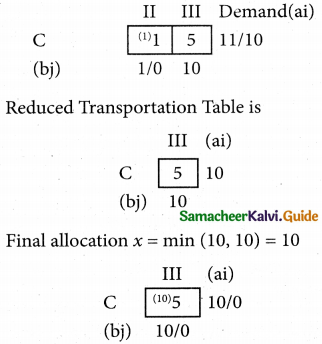
x = min (11, 1) = 1
Samacheer Kalvi 12th Business Maths Guide Chapter 10 Operations Research Ex 10.1 53
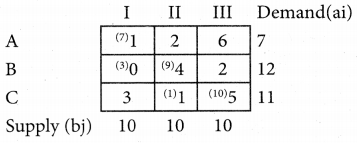
Thus we have the following allocations
Samacheer Kalvi 12th Business Maths Guide Chapter 10 Operations Research Ex 10.1 54
Transportation schedule:
A → I; B → I; B → II; C → II; C → III
Total transportation cost:
= (7 × 1) + (3 × 0) + (9 × 4) + (1 × 1) + (10 × 5)
= 7 + 0 + 36 + 1 + 50
= 94

Samacheer Kalvi 12th Business Maths Guide Chapter 10 Operations Research Ex 10.1

(ii) Least cost method:
The given transportation table is
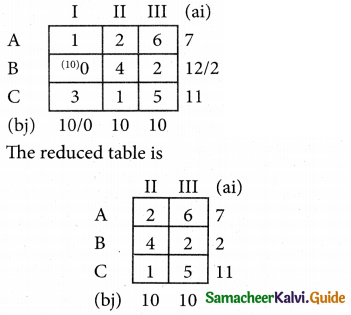
Samacheer Kalvi 12th Business Maths Guide Chapter 10 Operations Research Ex 10.1 55
Here Total supply = Total demand = 30
∴ The given problem is a balanced transportation problem.
Hence there exists a feasible solution to the given problem.
The least cost is 0 corresponds to the cell (B, I)
Allocate min (12, 10) = 10 units to this cell
Samacheer Kalvi 12th Business Maths Guide Chapter 10 Operations Research Ex 10.1 56
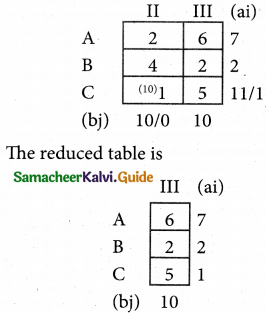
The least cost 1 corresponds to the cell (C, II)
Allocate min (11, 10) = 10 units to this cell
Samacheer Kalvi 12th Business Maths Guide Chapter 10 Operations Research Ex 10.1 57
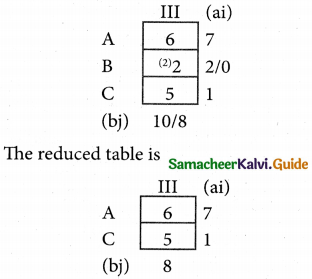
Here the least cost 2 corresponds to the cell (B, III)
Allocate min (2, 10) = 2 units to this cell.
Samacheer Kalvi 12th Business Maths Guide Chapter 10 Operations Research Ex 10.1 58
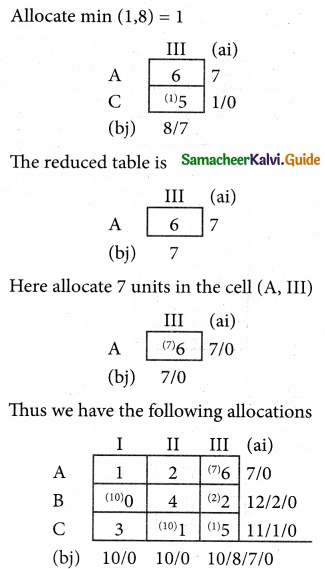
Here the least cost is 5 corresponds to the cell (C, III)
Samacheer Kalvi 12th Business Maths Guide Chapter 10 Operations Research Ex 10.1 59
Transportation schedule:
A → III; B → I; B → III; C → II; C → III
Total transportation cost:
= (7 × 6) + (10 × 10) + (2 × 2) + (10 × 1) + (1 × 5)
= 42 + 0 + 4 + 10 + 5
= 61

(iii) Vogel’s approximation method:
Here Σ ai = Σ bj = 30
(i.e) Total supply = Total demand
∴ This given problem is balanced transportation problem.
Hence there exists a feasible solution to the given problem.
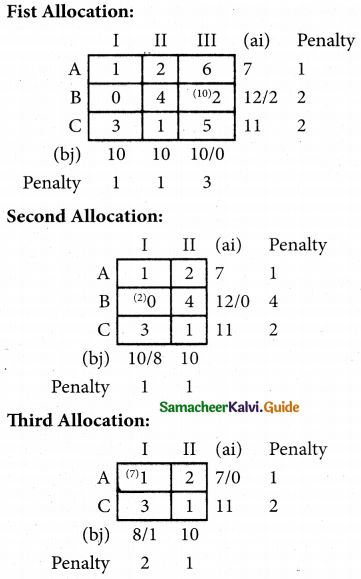
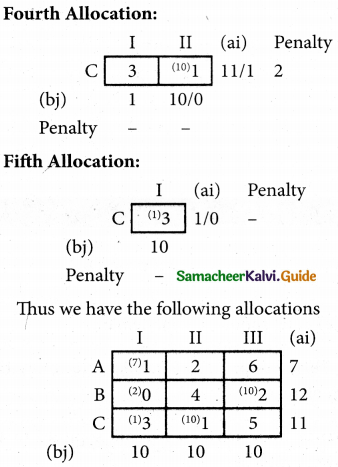
Samacheer Kalvi 12th Business Maths Guide Chapter 10 Operations Research Ex 10.1 60
Samacheer Kalvi 12th Business Maths Guide Chapter 10 Operations Research Ex 10.1 61
A → I; B → I; B → III; C → I; C → II
Total transportation cost:
= (7 × 1) + (2 × 0) + (10 × 2) + (1 × 3) + (10 × 1)
= 7 + 0 + 20 + 3 + 10
= 40

Samacheer Kalvi 12th Business Maths Guide Chapter 10 Operations Research Ex 10.1

Question 12.
Obtain an initial basic feasible solution to the following transportation problem by north west corner method.
Samacheer Kalvi 12th Business Maths Guide Chapter 10 Operations Research Ex 10.1 62
Solution:
Here the total available = 250 + 300 + 400 = 950
Total Required = 200 + 225 + 275 + 250 = 950
(i.e) Total Available = total required
∴ The given problem is balanced transportation problem.
we can find an initial basic feasible solution to the given problem.
From the above table, we can choose the cell in the North west corner. Here the cell is (A, D).
x11 = min (250, 200) = 200
Samacheer Kalvi 12th Business Maths Guide Chapter 10 Operations Research Ex 10.1 63
From the above table we can choose the cell in North west corner. Here the cell is (A, E)
x = min (50, 225) = 50
Samacheer Kalvi 12th Business Maths Guide Chapter 10 Operations Research Ex 10.1 64
From the above table, the north west corner cell is (B, E)
x = min (300, 175) = 175
Samacheer Kalvi 12th Business Maths Guide Chapter 10 Operations Research Ex 10.1 65
From the above table, the north west corner cell is (B, F)
x = min (125, 275) = 125
Samacheer Kalvi 12th Business Maths Guide Chapter 10 Operations Research Ex 10.1 66
Here the north west corner cell is (C, F)
x = min (400, 150) = 150
Samacheer Kalvi 12th Business Maths Guide Chapter 10 Operations Research Ex 10.1 67
Transportation schedule:
A → D; A → E; B → E; B → F; C → G
Total Transportation cost:
= (200 × 11) + (50 × 13) + (175 × 18) + (125 × 14) + (150 × 13) + (250 × 10)
= 2200 + 650 + 3150 + 1750 + 1950 + 2500
= 12,200

Samacheer Kalvi 12th Business Maths Guide Chapter 10 Operations Research Ex 10.1

Samacheer Kalvi 11th Chemistry Guide Chapter 15 Environmental Chemistry

Tamilnadu State Board New Syllabus Samacheer Kalvi 11th Chemistry Guide Pdf Chapter 15 Environmental Chemistry Text Book Back Questions and Answers, Notes.

Tamilnadu Samacheer Kalvi 11th Chemistry Solutions Chapter 15 Environmental Chemistry

11th Chemistry Guide Environmental Chemistry Text Book Back Questions and Answers

Textbook Evaluation:

I. Choose the best answer:

Question 1.
The gaseous envelope around the earth is known as atmosphere. The region lying between an altitudes of 11 – 50 km is _______.
(a) Troposphere
(b) Mesosphere
(c) Thermosphere
(d) Stratosphere
Answer:
(d) Stratosphere

Question 2.
Which of the following belongs to secondary air pollutant?
(a) Hydrocarbon
(b) Peroxy acetyl nitrate
(c) Carbon monoxide
(d) Nitric oxide
Answer:
(a) Hydrocarbon

Question 3.
Which of the following is natural and human disturbance in ecology?
(a) Forest fire
(b) Floods
(c) Acid rain
(d) Green house effect
Answer:
(b) Floods

Question 4.
Bhopal Gas Tragedy is a case of _______.
(a) thermal pollution
(b) air pollution
(c) nuclear pollution
(d) land pollution
Answer:
(c) nuclear pollution

Question 5.
Haemoglobin of the blood forms carboxy haemoglobin with
(a) Carbon dioxide
(b) Carbon tetra chloride
(c) Carbon monoxide
(d) Carbonic acid
Answer:
(c) Carbon monoxide

Samacheer Kalvi 11th Chemistry Guide Chapter 15 Environmental Chemistry

Question 6.
Which sequence for green house gases is based on GWP?
(a) CFC > N2O > CO2 > CH4
(b) CFC > CO2 > N2O > CH4
(c) CFC > N2O > CH4 > CO2
(d) CFC > CH4 > N2O > CO2
Answer:
(b) CFC > CO2 > N2O > CH4

Question 7.
Photo chemical smog formed in congested metropolitan cities mainly consists of
(a) Ozone, SO2 and hydrocarbons
(b) Ozone, PAN and NO2
(c) PAN, smoke and SO2
(d) Hydrocarbons, SO2 and CO2
Answer:
(d) Hydrocarbons, SO2 and CO2

Question 8.
The pH of normal rain water is
(a) 6.5
(b) 7.5
(c) 5.6
(d) 4.6
Answer:
(c) 5.6

Question 9.
Ozone depletion will cause
(a) forest fires
(b) eutrophication
(c) bio magnification
(d) global warming
Answer:
(a) forest fires

Question 10.
_______ is considered to be ozone friendly substitude for CFC’S
(a) HFC (Hydro Fluro Carbon)
(b) Halons
(c) PAN (Peroxy acetyl nitrate)
(d) PAH (Poly cyclic aromatic hydro carbon)
Answer:
(d) PAH (Poly cyclic aromatic hydro carbon)

Samacheer Kalvi 11th Chemistry Guide Chapter 15 Environmental Chemistry

Question 11.
Identify the wrong statement in the following.
(a) The clean water would have a BOD value of less than 5 ppm
(b) Greenhouse effect is also called as Global warming
(c) Minute solid particles in air is known as particulate pollutants
(d) Biosphere is the protective blanket of gases surrounding the earth
Answer:
(c) Minute solid particles in air is known as particulate pollutants

Question 12.
Living in the atmosphere of CO is dangerous because it
(a) combines with O2 present inside to form CO2
(b) Reduces organic matter of tissues
(c) Combines with haemoglobin and makes it incapable to absorb oxygen
(d) Dries up the blood
Answer:
(c) Combines with haemoglobin and makes it incapable to absorb oxygen

Question 13.
World Ozone layer protection Day is celebrated in ________.
(a) June 5
(b) Nov – 19
(c) Sep – 16
(d) Jan – 26
Answer:
(c) Sep – 16

Question 14.
Release of oxides of nitrogen and hydrocarbons into the atmosphere by motor vehicles is prevented by using
(a) grit chamber
(b) scrubbers
(c) trickling filters
(d) catalytic convertors
Answer:
(b) scrubbers

Question 15.
Biochemical oxygen Demand value less than 5 ppm indicates a water sample to be
(a) highly polluted
(b) poor in dissolved oxygen
(c) rich in dissolved oxygen
(d) low COD
Answer:
(d) low COD

Samacheer Kalvi 11th Chemistry Guide Chapter 15 Environmental Chemistry

Question 16.
Match the List I with List II and select the correct answer using the code given below the lists:

List IList II
A. Depletion of ozone layer1. CO2
B. Acid rain2. NO
C. Photochemical smog3. SO2
D. Green house effect4. CFC

Code:
Samacheer Kalvi 11th Chemistry Guide Chapter 15 Environmental Chemistry 1
Answer:
(a)

Question 17.
Match the List I with List II and select the correct answer using the code given below the lists.

List IList II
A. Stone leprosy1. CO
B. Biological magnification2. Green house gases
C. Global warming3. Acid rain
D. Combination with haemoglobin4. DDT

Code:
Samacheer Kalvi 11th Chemistry Guide Chapter 15 Environmental Chemistry 1
Answer:
(d)

Question 18.
Assertion (A):
If BOD level of water in a reservoir is more than 5 pm it is highly polluted.
Reason (R):
High biological oxygen demand means high activity of bacteria in water.
(i) Both (A) and (R) are correct and (R) is the correct explanation of (A)
(ii) Both (A) and (R) are correct and (R) is not the correct explanation of (A)
(iii) Both (A) and (R) are not correct
(iv) (A) is correct but (R) is not correct
(a) i
(b) ii
(c) iii
(d) iv
Answer:
(a) i

Question 19.
Assertion (A):
Excessive use of chlorinated pesticide causes soil and water pollution.
Reason (R):
Such pesticides are non – biodegradable.
(i) Both (A) and (R) are correct and (R) is the correct explanation of (A)
(ii) Both (A) and (R) are correct and (R) is not the correct explanation of (A)
(iii) Both (A) and (R) are not correct
(iv) (A) is correct but (R) is not correct
(a) i
(b) ii
(c) iii
(d) iv
Answer:
(a) i

Question 20.
Assertion (A):
Oxygen plays a key role in the troposphere
Reason (R):
Troposphere is not responsible for all biological activities
(i) Both (A) and (R) are correct and (R) is the correct explanation of (A)
(ii) Both (A) and (R) are correct and (R) is not the correct explanation of (A)
(iii) Both (A) and (R) are not correct
(iv) (A) is correct but (R) is not correct
(a) i
(b) ii
(c) iii
(d) iv
Answer:
(b) ii

Samacheer Kalvi 11th Chemistry Guide Chapter 15 Environmental Chemistry

II. Write brief answer to the following questions:

Question 21.
Dissolved oxygen in water is responsible for aquatic life. What processes are responsible for the reduction in dissolved oxygen in water?
Answer:
The process which are responsible for the reduction of dissolved oxygen in water are excessive use of phosphatic and nitrate fertilizers, detergents, the discharge of human sewage and organic waste from food, paper and pulp industries. The microorganisms which oxidize organic matter also used oxygen dissolved in H2O.

More over, during night, photosynthesis stops but the aquatic plants continue to respire, resulting in reduction of dissolved oxygen.

Question 22.
What would happen, if the greenhouse gases were totally missing in the earth’s atmosphere?
Answer:
The solar energy radiated back from the earth surface in absorbed by the green house gases. (CO2, CH4, O3, CFCs) are present near the earth’s surface. They heat up the atmosphere near the earth’s surface and keep it warm.

As a result of these, there is growth of vegetation which supports the life. In the absence of this effect, there will be not life of both plant and animal on the surface of the earth.

Question 23.
Define smog.
Answer:
Smog is a combination of smoke and fog which forms droplets that remain suspended in the air. Smog is a chemical mixture of gases that forms a brownish yellow haze over urban cities.Smog mainly consists of ground level ozone, oxides of nitrogen, volatile organic compounds, SO2 acidic aerosols and gases, and particulate matter.

Question 24.
Which is considered to be earth’s protective umbrella? Why?
Answer:
At high altitudes to the atmosphere consists of a layer of ozone (O3) which acts as an umbrella or shield for harmful UV radiations. It protects us from harmful effect such as skin cancer. UV radiation can convert molecular oxygen into ozone as shown in the following reaction.
O2(g) Samacheer Kalvi 11th Chemistry Guide Chapter 15 Environmental Chemistry 12 O(g) + O(g)
O(g) + O2(g) Samacheer Kalvi 11th Chemistry Guide Chapter 15 Environmental Chemistry 12 O3(g)

Question 25.
What are degradable and non – degradable pollutants?
Answer:
The pollutants are classified as bio-degradable and non-biodegradable pollutants.

Bio-degradable pollutants:
The pollutants which can be easily decomposed by the natural biological processes are called bio-degradable pollutants.
Example:
plant wastes, animal wastes etc.

Non bio-degradable pollutants:
The pollutants which cannot be decomposed by the natural biological processes are called Non bio-degradable
pollutants.
Examples:
Metal wastes (mainly Hg and Pb), D.D.T, plastics, nuclear wastes etc.,
These pollutants are harmful to living organisms even in low concentration. As they are not degraded naturally, it is difficult to eliminate them from our environment.

Samacheer Kalvi 11th Chemistry Guide Chapter 15 Environmental Chemistry

Question 26.
From where does ozone come in the photo chemical smog?
Answer:
NO2 Samacheer Kalvi 11th Chemistry Guide Chapter 15 Environmental Chemistry 2 NO + (O)
O3 are strong oxidizing agent and can react with unburnt hydrocarbons in polluted air to form formaldehyde, acrolein and peroxy acetyl nitrate (PAN).

Question 27.
A person was using water supplied by corporation. Due to shortage of water he started using underground water. He felt laxative effect. What could be the cause?
Answer:
A moderate concentration of sulphate ions in water are harmless but excessive concentration is greater than 500 ppm in water causes laxative effects. Hence under ground water may have consisted excess of suplhates.

Question 28.
What is green chemistry?
Answer:
Efforts to control environmental pollution resulted in development of science for synthesis of chemicals favorable to environment which is called green chemistry. Green chemistry means science of environmentally favorable chemical synthesis.

Question 29.
Explain how does green house effect cause global warming.
Answer:
Greenhouse effect may be defined as the heating up of the earth surface due to trapping of infrared radiations reflected by earth’s surface by CO2 layer in the atmosphere”. The heating up of earth through the greenhouse effect is called global warming.

Without the heating caused by the greenhouse effect, Earth’s average surface temperature would be only about -18 °C (CPF). Although the greenhouse effect is a naturally occurring phenomenon, it is intensified by the continuous emission of greenhouse gases into the atmosphere.

During the past 100 years, the amount of carbon dioxide in the atmosphere increased by roughly 30 percent and the amount of methane more than doubled. If these trends continue, the average global temperature will increase which can lead to melting of polar ice caps and flooding of low lying areas. This will increase incidence of infectious diseases like dengue, malaria etc.

Question 30.
Mention the standards prescribed by BIS for quality of drinking water.
Answer:
Standard characteristics prescribed for deciding the quality of drinking water by BIS, in 1991 are shown in Table.
Samacheer Kalvi 11th Chemistry Guide Chapter 15 Environmental Chemistry 3

Samacheer Kalvi 11th Chemistry Guide Chapter 15 Environmental Chemistry

Question 31.
How does classical smog differ from photochemical smog?
Answer:
Classical smog was first observed in London in December 1952 and hence it is also known as Londo coal smoke and fog.

It occurs in cool atmospheric smog found in many large cities. The chemical composition is the mixture of SO2, SO3 and humidity. It generally occurs in the morning and becomes worse when the sun rises. This is mainly due to the induced oxidation of SO2 to SO3, which reacts with water yielding sulphuric acid aerosol.

Chemically it is reducing in nature because of high concentration of SO2 and so it is also called as reducing smog.

ii) Photo chemical smog or Los Angel Smog:
Photo Chemical smog was first observed in Los Angels in 1950. It occurs in warm, dry and sunny climate. This type of smog is formed by the combination of smoke, dust and fog with air pollutants like oxides of nitrogen and hydrocarbons in the presence of sunlight.

It forms when the sun shines and becomes worse in the afternoon. Chemically it is oxidizing in nature because of high concentration of oxidizing agents NO2 and O3, so it is also called as oxidizing smog.

Question 32.
What are particulate pollutants? Explain any three.
Answer:
1. Particulate pollutants are small solid particles and liquid droplets suspended in air. Many of particulate pollutants are hazardous.
Examples: dust, pollen, smoke, soot and liquid droplets (aerosols) etc,

2. Smoke particulate consists of solid particles (or) mixture of solid and liquid particles formed by the combustion of organic matter.
For example, cigarette smoke, oil smoke, smokes from burning of fossil fuel, garbage and dry leaves.

3. Dust composed of fine solid particles produced during crushing and grinding of solid materials.
For example, sand from sand blasting, saw dust from wood works, cement dust from cement factories and fly ash from power generating units.

Question 33.
Even though the use of pesticides increases crop production, they adversely affect the living organisms. Explain the function and the adverse effects of the pesticides.
Answer:
Pesticides are chemicals that are used to kill or stop the growth of unwanted organisms. But these pesticides can affect the health of human beings.
These are further classified as

Insecticides:
Insecticides like DDT, BHC, aldrin etc. can stay in soil for long period of time and are absorbed by soil. They contaminate root crops like carrot, raddish, etc.

Fungicide:
Organo mercury compounds are used as most common fungicide. They dissociate in soil to produce mercury which is highly toxic.

Herbicides:
Herbicides are the chemical compounds used to control unwanted plants. They are otherwise known as weed killers. Example sodium chlorate (NaClO3) and sodium arsenite (Na3AsO3). Most of the herbicides are toxic to mammals.

Question 34.
Ethane burns completely in air to give CO2, while in a limited supply of air gives CO. The same gases are found in automobile exhaust. Both CO and CO2 are atmospheric pollutants.
Answer:
The major pollutants of oxides of carbon are carbon monoxide and carbon dioxide.

(i) Carbon Monoxide:
Carbon monoxide is a poisonous gas produced as a result of incomplete combustion of coal are firewood. It is released into the air mainly by. automobile exhaust. It binds with haemoglobin and form carboxy haemoglobin which impairs normal oxygen transport by blood and hence the oxygen carrying capacity of blood is reduced. This oxygen deficiency results in headache, dizziness, tension, Loss of consciousness, blurring of eye sight and cardiac arrest.

(ii) Carbon dioxide:
Carbon dioxide is released into the atmosphere mainly by the process of respiration, burning of fossil fuels, forest fire, decomposition of limestone in cement industry etc.

Green plants can convert CO2 gas in the atmosphere into carbohydrate and oxygen through a process called photosynthesis. The increased CO2 level in the atmosphere is responsible for global warming. It causes headache and nausea.

Question 35.
On the basis of chemical reactions involved, explain how do CFC’s cause depletion of ozone layer in stratosphere?
Answer:
In the presence of uv radiation, CFC’s break up into chlorine free radical
CF2Cl2 Samacheer Kalvi 11th Chemistry Guide Chapter 15 Environmental Chemistry 4 CF2Cl + Cl
CFCl3 Samacheer Kalvi 11th Chemistry Guide Chapter 15 Environmental Chemistry 4 CFCl2 + Cl
Cl + O3 → ClO + O2
ClO + O → Cl + O2

Chlorine radical is regenerated in the course of reaction. Due to this continuous attack of Cl thinning of Ozone layer takes place which leads to formation of the ozone hole.

It is estimated that for every reactive chlorine atom generated in the stratosphere 1,00,000 molecules of ozone are depleted.

Samacheer Kalvi 11th Chemistry Guide Chapter 15 Environmental Chemistry

Question 36.
How is acid rain formed? Explain its effect.
Answer:
Rain water normally has a pH of 5.6 due to dissolution of atmospheric CO2 into it. Oxides, of sulphur and nitrogen in the atmosphere may be absorbed by droplets of water that make up clouds and get chemically converted into sulphuric acid and nitric acid respectively as a results of pH of rainwater drops to the level 5.6 hence it is called acid rain.

Acid rain is a by-product of a variety of sulphur and nitrogen oxides in the atmosphere. Burning of fossil fuels (coal and oil) in power stations, furnaces and petrol, diesel in motor engines produce sulphur dioxide and nitrogen oxides. The main contributors to acid rain are SO2 and NO2. They are converted into sulphuric acid and nitric acid respectively by the reaction with oxygen and water.

2SO2 + O2 + 2H2O → 2H2SO4
4NO2 + O2 + 2H2O → 4HNO3

Question 37.
What is sewage? What are the major steps involved in the treatment of sewage waste?
Answer:
Objectives of waste water treatment:

  1. To convert harmful compounds into harmless compounds.
  2. To eliminate the offensive smell.
  3. To remove the solid content of the sewage.
  4. To destroy the disease-producing micro organisms.

Treatment process:
The sewage (or) wastewater treatment process involves the following steps.

I. Preliminary Treatment:
In this treatment, coarse solids and suspended impurities are removed by passing the wastewater through bar and mesh screens.

II. Primary treatment (or) Settling process:
In this treatment, greater proportion of the suspended inorganic and organic solids are removed from the liquid sewage by settling. In order to facilitate quick settling coagulants like alum, ferrous sulphate are added. These produce large gelatinous precipitates, which entrap finely divided organic matter and settle rapidly.
Al2(SO4)3 + 6H2O → 2Al(OH)3 ↓ + 3H2SO4

III. Secondary (or) biological treatment:
In this treatment, biodegradable organic impurities are removed by aerobic bacteria. It removes upto 90 % of the oxygen demanding wastes. This is done by trickling filter or activated sludge process.

(a) Trickling filter process:
It is a circular tank and is filled with either coarse or crushed rock. Sewage is sprayed over this bed by means of slowly rotating arms.
Samacheer Kalvi 11th Chemistry Guide Chapter 15 Environmental Chemistry 5

When sewage starts percolating downwards, mocroorganisms present in the sewage grow on the surface of filtering media using organic material of the sewage as food. After completion of aerobic oxidation the treated sewage is taken to the settling tank and the sludge is removed. This process removes about 80 – 85 % of BOD.

(b) Activated sludge process:

Activated sludge is biologically active sewage and it has a large number of aerobic bacterias, which can easily oxidize the organic impurities.

The sewage effluent from primary treatment is mixed with the required amount of activated sludge. Then the mixture is aerated in the aeration tank. Under these condition, organic impurities of the sewage get oxidized rapidly by the microorganisms.
Samacheer Kalvi 11th Chemistry Guide Chapter 15 Environmental Chemistry 6

After aeration, the sewage is taken to the sedimentation tank. Sludges settle down in this tank, called activated sludge, a portion of which is used for seeding fresh batch of the sewage. This process removes about 90-95 % of BOD.

IV. Tertiary treatment:
After the secondary treatment, the sewage effluent has a lower BOD (25 ppm), which can be removed by the tertiary treatment process.

In the tertiary treatment, the effluent is introduced into a flocculation tank, where lime is added to remove phosphates. From the flocculation tank the effluent is led to ammonia stripping tower, where pH is maintained to 11 and the NH4+ is converted to gaseous NH3. Then the effluent is allowed to pass through activated charcoal column, where minute organic wastes are absorbed by charcoal. Finally the effluent water is treated with disinfectant (chlorine).

V. Disposal of sludge:
This is the last stage in the sewage treatment. Sludge formed from different steps can be disposed by

  1. dumping into low – lying areas,
  2. burning of sludge (incineration),
  3. dumping into the sea,
  4. using it as low grade fertilizers.

Samacheer Kalvi 11th Chemistry Guide Chapter 15 Environmental Chemistry 7

Samacheer Kalvi 11th Chemistry Guide Chapter 15 Environmental Chemistry

Question 38.
Differentiate the following:
(i) BOD and COD
(ii) Viable and non-viable particulate pollutants.
Answer:
(i) BOD and COD Biochemical oxygen demand (BOD):
The total amount of oxygen in milligrams consumed by microorganisms in decomposing the waste in one litre of water at 200°C for a period of 5 days is called biochemical oxygen demand (BOD) and its value is expressed in ppm. BOD is used as a measure of degree of water pollution. Clean water would have BOD value less than 5 ppm whereas highly polluted water has BOD value of 17 ppm or more.

Chemical Oxygen Demand (COD):
BOD measurement takes 5 days so another parameter called the Chemical Oxygen Demand (COD) is measured. Chemical oxygen demand (COD) is defined as the amount of oxygen required by the organic matter in a sample of water for its oxidation by a strong oxidising agent like K2Cr2O7 in acid medium for a period of 2 hrs.

(ii) Viable and non – viable particulate pollutants:

Viable particulates:
The viable particulates are the small size living organisms such as bacteria, fungi, moulds, algae, etc. which are dispersed in air. Some of the fungi cause allergy in human beings and diseases in plants.

Non-viable particulates:
The non- viable particulates are small solid particles and liquid droplets suspended in air. They help in the transportation of viable particles. There are four types of non-viable particulates in the atmosphere.
Example:
Smoke, Dust, Mists, Fumes.

Question 39.
Explain how oxygen deficiency is cause by carbon monoxide in our blood? Give its effect.
Answer:
Carbon monoxide is a poisonous gas produced as a result of incomplete combustion of coal are firewood. It is released into the air mainly by automobile exhaust. It binds with haemoglobin and form carboxy haemoglobin which impairs normal oxygen transport by blood and hence the oxygen carrying capacity of blood is reduced.

This oxygen deficiency results in headache, dizziness, tension, Loss of consciousness, blurring of eye sight and cardiac arrest. Efforts to control environmental pollution have resulted in development of science for synthesis of chemical favorable to environment and it is called green chemistry.

Question 40.
What are the various methods you suggest to protect our environment from pollution?
Answer:

  1. Waste management:
    Environmental pollution can be controlled by proper disposal of wastes.
  2. Recycling:
    A large amount of disposed waste material can be reused by recycling the waste, thus it reduces the land fill and converts waste into useful forms.
  3. Substitution of less toxic solvents for highly toxic ones used in certain industrial processes.
  4. Use of fuels with lower sulphur content (e.g., washed coal)
  5. Growing more trees.
  6. Control measures in vehicle emissions are adequate.
  7. Efforts to control environmental pollution have resulted in development of science for synthesis of chemical favourable to environment and it is called green chemistry.

Samacheer Kalvi 11th Chemistry Guide Chapter 15 Environmental Chemistry

11th Chemistry Guide Environmental Chemistry Additional Questions and Answers

I. Choose the best answer:

Question 1.
The type of pollution cause by spraying of DDT is
(a) air and soil
(b) air and water
(c) air
(d) air, water and soil
Answer:
(d) air, water and soil

Question 2.
The green house effect is caused by
(a) CO2
(b) NO2
(c) NO
(d) CO
Answer:
(a) CO2

Question 3.
The gas responsible for ozone depletion:
(a) NO and freons
(b) SO2
(c) CO2
(d) CO
Answer:
(a) NO and freons

Question 4.
In Antartica ozone depletion is due to the formation of following compound
(a) acrolein
(b) peroxyacetyl nitrate
(c) SO2 and NO2
(d) chlorine nitrate
Answer:
(a) acrolein

Question 5.
The main element of smog is
(a) O3 and PAN
(b) O3
(c) PAN
(d) PPN and PBN
Answer:
(a) O3 and PAN

Samacheer Kalvi 11th Chemistry Guide Chapter 15 Environmental Chemistry

Question 6.
Classical smog occurs in places of
(a) excess SO2
(b) low temperature
(c) high temperature
(d) excess NH3
Answer:
(b) low temperature

Question 7.
Which gas is responsible for ‘Bhopal Gas Tragedy’ in 1984?
(a) CO
(b) Methyl isocynate
(c) SO2 and NO2
(d) Ethyl isocynate
Answer:
(b) Methyl isocynate

Question 8.
Which gas is a main reason behind air pollution, is produced by
(a) sewage pollutant
(b) aerosols
(c) industrial remains
(d) Above all
Answer:
(b) aerosols

Question 9.
Which is a dangerous radiological pollutant?
(a) C14
(b) S35
(c) Sr90
(d) P32
Answer:
(c) Sr90

Question 10.
Which is related to ‘Green House Effect’?
(a) Farming of Green Plants
(b) Farming of Vegetables in Houses
(c) Global Warming
(d) Biodegradable pollutant
Answer:
(c) Global Warming

Samacheer Kalvi 11th Chemistry Guide Chapter 15 Environmental Chemistry

Question 11.
The uppermost region of the atmosphere is called
(a) Ionosphere
(b) Mesosphere
(c) Troposphere
(d) Stratosphere
Answer:
(d) Stratosphere

Question 12.
Which of the following is the coldest region of atmosphere
(a) Thermosphere
(b) Mesosphere
(c) Troposphere
(d) Stratosphere
Answer:
(b) Mesosphere

Question 13.
The region which is greatly affected by air pollution is
(a) Thermosphere
(b) Stratosphere
(c) Troposphere
(d) Mesosphere
Answer:
(c) Troposphere

Question 14.
The substance which is a primary pollutant?
(a) H2SO4
(b) CO
(c) PAN
(d) Aldehydes
Answer:
(b) CO

Question 15.
Depletion of ozone layer causes
(a) breast cancer
(b) blood cancer
(c) lung cancer
(d) skin cancer
Answer:
(d) skin cancer

Samacheer Kalvi 11th Chemistry Guide Chapter 15 Environmental Chemistry

Question 16.
Formation of London smog takes place in
(a) Winter during day time
(b) summer during day time
(c) summer during morning time
(d) winter during morning time
Answer:
(d) winter during morning time

Question 17.
The substance which is not regarded as a pollutant?
(a) NO2
(b) CO2
(c) O3
(d) Hydrocarbons
Answer:
(b) CO2

Question 18.
Green house gases
(a) allow shorter wavelength to enter earth’s atmosphere while doesn’t allow longer wavelength to leave the earth’s atmosphere.
(b) allow longer wavelength to enter earth atmosphere while doesn’t allow shorter wavelength to leave the surface.
(c) don’t have wavelength specific character.
(d) she wavelength specific behaviour near the earth while far from earth these have wavelength independent behavior.
Answer:
(a) allow shorter wavelength to enter earth’s atmosphere while doesn’t allow longer wavelength to leave the earth’s atmosphere.

Question 19.
Carbon monoxide (CO) is harmful to man because
(a) it forms carbolic acid
(b) it generates excess CO2
(c) it is carcinogenic
(d) it competes with O2 for haemoglobin
Answer:
(d) it competes with O2 for haemoglobin

Question 20.
Today the concentration of green house gases is very high because of
(a) use of refrigerator
(b) increased combustion of oils and coal
(c) deforestation
(d) All of the above
Answer:
(d) All of the above

Samacheer Kalvi 11th Chemistry Guide Chapter 15 Environmental Chemistry

Question 21.
The quantity of CO2 in atmosphere is
(a) 3.34 %
(b) 6.5 %
(c) 0.034 %
(d) 0.34 %
Answer:
(c) 0.034 %

Question 22.
BOD of pond is connected with
(a) microbes & organic matter
(b) organic matter
(c) microbes
(d) None of these
Answer:
(a) microbes & organic matter

Question 23.
When rain is accompanied by a thunderstorm, the collected rain water will have a pH value
(a) slightly lower than that of rain water without thunderstorm
(b) slightly higher than that when the thunderstorm is not there
(c) uninfluenced by occurrence of thunderstorm
(d) which depends upon the amount of dust in air
Answer:
(a) slightly lower than that of rain water without thunderstorm

Question 24.
Water pollution is caused by
(a) pesticides
(b) SO2
(c) O2
(d) CO2
Answer:
(a) pesticides

Question 25.
Minamata disease of Japan is due to pollution of
(a) Aresenic
(b) Lead
(c) Cynide
(d) Mercury
Answer:
(d) Mercury

Samacheer Kalvi 11th Chemistry Guide Chapter 15 Environmental Chemistry

Question 26.
Which causes death of fish in water bodies polluted by sewage?
(a) Foul smell
(b) Pathogens
(c) Herbicides
(d) Decrease in D.O.
Answer:
(d) Decrease in D.O.

Question 27.
Sewage water is purified by
(a) aquatic plants
(b) microorganisms
(c) light
(d) fishes
Answer:
(b) microorganisms

Question 28.
Which pollutant is harmful for ‘Tajmahal’?
(a) Hydrogen
(b) O2
(c) SO2
(d) Chlorine
Answer:
(c) SO2

Question 29.
Negative soil pollution is
(a) reduction in soil productivity due to erosion and over use
(b) reduction in soil productivity due to addition of pesticides and industrial wastes
(c) converting fertile land into barren land by dumping ash, sludge and garbage
(d) None of the above
Answer:
(a) reduction in soil productivity due to erosion and over use

Question 30.
The quantity of DDT in food chain
(a) decreases
(b) remains same
(c) increases
(d) changes
Answer:
(c) increases

Samacheer Kalvi 11th Chemistry Guide Chapter 15 Environmental Chemistry

Question 31.
Which is known as “Third poison of environment” and also creates ‘Blue baby syndrome’
(a) Nitrate present in water
(b) Phosphate and detergents found in water
(c) Cyanide
(d) Pesticides
Answer:
(b) Phosphate and detergents found in water

Question 32.
The substance having the largest concentration in acid rain?
(a) H2CO3
(b) HNO3
(c) HCl
(d) H2SO4
Answer:
(d) H2SO4

Question 33.
Water is often treated with chlorine to
(a) remove hardness
(b) increase oxygen content
(c) kill germs
(d) remove suspended particles
Answer:
(c) kill germs

Question 34.
Thermal pollution affects mainly
(a) vegetation
(b) aquatic creature
(c) rocks
(d) air
Answer:
(b) aquatic creature

Question 35.
B.O.D test or biochemical oxygen demand test is made for measuring
(a) air pollution
(b) water pollution
(c) noise pollution
(d) soil pollution
Answer:
(b) water pollution

Samacheer Kalvi 11th Chemistry Guide Chapter 15 Environmental Chemistry

Question 36.
Brewery and sugar factory water alters the quality of a water body by increasing
(a) temperature
(b) turbidity
(C) pH
(d) COD and BOD
Answer:
(d) COD and BOD

Question 37.
A dental disease characterized by mottling of teeth is due to the presence of a certain chemical element in drinking water. Which is that element?
(a) Boron
(b) Chlorine
(c) Fluorine
(d) Mercury
Answer:
(c) Fluorine

Question 38.
The high amount of E.coli in water is an indicator of
(a) hardness of water
(b) industrial pollution
(c) sewage pollution
(d) presence of chlorine in the water
Answer:
(c) sewage pollution

Question 39.
A lake with an inflow of domestic sewage rich in organic waste may result in
(a) drying of the lake very soon due to algal bloom
(b) an increase production of fish due to a lot of nutrients
(c) death of fish due to lack of oxygen
(d) increased population of aquatic food web organisms
Answer:
(c) death of fish due to lack of oxygen

Question 40.
In which one of the following the BOD (Biochemical Oxygen Demand) of sewage(S), distillery effluent (DE), paper mill effluent (PE) and sugar mill effluent (SE) have been arranged in ascending order
(a) SE < S < PE < DE
(b) SE < PE < S < DE
(c) PE < S < SE < DE
(d) S < DE < PE < SE
Answer:
(c) PE < S < SE < DE

Samacheer Kalvi 11th Chemistry Guide Chapter 15 Environmental Chemistry

Question 41.
The greenhouse effect is because of the
(a) presence of gases, which in general are strong infrared absorbers, in the atmosphere
(b) presence of CO2 only in the atmosphere
(c) presence of O3 and CH4 in the atmosphere
(d) N2O and chlorofluoro hydrocarbons in the atmosphere
Answer:
(a) presence of gases, which in general are strong infrared absorbers, in the atmosphere

Question 42.
Which of the following is/are the hazardous pollutant(s) present in automobile exhaust gases?
(a) N2
(b) CO
(c) CH4
(d) Oxides of nitrogen
Answer:
(c) CH4

Question 43.
Green chemistry means such reactions which:
(a) produce colour during reactions
(b) reduce the use and production of hazardous chemicals
(c) are related to the depletion of ozone layer
(d) study the reactions in plants
Answer:
(b) reduce the use and production of hazardous chemicals

Question 44.
Which one of the following statement is not true?
(a) pH of drinking water should be between 5.5 – 9.5.
(b) Concentration of DO below 6 ppm is good for the growth of fish.
(c) Clean water would have a BOD value of less than 5 ppm.
(d) Oxides of sulphur, nitrogen and carbon are the most widespread air pollutant.
Answer:
(b) Concentration of DO below 6 ppm is good for the growth of fish.

Question 45.
Which one of the following statements regarding photochemical smog is not correct?
(a) Carbon monoxide does not play any role in photochemical smog formation.
(b) photochemical smog is an oxidizing agent in character.
(c) photochemical smog is formed through photochemical reaction involving solar energy.
(d) Photochemical smog does not cause irritation in eyes and throat.
Answer:
(d) Photochemical smog does not cause irritation in eyes and throat.

Samacheer Kalvi 11th Chemistry Guide Chapter 15 Environmental Chemistry

Question 46.
Frequent occurrence of water blooms in a lake indicates
(a) nutrient deficiency
(b) oxygen deficiency
(c) excessive nutrient availability
(d) absence of herbivores in the lake
Answer:
(b) oxygen deficiency

Question 47.
The smog is essentially caused by the presence of
(a) Oxides of sulphur and nitrogen
(b) O2 and N2
(c) O2 and O3
(d) O2 and N2
Answer:
(a) Oxides of sulphur and nitrogen

Question 48.
Identify the wrong statement in the following.
(a) Chlorofluorocarbons are responsible for ozone layer depletion.
(b) Greenhouse effect is responsible for global warming.
(c) Ozone layer does not permit infrared radiation from the sun to reach the earth.
(d) Acid rain is mostly because of oxides of nitrogen and sulphur.
Answer:
(c) Ozone layer does not permit infrared radiation from the sun to reach the earth.

Question 49.
Identify the incorrect statement from the following.
(a) Ozone absorbs the intense ultraviolet radiation of the sun.
(b) Depletion of ozone layer is because of its chemical reactions with chlorofluoro alkanes.
(c) Ozone absorbs infrared radiation.
(d) Oxides of nitrogen in the atmosphere can cause the depletion of ozone layer.
Answer:
(c) Ozone absorbs infrared radiation

Question 50.
What is DDT among the following?
(a) Greenhouse gas
(b) A fertilizer
(c) Biodegradable pollutant
(d) Non – biodegradable pollutant
Answer:
(d) Non – biodegradable pollutant

Samacheer Kalvi 11th Chemistry Guide Chapter 15 Environmental Chemistry

Question 51.
The gas leaked from a storage tank of the Union Carbide plant in Bhopal gas tragedy was:
(a) Methyl isocyanate
(b) Methylamine
(c) Ammonia
(d) Phosgene
Answer:
(a) Methyl isocyanate

Question 52.
Black – foot disease is caused due to groundwater contaminated with excess of
(a) Nitrate
(b) Fluoride
(c) Arsenic
(d) Sulphur
Answer:
(c) Arsenic

Question 53.
Exposure of an organism to UV system causes
(a) photodynamic action
(b) formation of thymidine
(c) splitting of H – bonds of DNA
(d) splitting of phosphodiester bonds
Answer:
(c) splitting of H – bonds of DNA

Question 54.
Under column – I, a list of gases that are known to have a greenhouse effect is given. Relate them to their main source selecting from the given under Column – II:

Column – IColumn – II
A. Nitrous oxide1. Secondary pollutant from car exhausts
B. Chlorofluoro carbon (CFCs)2. Combustion of fossil fuels, wood, etc.
C. Methane3. Denitrification
D. Ozone (O3)4. refrigerators, aerosol, sprays
E. Carbondioxide5. Cattle, rice fields, toilets

(a) A – 3, B – 4, C – 5, D – 1, E – 2
(b) A – 5, B – 1, C – 3, D – 4, E – 2
(c) A – 4, B – 5 , C – 1, D – 2, E – 3
(d) A – 1, B – 3, C – 4, D – 5, E – 2
Answer:
(a) A – 3, B – 4, C – 5, D – 1, E – 2

Question 55.
Minamata disease is a pollution related disease results form
(a) oil spills into sea
(b) accumulation of arsenic into atmosphere
(c) release of industrial waste mercury into bodies water
(d) release human organic waste into drinking water
Answer:
(c) release of industrial waste mercury into bodies water

Samacheer Kalvi 11th Chemistry Guide Chapter 15 Environmental Chemistry

Question 56.
Air pollution causing photochemical oxidants production include
(a) Carbon monoxide, sulphur dioxide
(b) Nitrous oxide, nitric acid fumes, nitric oxide
(c) Ozone, peroxyacetyl nitrate, aldehydes
(d) Oxygen, chlorine, fuming nitric acid
Answer:
(c) Ozone, peroxyacetyl nitrate, aldehydes

Question 57.
Photochemical smog formed in congested metropolitan cities mainly consists of
(a) ozone, peroxyacetyl nitrate and NOx
(b) smoke, peroxyacetyl nitrate and SO2
(c) hydrocarbons, SO2 and CO2
(d) hydrocarbons, ozone and SOx
Answer:
(a) ozone, peroxyacetyl nitrate and NOx

Question 58.
Which, one of the following statements is correct?
(a) Extensive use of chemical fertilizers may lead to eutrophication of nearby water bodies
(b) Both Azotobacter and Rhizobium fix atmospheric nitrogen in root nodules of plants
(c) Cyanobacteria such as Anabaena and Nostoc are important mobilizers of phosphates and potassium for plant nutrition in soil
(d) At present it is not possible to grow maize without chemical fertilizers
Answer:
(a) Extensive use of chemical fertilizers may lead to eutrophication of nearby water bodies

Question 59.
Reducing the use of non-biodegradable things will contribute of
(a) Increase in O2
(b) Cyanophycean blooms occur
(c) Depletion of O2 layers
(d) Eutrophication
Answer:
(a) Increase in O2

Question 60.
Which of the following metal is a water pollutant and causes sterility in human. being?
(a) As
(b) Mn
(c) Mg
(d) Hg
Answer:
(b) Mn

Samacheer Kalvi 11th Chemistry Guide Chapter 15 Environmental Chemistry

Question 61.
Lichens do not like to grow in cities
(a) because of absence of the right type of algae and fungi
(b) because of lack of moisture
(c) because of SO2 pollution
(d) because natural habitat is missing
Answer:
(c) because of SO2 pollution

Question 62.
Limit of BOD prescribed by Central pollution Control Board for the discharge of industrial and municipal waste waters into natural surface waters, is
(a) < 100 ppm
(b) < 30 ppm
(c) < 3.0 ppm
(d) < 10 ppm
Answer:
(b) < 30 ppm

Question 63.
Which one of the following pairs is mismatched
(a) Fossil fuel burning – release of CO2
(b) Nuclear power – radioactive wastes
(c) Solar energy – Greenhouse effect
(d) Biomass burning – release of CO2
Answer:
(c) Solar energy – Greenhouse effect

Question 64.
In a coal fired power plant electrostatic precipitators are installed to control emission of
(a) SO2
(b) NOx
(c) SPM
(d) CO
Answer:
(c) SPM

Question 65.
The term “Bio – magnification” refers to the
(a) growth of organism due to food consumption
(b) increase in population size
(c) blowing up of environmental issues by man
(d) increase in the concentration of non – degradable pollutants as they pass through food chain
Answer:
(d) increase in the concentration of non – degradable pollutants as they pass through food chain

Samacheer Kalvi 11th Chemistry Guide Chapter 15 Environmental Chemistry

Question 66.
In almost all Indian metropolitan cities like Delhi, the major atmospheric pollutant(s) is / are
(a) suspended particulate matter (SPM)
(b) oxides of sulphur
(c) carbon dioxide and carbon monoxide
(d) oxides of nitrogen
Answer:
(a) suspended particulate matter (SPM)

Question 67.
In coming years, skin related disorders will be more common due to
(a) pollutants in air
(b) use of detergents
(c) water pollution
(d) depletion of ozone layer
Answer:
(d) depletion of ozone layer

Question 68.
Statement 1:
Inhabitants close to very busy airports are likely to experience health hazards.
Statement 2:
Sound level of jet aeroplanes usually exceeds 160 dB.
(a) Statement – 1 is True, Statement – 2 is True, Statement – 2 is a correct explanation for Statement – 1.
(b) Statement – 1 is True, Statement – 2 is True, Statement – 2 is not a correct explanation for statement – 1
(c) Statement – 1 is True, Statement – 2 is False
(d) Statement – 1 is False, Statement – 2 is True
Answer:
(a) Statement – 1 is True, Statement – 2 is True, Statement – 2 is a correct explanation for Statement – 1.

Question 69.
Statement 1:
Suspended particulate matter (SPM) is an important pollutant released by diesel vehicles.
Statement 2:
Catalytic converters greatly reduce pollution caused by automobiles.
(a) Statement – 1 is True, Statement – 2 is True, Statement -2 is a correct explanation for Statement – 1.
(b) Statement – 1 is True, Statement – 2 is True, Statement – 2 is not a correct explanation for statement – 1
(c) Statement – 1 is True, Statement – 2 is False
(d) Statement – 1 is False, Statement – 2 is True
Answer:
(b) Statement – 1 is True, Statement – 2 is True, Statement – 2 is not a correct explanation for statement – 1

Question 70.
Statement 1:
Eutrophication shows increase in productivity in water.
Statement 2:
With increasing eutrophication, the diversity of the phytoplankton increases.
(a) Statement – 1 is True, Statement – 2 is True, Statement -2 is a correct explanation for Statement – 1.
(b) Statement – 1 is True, Statement – 2 is True, Statement – 2 is not a correct explanation for statement – 1
(c) Statement – 1 is True, Statement – 2 is False
(d) Statement – 1 is False, Statement – 2 is True
Answer:
(b) Statement – 1 is True, Statement – 2 is True, Statement – 2 is not a correct explanation for statement – 1

Samacheer Kalvi 11th Chemistry Guide Chapter 15 Environmental Chemistry

Question 71.
Statement 1:
The main cause of the Bhopal gas tragedy was phosgene.
Statement 2:
Phosgene is a volatile liquid.
(a) Statement – 1 is True, Statement – 2 is True, Statement -2 is a correct explanation for Statement – 1.
(b) Statement – 1 is True, Statement – 2 is True, Statement – 2 is not a correct explanation for statement – 1
(c) Statement – 1 is True, Statement – 2 is False
(d) Statement – 1 is False, Statement – 2 is True
Answer:
(d) Statement – 1 is False, Statement – 2 is True

Question 72.
Statement 1:
CO2 causes green house effect.
Statement 2:
Other gases do not show such effect.
(a) Statement – 1 is True, Statement – 2 is True, Statement -2 is a correct explanation for Statement – 1
(b) Statement – 1 is True, Statement – 2 is True, Statement – 2 is not a correct explanation for statement – 1
(c) Statement – 1 is True, Statement – 2 is False
(d) Statement – 1 is False, Statement – 2 is True
Answer:
(c) Statement – 1 is True, Statement – 2 is False

Samacheer Kalvi 11th Chemistry Guide Chapter 15 Environmental Chemistry

II. Very short question and answers (2 Marks):

Question 1.
What is called as environmental pollution?
Answer:
Any undesirable change in our environment that has harmful effects on plants, animals and human beings is called environmental pollution.

Question 2.
What are pollutants?
Answer:
The substances which cause pollution of environment are called pollutants.

Question 3.
Write the different types of atmospheric pollution.
Answer:

  1. Air pollution
  2. Water pollution
  3. Soil pollution.

Question 4.
What is Air pollution?
Answer:
Any undesirable change in air which adversely affects living organisms is called air pollution. Air pollution is limited to troposphere and stratosphere. Air pollution is mainly due to the excessive discharge of undesirable foreign matter in to the atmospheric air.

Samacheer Kalvi 11th Chemistry Guide Chapter 15 Environmental Chemistry

Question 5.
What are the techniques adopt to reduce particulate pollutants?
Answer:
The particulates from air can be removed by using electrostatic precipitators, gravity settling chambers, and wet scrubbers or by cyclone collectors. These techniques are based on washing away or settling of the particulates.

Question 6.
Define soil pollution.
Answer:
Soil pollution is defined as the buildup of persistent toxic compounds, radioactive materials, chemical salts and disease causing agents in soils which have harmful effects on plant growth and animal health.

Question 7.
Write the effects that were caused by classical smog.
Answer:

  1. Smog is primarily responsible for acid rain.
  2. Smog results in poor visibility and it affects air and road transport.
  3. It also causes bronchial irritation.

Samacheer Kalvi 11th Chemistry Guide Chapter 15 Environmental Chemistry

III. Short question and answers (3 Marks):

Question 1.
How the oxides of nitrogen pollute the atmospheric air?
Answer:
Oxides of nitrogen are produced during high temperature combustion processes, oxidation of nitrogen in air and from the combustion of fuels (coal, diesel, petrol etc.).
N2 + O2 Samacheer Kalvi 11th Chemistry Guide Chapter 15 Environmental Chemistry 8 2NO
2NO + O2 Samacheer Kalvi 11th Chemistry Guide Chapter 15 Environmental Chemistry 9 2NO2
NO + O3 → NO2 + O2

The oxides of nitrogen are converted into nitric acid which comes, down in the form of acid rain. They also form reddish brown haze in heavy traffic. Nitrogen dioxide potentially damages plant leaves and retards photosynthesis. NO2 is a respiratory irritant and it can cause asthma and lung injury. Nitrogen dioxide is also harmful to various textile fibres and metals.

Question 2.
How the hydrocarbon compounds make harmful effects on living things?
Answer:
The compounds composed of carbon and hydrogen only are called hydrocarbons. They are mainly produced naturally (marsh gas) and also by incomplete combustion of automobile fuel.

They are potential cancer causing (carcinogenic) agents. For example, polynuclear aromatic hydrocarbons (PAH) are carcinogenic, they cause irritation in eyes and mucous membranes.

Question 3.
Explain the environmental impact of ozone depletion.
Answer:
The formation and destruction of ozone is a regular natural process, which never disturbs the equilibrium level of ozone in the stratosphere. Any change in the equilibrium level of the ozone in the atmosphere will adversely affect life in the biosphere in the following ways.

Depletion of ozone layer will allow more UV rays to reach the earth surface and layer would cause skin cancer and also decrease the immunity level in human beings. UV radiation affects plant proteins which leads to harmful mutation of cells. UV radiation affects the growth of phytoplankton, as a result ocean food chain is disturbed and even damages the fish productivity.

Samacheer Kalvi 11th Chemistry Guide Chapter 15 Environmental Chemistry

Question 4.
Write the causes of water pollution.
Answer:
(i) Microbiological (Pathogens):
Disease causing microorganisms like bacteria, viruses and protozoa are most serious water pollutants. They come from domestic sewage and animal excreta. Fish and shellfish can become contaminated and people who eat them can become ill. Some serious diseases like polio and cholera are water borne diseases. Human excreta contain bacteria such as Escherichia coli and Streptococcus faecalis which cause gastrointestinal diseases.

(ii) Organic wastes:
Organic matter such as leaves, grass, trash etc can also pollute water. Water pollution is caused by excessive phytoplankton growth within water. Microorganisms present in water decompose these organic matter and consume dissolved oxygen in water.

Question 5.
Write a short note on Eutrophication.
Answer:
Eutrophication is a process by which water bodies receive excess nutrients that stimulates excessive plant growth (algae, other plant weeds). This enhanced plant growth in water bodies is called as algae bloom.

The growth of algae in extreme abundance covers the water surface and reduces the oxygen concentration in water. Thus, bloom-infested water inhibits the growth of other living organisms in the water body. This process in which the nutrient-rich water bodies support a dense plant population, kills animal life by depriving it of oxygen and results in loss of biodiversity is known as eutrophication.

Question 6.
Write the harmful effects those caused by chemical water pollutants.
Answer:

  1. Cadmium and mercury can cause kidney damage.
  2. Lead poisoning can leads to severe damage of kidneys, liver, brain etc. it also affects central nervous system
  3. Polychlorinated biphenyls (PCBs) causes skin diseases and are carcinogenic in nature.

Samacheer Kalvi 11th Chemistry Guide Chapter 15 Environmental Chemistry

Question 7.
Distinguish between BOD and COD.
Answer:

BODCOD
1. BOD is the amount of oxygen required for the biological decomposition of organic matter present in the water.COD is the amount of oxygen required for chemical oxidation of organic matter using some oxidizing agent like K2Cr207 and KMn04.
2. It is an important indication of the amount of organic matter present in the river water.It is carried out to determine the pollution strength of river water.
3. Since complete oxidation occurs in an indefinite period, the reaction period is taken as 5 days at 20°C.It is a rapid process and takes only 8 hours.

IV. Long question and answer (5 Marks):

Question 1.
Explain the different layers of earth’s atmosphere.
Answer:
Troposphere:
The lowest layer of the atmosphere is called the troposphere and it extends from o – 10 km from the earth surface. About 80% of the mass of the atmosphere is in this layer. This troposphere in further divided as follows.

i) Hydrosphere:
Hydrosphere includes all types of water sources like oceans, seas, rivers, lakes, streams, underground water, polar icecaps, clouds etc. It covers about 75% of the earth’s surface. Hence the earth is called as a blue planet.

ii) Lithosphere:
Lithosphere includes soil, rocks and mountains which are solid components of earth.

iii) Biosphere:
It includes the lithosphere, hydrosphere and atmosphere integrating the living organism present in the lithosphere, hydrosphere and atmosphere.

Question 2.
How the oxides of sulphur pollute the atmospheric air?
Answer:
Sulphur dioxide and sulphur trioxide are produced by burning sulphur-containing fossil fuels arid roasting sulphide ores. Sulphur dioxide is a poisonous gas to both animals and plants. Sulphur dioxide causes eye irritation, coughing and respiratory asthma, bronchitis, etc.

Sulphur dioxide is oxidised into more harmful sulphur trioxide in the presence of particulate matter present in polluted air.
2SO2 + O2 Samacheer Kalvi 11th Chemistry Guide Chapter 15 Environmental Chemistry 10 2SO3

SO3 combines with atmospheric water vapour to form H2SO4, which comes down in the form of acid rain.
SO3 + H2O → H2SO4

Question 3.
Explain the health effects of particulate pollutants for human health.
Answer:

  1. Dust, mist, fumes,etc., are air borne particles which are dangerous for human health. Particulate pollutants bigger than 5 microns are likely to settle in the nasal passage whereas particles of about 10 micron enters the lungs easily and causes scaring or fibrosis of lung lining.
  2. They irritate the lungs and causes cancer and a,sthma. This disease is also called pneumoconiosis. Coal miners may suffer from black lung disease. Textile workers may suffer from white lung disease.
  3. Lead particulates affect children’s brain, interferes maturation of RBCs and even cause cancer.
  4. Particulates in the atmosphere reduce visibility by scattering and absorption of sunlight. It is dangerous for aircraft and motor vehicles
  5. Particulates provide nuclei for cloud formation and increase fog and rain.
  6. Particulates deposit on plant leaves and hinder the intake of CO2 from the air and affect photosynthesis.

Samacheer Kalvi 11th Chemistry Guide Chapter 15 Environmental Chemistry

Question 4.
Explain the effects of photo chemical smog and its control.
Answer:
The three main components of photo chemical smog are nitrogen oxide, ozone and oxidised hydro carbon like formaldehyde(HCHO), Acrolein (CH2 = CH – CHO), peroxy acetyl nitrate (PAN). Photochemical smog causes irritation to eyes, skin and lungs, increase in chances of asthma.

High concentrations of ozone and NO can cause nose and throat irritation, chest pain, uncomfortable in breathing, etc. PAN is toxic to plants, attacks younger leaves and cause bronzing and glazing of their surfaces. It causes corrosion of metals stones, building materials and painted surfaces.

Control of Photo chemical smog:
The formation of photochemical smog can be suppressed by preventing the release of nitrogen oxides and hydrocarbons into the atmosphere from the motor vehicles by using catalytic convertors in engines. Plantation of certain trees like Pinus, Pyrus, Querus Vitus and juniparus can metabolise nitrogen oxide.

Question 5.
List out the major water pollutants and their sources.
Answer:

PollutantSources
1.MicroorganismsDomestic sewage, domestic waste water, dung heap.
2. Organic wastesDomestic sewage, animal excreta, food processing factory waste, detergents and decayed animals and plants.
3. Plant nutrientsChemical fertilisers.
4. Heavy metalsHeavy metal producing factories.
5. SedimentsSoil erosion by agriculture and strip-mining.
6. PesticidesChemicals used for killing insects, fungi and weeds.
7. RadioactiveMining of uranium containing minerals substances.
8. HeatWater used for cooling in industries.

Question 6.
What are the major sources that cause soil pollution?
Answer:
Artificial fertilizers:
Soil nutrients are useful for growth of plants. Plants obtains carbon, hydrogen and oxygen from air or water, whereas other essential nutrients like nitrogen, phosphorous, potassium, calcium, magnesium, sulphur are being absorbed from soil. To remove the deficiency of nutrients in soil, farmers add artificial fertilizers. Increased use of phosphate fertilizers or excess use of artificial fertilizers like NPK in soil, results in reduced yield in that soil.

Pesticides:
Pesticides are the chemicals that are used to kill or stop the growth of unwanted organisms. But these pesticides can affect the health of human beings.
These are further classified as

Insecticides:
Insecticides like DDT, BHC, aldrin etc. can stay in soil for long period of time and are absorbed by soil. They contaminate root crops like carrot, raddish, etc.

Fungicide:
Organo mercury compounds Eire used as most common fungicide. They dissociate in soil to produce mercury which is highly toxic.

Herbicides:
Herbicides are the chemical compounds used to control unwanted plants. They are otherwise known as weed killers.
Example:
Simple sodium chlorate (NaClO3) and sodium arsenite (Na3AsO3). Most of the herbicides are toxic to mammals.

Industrial wastes:
Industrial activities have been the biggest contributor to the soil pollution especially the mining Eind manufacturing activities.

Large number of toxic wastes are released from industries. Industrial wastes include cyanides, chromates, acids, alkalis, and metals like mercury, copper, zinc, cadmium and lead etc. These industrial wastes in the soil surface lie for a long time and make it unsuitable for use.

Samacheer Kalvi 11th Chemistry Guide Chapter 15 Environmental Chemistry

Question 7.
Explain the various contribution of green chemistry in our day to day life.
Answer:
(1) Dry cleaning of clothes:

Solvents like tetrachloroethylene used in dry cleaning of clothes, pollute the ground water and are carcinogenic. In the place of tetrachloroethylene, liquefied CO2 with suitable detergent is an Alternate solvent used. Liquified CO2 is not harmful to the ground water. Now a days H2O2 used for bleaching clothes in laundry, gives better results and utilizese less water.

(2) Bleaching of paper:

Conventional method of bleaching was done with chlorine. Now a days H2O2 can be used for bleaching paper in presence of catalyst.

(3) Synthesis of chemicals:

Acetaldehyde is now commercially prepared by one step oxidation of ethene in the presence of ionic catalyst in aqueous medium with 90% yield.

CH2 = CH2 + O Samacheer Kalvi 11th Chemistry Guide Chapter 15 Environmental Chemistry 11 CH3CHO
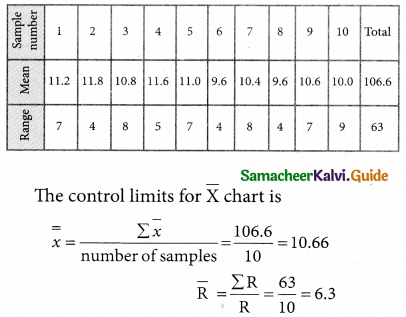
Ethylene Acetaldehyde

(4) Instead of petrol, methanol is used as a fuel in automobiles:

Methanol is considered to be less expensive than other commercial fuel and gasoline. During the process of combustion, it provides a higher thermal efficiency and power output because of its high octane rating and high heat vapourization.

(5) Neem based pesticides have been synthesised, which are more safer than the chlorinated hydrocarbons:

Every individual has an important role for preventing pollution and improving our environment. We Eire responsible for environmental protection. Let us begin to save our environment and provide a clean earth for our future generations.

Samacheer Kalvi 12th Business Maths Guide Chapter 9 Applied Statistics Miscellaneous Problems

Tamilnadu State Board New Syllabus Samacheer Kalvi 12th Business Maths Guide Pdf Chapter 9 Applied Statistics Miscellaneous Problems Text Book Back Questions and Answers, Notes.

Tamilnadu Samacheer Kalvi 12th Business Maths Solutions Chapter 9 Applied Statistics Miscellaneous Problems

Question 1.
Using three yearly moving averages, Determine the trend values from the following data.
Samacheer Kalvi 12th Business Maths Guide Chapter 9 Applied Statistics Miscellaneous Problems 1
Solution:
Samacheer Kalvi 12th Business Maths Guide Chapter 9 Applied Statistics Miscellaneous Problems 2

Samacheer Kalvi 12th Business Maths Guide Chapter 9 Applied Statistics Miscellaneous Problems

Question 2.
From the following data, calculate the trend values using fourly moving averages.
Samacheer Kalvi 12th Business Maths Guide Chapter 9 Applied Statistics Miscellaneous Problems 3
Solution:
Samacheer Kalvi 12th Business Maths Guide Chapter 9 Applied Statistics Miscellaneous Problems 4

Question 3.
Fit a straight line trend by the method of least squares to the following data.
Samacheer Kalvi 12th Business Maths Guide Chapter 9 Applied Statistics Miscellaneous Problems 5
Solution:
Samacheer Kalvi 12th Business Maths Guide Chapter 9 Applied Statistics Miscellaneous Problems 6
Therefore, the required equation of the straight line trend is given by
y = a + bx
y = 55.9875 + 0.830 x
⇒ y = 55.9875 + 0.83 (\(\frac { x-1983.5 }{0.5}\))
The trend values can be obtained by
When x = 1980
y = 55.9875 + 0.83 (\(\frac { 1980-1983.5 }{0.5}\))
= 55.9875 + 0.83 (-7)
= 55.9875 – 5.81
= 50.1775
When x = 1981
y = 55.9875 + 0.83 (\(\frac { 1981-1983.5 }{0.5}\))
= 55.9875 + 0.83 (-5)
= 55.9875 – 4.15
= 51.8375
When x = 1982
y = 55.9875 + 0.83 (\(\frac { 1981-1983.5 }{0.5}\))
= 55.9875 + 0.83 (-3)
= 55.9875 – 2.49
= 53.4975
When x = 1983
y = 55.9875 + 0.83 (\(\frac { 1983-1983.5 }{0.5}\))
= 55.9875 + 0.83 (-1)
= 55.9875 – 0.83
= 55.1575
When x = 1984
y = 55.9875 + 0.83 (\(\frac { 1984-1983.5 }{0.5}\))
55.9875 + 0.83 (1)
= 56.8175
when x = 1985
y = 55.9875 + 0.83 (\(\frac { 1985-1983.5 }{0.5}\))
= 55.9875 + 0.83 (3)
= 55.9875 + 2.49
= 58.4775
when x = 1986
y = 55.9875 + 0.83 (\(\frac { 1986-1983.5 }{0.5}\))
= 55.9875 + 0.83 (5)
= 55.9875 + 4.15
= 60.1375
when x = 1987
y = 55.9875 + 0.83 (\(\frac { 1987-1983.5 }{0.5}\))
= 55.9875 + 0.83 (7)
= 55.9875 + 5.81
= 61.7975

Samacheer Kalvi 12th Business Maths Guide Chapter 9 Applied Statistics Miscellaneous Problems

Question 4.
Fit a straight line trend by the method of least squares to the following data.
Samacheer Kalvi 12th Business Maths Guide Chapter 9 Applied Statistics Miscellaneous Problems 7
Solution:
Samacheer Kalvi 12th Business Maths Guide Chapter 9 Applied Statistics Miscellaneous Problems 8
Lasperyre’s price Index number
Samacheer Kalvi 12th Business Maths Guide Chapter 9 Applied Statistics Miscellaneous Problems 9
Samacheer Kalvi 12th Business Maths Guide Chapter 9 Applied Statistics Miscellaneous Problems 10
Hence Fisher’s Ideal Index satisfies Time reversal test

Samacheer Kalvi 12th Business Maths Guide Chapter 9 Applied Statistics Miscellaneous Problems

Question 5.
Using the following data, construct Fisher’s Ideal Index Number and Show that it satisfies Factor Reversal Test and Time Reversal Test?
Samacheer Kalvi 12th Business Maths Guide Chapter 9 Applied Statistics Miscellaneous Problems 11
Solution:
Samacheer Kalvi 12th Business Maths Guide Chapter 9 Applied Statistics Miscellaneous Problems 12
Factor reversal test
Samacheer Kalvi 12th Business Maths Guide Chapter 9 Applied Statistics Miscellaneous Problems 13
Hence Fisher’s Ideal Index satisfies Factor reversal test.

Question 6.
Compute the consumer price index for 2015 on the basis of 2014 from the following data.
Samacheer Kalvi 12th Business Maths Guide Chapter 9 Applied Statistics Miscellaneous Problems 14
Solution:
Samacheer Kalvi 12th Business Maths Guide Chapter 9 Applied Statistics Miscellaneous Problems 15

Samacheer Kalvi 12th Business Maths Guide Chapter 9 Applied Statistics Miscellaneous Problems

Question 7.
An Enquiry was made into the budgets of the middle class families in a city gave the following information.
Samacheer Kalvi 12th Business Maths Guide Chapter 9 Applied Statistics Miscellaneous Problems 16
What changes in the cost of living have taken place in the middle class families of a city?
Solution:
Samacheer Kalvi 12th Business Maths Guide Chapter 9 Applied Statistics Miscellaneous Problems 17
Conclusion:
The cost of living has increased up to 26.10% in 2011 as compared to 2010.

Question 8.
From the following data, calculate the control limits for the mean and range chart.
Samacheer Kalvi 12th Business Maths Guide Chapter 9 Applied Statistics Miscellaneous Problems 18
Solution:
Samacheer Kalvi 12th Business Maths Guide Chapter 9 Applied Statistics Miscellaneous Problems 19
UCL = \(\bar { \bar x}\) + A2\(\bar { R}\)
= 51 + 0.577(6.5)
= 51 + 3.7505
= 54.7505
= 54.75
CL = \(\bar { \bar x}\) = 51
UCL = \(\bar { \bar x}\) – A2\(\bar { R}\)
= 51 – 0.577(6.5)
= 51 – 3.7505
= 47.2495
= 47.25
The control limits for Range chart is
UCL = D4\(\bar { R}\)
= 2.114(6.5)
= 13.741
CL = \(\bar { R}\) = 6.5
LCL = D3\(\bar { R}\) = 0(6.5) = 0

Samacheer Kalvi 12th Business Maths Guide Chapter 9 Applied Statistics Miscellaneous Problems

Question 9.
The following data gives the average life(in hours) and range of 12 samples of 5 lamps each. The data are
Samacheer Kalvi 12th Business Maths Guide Chapter 9 Applied Statistics Miscellaneous Problems 20
Construct control charts for mean and range Comment on the control limits.
Solution:
Samacheer Kalvi 12th Business Maths Guide Chapter 9 Applied Statistics Miscellaneous Problems 21
UCL = \(\bar { \bar x}\) + A2\(\bar { R}\)
= 1367.5 + 0.577(427.5)
= 1367.5 + 246.6675
= 1614.1675
= 1614.17
CL = \(\bar { \bar x}\) = 1367.5
LCL = \(\bar { \bar x}\) + A2\(\bar { R}\)
= 1367.5 – 0.577(427.5)
= 1367.5 – 246.6675
= 1120.8325
= 1120.83
The control limits for Range chart is
UCL = D4\(\bar { R}\)
= 2.115(427.5)
= 904.1625
= 904.16
CL = \(\bar { R}\) = 427.5
LCL = D3\(\bar { R}\)
= 0(427.5)
= 0

Question 10.
The following are the sample means and I ranges for 10 samples, each of size 5. Calculate ; the control limits for the mean chart and range chart and state whether the process is in control or not.
Samacheer Kalvi 12th Business Maths Guide Chapter 9 Applied Statistics Miscellaneous Problems 22
Solution:
Samacheer Kalvi 12th Business Maths Guide Chapter 9 Applied Statistics Miscellaneous Problems 23
UCL = \(\bar { \bar x}\) + A2\(\bar { R}\)
= 4.982 + 0.577(0.36)
= 4.982 + 0.20772
= 5.18972
= 5.19
CL = \(\bar { \bar x}\) = 4.982
LCL = \(\bar { \bar x}\) + A2\(\bar { R}\)
= 4.982 – 0.577(0.36)
= 4.982 – 0.20772
= 4.77428
= 4.774
The control limits for range chart is
UCL = D2\(\bar { R}\) = 2.115(3.6)
= 7.614
CL = \(\bar { R}\) = 3.6
LCL = D3\(\bar { R}\)
= 0(0.36) = 0

Samacheer Kalvi 12th Business Maths Guide Chapter 9 Applied Statistics Miscellaneous Problems

Samacheer Kalvi 12th Business Maths Guide Chapter 9 Applied Statistics Ex 9.4

Tamilnadu State Board New Syllabus Samacheer Kalvi 12th Business Maths Guide Pdf Chapter 9 Applied Statistics Ex 9.4 Text Book Back Questions and Answers, Notes.

Tamilnadu Samacheer Kalvi 12th Business Maths Solutions Chapter 9 Applied Statistics Ex 9.4

Question 1.
A time series is a set of data recorded
(a) Periodically
(b) Weekly
(c) successive points of time
(d) all the above
Solution:
(d) all the above

Samacheer Kalvi 12th Business Maths Guide Chapter 9 Applied Statistics Ex 9.4

Question 2.
A time series consists of
(a) Five components
(b) Four components
(c) Three components
(d) Two components
Solution:
(b) Four components

Question 3.
The components of a time series which is attached to short term fluctuation is
(a) Secular trend
(b) Seasonal variations
(c) Cyclic variation
(d) Irregular variation
Solution:
(d) Irregular variation

Question 4.
Factors responsible for seasonal variations are
(a) Weather
(b) Festivals
(c) Social customs
(d) All the above
Solution:
(d) All the above

Question 5.
The additive model of the time series with the components T, S, C and I is
(a) y = T + S + C × I
(b) y = T + S × C × I
(c) y = T + S + C + I
(d) y = T + S × C + I
Solution:
(c) y = T + S + C + I

Question 6.
Least square method of fitting a trend is
(a) Most exact
(b) Least exact
(c) Full of subjectivity
(d) Mathematically unsolved
Solution:
(a) Most exact

Question 7.
The value of ‘b’ in the trend line y = a + bx is
(a) Always positive
(b) Always negative
(c) Either positive or negative
(d) Zero
Solution:
(c) Either positive or negative

Samacheer Kalvi 12th Business Maths Guide Chapter 9 Applied Statistics Ex 9.4

Question 8.
The component of a time series attached to long term variation is trended as
(a) Cyclic variation
(b) Secular variations
(c) Irregular variation
(d) Seasonal variations
Solution:
(b) Secular variations

Question 9.
The seasonal variation means the variations occurring with in
(a) A number of years
(b) within a year
(c) within a month
(d) within a week
Solution:
(b) within a year

Question 10.
Another name of consumer’s price index number is:
(a) Whole-sale price index number
(b) Cost of living index
(c) Sensitive
(d) Composite
Solution:
(b) Cost of living index

Question 11.
Cost of living at two different cities can be compared with the help of
(a) Consumer price index
(b) Value index
(c) Volume index
(d) Un-weighted index
Solution:
(a) Consumer price index

Question 12.
Laspeyre’s index = 110, Paasche’s index = 108, then Fisher’s Ideal index is equal to:
(a) 110
(b)108
(c) 100
(d) 109
Solution:
(d) 109
Hint:
01 = 110; pp01 = 108
Fisher’s Ideal Index = \(\sqrt { 110×108 }\) = \(\sqrt { 11880 }\) = 108.99 = 109

Question 13.
Most commonly used index number is:
(a) Volume index number
(b) Value index number
(c) Price index number
(d) Simple index number
Solution:
(c) Price index number

Samacheer Kalvi 12th Business Maths Guide Chapter 9 Applied Statistics Ex 9.4

Question 14.
Consumer price index are obtained by:
(a) Paasche’s formula
(b) Fisher’s ideal formula
(c) Marshall Edgeworth formula
(d) Family budget method formula
Solution:
(d) Family budget method formula

Question 15.
Which of the following Index number satisfy the time reversal test?
(a) Laspeyre’s Index number
(b) Paasche’s Index number
(c) Fisher Index number
(d) All of them.
Solution:
(c) Fisher Index number

Question 16.
While computing a weighted index, the current period quantities are used in the:
(a) Laspeyre’s method
(b) Paasche’s method
(c) Marshall Edgeworth method
(d) Fisher’s ideal method
Solution:
(b) Paasche’s method

Question 17.
The quantities that can be numerically measured can be plotted on a
(a) p – chart
(b) c – chart
(c) x bar chart
(d) np – chart
Solution:
(c) x bar chart

Samacheer Kalvi 12th Business Maths Guide Chapter 9 Applied Statistics Ex 9.4

Question 18.
How many causes of variation will affect the quality of a product?
(a) 4
(b) 3
(c) 2
(d) 1
Solution:
(c) 2

Question 19.
Variations due to natural disorder is known as
(a) random cause
(b) non-random cause
(c) human cause
(d) all of them
Solution:
(a) random cause

Question 20.
The assignable causes can occur due to
(a) poor raw materials
(b) unskilled labour
(c) faulty machines
(d) all of them
Solution:
(d) all of them

Question 21.
A typical control charts consists of
(a) CL, UCL
(b) CL, LCL
(c) CL, LCL, UCL
(d) UCL, LCL
Solution:
(c) CL, LCL, UCL

Question 22.
\(\bar { x}\) chart is a
(a) attribute control chart
(b) variable control chart
(c) neither Attribute nor variable control chart
(d) both Attribute and variable control chart
Solution:
(b) variable control chart

Samacheer Kalvi 12th Business Maths Guide Chapter 9 Applied Statistics Ex 9.4

Question 23.
R is calculated using
(a) xmax – xmin
(b) xmin – xmax
(c) \(\bar { x}\)max – \(\bar { x}\)min
(d) \(\bar {\bar x}\)max – \(\bar {\bar x}\)min
Solution:
(a) xmax – xmin

Question 24.
The upper control limit for x chart is given by
(a) \(\bar { x}\) + A2\(\bar { R}\)
(b) \(\bar {\bar x}\) + A2R
(c) \(\bar {\bar x}\) + A2\(\bar { R}\)
(d) \(\bar { x}\) + A2\(\bar {\bar R}\)
Solution:
(c) \(\bar {\bar x}\) + A2\(\bar { R}\)

Question 25.
The LCL for R chart is given by
(a) D2\(\bar { x}\)
(b) D2\(\bar {\bar R}\)
(c) D3\(\bar {\bar R}\)
(d) D3\(\bar { x}\)
Solution:
(d) D3\(\bar { x}\)

Samacheer Kalvi 12th Business Maths Guide Chapter 9 Applied Statistics Ex 9.4

Samacheer Kalvi 12th Business Maths Guide Chapter 9 Applied Statistics Ex 9.3

Tamilnadu State Board New Syllabus Samacheer Kalvi 12th Business Maths Guide Pdf Chapter 9 Applied Statistics Ex 9.3 Text Book Back Questions and Answers, Notes.

Tamilnadu Samacheer Kalvi 12th Business Maths Solutions Chapter 9 Applied Statistics Ex 9.3

Question 1.
Define Statistical Quality Control.
Solution:
The term Quality means a level or standard of a product which depends Material, Manpower, Machines, and Management (4M’s). Quality Control ensures the quality specifications all along them from the arrival of raw materials through each of their processing to the final delivery of goods. Quality Control is a powerful technique used to diagnose the lack of quality in any of the raw materials, processes, machines etc. It is essential that the end products should possess the qualities that the consumer expects from the manufacturer.

Samacheer Kalvi 12th Business Maths Guide Chapter 9 Applied Statistics Ex 9.3

Question 2.
Mention the types of causes for variation in a production process.
Solution:
There are two causes of variation which affects the quality of a product, namely
1. Chance Causes (or) Random causes
2. Assignable Causes

Question 3.
Define Chance Cause.
Solution:
These are small variations which are natural and inherent in the manufacturing process. The variation occurring due to these causes is beyond the human control and cannot be prevented or eliminated under any circumstances, the minor causes which do not affect the quality of the products to an extent are called as Chance Causes (or) Random causes. For example Rain, floods, power cuts, etc.,

Question 4.
Define Assignable cause.
Solution:
The second type of variation which is present in any production process is due to non-random causes. The assignable causes may occur in at any stage of the process, right from the arrival of the raw materials to the final delivery of the product. Some of the important factors of assignable causes are defective raw materials, fault in machines, unskilled manpower, worn out tools, new operation, etc.

Question 5.
What do you mean by product control?
Solution:
Product Control means that controlling the quality of the product by critical examination through sampling inspection plans. Product Control aims at a certain quality level to be guaranteed to the customers. It attempts to ensure that the product sold does not contain a large number of defective items. Thus it is concerned with classification of raw materials, semi-finished goods or finished goods into acceptable on rejectable products.

Question 6.
What do you mean by process control?
Solution:
In Process Control the proportion of defective items in the production process is to be minimized and it is achieved through the technique of control charts.

Samacheer Kalvi 12th Business Maths Guide Chapter 9 Applied Statistics Ex 9.3

Question 7.
Define a control chart.
Solution:
A control chart is essentially a graphic device for presenting data so as to directly reveal the frequency and extent of variations from established standards or goals. Control charts are simple to construct and easy to interpret and they tell the manager at a glance whether or not the process is in control, i.e within the tolerance limits.

Question 8.
Name the control charts for variables.
Solution:
(i) Charts for mean (\(\bar { X}\))
(ii) Charts for Range (R)

Question 9.
Define mean chart.
Solution:
The mean chart (\(\bar { X}\) chart) is used to show, the quality average of the samples taken from the given process. The \(\bar { X}\) charts are usually required for decision making to accept or reject the process.
Procedure for \(\bar { X}\)
i. Let X1, X2, X3, etc. be the samples selected each containing “n” observations usually (n = 4.5 or 6)

ii. Calculate mean for each samples \(\bar { X}\)1, \(\bar { X}\)2, \(\bar { X}\)3, ……… by using \(\bar { X}\)i = \(\frac { ΣX_i }{n}\), i = 1, 2, 3, 4, ….
where Σxi = total f “n” values included in the sample X1.

iii. Find the mean (\(\bar { \bar X}\)) of the sample means
\(\bar { \bar X}\) = \(\frac { Σ \bar X }{number of samples}\)
where Σ\(\bar { X}\) = total of all the sample means.

Question 10.
Define R chart.
Solution:
The R chart is used to show the variability or dispersion of the samples taken from the given process. R charts are also required for decision making to accept of reject the process.
Procedure for R-Charts
Calculate R = Xmax – Xmin
Let R1, R2, R3 ………….. be the ranges of the “n” samples. The average range is given by
\(\bar { X}\) = \(\frac { ΣR }{n}\)

Question 11.
What are the uses of statistical quality control?
Solution:
(i) The role of statistical quality control is to collect and analyse relevant data for the purpose of detecting whether the process is under control or not.
(ii) The value of quality control lies in the fact that assignable causes in a process can be quickly detected. Infact the variations are often discovered before the product becomes defective.
(iii) Statistical quality control is only diagnostic. It tells us whether the standard is being maintained or not.
(iv) This technique is used in almost all production industries such as automobile textile, electrical equipment, biscuits, both soaps, chemicals, Petroleum products, etc.
(v) The purpose for which SQC are used in two fold namely (a) process control (b) product control.
The main purpose of SQC is to device statistical techniques which would help in elimination of assignable causes and bring the production process under control.

Samacheer Kalvi 12th Business Maths Guide Chapter 9 Applied Statistics Ex 9.3

Question 12.
Write the control limits for the mean chart.
Solution:
The calculation of control limits for x chart in two different cases is
Samacheer Kalvi 12th Business Maths Guide Chapter 9 Applied Statistics Ex 9.3 1

Question 13.
Write the control limits for the R chart.
Solution:
The calculation of control limits for R chart in two different cases are
Samacheer Kalvi 12th Business Maths Guide Chapter 9 Applied Statistics Ex 9.3 2
The values of A2, D2 and D4 are given in the table.

Question 14.
A machine is set to deliver packets of a given j weight. Ten samples of size five each were recorded. Below are given relevant data:
Samacheer Kalvi 12th Business Maths Guide Chapter 9 Applied Statistics Ex 9.3 3
Solution:
Calculate the control limits for mean chart and the range chart and then comment on the state of control, (conversion factors for n = 5, A2 = 0.58, D3 = 0 and D4 = 2.115)
Samacheer Kalvi 12th Business Maths Guide Chapter 9 Applied Statistics Ex 9.3 4
UCL = \(\bar { \bar X}\) + A2 \(\bar { R}\)
= 16.2 + (0.58)(7.4)
= 16.2 + 4.292
= 20.492
= 20.49
CL = \(\bar { \bar X}\) = 16.2
LCL = \(\bar { \bar X}\) – A2 \(\bar { R}\)
= 16.2 – (0.58) (7.4)
= 16.2 – 4.292
= 11.908
= 11.91
The control limits for Range chart is
UCL = D4 \(\bar { R}\)
= (2.115)(7.4)
= 15.651
= 15.65
CL = \(\bar { R}\) = 7.4
LCL = D3 \(\bar { R}\) = (0)(7.4) = 0

Question 15.
Ten samples each of size five are difawn at regular intervals from a manufacturing process. The sample means (X) and their ranges (R) are given below:
Samacheer Kalvi 12th Business Maths Guide Chapter 9 Applied Statistics Ex 9.3 5
Calculate the control limits in respect of \(\bar { X}\) chart. (Given A2 = 0.58, D3 = 0 and D4 = 2.115 ) Comment on the state of control.
Solution:
Samacheer Kalvi 12th Business Maths Guide Chapter 9 Applied Statistics Ex 9.3 6
UCL = \(\bar { \bar X}\) + A2 \(\bar { R}\)
= 46.2 + (0.58)(6.8)
= 46.2 + 3.944
= 50.144
= 50.14
CL = \(\bar { \bar X}\) = 46.2
LCL = \(\bar { \bar X}\) + A2 \(\bar { R}\)
= 46.2 – (0.58)(6.8)
= 46.2 – 3.944
= 42.256
= 42.26
The control limits for Range chart is
UCL = D4 \(\bar { R}\)
= (2.115)(6.8)
= 14.382
= 14.38
CL = \(\bar { R}\) = 6.8
LCL = D3\(\bar { R}\) = (0)(6.8) = 0

Samacheer Kalvi 12th Business Maths Guide Chapter 9 Applied Statistics Ex 9.3

Question 16.
Construct X and R charts for the following data:
Samacheer Kalvi 12th Business Maths Guide Chapter 9 Applied Statistics Ex 9.3 7
Solution:
Samacheer Kalvi 12th Business Maths Guide Chapter 9 Applied Statistics Ex 9.3 8
Samacheer Kalvi 12th Business Maths Guide Chapter 9 Applied Statistics Ex 9.3 9
\(\bar { R}\) = \(\frac { 144 }{8}\) = 18
UCL = \(\bar { \bar x}\) + A2 \(\bar { R}\)
= 37.71 + (0.58)(18)
= 37.71 + 10.44
= 48.15
CL = \(\bar { \bar x}\) = 37.71
LCL = \(\bar { \bar x}\) – A2 \(\bar { R}\)
= 37.71 – (0.58)(18)
= 37.71 – 10.44
= 27.27
The control limits for Range chart is
UCL = D4 \(\bar { R}\) = 2.115 (18) = 38.07
CL = \(\bar { R}\) = 18
LCL = D3 \(\bar { R}\) = 0(18) = 0

Question 17.
The following data show the values of sample mean (\(\bar {x}\)) and its range (R) for the samples of size five each. Calculate the values for control limits for mean, range chart and determine whether the process is in control.
Samacheer Kalvi 12th Business Maths Guide Chapter 9 Applied Statistics Ex 9.3 10
Solution:
Samacheer Kalvi 12th Business Maths Guide Chapter 9 Applied Statistics Ex 9.3 11
UCL = \(\bar { \bar x}\) – A2 \(\bar { R}\)
= 10.66 + (0.58)(6.3)
= 10.66 + 3.654 = 14.314
= 14.31
CL = \(\bar { \bar x}\) = 10.66
LCL = \(\bar { \bar x}\) – A2 \(\bar { R}\)
= 10.66 – (0.58)(6.3)
= 10.66 – 3.654
= 7.006
The control limits for Range chart is
UCL = D4 \(\bar { R}\) = 2.115 (6.3)
= 13.3245
= 13.32
CL = \(\bar { R}\) = 6.3
LCL = D3 \(\bar { R}\) = 0(6.3) = 0
Conclusion: Since all the points of sample range is within UCL of R chart, the process is in control.

Question 18.
A quality control inspector has taken ten ” samples of size four packets each from a potato chips company. The contents of the sample are given below, Calculate the control limits for mean and range chart.
Samacheer Kalvi 12th Business Maths Guide Chapter 9 Applied Statistics Ex 9.3 12
(Given for n = 5, A2 = 0.58, D3 = 0 and D4 = 2.115)
Solution:
Samacheer Kalvi 12th Business Maths Guide Chapter 9 Applied Statistics Ex 9.3 13
UCL = \(\bar { \bar X}\) – A2 \(\bar { R}\)
= 12.5 + (0.58)(0.37)
= 12.5 + 0.2146 = 12.7146
= 12.71
CL = \(\bar { \bar X}\) = 12.5
LCL = \(\bar { \bar X}\) – A2 \(\bar { R}\) = 12.5 – (0.58) (0.37)
= 12.5 – 0.2146 = 12.2854
= 12.29
The control limits for Range chart is
UCL = D4 \(\bar { R}\) = (2.115)(0.37) = 0.78255
= 0.78
CL = \(\bar { R}\) = 0.37
LCL = D3\(\bar { R}\) = (0)(0.37) = 0

Samacheer Kalvi 12th Business Maths Guide Chapter 9 Applied Statistics Ex 9.3

Question 19.
The following data show the values of sample means and the ranges for ten samples of size 4 each. Construct the control chart for mean and range chart and determine whether the process is in control.
Samacheer Kalvi 12th Business Maths Guide Chapter 9 Applied Statistics Ex 9.3 14
Solution:
Samacheer Kalvi 12th Business Maths Guide Chapter 9 Applied Statistics Ex 9.3 15
UCL = \(\bar { \bar X}\) – A2 \(\bar { R}\)
= 30.1 +(0.73)(20.1)
= 30.1 + 14.673 = 44.773
= 44.77
CL = \(\bar { \bar X}\) = 30.1
LCL = \(\bar { \bar X}\) – A2 \(\bar { R}\)
= 30.1 – (0.73) (20.1)
= 30.1 – 14.673 = 15.427
= 15.43
The control limits for Range chart is
UCL = D4 \(\bar { R}\)
= 2.28(20.1) = 45.828
= 45.83
CL = \(\bar { R}\) = 20.1
LCL = D3 \(\bar { R}\) = 0(20.1) = 0

Question 20.
In a production process, eight samples of size 4 are collected and their means and ranges are given below. Construct mean chart and range chart with control limits.
Samacheer Kalvi 12th Business Maths Guide Chapter 9 Applied Statistics Ex 9.3 16
Solution:
Samacheer Kalvi 12th Business Maths Guide Chapter 9 Applied Statistics Ex 9.3 17
UCL = \(\bar { \bar X}\) – A2 \(\bar { R}\)
= 13.25 + (0.73) (3.12)
= 13.25 + 2.2776 = 15.5276
= 15.53
CL = \(\bar { \bar X}\) = 13.25
LCL = \(\bar { \bar X}\) – A2 \(\bar { R}\)
= 13.25 – (0.73)(3.12)
= 13.25 – 2.2776 = 10.972
= 10.97
The control limits for Range chart is
UCL = D4 \(\bar { R}\)
= 2.28(3.12) = 7.11984
= 7.12
CL = \(\bar { R}\) = 3.12
LCL = D3\(\bar { R}\) = 0(3.12) = 0

Samacheer Kalvi 12th Business Maths Guide Chapter 9 Applied Statistics Ex 9.3

Question 21.
In a certain bottling industry the quality control inspector recorded the weight of each of the 5 bottles selected at random during each hour of four hours in the morning.
Samacheer Kalvi 12th Business Maths Guide Chapter 9 Applied Statistics Ex 9.3 18
Solution:
Samacheer Kalvi 12th Business Maths Guide Chapter 9 Applied Statistics Ex 9.3 19
UCL = \(\bar { \bar X}\) – A2 \(\bar { R}\)
= 41 + (0.58)(4)
41 + 2.32 = 43.32
CL = \(\bar { \bar X}\) = 41
LCL = \(\bar { \bar X}\) – A2 \(\bar { R}\)
= 41 – (0.58)(4)
= 41 – 2.32
= 38.68
The control limits for range chart is
UCL = D4 \(\bar { R}\) = 2.115(4)
= 8.46
CL = \(\bar { R}\) = 4
LCL = D2 \(\bar { R}\) = 0(4) = 0
Conclusion: Since all the points of sample mean and Range are within the control limits, the process is in control.