TN Board 12th Commerce Important Questions Chapter 10 Recruitment Methods

Students get through the TN Board 12th Commerce Important Questions Chapter 10 Recruitment Methods which is useful for their exam preparation.

TN State Board 12th Commerce Important Questions Chapter 10 Recruitment Methods

Very short answer questions

Question 1.
Define “Recruitment”.
Answer:
According to Edwin B.Flippo, “It is a process of searching for prospective employees and stimulating and encouraging them to apply for jobs in an organization.

Question 2.
Explain – Word of mouth.
Answer:
The information relating to job seekers is collected through people of repute who pass on the message about the vacancy to their known people.

TN Board 12th Commerce Important Questions Chapter 10 Recruitment Methods

Question 3.
What is Retention?
Answer:
The retiring employees can be used to meet the requirement after superannuation as per management discretion.

Question 4.
What do you mean by Job Portals?
Answer:
Using internet job portals organizations can screen for prospective candidates and fill up their vacancies.

Question 5.
Give a short note on Deputation.
Answer:
A person who is already an employee of an organization can be deputed for a specific job for a specified period as a short-term solution.

Question 6.
Define – “Outsourcing”.
Answer:
The process of recruiting through screening of applications and finding the right person for the job for which job they are paid service charges (Outsourcing firms).

Question 7.
Mention the source of Recruitment.
Answer:
There are basically two ways by which an organization can recruit its employees namely

  1. Internal sources
  2. External sources
    External sources can further be classified into Direct and Indirect sources.

TN Board 12th Commerce Important Questions Chapter 10 Recruitment Methods

Question 8.
How to transfer the employee to an organization?
Answer:
Transfer of an employee from one department with surplus staff to that of another with the deficit staff.

Question 9.
List out the internal sources of Recruitment.
Answer:

  1. Transfer
  2. Upgrading
  3. Promotion
  4. Job rotation
  5. Dependants
  6. Previous applicants
  7. Retired employees
  8. Acquisitions and Mergers.

Question 10.
Mention the recent trends in Recruitment.
Answer:
The recent methods of recruiting by organizations include the following methods

  1. Outsourcing
  2. Poaching

Short answer questions

Question 1.
What are the reasons behind Recruitment?
Answer:
There are different reasons why vacancy arises and they are:

  1. Retirement of an employee
  2. Death of an employee
  3. Resignation of Job by an employee
  4. Disablement of an employee
  5. Dismissal of an employee

TN Board 12th Commerce Important Questions Chapter 10 Recruitment Methods

Question 2.
Write a short note about Employment Exchange.
Answer:

  1. These are exchanges established by Government that facilitates recruitment throughout the country.
  2. It makes available information required through the database for the employer as well as the job seeker.
  3. By bridging the gap between the employer as well as the job seeker.

Question 3.
Write about “e-Recruitment”.
Answer:

  1. The organization that carry out recruitment online method is said to follow e-Recruitment.
  2. The advancement in technology and communication has made it possible to reach out to prospective applicants globally online.
  3. It has become an inevitable external source of recruitment.

Long answer questions

Question 1.
Differentiate Employment Consultancies and Professional Associations.
Answer:
Employment Consultancies:

  1. These types of firms facilitate recruitment on behalf of client companies at cost.
  2. They have provided data relating to executive and top-level personnel.
  3. Service they charge consultation fees also known as Recruitment Process Outsourcing.

Professional Associates:

  1. An organization seeking applicants of high caliber and repute with a technical knowledge approach.
  2. Professional associations like Institute of Chartered Accountants, The Indian Medical Associations, All India Management Associations, The Institute of Training and Development.
  3. These Associations identify the right person.

TN Board 12th Commerce Important Questions Chapter 10 Recruitment Methods

Question 2.
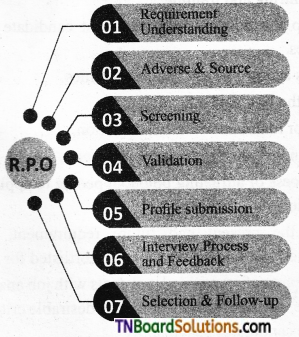
Write about the Recruitment Process Outsourcing with the help of Drawing.
Answer:

  1. Outsourcing: There are outsourcing firms that help in the process of recruiting through screening of applications and finding the right persons for the job for which job they are paid service charges.
  2. Recruitment Process Outsourcing:
    TN Board 12th Commerce Important Questions Chapter 10 Recruitment Methods 1

Multiple-choice questions

1. The process of attracting potential people to apply for a job in an organization:
(a) Selection
(b) Recruitment
(c) Human Resource
(d) None
Answer:
(b) Recruitment

2. …….. act as a link between Job Provider and Job Seeker.
(a) Human Resource
(b) Organisation
(c) Placement
(d) Recruitment
Answer:
(d) Recruitment

TN Board 12th Commerce Important Questions Chapter 10 Recruitment Methods

3. ……….. helps in the process of moving employees from a lower position to a higher position.
(a) Appraisal
(b) Skill
(c) Knowledge
(d) All the above
Answer:
(a) Appraisal

4. Movement of an employee from a higher position to a lower position because of poor performance is known as:
(a) Dependants
(b) Demotion
(c) Retention
(d) Job rotation
Answer:
(b) Demotion

5. The organization visits the educational institutions to recruit suitable candidates is known as:
(a) Word of Mouth
(b) Campus
(c) Job Portals
(d) None
Answer:
(b) Campus

6. Exchanges established by Government that facilitates recruitment throughout the country:
(a) Employment Exchange
(b) Employment Consultancies
(c) Professional Association
(d) Word of Mouth
Answer:
(a) Employment Exchange

TN Board 12th Commerce Important Questions Chapter 10 Recruitment Methods

7. How an organisation can screen for suitable candidates in the Job Portal?
(a) Internet
(b) Online
(c) Message
(d) None
Answer:
(a) Internet

8. Organisation seeking applicants of high caliber and repute with technical knowledge approach is known as:
(a) Employment referral
(b) Employment Consultancies
(c) Professional Associates
(d) Employment Exchange
Answer:
(c) Professional Associates

9. “Right Person for the Job” for which job they are paid service charges:
(a) Outsourcing
(b) Word of mouth
(c) e-Recruitment
(d) None
Answer:
(a) Outsourcing

10. The organization that carry out recruitment online methods is said to follow recruitment:
(a) e-Recruitment
(b) Campus
(c) Professional Association
(d) All the above
Answer:
(a) e-Recruitment

11. Why vacancy arises? Find out the reasons?
(a) Death
(b) Retirement
(c) Resignation
(d) All the above
Answer:
(d) All the above

TN Board 12th Commerce Important Questions Chapter 10 Recruitment Methods

12. How many ways by which an organization can recruit its employee?
(a) 4
(b) 2
(c) 6
(d) 3
Answer:
(b) 2

13. Applicants with suitable qualification requirement can be known as:
(a) Advertisement
(b) Walk-in
(c) Campus
(d) None
Answer:
(b) Walk-in

14. Give examples for Rival firms:
(a) Chartered Accounts
(b) Salesman
(c) Both (a) and (b)
(d) None
Answer:
(c) Both (a) and (b)

TN Board 12th Commerce Important Questions Chapter 10 Recruitment Methods

15. Advancement in Technology and communication to reach out to prospective application globally through:
(a) Online
(b) Advertisement
(c) Journals
(d) Magazines
Answer:
(a) Online

TN Board 12th Commerce Important Questions Chapter 9 Fundamentals of Human Resource Management

Students get through the TN Board 12th Commerce Important Questions Chapter 9 Fundamentals of Human Resource Management which is useful for their exam preparation.

TN State Board 12th Commerce Important Questions Chapter 9 Fundamentals of Human Resource Management

Very short answer questions

Question 1.
Give the meaning of Human Resource Management.
Answer:
Human Resource Management is a function of management concerned with hiring, motivating and maintaining people in an organization. It focuses on people in an organization. The branch of management that deals with managing human resource is known as human resource management.

Question 2.
List out the operating functions of Human Resource Management. Operating functions:
Answer:

  1. Procurement
  2. Development
  3. Compensation
  4. Retention
  5. Integration
  6. Maintenance

TN Board 12th Commerce Important Questions Chapter 9 Fundamentals of Human Resource Management

Question 3.
Define planning.
Answer:
Planning is deciding in advance what to do, how to do and who is to do it. It helps in the systematic operations of the business. It involves determining objectives, policies procedures, rules strategies, programmes and budgets.

Question 4.
How to select the right man for the right job?
Answer:

  1. Human resource management ensures the right talent available for the right job.
  2. To enable the employees to remain up-to-date through training and development programmes.
  3. HRM plays a significant role in the process of employee skill and knowledge.

Question 5.
How to encourage the employees through HRM?
Answer:

  1. The role of HRM to recognize the best performers and to provide them with bonus and incentives (appreciation for their work).
  2. This motivation can be either financial or non-financial.

Question 6.
In what way organizing the employees through HRM?
Answer:

  1. Division of work among employees.
  2. By assigning each employee their duties, a delegation of authority as required and creation of accountability to make employees responsible.

Question 7.
What is the strategic role of HRM?
Answer:
The strategic role of human resource management is the process of acquiring training, appraising, compensating employees and attending to their labour relation, health, safety and fairness concerns.

TN Board 12th Commerce Important Questions Chapter 9 Fundamentals of Human Resource Management

Question 8.
Explain the control process.
Answer:
The control process includes fixing standards, measuring actual performance comparing actual with the standard laid down, measuring deviations and taking corrective actions. This is made possible through observation, supervision reports records and audit.

Short answer questions

Question 1.
Define the human resource.
Answer:

  1. In an organization, the human resource is the employees who are inevitable for the survival and success of the enterprise.
  2. Human resource created all other resources.
  3. As per the views of Michael J. Jucius Human resource is a “whole consisting of interrelated, interdependent and interacting physiological, sociological and ethical components ”.
  4. Human resources can be utilized at all levels of management.

Question 2.
State any two significance of Human Resource Management.
Answer:
To identify manpower needs:

  1. Determination of manpower needs in an organization is very important as it is a form of investment.
  2. The number of men required are to be identified accurately to optimize the cost

To update the skill and knowledge:

  1. Managing human resource plays a significant role in the process of employee skill and knowledge.
  2. It enables the employees to remain up to date through training and development programmes.

Question 3.
Give short notes on retention.
Answer:

  1. Retention is the operative function of HRM.
  2. This is made possible through health and safety, welfare, social security, job satisfaction and quality of work life.

TN Board 12th Commerce Important Questions Chapter 9 Fundamentals of Human Resource Management

Question 4.
How to maintain the employee in an organization?
Answer:

  1. To be ensured that they are comfortable in the workplace.
  2. By maintaining a cordial relationship with subordinates and managers so as to contribute maximum to the organization.
  3. To encourage employees to work with job satisfaction, reducing labour turnover, accounting for human resource and carrying out audit and research.

Long answer questions

Question 1.
Explain briefly the role of human resource as the most important element in any organization.
Answer:

  1. The success, growth and development of an organization depend on the quality of the workforce they possess. It is only through the human resource all other resources are actively utilized leading to effectively running an establishment.
  2. In an organization, the human resources are the employees who are inevitable for the survival and success of the enterprise.
  3. Human resource has to be appropriately placed and appreciated. Human resource created all other resources.
  4. These individuals acquired the required skill sets, talents, knowledge, competencies and capabilities in the accomplishment of both individuals and organizational objectives.
  5. Human resource can work as a team. It exhibits innovation and creativity. It can be utilized at all levels of management.
  6. Change has to be introduced in such a \^ay that the human resource management acts as an agent to make the change effective.
  7. Managing the human resource is to motivate, participate and co-ordinate the available workforce.
  8. HRM focuses on the development of manpower through training and development programmes. It will increase the effective use of the resource procured.
  9. Human relations are possible only through human resource.
  10. Industrial relations depend on human resource. The advent of globalization, liberalization and privatization leading to advancement in information, communication and technology paved the way for exhibiting a high level of innovation and creativity in human resources.

TN Board 12th Commerce Important Questions Chapter 9 Fundamentals of Human Resource Management

Question 2.
Differentiate directing from controlling.
Answer:
Directing:

  1. It involves the issue of orders and instruction.
  2. These orders along with supervision guidance and motivation to get the best out of employees.
  3. This reduces waste of time, energy and money and early attainment of organizational objectives.

Controlling:

  1. It is comparing the actual with the standards.
  2. To check whether activities are going on as per plan and rectify deviations.
  3. The control process includes
    (a) Fixing of standards
    (b) Measuring actual performance
    (c) Comparing actual with the standard laid down
    (d) Measuring deviations and
    (e) Taking corrective actions.
    This is made possible through observation, supervision, reports, records and audit.

Multiple-choice questions

1. Employees who are inevitable for the survival and success of the enterprise:
(a) Development
(b) Production
(c) Human resource
(d) Finance
Answer:
(c) Human resource

2. The behaviour of Human Resource are:
(a) Predictable
(b) Unpredictable
(c) Ethical
(d) Values
Answer:
(b) Unpredictable

3. Human resources can be improved through:
(a) Training
(b) Development
(c) Both (a) and (b)
(d) None
Answer:
(c) Both (a) and (b)

TN Board 12th Commerce Important Questions Chapter 9 Fundamentals of Human Resource Management

4. ………. created all other resources.
(a) Natural resources
(b) Human resources
(c) Workforce
(d) Skill
Answer:
(b) Human resources

5. Managing Human resource is known as:
(a) Innovation
(b) Human resources management
(c) Factors of production
(d) All the above
Answer:
(b) Human resources management

6. How many set of functions performed by human resources management?
(a) 2
(b) 6
(c) 4
(d) 7
Answer:
(a) 2

7. The function of human resource management concerned with:
(a) Hiring
(b) Motivating
(c) Maintaining people
(d) All the above
Answer:
(d) All the above

8. ………… is possible through the best utilization of Human resource in an
organization.
(a) Goals
(b) Motivation
(c) Skill
(d) None
Answer:
(c) Skill

9. The main idea behind managing the Human resource is to:
(a) Motivate
(b) Participate
(c) Co-ordinate
(d) All the above
Answer:
(d) All the above

TN Board 12th Commerce Important Questions Chapter 9 Fundamentals of Human Resource Management

10. Which one is helpful in the workforce to identify their level of performance?
(a) Motivation
(b) Skill
(c) Knowledge
(d) Appraisal
Answer:
(d) Appraisal

11. How to encourage the best performer in an organization?
(a) Bonus
(b) Incentives
(c) Both (a) and (b)
(d) None
Answer:
(c) Both (a) and (b)

12. ………. Helps in the systematic operation of the business.
(a) Planning
(b) Integration
(c) Directing
(d) Retention
Answer:
(a) Planning

13. Controlling is made possible through:
(a) Observation
(b) Supervision
(c) Reports
(d) All the above
Answer:
(d) All the above

14. Find out the control process?
(a) Actual performance
(b) Accounting
(c) Social security
(d) Welfare
Answer:
(a) Actual performance

TN Board 12th Commerce Important Questions Chapter 9 Fundamentals of Human Resource Management

15. Which function reduces waste of time and money to the attainment of organizational objectives?
(a) Controlling
(b) Directing
(c) Integration
(d) Retention
Answer:
(b) Directing

16. Bring about reconciliation between personal interest and organizational interest:
(a) Integration
(b) Retention
(c) Compensation
(d) Maintenance
Answer:
(a) Integration

17. Development includes:
(a) Training
(b) Career planning
(c) Appraisal
(d) All the above
Answer:
(d) All the above

18. It ensures maintenance of a correct number of employees to carry out activities:
(a) Planning
(b) Directing
(c) Controlling
(d) None
Answer:
(a) Planning

19. Find out the following, Human Resource Management process:
(a) Training
(b) Programme
(c) Factors
(d) None
Answer:
(a) Training

TN Board 12th Commerce Important Questions Chapter 9 Fundamentals of Human Resource Management

20. Human resources exhibits:
(a) Innovation
(b) Creativity
(c) Both (a) and (b)
(d) Values
Answer:
(c) Both (a) and (b)

TN Board 12th Commerce Important Questions Chapter 8 Securities Exchange Board of India (SEBI)

Students get through the TN Board 12th Commerce Important Questions Chapter 8 Securities Exchange Board of India (SEBI) which is useful for their exam preparation.

TN State Board 12th Commerce Important Questions Chapter 8 Securities Exchange Board of India (SEBI)

Very short answer questions

Question 1.
When was the SEBI established?
Answer:

  1. Securities and Exchange Board of India (SEBI) is an apex body that maintains and regulates our capital.
  2. It was established in 1988 by the Indian Government but got statutory powers in 1992.
  3. It plays a great role in the Indian economy.

Question 2.
How many key functions of SEBI.
Answer:
SEBI performs three key functions

  1. Quasi-legislative
  2. Quasi-judicial and
  3. Quasi-executive

TN Board 12th Commerce Important Questions Chapter 8 Securities Exchange Board of India (SEBI)

Question 3.
What is the power to regulate the business on the stock market?
Answer:

  1. Efficient services may be provided to all the parties.
  2. It drafts regulations, conducts investigation and enforcement action and it passes rulings and orders.
  3. Registration of brokers and sub-brokers is made mandatory.

Question 4.
How to control over Brokers by SEBI?
Answer:

  1. To supervise and check the activities of the brokers and other middlemen in order to control the capital market.
  2. To regulate their activities, it was necessary to establish the SEBI.

Question 5.
How to open a Demat Account?
Answer:

  1. Fill up an account opening form and submit it along with copies of the required documents
  2. A Passport-Sized Photograph
  3. Proof of Identity
  4. Proof of Address
    Also carry the original documents for verification.

TN Board 12th Commerce Important Questions Chapter 8 Securities Exchange Board of India (SEBI)

Question 6.
What is meant by “PAN”?
Answer:
PAN or Permanent Account Number is a unique 10-digit alphanumeric identity allotted to each taxpayer by the Income Tax Department under the supervision of the Central Board of Direct Taxes. It also serves as identity proof.

Question 7.
In what way SEBI is to provide security to the Investors?
Answer:
Protecting them from the wrong information given by the companies in their prospectus, reducing the risk of delivery and payment, etc.

  1. Safeguarding the interests of investors by means of adequate education and guidance.
  2. SEBI makes rules and regulations that must be followed by the financial Intermediaries.

Question 8.
How to impose Monetary Penalties on Capital Market by SEBI?
Answer:

  1. To impose monetary penalties on capital market intermediaries and other participants for a range of violations.
  2. It can even impose a suspension of their registration for a short period.

Short answer questions

Question 1.
What is the role played by SEBI in the Indian economy?
Answer:
SEBI is an apex body that maintains and regulates our capital market.
It was established in 1988 by the Indian Government but got statutory powers in 1992.
SEBI plays a great role in the Indian economy.

  1. Monitor’s the working of mutual funds
  2. Restricts illegal practices of firms
  3. Plays a great role in protecting investors interest
  4. Regulates the working of stock exchanges
  5. Conducts audit inspection
  6. Prohibits insider activity

TN Board 12th Commerce Important Questions Chapter 8 Securities Exchange Board of India (SEBI)

Question 2.
Explain the guidelines issued by SEBI.
Answer:

  1. SEBI issues guidelines and instructions to businesses concerning capital issues.
  2. Separate guidelines are provided for initial public issues made by listed companies.
  3. It conducts research and publishes information beneficial to all market players (buyers and sellers).
  4. It has created regulations and guidelines that should be followed by mutual funds.

Long answer questions

Question 1.
Write briefly about Dematerialization (DEMAT).
Answer:

  1. Dematerialization is the process by which physical share certificates of an investor are taken back by the company/registrar and destroyed.
  2. Then an equivalent number of securities in the electronic form are credited to the investor’s account with his Depository Participant.
  3. Dematerialization is done at the request of the investor. Investors will first have to open an account with a DP (Depository Participant) and then request for dematerialization of certificates through the DP.
  4. Purchases made by an investor are credited to his account and sales are debited. The securities held in the dematerialized form are fungible.
  5. Dematerialized shares do not have any distinctive numbers. All the holdings of a particular society will be identical and interchangeable.
  6. Trading in dematerialized shares commenced on the NSE in December 1996.
  7. Reliance Industries was the first company to trade its 100 shares in Demat form.
  8. In the case of the BSE, dematerialization of shares commenced in the year December 1997.

Multiple-choice questions

1. In which year SEBI Act being passed by the Indian Parliament?
(a) 1990
(b) 1989
(c) 1985
(d) 1992
Answer:
(d) 1992

TN Board 12th Commerce Important Questions Chapter 8 Securities Exchange Board of India (SEBI)

2. The foremost objective of the SEBI is to provide to the Investors.
(a) Security
(b) Regulate
(c) Control
(d) None
Answer:
(a) Security

3. To establish the SEBI was necessary to the activities of the brokers.
(a) Control
(b) Regulate
(c) Interest
(d) Trading
Answer:
(b) Regulate

4. Find out the function of SEBI.
(a) Protection of Investors
(b) Training
(c) Legal Powers
(d) All the above
Answer:
(d) All the above

TN Board 12th Commerce Important Questions Chapter 8 Securities Exchange Board of India (SEBI)

5. SEBI has been empowered to impose monetary on capital market Intermediaries.
(a) Surcharge
(b) Penalties
(c) Incentive
(d) Bonus
Answer:
(b) Penalties

6. Dematerialization is done at the request of:
(a) The Investor
(b) Intermediaries
(c) The Producer
(d) None
Answer:
(a) The Investor

7. In which year the BSE dematerialization of shares?
(a) 1995
(b) 1993
(c) 1997
(d) 1999
Answer:
(c) 1997

8. Mention the documents require for a Demat Account:
(a) Address
(b) Proof of Identity
(c) Photo
(d) All the above
Answer:
(d) All the above

TN Board 12th Commerce Important Questions Chapter 8 Securities Exchange Board of India (SEBI)

9. In which Board is an apex body that maintains and regulates our Capital Market?
(a) Stock Exchange
(b) SEBI
(c) Financial Market
(d) Security Market
Answer:
(b) SEBI

10. How many functions that SEBI performs?
(a) 5
(b) 3
(c) 6
(d) 4
Answer:
(b) 3

11. SEBI regulates the following: Way to protect the interest of investors
(a) Mergers
(b) Acquisition
(c) Both (a) and (b)
(d) None
Answer:
(c) Both (a) and (b)

TN Board 12th Commerce Important Questions Chapter 8 Securities Exchange Board of India (SEBI)

12. Who is maintain effective supervision and avoids any unfair and anti-investor actions?
(a) Stock Market
(b) Financial Market
(c) Central Market
(d) SEBI
Answer:
(d) SEBI

13. Who is giving training to financial intermediaries?
(a) Central Government
(b) RBI
(c) State Government
(d) SEBI
Answer:
(d) SEBI

14. Who is issued a notification on delegating several powers under the Securities Contract Act to SEBI?
(a) Parliament
(b) Ministry of Finance
(c) The Government of India
(d) None
Answer:
(b) Ministry of Finance

TN Board 12th Commerce Important Questions Chapter 8 Securities Exchange Board of India (SEBI)

15. Who is regulating and controlling the business on stock markets?
(a) SEBI
(b) RBI
(c) Parliament
(d) All the above
Answer:
(a) SEBI

TN Board 12th Commerce Important Questions Chapter 7 Stock Exchange

Students get through the TN Board 12th Commerce Important Questions Chapter 7 Stock Exchange which is useful for their exam preparation.

TN State Board 12th Commerce Important Questions Chapter 7 Stock Exchange

Very short answer questions

Question 1.
Write down the origin of the stock exchange.
Answer:

  1. Amsterdam stock exchange is considered the oldest stock exchange in the world.
  2. It was established in the year 1602 by a Dutch East India Company called Verenigde Oost – Indische campaign called “VOC”.
  3. It was later rechristened as “Amsterdam bourse”.

Question 2.
Write about the first stock exchange in India.
Answer:

  1. The first stock exchange in India was “The Native Shares and Stock Brokers Association”.
  2. It was recognized by the Government of India on August 31, 1957, Under the Securities Contract (regulations) act 1956.
  3. It became the Bombay Stock Exchange.

TN Board 12th Commerce Important Questions Chapter 7 Stock Exchange

Question 3.
Write any five stock exchanges in the world.
Answer:

  1. The New York stock exchange
  2. London Stock Exchange
  3. Tokyo Stock Exchange
  4. Euronext
  5. Bombay Stock Exchange

Question 4.
What is meant by speculation?
Answer:

  1. Speculations involve trading a financial instrument involving high risk, in expectation of significant returns.
  2. The motive is to take maximum advantage of fluctuations in the market.
  3. Speculators are prevalent in the markets where price movements of securities are highly frequent and volatile.

Question 5.
Who is called Jobbers?
Answer:

  1. Jobbers are security merchants dealing in shares, debentures as independent operators.
  2. They buy and sell securities on their own behalf and try to earn through price changes.
  3. Jobbers cannot deal on behalf of the public and are barred from taking a commission.
  4. In India, they are called Taravaniwalas.

TN Board 12th Commerce Important Questions Chapter 7 Stock Exchange

Question 6.
Who are all participants in the stock exchange market?
Answer:

  1. Investors
  2. Speculators

Question 7.
List out the securities that are traded in stock exchanges.
Answer:

  1. Shares and debentures issued by public companies.
  2. Bonds and debentures issued by Government, public corporation, and municipal and port trust bodies.

Question 8.
Explain about authorized clerks.
Answer:

  1. The authorized clerks are mere employees of the members, appointed by members of the stock exchange.
  2. The authorized clerks transact business on behalf of their employers on the floor of the stock exchange.
  3. They are paid a salary plus commission.

Question 9.
How to protect the investors in the stock exchange?
Answer:
The stock exchange safeguards, investors interest and ensure fair dealing by strictly enforcing in rules and regulations.

TN Board 12th Commerce Important Questions Chapter 7 Stock Exchange

Question 10.
In what way the transactions take place in stock exchanges?
Answer:
The transactions are in securities at the stock exchange are effected only through its authorized brokers and members. Investors have to buy or sell securities at the stock exchange through the authorized brokers only.

Short answer questions

Question 1.
Discuss stock exchanges in India.
Answer:

  1. There are 24 stock exchanges in the country.
  2. With 21 of them being regional in nature.
  3. Three others have been set up in the reforms era.
  4. NSE, OTCEI, and ISE have a mandate to nationwide trading networks.
  5. The ISE has been promoted by 15 regional stock exchanges in the country and is based in Mumbai.
  6. The majority of the regional stock exchanges have adopted the Screen-Based Trading System (SBTS) to provide automated and modem facilities for trading.

Question 2.
Explain about few (top ten ) stock exchanges in the world.
Answer:

  1. The New York Stock Exchange: Located in New York city $ 19.223 trillion in listed market capitalization.
  2. London Stock Exchange: Located in London, England $6,187 trillion
    in listed market capitalization.
  3. Bombay Stock Exchange: Located in Mumbai, India $1,682 trillion in market capitalization.
  4. Euronext: Located throughout Europe (France, Portugal, Netherlands, and Belgium) $3,321 trillion in listed market capitalization.

TN Board 12th Commerce Important Questions Chapter 7 Stock Exchange

Question 3.
Explain National Clearance and Depository System (NCDS).
Answer:

  1. This system was created chiefly to help overcome the problem of settlement and clearance of transactions consequent to the enormous workload on the clearing agencies and share transfer agencies.
  2. The problems mainly arose out of systematic risks like counterparty risk, credit risk, bad deliveries, long-delayed delivery, counterfeit scripts, and forged scripts.

Question 4.
Explain about National Securities Depository Limited (NSDL).
Answer:

  1. The Government of India enacted the depositories act in August 1996, paving the way for the setting up depositories in India.
  2. NSDL was inaugurated as the first depository in India on November 8, 1996.
  3. Trading in dematerialized securities on the National Stock Exchange (NSE) commenced in December 26, 1996.
  4. The Bombay stock exchange also extended the facility of trading in dematerialized securities from December 29, 1997.

Long answer questions

Question 1.
Explain nifty and sensex.
Answer:
Nifty:

  1. The word Nifty originates from 2 words, “National” and “fifty”.
  2. Nifty basically means the index of the 50 most actively traded stocks from across all sectors.
  3. Nifty represents the top stocks of the NSE and when we talk about nifty going up, it means that all the heavyweight stock of NSE across all sectors are moving up.
  4. Nifty is computed from the performance of top stocks from different sectors.
  5. Nifty is calculated by using the market capitalization-weighted method according to which weights assigned according to the size of the company.
  6. Larger the size, the larger the weightage.

Sensex:

  1. Sensex is an index of the stocks in BSE.
  2. Sensex has a list of 30 stocks.
  3. BSE decides the stocks that are to be listed in Sensex.
  4. The criteria for picking a stock to be listed on Sensex are the volume of the trade of that stock and the total volume of the stock in BSE.
  5. BSE regularly prepares a set of 30 stocks which will be together called Sensex.
  6. BTW Sensex means sensitive index now each stock is allotted a weightage according to criteria.
  7. BSE each day stocks are traded and the price of stocks is determined according to demand and supply.

TN Board 12th Commerce Important Questions Chapter 7 Stock Exchange

Multiple-choice questions

1. ………. contribute the growth and expansion of national business and national economy and its people.
(a) stock exchange
(b) financial assets
(c) commodity exchange
(d) capital formation
Answer:
(a) stock exchange

2. When was the first stock exchange in India established?
(a) 1949
(b) 1947
(c) 1957
(d) 1955
Answer:
(c) 1957

3. Stock exchange is also called:
(a) share market
(b) bond
(c) debentures
(d) none
Answer:
(a) share market

4. Which is the oldest stock exchange in India?
(a) The Madras Stock Exchange Limited.
(b) Bombay Stock Exchange
(c) Bangalore Stock Exchange
(d) The National Stock Exchange
Answer:
(b) Bombay Stock Exchange

5. Which is the most popular stock exchange in the world?
(a) The New York Stock Exchange
(b) Tokyo Stock Exchange
(c) London Stock Exchange
(d) Euronext
Answer:
(c) London Stock Exchange

TN Board 12th Commerce Important Questions Chapter 7 Stock Exchange

6. In which year the Indian securities contracts (Regulation act) was passed by the Government of India?
(a) 1953
(b) 1949
(c) 1952
(d) 1956
Answer:
(d) 1956

7. Which is an integral part of stock exchange operations?
(a) Clearinghouse
(b) Speculations
(c) Trade
(d) None
Answer:
(b) Speculations

8. In what way the public get information for deciding on investments?
(a) Books
(b) Financial statement
(c) Annual reports
(d) All the above
Answer:
(d) All the above

9. How the transactions in securities at the stock exchange?
(a) Brokers
(b) Clerks
(c) Outsiders
(d) Trading circle
Answer:
(a) Brokers

10. The working of stock exchange is conducted and controlled through:
(a) Computers
(b) Electronic systems
(c) Both (a) and (b)
(d) None
Answer:
(c) Both (a) and (b)

TN Board 12th Commerce Important Questions Chapter 7 Stock Exchange

11. Stock exchange can raise huge funds by issue of:
(a) Shares
(b) debentures
(c) bonds
(d) All the above
Answer:
(d) All the above

12. How many stocks exchange markets are in India?
(a) 21
(b) 24
(c) 20
(d) 22
Answer:
(b) 24

13. How many regional stock exchanges in the country based at Mumbai?
(a) 12
(b) 10
(c) 14
(d) 15
Answer:
(d) 15

14. Regional stock exchanges have adopted to provide modern facilities for trading in transparent manner.
(a) SBTS (Screen Based Trading System)
(b) trading network
(c) National Market Local Trading
(d) none
Answer:
(a) SBTS (Screen Based Trading System)

15. How many Top Stock Exchanges are in the world?
(a) 5
(b) 1
(c) 10
(d) 12.
Answer:
(c) 10

16. Who is a commission agent and acts as intermediaries between buyers and sellers of securities?
(a) Jobbers
(b) Brokers
(c) speculators
(d) traders
Answer:
(a) Jobbers

TN Board 12th Commerce Important Questions Chapter 7 Stock Exchange

17. Who is an operator and expects arise in prices of securities in the future?
(a) A bull
(b) bear
(c) both (a) and (b)
(d) Lame duck.
Answer:
(a) A bull

18. A bear or Mandiwala speculator expects prices too in the future and sell securities at present.
(a) Rise
(b) fall
(c) constant
(d) none
Answer:
(b) fall

19. Who is also called a premium hunter?
(a) A stag
(b) lame duck
(c) both (a) and (b)
(d) a bear
Answer:
(a) A stag

TN Board 12th Commerce Important Questions Chapter 7 Stock Exchange

20. Find out the participants of the stock exchange market.
(a) Investors
(b) speculators
(c) both (a) and (b)
(d) traders
Answer:
(c) both (a) and (b)

21. In which market speculations ensure assumption and absorption of price risk?
(a) Stock exchange
(b) Security market
(c) Commodity exchange
(d) All the above
Answer:
(c) Commodity exchange

22. Which is the first depository participant registered with SEBI:
(a) SHCIL
(b) NCDS
(c) STCI
(d) NSE
Answer:
(a) SHCIL

23. When was NSE incorporated and a country, wide screen-based trading system?
(a) 1992
(b) 1990
(c) 1989
(d) 1985
Answer:
(a) 1992

TN Board 12th Commerce Important Questions Chapter 7 Stock Exchange

24. Mention the authorized and paid-up capital of STCI finance limited.
(a) Rs. 1000 crores
(b) Rs. 1050 crores
(c) Rs. 250 crores
(d) Rs. 500 crores
Answer:
(d) Rs. 500 crores

25. What about the contribution of RBI in the paid-up capital of STCI?
(a) 50.12%
(b) 50.10%
(c) 50.18%
(d) 50.20%
Answer:
(c) 50.18%

26. In which criteria each stock is allowed in Sensex?
(a) weightage
(b) price
(c) market
(d) capital
Answer:
(a) weightage

27. The price of stocks is determined in BSE based on?
(a) demand
(b) supply
(c) both (a) and (b)
(d) none
Answer:
(c) both (a) and (b)

28. What is the time for the trading equity market?
(a) 9.15 am to 3.30 pm
(b) 8.40 am to 3.00 pm
(c) 9.00 am to 2.45 pm
(d) 8.30 am to 2.30 pm
Answer:
(a) 9.15 am to 3.30 pm

TN Board 12th Commerce Important Questions Chapter 7 Stock Exchange

29. Which is the original home of the New York stock exchange?
(a) Dalai street
(b) wall street
(c) Lombard street
(d) none
Answer:
(b) wall street

30. An options market the right to sell a security is called a:
(a) put option
(b) call option
(c) outright
(d) reputable
Answer:
(a) put option

TN Board 12th Commerce Important Questions Chapter 6 Money Market

Students get through the TN Board 12th Commerce Important Questions Chapter 6 Money Market which is useful for their exam preparation.

TN State Board 12th Commerce Important Questions Chapter 6 Money Market

Very short answer questions

Question 1.
Define the term money market by RBI.
Answer:
The term RBI defines the money market as “a market for short term financial assets that are close substitutes for money facilitates the exchange of money for new financial claims in the primary market as also for financial claims already issued in the secondary market”.

Question 2.
Discuss the sub-markets in the money market.
Answer:
It is not a single homogeneous market. It comprises of several sub-markets each specializing in a particular type of financing:
Eg: call money market, Acceptance market, Bill market.

TN Board 12th Commerce Important Questions Chapter 6 Money Market

Question 3.
Explain the role of commercial banks in the money market.
Answer:
(i) The commercial banks are the nerve center of the whole money market.
(ii) They are the principal supplier of short-term funds.
(iii) The commercial banks serve as a vital link between the central bank and the various segments of the money market.

Question 4.
Who are all the subscribers in the certificate of deposit market?
Answer:
Certificates of deposits are available for subscription by individuals corporations, trusts, associations, and NRIs.

Question 5.
Mention the few participants in the money market.
Answer:

  1. Government of different countries
  2. Private and public banks
  3. RBI and SBI
  4. Commercial banks
  5. Mutual funds institutions.

Question 6.
What is the Treasury bill market?
Answer:
A market for the purchases and sale of Treasury bills is known as the Treasury bill market. A Treasury bill is nothing but a promissory note issued for a specific period stated therein. The period does not exceed a period of one year.

TN Board 12th Commerce Important Questions Chapter 6 Money Market

Question 7.
What is Grooming?
Answer:
Acquisition of securities nearing maturity through the stock exchanges by the RBI in order to facilitate redemption is described as Grooming.

Question 8.
Who are all the issuers of the certificate of deposits market?
Answer:
The issuers of certificate of deposits are

  1. Commercial banks
  2. Financial Institutions

Short answer questions

Question 1.
Mention a few characteristics of the Government securities market.
Answer:

  1. Agencies: Central, State, and Local Government
  2. RBI special role: Active role in purchase and sale of securities.
  3. Liquidity profile: The liquidity profile of securities issued by the central Government is high.
  4. Forms: Promissory note and bearer bond.
  5. Issue mechanism: The Public Debt Office (PDO) of the RBI undertakes to issue Government securities.

Question 2.
What are the objectives of the money market?
Answer:

  1. Providing an equilibrium mechanism for ironing out short-term surplus and deficits.
  2. Providing a focal point for central bank intervention for influencing liquidity in the company.
  3. Providing access in uses to users of short-term money to meet their requirements at a reasonable price.

TN Board 12th Commerce Important Questions Chapter 6 Money Market

Question 3.
Explain about commercial bills.
Answer:

  1. A bill of exchange issued by commercial organizations to raise short-term needs.
  2. These bills are 30 days, 60 days, and 90 days maturity.
  3. The commercial bill is an instrument drawn by a seller of goods on a buyer of goods.
  4. It possesses the advantage of self-liquidating in nature recourse to two parties.
  5. They must know the exact date of transactions, transparency of transactions, etc.

Long answer questions

Question 1.
Explain the difference between Treasury bills and commercial bills.
Treasury Bills:

  1. A market for the purchase and sale of Treasury bills is known as a “Treasury bills Market”.
  2. On the basis of periodicity Treasury bills may be (i) 91 days (ii) 182 days (iii) 364 days.
  3. These bills are freely marketable and they can be bought and sold at any time.
  4. A Treasury bill is nothing but a promissory note issued for a specific period stated therein.

Commercial bills:

  1. A bill of exchange issued by a commercial organization is known as Commercial bills.
  2. These bills are of 30 days, 60 days, and 90 days maturity.
  3. It possesses the advantage of self-liquidating in nature.
  4. To know the exact date of transactions, transparency of transactions, etc.

Multiple-choice questions

1. It is a market for short term funds for a period of not exceeding one year.
(a) Capital market
(b) Money market
(c) Both (a) and (b)
(d) none
Answer:
(b) Money market

TN Board 12th Commerce Important Questions Chapter 6 Money Market

2. Which bank plays a dominant role in the money market?
(a) Commercial banks
(b) Central bank
(c) Discount house
(d) Non-banking financial companies
Answer:
(a) Commercial banks

3. Which bank serves as a vital link between the central bank and other segments of the money market?
(a) Discount house
(b) Acceptance house
(c) Commercial bank
(d) None
Answer:
(c) Commercial bank

4. In open market operation, the central bank absorbs cash during off-seasons.
(a) Surplus
(b) Deficit
(c) Minimum
(d) All the above
Answer:
(a) Surplus

5. In which type of treasure bills do not carry any fixed rate:
(a) 91 days treasury bills
(b) 182 days treasury bills
(c) 364 days treasury bills
(d) None
Answer:
(c) 364 days treasury bills

6. A bill of exchange issued by a commercial organization:
(a) Treasury bill
(b) Commercial bill
(c) Commercial papers
(d) All the above
Answer:
(b) Commercial bill

7. In which bank play an active role in the purchase and sale of securities:
(a) RBI
(b) Central Government
(c) State Government
(d) Local Government
Answer:
(a) RBI

TN Board 12th Commerce Important Questions Chapter 6 Money Market

8. Securities are sold to the highest bidders is known as:
(a) Switching
(b) Auctioning
(c) Grooming
(d) All the above.
Answer:
(b) Auctioning

9. Liquidity in the money market is:
(a) High liquidity
(b) Low liquidity
(c) Minimum
(d) None
Answer:
(a) High liquidity

10. In what way transactions take place in the money market:
(a) Phone
(b) Formal place
(c) Both (a) and (b)
(d) None
Answer:
(a) Phone

11. Certificate of deposits are issued in the form of usance:
(a) Promissory notes
(b) Bearer bond
(c) Bills
(d) Stock certificate
Answer:
(a) Promissory notes

12. In the Government securities market liquidity profile of securities issued by the central Government is:
(a) Low
(b) High
(c) Medium
(d) All the above
Answer:
(b) High

TN Board 12th Commerce Important Questions Chapter 6 Money Market

13. Bills that are accompanied by documents of title of goods are called:
(a) Foreign bills
(b) Inland bills
(c) Documentary bills
(d) Supply bills
Answer:
(c) Documentary bills

14. Bills that are drawn without accompanying any document:
(a) Clean bills
(b) Indigenous bills
(c) Both (a) and (b)
(d) None
Answer:
(a) Clean bills

15. Government securities are issued by agencies:
(a) Central Government
(b) State Government
(c) Local Government
(d) All the above
Answer:
(d) All the above

TN Board 12th Commerce Important Questions Chapter 5 Capital Market

Students get through the TN Board 12th Commerce Important Questions Chapter 5 Capital Market which is useful for their exam preparation.

TN State Board 12th Commerce Important Questions Chapter 5 Capital Market

Very short answer questions

Question 1.
Define Capital Market.
Answer:
Capital Market can be defined as “a market for borrowing and lending of long-term capital funds required by business enterprises

Question 2.
Mention a few characteristics of the Capital Market.
Answer:

  1. Securities Market
  2. .Price
  3. Participants
  4. The market for Financial Assets

TN Board 12th Commerce Important Questions Chapter 5 Capital Market

Question 3.
What are the ways by which a company raises capital in a Primary Market?
Answer:

  1. Public Issue
  2. Rights Issue
  3. Private Placement

Question 4.
What is Commodity Market?
Answer:
The commodity market manages the trading in primary products which takes place in about 50 major commodity markets. Financial transactions increasingly outstrip physical purchases which are to be delivered.

Question 5.
Write a note on Foreign Capital.
Answer:
Capital markets make it possible to generate foreign capital. Indian firms are able to generate Capital Funds from Overseas markets by way of Bonds and other Securities Government has liberalized Foreign Direct Investment (FDI) in the country.

Question 6.
Explain Derivatives Market.
Answer:
The derivatives market facilitates the trading in financial instruments such as futures contracts and options used to help control financial risk. (Stocks, bonds, commodities, currencies, or mortgages).

Question 7.
Define Secondary Market.
Answer:
Secondary Market may be defined as the market for old securities which are previously issued in the primary market are traded here. The trading takes place between investors who follow the original issue in the Primary Market.

TN Board 12th Commerce Important Questions Chapter 5 Capital Market

Question 8.
What are the services provided by the financial institutions in Capital Market?
Answer:

  1. Grant of long term and medium-term loans to entrepreneurs
  2. Provision of Underwriting facilities
  3. Assistance in promotion of companies
  4. Participation in Equity Capital.

Question 9.
Explain the term Foreign Exchange Market.
Answer:
The Foreign exchange market abets foreign exchange trading. It is the largest, most liquid market in the world with an average traded value of more than $ 5 trillion per day.

Question 10.
What is Public Issue?
Answer:
The most common method of raising capital by new companies is through the sale of securities to the public. It is called Public Issue.

Short answer questions

Question 1.
Write a note on (NSDL) National Securities Depositories Limited.
Answer:
The NSDL was set up in the year 1996 for achieving a time-bound dematerialization as well as rematerialization of shares. The establishment of NSDL is expected to alleviate the problems of post-trade transactions in the secondary market.

Question 2.
Differentiate Hard commodities from soft commodities.
Answer:

Hard commoditiesSoft commodities
Hard commodities are raw materials typically mined such as gold, oil, rubber, iron and ore.Soft commodities are typically grown agricultural primary products such as wheat, cotton, coffee and sugar.

Question 3.
Briefly explain how to raise capital by a company in a Primary Market.
Answer:
A company that may raise capital in a primary market is
Public Issue: Raising capital by new companies is through the sale of securities to the public. It is called Public Issue.
Rights Issue: When an existing company wants to raise additional capital securities are first offered to be existing shareholders on a pre-emptive basis. It is called a rights issue.
Private Placement: Private Placement is a way of selling securities privately to a small group of investors.

TN Board 12th Commerce Important Questions Chapter 5 Capital Market

Question 4.
Write a note on the National Stock Exchange of India Limited (NSEI).
Answer:
NSEI was established in 1992 to function as a model stock exchange. The exchange aims at providing the advantage of nationwide electronic screen-based “Scripless” and “floorless” trading system insecurities. The Institution is expected to allow for an efficient and transparent system of securities trading.

Long answer questions

Question 1.
Discuss the Government Securities Market.
Answer:
Government Securities Market is the market for Government and Semi-Government Securities. An important feature of the securities traded in this market is that they are stable in value and are much sought after by banks.

  1. Guaranteed to return and investments.
  2. No speculation in securities.
  3. Predominated by such institutions as LIC, GIC, PFS, and commercial banks.
  4. The heavy volume of transactions necessitating negotiation of each transaction.

Question 2.
Explain the term Capital Market and how to promote the economic development of a country.
Answer:
The term capital market refers to the facilities and institutional arrangements through which long term funds, both debt and equity are raised and invested. It consists of a series of channels through which savings of the community are made available for industrial and commercial enterprises and for the public in general.
The capital market directs these savings into their most productive use leading to the growth and development of the economy. The capital market consists of development banks, commercial banks, and stock exchanges. An ideal capital market is one where finance is available at reasonable cost capital market forms an important core of a country’s financial system.

Multiple-choice questions

1. It directs savings into their most productive use leading to the development of the economy:
(a) Money Market
(b) Capital Market
(c) Stock Exchange
(d) None
Answer:
(b) Capital Market

TN Board 12th Commerce Important Questions Chapter 5 Capital Market

2. Capital Market is one where finance is available at:
(a) Low Cost
(b) High Cost
(c) Reasonable Cost
(d) All the above
Answer:
(c) Reasonable Cost

3. Capital Market offers an ideal source of:
(a) Internal Finance
(b) External Finance
(c) Short term Finance
(d) None
Answer:
(b) External Finance

4. Primary Market facilitates:
(a) Capital formation
(b) Trade
(c) Price
(d) Funds
Answer:
(a) Capital formation

5. Selling securities privately to a small group of investors:
(a) Capital Formation
(b) Public issue
(c) Private placement
(d) None
Answer:
(c) Private placement

6. Sale of securities to the public is known as:
(a) Rights issue
(b) Public issue
(c) Capital formation
(d) Liquidity
Answer:
(b) Public issue

TN Board 12th Commerce Important Questions Chapter 5 Capital Market

7. Securities are first offered to the existing shareholders on a pre-emptive basis. It is called:
(a) Rights issue
(b) Public Issue
(c) Both (a) and (b)
(d) None
Answer:
(a) Rights issue

8. The significance of Capital Market help to:
(a) Mobilize savings
(b) To raise permanent capital
(c) Stimulates Industrial growth
(d) All the above
Answer:
(d) All the above

9. In which type of Market covers both the stock exchange and over-the-counter market:
(a) Secondary Market
(b) Primary Market
(c) Both (a) and (b)
(d) None
Answer:
(a) Secondary Market

10. It is the central market through which resources are transferred to the Industrial Sector of the economy:
(a) Stock Exchange
(b) Financial Institution
(c) Corporate
(d) Commodity Market
Answer:
(a) Stock Exchange

11. In which place is convenient where Buyers and Sellers can easily purchase and sell securities?
(a) Capital Market
(b) Stock Exchange
(c) Money Market
(d) None
Answer:
(b) Stock Exchange

12. The Capital Market is also called:
(a) Securities Market
(b) Foreign Market
(c) Commodity Market
(d) Factoring
Answer:
(a) Securities Market

TN Board 12th Commerce Important Questions Chapter 5 Capital Market

13. How to determine the price of the securities in the Capital Market:
(a) Demand and Supply
(b) Savings
(c) Investment
(d) Risk
Answer:
(a) Demand and Supply

14. Which type of funds to provide for development in Backward and Rural areas?
(a) Long term
(b) Short term
(c) Equity
(d) None
Answer:
(a) Long term

15. Capital Market makes it possible to generate the following:
(a) Foreign Capital
(b) Foreign technology
(c) Foreign Direct Investment
(d) All the above
Answer:
(d) All the above

16. Investors can sell their securities and convert them into liquid cash:
(a) Secondary Market
(b) Money Market
(c) Both (a) and (b)
(d) None
Answer:
(a) Secondary Market

17. Which type of funding brings into force the hi-technology projects?
(a) Venture Fund Institutions
(b) Mutual Funds
(c) Public Sector Bonds
(d) None
Answer:
(a) Venture Fund Institutions

18. Channeling savings of small investors into productive investment are called as:
(a) Mutual Fund
(b) Equity
(c) Bond
(d) Stocks
Answer:
(a) Mutual Fund

19. Institutions that collect the book debts for and on behalf of their clients is known as:
(a) Factoring
(b) Equity
(c) Bond
(d) Trade
Answer:
(a) Factoring

TN Board 12th Commerce Important Questions Chapter 5 Capital Market

20. The Largest, most liquid market in the world is:
(a) Commodity Market
(b) Foreign Exchange Market
(c) Govt Securities Market
(d) Derivatives Market
Answer:
(b) Foreign Exchange Market

TN Board 12th Commerce Important Questions Chapter 4 Introduction to Financial Markets

Students get through the TN Board 12th Commerce Important Questions Chapter 4 Introduction to Financial Markets which is useful for their exam preparation.

TN State Board 12th Commerce Important Questions Chapter 4 Introduction to Financial Markets

Very short answer questions

Question 1.
What is the classification of the Indian financial system?
Answer:
The Indian Financial System can be broadly classified into

  1. Organized Sector and
  2. Unorganized Sector

Question 2.
List out the components of the Unorganized Sector.
Answer:
The Unorganized Sector consists of

  1. Money Lenders
  2. Indigenous Bankers

TN Board 12th Commerce Important Questions Chapter 4 Introduction to Financial Markets

Question 3.
What is Money Market?
Answer:
Money Market is the market for short-term financial claims (usually one year or less).
Eg: Treasury Bills, Commercial Papers

Question 4.
Explain Spot Market.
Answer:
Spot Market is a market where the delivery of the financial instrument and payment of cash occurs immediately.

Question 5.
What are the facilities provided by Financial Market?
Answer:
Financial Market facilitates business firms as well as Governments to raise funds by issuing and selling different instruments. It also helps investors to facilitate them to invest surplus funds and earn a return.

Question 6.
How for the transaction to be placed in Financial Market?
Answer:
Financial Market transactions may take place either at a specific place or location.
Eg: Stock exchange or other mechanisms such as telephone, telex, or other electronic media.

TN Board 12th Commerce Important Questions Chapter 4 Introduction to Financial Markets

Question 7.
Mention a few Financial Instruments.
Answer:

  1. Financial claims
  2. Assets and
  3. Securities
  4. Debentures
  5. Deposits and Loans
  6. Corporate Stocks and Bonds
  7. Government Bonds

Question 8.
Name the types of Financial Markets.
Answer:

  1. On the Basis of Type of Financial Claim
  2. On the Basis of Maturity of Financial Claim
  3. Time of Issue of Financial Claim
  4. Time of Delivery of Financial Claim
  5. The organizational structure of the Financial Market

Question 9.
How for Financial Assets are classified under different circumstances?
Answer:
Financial Assets can be classified differently under different circumstances. One such classification is

  1. Marketable assets
  2. Non-Marketable assets

Question 10.
Explain Marketable Assets.
Answer:
Marketable assets are those which can be easily transferred from one person to another without much hindrance. Eg: Shares of Listed Companies, Government securities.

TN Board 12th Commerce Important Questions Chapter 4 Introduction to Financial Markets

Short answer questions

Question 1.
Explain about Exchange Traded Market and Over-the-Counter Market.
Answer:

  1. Exchange-Traded Market is a centralized organization (Stock Exchange) with standardized procedures.
  2. Over-the-Counter Market is a decentralized Market (outside the stock exchange) with customized procedures.

Question 2.
Differentiate Money Market from Capital Market.
Answer:
Money Market: Money Market is the market for short-term financial claims. (One year or Less). Eg: Treasury Bill, Commercial Paper, Certificates of Deposit.
Capital Market: Capital Market is the market for long-term financial claims for more than one year. Eg: Shares, Debentures.

Long answer questions

Question 1.
What are the contributions of Financial Markets in promoting the economic development of a country?
Answer:

  1. Financial Markets play a key role in arranging the investment of funds.
  2. Financial Markets provide financial assistance to individuals, agricultural sectors, industrial sectors, service sectors, and financial institutions.
  3. Institution gets their short-term as well as long-term financial assistance. It leads to overall economic development.
  4. It contributes to nations’ growth by ensuring the flow of surplus funds to deficit units.
  5. The flow of funds for productive purposes.
  6. Development of entrepreneurial class by making financial resources.
  7. Enhancing the income and the gross national production.
  8. To raise the standard of living and the society’s well-being.
  9. New savings flow to aid the capital formation of a country.

TN Board 12th Commerce Important Questions Chapter 4 Introduction to Financial Markets

Question 2.
Discuss the classification of Financial Assets.
Answer:
Financial assets can be classified differently under different circumstances.
One such classification is:

  1. Marketable Assets: Marketable assets are those which can be easily transferred from one person to another without much hindrance. Eg: Shares of Listed Companies, Government securities.
  2. Non-Marketable Assets: If the assets cannot be transferred easily, they came under this category. Eg: Bank deposits, Provident Funds, Pension Funds, Insurance Policies.

Multiple-choice questions

1. To provide goods and services to the people Government need:
(a) Funds
(b) Project
(c) Time
(d) Place
Answer:
(a) Funds

2. In what type of assistance the financial institution can get from financial market?
(a) Short term finance
(b) Long term finance
(c) Both (a) and (b)
(d) None
Answer:
(c) Both (a) and (b)

3. A market where in financial instruments are traded is known as:
(a) Bankers
(b) Money Market
(c) Insurance
(d) Financial Market
Answer:
(d) Financial Market

TN Board 12th Commerce Important Questions Chapter 4 Introduction to Financial Markets

4. Financial Market for trading in Equity Shares of companies:
(a) Money Market
(b) Equity Market
(c) Debt Market
(d) Capital Market
Answer:
(b) Equity Market

5. Sale of securities for the first time by the companies known as:
(a) Primary Market
(b) Money Market
(c) Capital Market
(d) Spot Market
Answer:
(a) Primary Market

6. In which type of Market Stock exchange is an important institution?
(a) Money Market
(b) Primary Market
(c) Secondary Market
(d) None
Answer:
(c) Secondary Market

7. In Financial Market, the transaction may take place at a:
(a) Specific place
(b) Trade
(c) Stock
(d) Contracts
Answer:
(a) Specific place

8. Market for short term financial claim known as:
(a) Debt Market
(b) Equity Market
(c) Money Market
(d) Capital Market
Answer:
(c) Money Market

TN Board 12th Commerce Important Questions Chapter 4 Introduction to Financial Markets

9. Flow many times security can be sold in a Primary Market?
(a) Only One time
(b) Two time
(c) Three-time
(d) Multiple time
Answer:
(a) Only One time

10. Market for long-term financial claim known as.
(a) Money Market
(b) Capital Market
(c) Spot Market
(d) All the above
Answer:
(b) Capital Market

11. Market for securities that are already issued. Mention Type of Market.
(a) Primary Market
(b) Secondary Market
(c) Debt Market
(d) Capital Market
Answer:
(b) Secondary Market

12. Financial Market plays a key role in arranging:
(a) Selling different instrument
(b) Financial Assets.
(c) Capital formation
(d) Investment of Funds
Answer:
(d) Investment of Funds

13. Financial Market contribute:
(a) Development of entrepreneurial class
(b) Accelerate the growth of Industry
(c) To raise the standard of living
(d) All the above.
Answer:
(d) All the above.

14. Give an example for financial Assets.
(a) Equity Shares
(b) Gold
(c) Silver
(d) Land
Answer:
(a) Equity Shares

TN Board 12th Commerce Important Questions Chapter 4 Introduction to Financial Markets

15. Building is bought for hiring it becomes a:
(a) Financial Asset
(b) Physical Asset
(c) Both (a) and (b)
(d) None
Answer:
(a) Financial Asset

16. Assets that can be easily transferred from one person to another person:
(a) Marketable Assets
(b) Non-Marketable Assets
(c) Production
(d) Consumption
Answer:
(a) Marketable Assets

TN Board 12th Commerce Important Questions Chapter 3 Management By Objectives (MBO) and Management By Exception (MBE)

Students get through the TN Board 12th Commerce Important Questions Chapter 3 Management By Objectives (MBO) and Management By Exception (MBE) which is useful for their exam preparation.

TN State Board 12th Commerce Important Questions Chapter 3 Management By Objectives (MBO) and Management By Exception (MBE)

Very short answer questions

Question 1.
State a few features of MBO.
Answer:

  1. An attempt is made by the management to integrate the goals of an organization and individuals.
  2. It increases the organizational capability of achieving goals at all levels.
  3. MBO tries to combine the long-run goals or organization with short-run goals.

Question 2.
What are the objectives framed in matching resources?
Answer:

  1. The objectives are framed on the basis of the availability of resources.
  2. If certain resources are not adequately available the objectives of an organization are changes accordingly. So there is a need for matching resources with objectives.

TN Board 12th Commerce Important Questions Chapter 3 Management By Objectives (MBO) and Management By Exception (MBE)

Question 3.
How do solve the problems to MBO?
Answer:

  1. The superior should take corrective action.
  2. The superior should identify the reasons for the failure of achieving objectives.
  3. The problems faced by the subordinates should be identified and steps should be taken to tackle such problems.

Question 4.
Mention any two advantages of MBE.
Answer:

  1. It focuses managerial attention on major problems. As a result, there is a better utilization of managerial talents and energy.
  2. Management by exception provides better yardsticks for judging results. It is helpful in objective performance appraisal.

Short answer questions

Question 1.
Write a short note on setting subordinate objectives or targets?
Answer:

  1. The objectives of each subordinate or individual are fixed.
  2. There should be a free and frank discussion between the superior and his subordinates.
  3. Subordinates are induced to set standards themselves by giving an opportunity.
  4. If the subordinates are allowed to do so, they may set high standards and the chances of their accomplishment are higher.

Question 2.
Explain about periodical review meeting.
Answer:

  1. The superior and subordinates should hold meetings periodically in which they discuss the progress in the accomplishment of objectives.
  2. The fixed standards may be changed in the light of progress. But the basic conditions do not change.
  3. The periodical review meeting is held during the period set for achieving the objectives.

TN Board 12th Commerce Important Questions Chapter 3 Management By Objectives (MBO) and Management By Exception (MBE)

Long answer questions

Question 1.
Explain the difference between MBO and MBE.
Answer:
Management by Objectives (MBO):

  1. MBO is a management system in which each member of the organization effectively participates and involves himself.
  2. This system gives full scope to individual strength and responsibility.
  3. MBO is to relate individual performance to organizational goals.
  4. MBO is to enhance communications between superiors and subordinates.
  5. MBO is to serve as a device for organizational control and integration.
  6. MBO recognizes the participation of employees in goal-setting process.
  7. MBO tries to relate the organizational goal with social goals.

Management by Exception (MBE):

  1. Management by exception is an important principle of managerial control. It is managed by exception is business management that focuses on identifying and handling cases that deviate from the norm.
  2. It is necessary to set objectives or norms with predictable or estimated results.
  3. If actual performance and deviates significantly the issue needs to be passed to the senior managers as an “Exception has occurred”. Finally, the aim to solve this exception immediately.
  4. It focuses managerial attention on major problems. As a result, there is a better utilization of managerial talents and energy.
  5. It saves the time of managers because they deal only with exceptional matters.
  6. MBE keeps management alert to opportunities and threats by identifying critical problems.
  7. MBE provides better yardsticks for judging results. It is helpful in objective performance appraisal.

TN Board 12th Commerce Important Questions Chapter 3 Management By Objectives (MBO) and Management By Exception (MBE)

Question 2.
Explain briefly the benefits of Management by Objectives (MBO).
Answer:
Benefits of MBO:
MBO is intended primarily to measure and judge performance. An attempt is made by the management to integrate the goals of an organization and individuals.

  1. To clarify both the job to be done and expectations of accomplishment.
  2. Motivation: To stimulate the subordinate’s motivation. MBO tries to combine the long-run goals of the organization with short-run goals. It is not only on goals but also on effective performance.
  3. The participation of employees in the goal-setting process.
  4. Objectives for each section, department or division are framed on the basis of the overall objectives of the organization. The objectives should be achieved within a fixed period.
  5. There should be a free and frank discussion between the superior and his subordinates.
  6. The periodical review meeting is held during the period set for achieving the objectives.
  7. To top management executive should review the organization’s objectives to frame the objectives according to the changing situation.
  8. Objectives can be set at all levels and for all functions with future planning.

Multiple-choice questions

1. Which system creates self-control and motivates the manager?
(a) MBO
(b) Business organization
(c) MBE
(d) None
Answer:
(a) MBO

TN Board 12th Commerce Important Questions Chapter 3 Management By Objectives (MBO) and Management By Exception (MBE)

2. MBO tries to combine the goals of the organization.
(a) Long run
(b) Short-run
(c) Both (a) and (b)
(d) motivation
Answer:
(c) Both (a) and (b)

3 indicates the strength of an organization.
(a) Trust
(b) Goodwill
(c) Resources
(d) Key result areas
Answer:
(d) Key result areas

4. Give examples of (KRA) Key Result Areas.
(a) Profitability
(b) Market standing
(c) Innovation
(d) All the above
Answer:
(d) All the above

5. In process of MBO the objectives of each subordinate or individual are:
(a) changed
(b) constant
(c) fixed
(d) static
Answer:
(c) fixed

TN Board 12th Commerce Important Questions Chapter 3 Management By Objectives (MBO) and Management By Exception (MBE)

6. When is a need for matching resources with objectives?
(a) resources are not adequate
(b) available resources
(c) utilized resources
(d) none
Answer:
(a) resources are not adequate

7. In which process superior should take corrective action?
(a) Appraisal of activities
(b) KRA
(c) Matching resource
(d) Goal of each section
Answer:
(a) Appraisal of activities

8. Who is a part of the dynamic world?
(a) Management
(b) An organization
(c) Both (a) and (b)
(d) Subordinates
Answer:
(b) An organization

9. MBO motivates the:
(a) workers
(b) manager
(c) subordinates
(d) none
Answer:
(a) workers

TN Board 12th Commerce Important Questions Chapter 3 Management By Objectives (MBO) and Management By Exception (MBE)

10. MBO is a consuming process.
(a) market
(b) time
(e) strength
(d) business
Answer:
(b) time

11. In which process is better to use knowledge of trends, history, and available business data?
(a)MBO
(b)MBE
(c) Business organization
(d) Business management
Answer:
(b)MBE

12. In what way the managers save time?
(a) Deal only with exceptional matter
(b) Routine problems
(c) Job duties
(d) None
Answer:
(a) Deal only with exceptional matter

13. This lead to motivation and development of subordinates:
(a) Span of control
(b) Authority
(c) Manager
(d) All the above
Answer:
(a) Span of control

14. Systematic evaluation of performance is made with the help of:
(a) MBE
(b) MBO
(c) Both (a) and (b)
(d) None
Answer:
(b) MBO

TN Board 12th Commerce Important Questions Chapter 3 Management By Objectives (MBO) and Management By Exception (MBE)

15. MBO motivates the workers by:
(a) planning
(b) job
(c) objectives
(d) Business
Answer:
(b) job

TN Board 12th Commerce Important Questions Chapter 2 Functions of Management

Students get through the TN Board 12th Commerce Important Questions Chapter 2 Functions of Management which is useful for their exam preparation.

TN State Board 12th Commerce Important Questions Chapter 2 Functions of Management

Very short answer questions

Question 1.
Define Management functions.
Answer:
Management functions are called as Managerial process. This process is 24 hours nonstop process for attaining the objectives again and again for reaching the highest level.

Question 2.
What is meant by staffing?
Answer:
The staffing function comprises the activities of selection and placement of competent personnel. It refers to the placement of right persons in the right jobs.

TN Board 12th Commerce Important Questions Chapter 2 Functions of Management

Question 3.
What is the role of communication in the management function?
Answer:

  1. Communication is the transmission of human thoughts, views or opinions from one person to another person.
  2. Communication helps the regulation of the job and coordinates the activities.

Question 4.
How employees are kept informed of all necessary matters?
Answer:

  1. Circulars
  2. Notice boards
  3. Meeting
  4. Manuals
  5. Newsletters

Question 5.
Mention a few difficulties of coordination.
Answer:

  1. Differences in orientation towards particular goals
  2. Working in the enterprise in different capacities
  3. The size of the organization
  4. Differences in time orientation
  5. Different methods, standards for evaluating progress towards objectives.

Short answer questions

Question 1.
How to organize the members of an organization?
Answer:

  1. Organizing is the process of establishing harmonious relationships among the members of an organization.
  2. It is the creation of a network of relationships among the members.
  3. Organizing function work is assigned to employees who are given authority to carry out the work assigned and made accountable for it.

TN Board 12th Commerce Important Questions Chapter 2 Functions of Management

Question 2.
Write a short note about directing.
Answer:

  1. Directing denotes motivating, leading guiding, and communicating with subordinates.
  2. It is on an ongoing basis in order to accomplish pre-set goals.
  3. Employees are kept informed of all necessary matters by circulars, instructions, manuals, newsletters, notice – boards, meetings, etc in order to enable the employees to accomplish the organizational goals.

Long answer questions

Question 1.
Differentiate motivating from controlling?
Answer:
Motivating:

  1. Motivating includes increasing the speed of performance of a work and developing a willingness on the part of workers.
  2. This is done by a resourceful leader.
  3. The workers expect favorable climate conditions of work, fair treatment, monetary, non-monetary, incentive, effective communication, and gentlemanly approach.

Controlling:

  1. The control function helps in identifying underperformers and arranging remedial training for them.
  2. Measuring actual performance with predetermined standards.
  3. To evaluate the performance of employees and deciding increments and promotion decisions.

Multiple choice questions

1. Management functions are called as:
(a) Managerial process
(b) Planning
(c) Organizational process
(d) Directing
Answer:
(a) Managerial process

TN Board 12th Commerce Important Questions Chapter 2 Functions of Management

2. Which of the following is not a subsidiary function?
(a) Decision making
(b) Communication
(c) Innovation
(d) Controlling
Answer:
(d) Controlling

3. Nothing can be performed without:
(a) Organizing
(b) Planning
(c) Staffing
(d) Co-ordination
Answer:
(b) Planning

4. Who is given authority to carry out the work and made accountable for it?
(a) Organizing
(b) Staffing
(c) Motivation
(d) Co-ordination
Answer:
(a) Organizing

5. Placement of right persons in the right jobs is known as:
(a) Directing
(b) Planning
(c) Staffing
(d) All the above
Answer:
(c) Staffing

6. In what way employees are informed of necessary matters by:
(a) Notice-boards
(b) Circulars
(c) Meeting
(d) All the above
Answer:
(d) All the above

TN Board 12th Commerce Important Questions Chapter 2 Functions of Management

7. Innovation includes developing:
(a) New products
(b) New package
(c) New technique in production
(d) All the above
Answer:
(d) All the above

8. Continuous changes are being made in the business is known as:
(a) Directing
(b) Innovation
(c) Co-ordination
(d) None
Answer:
(b) Innovation

9. Who has to act as a representative of a company:
(a) A worker
(b) A manager
(c) Scholar
(d) All the above
Answer:
(b) A manager

10. Which of the following helps the regulation of job and coordinates the activities?
(a) Decision making
(b) Communications
(c) Representation
(d) None
Answer:
(b) Communications

Samacheer Kalvi 11th Accountancy Guide Chapter 14 Computerised Accounting

Tamilnadu State Board New Syllabus Samacheer Kalvi 11th Accountancy Guide Pdf Chapter 14 Computerised Accounting Text Book Back Questions and Answers, Notes.

Tamilnadu Samacheer Kalvi 11th Accountancy Solutions Chapter 14 Computerised Accounting

11th Accountancy Guide Computerised Accounting Text Book Back Questions and Answers

Samacheer Kalvi 11th Accountancy Guide Chapter 14 Computerised Accounting

I. Multiple Choice Questions

Choose the correct answer.

Question 1.
n accounting, computer is commonly used in the following areas:
a) Recording of business transactions
b) Payroll accounting
c) Stores accounting
d) All the above
Answer:
d) All the above

Question 2.
Customised accounting software is suitable for ________.
a) Small, conventional business
b) Large, medium business
c) Large, typical business
d) None of the above
Answer:
b) Large, medium business

Question 3.
Which one is not a component of computer system?
a) Input unit
b) Output unit
c) Data
d) Central Processing Unit
Answer:
c) Data

Question 4.
An example of output device is ________.
a) Mouse
b) Printer
c) Scanner
d) Keyboard
Answer:
b) Printer

Question 5.
One of the limitations of computerised accounting system is ________.
a) System failure
b) Accuracy
c) Versatility
d) Storage
Answer:
a) System failure

Question 6.
Expand CAS ________.
a) Common Application Software
b) Computerised Accounting System
c) Centralised Accounting System
d) Certified Accounting System
Answer:
b) Computerised Accounting System

Question 7.
Which one of the following is not a method of codification of accounts?
a) Access codes
b) Sequential codes
c) Block codes
d) Mnemonic code
Answer:
a) Access codes

Samacheer Kalvi 11th Accountancy Guide Chapter 14 Computerised Accounting

Question 8.
TALLY is an example of ________.
a) Tailor-made accounting software
b) Ready-made accounting software
c) In-built accounting software
d) Customised accounting software
Answer:
b) Ready-made accounting software

Question 9.
People who write codes and programmes are called as ________.
a) System analysts
b) System designers
c) System operators
d) System programmers
Answer:
d) System programmers

Question 10.
Accounting software is an example of ________.
a) System software
b) Application software
c) Utility software
d) Operating software
Answer:
b) Application software

II. Very Short Answer Questions

Question 1.
What is a computer?
Answer:

  1. A computer can be described as an electronic device designed to accept raw data as input, processes them and produces meaningful information as output.
  2. It has the ability to perform arithmetic and logical operations as per given set of instructions called program.

Question 2.
What is CAS?
Answer:

  1. Computerised accounting system refers to the system of maintaining accounts using computers.
  2. It involves the processing of accounting transactions through the use of hardware and software in order to keep and produce accounting records and reports.
  3. Computerised accounting system takes accounting transactions as inputs that are processed through accounting software.

Question 3.
What is hardware?
Answer:

  1. The physical components of a computer constitute its hardware.
  2. Hardware consists of input devices and output devices that make a complete computer system.
  3. Examples of input devices are keyboard, optical scanner, mouse, joystick, touch screen and stylus which are used to feed data into the computer.
  4. Output devices such as monitor and printer are media to get the output from the computer.

Question 4.
What is meant by software?
Answer:
A set of programs that form an interface between the hardware and the user of a computer system are referred to as software.

Question 5.
What is accounting software?
Answer:
Accounting software describes a type of application software that records and processes accounting transactions within functional modules such as accounts payable, accounts receivable, journal, general ledger, payroll, and trial balance. It functions as an accounting information system

Question 6.
Name any two accounting packages.
Answer:

  1. Readymade software
  2. Customised software
  3. Tailormade software

Samacheer Kalvi 11th Accountancy Guide Chapter 14 Computerised Accounting

Question 7.
Give any two examples of readymade software.
Answer:

  1. Tally ERP
  2. Profit Books

Question 8.
What is coding?
Answer:

  1. Coding refers to creating computer programming code.
  2. The process of assigning something for classification or identification is known as coding.

Question 9.
What is grouping of accounts?
Answer:

  1. Each minor head in accounting have number of sub-heads.
  2. After classification of accounts into various groups namely, major, minor and sub-heads and allotting codes to each account these are programmed into the computer system.
  3. A proper codification requires a systematic grouping of accounts.
  4. The major groups or heads could be Assets, Liabilities, Revenues and Expenses.
  5. The sub-groups or minor heads could be capital, non-current liabilities, current assets, sales and so on.

Question 10.
What are mnemonic codes?
Answer:

  1. A mnemonic is a term, symbol or name used to define or specify a computing function.
  2. Assembly language also uses a mnemonic to represent machine operation, or opcode.
  3. Example are SJ – Sales Journals ; HQ – Head Quarters.

Samacheer Kalvi 11th Accountancy Guide Chapter 14 Computerised Accounting

III. Short Answer Questions

Question 1.
What are the various types of accounting software?
Answer:
1. Readymade software:

  • These packages are standardised or readymade packages which can be used by the business enterprises immediately on procurement. These packages are used by small and conventional business enterprises.
  • Cost of installation and maintenance is very low. Training cost is negligible and sometimes the vendor provides free of cost training.
  • This software’s are used by those enterprises where financial transactions are simple, uniform and routine in nature. Few examples of such type of software are Tally, Busy, Marg, and Profit books.

2. Customised software:

  • Many a time, it is not possible that ready-to-use packages suit the requirements of the business enterprise.
  • In such circumstances, customised packages may help the business enterprise for fulfilling their requirements. Customised packages can be modified according to the need of the enterprise.
  • For example, software can record attendance of the employees and on the requirement of the customer it can also count the absence of employees in a month, etc.

3. Tailor made software:

  • Large enterprises have their own way of functioning.
  • For effective management information system, varied and specific information is frequently required by many users which may not be needed in case of small or medium scale enterprises.
  • In such enterprises, depending upon their functioning, need based software’s known as tailored packages are installed.
  • The cost of these packages is very high and specific training for using these packages is also required.

Question 2.
Mention any three limitations of computerised accounting system.
Answer:
1. Heavy cost of installation – Computer hardware needs replacement and software needs to be updated from time to time with the availability of newer versions.

2. Cost of training – To ensure effective and efficient use of computerised system of accounting, newer versions of hardware and software are to be introduced. These require special training and hence, cost is incurred to train the staff personnel.

3. Fear of unemployment – On account of the introduction of computerised accounting system, the employees feel insecure that they may lose employment and show less interest in computer related work.

4. Disruption of work – When computerised system is introduced, the existing process of accounting and other works are interrupted. This results in certain changes in the working environment.

5. System failure – The danger of a system crashing due to some failure in hardware can lead to subsequent interruption of work. This is more when no back-up is made.

Samacheer Kalvi 11th Accountancy Guide Chapter 14 Computerised Accounting

Question 3.
State the various types of coding methods.
Answer:
Following are the three methods of codification.
(a) Sequential codes – In sequential code, numbers and/or letters are assigned in consecutive order. These codes are applied primarily to source documents such as cheques, invoices, etc. A sequential code can facilitate document search.
For example:

  • Code – Accounts
  • CL001 – ABC LTD
  • CL002 – XYZ LTD
  • CL003 – SCERT

(b) Block codes – In a block code, a range of numbers is partitioned into a desired number of sub-ranges and each sub- range is allotted to a specific group. In most of the cases of block codes, numbers within a sub – range follow sequential coding scheme, i.e., the numbers increase consecutively.
For example:

  • Code       – Dealer type
  • 100 – 199 – Small pumps
  • 200 – 299 – Medium pumps
  • 300 – 399 – Pipes
  •  400 – 499 – Motors

(c) Mnemonic codes – A mnemonic code consists of alphabets or abbreviations as symbols to codify a piece of information.
For example:

  • Code – Information
  • SJ – Sales Journals
  • HQ – Head Quarters

Question 4.
List out the various reports generated by computerised accounting system.
Answer:
Computerised accounting system takes accounting transactions as inputs that are processed through accounting software to generate the following reports:

  1. Day books /Journals
  2. Trading account
  3. Ledger
  4. Profit and loss account
  5. Trial balance
  6. Balance sheet, etc.

Question 5.
Tate the input and output devices of a computer system,
Answer:
1. Input devices – Examples of input devices are keyboard, optical scanner, mouse, joystick, touch screen and stylus which are used to feed data into the computer.

2. Output devices – Examples Output devices such as monitor and printer are media to get the output from the computer.

Samacheer Kalvi 11th Accountancy Guide Chapter 14 Computerised Accounting

11th Accountancy Guide Computerised Accounting Additional Important Questions and Answers

I. Choose the correct answer.

Question 1.
An example of input device is ________.
a) Mouse
b) Printer
c) Monitor
d) Headphone
Answer:
a) Mouse

Question 2.
The facts and figures that are fed into a computer for further processing are called ________.
a) Procedure
b) Connectivity
c) Data
d) Reliability
Answer:
c) Data

Question 3.
________ packages are used by small and conventional business enterprises.
a) Readymade software
b) Customised software
c) Tailor made software
d) None of these
Answer:
a) Readymade software

Question 4.
________ packages c n be modified according to the need of the enterprise.
a) Readymade software
b) Customised software
c) Tailor made software
d) None of these
Answer:
b) Customised software

Question 5.
________ packages are used by medium or large nature business enterprises.
a) Readymade software
b) Customised software
c) Tailor made software
d) None of these
Answer:
b) Customised software

Question 6.
________ is a step by step series of instructions to per! rm a specific function and achieve desired output.
a) Procedure
b) Connectivity
c) Data
d) Reliability
Answer:
a) Procedure

Samacheer Kalvi 11th Accountancy Guide Chapter 14 Computerised Accounting

Question 7.
The physical components of a computer constitute it ________.
a) Hardware
b) Software
c) Data
d) Procedure
Answer:
a) Hardware

Question 8.
A set of tools and programs to manage the overall working of a computer using a defined set of hardware components is called an ________.
a) Programming software
b) Utility software
c) Application software
d) Operating system
Answer:
d) Operating system

Question 9.
________ are designed specifically for managing the computer device and its resources.
a) Programming software
b) Utility software
c) Application software
d) Operating system
Answer:
b) Utility software

Question 10.
________ is an identification mark.
a) Hardware
b) Software
c) Data
d) Code
Answer:
d) Code

Question 11.
________ codes are applied primarily to source documents such as cheques, invoices, etc.
a) Sequential codes
b) Block codes
c) Mnemonic codes
d) None of these
Answer:
a) Sequential codes

Question 12.
________ code can facilitate document search.
a) Mnemonic codes
b) Block codes
c) Sequential codes
d) None of these
Answer:
c) Sequential codes

Samacheer Kalvi 11th Accountancy Guide Chapter 14 Computerised Accounting

Question 13.
________ code, a range of numbers is partitioned into a desired number of sub-ranges and each sub-range is allotted to a specific group.
a) Mnemonic codes
b) Block codes
c) Sequential codes
d) None of these
Answer:
b) Block codes

Question 14.
________ code consists of alphabets or abbreviations as symbols to codify a piece of information.
a) Mnemonic codes
b) Block codes
c) Sequential codes
d) None of these
Answer:
a) Mnemonic codes

Question 15.
________ consists of input devices and output devices that make a complete computer system.
a) Hardware
b) Software
c) Data
d) Code
Answer:
a) Hardware

Question 16.
How many formats are available white exporting a file?
a) 2
b) 3
c) 5
d) 7
Answer:
b) 3

Question 17.
Tally package was developed by ________.
a) Tally solutions
b) Microsoft
c) Apple Solutions
d) None of the above
Answer:
a) Tally solutions

Question 18.
Which device of computer operation dispenses with the use of the keyboard?
a) Joystick
b) Mouse
c) Light Pen
d) Touch pen
Answer:
b) Mouse

Question 19.
Which of the following device primarily used to provide hard copy?
a) CRT
b) Pen drive
c) Printer
d) Card Reader
Answer:
c) Printer

Samacheer Kalvi 11th Accountancy Guide Chapter 14 Computerised Accounting

Question 20.
Which of the following produces high-quality output?
a) Impact Printer
b) Non-Impact Printer
c) Both (a) and (b)
d) one of the above
Answer:
b) Non-Impact Printer

Question 21.
Which of the following is not a hardware?
a) Printer
b) Scanner
c) Interpreter
d) All of the above
Answer:
c) Interpreter

Question 22.
The copimonly used input device is the ________.
a) Mouse
b) Monitor
c) Keyboard
d) None of the above
Answer:
c) Keyboard

Question 23.
The shortcut to use calculator is ________.
a) Ctrl + M
b) Ctrl + N
c) Ctrl + O
d) Ctrl + C
Answer:
b) Ctrl + N

Question 24.
Suspense account is grouped under ________.
a) Assets
b) Liabilities
c) Income
d) Expenses
Answer:
b) Liabilities

Question 25.
________ is a step by step series of instructions to perform a specific function and achieve desired output.
a) Procedure
b) Data
c) Connectivity
d) All the above
Answer:
a) Procedure

Samacheer Kalvi 11th Accountancy Guide Chapter 14 Computerised Accounting

II. Short Answer Questions

Question 1.
What is Operating system?
Answer:
A set of tools and programs to manage the overall working of a computer using a defined set of hardware components is called an operating system. It is the interface between the user and the computer system.
Example: DOS, Windows, UBUNTU, Imac, etc.

Question 2.
What is Programming software?
Answer:
Special software to accept data and interpret them in the form of machine/assembly language under-standable by a computer.
Example: C, PASCAL, COBOL, etc.

Question 3.
What is Utility software?
Answer:
These are designed specifically for managing the computer device and its resources.
Example: File manager, Anti-virus software, etc.

Question 4.
Give any two examples of Application software?
Answer:

  1. General purpose software.
  2. Specific purpose software.

Question 5.
Give any two examples of System software?
Answer:

  1. Operating system.
  2. Programming software.
  3. Utility software.

Question 6.
What is data?
Answer:
The facts and figures that are fed into a computer for further processing are called data. Data are raw input until the computer system interprets them using machine language, stores them in memory, classifies them for processing and produces results in conformance with the instructions given to it. Processed and useful data are called information which is used for decision making.

Samacheer Kalvi 11th Accountancy Guide Chapter 14 Computerised Accounting

Question 7.
What are sequential codes? ‘
Answer:
In sequential code, numbers and/or letters are assigned in consecutive order. These codes are applied primarily to source documents such as cheques, invoices, etc. A sequential code can facilitate document search.
For example:
Samacheer Kalvi 11th Accountancy Guide Chapter 14 Computerised Accounting 1

Question 8.
What are sequential codes?
Answer:
In a block code, a range of numbers is partitioned into a desired number of sub-ranges and each sub-range is allotted to a specific group. In most of the cases of block codes, numbers within a sub-range follow sequential coding scheme, i.e., the numbers increase consecutively.
For example:
Samacheer Kalvi 11th Accountancy Guide Chapter 14 Computerised Accounting 2

Question 9.
What is General purpose software?
Answer:
This type of application can be used for a variety of tasks and not limited to one particular function.
Example: MS-Office.

Question 10.
What is Specific purpose software?
Answer:
This software is created to execute one specific task and they are customised to the needs of user.
Example:
Accounting software, payroll software, etc.

Question 11.
Explain the basic Features of computerised accounting system.
Answer:
i) Simple and integrated – CAS is designed to automate and integrate ail the business operations such as purchase, sales, finance, inventory and manufacturing. The CAS may be integrated with enhanced Management Information System (MIS), multi-lingual and data organisation capabilities to simplify all the business processes of the organisation easily and cost-effectively.

ii) Speed – It can perform functions at much higher speed than doing the same manually.

iii) Accuracy – Computers perform functions with high degree of accuracy. If hardware, software and input by people are proper, the computerised accounting system can assure of accurate outcome.

iv) Reliability – Computers are used to process large volumes of data and hence, data provided by it are reliable.

v) Versatility – Computer and accounting software have the ability to perform diverse tasks. For example, by simply recording accounting entries through accounting software, one can get trial balance, trading account, profit and loss account, balance sheet and diverse reports.

vi) Transparency – With computerised accounting, the organisation will have greater transparency of day-to-day business operations and access to the vital information.

vii) Scalability – CAS enables processing of any volume of data in tune with the change in the size of the business.

viii) On-line facility – CAS offers online facility to store and process transaction and data so as to retrieve information to generate and view financial reports in any part of the world.

Question 12.
Discuss the Advantages of Computerised Accounting System.
Answer:
i) Faster processing – Computers require far less time than human beings in performing a particular task. Therefore, accounting data are processed faster using a computerised accounting system.

ii) Accurate information – There is less space for error because only one account entry is needed for each transaction unlike repeated posting of the same accounting data in manual system.

iii) Reliability – Computer systems are immune to boredom, tiredness or fatigue. Therefore, these can perform repetitive functions effectively and are highly reliable.

iv) Easy availability of information – The data are easily available and can be communicated to different users at the same time.

v) Up-to-date information – Account balances will always be up to date since the records are automatically updated as and when accounting data are entered or stored.

vi) Efficiency – The computer based accounting system ensures better use of time and resources.

vii) Storage and retrieval – Computer based systems require a fractional amount of physical space as compared to the books of accounts in the form of journals, ledgers and accounting registers.

viii) Works as a motivator to employees – Employees using computer systems feel more valued as they are trained and specialised for the job.

Samacheer Kalvi 11th Accountancy Guide Chapter 14 Computerised Accounting

Question 13.
Explain the Components of Computerised Accounting System.
Answer:
i) Hardware – The physical components of a computer constitute its hardware. Hardware consists of input devices and output devices that make a complete computer system. Examples of input devices are keyboard, optical scanner, mouse, joystick, touch screen and stylus which are used to feed data into the computer. Output devices such as monitor and printer are media to get the output from the computer.

ii) Software – A set of programs that form an interface between the hardware and the user of a computer system are referred to as software.

iii) People – The most important element of a computer system is its users. They are also called live-ware of the computer system.

iv) Procedure – Procedure is a step by step series of instructions to perform a specific function and achieve desired output.

v) Data – The facts and figures that are fed into a computer for further processing are called data. Data are raw input until the computer system interprets them using machine language, stores them in memory, classifies them for processing and produces results in conformance with the instructions given to it. Processed and useful data are called information which is used for decision making.

vi) Connectivity – When two or more computers are connected to each other, they can share information and resources such as sharing of files (data/music, etc), sharing of printer, sharing of facilities like the internet. This sharing is possible using wires, cables, satellite, infra-red, Bluetooth, microwave transmission, etc.

Question 14.
Differences between manual and computerised accounting system.
Answer:
Samacheer Kalvi 11th Accountancy Guide Chapter 14 Computerised Accounting 3

Question 15.
Compare ready to use software, customised software and tailor made software.
Answer:
Samacheer Kalvi 11th Accountancy Guide Chapter 14 Computerised Accounting 4