TN Board 12th Economics Important Questions Chapter 2 National Income

Students get through the TN Board 12th Economics Important Questions Chapter 2 National Income which is useful for their exam preparation.

TN State Board 12th Economics Important Questions Chapter 2 National Income

Very short answer questions

Question 1.
What is depreciation?
Answer:
Fall in value of fixed assets due to normal wear and tear and expected absolescence (disuse) is called depreciation (or consumption of fixed capital).

Question 2.
What are the components of aggregate expenditure?
Answer:

  1. Private consumption expenditure by households (C)
  2. Investment expenditure (I)
  3. Government purchases of goods & services (G)
  4. Net exports (X – M)
  5. GDP = C + I + G + (X – M)

TN Board 12th Economics Important Questions Chapter 2 National Income

Question 3.
What are Factor Incomes?
Answer:
Factor incomes are Incomes received by factors of production for their contribution to the production process.

Question 4.
What is called Green GNP?
Answer:
GNP would help to attain sustainable use of the natural environment and equitable distributions of benefits of development.

Question 5.
Define: (a) Nominal GNP, (b) Real GNP?
Answer:

  1. GNP measured at current prices is called nominal GNP
  2. GNP measured at constant prices is called Real GNP.

Question 6.
What are the uses of National Income accounting?
Answer:

  1. It reflects the performance of the economy.
  2. It indicates structural and sectorial changes.
  3. It shows how National Income is shared among various factors of production.
  4. It has several uses for economic policy and research.

Question 7.
What are transfer payments?
Answer:
Payments that are made without getting any goods or services in exchange (return) are called transfer payments. Eg: Gifts, old age pension, etc.

TN Board 12th Economics Important Questions Chapter 2 National Income

Question 8.
What are the 4 factors of production? What is their remuneration?
Answer:
Land, Labour, capital, and enterprise are the factors of production. Rent, wages, interest, and profit are the reward for factors of production.
Land – labor – capital – an organization
Rent – wages – interest – profit

Question 9.
Name the 3 price indices which are used to calculate price variations.
Answer:

  1. GDP or GNP deflator
  2. Consumer price index
  3. Wholesale price index.

Question 10.
What is GNP Deflator?
Answer:
It is a statistical tool used to measure the average level of prices of all goods and services that make up GNP.

TN Board 12th Economics Important Questions Chapter 2 National Income 1

Question 11.
What is meant by double counting? Why it should be avoided?
Answer:
Counting the same product more than once in calculating National Income is called double counting. It should be avoided to remove the chance of over-estimation.

Question 12.
What do you mean by National Income?
Answer:
It is the total money value of all final goods and services produced in a country during a particular period.

TN Board 12th Economics Important Questions Chapter 2 National Income

Question 13.
When do capital gains arise?
Answer:
When capital assets such as a house, other property stocks or shares, etc are sold at a higher price than the price of purchase capital gains arise. It is excluded from National Income.

Question 14.
What is the current price?
Answer:
It is the prevailing market price to calculate the value of output. It may be always higher than the real value.

Question 15.
Where is the production method applied in India?
Answer:
In India, this method is applied to agriculture, mining, and manufacturing including handicrafts.

Question 16.
Give an example of Double counting.
Answer:
Value of cotton enters the value of yam as cost and value of yam in cloth and that of cloth in garments.

TN Board 12th Economics Important Questions Chapter 2 National Income

Question 17.
How does the income method approach National income?
Answer:
This method approaches National Income from the distribution side. National Income is calculated by adding up all the income generated in the course of producing National products.

Question 18.
Name the sectors adopted in Income Method to calculate National Income?
Answer:
Small enterprises, banking and insurance, commerce and transport, professions, liberal arts and domestic services, public authorities, house property, and Foreign sector transactions.

Question 19.
What are the items to be included while calculating National Income through Income?
Answer:
The imputed value of rent for self-occupied houses or offices is to be included and the imputed value of services provided by owners of production units (family labour) is to be included.

Question 20.
Why a proper valuation of output is very difficult?
Answer:
In India, a special conceptual problem is posed by the existence of a large, unorganized, and non-monetized subsistence sector where the barter system prevails for transacting goods and services.

TN Board 12th Economics Important Questions Chapter 2 National Income

Question 21.
What are the difficulties in assessing depreciation allowance?
Answer:
The deduction of depreciation allowances, accidental damages, repair, and replacement charges from National Income requires a high degree of judgment to assess the depreciation allowance and other charges.

Question 22.
What do you mean by unpaid services?
Answer:
A housewife renders a no. of useful services like preparation of meals, serving, tailoring, mending, washing, cleaning, bringing up children, etc., she is not paid for them and her services are not directly included in National Income.

Question 23.
Why the Income from Illegal activities are not included in National Income?
Answer:
Because such Illegal activities have value and satisfy the wants of the people but they have not considered as productive from the point of view of society.

Question 24.
What is the variation percentage in the estimation of GDP in India?
Answer:
The GDP estimates for India vary from 2 trillion US Dollars to 5 trillion US Dollars. There is at least a 10% margin of error. National Income is overestimated or underestimated by at least 10%.

Question 25.
How is the economy divided under social accounting and sector?
Answer:
(a) Firms
(b) Households
(c) Government
(d) Rest of the world and
(e) Capital sector.

TN Board 12th Economics Important Questions Chapter 2 National Income

Question 26.
What do you mean by sector?
Answer:
A sector is a group of individuals or institutions having common interrelated economic transactions.

Question 27.
Give reasons for not including leisure in GNP?
Answer:
Leisure is not included in GNP because it is intangible and subjective. It is very difficult to measure value and it is also impossible to assess the value it.

Question 28.
What are the items that are excluded from GNP?
Answer:

  1. Financial transactions
  2. Transfer or second-hand or used goods
  3. Non-market goods and services
  4. Illegal activities
  5. Value of leisure

Question 29.
Does GNP measure National welfare?
Answer:
GNP is considered a good indicator of economic welfare but it is not an adequate measure of national welfare.

Question 30.
Explain components of factor income?
Answer:

  1. Compensation of employees (wages)
  2. Rent
  3. Interest
  4. Profits = (dividend + profit tax + undistributed profit)
  5. Mixed Income are called as components.

TN Board 12th Economics Important Questions Chapter 2 National Income

Question 31.
Why are exports treated as a part of the domestic products?
Answer:
Because exported goods and services are a part of the domestic output for the production of which domestic resources have been used.

Short answer questions

Question 1.
Methods of measuring National Income – Explain.
Answer:
All goods and services produced in the country must be counted and converted against money value during a year. So whatever is produced is either used for consumption or saving. Thus national output can be calculated at 3 levels that is production, Income, and expenditure.

Question 2.
How the Gross value of the farm output is obtained in India?
Answer:

  1. The total production of 64 agricultural commodities is estimated. The output of each crop is measured by multiplying the area shown by the average yield per hectare.
  2. The total output is valued at market price.
  3. The aggregate value of 64 commodities is taken to measure the gross value of agricultural value
  4. The net value of the agricultural output is measured by making deductions for the cost of seed, manure, etc.

Question 3.
What are the basic concepts used in measuring National Income?
Answer:
GDP, NNP, NNP at factor cost, Personal Income, Disposable Income, Per capita Income, Real Income, and GDP deflator.

TN Board 12th Economics Important Questions Chapter 2 National Income

Question 4.
What do you mean by GDP at market price?
Answer:
GDP is the total market value of the final goods and services produced within the country during a year. It is calculated at market prices. GDP by expenditure method at Market prices = C + I + G + (X-M)
C = Consumption Goods; I = Investment goods;
G = Government purchases (X – M) is net export which can be positive or negative.

Question 5.
Explain Real income.
Answer:
Real Income is the buying power of Nominal Income. Nominal Income is National Income expressed in terms of a general price level of a particular year. The Real Income is derived as National Income = National Income at a constant price. Current price ÷ /P1/ P0.
P1 – Price Index during the current year
P0 – Price Index during the base year

Question 6.
How is National Income calculated under the product method?
Answer:
The product method measures the output of the country. It is also known as the inventory method. Under this method, the value of the output from different sectors like agriculture, industry, trade, and commerce, etc is obtained for the entire economy during a year.

Question 7.
What are the precautions taken while measuring National Income under the expenditure method?
Answer:
Precautions:

  1. Second-hand goods: This expenditure should not be included.
  2. Purchase of shares and bonds: This expenditure or purchase should not be included.
  3. Transfer payments: Expenditures towards old age pension should not be included.
  4. Expenditure on intermediate goods: Expenditure on seeds, fertilizers by farmers should not be included to avoid double counting.

TN Board 12th Economics Important Questions Chapter 2 National Income

Question 8.
Explain statistical problems.
Answer:
There can be statistical problems while calculating National Income. Statistical data may not be perfectly reliable when they are compiled from numerous sources. Skill and efficiency of the statistical staff and co-operation of people at large are important in estimating National Income.

Question 9.
Write a note on National Income and erosion of national wealth.
Answer:
Natural resources are largely damaged for achieving higher GDP. That is there is a reduction of potential for future growth. So while estimating National Income, loss of natural resources should be subtracted from National Income.

Question 10.
What are the difficulties in measuring National Income?
Answer:

  1. Transfer payments: Pension, insurance, etc.,
  2. Difficulties in estimating depreciation allowances: Accidental damages, repair, etc…
  3. Unpaid services: Services of a housewife.
  4. Income from illegal activities: Smuggling, gambling, etc.,
  5. Production for self-consumption and changing price: Farmers keep food for self-consumption.
  6. Capital gains: Stocks & shares etc.,
  7. Statistical problems: Not perfect and reliable data.

Question 11.
Distinguish between Domestic and National Income.
Answer:

Domestic incomeNational income
Employee compensation + Rent, Interest and Profits + Mixed IncomeDomestic Income + Net Factor Income from abroad.

TN Board 12th Economics Important Questions Chapter 2 National Income

Question 12.
Distinguish between National Income and Net Domestic Product.
Answer:

National Income (NNPFC)Net Domestic Product (NDPMP)
Employee compensation + Rent Interest and profits + Mixed Income + Net Factor Income from abroad.Employee compensation + Rent, Interest and Profits + Mixed Income + Net Indirect Taxes.

Question 13.
Distinguish between NNPMP and NNPFC
Answer:

NNPMPNNPFC
GNPMp – DepreciationGNPMp – Depreciation – Net Indirect Taxes

Question 14.
Distinguish between National Income at current price and National Income at constant price.
Answer:

National Income at current priceNational Income at constant prices
It is the sum total of market value – of all final goods and services produced by an economy during a year estimated at current prices of that year.It is the sum total of market value of all final goods and services produced by an economy during the year but estimated at the price of same base year.
It can increase even when there is no flow of goods and services in the economy but only the current prices increase.It increase only there is an increase in the flow of goods and services.

TN Board 12th Economics Important Questions Chapter 2 National Income

Question 15.
Distinguish between National and Private income.
Answer:

National IncomePrivate Income
The sum of total factor earned by normal residents of a country within and outside the country during a year.It consists of Factor Incomes and Transfer Incomes received from all sources by private sector within and outside the country.

Question 16.
Distinguish between Private and Personal Income.
Answer:

Private IncomePersonal Income
It consists of Factor Incomes and Transfer Incomes received from all sources by private sector within an outside the country.It is the sum of earned incomes and transfer income received by persons from all sources within and outside the country.

Question 17.
Distinguish between Consumption and Capital goods.
Answer:

Consumption goodsCapital goods
These goods which are consumed by the ultimate consumers to satisfy their wants directly.
Eg: Tv, shirt, pen etc.,
These goods which help in the production of other goods and services.
Eg: machines, tools etc.,

Question 18.
Distinguish between Intermediate and Final Product.
Answer:

Intermediate ProductFinal Product
These products which are used in the production of other products or resale in the same year.
Eg: Fuels and raw materials etc.,
These products which are used for final consumption or final investment.
Eg: machinery cloth etc.,

TN Board 12th Economics Important Questions Chapter 2 National Income

Question 19.
Distinguish between Factor and Transfer payment.
Answer:

Factor paymentTransfer payment
Payments received by the factor of production in return for services. Eg: rent, wagesPayments received by households production units and other sources without rendering any services. Eg: donations, gifts etc.,

Question 20.
Distinguish between Domestic and National Products.
Answer:

Domestic productsNational products
It is the gross money value of all final goods and services produced in the domestic territory of a country during a year. It doesn’t include NFIA.It is the gross money value of all final goods and services produced by the normal residents of a country during a year. It includes NFIA.

Long answer questions

Question 1.
Explain the types of final goods and services of GNP.
Answer:
GNP is the total measure of the flow of final goods and services at market value resulting from current production in a country during a year including Net Income from abroad.

  1. The final value of consumer goods and services produced in a year to satisfy the immediate wants of the people – that is Consumption (C).
  2. Gross Investment is
    1. such as residential construction and inventories of finished and unfinished goods.
    2. Goods and services produced or purchased by Government (G)
    3. Net exports of goods and services that is the difference between the value of exports and imports that is (X – M).
    4. GNP at a market price i.e. the gross value of final goods and services produced annually in a country that is(C + I + G + (X – M) + (R-P)). GNP at market price = GDP at market prices + Net Factor Income from abroad.

TN Board 12th Economics Important Questions Chapter 2 National Income

Question 2.
Explain the Income method of Measuring National Income.
Answer:
The income method approaches National Income from the distribution side. In this method, National Income is calculated by adding all Incomes generated in the course of producing the national products.
Steps involved:

  1. The enterprises are classified into industrial groups.
  2. Factor Incomes are grouped under Labour Income, Capital Income, and Mixed-Income.
    Eg:

    • Labour Income – Wages and salaries
    • Capital Income – Profit and dividend
    • Mixed-Income – Farming and other professions
  3. National Income is calculated as Domestic Income + NFIA
    Y – W + r + i + π + (R – P)
    W = wages, r = rent, i = interest, n = profit.

This method helps in estimating the contributions of the remaining sector like banking and insurance transports, public authorities, house property, and the foreign sector. Transactions are got from the account of the balance of payments of the country.

Question 3.
What are the precautions taken under the product method?
Answer:
The product method is followed in underdeveloped countries. In this method, the margin of error is more. In India agricultural, mining, manufacturing, and handicrafts sectors follow this method.
Precautions:

  1. Double counting: The raw material should not be included for the final production of the calculation of National Income. Eg: values of cotton.
  2. The value of output used for consumption should not be used.
  3. Durable goods: Sale and purchase of second-hand goods should not be included. Eg: second-hand cars.

TN Board 12th Economics Important Questions Chapter 2 National Income

Question 4.
Explain the limitations of National Income as an Index of economic welfare.
Answer:

  1. Economic welfare depends upon the provided compositions of goods and services.
  2. Economic welfare will be less when there is higher GDP with environmental hazards. Eg: pollution, air, and water.
  3. Production of war goods will increase the national output but not economic welfare.
  4. The Per capita income can be increased by employing women and children for long hours but it will not promote economic welfare.
  5. The physical quality of life index is considered a better indicator of economic welfare.

Question 5.
How is National income measured through the social accounting method?
Answer:
The social accounting method measures the transactions among various sectors such as firms, households, government, etc., are recorded and their interrelationship is traced. The social accounting framework is useful for economists and policymakers because it represents.

Numerical problems

Question 1.
From the given data calculate Gross Domestic Product at market price.
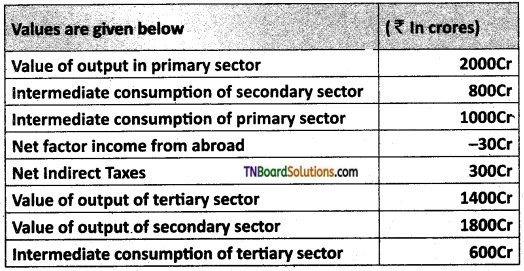
TN Board 12th Economics Important Questions Chapter 2 National Income 2
Answer:
GDPMP = (value of output in primary sector) – Intermediate consumption of primary sector + (value of output in secondary sector) – intermediate consumption of secondary sector + (value of output in tertiary sector) – Intermediate consumption of tertiary sector so by substituting the given values
= (2000 – 1000) + (1800- 800) + (1400- 600)
= 1000 + 1000 + 800 = Rs. 2800/- crores
Answer is 2800 crores.
Hence the GDPMP = 2800 Cr.

TN Board 12th Economics Important Questions Chapter 2 National Income

Question 2.
Calculate National Income or (NNPFC) by Income method and Expenditure method.
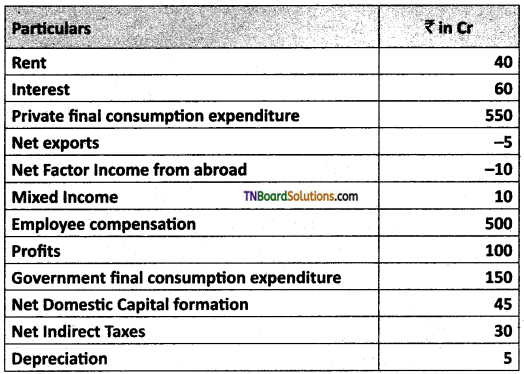
TN Board 12th Economics Important Questions Chapter 2 National Income 3
Answer:
Given data’s are:
(i) National Income (Income Method): National Income = Employee compensation + rent + interest + profits + mixed income + Net factor income from abroad = 500 + (100 +40 +60 ) +10 + (-10 ) = Rs. 700cr
(ii) National Income (Expenditure Method):
National Income private final consumption expenditure + government final consumption expenditure + net domestic capital formation + depreciation + net exports + net factor income from abroad – depreciation – net indirect taxes. = 550 + 150 + 45 + (-5) + (-10 ) – 30 = Rs. 700.

Question 3.
Calculate National Income.
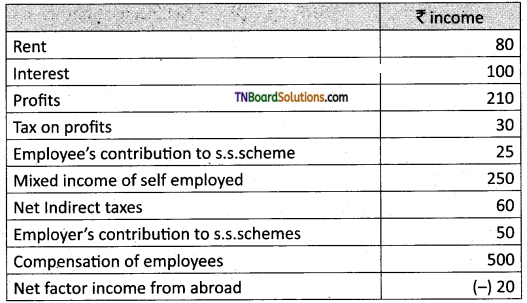
TN Board 12th Economics Important Questions Chapter 2 National Income 4
Answer:
Domestic Income = 80 + 100 + 210 + 250 + 500 = 1,140 Cr
National Income = 1,140 + (-20) = 1,120 Cr.

TN Board 12th Economics Important Questions Chapter 2 National Income

Question 4.
On the basis of the following real data at current prices of the Indian economy during 1982 -1983.
Find out 1) NNPFC
2) GNPMP
3) GDPMP
4) GNPFC and
5) NDPMP
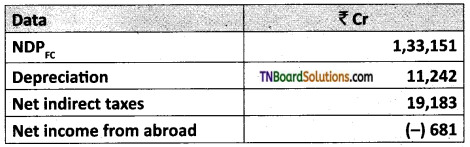
TN Board 12th Economics Important Questions Chapter 2 National Income 5

Answer:
1. NNPFC = NDPFC + Net Income from abroad.
= 1,33,151 + (-) 681 = 1,32,470 Cr.

2. NNPMP = NNPFC + Net indirect taxes.
= 1,32,470+ 19,183 = 1,51,653 Cr.

3. GNPNP = NNPMP + Depreciation.
= 1,51,653 + 11,242 = 1,62,895 Cr.

4. GDPMP = GNPMP – Net Income from abroad
= 1,62,895 – (-681) = 1,63,576 Cr.

5. GDPFC = GDPMP – Net indirect taxes.
= 1,63,576 – 19,183 = 1,44,393 Cr.

6. GNPFC = GDPFC + Net Income from abroad
= 1,44,393 +(-681) = 1,43,712 Cr.

7. NDPMP = GDPMP – Depreciation.
= 1,63,576 – 11,242 = 1,52,334 Cr.

TN Board 12th Economics Important Questions Chapter 2 National Income

Question 5.
Find out NDP from the given data.
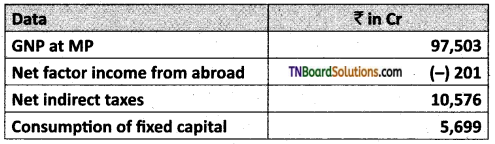
TN Board 12th Economics Important Questions Chapter 2 National Income 6
Answer:
NDP at MP = 97,503 – 5,699 – (- 201) = 92,005 Cr
NDPMP = 97,503 – 5,699 – (- 201) = 92,005 Cr.

Question 6.
GNP at MP of an imaginary economy is Rs. 1,20,000 Cr. And its capital stock is worth Rs. 3,00,000 Cr. If capital stock depreciates @ 20% per annum, indirect taxes amount to Rs. 30,000 Cr and subsidies are put at Rs. 15,000 Cr. Then what is the National Income.
Answer:
National Income (NNP at FC) = 12,000 – 60,000 (Dep 20% of 3,00,000) – 30,000 + 15,000.
= 12,000 – 60,000 – 30,000 + 15,000 = 45,000 Cr.
(Depreciation 20% of 3,00,000).

Question 7.
Find GDP at Fc from the following data:
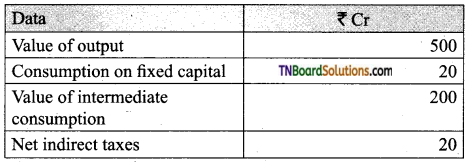
TN Board 12th Economics Important Questions Chapter 2 National Income 7
Answer:
GDP at FC = 1-3-4
i.e., Value of output – value of intermediate consumption – Net indirect taxes,
i.e., 500 – 200 – 20 = 280 Cr.

Question 8.
If the NDPFC is Rs. 1,000 Cr and NFIA is Rs. (-) 5 Cr. How much will be National Income (NNPFC)?
Answer:
NNPFC =NDPFC + NFIA
1,000 + (-5) = 995 Cr.

Question 9.
If Domestic Factor Income is Rs. 200 Cr. And National Income is Rs. 190 Cr. How much will be NFIA (Net Factor Income From Abroad)?
Answer:
NFIA = National Income – Domestic Factor Income = 190 – 200 = – 10 Cr.

TN Board 12th Economics Important Questions Chapter 2 National Income

Question 10.
Suppose the GDP at a market price of a country in a particular year was Rs. 1,100 Cr. Net Factor Income from abroad was Rs. 100 Cr. The value of indirect taxes – subsidies was Rs. 150 Cr. And National Income Rs. 850 Cr. Calculate the aggregate value of depreciation.
Answer:
National Income (or NNPFC) = GDPMP – Depreciation + NFIA – Net Indirect Taxes
850 = 1,100 – Depreciation + 1,100 – 150
Depreciation = 1,100 + 100 – 150 – 850
Depreciation = Rs. 200 Cr.

Activity

Question 1.
Compare GDP of different countries since 2001.
Answer:
Advantages of comparing GDP of different countries:

  1. Helps to develop a deep understanding of one’s own economy in comparison with others.
  2. Helps to know about our country’s economic backwardness.
  3. Helps to develop or find a solution to improve our GDP.
  4. To understand the necessity to work for the development of self and the country.
  5. To take the right decisions when it comes to the matter of choice of education and job choices.
  6. Helps to make decisions in life to improve per capita income.
  7. Comparison of 2 decades (2001 – 2020) will enhance the students to make the dream of Dr A.P.J. Abdul Kalam come true in 2020.
  8. Helps to build a new India in all-around development in 2020.

TN Board 12th Economics Important Questions Chapter 2 National Income

Multiple-choice questions

1. ……….. First introduced the concept of National income.
(a) Adam Smith
(b) Alfred Marshall
(c) Samuel son
(d) Simon Kuznets
Answer:
(d) Simon Kuznets

2. National income is:
(a) Value of good & services in a country during a year
(b) Value of money produced in a country during a year
(c) Value of agricultural products produced in a country during a year
(d) Value of industrial products produced in a country during a year
Answer:
(a) Value of good & services in a country during a year

3. GDP by expenditure method at market prices = ………..
(a) C + L + S + (X + M)
(b) C + S + G + (X – M)
(c) C + I + G + (X – M)
(d) S + I + G + (X – M)
Answer:
(c) C + I + G + (X – M)

4. Net domestic product =
(a) GDP – Depreciation
(b) GNP – Depreciation
(c) GDP – NFIA
(d) NNP – Depreciation
Answer:
(a) GDP – Depreciation

TN Board 12th Economics Important Questions Chapter 2 National Income

5. GNP includes ……….. types of final goods and services.
(a) 5
(b) 4
(c) 6
(d) 3
Answer:
(a) 5

6. The final goods and services produced in a year to satisfy the immediate wants of the people is referred as:
(a) Production
(b) Consumption
(c) Distribution
(d) Exchange
Answer:
(b) Consumption

7. NNP is expressed as:
(a) NNP = GNP – Depreciation
(b) NNP = GDP – Depreciation
(c) NNP = GDP – Transfer payments
(d) NNP = GNP – Transfer payments
Answer:
(a) NNP = GNP – Depreciation

8. Depreciation is also called as:
(a) Personal income
(b) Factor cost
(c) Capital cost
(d) Capital consumption allowance
Answer:
(d) Capital consumption allowance

TN Board 12th Economics Important Questions Chapter 2 National Income

9. NNP at factor cost =
(a) NNP at factor price – Indirect taxes + subsidies
(b) NNP at market price – Indirect taxes + subsidies
(c) NNP at market price – Direct taxes + subsidies
(d) NNP at factor price – Direct taxes + subsidies
Answer:
(b) NNP at market price – Indirect taxes + subsidies

10. Personal income is never equal to the National Income because it includes:
(a) Subsidies
(b) Disposable income
(c) Transfer payment
(d) Depreciation
Answer:
(c) Transfer payment

11. Disposal income = Personal income minus:
(a) Savings
(b) Indirect tax
(c) direct tax
(d) Investment
Answer:
(c) direct tax

12. The Average Income of a person of a country in a particular year is called:
(a) Per capita income
(b) National income
(c) personal income
(d) Disposable income
Answer:
(a) Per capita income

TN Board 12th Economics Important Questions Chapter 2 National Income

13. Nominal income is National Income expressed in terms of:
(a) Final value of goods
(b) General price level
(c) Current price level
(d) Factor cost
Answer:
(b) General price level

14. Product method is also called as:
(a) Expenditure method
(b) Income method
(c) Inventory method
(d) Factor earning method
Answer:
(c) Inventory method

15. The product method is followed in:
(a) Developed countries
(b) Developing countries
(c) Underdeveloped countries
(d) All the countries
Answer:
(c) Underdeveloped countries

16. Double counting is avoided in the ……….. method.
(a) Income method
(b) Expenditure method
(c) Factor earning method
(d) Value added method
Answer:
(d) Value added method

17. Example for National Income is:
(a) Pension
(b) salary
(c) Profit
(d) Bank savings
Answer:
(a) Pension

TN Board 12th Economics Important Questions Chapter 2 National Income

18. GNP =
(a) C + I + G + (X + M)
(b) C + I + S + (X + M)
(c) C + I + G + (X-M)
(d) C + S + I + (X – M)
Answer:
(b) C + I + S + (X + M)

19. National Income by-product method is measured by the value of final goods and services at:
(a) Current market prices
(b) Current factor prices
(c) Current savings
(d) Current income
Answer:
(a) Current market prices

20. The GDP estimates for India varies from 2 trillion US dollar to:
(a) 3 Trillion US dollar
(b) 4 Trillion US dollar
(c) 5 Trillion US dollar
(d) 6 Trillion US dollar
Answer:
(c) 5 Trillion US dollar

21. National disposable income is different from National Income because it also takes into account:
(a) Current transfers
(b) Capital transfers
(c) Both (a) and (b)
(d) All the above
Answer:
(a) Current transfers

TN Board 12th Economics Important Questions Chapter 2 National Income

22. Transfer is:
(a) Gift
(b) Charity
(c) Tax
(d) All the above
Answer:
(d) All the above

23. Welfare of the people of a country is determined by:
(a) Nominal GDP
(b) Real GDP
(c) Per capita real GDP
(d) Per capita real GDP and Cost of other factors.
Answer:
(d) Per capita real GDP and Cost of other factors.

24. Reduction is the production of junk food:
(a) Reduces welfare
(b) Increase welfare
(c) Both (a) and (b)
(d) Has no effect on welfare
Answer:
(c) Both (a) and (b)

25. Given GDPMP = 100
Subsidies = 5
Depreciation = 10 then NDPFC equals:
(a) 95
(b) 100
(c) 105
(d) 115
Answer:
(a) 95

26. Given NDPFC = 80
Indirect tax = 10 and Net factor Incdme to abroad = 10.
What is NNPMP?
(a) 70
(b) 80
(c) 90
(d) 100
Answer:
(d) 100

TN Board 12th Economics Important Questions Chapter 2 National Income

27. GDP at MP = 50,720 , NFIA = 2,400 calculate GNP at market price GNP = ………..
(a) 53,120 Cr
(b) 54,120 Cr
(c) 53,000 Cr
(d) 53,720 Cr
Answer:
(a) 53,120 Cr

28. GNP at market price 97,000 , subsidies 9,000 and Indirect Taxes 12,000 calculate GNPFC
(a) 1,00,700
(b) 1,00,000
(c) 9,000
(d) 12,000
Answer:
(b) 1,00,000

Pick the odd one out.

1. Per capita Income is:
(a) The total Income of the country
(b) Dividing National Income by population
(c) GDP/Population
(d) The Average Income of a person of a country
Answer:
(a) The total Income of the country

TN Board 12th Economics Important Questions Chapter 2 National Income

2. Net value added at factor cost (F) is:
(a) Market value of output
(b) Total of income payment made to factors of production
(c) NNI – Amount of Indirect tax + subsidies
(d) Value of the net output of the economy
Answer:
(d) Value of the net output of the economy

3. Methods of measuring National Income by:
(a) Value added method
(b) Factor earning method
(c) Disposable Personal Income
(d) Expenditure method
Answer:
(c) Disposable Personal Income

4. Real Income is:
(a) Nominal Income
(b) Real income is National Income expressed in terms of general price level
(c) Buying power of Nominal Income
(d) National Income/ Population
Answer:
(c) Buying power of Nominal Income

TN Board 12th Economics Important Questions Chapter 2 National Income

5. GDP deflator is:
(a) Index of price changes of goods and services included in GDP
(b) Difference between the value of exports and imports of goods and services
(c) It is dividing nominal GDP in a given year by the real GDP
(d)
TN Board 12th Economics Important Questions Chapter 2 National Income 1
Answer:
(b) Difference between the value of exports and imports of goods and services
TN Board 12th Economics Important Questions Chapter 1 Introduction to Macro Economics

Students get through the TN Board 12th Economics Important Questions Chapter 1 Introduction to Macro Economics which is useful for their exam preparation.

TN State Board 12th Economics Important Questions Chapter 1 Introduction to Macro Economics

Very short answer questions

Question 1.
Why was Keynes regarded as the Father of Modern Economics?
[OR]
How was Keynes regarded as arid why?
Answer:
Keynes was regarded as the Father of modem Economics because he explained the way out from the Great Economic depression when goods remained unsold and workers unemployed.

Question 2.
What are the subject matters covered in Macro Economics?
Answer:
The subject matters covered in Macro Economics are the such as Employment National Income, Inflation, business cycle, Poverty, Inequality, disparity, investment and saving, capital formation, infrastructure development, international trade, the balance of trade and balance of payments, exchange rate, and economic growth.

TN Board 12th Economics Important Questions Chapter 1 Introduction to Macro Economics

Question 3.
Write a note on the following:
Answer:

  1. National Income: It is a very important basic aspect of Macro Economy Analysis. The study also helps us to understand the growth process of an economy in the long term.
  2. Inflation: Inflation refers to a steady increase in the general price level.
  3. Business cycle: This problem is being faced by all economics. The cynical movements like depression, boom, recession, and recovery need to be studied carefully based on the aggregate economic variables.
  4. Poverty and unemployment: This is one of the economic paradoxes of resource-rich nations. The corrective measures can be done and resources can be allocated when the rate of poverty and unemployment are studied properly.
  5. Economic growth: Macroeconomic studies will give us a clear picture of the factors determining the growth and development of an economy.
  6. Economic policies: It is necessary to solve basic problems and to overcome the obstacles of economic growth.

Question 4.
Write a note on the Economy, or What do you mean by the economy? or Define Economy.
Answer:
An economy is referred to any system or area where economic activities are carried out.

Question 5.
What are the fundamental economic activities?
Answer:
The fundamental economic activities are production, consumption, and exchange activity.

Question 6.
Name the major Economic Activities.
Answer:
The major economic activities include transportation, banking, advertising, planning, government policy, etc.

TN Board 12th Economics Important Questions Chapter 1 Introduction to Macro Economics

Question 7.
Name the major non-economic activities.
Answer:
The major non-economic activities are environment, health, education, entertainment, governance regulations, etc.

Question 8.
Name the external activities from other economies.
Answer:
The external activities from other economies are export, import, international relations, emigration, immigration, foreign investments, foreign exchange earnings, etc.

Question 9.
What does the economic system refer to?
Answer:
Economic systems refer to the manner in which individuals and institutions are connected together to carry out economic activities in a particular area.

Question 10.
Name the three major types of economic systems.
Answer:

  1. Capitalistic economy (capitalism),
  2. Socialistic economy (socialism) and
  3. Mixed economy (mixedism) are the three major economic systems.

Question 11.
What does mixedism denote?
Answer:
Mixedism denotes the co-existence of capitalism and socialism.

Question 12.
Name the countries which are examples of a capitalistic economy.
Answer:
The countries are the USA, West Germany, Australia, and Japan.

Question 13.
What does socialism refer to?
Answer:
Socialism refers to a system of total planning, public ownership arid state control on economic activities.

Question 14.
Define socialism.
Answer:
Socialism is defined as a way of organizing a society in which major industries are owned and controlled by the government.

TN Board 12th Economics Important Questions Chapter 1 Introduction to Macro Economics

Question 15.
What does a socialist economy aim at?
Answer:
It aims at equality in the distribution of income and wealth and equal opportunity for all.

Question 16.
What is the socialist economy?
Answer:
In a socialist economy, all the resources are owned and operated by the government and public welfare is the main motive.

Question 17.
What do you mean by the mixed economy? (or) What is a mixed economy?
Answer:
In a mixed economy, both the private and public sectors co-exist and work together for economic development. It is a combination of capitalism and socialism.

Question 18.
What is a mixed economy? Give example or How does the mixed economy work?
Answer:
In Mixed Economy, resources are owned by Individuals and the Government. Eg: India, England, France, and Brazil.

Question 19.
How are variables classified in economics?
Answer:
Variables used in economic analysis are classified as stock and flow both may increase or decrease with time.

Question 20.
Write a note on stock and variable.
Answer:
Stock: It is a quantity of a commodity measured at a point in time.
Eg: Money supply, unemployment level, foreign exchange resources, and capital.
Flow Variable: They are measured over a period of time.
Eg: National income, exports, imports, consumption, production, investment, etc.

Question 21.
What is a model?
Answer:
A model is a simplified representation of a real situation. It is an explanation of the working of an economy.

TN Board 12th Economics Important Questions Chapter 1 Introduction to Macro Economics

Question 22.
How are models used in economics?
Answer:
In economics, models are used to describe economic activities, relationships, and behavior. They are built with graphs, equations, and maths.
Eg: Supply-demand models.

Question 23.
What does the circular flow of income indicate?
Answer:
It shows connections between different sectors of an economy.
Eg: The flow of income, goods, and services, is also a base of national accounts.

Question 24.
What do macro-economic studies about?
Answer:
It studies the behavior and performance of an economy as a whole.

Short answer questions

Question 1.
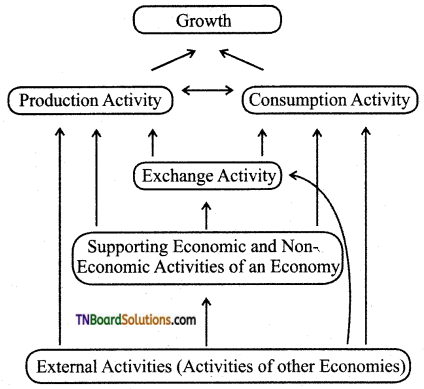
Draw the flowchart of the functioning of an economy based on activities.
Answer:
TN Board 12th Economics Important Questions Chapter 1 Introduction to Macro Economics 1

TN Board 12th Economics Important Questions Chapter 1 Introduction to Macro Economics

Question 2.
Explain the classifications of economics.
Answer:

  1. Status of Development: Developed, underdeveloped, undeveloped, and developing economies.
  2. System of Activities: Capitalistic, Socialistic, and Mixed Economies.
  3. The scale of Activities: Small and Large Economies.
  4. Nature of Functioning: Static and Dynamic Economies.
  5. Nature of Operation: Closed and Open Economies.
  6. Nature of Advancement: Traditional and Modem Economies.
  7. Level of National Income: Low Income, Middle Income, and High-Income Economies.

Question 3.
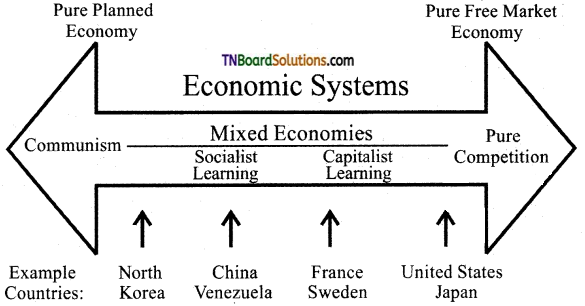
Explain mixed economy (mixedism) with a diagram.
Answer:
TN Board 12th Economics Important Questions Chapter 1 Introduction to Macro Economics 2

Question 4.
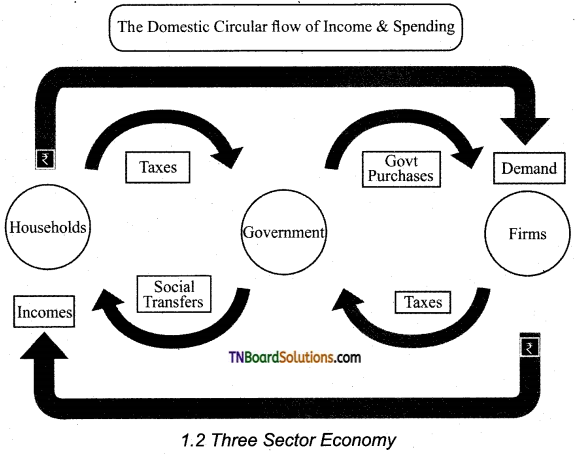
Draw the diagram of the circular flow of income in a three-sector economy.
Answer:
TN Board 12th Economics Important Questions Chapter 1 Introduction to Macro Economics 3

TN Board 12th Economics Important Questions Chapter 1 Introduction to Macro Economics

Question 5.
What are the limitations of macroeconomics?
Answer:

  1. Excessive generalization of the economy as a whole.
  2. Assumption of homogeneity among individual units.
  3. The composition of good and bad will vary between individual and the nation,
  4. Non-economic factors will determine the Economic activities.

Long answer questions

Question 1.
What are the features of a capitalist economy?
Answer:

  1. Private ownership of property and law of inheritance: All resources are owned by private individuals and they have the right to own or sell according to their will.
  2. Freedom of choice and enterprise: The individuals are free to do any trade or occupations anywhere and consumers are also free to use them.
  3. Profit motive: The technology is advanced and specializations are implemented, so the producers follow the golden rule of maximization of profit.
  4. Free competition: There is competition between buyers and sellers. The Government cannot prevent competition in the free market.
  5. Price mechanism – All economic activities are regulated through a price mechanism.
  6. Role of Government: The government has a limited role in a capitalist economy. The government provides basic services like defense, education, etc., in the economy.
  7. Inequalities of income: In a capitalist economy, the haves and have nots are classified so economic inequality prevails.

Question 2.
What are the demerits of capitalism?
Answer:

  1. The concentration of wealth and income: The inequalities of income prevails in a capitalist economy, as the concentration of wealth is with few.
  2. Wastage of resources: Because of product duplication and advertising, resources are wasted.
  3. Class struggle: In capitalism, the society is divided into capitalists and workers due to class struggle.
  4. Business cycle: Frequent economic fluctuations because of the free market.
  5. Production of Non-Essential goods: To maximize profit, even harmful goods are produced.

TN Board 12th Economics Important Questions Chapter 1 Introduction to Macro Economics

Question 3.
Explain the features of socialism.
Answer:

  1. Public ownership of means of production: The factors of productions (resources) are nationalized.
  2. All decisions are taken by the central planning authority.
  3. Maximum social benefit: Social welfare is the aim of socialism.
  4. Non – existence of competition: The Government has total control of production and distribution, there is no competition.
  5. Absence of price mechanism: Price is controlled and fixed by the central planning authority.
  6. Equality of income: There is no inequality of income in a socialist economy.
  7. Equality of opportunity: Equal opportunity is for all in socialism.
  8. Classless society: There are no class distinctions in socialism. All are equal.

Question 4.
Explain the merits of socialism.
Answer:

  1. Reduction in inequalities: No private property or exploitation is allowed.
  2. Rational allocation of resources: Wastages are minimized as the allocation of resources is done by the central planning authority.
  3. Absence of class conflicts: There are no inequalities, society is harmonious.
  4. End of trade cycles: Economic fluctuations are controlled because of the planning authority.
  5. Promotes social welfare: Social welfare is promoted by reducing exploitation, inequalities in society.

Question 5.
Explain the merits of a mixed economy.
Answer:

  1. Rapid Economic growth: In a mixed economy, the public and private needs are met.
  2. Balanced economic growth: There is balanced growth between agriculture and industry, consumer and capital goods, and rural and urban areas.
  3. Proper utilization of resources: In a mixed economy, utilization of resources is controlled directly in the Government sector and indirectly in the private sector.
  4. Economic equality: The government introduces a progressive rate of taxation for economic equality.
  5. Special advantages to the society: To promote social welfare fair price shops, rationing is established by Government.

TN Board 12th Economics Important Questions Chapter 1 Introduction to Macro Economics

Question 6.
Explain the demerits of a mixed economy.
Answer:

  1. Lack of coordination: Co-ordination related problems exist between the private and public sectors due to different ideas.
  2. Competitive attitude: Both the private and public sectors should work complementary but they are competitive in a real sense.
  3. Inefficiency: Due to inefficiency and corruption, public sector enterprises remain inefficient.
  4. Fear of nationalization: The fear of nationalization affects the business operations of private enterprises.
  5. Widening inequality: The gap between the rich and the poor increases, the inequality of capitalism and inefficiency of socialism prevails in mixed economies.

Question 7.
Explain three-sector economies with the diagram.
Answer:
In addition to households and firms, the inclusion of the government sector makes this model a three-sector model. The government levies taxes on households and firms, purchases goods and services from firms, and receive factors of production from the household sector. On the other hand, the government also makes social transfers such as pension, relief, subsidies to the households. Similarly, Government pays the firms for the purchases of goods and services. The Flow Chart illustrates the three-sector economy model: Under the three-sector model, national income(Y)isobtainedbyaddingConsumptionexpenditure(C), Investment expenditure (I), and Government expenditure (G).
[Refer diagram 1.2.]
Therefore:
Y = C + I + G

Question 8.
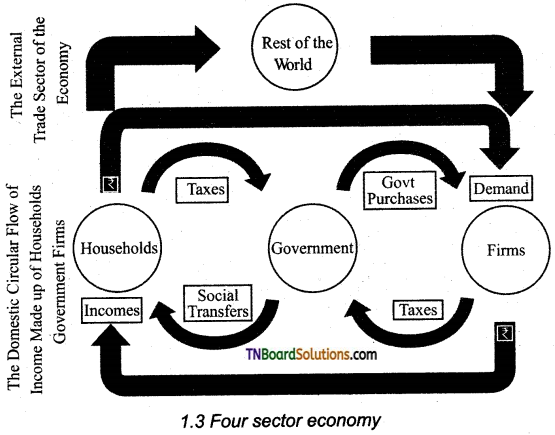
Explain four sector economies with the diagram.
Answer:
TN Board 12th Economics Important Questions Chapter 1 Introduction to Macro Economics 4
In a Four-sector economy, in addition to households, firms, and government, a fourth sector namely, the external sector is included. In real life, only a four-sector economy exists. This model is composed of four sectors namely,

  1. Households
  2. Firms
  3. Government,
  4. External sector

The external sector comprises exports and imports. It is illustrated in the Flow Chart.
In a four-sector economy, expenditure for the entire economy includes domestic expenditure (C+I+G) and net exports (X- M). Therefore,
Y = C + I + G +(X – M).

TN Board 12th Economics Important Questions Chapter 1 Introduction to Macro Economics

Multiple-choice questions

1. The word Micro and Macro were coined in the year:
(a) 1930
(b) 1931
(c) 1932
(d) 1933
Answer:
(d) 1933

2. The General Theory of Employment, interest and money was published in:
(a) 1935
(b) 1936
(c) 1937
(d) 1934
Answer:
(b) 1936

3. Purchase of refrigerator by a restaurant is:
(a) consumption expenditure on durable good
(b) consumption expenditure on non-durable goods
(c) intermediate expenditure
(d) final expenditure
Answer:
(d) final expenditure

4. Economic territory of a country is also called as:
(a) geographical territory
(b) political frontiers
(c) domestic territory
(d) all the above
Answer:
(c) domestic territory

TN Board 12th Economics Important Questions Chapter 1 Introduction to Macro Economics

5. …….. Term was coined by Manfred D Steger in 2002.
(a) Micro
(b) Macro
(c) Globalism
(d) Economy
Answer:
(c) Globalism

6. Co-existence of capitalism and socialism is called as:
(a) Market Economy
(b) Mixedism
(c) Traditional Economy
(d) Village Economy
Answer:
(b) Mixedism

7. ……….. is the driving force behind ail Economic activities in a capitalistic economy.
(a) Market
(b) Price
(c) Demand
(d) profit
Answer:
(d) profit

8. ……….. is the golden rule for a producer under Capitalism.
(a) To maximize profit
(b) To maximize production
(c) To maximize consumption
(d) To maximize distribution.
Answer:
(a) To maximize profit

9. ………. is the heart of a capitalistic economy.
(a) Competition
(b) Inequality of income
(c) Price mechanism
(d) Profit motive
Answer:
(c) Price mechanism

TN Board 12th Economics Important Questions Chapter 1 Introduction to Macro Economics

10. The Society is divided into two classes.
(a) Socialistic
(b) Capitalistic
(c) Mixedism
(d) Traditional society
Answer:
(b) Capitalistic

11. Inequalities of income is increased in because of the concentration of wealth in few hands.
(a) Capitalism
(b) Socialism
(c) Mixedism
(d) Globalism
Answer:
(a) Capitalism

12. The socialistic Economy is also known as:
(a) Planned economy
(b) Mixed economy
(c) Village economy
(d) Market economy
Answer:
(a) Planned economy

13. In a socialistic economy, all resources are owned and operated by:
(a) Government
(b) Private
(c) Individual
(d) RBI
Answer:
(a) Government

14. ……….. is an integral part of a socialistic economy.
(a) Social benefit
(b) Price mechanism
(c) Planning
(d) Profit
Answer:
(c) Planning

TN Board 12th Economics Important Questions Chapter 1 Introduction to Macro Economics

15. ……….. is the guiding principle behind all economic activities.
(a) Economy welfare
(b) Social welfare
(c) Material welfare
(d) Human welfare
Answer:
(b) Social welfare

16. Society functions in a harmonious manner in Economy.
(a) Capitalist
(b) Socialist
(c) Mixedism
(d) Village
Answer:
(b) Socialist

17. ………… is a simplified representation of the real situation of the economy.
(a) Model
(b) Society
(c) National income
(d) Macroeconomics.
Answer:
(a) Model

18. The basic identities of the two sector economy is:
(a) Y = C+I
(b) Y = C+S
(c) Y = S+Y
(d) Y = I+S
Answer:
(a) Y = C+I

19. ……….. is a quantity of a commodity that is constant at a point in time,
(a) Flow
(b) Stock
(c) Income
(d) Consumption
Answer:
(b) Stock

TN Board 12th Economics Important Questions Chapter 1 Introduction to Macro Economics

20. In the production phase of the circular flow of income, the income are:
(a) created
(b) distributed
(c) spent
(d) accumulated
Answer:
(a) created

21. Police department is a part of ……….. sector.
(a) primary sector
(b) secondary sector
(c) tertiary sector
(d) none
Answer:
(c) tertiary sector

22. Converting wheat into wheat flour is a part of this sector of .the economy:
(a) primary sector
(b) secondary sector
(c) tertiary sector
(d) agricultural sector
Answer:
(c) tertiary sector

TN Board 12th Economics Important Questions Chapter 1 Introduction to Macro Economics

23. Value added is:
(a) sales price – purchase price
(b) sales + stocks
(c) sales + net change in stocks – intermediate costs
(d) value of the output – purchase
Answer:
(c) sales + net change in stocks – intermediate costs

24. In national income accounting, reat is the payment for used of:
(a) parent
(b) trademark
(c) land
(d) godown
Answer:
(c) land

25. Income method national income from:
(a) income generation angle
(b) income paid out the angle
(c) income speak angle
(d) all the above
Answer:
(b) income paid out an angle

26. Expenditure method of estimating national income takes into account of:
(a) transfer expenditure
(b) financial expenditure
(c) intermediate expenditure
(d) all the above
Answer:
(b) financial expenditure

TN Board 12th Economics Important Questions Chapter 1 Introduction to Macro Economics

27. Operating surplus is:
(a) profit
(b) profit + rent
(c) profit + rent + royalty + interest
(d) profit + rent + interest
Answer:
(c) profit + rent + royalty + interest

28. Food item purchased by a production unit are:
(a) single-use customer goods
(b) single-use capital goods
(c) durable use consumer goods
(d) durable use capital goods
Answer:
(b) single-use capital goods

29. Capital loss is:
(a) normal wear and tear of fixed capital goods
(b) foreseen obsolences
(c) unforeseen obsolences
(d) all the above
Answer:
(c) unforeseen obsolences

TN Board 12th Economics Important Questions Chapter 1 Introduction to Macro Economics

30. Capital and investments are:
(a) both flows
(b) both stocks
(c) capital is stock while investment is a flow
(d) investment is stock while capital is a flow
Answer:
(c) capital is stock while investment is a flow

TN Board 12th Commerce Important Questions Chapter 28 Company Secretary

Students get through the TN Board 12th Commerce Important Questions Chapter 28 Company Secretary which is useful for their exam preparation.

TN State Board 12th Commerce Important Questions Chapter 28 Company Secretary

Very short answer questions

Question 1.
Define secretary using Oxford dictionary.
Answer:
“A secretary is a person who is employed to conduct correspondence on behalf of an individual or a company and also to execute filing documentation and administrative functions” Oxford Dictionary.

Question 2.
Mention the statutory functions of a company secretary.
Answer:
According to the Companies Act,

  1. Under the Income Tax Acts
  2. Under the Indian Stamp Act
  3. Under Other acts

TN Board 12th Commerce Important Questions Chapter 28 Company Secretary

Question 3.
State the other qualifications of a company secretary.
Answer:
The secretary must be smart, unbiased, and must have an IQ presence of mind and amiable personality. He should have a thorough knowledge of company law, labor law, mercantile law, accounting, and office management.

Question 4.
What is Quorum?
Answer:
There is another requirement of quorum. A single person does not contain a meeting. So it has to be seen that the required number of people are present. A requisite number of people at the meeting is called a quorum.

Question 5.
What are the acts applicable to the company?
Answer:

  1. Foreign exchange regulation act
  2. Industries development and regulation act.
  3. Factories act
  4. Industrial dispute act
  5. Labor laws
  6. Payment of wages act.

Question 6.
What is the qualification of a company secretary?
Answer:
Apart from the statutory qualifications, he should also have other qualifications as may be necessary to conduct the affairs of the company. Is statutory qualifications-company having a paid-up share capital of? 5 crore or more in the case of any other company (one or more).

TN Board 12th Commerce Important Questions Chapter 28 Company Secretary

Question 7.
Explain about the board meeting.
Answer:
Meetings of directors are called board meetings. Meetings of the directors provide a platform to discuss the business and take formal decisions.

Question 8.
State the kinds of resolution.
Answer:
There are broadly three types of resolutions namely,

  1. Ordinary resolution
  2. Special resolution
  3. A resolution requiring special notice.

Short answer questions

Question 1.
Explain briefly the appointment of the company secretary.
Answer:

  1. 204 of companies act 2013 the provisions regarding appointment of a company secretary are every listed company must have a full-time company secretary.
  2. Every unlisted company and every private company having a paid-up capital of Rs. 5 crores or more must also have a full-time secretary.
  3. Only an individual who is a member of the institute of company secretaries of India can be appointed as a company secretary.

TN Board 12th Commerce Important Questions Chapter 28 Company Secretary

Question 2.
Give a short note company secretary.
Answer:

  1. The person who is responsible for the general performance of an organization is called the company secretary.
  2. The Key Managerial Personnel (KMP) who run a company is called with different titles directors, managers or secretary.
  3. The word secretary has originated, in Latin. The Latin word “secretaries” which means secret.
  4. The person who steers the company holding the administrative, financial, and overall performance of the company is called the company secretary.

Question 3.
Discuss “voting”.
Answer:

  1. The word “vote” originated in the Latin word votum indicating one’s wishes or desire.
  2. By casting his vote one formally declaring his opinion or wish in favor of or against a proposal or a candidate to be elected for an office.
  3. Every motion or proposal is subject to the approval of the majority of the members or shareholders can cast their votes only on the occasions in which they want to establish their rights according to section 47 of the company act 2013.

Long answer questions

Question 1.
Explain the powers and rights of the company secretary.
Answer:
A company secretary is a high-level officer. He enjoys certain rights and power as per the contract made with the company, which are as follows.

  1. Supervision and control: As a head of the office a company secretary has the rights to supervise, direct and control all office activities of sub-ordinate officers.
  2. Signing authority: Being a principal officer, a company secretary can sign contracts, files, and documents on behalf of the company.
  3. Exercising power: He has the right to exercise powers as granted by the board of directors.
  4. Issuing testimonial: A company secretary can issue testimonials to employees on behalf of the company.
  5. Claiming salary and damages: As per the contract, he has the right to claim his salary and other allowances. He can also take legal action against the company if there is any breach of contract.
  6. Attending meeting: He has the right to be physically present in the meetings of the shareholders and board of directors.
  7. Preferential creditor: During the winding up of a company, the company secretary can claim his legal dues on a preferential basis.

TN Board 12th Commerce Important Questions Chapter 28 Company Secretary

Question 2.
In what situations company secretary can be removed?
Answer:
The company secretary may be terminated under the following situations:

  1. When his term of appointment has expired.
  2. When he is given proper notice of dismissal as per the terms of agreement of employment.
  3. When he makes a secret profit.
  4. When he misconducts himself
  5. Where he is found to be guilty of moral turpitude, negligence, disobedience, incompetence.
  6. Where he suffers from permanent mental and physical disabilities.

Multiple-choice questions

1. The Latin word “Secretarius” which means:
(a) Skill
(b) Knowledge
(c) Secret
(d) Personality
Answer:
(c) Secret

2. The first secretary of a company is appointed by the:
(a) Promoters
(b) Company act
(c) Board of directors
(d) None
Answer:
(a) Promoters

TN Board 12th Commerce Important Questions Chapter 28 Company Secretary

3. Who will make statutory books?
(a) Directors
(b) Secretary
(c) Shareholder
(d) All the above
Answer:
(b) Secretary

4. A company secretary acts under the full control of the:
(a) Board of directors
(b) Directors
(c) Both (a) and (b)
(d) None
Answer:
(c) Both (a) and (b)

5. ………… Should act as a link between the board of directors and the shareholders.
(a) Executive
(b) Chairman
(c) Secretary
(d) Vice-chairman
Answer:
(c) Secretary

6. Who has absolute discretion to remove a company secretary?
(a) The board of director
(b) The director
(c) Chairman
(d) Shareholders
Answer:
(a) The board of director

TN Board 12th Commerce Important Questions Chapter 28 Company Secretary

7. Every public company should hold a meeting of the shareholders within:
(a) Six months
(b) One year
(c) One month
(d) Three months
Answer:
(a) Six months

8. First meeting of directors should be convened within the date of incorporation of the company.
(a) 60 days
(b) 30 days
(c) 90 days
(d) 120 days
Answer:
(b) 30 days

9. …………. can be present at the meeting and he cannot vote.
(a) Proxy
(b) Poll
(c) Quorum
(d) None
Answer:
(a) Proxy

10. Company secretary should have a thorough knowledge of
(a) Company law
(b) Mercantile law
(c) Labour law
(d) All the above
Answer:
(d) All the above

TN Board 12th Commerce Important Questions Chapter 28 Company Secretary

11. ………… must ensure timely submission of tax revenue to the sales tax authority.
(a) Chairman
(b) Director
(c) Secretary
(d) None
Answer:
(c) Secretary

12. Secretary may be terminated under the following situations.
(a) Term of appointment has expired
(b) Misconducts himself
(c) He suffers from mental disabilities
(d) All the above
Answer:
(d) All the above

13. a Requisite number of the person at the meeting is called:
(a) Quorum
(b) Poll
(c) Proxy
(d) Financiers
Answer:
(a) Quorum

14. Voting has no secrecy is known as:
(a) Open procedure
(b) Secret procedure
(c) Postal ballot
(d) All the above
Answer:
(a) Open procedure

TN Board 12th Commerce Important Questions Chapter 28 Company Secretary

15. Voting method that could maintain the secrecy of the voter is known as:
(a) Secret procedure
(b) By voice
(c) Open procedure
(d) None
Answer:
(a) Secret procedure

TN Board 12th Commerce Important Questions Chapter 27 Company Management

Students get through the TN Board 12th Commerce Important Questions Chapter 27 Company Management which is useful for their exam preparation.

TN State Board 12th Commerce Important Questions Chapter 27 Company Management

Very short answer questions

Question 1.
What do you mean by Director?
Answer:
The person who takes an active interest in the well-being of a company and one of the members of the board of directors is called a Director of a company. A director is a person from a board of Directors who leads (or) supervises the functions of a company.

Question 2.
Mention a few duties of a director.
Answer:
The following are the duties of Directors:

  1. Collective duties of Directors
  2. General duties of Directors
  3. Specific duties of Directors

TN Board 12th Commerce Important Questions Chapter 27 Company Management

Question 3.
Who can a non-executive Director?
Answer:
A non-executive director typically does not engage in the day-to-day management of the organization but is involved in policymaking and planning exercises. In addition, non-executive Directors’ responsibilities include the monitoring of the executive Directors and acting in the interest of the company shareholders.

Question 4.
Who is called an independent Director?
Answer:
According to section 149(6), an independent director is an alternate Director other than a Managing Director who is known as a whole-time Director or nominee Director. The company has to appoint a minimum of two independent Directors.

Question 5.
How to nominate the Director?
Answer:
A Director nominated by any financial institution in pursuance of the provisions of any law for the time being in force, or of any agreement, or appointed by any Government or any other person to represent its interest.

Question 6.
What is the maximum limit a company can appoint Directors?
Answer:
A company can appoint maximum (15) fifteen Directors. A company may appoint more than fifteen directors after passing a special resolution in a general meeting and approval of the Central Government is not required.

Question 7.
State the general provisions relating to the appointment of Directors?
Answer:

  1. Every Director should be appointed by the company in a general meeting as per the provision of the act.
  2. Director identification number is compulsory for the appointment of Director of a company.
  3. A Director shall furnish his identification number and a declaration that he is not disqualified to become a Director under the act.

TN Board 12th Commerce Important Questions Chapter 27 Company Management

Question 8.
Who can remove a Director of the company?
Answer:
A director of a company can be removed from his office before the expiry of his term by the shareholders, the Central Government, the company law board.

Short answer questions

Question 1.
Explain about the “First Director”?
Answer:
“First Director” – Director means those Directors who hold office from the date of incorporation of the company. The first Directors are usually named in the articles of association or are appointed by the directors.
In the case of one person company, an individual being a number shall be deemed to be its first Director until the Director(s) are duly appointed by the member in accordance with the provision of section 152.

Question 2.
Explain managerial remuneration and its perquisites?
Answer:
The managerial remuneration is payable to persons appointed as 196 of the act. The term remuneration means any money or its equivalent given or passed to any person for services rendered by him and includes perquisites.

  1. Value of rent-free or concession accommodation.
  2. Value any other items provided free of cost or at a concessional rate.
  3. Value of securities/sweat equity shares allotted or transferred by the employer or former employer to the employee.
  4. A contribution made by an employer to an approved superannuation fund.
  5. Value of any other fringe benefit or amenity.
  6. Stock options would be part of the remuneration for all Directors.

TN Board 12th Commerce Important Questions Chapter 27 Company Management

Question 3.
Discuss the rights of the Director?
Answer:
Rights can be categorized into individual rights and collective rights. Individual rights such as:

  1. Right to inspect books of accounts.
  2. Right to receive notices of board meetings.
  3. Right to participate in proceedings and cast vote in favor or against resolutions.
  4. Right to receive circular resolutions proposed to be passed.
  5. Right to inspect minutes of board meetings.

Collective rights are as follows:

  1. Right to refuse to transfer shares: Directors of private companies and deemed public companies are entitled to refuse registration of transfer of shares to a person whom they do not approve.
  2. Right to elect a chairman: The Directors are entitled to elect a chairman for the board meetings.
  3. Right to appoint a managing Director: The board has the right to appoint the Managing Director/manager of the company.
  4. Right to recommend dividend: The board is entitled to decide whether the dividend is to be paid or not shareholders cannot compel the Directors to pay a dividend. However, they can reduce the rate of recommended dividends. Payment of dividends is the prerogative of the board.

Long answer questions

Question 1.
State the liability to the company of Directors.
Answer:
The Directors shall be liable to the company for in the following cases: Where they have acted ultra – vires the company: For example, where they apply the funds of the company to objects not specified in the memorandum of association or when they pay dividends out of capital.
Where there is a breach of trust: Directors being the trustees of the company, should discharge their duties in the best interest of the company, where they commit a breach of trust resulting in a loss to the company they are bound to make good the loss.
Misfeasance: Directors are liable to the company for misfeasance. It covers willful negligence. However mere failure on the part of the Director to take necessary steps for recovery of debts due to the company does not constitute misfeasance.

TN Board 12th Commerce Important Questions Chapter 27 Company Management

Question 2.
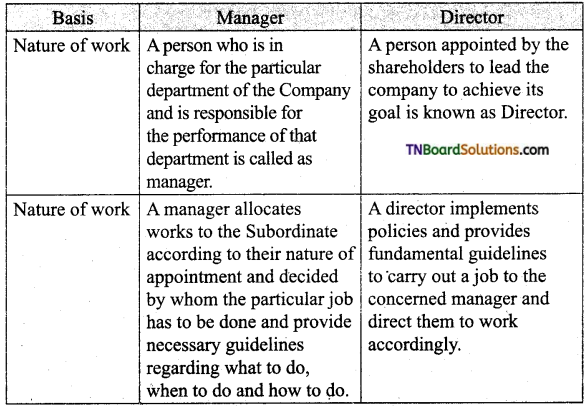
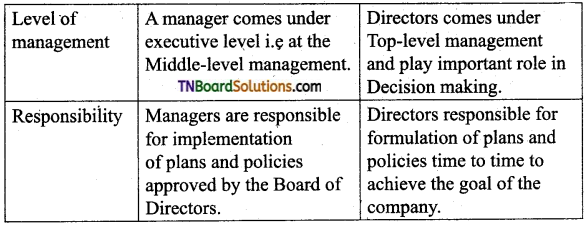
Differentiate between manager and Director?
Answer:
TN Board 12th Commerce Important Questions Chapter 27 Company Management 1
TN Board 12th Commerce Important Questions Chapter 27 Company Management 2

Question 3.
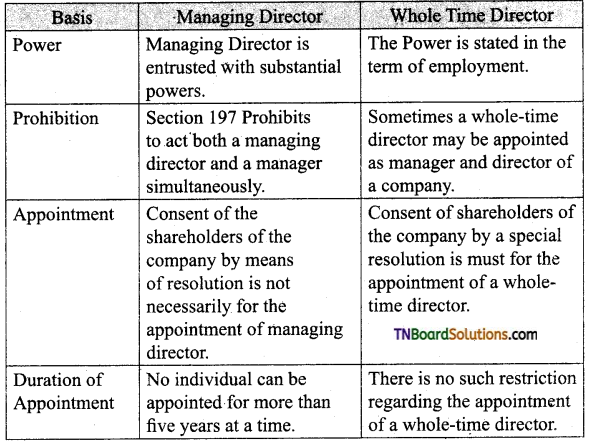
Differentiate between the managing director and the whole-time director?
Answer:
TN Board 12th Commerce Important Questions Chapter 27 Company Management 3

TN Board 12th Commerce Important Questions Chapter 27 Company Management

Multiple-choice questions

1. The group of human beings who undertake the responsibility to run the business are known as:
(a) Human resource
(b) Board of directors
(c) Human resource management
(d) None
Answer:
(b) Board of directors

2. The directors of a company formulate:
(a) Policies
(b) Objectives
(c) Both (a) and (b)
(d) Work
Answer:
(c) Both (a) and (b)

3. The directors are expected to act in:
(a) Good faith
(b) Utmost care
(c) Perform work
(d) All the above
Answer:
(d) All the above

4. Mention the key managerial personnel:
(a) The chief executive officer
(b) The managing director
(c) The company secretary
(d) All the above
Answer:
(d) All the above

5. The general board is empowered to:
(a) Set the policies
(b) Decision
(c) Work
(d) Duties
Answer:
(a) Set the policies

TN Board 12th Commerce Important Questions Chapter 27 Company Management

6. An ……….. can be either a whole-time director of the company or a managing director:
(a) Executive director
(b) Non-executive director
(c) Independent director
(d) All the above
Answer:
(a) Executive director

7. A substitute to a director who may be absent from India for a period, a company can appoint:
(a) Shadow director
(b) Independent director
(c) Alternative director
(d) Additional director
Answer:
(c) Alternative director

8. A person who is not a member of the board but he has some power to run a company is known as:
(a) Additional director
(b) Shadow director
(c) Independent
(d) Nominee director
Answer:
(b) Shadow director

9. A private company shall have a minimum of ……… directors.
(a) Ten
(b) Eight
(c) Nine
(d) One
Answer:
(d) One

10. A company can appoint a maximum number directors.
(a) 10
(b) 12
(c) 15
(d) 9
Answer:
(c) 15

TN Board 12th Commerce Important Questions Chapter 27 Company Management

11. The power is stated in the term of employment.
(a) Whole-time director
(b) Managing director
(c) Both (a) and (b)
(d) None
Answer:
(a) Whole-time director

12. ……… Comes under top-level management and play an important role in decision making.
(a) Directors
(b) Managers
(c) Executives
(d) Employees
Answer:
(a) Directors

13. Who is entrusted with substantial power?
(a) Whole-time director
(b) Manager
(c) Managing director
(d) None
Answer:
(c) Managing director

14. Who is in charge of the particular department of the company?
(a) Director
(b) Manager
(c) Secretary
(d) All the above
Answer:
(b) Manager

TN Board 12th Commerce Important Questions Chapter 27 Company Management

15. A director can be removed from his office in the following way.
(a) The shareholders
(b) The Central Government
(c) The company law board
(d) All the above.
Answer:
(d) All the above.

TN Board 12th Commerce Important Questions Chapter 26 Companies Act, 2013

Students get through the TN Board 12th Commerce Important Questions Chapter 26 Companies Act, 2013 which is useful for their exam preparation.

TN State Board 12th Commerce Important Questions Chapter 26 Companies Act, 2013

Very short answer questions

Question 1.
What is a company?
Answer:
Company form of business has certain distinct advantages over other forms of business like a sole proprietorship, partnership, etc., It includes features such as limited liability, perpetual succession, etc.

Question 2.
What are the different stages of the formation of the company?
Answer:

  1. Promotion
  2. Registration
  3. Capital subscription
  4. Commencement of business

TN Board 12th Commerce Important Questions Chapter 26 Companies Act, 2013

Question 3.
What is a public company?
Answer:
A corporation whose ownership is dispersed among the general public in many shares of stock which are freely traded on a stock exchange or in the counter market.

Question 4.
Explain articles of association.
Answer:
Articles of association is a document which along with the memorandum of association from the company’s constitution defines the responsibilities of the directors the kind of business to be undertaken and them by which the shareholder’s extent control over the board of directors.

Question 5.
What is share capital?
Answer:
Share capital consists of all funds raised by a company in exchange for shares of either common or prepared shares of stock. The amount of share capital or equity financing a company has can change over time.

Question 6.
Mention the kinds of preference shares.
Answer:

  1. Cumulative preference shares
  2. Non-cumulative preference shares
  3. Redeemable preference shares
  4. Non – Redeemable preference shares
  5. Convertible preference shares
  6. Non – Convertible preference shares
  7. Participating preference shares
  8. Tenure of preference shares

TN Board 12th Commerce Important Questions Chapter 26 Companies Act, 2013

Question 7.
Define share certificate.
Answer:
A share certificate is an instrument in writing that is legal proof of the ownership of the number of shares in it. Every company limited by shares whether it is public or private must issue the share certificate to its shareholders except in the case where shares are held in a dematerialization system.

Question 8.
What is stock?
Answer:
A stock is a general term used to describe the ownership certificates of any company. A share on the other hand refers to the stock certificate of a particular company. Holding a particular company’s shares makes you a shareholder.

Question 9.
When the certificate of incorporation issued by the registrar?
Answer:
After scrutinizing all the documents filed by the promoter the registrar enters the name of the company in the register of companies and charges a registration fee. The registrar then issues the “Certificate of Incorporation”.

Question 10.
Mention a few features of debentures.
Answer:

  1. It is issued by the company in the form of a certificate under the common seal.
  2. It is a movable property.
  3. Debenture holders are the creditors of the company.
  4. Debentures carry a fixed rate of interest.
  5. Debentures may be either secured or unsecured.

Short answer questions

Question 1.
Discuss the history of company law in India.
Answer:
The earliest business association in England was the “Merchant Guilds”. Some of the merchant Association or guilds who have regulated the companies-

  1. A Royal charter established the East India Company in the year 1600.
  2. In England, the joint-stock companies act was passed for the first time in 1844.
  3. In the year 1850, taking the English joint-stock companies Act, 1844 as a base, a provision was made for the registration of joint-stock companies in India.
  4. The joint-stock companies act was passed in India by introducing the concept of limited liability in the year 1857.
  5. In 1913, the Indian companies act of 1913 was passed. The act introduces the institution of private companies in the corporate sector in India.

After Independence based on the recommendation of Shri. H.C. Baba committee in 1950 and the provisions of the English Companies Act 1948 the Companies Act 1956 was introduced in the Parliament.

TN Board 12th Commerce Important Questions Chapter 26 Companies Act, 2013

Question 2.
Explain different kinds of share capital.
Answer:
According to section 43 of the Act, a company that is limited by shares can issue two classes of shares. They are

  1. Equity share capital
    (a) With voting rights or
    (b) With differential rights as to dividend, voting, or otherwise in accordance with such rules as may be prescribed.
  2. Equity shares: Those shares which are not called as preference share are known as equity share or the share of a company which does not have any preferential rights with regard to dividend and repayment of the share capital at the time of liquidation of a company.
  3. Preference shares: Section 42 of the companies Act, 2013 the term “Preference shares” means that part of the share capital the holders of which have a preferential right overpayment of dividend and repayment of share capital in the event of winding up of the company.

Question 3.
What are the details contains in the share certificate?
Answer:

  1. Company name
  2. Date of issue
  3. Details of the member
  4. Shares held
  5. Nominal value
  6. Paid-up value
  7. Definite number

TN Board 12th Commerce Important Questions Chapter 26 Companies Act, 2013

Long answer questions

Question 1.
Explain briefly the formation of a company.
Answer:
Section 3(1) of the Act states that a company may be formed for any lawful purpose by:

  1. Seven or more persons, where the company to be formed is to be a public company.
  2. Two or more persons where the company to be formed is to be a private company or
  3. One person, where the company to be formed is to be one person company, that is to say, a private company by subscribing their names or his name to a memorandum and complying with the requirements of this Act in respect of registration “Formation of a company” has been divided into four stages:
    (a) Promotion
    (b) Registration
    (c) Capital subscription
    (d) Commencement of business
    Out of the four stages, the first two stages promotion and registration are necessary for both public and private companies. A private company can start operating its business immediately after registration, but a public company has to pass through two more stages capital subscription and commencement. of business.

Question 2.
Discuss private placement.
Answer:

  1. Private placement means an offer of securities or invitation to subscribe to securities to a select group of persons through a private placement offer.
  2. The number of subscribers under private placement should not exceed 50 members or such numbers prescribed.
  3. Qualified institutional buyers and employees holding shares under stock option plans should be excluded in a country the maximum members mentioned above.
  4. But, companies going for private placement should fulfill certain conditions mentioned in the Companies Act 2013 in this regard. Then only they can collect capital through private placement.

TN Board 12th Commerce Important Questions Chapter 26 Companies Act, 2013

Multiple-choice questions

1. In which year a Royal Charter established the East India company?
(a) 1605
(b) 1603
(c) 1601
(d) 1600
Answer:
(d) 1600

2. In which act introduces the institution of private companies in the corporate sector in India?
(a) The Indian Companies Act
(b) Industrial and financial reconstruction
(c) Joint-stock companies Act
(d) None
Answer:
(a) The Indian Companies Act

3. According to section 2(11) “body corporate” or corporate includes:
(a) Private company
(b) Public company
(c) Small company
(d) All the above
Answer:
(d) All the above

4. How many stages of information of a company?
(a) 8
(b) 6
(c) 4
(d) 2
Answer:
(c) 4

TN Board 12th Commerce Important Questions Chapter 26 Companies Act, 2013

5. According to sec 35 of companies act issued by the registrar.
(a) Certificate of incorporation
(b) Power of attorney
(c) Verification
(d) Article of association
Answer:
(a) Certificate of incorporation

6. A fraction or portion of the total capital of the company which has equal denomination is known as:
(a) Share
(b) Debentures
(c) Promoter
(d) Bond
Answer:
(a) Share

7. ………. is issued under the common seal of the company acknowledging the receipt of money.
(a) Stock
(b) Debenture
(c) Bank loan
(d) None
Answer:
(b) Debenture

8. The debentures which are issued with a condition ………. at a fixed date or upon demand.
(a) Redeemable
(b) Irredeemable
(c) Secured
(d) All the above
Answer:
(a) Redeemable

9. Instruments are secured by a charge on the fixed asset of the issuer company is known as:
(a) Unsecured debentures
(b) Secured debentures
(c) Redeemable debentures
(d) Irredeemable debentures
Answer:
(b) Secured debentures

10. …………. generally have a charge on the assets of the company.
(a) Share
(b) Bond
(c) Debentures
(d) Loan
Answer:
(c) Debentures

TN Board 12th Commerce Important Questions Chapter 26 Companies Act, 2013

11. When a company needs ……….. for extension and development purpose.
(a) Interest
(b) Funds
(c) Labour
(d) Loan
Answer:
(b) Funds

12. Instruments that retain the debt character and cannot be converted into equity shares are called as:
(a) Partly convertible debentures
(b) Fully convertible debentures
(c) Non convertible debentures
(d) All the above
Answer:
(c) Non convertible debentures

13. ………. became payable on the company going to liquidation.
(a) Redeemable debenture
(b) Irredeemable debenture
(c) Both (a) and (b)
(d) None
Answer:
(c) Both (a) and (b)

14. ……….. is an instrument in writing that is legal proof of the ownership of a number of shares stated in it.
(a) Share warrant
(b) Share certificate
(c) Certificate incorporation
(d) Issue of securities
Answer:
(b) Share certificate

15. ………… can raise funds from the public by issuing shares.
(a) Public company
(b) Private company
(c) Joints stock company
(d) Sole proprietorship
Answer:
(a) Public company

TN Board 12th Commerce Important Questions Chapter 26 Companies Act, 2013

Multiple-choice questions

1. In which year a Royal Charter established the East India company?
(a) 1605
(b) 1603
(c) 1601
(d) 1600
Answer:
(d) 1600

2. In which act introduces the institution of private companies in the corporate sector in India?
(a) The Indian Companies Act
(b) Industrial and financial reconstruction
(c) Joint-stock companies Act
(d) None
Answer:
(a) The Indian Companies Act

3. According to section 2(11) “body corporate” or corporate includes:
(a) Private company
(b) Public company
(c) Small company
(d) All the above
Answer:
(d) All the above

4. How many stages of information of a company?
(a) 8
(b) 6
(c) 4
(d) 2
Answer:
(c) 4

5. According to sec 35 of companies act issued by the registrar.
(a) Certificate of incorporation
(b) Power of attorney
(c) Verification
(d) Article of association
Answer:
(a) Certificate of incorporation

TN Board 12th Commerce Important Questions Chapter 26 Companies Act, 2013

6. A fraction or portion of the total capital of the company which has equal denomination is known as:
(a) Share
(b) Debentures
(c) Promoter
(d) Bond
Answer:
(a) Share

7. ………. is issued under the common seal of the company acknowledging the receipt of money.
(a) Stock
(b) Debenture
(c) Bank loan
(d) None
Answer:
(b) Debenture

8. The debentures which are issued with a condition ………. at a fixed date or upon demand.
(a) Redeemable
(b) Irredeemable
(c) Secured
(d) All the above
Answer:
(a) Redeemable

9. Instruments are secured by a charge on the fixed asset of the issuer company is known as:
(a) Unsecured debentures
(b) Secured debentures
(c) Redeemable debentures
(d) Irredeemable debentures
Answer:
(b) Secured debentures

10. …………. generally have a charge on the assets of the company.
(a) Share
(b) Bond
(c) Debentures
(d) Loan
Answer:
(c) Debentures

TN Board 12th Commerce Important Questions Chapter 26 Companies Act, 2013

11. When a company needs ……….. for extension and development purpose.
(a) Interest
(b) Funds
(c) Labour
(d) Loan
Answer:
(b) Funds

12. Instruments that retain the debt character and cannot be converted into equity shares are called as:
(a) Partly convertible debentures
(b) Fully convertible debentures
(c) Non convertible debentures
(d) All the above
Answer:
(c) Non convertible debentures

13. ………. became payable on the company going to liquidation.
(a) Redeemable debenture
(b) Irredeemable debenture
(c) Both (a) and (b)
(d) None
Answer:
(c) Both (a) and (b)

14. ……….. is an instrument in writing that is legal proof of the ownership of a number of shares stated in it.
(a) Share warrant
(b) Share certificate
(c) Certificate incorporation
(d) Issue of securities
Answer:
(b) Share certificate

TN Board 12th Commerce Important Questions Chapter 26 Companies Act, 2013

15. ………… can raise funds from the public by issuing shares.
(a) Public company
(b) Private company
(c) Joints stock company
(d) Sole proprietorship
Answer:
(a) Public company

TN Board 12th Commerce Important Questions Chapter 25 Government Schemes for Entrepreneurial Development

Students get through the TN Board 12th Commerce Important Questions Chapter 25 Government Schemes for Entrepreneurial Development which is useful for their exam preparation.

TN State Board 12th Commerce Important Questions Chapter 25 Government Schemes for Entrepreneurial Development

Very short answer questions

Question 1.
What is the provision given to set up enterprises for entrepreneurs?
Answer:
Financial assistance, Insurance, subsidy, training helps early-stage technology startup and business loans, the special incentive is provided to set up new enterprises for entrepreneurs.

Question 2.
Give a note on making in India.
Answer:
This scheme is designed to transform India into a global design and manufacturing hub, the make in India initiative was launched in September 2014. This has helped procure investment, foster innovation develops skills, protect intellectual property and build best-in-class manufacturing infrastructure.

TN Board 12th Commerce Important Questions Chapter 25 Government Schemes for Entrepreneurial Development

Question 3.
Mention a few efforts at promoting entrepreneurship by the Government of India.
Answer:

  1. Startup India
  2. Make in India
  3. Atal Innovation Mission
  4. Support to Training and Employment Program for Women
  5. Jan Dhan – Aadhaar
  6. Digital India
  7. Standup India

Question 4.
What is the main aim of Standup India?
Answer:
It aims at enabling economic participation of women entrepreneurs, scheduled castes, and scheduled tribes and shares the benefit of Indian growth with the above-mentioned categories. At least women and one individual from the SC or ST communities is granted loans between 10 lakhs to 1 crore to set up greenfield enterprises in manufacturing, services, or the trading sector.

Question 5.
List out the steps in promoting an entrepreneurial venture.
Answer:

  1. Selection of the product
  2. Selection of the form of ownership
  3. Selection of site
  4. Designing capital structure
  5. Acquisition of manufacturing know-how
  6. Preparation of project report

Question 6.
How to select a suitable site for his / her venture?
Answer:

  1. Nearness to native place
  2. The incentive provided by the Government
  3. Nearness to Market
  4. Infrastructure Facilities
  5. Availability of labor and Raw materials in a particular area.

TN Board 12th Commerce Important Questions Chapter 25 Government Schemes for Entrepreneurial Development

Question 7.
What are the aspects the projects report covers?
Answer:

  1. Sources of finance
  2. Raw materials
  3. Market potential
  4. Profitability

Question 8.
How to get a statutory license?
Answer:
The entrepreneur has to obtain Municipal License from the authority concerned. Then the entrepreneur has to the registrar the unit with the Central and State Tax Department.

Short answer questions

Question 1.
What is stand-up India?
Answer:

  1. It was launched in 2015, standup India seeks to leverage Institutional credit for the benefit of India’s underprivileged.
  2. It aims at enabling economic participation of women entrepreneurs scheduled castes and scheduled tribes (SC and ST).
  3. To share the benefits of Indian growth (SC / ST).
  4. Granting a loan to one woman and one individual between 10 lakhs and 1 crore to set up greenfield enterprises in the manufacturing or service or trading sector.

TN Board 12th Commerce Important Questions Chapter 25 Government Schemes for Entrepreneurial Development

Question 2.
Write a note on the following.
Answer:

  1. Pradhan Mantra Kaushal Vikas Yojana (PMKVY): A flagship initiative of the Ministry of Skill Development and Entrepreneurship.
  2. This is a skill certificate initiative which aims to train youth in industry-relevant skill to enhance employment opportunities for livelihood creation and employability.
  3. Science for Equity Empowerment and Development (SEED):
    (a) SEED aims to provide opportunities to motivated scientists.
    (b) It should cover field-level workers to undertake action-oriented location-specific projects for socio-economic gain, particularly in rural areas.
    (c) SEED emphasizes equity in development so that the benefits of technology accrue to a vast section of the population particularly the disadvantaged.

Question 3.
Explain about Jan Dhan – Aadhaar – Mobile.
Answer:

  1. JAM for the first time is a technological intervention that enables the direct transfer of subsidies to intended beneficiaries.
  2. Therefore eliminates all intermediaries and leakages in the system which has a potential impact on the lives of millions of Indian citizens.

Long answer questions

Question 1.
Explain India’s efforts at promoting entrepreneurship and innovations.
Answer:
Startup India: Though the startup India Initiative, the Government of India promotes entrepreneurship by mentoring nurturing and facilitating startups throughout their life cycle. A fund to funds has been created to help startups gain access to funding.
Make in India: This scheme is designed to transform India into a global design and manufacturing hub, the make in India initiative was launched in September 2014.
Atal Innovation Mission: AIM is the Government of India’s endeavor to promote a culture of innovation and entrepreneurship and it serves as a platform for the promotion of world-class innovation Hubs Grand challenges, startup business.
Support to Training Employment Program for Women: STEP was launched by the Government of India’s Ministry of Women and Child Development to train women who have access to all skill training facilities especially in rural India.
Jan Dhan – Aadhaar – Mobile: JAM for the first time, is a technological intervention that enables direct transfer of subsidies to intended beneficiaries and therefore, eliminates all intermediaries and leakages in the system, which has a potential impact on the lives of millions of Indian citizens.

TN Board 12th Commerce Important Questions Chapter 25 Government Schemes for Entrepreneurial Development

Question 2.
Why Government of India support innovation and entrepreneurship in India?
Answer:

  1. The Government of India has undertaken several initiatives and instituted policy measures to foster a culture of innovation and entrepreneurship in the country.
  2. Job creation is a foremost challenge facing India.
  3. With a significant and unique demographic advantage, India has immense potential to innovate raise entrepreneurs, and create jobs for the benefit of the nation and the world.
  4. A wide spectrum of new programs and opportunities to nurture innovation has been created by the Government of India across a number of sectors agriculture, chemicals and fertilizers, finance, commerce and Industry Corporate Affairs, and Technology, etc.

Multiple-choice questions

1. To raise the potential of entrepreneur and create jobs for the benefits of the nation through:
(a) Innovation
(b) Schemes
(c) Programmes
(d) Training
Answer:
(a) Innovation

2. In which year make in India initiative was launched:
(a) 2016
(b) 2013
(c) 2014
(d) 2010
Answer:
(c) 2014

TN Board 12th Commerce Important Questions Chapter 25 Government Schemes for Entrepreneurial Development

3. The schemes that are designed to transform India into a global design:
(a) Make in India
(b) Digital India
(c) Standup India
(d) None
Answer:
(a) Make in India

4. It serves as a platform for the promotion of world-class innovation hubs and technology:
(a) Jandhan – Aadhaar – Mobile
(b) ATAL innovation mission
(c) National skill development mission
(d) Make in India
Answer:
(b) ATAL innovation mission

5. Which ministry trains women in rural India?
(a) Skill development and entrepreneurship
(b) National skill development mission
(c) Women and child development
(d) All the above
Answer:
(c) Women and child development

6. Transforming India into a digitally empowered society is known as:
(a) Make in India
(b) Digital India
(c) Stand up India
(d) Startup India
Answer:
(b) Digital India

7. In which year stand up India launches credit for India’s underprivileged and women entrepreneurs:
(a) 2010
(b) 2012
(c) 2014
(d) 2015
Answer:
(d) 2015

TN Board 12th Commerce Important Questions Chapter 25 Government Schemes for Entrepreneurial Development

8. ……… aims to provide opportunities to the motivated scientist.
(a) Science for Equity Empowerment and Development (SEED)
(b) National skill development
(c) JanDhan – Aadhaar
(d) None
Answer:
(a) Science for Equity Empowerment and Development (SEED)

9. ……….. has been set up to provide high-class incubation facilities across various parts of India.
(a) Dairy entrepreneurship development scheme
(b) ATAL incubation centres
(c) Single point registration scheme
(d) ATAL innovation mission
Answer:
(b) ATAL incubation centres

10. How entrepreneurs may select a product?
(a) Aspiration
(b) Capacity
(c) Motivation
(d) All the above
Answer:
(d) All the above

11. Entrepreneurs requires finance namely:
(a) Long term
(b) Short term
(c) Both (a) and (b)
(d) None
Answer:
(c) Both (a) and (b)

12. An entrepreneur can get the report prepared by:
(a) Auditors
(b) Development agencies
(c) Consultants
(d) All the above
Answer:
(d) All the above

TN Board 12th Commerce Important Questions Chapter 25 Government Schemes for Entrepreneurial Development

13. To train the youth in relevant skills to enhance employment for a livelihood is known as:
(a) Pradhan Mantri Kaushal Vikas Yojana (PMKVY)
(b) SEED
(c) TREAD
(d) STEP
Answer:
(a) Pradhan Mantri Kaushal Vikas Yojana (PMKVY)

14. Find out schemes to access credit among India’s underprivileged women:
(a) TREAD
(b) PMKVY
(c) SEED
(d) M-SIPS
Answer:
(a) TREAD

15. In which year national skill development mission was unveiled?
(a) 2000
(b) 2012
(c) 2010
(d) 2015
Answer:
(d) 2015

TN Board 12th Commerce Important Questions Chapter 24 Types of Entrepreneurs

Students get through the TN Board 12th Commerce Important Questions Chapter 24 Types of Entrepreneurs which is useful for their exam preparation.

TN State Board 12th Commerce Important Questions Chapter 24 Types of Entrepreneurs

Very short answer questions

Question 1.
What are the dealings are governed by Fabian entrepreneur?
Answer:
Their dealings are governed by customs, religion, tradition, and past practices handed down to them by their ancestors. They would like to follow in the footsteps of their predecessors.

Question 2.
What is innovating entrepreneur?
Answer:
These entrepreneurs do not have any family background or prior exposure to the venture initiated by them. They are self-made entrepreneurs.

TN Board 12th Commerce Important Questions Chapter 24 Types of Entrepreneurs

Question 3.
What is the strength of technical entrepreneurs?
Answer:
This type of entrepreneur demonstrates their creative talents by producing innovative products. Their strength lies in skill or knowledge of producing specialized products.

Question 4.
Explain state entrepreneurship.
Answer:
Trading/industrial ventures started by Government under various formats like company, corporation, departments, board denotes start entrepreneurship.

Short answer questions

Question 1.
What is the provision given by the Government to start the venture?
Answer:
The Government provides a great deal of support in the form of loan subsidies, the nominal rate of interest, tax breaks, tax holidays training, import of technology from abroad concessions for the export oriented item, allotment of sheds lands at a subsidized price, etc., impel the potential entrepreneur to start the venture.

Question 2.
What is the difference between Fabian and drone entrepreneurs?
Answer:
The main difference between Fabian and drone entrepreneurs lies in the fact that while Fabian entrepreneur adopts to changes eventually as a last resort, drone entrepreneur never adopts himself or herself to change.

Question 3.
Mention a few service entrepreneurs.
Answer:
Hoteliers, airlines, banking insurance, and financial service providers rapid service organization, bus operators, train service, manpower suppliers, advertising firms, etc., came under the service entrepreneurs category.

TN Board 12th Commerce Important Questions Chapter 24 Types of Entrepreneurs

Question 4.
Who is a pure entrepreneur?
Answer:
Pure entrepreneurs are individuals who are propelled to enter into a venture by psychological and economic motives. They apply their knowledge skill and insight in making the venture a great success in order to earn maximum profit out of the venture. Eg: Dhirubhai Ambani.

Question 5.
Explain about retail entrepreneurs.
Answer:
Retail entrepreneurs are those who enter into the venture of distributing the end product to the final consumer. They used to buy the goods in small quantities from numerous wholesalers and make it available different products of different brands under one roof to end consumers.

Long answer questions

Question 1.
Discuss induced entrepreneurs.
Answer:

  1. An induced entrepreneur is one who is inspired to take up entrepreneurial activity thanks to entrepreneurship-friendly policies put in place by the Government.
  2. In other words, concessions, incentives, and soaps provided by the Government drive them to enter into a venture.
  3. The government provides a great deal of support in the form of loans, subsidies, the nominal rate of interests, tax breaks, tax holidays, training allotment of sheds and lands at a subsidized price, etc., impel the potential entrepreneurs to start the venture.

Question 2.
Explain motivated entrepreneurship.
Answer:

  1. Motivated entrepreneurs are those motivated to take up a venture by a desire for self.
  2. An innovative entrepreneur is one who is always focused on introducing a new project or introducing something new in the venture already started.
  3. They constantly observe the environment around them in order to contribute something new to the venture.
  4. Their innovation may take in the form of a brand new product, a new method of production, upgraded products, simplification of complex process adoption of a distinct process and soon.

Question 3.
Give a short note on the trading entrepreneur.
Answer:

  1. Trading entrepreneurs are those who restrict themselves to buying and selling finished goods.
  2. They may be engaged in domestic and international trade.
  3. Their core strength lies in distribution and marketing.
  4. They get their income by way of commission and marketing.

TN Board 12th Commerce Important Questions Chapter 24 Types of Entrepreneurs

Question 4.
Explain first-generation entrepreneurs.
Answer:
A first-generation entrepreneur is one who starts a venture by virtue of his knowledge, skill, talent, and competence fulfillment. They are motivated to produce and market products or services by sheer prospects of making huge profits. They are further motivated to develop the venture to a saleable stage. So that he/she can sell the venture at a super profit to certain entrepreneurs (buyers) who do not like to take risks in setting up a new venture but desire to buy a well-developed venture promising great profit prospects.

Multiple-choice questions

1. Entrepreneurs in business are different according to the type of undertaking by him/her.
(a) Factor
(b) Activity
(c) Project
(d) Product
Answer:
(b) Activity

2. Innovation may take the form of:
(a) Brand new product
(b) Upgraded product
(c) New methods of production
(d) All the above
Answer:
(d) All the above

3. An entrepreneur who would like to follow in the footsteps of predecessors are known as:
(a) Fabian entrepreneur
(b) Drone entrepreneur
(c) Business entrepreneur
(d) None
Answer:
(a) Fabian entrepreneur

TN Board 12th Commerce Important Questions Chapter 24 Types of Entrepreneurs

4. Those who are totally opposed to change unfolding in the environment:
(a) Initiative entrepreneur
(b) Drone entrepreneur
(c) Trading entrepreneur
(d) Business entrepreneur
Answer:
(b) Drone entrepreneur

5. ……… is also called a solo entrepreneur.
(a) Business entrepreneur
(b) Trading entrepreneur
(c) Initiative entrepreneur
(d) None
Answer:
(a) Business entrepreneur

6. An entrepreneur gets their income by way of commission and marketing:
(a) Innovating entrepreneur
(b) Trading entrepreneur
(c) Corporate entrepreneur
(d) Business entrepreneur
Answer:
(b) Trading entrepreneur

7. Give an example for service entrepreneur:
(a) Banking
(b) Insurance
(c) Airlines
(d) All the above
Answer:
(d) All the above

8. An entrepreneur that pursues their venture in agriculture and allied sector is called as:
(a) Agricultural entrepreneur
(b) Service entrepreneur
(c) Industrial entrepreneur
(d) None
Answer:
(a) Agricultural entrepreneur

TN Board 12th Commerce Important Questions Chapter 24 Types of Entrepreneurs

9. An entrepreneur who commences his entrepreneurial activity in urban areas is known as:
(a) Rural entrepreneur
(b) Modem entrepreneur
(c) Retail entrepreneur
(d) Urban entrepreneur
Answer:
(d) Urban entrepreneur

10. Venture started by an individual is known as:
(a) Private entrepreneur
(b) Public entrepreneur
(c) Joint entrepreneur
(d) All the above
Answer:
(a) Private entrepreneur

11. One who starts his own ventures as a family business:
(a) Modem entrepreneur
(b) Rural entrepreneur
(c) Classical entrepreneur
(d) Motivated entrepreneur
Answer:
(c) Classical entrepreneur

12. Ventures started and owned by both Government and private individuals denote:
(a) Joint entrepreneur
(b) Urban entrepreneur
(c) First generation entrepreneur
(d) All the above.
Answer:
(a) Joint entrepreneur

13. Agriculture and trading entrepreneurs prefer to set up their ventures in ………… areas.
(a) Rural
(b) Urban
(c) Both (a) and (b)
(d) None
Answer:
(a) Rural

TN Board 12th Commerce Important Questions Chapter 24 Types of Entrepreneurs

14. Who are self-made entrepreneurs?
(a) First generation entrepreneur
(b) Modem entrepreneur
(c) Classical entrepreneur
(d) Trading entrepreneur
Answer:
(a) First generation entrepreneur

15. Entrepreneur who has natural inclination to start a venture is known as:
(a) Motivated entrepreneur
(b) Pure entrepreneur
(c) Induced entrepreneur
(d) Spontaneous entrepreneur
Answer:
(d) Spontaneous entrepreneur

TN Board 12th Commerce Important Questions Chapter 23 Elements of Entrepreneurship

Students get through the TN Board 12th Commerce Important Questions Chapter 23 Elements of Entrepreneurship which is useful for their exam preparation.

TN State Board 12th Commerce Important Questions Chapter 23 Elements of Entrepreneurship

Very short answer questions

Question 1.
What do you mean by entrepreneurship?
Answer:

  1. Entrepreneurship generates employment opportunities for many people besides providing self-employment to the entrepreneur.
  2. The business ventures started triggers a variety of economic activities like purchasing raw material, creating employment opportunities, and so on.
  3. Entrepreneurship becomes crucial for the overall economic development of a nation.

Question 2.
State the classification of an entrepreneur.
Answer:
Entrepreneurs are broadly classified into three groups namely

  1. Risk bearer,
  2. Organizer and
  3. Innovator.

TN Board 12th Commerce Important Questions Chapter 23 Elements of Entrepreneurship

Question 3.
Define manager.
Answer:

  1. The very motive of a manager is to render service in an entity set up for execution of venture.
  2. The manager is a salaried employee.
  3. The manager doesn’t bear any risk in the venture.

Question 4.
Explain planning in the function of management.
Answer:
Under planning, the entrepreneur has to lay down the objectives, goals, vision missions, policies, procedures, programs, budget, etc., for enabling the venture to proceed towards established destinations.

Question 5.
Mention a few associations that are promoting women’s entrepreneurship in India.
Answer:

  1. Self Help Group (SHG)
  2. Federation of Indian Women Entrepreneurs (FIWE)
  3. Women India Trust (WIT)
  4. Self Employed Women’s Association (SEWA)
  5. Women Entrepreneurs Promotion Association (WEPA)

Question 6.
Define the term marketing mix.
Answer:
The term marketing mix denotes the combination of four components namely product, price, promotion, physical distribution, in the case of physical product and three more components are included in the case of service products namely people, process, and physical evidence.

Question 7.
In what way knight describe an entrepreneur?
Answer:
Knight describes an entrepreneur to be an economic functionary who undertakes the risk of uncertainty that cannot be insured or capitalized or salaried. In nutshell, the entrepreneur is described to be a risk-taker.

TN Board 12th Commerce Important Questions Chapter 23 Elements of Entrepreneurship

Question 8.
What are the training schemes implemented by the Government of India for promoting the self-employment of women?
Answer:

  1. Support for Training and Employment Programme of women (STEP)
  2. Small Industry Service Institutions
  3. National Small industries corporations
  4. District Industrial Centers
  5. Development of Women and Children in Rural Areas (DWCRA)

Short answer questions

Question 1.
Entrepreneurs as an innovator- explain.
Answer:
Joseph A. Schumpeter in the year 1934 used innovation as a criterion to define an individual as an entrepreneur. According to him, the entrepreneur is one who

  1. Introduces a brand new product in the market
  2. Institutes new technology to produce a product
  3. Discovers new course of supply of raw materials
  4. Puts in place a new form of organization by establishing a monopoly.

Question 2.
How to mobilize capital by an entrepreneur?
Answer:

  1. The entrepreneur has to estimate the fixed capital and working capital required for running the project.
  2. So he has to initiate steps to build funds from various channels like own funds, browsing from close circles, banks, financial institutions, issue of shares and debentures, term loans, and so on to finance his fixed capital requirement.
  3. Entrepreneurs have to take steps to mobilize the capital needed to implement the venture.

Question 3.
What are the steps involved in control functions?
Answer:

  1. Fixing performance standards.
  2. Measuring the actual performance.
  3. Comparing actual performance with standards.
  4. Finding out causes for deviation if any, undertaking corrective measures – to bring actual performance to standards set.

TN Board 12th Commerce Important Questions Chapter 23 Elements of Entrepreneurship

Long answer questions

Question 1.
Explain briefly the importance of entrepreneurship.
Answer:
Entrepreneurship plays a pivotal role in the economic development of a country.
The following points are the importance of entrepreneurship:

  1. Innovation: Entrepreneurship and innovations are closely intertwined with each other. They bring about innovation by building a brand new product or upgrading existing products in a new territory or by inventing new technology.
  2. Contribution to gross domestic product(GDP): Promotion of entrepreneurship all across the country would undoubtedly add to the gross domestic product and national income of a country.
  3. Balanced regional development: Encouragement of entrepreneurship is underdeveloped and undeveloped regions of a country through various incentives and concessions is more likely to promote balanced regional development across the country.
  4. Export promotion: If entrepreneurship is encouraged to produce export-oriented goods, it can significantly add to the foreign exchange reserve of a country.
  5. Reduction of concentration of economic power in few hands:
    Promotion of entrepreneurship by encouraging small, medium, and micro enterprises prevents the concentration of economic power in the hands of few large entrepreneurs.
  6. Better standard of living: Entrepreneurs provide a lot of well-being measures to their employees besides paying salaries and wages. A higher standard of living brought about by entrepreneurship narrows down the gap between the haves and have nots

Question 2.
Explain non-financial support to the women entrepreneurs.
Answer:
Women entrepreneurs are provided with the following non-financial support.

  1. Putting in policies regulations and legal structures suitable to women entrepreneurs.
  2. Financial counseling and training
  3. Business advisory service
  4. Handling legal barriers
  5. Establishing commercial linkages
  6. Client researches
  7. Profitability and efficiency analysis
  8. Low rate of interest
  9. Collateral free loans
  10. Simplified processing system
  11. Flexible repayment system based on business nature.
  12. Offering and designing the products based on their needs.

TN Board 12th Commerce Important Questions Chapter 23 Elements of Entrepreneurship

Multiple-choice questions

1. The person who establishes business is termed as:
(a) Entrepreneurs
(b) Risk
(c) Hard work
(d) Leadership
Answer:
(a) Entrepreneurs

2. Entrepreneur is described to be an:
(a) Distributor
(b) Purchaser
(c) Organizer
(d) None
Answer:
(c) Organizer

3. In which year, Joseph A. Schumpter used innovation to define an individual as an entrepreneur:
(a) 1935
(b) 1934
(c) 1932
(d) 1937
Answer:
(b) 1934

4. According to J.A. Schumpter, an entrepreneur is one who innovates:
(a) Discover new products
(b) New technology
(c) New enterprise
(d) All the above
Answer:
(d) All the above

5. Entrepreneur should have in order to achieve goals in the business.
(a) Self-confident
(b) Frustrations
(c) Opportunities
(d) Efforts
Answer:
(a) Self-confident

TN Board 12th Commerce Important Questions Chapter 23 Elements of Entrepreneurship

6. ……….. has to take timely and correct decision with regard to business.
(a) Entrepreneur
(b) Planning
(c) Promotion
(d) Coordination
Answer:
(a) Entrepreneur

7. ……….. is an employee.
(a) Entrepreneur
(b) Intrapreneur
(c) Manager
(d) None
Answer:
(b) Intrapreneur

8. ………. narrows down the gap between the haves and have nots.
(a) Resources
(b) Entrepreneurship
(c) Economic power
(d) Risk
Answer:
(b) Entrepreneurship

9. ……….. does not bear any risk in the venture.
(a) Intrapreneur
(b) Entrepreneur
(c) Manager
(d) Enterprise
Answer:
(c) Manager

10. Find out the organization is promoting women’s entrepreneurship in India.
(a) SGH
(b) FIWE
(c) SEWA
(d) All the above
Answer:
(d) All the above

11. In which year Government of India has introduced national skill development policy:
(a) 2000
(b) 2004
(c) 2006
(d) 2009
Answer:
(d) 2009

TN Board 12th Commerce Important Questions Chapter 23 Elements of Entrepreneurship

12. Find out the problem of women entrepreneurs:
(a) Finance
(b) Education
(c) Sensitivity
(d) All the above
Answer:
(d) All the above

13. ………. help entrepreneur to achieve objectives formulated within a period of time.
(a) Business plan
(b) Funds
(c) Materials
(d) Factors
Answer:
(a) Business plan

14. The entrepreneur has to organize the following functions relate to human resource:
(a) Recruitment
(b) Selecting
(c) Training
(d) All the above
Answer:
(d) All the above

TN Board 12th Commerce Important Questions Chapter 23 Elements of Entrepreneurship

15. Which one is the marketing aspect as follows?
(a) Pricing
(b) Funds
(c) Size
(d) None
Answer:
(a) Pricing

TN Board 12th Commerce Important Questions Chapter 22 The Negotiable Instruments Act, 1881

Students get through the TN Board 12th Commerce Important Questions Chapter 22 The Negotiable Instruments Act, 1881 which is useful for their exam preparation.

TN State Board 12th Commerce Important Questions Chapter 22 The Negotiable Instruments Act, 1881

Very short answer questions

Question 1.
List the characteristics of a Negotiable instrument.
Answer:

  1. Transferability
  2. Title of the holder free from all defects
  3. Rights of the transferee to sue

Question 2.
Define assignability.
Answer:

  1. Assignability refers to the transferability of personal properties and rights from one person to another as a gift or sale or as security.
  2. In short, transferability of ownership of any goods other than negotiable instruments is called assignability.

TN Board 12th Commerce Important Questions Chapter 22 The Negotiable Instruments Act, 1881

Question 3.
Explain Promissory note.
Answer:
According to section 4 of the Negotiable instrument Act, “a promissory note is an instrument in writing (not being a banknote or a currency note) containing an unconditional undertaking signed by the maker to pay a certain sum of money only to or to the order of, a certain person or to the bearer of the instrument”.

Question 4.
Define the term Negotiable instrument.
Answer:
A Negotiable instrument is a document that entitles a person to a certain sum of money and which is transferable from one person to another by mere delivery or by endorsement and delivery.

Question 5.
Mention the types of cheques (crossing)?
Answer:
The crossing is of two types:
General crossing and special crossing.

Question 6.
State the few presumptions to negotiable instruments.
Answer:

  1. A negotiable instrument is presumed to have been accepted.
  2. Every negotiable instrument bearing a date is presumed to have been made or drawn on such a date.
  3. It is presumed to have been accepted within a reasonable time after the date and before its maturity.
  4. The transfer of a negotiable instrument is presumed to have been made before maturity.

TN Board 12th Commerce Important Questions Chapter 22 The Negotiable Instruments Act, 1881

Question 7.
State the features of a cheque.
Answer:

  1. Instrument in writings
  2. Unconditional orders
  3. Drawn on a specified banker only
  4. A certain sum of money only
  5. Payee to be certain
  6. Signed by the drawer
  7. Payable always on demand.

Question 8.
State any two differences between cheques and promissory notes.
Answer:
Cheque:

  1. A cheque contains an order to pay money.
  2. There are three parties in the cheque drawer, drawee, and payee.

Promissory Note:

  1. A promissory note contains an undertaking to pay money.
  2. In a promissory note there are only two parties the maker and the payee.

TN Board 12th Commerce Important Questions Chapter 22 The Negotiable Instruments Act, 1881

Short answer questions

Question 1.
Difference between a cheque and promissory note.
Answer:

Basic of DifferenceChequePromissory Note
Nature of orderA cheque contains an order to pay money.A promissory note contains an undertaking to pay money.
Number of partiesThere are three parties in a cheque – drawer, drawee and payee.In a promissory note there are only two parties – the maker and the payee.
Creator of the instrumentThe drawer of a cheque is a creditor.The maker of a note is a debtor.
Identity of the parties to instrumentThe drawer and the drawee can be one and same person.This cannot be so in a promissory note.
PayablenessA cheque is always payable on demand.A promissory note on the other hand is payable either on demand or after a specified period.
CrossingA cheque can be crossed.A pronote cannot be crossed.
StampingA cheque need not be stamped.A promissory note has to be sufficiently stamped.
DiscountingA cheque cannot be discounted.A promissory note can be discounted with a banker.
Grace periodNo days of grace are allowed for payment of a cheque.Three days of grace are allowed for calculating the due date of promissory note.
BearerA cheque is payable to order or to bearer.A promissory note cannot be made payable to bearer.

TN Board 12th Commerce Important Questions Chapter 22 The Negotiable Instruments Act, 1881

Question 2.
What are the characteristics of a promissory note?
Answer:

  1. A promissory note must be in writing.
  2. It must contain a promise or undertaking to pay a mere acknowledgment of indebtedness will not make it a promissory note.
  3. The promise to pay must be unconditional.
  4. It must be signed by the maker.
  5. The maker of the note must be a certain person.
  6. The payee must be certain.
  7. A promissory note originally made payable to the bearer is illegal.
  8. A banknote or a currency note is not a promissory note.
  9. A promissory note must be sufficiently stamped.

Question 3.
Explain the significance of the general crossing cheque.
Answer:

  1. A Crossed cheque should not be paid across the counter.
  2. Even if the payee of a crossed cheque is well-known the paying banker is directed to make payment only through another bank.
  3. If the payee does not have a bank account, he can collect it only through someone who is having a bank account.
  4. As a result, even if a crossed cheque has been stolen and collected for the party not entitled to it, the person for whom it has been collected can be easily traced.
  5. Crossing ensures safety and prevents payment into the wrong hands.

Question 4.
Expand the explain about MICR.
Answer:
MICR: Magnetic Ink Character Recognition.

  1. MICR code is a character-recognition technology used mainly by the banking industry to ease processing and clearance of cheques and other documents.
  2. It is found at the bottom of the cheque.
  3. It includes bank code, bank account number, cheque number, cheque amount, and a control indicator.
  4. The MICR code helps the banker to ensure the legitimacy or originality of paper documents.
  5. The special ink used in the MICR code is sensitive to magnetic fields.
  6. It prevents the crime of printing counterfeit cheques or documents using technology.
  7. The magnetic ink will help discover fake documents.

TN Board 12th Commerce Important Questions Chapter 22 The Negotiable Instruments Act, 1881

Long answer questions

Question 1.
Explain the types of negotiable instruments.
Answer:

  1. Bearer instrument: Promissory note, bill of exchange, or cheque is payable to bearer is called bearer instrument subject to fulfillment of either of the two conditions.
    (a) It must be expressed to be payable.
    (b) The only or last endorsement should be a blank endorsement.
  2. Inland instrument: Promissory note, bill of exchange, or cheque is an inland instrument subject to the following conditions:
    (a) It must be drawn in India.
    (b) It must be payable in India.
    (c) It must be drawn upon any person resident in India.
  3. Order instrument: Promissory note, bill of exchange, or cheque is payable to order is called order instrument.
  4. Foreign instrument: An instrument that is not an inland instrument is called a foreign instrument.
    (a) Bill drawn outside India.
    (b) Bill payable outside India.
    (c) Bill drawn upon foreign citizens.
  5. Ambiguous instrument: An ambiguous instrument means an instrument that can be considered either as a promissory note or bill of exchange.
  6. Inchoate instrument: It means an incomplete instrument in some respect.
  7. Time instrument: It is defined as an instrument that is payable sometime in the future.
  8. Accommodation instrument: Bill which is drawn, accepted without consideration.
  9. Clean bill: It means the bill to which no document of title to the goods is attached.

Multiple-choice questions

1. A Negotiable instrument means:
(a) Bill of exchange
(b) A promissory note
(c) Both (a) and (b)
(d) None
Answer:
(c) Both (a) and (b)

TN Board 12th Commerce Important Questions Chapter 22 The Negotiable Instruments Act, 1881

2. A person taking the instrument in good:
(a) Value
(b) Faith
(c) Price
(d) Cost
Answer:
(b) Faith

3. It refers to the transferability of personal properties and rights from one person to another as gift or sale:
(a) Assignability
(b) Negotiability
(c) Bill of exchange
(d) Promissory note
Answer:
(a) Assignability

4. It contains an unconditional undertaking to pay money is known as:
(a) Bill of exchange
(b) Cheque
(c) Promissory note
(d) All the above
Answer:
(c) Promissory note

5. Mow many parties in a bill of exchange?
(a) Two parties
(b) Three parties
(c) Four parties
(d) None
Answer:
(a) Two parties

6. It contains unconditional orders to pay money is known as:
(a) Promissory note
(b) Cheque
(c) Bill of exchange
(d) Negotiability
Answer:
(c) Bill of exchange

TN Board 12th Commerce Important Questions Chapter 22 The Negotiable Instruments Act, 1881

7. A bill of exchange is documented in:
(a) Writing
(b) Oral
(c) Word
(d) Condition
Answer:
(a) Writing

8. ……….. must be an instrument in writing.
(a) A cheque
(b) A bill
(c) A promissory note
(d) All the above
Answer:
(d) All the above

9. The cheque is always drawn on a specified:
(a) Banker
(b) Customer
(c) Parties
(d) All the above
Answer:
(a) Banker

10. It contains an order to pay money is known as:
(a) Promissory note
(b) Bill
(c) Cheque
(d) Document
Answer:
(c) Cheque

11. A cheque or bill must indicate that he is signing in it by using such word:
(a) On behalf of
(b) For
(c) Per pro
(d) All the above
Answer:
(d) All the above

TN Board 12th Commerce Important Questions Chapter 22 The Negotiable Instruments Act, 1881

12. The word “Negotiable” means:
(a) The value
(b) To pay money
(c) Notice
(d) Transferable
Answer:
(d) Transferable

13. A written document by which a right is created in favor of certain person is known as:
(a) Instrument
(b) Assumption
(c) Security
(d) Party
Answer:
(a) Instrument

14. A bill can be drawn and payable in any:
(a) Value
(b) Currency
(c) Payment
(d) Discharged
Answer:
(b) Currency

TN Board 12th Commerce Important Questions Chapter 22 The Negotiable Instruments Act, 1881

15. ………. is not necessary for a cheque.
(a) Notice
(b) Discount
(c) Stamp
(d) Currency
Answer:
(a) Notice

TN Board 12th Commerce Important Questions Chapter 21 The Sale of Goods Act, 1930

Students get through the TN Board 12th Commerce Important Questions Chapter 21 The Sale of Goods Act, 1930 which is useful for their exam preparation.

TN State Board 12th Commerce Important Questions Chapter 21 The Sale of Goods Act, 1930

Very short answer questions

Question 1.
What is an agreement to sell?
Answer:
The property “ownership or title” in the goods has to pass at a future time or after the fulfillment of certain conditions specified in the contract.

Question 2.
List down the types of goods.
Answer:
The type of goods covered under the sale of goods act:

  1. Existing goods may be either Specific goods, Ascertained goods and Generic or unascertained goods.
  2. Future goods
  3. Contingent goods.

TN Board 12th Commerce Important Questions Chapter 21 The Sale of Goods Act, 1930

Question 3.
What is meant by the future goods?
Answer:
These are goods that a seller does not possess at the time of contract of sale but which will be manufactured or produced or acquired by him after entering into a contract of sale agreement.

Question 4.
What do you mean by “condition”?
Answer:
A condition is a stipulation that is essential to the main purpose of the contract. It is core to the contract. The non-fulfillment of the condition cancel every contract.

Question 5.
Explain the term unpaid seller.
Answer:
A seller is deemed to be an unpaid seller, (a) when the whole of the price has not been paid or a bill of exchange or other negotiable instrument given to him has dishonored. It would be obvious that a seller who has received only a part of the price is also an unpaid seller.

Question 6.
Define actionable claim.
Answer:
The term actionable claim means debt secured by a mortgage of immovable property, Fixed Deposit Receipt, Dividend Due on share amount due under LIC policy, claim for rent which falls due in future, etc.

TN Board 12th Commerce Important Questions Chapter 21 The Sale of Goods Act, 1930

Question 7.
What do you understand by “Transfer of ownership”?
Answer:
Transfer of property (ownership) in goods from the seller to the buyer is the main object of a contract of sale. Property in goods means the ownership of goods.

Question 8.
Mention a few rights of an unpaid seller?
Answer:
Rights of an unpaid seller:

  1. Rights of an unpaid seller against the goods. Where the property in the goods has passed to the buyer. Right to lien, Right to stoppage in transit, and Right to resale.
  2. Where the property in the goods doesn’t pass to the buyer.
  3. Right of an unpaid seller against the buyer personally suit for price, suit for damage for nonacceptance. Suit for cancellation of the contract before the due date and suit for interest.

Question 9.
Explain the passing of property?
Answer:
Transfer of title of a property is called as the passing of property.
TN Board 12th Commerce Important Questions Chapter 21 The Sale of Goods Act, 1930 1

Question 10.
When the goods are ascertained?
Answer:
Ascertainment is a process by which the goods to be delivered under the contract of sale are identified and set apart. It is a unilateral act of the seller alone to identify and isolate the goods.

TN Board 12th Commerce Important Questions Chapter 21 The Sale of Goods Act, 1930

Short answer questions

Question 1.
Explain about “sale of goods”?
Answer:

  1. The sale of goods is one of the most important acts coming under special contract.
  2. This act was passed in the year 1930.
  3. Contracts for the sale of goods are subjected to general legal principles applicable to all contracts.
  4. Hence the general provisions of the Indian contract act continue to apply to the contract for the sale of goods.

Question 2.
Explain the transfer of property or ownership with an example?
Answer:
Transfer of property (ownership) in goods from the seller to the buyer is the main object of a contract of sale. For example, “A” possesses the watch he cannot be the owner. He might have borrowed the watch from his friend or stolen the watch from somebody or found it on the highways. In this case, he cannot be called the owner. It is important to know the precise movement of time at which the ownership in goods passes from the seller to buyer.

Question 3.
Discuss warranty in the case of dangerous goods?
Answer:

  1. Where the seller knows that the goods he is selling are dangerous or likely to be dangerous to the buyer.
  2. The buyer is ignorant of the danger, the seller should warn the buyer of the probable danger, otherwise, he will be liable to compensate the buyer in case of any injury.
  3. If a good is liable in damage, as he should warn the person, the probable danger.

TN Board 12th Commerce Important Questions Chapter 21 The Sale of Goods Act, 1930

Long answer questions

Question 1.
Discuss in detail about “formation of the contract of sale”?
Answer:

  1. A contract of sale of goods is a contract whereby the seller transfers or agrees to transfer the property (ownership) of the goods to the buyer for a price.
  2. The term “ownership” is of utmost importance in the sale of goods.
  3. Mere possession of the goods doesn’t entitle a person to ownership.
  4. Similarly, the purchase means buying the ownership of the goods from the seller for a price.
  5. The term ownership or property confers on the buyer absolute freedom to dispose of the assets in any way they like.
  6. Buyer has unlimited rights of the property purchased against the whole world.
  7. In this context, it is essential to leam the essential elements of a contract of sale.

Question 2.
Explain briefly about existing goods?
Answer:

  1. Existing goods: Existing goods are those owned or possessed by the seller at the time of contract of sale. Goods possessed even refer to sale by agents or by pledgers. Existing goods may be either specific goods, ascertained goods, and generic or unascertained goods.
  2. Specific goods: Specific goods identified and agreed upon at the time of contract of sale. Eg: If a buyer selects a particular variety of saree after examining several other sarees, the selected one denotes specific goods.
  3. Ascertained goods: The term “ascertained goods” is also used as similar in meaning to specific goods. But this term may even refer to goods that became ascertained subsequent to the formation of the contract.
  4. Unascertained or Generic goods: These are goods that are not identified and agreed upon at the time of contract of sale. For example, “A” wants to buy a car from a showroom, where different models at different prices have been displayed. All these displayed models represent unascertained goods.

TN Board 12th Commerce Important Questions Chapter 21 The Sale of Goods Act, 1930

Multiple-choice questions

1. A contract of sale involves:
(a) One party
(b) Two parties
(c) Three parties
(d) None
Answer:
(b) Two parties

2. Find out the goods:
(a) Stock
(b) Shares
(c) Growing crops
(d) All the above
Answer:
(d) All the above

3. The monetary consideration for the goods sold is called:
(a) Price
(b) Cost
(c) Factor
(d) Demand
Answer:
(a) Price

4. The term contract of sale includes:
(a) Sale
(b) Agreement to sell
(c) Both (a) and (b)
(d) Transfer
Answer:
(c) Both (a) and (b)

TN Board 12th Commerce Important Questions Chapter 21 The Sale of Goods Act, 1930

5. Those goods owned or possessed by the seller at the time of contract of sale known as:
(a) Contingent goods
(b) Existing goods
(c) Future goods
(d) All the above
Answer:
(b) Existing goods

6. Contingency goods are a part of:
(a) Future goods
(b) Existing goods
(c) Generic goods
(d) None
Answer:
(a) Future goods

7. Possession of goods refer the ……… goods.
(a) Custody
(b) Ownership
(c) Transfer
(d) None
Answer:
(a) Custody

8. Every kind of movable property other than actionable claim and money:
(a) Contract
(b) Ownership
(c) Goods
(d) Possessions
Answer:
(c) Goods

9. Goods identified and agreed upon at the time of contract of sale:
(a) Future goods
(b) Specific goods
(c) Contingent goods
(d) Existing goods
Answer:
(b) Specific goods

10. It is a stipulation that is collateral to the main purpose of the contract.
(a) Warranty
(b) Condition
(c) Ownership
(d) Possession
Answer:
(a) Warranty

TN Board 12th Commerce Important Questions Chapter 21 The Sale of Goods Act, 1930

11. Goods are owned or possessed by the seller at the time of contract of sale:
(a) Contingent goods
(b) Existing goods
(c) Future goods
(d) None
Answer:
(b) Existing goods

12. Where goods are sold by showing ………. by the seller.
(a) Conditions
(b) Samples
(c) Descriptions
(d) Weight
Answer:
(b) Samples

13. A seller is deemed to be an unpaid seller:
(a) Price is not paid fully
(b) A bill of exchange
(c) Both (a) and (b)
(d) None
Answer:
(c) Both (a) and (b)

14. An unpaid seller has a right to retain the goods till he receives the:
(a) Factor
(b) Price
(c) Warranty
(d) Delivery
Answer:
(b) Price

TN Board 12th Commerce Important Questions Chapter 21 The Sale of Goods Act, 1930

15. When will the buyer cancel the contract?
(a) Damage
(b) Before the date of delivery
(c) Defective
(d) Weight
Answer:
(b) Before the date of delivery