Samacheer Kalvi 11th Maths Guide Chapter 5 Binomial Theorem, Sequences and Series Ex 5.5

Tamilnadu State Board New Syllabus Samacheer Kalvi 11th Maths Guide Pdf Chapter 5 Binomial Theorem, Sequences and Series Ex 5.5 Text Book Back Questions and Answers, Notes.

Tamilnadu Samacheer Kalvi 11th Maths Solutions Chapter 5 Binomial Theorem, Sequences and Series Ex 5.5

Choose the correct or the most suitable answer:

Question 1.
The value of 2 + 4 + 6 + …………… + 2n is
(1) \(\frac{n(n-1)}{2}\)
(2) \(\frac{n(n+1)}{2}\)
(3) \(\frac{2 n(2 n+1)}{2}\)
(4) n(n + 1)
Answer:
(4) n(n + 1)

Explaination:
2 + 4 + 6 + ……… + 2n = 2(1 + 2 + 3 + ………….. + n)
= 2 × \(\frac{n(n+1)}{2}\)
= n(n + 1)

Samacheer Kalvi 11th Maths Guide Chapter 5 Binomial Theorem, Sequences and Series Ex 5.5

Question 2.
The coefficient of x6 in (2 + 2x)10 is
(1) 10C6
(2) 26
(3) 10C626
(4) 10C6210
Answer:
(4) 10C6210

Explaination:
Samacheer Kalvi 11th Maths Guide Chapter 5 Binomial Theorem, Sequences and Series Ex 5.5 1

Question 3.
The coefficient of x8 y12 in the expansion of (2x + 3y)20 is
(1) 0
(2) 28 312
(3) 28 312 + 212 38
(4) 20C8 28 312
Answer:
(4) 20C8 28 312

Explaination:
Samacheer Kalvi 11th Maths Guide Chapter 5 Binomial Theorem, Sequences and Series Ex 5.5 2

Samacheer Kalvi 11th Maths Guide Chapter 5 Binomial Theorem, Sequences and Series Ex 5.5

Question 4.
If nC10 > nCr for all possible r then a value of n is
(1) 10
(2) 21
(3) 19
(4) 20
Answer:
(4) 20

Explaination:
Out of 10C10, 21C10, 19C10 and 20C10, 20C10 is larger.

Question 5.
If a is the Arithmetic mean and g is the Geometric mean of two numbers then
(1) a ≤ g
(2) a ≥ g
(3) a = g
(4) a > g
Answer:
(2) a ≥ g

Explaination:
Given Arithmetic mean = a,
Geometric mean = g
We have A. M ≥ G. M
∴ a ≥ g

Samacheer Kalvi 11th Maths Guide Chapter 5 Binomial Theorem, Sequences and Series Ex 5.5

Question 6.
If (1 + x2)2 (1 + x)n = a0 + a1x + a2x2 + ………… + xn + 4 and if a0, a1, a2 are in A. P then n is
(1) 1
(2) 2
(3) 3
(4) 4
Answer:
(3) 3

Explaination:
Samacheer Kalvi 11th Maths Guide Chapter 5 Binomial Theorem, Sequences and Series Ex 5.5 3
n2 – 5n + 6 = 0
(n – 2) (n – 3) = 0
n = 2 or n = 3

Samacheer Kalvi 11th Maths Guide Chapter 5 Binomial Theorem, Sequences and Series Ex 5.5

Question 7.
If a, 8, b are in A .P , a, 4 , b are in G. P and if a, x ,b are in H . P then x is
(1) 2
(2) 1
(3) 4
(4) 16
Answer:
(1) 2

Explaination:
Given a, 8, b are in A. P ∴ 2 × 8 = a + b ⇒ a + b = 16 ——— (1)
Also a, 4, b are in G.P ∴ 42 = a . b ⇒ ab = 16 ——- (2)
Also a, x, b are in H.P. ∴ \(\frac{1}{a}, \frac{1}{x}, \frac{1}{b}\) are in A.P
Samacheer Kalvi 11th Maths Guide Chapter 5 Binomial Theorem, Sequences and Series Ex 5.5 4

Question 8.
Samacheer Kalvi 11th Maths Guide Chapter 5 Binomial Theorem, Sequences and Series Ex 5.5 5
(1) A. P
(2) G.P
(3) H.P
(4) AGP
Answer:
(3) H.P

Explaination:
Samacheer Kalvi 11th Maths Guide Chapter 5 Binomial Theorem, Sequences and Series Ex 5.5 6

Question 9.
The H.M of two positive numbers whose A.M and G.M are 16,8 respectively is
(1) 10
(2) 6
(3) 5
(4) 4
Answer:
(4) 4

Explaination:
Let a, b be the two numbers. Given A. M = \(\frac{a+b}{2}\) = 16
G.M = \(\sqrt{a b}\) = 8
a+b = 16 × 2 = 32
ab = 82 = 64
H.M = \(\frac{2 a b}{a+b}\)
= \(\frac{2 \times 64}{32}\) = 2 × 2 = 4

Samacheer Kalvi 11th Maths Guide Chapter 5 Binomial Theorem, Sequences and Series Ex 5.5

Question 10.
If S denote the sum of n terms of an A. P whose common difference is d, the value of Sn – 2Sn- 1 + Sn – 2 is
(1) d
(2) 2d
(3) 4d
(4) d2
Answer:
(1) d

Explaination:
Samacheer Kalvi 11th Maths Guide Chapter 5 Binomial Theorem, Sequences and Series Ex 5.5 7
= a + (n – 1) d – (a + (n – 2)d)
= a + (n – 1) d – a – (n – 2)d
= a + nd – d – a – nd + 2d = d

Question 11.
The remainder when 3815 is divided by 13 is
(1) 12
(2) 1
(3) 11
(4) 5
Answer:
(1) 12

Explaination:
3815 = (39 – 1)15 = 3915 – 15C1 3914(1) + 15C2 (39)13(1)2 – 15C3 (39)12(1)3 ….. + 15C14 (39)1(1) – 15C15(1)
Except -1 all other terms are divisible by 13.
∴ When 1 is added to it the number is divisible by 13. So the remainder is 13 – 1 = 12.

Samacheer Kalvi 11th Maths Guide Chapter 5 Binomial Theorem, Sequences and Series Ex 5.5

Question 12.
The nth term of the sequence 1, 2, 4, 7, 11, ………….. is
(1) n2 + 3n2 + 2n
(2) n3 – 3n2 + 3n
(3) \(\frac{n(n+1)(n+2)}{3}\)
(4) \(\frac{n^{2}-n+2}{2}\)
Answer:
(4) \(\frac{n^{2}-n+2}{2}\)

Explaination:
Samacheer Kalvi 11th Maths Guide Chapter 5 Binomial Theorem, Sequences and Series Ex 5.5 8

Question 13.
The sum up to n terms of the series
Samacheer Kalvi 11th Maths Guide Chapter 5 Binomial Theorem, Sequences and Series Ex 5.5 9
(1) \(\sqrt{2 n+1}\)
(2) \(\frac{\sqrt{2 n+1}}{2}\)
(3) \(\sqrt{2 n+1}-1\)
(4) \(\frac{\sqrt{2 n+1}-1}{2}\)
Answer:
(4) \(\frac{\sqrt{2 n+1}-1}{2}\)

Explaination:
Samacheer Kalvi 11th Maths Guide Chapter 5 Binomial Theorem, Sequences and Series Ex 5.5 10
Samacheer Kalvi 11th Maths Guide Chapter 5 Binomial Theorem, Sequences and Series Ex 5.5 11

Samacheer Kalvi 11th Maths Guide Chapter 5 Binomial Theorem, Sequences and Series Ex 5.5

Question 14.
The nth term of the sequence
Samacheer Kalvi 11th Maths Guide Chapter 5 Binomial Theorem, Sequences and Series Ex 5.5 12
(1) 2n – n – 1
(2) 1 – 2-n
(3) 2-n + n – 1
(4) 2n-1
Answer:
(2) 1 – 2-n

Explaination:
Samacheer Kalvi 11th Maths Guide Chapter 5 Binomial Theorem, Sequences and Series Ex 5.5 13

Question 15.
The sum up to n terms of the series
Samacheer Kalvi 11th Maths Guide Chapter 5 Binomial Theorem, Sequences and Series Ex 5.5 14
(1) \(\frac{\mathbf{n}(\mathbf{n}+1)}{2}\)
(2) 2n (n + 1)
(3) \(\frac{\mathbf{n}(\mathbf{n}+1)}{\sqrt{2}}\)
(4) 1
Answer:
(3) \(\frac{\mathbf{n}(\mathbf{n}+1)}{\sqrt{2}}\)

Explaination:
Samacheer Kalvi 11th Maths Guide Chapter 5 Binomial Theorem, Sequences and Series Ex 5.5 15

Samacheer Kalvi 11th Maths Guide Chapter 5 Binomial Theorem, Sequences and Series Ex 5.5

Question 16.
The value of the series
Samacheer Kalvi 11th Maths Guide Chapter 5 Binomial Theorem, Sequences and Series Ex 5.5 16
(1) 14
(2) 7
(3) 4
(4) 6
Answer:
(1) 14

Explaination:
Samacheer Kalvi 11th Maths Guide Chapter 5 Binomial Theorem, Sequences and Series Ex 5.5 17

Question 17.
The sum of an infinite G.P is 18. If the first term is 6 the common ratio is
(1) \(\frac{1}{3}\)
(2) \(\frac{2}{3}\)
(3) \(\frac{1}{6}\)
(4) \(\frac{3}{4}\)
Answer:
(2) \(\frac{2}{3}\)

Explaination:
Let the geometric series be a, ar, ar2, …………… arn-1
Given a = 6, S = 18
Samacheer Kalvi 11th Maths Guide Chapter 5 Binomial Theorem, Sequences and Series Ex 5.5 18

Samacheer Kalvi 11th Maths Guide Chapter 5 Binomial Theorem, Sequences and Series Ex 5.5

Question 18.
The coefficient of x5 in the series e-2x is
(1) \(\frac{2}{3}\)
(2) \(\frac{3}{2}\)
(3) \(-\frac{4}{15}\)
(4) \(\frac{4}{15}\)
Answer:
(3) \(-\frac{4}{15}\)

Explaination:
Samacheer Kalvi 11th Maths Guide Chapter 5 Binomial Theorem, Sequences and Series Ex 5.5 19

Question 19.
The value of
Samacheer Kalvi 11th Maths Guide Chapter 5 Binomial Theorem, Sequences and Series Ex 5.5 20
(1) \(\frac{e^{2}+1}{2 e}\)
(2) \(\frac{(e+1)^{2}}{2 e}\)
(3) \(\frac{(e-1)^{2}}{2 e}\)
(4) \(\frac{e^{2}+1}{2 e}\)
Answer:
(3) \(\frac{(e-1)^{2}}{2 e}\)

Explaination:
Samacheer Kalvi 11th Maths Guide Chapter 5 Binomial Theorem, Sequences and Series Ex 5.5 21

Samacheer Kalvi 11th Maths Guide Chapter 5 Binomial Theorem, Sequences and Series Ex 5.5

Question 20.
The value of
Samacheer Kalvi 11th Maths Guide Chapter 5 Binomial Theorem, Sequences and Series Ex 5.5 22
(1) log \(\left(\frac{5}{3}\right)\)
(2) \(\frac{3}{2}\) log \(\left(\frac{5}{3}\right)\)
(3) \(\frac{5}{3}\) log \(\left(\frac{5}{3}\right)\)
(4) \(\frac{2}{3}\) log \(\left(\frac{2}{3}\right)\)
Answer:
(2) \(\frac{3}{2}\) log \(\left(\frac{5}{3}\right)\)

Explaination:
Samacheer Kalvi 11th Maths Guide Chapter 5 Binomial Theorem, Sequences and Series Ex 5.5 23

Samacheer Kalvi 11th Maths Guide Chapter 5 Binomial Theorem, Sequences and Series Ex 5.4

Tamilnadu State Board New Syllabus Samacheer Kalvi 11th Maths Guide Pdf Chapter 5 Binomial Theorem, Sequences and Series Ex 5.4 Text Book Back Questions and Answers, Notes.

Tamilnadu Samacheer Kalvi 11th Maths Solutions Chapter 5 Binomial Theorem, Sequences and Series Ex 5.4

Question 1.
Expand the following in ascending powers of x and find the condition on x for which the binomial expansion is valid.
(i) \(\frac{1}{5+x}\)
Answer:
Samacheer Kalvi 11th Maths Guide Chapter 5 Binomial Theorem, Sequences and Series Ex 5.4 1
Samacheer Kalvi 11th Maths Guide Chapter 5 Binomial Theorem, Sequences and Series Ex 5.4 2

Samacheer Kalvi 11th Maths Guide Chapter 5 Binomial Theorem, Sequences and Series Ex 5.4

(ii) \(\frac{2}{(3+4 x)^{2}}\)
Answer:
Samacheer Kalvi 11th Maths Guide Chapter 5 Binomial Theorem, Sequences and Series Ex 5.4 3

(iii) (5 + x2)2/3
Answer:
Samacheer Kalvi 11th Maths Guide Chapter 5 Binomial Theorem, Sequences and Series Ex 5.4 4

Samacheer Kalvi 11th Maths Guide Chapter 5 Binomial Theorem, Sequences and Series Ex 5.4

(iv) \((x+2)^{-\frac{2}{3}}\)
Answer:
Samacheer Kalvi 11th Maths Guide Chapter 5 Binomial Theorem, Sequences and Series Ex 5.4 5
Samacheer Kalvi 11th Maths Guide Chapter 5 Binomial Theorem, Sequences and Series Ex 5.4 6

Question 2.
Find \(\sqrt[3]{1001}\) approximately. (two decimal places)
Answer:
Samacheer Kalvi 11th Maths Guide Chapter 5 Binomial Theorem, Sequences and Series Ex 5.4 7

Samacheer Kalvi 11th Maths Guide Chapter 5 Binomial Theorem, Sequences and Series Ex 5.4

Question 3.
Prove that \(\sqrt[3]{x^{3}+6}-\sqrt[3]{x^{3}+3}\) is approximately equal to \(\frac{1}{x^{2}}\) when x is sufficiently large.
Answer:
Samacheer Kalvi 11th Maths Guide Chapter 5 Binomial Theorem, Sequences and Series Ex 5.4 8
Samacheer Kalvi 11th Maths Guide Chapter 5 Binomial Theorem, Sequences and Series Ex 5.4 9
Samacheer Kalvi 11th Maths Guide Chapter 5 Binomial Theorem, Sequences and Series Ex 5.4 10
Samacheer Kalvi 11th Maths Guide Chapter 5 Binomial Theorem, Sequences and Series Ex 5.4 11

Samacheer Kalvi 11th Maths Guide Chapter 5 Binomial Theorem, Sequences and Series Ex 5.4

Question 4.
Prove that \(\sqrt{\frac{1-x}{1+x}}\) is approximately equal to 1 – x + \(\frac{x^{2}}{2}\) when x is very small.
Answer:
Samacheer Kalvi 11th Maths Guide Chapter 5 Binomial Theorem, Sequences and Series Ex 5.4 12
Samacheer Kalvi 11th Maths Guide Chapter 5 Binomial Theorem, Sequences and Series Ex 5.4 13

Samacheer Kalvi 11th Maths Guide Chapter 5 Binomial Theorem, Sequences and Series Ex 5.4

Question 5.
Write the first 6 terms of the exponential series
(i) e5x
Answer:
Samacheer Kalvi 11th Maths Guide Chapter 5 Binomial Theorem, Sequences and Series Ex 5.4 14

(ii) e-2x
Answer:
Samacheer Kalvi 11th Maths Guide Chapter 5 Binomial Theorem, Sequences and Series Ex 5.4 15

Samacheer Kalvi 11th Maths Guide Chapter 5 Binomial Theorem, Sequences and Series Ex 5.4

(iii) ex/2
Answer:
Samacheer Kalvi 11th Maths Guide Chapter 5 Binomial Theorem, Sequences and Series Ex 5.4 16
Samacheer Kalvi 11th Maths Guide Chapter 5 Binomial Theorem, Sequences and Series Ex 5.4 17

Question 6.
Write the first 4 terms of the logarithmic series.
(i) log (1 + 4x)
(ii) log (1 – 2x)
(iii) log \(\left(\frac{1+3 x}{1-3 x}\right)\)
(iv) log \(\left(\frac{1-2 x}{1+2 x}\right)\)
Find the intervals on which the expansions are valid.
Answer:
(i) log ( 1 + 4x )
Samacheer Kalvi 11th Maths Guide Chapter 5 Binomial Theorem, Sequences and Series Ex 5.4 18

Samacheer Kalvi 11th Maths Guide Chapter 5 Binomial Theorem, Sequences and Series Ex 5.4

(ii) log (1 – 2x)
Samacheer Kalvi 11th Maths Guide Chapter 5 Binomial Theorem, Sequences and Series Ex 5.4 19

(iii) log \(\left(\frac{1+3 x}{1-3 x}\right)\)
Samacheer Kalvi 11th Maths Guide Chapter 5 Binomial Theorem, Sequences and Series Ex 5.4 20

Samacheer Kalvi 11th Maths Guide Chapter 5 Binomial Theorem, Sequences and Series Ex 5.4

(iv) log \(\left(\frac{1-2 x}{1+2 x}\right)\)
Samacheer Kalvi 11th Maths Guide Chapter 5 Binomial Theorem, Sequences and Series Ex 5.4 21
Samacheer Kalvi 11th Maths Guide Chapter 5 Binomial Theorem, Sequences and Series Ex 5.4 22

Question 7.
Samacheer Kalvi 11th Maths Guide Chapter 5 Binomial Theorem, Sequences and Series Ex 5.4 23
Answer:
Samacheer Kalvi 11th Maths Guide Chapter 5 Binomial Theorem, Sequences and Series Ex 5.4 24

Samacheer Kalvi 11th Maths Guide Chapter 5 Binomial Theorem, Sequences and Series Ex 5.4

Question 8.
Samacheer Kalvi 11th Maths Guide Chapter 5 Binomial Theorem, Sequences and Series Ex 5.4 25
Answer:
Samacheer Kalvi 11th Maths Guide Chapter 5 Binomial Theorem, Sequences and Series Ex 5.4 26
Samacheer Kalvi 11th Maths Guide Chapter 5 Binomial Theorem, Sequences and Series Ex 5.4 27
Samacheer Kalvi 11th Maths Guide Chapter 5 Binomial Theorem, Sequences and Series Ex 5.4 28
Samacheer Kalvi 11th Maths Guide Chapter 5 Binomial Theorem, Sequences and Series Ex 5.4 29

Samacheer Kalvi 11th Maths Guide Chapter 5 Binomial Theorem, Sequences and Series Ex 5.4

Question 9.
Find the coefficient of x4 in the expansion of \(\frac{3-4 x+x^{2}}{e^{2 x}}\)
Answer:
Samacheer Kalvi 11th Maths Guide Chapter 5 Binomial Theorem, Sequences and Series Ex 5.4 30

Samacheer Kalvi 11th Maths Guide Chapter 5 Binomial Theorem, Sequences and Series Ex 5.4

Question 10.
Find the value of Samacheer Kalvi 11th Maths Guide Chapter 5 Binomial Theorem, Sequences and Series Ex 5.4 31
Answer:
Samacheer Kalvi 11th Maths Guide Chapter 5 Binomial Theorem, Sequences and Series Ex 5.4 32
Samacheer Kalvi 11th Maths Guide Chapter 5 Binomial Theorem, Sequences and Series Ex 5.4 33

Samacheer Kalvi 11th Maths Guide Chapter 5 Binomial Theorem, Sequences and Series Ex 5.3

Tamilnadu State Board New Syllabus Samacheer Kalvi 11th Maths Guide Pdf Chapter 5 Binomial Theorem, Sequences and Series Ex 5.3 Text Book Back Questions and Answers, Notes.

Tamilnadu Samacheer Kalvi 11th Maths Solutions Chapter 5 Binomial Theorem, Sequences and Series Ex 5.3

Samacheer Kalvi 11th Maths Guide Chapter 5 Binomial Theorem, Sequences and Series Ex 5.3

Question 1.
Find the sum of the first 20 terms of the arithmetic progression having the sum of first 10 terms as 52 and the sum of the first 15 terms as 77 .
Answer:
Sum of the first n terms of an Arithmetic progression is Sn = \(\) [2a + (n – 1)d]
Given S10 = 52
52 = \(\frac{10}{2}\) [ 2a + (10 – 1) d ]
52 = 5 [2a + 9d]
52 = 10a + 45d ……….. (1)
Also given S15 = 77
77 = \(\frac{15}{2}\) [2a + (15 – 1)d]
77 = \(\frac{15}{2}\) [2a + 14d]
77 = 15 [a + 7d]
77 = 15a + 105d ………….. (2)
Samacheer Kalvi 11th Maths Guide Chapter 5 Binomial Theorem, Sequences and Series Ex 5.3 1
Substituting the value of d in (1)
Samacheer Kalvi 11th Maths Guide Chapter 5 Binomial Theorem, Sequences and Series Ex 5.3 2

Samacheer Kalvi 11th Maths Guide Chapter 5 Binomial Theorem, Sequences and Series Ex 5.3

Question 2.
Find the sum up to the 17th term of the series Samacheer Kalvi 11th Maths Guide Chapter 5 Binomial Theorem, Sequences and Series Ex 5.3 3
Answer:
Samacheer Kalvi 11th Maths Guide Chapter 5 Binomial Theorem, Sequences and Series Ex 5.3 4
Samacheer Kalvi 11th Maths Guide Chapter 5 Binomial Theorem, Sequences and Series Ex 5.3 5

Samacheer Kalvi 11th Maths Guide Chapter 5 Binomial Theorem, Sequences and Series Ex 5.3

Question 3.
Compute the sum of first n terms of the following series.
(i) 8 + 88 + 888 + 8888 + . . . . . . .
Answer:
Samacheer Kalvi 11th Maths Guide Chapter 5 Binomial Theorem, Sequences and Series Ex 5.3 6
Samacheer Kalvi 11th Maths Guide Chapter 5 Binomial Theorem, Sequences and Series Ex 5.3 7

Samacheer Kalvi 11th Maths Guide Chapter 5 Binomial Theorem, Sequences and Series Ex 5.3

(ii) 6 + 66 + 666 + 6666 + . . . . . . .
Answer:
Samacheer Kalvi 11th Maths Guide Chapter 5 Binomial Theorem, Sequences and Series Ex 5.3 8

Samacheer Kalvi 11th Maths Guide Chapter 5 Binomial Theorem, Sequences and Series Ex 5.3

Question 4.
Compute the sum of first n terms of 1 + (1 + 4) + (1 + 4 + 42) + (1 + 4 + 42 + 43) + …………..
Answer:
The given series is 1 + (1 + 4) + (1 + 4 + 42) + (1 + 4 + 42 + 43) + …………..
nth term of the series is Tn = 1 + 4 + 42 + 43 + ………………. + 4n-1
Samacheer Kalvi 11th Maths Guide Chapter 5 Binomial Theorem, Sequences and Series Ex 5.3 9
Sum to n terms of the series
Sn = T1 + T2 + ………….. + Tn
Samacheer Kalvi 11th Maths Guide Chapter 5 Binomial Theorem, Sequences and Series Ex 5.3 10

Question 5.
Find the general terms and sum to n terms of the sequence 1, \(\frac{4}{3}\), \(\frac{7}{9}\), \(\frac{10}{27}\), ………….
Answer:
The given sequence as 1, \(\frac{4}{3}\), \(\frac{7}{9}\), \(\frac{10}{27}\), ………….
Consider the terms in the numerator 1, 4, 7, 10, ……………….. which is an Arithmetic progression
with first term a = 1, common difference d = 4 – 1 = 3
an = a + (n – 1)d = 1 + (n – 1)3 = 1 + 3n – 3 = 3n – 2
The given sequence can be written as 1, (1 + 3)\(\left(\frac{1}{3}\right)\), (1 + 2 × 3)\(\left(\frac{1}{3}\right)^{2}\) (1 + 3 × 3) \(\left(\frac{1}{3}\right)^{3}\), …………….
where \(1, \frac{1}{3}, \frac{1}{3^{2}}, \frac{1}{3^{3}}, \ldots \ldots\) is a G. P with first term a = 1 , common ratio r = \(\frac{1}{3}\)
∴ The given sequence is an Arithmetico – Geometric sequence.
Samacheer Kalvi 11th Maths Guide Chapter 5 Binomial Theorem, Sequences and Series Ex 5.3 11
Samacheer Kalvi 11th Maths Guide Chapter 5 Binomial Theorem, Sequences and Series Ex 5.3 12
which is an arithmetic – geometric sequence.
∴ The sum of first n terms of the arithmetico – geometric sequence is given by
Samacheer Kalvi 11th Maths Guide Chapter 5 Binomial Theorem, Sequences and Series Ex 5.3 13

Samacheer Kalvi 11th Maths Guide Chapter 5 Binomial Theorem, Sequences and Series Ex 5.3

Question 6.
Find the value of n if the sum to n terms of the series \(\sqrt{3}+\sqrt{75}+\sqrt{243}+\ldots \ldots . . . \text { is } 435 \sqrt{3}\)
Answer:
Samacheer Kalvi 11th Maths Guide Chapter 5 Binomial Theorem, Sequences and Series Ex 5.3 14
Samacheer Kalvi 11th Maths Guide Chapter 5 Binomial Theorem, Sequences and Series Ex 5.3 15

Question 7.
Show that the sum of ( m + n)th and ( m – n)th term of an A.P is equal to twice the mth term.
Answer:
Let the A.P. be a, a + d, a + 2d, ……..
tm + n = a + (m + n – 1)d
tm – n = a + (m – n – 1)d
tm = a + (m – 1)d
2tm = 2[a + (m – 1)d]
To prove tm + n + tm – n = 2tm
LHS tm + n + tm – n = a + (m + n – 1)d + a + (m – n – 1)d
Samacheer Kalvi 11th Maths Solutions Chapter 5 Binomial Theorem, Sequences and Series Ex 5.3 15
= 2a + d [2m – 2]
= 2[a + (m – 1)d) = 2 tm = RHS

Samacheer Kalvi 11th Maths Guide Chapter 5 Binomial Theorem, Sequences and Series Ex 5.3

Question 8.
A man repays an amount of Rs.3250 by paying Rs.20 in the first month and then increases the payment by Rs. 15 per month. How long will it take him to clear the amount?
Answer:
Amount of loan = 3250
Let n be the number of months taken to clear the loan
Amount paid in the first month a = 20
Increased payment in every month d = 15
∴ Amount paid in the second month = 20 + 15 = 35
Amount paid in the third month = 35 + 15 = 50
∴ The sequence of amount paid in every month is 20, 35, 50, …………. which is an A.P with first term a = 20 and common difference = 15
Given Sn = \(\frac{n}{2}\) [2a + (n – 1) d]
Sn = 3250
3250 = \(\frac{n}{2}\) [2 × 20 + (n – 1) 15]
6500 = n[40 + 15n – 15]
6500 = n[25 + 15n]
6500 = 25n + 15n2
1300 = 5n + 3n2
3n2 + 5n – 1300 = 0
3n2 + 65n – 60n – 1300 = 0
n(3n + 65) – 20 (3n + 65) = 0
(n – 20) (3n + 65) = 0
n = 20 = 0 or 3n + 65 = 0
n = 20 or n = \(-\frac{65}{3}\)
n = \(-\frac{65}{3}\) is not possible ∴ n = 20
Thus, in 20 months the loan is cleared.

Samacheer Kalvi 11th Maths Guide Chapter 5 Binomial Theorem, Sequences and Series Ex 5.3

Question 9.
In a race, 20 balls are placed in a line at intervals of 4 meters with the first ball, 24 meters away from the starting point. A contestant is required to bring the balls back to the starting place one at a time. How far would the contestant run to bring back all balls?
Answer:
Number of balls placed in a line = 20
Let A be the starting point.
The distance of the first ball from A = 24 m
The distance of the second ball from the first ball = 4 m
Samacheer Kalvi 11th Maths Guide Chapter 5 Binomial Theorem, Sequences and Series Ex 5.3 16
A contestant starts from point A, travels a distance of 24 m and picks the first ball and brings it back to starting point A. This is continued for each ball.
Distance travelled by the contestant to bring the first ball = 24 + 24 = 2 × 24 = 48 m
Distance travelled to bring the second ball = 2 ( 24 + 4 ) = 2 × 28 = 56 m
Distance travelled to bring the third ball = 2 × (24 + 4 + 4) = 64 m
Samacheer Kalvi 11th Maths Guide Chapter 5 Binomial Theorem, Sequences and Series Ex 5.3 17
∴ The sequence of distances travelled are 48, 56, 64 ……………
This is an Arithmetic progression with first term a = 48 ,
common difference d = 56 – 48 = 8 ,
number of terms n = 20.
The sum of 20 terms of this A.P gives the total distance travelled by the contestant in bringing all balls to the starting place
Sn = \(\frac{\mathrm{n}}{2}\) [2a + (n – 1)d]
S20 = \(\frac{\mathrm{20}}{2}\) [2 × 48 + (20 – 1)8] = 10 [96 + 19 × 8]
= 10 [ 96 + 152] = 10 × 248 = 2480
Total distance traveled = 2480 m

Question 10.
The number of bacteria in a certain culture doubles every hour. If there were 30 bacteria present in the culture originally how many bacteria will be present at the end of the 2nd hour, 4th hour, and nth hour?
Answer:
Number of bacteria at the beginning = 30
Number of bacteria after 1 hour = 30 × 2 = 60
Number of bacteria after 2 hours = 30 × 22 = 120
Number of bacteria after 4 hours = 30 × 24 = 30 × 16 = 480
∴ Number of bacteria after nth hour = 30 × 2n

Samacheer Kalvi 11th Maths Guide Chapter 5 Binomial Theorem, Sequences and Series Ex 5.3

Question 11.
What will Rs. 500 amounts to in 10 years after its deposit in a bank which pays an annual interest rate of 10 % compounded annually?
Answer:
Samacheer Kalvi 11th Maths Guide Chapter 5 Binomial Theorem, Sequences and Series Ex 5.3 13
Samacheer Kalvi 11th Maths Guide Chapter 5 Binomial Theorem, Sequences and Series Ex 5.3 20

Samacheer Kalvi 11th Maths Guide Chapter 5 Binomial Theorem, Sequences and Series Ex 5.3

Question 12.
In a certain town, a viral disease caused severe health hazards, upon its people disturbing their normal life. It was found that on each day, the virus which caused the disease spread in Geometric Progression. The amount of infected virus particle gets doubled each day, being 5 particles on the first day. Find the day when the infections virus particles just grow over 1,50,000 units?
Answer:
The number of viruses present at the beginning = 5, Given virus, gets doubled each day
∴ The sequence of a number of viruses in each day is 5, 10, 20, 40, 80, ………………. which is a G. P with First-term a = 5, Common ratio r = \(\frac{10}{5}\) = 2
nth term tn = arn-1
Samacheer Kalvi 11th Maths Guide Chapter 5 Binomial Theorem, Sequences and Series Ex 5.3 21
∴ On the 15th day, the infectious virus grows over 1,50,000 units.

Samacheer Kalvi 11th Maths Guide Chapter 5 Binomial Theorem, Sequences and Series Ex 5.2

Tamilnadu State Board New Syllabus Samacheer Kalvi 11th Maths Guide Pdf Chapter 5 Binomial Theorem, Sequences and Series Ex 5.2 Text Book Back Questions and Answers, Notes.

Tamilnadu Samacheer Kalvi 11th Maths Solutions Chapter 5 Binomial Theorem, Sequences and Series Ex 5.2

Question 1.
Write the first 6 terms of the sequence whose nth terms are given below and classify them as Arithmetic progression Geometric progression, Arithmetic – geometric progression, Harmonic progression and none of them.
(i) \(\frac{1}{2^{n+1}}\)
Answer:
Samacheer Kalvi 11th Maths Guide Chapter 5 Binomial Theorem, Sequences and Series Ex 5.2 2
Samacheer Kalvi 11th Maths Guide Chapter 5 Binomial Theorem, Sequences and Series Ex 5.2 3

Samacheer Kalvi 11th Maths Guide Chapter 5 Binomial Theorem, Sequences and Series Ex 5.2

(ii) Samacheer Kalvi 11th Maths Guide Chapter 5 Binomial Theorem, Sequences and Series Ex 5.2 1
Answer:
Samacheer Kalvi 11th Maths Guide Chapter 5 Binomial Theorem, Sequences and Series Ex 5.2 4

(iii) \(4\left(\frac{1}{2}\right)^{n}\)
Answer:
Samacheer Kalvi 11th Maths Guide Chapter 5 Binomial Theorem, Sequences and Series Ex 5.2 5
Samacheer Kalvi 11th Maths Guide Chapter 5 Binomial Theorem, Sequences and Series Ex 5.2 6

Samacheer Kalvi 11th Maths Guide Chapter 5 Binomial Theorem, Sequences and Series Ex 5.2

(iv) \(\frac{(-1)^{n}}{n}\)
Answer:
Samacheer Kalvi 11th Maths Guide Chapter 5 Binomial Theorem, Sequences and Series Ex 5.2 7

(v) \(\frac{2 n+3}{3 n+4}\)
Answer:
Samacheer Kalvi 11th Maths Guide Chapter 5 Binomial Theorem, Sequences and Series Ex 5.2 8

Samacheer Kalvi 11th Maths Guide Chapter 5 Binomial Theorem, Sequences and Series Ex 5.2

(vi) 2018
Answer:
The nth term an = 2018
a1 = 2018,
a2 = 2018,
a3 = 2018,
a4 = 2018,
a5 = 2018,
a6 = 2018,
∴ The given sequence is 2018, 2018, 2018, 2018, 2018, 2018, ………….
This is a œnstant sequence which has same common ratio and common difference.
Hence this is an A. P, G . P and AGP.

(vii) \(\frac{3 n-2}{3^{n-1}}\)
Answer:
Samacheer Kalvi 11th Maths Guide Chapter 5 Binomial Theorem, Sequences and Series Ex 5.2 9

Samacheer Kalvi 11th Maths Guide Chapter 5 Binomial Theorem, Sequences and Series Ex 5.2

Question 2.
Write the first 6 terms of the sequences whose nth term an is given below
(i) Samacheer Kalvi 11th Maths Guide Chapter 5 Binomial Theorem, Sequences and Series Ex 5.2 10
n = 1, an = n + 1, a1 = 1 + 1 = 2
n = 2, an = n, a2 = 2
n = 3, an = n + 1, a3 = 3 + 1 = 4
n = 4, an = n, a4 = 4
n = 5, an = n + 1, a5 = 5 + 1 = 6
n = 6, an = n, a6 = 6
∴ The first six terms are 2, 2, 4, 4, 6, 6

(ii) Samacheer Kalvi 11th Maths Guide Chapter 5 Binomial Theorem, Sequences and Series Ex 5.2 11
n = 1, a1 = 1, n = 2, a2 = 2
n = 3, an = an+1 + an-2, a3 = a3 – 1 + a3 – 2 = a2 + a1 = 2 + 1 = 3

n = 4, an = an+1 + an-2, a4 = a4 – 1 + a4 – 2 = a3 + a2 = 3 + 2 = 5

n = 5, an = an+1 + an-2, a5 = a5 – 1 + a5 – 2 = a4 + a3 = 5 + 3 = 8

n = 6, an = an+1 + an-2, a6 = a6 – 1 + a6 – 2 = a5 + a4 = 8 + 5 = 13
∴ The first six terms are 1, 2, 3, 5, 8, 13

(iii) Samacheer Kalvi 11th Maths Guide Chapter 5 Binomial Theorem, Sequences and Series Ex 5.2 12
Answer:
n = 1, an = n, a1 = 1
n = 2, an = n, a2 = 1
n = 3, an = n, a3 = 1

n = 4, an = an-1 + an-2 + an-3
a4 = a4-1 + a4-2 + a4-3
a4 = a3 + a2 + a1
a4 = 3 + 2 + 1 = 6

n = 5, an = an-1 + an-2 + an-3
a5 = a5-1 + a5-2 + a5-3
a5 = a4 + a3 + a2
a5 = 6 + 3 + 2 = 11

n = 6, an = an-1 + an-2 + an-3
a6 = a6-1 + a6-2 + a6-3
a6 = a5 + a4 + a3
a6 = 11 + 6 + 3 = 20
∴ The first six terms are 1, 2, 3, 6, 11, 20

Samacheer Kalvi 11th Maths Guide Chapter 5 Binomial Theorem, Sequences and Series Ex 5.2

Question 3.
Write the nth term of the following sequences.
(i) 2, 2, 4, 4, 6, 6, ……………..
Answer:
The odd terms are a1 = 2, a3 = 4, a5 = 6
The even terms are a2 = 2, a4 = 4, a6 = 6
Samacheer Kalvi 11th Maths Guide Chapter 5 Binomial Theorem, Sequences and Series Ex 5.2 15

(ii) Samacheer Kalvi 11th Maths Guide Chapter 5 Binomial Theorem, Sequences and Series Ex 5.2 13
Answer:
Samacheer Kalvi 11th Maths Guide Chapter 5 Binomial Theorem, Sequences and Series Ex 5.2 16
The terms in the numerator are 1 , 2 , 3, 4
a = 1 , d = 2 – 1 = 1
an = a + (n – 1) d
an = 1 + (n – 1)(1) = 1 + n – 1 = n
an = n
The terms in the denominator are 2 , 3 , 4 , 5 , 6 .
a = 2, d = 3 – 2 = 1
an = a + (n – 1) d
an = 2 + (n – 1) (1) = 2 + n – 1 = n + 1
an = n + 1
∴ The nth term of the given sequence is an = \(\frac{n}{n+1}\) for all n ∈ N

(iii) Samacheer Kalvi 11th Maths Guide Chapter 5 Binomial Theorem, Sequences and Series Ex 5.2 14
Answer:
Samacheer Kalvi 11th Maths Guide Chapter 5 Binomial Theorem, Sequences and Series Ex 5.2 17
The terms in the numerator are 1, 3, 5, 7, 9, ………….
a = 1 , d = 3 – 1 = 2
an = a + (n – 1) d
an = 1 + (n – 1)2
an = 1 + 2n – 2 = 2n – 1
The terms in the denominator are 2, 4, 6, 8, 10, …………..
a = 2, d = 4 – 2 = 2
an = a + (n – 1) d
an = 2 + (n – 1)(2)
an = 2 + 2n – 2 = 2n
∴ The nth term of the given sequence is an = \(\frac{2 n-1}{2 n}\) for all n ∈ N

Samacheer Kalvi 11th Maths Guide Chapter 5 Binomial Theorem, Sequences and Series Ex 5.2

(iv) 6, 10, 4, 12, 2, 14, 0, 16, – 2 …………………
Answer:
The given sequence is 6, 10, 4, 12, 2, 14, 0, 16, – 2 ……………..
The odd terms are a1 = 6, a3 = 4 , a5 = 2 , a7 = 0, a9 = – 2
∴ an = n – 7, n is odd
The even terms are a2 = 10, a4 = 12 , a6 = 14 , a8 = 16
∴ an = 8 + n, n is even.
Samacheer Kalvi 11th Maths Guide Chapter 5 Binomial Theorem, Sequences and Series Ex 5.2 18

Question 4.
The product of three increasing numbers in a G.P is 5832 . If we add 6 to the second number and 9 to the third number, then resulting numbers form an A.P. Find the numbers in G.P.
Answer:
Let the increasing numbers in G.P be \(\), a, ar.
Given \(\frac{a}{r}\) × a × ar = 5832 ⇒ a3 = 5832 = 183 ⇒ a = 18
Also given \(\frac{a}{r}\), a + 6, ar + 9 form an A.P.
∴ 2(a + b) = \(\frac{a}{r}\) + (ar + 9)
⇒ (a + 6) + (a + 6) = \(\frac{a}{r}\) + (ar + 9)
⇒ (a + 6) – \(\frac{a}{r}\) = (ar + 9) – (a + 6)
⇒ a + 6 – \(\frac{a}{r}\) = ar + 9 – a – 6
⇒ a + 6 – \(\frac{a}{r}\) = ar – a + 3
Substituting the value of a = 18, we get
Samacheer Kalvi 11th Maths Guide Chapter 5 Binomial Theorem, Sequences and Series Ex 5.2 19
Samacheer Kalvi 11th Maths Guide Chapter 5 Binomial Theorem, Sequences and Series Ex 5.2 20
39r = 18r2 + 18
18r2 – 39r + 18 = 0
(2r – 3)(3r -2) = 0
2r – 3 = 0 or 3r – 2 = 0
r = \(\frac{3}{2}\) or r = \(\frac{2}{3}\)

Samacheer Kalvi 11th Maths Guide Chapter 5 Binomial Theorem, Sequences and Series Ex 5.2

Case (i) When a = 18, r = \(\frac{3}{2}\) the numbers in G.P are
Samacheer Kalvi 11th Maths Guide Chapter 5 Binomial Theorem, Sequences and Series Ex 5.2 21

Case (ii) When a = 18, r = \(\frac{2}{3}\)
Samacheer Kalvi 11th Maths Guide Chapter 5 Binomial Theorem, Sequences and Series Ex 5.2 22

Question 5.
Write the nth term of the sequence \(\frac{3}{1^{2} \cdot 2^{2}}, \frac{5}{2^{2} \cdot 3^{2}}, \frac{7}{3^{2} \cdot 4^{2}}\), …………….. as a difference of two terms.
Answer:
Samacheer Kalvi 11th Maths Guide Chapter 5 Binomial Theorem, Sequences and Series Ex 5.2 23
The terms in the numerator are 3,5, 7
which forms an A. P with first term a = 3 and common difference d = 5 – 3 = 2
nth term tn = a + (n – 1) d
= 3 + (n – 1)(2)
= 3 + 2n – 2 = 2n + 1
tn = 2n + 1
The terms in the denominator are 12 . 22, 22 . 32, 32 . 42 ……………….
nth term tn = n2 . (n + 1)2
Samacheer Kalvi 11th Maths Guide Chapter 5 Binomial Theorem, Sequences and Series Ex 5.2 24

Question 6.
If tk is the kth term of a G.P then show that tn – k, tk, tn + k also form a G.F for any positive integer k.
Answer:
Given tk is the kth term of a G.P. We have nth term of a G.P is tn = arn-1
Samacheer Kalvi 11th Maths Guide Chapter 5 Binomial Theorem, Sequences and Series Ex 5.2 25

Samacheer Kalvi 11th Maths Guide Chapter 5 Binomial Theorem, Sequences and Series Ex 5.2

Question 7.
If a, b, c are in geometric progression and if a1/x = b1/y = c1/z are in Arithmetic progression.
Answer:
Samacheer Kalvi 11th Maths Guide Chapter 5 Binomial Theorem, Sequences and Series Ex 5.2 26

Question 8.
The A.M of two numbers exceeds their G.M by 10 and H.M by 16. Find the numbers.
Answer:
Let the numbers be a and b
Samacheer Kalvi 11th Maths Guide Chapter 5 Binomial Theorem, Sequences and Series Ex 5.2 27
Samacheer Kalvi 11th Maths Guide Chapter 5 Binomial Theorem, Sequences and Series Ex 5.2 28

Samacheer Kalvi 11th Maths Guide Chapter 5 Binomial Theorem, Sequences and Series Ex 5.2

Question 9.
If the roots of the equation (q – r)x2 + (r – p)x + (p – q) = 0 are equal then show that p , q and r are in A. P.
Answer:
The roots are equal ⇒ ∆ = 0
(i.e.) b2 – 4ac = 0
Hence, a = q – r ; b = r – p ; c = p – q
b2 – 4ac = 0
⇒ (r – p)2 – 4(q – r)(p – q) = 0
r2 + p2 – 2pr – 4[qr – q2 – pr + pq] = 0
r2 + p2 – 2pr – 4qr + 4q2 + 4pr – 4pq = 0
(i.e.) p2 + 4q2 + r2 – 4pq – 4qr + 2pr = 0
(i.e.) (p – 2q + r)2 = 0
⇒ p – 2q + r = 0
⇒ p + r = 2q
⇒ p, q, r are in A.P.

Question 10.
If a , b , c are respectively the pth, qth and rth terms of a G . P show that (q – r) log a + (r – p) log b + (p – q) log c = 0
Answer:
Let A be first term and R be the jmnon ratio of the G.P.
Given a = pth term of the G.P
General term of a G. P with first term A and common ratio R is tn = ARn – 1
∴ a = tp = ARP – 1
log a = log ARp-1 = log A + log Rp-1 = log A + (p – 1) log R

b = qth term of the G.P
b = tq = ARq-1
log b = log ARq-1 = log A + log Rq-1 = log A + (q – r)log R

c = rth term of the G.P
c = tr = ARr-1
log c = log ARr-1 = log A + log Rr-1 = log A + (r – 1) log R

Samacheer Kalvi 11th Maths Guide Chapter 5 Binomial Theorem, Sequences and Series Ex 5.2

(q – r) log a + (r – p) log b + (p – q) log c
= (q – r) [log A + (p – 1) log R] + (r – p) [ log A + (q – 1) log R ] + (P – q) [ log A + (r – 1) log R]
= (q – r) log A + (q – r) (p – 1 ) log R + (r – p) log A + (r – p) (q – 1) log R + (P – q) log A + (p – q) (r – 1 ) log R
= [ q – r + r – p + p – q ] log A + [ (q – r) (p – 1) + (r – p) (q – 1) + (p – q)(r – 1)] log R
= 0 × log A + [pq – q – rp + r + rq – r – pq + p + pr – p – rq + q] log R
= 0 × log R = 0
∴ (q – r) log a + (r – p) log b + (p – q) log c = 0

Samacheer Kalvi 12th English Guide Prose Chapter 4 The Summit

Tamilnadu State Board New Syllabus Samacheer Kalvi 12th English Guide Pdf Prose Chapter 4 The Summit Text Book Back Questions and Answers, Summary, Notes.

Tamilnadu Samacheer Kalvi 12th English Solutions Prose Chapter 4 The Summit

12th English Guide The Summit Text Book Back Questions and Answers

Textual Questions:

1. Based on your reading of the text, answer the following questions in one or two sentences each. (Text Book Page No. 116) (Note: IQ → Important Questions)

Question a.
What did Hillary do with his wet boots? (IQ)
Answer:
Hillary cooked his wet boots over the fierce flame of the Primus and managed to soften them.

Question b.
Name equipment and a tool carried by the climbers during their expedition. (IQ)
Answer:
They carried oxygen bottles, ice-ax, and crampons during their expedition.

Question c.
Why did Hillary become clumsy-fingered and slow-moving?
Answer:
After reaching the peak, Hillary ran out of oxygen, he was becoming clumsy-fingered and slow-moving. So, he quickly replaced his oxygen set.

Question d.
What did Hillary find in a tiny hollow? (IQ)
Answer:
Hillary found two oxygen bottles left by Evan and Bourdillon, who had their earlier attempt to reach Mt. Everest.

Question e.
When did Hillary feel a sense of freedom and well being?
Answer:
Their first partly-full bottle of oxygen got exhausted. They had only one oxygen bottle to cany. With reduced load of 20 litre bottle, Hillary cut steps down off the South Summit. So, he felt a sense of freedom and well-being.

Question f.
What did Hillary mean by saying “We had had enough to do the job, but by no means too much”?
Answer:

  1. Hillary meant that they carried an exact number of oxygen bottles needed for their expedition.
  2. They didn’t even carry a single bottle more.

Samacheer Kalvi 12th English Guide Prose Chapter 4 The Summit

2. Answer the following questions in two or three sentences each:(Text Book Page No. 116)

Question a.
How did the mountaineers belay?
Answer:
Belaying refers to a variety of techniques used by mountaineers to exert tension on a climbing rope so that a climber does not fall very far. A climbing partner typically applies tension at the other end of the rope whenever the climber is not climbing and removes the tension from the rope when the climber needs a rope to continue to climb.

Question b.
Why was the original zest fading away?
Answer:
Their original zest was fading away as they had to struggle a lot to find the top of Mt. Everest.

Question c.
What did Edmund Hillary do to escape the ’ large overhanging ice cornices?
Answer:
In a number of places, the overhanging ice cornices were very large. In order to escape them, Hillary cut a line of steps down to where the snow met the rocks on the west.

Question d.
What did Tenzing and Edmond Hillary gift to the God of Softy Summit? How did they do it? (IQ)
Answer:

  1. Tenzing gifted a bar of chocolate, a packet of biscuits and a handful of lollies whereas Hillary placed a small crucifix given by Colonel Hunt, besides Tenzing’s gifts.
  2. They did so by making a little hole in the snow.

Question e.
What did the photograph portray?
Answer:
The photograph portrayed North Col and the old route which had been made famous by the struggles of those great climbers in 1920’s and 1930’s.

Question f.
The soft snow was difficult and dangerous. Why?
Answer:
The soft snow was difficult and dangerous as it sometimes held Hillary’s weight but often fell down suddenly.

Question g.
How did the firm snow at the higher regions fill them with hope?
Answer:
They were a little perturbed by slippery soft snow. But as they reached firmer snow higher up, they felt better. As one bottle of oxygen got exhausted, their load was now less. As Hillary’s ax bit into the first steep slope of the ridge, his high hopes were realized. The snow was crystalline and firm. They were able to make comfortable belays to haul themselves up slowly.

Samacheer Kalvi 12th English Guide Prose Chapter 4 The Summit

3. Based on the text, answer the following questions in a paragraph of about 100 – 150 words each: (Text Book Page No. 116)

Question a.
How did Hillary and Tenzing prepare themselves before they set off to the summit?
Answer:
They started up their cookers and drank lots of lemon juice and sugar. Then they took sardines and biscuits. Hillary cleaned the ice off the oxygen sets. He rechecked and tested them. He had removed his boots which had become wet the day before. They were now frozen solid. It would be very challenging to start climbing the ice-cold Himalayas with such wet and chilling boots. So, he cooked them over the fierce flame of Primus and managed to soften them up. They were also conscious of the probability of braving snowstorms during the ascent. They fortified their clothing with windproof and also pulled three pairs of gloves silk, woolen, and windproof on to their hands. At 6.30 am they crawled out of their tent into the snow. They hoisted their 30 lb. of oxygen gear on their backs. Connecting their oxygen masks they turned on the valves to bring life-giving oxygen into their lungs. Taking a few deep breaths, They got ready to go.

Question b.
Give an account of the journey to the South Coi from 28,000 feet.
Answer:
They reached a crest of a ridge at about 28000 feet from where the ridge narrowed to a knife-edge. Hillary took over the lead. The route on top of the ridge was filled with soft snow which was both difficult and dangerous. After several hundred feet they reached a tiny hollow where they found two oxygen bottles left by the earlier expeditors. They took it for their use. Hillary took the lead for nearly 400 feet. They made frequent changes of the lead. When Hillary was stamping a trail in deep soft snow, a portion of it gave way and he slipped back. After this, they had a dilemma to proceed further. Still, without losing hope they proceeded further and climbed on to the south peak.

Question c.
Describe the feelings of Edmund Hillary and Tenzing as they reached the top of the Summit.
Answer:
Hillary’s first feelings were of relief on reaching Everest. There were no more ridges to traverse and no more humps to tease them off with the hope of success. He looked at Tenzing. In spite of the balaclava helmet, goggles, and oxygen mask, all encrusted with long icicles, that concealed his face, his delight was visible. He looked around with a grin of delight. They shook hands. Tenzing hugged Hillary and thumped each other till they were breathless. It was 1 .30 am. The ridge had taken them two and a half hours but it seemed like a lifetime.

Samacheer Kalvi 12th English Guide Prose Chapter 4 The Summit

Question d.
The ridge had taken us two and a half hours, but it seemed like a lifetime. Why?
Answer:
Tenzing and Hillary struggled hard to reach the top of the ridge. They helped each other belaying. After crossing the crack with great struggle, Hillary signaled to Tenzing to come on up who wriggled his way up the crack and collapsed at the top like a giant fish hailing from the sea. Again the ridge curved away to the right and they were unable to find its top. They felt that the ridge seemed never-ending. At this juncture, they lost their original enthusiasm but didn’t give up their try.

Hillary felt at one spot that the ridge seemed to be dropped sharply away instead of rising. Later he found a narrow snow ridge running up to a snowy summit. With the help of the ice-axe they paved the way in the firm snow and reached the top. Though it took two and a half hours for them to reach the top of the ridge, they felt that it took their whole lifetime just because of the struggle they had to reach it.

Question e.
Describe the view from the top. What was the most important photograph?
Answer:
On reaching the peak, Tenzing and Hillary felt a great relief. To the east was their giant neighbour Makalu, unexplored and unclimbed. Far away across the clouds, the great bulk of Kanchenjunga loomed on the horizon. To the west, they could see the unexplored ranges of Nepal stretching off into the distance. The most important photograph was a shot down at the north ridge showed the North Col and the old route. It had been made famous by the famous climbers of 1920’s and 1930’s. It was the breath-taking view of the snow’ clad peak all round.

Question f.
‘There is no height, no depth that the spirit of man, guided by higher Spirit cannot attain’. Discuss the above statement in the context of the achievement of Edmund Hillary and Tenzing.
Answer:
Tenzing and Hillary started with their ascent from 28,000 feet on 29th May. They had undergone many hardships before they reach the summit. The ridge was narrow from 28,000 feet and they had to make their way through soft snow which was both difficult and dangerous. The soft snow gave way suddenly when Hillary had his trail in the deep snow. In spite of his slipping back, he did not give up his effort to move forward. They also found it very difficult to cross the ridge when the snow was firm.

Crossing the narrow crack between the rock and the cornice was really thrilling. It was done by them with fierce determination. Though their energy level went down when they found the ridge to be never-ending, they did not lose hope and proceeded further. It was this strong determination and undying spirit that made them reach the summit successfully. Thus the statement, ‘There is no height, no depth that the spirit of man, guided by the higher spirit cannot attain gets proved.

Samacheer Kalvi 12th English Guide Prose Chapter 4 The Summit

Paragraph:

Introduction:
Edmund Hillary in his “The Summit” tells how the summit of Everest was reached.

Preparation:
Hillary and his friend Tenzing got ready for the climb from camp-8 on May 29. They drank large quantities of lemon juice and had some biscuits. He softened his boots which became frozen solid. They also wore three pairs of gloves.

Journey:
They reached a crest of a ridge at about 28000 feet which narrowed to a knife-edge. The route on top of the ridge was both difficult and dangerous as it was filled with soft snow without losing hope they proceeded further and crampons on to the south peak.

The struggle:
The snow was crystalline and firm. With the help of his ice-axe he made away and they proceeded further belaying each other. The overhanging ice cornices threatened them. They struggled hard to cross a great cornice which had a forty feet narrow crack between the cornice and the rock. Hillary found a narrow snow ridge running up to a snowy summit. Thus they reached the top. It took nearly two and a half hours for them to/each the top of the ridge.

Sense of fulfillment:
They thumped each other on their back till they became breathless. As they had undergone a huge risk they felt that they had risked their whole lifetime to reach the top. The most important photograph was that of the North ridge. They made a little hole in the snow and placed some offerings to the Gods. From there they safely started descending to the South Col.

Conclusion:
Thus their ascent of Everest depicts the value of teamwork which helps one to overcome any difficulties. The adventure of Hillary and Tenzing enriches the fact that there is no height, no depth, that the spirit of man, guided by a higher spirit cannot attain.

Samacheer Kalvi 12th English Guide Prose Chapter 4 The Summit

Vocabulary:

Idioms:

I. Given below are some Idiomatic expressions with their meanings. Understand the meaning: (Text Book Page No.117)

  1. wait for the dust to settle – to wait for a situation to become clear or certain.
  2. get/have all your ducks in a row – to have made all the preparations needed to do something / to be well-organized
  3. fetch and carry (for somebody) – to do a lot of little jobs for somebody as if you were their servant
  4. do the math – to think carefully about something before doing it, so that you know all the relevant facts or figures
  5. round the corner – very near

II. Fill in the blanks with the right idioms. Choose from the above-given idioms: (Text Book Page No.117)

Question a.
The Sherpas are cheerful, gallant men, who________________ tents, oxygen, food etc., for climbers during their ascent of the summit.
Answer:
fetch and carry

Question b.
The team _________________ carefully so as to reach the summit successfully.
Answer:
does the math

Question c.
When they had to climb through deep new snow the party sometimes had to _________________.
Answer:
wait for the dust to settle

Question d.
Each member of the team had all their _________________.
Answer:
get/have all your ducks in a row

Question e.
We could not believe that with a few more whacks of the ice axe in the firm snow we were _______________ to the top.
Answer:
round the corner

Samacheer Kalvi 12th English Guide Prose Chapter 4 The Summit

III. Understand the meaning of the given idiomatic expression and choose the right one to complete the sentence:
(Text Book Page No.117)

  • the icing on the cake — something extra and not essential, but is added to make it even better
  • break the ice — to make people more relaxed, especially at the beginning of the meeting

Question a.
The conference room was silent though packed. The chairman introduced an interactive session to _________.
Answer:
break the ice

Question b.
Our headmistress not only promised us to take us for an excursion but also announced that on return we would get a holiday. It was like _________.
Answer:
the icing on the cake

Phrasal Verbs: (Text Book Page No.118)

i. Given below are the phrasal verbs with their meanings. Use the given phrasal verbs in sentences of your own (Text Book Page No.118)

Samacheer Kalvi 12th English Guide Prose Chapter 4 The Summit 1

  1. I want to turn on the television.
  2. Mr. Prem took over charge as manager.
  3. The children set off for school.
  4.  The meeting was put off to next week.

Samacheer Kalvi 12th English Guide Prose Chapter 4 The Summit

ii. Given below are some Phrasal Verbs which are frequently used in connection with travelling. Guess the meaning and match: (Text Book Page No.118)

Question a.
Samacheer Kalvi 12th English Guide Prose Chapter 4 The Summit 2
Answer:

see offto go to the station or airport to say goodbye to someone
stopoverto stay at a place for a short period of time when travelling to another place
set offstart off / to begin a journey

Question b.
Samacheer Kalvi 12th English Guide Prose Chapter 4 The Summit 3
Answer:

get inarrive inside the train, bus, etc.
get offleave a bus or train etc.
get onenter a bus, train place
getawayto go away from home for a vacation.

Question c.
Samacheer Kalvi 12th English Guide Prose Chapter 4 The Summit 4
Answer:

check-inarrive and register at the airport or hotel
check outpay the bill when leaving a hotel

Samacheer Kalvi 12th English Guide Prose Chapter 4 The Summit

Compound words: (Text Book Page No. 118)

i. Here are some compound words chosen from the text:

Samacheer Kalvi 12th English Guide Prose Chapter 4 The Summit 5

Samacheer Kalvi 12th English Guide Prose Chapter 4 The Summit 6

I. Match the following with their right field, choosing appropriately from the box given: (Text Book Page No. 119)

Samacheer Kalvi 12th English Guide Prose Chapter 4 The Summit 7

Question 1.
snow-board
Answer:
Sports

Question 2.
snow-mobile
Answer:
transportation

Question 3.
snow-chains
Answer:
machinery

Question 4.
snow-storm
Answer:
weather

Question 5.
snow-bird
Answer:
travel

Question 6.
snow-belt
Answer:
geography

Samacheer Kalvi 12th English Guide Prose Chapter 4 The Summit

Listening:

First, read the following statements. Then, listen to the passage read aloud by your teacher or played on the recorder and complete the statements. You may listen to it again if required. Complete the following: (Text Book Page No. 119)

Question a.
List any three aspects which contributed to the success of the ascent of the summit.

  1. ___________
  2. __________
  3. __________.

Answer:

  1. Knowledge gained from other climbers
  2. Careful planning
  3. Excellence of equipment

Question b.
Without the help of ____________ nothing would have been possible.
Answer:
Teamwork / Sherpas

Question c.
The main idea of the passage is _________
Answer:
reasons for the success of the summit

Question d.
The biggest thing of all is _________.
Answer:
togetherness

Question e.
_________ were cheerful and gallant men.
Answer:
Sherpas

Samacheer Kalvi 12th English Guide Prose Chapter 4 The Summit

Speaking:

a) Group Activity: (Text Book Page No. 119)

Question i.
Have you ever been on an adventurous trip? If so, share your success story with your friends.
Answer:
I with my brother went on a trip from Tirunelveli to Chennai on a bike. When we were just nearing Chennai, the tire of the bike burst, we did not know what to do. Luckily we managed not to hurt ourselves. We were waiting for someone to help us. Finally, a car came that way. We pleaded with them to help us. They promised to send a mechanic to that place. We waited for nearly two hours. Then the mechanic came and repaired our bike. Later we reached our uncle’s home in Chennai safely.

Question ii.
How will you organize or plan for a trip or an event? Do you have the habit of preparing a check-list? Discuss.
Answer:
I organize a trip with my family to Mysore for four days to visit all the important places. I planned to go by train. So I will book the to and fro tickets to Mysore. I will book a room to stay there in advance, I will prepare a checklist a day before my travel one toothbrush, towel, soap, money, my Id card, medicines, first aid kit. A tourist guide book of Mysore. I will plan everything properly to make my trip safe and pleasant.

Samacheer Kalvi 12th English Guide Prose Chapter 4 The Summit

b) Individual Activity: (Text Book Page No. 119)

Given below are a few proverbs. Prepare a short speech of two minutes on one of the proverbs:

a) Nothing is impossible:
The word ‘impossible’ means it is possible. You can do anything. “The word impossible is found only in the dictionary of fools,” says Napoleon Bonaparte. In this word, everything is possible on the basis of will power, determination, and sacrifice. To accomplish the most difficult tasks, you need to put in a lot of hard work, extra perseverance, and concentration on a simple objective. You should have determination, dedication, and devotion to attain success. Never bother about the results keep on going even if the pace is slow. Just ensure it remains steady.
b) Where there is a will there’s away.
“Where there is a will there’s a way” is a message of hope and encouragement. Perseverance leads to success. Most of us are endowed with a fair share of intelligence, and all that is needed for success is diligence and perseverance. Some may not be blessed with good health. Some may not be blessed with a sharp intelligence or a retentive memory. Some may be dull. Yet, it is in the will power of all to attain to a certain standard of success. Thus, we may conclude with another saying “Strong Determination is the key to success”.

c) Together we can achieve more.
This means Unity is strength. If people work together, the work is easier and is completed more quickly. This proverb means that you should take advantage of a favourable situation before it changes. It is best to always be honest and tell the truth. By doing so, you will win the trust and respect of others. A country is strong whose citizens are united, a family is strong whose members stay together. Thus unity is very important in each and every sphere of our life.

Samacheer Kalvi 12th English Guide Prose Chapter 4 The Summit

Giving instructions: (Text Book Page No. 119)
Here are a few instructions are given by a Health Inspector to a group of students, in order to prevent malaria and dengue. Complete the series by adding some more important instructions. (Text Book Page No. 120)

  1. Do not allow water to stagnate in and around your house.
  2. Keep your surroundings clean.
  3. Wear long-sleeved shirts/blouses and long pants/skirts that cover your arms and legs.
  4. Do not litter the place with wastes
  5. Divide the waste into perishable and non¬perishable and put them in the proper place

Now, write a set of 8 to 10 instructions for the following situations:

1. A doctor instructing a patient regarding a healthy diet and proper care after surgery.

  • Eat food at regular intervals.
  • Do not take fatty food
  • Eat more green vegetables
  • Go for a walk daily
  • Do not take more sugar and salt

2. A traffic police personnel to the public, as to how to move around in safety, in crowded public places during festival seasons.

  • Do not wear lots of jewels
  • Take care of personal belongings.
  • Do not allow children to stray away.
  • Always follow the queue

3. A mother to her children, on safety measures to be taken before leaving home on vacation.

  • Do not go alone
  • Carry your belongings safely
  • Do not eat from roadside shops
  • Do not waste time unnecessarily

Samacheer Kalvi 12th English Guide Prose Chapter 4 The Summit

Reading:

On the basis of your understanding of the given passage, make notes in any appropriate format:

The Sherpas were nomadic people who first migrated from Tibet approximately 600 years ago, through the Nangpa La pass and settled in the Solukhumbu District, Nepal. These nomadic people then gradually moved westward along salt trade routes. During the 14th century, Sherpa ancestors migrated from Kham. The group of people from the Kham region, east of Tibet, was called “ShyarKhamba”.

The inhabitants of ShyarKhumbu were called Sherpa. Sherpa migrants travelled through O and Tsang, before crossing the Himalayas. According to Sherpa’s oral history, four groups migrated out of Solukhumbu at different times, giving rise to the four fundamental Sherpa clAnswer: Minyagpa, Thimmi, Sertawa, and Chawa. These four groups have since split into the more than 20 different clans that exist today.

Sherpas had little contact with the world beyond the mountains and they spoke their own language. Ang Dawa, a 76-year-old former mountaineer recalled “My first expedition was to Makalu [the world’s fifth highest mountain] with Sir Edmund Hillary’ We were not allowed to got really heavy when wet, and we only got a little salary, but we danced the Sherpa dance, and we were able to buy firewood and make campfires, and we spent a lot of the time dancing and singing and drinking. Today Sherpas get good pay and good equipment, but they don’t have good entertainment. My one regret is that I never got to the top of Everest. I got to the South Summit, but I never got a chance to go for the top.

The transformation began when the Sherpa Tenzing Norgay and the New in 1953. Edmund Hillary took efforts to
build schools and health clinics to raise the living standards of the Sherpas. Thus life in Khumbu improved due to the efforts taken by Edmund Hillary and hence he was known as ‘Sherpa King’.

Sherpas working on the Everest generally tend to perish one by one, casualties of crevasse falls, avalanches, and altitude sickness. Some have simply disappeared on the mountain, never to be seen again. Apart from the bad seasons in 1922, 1970, and 2014 they do not die en masse. Sherpas carry the heaviest loads and pay the highest prices on the world’s tallest mountain. In some ways, Sherpas have benefited from the commercialization of Everest more than any group, earning income from thousands of climbers and trekkers drawn to the mountain. While interest in climbing Everest grew gradually over the decades after the first ascent, it wasn’t until the 1990s that the economic motives of commercial guiding on Everest began.

This leads to an eclipse of the amateur impetus of traditional mountaineering. Climbers looked after each other for the love of adventure and “the brotherhood of the rope” now are tending to mountain businesses. Sherpas have taken up jobs as guides to look after clients for a salary. Commercial guiding agencies promised any reasonably fit person a shot at Everest.

Samacheer Kalvi 12th English Guide Prose Chapter 4 The Summit

Note Making:

Notes:
Life of Sherpas

I. Nomadic Sherpas migrated from Tibet to Nepal
a) 600 years ago
b) Shyarkhamba
c) 4 Sherpa clans – Minyaagpa, Thimmi, Sertawa, Chawa.

II. Little contact beyond mountains
a) have their own language
b) have no opportunity to reach the top
c) carry things for others
d) Edmund Hillary the ‘Sherpa King’

III. Sherpas die in mountain casualties:
a) carry heaviest loads
b) earn money from climbers
c) 1990s commercial guiding on Everest

Samacheer Kalvi 12th English Guide Prose Chapter 4 The Summit

Grammar:

Kinds of sentences — Simple, Complex, and Compound:

a) Simple sentence: (Text Book Page No.121)

Task 1:
Pick out the finite verbs in the following sentences: (Text Book Page No. 121)

Question a.
You can solve this problem in different ways.
Answer:
can solve

Question b.
The professor has been working on the last chapter of the book since March.
Answer:
as been working

Question c.
Despite being a celebrity, Ravi mingles easily with everyone.
Answer:
mingles

Question d.
You must speak clearly to make yourself understood.
Answer:
must speak

Question e.
The chairman being away, the clerk is unable to approve the proposal.
Answer:
is

Question f.
Getting down from the car, the Chief Guest walked towards the dais amidst applause.
Answer:
walked

Question g.
The old man struggled to walk without support.
Answer:
struggled

Question h.
In case of emergency, please contact this number.
Answer:
contact

Question i.
The sun having set, the temperature fell rapidly.
Answer:
fell

Question j.
But for your help, I could not have completed the assignment.
Answer:
completed

Samacheer Kalvi 12th English Guide Prose Chapter 4 The Summit

Task 2:

II. Read the following passage and identify the simple sentences: (Text Book Page No. 121)

Question  1.
Sunflowers turn according to the position of the sun. In other words, they ‘chase the light’. Have you ever wondered what happens on cloudy, rainy days when the sun is completely covered by clouds? If you think the sunflower withers or turns its head towards the ground, you are completely mistaken. Do you know what happens? Sunflowers turn to each other to share their energy. Learning from Nature, we too should support and empower each other.
Answer:
Sunflowers turn according to the position of the sun. In other words, they ‘chase the light’. Have you ever wondered what happens on cloudy, rainy days when the sun is completely covered by clouds? If you think the sunflower withers or turns its head towards the ground, you are completely mistaken. Do you know what happens? Sunflowers turn to each other to share their energy. Learning from Nature, we too should support and empower each other.

b) Complex sentence: (Text Book Page No.122)

Task 1:

Look at the following complex sentences. Circle the Main clauses and underline the Subordinate clauses: (Text Book Page No. I23) 

Question a.
Nobody knows when the power supply will resume.
Answer:
Nobody knows when the power supply will resume.
M.C                                              S.C

Question b.
Please tell me what the time is.
Answer:
Please tell me             what the time is.
M.C                                   S.C

Question c.
The man who directed the film was my schoolmate.
Answer:
The man             who directed the film          was my schoolmate.
M.C                             S.C                                          M.C

Question d.
I believe that all men are basically good.
Answer:
I believe                  that all men are basically good.
M.C                                           S.C

Question e.
No one knows when he will return.
Answer:
No one knows               when he will return.
M.C                                           S.C

Samacheer Kalvi 12th English Guide Prose Chapter 4 The Summit

Task 2:

Pick out the complex sentences in the following passage: (Text Book Page No. 123)

Question  1.
A man saw a lion in the bush, as he was walking through the forest. He did not know what to do. He was helpless. He was too scared to turn around and run. He just knelt down as if he were getting ready to pray. He closed his eyes, thinking that the lion would pounce on him anytime. Out of the corner of his eye, he saw the lion on its knees too. Shocked, he asked the lion what it was doing. The lion replied that he was praying before he started his meal.
Answer:
A man saw a lion in the bush, as he was walking through the forest. He did not know what to do. He was helpless. He was too scared to turn around and run. He just knelt down as if he were getting ready to pray. He closed his eyes, thinking that the lion would pounce on him anytime. Out of the corner of his eye, he saw the lion on its knees too. Shocked, he asked the lion what it was doing. The lion replied that he was praying before he started his meal.

c) Compound sentence: (Text Book Page No. 123)
Identify the two Main clauses and conjunction in each of the following sentences:

Question a.
It started raining suddenly and people ran for shelter.
Answer:
It started raining suddenly            and                              people ran for shelter.
M.C                                            conjunction                                    M.C

Question b.
Understand the concept well, otherwise, you cannot solve the problem.
Answer:
Understand the concept well,              otherwise,                          you cannot solve the problem.
M.C                                                      conjunction                                            M.C

Question c.
Fifty candidates appeared for the interview, but only five were selected.
Answer:
Fifty cT’rlidates appeared for the interview,                 but                   only five were selected.
M.C                                                                         conjunction                          M.C

Question d.
Ramesh did not know Spanish, so he wanted a translator.
Answer:
Ramesh did not know Spanish,                                so                                        he wanted a translator.
M.C                                                                     conjunction                                           M.C

Question e.
He is a good actor, still, he is not popular.
Answer:
He is a good actor,                   Still,                         he is not popular.
M.C                                       conjunction                          M.C

Samacheer Kalvi 12th English Guide Prose Chapter 4 The Summit

Task 2:

Pick out the compound sentences in the following passage: (Text Book Page No. 123) 

Question  1.
The food we eat has to be digested and then thrown out of the body. The air we breathe in, has to be thrown out, to help us survive. But we hold negative emotions like insecurity, anger, and jealousy within ourselves for years. If these negative emotions are not eliminated, the mind grows corrupt and diseased. Let us do away with hatred and lead a healthy life filled with peace and joy.
Answer:
The food we eat has to be digested and then thrown out of the body. The air we breathe in, has to be thrown out, to help us survive. But we hold negative emotions like insecurity, anger, and jealousy within ourselves for years. If these negative emotions are not eliminated, the mind grows corrupt and diseased. Let us do away with hatred and lead a healthy life filled with peace and joy.

Task 3:

Complete the sentences choosing the right endings: (Text Book Page No. 124)

Samacheer Kalvi 12th English Guide Prose Chapter 4 The Summit 8
Answer:

1. We were thoroughly disappointeda. since our team did not get a prize
2. Hardly had he stepped outb. when it began to rain
3. They wantedc. to find out his address
4. Since we had run out of petrold. we could not go further
5. The cause of his injurye. was his reckless driving

Samacheer Kalvi 12th English Guide Prose Chapter 4 The Summit

Conditional clause:

Task 1:

Read the following sentences and fill in the blanks: (Text Book Page No. 124)

Question a.
If I _______ (be) a spider, I would ______ (weave) webs.
Answer:
were, weave

Question b.
If Raj ______ (be) a sculptor, he would ______ (make) beautiful idols.
Answer:
were, make

Question c.
If Mary had an umbrella, she would ______ (lend) it to me.
Answer:
lend

Question d.
Rex would have played with me if he ______ (has) time.
Answer:
had

Question e.
If I were you, I would ______ (accept) this offer.
Answer:
accept

Question f.
We will ______ (select) storybooks for kids if we allow time for storytelling.
Answer:
select

Question g.
The Education Minister will ______ (visit) our school tomorrow if he goes by this way.
Answer:
visit

Question h.
You will be rewarded by the wise if you ______ (stand) for truth.
Answer:
stand

Question i.
If my mother ______ (know) of my poor performance in the exam, she will not allow me to watch a movie.
Answer:
knows

Question j.
If I had won the lottery, I would have ______ (donate) relief materials for the flood victims.
Answer:
donated

Samacheer Kalvi 12th English Guide Prose Chapter 4 The Summit

Task 2:

Rewrite the following sentences using ‘If’ without changing the meaning: (Text Book Page No. 125)

e.g. Unless you go for a walk regularly, you cannot reduce your weight. (Use ‘If’)
If you do not go for a walk regularly, you cannot reduce your weight.

Question a.
Sindhu would not have won the world championship unless she had single-minded devotion.
Answer:
If Sindhu had not had single-minded devotion, she would not have won the world championship.

Question b.
You will not reach your goal unless you chase your dream.
Answer:
If you do not chase your dream, you will not reach your goal.

Question c.
Unless we plant more trees, we cannot save our planet.
Answer:
If we plant more trees, we can save our planet.

Question d.
The rescue team would not have saved the victims unless they had received the call in time.
Answer:
If the rescue team had received the call in time, they would have saved the victims.

Question e.
The palace cannot be kept clean unless we appoint more people.
Answer:
If we do not appoint more people, the palace cannot be kept clean.

Question f.
The portraits would not have been so natural unless the artist had given his best.
Answer:
If the artist had not given his best, the portraits would not have been so natural.

Samacheer Kalvi 12th English Guide Prose Chapter 4 The Summit

Question g.
The manager would not have selected Nithiksha unless she exhibited good accounting skills.
Answer:
If she had not exhibited good accounting skills, the manager would not have selected Nithiksha.

Question h.
The policeman would not have arrested the man unless he had violated the rules.
Answer:
If he had not violated the rules, the policeman would not have arrested the man.

Question i.
Mr. Kunaal would not sponsor my higher education unless I studied well.
Answer:
If I studied well, Mr. Kunaal would sponsor my higher education.

Question j.
Kavin will not stop flying kites unless he understands the risk involved in it.
Answer:
If kavin understands the risk involved in it, he will stop flying kites.

Question k.
Tanya would not know the answer unless she referred to the answer key.
Answer:
If she referred to the answer key, Tanya would know the answer.

Question l.
My village cannot achieve a 100 % literacy rate unless the elders of the village cooperate with the education department.
Answer:
If the elders of the village do not cooperate with the education department, my village cannot achieve 100% literacy.

Samacheer Kalvi 12th English Guide Prose Chapter 4 The Summit

Writing:

Summarizing is to briefly sum up the various points from the notes made from the original passage.

Refer to the reading passage (Text Book Page No. 120). You must have completed reading. Now go through the passage once again and refer to the notes made and do the summarizing.

Rough Copy:
The Sherpas were nomadic people who migrated from Tibet about 600 years ago. They moved to the west. The ancestors from the Kham region were called Shayar khamba. The inhabitants were called Sherpas. There were fundamental clans, sherpas lived beyond the mountains. An old Sherpa Ang Dawa accompanied Edwin Hillary – He was called the Sherpa king, because he took efforts to build schools and health clinics to raise their living standards, Sherpas working on the Everest got perished due to Crevasse falls, Avalanches, and altitude sickness. They can carry heavy loads. They have benefited from the commercialization. Sherpas have taken up to look after clients for a salary. Sherpas’ life is entangled with the mountains.

Fair Copy:

The Sherpas

The Sherpas were nomadic people who migrated from Tibet about 600 years ago. They moved to the west. The ancestors from the Kham region were called Shayar Khamba. The inhabitants were called Sherpas. There were fundamental clans. Sherpas lived beyond the mountains. An old Sherpa Ang Dawa accompanied Edwin Hillary – He was called the Sherpa king because he took efforts to build schools and health clinics to raise their living standards. Sherpas working on the Everest got perished due to Crevasse falls, Avalanches, and altitude sickness. They can cany heavy loads. They have benefited by the commercialization. Sherpas have taken up jobs as guides to look after clients for a salary. Sherpas’ life is entangled with the mountains.

Samacheer Kalvi 12th English Guide Prose Chapter 4 The Summit

Interpreting non-verbal presentation:

Reading a map:

Let us together scale the summit. Here is a drawing of Everest showing the way to the summit, and the position of the camps with their heights. Trace the trekking trail to reach the summit with the given detail and write an interesting paragraph in about 100 words. (Text Book Page No. 126)

Samacheer Kalvi 12th English Guide Prose Chapter 4 The Summit 9

Paragraph about trekking trail to reach the summit:

We started our journey at the base camp. We have sufficient oxygen with us. At the 3rd camp, we suffered a lot due to ice fail. We didn’t come out till the weather was clear. Only three of our team could reach the 8th camp. From here the ridge narrowed to a knife-edged and it was a steep slope. So we had to cut steps and then moved. Since there was a lot of firm snow, we could do it. With great efforts. We reached the 9th camp. One of my friends became sick, I started my challenging journey with my other friend. Having fierce determination, nothing could stop us from reaching the top. When we realized that the ridge ahead of us dropped sharply away, we stood on the summit. It was a splendid joy we shared with each other and shouted, at the height of 28,700 feet.

Samacheer Kalvi 12th English Guide Prose Chapter 4 The Summit

ஆசிரியரைப் பற்றி:

சர் எட்மெண்ட் பெர்சிவல் ஹிலாரி (Sir Edmund Percival Hillary) (20 ஜீலை 1919 – 11 ஜனவரி 2008) நியூசிலாந்து நாட்டைச் சேர்ந்த மலை ஏறுபவர் (mountaineer), கண்டுபிடிப்பாளர் (explorer) மற்றும் தாராளமான நன்கொடையாளர் (philanthropist). இவர் இரண்டாம் உலகப்போரின் போது “நியூசிலாந்து ராயல் விமானப் படையில்” மாலுமியாக (navigator) பணியாற்றினார்.

எவரெஸ்ட் மலையில் ஏறியதற்கு பின்பு, அவர் தான் உருவாக்கிய “ஹிமாலயன் டிரஸ்ட்” மூலம் நேபாள நாட்டில் உள்ள “ஷெர்பா” (Sherpa) மக்களுக்கு சேவை செய்வதில் தன்னை ஈடுபடுத்திக் கொண்டார். “High Adventure, No Latitude for Error, Nothing Venture, Nothing Win. View from the Summit, The Remarkable Memoir by the First Person to Conquer Everest” ஆகியவை அவருடைய பிரபலமான (famous) புத்தகங்களாகும்.

Samacheer Kalvi 12th English Guide Prose Chapter 4 The Summit

பாடத்தைப் பற்றி:

இப்பாடத்தில் எவரெஸ்ட் சிகரத்தை தொட்ட உலக புகழ் பெற்ற மலைஏறும் வீரர் எட்மண்ட் ஹிலாரி தன் அனுபவத்தை கொடுத்திருக்கிறார். குறிப்பாக மே மாதம் 29ம் தேதி மலையேறும் இறுதி நாளில் நடந்த மெய் சிலிர்க்கும் நிகழ்வை பற்றியும் காலை 4.30 மணி முதல் பிற்பகல் 2 மணி வரை டென்சிங்குடன் சேர்ந்து அவர் எதிர்கொண்ட அபாயங்கள், புத்திசாலித்தனங்கள் பற்றியும் விரிவாக சொல்லப்பட்டு இருக்கிறது. அவர் புரிந்த இந்த அபாயகரமான நிகழ்வை, பாடத்தைப் படித்து விரிவாகக் காண்போம். சாகசங்கள், பயணங்கள் மற்றும் கண்டுபிடிப்புகள் எப்போதும் உற்சாகம் தரக்கூடியவை.

குறிப்பாக அவை எப்பொழுதும் மெய்யானதாகவும் மற்றும் முதன்முதலில் நடப்பதாகவும் இருந்தால் மெய்சிலிப்பேற்றக்கூடியவை. ஒருவர் மனதில் எழும் ஒரே கேள்வி என்னவென்றால், இவ்வாறு அதிகப்படியான ஆபத்துக்கள் அடங்கிய காரியங்களை ஒருவரை செய்யத் தூண்டுவது எது என்பதே ஆகும். இது வலிமைமிக்க துணிகரச் செயலை புரியக்கூடிய மனநிலை மற்றும் தனிச்சிறப்புமிக்க பண்புகளே அவர்களை அத்தகைய உயரங்களை தொடச் செய்கிறது.

Samacheer Kalvi 12th English Guide Prose Chapter 4 The Summit

The Summit Summary in Tamil

“எவரெஸ்ட்டிற்கு ஏறும் வழி” (The Ascent of Everest) என்னும் ஜான் ஹன்ட் (John Hunt) எழுதிய நூலை சற்று தழுவி இப்பாடப்பகுதி எடுக்கப்பட்டது. எவரெஸ்ட் சிகரம் எவ்வாறு அடையப்பட்டது என்பது சர் எட்மெண்ட் ஹிலாரியின் (Sir Edmund Hillary) சொந்த வார்த்தைகளால் சொல்லப்படுகிறது.

மே 28ல் தெற்கு கணவாயில் போடப்பட்ட முகாமில் 8 பேர் இருந்தனர், முறையே எட்மெண்ட் ஹிலாரி (Edmund Hillary), டென்சிங் (Tenzing), ஜார்ஜ் லோ (George Lowe), அல்பிரட் கிரிகோரி (Albert Gregory) மற்றும் இரண்டு செர்பாக்கள் (Sherpas), பெம்பா (Pemba), அங்க் நியிமா (Ang Nyima). ஆனால் பெம்பா ஏற முடியாத அளவிற்கு உடல்நிலை சரியில்லாமல் இருந்தார். மற்றவர்கள் அதிக சுமையுடன் அன்று 27900 அடி ஏறினர். அங்கே ஹிலாரியும், டென்சிங்கும் சிறிய கூடாரத்தில் இருந்து அவர்களுடன் வந்த மூன்று நபர்கள் முகடுகளில் சறுக்கி தெற்கு கணவாய்க்கு திரும்புவதை கண்டார்கள்.

சூரியன் மறையும் போது, ஹிலாரி மற்றும் டென்சிங் தங்கள் கூடாரத்திற்குள் சென்று, வெப்பம் தரும் (warm clothing) ஆடைகளை அணிந்து, தூங்கும் பைகளுக்குள் நெளிந்து சென்றார்கள். மறுநாள், மே 29ல் காலை 4 மணிக்கு ஏறுவதற்கு அவர்கள் தயாரானார்கள் (ready).

Samacheer Kalvi 12th English Guide Prose Chapter 4 The Summit

நாங்கள் எங்களது சூட்டடுப்பை (cooker) பற்ற வைத்து, அதிக அளவு எலுமிச்சை சாறையும் (lemon juice), சர்க்கரையும் (sugar) கலந்து குடித்தோம், அதன்பின் எங்களது கடைசி தகரக்குவளையில் உள்ள சார்டின் (sardines) எனப்படும் கடல் உணவையும், பிஸ்கெட்டையும் எடுத்துக் கொண்டோம். நான் எனது ஆக்சிஜன் தொகுப்பு பொருட்களை கூடாரத்தின் உள்ளே இழுத்து, அதன் மேலிருந்த பனிக்கட்டிகளை சுத்தம் செய்து அதனை பரிசோதனை செய்து சோதித்து பார்த்தேன்.

Samacheer Kalvi 12th English Guide Prose Chapter 4 The Summit 10

முந்தைய நாள் ஈரமாயிருந்து. இன்று உறைந்து போன (frozen) எனது காலணிகளை கழற்றினேன். எனவே அவைகளை நான் அடுப்பில் இருந்து வரும் புகையினால் சூடேற்றி மென்மையாக்கினேன். எங்களது கீழ் ஆடைக்கு மேலே நாங்கள் காற்று சீராக்கும் ஆடையை அணிந்தும், எங்கள் கைகளில் பட்டு, கம்பளி மற்றும் காற்று சீராக்கும், கையுறைகளையும் (gloves) அணிந்துக் கொண்டோம்.

காலை 6.30 மணியளவில் நாங்கள் எங்கள் கூடராத்தை விட்டு பனிக்குள் (snow) நகர்ந்து வந்து, 30 அளவுடைய ஆக்சிஜன் (oxygen) உருளையை (gear) முதுகில் சுமந்து, முகமூடியை அணிந்து, ஆக்சிஜன் உருளையில் குழாயைத் திறந்து எங்களது நுரையீரலுக்குள் ஆக்சிஜன் வாழ்வை அனுப்பினோம். ஒரு சில சிறந்த ஆழமான சுவாசத்திற்குப் பிறகு நாங்கள் புறப்பட தயாரானோம். எனது உறைந்து போன பாதங்களைப் பற்றி நான் சிறிது கவலைப்பட்டாலும், நான் டென்சிங்கை நகரச் சொன்னேன்.

டென்சிங் நீண்ட மலைமுகட்டை நோக்கி (traverse) செல்லக் கூடிய குறுக்கு பாதையில் நடந்தார். நாங்கள் 28000 அடி பனிக்குவியலை உண்டாக்கிய மலைமுகட்டின் உச்சியை அடைந்தோம். அதன் பிறகு அந்த முகடானது கத்தி போல் கூர்மையான பாதையாக காணப்பட்டது. என் காலகள் இப்போது வெப்பமானதால், நான் டென்சிங்கை முந்தினேன்.

Samacheer Kalvi 12th English Guide Prose Chapter 4 The Summit 11

கடினமானதாகவும், ஆபத்தாகவும் இருக்கக்கூடிய மலை முகட்டிற்கு செல்லக்கூடிய பாதையானது மென்பனியால் உருவாகயிருந்தது. அது சில நேரங்களில் என் நிலையிலேயே இருக்க செய்தாலும், அடிக்கடி மேலே செல்ல வழி விட்டது. பல நூறு அடிகளுக்கு அப்புறம் நாங்கள் சிறிய காலியான இடத்திற்கு வந்தோம். அங்கே எவான் மற்றும் போர்டில்லான் ஆகியோரின் முந்தைய முயற்சியில் விட்டுச் சென்ற இரண்டு ஆக்சிஜன் குடுவைகளை கண்டோம்.

மதிப்பு அளவீட்டிலிருந்த பனியை நான் விலக்கி, நாங்கள் அதனை சிக்கனமாக உபயோகித்தால் திரும்ப தெற்கு கணவாய் வரை செல்லத் தேவையான பல நூறு லிட்டர் ஆக்சிஜனை அவை இன்னும் கொண்டுள்ளன என்பதை கண்டறிந்து நிம்மதியானேன்.

Samacheer Kalvi 12th English Guide Prose Chapter 4 The Summit

நான் தெற்கு உச்சியின் கடைசி 400 அடிக்கு முன்னால் உள்ள மலைமுகட்டிற்கு (ridge) செல்லக்கூடிய பாதையில் தொடர்ந்து பயணமானோம்.

முன்னேறி செல்வதில் நாங்கள் அடிக்கடி (frequent) மாற்றங்களை கொண்டு வந்தோம். நான் எனது அடியை ஆழமான பாதையின் மீதிருந்த ஆழமான பனியில் வைத்த போது, ஒரு பகுதி விலகி சென்றதனால், நான் மூன்று நான்கு அடிகள் பின்னோக்கி வழுக்கினேன். நாங்கள் முன்னேறி செல்வது குறித்து டென்சிங்கிடம் நான் அறிவுரைகளை (advisability) கேட்ட போது, அவர் பனியைக் குறித்து மகிழ்ச்சியற்றுக் காணப்பட்டாலும் அவருடைய வழக்கமான கூற்றான “நீங்கள் விரும்பிய படியே” என்று உரையை முடித்தார்.

நான் முன்னேறிச் செல்வதற்கு முடிவெடுத்தேன் (decided). கடைசியாக நாங்கள் மேலே இருந்த உறுதியான பனியை அடைந்த போது நாங்கள் கடைசியா இருந்த செங்குத்தான சரிவினில் பனியை உடைக்கும் கம்பி கொண்டு பனியை வெட்டி படிகளை உருவாக்கினோம். அப்பொழுது நேரம் காலை 9 மணி.

Samacheer Kalvi 12th English Guide Prose Chapter 4 The Summit 12

தெற்கு சிகரத்திற்கு (south summit) கீழே நாங்கள் அமர்வதற்கு ஒரு இருக்கையை வெட்டினோம், பின்பு எங்களது பாதி நிரப்பப்பட்ட முதல் ஆக்சிஜன் குடுவை தீர்ந்திருந்த போது எங்களிடம் ஒரே ஒரு ஆக்சிஜன் நிரம்பிய குடுவை மட்டுமே மீதம் இருந்தது. இப்போது எங்களது உபகரணங்கள் சுமப்பதற்கு இலகுவாகவும், சுமார் 20 க்கு சற்று அதிகமாகவும் தான் எடை கொண்டிருந்தன.

என்னுடைய பனிக் கோடாரி (ice-axe) அந்த முகட்டின் முதல் செங்குத்தான சாய்வினை வெட்டிய போது, என்னுடைய உயர்ந்த நம்பிக்கைகளை (high hopes) நான் உணர்ந்தேன். பனியாகவும் படிகமாகவும் (crystalline), உறுதியானதாகவும் இருந்தது. பனிக்கோடாரியின் இரண்டு அல்லது மூன்று அடிகள் எங்களது பெரிய படிகட்டுகளை (large steps) உண்டு பண்ணியது. பனிக்கோடாரியின் ஒரு உறுதியான அடியானது கைப்பிடியை பாதி வரை மூழ்கச் செய்து, உறுதியான வசதியான மலை ஏற்றத்துக்கு வழி வகுக்கும்.

நாங்கள் ஒரு நேரத்தில் ஒருவர் மட்டுமே நகர்ந்தோம். என்னால் 40 படிகட்டுகளை வெட்ட முடியும், நான் அவ்வாறு வெட்டும் போது என் கயிரை டென்சிங் பிடித்துக் கொண்டு என் எடையைத் தாங்குவார் (belaying). அதன்பின் நான் என் கைப்பிடியை மூழ்கச் செய்து, அதனைச் சுற்றி கயிரால் கண்ணிகள் (loops) போட்டேன். டென்சிங்கோ , உடையும் படிக்கட்டுகளுக்கு எதிராக என்னை நோக்கி நகர்ந்து வந்தார். பின்னர் மறுபடியும் அவர் என் கயிரை பிடித்துக் கொண்டு என் எடையத்ை தாங்கும் போது, நான் வெட்டினேன்.

Samacheer Kalvi 12th English Guide Prose Chapter 4 The Summit

அதிக இடங்களில் தொங்குகின்ற பனிப்பாறைகள் மிகப் பெரியதாக இருந்ததால், அவற்றிலிருந்து தப்பிக்க நான் பனியின் மேற்பரப்பில் இருந்து பாறை வரையிலும் படிக்கட்டுகளை வெட்டினேன். இந்தப் பெரிய பாறையிலிருந்து நேராக 8000 அடிக்கு கீழாக மேற்கு பள்ளத்தாக்கில் உள்ள முகாம் 4ன் சிறிய கூடாரங்களைப் (tiny tents) பார்த்து சிலிர்ப்பேற்றியது. பாறைகளில் மேலே தவழ்ந்ததாலும் (crawl) பனியில் கைப்பிடிகளை வெட்டியதாலும் எங்களால் இந்த கடினமான பகுதிகளை வேகமாக கடந்து செல்ல முடிந்தது.

அதன் கிழக்குப் பகுதியில் (east side) இன்னொரு பெரிய பனிப்பாதை இருந்தது. அது 40-அடி உயர படியில் உருண்டோடி வந்தது, அங்கே பனிப்பாறைக்கும் பாறைக்கும் இடையே ஒரு விரிசல் (crack) இருந்தது. டென்சிங்கை எவ்வளவு சிறப்பாக என் எடையைத் தாங்க முடியுமோ, அவ்வாறு செய்து விட்டு, நான் அந்த விரிசலுக்குள் ஏறினேன். பின்னர், பின்னோக்கி உதைத்தவாறு என் மலையேறும் கருவியில் இருந்த ஆணிகளை உறைந்த பனியில் முழுவதுமாக மூழ்கச் செய்து நான் தரையில் இருந்து நெம்பியவாறு மேலே எழுந்தேன்.

அங்கிருந்து அனைத்து சிறிய பாறைப்பிடிகளின் துணையோடு, என் மூட்டு, தோள்பட்டை, கைகளால் முடிந்த அளவு பலத்தை திரட்டிக்கொண்டு, பனிப்பாறையுடன் ஒட்டிக்கொள்ள வேண்டும் என்று ஜெபித்துக் (praying) கொண்டே, நான் விரிசலில் மலையேறும் கருவியின் மூலம் பின்புறமாக நகர்ந்தேன்.

எனது முன்னேற்றம் (progress) மெதுவாக இருந்தாலும், நிலையானதாக இருந்தது. டென்சிங் கயிரை விட்டுவிட்டதால், நான் மேல் நோக்கி மெதுமெதுவாக பாறையின் உச்சியைத் தொடும் வரை நகர்ந்து, விரிசலிலிருந்து வெளிவந்து நான் தெற்கு சிகரத்திற்கு படிகளை வெட்டிக் கொண்டிருந்த போது, நான் சுதந்திரமாகவும், நன்றாக இருப்பது போன்றும் உணர்ந்தேன்.

Samacheer Kalvi 12th English Guide Prose Chapter 4 The Summit

ஒரு சில நிமிடங்களுக்கு நான் மூச்சுவிடுவதற்காக படுத்திருந்தேன். முதன் முறையாக நாங்கள் மலைச் சிகரத்தை அடைவதை எதுவும் தடுக்க முடியாது என்று மிக உறுதியாக உணர்ந்தோம், நான் அந்த தொங்கும் பாறையில் நிலையாக நின்று கொண்டு டென்சிங்கை நோக்கி மேலே வருமாறு கையசைத்தேன் (signed).

நான் அந்த கயிறில் நிம்மதி பெருமூச்சு விட்டபோது, டென்சிங்கோ அந்த விரிசலை நோக்கி மேலே நெளிந்து (wriggled) வந்து கடைசியாக உச்சத்தை அடைந்த போது, மிகப்பெரிய போராட்டத்திற்கு பின், கடலில் இருந்து வெளியே இழுத்து வரப்பட்ட பெரிய இராட்சச மீன் போல் நிலைகுலைந்தார்.

மலை முகடுகள் முன்பு போலவே தொடர்ந்தன, பெரிய பனிப்பாறையின் (giant cornices) வலது புறமும், கூர்மையான மலைச் சரிவுகள் இடது புறமும் இருந்தன. அந்த மலைமுகடானது வலது புறமாக வளைந்து (curved) சென்றதால் எங்களுக்கு மலை உச்சி எங்கு இருக்கிறது என்று தெரியாமல் போனது. நான் (கூனல்) திமிலின் பின்புறத்தை வெட்டும் போது அடுத்த திமில் கண்ணில் தென்படும். நேரம் செலவழிந்து கொண்டே இருந்தது, மலைமுகடுகளும் முடிவது போலத் தோன்றவில்லை.

எங்களது உண்மையான பேரார்வம் சிறிது விலகியது. இது ஒரு கடுமையான போராட்டமாகவே மாறியது. எங்களுக்கு முன்னே இருந்த பனிப்பாறை (snowy summit) எழுவதற்குப் பதிலாக, கிழே விழ ஆரம்பித்ததை நான் அதன்பின் உணர்ந்தேன். ஒரு குறுகலான பனிமுகடு (ice-axe) ஒரு மலை உச்சியை நோக்கி ஓடுவதைப் பார்க்க நான் மேல் நோக்கி பார்த்தேன்.

இதிலிருந்து விடுபட வேண்டும் (relief) என்பதே என் முதல் உணர்வாக இருந்தது. மேலும் இனிமேல் வெட்டுவதற்கு படிகட்டுகளோ, கடப்பதற்கு மலை முகடுகளோ, வென்றுவிடலாம் என்ற நம்பிக்கைக்கு ஏமாற்றம் அளிக்கும் மலை அங்கே காணப்படவில்லை. நான் டென்சிங்கை நோக்கினேன்.

மறைக்கக்கூடிய தலைகவசத்தையும் (balaclavahelmet), பனிக் கண்ணாடியையும், ஆக்சிஜன் வாயு முகமூடியையும் அணிந்திருந்தால் அனைத்தும் ஈட்டி போன்ற கூர்மையான வடிவுடைய பனிக்கட்டியும் சேர்த்து அவருடைய முகத்தை மறைத்தாலும், அவரைச் சுற்றிலும் அவர் பார்த்து விட்டு சந்தோஷத்தினால் சிரித்ததை எதையும் மறைக்கவில்லை.

Samacheer Kalvi 12th English Guide Prose Chapter 4 The Summit

நாங்கள் இருவரும் கை குலுக்கிக் கொண்டோம். டென்சிங் அவரது கையை என் தோள்மேல் போட்டுக் கொண்டார், கிட்டத்தட்ட மூச்சு முட்டும் வரை நாங்கள் இருவரும் முதுகில் தட்டிக் கொண்டோம். அப்போது நேரம் காலை 11,30 மணியாய் இருந்தது. இந்த மலை முகடு 2 1/2 மணி நேரத்தை எடுத்துக் கொண்டது, அது எங்களுக்கு ஒரு ஆயுட்காலமாகவே தோன்றியது.

எங்களுக்கு கிழக்கில் இதுவரை கண்டறியப்படாத ஏற்படாத பெரிய இராட்சச (giant) அண்டையரான மக்காலு (makalu) இருந்தது. மேகங்களுக்கிடையில் மிகத் தூரத்தில் கஞ்சன்சங்காவின் (Kanchenjunga) மிகப்பெரும் பகுதி அடிவானத்தில் நிழல் போல அச்சுறுத்தும் விதமாக காணப்பட்டது. மேற்கில் இதுவரை கண்டறியப்படாத நேபாளத்தின் மலைப்பகுதிகள் தூரத்திற்கு நீண்டு கிடந்ததை எங்களால் பார்க்க முடிந்தது.

வடக்கு மலைமுகட்டுக்கு கிழே உள்ள வடக்கு கணவாயையும் (North Col), 1920 மற்றும் 1930 களில் மலை ஏறுபவர்களால் போராடி பிரபலமாக்கப்பட்ட பழைய பாதையையும் (old route) காட்டும் மிக முக்கியமான புகைப்படமாக (photograph) நான் கருதும் புகைப்படம் அப்போது எடுக்கப்பட்டது. பத்து மணித்துளிகளுக்கும் பின், நான் மெதுவாக நகர்பவனாகவும் என் விரல்கள் வளைவுத் தன்மையற்றும் மாறின அதனால் நான் உடனே என் ஆக்சிஜன் உபகரணத்தை மாற்றினேன்.

இந்த வேளையில் (meanwhile), டென்சிங் பனியின் நடுவே ஒரு சிறிய துளையிட்டு (hole), அதனுள் – பலதரப்பட்ட சிறிய உணவுப் பொருட்களான (articles), சாக்லேட், பிஸ்கட், குச்சிமிட்டாய் (lollies) போன்றவற்றை வைத்தார். உண்மையில் இவை சிறிய படைப்புகள் தான் ஆனாலும் இந்த உயரமான மலைச்சிகரத்தை இருப்பிடமாக கொண்டுள்ளதாக நம்பும் அனைத்து பக்திமயமான புத்தமதத்தவர்களின் கடவுள்களுக்கு (devout Buddhists) ஒரு சிறு அடையாளப் பரிசாக இருக்கும்.

2 நாட்கள் முன்னதாக நாங்கள் தெற்கு கணவாயில் ஒன்றாக இருந்த போது, கர்னல் ஹன்ட் (Colonel Hunt) என்னிடம் ஒரு சிறிய சிலுவையை (crucifix) கொடுத்து, அதனை மலை உச்சிக்கு எடுத்துச் செல்லுமாறு கேட்டுக் கொண்டார். நானும் பனியில் சிறிய துளையிட்டு, டென்சிங்கின் பரிசுப்பொருட்களுக்கு அருகில் அந்த சிலுவையை வைத்தேன்.

15 நிமிடங்களுக்கு பிறகு, நான் உச்சியிலிருந்து எங்களது படிக்கட்டுகளை நோக்கி கீழே இறங்கினேன். ஆக்ஸிஜன் ‘ குறைந்து கொண்டிருப்பதன் அவசரத்தால் தூண்டப்பட்ட நாங்கள் நேரத்தை வீணாக்காமல் எங்கள் பாதையில் முன்னேறி சென்றோம் (cramponed). நாங்கள் மிக கவனமாக பாறையின் குறுக்கே தவழ்ந்து கடந்து, வழுக்கக்கூடிய பனிப்பகுதியில் ஒருவர் பின் ஒருவராக நகர்ந்து, கடைசியாக எங்களின் படிக்கட்டுகளில் மலையேறினோம் மேலும் திரும்பவும் தெற்கு வந்தோம்.

அப்போது நாங்கள் மிகவும் களைப்பாக இருந்தோம், ஆனாலும், நாங்கள் முகட்டில் சேமித்து வைத்திருந்த உருளைகளை (cylinders) நோக்கி கீழே நகர்ந்தோம். நாங்கள் எங்கள் முகாமை விட்டு மிக குறுகிய தூரத்தில் இருந்தாலும், எங்களது சொந்த குடுவைகளில் மிகச் சிறிய அளவே ஆக்சிஜன் மீதமிருந்ததாலும், நாங்கள் கூடுதல் உருளைகளை சுமந்து எதிர்பார்க்க முடியாத தரைத்தளத்தை (crazy platform) உடைய எங்களது கூடாரத்தை மதியம் 2 மணி அளவில் அடைந்தோம்.

Samacheer Kalvi 12th English Guide Prose Chapter 4 The Summit

எங்களுக்கு இதுவரை எல்லாவித தேவைகளுக்கும் நன்றாக உதவிய முகாமை கடைசியாக ஒருமுறை பார்த்த படி, நாங்கள் கீழ்நோக்கி திரும்பி, எங்கள் கால்களை இழுத்த படியே, மலை முகட்டிலிருந்து தெற்கு கணவாய்க்கு பாதுகாப்பாக கீழறங்கும் வேலையில் எங்களை ஈடுபடுத்திக் கொண்டோம்.

கனவைப் (dream) போலவே நேரம் கடந்தது முகாமிற்கு 200 அடிக்கு மேலே எங்களை நோக்கி வந்த இருவர் எங்களை சந்தித்தன. அவர்கள் சூடான சூப்பையும், நெருக்கடி கால ஆக்சிஜனையும் சுமந்து கொண்டிருந்த ஜரர்ஜ் லோ மற்றும் வில்பிரட் நாய்ஸ் ஆவார்கள். உயரத்திற்கு மிக அருகில் வந்த போது எனது ஆக்ஸிஜன் தீர்ந்தது. எங்களது வேலையை முடிப்பதற்கு போதுமான அளவு ஆக்ஸிஜனை நாங்கள் வைத்திருந்தோம், ஆனால் கொஞ்சம் கூட தேவைக்கு அதிகமாக இல்லை.

நாங்கள் எங்கள் கூடாரத்திற்குள் தவழ்ந்து வந்து, மகிழ்ச்சிப் பெருமூச்சு விட்டு (delight), எங்கள் தூங்கும் பைகளின் (sleeping bags) மேல் நிலை குலைந்து விழுந்த போது எங்களின் கூடாரங்கள் முடிவில்லாத தெற்கு கணவாயில் காற்றினால் சிறகடித்து (flapped) விழுந்து எங்களை பொட்டலம் போல் பொதிந்தது.

எங்களது பிரயாணத்தை வழிநடத்திய ஜான் ஹண்ட் என்பார் இவ்வாறு கூறுகிறார், “இது ஒரு மறக்க முடியாத நாளாக இருந்தது”. அவர்கள் உச்சியை ஏறி அடைந்தார்கள். அங்கே சந்தோஷ கூச்சலும், கைகலக்கல்களும், அரவணைப்புகள் இந்த இரண்டு கதாநாயகர்களுக்காக காணப்பட்டன. அவர்களது சந்தோஷமும் பெருமிதமும் டென்சிங் மற்றும் ஹிலாரியால் மிகச் கச்சிதமாக முடிக்கப்பட்ட இந்த சாலையை அவர்கள் எவ்வாறு பகிர்ந்து கொண்டார்கள், என்பதை காண்பித்தது. சாகசமானது (adventure) நிறைவுக்கு (concluded) வந்தது.

ஆபத்து மற்றும் கடினமான சூழ்நிலைகளில் உருவாக்கப்பட்ட குழுப்பணியும் (teamwork), தோழமை உணர்வும், ஒன்றையொன்று சந்தித்து, ஒன்றாக வென்றது தான் எவரெஸ்ட் சிகரத்தை ஏறிய கதையாகும், அவர்கள் இந்த பெரிய மலையின் உச்சியில் ஏறிய பிறகும், மற்றவர்களுக்கு அவர்களுடைய சொந்த “எவரெஸ்ட்களை” கண்டறியும் வண்ணம்.

Samacheer Kalvi 12th English Guide Prose Chapter 4 The Summit

சாகசத்திற்கான நிறைய சந்தர்ப்பங்கள் இன்னனமும் உள்ளன. அவற்றுள் சில, கைக்கு மிக அருகாமையிலும், மற்றவை வேறு நிலங்களில் வெகு தூரத்திலும் உள்ளன. அனைத்து சாகசங்களும் உற்சாகமளிப்பதில்லை. அதுபோல மலையில், மட்டுமே சாகசங்கள் புரியப்படுவதில்லை. நம்முடைய அன்றாட வாழ்க்கையிலும், கடவுளின் உன்னத சக்தியால் மேலே ஏறுவதற்கு எவெரெஸ்ட்கள் உள்ளன.

Samacheer Kalvi 11th Maths Guide Chapter 5 Binomial Theorem, Sequences and Series Ex 5.1

Tamilnadu State Board New Syllabus Samacheer Kalvi 11th Maths Guide Pdf Chapter 5 Binomial Theorem, Sequences and Series Ex 5.1 Text Book Back Questions and Answers, Notes.

Tamilnadu Samacheer Kalvi 11th Maths Solutions Chapter 5 Binomial Theorem, Sequences and Series Ex 5.1

Question 1.
Expand
(i) \(\left(2 x^{2}-\frac{3}{x}\right)^{3}\)
(ii) \(\left(2 x^{2}-3 \sqrt{1-x^{2}}\right)^{4}+\left(2 x^{2}+3 \sqrt{1-x^{2}}\right)^{4}\)
Answer:
(i) \(\left(2 x^{2}-\frac{3}{x}\right)^{3}\)
Samacheer Kalvi 11th Maths Guide Chapter 5 Binomial Theorem, Sequences and Series Ex 5.1 1

Samacheer Kalvi 11th Maths Guide Chapter 5 Binomial Theorem, Sequences and Series Ex 5.1

(ii) \(\left(2 x^{2}-3 \sqrt{1-x^{2}}\right)^{4}+\left(2 x^{2}+3 \sqrt{1-x^{2}}\right)^{4}\)
Samacheer Kalvi 11th Maths Guide Chapter 5 Binomial Theorem, Sequences and Series Ex 5.1 2
Samacheer Kalvi 11th Maths Guide Chapter 5 Binomial Theorem, Sequences and Series Ex 5.1 3

Question 2.
Compute
(i) 1024
(ii) 994
(iii) 97
Answer:
(i) 1024
1024 = (100 + 2)4
Samacheer Kalvi 11th Maths Guide Chapter 5 Binomial Theorem, Sequences and Series Ex 5.1 4
= 100000000 + 8 × 1000000 + 24 × 10000 + 3200 + 16
= 100000000 + 8000000 + 240000 + 3216
= 108243216

Samacheer Kalvi 11th Maths Guide Chapter 5 Binomial Theorem, Sequences and Series Ex 5.1

(ii) 994
994 = (100 – 1)4
Samacheer Kalvi 11th Maths Guide Chapter 5 Binomial Theorem, Sequences and Series Ex 5.1 5
= 100000000 – 4 × 1000000 + 6 × 10000 – 400 + 1
= 100000000 – 4000000 + 60000 -400+1
= 96059601

(iii) 97
97 = (10 – 1)7
Samacheer Kalvi 11th Maths Guide Chapter 5 Binomial Theorem, Sequences and Series Ex 5.1 6
Samacheer Kalvi 11th Maths Guide Chapter 5 Binomial Theorem, Sequences and Series Ex 5.1 7
= 103 (104 – 7 × 10³ + 21 × 102 – 35 × 10 + 35) – 21 × 100 + 70 – 1
= 103 (10000 – 7000 + 2100 – 350 + 35 ) – 2100 + 70 – 1
= 103 (12135 – 7350) – 2031
= 103 × 4785 – 2031
= 4785000 – 2031
= 4782969

Question 3.
Using binomial theorem, indicate which of the following two number is larger. (l.Ol)1000000, 10000 Answer:
Samacheer Kalvi 11th Maths Guide Chapter 5 Binomial Theorem, Sequences and Series Ex 5.1 8
= 1000000C0 + 1000000C1( . 01) + …………………….
= 1 + 1000000 × 0 . 01 + ……………………..
= 1 + 10000 + other positive terms
= 10001 + other positive terms
(1.01)1000000 – 10000 = 10001 + other positive terms – 10000 > 0
∴ (1.01)1000000 > 10000 ⇒ (1.01)1000000 is larger.

Samacheer Kalvi 11th Maths Guide Chapter 5 Binomial Theorem, Sequences and Series Ex 5.1

Question 4.
Find the coefficient of x15 in \(\left(x^{2}+\frac{1}{x^{3}}\right)^{10}\)
Answer:
General term Tr+1 = nCr xn-r . ar
∴ In the expansion \(\left(x^{2}+\frac{1}{x^{3}}\right)^{10}\)
Samacheer Kalvi 11th Maths Guide Chapter 5 Binomial Theorem, Sequences and Series Ex 5.1 9
To find the coefficient of x15, Put 20 – 5r = 15
20 – 15 = 5r ⇒ 5r = 5 ⇒ r = 1
∴ T1 + 1 = 10C1x20 – 5 ⇒ T2 = 10 . x15
∴ The coefficient of x15 is 10

Question 5.
Find the coefficient of x6 and the coefficient of x2 in \(\left(x^{2}-\frac{1}{x^{3}}\right)^{6}\)
Answer:
The general terms is Tr+1 = nCran-r . ar
∴ The general term in the expansion of \(\left(x^{2}-\frac{1}{x^{3}}\right)^{6}\) is
Samacheer Kalvi 11th Maths Guide Chapter 5 Binomial Theorem, Sequences and Series Ex 5.1 10
To find the coefficient of x6 , Put 12 – 5r = 6
12 – 6 = 5r ⇒ 5r = 6 ⇒ r = \(\frac{6}{5}\) which is impossible.
∴ There is no x6 term in the expansion.
To find the coefficient of x2,
Put 12 – 5r = 2
⇒ 12 – 2 = 5r
⇒ 10 = 5r
⇒ r = \(\frac{10}{5}\) = 5
Substituting in (1) we have
Samacheer Kalvi 11th Maths Guide Chapter 5 Binomial Theorem, Sequences and Series Ex 5.1 11
T3 = 15
∴ The coefficient of x2 is 15

Samacheer Kalvi 11th Maths Guide Chapter 5 Binomial Theorem, Sequences and Series Ex 5.1

Question 6.
Find the coefficient of x4 in the expansion of (1 + x3)50 \(\left(x^{2}+\frac{1}{x}\right)^{5}\)
Answer:
Samacheer Kalvi 11th Maths Guide Chapter 5 Binomial Theorem, Sequences and Series Ex 5.1 12
Samacheer Kalvi 11th Maths Guide Chapter 5 Binomial Theorem, Sequences and Series Ex 5.1 13
= 10x4 × 1 + 5 × 1225 x4 + 19600 x4 + 500 x4
= x4 (10 + 6125 + 19600 + 500) = 26235 . x4
∴ The coefficient of x4 is 26235.

Samacheer Kalvi 11th Maths Guide Chapter 5 Binomial Theorem, Sequences and Series Ex 5.1

Question 7.
Find the constant term of \(\left(x^{3}-\frac{1}{3 x^{2}}\right)^{5}\)
Answer:
Samacheer Kalvi 11th Maths Guide Chapter 5 Binomial Theorem, Sequences and Series Ex 5.1 14
Samacheer Kalvi 11th Maths Guide Chapter 5 Binomial Theorem, Sequences and Series Ex 5.1 15
To get the constant term,
Put 15 – 5r = 0
⇒ 5r = 15
⇒ r = 3
Samacheer Kalvi 11th Maths Guide Chapter 5 Binomial Theorem, Sequences and Series Ex 5.1 16

Samacheer Kalvi 11th Maths Guide Chapter 5 Binomial Theorem, Sequences and Series Ex 5.1

Question 8.
Find the last two digits of the number 3600.
Answer:
Consider 3600
3600 = (32)300 = 9300 = (1o – 1)300
Samacheer Kalvi 11th Maths Guide Chapter 5 Binomial Theorem, Sequences and Series Ex 5.1 17
= 10300 – 300 (10)299 + ………………. + 300 C1 × 10 × – 1 + 1 × 1 × 1
= 10300 – 300 (1o)299 + …………….. – 300 × 10 + 1
= 10300 – 300 × 10299 + ……………… – 3000 + 1
All the terms except the last are multiples of 100 and hence divisible by 100.
∴ The last two digits will be 01.

Question 9.
If n is a positive integer show that 9n+1 – 8n – 9 is always divisible by 64.
Answer:
Samacheer Kalvi 11th Maths Guide Chapter 5 Binomial Theorem, Sequences and Series Ex 5.1 18
which is divisible by 64 for all positive integer n.
∴ 9n – 8n – 1 is divisible by 64 for all positive integer n.
Put n = n + 1 we get
9n + 1 – 8 (n + 1) – 1 is divisible by 64 for all possible integer n
(9n + 1 – 8n – 8 – 1) is divisible by 64
∴ 9n + 1 – 8n – 9 is always divisible by 64

Samacheer Kalvi 11th Maths Guide Chapter 5 Binomial Theorem, Sequences and Series Ex 5.1

Question 10.
If n is an odd positive integer, prove that the coefficients of the middle terms in the expansion of (x + y)n are equal.
Answer:
Given (x + y)n
If n is odd the middle term in the expansion of (x + y)n are \(\frac{T_{n-1}}{2}+1\) and \(\mathrm{T}_{\frac{\mathrm{n}+1}{2}+1}\)
Samacheer Kalvi 11th Maths Guide Chapter 5 Binomial Theorem, Sequences and Series Ex 5.1 19

Question 11.
If n is a positive integer and r is a non-negative integer, prove that the coefficients of xr and xn-r in the expansion of (1 + x)n are equal.
Answer:
Given (1 + x)n.
General term Tr+1 = nCr xn – r . ar
∴ The general term in the expansion of (1 + x)n is Tr+1 = nCr . (1)n – r . xr
Tr+1 = nCr . xr ……….. (1)
∴ Coefficient of xr is nCr,
Put r = n – r in (1)
Tn – r + 1 = nCn – r . xn-r
∴ The coefficient of xn-r is nCn-r …………. (2)
we know nCr = nCn-r
∴ The coefficient of xr and coefficient of xn-r are equal, (by (1) & (2))

Samacheer Kalvi 11th Maths Guide Chapter 5 Binomial Theorem, Sequences and Series Ex 5.1

Question 12.
If a and b are distinct integers, prove that a – b is a factor of an – bn, whenever n is a positive integer.
Answer:
Let a = a + b – b
= b + (a – b)
an = [b + (a – b)]n
Using binomial expansion
Samacheer Kalvi 11th Maths Guide Chapter 5 Binomial Theorem, Sequences and Series Ex 5.1 20

Question 13.
In the binomial expansion of (a + b )n , the coefficients of the 4th and 13th terms are equal to each other , find n.
Answer:
In (a + b)n general term is tr + 1 = nCr an – r br
So, t4 = t3 + 1 = nC3 = nC12
⇒ n = 12 + 3 = 15
We are given that their coefficients are equal ⇒ nC3 = nC12 ⇒ n = 12 + 3 = 15
[nCx = nCy ⇒ x = y (or) x + y = n]

Samacheer Kalvi 11th Maths Guide Chapter 5 Binomial Theorem, Sequences and Series Ex 5.1

Question 14.
If the binomial co – efficients of three consecutive terms in the expansion of (a + x)n are in the ratio 1 : 7 : 42, then find n.
Answer:
The general term in the expansion of (a + b)n is Tr+1 = nCr . an-r . br
∴ The general term in the expansion of (a + x)n is Tr+1 = nCr . an-r . xr
Let the three consecutive terms be rth term, (r + 1 )th term, (r + 2 )th term.
Samacheer Kalvi 11th Maths Guide Chapter 5 Binomial Theorem, Sequences and Series Ex 5.1 21
Samacheer Kalvi 11th Maths Guide Chapter 5 Binomial Theorem, Sequences and Series Ex 5.1 22

Samacheer Kalvi 11th Maths Guide Chapter 5 Binomial Theorem, Sequences and Series Ex 5.1

Question 15.
In the binomial coefficients of (1 + x)n, the coefficients of the 5th, 6th, and 7th terms are in A.P. Find all values of n.
Answer:
Given (1 + x)n
Samacheer Kalvi 11th Maths Guide Chapter 5 Binomial Theorem, Sequences and Series Ex 5.1 23
12(n – 4) = 30 + n2 – 5n – 4n + 20 ⇒ 12n – 48 = 30 + n2 – 9n + 20
⇒ n2 – 9n – 12n + 50 + 48 = 0 ⇒ n2 – 21n + 98 = 0
⇒ n2 – 14n – 7n + 98 = 0 ⇒ n(n – 14) – 7(n – 14) = 0
⇒ (n – 7) (n – 14) = 0 ⇒ n = 7 or n = 14

Question 16.
prove that
Samacheer Kalvi 11th Maths Guide Chapter 5 Binomial Theorem, Sequences and Series Ex 5.1 24
Answer:
Samacheer Kalvi 11th Maths Guide Chapter 5 Binomial Theorem, Sequences and Series Ex 5.1 25

Samacheer Kalvi 11th Maths Guide Chapter 5 Binomial Theorem, Sequences and Series Ex 5.1

This relation is true for all values of n. Equating coefficient of xn on both sides, we have
The general term in the expansion of (1 + x)2n is Tr + 1 = 2nCr (1)2n – r . xr
Put r = n we get, Tn+1 = 2nCn . xn
∴ The coefficient of xn in the expansion of (1 + x)2n is 2nCn
Samacheer Kalvi 11th Maths Guide Chapter 5 Binomial Theorem, Sequences and Series Ex 5.1 26

Samacheer Kalvi 11th Maths Guide Chapter 4 Combinatorics and Mathematical Induction Ex 4.5

Tamilnadu State Board New Syllabus Samacheer Kalvi 11th Maths Guide Pdf Chapter 4 Combinatorics and Mathematical Induction Ex 4.5 Text Book Back Questions and Answers, Notes.

Tamilnadu Samacheer Kalvi 11th Maths Solutions Chapter 4 Combinatorics and Mathematical Induction Ex 4.5

Choose the correct or the most suitable answer:

Question 1.
The sum if the digits at the 10th place of all numbers formed with the help of 2, 4, 5, 7 taken all at a time is
(1) 432
(2) 108
(3) 36
(4) 18
Answer:
(2) 108

Samacheer Kalvi 11th Maths Guide Chapter 4 Combinatorics and Mathematical Induction Ex 4.5

Explaination:
Samacheer Kalvi 11th Maths Guide Chapter 4 Combinatorics and Mathematical Induction Ex 4.5 1
Number of digits given = 2, 4, 5, 7
Number of 4 digit numbers formed = 4! =24
So each digit occur \(\frac{24}{4}\) = 6 times
Sum of the digits = 2 + 4 + 5 + 7 = 18
So sum of the digits in each place = 18 × 6 = 108

Question 2.
In an examination, there are three multiple-choice questions and each question has 5 choices. The number of ways in which a student can fail to get all answer correct is
(1) 125
(2) 124
(3) 64
(4) 63
Answer:
(2) 124

Explanation:
Number of multiple-choice questions = 3
Number of choices in each question = 5
Number of ways of answering = 5 × 5 × 5 = 53 = 125
Number of ways of getting all answer correct = 1
∴ Number of ways of getting incorrect answer = 125 – 1 = 124

Samacheer Kalvi 11th Maths Guide Chapter 4 Combinatorics and Mathematical Induction Ex 4.5

Question 3.
The number of ways in which the following prize be given to a class of 30 boys first and second in mathematics, first and second in Physics, first in Chemistry and first in English is
(1) 304 × 292
(2) 302 × 293
(3) 302 × 294
(4) 30 × 295
Answer:
(1) 304 × 292

Explanation:
I and II in maths can be given in 30 × 29 ways.
I and II in physics can be given in 30 × 29 ways.
I and chemistry can be given in 30 ways.
I in English can be given in 30 ways.
So total number of ways = 30 × 29 × 30 × 29 × 30 × 30 = 304 × 292

Question 4.
The number of 5 digit numbers all digits of which are odd is
(1) 25
(2) 55
(3) 56
(4) 625
Answer:
(2) 55

Explanation:
The odd digit numbers = 1, 3, 5, 7, 9
Since repetition is allowed, each digit can be filled by 1, 3, 5, 7, 9
Unit’s place can be filled in 5 ways
Ten’s place can be filled in 5 ways etc.
∴ The number of 5 digit numbers with an odd digit in each place = 5 × 5 × 5 × 5 × 5 = 55 ways

Question 5.
In 3 fingers, the number of ways four rings can be worn is ————- ways.
(1) 43 – 1
(2) 34
(3) 68
(4) 64
Answer:
(4) 64

Explanation:
Each letter can be ported in 3 ways
∴ 4 letter is 34 ways

Samacheer Kalvi 11th Maths Guide Chapter 4 Combinatorics and Mathematical Induction Ex 4.5

Question 6.
Samacheer Kalvi 11th Maths Guide Chapter 4 Combinatorics and Mathematical Induction Ex 4.5 2
then the value of n are
(1) 7 and 11
(2) 6 and 7
(3) 2 and 11
(4) 2 and 6
Answer:
(2) 6 and 7

Explaination:
Samacheer Kalvi 11th Maths Guide Chapter 4 Combinatorics and Mathematical Induction Ex 4.5 3
( n + 5 ) ( n + 4) = 2 × 11 × (n – 1)
n2 + 5n + 4n + 20 = 22n – 22
n2 + 9n + 20 – 22n + 22 = 0
n2 – 13n + 42 = 0
n (n – 6) – 7 (n – 6) = 0
(n – 7) (n – 6) = 0
n – 7 = 0 or n – 6 = 0
n = 7 and n = 6

Samacheer Kalvi 11th Maths Guide Chapter 4 Combinatorics and Mathematical Induction Ex 4.5

Question 7.
The product of r consecutive positive integers is divisible by
(1) r !
(2) (r – 1) !
(3) ( r + 1 ) !
(4) rr
Answer:
(1) r !

Explanation:
1(2) (3) ….. (r) = r! which is ÷ by r!

Question 8.
The number of five-digit telephone numbers having at least one of their digits repeated is
(1) 90000
(2) 10000
(3) 30240
(4) 69760
Answer:
(4) 69760

Explaination:
Case (i) When zero is allowed in the first place.
The number of five-digit telephone numbers which can
be formed using the digits 0, 1, 2, …………,9 is 105.
The number of five-digit telephone numbers which have none of their digits repeated is 10P5
= 10 × 9 × 8 × 7 × 6 = 30240
∴ The required number of telephone number
= 105 – 30240
= 100000 – 30240
= 69,760

Case (ii) When zero is not allowed in the first place,
(a) Repetition allowed:
Samacheer Kalvi 11th Maths Guide Chapter 4 Combinatorics and Mathematical Induction Ex 4.5 4
The number of ways of filling the first box, second box, …………….. , fifth box
= 9 × 10 × 10 × 10 × 10
= 90000

Samacheer Kalvi 11th Maths Guide Chapter 4 Combinatorics and Mathematical Induction Ex 4.5

(b) Repetition riot allowed:
Number of ways of filling 1 box = 9
Number of ways of filling 2nd box = 9
Number of ways of filling 3rd box = 8
Number of ways of filling 4th box = 7
Number of ways of filling 5th box = 6
∴ Number of numbers with no digit is repeated = 9 × 9 × 8 × 7 × 6 = 37216
∴ Number of numbers having atleast one of the digits repeated = 90000 – 37216 = 52,784

Question 9.
If (a2 – a ) C2 = ( a2 – a) C4 then the value of a is
(1) 2
(2) 3
(3) 4
(4) 5
Answer:
(2) 3

Explaination:
(a2 – a)C2 = (a2 – a) C4
(a2 – a)C2 = (a2 – a) C(a2 – a) – 4 [nCr = nCn-r]
(a2 – a)C2 = (a2 – a) Ca2 – a – 4
∴ 2 = a2 – a – 4
a2 – a – 4 – 2 = 0 ⇒ a2 – a – 6 = 0
a2 – 3a + 2a – 6 = 0
a (a – 3) + 2 (a – 3) = 0
⇒ (a + 2)(a – 3) = 0 ⇒ a = – 2 or 3

Question 10.
There are 10 points in a plane and 4 of them are collinear. The number of straight lines joining any two points is
(1) 45
(2) 40
(3) 39
(4) 38
Answer:
(2) 40

Explaination:
Total number of points = 10
The number of straight lines joining any two points is same as the number ways of selecting 2 points from 10 points.
∴ The number of straight lines = 10C2
Given 4 points are collinear.
∴ The number of straight lines that these 4 points contribute = 4C2
Since 4 points are collinear they lie on a line.
∴ Required number of lines = 10C2 – 4C2 + 1
Samacheer Kalvi 11th Maths Guide Chapter 4 Combinatorics and Mathematical Induction Ex 4.5 5
= 5 × 9 – 2 × 3 + 1
= 45 – 6 + 1 = 40

Samacheer Kalvi 11th Maths Guide Chapter 4 Combinatorics and Mathematical Induction Ex 4.5

Question 11.
The number of ways in which a host lady invite for a party of 8 out of 12 people of whom two do not want to attend the party together is
(1) 2 × 11C7 + 10C8
(2) 11C7 + 10C8
(3) 12C8 – 10C6
(4) 10C6 + 2!
Answer:
(3) 12C8 – 10C6

Explaination:
Number of people = 12
Number of people invited for the party = 8
Number of people not willing to attend the party = 2
Number of ways of selecting 8 people from 12 people is 12C8
Two people do not attend party out of 10, remaining people 8 can attend in 10C6 ways.
∴ Number of ways in which two of them do not attend together = 12C8 – 10C6

Question 12.
The number of parallelograms that can be formed from a set of four parallel lines intersecting another set of three parallel lines.
(1) 6
(2) 9
(3) 12
(4) 18
Answer:
(4) 18

Explaination:
Number of first set of parallel lines = 4
Number of second set of parallel lines = 3
Number of parallelograms = 4C2 × 3C2
= \(\frac{4 \times 3}{1 \times 2} \times \frac{3 \times 2}{1 \times 2}\)
= 6 × 3
= 18

Samacheer Kalvi 11th Maths Guide Chapter 4 Combinatorics and Mathematical Induction Ex 4.5

Question 13.
Everybody in a room shakes hands with everybody else. The total number of shake hands is 66. The number of persons in the room is
(1) 11
(2) 12
(3) 10
(4) 6
Answer:
(2) 12

Explaination:
Number of shake hands = 66
Let the number of persons = n
First person shakes hands with the remaining n – 1 persons.
Second person shakes hands with the remaining n – 2 persons.
Samacheer Kalvi 11th Maths Guide Chapter 4 Combinatorics and Mathematical Induction Ex 4.5 6
∴ Total number of shake hands
= (n – 1) + (n – 2) + …………. + 2 + 1
= \(\frac{(\mathrm{n}-1)(\mathrm{n}-1+1)}{2}\)
Given 66 = \(\frac{(\mathrm{n}-1) \mathrm{n}}{2}\)
n2 – n = 132
n2 – n – 132 = 0
(n – 12) (n + 11) = 0
n = 12 or n = – 11
n = – 11 is not possible.
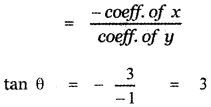
∴ n = 12

Question 14.
Number of sides of a polygon having 44 diagonals is
(1) 4
(2) 4!
(3) 11
(4) 22
Answer:
(3) 11

Explaination:
Number of diagonals of a polygon with n sides
= nC2 – n
= \(\frac{n(n-1)}{2}\)
Given \(\frac{n(n-1)}{2}\) – n = 44
n2 – n + 2n = 88
n2 – 3n – 88 = 0
(n – 11 ) (n + 8) = 0
n = 11 and n = – 8
n = – 8 is not possible.
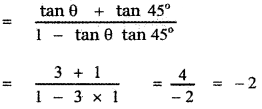
∴ n = 11

Samacheer Kalvi 11th Maths Guide Chapter 4 Combinatorics and Mathematical Induction Ex 4.5

Question 15.
If 10 lines are drawn in a plane such that no two of them are parallel and no three are concurrent, then the total number of point of intersection are
(1) 45
(2) 40
(3) 10!
(4) 210
Answer:
(1) 45

Explaination:
Number of non-parallel lines = 10
Two lines will interest.
∴ Number of points of intersection
= 10C2 = \(\frac{10 \times 9}{1 \times 2}\) = 45

Question 16.
In a plane there are 10 points are there out of which 4 points are collinear, then the number of triangles formed is
(1) 110
(2) 10C3
(3) 120
(4) 116
Answer:
(4) 116

Explaination:
Number of points = 10
Number of triangles formed by using 10 points is same as number of ways of choosing 3 points from 10 points = 10C3
Also given 4 points are collinear.
∴ These 4 points do not contribute triangles.
Thus, total number of triangles = 10C3 – 4C3
= \(\frac{10 \times 9 \times 8}{1 \times 2 \times 3}\) – 4
= 5 × 3 × 8 – 4
= 120 – 4
= 116

Question 17.
In 2nC3 : nC3 = 11 : 1 then
(1) 5
(2) 6
(3) 11
(4) 7
Answer:
(2) 6

Explaination:
Given 2nC3 : nC3 = 11 :
Samacheer Kalvi 11th Maths Guide Chapter 4 Combinatorics and Mathematical Induction Ex 4.5 7
4(2n – 1) = 11 (n – 2)
8n – 4 = 11 n – 22
-4 + 22 = 11 n – 8n
18 = 3n
⇒ n = 6

Samacheer Kalvi 11th Maths Guide Chapter 4 Combinatorics and Mathematical Induction Ex 4.5

Question 18.
(n – 1) Cr + ( n – 1 ) Cr – 1 is
(1) (n + 1) Cr
(2) (n – 1) Cr
(3) nCr
(4) nCr – 1
Answer:
(3) nCr

Explaination:
[nCr + nCr – 1 = (n + 1 ) Cr
(n – 1)Cr + (n – 1)Cr – 1 = (n – 1 + 1) Cr
= nCr

Question 19.
The number of ways of choosing 5 cards out of a deck of 52 cards which include atleast one king is
(1) 52C5
(2) 48 C5
(3) 52C5 + 48C5
(4) 52C5 – 48C5
Answer:
(4) 52C5 – 48C5

Explaination:
Number of cards = 52,
Number of kings = 4
Number of ways of choosing 5 cards out of 52 cards = 52 C5
Number of cards without kings = 48
Number of ways of choosing 5 cards with no kings from 48 cards = 48 C5
∴ Number of ways of choosing 5 cards out of 52 cards
= 52C5 – 48C5

Question 20.
The number of rectangles that a chessboard has
(1) 81
(2) 99
(3) 1296
(4) 6561
Answer:
(3) 1296

Explaination:
Number of rectangles in a chessboard is
Samacheer Kalvi 11th Maths Guide Chapter 4 Combinatorics and Mathematical Induction Ex 4.5 8
= 36 × 36
= 1296

Question 21.
The number of 10 digit number that can be written by using digits 2 and 3 is
(1) 10C2 + 9C2
(2) 210
(3) 210 – 2
(4) 10!
Answer:
(2) 210

Explaination:
Samacheer Kalvi 11th Maths Guide Chapter 4 Combinatorics and Mathematical Induction Ex 4.5 9
Each box can be filled in two ways using digits 2 and 3.
∴ A number of 10 digit number that can be written by using the digits 2 and 3 is 2 × 2 × 2 × …………. 10 times. = 210

Samacheer Kalvi 11th Maths Guide Chapter 4 Combinatorics and Mathematical Induction Ex 4.5

Question 22.
If Pr stands for rPr, then the sum of the series 1 + P1 + 2P3 + 3P3 + ……… + nPn is
(1) Pn + 1
(2) Pn + 1 – 1
(3) Pn + 1 + 1
(4) (n + 1)Pn – 1
Answer:
(1) Pn + 1

Explaination:
Given P, = rPr = r!
1 + 1 × P1! + 2 × P2 + 3 × P3 + …………… + n × Pn!
= 1 + (1 × 1! + 2 × 2! + 3 × 3! + …………. + n × n!)
= (n + 1 )!
= Pn + 1
[(1 × 1 !) + (2 × 2!) + (3× 3 !) + ….. + (n × n !) = (n + 1)! – 1]

Question 23.
The product of first n odd natural numbers equals
(1) 2nCn × nPn
(2) \(\left(\frac{1}{2}\right)^{n}\) 2nCn × nPn
(3) \(\left(\frac{1}{4}\right)^{n}\) × 2nCn × 2nPn
(4) nCn × nPn
Answer:
(2) \(\left(\frac{1}{2}\right)^{n}\) 2nCn × nPn

Explaination:
1 . 3 . 5 …………. (2n – 1)
Samacheer Kalvi 11th Maths Guide Chapter 4 Combinatorics and Mathematical Induction Ex 4.5 10

Question 24.
If nC4, nC5, nC6 are in A. P. the value of n can be
(1) 14
(2) 11
(3) 9
(4) 5
Answer:
(1) 14

Explaination:
Given nCn, nC5, nC6 are in A. P.
∴ 2 × nC5 = nC4 + nC6
Samacheer Kalvi 11th Maths Guide Chapter 4 Combinatorics and Mathematical Induction Ex 4.5 11
12(n – 4) = 30 + (n – 4) (n – 5)
12n – 48 = 30 + n2 – 5n – 4n + 20
12n – 48 = 50 + n2 – 9n
n2 – 9n – 50 – 12n + 48 = 0
n2 – 21n + 98 = 0
n2 – 14n – 7n + 98 = 0
n(n – 14) – 7(n – 14) = 0
(n – 7) (n – 14) = 0
n – 7 = 0 or n – 14 = 0
n = 7 or n = 14

Samacheer Kalvi 11th Maths Guide Chapter 4 Combinatorics and Mathematical Induction Ex 4.5

Question 25.
1 + 3 + 5 + 7 + …………. + 17 is equal to
(1) 101
(2) 81
(3) 71
(4) 61
Answer:
(2) 81

Explaination:
Given 1 + 3 + 5 + 7 + ………… + 17
This is an A.P. with first term a = 1
Common difference d = 2
Last term tn = 17
a + (n – 1)d = 17
1 + (n – 1)2 = 17
(n – 1)2 = 17 – 1
(n – 1)2 = 16
n – 1 = \(\frac{16}{2}\) = 8
n = 9
Samacheer Kalvi 11th Maths Guide Chapter 4 Combinatorics and Mathematical Induction Ex 4.5 12

Samacheer Kalvi 11th Maths Guide Chapter 4 Combinatorics and Mathematical Induction Ex 4.4

Tamilnadu State Board New Syllabus Samacheer Kalvi 11th Maths Guide Pdf Chapter 4 Combinatorics and Mathematical Induction Ex 4.4 Text Book Back Questions and Answers, Notes.

Tamilnadu Samacheer Kalvi 11th Maths Solutions Chapter 4 Combinatorics and Mathematical Induction Ex 4.4

Question 1.
By the principle of mathematical induction, prove that, for n ≥ 1
12 + 22 + 32 + ……….. + n3 = \(\left(\frac{\mathbf{n}(\mathbf{n}+\mathbf{1})}{2}\right)^{2}\)
Answer:
Let P(n) = 12 + 22 + 32 + ……….. + n3
p(n) = \(\left(\frac{\mathbf{n}(\mathbf{n}+\mathbf{1})}{2}\right)^{2}\)

Samacheer Kalvi 11th Maths Guide Chapter 4 Combinatorics and Mathematical Induction Ex 4.4

Step 1:
Let us verify the statement for n = 1
p(1) = 13 = \(\left(\frac{1(1+1)}{2}\right)^{2}\)
Samacheer Kalvi 11th Maths Guide Chapter 4 Combinatorics and Mathematical Induction Ex 4.4 1
P(1) = 1
∴ The given statement is true for n = 1

Step 2 :
Let us assume that the given statement is true for n = k
P(k) = 13 + 23 + 33 + …………… + k3
Samacheer Kalvi 11th Maths Guide Chapter 4 Combinatorics and Mathematical Induction Ex 4.4 2

Step 3 :
Let us prove the statement is true for n = k + 1
P(k + 1 ) = 13 + 23 + 33 + …………… + k3 + (k + 1)3
Samacheer Kalvi 11th Maths Guide Chapter 4 Combinatorics and Mathematical Induction Ex 4.4 3
This implies P (k + 1) is true.
∴ Thus, we have proved the result for n = k + 1.
Hence by the principle of mathematical induction, the result is true for all natural numbers n.
12 + 22 + 32 + ……….. + n3 = \(\left(\frac{\mathbf{n}(\mathbf{n}+\mathbf{1})}{2}\right)^{2}\)
is true for all natural numbers n.

Samacheer Kalvi 11th Maths Guide Chapter 4 Combinatorics and Mathematical Induction Ex 4.4

Question 2.
By the principle of mathematical induction, prove that, for n ≥ 1
Samacheer Kalvi 11th Maths Guide Chapter 4 Combinatorics and Mathematical Induction Ex 4.4 4
Answer:
Samacheer Kalvi 11th Maths Guide Chapter 4 Combinatorics and Mathematical Induction Ex 4.4 5

Step 1 :
Let us verify the statement for n = 1
Samacheer Kalvi 11th Maths Guide Chapter 4 Combinatorics and Mathematical Induction Ex 4.4 6
∴ The given statement is true for n = 1

Step 2 :
Let us assume that the given statement is true for n = k
Samacheer Kalvi 11th Maths Guide Chapter 4 Combinatorics and Mathematical Induction Ex 4.4 7

Step 3:
Let us prove the statement is true for n = k + 1
Samacheer Kalvi 11th Maths Guide Chapter 4 Combinatorics and Mathematical Induction Ex 4.4 8
Samacheer Kalvi 11th Maths Guide Chapter 4 Combinatorics and Mathematical Induction Ex 4.4 9
This implies P (k + 1) is true.
∴ Thus, we have proved the result for n = k + 1.
Hence by the principle of mathematical induction, the result is true for all natural numbers n.
Samacheer Kalvi 11th Maths Guide Chapter 4 Combinatorics and Mathematical Induction Ex 4.4 10
is true for all natural numbers n.

Samacheer Kalvi 11th Maths Guide Chapter 4 Combinatorics and Mathematical Induction Ex 4.4

Question 3.
Prove that the sum of the first ’n’ non-zero even numbers is n2 + n.
Answer:
Let P(n) : 2 + 4 + 6 +…+2n = n2 + n, ∀ n ∈ N

Step 1:
P( 1) : 2 = 12 + 1 = 2 which is true for P( 1)

Step 2:
P(k): 2 + 4 + 6+ …+ 2k = k2 + k. Let it be true.

Step 3:
P(k + 1) : 2 + 4 + 6 + … + 2k + (2k + 2)
= k2+ k + (2k + 2) = k2 + 3k + 2
= k2 + 2k + k + 1 + 1
= (k+ 1)2+ (k + 1)
Which is true for P(k + 1)
So, P(k + 1) is true whenever P(k) is true.

Samacheer Kalvi 11th Maths Guide Chapter 4 Combinatorics and Mathematical Induction Ex 4.4

Question 4.
By the principle of mathematical induction, prove that, for n ≥ 1, 1 . 2 + 2 . 3 + 3 . 4 + …………. + n . (n + 1) = \(\frac{\mathbf{n}(\mathbf{n}+1)(\mathbf{n}+2)}{3}\)
Answer:
Let P(n) = 1 . 2 + 2 . 3 + 3 . 4 + ………… + n . (n + 1) = \(\frac{\mathbf{n}(\mathbf{n}+1)(\mathbf{n}+2)}{3}\)

Step 1:
Let us verify the statement for n = 1
P(1) = 1 . 2 = \(\frac{1(1+1)(1+2)}{3}\)
= 1 . 2 = \(\frac{1 \cdot 2 \cdot 3}{3}\)
∴ The result is true for n = 1

Step 2:
Let us assume that the result is true for n = k
P (k) = 1-2 + 2-3 + 3- 4 + + k (k + 1 ) =
Samacheer Kalvi 11th Maths Guide Chapter 4 Combinatorics and Mathematical Induction Ex 4.4 11

Step 3:
Let us prove the result for n = k + 1
P(k + 1) = 1 . 2 + 2 . 3 + 3 . 4 + …………… + k (k + 1) (k + 1) (k + 1 + 1)
P (k + 1) = 1 . 2 + 2 . 3 + 3 . 4 + ………….. + k (k + 1) + (k + 1 ) (k + 2)
P (k + 1 ) = P(k) + (k + 1) (k + 2)
Samacheer Kalvi 11th Maths Guide Chapter 4 Combinatorics and Mathematical Induction Ex 4.4 12
This implies P (k + 1) is true.
∴ Thus, we have proved the result for n = k + 1, Hence by the principle of mathematical induction, the result is true for all natural numbers n.
1 . 2 + 2 . 3 + 3 . 4 + ………. + n (n + 1) = \(\frac{\mathrm{n}(\mathrm{n}+1)(\mathrm{n}+2)}{3}\)
is true for all natural numbers n ≥ 1

Samacheer Kalvi 11th Maths Guide Chapter 4 Combinatorics and Mathematical Induction Ex 4.4

Question 5.
Using the Mathematical induction, show that for any natural number n ≥ 2,
Samacheer Kalvi 11th Maths Guide Chapter 4 Combinatorics and Mathematical Induction Ex 4.4 13
Answer:
Let
Samacheer Kalvi 11th Maths Guide Chapter 4 Combinatorics and Mathematical Induction Ex 4.4 14
The first stage is n = 2

Step 1:
Let us verify the result for n = 2
Samacheer Kalvi 11th Maths Guide Chapter 4 Combinatorics and Mathematical Induction Ex 4.4 15
∴ The given result is true for n = 2.

Step 2:
Let us assume that the result is true for n = k.
Samacheer Kalvi 11th Maths Guide Chapter 4 Combinatorics and Mathematical Induction Ex 4.4 16

Step 3:
Let us prove the result for n = k + 1
Samacheer Kalvi 11th Maths Guide Chapter 4 Combinatorics and Mathematical Induction Ex 4.4 17
Samacheer Kalvi 11th Maths Guide Chapter 4 Combinatorics and Mathematical Induction Ex 4.4 18
∴ Thus, we have proved the result for n = k + 1.
Hence by the principle of mathematical induction, the result is true for all natural numbers n ≥ 2.
Samacheer Kalvi 11th Maths Guide Chapter 4 Combinatorics and Mathematical Induction Ex 4.4 19
is true for all natural numbers n ≥ 2.

Samacheer Kalvi 11th Maths Guide Chapter 4 Combinatorics and Mathematical Induction Ex 4.4

Question 6.
Using the Mathematical induction, show that for any natural number n ≥ 2,
Samacheer Kalvi 11th Maths Guide Chapter 4 Combinatorics and Mathematical Induction Ex 4.4 20
Answer:
Samacheer Kalvi 11th Maths Guide Chapter 4 Combinatorics and Mathematical Induction Ex 4.4 21

Step 1:
Since n ≥ 2 the first stage is n = 2
Let us verify the result for n = 2
Samacheer Kalvi 11th Maths Guide Chapter 4 Combinatorics and Mathematical Induction Ex 4.4 22
∴ P (2 ) is true.
The result is true for n = 2.

Step 2:
Let us assume that the result is true for n = k.
Samacheer Kalvi 11th Maths Guide Chapter 4 Combinatorics and Mathematical Induction Ex 4.4 23

Step 3:
Let us prove the result for n = k + 1
Samacheer Kalvi 11th Maths Guide Chapter 4 Combinatorics and Mathematical Induction Ex 4.4 24
Samacheer Kalvi 11th Maths Guide Chapter 4 Combinatorics and Mathematical Induction Ex 4.4 25
This implies p(k + 1) is true.
∴ Thus, we have proved the result for n = k + 1.
Hence by the principle of mathematical induction, the result is true for all natural numbers n ≥ 2.
Samacheer Kalvi 11th Maths Guide Chapter 4 Combinatorics and Mathematical Induction Ex 4.4 26
is true for all natural numbers n ≥ 2

Samacheer Kalvi 11th Maths Guide Chapter 4 Combinatorics and Mathematical Induction Ex 4.4

Question 7.
Using the mathematical induction, show that for any natural number n,
Samacheer Kalvi 11th Maths Guide Chapter 4 Combinatorics and Mathematical Induction Ex 4.4 27
Answer:
Samacheer Kalvi 11th Maths Guide Chapter 4 Combinatorics and Mathematical Induction Ex 4.4 28

Step 1:
First, let us verify the result for n = 1
Samacheer Kalvi 11th Maths Guide Chapter 4 Combinatorics and Mathematical Induction Ex 4.4 29
∴ The given result is true for n = 1

Step 2:
Let us assume the result for n = k
Samacheer Kalvi 11th Maths Guide Chapter 4 Combinatorics and Mathematical Induction Ex 4.4 30

Step 3:
Let us prove the result for n = k + 1
Samacheer Kalvi 11th Maths Guide Chapter 4 Combinatorics and Mathematical Induction Ex 4.4 31
Factorizing k3 + 6k2 + 9k + 4
f (k) = k3 + 6k2 + 9k + 4
f(- 1) = (- 1)3 + 6(- 1)2 + 9(- 1) + 4
f(- 1) = – 1 + 6 – 9 + 4 = 0
∴ (k + 1) is a factor of f(k)
Samacheer Kalvi 11th Maths Guide Chapter 4 Combinatorics and Mathematical Induction Ex 4.4 32
k3 + 6k2 + 9k + 4 = (k + 1) (k2 + 5k + 4).
= (k + 1) (k2 + 4k + k + 4)
= (k + 1) [k(k + 4) + 1(k + 4)]
= (k + 1) (k + 4) (k + 1)
Samacheer Kalvi 11th Maths Guide Chapter 4 Combinatorics and Mathematical Induction Ex 4.4 33
This implies P(k + 1) is true.
∴ Thus, we have proved the result for n = k + 1.
Hence by the principle of mathematical induction, the result is true for all natural numbers n.
Samacheer Kalvi 11th Maths Guide Chapter 4 Combinatorics and Mathematical Induction Ex 4.4 34
is true for all natural numbers n

Samacheer Kalvi 11th Maths Guide Chapter 4 Combinatorics and Mathematical Induction Ex 4.4

Question 8.
Using the Mathematical induction, show that for any natural number n,
Samacheer Kalvi 11th Maths Guide Chapter 4 Combinatorics and Mathematical Induction Ex 4.4 35
Answer:
Samacheer Kalvi 11th Maths Guide Chapter 4 Combinatorics and Mathematical Induction Ex 4.4 36

Step 1:
First, let us verify the result for n = 1
Samacheer Kalvi 11th Maths Guide Chapter 4 Combinatorics and Mathematical Induction Ex 4.4 37
Samacheer Kalvi 11th Maths Guide Chapter 4 Combinatorics and Mathematical Induction Ex 4.4 38
∴ The result is true for n = 1

Step 2:
Let us assume that the result is true for n = k
Samacheer Kalvi 11th Maths Guide Chapter 4 Combinatorics and Mathematical Induction Ex 4.4 39

Step 3:
Let us prove the result for n = k + 1
Samacheer Kalvi 11th Maths Guide Chapter 4 Combinatorics and Mathematical Induction Ex 4.4 40
Samacheer Kalvi 11th Maths Guide Chapter 4 Combinatorics and Mathematical Induction Ex 4.4 41
This implies P(k + 1) is true.
∴ Thus, we have proved the result for n = k + 1.
Hence by the principle of mathematical induction, the result is true for all natural numbers n.
Samacheer Kalvi 11th Maths Guide Chapter 4 Combinatorics and Mathematical Induction Ex 4.4 42

Samacheer Kalvi 11th Maths Guide Chapter 4 Combinatorics and Mathematical Induction Ex 4.4

Question 9.
Prove by mathematical induction that
1! + (2 × 2 !) + (3 × 3!) +…. .+ (n × n!) = (n + 1)! – 1
Answer:
P(n) is the statement
1! + (2 × 2!) + (3 × 3!) + ….. + (n × n!) = (n + 1)! – 1
To prove for n = 1
LHS = 1! = 1
RHS = (1 + 1)! – 1 = 2! – 1 = 2 – 1 = 1
LHS = RHS ⇒ P(1) is true
Assume that the given statement is true for n = k
(i.e.) 1! + (2 × 2!) + (3 × 3!) + … + (k × k!) = (k + 1)! – 1 is true
To prove P(k + 1) is true
p(k + 1) = p(k) + t(k + 1)
P(k + 1) = (k + 1)! – 1 + (k + 1) × (k + 1)!
= (k + 1)! + (k + 1) (k + 1)! – 1
= (k + 1)! [1 + k + 1] – 1
= (k + 1)! (k + 2) – 1
= (k + 2)! – 1
= (k + 1 + 1)! – 1
∴ P(k + 1) is true
⇒ P(k) is true, So by the principle of mathematical induction P(n) is true.

Samacheer Kalvi 11th Maths Guide Chapter 4 Combinatorics and Mathematical Induction Ex 4.4

Question 10.
Using the Mathematical induction, show that for any natural number n, x2n – y2n is divisible by x + y.
Answer:
Let P(n) = x2n – y2n is divisible by (x + y)
For n = 1
P(1) = x2 × 1 – y2 × 1 is divisible by (x + y)
⇒ (x + y) (x – y) is divisible by (x + y)
∴ P(1) is true
Let P(n) be true for n = k
∴ P(k) = x2k – y2k is divisible by (x + y)
⇒ x2k – y2k = λ(x + y) …… (i)
For n = k + 1
⇒ P(k + 1) = x2(k + 1) – y2(k + 1) is divisible by (x + y)
Now x2(k + 2) – y2(k + 2)
= x2k + 2 – x2ky2 + x2ky2 – y2k + 2
= x2k.x2 – x2ky2 + x2ky2 – y2ky2
= x2k (x2 – y2) + y2λ (x + y) [Using (i)]
⇒ x2k + 2 – y2k + 2 is divisible by (x + y)
∴ P(k + 1) is true.
Thus P(k) is true ⇒ P(k + 1) is true.
Hence by the principle of mathematical induction, P(n) is true for all n ∈ N

Samacheer Kalvi 11th Maths Guide Chapter 4 Combinatorics and Mathematical Induction Ex 4.4

Question 11.
By the principle of mathematical induction, prove that, for n ≥ 1, 12 + 22 + 32 + ………….. + n2 > \(\frac{n^{3}}{3}\)
Answer:
Let P (n) = 12 + 22 + 32 + ………….. + n2 > \(\frac{n^{3}}{3}\)

Step 1:
Let us first verify the result for n = 1
Samacheer Kalvi 11th Maths Guide Chapter 4 Combinatorics and Mathematical Induction Ex 4.4 44
∴ The result is true for n = 1

Step 2:
Let us assume that the result is true for n = k.
P(k) = 12 + 22 + 32 + …………… + k2 > \(\frac{\mathrm{k}^{3}}{3}\)

Step 3:
Let us prove the result for n = k + 1
P(k + 1) = 12 + 22 + 32 + …………… + k2 + (k + 1)2
P(k + 1) = P(k) + ( k + 1)2
Samacheer Kalvi 11th Maths Guide Chapter 4 Combinatorics and Mathematical Induction Ex 4.4 45
This implies P (k + 1) is true.
∴ Thus, we have proved the result for n = k + 1.
Hence by the principle of mathematical induction, the result is true for all natural numbers n.
12 + 22 + 32 + ………….. + n2 > \(\frac{n^{3}}{3}\)

Samacheer Kalvi 11th Maths Guide Chapter 4 Combinatorics and Mathematical Induction Ex 4.4

Question 12.
Use induction to prove that n3 – 7n + 3, is divisible by 3, for all natural numbers n.
Answer:
Let P(n) : n3 – 7n + 3
Step 1:
P(1) = (1)3 – 7(1) + 3
= 1 – 7 + 3 = -3 which is divisible by 3
So, it is true for P(1).

Step 2:
P(k) : k3 – 7k + 3 = 3λ. Let it be true
⇒ k3 = 3λ + 7k – 3

Step 3:
P(k + 1) = (k + 1)3 – 7(k + 1) + 3
= k3 + 1 + 3k2 + 3k – 7k – 7 + 3
= k3 + 3k2 – 4k – 3
= (3λ + 7k – 3) + 3k2 – 4k – 3 (from Step 2)
= 3k2 + 3k + 3λ – 6
= 3(k2 + k + λ – 2) which is divisible by 3.
So it is true for P(k + 1).
Hence, P(k + 1) is true whenever it is true for P(k).

Samacheer Kalvi 11th Maths Guide Chapter 4 Combinatorics and Mathematical Induction Ex 4.4

Question 13.
Use induction to prove that 5n + 1 + 4 × 6n when divided by 20 leaves a remainder 9 , for all natural numbers n.
Answer:
To prove 5n + 1 + 4 × 6n when divided by 20 leaves a remainder 9
That is to prove 5n + 1 + 4 × 6n – 9 is divisible by 20
Let P (n) be the statement 5n + 1 + 4 × 6n
which is divisible by 20
P (n) = 5n + 1 + 4 × 6n – 9 = 20λ

Step 1 :
Let us verify the statement for n = 1
P (1) = 5i + 1 + 4 × 61 – 9
= 52 + 4 × 6 – 9
= 25 + 24 – 9
= 49 – 9 = 40
which is divisible by 20
∴ The statement is true for n = 1

Step 2:
Let us assume that the statement is true for n = k
P(k) = 5k + 1 + 4 × 6k – 9 is divisible by 20
P(k) = 5k + 1 + 4 × 6k – 9 = 20λ …………… (1)

Step 3:
Let us prove the result for n = k + 1
Samacheer Kalvi 11th Maths Guide Chapter 4 Combinatorics and Mathematical Induction Ex 4.4 46
Hence, P(k + 1) is divisible by 20.
This implies P (k + 1) is true.
∴ Thus, we have proved the result for n = k + 1.
Hence by the principle of mathematical induction, the result is true for all natural numbers n.
Thus, 5n + 1 + 4 × 6n when divided by 20 leaves a remainder 9, for all natural numbers n.

Samacheer Kalvi 11th Maths Guide Chapter 4 Combinatorics and Mathematical Induction Ex 4.4

Question 14.
Use induction to prove that 10n + 3 × 4n + 2 + 5 is divisible by 9, for all natural numbers n.
Answer:
Let P( n) = 10n + 3 × 4n + 2 + 5 is divisible by 9

Step 1:
Let us verify the result for n = 1
P ( 1 ) = 101 + 3 × 41 + 2 + 5
= 15 + 3 × 43
= 15 + 3 × 64
= 15 + 192 = 207
which is divisible by 9
Thus we have verified the result for n = 1

Step 2:
Let us assume the result is true for n = k
P(k) = 10k + 3 × 4k + 2 + 5 is divisible by 9
∴ 10k + 3 × 4k + 2 + 5 = 9m for some m
10k = 9m – 5 – 3 × 4k + 2 for some m

Step 3:
Let us prove the result for n = k + 1
Samacheer Kalvi 11th Maths Guide Chapter 4 Combinatorics and Mathematical Induction Ex 4.4 47
which is divisible by 9
This implies P (k + 1) is true.
∴ Thus, we have proved the result for n = k + 1.
Hence by the principle of mathematical induction, the result is true for all natural numbers n.
10n + 3 × 4n + 2 + 5 is divisible by 9,
for all natural numbers n.

Samacheer Kalvi 11th Maths Guide Chapter 4 Combinatorics and Mathematical Induction Ex 4.4

Question 15.
Prove that using mathematical induction
Samacheer Kalvi 11th Maths Guide Chapter 4 Combinatorics and Mathematical Induction Ex 4.4 48
Answer:
Samacheer Kalvi 11th Maths Guide Chapter 4 Combinatorics and Mathematical Induction Ex 4.4 49
Samacheer Kalvi 11th Maths Guide Chapter 4 Combinatorics and Mathematical Induction Ex 4.4 50

Samacheer Kalvi 11th Maths Guide Chapter 4 Combinatorics and Mathematical Induction Ex 4.4

Samacheer Kalvi 11th Maths Guide Chapter 4 Combinatorics and Mathematical Induction Ex 4.4 51
Samacheer Kalvi 11th Maths Guide Chapter 4 Combinatorics and Mathematical Induction Ex 4.4 52

Samacheer Kalvi 11th Maths Guide Chapter 4 Combinatorics and Mathematical Induction Ex 4.4

Samacheer Kalvi 11th Maths Guide Chapter 4 Combinatorics and Mathematical Induction Ex 4.4 53
This implies P (k + 1) is true. Thus, we have proved the result for n = k + 1.
Hence by the principle of mathematical induction, the result is true for all natural numbers n.

Samacheer Kalvi 9th Science Guide Chapter 13 Chemical Bonding

Tamilnadu State Board New Syllabus Samacheer Kalvi 9th Science Guide Pdf Chapter 13 Chemical Bonding Text Book Back Questions and Answers, Notes.

Samacheer Kalvi 9th Science Solutions Chapter 13 Chemical Bonding

9th Science Guide Chemical Bonding Text Book Back Questions and Answers

I. Choose the correct answer:

Question 1.
Number of valence electrons in carbon is
(a) 2
(b) 4
(c) 3
(d) 5
Answer:
(b) 4

 Samacheer Kalvi 9th Science Guide Chapter 13 Chemical Bonding

Question 2.
Sodium having atomic number 11, is ready to ______________ electron/electrons to attain the nearest noble gas electronic configuration.
(a) gain one
(b) gain two
(c) lose one
(d) lose two
Answer:
(c) lose one

Question 3.
The element that would form anion by gaining electrons in a chemical reaction is ………………..
(a) potassium
(b) calcium
(e) fluorine
(d) iron
Answer:
(c) fluorine

 Samacheer Kalvi 9th Science Guide Chapter 13 Chemical Bonding

Question 4.
Bond formed between a metal and non metal atom is usually …………………..
(a) ionic bond
(b) covalent bond
(e) co-ordinate bond
Answer:
(a) ionic bond

Question 5.
______________ compounds have high melting and boiling points.
(a) Covalent
(b) Coordinate
(e) Ionic
Answer:
(c) Ionic

 Samacheer Kalvi 9th Science Guide Chapter 13 Chemical Bonding

Question 6.
Covalent bond is formed by …………………
(a) transfer of electrons
(b) sharing of electrons
(c) sharing a pair of electrons
Answer:
(b) sharing of electrons

Question 7.
Oxidising agents are also called as …………………. because they remove eletrons form other substances.
(a) electron donors
(b) electron acceptors
Answer:
(b) electron acceptors

 Samacheer Kalvi 9th Science Guide Chapter 13 Chemical Bonding

Question 8.
Elements with stable electronic configurations have eight electrons in their valence shell. They are ……………….
(a) halogens
(b) metals
(c) nobel gases
(d) non metals
Answer:
(c) noble gases

II. Answer briefly :

Question 1.
How do atoms attain Noble gas electronic configuration?
Answer:
Atoms of all elements, other than inert gases, combine to form molecules because they have incomplete valence shell and tend to attain a stable electronic configuration similar to noble gases. Atoms can combine either by transfer of valence electrons from one atom to another or by sharing of valence electrons in order to achieve the stable outer shell of eight electrons.

 Samacheer Kalvi 9th Science Guide Chapter 13 Chemical Bonding

Question 2.
NaCl is insoluble in carbon tetrachloride but soluble in water. Give reason.
Answer:
NaCl is an ionic compound, it is soluble in polar solvent (water). Whereas CCl4 is a covalent compound. So.it is insoluble in polar solvent (water). But it is soluble in nonpolar solvents.

Question 3.
Explain the Octet rule with an example.
Answer:
The tendency of atoms to have eight electrons in the valence shell is known as the ‘Octet rule’ or the ‘Rule of eight’ For example, Sodium with atomic number 11 will readily loose one electron to attain Neon’s stable electronic configuration. Similarly, chlorine has electronic configuration 2,8,7. To get the nearest noble gas (i.e. Argon) configuration, it needs one more electron. So chlorine readily gains one electron from another atom and obtains stable electronic configuration. Thus elements tend to have stable valence shell (eight electrons) either by losing or gaining electrons.
Samacheer Kalvi 9th Science Guide Chapter 13 Chemical Bonding 1
Samacheer Kalvi 9th Science Guide Chapter 13 Chemical Bonding 2

Question 4.
Write a note on different types of bonds.
Answer:
There are different types of chemical bonding possible between atoms which make the molecules. Depending on the type of bond they show different characteristics or properties.
Samacheer Kalvi 9th Science Guide Chapter 13 Chemical Bonding 3

Question 5.
Correct the wrong statements.
(a) Ionic compounds dissolve in non-polar solvents.
(b) Covalent compounds conduct electricity in molten or solution state.
Answer:
(a) Covalent compounds dissolve in non-polar solvents. (or) Ionic compounds dissolve in polar solvents.
(b) Ionic compounds conduct electricity in molten or solution state.

 Samacheer Kalvi 9th Science Guide Chapter 13 Chemical Bonding

Question 6.
Complete the table given below.
Samacheer Kalvi 9th Science Guide Chapter 13 Chemical Bonding 4

Answer:

Samacheer Kalvi 9th Science Guide Chapter 13 Chemical Bonding 5

Question 7.
Draw the electron distribution diagram for the formation of Carbon dioxide (CO2) molecule.
Answer:
Samacheer Kalvi 9th Science Guide Chapter 13 Chemical Bonding 6

Question 8.
Fill in the following table according to the type of bonds formed in the given molecule.
CaCl2, H2O, CaO, CO, KBr, HCl, CCl4, HF, CO2, Al2Cl6
Samacheer Kalvi 9th Science Guide Chapter 13 Chemical Bonding 7

Answer:

Samacheer Kalvi 9th Science Guide Chapter 13 Chemical Bonding 8

Question 9.
The property which is characteristic of an Ionic compound is that
(a) it often exists as a gas at room temperature.
(b) it is hard and brittle.
(c) it undergoes molecular reactions
(d) it has a low melting point.
Answer:
(b) it is hard and brittle

 Samacheer Kalvi 9th Science Guide Chapter 13 Chemical Bonding

Question 10.
Identify the following reactions as oxidation or reduction.
(a) Na → Na+ + e
(b) Fe3+ + 2 e → Fe+
Answer:
(a) oxidation
(b) reduction

Question 11.
Identify the compounds as Ionic/Covalent/Coordinate based on the given characteristics.
(a) Soluble in non-polar solvents
(b) Undergoes faster/instantaneous reactions
(c) Non-conductors of electricity
(d) Solids at room temperature
Answer:
(a) Co-ordinate Covalent compound.
(b) Ionic compound.
(c) Covalent compound.
(d) Ionic compound.

 Samacheer Kalvi 9th Science Guide Chapter 13 Chemical Bonding

Question 12.
An atom X with atomic number 20 combines with atom Y with atomic number 8. Draw the dot structure for the formation of the molecule XY
Answer:
Samacheer Kalvi 9th Science Guide Chapter 13 Chemical Bonding 9

Question 13.
Considering MgCl2 as ionic compound and CH4 as covalent compound give any two differences between these two compounds.
Answer:

MgCl (ionic compound)CH4(covalent compound)
1. It is formed by the transfer of electrons (2e ) from metal magnesium (Mg) to a non – metal atom chlorine (Cl)It is formed by the sharing of electrons between the non-metal atoms carbon and hydrogen
2. In MgCl2 , strong electrostatic force of attraction exist between magnesium cation (Mg2+) and chlorine atoms (Cl )In CH4, weak force of attraction exist between the carbon atom and four hydrogen atoms.

 Samacheer Kalvi 9th Science Guide Chapter 13 Chemical Bonding

Question 14.
Why are Noble gases inert in nature?
Answer:
Noble gases are inert in nature due to the completely filled subshells and thus have stable electronic structures which is very difficult to change. The elements Helium, Neon, Argon, Krypton, Xenon and Radon of group 18 in the periodic table are Noble gases.

III. Answer in detail :

Question 1.
List down the differences between Ionic and Covalent compounds.
Answer:

Ionic CompoundsCovalent Compounds
Formed by the transfer of electrons from a metal to a non-metal atomFormed by sharing of electrons between non-metal atoms.
The strong electrostatic force of attraction between cations and anions.Mutual sharing of electrons and so weak force of attraction between atoms.
Solids at room temperature.Gases, liquids, and soft solids.
Conducts electricity in molten state or in solutionsNon-conductors of electricity.
Have high melting and boiling points.Have low melting and boiling points.
Soluble in polar solventsSoluble in non-polar solvents.
Hard and brittle.Soft and waxy.
Undergo ionic reaction which is fast and instantaneousUndergo molecular reactions which are slow.

 Samacheer Kalvi 9th Science Guide Chapter 13 Chemical Bonding

Question 2.
Give an example for each of the following statements.
(a) A compound in which two Covalent bonds are formed.
(b) A compound in which one ionic bond is formed.
(c) A compound in which two Covalent and one Coordinate bond are formed.
(d) A Compound in which three covalent bonds are formed.
(e) A compound in which a coordinate bond is formed.
Answer:
(a) Oxygen molecule (O2) (O = O)
(b) Sodium’Chloride (NaCl)
(c) Carbon monoxide?
Samacheer Kalvi 9th Science Guide Chapter 13 Chemical Bonding 1i
(d) Nitrogen molecule (N2) (N ≡N)
(e) NH3 → BF3

Question 3.
Identify the incorrect statement and correct them.
(a) Like covalent compounds, coordinate compounds also contain charged particles (ions). So they; are good conductors of electricity.
(b) Ionic bond is a weak bond when compared to Hydrogen bond.
(c) Ionic or electrovalent bonds are formed by the mutual sharing of electrons between atoms.
(d) Loss of electrons is called Oxidation and gain of the electron is called Reduction.
(e) The electrons which are not involved in bonding are called valence electrons.
Answer:
(a) Incorrect statement. Like covalent compounds, co-ordinate compounds also do not contain charged particles (ions), so they are bad conductors of electricity.
(b) Incorrect statement. An ionic bond is a strong bond when compared to a hydrogen bond.
(c) Incorrect statement. Covalent bonds are formed by the mutual sharing of electrons between atoms, (or) Ionic or electrovalent bonds are formed by the transfer of electrons between atoms.
(d) Correct statement
(e) Incorrect statement. The electrons which are not involved in bonding are called lone pair of electrons.

 Samacheer Kalvi 9th Science Guide Chapter 13 Chemical Bonding

Question 4.
Discuss in brief the properties of coordinate covalent compounds.
Answer:
The compounds containing coordinate covalent bonds are called coordinate compounds.
(a) Physical state – These compounds exist as gases, liquids or solids.
(b) Electrical conductivity-Like covalent compounds, co-ordinate compounds also do not contain charged particles (ions), so they are bad conductors of electricity.
(c) Melting point – These compounds have to melt and boiling points higher than those of purely covalent compounds but lower than those of purely ionic compounds.
(d) Solubility – Insoluble in polar solvents like water but are soluble in non-polar solvents like benzene, CCl4, and toluene.
(e) Reactions – Co-ordinate covalent compounds undergo molecular reactions which are slow.

Question 5.
Find the oxidation number of the elements in the following compounds.
(a) C in CO2
(b) Mn in MnSO4
(c) N in HNO3
Answer:
(a) C in CO2
1(C) + 2(0) = 0
1x + 2(-2) = 0
x-4 = 0 ‘
x = +4 .
ON of C in CO2 is +4

(b) Mn in MnSO4
1 (Mn) + 1 (S) + 4(0) = 0
x + 1(+6) + 4(-2) = 0
x + 6 – 8 = 0
x – 2 = 0
x = +2
ON of Mn in MnSO4 is +2,

(c) N in HNO3
1(H) + 1 (N) +3(0) =0
1 (+1) + 1 (x) + 3 (-2) =0
+ 1 + x – 6 =0
x – 5 =0
x = +5
ON of N in HNO3 is + 5.

 Samacheer Kalvi 9th Science Guide Chapter 13 Chemical Bonding

9th Science Guide Chemical Bonding Additional Important Questions and Answers

I. Choose the correct answer:

Question 1.
Which of the following atom can exist independently?
(a) Magnesium
(b) Chlorine
(c) Hydrogen
(d) Neon
Answer:
(d) Neon

Question 2.
Alkali and alkaline earth metals form ………… compound when they react with non-metals.
(a) ionic
(b) covalent
(c) co-ordinate covalent
(d) all the above
Answer:
(a) ionic

 Samacheer Kalvi 9th Science Guide Chapter 13 Chemical Bonding

Question 3.
……………..compounds are highly brittle.
(a) Ionic
(b) Covalent
(c) Co-ordinate covalent
Answer:
(a) Ionic

Question 4.
The bond which is formed by mutual sharing of electrons is called ……………….. bond.
(a) ionic
(b) covalent
(c) co-ordinate covalent bond
(d) all the above
Answer:
(b) covalent

 Samacheer Kalvi 9th Science Guide Chapter 13 Chemical Bonding

Question 5.
………………. is an example of a covalent compound having a high melting point.
(a) Magnesium oxide
(b) Silicon carbide
(c) Ammonia
(d) All the above
Answer:
(b) Silicon carbide

Question 6.
Which of the following compound(s) possesses a high melting point?
(a) NaCl
(b) MgCl2
(c) CCl4
(d) Both a & b
Answer:
(d) Both a & b

 Samacheer Kalvi 9th Science Guide Chapter 13 Chemical Bonding

Question 7.
The element that would form cation due to the loss of electron during the chemical reaction is ………………..
(a) calcium
(b) Fluorine
(c) Chlorine
(d) all the above
Answer:
(a) calcium

Question 8.
Fajan’s rule is formulated by considering …………… the cation and ………………..of the cation and anion.
(a) charge
(b) size
(c) charge & size
(d) none
Answer:
(c) charge & size

 Samacheer Kalvi 9th Science Guide Chapter 13 Chemical Bonding

Question 9.
The formation of brown colour on the freshly unit surface of vegetables and fruits is because ………………. of organic compounds present in them.
(a) oxidation
(b) reduction
(c) both a & b
(d) none
Answer:
(a) oxidation

Question 10.
Which of the following compounds has melting and boiling points higher than covalent compounds but lower than ionic compounds?
(a) NaCl
(b) MgCl2
(c) H2O
(d) NH3→BF3
Answer:
(d) NH3→BF3

 Samacheer Kalvi 9th Science Guide Chapter 13 Chemical Bonding

Question 11.
Atoms having 1,2 or 3 electrons in their valence shell will readily form ……………..
(a) cation
(b) anion
Answer:
(a) cation

II. Fill in the blanks:

1. ……………theory explains the formation of molecules.
Answer:
Kossel – Lewis theory

The valency of noble gases is ……………..
Answer:
zero

 Samacheer Kalvi 9th Science Guide Chapter 13 Chemical Bonding

3. …………….. is the only noble gas which does not have eight electrons in their valence shell.
Answer:
Helium

4. The atom that loses electrons will from a ________
Answer:
cation

5. ______ compounds have high density.
Answer:
Ionic

 Samacheer Kalvi 9th Science Guide Chapter 13 Chemical Bonding

6. In covalent bond formation, the sharing of ………….. electrons takes place in their outermost shell.
Answer:
unpaired

7. Polar solvents contain bond between atoms with ………………
Answer:
different electronegativities

8. ……………….. & ………….. atoms have similar electronegativities.
Answer:
Carbon & hydrogen

 Samacheer Kalvi 9th Science Guide Chapter 13 Chemical Bonding

9. Molecular reactions are ……………… in the covalent compound.
Answer:
slow

10. Ionic compounds are ……………..in nature.
Answer:
solid

11. The tendency of atoms to have eight electrons in the outer shell is known as ……………….
Answer:
Octet rule

 Samacheer Kalvi 9th Science Guide Chapter 13 Chemical Bonding

12. As per Fajan’s rule, A1I3is ……………..
Answer:
covalent

13. Oxidising agents are otherwise called as ………………..
Answer:
electron acceptors

14. The tarnishing of metals is due to the formation of ……………….
Answer:
metal oxide

 Samacheer Kalvi 9th Science Guide Chapter 13 Chemical Bonding

15. The tarnishing of metals is an example of ……………. reaction.
Answer:
oxidation

16. The sum of oxidation number of all atoms in a compound is ………………..
Answer:
Zero

17. The ……………….. is a metal that has a high resistance to corrosion.
Answer:
Gold

 Samacheer Kalvi 9th Science Guide Chapter 13 Chemical Bonding

III. Spot the error / correct the wrong statement:

Question 1.
In the formation of compounds, the inner shell electrons of an atom involved in bonding.
Answer:
In the formation of compounds, the valence electrons of an atom involved in bonding.

Question 2.
The atom that gains electrons will form a cation.
Answer:
The atom that gains electrons will form an anion.

 Samacheer Kalvi 9th Science Guide Chapter 13 Chemical Bonding

Question 3.
Ionic compounds have low melting and boiling point.
Answer:
Ionic compounds have high melting and boiling point, (or) Covalent compounds have low melting and boiling point.

Question 4.
Non-polar solvents contain bonds between atoms with different electronegativities.
Answer:
Non-polar solvents contains bonds between atoms with similar electronegativities.

Question 5.
Covalent compounds are soluble in polar solvents.
Answer:
Covalent compounds are readily soluble in non-polar solvents, (or) Ionic compounds are soluble in polar solvents.

 Samacheer Kalvi 9th Science Guide Chapter 13 Chemical Bonding

Question 6.
Greater the charge of the cation greater will be the ionic character.
Answer:
Greater the charge of the cation greater will be the covalent character.

IV. Match the following :

Question 1.

1) Monoatomic gaseous atoma) Electrovalent bond
2) Octet ruleb) Benzene
3) Ionic bondc) Water
4) Non-polar solventd) Electronic theory of valence
5) Polar solvente) Noble gases

Answer:
1. – e, 2. – d, 3. – a, 4. – b, 5. – c

Question 2.

1) Atomic bonda) Oxygen and hydrogen
2) Atoms with different electronegativitiesb) acceptor bond
3) Atom which accepts electron pairc) covalent bond
4) Rusting of irond) donor atom
5) Atom which provides electron paire) oxidation
f) ionic bond

Answer:
1. – c, 2. – a, 3. – b, 4. – e, 5, – d.

 Samacheer Kalvi 9th Science Guide Chapter 13 Chemical Bonding

V. Find the odd one out and write the reason:

Question 1.
Water, acetone, benzene, toluene turpentine.
Answer:
Water. It is a polar solvent where a^ others air non-polar solvents.

Question 2.
Addition of oxygen, removal of hydrogen, loss of an electron, gain of electron.
Answer:
Gain of electron. It is a reduction reaction whereas other three are oxidation reactions.

 Samacheer Kalvi 9th Science Guide Chapter 13 Chemical Bonding

Question 3.
Platinum, palladium NaBH4, CrO3.
Answer:
CrO3 It is an oxidising agent whereas the other three are reducing agents.

Question 4.
Ionic bond, metallic bond, Coordinate covalent bond, Hydrogen bond.
Answer:
Hydrogen bond. It is a weak bond whereas the other three are strong bonds.

Question 5.
Soft & waxy, a bad conductor of electricity, low boiling point, solid at room temperature.
Answer:
Solid at room temperature.
It is the property of ionic compounds whereas the other three are the properties of covalent compounds.

 Samacheer Kalvi 9th Science Guide Chapter 13 Chemical Bonding
.
VI. Answer in brief :

Question 1.
What is a chemical bond?
Answer:
A chemical bond may be defined as the force of attraction between the two atoms that bind them together as a unit called a molecule.

Question 2.
Write the basic concept of Kossel – Lewis theory.
Answer:
Kossle – Lewis theory is based on the concept of electronic configuration of noble gases.

 Samacheer Kalvi 9th Science Guide Chapter 13 Chemical Bonding

Question 3.
Define the ionic bond.
Answer:
An ionic bond is a chemical bond formed by the electrostatic attraction between positive and negative ions. The bond is formed between two atoms when one or more electrons are transferred from the valence shell of one atom to the valence shell of the other atom.

Question 4.
The following shows the electronic distribution diagram for the formation of MgCl2 molecule. Based on this answer the following questions.
Samacheer Kalvi 9th Science Guide Chapter 13 Chemical Bonding 10
(a) Which of the above atom loses electrons to form a cation?
(b) Which of the above atom gain electrons to form an anion?
(c) How many electrons are transferred from Mg to Cl?
(d) Write the name of the anion formed.
(e) Which noble gas configuration do these ions resemble?
(f) Write the electronic configuration of Mg2+ & Cl
Answer:
(a) Magnesium atom loses electrons to form a cation.
(b) Chlorine atom gains 1 electron to from anion.
(c) Two electrons are transferred from Mg – atom to 2 Cl – atoms (each Cl – atom gains 1e from Mg – atom).
(d) Chloride anion (Cl )
(e) Mg2+ ion resembles noble gas configuration of Neon Cl ion resembles noble gas configuration of Argon.
(f) Electronic configuration of Mg2+ is 2, 8. and Electronic configuration of Cl is 2, 8, 8.

 Samacheer Kalvi 9th Science Guide Chapter 13 Chemical Bonding

Question 5.
What is covalent bond?
Answer:
Bond which is formed between atoms by the mutual sharing of electrons is known as a covalent bond.

Question 6.
Name of the following:
(a) An element which obtains the noble gas configuration of neon by losing three electrons.
(b) An element which gains two electrons to obtain the noble gas configuration of Neon.
Answer:
(a) Aluminium (Al → Al3+ + 3e)
(b) Oxygen atom (O + 2e → 02-)

Question 7.
Identify the following reactions as oxidation/reduction/redox reaction.
(a) Zn + CuSO4 → Cu + ZnSO4
(b) CuO+H2 → Cu+H2O
(c) 2Mg +O2  → 2MgO
Answer:
(a) Redox reaction
(b) Reduction
(e) Oxidation

 Samacheer Kalvi 9th Science Guide Chapter 13 Chemical Bonding

Question 8.
What are oxidising agents? Give an example.
Answer:
Substances which have the ability to oxidise other substances are called oxidizing agents. These are also called electron acceptors because they remove electrons from other substances. ’
Example:
Samacheer Kalvi 9th Science Guide Chapter 13 Chemical Bonding 11

Question 9.
What are reducing agents? Give examples.
Answer:
Substances which have the ability to reduce other substances are called reducing agents. These are also called electron donors because they donate electrons to other substances.
Example: NaBH4, LiAlH4 and metals like Palladium, Platinum.

Question 10.
What are redox reactions? Give examples.
Answer:
Both the oxidation and reduction occurs in the same reaction simultaneously is known as a redox reaction. If one reactant gets oxidised, the other gets reduced. Such reactions are called oxidation-reduction reactions or redox reactions.
Ex. 1 : 2 PbO + C → 2 Pb + CO2
Ex. 2 : Zn + CuSO → Cu + ZnSO4

 Samacheer Kalvi 9th Science Guide Chapter 13 Chemical Bonding

Question 11.
Define (a) oxidation (b) reduction reactions : Give examples.
Answer:
Samacheer Kalvi 9th Science Guide Chapter 13 Chemical Bonding 12

Samacheer Kalvi 9th Science Guide Chapter 13 Chemical Bonding 13

Question 12.
What is rancidity?
Answer:
The oxidation reaction in food materials that were left open for a long period is responsible for spoiling of food. This is called rancidity.

 Samacheer Kalvi 9th Science Guide Chapter 13 Chemical Bonding

Question 13.
Define oxidation number.
Answer:
Oxidation number of an element is defined as the formal charge which an atom of that element appears to have when electrons are counted.

Question 14.
Identify the type of bond in \(\mathrm{NH}_{4}^{+}\)
E:\jyothi\images\2\Samacheer Kalvi 9th Science Guide Chapter 13 Chemical Bonding 21.png
Answer:
Samacheer Kalvi 9th Science Guide Chapter 13 Chemical Bonding 21

VII. To interpret:

Question 1.
Ionic bond is also called electrostatic bond.
Answer:
In ionic bond formation the bond is formed between the oppositely charged ions and these ions come closer to each other due to electrostatic force of attraction. So ionic bond is also called an electrostatic bond.

Question 2.
Ionic compounds are crystalline solids at room temperature.
Answer:
Ionic compounds are formed because of the strong electrostatic force between cations and anions which are arranged in a well-defined geometrical pattern. Thus ionic compounds are crystalline solids at room temperature.

 Samacheer Kalvi 9th Science Guide Chapter 13 Chemical Bonding

Question 3.
Covalent compounds have a low melting point.
Answer:
In covalent compounds, atoms are held by a weak force of attraction. When heat is applied, the molecules are readily pulled out and get free movement.

VIII. Assertion and Reason type questions :

Question 1.
Statement (A) : Ionic compounds do not conduct electricity in a solid-state.
Reason (B) : The ions in ionic compounds are tightly held together by a strong electrostatic force of attraction and they can not move freely.
(a) B explains A
(b) B does not explain A
(c) B is wrong A
(d) A is right B is wrong
Answer:
(a) B explains A

 Samacheer Kalvi 9th Science Guide Chapter 13 Chemical Bonding

Question 2.
Statement (A) : Covalent compounds are bad conductors of electricity.
Reason (B) : Covalent compounds contain charged particles (ions)
a) B explains A
b) B does not explain A
c) Both A & B are right
d) Both A & B are wrong
Answer:
(b) B does not explain A
Reason: Since covalent compounds do not have charged particles (ions), they are bad conductors of electricity.

IX. Find the oxidation number of the elements in the following compounds.

(1) Zn in ZnSO4
(2) Ca in CaH2
(3) Mg in MgO
(4) N in NH3
(5) A1 in AlCl3
Answer:
(1) ZnSO4
1(Zn) + 1 (S) + 4 (0) = 0
x + 1(+6) + 4(-2) = 0
x + 6 – 8 = 0
x = + 2
Oxidation number of Zn in ZnSO4 is +2

(2) CaH2
1(Ca) + 2 (H) = 0
x + 2 (-1) = 0
x -2 = 0
x = + 2
Oxidation number of Ca in CaH2 is +2

(3) MgO
1(Mg) + 1 (O) = 0
x + 1 (-2) = 0
x -2 = 0
x = + 2
Oxidation number of Mg in MgO is +2

(4) NH3
1(N) + 3 (H) = 0
x + 3 (-1) = 0
x – 3 = 0
x = +3
Oxidation number of N in NH3 is +3
(5) AlCl3
1(Al) + 3(Cl) = 0
x + 3 (-1) = 0
x – 3 = 0
x = + 3
Oxidation number of Al in AlCl3 is +3

 Samacheer Kalvi 9th Science Guide Chapter 13 Chemical Bonding

X. Complete the following table:

Question 1.

AtomsAtomic numberElectron distribution
a) O8
b) N
c) –17
d) –2,8,2

Answer:

AtomsAtomic numberElectron distribution
a) O82,6
b) N72,5
c) Cl172,8,7
d) Mg122,8,2

 Samacheer Kalvi 9th Science Guide Chapter 13 Chemical Bonding

Question 2.

a) Dativebond
b) CaH2 → Ca+H2
c) –Reduction
d) –Redox reaction

Answer:

a) DativebondCo-ordinate covalent bond
b) CaH2 → Ca+H2Oxidation
c) Fe3+ + e →Fe2+Reduction
d) both Oxidation of Reduction takes place simultaneouslyRedox reaction

XI. To Match:

Name of compoundType of compound
a) Sodium chloride?
b) ?co-ordinate covalent compound
c) Methane?
d) Fluorine molecule?

Answer:

Name of compoundType of compound
a) Sodium chlorideIonic compound
b) NH3 → BF3co-ordinate covalent compound
c) MethaneCovalent compound
d) Fluorine moleculeCovalent compound

 Samacheer Kalvi 9th Science Guide Chapter 13 Chemical Bonding

XII. Answer in detail :

Question 1.
Explain the ionic bond formation in sodium chloride with electron distribution diagram.
Answer:
Formation of Sodium Chloride (NaCl)

(i) The atomic number of Sodium is 11 and its electronic configuration is 2, 8, 1. It has one electron excess to the nearest stable electronic configuration of a noble gas – Neon.

(ii) So sodium has a tendency to lose one electron from its outermost shell and acquire a stable electronic configuration forming sodium cation (Na+).

(iii) The atomic number of chlorine is 17 and its electronic configuration is 2, 8, 7. It has one electron less to The nearest stable electronic configuration of a noble gas – Argon.

(iv) So chlorine has a tendency to gain one electron to acquire a stable electronic
configuration forming chloride anion (Cl)
Samacheer Kalvi 9th Science Guide Chapter 13 Chemical Bonding 15

(v) When an atom of sodium combines with an atom of chlorine, an electron is transferred from the sodium atom to chlorine atom forming sodium chloride molecule. Thus both the atoms achieve stable octet electronic configuration.

Question 2.
Explain the covalent bond formation in the following molecules.
(a) Chlorine
(b) Nitrogen
(c) Hydrogen
(d) Oxygen
Answer:
(a) Chlorine
Chlorine molecule is formed by two chlorine atoms. Each chlorine atom has seven valence electrons (2,8,7). These two atoms achieve a stable completely filled electronic configuration (octet) by sharing a pair of electrons.
Samacheer Kalvi 9th Science Guide Chapter 13 Chemical Bonding 14

(b) Nitrogen
Nitrogen molecule is formed by two nitrogen atoms. Each nitrogen atom has five valence electrons (2, 5). These two atoms achieve a stable completely filled electronic configuration (octet) by sharing three pair of electrons. Hence a triple bond is formed in between the two atoms.

(c)Hydrogen
Hydrogen molecule is formed by two hydrogen atoms. Both hydrogen atoms contributes one electron each to the shared pair and both atoms acquire stable completely filled electronic configuration.
Samacheer Kalvi 9th Science Guide Chapter 13 Chemical Bonding 18

(d) Oxygen
Oxygen molecule is formed by two oxygen atoms. Each oxygen atom has six valence electrons (2,6). These two atoms achieve a stable electronic configuration (octet) by sharing two pair of electrons. Hence a double bond is formed in between
the two atoms.
Samacheer Kalvi 9th Science Guide Chapter 13 Chemical Bonding 19

 Samacheer Kalvi 9th Science Guide Chapter 13 Chemical Bonding

Question 3.
Explain the co-ordinate covalent bond formation in between NH3 → BF3 molecules.
Answer:
The ammonia molecule gives a lone pair of electrons to boron trifluoride (BF3) molecule which is electron deficient. Thus a coordinate covalent bond is formed between NH3 (donor molecule) and BF3 (acceptor molecule) and is represented by
Samacheer Kalvi 9th Science Guide Chapter 13 Chemical Bonding 20

Question 4.
Write notes on the characteristics of covalent compounds.
Answer:
a. Physical state: Depending on the force of attraction between covalent molecules the bond may be weaker or stronger. Thus covalent compounds exist in gaseous, liquid, and solid forms. Eg. Oxygen-gas; Water-liquid: Diamond-solid.

b. Electrical conductivity: Covalent compounds do not contain charged particles (ions), so they are bad conductors of electricity.

c. Melting point: Except few covalent compounds (Diamond, Silicon carbide), they have relatively low melting points compared to Ionic compounds.

d. Solubility: Covalent compounds are readily soluble in non-polar solvents like benzene (C6H6), carbon tetrachloride (CCl4). They are insoluble in polar solvents like water.

e. Hardness and brittleness: Covalent compounds are neither hard nor brittle. But they are soft and waxy.

f. Reactions: Covalent compounds undergo molecular reactions in solutions and these reactions are slow.

 Samacheer Kalvi 9th Science Guide Chapter 13 Chemical Bonding

Question 5.
Write notes on the characteristics of ionic compounds.
Answer:
a. Physical state: These compounds are formed because of the strong electrostatic force between cations and anions which are arranged in a well-defined geometrical pattern. Thus ionic compounds are crystalline solids at room temperature.

b. Electrical conductivity: Ionic compounds are crystalline solids and so their ions are tightly held together. The ions, therefore, cannot move freely, so they do not conduct electricity in a solid-state. However, in a molten state and their aqueous solutions conduct electricity.

c. Melting point: the strong electrostatic force between the cations and anions hold the ions tightly together, so very high energy is required to separate them. Hence ionic compounds have high melting and boiling points.

d. Solubility: Ionic compounds are soluble in polar solvents like water. They are insoluble in non-polar solvents like benzene (C6H6), carbon tetrachloride (CCl4).

e. Density, hardness, and brittleness: Ionic compounds have high density and they are quite hard because of the strong electrostatic force between the ions. But they are highly brittle.

f. Reactions: Ionic compounds undergo ionic reactions which are practically rapid and instantaneous.

Samacheer Kalvi 12th English Guide Prose Chapter 3 In Celebration of Being Alive

Tamilnadu State Board New Syllabus Samacheer Kalvi 12th English Guide Pdf Prose Chapter 3 In Celebration of Being Alive Text Book Back Questions and Answers, Summary, Notes.

Tamilnadu Samacheer Kalvi 12th English Solutions Prose Chapter 3 In Celebration of Being Alive

12th English Guide In Celebration of Being Alive Text Book Back Questions and Answers

Textual Questions:

1. Answer the following questions in one or two sentences based on your understanding of the lesson: (P.No. 70)(Note: IQ —> Important Questions)

Question a.
What thoughts troubled Dr. Christiaan Barnard as he neared the end of his career as a heart surgeon?
Answer:
Towards the end of his career, Dr. Christiaan Barnard was troubled by the suffering of people and especially of young children. He could not accept the fact that 12 million children are unlikely to reach the age of one and about 6 million children die annually before reaching the age of five.

Question b.
What were Dr. Barnard’s feelings when he was hospitalized after an accident?
Answer:
Dr. Barnard had a feeling about why his wife and himself had to suffer.

Question c.
When and where did the accident occur? (IQ)
Answer:
He and his wife were crossing the road after a lovely meal. A car hit him and knocked him into his wife. His wife was thrown into the other lane and was struck by a car coming in the opposite direction.

Question d.
How did the hospitalization of Dr. Barnard and his wife affect their routine?
Answer:
Dr. Barnard was not able to attend to the patients who were waiting for him to operate on them. His wife was not able to take care of her young baby.

Question e.
How was Dr. Barnard’s attitude to suffering different from that of his father’s?
Answer:
Dr. Barnard’s father accepted suffering as God’s will. He also believed that suffering ennobles humans. But Dr. Barnard found no meaning in the agony and suffering of patients and especially of the young children.

Samacheer Kalvi 12th English Guide Prose Chapter 3 In Celebration of Being Alive

Question f.
How was the unattended trolley put to use? (IQ)
Answer:
The unattended trolley was used as a car for a race (Grand Prix of Cape Town’s Red cross children’s’ hospital) within the hospital.

Question g.
What roles did the duo take up?
Answer:

  1. The two boys took the roles of a driver and a mechanic
  2. The blind boy was the mechanic and the boy with on arm was the driver.

Question h.
Why did the choice of roles prove to be easy for them?
Answer:
The mechanic provided motor power by galloping along behind the trolley with his head down. The driver steered the trolley by scraping his foot on the floor. The choice of the roles was easy because the mechanic was totally blind and the driver had only one arm.

Question i.
Who encouraged them and how?
Answer:
The other patients encouraged them by laughing and shouting.

Question j.
What does Dr. Barnard compare this entertainment to?
Answer:
Dr. Barnard compared the trolley race as much better entertainment than anything anyone puts on at the Indianapolis 500 car race.

Question k.
What happened in the grand finale? (IQ)
Answer:
The grand finale led to the scattering of plates and silverware placed on the trolley.

Question l.
How does Dr. Barnard know the boy who played the trolley’s driver?
Answer:
Dr. Barnard knew the trolley’s driver better. He had successfully closed a hole in his heart a few years back.

Question m.
What was the profound lesson that Dr. Barnard learned from the boys?
Answer:
The profound lesson that Dr.Barnard learned was that the business of living in the celebration of being alive.

Samacheer Kalvi 12th English Guide Prose Chapter 3 In Celebration of Being Alive

2. Answer the following questions in three or four sentences: (Text Book Page No. 71)

Question a.
Detail the statistics Dr. Barnard has provided in his speech.
Answer:
Of the 125 million children bom that year, 12 million are unlikely to reach the age of one. Another six million will die before the age of five. Among the rest, many will end up as mental or physical cripples.

Question b.
What happened when the doctor couple was crossing the street?
Answer:
When they were crossing the street a car hit him and knocked him into his wife. She was thrown into the
other lane and struck by a car coming from the opposite direction.

Question c.
What injuries did they sustain in the accident?
Answer:
Dr. Barnard had eleven broken ribs. A lung was profoundly perforated. His wife had a badly fractured shoulder.

Question d.
Dr. Barnard couldn’t find any nobility in suffering. Why?
Answer:
Dr.Barnard couldn’t find any nobility in suffering because a sufferer would move restlessly with his mind filled with agony.

Question e.
Why does Dr. Barnard find the suffering of children heartbreaking?
Answer:
He has always found the suffering of young children heart-breaking. Especially because they have total faith in doctors. They believe doctors will help. They don’t complain even after undergoing a mutilating surgery.

Samacheer Kalvi 12th English Guide Prose Chapter 3 In Celebration of Being Alive

Question f.
How did the boy who played the mechanic lose his eyesight?
Answer:

  1. One night his mother and father were drunk.
  2. His mother threw a lantern at his father which missed and broke over the child’s head and shoulders.
  3. He suffered severe third-degree burns on the upper part of his body and lost both his eyesight.

Question g.
Why does Dr. Barnard describe the blind boy as a ‘walking horror’?
Answer:
At the time of the Grand Prix, the boy was a walking horror. His face was disfigured. A long flap of skin was hanging from the side of his neck to his body. As the wound healed around his neck, his lower jaw became gripped in a mass of fibrous tissue. The only way he could open his mouth was to raise his head.

Question h.
What were the problems the trolley driver suffered from?
Answer:

  1. The trolley driver had a hole in his heart which was successfully closed by Dr.Barnard.
  2. He also suffered from a malignant tumour of the bone because of which his shoulder and arm were amputated.

3.Answer the following in a paragraph of 100 – 150 words each: (P.No. 71)

Question a.
Give an account of the medical problems for which the two boys were hospitalized.
Answer:
The seven years old mechanic suffered third-degree bums on the upper part of his body. He had lost both his eyes. He was literally a walking horror. He was disfigured. A long flap of skin was hanging from the side of his neck to his body. As the wound healed around his neck, his lower jaw became gripped in a mass of fibrous tissue. The trolley driver had a malignant tumour of the bone. A few days before the race, his shoulder and arm were amputated. There was little hope of his recovery. If two adults had similar ailments, they would have got dejected with life. But the boys were just happy celebrating the joy of being alive.

Samacheer Kalvi 12th English Guide Prose Chapter 3 In Celebration of Being Alive

Question b.
“These two children had given me a profound lesson …” Elucidate.
(or)
Question c.
Describe the ‘Grand Prix’ at Cape Town’s Red Cross Children’s Hospital.
(or)
Question d.
How did a casual incident in a hospital help Dr. Barnard perceive a new dimension of life?
Answer:
The author describes the event as “the Grand Prix of Cape Town’s Red Cross Children’s’ Hospital”. A nurse had left a breakfast trolley unattended. Very soon this trolley was commandeered by a daring crew of two, a driver and a mechanic. The mechanic provided motor power by galloping along behind the trolley head down. While the driver, seated on the lower deck held on with one hand and steered it by scrapping his foot on the floor. The choice of roles wags easily because the mechanic was totally blind and the driver had only one arm. It was better than the Indianapolis 500 car race. Patients shouted and cheered the boys. There was a grand finale of scattered plates and silverware before the nurse and ward sister took control of the situation.

Question e.
Life is unjust and cruel to certain people. Do they all resign themselves to their fate? Can you think of some who have fought their disabilities heroically and remained a stellar example for others? (for e.g. the astrophysicist Stephen Hawking, a paraplegic). Give an account of one such person and his/her struggle to live a fruitful life.
Answer:
It is a true fact that life is unjust and cruel to certain people. But they all do not resign themselves to their fate. In this context it is worth mentioning Divij Shah who is a one-handed cycling champion, He lost his right hand in an accident when he was four. Determined not to define that mishap in his life, he has experienced way more than the average person with two hands. In his teens, he played for West Bengal’s U-16 cricket team. Constantly looking for challenges, he also took upcycling. After meticulous practice, he bagged silver at the Asian Para-cycling championships that took place a few months ago. At present, Divij has his eyes set on becoming a champion in the 2020 Paralympics.

Samacheer Kalvi 12th English Guide Prose Chapter 3 In Celebration of Being Alive

Paragraph:

Introduction:
In celebration of being alive is an extract of Christiaan Barnard’s speech wherein he narrates an incident which took place in his hospital. It is this incident which made him look at the positive aspect of life. He and his wife met with an accident a few years back. They both were affected very badly. Barnard had eleven broken ribs and a perforated lung and his wife had a badly fractured shoulder. He had a bad feeling about why his wife and himself had to suffer.

4 Better person:
He remembered his father’s words who was of the view that suffering ennobles one and makes one a better person. Barnard found the suffering of children heartbreaking.

In the hospital:
A ‘Grand Prix’ of cape town’s red cross children’s hospital made him perceive a new dimension of life. A nurse had left a breakfast trolley unattended which was taken possession of by two bold and daring boys. One acted as a driver and the other a mechanic.

The mechanic who was seven years old suffered severe third-degree burns on the upper part of his body and lost both his eyes. The trolley’s driver had a hole in his heart which was successfully closed by Dr. Barnard. Later he was hospitalized again because he had a malignant tumour of the bone out of which his shoulder and arm were amputated.

Life lesson:
The patients encouraged them by their shouts and laughter. It was a much better entertainment the result of which was the scattered plates and silverware placed on the trolley. After the Grand Prix, the driver who had a little hope of recovery proudly informed Dr. Barnard that the trolley’s wheels were not properly oiled but he was a good driver and he had full confidence in the mechanic.

Conclusion:
Thus the action of the two children made Dr. Barnard realize the fact that the business of living is the celebration of being alive. He also realized that what is important is what you’ve left and not what you’ve lost.
Learn to live in the sufferings

Samacheer Kalvi 12th English Guide Prose Chapter 3 In Celebration of Being Alive

Vocabulary:
Go through the lesson and spot the words which mean the same as the following: (Text Book Page No. 71)

Question 1.
profession (para 1)
Answer:
Career

Question 2.
sorrowful (para 2)
Answer:
Gloomy

Question 3.
decency (para 5)
Answer:
Noble

Question 4.
destiny (para 6)
Answer:
Fate

Question 5.
hijacked (para 8)
Answer:
Commandeered

Question 6.
motivation (para 9)
Answer:
Encouragement

Question 7.
serious (para 10)
Answer:
Severe

Question 8.
significant (para 13)
Answer:
Important

Samacheer Kalvi 12th English Guide Prose Chapter 3 In Celebration of Being Alive

b) Go through the lesson and spot the words opposite to the meaning of the following:
Question 1.
rare (para 1)
Answer:
prevalent

Question 2.
primitive (para 6)
Answer:
sophisticated

Question 3.
fiction (para 7)
Answer:
witness / fact

Question 4.
fearful (para 8)
Answer:
intrepid

Question 5.
benign (para 11)
Answer:
malignant
Question 6.
diffidence (para 11)
Answer:
hope, confidence

Question 7.
boredom (para 12)
Answer:
amusement/recreation

Question 8.
criticize (para 13)
Answer:
appreciate.

Samacheer Kalvi 12th English Guide Prose Chapter 3 In Celebration of Being Alive

c) Frame illustrative sentences to distinguish the meaning of the words in the following clusters: (Text Book Page No. 72)

  1. career — carrier — courier
  2. patients — patience — patents
  3. accident — incident — incidence
  4. scraping — scrapping — scrubbing
  5. accept — except — expect
  6. lesson — lessen — lesion
  7. severe — sever — sewer
  8. raise — rise— rice
  9. quiet — quite — quit
  10. final — finale — feline

Answer:

1. careerJob, Professionshe likes to pursue her career in medicine.
carrierTransport people or goodsI will call a baggage carrier to help me.
couriera person whose job is to carry letters, important papers urgentlyA courier has arrived and there is a letter for you.
2 .patientsthe person receiving medical treatmentThere are many patients waiting in the hospital.
patienceremain calm and not angryMy grandfather didn’t have the patience to wait in the hospital.
patentsthe document shows that this is your right ‘An invention is not your own until it is patent.
3. accidentan unpleasant event that happens unexpectedlyA bus met with an accident yesterday.
incidentsomething that happens unusuallyIt was an incident that happened yesterday.
incidencethe number of time something happensThere is still a high incidence of Malaria in the area.
4. scrapingsomething you do not want any moreI heard the scraping of the spoon in the bowl.
scrappingto get rid of something that you do not want any moreThe government is scrapping the idea of collecting road tax.
scrubbingto clean with soap and water by rubbing it hardShe started cleaning the over with the scrub sponge.
5. acceptto agreePlease accept my gift.
exceptnot includedAll the students submitted their homework except Ram.
expectthink, beliefI expect my father to arrive at my home at this time.
6. Lessonsomething should be learnedThe teacher teaches her lesson in English.
lessento become lessThe govt decided it lessen the burden of the students.
lesionan organ that has suffered damage through injuryHer daughter suffered a brain lesion at birth.
7. severeseriousI had severe pain in my leg yesterday.
severto cut into two piecesHis finger was severed in the accidents.
seweran underground pipe that carries human wasteThe pond stank like a sewer.
8. raiseto liftShe raised her both arms above her head.
riseto move upwardsThe sun rises in the east.
ricebrown grainI like to eat rice every day.
9. quietcalmRamu is a quiet boy in the classroom.
quitenot veryIt was quite impossible to do this work.
quitgive upI want to quit my bad habits.

Samacheer Kalvi 12th English Guide Prose Chapter 3 In Celebration of Being Alive

d) Fill in the blanks with the words given in brackets: (Text Book Page No. 72)
[profound, amusement, confidence, agony, solace, intrepid, disfigured, perforated]

Question 1.
Theatrical plays were a main source of ___________ before the advent of television.
Answer:
amusement

Question 2.
The __________ warriors of the Spartan Army marched into battle against a powerful enemy.
Answer:
intrepid

Question 3.
The ___________ of parents finally came to an end when their lost child was found with the help of police.
Answer:
agony

Question 4.
Social media has brought about a ________ impact on the lives of millennials.
Answer:
profound

Question 5.
The tires of the car got ________ when the vehicle rolled over the rusted nails scattered on the road.
Answer:
perforated

Question 6.
Thomas Alva Edison did not lose his, ________ even after facing a series of experimental failures in his quest to discover tungsten.
Answer:
confidence

Question 7.
Many victims of the pipeline explosion in an oil refinery were left permanently ________.
Answer:
disfigured

Question 8.
The old lady found ________ in the company of the children in the neighbourhood.
Answer:
solace

Samacheer Kalvi 12th English Guide Prose Chapter 3 In Celebration of Being Alive

e) Form a phrase with each of the following pairs of nouns given below: (Text Book Page No. 72)

Here is an example from the lesson:
fibre + tissue — fibrous tissue

Question 1.
muscle + pain
Answer:
Muscular pain

Question 2.
skeleton + system
Answer:
skeletal system

Question 3.
nerve + disorder
Answer:
nervous disorder

Question 4.
digestion + enzymes
Answer:
digestive enzymes

Question 5.
surgery + instruments
Answer:
surgical instruments

Question 6.
agony + experience
Answer:
agonic experience

Question 7.
glory + victory
Answer:
glorious victory

Question 8.
fancy + idea
Answer:
fanciful idea

Question 9.
emotion + song
Answer:
emotional song

Question 10.
sense + issue
Answer:
sensible issue / sensitive issue.

Samacheer Kalvi 12th English Guide Prose Chapter 3 In Celebration of Being Alive

f) Fill the empty boxes with suitable words under each word class: (Text Book Page No. 73)

Samacheer Kalvi 12th English Guide Prose Chapter 3 In Celebration of Being Alive 1
Answer:

NounVerbAdjectiveAdverb
amusementamuseamusedamusingly
appreciationappreciateappreciativeappreciatively
successsucceedsuccessfulsuccessfully
proudpridepridefulproudly
hopehopehopefulhopefully

g) Spot the errors in the following sentences and rewrite them correctly: (Text Book Page No. 73) 

Question 1.
My grandfather is well-known in the village for his noble deeds.
Answer:
noble

Question 2.
I had my evening meals in a restaurant near my office.
Answer:
meal

Question 3.
The Boss had full confidence in his Manager for the successful completion of the project.
Answer:
in

Question 4.
After the complicated surgery, the patient hoped to complete recovery.
Answer:
for

Question 5.
The new health care scheme announced by the Government will bring relief to the children suffering with acute tuberculosis.
Answer:
from

Question 6.
In spite of his poverty and setbacks, was able to launch his dream carrier.
Answer:
career.

Samacheer Kalvi 12th English Guide Prose Chapter 3 In Celebration of Being Alive

Listening: (Text Book Page No. 73)

Listen to the passage being readout. Based on your understanding, complete the statements given below with appropriate answers:

Question 1.
Boredom occurs when a person is unable to ________.
Answer:
stay attentive

Question 2.
________ and ________ are emotional consequences of boredom.
Answer:
Anger, frustration

Question 3.
Two physical signs of acute boredom are ________, ________.
Answer:

  • eyelids droop
  •  the frown on the face

Question 4.
How does boredom affect the quality of work a person does?
Answer:
A bored person commits a lot of errors in his work.

Question 5.
Mention two ways by which one can overcome boredom.
Answer:

  • exercise
  • set goals and work for them

Samacheer Kalvi 12th English Guide Prose Chapter 3 In Celebration of Being Alive

Speaking: (Text Book Page No. 73)

Question 1.
You are rushing to attend to important work and you witness an accident on your way. Will you go to the rescue of the injured person? Share your views with the class.
Answer:
It is human nature to help the suffering. If I happen to see an accident while going on important work, I would go to the rescue of the injured person. While I was going out on important work, I happened to see an accident on the road. An old lady who was crossing the road was knocked down by a car. She fell down on the road with bleeding injuries. I immediately went to her, tied a cloth around the injured place to stop bleeding, and took her to a nearby hospital in, an auto-rickshaw. The doctors treated her injuries and her life was saved. I informed her relatives about the accident and they rushed to the hospital. They thanked me for helping the old lady.

Question 2.
Every person should take up the responsibility to serve society in his or her own way. Discuss the various ways in which you can serve society.
Answer:
Every citizen has the responsibility to serve society. There are many ways of helping the needy. Plastic has ruined the environment. The government is taking various, steps to ban the use of plastic. Awareness should be created among the public about the dangers of using plastic. I would form a small group of my friends and try to bring awareness to the public by meeting members of every household in my locality. Planting trees is very important. I will contact people, try to plant saplings wherever it is possible. I would meet the children in the locality and their parents and request them to inculcate healthy habits in their children regarding personal hygiene.
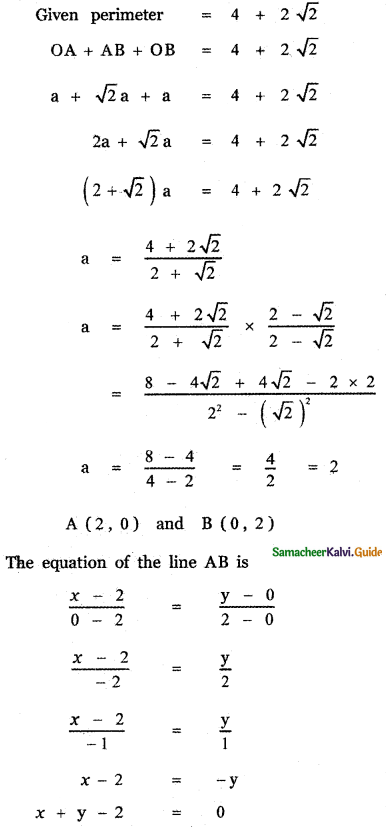
Samacheer Kalvi 12th English Guide Prose Chapter 3 In Celebration of Being Alive

Dialogue: (Text Book Page No. 73)

Here is a conversation between a student who wishes to open an account and a bank clerk. (Text Book Page No. 74)
Samacheer Kalvi 12th English Guide Prose Chapter 3 In Celebration of Being Alive 2
Student: Good morning, madam.
Bank Clerk: Good morning, what can I do for you?
Student: I would like to open an account in your bank.
Bank Clerk: Are you a student of a school or a college?
Student: I am a student of Govt. Hr. Sec. School, Tirunelveli.
Bank Clerk: Why do you want to open an account?
Student: My class teacher advised me to open an account to receive the monetary benefits from government schemes.
Bank Clerk: Here is an application form to open an account in our bank. Fill it up.
Student: Should I enclose any document with the form?
Bank Clerk: Yes. You should enclose a valid identity proof and an address proof that are approved by the government.
Student: Madam, can I submit the form and documents tomorrow?
Bank Clerk: Okay. You need to make an initial deposit of Rs. 500/- to open an account.
Student: Sure Madam, Thank you.
Bank Clerk: You are welcome.

a) Pair work: Practise the dialogue with another student. Then write a similar dialogue between a student and the class teacher regarding an educational trip: (Text Book Page No. 74)

Student: Good morning Mam.
Teacher: Yes, Good morning what about our educational trip?
Student: Yes Mam, I have come to speak about that.
Teacher: Did you inform all the students about it?
Student: Yes, Mam. I have informed all the students. But some of them are not willing to come.
Teacher: Why? Any problem?
Student: Yes Mam, Money is the only problem for them.
Teacher: OK, Give me the list of the students who are willing to participate in the educational trip.
Student: Yes Mam, I will give it at once.
Teacher: OK, see you in the classroom.

Samacheer Kalvi 12th English Guide Prose Chapter 3 In Celebration of Being Alive.
b) Build a conversation for the following situations with a minimum of five exchanges: (Text Book Page No. 74)

1. A passenger and a railway staff regarding the cancellation of the reserved tickets:
Passenger: Good Morning Sir.
Staff: Good morning, what can I do for you?
Passenger: Sir, I want to cancel my reserved ticket.
Staff: Why? What ¡s the reason?
Passenger: My grandfather is dead. So I am unable to go now.
Staff: 0k, It’s all right.
Passenger: Will you refund the money, Sir?
Staff: Yes, please fill the cancellation form.
Passenger: Sure sir, Thank you very much.
Staff: You are welcome.

2. Two friends about the NSS camp which they are going to attend:
Ramu: Hai Rahul, How are you?
Raghul: I am fine. How are you?
Ramu: lam fine. Are you coming to the NSS camp?
Raghul: Yes, I will come. What about you?
Ramu: Yeah! I will also come.
Raghul: Are you willing to participate in any programme?
Ramu: Yes, I will.
Raghul: Shall we speak about the danger of plastics?
Ramu: OK. It’s a good idea.
Raghul: OK, Ram we shall meet in the NSS camp.

3. A salesman and a customer at an electronic shop:
Salesman: You are welcome Sir. what do you want?
Customer: May I have a mixie?
Salesman: Yes, off course. which company do you want sir?
Customer: I want to buy preethi sir.
Salesman: Please come to this side.
Customer: what is the price of it?
Salesman: It is only Rs.3500 sir.
Customer: Does it have any warranty
Salesman: Yes, sir It has 10 years warranty.
Customer: 0K sir, I take this one.

4. A father and his daughter about the advantages of the habit of newspaper- reading:
Father: Do you read any newspaper regularly?
Daughter: Yes dad, I am reading the newspaper daily.
Father: Ws nice. Do you think reading newspaper is essential?
Daughter: Certainly. In fact, it is a storehouse of knowledge.
Father: What can you learn from it?
Daughter: I can learn about world trade, commerce, politics, films, games, and sports, etc from it.
Father Now, what is your suggestion for others?
Daughter: I want to say that everybody should read at least one newspaper daily.
Father: Okay, It is a good habit, and keeps going.
Daughter: Thank you, Dad.

Samacheer Kalvi 12th English Guide Prose Chapter 3 In Celebration of Being Alive

c) Extend the conversation with two more relevant exchanges: (Text Book Page No. 75)

1. Receptionist: Good evening, sir. Welcome to Chennai.
Traveller: I would like to book a deluxe room in your hotel for 3 days.
Receptionist: Single room or double room?
Traveller: Double room, please
Receptionist: Sir, give me your Aadhar card.
Traveller: I have my driving license only
Receptionist: 0k. That will do sir.

2. Student: Good morning, sir. May I come in?
Teacher: Good morning, why are you late today?
Student: My bus broke down on the way. So I had to walk to school.
Teacher: Go and inform the HM.
Student: Yes sir, I will inform him.
Teacher: Get his permission and then enter the classroom

Reading:

Reading Comprehension: (Text Book Page No. 75)

Read the passage given below and answer the questions that follow:

Humans have long been fascinated by fiction. We experience the excitement in assigning supernatural power to
imaginary characters in fictional stories and so we have Spiderman, Batman, He-man, Titans, and many more. The ‘Cyborg’ was an offshoot of such wild imagination of humans to invest our species with superhuman powers. Today, the Cyborg is no more an imaginary organism. We are living in a world where a sizeable population of humans has merged their bodies with technological implants. The term Cyborg, short for ‘cybernetic organism’ was coined to describe a man, whose body is implanted with technological devices to supplement and substitute body functions.

Cyborgs include people with cardiac pacemakers, contact lenses, bionic ears and eyes, prosthetics, and so on. In other words, a cyborg is partly human and partly machine. The technological innovations in the field of medicine and healthcare augment humans with machines, producing a beta version of the human body. The advent of brain-machine interfaces is certain to blur the boundary between humans and machines. Scientists are working hard to find a technique for age reversal too. People do not want to die, so mankind is striving to get to the final frontier, which is the development of machines and devices that would accord man immortality.

Samacheer Kalvi 12th English Guide Prose Chapter 3 In Celebration of Being Alive

The needs of humans are not limited. As time passes, food habits change, thinking patterns change, and even appearances change. We are about to travel by driverless, fully automated vehicles. Computers and smartphones have become our masters. The more we depend and merge with technological advancements, the more the humanness in us slowly erodes. Intelligence is sought to be infused into machines and robotics are designed in such a way to give the man a virtual human companion. The field of artificial intelligence is overtaking the human brain and many fear that it could even harm the human race. Despite certain limitations and potential threats, many believe that cyborgs will be the next step in the evolution of mankind. The amalgamation of man and machine is sure to add a new dimension to the life of mankind and this will prove to be the biggest evolution in Biology’ since the emergence of life, four billion years ago.

Question a.
Account for the popularity of characters with supernatural powers. (Text Book Page No. 76)
Answer:
Humans have long been fascinated by fiction. We experience the excitement in assigning supernatural power to imaginary characters in fictional stories

Question b.
Who is referred to as a ‘Cyborg’?
Answer:
The ‘Cyborg’ was an offshoot of such wild imagination of humans to invest our species with superhuman powers. Today, the Cyborg is no more an imaginary organism. We are living in a world where a sizeable population of humans have merged their bodies with technological implants.

Question c.
What is expected to happen with the advent of the brain-machine interface?
Answer:
The advent of brain-machine interfaces is certain to blur the boundary between humans and machines.

Question d.
The needs of humans are not limited. How is this statement elaborated in the passage?
Answer:
The needs of humans are not limited. As time passes, food habits change, thinking patterns change, and even appearances change. We are about to travel by driverless, fully automated vehicles. Computers and smartphones have become our masters.

Question e.
How can a machine turn into a virtual companion for humans?
Answer:
The more we depend and merge with technological advancements, the more the humanness in us slowly erodes. Intelligence is sought to be infused into machines and robotics are designed in such a way to give man a virtual human companion.

Question f.
Explain the flip side of the rapid technological advancement.
Answer:
Scientists are working hard to find a technique for age reversal too. People do not want to die, so mankind is striving to get to the final frontier, which is development of machines and devices that would accord man immortality.

Question g.
Identify the word in para 1 which means ‘everlasting life’.
Answer:
Long – immortality

Question h.
Which of the following words is synonymous with ‘amalgamation’?
Answer:
a) recreation
b) integration
c) exploration
d) proposition

Question i.
Which of the following options is the antonym of the word ‘advent’?
Answer:
a) drawback
b) dispute
c) departure
d) danger

Question j.
Find out the word which is the antonym of ‘natural’ in para 2.
Answer:
Artificial.

Active and Passive voice: (Text Book Page No. 76)

Samacheer Kalvi 12th English Guide Prose Chapter 3 In Celebration of Being Alive 3

Task 1:
Change the following sentences into Passive Voice: (Text Book Page No. 77)

Question a.
Governor inaugurated the exhibition at ten o’clock.
Answer:
The exhibition was inaugurated by the Governor at ten o’clock.

Question b.
The crowd expected their leader to arrive early in the morning.
Answer:
Their leader was expected to arrive early in the morning by the crowd.

Question c.
Who taught her Computer Science?
Answer:
By whom she was taught computer science?

Question d.
They unanimously named Ravi the captain of the team.
Answer:
Ravi was named the captain of the team unanimously by them.

Question e.
The President gave the commander an award.
Answer:
The commander was given an award by the president.

Question f.
Do not tell a lie.
Answer:
Let not a fie be fold.

Question g.
Please open the door.
Answer:
Let the door be opened.

Question h.
It is time to stop work.
Answer:
Let the work be stopped by this time / It is time the work is stopped.

Question i.
They say he is a spy.
Answer:
It is said by them that he is supposed to be a spy.

Question j.
One should keep one’s promise.
Answer:
One’s promises should be kept.

Question k.
People burn a great deal of wood in winter.
Answer:
A great deal of wood is burned by people in winter.

Question l.
Where had you kept the book?
Answer:
Where had the book been kept by you?

Question m.
When did you feel the tremors?
Answer:
When was the tremors felt by you?

Question n.
How did you do the experiment?
Answer:
How was the experiment done by you?

Question o.
Whose car did someone park in front of your gate?
Answer:
Whose car was parked by someone in front of your gate?

Samacheer Kalvi 12th English Guide Prose Chapter 3 In Celebration of Being Alive

Change the following sentences into Active Voice: (Text Book Page No. 78)

Question a.
The smuggler has been nabbed by the police.
Answer:
The police have nabbed the smuggler.

Question b.
By whom were you interviewed?
Answer:
Who interviewed you?

Question c.
Why were you scolded by your parents?
Answer:
Why did your parents scold you?

Question d.
Not a word was spoken by the convict in self¬defence.
Answer:
The convict did not speak a word in self defence.

Question e.
Good news is expected shortly.
Answer:
They expect Good news shortly.

Question f.
The mail has just been received.
Answer:
They have just received the mail.

Question g.
Sundari has been taken to the hospital by her husband.
Answer:
The husband has taken Sundari to the hospital.

Question h.
Our television is being repaired now.
Answer:
He is repairing our television now.

Question i.
Sweets have not been distributed to children by the organisers.
Answer:
The organisers have not distributed sweets to children.

Question j.
Prizes were being given by the chief guest.
Answer:
The chief guest was giving the prizes.

Question k.
Nobody has been seen in the library this week.
Answer:
I have seen nobody in the library this week.

Question l.
Nobody would have known the truth if you had not disclosed it.
Answer:
The truth would not have been known if it had not been disclosed by you.

Question m.
You are advised to help the poor and needy.
Answer:
You have to help the poor and needy.

Question n.
You are requested to make a cup of tea for the guest.
Answer:
Please make a cup of tea for the guest.

Samacheer Kalvi 12th English Guide Prose Chapter 3 In Celebration of Being Alive

Question Tags: (Text Book Page No. 79)

Task 1:
Add suitable question tags to the following sentences and punctuate properly: (Text Book Page No.81)

Question 1.
The children are very happy today.
Answer:
Aren’t they?

Question 2.
You have not returned my books yet.
Answer:
Have you?

Question 3.
We enjoyed the trip very much.
Answer:
Didn’t we?

Question 4.
Let’s clean the shelves this weekend.
Answer:
Shall we?

Question 5.
My mother rarely travels by bus.
Answer:
Does she?

Question 6.
Somebody must bell the cat.
Answer:
Mustn’t someone?

Question 7.
Anita never comes late to the office.
Answer:
Does she?

Question 8.
I am always the winner.
Answer:
Aren’t I?

Question 9.
Don’t commit this mistake again.
Answer:
Will you?

Question 10.
There is a pharmacy near that bus stand.
Answer:
Isn’t there?

Question 11.
Bacteria can never survive in extreme weather conditions.
Answer:
Can they?

Question 12.
I am not as smart as you are.
Answer:
Am I?

Question 13.
The boys broke the windowpane last evening.
Answer:
Didn’t they?

Question 14.
Leaves wither during autumn.
Answer:
Don’t they?

Question 15.
You should add a little salt to the buttermilk.
Answer:
Shouldn’t you?

Samacheer Kalvi 12th English Guide Prose Chapter 3 In Celebration of Being Alive

Task 2:
Correct the error found in the question tag in each of the following: (Text Book Page No.81) 

Question 1.
The evildoers cannot cross the path of truth, can’t they?
Answer:
Can they?

Question 2.
The vegetables in the fridge are still fresh, aren’t it?
Answer:
aren’t they?

Question 3.
The village head understood the intention of the politician, doesn’t he?
Answer:
didn’t he?

Question 4.
I claim to be a person of faith and prayer, aren’t I?
Answer:
don’t I?

Question 5.
The employees are seldom allowed to meet their boss, aren’t they?
Answer:
are they?

Question 6.
Let’s organize a trip to Goa, can we?
Answer:
shall we?

Question 7.
The landlady will charge me for the damage, shan’t she?
Answer:
won’t she?

Question 8.
Both the sisters have left for Canada, aren’t they?
Answer:
haven’t they?

Question 9.
That’s definitely not the right thing to do in this situation, isn’t that?
Answer:
is that?

Question 10.
We needn’t apply for a bank loan, do we?
Answer:
need we?

Question 11.
The Chief Guest spoke a few words, did he?
Answer:
didn’t he?

Question 12.
The rhinoceros has a horn made of keratin, haven’t they?
Answer:
hasn’t it?

Samacheer Kalvi 12th English Guide Prose Chapter 3 In Celebration of Being Alive

Story writing: (Text Book Page No. 82)

Task 1:
Expand the following outlines into complete stories and supply a suitable title for each: (Text Book Page No. 83)

Exercise: (Text Book Page No. 84)

1. Big cotton merchant – owned a factory – many employees – one day a heap of cotton stolen – no due – merchant’s secretary assured to find out – asked him to host dinner – invite all workers – merchant agreed – middle of the feast – secretary suddenly shouted – cotton sticking to hair of thieves – the guilty dusted their heads – tried to clear – caught in the trap – punished.

The Clever Secretary

Once upon a time, there was a big cotton merchant. He owned a factory. Many employees were working on it. One day a bale of cotton was stolen. The merchant had no clue as to who might have stolen the baie of cotton. The merchant’s secretary assured him that she will find out the thief. She asked him to host a dinner and invite all the workers. Merchant agreed. When the feast was in progress, the secretary shouted suddenly, There is cotton sticking on to the hair of the thieves. The guilty ones dusted their heads to clear it. They ‘ .ere caught. They were punished.

2. Mr. X, a rich businessman – runs a company – always very busy with office work – one day his son – 10 years old – approaches dad and asks – how much he earns in one hour – father gets furious – boy persuades – father says Rs. 500 – immediate son asks for Rs. 300 – father shouts – wasting money on toys – son leaves to his room crying – father feels bad – thinks might need some stationery – enters boy’s room and gives money – boy becomes happy – takes some crumpled notes – under his pillow – counts everything together – total Rs.500 – gives it to dad – wants to buy – one hour of his time – father realizes his mistake – feels sorry and guilty – hugs son – closes all office files – takes him on a picnic – decides to spend more time with near and dear ones.

Sons Love for his father

Mr. X is a rich businessman. He runs a company. He is always busy with his office work. Like a snail, he carries his office workers everywhere. His young son one day asks him, “How much do you earn in an hour?”. The father gets furious and refuses to reply. But the son coaxes him to give the answer. The father grudgingly says, “Rs. 500/- an hour”. Immediately the boy asks his dad to give him three hundred rupees. He reprimands his son for trying to waste his hard-earned money. The boy cries and goes to the bedroom without dinner. The father feels guilty. He realizes that the boy might really need the money for buying some stationery. He gives him three hundred rupees. The next moment, the boy collected all the crumpled notes from under his pillow. Dad asks, “why did you ask for money when you have so much?”. Without replying the boy handed him Rs. 500/- and said, “This is the amount you earn in an hour, I have given you that money. Now will you spend an hour with me?”. The father realizes his mistake. He takes the boy out on a picnic. Then onwards he regularly spends time with him.

Samacheer Kalvi 12th English Guide Prose Chapter 3 In Celebration of Being Alive

Task 2:
Continue and complete the following stories and suggest suitable titles for the same: (Text Book Page No. 85)

1. A rich man had a neighbour who was suffering from acute poverty. The rich man was proud of
his wealth and treated his poor neighbour with disrespect and derision. One day, a fortune-teller told the rich man that all his wealth would be possessed by his neighbour within a month. The rich man became greatly worried and spent sleepless nights. He did not know how to safeguard his wealth round the clock.

Suddenly he thought of a plan. He disposed of everything he had and with all that money, he bought a large, precious diamond. He sewed up the diamond in his turban. He proudly said to himself, “Now, there’s no way. My poor neighbour can never secure my wealth. The words of the fortune-teller will prove false.” …………………….

The rich man used to have the turban on his head securely always. One 0ay a strong wind blew the turban away. It was carried by a monkey which ran away, jumping on to trees. The rich man ran behind it. He could not keep pace with it. However, he found the turban near his house. He frantically searched for the diamond. But it was not there. The monkey searched for some food in the turban and in the process threw the diamond in the poor neighbour’s house. After many days the neighbour found the diamond, sold it, and became rich. Thus the astrologer’s prediction came true.

2. Four friends decided to go to a restaurant for dinner. They ordered an extra-large pizza with
grated cheese and other choice toppings. The next 20 minutes seemed to be too long a time. Their eyes widened and their mouth watered, when the server brought the steaming hot pizza and placed it on the table. They could barely control the drool. Simultaneously, all the four hands pulled at a slice from the plate, their faces beaming with a victorious grin. Silence prevailed as they were absorbed in the taste of their favourite food. They relished every mouthful to the core and savoured the taste of each topping with a smile of approval.
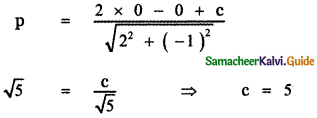
Soon, the plate was empty and clean with no trace. The boys dabbed their mouths and wiped their hands with tissues. Mission accomplished, they leaned back with immense joy and satisfaction not knowing, it would be short¬lived. The waiter arrived with the bill. Joseph, who had brought the others to the restaurant for a treat casually slipped his hand into his pocket to get his wallet. He gave a soft shriek accompanied by an expression of dismay and utter disbelief. He exclaimed, “It’s not there! Someone has pinched my wallet! What are we to do now?” ………….
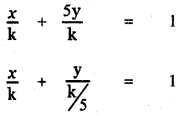
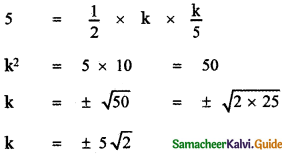
Joseph tried to convince the manager of the hotel about the theft of the purse. He refused to accept their version and asked them to pay the bill. Joseph asked his friends to stay in the hotel and he went home, brought money and paid at the hotel, for the relief of all.
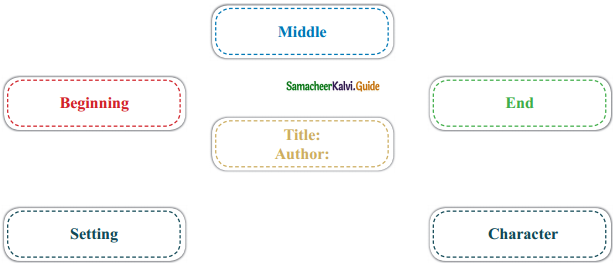

Samacheer Kalvi 12th English Guide Prose Chapter 3 In Celebration of Being Alive

ஆசிரியரைப் பற்றி:

கிறிஸ்டியன் நீத்லிங் பெர்னார்டு (Christiaan Neethling Barnard) 1922ல் தென் ஆப்ரிக்காவில் ஓர் ஏழ்மையான பெற்றோருக்கு 4வது குழந்தையாகப் பிறந்தார். கல்வியில் அதிக நாட்டம் காட்டிய இவர், தனது சகோதரரை இதய நோயினால் (a cardiac ailment) இழந்த பிறகு மருத்துவம் (medicine) படிக்க தீர்மானித்தார். இவர் கல்வி உதவித்தொகை மூலமாக இதய அறுவை சிகிச்சையில் (cardiac surgery) மேற்படிப்பு பயின்றார்.

இதய அறுவை சிகிச்சை வல்லுநரான பெர்னார்டு, அக்காலத்தில் குணப்படுத்த இயலாத பிறவி மற்றும் சிக்கலான இதயக் கோளாறுகளில் கவனம் (focussed) செலுத்தினார். விலங்குகளிடம் இதயமாற்று அறுவை சிகிச்சை (heart transplantation) செய்து, பின்னர் 1967ல் உலகின் முதன்முதலில் மனிதர்களுக்கிடையே இதய மாற்று அறுவை சிகிச்சை செய்தார்.

இதனால் இவர் உலக அளவில் அடையாளங்காணப்பட்டு, இன்று வரை ஏற்றுக்கொள்ளக்கூடிய அறுவை சிகிச்சை உத்திகளை (techniques) வகுத்தார். இவர் 14 புத்தகங்களை எழுதியுள்ளார். இவரின் 235 அறிவியல் கட்டுரைகள், புகழ்பெற்ற பத்திரிக்கைகளில் பிரசுரமாகியுள்ளன. “ஒரே வாழ்க்கை ”, “ஆரோக்கியமான இதயத்திற்கு 50 வழிகள்”, “மிகச்சிறந்த மருந்து”, மற்றும் “நம்பிக்கை ‘ என்பன இவர் எழுதிய புத்தகங்களுள் சில இதய அறுவை சிகிச்சையில் முன்னோடியான இவர் கேப்டவுன் பல்கலைகழகத்தில் (University of Cape), மருத்துவத்துறையில் முனைவர் (Doctorate) பட்டம் பெற்றார்.

அதன் பிறகு உலகின் பல்வேறு பல்கலைக்கழகங்கள் இவருக்கு 11 கௌரவ டாக்டர் பட்டம் வழங்கின. இவர் 36 சர்வதேச விருதுகளைப் (International Awards) பெற்றுள்ளார். இவரின் கடைசி காலத்தில் இவர் “கிறிஸ்டியன் பெர்னார்டு அறக்கட்டளையை நிறுவி உலகம் முழுவதும் உள்ள பின்தங்கிய குழந்தைகளுக்கு (underprivileged) சேவை செய்யவும், அவர்களின் நிலையை உயர்த்த காரணமாகவும் இருந்தார். இவர் தனது 78ம் வயதில் 2001ல் மறைந்தார்.

Samacheer Kalvi 12th English Guide Prose Chapter 3 In Celebration of Being Alive

பாடத்தைப் பற்றி:

“நாம் அனைவருக்கும் முதன் முதலில் இதய மாற்று அறுவை சிகிச்சை செய்த மருத்துவர் கிறிஸ்டியன் பெர்னான்ட் அறிவோம். இங்கே அவருடைய பேச்சின் சாரம்சம் கொடுக்கப்பட்டுள்ளது, இதில் வாழ்க்கையை குறித்து அவர் கொண்டிருந்த தோற்றத்தை மாற்றிய அவரது அனுபவத்தை விளக்குகிறார்”.

கொடுக்கப்பட்ட பாடத்தில் ஒரு மருத்துவமனையில் செவிலியர் (Nurse) ஒருவர் காலைச் சிற்றுண்டி வண்டியை கவனிக்காமல் விட்டுவிட்டனர். ஆனால் கை துண்டிக்கப்பட்ட சிறுவனும் இயந்திர வல்லுனரும் அதை நகர்த்தி நோயாளிகளுக்கு உணவு பரிமாறுகின்றனர். இருவரும் நல்ல பாடத்தை போதிக்கின்றனர். இப்படி ஒரு வியத்தகு மாற்றத்தை உண்டு பண்ணியது என்ன என்பதை இங்கே கண்டரிவோம்.

Samacheer Kalvi 12th English Guide Prose Chapter 3 In Celebration of Being Alive

In Celebration of Being Alive Summary in Tamil

ஒரு இதய சிகிச்சை நிபுணராக என்னுடைய வேலையின் (career – பணி) இறுதியை நெருங்க நெருங்க என் மக்கள் ஏன் வேதனைப்பட வேண்டும் என்பதை நோக்கி என் எண்ணங்கள் (thoughts) திரும்பின. இன்று இவ்வுலகில் அதிகப்படியான மக்கள் மிக கொடூரமாக (cruelly) வேதனைப்படுகிறார்கள்.

இந்த ஆண்டு பிறக்கக்கூடிய 125 மில்லியன் குழந்தைகளில், 12 மில்லியன் குழந்தைகள் தங்களது ஒரு வயதை அடைவதே கடினம் மற்றும் அடுத்த 6 மில்லியன் குழந்தைகளில் 5 வயதை எட்டுவதே இல்லை என்பது உங்களுக்கு தெரியுமா! மீதமுள்ளவர்களில் நிறைய பேர் மனம் (mental) அல்லது உடல் ஊனமுற்றவர்களாகவே (physical cripples) ஆகின்றனர்.

சில வருடங்களுக்கு முன்னால் நான் சந்தித்த விபத்திலிருந்து எனக்கு இந்த இருண்ட எண்ணங்கள் (gloomy thoughts) தோன்றியிருக்கலாம் (stem). அருமையான உணவிற்கு பின் நான் என் மனைவியுடன் ஒரு நிமிடம் தெருவை தாண்டி சென்று கொண்டிருந்தேன். மறு நிமிடம் ஒரு கார் என்னை இடித்து (hit) என் மனைவியின் மீது தள்ளியது (knocked), அவளோ அடுத்த பாதையில் தூக்கி வீசப்பட்டு எதிரே வந்த காரினால் அடிப்பட்டாள் (struck).

அடுத்த சில நாட்கள் நான் மருத்துவமனையில் மிகுந்த மன வேதனையையும் (agony), பயத்தையும் (fear) மட்டும் அனுபவிக்கவில்லை கூடவே கோபத்தையும் (anger) உணர்ந்தேன். நானும் என் மனைவியும் ஏன் வேதனைப்பட வேண்டும் என என்னால் புரிந்து கொள்ள முடியவில்லை . என்னுடைய 11 விலா எலும்புகள் (ribs) உடைந்தன மற்றும் எனது நுரையீரலிலும் (lung) அடிபட்டு துளைகள் விழுந்தன. எனது மனைவியின் தோல்பட்டையும் நொறுங்கியது. ஏன் எங்களுக்கு இவ்வாறு நடக்க வேண்டும்? என மீண்டும் மீண்டும் நான் எனக்குள்ளே கேட்டுக்கொண்டேன்.

Samacheer Kalvi 12th English Guide Prose Chapter 3 In Celebration of Being Alive 4

எல்லாவற்றிற்கும் மேலாக நான் எனது வேலையையும் பார்க்க வேண்டியதிருந்தது. என்னிடம் சிகிச்சை பெற நோயாளிகள் (patients) காத்து கொண்டிருந்தனர். எங்களின் சிறு வயது குழந்தைக்கு என் மனைவியின் அரவணைப்பு தேவைப்பட்டது.
எனது தந்தை இப்போது உயிரோடிருந்தால் அவர் இவ்வாறு தான் கூறியிருப்பார். “மகனே, இது கடவுளின் விருப்பம், அவர் இவ்வாறு தான் உன்னை சோதிப்பார். சோதனைகளே உன்னை மேன்மையாக்கி, ஒரு சிறந்த மனிதனாக உன்னை உருவாக்கும் (ennobles)”.

Samacheer Kalvi 12th English Guide Prose Chapter 3 In Celebration of Being Alive

ஆனால், ஒரு மருத்துவராக வேர்வையால் நனைந்த படுக்கையில் (sweatsoaked bed) வலியால் துடித்துக் கொண்டும், மனம் நிறைய கடுந்துயராலும் நிரப்பப்பட்ட நோயாளிடம் எந்தவொரு பெருந்தன்மையையும் (noble) என்னால் காண இயலவில்லை. இரவில் மருத்துவமனையில் தனிமையில் படுக்கையில் அழுது கொண்டிருக்கும் குழந்தையிடமும் என்னால் எந்தவொரு பெருந்தன்மையையும் (nobility) காண இயலவில்லை.

அக்காலத்தில் அதிநவீன (sophisticated) இதய அறுவை சிகிச்சை முறைகள் கிடையாது. குழந்தைகள் வேதனையடைவதைக் கண்டுநான் மனமுடைந்து போயிருக்கிறேன். ஏனென்றால் அவர்கள் தங்களின் முழு நம்பிக்கையையும் (trust) மருத்துவர்கள் மற்றும் செவிலியர்கள் மீது வைப்பார்கள். நீங்கள் அவர்களுக்கு உதவுவீர்கள் என்று அவர்கள் நம்புவார்கள்.

உங்களால் முடியவில்லை என்றால் அவர்கள் தங்கள் விதியைக் கூட ஏற்றுக் கொள்ள (believe) மாட்டார்கள். உருவச்சிதைவு அடையக்கூடிய அறுவைச்சிகிச்சை (mutilating surgery) செய்த பிறகு கூட அவர்கள் குறைகூற மாட்டார்கள்.

பல வருடங்களுக்கு முன்னால் ஒரு நாள் காலையில் நான் கண்டதை கேட்டவுடன் நகரின் செஞ்சிலுவை (Red cross) சிறுவர் மருத்துவமனையில் மோட்டார் வாகன ஓட்டப் பந்தயம் (Grand Prix) என்றே அழைப்பேன். அந்நிகழ்வு வேதனையைக் குறித்து நான் எண்ணிவந்ததில், ஒரு உண்மையை நான் விட்டிருந்ததை குறித்து அது என் கண்களைத் திறந்தது. அது எனக்கு ஒரு பெரிய ஆறுதலாக (solace) இருந்தது.

அந்த காலை அங்கு என்ன நடந்தது என்றால், காலை உணவு தள்ளுவண்டியை (breakfast trolley) செவிலியர் எடுக்கவில்லை. அடுத்தகணமே அந்த தள்ளுவண்டியானது இரு துணிச்சலான (intrepid), தைரியமான ஓட்டுநர் மற்றும் இயந்திர வல்லுநரால் வழி நடத்தப்பட்டது.

இயந்திர வல்லுநரோ தலையை குனிந்தவாறு தள்ளுவண்டியை பின்புறமிருந்து விரைந்து தள்ளி அதற்கு இயந்திர சக்தியளித்தனர் (provided), அதே வேளையில் ஓட்டுநரோ, தள்ளுவண்டியின் முன்புறம் அமர்ந்து கொண்டு ஒருகையால் வண்டியைப் பிடித்து காலால் தரையை உரசி (scraping) தள்ளுவண்டியை ஓட்டினார். அவர்கள் தேர்ந்தெடுத்த வேடங்கள் மிக எளிது ஏனென்றால் இயந்திர வல்லுநரோ கண்ணிழந்தவன் (blind), ஓட்டுநரோ ஒரு கை (arm) மட்டுமே கொண்டவன்.

Samacheer Kalvi 12th English Guide Prose Chapter 3 In Celebration of Being Alive

அன்று அவர்கள் ஒரு பெரிய நிகழ்ச்சியையே நடத்தினார்கள். மீதமிருந்த நோயாளிகளிடமிருந்து அவர்களுக்கு கிடைத்த உற்சாகத்தையும் (encouragement) சிரிப்பையும் பார்த்த போது இண்டியானா போலிஸில் (Indiana Polis) நடைபெறும் 500 கார்களின் ஓட்டப்பந்தயத்தை (race) விட இவர்களின் நிகழ்ச்சி மிகச்சிறந்தது என தோன்றியது. அவர்களை செவிலியர்கள் பிடித்து, திட்டி, படுக்கைக்கு திரும்ப அனுப்பும் வரை, அங்கு சிதறிய தட்டுகள் மற்றும் சில்வர் பாத்திரங்களின் இறுதிச் சுற்று (grand finale) நடந்தது.

அவ்விருவர்களைப் பற்றி நான் கூறுகிறேன். இயந்திர வல்லுநரோ 7 வயதானவன். ஒரு நாள் அவனது தாயும் தந்தையும் குடித்து விட்டு சண்டையில், அவனது தாய் விளக்கை (lantern) எடுத்து தந்தை மீது எறியும் போது அது தவறி குழந்தையின் தலை மற்றும் தோள் பகுதியின் மீது விழுந்தது. இதனால் அதிகப்படியான மூன்றாம் நிலை காயங்களால் அவனது மேலுடல் பாதிக்கப்பட்டது, அவனது இரண்டு கண்களும் பார்வை இழந்தன.

வாகன ஓட்டப்பந்தயத்தின் போது அவன் ஒரு நடமாடும், பயமூட்டும் (horror) பொருளாக, அதாவது உருக்குலைந்த (disfigured) முகத்தோடும், ஒரு நீண்ட சதை மடிப்பு கழுத்திலிருந்து தொங்கிய வண்ணமும் காணப்பட்டான்.

அவனது கழுத்தைச் சுற்றி காயம் ஆறிக்கொண்டிருந்த வேளையில், அவனுடைய கீழ்த்தாடை நரம்புத் திசுக்களினால் (tissue) இறுகப்பற்றிக் கொள்ளப்பட்டது. அவன் தனது தலையை உயர்த்தினால் (raise) மட்டுமே அவனால் தனது வாயைத் திறக்க முடியும். அந்த பந்தயம் முடிந்து நான் அவளை சந்தித்த போது “நாங்கள் வென்று விட்டோம். உங்களுக்கு தெரியுமா?” என்று சிரித்துக்கொண்டே கூறினான்.

அந்த தள்ளுவண்டியின் ஓட்டுநரை (trolley’s driver) எனக்கு நன்றாக தெரியும். சில வருடங்களுக்கு முன்னால். அவன் இதயத்தில் இருந்த ஓட்டையை நான் வெற்றிகரமாக அடைத்தேன். அவன் எலும்பில் இருந்த வீரியமான (malignant tumour) கட்டியின் காரணமாக அவன் மறுபடியும் மருத்துவமனைக்கு அழைத்து வரப்பட்டான். பந்தயத்திற்கு சில நாட்கள் முன்னதாக அவனது தோள்பட்டையும், கையும் சிகிச்சையின் மூலம் வெட்டி எடுக்கப்பட்டது (amputated).

Samacheer Kalvi 12th English Guide Prose Chapter 3 In Celebration of Being Alive

அவன் குணமடைவதற்கான (recovery) நம்பிக்கை குறைவாகவே காணப்பட்டது. பந்தயத்திற்குப் பின் அவன் என்னிடம், தள்ளுவண்டியின் சக்கரங்கள் சரியாக எண்ணெய் இடப்படவில்லை என்றும், அவன் ஒரு சிறந்த ஓட்டுநர் என்றும், தான் இயந்திர வல்லுநரிடம் முழு நம்பிக்கை கொண்டிருந்ததாகவும் கூறினான்.

திடீரென, வாழ்க்கையை வாழ்வதற்கான ஒரு ஆழமான பாடத்தை (profound lesson) இவர்கள் இருவரும் எனக்கு கற்று கொடுத்ததாகவே உணர்ந்தேன் (realized). ஏனென்றால் வாழ்வது என்பது இனிமைக்காவோ, பொழுது போக்கிற்காகவோ, மனமகிழ்ச்சிக்காகவோ நாம் செய்யும் ஏதோ ஒன்று அல்ல, மாறாக மகிழ்ச்சி என்ற வார்த்தையின் உண்மையான உணர்வே ஆகும். வாழ்வதென்பது உயிரோடிருப்பதின் கொண்டாட்டமே (celebration).

நான் வேதனைப்படுவதை தவறான (wrong) முறையிலிருந்தே பார்த்து கொண்டிருந்தேன். நீங்கள் வேதனை அடைவதால் மட்டும் சிறந்த மனிதராக முடியாது. ஆனால் வேதனையை அனுபவித்து (experience) இருக்கிறீர்கள் என்றால் உங்களால் ஒரு சிறந்த மனிதனாக முடியும். இருளைப் பற்றி அறியாவிட்டால், நம்மால் ஒளியைப் பாராட்ட இயலாது.

கடுங்குளிரால் பாதிக்கப்படாமல் நம்மால் வெதுவெதுப்பை பாராட்ட இயலாது. நீங்கள் இழந்தது எதுவோ அது முக்கியமில்லை (important), உங்களிடம் மீதமிருப்பது (left) எதுவோ அதுவே மிக முக்கியம் என்று இச்சிறுவர்கள் எனக்கு உணர்த்தி விட்டார்கள்.