TN Board 11th Commerce Important Questions Chapter 15 Insurance

Students get through the TN Board 11th Commerce Important Questions Chapter 15 Insurance which is useful for their exam preparation.

TN State Board 11th Commerce Important Questions Chapter 15 Insurance

Very short answer questions

Question 1.
Write short notes on Surrender value?
Answer:
The surrender value is the cash value of the policy which is payable to the policyholder if he decides to terminate the contract. This surrender value is usually obtained from the paid-up value by applying a percentage factor. The surrender value signifies the number of premiums paid that is returned to the policyholder at the time of surrendering the policy.

Question 2.
Write short notes on Double insurance?
Answer:
When more than one insurance policy is taken to cover the same subject matter i.e. risk, then it is known as Double Insurance.

Question 3.
What do you mean by Indemnity?
Answer:
Indemnity means security or compensation against loss or damages. In insurance, the insured would be compensated with the amount equivalent to the actual loss.

TN Board 11th Commerce Important Questions Chapter 15 Insurance

Question 4.
What are the features of Life insurance?
Answer:

  1. Life insurance provides protection to the family at the premature death of an individual.
  2. It gives an adequate amount at an old age when earning capacities are reduced.
  3. Life insurance is not only a protection but is a sort of investment because a certain sum is returnable to the assured at the time of death or at the expiry of a certain period.

Short answer questions

Question 1.
What are the types of Insurance?
Answer:
Insurance covers different types of risks. All contracts of insurance can be broadly classified as follows:

  1. Life Insurance (or) Life Assurance,
  2. Non-life Insurance (or) General Insurance.

It can be further classified into:

  1. Fire Insurance,
  2. Marine Insurance,
  3. Health Insurance and
  4. Miscellaneous Insurance.

Question 2.
What is contribution?
Answer:
The same subject matter may be insured with more than one insurer then it is known as ‘Double Insurance’. In such a case, the insurance claim to be paid to the insured must be shared on contributed by all insurers in proportion to the sum assured by each one of them. It may be noted that in the case of multiple insurances, the insured can claim the loss from any of the insurers subject to the condition that the insured cannot recover more than the amount of actual loss from all taken together.

TN Board 11th Commerce Important Questions Chapter 15 Insurance

Question 3.
What is the meaning of insurance?
Answer:
Insurance is a contract between the insurer and the insured under which the insurer undertakes to compensate the insured for the loss arising from the risk insured against, in consideration the insured agrees to pay premium regularly.

Question 4.
Explain the types of marine insurance?
Answer:

  1. Hull or Ship Insurance: When a ship is insured against any type of danger, it is known as hull insurance. This policy is taken to indemnify the insured for losses caused by damage to the ship.
  2. Cargo Insurance: When a marine insurance policy is taken by the cargo owner to be compensated for loss caused to his cargo during the Voyage, it is known as cargo insurance. The cargo to be transported by ship is subject to many risks, as the risk of theft, loss of goods in the voyage, etc.
  3. Freight Insurance: When a marine insurance policy is taken to guard against non-recovery of freight, it is known as freight insurance. The shipping company is mainly interested in freight, which it – gets either in advance or on the arrival of goods. However, it will not get the freight, if the goods are lost during transit. So, to ensure the freight, it takes freight insurance. A contract of marine insurance covers the ship, cargo, and freight.

Question 5.
Explain the types of business risk?
Answer:

  1. Speculative Risks: Speculative risks are the kind of risks that have the possibility of gain as well as the possibility of loss. Such risks are the result of market conditions. Favorable market conditions result in gains whereas unfavorable market conditions result in losses, eg: Use of better technology helps to produce better quality products at cheaper prices. This may increase the demand and thus result in higher profits.
  2. Pure Risks: Pure risks are the type of risks where a business suffers loss only if the risk occurs. Non-occurrence of such risks leads to the absence of loss, eg: Business may suffer loss only if fire, theft or strike occurs.
  3. Insurable Risks: Insurable risks are the type of risks where a business can insure the probable losses by paying a predetermined premium to an insurance company. At the time of loss, the insurance company pays compensation on the basis of agreed terms and conditions. Loss arising from natural and physical risks can be insured as the probability of risk can be determined, eg: a Company can insure its stock against fire or theft and if it loses its stock due to fire or theft in office, the insurance company pays compensation only up to an extent of the value lost.
  4. Uninsurable Risk: Losses arising from unforeseen natural events, political changes, or trade cycles are called uninsurable risks. Loss due to earthquake or flood or cyclone cannot be estimated and their probability cannot be calculated. Government directly takes care of the affected persons. Losses to businesses due to policy decisions of ruling political parties in a country, or due to economic depression cannot be insured. These uninsurable risk events are called uncertainties. The concept of risk is different from uncertainty. During uncertain events, decisions cannot be taken.

TN Board 11th Commerce Important Questions Chapter 15 Insurance

Question 6.
What is the need for Insurance?
Answer:
Business involves many risks. Goods are damaged or destroyed while they are in transit or in godowns. This loss is reduced largely by insuring the goods. A family generally depends on the income earned by the head of the family, who is a daily wage earner (breadwinner). If he suddenly dies, the family may be left in a very difficult situation. Insurance substitutes this uncertainty by providing financial compensation.

Question 7.
What is life insurance and mention its features?
Answer:
Life insurance contract may be defined as the contract, whereby the insurer in consideration of a premium undertakes to pay a certain sum of money either on the death of the insured or on the expiry of a fixed period which Never is earlier. Since the value of life cannot estimate in terms of money, the principle of indemnity is not involved in life insurance. A person can take any number of policies in his own life.

Question 8.
Write short note on marine insurance.
Answer:
Marine insurance is the most important and challenging branch of insurance. It has developed over many countries. Under this, the insurer undertakes to indemnify the insured against marine losses. The principles of utmost good faith, indemnity, insurable interest and proximate cause, will apply to marine insurance. But insurable interest is present at the time of loss of the insured property.

TN Board 11th Commerce Important Questions Chapter 15 Insurance

Question 9.
What is fire insurance and bring its importance?
Answer:
A fire insurance contract does not ensure the safety of the insured property. Its purpose is to see that the insured does not suffer pecuniary loss from the insured property due to fire. If the insured property is transferred to another person, the contract of insurance comes to an end. It is not connected with the subject matter of insurance. Thus fire insurance is a mere personal contract between the insurer and the insured. If the loss is due to ‘fire’ within the meaning of the policy, it is immaterial about the cause of the policy and the insurer is liable to indemnify the insured.

Question 10.
What is Economic causes?
Answer:
These include uncertainties relating to demand for goods, competition, price, collection of dues from customers, change of technology or method of production, etc. Financial problems like rising in interest rate for borrowing, levy of higher taxes, etc., also come under this type of cause as they result in the higher unexpected cost of operation of the business.

Long answer questions

Question 1.
Distinguish between Insurance and Assurance.
Answer:

InsuranceAssurance
Loss due to risk is not certain to happen which may or may not take place.Each person has to die sooner or later. So loss due to the risk of death is certain.
This is a contract for a short period (one year).But it is a long-term contract (for 15 years or more).
The value of the subject matter can be easily determined.It is difficult to determine the value of human life which is the subject matter of contract.
It is the contract of indemnity.It is not a contract of indemnity.
When the insurer compensates for the loss suffered by a person, he acquires the rights and remedies available to that person.This does not apply here.

TN Board 11th Commerce Important Questions Chapter 15 Insurance

Question 2.
What are the principles of insurance?
Answer:
There are special principles applicable to contracts of insurance. They are:

  1. Insurable Interest: Insurable interest is necessary for a valid contract of insurance. Insurable interest must be a pecuniary interest. A person is said to have an insurable interest in a property, as to have benefited from its existence and prejudice by its destruction. The time when insurable interest should exist differs according to the nature of insurance.
  2. Utmost good faith: A contract of insurance is a contract of utmost good faith. The proposer is bound to make frill disclosure of all facts. Misrepresentation, non-disclosure of fraudulent misrepresentation in any document leads to disowning the insurer from all liabilities under the contract.
  3. Indemnity: ‘To indemnity means ‘to make good the actual loss suffered. The principle of indemnity is applicable to property insurance alone. Insurance contracts are contracts of indemnity. This means that the insured should be placed after a loss, in the same position as he was immediately before the loss.
  4. Proximate cause: Proximate means nearest. It is only the nearest reason to be taken into account. The insurer is liable only if the nearest cause comes within the meaning of risk insured.
  5. Contribution: Where a property is overinsured by double insurance, each insurer is bound as between himself and other insurers, to contribute in proportion to the amount for which he is liable under his contract with the insured.
  6. Subrogation: Subrogation means the transfer of rights and remedies of the insured to the insurer after the indemnity has been effected. According to this principle, after the insured is compensated for the loss, the right of ownership of such damaged part of the property passes to the insurer.

Question 3.
What are the kinds of life policies?
Answer:
The life insurance policies can be divided on the basis of

  1. Duration of Policy: (a) Whole Life Policy, (b) Term policy.
  2. Method of payment of premium.
  3. Policies according to participation in profits (a) with profit policies and (b) without profit policies.
  4. Policies according to the number of persons insured in a policy, the policy may be:
    (a) Single life policy, (b) Multiple life Policy, (c) Joint life Policy, (d) Last Survivorship policy.
  5. Policies according to the method of payment of claims- (a) Lump-sum policies,
    (b) Installment or Annuity Policies.

There are other life insurance policies which are as follows:

  1. Money-Back policy
  2. Children’s Deferred Assurance (C.D.A)
  3. Group insurance policy
    (a) Employer-Employee groups
    (b) Labour – Union Group
    (c) Creditor – Debtor Group.

TN Board 11th Commerce Important Questions Chapter 15 Insurance

Question 4.
What is the classification of marine policies?
Answer:
Marine Policies are of different types. On the basis of the subject matter marine policies are classified into-

  1. Cargo Insurance,
  2. Hull Insurance,
  3. Freight Insurance,
  4. Liability Insurance.

On the basis of duration, policies may be classified into

  1. Time Policies,
  2. Voyage Policy.

On the basis of duration, term policies are classified into

  1. Construction or builders risk policies,
  2. Port Risks Policies,
  3. Floating Policies,
  4. Open cover policies.

Question 5.
Explain the types of fire policies.
Answer:

  1. Floating Policy: It is a policy covering stock in different places within the limits of one city/town/village by charging 25% of premium over and above the highest rate applicable to anyone at risk. The goods should belong to a single owner. No floating policy can be issued in respect of the immovable property.
  2. Declaration Policy: Declaration policies may be granted only in respect of the own stocks of the insured or which are in the insurer’s custody. Generally, levels of stock will vary frequently depending on purchases and sales. The owner takes a policy for a maximum expected level and a premium is paid. Every month the owner. declares the level of stock. In the end, the premium is adjusted accordingly.
  3. Reinstatement Policy: This policy is also known as a new or old policy. This policy is issued in respect of building, plant, and machinery, furniture and fixtures, and fittings only. The payment to be made is the cost of reinstatement of the building or the cost of replacement of the machinery to a condition equal to prior to the loss.

TN Board 11th Commerce Important Questions Chapter 15 Insurance

Student Activity.

(a) Sanjana insured her factory for Rs. 5 Lakh against fire. Due to fire, she suffered a loss of Rs. 2 lakh. How much amount she can recover from the insurance company? Why?
Answer:

  1. Sanjana insured her factory value worth Rs. 5 lakhs against fire.
  2. She suffered a loss of Rs. 2 lakhs. She can get Rs. 2,00,000 only from the insurance company.
  3. If the loss due to fire exceeds Rs. 5,00,000 she cannot get an actual loss on compensation (subject to average clause). She will get only Rs. 2,00,000.

(b) A factory owner gets his stock of goods insured, but he hides the fact the electricity board has issued him a statutory warning letter to get his factory’s wiring changed. Later on, the factory catches fire due to a short circuit of wiring. Can he claim compensation?
Answer:
No, he cannot claim compensation. Because already electricity board has issued him a statutory warning letter to get his factory’s wiring changed. Due to inadequate wiring, the factory catches fire so he cannot get compensation.

Multiple choice questions

1. ……… is not a contract of indemnity.
(a) Insurance
(b) Assurance
(c) Banking
(d) All the above
Answer:
(b) Assurance

2. ……….. is necessary for a valid contract of insurance.
(a) Insurable interest
(b) Indemnity
(c) Contribution
(d) utmost good faith
Answer:
(a) Insurable interest

TN Board 11th Commerce Important Questions Chapter 15 Insurance

3. In which year crop insurance scheme was introduced in India?
(a) 1948-49
(b) 1978-79
(c) 1985-86
(d) 1990-91
Answer:
(c) 1985-86

4. ……… is no limit in law.
(a) Life Insurance
(b) Fire Insurance
(c) Marine Insurance
(d) Burglary Insurance
Answer:
(a) Life Insurance

5. Policy is only for a period up ………. months
(a) 8 months
(b) 9 months
(c) 12 months
(d) 10 months
Answer:
(c) 12 months

6. The transfer of rights and remedies of the insured to the insurer means:
(a) proximate cause
(b) contribution
(c) utmost good faith
(d) subrogation
Answer:
(d) subrogation

7. The policy that covers the risk only during a particular period is known as:
(a) whole life policy
(b) term policy
(c) single life policy
(d) lump-sum policy
Answer:
(b) term policy

TN Board 11th Commerce Important Questions Chapter 15 Insurance

8. The policy which includes liability arising out of damages etc to the harbor is known as:
(a) hull insurance
(b) cargo insurance
(c) voyage policy
(d) liability insurance
Answer:
(d) liability insurance

9. A master policy taken out by any trade union for the benefit of its members is known as:
(a) creditor-debtor group
(b) group insurance policy
(c) labor union group
(d) joint life policy
Answer:
(c) labour union group

10. In mediclaim policy according to scheme a maximum benefit amount is:
(a) 10000
(b) 150000
(c) 100000
(d) 300000
Answer:
(b) 150000

11. In which year Children’s money-back plan was introduced?
(a) 1986
(b) 1988
(c) 1989
(d) 1995
Answer:
(d) 1995

TN Board 11th Commerce Important Questions Chapter 15 Insurance

12. In which year Insurance Act was amended in India?
(a) 1940
(b) 1928
(c) 1938
(d) 1945
Answer:
(c) 1938

13. Which one is the principle of insurance?
(a) Co-operation
(b) Mutual interest
(c) Indemnity
(d) None of these
Answer:
(a) Co-operation

14. What is the minimum period of life assurance?
(a) More than one year
(b) 5 year
(c) 10 years
(d) 15 years or more
Answer:
(d) 15 years or more

15. Which of the following is covered under life assurance policy?
(a) Act only
(b) Cargo insurance
(c) Declaration policy
(d) Money back policy
Answer:
(d) Money back policy

TN Board 11th Commerce Important Questions Chapter 15 Insurance

16. Which of the following is not a function of insurance?
(a) Risk sharing
(b) Assist in capital formation
(c) Lending of funds
(d) None of the above
Answer:
(c) Lending of funds

17. Which of the following is not applicable in life insurance contract?
(a) Conditional contract
(b) Unilateral contract
(c) Indemnity contract
(d) None of the above
Answer:
(c) Indemnity contract

18. In which of the insurance policy loss cannot be measured?
(a) Life insurance
(b) Marine insurance
(c) Fire insurance
(d) All of the above
Answer:
(a) Life insurance

19. It is the duty of the insured to make an effort for minimization of loss it is the principle of:
(a) utmost good faith
(b) contribution
(c) mitigation
(d) insurable interest
Answer:
(c) mitigation

TN Board 11th Commerce Important Questions Chapter 15 Insurance

20. Insurers must have some pecuniary interest in the subject matter of interest. It is the principle of:
(a) mitigation
(b) contribution
(c) utmost good faith
(d) insurable interest
Answer:
(d) insurable interest
TN Board 11th Commerce Important Questions Chapter 14 Transportation

Students get through the TN Board 11th Commerce Important Questions Chapter 14 Transportation which is useful for their exam preparation.

TN State Board 11th Commerce Important Questions Chapter 14 Transportation

Very short answer questions

Question 1.
What do you mean by land transport?
Answer:
Transport of people and goods by land vehicles is known as Surface transport. It is also called ‘Land Transport’.

Question 2.
What are the types of transport?
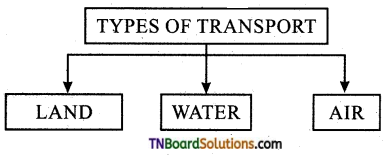
Answer:
TN Board 11th Commerce Important Questions Chapter 14 Transportation 1

Question 3.
What are tramways?
Answer:
Tramways were initially horse-drawn later steam-powered and now electrically operated. Its carrying capacity is large. They are able to cope up with the peak hour traffic in big cities.

TN Board 11th Commerce Important Questions Chapter 14 Transportation

Question 4.
What are Inland waterways?
Answer:
Inland Waterways comprise rivers, canals, and lakes. It is also known as internal water transport. Rivers that are naturally navigable are called natural waterways. Canals and canalized rivers belong to the category of ‘Artificial Waterways’.

Question 5.
What is a common carrier?
Answer:
A common carrier is a person who is engaged in the business of carrying goods for hire indiscriminately for all persons.

Question 6.
What are the liners types?
Answer:
There are two types of liners namely (i) Passenger liners, (ii) Cargo liners.

Question 7.
What are the types of commercial ships?
Answer:
The following is the major types of commercial ships –

  1. The general cargo ship,
  2. Bulk carriers,
  3. Container ships,
  4. Auto carrier,
  5. Tankers,
  6. Fishing vessels,
  7. Oil vessels,
  8. Passengers ships,
  9. Ferryboats,
  10. Tow and tug boats,
  11. Specialized ships.

TN Board 11th Commerce Important Questions Chapter 14 Transportation

Question 8.
What are bullock carts?
Answer:
It constitutes the predominant form of rural road transport in India for goods traffic and to some extent for passengers’ traffic. It links up the villages with the nearby markets and railway stations. It carries the produce for sale to the market and consumer goods to the villages.

Question 9.
What is a private carrier?
Answer:
A private carrier is engaged in casual occupation and carries goods on occasions or under a special contract.

Short answer questions

Question 1.
What are the demerits of Air transport?
Answer:

  1. It is a very costly mode of transport. The rates and fares charged by which are beyond the reach of common people.
  2. Aircraft are not quite suitable for carrying heavy loads and weights.
  3. It is not dependable because of unfavorable weather which may disturb the air service suddenly.
  4. The construction and maintenance of aerodromes involve huge capital expenditure.
  5. Every country controls the air space above its territory. Therefore, an airplane cannot fly over another country without obtaining prior permission from the concerned authority.

Question 2.
What is sea transport?
Answer:
Ocean transport has been playing a significant role in the development of economic, social, and cultural relations among countries of the world. International trade owes its growth to ocean transport. Ocean transport enjoys a pride of place in aiding international trade. Cheapness is its great virtue. In the transportation of low-grade, bulky goods among the countries, the role of ocean transport is commendable.

TN Board 11th Commerce Important Questions Chapter 14 Transportation

Question 3.
What is Monorail?
Answer:
A monorail is like a train, but instead of having two sets of wheels that balances on a railway track, the monorail is balanced on top of one rail. Monorails are often used to transport people around large cities. Some monorails utilize magnets to hover on their rails, reducing friction between the train and the rail. The first monorail was invented in the 19th century.

Question 4.
What is conveyor transport?
Answer:
It is the broad category of transport mode that includes modes developed from the idea of a conveyor belt. Examples include a Conveyor belt, two or more Pulleys with a continuous loop of material that rotates about them, an Escalator, an Elevator which is used to carry people among floors of the building, etc.

Question 5.
What is Railway Receipt?
Answer:
A railway Receipt is an acknowledgment of receipt of goods by the railway for transporting. It serves as a document of title of goods, viz., it shows the title of its holders of the goods. It may be issued in the name of the consignor or consignee. Only on presentation of the railway receipt, the railways will deliver the goods.

Question 6.
What are the types of Ocean transport?
Answer:
Ocean transport may be divided into two broad categories.

  1. Coastal shipping: Coastal shipping
    constitutes an important means of transport in all countries having a long coastline. It is a cheap means of transport for the movement of bulky cargoes like coal, iron ore, etc. to domestic ports of the country. Usually, the coastal shipping trade of a country is reserved for national shipping. In India, the Coastal shipping trade is now exclusively reserved for Indian ships.
  2. Overseas shipping: It means the passengers and goods have to cross an ocean. For Example India export goods to America.

TN Board 11th Commerce Important Questions Chapter 14 Transportation

Question 7.
What are the demerits of inland waterways?
Answer:

  1. It is the slowest means of transport. As compared to this, railways are quicker, safer, and cheaper means of transport.
  2. Floods caused during the rainy season, lack of flow of water during summer season affect to ply boats and steamers.
  3. Sometimes rivers also change their way. It leads to stoppage and uncertainty in the usage of this means of transport.

Question 8.
What are the economic benefits of transport?
Answer:

  1. It increases the efficiency of production.
  2. It stimulates wants by increasing the quantity and variety of consumer goods.
  3. It develops and expands the market.
  4. It helps in price stability by distributing goods all over the country.
  5. It aids in economic growth.
  6. It helps in specialization and mass production.
  7. It encourages innovations in product production and design.

TN Board 11th Commerce Important Questions Chapter 14 Transportation

Long answer questions

Question 1.
What are the services of transport to business?
Answer:

  1. It increases the efficiency of production: The object of production is consumption. Effective transport system creates time and place utilities and thereby influences the demand for goods and the value of goods. Thus, transport makes production efficient and purposeful.
  2. It stimulates wants by increasing the quantity and variety of consumer goods: It helps in getting commodities, which cannot be had or produced in a region due to unsuitable natural conditions. Without adequate and effective transport, goods cannot be had either in the quantities or varieties required in a complex economy.
  3. It develops and expands the market: The primary function of transport is to enable the physical distribution of goods at the global level. The distribution of goods must take place easily, economically, and speedily. It provides the chance of expanding the national land international market.
  4. It helps in price stability by distributing goods all over the country.
  5. It aids to economic growth: The movement of raw materials, fuel, labor, and finished products and the mobility of capital and technical know-how, transport playing a remarkable role in the growth of all industries from agriculture to manufacturing.
  6. It helps, in specialization and mass production: Specialization means the division of a complex process of production into a number of separate processes so that each person or group specializes in each and every process. It has been extended to the international level too.
  7. It encourages innovations in product production and designing: It provides plenty of opportunities to the producers to produce their product in an innovative and creative way, to catch up with the wider market and reap more profit.

Question 2.
What are the documents used in transport?
Answer:

  1. Way Bill: The waybill is an acknowledgment of receipt of goods for transport by the carrier. The carrier, accepting goods for transport, issues waybills in the name of the consignors or consignees. It serves as evidence of the contract of transport. It is also a document of the title of goods. The ownership of goods represented by a waybill can be transferred, by endorsement and delivery of the waybill. If a waybill lost, the consignee will be allowed to clear the goods from the carrier after he executes an indemnity bond.
  2. Railway Receipt: Railway Receipt is an acknowledgment of receipt of goods by the railway for transporting. It serves as a document of title of goods, viz., it shows the title of its holders of the goods. It may be issued in the name of the consignor or consignee. Only on presentation of the railway receipt, the railways will deliver the goods. If railway receipt is lost, the consignees can obtain the goods from the railway by executing an indemnity bond. Ownership of the goods can be transferred by endorsement and delivery of the receipt.
  3. Charter Party: When goods are to be consigned in large quantity, it is advantageous to hire the whole or substantial part of the ship. The document through which this contract is made is known as ‘Charter Party may also be known as ‘Voyage Charter’ or ‘Time Charter’. The person who hires the ship is known as Charter The charter party brings the vessel and crew under the control of the charter. The charter becomes responsible to the third parties for the acts of the master and crew of the ship.
  4. Bill of Lading: Bill of Lading is a document containing the terms and conditions of the contract of the carriage! It is issued by the shipping company and signed by the captain of the ship. It acknowledges the receipt of the goods described in it on board the ship. It also serves as an official receipt of goods. It is a document of the title of goods. The main contents are Name of Exporter, name of the ship, place of loading, particulars of goods shipped, port of destination, freight paid or to be paid, person to whom delivery of goods is to be made, date, etc. If the condition of the packages is good, a clean bill of lading is issued. If some of the packages are found damaged, a foul or clause bill of lading is issued.
  5. Air Consignment Note or Airway Note: It is a document prepared by the consignor, which is handed over to the carrier of goods while transporting goods through Airways. Air Consignment Note is made out of three original parts. One is signed by the consignor and marked for the carrier. The second is signed by both the consignor and the carrier and marked for the consignee (intended to accompany the goods) and the third is signed by the carrier and handed back to the consignor after the goods have been accepted.

TN Board 11th Commerce Important Questions Chapter 14 Transportation

Question 3.
What are the recent trends in transportation?
Answer:

  1. Metro Rail: Metro Rail is a Mass Rapid Transport System (MRTS). It is a convenient, fast, efficient, reliable, comfortable mode of urban transport. Rapid transit is also known as heavy rail, metro, subway, tube, or underground is a type of high capacity, public transport generally found in urban areas.
  2. Monorail: A monorail is like a train, but instead of having two sets of wheels that balances on a railway track, the monorail is balanced on top of one rail. Monorails are often used to transport people around large cities. Some monorails utilize magnets to hover on their rails, reducing friction between the train and the rail. The first monorail was invented in the 19th century.
  3. Bullet train: High-speed rail is a type of rail transport that operates significantly faster than traditional rail traffic, using an integrated system of specialized rolling stock and dedicated tracks. The first such system began operations in Japan in 1964 and was widely known as the bullet train. High-speed trains normally operate on standard gauge tracks of continuously welded rail.
  4. Pipeline Transport: It is the mode of transportation of goods or materials through the pipe. Liquids and gases are transported in pipelines. Pipeline exist for the transport of crude and refined petroleum, fuels such as Oil, Natural gas and Biofuel, etc., and other fluids including sewage, slurry, and water. It requires heavy investment to install.
  5. Conveyor Transport: It is the broad category of transport mode that includes modes developed from the idea of a conveyor belt. Examples include a Conveyor belt, two or more Pulleys with a continuous loop of material that rotates about them, an Escalator, an Elevator which is used to carry people among floors of buildings etc.
  6. Ropeway Transport: A Ropeway is another means of transport in naval lifting device.
    It can be operated in a place where road construction is impractical and costly. Certain limit of goods of people can be transported with the help of (naval lifting device) electricity. In the hilly remote areas ropeway system of transport may be suitable means of transport.
  7. Hyperloop Transport: Hyperloop is a proposed system of transport that would see pods or containers travel at high-level speed through a tube that has been pumped into a near-vacuum. The train pods would either float using magnetic levitation technology or float using air caster “Skis”, similar to how pucks travel across an air hockey table. With so little friction in the tunnel, the pod would be able to travel at immense speed with projected top speeds of 760 mph. Hyperloop is a futuristic transport system. Tunnels for the Hyperloop would be built either above or below ground, at only around 3 meters in diameter, lacking up a smaller ground footprint than traditional rail or road. Elon Musk an entrepreneur had proposed this mode of transport as a “fifth mode of transport” in 2012.

Question 4.
What is Railway Transport? Explain advantages and disadvantages.
Answer:
The invention of the steam engine by James Watt revolutionized the mode of transport all over the world. Railway, as a mode of transport, is the most organized transport undertaking all over the world. Railways are the cheapest and quickest means of transport for carrying heavy goods over long distances.
Advantages of Railway Transport:

  1. Railways are well suited for carrying heavy and bulky goods over long distances.
  2. It can provide long-distance travel throughout the day and night with unbroken services.
  3. It can provide better production and safety to the goods than motor transport. The goods generally carried in closed wagons are not exposed to sun, rain, etc.
  4. Though the initial investment is large, in the long run, the operating expenses will be very low in railways and it will prove a cheaper mode of transport. It requires less time than motor transport for carrying goods over long distance with greater speed
  5. It has a regular schedule of timing and is available throughout the year.
  6. It provides unaffected services whether rainy or shinny weather conditions.

Disadvantages of Railway Transport:

  1. Railway rates are relatively higher than motor transport for transporting lightweight articles over short distances.
  2. It is inflexible, as it is operated to a particular track that cannot deviate from the set routes.
  3. In rural areas, it cannot offer adequate traffic because of uneconomical operating costs.
  4. It requires heavy investment for the installation of tracks and maintenance that increases its fare on the users.
  5. If railways are not fully utilized and if wagons and coaches are too half-empty to their capacity, a heavy financial burden will be cast on the railway.

TN Board 11th Commerce Important Questions Chapter 14 Transportation

Question 5.
Explain the advantages of motor transport.
Answer:
Roads connect the interior parts of a country with railway stations and markets. They help in the exploitation of villages that are the rich sources of raw materials and valuable markets for finished products. Motor transport, as the dominant form of road transport, offers many advantages. They are:

  1. Flexibility: The greatest merit of motor transport is its flexibility. It can reach the interior and remote villages. Unlike railways, it is not wedded to any particular track. It can change its route, timing, and areas of operation. It can pick up as well as deliver goods almost anywhere.
  2. Complete service: It provides a complete service to businessmen. It leads the goods from the factory or the firm and delivers them at the door of buyers. It thus avoids much handling and the resultant damage. But in the case of railways, goods have to be taken to the railway station, unloaded from the carriers, and then loaded in the railway wagons; at the destination, they have to be again unloaded from them before being delivered to consignees. Besides adding to the cost of goods, this intermediate loading and handling causes damage to goods and delays their delivery.
  3. Suitability: Motor transport is very well suited for short-distance traffic. It is also suitable for the delivery of small loads to many consignees on the way. As the capacity of lorries is less than that of railway wagons, small traders who have to transport limited loads can conveniently make use of this transport. It is more suitable for goods like perishable articles which are to be delivered quickly and for meeting sudden demand.
  4. Economy: Goods for lorry transport do not require elaborate packing. It is common for owners of goods to travel in lorries along with their goods in order to personally attend to loading and unloading. This practice reduces the risks of breakages and thefts. Further, freight rates in roadways are comparatively lower for short distances and small loads than that in railways. The absence of intermediate handling and loading also reduces the cost in the case of motor transport. Moreover, laying a road is cheaper than laying a railway track. The users of roads pay very little for their laying and maintenance.
  5. Speed: Motor transport is quicker than rail transport for transporting goods over short distances. Quick transport and prompt delivery help to increase the turnover of the business.
  6. Service: Motor transport renders a valuable service to interior rural areas by connecting them with railway stations, markets, and nearby towns. It serves as a feeder to other forms of transport, namely railways, waterways, and airways. It helps fruits, vegetables, dairy products, etc. reach nearby cities and towns in a state of freshness. Its service to hill areas deserves special mention because of its greater climbing capacity than rail transport. It earns huge revenue from the government and creates more employment opportunities.

TN Board 11th Commerce Important Questions Chapter 14 Transportation

For Own Thinking

Geographical separation between producer and consumer – Comment. Importing Crude oil from foreign countries to Petroleum refineries – transporting through Truck tankers or Pipelines – Suggest with reason.
Answer:
Goods are produced at a few places but are required for use at different places. Geographical distance separates producers and consumers. This difficulty is removed by transport, eg: Knitwear products of Tirupur are sold throughout the world, Nellore rice is widely consumed in Chennai and other places with the help of various means of transport.
Import crude oil from foreign countries to petroleum refineries transporting it through truck tankers is good. These tankers are specially designed to carry crude oil, petrol, and petroleum products, but pipelines sometimes suggested it is good because of lesser cost.

Multiple choice questions

1. Transport is an integral part of:
(a) trade
(b) commerce
(c) economics
(d) all the above
Answer:
(b) commerce

2. Transport help to reduce variation in:
(a) price of goods
(b) quality of goods
(c) quantity of goods
(d) none of these
Answer:
(a) price of goods

3. …….. are used in deserts for similar purpose.
(a) Elephant
(b) Lion
(c) Camel
(d) Tiger
Answer:
(c) Camel

4. ……… connect the interior part of a country
(a) Roads
(b) Railways
(c) Tramways
(d) All the above
Answer:
(a) Roads

5. Tramways made their appearance in the ……… century.
(a) 18th century
(b) 16th century
(c) 17th century
(d) 19th century
Answer:
(d) 19th century

TN Board 11th Commerce Important Questions Chapter 14 Transportation

6. Motor transport complete service to:
(a) Businessmen
(b) Customers
(c) Bankers
(d) Wholesaler
Answer:
(a) Businessmen

7. ……….. is a free gift of nature.
(a) Air
(b) Water
(c) Land
(d) Animals
Answer:
(b) Water

8. Tramways are a ……….. form of transport.
(a) Very slow
(b) Very speed
(c) Slow
(d) Speed
Answer:
(a) Very slow

9. Which one of the following is covered under land transport:
(a) Liners
(b) Tankers
(c) Pack animals
(d) Tramps
Answer:
(c) Pack animals

TN Board 11th Commerce Important Questions Chapter 14 Transportation

10. Which one of the following not covered under transport:
(a) canal
(b) river
(c) Bullock carts
(d) bill of lading
Answer:
(d) bill of lading

11. Who is the Inventor of the steam engine?
(a) James watt
(b) Gopal
(c) R.Bhatt
(d) PK. Ghosh
Answer:
(a) James watt

12. In which year cycle and rickshaw were introduced in the world.
(a) 1850
(b) 1847
(c) 1972
(d) 1867
Answer:
(d) 1867

13. The first railway line in India was opened to traffic between:
(a) Mumbai – Chennai
(b) Chennai – Kolkata
(c) Mumbai and thane
(d) Delhi-Chennai
Answer:
(c) Mumbai and thane

14. Air consignment note is made out in original part:
(a) one
(b) two
(c) three
(d) four
Answer:
(c) three

TN Board 11th Commerce Important Questions Chapter 14 Transportation

15. Transport can be divided into types.
(a) three
(b) five
(c) four
(d) one
Answer:
(a) three

16. Cargo vessels are called:
(a) cargo liners
(b) Perrys
(c) liners
(d) tankers
Answer:
(a) cargo liners

17. Best way of transport for long distances:
(a) motor
(b) boats
(c) tramways
(d) railways
Answer:
(d) railways

18. The invention of the steam engine by James watt ……… modes of transport all over the world.
(a) revolutionized
(b) modernized
(c) industrialized
(d) economized
Answer:
(a) revolutionized

TN Board 11th Commerce Important Questions Chapter 14 Transportation

19. In the rural areas the most important mode of transport is:
(a) donkeys
(b) horses
(c) motor vehicles
(d) Bullock carts
Answer:
(d) Bullock carts

20. For carrying heavy logs in forests used.
(a) elephants
(b) horses
(c) camels
(d) donkeys
Answer:
(a) elephants

TN Board 11th Commerce Important Questions Chapter 13 Warehousing

Students get through the TN Board 11th Commerce Important Questions Chapter 13 Warehousing which is useful for their exam preparation.

TN State Board 11th Commerce Important Questions Chapter 13 Warehousing

Very short answer questions

Question 1.
Define warehouse.
Answer:
According to Stephenson “A warehouse is an establishment for the storage or accumulation of goods”.

Question 2.
Write a note on warehousing in Tamil Nadu.
Answer:
A premier warehousing agency in the State of Tamil Nadu was established in 1957. It provides price support to the agricultural sector. It is one of the biggest public warehouses operating in the state offering logistic services to a diverse group of clients.

Question 3.
What are the documents used in warehousing?
Answer:

  1. Warehouse warrant,
  2. Dock warrant,
  3. Dock receipt,
  4. Warehouse keeper’s certificate and Delivery order.

TN Board 11th Commerce Important Questions Chapter 13 Warehousing

Question 4.
Food Corporation of India. Explain.
Answer:
It provides storage facilities for food grains. FCI also hires storage capacity from other sources such as CWC, SWC, State Governments, and private parties. The available storage capacity of the Food Corporation of India in the seventh plan is 20.33 million tonnes.

Question 5.
What is in Transit Mixing?
Answer:
It refers to a function in which the warehouse receives products from different plants and mix and repack them as per the client’s requirement.

Short answer questions

Question 1.
What is the village storage?
Answer:
Underground storage structures are used by farmers in villages to store food grains. They are safer from threats from various external sources of damage, such as theft, rain, or wind. Separate peripheral structures with mud are erected as surface storage structures for food grains. PAU bin, Pusa bin, HapurTekka, etc. are used for small-scale storage of grains. Cap storage, Silos, etc, are used for large-scale storage of food grains.

Question 2.
Define Government licensed Warehousing.
Answer:
Bonded warehouses are those warehouses, which are licensed by the government to accept the storage of imported goods that are not cleared due to non-payment of customs duty by the importer. Branding can be undertaken in the warehouse itself.
Bank loans can be obtained by submitting the receipt issued by these warehouses as collateral security. Strict supervision and control are imposed by customs authorities on their operation and functioning.

TN Board 11th Commerce Important Questions Chapter 13 Warehousing

Question 3.
What are the disadvantages of Warehousing?
Answer:
Warehousing is not effective because of the following reasons:

  1. There are no adequate transport facilities between the place of production and warehouses.
  2. Lack of sufficient storage facilities for different commodities such as perishable and non-perishable commodities.
  3. Complicated formalities are to be fulfilled at the warehouses. The illiterate and innocent farmers are not able to cope with these procedures.
  4. The complicated process of Barcode technology can reduce the storing of goods by some producers.
  5. Unavoidable delay in obtaining financial assistance may cause loss to the owner of goods.

Question 4.
What is the Warehousing in India?
Answer:
India is an agrarian country but the importance of warehousing was not felt till 1950.
Agriculture contributes 16 percent of the overall GDP and accounts for the employment of approximately 52 percent of the Indian population. It is estimated that more than 40 percent of our agricultural productions wasted due to poor storage facilities.

TN Board 11th Commerce Important Questions Chapter 13 Warehousing

Long answer questions

Question 1.
What are the factors determining the warehousing?
Answer:

  1. Mass production: Production is based on the anticipated demand for goods. Mass production of goods takes place by establishing big factories and modem production. The market for such goods is spread all over the country. Therefore, warehouses are to be built at different places to store these products and provide prompt supplies when demanded.
  2. Nature of commodities: Some goods are perishable in nature and therefore they should be consumed in time to avoid deterioration. Storing them in cold storage can extend the life of the goods.
  3. Seasonal production but regular consumption: The farm products such as wheat, sugar, pulses, etc. are produced only in seasons. But the Consumption of these products is evenly spread throughout the year. If proper storage facilities are not provided, .the quality of these goods deteriorates and may become not usable.
  4. Regular production but seasonal consumption: Certain goods are produced regularly throughout the year. But, they are demanded in seasons only. For example, raincoats, blankets, umbrellas, etc. require
    storage for a whole year. They can be N released in large quantities to meet the heavy demand in the rainy and winter seasons.
  5. Proximity to production centers: Productions of goods at specific centers need to be supplied in time and without interruption to consumers throughout the country. For this purpose, goods are regularly fed to the warehouses situated in different market areas.

Question 2.
Write a brief note on the various types of documents used in the warehousing.
Answer:

  1. Warehouse warrants: It is a document issued in favor of the owner or depositor of goods by the warehouse keeper. This is a document of title of goods and can be transferred by simple endorsement and delivery. To transfer all the goods the warehouse warrant is sufficient. If only a part of the goods are to be transferred then a delivery order is needed. The delivery order is to be accompanied by the warehouse warrant.
  2. Warehouse Keeper’s Receipt: It is a document issued by the warehouse keeper, which acknowledges the receipt of goods from the depositor of goods. It also shows the existence of an agreement to keep the goods in the warehouse subject to certain conditions. This is not a document of title of goods and is not transferable.
  3. Dock Warrant: Dock is a place in the harbor where the goods are kept for loading into the ship. A dock warrant is a document of title of goods issued by dock authorities. This document certifies that the dock authorities hold the goods. To take delivery of the goods this certificate should be given back to dock authorities. The right of getting delivery of goods can be assigned to third parties too.
  4. Dock Receipt: Dock receipt is an acknowledgment of receipt of goods issued by dock authorities to the owner of the goods. It is not a document of the title of goods. Therefore, the right of taking of delivery of goods cannot be transferred.
  5. Delivery Order: This is a document through, which the depositor directs the warehouse keeper to deliver the specified goods either to the party mentioned in the document or to the bearer. The warehouse keeper delivers the goods as per the instruction. Transfer of ownership takes place through this document.

TN Board 11th Commerce Important Questions Chapter 13 Warehousing

Question 3.
What are the Central Warehousing functions?
Answer:
It was established in 1957. The available storage capacity of Central Warehousing Corporation is 11.17 million tonnes and with the operation through 464 warehousing centers across the country, (as of 30th September 2017).
Functions of Central Warehousing Corporation:

  1. To provide agency services for scientific storage of agricultural produce, seeds, manures fertilizers, agricultural implements, and other notified commodities.
  2. To issue a negotiable warehouse receipt for procuring credit to the owners of goods.
  3. To preserve the produce deposited with care and protect against insects and various pests and deterioration due to moisture and dampness.
  4. To act as an agent of the government for the purchase and sale, storage, and distribution of specified commodities and transport to and from the warehouse.
  5. To reduce the cost of storage and facilitate the marketing of products through proper grading.

Question 4
Write in detail about performances.
Answer:
A premier warehousing agency in the State of Tamilnadu was established in 1957. It provides price support to the agricultural sector.
Performances:

  1. Tamilnadu Warehousing Corporation (TNWC) operates 65 warehouses across the state with a storage capacity of 6.3 lakh tonnes providing warehousing services for a wide range of products running from agricultural products to sophisticated industrial products.
  2. Warehousing activities of Tamil Nadu Warehousing Corporation include food grain warehouse and custom bonded- warehouse.
  3. Apart from storage and handling, Tamil Nadu Warehousing Corporation also offers its services in the area of handling, transportation, disinfecting services, fumigation services, and other ancillary activities.
  4. Tamil Nadu Warehousing Corporation also offers training on the scientific storage of stocks to different agencies.
  5. Scientific storage and handling services are offered for more than 200 commodities that include agricultural produce, industrial raw materials, finished goods, and a variety of hygroscopic items.

TN Board 11th Commerce Important Questions Chapter 13 Warehousing

Question 5.
Write in detail about the functions of TNWC.
Answer:

  1. The Regional Managers/Senior Regional Managers conduct regular inspections of warehouses with 100% physical verification of stocks in their region.
  2. The copies of inspection reports for all inspections conducted by RMs/SRMs are submitted to Head Office along with their remarks if any. Based on this, further action is taken by the Head Office.
  3. Regional Managers also conduct surprise inspections to sort out the problems in the warehouses.
  4. The Regional Managers submit tour diaries every month for review by the Inspection Cell.
  5. The inspection wing conducts staff meetings and Regional Managers’ meetings depending upon the need to sort out business matters, collection, staff grievances, etc.

For Future teaming

The warehouse of the future: How will it impact efficiency?
Answer:
From 2019, new technology could be revolutionary and improving efficiency in warehouses by Warehousing Management System (WMS). Technologies including artificial intelligence, 3D printing, and self-driving vehicles could be more widely used in warehouses- everywhere sooner than you think. By 2030, warehouses will be a part of an initiative to achieve zero net energy.
Warehouse buildings will operate 24 x 7 x 365 and be designed with sustain¬ability. By creating strategies, warehouses will save costs and prevent harmful emissions. Solar panels will become the main source of energy for warehouses. This will assist in running the warehouse lighting and equipment. As well as recharging the electric vehicles that make deliveries. New technologies could be increasing the efficiency of how warehouses are run as soon as 2019.

TN Board 11th Commerce Important Questions Chapter 13 Warehousing

Multiple choice questions

1. Warehousing is one of the functions of:
(a) banking
(b) insurance
(c) marketing
(d) none of these
Answer:
(c) marketing

2. ……… is based on the anticipated demand for goods.
(a) Production
(b) Marketing
(c) Transport
(d) Warehouse
Answer:
(a) Production

3. ……… Warehouse service provides inspection packing and shipping:
(a) private
(b) public
(c) co-operative
(d) all of the above
Answer:
(b) public

4. …….. warehouse are owned by private persons to store their own products
(a) Private
(b) Public
(c) Co-operative
(d) Household warehouse
Answer:
(a) Private

TN Board 11th Commerce Important Questions Chapter 13 Warehousing

5. …….. are formed by the state and central government for their exclusive uses.
(a) Food Corporation of India
(b) Government Warehouse
(c) Bank godowns
(d) None of these
Answer:
(b) Government Warehouse

6. The term ware means:
(a) sales
(b) manufactures
(c) products
(d) goods
Answer:
(c) products

7. The Central warehousing corporation was established in:
(a) 1957
(b) 1900
(c) 1988
(d) 1986
Answer:
(a) 1957

8. The available storage capacity of SWC in the seventh plan is ……. tonnes.
(a) 9.70 Million
(b) 8.70 Million
(c) 28.70 Million
(d) 10.70 Million
Answer:
(a) 9.70 Million

TN Board 11th Commerce Important Questions Chapter 13 Warehousing

9. CWC stands for:
(a) Central Water Commission
(b) Central Warehousing Commission
(c) Central Warehousing Corporation
(d) Central Water Corporation
Answer:
(c) Central Warehousing Corporation

10. FCI, STC, CWC are examples of:
(a) Bonded warehouse
(b) Government warehouse
(c) Private warehouse
(d) Co-operative warehouse
Answer:
(b) Government warehouse

11. Storage is only a:
(a) holding place
(b) marketing center
(c) bonded warehouse
(d) delivery point
Answer:
(b) marketing center

12. The warehouse owned by large scale manufacturers wholesalers etc., are called:
(a) public warehouse
(b) private warehouse
(c) co-operative warehouse
(d) bonded warehouse
Answer:
(b) private warehouse

TN Board 11th Commerce Important Questions Chapter 13 Warehousing

13. The acknowledgment of receipt of goods issued by dock authorities to the owner of the goods is known as:
(a) dock warrant
(b) warehouse warrant
(c) delivery order
(d) dock receipt
Answer:
(d) dock receipt

14. A premier warehousing agency was started in Tamil Nadu in the year:
(a)1975
(b) 1989
(c) 1957
(d) 1991
Answer:
(c) 1957

15. As of 1st April 2002 the storage capacity of FCI was:
(a) 20.33 million tonnes
(b) 203.3 lak million
(c) 358.40 Lakh tonnes
(d) 162.78 million tonnes
Answer:
(c) 358.40 Lakh tonnes

16. Grain elevators it’s popular in:
(a) Andhra
(b) USA & UK
(c) Japan
(d) China
Answer:
(b) USA & UK

TN Board 11th Commerce Important Questions Chapter 13 Warehousing

17. On the basis of ownership warehouse can be classified into:
(a) one
(b) two
(c) three
(d) four
Answer:
(c) three

18. On the basis of service warehouse can be classified into:
(a) ten
(b) nine
(c) five
(d) eight
Answer:
(b) nine

TN Board 11th Commerce Important Questions Chapter 12 Functions of Commercial Banks

Students get through the TN Board 11th Commerce Important Questions Chapter 12 Functions of Commercial Banks which is useful for their exam preparation.

TN State Board 11th Commerce Important Questions Chapter 12 Functions of Commercial Banks

Very short answer questions

Question 1.
Write a brief note on EFT in India?
Answer:
In 1995 the-RBI has introduced an electronic clearing system for the transfer of funds in Mumbai, Delhi, Calcutta, and Chennai. A Floppy input clearing system was introduced in the banking industry in which the data are considered for settlement. In 1997 RBI has introduced an electronic clearing service for payment of electricity bills in Mumbai.

Question 2.
Meaning of Bank Rate.
Answer:
Bank Rate is the rate at which bills are discounted and rediscounted by the banks with the central bank during inflation the bank rate is increased and during deflation bank rate is decreased.

TN Board 11th Commerce Important Questions Chapter 12 Functions of Commercial Banks

Question 3.
Meaning of land development banks and their functions.
Answer:
Land development banks were earlier called land mortgage banks. Its structure is not uniform in all the states. In some states it is federal and some state is mixed.
Functions: It gives long-term loans to agriculturalists for making improvements on the land repaying old debt etc. It gives loans to free the mortgaged land and to buy new land.

Question 4.
What are the limitations of the MICR cheque?
Answer:
MICR cheques are expensive as it requires superior quality paper and special ink. Customers have to be educated in handling MICR Cheques Counterfoils are not permitted in the Cheque book, which may cause inconvenience to customers.

Question 5.
Give examples of Commercial banks?
Answer:
Canara Bank, Punjab National bank, Lakshmi villas bank, etc.

Question 6.
Give the meaning of internet banking.
Answer:
Banking through the internet is called internet banking. It can also be called electronic banking many have their own website that offers banking facilities such as account inquiry requests for statements and checkbooks etc., on the net.

TN Board 11th Commerce Important Questions Chapter 12 Functions of Commercial Banks

Question 7.
What do you mean by Indigenous banks?
Answer:
Indigenous bankers are those who do not come under the control of RBI.

Short answer questions

Question 1.
List the main types of banks.
Answer:
A. On the basis of function:

  1. Commercial banks.
  2. Industrial banks.
  3. Regional Rural Banks.
  4. Exchange banks.
  5. Central bank.

B. On the basis of ownership:

  1. Public sector banks.
  2. Private sector banks.
  3. Co-operative banks.

C. On the basis of schedules of RBI:

  1. Schedules banks.
  2. Non-Schedules banks.

TN Board 11th Commerce Important Questions Chapter 12 Functions of Commercial Banks

Question 2.
Explain the advantages of ATMs to customers and bankers.
Answer:

  1. It gives round-the-clock service and thereby banking time is saved.
  2. Service is quick and efficient and free from errors.
  3. On networking, the cardholder can access cash and services at any place.
  4. Funds can be transferred easily to any branch of the banks.
  5. Withdrawals can be made at any time and hence it can be called an anywhere banking facility.

Question 3.
List the various types of deposits accepted by the bank.
Answer:
Bank accepts various types of deposits. There are four types of deposits.

  1. Fixed or Time Deposit Account.
  2. Savings Bank Deposits Account.
  3. Current Deposits Account.
  4. Recurring deposits Accounts deposit a fixed sum of money.

Question 4.
What is a cheque?
Answer:
A cheque is an easy and safe method of making payments to or withdrawing money from a bank. According to the Negotiable Instruments Act 1881, “a cheque is a bill of exchange drawn on a specified banker payable on demand”.

Question 5.
What is a MICR cheque?
Answer:
A MICR cheque is a modem form of a cheque, which minimizes the human efforts and processing time (Magnetic Ink Character Recognition). It is a system that uses a special machine that types characters on the documents using ink containing iron oxide.

TN Board 11th Commerce Important Questions Chapter 12 Functions of Commercial Banks

For Own Thinking

In all ATM Centers, there are one or two machines, sometimes it may be four or five. All ATM machines have some amount of money inside the box. In this way lot of currency notes are locked day by day. Think about the alternate way for avoiding this locking of currency notes.
The debate about the security problem in the E-Banking system of services.
Answer:
Bank visit: I want to go to the bank of India. First I asked regarding how to open a bank account. How to operate a bank account. What is the minimum balance? How to take money from the bank. How to use ATM cards. Operate an E-Banking system. How will you get a credit card?
When you want a loan: We want to get a loan. First of all open a bank account. Operate bank account for at least one year correctly. Want to get a loan bank will check our creditworthiness, our monthly salary, or by way of getting monthly income. The eligibility to get a loan. To show all our ID proofs and address proofs, pan card, etc. Bank also wants to check our credit score. Then only get bank loans. Surety wants to give against the loan.

For Future teaming

Field visit – nearest – collect information about the rate of interest payable on Savings deposit, Fixed deposit, Current deposit, and Recurring deposit. Collect photocopies of the various cards used in our day-to-day life. Nowadays debit cards, credit cards, smart cards, and other cards are used for day-to-day purposes. In the future how many cards we may use for our purposes.
Answer:

  1. Commercial banks: Canara Bank, Punjab National Banks, Industrial banks.
  2. Industrial Banks: IDBI; Industrial Development Bank of India. ICICI: Industrial Credit and Investment Corporation of India.
  3. Co-operative banks: Central co-operative bank, Agricultural co-operative bank.
  4. Foreign bank: Standard charter bank. HSBC.

TN Board 11th Commerce Important Questions Chapter 12 Functions of Commercial Banks

Case Study

A person forgot his password or a Debit card, How to get a password? Give guidelines to him.
Answer:
Forget his password:
1st Step: The banker asked his customer for his registered phone number. Then from the bank, we can get a one-time password (OTP) through the registered phone number and get a password easily.
2nd step: The customer can get a new password from the bank manager. The manager will guide properly and help the customer to get a new password.
3rd Step: Using an ATM card and customer registered phone number he can get the password.

Multiple choice questions

1. Banks are necessary for the:
(a) farmers
(b) students
(c) children
(d) none of these
Answer:
(a) farmers

2. Banks that help for the development of trade and commerce are called:
(a) Commercial Bank
(b) Industrial Bank
(c) Regional rural bank
(d) Exchange bank
Answer:
(a) Commercial Bank

3. ………… banks are established in rural areas.
(a) Commercial Bank
(b) Industrial Bank
(c) Regional rural bank
(d) Exchange bank
Answer:
(c) Regional rural bank

TN Board 11th Commerce Important Questions Chapter 12 Functions of Commercial Banks

4. Marvadis, pawnbrokers are examples of:
(a) Central bank
(b) Commercial bank
(c) Indigenous bankers
(d) None of these
Answer:
(c) Indigenous bankers

5. ………. banks play an important role in the economic development of a country.
(a) Central bank
(b) Commercial bank
(c) Indigenous bank
(d) Exchange bank
Answer:
(b) Commercial bank

6. State Co-operative bank is also called as:
(a) UTI
(b) Apex bank
(c) ICICI
(d) HDFC
Answer:
(b) Apex bank

7. The primary functions of a commercial bank are of types.
(a) 1
(b) 1
(c) 4
(d) 5
Answer:
(b) 1

8. NEFT this was launched by the RBI in:
(a) 2005
(b) 2006
(c) 2008
(d) 2010
Answer:
(a) 2005

9. Real-time gross settlement systems it was launched by RBI:
(a) 2013
(b) 2015
(c) 2016
(d) 2006
Answer:
(a) 2013

TN Board 11th Commerce Important Questions Chapter 12 Functions of Commercial Banks

10. Electronic clearing services was launched by the RBI in:
(a) 1996
(b) 1998
(c) 1999
(d) 1995
Answer:
(d) 1995

TN Board 11th Commerce Important Questions Chapter 11 Types of Banks

Students get through the TN Board 11th Commerce Important Questions Chapter 11 Types of Banks which is useful for their exam preparation.

TN State Board 11th Commerce Important Questions Chapter 11 Types of Banks

Very short answer questions

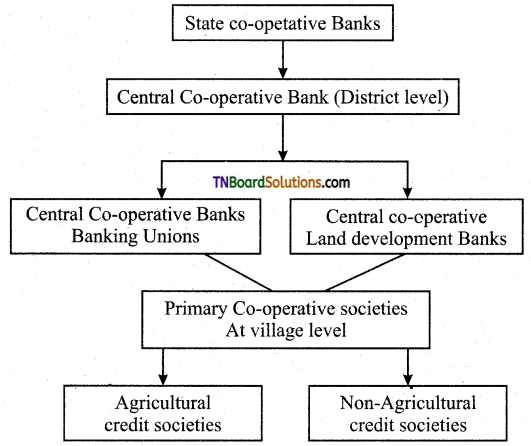
Question 1.
The structure of Cooperative banks?
Answer:
TN Board 11th Commerce Important Questions Chapter 11 Types of Banks 1

Question 2.
List the various types of deposit accepted by banks?
Answer:

  1. Fixed Deposit,
  2. Saving Deposit,
  3. Current Deposit,
  4. Recurring Deposit.

A bank in a country opposite another bank in a foreign countries to act as a correspondent bank.

Question 3.
What are the development banks?
Answer:
Huge finance required for investment, expansion, and modernization of big industries and others is granted by a separate type of bank called development Banks.

TN Board 11th Commerce Important Questions Chapter 11 Types of Banks

Question 4.
Give two example regional rural banks?
Answer:

  1. Pallavan Grama Bank, Salem, Tamil Nadu.
  2. Pandian Grama Bank,Thirumangalam, Madurai Dirstict, Tamil Nadu.
  3. Vallalar Grama Bank, Chidambaram, Cuddalore District, Tamil Nadu.
  4. Paduvai Bharathiyar Grama Bank, Villiyanur, Puducherry.

Question 5.
Give two example specialized banks.
Answer:
(a) Export-Import Bank of India (EXIM Bank).
(b) National Housing Bank (NHB).

Question 6.
Name of the Nationalised banks?
Answer:
The Nationalised banks are Indian Bank, Indian Overseas Bank, Oriental Bank of Commerce.

Question 7.
Name of the private sector banks?
Answer:
The Private Sector banks are Lakshmi Vilas Bank, Karur Vysya Bank, Kotak Mahindra bank.

Question 8.
Public sector banks give two examples.
Answer:
Public sector banks are State Bank of India, IDBI Bank Ltd., and all nationalized banks.

TN Board 11th Commerce Important Questions Chapter 11 Types of Banks

Short answer questions

Question 1.
Small finance banks objectives.
Answer:

  1. Mobilizing rural savings (accepting deposits).
  2. Providing credit to – (a) small and marginal farmers, (b) to micro and small industries, and (c) Other unorganized sector entities.
  3. In September 2015, RBI granted provisional licenses to 8 Non-Banking Finance Companies (NBFCs) already engaged in microfinance to be converted into SFBs and 2 others. SFBs are low-cost structure banks. They are formed under section 22 of the Banking Regulation Act 1949.

Question 2.
What are the features of banks?
Answer:

  1. Acceptance of deposits of money from the public.
  2. Obligation to refund deposits on demand.
  3. Lending or investing money for promotion and development of business.
  4. Profitable employment of funds received as deposits from the public.
  5. Money is. with-drawable by cheque or draft.

Question 3.
Mention the main function of Co-operative Banks.
Answer:
The main function of Co-operative Banks is to link the farmers with the money markets of the country.

TN Board 11th Commerce Important Questions Chapter 11 Types of Banks

Long answer questions

Question 1.
Explain the need for banking.
Answer:

  1. Savings and capital formation Bank plays a vital role in mobilizing the savings of the people and promoting capital formation for the economic development of the country.
  2. Canalization of savings The mobilized savings are allocated by the banks for the development of various fields such as agriculture, industry, communication, transport etc.
  3. Implementation of Monetary Policy A well-developed banking system can easily implement monetary policy because the development of the economy depends upon the control of credit given by the banks. So, banks are necessary for the effective implementation of monetary policy.
  4. Encouragement of Industries Banks provides various types of financial services such as granting cash credit, loans, issuing letters of credit, and bill discounting, etc., which encourages the development of various industries in the country.
  5. Regional development Banks, by transferring surplus money from the developed regions to the less developed regions reduces regional imbalances.

Question 2.
What are central co-operative banks and what are its functions?
Answer:
Central Co-operative Banks is the federation of all primary societies at the district level. Therefore it is also called District co-operative Central Banks.
Functions:

  1. They supervise, control, and finances the primary credit societies.
  2. They provide credit to individual customers on the basis of security.
  3. They accept deposits and pays a higher rate of interest than commercial banks.
  4. They help in remitting money to their customers.
  5. They help in solving problems of primary co-operative societies.
  6. They control and supervise the working of primary co-operative societies.

TN Board 11th Commerce Important Questions Chapter 11 Types of Banks

For Own Thinking

Question 1.
The debate about the benefits of various banks.
Answer:

  1. Savings and capital formation.
  2. Canalization of savings.
  3. Implementation of monetary policy.
  4. Encouragement to industries.
  5. Regional development.
  6. Development of Agriculture of other neglected sectors.

Question 2.
Bank visit – write an essay about the bank you visited.
Answer:
While filling the form. I asked for her ID proof. To my amazement, she took out a polythene bag full of all sorts of cards. Some cards had her picture on them and some were of her husband. I look for her Adhaar Card and fill in the details after 15 minutes of interrogation. I completed her from where applicants’ signatures were required. She with all her concentration held the pen as if it was a discomforting object to hold and wrote her name in Hindi. Her handwriting similar to that of a kid of UKG class may be a bit better.

Question 3.
When you want loan how will you get the loan from bank?
Answer:

  1. Banks are seeing the eligibility to get loans.
  2. Salaried people to get loan.
  3. Three months bank statement.
  4. ID proof.
  5. Address proof.
  6. Repayment sources.
  7. Equal asset as a surety.

TN Board 11th Commerce Important Questions Chapter 11 Types of Banks

For Future teaming

Question 1.
Mention the names of Commercial Banks, Industrial Banks, Cooperative Banks, and Foreign Banks in your areas.
Answer:
Commercial banks are:

  1. Canara Bank
  2. Punjab National Bank
  3. Lakshmi Villas Bank.

Industrial banks are:

  1. IDBI: Industrial Development Bank of India.
  2. ICICI: Industrial Credit and Investment Corporation of India.

Co-operative banks are:

  1. Central co-operative bank.
  2. Land Development bank.

Foreign banks are:

  1. Standard Chartered Bank.
  2. Bank of England.

Question 2.
Collection of pictures related to different types of banks.
Answer:
TN Board 11th Commerce Important Questions Chapter 11 Types of Banks 2

TN Board 11th Commerce Important Questions Chapter 11 Types of Banks

Case Study

Question 1.
You are the Agricultural bank manager; a farmer approaches you for a loan from your bank for purchasing a tractor and other farm equipment. How would you sanction the loan?
Answer:
Regarding land details: Whether he is a small farmer. Whether he is eligible to get loan repayment sources.

Question 2.
Due to natural calamities, the farmer could not repay the loan. He has no other way to repay the loan. How to collect loans from the farmer?
Answer:
Banker collect loan from the farmer by way of Personal property. But without interest bankers collect loans from the farmer. Sometimes farmer has no way to repay the loan. The loan will become bad debt.

Multiple choice questions

1. Bank of Hindustan was first bank in India established in:
(a) 1870
(b) 1970
(c) 1670
(d) 1770
Answer:
(d) 1770

2. The general bank of India was established in:
(a) 1976
(b) 1786
(c) 1686
(d) 1886
Answer:
(b) 1786

TN Board 11th Commerce Important Questions Chapter 11 Types of Banks

3. Bank of Calcutta was the first joint-stock bank established in:
(a) 1906
(b) 1806
(c) 1606
(d) 1706
Answer:
(b) 1806

4. Bank of Calcutta it was renamed as the Bank of Bengal:
(a) 1909
(b) 1809
(c) 1609
(d) 1709
Answer:
(b) 1809

5. Bank of Bombay is established in:
(a) 1840
(b) 1940
(c) 1860
(d) 1866
Answer:
(a) 1840

6. IDBI Bank established as the apex development bank in:
(a) 1999
(b) 2004
(c) 2008
(d) 1964
Answer:
(d) 1964

TN Board 11th Commerce Important Questions Chapter 11 Types of Banks

7. All Co-operative bank in Tamilnadu are registered under Tamilnadu Co-operative societies Act:
(a) 1883
(b) 1663
(c) 1773
(d) 1983
Answer:
(d) 1983

8. In 2017 there were …….. foreign banks in India and all of them were scheduled bank.
(a) 40
(b) 41
(c) 42
(d) 43
Answer:
(c) 42

9. Regional rural banks as on 31.3.2016 there were 56 RRB in India with branches:
(a) 14494
(b) 15000
(c) 18000
(d) 10000
Answer:
(a) 14494

10. Give the example of RRB:
(a) ICICI
(b) HDFC
(c) UTI
(d) Pallavan grama bank
Answer:
(d) Pallavan grama bank

TN Board 11th Commerce Important Questions Chapter 10 Reserve Bank of India

Students get through the TN Board 11th Commerce Important Questions Chapter 10 Reserve Bank of India which is useful for their exam preparation.

TN State Board 11th Commerce Important Questions Chapter 10 Reserve Bank of India

Very short answer questions

Question 1.
What do you mean by indigenous banker?
Answer:
Indigenous bankers are those who do not come under the control of RBI. For example Moneylenders, Marvadis Chettiars, Pawnbrokers are known as indigenous bankers.

Question 2.
List the credit control methods of Reserve bank of India.
Answer:
TN Board 11th Commerce Important Questions Chapter 10 Reserve Bank of India 1

Question 3.
Define Scheduled Bank?
Answer:
The banks which fulfill the following conditions are classified into scheduled banks.

  1. Their paid-up capital and reserves are at least Rs. 5 Lakhs.
  2. Their operations are not detrimental to the interest of the depositors.
  3. They are a corporation or Cooperative society and not partnerships or single-owner firms.

TN Board 11th Commerce Important Questions Chapter 10 Reserve Bank of India

Short answer questions

Question 1.
Who is the sole authority for the issue of currency notes?
Answer:
RBI is the sole authority for the issue of – currency notes in India except for one rupee coin, one rupee note, and subsidiary coins. These notes are printed and issued by the issue department.

Question 2.
Who is the Banker to the Government?
Answer:
RBI acts as the banker and agent of the government. It gives the following services:

Question 3.
Who is called a Banker’s Bank?
Answer:
As per the Banking Regulation Act 1949, every bank has to keep, certain minimum cash balance with RBI. This is called as Cash Reserve Ratio. The scheduled banks can borrow money from the reserve bank of India on eligible securities and by rediscounting bills of exchange. Thus it acts as a banker’s bank.

Long answer questions

Question 1.
What is the main objective of RBI?
Answer:

  1. To manage and regulate foreign exchange.
  2. To build a sound and adequate banking and credit structure.
  3. To promote specialized institutions to increase the term finance to industry.
  4. To give support to government and planning authorities for the economic development of the country.
  5. To control and manage the banking system in India.
  6. To execute the monetary policy of the country.

TN Board 11th Commerce Important Questions Chapter 10 Reserve Bank of India

For Own Thinking

A Debate on demonetization and – remonetization.
Answer:
Demonetization:

  1. To crop whip against black money.
  2. To drive out counterfeit currency in circulation.
  3. Formalization of cash-dependent business
  4. Dismantling the financial strength of terrorism and Naxalism. This leads to No black money.
    “All must pay correct taxes,
    All are equal. ”

Remonetization:

  1. There were Rs. 17.118 billion value of Rs. 5000 and Rs. 1000 currency notes in circulation before demonetization.
  2. They consisted of around 2203 Crore: pieces of notes.
  3. Now remonetization was carried out by issuing new Rs. 2000 and Rs. 500 currency notes to circulate.
    ‘All economic problems solved now”

For Future teaming

1. Know the Central Banks of Some other Countries. The Central Bank of Russia is the Bank of Russia. The Central Bank of Sri Lanka is the Central Bank of Sri Lanka. The Central Bank of the USA is …..(i)…… The Central Bank of Pakistan is ..(ii)…..
Answer:

(i) Central Bank of America is Federal Reserve.
(ii) Central Bank of Pakistan is the State Bank of Pakistan.

2. Mention the names of Central Banks in three other countries.
Answer:

  1. Central Bank of Bhutan – Bhutan.
  2. Reserve Bank of Australia – Australia
  3. Central Bank of China – China.
  4. Bank of Canada – Canada.

TN Board 11th Commerce Important Questions Chapter 10 Reserve Bank of India

3. Understand the concepts of the monetary authority, banking system, financial system.
Answer:
The formal financial system of four segments. These are financial institutions, financial markets, financial instruments, and financial services.

4. Collection of names of RBI Governors.
Answer:

  1. D. Subbarao. IAS – September 5, 2008
  2. Raghuram Rajan – September 4, 2013
  3. Urjit Patel – September 5, 2016.

5. Collection of photocopy of currencies and coins in India.
Answer:
TN Board 11th Commerce Important Questions Chapter 10 Reserve Bank of India 2
(i) Currency rare Indian 2 rupees.
(ii) Rare 1908 King Edward VII
(iii) My coin collections two rupees.

Case Study

1. Take up a recent newspaper clipping about RBI such as the measures taken to reduce NPA. etc.
Answer:
Central banks are not known to be trigger happy. RBI is no exception. Indeed it has often been criticized for being much too cautious. Especially when it comes to loosening Capital A/c.

2. Arrange for a group discussion on customer grievances and the cases settled by Banking Ombudsman offices.
Answer:
The RBI today said it will bring about a customer grievances redressal mechanism for non-banking finance companies NBFCs by this month-end.

TN Board 11th Commerce Important Questions Chapter 10 Reserve Bank of India

3. Visit the RBI website www.rbi.org.in to read and have a discussion on any annual report, etc.
Answer:
The asset quality of the banking sector continued to be a concern during 2016-2017. In the aftermath of the assets quality review (QAR) undertaken by the RBI.

Multiple choice questions

1. Which of the following is an example of e-banking:
(a) EFT
(b) Online banking
(c) ATM
(d) All of the above
Answer:
(d) All of the above

2. Who can get an overdraft from a bank?
(a) A current A/c Holder
(b) A savings A/c Holder
(c) A fixed Deposit A/c Holder
(d) A Recurring Deposit A/c Holder
Answer:
(a) A current A/c Holder

TN Board 11th Commerce Important Questions Chapter 10 Reserve Bank of India

3. Give full form of ATM:
(a) Automatic telemoney
(b) Any time money
(c) Automated teller machine
(d) Automatic transfer machine
Answer:
(c) Automated teller machine

4. Name the type of banking under which ATM credit card and EFT facilities are available:
(a) Internet Banking
(b) E – Banking
(c) Modem Banking
(d) Online Banking
Answer:
(b) E – Banking

5. Name the controlling authority to telecom services in India.
(a) TRAI
(b) SEBI
(c) RBI
(d) IRDA
Answer:
(a) TRAI

TN Board 11th Commerce Important Questions Chapter 10 Reserve Bank of India

6. Which of the following can be used only for e-business?
(a) Cheques
(b) Credit card
(c) Debit card
(d) E-cash
Answer:
(d) E – cash

7. Banks are called as manufactures of:
(a) Money
(b) Loans
(c) Deposit
(d) Overdrafts
Answer:
(a) Money

8. The reserve introduced an electronic clearing service for payment of electricity, bills in 1997;
(a) Chennai
(b) Kolkatta
(c) Delhi
(d) Mumbai
Answer:
(d) Mumbai

9. A bank that occupies a central position in the monetary and banking system of the country and has a superior financial authority is:
(a) Central Bank
(b) Commercial Bank
(c) Exchange Bank
(d) Co-operative bank
Answer:
(a) Central Bank

TN Board 11th Commerce Important Questions Chapter 10 Reserve Bank of India

10. ……… are those who do not come under the control of RBI,
(a) Indigenous Bank
(b) ICICI
(c) Central bank
(d) exchange bank
Answer:
(a) Indigenous Bank

11. RBI on the basis of functions:
(a) Commercial bank
(b) Co-operation bank
(c) Non-scheduled bank
(d) Private sector bank
Answer:
(a) Commercial bank

12. The head office of the RBI is situated in:
(a) Chennai
(b) Mumbai
(c) Delhi
(d) Kolkatta
Answer:
(b) Mumbai

13. The demonetization in ………. year was a grand success because of the leadership role of the RBI.
(a) 2013-2014
(b) 2014-2015
(c) 2012-2013
(d) 2016-2017
Answer:
(d) 2016-2017

TN Board 11th Commerce Important Questions Chapter 10 Reserve Bank of India

14. One governor and four deputy governors appointed for a period of ………. years.
(a) one
(b) two
(c) three
(d) four
Answer:
(d) four

15. RBI it also has ………. regional officers.
(a) 20
(b) 19
(c) 21
(d) 24
Answer:
(b) 19

16. The functions of the RBI can be grouped under the heads:
(a) 1
(b) 2
(c) 5
(d) 6
Answer:
(b) 2

17. This central office has ………. departments in 2017.
(a) 30
(b) 31
(c) 33
(d) 36
Answer:
(c) 33

TN Board 11th Commerce Important Questions Chapter 10 Reserve Bank of India

18. Emblem of RBI:
(a) Palm tree & tiger
(b) Palm tree lion
(c) Palm tree & zebra
(d) Palm tree kangaroo
Answer:
(a) Palm tree & tiger

19. Foreign exchange management Act:
(a) 2003
(b) 2008
(c) 1999
(d) 2016
Answer:
(c) 1999

20. The rupee symbol was changed from Rs to by the government of India on:
(a) 15.7.2010
(b) 15.4.1987
(c) 15.3.2011
(d) 15.6.2012
Answer:
(a) 15.7.2010

TN Board 11th Commerce Important Questions Chapter 10 Reserve Bank of India

21. There were ………. billion value of 500 and 1000 currency notes in circulation before Demonetisation.
(a) 16118
(b) 17118
(c) 17211
(d) 16444
Answer:
(b) 17118

TN Board 11th Commerce Important Questions Chapter 9 Government Organisation

Students get through the TN Board 11th Commerce Important Questions Chapter 9 Government Organisation which is useful for their exam preparation.

TN State Board 11th Commerce Important Questions Chapter 9 Government Organisation

Very short answer questions

Question 1.
What was the role of government in the past?
Answer:
In the past the role of government was limited only to the maintenance of law and order.

Question 2.
What factors govern the choice of a particular form of organisation for an industry?
Answer:
The choice of the particular form of organisation depends upon

  1. the nature of the industry,
  2. the circumstances of the country and
  3. the policy of the government.

TN Board 11th Commerce Important Questions Chapter 9 Government Organisation

Question 3.
Explain the management of public corporation.
Answer:
A Public corporation is an autonomous body corporate created by a special statute of a state or central government. A public corporation is a separate legal entity created for a specific purpose. It is a administrated by a board appointed by public authority to which it is answerable.

Question 4.
How does H. Hansen define public enterprises?
Answer:
According to A.H. Hansen “Public enterprise means state ownership and operation of industrial, agricultural, financial and commercial undertaking.

Question 5.
How can we establish state enterprises?
Answer:
State enterprises are established to implement economic policies of the government the primary objective of the state enterprises is to serve the people and help in creating an environment for industrial activity.

Question 6.
Give some example for government department organisations in india.
Answer:
In India

  1. Railways post and telegraph,
  2. BSNL,
  3. Radio and
  4. Television as government departments.

TN Board 11th Commerce Important Questions Chapter 9 Government Organisation

Question 7.
Give the four forms of Govt. Institution.
Answer:

  1. Departmental understanding
  2. Public corporation
  3. Government company
  4. Board organization.

Question 8.
What are the forms in which government can organize an industrial or commercial unit.
Answer:
The government can organise an industrial or commercial unit in any one of the following form

  1. Departmental of the government,
  2. Separate corporation and
  3. Joint stock company.

Question 9.
Why departmental organisation is suitable for defence industries?
Answer:
Strategic industries like defence and atomic power cannot be better managed other than government departments. Department undertakings can maintain secrecy in their working.

Short answer questions

Question 1.
What necessitated Governments to intervene in industrial sector?
Answer:
Industrial revolution helped all-round growth of industries. Private entrepreneurs worked, only for profit motive. The exploitation of consumers and workers by private entrepreneurs became very common. The development of industries was left to the judgment of private enterprises. Therefore, Government control or intervention became a necessity to safeguard the interests of the general public.

Question 2.
How does the state enterprises bring in balanced economic growth?
Answer:
The aim of Industrialisation is to develop all industries, essential for the country. Also, various regions of the country should be equally developed. Private sector may not establish industries in certain regions, where they do not find opportunities to earn more profit. They cannot be compelled to start their undertakings in backward regions. So government can start industries in backward areas.

TN Board 11th Commerce Important Questions Chapter 9 Government Organisation

Question 3.
What is a Public Corpqration?
Answer:
Public Corporation is established under a specific statute passed in the parliament. It is also known as-a statutory corporation. The statute defines its objectives, powers and functions. It is an autonomous body fully financed by the government. It has a separate legal existence.

Question 4.
Why does the government enter into those fields where large investments are required?
Answer:
Some undertakings need heavy investment and the gestation period may also be longer. Private industrialists cannot afford to make such, huge investments. In case of railways, ship-building, energy producing concerns, etc., very huge investments is required which is beyond the means of private investors. Hence, government enters these fields and establish its own undertakings.

Question 5.
Write about the provision of public utilities by government.
Answer:
Government undertakes to provide various necessities like electricity, water, coal, gas, transport, communication facilities to the people. The aim is to provide these basic facilities at cheap rates. Private sector cannot be relied upon to provide these services. Moreover, there are chances of public exploitation in these services. So public utilities are provided by government undertakings.

Question 6.
Write a short note on accountability of a public corporation.
Answer:
A public corporation is accountable to the legislature, and also to the ministry mentioned in the special Act. Its accounts are audited by Comptroller and Auditor-General and the Annual report is presented to the Parliament or Legislature.

TN Board 11th Commerce Important Questions Chapter 9 Government Organisation

Question 7.
Mention the circumstances suitable for government company form of organisation.
Answer:
Government company form of organization . is suitable in the following circumstances.

  1. When the government wants to take over an existing enterprise in ah emergency.
  2. When the State wants to establish an undertaking in collaboration with private enterprises or with foreign countries
  3. When there is a need for flexibility in the operations of the enterprises.
  4. When the Government wishes to start the enterprises with a view of transferring it to private management later.

Long answer questions

Question 1.
Write a note on government companies.
Answer:

  1. A company owned by central and /or state government is called a Government company. Either whole of the capital or majority of the shares are owned by the government.
  2. According to Indian Companies Act, 1956, “Government company means any company in which not less than 51 % of the paid-up share capital is held by the central government or by any state governments or government or partly by the central government and partly by one or more state government and includes a company which is a subsidiary of a government company”.
  3. Government companies are registered both as public limited and private limited companies but the management remains with the government in both cases. Government companies enjoy some privileges which are not available for non¬
    government companies. No special statute is required to form government companies.
  4. Government companies enter those . fields where private investment is not forthcoming. Sometimes, government has to take over sick units in private sector.

Question 2.
What are the differences between public and private sector?
Answer:

Public sectorPrivate sector
Sufficient, unlimited resources; successful in mobilizing savings through banks, bonds etc.Limited resources; The private sector is not successful in mobilising the resources of the country or from foreign countries for the economic development.
Checks concentration of economic power in the hands of few.Leads to concentration of economic power in the hands of few individuals.
Develop those sectors which are neglected bv the private sector.Develop those industries / sectors in which risk is less and returns is more.
Preserves national wealth.Exploitation of natural resource like forests, mines etc., for personal advantage.
Brings in balanced growth; starts industries in backward areas.Do not establish industries in backward areas.
Heavy, basic and defence industries are reserved for public sector.Consumer goods industries, agriculture are in private sector.

TN Board 11th Commerce Important Questions Chapter 9 Government Organisation

Question 3.
Draw a flow chart of state enterprise with example.
Answer:
TN Board 11th Commerce Important Questions Chapter 9 Government Organisation 1

Question 4.
What are the merits and demerits of a government company?
Answer:
Merits of Government Company:

  1. Easy to form: The formation of a government company is comparatively easy. No prior approval of the parliament/ legislature is required.
  2. Flexibility in management: There is flexibility in running the business of the company. It can follow flexible policy to suit the changing, business conditions.
  3. Freedom of action: It enj0ys a large measure of freedom in matters of finance, administration, and personnel. It can plan its own capital structure.
  4. No government interference: It enjoys greater freedom and authority and is free from the protracted and time-consuming regulations of the Government. So, the government company can work just like any privately owned company.
  5. Run-on commercial lines: Government companies are run on sound business lines. They earn surpluses to finance their own expansion.

Demerits of Government Company:

  1. Political interference:
    In reality, government companies do not enjoy any autonomy in their activities. The interference of the Ministers has been very frequent. Every Government tries to nominate directors from its own political party and through these, companies are run on political consideration
  2. Minority interest neglected: Since the government is the majority shareholder, the Government is able to impose its will on the management of such a company.
  3. Lack of interest: The top position officials of the company are not dedicated to the success of the company as they are frequently transferred. The Board of Directors also does not have the necessary skill and experience to run the business on sound business lines.
  4. Accountability: The Annual Audit Report placed before the Parliament reveal only financial matters. There is no accountability for the operational efficiency, administration, and personnel of the companies.
  5. Red-tapism: These companies are dependent on the government for taking important policy decisions. Red-tapism in governments affects the working of these companies.

TN Board 11th Commerce Important Questions Chapter 9 Government Organisation

For Own Thinking

1. Name any two examples of Departmental undertaking business.
Answer:
Examples of Departmental undertaking:

  1. Radio and Television.
  2. Post and Telegraph.

2. Name any two examples of Public corporations. Examples of Public corporation:
Answer:

  1. RBI – Reserve Bank of India.
  2. UTI – Unit Trust of India.

3. Name any two examples of Government companies.
Answer:

  1. Maruti Udyog.
  2. BHEL – Bharath Heavy Electricals Limited.

For Future Learning

(i) Organise a debate in your class on the motion “Public Enterprises in India have failed to achieve their objectives”. Select a few good speakers for the purpose. State the points for and against the motion.
Answer:
Favorable:

  1. Excessive government control.
  2. Interference
  3. Delay and Redtapism.
  4. Tax burden to public
  5. Inefficiency.

Unfavorable:

  1. Proper use of funds
  2. Source of income for the government.
  3. Secrecy.
  4. Useful to specific industries.

TN Board 11th Commerce Important Questions Chapter 9 Government Organisation

(ii) Recently a discussion on “The objectives of Public sector undertakings was organized by the Friends Circle, a private cultural, organization of the city of Chennai. One of the participants, Mr. Ramesh happened to be a social worker. He observed, “the objective of Public Enterprises is to serve the Society and not to earn profits”. Mr. Deepesh, an advocate, objected to Mr. Ramesh’s statement and gave his own viewpoint. Thus continued the discussion.
If you have participated in that discussion, what should have been your stand and why?
Answer:
Public enterprises not to earn profit. But run as commercial lines. Defense industries are looking after departmental undertakings. In an emergency situation, the private sector cannot cooperate with the government.
The objective of public sector undertakings is to serve society and not to earn profit.

Case Study

Case 1- You are a newly appointed MD of a foreign sector tourist Bus transport company.
Answer:
The management of the bus Transport undertaking of your city finds that its buses are not able to attract very many tourists. Private Mini-Buses are seen to be preferred by people on certain routes. As a result, the undertaking is incurring losses. Therefore, management wants to reformulate its price policy. As a CEO or MD, what advice can you give to it? Explain.
Answer:
My advice is first to attract the public because people like attractions. Tourist bus transport company earn profit.

Case 2- Mr.Sudhan is studying in B.Com, 1st year. His father, Mr.Somu is a leading businessman in Chennai. Somehow, Mr. Sudhan does not know anything about utilities. But he is to prepare a lesson for his class on this topic. He requests his father for help. His father tells Mr. Sudhan that Public utilities are no different from his own business except that these are controlled by the Government instead of private people. Meanwhile, Mr. Chandrasekaran a friend of Mr. Somu comes there. Mr. Chandrasekaran is an employee of Chennai Electricity Supply Undertaking. Mr. Chandrasekaran intervenes in the conversation going on between Mr. Somu and his son and holds that Mr. Sudhan is not correct; there are other special features of public utilities, too. Perform the characters of Mr, Sudhan, Mr. Somu, and Mr. Chandrasekaran and state your positions.
Answer:
Government undertakes to provide various necessities like electricity, water, coal, gas, transport, communication facilities to the people. Above public utility services given by public enterprises.
Characters of Somu: a businessman.
(i) Private business people pay tax regularly.
(ii) Government employees are paid, servants. So he cannot work efficiently.
Characters of Mr. Chandra Sekar: He is an employee of the Chennai Electricity supply board. He explains electricity is very important to the public electricity board supplies electricity to common people, Industries, and all trade.
Characters of Mr. Sudhan: He is a BCom student. He knows everything from his textbook and also his father is also a businessman. He is getting information about business from his father.

TN Board 11th Commerce Important Questions Chapter 9 Government Organisation

Multiple choice questions

1. PSE’s are organizations owned by:
(a) joint hindu family
(b) government
(c) foreign companies
(d) private entrepreneurs
Answer:
(b) government

2. Disinvestments of PSE.s implies:
(a) sale of equity shares to private sector/ public
(b) closing down operations
(c) investing in new areas
(d) buying shares of PSE’s
Answer:
(a) sale of equity shares to private sector/ public

3. In which form of public sector enterprise private individuals can also become shareholders?
(a) Departmental undertaking
(b) Government company
(c) Statutory corporation
(d) None of the above
Answer:
(b) Government company

4. Which of the following is most suitable when national security is of utmost importance?
(a) Departmental undertaking
(b) Government company
(c) Statutory corporation
(d) None of the above
Answer:
(a) Departmental undertaking

TN Board 11th Commerce Important Questions Chapter 9 Government Organisation

5. Steel Authority of India Limited (SAIL) is an example of:
(a) statutory corporation
(b) government company
(c) departmental undertaking
(d) none of the above
Answer:
(a) statutory corporation

6. “Which of the following has 51% of the capital from the government?
(a) Government Company
(b) Departmental Undertaking
(c) Statutory Corporation
(d) None of the above
Answer:
(a) Government Company

7. Which year brought a drastic change in the role of the public sector in India?
(a) 1951
(b) 1991
(c) 1956
(d) 2001
Answer:
(b) 1991

8. Memorandum of understanding (mou) is a term used in the context of:
(a) public-private partnership
(b) joint venture
(c) the changing role of the Public sector
(d) all of the above
Answer:
(d) all of the above

9. Since 1991 number of …….. has increased in India:
(a) departmental undertaking
(b) government company
(c) statutory corporation
(d) global enterprises
Answer:
(d) global enterprises

TN Board 11th Commerce Important Questions Chapter 9 Government Organisation

10. Which of the following is controlled and managed as per provisions of the statute under which it has been formed?
(a) Departmental undertaking
(b) Statutory corporation
(c) Government company
(d) None of the above
Answer:
(b) Statutory corporation

11. State enterprise is an undertaking owned and controlled by the:
(a) local government
(b) state government
(c) central government
(d) local or state or central government.
Answer:
(d) local or state or central government.

12. Example for the departmental undertaking is:
(a) industrial development bank of India
(b) all India radio and television
(c) state trading corporation
(d) Tamil Nadu state transport corporation
Answer:
(b) all India radio and television

13. Indian telephone industry is an example of:
(a) departmental organization
(b) public corporation
(c) government company
(d) joint venture
Answer:
(a) departmental organization

14. Red-Tapism affects the working of the:
(a) government companies
(b) departmental organization
(c) private companies
(d) foreign companies in India
Answer:
(a) government companies

TN Board 11th Commerce Important Questions Chapter 9 Government Organisation

15. Departmental undertaking can maintain in their working:
(a) cost-effectiveness
(b) secrecy
(c) discipline (irregularity)
Answer:
(b) secrecy

16. Government companies are managed by:
(a) ministers
(b) members of parliament
(c) board of directors
(d) higher officials
Answer:
(c) board of directors

17. A public corporation is accountable to the:
(a) board of directors
(b) government officials
(c) ministers
(d) legislature
Answer:
(d) legislature

18. If defense industries are owned by private individuals:
(a) profits will go the private entrepreneurs
(b) the security of the country will be safe
(c) defense secrets will be given out
(d) the country’s defense will be safe.
Answer:
(c) defense secrets will be given out

TN Board 11th Commerce Important Questions Chapter 9 Government Organisation

19. Government companies provide healthy competition to the:
(a) private sector
(b) public corporation
(c) co-operative society
(d) foreign companies
Answer:
(a) private sector

20. There is no competition to the business of:
(a) partnership
(b) joint-stock company
(c) sole trading concern
(d) departmental organization
Answer:
(d) departmental organization

21. Government companies are registered under:
(a) a special statute of government
(b) companies act, 1956
(c) royal charter
(d) order of the Government
Answer:
(b) companies act, 1956

22. In a public corporation the management has:
(a) limited freedom
(b) no freedom of action
(c) controlled freedom
(d) unrestricted freedom of action
Answer:
(c) controlled freedom

TN Board 11th Commerce Important Questions Chapter 9 Government Organisation

23. For the efficient working of state enterprise the form of organization generally considered suitable is:
(a) departmental organization
(b) public corporation
(c) government company
(d) none of these
Answer:
(b) public corporation

24. Public can also subscribe to the share capital of:
(a) public corporation
(b) departmental undertaking
(c) government company
(d) none of these
Answer:
(c) government company

25. In a government company the share capital of the government must hot be less than:
(a) 51%
(b) 60%
(c) 75%
(d) 90%
Answer:
(a) 51%

26. State enterprises are established to:
(a) implement economic policies of the government
(b) earn profit
(c) prevent the entry of private enterprises
(d) establish socialist society
Answer:
(a) implement economic policies of the government

TN Board 11th Commerce Important Questions Chapter 9 Government Organisation

27. This is an undertaking owned and controlled by Government:
(a) Sole tradership
(b) Partnership
(c) State enterprises
(d) Joint-stock companies
Answer:
(c) State enterprises

28. The aim of industrialization is to:
(a) achieve economic development
(b) develop all industries
(c) raise the income of the people
(d) raise the employment opportunities
Answer:
(b) develop all industries

29. The public corporation is managed by:
(a) board of directors
(b) civil servants
(c) directors
(d) managing Committee
Answer:
(a) board of directors

TN Board 11th Commerce Important Questions Chapter 9 Government Organisation

30. Government companies are managed by:
(a) Ministers
(b) Members of Parliament
(c) Board of Directors
(d) Higher officials
Answer:
(c) Board of Directors

TN Board 11th Commerce Important Questions Chapter 8 Multi-National Corporations (MNCs)

Students get through the TN Board 11th Commerce Important Questions Chapter 8 Multi-National Corporations (MNCs) which is useful for their exam preparation.

TN State Board 11th Commerce Important Questions Chapter 8 Multi-National Corporations (MNCs)

Very short answer questions

Question 1.
What are the other names for Multinational companies?
Answer:
A multinational corporation is also known as a transnational corporation namely “Global gaint (or) World enterprises (or) International enterprise.

Question 2.
What is a Multinational Firm?
Answer:
All forms of business organisation that transcend political frontiers may be called as multinational firms.

TN Board 11th Commerce Important Questions Chapter 8 Multi-National Corporations (MNCs)

Question 3.
What do you mean by MNC?
Answer:
A Multinational company is one whose ownership is accommodated in more than one country products are manufactured and sold in many countries

Question 4.
Explain the merits of MNC?
Answer:
Merits of MNC:

  1. They increase the investment income and employment in the host country.
  2. They increase managerial skills.
  3. They support the domestic enterprise.
  4. They help in increasing the competition.
  5. They try to equalize the cost of factors of production.

Question 5.
Explain the demerits of MNC?
Answer:

  1. They may retard the growth of employment in the home country.
  2. They may destroy competition and acquire monopoly powers.
  3. MNC technology is designed for worldwide profit maximization and is not for the development of the needs of poor countries.
  4. MNC’s avoid taxes by manipulating the transfer pricing.

TN Board 11th Commerce Important Questions Chapter 8 Multi-National Corporations (MNCs)

Short answer questions

Question 1.
Mention the five criteria to define a company as an MNC?
Answer:

  1. It operates in many countries at different levels of economic development.
  2. Multinational manage their local subsidiaries.
  3. It maintains complete industrial organisation including research and development and manufacturing facilities in several countries.
  4. It has multinational central management.
  5. It has multinational stock ownership.

Question 2.
MNC’s are in a position to exercise massive control over an economy substantiate.
Answer:

  1. MNC’s are characterised by possessing huge financial resources. These huge financial resources give them economic power in the economy they can afford to survive even during losses as well.
  2. MNC’s possess technological superiorities and are capable of conforming to international standards and quality specifications.
  3. They make use of aggressive marketing strategies for their products.
  4. They have an established brand image in the market.

TN Board 11th Commerce Important Questions Chapter 8 Multi-National Corporations (MNCs)

Question 3.
Global enterprises are giant both in size and operations “substantiate this statement.
Answer:

  1. It has huge capital resources.
  2. It involves foreign collaboration,
  3. It uses advanced technology.
  4. It leads to product innovation.
  5. It makes use of marketing strategies.
  6. It leads to the expansion of market territory.
  7. It makes uses of centralized control.

Question 4.
Multinational companies have done more harm than good. Explain.
Answer:

  1. Yes, I agree that multinational companies have done more harm than good. It is clear from the following disadvantages which it is creating for the economy.
  2. It disregards national priorities.
  3. It leads to the creation of a monopoly.
  4. It leads to the depletion of natural resources.
  5. It leads to technology obsolete.
  6. It creates a threat to national sovereignty.

Question 5.
Give an example of multinational companies
Answer:

  1. Unilever limited.
  2. Union carbide.
  3. International Business Machines. (IBM).
  4. Philips.
  5. Coca-cola corporation.

TN Board 11th Commerce Important Questions Chapter 8 Multi-National Corporations (MNCs)

Question 6.
What do you understand by multinational companies and explain its features?
Answer:
A multinational company is a company carrying on business in two or more countries. According to Neil H. Jacoby, “A multinational corporation owns and manages business in two or more countries.
Features:
(i) A multinational company is operated in more than one country simultaneously.
(ii) It is generally very large in size.
(iii) Its purpose is to reduce transport costs and to make use of raw materials, labour, capital and the market of foreign countries.
There are 500 to 700 MNCs operating in the world today, Half of them are U.S multinationals. The multinationals based in the USA have the largest share of foreign direct investment (FDI), followed by the U.K, Germany, Japan, Switzerland, France and Canada. In underdeveloped countries, the investment and employment created by the MNCs have been chiefly concentrated in Brazil, Mexico, Hong Kong, the Philippines, Singapore and South Korea. Latin America accounts for about 60% of the MNC employment in developing countries, followed by Asia 30% and Africa 10%. Foreign investment has moved some developing countries which offer political stability and a convenient economic environment, including tax incentives, large markets, cheap labour and easy access to oil and other natural resources.

For Own Thinking

1. Name any 2 Indian Multinational Companies abroad?
Answer:

  1. Indian MNC abroad.
  2. Suzuki Marathi Suzuki
  3. Timex watches.

2. Name any 2 Foreign Companies in India?
Answer:

  1. Coca-cola corporation.
  2. International Business Machine.

TN Board 11th Commerce Important Questions Chapter 8 Multi-National Corporations (MNCs)

For Future Learning

Multinational companies establish themselves in developing countries to enjoy huge profits by selling consumer goods or luxury items. They start a business by offering a wide variety of goods at prices cheaper than local retailers offer. But once they are established they increase prices.
(i) State the values the government of a developing country ignores while allowing MNCs to establish in their country.
Answer:

  1. MNC’s produce only those things which are used by the rich, poor people do not get any benefits.
  2. MNC leads to use the natural resources of the host country carelessly.
  3. MNC’s tend to promote their culture in their home country.
  4. Many domestic industries have to windup, as a result of the threat from MNC’s.

(ii) What value do the MNCs violate?
Answer:

  1. Neglect of Industrial and Economic growth of the home country.
  2. An investment in the home country is not profitable.
  3. Money value also decreased.

Case Study

Public enterprises are established to achieve the goal of economic and social development of the country. They are managed and controlled by Central or State Governments through ministers or government officials. Many times their poor performance influences the policy formulation and running of the enterprise into a loss. Even the big business houses use their influence and get the policies formulated in their favour. State the role of ministers or government to frame the policies for the success of public enterprises.
Answer:

  1. Government policies are favourable towards N public enterprise.
  2. Public and human resources also developed in our country.
  3. By providing good services to increase profit.
  4. Government must frame the policies for the success of the public enterprise.
  5. No-one Can misuse these policies for personal use.
  6. National income will raise by starting MNC’s in the home country.

TN Board 11th Commerce Important Questions Chapter 8 Multi-National Corporations (MNCs)

Multiple choice questions

1. Centralised control in MNC’s implies control exercised by:
(a) branches
(b) subsidiaries
(c) headquarters
(d) parliament
Answer:
(c) headquarters

2. Reconstruction of risk public sector units is taken up by:
(a) MOFA
(b) MOU
(c) BIFR
(d) NRF
Answer:
(c) BIFR

3. BIFR stand for:
(a) Bureau of Industrial and Financial Reconstruction
(b) Board of Industrial and Financial Reconstruction
(c) Board of Indian Financial Reconstruction
(d) Board of Industrial and Financial Reformation
Answer:
(b) Board of Industrial and Financial Reconstruction

TN Board 11th Commerce Important Questions Chapter 8 Multi-National Corporations (MNCs)

4. Multinational companies operate in:
(a) the native countries only
(b) several countries
(c) the Asian countries only
(d) the European countries only
Answer:
(b) several countries

5. Philips is an example of:
(a) joint-stock company
(b) partnership company
(c) sole trading institution
(d) multinational company
Answer:
(d) multinational company

6. Latin America accounts for MNC employment in developing countries:
(a) 10%
(b) 50%
(c) 30%
(d) 60%
Answer:
(d) 60%

7. A multinational company is also known as:
(a) global giant
(b) partnership
(c) co-operative society
(d) public Corporation
Answer:
(a) global giant

8. Pepsi corporation company is an example of:
(a) MNC
(b) government company
(c) join venture
(d) public company
Answer:
(a) MNC

TN Board 11th Commerce Important Questions Chapter 8 Multi-National Corporations (MNCs)

9. Government policy is also favourable towards:
(a) Public corporation
(b) Multinational company
(c) Joint Hindu family
(d) Partnership
Answer:
(b) Multinational company

10. Operates in many countries at different levels of economic development and has i multinational central management:
(a) MNC
(b) Import
(c) Export
(d) Entrepot
Answer:
(a) MNC

11. The multinational firms based in …….. have the largest share of Foreign direct investment.
(a) Germany
(b) Japan
(c) Unite States of America
(d) the United Kingdom
Answer:
(c) Unite States of America

TN Board 11th Commerce Important Questions Chapter 8 Multi-National Corporations (MNCs)

12. Coca Cola corporation it is an:
(a) American company
(b) African company
(c) German company
(d) Indian company
Answer:
(a) American company

TN Board 11th Commerce Important Questions Chapter 7 Cooperative Organisation

Students get through the TN Board 11th Commerce Important Questions Chapter 7 Cooperative Organisation which is useful for their exam preparation.

TN State Board 11th Commerce Important Questions Chapter 7 Cooperative Organisation

Very short answer questions

Question 1.
What is a Co-operative warehouse?
Answer:
Co-operative warehouse are mostly found in rural areas. It helps the members to get the facility of storing agricultural inputs. They will keep the finished goods till they are despatched for sale through marketing co-operatives.

Question 2.
Mention any four features of co-operative society?
Answer:

  1. Voluntary Organisation.
  2. Equality
  3. Democratic managements and
  4. Combination of resources.

Question 3.
Write a short note on the meclagaon committee.
Answer:
In 1914 a committee headed by meclagaon was appointed by the government to review the working of co-operatives on the basis of this recommendation of the committee the government of co-operatives was transferred, from the central to the state governments.

TN Board 11th Commerce Important Questions Chapter 7 Cooperative Organisation

Question 4.
What are the non agricultural credit society?
Answer:

  1. Consumer’s co-operatives
  2. Manufacturer’s co-operatives
  3. Housing co-operatives and
  4. Co-operatives warehouses.

Question 5.
What are the aims of credit co-operative society?
Answer:
Credit societies are voluntary association of people with moderate means. They are formed with the aim of giving short term finance to members. In this way the co-operative society protects its members from the clutches of the money lenders.

Question 6.
Give example of co-operative super markets in TamilNadu?
Answer:
Examples of co-operatives super markets in TamilNadu are Kamadhenu Super Market in Chennai, Chinthamani Super Market in Trichy and Coimbatore and Karpagam Super market in Vellore and Villupuram districts! and Ponni co-operatives Super market inj Salem.

Question 7.
What are the aims of co-operative societies?
Answer:
Co-operative enterprises emerged as an instrument to protect the interest of weaker sections. The aim or philosophy behind the concepts is all for each and each for all.

Question 8.
Define Joint Stock Company.
Answer:
A company is defined as an incorporated v association which in an artificial person created by law having a common seal and perpetual succession.

TN Board 11th Commerce Important Questions Chapter 7 Cooperative Organisation

Question 9.
Explain the merits of Super Market?
Answer:
Merits of super Market:

  1. Customers are able to buy the goods of daily use in one place.
  2. The profit of the super market is shared with the customers in the form or low price of products.
  3. They can move around the stores and buy in a relaxed manner and choose the articles they like.
  4. Super markets are able to attract many customers and there by register more turn over.
  5. The commodities are made available at fixed prices. It is marked on the products.

Short answer questions

Question 1.
What is meant by one man one vote?
Answer:
Co-operative societies are managed on democratic lines. Every member has only one vote irrespective of the number of shares held by. him. The society is formed on the principle of democracy which means “ One vote for one member”. A General body meeting is conducted annually. Representatives are elected by the members to manage the society.

Question 2.
What is the significance of ‘self help and mutual help?
Answer:
The main principle of co-operative organisation is the mutual help. Every member of the society is expected to help himself. This is called self-help. When every member helps every other member, it is called mutual help.

Question 3.
What are the aims of Credit Cooperative society?
Answer:
Credit societies are voluntary association of people with moderate means. They are formed with the aim of giving short-term finance to members. In this way, the co¬operative society protects its members from the clutches of the moneylenders.

TN Board 11th Commerce Important Questions Chapter 7 Cooperative Organisation

Question 4.
Explain the meaning of ‘Consumer co-operatives’.
Answer:
Consumer’s Co-operatives: A cooperative society organized by consumers of a locality for supplying essential goods at a reasonable price. This is called a consumer cooperative society. It eliminates the middlemen. They purchase their requirements directly from the producers or wholesalers in bulk and sell to members, non-members at a reasonable price.

Question 5.
What are the aims of Cooperative societies?
Answer:
Co-operative enterprises emerged as an instrument to protect the interest of the weaker sections. The aim or philosophy behind the concept is “All for each and each for all”.

Question 6.
What do- you understand by marketing co-operative?
Answer:
Marketing co-operatives help the members to secure fair price for their products. They may purchase the produce from the members and sell in, bulk when the market is favourable. In some cases co-operatives sell the produce of the members on commission basis. Marketing co-operatives advance loans to the members. These societies eliminate middlemen and help the members to secure better price for their product.

Question 7.
What is a Non-agricultural Non-credit Society?
Answer:
Non-Agricultural Non-credit societies are formed in order to assist the middle and lower income groups of people. Their main aim is for rendering different types of service to their members at nominal rates of interest.
The different types are:

  1. Consumer’s co-operatives
  2. Manufacturer’s co-operatives
  3. Housing co-operatives and
  4. Co-operative warehouses.

TN Board 11th Commerce Important Questions Chapter 7 Cooperative Organisation

Question 8.
What does the word co-operation mean?
Answer:
The word co-operation is derived from the Latin word “co-operari” meaning “ to work with”. So co-operation means working together with others for a common purpose.

Question 9.
What are Co-operative Farming Societies?
Answer:
Co-operative farming are organized by landowners and agriculturists. The main aim is to secure the advantage of large-scale farming and produce maximum productivity with the lowest cost. These societies would solve the problems of agriculture like poor yield.

Long answer questions

Question 1.
Explain the types of Agricultural Credit Societies.
Answer:

  1. Agricultural credit societies are organised mostly by agriculturists of a village. They provide loans to its members for various productive and unproductive purposes – relating to Agriculture. Agriculture credit societies are also called as rural credit societies or primary societies.
  2. Rural credit Societies are located in rural areas. They secure funds by way of selling shares and by accepting deposits from members and non-members. They lend for productive purpose to small farmers and marginal farmers. They are formed at villages. ‘Its aim is to help their members in developing the habit of savings and banking habit. They also help in collecting rural savings for national development. The liability of the members is unlimited.

Question 2.
What are the steps involved in forming a co-operative society?
Answer:
Formation of a Co-operative Society: A co-operative society must be registered under the Co-operative Societies Act, 1912 or any other state Co-operative law. A co-operative society can be started with a minimum of 25 persons, having a common interest.
An application has to be submitted to the Registrar of Co-operative Societies expressing their intention. The application form is known as Memorandum of Association, It should contain the name and address of the society its objectives, the capital and liability of the members, A copy of the bye-laws stating the rules and regulations of the society should be attached along with the application form.
The system of management, procedure with regard to meetings, resolutions, are stated in the bye-laws. The Registrar will, carefully scrutinise the documents in order to ensure that they are in accordance with the provisions of the Act. When he is folly satisfied he will enter the name of the society in his register and issue the Certificate of Registration. By issue of this certificate, the society comes into existence as a body corporate having a separate legal entity.

TN Board 11th Commerce Important Questions Chapter 7 Cooperative Organisation

Question 3.
State the meaning of supermarket and explain its features.
Answer:
“Supermarket” refers to a type of large-scale retailing. The articles of daily use are sold in different departments without the help of salespersons. It is usually started in cities and big towns as a joint-stock company to earn profit. They must have a large daily turnover to earn a profit on their large capital outlay. In India, the first supermarket was started in New Delhi.
Supermarkets have a dominant provision section, with more varieties. Other sections relating to clothing, footwear, stationery, crockery, and other household items are displayed with their prices. The prices are fixed. There is no bargaining. Door delivery of goods is also given. Sales are made only for cash. Nowadays credit cards are also accepted.
Features:

  1. It is a form of large scale retailing,
  2. There Is a wide variety of goods made available.
  3. The system of self-service is used.
  4. There is no need for salesmen in the self-services section.
  5. The layout is in the form of different departments.
  6. Sales are on a cash basis.
  7. Goods are sold after cleaning and packing.
  8. No adulteration is practiced.
  9. Correct weighment are used so that consumers are not cheated by short weighing.
  10. Scarce commodities are also supplied.

Question 4.
Draw a chart showing the types of co-operatives.
Answer:
TN Board 11th Commerce Important Questions Chapter 7 Cooperative Organisation 1

For Future learning

A group of mechanical and automobile engineers joins hands to set up a Cooperative for the assembly of scooters. How can they go about it? What principles would you like them to keep in mind? How can they augment their financial resources and how should they organize the marketing effort?
Answer:
An Industrial co-operative is organized by small-scale producers. These co-operatives are very useful in obtaining spare parts of scooters.
Now a days we all live in High rise flats. These are either constructed by builders or built by a group of people as a society. Work in groups and collect information regarding any two cooperative housing societies in your neighborhood.
Co-operative community hall, Madipakkam. These types of co-operative giving loans for the construction of buildings.

TN Board 11th Commerce Important Questions Chapter 7 Cooperative Organisation

For Own Thinking

1. List out any 2 Cooperative institutions.
Answer:

  1. Amul
  2. Indian farmers fertilizers co-operative Limited.
  3. Mothers diary
  4. Dairy farmers
  5. National rural utilities co-operative finance corporation.

2. Name any 2 district-level cooperative organizations.
Answer:

  1. TamilNadu co-operative marketing Federation Limited.
  2. Tamil Nadu state co-operative society.

3. Mention any 3 village-level primary cooperatives in your area?
Answer:

  1. Co-operative Marketing societies.
  2. Co-operative fanning societies.
  3. Housing co-operatives.

Case Study

Chandra, a trade union activist, lives in a Workers’ colony in the city of Chennai. He is a devoted leader for the cause of workers’ welfare. For the last many months he has been observing that the local vendors of commodities of daily use have been making j huge profits by charging high process from j workers. He cannot tolerate all this and thinks of the idea of opening a consumers’ cooperative store in the colony. He calls a few elderly workers of the locality, tells them about their exploitation by merchants, and discusses with them all his plans to solve the problem. Merchants and discusses with them all his plans to solve the problem. While some of the workers welcome the scheme. Others express their genuine doubts about its feasibility and success. Take the roles of these workers and list out the possible arguments among them.
Answer:
Chandra a trade union activist to Start a consumer cooperative society to buy quality goods. They also supply essential commodities through the public distribution system.

  1. Students co-operative stores.
  2. Co-operative provision stores.
  3. Supermarket.

So, Chandru thinks we want to buy quality goods at a fair price to open consumer co-operatives. Financial resources collected from members.

TN Board 11th Commerce Important Questions Chapter 7 Cooperative Organisation

Multiple choice questions

1. In a cooperative society the principle followed is:
(a) one share one vote
(b) one man one vote
(c) no vote
(d) multiple votes
Answer:
(b) one man one vote

2. What is the minimum number of persons, required to form a co-operative society?
(a) 2
(b) 7
(c) 10
(d) 20
Answer:
(b) 7

3. Maximum membership in a co-operative society is:
(a) 50
(b) 60
(c) 100
(d) unlimited
Answer:
(d) unlimited

4. Co-operative society can be started:
(a) only at villages
(b) in town and villages
(c) only in cities
(d) only in urban areas
Answer:
(b) in town and villages

5. Agricultural credit societies are organized in:
(a) towns
(b) villages
(c) hill areas
(d) coastal areas
Answer:
(b) villages

TN Board 11th Commerce Important Questions Chapter 7 Cooperative Organisation

6. The capital of a Co-operative society is divided into shares of equal value:
(a) 100
(b) 1000
(c) many
(d) 500
Answer:
(c) many

7. The Indian Co-operative Act was enacted in the year:
(a) 1914
(b) 1974
(c) 1954
(d) 1944
Answer:
(a) 1914

8. The first-ever co-operative movement was started in the year:
(a) 1858
(b) 1958
(c) 1948
(d) 1844
Answer:
(d) 1844

9. The Government appointed a committee to review the working of co-operatives under the chairmanship of
(a) H.C. Calvert
(b) Meclagaon
(c) Horace Plunkett
(d) Talmaki I
Answer:
(b) Meclagaon

10. The first-ever co-operative movement was started by:
(a) Alexander Dumas
(b) Meclagaon
(c) Calvert
(d) Robert Owen
Answer:
(d) Robert Owen

TN Board 11th Commerce Important Questions Chapter 7 Cooperative Organisation

11. The history of co-operative movement can be started in the year:
(a) 100
(b) 20
(c) 150
(d) 300
Answer:
(c) 150

12. All for each and each for all is the philosophy behind the concept of
(a) capitalism
(b) socialism
(c) feudalism
(d) co-operation
Answer:
(d) co-operation

13. In the central Government passed, the credit Co-operative societies Act:
(a) 1804
(b) 1994
(c) 1904
(d) 1914
Answer:
(c) 1904

14. The father of the co-operative movement was:
(a) Robert Owen
(b) Alexander Dumas
(c) Meclagaon
(d) Calvert
Answer:
(a) Robert Owen

15. A co-operative supermarket supplies:
(a) credit
(b) service
(c) goods
(d) cash
Answer:
(c) goods

TN Board 11th Commerce Important Questions Chapter 7 Cooperative Organisation

16. Consumers co-operation was first successful in:
(a) England
(b) the USA
(c) Swiss
(d) India
Answer:
(a) England

17. Central co-operative bank is established at:
(a) villages
(b) districts
(c) state headquarters
(d) urban areas
Answer:
(c) state headquarters

18. Only of the profits to be distributed as dividend.
(a) 10%
(b) 11%
(c) 9%
(d) 25%
Answer:
(c) 9%

19. Minority interest can be protected in:
(a) sole trader
(b) partnership
(c) co-operative societies
(d) public company
Answer:
(b) partnership

20. Co-operation is a mid-way between:
(a) capitalism and communism
(b) capitalism and socialism
(c) socialism and mixed economic system
(d) socialism and feudalism
Answer:
(a) capitalism and communism

21. Dividend is declared in a co-operative store to its members:
(a) share capital
(b) number of shares purchased
(c) amount of patronage given
(d) none of the above
Answer:
(c) amount of patronage given

TN Board 11th Commerce Important Questions Chapter 7 Cooperative Organisation

22. The basic objective of a co-operative society is to:
(a) earn profit
(b) organize some essential service for the benefit of its member
(c) organize essential services to the community
(d) arrange for enough quality goods for the community
Answer:
(b) organize some essential service for the benefit of its member

23. In a co-operative society, the shares of a member:
(a) can be transferred
(b) can be repaid
(c) cannot be transferred
(d) none of the above
Answer:
(b) can be repaid

24. A co-operative supermarket supplies:
(a) credit
(b) service
(c) goods
(d) cash
Answer:
(c) goods

TN Board 11th Commerce Important Questions Chapter 6 Joint Stock Company

Students get through the TN Board 11th Commerce Important Questions Chapter 6 Joint Stock Company which is useful for their exam preparation.

TN State Board 11th Commerce Important Questions Chapter 6 Joint Stock Company

Very short answer questions

Question 1.
What is stated in the situation clause in a memorandum?
Answer:
The state in which the registered office of the company is to be situated is stated here. The actual address need not be given.

Question 2.
What are registered companies? Give examples?
Answer:
Companies that are registered under the companies act 1956 are .called registered companies. Tata motors limited, Satyam computer services Ltd, EID parry ltd, etc belong to this category.

TN Board 11th Commerce Important Questions Chapter 6 Joint Stock Company

Question 3.
Write a short note on Capital Clause?
Answer:
The capital clause requires to state the company’s authorized share capital, the different categories of shares, and the nominal value (the minimum value per share) of the shares. It is also required to list the company’s assets under this clause.

Question 4.
For what reasons are shares forfeited?
Answer:

  1. Shares can be forfeited only for non-payment of calls due.
  2. Shares cannot be forfeited for any other debt due from the shareholder.

Question 5.
How does the company secretaries Act 1980 define a secretary?
Answer:
According to the company secretaries Act 1980, a company secretary is a person who is a member of the institute of company secretaries of India.

Question 6.
What is the consequence of not receiving a minimum subscription?
Answer:
If a minimum subscription is not received within 90 days of the issues of the prospectus money received on the application must be refunded to the applicants.

TN Board 11th Commerce Important Questions Chapter 6 Joint Stock Company

Question 7.
What do the Articles of Association deal with?
Answer:
Articles of Association is another important document as it contains the rules and regulations for the internal functioning of the company.

Question 8.
Write a short note on the capital clauses.
Answer:
The amount of share capital with which the company is to be registered and its division into shares of fixed amount are also stated in the capital clause.

Long answer questions

Question 1.
Briefly explain the features of the company form of organization.
Answer:
Salient Features of the company form of organization are –

  1. Separate legal entity: A company is a person created by law complying with all formalities prescribed under the Companies Act, 1956. It enjoys a separate personality of its own, different from the members composing it. A company can enter into valid Contracts with others including its members and deal with the property in any way it likes. It can sue others in its own name and be sued in its own name by others including its members.
  2. Perpetual succession – continuity of life: Members may come and go but the company can go on forever” (Lord Gower). This is because the company’s existence does not depend upon the existence of even promoters who were instrumental in its formation Neither change in the membership of the company nor the death of its members has any impact on the x continuity of its life.
  3. Common seal: Though the separate personality of the company is legally recognized, it needs a human agency to act. Obviously, it cannot sign. Any contract entered into by a company, to be valid, must bear the official seal of the company.
  4. Limited liability: The liability of the members of a company is generally limited to the value of shares. When once the full value of the shares is paid up, there is no more liability for the shareholders. The feature of limited liability attracts a large number of investors to subscribe to the shares of the company.
  5. Easy transferability of shares: In the case of public limited companies, their fully paid shares can be transferred to others without any difficulty. However, in the case of private limited companies, the right to transfer the shares is subject to certain restrictions.

TN Board 11th Commerce Important Questions Chapter 6 Joint Stock Company

Question 2.
Briefly state the documents to be filed for getting a certificate of incorporation.
Answer:
The promoter has to file the following documents with the Registrar of Companies for getting a certificate of incorporation.

  1. Memorandum of Association: This document defines the scope of activities of the company. It should contain the name, the place where the registered office is situated, authorized capital, and the objects of the business. It should be printed and duly stamped, signed, and witnessed. A minimum of two persons in the case of a private limited company and seven in the case of a public limited company must sign the document.
  2. Articles of Association: This contains the regulations connected with the internal management of the company. This document must also be duly stamped and signed by the signatories to the memorandum and witnessed.
  3. Original letter of approval: Original letter of approval of name be obtained from the Registrar and be filed.
  4. A list of directors: A list of directors who have consented to be its directors must be filed.
  5. Written consent to act as directors: The directors have to give their consent in writing to act as their directors. They should also undertake to take the necessary qualification shares and pay for them.
  6. Notice of the address of the registered office.
  7. Statutory declaration: A declaration stating that all the requirements of law relating to registration have been complied with is to be filed. This declaration must be given by an Advocate of the Supreme Court or High Court, or by a Chartered Accountant who is engaged in the formation of the company or by a person named in the Articles as a director or secretary of the company. The Registrar will scrutinize all the documents and if he finds them in order, he will issue the Certificate of Incorporation.

Question 3.
Bring out the distinction between a company and a partnership.
Answer:
TN Board 11th Commerce Important Questions Chapter 6 Joint Stock Company 1

TN Board 11th Commerce Important Questions Chapter 6 Joint Stock Company

Question 4.
Discuss briefly the different kinds of companies.
Answer:
Kinds of companies: Companies can be classified on the basis of incorporation, nature of liability, the extent of public interest, ownership, nationality, etc.
On the basis of incorporation: Any company – is to be incorporated under an Act. The provisions of the particular Act under which it is established govern its working. Companies of this kind are of three types. They are –

  1. Chartered companies: Companies established as a result of a charter granted by the King or Queen of a country are known as chartered companies. The charter issued, governs their functioning, eg: East India Company and Bank of England. In India, such companies do not exist now.
  2. Statutory companies: Companies established by Special Acts of Parliament or State Legislatures are called statutory companies. The special Acts under which they are established regulate their functioning. Reserve Bank of India, Life Insurance Corporation of India, etc., are of this type.
  3. Registered companies: Companies that are registered under The Companies Act, 1956 are called registered companies. Tata Motors Limited, Satyam Computer Services Ltd, EID Parry Ltd, etc belong to this category.

On the basis of liabilities:

  1. Companies limited by shares: Here the maximum liability of a shareholder is limited to the amount unpaid on the shares held. Ofice he pays the full value of shares, he has no further liability.
  2. Companies limited by guarantee:
    company limited by guarantee the liability of a shareholder is limited to the amount he has voluntarily undertaken to contribute to meet any deficiency at the time of its winding up.
  3. Unlimited companies: The liability of the members of unlimited companies is unlimited. Unlimited companies are almost non-existent.

On the basis of nationality:

  1. Domestic company: Companies registered under the Companies Act, 1956 or under earlier Acts are considered domestic companies.
  2. Foreign company: A foreign company means a company incorporated outside India but having a place of business in India. It has to furnish to the authorities the full address of the registered or principal office of the company or a list of its directors or names and addresses of the residents in India authorized to receive notices, documents, etc.

On the basis of ownership:

  1. Holding and subsidiary companies:
    A company becomes a holding company of another if it can appoint or remove all or majority of the directors of the latter company or if it holds more than 50% of the equity share capital of the latter or if it can exercise more than 50% of the total voting power of the latter.
  2. The other company which is so controlled is called the subsidiary company.
  3. Government companies: A Government company is one in which not less than 51% of the paid-up capital is held by the Central Government or by any one or more State Governments or partly by the Central Governments and partly by one or more State Governments, eg: Bharat Heavy Electricals Limited, Steel Authority of India Limited, etc.
    A subsidiary of a Government company is also treated as a Government company. Its employees are not Government employees.

TN Board 11th Commerce Important Questions Chapter 6 Joint Stock Company

On the basis of a number of members:

  1. Public Limited Companies: The public is invited to subscribe to the shares of the company usually by issuing a prospectus. Shares are easily transferable. A minimum number of people is seven and there is no limit to the maximum number of shareholders. The name must end with the word ‘limited’.
  2. Private Limited Companies: A private limited company is a company that has a minimum paid-up capital of rupees one lakh or such higher paid-up capital as may be prescribed.

For Own Thinking

1. Name any 2 Government-owned Joint Stock companies.
Answer:

  1. Indian Telephone Industries.
  2. TamilNadu State Transport Corporation Limited.
  3. TamilNadu Agro Industries Corporation.

2. Name any 2 Joint-stock companies with private ownership.
Answer:

  1. Nokia
  2. Nestle

3. Name any 2 Private ownership with Foreign participants.
Answer:

  1. Marathi Suzuki.
  2. Ford.
  3. Hyundai.

For Future Learning

Collect advertisements of three different companies inviting the public to subscribe to their shares. Compare their contents regarding the following points.
Answer:
TN Board 11th Commerce Important Questions Chapter 6 Joint Stock Company 2

TN Board 11th Commerce Important Questions Chapter 6 Joint Stock Company

Case Study

Case 1: Ashok is an industrial designer by training. He had the opportunity to learn the technology of fiberglass manufacture while he was in Germany for his training. He plans to set up a plant for the manufacture of fiberglass in India and is able to interest some financiers and technologists. It is estimated that the initial investment in the plant will be of the order of 50 lakhs. Ashok and others decide to set up a company for this purpose. Should they set up a public limited company for the purpose? If so, how should
they go about it? If not, what alternative would you suggest? What formalities will be required of Ashok and his associates if they choose the alternative form of organization suggested by you?
Answer:
Ashok started the public limited company with a capital of Rs. 50 lakhs.
Incorporation: (a) Registration, (b) Approval for the proposed name.
Filling documents: (a) Memorandum of Association, (b) Articles of Association, (c) List of directors, (d) Written consent to act as a director, (e) Statutory declaration, (j) Registrar check all the documents, (g) Prospectus, (h) Minimum subscription, (i) Statement in lies of the prospectus, (j) Filing further documents.
Ashok followed the above rules regarding forming a company.

Case 2: Collect any 10 items of daily use (Packed items} and list the names of the companies manufacturing those items. Classify those companies as public and private limited companies. Which of them are Multinational Companies?
Answer:

  1. Sakthi Masala – Private Limited.
  2. Aachi Masala – Private Limited.
  3. Aavin milk – Government of Tamil Nadu.
  4. Arokia – Private Limited.
  5. Coca-Cola – Multinational company.
  6. Nestle chocolate – Multinational company.
  7. Pepsico – Multinational company.
  8. Lovato – Private Limited company.
  9. Dairy Milk – Private Limited company.
  10. Colgate – Private Limited company.
  11. Hamam Soap – Multinational company.
  12. Ariel – Private Limited company.

TN Board 11th Commerce Important Questions Chapter 6 Joint Stock Company

Multiple choice questions

1. The board of directors of a joint stock company is elected by:
(a) general public
(b) government bodies
(c) share holders
(d) employer
Answer:
(c) share holders

2. Which document is called charter of a company?
(a) Memorandum of association
(b) Prospectus
(c) Articles of association
(d) All of the above
Answer:
(a) Memorandum of association

3. Name the type of company which must have a minimum paid up capital of 5 lakhs:
(a) public company
(b) private company
(c) government company
(d) all of the above
Answer:
(a) public company

4. Registration of a joint stock company is:
(a) compulsory
(b) optional
(c) compulsory for public limited companies for private limited companies
(d) optional for public limited companies and compulsory for private limited companies
Answer:
(a) compulsory

5. The minimum number of members for a public limited company is:
(a) 2
(b) 3
(c) 1
(d) 10
Answer:
(c) 1

6. The minimum subscription specified in the prospectus must be received with in:
(a) 90 days
(b) 120 days
(c) 130 days
(d) 60 days
Answer:
(a) 90 days

7. Debenture holders of a company are its:
(a) creditors
(b) members
(c) credit customers
(d) borrowers
Answer:
(a) creditors

TN Board 11th Commerce Important Questions Chapter 6 Joint Stock Company

8. Where the shares are issued at a discount and the nominal value of the share is Rs. 100 the maximum discount that can be allowed is:
(a) Rs. 5
(b) Rs. 10
(c) Rs. 20
(d) Rs. 15
Answer:
(b) 110

9. Large scale production has become the order of the day with the:
(a) the outbreak of the First World war
(b) the advent of the industrial revolution
(c) break down of feudal system
(d) victory of communism
Answer:
(b) the advent of the industrial revolution

10. A company is created by:
(a) law
(b) the entrepreneur
(c) the government
(d) the rich people
Answer:
(a) law

11. The liability of the members of a company is limited to the:
(a) proportion of capital
(b) value of assets
(c) technical experts
(d) value of shares
Answer:
(d) value of shares

12. Any contract entered into by a company to be a valid must:
(a) be recognized by the government
(b) be accepted by the board of directors
(c) bear the seal of the company
(d) be registered with the registrar of companies
Answer:
(c) bear the seal of the company

TN Board 11th Commerce Important Questions Chapter 6 Joint Stock Company

13. Management of a company is entrusted to:
(a) group of exports
(b) government officials
(c) technical experts
(d) the board of directors
Answer:
(d) the board of directors

14. Statutory companies are those which are established by:
(a) special acts of parliament
(b) special acts of parliament or state legislatures
(c) special acts of state legislatures
(d) provisions of the constitution of India
Answer:
(b) special acts of parliament or state legislatures

15. A private company limited can work with just:
(a) two directors
(b) five directors
(c) one director
(d) many directors
Answer:
(a) two directors

16. A company secretary is appointed by:
(a) government
(b) the institute of company secretaries of India
(c) the board of directors
(d) shareholders in annual general meeting
Answer:
(c) the board of directors

17. The overall maximum managerial remuneration in a public limited company shall not exceed:
(a) 11% of net profit
(b) 11% of paid-up capital and free reserves
(c) 5% of net profit
(d) 5% of paid-up capital and free reserve
Answer:
(a) 11% of net profit

TN Board 11th Commerce Important Questions Chapter 6 Joint Stock Company

18. The value of qualification shares of a director in a public limited company shall not exceed:
(a) 5000
(b) 500000
(c) 50000
(d) 500
Answer:
(a) 5000

19. Managerial remuneration is paid in the form of:
(a) monthly salary,
(b) commission
(c) percentage of net profit
(d) monthly salary or percentage of net profits or a commission
Answer:
(d) monthly salary or percentage of net profits or a commission

20. The interval between two annual meetings must not be more than months:
(a) 15
(b) 18
(c) 10
(d) 12
Answer:
(a) 15

21. The liability of shareholders of a private limited company is limited to:
(a) the paid-up value of the shares
(b) the amount remaining unpaid on the shares
(c) the extent of private assets
(d) amount called up
Answer:
(b) the amount remaining unpaid on the shares

22. A private limited company can commence business:
(a) immediately on receiving the certificate of incorporation
(b) only after the certificate of commencement of the business is received
(c) on getting name approval from the registrar
(d) on filing all the documents necessary for formation with the Registrar
Answer:
(a) immediately on receiving the certificate of incorporation

23. The existence of a company comes to a close:
(a) on the death of all its promoters
(b) on the death of all the directors of the board
(c) on the transfer of shares by most of its original members
(d) none of the above
Answer:
(d) none of the above

TN Board 11th Commerce Important Questions Chapter 6 Joint Stock Company

24. Which of the following documents define the scope of a company’s activities?
(a) Memorandum of Association
(b) Articles of Association
(c) Prospectus
(d) Statutory Declaration
Answer:
(a) Memorandum of Association

25. Which of the following companies must file with the Registrar a statement in lieu of prospectus?
(a) a public limited company which raises funds from the public through issue of shares
(b) a public limited company which has made arrangement for racing its capital from directors and their relatives
(c) a private limited company
(d) all of them
Answer:
(b) a public limited company which has made arrangement for racing its capital from directors and their relatives

26. A preference share has priority in:
(a) dividend only
(b) only in return for capital at the time of winding up
(c) voting rights
(d) both dividend and return of capital on winding up
Answer:
(d) both dividend and return of capital on winding up

27. Shares can be forfeited for:
(a) non-payment of any debt due to the company
(b) not attending three annual general meetings consecutively
(c) for non-payment of call money
(d) for violent activities at the annual general meetings
Answer:
(c) for non-payment of call money

TN Board 11th Commerce Important Questions Chapter 6 Joint Stock Company

28. Debenture holders are entitled to receive interest in the following circumstances:
(a) when there are profits
(b) when shareholders also get dividend
(c) every year irrespective of loss
(d) all the above
Answer:
(d) all the above

29. A share certificate discloses:
(a) the name of the shareholder
(b) the number of shares
(c) distinctive number of shares
(d) all of these
Answer:
(d) all of these

30. Holding companies are those which:
(a) are administered by the multinationals
(b) hold more than 50% of the equity share capital of another company
(c) look after the administration of other companies
(d) are under the direct control of the government of India.
Answer:
(b) hold more than 50% of the equity share capital of another company

31. The minimum paid-up capital of a private limited company should be:
(a) Rs. 5 lakhs
(b) Rs. 10 lakhs
(c) Rs. 25 lakhs
(d) Rs. 1 lakh
Answer:
(d) Rs. 1 lakh

32. Joint-stock companies require:
(a) huge, capital
(b) small capital
(c) no capital
(d) medium capital
Answer:
(a) huge, capital

TN Board 11th Commerce Important Questions Chapter 6 Joint Stock Company

33. A private limited company:
(a) should compulsorily hold a statutory meeting
(b) is exempted from holding a statutory meeting
(c) is prohibited from holding a statutory meeting
(d) has to be incorporated with five directors
Answer:
(a) should compulsorily hold statutory meetings

34. The Directors need not retire by rotation in:
(a) Independent Private Limited companies
(b) Joint Stock Companies
(c) Public corporations
(d) Departmental undertakings
Answer:
(b) Joint Stock Companies

35. The first stage of formation of a company is:
(a) location
(b) advertising
(c) promotion
(d) appointment of labor
Answer:
(a) location

36. The objects clause states the:
(a) activities in which the company can engage itself
(b) liability of members is limited
(c) amount of share capital
(d) the situation of the registered office
Answer:
(c) amount of share capital

TN Board 11th Commerce Important Questions Chapter 6 Joint Stock Company

37. The share holders’ shares have of a company.
(a) no charge on assets
(b) charge on specific assets
(c) charge on current assets
(d) charge on fixed assets
Answer:
(a) no charge on assets