TN Board 11th Commerce Important Questions Chapter 25 International Business

Students get through the TN Board 11th Commerce Important Questions Chapter 25 International Business which is useful for their exam preparation.

TN State Board 11th Commerce Important Questions Chapter 25 International Business

Very short answer questions

Question 1.
What is the share of India’s exports in world exports?
Answer:
0.8%

Question 2.
Which service has got a dominating share in foreign trade in services?
Answer:
Software and miscellaneous.

Question 3.
India is ……… largest economy in the world.
Answer:
10th

TN Board 11th Commerce Important Questions Chapter 25 International Business

Question 4.
Name of the country whose shares in largest in India’s exports and imports.
Answer:
The United States of America.

Question 5.
Reebok orders footballs to local manufacturers of Ludhiana and then sells it all over the world it is an example of what?
Answer:
Contract manufacturing.

Question 6.
The license of franchisee pays a fee licensor .or franchisor. What is it called?
Answer:
Royalty.

Question 7.
Give one point of difference between licensing and franchising.
Answer:
Licensing is used for goods and franchising is used for services.

TN Board 11th Commerce Important Questions Chapter 25 International Business

Short answer questions

Question 1.
List major items of India’s import?
Answer:
India’s major items of imports include crude oil and petroleum products, capital goods, electronic goods, pearls, precious and semi-precious stones gold, silver, and chemicals.

Question 2.
What are the major items that are exported from India?
Answer:
India’s major items of exports include textiles garments, gems and jewelry, engineering products and chemicals, agriculture, and allied products.

Question 3.
List the major countries with whom India trade:
Answer:
India’s major trading partners are the USA, UK, Germany, Japan, Belgium, Hongkong, UAE, China, Switzerland, Singapore, and Malaysia.

Question 4.
Define International business.
Answer:
According to Michael R.Q. Zinkota “International business consists of transactions that are devised and carried out across national borders to satisfy the objectives of the individuals.” Companies and organizations these transactions take on various forms.

TN Board 11th Commerce Important Questions Chapter 25 International Business

Question 5.
Mention methods of conducting International Business.
Answer:

  1. Exporting and Importing.
  2. Contract manufacturing.
  3. Licensing and Franchising.
  4. Joint venture.
  5. Foreign direct investment.

For Future learning

1. Scope of international business.
Answer:
Involvement of countries. International business can take place only when transactions occur across different countries.

2. Wide range of international business.
Answer:
Geographical specialization optimum use of Natural resources, Economic development.

For Own Thinking

Take interest in export or import trade Try to become an exporter.
Answer:
In export – take interest in exporting all types of dress materials. Like Sarees, Chudithars.
First I select Importer: To follow export trade procedure.

  1. Receiving inquiries.
  2. Receipt of order or indent.
  3. Obtaining a letter of credit.
  4. Obtaining export license.
  5. Obtaining shipping order.
  6. Packing, marking, and forwarding.
  7. Preparation of Invoice.
  8. Obtaining customs clearance.
  9. Paying dock dues.
  10. Verification of goods to be shipped.
  11. Bill of lading.
  12. Certificate of origin.
  13. Receiving payments.

TN Board 11th Commerce Important Questions Chapter 25 International Business

Multiple-choice questions

1. In which of the following modes of entry does the domestic manufacturer give the right to use intellectual property such as patent and trademark to a manufacturer in a foreign country for a fee:
(a) licensing
(b) contract manufacturing
(c) joint venture
(d) none of these
Answer:
(a) licensing

2. Outsourcing a part of or entire production and concentrating on marketing operations in international business is known as:
(a) licensing
(b) franchising
(c) contract manufacturing
(d) joint venture
Answer:
(c) contract manufacturing

3. When two or more firms come together to create a new business entity that is legally separate and distinct from its parents it is known as:
(a) contract manufacturing
(b) franchising
(c) joint ventures
(d) licensing
Answer:
(c) joint ventures

4. Which of the following is not an advantage of exporting?
(a) Easier way to enter into international markets
(b) Comparatively lower risks
(c) Limited presence in foreign markets
(d) Fewer investment requirements
Answer:
(a) Easier way to enter into international markets

TN Board 11th Commerce Important Questions Chapter 25 International Business

5. Which one of the following modes of entry requires a higher level of risk?
(a) Licensing
(b) Franchising
(c) Contract manufacturing
(d) Joint venture
Answer:
(c) Contract manufacturing

6. Which one of the following modes of entry permits a greater degree of control over overseas operations?
(a) Licensing/franchising
(b) Wholly owned subsidiary
(c) Contract manufacturing
(d) Joint venture
Answer:
(b) Wholly owned subsidiary

7. Which one of the following modes of entry brings the firm closer to international markets.
(a) Licensing
(b) Franchising
(c) Contract manufacturing
(d) Joint venture
Answer:
(c) Contract manufacturing

8. Which one of the following is not amongst India’s major export items?
(a) Textiles and Garments
(b) Germs and Jewellery
(c) Basmati rice
(d) Oil and Petroleum products
Answer:
(c) Basmati rice

TN Board 11th Commerce Important Questions Chapter 25 International Business

9. Which one of the following is not amongst india’s major import items?
(a) Ayurvedic medicines
(b) Oil and petroleum products
(c) Pearls and Precious stones
(d) Machinery
Answer:
(b) Oil and petroleum products

10. Which one of the following is not amongst India’s major trading partners?
(a) USA
(b) UK
(c) Germany
(d) Newzealand
Answer:
(d) Newzealand
TN Board 11th Commerce Important Questions Chapter 24 Retailing

Students get through the TN Board 11th Commerce Important Questions Chapter 24 Retailing which is useful for their exam preparation.

TN State Board 11th Commerce Important Questions Chapter 24 Retailing

Very short answer questions

Question 1.
What are the types of Itinerant traders?
Answer:

  1. Peddlers and hawkers
  2. Street traders,
  3. Market traders,
  4. Cheap jacks traders.

Question 2.
What are the types of small-scale fixed retailer shops?
Answer:

  1. Street stalls
  2. General stores
  3. Single line stores
  4. Specialty stores
  5. Second shops

TN Board 11th Commerce Important Questions Chapter 24 Retailing

Question 3.
What is street vendors?
Answer:
The traders sit on the footpath of the road or at the end of the road (pavement) and sell their goods such as fruits, vegetables, books, etc. are called street vendors.

Question 4.
What are Departmental stores?
Answer:
A departmental Store is a large retail establishment offering a wide variety of products, classified into well-defined departments.

Short answer questions

Question 1.
Who is an Itinerant trader?
Answer:
The traders who have no fixed place of the sale are called Itinerants. They move from one place to another place in search of customers. They are also known as Mobile traders. Mobile traders deal in low price, daily usable items such as fruits, vegetables, fish, clothing, books, etc.

Question 2.
What are the types of large-scale fixed retailers shop?
Answer:
Large scale fixed retailers:

  1. Departmental stores.
  2. Chain stores.
  3. Consumer co-operative stores.
  4. Supermarkets.
  5. Hire purchase and installment.
  6. Mail order houses.
  7. Shopping malls.
  8. Automatic vending machines.
  9. Telemarketing.
  10. Online shopping.

TN Board 11th Commerce Important Questions Chapter 24 Retailing

Question 3.
What are market traders?
Answer:
Small traders open their shops at different places on fixed days or dates such as every Sunday or alternative Wednesdays and so on (Varasandhai – weekly market). They deal in one particular line of merchandise and in low-priced consumer items of daily use. eg: Pollachi, Manapparai, Ranipet, etc.

Question 4.
What are cheap jacks?
Answer:
Those retailers who have independent shops of temporary nature in a business locality are depending upon the potentiality of the area. They deal in consumer goods and services such as shoes and chappals, plastic items, repair of watches, etc.

Question 5.
What are the limitations of chain stores?
Answer:

  1. Limited variety: Multiple shops deal only in a limited range of products.
  2. Absence of services: Customers do not get credit, home delivery, and other facilities.
  3. Lack of personal touch: The owner loses direct personal contact with the customers. The paid staffs do not take a personal interest in each and every customer.
  4. Inflexibility: All the branches centrally controlled and uniform policies are adopted for all the shops.

Question 6.
What is a supermarket?
Answer:
A Supermarket is a large retail store selling a wide variety of consumer goods on the basis of low price appeal, wide variety and assortment, self-service, and heavy emphasis on merchandising appeal. The goods traded are generally food products and other low-priced, branded and widely used consumer products such as grocery, utensils, clothes, household goods, electronic appliances, and medicines, eg: The Nilgiris.

TN Board 11th Commerce Important Questions Chapter 24 Retailing

Question 7.
What is Telephonic marketing?
Answer:
Potential Customers are contacted through telephone or mobile to provide information about the products. Willing customers visit the office and place the orders. This method is useful for loans, financing, insurance services, credit card, etc. No middlemen in this marketing and cost reduced accordingly.

Question 8.
What is Television marketing?
Answer:
In this method, customers are attracted by providing full information of product or service through TV demonstrations. Customers are given either a phone number or the name of the website to place the order. Payments for these products are made through two methods.

  1. Advance payment by debit/credit card and
  2. Payment in cash at the tithe of delivery, eg: Tablemate and other home appliances.

Question 9.
Examples of supermarkets?
Answer:

  1. Ponni Supermarket – Salem.
  2. Karpagam Super market – Vellore.
  3. Kamathenu Supermarket – Chennai.
  4. Chinthamani Supermarket – Coimbatore.

TN Board 11th Commerce Important Questions Chapter 24 Retailing

Long answer questions

Question 1.
What is the advantage of the departmental store?
Answer:

  1. Convenience in buying: The departmental stores provide great convenience to all the members in a family in buying almost all goods of their requirements at one place.
    A large variety of goods available in all the departments enable customers to save time and no need to run from one place to another to complete their shopping.
  2. Attractive services: It aims at providing maximum services and facilities to the customers such as home delivery of goods, execution of telephone orders, restrooms, restaurants, salons, children’s game centers, etc.
  3. Central location: These stores are usually located at central places so that more people can approach easily.
  4. Elimination of Middleman: A departmental store combines both the functions of retailing as well as warehousing. They purchase directly from manufacturers and operate separate warehouses. It helps in eliminating undesirable middlemen between the producers and the consumers.
  5. Economies of Large Scale Operations:
    The Departmental stores are organized at a large scale i.e., buy goods in bulk, therefore they enjoy the benefit of a special discount. In turn, the customers get their goods in quality and lower price.

Question 2.
What are the limitations of the departmental store?
Answer:

  1. High cost of operations: A departmental store requires a large building with ample parking at a central place. It has to incur heavy expenditure on salaries, maintenance of the building, customer services, advertising, etc. As a result, the establishment and overhead costs of operations is very high.
  2. Higher prices: Due to high operating costs, prices of goods in a departmental store are comparatively high. Only rich persons can afford to buy goods at a departmental store.
  3. Distance: It is located at a central place of a city, away from people living in suburban areas who have to travel a long distance to reach the store.
  4. Lack of personal touch: The management of a store finds it very difficult to maintain personal contact with the customers. The salaried staff may not take interest in securing the satisfaction and goodwill of the customers.
  5. Difficult to establish: A large amount of capital investment and a large number of specialized persons are required to establish a departmental store.
  6. High risk: Due to a central location and large-scale operations, the risk of loss is very high. Changes in tastes and fashion and market fluctuations may lead to heavy loss.

TN Board 11th Commerce Important Questions Chapter 24 Retailing

Question 3.
What are the features of a Chain store?
Answer:

  1. Location: These shops are located in fairly populous localities where a sufficient number of customers can be approached.
  2. Nature of product: These shops deal in a particular product line and specialize in the same product i.e, standardized and branded consumer products.
  3. Centralized management: The manufactur¬ing or procurement of goods for all the retail units is centralized at the head office, from where the goods are despatched to each of these shops.
  4. Fixed price: The prices of goods are fixed and all sales are made on a cash basis.
  5. Role of Sales personnel: The salespersons play an active role in helping the consumers to complete their shopping i.e., in the selection and choice of their goods as per the tastes.

Question 4.
What are the advantages of a Chain store?
Answer:

  1. Economies of large scale: Multiple shops are owned and operated by manufacturers or intermediaries. Centralized and bulk buying, results in lower costs.
  2. Elimination of middlemen: Goods are sold in multiple shops at relatively low prices. By selling directly to the consumers, it is able to eliminate unnecessary middlemen.
  3. No bad debts: All the sales are made in these shops on a cash basis only. So, no bad debts will arise, and no reduction of working capital.
  4. Convenience in shopping; Shops are located in all important areas. Therefore, customers are not required to travel long distances for making purchases.
  5. Public confidence: Multiple shops enjoy public confidence due to fixed prices, standard quality, uniform appearance, and selection of goods with the help of salesmen.

TN Board 11th Commerce Important Questions Chapter 24 Retailing

Question 5.
Difference between Departmental store and Multiple shops.
Answer:

Departmental storeMultiple shops
A Departmental store is organized by adding a number of departments in the same premises.They are established by setting up branches in different, localities.
Location: These stores are located in the central places of cities. Therefore they try to attract customers from far-off places.These shops are generally located near the customer’s residences. So the choice of site for locating multiple shops does not present a serious problem.
Variety of Goods: These stores keep a wide assortment of goods in their shops. They satisfy the needs of the consumers at one place for different goods.These shops do not offer a variety of goods for their customers. But they satisfy only one particular type of need of the consumers.
Flexibility: A departmental store when started initially faces a lot of problems such as finance, location, availability of experts etc., Even their closure will be a difficult one.A multiple shops can very easily open new branches. It is also very easy to close down a losing branch.
Change of location: A shifting of departmental Store to another location entails enormous difficulties in view of its huge establishment.If sales are downward, a multiple shop can change easily the location of its branch to a better locality in the same city as each branch is a small-sized unit.

Question 6.
What are the types of retailer?
Answer:
Itinerant Traders
(a) peddlers and hawkers
(b) street traders
(c) market traders
(d) cheap jacks traders

Fixed shop small retailers
(a) street stalls
(b) chain stores
(c) single-line stores
(d) specialty stores
(e) second shops

TN Board 11th Commerce Important Questions Chapter 24 Retailing

For Future learning

There are about two lakh retailers in Tamil Nadu. About one lakh in Chennai city. There was an abortive move in 2012 to invite FDI in the retail sector by the central government. What is your opinion?
Answer:
My opinion is not in favor of the central government because it affects domestic products.

For Own Thinking

1. Many products are available near the residence of people. How do these products reach the shops from the manufacturers?
Answer:
Dealers take the goods from manufactures to retail stores.

2. Identify various fixed shop retailers in your locality and classify them according to the different types you have studied.
Answer:
Street stalls – Vegetable shop and old book shop.
Single line products: Bata shop.

3. Do you know any retailers selling second-hand goods in your area? Find out the category of the product that they deal in? Which products are suitable for resale? List out some of your findings. What conclusions do you draw?
Answer:
Dress materials: Sarees, shirts.
Consumer durable goods: Refrigerator washing machine.

4. From your own experience, compare the features of two retail stores selling the same type of products.
Answer:
Textile shop: Departmental store.
Features: Same quality, Same price.

TN Board 11th Commerce Important Questions Chapter 24 Retailing

Multiple-choice questions

1. The day-to-day administration of a departmental store is looked after by the:
(a) managing director
(b) board of directors
(c) head clerk
(d) owner himself
Answer:
(a) managing director

2. Multiple shops are called chain stores in:
(a) England
(b) China
(c) America
(d) Japan
Answer:
(c) America

3. Distributive Co-operatives owe their origin to the pioneering efforts of 28 weavers in:
(a) America
(b) Germany
(c) France
(d) England
Answer:
(d) England

TN Board 11th Commerce Important Questions Chapter 24 Retailing

4. Though the buyer gets possession of goods immediately on signing the contract the ownership does not pass on to him. This system is called:
(a) installment system
(b) hire purchase system
(c) mail order business
(d) departmental store system
Answer:
(b) hire purchase system

5. The paperless exchange of business information using network-based technologies is called:
(a) electronic business
(b) e-commerce
(c) Internet
(d) electronic data interchange
Answer:
(b) e-commerce

6. Departmental stores are of:
(a) French origin
(b) American origin
(c) Latin origin
(d) none of these
Answer:
(a) French origin

7. The minimum number of Co-operative society is:
(a) 10
(b) 25
(c) 30
(d) 5
Answer:
(b) 25

TN Board 11th Commerce Important Questions Chapter 24 Retailing

8. Teleshopping is used by the:
(a) wholesales
(b) retailers
(c) customers
(d) owners
Answer:
(c) customers

9. ……….. is an easy way of shopping for the aged and the disabled people:
(a) Hire purchase system
(b) Installment system
(c) Teleshopping
(d) None of these
Answer:
(c) Teleshopping

10. ……….. are actively encouraged by the government.
(a) Co-operative societies
(b) Departmental stores
(c) Multiple shops
(d) all the above
Answer:
(a) Co-operative societies

11. The weavers Formed “Rochdale Pioneers Equitable Society in the year:
(a) 1844
(b) 1845
(c) 1944
(d) 1996
Answer:
(a) 1844

TN Board 11th Commerce Important Questions Chapter 24 Retailing

12. ……….. Provide free home delivery service to the customers.
(a) Wholesaler
(b) Retailers
(c) Manufacturer
(d) Owner
Answer:
(b) Retailers

13. A businessman who is appointed by a:
(a) broker
(b) factor
(c) mercantile agent
(d) retailer
Answer:
(c) mercantile agent

14. ………. is a link between manufacturer and retailer.
(a) Commission agent
(b) Auctioneers
(c) Factors
(d) Wholesaler
Answer:
(d) Wholesaler

TN Board 11th Commerce Important Questions Chapter 24 Retailing

15. The retailers are the connecting link between the producer and:
(a) consumer
(b) wholesaler
(c) retailer
(d) brokers
Answer:
(a) consumer

TN Board 11th Commerce Important Questions Chapter 23 Channels of Distribution

Students get through the TN Board 11th Commerce Important Questions Chapter 23 Channels of Distribution which is useful for their exam preparation.

TN State Board 11th Commerce Important Questions Chapter 23 Channels of Distribution

Very short answer questions

Question 1.
Explain -The channel of distribution?
Answer:
A channel is a route through which the goods are passed on to the ultimate consumer. There are direct channels or routes of distribution without middlemen.

Question 2.
Define channels of distribution.
Answer:
According to Cundiff. W and Still, a channel of distribution may be defined as “a path traced in the direct or indirect transfer of title to a product as it moves from the producer to ultimate consumers”.

TN Board 11th Commerce Important Questions Chapter 23 Channels of Distribution

Question 3.
What is e-commerce?
Answer:
This is also a direct channel where there is no middleman. A website is created by the producer and through the internet, the product order is received and delivery of goods is made from the nearest godown of the producer.

Question 4.
What is the middlemen factor?
Answer:
Middlemen who are experienced and have produced more sales are wanted by all producers. Long channel naturally increases the cost and price of the product. The number of layers of middlemen should be kept to a minimum.

Question 5.
Who is a merchant middleman?
Answer:
Merchant Middlemen are the intermediaries who buy and sell the goods in their own name, and in return earn a profit out of it. They take ownership as well as possession of the goods they sell

Question 6.
Define Wholesaler.
Answer:
According to Evelyn Thomas “, a true wholesaler is himself neither a manufacturer nor a retailer but act as a link between the two”.

TN Board 11th Commerce Important Questions Chapter 23 Channels of Distribution

Question 7.
Define Retailer.
Answer:
According to Cundiff and Still “a retailer is a merchant or occasionally an agent whose main business is selling directly to the ultimate consumers”.

Short answer questions

Question 1.
What are the types of channels based on goods and services?
Answer:

  1. Consumer Goods Distribution Channels: Fast-moving consumer goods (FMCG) like provision items, clothes, etc. every customer buys to utilize and exhaust them. Next day or week or month fresh purchases need to be made. There are durable goods used by consumers like refrigerators, television, LED bulbs, fans, laptops, etc. They are used continuously for years together.
    The next purchase is made after some years. Further, they need to be installed, serviced, and spare parts for replacement. The retail stores for FMCG goods are far more in number than durable goods retailers. But the distribution channels are the same for both of them.
  2. Industrial Goods Distribution Channels: Industrial machinery and equipment need a shorter channel of distribution. The industries that use the products are less in number. Technical support from the producer or dealer is required for the installation, operation, and maintenance of the machinery. The producer sells the machinery through his salesmen or authorized dealers. MRI – Magnetic Resonance Imaging Scanner used in hospitals to produce images of body structures are sold through authorized dealers or wholesalers to customers.

Question 2.
Write a note on – (i) del-credere agent (ii) Auctioneers.
Answer:
(i) Del-credere Agents: The agent who guarantees to the principal the collection of cash from credit sales is called del- credere agent’. If they do not pay, the agent would bear the loss himself. He is given an additional commission known as del- credere commission for bearing the risk. He carefully selects the buyers to whom credit can be extended based on their honesty and reliability.
(ii) Auctioneers: Auctioneers are agents who sell goods by auction on behalf of their principals. The auction sale is made through a notification to the public. The notice clearly mentions the date, time, place, and details of goods, which will be widely published through newspapers, posters, leaflets, and announcements, etc., Auction sales may be “WITH RESERVE” and “WITHOUT RESERVE”. In the case of auction “WITH RESERVE,” no sale can take place below the minimum price fixed by the seller, which is known as “Reserve Price”. In the case of auction “WITHOUT RESERVE,” the auctioneer is bound to sell the product to the highest bidder. The price for which the bid is accepted is called “knocked down the price”. Striking a hammer on the desk indicates the acceptance of a bid by the auctioneer. After the highest bid is accepted, the auctioneer becomes the agent for both the seller and the buyer. For his services, the auctioneer is entitled to receive a commission, which is a certain percentage of the sale proceeds.

TN Board 11th Commerce Important Questions Chapter 23 Channels of Distribution

Question 3.
Explain the service rendered to the government.
Answer:
Services to the Government are:

  1. Payment of taxes: Retailers collect General Service Taxes and pay them to the Government which leads to an increase in national income.
  2. Helps in Improve the Standard of Living: Retailers help society to improve the standard of living of people and contribute to the economic development of a country.
  3. Implementation of Government Policies and Acts: Retailers implement the government policies and enforcing the acts such as the prohibition of tobacco products, prohibition of child labor, prohibition of adulteration considering common interest.

Question 4.
Explain direct marketing.
Answer:
The manufacturer establishes branches all over the country or in other countries also. The producer first enrolls few consumers. These consumers are asked to bring in more consumers. Various commissions are paid to the senior and junior consumers according to their turnover. All consumers directly purchase from the producer’s branches.

Question 5.
Explain mail-order business or phone order business.
Answer:
The manufacturer collects orders from the consumers through post or mail or phone and delivers the products themselves. Some producers send the catalog of their products directly to the consumers and receive orders over post or phone. Then they distribute goods to the demanding consumers.

TN Board 11th Commerce Important Questions Chapter 23 Channels of Distribution

Long answer questions

Question 1.
What are the types of Wholesalers?
Answer:

  1. Manufacturer wholesaler: Manufacturer wholesaler undertakes manufacturing of goods in addition to the wholesale business.
    He Sells not only the goods manufactured by him on wholesale business but also goods manufactured by other producers.
  2. Retail Wholesaler: This type of wholesaler carries on both wholesale and retail trade. He purchases goods in bulk from manufacturers and sells them directly to consumers through his own retail outlets, eg: Super Bazaar.
  3. Merchant Wholesaler: A merchant wholesaler neither manufactures goods nor sells them directly to consumers. He is the ‘wholesaler proper’ or ‘pure wholesaler’. He buys goods in bulk from manufacturers and sells them in small lots to retailers. Merchant wholesalers can be further classified into three categories on the basis of the degree of specialization, (a) General merchandise wholesalers, (b) Single line wholesalers, (c) Speciality wholesalers.
    (a) General Merchandise Wholesalers: This type of wholesaler deals in a wide range of goods such as groceries, electrical equipment, medicines, cloth, etc. The importance of this type of wholesaler has heightened due to increasing specialization in trade.
    (b) Single Line Wholesalers: This type of wholesaler deals in only one line of goods and distributes different brands and varieties of the particular line. For example, a wholesaler may deal in refrigerators produced by different manufacturers.
    (c) Speciality Wholesalers: This wholesaler specializes in a single product. For example, a wholesaler may deal only in Tata tea and
    nothing else.

Question 2.
Difference between factors and brokers.
Answer:

FactorsBrokers
Take possession of goods.Do not take possession of goods.
Deals in his own name.Deals on behalf of the owner of goods (principal). ‘
Right to receive payments.Cannot receive payments.
Personally liable for his actions.The principal is liable for his actions.
Remuneration is called commission.Remuneration is called brokerage.
He has a right of lien on goods in his possession for his unpaid charges.He cannot have the right of lien on goods in his possession for his unpaid charges.
He is a general mercantile agent.He is a special mercantile agent.

TN Board 11th Commerce Important Questions Chapter 23 Channels of Distribution

For Own Thinking

1. Students should visit a nearby wholesale trade unit and watch the trading activities held there.
Answer:
Rathna Fan House – T. Nagar. All kinds of fans are available here.

2. Students should visit a nearby two-wheeler showroom and watch which type of channel of distribution followed by them.
Answer:
Manufacturer – middlemen – showroom – customers.

For Future learning

1. Students should know that there will be SOHO (Small Office – Home Office) method that plays an important role.
Answer:
Small office: For. business purposes to open a separate office to use business purposes.
Home office: For business purposes, our home is used as a business office purpose.

2. Students should recognize the importance of online trading and develop them as per the future developments in this field.
Answer:

  1. Importance of online trading and develop online trading.
  2. The fast growth of increasing the population no time to spend for shopping.
  3. So people to sit at home. to order the products which are necessary for their home. So online trading is essential for the fast growth of the population.

TN Board 11th Commerce Important Questions Chapter 23 Channels of Distribution

Multiple-choice questions

1. A commission agent is an intermediary involved in:
(a) import trade
(b) entrepot trade
(c) export trade
(d) domestic trade
Answer:
(c) export trade

2. Sale of domestic goods to foreign countries:
(a) import trade
(b) export trade
(c) entrepot trade
(d) retail trade
Answer:
(b) export trade

3. A mercantile agent who guarantees his principal for the collection of dues from the customers to whom credit sales are made:
(a) delcredre agent
(b) commission agent
(c) factor
(d) broker
Answer:
(a) delcredre agent

4. Remuneration given to a broker is called
(a) commission
(b) salary
(c) dividend
(d) brokerage
Answer:
(d) brokerage

TN Board 11th Commerce Important Questions Chapter 23 Channels of Distribution

5. This retail business acts as a universal supplier of a wide variety of products
(a) multiple shops
(b) teleshopping
(c) departmental store
(d) mail-order business
Answer:
(c) departmental store

6. It helps disabled and elderly people:
(a) e-commerce
(b) installment system
(c) teleshopping
(d) multiple shops
Answer:
(c) teleshopping

7. Commission agents play a vital role in marketing:
(a) agricultural
(b) industrial
(c) traders
(d) wholesaler
Answer:
(a) agricultural

8. ……….. is not personally liable for the contracts concluded.
(a) Brokers
(b) Factors
(c) Commission agent
(d) Auctioneers
Answer:
(a) Brokers

9. Channel of distribution means the chain of ………… engaged in the distribution of goods.
(a) wholesaler
(b) retailer
(c) middlemen
(d) all the above
Answer:
(c) middlemen

TN Board 11th Commerce Important Questions Chapter 23 Channels of Distribution

10. The nature and type of product help in determining a decision about the channel of distribution are called:
(a) product factor
(b) market factor
(c) consumed factor
(d) middlemen factor
Answer:
(a) product factor

TN Board 11th Commerce Important Questions Chapter 22 Types of Trade

Students get through the TN Board 11th Commerce Important Questions Chapter 22 Types of Trade which is useful for their exam preparation.

TN State Board 11th Commerce Important Questions Chapter 22 Types of Trade

Very short answer questions

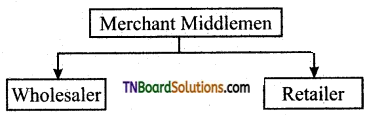
Question 1.
Explain-Division of merchant middlemen?
Answer:
TN Board 11th Commerce Important Questions Chapter 22 Types of Trade 1

Question 2.
Functions of wholesalers?
Answer:

  1. Sale to other dealers: The wholesaler sells goods to retailers. He does not come into direct contact with the ultimate consumer.
  2. Buying directly from the manufacturer: Usually, the wholesaler buys directly from the manufacturer.

TN Board 11th Commerce Important Questions Chapter 22 Types of Trade

Question 3.
Features of Internal trade?
Answer:
It does not involve any custom/import duty, but buyers need not pay taxes to the government. The goods must be a part of domestic production.

Question 4.
India’s important export items.
Answer:

  1. Petroleum products.
  2. Jewelry.
  3. Automobile
  4. Bio-chemicals
  5. Pharmaceuticals.

Question 5.
India’s important import items.
Answer:

  1. Mineral fuels including oil.
  2. Gem, precious metals.
  3. Electrical machinery and equipment.
  4. Machinery including computers.
  5. Organic chemicals.

Question 6.
Name the Entrepot centres.
Answer:

  1. Singapore.
  2. Dubai.
  3. Hongkong.

TN Board 11th Commerce Important Questions Chapter 22 Types of Trade

Question 7.
What are the functions of Wholesaler?
Answer:

  1. Assembling and buying.
  2. Storing or warehousing.
  3. Financing.
  4. Transportation.
  5. Risk bearing
  6. Grading packing and packaging
  7. Providing market Information.

Short answer questions

Question 1.
Explain the services rendered, by a retailer?
Answer:

  1. Organized link: The retailer is an important agency linking up the wholesaler on one side and the consumer on the other side.
  2. Consumer preferences: The retailer is in close touch with the consumers. So he can inform the consumer’s preferences to the wholesaler.
  3. Personal attention: The retailer is able to provide more personal attention to his customers. He gives special services on the spot when the articles require a minor repair.
  4. Widening of the market: The retailer makes it possible to widen the size of the market. The relieves wholesalers from the burden of organizing sales outlets to various.

Long answer questions

Question 1.
Difference between Internal Trade and Foreign Trade.
Answer:

Internal TradeForeign Trade
It refers to the trade within a country.It refers to trade between two or more countries.
It involves the exchange of goods and services within the country.This involves the exchange of goods and services between two or more countries.
In-home trade there is no exchange of currencies.In foreign trade exchange of currencies of different countries takes place.
In-home trade the risk of transportation is very less when compared to foreign trade.In international trade, the goods are to be transported to long distances through various modes of transport, and hence the risk of transportation is more.
In-home trade only the laws prevailing in that country have to be followed.In foreign trade, the laws, customs, and regulations of different countries are to be followed
The aim of home trade is to provide essential goods and services economically.The aim of foreign trade is to raise the standard of living of the people.

TN Board 11th Commerce Important Questions Chapter 22 Types of Trade

Question 2.
What are the differences between the wholesaler and retailer?
Answer:

WholesalerRetailer
A wholesaler is a link between manufacturer and retailer.The retailer is a link between a wholesaler and the ultimate consumer.
He buys in large quantities from the manufactures.He buys in small quantities from the wholesaler.
He deals with one line of products.He deals in different types of products.
Business spread to different areas.Business located in particular place of the area.
He is very close to the manufacturer but distant from the consumer.He is very close to the consumer and away from the manufacturer.
He operates his business in big commercial cities.He operates even in the smallest villages and also big cities.
Do not provide after-sale service.Provide after-sale service.

For Own Thinking

Question 1.
Students should go to a nearby internal trade unit and observe the trade activities.
Answer:
Student Name: Raja. He is going to Leather Garments, Keelkattalai (pouch).
1st step: Buying fill leather.
2nd step: Cutting the leathers in suitable shape.
3rd step: Stitching the leathers.
4th step: To form the pouch.

Question 2.
Students should go to the retail shops, and observe the trading activities.
Answer:
To observe the retail shop. Students observe the retail shop.

  1. In retail shop all food items.
  2. In retail shop all snacks items.
  3. In retail shop all oil items.
  4. In retail shop all kinds of soaps.

The student’s observation is all kinds of items are sold here.

TN Board 11th Commerce Important Questions Chapter 22 Types of Trade

For Future learning

1. In the future the location of trade houses will be completely changed, where the customers place an order by mobile phone or e-mail and it should be delivered at the doorstep of the buyer.
Answer:
In the future, he needs trade houses. Because nowadays by using the network to buy all the goods.

2. In the future there is no need for showrooms, displays, window decorations, etc. retail shops provide code numbers to the products and hence there is no heed for retail shops. So, the students should be prepared to meet future changes.
Answer:
Yes, students should be prepared to meet future changes. All items are available in net-based shopping.

Case Study

1. Mr. Kovalan completed his M.Com., degree and proposed to start a business dealing with power loom machines. After a complete analysis, it was found that it is better to buy from foreign countries than to buy from domestic manufacturers. So what is your opinion on whether to purchase from foreign countries or from domestic manufacturers?
Answer:
Better to buy from domestic manufactures. Because our country gets more income from income tax and giving more employment opportunities.

TN Board 11th Commerce Important Questions Chapter 22 Types of Trade

Multiple choice questions

1. The persons who come in between the primary producer and the final consumer to promote trade is called as:
(a) trader
(b) middleman
(c) agent
(d) auctioneer
Answer:
(b) middleman

2. An agent is appointed by the:
(a) wholesaler
(b) principal
(c) retailer
(d) manufacturer
Answer:
(b) principal

3. …….. is one which is carried on within the boundaries of a particular country.
(a) Home trade
(b) Foreign trade
(c) Import trade
(d) Export trade
Answer:
(a) Home trade

4. ……….. is a trade between one country with another country.
(a) Home trade
(b) Foreign trade
(c) Retail trade
(d) None of these
Answer:
(b) Foreign trade

5. The nature and type of product help in determining a decision about the channel of distribution are called:
(a) consumer factor
(b) market factor
(c) product factor
(d) middlemen factor
Answer:
(c) product factor

TN Board 11th Commerce Important Questions Chapter 22 Types of Trade

6. ……… is not personally liable for the contracts concluded
(a) Factors
(b) Brokers
(c) Commission agent
(d) Auctioneers
Answer:
(b) Brokers

7. ………. is a link between manufacturer and retailer.
(a) Factors
(b) Broker
(c) Auctioneers
(d) Wholesaler
Answer:
(d) Wholesaler

8. A warehouse keeper accepts goods for the purpose of:
(a) storage
(b) export
(c) selling
(d) packaging
Answer:
(a) storage

9. ………. are agents -who merely bring the buyer and the seller in to contact.
(a) Selling agent
(b) Commission agent
(c) Broker
(d) Stockist
Answer:
(c) Broker

TN Board 11th Commerce Important Questions Chapter 22 Types of Trade

10. Wholesaler’s deals in ……… quantity of goods.
(a) small
(b) large
(c) medium
(d) limited
Answer:
(b) large

11. Small scale fixed retailers include:
(a) general stores
(b) pedlars
(c) cheapjacks
(d) hawkers
Answer:
(a) general stores

12. Trade may be classified into home trade and:
(a) foreign trade
(b) retail trade
(c) entrepot
(d) itinerant trade
Answer:
(a) foreign trade

13. Business deals with goods and;
(a) exchange of goods
(b) services
(c) time
(d) place
Answer:
(b) services

TN Board 11th Commerce Important Questions Chapter 21 Micro, Small and Medium Enterprises (MSME) and Self Help Groups (SHGs)

Students get through the TN Board 11th Commerce Important Questions Chapter 21 Micro, Small and Medium Enterprises (MSME) and Self Help Groups (SHGs) which is useful for their exam preparation.

TN State Board 11th Commerce Important Questions Chapter 21 Micro, Small and Medium Enterprises (MSME) and Self Help Groups (SHGs)

Very short answer questions

Question 1.
Give full form of SIDBI.
Answer:
Small Industries Development Bank of India.

Question 2.
Give full form of NABARD.
Answer:
National Bank for Agriculture and Rural Development

Question 3.
Discuss any two characteristics of SSI.
Answer:

  1. They are run as sole proprietorships or partnerships.
  2. Normally they use labor-intensive methods.

TN Board 11th Commerce Important Questions Chapter 21 Micro, Small and Medium Enterprises (MSME) and Self Help Groups (SHGs)

Question 4.
Name any two units included in the SSI category.
Answer:
Export-oriented units and Ancillary units.

Question 5.
What are different parameters used to measure the size of a business?
Answer:
Following parameters may be used to measure the size of the business:

  1. A number of workers employed.
  2. Size of plant and machinery.
  3. Total output.
  4. Inventory size.

Question 6.
What are small sector industries in the village?
Answer:
The small sector industries in the village are:

  1. Handlooms,
  2. Handicrafts,
  3. Coir,
  4. Sericulture,
  5. Khadi industries,
  6. Village industries,
  7. Small scale industries and power loom.

Question 7.
Give example Commercial Bank.
Answer:
Commercial Banks: Public sector banks.
eg: State Bank of India, Indian Bank, Indian Overseas Bank, Canara Bank.
Private sector banks: e§: ICICI, Axis Bank, City Union Bank, HDFC, Karur Vasya Bank, Tamilnadu Mercantile Bank.

TN Board 11th Commerce Important Questions Chapter 21 Micro, Small and Medium Enterprises (MSME) and Self Help Groups (SHGs)

Question 8.
Give an example for non-banking finance institutions?
Answer:
Non-Banking Finance Institutions:

  1. National Small Industries Corporation Ltd (NSIC).
  2. Small Industries Development Bank of India (SIDBI).

Question 9.
Examples of the regional rural banks.
Answer:

  1. Pandian Rural Bank.
  2. Pallavan Rural Bank.
  3. Vallalar Rural Bank.

Question 10.
Examples of cooperative banks.
Answer:

  1. TNSC Bank.
  2. District Central Co-operative Bank.

Question 11.
Example of micro-finance Institutions.
Answer:
Mudra Bank.

Short answer questions

Question 1.
State the objective of small bu Iness in rural India.
Answer:

  1. To create more employment opportunities with less investment
  2. The removal of the more economic backwardness of rural and less developed regions of the economy.
  3. They reduce regional imbalances.
  4. The mobilization and ensure optimum utilization of unexploited resources of the country.

TN Board 11th Commerce Important Questions Chapter 21 Micro, Small and Medium Enterprises (MSME) and Self Help Groups (SHGs)

Question 2.
What is the role of district industries center for the growth of small businesses in India?
Answer:
The district industries centers programme was launched on May 1st 1978, with a view to providing an integrated administrative framework at the district level which looks at the problem of industrialization in the district.

Question 3.
Write a short note on Mudra Bank.
Answer:
The Government of India has launched MUDRA Bank with a capital amount of Rs. 20,000 Crores and a credit guarantee corpus of Rs. 3,000 Crores, to help micro small, and medium enterprises and startups to resolve problems relating to financing.

Question 4.
Explain (MSME Sector).
Answer:
MSME Sector provides more employment opportunities to the people of India. It helps towards the industrialization of rural and backward areas. This sector reduces regional imbalances. It provides an equitable distribution of national income and wealth.

Question 5.
Explain Micro Enterprises.
Answer:
Micro Enterprises are engaged in low scale activities such as:

  1. Clay pot making.
  2. Fruits and vegetable vendors.
  3. Transport (three-wheeler, tempos, and autos).
  4. Repair shops.
  5. Cottage industries, small industries.
  6. Handlooms, handicraft works, etc.

TN Board 11th Commerce Important Questions Chapter 21 Micro, Small and Medium Enterprises (MSME) and Self Help Groups (SHGs)

Long answer questions

Question 1.
What are the modes of linkage to self-help groups?
Answer:
There are three distinct modes of credit to SHGs. Under the first mode, banks lend directly to the SHGs. In the second mode, banks provide loans to the NGOs for onward lending to the SHGs and ultimately to micro-entrepreneurs. Under the third mode, banks extend credit to the SHGs with the NGOs serving as facilitators. Out of these three methods, the last method of direct lending by the bank with NGO facilitation is widely practiced.

Question 2.
Write short notes on self, help groups in India.
Answer:
In December 2017 there were 45,67,090 SHGs in India. The total number of members in SHGs during the same period stood at 5,02,65,933 at all Indian levels. The five-year plans of the government of India have given due recognition to the relevance of the Self-help group concept to implement developmental schemes at the grassroots level.

Question 3.
Write a short note on SHG’s in Tamil Nadu.
Answer:
In Tamil Nadu, Tamil Nadu Corporation for Development of Women Limited (TNCDW) was established in the year1983 with the prime objective of socio-economic development and empowerment of rural women. The Government of Tamil Nadu spearheaded the Self Help Group concept in the country by forming SHGs in Dharmapuri district with the assistance of the International Fund for Agricultural Development (IFAD) in September 1989. The success of the IFAD project paved way for the now popularly called “Mahalir Thittam” project, which was launched during 1997-98 with the State Government funding and was progressively extended to all the 30 districts. The SHG movement has now emerged as a powerful and vibrant movement illuminating the lives of many poor women in the state.

TN Board 11th Commerce Important Questions Chapter 21 Micro, Small and Medium Enterprises (MSME) and Self Help Groups (SHGs)

For Own Thinking

1. Role of women as entrepreneurs.
Answer:
One of the famous Indian women entrepreneurs is Indira Nooyi. She was born in Chennai and had her bachelor’s degree in Madras Christian College. Master’s Degree in public management from Yale University. Masters in Finance and Marketing from IIM, Kolkata.
Occupation: Joined PepsiCo in 1994 and became CFO in 2001. Earlier she held Senior Executive positions in Motorola and Asia Brown Boveri.
She was a product manager at Johnson and Johnson and then textile firm mettur Beardsell. Awarded PadmaBushan for her business achievements and for being an inspiration to India’s corporate leadership.
She helped the company to complete 30 billion dollars worth of crucial deals within the last couple of years.

2. Income-tax exemption for Start-up initiatives.
Answer:
The Government of India has launched Mudra Bank with a capital amount of Rs. 20,000 Crore and credit guarantee corpus of Rs. 3000 Crore to help MSMEs and startups to resolve problems relating to income tax exemption and financing.

TN Board 11th Commerce Important Questions Chapter 21 Micro, Small and Medium Enterprises (MSME) and Self Help Groups (SHGs)

For Future learning

1. World Association of Small & Medium enterprises (WASME).
Answer:
UNICTAD, ITC, WIPO, UNESCO, UNESCAP, global nonprofit organization head quarters – Noida (India).

2. Ministry of MSME and its functions.
Answer:
Ministry of MSME. Its function is to honor the people who are producing quality goods. Gandhimathi appliances are honored by the Ministry of MSME. National Award 2010. Quality product in Micro and «* small enterprises for LPG operated stoves/appliance.

Multiple choice questions

1. Village and Small industries together provide the ………. employment opportunities in India.
(a) largest
(b) smallest
(c) highest
(d) self
Answer:
(a) largest

2. How much do small industries in India account for the total industrial units?
(a) 100%
(b) 95%
(c) 80%
(d) 75%
Answer:
(b) 95%

TN Board 11th Commerce Important Questions Chapter 21 Micro, Small and Medium Enterprises (MSME) and Self Help Groups (SHGs)

3. What is the investment limit for SSI?
(a) One crore
(b) Two crore
(c) Three crore
(d) Five crore
Answer:
(a) One crore

4. Name the apex bank set up to provide direct and indirect financial assistance to the small-scale sector?
(a) UTI
(b) SBI
(c) SIDBI
(d) RBI
Answer:
(c) SIDBI

5. Name any two units included in:
(a) UTI
(b) NABARD
(c) SIDBI
(d) SSI
Answer:
(d) SSI

6. Name any two institutions specially set up to promote small scale enterprise:
(a) SIDBI & SIDCO
(b) NABARD
(c) WASME
(d) KVIC
Answer:
(a) SIDBI & SIDCO

TN Board 11th Commerce Important Questions Chapter 21 Micro, Small and Medium Enterprises (MSME) and Self Help Groups (SHGs)

7. Public sector banks example:
(a) Pandian Rural bank
(b) ICICI
(c) State Bank of India
(d) Mudra bank
Answer:
(c) State Bank of India

8. Regional Rural bank example:
(a) Indian bank
(b) Pallavan Rural Bank
(c) HDFC
(d) KVB
Answer:
(b) Pallavan Rural Bank

9. Co-operative Banks example:
(a) TNSC
(b) NSIC
(c) SIDBI
(d) SBI
Answer:
(a) TNSC

TN Board 11th Commerce Important Questions Chapter 21 Micro, Small and Medium Enterprises (MSME) and Self Help Groups (SHGs)

10. Tamilnadu Mercantile Bank example:
(a) public sector
(b) private sector
(c) regional rural bank
(d) co-operative bank
Answer:
(b) private sector

TN Board 11th Commerce Important Questions Chapter 20 International Finance

Students get through the TN Board 11th Commerce Important Questions Chapter 20 International Finance which is useful for their exam preparation.

TN State Board 11th Commerce Important Questions Chapter 20 International Finance

Very short answer questions

Question 1.
Give the full form of GDR and ADR.
Answer:
GDR – Global Depository Receipts ADR – American Depository Receipts

Question 2.
What is trade credit?
Answer:
Trade credit is the credit extended by one trader to another for the purchase of goods and services.

TN Board 11th Commerce Important Questions Chapter 20 International Finance

Question 3.
What is Debenture?
Answer:
A Debenture is a document or certificate which is issued under the common seal of the company, acknowledging its debt to the holders at given terms and conditions.

Question 4.
State two factors affecting the working capital requirement of a firm.
Answer:
Nature of business and speed of sales

Question 5.
State two factors affecting the fixed capital requirement of a firm.
Answer:
Size of business and nature of business

Question 6.
Why preferences are given to preferential shares.
Answer:
They are given some preferences because they are not given voting rights.

TN Board 11th Commerce Important Questions Chapter 20 International Finance

Question 7.
Who regulates the acceptance of public deposits?
Answer:
Reserve Bank of India.

Short answer questions

Question 1.
List sources of raising long-term and short-term finance.
Answer:
Sources of raising long and short term finance are shown in the chart given below:
Long term Finance sources:

  1. Equity shares,
  2. Retained shares,
  3. Preference shares,
  4. Debentures,
  5. Long from financial institutions,
  6. Long from a bank.

Short term Finance sources:

  1. Trade credit,
  2. Factoring,
  3. Banks,
  4. Commercial papers.

Question 2.
What is Foreign Direct Investment (FDI).
Answer:
It is an investment made by the company or an individual in one country with business interests in another country in the form of either establishing business operations or acquiring business assets in the other country such as ownership or controlling interest in a foreign country.

TN Board 11th Commerce Important Questions Chapter 20 International Finance

Question 3.
What are forms to take foreign direct investment?
Answer:

  1. Establishment of a new enterprise in a Foreign country.
  2. Expression of existing branch or subsidiary in a Foreign country.
  3. Acquisition of enterprise located in a Foreign country.

Question 4.
What are the sources from where the funds generated?
Answer:

  1. Commercial Banks.
  2. Depositary receipts.
  3. International Agencies and development Banks,
  4. International capital markets.

Long answer questions

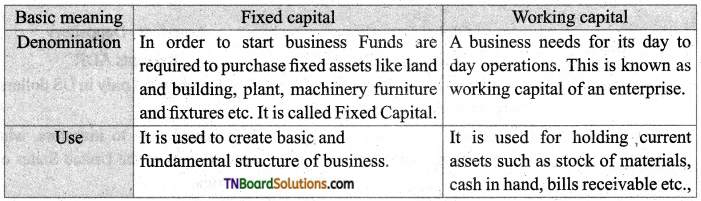
Question 1.
Differentiate between fixed capital and working capital.
Answer:
TN Board 11th Commerce Important Questions Chapter 20 International Finance 1

TN Board 11th Commerce Important Questions Chapter 20 International Finance

Question 2.
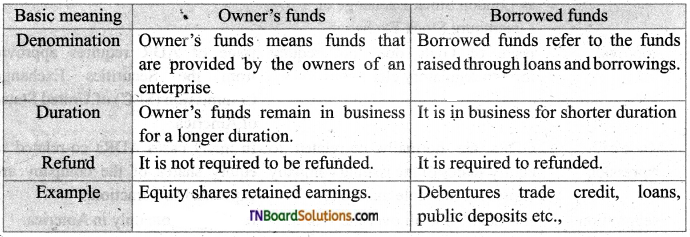
Differentiate between owner’s funds and borrowed funds.
Answer:
TN Board 11th Commerce Important Questions Chapter 20 International Finance 2

Question 3.
What are the steps in the process of issuing GDR?
Answer:
There are four steps in the process of issuing GDRs as follows.

  1. The company issuing GDRs hands over its shares to one Domestic Custodian Bank (DCB).
  2. The DCB requests the Overseas Depository Bank (ODB) situated in the foreign country for issuing the shares as GDR.
  3. The ODB converts the shares shown in rupees into GDR which are denominated in US dollars.
  4. Finally, ODB issues them to the intending investors.

Question 4.
What is ADR and what are the steps in process of issuing ADRs.
Answer:

  1. First of all, a company hands over the shares to a Domestic Custodian Bank (DCB)
  2. Then DCB requests the American Depository Bank (ADB) to issue the shares in the form of ADRs
  3. ADB converts the issue which are in rupees into US dollars
  4. Finally, ADB issues them to the intending investors.

TN Board 11th Commerce Important Questions Chapter 20 International Finance

For Own Thinking

1. Role of World Bank in globalization.
Answer:
The Bretton woods institutions the IMF and World Bank have an important role to play in making globalization work better. They were created in 1944 to help restore and sustain the benefits of global integration by promoting international economic cooperation.

2. The concept of Hot Money.
Answer:
Hot money refers to funds that are controlled by investors who actively seek short-term returns. These investors scan the market for short-term, high-interest-rate investment opportunities. A typical short-term- investment opportunity that attracts hot money is the certificate of deposit.

For Future learning

1. Possibilities of making the western and American countries in favour of Indian Depository Receipt (IDR).
Answer:
An IDR is meant to diversify your holding across regions to free you from a region bias or the risk of a portfolio getting too concentrated in the home market you need to study the firms. Financials before you buy its IDR.

2. Petrodollar system and its future.
Answer:
If you have never heard of the petrodollar system. It will not surprise me. It is certainly not a topic that makes its way out of Washington and wall street circles too often. The mainstream media rarely if ever discusses the inner working of the petrodollar system.

TN Board 11th Commerce Important Questions Chapter 20 International Finance

Multiple choice questions

1. Name of the Indian companies which have raised money through the issue of GDRS:
(a) HDFC
(b) ICICI
(c) SBI
(d) Indian bank
Answer:
(b) ICICI

2. Public deposits are the deposits raised by organizations directly from the public:
(a) HDFC
(b) ICICI
(c) IDBI
(d) SBI
Answer:
(c) IDBI

3. Equity shareholders are called the of the company.
(a) Owners
(b) Consumers
(c) Public
(d) Bankers
Answer:
(a) Owners

TN Board 11th Commerce Important Questions Chapter 20 International Finance

4. Who regulates the acceptance of public deposits?
(a) RBI
(b) SBI
(c) UTI
(d) ICICI
Answer:
(a) RBI

5. Debenture holders are ……… of the company.
(a) Creditors
(b) Debtors
(c) Owners
(d) Customers
Answer:
(a) Creditors

6. Internal sources of capital are:
(a) Generated through outsiders such as suppliers
(b) Generated through loans from commercial banks
(c) Generated through the issue of shares
(d) Generated wit in the business
Answer:
(d) Generated wit in the business

7. Public deposits are the deposits that are raised directly from:
(a) the public
(b) the directors
(c) the auditors
(d) the owners
Answer:
(a) the public

TN Board 11th Commerce Important Questions Chapter 20 International Finance

8. ADRs are issued in:
(a) Canada
(b) China
(c) India
(d) the USA
Answer:
(d) the USA

9. Funds required for purchasing current assets is an example of:
(a) fixed capital requirement
(b) ploughing back of profits
(c) working capital requirement
(d) none of the above
Answer:
(c) working capital requirement

10. Trade credit is the example of:
(a) long term finance
(b) medium-term finance
(c) short term finance
(d) All of the above
Answer:
(d) All of the above

TN Board 11th Commerce Important Questions Chapter 19 Sources of Business Finance

Students get through the TN Board 11th Commerce Important Questions Chapter 19 Sources of Business Finance which is useful for their exam preparation.

TN State Board 11th Commerce Important Questions Chapter 19 Sources of Business Finance

Very short answer questions

Question 1.
What are External sources?
Answer:
External sources of funds include all those sources which generate funds from outside the business enterprise. For example issue of shares and debentures, borrowings from banks and financial institutions, public deposits, factoring, leasing, hire purchase, etc.

Question 2.
What are mutual funds?
Answer:
An individual investor who wants to invest in equities and bonds with a balance of risk and return generally can invest in mutual funds. Nowadays people invest in stock markets through a mutual fund. A systematic investment plan is one of the best investment options in India.

Question 3.
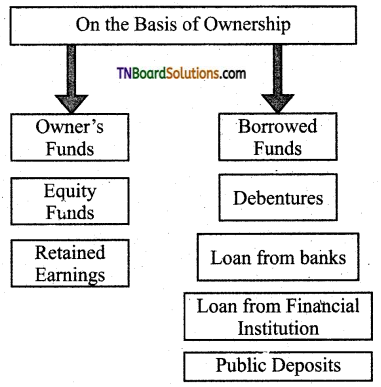
Business finance on the basis of ownership types of categories.
Answer:
TN Board 11th Commerce Important Questions Chapter 19 Sources of Business Finance 1

TN Board 11th Commerce Important Questions Chapter 19 Sources of Business Finance

Question 4.
Expand ULIP?
Answer:
ULIP is a life insurance-linked product, which provides risk cover for the policyholder along with investment options to invest in any number of qualified investments such as stocks, bonds, or mutual funds.

Short answer questions

Question 1.
Explain PPF?
Answer:
Public Provident Fund (PPF): It is the safest long-term investment option for investors in India. It is totally tax-free. PPF account can be opened in a bank or post office. The money deposited cannot be withdrawn before 15 years and an investor can earn compound interest from this account. However, the investor can extend the time frame for the s next five years if the investor does not opt to withdraw the amount matured for payment at the maturity date. PPF investor can take a loan against PPF account when he/she experiences financial difficulties.

Question 2.
What is the post office saving scheme?
Answer:
There are different types of postal small savings schemes namely Post Office Savings Account, Post Office Recurring Deposit Account (RD), Post Office Fixed Deposit Account (FD/TD), Post Office Monthly Income Account Scheme (MIS), Senior Citizens Saving Scheme (SCSS) Public Provident Fund Account (PPF), National Savings Certificates (NSC), Kisan Vikas Patra (KVP), Sukanya Samriddhi Account (SSA). Investors can choose the appropriate postal schemes as per their needs. Postal investment schemes are the safest investments.

Question 3.
What are public deposits?
Answer:
Public deposits are more beneficial than the fixed deposit in the bank, in the matter of yielding good returns. An investor has to select the investment period very carefully. He/she is not allowed to withdraw money before maturity. However, the public deposits collected by companies and institutions do not offer any insurance benefits. It does not come under the control of the Reserve Bank of India. Investors who are willing to invest for the long term can opt for public deposits.

TN Board 11th Commerce Important Questions Chapter 19 Sources of Business Finance

Question 4.
What is Bonds?
Answer:
Bonds are one of the ideal investment options for those investors who would like to invest their hard-earned money safely. Bonds are issued both by government and public and private sector companies and financial institutions. Mostly there are four types of bonds sold in ‘India namely Government bonds, Corporate bonds, Banks and other financial institutions bonds, and Tax saving bonds. The term bond is used for the debt collected by the government while the term debenture is used when the corporates collect debt capital from the public. Investment in bonds is totally risk-free.

Question 5.
Explain bank deposits.
Answer:
Fixed deposits (FD) enable the investor to invest the money for a specific period. The Fixed deposit can be opened from a minimum period of 7 days to a maximum period of 10 years. The fixed deposit holder can take a loan against the fixed deposit receipt. The depositor cannot withdraw the fixed deposits before the maturity date.
A recurring deposit (RD) account is another investment option for those people who earn regular income. This deposit can be opened for a minimum period of 1 year to a maximum period of 10 years. The Recurring deposit holder can take a loan against the installments paid.

Question 6.
Explain the terms- Bank overdraft?
Answer:
Bank overdraft refers to an arrangement whereby the bank allows the customers to overdraw the required amount from its current deposit account within a specified limit. Interest is charged only on the amount actually overdrawn.

TN Board 11th Commerce Important Questions Chapter 19 Sources of Business Finance

Question 7.
Explain the term-Share.
Answer:
Corporate enterprises generally obtain capital mainly from share capital which is divided into small units called shares. Each share has a nominal value. The Indian Companies Act 2013 describes a share as “to be a share in the share capital of a company”. The person holding a share is called a shareholder.

Question 8.
Write about savings.
Answer:
The concept of savings plays an important role in the economic development of any country. Saving is defined as the difference between income and consumption. In other words, it points to sacrifices of some sort. Earning money may be easy, but using it in the right way as well as saving it for the future is pretty tough. Savings is important for each and every one of us to lead a peaceful life. Saving paves way for a happier future. “World Savings Day” was promoted all over the world to emphasize the value Of savings. October 31 has been declared as the “World Savings Day” by. the International Savings Bank Congress.

Question 9.
Write about Estate Investment.
Answer:
Real estate is one of the fastest-growing sectors in India. Buying a flat or plot is supposed to be the best decision amongst the investment options. The value of the real asset may increase substantially depending upon the area of location and other support facilities available therein. However, an investor in real estate has to be cautious and circumspect in verifying the genuineness of the title deeds before investing in real estate assets and also the reputation of the seller of real assets.

TN Board 11th Commerce Important Questions Chapter 19 Sources of Business Finance

Long answer questions

Question 1.
Do the following points highlight the importance of savings?
Answer:
Importance of Savings: Money invested in a deposit account, small savings schemes, mutual funds, life insurance policies, Bonds of Government companies, shares, etc. lead to the overall economic development of a country.

  1. Money invested in bank deposits facilitates employment generation in various sectors of the economy and poverty alleviation.
  2. The savings invested in bank deposits lead to credit creation in the country which in turn promotes industrial and agricultural development in a country.
  3. Savings invested in government bonds and various institutions help in great measure in building in strengthening the infrastructure facilities in a country.
  4. A country with higher savings can easily face the consequences of an economic recession.
  5. The bad consequences of inflation can be met easily with strong savings. As a result, the evil effect of soaring prices can be controlled.

Question 2.
Significance of business finance.
Answer:
The following points highlight the significance of business finance.

  1. A firm with adequate business finance can easily start any business venture.
  2. Business finance helps the business organization to purchase raw materials from the supplier easily to produce goods.
  3. The business firm can meet financial liabilities like prompt payment of salary and wages, expenses, etc., in time with the help of sound financial support.
  4. Sound financial support enables the enterprises to meet any unexpected or uncertain risks arising from the business environment efficiently. For example economic slowdown, trade cycles, severe competition, a shift in consumer preference, etc.
  5. A sound financial position empowers the enterprise to attract talented manpower and introduce the latest technology.

TN Board 11th Commerce Important Questions Chapter 19 Sources of Business Finance

Question 3.
Explain the nature of Business finance.
Answer:
Nature of Business Finance: The following characteristics can be derived from the above definitions.

  1. Business finance comprises all types of funds namely short, medium, and long-term used in business.
  2. All types of organizations namely small, medium and large enterprises require business finance.
  3. The volume of business finance required varies from one business enterprise to another depending upon its nature and size. In other words, small and medium enterprises require a relatively lower level of business finance than large-scale enterprises.
  4. The amount of business finance required differs from one period to another. In other words, the requirement of business finance is heavy during the peak season while it is at a low level during the dull season.
  5. The amount of business finance determines the scale of operations of business enterprises.

Case Study

Gokul Steel Ltd is a large and credit-worthy company that manufactures steel for the Indian market. It now wants to cater to the Asian market and decides to invest in new hi-tech machines. Since the investment is large, it requires long-term finance. It decides to raise funds by issuing equity shares. The issue of equity shares involves huge floatation costs. To meet the expenses of floatation cost, the company decides to tap the money market.
(a) Name and explain the money-market instrument the company can use for the above purpose.
They help the central bank in regulating liquidity in the economy. Money market help short-term fund user to fulfill their needs reasonable costs.
(b) What is the duration for which the com party can get funds through the instrument?
These instruments are short-term notes issued by state and municipal governments although they carry somewhat more risk than T-bills and tend to be less negotiable. They feature the added benefit that the interest is not subject to federal income tax. For this reason, corporations find that the lower yield is worthwhile on this type of short-term investment.
(c) State any other purpose for which this instrument can be used.
Financial instruments are assets that can be traded. They can also be seen as packages of capital that may be traded. Most types of financial instruments provide an efficient flow and transfer of capital all throughout the world investors. These assets can be cash a contractual right to deliver or receive cash or another type of financial instrument or evidence of one’s ownership of an entity.

TN Board 11th Commerce Important Questions Chapter 19 Sources of Business Finance

For Own Thinking

Question 1.
Working of chit funds.
Answer:
Equity mutual funds are managed by professional and certified funds managers who have expertise and experience in financial markets. As mutual funds collect money from many investors the cost of asset management is divided between a larger number of people. Thus reducing the assets management fee per person.

Question 2.
Finance for bonded labor.
Answer:
“Debt bondage” also known as debt slavery or bonded labor is a person’s pledge of labour or service as security for the repayment for a debt or other obligation where there is no hope of actually repaying the debt.

For Future teaming

Question 1.
Export finance for small entrepreneurs.
Answer:
Exporting goods and services can bring significant opportunities for companies of all sizes. By tapping into new markets and new revenue streams. Companies can access a larger customer base and grow their business. Importantly these opportunities are not limited to large corporations.

TN Board 11th Commerce Important Questions Chapter 19 Sources of Business Finance

Question 2.
Financing software companies run by young graduates.
Answer:
Even employees already working in the financial sector eyeing opportunities in tech; In a new study of over 800 financial services employees in partnership with Kronos. We found that one-fourth are more interested in working in the tech industry than finance. Finance as a career choice is down 22% from 2008 and graduates from the top 10 MBA schools are now 40% less likely to work’ in investment banking.

Multiple choice questions

Question 1.
Equity Shareholders are called:
(a) owners of the company
(b) partners of the company
(c) executives of the company
(d) guardian of the company
Answer:
(a) owners of the company

Question 2.
The term redeemable is used for:
(a) preference shares
(b) commercial paper
(c) equity shares
(d) public shares
Answer:
(a) preference shares

Question 3.
Funds required for purchasing current assets is an example of:
(a) fixed capital requirement
(b) plowing back of profits
(c) working capital requirement
(d) lease financing
Answer:
(c) working capital requirement

TN Board 11th Commerce Important Questions Chapter 19 Sources of Business Finance

Question 4.
ADRS are issued in:
(a) Canada
(b) China
(c) India
(d) the USA
Answer:
(d) the USA

Question 5.
Under the lease agreement, the lessee gets the right to:
(a) share profits earned by the lessor
(b) participate in the management of the organization
(c) use the asset for a specified period
(d) sell the assets
Answer:
(c) use the asset for a specified period

Question 6.
Public deposits are the deposits that are raised directly from:
(a) the public
(b) the directors
(c) the auditors
(d) the owners
Answer:
(a) the public

Question 7.
Debentures represent:
(a) fixed capital of the company
(b) permanent capital of the company
(c) fluctuating capital of the company
(d) loan capital of the company
Answer:
(d) loan capital of the company

TN Board 11th Commerce Important Questions Chapter 19 Sources of Business Finance

Question 8.
Under the factoring arrangement the sector:
(a) produces and distributes the goods or services
(b) makes the payment on behalf of the client
(c) collects the client’s debt or account receivables.
(d) transfer the goods from one place to another
Answer:
(c) collects the client’s debt or account receivables.

Question 9.
The maturity period of a commercial paper usually ranges from:
(a) 20 to 40 days
(b) 60 to 90 days
(c) 120 to 365 days
(d) 90 to 364 days
Answer:
(d) 90 to 364 days

Question 10.
Internal sources of capital are those that are:
(a) generated through outsiders such as suppliers
(b) generated through loans from commercial banks
(c) generated through the issue of shares.
(d) generated within the business
Answer:
(d) generated within the business

TN Board 11th Commerce Important Questions Chapter 18 Business Ethics and Corporate Governance

Students get through the TN Board 11th Commerce Important Questions Chapter 18 Business Ethics and Corporate Governance which is useful for their exam preparation.

TN State Board 11th Commerce Important Questions Chapter 18 Business Ethics and Corporate Governance

Very short answer questions

Question 1.
What is Social Responsibility?
Answer:
Social responsibility refers to the businessman’s decision and action taken for reasons at least partially beyond the firm’s direct economic or technical interest.

Question 2.
What is Business Ethics?
Answer:
Business Ethics refers to the moral principles or rules of behavior which should govern the moral conduct of businessmen.

Question 3.
Define corporate governance.
Answer:
“Corporate governance is about promoting fairness, transparency and accountability.” – World Bank.

TN Board 11th Commerce Important Questions Chapter 18 Business Ethics and Corporate Governance

Question 4.
Define MNC.
Answer:
MNC is defined to be an enterprise operating in several countries but managed from one country.

Question 5.
Write a short note on Benchmarking.
Answer:

  1. Select a product, service, or process to benchmark.
  2. Identify the key performance metrics.
  3. Choose companies or internal areas to benchmark.
  4. Collect data on performance and practices,
  5. Analyze the data and identify opportunities for improvement.

Short answer questions

Question 1.
What is Corporate Social Responsibility?
Answer:
Corporate Social responsibility is a comprehensive set of policies. Practices and programs which are integrated into business operations supply claims and decision making process throughout the company wherever the company does business and includes responsibility for current actions as well as past and future actions.

TN Board 11th Commerce Important Questions Chapter 18 Business Ethics and Corporate Governance

Question 2.
Describe the obligations of business towards owners and shareholders.
Answer:
If a business satisfies its investors they are likely to invest more money in a project as a result, more funds will flow in and the same can be utilized to modernize, expand and diversify the existing activities on a larger scale happy financiers can fulfill the rising demand of funds needed for its growth and expansion.

  1. They need to give a fair return to Shareholders.
  2. They need to give true and fair information to shareholders.

They need to give them proper opportunities to shareholders.

Question 3.
Give any four reasons against the social responsibilities of business.
Answer:

  1. Violation of profit maximization: As per this argument business enterprises claim that our objective is profit maximization business can reduce its cost and raise profits and only they can meet their social responsibility.
  2. Lack of Social skills: Business enterprises neither have still nor experience to solve all types of social problems. Therefore it should be handled by specialized agencies.
  3. The burden on consumers: Many of the social responsibilities cost a lot its burden falls on consumers only.
  4. Lack of broad public support: Businesses cannot operate successfully because of a lack of co-operation and confidence from the public in business enterprises.

TN Board 11th Commerce Important Questions Chapter 18 Business Ethics and Corporate Governance

Long answer questions

Question 1.
Explain Benchmarking in various parts of the world.
Answer:
Japan: In early 2014, the Japanese Prime Minister announced the goal of increasing the percentage of women in executive positions at Japanese companies to 30% by 2020.
The UK: UK businesses had voluntary targets first set in 2011 i.e. to have 25% women on FTSE100 (The Financial Times Stock Exchange) Boards by 2015.
Canada: At the Federal level, two bills are currently being tabled which will impose a40% quota for female Board members of public companies and other regulated entities such as banks and insurance companies.
Brazil: A bill pending in the Brazilian Senate would impose a 40% female quota on the Boards of state-owned enterprises by 2022. IBGC Code of Best Practices (Brazilian Institute of Corporate Governance) recommends:

  1. A formal evaluation process of the performance of the Board, of individual directors, and of the CEO.
  2. The process to be conducted by the Chair.
  3. Participation of the outsider to make the process more effective.
  4. Evaluation system adapted to each organization.
  5. Disclosure of the process of evaluation, to the shareholders.

Question 2.
Write a short note on MNC.
Answer:
Any company is referred to as a Multinational company or corporation (MNC) when that company manages its operation or production or service delivery from more than a single country. It has its headquarter based in one country with several other operating branches in different other countries. The country where the headquarter is located is called the home country whereas; the other countries with operational branches are called the host countries. Apart from playing an important role in globalization and international relations, these multinational companies even have a notable influence on a country’s economy as well as the world economy. The budget of some of the MNCs is so high that at times they even exceed the GDP (Gross Domestic Product) of a nation.

TN Board 11th Commerce Important Questions Chapter 18 Business Ethics and Corporate Governance

For Own Thinking

Question 1.
Illustrate the ethical practices followed by different reputed organizations .giving practical examples.
Answer:
Physicians: The American medical association also imposes a code of ethics on physicians. This code of ethics addresses everything from impersonal relationships with other staff members such as nurses’ information on patient care.

Question 2.
Create case studies concerning the existing famous organization following ethical practices quoting their real-life practice.
Answer:

  1. Use real-life examples. If you are free to choose a topic on your own try to take it from real life. However, avoid real names.
  2. Finish every part of your study with points for discussion. They will engage your reader and help him orient in the study.

Question 3.
Identifying ethical codes based on which organization exits, for the long run and short run, justifying the adherence to code of ethics.
Answer:
Two of the 22 identified excerpts involved individuals referring to ethical guidelines that are clear and penalties potentially serious. Responses falling under this theme tend to refer to guidelines when they believe a clear concrete rule is available and when consequences may be substantial and costly.

TN Board 11th Commerce Important Questions Chapter 18 Business Ethics and Corporate Governance

For Future teaming

Question 1.
Money earning cannot be the sole objective of business or life.
Answer:
Yes, because reputation is very important, but the primary objective is to earn profit.
Even though businesses run on commercial lines. Service is the main objective of business while running the business money is important at the same service to the society and public is very important.

Question 2.
The mind of students to accept that ethics and consideration for the environment, law, etc can lengthen the income-earning of an individual or business.
Answer:
As you might imagine environmental legislation is a broad topic. Mainly because the natural environment encompasses. So many different aspects. So environmental laws need to consider everything from the air we breathe to the natural resources we rely on to the plants and animals that share this world with us.

Multiple choice questions

1. The U S A formulation of various committees:
(a) 4
(b) 2
(c) 3
(d) 1
Answer:
(a) 4

TN Board 11th Commerce Important Questions Chapter 18 Business Ethics and Corporate Governance

2. The UK corporate Governance code recommends evaluation of the Board of FTSE ………….. companies.
(a) 450
(b) 325
(c) 385
(d) 350
Answer:
(d) 350

3. UK Business had voluntary targets first set in:
(a) 2013
(b) 2011
(c) 2012
(d) 2010
Answer:
(b) 2011

4. MNC is defined to be an enterprise operating in several countries but managed from ……….. country.
(a) 2
(b) 3
(c) 1
(d) 5
Answer:
(c) 1

5. Good Corporate Governance enables corporate success and …………… development.
(a) economic
(b) commerce
(c) mathematics
(d) social
Answer:
(a) economic

TN Board 11th Commerce Important Questions Chapter 18 Business Ethics and Corporate Governance

6. Corporate Governance eliminates by:
(a) capital
(b) investment
(c) loan and advance
(d) risks and mismanagement
Answer:
(d) risks and mismanagement

7. Types of key elements of business ethics:
(a) 1
(b) 3
(c) 5
(d) 6
Answer:
(c) 5

8. Which of the following can explain the need for pollution control?
(a) Cost savings
(b) Reduced risk of liability
(c) Reduction of health hazards
(d) All of them
Answer:
(c) Reduction of health hazards

TN Board 11th Commerce Important Questions Chapter 18 Business Ethics and Corporate Governance

9. Ethics is related to:
(a) medical
(b) law
(c) business
(d) all of the above
Answer:
(d) all of the above

TN Board 11th Commerce Important Questions Chapter 17 Social Responsibility of Business and Business Ethics

Students get through the TN Board 11th Commerce Important Questions Chapter 17 Social Responsibility of Business and Business Ethics which is useful for their exam preparation.

TN State Board 11th Commerce Important Questions Chapter 17 Social Responsibility of Business and Business Ethics

Very short answer questions

Question 1.
What is the relation between ethics and moral values?
Answer:
Ethics refer to the entire body of moral values which society attaches to the actions of human beings.

Question 2.
What do you mean by the principles derived from social values which guide and conduct of businessmen?
Answer:
Business ethics are principles derived from social values which guide and govern the conduct of businessmen.

TN Board 11th Commerce Important Questions Chapter 17 Social Responsibility of Business and Business Ethics

Question 3.
Mention two responsibilities of business towards customers.
Answer:
Supply or right quality of goods and proper precaution against adulteration.

Question 4.
Give any two reasons supporting social responsibilities.
Answer:

  1. It is in the long-term interest of the business.
  2. It is justified for the growth and existence of the business.

Question 5.
Define pollution.
Answer:
Pollution is a change in the physical, chemical, and biological characteristics of our land and water.

Question 6.
Give any one point of difference between ethics and law.
Answer:
Ethics are self-imposed while laws are imposed by an external governing authority.

Question 7.
Do businessmen have the skill to tackle social problems?
Answer:
Yes, businessmen have the skill to tackle some but not all social problems.

TN Board 11th Commerce Important Questions Chapter 17 Social Responsibility of Business and Business Ethics

Short answer questions

Question 1.
What is a code of ethics?
Answer:
An enterprise must clearly define the – ethical code of conduct to be followed in the organization. The code should include quality standards for work law governing production and employees’ health and safety standards.

Question 2.
Define social responsibility.
Answer:
According to Peter F. Drucker, “Social Responsibility requires managers to consider whether their action is likely to promote the public good, to advance the basic beliefs of our society, to contribute to its stability, strength, and harmony”.

Question 3.
Mention the kinds of social responsibility.
Answer:

  1. Economic responsibility.
  2. Legal responsibility.
  3. Ethical responsibility.
  4. Discretionary responsibility.

Question 4.
Explain responsibility towards supplies.
Answer:

  1. Giving regular orders for the purchase of goods.
  2. Dealing on fair terms and conditions.
  3. Availing reasonable credit period.
  4. Timely payment of dues.

TN Board 11th Commerce Important Questions Chapter 17 Social Responsibility of Business and Business Ethics

Question 5.
Examples of corporate social responsibility in India.
Answer:

  1. Tata Group
  2. Mahindra and Mahindra,

Question 6.
Explain responsibility towards investors.
Answer:

  1. Ensuring the safety of their investment.
  2. Regular payment of interest.
  3. Timely payment of the principal amount.

Question 7.
Difference between ethics and law.
Answer:

EthicsLaw
Business ethics refer to the socially deter­mined moral principles which should govern business activities.Laws are determined by the legal bodies of a country.

TN Board 11th Commerce Important Questions Chapter 17 Social Responsibility of Business and Business Ethics

Long answer questions

Question 1.
Write any four reasons against the social responsibilities of business.
Answer:
These are responsibilities that society has towards everyone they are not the responsibilities of individuals but ones we share as a society.

  1. Reason: Violation of profit maximization as per this argument business enterprises claim that our objective is profit maximization business can reduce its cost and raise profit and them only it can meet its social responsibility.
  2. Lack of social skills: Business enterprises neither have still nor experience to solve 1 all types of social problems. Therefore it j should be handled by specialized agencies.
  3. The burden on consumers: Many of the social responsibilities cost a lot its burden falls on consumers only.
  4. Lack of broad public support: Businesses cannot operate successfully because of a lack of co-operation and confidence from the public to business enterprises.

Question 2.
Explain the various elements of business ethics?
Answer:
Business ethics should be followed in the day-to-day working of a business enterprise the following are some of the elements of business ethics.

  1. Commitment by top management: Top-level officers such as the CEO’s other higher level managers must sincerely follow the ethical code of conduct, they should also guide other employees in their organizations in adopting the code.
  2. Publication of code: An enterprise must clearly define the ethical code of conduct to be followed in the organization. The code should include quality standards. For work, laws, governing production and employees health and safety standards.
  3. Establishment of compliance mechanism:
    In addition to setting performance standards, an enterprise must also devise a mechanism through which it can measure the actions of individual employees. These should be done in order to confirm whether the ethical standards are being met.
  4. Involvement of employees at all levels:
    The successful implementation of ethical standards depends to a large extent on the involvement of employees at different levels, this is because it is employees who actually implement the ethical job.

TN Board 11th Commerce Important Questions Chapter 17 Social Responsibility of Business and Business Ethics

For Own Thinking

Question 1.
To identify ethical and unethical practices of business enterprises.
Answer:
(a) Ethical:

  1. Investors: Ensuring the safety of their money and timely payment of interest.
  2. Employers: Provision of fair opportunities in promotions and training, good working environment, and timely payment of salaries.
  3. Customers: Complete information on the service and product should be made available. Personal information of the customers. Should not be used for personal gain.

(b) Unethical:

  1. Resorting to dishonesty, trickery, or deception.
  2. Distortion of facts to mislead or confuse.
  3. People emotionally by exploiting their vulnerabilities.
  4. Greed to a mass excessive profit.

Question 2.
To understand the level of discharging Socially Responsibility practices of business units.
Answer:
Business is an economic activity. It is argued by the opponents of social responsibility that the basic function of a business enterprise is to look into the economic viability of its operations. It is the government to look after the interests of the society. The prime responsibility of assuming social responsibility should therefore be of the government and not of the business enterprises.

Question 3.
To analysis the impact of Social Responsibility Of Small, Medium, and Large scale enterprises in Society.
Answer:

  1. Respect for the employer’s rights.
  2. Ensuring operational safety and security at the workplace.
  3. Occupational health.
  4. Good governance and good practices.
  5. Compliance with the laws.

TN Board 11th Commerce Important Questions Chapter 17 Social Responsibility of Business and Business Ethics

Question 4.
To clearly distinguish the benefits derived by different stakeholders while* discharging of Social Responsibility of business units.
Answer:
CSR should not be taken to include steps taken as a result of legal obligations to prevent or mitigate harm. In that regard, a growing number of theorists are now suggesting that companies have a fundamental existential obligation to adequately plan for and manage sustainability issues in order to avoid breaches of director’s duties as a result of a failure to mitigate risk in this area.

For Future learning

Question 1.
To evaluate the impact of social responsibility on the profitability of the business unit.
Answer:
There is an impressive history associated with the evolution of the concept and definition of corporate social responsibility. In this article, the author traces the evolution to the CSR construct beginning in the 1950s which marks the modem area of CSR.

Question 2.
To predict methods by which social responsibility can be discharged.
Answer:
We use data from different sources to analyze whether actual environmental outcomes such as emissions and environmental fines can be explained by lagged environmental ratings.

Question 3.
To depict through pictures, the stakeholder’s position in a company taking socially responsible activities.
Answer:
In order to completely understand the context of corporate social responsibility, you must first understand the role of stakeholders for an organization. The next section will describe the role of stakeholders. Two types of primary stakeholders and secondary stakeholders.

TN Board 11th Commerce Important Questions Chapter 17 Social Responsibility of Business and Business Ethics

Multiple choice questions

1. Social responsibility is:
(a) same as a legal responsibility
(b) broader than legal responsibility
(c) narrower than legal responsibility
(d) None of them
Answer:
(b) broader than legal responsibility

2. If the business is to operate in a society that is full of diverse and complicated problems it may have:
(a) little chance of success
(b) great chance of success
(c) little chance of failure
(d) no relation with success or failure
Answer:
(a) little chance of success

3. Business people have the skills to solve:
(a) all social problems
(b) some social problems
(c) no social problems
(d) all economic problems
Answer:
(b) some social problems

4. That an enterprise must behave as a good citizen is an example of its responsibility towards:
(a) owners
(b) workers
(c) consumer
(d) community
Answer:
(d) community

TN Board 11th Commerce Important Questions Chapter 17 Social Responsibility of Business and Business Ethics

5. Carbon monoxide emitted by automobile directly contributes to:
(a) water pollution
(b) noise pollution
(c) land pollution
(d) air pollution
Answer:
(d) air pollution

6. Which of the following can explain the need for pollution control?
(a) Cost savings
(b) Reduced risk of liability
(c) Reduction of health hazards
(d) All of them
Answer:
(c) Reduction of health hazards

7. Which of the following is capable of doing maximum good to society?
(a) Business success
(b) Ethics
(c) Laws and regulations
(d) Professional management
Answer:
(b) Ethics

TN Board 11th Commerce Important Questions Chapter 17 Social Responsibility of Business and Business Ethics

8. Which of the following alone can ensure effective ethics program in a business enterprise?
(a) Publication of code
(b) Involvement of employee
(c) Establishment of compliance mechanisms.
(d) None of them
Answer:
(c) Establishment of compliance mechanisms.

TN Board 11th Commerce Important Questions Chapter 16 Emerging Service Business in India

Students get through the TN Board 11th Commerce Important Questions Chapter 16 Emerging Service Business in India which is useful for their exam preparation.

TN State Board 11th Commerce Important Questions Chapter 16 Emerging Service Business in India

Very short answer questions

Question 1.
Define Franchising.
Answer:
One of the key components of the success of any business lies in its ability to reach out to customers at the local, national, and global levels. Franchising has often been used as a method for expanding domestic markets and for entering international markets.

Question 2.
What is a Reduction in investment?
Answer:
Companies through outsourcing avail the services of outsiders which in turn reduces the investment requirements. The amount so available can be utilized productively and this increases the profits.

Question 3.
What are the core and noncore activities?
Answer:
Companies can benefit in the long run provided they are keen on their core activities rather than noncore, activities. A core activity involves experience, expertise, efficiency, and even investment in the field of specialization. Noncore activities can be outsourced to outsiders who are specialists in their area of operation.

TN Board 11th Commerce Important Questions Chapter 16 Emerging Service Business in India

Question 4.
What is B2B?
Answer:
Business to Business (B2B): Under the model, business concerns transact with one another through the internet. For instance, Snapdeal, Flipkart, Alibaba, Indiamart, Trade India. Com etc.

Question 5.
What is C2B?
Answer:
This model is reverse to auction model. Products like automobiles, electronic items furniture, and similar product are traded by customers through websites, eg: Naukri.com and Monster.com are examples of Indian companies operating in this domain.

Question 6.
Examples of factoring companies.
Answer:
(i) Canbank Factors limited.
http:// www.canbankfactors.com
(ii) SBI Global.
http:// www.sbiglobal.in
(iii) IFCI Factors Limited, http:// www.ifcifacors.com

Question 7.
What is forfeiting?
Answer:
Forfeiting is defined as “the non-recourse purchase by a bank or any other financial institution of resembles arising from export of goods and services.

Question 8.
What do you mean by BPO?
Answer:
BPO means getting contractual services of external companies or a group of companies to complete the special work or process of a company, eg: Gall center, Data entry.

TN Board 11th Commerce Important Questions Chapter 16 Emerging Service Business in India

Question 9.
What do you mean by KPO?
Answer:
KPO refers to the outsourcing of knowledge-based processes. It means obtaining end knowledge work from outside the organization in order to run the business successfully and in a cost-effective manner.

Question 10.
Mention the types of factoring?
Answer:

  1. Full-service factoring.
  2. With resource factoring.
  3. Maturity factoring,
  4. International factoring.

Short answer questions

Question 1.
Give any five top 10 franchises in India.
Answer:

Name of FranchiseCountry of OriginNumber of Years of Franchising in IndiaIndustry
SubwayUSA16Food and Beverage
Aloha IndiaMalaysia15Education and Training
Baskin – RobbinsUSA24Food and Beverage
KidzeeIndia14Children’s
US Dollar StoreIndia13Retail
McDonald’sUSA21 :Foods and Beverage

TN Board 11th Commerce Important Questions Chapter 16 Emerging Service Business in India

Question 2.
Difference between factoring & forfeiting?
Answer:

FactorForfeiting
Financing is dependent on the exporter’s credit standing.Financing is dependent on the availing bank’s financial standing.
Cost is borne by the seller.Cost is borne by the overseas buyer.
For transactions of short-term maturity period.For transactions of medium-term maturity period.
Only a certain percent of receivables factored is advanced.Full finance is available.
Risk can be transferred to the seller.All risks are borne by the forfeiter.

Question 3.
What is the impact of e-commerce on vendors?
Answer:

  1. Vendors could have wider access to customers across the globe.
  2. This helps minimize the cost of operating business due to the direct distribution of goods to end consumers thanks to the minimum invention of intermediaries.
  3. The vendor could interact with multiple buyers and sellers.
  4. Business concerns could orient marketing efforts towards targeted customers.

TN Board 11th Commerce Important Questions Chapter 16 Emerging Service Business in India

Long answer questions

Question 1.
Explain the terms (i) Franchisee, (ii) Franchisor, (Hi) Factoring, (iv) Forfeiting.
Answer:

  1. Franchisee: The individual who acquires the right to operate the business or use the trademark of the seller is known as the franchisee.
  2. The franchisor: The owner of a business that provides the franchise. Generally, he owns the patent/trademark and offers it to the franchisee under a licensing agreement. Depending on the agreement, the franchisor may also provide support services like service/product training, marketing,
    advertising, etc. The franchisor levies fees in the form of royalty.
  3. Factoring: In a report submitted to the Reserve Bank of India, Mr. C.S. Kalyanasundaram defines factoring as “a continuing arrangement under which a financing institution assumes the credit and collection functions for its clients, purchases receivables as they arise (with or without recourse for credit losses, i.e., the customer’s financial inability to pay), maintains the sales ledgers, attends to other book-keeping duties relating to such accounts, and performs other auxiliary duties”.
  4. Forfeiting: The non-recourse purchase by a bank or any other financial institution of receivables arising from the export of goods and services.

Question 2.
What are the general impacts of E-commerce?
Answer:
About 40 million people in India is said to be employed in the e-commerce sector either directly or indirectly.

  1. E-commerce generates great opportunities for entrepreneurship in the sphere of online retailing, online service digital commerce, and so on.
  2. E-commerce companies have invested heavily in supply chain areas, warehousing, and delivery points.
  3. With a rise in e-commerce transactions sale of financial, physical, and data security system-related products has seen tremendous growth in India.
  4. E-commerce promotes innovative practices of carrying on a business. Social media and social media networks have opened new ways of transacting with customers through e-commerce.
  5. Thanks to wider broadband connectivity many business concerns are switching over to the e-commerce mode of transacting business.

TN Board 11th Commerce Important Questions Chapter 16 Emerging Service Business in India

For Own Thinking

1. You are a small-scale manufacturer of ignition coils for automobiles, located near Ranipet. Explain how will you avail of financial credits through factoring if you get orders from
a. Ford India, Chennai
b. Maruti Suzuki, Gurgaon
c. Kun Hyundai, Seoul.
Mainly used in advertising industry, construction, household appliances industry, electrical industry, furniture industry, and transportation.

For Future teaming

Question 1.
Identify methods of moving goods.
Answer:
In contrast to pull and push methods. The push method is a system that is used in traditional production when work or output finished it is pushed to the station. While pull method is pulling output from the proceeding station as needed.

Question 2.
Draft ways and means of overcoming the problems in Logistics.
Answer:
International organizations have a key role to play in meeting this challenge, including by rapidly but accurately assessing the extent of available host nation support in order to plan for the delivery of the necessary additional logistic support from other sources.

Question 3.
Project the future of Logistics Management in India.
Answer:
Logistics management functions that are a part of ERP systems are usually integrated with other business functions in the system. Like sales finance procurement and human resources. More specialized and warehouse management.

TN Board 11th Commerce Important Questions Chapter 16 Emerging Service Business in India

Multiple choice questions

1. E-Business and E-Commerce are:
(a) synonyms
(b) antonyms
(c) former is wider than latter
(d) extroverted
Answer:
(c) former is wider than latter

2. When was electronic data interchange (EDI) Standardised?
(a) 1984
(b) 1995
(c) 2000
(d) 1999
Answer:
(a) 1984

3. In B2B, B2C, C2C, etc B and C stand for:
(a) business and corporate
(b) biding and customer
(c) business and customer
(d) business and consumer
Answer:
(d) business and consumer

TN Board 11th Commerce Important Questions Chapter 16 Emerging Service Business in India

4. When parties involved in the electronic transactions are from within a given business firm it is called?
(a) B2B commerce
(b) Intra B commerce
(c) C2C commerce
(d) B2C commerce
Answer:
(b) Intra B commerce

5. When a firm transacts with its employees it is referred to as:
(a) B2B commerce
(b) B2E commerce
(c) C2C commerce
(d) B2C commerce
Answer:
(b) B2E commerce

6. Work from home using the internet is covered under:
(a) online networking
(b) virtual private network
(c) electronic data exchange
(d) PayPal
Answer:
(b) virtual private network

7. Which of the following is a benefit of e-business?
(a) Less Risky
(b) Less Technological Requirements
(c) Convenience
(d) All of the above
Answer:
(c) Convenience

TN Board 11th Commerce Important Questions Chapter 16 Emerging Service Business in India

8. Which of the following is not an application of e-business?
(a) E-Procurement
(b) E – bidding
(c) E – delivery
(d) All of the above
Answer:
(d) All of the above

9. Which of the following can be used only for e-business?
(a) Cheques
(b) Credit card
(c) Debit card
(d) E-Cash
Answer:
(d) E-Cash

10. About 95% of online consumer transactions are executed through:
(a) cheques
(b) credit card
(c) debit card
(d) e-cash
Answer:
(b) credit card

11. When a customer claims that he has made the payment but the seller does not get it, it is called?
(a) Default on delivery
(b) Default on order taking
(c) Bad debts
(d) Default on payment
Answer:
(d) Default on payment

12. Which of the following is used to handle data storage risk?
(a) VIRUS
(b) Hacking
(c) Cryptography
(d) All of the above
Answer:
(c) Cryptography

TN Board 11th Commerce Important Questions Chapter 16 Emerging Service Business in India

13. ……….. is the largest captive BPO unit in India for providing certain kinds of services to the parent company in the united states as well as to its subsidiaries in other countries.
(a) Infosys
(b) General Electric (GE)
(c) Accenture
(d) None of these
Answer:
(b) General Electric (GE)

14. BPO ……… cost and ………. excellence
(a) reduces, reduces
(b) increases, increases
(c) reduces, increases
(d) increases reduces
Answer:
(c) reduces, increases

15. In India ……. and ……… are referred to as emerging modes of business
(a) e- business and e-commerce
(b) outsourcing and e-commerce
(c) outsourcing and e-business
(d) online trading and networking
Answer:
(b) outsourcing and e-commerce

16. E-commerce does not include:
(a) business interactions with its suppliers
(b) business interactions with its customers
(c) interactions among the various departments within the business
(d) interactions among the geographically dispersed units of the business
Answer:
(c) interactions among the various departments within the business

TN Board 11th Commerce Important Questions Chapter 16 Emerging Service Business in India

17. A call center handles.
(a) only inbound voice-based business
(b) only outbound voice-based business
(c) both voice-based and non-voice based business
(d) both customer-facing and back-end business
Answer:
(d) both customer-facing and back-end business

18. It is not an application of E-business:
(a) online bidding
(b) online procurement
(c) online trading
(d) contract R and D
Answer:
(d) contract R and D