TN Board 11th Bio Botany Important Questions Chapter 3 Vegetative Morphology

Students get through the TN Board 11th Bio Botany Important Questions Chapter 3 Vegetative Morphology which is useful for their exam preparation.

TN State Board 11th Bio Botany Important Questions Chapter 3 Vegetative Morphology

Answer the following short answers.

Question 1.
Define reproductive morphology.
Answer:
It includes Flower/inflorescence, Fruit, and Seed.

Question 2.
Write down any two primary functions of the stem.
Answer:

  1. Provides support and bears leaves, flowers, and fruits.
  2. It transports water and mineral nutrients to the other parts from the root.

Question 3.
Mention three important components of vegetative morphology.
Answer:

  1. Habit,
  2. Habitat and
  3. Life span.

TN Board 11th Bio Botany Important Questions Chapter 3 Vegetative Morphology

Question 4.
What are herbs? Give two examples.
Answer:
Herbs are soft-stemmed plants with less wood or no wood. Phyllanthus amarus, Cleome viscosa.

Question 5.
What is the two plant habitat?
Answer:
Depending upon where plants grow habitats may be classified into major categories:

  1. Terrestrial and
  2. Aquatic.

Question 6.
Define perennial plants give two examples.
Answer:
A plant that grows for many years that flowers and set fruits for several seasons during the life span.

Question 7.
What is meant by Angiosperms?
Answer:
Flowering plants are called “Angiosperms” or Magnoliophyta.

Question 8.
Give two primary functions of the root system.
Answer:

  1. Absorb water and minerals from the soil.
  2. Help to anchor the plant firmly in the soil.

Question 9.
Explain fusiform root with one example.
Answer:
These roots are swollen in the middle and tapering towards both ends. eg. Raphanus sativus.

TN Board 11th Bio Botany Important Questions Chapter 3 Vegetative Morphology

Question 10
What is meant by thorn climbers? Give one example.
Answer:
Climbing or reclining on the support with the help of thorns as in Bougainvillea and Carissa.

Question 11.
Explain Phylloclade.
Answer:
Phylloclade is a characteristic adaptation of xerophytes where the leaves often fall off early and modified into spines or scales to reduce transpiration.

Question 12.
Define Bulb.
Answer:
It is a condensed conical or convex stem surrounded by fleshy scale leaves.

Question 13.
What is meant by Cladode?
Answer:
Cladode is a flattened or cylindrical stem similar to Phylloclade but with one or two internodes only.

Question 14.
Define Venation.
Answer:
The arrangement of veins and veinlets on the leaf blade or lamina is called venation. Internally, the vein contains vascular tissues.

Question 15.
What is meant by Phyllotaxy?
Answer:
The mode of arrangement of leaves on the stem is known as phyllotaxy (Gk. Phyllon = leaf; taxis = arrangement).

TN Board 11th Bio Botany Important Questions Chapter 3 Vegetative Morphology

Question 16.
Give two examples for parallel venation.
Answer:

  1. Canna,
  2. Bamboo,

Question 17.
Explain opposite phyllotaxy.
Answer:
In this type, each node possesses two leaves opposite to each other.

Question 18.
What is meant by phyllode?
Answer:
Phyllodes are flat, green-colored leaf-like modifications of petioles or rachis. The leaflets or lamina of the leaf are highly reduced or caducous.

Question 19.
Define Heterophylly.
Answer:
The occurrence of two different kinds of leaves in the same plant is called heterophylly.

Question 20.
Give two examples of evergreen plants.
Answer:
Mimiisops, Calophyllum.

TN Board 11th Bio Botany Important Questions Chapter 3 Vegetative Morphology

Answer In brief.

Question 1.
What is plant morphology? Explain the types of morphology.
Answer:
The study of various external features of the organism is known as morphology. Plant morphology is also known as external morphology deals with the study of the shape, size, and structure of plants and their parts (roots, stems, leaves, flowers, fruits, and seeds). The study of morphology is important in taxonomy. Morphological features are important in determining the productivity of crops. Morphological characters indicate the specific habitats of living as well as the fossil plants and help to correlate the distribution in space and time of fossil plants. Morphological features are also significant for phylogeny.
Plant Morphology can be studied under two broad categories:

  1. Vegetative morphology – It includes the shoot system and root system.
  2. Reproductive morphology – It includes Flower/inflorescence, Fruit, and Seed.

Question 2.
Explain the adventitious root system with an example.
Answer:

  1. Root developing from any part of the plant other than the radicle is called adventitious root. It may develop from the base of the stem or nodes or internodes. eg. Monstera deliciosa, Ficus benghalensis, Piper nigrum.
  2. In most of monocots, the primary root of the seedling is short-lived and lateral roots arise from various regions of the plant body. These are a bunch of thread-like roots equal in size which are collectively called fibrous root systems generally found in grasses, eg. Oryza sativa, Eleusine coracana, Pennisetum americanum.

TN Board 11th Bio Botany Important Questions Chapter 3 Vegetative Morphology

Question 3.
What are the storage roots? Explain each type with a suitable example.
Answer:
Tuberous root: These roots are swollen without any definite shape. Tuberous roots are produced singly and not in clusters, eg. Ipomoea batatas.
Fasciculated root: These roots are in the cluster from the base of the stem. eg. Dahlia, Asparagus, Ru&ltia.
Nodulose root: In this type of root swelling occurs only near the tips. eg. Mtmnfct (arrow root) Curcuma amada (mango ginger), Curcuma loHga (turmeric).
Monilifonn or Beaded root: These roots swell at frequent intervals giving them a beaded appearance, eg. Vitis, Portulaca, Momordica Indian spinach.
Annulatedroot: These roots have a series of ring-like swelling on their surface at regular intervals. eg. Ipecac (Psychotria)

Question 4.
List out the characteristic features of this stem.
Answer:

  1. The stem is usually the aerial portion of the plant
  2. It is positively phototropic and negatively geotropic.
  3. It has nodes and internodes.
  4. The stem bears vegetative bud for vegetative growth of the plant, and floral buds for reproduction, and ends in a terminal bud.
  5. The young stem is green and thus carries out photosynthesis.
  6. During reproductive growth, the stem bears flowers and fruits.
  7. Branches arise exogenously.
  8. Some stems bear multicellular hairs of different kinds.

Question 5.
What is the secondary function of the stem?
Answer:

  1. Food storage – eg. Solanum tuberosum, Colocasia, and Zingiber officinale.
  2. Perennation / reproduction – eg. Zingiber officinale, Curcuma longa.
  3. Water storage – eg. Opuntia.
  4. Buoyancy – eg. Neptunia.
  5. Photosynthesis – eg. Opuntia, Ruscus, Casuarina, Euphorbia, Caralluma.
  6. Protection – eg. Citrus, Duranta, Bougainvillea, Acacia, Fluggea, Carissa.
  7. Support – eg. Passiflora,Bougainvillea, Vitis, Cissus quadrangularis.

TN Board 11th Bio Botany Important Questions Chapter 3 Vegetative Morphology

Question 6.
What are Bulbils? Explain different types with suitable examples.
Answer:

  1. Bulbils are modified and enlarged buds, meant for propagation.
  2. When bulbils detach from the parent plant and fall on the ground, they germinate into new plants and serve as a means of vegetative propagation.
  3. In Agave and Allium, proliferum floral buds get modified into bulbils.
  4. In Lilium bulbiferum and Dioscorea bulbifera, the bulbils develop in the axil of leaves.
  5. In Oxalis, they develop just above the swollen root.

Question 7.
What is meant by Rhizome? Give at least three examples.
Answer:
This is an underground stem that grows horizontally with several lateral growing tips. Rhizome possess conspicuous nodes and internodes covered by scale leaves, eg. Zingiber officinale, Canna, Curcuma longa, Maranta arundinacea, Nymphaea, Nelumbo.

Question 8.
List out the primary function of the leaf.
Answer:
Primary functions:

  1. Photosynthesis,
  2. Transpiration,
  3. Gaseous exchange,
  4. Protection of buds,
  5. Conduction of water and dissolved solutes.

Question 9.
Describe Palmately reticulate venation. Mention its types for example.
Answer:
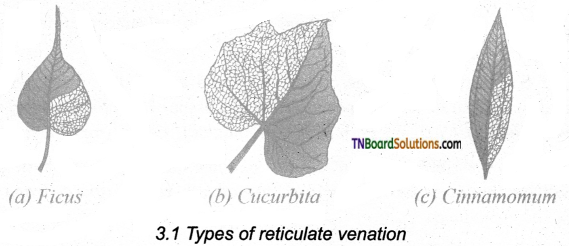
Palmately reticulate venation (multicostate): In this type of venation there are two or more principal veins arising from a single point and they proceed outward or upwards. The two types of palmate reticulate venation are

  1. Divergent type: When all principal veins originate from the base and diverge from one another towards the margin of the leaf as in Cucurbita, Luffa, Carica papaya, etc.
  2. Convergent: When the veins converge to the apex of the leaf, as in Indian plum (Zizyphus),
    bay leaf (Cinnamomum)
    TN Board 11th Bio Botany Important Questions Chapter 3 Vegetative Morphology 1
    (a) Pinnately reticulate, (b) Palmately reticulate (Divergent), (c) Palmately reticulate (Convergent)

TN Board 11th Bio Botany Important Questions Chapter 3 Vegetative Morphology

Question 10.
Give an account of storage leaves with suitable examples.
Answer:
Some plants of saline and xerophytic habitats and members of the family Crassulaceae commonly have fleshy or swollen leaves. These succulent leaves store water, mucilage or food material. Such storage leaves resist desiccation, eg. Aloe, Agave, Bryophyllum, Kalanchoe, Sedum, Sueada, Brassica oleracea (cabbage-variety capitata).

Answer In detail.

Question 1.
Describe the regions of the root with a suitable diagram.
Answer:
TN Board 11th Bio Botany Important Questions Chapter 3 Vegetative Morphology 2
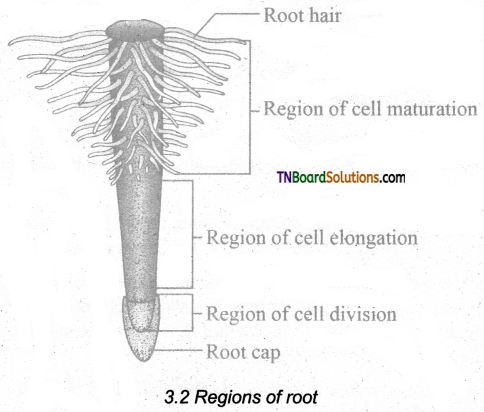
The root tip is covered by dome-shaped parenchymatous cells called root caps. It protects the meristematic cells in the apex. In Pandanus multiple root cap is present. In Pistia instead of a root cap, a root pocket is present. A few millimeters above the root cap the following three distinct zones have been classified based on their meristematic activity.

  1. Meristematic Zone,
  2. Zone of Elongation,
  3. Zone of Maturation.

Question 2.
What are the vital functions of root? Explain each function with a suitable example.
Answer:
Epiphytic or velamen root: Some epiphytic orchids develop a special kind of aerial roots which hang freely in the air. These roots develop a spongy tissue called velamen which helps in the absorption of moisture from the surrounding air. eg. Vanda, Dendrobiutn, Aerides.
Foliar root: Roots are produced from the veins or lamina of the leaf for the formation of the new plant, eg. Bryophyllum, Begonia, Zamioculcas.
Sucking or Haustorial roots: These roots are found in parasitic plants. Parasites develop adventitious roots from the stem which penetrate into the tissue of the host plant and suck nutrients, eg. Ciiscuta (dodder), Cassytha, Orobanche (broomrape), Viscum (mistletoe), Dendrophthoe.
Photosynthetic or assimilatory roots: Roots of some climbing or epiphytic plants develop chlorophyll and turn green which help in photosynthesis, eg. Tinospora, Trapa natans (water chestnut), Taeniophyllum.

TN Board 11th Bio Botany Important Questions Chapter 3 Vegetative Morphology

Question 3.
Explain different types of stem.
Answer:
The majority of angiosperm possess upright, vertically growing erect stem. They are (i) Excurrent, (ii) Decurrent, (iii) Caudex, (iv) Culm

  1. Excurrent: The main axis shows continuous growth and the lateral branches gradually becoming shorter towards the apex which gives a conical appearance to the trees, eg. Polyalthia longifolia, Casuarina.
  2. Decurrent: The growth of the lateral branch is more vigorous than that of the main axis. The tree has a rounded or spreading appearance, eg. Mangifera indica, Azadirachta indica, Tamarindus indicus, Aegle marmelos.
  3. Caudex: It’s an unbranched, stout, cylindrical stem, marked with scars of fallen leaves, eg. Cocus Nucifera, Borassusflabellifermis, Areca catechu.
  4. Culm: Erect stems with distinct nodes and usually hollow internodes clasped by leaf sheaths.
    eg. Majority of grasses including Bamboo.

Question 4.
Describe the various sub-aerial stem modifications with suitable examples.
Answer:
Subaerial stem found in plants with the weak stem in which branches lie horizontally on the ground. These are meant for vegetative propagation. They may be subaerial or partially subterranean.
Runner: This is a slender, prostrate branch creeping on die ground and rooting at the nodes, eg. Centella (Indian pennywort), Oxalis (wood sorrel), lawn grass (Cynodon dactylon).
Stolon: This is also a slender, lateral branch originating from the base of the stem. But it first grows obliquely above the ground, produces a loop and bends down towards the ground. When touches the ground it produces roots and becomes an independent plantlet. eg. Mentha piperita (peppermint), Fragaria indica (wild strawberry).
Sucker: Sucker develops from an underground stem and grows obliquely upwards and gives rise to a separate plantlet or new plant, eg. Chrysanthemum, Musa, Bambusa.
Offset: Offset is similar to runner but found in aquatic plants especially in rosette leaved forms.
A short thick lateral branch arises from the lower axil and grows horizontally leafless for a short distance, then it produces a bunch of rosette leaves and roots at nodes, eg. Eiehhornia (water hyacinth), Pistia (water lettuce).

TN Board 11th Bio Botany Important Questions Chapter 3 Vegetative Morphology

Question 5.
Explain the parts of the leaf with a suitable diagram.
Answer:
Three main parts of a typical leaf are:
(i) Leaf base (Hypopodium), (ii) Petiole (Mesopodium), (iii) Lamina (Epipodium).

  1. The part of the leaf attached to the node of the stem is called the leaf base. Usually, it protects growing buds at its axil. In legumes, the leaf base becomes broad, thick, and swollen which is known as a pulvinus. eg. Clitoria, Lablab, Cassia, Erythrina, Butea, Peltophorum.
    In many monocot families such as Arecaceae, Musaceae, Zingiberaceae, and Poaceae the leaf base extends, into a sheath and clasps part or whole of the internode. Such leaf base also leaves permanent scars on the stem when they fall. eg. Arecaceae.
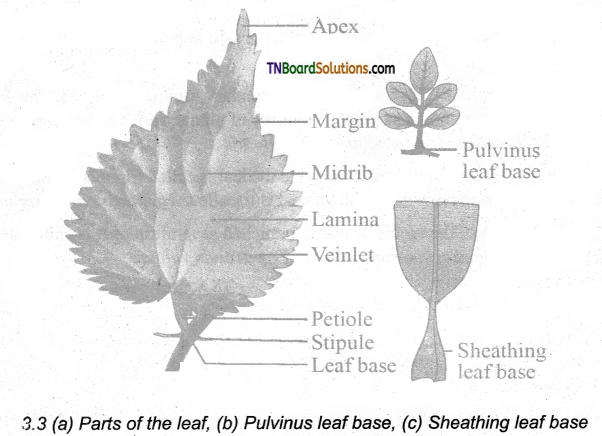
    TN Board 11th Bio Botany Important Questions Chapter 3 Vegetative Morphology 3
  2. Petiole (stipe or mesopodium): Tt is the bridge between leaf and stem. Petiole or leaf stalk is a cylindrical or subcylindrical or flattened structure of a leaf that joins the lamina with the stem. A leaf with petiole is said to be petiolate. eg. Ficus, Hibiscus, Mangifera, Psidium. Leaves that do not possess petiole is said to be sessile, eg. Calotropis, Gloriosa.
  3. The expanded flat green portion of the leaf is the blade or lamina. It is the seat of photosynthesis, gaseous exchange, transpiration, and most of the metabolic reactions of the plant. The lamina is traversed by the midrib from which arise numerous lateral veins and thin veinlets. The lamina shows great variations in its shape, margin, surface, texture, color, venation, and incision.
  4. In most of the dicotyledonous plants, the leaf base bears one or two lateral appendages called the stipules. Leaves with stipules are called stipulate. The leaves without stipules are called exstipulate or estipulate. The stipules are commonly found in dicotyledons. In some grasses (Monocots) an additional outgrowth is present between leaf base and lamina. It is called Ligule. Sometimes, small stipule-like outgrowths are found at the base of leaflets of a compound leaf. They are called stipels. The main function of the stipule is to protect the leaf in the bud condition.

Question 6.
What are the types of pinnately compound leaves? Explain each type with, suitable example.
Answer:
A pinnately compound leaf is defined as one in which the rachis, bears laterally a number of leaflets, arranged alternately or in an opposite manner, as in tamarind, Cassia.

  1. Unipinnate: The rachis is simple and unbranched which bears leaflets directly on its sides in alternate or opposite manner, eg. Rose, Neem. Unipinnate leaves are of two types.
    When the leaflets are even in number, the leaf is said to be paripinnate. eg. Tamarind, Abrus, Sesbania, Saraca, Cassia.
    When the leaflets are odd in number, 1he leaf is said to be imparipinnate. eg. Rose, Neem \ (Azadirachta), Chinese box (Murraya).
  2. Bipinnate: The primary rachis produces secondary rachis which bears the leaflets. The secondary rachii are known as pinnae. Number of pinnae varies depending on the species, eg. Delonix, Mimosa, Acacia nilotica, Caesalpinia.
  3. Tripinnate: When the rachis branches thrice the leaf is called tripinnate. (i.e) the secondary rachii produce the tertiary rachii which bear the leaflets, eg. Moringa, Oroxylum.
  4. Decompound: When the rachis of the leaf is branched several times it is called decompound, eg. Daucus carota, Coriandrum sativum, Foeniculum vulgare.

TN Board 11th Bio Botany Important Questions Chapter 3 Vegetative Morphology

Choose the correct answer.

1. Vegetative morphology of plant includes:
(a) Shoot system, root system, and inflorescence
(b) the root system, flower, and seed
(c) shoot system and root system
(d) flower, fruit, and seed.
Answer:
(c) shoot system and root system

2. Phyllanthus amarus belongs to the group:
(a) Slmibs
(b) Herbs
(c) Climbers
(d) Trees
Answer:
(b) Herbs

3. The root system of the plant is generally:
(a) positively geotropic and negatively phototrophic in nature
(b) negatively geotropic and positively phototrophic in nature
(c) Positively geotropic and negatively phototrophic in nature
(d) negatively geotropic and negatively phototrophic in nature
Answer:
(c) Positively geotropic and negatively phototrophic in nature

4. Otym Sativa has:
(a) Tab toot system
(b) fibrous root system
(c) Adventitious and tap root system
(d) taproot with the secondary root system
Answer:
(b) fibrous root system

TN Board 11th Bio Botany Important Questions Chapter 3 Vegetative Morphology

5. Match the following:

(i) Conical root(a) Mechanical support
(ii) Tuberous root(b) Orchids
(in) Climbing root(c) Food storage
(iv) Epiphytic root.(d) Daucus carota

(a) (i)-(d), (ii)-(b), (iii)-(a), (iv)-(c)
(b) (i)-(d), (ii)-(c), (iii)-(a), (iv)-(b)
(c) (i)-(b), (ii)-(a), (iii)-(d), (iv)-(c)
(d) (i)-(b), (ii)-(c), (iii)-(a), (iv)-(d)
Answer:
(b) (i)-(d), (ii)-(c), (iii)-(a), (iv)-(b)

6. Foliar root is present in:
(a) randa
(b) Bryophyllum
(c) Delonix regia
(d) piper betel
Answer:
(b) Bryophyllum

7. Match the following:

(i) Pothos(a) Stem climber
(ii) Ipomoea(b) Thom climber
(iii) Bignonia(c) Root climber
(iv) Carissa(d) Hook climber

(a) (i)-(d), (ii)-(b), (iii)-(a), (iv)-(c)
(b) (i)-(d), (ii)-(c), (iii)-(b), (iv)-(a)
(c) (i)-(b), (ii)-(a), (iii)-(d), (iv)-(c)
(d) (i)-(c), (ii)-(a), (iii)-(d), (iv)-(b)
Answer:
(d) (i)-(c), (ii)-(a), (iii)-(d), (iv)-(b)

8. cladode is present in:
(a) Bambusa
(b) Musa
(c) Asparagus
(d) Citrus
Answer:
(c) Asparagus

TN Board 11th Bio Botany Important Questions Chapter 3 Vegetative Morphology

9. Rhizome is the modification of:
(a) Stem
(b) Root
(c) Undergroimd stem
(d) Undergroimd bulb
Answer:
(c) Undergroimd stem

10. Petiole is present in:
(a) Calotropis
(b) Hibiscus
(c) Gloriosa
(d) None of the above
Answer:
(b) Hibiscus

11. Ficus religiosa has:
(a) Pinnately parallel venation
(b) Palmately reticulate venation
(c) Multicostate venation
(d) Pinnately reticulate venation
Answer:
(d) Pinnately reticulate venation

12. Pinnately compound leaf is present in:
(a) Cassia
(b) Cucurbita
(c) begonia
(d) acalypha
Answer:
(a) Cassia

13. The part of the root which is most active in water absorption is called:
(a) root cap
(b) maturation zone
(c) meristematic zone
(d) zone of elongation
Answer:
(b) maturation zone

14. Venation is a term used to describe the pattern of arrangement of:
(a) floral organs
(b) veins and veinlets in a lamina
(c) flower in inflorescence
(d) all of them
Answer:
(b) veins and veinlets in a lamina

TN Board 11th Bio Botany Important Questions Chapter 3 Vegetative Morphology

15. Epiphytic roots are found in;
(a) Indian rubber
(b) Orchid
(c) Tinospora
(d) Cuscuta
Answer:
(b) Orchid

16. Potatoes are borne on:
(a) Primary roots
(b) lateral roots
(cl Adventitious roots
(d) axil of scaly leaves
Answer:
(d) axil of scaly leaves

17. Winged petiole is found in:
(a) citrus
(b) radish
(c) acacia
(d) peepal
Answer:
(a) citrus

18. Fibrous root in ficus benghalensis develop from:
(a) stem
(b) node
(c) intemode
(d) none of the above
Answer:
(a) stem

19. Foliar roots are present in:
(a) vanda
(b) Bombax
(c) Bryophyllum
(d) Ficus pumila
Answer:
(c) Bryophyllum

20. Which one of the following is not a characteristic of the root.
(a) presence of root cap
(b) presence of chlorophyll
(c) absence of buds
(d) presence of unicellular hair
Answer:
(b) presence of chlorophyll

TN Board 11th Bio Botany Important Questions Chapter 3 Vegetative Morphology

21. ………… are the vegetative organs of the flowering plant.
(a) Leaves, stem, fruits
(b) Roots, stem, flowers
(d) Roots, stem, leaves.
(c) Roots, leaves, flowers
Answer:
(d) Roots, stem, leaves.

22. Which is not a stem modification?
(a) Rhizome of ginger
(b) Corn of colocasia
(c) Pitcher of nepenthes
(d) Tuber of potato
Answer:
(c) Pitcher of nepenthes

23. In One of the following stem performs the function of storage and propagation,
(a) Wheat
(b) Ginger
(c) Radish
(d) Paddy
Answer:
(b) Ginger

24. An underground specialised sheet with a reduced disc-like stem covered by fleshy leaves is:
(a) Rhizome
(b) Rhizosphere
(c) Bulb
(d) Bulbil
Answer:
(c) Bulb

TN Board 11th Bio Botany Important Questions Chapter 3 Vegetative Morphology
25. A phyllode i

s modified:
(a) leaf
(b) Stem
(c) Root
(d) Branch
Answer:
(a) leaf

26. A fibrous root system is better adapted than a tap root system for:
(a) Storage food
(b) Anchorage plant to soil
(c) absorption of water and organic food
(d) Transport of water and organic food
Answer:
(b) Anchorage plant to soil

27. Arrangement of leaves on a stem is called:
(a) Venation
(b) Vernation
(c) Phyllotaxy
(d) Axis
Answer:
(c) Phyllotaxy

28. The pitcher in nepenthes is a modification of:
(a) Stem
(b) root
(c) branch
(d) leaf
Answer:
(d) leaf

TN Board 11th Bio Botany Important Questions Chapter 3 Vegetative Morphology

29. Leaf spines are present in:
(a) bombax
(b) asparagus
(c) mango
(d) citrus
Answer:
(b) asparagus

30. Heterophylly is found in:
(a) Limnophila heterophylla
(b) Calophyllum
(c) Erythrina
(d) Cabbage
Answer:
(a) Limnophila heterophylla
TN Board 11th Bio Botany Important Questions Chapter 2 Plant Kingdom

Students get through the TN Board 11th Bio Botany Important Questions Chapter 2 Plant Kingdom which is useful for their exam preparation.

TN State Board 11th Bio Botany Important Questions Chapter 2 Plant Kingdom

Answer the following short answers.

Question 1.
Define photosynthesis.
Answer:
Plants are unique living entities as they are endowed with the power to harvest the light energy from the sun and to convert it to chemical energy in the form of food through the astounding reaction, photosynthesis.

Question 2.
What is an alternation of generation?
Answer:
Alternation of generation is common in all plants. Alternation of the haploid gametophytic phase (n) with the diploid sporophytic phase (2n) during the life cycle is called alternation of generation.

Question 3.
What do you know about Halophyte algae?
Answer:
Dunaliella salina grows in salt pans (Halophytic algae), which can tolerate high concentration of salt content.

TN Board 11th Bio Botany Important Questions Chapter 2 Plant Kingdom

Question 4.
Mention any two vegetative reproduction in algae.
Answer:
Vegetative reproduction includes fission in unicellular forms the cell divides mitotically to produce two daughter cells, eg. Chlamydomonas.
Fragmentation: fragments of parent thallus grow into new individual, eg. Uloihrix.

Question 5.
Describe the thallus of red algae.
Answer:
The thallus is multicellular, macroscopic and diverse in form.

Question 6.
What is Garpogohium?
Answer:
The female sex organ of red algae is called carpogonium.

Question 7.
Mention any two characteristic features of bryophytes.
Answer:

  1. The plant body of bryophyte is gametophyte and is not differentiated into root, stem and leaf-like structure.
  2. Most of them are primitive land dwellers. Some of them are aquatic (Riella, Ricciocarpus).

Question 8.
Mention any three uses of Pteridophyte.
Answer:
Cut flower arrangements, Food, Biofertilizer.

TN Board 11th Bio Botany Important Questions Chapter 2 Plant Kingdom

Question 9.
Define the term Solenostele.
Answer:
The stele is perforated at a place or places corresponding to the origin of the leaf trace.

Question 10.
What is meant by Amber?
Answer:
Amber is a plant secretion that is an efficient preservative that doesn’t get degraded and hence can preserve remains of extinct life forms. The amber is produced by Pinites succinifera, a Gymnosperm.

Question 11.
Why do you call some plant fossil plants?
Answer:
The term ’form genera’ is used to name the fossil plants because the whole plant is not recovered as fossils instead organs or parts of the extinct plants are obtained in fragments.

Question 12.
What are the three classes of Gymnosperms?
Answer:

  1. Cycadopsida,
  2. Coniferopsida,
  3. Gnetopsida

Question 13.
Define the term Gymnosperm.
Answer:
Gymnosperms (Gr. Gymnos = naked; Sperma = seed) are naked seed-producing plants. They were dominant in the Jurassic and cretaceous periods of the Mesozoic era.

TN Board 11th Bio Botany Important Questions Chapter 2 Plant Kingdom

Question 14.
What are the non-vascular cryptogams?
Answer:
Vascular tissue like xylem and phloem are completely absent, hence called ‘Non-vascular cryptogams’.

Question 15.
Mention any two fossil gymnosperms.
Answer:
Medullosa and Lepido-carpon.

Question 16.
List out morphological features of the dicot plant.
Answer:

  1. Reticulate venation is present in the leaves.
  2. Presence of two cotyledons in the seed.
  3. Primary root radicle persists as the taproot.
  4. Flowers tetramerous or Pentamerous.
  5. Tricolpate (3 furrow) pollen is present.

Question 17.
What do you know about pyrenoids?
Answer:
Storage bodies called pyrenoids are present in the chloroplast and store starch.

Question 18.
What are Epiphytic algae?
Answer:
A few algae grow on the surface of aquatic plants and are called epiphytic algae (Coleochaete, and Rhodymenia).

Question 19.
What are Bryophytes?
Answer:
Bryophytes are the simplest land inhabiting cryptogams and are restricted to moist, shady habitats.
They lack vascular tissue and hence called ‘Non- vascular cryptogams’.

TN Board 11th Bio Botany Important Questions Chapter 2 Plant Kingdom

Question 20.
Mention the five subdivisions of Pteridophytes.
Answer:

  1. Psilophytopsida,
  2. Psilotopsida,
  3. Lycopsida,
  4. Sphenopsida,
  5. Pteropsida.

Answer In brief.

Question 1.
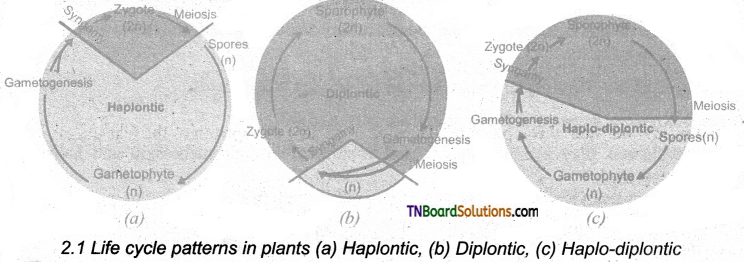
List the life cycle patterns in plants.
Answer:
TN Board 11th Bio Botany Important Questions Chapter 2 Plant Kingdom 1

Question 2.
Name the 11 classes of Algae by which F.E. Fritsch classified.
Answer:
F.E. Fritsch proposed a classification for algae-based on pigmentation, types of flagella, reserve food materials, thallus structure and reproduction. He published his classification in the book “The structure and reproduction of Algae” (1935). He classified algae into 11 classes namely Chlorophyceae, Xanthophyceae, Chrysophyceae, Bacillariophyceae, Cryptophyceae, Dinophyceae, Chloromonodineae, Euglenophyceae, Phaeophyceae, Rhodophyceae, Cyanophyceae.

TN Board 11th Bio Botany Important Questions Chapter 2 Plant Kingdom

Question 3.
Describe the gametophyte phase of non-vascular cryptogams.
Answer:

  1. The gametophyte is a conspicuous, long-lived phase of the life cycle.
  2. Thalloid forms are present in liverworts and Hornworts.
  3. In Mosses leaf-like, stem-like structures are present.
  4. In Liverworts thallus grows prostrate on the ground and is attached to the substratum by means of rhizoids.
  5. Two types of rhizoids are present namely smooth-walled and pegged. Multicellular scales are also present.
  6. In Moss, the plant body is erect with a central axis bearing leaf-like expansions. Multicellular rhizoids are present.

Question 4.
Describe the sporophyte of non-vascular cryptogam.
Answer:

  1. The embryo divides and gives rise to the sporophyte.
  2. The sporophyte is dependent on the gametophyte.
  3. It is differentiated into three recognizable parts namely foot, seta and capsule.
  4. The foot is the basal portion and is embedded in the gametophyte through which water and nutrients are supplied for the sporophyte.
  5. The diploid spore mother cells found in the capsule region undergo meiotic division and give rise to haploid spores. Bryophytes are homosporous.
  6. In some sporophytes, elaters are present and help in the dispersal of spores, eg. Marchantia.
  7. The spores germinate to produce gametophyte.

Question 5.
Write briefly about the economic importance of non-vascular cryptogams.
Answer:

  1. A large amount of dead thallus of Sphagnum gets accumulated mid compressed, hardened to form peat. In northern Europe, peat is used as fuel in a commercial scale (Netherlands).
  2. Apart from this Nitrates, brown dye and tanning materials are derived from peat.
  3. Sphagnum and peat are also used in horticulture as packing material because of their water holding capacity.
  4. Marchantia polymorpha is used to cure pulmonary tuberculosis.
  5. Sphagnum, Bryum and Polytrichum are used as food.
  6. Bryophytes play a major role in soil formation through succession and help in soil conservation.

TN Board 11th Bio Botany Important Questions Chapter 2 Plant Kingdom

Question 6.
List out any four, characteristic features of pteridophytes.
Answer:

  1. The plant body is a sporophyte (2n) and it is the dominant phase.
  2. It is differentiated into root, stem and leaves. Roots are adventitious.
  3. The stem shows monopodial or dichotomous branching.
  4. Leaves may be microphyllous or megaphyllous.

Question 7.
Distinguish between Gymnosperms and Angiosperms.
Answer:

GymnospermsAngiosperms
Vessels are absent [except Gnetales]Vessels are present
Phloem lacks companion cellsCompanion cells are present
Ovules are nakedOvules are enclosed within the ovary
Wind pollination onlyInsects, wind, water, animals etc., act as pollinating agents
Double fertilization is absentDouble fertilization is present
Endosperm is haploidEndosperm is triploid
Fruit formation is absentFruit formation is present
Flowers absentFlowers present

Question 8.
List out any three Economic importance of algae.
Answer:

  1. Agar Agar – cell wall material used for media preparation in the microbiology lab.
  2. Packing canned food, cosmetic, textile paper industry.
  3. Carrageenan – Preparation of toothpaste, paint, blood coagulant
  4. Alginate – Ice cream, paints, flameproof fabrics.

TN Board 11th Bio Botany Important Questions Chapter 2 Plant Kingdom

Question 9.
Describe the Vegetable reproduction of non-vascular cryptogams.
Answer:

  1. Vegetative reproduction takes place by die formation of adventitious buds (Riccia fluitans) tubers develop in Anthoceros.
  2. In some forms small detachable branches or brood bodies are formed, they help in vegetative reproduction as in Bryopteris fruticulosa.
  3. In Marchantia propagative organs called gemmae are formed and help in reproduction.

Question 10.
List the salient features of Angiosperms.
Answer:

  1. Vascular tissue (Xylem and Phloem) is well developed.
  2. Flowers are produced instead of a cone.
  3. The embryosac (Ovule) remains enclosed in the ovary.
  4. Pollen tube helps in fertilization, so water is not essential for fertilization.
  5. Double fertilization is present. The endosperm is triploid.
  6. Angiosperms are broadly classified into two classes namely Dicotyledons and Monocotyledons.

Answer In detail.

Question 1.
Explain the asexual and sexual reproduction in algae with a suitable example.
Answer:
Asexual reproduction takes place by the production of zoospores (Ulothrix, Oedogonium),

  1. Aplanospore – Thin walled non motile spores, eg. Vaucheria.
  2. Autospores – Spores that look similar to the parent cell. eg. Chlorella.
  3. Hypnospore – Thick walled aplanospore. eg. Chlamydomonas nivalis. .
  4. Tetraspores – Diploid thallus of Polysiphonia produce haploid spores after meiosis).

TN Board 11th Bio Botany Important Questions Chapter 2 Plant Kingdom

Sexual reproduction in algae are of three types:

  1. Isogamy (Fusion of morphologically and Physiologically similar gametes eg. Ulothrix.
  2. Anisogamy (Fusion of either morphologically or physiologically dissimilar gametes eg. Pandorina.
  3. Oogamy (Fusion of both morphologically and physiologically dissimilar gametes, eg. Sargassum. The life cycle shows a distinct alternation of generation.

Question 2.
Give an account of Phaeophyceae.
Answer:
The members of this class are called ‘Brown algae’.

  1. The majority of the forms are found in marine habitats.
  2. Pleurocladia is a freshwater form.
  3. The thallus is filamentous (Ectocarpus) frond-like (Dictyota) or maybe giant kelps (Laminaria and Macrocystis).
  4. The thallus is differentiated into leaf-like photosynthetic part Called fronds, a stalk-like structure called stipe and a holdfast which attach thallus to the substratum.
  5. The Pigments include Chlorophyll a, c, Carotenoids and Xanthophylls.
  6. A golden-brown pigment called fucOxanthin is present and it gives shades of colour from olive green to brown to the algal members of this group.
  7. Mannitol and Laminarin are the reserve food materials. Motile reproductive structures are present.
  8. Two laterally inserted unequal flagella are present. Among these one is whiplash and another is tinsel.
  9. Although sexual reproduction ranges from isogamy to Oogamy, Most of the forms show the Oogamous type.
  10. Alternation of generation is present (isomorphic, heteromorphic or diplontic). eg. Sargassum, Laminaria, Fucus and Dictyota.

TN Board 11th Bio Botany Important Questions Chapter 2 Plant Kingdom

Question 3.
Explain the method of sexual reproduction in non-vascular cryptogams.
Answer:

  1. Sexual reproduction is oogamous. Antheridia and Archegonia are produced in a protective covering and are multicellular.
  2. The antheridia produce biflagellate antherozoids which swim in a thin film of water and reach the archegonium and fuse with the egg to form a diploid zygote.
  3. Water is essential for fertilization.
  4. The zygote is the first cell of the sporophyte generation. It undergoes mitotic division to form the multicellular undifferentiated embryo. The embryogeny is exoscopic (the first division of the zygote is transverse and the apex of the embryo develops from the outer cell). The embryo divides and gives rise to the sporophyte.
  5. The sporophyte is dependent on the gametophyte.
  6. It is differentiated into three recognizable parts namely foot, seta and capsule. Foot is the basal portion and is embedded in the gametophyte through which water and nutrients are supplied for the sporophyte.
  7. The diploid spore mother cells found in the capsule region undergo meiotic division and give rise to haploid spores. Bryophytes are homosporous.
  8. In some sporophytes elaters are present and help in the dispersal of spores eg. Marchantia.
  9. The spores germinate to produce gametophyte.

Question 4.
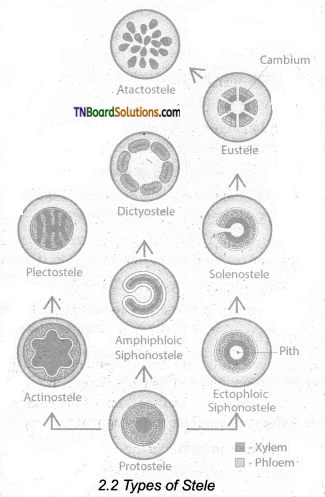
Give an account of types of steles.
Answer:
The term stele refers to the central cylinder of vascular tissues consisting of xylem, phloem; pericycle and sometimes medullary rays with pith. There are two types of steles (i) Protostele, (ii) Siphonostele.
Protostele In protostele xylem surrounds phloem. The type includes Haplostele, Actinostele, Plectostele, and mixed protostele.

  1. Haplostele Xylem surrounded by phloem is known as haplostele. eg. Selaginella.
  2. Actinostele Star-shaped xylem core is surrounded by phloem is known as actinostele.
    eg. Lycopodium serratum.
  3. Plectostele Xylem plates alternate with phloem plates, eg. Lycopodium clavatum.
  4. Mixed protostele Xylem groups uniformly scattered in the phloem, eg. Lycopodium cernuum.

TN Board 11th Bio Botany Important Questions Chapter 2 Plant Kingdom 2

Siphonostele: In siphonostele, xylem is surrounded by phloem with pith at the centre. It includes Ectophloic siphonostele, Amphiphloic siphonostele, Solenostele, Eustele, Atactostele and Polycyclic stele.

  1. Ectophloic siphonostele: The phloem is restricted only on the external side of the xylem. Pith is in centre, eg. Osmunda.
  2. Amphiphloic siphonostele: The phloem is present on both the sides of xylem. The pith is in the centre, eg. Marsilea.
  3. Solenostele: The stele is perforated at a place or places corresponding the origin of the leaf trace.
    (a) Ectophloic solenostele: Pith is in the centre and the xylem is surrounded by phloem, eg. Osmunda.
    (b) Amphiphloic solenostele: Pith is in the centre and the phloem is present on both sides of the xylem. eg. Adiantum pedatum
    (c) Dictyostele: The stele is separated into several vascular strands and each one is called meristele. eg. Adiantum capillus-veneris.
  4. Eustele: The stele is split into distinct collateral vascular bundles around the pith, eg. Dicot stem.
  5. Atactostele: The stele is split into distinct collateral vascular bundles and are scattered in the ground tissue, eg. the Monocot stem.
  6. Polycyclicstele: The vascular tissues are present in the form of two or more concentric cylinders, eg. Pteridium.

TN Board 11th Bio Botany Important Questions Chapter 2 Plant Kingdom

Question 5.
Describe the general characteristics features of gymnosperms.
Answer:

  1. Most of the gymnosperms are evergreen woody trees or shrubs. Some are lianas (Gnetum)
  2. The plant body is sporophyte and is differentiated into root, stem and leaves.
  3. A well-developed tap root system is present. Coralloid roots of Cycas have a symbiotic association with blue-green algae. In Pinus the roots have mycorrhizae.
  4. The stem is aerial, erect and branched or unbranched (Cycas) with leaf scars.
  5. In conifers two types of branches namely branches of limited growth (Dwarf shoot) and Branches of unlimited growth (Long shoot) are present.
  6. Leaves are dimorphic, foliage and scale leaves are present. Foliage leaves are green, photosynthetic and borne on branches of limited growth. They show xerophytic features.
  7. The xylem consists of tracheids but in Gnetum and Ephedra Vessels are present.
  8. Secondary growth is present. The wood may be Manoxylic (Porous, soft, more parenchyma with wide medullary ray – Cycas) or Pycnoxylic (compact with narrow medullary ray-Pinus).
  9. They are Heterosporous. The plant may be monoecious (Pinus) or dioecious (Cycas).
  10. Microsporangia and Megasporangia are produced on Microsporophyll and Megasporophyll respectively.
  11. Male and female cones are produced.
  12. Anemophilous pollination is present.
  13. Fertilization is siphon gamous and pollen tube helps in the transfer of male nuclei.

Question 6.
List out the economic importance of gymnosperms.
Answer:
Economic importance of gymnosperms

PlantsProductsUses
Cycas circinalis, Cycas revolutaSagoStarch used as food.
Pinus gerardiana.Roasted seedUsed as a food.
Abies balsamea.Resin (Canada balsam)Used as mounting medium in permanent slide preparation.
Pinus insularis, Pinus roxburghiiRosin and TurpentinePaper sizing and varnishes.
Araucaria (monkey’s puzzle), Picea and Phyllocladus.TanninsBark yield tannins and is used in Leather industries.
Taxus brevifolia.TaxolDrug used for cancer treatment.
Ephedra gerardiana.EphedrineFor the treatment of asthma, bronchititis.
Pinus roxburghii.OleoresinUsed to make soap, varnishes and printing ink.
Pinus roxburghii, Picea smithianaWood pulpUsed to make papers.
Cedrus deodara.WoodUsed to make doors, boats and railway sleepers.
Cedrus atlantica.OilUsed in perfumery.
Thuja, Cupressus, Araucaria, and Crypiomeria.DecorativeOrnamental plants.

TN Board 11th Bio Botany Important Questions Chapter 2 Plant Kingdom

Choose the correct answer.

1. Who proposed plant kingdom?
(a) Eichler
(b) G.M.Smith
(c) Chamberlain
(d) Aristotle
Answer:
(a) Eichler

2. Volvox, §pirogyra are the examples for:
(a) Diplontic
(b) Haplontic
(c) Epiphytic
(d) Haplodiplotic
Answer:
(b) Haplontic

3. Father of Indian phycology is:
(a) Went
(b) F.E. Fritsch
(c) Ainsworth
(d) M.O.P. Iyengar
Answer:
(d) M.O.P. Iyengar

4. Identify the incorrect habitat:
(a) Marine – Sargassum
(b) Freshwater – Oedogonium
(c) Soil – Ulothrix
(d) Salt pass – Dunaliella
Answer:
(c) Soil – Ulothrix

5. The study of Algae is called:
(a) Phycology
(b) Mycology
(c) Bryology
(d) Virology
Answer:
(a) Phycology

TN Board 11th Bio Botany Important Questions Chapter 2 Plant Kingdom

6. Which is the proteinaceous body found is
(a) Pyrenoids
(b) Siliceous walls
(c) Carrageenan
(d) Alginate
Answer:
(a) Pyrenoids

7. Oedogonium belongs to the class:
(a) Cryptophyceae
(b) Rhodophyceae
(c) Phaeophyceae
(d) Chlorophyceae
Answer:
(d) Chlorophyceae

8. Identify the incorrect pair.
(a) Green algae – Chlorophyceae
(b) Red algae – Rhodophyceae
(c) Brown algae -Phaeophyceae
(d) Blue algae – Dinophyceae
Answer:
(d) Blue algae – Dinophyceae

9. Match the following:

(i) Carrageenin(a) Gracilaria
(ii) Alginate(b) Chlorella
(Hi) Chlorellin(c) Laminaria
(iv) Agar agar(d) Chondrus

(a) (i)-(d), (ii)-(b), (iii)-(a), (iv)-(c)
(b) (i)-(d), (ii)-(c), (iii)-(b), (iv)-(a)
(c) (i)-(b), (ti)-(a), (iii)-(d), (iv)-(c)
(d) (i)-(b), (ii)-(c), (iii)-(a), (iv)-(d)
Answer:
(b) (i)-(d), (ii)-(c), (iii)-(b), (iv)-(a)

10. Amylum stars, root bulbils and amorphous bulbils are the vegetative reproductive organs of:
(a) Chora
(b) Oedogonium
(c) Selaginella
(d) Pinus
Answer:
(a) Chora

TN Board 11th Bio Botany Important Questions Chapter 2 Plant Kingdom

11. In which sporophyte elaters are present and help in dispersal:
(a) Riccia
(b) Anthoceros
(c) Bryopteris
(d) Marchantia
Answer:
(d) Marchantia

12. Who classified bryophytes in to 3 classes.
(a) Proskauer
(b) Kashyap
(c) G.M.Smith
(d) Chamberlain
Answer:
(a) Proskauer

13. Sphagnum is used in:
(a) Agriculture
(b) Horticulture
(c) Sericulture
(d) Monoculture
Answer:
(b) Horticulture

14. Pulmonary tuberculosis is caused by:
(a) Funaria hygrometrica
(b) Sphagnum
(c) Marchantia polynmorpha
(d) Riccia
Answer:
(c) Marchantia polynmorpha

15. Selaginalla is the example for:
(a) Plectostele
(b) Haplostele
(c) Mixed protostele
(d) Actinostele
Answer:
(b) Haplostele

TN Board 11th Bio Botany Important Questions Chapter 2 Plant Kingdom

16. ‘Walking fem’ is the common name for:
(a) Pinus
(b) Cycas
(c) Adiantum
(d) Selaginella
Answer:
(c) Adiantum

17. Identify the incorrect statement.
(a) presence of cambium in gymnosperm as in monocotyledons
(b) presence integument around the ovule
(c) both plant group produce seeds.
(d) pollentube helps in the transfer of male nucleus in both.
Answer:
(a) presence of cambium in gymnosperm as in monocotyledons

18. Match the following:

(i) Cycas revoluta(a) Drug used for cancer treatment
(ii) Pinus gerardiana(b) used in perfumery
(iii) Taxus brevifolia(c) used as a food
(iv) Cedrus atlantica(d) starch used as food

(a) (i)-(d), (ii)-(b), (iii)-(a), (iv)-(c)
(b) (i)-(d), (ii)-(c), (iii)-(a), (iv)-(b)
(c) (i)-(a), (ii)-(d), (iii)-(b), (iv)-(c)
(d) (i)-(a), (ii)-(c), (iii)-(b), (iv)-(d)
Answer:
(b) (i)-(d), (ti)-(c), (iii)-(a), (iv)-(b)

19. Coralloid roots are found in:
(a) Araucaria
(b) Ephedra
(c) Cycas
(d) Pinus
Answer:
(c) Cycas

20. Foliage leaves are otherwise called:
(a) Axillary leaves
(b) Scale leaves
(c) Sessile leaves
(d) Assimilatory leaves
Answer:
(d) Assimilatory leaves

TN Board 11th Bio Botany Important Questions Chapter 2 Plant Kingdom

21. Algae having oil as reserve food belongs to:
(a) Xanthophyceae
(b) Rhodophyceae
(c) Chlorophyceae
(d) Phaeophyceae
Answer:
(a) Xanthophyceae

22. Antheridia and Archegonia are sex organs of:
(a) Moss
(b) Mucor
(c) Spirogyra
(d) Puccinia
Answer:
(a) Moss

23. Archegonicphore is found in:
(a) Funaria
(b) Marchantia
(c) Chara
(d) Adiantum
Answer:
(b) Marchantia

24. Which one of the following in Spyrogyra is different based on its nucleus?
(a) Zygospore
(b) Azygospore
(c) Aplanspore
(d) Akinete
Answer:
(a) Zygospore

25. Nostoc fixes dinitrogen in symbiotic association with the following:
(a) Alnus
(b) Gunnera
(c) Anthocerus
(d) Casurina
The correct combination is:
(a) I & II (b) II & III (c) I & III (d) I & IV
Answer:
(b) II & III

TN Board 11th Bio Botany Important Questions Chapter 2 Plant Kingdom

26. Select the wrong statement:
(a) Isogametes are similar in structure, function and behaviour
(b) Anisogametes differ either in structure, function and behaviour
(c) In oomycetes , female gamete is smaller and motile, while male gamete is larger and nonmotile.
(d) Cjilamydomonas exhibits both isogamy and anisogamy and focus shows oogamy.
Answer:
(c) In oomycetes , female gamete is smaller and motile, while male gamete is larger and nonmotile.

27. The ladder like structure found in spirogyra is due to:
(a) Asexual reproduction
(b) Lateral conjugation
(c) Direct conjugation
(d) Sealiriform conjugation
Answer:
(d) Sealiriform conjugation

28. Transgenic plants are the ones:
(a) grown in artificial medium, after hybridization in the field.
(b) produced by a somatic embryo in artificial medium.
(c) generated by introducing foreign DNA into a cell and regenerating a plant from that cell.
(d) produced after protoplast fusion in artificial medium.
Answer:
(c) generated by introducing foreign DNA into a cell and regenerating a plant from that cell.

29. Which of the following is a living fossil?
(a) Spirogyra
(b) Moss
(c) Cycas
(d) Saccharomyces
Answer:
(c) Cycas

TN Board 11th Bio Botany Important Questions Chapter 2 Plant Kingdom

30. Which of the following species propagates through leaf-tip?
(a) Funaria
(b) Walking fern
(c) Moss
(d) Marchantia
Answer:
(b) Walking fern

TN Board 11th Bio Botany Important Questions Chapter 1 Living World

Students get through the TN Board 11th Bio Botany Important Questions Chapter 1 Living World which is useful for their exam preparation.

TN State Board 11th Bio Botany Important Questions Chapter 1 Living World

Answer the following short answers.

Question 1.
Define Biosphere.
Answer:
Earth has formed some 4.6 billion years ago. It is a life-supporting planet with landforms like mountains, plateaus, glaciers, etc., Life on earth exists within a complex structure called the biosphere.

Question 2.
What is the role of the DNA molecule?
Answer:
DNA is essential for the regulation of life and is made up of carbon, hydrogen, oxygen, nitrogen, and phosphorus, and thus nonliving and living things exist together to make our planet unique.

Question 3.
What is consciousness?
Answer:
AH organisms are capable of sensing their environment and respond to various physical, chemical, and biological stimuli. Animals sense their surroundings by sense organs. This is called consciousness.

TN Board 11th Bio Botany Important Questions Chapter 1 Living World

Question 4.
Explain Prions.
Answer:
Prions were discovered by Stanley B.Prusiner in the year 1982 and are proteinaceous infectious particles. They are the causative agents for about a dozen fatal degenerative disorders of the central nervous system of humans and other animals. For example Creutzfeldt – Jakob Disease (CJD), Bovine Spongiform Encephalopathy (BSE) – commonly known as mad cow disease and scrapie disease of sheep.

Question 5.
What is Plasmid?
Answer:
Plasmids are extrachromosomal double-stranded, circular, self-replicating, autonomous elements. They contain genes for fertility, antibiotic-resistant and heavy metals. It also helps in the production of bacteriocins and toxins which are not found in the bacterial chromosome.

Question 6.
Mention the need for classification?
Answer:
Classification is essential to achieve the following needs:

  1. To relate things based on common characteristic features.
  2. To define organisms based on the salient features.
  3. Helps in knowing the relationship amongst different groups of organisms.
  4. It helps in understanding the evolutionary relationship between organisms.

Question 7.
What is Pili?
Answer:
Pili or fimbriae are hair-like appendages found on the surface of the cell wall of gram-negative bacteria (eg. Enterobacterium). The pili are 0.2 to 20 pm long with a diameter of about 0.025pm. In addition to normal pili, special types of pili that help in conjugation called sex pili are also found.

TN Board 11th Bio Botany Important Questions Chapter 1 Living World

Question 8.
Define “Pruteen”.
Answer:
“Pruteen” is a single cell protein derived from Methylophilus and Methylotropus.

Question 9.
What are Mycobiont and Phycobiont?
Answer:
The symbiotic association between algae and fungi is called lichens. The algal partner |is called Phycobiont or Photobiont and the fungal partner is called Mycobiont. Algae provide nutrition for fungal partners in turn fungi provide protection and also help to fix the thallus to the substratum through rhizines. Asexual reproduction takes place through fragmentation, Soredia, and Isidia. Phycobionst reproduces by akinetes, hormogonia, aplanospore, etc., Mycobionts undergo sexual reproduction and produce ascocarps.

Question 10.
Define Homeostasis.
Answer:
Property of self-regulation and tendency to maintain a steady-state within an external environment which is liable to change is called Homeostasis. It is essential for the living organism to maintain internal conditions to survive in the environment.

Question 11.
Mention any four living characteristics of viruses.
Answer:

  1. Presence of nucleic acid and protein.
  2. Capable of mutation
  3. Ability to multiply within living cells.
  4. Able to infect and cause diseases in living beings.

Question 12.
Explain the term Viroid.
Answer:
Viroid is a circular molecule of ssRNA without a capsid and was discovered by T.O.Diener in the year 1971. The RNA of viroid has a low molecular weight. Viroids cause citrus exocytic and potato spindle tuber disease in plants.

TN Board 11th Bio Botany Important Questions Chapter 1 Living World

Question 13.
What is meant by red tide?
Answer:
Red tide is caused by the toxic bloom of Dinoflagellates like Gymnodinium breve and Gonyaulax tamarensis. A major red tide incident in the west coast of Florida in the year 1982 killed hundreds and thousands of fishes.

Question 14.
What are Polysomes?
Answer:
The ribosomes are the site of protein synthesis. The number of ribosomes per cell varies from 10,000 to 15,000. The ribosomes are 70S type and consist of two subunits (50S and 30S). The ribosomes are held together by mRNA and form polyribosomes or polysomes.

Question 15.
Write briefly on purple sulfur bacteria.
Answer:
For bacteria belonging to this group, the hydrogen donor is Thiosulphate and Bacteriochlorophyll. Chlorophyll containing chlorosomes are present, eg. Chromatium.

Question 16.
Match the following:

(i) Xanthomanas oryzae(a) Apple
(ii) Erwiria caratovora(b) Citrus
(iii) Erwiria amylovera(c) Rice
(iv) Xanthomnas citri(d) Carrot

Answer:
(i)-(c);
(ii)-(a);
(iii)-(d);
(iv)-(b)

TN Board 11th Bio Botany Important Questions Chapter 1 Living World

Question 17.
What is meant by aflatoxin?
Answer:
Aspergillus, Rhizopus, Mucor, and Penicillium ate involved in the spoilage of food materials. Aspergillus flavus infest dried foods and produce a carcinogenic toxins called aflatoxin.

Question 18.
Explain the term mycorrhizae.
Answer:
The Symbiotic association between fungal mycelium and roots of plants is called mycorrhizae. In this relationship, fungi absorb nutrition from the root, and in turn, the hyphal network of mycorrhizae forming fungi helps the plant to absorb water and mineral nutrients from the soil.

Question 19.
Name any two fungal diseases of plants and their causative organism.
Answer:

  1. A blast of Paddy: Magnaporthe grisea.
  2. Red rot of sugarcane: Colletotrichum falcatum.

Question 20.
Explain Oomycetes with an example.
Answer:
Coenocytic mycelium is present. The cell wall is made up of Glucan and Cellulose. Zoospore with one whiplash and one tinsel flagellum is present. Sexual reproduction is Oogamous. eg. Albugo.

TN Board 11th Bio Botany Important Questions Chapter 1 Living World

Answer In brief.

Question 1.
Differentiate extrinsic and intrinsic.
Answer:

ExtrinsicIntrinsic
Growth in non-living objects is extrinsic.Growth in living things is intrinsic.
Mountains, boulders, and sand mounds grow by simple aggregation of material on the surface.Living cells grow by the addition of new protoplasm within the cells.

Question 2.
List out the classification of viruses.
Answer:

Different Classes of viruses
ClassExample
Class 1 – Viruses with dsDNAAdenoviruses
Class 2 – Viruses with (+) sense ssDNAParvo viruses
Class 3 – Viruses with dsRNAReo viruses
Class 4 – Viruses with (+) sense ssRNAToga viruses
Class 5 – Viruses with (-) antisense ssRNARhabdo viruses
Class 6 – Viruses with (+) sense ss RNA- RT that replicate with DNA intermediate in the life cycle.Retroviruses
Class 7 – Viruses with ds DNA – RT that replicate with RNA intermediate in the life cycle.Hepadna viruses

Question 3.
Name any three plant, animal, and human diseases caused by viruses.
Answer:
Plant diseases: (i) Tobacco mosaic, (ii) Cauliflower mosaic, (iii) Sugarcane mosaic.
Animal diseases: (i) Foot and mouth disease of cattle, (ii) Rabies of dog, (iii) Encephalomyelitis of horse
Human diseases: (i) Common cold, (ii) Hepatitis B, (iii) Cancer.

TN Board 11th Bio Botany Important Questions Chapter 1 Living World

Question 4.
Distinguish catabolism and anabolism.
Answer:

AnabolismCatabolism
Building up process.Breaking down process.
Smaller molecules combine together to form larger molecules.Larger molecules break into smaller units.
Chemical energy is formed and stored, eg. Synthesis of proteins from amino acids.The stored chemical energy is released and used. eg. Breaking down of glucose to C02 and water.

Question 5.
List out any three methods of sexual reproduction, in fungi.
Answer:

  1. Sexual reproduction is present but sex organs are absent. Somatogamy or spermatisation results in plasmogamy.
  2. Karyogamy is delayed and the dikaryotic phase is prolonged.
  3. Karyogamy takes place in basidium and it is immediately followed by meiotic division.

Question 6.
Describe briefly the Viral genome.
Answer:

  1. Each virus possesses only one type of nucleic acid either DNA or RNA. The nucleic acid may be in a linear or circular form.
  2. Generally nucleic acid is present as a single unit but in wound tumor virus and in influenza virus it is found in segments.
  3. The viruses possessing DNA are called ‘Deoxyviruses’ whereas those possessing RNA are called ‘Riboviruses’. The majority of animal and bacterial viruses are DNA viruses (HIV is the animal virus that possesses RNA).
  4. Plant viruses generally contain RNA (Cauliflower Mosaic virus possesses DNA). The nucleic acids may be single-stranded or double-stranded. On the basis of the nature of nucleic acid, viruses are classified into four categories. They are Viruses with ssDNA (Parvoviruses), dsDNA (Bacteriophages), ssRNA (TMV), and dsRNA(wound tumour virus).

TN Board 11th Bio Botany Important Questions Chapter 1 Living World

Question 7.
Explain the structure of T4 bacteriophage.
Answer:

  1. The T4 phage is tadpole-shaped and consists of head, collar, tail, base plate, and fibers.
  2. The head is hexagonal which consists of about 2000 identical protein subunits.
  3. The long helical tail consists of an inner tubular core that is connected to the head by a collar.
  4. There is a base plate attached to the end of the tail. The base plate contains six spikes and tail fibers. These fibers are used to attach the phage to the cell wall of the bacterial host during replication.
  5. A dsDNA molecule of about 50 pm is tightly packed inside the head. The DNA is about 1000 times longer than the phage itself.

Question 8.
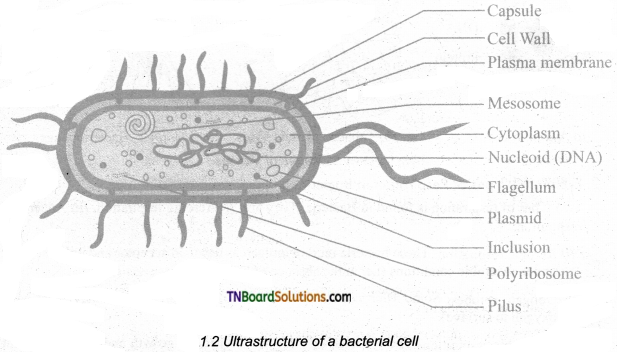
Draw and label the ultrastructure of a bacterial cell.
Answer:
TN Board 11th Bio Botany Important Questions Chapter 1 Living World 1

Question 9.
What is meant by Ammonification? Explain the bacteria involved in the process.
Answer:

Bacterial aspectsBacteriaRole
Ammonification(i)  Bacillus ramosus

(ii)  Bacillus mycoides

Convert complex proteins in the dead bodies of plants and animals into ammonia which is later converted into ammonium salt

TN Board 11th Bio Botany Important Questions Chapter 1 Living World

Question 10.
Explain Actinomycetes with an example.
Answer:
Actinomycetes are also called ‘Ray fungi’ due to their mycelia-like growth. They are anaerobic or facultative anaerobic microorganisms and are gram-positive. They do not produce an aerial mycelium. Their DNA contains high guanine and cytosine content (eg. Streptomyces).

Answer In detail.

Question 1.
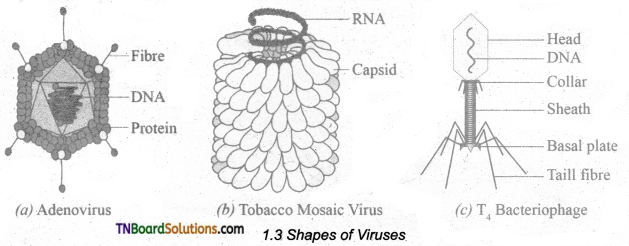
Draw the structure of different types of viruses and explain.
Answer:
Viruses are ultramicroscopic particles. They are smaller than bacteria and their diameter range from 20 to 300 nm (1 nm = 10-9 meters). Bacteriophage measures about 10 – 100 nm in size. The size of TMV is 300 x 20 nm.
Generally, viruses are of three types based on shape and symmetry.

  1. Cuboid symmetry – eg. Adenovirus, Herpes virus.
  2. Helical symmetry – eg. Influenza virus, TMV.
  3. Complex or Atypical – eg. Bacteriophage, Vaccinia virus.

TN Board 11th Bio Botany Important Questions Chapter 1 Living World 2

Question 2.
Explain the types of Respiration in Bacteria.
Answer:
Two types of respiration are found in Bacteria. They are (i) Aerobic respiration, (ii) Anaerobic respiration.

  1. Aerobic respiration These bacteria require oxygen as a terminal acceptor and will not grow under anaerobic conditions (i.e. in the absence of O2) eg. Streptococcus.
    Obligate aerobes: Some Micrococcus species are obligate aerobes (i.e. they must have oxygen to survive),
  2. Anaerobic respiration: These bacteria do not use oxygen for growth and metabolism but obtain their energy from fermentation reactions, eg. Clostridium.

Facultative anaerobes: There are bacteria that can grow either using oxygen as a terminal electron acceptor or anaerobically using fermentation reaction to obtain energy. When a facultative anaerobe such as E. coli is present at a site of infection like an abdominal abscess, it can rapidly consume all available 02 and change to anaerobic metabolism producing an anaerobic environment and thus allow the anaerobic bacteria that are present to grow and cause disease, eg. Escherichia coli and Salmonella.
Capnophilic Bacteria: Bacteria that require CO2 for their growth are called as capnophilic bacteria, eg. Campylobacter.

TN Board 11th Bio Botany Important Questions Chapter 1 Living World

Question 3.
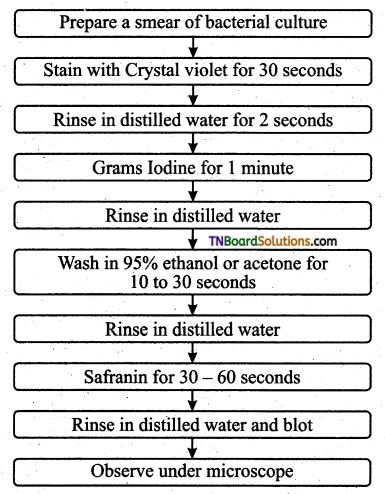
Describe the various steps in Gram’s staining procedure.
Answer:
TN Board 11th Bio Botany Important Questions Chapter 1 Living World 3

Question 4.
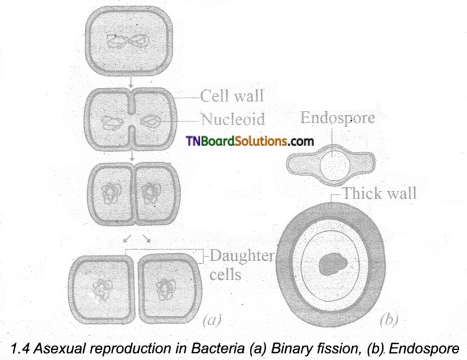
Give a concise account of asexual reproduction in bacteria.
Answer:
Bacteria reproduce asexually by Binary fission, conidia, and endospore formation. Among these Binary fission is the most common one.
Binary fission: Under favorable conditions, the cell divides into two daughter cells. The nuclear material divides first and it is followed by the formation of a simple median constriction which! finally results in the separation of two cells.
Endospores: During unfavorable conditions bacteria produce endospores. Endospores are produced in Bacillus megaterium, Bacillus sphaericus, and Clostridium tetani. Endospores are thick-walled resting spores. During the favorable conditions, they germinate and form bacteria.
TN Board 11th Bio Botany Important Questions Chapter 1 Living World 4

TN Board 11th Bio Botany Important Questions Chapter 1 Living World

Question 5.
Enumerate the general characteristic features of fungi.
Answer:

  1. The majority of fungi are made up of thin, filamentous branched structures called hyphae. A number of hyphae get interwoven to form mycelium. The cell wall of fungi is made up of a polysaccharide called chitin (polymer of N-acetyl glucosamine).
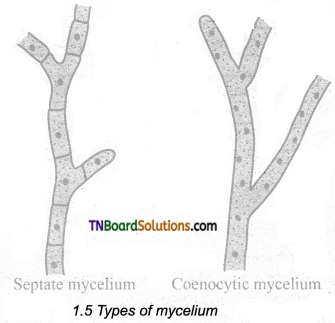
  2. The fungal mycelium is categorized into two types based on the presence or absence of septa (figure). In lower fungi, the hypha is aseptate, multinucleate and is known as coenocytic mycelium (eg. Albugo). In higher fungi, a septum is present between the cells of the hyphae. eg. Fusarium:
    TN Board 11th Bio Botany Important Questions Chapter 1 Living World 5
  3. The mycelium is organized into loosely or compactly interwoven fungal tissues called plectenchyma. It is further divided into two types prosenchyma and pseudoparenchyma. In the former type, the hyphae are arranged loosely but parallel to one another In the latter hyphae are compactly arranged and lose their identity.
  4. In holocarpic forms, the entire thallus is converted into reproductive structure whereas in Eucarpic some regions of the thallus are involved in the reproduction other regions remain vegetative. Fungi .reproduce both by asexual and sexual methods. The asexual phase is called Anamorph and the sexual phase is called Teleomorph. Fungi having both phases are called Holomorph.
  5. In general sexual reproduction in fungi includes three steps (a) Fusion of two protoplasts (plasmogamy), (b) Fusion of nuclei (karyogamy), and (c) Production of haploid spores through meiosis.

Question 6.
Write an essay on the Beneficial activities of fungi.
Answer:
Fungi provide delicious and nutritious food called mushrooms. They recycle the minerals by decomposing the litter thus adding fertility to the soil. The dairy industry is based on a single-celled fungus called yeast. They deteriorate the timber. Fungi cause food poisoning due to the production of toxins. The Beneficial and harmful activities of fungi are discussed below:
Beneficial activities:

  1. Food: Mushrooms likeLentinus edodes, Agaricusbisporus, Volvariella volvaceae are consumed ‘ for their high nutritive value. Yeasts provide vitamin B and Eremothecium ashbyii is a rich source of Vitamin B12.
  2. Medicine: Fungi produce antibiotics that arrest the growth or destroy the bacteria. Some of the antibiotics produced by fungi include Penicillin (Penicillium notatum), Cephalosporins,
    (Acremonium chrysogenum), Griseofulvin (Penicillium griseofulvum). Ergot alkaloids (Ergotamine) produced by Claviceps purpurea are used as vasoconstrictors.
  3. Industries: Production of organic acid: For the commercial production of organic acids fungi are employed in the Industries. Some of the organic acids and fungi which help in the production of organic acids are Citric acid and Gluconic-acid – Aspergillus niger, Itaconic acid – Aspergillus terreus, Kojic acid – Aspergilhis oryzae.
  4. Bakery and Brewery: Yeast (Saccharomyces cerevisiae) is used for the fermentation of sugars to yield alcohol. Bakeries utilize yeast for the production of Bakery products like Bread, buns, rolls. etc. Penicillium roquefortii and Penicillium camemberti are employed in cheese production.
  5. Production of enzymes: Aspergillus oryzae, Aspergillus niger is employed in the production of enzymes like Amylase, Protease, Lactase etc., ’Rennet’ which helps in the coagulation of milk in cheese manufacturing is derived from Mucor spp.
  6. Agriculture: Mycorrhiza forming fungi like Rhizoctonia, Phallus, Scleroderma helps in the absorption of water and minerals. Fungi like Beauveria bassiana, Metarhizium anisopliae are used as Biopesticides to eradicate the pests of crops. Gibberellin, produced by a fungus Gibberella fujikuroi induce plant growth and is used as growth promoter.

TN Board 11th Bio Botany Important Questions Chapter 1 Living World

Activity

Text Book Page No. 25

Collect some root nodules of leguminous crops. Draw diagram. Wash, it in tap water and prepare d smear by squeezing the content into a clean slide. Follow the Gram staining method and identify the bacteria.
Answer:
Azotobacter, Clostridium, rhizobium are observed.

Text Book Page No. 37

Get a button mushroom. Draw a diagram of the fruit body. Take a thin longitudinal section passing through the gill and observe the section under a microscope. Record your observations.
Answer:
TN Board 11th Bio Botany Important Questions Chapter 1 Living World 6
TN Board 11th Bio Botany Important Questions Chapter 1 Living World 7
Keep a slice of bread in a clean plastic tray or plate. Wet the surface with little water. Leave the setup for 3 or 4 days. Observe the moldy growth on the surface of the bread. Using .a needle removes some mycelium and place it on a slide and stain the mycelium using lactophenol blue. Observe the mycelium and sporangium under the microscope and Record your observation and identify the fungi and its group based on characteristic features:
The bread mold fungi such as Mucor, Rhizopus can be observed.

TN Board 11th Bio Botany Important Questions Chapter 1 Living World

I. Choose the correct answer.

1. A sexual reproduction in living organism occurs by the production of:
(a) conidia formation
(b) budding
(c) binnary fission
(d) all the above
Answer:
(d) all the above

2. Animal sense their surroundings by sense organ is called:
(a) Metabolism
(b) Irritability
(c) Consciounsness
(d) Anabolism
Answer:
(c) Consciounsness

3. Who obtained the crystalline protein sediment from infected tobacco juice?
(a) Edward Jennev
(b) W.M. Stanley
(c) Ivanowsky
(d) F.W. Twort
Answer:
(b) W.M. Stanley

4. Which of the following is the diameter of bacteriophage?
(a) 10 – 100 nm
(b) 20 – 100 nm
(c) 10 – 200 nm
(d) 20 – 30 nm
Answer:
(a) 10 – 100 nm

TN Board 11th Bio Botany Important Questions Chapter 1 Living World

5. How many classes are there in viruses?
(a) 5
(b) 3
(c) 1
(d) 6
Answer:
(c) 1

6. The shape of TMV is:
(a) round shape
(b) cuboid shape
(c) cylindrical shape
(d) rod shape
Answer:
(d) rod shape

7. Identify the incorrect statement of living characters of viruses.
(a) Absence of metabolism
(b) Presence of nucleic acid
(c) Multiply within the cells
(d) Capable of mutation
Answer:
(a) Absence of metabolism

8. Cyanophages means:
(a) Viruses infecting red algae
(b) Viruses infecting brown algae
(c) Viruses infecting blue-green algae
(d) Viruses infecting green algae
Answer:
(c) Viruses infecting blue-green algae

9. Which one of the following is a bacterial disease?
(a) Common cold
(b) Cancer
(c) Rabies
(d) Tetanus
Answer:
(d) Tetanus

10. Who proposed the five kingdom classification?
(a) R.H. Whittaker
(b) Linnaeus
(c) Haeckel
(d) Aristotle
Answer:
(a) R.H. Whittaker

TN Board 11th Bio Botany Important Questions Chapter 1 Living World

11. Actinomycetes, cyanobacteria are examples of:
(a) Protostar
(b) Fungi
(c) Monera
(d) Animalia
Answer:
(c) Monera

12. What are the three domains of life according to Carl Woese and co-workers?
(a) Prokaiyota, Eukaryota, Archaea
(b) Archaea, Bacteria, Protozoa
(c) Archaea, Fungi, Bacteria
(d) Bacteria, Archaea, Eukarya
Answer:
(d) Bacteria, Archaea, Eukarya

13. Who coined the word Bacterium?
(a) Christian Gram
(b) C.G.Ehrenberg
(c) Griffith
(d) Lederberg
Answer:
(b) C.G.Ehrenberg

14. Eschrichia coli and Salmonella are examples of:
(a) Aerobes
(b) Obligate aerobes
(c) Facultative anaerobes
(d) Anaerobes
Answer:
(c) Facultative anaerobes

TN Board 11th Bio Botany Important Questions Chapter 1 Living World

15. Which among the bacteria breakdown hydrocarbons?
(a) Pseudomonas putida
(b) Lacto bacillus
(c) Bifido bacterium
(d) Nitrosomonas
Answer:
(a) Pseudomonas putida

16. Match the following disease with their pathogen:

Name of the diseaseName of the pathogen
(i) Bacterial blight(a) Clavibactor michiganensis
(ii) Fire blight(b) Xanthomonas citri
(Hi) Citrus canker(c) Xanthomonas oryzae
(iv) Ring rot(d) Erwinia amylvora

(a) (i)-(d); (ii)-(c); (iii)-(b); (iv)-(a)
(b) (i)-(c); (ii)-(a); (iii)-(b); (iv)-(d)
(c) (i)-(a)-, (ii)-(d); (iii)-(b); (iv)-(c)
(d) (i)-(c); (ii)-(d); (iii)-(b); (iv)-(a)
Answer:
(d) (i)-(c); (ii)-(d); (iii)-(b); (iv)-(a)

17. PHB means:
(a) Poly Hexo Butyrate
(b) Poly Hydrolxl Butyle
(c) Poly -13 Hydroxl Butyrate
(d) Poly Hedfal Butyrate
Answer:
(c) Poly -13 Hydroxl Butyrate

TN Board 11th Bio Botany Important Questions Chapter 1 Living World

18. Which of the statement is incorrect in blue-green algae?
(a) The thallus is unicellular
(b) The reserve food material is cyanophycean starch
(c) Absence of mucilage around the thallus
(d) Sexual reproduction is absent
Answer:
(c) Absence of mucilage around the thallus

19. Nostoc and Anabaena are examples of:
(a) Biofertilizer
(b) Biological fuel
(c) Biotic factor
(d) Pro-Biotic
Answer:
(a) Biofertilizer

20. Father of the Indian mycology is:
(a) P.A.Michali
(b) C.H.Blackley
(c) Sir Edwin John Butler
(d) A.F. Blakeshec
Answer:
(c) Sir Edwin John Butler

21. In Fungi reproduction sexual phase is called:
(a) Anamorph
(b) Holomorph
(c) Allelomorph
(d) Teleomorph
Answer:
(d) Teleomorph

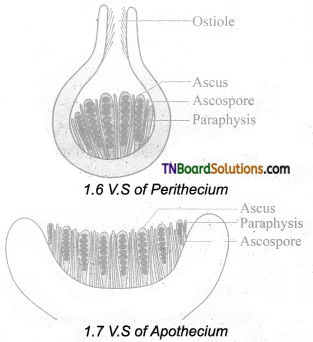
22. Odd one out (Type of ascocarp):
(a) Deistothecium
(b) Perithecium
(c) Apothecium
(d) Basidium
Answer:
(d) Basidium

TN Board 11th Bio Botany Important Questions Chapter 1 Living World

23. Which one of the following is a rich source of vitamin B12?
(a) Agaricus bisporus
(b) Aspergillus oryzae
(c) Eremothecium ashbyii
(d) Clavicepspurpurea
Answer:
(c) Eremothecium ashbyii

24. Pick out the incorrect pair:
(a) Blast of paddy – Magnaporthe grisea
(b) Red rot of sugarcane – Albugo Candida
(c) Rust of wheat – Pucciniagraminis
(d) peach of leaf curl – Taphrina deformans
Answer:
(b) Red rot of sugarcane – Albugo Candida

25. The symbiotic association between fungal mycelium and roots of higher plants is called:
(a) Lichen
(b) Symbiotic
(c) Monotropa
(d) Mycorrhizac
Answer:
(d) Mycorrhizac

26. Each virus posses only one type of nucleic acid:
(a) Either DNA or RNA
(b) DNA only
(c) Neither DNA nor RNA
(d) RNA only
Answer:
(a) Either DNA or RNA

TN Board 11th Bio Botany Important Questions Chapter 1 Living World

27. Tobacco mosaic virus is a:
(a) rhomboid-shaped helical virus
(b) rod-shaped helical virus
(c) rectangular-shaped virus
(d) triangular shaped helical virus
Answer:
(b) rod-shaped helical virus

28. Indicate the correct statement:
(a) Virion is a circular molecule of ss RNA without a capsid
(b) Virion is a phage that injects linear DNA into the host cell
(c) Virion is an intact infective virus particle, which is non – replicating outside a host cell
(d) Virion is discovered by J.W Randles
Answer:
(c) Virion is an intact infective virus particle, which is non – replicating outside a host cell

29. Transfer of DNA from one bacterium to another is called:
(a) Conjugation
(b) Transformation
(c) Transduction
(d) Binary fission
Answer:
(b) Transformation

TN Board 11th Bio Botany Important Questions Chapter 1 Living World

30. Fusion of two somative cells of the hypae is called:
(a) Anisogamy
(b) Somatogamy
(c) Oogamy
(d) Isogamy
Answer:
(b) Somatogamy

TN Board 11th Commerce Important Questions Chapter 33 Indirect Taxation

Students get through the TN Board 11th Commerce Important Questions Chapter 33 Indirect Taxation which is useful for their exam preparation.

TN State Board 11th Commerce Important Questions Chapter 33 Indirect Taxation

Very short answer questions

1. Mention the kinds of GST.
Answer:

  1. CGST – Central Goods and Service Tax.
  2. SGST – State Goods and Service Tax.
  3. UGST – Union Goods and Service Tax.
  4. IGST – Integrated State Goods arid Service Tax.
  5. IGST on exports.

2. Main sources of Tax revenue and Non-tax revenue.
Answer:

  1. Land revenue.
  2. Taxes on sales and purchase of goods.
  3. Taxes on agricultural income.
  4. Taxes on land and building.
  5. Entertainment tax.

TN Board 11th Commerce Important Questions Chapter 33 Indirect Taxation

3. GST benefits of consumer.
Answer:

  1. The input tax credit allowed will lower the prices to the consumers.
  2. All small retailers will get exemption and purchases from them will cost less for the consumers.

Short answer questions

1. Explain the meaning of GST.
Answer:

  1. Goods and Services Tax (GST) is the tax imposed on the supply (consumption) of goods and services. It is a destination-based consumption tax and collected on those value-added items at each stage of the supply chain.
  2. A manufacturer in India, need not pay GST wherever he/she manufactures. GST is applicable to all goods and services except alcohol and specified petroleum products. GST Act has proposed four tax rates, i.e. 5%, 12%, 18% and 28%.

2. Write any three benefits of GST.
Answer:

  1. The creation of more employment opportunities will result in poverty eradication.
  2. It will bring more tax compliance (more taxpayers) and increase revenue to the Governments.
  3. It is transparent and will improve India’s ranking in the ‘Ease of Doing Business in the world.

Long answer questions

1. GST benefits of the business community.
Answer:

  1. Simpler Tax System with fewer exemptions. 17 taxes were abolished and one tax exists today.
  2. The input tax credit will reduce cascading effect of taxes. Reduction in average tax burden will encourage manufacturers and help the “Make in India” campaign and make India a manufacturing hub.
  3. Common procedures, common classification of goods and services, and timelines will lend greater certainty to the taxation system.
  4. GSTN facility will reduce multiple record-keeping, lesser investment in manpower and resources, and improve efficiency.
  5. All interactions will be through a common GSTN portal and will ensure corruption-free administration.
  6. Uniform prices throughout the country. Expansion of business to all states is made easy.

TN Board 11th Commerce Important Questions Chapter 33 Indirect Taxation

2. Explain IGST with an example.
Answer:
Meaning:

  1. IGST refers to the integrated goods and services tax and it is a combined form of CGST and IGST and is levied by the central government.
  2. Collection of tax: Taxes collected by the central government.
  3. Applicability: All exports are treated as inter-state supply under GST since exports also rated. GST is not imposed on all goods and services exported from India. Any input credit paid already exports will be refundable.
  4. Registration: Registration is mandatory.
  5. Composition: The composition scheme is not applicable in interstate supply.

Multiple-choice questions

1. GST applicable to all goods and services except alcohol and specified petroleum products. GST Act has proposed tax rates.
(a) two
(b) three
(c) four
(d) five
Answer:
(c) four

2. GST is of ……… kinds
(a) three
(b) four
(c) one
(d) five
Answer:
(a) three

3. CGST Act on:
(a) 2017
(b) 2016
(c) 2008
(d) 2002
Answer:
(a) 2017

TN Board 11th Commerce Important Questions Chapter 33 Indirect Taxation

4. The chairman of the council is the union ………. minister.
(a) educational
(b) agricultural
(c) finance
(d) textiles
Answer:
(c) finance

5. CGST collection of tax:
(a) state government
(b) central government
(c) direct tax
(d) indirect tax
Answer:
(a) state government

6. Input tax credit allowed will lower the prices to the:
(a) banker
(b) consumers
(c) debtors
(d) creditors
Answer:
(b) consumers

7. Several …………. says that GST in India would impact negatively on the real estate market.
(a) economics
(b) commerce
(c) mathematics
(d) statistics
Answer:
(a) economics

TN Board 11th Commerce Important Questions Chapter 33 Indirect Taxation

8. A number of retail products currently have only:
(a) 2%
(b) 3%
(c) 4%
(d) 5%
Answer:
(c) 4%

9. The aviation industry would be affected service taxes on airfares currently range from:
(a) 6% to 9%
(b) 5% to 8%
(c) 4% to 6%
(d) 4% to 8%
Answer:
(a) 6% to 9%

10. GST this rate will surpass fifteen percent and effectively ……… the tax rate.
(a) double rate
(b) Single rate
(c) triple rate
(d) Others rate
Answer:
(a) double rate

TN Board 11th Commerce Important Questions Chapter 32 Direct Taxes

Students get through the TN Board 11th Commerce Important Questions Chapter 32 Direct Taxes which is useful for their exam preparation.

TN State Board 11th Commerce Important Questions Chapter 32 Direct Taxes

Very short answer questions

Question 1.
What are 80C Deductions?
Answer:
80C Deductions; Contribution to Provident Fund, Life Insurance Premium, Children’s Tuition Fees, Health Insurance Premium, Investment in National Savings Certificate, interest paid for home loans, etc.

Question 2.
What is Applicability?
Answer:
Income Tax is applicable throughout India including the State of Jammu and Kashmir.

TN Board 11th Commerce Important Questions Chapter 32 Direct Taxes

Question 3.
What is Annual tax?
Answer:
Income tax is an annual tax because it is the income of a particular year that is chargeable to tax.

Question 4.
What are the kinds of taxes?
Answer:
Direct taxes and Indirect taxes.

Question 5.
Examples of Indirect taxes.
Answer:
Excise duties, customs duties, sales tax, entertainment tax, service tax.

Question 6.
Mention the features of Income-tax in India.
Answer:

  1. Levied as per the constitution,
  2. Levied by the central government,
  3. Direct tax,
  4. Annual tax,
  5. Tax on the person,
  6. Tax on Income.

TN Board 11th Commerce Important Questions Chapter 32 Direct Taxes

Short answer questions

Question 1.
Explain Income Tax is administered by the central government.
Answer:
Income tax is administered by the Central Government (Ministry of Finance) with the help of the ‘Income tax department’ with branches throughout the country. The Central Government has constituted the Central Board of Direct Taxes (CBDT) which exercises overall control over the Income-tax department by issuing guidelines for related matters.

Question 2.
Define Direct tax.
Answer:
Income tax is a direct tax. It is because the liability to deposit and ultimate burden are on the same person. The person earning income is liable to pay income tax out of his own pocket and cannot pass on the burden of tax to another person.

Question 3.
What are the names of Direct taxes?
Answer:
The names of direct taxes are:

  1. Income-Tax, Wealth Tax,
  2. Capital Gains Tax,
  3. Securities Transaction Tax,
  4. Fringe Benefits Tax (from 2005),
  5. Banking Cash Transaction Tax
    (for Rs. 50,000 and above – from 2005), etc.

In India, all direct taxes are levied and administered by the Central Board of Direct Taxes.

TN Board 11th Commerce Important Questions Chapter 32 Direct Taxes

Question 4.
As per the assessment year 2018 – 19. Tabulate/ the Income Tax slab rate for individuals.
Answer:

Total IncomeIncome tax rate
Upto – 2,50,000Nil
2,50,000 – 5,00,0005%
5,00,001 – 10,00,00020%
Above 10,00,00030%

Long answer questions

Question 1.
Difference between Direct tax and Indirect tax.
Answer:

Direct taxIndirect tax
Taxes on personal income, wealth, etc.faxes on commodities and services.
This kind of tax is imposed on the person and collected from the same person.This kind of tax is imposed on one person (producer) and collected from another person (consumer).
The money burden and real burden fall on the same person.The money burden, as well as real burden, fall on the different person.
Direct taxes collected from the people directly.indirect taxes are collected from the people indirectly through the price of goods.
Direct taxes are paid by rich people.Indirect taxes are paid by the poor.

TN Board 11th Commerce Important Questions Chapter 32 Direct Taxes

Multiple-choice questions

1. There are …….. types of taxes:
(a) one
(b) two
(c) three
(d) four
Answer:
(b) two

2. In India all direct taxes are levied and administered by ……… of direct taxes
(a) central board
(b) person
(c) company
(d) creditors
Answer:
(a) central board

3. If a tax levied on the income or wealth of a person and is paid by that person directly to the government it is called
(a) direct tax
(b) indirect tax
(c) income tax
(d) capital tax
Answer:
(a) direct tax

4. Good services tax example:
(a) direct tax
(b) indirect tax
(c) wealth tax
(d) capital gains tax
Answer:
(b) indirect tax

TN Board 11th Commerce Important Questions Chapter 32 Direct Taxes

5. Banking cash transaction tax and above ………. from 2005.
(a) Rs. 50000
(b) Rs. 40000
(c) Rs. 100000
(d) Rs. 80000
Answer:
(a) Rs. 50000

6. Income tax is charged by the central government on all incomes others than ……….. income.
(a) banking
(b) industries
(c) agricultural
(d) home loan
Answer:
(c) agricultural

7. Income tax is direct tax it is because the ………. to deposit and ultimate burden are on the same person.
(a) money
(b) asset
(c) capital
(d) liability
Answer:
(d) liability

8. Tax on long term capital gain:
(a) 30%
(b) 25%
(c) 20%
(d) 15%
Answer:
(c) 20%

9. Section IIIA tax on short term capital gain on shares covered under SST:
(a) 20%
(b) 15%
(c) 30%
(d) 40%
Answer:
(b) 15%

TN Board 11th Commerce Important Questions Chapter 32 Direct Taxes

10. Tax on lottery income section 115BB
(a) 30%
(b) 20%
(c) 10%
(d) 15%
Answer:
(a) 30%

11. Income tax is applicable throughout India including the state of:
(a) Hariyana
(b) Tamilnadu
(c) Jammu & Kashmir
(d) Mumbai
Answer:
(c) Jammu & Kashmir

12. It normally consisting of a period of 12 months commencing on 1st April every year and ending on:
(a) 31st October
(b) 31st December
(c) 31st May
(d) 31st March
Answer:
(d) 31st March

13. Income from salaries sections:
(a) 15-17
(b) 16-17
(c) 17-18
(d) 19-20
Answer:
(a) 15-17

TN Board 11th Commerce Important Questions Chapter 32 Direct Taxes

14. Income computed under these heads shall be aggregated after adjusting past and present losses and the total so arrived at is known as ……….. income.
(a) not total income
(b) gross total income
(c) total income
(d) income
Answer:
(b) gross total income

15. Gross total income, income tax Act:
(a) 1972
(b) 1971
(c) 1871
(d) 1961
Answer:
(d) 1961

TN Board 11th Commerce Important Questions Chapter 31 Discharge and Breach of a Contract

Students get through the TN Board 11th Commerce Important Questions Chapter 31 Discharge and Breach of a Contract which is useful for their exam preparation.

TN State Board 11th Commerce Important Questions Chapter 31 Discharge and Breach of a Contract

Very short answer questions

Question 1.
What are the types of remedies for injured parties?
Answer:
There are various types of remedies for the injured parties listed as follows:

  1. Recission of Contract,
  2. Claim for Specific Performance,
  3. Claim for Injunction,
  4. Claim for Quantum Merit and
  5. Claim for Damages.

Question 2.
What is a claim for specific performance?
Answer:
In some specific cases if the damages are not the adequate remedy, then the court can direct the party in breach for the specific performance of the contract. In such a case, the promise is carried out as per the terms and conditions of the contract.

TN Board 11th Commerce Important Questions Chapter 31 Discharge and Breach of a Contract

Question 3.
What are the types of damages?
Answer:
There are mainly four types of damages, such as-

  1. Ordinary damages,
  2. Special damages,
  3. Vindictive or exemplary damages and
  4. Nominal damages.

Question 4.
What is the types of injunction case?
Answer:

  1. If the contract is voidable,
  2. If the contract becomes void, or
  3. On discovering the contract as void.

Question 5.
Write a short note on recission of the contract?
Answer:
In case of breach of contract by one party, then the other parties may rescind the contract and thereby the party is absolved from all obligations under this contract.

Short answer questions

Question 1.
Explain the agreement on consent?
Answer:
Agreement between the parties comes to an end by mutually agreeing for it. Any contract is created by an agreement, hence in the same way, it can be discharged by an agreement. In this connection, the rule of law is as follows.
“Eodem modo qus and quide constituitor, eodem modo destruitur,” the meaning of which is that a thing may be destroyed in the same manner, in which, it is constituted. The consent may be of the following types
Express: Express consent may be given at the time of formation of the contract or subsequent to its formation.
Implied: The contracts are also discharged by implied consent, different modes of discharge by implied consent are:

  1. Novation,
  2. Alteration,
  3. Recession,
  4. Remission,
  5. Accord and Satisfaction,
  6. Waiver and
  7. Merger

TN Board 11th Commerce Important Questions Chapter 31 Discharge and Breach of a Contract

Question 2.
What is the lapse of time?
Answer:
According to the Limitation Act, 1963 a contract must be performed within a specified time. If it is not performed within this specified time limit and against which if no action is taken by the promisee in the. Court of Law within a specified time, then the promisee is deprived of his remedy at law. In such cases, the contract is discharged.

Question 3.
Name the contracts that can be contract discharged by law.
Answer:

  1. By death,
  2. By merger.
  3. By Insolvency.
  4. Unauthorized alternation of the terms of a contract.
  5. Rights and Liabilities vesting in the same person.

Long answer questions

Question 1.
Explain the contract discharged by the operation law.
Answer:

  1. By Death: If the contracts depend on the personal skill or ability, then such contract may be discharged on the death of the promisor
  2. By Merger: Merger will take place when an inferior right accruing to the same party either under the same or another contract.
  3. By Insolvency: An insolvent is discharged from all liabilities incurred prior to his adjudication.
  4. Unauthorized Alteration of the Terms of a Contract: If one party makes any material alteration in the contract without the consent of the other party, then the other party can avoid the contract.
  5. Rights and liabilities vesting in the same person: Where the right and liability become vested in the same person, the other parties are discharged.

TN Board 11th Commerce Important Questions Chapter 31 Discharge and Breach of a Contract

For Own Thinking

1. To draw inference about the nature of the contract and legal ways of discharging it.
Answer:

  1. Performance implies carrying out the obligation of the contract.
  2. Performance must be completed according to die real intentions of the agreement, performance must be done according to the time and manner prescribed.

2. To understand the modes of discharge of contract.
Answer:
To explain two modes of discharge of contract.
Merger: Two or more contracts combined together to form a contract and discharge of contract.

For Future Learning

1. To interpret the consequence of the breach of performance of a contract.
Answer:
All parties to a contract are expected to perform their promises when one party refuses to perform his promise. Then the breach of contract takes place.

2. Illustrate with example the modes of discharge of contract and if not discharged the consequences.
Answer:
Recission of contract: In case of breach of contract by one party then the other parties may rescind the contract and thereby the party is absolved from all obligations under the contract.

3. To foresee the suitability of remedies for breach of contract violation of which leading to legal consequences.
Answer:
Remedies of breach of contract for that to claim damages.
Ordinary damages: Damages that arise in the ordinary course of events from, the breach of contract are called ordinary damages.
eg: Annie contracted to sell and deliver Bala 100 bags of Dhall at Rs. 3000 per bag and price to be paid at the time of delivery.
The price of Dhall is raised to Rs. 4000 per bag and Annie refused to sell the dhall. Bala can claim damages at the rate of Rs. 1000 per bag.

TN Board 11th Commerce Important Questions Chapter 31 Discharge and Breach of a Contract

Multiple-choice questions

1. Performance of contract may be of ………. types.
(a) one
(b) two
(c) threat
(d) four
Answer:
(b) two

2. Impossibility existing at the time of:
(a) agreement
(b) formation of contract
(c) promisor
(d) personal
Answer:
(a) agreement

3. A contract can be discharged by the law.
(a) commercial law
(b) operation law
(c) civil law
(d) criminal law
Answer:
(b) operation law

4. Where the right and liability become vested, in the same person the:
(a) one party
(b) two parties
(c) other parties
(d) third parties
Answer:
(c) other parties

5. Right and ………. vesting in the same person.
(a) assets
(b) liabilities
(c) capital
(d) current asset
Answer:
(b) liabilities

TN Board 11th Commerce Important Questions Chapter 31 Discharge and Breach of a Contract

6. They are various types of remedies for the injured parties listed as:
(a) one
(b) two
(c) three
(d) five
Answer:
(d) five

7. The contract and thereby the party is absolved from all obligations under the contract:
(a) rescission of contract
(b) claim for injunction
(c) claim for damages
(d) claim for quantum merit
Answer:
(a) rescission of contract

8. When it is probable that compensation in ……… cannot be received for the nonperformance of the act agreed to be done.
(a) asset
(b) money
(c) plant
(d) creditors
Answer:
(b) money

9. The contract made by a company ultra-virus of its ………. of association.
(a) memorandum
(b) articles of association
(c) prospectus
(d) all of the above
Answer:
(a) memorandum

10. A party for breach of contract there are mainly ………. types.
(a) one
(b) two
(c) four
(d) five
Answer:
(c) four

TN Board 11th Commerce Important Questions Chapter 31 Discharge and Breach of a Contract

11. The court may order injunction in the ………. types.
(a) one
(b) three
(c) two
(d) four
Answer:
(b) three

12. Section 73 of the Indian contract act:
(a) 1872
(b) 1972
(c) 2013
(d) 1982
Answer:
(a) 1872

TN Board 11th Commerce Important Questions Chapter 30 Performance of Contract

Students get through the TN Board 11th Commerce Important Questions Chapter 30 Performance of Contract which is useful for their exam preparation.

TN State Board 11th Commerce Important Questions Chapter 30 Performance of Contract

Very short answer questions

Question 1.
What is attempted performance?
Answer:
When the party offers to perform his obligation, it is not accepted by the promisee. So, it is also called the offer to performance or tender. Hence, a valid tender of performance is considered to be the performance of a promise.

Question 2.
Who is a third person?
Answer:
According to Section 41, if a promisee accepts the performance of the promise by a third person he cannot afterward enforce it against the promisor.

TN Board 11th Commerce Important Questions Chapter 30 Performance of Contract

Question 3.
What are Representations?
Answer:
A contract that involves the use of personal skill or it is found on personal considerations, comes to an end if the promisor dies. Of course, in the case of other contracts, the legal representatives Of a deceased promisor are bound to perform the contract Section 37.

Question 4.
Explain the time and place of performance of the promise.
Answer:
It is only the promisee for Whom the contract is performed. Only the promisee can demand the performance of the promise under a contract.

Short answer questions

Question 1.
What is the appropriation of payments?
Answer:
Sometimes, a debtor owes several distinct debts to the same creditor and he makes a payment that is insufficient to satisfy all the debts. In such a case, a question arises as to which particular debt the payment is to be appropriated. Section 59 to 61 of the Act lays down the following rules as to the appropriation of payments which provide an answer to this question.

Question 2.
What is mutual and dependent?
Answer:
Where the performance of the promise by one party depends upon the prior performance of promise by the other party, the promises are conditional and dependent. For example, A agrees to construct a building for B. B agrees to supply cement for the construction. Hence A’s promise to perform depends on B’s promise.

TN Board 11th Commerce Important Questions Chapter 30 Performance of Contract

Question 3.
Explain the appropriation as per express instructions.
Answer:
Appropriation as per express Instructions:
Every debtor who owes several debts to a creditor has a right to instruct his creditor to which particular debt, the payment is to be appropriated or adjusted. Therefore, where the debtor expressly states that the payment is to be applied to the discharge of a particular debt, the. payment must be applied accordingly.

Question 4.
Write a short note on the Devolution of Joint Rights.
Answer:
“When a person has made a promise to two or more persons jointly, then unless there is a contract to the contrary, the right to claim performance rests as between him and them, with them during their joint lives and after the death of them with representatives of such deceased person jointly with survivors, and after the death of the last survivor, with the representatives of all jointly”.

Question 5.
Explain – Promisee.
Answer:
Only a promisee can demand performance and not a stranger demand performance of the contract.

Question 6.
What do you mean by mutual and concurrent?
Answer:
Where the two promises are said to be performed simultaneously. They are said to be mutual and concurrent.

TN Board 11th Commerce Important Questions Chapter 30 Performance of Contract

Long answer questions

Question 1.
What is the essentials of a valid tender of performance?
Answer:
A tender, to be valid, must satisfy the following essential requirements

  1. It must be unconditional.
  2. It must be for the whole obligation and must not be in installments if the contract requires in full.
  3. It must be by a person who is in a position and willing to perform the promise.
  4. It must be at the proper time and place.
  5. It must be in proper form.
  6. It must be made to a proper person i.e. to the promisee or his authorized agent.
  7. In the case of the tender of goods, the promisee must be given a reasonable opportunity to inspect the goods.
  8. It may be made to one of the several joint promisees.

For Own Thinking

1. To identify the performance and distinguish the performance as actual or attempted.
Answer:

  1. When the party has done what he had undertaken to do. It is called actual – performance.
  2. When the party offers to perform his obligation. Itisnotacceptedbythepromisee, so it is called an offer to perform.

2. To understand the time and place of performance, so that the contract is established to be discharged or not.
Answer:

  1. If the promise is to be performed on a certain day, the promisor may undertake the perform it without application of promise.
  2. However, the promise should be performed at the place where it was required to be performed.

TN Board 11th Commerce Important Questions Chapter 30 Performance of Contract

For Future Learning

1. Suggest ways by which the nature of the performance of a contract can be categorized.
Answer:

  1. Apromisor is to perform his promise within a reasonable time.
  2. On the other hand, a reasonable time will depend upon the circumstances of the case.

2. To identify those who are involved in the process of performance of a contract and their legal status.
Answer:

  1. The contract should be performed by the promisor by himself. He is like a legal representative.
  2. A contract that is not of personal nature may be performed by an agent who is likely a promisor.

Multiple-choice questions

1. Indian contract act lays down that “When ………. or more persons have made a joint promise.
(a) one
(b) two
(c) three
(d) five
Answer:
(b) two

TN Board 11th Commerce Important Questions Chapter 30 Performance of Contract

2. Promises which form consideration or part of the consideration for each other are called:
(a) reciprocal promise
(b) promisor alone
(c) agent
(d) all the above
Answer:
(a) reciprocal promise

3. Where the two promises are said to be performed simultaneously they are said to be?
(a) Mutual and dependent
(b) Mutual and independent
(c) Mutual and concurrent
(d) Become’s Void
Answer:
(c) Mutual and concurrent

4. What are Reciprocal promises types?
(a) One
(b) Two
(c) Three
(d) Five
Answer:
(b) Two

5. Whether they are or are not based on the limitation act:
(a) 1963
(b) 1973
(c) 1983
(d) 1993
Answer:
(a) 1963

TN Board 11th Commerce Important Questions Chapter 30 Performance of Contract

6. Application of payment where debt to be discharged is not indicated if section:
(a) 85
(b) 80
(c) 70
(d) 60
Answer:
(d) 60

7. If section 60 is attracted the ………… shall have the discretion to apply for such payment.
(a) debtors
(b) creditors
(c) owners
(d) bankers
Answer:
(b) creditors

8. The payment shall be applied in discharge of each of these ………… proportionately.
(a) debt
(b) credit
(c) bank overdraft
(d) bills payable
Answer:
(a) debt

9. A contract that involves the use of personal skill or it is found on personal considerations comes to an end if the dies.
(a) promisor
(b) agent
(c) promise
(d) legal representative
Answer:
(a) promisor

TN Board 11th Commerce Important Questions Chapter 30 Performance of Contract

10. It must be made to a proper person to the promises or his authorized:
(a) agent
(b) promisor
(c) promise
(d) legal representation
Answer:
(a) agent

11. Exception to stronger to a contract:
(a) third party
(b) legal representative
(c) promise
(d) promisor
Answer:
(a) third party

TN Board 11th Commerce Important Questions Chapter 29 Elements of Contract

Students get through the TN Board 11th Commerce Important Questions Chapter 29 Elements of Contract which is useful for their exam preparation.

TN State Board 11th Commerce Important Questions Chapter 29 Elements of Contract

Very short answer questions

Question 1.
What is Acceptance?
Answer:
When the person to whom the proposal is made, signifies his assent thereto, the proposal is said to be accepted.

Question 2.
What is an Agreement?
Answer:
Every promise and set of promises forming consideration for each other is an agreement. In short, Agreement = Offer + Acceptance.

Question 3.
What are the classified into agreements categories?
Answer:
The agreements may be classified into two categories:

  1. Agreement not enforceable by law – Any essential of a valid contract is not available.
  2. An agreement enforceable by law – All essentials of a valid contract are available.

TN Board 11th Commerce Important Questions Chapter 29 Elements of Contract

Question 4.
What is an implied contract?
Answer:
The implied contract is one, which is not expressly written but understood by the conduct of parties. Where the proposal or acceptance of any promise is made otherwise than in words, the promise is said to be implied, eg: A gets into a public bus, there is an implied contract that he will pay the bus fare.

Question 5.
Explain the Bilateral contract.
Answer:
A contract in which both the parties commit to performing their respective promises is called a bilateral contract, eg: R offers to sell his fiat car to S for Rs. 10,00,000 on acceptance of R’s offer by S, there is a promise by R to Sell the car and there is a promise by S to purchase – the car, there are two promises.

Question 6.
Define Law.
Answer:
Law means a set of rules which governs our, behaviour and relating in a civilized society. So there is no need for Law in an uncivilized society. One to should know the law to which he is subjected because ignorance of the law is no excuse.

Short answer questions

Question 1.
Define free consent.
Answer:
The consent of the parties must be free and genuine. Consent means agreeing upon the same thing in the same sense at the same time i.e. there should be consensus-ad-idem. Consent is said to be free when it is not caused by coercion, undue influence, fraud, misrepresentation or mistake.

TN Board 11th Commerce Important Questions Chapter 29 Elements of Contract

Question 2.
Write a note on (i) Illegal contract, (ii) Unenforceable contract.
Answer:

  1. Illegal Contract: It is a contract that is forbidden by law. All illegal agreements are Void but all void agreements or contracts are not necessarily illegal. A contract that is immoral or opposed to public policy is illegal in nature.
    (a) Unlike illegal agreements there is no punishment to the parties to avoid agreement.
    (b) Illegal agreements are void from the very beginning but sometimes valid contracts may subsequently become void.
  2. Unenforceable Contract: Where a contract is unenforceable because of some technical defect i.e. absence in writing barred by imitation etc. If the parties perform the contract it will be valid, but the court will not compel them if they do not.

Question 3.
What is the Indian Contract?
Answer:
The Indian Contract Act occupies the most important place in Commercial Law. Without Contract Act, it would have been difficult to carry on a trade or any other business activity. It is not only the business community that is concerned with the Contract Act, but it also influences the entire society. The main object of the contract action is to Assure that the rights and obligations which arise out of the contract are carried out and in case of failure to do so, the remedies are made available to the affected party.

Question 4.
Write a short note on the executory contract.
Answer:
A contract in which both the parties are yet to fulfil their obligations, it is said to be an executory contract, eg: A agrees to buy B’s cycle by promising to pay cash on 15th June. B agrees to deliver the cycle on 20th June.

Question 5.
Write a short note on a unilateral contract.
Answer:
A unilateral contract is a one-sided contract in which only one party has performed his promise or obligation, the other party has to perform his promise or obligation, eg: X promises to pay Y a sum of? 10,000 for the goods to be delivered by Y. X paid the money and Y is yet to deliver the goods.

TN Board 11th Commerce Important Questions Chapter 29 Elements of Contract

Long answer questions

Question 1.
What is the classification of the type of contracts?
Answer:
TN Board 11th Commerce Important Questions Chapter 29 Elements of Contract 1

Question 2.
The capacity of parties – Explain (sec-11).
Answer:

  1. The parties to a contract must have the capacity (legal ability) to make a valid contract.
  2. The Indian Contract Act specifies that every person is competent to contract provided.
  3. He is of the age of majority according to the Law which he is subject to, and
  4. Who is of sound mind and is not disqualified from contracting by any law.
  5. To which he is subject to, an alien enemy, foreign sovereigns and accredited representative of a foreign state, insolvents and convicts are not competent to contract.

TN Board 11th Commerce Important Questions Chapter 29 Elements of Contract

For Own Thinking

1. A agrees to pay B (Rs. 20,000). and in consideration, B agrees to unload 10 bags of sugar from a truck in 5 minutes. Is it a Valid contract?
Answer:

  1. It is hot a valid contract.
  2. Because unloading time is too short.

2. X writes to Y, As a doctor, you treat my wife without charging, I promise to pay you Rs. 10,000/-. “X” does not pay. Advise Y.
Answer:
As per your promise, I treated your wife. Hence it is left up to you to fulfil your promise to pay me Rs. 10,000/-.

3. P owes Q Rs. 10,000/- for the last 10 years and the payment is time-barred. P signs a pro-note for it. Is it a valid contract? If yes, give a reason.
Answer:
No. It is not a valid contract. The promotion will be renewed every year.

For Future Learning

1. After studying this chapter anyone can enter into a Valid Contract and can also identify the essentials present in the contract.
Answer:
When one person signifies to another his willingness to do or to abstain from doing anything with the accent of that other person.

2. After understanding this chapter entering into Offer and” giving Acceptance becomes easier.
Answer:
An agreement of purity social or domestic nature is not at all a contract. An invitation to dinner does not create any legal relationship and hence, is not a contract.
Offer = proposal
Acceptance = proposal is accepted.

TN Board 11th Commerce Important Questions Chapter 29 Elements of Contract

3. After going through this chapter the value of consideration and the requirement for return payment can be understood better.
Answer:
A contract is an agreement enforceable by law. Every contract is enforceable. A contract includes an agreement.

4. After reviewing this chapter the parties who are allowed to enter and the parties who are not allowed to enter into a contract can be clearly demarcated.
Answer:
Who is allowed to enter into a contract: An agreement includes not only these agreements which can be enforceable by law but also those which may not be enforceable. A minor cannot enter into a contract.
Who are not allowed to enter into a contract: There may be an agreement to do an illegal act. eg: Smuggling goods. Which cannot be enforceable by law.

5. After analysing this chapter an obligation imposed by law – Quasi Contracts are better understood and distinguished from other contracts.
Answer:
Quasi-contract is an obligation of one party to another imposed by law independent Of an agreement between the parties.
Illegal contract: It is a contract that is forbidden by law. All illegal agreement is void but all void agreements or contracts are not necessarily illegal.

Multiple-choice questions

1. The Indian Contract Act occupies the most important place in the ……….. law.
(a) commercial
(b) civil
(c) criminal
(d) labour
Answer:
(a) commercial

TN Board 11th Commerce Important Questions Chapter 29 Elements of Contract

2. The English common law is the basis for the development of the Indian Contract Act:
(a) 1972
(b) 1872
(c) 1982
(d) 1992
Answer:
(b) 1872

3. There are ……… parts of Indian contract Act namely.
(a) two
(b) three
(c) four
(d) five
Answer:
(a) two

4. The Act came into force on 1st September 1872 and applies to the whole of India except the state of:
(a) Andhra
(b) Kerala
(c) Jammu & Kashmir
(d) Madhya Pradesh
Answer:
(c) Jammu & Kashmir

5. Two persons cannot enter into an agreement to do a ………. act.
(a) Criminal act
(b) Commercial law
(c) Civil law
(d) Labour law
Answer:
(a) Criminal act

6. Capacity of parties section:
(a) 12
(b) 19
(c) 10
(d) 11
Answer:
(d) 11

TN Board 11th Commerce Important Questions Chapter 29 Elements of Contract

7. Certain agreements have been expressly declared ……… by the law.
(a) Valid contract
(b) Illegal void
(c) Commercial law
(d) criminal law
Answer:
(b) Illegal void

8. Classification of contract types are:
(a) 5
(b) 2
(c) 3
(d) 6
Answer:
(c) 3

9. There must be two parties to an agreement namely one party making the offer and the other party accepting it:
(a) Offer and Acceptance
(b) Legal Relationship
(c) Lawful object
(d) Free consent
Answer:
(a) Offer and Acceptance

TN Board 11th Commerce Important Questions Chapter 29 Elements of Contract

10. An agreement of social or domestic nature is not at all a contract:
(a) Free consent
(b) Capacity of parties
(c) Offer and Acceptance
(d) Legal Relationship
Answer:
(d) Legal Relationship

TN Board 11th Commerce Important Questions Chapter 27 Facilitators of International Business

Students get through the TN Board 11th Commerce Important Questions Chapter 27 Facilitators of International Business which is useful for their exam preparation.

TN State Board 11th Commerce Important Questions Chapter 27 Facilitators of International Business

Very short answer questions

Question 1.
What is SAARC Council?
Answer:
At the top SAARC is represented by the heads of member nations. It meets once in two years. The headquarter is located in Nepal. SAARC secretariat is headed by the Secretary-General appointed by the members.

Question 2.
Write a note on ICSID?
Answer:
ICSID is an autonomous institution set up in order to provide a forum for conciliation and arbitration of the international dispute, It was set up in 1966. It is located in Washington.

TN Board 11th Commerce Important Questions Chapter 27 Facilitators of International Business

Question 3.
What is a loan for development activities?
Answer:
India got several loan facilities from IMF for its several development projects.

Question 4.
What is export advice?
Answer:
India used to get expert advice from IMF for solving the economic problems. It has given valuable advice to India with regard to financing its 5-year plan.

Question 5.
When WTO established?
Answer:
The world trade organisation was established in 1995. In 1999 there were 135 member countries in the WTO.

Short answer questions

Question 1.
Point out the objectives of SAARC.
Answer:
The objectives of SAARC include:

  1. Promoting the welfare of the people of Asia
  2. Achieving economic growth, social programme and cultural development in member countries.
  3. Strengthening self-reliance among the members.
  4. Strengthening co-operation among the members as well as with other developing countries and international and regional organization.
  5. Maintaining peace among the member nations in the region.

TN Board 11th Commerce Important Questions Chapter 27 Facilitators of International Business

Question 2.
Point out the objectives of IMF.
Answer:
” The objective of IMF are:

  1. Promoting international monetary cooperation.
  2. Ensuring balanced international trade
  3. Ensuring exchange rate stability
  4. Eliminating or minimizing exchange restrictions by promoting multilateral payments.
  5. Providing economic assistance to member countries for correcting the imbalance in the balance of payments of countries
  6. Minimizing imbalance in quantum and duration of the balance of payment.

Question 3.
What are the IDA?
Answer:
It was set up in 1960. It provides term loans to member countries at concessional terms and conditions for their economic development. It creates supplementary sources of credit for member countries. It assists in the poverty alleviation programme of least developed countries. It provides support for health, education, infrastructure agriculture, human resources development of developing and least developed countries.

Question 4.
What is the meaning of IMF?
Answer:
International Monetary fund (IMF) is an international organization headquartered in Washington DC. It has a membership of 189 countries. It was established on 27th December 1945 on the recommendation of the Bretton Wood Conference. It provides shorter loan to member countries to their correct balance of payments disequilibrium.

TN Board 11th Commerce Important Questions Chapter 27 Facilitators of International Business

Long answer questions

Question 1.
What is a world trade organisation? Explain functions and merits.
Answer:
Meaning: The World Trade Organization (WTO) is the only global international organization dealing with the rules of trade between nations. The goal is to help producers of goods and services, exporters, and importers in the conduct of international trade. Its main aim is to ensure the smooth flow of trade. The World Trade Organization (WTO) was established in 1995. In 1999, there were 135 member countries in the WTO.
Functions: The following are the functions of WTO:

  1. It facilitates the operations, implementations and administration of the objectives of Trade agreements.
  2. It provides negotiation facilities among member countries for smooth world trades.
  3. It helps for the settlement Of disputes between the member countries.
  4. It cooperates with International Monetary Fund and the World Bank to get greater coherence in global economic policymaking.

Merits:

  1. The system helps to promote peace.
  2. Disputes are handled constructively.
  3. Rules make life easier for all.
  4. Free trade cuts the costs of living.
  5. It provides more choice of products and qualities.

For Own Thinking

1. A vital role played in international business by WTO.
Answer:
World Trade Organisation (WTO) is the only global international organisation dealing with the rules of trade between nations.

2. Necessity for the world as a global village through IMF IBRD and SAARC.
Answer:

  1. It acts as short term credit institution at the international level.
  2. Promoting the welfare of the people of Asia.

TN Board 11th Commerce Important Questions Chapter 27 Facilitators of International Business

For Future Learning

1. WTO- new agreements.
Answer:
Its main aim is to ensure smooth flow of goods trade. World organisation was established on 1st January 1993. The GATT was renamed as WTO with some changes WTO has 164 member countries as of 29th July 2016.

2. IMF World Bank and SAARC major role in international business.
Answer:

  1. Monitoring and coordinating the development programme.
  2. Dealing with modalities of financing.
  3. World Bank: Providing long term loans to developing countries.
  4. IMF: It works for faster global growth.

Multiple-choice questions

1. WTO is promoting international peace and creating a conducive environment for conducting:
(a) home trade
(b) itinerant trade
(c) small scale fixed retailers trade
(d) International trade
Answer:
(d) International trade

2. WTO meets almost once every years:
(a) three
(b) two
(c) one
(d) five
Answer:
(a) three

3. WTO has ………… member countries as of 29th July 2016.
(a) 184
(b) 172
(c) 164
(d) 192
Answer:
(c) 164

TN Board 11th Commerce Important Questions Chapter 27 Facilitators of International Business

4. The WTO trade organisation WTO was established on:
(a) 1.1.1996
(b) 1.7.1998
(c) 1.8.1995
(d) 1.1.1995
Answer:
(d) 1.1.1995

5. World bank it was set up in ……….. order to reconstruct and rehabilitate the first world was affected countries of Europe and assist in the development of developing countries.
(a) 1955
(b) 1944
(c) 1996
(d) 2000
Answer:
(b) 1944

6. IMF has a membership of ……… countries.
(a) 189
(b) 190
(c) 119
(d) 168
Answer:
(a) 189

7. IMF was established on 27th December …………… on the recommendation of the Bretton wood conference.
(a) 1984
(b) 1945
(c) 1845
(d) 1996
Answer:
(b) 1945

8. SAARC number of member countries include:
(a) 12
(b) 10
(c) 8
(d) 9
Answer:
(c) 8

TN Board 11th Commerce Important Questions Chapter 27 Facilitators of International Business

9. SAARC was established on:
(a) 8.12.1985
(b) 8.12.1986
(c) 8.12.1987
(d) 8.12.1988
Answer:
(a) 8.12.1985

10. SAARC the headquarter is located in:
(a) Nepal
(b) Asia
(c) Bengal
(d) London
Answer:
(a) Nepal

11. SAARC it meets once in ………. years.
(a) Five
(b) Two
(c) Three
(d) One
Answer:
(b) Two

TN Board 11th Commerce Important Questions Chapter 26 Export and Import Procedures

Students get through the TN Board 11th Commerce Important Questions Chapter 26 Export and Import Procedures which is useful for their exam preparation.

TN State Board 11th Commerce Important Questions Chapter 26 Export and Import Procedures

Very short answer questions

Question 1.
What is taking delivery of goods?
Answer:
Importer takes delivery of goods from the Railway/Carrier after producing the Railway Receipt or Lofry Receipt.

Question 2.
What Is a trade enquiry?
Answer:
Having obtained IEC, the intending importer has to make enquiry from the exporter or his agents.

Question 3.
What are import documents?
Answer:

  1. Import License,
  2. Indent,
  3. Letter of Credit,
  4. Bill of Entry,
  5. Bill of sight,
  6. Port Trust Dues Receipt,
  7. Bill Of Lading,
  8. Bill of Exchange,
  9. Advice Note.

TN Board 11th Commerce Important Questions Chapter 26 Export and Import Procedures

Question 4.
Write a short note on the export trading house.
Answer:
Export trade house has been established to increase the export, strengthen the global market, capacity and get necessary facilities for increasing the export performance of our country.

Question 5.
Explain – Forwarding Agent.
Answer:
Forwarding Agent is appointed by the exporter to fulfill the customs and shipping-related formalities and certain logistic functions.

Short answer questions

Question 1.
What is the settlement of the import bill?
Answer:
The importer settles the import bill in the following ways.

  1. Importer collects shipping documents after payment.
  2. Importer gets shipping documents after payment of bills of exchange in the case of Documents against payments (D/P).
  3. Importer gets shipping documents after giving acceptance on bills of exchange in the case of Documents against Acceptance(D/A).

Question 2.
What are the contents of Bill lending?
Answer:

  1. Name of the ship,
  2. Date of shipment,
  3. Place of Bearding,
  4. Port of destination,
  5. Name address of exporter,
  6. Name and address of the importer,
  7. Description of Goods,
  8. Number of package,
  9. Distinctive mark on good,
  10. Amount of freight.

TN Board 11th Commerce Important Questions Chapter 26 Export and Import Procedures

Question 3.
What are intermediaries involved in export trade?
Answer:
TN Board 11th Commerce Important Questions Chapter 26 Export and Import Procedures 1

Question 4.
What is a commission agent?
Answer:
Commission Agent is an international agent who is paid a certain percentage of commission for the order booked by him abroad. He offers products to potential customers in the territory allotted to him in accordance with the terms and conditions specified by the principal. However, there is no employment relationship between the agent and the principal and the relationship is purely temporary. The agents get an only commission at the end of the deal.

Question 5.
Explain the intermediaries in import trade.
Answer:

  1. Indent Houses/ Import Agent: This intermediary is specialized in a particular trade. He charges fees for his service. The importer has to enter into a contract with the indent house to avail himself of his service.
  2. Clearing Agent: Clearing Agent is specialized in clearing the goods from the port of discharge destination and transport them over to the importer. They fulfill the various custom formalities on behalf of the importer and get the goods cleared from the port. They charge commission for their service.

Question 6.
What is the insurance of goods?
Answer:
Exporter has to arrange for getting the goods insured to protect them against the various risks like deterioration, collision, immersion, fire, entry of seawater, etc., as per the instructions of importer if any.

TN Board 11th Commerce Important Questions Chapter 26 Export and Import Procedures

Question 7.
Explain the types of indent?
Answer:

  1. Open Indent: It gives complete freedom to the exporter to choose the type of goods, price, quality, method of packing, etc.
  2. Closed Indent: It does not give any freedom to the exporter. Importer specifies climates the type of goods, price, quality, packing method, and so on which should be strictly observed by the exporter.
  3. Confirmatory Indent: An indent is to be confirmed by the importer/ his agent and the final indent is sent by the importer thereafter.

Long answer questions

Question 1.
What are the objectives of Export trade?
Answer:
The important objectives of the export include –

  1. Facilitating selling of goods to countries which desperately need such goods.
  2. Expanding the market for goods by producing them on a large scale.
  3. Earning foreign exchange through exports.
  4. Helping a country increase the national income.
  5. Creating employment opportunities in a country by promoting export-oriented and export-related enterprises.
  6. Generating revenue for the Government in the form of customs and excise duties.
  7. Promoting mutual understanding and co-operation among the nations.
  8. Achieving optimum utilization of resources by large-scale production of goods.

TN Board 11th Commerce Important Questions Chapter 26 Export and Import Procedures

Question 2.
What are the EXIM bank’s main functions?
Answer:
The main functions of EXIM bank are:

  1. It provides direct financial assistance to exporters of plants, machinery, and related services.
  2. It underwrites the shares, debentures, and bonds of the companies engaged in exports.
  3. It provides a re-discount facility in respect of export bills for a period not exceeding 90 days against a short-term export bill discounted by a commercial bank.
  4. It gives overseas buyer credit to foreign exporters for the import of Indian capital goods which are used for manufacturing export products.
  5. It finances export-oriented industries.
  6. It collects and provides market and credit information about foreign trade to those engaged in international business.

Question 3.
What are the procedures relating to import trade?
Answer:

  1. Obtaining Import License: The importer has to secure Import and Export Code (IEC) from the Director-General of Foreign Trade or its Regional Authority. The Indian Institute classification (ITC) -Harmonized System (HS) classified the goods into three categories, namely Restricted, Canalised, and Prohibited. Goods not specified in the above categories can be freely imported without any restrictions. An import license is not required to import the goods not mentioned in the above classification. An import license is valid for 24 months for capital goods and 18 months for other goods. The importer has to submit a copy of the IEC to customs authorities at the time of clearance of goods. The second copy of IEC is used to obtain foreign exchange from RBI.
  2. Trade Enquiry: Having obtained IEC, the intending importer has to make enquiry from the exporter or his agents. The importer makes the request by e-mail or postal mail to supply the details given below,
    1. Specification of goods like size, design, quality, etc.
    2. Quantity goods available,
    3. Price per unit,
    4. Terms of shipping,
    5. Terms of payments i.e. Letter of credit Documents against Acceptance (D/A) or Documents against Payment (D/P),
    6. Probable delivery time,
    7. Validity of offer period.
      Importer responds to enquiry by sending proforma invoice.
  3. Obtaining Foreign Exchange: Since the importer has to settle import bills in foreign j currency, he has to obtain foreign exchange.j Importer has to provide IEC code in the! form supplied by an authorized dealer to get foreign exchange. The importer has to submit an application along with necessary j documents to the Exchange Control I Department of RBI. After scrutinizing the said application, the Reserve Bank of India will sanction the release of foreign exchange.
  4. Placing an Indent Order: importer places j an order either directly or through an indenting house. The indent contains the details like type of goods, design of goods, price, quantity, grade, packing instructions, insurance, delivery mode, desired delivery period, mode of the period, mode of shipment, etc.
  5. Opening Letter of Credit (L/C): Where foreign exporter does not know Indian; importer, he may like to ensure the! the creditworthiness of the unknown importer. In such a case, the exporter may advise the importer to arrange for a letter of credit in his favour. Letter of credit is a document under which issuing bank undertakes to make payment on behalf of the importer or to the order of the importer in exchange for specified documents from the exporter’s bank. The letter of credit is issued only for the financially sound importers. Exporter’s bank eventually sends the document to issuing bank which releases the payment.

TN Board 11th Commerce Important Questions Chapter 26 Export and Import Procedures

Question 4.
Share of top five commodities in India’s exports.
TN Board 11th Commerce Important Questions Chapter 26 Export and Import Procedures 2
Answer:
■ Petroleum products
■ Peral precious semi-precious stone
■ Gold and other precious metals jewelry
■ Drug formulations biological
■ RMC cotton including accessories
■ Others

Question 5.
Write a note on (i) Customs clearance. (ii) payment of dock dues.
Answer:
(i) Customs Clearance: The exporter or his agent prepares three copies of the shipping bill in printed form. The Shipping bill contains the details like name and address of exporter, description of goods, value of goods, volume of goods, identification marks on the goods, port of destination, and port of loading. There are three types of shipping bills for three different categories of goods namely, dutiable goods, dutyfree goods, and duty draw-back goods Forwarding agent proceeds to pay export duty calculated by customs officers in the case of dutiable goods.
(ii) Payment of Dock Dues: After the payment of export duty, the forwarding agent arranges for transporting the goods to docks. The agent fills two copies of challan and submits it to the dock authorities along with one copy of the shipping bill. Then the agent pays dock charges. Dock authorities retain one copy of challan and return the second copy to the forwarding agent. This signed copy is called Dock Receipt or Port Trust Receipt.

Question 6.
Explain the objectives of import trade.
Answer:

  1. Achieving Rapid Industrialization: Developing countries can achieve rapid industrialization by importing advanced technology scarce raw materials, capital goods like machinery equipment, etc., and talents from other countries.
  2. Meeting Consumer Demand: Certain goods are either not available or cannot be manufactured/produced adequately to meet the growing demand in the home country. Hence import is necessary to meet the short supply of those goods.
  3. Upgrading Standard of Living of the People: Consumers are able to use a wide variety of goods like cell phones, car laptops, television audio systems, washing machines, perfume, soaps, etc., manufactured in foreign countries and enhance their standard of living through import trade.
  4. Meeting Shortage Situation: During famine, earthquake, flood drought, tsunami, abnormal price-increase situations, and so on food grains, vegetables, and other essential commodities are imported from foreign countries and the bad situation arising from the above situations are thus overcome.
  5. Lengthening Defence: Many countries around the world import defense equipment for their armed force. Such imports enable the country to ensure its sovereignty and territorial integrity.

TN Board 11th Commerce Important Questions Chapter 26 Export and Import Procedures

For Future Learning

1. Import Trade Procedures.
Answer:

  1. Trade enquiry.
  2. Obtain import license
  3. Obtaining foreign exchange.
  4. Placing the indent.
  5. Arranging letter of credit.
  6. Obtaining shipping documents.

2. Agencies involved in Import Trade.
Answer:

  1. Indent houses.
  2. Clearing agents.

For Own Thinking

1. You should be able to think to simplify Import Trade Procedures.
Answer:

  1. Trade enquiry,
  2. Arranging letter of credit.
  3. Receiving payments.

2. Create interest in International Business for yourself.
Answer:

  1. Take interest in International business.
  2. To get more profit.
  3. To give employment opportunities to the public.

TN Board 11th Commerce Important Questions Chapter 26 Export and Import Procedures

Multiple-choice questions

1. Which of the following documents are not required for obtaining an export license?
(a) IEC number
(b) Letter of credit
(c) Registration cum membership certificate
(d) Bank account number
Answer:
(b) Letter of credit

2. Which of the following documents is not required in connection with an import transaction?
(a) Bill of lading
(b) Shipping bill
(c) Certificate of origin
(d) Shipment advice
Answer:
(a) Bill of lading

3. Which of the following do not form part of the duty drawback scheme?
(a) Refund of excise duties
(b) Refund of customs duties
(c) Refund of export duties
(d) Refund of income dock charges at the port of shipment
Answer:
(d) Refund of income dock charges at the port of shipment

4. Which one of the following is not a document related to fulfilling the customs formalities?
(a) Shipping bill
(b) Export license
(c) Letter of insurance
(d) Proforma invoice
Answer:
(d) Proforma invoice

5. Which one of the following is not a part of – export documents?
(a) Commercial invoice
(b) Certificate of origin
(c) Bill of entry
(d) Mate’s receipt
Answer:
(c) Bill of entry

TN Board 11th Commerce Important Questions Chapter 26 Export and Import Procedures

6. A receipt issued by the commanding officer of the ship when the cargo is loaded on the ship is known as:
(a) shipping receipt
(b) mate receipt
(c) cargo receipt
(d) charter receipt
Answer:
(b) mate receipt

7. Which of the following document is prepared by the exporter and includes details- of the cargo in terms of the shippers name the number of packages the shipping bill. Port of destination name of the vehicle carrying the cargo?
(a) Shipping bill
(b) Packaging list
(c) Mate’s receipt
(d) Bill of exchange
Answer:
(a) Shipping bill

8. The document containing the guarantee of a bank to honour drafts draw on it by an exporter is:
(a) letter of hypothecation
(b) letter of credit
(c) bill of lading
(d) bill of exchange
Answer:
(b) letter of credit

9. Which of the following does not belong to the world bank group?
(a) IBRD
(b) IDA
(c) MIGA
(d) IMF
Answer:
(d) IMF

TN Board 11th Commerce Important Questions Chapter 26 Export and Import Procedures

10. TRIP is one of the WTO agreements that deal with:
(a) trade in agriculture
(b) trade in services
(c) trade-related investments measures
(d) none of these
Answer:
(d) none of these