Samacheer Kalvi 11th Bio Botany Guide Chapter 1 Living World

Tamilnadu State Board New Syllabus Samacheer Kalvi 11th Bio Botany Guide Pdf Chapter 1 Living World Text Book Back Questions and Answers, Notes.

Tamilnadu Samacheer Kalvi 11th Bio Botany Solutions Chapter 1 Living World

11th Bio Botany Guide Living World Text Book Back Questions and Answers

Part-I

Choose the Right Answer: 

Question 1.
Which one of the following statements about viruses is correct?
a. Possess their own metabolic system
b. They are the facultative parasites
c. They contain DNA or RNA
d. Enzymes are present
Answer:
b. They are the facultative parasites

Question 2.
Identify the Archaebacterium
a. Acetobacteria
b. Erwinia
c. Treponema
d. Methanobacterium
Answer:
d. Methanobacterium

Samacheer Kalvi 11th Bio Botany Chapter 1 Living World

Question 3.
Identify the correctly matched pair
a. Actinomycete – a) Late blight
b. Mycoplasma  – b) lumpy jaw
c. Bacteria – c) crown gall
d. Fungi – d) sandal spike
Answer:
a. Actinomycete – Lumpy jaw
b. Mycoplasma – sandal spike
c. Bacteria – crown gall
d. Fungi – late blight

Question 4.
Identify the incorrect statement about the gram-positive bacteria.
a. Teichoic acid absent
b. A high percentage of peptidoglycan is found in the cell wall.
c. Cell wall is single-layered
d. Lipopolysaccharide is present in the cell wall.
Answer:
a. Teichoic acid absent
Samacheer Kalvi 11th Bio Botany Chapter 1 Living World

Question 5.
The correct statement regarding Blue Green Algae is
a. Lack of motile structures
b. Presence of cellulose in cell wall
c. Absence of mucilage around the thallus
d. Presence of Floridian starch
Answer:
a. lack of motile structure

Question 6.
Differentiate Homoiomerous and Heteromerous lichens.
Answer:

Homoiomerous

Heteromerous

Here algae cells evenly distributed in the thallusHeteromerous-a distinct layer of alga and fungi present.

Question 7.
Write the distinguishing features of Monera.
Answer:
Distinguishing Features of Monera:

  1. This kingdom includes all prokaryotic organisms. Example: Mycoplasma, bacteria, actinomycetes, and cyanobacteria.
  2. These are microscopic. They do not have a true nucleus and membrane-bound organelles.
  3. Many other bacteria like Rhizobium, Azotobacter, and Clostridium can fix atmospheric nitrogen into ammonia.
  4. Some bacteria are parasites and others live as symbionts.

Samacheer Kalvi 11th Bio Botany Chapter 1 Living World

Question 8.
Why do farmers plant leguminous crops in crop rotations/mixed cropping?
Answer:
Rhizobium- Nitrogen-fixing bacteria,
Living in the root modules of leguminous plants has a symbiotic association with it, fix atmospheric nitrogen, and convert it into nitrates, thereby increases the fertility of the soil. Growing legumes alternatively with paddy can help paddy to give high yield- This method of growing paddy, alternatively with leguminous plants is known as crop rotation.

Mixed cropping:
Amidst, other crops. The leguminous crop is also raised as a mixed crop – so that it enriches the soil and increases the yield by fixing atmospheric nitrogen.

Question 9.
Briefly discuss the 5 kingdom system of classification. Add a note on their merits and demerits.
Answer:
a. Proposed by R.H. Whittaker (American taxonomist)
b. Criteria considered – cell structure, Thallus Organization, Mode of Nutrition, Reproduction, and Phytogenitic Relations.
5 kingdom classifications include: –
a. Monera b. Protista c. Fungi d. Plantae e. Animalia

S. No

Merits:

Demerits:

1.Based on the complexity of cell structure & organization of thallusMonera & Protista – Include both autotrophic & heterotrophic organisms
2.Based on mode of nutrition.Include cell wall lacking & cell wall
3.Fungi-kept in a separate category from plantsBearing organisms.
4.It shows the phylogeny of the organismsSo the group is more heterogeneous

Question 10.
Give a general account of lichens
Answer:
a. Definition: A symbolic association of algae and Fungi helping each other & living together known as lichens.
b. Partners: Algal partner known as Phycobiont & Fungal partner known as Mycobiont
c. Role of Algal partner – Autotrophic prepare food – give nutrition to fungal partner also
d. Role of fungal partner – gives protection- helps in fixing to the substratum by rhizines.
Classification:

Character

Phycobiont

Mycobiont

1Asexual reproductionAkinetes, hormogonia, Aplanospore, etc.fragmentation soredia, and isidia
2Sexual reproductionabsentsexual reproduction by ascocarp & ascospores

Character

Classification of lichens

1.HabitatCorticolous – growing on the bark
Lichnicolous – growing on wood
Saxicolous – growing on rock
Terricolous – growing on the ground
Marine – siliceous rock sea
Freshwater – siliceous rocks (freshwater habitat).
2.Morphology of thallusLeprose – distinct fungal layer absent Crustose – crust like Foliose – Leaf-like Fruticose-branched pendulous shrub-like
3.On the basis of the distribution of algae cellsHomoiomerous – Algae cells evenly distributed Heteromerous – A distinct layer of Algae and Fungi present
4.On the basis of the fungal partnerIf it is Ascomycetes – Ascolichen If it is basidiomycetes-Basidiolichen

Economic importance:

Secretion of acids of lichens

Uses

1Oxalic acidWeathering of rocks Pioneers in xerosere
2Usnic acidAntibacterial

II. a. Pollution Indicators – Lichens sensitive to air pollutants- (pollution indicators)
b. Rocella Montagne – Produces a dye used in litmus paper (acid-base indicator)
c. Cladonia rangiferina – Food for animals in tundra regions

Samacheer Kalvi 11th Bio Botany Chapter 1 Living World

Part – II.

11th Bio Botany Guide Living World Additional Important Questions and Answers

Choose The Right Answer:

Question 1.
Earth has formed around billion years ago ……………
(a) 3.3
(b) 5.6
(c) 4.6
(d) 5.9
Answer:
(c) 4.6

Question 2.
The organism that is reproductively sterile is
a. Wasp
b. Worker bees
c. Housefly
d. Drosophila
Answer:
c. Worker bees

Samacheer Kalvi 11th Bio Botany Chapter 1 Living World

Question 3.
Which of the following is NOT a prokaryote?
(a) Bacteria
(b) Blue-green algae
(c) Oedogonium
(d) Nostoc
Answer:
(c) Oedogonium

Question 4.
Recombination is the result of
a. Binary fission
b. Asexual reproduction
c. Sexual reproduction.
d. Vegetative propagation
Answer:
c. sexual reproduction

Samacheer Kalvi 11th Bio Botany Chapter 1 Living World

Question 5.
Vaccination for smallpox was discovered by …………….
(a) W.M. Stanley
(b) Adolf Mayer
(c) Robert Koch
(d) Edward Jenner
Answer:
(d) Edward Jenner

Question 6.
Blister-like pustules occur due to
a. Chickenpox
b. Rust
c. Smut
d. Mumps
Answer:
a. Chickenpox

Samacheer Kalvi 11th Bio Botany Chapter 1 Living World

Question 7.
Expand Bt-toxin
a. Biotechnology
b. Biotoxin
c. Beta-toxin
d. Bacillus thuringiensis
Answer:
d. Bacillus thuringiensis

Question 8.
One nanometer equals to metres …………….
(a) 10-9
(b) 10-6
(c) 10-5
(d) 10-12
Answer:
(a) 10-9

Samacheer Kalvi 11th Bio Botany Chapter 1 Living World

Question 9.
Saprophytic angiosperm with mycorrhiza
a. Clostridium
b. Azolla
c. Monotropa
d. Viscum
Answer:
c. Monotropa

Question 10.
The famous roqueforti cheese is produced by employing
a. Aspergillus roquefortic
b. Penicillium camemberti
c. Penicillium notatum
d. Aspergillus terreus
Answer:
b.Penicillium camémberti

Samacheer Kalvi 11th Bio Botany Chapter 1 Living World

Question 11.
Identify the criteria not used in classifying viruses by Baltimore …………….
(a) ss (or) ds
(b) use of RT
(c) capsid
(d) sense or antisense
Answer:
(c) capsid

Question 12.
Both viruses and bacteria contain
a. Plasma membrane
b. Protein wat
c. Peptidoglycan
d. Nucleic acids
Answer:
d. Nucleic acids

Samacheer Kalvi 11th Bio Botany Chapter 1 Living World

Question 13.
Lactobacillus bulgaricus is responsible for the formation of
a. Lactic acid
b. Cheese
c. Yogurt
d. Curd
Answer:
C. Yoghurt

Question 14.
Parvo viruses have …………….
(a) ssDNA
(b) dsDNA
(c) ssRNA
(d) dsRNA
Answer:
(a) ssDNA

Samacheer Kalvi 11th Bio Botany Chapter 1 Living World

Question 15.
Bacterial chlorophyll is also known as
a. Chlorophyll
b. Bilirubin
c. Chromatium
d. Chioridin .
Answer:
Chromatium

Question 16.
This drug is also known as wonder drug.
a. Streptomycin
b. Aureomycin
c. Bacitracin
d. Pencillin
Answer:
Pencillin

Samacheer Kalvi 11th Bio Botany Chapter 1 Living World

Question 17.
The empty protein coat left outside after penetration is …………….
(a) host
(b) ghost
(c) capsid
(d) capsomeres
Answer:
(b) ghost

Question 18.
Among the given 4 – one is not viral diseases- find it out.
a. Cucumber mosaic
b. Citrus canker
c. Ricetungro
d. Potato leaf roll
Answer:
b. citrus canker

Samacheer Kalvi 11th Bio Botany Chapter 1 Living World

Question 19.
Bacillus thuringiensis is an
a. Biofertilizer
b. Bio-fuel
c. Bio-pesticide
d. Bio-medicine
Answer:
c. Bio-pesticide

Question 20.
Mad cow disease is caused by …………….
(a) viroids
(b) virusoids
(c) prions
(d) viruses
Answer:
(c) prions

Samacheer Kalvi 11th Bio Botany Chapter 1 Living World

Question 21.
Bacteria that grow in high salinity condition is known as
a. Methane bacterium
b. Halobacterium
c. Thermos aquaticus
d. Agrobacterium
Answer:
b. Halobacterium

Question 22.
Budding is an unique feature of
a. Schizo saccharomyces
b. Aspergillus
c. Penicillium
d. Neurospora
Answer:
Schizo saccharomyces

Samacheer Kalvi 11th Bio Botany Chapter 1 Living World

Question 23.
Mycophages infect …………….
(a) blue-green algae
(b) bacteria
(c) fungi
(d) cyanobacteria
Answer:
(c) fungi

Question 24.
The colourless cell in Nostoc in the intercalary position is responsible for nitrogen fixation is
a. Holoblast
b. Heterozygote
c. Homocyst
d. Heterocyst
Answer:
d. Heterocyst

Samacheer Kalvi 11th Bio Botany Chapter 1 Living World

Question 25.
Genetic trait carried in the bacterial
a. Cell wall
b. Chromosome
c. Plasmid
d. Cell membrane
Answer:
c. Plasmid

Question 26.
Three kingdom classification was proposed by …………….
(a) Copeland
(b) Theophrastus
(c) Linnaeus
(d) Haeckel
Answer:
(d) Haeckel

Samacheer Kalvi 11th Bio Botany Chapter 1 Living World

Question 27.
Developing a vaccine for SARS is difficult because
a. It spreads through nucleic acid
b. It is an enveloped virus
c. It has RNA
d. It constantly changes its form
Answer:
d. It constantly changes its form

Question 28.
Arrange correctly the following viruses according to the given shape and symmetry, Cuboidal, spherical, helical and complex respectively
I. a. Vaccinovirus b. Influenza, c. HIV, d. Herpes
II. a. Influenza b. HIV c, Herpes d. Vaccinovirus
III. a. Herpes b. HIV, c. Influenza d. Vaccinovirus
IV. a. HIV b. Herpes c. Vaccinio Virus d. Influenza
Answer:
III. a. Herpes, b, HIV, c, Influenza, d, Vaccinovirus

II.Match the following and find the correct answer.

Question 1.
I. Five kingdom system of classification
II. Three kingdom system of classification
III. Four kingdom system of classification
IV. Two kingdom system of classification
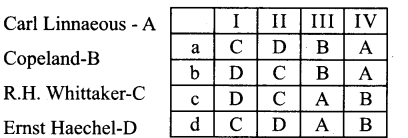
Samacheer Kalvi 11th Bio Botany Chapter 1 Living World 1
Answer:
a. C-D-B-A

Question 2.
I. TMV Discovered by world
II. Bacterium word coined by
III. Father of Mycology
IV. Classification virus given by
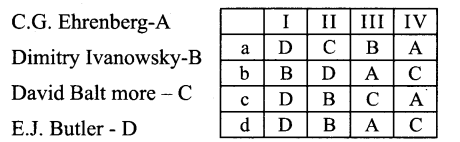
Samacheer Kalvi 11th Bio Botany Chapter 1 Living World 2
Answer:
b. B-D-A-C

Samacheer Kalvi 11th Bio Botany Chapter 1 Living World

Question 3.
I. Genophore
II. Bacteria
III. Extra Chromosomal DNA
IV. Fimbrial
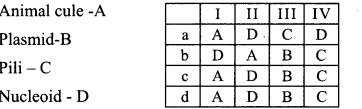
Samacheer Kalvi 11th Bio Botany Chapter 1 Living World 2
Answer:
b. D-A-B-C

Question 4.
I. Plasmid
II. Heterocyst
III. Glycocalyx
IV. Mesosome
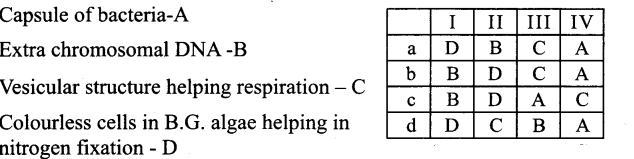
Samacheer Kalvi 11th Bio Botany Chapter 1 Living World 4
Answer:
c. B-A-D-C

Samacheer Kalvi 11th Bio Botany Chapter 1 Living World

III.

Question 1.
Which one of the following is a false statement regarding Prions
a. Prions were discovered by B. Prusiner in 1982
b. They are infectious particles of lipo protein
c. They cause about a dozen fatal degenerative disorders of CNS
d. Creutzfeldt-Jakob disease(cjD) and bovine spongiform encephalopathy (BSE) are some commonly known diseases
Answer:
b. They are infectious particles of lipoprotein

Question 2.
Which one of the following is a false statement regarding Ribosomes
a. Ribosomes are the sites of protein synthesis
b. The number of ribosomes per cell varies from 1000 to 1500.
c. The ribosomes are 70s type and consists of a 2 subunits (50s and 30s)
d. The nbosomes are held together by mRNA and form polyribosomes or polysomes.
Answer:
b. The number of ribosomes per cell varies from 1000 to 1500.

IV. Find out the True and False statements from the following and on that basis find the correct answer:

Question 1.
(i) Poly-B hydroxybutysate is a microbial plastic which is biodegradable
(ii) Transfer of DNA from one bacterium to another is known as transduction
(iii) Micrococcus must have oxygen to survive-known as an obligate aerobe
(iv) Spirulina is rich in carbohydrates so treated as an alternative food.
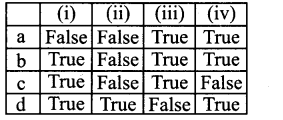
Samacheer Kalvi 11th Bio Botany Chapter 1 Living World 5
Answer:
c. True False True False

Samacheer Kalvi 11th Bio Botany Chapter 1 Living World

Question 2.
(i) Toad stools are known as an edible mushroom
(ii) Volvariella volvaceae and Agaricus bisporous are known for their high poisonous nature
(iii) Claviceps purpurea produces ergot-used as vasoconstrictor
(iv) Aspergillus flavus infest dried foods and produce carcinogenic toxin called -aflatoxin
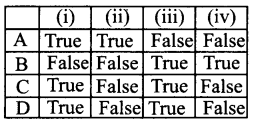
Samacheer Kalvi 11th Bio Botany Chapter 1 Living World 6
Answer:
B. False False True True

Question 3.
Which one of the following is a correct statement regarding TMV
a. David Baltimore in 1971 discovered TMV
b.First visible symptom of TMV is visible discoloration of leaves along the veins-but with typical yellow and green symptom molting-(mosaic symptom)
c. The plant grow abnormally at the nodal point
d. Infection spread by house flies and mosquitoes
Answer:
b. First visible symptom of TMV is discoloration of leaves along with the veins-but visible with typical yellow and green symptom molting-(mosaic symptom)

Samacheer Kalvi 11th Bio Botany Chapter 1 Living World

V.

Question 1.
Which one of the following is a correct statement regarding bacterial antibiotic
a. Chloromycetin got from Streptomyces venezuelae cure T.B
b. Bactracin is got from bacillus mycoides- used to treat UTI
c. Aurecomycin got from Streptomyces aureofaciens is used to treat whooping cough and eye infections
d. Streptomycin got from Streptmyces griseus cure typhoid fever
Answer:
c. Aurecomycin got from streptomyces aureofaciens is used to treat whooping cough and eye infections

Samacheer Kalvi 11th Bio Botany Chapter 1 Living World

Question 2.
Which one of the following is a correct statement regarding mycoplasma
a.  Mycoplasm are very small (0.1-0.5mm) pleomorphic gram negative micro organisms
b.  The have whole body appear like boiled egg-like structure in culture
c.  Little leaf of tomato Witches broom of solanum.
d.  Mycoplasma is also known as mollicutes
Answer:
Mycoplasm arevery small (0.1- 0.5mm) pleomorphic gram negative micro organisms

VI.

Question 1.
Sac fungi & club fungi are common names of
a.  Ascomycetes
b.  Basidiomycetes
c.  Deuteromycetes
d.  Phycomycetes
(i) a & b
(ii) b & c
(iii) a & c
(iv) c & d
Answer:
(i) a & b

Question 2.
Recurrence of fungal skin disease is due to
a. Resistance to antibiotics
b. Dormant spores become active at the onset of favourable condition
c. Non-availability of specific drugs.
d. Moisture favor fungal mycelium to spread,
(i) a & C
(ii) b & c
(iii) b & d
(iv) c & d
Answer:
(i) b & d

Samacheer Kalvi 11th Bio Botany Chapter 1 Living World

Question 3.
Find out the symbiotic associations from the given options.
a. Nitrogen fixing bacteria on the leguminous plants.
b. Rhizoids of Neprolepis
c. Lichens on rocks
d. Mycorrhizal roots.
(I) ac & d
(II) ab & c
(III) ab & d
(IV) a & b
Answer:

VII. Find out the wrong statement

Question 1.
Which one of the following is a wrong statement regarding ehemo lithotrophs
a. Sulphur bacteria
b. Iron bacteria
c. Methane bacteria
d. Hydrogen bacteria
Answer:
c. Methane bacteria

Question 2.
Among the following, which one is not viral?
a. Cucumber mosaic
b. Citrus canker
c. Rice tungro
d. Potato leaf roll
Answer:
b. Citrus canker

Samacheer Kalvi 11th Bio Botany Chapter 1 Living World

Question 3.
Which one of the following is not a Ribovirus?
a. Tobacco mosaic virus
b. Cauliflower mosaic virus
c. Human immune deficiency virus.
d. Wound tumour virus d. Pilobolus
Answer:
d. Wound tumour virus

Question 4.
Find out from the given, which one is not a Zygomycetes fungi.
a. Mucor
b. Rhizopus
c. Yeast
d. Pilobolus
Answer:
c. yeast

VIII. Read the following Assertion A and Reason R. Find the correct Answer

Question 1.
Assertion ‘A’: Viruses have genetic material but cannot divided on its own. They also don’t have in built metabolic machinery Reason ‘R’: Virus kept between living and non living
(a) A & R correct. R is explaining A
(b) A & R correct R is not explaining A
(c) A is true but R is wrong
(d) A is true but R is not explaining A
Answer:
a. A & R correct R is explaining A.

Question 2.
Assertion ‘A : Some bacteria have the capacity to retain gramstain after treatment with acid alcohol.
Reason ‘R’: Known as gram +ve as attracted towards positive pole under the influence of electric current.
Answer:
c. A is true but R is wrong.

Samacheer Kalvi 11th Bio Botany Chapter 1 Living World

Question 3.
Assertion’A’: Aflatoxin produced by Aspergillus flavus.
Reason ’R’: These toxin are useful to mankind to cure few disease
Answer:
c. A is true but R is wrong

Question 4.
Assertion ’A’: In septal mycelium the septa complete the partition walls between cells Reason
‘R’: There is no cytoplasmic connection between adjacent cells.
Answer:
d. A is true but R is not explaining A.

I. Additional 2 Marks

Question 1.
Define Growth.
Answer:
Growth is an intrinsic property of all living organisms through which they can increase cells both in number and mass.

Question 2.
Tabulate Milestones in Virology
Answer:

Year

Name of the Scientist

Achievement

1796Edward JennerVaccination for smallpox
1886Adolf MayerProved infectious nature of- TMV- from mosaic leaves sap
1892Dimitry IvanowskyViruses are smaller than bacteria

Question 3.
Draw the structure of TMV and label the parts and explain in a word or two
Answer:
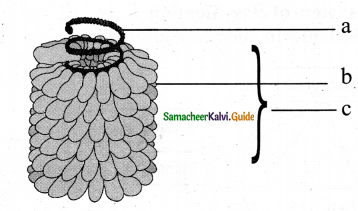
Samacheer Kalvi 11th Bio Botany Chapter 1 Living World 7
Answer:
a. Nucleic acid – It is ss RNA(Single Standed)
b. Capsomere – Protein Units
c. Capsid – Protein Coat.

Samacheer Kalvi 11th Bio Botany Chapter 1 Living World

Question 4.
Define reproduction and Mention its types.
Answer:
Reproduction is the tendency of a living organism to perpetuate its own species. There are two types of reproduction namely asexual and sexual.

Question 5.
Bacteria is a indeed friend- discuss
Answer:
Even though Bacteria cause many diseases to plants animals and human beings they are beneficial to day-to-day life also. Ex: Milk (lactobacillus acidophobus)/(lactobaci llus lacti)
a. Curd b. Butter c. Cheese d. Yogurt These are a few of the beneficial activities.

Question 6.
Draw the ultra structure of bacterial cell.
Answer:
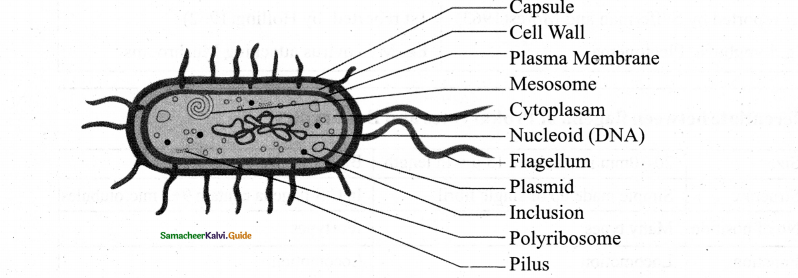
Samacheer Kalvi 11th Bio Botany Chapter 1 Living World 8

Question 7.
Name the four types of ascocarps produced by ascomycetes.
Answer:
Four Types Of Ascocarps Produced By Ascomycetes:

  1. Cleistothecium
  2. Perithecium
  3. Apothecium and
  4. Pseudothecium.

Question 8.
Why is it essential to do classification?
Answer:

  • To relate on the basis of common features
  • To define, on the basis of salient features
  • To know the relationship among different groups.
  • To understand evolutionary relationship.

Samacheer Kalvi 11th Bio Botany Chapter 1 Living World

Question 9.
Ruggerio etal’s recent classification-Explain.
Answer:

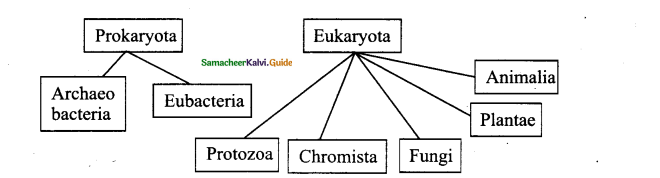
  • Ruggerio etal in 2015-published-7-kingdom system of classification
  • It is an extension of Cavalier’s 6 – Kingdom Scheme’Include 2 superkingdom
    Samacheer Kalvi 11th Bio Botany Chapter 1 Living World 9

Question 10.
What is Prophage?
Answer:
a. In the lysogenic cycle, the injected phage DNA become circular and integrates into bacterial chromosome by recombination.
b. The integrated DNA of phage and bacteria is known as Prophase.

Samacheer Kalvi 11th Bio Botany Chapter 1 Living World

Question 11.
Distinguish between Cyanophage and Mycophage
Answer:

CyanophageMycophage
1Vims infecting blue green Algae are known as
Cyanophage
Vims allacking fungi are called Mycovimses or
Mycophage
21st reported by Safferman and Mores(1963)1st reported by Holling(1962)
3Eg. Lyngbuya, PlectonemaEg. Myc ovims attacking Mushrooms

Question 12.
Differentiate between flagella of Prokaryotes and Eukaryotes
Answer:

1Size20-30mm in diameter 15 pm in lengthBigger in size
2StructureSimple made up of single fibrilIn C.S flagella contain 9+2 microtubules
3No of positionMany typesfew types
4FunctionLocomotionLocomotion

Question 13.
Differentiate between Photolithotrophs and Photo organotrophs
Answer:

Photolithotrophs

Photo organotrophs

1 .Hydrogen donor is an in organic substance 2 types – Green sulphur bacteria Hydrogen donor H2S Posses bacterioviridin.
E.g chlorobium Purple sulphur bacteria
Here hydrogen donor is thiosulphate
pigment bacterial chlorophyll in chlorosomes
E.g chromatium
2. The hydrogen donor is an organic acid or alcohol
e.g purple non sulphur bacteria Rhodospirillum
E.g

  • Purple non sulphur bacteria
  • Rhodospirillum

Question 14.
If you think endospore formation not a reproduction method then justify you answer
Answer:
Yes Endospores are formed not during reproduction, but during unfavorable season the thick walled endospores are resting spores when favorable condition comes, they germinate and form bacteria.

Samacheer Kalvi 11th Bio Botany Chapter 1 Living World

Question 15.
What are the 3 different methods by which gene recombination occur in bacteria ? Or write about Sexual reproduction in bacteria?
Answer:
Sexual reproduction is so simple formation and fusion of gametes is absent. However by  Three different methods gene recombination can occur

  1. Conjugation
  2. Transduction
  3. Transformation

2 Marks

Question 16.
Define chemolithotrophs – give examples
Answer:

  • The type of bacteria oxidise in organic compound to release energy
  • Eg Sulphur bacteria – Thiobacillus thio oxidants
  • Iron bacteria – Ferrobacillus ferro oxidants
  • Hydrogen bacteria – Hydrogenomonas

Question 17.
Label the given diagram properly
Answer:
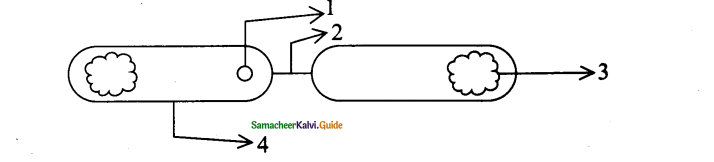
Samacheer Kalvi 11th Bio Botany Chapter 1 Living World 10
Answer:
1. F- plasmid
2. Conjugation pilus
3. Chromosome
4. F+ cell

Question 18.
Write any 2 vitamin yielding bacteria
Answer:

Escherichia coliLive in human intestine produce large quantities of vitamin K&B – complex
ClostrdiumacctobutylieumVitamin B2 is prepared by the fermentation of sugar

Question 19.
Name any 2 bacteria diseases affecting Potato
Answer:

Name of diseaseCausative organism
1. Ringrot_____________Clavi bacter michiganensis sub sp sepedonicus
2. Scab_____________Streptomyees scabies

Question 20.
What is meant by Probiotics
Answer:

  • Microorganism such as lactobacillus bifidobacterium when consume as a dietary supplement help to maintain or restores beneficial bacteria to the digestive tract. They are called friendly or good bacteria. They keep our gut healthy
  • They help to increase the immunity of the body
  • Eg: Probiotic Yoghurt
  • Probiotie tooth paste.

Question 21.
What is the meant by Ray fungi? Give example
Answer:

  • Actinomycetes are called as ray fungi due to their mycelia like growth
  • They are anaerobic or facultative anaerobic
  • They are gram + ve
  • Don’t produce aerial mycelium
  • DNA contain high guanine and cytosine content Eg strepotmyces

Samacheer Kalvi 11th Bio Botany Chapter 1 Living World

Question 22.
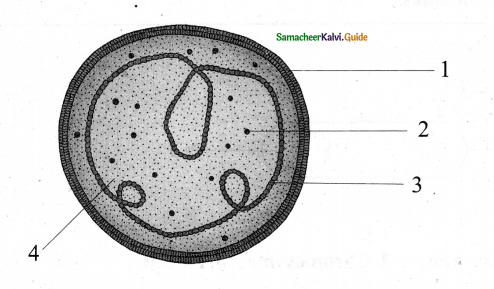
What is this structure?
Answer:
The figure is the structure of mycoplasma
Samacheer Kalvi 11th Bio Botany Chapter 1 Living World 11
Answer:
1. Cell membrane
2. Ribosome
3. DNA strain
4. Cytoplasm

Question 23.
Name few Renowed mycologists?
Answer:
A. Arthur H.R. Buller, John Webster D.L. Hawksworth, G.C Ainsworth
B. B mundkur, K.C. Meta, C.V. Subramanian and T.S. Sadasivam & Father of Indian Mycology -E.J. Butler-

Question 24.
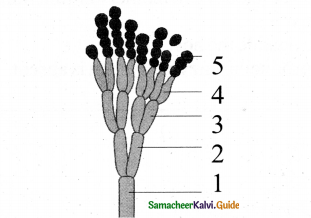
Identify the diagram and label any three parts.
Answer:
Samacheer Kalvi 11th Bio Botany Chapter 1 Living World 12
Conidia formation-Penicillium

  1. Conidiophores
  2. Ramus
  3. Metula
  4. Sterigma
  5. Conidium or Conidiospore

Samacheer Kalvi 11th Bio Botany Chapter 1 Living World

Question 25.
Define Homeostasis. Why it is essential?
Answer:
Property of self-regulation and tendency to maintain a steady-state within an external environment which is liable to change is called homeostasis. It is essential for the living organism to maintain internal conditions to survive in the environment.

Question 26.
Name 4 fungi, from which we derive organic acids.
Answer:

  1. Citric acid& Gluconic acid – Aspergillus niger
  2. Itaconicacid – Aspergillus terreus
  3. Kojicacid – Aspergillus oryzae

Samacheer Kalvi 11th Bio Botany Chapter 1 Living World

Question 27.
Name 4 common basidiomycetes
Answer:

  1. Puffballs,
  2. Toadstools,
  3. Birds nest’s fungi,
  4. Bracket fungi,
  5. Smuts
  6. Rusts,
  7. Smuts.

Question 28.
Define aflatoxin.
Answer:
Aspergillus, Polyporus, Mucor and Penicillium are involved in spoilage of food material Aspergillus flavus infest dried food & produce caranogenic toxin known as aflatoxin.

Question 29.
Name 3 Dermatophytes
Answer:

  1. Trichophyton
  2. Tinea
  3. Microsporum
  4. Epidermophyton are some fungi causing skin problems

3 Marks Additional Questions

Question 1.
State the living and Non-living character of the Virus.
Answer:
(i) Living characters:

  • Presence of nucleic acid & protein
  • Capable of mutation
  • Ability to multiply with living cells
  • Able to infect and cause diseases
  • Show irritability and host-specific.

(ii) Non-living characters:

  • Can be crystallized
  • Don’t have metabolic machinery or functional autonomy
  • In active outside the host
  • Energy producing enzyme system is absent

Question 2.
Draw the ultra structure of bacterial cell. Image Parts:
Answer:
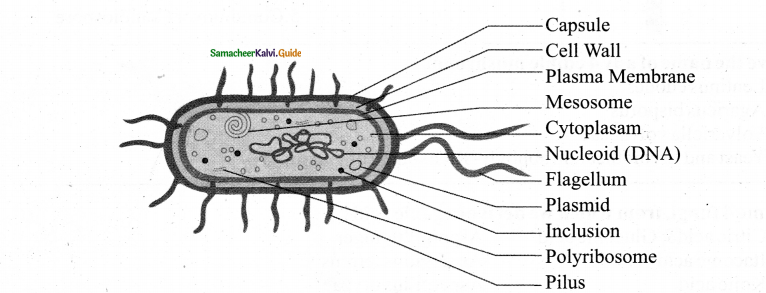
Samacheer Kalvi 11th Bio Botany Chapter 1 Living World 13
Question 3.
What are the economic importance of Cyanophyceae
Answer:

SNO

NAME OF THE ORGANISM

ECONOMIC IMPORTANCE

1Microcystis aeruginosa anabaeria Anabaena Flos aquaeWaterbloom-release toxins-affect aqualic organisms
2Nostoc, AnabaenaFix atmospheric nitrogen(bio fertilizer)
3SpirulinaUsed to prepare SCP

Question 4.
Explain any 3 asexual method of reproduction in fungi
Answer:

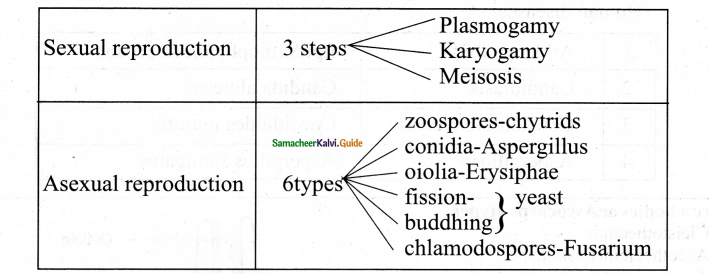
1.ZoosporesFlagellate structures-produced zoosporangia e.g. chytrids
2.ConidiaSpores produced on conidiosphores e.g. penicillillium, Aspergillus
3.BuddingA small out growth of parental cell, gets detached E.g. Saccharomyces.

Samacheer Kalvi 11th Bio Botany Chapter 1 Living World

Question 5.
Tabulate animal diseases caused by bacteria
Answer:

S.NOName of the animalName of the diseasesName of the pathogen
1.SheepAnthraxBacillus anthracis
2.CattleBrucellosisBacillus abortus
3.CattleBovine TuberculosisMycobacterium bovis
4.CattleBlack legClostridium chanvei

Question 6.
Distinguish between Ammonification & Nitrification.
Answer:

AmmonificationNitrification
1. Convert protein of dead plant animal bodies

Ammonia

Ammonium salt
After Ammonification the ammonium salts converted into Nitrites & nitrates
2. The bacteria bringing forth this conversion is known as  Ammonifying Bacteria. This conversion of Ammonia into nitrites & nitrates is known as Nitrification.

Question 7.
By drawing diagrams, classify bacteria on the basis of flagellatin
Answer:
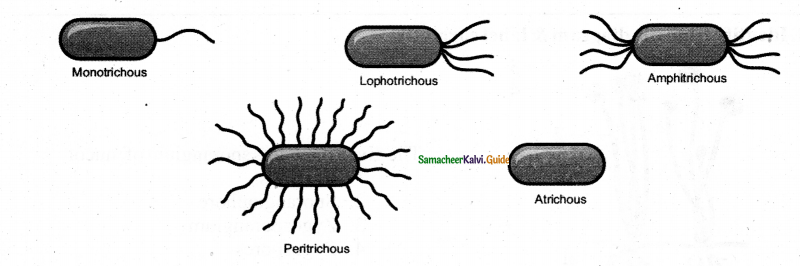
Samacheer Kalvi 11th Bio Botany Chapter 1 Living World 14

Question 8.
What are the prominent symptoms of TMV-affected tobacco plants?
Answer:
The first visible symptom of TMV is discoloration of leaf colour along the veins and show typical yellow and green mottling which is the mosaic symptom. The downward curling and distortion of young apical leaves occurs, plant becomes stunted and yield is affected.

Samacheer Kalvi 11th Bio Botany Chapter 1 Living World

Question 9.
Define Transduction and explain
Answer:
The three types of Transduction

  1. Phage mediated DNAtransfer is Transduction
  2. Zinder and Lederberg (1952) discovered it in Salmonella typhimurum
  3. 2 types – Generalised and Specalised

I. Generalised Transduction:
a. Ability of bacteriophage to carry the genetic material of any region of bacteria DNA is called generalized transduction.

II. Specialised Transduction:
a. Ability of bacteriophage to carry only a specific region of the bacterial DNA is called Specialized or Restricted Transduction.

Question 10.
Identify from the diagram – & table correctly
Answer:
The given diagram is Basidiocarp of Agaricus
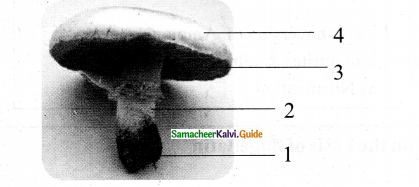
Samacheer Kalvi 11th Bio Botany Chapter 1 Living World 15
Answer:
1. Rhizoids
2. Stipe
3. Pileus
4. Gills

Question 11.
Identify from the diagram & label correctly.
Answer:
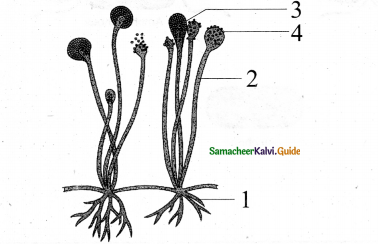
Samacheer Kalvi 11th Bio Botany Chapter 1 Living World 16
The given diagrams sporangium of mucor
1. Rhizoids
2. Sporangiophore
3. Zygosporangium
4. Zygospores

Samacheer Kalvi 11th Bio Botany Chapter 1 Living World

Question 12.
Define biopesticides and give 2 examples from fungi.
Answer:

  1. The substances derived from microbes and plants can be used to kill or eradicate pests weeds and diseases causing germs of crops.
  2. This is known Bio-pesticide. They are ecofriendly, non hazardous, non phytotoxic, e.g. Beauveria bassiana Metarhizium anisopliae

Question 13.
Write down any 4 uses of Mycorrhiza.
Answer:

  • Nutrition – Saprophytic Angiosperm cant prepare food-due to absence of green leaves & it get nutrition via mycorrhiza e.g. Monotropa
  • Availability of water and minerals: improve availability of water & minerals
  • Protection-help plant to resist drought & attack of plant pathogen

Question 14.
Progametangium is formed at the tip.
Answer:
The fusion occurs & Zygosporangium is formed then undergo meiosis & zygospores These zygospores germinate are formed, during favourable condition into fungal hyphae.
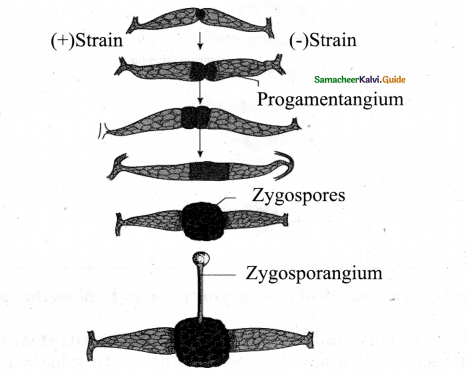
Samacheer Kalvi 11th Bio Botany Chapter 1 Living World 17

Question 15.
Explain briefly the characteristics of Oomycetes
Answer:

Mycelium
Cell wall
Asexual reproduction
Sexual reproduction
Branched & Coenocytic
(multinucleate made up of Glucan & Cellulose)
Heterokont with one whiplash & one tinsel flagellum Oogamous-in nature E.g. Albugo

Samacheer Kalvi 11th Bio Botany Chapter 1 Living World

Question 16.
Explain briefly the characteristics of zygomycetes
Answer:

  • Nutrition cell wall
  • Cellwall
  •  Mycelium
  • Asexual reproduction
  • Sexual reproduction
Mostly saprophytic
Chitin & Cellulose
Branched & Coenocylic
Zygospore produced in Zygosporangia
fusion of gametangia result in zygospores

Question 17.
Planogametic copulation in fungi has 3 types Explain.
Answer:
Planogametic copulation means fusion of motile gametes it has 3 types

  1. Isogamy
  2. Anisogamy
  3. Oogamy
    Isogamy — Morphologically smilar gametes Anisogamy Morphologically dissimilar gametes
    Oogamy – But in Oogamy it is highly advanced anisogamy

Question 18.
Explain gametangial copulation in Rhizopus with the help of diagrams.
Answer:

  • In rhizopus & in Mucor there occur heterothallism- there are 2 strains of the hyphae.
  • In a sexual copulation only the 2 opposite strains +ve and -ve strains come together.
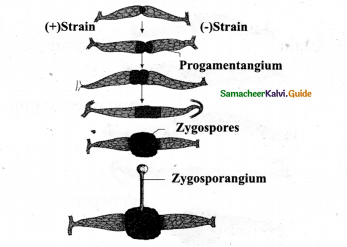
    Samacheer Kalvi 11th Bio Botany Chapter 1 Living World 18

Question 19.
The tea or tobacco is not a result of mere drying process. Explain the value addition in these things?
Answer:
Yes tea & tobacco they are not mere dried leaves of Camellia sinensis (tea) & Nicotiana tobaccum so tea and tobacco to reach the utility stage, they have to be subjected to biological process known as curing, where specific bacteria are added & curing occur by a process of fermentation specific flavor and aroma of tea and tobacco are due to this fermentation process.

Tea – Mycococcus candisans
Tobacco – Bacillus megatherium

Samacheer Kalvi 11th Bio Botany Chapter 1 Living World

Question 20.
Write about the harmful activities of fungi.
Answer:

Amanita phalloides
Amanita yema
Boletus satanus
known as toad stools
Poisonous – toxins are produced
Aspergillus
Rhizopus
Mucor
Penicillum
Cause food spoilage
Aspergillus flavusinfest dried foods produce carcinogenic toxin called aflatoxin
Patutin ochratoxin A arc other toxins produced by fungi
DiseasesVarious diseases are caused to plants animals & human beings.

Question 21.
Mycorrhiza is known as bio fertilizer. Explain
Answer:

  • Symbolic association between fungal mycelium and roots of higher plants is known as mycorrhiza.
  • Fungi absorbs nutrition from root of higher plant, and intum fungal hyphae helps the paint to absorb water and minerals nutrients from soil.
  • Any nutrient of biological orgin is biofertilizer & This is Bio fertilizer it is non hazardous, Non phytotoxic and ecofriendly.

Question 22.
Name the Antibiotics derived from fungi.
Answer:

OrganismAntibioticsUses
Penicillium notatumPenicillinTo treat Pneumonia and throat infections
Penicillium griseofulvumGrisofulvinTo treat ring worm athletes foot & fungal infections of scalp.
Acremorium chrysogenumCephatosporinTo treat respiratory tract infections skin infections & UTI (urinary tract infections)
Claviceps purpureaErgotamineTo treat migraine head aches induce uterus contraction at the time of child birth.

5 Marks

Question 1.
Compare the five-kingdom system of classification
Answer:
Kingdom
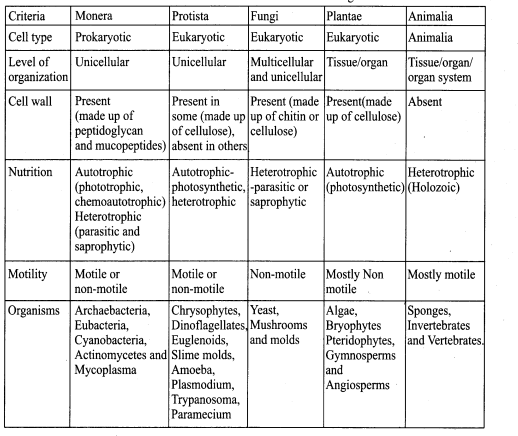
Samacheer Kalvi 11th Bio Botany Chapter 1 Living World 28

Samacheer Kalvi 11th Bio Botany Chapter 1 Living World

Question 2.
Ultrastructure of a typical bacterial cell.
Answer:
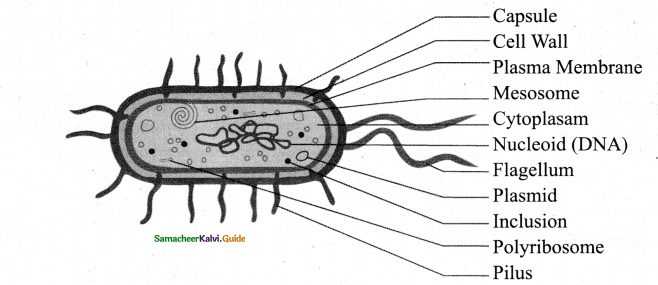
Samacheer Kalvi 11th Bio Botany Chapter 1 Living World 19

Question 3.
Explain industrial uses of bacteria.
Answer:
Industrial Uses
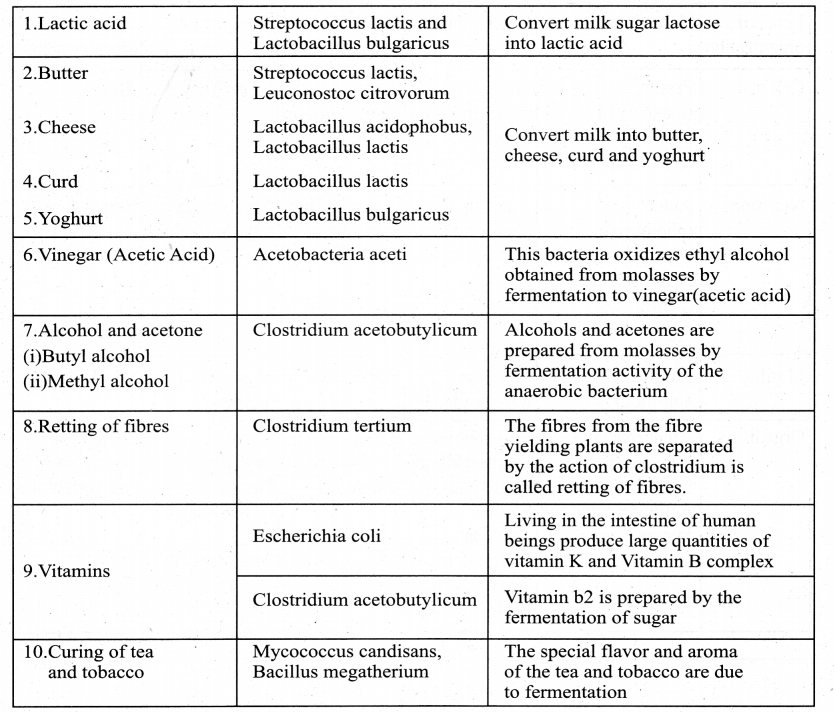
Samacheer Kalvi 11th Bio Botany Chapter 1 Living World 29

Question 4.
List out bacterial diseases caused to plants, animals & human brings.
Answer:
Plant diseases caused by bacteria

SNo

Name of the hostName of the disease

Name of the pathogen

1RiceBacterial blightXanthomonas oryzae
2AppleFire blightErwinia amylovora
3CarrotSoft rotErwinia caratovora
4CitrusCitrus cankerXanthomonas citri
5CottonAngular leaf spotXanthomonas malvacearum
6PotatoRing rotClavibacter michiganesis subsp sepdonicus
7PotatoscabSterptomyces scabies

Animal diseases caused by bacteria

S.No

Name of the animalName of the diseases

Name of the pathogen

1SheepanthraxBacillus anthracis
2CattlebrucellosisBrucella abortus
3CattleBovine tuberculosisMycobacterium bovis
4CattleBlack legClostridium chanvei

Human diseases caused by bacteria

S.NO

Name of the disease

Name of the pathogen

1.CholeraVibrio cholerae
2.TyphoidSalmonella typhi
3.TuberculosisMycobacterium tuberculosis
4.LeprosyMycobacterium leprae
5.PneumoniaDiplococcus pneumonie
6.PlagueYersinia pestis
7.DiphtheriaCorynebacterium diptheriae
8.TetanusClostridium tetani
9.Food poisoningClostridium botulinum
10.SyphilisTreponema pallidum

Samacheer Kalvi 11th Bio Botany Chapter 1 Living World

Question 5.
Tabulate the salient features of Cyanophyceae?
Answer:

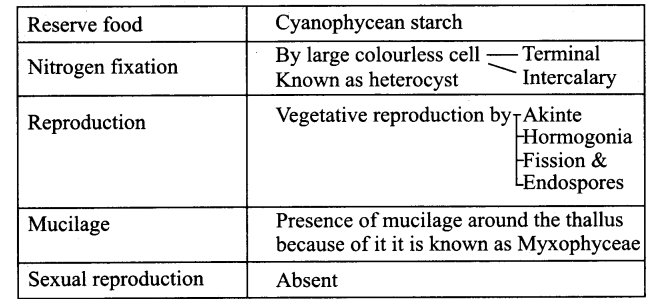
ThallusUnicellular- Eg. Chroococcus
Colonial- Eg. Gleocapsa
Filamentous trichome- Eg. Nostoc
MovementGliding movement – Eg. Oscillatoria
ProtoplasmCentral – centroplasm
Peripheral – chromoplast
Photosynthetic pigmentsc. phyco cyanin &
c. phyco erythrin
Myxo xanthum
Myxo xanthophyll

Samacheer Kalvi 11th Bio Botany Chapter 1 Living World 20

Question 6.
Give an account of Mycoplasma as Mollicutes.
Answer:

  • Small-(0.1-0.5gm)
  • Pieomorphic- gram-negative
  • 1 st isolation by Nocard & co in 1898-from pleural fluid of cattle affected with bovine pleuropneumonia.
  • Cell wall-absent
  • In culture appear as fried egg.
  • DNA contains low guanine and cytosine than true bacteria
  • Cause disease in Animals / Plants
  • Little leaf of brinjal – Witches broom of legumes Phyllody of cloves Sandal spike, -plant diseases
  • Pleuropneumonia – animal disease caused by Mycoplasma mycoide.

Samacheer Kalvi 11th Bio Botany Chapter 1 Living World

Question 7.
Differentiate between Gram-positive and Gram-Negative bacteria.
Answer:
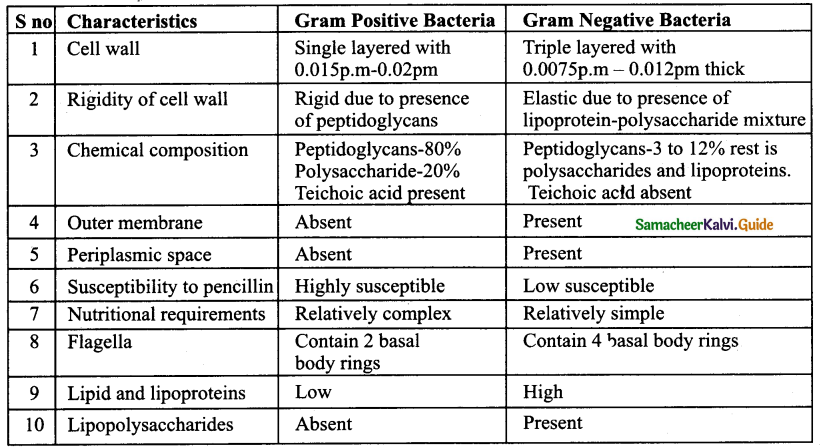
Samacheer Kalvi 11th Bio Botany Chapter 1 Living World 30

Question 8.
Explain transformation in bacteria.
Answer:
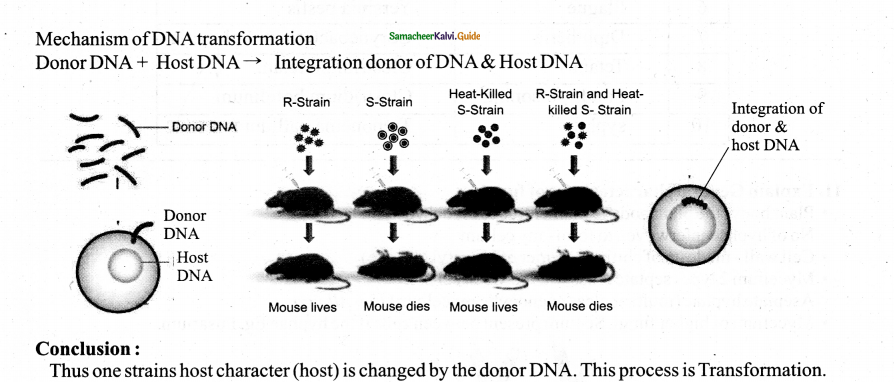
Definition: Transfer of DNA from one bacteria to another is called transformation.

  • 1928 Frederick Griffth demonstrated it in mice using Diplococcus pneumonia.
  • 2 strains
    • Smooth colonies – virulent type (S)
    • Rough colonies – Avirulent type (R)
  • S type injected – mouse died because it is virulent
  • R type injected – mouse lived because R type is Avirulent
  • Heat killed S type injected-mouse lived
  • Heat killed S type + R type called when injected mixedly} mouse died

Samacheer Kalvi 11th Bio Botany Chapter 1 Living World 21
Samacheer Kalvi 11th Bio Botany Chapter 1 Living World 22


Question 9.
Classify the nitrogen-fixing biological systems.
Answer:
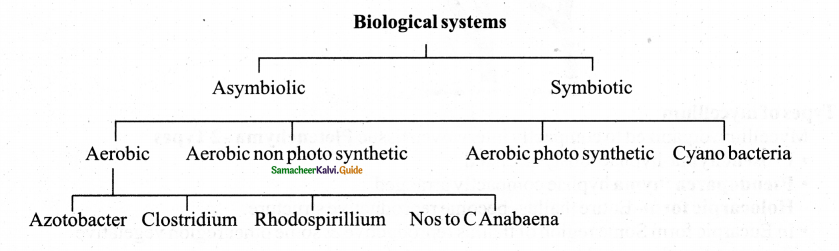
Samacheer Kalvi 11th Bio Botany Chapter 1 Living World 23
I. Symbiolic Angiosperm:
Leguminous Rhizobium root nodules of Ground nut Peas etc. (soil bacterium) Non-Leguminous (Alnus casuarinas) Frankia actinomycetes (root nodules)
II. Symbiolic gymnosperm Cycas unidentified spices of Blule green algae (corolloid roots)
III. Symbiotic ferns Azolla- Anbaena azollae – leaf pockets
IV. Symbiotic (fungi & Algae) Lichen (phycobiont mycobiont mutually benefited).

Samacheer Kalvi 11th Bio Botany Chapter 1 Living World

Question 10.
Tabulate the human disease caused by bacteria.
Answer:
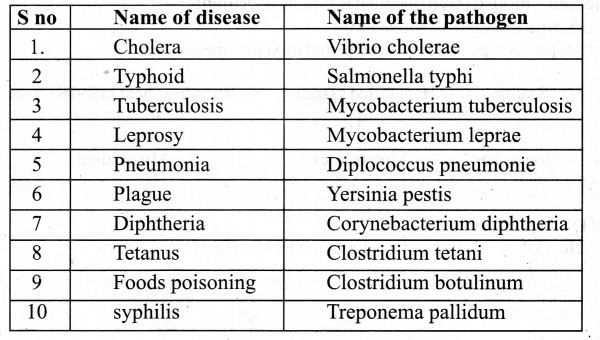
Samacheer Kalvi 11th Bio Botany Chapter 1 Living World 31

Question 11.
Explain General characteristics of fungi
Answer:

  • Plant body- the plant body is filamentous & branched hyphae No of hyphae interwoven to form – my celium
  • Cell wall – made up of chitin (polymer of N acetyl glucose)
  • Mycelium 2 types septate cross wall between cells Aseptate hyphae (multi nucleus coenocytic mycelium) E.g Albugo
  • Mycelium of higher fungi. Septum present between cells if the hyphae Eg. Fusarium.
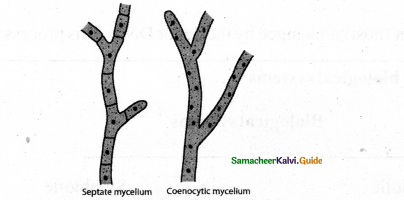
    Samacheer Kalvi 11th Bio Botany Chapter 1 Living World 24

Types of mycelium
Mycelium organized to compactly interwoven tissue Pletenchyma – 2 Types

  • Prosenchyma-hyphae loosely arranged
  • Pseudoparenchyma hyphae compactly arranged Holocarpic form- Entire thallus- become reproductive structure.
  • In Eucarpic form Some region of thallus reproductive & some other region vegetative Reproduction there are 3 types
    • Anamorph-Asexual
    • Teleomorph -Sexual
    • Holomorph-both sexual & Asexual.

Samacheer Kalvi 11th Bio Botany Chapter 1 Living World 25

Question 12.
Tabulate various types of Mycorrhizae
Answer:
Mycorrhizae – 3 Types

Ectotropic mycorrhizae

Endotropicmycorrhizae

Ectrndotrophicmycorrhizae

The fungal mycelium forms a dense sheath around the root called mantle. The hypha network penetrate the intercellular spaces of the epidermis, and cortex to form Hartignet. Example pisolithus tinctorius.The hyphae grows mainly inside the roots, penetrate the outer cortical cells of the plant root. A small portion of the mycelium is found outside the root. This form is also called Vesicular Arbuscular Mycorrhizal fungi (VAM fungi) due to the presence of vesicle or arbuscle like haustoria.

1. Arbuscular mycorrhizae(VAM)- Example Gigaspora
2. Ericoid mycorrhizae- Example liriodendron
3. Orchid mycorrhizae- Example Rhizoctonia

The fungi form both mantle and also penetrates the cortical cells.

Samacheer Kalvi 11th Bio Botany Chapter 1 Living World

Question 13.
List out diseases caused by fungi
Answer:
Diseases caused by fungi

S no

Name of the disease

Causative organism

                                               Plant diseases
1Blast of paddyMagnoporthegriesea
2Red rot of sugarcaneColletotrichum falcatum
3Anthracnose of beansColletotrichum lindemuthianum
4White rust of crucifersAlbugo Candida
5Peach leaf curlTaphrina deformans
6Rust of wheatPuccinia graminis tritici

Human diseases

1Athlete’s footEpidermophyton floccosum
2CandidiasisCandida albicans
3CoccidioidomycosisCoccidiosis immitis
4AspergillosisAspergillus fumigatus

Question 14.
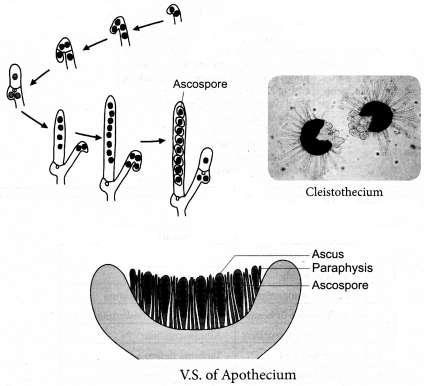
Fruit bodies or Ascocarps 4types
Answer:

  • Cleistothecium
  • Ascothecium(flask shape)
  • Apothecium(cup shape)
  • Psedothecium
    1. Image structure of cleistothecium
    2. Structure of PeritheciumV.S
    3. Structure of Apothecium
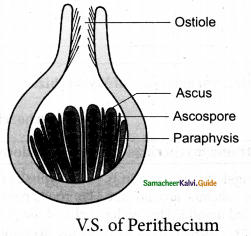
Samacheer Kalvi 11th Bio Botany Chapter 1 Living World 26
Samacheer Kalvi 11th Bio Botany Chapter 1 Living World 27

Question 15.
Give an account of Basidiomycetes (club fungi).
Answer:

Fungi includedPuffballs, toadstools, bird nest’s fungi. Bracket fungi- stinkhorns, rusts smuts etc.
HabitatMostly terrestrial Saprophytic Parasitic mode of life
MyceliumWell-developed, septate with a bracket like 3 types Monokaryotic mycelium Dikaryotic mycelium (Primary & Secondary) Tertiary mycelium
Sexual reproduction steps Plasmogamy Karyogamy &MeiosisOccur – but sex organs absent Somatogamy or – Spermatisation result in Plasmogamy Karyogamy delayed & dikaryotic phase is prolonged followed by meiosis
image4 nuclei become basidiospores bom on sterigmata -(exogenous) Club-shaped basidium bear basidiospores so-known as club fungi.

Samacheer Kalvi 11th Bio Botany Chapter 1 Living World

Samacheer Kalvi 12th Physics Guide Chapter 10 Communication Systems

Tamilnadu State Board New Syllabus Samacheer Kalvi 12th Physics Guide Pdf Chapter 10 Communication Systems Text Book Back Questions and Answers, Notes.

Tamilnadu Samacheer Kalvi 12th Physics Solutions Chapter 10 Communication Systems

12th Physics Guide Communication Systems Text Book Back Questions and Answers

Part – I:

Textbook Evaluation:

I. Multiple Choice questions:

Question 1.
The output transducer of the communication system converts the radio signal into
a) Sound
b) Mechanical energy
c) Kinetic energy
d) None of the above
Answer:
a) Sound

Question 2.
The signal is affected by noise in a communication system
a) At the transmitter
b) At the modulator
c) In the channel
d) At the receiver
Answer:
c) In the channel

Question 3.
The variation of frequency of carrier wave with respect to the amplitude of the modulating signal is called
a) Amplitude modulation
b) Frequency modulation
c) Phase modulation
d) Pulse width modulation
Answer:
b) Frequency modulation

Question 4.
The interntionally accepted frequency deviation for the purpose of FM broadcasts.
a) 75 kHz
b) 68 kHz
c) 80 kHz
d) 70 kHz
Answer:
a) 75 kHz

Question 5.
The frequency range of 3 MHz to 30 MHz is used for
a) Ground wave propagation
b) Space wave propagation
c) Sky wave propagation
d) Satellite communication
Answer:
c) Sky wave propagation

Samacheer Kalvi 12th Physics Guide Chapter 10 Communication Systems

II. Short Answers Questions:

Question 1.
Give the factors that are responsible for transmission impairments.
Answer:
Attenuation:
The strength of signal decreases with increasing distance which causes loss of energy.
Distortion:
Change in the shape of the signal
Noise:
Random or unwanted signal mixes up with the original sound.

Question 2.
Distinguish between wireline and wireless communication? Specify the range of electromagnetic waves in which it is used.
Answer:

Wireline CommunicationWireless Communication
It uses wires, cables and optical fibres as a mediumIt uses free space as a medium
It cannot be used for long distance transmissionIt can be used for long distance transmission
Ex. Telephone, intercom and cable TVEx. Mobile, radio or TV broadcasting and satellite communication

Question 3.
Explain centre frequency or resting frequency in frequency modulation.
Answer:
When the frequency of the baseband signal is zero (no input signal), there is no change in the frequency of the carrier wave. It is at its normal frequency and is called center frequency or resting frequency.

Question 4.
What does RADAR stand for?
Answer:

  • RADAR stands for Radio Detection and Ranging
  • It is used to sense, detect and locate distant objects like aircraft, ships, spacecraft, etc.

Question 5.
What do you mean by the Internet of Things?
Answer:
Internet of Things (IoT), it is made possible to control various devices from a single device. Example: home automation using a mobile phone.

Samacheer Kalvi 12th Physics Guide Chapter 10 Communication Systems

III. Long Answers Questions:

Question 1.
What is modulation? Explain the types of modulation with necessary diagrams.
Answer:
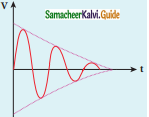
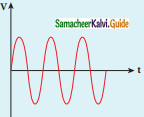
Modulation:
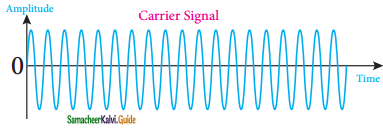
For long-distance transmission, the low-frequency baseband signal (input signal) is superimposed onto a high-frequency radio signal by a process called modulation.

i) Amplitude modulation:
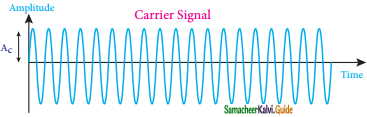
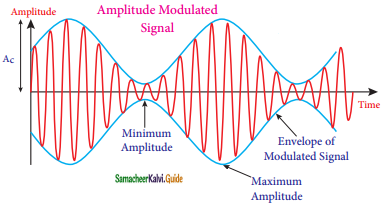
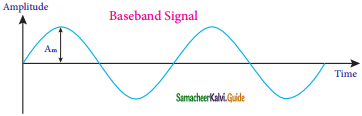
1. If the amplitude of the carrier signal is modified according to the instantaneous amplitude of the baseband signal.
2. The frequency and the phase of the carrier signal remains constant.
3. It is used in radio and TV broadcasting.
Samacheer Kalvi 12th Physics Guide Chapter 10 Communication Systems 1

Samacheer Kalvi 12th Physics Guide Chapter 10 Communication Systems 2

Samacheer Kalvi 12th Physics Guide Chapter 10 Communication Systems 3

Advantages of AM:
1. Easy transmission and reception
2. Lesser bandwith
3. Low cost

Disadvantages of AM:
1. High noise level
2. Low efficiency
3. Small operating range

ii) Frequency modulation:
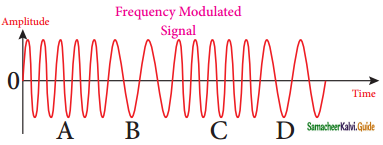
1. Frequency of the carrier signal is modified according to the instantaneous amplitude of the baseband signal.
2. The amplitude and the phase of the carrier signal remain constant.
3. Increase in the amplitude of the baseband signal increases the carrier signal frequency.
4. Louder signals form compressions and weaker signals form rarefactions.
5. When the frequency of the baseband signal is zero, there is no change in the frequency of the carrier wave. This is known as centre frequency or resting frequency.
Samacheer Kalvi 12th Physics Guide Chapter 10 Communication Systems 4

Samacheer Kalvi 12th Physics Guide Chapter 10 Communication Systems 5

Samacheer Kalvi 12th Physics Guide Chapter 10 Communication Systems 6

Advantages:
1. Decrease in noise
2. Efficiency is high
3. Operating range is quite large
4. Better quality

Disadvantages:
1. Requires wider channel
2. Less area is covered.
3. Transmitters and receivers are complex and costly.

Phase Modulation:
Samacheer Kalvi 12th Physics Guide Chapter 10 Communication Systems 7

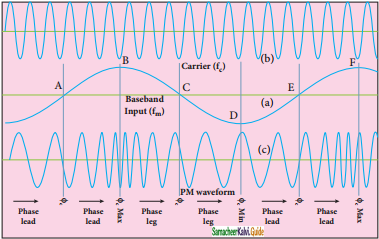
1. The instantaneous amplitude of the baseband signal modifies the phase of the carrier signal keeping the amplitude and frequency constant.
2. The frequency shift depends on

  • the amplitude of the modulating signal and
  • the frequency of the signal.

3. When the modulating signal goes positive, the amount of phase lead increases with the amplitude of the modulating signal.
4. The carrier signal is compressed or its frequency is increased.
5. The negative half cycle of the baseband signal produces lag in the carrier signal.
6. Phase modulated wave also comprises of compressions and rarefactions.
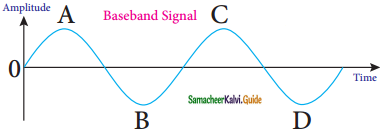
7. When the signal voltage is zero, (A, C and E) the carrier frequency is unchanged.

Advantages:
1. FM Signal produced from PM signal is very stable.
2. The center frequency called resting frequency is stable.

Samacheer Kalvi 12th Physics Guide Chapter 10 Communication Systems

Question 2.
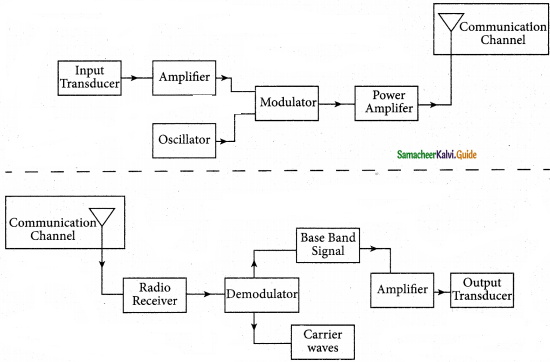
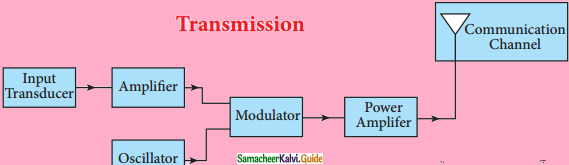
Elaborate on the basic elements of a communication system with the necessary block diagram.
Answer:
1. Information (Baseband or input signal):
i. Information can be in the form of a sound signal like speech, music, pictures or computer data.
ii. These can be given as input to the input transducer.

Samacheer Kalvi 12th Physics Guide Chapter 10 Communication Systems 10


2. Input transducer:
i. It converts variation in a physical quantity such as pressure, temperature, sound into equivalent electrical signals or vice versa.
ii. It converts the information into corresponding electrical signals.
iii. The electrical equivalent of the original information is called baseband signal.

3. Transmitter:
It is located at the broadcasting station.

a) Amplifier:
Very weak transducer output is amplified

b) Oscillator:
i. For long-distance, the high-frequency carrier wave is transmitted into space.
ii. Energy of the wave is proportional to its frequency, so the carrier wave has very high energy.

c) Modulator:
It superimposes the baseband signal onto the carrier signal and generates the modulated signal.

d) Power amplifier:
To cover a large distance, the power level of the electrical signal is increased.

4. Transmitting antenna:
i. It travels in the form of electromagnetic waves with the velocity of light
ii. Used for long-distance transmission
iii. Ex: Mobile, radio or TV broadcasting, satellite communication.

5. Communication channel:
To carry the electrical signal from transmitter to receiver with less noise or distortion.

Wireline Communication:
i. Medium – Wires, Cables, and optical fibers
ii. Cannot be used for long-distance transmission
iii. Ex: Telephone, intercom and Cable TV

Wireless communication:
i. Medium – free space
ii. Signals are transmitted in the form of electromagnetic waves.

Samacheer Kalvi 12th Physics Guide Chapter 10 Communication Systems

6. Noise:
i. Undesirable electrical signal
ii. Reduces the quality of the transmitted signal.
iii. It may be man-made or natural.
iv. It cannot be completely eliminated but it can be reduced.

7. Receiver:
i. The transmitted signals are fed into the receiver.
ii. Receiver consists of the demodulator, amplifier, detector etc.
iii. Demodulator extracts the baseband signal from the carrier.
iv. Then it is amplified and detected, then fed to the output transducer.

8. Repeaters:
i. Combination of transmitter and receiver
ii. Increase the range or distance through which the signals are sent.
iii. Signals are received, amplified, and retransmitted with a different frequency to the destination.
iv. Ex. Communication satellite in space.

9. Output transducer:
i. Converts the electrical signal back to its original form such as sound, music, pictures or data.
ii. Ex : Loudspeakers, Picture tubes, Computer monitor etc.

10. Attenuation:
The loss of strength of a signal while propagating through a medium.

11. Range:
i. Maximum distance between the source and the destination.
ii. The signal is received with sufficient strength.

Samacheer Kalvi 12th Physics Guide Chapter 10 Communication Systems

Question 3.
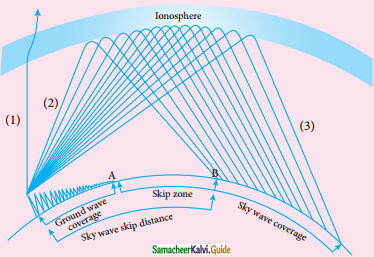
Explain the three inodes of propagation of electromagnetic waves through space.
Answer:
According to the frequency range, the electromagnetic wave transmitted by the transmitter travels in three different modes.

1. Ground Wave propagation (or) Surface Wave propagation:
i. The electromagnetic waves are transmitted by the transmitter glide over the surface of the earth to reach the receiver.
ii. Both transmitting and receiving antennas must be close to the earth.
iii. The size of the antenna decides the efficiency of the radiation of signals.
iv. Some reasons for attenuation are

a) Increasing distance:
Attenuation of the signal depends on
(i) Power of the transmitter
(ii) frequency of the transmitter
(iii) Condition of the earth surface.

b) Absorption of energy by the Earth:
i. Transmitted signal is in contact with the Earth, it induces charges in the Earth and constitutes a current.
ii. The Earth behaves like a leaky capacitor which leads to the attenuation of the wave.

c) Tilting of the wave:
i. The wavefront starts gradually tilting according to the curvature of the Earth.
ii. When the tilt increases, the electric field strength decreases.
iii. At some distance, the surface wave dies out due to energy loss.
iv. The frequency of the ground waves is mostly less than 2 MHz
v. It is used in local broadcasting, radio navigation, for ship – to ship, ship – to shore communication and mobile communication.

2. Skywave propagation (or) Ionospheric propagation:
i. The electromagnetic waves are radiated from an antenna, directed upwards at large angles gets reflected by the ionosphere back to earth.
ii. Due to the absorption of ultraviolet rays, cosmic ray and other high energy radiations like α, β rays from sun get ionized.
iii. These charged ions provide a reflecting medium for the reflection of radio waves.
iv. The phenomenon of bending the radio waves back to earth is due to total internal reflection.
v. The shortest distance between the transmitter and the point of reception of the skywave along the surface is called as the skip distance.
vi. When the angle of emission increases, the reception of ground waves decreases.
vii. A zone where there is no reception of electromagnetic waves neither ground nor sky is called skip zone or skip area.
viii. In this mode of propagation, the frequency range of EM waves is 3 to 30 MHz.
ix. It is used for short wave broadcast services.
x. Extremely long-distance communication is possible.
xi. A single reflection helps to travel a distance of approximately 4000 km.

Samacheer Kalvi 12th Physics Guide Chapter 10 Communication Systems

3. Space Wave propagation:
i. The process of sending and receiving information signal through space.
ii. EM waves of very high frequencies above 30 MHz are used.
iii. Waves travel in a straight line from the transmitter to the receiver.
iv. The transmission towers must high.
v. For high frequencies, the signals will not encounter the curvature of the earth.
vi. It travels with less attenuation and loss of signal strength.
vii. TV broadcast, satellite communication and RADAR are based on this propagation
viii. It has some advantages, larger bandwith, high data rates, better directivity, small antenna size, low power consumption etc.
ix. Range depends on the height of the antenna (h).
x. Range or distance (d) = \(\sqrt{2 \mathrm{Rh}}\)
R – Radius of the earth
R = 6400 Km.

Samacheer Kalvi 12th Physics Guide Chapter 10 Communication Systems

Question 4.
What do you know about GPS? Write a few applications of GPS.
Answer:
GPS:

  1. GPS stands for Global Positioning System.
  2. It offers geolocation and time information anywhere on or near the earth.
  3. It works with the assistance of a satellite network.
  4. It broadcasts a precise signal like an ordinary radio signal.
  5. It convey the location data which is translated by the GPS software.
  6. This software recognize the satellite, its location ahd time taken to travel from each satellite.
  7. Then the data from each satellite is processed to estimate the location of the receiver.

Applications:

  1. It is used in fleet vehicle management for tracking cars, trucks and buses.
  2. In wildlife management for counting of wild animals.
  3. In engineering for making tunnels, bridges etc.

Question 5.
Give the applications of ICT is mining and agriculture sectors.
Answer:
ICT in mining:

  1. Improves operational efficiency, remote monitoring and disaster locating system.
  2. Provides audio – visual warning to the trapped underground miners.
  3. Helps to connect remote sites.

ICT in agriculture:

  1. Increases food productivity and farm management.
  2. Optimize the use of water, seeds and fertilizers etc.
  3. It is used in farming to decides the suitable place for the species to be planted.
  4. It can be used in sophisticated technologies like robots, temperature, moisture sensors, aerial images and GPS technology.

Samacheer Kalvi 12th Physics Guide Chapter 10 Communication Systems

Question 6.
Modulation helps to reduce the antenna size in wireless communication Explain.
Answer:

  1. Antenna is used at both transmitter and receiver.
  2. Antenna height is important in wireless communication.
  3. The height of the antenna must be a muiltiple of \(\frac{\lambda}{4}\).
    i.e h = \(\frac{\lambda}{4}\)
    Where, λ = \(\frac{C}{\gamma}\), C = Velocity of light
    γ – frequency λ – wavelength
  4. Consider two base band signals.
  5. One is modulated and the other is not modulated
  6. Frequency of the original baseband signal, γ = 10 KHz
  7. Frequency of the modulated signal, γ = 1 MHz
  8. Height required to transmit the original baseband signal is,
    h1 = \(\frac{\lambda}{4}=\frac{C}{4 \gamma}\)
    = \(\frac{3 \times 10^{8}}{4 \times 10 \times 10^{3}}\) = 7.5 Km
    Height required to transmit the modulated signal is
    h2 = \(\frac{\lambda}{4}=\frac{C}{4 \gamma}\)
    = \(\frac{3 \times 10^{8}}{4 \times 10 \times 10^{6}}\) = 75 m
  9. From the above example, it is clear that modulated signals reduce the height of the antenna.

Question 7.
Fiber-optic communication is gaining popularity among the various transmission media – justify.
Answer:
The method of transmitting information from one place to another in terms of light pulses through an optical fiber is called fiber optic communication. It is in the process of replacing wire transmission in communication systems. Light has very high frequency (400 THz – 790 THz) than microwave radio systems.  The fibers are made up of silica glass or silicon dioxide which is highly abundant on Earth.

Now it has been replaced with materials such as chalcogenide glasses, fluoro aluminate crystalline materials because they provide larger infrared wavelength and better transmission capability. As fibers are not electrically conductive, it is preferred in places where multiple channels are to be laid and isolation is required from electrical and electromagnetic interference.

Applications:
Optical fiber system has a number of applications namely, international communication, inter-city communication, data links, plant and traffic control and defense applications.

Merits:

  1. Fiber cables are very thin and weight lesser than copper cables.
  2. This system has much larger bandwidth. This means that its information-carrying capacity is larger.
  3. Fiber optic system is immune to electrical interferences.
  4. Fiber optic cables are cheaper than copper cables.

Demerits:

  1. Fiber optic cables are more fragile when compared to copper wires.
  2. It is an expensive technology.

Samacheer Kalvi 12th Physics Guide Chapter 10 Communication Systems

PART – II:

12th Physics Guide Communication Systems Additional Questions and Answers

I. Matching Type Questions:

Question 1.

Column 1Column 2
1. Wireless communicationa. 30 MHz to 400 GHz
2. Ground wave propagationb. 3 MHz to 30 GHz
3. Sky wave propagationc. 2 KHz to 2 MHz
4. Space wave propagationd. 2 KHz to 400 GHz

Answer:

  1. d
  2. c
  3. b
  4. a

Question 2.

Column 1Column 2
1. GPSa. Fisheries
2. GSMb. Military and Navigation systems
3. ICTc. Mobile communication
4. RADARd. Counting of wild animals

Answer:

  1. d
  2. c
  3. a
  4. b

Question 3.

Column 1Column 2
1. Uplink Frequency banda. 20 – 20,000 Hz
2. Downlink Frequency bandb. 400 THz – 790 THz
3. Very High frequency of lightc. 6 GHz
4. Audio frequencyd. 4 GHz

Answer:

  1. c
  2. d
  3. b
  4. a

Samacheer Kalvi 12th Physics Guide Chapter 10 Communication Systems

II. Fill in the blanks:

Question 1.
_______ gives the difference between the upper and lower frequency limits of the signal.
Answer:
Bandwidth

Question 2.
For a frequencv less than the critical frequencv, skip distance is _______.
Answer:
Zero

Question 3.
Multimode fibers operate at the speed of _______.
Answer:
10 Mbps

Question 4.
Radar uses _______ for communication.
Answer:
electromagnetic waves.

Samacheer Kalvi 12th Physics Guide Chapter 10 Communication Systems

III. Choose the Odd man out:

Question 1.
a) Input transducer
b) Amplifier
c) Oscillator
d) Demodulator
Answer:
d) Demodulator

Question 2.
a) Telephone
b) mobile
c) intercom
d) Cable TV
Answer:
b) Mobile

Question 3.
a) Weather satellites
b) Communication
c) satellites
d) Navigation satellites
e) RADAR
Answer:
e) RADAR

Question 4.
a) Total internal reflection
b) skip distance
c) amplitude modulation
d) skip zone
Answer:
c) Amplitude modulation

IV. Choose the incorrect pair:

Question 1.
i) Space wave propagation – LOS
ii) Tracking cars – ICT
iii) Counting of wild animals – GPS
iv) Home automation using
a mobile phone – IoT
Answer:
ii) Tracking cars – ICT

Question 2.
i) Input transducer – Microphone
ii) Output transducer – Loudspeakers
iii) Transmitter – Broadcasting station
iv) Oscillator – Low-frequency carrier wave
Answer:
iv) Oscillator – Low-frequency carrier wave

Question 3.
i) Bandwidth, BW – γ1 – γ2
ii) Amplitude modulation system – 10 KHz
iii) Single side – band system – 5 KHz
iv) Height of the Antenna – \(\frac{\lambda}{4}\)
Answer:
i) Bandwidth, BW – γ1 – γ2

Question 4.
i) Amplitude – High-efficiency modulation
ii) Baseband signal – input signal
iii) Carrier signal – a radio signal
iv) Resting frequency – centre frequency
Answer:
i) Amplitude modulation – High efficiency

Samacheer Kalvi 12th Physics Guide Chapter 10 Communication Systems

V. Choose the correct pair:

Question 1.
i) Attenuation – Amplitude of the transmitter
ii) High frequency – High skip distance
iii) Skip distance – The longest distance
iv) RADAR – Ground wave propagation
Answer:
ii) High frequency – High skip distance

Question 2.
i) Audio frequency – 200 to 2000 Hz
ii) Carrier wave – Cosine wave
iii) Louder signal – Compressions
iv) Frequency shift – Rarefaction
Answer:
iii) Louder signal- Compressions

Question 3.
i) Velocity of light – 3 × 10⁶ m/ s
ii) Radius of the earth – 6800 Km
iii) Date speed for homes – 2 Gbps
iv) Antenna height – d = \(\sqrt{2 \mathrm{Rh}}\)
Answer:
iv) Antenna height – d = \(\sqrt{2 \mathrm{Rh}}\)

Question 4.
i) Skywave propagation – 3 MHz to 30 MHz
ii) Space wave propagation – 30 MHz to 40 MHz
iii) Ground wave propagation – 20 KHz to 20 MHz
iv) Wireless communication – 1 KHz to 2 KHz
Answer:
i) Skywave propagation – 3 MHz to 30 MHz

Samacheer Kalvi 12th Physics Guide Chapter 10 Communication Systems

VI. Assertion and Reason:

Question 1.
Assertion:
Short wave bands are used for the transmission of radio waves to a large distance.
Reason:
Short waves are reflected by the ionosphere.
a) Assertion and the reason are true and the reason is the correct explanation of the assertion.
b) Assertion and the reason are true and the reason is not the correct explanation of the assertion.
c) Assertion is true but reason is false
d) Assertion is false but reason is true.
Answer:
a) Assertion and the reason are true and the reason is the correct explanation of the assertion.

Question 2.
Assertion:
Television broadcasting becomes weaker with increasing distance.
Reason:
The power transmitted from the TV transmitter varies inversely as the distance of the receiver.
a) Assertion and the reason are true and the reason is the correct explanation of the assertion.
b) Assertion and the reason are true and the reason is not the correct explanation of the assertion.
c) Assertion is true but reason is false
d) Assertion is false but reason is true.
Answer:
c) Assertion is true but reason is false

Question 3.
Assertion:
Optical fibre communication has immunity to cross talk.
Reason:
Optical interference between fibres is zero.
a) Assertion and the reason are true and the reason is the correct explanation of the assertion.
b) Assertion and the reason are true and the reason is not the correct explanation of the assertion.
c) Assertion is true but reason is false
d) Assertion is false but reason is true.
Answer:
a) Assertion and the reason are true and the reason is the correct explanation of the assertion.

Question 4.
Assertion:
A dish antenna is highly directionals
Reason:
This is because a dipole antenna is omnidirectional.
a) Assertion and the reason are true and the reason is the correct explanation of the assertion.
b) Assertion and the reason are true and the reason is not the correct explanation of the assertion.
c) Assertion is true but reason is false
d) Assertion is false but reason is true.
Answer:
b) Assertion and the reason are true and the reason is not the correct explanation of the assertion.

Samacheer Kalvi 12th Physics Guide Chapter 10 Communication Systems

VII. Choose the correct statement:

Question 1.
i) A transducer is a device which converts an electrical signal into variations in a physical quantity.
ii) Transmitting antenna radiates the radio signal into space in all directions.
iii) The power amplifier decreases the power level of the signal
iv) The minimum distance between the source and the destination is called a range
Answer:
Statement (ii) is correct.

Question 2.
i) Attenuation depends on the frequency of the transmitter.
ii) Increase in the tilt increases the electric field strength.
iii) Transmitting and receiving antenna must be close to the earth.
iv) The frequency of the ground waves is most less than 1 MHz.
Answer:
Statements (i) and (iii) are correct

Question 3.
i) The higher the frequency, lower is the skip distance.
ii) Bending of radio waves back to earth is called refraction.
iii)The frequency range of EM wave in skywave propagation is 30 to 300 MHz.
iv) When the angle of emission increases, the reception of ground waves decreases.
Answer:
Statement (iv) is correct.

Question 4.
i) The transducer output is very weak
ii)The electrical equivalent of the original information is called the carrier signal.
iii) Microphone converts electrical energy into sound energy.
iv) Wireline communication uses free space as a communication medium.
Answer:
Statement (i) is correct.

Samacheer Kalvi 12th Physics Guide Chapter 10 Communication Systems

VIII. Choose the incorrect statement:

Question 1.
i) Noise is the undesirable electrical signal.
ii) It attenautes or reduces the quality of the signal
iii) It may be man – made or natural
iv) Noise can be completely eliminated.
Answer:
Statement (iv) is correct.

Question 2.
i) Operating range is quite large in FM
ii) In FM, there is a large increase in noise
iii) Am radio has better quality compared to FM radio.
iv) FM requires a much under channel
Answer:
Statement (ii) & (iii) are incorrect

Question 3.
i) Noise level is low in AM
ii) There is a lesser landwidth in AM
iii) In A.M the efficiency is low
iv) Small operating range in AM
Answer:
Statement (i) is incorrect

Question 4.
i) ICT in mining helps to connect remote sites.
ii) ICT is widely used in decreasing food productivity
iii) ICT improves operational efficiency
iv) ICT are also used in fisheries
Answer:
Statement (ii) is incorrect

Samacheer Kalvi 12th Physics Guide Chapter 10 Communication Systems

IX. Choose the best answer:

Question 1.
Which of the following frequencies will be suitable for beyond the horizon communication using sky waves?
(a) 10 kHz
(b) 10 MHz
(c) 1 GHz
(d) 1000 GHz
Answer:
(b) 10 MHz
Hint:
A frequency of 10 kHz will require a very large radiating antenna while frequencies 1GHz and 1000 GHz will penetrate the ionosphere and cannot be reflected by it.

Question 2.
Cellular phones use radio waves in ______ band.
a) long-wave
b) short wave
c) medium wave
d) ultra-high frequency
Answer:
d) ultra-high frequency

Question 3.
Antenna is
(a) inductive
(b) capacitive
(c) resistive above its resonant frequency
(d) resistive at the resonant frequency
Answer:
(d) resistive at the resonant frequency.
Hint:
An antenna is a tuned circuit consisting of an inductance and a capacitance. At the resonant frequency, it is resistive.

Question 4.
In space wave propagation, the range of the propagation depends on the height (h) of the antenna given by the equation.
a) \(\sqrt{2 \mathrm{Rh}}\)
b) \(\sqrt{\frac{R h}{2}}\)
c) \(\sqrt{2 R^{2} h}\)
d) \(\frac{h}{2 R}\)
Answer:
a) \(\sqrt{2 \mathrm{Rh}}\)

Question 5.
_______ modulation is used in radio and TV broadcasting.
a) Frequency
b) Phase
c) Amplitude
d) Carrier
Answer:
c) Amplitude

Samacheer Kalvi 12th Physics Guide Chapter 10 Communication Systems

Question 6.
If a ________ wave is used as the baseband signal, then phase reversal takes place in the modulated signal.
a) Square
b) Sine
c) Cosine
d) triangular
Answer:
a) Square

Question 7.
An oscillator is producing FM waves of frequency 2 kHz with a variation of 10 kHz. What is the modulation index?
(a) 0.67
(b) 5.00
(c) 0.20
(d) 1.5
Answer:
(b) 5.00
Hint:
mf = \(\frac { ∆f }{ f }\) = \(\frac { 10kHz }{ 2kHz }\) = 5

Question 8.
The best example of transducer is________
a) Loudspeaker
b) picture tubes
c) computer monitor
d) microphone
Answer:
d) microphone

Question 9.
________ generates high – frequency carrier wave.
a) Modulator
b) Oscillator
c) Amplifier
d) Power amplifier
Answer:
b) Oscillator

Question 10.
The maximum distance upto which TV transmission from a TV tower of height h can be received is proportional to
(a) h1/2
(b) h
(c) 3/2
(d) h2
Answer:
(a) h1/2
Hint:
d = \(\sqrt { 2Rh } \) ; d ∝ h1/2

Samacheer Kalvi 12th Physics Guide Chapter 10 Communication Systems

Question 11.
The height of the antenna must be a multiple of _______.
a) \(\frac{\lambda}{4}\)
b) \(\frac{\lambda}{8}\)
c) 4λ
d) 2λ
Answer:
a) \(\frac{\lambda}{4}\)

Question 12.
The relation between the frequency, the velocity of light, and wavelength is given by ________.
a) C = γλ
b) C = \(\frac{\lambda}{\gamma}\)
c) λ = \(\frac{C}{\gamma}\)
d) both (a) and (c)
Answer:
d) both (a) and (c)

Question 13.
In AM, the channel bandwidth is ______ the signal frequency
a) thrice
b) twice
c) equal to
d) half
Answer:
b) twice

Question 14.
The height of the transmitting and receiving antenna must be a multiple of
a) 2λ
b) λ/4
c) λ/2
d) 4λ
Answer:
b) λ/4

Question 15.
A laser beam is used for carrying out surgery because it
(a) is highly monochromatic
(b) is highly coherent
(e) is highly directional
(d) can be sharply focused
Answer:
(d) can be sharply focused
Hint:
A laser beam is highly monochromatic, directional, and coherent and hence it can be sharply focused for carrying out surgery.

Samacheer Kalvi 12th Physics Guide Chapter 10 Communication Systems

Question 16.
The _______ of the antenna plays a major role in deciding the efficiency of the radiation of the signals.
a) shape
b) distance
c) direction
d) size
Answer:
d) size

Question 17.
A single reflection helps the radio waves to travel a distance of approximately
a) 40 km
b) 400 km
c) 4000 km
d) 4 km
Answer:
c) 4000 km

Question 18.
When the angle of emission increases, the reception of ground waves _______.
a) increases
b) decreases
c) remains constant
d) none of the above
Answer:
b) decreases

Question 19.
The principle used in the transmission of signals through an optical fiber is
(a) total internal reflection
(b) refraction
(c) dispersion
(d) interference
Answer:
(a) total internal reflection
Hint:
Signals propagate through an optical fiber by suffering repeated total internal reflections.

Question 20.
The fibres are made up of _______.
a) glass
b) silicon
c) silica glass
d) both a & c
Answer:
d) both a & c

Samacheer Kalvi 12th Physics Guide Chapter 10 Communication Systems

Question 21.
_______ provide the fastest transmission rate compared to any other form of transmission
a) Cable wires
b) Fibers
c) Fiber optic cables
d) Copper wire
Answer:
c) Fiber optic cables

Question 22.
________ is a fast-growing technology in the field communication system.
a) Mobile
b) Satellite
c) Fiber optics
d) Internet
Answer:
d) Internet

Question 23.
The skywave propagation is suitable for radio waves of frequency
(a) from 2 MHz to 50
(b) upto 2MHz
(c) from 2 MHz to 30 MHz
(d) from 2MHz to 20 MHz
Answer:
(c) from 2 MHz to 30 MHz

Question 24.
To store all the information available on the internet, we need over
a) 2 billion DVDs
b) 1 billion DVDs
c) 3 billion DVDs
d) 4 billion DVDs
Answer:
b) 1 billion DVDs

Question 25.
_______ is used to search for information on the World Wide Web
a) Communication
b) Satellite
c) E-Commerce
d) Search engine
Answer:
d) Search engine

Samacheer Kalvi 12th Physics Guide Chapter 10 Communication Systems

Question 26.
_______ is used for making tunnels, bridges etc.
a) GSM
b) TDMA
c) GPS
d) GPRS
Answer:
c) GPS

Question 27.
Fiber optic cables provide data speed of ____ for homes and businesses.
a) 1 Gbps
b) 2 Gbps
c) 10 Mbps
d) 5 Gbps
Answer:
a) 1 Gbps

Question 28.
A modem is a device which performs
(a) modulation
(b) demodulation
(c) rectification
(d) modulation and demodulation
Answer:
(d) modulation and demodulation

Samacheer Kalvi 12th Physics Guide Chapter 10 Communication Systems

X. Two Marks Questions:

Question 1.
What is a communication system?
Answer:
The setup used to transmit information from one point to another is called a communication system.

Question 2.
What is called a baseband signal?
Answer:
The electrical equivalent of the original information.

Question 3.
What is a transducer?
Answer:
A device that converts variations in a physical quantity into an equivalent electrical signal.

Question 4.
Define bandwidth.
Answer:
The frequency range over which the baseband signals or the information signals such as voice, music, the picture is transmitted.

Question 5.
Define bandwidth?
Answer:
The frequency range over which the baseband signals or the information signals such as voice, music, picture, etc. is transmitted is known as bandwidth.

Samacheer Kalvi 12th Physics Guide Chapter 10 Communication Systems

Question 6.
What is skip distance?
Answer:
The shortest distance between the transmission and the point of reception of the skywave along the surface.

Question 7.
What is skip zone or skip area?
Answer:

  • The zone in which there is no reception of electromagnetic waves.
  • It is also called as skip area.

Question 8.
What is called fibre optic communication?
Answer:
The method of transmitting information from one place to another in terms of light pulses through an optical fiber.

Question 9.
What is mean by fibre optic communication?
Answer:
The method of transmitting information from one place to another in terms of light pulses through an optical fiber is called fiber optic communication.

Question 10.
Expand GPS and write a note on it.
Answer:

  • GPS stands for Global Positioning System.
  • It is a global navigation satellite system that offers geolocation and time anywhere on or near the earth.

Samacheer Kalvi 12th Physics Guide Chapter 10 Communication Systems

Question 11.
Why do we need carrier waves of very high frequency in the modulation of signals?
Answer:
High-frequency carrier waves are used

  1. to increase operating range
  2. to reduce antenna length
  3. to convert the wideband signal into the narrowband signal.

Question 12.
Why is modulation needed at all?
Answer:
Modulation is needed.

  1. to transmit a low-frequency signal to a distant place.
  2. for protecting the waveform of the signal
  3. to keep the height of antenna small.

Question 13.
Which is better for high fidelity reception FM or AM?
Answer:
FM transmission gives high fidelity due to the presence of a large number of sidebands.

Question 14.
Why is the transmission of signals through a coaxial cable not possible for frequencies greater than 20 MHz?
Answer:
For frequencies greater than 20 MHz, dielectric loss becomes quite high.

Question 15.
Why are short wave bands used for long-distance transmission of signals?
Answer:
Radio waves of short wave bands can be easily reflected bv the ionosphere. So they are used in long-distance transmission.

Samacheer Kalvi 12th Physics Guide Chapter 10 Communication Systems

Question 16.
Why microphone is used as an input transducer?
Answer:
A transducer is a device that converts sound into an equivalent electrical signal So, a microphone which converts sound into electrical energy is used as a transducer.

Question 17.
What are the elements in the transmitter?
Answer:

  1. Amplifier
  2. Modulator
  3. Oscillator
  4. Power amplifier

Question 18.
Draw the block diagram of Transmission.
Answer:
Samacheer Kalvi 12th Physics Guide Chapter 10 Communication Systems 8

Question 19.
Define range.
Answer:
The maximum distance between the source and the destination upto which the signal is received with sufficient strength.

Question 20.
Mention the application of ICT is fisheries.
Answer:

  • Satellite vessel monitoring system helps to identify fishing zones.
  • Use of barcodes helps to identify time and date of catch, species name, quality of fish.

Samacheer Kalvi 12th Physics Guide Chapter 10 Communication Systems

Question 21.
What is satellite communication?
Answer:
A mode of communication of signal between transmitter and receiver via satellite.

Question 22.
What are the basic elements required for the transmission and reception of a signal?
Answer:
Transducer, amplifier, carrier signal, modulator, power amplifier, medium of transmission, tansmitting and receiving antenna, demodulator and detector.

Question 23.
Give the reasons for attenuation in the Ground wave propagation.
Answer:

  1. Increasing distance
  2. Absorption of energy by the earth
  3. Tilting of the wave.

Samacheer Kalvi 12th Physics Guide Chapter 10 Communication Systems

XI. Three Marks questions:

Question 1.
What are the advantages of FM?
Answer:

  1. Large decrease in noise. An increase in signal noise ratio
  2. The operating range is quite large
  3. The transmission efficiency is very high
  4. FM bandwidth covers the entire frequency range.
  5. FM radio has better quality compared to AM radio.

Question 2.
What are the disadvantages of FM?
Answer:

  1. FM requires a much wider channel
  2. FM transmitters and receivers are more complex and costly.
  3. In FM reception, less area is covered compared to AM.

Question 3.
Give the reason why transmission of TV signals via sky wave is not possible.
Answer:

  1. Television frequencies lie in the range 100 – 220 MHz which cannot be reflected by the ionosphere.
  2. So, sky wave propgation is not used in TV transmission.

Samacheer Kalvi 12th Physics Guide Chapter 10 Communication Systems

Question 4.
Show in diagram, the skip distance and the skip zone.
Answer:
Samacheer Kalvi 12th Physics Guide Chapter 10 Communication Systems 9

Question 5.
It is necessary to use satellites for long distance TV transmission. Why?
Answer:

  1. TV signals being of high frequency are not reflected by the ionosphere.
  2. Ground wave transmission is possible only up to a limited range.
  3. So, satellites are used for long distance TV transmission.

Question 6.
Which is more efficient mode of transmission FM or AM?
Answer:

  1. FM transmission is more efficient because all the transmitted power is useful.
  2. In AM transmission, most of the power goes waste in transmitting the carrier alone.

Question 7.
Give an account of E-commerce and search engine.
Answer:
E-Commerce:
Buying and selling of goods and services, transfer of funds are done by an electronic network.
Search engine:
A web-based service tool used to search for information on World Wide Web.

Samacheer Kalvi 12th Physics Guide Chapter 10 Communication Systems

Question 8.
Expand GSM. Give a note on it.
Answer:

  • GSM – Global System for Mobile Communication.
  • Increases the utilization of bandwidth of the network, sharing of the networks, error detections etc.

Question 9.
Mention some of the applications of optical fiber system.
Answer:

  1. International Communication
  2. Intercity communication
  3. data links
  4. plant and traffic control
  5. defence applications.

Question 10.
What are repeaters in an electronic communication system?
Answer:

  1. Repeaters are a combination of transmitter and receivers.
  2. Used to increase the range or distance through which the signals are sent.
  3. The received signals are transmitted with a carrier signal of different frequencies to the destination.

Question 11.
State two factors by which the range of transmission of T.V. signals can be increased.
Answer:
The range of TV transmission can be increased by using

  • tall antenna and
  • geostationary satellites.

Samacheer Kalvi 12th Physics Guide Chapter 10 Communication Systems

Question 12.
Compare the difference between PM and FM.
Answer:

Phase ModulationFrequency Modulation
1. Smaller bandwidthLarger bandwidth
2. High transmission speedLow transmission speed
3. More information can be sent.Less information can be sent

Question 13.
Why should transmitters broadcasting programmes use different carrier frequencies?
Answer:

  1. Different audio signals fall in the same spectral range.
  2. Different transmitting stations are allowed different slots in radio frequency range.
  3. A single receiver can tune into these frequencies without any confusion or overlap.

Question 14.
Give one example each of a system that uses the (i) sky – wave (ii) space wave mode of propagation.
Answer:

  1. Short broadcast services use skywave propagation.
  2. TV broadcast, microwaves links, satellite communication use space wave propagation.

Question 15.
A transmitting antenna has a height of 40m and the height of the receiving antenna is 30m. What is the maximum distance between them for line-of-sight communication?
[The radius of the earth is 6.4 × 10⁶ m]
Solution:
The total distance d between the transmitting and receiving antennas will be the sum of the individual distances of coverage,
d = d1 + d2
= \(\sqrt{2 R}\left(\sqrt{h_{1}}+\sqrt{h_{2}}\right)\)
= \(\sqrt{2 \times 6.4 \times 10^{6}}\)
= 16 × 102√5 × (6.32+ 5.48)
= 42217m
d = 42.217 km

Samacheer Kalvi 12th Physics Guide Chapter 10 Communication Systems

XII. Five Mark Questions:

Question 1.
Explain mobile communication? Write its applications.
Answer:
Mobile communication is used to communicate with others in different locations without the use of any physical connection like wires or cables. It allows the transmission over a wide range of area without the use of the physical link. It enables people to communicate with each other regardless of a particular location like office, house, etc. It also provides communication access to remote areas.

It provides the facility of roaming:
that is. the user may move from one place to another without the need of compromising on the communication. The maintenance and cost of installation of this communication network are also cheap.

Applications:

  1. It is used for personal communication and cellular phones offer voice and data connectivity with high speed.
  2. Transmission of news across the globe is done within a few seconds.
  3. Using the Internet of Things (IoT), it is made possible to control various devices from a single device.
    Example: home automation using a mobile phone.
  4. It enables smart classrooms, online availability of notes, monitoring student activities etc. in the field of education.

Samacheer Kalvi 12th Physics Guide Chapter 10 Communication Systems

Question 2.
Give a brief account on RADAR and its applications.
Answer:

  1. RADAR stands for Radio Detection and Ranging system.
  2. The angle, range or velocity of the objects which are invisible to the human eye can be determined.
  3. Electromagnetic waves are used for communication.
  4. Signal is initially radiated into space by an antenna in all direction.
  5. Then it gets reflected or reradiated in many directions as it strikes the object.
  6. Radar antenna receives the reflected radio signal and it is delivered to the receiver.
  7. These signals are processed and amplified to determine the geographical statistics of the object.
  8. the range is determined by calculating the time taken by the signal to travel from RADAR to the target and back.

Applications:
RADAR is used

  1. to sense, detect and distant objects like aircraft, ships, spacecraft etc.
  2. in military for locating and detecting the targets.
  3. in navigation systems such as ship-borne surface search, air search and weapons guidance system.
  4. to measure precipitation rate and wind speed in meteorological observation
  5. to locate and rescue people in emergency situations.

Samacheer Kalvi 12th Physics Guide Chapter 10 Communication Systems

Question 3.
What do you know about mobile communication? Give its applications.
Answer:

  1. Mobile communication is used to communicate with others in different locations without the use of any physical connection like wires or cables.
  2. It allows the transmission over a wide range of areas without the use of the physical link.
  3. It also provides communication access to remote areas.
  4. It provides the facility of roaming.
  5. User may move from one place to another without the need of compromising on the communication.
  6. The maintenance and cost of installation are cheap.

Applications:

  1. It is used to communicate with each other regardless of a particular location like office, house etc.
  2. It is used for personal communication.
  3. Cellular phones offer voice and data connectivity with high speed.
  4. Transmission of news across the globe is done within a few seconds.
  5. IoT is used to control various devices from a single device
    Ex. home automation using a mobile phone.
  6. It enables smart classrooms, online availability of notes, monitoring student activities etc in the field of education.

Question 4.
What is bandwidth? Explain the bandwidth of the transmission system.
Answer:

  1. The frequency range over which the baseband signals or the information signals such as voice, music, picture, etc is transmitted.
  2. Each of these signals has different frequencies. The communication system depends on the nature of the frequency band for a given signal.
  3. Bandwidth gives the difference between the upper and lower frequency limits df the signal.
  4. The portion of the electromagnetic spectrum occupied by the signal.
  5. If γ1 and γ2 are the lower and upper-frequency limits of a signal.
  6. Bandwidth, BW = γ2 – γ1

Bandwidth of Transmission system:

  1. The range of frequencies required to transmit a piece of specified information in a particular channel.
  2. An amplitude modulation system requires a channel bandwidth of 10 kHz to transmit a 5 kHz signal.
  3. A single side-band system requires only 5 kHz channel bandwidth for a 5 kHz signal.
  4. Because in amplitude modulation, the channel bandwidth is twice the signal frequency.
  5. It is required to reduce the channel bandwidth to accommodate more channels in the available electromagnetic spectrum.

Question 5.
Explain the process of modulation.
Answer:

  1. For long-distance transmission, the low-frequency baseband signal is superimposed onto a high-frequency radio signal.
  2. The energy of the information signal is sufficient to send directly.
  3. A very high-frequency signal called carrier signal is used to carry the baseband signal.
  4. As the frequency of the carrier signal is very high, it can be transmitted to long distances with less attenuation.
  5. The carrier wave is a sine wave signal.
  6. The carrier signal will be more compatible.
  7. It propagates in free space with greater efficiency.
  8. A sine wave can be represented as
    ec = Ec sin (2πγct + φ)
    Where, Ec – amplitude γc – frequency
    φ – the initial phase of the carrier wave at time ‘t’
  9. The characteristics of the carrier signal are modified in three types.
    • Amplitude modulation
    • Frequency modulation
    • Phase modulation.

Samacheer Kalvi 12th Physics Guide Chapter 10 Communication Systems

Question 6.
What do you know about INTERNET? Write its few applications?
Answer:
Internet is a fast-growing technology in the field of a communication system with multifaceted tools. It provides new ways and means to interact and connect with people. Internet is the largest computer network recognized globally that connects millions of people through computers. It finds extensive applications in all walks of life.

Applications:

  1. Search engine: The search engine is basically a web-based service tool used to search for information on World Wide Web.
  2. Communication: It helps millions of people to connect with the use of social networking: emails, instant messaging services, and social networking tools.
  3. E-Commerce: Buying and selling of goods and services, transfer of funds are done over an electronic network.

Samacheer Kalvi 12th Physics Guide Chapter 9 Semiconductor Electronics

Tamilnadu State Board New Syllabus Samacheer Kalvi 12th Physics Guide Pdf Chapter 9 Semiconductor Electronics Text Book Back Questions and Answers, Notes.

Tamilnadu Samacheer Kalvi 12th Physics Solutions Chapter 9 Semiconductor Electronics

12th Physics Guide Semiconductor Electronics Text Book Back Questions and Answers

Part I:

Textbook Evaluation:

I. Multiple choice questions:

Question 1.
The barrier potential of a silicon diode is approximately
a) 0.7 V
b) 0.3V
c) 2.0 V
d) 2.2V
Answer:
a) 0.7 V

Question 2.
Doping a semiconductor results in
a) The decrease in mobile charge carriers
b) The change in chemical properties
c) The change in the crystal structure
d) The breaking of the covalent bond
Answer:
c) The change in the crystal structure

Question 3.
A forward-biased diode is treated as
a) An open switch with infinite resistance
b) A closed switch with a voltage drop of 0V
c) A closed switch in series with a battery voltage of 0.7V
d) A closed switch in series with a small resistance and a battery.
Answer:
d) A closed switch in series with a small resistance and a battery.

Question 4.
If a half -wave rectified voltage is fed to a load resistor, which part of a cycle the load current will flow?
a) 0° – 90°
b) 90° – 180°
c) 0° – 180°
d) 0° – 360°
Answer:
c) 0°-180°

Question 5.
The primary use of a zener diode is
a) Rectifier
b) Amplifier
c) Oscillator
d) Voltage regulator
Answer:
d) Voltage regulator

Samacheer Kalvi 12th Physics Guide Chapter 9 Semiconductor Electronics

Question 6.
The principle in which a solar cell operates
a) Diffusion
b) Recombination
c) Photovoltaic action
d) Carrier flow
Answer:
c) Photovoltaic action

Question 7.
The light emitted in an LED is due to
a) Recombination of charge carriers
b) Reflection of light due to lens action
c) Amplification of light falling at the junction
d) Large current capacity.
Answer:
a) Recombination of charge carriers

Question 8.
When a transistor is fully switched on, it is said to be
a) Shorted
b) Saturated
c) Cut-off
d) Open
Answer:
b) Saturated

Question 9.
The specific characteristic of a common emitter amplifier is
a) High input resistance
b) Low power gain
c) Signal phase reversal
d) Low current gain
Answer:
c) Signal phase reversal

Question 10.
To obtain sustained oscillation in an oscillator,
a) Feedback should be positive
b) Feedback factor must be unity
c) Phase shift must be 0 or 2π
d) All the above
Answer:
d) All the above

Samacheer Kalvi 12th Physics Guide Chapter 9 Semiconductor Electronics

Question 11.
If the input to the NOT gate is A = 1011, its output is
a) 0100
b) 1000
c) 1100
d) 0011
Answer:
a) 0100

Question 12.
The electrical series circuit in digital form is
a) AND
b) OR
c) NOR
d) NAND
Answer:
a) AND

Question 13.
Which one of the following represents a forward bias diode? (NEET)
Samacheer Kalvi 12th Physics Guide Chapter 9 Semiconductor Electronics 1
Answer:
a) A node must have a high potential

Question 14.
The given electrical network is equivalent to
Samacheer Kalvi 12th Physics Guide Chapter 9 Semiconductor Electronics 2
a) AND gate
b) OR gate
c) NOR gate
d) NOT gate
Answer:
c) NOR gate
Samacheer Kalvi 12th Physics Guide Chapter 9 Semiconductor Electronics 96

Question 15.
The output of the following circuit is 1 when the input ABC is
Samacheer Kalvi 12th Physics Guide Chapter 9 Semiconductor Electronics 3
a) 101
b) 100
c) 110
d) 010
Answer:
a) 101
Samacheer Kalvi 12th Physics Guide Chapter 9 Semiconductor Electronics 4

Samacheer Kalvi 12th Physics Guide Chapter 9 Semiconductor Electronics

II. Short Answer Questions:

Question 1.
Define electron motion in a semiconductor.
Answer:
To move the hole in a given direction, the valence electrons move in the opposite direction. Electron flow in an N-type semiconductor is similar to electrons moving in a metallic wire. The N-type dopant atoms will yield electrons available for conduction.

Question 2.
Distinguish between intrinsic and extrinsic semiconductors.
Answer:

Intrinsic SemiconductorExtrinsic Semiconductor
1. It is pure form of semiconductorSmall amount of impurity is added
2. No doping takes place in intrinsic semiconductorDoping takes place
3. Number of free electrons in conduction is equal to number of holes in valence band.Number of free electrons and holes are not equal
4. It has bad electrical characteristicsIt has good electrical conductivity

Question 3.
What do you mean by doping?
Answer:
The process of adding impurities to the intrinsic semiconductor is called doping.

Question 4.
How electron-hole pairs are created in a semiconductor material?
Answer:
When external voltage is applied in semiconductor free electrons from valence band moves to conduction band and recombined with holes. So electron-hole pairs are created.

Question 5.
A diode is called a unidirectional device. Explain
Answer:
A diode is called a unidirectional device, i.e., current flows in only one direction (anode to cathode internally) when a forward voltage is applied, the diode conducts and when a reverse voltage is applied, there is no conduction. A mechanical analogy is a rat chat, which allows motion in one direction only.

Samacheer Kalvi 12th Physics Guide Chapter 9 Semiconductor Electronics

Question 6.
What do you mean by leakage current in a diode?
Answer:

  1. Under biasing very small current (μA) flows across the junction in a diode.
  2. It is due to minority charge carriers.
  3. This current is called leakage current or reverse saturation current.

Question 7.
Draw the output waveform of a full-wave rectifier.
Answer:
Samacheer Kalvi 12th Physics Guide Chapter 9 Semiconductor Electronics 5
Input and output waveforms

Question 8.
Distinguish between avalanche and Zener breakdown.
Answer:

Avalanche breakdownZener breakdown
1. The phenomenon of increasing the free electrons or current in the semiconductor by applying a higher voltageThe process in which electrons are moving across the barrier from valence band of P-type material to conduction band of lightly filled n -material
2. Depletion layer is thickDepletion layer is thin
3. Electric field is weakElectric field is strong
4. Produces pairs of electrons and holesProduces electrons
5. Doping is lowDoping is heavy
6. Breakdown voltage varyVoltage remains constant

Question 9.
Discuss the biasing polarities in NPN and PNP transistors.
Answer:
In a PNP transistor, base and collector will be negative with respect to emitter indicated by the middle letter N whereas base and collector will be positive in an NPN transistor [indicated by the middle letter P.

Question 10.
Explain the current flow in an NPN transistor.
Answer:

  1. In NPN transistor electron flow from Emitter to collector. So conventional current flow from collector to emitter.
  2. Electrons from emitter region flow towards base region constitute emitter current (IE). Electrons after reaching base region recombine with holes – Most of electrons reach collector region. This constitute collector current (Ic). After recombination of holes in base region by bias voltage VEE constitute base current IB.
    IE = IB + IC [Since base current is very low Ic ≈ IC]

Samacheer Kalvi 12th Physics Guide Chapter 9 Semiconductor Electronics

Question 11.
What is the phase relationship between the AC input and output voltages in a common emitter amplifier? What is the reason for the phase reversal?
Answer:
In a common emitter amplifier, the input and output voltages are 180° out of phase or in, opposite phases. The reason for this can be seen from the fact that as the input voltage rises, so the current increases through the base circuit.

Question 12.
Explain the need for a feedback circuit in a transistor oscillator.
Answer:
If the portion of the output fed to the input is in phase with the input, then the magnitude of the input increases. It is necessary for sustained oscillations, so feed back circuit is needed for transistor oscillator.

Question 13.
Give circuit symbol, logical operation, truth table, and Boolean expression of AND, OR, NOT, NAND, NOR, and EX-OR gates.
Answer:
Samacheer Kalvi 12th Physics Guide Chapter 9 Semiconductor Electronics 6

Question 14.
State De Morgan’s first and second theorems.
Answer:
First Theorem:
The complement of the sum is equal to the product of its complements
\(\overline{\mathrm{A}+\mathrm{B}}=\overline{\mathrm{A}} \cdot \overline{\mathrm{B}}\)
Second Theorem:
The complement of the product is equal to sum of its complements
\(\overline{A \cdot B}=\bar{A}+\bar{B}\)

Samacheer Kalvi 12th Physics Guide Chapter 9 Semiconductor Electronics

III. Long Answer Questions:

Question 1.
Elucidate the formation of a N – type and P – type semiconductors.
Answer:
1. N – type semiconductor:
N – type semiconductor is obtained by doping a pure Germanium or silicon with dopant from group V pentavalent elements like phosphorous, Arsenic, Antimony.
Samacheer Kalvi 12th Physics Guide Chapter 9 Semiconductor Electronics 7

Samacheer Kalvi 12th Physics Guide Chapter 9 Semiconductor Electronics 8
n-type extrinsic semiconductor:
(a) Free electron which is loosely attached to the lattice
(b) Representation of donar energy level.

1. Dopants has 5 valence electrons, Germanium has 4 valence electrons.
2. During the process of doping few Ge atoms’ are replaced by group V dopants.
3. Four of the five valence electrons of impurities bound with 4 valence electrons of neighbouring Ge atoms.
4. The 5th valence electron of impurity atom is loosely attached, it has not formed covalent bond.
5. Energy level loosely attached electron is just below the conduction band edge which is called donor energy level.
6. At room temperature electrons easily moves to conduction band with absorption of thermal energy.
7. These thermally generated electrons leave holes in valance band.
8. Such a semiconductor doped with a pentavalent impurity is called n-type semiconductor.

2. P-type semiconductor.
1. Trivalent atom from group III elements such as Boron, Aluminium, Gallium, Indium is added with Germanium or silicon is a p-type semiconductor.
2. The dopants with 3 valence electrons bound with neighbouring Germanium atom one electron position of the dopant in Ge lattice will remain vacant.
3. The missing electron position in covalent band is denoted as a hole.
4. To make complete covalent bond with all 4 neighbouring atom, dopant needs one more electrons.
5. Dopants accept electron from neighbouring atoms. This impurity is called acceptor impurity.
6. Energy level of hole created by each impurity atom is just above valence band, which is called acceptor energy level.
7. In such extrinsic semiconductor holes are majority carriers and thermally generated electrons are minority carriers. This semiconductor is called a p-type semiconductor.

Samacheer Kalvi 12th Physics Guide Chapter 9 Semiconductor Electronics 9

Samacheer Kalvi 12th Physics Guide Chapter 9 Semiconductor Electronics 10
P-type extrinsic semiconductor
(a) Hole generated by the dopant
(b) Representation of acceptor energy level.

Samacheer Kalvi 12th Physics Guide Chapter 9 Semiconductor Electronics

Question 2.
Explain the formation of PN junction diode. Discuss its V-I characteristics.
Answer:
Samacheer Kalvi 12th Physics Guide Chapter 9 Semiconductor Electronics 11

Samacheer Kalvi 12th Physics Guide Chapter 9 Semiconductor Electronics 12
p-n junction diode
(a) Schematic representation
(b) Circuit symbol

i. A p-n junction diode is formed when p-type semiconductor is fused with N-type semiconductor.
ii. Depending on polarity of external source to the p-n junction there are two types of biasing
1. Forward bias
2. Reverse bias

1. Forward bias:
i. If positive terminal of external voltage source is connected to p-side and negative terminal to n-side forward bias takes place.
ii. Electron moves to n-side holes move to p side Recombination takes place near junction and reduce depletion region.
iii. Electron from n-side accelerate towards p side it experience reduced potential barrier at junction.
iv. Applied voltage is increased, width of depletion region and barrier potential further reduced.
v. So large number of electrons pass through junction.

2. Reverse bias:
i. If positive terminal of external voltage source is connected to p-side and negative terminal to n-side reverse bias takes place.

Samacheer Kalvi 12th Physics Guide Chapter 9 Semiconductor Electronics 13

ii. Depletion region is increased potential barrier is also increased.
iii. Majority charge carriers from both sides experience a great barrier to cross the junction. So diffusion current reduces.
iv. The current flows under reverse bias is called reverse saturation current IS

V-I Characteristics:

1. Forward characteristics:
i. A graph is plotted by taking forward bias voltage in X axis and current i Y axis.
ii. Current flow is negligible when applied voltage is less than threshold voltage beyond that increase in current is significant even for small increase in voltage.
iii. Graph shows clearly current flow is non linear. It doesnot obey ohm’s law.
iv. Forward resistance rf = \(\frac{\Delta \mathrm{V}}{\Delta \mathrm{I}}\)
v. Diode behaves as conductor when it is forward bias.

Samacheer Kalvi 12th Physics Guide Chapter 9 Semiconductor Electronics 14

Samacheer Kalvi 12th Physics Guide Chapter 9 Semiconductor Electronics 15
p-n junction diode
(a) diode under forward bias
(b) forward characteristics

2. Reverse characteristics:
i. In reverse bias p-region is connected to negative terminal and n-region to positive terminal, Graph is drawn for reverse bias characteristics.
ii. Very small current in pA flows across junction. This is due to leakage current or reverse saturation current.
iii. The reverse bias voltage can be increased only up to rated value otherwise diode will enter into breakdown region.

Samacheer Kalvi 12th Physics Guide Chapter 9 Semiconductor Electronics 16

Samacheer Kalvi 12th Physics Guide Chapter 9 Semiconductor Electronics 17

p-n junction diode
(a) diode under reverse bias
(b) reverse characteristics

Samacheer Kalvi 12th Physics Guide Chapter 9 Semiconductor Electronics 18
Forward and reverse characteristics of a diode

Samacheer Kalvi 12th Physics Guide Chapter 9 Semiconductor Electronics

Question 3.
Draw the circuit diagram of a half wave rectifier and explain its working.
Answer:
i. The circuit consist of transformer, p-n junction diode and resistor.
ii. In half wave rectifier either a positive half or the negative half of AC input is passed through it, other half is blocked.

Samacheer Kalvi 12th Physics Guide Chapter 9 Semiconductor Electronics 19

Samacheer Kalvi 12th Physics Guide Chapter 9 Semiconductor Electronics 20
(a) Input signal
(b) half wave rectifier circuit
(c) input and output waveforms

During positive half cycle:
1. When positive half cycle of input signal passes. A becomes positive with respect to B.
2. Diode is forward bias, current flows through RL output voltage V0 is developed.
3. Waveform is shown in figure.

During negative half cycle:
1. When negative half cycle of input signal passes A is negative with respect to B.
2. Diode is reverse bias, does not conduct No current is passed through RL. No voltage drop across RL.
3. Negative half cycle of ac supply is suppressed at output waveform is shown in figure.
4. Efficiency of half wave rectifier is 40.67%.

Question 4.
Explain the construction and working of a full wave rectifier.
Answer:
i. Full wave rectifier consist two p-n junction diodes a center tapped transformer and load resistor (RL)
ii. Due to centre tap transformer output voltage rectified by each diode is only one half of total secondary voltage.

Samacheer Kalvi 12th Physics Guide Chapter 9 Semiconductor Electronics 21

Samacheer Kalvi 12th Physics Guide Chapter 9 Semiconductor Electronics 22
(a) Full wave rectifier circuit
(b) Input and output waveforms

During positive half cycle:
1. Input signal passes through the circuit M is positive, G is zero, N is negative potential.
2. D1 forward bias, D2 reverse bias.
3. Current flows through MD1 AGC
4. Positive half cycle of voltage appears across RL in direction G to C.

During negative half cycle:
1. Terminal N is positive, G is at zero, M is negative potential.
2. D2 is forward bias, D1 is reverse bias.
3. Current flows through ND2BGC
4. Negative half cycle of voltage across RL from G to C.
5. Hence in full wave rectifiers both postive and negative half cycle of input signals pass through the circuit in same direction.
6. Efficiency of full wave rectifier is 31.2%.

Samacheer Kalvi 12th Physics Guide Chapter 9 Semiconductor Electronics

Question 5.
What is an LED? Give the principle of operation with a diagrajm?
Answer:
1. LED is a p-n junction diode which emit visible or invisible light when it is forward bias.
2. It converts electrical energy to light energy.
3. It consists of p-layer, n-layer and substrate. External resistance in series with biasing source is required to limit forward current through LED. It has anode and cathode.

Samacheer Kalvi 12th Physics Guide Chapter 9 Semiconductor Electronics 23

Samacheer Kalvi 12th Physics Guide Chapter 9 Semiconductor Electronics 24

Samacheer Kalvi 12th Physics Guide Chapter 9 Semiconductor Electronics 25
(a) Circuit symbol of LED
(b) Inside view of LED
(c) Schematic diagram to explain recombination process

4. When p-n junction is forward bias, conduction band electron on n-side and valence band hole on p side diffuse across the junction.
5. When they cross junction, they become excess minortiy carriers. These excess minority carriers recombine with opposite charged majority carriers in respective region.
6. During recombination process energy is released is the form of light or heat.
7. The colour of the light is determined by energy band gap of the material.
8. LED’s with wide range colours such as blue (Sic), green (AlGaP), red(GaAsP), white(GaInN) is also available.

Question 6.
Write notes on Photodiode.
Answer:
Samacheer Kalvi 12th Physics Guide Chapter 9 Semiconductor Electronics 26                      Samacheer Kalvi 12th Physics Guide Chapter 9 Semiconductor Electronics 27
(a) Circuit symbol
(b) Schematic view of photodiode

1. Photodiode is a p-n junction diode which converts an optical signal into electric current.
2. It works in reverse bias.
3. It consists of F p-n junction semiconductor made of photosensitive material kept safely inside a plastic case.
4. It has small transparent window to allow light.
5. When photon (hυ) strikes depletion region of diode some valence band electrons elevated to conduction band. In turns holes are developed in valence band. This creates electron hole pair.
6. Amount of electron – hole pair generated depends on intensity of light.
7. These electrons and hole swept across the junction by electric field. Thus holes moves to -n side, electrons to p side.
8. When external circuit is made, electrons flow through external circuit and constitute the photo current.

Applications:
Alarm system, count items in conveyer belt, photo conductors, CD players, smoke detectors, detectors for computed tomography etc.

Samacheer Kalvi 12th Physics Guide Chapter 9 Semiconductor Electronics

Question 7.
Explain the working principle of a solar cell. Mention its applications.
Answer:
11. Solar cell converts light energy directly into electricity or electric potential difference by photovoltaic effect.

Samacheer Kalvi 12th Physics Guide Chapter 9 Semiconductor Electronics 28
Cross-sectional view of a solar cell

2. It generates emf when radiations falls on p-n junction. A solar cell is of two type p-type and n-type.
3. Both types use a combinations of p-type and n-type silicon which together forms the p-n junction.
4. In solar cell, electron – hole pairs are generated due to absorption of light near junction.
5. Electrons move towards n-type silicon, holes moves towards p-type silicon layer.
6. Electrons reaching n-side are collected by front contact and holes reaching p-side are collected by back electrical contact.
7. Thus potential difference is developed across solar cell. When external load is connected, photocurrent flows through it.
8. Many solar cells are connected in series or parallel to form solar panel or module.

Applications:
1. Widely used in calculators, watches, toys, portable power supplies etc.
2. Used in satellites and space stations.
3. Solar panels are used to generate electricity.

Question 8.
Sketch the static characteristics of a common emitter transistor and bring out the essence of input and output characteristics.
Answer:
Samacheer Kalvi 12th Physics Guide Chapter 9 Semiconductor Electronics 29
Static characteristics of a NPN transistor in common emitter configuration

i. The circuit to study the static characteristics of NPN transistor is given in figure
ii. Bias supply voltages VBB and VCC bias, base – emitter junction and collector – emitter junction
iii. Junction potentials are VBE and YCE
iv. R1 and R2 are used to vary base and collector currents respectively.

1. Input Characteristics:
i. Input Characteristics curve gives relationship between IB and VBE at constant VCE
ii. For constant collector emitter voltage VCE, Base emitter voltage VBE increases for corresponding Base current IB which is recorded and graph is ploted.
iii. The curve looks like forward characteristics

Samacheer Kalvi 12th Physics Guide Chapter 9 Semiconductor Electronics 30
Input characteristics of a NPN transistor in common emitter configuration

iv. Beyond knee voltage base current increases with increase in base emitter voltage for silicon 0.7 V & for Germanium 0.3 V
v. Increase is VCE decreases IB. This shift the curves outward.
vi. Input resistance Ri = \(\left(\frac{\Delta V_{B E}}{\Delta I_{B}}\right)_{V_{C B}}\)

2. Output characteristics:

Samacheer Kalvi 12th Physics Guide Chapter 9 Semiconductor Electronics 31
Output characteristics of a NPN transistor in common emitter configuration

i. The output characteristics gives the relation between ∆IC with respect to ∆VCE at constant IB
ii. Initially base current IB is set to particular value. Increasing collector emitter voltage VCE corresponding collector current IC increases. A graph is plotted.

iii. Saturation region:
When VCE increased above 0V, IC increases rapidly almost independent of IB called knee voltage Transistor operated above this knee voltage

iv. Cut off region:
A small IC exist even after IB is reduced to zero. This current is due to presence of minority carriers across collector – base junction and the surface leakage current (ICEO). This region is called cut-off region.

v. Active region:
In this region emitter – base junction is forward bias, collector – base junction is reverse bias. Transistor in this region can be used for voltage, current and power amplification.

vi. Breakdown region:
If VCE is increased beyond rated value, given Ic increases enormously leading to junction breakdown of transistor. This avalanche breakdown can damages the transistor.
vii. Output resistance Ro = \(\left(\frac{\Delta V_{C E}}{\Delta I_{C}}\right)_{I_{B}}\)

Samacheer Kalvi 12th Physics Guide Chapter 9 Semiconductor Electronics

Question 9.
Describe the function of a transistor as an amplifier with the neat circuit diagram. Sketch the input and output wave form.
Answer:
i. Amplification is the process of increasing the signal strength (increase in the amplitude)
ii. NPN transistor is connected in CE configuration
iii. To start with, Q point is fixed to get maximum signal swing at the output.
iv. RC – to measure output voltage
C1 allows only AC signals to pass,
Bypass capacitor CE provides a low resistance path
Coupling capacitor CC is used to couples next stage amplifier.
Vs input source signal
IC = BIB (∴ B = \(\frac{I_{C}}{I_{B}}\))
VCE = VCC – ICRC

Samacheer Kalvi 12th Physics Guide Chapter 9 Semiconductor Electronics 32                       Samacheer Kalvi 12th Physics Guide Chapter 9 Semiconductor Electronics 33
(a)Transistor as an amplifier
(b) Input and output waveform showing 180° phase reversal.

Working of the amplifier:

During positive half cycle:
1. Input signal Vs increases the forward voltage across emitter base. IB increases. also increases IC also increases β times.
2. This increase the voltage drop across Rc which decreaseVCE.
3. Therefore input signal in the positive direction produces an amplified signal in negative direction at the output. Hence output signal is reversed by 180°

During negative half cycle:
1. Input signal Vs decreases the forwarded voltage across emitter – base. As a result IB decreases, IC increases.
2. Increase in IC decreases potential drop across Rc and increases VCE.
3. Input signal in negative direction produces amplified signal in the positive direction at the output.
4. Therefore 180° phase reversal is observed during negative half signal.

Question 10.
Transistor functions as a switch. Explain.
Answer:
1. In saturation and cut-off region transistor works as an electronic switch that helps to turn ON or OFF a circuit.
2. presence of dc source at the input (saturation region):

Samacheer Kalvi 12th Physics Guide Chapter 9 Semiconductor Electronics 34
Transistor as a switch

3. When high input voltage (Vin = +5V) is applied, IB increases and in turn increases IC.
4. Transistor will move into saturation region (turned ON)
5. Increase in IC increases voltage drop across Rc lowering the output voltage close to zero.
6. Transistor acts like a closed switch (ON condition)

Absence of dc source at the input (cut-off region) :
1. At low input voltage (Vin = 0V), decreases the IB and in turn decreases IC.
2. Transistor moves to cut off region (turned ON)
3. Decrease in IC decreases voltage drop across Rc, increasing output voltage +5V transistor acts as open switch (OFF condition)
4. It is manifested that high input gives low output and low input gives high output.

Question 11.
State Boolean laws. Elucidate how they are used to simplify Boolean expressions with suitable example.
Answer:
1. Complement law:
\(\overline{\mathrm{A}}\) = A
A Y = \(\overline{\mathrm{A}}\)
O Y = \(\overline{\mathrm{O}}\) = 1
I Y = \(\overline{\mathrm{I}}\) = \(\overline{\mathrm{O}}\)

2. OR laws:
Samacheer Kalvi 12th Physics Guide Chapter 9 Semiconductor Electronics 35

3. AND laws:
Samacheer Kalvi 12th Physics Guide Chapter 9 Semiconductor Electronics 36

4. Commutative laws:
A + B = B + A
A.B = B.A

5. Associative laws
A + (B + C) = (A + B) + C
A.(B.C) = (A.B).C

6. Distributive laws
A (B + C) = AB + AC
A + BC = (A + B) (A + C)

Question 12.
State and prove De Morgan’s First and Second theorems.
Answer:
First Theorem:
The complement of the sum is equal to the product of its complements
\(\overline{A+B}=\bar{A} \cdot \bar{B}\)
Samacheer Kalvi 12th Physics Guide Chapter 9 Semiconductor Electronics 37

Second Theorem:
The complement of the product of two inputs is equal to the sum of its complements.
\(\overline{\mathrm{A} \cdot \mathrm{B}}=\overline{\mathrm{A}}+\overline{\mathrm{B}}\)
Samacheer Kalvi 12th Physics Guide Chapter 9 Semiconductor Electronics 38

Samacheer Kalvi 12th Physics Guide Chapter 9 Semiconductor Electronics

IV. Numerical Problems:

Question 1.
The given circuit has two ideal diodes connected as shown in figure below. Calculate the current flowing through the resistance R1
Samacheer Kalvi 12th Physics Guide Chapter 9 Semiconductor Electronics 39
Solution:
D1 will act as Reverse bias so current will not pass through it
Total Resistance = 4Ω
V = 10 V
Current flow through R1I = \(\frac{\mathrm{V}}{\mathrm{R}}\)
= \(\frac{10}{4}\) = 2.5 A

Question 2.
Four silicon diodes and a 10Ω resistor are connected as shown in figure below. Each diode has a resistance of 1Ω. Find the current flows through the 18Ω resistor.
Samacheer Kalvi 12th Physics Guide Chapter 9 Semiconductor Electronics 40
Solution:
Current flow through D1 and D3 = 2Ω
Current flow through D2 and D4 = 2Ω
These two are in parallel so
Net resistants = \(\frac{1}{2}\) + \(\frac{1}{2}\) = 1Ω
Total Resistance = 1Ω+ 18Ω = 19Ω
V = 2.5Ω
I = \(\frac{\mathrm{V}}{\mathrm{R}}\) = \(\frac{2.5}{19}\)
I = 0.13 A

Question 3.
Assuming VCESat = 0.2 V and β = 50, find the minimum base current (IB) required to drive the transistor given in the figure to saturation.
Samacheer Kalvi 12th Physics Guide Chapter 9 Semiconductor Electronics 41
Solution:
VCC = 3V
β = 50
IB =?
Collector current
VCC = 3 – 0.2 = 2.8 V
IC = \(\frac{\mathrm{V}_{\mathrm{CC}}}{\mathrm{R}_{\mathrm{c}}}\)
= \(\frac{2.8}{1 \times 10^{3}}\) = 2.8 × 10⁻³ A

β = \(\frac{\mathrm{I}_{\mathrm{c}}}{\mathrm{I}_{\mathrm{B}}}\)
IB = \(\frac{\mathrm{I}_{\mathrm{c}}}{\beta}\) = \(\frac{2.8 \times 10^{-3}}{50}\)
= 56 × 10-6 A
IB = 56 µA

Samacheer Kalvi 12th Physics Guide Chapter 9 Semiconductor Electronics

Question 4.
A transistor having α = 0.99 and VBE = 0.7 V, is given in the circuit. Find the value of the collector current.
Samacheer Kalvi 12th Physics Guide Chapter 9 Semiconductor Electronics 42
Solution:
Vcc = 12 V
α = 0.99
VBE = 0.7 V
IC =?
Applying Kirchoff’s voltage law,
VBE + (IC + IB) 1k + 10k.IB + (IC + IB) 1k = 12 ………………(1)
IB = \(\frac{\mathrm{I}_{\mathrm{C}}}{\beta}\)

β = \(\frac{\alpha}{1-\alpha}\) = \(\frac{0.99}{1-0.99}\) = 0.99

IB = \(\frac{\mathrm{I}_{\mathrm{C}}}{99}\)

IC = β IB
IC = 99 IB
IC = \(\frac{\mathrm{I}_{\mathrm{C}}}{99}\)
VBE = 0.7 V
Substitute in equation (1)
\(\frac{0.7}{10^{3}}\) + (99 IB + IB) + 10 IB + (99 IB + IB) = \(\frac{12}{10^{3}}\)
100 IB + 10 IB + 100 IB = \(\frac{12-0.7}{10^{3}}\)
210 IB = \(\frac{11.3}{10^{3}}\) ;
IB = 0.054 × 10⁻³ A
IC = 99 IB = 99 × 0.054 × 10-3 A
IC = 5.34 × 10⁻³ A
IC = 5.34 mA

Question 5.
In the circuit shown in the figure, the BJT has a current gain (β) of 50. For an emitter-base voltage VEB = 600 mV, calculate the emitter-collector voltage VEC (in volts)
Samacheer Kalvi 12th Physics Guide Chapter 9 Semiconductor Electronics 43
Solution:
β = 50
VEB = 600 × 10-3V
RB = 60 kΩ
RC = 500 kΩ
VB = VE – VEB
= 3 – 0.6 = 2.4 V
IB = \(\frac{\mathrm{V}_{\mathrm{B}}}{\mathrm{R}_{\mathrm{B}}}\)
= \(\frac{2.4}{60 \times 10^{3}}\)
= 0.04 × 10⁻³ A
IB = 40 µA
IC = β IB
= 50 × 40 × 10-6
IC = 2mA
VC = IC RC = 500IC
= 500 × 2 × 10-3
VEC = VE – VC
= 3 – 1 = 2V

Samacheer Kalvi 12th Physics Guide Chapter 9 Semiconductor Electronics

Part II:

12th Physics Guide Semiconductor Electronics Additional Questions and Answers

I. Choose the correct answer:

Question 1.
A transistor has α = 0.95, it has change in emitter current of 100 milliampere then the change in collector current is
a) 95 mA
b) 99.05 mA
c) 100.95 mA
d) 100 mA
Answer:
a) 95 mA
Solution:
α = \(\frac{\Delta \mathrm{I}_{\mathrm{c}}}{\Delta \mathrm{I}_{\mathrm{e}}}\)
∆IC = ∆Ie × α
= 100 × 0.95
= 95 mA

Question 2.
Diode can works as
a) Demodulator
b) Modulator
c) Amplifier
d) Rectifier
Answer:
a) Demodulator

Question 3.
Three amplifiers of each with gain 10 volt are connected in series then the overall amplification is ______.
a) 10/3
b) 13
c) 1000
d) none of these
Answer:
c) 1000
Solution:
10 × 10 × 10 = 1000

Question 4.
A Transistor has an α = 0.95 then β is
a) 1/19
b) 19
c) 1.5
d) 0.95
Answer:
b) 19
Solution:
β = \(\frac{\alpha}{1-\alpha}\) = \(\frac{0.95}{1-0.95}\)

Question 5.
In p – type semiconductor germanium is doped with _______.
a) aluminium
b) boron
c) gallium
d) all of these
Answer:
d) all of these

Samacheer Kalvi 12th Physics Guide Chapter 9 Semiconductor Electronics

Question 6.
For an npn transistor, the collector current is 10 mA. If 90% of electron emitted reach the collector then
a) base current will be 1 mA
b) base current will be 10 mA
c) emitter current will be 11 mA
d) emitter current will be 9 mA
Answer:
a) & c)
Solution:
0.9 Ie10 = IC
Ie = \(\frac{10}{0.9}\) = 11 mA
IB = 11 – 10 = 1 mA

Question 7.
The depletion layer in p-n junction region is caused by _______.
a) drift of holes
b) diffusion of charge carriers
c) drift
d) drift of electrons
Answer:
b) diffusion of charge carriers

Question 8.
When – n – type semiconductor is heated ______.
a) number of electrons only increase
b) number of holes increase
c) number of electrons and holes remains same
d) number of electrons and holes increase equally
Answer:
d) number of electrons and holes increase equally

Question 9.
The device that can act as complete electronic circuit is _______.
a) junction diode
b) IC
c) transistor
d) diode
Answer:
b) IC

Question 10.
In following circuit the output Y for all possible input A and B is expressed by truth table
Samacheer Kalvi 12th Physics Guide Chapter 9 Semiconductor Electronics 44
a) Samacheer Kalvi 12th Physics Guide Chapter 9 Semiconductor Electronics 97

b) Samacheer Kalvi 12th Physics Guide Chapter 9 Semiconductor Electronics 98

c) Samacheer Kalvi 12th Physics Guide Chapter 9 Semiconductor Electronics 99

d) Samacheer Kalvi 12th Physics Guide Chapter 9 Semiconductor Electronics 100

Answer:
c) Samacheer Kalvi 12th Physics Guide Chapter 9 Semiconductor Electronics 99

Y’ = \(\overline{A+B}\)
Y = \(\overline{Y^{\prime}}\) = \(\overline{\overline{A+B}}\)
Y = A + B

Samacheer Kalvi 12th Physics Guide Chapter 9 Semiconductor Electronics

Question 11.
Which one is correct for reverse bias is applied in junction diode
a) Increase minority career
b) lower potential barrier
c) raise in potential barrier
d) increase in majority carrier
Answer:
c) raise in potential barrier

Question 12.
In common emitter configuration Vc = 1.5 Vc change in base current from 100 µA to 150 µA produce change in collector current from 5 mA to 10 mA. The current gain (β) is
a) 75
b) 100
c) 50
d) 67
Answer:
b) 100
Solution:
∆IB = 50 µA
∆IC = 5 mA
β = \(\frac{\Delta \mathrm{I}_{\mathrm{B}}}{\Delta \mathrm{I}_{C}}\)
= \(\frac{5 \mathrm{~mA}}{50 \mu \mathrm{A}}\)
= 100

Question 13.
To use a transistor as an amplifier
a) the emitter base junction is forward biased and base collector junction is reverse biased
b) no bias voltage is required
c) both junction are forward bias
d) both junctions are reverse bias
Answer:
a) the emitter base junction is forward biased and base collector junction is reverse biased

Question 14.
The circuit shown in figure contains two diodes each with forward resistance of 50Ω and with infinite backward resistance. If battery voltage is 6V the current through 100Ω resistance is
Samacheer Kalvi 12th Physics Guide Chapter 9 Semiconductor Electronics 45
a) Zero
b) 0.02 mA
c) 0.03 mA
d) 0.36 mA
Answer:
b) 0.02 mA
Solution:
Current will not pass through D2
Total resisatnce = 50 + 150 + 100 = 300Ω
Current = \(\frac{6}{300}\) = 0.02 V

Question 15.
Type of material which emits white light in LED
a) GaInN
b) Sic
c) AlGaP
d) GaInP
Answer:
a) GalnN

Samacheer Kalvi 12th Physics Guide Chapter 9 Semiconductor Electronics

Question 16.
Blue colour LED is made up of
a) Sic
b) AIGaP
c) GaAsP
d) GaInP
Answer:
a) Sic

Question 17.
The energy band gap is maximum in
a) metals
b) super conductors
c) insulators
d) semiconductors
Answer:
c) insulators

Question 18.
The part of transistor which is mostly heavily doped to produce large majority carriers
a) emitter
b) base
c) collector
d) None of these
Answer:
a) emitter

Question 19.
In the middle of depletion layer of reverse – biased p-n junction
a) electric field is zero
b) potential is maximum
c) electric field is maximum
d) potential is zero
Answer:
c) electric field is maximum

Question 20.
What is the current flowing in the circuit?
Samacheer Kalvi 12th Physics Guide Chapter 9 Semiconductor Electronics 46
a) 1.71 A
b) 2.0 A
c) 2.31 A
d) 1.33 A
Answer:
b) 2.0 A
Solution:
D1 is reverse bias will not conduct = \(\frac{12}{6}\) = 2 A

Samacheer Kalvi 12th Physics Guide Chapter 9 Semiconductor Electronics

Question 21.
A diode as a rectifier converts _______.
a) a.c to d.c
b) d.c to a.c
c) AC only
d) dc only
Answer:
a) ac to d.c

Question 22.
An oscillator is nothing but an amplifier with
a) positive feedback
b) large gain
c) no feed back
d) negative feedback
Answer:
a) positive feedback

Question 23.
In Intrinsic semiconductor at room temperature number of electrons and holes are
a) equal
b) zero
c) unequal
d) infinite
Answer:
a) equal

Question 24.
The level formed due to impurity atom in forbidden energy gap, very near to valence band is p-type semiconductor is called
a) An acceptor level
b) A donor level
c) Conduction level
d) A forbidden level
Answer:
a) An acceptor level

Question 25.
The symbol represents _______ gate.
Samacheer Kalvi 12th Physics Guide Chapter 9 Semiconductor Electronics 47
a) NAND gate
b) OR gate y
c) AND gate
d) NOT gate
Answer:
d) NOT gate

Samacheer Kalvi 12th Physics Guide Chapter 9 Semiconductor Electronics

Question 26.
In p-n junction, avalanche current flows is circuit when biasing
a) Forward
b) Reverse
c) Zero
d) Excess
Answer:
b) Reverse

Question 27.
For detecting light, which is correct?
a) Photodiode has to be forward biased
b) Photodiode has to be reversed biased
c) LED has to be connected in forwarded bias
d) LED in reverse bias
Answer:
b) Photodiode has to be reversed biased

Question 28.
What is the output Y in the above circuit, when all the three inputs A, B and C are 0?
Samacheer Kalvi 12th Physics Guide Chapter 9 Semiconductor Electronics 48
a) 0
b) 1
c) 10
d) 11
Answer:
a) 0

Question 29.
Which type of semiconductor device does not need any bias voltage
a) Photodiode
b) Zero diode
c) Solar cell
d) Transistor
Answer:
c) Solar cell

Question 30.
The frequency of oscillator is_____ 2 1
a) f = \(\frac{1}{2 \pi \mathrm{LC}}\)

b) ω2 = \(\frac{1}{\mathrm{LC}}\)

c) ω = \(\frac{1}{2 \pi \sqrt{\mathrm{LC}}}\)

d) f = \(\frac{1}{2 \pi \sqrt{\mathrm{LC}}}\)
Answer:
d) \(\frac{1}{2 \pi \sqrt{\mathrm{LC}}}\)

Samacheer Kalvi 12th Physics Guide Chapter 9 Semiconductor Electronics

Question 31.
The logic circuit shown in figure represents ______ gate.
Samacheer Kalvi 12th Physics Guide Chapter 9 Semiconductor Electronics 49
a) OR
b) AND
c) NOR
d) NAND
Answer:
d) NAND

Question 32.
Maximum efficiency of full wave rectifier
a) 100%
b) 81.2%
c) 40.6%
d) 95%
Answer:
b) 81.2%

Question 33.
The diffusion current in P-N junction is from
a) p side to n side
b) n side top side
c) Both (a) and (b)
d) None
Answer:
a) p side to n side

Question 34.
The current through an ideal PN junction shown in figure
Samacheer Kalvi 12th Physics Guide Chapter 9 Semiconductor Electronics 50
a) 5 mA
b) 10 mA
c) 70 mA
d) 100 mA
Answer:
b) 10 mA
Solution:
V = 5-(-2)
V = 7V
I = \(\frac{7}{100}\)
I = 10 MA

Question 35.
Efficiency of half wave rectifier is
a) 81.2%
b) 100%
c) 40.6%
d) 95%
Answer:
c) 40.6%

Samacheer Kalvi 12th Physics Guide Chapter 9 Semiconductor Electronics

Question 36.
In common base amplifier, phase difference between input voltage and output voltage
a) 0
b) π/4
c) π/2
d) π
Answer:
a) 0

Question 37.
What will be the input of A and B for Boolean expression \(\overline{(A+B)}\) \(\overline{(\mathrm{A} \cdot \mathrm{B})}\) = 1
a) 0,0
b) 0,1
c) 1,0
d) 1,1
Answer:
a) 0,0
Solution:
\(\overline{0} \cdot \overline{0}\) = 1
1.1 = 1

Question 38.
The value of current flowing through AB in this circuit
Samacheer Kalvi 12th Physics Guide Chapter 9 Semiconductor Electronics 51
a) 10 mA
b) 20 mA
c) 15 mA
d) 11 mA
Solution:
PD = 3 -(-7) = 10V
I = \(\frac{10}{1000}\)
= 10-2 A = 10 mA

Question 39.
To get output, 1 for following circuit. The correct choice for input is ________.
Samacheer Kalvi 12th Physics Guide Chapter 9 Semiconductor Electronics 52
a) A = 0, B = 1, C = 0
b) A = 1, B = 0, C = 0
c) A = 1, B = 1, C = 0
d) A = 1, B = 0, C = 1
Answer:
c) A = 1, B = 1, C = 0
Solution:
Y’ = A+B
Y = (A + B) C = 1
(1 + 0).1 = 1

Question 40.
The given electrical network is equal to
Samacheer Kalvi 12th Physics Guide Chapter 9 Semiconductor Electronics 53
a) AND gate
b) OR gate
c) NOR gate
d) Ex-OR gate
Answer:
c) NOR gate
Y1 = \(\overline{A+B}\) = \(\overline{\mathrm{A}} \cdot \overline{\mathrm{B}}\)
Y2 = \(\overline{\mathrm{Y}}_{1}\) = \(\overline{\mathrm{A}} \cdot \overline{\mathrm{B}}\) = A + B
Y = \(\overline{A+B}\)

Samacheer Kalvi 12th Physics Guide Chapter 9 Semiconductor Electronics

Question 41.
Which gate will give high input when odd numbers of input are high
a) NAND gate
b) OR gate
c) NOR gate
d) EX-OR gate
Answer:
d) EX-OR gate

Question 42.
The current gain (β) of a transistor in common emitter mode is 40. To change the collector current by 160 mA at constant VCE, The necessary change in the base current is
a) 0.2 mA
b) 4 µA
c) 4 mA
d) 40 mA
Answer:
c) 4 mA

Question 43.
Which one is Barkhausen condition for sustained Oscillation
a) phase shift 0°
b) loop gain is unity
c) \(|A B|\) = 0
d) Both (a) and (b)
Answer:
d) Both (a) and (b)

Question 44.
Tank circuit consists of ________.
a) Capacitor
b) Inductor
c) Both (a) and (b)
d) Diode
Answer:
c) Both (a) and (b)

Question 45.
The given electrical network is equivalent to:
Samacheer Kalvi 12th Physics Guide Chapter 9 Semiconductor Electronics 54
(a) NAND gate
(b) OR gate
(c) NOT gate
(d) Ex-OR gate
Answer:
b) OR gate

Samacheer Kalvi 12th Physics Guide Chapter 9 Semiconductor Electronics

Question 46.
The maximum reverse bias that can be applied before entering into zener region is referred as
a) PIV rating
b) PAV rating
c) RIM rating
d) None
Answer:
a) PIV rating

Question 47.
For reverse voltage between 4 and 6V ___________ are present
a) Zener effect
b) Avalanche effect
c) Both effects
d) None
Answer:
c) Both effects

Question 48.
Solar cell works on _______ effect.
a) Photo emissive
b) Photo electric
c) Photo conducting
d) Photo voltaic
Answer:
d) Photo voltaic

Question 49.
Which one is the symbol for photodiode
a) Samacheer Kalvi 12th Physics Guide Chapter 9 Semiconductor Electronics 55

b) Samacheer Kalvi 12th Physics Guide Chapter 9 Semiconductor Electronics 56

c) Samacheer Kalvi 12th Physics Guide Chapter 9 Semiconductor Electronics 57

d) Samacheer Kalvi 12th Physics Guide Chapter 9 Semiconductor Electronics 58
Answer:
c) Samacheer Kalvi 12th Physics Guide Chapter 9 Semiconductor Electronics 57

Samacheer Kalvi 12th Physics Guide Chapter 9 Semiconductor Electronics

II. Choose the Correct Statement:

Question 1.
Which of the statement is not true?
a) The resistance of intrinsic semiconductor decreases with increase of temperature
b)Doping pure Si with trivalent impurities give p-type semiconductor.
c) The majority carriers in n type semiconductors are holes
d) A p-n type junction can act as a semiconductor diode
Answer:
c) The majority carriers in n type semiconductors are holes

Question 2.
Which one is correct statement A — p type semiconductor is
i) A silicon crystal is doped with arsenic impurity
ii) Si doped with aluminium impurity
iii) Ge doped with phosphorous impurity
iv) Ge doped with boron impurity
a) (i) and (ii) are correct
b) (ii) and (iii) are correct
c) (i) and (iv) are correct
d) (i) only correct
Answer:
b) (ii) and (iii) are correct

Question 3.
Read the following statement carefully
Y: The resistivity of semiconductor decreases with increase of temperature
Z: The resistivity value of semiconductor is 10-5 to 106 Ωm
a) Y is true but Z is false
b) Y is false but Z is true
c) Both Y and Z are true
d) Both Y and Z are false
Answer:
c) Both Y and Z are true

Question 4.
Which one of the following statement is correct?
a) The depletion region of P-N junction diode increase with forward bias
b) The depletion region of P-N junction diode decrease with reverse bias
c) The depletion region of PN junction diode does not change with biasing
d) The depletion region of PN junction diode decreases with forward biasing.
Answer:
d) The depletion region of PN junction diode decreases with forward biasing.

Question 5.
Assertion:
The size, capacity of chips are progressed enormously with advancement of technology
Reason:
Computers, mobile phones are possible in small size and low cost of ICs
a) Assertion and Reason are true and Reason is correct explanation of Assertion
b) Assertion and Reason are true but Reason is not correct explanation of Assertion
c) Assertion is true but Reason is false
d) Assertion is false but Reason is true
Answer:
a) Assertion and Reason are true and Reason is correct explanation of Assertion

Samacheer Kalvi 12th Physics Guide Chapter 9 Semiconductor Electronics

III. Fill in the blanks:

Question 1.
The reverse saturation current of silicon diode doubles for every _______ rise in temperature.
Answer:
10°C

Question 2.
The external voltage applied to p-n junction is called _______.
Answer:
bias voltage

Question 3.
A semiconductor has ________ resistance coefficient.
Answer:
negative

Question 4.
The most commonly used semiconductor is ____________.
Answer:
silicon

Question 5.
Find the odd one out. Trivalent atoms used in doping
a) Boron
b) Aluminium
c) Indium
d) Arsenic
Answer:
d) Arsenic

Question 6.
Find the odd one out Pentavalent dopant used in n-type semiconductor
a) Phosphorus
b) Antimony
c) Galium
d) Arsenic
Answer:
c) Galium

Samacheer Kalvi 12th Physics Guide Chapter 9 Semiconductor Electronics

IV. Match the following:

Question 1.
Samacheer Kalvi 12th Physics Guide Chapter 9 Semiconductor Electronics 59
a) 1 – d 2 – b 3 – a 4 – c
b) 1 – d 2 – a 3 – b 4 – c
c) 1 – d 2 – a 3 – c 4 – b
d) 1- c 2 – a 3 – b 4 – d
Answer:
b) 1 – d 2 – a 3 – b 4 – c

Question 2.

1. Silicona. 6 ev
2. Germaniumb. holes
3. Insulatorc. 1.1 ev
4. Deficiency of electrond. 0.7 ev

a) 1 – c 2 – d 3 – b 4 – a
b) 1 – a 2 – b 3 – c 4 – d
c) 1 – c 2 – d 3 – a 4 – b
d) 1 – b 2 – c 3 – a 4 – d
Answer:
c) 1 – c 2 – d 3 – a 4 – b

Samacheer Kalvi 12th Physics Guide Chapter 9 Semiconductor Electronics

V. Two Mark Questions:

Question 1.
Define Energy band.
Answer:
Band of very large number of closely spaced energy levels in a very small energy range is known as energy band.

Question 2.
What is valence band?
Answer:
The energy band formed due to the valence orbits is called valence band.

Question 3.
What is called conduction band?
Answer:
The energy band formed by unoccupied orbits is called conduction band.

Question 4.
What is forbidden energy gap?
Answer:
The energy gap between valence band and conduction band is called forbidden energy gap.

Question 5.
What are passive and active components?
Answer:
Passive components:
Components that cannot generate power in a circuit.
Active components:
components that can generate power in a circuit.

Samacheer Kalvi 12th Physics Guide Chapter 9 Semiconductor Electronics

Question 6.
Give example for Pentavalent elements.
Answer:
Phosphorus, Arsenic and Antimony

Question 7.
Write – the examples of trivalent impurities.
Answer:
Boron, Aluminum, Gallium and Indium

Question 8.
Differntiate Donor impurities, Acceptor impurities.
Answer:

Donor ImpurityAcceptor Impurity
Impurity atoms which donate electrons to the conduction band are called Donor impurities.

Ex: Pentavalent elements like Phosphorous, Arsenic and Antimony

 Dopants (or) Impurities which accept electron from neighbouring atoms are called acceptor impurity.

Ex: Trivalent elements like Boron, Aluminium, Gallium, Indium

Question 9.
What is barrier potential?
Answer:
The difference in potential across the depletion layer is called barrier potential.

Question 10.
What are extrinsic semiconductors?
Answer:
An extrinsic semiconductor is a semiconductor doped by a specific impurity which is able to deeply modify its electrical properties, making it suitable for electronic applications (diodes, transistors etc.) or optoelectronic applications (light emitters and detectors).

Samacheer Kalvi 12th Physics Guide Chapter 9 Semiconductor Electronics

Question 11.
What is called bias voltage?
Answer:
The external voltage applied to the p-n junction is called bias voltage.

Question 12.
What is called Forward bias and reverse bias in p-n junction diode?
Answer:

  1. If positive terminal of external voltage source is connected to p-side and negative terminal to n-side is called forward bias.
  2. If positive terminal of battery is connected to n-side and negative terminal to p-side. The junction is said
    to be reverse bias.

Question 13.
What is reverse saturation current?
Answer:
The current that flows under a reverse bias is called the reverse saturation current. It is represented as Is.

Question 14.
Write down the applications of Zener diode.
Answer:
The Zener diode can be used as:

  1. Voltage regulators
  2. Peak clippers
  3. Calibrating voltages
  4. Provide fixed reference voltage in a network for biasing
  5. Meter protection against damage from accidental application of excessive voltage.

Question 15.
In the combination of the following gates, write the Boolean equation for output Y in terms of inputs A and B
Samacheer Kalvi 12th Physics Guide Chapter 9 Semiconductor Electronics 60
Answer:
The output at the 1st AND gate : \(\mathrm{A} \overline{\mathrm{B}}\)
The output at the 2nd AND gate : \(\overline{\mathrm{A}} \mathrm{B}\)
The output at the OR gate : Y = \(\mathrm{A.} \overline{\mathrm{B}}+\overline{\mathrm{A}} \cdot \mathrm{B}\)

Samacheer Kalvi 12th Physics Guide Chapter 9 Semiconductor Electronics

Question 16.
What are the characteristics of ideal diode?
Answer:

  1. It acts like conductor when it is forward biased.
  2. When it is reverse bias it acts like an insulator
  3. The barrier potential is assumed to be zero and hence it behaves like a resistor.

Question 17.
What are Optoelectronic devices?
Answer:
Optoelectronics deals with devices which convert electrical energy into light and light into electrical energy through semiconductors.

Question 18.
Define efficiency of rectifier.
Answer:
Efficiency (η) is the ratio of the output DC power to the ac input power supplied to the circuit.

Question 19.
What is Zener diode. Draw its symbol
Answer:
Zener diode is a reverse biased heavily doped silicon diode. It is specially designed to operate in breakdown region
Samacheer Kalvi 12th Physics Guide Chapter 9 Semiconductor Electronics 61

Question 20.
What is called optoelectronics?
Answer:

  1. 1. Optoelectronics deals with devices which convert electrical energy into light and light into electrical energy through semiconductors.
  2. Optoelectronic devices are LED, photodiode and solar cells.

Samacheer Kalvi 12th Physics Guide Chapter 9 Semiconductor Electronics

Question 21.
What is light emitting diode?
Answer:
Light Emitting Diode (LED) is a p-n junction diode which emits visible or invisible light when it is forward biased. Symbol is
Samacheer Kalvi 12th Physics Guide Chapter 9 Semiconductor Electronics 62

Question 22.
What is photodiode? Draw the circuit symbol.
Answer:
A p-n junction – diode which converts an optical signal into electric current is known as photodiode. Circuit symbol is
Samacheer Kalvi 12th Physics Guide Chapter 9 Semiconductor Electronics 63

Question 23.
What is solar cell?
Answer:
A solar cell is photo voltaic cell converts light energy directly into electricity or electric potential difference by photovoltaic effect.

Question 21.
Write down the applications of Oscillators.
Answer:
Applications of oscillators:

  • to generate periodic sinusoidal or nonsinusoidal waveforms.
  • to generate RF carriers.
  • to generate audio tones
  • to generate clock signals in digital circuits.
  • as sweep circuits in TV sets and CRO.

Question 25.
What is Input resistance?
Answer:
The ratio of the change in base emitter voltage (∆VBE) to change in base current (∆IB) at constant collector emitter voltage (VCE) is called input resistance (Ri)
Ri = \(\left(\frac{\Delta V_{B E}}{\Delta I_{B}}\right)_{V_{C E}}\)

Samacheer Kalvi 12th Physics Guide Chapter 9 Semiconductor Electronics

Question 26.
What is output resistance?
Answer:
The ratio of change in collector – emitter voltage (∆VCE) to the corresponding change is collector current (∆IC) at constant base current.
R0 = \(\left(\frac{\Delta \mathrm{V}_{\mathrm{CE}}}{\Delta \mathrm{I}_{\mathrm{C}}}\right)_{\mathrm{I}_{\mathrm{B}}}\)

Question 27.
What is forward current gain in common emifter mode?
Answer:
The ratio of change in collector current (∆IC) to change in base current (IB) at constant collector – emitter voltage (VCE) is called forward current gain (B)
B = \(\left(\frac{\Delta \mathrm{I}_{\mathrm{C}}}{\Delta \mathrm{I}_{\mathrm{B}}}\right)_{\mathrm{V}_{\mathrm{CE}}}\)
The value is very high and range from 50 to 200.

Question 28.
What is amplification?
Answer:

  1.  Amplification is the process of increasing the signal strength (increase the amplitude)
  2. If large amplification is required, the transistors are cascaded.

Question 29.
Write the Barkhausen conditions for sustained oscillations?
Answer:

  1. The loop phase shift is 0° or integral multiple of 2n.
  2. The loop again must be unity \(|A B|\) = 1
    A – Voltage gain,
    B – Feedback ratio.

Question 30.
Draw the circuit diagrams of transistor in CB and CC modes.
Answer:

CB ModeCC Mode
Samacheer Kalvi 12th Physics Guide Chapter 9 Semiconductor Electronics 64Samacheer Kalvi 12th Physics Guide Chapter 9 Semiconductor Electronics 65

Samacheer Kalvi 12th Physics Guide Chapter 9 Semiconductor Electronics

Question 31.
Differentiate damped and undamped Oscillations.
Answer:

Damped OscillationUndamped Oscillation
1. If amplitude of electrical oscillations decreases with time due to energy loss is damped oscillation.

Samacheer Kalvi 12th Physics Guide Chapter 9 Semiconductor Electronics 66

1. The amplitude of electrical oscillation remains constant with time is damped oscillation.

Samacheer Kalvi 12th Physics Guide Chapter 9 Semiconductor Electronics 67

VI. Three Mark Questions:

Question 1.
Differentiate Intrinsic semiconductor and Extrinsic semiconductors.
Answer:

Intrinsic SemiconductorExtrinsic Semiconductor
1. It is in pure formIt formed by adding trivalent or pentavalent impurity.
2. Holes and electrons are equalNo. of holes are more in p-type. No of electrons are more in n-type.
3. Conductivity increases with raise in temperatureConductivity depends on the amount of impurity added
4. Conductivity is slightly increasedConductivity is greatly increased.

Question 2.
Find the differences between N-type and p-type semiconductors.
Answer:

N – typeP – type
1. Pentavalent impurities are addedTrivalent impurities are added.
2. Majority carriers are electrons.Majority carriers are holes.
3. Minority carriers are holesMinority carriers are electrons
4. They are negatively charged materialsThey are positively charged materials

Question 3.
Write briefly about common — base configuration. Draw the circuit symbol for it.
Answer:
NPN transistor in common base configuration
Samacheer Kalvi 12th Physics Guide Chapter 9 Semiconductor Electronics 68
(a) Schematic circuit diagram

Samacheer Kalvi 12th Physics Guide Chapter 9 Semiconductor Electronics 69
(b) Circuit Symbol

1. Base is common to both input and output
2. Emitter current IE is input collector current is output current IC.
3. Input signal is applied between base and emitter output is measured between collector and base.

Question 4.
What is Zener diode? Write the applications.
Answer:
Zener diode is reverse biased with heavily doped silicon diode specially works in breakdown region. Zener diode can be used as

  1. Voltage regulators
  2. Peak Clippers
  3. Calibrating Voltages
  4. Provide fixed reference voltage in-network for biasing
  5. Meter protection against damage from accidental application of excessive

Question 5.
What are the applications of LED?
Answer:

  1. Indicator lamps on front panel of scientific and lab equipments
  2. Seven – segment displays
  3. Traffic – signals, exit signals in emergency vehicle lighting.
  4. Industrial process control, position encoders, bar graph readers.

Samacheer Kalvi 12th Physics Guide Chapter 9 Semiconductor Electronics

Question 6.
List the applications of photodiodes
Answer:

  1. Alarm system
  2. Count items on a conveyer belt
  3. Photo conductors
  4. CD players smoke detectors
  5. Detectors for computed demography

Question 7.
Explain the different modes of transistor biasing.
Answer:
1. Forward Active:

  • In this bias emitter – base junction is forward bias, collector base junction is reverse bias. .
  • Transistor is in active mode of operation.
  • Transistor functions as amplifier.

2. Saturation:

  • Emitter base junction and collector-base junction are forward biased.
  • Very large flow of current across junction.
  • Transistor is used as closed switch.

3. Cut-Off:

  • Emitter – base and collector-base junction are reverse biased.
  • Transistor is acts as an open switch.

Question 8.
Write a note on common – Emitter configuration Draw the circuit diagram.
Answer:
NPN transistor in common emitter configuration
Samacheer Kalvi 12th Physics Guide Chapter 9 Semiconductor Electronics 70
(a) Schematic circuit diagram

Samacheer Kalvi 12th Physics Guide Chapter 9 Semiconductor Electronics 71
(b) Circuit Symbol
1. Emitter is common to both input and output.
2. Base current IB is input current IC is output current.
3. Input signal is applied between base and emitter. Output is measured between collector and emitter.

Question 9.
Write a note on common – collector configuration.
Answer:
1. Collector is common to both the inputs and outputs.
2. In is input current and Ig is output current.
3. Input signal is applied between base and collector. Output is measured between emitter and collector.
NPN transistor in common collector configuration
Samacheer Kalvi 12th Physics Guide Chapter 9 Semiconductor Electronics 72
(a) schematic circuit diagram

Samacheer Kalvi 12th Physics Guide Chapter 9 Semiconductor Electronics 73
(b) Circuit diagram

Question 10.
Write the applications of Oscillators.
Answer:

  1. To generate a periodic sinusoidal or non-sinusoidal wave forms.
  2. To generate RF carriers.
  3. To generate audio tones .
  4. To generate clock signals in digital circuits.
  5. As sweep circuits in TV sets and CRO.

Samacheer Kalvi 12th Physics Guide Chapter 9 Semiconductor Electronics

Question 11.
Write a short note on NAND gate.
Answer:
The circuit symbol of NAND gate is
Samacheer Kalvi 12th Physics Guide Chapter 9 Semiconductor Electronics 74

Samacheer Kalvi 12th Physics Guide Chapter 9 Semiconductor Electronics 75

Boolean Equation:
Y = \(\overline{A \cdot B}\)

Logic operation:
1. The output Y equals the complement of AND
2. The output is logic zero only when all inputs are high

Question 12.
Write a not on NOR gate.
Answer:
Circuit symbol:
Samacheer Kalvi 12th Physics Guide Chapter 9 Semiconductor Electronics 76

A, B inputs, Y – output

Samacheer Kalvi 12th Physics Guide Chapter 9 Semiconductor Electronics 77

Boolean equation:
Y = \(\overline{A+B}\)

Logic operation:
1. Y equals to complement of OR
2. The output is high when all inputs are low.

Question 13.
Write a note on Ex – OR gate.
Answer:
The circuit symbol is
Samacheer Kalvi 12th Physics Guide Chapter 9 Semiconductor Electronics 78
A, B inputs, Y – output

Samacheer Kalvi 12th Physics Guide Chapter 9 Semiconductor Electronics 79
Boolean equation is
Y = \(A \cdot \bar{B}+\bar{A} \cdot B\)
Y = \(A \oplus B\)
Logic operation:
The output is high only when either of two inputs is high.

Question 14.
Write down the concept in details of Integrated Chips (IC’s) Integrated Chips
Answer:
An integrated circuit is also referred as an IC or a chip or a microchip. It consists of thousands to millions of transistors, resistors, capacitors, etc. integrated on a small flat piece of semiconductor material that is normally Silicon. Integrated circuits (ICs) are the keystone of modem electronics. With the advancement in technology and the emergence of Very Large Scale Integration (VLSI) era it is possible to fit more aind more transistors on chips of same piece.

ICs have two main advantages over ordinary circuits: cost and performance. The size, speed, and capacity of chips have progressed enormously with the advancement in technology. Computers, mobile phones, and other digital home appliances are now made possible by the small size and low cost of ICs. ICs can function as an amplifier, oscillator, timer, microprocessor and computer memory.

These extremely small ICs can perform calculations and store data using either digital or analog technology. Digital ICs use logic gates, which work only with values of ones and zeros. A low signal sent to a component on a digital IC will result in a value of 0, while a high signal creates a value of 1.

Question 15.
In the following diagrams, indicate which of the diodes are forward biased and which are reverse biased?
Samacheer Kalvi 12th Physics Guide Chapter 9 Semiconductor Electronics 80
Answer:
a) Forward biased
b) Reverse biased
c) Reverse biased

Samacheer Kalvi 12th Physics Guide Chapter 9 Semiconductor Electronics

Question 16.
Find the current through the Zener diode when the load resistance is 1 kΩ. Use diode approximation.
Samacheer Kalvi 12th Physics Guide Chapter 9 Semiconductor Electronics 81
Answer:
Voltage across AB, Vz = 9V
Voltage drop across R = 15 – 9 = 6V
Current through the resistor
I = \(\frac{\mathrm{V}}{\mathrm{R}}\)
= \(\frac{6}{1 \times 10^{3}}\) = 6 mA
Voltage across load resistor,
VAB = 9V
Current through load resistor,
IL = \(\frac{\mathrm{V}_{\mathrm{AB}}}{\mathrm{R}_{\mathrm{L}}}=\frac{9}{2 \times 10^{3}}\)
= 4.5 mA
Current through the zener diode,
Iz = I – Ip = 6 mA = 1.5 mA

VII. Five Mark Questions:

Question 1.
Explain the forward and reverse bias of Zener diode. Discuss its V-I Characterestics.
Answer:
1. The forward characteristics of Zener diode is similar to ordinary p-n junction diode.
2. It starts conducting around 0.7 H. However reverse characteristics is highly significant.
3. The increase in reverse voltage normally generate reverse current. While in Zener diode when reverse voltage (V2) increase in current is very sharp the voltage remains constant.
4. If reverse current is increased further diode will be damaged Vz – Zener breakdown voltage
5. Iz(min) minimum current to sustain breakdown
6. Iz(max) maximum current limited by maximum power dissipation.
7. Zener diode is operated is reverse bias having voltage greater than Vz and current less than Iz(max)
8. The reverse characteristics is not exactly vertical so diode posses zener dynamic impedence.
9. Zener resistance in inverse of slope in breakdown region.
10. Increase in the Zener current produces only a very small increase in reverse voltage.
11. Voltage of ideal Zener diode doesn’t change. Vz remains almost constant even when Iz increases.
Samacheer Kalvi 12th Physics Guide Chapter 9 Semiconductor Electronics 82
(a) forward bias

Samacheer Kalvi 12th Physics Guide Chapter 9 Semiconductor Electronics 83
(b) reverse bias

Samacheer Kalvi 12th Physics Guide Chapter 9 Semiconductor Electronics 84
(c) V-I characteristics

Samacheer Kalvi 12th Physics Guide Chapter 9 Semiconductor Electronics

Question 2.
How zener diode works as a voltage regulator? Explain.
Answer:
Samacheer Kalvi 12th Physics Guide Chapter 9 Semiconductor Electronics 85
Circuit to study voltage regulation by Zener diode

  1. A Zener diode working in breakdown region can serve as a voltage regulator.
  2. It maintains constant output voltage V0 even when input voltage Vi or load current IL varies.
  3. In this circuit, Vi is regulated to constant voltage Zener voltage Vz at output represented as V0 using Zener diode.
  4. The output is maintained constant as long as Vi. does not fall below V2.
  5. When potential developed across the diode is greater than Vz diode moves into Zener breakdown region. It conducts, large current through Ri.
  6. The total current is always less than the maximum Zener diode current. Under all conditions V0 = Vz Thus output voltage is regulated.

Question 3.
Transistor works as oscillator Explain.
Answer:
Samacheer Kalvi 12th Physics Guide Chapter 9 Semiconductor Electronics 86
Block diagram of an Oscillator

1. An electronic oscillator converts dc energy into ac energy of high frequency
2. An oscillator circuit consist of tank circuit, an amplifier and feed back circuit.
3. Tank circuit generates electrical oscillations and acts as ac input source to transistor amplifier.
4. Amplifier amplifies input ac signal Feed back circuit produces Block diagram of an oscillator a portion of output to tank circuit to sustain the oscillations without energy loss.
5. So an oscillator does not require an external output signal. It is self – sustained.
6. Feedback Network Portion of output is fed to input is in phase with input the magnitude of input increases. It is necessary for sustained oscillations.
Tank Circuit:
Samacheer Kalvi 12th Physics Guide Chapter 9 Semiconductor Electronics 87
tank circuit

1. The LC tank circuit consist of inductance and capacitor connected in parallel
2. Whenever energy is supplied to tank circuit from DC source, energy is stored in inductor and capacitor alternatively This produces oscillations of definite frequency
3. In order to produce undamped oscillations, positive feedback is provided from output to frequency f = \(\frac{1}{2 \pi \sqrt{\mathrm{LC}}}\)

Samacheer Kalvi 12th Physics Guide Chapter 9 Semiconductor Electronics

VIII. Additional Problems:

Question 2.
In PNP transistor circuit, the collector current is 10 mA. If 90% of the holes reach the collector, find emitter and base currents.
Solution:
Here, IE = 10 mA
As 90% of the holes reach the collector, so the collector current.
IC = 90% of IE
IC = \(\frac { 90 }{ 100 }\) IE
IE = \(\frac { 100 }{ 90 }\) IC = \(\frac { 100 }{ 90 }\) x 10
IE ≃ 11mA
Base current, IB = IE – IC = 11 – 10
IB = 1 mA.

Question 2.
An NPN BJT having reverse saturation current IS = 10-15 A is biased in the forward active region with VBE = 700 mV and the current gain (β) may vary from 50 to 150 due to manufacturing variations. What is the maximum emitter current (in μA)
Solution:
IS = 10-15 A
VBE = 700
VT = 25 mV
β range from 50 to 150
IC = I0 e(VBE/VT)
IE = \(\frac { β+1 }{ β }\) IC
IE = \(\frac { β+1 }{ β }\) IS eVBE/VT
IE will be maximum when β is 50
= 1.02 × 10⁻¹⁵ × e700 × 10-3/25 × 10-3
IE = 1475 μA

Samacheer Kalvi 12th Physics Guide Chapter 9 Semiconductor Electronics

Question 3.
The current gain β of silicon transistor used in circuit shown in figure is 50. (Barrier potential of silicon is 0.69 V) find IB, IE and I.
Samacheer Kalvi 12th Physics Guide Chapter 9 Semiconductor Electronics 88
Solution:
VBB = 2V
VCC = 10V
β = 50
RB = 10 kΩ
Barrier potential of Si VBE = 0.69 V
RC = 1 kΩ
VBB = IB RB + VBE
IB = \(\frac{\mathrm{V}_{\mathrm{BB}}-\mathrm{V}_{\mathrm{BE}}}{\mathrm{R}_{\mathrm{B}}}\)
= \(\frac{2-0.69}{10 \times 10^{3}}\) = 131 µA
β = \(\frac{\mathrm{I}_{\mathrm{c}}}{\mathrm{I}_{\mathrm{B}}}\)
IC = IBβ
= 131 × 10-6 × 50 = 6.55 mA
∴ IE = IC + IB
IE = 6.55 mA + 131 µA
= 6.55 mA + 0.131 mA
IE = 6.681 mA

Question 4.
You are given the two circuits shown in figure show that circuit
(a) acts as OR gate while the circuit
(b) acts as AND gate
Solution:
(a) A, B input Y output
Samacheer Kalvi 12th Physics Guide Chapter 9 Semiconductor Electronics 89
(a) A, B inputs Y output
Samacheer Kalvi 12th Physics Guide Chapter 9 Semiconductor Electronics 90
output of NOT gate = \(\overline{A+B}\)
This will be input for NOT gate.
Its output will be
\(\overline{\overline{A+B}}\) = A + B
∴ Y = A + B
Hence the circuit functions as OR gate.

(b) A, B are inputs Y – output
Samacheer Kalvi 12th Physics Guide Chapter 9 Semiconductor Electronics 91
Y = \(\overline{\mathrm{A}}+\overline{\mathrm{B}}\)
= \(\overline{\overline{\bar{A}} \cdot \overline{\bar{B}}}\)
Y = A.B
Hence this circuit functions as AND gate.

Samacheer Kalvi 12th Physics Guide Chapter 9 Semiconductor Electronics

Question 5.
In the circuit shown in the figure, the input voltage Vi is 20V, VBE = 0V and VCE = 0V, what are the values of IB IC and β?
Samacheer Kalvi 12th Physics Guide Chapter 9 Semiconductor Electronics 92
Solution:
Samacheer Kalvi 12th Physics Guide Chapter 9 Semiconductor Electronics 93

Question 6.
Name the logic gate equivalent of the output Y. If the same waveform I / P is given to both the inputs A and B, draw the corresponding output waveform.
Samacheer Kalvi 12th Physics Guide Chapter 9 Semiconductor Electronics 86
Solution:
Samacheer Kalvi 12th Physics Guide Chapter 9 Semiconductor Electronics 95
b) The output waveform will be the same as that of input waveform as it is OR (Addition) operation and same input is given to both A and B.

Samacheer Kalvi 11th Commerce Guide Chapter 33 Indirect Taxation

Tamilnadu State Board New Syllabus Samacheer Kalvi 11th Commerce Guide Pdf Chapter 33 Indirect Taxation Text Book Back Questions and Answers, Notes.

Tamilnadu Samacheer Kalvi 11th Commerce Solutions Chapter 33 Indirect Taxation

11th Commerce Guide Indirect Taxation Text Book Back Questions and Answers

I. Choose the Right Answer:

Question 1.
Who is the chairman of the GST council?
a) RBI Governor
b) Finance Minister
c) Prime Minister
d) President of India
Answer:
b) Finance Minister

Question 2.
GST Stands for ………………
a) Goods and Supply Tax
b) Government Sales Tax
c) Goods and Services Tax
d) General Sales Tax
Answer:
c) Goods and Services Tax

Samacheer Kalvi 11th Commerce Guide Chapter 33 Indirect Taxation

Question 3.
What kind of Tax the GST is?
a) Direct Tax
b) Indirect Tax
c) Dependence on the Type of Goods and Services
d) All Business Organisations
Answer:
b) Indirect Tax

Question 4.
What is IGST?
(a) Integrated Goods and Service Tax
(b) Indian Goods and Service Tax ‘
(c) Initial Goods and Service Tax
(d) All the Above
Answer:
(a) Integrated Goods and Service Tax

Samacheer Kalvi 11th Commerce Guide Chapter 33 Indirect Taxation

Question 5.
In India, GST became effective from?
a) 1st April 2017
b) 1st January 2017
c) 1 st July 2017
d) 1 st March 2017.
Answer:
d) 1 st March 2017.

II. Very Short Answer Questions:

Question 1.
Define Indirect tax.
Answer:
Indirect Tax is levied on goods and services. It is collected from the buyers by the sellers and paid by the sellers to the Government. Since it is indirectly imposed on the buyers it is called an indirect tax.

Question 2.
List out any four types of indirect taxes levied in India.
Answer:
Goods and Services Tax, Excise Duty

Samacheer Kalvi 11th Commerce Guide Chapter 33 Indirect Taxation

Question 3.
What do you mean by Goods and Services Taxes?
Answer:
Goods and Services Tax (GST) is the tax imposed on the supply (consumption) of goods and services. It is a destination-based consumption tax and collected on those value-added items at each stage of the supply chain.

Question 4.
Write a note on SGST.
Answer:
State Goods and Services Tax – imposed and collected by the State Governments under State GST Act. (Tamil Nadu GST Act 2017 passed by Tamil Nadu Govt.) SGST means State goods and service tax, replace the existing tax like sales tax, luxury tax, entry tax, etc. and it is levied by the state government.

Samacheer Kalvi 11th Commerce Guide Chapter 33 Indirect Taxation

Question 5.
What is CGST?
Answer:
CGST – Central Goods and Services Tax – is imposed and collected by the Central Government on all supply of goods within a state (intrastate) under CGST Act 2017.

III. Short Answer Questions

Question 1.
Write any two differences between direct taxes and indirect taxes.
Answer:

Basis of DifferenceDirect TaxesIndirect Taxes
1. MeaningIf a tax levied on the income or wealth of a person is paid by that person directly to the Government it is called direct taxIf tax is levied on the goods or services of a person is collected from the buyers by another person(seller) and paid by him to the Government it is called an indirect tax
2. EvasionTax evasion is possibleTax evasion is more difficult

Question 2.
What are the objectives of GST?
Answer:

  1. To create a common market with uniform tax rate in India. (One Nation, One Tax, One Market)
  2. To eliminate the cascading effect of taxes, GST allows set-off of prior taxes for the same transactions as input tax credit.
  3. To boost Indian exports, the GST already collected on the inputs will be refunded and thus there will be no tax on all exports.
  4. To increase the tax base by bringing more number of tax payers and increase tax revenue.
  5. To simplify tax return procedures through common forms and avoidance of visiting tax departments.
  6. To provide online facilities for payment of taxes and submission of forms.

Samacheer Kalvi 11th Commerce Guide Chapter 33 Indirect Taxation

Question 3.
Briefly explain the functions of GST council.
Answer:
The GST Council will oversee the implementation of the GST. But the Central Board of Excise and Customs is responsible for administration of the CGST and IGST Acts. The Council makes recommendations on rate of GST, apportionment of IGST, exemptions, model GST laws, etc. The Chairman of the Council is the Union Finance Minister.

The Minister of State in the Finance Ministry and all Finance Ministers of the State Governments shall be its members.The Central Government shall have l/3rd voting power and all State Governments shall have 2/3rd voting powers. All decisions of the Council can be passed only with 3/4h of the total votes. Each state has one vote, irrespective of its size or population. Twenty four council meetings were held until 2017.

Question 4.
Explain IGST with an example.
Answer:
IGST – Inter-State Goods and Services Tax is imposed and collected by the Central Government and the revenue is shared with States under IGST Act 2017.

Samacheer Kalvi 11th Commerce Guide Chapter 33 Indirect Taxation

Question 5.
Write any three demerits of UGST.
Answer:
The demerits of GST are :
Several Economists says that GST in India would impact negatively on the real estate market. It would add up to 8 percent to the cost of new homes and reduce demand by about 12 percent. Another criticism is that CGST, SGST are nothing but new names for Central Excise/Service Tax, VAT and CST.

Hence, there is no major reduction in the number of tax layers. A number of retail products currently have only four percent tax on them. After GST, garments and clothes could become more expensive.

IV. Long Answer Questions

Question 1.
Distinguish between direct taxes and indirect taxes.
Answer:

Bases of Difference

Direct Taxes

Indirect Taxes

1. MeaningIf a tax levied on the income or wealth of. a person is paid by that person (or his office) directly to the Government, it is called direct tax.If tax is levied on the goods or services of a person is collected from the buyers by another person (seller) and paid by him to the Government it is called indirect tax
2. Incidence and ImpactFalls on the same person. Imposed on the income of a person and paid by the same person.Falls on different persons. Imposed on the sellers but collected from the consumers and paid by sellers.
3.BurdenMore income attracts more income tax. Tax burden is progressive on people.Rate of tax is flat on all individuals. Therefore more income individuals pay less and lesser portion of their income as tax. Tax burden is regressive
4.EvasionTax evasion is possible.Tax evasion is more difficult
5.InflationDirect Tax helps in reducing the inflationIndirect tax contributes to inflation
6. Shift abilityCannot be shifted to othersCan be shifted to others
7.ExamplesIncome Tax,Wealth Tax, Capital Gains Tax, Securities Transaction Tax, Perquisites TaxGST, Excise Duty

Question 2.
Discuss the different kinds of GST.
Answer:
GST is of three kinds: CGST, SGST/UGST, and IGST.
1. CGST – Central Goods and Services Tax – imposed and collected by the Central Government on all supply of goods within a state (intra-state) under CGST Act 2017.

2. SGST – State Goods and Services Tax – imposed and collected by the State Governments under State GST Act. (Tamil Nadu GST Act 2017 passed by Tamil Nadu Govt.)

3. UGST – Union Territory Goods and Services Tax – imposed and collected by the five Union Territory Administrations in India under UGST Act 2017.

4. IGST – Inter-State Goods and Services Tax – imposed and collected by the Central Government and the revenue shared with States under IGST Act 2017.

5. IGST on exports – All exports are treated as Inter-State supply under GST. Since exports are zero-rated, GST is not imposed on all goods and services exported from India. Any input credit paid already on exports will be refunded.

Samacheer Kalvi 11th Commerce Guide Chapter 33 Indirect Taxation

Question 3.
Elucidate the merits of GST.
Answer:
A. To the Society and country:

  1. A unified common national market will attract more foreign investment. GST has integrated the economy of all States and Union Territories.
  2. It brings parity in taxation among imported goods and Indian manufactured goods. All imported goods will be charged with IGST which will be more or less equivalent to the total of CGST and SGST levied on manufactured goods. Removal of several taxes will make the price of Indian products more competitive in the world market.
  3. It will boost manufacturing, export, GDP leading to economic growth through an increase in economic activity.
  4. The creation of more employment opportunities will result in poverty eradication.
  5. It will bring more tax compliance (more taxpayers) and increase revenue to the Governments.
  6. It is transparent and will improve India’s ranking in the Ease of Doing Business in the world.
  7. Uniform rates of tax will reduce tax evasion and rate arbitrage between States.

B. To Business Community:

  1. Simpler Tax System with fewer exemptions. 17 taxes were abolished and one tax exists today.
  2. The input tax credit will reduce cascading effect of taxes. Reduction in average tax burden will encourage manufacturers and help the “Make in India” campaign and make India a manufacturing hub.
  3. Common procedures, common classification of goods and services, and timelines will lend greater certainty to the taxation system.
  4. GSTN facility will reduce multiple record-keeping, lesser investment in manpower and resources and improve efficiency.
  5. All interactions will be through a common GSTN portal and will ensure corruption-free administration
  6. Uniform prices throughout the country. Expansion of business to all states is made easy.

C. To Consumers:

  1. The input tax credit allowed will lower the prices to the consumers.
  2. All small retailers will get exemptions and purchases from them will cost less for the consumers.

Question 4.
Compare CGST, SGST, and IGST.
Answer:

Basis of DifferenceCGSTSGSTIGST
1.MeaningCGST means Central goods and service tax to replace the existing tax like service tax, excise, etc. and It is levied by the central governmentSGST means State goods and service tax, replace the existing tax like sales tax, luxury tax, entry tax,-etc. and it is levied by the state governmentIGST refers to the Integrated Goods and Services Tax and it is a combined form of CGST and IGST and it is levied by the central government
2. Collection of TaxCentral GovernmentState GovernmentCentral Government
3. ApplicabilityIntra-State supplyIntra-state supplyInter-State supply
4.RegistrationNo registration till the turnover crosses 20 lakhs (10 lakhs for northeastern states)No registration till the turnover crosses 20 lakhs (10 lakhs for northeastern states)Registration is mandatory
5.CompositionThe dealer can use the benefit upto 75 lakhs under the composition schemeThe dealer can use the benefit up to 75 lakhs under the composition schemeThe composition scheme is not applicable in interstate supply

11th Commerce Guide Indirect Taxation Additional Important Questions and Answers

I. Choose the Correct Answer:

Question 1.
GST is a …………….. based tax on consumption of goods and services.
a. duration
b. destination
c. dividend
d. development
Answer:
b. destination

Question 2.
India GST model has …………….. rate structure.
a. 3
b. 5
c.4
d. 6
Answer:
c. 4

Samacheer Kalvi 11th Commerce Guide Chapter 33 Indirect Taxation

Question 3.
What is the maximum rate prescribed under GST?
a. 12
b. 20
c. 28
d. 18
Answer:
b. 20

Question 4.
When does liability to pay GST arise in the case of a supply of goods?
a. on raising of invoice
b. At the time of supply of goods
c. On receipt of payment
d. Earliest of any of above
Answer:
d. Earliest of any of above

Samacheer Kalvi 11th Commerce Guide Chapter 33 Indirect Taxation

Question 5.
Special provisions are there in the GST Act for the …………….. north-eastern states.
a. 8
b. 9
c. 6
d. 18
Answer:
a. 8

II. Very Short Answer Questions:

Question 1.
What do you mean by UGST?
Answer:
Union Territory Goods and Services Tax is formed to impose and collect tax from the five union territory administrations in India under UGST Act 2017.

III. Long Answer Questions

Question 1.
Write a note on GST Council:
Answer:
The GST Council will oversee the implementation of the GST. But the Central Board of Excise and Customs is responsible for the administration of the CGST and IGST Acts. The Council makes recommendations on the rate of GST, apportionment of IGST, exemptions, model GST laws, etc. The Chairman of the Council is the Union Finance Minister.

The Minister of State in the Finance Ministry and all Finance Ministers of the State Governments shall be its members. The Central Government shall have l/3rd voting power and all State Governments shall have 2/3rd voting powers. All decisions of the Council can be passed only with 3/4h of the total votes. Each state has one vote, irrespective of its size or population. Twenty four council meetings were held until 2017.

Samacheer Kalvi 11th Commerce Guide Chapter 33 Indirect Taxation

Question 2.
Who are all the officials involved in GST Secretariat?
Answer:
The following are the officials involved in GST officials:

  • The Secretary (Revenue) will be appointed as the Ex-officio Secretary to the GST Council.
  • The Chairperson, Central Board of Excise and Customs (CBEC), will be a permanent invitee (non-voting).
  • One post of Additional Secretary to the GST, and
  • Four posts of Commissioner in the GST Council Secretariat will also be created.

Question 3.
What are all the limitations of GST?
Answer:
The limitations/disadvantages of GST are stated below:

  • Several Economists say that GST in India would impact negatively the real estate market. It would add up to 8 percent to the cost of new homes and reduce demand by about 12 percent.
  • Another criticism is that CGST, SGST are nothing but new names for Central Excise/ Service Tax, VAT, and CST. Hence, there is no major reduction in the number of tax layers.
  • A number of retail products currently have only four percent tax on them. After GST, garments, and clothes could become more expensive.
  • The aviation industry would be affected. Service taxes on airfares currently range from six to nine percent. With GST, this rate will surpass fifteen percent and effectively double the tax rate.
  • Adoption and migration to the new GST system would involve teething troubles and learn for the entire ecosystem.

Samacheer Kalvi 11th Commerce Guide Chapter 33 Indirect Taxation

Samacheer Kalvi 11th Commerce Guide Chapter 32 Direct Taxes

Tamilnadu State Board New Syllabus Samacheer Kalvi 11th Commerce Guide Pdf Chapter 32 Direct Taxes Text Book Back Questions and Answers, Notes.

Tamilnadu Samacheer Kalvi 11th Commerce Solutions Chapter 32 Direct Taxes

11th Commerce Guide Direct Taxes Text Book Back Questions and Answers

I. Choose the Correct Answer

Question 1.
Income Tax is ………………
a) a business tax
b) a direct tax
c) an indirect tax
d) none of these
Answer:
b) a direct tax

Question 2.
Period of assessment year is …………
a) 1 st April to 31 st March
b) 1st March to 28th Feb
c) 1st July to 30th June
d) 1st Jan. to 31st Dec
Answer:
a) 1 st April to 31 st March

Samacheer Kalvi 11th Commerce Guide Chapter 32 Direct Taxes

Question 3.
The year in which income is earned is known as …………………
a) Assessment Year
b) Previous Year
c) Light Year
d) Calendar Year
Answer:
b) Previous Year

Question 4.
The aggregate income under five heads is termed as ……………….
(a) Gross Total Income
(b) Total Income
(c) Salary Income
(d) Business Income
Answer:
(b) Total Income

Samacheer Kalvi 11th Commerce Guide Chapter 32 Direct Taxes

Question 5.
Agricultural income earned in India is ……………
a) Fully Taxable
b) Fully Exempted
c) Not Considered for Income
d) None of the above
Answer:
b) Fully Exempted

II. Very Short Answer Questions

Question 1.
What is Income tax?
Answer:
Income tax is a direct tax under which tax is calculated on the income, gains, or profits earned by a person such as individuals and. other artificial entities (a partnership firm, company, etc.).

Question 2.
What is meant by the previous year?
Answer:
The year in which income is earned is called the previous year. It is also called as financial year.

Samacheer Kalvi 11th Commerce Guide Chapter 32 Direct Taxes

Question 3.
Define the term person?
Answer:
The term ‘person’ has been defined under the Income-tax Act. It includes individual, Hindu, Undivided Family, Firm, Company, local authority, Association of Person or Body of Individual or any other artificial juridical persons.

Question 4.
Define the term assessed?
Answer:
As per S. 2(7) of the Income Tax Act, 1961, the term “assessee” means a person by whom any tax or any other sum of money is payable under this Act. Assess includes individual, HUF, Firm, Company, Local authority, AOP, BOJ or any other artificial juridical persons.

Samacheer Kalvi 11th Commerce Guide Chapter 32 Direct Taxes

Question 5.
What is an assessment year?
Answer:
The term has been defined under section 2(9). The year in which tax is paid is called the assessment year. It normally consists of a period of 12 months commencing on 1st April every year and ending on 31st March of the following year.

III. Short Answer Questions

Question 1.
What is Gross Total Income?
Answer:
According to section 80 B (5) Income computed under the following heads shall be aggregated after adjusting past and present losses and the total so arrived is known as ‘Gross Total income’.

  • Income from Salaries
  • Income from House Property
  • Income from Business or Profession
  • Income from Capital Gain
  • Income from Other Sources

Question 2.
List out the five heads of Income.
Answer:
The five heads of income are:

  1. Income from‘Salaries’ [Sections 15 – 17];
  2. Income from ‘House Property’ [Sections 22 – 27];
  3. Income from ‘Profits and Gains of Business or Profession’ [Sections 28 – 44];
  4. Income from ‘Capital Gains’ [Sections 45 – 55]; and
  5. Income from other Sources’ [Sections 56 – 59].

Samacheer Kalvi 11th Commerce Guide Chapter 32 Direct Taxes

Question 3.
Write a note on Agricultural Income.
Answer:
According to Section 2(1 A) of the Income Tax Act 1961, Agricultural Income includes, “Any rent or revenue derived from land which is situated in India and is used for agriculture purposes”.

Question 4.
What do you mean by Total income?
Answer:
Out of Gross Total Income, Income Tax Act 1961 allows certain deductions under section 80. After allowing these deductions the figure which we arrive at is called ‘Total Income’ and on this figure tax liability is computed at the prescribed rates.

  1. Gross Total Income
  2. Less: Deductions (Sec. 80C to 80U)
  3. Total Income (T.I.)

Samacheer Kalvi 11th Commerce Guide Chapter 32 Direct Taxes

Question 5.
Write short notes on:
Answer:
a. Direct Tax:
If a tax levied on the income or wealth of a person and is paid by that person (or his office) directly to the Government, it is called direct tax e.g. Income-Tax, Wealth Tax, Capital Gains Tax, Securities Transaction Tax. Fringe Benefits Tax (from 2005), Banking Cash Transaction Tax (for Rs.50,000 and above -from 2005), etc. In India all direct taxes are levied and administered by Central Board of Direct Taxes.

b. Indirect Tax:
If tax is levied on the goods or services of a person (seller). It is collected from the buyers and is paid by seller to the Government. It is called indirect tax. e.g. GST.

IV. Long Answer Questions

Question 1.
Elucidate any five features of Income Tax.
Answer:
Features of Income Tax in India:
1. Levied as Per the Constitution Income tax is levied in India by virtue of entry No. 82 of List I (Union List) of Seventh Schedule to Article 246 of the Constitution of India.

2. Levied by Central Government Income tax is charged by the Central Government on all incomes other than agricultural income. However, the power to charge income tax on agricultural income has been vested with the State Government as per entry 46 of List II, i.e., State List.

3. Direct Tax Income tax is a direct tax. It is because the liability to deposit and ultimate burden are on the same person. The person earning income is liable to pay income tax out of his own pocket and cannot pass on the burden of tax to another person.

4. Annual Tax Income tax is an annual tax because it is the income of a particular year which is chargeable to tax.

5. Tax on Person It is a tax on income earned by a person. The term ‘person’ has been defined under the Income-tax Act. It includes individual, Hindu Undivided Family, Firm, Company, local authority, Association of Person or Body of Individual or any other artificial juridical persons. The persons who are covered under Income-tax Act are called ‘assessees’.

Samacheer Kalvi 11th Commerce Guide Chapter 32 Direct Taxes

Question 2.
Define Tax. Explain the term direct tax and indirect tax with an example.
Answer:
A tax is a compulsory financial contribution imposed by a government to raise revenue, levied on the income or property of persons or organizations, on the production costs or sales prices of goods and services etc.

a. Direct Tax:
A direct tax is paid directly by an individual or organization to an imposing entity. A taxpayer, for example pays direct taxes to the government for different purposes, including real property tax, personal property tax, income tax or taxes on assets.

b. Indirect Tax:
If tax is levied on the goods or services of a person(seller), it is known as indirect tax. It is , collected from the buyers and is paid by the seller to the government. It is paid to the government by one entity in the supply chain. Example: GST.

Question 3.
List out any ten kinds of incomes chargeable under the head income tax.
Answer:

  1. Profits and gains of business or profession.
  2. Dividend
  3. Voluntary contribution received by a charitable / religious trust or university/education institution or hospital/electoral trust[ w.e.f. 01.04.2010]
  4. Value of perquisite or profit in lieu of salary taxable u/s 17 and social allowance or benefit specifically granted either to meet personal expenses or for performance Of duties of an office or employment of profit.
  5. Export incentives, like duty drawback, cash compensatory support, sale of licenses, etc.
  6. Interest, salary, bonus, commission, or remuneration earned by a partner of a firm from such firm.
  7. Capital gains chargeable u/s 45.
  8. Profits and gains from the business of banking carried on by a cooperative society with its members.
  9. Winnings from lotteries, crossword puzzles, races including horse races, card games, and other games of any sort or from gambling or betting of any form or nature whatsoever.
  10. Deemed income u/s 41 or 59.

Question 4.
Discuss the various kinds of assessments.
Answer:
The following are the different types of assesses:

  • Individual
  • Partnership firm
  • Hindu Undivided Family
  • Companies
  • Association of Persons
  • Body of Individual.

Samacheer Kalvi 11th Commerce Guide Chapter 32 Direct Taxes

11th Commerce Guide Direct Taxes Additional Important Questions and Answers

I. Choose the Correct Answer:

Question 1.
How many heads of income are there to compute Gross total income?
a. Six
b. Five
c. Four
d. Three
Answer:
b. Five

Question 2.
Income Tax Act came into force on ……………
a.1.4.1932
b. 1.4.1962
c. 1.4.1947
d. 1.4.1954
Answer:
b. 1.4.1962

Samacheer Kalvi 11th Commerce Guide Chapter 32 Direct Taxes

Question 3.
The compensation received for loss of trading asset is a ……………….
a. Capital receipt
b. Revenue receipt
c. a casual receipt
d. None of the above
Answer:
a. Capital receipt

Question 4.
The legislative powers of the Union Government and the State Governments are given in the …………………….. of the Indian Constitution.
a. Article 246 (VII schedule)
b. Article 246 (VI schedule)
c. Article 264 (VII schedule)
d. Article 446 (VII schedule)
Answer:
a. Article 246 (VII schedule)

Samacheer Kalvi 11th Commerce Guide Chapter 32 Direct Taxes

Question 5.
Tax charged on Long Term Capital Gain is ……………..
a. 20%
b. 15%
c. 25%
d. 30%
Answer:
a. 20%

II. Very Short Answer Questions:

Question 1.
What do you mean by Tax?
Answer:
Tax is a compulsory contribution to state revenue by the Government. It is levied on the income or profits from the business of individuals and institutions.

Question 2.
What is the reasoñ for collecting tax?
Answer:
The revenue earned through tax is utilized for the expenses of civil ädministration, internal and external security, building infrastructure, etc.

Samacheer Kalvi 11th Commerce Guide Chapter 32 Direct Taxes

III. Short Answer Questions

Question 1.
Who do income tax is treated as annual tax?
Answer:
Income tax is an annual tax because it is the income of a particular year which is chargéable to tax.

Question 2.
What are all the tax rates prescribed for LTCG, STCG, and lottery income?
Answer:
The following tax rates have been prescribed under Income Tax Act. ‘

  • Tax on long term capital gain @ 20% (Section 112);
  • Tax on short term capital gain on shares covered under STT @15% (Section 111A).
  • Tax on lottery income @ 30% (Section 11 5BB)

Question 3.
What do you mean by the previous year?
Answer:
According to Section (3) of the Income Tax Act 1961, “The year in which income is earned is called the previous year”. It is also normally consisting of a period of 12 months commencing on 1 st April every year and ending on 31 st March of the following year. It is also called as financial year’ immediately following the assessment year.

Samacheer Kalvi 11th Commerce Guide Chapter 32 Direct Taxes

IV. Long Answer Questions

Question 1.
Write a note on the structure of the Indian Taxation system:
Answer:
The Indian taxation system is one of the largest systems in the world. The authority to levy tax is derived from the Indian constitution and is well-structured. The tax administration has a clear demarcation between Central Government and State Governments and then between state Governments and Local Bodies. Article 246 (Seventh Schedule) of the Indian constitution contains the legislative powers (including taxation) of the Union government and the State Governments.

Question 2.
Write a note on Heads of Income under Income Tax Act:
Answer:
Section 14 of the Income Tax Act 1961 provides for the computation of the total income of an assessee which is divided into five heads of income. Each head of income has its own method of computation. These five heads are;

  1. Income from ‘Salaries’ [Sections 15-17]
  2. Income from ‘House Property’ [Sections 22-27]
  3. Income from ‘Profits and Gains of Business or Profession’ [Sections 28- 44]
  4. Income from ‘Capital Gains’ [Sections 45-55] and
  5. Income from ‘Other Sources’ [Sections 56-59].

Samacheer Kalvi 11th Commerce Guide Chapter 32 Direct Taxes

Question 3.
Write a note on slab raite of Income-tax charged on Individual:
Answer:
According to the Assessment year 2018-2019 the following rates will be charged:

Total Income (Rs)

Income Tax Rate

Up to 2,50,000Nil
2,50,001 – 5,00,000 5%
5,00,000 – 10,00,00020%
Above 10,00,00030%

Samacheer Kalvi 11th Commerce Guide Chapter 31 Discharge and Breach of a Contract

Tamilnadu State Board New Syllabus Samacheer Kalvi 11th Commerce Guide Pdf Chapter 31 Discharge and Breach of a Contract Text Book Back Questions and Answers, Notes.

Tamilnadu Samacheer Kalvi 11th Commerce Solutions Chapter 31 Discharge and Breach of a Contract

11th Commerce Guide Discharge and Breach of a Contract Text Book Back Questions and Answers

I. Choose the Correct Answer

Question 1.
On the valid performance of the contractual obligation by the parties, the contract
a. Is discharged
b. Becomes enforceable
c. Becomes void
d. None of these
Answer:
a. Is discharged

Question 2.
An agreement to do an act impossible in itself under Section.56 is
a. Void
b. Valid
c. Voidable
d. Unenforceable
Answer:
a. Void

Samacheer Kalvi 11th Commerce Guide Chapter 31 Discharge and Breach of a Contract

Question 3.
Any agreement which becomes impossible to perform under various circumstances
a. Voidable
b. Void
c. Valid
d. None of these
Answer:
b. Void

Question 4.
Discharge by mutual agreement may involve
a. Novation
b. Rescission
c. Alteration
d. All of the above
Answer:
d. All of the above

Samacheer Kalvi 11th Commerce Guide Chapter 31 Discharge and Breach of a Contract

Question 5.
The compensation given for breach of contract is
a. Damage
b. remuneration
c. Money
d. Cheque
Answer:
a. Damage

II Very Short Answer Questions

Question 1.
What are the kinds of consent?
Answer:
The consent may be of the following types:

  1. Express
  2. Implied

Question 2.
What are the types of Impossibility of Performance?
Answer:
There are two types of the impossibility of performance such as

  1. Impossibility existing at -the time of the agreement.
  2. Impossibility arising subsequent to the formation of the contract.

Samacheer Kalvi 11th Commerce Guide Chapter 31 Discharge and Breach of a Contract

Question 3.
What is Quantum merit?
Answer:
The meaning of the phrase quantum merit is ‘as much as earned’.

III. Short Answer Questions

Question 1.
What are the different modes of discharge by implied consent?
Answer:
The different modes of discharge by implied consent are: .

  • Novation
  • Alteration
  • Recession
  • Remission
  • Accord and Satisfaction
  • Waiver and
  • Merger

Question 2.
Define discharge by Performance.
Answer:
Performance implies carrying out the obligation of the contract. Performance must be completed according to the real intentions of the agreement. Performance must be done according to the time and manner prescribed.

Samacheer Kalvi 11th Commerce Guide Chapter 31 Discharge and Breach of a Contract

Question 3.
What are the reasons for impossibility arising after the formation of a contract?
Answer:
A contract may be discharged if its performance becomes impossible. The rule of the impossibility of performance is based on the following maxims

  • The law does not recognize what is impossible and
  • What is impossible does not create an obligation

Question 4.
What are the various rules regarding damages?
Answer:
Generally in the following cases, the court grants specific performance:

  1. When the act agreed to be done is such that compensation in money for its non – performance is not sufficient.
  2. When it is probable that compensation in money cannot be received for the non – performance of the act agreed to be done.
  3. When there is no standard for ascertaining the actual damage caused by the non – performance of the act agreed to be done.

Samacheer Kalvi 11th Commerce Guide Chapter 31 Discharge and Breach of a Contract

IV. Long Answer Questions

Question 1.
Explain the ways of discharge of Contract?
Answer:
Meaning:
Discharge of contract implies termination of the contractual relationship between the parties. A contract is discharged if it ceases to operate and when the rights and obligations created by it come to an end.

Discharge by Performance:
Performance implies carrying out the obligation of the contract. Performance must be completed according to the real intentions of the agreement. Performance must be done according to time and manner prescribed. Performance of contract may be of two types namely (i) Actual . performance (ii)Attempted performance

By Agreement on Consent:
Agreement between the parties comes to an end by mutually agreeing for it. Any contract is created by an agreement, hence in the same way, it can be discharged by an agreement. In this connection, the rule of law is as follows. “Eodemmodoqus and quide constitution, eodemmododestruitur,” the meaning of which is that a thing may be destroyed in the same manner, in which, it is constituted. The consent may be of the following types

  • Express
  • Implied.

By Impossibility of Performance:
A contract may be discharged if its performance becomes impossible. According to the Section 56 of the Act, all acts to do impossible acts are void. There are two types of impossibility of performance such as

  1. Impossibility existing at the time of agreement,
  2. Impossibility arising subsequent to the formation of contract.

By Lapse of Time:
According to the Limitation Act, 1963 a contract must be performed within a specified time. If it is not performed within this specified time limit and against which if no action is taken by the promisee in the Court of Law within specified time, then the promisee is deprived of his remedy at law. In such cases, the contract is discharged.

A contract can be discharged by the operation of law:
The operation of law by which contract can be discharged are as follows :

  • By Death
  • By Merger
  • By Insolvency
  • The unauthorised alteration of terms of a contract
  • Rights and liabilities vesting in the same person

Samacheer Kalvi 11th Commerce Guide Chapter 31 Discharge and Breach of a Contract

Question 2.
Write about the various remedies for breach of contract:
Answer:
There are various types of remedies for the injured parties listed as follows:

1. Recission of Contract – In case of breach of contract by one party, then the other parties may rescind the contract, and thereby the party is absolved from all obligations under the contract.

2. Claim for Specific Performance – In some specific cases if the damages are not an adequate remedy, then the court can direct the party in breach for the specific performance of the contract. In such a case, the promise is carried out as per the terms and conditions of the contract.

3. Claim for Injunction – Injunction is an order passed by a competent Court restraining a person from doing some act. An injunction can be defined as a mode of securing the specific performance of the negative terms of a contract.

4. Claim for Quantum Merit – The claim for quantum merit may arise if a contract performed by one party has become discharged by breach of the other party. The meaning of the phrase quantum merit is as much as earned’.

5. Claim for Damages – The claim for quantum merit may arise if a contract performed by one party has become discharged by breach of the other party. The meaning of the phrase quantum merit is as much as earned.

Question 3.
Discuss the different types of damages awarded to the injured party.
Answer:
Damages are monetary compensation awarded by the court to the injured party for the loss or injury suffered by him. As per the contract, one party can claim damages if the other parties breach the contract. The main purpose of awarding the damages is to make good the loss suffered by him. It is known as the doctrine of restitution.

Section 73 of the Indian Contract Act, 1872 deals with the compensation for loss or damages caused by a party for breach of contract. There are mainly four types of damages, such as

  1. Ordinary damages
  2. Special damages
  3. Vindictive or exemplary damages; and
  4. Nominal damages

Samacheer Kalvi 11th Commerce Guide Chapter 31 Discharge and Breach of a Contract

11th Commerce Guide Discharge and Breach of a Contract Additional Important Questions and Answers

I. Choose the Correct Answer:

Question 1.
In case of breach of contract, which of the following remedies is not available to the aggrieved party?
a. suit for rescission
b.suit for damages
c. suit for specific performance
d. a suit under Indian Penal Code
Answer:
d. suit under Indian Penal Code

Question 2.
The time of limitation for enforcement of contractual rights is ………………..
a. 2 years
b. 3 years
c. 4 years
d. 5 years
Answer:
b. 3 years

Samacheer Kalvi 11th Commerce Guide Chapter 31 Discharge and Breach of a Contract

Question 3.
If a new contract is replaced in the place of a prevailing contract is called …………………
a. alteration
b. novation
c. waiver
d. remission
Answer:
b. novation

Question 4.
Discharge by mutual agreement involves which of the following?
a. Novation
b. Rescission
c. Alteration
d. All the above
Answer:
d. All the above

Samacheer Kalvi 11th Commerce Guide Chapter 31 Discharge and Breach of a Contract

Question 5.
Which of the following is the usual law remedy?
a. Injunction
b. Specific Performance
c. Damages
d. Penalty
Answer:
c. Damages

II. Very Short Answer Questions:

Question 1.
What do you mean by the discharge of a contract?
Answer:
Discharge of contract implies termination of the contractual relationship between the parties. A contract is discharged if it ceases to operate and when the rights and obligations created by it come to an end.

Question 2.
What are all the types of performance of a contract?
Answer:
Performance of the contract is under two types namely,

  1. Actual Performance and
  2. Attempted Performance.

Samacheer Kalvi 11th Commerce Guide Chapter 31 Discharge and Breach of a Contract

III. Short Answer Questions:

Question 1.
State some cases, in which the court grants specific performance:
Answer:

  • When the act agreed to be done is such that compensation in money for its non-performance is not sufficient.
  • When it is probable that compensation in money cannot be received for the non-performance of the act agreed to be done.
  • When there is no standard for ascertaining the .actual damage caused by the non-performance of the act agreed to be done.

Question 2.
At what circumstances the court may order an injunction at the time of claim?
Answer:
The court may order injunction in the following cases:

  • If the contract is voidable
  • If the contract becomes void or
  • On discovering the contract as void.

IV Long Answer Questions

Question 1.
Explain the ways by which a contract can be discharged by operation of law:
Answer:
The operation of law by which contract can be discharged are as follows:
By Death:
If the contracts depend on the personal skill or ability, then such contract may be discharged on the death of the promisor.

By Merger:
Merger will take place when an inferior right accruing to the same party either under the same or another contract.

By Insolvency:
An insolvent is discharged from all liabilities incurred prior to his adjudication.

Unauthorized Alteration of the Terms of a Contract:
If one party makes any material alteration in the contract without the consent of the other party, then the other party can avoid the contract.

Rights and liabilities vesting in the same person:
Where the right and liability become vested in the same person, the other parties are discharged.

Samacheer Kalvi 11th Commerce Guide Chapter 31 Discharge and Breach of a Contract

Question 2.
What are all the reasons for not granting the specific performance by the court?
Answer:
The court does not grant specific performance in the following cases:

  • Damages are an adequate remedy
  • The contract is not certain
  • The contract is inequitable to either party
  • The contract is of revocable nature
  • The contract is made by the trustee in breach of trust
  • The contract is of personal nature i.e., contract to marry
  • The contract made by a company ultra-vires of its Memorandum of Association
  • The court cannot supervise it’s carrying out.

Samacheer Kalvi 11th Commerce Guide Chapter 31 Discharge and Breach of a Contract

Samacheer Kalvi 11th Commerce Guide Chapter 30 Performance of Contract

Tamilnadu State Board New Syllabus Samacheer Kalvi 11th Commerce Guide Pdf Chapter 30 Performance of Contract Text Book Back Questions and Answers, Notes.

Tamilnadu Samacheer Kalvi 11th Commerce Solutions Chapter 30 Performance of Contract

11th Commerce Guide Performance of Contract Text Book Back Questions and Answers

I. Choose the Correct Answer

Question 1.
On the valid performance of the contractual obligations by the parties, the contract
a. Is discharged
b. Become enforceable
c. Becomes void
d. Becomes legal
Answer:
a. Is discharged

Question 2.
Which of the following persons can perform the contract?
a. Promisor alone
b. Legal representatives of promisor
c. Agent of the promisor
d. All the above
Answer:
d. All the above

Samacheer Kalvi 11th Commerce Guide Chapter 30 Performance of Contract

Question 3.
A, B, C jointly promised to pay Rs.50,000 to D. Before performnce of the contract, C dies. Here, the contract
a. Becomes void on C’s death
b. Should be performed by A and B along with C’s legal representatives.
c. Should be performed by A and B alone.
d. Should be renewed between A, B and D.
Answer:
b. Should be performed by A and B along with C’s legal representatives.

Question 4.
Which of these parties cannot demand performance of promise?
a. Promisee
b. Any of the Joint Promisees
c. On the death of a Promisee, his Legal Representative.
d. Stranger to the Contract
Answer:
d. Stranger to the Contract

Samacheer Kalvi 11th Commerce Guide Chapter 30 Performance of Contract

Question 5.
A person is said to be a third person if he is not a
a. promisor
b. promise
c. agent
d. Legal Representative
Answer:
c. agent

II Very Short Answer Questions

Question 1.
State the ways of Performing a Contract.
Answer:
There are mainly two ways of performing a contract such as:

  1. Actual Performance
  2. Attempted Performance

Question 2.
Who is a Legal Representative?
Answer:
A person who oversees the legal affairs of another. Examples: The executor or administrator of an estate and a court-appointed guardian of a minor or incompetent person.

Samacheer Kalvi 11th Commerce Guide Chapter 30 Performance of Contract

Question 3.
Who is an agent?
Answer:
According to Para 2 of Section 40, the promisor may employ a competent person such as an agent to perform the promise if the contract is not formed on personal condition.

Question 4.
Define Reciprocal Promise.
Answer:
Promises which form consideration or part of the consideration for each other are called ‘reciprocal promise’.

Samacheer Kalvi 11th Commerce Guide Chapter 30 Performance of Contract

Question 5.
By whom must contracts be performed?
Answer:

  1. Promisor himself
  2. Agent
  3. Representations
  4. Third-person
  5. Joint Promisors

III. Short Answer Questions

Question 1.
What is a Valid tender?
Answer:
The tender which is in proper form, which contains the whole obligation and must not be in installments, which is unconditional is said to be a valid tender.

Question 2.
Who can execute and Perform a Contract?
Answer:
Promisor himself – Under Para 1 to Section 40, it is laid down that where it appears from the nature of the contract, the intention of the parties that any promise contained in it must be performed by the promisor himself or by his legal representatives or by any other competent person employed by him.

Question 3.
Who can demand performance?
Answer:
The following are those who can demand the performance of a valid contract:

  • Promise
  • Legal Representative
  • Third-Party

Question 4.
Write a note on the benefits of Reciprocal Promise.
Answer:
Meaning:
Promises which form the consideration or part of the consideration for each other are called reciprocal promises.
Benefits of Reciprocal Promise:

  • Since both the parties are working simultaneously, there is no chance of losses.
  • Each party are performing their promises independently to make the promise a successful one.
  • There is no loss raised due to lack of time.

Samacheer Kalvi 11th Commerce Guide Chapter 30 Performance of Contract

Question 5.
Who is a Joint Promisors?
Answer:
Joint Promisors:
(a) Devolution of Joint Liabilities (Section 42)
Section 42 of Indian Contract Act lays down that “When two or more persons have made a joint promise, then unless a contrary intention appears in the contract, all such persons, during their joint lives and after the death of the last survivor, representatives of all, jointly must fulfil the promise”

(b) Devolution of Joint Rights (Section 45)
“When a person has made a promise to two or more persons jointly, then unless there is a contract to the contrary, the right to claim performance rests as between him and them, with them during their joint lives and after the death of them with representatives of such deceased person jointly with survivors, and after the death of last survivor, with the representatives of all jointly”.

IV Long Answer Questions

Question 1.
Explain rules relating to place of performance of promise:
Under Section 47, specified time and place for performance: If the promise is to be performed on a certain day, the promisor may undertake to perform it without application of the promisee.

According to Section 47, In such a case the promisor may perform the promise at any time during the usual hours of business on such day and at the place at which the promise ought to be performed.

Question 2.
Elucidate the provision regarding time as a factor in performance.
Answer:
1. Under Section 46, performance within a reasonable time:
According to Section 46, a promisor is to perform his promise within a reasonable time. On the other hand, a reasonable time will depend upon the circumstance of the case, the usage of trade or on the intention of the parties entering into the contract.
Example: A has given an order of supply of books in July which should be performed within 4 to 5 days of the month of July.

2. Under Section 47, specified time and place for performance:
If the promise is to be performed on a certain day, the promisor may undertake to perform it without application of the promisee. According to Section 47, In such a case the promisor may perform the promise at any time during the usual hours of business on such day and at the place at which the promise ought to be performed.

Samacheer Kalvi 11th Commerce Guide Chapter 30 Performance of Contract

Question 3.
How do you think appropriation of payments takes place?
Answer:
Appropriation means application of payments The question of appropriation of payments arises when a debtor owes several debts to the same creditor and makes a payment that is not sufficient to discharge the whole indebtedness.
Appropriation of Payments:
Sometimes, a debtor owes several distinct debts to the same creditor and he makes a payment which is insufficient to satisfy all the debts. In such a case, a question arises as to which particular debt the payment is to be appropriated. Section 59 to 61 of the Act lay down the following rules as to appropriation of payments which provide an answer to this question. Therefore, where the debtor expressly states that the payment is to be applied to the discharge of a particular debt, the payment must be applied accordingly.

Application of payment:
Where debt to be discharged is not indicated [60] If section 60 is attracted, the creditor shall have the discretion to apply such payment for any lawful debt which is due to him from the person making the payment.

Application of payment:
Where neither party appropriates [61] The payment shall be applied in discharge of the debts in order of time whether they are or are not based by the limitation Act 1963 if the debt is of equal standing (i.e. payable on the same date) the payment shall be applied in discharge of each of this debt proportionately.

11th Commerce Guide Performance of Contract Additional Important Questions and Answers

I. Choose the Correct Answer:

Question 1.
Every promise and every set of promises, forming the consideration for each other is an
a. agreement
b. contract
c. offer
d. acceptance
Answer:
a. agreement

Question 2.
When, at the desire of the promisor, the promisee or any other person has done or abstained from doing or, does or abstain from doing or promises to do or to abstain from doing something, such act or abstinence or promise under section 2(d) is called
(a) Reciprocal promise
(b) consideration for the promise
(c) counteroffer
(d) acceptance
Answer:
(b) consideration for the promise

Samacheer Kalvi 11th Commerce Guide Chapter 30 Performance of Contract

Question 3.
Promises which form the consideration or part thereof, for each other under section 2(F) are called
(a) acceptances for different proposals
(b) agreements
(c) reciprocal promises
(d) consideration
Answer:
(c) reciprocal promises

Question 4.
In a valid contract, what comes first
a. enforceability
b. acceptance
c. promise
d. proposal
Answer:
a. enforceability

Samacheer Kalvi 11th Commerce Guide Chapter 30 Performance of Contract

Question 5.
The void agreement signifies ………..
a. agreement illegal in nature
b. agreement not enforceable by law
c. agreement violating legal procedure
d. agreement against public policy
Answer:
b. agreement not enforceable by law

II. Very Short Answer Questions:

Question 1.
What do you mean by the appropriation of payments?
Answer:
Appropriation means the application of payments. It arises when a debtor owes several debts to the same creditor and makes a payment that is not sufficient to discharge the whole indebtedness.

Question 2.
What is the nature of the third person with regard to the performance of the contract?
Answer:
According to Section 41, if a promisee accepts the performance of the promise by a third person he cannot afterward enforce it against the promisor.

Samacheer Kalvi 11th Commerce Guide Chapter 30 Performance of Contract

III. Short Answer Questions:

Question 1.
Explain the ways of performing a contract:
Answer:
There are mainly two ways of performing a contract such as:

  1. Actual Performance: When the party has done what he had undertaken to do, it is called actual performance. In actual performance, the party is to fulfill all his obligations under the contract.
  2. Attempted Performance: When the party offers to perform his obligation, it is not accepted by the promisee. A valid tender of performance is considered to be the performance of a promise.

Question 2.
Explain the term Devolution of Joint Rights:
Answer:
According to section 45 of Indian Contract, Act Devolution means, “When a person has made a promise to two or more persons jointly, then unless there is a contract to the contrary. the right to claim performánce rests as between him and them, with them during their joint lives: and after the death of them with representatives of such deceased person jointly with survivors, and after the death of’ last survivor, with the representatives of all jointly”.

Samacheer Kalvi 11th Commerce Guide Chapter 30 Performance of Contract

IV. Long Answer Questions

Question 1.
State the essentials of a valid tender of performance:
Answer:
A tender, to be valid, must satisfy the following essential requirements

  • It must be unconditional
  • It must be for the whole obligation and must not be in installments if the contract requires in full. It must be by a person who is in a position and willing to perform the promise.
  • It must be at the proper time and place.
  • It must be in proper form.
  • It must be made to a proper person i.e. to the promisee or his authorized agent.
  • In case of the tender of goods, the promisee must be given a reasonable opportunity to inspect the goods.
  • It may be made to one of the several joint promisees.

Question 2.
Explain the types of Reciprocal Promises:
Answer:

  1. Mutual and Indepéndent: Where each party must perform his promise independently without the performance of the other, the promise is mutual and independent, For example, Ramu agrees to pay Somu the amount for the rice supplied on 10th June. Some promises to deliver rice on 18th June.
  2. Mutual and Dependent: Where the performance of the promise by one party depends upon the prior performance of the promise by the other party, the promises are conditional and dependent.
  3. For example, A agrees to construct a building for B. B agrees to supply cement for the construction. Hence A’s promise to perform depends on B’s promise.
  4. Mutual and Concurrent: Where the two promises are said to be performed simultaneously, they are said to be mutual and concurrent.

Samacheer Kalvi 11th Commerce Guide Chapter 30 Performance of Contract

Samacheer Kalvi 11th Commerce Guide Chapter 29 Elements of Contract

Tamilnadu State Board New Syllabus Samacheer Kalvi 11th Commerce Guide Pdf Chapter 29 Elements of Contract Text Book Back Questions and Answers, Notes.

Tamilnadu Samacheer Kalvi 11th Commerce Solutions Chapter 29 Elements of Contract

11th Commerce Guide Elements of Contract Text Book Back Questions and Answers

I Choose the Correct Answer

Question 1.
An agreement enforceable by law is a ………………..
(a) Enforceable acceptance
(b) Accepted offer
(c) Approved promise
(d) Contract
Answer:
(d) Contract

Question 2.
Every promise and every set of promises, forming the consideration for each other, is an
(a) Agreement
(b) Contract
(c) Offer
(d) Acceptance
Answer:
(a) Agreement

Samacheer Kalvi 11th Commerce Guide Chapter 29 Elements of Contract

Question 3.
Void agreement signifies ……………….
(a) Agreement illegal in nature
(b) Agreement not enforceable by law
(c) Agreement violating legal procedure
(d) Agreement against public policy
Answer:
(b) Agreement not enforceable by law

Question 4.
Acceptance to be valid must ………………….
(a) Be absolute
(b) Be unqualified
(c) Both be absolute & unqualified
(d) Be conditional
Answer:
(c) Both be absolute & unqualified

Samacheer Kalvi 11th Commerce Guide Chapter 29 Elements of Contract

Question 5.
A contract with or by a minor is a ……………
(a) Valid contract
(b) Void contract
(c) Voidable contract .
(d) Voidable at the option of either party
Answer:
(d) Voidable at the option of either party

II. Very Short Answer Questions

Question 1.
What is law?
Answer:
Law means a ‘set of rules’ which governs our behaviour and relating in a civilized society.

Question 2.
Why should one know the law?
Answer:
One should know the law to which he/she is subjected to hecausç ignorance of law is no excuse.

Samacheer Kalvi 11th Commerce Guide Chapter 29 Elements of Contract

Question 3.
Can a minor enter into a Contract?
Answer:
As per the Indian Contract Act 1872, a contract entered by or with a minor is void as well as void-abinitio. Which means it has no legal effect from the very beginning.

Question 4.
Who can enter into a Contract?
Answer:
The Indian Contract Act specifies that every person is competent to contract provided he/she

  • Is of the age of majority according to the law which he/she is subject to, and
  • Who is of sound mind and
  • Is not disqualified from contracting by any law to which he is subject to, an alien enemy, foreign sovereigns and accredited representative of a foreign state, insolvents, and convicts are not competent to contract.

Samacheer Kalvi 11th Commerce Guide Chapter 29 Elements of Contract

Question 5.
Define Contract
Answer:
Contract 2(h) An agreement enforceable by Law is a Contract.

III Short Answer Questions

Question 1.
Define Offer:
Answer:
According to section 2(a) of Indian Contract Act Offer is defined as “When one person signifies to another his willingness to do or to abstain from doing anything, with a view to obtaining the assent of that other person either to such act or abstinence, he is said to make a proposal”.

Question 2.
What do you mean by Agreement?
Answer:
An “agreement” means ‘a promise or a set of promises’ forming consideration for each other. A promise arises when a proposal is accepted. By implication, an agreement is an accepted proposal. In other words, an agreement consists of an ‘offer’ and its ‘acceptance’.
Agreement = offer / Proposal + Acceptance

Samacheer Kalvi 11th Commerce Guide Chapter 29 Elements of Contract

Question 3.
Define a Voidable Contract:
Answer:
According to Section 2 (i) of the Indian Contract Act 1872, a voidable contract is, “An agreement which is enforceable by law at the option of one or more parties but not at the option of the other or others is a voidable contract”.

Question 4.
What do you mean by Revocation?
Answer:
The Revocation means the withdrawal of an offer power of attorney.

Samacheer Kalvi 11th Commerce Guide Chapter 29 Elements of Contract

Question 5.
Who is a promisor, promisee?
Answer:
Promisor: The person who has become obliged through a promise is known as a promisor
Promisee: The person to whom the promise has been made is known as the promisee.

IV Long Answer Questions

Question 1.
Explain the essentials of a Valid Contract:
Answer:

  1. Offer and Acceptance: There must be two parties to an agreement namely one party making the offer and the other party accepting it.
  2. Legal Relationship: The parties must have the intention to create legal relations between them. An agreement of Social or domestic nature is not at all a contract.
  3. Lawful Consideration (quid pro quo) : As per Contract Act under Sec.2(d) Consideration means something in return. A contract without consideration becomes invalid.
  4. Lawful Object (Section 23) : The object of the agreement should be lawful and legal. It must not be immoral, illegal or opposed to public policy.
  5. Free Consent (Section 13 & 14) : Consent of the parties must be free and genuine. Consent means agreeing upon the same thing in the same sense at the same time i.e. there should be a consensus – ad – idem. Consent is said to be free when it is not caused by coercion, undue influence, fraud, misrepresentation, or mistake.
  6. The capacity of Parties (Section 11): The parties to a contract must have the capacity (legal ability) to make a valid contract.
  7. The certainty of Terms (Section 29): The agreement should be clear to the parties of the agreement. The agreement must be precise.
  8. Possibility of Performance (Section 56) : The terms of the agreement should be capable of performing. An agreement to do an act, impossible in itself cannot be enforced.
  9. Not declared Void: The agreement should be such that it should be capable of being enforced by law. Certain agreements have been expressly declared illegal or void by the law.
  10. Necessary Legal Formalities: A contract may be oral or in writing. Where a particular type of contract is required by law to be in writing and registered, it must comply with necessary formalities as to writing, registration, and attestation.

Samacheer Kalvi 11th Commerce Guide Chapter 29 Elements of Contract

Question 2.
Difference between Contract and Agreement.
Answer:

Basis of Difference

Contract

Agreement

1. DefinitionA contract is an agreement enforceable by lawAn agreement is every promise or every set of promises forming consideration
2. EnforceabilityEvery contract is enforceableEvery promise is not enforceable
3. InterrelationshipA contract includes an agreementAn agreement does not include a contract
4. ValidityOnly legal agreements are called contractsAn agreement may be both legal or illegal
5. Legal ObligationEvery contract contains a legal ‘ obligation.It is not necessary for every agreement to have a legal obligation.

Question 3.
Explain the classification of Contract on the basis of the Validity.
Answer:

  1. Valid Contract: An agreement which fulfills all the essentials prescribed by law on the basis of its creation. For example, S offers to sell his car for Rs.2,00,000 to T. T agrees to buy it. It is a Valid Contract.
  2. Void Contract 2(j): A contract which ceases to be enforceable by law. A contract which does not satisfy any of the essential elements of a valid contract is said to be Void.
  3. Voidable Contract 2(i): An agreement which is enforceable by law at the option of one or more parties but not at the option of the other or others is a voidable contract.
  4. Illegal Contract: It is a contract which is forbidden by law. All illegal agreements are Void but all void agreements or contracts are not necessarily illegal. A contract that is immoral or opposed to public policy is illegal in nature.
  5. Unenforceable Contract: Where a contract is unenforceable because of some technical defect i.e. absence in writing barred by imitation etc. If the parties perform the contract it will be valid, but the court will not compel them if they do not.

Samacheer Kalvi 11th Commerce Guide Chapter 29 Elements of Contract

Question 4.
Explain the classification of Contract on the basis of the Formation.
Answer:
Express Contract:
A contract made by the word spoken or written. According to Section.9, in so far as the proposal or acceptance of any promise is made in words, the promise is said to be express. For example, P says to Q ‘will you buy my bicycle for Rs.l,000?” Q says to P “Yes”.

Implied Contract:
The implied contract is one, which is not expressly written but understood by the conduct of parties. Where the proposal or acceptance of any promise is made otherwise than in words, the promise is said to be implied. For example, A gets into a public bus, there is an implied contract that he will pay the bus fare.

Quasi Contract:
It is a contract created by law. Actually, there is no contract. It is based on the principle that “a person shall not be allowed to enrich himself unjustly at the expense of the other”. In other words, it is an obligation of one party to another imposed by law independent of an agreement between the parties.

Tacit Contract:
A contract is said to be tacit when it has to be inferred from the conduct of the parties. For example, obtaining cash through an automatic teller machine, sale by fall of the hammer of an auction sale.

Question 5.
Explain the classification of Contract on the basis of the Performance.
Answer:
1. Executed Contract: A contract in which both the parties have fulfilled their obligations under the contract. For example X contracts to buy a car from Y by paying cash, Y instantly delivers his car.

2. Executory Contract: A contract in which both the parties are yet to fulfill their obligations, is said to be an executory contract. For example, A agrees to buy B’s cycle by promising to pay cash on 15th June. B agrees to deliver the cycle on 20th June.

3. Unilateral Contract: A unilateral contract is a one-sided contract in which only one party has performed his promise or obligation, the other party has to perform his promise or obligation.

For example, X promises to pay Y a sum of Rs. 10,000 for the goods to be delivered by Y. X paid the money and Y is yet to deliver the goods.

4. Bilateral Contract: A contract in which both the parties commit to performing their respective promises is called a bilateral contract. For example, R offers to sell his fiat car to S for Rs. 10,00,000 on acceptance of R’s offer by S, there is a promise by R to Sell the car and there is a promise by S to purchase the car, there are two promises.

Samacheer Kalvi 11th Commerce Guide Chapter 29 Elements of Contract

11th Commerce Guide Elements of Contract Additional Important Questions and Answers

I. Choose the Correct Answer

Question 1.
Contracts classified on the basis of performance are
a. executed contracts
b. executory contracts
c. partly executed or partly executory contracts
d. all of the above
Answer:
d. all of the above

Question 2.
A contract in which, under the terms of a contract, nothing remains to be done by either party is known as
a. executed contract
b. executory contract
c. unilateral contract
d. none of the above
Answer:
a. executed contract

Samacheer Kalvi 11th Commerce Guide Chapter 29 Elements of Contract

Question 3.
All illegal agreements are void, but all void agreements are not illegal.
a. True
b. Partly true
c. False
d. None of the above
Answer:
a. True

Question 4.
A appoints B as his agent, by way of a power of attorney. This is an example of
a. express contract
b. implied contract
c. tacit contract
d. unlawful contract
Answer:
a. express contract

Samacheer Kalvi 11th Commerce Guide Chapter 29 Elements of Contract

Question 5.
A contract creates
a. rights in person
b. rights in parties
c. no obligations
d. only obligations and no rights
Answer:
a. rights in person

Question 6.
The Contract Act came into force
a. from 1 September 1972.
b. before 1 September 1882.
c. from 1 September 1872.
d. after 1 September 1872.
Answer:
c. from 1 September 1872.

Samacheer Kalvi 11th Commerce Guide Chapter 29 Elements of Contract

II. Very Short Answer Questions:

Question 1.
What is meant by Tacit Contract?
Answer:
A Contract is said to be tacit when it has to be inferred from the conduct of the parties. For example, obtaining cash through an automatic teller machine, sale by fall of the hammer of an auction sale.

Question 2.
What are all the two parts of the Indian Contract Act?
Answer:

  1. General Contract
  2. Special Contract

Samacheer Kalvi 11th Commerce Guide Chapter 29 Elements of Contract

Question 3.
What do you mean by Acceptance?
Answer:
According to section 2(b) of the Indian Contract Act 1872, When the person to whom the proposal is made, signifies his assent thereto. the proposal is said to be accepted.

III Short Answer Questions.

Question 1.
Write a short note on Bilateral Contract.
Answer:
A contract in which both the parties commit to performing their respective promises is called a bilateral contract. For example, R offers to sell his fiat car to S for Rs. 10,00,000 on acceptance of R’s offer by S, there is a promise by R to Sell the car and there is a promise by S to purchase the car, there are two promises.

Question 2.
What are all the types of agreements?
Answer:
Agreements are all in the following types: Agreement no enforceable by law – Any essential of a valid contract is not available. An agreement enforceable by law – All essentials of a valid contract are available.

Samacheer Kalvi 11th Commerce Guide Chapter 29 Elements of Contract

Question 3.
Explain the term Consideration:
Answer:
As per section 2(d) When at the desire of the promisor, the promisee or any other person has done or abstained from doing something or does or abstains from doing something or promises to do or abstain from doing something, such act or abstinence or promise is called a consideration for the promise.

IV Long Answer Questions:

Question 1.
Write a note on the Indian Contract Act.
Answer:
The Indian Contract Act occupies the most important place in Commercial Law. Without Contract Act, it would have been difficult to carry on a trade or any other business activity. The main object of the contract action is to assure that the rights and obligations which arise out of the contract are carried out and in case of failure to do so, the remedies are made available to the affected party. The Indian Contract Act is so much infused in the daily lives that it affects all.

Every purchase that one does, or a loan taken from a banker, or a ride one takes in a bus and many other transactions of daily life have its impact by Contract Act. The English common law is the basis for the development of the Indian Contract Act 1872. The Act came into force on 1st September 1872 and applies to the whole of India except the state of Jammu and Kashmir. This Act applies to the usage of trade and lays down the general principles.

Samacheer Kalvi 11th Commerce Guide Chapter 29 Elements of Contract

Samacheer Kalvi 11th Physics Guide Chapter 7 Properties of Matter

Tamilnadu State Board New Syllabus Samacheer Kalvi 11th Physics Guide Pdf Chapter 7 Properties of Matter Text Book Back Questions and Answers, Notes.

Tamilnadu Samacheer Kalvi 11th Physics Solutions Chapter 7 Properties of Matter

11th Physics Guide Properties of Matter Book Back Questions and Answers

Samacheer Kalvi 11th Physics Guide Chapter 7 Properties of Matter

I. Multiple choice questions:

Question 1.
Consider two wires X and Y. The radius of wire X is 3 times the radius of Y. If they are stretched by the same load then the stress on Y is:
(a) equal to that on X
(b) thrice that on X
(c) nine times that on X
(d) Half that on X
Answer:
(c) nine times that on X

Hint:
Samacheer Kalvi 11th Physics Guide Chapter 7 Properties of Matter 1

Question 2.
If a wire is stretched to double of its original length, then the strain in the wire is:
(a) 1
(b) 2
(c) 3
(d) 4
Answer:
(a) 1

Hint:
Samacheer Kalvi 11th Physics Guide Chapter 7 Properties of Matter 2

Question 3.
The load – elongation graph of three wires of the same material are shown in figure. Which of the following wire is the thickest?
Samacheer Kalvi 11th Physics Guide Chapter 7 Properties of Matter 3
(a) wire 1
(b) wire 2
(c) wire 3
(d) all of them have same thickness
Answer:
(a) wire 1

Hint:
For wire stress is less
Stress = \(\frac { Force }{ Area }\)
As stress is less Area will be greater.
∴ Wire 1 is thickest.

Samacheer Kalvi 11th Physics Guide Chapter 7 Properties of Matter

Question 4.
For a given material, the rigidity modulus is [ \(\frac { 1 }{ 3 }\) ]3 of Young’s modulus. Its Poisson’s ratio:
(a) 0
(b) 0.25
(c) 0.3
(d) 0.5
Answer:
(d) 0.5

Hint:
Samacheer Kalvi 11th Physics Guide Chapter 7 Properties of Matter 4

Question 5.
A small sphere of radius 2 cm falls from rest in a viscous liquid. Heat is produced due to viscous force. The rate of production of heat when the sphere attains its terminal velocity is proportional to: [NEET model 2018]
(a) 2²
(b) 2³
(c) 24
(d) 25
Answer:
(d) 25

Hint:
Samacheer Kalvi 11th Physics Guide Chapter 7 Properties of Matter 5

Question 6.
Two wires are made of the same material and have the same volume. The area of cross sections of the first and the second wires are A and 2A respectively. If the length of the first wire is increased by Δl on applying a force F, how much force is needed to stretch the second wire by the same amount? [NEET model 2018]
(a) 2
(b) 4
(c) 8
(d) 16
Answer:
(b) 4

Question 7.
With an increase in temperature, the viscosity of liquid and gas, respectively will:
(a) increase and increase
(b) increase and decrease
(c) decrease and increase
(d) decrease and decrease
Answer:
(c) decrease and increase

Samacheer Kalvi 11th Physics Guide Chapter 7 Properties of Matter

Question 8.
The Young’s modulus for a perfect rigid body is:
(a) 0
(b) 1
(c) 0.5
(d) infinity
Answer:
(d) infinity

Question 9.
Which of the following is not a scalar?
(a) viscosity
(b) surface tension
(c) pressure
(d) stress
Answer:
(d) stress

Question 10.
If the temperature of the wire is increased, then the Young’s modulus will:
(a) remain the same
(b) decrease
(c) increase rapidly
(d) increase by very a small amount
Answer:
(b) decrease

Question 11.
Copper of fixed volume V is drawn into wire of length l. When this wire is subjected to a constant force F, the extension produce in the wire is ∆l. If Y represents the Young’ modulus, then which of the following graph is a straight line?
(a) ∆l verses V
(b) ∆l verses Y
(c) ∆l verses F
(d) ∆l verses \(\frac { 1 }{ l }\)
Answer:
(c) ∆l verses F

Hint:
Strain ∝ Stress
∴ ∆l ∝ F

Samacheer Kalvi 11th Physics Guide Chapter 7 Properties of Matter

Question 12.
A certain number of spherical drops of a liquid of radius R coalesce to form a single drop of radius R and volume V If T is the surface tension of the liquid, then:
(a) energy = 4VT(\(\frac { 1 }{ r }\) – \(\frac { 1 }{ R }\)) is released
(b) energy = 3 VT(\(\frac { 1 }{ r }\) + \(\frac { 1 }{ R }\)) is absorbed
(c) energy = 3VT (\(\frac { 1 }{ r }\) – \(\frac { 1 }{ R }\))is released
(d) energy is neither released nor absorbed
Answer:
(c) energy = 3VT (\(\frac { 1 }{ r }\) – \(\frac { 1 }{ R }\))is released

Question 13.
The following four wires are made of the same material. Which of these will have the largest extension when the same tension is applied?
(a) length = 200 cm, diameter = 0.5 mm
(b) length= 200 cm, diameter = 1 mm
(c) length 200 cm, diameter = 2 mm
(d) length= 200 cm, diameter = 3 m
Answer:
(a) length = 200 cm, diameter = 0.5 mm

Hint:
Samacheer Kalvi 11th Physics Guide Chapter 7 Properties of Matter 6
Hence the value of l must be most and that of d must be least.

Question 14.
The wettability of a surface by a liquid depends primarily on:
(a) viscosity
(b) surface tension
(c) density
(d) angle of contact between the surface and the liquid
Answer:
(d) angle of contact between the surface and the liquid

Question 15.
In a horizontal pipe of non-uniform cross section, water flows with a velocity of 1 ms-1 at a point where the diameter of the pipe is 20 cm. The velocity of water (ms-1) at a point where the diameter of the pipe 10 cm is:
(a) .0025 m/s
(b) .25 m/s
(c) 0.025 m
(d) .5 m/s
Answer:
(b) .25 m/s

Hint:
Samacheer Kalvi 11th Physics Guide Chapter 7 Properties of Matter 7

II. Short Answer Questions:

Question 1.
Define stress and strain.
Answer:
Stress: The force per unit area is called as stress.
Stress, σ = \(\frac { Force }{ Area }\) = \(\frac { F }{ A }\)

Strain: Strain is defined as the ratio of change in size to the original size of an object. It measures the degree of deformation.
Samacheer Kalvi 11th Physics Guide Chapter 7 Properties of Matter 8

Question 2.
State Hooke’s law of elasticity.
Answer:
It states that for small deformation, the stress is directly proportional to strain.

Samacheer Kalvi 11th Physics Guide Chapter 7 Properties of Matter

Question 3.
Define Poisson’s ratio.
Answer:
It is defined as the ratio of relative contraction (lateral strain) , to relative expansion (longitudinal strain).
Samacheer Kalvi 11th Physics Guide Chapter 7 Properties of Matter 9

Question 4.
Explain elasticity using intermolecular forces.
Answer:
Elastic behaviour of solid. In a solid, atoms and molecules are arranged in such a way that each molecule is acted upon by the forces due to the neighbouring molecules. When deforming force is applied on a body so that its length increases, then the molecules of the body go far apart.

Question 5.
Which one of these is more elastic, steel or rubber? Why?
Answer:
Steel is more elastic than rubber. If equal stress is applied to both steel and rubber, the steel produces less strain. So Young’s modulus is higher for steel than rubber. Hence steel is more elastic than rubber.

Question 6.
A spring balance shows wrong readings after using for a long time. Why?
Answer:
When a spring balance has been used for a long time, it develops elastic fatigue, the spring of such a balance takes a longer time to recover its original configuration and therefore it does not give correct measurement.

Samacheer Kalvi 11th Physics Guide Chapter 7 Properties of Matter

Question 7.
What is the effect of temperature on elasticity?
Answer:
As the temperature of the substance increases, its elasticity decreases.

Question 8.
Write down the expression for the elastic potential energy of a stretched wire.
Answer:
W = \(\frac { 1 }{ 2 }\) Fl = Elastic potential energy

Question 9.
State Pascal’s law in fluids.
Answer:
If the pressure in a liquid is changed at a particular point, the change is transmitted to the entire liquid without being diminished in magnitude.

Question 10.
State Archimedes principle.
Answer:
When a body is partially or wholly immersed in a fluid, it experiences an upward thrust equal to the weight of the fluid displaced by it and its upthrust acts through the centre of gravity of the liquid displaced.
Upthrust or buoyant force = weight of liquid displaced.

Question 11.
What do you mean by upthrust or buoyancy?
Answer:
The upward force exerted by a fluid that opposes the weight of an immersed object in a fluid is called upthrust or buoyant force.

Samacheer Kalvi 11th Physics Guide Chapter 7 Properties of Matter

Question 12.
State the law of floatation.
Answer:
The law of floatation states that a body will float in a liquid if the weight of the liquid displaced by the immersed part of the body equals the weight of the body.

Question 13.
Define coefficient of viscosity of a liquid.
Answer:
The coefficient of viscosity of a liquid is defined as the viscous force acting tangentially per unit area of a liquid layer having a unit velocity gradient in a direction perpendicular to the direction of flow of the liquid.

Question 14.
Distinguish between streamlined flow and turbulent flow.
Answer:
Streamlined flow:

  • When a liquid flows such that each particle of the liquid passing a point moves along the same path and has the same velocity as its predecessor then flow is said to be streamlined flow.
  • The velocity of the particles is constant.
  • The path taken by the particle in this flow is a curve.

Turbulent flow:

  • When the speed of the moving liquid, exceeds the critical speed vc, the motion becomes turbulent.
  • The velocity changes both in magnitude and direction from particle to particle.
  • The path taken by the particle in this flow becomes erratic and whirlpool. Like circles.

Question 15.
What is Reynold’s number? Give its significance.
Answer:
Reynold’s number Rc is a critical variable, which decides whether the flow of a fluid through a cylindrical pipe is streamlined or turbulent.
Rc = \(\frac { ρVD }{ η }\)

Samacheer Kalvi 11th Physics Guide Chapter 7 Properties of Matter

Question 16.
Define terminal velocity.
Answer:
The maximum constant velocity acquired by a body while falling freely through a viscous medium is called the terminal velocity VT.

Question 17.
Write down the expression for Stoke’s force and explain the symbols involved in it.
Answer:
F= 6πηrv

  • Radius (r ) of the sphere
  • Velocity (v) of the sphere and
  • Coefficient of viscosity η of the liquid.

Question 18.
State Bernoulli’s theorem.
Answer:
According to Bernoulli’s theorem, the sum of’ pressure energy, kinetic energy, and potential energy per unit mass of an incompressible. Non-viscous fluid in a streamlined flow remains a constant.

Question 19.
What are the energies possessed by a liquid? Write down their equations.
Answer:
A liquid in a steady flow can possess three kinds of energy. They are
(i) Kinetic energy, KE = \(\frac { 1 }{ 2 }\)mv²
(ii) Potential energy, PE = mgh
(iii) Pressure energy, respectively Ep = PV

Question 20.
Two streamlines cannot cross each other. Why?
Answer:
If two streamlines cross each other, there will be two directions of flow at the point of intersection which is impossible.

Samacheer Kalvi 11th Physics Guide Chapter 7 Properties of Matter

Question 21.
Define surface tension of a liquid. Mention its S.l unit and dimension.
Answer:
Surface tension is defined as the force acting on a unit length of an imaginary line drawn on the free surface of the liquid, the direction of the force being perpendicular to the line so drawn and acting parallel to the surface. The SI unit and dimensions of surface tension are Nm-1 and MT-2, respectively.

Question 22.
How is surface tension related to surface energy?
Answer:
The surface energy per unit area of a surface is numerically equal to the surface tension.

Question 23.
Define the angle of contact for a given pair of solid and liquid.
Answer:
The angle between tangents drawn at the point of contact to the liquid surface and solid surface inside the liquid is called the angle of contact for a pair of solid and liquid. It is denoted by θ.

Question 24.
Distinguish between cohesive and adhesive forces.
Answer:
Cohesive – The force between the like molecules which holds the liquid together is called ‘cohesive force’.

Adhesive – When the liquid is in contact with a solid, the molecules of these solid and liquid will experience an attractive force which is called ‘adhesive force’.

Question 25.
What are the factors affecting the surface tension of a liquid?
Answer:

  1. The presence of any contamination or impurities.
  2. The presence of dissolved substances.
  3. Electrification
  4. Temperature

Samacheer Kalvi 11th Physics Guide Chapter 7 Properties of Matter

Question 26.
What happens to the pressure inside a soap bubble when air is blown into it?
Answer:
Pressure will slowly increase inside the soap bubble.

Question 27.
What do you mean by capillarity or capillary action?
Answer:
In a liquid whose angle of contact with solid is less than 90°, suffers capillary rise. On the other hand, in a liquid whose angle of contact is greater than 90°, suffers capillary fall. The rise or fall of a liquid in a narrow tube is called capillarity or capillary action.

Question 28.
A drop of oil placed on the surface of water spreads out. But a drop of water place on oil contracts to a spherical shape. Why?
Answer:
When a drop of water is placed on oil, the cohesive force of water molecules dominates the adhesive force between water and oil molecules. Hence drop of water contracts to a spherical shape.

Question 29.
State the principle and usage of Venturimeter.
Answer:
This device is used to measure the rate of flow (or say flow speed) of the incompressible fluid flowing through a pipe. It works on the principle of Bernoulli’s theorem.

Samacheer Kalvi 11th Physics Guide Chapter 7 Properties of Matter

III. Long Answer Questions:

Question 1.
State Hooke’s law and verify it with the help of an experiment.
Answer:
Hooke’s law states that for a small deformation when the stress and strain are proportional to each other.

It can be verified in a simple way by stretching a thin straight wire (stretches like spring) of length L and uniform cross-sectional area A spring is suspended from a fixed point O. A pan and a pointer are attached at the free end of the wire as shown in Figure.

Using a vernier scale arrangement the extension produced on the wire is measured. From the experiment, it is known that for a given load, the corresponding stretching force is F and the elongation produced on the wire is ΔL.
Samacheer Kalvi 11th Physics Guide Chapter 7 Properties of Matter 10

It is directly proportional to the original length L and inversely proportional to the area of cross-section A. A graph is plotted using F on the X-axis and AL on the Y-axis. This graph is a straight line passing through the origin as shown in Figure.
Samacheer Kalvi 11th Physics Guide Chapter 7 Properties of Matter 11
Variation of ∆L with F
∴ ∆L = (slope)F
Multiplying and dividing by volume,
V = AL,
F(slope) = \(\frac { AL }{ AL }\) ∆L
Rearranging, we get
Samacheer Kalvi 11th Physics Guide Chapter 7 Properties of Matter 12
i.e., the stress is proportional to the strain in the elastic limit.

Question 2.
Explain the different types of modulus of elasticity.
Answer:
There are three types of modulus of elasticity. They are:

  1. Young’s modulus
  2. Bulk modulus
  3. Rigidity modulus

Young’s modulus: When a wire is stretched or compressed, then the ratio between tensile stress (or compressive stress) and tensile strain (or compressive strain) is defined as Young’s modulus.
Samacheer Kalvi 11th Physics Guide Chapter 7 Properties of Matter 13
SI unit of Young’s modulus is Nm-2 or pascal.
Bulk modulus: Bulk modulus is defined as the ratio of volume stress to the volume strain.
Bulk modulus,
Samacheer Kalvi 11th Physics Guide Chapter 7 Properties of Matter 14
The negative sign in equation (1) means that when pressure is applied to the body, its volume decreases.
The rigidity modulus or shear modulus:
It is defined as rigidity modulus or Shear modulus,
Samacheer Kalvi 11th Physics Guide Chapter 7 Properties of Matter 15

Question 3.
Derive an expression for the elastic energy stored per unit volume of a wire.
Answer:
When a body is stretched, work is done against the restoring force (internal force). This work done is stored in the body in the form of elastic energy. Let us consider a wire whose un-stretch length is L and the area of cross-section is A. Let a force produce an extension l and it is assumed that the elastic limit of the wire has not been exceeded and there is no loss in energy. Then, the work done by the force F is equal to the energy gained by the wire. The work is done in stretching the wire by dl,
dW = F dl
The total work done in stretching the wire from 0 to l is
W = \(\int_{0}^{l} \mathrm{~F} d l\) … (1)
From Young’s modulus of elasticity,
Y = \(\frac { F }{ A }\) x \(\frac { L }{ l }\) ⇒ F = \(\frac { YAl }{ L }\) … (2)
Substituting equation (2) in equation (1), we get
W = \(\int_{0}^{l} \frac{\mathrm{YAl}}{\mathrm{L}} d l\)
Since l is the dummy variable in the integration, we can change l to l’ (not in limits), therefore
Samacheer Kalvi 11th Physics Guide Chapter 7 Properties of Matter 16

Question 4.
Derive an equation for the total pressure at a depth ‘h’ below the liquid surface.
Answer:
Let us consider a water sample of a cross-sectional area in the form of a cylinder. Let h1 and h2 be the depths from the air-water interface to level 1 and level 2 of the cylinder, respectively as shown in Figure (a). Let F1 be the force acting downwards on level 1 and F2 be the force acting upwards on level 2, such that, F1 = P1 A and F2 = P2 A Let the mass of the sample to be m and under equilibrium condition, the total upward force (F2) is balanced by the total downward force (F1 + mg), otherwise, the gravitational force will act downward which is being exactly balanced by the difference between the force F2 – F1
F2 – F1 = mg = FG … (1)
Where m is the mass of the water available in the sample element. Let p be the density of the water then, the mass of water available in the sample element is
m = ρV = ρA(h2 – h1])
V= A (h2 – h1)
Samacheer Kalvi 11th Physics Guide Chapter 7 Properties of Matter 17
A sample of water with base area A in a static fluid with its forces in equilibrium
Hence, gravitational force,
FG = ρA(h2 – h1)g
On substituting the value of W in equation (1)
F2 = F1 + mg
⇒ P2A = P1A + ρA(h2 – h1)g
Cancelling out A on both sides,
P2 = P1 + ρ (h2 – h1)g … (2)
Samacheer Kalvi 11th Physics Guide Chapter 7 Properties of Matter 18
If we choose level 1 at the surface of the liquid (i.e., air-water interface) and level 2 at a depth ‘h ’ below the surface (as shown in Figure), then the value of h1 becomes zero (h1 = 0) when P1 assumes the value of atmospheric pressure (say Pa). In addition, the pressure (P2) at a depth becomes P. Substituting these values in the equation,
p2 = p1 + ρ(h2 – h1)g
we get
p = pa + ρgh
This means, the pressure at a depth h is greater than the pressure on the surface of the liquid, where Pa is the atmospheric pressure = 1.013 x 10⁵ Pa. If the atmospheric pressure is neglected then
p = ρ gh
For a given liquid, p is fixed and g is also constant, then the pressure due to the fluid column is directly proportional to vertical distance or height of the fluid column.

Samacheer Kalvi 11th Physics Guide Chapter 7 Properties of Matter

Question 5.
State and prove Pascal’s law in fluids.
Answer:
Samacheer Kalvi 11th Physics Guide Chapter 7 Properties of Matter 19
Pascal’s law states that if the effect of gravity can be neglected then the pressure in a fluid in equilibrium is the same everywhere. Let us consider any two points A and B inside the fluid imagined. A cylinder is such that points A and B lie at the centre of the circular surface at the top and bottom of the cylinder.

Let the fluid inside this cylinder be in equilibrium under the action of forces from outside the fluid. The forces acting on the circular, top, and bottom surfaces are perpendicular to the forces acting on the cylindrical surface. Therefore the forces acting on the faces at A and B are equal and opposite and hence add to zero.

As the areas of these two faces are equal, the pressure at A = pressure at B. This is the proof of Pascal’s law when the effect of gravity is not taken into account.

Question 6.
State and prove Archimedes principle.
Answer:
Samacheer Kalvi 11th Physics Guide Chapter 7 Properties of Matter 20
Archimedes principle states that when a body is partially or wholly immersed in a fluid, it experiences an upward thrust equal to the weight of the fluid displaced by it, and its upthrust acts through the centre of gravity of the liquid displaced.
Proof:
Consider a body of height h lying inside a liquid of density p, at a depth x below the free surface of the liquid. The area of a cross-section of the body is a. The forces on the sides of the body cancel out.
Samacheer Kalvi 11th Physics Guide Chapter 7 Properties of Matter 21
Pressure at the upper face of the body,
P1 = xρg
Pressure at the lower face of the body,
P2 = (x + h)pρg
Thrust acting on the upper face of the body is
F1 = P1a = xρga
acting vertically downwards.
Thrust acting on the lower face of the body is
F2 = P2a = (x+h)ρga
acting vertically upwards.
The resultant force (F2 – F1) is acting on the body in the upward direction and is called Upthrust (U).
∴ U = F2 – F1 = (x + h)ρg – xρga = ahρg
But, ah = V, the volume of the body = volume of liquid displaced.
U = Vρg = Mg
[∴ M = Vρ = mass of liquid displaced] i.e., upthrust or buoyant force.
= Weight of liquid displaced.
This proves the Archimedes principle.

Question 7.
Derive the expression for the terminal velocity of a sphere moving in a high viscous fluid using stokes force.
Answer:
Let us consider a sphere of radius r which falls freely through a highly viscous liquid of coefficient of viscosity η. Let the density of the material of the sphere be p and the density of the fluid be c.
Samacheer Kalvi 11th Physics Guide Chapter 7 Properties of Matter 22
Gravitational force acting on the sphere,
FG = mg = \(\frac { 4 }{ 3 }\)πr³pg (downward force)
Upthrust, U= \(\frac { 4 }{ 3 }\)πr³σg (upward force)
viscous force F = 6πηrvt
At terminal velocity vt.
downward force = upward force.
Samacheer Kalvi 11th Physics Guide Chapter 7 Properties of Matter 23

Question 8.
Derive Poiseuille’s formula for the volume of a liquid flowing per second through a pipe under streamlined flow.
Answer:
Consider a liquid flowing steadily through a horizontal capillary tube.
Let v = (\(\frac { V }{ t }\)) be the volume of the liquid flowing out per second through a capillary tube.
It depends on
(i) coefficient of viscosity (η) of the liquid
(ii) radius of the tube (r).
(iii) the pressure gradient (yj Then,
Samacheer Kalvi 11th Physics Guide Chapter 7 Properties of Matter 24
So, equating the powers of M, L, and T on both sides, we get
a + c = 0, – a + b – 2c = 3, and – a – 2c = 1 On solving three equations, we get
a = – 1, b = 4, and c = 1
Therefore, equation (1) becomes,
v = kη-1r(\(\frac { p }{ l }\))1
Experimentally, the value of k is shown to be \(\frac { π }{ 8 }\), we have
V = \(\frac{\pi r^{4} \mathrm{P}}{8 \eta l}\)
The above equation is known as Poiseuille’s equation for the flow of liquid through a narrow tube or a capillary tube.

Question 9.
Obtain an expression for the excess of pressure inside a
(i) liquid drop
(ii) liquid bubble
(iii) air bubble.
Answer:
(i) Liquid drop: Let us consider a liquid drop of radius R and the surface tension of the liquid is T.
Samacheer Kalvi 11th Physics Guide Chapter 7 Properties of Matter 26
The various forces acting on the liquid drop are,
(a) Force due to surface tension FT= 2πRT towards the right
(b) Force due to outside pressure, F\(\mathrm{F}_{\mathrm{P}_{1}}\) towards right
(c) Force due to inside pressure,
\(\mathrm{F}_{\mathrm{P}_{2}}\) = P2 πR² towards left
As the drop is in equilibrium,
\(\mathrm{F}_{\mathrm{P}_{2}}\) = FT + \(\mathrm{F}_{\mathrm{P}_{1}}\)
P22πR² = 2πRT + P1πR²
⇒ (P2 – P1)πR² = 2πRT
Excess pressure is ∆P = P2 – P1 = \(\frac { 2T }{ R }\)

(ii) Liquid bubble: A soap bubble of radius R and the surface tension of the soap bubble be T is as shown in Figure. A soap bubble has two liquid surfaces in contact with air, one inside the bubble and the other outside the bubble. Hence, the force on the soap bubble due to surface tension is 2 x 2πRT. The various forces acting on the soap bubble are,
Samacheer Kalvi 11th Physics Guide Chapter 7 Properties of Matter 27
(a) Force due to surface tension
FT = 4πRT towards right

(b) Force due to outside pressure,
FP = P1πR² towards right

(c) Force due to inside pressure,
\(\mathrm{F}_{\mathrm{P}_{2}}\) = P2πR² towards left
As the bubble is in equilibrium,
\(\mathrm{F}_{\mathrm{P}_{2}}\) = FT + \(\mathrm{F}_{\mathrm{P}_{1}}\)
P2πR² = 4πRT + P1πR²
⇒ (P2 – P1)πR² = 4πRT
Excess pressure is ∆P = P2 – P1 = \(\frac { 4T }{ R }\)

(iii) Air bubble: Let us consider an air bubble of radius R inside a liquid having surface tension T as shown in Figure. Let P1 and P2 be the pressures outside and inside the air bubble, respectively. Now, the excess pressure inside the air bubble is ∆P = P1 – P2.
Samacheer Kalvi 11th Physics Guide Chapter 7 Properties of Matter 28
In order to find the excess pressure inside the air bubble, let us consider the forces acting on the air bubble. For the hemispherical portion of the bubble, considering the forces acting on it, we get,
(a) The force due to surface tension acting towards right around the rim of length 2πR is FT = 2πRT

(b) The force due to outside pressure P1 is to the right acting across a cross-sectional area of πR² is \(\mathrm{F}_{\mathrm{P}_{1}}\) = P1πR²

(c) The force due to pressure P2 inside the bubble, acting to the left is \(\mathrm{F}_{\mathrm{P}_{2}}\) = P2πR²
As the air bubble is in equilibrium under the action of these forces, \(\mathrm{F}_{\mathrm{P}_{2}}\) = FT + \(\mathrm{F}_{\mathrm{P}_{1}}\).
Samacheer Kalvi 11th Physics Guide Chapter 7 Properties of Matter 29

Question 10.
What is capillarity? Obtain an expression for the surface tension of a liquid by the capillary rise method.
Answer:
The rise or fall of a liquid in a narrow tube is called capillarity. Let us consider a capillary tube which is held vertically in a beaker containing water; the water rises in the capillary’ tube to a height h due to surface tension.
Samacheer Kalvi 11th Physics Guide Chapter 7 Properties of Matter 30
The surface tension force FT, acts along the tangent at the point of contact downwards and its reaction force upwards. Surface tension T is resolved into two components.
(i) Horizontal component T sinθ and
(ii) Vertical component T cosθ acting upwards, all along the whole circumference of the meniscus.
Total upward force = (T cosθ) (2πr)
= 2πrT. cosθ
Where θ is the angle of contact, r is the radius of the tube. Let ρ be the density of water and h be the height to which the liquid rises inside the tube. Then,
Samacheer Kalvi 11th Physics Guide Chapter 7 Properties of Matter 31
The upward force supports the weight of the liquid column above the free surface, therefore,
Samacheer Kalvi 11th Physics Guide Chapter 7 Properties of Matter 32
If the capillary is a very fine tube of the radius (i.e., the radius is very small) then \(\frac { r }{ 3 }\) can be neglected when it is compared to the height h. Therefore,
T = \(\frac{r \rho g h}{2 \cos \theta}\)

Question 11.
Obtain an equation of continuity for a flow of fluid on the basis of conservation of mass.
Answer:
Let us consider a pipe AB of varying cross-sectional areas a1 and a2 such that a1 > a2. A non – viscous and incompressible liquid flows steadily through the pipe, with velocities v1 and v2 in areas a1 and a2, respectively as shown in Figure.
Samacheer Kalvi 11th Physics Guide Chapter 7 Properties of Matter 33
Let m1 be the mass of fluid flowing through section A in time ∆t, m1 = (a1v1 ∆t)ρ
Let m2 be the mass of fluid flowing through section B in time ∆t, m2 = (a2v2 ∆t)ρ
For an incompressible liquid, mass is conserved m1 = m2
a1v1 ∆tρ = a2v2∆tρ
a1v1 = a2v2 ⇒ av = constant
Which is called the equation of continuity. It is based on the conservation of mass in the flow of fluids. In general, av – constant.

Question 12.
State and prove Bernoulli’s theorem for a flow of incompressible, non-viscous, and streamlined flow of fluid.
Statement:
According to Bernoulli’s theorem, the sum of pressure energy, kinetic energy, and potential energy per unit mass of an incompressible, non-viscous fluid in a streamlined flow remains a constant.
Samacheer Kalvi 11th Physics Guide Chapter 7 Properties of Matter 34
Proof:
Let us consider a flow of liquid through a pipe AB as shown in Figure. Let V be the volume of the liquid when it enters A in a time t which is equal to the volume of the liquid leaving B in the same time. Let aA, vA, and PA. be the area of cross-section of the tube, velocity of the liquid, and pressure exerted by the liquid at A respectively.
Let the force exerted by the liquid at A is
FA = VA
Distance travelled by the liquid in time t is
d = vA t
Therefore, the work done is
W = FAd = PA aA vA t
But aA vA t = aA d = V, the volume of the liquid entering at A.
Thus, the work done is the pressure energy (at A),
W = FA d = PA V
Pressure energy per unit mass at pressure energy
Samacheer Kalvi 11th Physics Guide Chapter 7 Properties of Matter 35
Since m is the mass of the liquid entering at A in a given time, therefore, pressure energy of the liquid at A is
EPA = PAV = PAV x \(\frac { m }{ m }\) = m \(\frac{P_{A}}{\rho}\)
Potential energy of the liquid at A,
PA = mg hA,
Due to the flow of liquid, the kinetic energy of the liquid at A,
KEA = \(\frac { 1 }{ 2 }\)mv²A
Therefore, the total energy due to the flow of liquid at A, EA = EPA + KEA + PEA
EA = \(m \frac{\mathrm{P}_{\mathrm{A}}}{\rho}+\frac{1}{2} m v_{\mathrm{A}}^{2}+m g h_{\mathrm{A}}\)
Similarly, let aB, vB, and PB be the area of a cross section of the tube, the velocity of the liquid, and pressure exerted by the liquid at B. Calculating the total energy at EB, we get
EB = \(m \frac{\mathrm{P}_{\mathrm{B}}}{\rho}+\frac{1}{2} m v_{\mathrm{B}}^{2}+m g h_{\mathrm{B}}\)
From the law of conservation of energy,
Samacheer Kalvi 11th Physics Guide Chapter 7 Properties of Matter 36
Thus, the above equation can be written as
\(\frac { p }{ ρg }\) + \(\frac { 1 }{ 2 }\)\(\frac{v^{2}}{g}\) + h = constant

Question 13.
Describe the construction and working of venturimeter and obtain an equation for the volume of liquid flowing per second through a wider entry of the tube.
Answer:
Construction: It consists of two wider tubes A and A’ (with cross-sectional area A) connected by a narrow tube B (with the cross-sectional area a). A manometer in the form of a U-tube is also attached between the wide and narrow tubes as shown in Figure. The manometer contains a liquid of density ‘ρm‘.
Samacheer Kalvi 11th Physics Guide Chapter 7 Properties of Matter 37
Theory:
Let P1 be the pressure of the fluid at the wider region of tube A. Let us assume that the fluid of density ‘ρ’ flows from the pipe with speed ‘v1’ and into the narrow region, its speed increases to ‘v1‘.

According to Bernoulli’s equation, this increase in speed is accompanied by a decrease in the fluid pressure P2 at the narrow region of the tube B. Hence, the pressure difference between tubes A and B is noted by measuring the height difference (∆P = P1 – P2) between the surfaces of the manometer liquid.
From the equation of continuity, we can say that Av1 = av2 which means that
v2 = \(\frac { A }{ a }\)v1
Using Bernoulli’s equation,
Samacheer Kalvi 11th Physics Guide Chapter 7 Properties of Matter 38

IV. Numerical Problems:

Question 1.
A capillary of diameter d mm is dipped in water such that the water rises to a height of 30 mm. If the radius of the capillary is made (\(\frac { 2 }{ 3 }\))of its previous value, then compute the height up to which water will rise in the new capillary?
Answer:
Let diameter of capillary tube = d mm
Let the radius of capillary tube r1 = r mm
Capillary rise h1 = 30 mm
Let the radius of another capillary tube r2 = \(\frac { 2 }{ 3 }\) r
Let the capillary rise of another capillary tube be h2
We know that
Samacheer Kalvi 11th Physics Guide Chapter 7 Properties of Matter 39

Question 2.
A cylinder of length 1.5 m and diameter 4 cm is fixed at one end. A tangential force of 4 x 10⁵ N is applied at the other end. If the rigidity modulus of the cylinder is 6 x 10⁵ Nm-2 then, calculate the twist produced in the cylinder.
Answer:
Length of a cylinder l = 1.5 m
Diameter of a cylinder d = 4 x 10⁻² m
Tangential force Ft = 4 x 10⁵ N
Rigidity modulus ηR = 6 x 10¹⁰ Nm-2
Twist produced θ = ?
Samacheer Kalvi 11th Physics Guide Chapter 7 Properties of Matter 40

Question 3.
A spherical soap bubble A of radius 2 cm is formed inside another bubble B of radius 4 cm. Show that the radius of a single soap bubble which maintains the same pressure difference as inside the smaller and outside the larger soap bubble is lesser than the radius of both soap bubbles A and B.
Answer:
Excess of pressure inside the liquid due to surface tension,
∆P = \(\frac { 2T }{ R }\)
Where T – surface tension
In the case of soap bubbles, the excess pressure inside the soap bubble,
∆Pb = \(\frac { 4T }{ R }\)
Excess of pressure of air inside the bigger bubble
∆Pbigger = \(\frac { 4T }{ 4 }\) = T
Excess of pressure of air inside the smaller bubble
∆Psmaller = \(\frac { 4T }{ 2 }\) = 2T
Air pressure different between the smaller bubble and the atmosphere will be equal to the sum of excess pressure inside the bigger and smaller bubbles.
Samacheer Kalvi 11th Physics Guide Chapter 7 Properties of Matter 41
Excess pressure inside a single soap bubble
= \(\frac { 4T }{ R }\) = 4T = T
∴ Pressure different of single soap bubble less than the radius of both T < 3T.

Samacheer Kalvi 11th Physics Guide Chapter 7 Properties of Matter

Question 4.
A block of Ag of mass x kg hanging from a string is immersed in a liquid of relative density 0.72. If the relative density of Ag is 10 and tension in the string is 37.12 N then compute the mass of the Ag block.
Answer:
Let the mass of Ag block be x kg,
Tension in the string T = 37.12 N.
Relative density of liquid Rliq = 0.72
Relative density of silver RAg = 10
According to the principle of flotation
Vpg = mg
∴ Vp=m … (1)
Weight of Ag block = mg = Vρg = RAgVg
Weight of Ag block W = 10 Vρg [ ∵ m = Vρ]
Force of buoyancy FB = Rliq (Vρ)g = 0.72 Vρg
Apparent weight Wapp = 10 Vρg – 0.72 Vρg
= 9.78 Vρg
= 9.78 mg
Tension in the string = Apparent weight
37.12= 9.78 mg
Mass m = \(\frac { 37.12 }{ 9.28 }\) = 4 kg

Question 5.
The reading of the pressure meter attached with a closed pipe is 5 x 10⁵ Nm-2. On opening the valve of the pipe, the reading of the pressure meter is 4.5 x 10⁵ Nm-2. Calculate the speed of the water flowing in the pipe.
Answer:
Initial pressure P2 = 5 x 10⁵ Nm-2
Final pressure P1 = 4. 5 x 10⁵ Nm-2
Initial velocity V1 = 0
Final velocity v2 = v2
Density of water ρ = 10³ kg/m³
Using Bernoulli’s theorem, we can write,
Samacheer Kalvi 11th Physics Guide Chapter 7 Properties of Matter 42

V. Conceptual Questions:

Question 1.
Why coffee runs up into a sugar lump (a small cube of sugar) when one corner of the sugar lump is held in the liquid?
Answer:
Dip the comer of a sugar cube in coffee, and get the whole cube coffee-flavoured due to “capillary action”.

Question 2.
Why two holes are made to empty an oil tin?
Answer:
When oil comes out of one hole with high velocity, the pressure in the tin decreases. To have a continuous flow of oil proper pressure is to be maintained inside the tin. To achieve this, atmospheric air has to be entered inside the tin. For this purpose, only another hole is made out. Hence two holes are made to empty an oil tin.

Question 3.
We can cut vegetables easily with a sharp knife as compared to a blunt knife. Why?
Answer:
The area of a sharp edge is much less than the area of a blunt edge. For the same total force, the effective force per unit area is more for the sharp edge than the blunt edge. Hence, a sharp knife cuts easily than a blunt knife.

Samacheer Kalvi 11th Physics Guide Chapter 7 Properties of Matter

Question 4.
Why the passengers are advised to remove the ink from their pens while going up in an aeroplane?
Answer:
While going up in an aeroplane the atmospheric pressure decreases with height. When aeroplane is going up, the ink in the pen tends to ooze out to equalise the pressure. This may spoil the clothes of the passengers. So they are advised to remove ink from the pen.

Question 5.
We use a straw to suck soft drinks, why?
Answer:
When we suck through the straw, the pressure inside the straw becomes less than the atmospheric pressure. Due to the pressure difference, the soft drink rises in the straw and we are able to take the soft drink easily.

Samacheer Kalvi 11th Commerce Guide Chapter 28 Balance of Trade and Balance of Payments

Tamilnadu State Board New Syllabus Samacheer Kalvi 11th Commerce Guide Pdf Chapter 28 Balance of Trade and Balance of Payments Text Book Back Questions and Answers, Notes.

Tamilnadu Samacheer Kalvi 11th Commerce Solutions Chapter 28 Balance of Trade and Balance of Payments

11th Commerce Guide Balance of Trade and Balance of Payments Text Book Back Questions and Answers

I. Choose the Correct Answer

Question 1.
The Statement which discloses a record of transactions between the residents of one country and residents of foreign country.
(a) Balance of Payment
(b) Balance of Trade
(c) Statement of Receipts and Payments
(d) Accounting Statement
Answer:
(a) Balance of Payment

Question 2.
The Balance of Payments councils consists of
(a) Current Account
(b) Capital Account
(c) Receipts and Payments Account
(d) Both Current Account and Capital Account
Answer:
(d) Both Current Account and Capital Account

Samacheer Kalvi 11th Commerce Guide Chapter 28 Balance of Trade and Balance of Payments

Question 3.
Foreign capital long- term loan and foreign currency reserve are recorded under
(a) Official Capital
(b) Private Capital
(c) Banking Capital
(d) Both Private and Official Capital
Answer:
(b) Private Capital

Question 4.
The term official capital includes
(a) RBI holdings of foreign currencies
(b) Special Drawing Rights held by the Government
(c) Both A and B
(d) Foreign Investment
Answer:
(c) Both A and B

Samacheer Kalvi 11th Commerce Guide Chapter 28 Balance of Trade and Balance of Payments

Question 5.
Balance of payments surplus indicates
(a) Exports are more than the Imports
(b) Imports are more than Exports
(c) Exports and Imports are at Equilibrium
(d) Exports and Imports are above Equilibrium
Answer:
(a) Exports are more than the Imports

II. Very Short Answer Questions

Question 1.
What do you mean by Balance of payments?
Answer:
Balance of payment refers to a systematic record of all economic transactions between the residents of one country and the residents of foreign countries during a particular period of time.

Question 2.
What do you mean by Balance of trade?
Answer:
during a year. If the export of a country exceeds its imports, it shows favourable balance of trade. If the import exceeds the exports, it shows unfavorable balance of trade.

Samacheer Kalvi 11th Commerce Guide Chapter 28 Balance of Trade and Balance of Payments

Question 3.
Define Balance of payments
Answer:
According to International Monetary Fund, “The balance of payments for a given period is a systematic record of all economic transactions taken place during the period between residents of the reporting countries.”

Question 4.
What is the composition of private capital?
Answer:
Private capital consists of foreign investments, long-term loan,s and foreign currency deposits.

Samacheer Kalvi 11th Commerce Guide Chapter 28 Balance of Trade and Balance of Payments

Question 5.
Mention the components of banking capital.
Answer:
Banking capital includes movement into external financial assets and liabilities commercial and cooperative banks authorized to dealing in foreign exchange.

Question 6.
Mention the components of official capital.
Answer:
It includes RBI’s holdings of foreign currency and special drawing rights (SDR) held by the Government.

III. Short Answer Questions

Question 1.
Why is the Balance of payment prepared?
Answer:
Balance of payment helps in framing monetary, fiscal, and trade policies of the country. Government keenly observes the balance of payment position of its important trade partners in making policy decisions. It reveals whether a country produces enough economic output to pay for its growth.

Samacheer Kalvi 11th Commerce Guide Chapter 28 Balance of Trade and Balance of Payments

Question 2.
What does the Balance of payment disclose?
Answer:
The balance of payments consists of three components namely, financial account, current account and Capital account.

Question 3.
What are the credit items shown in currents accounts?
Answer:
A. Goods Export(visible)
B. Invisible-Exports

  1. Transport service sold abroad
  2. Banking service sold abroad
  3. Insurance service sold abroad
  4. Income received on loan and investment made in foreign countries
  5. Expenses incurred by foreign tourists in India

Samacheer Kalvi 11th Commerce Guide Chapter 28 Balance of Trade and Balance of Payments

Question 4.
State the components of the capital account.
Answer:
Capital account consists of three components

  1. Private Capital: Private capital consists of foreign investments, long term loan and foreign currency deposits
  2. Banking Capital: Banking capital includes movement into external financial asset and liabilities commercial and co operative banks authorized to dealing in foreign exchange.
  3. Official Capital: It includes RBI’s holdings of foreign currency and special drawing rights (SDR) held by the Government

IV. Long Answer Questions

Question 1.
Write down the structure of the capital account
Answer:
The capital account consists of three components

  1. Private Capital: Private capital consists of foreign investments, long-term loans, and foreign currency deposits.
  2. Banking Capital: Banking capital includes movement into external financial assets and liabilities commercial and cooperative banks authorized to dealing in foreign exchange.
  3. Official Capital: It includes RBI’s holdings of foreign currency and special drawing rights (SDR) held by the Government.

Samacheer Kalvi 11th Commerce Guide Chapter 28 Balance of Trade and Balance of Payments

Question 2.
Distinguish balance of payment and balance of trade
Answer:

Nature

Balance of Payment

Balance of Trade

1. MeaningIt is a systematic record of all economic transactions happened between the resident of one country and resident of foreign countries during a particular period.Balance of trade is a statement showing the net effect of export and import of a country
2. Nature of Trans­actions recordedIt records both the transactions relating to goods and servicesIt records only trans­actions relating to merchandise, i.e. goods transactions
3. Capital Trans­actionsIt records capital trans­actionsIt does not record capital transactions
4. Structuret includes balance of trade, balance of services, balance of unilateral transfer and balance of capital trans­actionsIt is part of current account of BOP
5. Net PositionIt always remains bal­anced in the sense that receipt side is made equal to payment sideIt may be at favorable or unfavourable or in equilibrium state
6. Indicator Eco­nomic StatusIt is true indicator of economic performance of an economyIt is not true indicator of economic prosperity or economic relations of country.
7. Correcting Un­favourablenessUnfavourable balance of payment leads to deficit in balance of payment situation.Unfavourable balance of trade can be converted into favorable balance of payment

Question 3.
Highlight the features of the balance of trade.
Answer:

  1. Balance of trade is a statement showing the net effect of export and import of a country.
  2. It records only transactions, relating to merchandise, i.e. goods transactions.
  3. It does not record capital transactions.
  4. It is part of the current account of the BOP.
  5. It may be favorable or unfavourable or in an equilibrium state.
  6. It is not a true indicator of economic prosperity or economic relations of a country.
  7. Unfavourable balance of trade can be converted into a favorable balance of payment.

11th Commerce Guide Balance of Trade and Balance of Payments Additional Important Questions and Answers

I. Choose the Correct Answer

Question 1.
Balance of payment of a country includes:
a. Current account
b. Monetary account
c. Capital account
d. All of the above
Answer:
d. All of the above

Question 2.
The final balance of payments of a country is ………………..
a. Always balanced
b. Always deficit
c. Always surplus
d. Fluctuates
Answer:
b. Always deficit

Samacheer Kalvi 11th Commerce Guide Chapter 28 Balance of Trade and Balance of Payments

Question 3.
Balance of payments of a country has …………… parts.
a. 2
b. 3
c. 4
d. 5
Answer:
b. 3

Question 4.
If the balance of payments of a country is in deficit, then …………………….
a. Current Account will be in deficit
b. Money supply can be increased to meet deficit
c. Country can borrow from abroad
d. (a) and (c) of the above
Answer:
d. (a) and (c) of the above

II. Very Short Answer Questions:

Question 1.
What are all the contents of the Balance of Payments?
Answer:
Balance of payments contains a classified record of all receipts and payments arising from goods exported, services rendered, and capital received by residents in a country and payment made by them in the account of goods imported.

Samacheer Kalvi 11th Commerce Guide Chapter 28 Balance of Trade and Balance of Payments

III. Short Answer Questions

Question 1.
What are all the elements of the current account balance?
Answer:
The current account balance includes two items

  1. Visible trade – Import and export of goods
  2. Invisible trade – Invisible service items like banking, shipping,. insurance, travel, and transportation.

Question 2.
What are all the debit items shown in the current account?
Answer:
The following are the debit items shown in the current account:

  • Goods Import
  • Invisible Import
  • Transport services purchased from foreign countries
  • Banking services purchased from foreign countries
  • Insurance services purchased from foreign countries
  • Visit of our tourists to foreign countries
  • Other services purchased from foreign countries
  • Interest paid on loan in the home country

Samacheer Kalvi 11th Commerce Guide Chapter 28 Balance of Trade and Balance of Payments

IV. Long Answer Questions:

Question 1.
What is the result revealed by the Balance of Payment?
Answer:
A Balance of Payment surplus indicates that country’s exports are more than its imports and its government and residents are savers. The country can even lend to other countries which in turn buy its products. As a result, it boosts economic growth in the short term. The country achieves higher economic growth due to higher exports in the long run. It builds a strong domestic market. This protects the economy from exchange rate fluctuations.

A Balance of Payment deficit points to the fact that the country’s import is more than the export. This situation forces the country to borrow from other countries to pay for its imports. It creates economic development in the short term.

Samacheer Kalvi 11th Commerce Guide Chapter 28 Balance of Trade and Balance of Payments