Samacheer Kalvi 11th Computer Science Guide Chapter 6 Specification and Abstraction

Tamilnadu State Board New Syllabus Samacheer Kalvi 11th Computer Science Guide Pdf Chapter 6 Specification and Abstraction Text Book Back Questions and Answers, Notes.

Tamilnadu Samacheer Kalvi 11th Computer Science Solutions Chapter 6 Specification and Abstraction

11th Computer Science Guide Specification and Abstraction Text Book Questions and Answers

Part I

Choose the best answer

Question 1.
Which of the following activities is algorithmic in nature?
a) Assemble a bicycle
b) Describe a bicycle
c) Label the parts of a bicycle
d) Explain how a bicycle works
Answer:
a) Assemble a bicycle

Question 2.
Which of the following activities is not algorithmic in nature?
a) Multiply two numbers
b) Draw a kolam
c) Walk in the park
d) Braid the hair
Answer:
d) Braid the hair

Samacheer Kalvi 11th Computer Science Guide Chapter 6 Specification and Abstraction

Question 3.
Omitting details inessential to the task and representing only the essential features of the task is known as
a) specification
b) abstraction
c) composition
d) decomposition
Answer:
b) abstraction

Question 4.
Stating the input property and the as :-output relation a problem is known
a) specification
b) statement
c) algorithm
d) definition
Answer:
a) specification

Question 5.
Ensuring the input-output relation is
a) the responsibility of the algorithm and the right of the user
b) the responsibility of the user and the right of the algorithm
c) the responsibility of the algorithm but not the right of the user
d) the responsibility of both the user and the algorithm
Answer:
d) the responsibility of both the user and the algorithm

Question 6.
If i = 5 before the assignment i := i-1 after the assignment? the value of i is
a) 5
b) 4
c) 3
d) 2
Answer:
b) 4

Samacheer Kalvi 11th Computer Science Guide Chapter 6 Specification and Abstraction

Question 7.
If 0 < i before the assignment S := i-1 after the assignment, we cars conclude that
a) 0 < i
b) 0 < i c) i = 0 d) 0 >i
Answer:
b) 0 < i

Samacheer Kalvi 11th Computer Science Guide Chapter 6 Specification and Abstraction

Part II

Short Answers

Question 1.
Define an algorithm
Answer:
An algorithm is a step-by-step sequence of statements intended to solve a problem. An algorithm starts execution with the input data, executes the statements, and finishes execution with the output data.

Question 2.
Distinguish between an algorithm and a process.
Answer:
An algorithm is a sequence of instructions to accomplish a task or solve a problem.
An instruction describes an action. When the instructions are executed, a process evolves which accomplishes the intended task or solves the given problem.
We can compare an algorithm to a recipe, and the resulting process to cooking.

Question 3.
Initially, farmer, goat, grass, wolf = L, L, L, L, and the farmer crosses the river with a goat. Model the action with an assignment statement.
Answer:
The sequence of assignments for goat, grass, and wolf problem.

1. farmer, goat, grass, wolf = L, L, L, L
2. farmer, goat = R, R
3. farmer, goat, grass, wolf = R, R, L, L
4. farmer = L
5. farmer, goat, grass, wolf = L, R, L, L
6. farmer, grass = R, R
7. farmer, goat, grass, wolf = R, R, R, L
8. farmer, goat = L, L
9. farmer, goat, grass, wolf = L, L, R, L
10. farmer, wolf = R, R
11. farmer, goat, grass, wolf = R, L, R, R
12. farmer = L
13. farmer, goat, grass, wolf = L, L, R, R
14. farmer, goat =R, R
15. farmer, goat, grass, wolf = R, R, R, R

Question 4.
Specify a function to find the minimum of two numbers.
Answer:

  1. – – minimum (a,b)
  2. – – inputs: a, b are real numbers.
  3. – – output: result: = minimum (a,b)

Samacheer Kalvi 11th Computer Science Guide Chapter 6 Specification and Abstraction

Question 5.
If √2 = 1.414, and the square_root() function returns -1.414, does it violate the following specification?
— square_root (x)
— inputs: x is a real number, x ≥ 0
— outputs: y is d real number such that y2 = x
Answer:
— square_root (x)
— inputs: x is a real number, x > 0
— outputs: y is d real number such that y2 = x
Yes. It violates the specification. For a positive input (x > 0), the output square-root value should also be positive.

Part III

Explain in brief.

Question 1.
When do you say that a problem is algorithmic in nature?
Answer:
A Problem is algorithmic in nature when its solution involves the construction of an algorithm. Also when the

  1. Input data and output data of the problem are specified.
  2. The relation between the input data and the output data is specified.

Question 2.
What is the format of the specification of an algorithm?
Answer:
An algorithm is specified by the properties of the given input and the relation between the input and the desired output. In simple words, the specification of an algorithm is the desired input-output relation.

Let P be the required property of the inputs and Q the property of the desired outputs. Then the algorithm S is specified as;

  • algorithm_name (inputs)
  • – inputs: P
  • – outputs: Q

This specification means that if the algorithm starts with inputs satisfying P, then it will finish with the outputs satisfying Q.

Samacheer Kalvi 11th Computer Science Guide Chapter 6 Specification and Abstraction

Question 3.
What is abstraction?
Answer:
Abstraction:
It is the facility to define objects. It also involves the removal of unnecessary attributes and defining only essential attributes. For example, when we represent the state of a process we select only the variables essential to the problem and ignore inessential details.

Question 4.
How is the state represented in algorithms?
Answer:
Computational processes in the real-world have stated. As a process evolves, the state changes.
The state of a process can be represented by a set of variables in an algorithm. The state at any point of execution is simply the values of the variables at that point. As the values of the variables are changed, the state changes.

Example:
State: A traffic signal may be in one of the three states: green, amber, or red. The state is changed to allow a smooth flow of traffic. The state may be represented by a single variable signal which can have one of the three values: green, amber, or red.

Question 5.
What is the form and meaning of the assignment statement?
Answer:
Variables are named boxes to store values. The assignment statement is used to store a value in a variable. It is written with the variable on the left side of the assignment operator and a value on the right side.
variable := value

When this assignment is executed, the value on the right side is stored in the variable on the left side. The assignment
m := 2 stores value 2 in variable m.
Samacheer Kalvi 11th Computer Science Guide Chapter 6 Specification and Abstraction 1
If the variable already has a value stored in it, the assignment changes its value to the value on the right side. The old value of the variable is lost.
The right side of an assignment can be an expression.
variable := expression
In this case, the expression is evaluated and the value of the expression is stored in the variable.

Samacheer Kalvi 11th Computer Science Guide Chapter 6 Specification and Abstraction

Question 6.
What is the difference between assignment operator and equality operator?
Answer:

Assignment operatorEquality operator
It assign right-hand side of the assignment operator value(constant / variable/ expression) to the left-hand side variable.It compares both operands and returns True if it is equal otherwise False. It is a relational operator.

Part IV

Explain in detail

Question 1.
Write the specification of an algorithm hypotenuse whose inputs are the lengths of the two shorter sides of a right-angled triangle, and the output is the length of the third side.
Answer:
hypotenuse(sl, s2).
— inputs: si and s2 both are real numbers
— outputs: I is a real number such that
l2 = s12+ S22.

Question 2.
Suppose you want to solve the quadratic equation ax2 + bx + c = 0 by an algorithm.
quadratic_solve (a, b, c)
— inputs : ?
— outputs: ?
You intend to use the formula and you are prepared to handle only real number roots. Write a suitable specification.
\(x=\frac{-b \pm \sqrt{b^{2}-4 a c}}{2 a}\)
Solution;
quadratic_solve (a, b, c).
– inputs : a,b,c all are real numbers, a ≠ 0.
– outputs: x is a real number.
\(x=\frac{-b \pm \sqrt{b^{2}-4 a c}}{2 a}\)
such that b2 – 4ac > 0.

Samacheer Kalvi 11th Computer Science Guide Chapter 6 Specification and Abstraction

Question 3.
Exchange the contents: Given two glasses marked A and B Glass A is full of apple drink and glass B is full of grape drink. For exchanging the contents of glasses A and B, represent the state by suitable variables, and write the specification of the algorithm.
Answer:
The specification of the algorithm:
exchange (A, B)
–inputs: A,B are real and >0
–outputs: A,B are real and >0
State representation
TEMP:=A
A:=B
B := TEMP

11th Computer Science Guide Specification and Abstraction Additional Questions and Answers

Part I

Choose the best answer

Question 1.
Which one of the following is an example of a process?
(a) Braid the hair
(b) Adding three numbers
(c) Cooking a dish
(d) Walk in the Road
Answer:
(c) Cooking a dish

Question 2.
An instruction describes an __________
a) action
b) input
c) output
d) flow
Answer:
a) action

Samacheer Kalvi 11th Computer Science Guide Chapter 6 Specification and Abstraction

Question 3.
How many basic building blocks construct an algorithm?
(a) 3
(b) 4
(c) 5
(d) 8
Answer:
(b) 4

Question 4.
Instructions of a computer are also known as _________
a) statements
b) structures
c) procedures
d) None of these
Answer:
a) statements

Question 5.
……………….. how many control flow statement is there to alter the control flow depending on the state?
(a) 5
(b) 6
(c) 3
(d) 8
Answer:
(c) 3

Question 6.
__________ is a step in solving a mathematical problem suggested by G Polya.
a) Understand the problem and Devise a plan
b) Carry out the plan
c) Review your work
d) All the above
Answer:
d) All the above

Samacheer Kalvi 11th Computer Science Guide Chapter 6 Specification and Abstraction

Question 7.
……………….. statement is used to store a value in a variable.
(a) Assignment
(b) Sequential control flow
(c) Alternative control flow
(d) Iterative
Answer:
(a) Assignment

Question 8.
__________takes input data, process the data, and produce output data.
a) Function
b) Algorithm
c) Procedure
d) None of these
Answer:
b) Algorithm

Question 9.
Each part of the algorithm is known as ………………..
(a) input
(b) function
(c) variable
(d) program
Answer:
(b) function

Question 10.
When we do operations on data, we need to store the results in________
a) Function
b) Algorithm
c) Constant
d) Variable
Answer:
d) Variable

Question 11.
If i: = 3 before the assignment, i: = i + 1 after the assignment ………………..
(a) 3
(b) 4
(c) 5
(d) 0
Answer:
(b) 4

Samacheer Kalvi 11th Computer Science Guide Chapter 6 Specification and Abstraction

Question 12.
In algorithm, the statement to be executed next may depend on the __________
a) algorithm step
b) state of the process
c) user direction
d) None of these
Answer:
b) state of the process

Question 13.
If i: = 10 before the assignment, then i: = i % 2 after the assignment
(a) 10
(b) 5
(c) 0
(d) 1
Answer:
(c) 0

Question 14.
There are control flow statements to alter the control flow depending on the state.
a) two
b) five
c) four
d) three
Answer:
d) three

Question 15.
Initially the values of P and C are 4 and 5 respectively
– – P, C : = 4, 5
P : = C
C : = P. Then find P and C
(a) 4 and 4
(b) 5 and 4
(c) 5 and 5
(d) 4 and 5
Answer:
(c) 5 and 5

Question 16.
__________ control flow, a condition of the state is tested, and if the condition is true, one statement is executed; if the condition is false, n alternative statement is executed.
a) alternative
b) iterative
c) random
d) sequential
Answer:
a) alternative

Samacheer Kalvi 11th Computer Science Guide Chapter 6 Specification and Abstraction

Question 17.
How many Algorithmic designing techniques are there?
(a) 2
(b) 3
(c) 4
(d) 5
Answer:
(c) 4

Question 18.
A ___________ takes an input and produces an output, satisfying a desired input-output relation.
a) function
b) union
c) structures
d) None of these
Answer:
a) function

Question 19.
which one of the following is the equality operator?
(a) =
(b) = =
(c) + +
(d) – –
Answer:
(b) = =

Question 20.
___________ is the basic principle and technique for designing algorithm.
a) Specification
b) Abstraction
c) Composition and Decomposition
d) All the above
Answer:
d) All the above

Samacheer Kalvi 11th Computer Science Guide Chapter 6 Specification and Abstraction

Question 21.
Which one of the following statements are not executed on the computers?
(a) Comment line
(b) Header file
(c) cin
(d) cout
Answer:
(a) Comment line

Question 22.
Ignoring or hiding unnecessary details and modeling an entity only by its essential properties is known as __________
a) data hiding
b) abstraction
c) data analysis
d) None of these
Answer:
b) abstraction

Question 23.
The values of the variables when the algorithm finishes is ………………..
(a) final stage
(b) final state
(c) last stage
(d) last state
Answer:
(b) final state

Question 24.
An algorithm is composed of__________
statement.
a) assignment
b) control flow
c) both A and B
d) None of these
Answer:
c) both A and B

Samacheer Kalvi 11th Computer Science Guide Chapter 6 Specification and Abstraction

Question 25.
Which one of the following is not a building block of the algorithm?
(a) data
(b) state
(c) variables
(d) functions
Answer:
(b) state

Question 26.
To solve a problem, we must state the problem__________
a) clearly and precisely
b) with ambiguity
c) with data hiding
d) None of these
Answer:
a) clearly and precisely

Question 27.
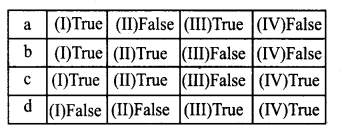
Reasoning:
I. We can store a value in a variable using the assignment operator.
II. We can change the value in a variable using the assignment operator.
III. Assignment operator is = =
(a) I and III are true
(b) I and II are true
(c) II and III are true
(d) I, II, III is true
Answer:
(b) I and II are true

Question 28.
Specification of an algorithm is the desired __________relation.
a) input-process
b) process-output
c) input-output
d) None of these
Answer:
c) input-output

Samacheer Kalvi 11th Computer Science Guide Chapter 6 Specification and Abstraction

Question 29.
In which one of the control flow statements, if the condition is false, then the alternative statement will be executed ………………..
(a) Sequential
(b) iterative
(c) selection
(d) alternative
Answer:
(d) alternative

Question 30.
The values of the variables when the algorithm starts are known as the __________state.
a) initial
b) final
c) intermediate
d) None of these
Answer:
a) initial

Question 31.
If the statement is executed one after the other, then it is a control flow.
(a) Sequential
(b) iterative
(c) selection
(d) alternative
Answer:
(a) Sequential

Question 32.
We can write the specification in a standard __________part format.
a) three
b) four
c) two
d) many
Answer:
a) three

Question 33.
Which one of the following is not a technique for designing algorithms?
(a) specifications
(b) abstraction
(c) encapsulation
(d) composition
Answer:
(c) encapsulation

Samacheer Kalvi 11th Computer Science Guide Chapter 6 Specification and Abstraction

Question 34.
__________defines the rights and responsibilities of the designer and the user.
a) Specification
b) Abstraction
c) Composition and Decomposition
d) All the above
Answer:
a) Specification

Question 35.
How many parts are there in the specification is ………………..
(a) 2
(b) 3
(c) 4
(d) 5
Answer:
(b) 3

Question 36.
In algorithms, the state of a computation is abstracted by a set of __________
a) expressions
b) variables
c) functions
d) None of these
Answer:
b) variables

Question 37.
Identify the statement which is not true?
(a) An instruction describes an object
(b) the specification is one of the algorithm design techniques
(c) An algorithm is a step by step sequence of instructions
Answer:
(a) An instruction describes an object

Question 38.
_________ is a basic and important abstraction.
a) process
b) state
c) addition
d) None of these
Answer:
d) None of these

Samacheer Kalvi 11th Computer Science Guide Chapter 6 Specification and Abstraction

Question 39.
Sequential, Alternative, and Iterative comes under the classification of ……………….. :
(a) Building blocks of the algorithm
(b) control flow statements
(c) Algorithm design techniques
(d) Abstraction
Answer:
(b) control flow statements

Part II

Short Answer Questions

Question 1.
Define State.
Answer:
The state of a process can be represented by a set of variables in an algorithm. The State at any point of execution is simply the values of the variables at that point.

Question 2.
What is the statement?
Answer:
Instructions of a computer are also known as statements.

Question 3.
Define variable.
Answer:
The data stored in a variable is also known as the value of the variable. We can store a value in a variable or change the value of a variable, using an assignment statement.

Question 4.
What are the building blocks of algorithms?
Answer:
The building blocks of algorithms are;

  • Data.
  • Variables.
  • Control flow.
  • Functions.

Samacheer Kalvi 11th Computer Science Guide Chapter 6 Specification and Abstraction

Question 5.
Define control flow.
Answer:
The order in which the statements are executed may differ from the order in which they are written in the algorithm. This order of execution of statements is known as the control flow.

Question 6.
What is a function?
Answer:
The parts of an algorithm are known as functions. A function is like a sub-algorithm. It takes an input, and produces an output, satisfying the desired input, output relation.

Question 7.
How will you specify the algorithm?
Answer:
The algorithm S is specified as;

  • algorithm_name (inputs)
  • inputs: P
  • outputs: Q

This specification means that if the algorithm starts with inputs satisfying P, then it will finish with the outputs satisfying Q.

Question 8.
Define abstraction.
Answer:
Abstraction is the process of ignoring or hiding irrelevant details and modeling a problem only by its essential features.

Samacheer Kalvi 11th Computer Science Guide Chapter 6 Specification and Abstraction

Question 9.
What purpose abstraction is used?
Answer:
Abstraction is the most effective mental tool used for managing complexity. If we do not abstract a problem adequately, we may deal with unnecessary details and complicate the solution.

Part III

Explain in brief

Question 1.
Define Alternative control flow statement.
Answer:
In alternative control flow, a condition of the state is tested, and if the condition is true, one statement is executed; if the condition is false, an alternative statement is executed.

Question 2.
Justify goat, grass, and wolf problem is algorithmic.
Answer:
goat, grass, and wolf problem:
A farmer wishes to take a goat, a grass bundle, and a wolf across a river. However, his boat can take only one of them at a time. So several trips are necessary across the river.

Moreover, the goat should not be left alone with the grass (otherwise, the goat would eat the grass), and the wolf should not be left alone with the goat (otherwise, the wolf would eat the goat).

How can the farmer achieve the task? Initially, we assume that all the four are at the same side of the river, and finally, all the four must be on the opposite side. The farmer must be in the boat when crossing the river.
A solution consists of a sequence of instructions indicating who or what should cross. Therefore, this is an algorithmic problem.

Question 3.
Write the Iterative control flow statement.
Answer:
In iterative control flow, a condition of the state is tested, and if the condition is true, a statement is executed. The two steps of testing the condition and executing the statement are repeated until the condition becomes false.

Samacheer Kalvi 11th Computer Science Guide Chapter 6 Specification and Abstraction

Question 4.
Explain variable.
Answer:
Variables are named boxes for storing data. When we do operations on data, we need to store the results in variables. The data stored in a variable is also known as the value of the variable.
We can store a value in a variable or change the value of a variable, using an assignment statement.

Question 5.
Write the following
(i) initial state
(ii) final state
Answer:
The values of the variables when the algorithm starts are known as the initial state, and the values of the variables when the algorithm finishes are known as the final state.

Samacheer Kalvi 11th Computer Science Guide Chapter 6 Specification and Abstraction

Question 6.
When functions are needed?
Answer:
Algorithms can become very complex. The variables of an algorithm and dependencies among the variables may be too many. Then, it is difficult to build algorithms correctly.
In such situations, we break an algorithm into parts, construct each part separately, and then integrate the parts to the complete algorithm. The parts of an algorithm are known as functions.

Question 7.
Give an example for a function?
Answer:
Suppose we want to calculate the surface area of a cylinder of radius r and height h.
A = 2 πr² + 2πrh
We can identify two functions, one for calculating the area of a circle and the other for the circumference of the circle.
If we abstract the two functions as circle_area(r) and circle_circumference(r), then,
cylinder_area (r, h) can be solved as:
cylinder_area (r, h) = 2 X circle_area (r) + circle_circumference (r) X h.

Question 8.
What are the basic principles and techniques for designing algorithms?
Answer:
The basic principles and techniques for designing algorithms are:

  • Specification.
  • Abstraction.
  • Composition.
  • Decomposition.

Question 9.
Write the specification format and explain.
Answer:
Specification format:
We can write the specification in a standard three-part format:

  • The name of the algorithm and the inputs.
  • Input: the property of the inputs.
  • Output: the desired input-output relation.

The first part is the name of the algorithm and the inputs. The second part is the property of the inputs. It is written as a comment which starts with – inputs: The third part is the desired input-output relation.
It is written as a comment which starts with — outputs: The input and output can be written using English and mathematical notation.

Samacheer Kalvi 11th Computer Science Guide Chapter 6 Specification and Abstraction

Question 10.
Write the specification of an algorithm for computing the square root of a number.
Answer:

  • Let us name the algorithm square_root.
    it takes the number as the input. Let us name the input n. n should not be negative.
  • It produces the square root of n as the output. Let us name the output y. Then n should be the square of y.

Now the specification of the algorithm is
a) square_root (n).
b) inputs: n is a real number, n > 0.
c) outputs: y is a real number such that y 2= n.

Question 11.
Give an example for abstraction.
Answer:

  • A road map is designed for drivers. They do not usually worry about hills so most hills are ignored on a road map.
  • A walker’s map is not interested in whether a road is a one-way street, so such details are ignored.

Part IV

Explain in detail

Question 1.
Explain the three control flow statement.
Answer:
There are three important control flow statements to alter the control flow depending on the state.

  1. In sequential control flow, a sequence of statements is executed one after another in the same order as they are written.
  2. In alternative control flow, a condition of the state is tested, and if the condition is true, one statement is executed; if the condition is false, an alternative statement is executed.
  3. In iterative control flow, a condition of the state is tested, and if the condition is true, a statement is executed. The two steps of testing the condition and executing the statement are repeated until the condition becomes false.

Question 2.
What are the uses of the Operating System?
Answer:
The basic principles and techniques for designing algorithms are;

  • Specification.
  • Abstraction.
  • Composition.
  • Decomposition.

Specification: The first step in problem-solving is to state the problem precisely. A problem is specified in terms of the input given and the output desired. The specification must also state the properties of the given input, and the relation between the input and the output.

Abstraction: A problem can involve a lot of details. Several of these details are unnecessary for solving the problem. Only a few details are essential. Ignoring or hiding unnecessary details and modeling an entity only by its essential properties is known as abstraction. For example, when we represent the state of a process, we select only the variables essential to the problem and ignore inessential details.

Composition: An algorithm is composed of assignment and control flow statements. A control flow statement tests a condition of the state and, depending on the value of the condition, decides the next statement to be executed.

Samacheer Kalvi 11th Computer Science Guide Chapter 6 Specification and Abstraction

Decomposition: We divide the main algorithm into functions. We construct each function independently of the main algorithm and other functions. Finally, we construct the main algorithm using the functions.

Question 3.
Explain the specification format.
Answer:
Specification format: We can write the specification in a standard three-part format:

  1. The name of the algorithm and the inputs
  2. Input: the property of the inputs
  3. Output: the desired input-output relation

The first part is the name of the algorithm and the inputs. The second part is the property of the inputs. It is written as a comment which starts with – inputs: The third part is the desired input-output relation. It is written as a comment which starts with outputs: The input and output can be written using English and mathematical notation.

Samacheer Kalvi 11th Computer Science Guide Chapter 6 Specification and Abstraction

Question 4.
Explain the state with a suitable example.
Answer:
State:
The state is a basic and important abstraction. Computational processes have stated. A computational process starts with an initial state. As actions are performed, its state changes. It ends with a final state.

The state of a process is abstracted by a set of variables in the algorithm. The state at any point of execution is simply the values of the variables at that point.

Example:
Chocolate Bars: A rectangular chocolate bar is divided into squares by horizontal and vertical grooves. We wish-to break the bar into individual squares.
To start with, we have the whole of the bar as a single piece. A cut is made by choosing a piece and breaking it along one of its grooves. Thus a cut divides a piece into two pieces. How many cuts are needed to break the bar into its individual squares? In this example, we will abstract the essential variables of the problem.

Essential variables:
The number of pieces and the number of cuts are the essential variables of the problem. We will represent them by two variables, p and c, respectively. Thus, the state of the process is abstracted by two variables p and c.

Irrelevant details:
The problem could be cutting a chocolate bar into individual pieces or cutting a sheet of postage stamps into individual stamps. It is irrelevant. The problem is simply cutting a grid of squares into individual squares.
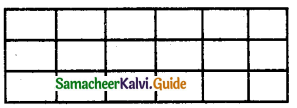
Samacheer Kalvi 11th Computer Science Guide Chapter 6 Specification and Abstraction 2

The sequence of cuts that have been made and the shapes and sizes of the resulting pieces are irrelevant too. From p and c, we cannot reconstruct the sizes of the individual pieces. But, that is irrelevant to solving the problem.
Samacheer Kalvi 11th Physics Guide Chapter 10 Oscillations

Tamilnadu State Board New Syllabus Samacheer Kalvi 11th Physics Guide Pdf Chapter 10 Oscillations Text Book Back Questions and Answers, Notes.

Tamilnadu Samacheer Kalvi 11th Physics Solutions Chapter 10 Oscillations

11th Physics Guide Oscillations Book Back Questions and Answers

Samacheer Kalvi 11th Physics Guide Chapter 10 Oscillations

I. Multiple choice questions:

Question 1.
In a simple harmonic oscillation, the acceptation against displacement for one complete oscillation will be: (Model NSEP 2000 – 01)
(a) an ellipse
(b) a circle
(c) a parabola
(d) a straight line
Answer:
(d) a straight line

Hint:
The sketch between cause (magnitude of acceleration) and effect (magnitude of displacement) is a straight line.

Question 2.
A particle executing SHM crosses points A and B with the same velocity. Having taken 3 s in passing from A to B, it returns to B after another 3 s. The time period is:
(a) 15 s
(b) 6 s
(c) 12 s
(d) 9 s
Answer:
(c) 12 s

Hint:
Samacheer Kalvi 11th Physics Guide Chapter 10 Oscillations 1
The time period is the time taken by a particle to return to B.

Question 3.
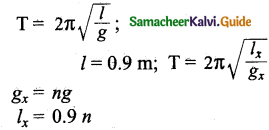
The length of a second’s pendulum on the surface of the Earth is 0.9 m. The length of the same pendulum on the surface of planet X such that the acceleration of the planet X is n times greater than the Earth is:
(a) 0.9 n
(b) \(\frac { 0.9 }{ n }\)m
(c) 0.9 n²m
(d) \(\frac{0.9}{n^{2}}\)
Answer:
(a) 0.9 n

Hint:
Samacheer Kalvi 11th Physics Guide Chapter 10 Oscillations 2

Question 4.
A simple pendulum is suspended from the roof of a school bus which moves in a horizontal direction with an acceleration a, then the time period is:
(a) T ∝ \(\frac{1}{g^{2}+a^{2}}\)
(b) T ∝ \(\frac{1}{\sqrt{g^{2}+a^{2}}}\)
(c) T ∝ \(\sqrt{g^{2}+a^{2}}\)
(d) T ∝ (g² + a²)
Answer:
(b) T ∝ \(\frac{1}{\sqrt{g^{2}+a^{2}}}\)

Hint: T = 2π\(\sqrt{\frac{l}{g}}\)
When a bus is moving
g’ = \(\sqrt{g^{2}+a^{2}}\)
∴ T ∝ \(\frac{1}{\sqrt{g^{2}+a^{2}}}\)

Samacheer Kalvi 11th Physics Guide Chapter 10 Oscillations

Question 5.
Two bodies A and B whose masses are in the rati0 1:2 are suspended from two separate massless springs of force constants kA and kB respectively. If the two bodies oscillate vertically such that their maximum velocities are in the ratio 1:2, the ratio of the amplitude A to that of B is:
(a) \(\sqrt{\frac{k_{\mathrm{B}}}{2 k_{\mathrm{A}}}}\)
(b) \(\sqrt{\frac{k_{\mathrm{B}}}{8 k_{\mathrm{A}}}}\)
(c) \(\sqrt{\frac{2k_{\mathrm{B}}}{ k_{\mathrm{A}}}}\)
(d) \(\sqrt{\frac{8k_{\mathrm{B}}}{ k_{\mathrm{A}}}}\)
Answer:
(b) \(\sqrt{\frac{k_{\mathrm{B}}}{8 k_{\mathrm{A}}}}\)

Hint: vA : vB
Amplitude of A : Amplitude of B = \(\sqrt{\mathrm{K}_{\mathrm{B}}}: \sqrt{8 \mathrm{~K}_{\mathrm{A}}}\)

Question 6.
A spring is connected to a mass m Suspended from it and its time period for vertical oscillation is T. The spring is now cut into two equal halves and the same mass is suspended from one of the halves. The period of vertical oscillation is:
(a) T’ = \(\sqrt{2}\)T
(b) T’ = \(\frac{\mathrm{T}}{\sqrt{2}}\)
(c) T’ = \(\sqrt{2T}\)
(d) T’ = \(\sqrt{\frac{\mathrm{T}}{2}}\)
Answer:
(b) T’ = \(\frac{\mathrm{T}}{\sqrt{2}}\)

Hint:
T = 2π\(\sqrt{\frac{\mathrm{m}}{k}}\)
When the spring is cut into two equal halves, then the force constant of each part is 2k.
When the mass is suspended from one of the halves.
Time period T’ = 2π\(\sqrt{\frac{\mathrm{m}}{2k}}\)
= \(\sqrt{\frac{\mathrm{T}}{2}}\)

Question 7.
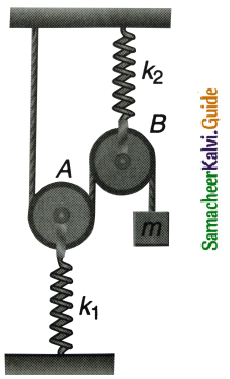
The time period for small vertical oscillations of block of mass m when the masses of the pulleys are negligible and spring constant k1 and k2 is:
Samacheer Kalvi 11th Physics Guide Chapter 10 Oscillations 3
(a) T = 4π\(\sqrt{m\left(\frac{1}{k_{1}}+\frac{1}{k_{2}}\right)}\)
(b) T = 2π\(\sqrt{m\left(\frac{1}{k_{1}}+\frac{1}{k_{2}}\right)}\)
(c) T = 4π\(\sqrt{m\left(k_{1}+k_{2}\right)}\)
(d) T = 2π\(\sqrt{m\left(k_{1}+k_{2}\right)}\)
Answer:
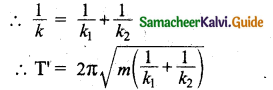
(a) T = 4π\(\sqrt{m\left(\frac{1}{k_{1}}+\frac{1}{k_{2}}\right)}\)

Hint:
T = 2π\(\frac { m }{ k }\)
The given arrangement is similar to the combination of springs in series.
Samacheer Kalvi 11th Physics Guide Chapter 10 Oscillations 4

Question 8.
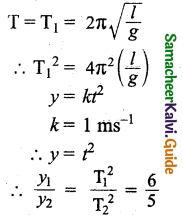
A simple pendulum has a time period T1. When its point of suspension is moved vertically upwards according as y = kt², where y is vertical distance covered and k = 1 ms-2, its time period becomes T2. Then, \(\frac{\mathrm{T}_{1}^{2}}{\mathrm{~T}_{2}^{2}}\) is (g = 10 ms-2
(a) \(\frac { 5 }{ 6 }\)
(b) \(\frac { 11 }{ 10 }\)
(c) \(\frac { 6 }{ 5 }\)
(d) \(\frac { 5 }{ 4 }\)
Answer:
(c) \(\frac { 6 }{ 5 }\)

Hint:
Samacheer Kalvi 11th Physics Guide Chapter 10 Oscillations 5

Question 9.
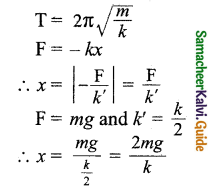
An ideal spring of spring constant k, is suspended from the ceiling of a room and a block of mass m is fastened to its lower end. If the block is released when the spring is un-stretched, then the maximum extension in the spring is:
(a) 4\(\frac { mg }{ k }\)
(b) \(\frac { mg }{ k }\)
(c) 2\(\frac { mg }{ k }\)
(d) \(\frac { mg }{ 2k }\)
Answer:
(c) 2\(\frac { mg }{ k }\)

Hint:
Samacheer Kalvi 11th Physics Guide Chapter 10 Oscillations 6

Question 10.
A pendulum is hung in a very high building oscillates to and fro motion freely like a simple harmonic oscillator. If the acceleration of the bob is 16 ms-2 at a distance of 4 m from the mean position, then the time period is: (NEET 2018 model)
(a) 2s
(b) 1s
(c) 2 πs
(d) πs
Answer:
(d) πs

Hint:
a = 16 m/s²; y = 4
a = – \(\frac { g }{ l }\)x = – ω²x
16 = \(\left|1-\omega^{2} \times 4\right|\)
∴ ω² = \(\frac { 16 }{ 4 }\) = 4
ω = 2
Time period T = \(\frac { 2π }{ ω }\) = πs

Samacheer Kalvi 11th Physics Guide Chapter 10 Oscillations

Question 11.
A hollow sphere is filled with water. It is hung by a long thread. As the water flows out of a hole at the bottom, the period of oscillation will:
(a) first increase and then decrease
(b) first decrease and then increase
(c) increase continuously
(d) decrease continuously
Answer:
(a) first increase and then decrease

Hint:
As the water flows out of the sphere, the time period first increases and then decreases. Initially, when the sphere is completely filled with water its centre of gravity (C.G) lies at its centre. As water flows out, the C.G begins to shift below the centre of the sphere.

The effective length of the pendulum increases and hence time period increases. When the sphere becomes more than half empty, its C.G begins to rise up. The effective length of the pendulum decreases and T decreases.

Question 12.
The damping force on an oscillator is directly proportional to the velocity. The units of the constant of proportionality are: (AIPMT 2012)
(a) kg m s-1
(b) kg m s-2
(c) kg s-1
(d) kg s
Answer:
(c) kg s-1

Hint:
Fd ∝ v
Fd = – bv
Fd = kv
∴ k = \(\frac{\mathrm{F}_{d}}{\nu}\)
Units of k = \(\frac{\mathrm{kgms}^{-2}}{\mathrm{~m} / \mathrm{s}}\)
= kg-1
Units of proportionality constant = kgs-1

Question 13.
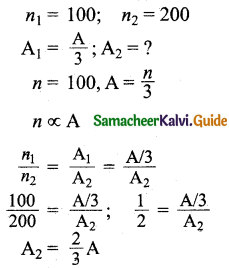
When a damped harmonic oscillator completes 100 oscillations, its amplitude is reduced to\(\frac { 1 }{ 3 }\) of its initial value. What will be its amplitude when it completes 200 oscillations?
(a) \(\frac { 1 }{ 5 }\)
(b) \(\frac { 2 }{ 3 }\)
(c) \(\frac { 1 }{ 6 }\)
(d) \(\frac { 1 }{ 9 }\)
Answer:
(b) \(\frac { 2 }{ 3 }\)

Hint:
Samacheer Kalvi 11th Physics Guide Chapter 10 Oscillations 7

Question 14.
Which of the following differential equations represents a damped harmonic oscillator?
(a) \(\frac{d^{2} y}{d t^{2}}\) + y = 0
(b) \(\frac{d^{2} y}{d t^{2}}\) + γ \(\frac { dy }{ dt }\) + y = 0
(c) \(\frac{d^{2} y}{d t^{2}}\) + k²y = 0
(d) \(\frac { dy }{ dt }\) + y = 0
Answer:
(b) \(\frac{d^{2} y}{d t^{2}}\) + γ \(\frac { dy }{ dt }\) + y = 0

Hint:
For a damped oscillator F ∝ v
Total restoring force F = – ky – bv
b – damping constant; y – displacement
If F = – ky – by
then m\(\frac{d^{2} y}{d t^{2}}\) = – ky – b\(\frac { dy }{ dt }\)
m\(\frac{d^{2} y}{d t^{2}}\) + ky + b\(\frac { dy }{ dt }\) = 0
÷ m we get
\(\frac{d^{2} y}{d t^{2}}\) + \(\frac { b }{ m }\)\(\frac { dy }{ dt }\) + \(\frac { k }{ m }\)y = 0
If k = m and \(\frac { b }{ m }\) = r
then the equation becomes
\(\frac{d^{2} y}{d t^{2}}\) + r\(\frac { dy }{ dt }\) + y = 0

Samacheer Kalvi 11th Physics Guide Chapter 10 Oscillations

Question 15.
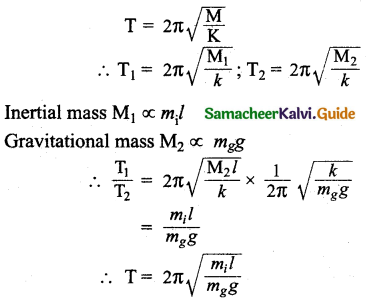
If the inertial mass and gravitational mass of the simple pendulum of length l are not equal, then the time period of the simple pendulum is:
(a) T = 2π\(\sqrt{\frac{m_{i} l}{m_{g} g}}\)
(b) T = 2π\(\sqrt{\frac{m_{g} l}{m_{i} g}}\)
(c) T = 2π\(\frac{m_{g}}{m_{i}} \sqrt{\frac{l}{g}}\)
(d) T = 2π\(\frac{m_{i}}{m_{g}} \sqrt{\frac{l}{g}}\)
Answer:
(a) T = 2π\(\sqrt{\frac{m_{i} l}{m_{g} g}}\)

Hint:
Samacheer Kalvi 11th Physics Guide Chapter 10 Oscillations 8

II. Short Answers Questions:

Question 1.
What is meant by periodic and non-periodic motion? Give any two examples, for each motion.
Answer:
Periodic motion: Any motion which repeats itself in a fixed time interval is known as periodic motion. Examples: Hands in a pendulum clock, the swing of a cradle.
Non-Periodic motion: Any motion which does not repeat itself after a regular interval of time is known as non-periodic motion. Example: Occurrence of Earthquake, the eruption of a volcano.

Question 2.
What is meant by the force constant of a spring?
Answer:
Force constant is defined as force per unit length.

Question 3.
Define the time period of simple harmonic motion.
Answer:
The time period is defined as the time taken by a particle to complete one oscillation. It is usually denoted by T.

Question 4.
Define frequency of simple harmonic motion.
Answer:
The number of oscillations produced by the particle per second is called frequency. It is denoted by f. SI unit for frequency is s-1 or hertz (Hz).
Mathematically, frequency is related to time period by f = \(\frac{1}{\mathrm{T}}\)

Samacheer Kalvi 11th Physics Guide Chapter 10 Oscillations

Question 5.
What is an epoch?
Answer:
Initial phases of a particle is an epoch. At time t = 0 s (initial time), the phase φ = (φ0 is called epoch (initial phase) where φ0 is called the angle of epoch.

Question 6.
Write short notes on two springs connected in series.
Answer:
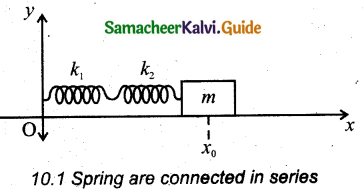
Let us consider two springs whose spring constant are k1 and k2 and which are connected to a mass m as shown in Figure.
Samacheer Kalvi 11th Physics Guide Chapter 10 Oscillations 9
Let F be the applied force towards right as shown in Figure. The net displacement of the mass point is
x = x1 + x2
From Hooke’s law, the net force,
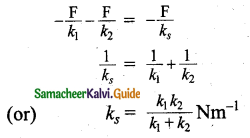
F = – ks(x1 + x2)
The effective spring constant can be calculated as
Samacheer Kalvi 11th Physics Guide Chapter 10 Oscillations 11
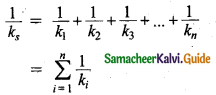
When n springs connected in series, the effective spring constant in series is
Samacheer Kalvi 11th Physics Guide Chapter 10 Oscillations 12
If all spring constants are identical
i.e., k1 = k2 = … = kn = k then
\(\frac{1}{k_{s}}\) = \(\frac { n }{ k }\) ⇒ ks = \(\frac { k }{ n }\)
This means that the effective spring constant reduces by the factor n. So, for springs in series connection, the effective spring constant is lesser than the individual spring constants.

Question 7.
Write short notes on two springs connected in parallel.
Answer:
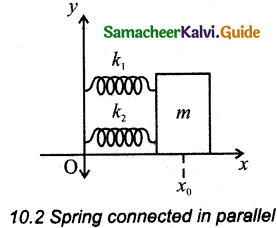
Let us consider only two springs of spring constants k1 and k2 attached to a mass m as shown in Figure.
Samacheer Kalvi 11th Physics Guide Chapter 10 Oscillations 13
Net force for the displacement of mass m is F = – kpx … (1)
Where kp is called effective spring constant. Let the first spring be elongated by a displacement x due to force F1 and the second spring be elongated by the same displacement x due to force F2, then the net force
F = – k1x – k2x … (2)
Equating equations (2) and (1), we get
kp = k1 + k2 … (3)
Generalizing, for n springs connected in parallel,
kp = \(\sum_{i=1}^{n} k_{i}\) … (4)
If all spring constants are identical i.e., k1 = k2 = … = kn = k then
kp = nk … (5)
It is implied that the effective spring constant increases by a factor n. So, for the springs in parallel connection, the effective spring constant is greater than the individual spring constant.

Question 8.
Write down the time period of simple pendulum.
Answer:
T = 2π\(\sqrt{\frac{l}{g}}\) in second.
where l – length of the pendulum.
g – acceleration due to gravity.

Samacheer Kalvi 11th Physics Guide Chapter 10 Oscillations

Question 9.
State the laws of simple pendulum.
Answer:
Laws of simple pendulum: The time period of a simple pendulum.

Depends on the following laws:
(i) Law of length: For a given value of acceleration due to gravity, the time period of a simple pendulum is directly proportional to the square root of length of the pendulum.
T ∝ \(\sqrt{l}\) … (1)

(ii) Law of acceleration: For a fixed length, the time period of a simple pendulum is inversely proportional to the square root of acceleration due to gravity.
T ∝ \(\frac{1}{\sqrt{g}}\) … (2)

Question 10.
Write down the equation of time period for linear harmonic oscillator.
Answer:
Time period T = \(\frac { 1 }{ f }\) = 2π \(\sqrt{\frac{m}{k}}\)s
where m is the mass, k is the spring constant.

Question 11.
What is meant by free oscillation?
Answer:
The oscillations in which the amplitude decreases gradually with the passage of time are called damped Oscillations.
Example:

  1. The oscillations of a pendulum or pendulum oscillating inside an oil-filled container.
  2. Electromagnetic oscillations in a tank circuit.
  3. Oscillations in a dead beat and ballistic galvanometers.

Question 12.
Explain damped oscillation. Give an example.
Answer:
If an oscillator oscillates in a resistive medium, then its amplitude goes on decreasing. The motion of the oscillator is called damped oscillation.
Example:

  • The oscillations of a pendulum (including air friction) or pendulum oscillating inside an oil-filled container.
  • Electromagnetic oscillations in a tank circuit.

Question 13.
Define forced oscillation. Give an example.
Answer:
The body executing vibration initially vibrates with its natural frequency and due to the presence of external periodic force, the body later vibrates with the frequency of the applied periodic force. Such vibrations are known as forced vibrations.
Example: Soundboards of stringed instruments.

Samacheer Kalvi 11th Physics Guide Chapter 10 Oscillations

Question 14.
What is meant by maintained oscillation? Give an example.
Answer:
To avoid damping in an oscillation, energy is supplied from an external source, the amplitude of the oscillation can be made constant. Such vibrations are known as maintained vibrations.

Example:
The vibration of a tuning fork getting energy from a battery or from an external power supply.

Question 15.
Explain resonance. Give an example.
Answer:
The frequency of external periodic force (or driving force) matches with the natural frequency of the vibrating body (driven). As a result, the oscillating body begins to vibrate such that its amplitude increases at each step and ultimately it has a large amplitude. Such a phenomenon is known as resonance and the corresponding vibrations are known as resonance vibrations. Example: The breaking of glass due to sound

Samacheer Kalvi 11th Physics Guide Chapter 10 Oscillations

III. Long Answers Questions:

Question 1.
What is meant by simple harmonic oscillation? Give examples and explain why every simple harmonic motion is a periodic motion whereas the converse need not be true.
Answer:
Simple harmonic motion is a special type of oscillatory motion in which the acceleration or force on the particle is directly proportional to its displacement from a fixed point and is always directed towards that fixed point.

Example: Oscillation of a pendulum. SHM is a special type of periodic motion, where restoring force is proportional to the displacement and acts in the direction opposite to displacement.

Question 2.
Describe Simple Harmonic Motion as a projection of uniform circular motion.
Answer:
(i) Let us consider a particle of mass m moving with uniform speed v along the circumference of a circle whose radius is r in an anti-clockwise direction (as shown in Figure).

(ii) It is assumed that the origin of the coordinate System coincides with the center 0 of the circle.

(iii) If co is the angular velocity of the particle and 0 the angular displacement of the particle at any instant of time t, then θ = ωt. By projecting the uniform circular motion on its diameter a simple harmonic motion is obtained.

(iv) This means that we can associate a map (or a relationship) between uniform circular (or revolution) motion to vibratory motion.

(v) Conversely, any vibratory motion or revolution can be mapped to uniform circular motion. The position of a particle moving is projected on to its vertical diameter or on to a line parallel to vertical diameter.

(vi) Similarly, we can do it for horizontal axis or a line parallel to the horizontal axis.

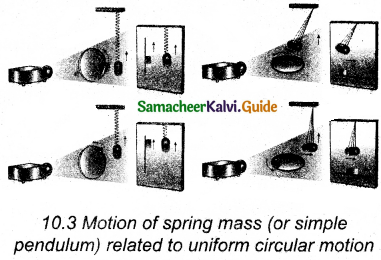
Example: Let us consider a spring-mass system (or oscillation of pendulum) as shown in Figure. When the spring moves up and down (or pendulum moves to and fro), the motion of the mass or bob is mapped to points on the circular motion.
Samacheer Kalvi 11th Physics Guide Chapter 10 Oscillations 14
Thus, if a particle undergoes uniform circular motion then the projection of the particle on the diameter of the circle (or on a line parallel to the diameter) traces straight line motion that is simple harmonic in nature. The circle is known as the reference circle of the simple harmonic motion.

Question 3.
What is meant by angular harmonic oscillation? Compute the time period of angular harmonic oscillation.
Answer:
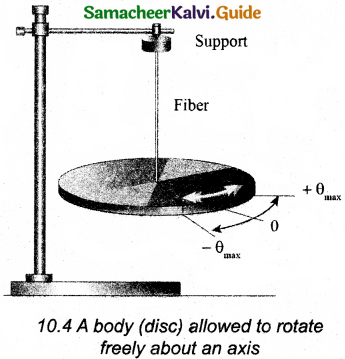
Samacheer Kalvi 11th Physics Guide Chapter 10 Oscillations 15
If a body is allowed to rotate freely about a given axis then the oscillation is known as the angular oscillation. The point at which the resultant torque acting on the body is taken to be zero. It is called mean position. If the body is displaced from the mean position, then the resultant torque acts such that it is proportional to the angular displacement. This torque has a tendency to bring the body towards the mean position.

Time period : Let \(\overline{θ}\) be the angular displacement of the body and the resultant torque \(\vec { τ }\) acting on the body is,
\(\vec { τ }\) ∝ \(\vec {θ}\) … (1)
\(\vec { τ }\) = – k\(\vec {θ}\) … (2)
K is the restoring torsion constant, that is torque per unit angular displacement. If I is the moment of inertia of the body and \(\vec { τ }\) ∝ \(\vec {α}\) is the angular acceleration then
\(\vec { τ }\) = I \(\vec{α}\) = k \(\vec {θ}\)
But \(\vec{α}\) = \(\frac{d^{2} \vec{\theta}}{d t^{2}}\) and therefore
\(\frac{d^{2} \vec{\theta}}{d t^{2}}\) = – \(\frac { k }{ I }\)\(\vec {θ}\) … (3)
This differential equation resembles simple harmonic differential equation.
By comparing equation (3) with simple harmonic motion given we get,
a = \(\frac{d^{2} y}{d t^{2}}\) = – ω²y, we have
ω = \(\sqrt{\frac{k}{I}}\) rads-1 … (4)
The frequency of the angular harmonic motion is given equation ω = 2πf is
f = \(\frac { 1 }{ 2π }\) \(\sqrt{\frac{k}{I}}\)Hz … (5)
The time period is given equation is
T = \(\frac { 1 }{ f }\); T = 2π\(\sqrt{\frac{I}{k}}\) second
In angular simple harmonic motion, the displacement of the particle is measured in terms of angular displacement \(\vec {θ}\).

Samacheer Kalvi 11th Physics Guide Chapter 10 Oscillations

Question 4.
Write down the difference between simple harmonic motion angular simple harmonic motion.
Answer:
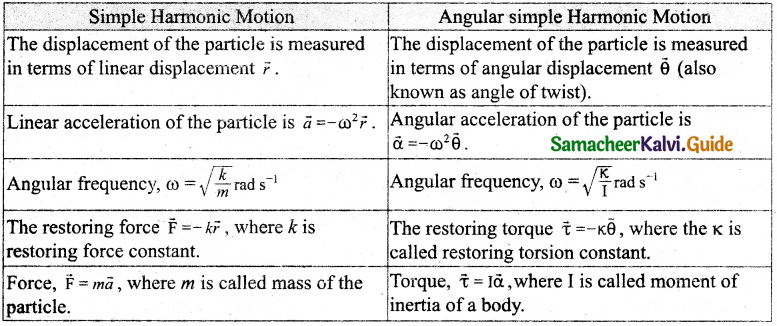
Comparison of simple harmonic motion and angular simple harmonic motion.
Samacheer Kalvi 11th Physics Guide Chapter 10 Oscillations 16

Question 5.
Discuss the simple pendulum in detail.
Answer:
Construction:
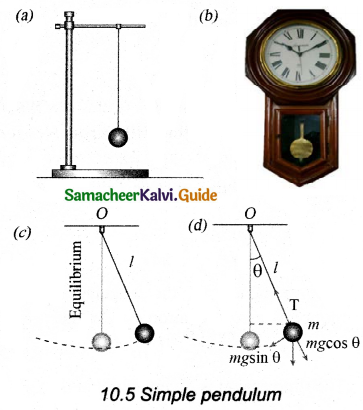
A pendulum is a mechanical system which exhibits periodic motion. It has a bob with mass m suspended by a massless and inextensible string. The other end is fixed on a stand as shown in Figure (a). At equilibrium, the pendulum does not oscillate and is suspended vertically downward.

Such a position is known as mean position or equilibrium position. When a pendulum is displaced through a small displacement from its equilibrium position and released, the bob of the pendulum executes to and fro motion.
Samacheer Kalvi 11th Physics Guide Chapter 10 Oscillations 17
Calculation of time period: Let l be the length of the pendulum which is taken as the distance between the point of suspension and the centre of gravity of the bob. Two forces act on the bob of the pendulum at any displaced position, as shown in Figure (d),

  • The gravitational force acting on the body (F = mg) acts vertically downwards.
  • The tension in the string T acts along the string to the point of suspension.

Resolving the gravitational force into its components:

  • Normal component: It is along the string but in opposition to the direction of tension, Fas = mg cosθ.
  • Tangential component: It is perpendicular to the string i.e., along the tangential direction of arc of the swing, Fps = mg sinθ.

Hence, the normal component of the force is, along the string,
T – Was = m\(\frac{v^{2}}{l}\)
Here v is speed of bob
T – mg cosθ = m\(\frac{v^{2}}{l}\) … (1)
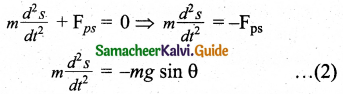
From the Figure, it is observed that the tangential component Wps of the gravitational force always points towards the equilibrium position. This direction always points opposite to the direction of displacement of the bob from the mean position. Hence, in this case, the tangential force is the restoring force. Applying Newton’s second law along tangential direction, we have
Samacheer Kalvi 11th Physics Guide Chapter 10 Oscillations 18
Where, s is the position of bob that is measured along the arc. Expressing arc length in terms of angular displacement i.e.,
s = lθ … (3)
Then its acceleration,
\(\frac{d^{2} \theta}{d t^{2}}\) = \(\frac{d^{2} \theta}{d t^{2}}\) … (4)
Substituting equation (4) in equation (2), we get,
l\(\frac{d^{2} \theta}{d t^{2}}\) = – g sin θ
\(\frac{d^{2} \theta}{d t^{2}}\) = – \(\frac { g }{ l }\) sin θ … (5)
Because of the presence of sinθ in the above differential equation, it is a nonlinear differential equation. It is assumed that “the small oscillation approximation”, sin θ ≈ θ, the above differential equation becomes linear differential equation.
\(\frac{d^{2} \theta}{d t^{2}}\) = – \(\frac { g }{ l }\) θ
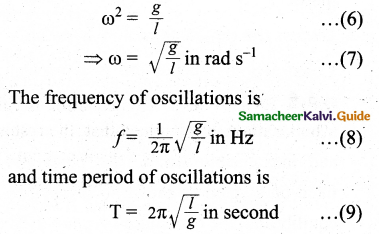
It is known as oscillatory differential equation. Hence, the angular frequency of this oscillator (natural frequency of this system) is
Samacheer Kalvi 11th Physics Guide Chapter 10 Oscillations 19

Question 6.
Explain the horizontal oscillations of a spring.
Answer:
Samacheer Kalvi 11th Physics Guide Chapter 10 Oscillations 20
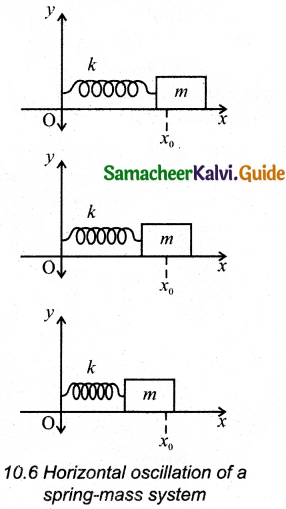
Let us consider a system containing a block of mass m fastened to a massless spring with stiffness constant or force constant or spring constant k placed on a smooth horizontal surface (frictionless surface) as shown in Figure. Let x0 be the equilibrium position or mean position of mass m when it is left undisturbed.

When the mass is displaced through a small displacement x towards right from its equilibrium position and then released, it will oscillate back and forth about its mean position x0. Let F be the restoring force (due to stretching of the spring) that is proportional to the amount of displacement of block: For one-dimensional motion, we get
F ∝ x
F = – kx
where negative sign implies that the restoring force will always act opposite to the direction of the displacement. This equation is called Hooke’s law. It is noticed that, the restoring force is linear with the displacement (i.e., the exponent of force and displacement are unity). This is not always true. If we apply a very large stretching force, then the amplitude of oscillations becomes very large.
m\(\frac{d^{2} x}{d t^{2}}\) = – kx
\(\frac{d^{2} x}{d t^{2}}\) = – \(\frac { k }{ m }\)x … (1)
Comparing the equation (1) with simple harmonic motion equation a = \(\frac{d^{2} y}{d t^{2}}\) = – ω²y, we get
ω² = \(\frac { k }{ m }\)
which means the angular frequency or natural frequency of the oscillator is
ω = \(\sqrt{\frac{k}{m}}\)rad s-1 … (2)
The frequency of the oscillation is
f = \(\frac { ω }{ 2π }\) = \(\frac { 1 }{ 2π }\)\(\frac { k }{ m }\) Hertz … (3)
and the time period of the oscillation is
T = \(\frac { 1 }{ f }\) = 2π[/latex]\(\frac { m }{ k }\) seconds … (4)

Question 7.
Describe the vertical oscillations of a spring.
Answer:
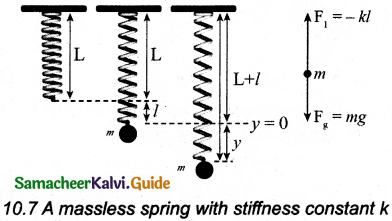
Consider a massless spring with stiffness constant or force constant k attached to a ceiling as shown in Figure. Let the length of the spring before loading mass m be L. If the block of mass m is attached to the other end of the spring, then the spring elongates by a length l. Let F1 be the restoring force due to the stretching of spring. Due to mass m, the gravitational force acts vertically downward. A free-body diagram is drawn for this system as shown in Figure. When the system is under equilibrium,
Samacheer Kalvi 11th Physics Guide Chapter 10 Oscillations 21
F1 + mg = 0 … (1)
But the spring elongates by small displacement l,
∴ F1 ∝ l ⇒ F1 = – kl … (2)
Substituting equation (2) in equation (1), we get
– kl + mg = 0
mg = kl
(or) \(\frac { m }{ k }\) = \(\frac { 1 }{ g }\) … (3)
Suppose a very small external force is applied on the mass such that the mass further displaces downward by a displacement y, then it will oscillate up and down. Now, the restoring force due to this stretching of spring (total extension of spring is y + l) is
F2 (y + 1)
F2 = – k(y + 1) = – ky – kl … (4)
Since, the mass moves up and down with acceleration , by drawing the free body diagram for this case, we get
-ky – kl + mg = m\(\frac{d^{2} y}{d t^{2}}\) … (5)
The net force acting on the mass due to this stretching is
F = F2 + mg
F = – ky – kl + mg … (6)
The gravitational force opposes the restoring force. Substituting equation (3) in equation (6), we get
F = – ky – kl + kl = ky
Time period:
Applying Newton’s law, we get
m\(\frac{d^{2} y}{d t^{2}}\) = – ky
\(\frac{d^{2} y}{d t^{2}}\) = – \(\frac { k }{ m }\)y … (7)
The above equation is in the form of simple harmonic differential equation. Hence the time period is
T = 2π \(\sqrt{\frac{m}{k}}\)second … (8)
The time period can be rewritten using equation (3) as
T = 2π \(\sqrt{\frac{m}{k}}\) = 2π \(\sqrt{\frac{l}{g}}\)second.

Samacheer Kalvi 11th Physics Guide Chapter 10 Oscillations

Question 8.
Write short notes on the oscillations of the liquid column in U-tube.
Answer:
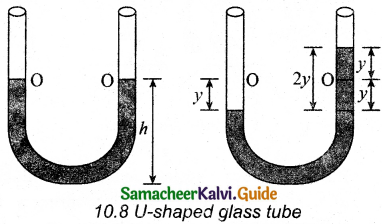
Let us consider a U-shaped glass tube which consists of two open arms with uniform cross¬sectional area A. Let us pour a non-viscous uniform incompressible liquid of density p in the U-shaped tube to a height h as shown in the Figure. If the liquid and tube are not disturbed then the liquid surface will be in equilibrium position O.
Samacheer Kalvi 11th Physics Guide Chapter 10 Oscillations 22
It means the pressure as measured at any point on the liquid is the same and also at the surface on the arm (edge of the tube on either side), that balances the atmospheric pressure. Hence, the level of liquid in each arm will be the same. By blowing air one can provide sufficient force in one arm, and the liquid gets disturbed from equilibrium position O, It is meant, that pressure at blown arm is higher than the other arm.

A difference in pressure is created that will cause the liquid to oscillate for a very short duration of time about the mean or equilibrium position. Finally, it comes to rest.
Time period of the oscillation is
T= 2π \(\sqrt{\frac{l}{2g}}\)second

Question 9.
Discuss in detail the energy in simple harmonic motion.
Answer:
(i) Expression for Potential Energy:For the simple harmonic motion, the force and the displacement are related by Hooke’s law
\(\vec { F }\) = – k\(\vec { r }\)
F = – kx … (1)
the work done by the conservative force field is independent of path.
Calculation potential energy:
F = \(\frac { dU }{ dx }\) … (2)
Comparing (1) and (2), we get
\(\frac { dU }{ dx }\) = – kx
dU = – kx dx
This work done by the force F during a small displacement dx stores as potential energy
Samacheer Kalvi 11th Physics Guide Chapter 10 Oscillations 23
From equation,
ω = \(\sqrt{\frac{k}{m}}\) rad s-1
By substituting the value of force constant k = mω² in equation (3), we get
U(x) = \(\frac { 1 }{ 2 }\)mω²x² … (4)
where ω is the natural frequency of the oscillating system. For the particle executing simple harmonic motion from the equation,
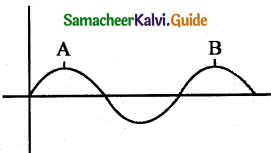
y = A sin ωt
we get,
x = A sin ωt
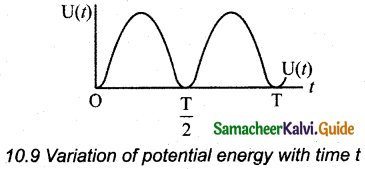
U(t) = \(\frac { 1 }{ 2 }\)mω²x² … (5)
This variation of U is shown below.
Samacheer Kalvi 11th Physics Guide Chapter 10 Oscillations 24

(ii) Expression for Kinetic Energy:
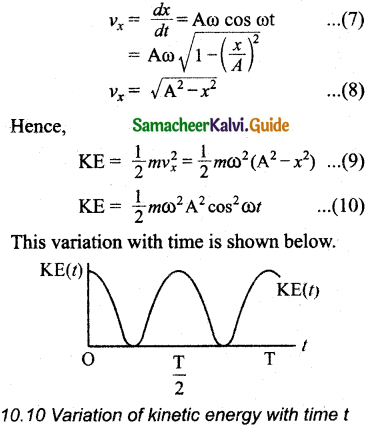
Kinetic energy
KE = \(\frac { 1 }{ 2 }\)mvx² = \(\frac { 1 }{ 2 }\)m(\(\frac { dx }{ dt }\))² … (6)
Since the particle executes simple harmonic motion, from equation y = A sin ωt
x = A sin ωt
∴ velocity is
Samacheer Kalvi 11th Physics Guide Chapter 10 Oscillations 25

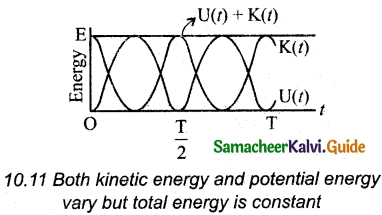
(iii) Expression for Total Energy: Total energy is the sum of kinetic energy and potential energy.
E = KE + U … (11)
E = \(\frac { 1 }{ 2 }\)mω²(A² – x²) + \(\frac { 1 }{ 2 }\)mω²x² … (12)
Hence, cancelling x² term,
E = \(\frac { 1 }{ 2 }\)mω²x² = r constant … (13)
Alternatively, from equation (5) and equation (10), we get the total energy as
E = \(\frac { 1 }{ 2 }\)mω²x² sin²ωt + \(\frac { 1 }{ 2 }\)mω²A²cos²ωt
= \(\frac { 1 }{ 2 }\)mω²A² (sin²ωt + cos²ωt)
From trigonometry identity,
(sin² ωt + cos² ωt) = 1
E = \(\frac { 1 }{ 2 }\)mω²A² = constant
which gives the law of conservation of total energy.
Samacheer Kalvi 11th Physics Guide Chapter 10 Oscillations 26

Question 10.
Explain in detail the four different types of oscillations.
Answer:
(i) Free oscillations: When the oscillator oscillates with a frequency that is equal to the natural frequency of the oscillator. Such an oscillation or vibration is known as free oscillation or free vibration.

Example:

  • Oscillation of a simple pendulum,
  • Vibration in a stretched string.

(ii) Damped oscillation: If an oscillator oscillates in a resistive medium, then its amplitude goes on decreasing. The energy of the oscillator is used to do work against the resistive medium. The motion of the oscillator is said to be a damped oscillation.
Example:

  • The oscillations of a pendulum (including air friction) or pendulum oscillating inside an oil filled container.
  • Electromagnetic oscillations in a tank circuit.

(iii) Forced oscillations: In this type of vibration, the body executing vibration initially vibrates with its natural frequency. Because of the presence of external periodic force, the body later vibrates with the frequency of the applied periodic force. Such vibrations are known as forced vibrations.

Example:
Soundboards of stringed instruments.

(iv) Maintained oscillations: The amplitude of the oscillation can be made constant. By supplying energy from an external source. Such oscillations are known as maintained oscillations.

Example:
The vibration of a tuning fork getting energy from a battery or from external power supply.

Samacheer Kalvi 11th Physics Guide Chapter 10 Oscillations

IV. Numerical Problems:

Question 1.
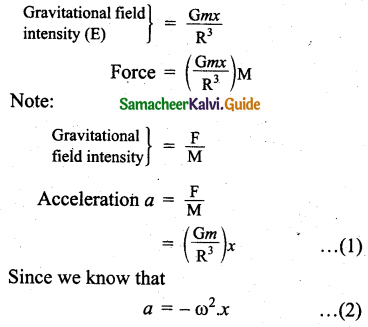
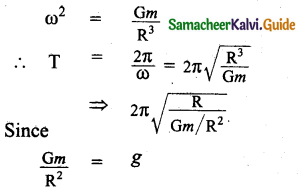
Consider the Earth as a homogeneous sphere of radius R and a straight hole is bored in it through its centre. Show that a particle dropped into the hole will execute a simple harmonic motion such that its time Period is T = 2π\(\sqrt{\frac{\mathrm{R}}{g}}\)
Answer:
Samacheer Kalvi 11th Physics Guide Chapter 10 Oscillations 27
(Here, negative has no meaning. It can be neglected)
Comparing equation (1) & (2) we get,
Samacheer Kalvi 11th Physics Guide Chapter 10 Oscillations 28
Time period, T = 2π\(\sqrt{\frac{\mathrm{R}}{g}}\)
Hence proved.

Question 2.
Calculate the time period of the oscillation of a particle of mass m moving in the potential defined as
Answer:
Samacheer Kalvi 11th Physics Guide Chapter 10 Oscillations 29
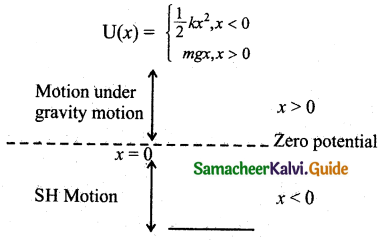
In the problem consider oscillation of particle into 2 cases via x < 0 (consider it as SHM where the time period is considered as t1) and another one as x > 0 (consider it as a motion under gravity, where time period is t2)

Note:
We want to find the total time period, which will be T = t1 + t2.
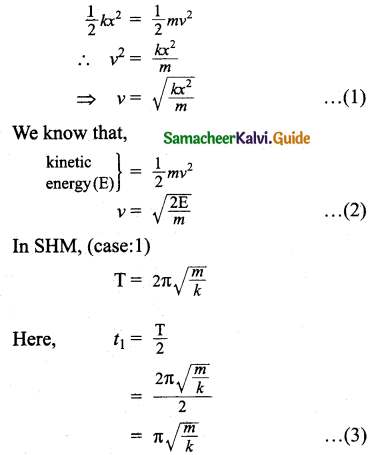
According to the conservation of energy
Samacheer Kalvi 11th Physics Guide Chapter 10 Oscillations 30
In case: 2 (Motion under gravity)
t2 = \(\frac { 2v }{ g }\) substituting equation (2) here we get,
t2 = \(\frac { 2 }{ g }\)\(\sqrt{\frac{2 E}{m}}\)
⇒ 2\(\sqrt{\frac{2 \mathrm{E}}{m g^{2}}}\) … (4)
Adding equation (3) & (4)
Time period of oscillation,
T = t1 + t2
= π\(\sqrt{\frac{m}{k}}\) + 2\(\sqrt{\frac{2 \mathrm{E}}{m g^{2}}}\)

Question 3.
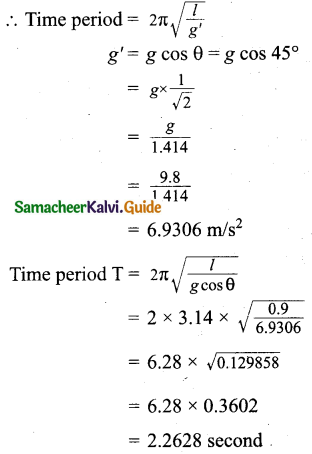
Consider a simple pendulum of length l = 0.9 m which is properly placed on a trolley rolling down on a inclined plane which is at θ = 45° with the horizontal. Assuming that the inclined plane is frictionless, calculate the time period of oscillation of the simple pendulum.
Answer:
The effective value of acceleration due to gravity (g) will be equal to the component of g normal to the inclined plane which is
g’ = g cos α
T = 2π\(\sqrt{\frac{l}{g^{\prime}}}\) = 2π\(\sqrt{\frac{l}{g \cos \theta}}\)
Length of the pendulum l = 0.9m
Angle of inclination θ = 45°
Samacheer Kalvi 11th Physics Guide Chapter 10 Oscillations 31

Question 4.
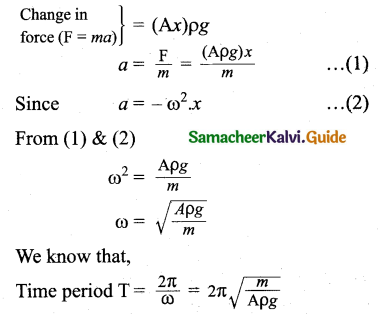
A piece of wood of mass m is floating erect in a liquid whose density is ρ. If it is slightly pressed down and released, then executes simple harmonic motion. Show that its time period of oscillation is T = 2π\(\sqrt{\frac{m}{\mathrm{Ag} \rho}}\)
Answer:
When a wood is pressed and released,
Samacheer Kalvi 11th Physics Guide Chapter 10 Oscillations 32

Question 5.
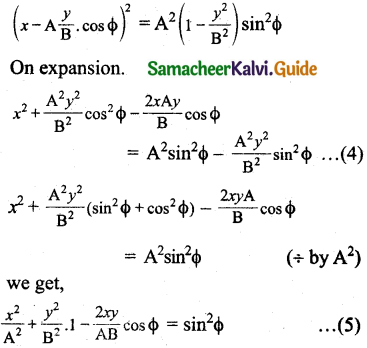
Consider two simple harmonic motion along x and y-axis having same frequencies but different amplitudes as x = A sin (ωt + φ) (along x axis) and y = B sin ωt (along y axis). Then show that \(\frac{x^{2}}{\mathrm{~A}^{2}}+\frac{y^{2}}{\mathrm{~B}^{2}}-\frac{2 x y}{\mathrm{AB}}\) cosφ = sin²φ and also discuss the special cases when
(i) φ = 0
(ii) φ = π
(iii) φ = \(\frac { π }{ 2 }\)
(iv) φ = \(\frac { π }{ 2 }\) and A = B
(v) φ = \(\frac { π }{ 4 }\)
Note: when a particle is subjected to two simple harmonic motions at right angle to each other the particle may move along different paths. Such paths are called Lissajous figures.
Given:
x = A sin(ωt-φ) … (1)
y = B sin ωt … (2)
In equation (1) use,
sin (A – B) – sin A cos B + cos A sin B
(1) ⇒ x – A sin ωt. cos (φ) + A cos ωt. sinφ
x – A sin cat. cos φ = A cos cot sin φ
squaring on both sides we get,
(x – A sin cot. cos φ)² = A² cos²cot sin²φ … (3)
In equation (3) sin at can be re-written as, \(\frac { y }{ B }\) [from equation (2)]. Also, use
cos²cot = 1 – sin²ωt in equation (3)
∴ (3) becomes
Samacheer Kalvi 11th Physics Guide Chapter 10 Oscillations 34
Hence proved.

Special cases:
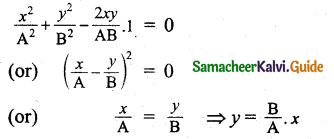
(i) φ = 0 in equation (5) we get,
Samacheer Kalvi 11th Physics Guide Chapter 10 Oscillations 35
The above equation resembles equation of a straight line passing through origin with positive slope.

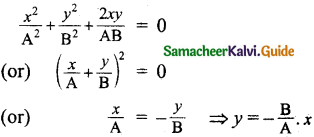
(ii) φ = π in equation (5)
Samacheer Kalvi 11th Physics Guide Chapter 10 Oscillations 36
The above equation is an equation of a straight line passing through origin with a negative slope.

(iii) φ = \(\frac { π }{ 2 }\) in equation (5)
The above equation of an ellipse whose centre is origin.

(iv) φ = \(\frac { π }{ B }\) and A = B in equation (5)
\(\frac{x^{2}}{\mathrm{~A}^{2}}+\frac{y^{2}}{\mathrm{~A}^{2}}\) = 1
⇒ x² + y² = A²
The above equation of a circle whose centre is origin.

(v) φ = \(\frac { π }{ 4 }\), cos \(\frac { π }{ 4 }\) = \(\frac{1}{\sqrt{2}}\) sin\(\frac { π }{ 4 }\) = \(\frac{1}{\sqrt{2}}\) equation (5) we get,
\(\frac{x^{2}}{\mathrm{~A}^{2}}+\frac{y^{2}}{\mathrm{~A}^{2}}\) – \(\frac{(\sqrt{2}) x y}{A B}\) = \(\frac { 1 }{ 2 }\)
The above equation is an equation of tilted ellipse.

Samacheer Kalvi 11th Physics Guide Chapter 10 Oscillations

Question 6.
Show that for a particle executing simple harmonic motion,
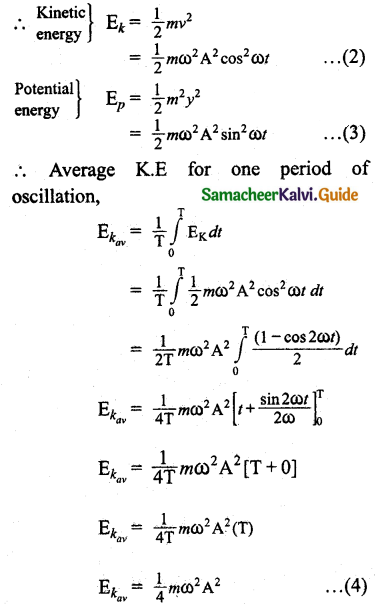
(a) the average value of kinetic energy is equal to the average value of potential energy,
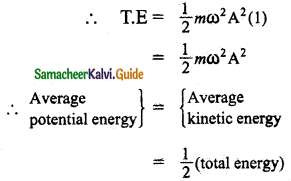
(b) average potential energy = average kinetic energy = \(\frac { 1 }{ 2 }\) (total energy)
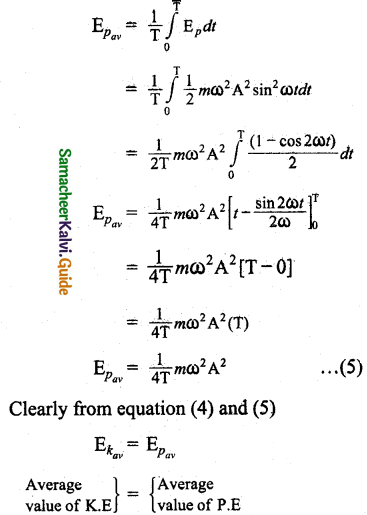
Hint: average kinetic energy = < kinetic energy > = \(\frac{1}{\mathrm{~T}} \int_{0}^{\mathrm{T}}(\text { Potential energy }) d t\) and average potential energy = < potential energy > = \(\frac{1}{\mathrm{~T}} \int_{0}^{\mathrm{T}}(\text { Potential energy }) d t\)
Answer:
(a) Suppose a particle of mass m executes SHM of time period T. The displacement of the particle at any instant t is given by
y = A sin ωr … (1)
Velocity v = \(\frac { dy }{ dt }\) = \(\frac { d }{ dt }\)(sin ωt) = Aω cos ωt = ωA cosωt
Samacheer Kalvi 11th Physics Guide Chapter 10 Oscillations 37
Average potential energy over a period of oscillation is,
Samacheer Kalvi 11th Physics Guide Chapter 10 Oscillations 38

(b) Total energy
T.E = \(\frac { 1 }{ 2 }\) ω²y² + \(\frac { 1 }{ 2 }\)mω²(A² – y²)
But y = A sinωt
T.E = \(\frac { 1 }{ 2 }\)mω²A² ωt + \(\frac { 1 }{ 2 }\)mω²A² cos²ωt
= \(\frac { 1 }{ 2 }\)mω²A²(sin²ωt + cos²ωt)
From trignometry identity
sin² ωt + cos² ωt = 1
Samacheer Kalvi 11th Physics Guide Chapter 10 Oscillations 39

Question 7.
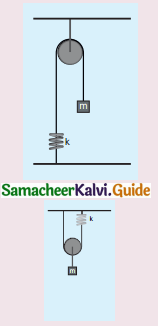
Compute the time period for the following system if the block of mass m is slightly displaced vertically down from its equilibrium position and then released. Assume that the pulley is light and smooth, strings and springs are light.
Answer:
Samacheer Kalvi 11th Physics Guide Chapter 10 Oscillations 40
Case (a):
When mass is slightly displaced vertically down: Now pulley is fixed rigidly here. When the mass is displaced by y and the spring will also be stretched by y.
Hence F = ky
Time period T = \(\sqrt{\frac{m}{k}}\)

case (b):
When the system is released: WTien mass is displaced by y, pulley is also displaced by 4y,
∴ F = 4 Icy
∴ T = 2π\(\sqrt{\frac{m}{4k}}\)

Samacheer Kalvi 11th Physics Guide Chapter 10 Oscillations

Samacheer Kalvi 11th Computer Science Guide Chapter 5 Working with Typical Operating System (Windows & Linux)

Tamilnadu State Board New Syllabus Samacheer Kalvi 11th Computer Science Guide Pdf Chapter 5 Working with Typical Operating System (Windows & Linux) Text Book Back Questions and Answers, Notes.

Tamilnadu Samacheer Kalvi 11th Computer Science Solutions Chapter 5 Working with Typical Operating System (Windows & Linux)

11th Computer Science Guide Working with Typical Operating System (Windows & Linux) Text Book Questions and Answers

Part I

Choose the correct answer.

Question 1.
From the options given below, choose the operations managed by the operating system.
a) Memory
b) Processor
c) I/O devices
d) all of the above
Answer:
d) all of the above

Samacheer Kalvi 11th Computer Science Guide Chapter 5 Working with Typical Operating System (Windows & Linux)

Question 2.
Which is the default folder for many Windows Applications to save your file?
a) My Document
b) My Pictures
c) Documents and Settings
d) My Computer
Answer:
a) My Document

Question 3.
Under which of the following OS, the option Shift + Delete – permanently delete a file or folder?
a) Windows 7
b) Windows 8
c) Windows 10
d) None of the OS
Answer:
a) Windows 7

Samacheer Kalvi 11th Computer Science Guide Chapter 5 Working with Typical Operating System (Windows & Linux)

Question 4.
What is the meaning of “Hibernate” in Windows XP/Windows 7?
a) Restart the Computer in safe mode
b) Restart the Computer in hibernate mode
c) Shutdown the Computer terminating a!! the running applications
d) Shutdown the Computer without closing the running applications
Answer:
d) Shutdown the Computer without closing the running applications

Question 5.
Which of the following OS is not based on Linux?
a) Ubuntu
b) Redhat
c) CentOs
d) BSD
Answer:
d) BSD

Question 6.
Which of the following in Ubuntu OS is used to view the options for the devices installed?
a) Settings
b) Files
c) Dash
d) VBox_GAs_5.2.2
Answer:
b) Files

Samacheer Kalvi 11th Computer Science Guide Chapter 5 Working with Typical Operating System (Windows & Linux)

Question 7.
Identify the default email client in Ubuntu.
a) Thunderbird
b) Firefox
c) Internet Explorer
d) Chrome
Answer:
a) Thunderbird

Question 8.
Which is the default application for spreadsheets in Ubuntu? This is available in the software launcher.
a) LibreOffice Writer
b) LibreOffice Calc
c) LibreOffice Impress
d) LibreOffice Spreadsheet
Answer:
b) LibreOffice Calc

Samacheer Kalvi 11th Computer Science Guide Chapter 5 Working with Typical Operating System (Windows & Linux)

Question 9.
Which is the default browser for Ubuntu?
a) Firefox
b) Internet Explorer
c) Chrome
d) Thunderbird
Answer:
a) Firefox

Samacheer Kalvi 11th Computer Science Guide Chapter 5 Working with Typical Operating System (Windows & Linux)

Question 10.
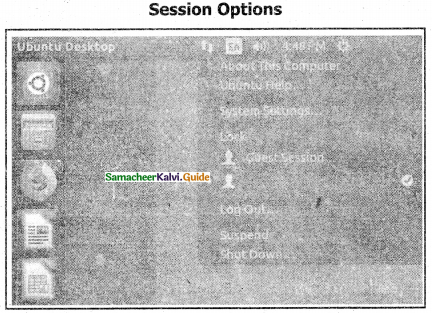
Where will you select the option to log out, suspend, restart, or shut down from the desktop of Ubuntu OS?
a) Session Indicator
b) Launcher
c) Files
d) Search
Answer:
a) Session Indicator

Part – II

Short Answers

Question 1.
Differentiate cut and copy options.
Answer:

COPYCUT
Copy text will leave the source as it is and place a copy in the destination.Move text will shift the source to the destination i.e., the text will change its position.
After the copy, the text available in both source and destination locations.After the move, the text available in the destination location alone.

Samacheer Kalvi 11th Computer Science Guide Chapter 5 Working with Typical Operating System (Windows & Linux)

Question 2.
What is the use of a file extension?
Answer:
File Extension is the second part of the file name. It succeeds the decimal point in the file name. It is used to identify the type of file and it is normally upto 3 to 4 characters long.
Example: exe, html.

Samacheer Kalvi 11th Computer Science Guide Chapter 5 Working with Typical Operating System (Windows & Linux)

Question 3.
Differentiate Files and Folders.
Answer:

FilesFolders
The files store data of any kind.The folders store files and other sub-folders.
Information stored in the computer only in the form of file.The folders often referred to as directories, are used to organize files on your computer.

Question 4.
Differentiate Save and Save As option.
Answer:

SaveSave As
The save command automatically saves the file using the same name, format and location, as when it was last saved or opened from. Save command opens a dialog box only first time saved.The save as command opens a dialog box every time in which the user can change the name of the file, the format, as well as the location of where the file is saved if needed.
Question 5.
What is open source?
Answer:
Open source refers to a program or software in which the source code is available in the web to all public, without any cost.

Question 6.
What are the advantages of open source?
Answer:
The reasons individuals or organizations choose open source software are:

  1. lower cost
  2. security
  3. no vendor ‘lock-in’
  4. better quality

Samacheer Kalvi 11th Computer Science Guide Chapter 5 Working with Typical Operating System (Windows & Linux)

Question 7.
Mention the different server distributions in Linux OS.
Answer:
The server distribution in Linux OS:

  1. Ubuntu Linux
  2. Linux Mint
  3. Arch Linux
  4. Deepin
  5. Fedora
  6. Debian
  7. Centos

Question 8.
How will you log off from Ubuntu OS?
Answer:
When you have finished working on your computer, you can choose to Log Out through the Session Indicator on the far right side of the top panel.

Part – III

Explain in brief

Question 1.
Analyse: Why the drives are segregated?
Answer:

  1. It saves space and increases system performance.
  2. Sharing and protection.
  3. Segment and segregate the data to defend it from cyber-attacks.

Samacheer Kalvi 11th Computer Science Guide Chapter 5 Working with Typical Operating System (Windows & Linux)

Question 2.
If you are working on multiple files at a time, sometimes the system may hang. What is the reason behind it. How can you reduce it?
Answer:
Too Many Applications Running :
Each application open on the system takes some internal and hardware resources to keep it running. If multiple apps and programs are running, your PC may run low on resources as memory is used by a number of applications.

Device Driver Issues:
Outdated or damaged drivers can also be the reason behind frequent computer freezes. If video drivers being installed on your system are not updated, the computer might hang up while you attempt to play a video or game on the system.

Operating System Issues:
To ensure the smooth functioning of the machine, make sure that all updates are installed. To be able to keep the system updated, it is vital that you use a legal copy of the operating system.

Excess Heating Up:
If the temperature of your system processor is higher than usual, the chances are that the computer may freeze.

Hardware Misconfigyratioo:
One major reason behind the computer freeze issue is hardware misconfiguration, This may have occurred due to misconfigured hardware component that you recently added to the computer. Alternatively, the hardware component you added recently may be incompatible with the computer.

Question 3.
Are drives such as hard drive and floppy drives represented with drive letters? If so why, if not why?
Answer:
Yes, hard drives and floppy drives are represented with drive letters.
A: drive is used for floppy disk of 3.5 inches and storage capacity of 1.44 MB.
B: drive is for floppy of size 5.25 inches and of storage capacity of 1.2 MB
So, we can say like
A: First Floppy Drive
B: Second Floppy Drive
C: D : E: …………….. Z: Hard Disk Drives, CD/DVD

Samacheer Kalvi 11th Computer Science Guide Chapter 5 Working with Typical Operating System (Windows & Linux)

Question 4.
Write the specific use of Cortana.
Answer:
Cortana is your personal digital assistant on Windows 10 to help you find virtually anything on your device, track your packages and flights, inform you about weather and traffic information, manage your calendar and create reminders, and it can even tell you jokes.

Question 5.
List out the major differences between Windows and Ubuntu OS.
Answer:

WindowsUbuntu
Windows NT’ is the kernel used in WindowsLinux is the kernel used in Ubuntu
Needs to pay for WindowsIt is completely free and available as open-source
It support executable files (.exe), Virus threatening existsIt does not support executable files (.exe) so, mostly it is virus-free OS
Desktop OS does not support serverDesktop OS can also work as a server
It does not support multiple desktop environmentsIt supports multiple desktop environments
Installation is very simpleInstallation is quite complex process
Separately install MS Office in WindowsOS comes with many useful software like Office
It does not have own software managerIt has its own software manager
Software installation does that by simple installation package and instructions.It normally installs the software and tools by terminal
User friendlyIt is not user friendly

Samacheer Kalvi 11th Computer Science Guide Chapter 5 Working with Typical Operating System (Windows & Linux)

Question 6.
Are there any difficulties you face while using Ubuntu? If so, mention it with reasons.
Answer:

  1. Ubuntu has less hardware support for commercial/industrial/medical/ logistical therefore it’s less voted for use in big-time backends.
  2. Ubuntu doesn’t support middlewares such as C panel, cloud Linux and a plethora of other infrastructure or monitoring tools.
  3. Hard to install graphic drivers especially for old hardware. It is not possible to play modern games, because of poor graphics quality.
  4. The user switching from windows will not like the user experience on Ubuntu and will have difficulty in operating the OS.
  5. Ubuntu is not capable of playing MP3 files by default.

Samacheer Kalvi 11th Computer Science Guide Chapter 5 Working with Typical Operating System (Windows & Linux)

Question 7.
Differentiate Thunderbird and Firefox in Ubuntu OS.
Answer:

  • Firefox is a browser is access the internet.
  • Thunderbird is an email client. We can install it on our computer and view our emails.
  • Both Firefox and Thunderbird are Mozilla products.

Question 8.
Differentiate Save, Save As, and Save a Copy in Ubuntu OS.
Answer:
Save: This will save the document without asking for a new name or location. It will overwrite the original.

Save As: This will prompt you to save the document using a dialog box. You will have the ability to change the file name and/or location.

Save A Copy: This will prompt you to save a ‘copy’ using the same dialog box as ‘save as’. You will have the ability to change the file name and/or location. If you choose the same file name and location it will overwrite the original.

If you changed the name or location of the document you will be working on the original document, not the copy. This means that if you make additional changes and then hit save the original will be overwritten with the new changes, but the copy you saved earlier will be left at the state of the Save A Copy.

Part IV

Explain in detail

Question 1.
Explain the versions of the Windows Operating System.
Answer:
Versions of Windows Operating System
Samacheer Kalvi 11th Computer Science Guide Chapter 5 Working with Typical Operating System (Windows & Linux) 1
Samacheer Kalvi 11th Computer Science Guide Chapter 5 Working with Typical Operating System (Windows & Linux) 2
Samacheer Kalvi 11th Computer Science Guide Chapter 5 Working with Typical Operating System (Windows & Linux) 3
Samacheer Kalvi 11th Computer Science Guide Chapter 5 Working with Typical Operating System (Windows & Linux) 4
Samacheer Kalvi 11th Computer Science Guide Chapter 5 Working with Typical Operating System (Windows & Linux) 5
Samacheer Kalvi 11th Computer Science Guide Chapter 5 Working with Typical Operating System (Windows & Linux) 6

Samacheer Kalvi 11th Computer Science Guide Chapter 5 Working with Typical Operating System (Windows & Linux)

Question 2.
Draw and compare the scan equivalence in Windows and Ubuntu.
Answer:
Samacheer Kalvi 11th Computer Science Guide Chapter 5 Working with Typical Operating System (Windows & Linux) 7
Samacheer Kalvi 11th Computer Science Guide Chapter 5 Working with Typical Operating System (Windows & Linux) 8

Question 3.
Complete the following matrix.

Navigational methodLocated onIdeally suited for
Start buttonTaskbar
DesktopExploring your disk drives and using system tools
Windows

Explorer

Seeing hierarchy of ail computer contents and resources in one window.
Quick Launch

Answer:

Navigational methodLocated onIdeally suited for
Start buttonTaskbarTo open the applications
My ComputerDesktopExploring your disk drives and using system tools
Windows ExplorerStart ButtonSeeing hierarchy of all computer contents and resources in one window.
Quick LaunchTaskbarTo quickly launch programs that we place in it

Samacheer Kalvi 11th Computer Science Guide Chapter 5 Working with Typical Operating System (Windows & Linux)

Question 4.
Observe the figure and mark all the window elements. Identify the version of the Windows OS.
Answer:
The element of a windows
Samacheer Kalvi 11th Computer Science Guide Chapter 5 Working with Typical Operating System (Windows & Linux) 9 Samacheer Kalvi 11th Computer Science Guide Chapter 5 Working with Typical Operating System (Windows & Linux) 10
Samacheer Kalvi 11th Computer Science Guide Chapter 5 Working with Typical Operating System (Windows & Linux) 11

Samacheer Kalvi 11th Computer Science Guide Chapter 5 Working with Typical Operating System (Windows & Linux)

Question 5.
Write the procedure to create, rename, delete and save a file in Ubuntu OS. Compare it with Windows OS.
Answer:
The procedure to create, rename, delete and save a file in Ubuntu OS

Creating Files:

  • We can create the files with the same procedure by clicking the Files icon,
  • The following Figure shows the method of creating a File by right-clicking on the Desktop,

Samacheer Kalvi 11th Computer Science Guide Chapter 5 Working with Typical Operating System (Windows & Linux) 12

A new File can also be created by using File menu.
Samacheer Kalvi 11th Computer Science Guide Chapter 5 Working with Typical Operating System (Windows & Linux) 13

Deleting a File: A file created by us can be moved to trash by using right-click or by using the menu.
Samacheer Kalvi 11th Computer Science Guide Chapter 5 Working with Typical Operating System (Windows & Linux) 14

Deleting a File: Deleting a File by using the Edit menu.
Samacheer Kalvi 11th Computer Science Guide Chapter 5 Working with Typical Operating System (Windows & Linux) 15

Rename a file:

  • Select the file.
  • Right dick on the selected file and select Rename.
  • Type the new filename and then, press Enter

The procedure to create, rename, delete and save a file in Windows OS

To create a file:

  • Open the application using the Start button or through Icon or using the Run command.
  • Enter the content.
  • Save the file using Ctrl + S.

Renaming Files:
Using the FILE Menu

  • Select the File you wish to Rename.
  • Click File → Rename.
  • Type in the new name.
  • To finalize the renaming operation, press Enter.

To delete a file:
Select the file or folder you wish to delete.

  • Right-click the file or folder, select the Delete option from the pop-up menu, or Click
    File → Delete or press the Delete key from the keyboard.
  • The file will be deleted and moved to the Recycle bin.

To save a file:
Select the Save option from File Menu OR press Ctrl + S and then enter the file name and press OK.

Samacheer Kalvi 11th Computer Science Guide Chapter 5 Working with Typical Operating System (Windows & Linux)

11th Computer Science Guide Working with Typical Operating System (Windows & Linux) Additional Questions and Answers

Part I & Part II

Part – I

Choose the correct answer:

Question 1.
………………. is an Open source Operating System for desktop and server.
(a) Windows series
(b) Android
(c) iOS
(d) Linux
Answer:
(d) Linux

Question 2.
__________enables the hardware to communicate and operate with other software.
a) Loader
b) Compiler
c) Interpreter
d) Operating System
Answer:
d) Operating System

Question 3.
If you want to select multiple files or folders, use ……………….
(a) Ctrl + shift
(b) Ctrl + click
(c) shift + click
(d) Ctrl + shift + click
Answer:
(b) Ctrl + click

Samacheer Kalvi 11th Computer Science Guide Chapter 5 Working with Typical Operating System (Windows & Linux)

Question 4.
__________controls the overall execution of the computer.
a) Loader
b) Compiler
c) Interpreter
d) Operating System
Answer:
d) Operating System

Question 5.
………………. is one of the popular Open Source versions of the UNIX Operating System.
(a) Windows 7
(b) Windows 8
(c) Linux
(d) Android
Answer:
(c) Linux

Question 6.
The most popular Operating System for desktop and laptop computers.
a) Windows Series
b) Android
c) iOS
d) Linux
Answer:
a) Windows Series

Question 7.
………………. icon is the equivalent of Recycle bin of windows OS. All the deleted Files and Folders are moved here.
(a) Trash
(b) Files
(c) Online shopping
(d) Libre Office Impress
Answer:
(a) Trash

Question 8.
The most popular Operating System for Apple phones, iPad, and iPods.
a) Windows Series
b) Android
c) iOS
d) Linux
Answer:
c) iOS

Samacheer Kalvi 11th Computer Science Guide Chapter 5 Working with Typical Operating System (Windows & Linux)

Question 9.
………………. manages network connections, allowing you to connect to a wired or wireless network.
(a) Toolbar
(b) Title bar
(c) Session indicator
(d) Network indicator
Answer:
(d) Network indicator

Question 10.
Multiple applications can execute simultaneously in Windows, and this is known as __________
a) Multitasking
b) Multiuser
c) Parallel processing
d) None of these
Answer:
a) Multitasking

Question 11.
Clock is available in ……………….
(a) system tray
(b) Files
(c) start
(d) My documents
Answer:
(a) system tray

Question 12.
Windows Operating System uses __________as input device.
a) Keyboard
b) Mouse
c) Both A and B
d) None of these
Answer:
c) Both A and B

Question 13.
The menu bar is present below the ……………….
(a) Taskbar
(b) Scroll bar
(c) Title bar
(d) Function bar
Answer:
(c) Title bar

Samacheer Kalvi 11th Computer Science Guide Chapter 5 Working with Typical Operating System (Windows & Linux)

Question 14.
__________ is used to enter alphabets, numerals and special characters.
a) Keyboard
b) Mouse
c) Scanner
d) Optical Character Reader
Answer:
a) Keyboard

Question 15.
………………. has the task for frequently used applications?
(a) Quick Launch Tool bar
(b) Settings
(c) My pc
(d) This pc
Answer:
(a) Quick Launch Toolbar

Question 16.
__________program is an application program.
a) Word processing
b) Games and Spreadsheets
c) Calculator
d) All the above
Answer:
d) All the above

Question 17.
SSD stands for ……………….
(a) Solid State Devices
(b) Simple Stage Driver
(c) Single State Drivers
(d) Synchronized State Devices
Answer:
(a) Solid State Devices

Samacheer Kalvi 11th Computer Science Guide Chapter 5 Working with Typical Operating System (Windows & Linux)

Question 18.
__________is a file management activity.
a) Creating and Modifying file
b) Saving a file
c) Deleting a file
d) All the above
Answer:
d) All the above

Question 19.
What is the name given to the document window to enter or type the text?
(a) Workspace
(b) Work Area
(c) Typing Area
(d) Space
Answer:
(a) Workspace

Question 20.
Windows 1.x introduced in the year __________
a) 1992
b) 1987
c) 1985
d) 1982
Answer:
c) 1985

Question 21.
The disk drives mounted in the system can be seen by clicking ……………….
(a) Disk drive Icon
(b) Drive Icon
(c) Device Driver Icon
(d) My Computer Icon
Answer:
(d) My Computer Icon

Question 22.
Windows 3.x introduced in the year __________
a) 1992
b) 1987
c) 1985
d) 1982
Answer:
a) 1992

Samacheer Kalvi 11th Computer Science Guide Chapter 5 Working with Typical Operating System (Windows & Linux)

Question 23.
Windows 10 was developed in the year ……………….
(a) 2009
(b) 2012
(c) 2015
(d) 2018
Answer:
(c) 2015

Question 24.
Windows 98 introduced in the year __________
a) 1992
b) 1988
c) 1998
d) 1995
Answer:
c) 1998

Question 25.
The Rulers are used to set ……………….
(a) Orientations
(b) Header
(c) Footer
(d) Margins
Answer:
(d) Margins

Question 26.
Windows-XP introduced in the year __________
a) 2002
b) 2000
c) 1990
d) 2001
Answer:
d) 2001

Question 27.
Which functional key is used to bring the focus on, the first menu of the menu bar?
(a) F5
(b) F10
(c) F11
(d) F7
Answer:
(b) F10

Samacheer Kalvi 11th Computer Science Guide Chapter 5 Working with Typical Operating System (Windows & Linux)

Question 28.
Windows-7 introduced in the year __________
a) 2002
b) 2007
c) 2009
d) 2010
Answer:
c) 2009

Question 29.
Which one of the following is used to open the search results dialog box?
(a) search
(b) See more results
(c) search more results
(d) searching web
Answer:
(b) See more results

Question 30.
Windows-10 introduced in the year __________
a) 2012
b) 2015
c) 2009
d) 2010
Answer:
b) 2015

Question 31.
The keyboard shortcut to save a file is ……………….
(a) alt + s
(b) Ctrl + s
(c) Ctrl + alt + s
(d) winkey + s
Answer:
(b) Ctrl + s

Samacheer Kalvi 11th Computer Science Guide Chapter 5 Working with Typical Operating System (Windows & Linux)

Question 32.
In which version Start button window introduced.
a) Windows-XP
c) Windows 2.x
b) Windows 3.x
d) Windows 95
Answer:
d) Windows 95

Question 33.
Applications or files or folders are opened using related shortcut icons by ……………….
(a) Click and drag
(b) double click
(c) click
(d) drag and drop
Answer:
(b) double click

Question 34.
In which Windows version plug and play was introduced.
a) Windows-XP
b) Windows 98
c) Windows-Vista
d) Windows 95
Answer:
b) Windows 98

Question 35.
Which option is used to save the file?
(a) Ctrl + s
(b) Save
(c) File + save
(d) All the above
Answer:
(d) All the above

Question 36.
Which Windows version was designed to act as servers in the network.
a) Windows-XP
b) Windows 98
c) Windows-Vista
d) Windows-NT
Answer:
d) Windows-NT

Samacheer Kalvi 11th Computer Science Guide Chapter 5 Working with Typical Operating System (Windows & Linux)

Question 37.
ubuntu supports an office suite called ……………….
(a) Open Office
(b) Star Office
(c) Libre Office
(d) MS – Office
Answer:
(c) Libre Office

Question 38.
__________versions of Windows 2000 were released.
a) 6
b) 5
c) 4
d) 3
Answer:
c) 4

Question 39.
Which one of the following is a server distribution of Linux?
(a) Deepin
(b) Firefox
(c) MS.word
(d) Files
Answer:
(a) Deepin

Question 40.
Which version of Windows 2000 released for both a Web server and an office server.
a) Professional
b) Data Centre Server
c) Advanced Server
d) Server
Answer:
d) Server

Question 41.
Which option is used to delete all files in the Recycle bin?
(a) Remove the Recycle bin
(b) Empty the Recycle bin
(c) Clear the Recycle bin
(d) Clean the Recycle bin
Answer:
(b) Empty the Recycle bin

Question 42.
Which version of Windows 2000 released for high-traffic computer networks.
a) Professional
b) Data Centre Server
c) Advanced Server
d) Server
Answer:
b) Data Centre Server

Samacheer Kalvi 11th Computer Science Guide Chapter 5 Working with Typical Operating System (Windows & Linux)

Question 43.
Which version of Windows introduced as a stable version.
a) Windows-XP
b) Windows Me
c) Windows-Vista
d) Windows-NT
Answer:
a) Windows-XP

Question 44.
In which version of Windows booting time was improved.
a) Windows-7
b) Windows Me
c) Windows-Vista
d) Windows-NT
Answer:
a) Windows-7

Question 45.
__________feature is introduced in Windows-7.
a) Aero peek
b) Pinning programms to the taskbar
c) Handwriting recognition
d) All the above
Answer:
d) All the above

Question 46.
What is used to interact with windows by clicking icons?
(a) Mouse
(b) Keyboard
(c) Monitor
(d) Printer
Answer:
(a) Mouse

Question 47.
Which version of Windows served as a common platform for mobile and computer.
a) Windows-7
b) Windows – 8
c) Windows-Vista
d) Windows-NT
Answer:
b) Windows – 8

Samacheer Kalvi 11th Computer Science Guide Chapter 5 Working with Typical Operating System (Windows & Linux)

Question 48.
Windows-8 takes better advantage of_________
a) multi-core processing
b) solid-state drives
c) touch screens
d) all the above
Answer:
d) all the above

Question 49.
The start button was added again in the version of Windows.
a) Windows-7
b) Windows-8
c) Windows-Vista
d) Windows-10
Answer:
d) Windows-10

Question 50.
Hardware settings are used in which option?
(a) Monitor
(b) Display
(c) Theme
(d) My Computer
Answer:
(b) Display

Samacheer Kalvi 11th Computer Science Guide Chapter 5 Working with Typical Operating System (Windows & Linux)

Question 51.
Cortana voice activated personal assistance introduced in _________version of Windows.
a) Windows-7
b) Windows-8
c) Windows-Vista
d) Windows-10
Answer:
d) Windows-10

Question 52.
The opening screen of Windows is called
a) taskbar
b) system tray
c) desktop
d) none of the above
Answer:
c) desktop

Question 53.
The notification area of ubuntu-desktop is otherwise called……………….
(a) Task bar
(b) Desktop
(c) status bar
(d) Indicator area
Answer:
(d) Indicator area

Question 54.
_________is a graphic symbol representing the window elements like files, folders, shortcuts etc.
a) Taskbar
b) Icon
c) Shortcut key
d) None of these
Answer:
b) Icon

Question 55.
_________play a vital role in GUI based applications.
a) Taskbar
b) Icon
c) Shortcut key
d) None of these
Answer:
b) Icon

Question 56.
The icons which are available on the desktop by default while installing Windows OS are called __________icons.
a) quick launch
b) standard
c) default
d) desktop
Answer:
b) standard

Question 57.
Which menu has the rename option?
(a) File
(b) Edit
(c) View
(d) Window
Answer:
(a) File

Question 58.
_________icons can be created for any application or file or folder.
a) Standard
b) Default
c) Shortcut
d) None of these
Answer:
c) Shortcut

Question 59.
By double-clicking the _________icon, the related application or file or folder will open.
a) Standard
b) Default
c) Shortcut
d) None of these
Answer:
c) Shortcut

Question 60.
The disk drive icons graphically represent _________disk drive options.
a) six
b) five
c) three
d) four
Answer:
b) five

Question 61.
Which option reboot the computer?
(a) Restart
(b) Boot
(c) Reboot
(d) Reselect
Answer:
(a) Restart

Question 62.
The disk drive icons available for __________
a) Removable storage
b) Network drive
c) Pen drive
d) All the above
Answer:
d) All the above

Question 63.
__________is a typical rectangular area in an application or a document.
a) Cell pointer
b) Window
c) Table cell
d) None of these
Answer:
b) Window

Question 64.
_________ is an area on the screen that displays information for a specific program.
a) Cell pointer
b) Window
c) Table cell
d) None of these
Answer:
b) Window

Question 65.
Who developed Ubuntu OS?
(a) Mark Shuttleworth
(b) Ricki Mascitti
(c) Dan Bricklin
(d) Bob Frankston
Answer:
(a) Mark Shuttleworth

Question 66.
Application window can be __________
a) resized
b) maximized or minimized
c) placed side by side or overlap
d) All the above
Answer:
d) All the above

Question 67.
When two or more windows are open, only one of them is active and the rest are__________
a) inactive
b) hidden
c) minimized
d) maximized
Answer:
a) inactive

Question 68.
A __________is a section of the screen used to display the contents of a document.
a) System Window
b) Application Box
c) Application Window
d) Document Window
Answer:
d) Document Window

Question 69.
How many sets of scroll bars are there?
(a) 2
(b) 3
(c) 4
(d) 5
Answer:
(a) 2

Question 70.
__________ window is used for typing, editing, drawing, and formatting the text and graphics.
a) System Window
b) Application Box
c) Application Window
d) Document Window
Answer:
d) Document Window

Question 71.
__________window helps the user to communicate with the Application program.
a) System Window
b) Application Box
c) Application Window
d) Document Window
Answer:
c) Application Window

Question 72.
The title bar of a window will contain __________button.
a) minimize
b) maximize
c) close
d) all the above
Answer:
d) all the above

Question 73.
What is the name given to the larger window?
(a) Work window
(b) Document window
(c) Application window
(d) Desktop
Answer:
(c) Application window

Question 74.
__________in the menu bar can be accessed by pressing the Alt key and the letter that appears underlined in the menu title.
a) Menu
b) Title
c) Tool
d) None of these
Answer:
a) Menu

Question 75.
In Windows 7, in the absence of the menu bar, click __________and from the drop-down menu, click the Layout option and select the desired item from that list.
a) System Properties
b) Install
c) Uninstall
d) Organize
Answer:
d) Organize

Question 76.
The __________is the area in the document window to enter or type the text of your document.
a) application space
b) text space
c) content space
d) workspace
Answer:
d) workspace

Question 77.
The scroll bars are used to scroll the workspace __________
a) horizontally
b) vertically
c) either A or B
d) None of these
Answer:
c) either A or B

Question 78.
Which option is used as a part of installing new software or windows update?
(a) Lock
(b) Restart
(c) Sleep
(d) Hibernate
Answer:
(b) Restart

Question 79.
Using the __________menu, we can start any application.
a) Start
b) File
c) Format
d) Tools
Answer:
a) Start

Question 80.
At the bottom of the screen is a horizontal bar called the __________
a) scrollbar
b) taskbar
c) quick launch toolbar
d) system tray
Answer:
b) taskbar

Question 81.
Task bar contains __________
a) Start button
b) shortcuts to various programs
c) minimized programs
d) all the above
Answer:
d) all the above

Question 82.
In the taskbar, the extreme right corner we can see the __________.
a) Start button
b) shortcuts to various programs
c) minimized programs
d) system tray
Answer:
d) system tray

Question 83.
System trays contains __________
a) volume control
b) network
c) date and time
d) all the above
Answer:
d) all the above

Question 84.
In the taskbar, __________contains task for frequently used applications.
a) scroll bar
b) start button
c) quick launch toolbar
d) system tray
Answer:
c) quick launch toolbar

Question 85.
By clicking the __________icon, the user can see the disk drivers mounted in the system in windows-XP and Windows Vista.
a) This PC
b) My Document
c) Computer
d) My Computer
Answer:
c) Computer

Question 86.
By clicking the __________icon, the user can see the disk drivers mounted in the system in Windows-8.
a) This PC
b) My Document
c) Computer
d) My Computer
Answer:
d) My Computer

Question 87.
The functionality of computer icon _________in all versions of Windows.
a) differs
b) remains the same
c) slightly change
d) None of these
Answer:
b) remains the same

Question 88.
By clicking the _________ icon, the user can see the disk drivers mounted in the system in Windows-7.
a) This PC
b) My Document
c) Computer
d) My Computer
Answer:
c) Computer

Question 89.
We can also open an application by clicking __________on the Start menu, and the name of the application.
a) Run
b) All Programs
c) Accessories
d) None of these
Answer:
a) Run

Question 90.
To quit an application, click the __________ button in the upper right corner of the application window.
a) Minimize
b) Maximize
c) Resize
d) Close
Answer:
d) Close

Question 91.
We can also quit an application by clicking on the option in Windows 7.
a) File → Exit
b) File → Close
c) Both A and B
d) None of these
Answer:
c) Both A and B

Question 92.
In Windows-7, we can organize your documents and programs in the form of_________
a) files
b) folder
c) Both A and B
d) None of these
Answer:
c) Both A and B

Question 93.
We can_________ the files and folders.
a) move and copy
b) rename and delete
c) search
d) all the above
Answer:
d) all the above

Question 94.
To better organise our files, we can store them in __________
a) shortcut
b) folder
c) recycle bin
d) None of these
Answer:
b) folder

Question 95.
There are __________ways in to create a new folder.
a) 5
b) 4
c) 3
d) 2
Answer:
d) 2

Question 96.
__________is a command to create a new folder.
a) File → New → Directory
b) File → New → Folder
c) File → Open → Folder
d) File → New → New Folder
Answer:
b) File → New → Folder

Question 97.
The default name of the new folder is__________
a) New folder
b) Untitled
c) Noname
d) None of these
Answer:
a) New folder

Question 98.
To create a folder in the desktop __________command is used.
a) left-click →  New → Folder
b) right-click → New → Directory
c) double click → New → Folder
d) right-click → New → Folder
Answer:
d) right-click → New → Folder

Question 99.
_________ is an in-built word processor application in Windows OS.
a) Word
b) Wordstar
c) Wordpad
d) Notepad
Answer:
c) Wordpad

Question 100.
In Windows OS to create and manipulate text documents __________is used by default.
a) Word
b) Wordstar
c) Wordpad
d) Notepad
Answer:
c) Wordpad

Question 101.
__________is used to open Wordpad.
a) Click Start → All Programs → Accessories → Wordpad.
b) Run → type Wordpad, click OK
c) Either A or B
d) None of these
Answer:
c) Either A or B

Question 102.
In Wordpad, save the file using __________
a) File → Save
b) Ctrl + S
c) Either A or B
d) None of these
Answer:
c) Either A or B

Question 103.
In the Save As dialog box, select the location where you want to save the file by using the _______drop down list box.
a) filename
b) look in
c) file type
d) None of these
Answer:
b) look in

Question 104.
We can use the _______ box on the Start menu to quickly search a particular folder or file in the computer or in a specific drive.
a) Find
b) Search
c) Look in
d) None of these
Answer:
b) Search

Question 105.
The most common way of opening a file or a Folder is to _______on it.
a) right-click
b) double click
c) click and drag
d) move the mouse
Answer:
b) double click

Question 106.
How many methods are there to rename a file?
a) 4
b) 3
c) 2
d) only one
Answer:
b) 3

Question 107.
_______is the command for cut operation.
a) Edit → Cut
b) File → Cut
c) Format → Cut
d) Window → Cut
Answer:
a) Edit → Cut

Question 108.
_______is the shortcut for cut operation.
a) Ctrl + C
b) Ctrl + X
c) Ctrl + P
d) Ctrl + V
Answer:
b) Ctrl + X

Question 109.
_______is the command for copy operation.
a) Edit → Copy
b) File → Copy
c) Format → Copy
d) Window → Copy
Answer:
a) Edit → Copy

Question 110.
_______is the shortcut for copy operation.
a) Ctrl + C
b) Ctrl + X
c) Ctrl + P
d) Ctrl + V
Answer:
a) Ctrl + C

Question 111.
_______is the command for paste operation.
a) Edit → Paste
b) File → Paste
c) Format → Paste
d) Window → Paste
Answer:
a) Edit → Paste

Question 112.
_______is the shortcut for paste operation.
a) Ctrl + C
b) Ctrl + X
c) Ctrl + P
d) Ctrl + V
Answer:
d) Ctrl + V

Question 113.
_______is used for copy operation.
a) Click Edit Copy
b) Press Ctrl + C
c) Right click → Copy from the pop-up menu
d) all the above
Answer:
d) all the above

Question 114.
_______is used for cut operation.
a) Click Edit → Cut
b) Press Ctrl + X
c) Right click Cut from the pop-up menu
d) all the above
Answer:
d) all the above

Question 115.
_______is used for paste operation.
a) Click Edit → Paste
b) Press Ctrl + V
c) Right click → Paste from the pop-up menu
d) all the above
Answer:
d) all the above

Question 116.
There are _______methods of transferring files to or from a removable disk.
a) 2
b) 3
c) only one
d) None of these
Answer:
a) 2

Question 117.
_______is a method of transferring files to or from a removable disk.
a) Copy and Paste
b) Send To
c) Both A and B
d) None of these
Answer:
c) Both A and B

Question 118.
If you want to select multiple files or folders, use _______
a) Ctrl + Click
b) Shift + Click
c) Alt + Click
d) All the above
Answer:
a) Ctrl + Click

Question 119.
If you want to select consecutive files or folders, click on the first file and then use_______at the last file.
a) Ctrl + Click
b) Shift + Click
c) Alt + Click
d) All the above
Answer:
b) Shift + Click

Question 120.
When we delete a file or folder, it will move into the _______
a) My Document
b) My Computer
c) Recycle Bin
d) None of these
Answer:
c) Recycle Bin

Question 121.
To permanently delete a file or folder (i.e. to avoid sending a file or folder to the Recycle Bin), hold down the _______key, and press deletes on the keyboard.
a) ALT
b) SHIFT
c) CTRL
d) None of these
Answer:
b) SHIFT

Question 122.
_______is a special folder to keep the files or folders deleted by the user.
a) My Document
b) My Computer
c) Recycle Bin
d) None of these
Answer:
c) Recycle Bin

Question 123.
The user cannot access the files or folders available in the Recycle bin without _______it.
a) deleting
b) copy
c) restoring
d) None of these
Answer:
c) restoring

Question 124.
To delete all files in the Recycle bin, select _______option.
a) Empty the Recycle Bin
b) Clear the Recycle bin
c) Trash
d) None of these
Answer:
a) Empty the Recycle Bin

Question 125.
_______option is used to switch to another user account on the computer without closing our open programs and Windows processes.
a) log-off
b) switch user
c) sleep
d) restart
Answer:
b) switch user

Question 126.
_________ option is used to switch to another user account on the computer after closing all your open programs and Windows processes.
a) log-off
b) switch user
c) sleep
d) restart
Answer:
a) log-off

Question 127.
_______ option is used to reboot the computer.
a) log-off
b) switch user
c) sleep
d) restart
Answer:
d) restart

Question 128.
_______option is often required as part of installing new software or Windows update.
a) log-off
b) switch user
c) sleep
d) restart
Answer:
d) restart

Question 129.
_______option puts the computer into a low-power mode that retains all running programs and open Windows in computer memory for a super-quick restart.
a) log-off
b) switch user
c) sleep
d) restart
Answer:
c) sleep

Question 130.
_______option found only on laptop computers.
a) hibernate
b) shutdown
c) sleep
d) restart
Answer:
a) hibernate

Part II

Choose the correct answer:

Question 1.
_______refers to a program or software in which the source code is available on the web to the general public free of cost.
a) malware
b) free source
c) open-source
d) None of these
Answer:
c) open-source

Question 2.
_______is typically created as a collaborative effort in which programmers continuously improve upon the source code on the web and share the changes within the community.
a) malware
b) free source code
c) open-source code
d) None of these
Answer:
c) open-source code

Question 3.
_______is one of the popular Open Source versions of the UNIX Operating System.
a) Linux
b) MSDOS
c) Oracle
d) None of these
Answer:
a) Linux

Question 4.
_______is open source as its source code is freely available.
a) Linux
b) MSDOS
c) Oracle
d) None of these
Answer:
a) Linux

Question 5.
The most popular Linux server distributor is_______
a) Ubuntu Linux
b) Linux Mint
c) Arch Linux
d) All the above
Answer:
d) All the above

Question 6.
The most popular Linux server distributor is_______
a) Deepin and Fedora
b) Debian
c) CentOS
d) All the above
Answer:
d) All the above

Question 7.
_______ is a Linux-based operating system.
a) Ubuntu
b) MSDOS
c) Oracle
d) None of these
Answer:
a) Ubuntu

Question 8.
_______ is designed for computers, smartphones, and network servers.
a) Ubuntu
b) MSDOS
c) Oracle
d) None of these
Answer:
a) Ubuntu

Question 9.
The Ubuntu system is developed by a UK based company called ._______
a) Microsoft
b) Borland International
c) Cambridge
d) Canonical Ltd
Answer:
d) Canonical Ltd

Question 10.
Ubuntu was conceived in the year _______
a) 1994
b) 2004
c) 2014
d) 2012
Answer:
b) 2004

Question 11.
Ubuntu was conceived by_______
a) Mark Shuttleworth
b) Mark Zuckerberg
c) Mark Shuttleberg
d) None of these
Answer:
a) Mark Shuttleworth

Question 12.
The desktop version of Ubuntu supports _______ software.
a) Firefox
b) Chrome
c) VLC
d) All the above
Answer:
d) All the above

Question 13.
Ubundu supports the office suite called_______
a) MS-Office
b) Star Office
c) Libre Office
d) None of these
Answer:
c) Libre Office

Question 14.
Ubuntu has in-built email software called_______
a) Firefox
b) Thunderfox
c) Firebird
d) Thunderbird
Answer:
d) Thunderbird

Question 15.
_______ gives the user access to email such as Exchange, Gmail, Hotmail, etc.
a) Firefox
b) Thunderfox
c) Firebird
d) Thunderbird
Answer:
d) Thunderbird

Question 16.
The best feature of Ubundu is _______
a) It is a free operating system
b) It is backed by a huge open source community
c) Both A and B
d) None of these
Answer:
c) Both A and B

Question 17.
_______ is based on the concept of a Graphical User Interface.
a) Ubundu
b) Microsoft Windows
c) Apple
d) All the above
Answer:
d) All the above

Question 18.
_______ is the icons in the Ubuntu OS.
a) Search your Computer
b) Files
c) Firefox Web browser
d) All the above
Answer:
d) All the above

Question 19.
_______ is a word processor software of Ubundu.
a) LibreOffice Writer
b) LibreOfficeCalc
c) LibreOffice Impress
d) None of these
Answer:
a) LibreOffice Writer

Question 20.
_______ is a spreadsheet software of Ubundu.
a) LibreOffice Writer
b) LibreOfficeCalc
c) LibreOffice Impress
d) None of these
Answer:
b) LibreOfficeCalc

Question 21.
_______ is a Presentation software of Ubundu.
a) LibreOffice Writer
b) LibreOfficeCalc
c) LibreOffice Impress
d) None of these
Answer:
c) LibreOffice Impress

Question 22.
_______ is the online shopping icon of Ubundu.
a) Amazon
b) Firefox
c) Bigshop
d) Wallmart
Answer:
a) Amazon

Question 23.
_______ is a Recycle Bin Icon of Ubundu.
a) Amazon
b) Firefox
c) Files
d) Trash
Answer:
d) Trash

Question 24.
In Unundu, the frequently used icons in the menu bar are found on the _______
a) left
b) middle
c) right
d) Either A or B or C
Answer:
c) right

Question 25.
The most common indicators in the Menu bar are located in the _______ .
a) Indicator
b) Notification area
c) Either A or B
d) None of these
Answer:
c) Either A or B

Question 26.
_______ manages network connections, allowing you to connect to a wired or wireless network.
a) Indicator
b) Notification area
c) Either A or B
d) Network Indicator
Answer:
d) Network Indicator

Question 27.
_______ shows the current keyboard layout.
a) Indicator
b) Notification area
c) Text Entry Settings
d) Network Indicator
Answer:
c) Text Entry Settings

Question 28.
The keyboard indicator menu contains the_______ menu items.
a) Character Map
b) Keyboard Layout Chart
c) Text Entry Settings
d) All the above
Answer:
d) All the above

Question 29.
_______ indicator incorporates your social applications.
a) Messaging
b) Sound
c) Session
d) Network
Answer:
a) Messaging

Question 30.
From Messaging indicator, we can access _______
a) instant messenger
b) email clients
c) Both A and B
d) None of these
Answer:
c) Both A and B

Question 31.
_______ indicator provides an easy way to adjust the volume as well as access your music player.
a) Messaging
b) Sound
c) Session
d) Network
Answer:
b) Sound

Question 32.
_______ indicator is a link to the system settings, Ubuntu Help, and session options
a) Messaging
b) Sound
c) Session
d) Network
Answer:
c) Session

Question 33.
_______ displays the current time and provides a link to your calendar and time and date settings.
a) Indicator
b) Clock
c) System Tray
d) Notification Area
Answer:
b) Clock

Question 34.
_______ is a session option.
a) locking your computer and user/guest session
b) logging out of a session
c) restarting the computer or shutting down completely
d) all the above
Answer:
d) all the above

Question 35.
The _______ shows the name of the currently selected directory.
a) Title bar
b) System Tray
c) Notification Area
d) None of these
Answer:
a) Title bar

Question 36.
The toolbar displays _______
a) your directory browsing history
b) your location in the file system
c) a search button and options for your current directory view
d) all the above
Answer:
d) all the above

Question 37.
The default Ubuntu 16.04 theme known as_______
a) Ambiance
b) Aspirant
c) Environment
d) None of these
Answer:
a) Ambiance

Question 38.
The Launcher is equivalent to _______
a) System Tray
b) Taskbar
c) Desktop
d) None of these
Answer:
b) Taskbar

Question 39.
The vertical bar of icons on the left side of the desktop is called _______
a) System Tray
b) Taskbar
c) Launcher
d) None of these
Answer:
c) Launcher

Question 40.
The Launcher provides easy access to _______
a) applications
b) mounted devices
c) Trash
d) All the above
Answer:
d) All the above

Question 41.
All current applications on your system will place an icon in the _______
a) System Tray
b) Taskbar
c) Launcher
d) None of these
Answer:
c) Launcher

Question 42.
_______ icon is equal to the search button in Windows OS.
a) Search Your Computer
b) Find
c) Quick Search
d) None of these
Answer:
a) Search Your Computer

Question 43.
_______ icon is equivalent to My Computer icon.
a) Your Computer
b) Files
c) Quick Search
d) None of these
Answer:
b) Files

Question 44.
We can directly go to Desktop, Documents using_______ icon.
a) Your Computer
b) Files
c) Quick Search
d) None of these
Answer:
b) Files

Question 45.
By clicking the _______ icon, we can directly browse the internet.
a) Amazon
b) Firefox Web Browser
c) Bishop
d) Walmart
Answer:
b) Firefox Web Browser

Question 46.
_______ is equivalent to clicking the Web Browser in Taskbar in Windows.
a) Amazon
b) Firefox Web Browser
c) Bigshop
d) Walmart
Answer:
b) Firefox Web Browser

Question 47.
_______ icon will directly take you to document preparation applications like MS Word in Windows.
a) LibreOffice Writer
b) LibreOfficeCalc
c) LibreOffice Impress
d) None of these
Answer:
a) LibreOffice Writer

Question 48.
_______ icon will open LibreOffice Calc application.
a) LibreOffice Writer
b) Libre Office Caic
c) LibreOffice Impress
d) None of these
Answer:
b) Libre Office Caic

Question 49.
_______ is similar to MS Excel in Windows.
a) LibreOffice Writer
b) Libre Office Caic
c) LibreOffice Impress
d) None of these
Answer:
b) Libre Office Caic

Question 50.
_______ icon is used to prepare any presentations in Ubuntu like MS PowerPoint.
a) LibreOffice Writer
b) LibreOfficeCaic
c) LibreOffice Impress
d) None of these
Answer:
c) LibreOffice Impress

Question 51.
_______ icon will let you add any additional applications you want.
a) LibreOffice Writer
b) LibreOfficeCalc
c) LibreOffice Impress
d) Ubundu Software
Answer:
d) Ubundu Software

Question 52.
Using _______ icon users can buy and sell any products online.
a) Amazon
b) Firefox Web Browser
c) Online Shopping
d) Wallnnart
Answer:
c) Online Shopping

Question 53.
_______ icon is similar to the Control panel in the Windows Operating System.
a) System Settings
b) Your Computer
c) Launcher
d) None of these
Answer:
a) System Settings

Question 54.
Match the following:
table
a) Trash 1. Online Shopping App
b) System Settings 2. Recycle Bin
c) LibreOffice Impress 3. Control Panel
d) Amazon 4. Presentation software
a) 2, 1, 4, 3
b) 4, 3, 1, 2
c) 3, 1, 4, 2
d) 2, 3, 4, 1
Answer:
d) 2, 3, 4, 1

Question 55.
Identify the correct statement from the following:
a) In Ubundu, all the deleted Files and Folders are moved to Trash
b) Similar to Windows OS, we can create, delete the files and folders with the same procedure by clicking the Files icon in Ubundu.
c) A new File or new Folder can also be created by using File menu in Ubundu
d) All the above
Answer:
d) All the above

Question 56.
Shutting down Ubuntu using Session _______ option.
a) Log out
b) Suspend
c) Shutdown
d) All the above
Answer:
d) All the above

Part – I

Shot Answers

Question 1.
Name some distributions of Linux.
Answer:

  1. Fedora
  2. Ubuntu
  3. BOSS
  4. RedHat
  5. Linux Mint.

Question 2.
What are the most popular operating systems suitable for desktop and laptop computers?
Answer:
All the Windows Series like Windows Vista, Windows-7, etc operating systems are suitable for desktop and laptop computers.

Question 3.
What is Open source Operating system?
Answer:
It is the software in which the source code is available to the general public for use and modification from its original design, free of charge.

Question 4.
Which operating system suitable for Apple phones, iPad, and iPods?
Answer:
iOS operating systems are suitable for Apple phones, iPad, and iPod.

Question 5.
What are the similarities between Ubuntu and other operating systems?
Answer:
All are based on the concepts of Graphical User Interface.

Question 6.
What is multitasking?
Answer:
Multiple applications can execute simultaneously in Windows, and this is known as multitasking.

Question 7.
What is a workspace of a window?
Answer:
The workspace is the area in the document window to enter or type the text of your document. The workspace is the element of a window.

Question 8.
What are the file management activities?
Answer:
File management activities are creating, modifying, saving, deleting files and folders.

Question 9.
What are the four versions of Windows 2000 and its application?
Answer:
The four versions of Windows 2000 are:

  • Windows 2000 – Professional – for business desktop and laptop systems.
  • Windows 2000 – Server – for both a Web server and an office server.
  • Windows 2000 – Advanced Server – for line-of-business applications.
  • Windows 2000 – Data Centre Server – for high-traffic computer networks.

Question 10.
What is Firefox?
Answer:
It is a browser.

Question 11.
What is a desktop?
Answer:
The opening screen of Windows is called Desktop.

Question 12.
Write a note on Icons.
Answer:
Icon is a graphic symbol representing the window elements like files, folders, shortcuts etc. Icons play a vital role in GUI based applications.

Question 13.
What do you mean by standard icon? Give an example.
Answer:
The icons which are available on desktop by default while installing Windows OS are called standard icons. The standard icons available in all Windows OS are My Computer, Documents and Recycle Bin.

Question 14.
How will you switch to desktop?
Answer:
We can move to the Desktop any time by pressing the Winkey + D or using Aero Peek while working in any application.

Question 15.
Define Window.
Answer:
Window is a typical rectangular area in an application or a document. It is an area on the screen that displays information for a specific program.

Question 16.
Write note on document window.
Answer:
A document window is a section of the screen used to display the contents of a document.

Question 17.
Write a note on Recycle Bin.
Answer:
Recycle Bin: Recycle bin is a special folder to keep the files or folders deleted by the user, which means you still have an opportunity to recover them. The user cannot access the files or folders available in the Recycle bin without restoring it.

Question 18.
How will you restore file or folder from Recycle Bin?
Answer:
To restore file or folder from the Recycle Bin

  • Open Recycle bin.
  • Right-click on a file or folder to be restored and select the Restore option from the pop-up menu.
  • To restore multiple files or folders, select Restore all items.
  • To delete all files in the Recycle bin, select Empty the Recycle Bin.

Question 19.
How will you create a desktop shortcut?
Answer:
Creating Shortcuts on the Desktop:
Shortcuts to your most often used folders and files may be created and placed on the Desktop to help automate your work.

  • Select the file or folder that you wish to have as a shortcut on the Desktop.
  • Right-click on the file or folder.
  • Select Send to from the shortcut menu, then select Desktop (Create Shortcut) from the sub¬menu.
  • A shortcut for the file or folder will now appear on your desktop and you can open it from the desktop in the same way as any other icon.

Question 20.
How will you log off/shut down the computer?
Answer:
To Log off/Shut down the computer :

  • Click start to → log off (click the arrow next to Shut down) or Start Shutdown.
  • If you have any open programs, then you will be asked to close them or windows will Force shut down, you will lose any unsaved information if you do this.

Question 21.
Compare switch user and log off options.
Answer:

  • Switch User: Switch to another user account on the computer without closing your open programs and Windows processes.
  • Log Off: Switch to another user account on the computer after closing all your open programs and Windows processes.

Question 22.
When we use the Lock and Restart option?
Answer:

  • Lock: Lock the computer while you’re away from it.
  • Restart: Reboot the computer. This option is often required as part of installing new software or Windows update.

Question 23.
Write a note on the Sleep mode option.
Answer:
Sleep: Puts the computer into a low-power mode that retains all running programs and open Windows in computer memory for a super-quick restart.

Question 24.
Write a note on Hibernate mode option? Where it is available?
Answer:
The Hibernate option is found only on laptop computers. It puts the computer into a low-power mode after saving all running programs and open windows on the machine’s hard drive for a quick restart.

Part – II

Short Answers

Question 1.
How will you rename the files or folders?
Answer:
Using the FILE Menu

  1. Select the File or Folder you wish to Rename.
  2. Click File → Rename.
  3. Type in the new name.
  4. To finalize the renaming operation, press Enter

Question 2.
What are the merits of open source code?
Answer:
Open Source code is typically created as a collaborative effort in which programmers continuously improve upon the source code on the web and share the changes within the community.

Question 3.
List out the important functions of an OS?
Answer:
Following are some of the important functions of an Operating System:

  1. Memory Management
  2. Process Management
  3. Device Management
  4. File Management
  5. Security Management
  6. Control overall system performance
  7. Error detecting aids
  8. Coordination between other software and users

Question 4.
List the distributors of Linux.
Answer:
The most popular Linux server distributors are: Ubuntu Linux

  • Linux Mint
  • Arch Linux
  • Deepin
  • Fedora
  • Debian
  • CentOS

Question 5.
Write about Ubuntu.
Answer:
Ubuntu is a Linux-based operating system. It is designed for computers, smartphones, and network servers. The system is developed by a UK-based company called Canonical Ltd. Ubuntu was conceived in 2004 by Mark Shuttleworth, a successful South African entrepreneur.

Question 6.
Write note on the Network indicator.
Answer:
Network indicator – This manages network connections, allowing you to connect to a wired or wireless network.

Question 7.
What are the four versions of Windows 2000?
Answer:

  1. Professional – business desktop and laptop systems.
  2. Server – used as both a web server and an office server.
  3. Advanced server – for a line of business applications.
  4. Datacenter server – for high-traffic computer networks.

Question 8.
Write note on the Sound indicator.
Answer:
Sound indicator – This provides an easy way to adjust the volume as well as access your music player.

Question 9.
What is a Window?
Answer:
Window is a typical rectangular area in an application or a document. It is an area on the screen that displays information for a specific program. The two types of windows are the application window and the document window.

Question 10.
Write about session indicators.
Answer:
Session indicator – This is a link to the system settings, Ubuntu Help, and session options like locking your computer, user/guest session, logging out of a session, restarting the computer, or shutting down completely.

Question 11.
How will you start an application?
Answer:

  1. Click the start button and then point to all programs. The program menu appears. Point to the group that contains the application you want to start and then click the application name.
  2. Click Run on the start menu and type the name of the application and click ok.

Question 12.
Write about Toolbar of Ubuntu.
Answer:
Toolbar – The toolbar displays your directory browsing history, your location in the file system, a search button, and options for your current directory view.

Question 13.
Write a note on Recycle bin.
Answer:
Recycle bin is a special folder to keep the files or folders deleted by the user. From the recycle bin, files can be restored back.

Part – I

Explain brief

Question 1.
Discuss the following Icons.
Answer:
Shortcut Icons:
Shortcut icons can be created for any application or file or folder. By double-clicking the icon, the related application or file, or folder will open. This represents the shortcut to open a particular application.

Disk drive icons:
The disk drive icons graphically represent five disk drive options.

  1. Hard disk.
  2. CD – ROM/DVD Drive.
  3. Pen drive.
  4. Other removable storage such as mobile, smartphone, tablet, etc.
  5. Network drives if your system is connected with another system.

Question 2.
What is a shortcut icon? Mention its types.
Answer:
Shortcut icons can be created for any application or file or folder. By double-clicking the icon, the related application or file, or folder will open.
Type of shortcuts:

  1. Desktop shortcut
  2. Keyboard shortcut

Question 3.
Write notes on disk drive icons.
Answer:
The disk drive icons graphically represent five disk drive options.

  1. Hard disk.
  2. CD-ROM/DVD Drive
  3. Pen drive
  4. Other removable storage such as mobile, smartphone, tablet, etc.
  5. Network drives if your system is connected with another system.

Question 4.
What is the application window? Explain with an example.
Answer:
It is an area on a computer screen with defined boundaries, and within which information is displayed.
Such windows can be resized, maximized, minimized, placed side by side, overlap, and so on.
An Application Window contains an open application i.e. current application such as Word or Paint. When two or more windows are open, only one of them is active and the rest are inactive.

Question 5.
Explain various methods of creating Files and Folders.
Answer:
Creating files and Folders:
Creating Folders:
You can store your files in many locations – on the hard disk or in other devices. To better organise your files, you can store them in folders.
There are two ways in which you can create a new folder:

Method I:
Step 1: Open Computer Icon.
Step 2: Open any drive where you want to create a new folder. (For example select D:)
Step 3: Click on File → New → Folder.
Step 4: A new folder is created with the default name “New folder”.
Step 5: Type in the folder name and press Enter key.

Method II:
In order to create a folder in the desktop:
Step 1: In the Desktop, right-click → New → Folder.
Step 2: A Folder appears with the default name “New folder” and it will be highlighted.
Step 3: Type the name you want and press Enter Key.
Step 4: The name of the folder will change.

Question 6.
Write about Taskbar.
Answer:
At the bottom of the screen there- is a horizontal bar called the taskbar. This bar contains the Start button(left side), shortcuts to various programs, minimized programs, and in the extreme right corner you can see the system tray which consists of volume control, network, date and time, etc. Next to the Start button is the quick Launch Toolbar which contains tasks for frequently used applications.
Samacheer Kalvi 11th Computer Science Guide Chapter 5 Working with Typical Operating System (Windows & Linux) 16

Question 7.
Explain Computer Icon.
Answer:
Computer Icon – By clicking this icon, the user can see the disk drivers mounted in the system. In Windows XP, Vista, this icon is called “My computer” in Windows 8 and 10, it is called “This PC”.
The functionality of the computer icon remains the same in all versions of windows as shown in the following Figure.
Samacheer Kalvi 11th Computer Science Guide Chapter 5 Working with Typical Operating System (Windows & Linux) 17

Question 8.
How will you copy files and folders?
Answer:
Copying Files and Folders:
There are variety of ways to copy files and folders:

The method I – COPY and PASTE:
To copy a file or folder, first, select the file or folder and then choose one of the following:

  1. Click Edit → Copy or Ctrl + C or right-click → Copy from the pop-up menu.
  2. To paste the file(s) or folder(s) in the new location, navigate to the target location then do one of the following:
  3. Click Edit → Paste or Ctrl + V.
  4. Or Right-click → Paste from the pop-up menu.

Method II – Drag and Drop:

  1. In the RIGHT pane, select the file or folder you want to copy.
  2. Click and drag the selected file and/or folder to the folder list on the left, and drop it where you want to copy the file and/or folder.
  3. Your file(s) and folder(s) will now appear in the new area.

Question 9.
How will you search files or folders using the Computer icon?
Answer:
Procedure:

  • Click Computer Icon from desktop or from the Start menu.
  • The Computer disk drive screen will appear and at the top right corner of that screen, there is a search box option.
  • Type the name of the file or the folder you want to search. Even if you give the part of the file or folder name, it will display the list of files or folders starting with the specified name.
  • Just click and open that file or the folder.

Question 10.
How will you delete a file or folder?
Answer:
To delete a file or folder: Select the file or folder you wish to delete.

  • Right-click the file or folder, select the Delete option from the pop-up menu or Click File → Delete or press the Delete key from the keyboard.
  • The file will be deleted and moved to the Recycle bin.

Question 11.
Represent overview of an operating system using a diagram.
Answer:
Samacheer Kalvi 11th Computer Science Guide Chapter 5 Working with Typical Operating System (Windows & Linux) 18

Part II

Explain brief

Question 1.
What are the features of Ubuntu?
Answer:
Features of Ubuntu

  • The desktop version of Ubuntu supports all norma! software like Windows such as Firefox, Chrome, VLC, etc.
  • It supports the office suite called LibreOffice.
  • Ubuntu has in-built email software called Thunderbird, which gives the user access to email such as Exchange, Gmail, Hotmail, etc.
  • There are free applications for users to view and edit photos, to manage and share videos.
  • It is easy to find content on Ubuntu with the smart searching facility.
  • The best feature is, it is a free operating system and is backed by a huge open source community.

Question 2.
What are the names of the icons in the Ubuntu OS?
Answer:

  • Search your Computer
  • Files
  • Firefox Webbrowser
  • LibreOffice Writer
  • LibreOfficeCalc
  • LibreOffice Impress
  • Ubuntu Software
  • Amazon
  • System Settings
  • Trash

Question 3.
Explain about Ubuntu menu bar.
Answer:
Menu bar – The menu bar is located at the top of the screen, The menu bar Incorporates common functions used in Ubuntu. The frequently used icons in the menu bar are found on the right. The most common indicators in the Menu bar are located in the indicator or notification area.
Samacheer Kalvi 11th Computer Science Guide Chapter 5 Working with Typical Operating System (Windows & Linux) 19

Question 4.
Write a note on Text entry settings.
Answer:
Text entry settings: This shows the current keyboard layout (such as En, Fr, Ku, and so on. If more than one keyboard layout is shown, it allows you to select a keyboard layout out of those choices. The keyboard indicator menu contains the following menu items: Character Map, Keyboard Layout Chart, and Text Entry Settings.

Question 5.
Write about Ubundu desktop background.
Answer:
The desktop background Below the menu bar at the top of the screen is an image covering the entire desktop. This is the default desktop background or wallpaper;, belonging to the default Ubuntu 16.04 theme known as Ambiance.
Samacheer Kalvi 11th Computer Science Guide Chapter 5 Working with Typical Operating System (Windows & Linux) 20

Question 6.
Explain Ubuntu Shutting down method.
Answer:
Shutting down Ubuntu using Session options
When you have finished working on your computer, you can choose to Log Out, Suspend or Shut down through the Session Indicator on the far right side of the top panel.
Samacheer Kalvi 11th Computer Science Guide Chapter 5 Working with Typical Operating System (Windows & Linux) 21

Part – I

Explain brief

Question 1.
Explain the various mouse actions.
Answer:
The following are the mouse actions:

ActionReaction
Point to an itemMove the mouse pointer over the item.
ClickPoint to the item on the screen, press and release the left mouse button.
Right-clickPoint to the item on the screen, press and release the right mouse button. Clicking the right mouse button displays a pop-up menu with various options.
Double-clickPoint to the item on the screen, quickly press twice the left mouse button.
Drag and dropPoint to an item then hold the left mouse button as you move the pointer press and you have reached the desired position, release the mouse button.

Question 2.
Draw and explain the Elements of a window.
Answer:
The elements of a window
Samacheer Kalvi 11th Computer Science Guide Chapter 5 Working with Typical Operating System (Windows & Linux) 22

Menu Bar:
The menu bar is seen under the title bar. Menus in the menu bar can be accessed by pressing the Alt key and the letter that appears underlined in the menu title. Additionally, pressing Alt or F10 brings the focus on the first menu of the menu bar.

The Workspace:
The workspace is the area in the document window to enter or type the text of your document.

Scroll bars:
The scroll bars are used to scroll the workspace horizontally or vertically.

Corners and borders:
The corners and borders of the window help to drag and resize the windows. The mouse pointer changes to a double-headed arrow when positioned over a border or a corner. Drag the border or corner in the direction indicated by the double-headed arrow to the desired size. The window can be resized by dragging the corners diagonally across the screen.

Title bar:
The first line of the window is called the title bar. It contains the name of the application on its left and the sizing buttons on its right.

Question 3.
How will you create a folder? Explain its methods with an example.
Answer:
There are two ways in which you can create a new folder:

Method I:
Step 1: Open Computer Icon.
Step 2: Open any drive where you want to create a new folder. (For example select D:.
Step 3: Click on File → New Folder.
Step 4: A new folder is created with the default name “New folder”.
Step 5: Type in the folder name and press Enter key.

Method II:
In order to create a folder on the desktop:
Step 1: In the Desktop, right-click New → Folder.
Step 2: A Folder appears with the default name “New folder” and it will be highlighted.
Step 3: Type the name you want and press Enter Key.
Step 4: The name of the folder will change.

Question 4.
How will you create a file in Wordpad?
Answer:
To create files in Wordpad we need to follow the steps given below.

  1. Click Start → All Programs → Accessories → Wordpad or Run → type Wordpad, click OK. Wordpad window will be opened.
  2. Type the contents in the workspace and save the file using File → Save or Ctrl + S.
  3. Save As dialog box will be opened.
  4. In the dialog box, select the location where you want to save the file by using the Look in the drop-down list box.
  5. Type the name of the file in the file name text box.
  6. Click the save button.

Question 5.
Explain the method of finding Files and Folders.
Answer:
You can use the search box on the Start menu to quickly search a particular folder or file in the computer or in a specific drive.

To find a file or folder

  1. Click the Start button, the search box appears at the bottom of the start menu.
  2. Type the name of the file or the folder you want to search. Even if you give the part of the file or folder name, it will display the list of files or folders starting with the specified name.
  3. The files or the folders with the specified names will appear, if you click that file, it will directly open that file or the folder.
  4. There is another option called “See more results” which appears above the search box.
  5. If you click it, it will lead you to a Search Results dialog box where you can click and open that file or the folder.

Question 6.
Explain the various methods to Rename a file.
Answer:
You can rename using the File menu, left mouse button, or right mouse button.

Method 1:
Using the FILE Menu

  1. Select the File or Folder you wish to Rename.
  2. Click File → Rename.
  3. Type in the new name.
  4. To finalise the renaming operation, press Enter.

Method 2:
Using the Right Mouse Button

  1. Select the file or folder you wish to rename.
  2. Click the right mouse button over the file or folder.
  3. Select Rename from the pop-up menu.
  4. Type in the new name.
  5. To finalise the renaming operation, press Enter.

Method 3:
Using the Left Mouse Button

  1. Select the file or folder you wish to rename.
  2. Press F2 or click over the file or folder. A surrounding rectangle will appear around the name.
  3. Type in the new name.
  4. To finalise the renaming operation, press Enter.

Question 7.
How will you move the files and folders? Explain various methods.
Answer:
Method I:
CUT and PASTE: To move a file or folder, first select the file or folder and then choose one of the following:

  1. Click on the Edit → Cut or Ctrl + X Or right-click → cut from the pop-up menu.
  2. To move the file(s) or folder(s) in the new location, navigate to the new location and paste it using Click Edit → Paste from the edit menu or Ctrl + V using the keyboard.
  3. Or Right-click →  Paste from the pop-up menu. The file will be pasted in the new location.

Method II:
Drag and Drop: In the disk drive window, we have two panes called left and right panes. In the left pane, the files or folders are displayed like a tree structure. In the right pane, the files inside the specific folders in the left pane are displayed with various options.

  1. In the right pane of the Disk drive window, select the file or folder we want to move.
  2. Click and drag the selected file or folder from the right pane to the folder list on the left pane.
  3. Release the mouse button when the target folder is highlighted (active).
  4. Our file or folder will now appear in the new area.

Question 8.
How will you copy the files and folders? Explain various methods.
Answer:
Copying Files and Folders Method I – COPY and PASTE
To copy a file or folder, first, select the file or folder and then choose one of the following:

  1. Click Edit Copy or Ctrl + C or right-click Copy from the pop-up menu.
  2. To paste the file(s) or folder(s) in the new location, navigate to the target location then do one of the following:
  3. Click Edit Paste or Ctrl + V.
  4. Or Right-click → Paste from the pop-up menu.

Method II – Drag and Drop

  1. In the RIGHT pane, select the file or folder we want to copy.
  2. Click and drag the selected file and/or folder to the folder list on the left, and drop it where you want to copy the file and/or folder.
  3. Our file(s) and folder(s) will now appear in the new area.

Question 9.
How will you copy the files and folders to a removable disk? Explain various methods.
Answer:
Copying Files and Folders to a removable disk
The following are methods of transferring files to or from a removable disk:

  • Copy and Paste
  • Send To

METHOD I: Copy and Paste

  1. Plug the USB flash drive directly into an available USB port.
  2. If the USB flash drive or external drive folder does NOT open automatically, follow these steps:
  3. Click Start → Computer.
  4. Double-click on the Removable Disk associated with the USB flash drive.
  5. Navigate to the folders in your computer containing files you want to transfer.
  6. Right-click on the file you want to copy, then select Copy.
  7. Return to the Removable Disk window, right-click within the window, then select Paste.

METHOD II: Send To

  1. Plug the USB flash drive directly into an available USB port.
  2. Navigate to the folders in our computer containing files you want to transfer.
  3. Right-click on the file we want to transfer to your removable disk.
  4. Click Send To and select the Removable Disk associated with the USB flash drive.

Part – II

Explain detail

Question 1.
Explain the elements of Ubuntu,
Answer:
Search your Computer Icon
This icon is equal to the search button in Windows OS. Here, you have to give the name of the File or Folder for searching them.

Files :
This icon is equivalent to the My Computer icon. From here, you can directly go to Desktop, Documents, and so on.

Firefox Web Browser:
By clicking this icon, you can directly browse the internet. This is equivalent to clicking the Web Browser in Taskbar in Windows.

Online Shopping icon:
Using this icon users can buy and sell any products online.

System Settings Icons :
This icon is similar to the Control panel in the Windows Operating System. But here, you need to authenticate the changes by giving your password. You cannot simply change as you do in Windows.

Trash :
This icon is the equivalent of Recycle bin of windows OS. All the deleted Flies and Folders are
moved here.

Question 2.
Explain the method of creating, deleting files/folders in Ubuntu.
Answer:
Creating, Deleting Files/Folders
Similar to Windows OS, you can create, delete the files and folders with the same procedure by clicking the Files icon. The following Figure shows the method of creating a File or Folder by right-clicking on the Desktop.
Samacheer Kalvi 11th Computer Science Guide Chapter 5 Working with Typical Operating System (Windows & Linux) 23

A new File or new Folder can also be created by using the File menu.

Samacheer Kalvi 11th Computer Science Guide Chapter 5 Working with Typical Operating System (Windows & Linux) 24
Deleting a File/Folder: A file/folder created by you can be moved to trash by using right-click or by using the menu.

Samacheer Kalvi 11th Computer Science Guide Chapter 5 Working with Typical Operating System (Windows & Linux) 25

Question 3.
Explain LibreOffice Writer, LibreOffice Cacl and LibreOffice Impress.
Answer:
LibreOffice Writer
This icon will directly take you to document preparation applications like MS Word in Windows.
Samacheer Kalvi 11th Computer Science Guide Chapter 5 Working with Typical Operating System (Windows & Linux) 26

Libre Office Cac: This icon will open the LibreOffice Calc application. It is similar to MS Excel in Windows.
Samacheer Kalvi 11th Computer Science Guide Chapter 5 Working with Typical Operating System (Windows & Linux) 27

LibreOffice Impress: By clicking this icon, you can open LibreOffice Impress to prepare any presentations in Ubuntu like MS PowerPoint.
Samacheer Kalvi 11th Computer Science Guide Chapter 5 Working with Typical Operating System (Windows & Linux) 28

Samacheer Kalvi 11th Computer Science Guide Chapter 4 Theoretical Concepts of Operating System

Tamilnadu State Board New Syllabus Samacheer Kalvi 11th Computer Science Guide Pdf Chapter 4 Theoretical Concepts of Operating System Text Book Back Questions and Answers, Notes.

Tamilnadu Samacheer Kalvi 11th Computer Science Solutions Chapter 4 Theoretical Concepts of Operating System

11th Computer Science Guide Theoretical Concepts of Operating System Text Book Questions and Answers

Part I

Choose the correct answer.

Question 1.
Operating system is a
a) Application Software
b) Hardware
c) System Software
d) Component
Answer:
c) System Software

Samacheer Kalvi 11th Computer Science Guide Chapter 4 Theoretical Concepts of Operating System

Question 2.
Identify the usage of Operating Systems
a) Easy interaction between the human and computer
b) Controlling input & output Devices
c) Managing use of main memory
d) All the above
Answer:
d) All the above

Question 3.
Which of the following is not a function of an Operating System?
a) Process Management
b) Memory Management
c) Security management
d) Complier Environment
Answer:
d) Complier Environment

Question 4.
Which of the following OS is a Commercially licensed Operating system?
a) Windows
b) UBUNTU
C) FEDORA
d) REDHAT
Answer:
a) Windows

Samacheer Kalvi 11th Computer Science Guide Chapter 4 Theoretical Concepts of Operating System

Question 5.
Which of the following Operating systems support Mobile Devices?
a) Windows 7
b) Linux
c) BOSS
d) iOS
Answer:
a) Windows 7

Question 6.
File Management manages
a) Files
b) Folders
c) Directory systems
d) All the Above
Answer:
d) All the Above

Question 7.
Interactive Operating System provides
a) Graphics User Interface (GUI)
b) Data Distribution
c) Security Management
d) Real Time Processing
Answer:
a) Graphics User Interface (GUI)

Question 8.
Android is a
a) Mobile Operating system
b) Open Source
c) Developed by Google
d) All the above
Answer:
d) All the above

Samacheer Kalvi 11th Computer Science Guide Chapter 4 Theoretical Concepts of Operating System

Question 9.
Which of the following refers to Android operating system’s version?
a) JELLYBEAN
b) UBUNTU
c) OS/2
d) MITTIKA
Answer:
a) JELLYBEAN

Part II

Short Answers

Question 1.
What are the advantages of management in Operating System?
Answer:

  1. Allocating memory is easy and cheap
  2. Any free page is ok, OS can take the first one out of the list it keeps
  3. Eliminates external fragmentation
  4. Data (page frames) can be scattered all over PM
  5. Pages are mapped appropriately anyway
  6. Allows demand paging and pre – paging
  7. More efficient swapping
  8. No need for considerations about fragmentation
  9. Just swap out the page least likely to be used

Question 2.
What is the multi-user Operating system?
Answer:
It is used in computers and laptops that allow same data and applications to be accessed by multiple users at the same time.
The users can also communicate with each other. Windows, Linux and UNIX are examples for multi-user Operating System.

Samacheer Kalvi 11th Computer Science Guide Chapter 4 Theoretical Concepts of Operating System

Question 3.
What is a GUI?
Answer:
GUI – Graphical User Interface – It allows the use of icons or other visual indicators to interact with electronic devices, rather than using only text via the command line. For example, all versions of Microsoft Windows utilize a GUI, whereas MS-DOS does not.

Question 4.
List out different distributions of Linux operating system.
Answer:
Linux distributors are Ubuntu, Mint, Fedora, RedHat, Debian, Google’s Android, Chrome OS, and Chromium OS.

Question 5.
What are the security management features available in Operating System?
Answer:
Security Management features:

  1. File access level security
  2. System-level security
  3. Network-level security

Samacheer Kalvi 11th Computer Science Guide Chapter 4 Theoretical Concepts of Operating System

Question 6.
What is multi-processing?
Answer:
This is a one of the features of Operating System. It has two or more processors for a single running process .

Question 7.
What are the different Operating Systems used in computer?
Answer:
Different operating system used:

  1. Single user, single Task Operating system
  2. Multi-user operating system
  3. Multiprocessing operating system
  4. Distributed Operating system

Part III

Explain in Brief

Question 1.
What are the advantages and disadvantages of Time-sharing features?
Answer:

AdvantagesDisadvantages
Many applications can run at the same time.it consumes much resources.
The CPU is not idle.Constraint on security and integrity of data.
Provides the advantage of quick response.Reliability constraint exists.

Question 2.
Explain and List examples of mobile operating system.
Answer:
A Mobile Operating System (or mobile OS) is an operating system that is specifically designed to run on mobile devices such as phones, tablets, smartwatches, etc.
Example: Apple IOS

Google Android: Android is a mobile OS developed by Google, based on Linux and designed for smartphones and tabs. iOS was developed by Apple.
Example: Android, ColorOS, LGUX, MIUI.

Samacheer Kalvi 11th Computer Science Guide Chapter 4 Theoretical Concepts of Operating System

Question 3.
What are the differences between Windows and Linux Operating systems?
Answer:

WINDOWSLINUX
It is a licensed OSLinux is an open-source operating system
Vulnerable to viruses and malware attacksMore secure
Windows must boot from the primary- partitionIt can be booted from an either primary or logical partition
Windows file name are not case sensitiveIn Linux, file names are case sensitive
Windows uses the microkernel which takes less spaceLinux uses the monolithic kernel which consumes more running space

Question 4.
Explain the process management algorithms in Operating System.
Answer:
The following algorithms are mainly used to allocate the job (process) to the processor: FIFO, SJF, Round Robin, based on priority.

  1. First In First Out (FIFO) Scheduling – This algorithm is based on queuing technique. Technically, the process that enters the queue first is executed first by the CPU, followed by the next, and so on. The processes are executed in the order of the queue.
  2. Shortest Job First (SJF) Scheduling – This algorithm works based on the size of the job being executed by the CPU.
  3. Round Robin Scheduling – Round Robin (RR) Scheduling algorithm is designed especially -for time-sharing systems, jobs are assigned, and processor time in a circular method.
  4. Based on priority – The given job (process) is assigned on a priority. The job which has higher priority is more important than ether jobs.

Samacheer Kalvi 11th Computer Science Guide Chapter 4 Theoretical Concepts of Operating System

Part IV

Explain in detail

Question 1.
Explain the concept of a Distributed Operating System.
Answer:
The data and application that are stored and processed on multiple physical locations across the world over the digital network (internet/intranet). The Distributed Operating System is used to access shared data and files that reside in any machine around the world. The user can handle the data from different locations. The users can access it as if it is available on their own computer.

The advantages of distributed Operating System are as follows:

  • A user at one location can make use of all the resources available at another location over the network.
  • Many computer resources can be added easily in the network
  • Improves the interaction with the customers and clients.
  • Reduces the load on the host computer.

Samacheer Kalvi 11th Computer Science Guide Chapter 4 Theoretical Concepts of Operating System

Question 2.
Explain the main purpose of an operating system.
Answer:
The main use of the Operating System is:

  • To ensure that a computer can be used to extract what the user wants it to do.
  • Easy interaction between the users and computers.
  • Starting computer operation automatically when power is turned on (Booting).
  • Controlling Input and Output Devices.
  • Manage the utilization of main memory.
  • Providing security to user programs.

Question 3.
Explain the advantages and disadvantages of open-source operating systems.
Answer:
The benefits of open source are tremendous and have gained huge popularity in the IT field in recent years. They are as follows:

  1. Open-source (OS) is free to use, distribute and modify.
  2. Open source is independent of the company as an author who originally created it.
  3. It is accessible to everyone. Anyone can debug the coding.
  4. It doesn’t have the problem of incompatible formats that exist in proprietary software.
  5. It is easy to customize as per our needs.
  6. Excellent support will be provided by programmers who will assist in making solutions.

Some of the disadvantages are:

  1. The latest hardware is incompatible, i.e. lack of device drivers.
  2. It is less user-friendly and not as easy to use.
  3. There may be some indirect costs involved such as paying for external support.
  4. Malicious users can potentially view it and exploit any vulnerability.

Samacheer Kalvi 11th Computer Science Guide Chapter 4 Theoretical Concepts of Operating System

11th Computer Science Guide Theoretical Concepts of Operating System Additional Questions and Answers

Part I

Choose the correct answer

Question 1.
Software is classified into ………………. types.
(a) five
(b) two
(c) four
(d) six
Answer:
(b) two

Question 2.
_________ interacts basically with the hardware to generate the desired output.
a) hardware
b) freeware
c) software
d) None of these
Answer:
c) software

Samacheer Kalvi 11th Computer Science Guide Chapter 4 Theoretical Concepts of Operating System

Question 3.
Which one of the following is not an algorithm?
(a) NTFS
(b) FIFO
(c) SJE
(d) Round Robin
Answer:
(a) NTFS

Question 4.
_________is a software classification.
a) application software
b) system software
c) both A and B
d) None of these
Answer:
c) both A and B

Question 5.
Which one of the following is not a prominent operating system?
(a) UNIX
(b) IOS
(c) GUI
(d) Android
Answer:
(c) GUI

Samacheer Kalvi 11th Computer Science Guide Chapter 4 Theoretical Concepts of Operating System

Question 6.
_________is an application software.
a) MS-Word
b) VLC player
c) MS-Excel
d) All the above
Answer:
d) All the above

Question 7.
Which one of the following comes under proprietary license?
(a) Apple Mac OS
(b) Google’s Android
(c) UNIX
(d) LINUX
Answer:
(a) Apple Mac OS

Question 8.
_________is an application software to play audio, video files.
a) MS-Word
b) VLC player
c) MS-Excel
d) All the above
Answer:
b) VLC player

Samacheer Kalvi 11th Computer Science Guide Chapter 4 Theoretical Concepts of Operating System

Question 9.
………………. is the second most popular mobile operating system globally after Android.
(a) Microsoft Windows
(b) iOS
(c) UNIX
(d) LINUX
Answer:
(b) iOS

Question 10.
_________is a system software.
a) Operating System
b) Language Processor
c) Both A and B
d) None of these
Answer:
c) Both A and B

Question 11.
Which one of the following is System software?
(a) Operating System
(b) Language Processor
(c) Both a & b
(d) none of these
Answer:
(c) Both a & b

Question 12.
_________controls input, output of all other peripheral devices.
a) Operating System
b) Language Processor
c) VLC player
d) MS-Word
Answer:
a) Operating System

Question 13.
Hardware and software are managed by ……………….
(a) GUI
(b) OS
(c) Bootstrap
(d) keyboard
Answer:
(b) OS

Samacheer Kalvi 11th Computer Science Guide Chapter 4 Theoretical Concepts of Operating System

Question 14.
Without a(n) _________, a computer cannot effectively manage all the resources,
a) Operating System
b) Language
c) Both A and B
d) None of these
Answer:
a) Operating System

Question 15.
An OS that allows only a single user to perform a task at a time is called……………….
(a) Single user os
(b) Single task os
(c) Both a & b
(d) Multi-tasking os
Answer:
(c) Both a & b

Question 16.
A user cannot communicate directly computer _________
a) software
b) hardware
c) Both A and B
c) None of these
Answer:
b) hardware

Question 17.
Identify the multi-user OS?
(a) Windows
(b) Linux
(c) UNIX
(d) All of these
Answer:
(d) All of these

Question 18.
The mobile devices mostly use _________as mobile OS.
a) Android
b) iOS
c) Either A or B
d) None of th
Answer:
c) Either A or B

Samacheer Kalvi 11th Computer Science Guide Chapter 4 Theoretical Concepts of Operating System

Question 19.
GUI stands for ……………….
(a) Geo User Interact
(b) Global User InterChange
(c) Graphical User Interface
(d) Global User Interface
Answer:
(c) Graphical User Interface

Question 20.
Operating System is basically – an interface between the _________
a) user and hardware
b) user and memory
c) programmer and hardware
d) None of these
Answer:
a) user and hardware

Question 21.
The operating system processes are executed by ……………….
(a) User code
(b) System code
(c) Task
(d) Program
Answer:
(b) System code

Question 22.
_________translates the user request into machine language.
a) Operating System
b) Language Processor
c) Application program
d) None of these
Answer:
a) Operating System

Question 23.
NTFS is a ……………….
(a) game
(b) file management technique
(c) OS
(d) System-level security
Answer:
(b) file management technique

Samacheer Kalvi 11th Computer Science Guide Chapter 4 Theoretical Concepts of Operating System

Question 24.
The main use of Operating 5ystem is _________
a) Controlling Input and Output Devices
b) Manage the utilization of main memory
c) Providing security to user programs
d) All the above
Answer:
d) All the above

Question 25.
Unix was developed in the year ……………….
(a) 1970
(b) 1980
(c) 1990
(d) 1960
Answer:
(a) 1970

Question 26.
A user task is a _________function.
a) printing a document
b) writing a file to disk
c) editing a file or downloading a file
d) All the above
Answer:
d) All the above

Question 27.
………………. is a windows alternative open-source operating system.
(a) React OS
(b) Boss
(c) Redhat
(d) Fedora
Answer:
(a) React OS

Question 28.
______ OS is used in computers and laptops.
a) Multi-user
b) Multitask
c) Either A or B
d) None of these
Answer:
a) Multi-user

Samacheer Kalvi 11th Computer Science Guide Chapter 4 Theoretical Concepts of Operating System

Question 29.
Which among the following is not an android mobile open source version?
(a) Donut
(b) Froyo
(c) Nougat
(d) Alpha
Answer:
(a) Donut

Question 30.
In _________OS users can also communicate with each other.
a) Multi-user
b) Multitask
c) Single user
d) MS-DOS
Answer:
a) Multi-user

Question 31.
_____ is an example of a multi-user Operating System.
a) Windows
b) Linux
c) UNIX
d) All the above
Answer:
d) All the above

Question 32.
A cheap computer can be build with _________
a) raspbion OS
b) Raspberry Pi
c) Both A and B
d) None of these
Answer:
c) Both A and B

Samacheer Kalvi 11th Computer Science Guide Chapter 4 Theoretical Concepts of Operating System

Question 33.
_________is a platform that’s designed to teach how to build a computer.
a) raspbion OS
b) Raspberry Pi
c) Both A and B
d) None of these
Answer:
a) raspbion OS

Question 34
______ is a key feature of an OS.
a) User interface
b) Fault tolerance
c) Memory management
d) All the above
Answer:
d) All the above

Question 35.
_________is the only way that a user can make interaction with a computer.
a) User interface
b) Fault tolerance
c) Memory management
d) All the above
Answer:
a) User interface

Question 36.
_________is the main reason for the key success of GUI.
a) User friendly
b) Fault tolerance
c) Robust
d) None of these
Answer:
a) User friendly

Question 37.
GUI means _________
a) Graphical User Interlink
b) Good User Interface
c) Graph User Interface
d) Graphical User Interface
Answer:
d) Graphical User Interface

Question 38.
The _________is a window based system.
a) command mode
b) GUI
c) both A and B
d) None of these
Answer:
b) GUI

Samacheer Kalvi 11th Computer Science Guide Chapter 4 Theoretical Concepts of Operating System

Question 39.
_________are playing vital role of the particular application.
a) Icons
b) Commands
c) Navigations
d) None of these
Answer:
a) Icons

Question 40.
The___________should satisfy the customer based on their needs.
a) user interface
b) fault tolerance
c) memory management
d) all the above
Answer:
a) user interface

Question 41.
The ________ should save the user’s precious time.
a) user interface
b) fault tolerance
c) memory management
d) all the above
Answer:
a) user interface

Question 42.
The ________is to satisfy the customer.
a) user interface
b) fault tolerance
c) memory management
d) all the above
Answer:
a) user interface

Question 43.
The ________should reduce the number of errors committed by the user.
a) process management
b) fault tolerance
c) memory management
d) None of these
Answer:
d) None of these

Question 44.
_____ is the process of controlling and coordinating the computer’s main memory.
a) process management
b) fault tolerance
c) memory/ management
d) None of these
Answer:
c) memory/ management

Samacheer Kalvi 11th Computer Science Guide Chapter 4 Theoretical Concepts of Operating System

Question 45.
________is the process of assigning memory space to various running programs to optimize overall computer performance.
a) user interface
b) memory management
c) fault tolerance
d) all the above
Answer:
b) memory management

Question 46.
________involves the allocation of specific memory blocks to individual programs based on user demands.
a) user interface
b) memory management
c) fault tolerance
d) all the above
Answer:
b) memory management

Question 47.
________ensures the availability of adequate memory for each running program at all times.
a) process management
b) fault tolerance
c) memory management
d) None of these
Answer:
c) memory management

Question 48.
The objective of the Memory Management process is to improve ________
a) the utilization of the CPU
b) the speed of the computer’s response
c) Both A and B
d) None of these
Answer:
c) Both A and B

Question 49.
The Operating System is responsible for the________
a) Keeping track of which portion of memory is currently being used and who is using them.
b) Determining which processes and data to move in and out of memory.
c) Allocation and de-allocation of memory blocks as needed by the program in main memory.
d) All the above
Answer:
d) All the above

Question 50.
________ is function that includes creating and deleting processes.
a) process management
b) fault tolerance
c) memory management
d) None of these
Answer:
a) process management

Question 51.
________ providing mechanisms for processes to communicate and synchronize with each other.
a) process management
b) fault tolerance
c) memory management
d) None of these
Answer:
a) process management

Samacheer Kalvi 11th Computer Science Guide Chapter 4 Theoretical Concepts of Operating System

Question 52.
A(n)____i_____ s the unit of work in a computer.
a) task
b) process
c) operation
d) None of these
Answer:
b) process

Question 53.
A word-processor program being run by an individual user on a computer is a________
a) task
b) process
c) operation
d) None of these
Answer:
b) process

Question 54.
A system task, such as sending output to a printer or screen, can also be called as a ________
a) task
b) process
c) operation
d) none of these
Answer:
b) process

Question 55.
A computer processes are classified as _________ categories.
a) 5
b) 4
c) 3
d) 2
Answer:
d) 2

Samacheer Kalvi 11th Computer Science Guide Chapter 4 Theoretical Concepts of Operating System

Question 56.
A category of computer process is _________
a) operating system process
b) user process
c) both A and B
d) None of these
Answer:
c) both A and B

Question 57.
________process is executed by system code.
a) operating system process
b) user process
c) both A and B
d) None of these
Answer:
a) operating system process

Question 58.
________process is execute by user code.
a) operating system process
b) user process
c) both A and B
d) None of these
Answer:
b) user process

Question 59.
All the computer processes can potentially execute concurrently on a ________CPU,
a) single
b) parallel
c) linear
d) None of these
Answer:
a) single

Question 60.
A process needs certain resources including _________ to finish its task.
a) CPU time
b) Memory
c) Files and I/O devices
d) All the above
Answer:
d) All the above

Question 61.
The Operating System is responsible for the_______activity.
a) Scheduling processes and threads on the CPUs
b) Suspending and resuming processes
c) Providing mechanisms for process synchronization
d) All the above
Answer:
d) All the above

Samacheer Kalvi 11th Computer Science Guide Chapter 4 Theoretical Concepts of Operating System

Question 62.
The ________ algorithm is mainly used to allocate the job to the processor.
a) FIFO or SJF
b) Round Robin
c) Based on Priority
d) All the above
Answer:
d) All the above

Question 63.
FIFO means ________
a) First In Fast Out
b) Fast In First Out
c) First In First Out
d) None of these
Answer:
c) First In First Out

Question 64.
________is based on queuing technique.
a) FIFO
b) Round Robin
c) Based on Priority
d) All the above
Answer:
a) FIFO

Question 65.
________algorithm works based on the size of the job being executed by the CPU.
a) FIFO
b) Round Robin
c) Based on Priority
d) SJF
Answer:
d) SJF

Question 66.
________algorithm is designed especially for time-sharing systems.
a) FIFO
b) Round Robin
c) Based on Priority
d) SJF
Answer:
b) Round Robin

Question 67.
In the _______algorithm jobs are assigned and processor time in a circular method.
a) FIFO
b) Round Robin
c) Based on Priority
d) SJF
Answer:
b) Round Robin

Samacheer Kalvi 11th Computer Science Guide Chapter 4 Theoretical Concepts of Operating System

Question 68.
The challenge in the computer and software industry is to protect user’s ________from hackers.
a) data
b) operation
c) hardware
d) all the above
Answer:
a) data

Question 69.
The Operating System provides ________levels of securities to the user end.
a) four
b) three
c) two
d) many
Answer:
b) three

Question 70.
The Operating System security is ________
a) File access level
b) System-level
c) Network level
d) All the above
Answer:
d) All the above

Question 71.
In order to access the files created by other people, you should have the ________
a) user name and password
b) ogin id
c) email id
d) access permission
Answer:
d) access permission

Question 72.
File access permissions can be granted by the__________
a) creator of the file
b) administrator of the system
c) Either A or B
d) None of these
Answer:
c) Either A or B

Question 73.
________level security is offered by the password in a multi-user environment.
a) File access
b) System
c) Network
d) All the above
Answer:
b) System

Question 74.
________offers the password facility.
a) Windows
b) Linux
c) Windows and Linux
d) None of these
Answer:
c) Windows and Linux

Samacheer Kalvi 11th Computer Science Guide Chapter 4 Theoretical Concepts of Operating System

Question 75.
________security is an indefinable one.
a) File access level
b) System-level
c) Network level
d) All the above
Answer:
c) Network level

Question 76.
The people from all over the world try to provide ________security.
a) File access level
b) System-level
c) Network level
d) All the above
Answer:
c) Network level

Question 77.
The Operating Systems should be ________
a) patience
b) error-free
c) robust
d) None of these
Answer:
c) robust

Question 78.
When there is a fault, the ________should not crash.
a) application program
b) operating system
c) data
d) None of these
Answer:
b) operating system

Question 79.
The operating system manages the ________on a computer.
a) files
b) folders
c) directory systems
d) all the above
Answer:
d) all the above

Question 80.
Any type of data in a computer is stored in the form of ________
a) blocks
b) files
c) archives
d) None of these
Answer:
b) files

Question 81.
FAT stands for ________
a) File Allocation Task
b) File Authentication Table
c) Fixed Allocation Table
d) File Allocation Table
Answer:
d) File Allocation Table

Question 82.
The FAT stores general information about files like_________
a) filename and type
b) size
c) starting address and access mode
d) all the above
Answer:
d) all the above

Samacheer Kalvi 11th Computer Science Guide Chapter 4 Theoretical Concepts of Operating System

Question 83.
______ is the file access mode.
a) sequential
b) indexed / indexed-sequential
c) direct/relative
d) all the above
Answer:
d) all the above

Question 84.
The ________ of the operating system helps to create, edit, copy, allocate memory to the files, and also updates the FAT.
a) system agent
b) file agent
c) file supervisor
d) file manager
Answer:
d) file manager

Question 85.
ext2 stands for _______________
a) secondary extended file system
b) second extended folder system
c) second extended file scheme
d) second extended file system
Answer:
d) second extended file system

Question 86.
ext2 used in_________
a) Linux
b) MSDOS
c) Unix
d) None of these
Answer:
a) Linux

Question 87.
NTFS stands for_______
a) New Technology Focus System
b) New Technology File System
c) New Technology Filter System
d) New Trend File system
Answer:
b) New Technology File System

Question 88.
NTFS developed by________
a) Apple
b) IBM
c) Intel
d) Microsoft
Answer:
d) Microsoft

Samacheer Kalvi 11th Computer Science Guide Chapter 4 Theoretical Concepts of Operating System

Question 89.
______ has two or more processors for a single running process.
a) Mega processing
b) Micro processing
c) Multi-processing
d) Mixed-processing
Answer:
c) Multi-processing

Question 90.
Processing takes place in parallel is known as __________ processing.
a) parallel processing
b) distributed processing
c) parent
d) None of these
Answer:
a) parallel processing

Question 91.
______feature is used for high-speed execution which increases the power of computing.
a) parallel processing
b) distributed processing
c) multi-processing
d) None of these
Answer:
a) parallel processing

Question 92.
________allows execution of multiple tasks or processes concurrently.
a) Extended processing
b) Time sharing
c) Batch processing
d) None of these
Answer:
b) Time sharing

Question 93.
In _______ each task a fixed time is allocated.
a) Extended processing
b) Time sharing
c) Batch processing
d) None of these
Answer:
b) Time sharing

Question 94.
In_________the processor switches rapidly between various processes after a time is elapsed or the process is completed.
a) Extended processing
b) Time sharing
c) Batch processing
d) None of these
Answer:
b) Time sharing

Samacheer Kalvi 11th Computer Science Guide Chapter 4 Theoretical Concepts of Operating System

Question 95.
________feature takes care of the data and application that are stored and processed on multiple physical locations across the world over the digital network.
a) Multi-user OS
b) Distributed OS
c) Singe user OS
d) None of these
Answer:
b) Distributed OS

Question 96.
_________ is used to access shared data and files that reside in any machine around the world.
a) Multi-user OS
b) Distributed OS
c) Singe user OS
d) None of these
Answer:
b) Distributed OS

Question 97.
In_________ OS the user can handle the data from different locations.
a) Multiuser OS
b) Distributed OS
c) Singe user OS
d) None of these
Answer:
b) Distributed OS

Question 98.
________is the advantage of distributed Operating System.
a) A user at one location can make use of all the resources available at another location over the network.
b) Many computer resources can be added easily to the network
c) Improves the interaction with the customers and clients.
d) All the above
Answer:
d) All the above

Question 99.
_______reduces the load on the host computer.
a) Multi-user OS
b) Distributed OS
c) Singe user OS
d) None of these
Answer:
b) Distributed OS

Samacheer Kalvi 11th Computer Science Guide Chapter 4 Theoretical Concepts of Operating System

Question 100.
Prominent OS is________
a) UNIX and Windows
b) Linux
c) iOS and Android
d) All the above
Answer:
d) All the above

Question 101.
Modem operating systems use a
a) command mode interaction
b) GUI
c) visual
d) None of these
Answer:
b) GUI

Question 102.
OS can be
a) Proprietary with a commercial license
b) Open source
c) Either A or B
d) None of these
Answer:
c) Either A or B

Question 103.
_______is a proprietary with a commercial license OS.
a) Microsoft Windows
b) Apple Mac OS
c) Apple iOS
d) All the above
Answer:
d) All the above

Question 104.
________ is a open source free license OS.
a) Unix
b) Linux
c) Google’s Android
d) All the above
Answer:
d) All the above

Question 105.
Unix derive originally from _______
a) Borland International
b) AT&T Bell Labs
c) Intel
d) None of these
Answer:
b) AT&T Bell Labs

Samacheer Kalvi 11th Computer Science Guide Chapter 4 Theoretical Concepts of Operating System

Question 106.
The development of the Unix began in the year__________
a) 1960
b) 1966
c) 1970
d) 1976
Answer:
c) 1970

Question 107.
The Unix was developed by _______
a) Ken Thompson
b) Dennis Ritchie
c) Both A and B
d) Bjarne Stroustrup
Answer:
c) Both A and B

Question 108.
_______ OS can be modified and distributed by anyone around the world.
a) MS-DOS
b) Windows
c) Linux
d) None of these
Answer:
c) Linux

Question 109.
Most of the servers run on Linux because_______
a) it is easy to customize
b) it is rigid
c) it is not case sensitive
d) None of these
Answer:
a) it is easy to customize

Question 110.
_______is Linux distributor.
a) Ubuntu
b) Mint
c) Fedora
d) All the above
Answer:
d) All the above

Question 111.
_______is Linux distributor.
a) RedHat
b) Debian
c) Google’s Android
d) All the above
Answer:
d) All the above

Samacheer Kalvi 11th Computer Science Guide Chapter 4 Theoretical Concepts of Operating System

Question 112.
_______is Linux distributor.
a) Chrome OS
b) Chromium OS
c) Both A and B
d) MS-DOS
Answer:
c) Both A and B

Question 113.
The Linux operating system was originated in the year _________
a) 1990
b) 1991
c) 1890
d) 1980
Answer:
d) 1980

Question 114.
The Linux operating system was developed by________
a) Ken Thompson
b) Dennis Ritchie
c) Linus Torvalds
d) Bjarne Stroustrup
Answer:
c) Linus Torvalds

Question 115.
Linux is similar to the________operating system.
a) Windows
b) UNIX
c) MS-DOS
d) None of these
Answer:
b) UNIX

Question 116.
Unix and the C programming language were developed by
a) Borland International
b) AT&T Bell Labs
c) Intel
d) None of these
Answer:
b) AT&T Bell Labs

Samacheer Kalvi 11th Computer Science Guide Chapter 4 Theoretical Concepts of Operating System

Question 117.
_______OS is primarily targeted to Intel and AMD architecture based computers.
a) Windows
b) UNIX
c) MS-DOS
d) None of these
Answer:
a) Windows

Question 118.
_______is a Windows-alternative open-source operating system.
a) RearOS
b) ReachOS
c) ReactOS
d) None of these
Answer:
c) ReactOS

Question 119.
________is a mobile device.
a) phones
b) tablets
c) MP3 players
d) All the above
Answer:
d) All the above

Question 120.
Android is a mobile operating system developed by
a) Borland International
b) AT&T Bell Labs
c) Intel
d) Google
Answer:
d) Google

Question 121.
_________ OS is designed primarily for touch screens mobile devices such as smartphones and tablets.
a) Windows
b) UNIX
c) MS-DOS
d) Android
Answer:
d) Android

Question 122.
Google has developed _______for televisions.
a) Android Wear
b) Android Car
c) Android TV
d) None of these
Answer:
c) Android TV

Question 123.
Google has developed _______ for cars.
a) Android Auto
b) Android Car
c) Android TV
d) None of these
Answer:
a) Android Auto

Question 124.
Google has developed_________for wrist watches.
a) Android Wear
b) Android Car
c) Android TV
d) None of these
Answer:
a) Android Wear

Samacheer Kalvi 11th Computer Science Guide Chapter 4 Theoretical Concepts of Operating System

Question 125.
Google has developed separate Android for_________
a) game consoles
b) digital cameras
c) PCs
d) All the above
Answer:
d) All the above

Question 126.
________ is an Android version.
a) Alpha and Beta
b) Cupcake and Donut
c) Eclair and Froyo
d) All the above
Answer:
d) All the above

Question 127.
_________ is an Android version.
a) Gingerbread
b) Honeycomb
c) Icecream Sandwich
d) All the above
Answer:
d) All the above

Question 128.
___________ is an Android version.
a) Jelly Bean
b) Kitkat and Lollipop
c) Marshmallow and Nought
d) All the above
Answer:
d) All the above

Question 129.
________ is a mobile Operating System created and developed by Apple Inc.
a) Android
b) iOS
c) Unix
d) None of these
Answer:
b) iOS

Question 130.
__________ is a mobile Operating System created and developed only for hardware of the Apple iPhone.
a) Android
b) iOS
c) Unix
d) None of these
Answer:
b) iOS

Samacheer Kalvi 11th Computer Science Guide Chapter 4 Theoretical Concepts of Operating System

Question 131.
________is the second most popular mobile Operating System globally.
a) Android
b) iOS
c) Unix
d) None of these
Answer:
b) iOS

Question 132.
________ is the top most popular mobile Operating System globally.
a) Android
b) iOS
c) Unix
d) None of these
Answer:
a) Android

Question 133.
Samacheer Kalvi 11th Computer Science Guide Chapter 4 Theoretical Concepts of Operating System 1
is the logo of _______OS.
a) Windows 7
b) Windows 8
c) Mac OS
d) None of these
Answer:
b) Windows 8

Question 134.
Samacheer Kalvi 11th Computer Science Guide Chapter 4 Theoretical Concepts of Operating System 2
is the logo of ______OS
a) Windows 7
b) Windows 8
c) Mac OS
d) None of these
Answer:
c) Mac OS

Question 135.
Samacheer Kalvi 11th Computer Science Guide Chapter 4 Theoretical Concepts of Operating System 3
is the logo of______OS
a) Linux
b) Apple iOS
c) Mac OS
d) None of these
Answer:
a) Linux

Samacheer Kalvi 11th Computer Science Guide Chapter 4 Theoretical Concepts of Operating System

Question 136.
Samacheer Kalvi 11th Computer Science Guide Chapter 4 Theoretical Concepts of Operating System 4
is the logo of _______OS
a) Windows 7
b) Apple iOS
c) Mac OS
d) None of these
Answer:
b) Apple iOS

Question 137.
Samacheer Kalvi 11th Computer Science Guide Chapter 4 Theoretical Concepts of Operating System 5
is the logo of _______OS
a) Android
b) Apple iOS
c) Mac OS
d) None of these
Answer:
a) Android

Question 138.
Samacheer Kalvi 11th Computer Science Guide Chapter 4 Theoretical Concepts of Operating System 6
is the logo of ______OS
a) Android
b) Apple iOS
c) Mac OS
d) Unix
Answer:
d) Unix

Part II

Short Answers

Question 1.
What is an operating system?
Answer:
An operating system is software which serves as the interface between a user and a computer.

Question 2.
What are the classifications of software?
Answer:
Software is classified into two types:

  • Application Software.
  • System Software.

Samacheer Kalvi 11th Computer Science Guide Chapter 4 Theoretical Concepts of Operating System

Question 3.
What is a Real-Time operating system?
Answer:
It is multi-tasking and multi-user operating system designed for real-time-based applications such as robotics, weather, and climate prediction software, etc.

Question 4.
What is system software?
Answer:
The system software is a type of computer program that is designed to run the computer’s hardware and application programs. Example: Operating System.

Question 5.
What are the advantages of Distributed Operating system?
Answer:
Resources can be used in different locations. Improves interaction with customers and clients. Reduces load on host computers. The data can be exchanged via email and chat.

Question 6.
List any 4 system software.
Answer:

  1. Operating System.
  2. Language Processor.
  3. Compiler.
  4. Loader.

Question 7.
Explain Round Robin Scheduling.
Answer:
This type of scheduling is also known as the Time-sharing scheduling process. In this, each program is given a fixed amount of time to execute.

Samacheer Kalvi 11th Computer Science Guide Chapter 4 Theoretical Concepts of Operating System

Question 8.
What are the functions of an operating system?
Answer:
The functions of an Operating System include file management, memory management, process management and device management and many more.

Question 9.
Mention different management techniques?
Answer:
Single continuous allocation, Partitioned allocation, Paged memory management, Segmented memory management.

Question 10.
What are the popular operating systems used in mobile devices?
Answer:
The mobile devices mostly use Android and iOS as mobile OS.

Question 11.
What is an Android?
Answer:
Android is a mobile operating system developed by Google, based on Linux, and designed primarily for touch screens mobile devices such as smartphones and tablets.

Question 12.
How OS cars be developed and released?
Answer:
OS can be either proprietary with a commercial license or can be open source.

Question 13.
What is Process Management?
Answer:
Process management is a function that includes creating and deleting processes and providing mechanisms for processes to communicate and synchronize with each other.

Question 14.
Write note on Microsoft Windows.
Answer:
Microsoft Windows is a family of proprietary operating systems designed by Microsoft Corporation and primarily targeted to Intel and AMD architecture-based computers.

Samacheer Kalvi 11th Computer Science Guide Chapter 4 Theoretical Concepts of Operating System

Question 15.
What are the 3 levels of security?
Answer:

  1. File Access Level
  2. System Level
  3. Network Level.

Question 16.
Write about raspbion OS.
Answer:
Raspbion OS is a platform that’s designed to teach how to build a computer, what every part of a circuit board does, and finally how to code apps or games. The platform is available in pre-designed kits.

Question 17.
Write not on User Interface.
Answer:
User interface is one of the significant features in Operating System. The only way that users can make interact with a computer. If the computer interface is not user-friendly, the user slowly reduces the computer usage from their normal life.

Question 18.
What is the objective of memory management?
Answer:
The objective of the Memory Management process is to improve both the utilization of the CPU and the speed of the computer’s response to its users via main memory.

Question 19.
What is process management?
Answer:
Process management is a function that includes creating and deleting processes and providing mechanisms for processes to communicate and synchronize with each other.

Question 20.
What is the process? Give an example.
Answer:
A process is the unit of work in a computer. A word¬processing program being run by an individual user on a computer is a process.

Question 21.
Give any two examples for a process. Examples:
Answer:
A word-processing program being run by an individual user on a computer.
System task, such as sending output to a printer or screen.

Question 22.
What is the classification of a process?
Answer:
A computer consists of a collection of processes. They are classified as two categories:

  1. Operating System processes are executed by system code.
  2. User Processes which is executed by user code.

Question 23.
What are the requirements of a process?
Answer:
A process needs certain resources including CPU time, memory, files, and I/O devices to finish its task.

Samacheer Kalvi 11th Computer Science Guide Chapter 4 Theoretical Concepts of Operating System

Question 24.
What is the major challenge in the computer and software industry?
Answer:
The major challenge in the computer and software industry is to protect user’s legitimate data from hackers.

Question 25.
Explain File Access level security.
Answer:
In order to access the files created by other people, you should have access permission. Permissions can either be granted by the creator of the file or by the administrator of the system.

Question 26.
How will you offer system-level security?
Answer:
System-level security is offered by the password in a multi-user environment.

Question 27.
Which OS offers system-level security?
Answer:
Both Windows and Linux offer the password facility to enable system-level security.

Question 28.
Write a note on network-level security.
Answer:
Network security is an indefinable one. So people from all over the world try to provide such security.

Question 29.
Write a note on Fault Tolerance.
Answer:
Fault Tolerance: The Operating Systems should be robust. When there is a fault, the Operating System should not crash, instead, the Operating System has fault tolerance capabilities and retains the existing state of the system.

Question 30.
How data is stored in a computer?
Answer:
Any type of data in a computer is stored in the form of files and directories/folders through File Allocation Table (FAT).

Question 31.
What will be stored in FAT?
Answer:
The FAT stores general information about files like filename, type (text or binary), size, starting address, and access mode.

Samacheer Kalvi 11th Computer Science Guide Chapter 4 Theoretical Concepts of Operating System

Question 32.
What are the various file access modes?
Answer:
File access modes are:

  • Sequential.
  • Indexed.
  • Indexed-sequential.
  • Direct.
  • Relative.

Question 33.
Write note on file manager.
Answer:
The file manager of the operating system helps to create, edit, copy, allocate memory to the files and also updates the FAT,

Question 34.
What is multi-process?
Answer:
This is one of the features of Operating System, It has two or more processors for a single running process. Each processor works on different parts of the same task or on two or more different tasks. This feature is used for high-speed execution which increases the power of computing.

Question 35.
Write note on parallel processing.
Answer:
Processing takes place in parallel is known as parallel processing.

Question 36.
Write a note on Time Sharing,
Answer:
It allows the execution of multiple tasks or processes concurrently. For each task, a fixed time is allocated. This division of time is called Time- sharing.

Question 37.
Why distributed operating system is used?
Answer:
The Distributed Operating System is used to access shared data and files that reside in any machine around the world.

Samacheer Kalvi 11th Computer Science Guide Chapter 4 Theoretical Concepts of Operating System

Question 38.
What are the advantages of GUI?
Answer:
A GUI lets you use your mouse to click icons, buttons, menus, and everything is clearly displayed on the screen using a combination of graphics and text elements.

Question 39.
What are the key features of OS?
Answer:
Features of the Operating System:
Samacheer Kalvi 11th Computer Science Guide Chapter 4 Theoretical Concepts of Operating System 7

Question 40.
What devices are controlled by OS?
Answer:
OS controls input, output and other peripheral devices such as disk drives, printers and electronic gadgets

Samacheer Kalvi 11th Computer Science Guide Chapter 4 Theoretical Concepts of Operating System

Part III

Explain in Brief

Question 1.
Write a short note on Android.
Answer:
Android:
Android is a mobile operating system developed by Google, based on Linux, and designed primarily for touch screens mobile devices such as smartphones and tablets. Google has further developed Android TV for televisions, Android Auto for cars, and Android Wear for wrist watches, each with a specialized user interface. Variants of Android are also used on game consoles, digital cameras, PCs, and other electronic gadgets.

Question 2.
List various OS with their symbol.
Answer:
Various Operating Systems:
Samacheer Kalvi 11th Computer Science Guide Chapter 4 Theoretical Concepts of Operating System 8

Question 3.
Explain the classification of Operating Systems according to availability.
Answer:
Classification of Operating Systems according to availability.
Samacheer Kalvi 11th Computer Science Guide Chapter 4 Theoretical Concepts of Operating System 9

Question 4.
Write a note on iOS – iPhone OS.
Answer:
iOS (formerly iPhone OS) is a mobile Operating System created and developed by Apple Inc., exclusively for its hardware. It is the Operating System that presently powers many of the company’s mobile devices, including the iPhone, iPad, and iPod Touch. It is the second most popular mobile Operating System globally after Android.

Samacheer Kalvi 11th Computer Science Guide Chapter 4 Theoretical Concepts of Operating System

Question 5.
List the various Linux distributions.
Answer:
Linux Distributions:
Samacheer Kalvi 11th Computer Science Guide Chapter 4 Theoretical Concepts of Operating System 10

Question 6.
Write a note on single-user OS?
Answer:
An os allows only a single user to perform a task at a time. It is called a single user and single task os.
Example: MS-DOS.

Question 7.
Explain Android OS.
Answer:
Android is a mobile operating system developed by Google, based on Linux and designed primarily for touch screen mobile devices such as smartphones and tablets.

Google has further developed Android TV for televisions, Android Auto for cars and Android Wear for wrist watches, each with a specialized user interface.

Variants of Android are also used on game consoles, digital cameras, PCs and other electronic gadgets.

Question 8.
What are the various Android versions?
Answer:
Samacheer Kalvi 11th Computer Science Guide Chapter 4 Theoretical Concepts of Operating System 11

Samacheer Kalvi 11th Computer Science Guide Chapter 4 Theoretical Concepts of Operating System

Question 9.
Define Process?
Answer:

  1. A process is a unit of work (program) in a computer.
  2. A word processing program being run by an individual user on a computer is a process.
  3. A system task, such as sending output to a printer or screen can also be called a process.

Question 10.
What are the points are considered when User Interface is designed for an application.
Answer:
The following points are considered when User
The interface is designed for an application.

  • The user interface should enable the user to retain this expertise for a longer time.
  • The user interface should also satisfy the customer based on their needs.
  • The user interface should save user’s precious time. Create graphical elements like Menus,Window,Tabs, Icons and reduce typing work will be an added advantage of the Operating System.
  • The ultimate aim of any product is to satisfy the customer. The User Interface is also to satisfy the customer.
  • The user interface should reduce number of errors committed by the user with a little practice the user should be in a position to avoid errors.

Question 11.
Name the activities done by os related to the process management?
Answer:

  1. Scheduling processes and threads on the CPU.
  2. Creating and deleting both user and system processes.
  3. Suspending and resuming processes.
  4. Providing mechanisms for process synchronization.
  5. Providing mechanisms for process communication.

Question 12.
What are the responsibilities of the Operating System in connection with memory management?
Answer:
The Operating System is responsible for the following activities in connection with memory management:

  • Keeping track of which portion of memory are currently being used and who is using them.
  • Determining which processes and data to move in and out of memory.
  • Allocation and de-allocation of memory blocks as needed by the program in main memory.

Samacheer Kalvi 11th Computer Science Guide Chapter 4 Theoretical Concepts of Operating System

Question 13.
Write a note on the File Allocations Table (FAT).
Answer:

  1. Any type of data in a computer is stored in the form of flies and directories/folders through File Allocation Table (FAT).
  2. The FAT stores general information about files like file name, type (text or binary), size, starting address and access mode (sequential / indexed / indexed – sequential / direct / relative).

Question 14.
Explain File Management.
Answer:
File Management:
File management is an important function of OS which handles the data storage techniques. The operating system manages the files, folders, and directory systems on a computer.

Any type of data in a computer is stored in the form of files and directories/folders through File Allocation Table (FAT). The FAT stores general information about files like filename, type (text or binary), size, starting address and access mode (sequential/indexed/indexed-sequential/direct/ relative).

The file manager of the operating system helps to create, edit, copy, allocate memory to the files, and also updates the FAT. The OS also takes care of the files that are opened with proper access rights to read or edit them.

There are few other file management techniques available like Next-Generation File System (NTFS) and ext2 (Linux).

Samacheer Kalvi 11th Computer Science Guide Chapter 4 Theoretical Concepts of Operating System

Question 15.
Write a note on React OS.
React os is a window – alternative open-source os which is being developed on the principles of windows – without using any of the Microsoft code.

PART – IV

Explain in detail.

Question 1.
What is the Need for Operating System? Explain in detail.
Answer:
Operating System has become essential to enable the users to design applications without the knowledge of the computer’s internal structure of hardware. Operating System manages all the Software and Hardware.

Most of the time there are many different computer programmes running at the same time, they all need to access the Computers, CPU, Memory, and Storage. The need for an Operating System is basically – an interface between the user and hardware.

Interaction of Operating system and user
Samacheer Kalvi 11th Computer Science Guide Chapter 4 Theoretical Concepts of Operating System 12

Operating System works as translator, while it translates the user request into machine language (Binary language), processes it and then sends it back to Operating System. Operating System converts processed information into the user-readable form.

Question 2.
What are the uses of the Operating System?
Answer:
The main use of the Operating System is:

  • To ensure that a computer can be used to extract what the user wants it to do.
  • Easy interaction between the users and computers.
  • Starting computer operation automatically when power is turned on (Booting).
  • Controlling Input and Output Devices.
  • Manage the utilization of main memory.
  • Providing security to user programs.

Samacheer Kalvi 11th Computer Science Guide Chapter 4 Theoretical Concepts of Operating System

Question 3.
Explain User Interface?
Answer:
User Interface:
The user interface is one of the significant features of the Operating System. The only way that a user can make interacting with a computer. If the computer interface is not user-friendly, the user slowly reduces the computer usage from their normal life. This is the main reason for the key success of GUI (Graphical User Interface) based Operating System. The GUI is a window-based system with a pointing device to direct I/O, choose from menus, make selections, and a keyboard to enter text. Its vibrant colours attract the user very easily. Beginners are impressed by the help and pop-up window message boxes. Icons are playing a vital role in the particular application.

Now Linux distribution is also available as a GUI-based Operating System. The following points are considered when User Interface is designed for an application.

  1. The user interface should enable the user to retain this expertise for a longer time.
  2. The user interface should also satisfy the customer based on their needs.
  3. The user interface should save the user’s precious time. Create graphical elements like Menus, Window, Tabs, Icons and reduce typing work will be an added advantage of the Operating System.
  4. The ultimate aim of any product is to satisfy the customer. The User Interface is also designed to satisfy the customer.
  5. The user interface should reduce the number of errors committed by the user with a little practice the user should be in a position to avoid errors (Error Log File)

Question 4.
Explain distributed operating system.
Answer:
This feature takes care of the data and applications that are stored and processed on multiple physical locations across the world over the digital network. The Distributed Operating System is used to access shared data and files that reside in any machine around the world. The user can handle the data from different locations. The users can access as if it is available on their own computer.

The advantages of distributed Operating System are as follows:

  • A user at one location can make use of all the resources available at another location over the network.
  • Many computer resources can be added easily to the network.
  • Improves the interaction with the customers and clients.
  • Reduces the load on the host computer.

Question 5.
Explain process Management.
Answer:
Process Management:
Process management is a function that includes creating and deleting processes and providing mechanisms for processes to communicate and synchronize with each other. A process is a unit of work (program) in a computer. A word processing program being run by an individual user on a computer is a process. A system task, such as sending output to a printer or screen, can also be called a Process.

A computer consists of a collection of processes, they are classified into two categories:

  1. Operating System processes which is executed by system code.
  2. User Processes which is executed by user code.

All these processes can potentially execute concurrently on a single CPU. A process needs certain resources including CPU time, memory, files, and I/O devices to finish its task.

The Operating System is responsible for the following activities associated with the process management:

  1. Scheduling processes and threads on the CPUs.
  2. Creating and deleting both user and system processes.
  3. Suspending and resuming processes.
  4. Providing mechanisms for process synchronization.
  5. Providing mechanisms for process communication.

The following algorithms are mainly used to allocate the job (process) to the processor.

  1. FIFO
  2. SJF
  3. Round Robin
  4. Based on Priority

Samacheer Kalvi 11th Computer Science Guide Chapter 4 Theoretical Concepts of Operating System

ACTIVITY

Question 1.
Draw a line between the operating system logo and the correct description.
Answer:
Samacheer Kalvi 11th Computer Science Guide Chapter 4 Theoretical Concepts of Operating System 13

Question 2.
Discuss and provide suitable answers to the questions below.
Answer:
One of the functions of an Operating System is multi-tasking.
i) Explain one reason why multi-tasking is needed in an operating system.
Reasons:

  • CPU is used most of the time and never becomes idle.
  • The system looks fast as all the tasks run in parallel.
  • Short-time jobs are completed faster than long-time jobs.
  • Resources are used nicely.
  • Total read time is taken to execute program/job decreases.
  • Response time is shorter.

ii) State two other functions of an Operating System.
Disk Management:
The operating system manages the disk space. It manages the stored files and folders in a proper way.

Device Controlling:
The operating system also controls all devices attached to the computer. The hardware devices are controlled with the help of small software called a device driver.

Samacheer Kalvi 11th Computer Science Guide Chapter 4 Theoretical Concepts of Operating System

Print controlling:
The operating system also controls the printing function. If a user issues two print commands at a time, it does not mix data of these files and prints them separately.

Samacheer Kalvi 11th Bio Botany Guide Chapter 4 Reproductive Morphology

Tamilnadu State Board New Syllabus Samacheer Kalvi 11th Bio Botany Guide Pdf Chapter 4 Reproductive Morphology Text Book Back Questions and Answers, Notes

Tamilnadu Samacheer Kalvi 11th Bio Botany Solutions Chapter 4 Reproductive Morphology

11th Bio Botany Guide Reproductive Morphology Text Book Back Questions and Answers

Part – I

Choose the Right Answer: 

Question 1.
Vexillary aestivation is characteristic of the family
a. Fabaceae
b. Asteraceae
c. Solanaceae
d. Brassieaceae
Answer:
a. Fabaceae

Question 2.
Gynoecium with united carpels is termed as
a. Apocarpous
b. Multicarpellary
c. Syncarpous
d. None of the above
Answer:
c. Syncarpous

Samacheer Kalvi 11th Bio Botany Chapter 4 Reproductive Morphology

Question 3.
Aggregate fruit develops from
a. Multicarpellary apocarpous ovary
b. Multicarpellary syncarpous ovary
c. Multicarpellary ovary
d. Whole Inflorescence
Answer:
a. multicarpellary apocarpous ovary

Question 4.
In an inflorescence where flowers are borne laterally in an aeropetal succession, the position of the youngest floral bud shall be
a. Proximal
b. distal
c. Intercalary
d. Anywhere
Answer:
a. Proximal

Samacheer Kalvi 11th Bio Botany Chapter 4 Reproductive Morphology

Question 5.
A true fruit is the one where
a. only ovary of the flower develops into fruit.
b. ovary and caly x of the flower develops into fruit.
c. ovary, caly x, and thalamus of the flower develops into fruit.
d. All floral whorls of the flower develops is to fruit.
Answer:
a.only ovary of the flower develops into the fruit

Question 6.
Find out the floral formula for a besexual flower with bract, regular, pentamerous, distinct caly x and corolla , superior ovary without bracteole.
Answer:
Samacheer Kalvi 11th Bio Botany Chapter 4 Reproductive Morphology 1

Question 7.
Giving the technical terms for the following.
a. A sterile stamen …………………..
b. Stamens are united in one bunch …………….
c. Stamens attached to the petals ……………….
Answer:
a. staminode
b. monodelphous
c. Epipetalous (petalostemonous)

Samacheer Kalvi 11th Bio Botany Chapter 4 Reproductive Morphology

Question 8.
Explain different types of placentation with example
Answer:
Marginal:
Samacheer Kalvi 11th Bio Botany Chapter 4 Reproductive Morphology 2
It is with the plaentae along the marging of a unicarpellate ovary.
Example-Fabaceae.

Axile:

Samacheer Kalvi 11th Bio Botany Chapter 4 Reproductive Morphology 3
The placentae arises from the column in a compound ovary with septa.
Example-Hibiscus, tomato lemon

Superficial:

Samacheer Kalvi 11th Bio Botany Chapter 4 Reproductive Morphology 4

Ovules arise from the surfae of the septa.
Example: Nymphaeceae

Parietal:

Samacheer Kalvi 11th Bio Botany Chapter 4 Reproductive Morphology 5

It is the placentae on the ovary walls or upon intruding partitions of a unilocular, compound Ovary.
Example: Mustard, Argemone, cucumber.

Free-central:

Samacheer Kalvi 11th Bio Botany Chapter 4 Reproductive Morphology 6

It is with the placentae along the column in a compound ovary without septa.
Example: Caryophyllaceae, Dianthus, Primrose

Basal:

Samacheer Kalvi 11th Bio Botany Chapter 4 Reproductive Morphology 7

It is the placenta at the base of the ovary.
Example: Sunflower (asrteraceae) Marigold.

Samacheer Kalvi 11th Bio Botany Chapter 4 Reproductive Morphology

Question 9.
Differences between aggregate fruit with multiple fruit.
Answer:
Samacheer Kalvi 11th Bio Botany Chapter 4 Reproductive Morphology 8

Question 10.
Explain different type of fleshy fruit with suitable example
Answer:
Samacheer Kalvi 11th Bio Botany Chapter 4 Reproductive Morphology 9
Samacheer Kalvi 11th Bio Botany Chapter 4 Reproductive Morphology 10

Part II

11th Bio Botany Guide Reproductive Morphology Additional Important Questions and Answers

Choose the Right Answer:

Question 1.
Placentation in tomato and lemon is …………….
(a) parietal
(b) marginal
(c) free – central
(d) axile
Answer:
(d) axile

Question 2.
This is not a racemose Inflorescence
a. Spite
b. Catkin
c. Spadix
d. Cauliflower
Answer:
d.Cauliflower

Samacheer Kalvi 11th Bio Botany Chapter 4 Reproductive Morphology

Question 3.
Geocarpic fruits are seen in …………… .
(a) carrot
(b) groundnut
(c) radish
(d) turnip
Answer:
(b) groundnut

Question 4.
Pendulose spikes occur in
a. Piper nigrum
b. Dry za sativa
c. Tridax sp
d. Zeamays
Answer:
a. Piper nigrum

Samacheer Kalvi 11th Bio Botany Chapter 4 Reproductive Morphology

Question 5.
When the calyx is coloured and showy, it is called …………… .
(a) petaloid
(b) sepaloid
(c) bract
(d) spathe
Answer:
(a) petaloid

Question 6.
Parietal placentation occurs in
a. Hibiscus
b. Nymphaeaceae
c. Cucumber
d. Fabaceae
Answer:
c. Cucumber

Samacheer Kalvi 11th Bio Botany Chapter 4 Reproductive Morphology

Question 7.
Trace the correct F.D of Jxora coccinea

Samacheer Kalvi 11th Bio Botany Chapter 4 Reproductive Morphology 11
Answer:
Samacheer Kalvi 11th Bio Botany Chapter 4 Reproductive Morphology 12

Question 8.
In Theobroma cocoa, the inflorescence arise from …………… .
(a) terminal shoot
(b) axillary part
(c) trunk of plant
(d) leaf node
Answer:
(c) trunk of plant

Samacheer Kalvi 11th Bio Botany Chapter 4 Reproductive Morphology

Question 9.
An example for a Pseudo fruit
a. Apple
b. Tomato
c. Pumpkin
d. Mango
Answer:
a. Apple

Question 10.
The fruit type intermediate between dehiscent and indehiscent is known as
a. Regma
b. Samara
c. Schizocarpic
d. Nut
Answer:
c. Schizocarpic

Samacheer Kalvi 11th Bio Botany Chapter 4 Reproductive Morphology

Question 11.
Thyrsus is a type of …………… inflorescence.
(a) raceme
(b) cyme
(c) mixed
(d) special
Answer:
(c) mixed

Question 12.
Br, Ebrl, O7 p3+3 A(3) Go – is
a. This F.D of male flower of musa
b. The F.D of crotalaria juncea
c. The F.D. of male flower of phyllanthus amaras
d. The F.D of male flower of cocos nucifera
Answer:
c.The F.D of male flower of phyllnthus amaras.

Samacheer Kalvi 11th Bio Botany Chapter 4 Reproductive Morphology

Question 13.
Calyz is distinctly leaf-like, large often orange or white coloured as in mussenda it is known as
a. Campanulate sepals
b. Tubular sepals
c. Petaloid sepals
d. Sepaloid petals
Answer:
c. Petaloid sepals

Question 14.
If unisexual and bisexual flowers are seen in same plant then the plant is said to be …………… .
(a) polyphyllous
(b) polygamous
(c) hermaphroditic
(d) dioecious
Answer:
(b) polygamous

III. Match the following

Question 1.
(I) Spathe – A) Hibiscus sp
(II) Spikelet – B) Musa sp
(III) Epicaly – C) Paddy
(IV) Pislillate flower – D) Cocas Nucifera
Samacheer Kalvi 11th Bio Botany Chapter 4 Reproductive Morphology 13
Answer:
b. D-C-A-B

Samacheer Kalvi 11th Bio Botany Chapter 4 Reproductive Morphology

Question 2.
(I) Epipetalous – A) G(2)
(II) Monoadeiphous – B) P(5)
(III) Inferior Ovary – C) A(a)
(IV) Gamophyllous – D) C(5)A5
Samacheer Kalvi 11th Bio Botany Chapter 4 Reproductive Morphology 14
Answer:
a. D-C-A-B

Question 3.
(I) Catkin – A) Cauliflower
(Il) Corymb – B) Mangifera indica
(III) Panicle – C) Coriandrumsatiuum
(IV) Umbel – C) Coriandrumsatiuum
Samacheer Kalvi 11th Bio Botany Chapter 4 Reproductive Morphology 15
Answer:
b. D-C-B-A

Samacheer Kalvi 11th Bio Botany Chapter 4 Reproductive Morphology

Question 4.
(I) A single female flower surrounded by a group of male – A) Coenanthum flowers-enclosed in an involucre
(II) Circular disclike fleshy open receptacle bearing – B) Hypanthodium pistillate at the centre & staminate flowers at periphery}
(III) Receptacle hollow male flowers towards ostiole female – C) Polychasialcyme and neutral in the middle
(IV) Central axis ends in a flower lateral axis branches repeatedly – D) cyathium
Samacheer Kalvi 11th Bio Botany Chapter 4 Reproductive Morphology 16
Answer:
b. D-A-B-C

Question 5.
(I) Persistent calyx – A) Calyx falls after the opening of a flower
(II) Deciduous calyx – B) Continue to grow with fruit and encloses it completely or partially
(III) Caduceus calyx – C) Calyx continues to be along with fruit forms a cup
(VI) Accresent calyx – D) Calyx falls during the early development stage of the flower
Samacheer Kalvi 11th Bio Botany Chapter 4 Reproductive Morphology 17
Answer:
C. C-A-D-B

Samacheer Kalvi 11th Bio Botany Chapter 4 Reproductive Morphology

IV. Choose the wrong pair

Question 1.
a. Follicle – Calotropis
b. Silicula – Capsella
c. Loculicidal capsule – Lady’s finger
d. Legume – Castor castor
Answer:
d. Legume

Question 2.
a. Raceme – Crotalaria
b. Cyme – Cyathium
c. Special type – Hypanthodium
d. Mixed type – Thyssus
Answer:
b. Cyme – Cyathium

Samacheer Kalvi 11th Bio Botany Chapter 4 Reproductive Morphology

Question 3.
a. Monoecious – Coconut
b. Dioecious – Musa
c. Polygamous – Mangifera
d. Bisexual – Brinjal
Answer:
b. Dioecius- Musa

V. Fill up the tabulation with the right answer.

Question 1.

ConditionExplanationExample
1. Apostemonous__________________Cassia
2. PolyadelphonsFilaments connate into many bundles__________________
3. __________________Stamens adnate to petalsDatura
Syngenesious__________________Asteraceae

Answer:
1. Stamens distinct do not fuse with other parts
2. Citrus
3. Epipetalous
4. Anthers connate, filaments free

Samacheer Kalvi 11th Bio Botany Chapter 4 Reproductive Morphology

Question 2.

Attachment of AntherDescriptionExample
1. Basiifixed………………….Datura
2. ………………….The apex of filament is attached to the dorsal side of the antherHibiscus
3. VersatileThe filament is attached to the anther at the midpoint ……………..
4. …………..The filament is continued from the base to the apexRanunculus

Answer:
1. Base of another is attached to the tip of the filament
2. Dorsifixed
3. Grasses
4. Adnate

VI. Choose the wrong pair

Question 1.
1. Ripened ovary – Seed
2. Ovary wall – Testa & tegmen
3. Ferlised ovule – Seed
4. Integuments of – Pericarp ovule
Answer:
3. Ferlized ovule – Seed

Question 2.
1. Cremocarp – groundnut
2. Carcerulus – coriander
3. Lomentum – abutilon
4. Regma – castor
Answer:
4. Regma – castor

Samacheer Kalvi 11th Bio Botany Chapter 4 Reproductive Morphology

Question 3.
1. Caryopsis – paddy
2. Cypsela – coriander
3. Cremocarp – groundut
4. Lomentum – sunflower
Answer:
1. Caryopsis – paddy

VII. Identify the diagram & Label it correctly

Question 1.
Cymose inflorescen or simple dichasium
Samacheer Kalvi 11th Bio Botany Chapter 4 Reproductive Morphology 19
Answer:
Cymose inflorescen or simple dichasium
Samacheer Kalvi 11th Bio Botany Chapter 4 Reproductive Morphology 19
A-Bract
B-Old flower
C-Young flower

Question 2.
This is Papilionaceous Corolla
Samacheer Kalvi 11th Bio Botany Chapter 4 Reproductive Morphology 20
Answer:
This is Papilionaceous Corolla
Samacheer Kalvi 11th Bio Botany Chapter 4 Reproductive Morphology 20

A-Standard petal or corolla
B-Wing petals or alae
C-Keel petals or camia

Samacheer Kalvi 11th Bio Botany Chapter 4 Reproductive Morphology

Question 3.
The given diagram is spadix inflorescence
Samacheer Kalvi 11th Bio Botany Chapter 4 Reproductive Morphology 21
Answer:
The given diagram is spadix inflorescene
Samacheer Kalvi 11th Bio Botany Chapter 4 Reproductive Morphology 21
A-Central axis
B- Female flower
C- Male flower

Question 4.
The given diagram is verticillaster
Samacheer Kalvi 11th Bio Botany Chapter 4 Reproductive Morphology 22
Answer:
The given diagram is verticillaster
Samacheer Kalvi 11th Bio Botany Chapter 4 Reproductive Morphology 22
A-Central axis
B-Monocharial scorpioid lateral branches
C-Blder flowers

Samacheer Kalvi 11th Bio Botany Chapter 4 Reproductive Morphology

Question 5.
The diagram represents the tetradynamous condition of stamen
Samacheer Kalvi 11th Bio Botany Chapter 4 Reproductive Morphology 23
Answer:
The diagram represents the tetradynamous condition of stamen
Samacheer Kalvi 11th Bio Botany Chapter 4 Reproductive Morphology 23

A-4 long stamens
B-2 long stamens

VIII. Find out the true or false

Question 1.
(i) Asymmetric flowers cannot be divided into equal halves in any plane
(ii) The calyx of tridax is modified into a tubular structure
(iii) Heterostemonous stamens, have different lengths in the same flower
(iv) Hypanthium is a fleshy elevated stamina disk which is nectariferous in nature.
Samacheer Kalvi 11th Bio Botany Chapter 4 Reproductive Morphology 24
Answer:
a. True – False – True – True

Question 2.
(i) Aeswation is the arrangement of sepals and petals in the flower when it open
(ii) Lodicule is the reduced scale-like perianth in the members of Poaceae
(iii) The walls of the ovary and septa form a cavity called locule
(iv) The branch that bears the flower is called the parental axis.
Samacheer Kalvi 11th Bio Botany Chapter 4 Reproductive Morphology 25
Answer:
c. False – True – True – False

Samacheer Kalvi 11th Bio Botany Chapter 4 Reproductive Morphology

IX. In the following diagram what are the parts.

Question 1.
Samacheer Kalvi 11th Bio Botany Chapter 4 Reproductive Morphology 26
Answer:
c. Peduncle – Involucre – Female flower – Male flower

X. Write down the edible parts of the following.

Question 1.

  1. Apple …….?
  2. Coconut …….?
  3. Jack fruit ……?
  4. Mango ……?
  5. Tomato ……?
  6. Orange …….?
  7. Pomegranate ……..?

Answer:

  1. Thalamus
  2. Oily endosperm
  3. Perianth
  4. Fleshy juicy mesocarp
  5. Epi, meso, and endocarp i.e (pericarp)
  6. Juicy hairs
  7. Testa of seed

Samacheer Kalvi 11th Bio Botany Chapter 4 Reproductive Morphology

XI. Read the following Assertion and Reason & Find the correct answer.

Question 1.
Assertion (A): Fruits are the products of pollination and fertilization
Reason (R): All floral whorls of a flower develop into a fruit
(a) A and R are correct. R is explaining A
(b) A and R are correct but R is not explaining Assertion
(c) A is true but R is wrong
(d) A is true but R is not explaining Assertion
Answer:
(c) A is true but R is wrong

Question 2.
Assertion (A): Homochlamydeous condition is prevalent in monocot
Reason (R) : Undifferentiated calyx and corolla is known as perianth
(a) A and R are correct and R is explaining A
(b) A and R are correct but R is not explaining Assertion
(c) A is true but R is wrong
(d) A is true but R is not explaining Assertion
Answer:
(a) A and R are correct and R is explaining A

Samacheer Kalvi 11th Bio Botany Chapter 4 Reproductive Morphology

Question 3.
Assertion (A): Almost all flowers are hermaphrodite
Reason (R): Male and female sex organs do not occur in the same flower
(a) A and R are correct R is explaining A
(b) A and R are correct but R is not explaining assertion
(c) A is true but R is wrong
(d) A is true but R is not explaining assertion
Answer:
(c) A is true but R is wrong

XII. Fill up the blanks by giving technical terms for the following.

Question 1.
a) The study of fruits …….
Answer:
Pomology

b) lkebana is an act of ……….
Answer:
Flower arrangement

c) The botanical name of Saffron flower ……………
Answer:
Crocus Sativum

d) The flower grows once in 12 years …………
Answer:
Kurinji (Strobilanthus kunthranus)

e) World’s largest fruit is …………………
Answer:
Lodoicea maldivica

f) King Herod’s palace, near dead sea, scientist have got a seed viable for …………. years
Answer:
20,000 years

g) The longest and largest inflorescence of any flowering plant is ………………
Answer:
Corypha umbraculifera (cudai palm)

h) The largest single flower is known sofae is ………………
Answer:
Rafflesia arnoldi

Samacheer Kalvi 11th Bio Botany Chapter 4 Reproductive Morphology

Give very short answers – 2 Marks

Question 1.
How will you define inflorescence?
Answer:
An inflorescence is a group of flowers arising from a branched or unbranched axis with a definite pattern.

Question 2.
Distinguish between Bract and Bracteole.
Answer:

Bract

Bracteole

  • Bract is that scale-like or structure leaf-like from which arises a flower
  • The presence of bract can be denoted as Bracteate its absence known as a bracteole
  • It is the scale-like or leaf-like structures seen on the pedicel of the flower just above the Bract.
  • The presence of bracteole in a flower is known as Bractolate, if it is absent it is known as Bracteolate

Question 3.
Distinguish between the Posterior and Anterior sides of a flower.
Answer:

Posterior side

Anterior side

The side of the flower facing the mother axis is called the Posterior side.
It is also known the part towards the plan
The side of the flower facing away from the mother axis is called the anterior side.
It is the part away from the plant.

Question 4.
Distinguish between Superior and Inferior Ovary.
Answer:

Superior Ovary

Inferior Ovary

It is the attachment of ovary relative to other floral parts – if the ovary with sepals, petals and stamens attached at the base of the ovary, e.g Hibiscus, MangiferaIf in the ovary the sepals petals and stamens attached at the base of the ovary it is called Inferior.
e.g Ixora or Musa.

Samacheer Kalvi 11th Bio Botany Chapter 4 Reproductive Morphology

Question 5.
What is a sessile flower?
Answer:
A flower without a pedicel or stalk is said to be a sessile flower.

Question 6.
What is the use of Pappus?
Answer:
Pappus is the hair-like structures – (modification of calyx)
Pappus occur in Asteraceaemembers – They help in the dispersal of fruits.

Question 7.
Write the units of (a) Perianth and (b) Calyx.
Answer:
The units of (a) Perianth and (b) Calyx:

  1. Perianth – tepals and
  2. Calyx – sepals

Question 8.
Distinguish between Apocarpous & Syncarpous.
Answer:

Apocarpous

Syncarpous

A pistil containing two or more distinct carpels is known as apocarpous condition e.g AnnonaA pistil containing two or more carpels which write or cannot-it is known as a syncarpous condition, e.g citus, tomato

Question 9.
Define a Carpel & Locule.
Answer:

Carpel

Locule

Components of gynoecium usually made of one or more carples they may be distinct or cannot Usually no. of carpel equals the no.of loculeThe walls of the ovary and (crosswall of ovary from a cavity called lcoule Usually no.of locules equals the no of carples exception Bicarpellary unilocular condition in Asteraceae

Question 10.
Draw the structure of the Anthophore.
Answer:
Intermodal extension between Calyx and Coralla
A – Androecium
B – Gynoecium
C – Corolla
D – Anthophore
E – Calyx
Samacheer Kalvi 11th Bio Botany Chapter 4 Reproductive Morphology 27

Question 11.
Classify racemose Inflorescence.
Answer:
Samacheer Kalvi 11th Bio Botany Chapter 4 Reproductive Morphology 28

Question 12.
Draw the structure of Hypanthodium and label the parts.
Answer:
Samacheer Kalvi 11th Bio Botany Chapter 4 Reproductive Morphology 29
A – Ostiole
B – Male flowers
D – Neutral flower gall flower
C – Female flower
E – Receptacle

Samacheer Kalvi 11th Bio Botany Chapter 4 Reproductive Morphology

Question 13.
Compare Achene & Caryposis.
Answer:

Achene

Caryopsis

Indehiscent one-seeded fruit Develop from monocarpellary ovary Pericarp hard leathery-remain free from seed coat E.g. ClematisIndehiscent one-seeded fruit Develop from monocarpellary ovary Pericarp fused with seed coat E.g. Paddy

Question 14.
Compare Legume and Follicle
Answer:
Samacheer Kalvi 11th Bio Botany Chapter 4 Reproductive Morphology 30

Question 15.
Differentiate between Dicotyledonous seed and Monocotyledonous seed.
Answer:

Dicot

Monocot

Two cotyledons occur Usually cotyledons store food and become thick and fleshy nourishes seedling during early development E.g.PeaOnly one cotyledon occur The endosperm persistent and nourishes the seedling during early development E.g. Castor

Question 16.
Differentiate between Albuminous and Non-albuminous seed.
Answer:

Albuminous seed

Non Albuminous seed

The cotyledons are then membranous and mature seeds have endosperm persistent and nourishes the seedling during its early development. Eg. Castor, SunflowerFood is stored in cotyledons and mature seeds are without endosperm.
Eg. Pea, Groundnut

Give Short Answers – 3 Marks

Question 1.
Differentiate between Racemose and Cymose Inflorescence.
Answer:

Characters

Racemose

Cymose

1. Main axisUnlimited growthLimited growth
2. Arrangement of flowersAcropetal successionBasipetal succession
3. OpeningCentripetalCentrifugal
4. Oldest flowerAt the baseAt the top

Question 2.
What is meant by Salver shaped or Hypocrateriform corolla. Give Eg.
Answer:
Petals of a flower fused to form a long narrow tube with spreading limbs are called salver-shaped or hypocrateriform corolla.
E.g. Ixora, Catharanthus sp.

Samacheer Kalvi 11th Bio Botany Chapter 4 Reproductive Morphology

Question 3.
Differentiate between Corymbose and Umbellate inflorescence by drawing diagrams.
Answer:

Question 4.
Why do we call Thyrsus as Raceme of Cymes?
Answer:
a. The main axis is indefinite growth like raceme
b. But it bears pedicellate cymes on either side laterally. E.g. Ocimum sanctum.
Samacheer Kalvi 11th Bio Botany Chapter 4 Reproductive Morphology 32

Question 5.
Differentiate between Cyathium and Coenanthium.
Answer:

Cyathium

Coenanthium

A single female flower surrounded by many male flowers enclosed by a common involucre Flowers are naked-Aclamydeous Extrafloral nectary is present in involucre E.g. EuphorbiaCircular disc-like fleshy open receptacle bearing many pistillate or female flowers at the center surrounded by many male or staminate flowers at the periphery. Eg. Dorsenia

Question 6.
Differentiate between Homogamous head & Heterogamous head inflorescence.
Answer:

Homogamous Head

Heterogamous Head

Only one kind of florets 2 Types Has only tongue florets- E.g. Launaea Has only tube florets – E.g. VernoruaIt has 2 types of florets -Tongue of ray, Tube of Disc Tongue florets seen towards the periphery, and Tube florets located at the centre of the inflorescence E.g. Helianths & Tridax

Question 7.
Distinguish between the two types of Monochasial Cyme.
Answer:
Samacheer Kalvi 11th Bio Botany Chapter 4 Reproductive Morphology 33

Question 8.
Distinguish between Anthophore and Androphore, Gynophore and Gynandrophore
Answer:

Anthophore

AndrophoreGynophore

Gynandrophore

The intermodal elongation between calyx and corolla E.g. Silene conoideaThe internal elongation between coralla and Aroecium E.g. GrewiaThe internal elongation between Androecium and cynoecium E.g. CapparisThe unified internal elongation between corolla and Androecium as well as between Androecium and gynoecium E.g gynandropsis

Question 9.
Distinguish between Connation & Adnation
Answer:
Samacheer Kalvi 11th Bio Botany Chapter 4 Reproductive Morphology 34

Question 10.
Differentiate between Didynamous and Tetradynamous condition of the stamen.
Answer:
Samacheer Kalvi 11th Bio Botany Chapter 4 Reproductive Morphology 35

Question 11.
Explain the various types of Schizocarpic fruit.
Answer:
This fruit type of intermediate between dehiscent and indehiscent fruit. The fruit instead of dehiscing rather splits into a number of segments, each containing one or more seeds. They are of the following types:

  1. Cremocarp: Fruit develops from bicarpellary, syncarpous, inferior ovary and splitting into two one-seeded segments known as mericarps. e.g., Coriander and Carrot.
  2. Carcerulus: Fruit develops from bicarpellary, syncarpous, superior ovary and splitting into four one-seeded segments known as nutlets, e.g., Leucas, Ocimum and Abutilon.
  3. Lomentum: The fruit is derived from monocarpellary, unilocular ovary. A leguminous fruit, constricted between the seeds to form a number of one seeded compartments that separate at maturity, e.g., Desmodium, Arachis and Mimosa.
  4. Regma: They develop from tricarpellary, syncarpous, superior, trilocular ovary and splits into one-seeded cocci which remain attached to carpophore, e.g., Ricinus and Geranium.

Question 12.
Identify the plant & Write down the floral formula of the given floral diagram.
Answer:
Samacheer Kalvi 11th Bio Botany Chapter 4 Reproductive Morphology 36

Question 13.
Draw the floral diagram of Ixora Coccinea flower and write down floral formula.
Answer:
Samacheer Kalvi 11th Bio Botany Chapter 4 Reproductive Morphology 37

Question 14.
Classify the anthers based on their mode of attachment.
Answer:
The anthers based on their mode of attachment:

  1. Basifixed: (Innate) Base of anther is attached to the tip of filament, e.g., Brassica, Datura
  2. Dorsifixed: Apex of filament is attached to the dorsal side of the anther, e.g. Citrus, Hibiscus
  3. Versatile: Filament is attached to the anther at midpoint, e.g., Grasses
  4. Adnate: Filament is continued from the base to the apex of anther, e.g. Verbena, Ranunculus, Nelumbo.

Essay Questions – 5 Marks

Question 1.
Distinguish between Monoecious – Dioecious &Polygamous.
Answer:

MonoeciousDioeciousPolygamous
a.One house i.e male and female flowers present in the same flower . E.g. CoconutTwo house i.e male and and female flowers present on separate plants
E.g. Papaya
Here male flowers(staminate) female flowers (pistillate) & bisexual flowers occur in a single plant E.g. Mangifera

Question 2.
List out the significance of fruits.
Answer:
The significance of fruits:

  1. Edible part of the fruit is a source of food, energy for animals.
  2. They are source of many chemicals like sugar, pectin, organic acids, vitamins and minerals.
  3. The fruit protects the seeds from unfavourable climatic conditions and animals.
  4. Both fleshy and dry fruits help in the dispersal of seeds to distant places.
  5. In certain cases, fruit may provide nutrition to the developing seedling.
  6. Fruits provide source of medicine to humans.

Question 3.
What are the various parts of a typical flower.
Answer:
Samacheer Kalvi 11th Bio Botany Chapter 4 Reproductive Morphology 38

Question 4.
Detìne Aestivation Give an account of various types of aestivation?
Answer:

  • Aestivation: Arrangement of sepals and petals in the flowers bud.
  •  Types : There are 5 types
  •  Valvate : Margins of sepals and petals do not overlap but touch each other.
    Eg. Calyx — malvaceac inem bers .
  • Twisted or convolute or contorted: One margin of each petal or sepal overlapping on
    the other petal – Eg. Corolla of Malvaceae (china i-ose)
  • Imbricate : Sepals\ Petalsepals petaals – overlap irregularly one member of the whorl-
    exterior another interior other three one margin exterior other interior

3 types

  1.  Ascending-imbricate Eg. Cassia,
  2. . Descendingly-imbricate (vexillary aestivation) Eg. Clihoria,
  3. . Quincuncial- Eg. Guava
    Samacheer Kalvi 11th Bio Botany Chapter 4 Reproductive Morphology 39

Question 5.
Define placentation and explain the various types of placentation with diagrams.
Answer:

Marginal:
Samacheer Kalvi 11th Bio Botany Chapter 4 Reproductive Morphology 2
It is with the plaentae along the marging of a unicarpellate ovary.
Example-Fabaceae.
Axile:

Samacheer Kalvi 11th Bio Botany Chapter 4 Reproductive Morphology 3
The placentae arises from the column in a compound ovary with septa.
Example-Hibiscus, tomato lemon

Superficial:

Samacheer Kalvi 11th Bio Botany Chapter 4 Reproductive Morphology 4

Ovules arise from the surfae of the septa.
Example: Nymphaeceae

Parietal:

Samacheer Kalvi 11th Bio Botany Chapter 4 Reproductive Morphology 5

It is the placentae on the ovary walls or upon intruding partitions of a unilocular, compound Ovary.
Example: Mustard, Argemone, cucumber.

Free-central:

Samacheer Kalvi 11th Bio Botany Chapter 4 Reproductive Morphology 6

It is with the placentae along the column in a compound ovary without septa.
Example: Caryophyllaceae, Dianthus, Primrose

Basal:

Samacheer Kalvi 11th Bio Botany Chapter 4 Reproductive Morphology 7

It is the placenta at the base of the ovary.
Example: Sunflower (Asteraceae) Marigold.

Question 6.
Draw the floral diagram and flower of Cocos Nucifera and try to describe the flower with the floral diagram and floral formula.
Answer:
Samacheer Kalvi 11th Bio Botany Chapter 4 Reproductive Morphology 40
Male flower // Femle flower
Male flower of Cocos nucifera.

Male flower – Unisexual male Actinomorphic Bracteate, Bracteolate Incomplete
Perianth – 6 tepals – outer 3 and inner 3 two whorlsimbricate – apophyllous
Androecium – 6 stamens – outer 3 and inner 3 – free anther dithecous
Gynoecium – Absent – pistillode present

Female Flower – Unisexual female Actinomorphic Bracteole, ebracteolate, incomplete
Perianth – 6 tepals outer 3 -inner 3 outer valvate, inner imbricate apophyllous
Androecium – Absent staminode tricarpellary
Gynoecium – Ovary superior – tricarpellary trilocular syncarpous- ovules-Axile Placentation.

Question 7.
Describe the ovary types on the basis of its positive relative to other parts.
Answer:
The ovary can be divided into 3 types on this basis
Superior Ovary : (Flower Hypogynous)
It is the ovary with sepals, petals and stamens attached at the base of the ovary.

In feriror ovary : (Flower Epigynous)
It is the ovary with sepals, petals and stamens attached at the apex of the ovary.

Half inferior ovary : (Flower Perigynous) It is the ovary with sepals petals and stamens or hypanthium attached near the middle of the ovary

Samacheer Kalvi 11th Bio Botany Chapter 4 Reproductive Morphology 41

Question 8.
Give an account of Dry Dehiscent fruits.
Answer:

Samacheer Kalvi 11th Bio Botany Chapter 4 Reproductive Morphology 43

Question 9.
Give an account of dry indehiscent fruits.
Answer:

Type of fruitNature of ovarySpecial aspectsExample
1.AcheneMonocarpellary superior ovary ApocarpousApocarpous Fruit wall pericarp is free from seed coat.Clematis strawberry
2.CypselaBicarpellary inferior ovary syncarpousReduced scales Hairy or feathery – calyx lobes-PappusTridax helianthus
3.CaryopsisMonocarpellary superior ovaryFruit wall inseparably fused with seedOryza triticum
4.NutMulticarpellary syncarpous superior ovaryHard woody bony pericarpAnacardium
5.SamaraMonocarpellary superior ovaryPericarp (ovary wall) Develop into then wing-like structure – help in fruit dispersalPterocarpus
6.UtricleBicarpellary unilocular syncarpous superior ovaryPericarp loosely encloses the seed.Chenopodium.

Question 10.
Explain only the racemose type with the elongated main axis.
Answer:
Samacheer Kalvi 11th Bio Botany Chapter 4 Reproductive Morphology 42

Question 11.
Draw a chart depicting various types of Fruits.
Answer:
Samacheer Kalvi 11th Bio Botany Chapter 4 Reproductive Morphology 44

Question 12.
What is the significance of Seeds?
Answer:
Samacheer Kalvi 11th Bio Botany Chapter 4 Reproductive Morphology 45

Question 13.
Draw the tabulation showing various fruits & their edible part.
Answer:

Samacheer Kalvi 11th Bio Botany Chapter 4 Reproductive Morphology 46
Samacheer Kalvi 11th Bio Botany Chapter 4 Reproductive Morphology 47
Samacheer Kalvi 11th Bio Botany Chapter 4 Reproductive Morphology 48

Samacheer Kalvi 12th Physics Guide Chapter 11 Recent Developments in Physics

Tamilnadu State Board New Syllabus Samacheer Kalvi 12th Physics Guide Pdf Chapter 11 Recent Developments in Physics Text Book Back Questions and Answers, Notes.

Tamilnadu Samacheer Kalvi 12th Physics Solutions Chapter 11 Recent Developments in Physics

12th Physics Guide Recent Developments in Physics Text Book Back Questions and Answers

Part – I

TextBook Evaluation:

I. Multiple Choice Questions:

Question 1.
The particle size of ZnO material is 30 nm. Based on the dimension it is classified as
a) Bulk material
b) Nanomaterial
c) Soft material
d) Magnetic material
Answer:
b) Nanomaterial

Question 2.
Which one of the following is the natural nanomaterial.
a) Peacock feather
b) Peacock beak
c) Grain of sand
d) Skin of the Whale
Answer:
a) Peacock feather

Question 3.
The blue print for making ultra-durable synthetic material is mimicked from ________.
a) Lotus leaf
b) Morpho butterfly
c) Parrot fish
d) Peacock feather
Answer:
c) Parrot fish

Question 4.
The method of making nanomaterial by assembling the atoms is called ______.
a) Top down approach
b) Bottom up approach
c) Cross down approach
d) Diagonal approach
Answer:
b) Bottom up approach

Question 5.
“Sky wax” is an application of nano product in the field of ________.
a) Medicine
b) Textile
c) Sports
d) Automotive industry
Answer:
c) Sports

Samacheer Kalvi 12th Physics Guide Chapter 11 Recent Developments in Physics

Question 6.
The materials used in Robotics are ________.
a) Aluminium and silver
b) Silver and gold
c) Copper and gold
d) Steel and aluminium
Answer:
d) Steel and aluminium

Question 7.
The alloys used for muscle wires in Robots are _______.
a) Shape memory alloys
b) Gold copper alloys
c) Gold silver alloys
d) Two-dimensional alloys
Answer:
a) Shape memory alloys

Question 8.
The technology used for stopping the brain from processing pain is ______.
a) Precision medicine
b) Wireless brain sensor
c) Virtual reality
d) Radiology
Answer:
c) Virtual reality

Question 9.
The particle which gives mass to protons and neutrons are _______.
a) Higgs particle
b) Einstein particle
c) Nanoparticle
d) Bulk particle
Answer:
a) Higgs particle

Question 10.
The gravitational waves were theoretically proposed by _______.
a) Conrad Rontgen
b) Marie Curie
c) Albert Einstein
d) Edward Purcell
Answer:
c) Albert Einstein

Samacheer Kalvi 12th Physics Guide Chapter 11 Recent Developments in Physics

II. Short Answers Questions:

Question 1.
Distinguish between Nanoscience and Nanotechnology.
Answer:

NanoscienceNanotechnology
1. Nanoscience is the science of objects with a typical size of 1-100 nm.
Nano means one-billionth of a metre that is 10-9m.
Nanotechnology is a technology involving design, production.
2. If matter is divided into such small objects the mechanical, electrical, optical magnetic and other properties change.Characterization and application of nano structured materials.

Question 2.
What is the difference between Nano materials and Bulk materials?
Answer:

Nano MaterialsBulk Mateerials
1. Nano materials are particle that have their size in 1-100 nm range atleast in one dimension.Bulk materials are particle that have their size above lOOnm in all dimensions.
2. We cannot see particles of nanomaterials from the naked eye.We can see particle of most of the bulk materials from the naked eye.
3. The example of nanomaterials include nano zymes, titanium dioxide, nano particles, graphene, etc.The example of bulk materials include plaster sand, gravel, cement, ore, slag, salts, etc.

Question 3.
Give any two examples for “Nano” in nature.
Answer:
1.  Single-strand DNA:
A single strand of DNA, the building block of all living things, is about three nanometers wide.

2. Morpho Butterfly:
The scales on the wings of a morpho butterfly contain nanostructures that change the way light waves interact with each other, giving the wings brilliant metallic blue and green hues. Mimic in laboratories – Manipulation of colours by adjusting the size of nanoparticles with which the materials are made.

Question 4.
Mention any two advantages and disadvantages of Robotics.
Answer:
Advantage:

  1. The robots are much cheaper than humans.
  2. Robots never get tired like humans.
  3. Stronger and faster than humans.

Disadvantage:

  1. Robots have no sense of emotions or conscience.
  2. They lack empathy and hence create an emotionless workplace.
  3. Unemployment problem will increase.

Question 5.
Why steel is preferred in making Robots?
Answer:
Steel is several times stronger. In any case, because of the inherent strength of metal, robot bodies are made using a sheet, bar, rod, channel, and other shapes.

Samacheer Kalvi 12th Physics Guide Chapter 11 Recent Developments in Physics

Question 6.
What are black holes?
Answer:

  1. Black holes are the end-stage of stars which are the highly dense massive objects. Its mass ranges from 20 times mass of the sun to 1 million times mass of the sun.
  2. It has very strong gravitational force such that no particle or even light can escape from it.
  3. The existence of black holes is studied when the stars orbiting the black hole behave differently from the other stars. Every galaxy has a black hole at its center.

Question 7.
What are sub atomic particles?
Answer:

  1. The three main subatomic particles that form an atom are protons, neutrons, and electrons.
  2. Subatomic particles are particles that are smaller than the atom, proton and neutron are made up of quarks which is interact through gluons.
  3. A subatomic particle having two types of particles, they are elementary particles and composite particles.

III. Long Answer Questions:

Question 1.
Discuss the applications of Nanomaterials in various fields.
Answer:

(i) Automotive industry:

  • Lightweight construction
  • Painting (fillers, base coat, clear coat)
  • Catalysts
  • Tires (fillers)
  • Sensors
  • Coatings for window screen and car bodies

(ii) Chemical industry:

  • Fillers for paint systems
  • Coating systems based on nanocomposites
  • Impregnation of papers
  • Switchable adhesives
  • Magnetic fluids

(iii) Engineering

  • Wear protection for tools and machines (anti blocking coatings, scratch resistant coatings on plastic parts, etc.)
  • Lubricant – free bearings

(iv) Electronic industry

  • Data memory
  • Displays
  • Laser diodes
  • Glass fibres
  • Optical switches
  • Filters (IR-blocking)
  • Conductive, antistatic coatings

(v) Construction:

  • Construction materials
  • Thermal insulation
  • Flame retardants
  • Surface – functionalised building materials for wood, floors, stone, facades, tiles, roof tiles, etc.
  • Facade coatings
  • Groove mortar

(vi) Medicine:

  • Drug delivery systems
  • Contrast medium
  • Prostheses and implants
  • Agents in cancer therapy
  • Active agents
  • Medical rapid tests
  • Antimicrobial agents and coatings

(vii) Textile / fabrics / non – wovens:

  • Surface – processed textiles
  • Smart clothes

(viii) Energy:

  • Fuel cells
  • Solar cells
  • Batteries
  • Capacitors

(ix) Cosmetics:

  • Sun protection
  • Lipsticks
  • Skin creams
  • Tooth paste

(x) Food and drinks:

  • Package materials
  • Additives
  • Storage life sensors
  • Clarification of fruit juices

(xi) Household:

  • Ceramic coatings for irons
  • Odors catalyst
  • Cleaner for glass, ceramic, floor, windows

(xii) Sports / outdoor:

  • Ski wax
  • Antifogging of glasses/goggles
  • Antifouling coatings for ships/boats
  • Reinforced tennis rackets and balls.

Samacheer Kalvi 12th Physics Guide Chapter 11 Recent Developments in Physics

Question 2.
What are the possible harmful effects of the usage of Nanoparticles? Why?
Answer:

  1. The research on the harmful impact of the application of nanotechnology is also equally important and fast developing.
  2. The major concern here is that the nanoparticles have the dimensions same as biological molecules such as protein.
  3. They may easily get absorbed onto the surface of living organisms and they might enter the tissues and fluids of the body.
  4. The interaction with living systems is also affected by the dimensions of the nanoparticles.
  5. For instance, nanoparticles of a few nanometers size may reach well inside biomolecules.
  6. It is also possible for the inhaled nanoparticles to reach the blood to reach other sites such as the liver, heart, or blood cells.
  7. Researchers are trying to understand the response of living organisms to the presence of nanoparticles of varying size, shape, chemical composition, and surface characteristics.

Question 3.
Discuss the functions of key components in Robots?
Answer:
Samacheer Kalvi 12th Physics Guide Chapter 11 Recent Developments in Physics 1
Power conversion unit:
Robots are powered by batteries, solar power, and hydraulics.

Actuators:

  1. Converts energy into movement.
  2. The majority of the actuators produce rotational (or) linear motion.

Most robots are composed of 3 main parts.

The Controller:

  1. This is also known as the “brain” which is run by a computer program.
  2. It gives commands for the moving parts to perform the job.

Most robots are composed of 3 main parts.

Mechanical parts:

  1. Motors
  2. Pistons
  3. Grippers
  4. Wheels and gears that make the robot move, grab, turn and lift.

Sensors:

  1. To tell the robot about its surroundings.
  2. It helps to determine the sizes and shapes of the objects around, the distance between the objects, and the directions as well.

Samacheer Kalvi 12th Physics Guide Chapter 11 Recent Developments in Physics

Question 4.
Elaborate any two types of Robots with relevant examples.
Answer:
(i) Human-Robot: Certain robots are made to resemble humans in appearance and replicate human activities like walking, lifting, and sensing, etc.

  1. Power conversion unit: Robots are powered by batteries, solar power, and hydraulics.
  2. Actuators: Converts energy into movement. The majority of the actuators produce rotational or linear motion.
  3. Electric motors: They are used to actuate the parts of the robots like wheels, arms, fingers,
    legs, sensors, camera, weapon systems etc. Different types of electric motors are used. The most often used ones are AC motor, Brushed DC motor, Brushless DC motor, Geared DC motor, etc.
  4. Pneumatic Air Muscles: They are devices that can contract and expand when air is pumped inside. It can replicate the function of a human muscle. The contract almost 40% when the air is sucked inside them.
  5. Muscle wires: They are thin strands of wire made of shape memory alloys. They can contract by 5% when an electric current is passed through them.
  6. Piezo Motors and Ultrasonic Motors: Basically, we use it for industrial robots.
  7. Sensors: Generally used in task environments as it provides information of real-time knowledge.
  8. Robot locomotion: Provides the types of movements to a robot.
    The different types are:

    • Legged
    • Wheeled
    • Combination of Legged and Wheeled Locomotion
    • Tracked slip/skid.

(ii) Industrial Robots:
Six main types of industrial robots:

  1. Cartesian
  2. SCARA (Selective Compliance Assembly Robot Arm)
  3. Cylindrical
  4. Delta
  5.  Polar
  6. Vertically articulated

Six-axis robots are ideal for:

  1. Arc Welding
  2. Spot Welding
  3. Material Handling
  4. Machine Tending
  5. Other Applications

Question 5.
Comment on the recent advancement in medical diagnosis and therapy.
Answer:
The recent advancement in medical diagnosis and therapy:

  1. Virtual reality
  2. Precision medicine
  3. Health wearables
  4. Artificial organs
  5.  3 – D printing
  6. Wireless brain sensors
  7. Robotic surgery
  8. Smart inhalers

1. Virtual reality:
Medical virtual reality is effectively used to stop the brain from processing pain and cure soreness in the hospitalized patients. Virtual reality has enhanced surgeries by the use of 3D models by surgeons to plan operations. It helps in the treatment of Autism, Memory loss, and Mental illness.

2. Precision medicine:
Precision medicine is an emerging approach for disease treatment and prevention that takes into account individual variability in genes, environment, and lifestyle for each person. In this medical model, it is possible to customise healthcare, with medical decisions, treatments, practices, or products which are tailored to the individual patient.

3. Health wearables:
A health wearable is a device used for tracking a wearer’s vital signs or health and fitness-related data, location, etc. Medical wearables with artificial intelligence and big data provide an added value to healthcare with a focus on diagnosis, treatment, patient monitoring, and prevention.

Note Big Data: Extremely large data sets that may be analysed computationally to reveal patterns, trends, and associations, especially relating to human behavior and interactions.

4. Artificial organs:
An artificial organ is an engineered device or tissue that is implanted or integrated into a human. It is possible to interface it with living tissue or to replace a natural organ. It duplicates or augments a specific function or functions of human organs so that the patient may return to normal life as soon as possible.

5. 3D printing:
Advanced 3D printer systems and materials assist physicians in a range of operations in the medical field from audiology, dentistry, orthopedics, and other applications.

6. Wireless brain sensors:
Wireless brain sensors monitor intracranial pressure and temperature and then are
absorbed by the body. Hence there is no need for surgery to remove these devices.

7. Robotic surgery:
Robotic surgery is a type of surgical procedure that is done using robotic systems. Robotically-assisted surgery helps to overcome the limitations of pre – existing minimally invasive surgical procedures and to enhance the capabilities of surgeons performing open
surgery.

8. Smart inhalers:
Inhalers are the main treatment option for asthma. Smart inhalers are designed with health systems and patients in mind so that they can offer maximum benefit. Smart inhalers use Bluetooth technology to detect inhaler use, remind patients when to take their medication, and gather data to help guide care.

Samacheer Kalvi 12th Physics Guide Chapter 11 Recent Developments in Physics

Part – II:

12th Physics Guide Recent Developments in Physics Additional Questions and Answers

I. Match the following:

Question 1.

III
1. Moleculea. Located in the center of an atom
2. Nucleonb. Electrons revolving around the atomic nucleus
3. Atomc. Protons & Neutrons comprising the nucleus of an atom
4. Nucleusd. Composed of two (or) more

Answer:

  1. d
  2. c
  3. b
  4. a

Question 2.

III
1. Geroge Devola. Audiology
2. Nanob. No need surgery
3. Wireless brain sensorsc. One billionth of a meter (109 m)
4. 3D Printingd. Unimate

Answer:

  1. d
  2. c
  3. b
  4. a

Question 3.

III
1. Higgs Particlea. Slavic word
2. Albert Einsteinb. Mass of particle
3. Black Holesc.Gravitational waves
4. Robotd. End stage of stars

Answer:

  1. b
  2. c
  3. d
  4. a

Question 4.

III
1. Stephen Hawkinga. Rossum universal robots
2. Einstein’s theoryb. Twin mars rovers
3. Karl Capekc. Field of black holes
4. Outer spaced. General relativity

Answer:

  1. c
  2. d
  3. a
  4. b

Question 5.

III
1. Inhalersa. Aluminium and steel
2. 3D Printingb. Mars pathfinder mission
3. Make robotsc. Dentistry
4. Outer Spaced. Asthma

Answer:

  1. d
  2. c
  3. a
  4. b

Samacheer Kalvi 12th Physics Guide Chapter 11 Recent Developments in Physics

II. Fill in the blanks:

Question 1.
_____ existed in nature long before scientists began studying them in laboratories.
Answer:
Nanoscale structures

Question 2.
_____ and _____ is the interdisciplinary area covering its applications in various fields.
Answer:
Nanoscience, technology

Question 3.
Chinese scientists have created the world’s first autonomous DNA robots to combat _______.
Answer:
cancer tumours

Question 4.
________ is the fundamental entity of matter.
Answer:
Atom

Question 5.
There are two ways of preparing the nanomaterials _____ and _____ approaches.
Answer:
top-down, bottom-up

Samacheer Kalvi 12th Physics Guide Chapter 11 Recent Developments in Physics

III. Choose the odd man out:

Question 1.
The robotic system mainly consists of ________.
a) sensors
b) power supplies
c) blood cells
d) control system
Answer:
c) blood cells

Question 2.
The key components of a robot are _______.
a)Power conversion unit
b) Actuators
c) Electric motors
d) Muscle wires
e) Delta
f) Sensors
Answer:
e) Delta

Question 3.
Six main types of industrial robots are _______.
a) Cartesian
b) SCARA
c) Cylindrical
d) Delta
e) Polar
f) Ultrasonic motors
Answer:
f) Ultrasonic motors

Question 4.
The recent advancement in medical technology includes ________.
a) Artificial organs
b) Precision medicine
c) Virtual reality
d) Pool cleaning
e) 3D printing etc
Answer:
d) Pool cleaning

Question 5.
Household robots are used as _______.
a) floor cleaners
b) gutter cleaners
c) Pool cleaning
d) Investigation of the rocks
e) Lawn mowing
Answer:
d) Investigation of the rocks

Samacheer Kalvi 12th Physics Guide Chapter 11 Recent Developments in Physics

IV. Find the correct pair:

Question 1.
a) SCARA – Spot welding
b) George Devol and – First robot Joseph Engalberger company
c) Found rocks and soils – Pool cleaning
d) Size less than 100 nm – Bulk solid
Answer:
b) George Devol and Joseph Engalberger – First robot company

Question 2.
a) Top-down approach – Plasma etching
b) Chemical Industry – Glass Fibres
c) Medicine – Active agents
d) Human-Robot – Machine Tending
Answer:
c) Medicine – Active agents

V. Find the incorrect pair:

Question 1.
a) 3D Printing – Audiology
b) Karel Capek – Rossum universal robots
c) Inhalers – Asthma
d) Higgs particle – End stage of stars
Answer:
d) Higgs particle – End stage of stars

Question 2.
a) Higgs particles – God particles
b) Stephen Hawking – Field of Black holes
c) Molecule – Fundamental entity of matter
d) George Devol – Unimate
Answer:
c) Molecule – Fundamental entity of matter

Samacheer Kalvi 12th Physics Guide Chapter 11 Recent Developments in Physics

VI. Choose the incorrect statement:

Question 1.
Statement 1: Nanotechnology is a technology involving the design, production, characterization, and applications of nanostructured materials.
Statement 2: Nanoparticles of a few micrometers size may reach well inside biomolecules, which is not possible for larger nanoparticles.
a) statement 1
b) statement 2
c) statement 1 and 2
d) None of these
Answer:
b) Statement 2:
Correct Sentence:
Nanoparticles of a few nanometer-size may reach well inside biomolecules, which is not possible for larger nanoparticles.

Question 2.
a) Statement 1: Five major fields of robotics are human-robot interface, mobility, manipulation, programming, and sensors.
b) Statement 2: Aluminum is a softer metal and is, therefore, easier to work with.
c) Statement 3: Industrial robots are used for exploring stars, planets, etc.
d) Statement 4: The robotic system mainly consists of sensors, power supplies, control systems, manipulators and
necessary software.
Answer:
c) Statement 3
Correct Sentence:
Industrial robots are used for welding, cutting, robotic water jet cutting, lifting, etc.

Question 3.
a) Statement 1: Accelerated mass emits gravitational force which is very week.
b) Statement 2: Black holes are the strongest source of gravitational waves.
c) Statement 3: Cosmology is the branch that involves the origin and evolution of the universe.
Answer:
a) Statement 1:
Correct Sentence:
Accelerated mass emits gravitational wave which is very week.

Samacheer Kalvi 12th Physics Guide Chapter 11 Recent Developments in Physics

VII. Choose the correct statement:

Question 1.
a) Statement 1: Human is a mechanical device.
b) Statement 2: Nanoparticles can also cross cell membranes.
c) Statement 3: Top up and Bottom down are the two ways to preparing the nanomaterials.
d) Statement 4: It is possible to deliver a drug directly to a specific cell in the body by designing the surface of bulk particles.
Answer:
b) Statement 2: Nanoparticles can also cross cell membranes.

Question 2.
a) Statement 1: Manipulation of colours is found in laboratories by Morpho butterfly in nature.
b) Statement 2: Similar nanostructures are made in a lab to glow in different colors from peacock feathers in nature.
c) Statement 3: Water repellent nano paints are made from a lotus leaf surface idea.
d) Statement 4: All statements are correct.
Answer:
d) Statement 4: All statements are correct

Question 3.
Nanomaterial-based products in different fields.
a) Statement 1: Lightweight construction in medicine.
b) Statement 2: Displays nanomaterial application in the engineering field.
c) Statement 3: Antimicrobial agents and coating in the medical field.
d) Statement 4: None of these
Answer:
c) Statement 3: Antimicrobial agents and coating in the medical field.

Samacheer Kalvi 12th Physics Guide Chapter 11 Recent Developments in Physics

VIII. Assertion and Reason:

a) Assertion is correct, the reason is correct; the reason is a correct explanation for the assertion.
b) Assertion is correct, the reason is correct; the reason is not a correct explanation for the assertion.
c) Assertion is correct, reason is incorrect.
d) Assertion is incorrect, reason is correct.

Question 1.
Assertion (A):
Nanoparticles can also cross cell membranes.
Reason (R):
It is also possible for the inhaled nanoparticles to reach the blood, other sites as the liver, heart.
Answer:
a) Assertion is correct, the reason is correct; the reason is a correct explanation for the assertion.

Question 2.
Assertion (A):
A drug delivery system is a medical application of a nano-based product.
Reason (R):
The mechanical parts of Robotics are motors, pistons, grippers, wheels, and gears.
Answer:
b) Assertion is correct, the reason is correct; the reason is not a correct explanation for the assertion.

Question 3.
Assertion (A):
Human robots replicate human activities like walking, lifting, and sensing, etc.
Reason (R):
Electric motors are not used in robots.
Answer:
c) Assertion is correct, reason is incorrect.

Question 4.
Assertion (A):
Face recognition is a natural intelligence of robots.
Reason (R):
Robot can translate words from one language to another.
Answer:
d) Assertion is incorrect, reason is correct.

Samacheer Kalvi 12th Physics Guide Chapter 11 Recent Developments in Physics

IX. Choose the correct answer:

Question 1.
An automatic apparatus or device that performs functions ordinarily ascribed to human or operate with what appears to be almost human intelligence is called ……………..
(a) Robot
(b) Human
(c) Animals
(d) Reptiles.
Answer:
(a) Robot.

Question 2.
If the particle of a solid is of size less than 100 nm, it is said to be a .
a) nano solid
b) bulk solid
c) nano & bulk solids
d) None of these
Answer:
a) nano solid

Question 3.
The basic components of the robot are ……………..
(a) mechanical linkage
(b) sensors and controllers
(c) user interface and power conversion unit
(d) All the above.
Answer:
(d) All the above.

Question 4.
Nano means ________.
a) 10-33 m
b) 10-6 m
c) 10-9 m
d) 10-12 m
Answer:
c) 10-9 m

Question 5.
_______ and _______ are the two important phenomena that govern nano properties.
a) Quantum confinement effects
b) Surface effects
c) Quantum confinement (or) Surface light
d) Quantum confinement effect and Surface confinement effects
Answer:
d) Quantum confinement effect and Surface confinement effects

Samacheer Kalvi 12th Physics Guide Chapter 11 Recent Developments in Physics

Question 6.
Which of the following atoms do not move from each other ……………..
(a) Shape memory alloys
(b) Nanomaterials
(c) Dielectrics
(d) Static materials.
Answer:
(b) Nanomaterials

Question 7.
A health wearable is a device used for ________.
a) health and fitness-related data, location, etc.
b) to replace a natural organ
c) (a) and (b)
d) (a) or (b)
Answer:
a) health and fitness-related data, location, etc.

Question 8.
Atom is made up of ________.
a) electrons
b) protons
c) neutrons
d) above all
Answer:
d) above all

Question 9.
For nanometers whose diameters less than …………….are used for welding purposes.
(a) 10 nm
(b) 20 nm
(c) 30 nm
(d) 40 nm.
Answer:
(a) 10 nm

Question 10.
The Strongest source of gravitational waves is _______.
a) black holes
b) accelerated mass
c) sun
d) stars
Answer:
a) black holes

Samacheer Kalvi 12th Physics Guide Chapter 11 Recent Developments in Physics

Question 11.
This is the black hole at the centre of the milky way galaxy.
a) Sagittarius A*
b) Sagittarius B*
c) Sagittarius C*
d) Sagittarius D*
Answer:
a) Sagittarius A*

Question 12.
Who worked in the field of black holes.
a) Marie curie
b) Stephen Hawking
c) Conrad Rontgen
d) Edward Purcell
Answer:
b) Stephen Hawking

Question 13.
Who is the father of the modem robotics industry formed the world’s first robotic company in 1956 ……………..
(a) Joliot
(b) Cormark
(c) Engelberger
(d) Edward purcell.
Answer:
(c) Engelberger

Question 14.
Slavic word robota means ________.
a) labour
b) work
c) labour (or) work
d) None of these
Answer:
c) labour (or) work

Question 15.
These robots are used for vacuum cleaners, floor cleaners, pool cleaning, etc.,
a) Household robots
b) Industrial robots
c) Space robots
d) None of these
Answer:
a) Household robots

Samacheer Kalvi 12th Physics Guide Chapter 11 Recent Developments in Physics

Question 16.
Similar nanostructures are made in a lab to glow in different colors.
a) Morpho butterfly
b) Peacock feathers
c) DNA
d) Parrotfish
Answer:
b) Peacock feathers

Question 17.
Manipulation of colours by adjusting the size of nanoparticles from this idea is _______.
a) Morpho butterfly
b) Peacock feathers
c) Parrotfish
d) Lotus leaf surface
Answer:
a) Morpho butterfly

Question 18.
The phenomenon of artificial radioactivity was invented by ……………..
(a) Joliot and Irene curie
(b) Felix Bloch and Edward Purcell
(c ) Connick and Hounsfield
(d) Wilhelm Conrad – Rontgen.
Answer:
(a) Joliot and Irene curie

Question 19.
Bottom up approach example is _______.
a) ball milling
b) sol-gel
c) lithography
d) plasma etching
Answer:
d) plasma etching

Question 20.
Coatings for wind-screen and car bodies
a) Chemical industry
b) Electronic industry
c) Automotive industry
d) Medicine
Answer:
c) Automotive industry

Samacheer Kalvi 12th Physics Guide Chapter 11 Recent Developments in Physics

Question 21.
This is effectively used to stop the brain from processing pain and cure soreness in the hospitalized patients.
a) Virtual reality
b) Precision medicine
c) Health wearables
d) Artificial organs
Answer:
a) Virtual reality

Question 22.
This is an emerging approach for disease treatment.
a) Artificial organs
b) Health wearables
c) Precision medicine
d) Virtual reality
Answer:
c) Precision medicine

Question 23.
This is possible to interface it with living tissue (or) to replace a natural organ.
a) Precision medicine
b) Health wearables
c) Virtual reality
d) Artificial organs
Answer:
d) Artificial organs

Question 24.
This device used for tracking a wearer’s vital signs.
a) 3D printing
b) Health wearables
c) Artificial organs
d) Robotic surgery
Answer:
b) Health wearables

Question 25.
This monitor intracranial pressure and temperature and then are absorbed by the body.
a) 3D printing
b) Health wearables
c) wireless brain sensors
d) Robotic surgery
Answer:
c) wireless brain sensors

Samacheer Kalvi 12th Physics Guide Chapter 11 Recent Developments in Physics

Question 26.
Composed of two or more atoms.
a) Molecule
b) Atom
c) Nucleus
d) Nucleon
Answer:
a) Molecule

Question 27.
Electrons revolving around the atomic nucleus.
a) Molecule
b) Atom
c) Nucleus
d) Nucleon
Answer:
b) Atom

Question 28.
Composed of protons and neutrons located in the center of an atom.
a) Molecule
b) Atom
c) Nucleus
d) Nucleon
Answer:
c) Nucleus

Question 29.
Protons and neutrons comprising the nucleus of an atom.
a) Molecule
b) Atom
c) Nucleus
d) Nucleon
Answer:
d) Nucleon

Question 30.
Smart inhaler uses this technology to detect inhaler use.
a) system technology
b) Bluetooth technology
c) both (a) and (b)
d) None of these
Answer:
b) Bluetooth technology

Samacheer Kalvi 12th Physics Guide Chapter 11 Recent Developments in Physics

X. Two mark questions:

Question 1.
What is physics?
Answer:
Physics is the basic building block for Science, Engineering, Technology, and Medicine.

Question 2.
What is Robotics?
Answer:
Robotics is an integrated study of mechanical engineering, electronic engineering, computer engineering, and science.

Question 3.
What are Robots?
Answer:
The robot is a mechanical device designed with electronic circuitry and programmed to perform a specific task.

Question 4.
What is meant by ‘Robot’? Write its uses?
Answer:
Robot is a mechanical device designed with electronic circuitry and programmed to perform a specific task. These automated machines are highly significant in this robotic era where they can take up the role of humans in certain dangerous environments that are hazardous to people like defusing bombs, finding survivors in unstable ruins, and exploring mines and shipwrecks.

Question 5.
Name main types of industrial robots.
Answer:
Six main types of industrial robots are,

  1. Cartesian
  2. SCARA
  3. Cylindrical
  4. Delta
  5. Polar
  6. Vertically articulated

Samacheer Kalvi 12th Physics Guide Chapter 11 Recent Developments in Physics

Question 6.
Name the axis robots.
Answer:
Six-axis robots are ideal for

  1. Arc Welding
  2. Spot Welding
  3. Material Handling
  4. Machine Tending
  5. Other applications

Question 7.
What is the aim of artificial intelligence?
Answer:
The aim of artificial intelligence is to bring in human-like behavior in robots.

Question 8.
Define cosmology?
Answer:
Cosmology is the branch that involves the origin and evolution of the universe. It deals with the formation of stars, galaxy, etc.

Question 9.
What are the uses of outer space robots?
Answer:
In outer space, robots are used for exploring stars, planets, etc., investigation of the mineralogy of the rocks and soils on Mars, analysis of elements found in rocks and soils.

Question 10.
Name some outer space robots.
Answer:

  1. Mars Rovers of NASA
  2. Twin Mars Rovers
  3. Mars Pathfinder Mission

Samacheer Kalvi 12th Physics Guide Chapter 11 Recent Developments in Physics

Question 11.
What are the uses of household robots?
Answer:
Household robots are used as,

  1. Vacuum cleaners
  2. Floor cleaners
  3. Gutter cleaners
  4. Lawn mowing
  5. Pool cleaning
  6. To open and close doors

Question 12.
What are the developments in Nano-robots?
Answer:
Nano-robots are being developed to be in the bloodstream to perform small surgical procedures, to fight against bacteria, repairing individual cells in the body.

Question 13.
Define Particle physics.
Answer:
Particle physics deals with fundamental particles of nature. Protons and neutrons are made of quarks.

Question 14.
What is cosmology?
Answer:
Cosmology is the branch that involves the origin and evolution of the universe.

Question 15.
What is physics?
Answer:

  1. Physics is the basic building block for Science, Engineering, Technology and Medicine.
  2. Nanoscience is the science of objects with typical sizes of 1-100 nm.

Samacheer Kalvi 12th Physics Guide Chapter 11 Recent Developments in Physics

Question 16.
What is Nano?
Answer:
Nano means one-billionth of a meter that is 10-9 m.

Question 17.
What is nano solid?
Answer:
If the particle of a solid is of size less than lOOnm, it is said to be a nano solid.

Question 18.
What is bulk solid?
Answer:
When the particle size exceeds 100 nm, it forms a bulk solid.

Question 19.
Name the two ways of preparing the nanomaterials.
Answer:

  • Top-down approaches
  • Bottom-up approaches

Question 20.
What are the major fields of robotics?
Answer:
Five major fields of robotics are

  1. Human-robot interface
  2. Mobility
  3. Manipulation
  4. Programming
  5. Sensors

Samacheer Kalvi 12th Physics Guide Chapter 11 Recent Developments in Physics

Question 21.
Is the accelerated mass emits gravitational waves?
Answer:
Yes, the accelerated mass emits gravitational waves which are very weak.

Question 22.
What is the important phenomena of nano properties?
Answer:
Quantum confinement effects and surface effects are the two important phenomena that govern nano properties.

Question 23.
Is the nano form of the material the same as its bulk counterpart?
Answer:
No, The nano form of the material shows strikingly different properties when compared to its bulk counterpart.

Question 24.
Can nanoparticles get absorbed?
Answer:
Yes, Nanoparticles can easily get absorbed onto the surface of living organisms and they might enter the tissues and fluids of the body.

Question 25.
What is the function of inhaled nanoparticles?
Answer:
The inhaled nanoparticles reach the blood and that may also reach other sites such as the liver, heart, and blood cells.

Samacheer Kalvi 12th Physics Guide Chapter 11 Recent Developments in Physics

Question 26.
Can nanoparticles cross the cell membrane?
Answer:
Yes, nanoparticles can also cross cell membranes.

Question 27.
Is the larger nanoparticles can reach inside the biomolecules?
Answer:

  1. The absorbing nature depends on the surface of the nanoparticle.
  2. Nanoparticles of a few nanometers size may reach well inside biomolecules, which is not possible for larger nanoparticles.

Question 28.
What is Unimate?
Answer:
In 1954, George Devol invented the first digitally operated programmable robot called “Unimate”.

Question 29.
Write a short note on Human-Robot.
Answer:
Certain robots are made to resemble humans in appearance and replicate human activities like walking, lifting and sensing, etc.

Samacheer Kalvi 12th Physics Guide Chapter 11 Recent Developments in Physics

XI. Three mark questions:

Question 1.
List out the nanomaterial-based products in the automotive industry.
Answer:

  1. Lightweight construction
  2. Painting (fillers, base coat, clear coat)
  3. Catalysts
  4. Tires (fillers)
  5. Sensors
  6. Coatings for wind-screen and car bodies

Question 2.
Give five examples of nanomaterial-based products in the chemical industry.
Answer:

  1. Fillers for paint systems
  2. Coating systems based on nanocomposites
  3. Impregnation of papers
  4. Switchable adhesives
  5. Magnetic fluids

Question 3.
Write the application of nanomaterial-based products in construction.
Answer:

  1. Construction materials
  2. Thermal insulation
  3. Flame retardants
  4. Surface-functionalized building materials for wood, floors, stone, facades, tiles, roof tiles, etc.
  5. Facade coatings
  6. Groove mortar

Samacheer Kalvi 12th Physics Guide Chapter 11 Recent Developments in Physics

Question 4.
What are the applications of nanomaterial-based products in the following areas?
i) Textile
ii) Energy
iii) cosmetics
Answer:

Textile/fabrics/ non-wovensEnergyCosmetics
1. Surface Processed textiles
2. Smart clothes
1. Fuel cells
2. Solar cells
3. Batteries
4. Capacitors
1. Sun protection
2. Lipsticks
3. Skin creams
4. toothpaste

Question 5.
List the nanomaterial-based products in Engineering.
Answer:

  1. Wear protection for tools and machines (anti-blocking coatings, scratch-resistant coatings on plastic parts, etc.)
  2. Lubricant-free bearings.

Question 6.
Write about the top-down approach of nanomaterials synthesis.
Answer:
Top-down approach:

  • Nanomaterials are synthesised by breaking down bulk solids into nano sizes.
  • Ex: Ball milling, sol-gel, lithography.

Samacheer Kalvi 12th Physics Guide Chapter 11 Recent Developments in Physics

Question 7.
What is bottom-up approach?
Answer:

  1. Nanomaterials are synthesised by assembling the atoms/molecules together.
  2. Selectively atoms are added to create structures.
  3. Example: Plasma etching and chemical vapour deposition.

Question 8.
Short note on nano in laboratories.
Answer:

  1. The nanostructures made in the laboratory mimic some of nature’s amazing nanostructures.
  2. As the nanostructures are so small, specialized methods are needed to manufacture objects in this size range.
  3. There are two ways of preparing the nanomaterials, top-down and bottom-up approaches.

Question 9.
Mention the uses of wireless brain sensors.
Answer:

  1. Wireless brain sensors monitor intracranial pressure and temperature and then are absorbed by the body.
  2. Hence there is no need for surgery to remove these devices.

Samacheer Kalvi 12th Physics Guide Chapter 11 Recent Developments in Physics

Question 10.
What is robotic surgery?
Answer:

  1. Robotic surgery is a type of surgical procedure that is done using robotic systems.
  2. Robotically assisted surgery helps to overcome the limitations of pre-existing minimally-invasive surgical procedures and to enhance the capabilities of surgeons performing open surgery.

Question 11.
What do you know about smart inhalers?
Answer:

  1. Inhalers are the main treatment option for asthma.
  2. Smart inhalers are designed with health systems and patients in mind so that they can offer maximum benefit.
  3. Smart inhalers use BlueTooth technology to detect inhaler use, remind patients when to take their medication, and gather data to help guide care.

Question 12.
What is the role of physics in medical diagnosis?
Answer:

  1. Medical science very much revolves around physics principles.
  2. Medical instrumentation has widened the life span due to the technology integrated diagnosis and treatment of most of the diseases.
  3. This modernisation in all fields is possible due to the efficient application of fundamental physics.

Question 13.
What is gravitational waves? How are they produced?
Answer:

  1. Gravitational waves are the disturbances in the curvature of space-time and it travels with the speed of light.
  2. Any accelerated charge emits an electromagnetic wave. Any accelerated mass emits gravitational waves but these waves are very weak even for masses like earth. The strongest source of gravitational waves is black holes.
  3. The recent discoveries of gravitational waves are emitted by two black holes when they merge into a single black hole.

Samacheer Kalvi 12th Physics Guide Chapter 11 Recent Developments in Physics

Question 14.
Can we completely replace humans with robots? Give any three reasons.
Answer:
No, we cannot completely replace humans with robots. Following are the reasons:

  1. Robots have no sense of emotions or conscience.
  2. Robots cannot handle unexpected situations.
  3. Humans cannot be replaced by robots in decision-making.

Question 15.
What is a quark?
Answer:

  1. A quark is a type of elementary particle and a fundamental constituent of matter.
  2. Quarks combine to form composite particles called hadrons, the most stable of which are protons and neutrons, the components of atomic nuclei.

Question 16.
How nano are found in mimic in laboratories from i) Morpho butterfly ii) Peacock feathers.
Answer:

  1. Morpho butterfly: Manipulation of colours by adjusting the size of nanoparticles with which the materials are made.
  2. Peacock feathers: Similar nanostructures are made in a lab to glow in different colors.

Question 17.
From parrotfish, how nano are found in laboratories?
Answer:
The natural structure provides a blueprint for creating ultra-durable synthetic materials that could be useful for mechanical components in electronics and in other devices that undergo repetitive movement, abrasion, and contact stress.

Samacheer Kalvi 12th Physics Guide Chapter 11 Recent Developments in Physics

Question 18.
How the lotus leaf surface (Nano in nature) found in laboratories?
Answer:

  1. Water repellant nano paints are made.
  2. Coating with such nano paints gives durability, protection against stains and dirt also enhances fuel efficiency when coated on ships.

Question 19.
What do you know about animate?
Answer:

  1. In 1954, George Devol invented the first digitally operated programmable robot called Unimate.
  2. George Devol and Joseph Engelberger, the father of the modern robotics industry formed the world’s first robot company in 1956.
  3. In 1961, Unimate was operated in a General Motors automobile factory for moving car parts around in New Jersey.

Samacheer Kalvi 12th Physics Guide Chapter 11 Recent Developments in Physics

XII. Five mark questions:

Question 1.
Write the advantage of Robotics.
Answer:

  1. Robots are much cheaper than humans.
  2. Robots never get tired like humans. It can work 24 x 7. Hence absenteeism in the workplace can be reduced.
  3. Robots are more precise and error-free in performing the task.
  4. Stronger and faster than humans.
  5. Robots can work in extreme environmental conditions: extreme hot (or) cold, space (or) underwater.
  6. In dangerous situations like bomb detection and bomb deactivation.
  7. In warfare, robots can save human lives.
  8. Robots are significantly used in handling materials in chemical industries especially in nuclear plants which can lead to health hazards in humans.

Question 2.
List out the disadvantage of Robotics.
Answer:

  1. Robots have no sense of emotions or conscience.
  2. They lack empathy and hence create an emotionless workplace.
  3. If ultimately robots would do all the work, and the humans will just sit and monitor them, health hazards will increase rapidly.
  4. The unemployment problem will increase.
  5. Robots can perform defined tasks and can’t handle unexpected situations
  6. The robots are well programmed to do a job and if a small thing goes wrong it ends up in a big loss to the company.
  7. If a robot malfunctions, it takes time to identify the problem, rectify it, and even program if necessary. This process requires significant time.
  8. Humans can’t be replaced by robots in decision-making.
  9. Till the robot reaches the level of human intelligence, the humans in the workplace will exit.

Samacheer Kalvi 12th Physics Guide Chapter 11 Recent Developments in Physics

Question 3.
Give an example of “Nano” in nature.
Answer:

  1. A single strand of DNA the building block of all living things is about three nanometers wide.
  2. The scales on the wings of a morpho butterfly contain nanostructures that change the way light waves interact with each other, giving the wings brilliant metallic blue and green hues.
  3. Peacock feathers get their iridescent coloration from light interacting with 2-dimensional photonic crystal structures just tens of nanometers thick.
  4. Parrotfish crunches up coral all day. The source of the parrot fish’s powerful bite is the interwoven fiber nanostructure.
  5. Crystals of a mineral called fluorapatite are woven together in a chain mail-like arrangement. This structure gives parrotfish teeth incredible durability.
  6. Lotus leaf surface scanning electron micrograph (SEM) showing the nanostructures on the surface of a leaf from a lotus plant. This is the reason for the self-cleaning process in lotus leaf.

Question 4.
List out the applications of Nanotechnology in various fields.
Answer:

  1. Optical engineering and communication
  2. Electronics
  3. Metallurgy and materials
  4. Defense and security
  5. Energy storage
  6. Biomedical and drug delivery
  7. Agriculture and food
  8. Cosmetics and paints
  9. Biotechnology
  10. Textile

Question 5.
Explain about Nanorobots.
Answer:

  1. The size of the nanorobots is reduced to a microscopic level to perform a task in very small spaces.
  2. However, it is only in the developmental stage.
  3. The future prospects of it are much expected in the medical field:
    • Nano-robots in the bloodstream to perform small surgical procedures.
    • To fight against bacteria
    • Repairing individual cells in the body.
  4. It can travel into the body and once the job is performed it can find its way out.
  5. Chinese scientists have created the world’s first autonomous DNA robots to combat cancer tumours.

Samacheer Kalvi 12th Physics Guide Chapter 11 Recent Developments in Physics

Question 6.
List out the recent advancement in medical technology.
Answer:

  1. Virtual reality
  2. Precision medicine
  3. Health wearables
  4. Artificial organs
  5. 3D printing
  6. Wireless brain sensors
  7. Robotic surgery
  8. Smart inhalers

Question 7.
Discuss the applications of nanomaterial-based products in
i) Electronic Industry
ii) Medicine.
Answer:

Electronic industryMedicine
1. Data memory
2. Displays
3. Laser diodes
4. Glass fibers
5. Optical switches
6. Filters
7. Conductive, antistatic coatings
1. Drug delivery system
2. Active agents
3. Contrast medium
4. Medical rapid tests
5. Prostheses and implants
6. Antimicrobial agents and coatings
7. Agents in cancer therapy

Question 8.
Write about artificial intelligence briefly.
Answer:
The aim of artificial intelligence is to bring in human-like behaviour in robots. It works on

  1. Face recognition
  2. Providing a response to player’s actions in computer games
  3. Taking decisions based on previous actions
  4. To regulate the traffic by analyzing the density of traffic on roads.
  5. Translate words from one language to another

Samacheer Kalvi 12th Physics Guide Chapter 11 Recent Developments in Physics

Question 9.
What are the uses of industrial robots?
Answer:
Industrial robots are used for

  1. Welding
  2. Cutting
  3. Lifting
  4. Packing
  5. Transport
  6. Sorting
  7. Bending
  8. Assembling
  9. Manufacturing
  10. Weaponry
  11. Industrial goods
  12. Laboratory research
  13. Mass production of consumer
  14. Robotic water jet cutting
  15. Robotic laser cutting
  16. Handling hazardous materials like nuclear waste.

Samacheer Kalvi 11th Physics Guide Chapter 9 Kinetic Theory of Gases

Tamilnadu State Board New Syllabus Samacheer Kalvi 11th Physics Guide Pdf Chapter 9 Kinetic Theory of Gases Text Book Back Questions and Answers, Notes.

Tamilnadu Samacheer Kalvi 11th Physics Solutions Chapter 9 Kinetic Theory of Gases

11th Physics Guide Kinetic Theory of Gases Book Back Questions and Answers

Samacheer Kalvi 11th Physics Guide Chapter 9 Kinetic Theory of Gases

I. Multiple choice questions:

Question 1.
A particle of mass m is moving with speed u in a direction which makes 60° with respect to x-axis. It undergoes elastic collision with the wall. What is the change in momentum in x and y direction?
Samacheer Kalvi 11th Physics Guide Chapter 9 Kinetic Theory of Gases 1
(a) ∆px = – mu, ∆py = 0
(b) ∆px = – 2mu, ∆py = 0
(c) ∆px = 0, ∆py = mu
(d) ∆px = mu, ∆py = 0
Answer:
(a) ∆px = – mu, ∆py = 0

Hint: As it moves with respect to X axis
∆px = – mu
∆py = 0

Question 2.
A sample of ideal gas is at equilibrium. Which of the following quantity is zero?
(a) rms speed
(b) average speed
(c) average velocity
(d) most probable speed
Answer:
(c) average velocity

Hint:
vav = 1.6\(\sqrt{\frac{k \mathrm{~T}}{m}}\)
In equilibrium temperature T = 0

Samacheer Kalvi 11th Physics Guide Chapter 9 Kinetic Theory of Gases

Question 3.
An ideal gas is maintained at constant pressure. If the temperature of an ideal gas increases from 100K to 1000K then the rms speed of the gas molecules:
(a) increases by 5 times
(b) increases by 10 times
(c) remains same
(d) increases by 7 times
Answer:
(b) increases by 10 times

Hint:
vrms = 1.73\(\sqrt{\frac{k \mathrm{~T}}{m}}\)
vrms ∝ ∆T
∆T is increased by 10 times.
∴ rms speed is increased by 10 times.

Question 4.
Two identically sized rooms A and B are connected by an open door. If the room A is air conditioned such that its temperature is 4° lesser than room B, which room has more air in it?
(a) Room A
(b) Room B .
(c) Both room has same air
(d) Cannot be determined
Answer:
(a) Room A

Hint:
As temperature of room A is less than that of room B evidently, Room A has more air in it.

Samacheer Kalvi 11th Physics Guide Chapter 9 Kinetic Theory of Gases

Question 5.
The average translational kinetic energy of gas molecules depends on:
(a) number of moles and T
(b) only on T
(c) P and T
(d) P only
Answer:
(a) number of moles and T

Hint:
Samacheer Kalvi 11th Physics Guide Chapter 9 Kinetic Theory of Gases 1a

Question 6.
If the internal energy of an ideal gas U and volume V are doubled then the pressure:
(a) doubles
(b) remains same
(c) halves
(d) quadruples
Answer:
(b) remains same

Hint:
∆Q = ∆U + ∆W
∆U = ∆Q – ∆W

Question 7.
The ratio γ = \(\frac{\mathrm{C}_{\mathrm{P}}}{\mathrm{C}_{\mathrm{V}}}\) for a gas mixture consisting of 8 g of helium and 16 g of oxygen is:
(a) 23/15
(b) 15/23
(c) 27/11
(d) 17/27
Answer:
(a) 23/15

Hint:
Number of moles of helium n = \(\frac { 8 }{ 4 }\) = 2
Number of moles of Oxygen n’ = \(\frac { 16 }{ 32 }\) = \(\frac { 1 }{ 2 }\)
For monoatomic helium gas f = 3
Cv = \(\frac { f }{ 2 }\)R = \(\frac { 3 }{ 2 }\)R
For diatomic oxygen gas f = 5
Samacheer Kalvi 11th Physics Guide Chapter 9 Kinetic Theory of Gases 2

Question 8.
A container has one mole of monoatomic ideal gas. Each molecule has f degrees of freedom. What is the ratio of γ = \(\frac{\mathrm{C}_{\mathrm{P}}}{\mathrm{C}_{\mathrm{V}}}\)?
(a) f
(b) \(\frac { f }{ 2 }\)
(c) \(\frac { f }{ f + 2 }\)
(d) \(\frac { f+2 }{ f }\)
Answer:
(d) \(\frac { f+2 }{ f }\)

Question 9.
If the temperature and pressure of a gas is doubled the mean free’ path of the gas molecules:
(a) remains same
(b) doubled
(c) tripled
(d) quadrupled
Answer:
(a) remains same

Hint:
Mean free path is independent of temperature of pressure.

Samacheer Kalvi 11th Physics Guide Chapter 9 Kinetic Theory of Gases

Question 10.
Which of the following shows the correct relationship between the pressure and density of an ideal gas at constant temperature?
Samacheer Kalvi 11th Physics Guide Chapter 9 Kinetic Theory of Gases 3
Answer:
Samacheer Kalvi 11th Physics Guide Chapter 9 Kinetic Theory of Gases 4

Question 11.
A sample of gas consists of μ1 moles of monoatomic molecules, μ2 moles of diatomic molecules and μ3 moles of linear triatomic molecules. The gas is kept at high temperature. What is the total number of degrees of freedom?
(a) [3μ1 + 7(μ2 + μ3)] NA
(b) [3μ1 + 7μ2 + 6μ3] NA
(c) [7μ1 + 3(μ23)] NA
(d) [3μ1 + 6(μ2 + μ3)] NA
Answer:
(a) [3μ1 + 7(μ2 + μ3)] NA

Hint:
For monoatomic molecule no. of degrees freedom = 3
For diatomic molecule no. of degrees of freedom = 5
For triatomic molecule no. of degrees of freedom = 7
Total = [3μ1 + 7(μ2 + μ3) ]NA

Question 12.
If sp and sv denote the specific heats of nitrogen gas per unit mass at constant pressure and constant volume respectively, then: (JEE 2007)
(a) sp and sv = 28R
(b) sp and sv = R/28
(c) sp and sv = R/14
(d) sp and sv = R
Answer:
(b) sp and sv = R/28

Hint:
Cp – Cv = R
For diatomic gas N2 no. of degrees of freedom = 5
Sp – sv = R/28

Question 13.
Which of the following gases will have least rms speed at a given temperature?
(a) Hydrogen
(b) Nitrogen
(c) Oxygen
(d) Carbon dioxide
Answer:
(d) Carbon dioxide

Hint:
vrms = 1.73\(\sqrt{\frac{k \mathrm{~T}}{m}}\)

Samacheer Kalvi 11th Physics Guide Chapter 9 Kinetic Theory of Gases

Question 14.
For a given gas molecule at a fixed temperature, the area under the Maxwell- Boltzmann distribution curve is equal to:
(a) \(\frac { PV }{ kT }\)
(b) \(\frac { kT }{ PV }\)
(c) \(\frac { P }{ NkT }\)
(d) PV
Answer:
(a) \(\frac { PV }{ kT }\)

Hint:
The area under the graph will give total number of gas molecules in the system.
n = \(\frac { PV }{ RT }\) R = k
n = \(\frac { PV }{ kT }\)

Question 15.
The following graph represents the pressure versus number density for ideal gas at two different temperatures T1 and T2. The graph implies:
Samacheer Kalvi 11th Physics Guide Chapter 9 Kinetic Theory of Gases 5
(a) T1 = T2
(b) T1 > T2
(c) T1 < T2
(d) Cannot be determined
Answer:
(b) T1 > T2

II. Short Answer Questions:

Question 1.
What is the microscopic origin of pressure? kinetic energy and pressure?
Answer:
The microscopic origin of pressure was proposed by considering a thermodynamic system as a collection of molecules. By the kinetic theory of gases, the pressure is linked to the velocity of molecules (v) and number density (\(\frac {N}{ V }\))
p = \(\frac { 1 }{ 3 }\)\(\frac { N }{ V }\)mv²
Where v – velocity of molecular
\(\frac { N }{ V }\) – number density

Question 2.
What is the microscopic origin of T is uniformly distributed to all degrees of temperature?
Answer:
The average K.E per molecule \(\overline{\mathrm{KE}}=\epsilon=\frac{3}{2} k \mathrm{T}\)
The equation implies that the temperature of a gas is a measure of the average translational K.E. per molecule of the gas.

Samacheer Kalvi 11th Physics Guide Chapter 9 Kinetic Theory of Gases

Question 3.
Why moon has no atmosphere?
Answer:
The escape speed of gases on the surface of Moon is much less than the root mean square speeds of gases due to low gravity. Hence all molecules of the gases escape from the surface of the Moon easily.

Question 4.
Write the expression for rms speed, average speed and most probable speed of a gas molecule.
Answer:
(i) The root mean square speed (rms):
vrms = \(\sqrt{\frac{3 R T}{M}}\)

(ii) Average speed:
\(\overline{v}\) = 1.60\(\sqrt{\frac{k \mathrm{~T}}{m}}\)

(iii) Most probable speed:
vmp = 1.41\(\sqrt{\frac{k \mathrm{~T}}{m}}\)

Question 5.
What is the relation between the average kinetic energy and pressure?
Answer:
P = \(\frac {2}{ 3 }\)\(\overline{KE}\)

Question 6.
Define the term degrees of freedom.
Answer:
The minimum number of independent coordinates needed to specify the position and configuration of a thermo-dynamical system in space is called the degree of freedom of the system.

Samacheer Kalvi 11th Physics Guide Chapter 9 Kinetic Theory of Gases

Question 7.
State the law of equipartition of energy.
Answer:
According to kinetic theory, the average kinetic energy of a system of molecules in thermal equilibrium at temperature T is uniformly distributed to all degrees of freedom (x or y or z directions of motion) so that each degree of freedom will get \(\frac {1}{ 2 }\) kT of energy. This is called law of equipartition of energy.

Question 8.
Define mean free path and write down its expression.
Answer:
Average distance travelled by the molecule between collisions is called mean free path (λ).
λ = \(\frac{1}{\sqrt{2} n \pi d^{2}}\)

Question 9.
Deduce Charle’s law based on kinetic theory.
Answer:
PV = \(\frac {2}{ 3 }\)U
For a fixed pressure, the volume of the gas is proportional to internal energy of the gas.
(or)
Average kinetic energy is directly proportional to absolute temperature. It is implied that,
V ∝ T
(or) \(\frac {V}{ T }\) = constant.

Question 10.
Deduce Boyle’s law based on kinetic theory.
Answer:
We know that,
PV = \(\frac {2}{ 3 }\)U
But the internal energy of an ideal gas is equal to N times the average kinetic energy (∈) of each molecule.
U = N∈
For a fixed temperature, the average translational kinetic energy ∈ will remain constant. It implies that,
PV = \(\frac {2}{ 3 }\)N∈
Thus, PV = constant

Samacheer Kalvi 11th Physics Guide Chapter 9 Kinetic Theory of Gases

Question 11.
Deduce Avogadro’s law based on kinetic theory.
Answer:
Avogadro’s law states that, at constant temperature and pressure, equal volumes of all gases contain the same number of molecules. For two different gases at the same temperature and pressure, according to kinetic theory of gases,
From equation,
Samacheer Kalvi 11th Physics Guide Chapter 9 Kinetic Theory of Gases 6
where \(\overline{v_{1}^{2}}\) and \(\overline{v_{2}^{2}}\) are the mean square speed for two gases and N1 and N2 are the number of gas molecules in two different gases.

At the same temperature, the average kinetic energy per molecule is the same for two gases.
\(\frac {1}{ 2 }\)m1\(\overline{v_{1}^{2}}\) = \(\frac {1}{ 2 }\)m2\(\overline{v_{2}^{2}}\) … (2)
Dividing the equation (1) by (2) we get, N1 = N2.
This is Avogadro’s law. It is sometimes referred to as Avogadro’s hypothesis or Avogadro’s Principle.

Question 12.
List the factors affecting the mean free path.
Answer:

  1. Mean free path increases with increasing temperature. As the temperature increases, the average speed of each molecule will increase.
  2. It is the reason why the smell of hot sizzling food reaches several metre away than smell of cold food.
  3. The mean free path increases with decreasing pressure of the gas and diameter of the gas molecules.

Question 13.
What is the reason for the Brownian motion?
Answer:
According to kinetic theory, any particle suspended in a liquid or gas is continuously bombarded from all directions so that the mean free path is almost negligible. This leads to the motion of the particles in a random and zig-zag manner.

Samacheer Kalvi 11th Physics Guide Chapter 9 Kinetic Theory of Gases

III. Long Answer Questions:

Question 1.
Write down the postulates of the kinetic theory of gases.
Answer:

  1. All the molecules of a gas are identical, elastic spheres.
  2. The molecules of different gases are different.
  3. The number of molecules in a gas is very large and the average separation between them is larger than size of the gas molecules.
  4. The molecules of a gas are in a state of continuous random motion.
  5. The molecules collide with one another and also with the walls of the container.
  6. These collisions are perfectly elastic so that there is no loss of kinetic energy during collisions.
  7. Between two successive collisions, a molecule moves with uniform velocity.
  8. The molecules do not exert any force of attraction or repulsion on each other except during collision.
  9. The molecules do not possess any potential energy and the energy is wholly kinetic.
  10. The collisions are instantaneous. The time spent by a molecule in each collision is very small compared to the time elapsed between two consecutive collisions.
  11. These molecules obey Newton’s laws of motion even though they move randomly.

Question 2.
Derive the expression of pressure exerted by the gas on the walls of the container.
Answer:
Let us consider a monoatomic gas of N molecules each having a mass m inside a cubical container of side l.
Samacheer Kalvi 11th Physics Guide Chapter 9 Kinetic Theory of Gases 7
The molecules collide with each other and also with the walls of the container. As the collisions are elastic in nature, there is no loss of energy, but a change in momentum occurs.

During each collision, the molecules impart certain momentum, to the wall. Because momentum, is transferred by molecules, the walls experience a continuous force. The force experienced per unit area of the walls of the container determines the pressure exerted by the gas.

Let us consider a molecule of mass m moving with a velocity v having components (vx, vy, vz) hits the right side wall. Since we have assumed that the collision is elastic, the particle rebounds with same speed and its x-component is reversed. The components of velocity of the molecule after collision are (-Vx, Vy, Vz).

The x-component of momentum of the molecule before collision = mvx.
The x-component of momentum of the molecule after collision = – mvx.
Samacheer Kalvi 11th Physics Guide Chapter 9 Kinetic Theory of Gases 9
According to law of conservation of linear momentum, the change in momentum of the wall = 2 mvx
The molecules within the distance of vx∆t from the right side wall and moving towards the right will hit the wall in the time interval ∆t.
Samacheer Kalvi 11th Physics Guide Chapter 9 Kinetic Theory of Gases 8
The number of molecules that will hit the right side wall in a time interval At is equal to the product of volume (Avx∆t) and number density of the molecules (n). Here A is area of the wall and n is number of molecules per unit volume (\(\frac { N }{ V }\)). It is assumed that the number density is the same throughout the cube.

Not all the n molecules will move to the right, hence on an average only half of then n molecules move to the right and the other half moves towards left side.
The number of molecules that hit the right side wall in a time interval.
∆t = \(\frac { n }{ 2 }\)Avx∆t … (2)
In the same interval of time ∆t, the total momentum transferred by the molecules,
∆p = \(\frac { n }{ 2 }\)Avx∆t x 2mvx
= Av²xmn∆t … (3)
From Newton’s second law, the change in momentum in a small interval of time gives rise to force.
The force exerted by the molecules on the wall is given by
F = \(\frac { ∆p }{ ∆t }\) = nmAv²x … (4)
Pressure, P = force the area of the wall,
P = \(\frac { F }{ A }\) = nmv²x… (5)
Since all the molecules are moving completely in random manner, they do not have same speed, so the term v²x can be replaced by the average \(\overline{v_{x}^{2}}\) in equation (5)
P = nm\(\overline{v_{x}^{2}}\) … (6)
Since the gas is assumed to move in a random direction, it has no preferred direction of motion. It is implied that the molecule has the same average speed in all three directions. So, \(\overline{v_{x}^{2}}\) = \(\overline{v_{y}^{2}}\) = \(\overline{v_{z}^{2}}\) The mean square speed is obtained from,
Samacheer Kalvi 11th Physics Guide Chapter 9 Kinetic Theory of Gases 10

Question 3.
Explain in detail the kinetic interpretation of temperature.
Answer:
We know that,
P = \(\frac { 1 }{ 3 }\) \(\frac { N }{ V }\) m\(\overline{v^{2}}\)
PV = \(\frac { 1 }{ 3 }\) Nm\(\overline{v^{2}}\) … (1)
Comparing the equation (1) with ideal gas equation PV = NkT,
NkT = \(\frac { 1 }{ 3 }\) Nm\(\overline{v^{2}}\)
KT = \(\frac { 1 }{ 3 }\) m\(\overline{v^{2}}\) … (2)
Multiply the above equation by 3/2 on both sides,
\(\frac { 3 }{ 2 }\)KT = \(\frac { 1 }{ 2 }\) m\(\overline{v^{2}}\) … (3)
R.H.S. of the equation (3) is called average kinetic energy of a single molecule (\(\overline{KE}\)).
The average kinetic energy per molecule
\(\overline{KE}\) = ∈ = \(\frac { 3 }{ 2 }\)KT … (4)
It is implied from equation (3) that the temperature of a gas is a measure of the average translational kinetic energy per molecule of the gas.

Samacheer Kalvi 11th Physics Guide Chapter 9 Kinetic Theory of Gases

Question 4.
Describe the total degrees of freedom for monoatomic molecule, diatomic molecule and triatomic molecule.
Answer:
Monoatomic molecule:
A monoatomic molecule has only three translational degrees of freedom by virtue of its nature.
∴ f = 3
Example: Helium, Neon, Argon.
Diatomic molecule: There are two cases.

(i) At Normal temperature: A molecule of a diatomic gas consists of two atoms bound to each other by a force of attraction, the center of mass lies in the center of the diatomic molecule. So, the motion of the center of mass requires three translational degrees of freedom.
In addition, the diatomic molecule can be rotated about three mutually perpendicular axes.
Samacheer Kalvi 11th Physics Guide Chapter 9 Kinetic Theory of Gases 11
In addition, the diatomic molecule can be rotated about three mutually perpendicular axes.
Samacheer Kalvi 11th Physics Guide Chapter 9 Kinetic Theory of Gases 12
But the moment of inertia about its own axis of rotation is negligible. Hence, it has only two rotational degrees of freedom. So totally there are five degrees of freedom.
f = 5

(ii) At high temperature: At a very high temperature such as 5000 K, the diatomic molecules possess additional two degrees of freedom due to vibrational motion [one due to kinetic energy of vibration and the other is due to potential energy].
Samacheer Kalvi 11th Physics Guide Chapter 9 Kinetic Theory of Gases 13
So totally there are seven degree of freedom.
f = 7
Example: Hydrogen, Nitrogen, Oxygen.

(i) Linear triatomic molecule:
The linear triatomic molecule has three translational degrees of freedom. It has two rotational degrees of freedom because it is similar to a diatomic molecule except there is an additional atom at the center.

At normal temperature, linear triatomic molecules will have five degrees of freedom. It has two additional vibrational degrees of freedom at high temperatures.
Samacheer Kalvi 11th Physics Guide Chapter 9 Kinetic Theory of Gases 14
So a linear triatomic molecule has seven degrees of freedom.
Example: Carbon dioxide.

(ii) Non-linear triatomic molecule: It has three translational degrees of freedom and three rotational degrees of freedom about three mutually orthogonal axes. So, the total degrees of freedom.
f = 6
Samacheer Kalvi 11th Physics Guide Chapter 9 Kinetic Theory of Gases 15
Example: Water, Sulphur dioxide.

Question 5.
Derive the ratio of two specific heat capacities of monoatomic, diatomic, and triatomic molecules.
Answer:
Monoatomic molecule: Average kinetic energy of a molecule
= [\(\frac { 3 }{ 2 }\)kT]
(i) Total energy of a mole of gas
= \(\frac { 3 }{ 2 }\)

(ii) For one mole, the molar specific heat at constant volume
CV = \(\frac { dU }{ dT }\) = \(\frac { d }{ dT }\)[\(\frac { 3 }{ 2 }\)RT]
CV = [latex]\frac { 3 }{ 2 }[/latex]R
Cp = CV + R = \(\frac { 3 }{ 2 }\)R + R
= \(\frac { 5 }{ 2 }\) R

(iii) The ratio of specific heats,
Samacheer Kalvi 11th Physics Guide Chapter 9 Kinetic Theory of Gases 15
Diatomic molecule: Average kinetic energy of a diatomic molecule at low temperature \(\frac { 5 }{ 2 }\)

(i) Total energy of one mole of gas
= \(\frac { 5 }{ 2 }\)kT x NA = \(\frac { 5 }{ 2 }\)RT
(Here, the total energy is purely kinetic)

(ii) For one mole specific heat at constant volume
Samacheer Kalvi 11th Physics Guide Chapter 9 Kinetic Theory of Gases 16

(iii) Energy of a diatomic molecule at high temperature is equal to \(\frac { 7 }{ 2 }\) RT.
CV = \(\frac { dU }{ dT }\) = [ \(\frac { 7 }{ 2 }\)RT] = [\(\frac { 7 }{ 2 }\) R
∴CP = CV + R = \(\frac { 7 }{ 2 }\) R + R
CP = \(\frac { 9 }{ 2 }\)R
It is noted that the CV and CP are higher for diatomic molecules than the monoatomic molecules. It is implied that to increase the temperature of diatomic gas molecules by 1 °C it require more heat energy than monoatomic molecules.
Samacheer Kalvi 11th Physics Guide Chapter 9 Kinetic Theory of Gases 17

Triatomic molecule:
(i) Linear molecule: Energy of one mole
= \(\frac { 7 }{ 2 }\)KT x NA = \(\frac { 7 }{ 2 }\)RT
Samacheer Kalvi 11th Physics Guide Chapter 9 Kinetic Theory of Gases 18

(ii) Non-Linear molecule: Energy of one mole
= \(\frac { 6 }{ 2 }\)KT x NA = \(\frac { 6 }{ 2 }\)RT
CV = \(\frac { dU }{ dT }\) = 3R
CP = CV + R
= 3R + R = 4R
∴ γ = \(\frac{\mathrm{C}_{\mathrm{P}}}{\mathrm{C}_{\mathrm{V}}}\) = \(\frac { 4R }{ 3R }\)
= \(\frac { 4 }{ 3 }\)
= 1.33

Question 6.
Explain in detail the Maxwell Boltzmann distribution function.
Answer:
(i) All molecules in any gas move with different velocities in random directions.

(ii) Each molecule collides with every other molecule and their speed is exchanged.

(iii) Let us calculate the rms speed of each molecule and not the speed of each molecule which is rather difficult.

(iv) In general our interest is to find how many gas molecules have the range of speed from v to v + dv.

(v) This is given by Maxwell’s speed distribution function.
Nv = 4πN(\(\frac { m }{ 2πkT }\))3/2 v² \(e^{-m v^{2} / 2 k T}\)
The above expression is graphically shown as follows
Samacheer Kalvi 11th Physics Guide Chapter 9 Kinetic Theory of Gases 19

(vi) For a given temperature the number of molecules having lower speed increases parabolically but decreases exponentially after reaching most probable speed. The rms speed, average speed, and most probable speed are indicated in the Figure.

(vii) It is found that the rms speed is greatest among the three.

(viii) The area under the graph will give the total number of gas molecules in the system.

(ix) From the speed distribution graph for two different temperatures, it is found that, as temperature increases, the peak of the curve is shifted to the right.

(x) It is implied that the average speed of each molecule will increase. But the area under each graph is the same. Since it represents the total number of gas molecules.

Samacheer Kalvi 11th Physics Guide Chapter 9 Kinetic Theory of Gases

Question 7.
Derive the expression for mean free path of the gas.
Answer:
Let us consider a system of molecules each with diameter d. Let n be the number of molecules per unit volume. It is assumed that only one molecule is in motion and all others are at rest as shown in the figure.
Samacheer Kalvi 11th Physics Guide Chapter 9 Kinetic Theory of Gases 21
If a molecule moves with average speed v in a time t, the distance travelled is vt. In this time t, let us consider the molecule to move in an imaginary cylinder of volume itd2vt. It collides with any molecule whose center is within this cylinder. Hence, the number of collisions is equal to the number of molecules in the volume of the imaginary cylinder. It is equal to πd²vt. The total path length divided by the number of collisions in time t is the mean free path.
Samacheer Kalvi 11th Physics Guide Chapter 9 Kinetic Theory of Gases 22
It is assumed that only one molecule is moving at a time and other molecules are at rest. But in actual practice all the molecules are in random motion. Hence the average relative speed of one molecule with respect to other molecules has to be taken into account. After some detailed calculations the correct expression for mean free path,
λ = \(\frac{1}{\sqrt{2} n \pi d^{2}}\)
It is implied from the equation that the mean free path is inversely proportional to number density. When the number density increases the molecular collisions increases. Hence it decreases the distance travelled by the molecule before collisions.

Rearranging the equation (2) using ‘m’ (mass of the molecule)
∴ λ = \(\frac{m}{\sqrt{2} \pi d^{2} m n}\)
But mn – mass per unit volume = ρ (density of the gas)
Samacheer Kalvi 11th Physics Guide Chapter 9 Kinetic Theory of Gases 23

Question 8.
Describe the Brownian motion.
Answer:
The random (Zig – Zag path) motion of pollen suspended in a liquid is called Brownian motion. Brownian motion is due to the bombardment of suspended particles by molecules of the surrounding fluid. Einstein gave the systematic theory of Brownian motion based on kinetic theory and he deduced the average size of molecules.

According to kinetic theory, any particle suspended in a liquid or gas is continuously bombarded from all directions in such a way that the mean free path is almost negligible. This leads to the motion of the particles in a random and zig-zag manner.

Factors affecting Brownian Motion:

  • Brownian motion increases with increasing temperature.
  • It decreases with bigger particle size, high viscosity, and density of the liquid (or) gas.

IV. Numerical Problems:

Question 1.
Fresh air is composed of nitrogen N2 (78%) and oxygen O2 (21%). Find the rms speed of N2 and O2 at 20°C.
Answer:
Samacheer Kalvi 11th Physics Guide Chapter 9 Kinetic Theory of Gases 24

Question 2.
If the rms speed of methane gas in Jupiter’s atmosphere is 471.8 ms-1, shows that the surface temperature of Jupiter is sub-zero.
Answer:
Let the temperature of Jupiter be T.
Samacheer Kalvi 11th Physics Guide Chapter 9 Kinetic Theory of Gases 25
The temperature of Jupiter is = -130°C

Samacheer Kalvi 11th Physics Guide Chapter 9 Kinetic Theory of Gases

Question 3.
Calculate the temperature at which the rms velocity of a gas triples its value at S.T.P.
Answer:
Let, T = T1 = 273K
RMS velocity,
C = \(\sqrt{\frac{3 \mathrm{RT}_{1}}{\mathrm{M}}}\) … (1)
When the RMS velocity is tripled,
3C = \(\sqrt{\frac{3 \mathrm{RT}_{2}}{\mathrm{M}}}\) … (2)
Dividing equation (2) by (1) we get
\(\frac { 3C }{ C }\) = \(\sqrt{\frac{3 \mathrm{RT}_{2} / \mathrm{M}}{3 \mathrm{R} \times 273 / \mathrm{M}}}\)
3 = \(\sqrt{\frac{\mathrm{T}_{2}}{273}}\)
Squaring on both side
9 = \(\frac{\mathrm{T}_{2}}{273}\)
∴ T2 = 273 x 9 = 2457K
Temperature T2 = 2457K

Question 4.
A gas is at temperature 80°C and pressure 5 x 10⁻¹⁰ Nm-2. What is the number of molecules per m³ if Boltzmann’s constant is 1.38 x 10⁻²³ J k-1.
Answer:
Temperature T = 80 + 273 = 353K
Pressure P = 5 x 10⁻¹⁰N/m²
KB = \(\frac { R }{ N }\) ∴ R = KBN
P = nRT = nKBNT
Number of molecules,
Samacheer Kalvi 11th Physics Guide Chapter 9 Kinetic Theory of Gases 26
Number of molecules = 1.02 x 10¹¹

Question 5.
From kinetic theory of gases, show that Moon cannot have an atmosphere (Assume k = 1.38 x 10²³ J K-1, T = 0° C = 273K).
Answer:
We know that \(\frac { 1 }{ 2 }\) mV²rms = \(\frac { 3 }{ 2 }\) kT
Samacheer Kalvi 11th Physics Guide Chapter 9 Kinetic Theory of Gases 27
Vrms = 1.842 x 10³ ms-1
The value of ve is less than the velocity of gas present on the moon. Hence moon cannot have an atmosphere.

Question 6.
If 1020 oxygen molecules per second strike 4 cm² of the wall at an angle of 30° with the normal when moving at a speed of 2 x 10³ ms-1, find the pressure exerted on the wall, (mass of 1 atom =1.67 x 10⁻²⁷ kg).
Answer:
Samacheer Kalvi 11th Physics Guide Chapter 9 Kinetic Theory of Gases 28
Velocity = 2 x 10³ms-1
P = 26.72 x 10-7 x 8 x 2 x 10³
= 427.5 x 10⁻⁴ kg ms-1
Component of momentum normal to wall,
PC = P cosθ
Angle θ = 30°
PC = 427.5 x 10⁻⁴ cos30°
= 427.5 x 10⁻⁴ x \(\frac{\sqrt{3}}{2}\)
= 370.2 x 10⁻⁴ kg ms-1
Samacheer Kalvi 11th Physics Guide Chapter 9 Kinetic Theory of Gases 29

Question 7.
During an adiabatic process, the pressure of a mixture of monoatomic and diatomic gases is found to be proportional to the cube of the temperature. Find the value of γ = (CP/CV).
Answer:
Meyer’s relation is,
CP – CV = R
∴ CP = CV + R
γ = \(\frac{C_{P}}{C_{V}}\)
= \(\frac{C_{V}+R}{C_{V}}\)
γ = 1 + \(\frac{R}{C_{V}}\)
∴ CV = \(\frac { R }{ r-1 }\)
For monoatomic gas, R
Samacheer Kalvi 11th Physics Guide Chapter 9 Kinetic Theory of Gases 30

Question 8.
Calculate the mean free path of air molecules at STP. The diameter of N2 and O2 is about 3 x 10⁻¹⁰m.
Answer:
One moles of an ideal gas at S.T.P occupies a volume of 22.4 x 10⁻³m³.
Samacheer Kalvi 11th Physics Guide Chapter 9 Kinetic Theory of Gases 31
In terms of number of molecules and radius the mean free path at S.T.P can be written as,
Samacheer Kalvi 11th Physics Guide Chapter 9 Kinetic Theory of Gases 32

Question 9.
A gas made of a mixture of 2 moles of oxygen and 4 moles of argon at temperature T. Calculates the energy of the gas in terms of RT. Neglect the vibrational modes.
Answer:
Since oxygen is a diatomic molecule with 5 degrees of freedom,
Degree of freedom of molecules in 2 moles of oxygen = f1 = 2N x 5 = 10 N.
Since argon is a monoatomic molecule, degrees of freedom of molecules in 4 moles of argon f2 = 4N x 3 = 12 N.
∴ Total degrees of freedom of the mixture = f = f1 + f2
= 10 N+ 12N
= 22N.
According to the principle of law of equation partition energy, associated with each degree of freedom of a molecule = \(\frac { 1 }{ 2 }\)kT.
Samacheer Kalvi 11th Physics Guide Chapter 9 Kinetic Theory of Gases 33

Samacheer Kalvi 11th Physics Guide Chapter 9 Kinetic Theory of Gases

Question 10.
Estimate the total number of air molecules in a room of capacity 25 m3 at a temperature of 27°C.
Answer:
Boltzmann’s constant KB = 1.38 x 10⁻²³Jk-1
KB = \(\frac { R }{ N }\)
∴ R = KBN
Now P= nRT = nKBNT
∴The number of molecules in the room PV
= nN = \(\frac{\mathrm{PV}}{\mathrm{TK}_{\mathrm{B}}}\)
Temperature = 27 + 273 = 300K
= \(\frac{1.013 \times 10^{5} \times 25}{300 \times 1.38 \times 10^{-23}}\)
= 6.117 x 1026 molecules
= 6.1 x 1026 molecules

Samacheer Kalvi 11th Bio Botany Guide Chapter 3 Vegetative Morphology

Tamilnadu State Board New Syllabus Samacheer Kalvi 11th Bio Botany Guide Pdf Chapter 3 Vegetative Morphology Text Book Back Questions and Answers, Notes.

Tamilnadu Samacheer Kalvi 11th Bio Botany Solutions Chapter 3 Vegetative Morphology

11th Bio Botany Guide Vegetative Morphology Text Book Back Questions and Answers

Part-I

I. Choose the Right Answer:

Question 1.
Roots are
a. Descending-negatively geostrophic positively phototrophic
b. Descending-positively geostrophic negatively phototrophic
c. Ascending, positively geostrophic negatively phototrophic
d. Ascending, negatively geostrophic negatively phototrophic
Answer:
b. Descending-positively geostrophic negatively phototrophic

Question 2.
When the root is thick and fleshy but does not take a definite shape is said to be
a. Nodulose root
b.Tuberous root
c. Moniliform root
d. Fasciculated root
Answer:
b. Tuberous root

Samacheer Kalvi 11th Bio Botany Chapter 3 Vegetative Morphology

Question 3.
Example for negatively geotrophic roots
a. Ipomoea, Dahlia
b. Asparagus, Ruellia
c. Vitis, Portulaca
d. Avicennia, Rhizophora
Answer:
d. Avicenniarhizophora

Question 4.
Cureumaamada curcuma domestica Asparagus maranta are examples of
a. Tuberous root
b. Beaded root
c. Moniliform root
d. Nodulose root
Answer:
d. Nodulose root

Samacheer Kalvi 11th Bio Botany Chapter 3 Vegetative Morphology

Question 5.
Bryophyllum and Dioscorea are examples for
a. Foliar bud, apical bud
b.Foliar bud, cauline bud
c. Cauline bud, apical bud
d.Cauline bud, fohar bud
Answer:
b. Foliar bud, cauline bud

Two Marks

Question 6.
Why lateral roots are endogenous?
Answer:
Lateral roots arise from the pericycle, part Eg. Inner part – so it is known as endogenous in origin.

Samacheer Kalvi 11th Bio Botany Chapter 3 Vegetative Morphology

Question 7.
Write the similarities and differences between

  1. Avicennia & trapa
  2. Banyan & silk cotton
  3. Fusiform and Napiform root

Answer:
I. Avicennia & trapa

 Avicennia

Trapa (water chestnut)

Live in marshy leavesLive in aquatic habitat
Has negatively geotrophic root known as respiratory roots-with pneumatophores help in exchange of gasesHas photosynthetic or assimilatory roots – help in photosynthesis.

II. Banyan & silk cotton

Banyan

Silk cotton

Has pillar roots- grow vertically downward from the lateral branches to soil -to give additional support.Has broad plant-like outgrowths develop obliquely towards the base all around the trunk – to give support.

III. Fusiform and Napiform root

Fusiform

Napiform

Roots are swollen in the middle and tapering towards both ends (like a spindle-shaped Eg. Raphanus sativusRoots broad and suddenly tapers like a tall at the apex (top-shaped) Eg. Beta vulgaris

Question 8.
How root climbers differ from stem climbers?
Answer:

Root Climbers

Stem Climbers

Climb with the help of adventitious root( arise from the node) Eg: Piperbetal, piper nigrumNo special climbing structures – stem itself coils around the support Eg: Ipomoeaellittoria

Question 9.
Compare sympodial branching with monopodial branching.
Answer:

Sympodial

Monopodial

Determinate — growth
Terminal bud ceases -to grow-and further growth by lateral buds- Eg. Cycas
Indeterminate growth
TerminaI bud — grows uninterrupted and produce several lateral branches — Eg. Polyalthi

Question 10.
Compare pinnate unicostate and palmate multicoastate venation?
Answer:

Pinnately reticulate (unicoastate)

Palmately reticulate (multicoastate)

One mid rib in the centre with many laterlal braches
Eg: Mangifera indica
Several veins arise from the help of peticole & run parallel & unite at the apex – 2 types
Divergent Eg: Borassussflabellifereg,
Covergant Eg. Paddy

Part – II

11th Bio Botany Guide Vegetative Morphology Additional Important Questions and Answers

Choose the Correct Answer:

Question 1.
The study about external features of an organism is known as …………… .
(a) morphology
(b) anatomy
(c) physiology
(d) taxonomy
Answer:
(a) morphology

Question 2.
Onion lettuce, fennel, radish, cabbage are examples of
a. perennial
b. annual.
c. centennial
d. biennial
Answer:
d.biennial

Samacheer Kalvi 11th Bio Botany Chapter 3 Vegetative Morphology

Question 3.
The branch of science that deals with the classification of organisms is called as …………… .
(a) taxonomy
(b) morphology
(c) physiology
(d) anatomy
Answer:
(a) taxonomy

Question 4.
Palmately reticulate, convergent venation is seen in
a. zizipus
b. mango
c. cucurbita
d. carica papaya
Answer:
a. zizipus

Samacheer Kalvi 11th Bio Botany Chapter 3 Vegetative Morphology

Question 5.
Rolling or folding of individual leaves may be as follows
a. pteryix
b. ptyxis
c. typxis
d. xyptes
Answer:
b. ptyxis

Question 6.
The general form of a plant is referred to as …………… .
(a) habitat
(b) structure
(c) habit
(d) shape and size
Answer:
(c) habit

Samacheer Kalvi 11th Bio Botany Chapter 3 Vegetative Morphology

Question 7.
These are examples for shrubs
a. coconut and Palmyra
b. mango and bamboo
c. hibiscus and castor
d. cotton and bougainvillea
Answer:
c. Hibiscus and Castor

Question 8.
Angiosperms are also known as
a. Bryophytes
b. pteridophytes
c. Magnoliophytes
d. Tracheophytes
Answer:
c.Magnoliophytes

Samacheer Kalvi 11th Bio Botany Chapter 3 Vegetative Morphology

Question 9.
Climbers are also called as …………… .
(a) herbs
(b) trees
(c) vines
(d) shrubs
Answer:
(c) vines

Question 10.
The phyllotaxy seen in Nerium is known as
a. whorled
b. opposite
c. alternate
d. ternate
Answer:
d.Ternate

Samacheer Kalvi 11th Bio Botany Chapter 3 Vegetative Morphology

Question 11.
…………… is an example for xerophytes.
(a) Lichens
(b) Euphorbia
(c) Ficus
(d) Ipomoea
Answer:
(b) Euphorbia

II. FILL UP THE BLANKS

Question 1.

1.

Definition

Term used

Example

a.The occurrence of 2 kinds of leaves(a)
b.When leaf directly vertically upwards(b)Limnophyllaheterophylla
c.One leaflet articulated to the petioleunifoliolateGrass (c)
d.Lower leaves with longer petioles, Successive leaves with shorter petiolesMosaic(d)

Answer:
a. Heterophylly
b. isobilateral leaf
c. citrus
d. acalypha

Samacheer Kalvi 11th Bio Botany Chapter 3 Vegetative Morphology

III. Identify the Diagram

Question 1.
Identify The Diagram and Label ABCD
Answer:
Samacheer Kalvi 11th Bio Botany Chapter 3 Vegetative Morphology 1

Question 2.
IDENTIFY THE DIAGRAM and Label ABCD from the diagram
Answer:
Samacheer Kalvi 11th Bio Botany Chapter 3 Vegetative Morphology 2

Question 3.
Identify the Diagram and Label ABCD from the diagram
Answer:
Samacheer Kalvi 11th Bio Botany Chapter 3 Vegetative Morphology 3

IV. Read the following Assertion and Reason Find the correct answer

Question 1.
Assertion: Rootstock laek root cap and root hairs but they possess terminal but which is a characteristic of stem
Reason: Rootstocks also known as underground stem
a. Assertion and Reason are correct reason explaining stem
b. Assertion and Reason are correct but the reason is not explaining assertion
c. Assertion is true, but Reason wrong
d. Assertion is true, but Reason is not explaining assertion
Answer:
Assertion and reason are correct -Reason is explaining assertion

Question 2.
Assertion: Avieennia develop special kinds of the root (negatively-geotropic) known as respiratory roots
Reason: They are mangrove plants
a. Assertion and Reason are correct Reason is explaining assertion
b. Assertion and Reason are correct but, the reason is not explaining assertion
c. Assertion is true, but Reason is wrong
d. Assertion is true, but Reason is not explaining assertion
Answer:
Assertion and reason are correct, but the reason is not explaining assertion.

Samacheer Kalvi 11th Bio Botany Chapter 3 Vegetative Morphology

V. Find out the Wrong answer

Question 1.
Buttress roots are not traced in
a. Terminalia arjuna
b. Delonixregia
c. Bombax spp
d. Piper betel
Answer:
d. Piper betel

Question 2.
Among the given which one doesn’t have foliar roots
a. Bryophyllum
b. Begnonia
c. Zamiaculeas
d. Ranunculus
Answer:
d. Ranunculus

Samacheer Kalvi 11th Bio Botany Chapter 3 Vegetative Morphology

Question 3.
Among the given, Find out the odd man with reference to the fibrous root system.
a. Eleusineeoracana
b. Pennisetumamericanum
c. Zingiferaoffieinalis
d. Ficusbenahaliensis
Answer:
d. Ficusbenahaliensis

VI. Form the match and Find the Wrong Pair

Question 1.
(1) Tendril as stem modification – Passiflora
(2) Tendril as leaf modification – Lathyrus
(3) Tendril as stipule modification- Smilax
(4) Tendril as a modification of petiole of the leaf – Nepenthes
Answer:
(4) Tendril as a modification of petiole of the leaf – Nepenthes

Samacheer Kalvi 11th Bio Botany Chapter 3 Vegetative Morphology

Question 2.
(1) Zingifereffienalis – Rhizome
(2) Eolehicum – Eorm
(3) Allium cepia – Tunicatedbulle
(4) Tuber – Tulipa.spp
Answer:
(4) Tuber – Tulipa .spp

Question 3.
(1) Leaf base – Hypopodium
(2) petiole – Mesopodium
(3) Midrib – Endopodium
(4) Lamenia – Epipodium
Answer:
(3) Midrib – Endopodium

Samacheer Kalvi 11th Bio Botany Chapter 3 Vegetative Morphology

Question 4.
(1) Flattened – Cynodon dactyla
(2) Cylindrical cladode – Asparagus
(3) Flattened phylloclade – Opuntia
(4) Cylindrical – Euphorbia antiquorum
Answer:
(3) Flattened phylloclade- Opuntia

Question 5.
(1) Additional outgrowth between leafe base & lamina – Ligute
(2) Sheathing leaf base – Mesopodium
(3) Stiples occur in – Fabaceae
(4) Stiples absent in – Monocots
Answer:

VII. Match And Find The Correct Answer

Question 1.
(1) Unipennate – Eaesalpinia A
(2) Bipinnate – Eoriandrumsativum B
(3) Tripinnate – Neem C
(4) Decompound – Moringa D
Samacheer Kalvi 11th Bio Botany Chapter 3 Vegetative Morphology 4
Answer:
b)C-A-D-B

Samacheer Kalvi 11th Bio Botany Chapter 3 Vegetative Morphology

Question 6.
Tabulate the Aerial Stem modification
Answer:
Samacheer Kalvi 11th Bio Botany Chapter 3 Vegetative Morphology 5

Question 7.
Draw the structure of prop roots
Answer:
Samacheer Kalvi 11th Bio Botany Chapter 3 Vegetative Morphology 6

Question 8.
Differentiate between Excurrent and decurrent types of stem.
Answer:

Excurrent

Decurrent

Main axis – continuous growth lateral branches shorter and tapper towards tip conical appearance Ex: PolyalthiaLateral branches more vigorous growth- giving rounded spreading appearance Ex: Mangifera

Question 9.
Differentiate between Runner and Sucker:
Answer:

Runner

Sucker

Prostrate branch of aerial stem creeping on the ground and rooting at nodes.
Ex: Centellacynodondaetylon
The underground stem grows obliquely upwards give rise to a new plant.
Ex: Chrysanthemum Bambusa, Musa

Question 10.
Differentiate between Ternate and Whorled Phyilotaxy
Answer:

Ternate

Whorled

At each node, three leaves are attached
Ex: Nerium
At each node more than 3 leaves form a whorl
Ex: Allamanda

Question 11.
What is plant morphology?
Answer:
Plant morphology is also known as external morphology deals with the study of shape, size, and structure of plants and their parts like (roots, stems, leaves, flowers, fruits, and seeds).

Samacheer Kalvi 11th Bio Botany Chapter 3 Vegetative Morphology

Question 12.
Name any 2 brace roots and write down their botanical name
Answer:

  1. Sugarcane – Saccharum officinarum
  2. Maize- Zea mays

Question 13.
Draw the Regions of the root tip and label the parts
Answer:
Samacheer Kalvi 11th Bio Botany Chapter 3 Vegetative Morphology 7

Question 14.
What is meant by ‘Eye’ of a potato?
Answer:
The axillary bud ensheathes by the scale appears as eye-like on the potato surface each and every eye can develop into a potato plant.
‘S’ Scale Leaf Auxiliary bud
Samacheer Kalvi 11th Bio Botany Chapter 3 Vegetative Morphology 8

Question 15.
Draw the structure of a typical leaf and label the parts
Answer:
Samacheer Kalvi 11th Bio Botany Chapter 3 Vegetative Morphology 9

Give Short Answer

Question 1.
The morphological study is important in Taxonomy. Why?
Answer:
Morphological features are important in determining the productivity of crops. Morphological characters indicate the specific habitats of living as well as the fossil plants and help to correlate the distribution in space and time of fossil plants. Morphological features are also significant for phylogeny.

Samacheer Kalvi 11th Bio Botany Chapter 3 Vegetative Morphology

Question 2.
Classify leaves on the basis of duration
Answer:

  1. Cauducuous (fagaceous)- falling off soon after formation – Opuntia
  2. Deciduous – Falling at the end of the growing season (winter& summer-leaf less)- Erythrina indica
  3. Evergreen- persistent throughout the year tree never remain leafless Mimusops
  4. Marcescent- no falling-but withering on the plants – Fagaceae

Question 3.
Classify compound leaf types
Answer:
Samacheer Kalvi 11th Bio Botany Chapter 3 Vegetative Morphology 10

Question 4.
Give the diagrammatic representation of leaf modifications
Answer:
Samacheer Kalvi 11th Bio Botany Chapter 3 Vegetative Morphology 12

Question 5.
Give a brief account on the tap root system.
Answer:
Primary root is the direct prolongation of the radicle. When the primary root persists and continues to grow as in dicotyledons, it forms the main root of the plant and is called the tap root. Tap root produces lateral roots that further branch into finer roots. Lateral roots along with their branches together called secondary roots.

Samacheer Kalvi 11th Bio Botany Chapter 3 Vegetative Morphology

Question 6.
Classify venation
Answer:
Samacheer Kalvi 11th Bio Botany Chapter 3 Vegetative Morphology 13
Question 7.
Notes on Heterophylly.
Answer:
Definition:
Morphologically 2 different kinds of leaves in the same plant is called heterophylly.
Types-2

  1. Structural
  2. Developmental

1. Structural – In Limnophyllaheterophylla, aquatic plant half of its plant body is submerged and half is above water level. Here aerial leaves are normal & the submerged leaves are highly dissected.

2. Developmental – In Sterculiavillosa Varying structure during different developmental stages- Young leaves – lobed or dissected Mature leaves – entire

Samacheer Kalvi 11th Bio Botany Chapter 3 Vegetative Morphology

Question 8.
How the leaf hooks helps the Bignonia plant?
Answer:
In cat’s nail (Bignonia unguiscati) an elegant climber, the terminal leaflets become modified into three, very sharp, stiff, and curved hooks, very much like the nails of a cat. These hooks cling to the bark of a tree and act as organs of support for climbing.

Phyllode- It is a winged leaf petiole or stalk or rachis Eg. Nepenthus – modified to perform the function as leaf
Acacia auriculiformis Leaf- petiole modification to do photosynthesis

Essay Question – Five marks

Question 1.
Classify terrestrial habitats
Answer:

Types

Examples

Mesophytes (soil-&with sufficient water)Azadurachitaindica
Xerophytes (in dry habitals)Opuntia .euphorbia
Psammophytes (on sand)Spinifex littoralis
Lithophytes (on rocks)Liehensficusspp

Question 2.
Classify aquatic habitat.
Answer:

Types

Examples

1. Free-floatingEichhomia, pistia
2. SubmergedHydrilla,vallisneria
3. EmergentLimnophytes, typha
4. Floating leaves but submergedNelumbo, nymphaea
5. Mangroves (marshy plants)Avicennia, Rhizophora

Question 3.
Draw the structure of a typical plant and neatly label the parts
Answer:
Samacheer Kalvi 11th Bio Botany Chapter 3 Vegetative Morphology 14

Samacheer Kalvi 11th Bio Botany Chapter 3 Vegetative Morphology

Question 4.
What are the various types of root modification
Answer:
Samacheer Kalvi 11th Bio Botany Chapter 3 Vegetative Morphology 15

Question 5.
Give a clear-cut distinction of horks Spines & prickles.
Answer:

Horks

Spines

Prickles

Organ of climbingProtective & adaptive to xeric conditionProtective & adaptive to xeric condition
Leaf modification terminal 3 leaflets – modified into sharp sliff -curved hooks (like nails of eat)- bignonia unguiseatrLeaf modification – opuntia Leaf & stipule modification-  Euphorbia Leaf surface or margin of leaf – Argemone mexicanaOur growth from epidermal cells of stem or leaves – Rosa spp

Samacheer Kalvi 11th Bio Botany Chapter 3 Vegetative Morphology

Question 6.
List out various types of Phyllotaxy.
Answer:

Type

Definition

Examples

1. Alternate SpiralOnly one leaf — each node successive nodes have alternate – in a spiral mannerHibiscus
2. Alternate bifarousLeaves in 2 rows – alternativelyPolyalthia
3. Opposite superposed2 leaves in each node opposite in same direction in successive nodesEg. Guava
4. Opposite deeussateOne pair of leaves at right angles to the next lower pairEg.Calotropis
5. Temate3 leaves at each nodeEg.Nerium
6. Whorled or verticulateMore than 3 leaves at each nodeEg.Allamanda
7. Leaf MosaicUpper leaves with short petiole lower leaves have long petiolesEg.Aealypha

Question 7.
Compare & Contrast pitcher from bladderwort.
Answer:

Pitcher plant

Bladder plant

Grow in terrestrial habitat – where there is scarcity of nitrogen in the soilRoot less free-floating or slightly submerged aquatic plant
All parts of leaf modified, specially the leaf lamina- as pitcher with lid to trap insects Eg. NepenthusLeaf highly segmented and some segments of leaf modified into the bladder with trap door to trap aquatic animalcules Eg. Utricularia

Question 8.
Define Ptyxis or Vernation list out the various types
Answer:

TypesDefinitionExamples
ReclinateUpper half of leaf blade bent upon lower leafEriobotry a japonica
ConsolidateLengthwise folding along mid ribGuava, potato Bauhenia
PlicateRepeatedly folded longitudinally along ribs – zigzag mannerBorassus
CricinateLeaf rolled apex to baseFerns
ConvoluteLeaf rolled from margin from one to otherMusa members of Arecaceae
InvoluteTwo margins rolled on the upper surface of leaf towards mid rib.Lotus lily
CrumpledIrregularly foldedCabbage

Samacheer Kalvi 11th Bio Botany Chapter 3 Vegetative Morphology

Samacheer Kalvi 11th Bio Botany Guide Chapter 2 Plant Kingdom

Tamilnadu State Board New Syllabus Samacheer Kalvi 11th Bio Botany Guide Pdf Chapter 2 Plant Kingdom
Text Book Back Questions and Answers, Notes.

Tamilnadu Samacheer Kalvi 11th Bio Botany Solutions Chapter 2 Plant Kingdom

11th Bio Botany Guide Plant Kingdom Text Book Back Questions and Answers

Part-I

Choose the Right Answer:

Question 1.
Which of the plant group has gametophyte as a dominant phase ?
a. Pteridophytes
b. Bryophytes
c. Gymnosperm
d. Angiosperm
Answer:
b. Bryophytes

Samacheer Kalvi 11th Bio Botany Guide Chapter 2 Plant Kingdom

Question 2.
Which of the following represent gametophytic generation in Pteridophytes?
a. Prothallus
b. Thallus
c. Cone
d. Rhizophore
Answer:
a. Prothallus

Question 3.
The haploid number of chromosome for an Angiosperm is 14, the number of chromosome in its endosperm would be
a. 7
b. 14
c. 42
d. 28
Answer:
c. 42

Question 4.
Endosperm is gymnosperm is formed
a. At the time of fertilization
b. Before fertilization
c. After fertilization
d. Along with the development of embryo
Answer:
b. Before fertilization

Samacheer Kalvi 11th Bio Botany Guide Chapter 2 Plant Kingdom

Question 5.
Differentiate Haplontic and Diplontic life cycle.
Answer:

Haplontic life cycleDiplontic life cycle .
Gametophyte phase Sporophytic phaseDominant photosynthetic independent Recessive represented by the zygote.Zygote undergoes meiosis to restore haploidy e.g. Volvox.SpirogyraRecessive represented by single to few celled stage Zygote develop in to dominant sporophyte e.g.Fucus, Gymnosperm, Angiosperm.

Question 6.
What is plectostele – Give example.
Answer:
Plectostele: Xylem plates alternates with phloem plates. Example: Lycopodium clavatum.

Question 7.
What do we infer from the term Pucnoxylic?
Answer:

  • Secondary growth is also traced in gymnosperms, E.g. Cycas and Pinus.
  • The wood may be compact with narrow medullary ray this condition known as Pycnoxlic seen in Pinus.
  • It is opposite to Manoxylic condition which is seen in Cycas.

Question 8.
Mention two characters shared by Gymnosperms and Angiosperms.
Answer:

Gymnosperms

Angiosperms

1Seed bearing plantsSeed bearing plants
2Plant body is a sporophyte and it is dominant phase.Plant body is a sporophyte and it is also the dominant phase
3Stem show secondary growth.Stem show secondary growth only in dicots not in monocots.
4Alternation of generation is present.Alternation of generation is present.

Question 9.
Do you think shape of chloroplast is unique for algae. Justify your answer.
Answer:
Variation among the shape of the chloroplast is found in members of algae. It is Cup-shaped (chlamydomonas). Discoid ((Chara), Girdle shaped (Ulothrix), reticulate (Oedogonium), spiral (Spirogyra), stellate (Zygnema) and plate like (Mougeoutia).

Samacheer Kalvi 11th Bio Botany Guide Chapter 2 Plant Kingdom

Question 10.
Do you agree with the statement that Bryophytes need water for fertilization? Justify your answer.
Answer:
Being amphibians of plant kingdom they are simplest land inhabiting cryptogams and restricted to moist shady habitats. They need water for the male gametes to reach Archegonia to effect fertilization. So water is needed for completing their fertilization and their life cycle.

Part – II

11th Bio Botany Guide Plant Kingdom Additional Important Questions and Answers

I. Choose the correct option.

Question 1.
Gametophytic phase is …………… .
(a) triploid
(b) tetraploid
(c) haploid
(d) diploid
Answer:
(c) haploid

Question 2.
The numbers of known species of Angiosperms in the world is
a. 268600
b. 286600
c. 224400
d. 274832
Answer:
a. 268600

Samacheer Kalvi 11th Bio Botany Guide Chapter 2 Plant Kingdom

Question 3.
Which algae leads an endozoic life in Hydra?
(a) Chlorella
(b) Gracilaria
(c) Ulothrix
(d) Chlamydomonas
Answer:
(a) Chlorella

Question 4.
The protein bodies found in chromatophores & assist in the synthesis and storage of starch is
a. Leucoplasts
b. Floridean starch
c. Pyrenoids
d. Mannitol
Answer:
c. Pyrenoids

Question 5.
Postelia palmaeformis is commonly known as
a. Sea kelp
b. Sea shell
c. Sea palm
d. Sea worth
Answer:
c. Sea palm

Samacheer Kalvi 11th Bio Botany Guide Chapter 2 Plant Kingdom

Question 6.
In Chara, thallus is encrusted with …………… .
(a) calcium carbonate
(b) hydrogen sulphate
(c) silica
(d) ammonium carbonate
Answer:
(a) calcium carbonate

Question 7.
Gemmae formation is not traced in which three of the given four options
a. Marchanlia
b. Riella
c. Ricciocarpus
d. Anthoceros
(i) ab & c
(ii) be & d
(iii) ab & d
(iv) ac & d
Answer:
(ii) be & d

Samacheer Kalvi 11th Bio Botany Guide Chapter 2 Plant Kingdom

Question 8.
Find out the aquatic bryophytes of the following.
a. Riella
b. Ricciocarpus
c. Riccia
d. Bryopteris
(i) a&c
(ii) b&c
(iii) c&d
(iv) a&b
Answer:
(iv) a&b

Question 9.
…………… are thin-walled non – motile spores.
(a) Zoospores
(b) Akinetes
(c) Aplanospores
(d) Genunae
Answer:
(c) Aplanospores

Question 10.
which one of the following is a terrestrial chiorophycea
a. Chara
b. Zygnema
c. Trentipohlia
d. Ulva
Answer:
c. Trentipohlia

Question 11.
Thick walled spores meant for perrennation are known as
a. Aplanospores
b. Akinetes
c. Endospores
d. Zoospores
Answer:
b. Akinetes

Samacheer Kalvi 11th Bio Botany Guide Chapter 2 Plant Kingdom

Question 12.
The photosynthetic part of the Phaeophyceae thallus Is called as
(a) holdfast
(b) stipes
(c) lamina
(d) fronds
Answer:
(d) fronds

Question 13.
The female sex organ of red algae is known as
a. Archegonium
b. Spermatogonium
c. Carpogonium
d. Oogonium
Answer:
c. Carpogonium

Question 14.
Endosperm is triploid and haploid in
a. Pteridophyta & Gymnosperm
b. Angiosperm & Gymnosperm
c. Gymnosperm & monocot
d. Gymnosperm & dicot
Answer:
b. Angiosperm & Gymnosperm

Question 15.
Gelidium belongs to …………… members.
(a) Rhodophyccae
(b) Phaeophyceae
(c) Cyanophyccae
(d) Dinophyceae
Answer:
(a) Rhodophyceae

Samacheer Kalvi 11th Bio Botany Guide Chapter 2 Plant Kingdom

Question 16.
……………….. is known as leather leaf fern
a. Marsilea
b. Azolla
c. Selaginella
d. Rumohra adiantiformis
Answer:
d. Rumohra adiantiformis

Question 17.
Stele includes
a. Xylem, phloem & cambium
b. Xylem, phloem & medulla
c. Xylem, phloem & pericycle
d. Xylem, phloem, pericycle & medulla
Answer:
d. Xylem, phloem, pericycle & medulla

Question 18.
Marchantia vegetatively propagates by …………… .
(a) tubers
(b) gemmae
(c) buds
(d) brood bodies
Answer:
(b) gemmae

Question 19.
The organ in bryophytes that help to attach the thallus to the substratum is
a. Hold fast
b. Rhizoids
c. Rhizopore
d.Roots
Answer:
a. Holdfast

Question 20.
Coralloid roots of cycas have a symbiotic association with …………….
(a) Blue-green algae
(b) Mycorrhiza
(c) Euglena
(d) Rhizobium
Answer:
(a) Blue-green algae

Samacheer Kalvi 11th Bio Botany Guide Chapter 2 Plant Kingdom

II. Match the following & find the correct answer.

Question 1.
(i) Spores look similar to parental cell – Zoospore (A)
(ii) Thick walled aplanospores – Autospore (B)
(iii) Thin walled non-motile spores – Hypnospore (C)
(iv) Thin walled motile spores – Aplanospore (D)
Samacheer Kalvi 11th Bio Botany Chapter 2 Plant Kingdom 1
Answer:
(b) B-C-D-A

Question 2.
(i) Helianthusannum – Amphiboloicstele (A)
(ii) Lycopodium serratum – Eustele(B)
(iii) Zeamays – Actinostele (C)
(iv) Adiantumpedatum – Atactostele (D)
Samacheer Kalvi 11th Bio Botany Chapter 2 Plant Kingdom 2
Answer:
(a) B-C-D-A

Question 3.
(i) Fossil bryophyte – Lepidodendron, Williamson
(ii) Fossil Algae – Calamites Baragwanthia
(iii) Fossil pteridophyte – Naiadita, Hepaticites
(iv) Fossil Gymnosperm – Palaeoporella,Dimorphosiphon
Samacheer Kalvi 11th Bio Botany Chapter 2 Plant Kingdom 3
Answer:
(d) C-D-B-A

Question 4.
(i) Abies balsamea – Drug for cancer treatment (A)
(ii)Taxus brevifolia – Wood for making door, boat & railway sleepers (B)
(iii) Cedrus deodara – Treatment for asthama & bronchitis(C)
(iv) Ephedra gerardiana – Slide mounting medium(D)
Samacheer Kalvi 11th Bio Botany Chapter 2 Plant Kingdom 4
Answer:
(c) D-A-B-C

Samacheer Kalvi 11th Bio Botany Guide Chapter 2 Plant Kingdom

Question 5.
Find the chromosome number of the following by choosing the correct option.
(i) Embryo ofblyophyta
(ii) Embryo ofAngiosperm
(iii) Endosperm ofAngiosperm
(iv) Sporophyte ofpteridophyta
Samacheer Kalvi 11th Bio Botany Chapter 2 Plant Kingdom 5
Answer:
(a) (I) n (II) 2n (III) 3n (IV) 2n

III. Choose the wrong statement.

Question 1.
The following statement is not applicable to which one of the following options
The sporophyte is dominant, photosynthetic, and independent. The gametophytic phase is represented by a single to few celled gametophyte
a. Fucus
b. Mango
c. Pinus
d. Marchantia
Answer:
d. Marchantia

Question 2.
One of the following is not a Marine Algae.
a. Gracilaria
b. Sargassum
c. Oedogonium
d. Cladophora
Answer:
c. Oedogonium

Question 3.
Which one of the following is not a Vascular cryptogam
a. Lycopodium
b. Anthoceros
c. Equisetum
d. Selaginella
Answer:
b. Anthoceros

Question 4.
Which one among the given four doesn’t belong to Chlorophyceae
a. Chiorella
b. Volvox
c. Chara
d. Sargassum
Answer:
d. Sargassum

Samacheer Kalvi 11th Bio Botany Guide Chapter 2 Plant Kingdom

Question 5.
Pollination is not entomophilous in
a. Hibiscus
b. Mangifera
c. Chrysanthemum
d. Cycas
Answer :
d. Cycas

Question 6.
The following one is not a monoecious plant
a. Pinus
b. Cycas
c. Alnus
d. Ginkgo
Answer:
b. Cycas

Question 7.
Which one of the following is not the correct statement regarding Algae?
a. The study of Algae is known as Phycology
b. A wide range of thallus organization is found in Algae
c. Algae are eukaryotic except Blue Green Algae
d. They are the simplest plant group with root stem and leaves
Answer:
d. They are the simplest plant group with root stem and leaves

IV. Find out the true or false statements from the following and on that basis find the correct answer.

Question 1.
(i) Chara thallus is encrusted with calcium carbonate
(ii) Siliceous wall occurs in the cell wall of Diatom
(iii) Soil inhabiting algae – Fritshchiella
(iv) Cladophora crispate is growing now
Samacheer Kalvi 11th Bio Botany Chapter 2 Plant Kingdom 6
Answer:
c. (I) True (II) True (III) False (IV) True

Question 2.
(i)  Prothallus develop into a sporophyte
(ii)  Algae growing on snow is known as cryptophytes
(iii)  The common name of Postelia Palmaeformis is known as sea palm.
(iv)  Endosperm is triploid in pinus.
Samacheer Kalvi 11th Bio Botany Chapter 2 Plant Kingdom 7
Answer:
a. (I) False (II) True (III) True (IV) False

Samacheer Kalvi 11th Bio Botany Guide Chapter 2 Plant Kingdom

Question 3.
(i)  Apogamy and Apospory is common in pteridophytes
(ii) Spore bearing leaves in pteridophytes are known as a sorus
(iii) Branches of limited growth and branches of unlimited growth are seen in gymnosperm
(iv) Cambium occur in gymnosperm as in dicots
Samacheer Kalvi 11th Bio Botany Chapter 2 Plant Kingdom 8
Answer:
d. (I) True (II) False (III) False (IV) True

Question 4.
(i) Fungi play important role in soil conservation
(ii) Vascular cryptogams were predominant in the paleozoic era
(iii) Gymnosperms were dominant in the early cretaceous period.
(iv) Angiosperms appeared during the Jurassic period
Samacheer Kalvi 11th Bio Botany Chapter 2 Plant Kingdom 9
Answer:
b (I) False (II) True (III) False (IV) False

Question 5.
(i) Polyembryony is traced in Pteridophyta
(ii) Vessels are present in Gnetum and ephedra
(iii) Heterosporus condition is seen in Lycopodium
(iv) Corolloid root occur in Cycas
Samacheer Kalvi 11th Bio Botany Chapter 2 Plant Kingdom 10
Answer:
a. (I) False (II) True (III) False (IV) True

Question 6.
Which one of the following is the correct statement regarding Phaeophyta
a.  It is commonly known as Red Algae
b. The plant body has fronds, stipe & hold fast
c. The reserve material is Floridian starch
d. Sexual reproduction is isogamous
Answer:
b. The plant body has fronds, stipe & holdfast

Samacheer Kalvi 11th Bio Botany Guide Chapter 2 Plant Kingdom

Question 7.
Choose the right statement regarding leaves of Pteridiumsp.
a. It is used as food
b. Green dye is derived from it.
c. It is used as bio-fertilizer
d. It is an ornamental foliage plant
Answer:
b.Green dye is derived from it

Question 8.
Which one of the following is a correct statement regarding Bryophyta
a. Mostly terrestrial plants so water is not essential for reproduction
b. The gametophyte is dominant but the sporophyte is independent
c. They have well-developed xylem and phloem tissues
d. They are the simplest land inhabiting cryptogams lacking vascular tissues.
Answer:
d.They are the simplest land inhabiting cryptogams lacking vascular tissues

Question 9.
Choose the correct statement regarding Gymnosperm
a. The spores are generally homosporous
b. The leaves are dimorphic, foliage and scale leaves are present
c. The stem is aerial erect and unbranched in conifers
d. Xylem mostly consists of only vessels.
Answer:
b. The leaves are dimorphic, foliage and scale leaves are present.

Question 10.
Choose the correct statement regarding the common characters of Gymnosperm and Angiosperm only
a. Pollen tube help in the transfer of male nucleus & fertilization is Siphonogamous
b. Heterospory is of common occurrence
c. Vessels are the chief water-conducting elements
d. Pollination is by Anemophilous method only
Answer:
a. Pollen tubes help in the transfer of the male nucleus & fertilization is Siphonogamous.

Question 11.
Look at the picture and find out the correct answer.
a. Gemmae of Marchantia
b. Thallus of Riccia
c. The gametophyte of Anthoceos
d. The tubers of Anthoceos
Samacheer Kalvi 11th Bio Botany Chapter 2 Plant Kingdom 11
Answer:
d.The tubers of Anthoceos

Samacheer Kalvi 11th Bio Botany Guide Chapter 2 Plant Kingdom

Question 12.
Look at the picture and find out the correct answer
a. The Asexual reproduction in Ultrix by the formation of zoospores
b. Akinetes formation in Pithophora
c. Scalariform conjugation in Zygnema
d. Zygospore formation in spirogyra
Samacheer Kalvi 11th Bio Botany Chapter 2 Plant Kingdom 12
Answer:
c. Scalariform conjugation in zygoma.

V.

Question 1.
Which one of the following is a wrong pair?
a. National wood fossil park – Thuruvakkarai
b. Shiwalik fossil park – Arunachala Pradesh
c. Mandal fossil park – Madhya Pradesh
d. Raj mahal hill – Jharkhand
Answer:
b. Shiwalik fossil park – Arunachala Pradesh

Question 2.
Which one of the following is a wrong pair?
a. Halophytic Algae – Dunaliella salina
b. Epiphytic Algae – Rhodymenia
c. Endophytic algae – Cladophora crisp ala
d. Endozoic Algae – Chlorella
Answer:
c. Endophytic Algae – Cladophora crisp ala

Question 3.
Which one of the following is a wrong pair?
a. Father of Indian Bryology- Prof. Shiv. Ram Kashyap
b. Father of Indian Phycology – F.E. Fritsch
c. The classification of gymnosperm – Sporn
d. The father of Indian Paleobotany – Prof. Birbal Sahni
Answer:
b.Father of Indian Phycology F.E.Fritsch

Samacheer Kalvi 11th Bio Botany Guide Chapter 2 Plant Kingdom

VI. Read the following assertion & reason. Find the correct answer.

Question 1.
Assertion: Chlorophyceae is known as green algae.
Reason: These plants have chlorophyll & chlorophyll as their major photosynthetic pigments.
(a) Assertion and Reason are correct. The reason is explaining Assertion.
(b) Assertion and Reason are correct, but Reason is not explaining Assertion.
(c) Assertion is true, but Reason is wrong.
(d) Assertion is true, but Reason is not explaining Assertion.
Answer:
(a) Assertion and Reason are correct. The reason is explaining Assertion.

Question 2.
Assertion: In Bryophytes haploid gametophyte, alternate with diploid sporophyte phase.
Reason: Bryophytes lack vascular tissue and hence called non-vascular cryptogams.
(a) Assertion and Reason are correct. The reason explaining Assertion.
(b) Assertion and Reason are correct, but Reason is not explaining Assertion.
(c) Assertion is true, but Reason is wrong.
(d) Assertion is true, but Reason is not explaining Assertion.
Answer:
(b) Assertion and Reason are correct, but Reason is not explaining Assertion

Samacheer Kalvi 11th Bio Botany Guide Chapter 2 Plant Kingdom

Question 3.
Assertion: Gnetum has flowers and it also has vessels as conducting elements like angiosperm.
Reason: Gnetum is a primitive gymnosperm.
(a) Assertion and Reason are correct, Reason explaining assertion.
(b) Assertion and Reason are correct, but Reason not explaining Assertion.
(c) Assertion is true, but Reason is wrong.
(d) Assertion is true, but Reason is not explaining Assertion.
Answer:
(c) Assertion is true, but Reason is wrong.

Question 4.
Assertion: The endosperm is haploid and develops before fertilization in a gymnosperm.
Reason: The endosperm is triploid and develops after fertilization in angiosperm.
(a) Assertion and Reason are correct. The reason explaining Assertion.
(b) Assertion and Reason are correct, but Reason is not explaining Assertion.
(c) Assertion is true, but Reason is wrong.
(d) Assertion is true, but Reason is not explaining Assertion.
Answer:
(b) Assertion and Reason are correct, but Reason is not explaining Assertion.

Question 5.
Assertion: The embryogeny is endoscopic in Bryophytes.
Reason: The first division of the zygote is transverse & the apex of the embryo develops from the outer cell.
(a) Assertion and Reason are correct, Reason explaining Assertion.
(b) Assertion and Reason are correct, but Reason is not explaining Assertion.
(c) Assertion is true, but Reason is wrong.
(d) Assertion is true, but Reason is not explaining Assertion.
Answer:
(a) Assertion and reason are correct, Reason explaining Assertion.

Samacheer Kalvi 11th Bio Botany Guide Chapter 2 Plant Kingdom

VII. In the following diagram what are the parts (A) (B) (C) (D) representing?

Question 1.
(a) (A) Epidermis (B) Xylem
(C) Phloem (D) Cambium
(b) (A) Epidermis (B) Phloem
(C) Cambium (D) Xylem
(c) (A) Epidermis (B) Cambium
(C) Xylem (D) Phloem
(d) (A) Phloem (B) Xylem
(C) Cambium (D) Epidermis
Samacheer Kalvi 11th Bio Botany Chapter 2 Plant Kingdom 13
Ans: (b) (A) Epidermis-(B) Phloem-(C) Cambium-(D) Xylem

Additional Questions – 2 Marks

Question 1.
Define alternation of generation.
Answer:
Alternation of the haploid gametophytic phase (n) with diploid sporophytic phase (2n) during the life cycle is called alternation of generation.

Question 2.
Chlorella – structure label the parts.
Answer:
Samacheer Kalvi 11th Bio Botany Chapter 2 Plant Kingdom 14
Label (1) nucleus
(2) cup-shaped chloroplast

Samacheer Kalvi 11th Bio Botany Guide Chapter 2 Plant Kingdom

Question 3.
Name any two freshwater algae.
Answer:
Two freshwater algae:

  1. Oedogonium and
  2. Ulothrix

Question 4.
What is the use of Diatomaceous earth?
Answer:
Diatomaceous earth is got from the siliceous frustules (Diatom). It belongs to bacillario phyta. The transparent cell walls of a diatom are made up of hydrated silica. Generally known as Diatomaceous earth.
Use:

  • It is used in water filters as an insultation material.
  • Reinforcing agent in concrete and rubber.

Question 5.
What is the use of chlorella in sewage treatment?
Answer:

  • Chlorella, Scenedesmus, Chlamydomonas are used in the sewage treatment plants. For their photosynthetic activity, they utilize the carbon dioxide from sewage and release oxygen.
  • The aerobic bacteria, by utilising this oxygen degrade & decompose organic materials in the sewage. Thus play a vital role in sewage treatment plants. (STPs)

Samacheer Kalvi 11th Bio Botany Guide Chapter 2 Plant Kingdom

Question 6.
Identify and label the given diagram.
Samacheer Kalvi 11th Bio Botany Chapter 2 Plant Kingdom 15
Answer:
The given figure represents Marchantia

  1. Apical notch
  2. Sex organs
  3. Gametophyte of thallus
  4. Rhizoids
  5. Gemma

Question 7.
Differentiate between Sorus, Sporangia, Sporophyll.
Answer:

Sporangia

Sorus

Sporophyll

Spore producing organGroup of Sporangia known as SorusThe leaf-bearing Sorus in Neprolepis is known as Sporophyll

Question 8.
Bryophytes are amphibians of plant kingdom – Justify.
Answer:
Bryophytes are called ‘amphibians of plant kingdom’ because they need water for completing their life cycle.

Question 9.
Label the given diagram.
Samacheer Kalvi 11th Bio Botany Chapter 2 Plant Kingdom 16
Answer:
The given diagram is the sporophyte of Funaria parts

  1. Calyptra
  2. Capsule
  3. Leaves
  4. Rhizoids

Samacheer Kalvi 11th Bio Botany Guide Chapter 2 Plant Kingdom

Question 10.
What are the aspects that helped Pteridophtes to evolve into terrestrial habitats?
Answer:

  • Pteridophytes are the first to acquire vascular tissues, xylem and phloem, and a well-developed root system. So known as vascular cryptogam.
  • This aspect had helped pteridophytes to evolve into terrestrial habitats.

Question 11.
Assign few plants in the group Pteridophytes.
Answer:
Type Botanical name
Club moss – Lycopodium
Horsetails – Equisetum
Quill worts – Isoetes
Water ferns – Salviniales
Tree ferns – Dryopteris

Question 12.
Write down Reimer’s classification of Pteridophytes.
Answer:
5 subdivisions – 19 orders – 48 families

  1. Psilophytopsida
  2. Psilotopsida
  3. Lycopsida
  4. Sphenopsida
  5. Pteropsida

Question 13.
What Is amber? Which group of plants produce amber?
Answer:
Amber is a plant secretion that is an efficient preservative that doesn’t get degraded and hence can preserve remains of extinct life forms. The amber is produced by Pinites succinifera, a Gymnosperm.

Samacheer Kalvi 11th Bio Botany Guide Chapter 2 Plant Kingdom

Question 14.
What is meant by Siphonostele?
Answer:
In siphonostele, the xylem is surrounded by phloem with pith in the centre- eg. Marsilea. It includes ectophloic, siphonoslele, Amphiphloic-siphonoslele, soleonslete, eustele, Atactostele, and polycyclic stele thus altogether 6 types.

Question 15.
What is Amber? Where have you noticed it?
Answer:

  • In Spielberg’s Jurassic park-movie (A mosquito embedded in a transparent substance called amber is
    mentioned)
  • Amber is thus a plant secretion, used as an efficient preservative, that doesn’t get degraded.
  • Pinites succinifera a Gymnosperm plant produces Amber.

Question 16.
What is the word Jurassic – denote?
Answer:

  • ‘Jurassic’ is a specific period of the dinosaurs. It comes under the Mesozoic era.
  • Gymnosperms were also dominant in that period.

3 Marks

Question 1.
Give the widely accepted outline classification for plants.
Answer:
Samacheer Kalvi 11th Bio Botany Chapter 2 Plant Kingdom 17

Question 2.
Give the total number of plant groups in the world and India.
Answer:

Total Number of plant groups in the world and India
NNumber of known species
Plant groupWorldIndia
Algae400007357
Bryophytes162362748
Pteridophytes120001289
Gymnosperms101279
Angiosperms26860018386

Samacheer Kalvi 11th Bio Botany Guide Chapter 2 Plant Kingdom

Question 3.
Name the 3 types of life cycles seen in plants?
Answer:
The 3 types of life cycles seen in the plant:

  1. Haplontic life cycle
  2. Diplontic life cycle
  3. Haplodiplontic life cycle

Question 4.
More than half of the total productivity of the world is done by Marine Algae -Justify.
Answer:

  • Yes two-third of earths surface is covered by oceans and seas.
  • Of this the photosynthetic plants called algae are the major primary producers Nearly 1/2 of total productivity of the world is done by marine Algae. All other marine organisms depend upon them for the very existence.

Question 5.
Classify Algae according to F.E.Fritsch.
Answer:
F.E. Fritsch in his the structure and reproduction of Algae (1935)-classified Algae into 11 classes.

  1. Chlorophyceae
  2. Xanthophyceae
  3. Chrysophyceae
  4.  Bacillariophyceae
  5. Cryptophyceae
  6. Dinophyceae
  7. Chloromondineae
  8. Euglenophyceae
  9. Phaeophyceae
  10. Rhodophyceae
  11. Cyanophyceae

Samacheer Kalvi 11th Bio Botany Guide Chapter 2 Plant Kingdom

Question 6.
Write about Reproduction in Chlorophyceae.
Answer:

1.Vegetative ReproductionFragmentation-E.g. spirogyra
2.Asexual ReproductionZoospores, Aplanospores, Akinetes
3.Sexual ReproductionIsogamous, Anisogamous, Oogamous

Question 7.
Write down the economic importance of Bryophyte?
Answer:

Name of the Bryophyte

Use

SphagnumA large amount of dead thallus compressed & hardened to form-peat
PeatNorthern Europe (Netherlands) peat is a commercial fuel.
Sphagnumt peatNitrates, brown dye, tanning materials are derived from the peat used in horticulture as packing material.
Marechantia polymorphaCure pulmonary tuberculosis
Sphagnum, Bryum polytrichumUsed as food
All bryophytesFrom major role in soil formation through succession & help in soil conservation

Question 8.
List down the economic importance of Pteridophytes.
Answer:

Pteridophyte

Uses

Rumohra adiantiformis(leather leaf fem)Cut flower arrangements
MarsileaFood
AzollaBiofertilizer
Dryopteris filix-masTreatment for tapeworm.
Pteris vittataRemoval of heavy metals from soils-(Bioremediation)
Pteridium sp.Leaves yield a green dye
Equisetum sp.Stems for scouring
Psilotum, Lycopodium, Selaginella, Angiopteris, MarattiaOrnamental plants

Question 9.
Name the three classes of Bryophytes, according to Proskauer.
Answer:
Three Classes of Bryophytes, According to Proskauer:

  1. Hepaticopsida
  2. Anthocerotopsida and
  3. Bryopsida.

Samacheer Kalvi 11th Bio Botany Guide Chapter 2 Plant Kingdom

Question 10.
List down the salient features of Angiosperm.
Answer:

  • Vascular system – Xylem and Phloem well developed
  • Flowers are produced (instead of cones)
  • Ovules (embryosac and seeds) – remain enclosed in ovary/fruit Pollen tube -Help in fertilization water no necessary
  • Double fertilization & triple fusion present is one of the unique features.

Question 11.
Differentiate between Dicotyledons & Monocotyledons.
Answer:
Samacheer Kalvi 11th Bio Botany Chapter 2 Plant Kingdom 18

5 Marks

Question 1.
Classify Algae on the basis of their habitats.
Answer:

S.no

Habitat

Name of Algae

1.Aquatic / MarineGracilaria & Sargassum
2.FreshwaterOedogonium & ulothrix
3.SoilFritschella & Vaucheria
4.Endozoic life in (Hydra & sponges)Chlorella
5.Epizoic (on the shells of mollusks)Cladophora crispata
6.Salt pans – (Halophytic algae)Dunaliella salina
7.Growing in snow converted mountains – (Cryophytic)Chlamydomonas nivulis (give red colour to snow / red Snow)
8.Epiphytic on the surface of aquatic plantsColeochaete, Rhodymenia

Question 2.
Give an account of General Characteristics of Algae?
Answer:
Criteria I

Thallus Organization

Unicellular motile – Chlamydomonas

Unicellular non-motile – Chlorella
Colonial motile – Volvox
Colonial non-motile – Hydrodictyon
Siphonous – Vaucheria
Filamentous (unbranched)- Spirogyra
Filamentous (branched) – Cladophora
Discoid – Coleochaete
Heterotrichous – Frlschiella Sc macrocyslis
Foliaceous – Ulva
Giant kelps – Laminaria, Macrocystis

Criteria II

Eukaryotic Cell wall

Almost all except Blue-green alga (prokaryotic)

Cellulose & HemicellulosesMost algae
Siliceous wallsDiatoms
Cell wall-encrusted with Calcium CarbonateChara thallus
Algin, Polysulphate(Agar Agar)
Ester of Polysaccharide CarrageeninGracillaria Chondrus crispus Gellidella

Criteria III

Pigmentation Reserve food material & flagellationA lot of difference exists
ReproductionVegetative Asexual & sexual
Vegetative reproductionFission, fragmentation budding, bulbils, akinetes, tubers etc
Asexual reproductionZoo spores- ulolhrix Aplano spores- Vaucheria Auto spores- Chlorella Hypno spores – Chlamydomonas nivalis Tetra spores etc polysiphonia
Sexual reproductionIsogamy – ulothrix Anisogamy- Pandorina Oogamy- Sargassum

Samacheer Kalvi 11th Bio Botany Guide Chapter 2 Plant Kingdom

Question 3.
Give an account of Phaeophyceae.
Answer:
Samacheer Kalvi 11th Bio Botany Chapter 2 Plant Kingdom 19
Question 4.
Give an account of Rhodophyceae (red algae) criteria.
Answer:
Samacheer Kalvi 11th Bio Botany Chapter 2 Plant Kingdom 20
Question 5.
Economic importance of Algae.
Answer:

Samacheer Kalvi 11th Bio Botany Chapter 2 Plant Kingdom 22

Question 6.
General characteristic features of Bryophytes.
Answer:
Samacheer Kalvi 11th Bio Botany Chapter 2 Plant Kingdom 22
Samacheer Kalvi 11th Bio Botany Chapter 2 Plant Kingdom 23

Samacheer Kalvi 11th Bio Botany Guide Chapter 2 Plant Kingdom

Question 7.
Write down differences between Gymnosperm & Angiosperm.
Answer:

Gymnosperms

Angiosperms

Vessels are absent [except Gnetales]Vessels are present
Phloem lacks companion cellsCompanion cells are present
Ovules are nakedOvules are enclosed within the ovary
Wind pollination onlyInsects, wind, water, animals etc., act as pollinating agents
Double fertilization is absentDouble fertilization is present
The endosperm is haploid (Pre-Fertilisation)The endosperm is triploid (Post-Fertilisation)
Fruit formation is absentFruit formation is present
Flowers absentFlowers present

Question 8.
Write down the Economic Importance of Gymnosperm.
Answer:

Plants

Products

Uses

1. Cycas circinalis, Cycas revoluteSagoStarch used as a food
2. Pinus gerardianaRoasted seedUsed as food
3. Abies balsameaResin (Canada balsam)Used as a mounting medium in permanent slide preparation
4. Pinus insularis, Pinus roxburghiiRosin and TupertinePaper sizing and varnishes
5. Araucaria (monkey’s puzzle), Picea and PhyllocladusTanninsBark yield tannins and is used in leather industries
6. Taxus brevifoliaTaxolDrug used for cancer treatment
7. Ephedra gerardianaEphedrineFor the treatment of asthma, bronchititis
8. Pinus roxburghii,Oleo resinUsed to make soap, varnishes, and printing ink
9. Pinus roxburghii, Picea smithianaWood pulpUsed to make papers
10. Cedrus deodaraWoodUsed to make doors, boats, and railway sleepers
11. Cedrus atlanticaOilUsed in perfumery
12. Thuja, Cupressus, Araucaria, & CryptomeriaDecorativeOrnamental plants

Question 9.
Give an account of Fossil plants.
Answer:
Samacheer Kalvi 11th Bio Botany Chapter 2 Plant Kingdom 24

Samacheer Kalvi 11th Physics Guide Chapter 8 Heat and Thermodynamics

Tamilnadu State Board New Syllabus Samacheer Kalvi 11th Physics Guide Pdf Chapter 8 Heat and Thermodynamics Text Book Back Questions and Answers, Notes.

Tamilnadu Samacheer Kalvi 11th Physics Solutions Chapter 8 Heat and Thermodynamics

11th Physics Guide Heat and Thermodynamics Book Back Questions and Answers

Samacheer Kalvi 11th Physics Guide Chapter 8 Heat and Thermodynamics

Part – I:
I. Multiple choice questions:

Question 1.
In hot summer after a bath, the body’s:
(a) internal energy decreases
(b) internal energy increases
(c) heat decreases
(d) no change in internal energy and heat
Answer:
(a) internal energy decreases

Question 2.
The graph between volume and temperature in Charle’s law is:
(a) an ellipse
(b) a circle
(c) a straight line
(d) a parabola
Answer:
(c) a straight line

Samacheer Kalvi 11th Physics Guide Chapter 8 Heat and Thermodynamics

Question 3.
When a cycle tyre suddenly bursts, the air inside the tyre expands. This process is:
(a) isothermal
(b) adiabatic
(c) isobaric
(d) isochoric
Answer:
(b) adiabatic

Question 4.
An ideal gas passes from one equilibrium state (P1, V1, T1, N) to another equilibrium state (2P1, 3V1, T2, N). Then:
(a) T1 = T2
(b) T1 = \(\frac{\mathrm{T}_{2}}{6}\)
(c) T1 = 6T2
(d) T1 = 3T2
Answer:
(b) T1 = \(\frac{\mathrm{T}_{2}}{6}\)

Question 5.
When a uniform rod is heated, which of the following quantity of the rod will increase:
(a) mass
(b) weight
(c) centre of mass
(d) moment of inertia
Answer:
(d) moment of inertia

Hint:
M.I. = MK²
K – radius of gyration.
During heating K would be increased. Hence moment of inertia will increase.

Samacheer Kalvi 11th Physics Guide Chapter 8 Heat and Thermodynamics

Question 6.
When food is cooked in a vessel by keeping the lid closed, after some time the steam pushes the lid outward. By considering the steam as a thermodynamic system, then in the cooking process:
(a) Q > 0, W > 0
(b) Q < 0, W > 0
(c) Q > 0, W < 0
(d) Q < 0, W < 0
Answer:
(a) Q > 0, W > 0

Hint:
Q > 0; W > 0
∆Q = ∆U1 + ∆W.
∴ ∆Q ∝ ∆W
When ∆Q > 0
∆W > 0.

Question 7.
When you exercise in the morning, by considering your body as a thermodynamic system, which of the following is true?
(a) ∆U > 0, W > 0
(b) ∆U < 0, W > 0
(c) ∆U< 0, W < 0
(d) ∆U = 0, W > 0
Answer:
(b) ∆U < 0, W > 0

Hint:
∆Q = ∆U + ∆W
When exercise is performed, internal energy is utilised (∆U < 0). So it will decrease.
But as internal energy is utilised, the exercise (∆W) will be more. So work will be more.
∴ ∆W > 0
∆U < 0 W > 0

Samacheer Kalvi 11th Physics Guide Chapter 8 Heat and Thermodynamics

Question 8.
A hot cup of coffee is kept on the table. After some time it attains a thermal equilibrium with the surroundings. By considering the air molecules in the room as a thermodynamic system, which of the following is true?
(a) ∆U > 0, Q = 0
(b) ∆U > 0, W < 0
(c) ∆U > 0, Q > 0
(d) ∆U = 0, Q > 0
Answer:
(c) ∆U > 0, Q > 0

Hint: During the thermal equilibrium with surrounding as heat energy (Q) is increased, internal energy will be increased.
∴ ∆U > 0 Q > 0

Question 9.
An ideal gas is taken from (Pi, Vi) to (Pf, Vf) in three different ways. Identify the process in which the work done on the gas the most.
Samacheer Kalvi 11th Physics Guide Chapter 8 Heat and Thermodynamics 1
(a) Process A
(b) Process B
(c) Process C
(d) Equal work is done in Process A, B & C
Answer:
(b) Process B

Hint:
When work is done on the gas, compression takes place. Final pressure Pf will be increased and remains constant. It is shown by process B.

Question 10.
The V-T diagram of an ideal gas which goes through a reversible cycle A → B → is shown below. (Processes D → A and B → C are adiabatic)
Samacheer Kalvi 11th Physics Guide Chapter 8 Heat and Thermodynamics 2
The corresponding PV diagram for the process is (all figures are schematic)
Samacheer Kalvi 11th Physics Guide Chapter 8 Heat and Thermodynamics 3
Answer:
Samacheer Kalvi 11th Physics Guide Chapter 8 Heat and Thermodynamics 4

Question 11.
A distant star emits radiation with maximum intensity at 350 nm. The temperature of the star is:
(a) 8280 K
(b) 5000 K
(c) 7260 K
(d) 9044 K
Answer:
(a) 8280 K

Hint:
Samacheer Kalvi 11th Physics Guide Chapter 8 Heat and Thermodynamics 5

Question 12.
Identify the state variables given here.
(a) Q, T, W
(b) P,T,U
(c) Q, W
(d) P,T,Q
Answer:
(b) P,T,U

Question 13.
In an isochoric process, we have:
(a) W = 0
(b) Q = 0
(c) ∆U = 0
(d) ∆T = 0
Answer:
(a) W = 0

Hint:
Work done in an isochoric process is zero.

Question 14.
The efficiency of a heat engine working between the freezing point and boiling point of water is: (NEET2018)
(a) 6.25%
(b) 20%
(c) 26.8%
(d) 12.5%
Answer:
(b) 20%

Hint:
T2 = 0° C = 0 + 273 = 273 K
T1 = 100° C = 100 + 273 = 373 K
Samacheer Kalvi 11th Physics Guide Chapter 8 Heat and Thermodynamics 6

Question 15.
An ideal refrigerator has a freezer at a temperature of -12°C. The coefficient of performance of the engine is 5. The temperature of the air (to which the heat ejected) is:
(a) 50°C
(b) 45.2°C
(c) 40.2°C
(d) 37.5°C
Answer:
(c) 40.2°C

Hint:
Samacheer Kalvi 11th Physics Guide Chapter 8 Heat and Thermodynamics 7

I. Short Answer Questions:

Question 1.
‘An object contains more heat’- is it a right statement? If not why?
Answer:
When heated, an object receives heat from the agency. Now object has more internal energy than before. Heat is the energy in transit and which flows from an object at a higher temperature to an object at lower temperature. Heat is not a quantity. So the statement I would prefer “an object contains more thermal energy”.

Question 2.
Obtain an ideal gas law from Boyle’s and Charles’law.
Answer:
According to Boyle’s law, Pressure ∝ \(\frac { 1 }{ 2 }\)
i.e., P ∝ \(\frac { 1 }{ V }\)
According to Charle’s law,
Volume ∝ Temperature, i.e., V ∝ T
By combining these two laws, we get
PV= CT … (1)
Where C is a positive constant
But C = k x Number of particles (N)
C = kN
Where k – Boltzmann’s constant.
∴ Equation (1) becomes
PV = NkT

Samacheer Kalvi 11th Physics Guide Chapter 8 Heat and Thermodynamics

Question 3.
Define one mole.
Answer:
One mole of any substance is the amount of that substance which contains Avogadro number (NA) of particles (such as atoms or molecules).

Question 4.
Define specific heat capacity and give its unit.
Answer:
Specific heat capacity of a substance is defined as the amount of heat energy required to raise the temperature of 1 kg of a substance by 1 Kelvin or 1 °C.
The SI unit for specific heat capacity is J kg-1 K-1.

Question 5.
Define molar specific heat capacity.
Answer:
Heat energy required to increase the temperature of one mole of substance by IK or 1°C.

Question 6.
What is a thermal expansion?
Answer:
Thermal expansion is the tendency of matter to change in shape, area, and volume due to a change in temperature.

Question 7.
Give the expressions for linear, area and volume thermal expansions.
Answer:
(i) Linear expansion:
\(\frac { ∆L }{ L }\) = α ∆T ⇒ αL = \(\frac { ∆L }{ L∆T }\)

(ii) Area expansion:
\(\frac { ∆A }{ A }\) = 2α ∆T ⇒ αA = \(\frac { ∆A }{ A∆T }\)

(iii) Volume expansion:
\(\frac { ∆V }{ V }\) = 3α ∆T ⇒ αv = \(\frac { ∆V }{ V∆T }\)

Question 8.
Define latent heat capacity. Give its unit.
Answer:
Latent heat capacity of a substance is defined as the amount of heat energy required to change the state of a unit mass of the material. The SI unit for latent heat capacity is J kg-1.

Samacheer Kalvi 11th Physics Guide Chapter 8 Heat and Thermodynamics

Question 9.
State Stefan-Boltzmann law.
Answer:
The total amount of heat energy radiated per second per unit area of a black body is directly proportional to the fourth power of its absolute temperature.

Question 10.
What is Wien’s law?
Answer:
The wavelength of maximum intensity of emission of a black body radiation is inversely proportional to the absolute temperature of the black body.

Question 11.
Define thermal conductivity. Give its unit.
Answer:
The quantity of heat transferred through a unit length of a material in a direction normal to Unit surface area due to a unit temperature difference under steady-state conditions is known as the thermal conductivity of a material.

Question 12.
What is a black body?
Answer:
A black body is one which neither reflects nor transmits but absorbs whole of the radiation incident on it.

Question 13.
What is a thermodynamic system? Give examples.
Answer:
Thermodynamic system: A thermodynamic system is a finite part of the universe. It is a collection of a large number of particles (atoms and molecules) specified by certain parameters called pressure (P), Volume (V), and Temperature (T). The remaining part of the universe is called the surrounding. Both are separated by a boundary.
Examples: A thermodynamic system can be liquid, solid, gas, and radiation.

Question 14.
What are the different types of thermodynamic systems?
Answer:
(i) Open system can exchange both matter and energy with the environment.
Samacheer Kalvi 11th Physics Guide Chapter 8 Heat and Thermodynamics 8
(ii) Closed system exchange energy but not matter with the environment.
Samacheer Kalvi 11th Physics Guide Chapter 8 Heat and Thermodynamics 9
(iii) Isolated system can exchange neither energy nor matter with the environment.
Samacheer Kalvi 11th Physics Guide Chapter 8 Heat and Thermodynamics 10

Question 15.
What is meant by ‘thermal equilibrium’?
Answer:
Two systems are said to be in thermal equilibrium with each other if they are at the same temperature, which will not change with time.

Question 16.
What is mean by state variable? Give example.
Answer:
The quantities that are used to describe the equilibrium states of a Thermodynamic system. .
Example: Pressure, Volume, Temperature.

Question 17.
What are intensive and extensive variables? Give examples.
Answer:
Extensive variable depends on the size or mass of the system.
Example: Volume, total mass, entropy, internal energy, heat capacity etc.
Intensive variables do not depend on the size or mass of the system.
Example: Temperature, pressure, specific heat capacity, density etc.

Question 18.
What is an equation of state? Give an example.
Answer:
The equation that relates the state variables in a specific manner is called equation of state.
Examples:
(i) Gas equation
PV = NkT

(ii) Vander Waal’s equation, .
(p +\(\frac{a}{v^{2}}\))(v – b) = RT

Samacheer Kalvi 11th Physics Guide Chapter 8 Heat and Thermodynamics

Question 19.
State Zeroth law of thermodynamics,
Answer:
The zeroth law of thermodynamics states that if two systems, A and B, are in thermal equilibrium with a third system C, then A and B are in thermal equilibrium with each other.

Question 20.
Define the internal energy of the system.
Answer:
The sum of kinetic and potential energies of all the molecules of the system with respect to the centre of mass of the system.

Question 21.
Are internal energy and heat energy the same? Explain.
Answer:
Internal energy and thermal energy do not mean the same thing, but they are related. Internal energy is the energy stored in a body. It increases when the temperature of the body rises, or when the body changes from solid to liquid or from liquid to gas.
“Heat is the energy transferred from one body to another as a result of a temperature difference.”

Question 22.
Define one calorie.
Answer:
To raise 1 g of an object by 1°C , 4.186 J of energy is required. In earlier days the heat energy was measured in calorie.
1 cal = 4.186J

Question 23.
Did joule converted mechanical energy to heat energy? Explain.
Answer:
In Joule’s experiment, when the masses fall, the paddle wheel turns. The frictional force between paddle wheel and water causes a rise in temperature of water. It is due to the work done by the masses. This infers that gravitational potential energy is transformed into internal energy of water. Thus Joule converted mechanical energy into heat energy.

Samacheer Kalvi 11th Physics Guide Chapter 8 Heat and Thermodynamics

Question 24.
State the first law of thermodynamics.
Answer:
‘Change in internal energy (AU) of the system is equal to heat supplied to the system (Q) minus the work done by the system (W) on the surroundings’.

Question 25.
Can we measure the temperature of the object by touching it?
Answer:
No, we can’t measure the temperature of the object touching it. Because the temperature is the degree of hotness or coolness of a body. Only we can sense the hotness or coolness of the object.

Question 26.
Give the sign convention for Q and W.
Answer:
Samacheer Kalvi 11th Physics Guide Chapter 8 Heat and Thermodynamics 11

Question 27.
Define the quasi-static process.
Answer:
A quasi-static process is an infinitely slow process in which the system changes its variables (P, V, T) so slowly such that it remains in thermal, mechanical, and chemical equilibrium with its surroundings throughout.

Question 28.
Give the expression for work done by the gas.
Answer:
In general, the work done by the gas by increasing the volume from Vi to Vf is given by
W = \(\int_{V_{i}}^{V_{f}} \mathrm{P} d \mathrm{~V}\)

Question 29.
What is PV diagram?
Answer:
PV diagram is a graph between pressure P and volume V of the system. The P-V diagram is used to calculate the amount of work done by the gas during expansion or on the gas during compression.

Question 30.
Explain why the specific heat capacity at constant pressure is greater than the specific heat capacity at constant volume.
Answer:
When increasing the temperature of a gas at constant pressure, gas expands and consume some heat to do work. It is not happened, while increasing the temperature of a gas at constant volume. Hence less heat energy is required to increase the temperature of the gas at constant volume. Hence CP is always greater than Cv.

Question 31.
State the equation of state for an isothermal process.
Answer:
The equation of state for isothermal process is given by,
PV = constant

Question 32.
Give an expression for work done in an isothermal process.
Answer:
W = μRTln \(\left(\frac{\mathrm{V}_{f}}{\mathrm{~V}_{i}}\right)\)

Samacheer Kalvi 11th Physics Guide Chapter 8 Heat and Thermodynamics

Question 33.
Express the change in internal energy in terms of molar specific heat capacity.
Answer:
When the gas is heated at the constant volume the temperature increases by dT. As no work is done by the gas, the heat that flows into the system will increase only the internal energy. Let the change in internal energy be dU. dU = µωdT

Question 34.
Apply first law for (i) an isothermal (ii) adiabatic (Hi) isobaric processes.
Answer:
(i) For an isothermal process temperature is maintained as constant. Hence,
∆V= 0
∴ W = P∆V = 0
According to first law of thermodynamics
∆U = Q – W
= Q – 0
= Q
∴ ∆U = Q

(ii) For adiabatic process, Q = 0
By applying first law of thermodynamics
∆U = Q – W
∆U = |- W| = W
∆U = W = \(\frac{\mu R}{\gamma-1}\) = (Ti – Tf)

(iii) (a) For isobaric expansion Q > O
According to first law of thermodynamics
∆U = – Q – W
∆U = Q – P∆V

(b) For isobaric compression Q < O.
According to first law of thermodynamics
∆U = – Q – W
= – Q – P∆V

Question 35.
Give the equation of state for an adiabatic process.
Answer:
The equation of state for an adiabatic proc ess is given by,
PVγ = Constant

Question 36.
State an equation state for an isochoric process.
Answer:
The equation of state for an isochoric process is given by,
P = (\(\frac { μR }{ V }\))T

Question 37.
if the piston of a container is pushed fast inward. Will the ideal gas equation be valid in the intermediate stage? ff not, why?
Answer:
When the piston is compressed so quickly that there is no time to exchange heat to the surrounding, the temperature of the gas increases rapidly. In this intermediate stage the ideal gas equation be not valid. Because this equation can be relates the pressure, volume and temperature of thermodynamic system at equilibrium.

Samacheer Kalvi 11th Physics Guide Chapter 8 Heat and Thermodynamics

Question 38.
Draw the PV diagram for,
(a) isothermal process
(b) Adiabatic process
(c) lsobaric process
(d) lsochoric process
Answer:
(a) isothermal process:
Samacheer Kalvi 11th Physics Guide Chapter 8 Heat and Thermodynamics 12
(b) Adiabatic process:
Samacheer Kalvi 11th Physics Guide Chapter 8 Heat and Thermodynamics 13
(c) lsobaric process:
Samacheer Kalvi 11th Physics Guide Chapter 8 Heat and Thermodynamics 14
(d) lsochoric process:
Samacheer Kalvi 11th Physics Guide Chapter 8 Heat and Thermodynamics 15

Question 39.
What is a cyclic process?
Answer:
It is a process in which the thermodynamic system returns to its initial state after undergoing a series of changes.

Question 40.
What is meant by a reversible and irreversible processes?
Answer:
Reversible processes: A thermodynamic process can be considered reversible only if it possible to retrace the path in the opposite direction in such a way that the system and surroundings pass through the same states as in the initial, direct process.
Irreversible processes: All natural processes are irreversible. Irreversible process cannot be plotted in a PV diagram, because these processes cannot have unique values of pressure, temperature at every stage of the process.

Question 41.
State Clausius form of the second law of thermodynamics.
Answer:
“Heat energy always flows from hotter object to colder object spontaneously”. This is known as the Clausius form of second law of thermodynamics.

Question 42.
State Kelvin-Planck statement of second law of thermodynamics.
Answer:
It is impossible to construct a heat engine that operates in a cycle, whose sole effect is to convert the heat completely into work.

Question 43.
Define heat engine.
Answer:
Heat engine is a device which takes heat as input and converts this heat in to work by undergoing a cyclic process.

Question 44.
What are processes involves in a Carnot engine?
Answer:

  1. Isothermal expansion
  2. Adiabatic expansion
  3. Isothermal compression
  4. Adiabatic compression.

Question 45.
Can the given heat energy be completely converted to work in a cyclic process? If not, when can the heat can completely converted to work?
Answer:
No.
According to second law it can’t be completely converted. It is not possible to convert heat completely converted into work, in a cyclic process. But, in Non-cyclic process, heat can be completely converted into work.

Samacheer Kalvi 11th Physics Guide Chapter 8 Heat and Thermodynamics

Question 46.
State the second law of thermodynamics in terms of entropy.
Answer:
“For all the processes that occur in nature (irreversible process), the entropy always increases. For reversible process entropy will not change”. Entropy determines the direction in which natural processes should occur.

Question 47.
Why does heat flow from a hot object to a cold object?
Answer:
Because entropy increases when heat flows from hot object to cold object. If heat were to flow from a cold to a hot object, entropy will be decreased. So second law thermodynamics is violated.

Question 48.
Define the coefficient of performance.
Answer:
The ratio of heat extracted from the cold body (sink) to the external work done by the compressor W.
COP = ß = \(\frac{\mathrm{Q}_{\mathrm{L}}}{\mathrm{W}}\).

III. Long Answer Questions:

Question 1.
Explain the meaning of heat and work with suitable examples.
Answer:
The spontaneous flow of energy from the object at higher temperature to the one at lower temperature. When they are contact. This energy is called heat. This process of energy transfer from higher temperature object to lower temperature object is called heating.

Example: ‘A hot cup of coffee has more heat’. This statement is correct or wrong?

When heated, a cup of coffee receives heat from the stove. Once the coffee is taken from the stove, the cup of coffee has more internal energy than before. ‘Heat’ is the energy in transit and that flows from a body at higher temperature to an other body at lower temperature. Heat is not a quantity. So the statement ‘A hot cup of coffee has more heat’ is wrong, instead ‘coffee is hot’ will be appropriate.

Meaning of Work: If a body undergoes a displacement then only work is said to be done by the body. Work is also the transfer of energy by other means such as moving a piston of a cylinder containing gas.

Example: When you rub your hands against each other the temperature of the hand is increased. You have done some work on your hands by rubbing. The temperature of the hands increases due to this work. Now when you place your hands on the chin, the temperature of the chin increases.

This is because the hands are at higher temperature than the chin. In the above example, the temperature of hands is increased due to work and temperature of the chin is increased due to heat transfer from the hands to the chin.

The temperature in the system will increase and sometimes may not by doing work on the system. Like heat, work is also not a quantity and through the work energy is transferred to the system.

Samacheer Kalvi 11th Physics Guide Chapter 8 Heat and Thermodynamics

Question 2.
Discuss the ideal gas laws.
Answer:
(i) Boyles law: When the gas is kept at constant temperature, the pressure of the gas is inversely proportional to the volume.
P ∝ \(\frac { 1 }{ v }\)

(ii) Charles law: When the gas is kept at constant pressure, the volume of the gas is directly proportional to absolute temperature. V ∝ T

(iii) By combining these two equations we have PV= CT … (1)

(iv) Let the constant C as k times the number of particles N. Here k is the Boltzmann constant and it is found to be a universal constant. So the ideal gas law can be stated as follows,
PV = NkT … (2)
If the gas consists of p mole of particles then total number of particles is
N = μNA … (3)
Where NA is Avogadro’s number.
Substituting the value of N in the equation (2) we get
PV = μNAkT
Here NAk = R
So, the ideal gas law can be written for μ mole of gas is
PV= pRT
It is called equation of state for an ideal gas.

Question 3.
Explain in detail the thermal expansion.
Answer:
Thermal expansion is the tendency of matter to change in shape, area, and volume due to a change in temperature. When a solid is heated, its atoms vibrate with higher amplitude about their fixed points. At that time, relative change in the size of solids is small.

Liquids expand more than solids because, they have less intermolecular forces than solids. In the case of gas molecules, the intermolecular forces are almost negligible and so they expand much more than solids.

Linear Expansion: In solids, for a small change in temperature ∆T, the fractional change in length \(\frac { ∆L }{ L }\) is directly proportional to ∆T.
\(\frac { ∆L }{ L }\) = αL∆T
Therefore, αL = \(\frac { ∆L }{ L∆T }\)

Area Expansion: For an infinitesimal change in temperature ∆T the fractional change in area of a substance is directly proportional to ∆T and it can be written as
\(\frac { ∆A }{ A }\) = αA∆T
Therefore, αA = \(\frac { ∆A }{ A∆T }\)
Volume Expansion: For a very small change in temperature ∆T the fractional change in volume \(\frac { ∆V }{ V }\) of a substance is directly proportional to AT.
\(\frac { ∆V }{ V }\) = αV∆T
Therefore, αV = \(\frac { ∆L }{ V∆T }\)

Samacheer Kalvi 11th Physics Guide Chapter 8 Heat and Thermodynamics

Question 4.
Describe the anomalous expansion of water. How is it helpful in our lives?
Answer:
On heating liquids expand and contract on cooling at moderate temperatures. But water exhibits an anomalous behavior. It contracts on heating between 0°C and 4°C. The volume of the given amount of water decreases as . it is cooled from room temperature, until it reach 4°C . Below 4°C the volume increases and so the density decreases. It means that the water has a maximum density at 4°C. This behaviour of water is called anomalous expansion of water.
Samacheer Kalvi 11th Physics Guide Chapter 8 Heat and Thermodynamics 16
During winter in cold countries, the surface of the lakes would be at lower temperature than the bottom. Since the solid water (ice) has lower density than its liquid form,’below 4°C, the frozen water will be on the top surface above the liquid water (ice floats). It is due to the anomalous expansion of water. The water in lakes and ponds freeze only at the top. So, the species living in the lakes will be safe at the bottom.

Question 5.
Explain Calorimetry and derive an expression for final temperature when two thermodynamic systems are mixed.
Answer:
Calorimetry means the measurement of the amount of heat released or absorbed by thermodynamic system during the heating process. When a body at higher temperature is brought in contact with another body at lower temperature, due to transformation of heat. The heat lost by the hot body is equal to the heat gained by the cold body. No heat is allowed to escape to the surroundings. It can be mathematically expressed as
Qgain = – Qlost
Qgain + Qlost = 0
Heat gained or lost can be measured with a calorimeter.
When a sample is heated at high temperature (T1) and immersed into water at room temperature (T2) in the calorimeter. After some time both sample and water reach a final equilibrium temperature Tf. Since the calorimeter is insulated, heat given by the hot sample is equal to heat gained by the water.
Qgain = – Qlost
As per the sign convention, the heat energy lost is denoted by negative sign and heat gained is denoted as positive.
From the definition of specific heat capacity,
Qgain= m2s2(Tf – T2)
Qlost = m1s1(Tf – T1)
Here s1 and s2 specific heat capacity of hot sample and water respectively.
So we can write,
Samacheer Kalvi 11th Physics Guide Chapter 8 Heat and Thermodynamics 17

Question 6.
Discuss various modes of heat transfer.
Answer:
There are three modes of heat transfer: Conduction, Convection and Radiation.

Conduction: Conduction is the process of direct transfer of heat through matter due to temperature difference. If two objects are placed in direct contact with one another, then heat will be transferred from the hotter object to the colder one.

Convection: Convection is the process in which heat energy transfer is by actual movement of molecules in fluids such as liquids and gases. In convection, molecules move freely from one place to another.
Example: Boiling of water in a pot.

Radiation: Radiation is a form of energy transfer from one body to another by electromagnetic waves.
Example: Solar energy from the Sun.

Samacheer Kalvi 11th Physics Guide Chapter 8 Heat and Thermodynamics

Question 7.
Explain in detail Newton’s law of cooling.
Answer:
Newton’s law of cooling states that the rate of loss of heat of a body is directly proportional to the difference in the temperature between that body and its surroundings.
\(\frac { dQ }{ dt }\) ∝ – (T – Ts) … (1)
The negative sign implies that the quantity of heat lost by liquid goes on decreasing with time. Where,
T = Temperature of the object
T = Temperature of the surrounding
Samacheer Kalvi 11th Physics Guide Chapter 8 Heat and Thermodynamics 18
From the above graph, it is clear that the rate of cooling is high initially and decreases with falling temperature.

Consider a body of mass m and specific heat capacity s at temperature T. Let T be the temperature of the surroundings. If the temperature falls by a small amount dl in time dt, then the amount of heat lost is,
dQ = msdT
Dividing both sides of equation (2) by dt
\(\frac { dQ }{ dt }\) ∝ \(\frac { msdT }{ dt }\) … (3)
From Newton’s law of cooling
\(\frac { dQ }{ dt }\) ∝ (T – Ts)
\(\frac { dQ }{ dt }\) ∝ (T – Ts) … (4)
Where a is some positive constant.
From equation (3) and (4)
– a(T – Ts) = ms\(\frac { dT }{ dt }\)
\(\frac{d \mathrm{~T}}{\mathrm{~T}-\mathrm{T}_{s}}\) = – \(\frac { a }{ ms }\)dt … (5)
Integrating equation (5) on both sides,
Samacheer Kalvi 11th Physics Guide Chapter 8 Heat and Thermodynamics 19
Where b1 is the constant of integration. Taking exponential both sides, we get
T = Ts + b2 \(e^{-\frac{a}{m s} t}\)
here b2 = \(e^{b_{1}}\) = constant.

Question 8.
Explain Wien’s law and why our eyes are sensitive only to visible rays?
Answer:
Wien’s law states that, ‘the wavelength of maximum intensity of emission of a black body radiation is inversely proportional to the absolute temperature of the black body’.
λm ∝ \(\frac { 1 }{ T }\)
(or)
λm = \(\frac { b }{ T }\) … (1)
It is implied that if temperature of the body increases, maximal intensity wavelength (λm) shifts towards lower wavelength (higher frequency) of electromagnetic spectrum.

Wien’s law and Vision: Why our eye is sensitive to only visible wavelength (in the range 400 nm to 700nm)?

The Sun is approximately considered as a black body. Since any object above 0 K will emit radiation, Sun also emits radiation. Its surface temperature is about 5700 K. By substituting this value in the equation (1),
Samacheer Kalvi 11th Physics Guide Chapter 8 Heat and Thermodynamics 20
It is the wavelength at which maximum intensity is 508nm. Since the Sun’s temperature is around 5700K, the spectrum of radiations emitted by Sun lie between 400 nm to 700 nm which is the visible part of the spectrum.

The humans evolved under the Sun by receiving its radiations. The human eye is sensitive only in the visible.
Samacheer Kalvi 11th Physics Guide Chapter 8 Heat and Thermodynamics 21

Question 9.
Discuss the,
(i) Thermal equilibrium
(ii) Mechanical equilibrium
(iii) Chemical equilibrium
(iv) Thermodynamic equilibrium.
Answer:
(i) Thermal equilibrium: Two systems are said to be in thermal equilibrium with each other if they are at the same temperature, which will not change with time.

(ii) Mechanical equilibrium: A system is said to be in mechanical equilibrium if no unbalanced force acts on the thermodynamic system or on the surrounding by thermodynamic system.

(iii) Chemical equilibrium: If there is no net chemical reaction between two thermodynamic systems in contact with each other then it is said to be in chemical equilibrium.

(iv) Thermodynamic equilibrium: If two systems are set to be in thermodynamic equilibrium, then the systems are at thermal, mechanical and chemical equilibrium with each other. In a state of thermodynamic equilibrium the macroscopic variables such as pressure, volume and temperature will have fixed values and do not change with time.

Question 10.
Explain Joule’s Experiment of the mechanical equivalent of heat.
Answer:
Joule showed that mechanical energy can be converted into internal energy and vice versa. In his experiment, two masses were tied with a rope and a paddle wheel as shown in Figure. When these masses fall through a distance h due to gravity, both the masses lose potential energy which is equal to 2mgh. When the masses fall, the paddle wheel turns. Due to the turning of wheel inside water, frictional force comes in between the water and the paddle wheel.

This causes a rise in temperature of the water. This confirms that gravitational potential energy is converted to internal energy of water. The temperature of water increases due to the work done by the masses. In fact, Joule was able to show that the mechanical work has the same effect as giving heat energy. He found that to raise lg of an object by 1°C , 4.186J of energy is required. In earlier days the heat was measured in calorie.
1 cal = 4.186 J
Samacheer Kalvi 11th Physics Guide Chapter 8 Heat and Thermodynamics 22
This is called Joule’s mechanical equivalent of heat.

Question 11.
Derive the expression for the work done in a volume change in a thermodynamic system.
Answer:
Let us consider a gas contained in the cylinder fitted with a movable piston. When the gas is expanded quasi-statically by pushing the piston by a small distance dx as shown in Figure. Because the expansion occurs quasi- statically. The pressure, temperature and internal energy will have unique values at every instant.
The small work done by the gas on the piston
dW = F dx … (1)
Samacheer Kalvi 11th Physics Guide Chapter 8 Heat and Thermodynamics 23
The force exerted by the gas on the piston F – PA.
A – area of the piston and
P – pressure exerted by the gas on the piston.
Equation (1) can be rewritten as
dW = PA dx … (2)
But A dx = dV change in volume during this expansion process.
Hence the small work done by the gas during the expansion is given by
dW = dV … (3)
It is noted that is positive since the volume is increased. In general the work done by the gas by increasing the volume from Vi to Vf is given by
W = \(\int_{V_{i}}^{\mathrm{V}_{f}} \mathbf{P} d \mathrm{~V}\)
Suppose if the work is done on the system, then Vi > Vf.
Then, W is negative.

Samacheer Kalvi 11th Physics Guide Chapter 8 Heat and Thermodynamics

Question 12.
Derive Meyer’s relation for an ideal gas.
Answer:
Let us consider μ mole of an ideal gas in a container with volume V, pressure P and temperature T. When the gas is heated at constant volume the temperature increases by dT. Since no work is done by the gas, the heat that flows into the system will increase only the internal energy. Let the change in internal energy be dU.
If Cv is the molar specific heat capacity at constant volume,.
dU= μCvdT … (1)
When the gas is heated at constant pressure so that the temperature increases by dT. If ‘Q’ is the heat supplied in this process and ‘dV’ the change in volume of the gas.
Q = μCpdT … (2)
If W is the workdone by the gas in this process, then
W = P dV … (3)
But from the first law of thermodynamics,
Q = dU + W … (4)
Substituting equations (1), (2) and (3) in (4), we get,
μCpdT = μCvdT + P dV … (5)
For mole of ideal gas, the equation of state is given by,
PV = μRT
⇒ PdV + VdP = μRdT … (6)
Since the pressure is constant, dP = 0
∴ CpdT = CvdT + RdT
∴ Cp = Cv + R
(or) Cp – Cv = R … (7)
This relation is called Meyer’s relation.

Question 13.
Explain in detail the isothermal process.
Answer:
It is a process in which both the pressure and volume of a thermodynamic system will change at constant temperature. The ideal gas equation is
PV = μRT
Here, T is constant for this process.
So the equation of state for isothermal process is given by,
PV= constant … (1)
It is implied that if the gas goes from one equilibrium state (P1,V1) to another equilibrium state (P2,V2) the following relation holds for this process
P1,V1 = P2,V2 … (2)
Since PV = constant, P is inversely proportional to V(P ∝ \(\frac { 1 }{ V }\)). This implies that PV graph is a hyperbola. The pressure-volume graph for constant temperature is also called isotherm.
The following figure shows the PV diagram for quasi-static isothermal expansion and quasi-static isothermal compression. For an isothermal process since temperature is constant, the internal energy is also constant. It implies that dU or ∆U – 0.
Samacheer Kalvi 11th Physics Guide Chapter 8 Heat and Thermodynamics 24
For an isothermal process, the first law of thermodynamics can be written as follows,
Q = W … (3)
From equation (3), it implies that the heat supplied to a gas is used to do only external work. It is a common misconception that when there is flow of heat energy to the system, the temperature will increase. For isothermal process it is not true. When the piston of the cylinder is pushed, the isothermal compression takes place. This will increase the internal energy which will flow out of the system through thermal contact.

Samacheer Kalvi 11th Physics Guide Chapter 8 Heat and Thermodynamics

Question 14.
Derive the work done in an isothermal process.
Answer:
Let us consider an ideal gas which is allowed to expand quasi-statically at constant temperature from initial state (Pi,Vi) to the final state (Pf, Vf. Let us calculate the work done by the gas during this process.
gas, W = \(\int_{V_{i}}^{\mathrm{V}_{f}} \mathrm{P} d \mathrm{~V}\) … (1)
As the process occurs quasi-statically, at every stage the gas is at equilibrium with the surroundings. Since it is in equilibrium at every stage the ideal gas law is valid.
P = \(\frac { μRT }{ V }\) … (2)
Substituting equation (2) and (1) we get,
Samacheer Kalvi 11th Physics Guide Chapter 8 Heat and Thermodynamics 25
In equation (3), μRT is taken out of the integral, since it is constant throughout the isothermal process.
By performing the integration in equation (3), we get
W = μRTln\(\left(\frac{\mathrm{V}_{f}}{\mathrm{~V}_{i}}\right)\) … (4)
Since we have an isothermal expansion,
\(\frac{\mathrm{V}_{f}}{\mathrm{~V}_{i}}\) > 1, so \(\left(\frac{\mathrm{V}_{f}}{\mathrm{~V}_{i}}\right)\) > 0. As a result the work done by the gas during an isothermal expansion is positive.
Equation (4) is true for isothermal compression also. But in an isothermal compression \(\frac{\mathrm{V}_{f}}{\mathrm{~V}_{i}}\) < 1. So \(\left(\frac{\mathrm{V}_{f}}{\mathrm{~V}_{i}}\right)\) < 0.
Hence the work done on the gas in an isothermal compression is negative. In the PV diagram the work done during the isothermal expansion is equal to the area under the graph as shown in figure.
Samacheer Kalvi 11th Physics Guide Chapter 8 Heat and Thermodynamics 25
Similarly for an isothermal compression, the area under the PV graph is equal to the work done on the gas that turns out to be the area with a negative sign.

Question 15.
Explain in detail an adiabatic process.
Answer:
It is a process in which no heat energy flows into or out of the system (Q = 0). But the gas can expand by spending its internal energy or gas can be compressed through some external work. Hence the pressure, volume and temperature of the system may change in an adiabatic process.

From the first law for an adiabatic process, ∆U = W. This implies that the work is done by the gas at the expense of internal energy or work is done on the system that increases its internal energy. The adiabatic process can be achieved by the following methods

(i) Thermally insulating the system from surroundings. So that no heat energy flows into or out of the system. For instance, when thermally insulated cylinder of gas is compressed (adiabatic compression) or expanded (adiabatic expansion) as shown in the Figure.
Samacheer Kalvi 11th Physics Guide Chapter 8 Heat and Thermodynamics 27
(ii) If the process occurs so quickly so that there is no time to exchange heat with surroundings even though there is no thermal insulation

The equation (1). Implies that if the gas goes from an equilibrium state (Pi, Vi) to another equilibrium state (Pf,Vf) adiabatically then it satisfies the relation,
PVγ = constant … (1)
The equation (1) Here γ is called adiabatic exponent ( γ = \(\frac{C_{\mathrm{P}}}{C_{\mathrm{V}}}\)) which depends on the nature of the gas.
The equation (1). Implies that if the gas goes from an equilibrium state (Pi,Vi) to another equilibrium state (Pf, Vf) adiabatically then it satisfies the relation,
PiViγ = PfVfγ … (2)
The PV diagram of an adiabatic expansion and adiabatic compression process.
Samacheer Kalvi 11th Physics Guide Chapter 8 Heat and Thermodynamics 28
The PV diagram for an adiabatic process is also called adiabatic. It is noted that the PV diagram for isothermal and adiabatic processes look similar. But actually the adiabatic curve is steeper than isothermal curse.
Let us rewrite the equation (1) in terms of T and V. From ideal gas equation, the pressure P = \(\frac { μRT }{ V }\). Substituting this equation in the equation (1), we have
\(\frac { μRT }{ V }\)Vγ = constant
(or) \(\frac { T }{ V }\)Vγ = \(\frac { constant }{ μR }\)
Note here that is another constant. So it can
be written as
TVγ-1 = constant … (3)
From the equation (3) it is known that if the gas goes from an initial equilibrium state (Ti,Vi) to final equilibrium state (Tf, Vf) adiabatically then it satisfies the relation
\(\mathrm{T}_{i} \mathrm{~V}_{i}^{\gamma-1}=\mathrm{T}_{f} \mathrm{~V}_{f}^{\gamma-1}\) … (4)
The equation of state for adiabatic process can also be written in terms of T arid P as
\(\mathrm{T}^{\gamma} \mathrm{P}^{1-\gamma}\) = constant

Question 16.
Derive the work done in an adiabatic process.
Answer:
Let us consider p moles of an ideal gas enclosed in a cylinder having perfectly non conducting walls and base. A frictionless and insulating piston A is fitted in the cylinder as shown in Figure. It’s area of cross-section be A.
Samacheer Kalvi 11th Physics Guide Chapter 8 Heat and Thermodynamics 29
Let W be the work done when the system goes from the initial state (PiViTi) to the final state (PfVfTf) adiabatically.
W = \(\int_{V_{i}}^{\mathrm{V}_{f}} \mathrm{P} d \mathrm{~V}\) … (1)
It is assumed that the adiabatic process occurs quasi-statically, at every stage the ideal gas law is valid. Under this condition, the adiabatic equation of state is PVγ = constant (or) P = \(\frac{\text { constant }}{\mathrm{V}^{\gamma}}\) can be substituted in the equation (1), we get
Samacheer Kalvi 11th Physics Guide Chapter 8 Heat and Thermodynamics 30
From ideal gas law,
Samacheer Kalvi 11th Physics Guide Chapter 8 Heat and Thermodynamics 31
In adiabatic expansion, work is done by the gas. i.e., Wadia is positive. As Ti > Tf the gas cools during adiabatic expansion.

In adiabatic compression, work is done on the gas. i.e., Wadia is negative. As Ti < Tf hence the temperature of the gas increases during adiabatic compression.

Samacheer Kalvi 11th Physics Guide Chapter 8 Heat and Thermodynamics

Question 17.
Explain the isobaric process and derive the work done in this process.
Answer:
Isobaric process is a thermodynamic process that occurs at constant pressure. Inspite of the pressure consistency of this process, temperature, volume and internal energy are not constant. From the ideal gas equation, we have
V = (\(\frac { μR }{ P }\))T … (1)
Here, \(\frac { μR }{ P }\) = constant
In an isobaric process the temperature is directly proportional to volume.
V ∝ T(Isobaric process) … (2)
It is implied that for a isobaric process, the V-T graph is a straight line passing through the origin.
Work done by the gas
W= \(\int_{V_{i}}^{\mathrm{V}_{f}} \mathrm{P} d \mathrm{~V}\)
In an isobaric process, the pressure is constant, So P comes out of the integral,
Samacheer Kalvi 11th Physics Guide Chapter 8 Heat and Thermodynamics 32
∆V – change in the volume. If AV is negative, W is also negative. It is implied that the work is done on the gas. If ∆V is positive, W is also positive, implying that work is done by the gas. From the ideal gas equation.
equation (4) can be rewritten as
PV = μRT and V = \(\frac { μRT }{ P }\)
Substituting this in equation (4) we get,
W = μRTf(1 – \(\frac{\mathrm{T}_{i}}{\mathrm{~T}_{f}}\)) … (5)
In the PV diagram, area under the isobaric curve is equal to the work done in isobaric process. The shaded area in the following Figure is equal to the work done by the gas.
Samacheer Kalvi 11th Physics Guide Chapter 8 Heat and Thermodynamics 33
The first law of thermodynamics for isobaric process is given by,
∆U = Q – P∆V

Question 18.
Explain in detail the isochoric process.
Answer:
Isochoric process is a thermodynamic process in which the volume of the system is kept constant. But pressure, temperature and internal energy continue to be variables. The pressure-volume graph for an isochoric process is a vertical line parallel to pressure axis as shown in Figure.
Samacheer Kalvi 11th Physics Guide Chapter 8 Heat and Thermodynamics 34
The equation of state for an isochoric process is given by,
P = \(\frac { μR }{ V }\) … (1)
Here \(\frac { μR }{ V }\) = constant
∴ P ∝ T
It is inferred that the pressure is directly proportional to temperature. This implies that the P-T graph for an isochoric process is a straight line passing through origin. If a gas goes from state (Pi, Ti) to (Pf, Tf) at constant volume, then the system satisfies the following equation,
\(\frac{P_{i}}{T_{i}}=\frac{P_{f}}{T_{f}}\)
For an isochoric processes, AV=0 and W-0. Then the first law of thermodynamics becomes
∆U = Q … (3)
It is implied that the heat supplied is used to increase only the internal energy. As a result the temperature increases and pressure also increases.

Question 19.
What are the limitations of the first law of thermodynamics?
Answer:
The first law of thermodynamics explains well the inter convertibility of heat and work. But is not indicated the direction of change.
Example:
(i) When a hot object is in contact with a cold object, heat always flows from the hot object to cold object but not in the reverse direction. According to first law of thermodynamics, it is possible for the energy to flow from hot object to cold object and viceversa. But in nature the direction of heat flow is always from higher temperature to lower temperature.

(ii) When brakes are applied, a car stops due to friction and the work done against friction is converted into heat. But this heat is not reconverted into the kinetic energy of the car. Hence the first law is not sufficient to explain many of natural phenomena.

Samacheer Kalvi 11th Physics Guide Chapter 8 Heat and Thermodynamics

Question 20.
Explain the heat engine and obtain its efficiency.
Answer:
Heat engine is a device which takes heat as input and converts this heat into work by undergoing a cyclic process.
A heat engine has three parts:
(i) Hot reservoir
(ii) Working substance
(iii) Cold reservoir
A Schematic diagram for heat engine is given below in the figure.
Samacheer Kalvi 11th Physics Guide Chapter 8 Heat and Thermodynamics 35

  • Hot reservoir (or) Source: It supplies heat to the engine. Which is always maintained at a high temperature TH.
  • Working substance: It is a substance like gas or water, that converts the heat supplied into work.
  • Cold reservoir (or) Sink: The heat engine ejects some amount of heat (QL) into cold reservoir after it doing work. It is always maintained at a low temperature TL.

The heat engine works in a cyclic process. After a cyclic process it returns to the same state. Since the heat engine returns to the same state after it ejects heat, the change in the internal energy of the heat engine is zero.

The efficiency of the heat engine is defined as the ratio of the work done (output) to the heat absorbed (input) in one cyclic process. Let the working substance absorb heat QH units from the source and reject QL units to the sink after doing work W units.
We can write,
Input heat = Work done + ejected heat
QH = W + QL
W = QH – QL
Then the efficiency of heat engine
Samacheer Kalvi 11th Physics Guide Chapter 8 Heat and Thermodynamics 36

Question 21.
Explain in detail Carnot heat engine.
Answer:
A reversible heat engine operating in a cycle between two temperatures in a particular way is called a Carnot Engine. The carnot engine consists of four parts that are given below.

  1. Source: It is the source of heat maintained at constant high temperature TH. Without changing its temperature any amount of heat can be extracted from it.
  2. Sink: It is a cold body maintained at a constant low temperature TL. It can absorb any amount of heat.
  3. Insulating stand: It is made of perfectly non-conducting material. Heat is not conducted through this stand.
  4. Working substance: It is an ideal gas enclosed in a cylinder with perfectly non-conducting walls and perfectly conducting bottom. A non-conducting and frictionless piston is fitted in it.

The four parts are shown in the following Figure.
Samacheer Kalvi 11th Physics Guide Chapter 8 Heat and Thermodynamics 37
Samacheer Kalvi 11th Physics Guide Chapter 8 Heat and Thermodynamics 38
Carnot’s cycle: In camot’s cycle, the working substance is subjected to four successive reversible processes.
Let the initial pressure, volume of the working substance be P1, V1.
When the cylinder is placed on the source, the heat (QH) flows from source to the working substance (ideal gas) through the bottom of the cylinder.
The input heat increases the volume of the gas.So the piston is allowed to move out very’ slowly.
W1 is the work done by the gas it expands from volume V1 to volume V2 with a decrease of pressure from P1 to P2.
Then the work done by the gas (working substance) is given by
∴ QH = QA→B \(\int_{V_{1}}^{\mathrm{V}_{2}} \mathrm{P} d \mathrm{~V}\)
When the cylinder is placed on the insulating stand and the piston is allowed to move out, the gas expands adiabatically from volume V2 to volume V3 the pressure falls from P2 to P3. The temperature falls to TLK.
The work done by the gas in an adiabatic expansion is given by,
Samacheer Kalvi 11th Physics Guide Chapter 8 Heat and Thermodynamics 39
Area under the curve BC.
Isothermal compression from (P3, V3, TL) to (P4, V4, TL).
Samacheer Kalvi 11th Physics Guide Chapter 8 Heat and Thermodynamics 40
Let the cylinder is placed on the sink and the gas is isothermally compressed until the pressure and volume become P4 and V4 respectively.
Samacheer Kalvi 11th Physics Guide Chapter 8 Heat and Thermodynamics 41
Let the cylinder is placed on the insulating stand again and the gas is compressed adiabatically till it attains the initial pressure P1, volume V2 and temperature TH, Which is shown by the curve DA in the P – V diagram.
Samacheer Kalvi 11th Physics Guide Chapter 8 Heat and Thermodynamics 42
= – Area under the curve DA
Let ‘W’ be the net work done by the working substance in one cycle
Samacheer Kalvi 11th Physics Guide Chapter 8 Heat and Thermodynamics 43
The net work done by the Carnot engine in one cycle is given by,
W = WA→B – WC→D
Net work done by the working substance in one cycle is equal to the area (enclosed by ABCD) of the P-V diagram.
Samacheer Kalvi 11th Physics Guide Chapter 8 Heat and Thermodynamics 44

Question 22.
Derive the expression for Carnot engine efficiency.
Answer:
Efficiency is defined as the ratio of work done by the working substance in one cycle to the amount of heat extracted from the source.
Samacheer Kalvi 11th Physics Guide Chapter 8 Heat and Thermodynamics 45
Let us omit the negative sign. Since we are interested in only the amount of heat (QL) ejected into the sink, we have
Samacheer Kalvi 11th Physics Guide Chapter 8 Heat and Thermodynamics 46
By applying adiabatic conditions, we get,
TH V2γ-1 = TL V3γ-1
TH V1γ-1 = TL V4γ-1
By dividing the above two equations, we get
\(\left(\frac{\mathrm{V}_{2}}{\mathrm{~V}_{1}}\right)\)γ-1 = \(\left(\frac{\mathrm{V}_{3}}{\mathrm{~V}_{4}}\right)\)γ-1
Which implies that
\(\frac{\mathrm{V}_{2}}{\mathrm{~V}_{1}}=\frac{\mathrm{V}_{3}}{\mathrm{~V}_{4}}\) … (5)
Substituting equation (5) and (4), we get
\(\frac{\mathrm{Q}_{\mathrm{L}}}{\mathrm{Q}_{\mathrm{H}}}=\frac{\mathrm{T}_{\mathrm{L}}}{\mathrm{T}_{\mathrm{H}}}\)
∴ The efficiency
η = 1 – \(\frac{\mathrm{T}_{\mathrm{L}}}{\mathrm{T}_{\mathrm{H}}}\)

Question 23.
Explain the second law of thermodynamics in terms of entropy.
Answer:
\(\frac{\mathrm{Q}_{\mathrm{L}}}{\mathrm{Q}_{\mathrm{H}}}\) = \(\frac{\mathrm{T}_{\mathrm{L}}}{\mathrm{T}_{\mathrm{H}}}\) … (1)
According to efficiency of Carnot’s engine equation, quantity \(\frac{\mathrm{Q}_{\mathrm{H}}}{\mathrm{T}_{\mathrm{H}}}\) = \(\frac{\mathrm{Q}_{\mathrm{L}}}{\mathrm{T}_{\mathrm{L}}}\).
The quantity \(\frac { Q }{ T }\) is called entropy. It is a very important thermodynamic property of a System, which is also a state variable.
\(\frac{\mathrm{Q}_{\mathrm{H}}}{\mathrm{T}_{\mathrm{H}}}\) is the entropy received by the Carnot engine from hot reservoir and \(\frac{\mathrm{Q}_{\mathrm{L}}}{\mathrm{T}_{\mathrm{L}}}\) is entropy given out by the Carnot engineLto the cold reservoir. For reversible engines (Carnot Engine) both entropies should be same, so that the change in entropy of the Carnot engine in one cycle is zero. It is proved in equation (1).
But for all practical engines like diesel and petrol engines which are not reversible engines, they satisfy the relation \(\frac{\mathrm{Q}_{\mathrm{L}}}{\mathrm{T}_{\mathrm{L}}}\) > \(\frac{\mathrm{Q}_{\mathrm{H}}}{\mathrm{T}_{\mathrm{H}}}\).
In fact the second law of thermodynamics can be reformulated as follows “For all the processes that occur in nature(irreversible process), the entropy always increases. For reversible process entropy will not change”. Entropy determines the direction in which natural process must occur.

Question 24.
Explain in detail the working of a refrigerator.
Answer:
A refrigerator is a Carnot’s engine working in the reverse order which is shown in the figure.
Samacheer Kalvi 11th Physics Guide Chapter 8 Heat and Thermodynamics 47
8.17 Schematic diagram of a refrigerator The working substance (gas) absorbs a quantity of heat QL from the cold body (sink) at a lower temperature TL. A certain amount of work W is done on the working substance by the compressor and a quantity of heat QH is rejected to the hot body (source) i.e., the atmosphere at TH. When we stand beneath of the refrigerator, we can feel warmth air.
From the first law of thermodynamics, we have QL + W = QH
Hence the cold reservoir (refrigerator) further cools down and the surroundings (kitchen or atmosphere) gets hotter.

Samacheer Kalvi 11th Physics Guide Chapter 8 Heat and Thermodynamics

IV. Numerical problems:

Question 1.
Calculate the number of moles of air is in the inflated balloon at room temperature as shown in the figure.
Answer:
Samacheer Kalvi 11th Physics Guide Chapter 8 Heat and Thermodynamics 48
The radius of the balloon is 10 cm, and pressure inside the balloon is 180 kPa.
The pressure inside the balloon P = 1.8 x 10⁵ P
Room temperature
T = 273 + 30 = 303K.
Let the radius of the balloon be R = 10 x 10-2m.
Volume of the balloon
Samacheer Kalvi 11th Physics Guide Chapter 8 Heat and Thermodynamics 49

Question 2.
In the planet Mars, the average temperature is around – 53°C and atmospheric pressure is 0.9 kPa. Calculate the number of moles of
the molecules in unit volume in the planet Mars? Is this greater than that in earth?
Answer:
Samacheer Kalvi 11th Physics Guide Chapter 8 Heat and Thermodynamics 50
= 0.9 x 10³Pa
PV = NkT
Since volume is unity V = 1
Equation (1) becomes
P = NkT
Where k is Boltzmann constant
Samacheer Kalvi 11th Physics Guide Chapter 8 Heat and Thermodynamics 51

Question 3.
An insulated container of gas has two chambers separated by an insulating partition. One of the chambers has volume V1 and contains ideal gas at pressure P1 and temperature T1. The other chamber has volume V1 and contains ideal gas at pressure P2 and temperature T2. If the partition is removed without doing any work on the gases, calculate the final equilibrium temperature of the container.
Answer:
In first chamber let the pressure be P1
In second chamber let the pressure be P2
In first chamber let the volume be V1
In second chamber let the volume be V2
In first chamber let the temperature be T1
In second chamber let the temperature be T2
According to conservation of energy,
Samacheer Kalvi 11th Physics Guide Chapter 8 Heat and Thermodynamics 52

Question 4.
The temperature of a uniform rod of length L having a coefficient of linear expansion αL is changed by ∆T. Calculate the new moment of inertia of the uniform rod about axis passing through its centre and perpendicular to an axis of the rod.
Answer:
Moment of inertia of uniform rod of mass M, and length L about axis passing through its centre and perpendicular to an axis of rod is given by
I = \(\frac{\mathrm{ML}^{2}}{12}\)
The increase in length of the rod
∆l = LαL∆T
αL – Coefficient of linear expansion.
∆T – change in temperature
After the rod is heated,
Moment of inertia,
Samacheer Kalvi 11th Physics Guide Chapter 8 Heat and Thermodynamics 53

Question 5.
Draw the TP diagram (P-x axis, T-y axis), VT(T-x axis, V-y axis) diagram for
(a) Isochoric process
(b) Isothermal process
(c) isobaric process.
Answer:
(a) For isochoric process:
V = V0 = constant
Samacheer Kalvi 11th Physics Guide Chapter 8 Heat and Thermodynamics 54
The points a and b are represented as a = (P1V0T0) b = (P2, V0, T2)

(b) For isothermal process:
T = T0 = constant
PV = nRT0
Samacheer Kalvi 11th Physics Guide Chapter 8 Heat and Thermodynamics 55
P(T) = multivalue
P(T) = \(\frac{n \mathrm{RT}_{0}}{\mathrm{~V}}\)
The points a and b are represented as
a = (P1V1,T) b = (P2V0T0)

(c) For isobaric process:
P = P0 = constant
T(V) = \(\frac{\mathrm{P}_{0} \mathrm{~V}}{n^{2}}\)
P0V = nRT
P(T) = P0
Samacheer Kalvi 11th Physics Guide Chapter 8 Heat and Thermodynamics 56

Question 6.
A man starts bicycling in the morning at a temperature around 25°C, he checked the pressure of tire which is equal to be 500 kPa. Afternoon he found that the absolute pressure in the tyre is increased to 520 kPa. By assuming the expansion of tyre is negligible, what is the temperature of tyre at afternoon?
Answer:
Samacheer Kalvi 11th Physics Guide Chapter 8 Heat and Thermodynamics 57

Question 7.
The temperature of a normal human body is 98.6°F. During high fever if the temperature increases to 104°F, what is the change in peak wavelength that emitted by our body? (Assume human body is a black body)
Answer:
Normal temperature of human body = 98.6°F
Conversion of F° to C°
C = \(\frac { (F-32) }{ 1.8 }\)
= \(\frac { (98.6-32 }{ 1.8 }\)
= \(\frac { 66.6 }{ 1.8 }\)
= 37°C
Conversion of C° to Kelvin
T = 37 + 273 = 310
Peak wavelength at 98.6°F is
λm = \(\frac { b }{ T }\)
= \(\frac{2.898 \times 10^{-3}}{310}\)
= 0.009348 x 10⁻³ m
= 9348 x 10-9
= 9348 nm
Final temperature of the human body = 104°F
Conversion of F° to C°
C = \(\frac { F-32 }{ 1.8 }\)
= \(\frac { 104-32 }{ 1.8 }\)
= \(\frac { 72) }{ 1.8 }\)
Conversion of 40° to Kelvin
T = 40+ 273 = 313 K
Peak wavelength at 104°F is
λm = \(\frac { b }{ T }\)
= \(\frac{2.898 \times 10^{3}}{313}\)
= 0.009258 x 10⁻³ m
= 9258 x 10-9 = 9258 nm
λmax = 9348 nm at 98.6°F
λmax = 9258 nm at 104°F

Samacheer Kalvi 11th Physics Guide Chapter 8 Heat and Thermodynamics

Question 8.
In an adiabatic expansion of the air, the volume is increased by 4%, what is percentage change in pressure? (For air γ = 1.4)
Answer:
Percentage of increased volume = 4%
\(\frac { ∆V }{ V }\) x 100 = 4%
γ = 1.4
In adiabatic process
PVγ = Constant
Samacheer Kalvi 11th Physics Guide Chapter 8 Heat and Thermodynamics 58

Question 9.
In a petrol engine, (internal combustion engine) air at atmospheric pressure and temperature of 20°C is compressed in the cylinder by the piston to 1/8 of its original volume. Calculate the temperature of the compressed air. (For air γ = 1.4)
Answer:
P1 = 1 atmospheric pressure, V1 = V, V2 = \(\frac { V }{ 8 }\)
T1 = 20 + 273 – 293K, T2 – ?, γ = 1.4.
Samacheer Kalvi 11th Physics Guide Chapter 8 Heat and Thermodynamics 59
∴ The temperature of the compressed air = 400°C

Question 10.
Consider the following cyclic process consist of isotherm, isochoric and isobar which is given in the figure.
Samacheer Kalvi 11th Physics Guide Chapter 8 Heat and Thermodynamics 60
Answer:
Draw the same cyclic process qualitatively in the V-T diagram where T is taken along x direction and V is taken along y-direction. Analyze the nature of heat exchange in each process.

Process 1 to 2: increase in volume. So heat must be added.

Process 2 to 3: Volume remains constant. Increase in temperature. The given heat is used to increase the internal energy.

Process 3 to 1: Pressure remains constant. Volume and Temperature are reduced. Heat flows out of the system. It is an isobaric compression where the work is done on the system.
Samacheer Kalvi 11th Physics Guide Chapter 8 Heat and Thermodynamics 61
Explanation: In the graph, during the process (1 to 2), the gas undergoes isothermal expansion. It receives certain amount of heat from the surroundings. It uses this heat in doing the work. Hence internal energy of the gas remains unchanged.

During the process represented by (2 to 3) the gas is heated at constant volume. Since no work is done and volume does not change, the process is isochoric process.

Since heat is transferred to the gas from the surroundings, the internal energy of the gas is increased. During the process represented by (3 to 1) the gas is compressed isobarically. Work is done on the gas. Since temperature drops internal energy is reached. Hence the gas gives up heat to the surroundings.

Question 11.
An ideal gas is taken in a cyclic process as shown in the figure. Calculate
(a) work done by the gas.
(b) work done on the gas.
(c) Net work done in the process
Samacheer Kalvi 11th Physics Guide Chapter 8 Heat and Thermodynamics 62
Answer:
(a) Let the work done by the gas along AB be W. From the fig pressure,
P = 600 N/m²
From the fig change in volume,
∆V = 3
∴Work done,
W = PAV
= 600 x 3 = 1800J
= 1.8 kJ

(b) Isobaric compression take place and work is done on the gas along BC.
W = – PAV
∆V = (6 – 3) = 3
P = +400N/m²
∴ W= – 400 x 3
= – 1200
= – 1.2 kJ

(c)
Samacheer Kalvi 11th Physics Guide Chapter 8 Heat and Thermodynamics 64

Question 12.
For a given ideal gas 6 x 10⁵ J heat energy is supplied and the volume of gas is increased from 4 m³ to 6 m² at atmospheric pressure. Calculate
(a) the work done by the gas
(b) change in internal energy of the gas
(c) graph this process in PV and TV diagram.
Answer:
Heat energy supplied to the gas
Q = 6 x 10⁵J

(b) Change in internal energy
∆U = ∆Q – AW
= ∆Q – P∆V
= 6 x 10⁵ – 2.026 x 105
= 3,974 x 103
∆U = 3.974 kJ

(c)
Samacheer Kalvi 11th Physics Guide Chapter 8 Heat and Thermodynamics 63

Question 13.
Suppose a person wants to increase the efficiency of the reversible heat engine that is operating between 100°C and 300°C. He had two ways to increase the efficiency.
(a) By decreasing the cold reservoir temperature from 100°C to 50°C and keeping the hot reservoir temperature constant
(b) By increasing the temperature of the hot reservoir from 300°C tc 350°C by keeping the cold reservoir temperature constant. Which is the suitable method?
Answer:
Temperature of cold reservoir
T1 = 100°C
= 100 + 273 – 373 K
Temperature of hot reservoir
TH = 300 + 273 = 573 K
η = 1 – \(\frac{\mathrm{T}_{\mathrm{L}}}{\mathrm{T}_{\mathrm{H}}}\)
η = 1 – \(\frac { 373 }{ 573 }\)
η = 1 – \(\frac { 573 – 373 }{ 573 }\)
= \(\frac { 200 }{ 753 }\)
= 0.349 x 100
Initial efficiency = 34.9%

(a) By decreasing the temperature of the cold reservoir from 100°C to 50PC.
Samacheer Kalvi 11th Physics Guide Chapter 8 Heat and Thermodynamics 67

(b) By increasing the temperature of the hot reservoir from 300°C to 350°C,
T1 = 350 + 273 = 623K
T1 = 100 + 273 =373K
∴ Efficiency,
η = 1 – \(\frac{\mathrm{T}_{\mathrm{2}}}{\mathrm{T}_{\mathrm{1}}}\)
η = 1 – \(\frac { 373 }{ 623 }\)
η = \(\frac { 623 – 373 }{ 623 }\)
η = \(\frac { 250 }{ 623 }\)
η = 0.4012
η = 0.4012 x 100 = 40.12%
∴ Method (a) is more efficient than method (b).

Samacheer Kalvi 11th Physics Guide Chapter 8 Heat and Thermodynamics

Question 14.
A Carnot engine whose efficiency is 45% takes heat from a source maintained atatemperature of 327°C. To have an engine of efficiency 60% what must be the intake temperature for the same exhaust (sink) temperature?
Answer:
Temperature of a source,
T1 = 327°C = 327 + 273 = 600 k
η = \(\frac { 45 }{ 100 }\) = 0.45
Efficiency η = 1 – \(\frac{\mathrm{T}_{\mathrm{2}}}{\mathrm{T}_{\mathrm{1}}}\)
∴ 0.45 = 1 – \(\frac{\mathrm{T}_{2}}{600}\)
\(\frac{\mathrm{T}_{2}}{600}\) = 1 – 0.45 = 0.55
∴ T2 = 0.55 x 600 = 330 K
η = 60% = \(\frac { 60 }{ 100 }\) = 0.6
0.6 = 1 – \(\frac{\mathrm{T}_{\mathrm{2}}}{\mathrm{T}_{\mathrm{1}}}\) = 1 – \(\frac{330}{\mathrm{~T}_{1}}\)
\(\frac{330}{\mathrm{~T}_{1}}\) = 1 – 0.6 = 0.4
In take temperature
T1 = \(\frac { 330 }{ 0.4 }\) = 825K
= 825 – 273
= 552°C
The intake temperature = 552°C

Question 15.
An ideal refrigerator keeps its content at 0°C while the room temperature is 27°C. Calculate its coefficient of performance.
Answer:
Samacheer Kalvi 11th Physics Guide Chapter 8 Heat and Thermodynamics 68