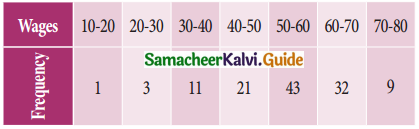
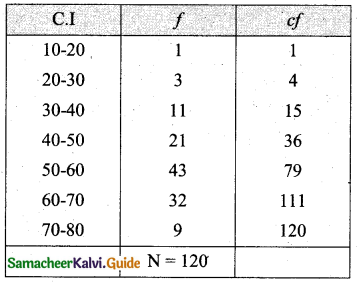
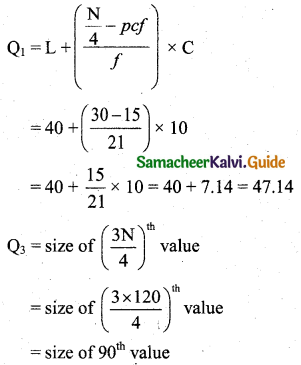
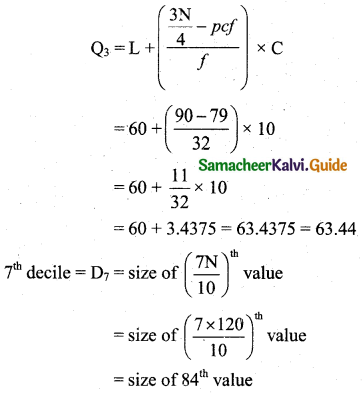
Samacheer Kalvi 11th Business Maths Guide Chapter 10 Operations Research Ex 10.1

Tamilnadu State Board New Syllabus Samcheer Kalvi 11th Business Maths Guide Pdf Chapter 10 Operations Research Ex 10.1 Text Book Back Questions and Answers, Notes.

Tamilnadu Samacheer Kalvi 11th Business Maths Solutions Chapter 10 Operations Research Ex 10.1

Samacheer Kalvi 11th Business Maths Operations Research Ex 10.1 Text Book Back Questions and Answers

Question 1.
A company produces two types of pens A and B. Pen A is of superior quality and pen B is of lower quality. Profits on pens A and B are ₹5 and ₹3 per pen respectively. Raw materials required for each pen A is twice as that of pen B. The supply of raw material is sufficient only for 1000 pens per day. Pen A requires a special clip and only 400 such clips are available per day. For pen B, only 700 clips are available per day. Formulate this problem as a linear programming problem.
Solution:
(i) Variables: Let x1 and x2 denotes the number of pens in type A and type B.

(ii) Objective function:
Profit on x1 pens in type A is = 5x1
Profit on x2 pens in type B is = 3x2
Total profit = 5x1 + 3x2
Let Z = 5x1 + 3x2, which is the objective function.
Since the B total profit is to be maximized, we have to maximize Z = 5x1 + 3x2

Samacheer Kalvi 11th Business Maths Guide Chapter 10 Operations Research Ex 10.1

(iii) Constraints:
Raw materials required for each pen A is twice as that of pen B.
i.e., for pen A raw material required is 2x1 and for B is x2.
Raw material is sufficient only for 1000 pens per day
∴ 2x1 + x2 ≤ 1000
Pen A requires 400 clips per day
∴ x1 ≤ 400
Pen B requires 700 clips per day
∴ x2 ≤ 700

(iv) Non-negative restriction:
Since the number of pens is non-negative, we have x1 > 0, x2 > 0.
Thus, the mathematical formulation of the LPP is
Maximize Z = 5x1 + 3x2
Subj ect to the constrains
2x1 + x2 ≤ 1000, x1 ≤ 400, x2 ≤ 700, x1, x2 ≥ 0

Samacheer Kalvi 11th Business Maths Guide Chapter 10 Operations Research Ex 10.1

Question 2.
A company produces two types of products say type A and B. Profits on the two types of product are ₹ 30/- and ₹ 40/- per kg respectively. The data on resources required and availability of resources are given below.
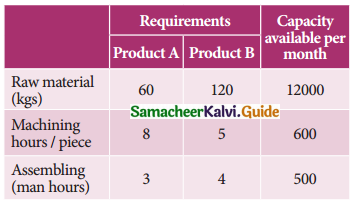
Samacheer Kalvi 11th Business Maths Guide Chapter 10 Operations Research Ex 10.1 Q2
Formulate this problem as a linear programming problem to maximize the profit.
Solution:
(i) Variables: Let x1 and x2 denote the two types products A and B respectively.

(ii) Objective function:
Profit on x1 units of type A product = 30x1
Profit on x2 units of type B product = 40x2
Total profit = 30x1 + 40x2
Let Z = 30x1 + 40x2, which is the objective function.
Since the profit is to be maximized, we have to maximize Z = 30x1 + 40x2

Samacheer Kalvi 11th Business Maths Guide Chapter 10 Operations Research Ex 10.1

(iii) Constraints:
60x1 + 120x2 ≤ 12,000
8x1 + 5x2 ≤ 600
3x1 + 4x2 ≤ 500

(iv) Non-negative constraints:
Since the number of products on type A and type B are non-negative, we have x1, x2 ≥ 0
Thus, the mathematical formulation of the LPP is
Maximize Z = 30x1 + 40x2
Subject to the constraints,
60x1 + 120x2 ≤ 12,000
8x1 + 5x2 ≤ 600
3x1 + 4x2 ≤ 500
x1, x2 ≥ 0

Samacheer Kalvi 11th Business Maths Guide Chapter 10 Operations Research Ex 10.1

Question 3.
A company manufactures two models of voltage stabilizers viz., ordinary and autocut. All components of the stabilizers are purchased from outside sources, assembly and testing is carried out at company’s own works. The assembly and testing time required for the two models are 0.8 hour each for ordinary and 1.20 hours each for auto-cut. Manufacturing capacity 720 hours at present is available per week. The market for the two models has been surveyed which suggests maximum weekly sale of 600 units of ordinary and 400 units of auto-cut. Profit per unit for ordinary and auto-cut models has been estimated at ₹ 100 and ₹ 150 respectively. Formulate the linear programming problem.
Solution:
(i) Variables : Let x1 and x2 denote the number of ordinary and auto-cut voltage stabilized.

(ii) Objective function:
Profit on x1 units of ordinary stabilizers = 100x1
Profit on x2 units of auto-cut stabilized = 150x2
Total profit = 100x1 + 150x2
Let Z = 100x1 + 150x2, which is the objective function.
Since the profit is to be maximized. We have to
Maximize, Z = 100x1 + 15x2

Samacheer Kalvi 11th Business Maths Guide Chapter 10 Operations Research Ex 10.1

(iii) Constraints: The assembling and testing time required for x1 units of ordinary stabilizers = 0.8x1 and for x2 units of auto-cut stabilizers = 1.2x2
Since the manufacturing capacity is 720 hours per week. We get 0.8x1 + 1.2x2 ≤ 720
Maximum weekly sale of ordinary stabilizer is 600
i.e., x1 ≤ 600
Maximum weekly sales of auto-cut stabilizer is 400
i.e., x2 ≤ 400

(iv) Non-negative restrictions:
Since the number of both the types of stabilizer is non-negative, we get x1, x2 ≥ 0.
Thus, the mathematical formulation of the LPP is,
Maximize Z = 100x2 + 150x2
Subject to the constraints
0.8x1 + 1.2x2 ≤ 720, x1 ≤ 600, x2 ≤ 400, x1, x2 ≥ 0

Samacheer Kalvi 11th Business Maths Guide Chapter 10 Operations Research Ex 10.1

Question 4.
Solve the following linear programming problems by graphical method.
(i) Maximize Z = 6x1 + 8x2 subject to constraints 30x1 + 20x2 ≤ 300; 5x1 + 10x2 ≤ 110; and x1, x2 ≥ 0.
(ii) Maximize Z = 22x1 + 18x2 subject to constraints 960x1 + 640x2 ≤ 15360; x1 + x2 ≤ 20 and x1, x2 ≥ 0.
(iii) Minimize Z = 3x1 + 2x2 subject to the constraints 5x1 + x2 ≥ 10; x1 + x2 > 6; x1+ 4x2 ≥ 12 and x1, x2 ≥ 0.
(iv) Maximize Z = 40x1 + 50x2 subject to constraints 3x1 + x2 ≤ 9; x1 + 2x2 ≤ 8 and x1, x2 ≥ 0.
(v) Maximize Z = 20x1 + 30x2 subject to constraints 3x1 + 3x2 ≤ 36; 5x1 + 2x2 ≤ 50; 2x1 + 6x2 ≤ 60 and x1, x2 ≥ 0.
(vi) Minimize Z = 20x1 + 40x2 subject to the constraints 36x1 + 6x2 ≥ 108; 3x1 + 12x2 ≥ 36; 20x1 + 10x2 ≥ 100 and x1, x2 ≥ 0.
Solution:
(i) Given that 30x1 + 20x2 ≤ 300
Let 30x1 + 20x2 = 300
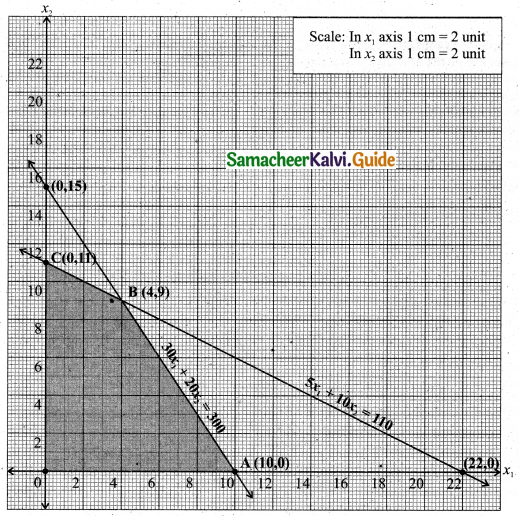
Samacheer Kalvi 11th Business Maths Guide Chapter 10 Operations Research Ex 10.1 Q4
Therefore
3x1 + 2x2 = 30
Samacheer Kalvi 11th Business Maths Guide Chapter 10 Operations Research Ex 10.1 Q4.1
Also given that 5x1 + 10x2 ≤ 110
Let 5x1 + 10x2 = 110
x1 + 2x2 = 22
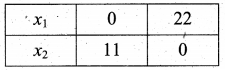
Samacheer Kalvi 11th Business Maths Guide Chapter 10 Operations Research Ex 10.1 Q4.2
To get point of intersection, (i.e., the to get eo-ordinates of B)
3x1 + 2x2 = 30 …….(1)
x1 + 2x2 = 22 ……..(2)
(1) – (2) ⇒ 2x1 = 8
x1 = 4
x1 = 4 substitute in (1),
x1 + 2x2 = 22
4 + 2x2 = 22
2x2 = 18
x2 = 9
i.e., B is (4, 9)
The feasible region satisfying all the given conditions is OABC.
The co-ordinates of the points are O(0, 0), A(10, 0), B(4, 9), C(0, 11).
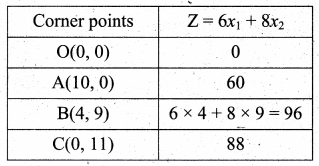
Samacheer Kalvi 11th Business Maths Guide Chapter 10 Operations Research Ex 10.1 Q4.3
The maximum value of Z occurs at B.
∴ The optimal solution is x1 = 4, x2 = 9 and Zmax = 96

Samacheer Kalvi 11th Business Maths Guide Chapter 10 Operations Research Ex 10.1

(ii) Given that 960x1 + 640x2 ≤ 15360
Let 960x1 + 640x2 = 15360
3x1 + 2x2 = 48
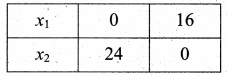
Samacheer Kalvi 11th Business Maths Guide Chapter 10 Operations Research Ex 10.1 Q4.4
Also given that x1 + x2 ≤ 20
Let x1 + x2 = 20
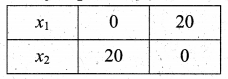
Samacheer Kalvi 11th Business Maths Guide Chapter 10 Operations Research Ex 10.1 Q4.5
To get point of intersection
3x1 + 2x2= 48 …..(1)
x1 + x2 = 20 ……(2)
(2) × -2 ⇒ -2x1 – 2x2 = -40 …..(3)
(1) + (3) ⇒ x1 = 8
x1 = 8 substitute in (2),
8 + x2 = 20
x2 = 12
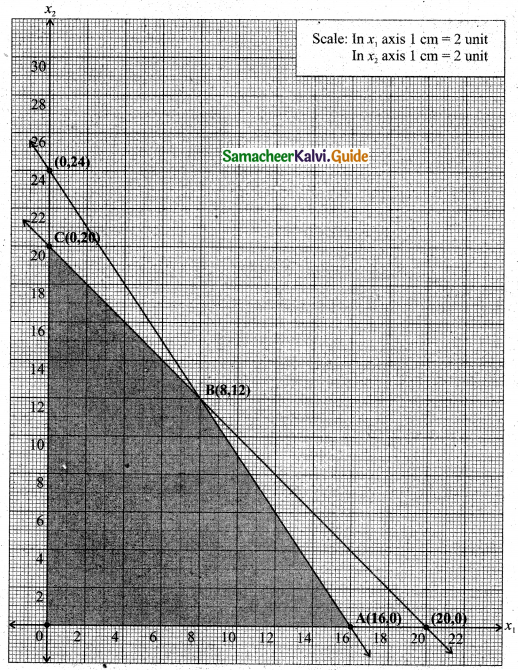
Samacheer Kalvi 11th Business Maths Guide Chapter 10 Operations Research Ex 10.1 Q4.6
The feasible region satisfying all the given conditions is OABC.
The co-ordinates of the comer points are O(0, 0), A(16, 0), B(8,12) and C(0, 16).
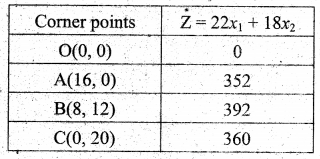
Samacheer Kalvi 11th Business Maths Guide Chapter 10 Operations Research Ex 10.1 Q4.7
The maximum value of Z occurs at B(8, 12).
∴ The optimal solution is x1 = 8, x2 = 12 and Zmax = 392

Samacheer Kalvi 11th Business Maths Guide Chapter 10 Operations Research Ex 10.1

(iii) Given that 5x1 + x2 ≥ 10
Let 5x1 + x2 = 10
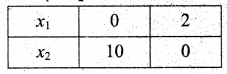
Samacheer Kalvi 11th Business Maths Guide Chapter 10 Operations Research Ex 10.1 Q4.8
Also given that x1 + x2 ≥ 6
Let x1 + x2 = 6
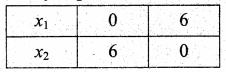
Samacheer Kalvi 11th Business Maths Guide Chapter 10 Operations Research Ex 10.1 Q4.9
Also given that x1 + 4x2 ≥ 12
Let x1 + 4x2 = 12
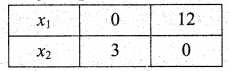
Samacheer Kalvi 11th Business Maths Guide Chapter 10 Operations Research Ex 10.1 Q4.10
To get C
5x1 + x2 = 10 ……..(1)
x1 + x2 = 6 ………(2)
(1) – (2) ⇒ 4x1 = 4
⇒ x1 = 1
x = 1 substitute in (2)
⇒ x1 + x2 = 6
⇒ 1 + x2 = 6
⇒ x2 = 5
∴ C is (1, 5)
To get B
x1 + x2 = 6
x1 + 4x2 = 12
(1) – (2) ⇒ -3x2 = -6
x2 = 2
x2 = 2 substitute in (1), x1 = 4
∴ B is (4, 2)
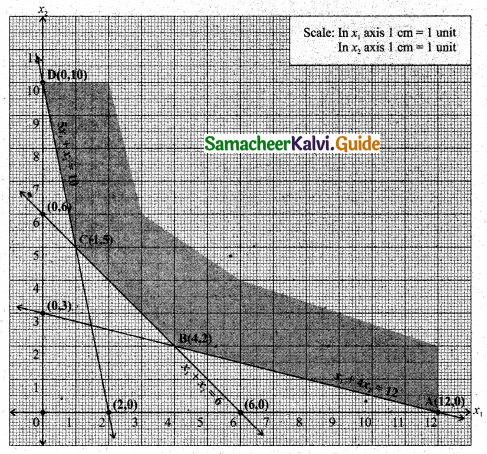
Samacheer Kalvi 11th Business Maths Guide Chapter 10 Operations Research Ex 10.1 Q4.11
The feasible region satisfying all the conditions is ABCD.
The co-ordinates of the comer points are A(12, 0), B(4, 2), C(1, 5) and D(0, 10).
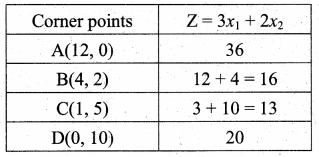
Samacheer Kalvi 11th Business Maths Guide Chapter 10 Operations Research Ex 10.1 Q4.12
The minimum value of Z occours at C(1, 5).
∴ The optimal solution is x1 = 1, x2 = 5 and Zmin = 13

Samacheer Kalvi 11th Business Maths Guide Chapter 10 Operations Research Ex 10.1

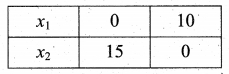
(iv) Given that 3x1 + x2 ≤ 9
Let 3x1 + x2 = 9
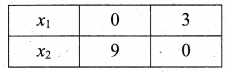
Samacheer Kalvi 11th Business Maths Guide Chapter 10 Operations Research Ex 10.1 Q4.13

Samacheer Kalvi 11th Business Maths Guide Chapter 10 Operations Research Ex 10.1 Q4.14
Also given that x1 + 2x2 ≤ 8
Let x1 + 2x2 = 8
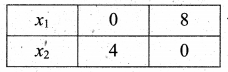
Samacheer Kalvi 11th Business Maths Guide Chapter 10 Operations Research Ex 10.1 Q4.15
3x1 + x2 = 9 ………(1)
x1 + 2x2 = 8 ……..(2)
(1) × 2 ⇒ 6x1 + 2x2 = 18 ……..(3)
(2) + (3) ⇒ -5x1 = -10
x1 = 2
x1 = 2 substitute in (1)
3(2) + x2 = 9
x2 = 3
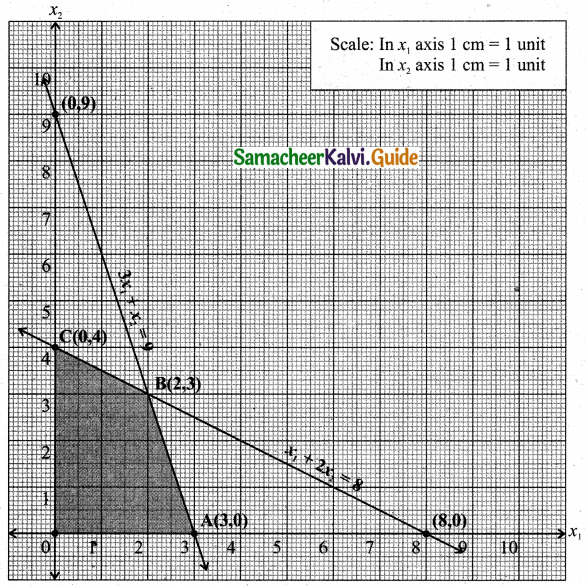
The feasible region satisfying all the conditions is OABC.
The co-ordinates of the corner points are O(0, 0), A(3, 0), B(2, 3), C(0, 4)
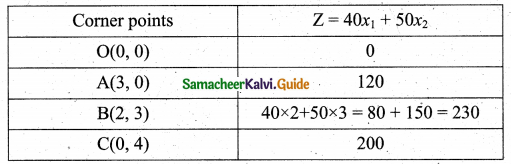
Samacheer Kalvi 11th Business Maths Guide Chapter 10 Operations Research Ex 10.1 Q4.16
The maximum value of Z occurs at (2, 3).
∴ The optimal solution is x1 = 2, x2 = 3 and Zmax = 230

Samacheer Kalvi 11th Business Maths Guide Chapter 10 Operations Research Ex 10.1

(v) Given that 3x1 + 3x2 ≤ 36
Let 3x1 + 3x2 = 36
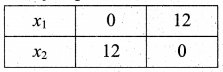
Samacheer Kalvi 11th Business Maths Guide Chapter 10 Operations Research Ex 10.1 Q4.17
Also given that 5x1 + 2x2 ≤ 50
Let 5x1 + 2x2 = 50
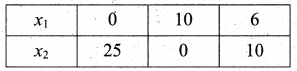
Samacheer Kalvi 11th Business Maths Guide Chapter 10 Operations Research Ex 10.1 Q4.18
x1 + x2 = 12 ……(1)
5x1 + 2x2 = 50 ……….(2)
(1) × 2 ⇒ 2x1 + 2x2 = 24 ………(3)
(2) – (3) ⇒ 3x1 = 26
x1 = \(\frac{26}{3}\) = 8.66
put x1 = \(\frac{26}{3}\) substitute in (1)
x1 + x2 = 12
x2 = 12 – x1
x2 = 26 – \(\frac{26}{3}\) = \(\frac{10}{3}\) = 3.33
Also given that 2x1 + 6x2 ≤ 60
Let 2x1 + 6x2 = 60
x1 + 3x2 = 30
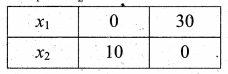
Samacheer Kalvi 11th Business Maths Guide Chapter 10 Operations Research Ex 10.1 Q4.19
x1 + x2 = 12 …….(1)
x1 + 3x2 = 30 …….(2)
(1) – (2) ⇒ -2x2 = -18
x2 = 9
x2 = 9 substitute in (1) ⇒ x1 = 3
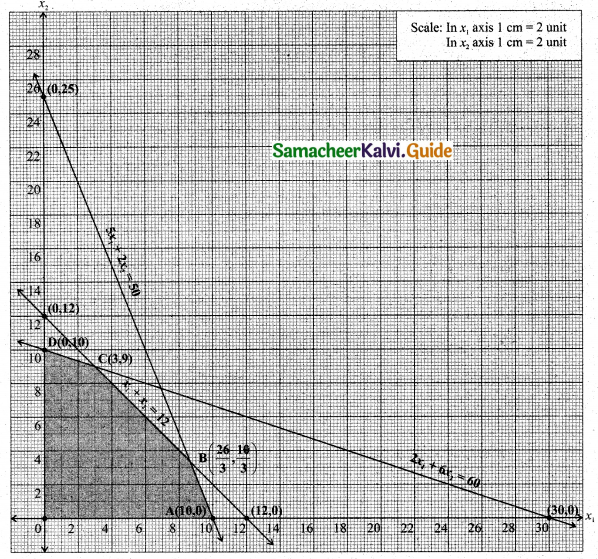
Samacheer Kalvi 11th Business Maths Guide Chapter 10 Operations Research Ex 10.1 Q4.20
The feasible region satisfying all the given conditions is OABCD.
The co-ordinates of the comer points are O(0, 0), A(10, 0), B(\(\frac{26}{3}, \frac{10}{3}\)), and C = (3, 9) and D (0, 10)
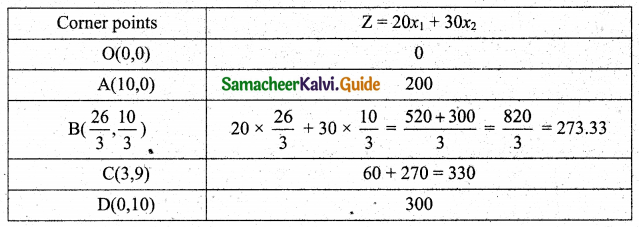
Samacheer Kalvi 11th Business Maths Guide Chapter 10 Operations Research Ex 10.1 Q4.21
The maximum value of Z occurs at C(3, 9)
∴ The optimal solution is x1 = 3, x2 = 9 and Zmax = 330

Samacheer Kalvi 11th Business Maths Guide Chapter 10 Operations Research Ex 10.1

(vi) Given that 36x1 + 6x2 ≥ 108
Let 36x1 + 6x2 = 108
6x1 + x2 = 18
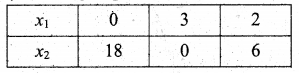
Samacheer Kalvi 11th Business Maths Guide Chapter 10 Operations Research Ex 10.1 Q4.22
Also given that 3x1 + 12x2 ≥ 36
Let 3x1 + 12x2 = 36
x1 + 4x2 = 12
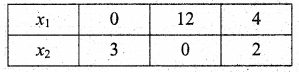
Samacheer Kalvi 11th Business Maths Guide Chapter 10 Operations Research Ex 10.1 Q4.23
Also given that 20x1 + 10x2 ≥ 100
Let 20x1 + 10x2 = 100
2x1 + x2 = 10
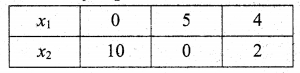
Samacheer Kalvi 11th Business Maths Guide Chapter 10 Operations Research Ex 10.1 Q4.24

Samacheer Kalvi 11th Business Maths Guide Chapter 10 Operations Research Ex 10.1 Q4.25
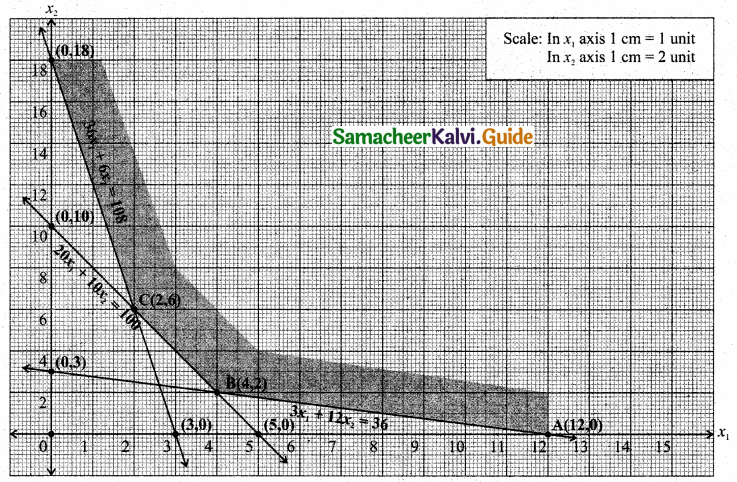
The feasible region satisfying all the conditions is ABCD.
The co-ordinates of the comer points are A(12, 0), B(4, 2), C(2, 6) and D(0, 18).
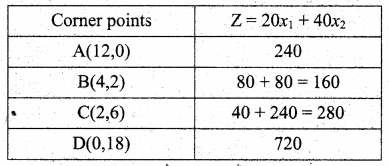
Samacheer Kalvi 11th Business Maths Guide Chapter 10 Operations Research Ex 10.1 Q4.26
The minimum value of Z occurs at B(4, 2)
∴ The optimal solution is x1 = 4, x2 = 2 and Zmin = 160
Samacheer Kalvi 11th Business Maths Guide Chapter 9 Correlation and Regression Analysis Ex 9.3

Tamilnadu State Board New Syllabus Samcheer Kalvi 11th Business Maths Guide Pdf Chapter 9 Correlation and Regression Analysis Ex 9.3 Text Book Back Questions and Answers, Notes.

Tamilnadu Samacheer Kalvi 11th Business Maths Solutions Chapter 9 Correlation and Regression Analysis Ex 9.3

Samacheer Kalvi 11th Business Maths Correlation and Regression Analysis Ex 9.3 Text Book Back Questions and Answers

Choose the correct answer.

Question 1.
An example of a positive correlation is:
(a) Income and expenditure
(b) Price and demand
(c) Repayment period and EMI
(d) Weight and Income
Answer:
(a) Income and expenditure

Question 2.
If the values of two variables move in the same direction then the correlation is said to be:
(a) Negative
(b) Positive
(c) Perfect positive
(d) No correlation
Answer:
(b) Positive

Samacheer Kalvi 11th Business Maths Guide Chapter 9 Correlation and Regression Analysis Ex 9.3

Question 3.
If the values of two variables move in the opposite direction then the correlation is said to be:
(a) Negative
(b) Positive
(c) Perfect positive
(d) No correlation
Answer:
(a) Negative

Question 4.
Correlation co-efficient lies between:
(a) 0 to ∞
(b) -1 to +1
(c) -1 to 0
(d) -1 to ∞
Answer:
(b) -1 to +1

Samacheer Kalvi 11th Business Maths Guide Chapter 9 Correlation and Regression Analysis Ex 9.3

Question 5.
If r(X, Y) = 0 the variables X and Y are said to be:
(a) Positive correlation
(b) Negative correlation
(c) No correlation
(d) Perfect positive correlation
Answer:
(c) No correlation

Question 6.
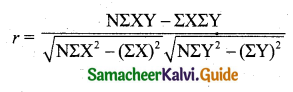
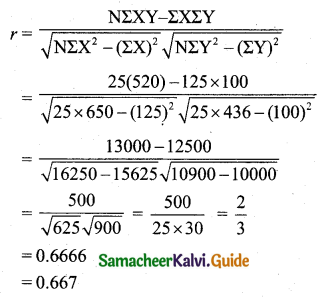
The correlation coefficient from the following data N = 25, ΣX = 125, ΣY = 100, ΣX2 = 650, ΣY2= 436, ΣXY = 520:
(a) 0.667
(b) -0.006
(c) -0.667
(d) 0.70
Answer:
(a) 0.667
Hint:
Samacheer Kalvi 11th Business Maths Guide Chapter 9 Correlation and Regression Analysis Ex 9.3 Q6

Samacheer Kalvi 11th Business Maths Guide Chapter 9 Correlation and Regression Analysis Ex 9.3

Question 7.
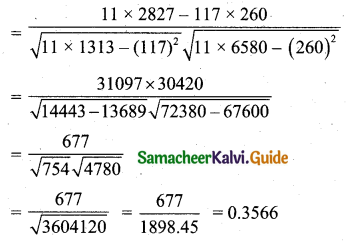
From the following data, N = 11, ΣX = 117, ΣY = 260, ΣX2 = 1313, ΣY2 = 6580, ΣXY = 2827. the correlation coefficient is:
(a) 0.3566
(b) -0.3566
(c) 0
(d) 0.4566
Answer:
(a) 0.3566
Hint:
Samacheer Kalvi 11th Business Maths Guide Chapter 9 Correlation and Regression Analysis Ex 9.3 Q7

Samacheer Kalvi 11th Business Maths Guide Chapter 9 Correlation and Regression Analysis Ex 9.3 Q7.1

Question 8.
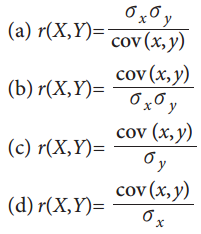
The correlation coefficient is:
Samacheer Kalvi 11th Business Maths Guide Chapter 9 Correlation and Regression Analysis Ex 9.3 Q8
Answer:
(b) r(X, Y) = \(\frac{cov(x, y)}{\sigma_{x} \sigma_{y}}\)

Samacheer Kalvi 11th Business Maths Guide Chapter 9 Correlation and Regression Analysis Ex 9.3

Question 9.
The variable whose value is influenced or is to be predicted is called:
(a) dependent variable
(b) independent variable
(c) regressor
(d) explanatory variable
Answer:
(a) dependent variable

Question 10.
The variable which influences the values or is used for prediction is called:
(a) Dependent variable
(b) Independent variable
(c) Explained variable
(d) Regressed
Answer:
(b) Independent variable

Samacheer Kalvi 11th Business Maths Guide Chapter 9 Correlation and Regression Analysis Ex 9.3

Question 11.
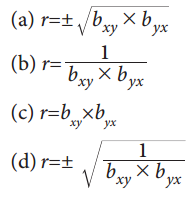
The correlation coefficient:
Samacheer Kalvi 11th Business Maths Guide Chapter 9 Correlation and Regression Analysis Ex 9.3 Q11
Answer:
(a) \(r=\pm \sqrt{b_{x y} \times b_{y x}}\)

Question 12.
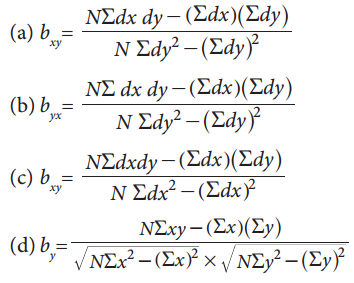
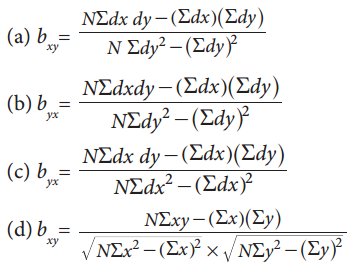
The regression coefficient of X on Y:
Samacheer Kalvi 11th Business Maths Guide Chapter 9 Correlation and Regression Analysis Ex 9.3 Q12
Answer:
(a) \(b_{x y}=\frac{\mathrm{N} \Sigma d x d y-(\Sigma d x)(\Sigma d y)}{\mathrm{N} \Sigma d y^{2}-(\Sigma d y)^{2}}\)

Samacheer Kalvi 11th Business Maths Guide Chapter 9 Correlation and Regression Analysis Ex 9.3

Question 13.
The regression coefficient of Y on X:
Samacheer Kalvi 11th Business Maths Guide Chapter 9 Correlation and Regression Analysis Ex 9.3 Q13
Answer:
(c) \(b_{y x}=\frac{\mathrm{N\Sigma} d x d y-(\Sigma d x)(\Sigma d y)}{\mathrm{N} \Sigma d x^{2}-(\Sigma d x)^{2}}\)

Question 14.
When one regression coefficient is negative, the other would be:
(a) Negative
(b) Positive
(c) Zero
(d) None of these
Answer:
(a) Negative

Samacheer Kalvi 11th Business Maths Guide Chapter 9 Correlation and Regression Analysis Ex 9.3

Question 15.
If X and Y are two variates, there can be at most:
(a) one regression line
(b) two regression lines
(c) three regression lines
(d) more regression lines
Answer:
(b) two regression lines

Question 16.
The lines of regression of X on Y estimates:
(a) X for a given value of Y
(b) Y for a given value of X
(c) X from Y and Y from X
(d) none of these
Answer:
(a) X for a given value of Y

Samacheer Kalvi 11th Business Maths Guide Chapter 9 Correlation and Regression Analysis Ex 9.3

Question 17.
Scatter diagram of the variate values (X, Y) give the idea about:
(a) functional relationship
(b) regression model
(c) distribution of errors
(d) no relation
Answer:
(a) functional relationship

Question 18.
If regression co-efficient of Y on X is 2, then the regression co-efficient of X on Y is:
(a) ≤ \(\frac{1}{2}\)
(b) 2
(c) > \(\frac{1}{2}\)
(d) 1
Answer:
(a) ≤ \(\frac{1}{2}\)

Samacheer Kalvi 11th Business Maths Guide Chapter 9 Correlation and Regression Analysis Ex 9.3

Question 19.
If two variables move in a decreasing direction then the correlation is:
(a) positive
(b) negative
(c) perfect negative
(d) no correlation
Answer:
(a) positive

Question 20.
The person suggested a mathematical method for measuring the magnitude of the linear relationship between two variables say X and Y is:
(a) Karl Pearson
(b) Spearman
(c) Croxton and Cowden
(d) Ya Lun Chou
Answer:
(a) Karl Pearson

Samacheer Kalvi 11th Business Maths Guide Chapter 9 Correlation and Regression Analysis Ex 9.3

Question 21.
The lines of regression intersect at the point:
(a) (X, Y)
(b) \((\overline{\mathrm{X}}, \overline{\mathrm{Y}})\)
(c) (0, 0)
(d) (σx, σy)
Answer:
(b) \((\overline{\mathrm{X}}, \overline{\mathrm{Y}})\)

Question 22.
The term regression was introduced by:
(a) R.A Fisher
(b) Sir Francis Galton
(c) Karl Pearson
(d) Croxton and Cowden
Answer:
(b) Sir Francis Galton

Samacheer Kalvi 11th Business Maths Guide Chapter 9 Correlation and Regression Analysis Ex 9.3

Question 23.
If r = -1, then correlation between the variables:
(a) perfect positive
(b) perfect negative
(c) negative
(d) no correlation
Answer:
(b) perfect negative

Question 24.
The coefficient of correlation describes:
(a) the magnitude and direction
(b) only magnitude
(c) only direction
(d) no magnitude and no direction
Answer:
(a) the magnitude and direction

Samacheer Kalvi 11th Business Maths Guide Chapter 9 Correlation and Regression Analysis Ex 9.3

Question 25.
If Cov(x, y) = -16.5, \(\sigma_{x}^{2}\) = 2.89, \(\sigma_{y}^{2}\) = 100. Find correlation coeffient.
(a) -0.12
(b) 0.001
(c) -1
(d) -0.97
Answer:
(d) -0.97

Samacheer Kalvi 11th Business Maths Guide Chapter 7 Financial Mathematics Ex 7.2

Tamilnadu State Board New Syllabus Samcheer Kalvi 11th Business Maths Guide Pdf Chapter 7 Financial Mathematics Ex 7.2 Text Book Back Questions and Answers, Notes.

Tamilnadu Samacheer Kalvi 11th Business Maths Solutions Chapter 7 Financial Mathematics Ex 7.2

Samacheer Kalvi 11th Business Maths Financial Mathematics Ex 7.2 Text Book Back Questions and Answers

Question 1.
Find the market value of 62 shares available at ₹ 132 having the par value of ₹ 100.
Solution:
Market value = ₹ Number of shares × Market value of a share
= ₹ 132 × 62
= ₹ 8,184

Samacheer Kalvi 11th Business Maths Guide Chapter 7 Financial Mathematics Ex 7.2

Question 2.
How much will be required to buy 125 of ₹ 25 shares at a discount of ₹ 7.
Solution:
Face value of a share = ₹ 25
Market value of a share = ₹ 25 – 7 = ₹ 18
Amount of money required to buy 125 shares = Number of shares × Market value of a share
= ₹ 125 × 18
= ₹ 2,250

Question 3.
If the dividend received from 9% of ₹ 20 shares is ₹ 1,620, find the number of shares.
Solution:
Income = Number of shares × Face value of a share × Rate of dividend
1620 = Number of shares × 20 × \(\frac{9}{100}\)
Number of shares = \(\frac{1620 \times 100}{20 \times 9}\) = 900 shares

Samacheer Kalvi 11th Business Maths Guide Chapter 7 Financial Mathematics Ex 7.2

Question 4.
Mohan invested ₹ 29,040 in 15% of ₹ 100 shares of a company quoted at a premium of 20%. Calculate
(i) the number of shares bought by Mohan
(ii) his annual income from shares
(iii) the percentage return on his investment
Solution:
Investment = ₹ 29,040
Rate of dividend = 15%
Number of shares = 100
Premium = 20%
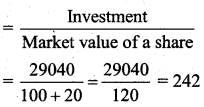
(i) Number of shares
Samacheer Kalvi 11th Business Maths Guide Chapter 7 Financial Mathematics Ex 7.2 Q4

(ii) Annual income from shares = (Number of shares) × (Face value of a share) × (Rate of dividend)
= 242 × 100 × \(\frac{15}{100}\)
= ₹ 3630

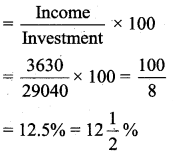
(iii) The percentage return on his investment
Samacheer Kalvi 11th Business Maths Guide Chapter 7 Financial Mathematics Ex 7.2 Q4.1

Question 5.
A man buys 400 of ₹ 10 shares at a premium of ₹ 2.50 on each share. If the rate of dividend is 12% find
(i) his investment
(ii) annual dividend received by him
(iii) rate of interest received by him on his money
Solution:
(i) Given Number of shares = 400
Face value of a share ₹ 10 market values of a share = 10 + 2.50 = ₹ 12.50
Investment = Number of shares × Market value of a share = ₹ 400 × 12.50 = ₹ 5000

(ii) Annual dividend = Number of shares × Face value × Rate of dividend
= 400 × 10 × \(\frac{12}{100}\)
= ₹ 480

(iii) Rate of dividend = \(\frac{\text { Dividend }}{\text { Investment }}\) × 100
= \(\frac{480}{5000}\) × 100
= \(\frac{48}{5}\)
= 9.6%

Samacheer Kalvi 11th Business Maths Guide Chapter 7 Financial Mathematics Ex 7.2

Question 6.
Sundar bought 4,500 of ₹ 10 shares, paying 2% per annum. He sold them when the price rose to ₹ 23 and invested the proceeds in ₹ 25 shares paying 10% per annum at ₹ 18. Find the change in his income.
Solution:
Number of shares = \(\frac{4500}{10}\) = 450
Income from 2% stock = Number of shares × face value × Rate of dividend
= 450 × 10 × \(\frac{2}{100}\)
= ₹ 90
Selling price of450 shares = 450 × 23 = ₹ 10,350
Number of shares bought in 10% stock = \(\frac{\text { Selling price of } 450 \text { shares at } ₹ 23}{\text { Market value }}\)
= \(\frac{10350}{18}\)
= ₹ 575
Income, from 10% stock = No of shares × face value × Rate of dividend
= 575 × 25 × \(\frac{10}{100}\)
= 575 × \(\frac{10}{4}\)
= ₹ 1437.5
= ₹ 1437.50
Charge in his income = ₹ 1437.50 – ₹ 90 = ₹ 1347.50

Question 7.
A man invests ₹ 13,500 partly in 6% of ₹ 100 shares at ₹ 140 and partly in 5% of ₹ 100 shares at ₹ 125. If his total income is ₹ 560, how much has he invested in each?
Solution:
Let the amount invested in 6% of ₹ 100 shares at ₹ 140 be x.
Then the amount invested in 5% of ₹ 100 shares at ₹ 125 is ₹ 13500 – x.
Income from 6% shares = Number of shares × Face value of a share × Rate of dividend
= \(\frac{x}{140} \times 100 \times \frac{6}{100}\)
= \(\frac{3 x}{70}\)
Income from 5% shares = Number of shares × Face value of a share × Rate of dividend
= \(\frac{13500-x}{125} \times 100 \times \frac{5}{100}\)
= \(\frac{13500-x}{25}\)
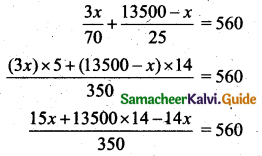
Given that the total income = ₹ 560
Samacheer Kalvi 11th Business Maths Guide Chapter 7 Financial Mathematics Ex 7.2 Q7
x + 13500 × 14 = 560 × 350

x = 196000 – 189000 = 7000
Amount invested at 6% stock = ₹ 7,000
Amount invested at 5% stock = ₹ 13500 – ₹ 7000 = ₹ 6500

Samacheer Kalvi 11th Business Maths Guide Chapter 7 Financial Mathematics Ex 7.2

Question 8.
Babu sold some ₹ 100 Shares at a 10% discount and invested his sales proceeds in 15% of ₹ 50 shares at ₹ 33. Had he sold his shares at a 10% premium instead of a 10% discount, he would have earned ₹ 450 more. Find the number of shares sold by him.
Solution:
Let the number of shares sold by Babu be x.
The face value of a share is ₹ 100.
He sold a 10% discount; the selling price of one share ₹ 90.
The selling price of x shares = ₹ 90x
He bought a share of face value ₹ 50 and the number of shares 33.
∴ Number of shares bought for the amount ₹ 90x i.e., \(\frac{90 x}{33}\)
∴ Face value of 50 shares = Cost of one share × Number of share
= 50 × \(\frac{90 x}{33}\)
The dividend is 15%.
∴ Income = \(\frac{15}{100}\) × Face value of 50 shares
= \(\frac{15}{100} \times 50 \times \frac{90 x}{33}\)
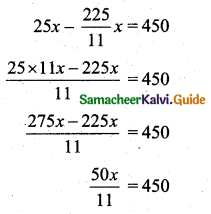
= \(\frac{225 x}{11}\)
Suppose he sold his shares at 10% premium instead of 10% discount, the market value of one share is ₹ 110.
Selling price of x shares = 110 × x = 110x
Number of shares bought for ₹ 33 = \(\frac{110 x}{33}\)
Face value of 50 shares = \(\frac{110 x}{33}\) × 50
Income = \(\frac{15}{100} \times \frac{110 x}{33}\) × 50 = 25x
Change Income = ₹ 450
Samacheer Kalvi 11th Business Maths Guide Chapter 7 Financial Mathematics Ex 7.2 Q8
x = \(\frac{450}{50}\) × 11 = 9 × 11 = 99 shares

Question 9.
Which is better investment? 7% of ₹ 100 shares at ₹ 120 (or) 8% of ₹ 100 shares at ₹ 135.
Solution:
Let the investment in each case be ₹ (120 × 135)
Case (i): Income from 7% of ₹ 100 shares at ₹ 120 = \(\frac{7}{120}\) × 120 × 135
= 7 × 135
= ₹ 945

Case (ii): Income from 8% of ₹ 100 shares at ₹ 135 = \(\frac{8}{135}\) × (120 × 135)
= 8 × 120
= ₹ 960
∴ 8% of 100 shares at ₹ 135 is better investment.

Samacheer Kalvi 11th Business Maths Guide Chapter 7 Financial Mathematics Ex 7.2

Question 10.
Which is better investment? 20% stock at 140 (or) 10% stock at 70.
Solution:
Let the investment in case be ₹ 140 × 70
Income from 20% stock at ₹ 140 is = \(\frac{20}{140}\) × 140 × 70
= 20 × 70
= ₹ 1400
Income from 10% stock at 70 = \(\frac{10}{70}\) × 140 × 70 = ₹ 1400
For the same investtnent both stocks fetch the same income. Therefore they are equivalent shares.

Samacheer Kalvi 11th Business Maths Guide Chapter 7 Financial Mathematics Ex 7.1

Tamilnadu State Board New Syllabus Samcheer Kalvi 11th Business Maths Guide Pdf Chapter 7 Financial Mathematics Ex 7.1 Text Book Back Questions and Answers, Notes.

Tamilnadu Samacheer Kalvi 11th Business Maths Solutions Chapter 7 Financial Mathematics Ex 7.1

Samacheer Kalvi 11th Business Maths Financial Mathematics Ex 7.1 Text Book Back Questions and Answers

Question 1.
Find the amount of an ordinary annuity of ₹ 3,200 per annum for 12 years at the rate of interest of 10% per year, [(1.1)12 = 3.1384]
Solution:
Here a = 3,200, n = 12, and i = \(\frac{10}{100}\) = 0.1
A = \(\frac{a}{i}\) [(1 + i)n – 1]
= \(\frac{3200}{0.1}\) [(1 + 0.1)12 – 1]
= 32000 [(1.1)12 – 1]
= 32000 [3.1384 – 1] [∵ (1.1)12 = 3.1384]
= 32000 [2.1384]
= ₹ 68,428.8

Samacheer Kalvi 11th Business Maths Guide Chapter 7 Financial Mathematics Ex 7.1

Question 2.
If the payment of ₹ 2,000 is made at the end of every quarter for 10 years at the rate of 8% per year, then find the amount of annuity. [(1.02)40 = 2.2080]
Solution:
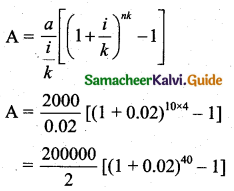
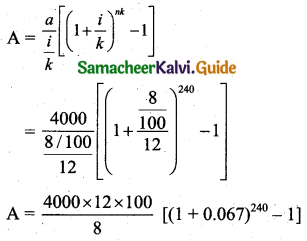
Here a = 2,000, n = 10 years, and \(\frac{i}{k}=\frac{\frac{8}{100}}{4}=\frac{2}{100}=0.02\)
Samacheer Kalvi 11th Business Maths Guide Chapter 7 Financial Mathematics Ex 7.1 Q2
= 100000 [2.2080 – 1] [∵ (1.02)40 = 2.2080]
= 100000 [1.2080]
= ₹ 1,20,800

Question 3.
Find the amount of an ordinary annuity of 12 monthly payments of ₹ 1,500 that earns interest at 12% per annum compounded monthly. [(1.01)12 = 1.1262]
Solution:
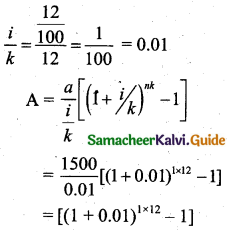
Here a = 1,500, n = 1 year, and i = \(\frac{12}{100}\)
Samacheer Kalvi 11th Business Maths Guide Chapter 7 Financial Mathematics Ex 7.1 Q3
= 150000 [(1.01)12 – 1]
= 150000 [1.1262 – 1] (∵ (1.01)12 = 1.1262)
= 150000 [0.1262]
= ₹ 18,930

Samacheer Kalvi 11th Business Maths Guide Chapter 7 Financial Mathematics Ex 7.1

Question 4.
A bank pays 8% per annum interest compounded quarterly. Find equal deposits to be made at the end of each quarter for 10 years to have ₹ 30,200? [(1.02)40 = 2.2080]
Solution:
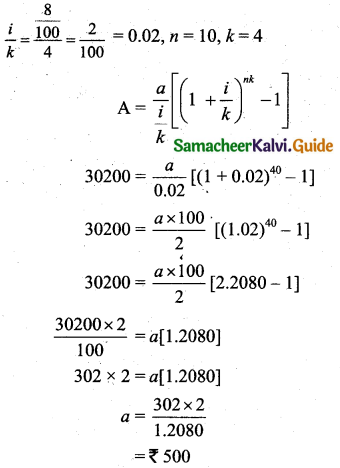
Here A = ₹ 30200, i = \(\frac{8}{100}\)
Samacheer Kalvi 11th Business Maths Guide Chapter 7 Financial Mathematics Ex 7.1 Q4

Question 5.
A person deposits ₹ 2,000 from his salary towards his contributory pension scheme. The same amount is credited by his employer also. If an 8% rate of compound interest is paid, then find the maturity amount at end of 20 years of service. [(1.0067)240 = 4.966]
Solution:
A person deposit ₹ 2,000.
The employer also credited the same amount.
a = ₹ 2,000 + ₹ 2,000 = ₹ 4,000
Samacheer Kalvi 11th Business Maths Guide Chapter 7 Financial Mathematics Ex 7.1 Q5
Note:
If (1.0067) = 4.966 (Original value)
Then A = 600000 (4.966 – 1)
= 600000(3.966)
= ₹ 23,79,600

Samacheer Kalvi 11th Business Maths Guide Chapter 7 Financial Mathematics Ex 7.1

Question 6.
Find the present value of ₹ 2,000 per annum for 14 years at the rate of interest of 10% per annum. [(1.04)-14 = 0.6252]
Solution:
Here a = 2000, n = 14, and i = \(\frac{10}{100}\) = 0.1
\(P=\frac{a}{i}\left[1-\frac{1}{(1+i)^{n}}\right]\)
= \(\frac{2000}{0.1}\left[1-\frac{1}{(1+0.1)^{14}}\right]\)
= \(\frac{2000}{0.1}\left[1-(1.1)^{-14}\right]\)
= 20000 [1 – 0.2632]
= 20000 × 0.73678
= ₹ 14,735.60

Question 7.
Find the present value of an annuity of ₹ 900 payable at the end of 6 months for 6 years. The money compounded at 8% per annum. [(1.04)-12 = 0.6252]
Solution:
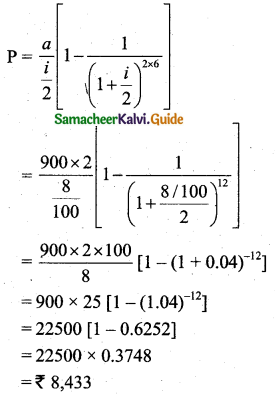
Samacheer Kalvi 11th Business Maths Guide Chapter 7 Financial Mathematics Ex 7.1 Q7

Samacheer Kalvi 11th Business Maths Guide Chapter 7 Financial Mathematics Ex 7.1

Question 8.
Find the amount at the end of 12 years of an annuity of ₹ 5,000 payable at the beginning of each year, if the money is compounded at 10% per annum.
Solution:
Here a = 5000, i = 10% = \(\frac{10}{100}\) = 0.1, n = 12
Amount A = (1 + i) \(\frac{a}{i}\) [(1 + i)n – 1]
= (1 + 0.1) \(\frac{5000}{\frac{10}{100}}\) [(1 + 0.1)12 – 1]
= (1.1) 50000 [(1.1)12 – 1]
= 55000 [3.1384 – 1]
= 55000 [2.1384]
= ₹ 1,17,612

Question 9.
What is the present value of an annuity due of ₹ 1,500 for 16 years at 8% per annum? [(1.08)15 = 3.172]
Solution:
Present value of annuity due, \(\mathrm{P}=\frac{a(1+i)}{i}\left[1-\frac{1}{(1+i)^{n}}\right]\)
Here a = 1500, n = 16, i = \(\frac{8}{100}\) = 0.08
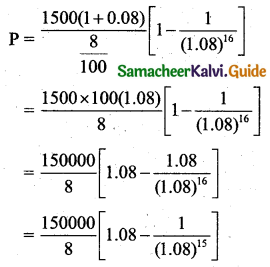
Samacheer Kalvi 11th Business Maths Guide Chapter 7 Financial Mathematics Ex 7.1 Q9
= 18750[1.08 – \(\frac{1}{3.1721}\)] [∵ (1.08)15 = 3.1721]
= 18750[1.08 – 0.31524]
= 18750[0.7648]
= ₹ 14340

Samacheer Kalvi 11th Business Maths Guide Chapter 7 Financial Mathematics Ex 7.1

Question 10.
What is the amount of perpetual annuity of ₹ 50 at 5% compound interest per year?
Solution:
\(P=\frac{a}{i}=\frac{50}{\left(\frac{5}{100}\right)}=\frac{50 \times 100}{5}=₹ 1,000\)

Samacheer Kalvi 11th Business Maths Guide Chapter 9 Correlation and Regression Analysis Ex 9.2

Tamilnadu State Board New Syllabus Samcheer Kalvi 11th Business Maths Guide Pdf Chapter 9 Correlation and Regression Analysis Ex 9.2 Text Book Back Questions and Answers, Notes.

Tamilnadu Samacheer Kalvi 11th Business Maths Solutions Chapter 9 Correlation and Regression Analysis Ex 9.2

Samacheer Kalvi 11th Business Maths Correlation and Regression Analysis Ex 9.2 Text Book Back Questions and Answers

Question 1.
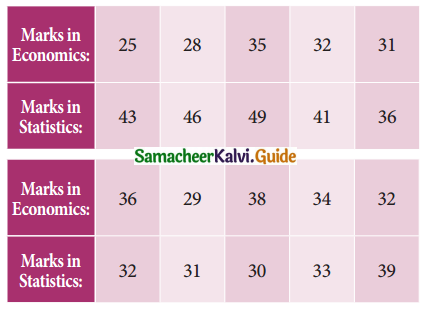
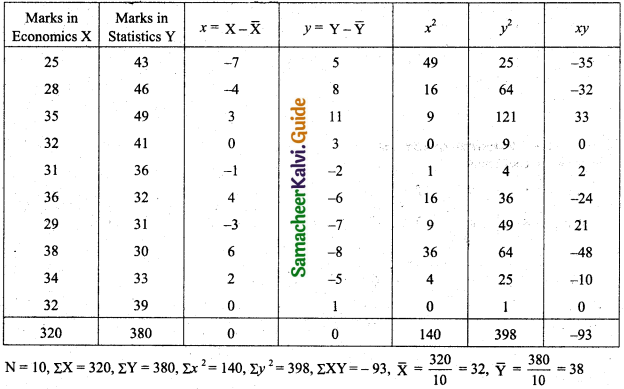
From the data given below:
Samacheer Kalvi 11th Business Maths Guide Chapter 9 Correlation and Regression Analysis Ex 9.2 Q1
Find
(a) The two regression equations
(b) The coefficient of correlation between marks in Economics and statistics
(c) The most likely marks in Statistics when the marks in Economics is 30.
Solution:
Samacheer Kalvi 11th Business Maths Guide Chapter 9 Correlation and Regression Analysis Ex 9.2 Q1.1
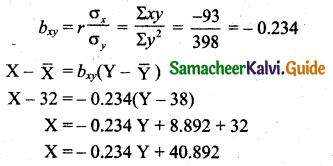
(a) Regression equation of X on Y.
Samacheer Kalvi 11th Business Maths Guide Chapter 9 Correlation and Regression Analysis Ex 9.2 Q1.2
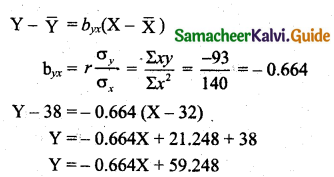
Regression equation of Y on X.
Samacheer Kalvi 11th Business Maths Guide Chapter 9 Correlation and Regression Analysis Ex 9.2 Q1.3
(b) Coefficient of correlation \(r=\pm \sqrt{b_{x y} \times b_{y x}}\)
= \(\sqrt{(-0.234)(-0.664)}\)
= -0.394
(c) When X = 30, Y = ?
Y = -0.664(30) + 59.248
= -19.92 + 59.248
= 39.328.

Samacheer Kalvi 11th Business Maths Guide Chapter 9 Correlation and Regression Analysis Ex 9.2

Question 2.
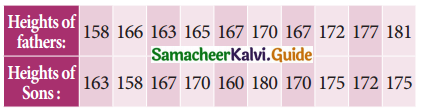
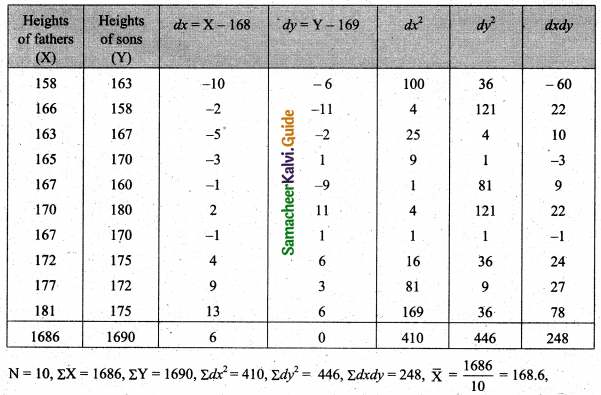
The heights (in cm.) of a group of fathers and sons are given below.
Samacheer Kalvi 11th Business Maths Guide Chapter 9 Correlation and Regression Analysis Ex 9.2 Q2
Find the lines of regression and estimate the height of son when the height of the father is 164 cm.
Solution:
Samacheer Kalvi 11th Business Maths Guide Chapter 9 Correlation and Regression Analysis Ex 9.2 Q2.1
\(\overline{\mathrm{Y}}=\frac{1690}{10}=169\)
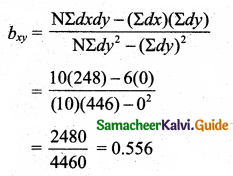
Samacheer Kalvi 11th Business Maths Guide Chapter 9 Correlation and Regression Analysis Ex 9.2 Q2.2
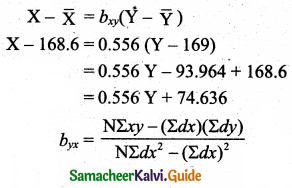
Regression equation of X on Y
Samacheer Kalvi 11th Business Maths Guide Chapter 9 Correlation and Regression Analysis Ex 9.2 Q2.4
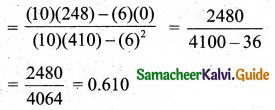
Samacheer Kalvi 11th Business Maths Guide Chapter 9 Correlation and Regression Analysis Ex 9.2 Q2.3
Regression equation of Y on X
\(\mathrm{Y}-\overline{\mathrm{Y}}=b_{\mathrm{yx}}(\mathrm{X}-\overline{\mathrm{X}})\)
Y – 169 = 0.610 (X – 168.6)
Y – 169 = 0.610X – 102.846
Y = 0.610X – 102.846 + 169
Y = 0.160X + 66.154 ………(1)
To get son’s height (Y) when the father height is X = 164 cm.
Put X = 164 cm in equation (1) we get
Son’s height = 0.610 × 164 + 66.154
= 100.04 + 66.154 cm
= 169.19 cm.

Question 3.
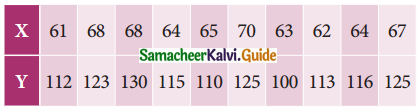
The following data give the height in inches (X) and the weight in lb. (Y) of a random sample of 10 students from a large group of students of age 17 years:
Samacheer Kalvi 11th Business Maths Guide Chapter 9 Correlation and Regression Analysis Ex 9.2 Q3
Estimate weight of the student of a height 69 inches.
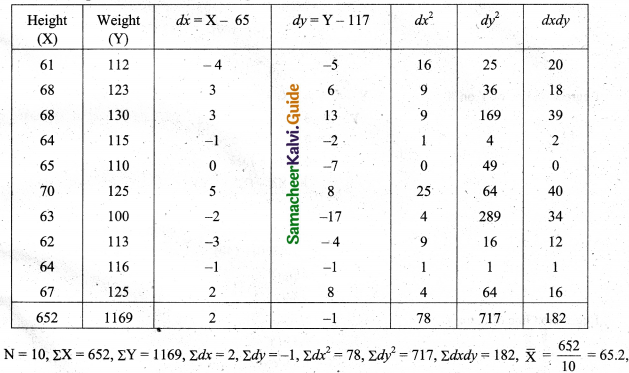
Solution:
Samacheer Kalvi 11th Business Maths Guide Chapter 9 Correlation and Regression Analysis Ex 9.2 Q3.1
\(\overline{\mathrm{Y}}=\frac{1169}{10}=116.9\)
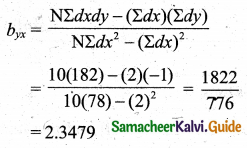
Samacheer Kalvi 11th Business Maths Guide Chapter 9 Correlation and Regression Analysis Ex 9.2 Q3.2
Regression equation of Y on X
\(Y-\bar{Y}=b_{y x}(X-\bar{X})\)
Y – 117 = 2.3479 (X – 65.2)
Y – 117 = 2.3479X – (2.3479)(65.2)
Y = 2.3479X – 153.08308 + 117
Y = 2.3479 – 36.08308
When the height X = 69 inches
Weight, Y = 2.3479(69) – 36.08308
= 162.0051 – 36.08308
= 125.92202
= 125.92 lb

Samacheer Kalvi 11th Business Maths Guide Chapter 9 Correlation and Regression Analysis Ex 9.2

Question 4.
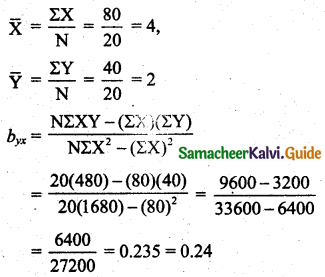
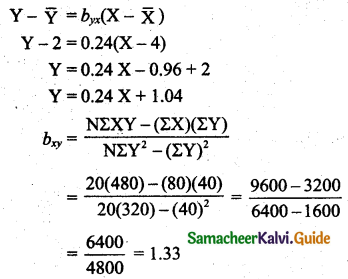
Obtain the two regression lines from the following data N = 20, ΣX = 80, ΣY = 40, ΣX2 = 1680, ΣY2 = 320 and ΣXY = 480.
Solution:
ΣX = 80, ΣY = 40, ΣX2 = 1680, ΣY2 = 320, ΣXY = 480, N = 20
Samacheer Kalvi 11th Business Maths Guide Chapter 9 Correlation and Regression Analysis Ex 9.2 Q4
Regression line of Y on X
Samacheer Kalvi 11th Business Maths Guide Chapter 9 Correlation and Regression Analysis Ex 9.2 Q4.1
Regression line of X on Y
\(\mathbf{X}-\overline{\mathbf{X}}=b_{x y}(\mathbf{Y}-\overline{\mathbf{Y}})\)
X – 4 = 1.33(Y – 2)
X = 1.33Y – 2.66 + 4
X = 1.33Y + 1.34

Question 5.
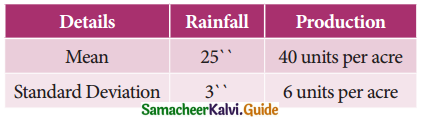
Given the following data, what will be the possible yield when the rainfall is 29″
Samacheer Kalvi 11th Business Maths Guide Chapter 9 Correlation and Regression Analysis Ex 9.2 Q5
The coefficient of correlation between rainfall and production is 0.8.
Solution:
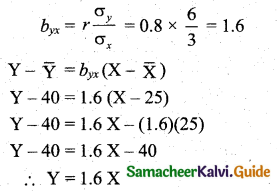
\(\overline{\mathrm{X}}\) = 25, σx = 3, \(\overline{\mathrm{Y}}\) = 40, σy = 6, r = 0.8
Samacheer Kalvi 11th Business Maths Guide Chapter 9 Correlation and Regression Analysis Ex 9.2 Q5.1
To find the yield when the rainfall is 29″ is,
Put X = 29 in the above equation we get yield,
Y = 1.6 × 29 = 46.4 units/acre

Samacheer Kalvi 11th Business Maths Guide Chapter 9 Correlation and Regression Analysis Ex 9.2

Question 6.
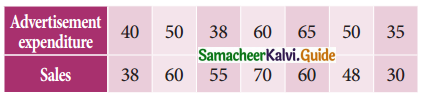
The following data relate to advertisement expenditure (in lakh of rupees) and their corresponding sales (in crores of rupees)
Samacheer Kalvi 11th Business Maths Guide Chapter 9 Correlation and Regression Analysis Ex 9.2 Q6
Estimate the sales corresponding to advertising expenditure of ₹ 30 lakh.
Solution:
Samacheer Kalvi 11th Business Maths Guide Chapter 9 Correlation and Regression Analysis Ex 9.2 Q6.1
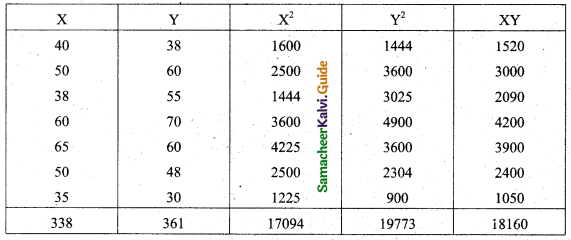
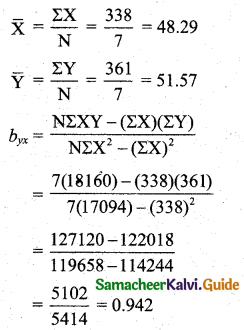
N = 7, ΣX = 338, ΣY = 361, ΣX2 = 17094, ΣY2 = 19773, ΣXY = 18160.
Samacheer Kalvi 11th Business Maths Guide Chapter 9 Correlation and Regression Analysis Ex 9.2 Q6.2
Regression equation of Y on X
\(Y-\bar{Y}=b_{y x}(X-\bar{X})\)
Y – 51.57 = 0.942(X – 48.29)
Y – 51.57 = 0.942X – 0.942 × 48.29
Y – 51.57 = 0.942X – 45.48918
Y = 0.942X + 51.57 – 48.29
Y = 0.942X + 6.081
To find the sales, when the advertising is X = ₹ 30 lakh in the above equation we get,
Y = 0.942(30) + 6.081
= 28.26 + 6.081
= 34.341
= ₹ 34.34 crores

Question 7.
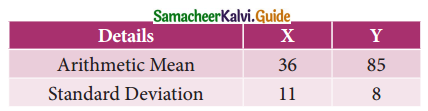
You are given the following data:
Samacheer Kalvi 11th Business Maths Guide Chapter 9 Correlation and Regression Analysis Ex 9.2 Q7
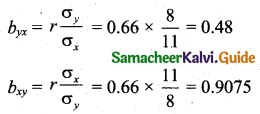
If the Correlation coefficient between X and Y is 0.66, then find
(i) the two regression coefficients,
(ii) the most likely value of Y when X = 10.
Solution:
\(\overline{\mathrm{X}}\) = 36, \(\overline{\mathrm{Y}}\) = 85, σx = 11, σy = 8, r = 0.66
(i) The two regression coefficients are,
Samacheer Kalvi 11th Business Maths Guide Chapter 9 Correlation and Regression Analysis Ex 9.2 Q7.1
(ii) Regression equation of X on Y:
\(X-\bar{X}=b_{x y}(Y-\bar{Y})\)
X – 36 = 0.91(Y – 85)
X – 36 = 0.91Y – 77.35
X = 0.91Y – 77.35 + 36
X = 0.91Y – 41.35
Regression line of Y on X:
\(Y-\bar{Y}=b_{y x}(X-\bar{X})\)
Y – 85 = 0.48(X – 36)
Y = 0.48X – 17.28 + 85
Y = 0.48X + 67.72
The most likely value of Y when X = 10 is
Y = 0.48(10) + 67.72 = 72.52.

Samacheer Kalvi 11th Business Maths Guide Chapter 9 Correlation and Regression Analysis Ex 9.2

Question 8.
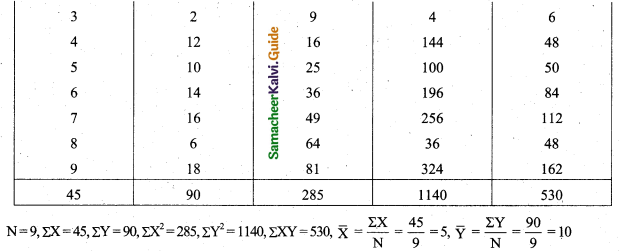
Find the equation of the regression line of Y on X, if the observations (Xi, Yi) are the following (1, 4) (2, 8) (3, 2) ( 4, 12) ( 5, 10) ( 6, 14) ( 7, 16) ( 8, 6) (9, 18).
Solution:
Samacheer Kalvi 11th Business Maths Guide Chapter 9 Correlation and Regression Analysis Ex 9.2 Q8
Samacheer Kalvi 11th Business Maths Guide Chapter 9 Correlation and Regression Analysis Ex 9.2 Q8.1
Samacheer Kalvi 11th Business Maths Guide Chapter 9 Correlation and Regression Analysis Ex 9.2 Q8.2
Regression line of Y on X:
\(Y-\bar{Y}=b_{y x}(X-\bar{X})\)
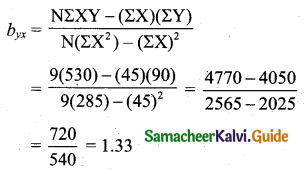
Y – 10 = 1.33(X – 5)
Y = 1.33X – 6.65 + 10
Y = 1.33X + 3.35

Question 9.
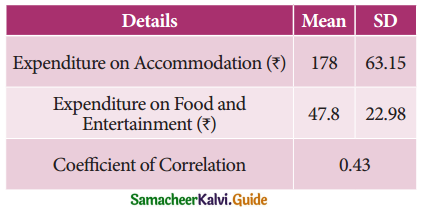
A survey was conducted to study the relationship between expenditure on accommodation (X) and expenditure on Food and Entertainment (Y) and the following results were obtained:
Samacheer Kalvi 11th Business Maths Guide Chapter 9 Correlation and Regression Analysis Ex 9.2 Q9
Write down the regression equation and estimate the expenditure on Food and Entertainment, if the expenditure on accommodation is ₹ 200.
Solution:
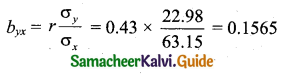
\(\overline{\mathrm{X}}\) = 178, \(\overline{\mathrm{Y}}\) = 47.8, σx = 63.15, σy = 22.98, r = 0.43
Samacheer Kalvi 11th Business Maths Guide Chapter 9 Correlation and Regression Analysis Ex 9.2 Q9.1
Regression line of Y on X:
\(\mathrm{Y}-\overline{\mathrm{Y}}=b_{y x}(\mathrm{X}-\overline{\mathrm{X}})\)
Y – 47.8 = 0.1565(X – 178)
Y = 0.1565X – 27.857 + 47.8
Y = 0.1565X + 19.94
When the expenditure on accommodation is ₹ 200 the expenditure on food and entertainments is,
Y = 0.1565X + 19.94
Y = 0.1565(200) + 19.94
= 31.3 + 19.94
= ₹ 51.24.

Samacheer Kalvi 11th Business Maths Guide Chapter 9 Correlation and Regression Analysis Ex 9.2

Question 10.
For 5 observations of pairs of (X, Y) of variables X and Y the following results are obtained.
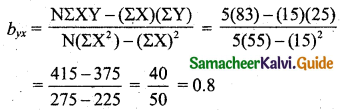
ΣX = 15, ΣY = 25, ΣX2 = 55, ΣY2 = 135, ΣXY = 83. Find the equation of the lines of regression and estimate the values of X and Y if Y = 8; X = 12.
Solution:
N = 5, ΣX = 15, ΣY = 25, ΣX2 = 55, ΣY2 = 135, ΣXY = 83, \(\overline{\mathrm{X}}=\frac{15}{5}\) = 3, \(\overrightarrow{\mathrm{Y}}=\frac{25}{5}\) = 5.
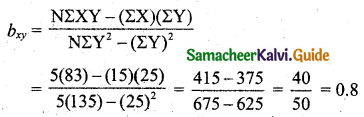
Samacheer Kalvi 11th Business Maths Guide Chapter 9 Correlation and Regression Analysis Ex 9.2 Q10
Regression line of Y on X:
\(Y-\bar{Y}=b_{x y}(X-\bar{X})\)
Y – 5 = 0.8(X – 3)
Y = 0.8X – 2.4 + 5
Y = 0.8X + 2.6.
WhenX = 12, Y = 0.8X + 2.6
Y = (0.8)12 + 2.6
= 9.6 + 2.6
= 12.2
Samacheer Kalvi 11th Business Maths Guide Chapter 9 Correlation and Regression Analysis Ex 9.2 Q10.1
Regression line of X on Y:
\(X-\bar{X}=b_{x y}(Y-\bar{Y})\)
X – 3 = 0.8(Y – 5)
X = 0.8Y – 4 + 3
X = 0.8Y – 1
When Y = 8, X = 0.8Y – 1
X = (0.8)8 – 1
= 6.4 – 1
= 5.4

Question 11.
The two regression lines were found to be 4X – 5Y + 33 = 0 and 20X – 9Y – 107 = 0. Find the mean values and coefficient of correlation between X and Y.
Solution:
To get mean values we must solve the given lines.
4X – 5Y = -33 ……(1)
20X – 9Y = 107 …….(2)
(1) × 5 ⇒ 20X – 25Y = -165
20X – 9Y = 107
Subtracting (1) and (2), -16Y = -272
Y = \(\frac{272}{16}\) = 17
i.e., \(\overline{\mathrm{Y}}\) = 17
Using Y = 17 in (1) we get, 4X – 85 = -33
4X = 85 – 33
4X = 52
X = 13
i.e., \(\overline{\mathrm{X}}\) = 13
Mean values are \(\overline{\mathrm{X}}\) = 13, \(\overline{\mathrm{Y}}\) = 17,
Let regression line of Y on X be
4X – 5Y + 33 = 0
5Y = 4X + 33
Y = \(\frac{1}{5}\) (4X + 33)
Y = \(\frac{4}{5} X+\frac{33}{5}\)
Y = 0.8X + 6.6
∴ byx = 0.8
Let regression line of X on Y be
20X – 9Y – 107 = 0
20X = 9Y + 107
X = \(\frac{1}{20}\) (9Y + 107)
X = \(\frac{9}{20} Y+\frac{107}{20}\)
X = 0.45Y + 5.35
∴ bxy = 0.45
Coefficient of correlation between X and Y is
\(r=\pm \sqrt{b_{y x} \times b_{x y}}\)
\(r=\pm \sqrt{0.8 \times 0.45}\)
= ±0.6
= 0.6
Both byx and bxy is positive take positive sign.

Samacheer Kalvi 11th Business Maths Guide Chapter 9 Correlation and Regression Analysis Ex 9.2

Question 12.
The equations of two lines of regression obtained in a correlation analysis are the following 2X = 8 – 3Y and 2Y = 5 – X . Obtain the value of the regression coefficients and correlation coefficient.
Solution:
Let regression line of Y on X be,
2Y = 5 – X
Y = -0.5X + 2.5
byx = -0.5
i.e., byx= \(-\frac{1}{2}\)
Let regression line of X on Y be
2X = 8 – 3Y
X = -1.5Y + 4
bxy = -1.5
i.e., bxy = \(-\frac{3}{2}\)
Correlation coefficient \(r=\pm \sqrt{b_{x y} \times b_{y x}}\)
= \(\pm \sqrt{1.5 \times 0.5}\)
= -0.866
Both bxy and byx is negative so take negative sign.

Samacheer Kalvi 11th Business Maths Guide Chapter 9 Correlation and Regression Analysis Ex 9.1

Tamilnadu State Board New Syllabus Samcheer Kalvi 11th Business Maths Guide Pdf Chapter 9 Correlation and Regression Analysis Ex 9.1 Text Book Back Questions and Answers, Notes.

Tamilnadu Samacheer Kalvi 11th Business Maths Solutions Chapter 9 Correlation and Regression Analysis Ex 9.1

Samacheer Kalvi 11th Business Maths Correlation and Regression Analysis Ex 9.1 Text Book Back Questions and Answers

Question 1.
Calculate the correlation co-efficient for the following data:
Samacheer Kalvi 11th Business Maths Guide Chapter 9 Correlation and Regression Analysis Ex 9.1 Q1
Solution:
Samacheer Kalvi 11th Business Maths Guide Chapter 9 Correlation and Regression Analysis Ex 9.1 Q1.1
Coefficient of correlation
Samacheer Kalvi 11th Business Maths Guide Chapter 9 Correlation and Regression Analysis Ex 9.1 Q1.2

Samacheer Kalvi 11th Business Maths Guide Chapter 9 Correlation and Regression Analysis Ex 9.1

Question 2.
Find the coefficient of correlation for the following:
Samacheer Kalvi 11th Business Maths Guide Chapter 9 Correlation and Regression Analysis Ex 9.1 Q2
Solution:
Samacheer Kalvi 11th Business Maths Guide Chapter 9 Correlation and Regression Analysis Ex 9.1 Q2.1
Samacheer Kalvi 11th Business Maths Guide Chapter 9 Correlation and Regression Analysis Ex 9.1 Q2.2
Samacheer Kalvi 11th Business Maths Guide Chapter 9 Correlation and Regression Analysis Ex 9.1 Q2.3

Question 3.
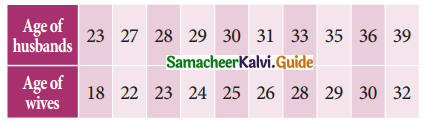
Calculate the coefficient of correlation for the ages of husbands and their respective wives:
Samacheer Kalvi 11th Business Maths Guide Chapter 9 Correlation and Regression Analysis Ex 9.1 Q3
Solution:
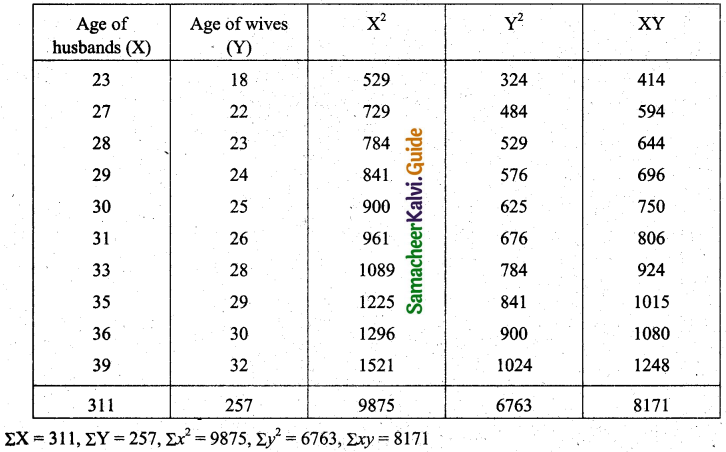
Without deviation:
Samacheer Kalvi 11th Business Maths Guide Chapter 9 Correlation and Regression Analysis Ex 9.1 Q3.1
N = 10
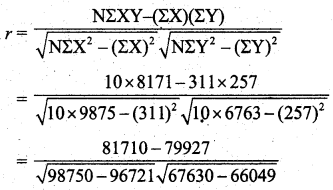
Coefficient of correlation
Samacheer Kalvi 11th Business Maths Guide Chapter 9 Correlation and Regression Analysis Ex 9.1 Q3.2
= \(\frac{1783}{45 \times 39.76}\)
= 0.9965
Note: We can do the above problem using deviations taken from arithmetic means of X and Y. i.e., using
r = \(\frac{\Sigma \mathrm{XY}}{\sqrt{\Sigma \mathrm{X}^{2} \Sigma \mathrm{Y}^{2}}}\)

Samacheer Kalvi 11th Business Maths Guide Chapter 9 Correlation and Regression Analysis Ex 9.1

Question 4.
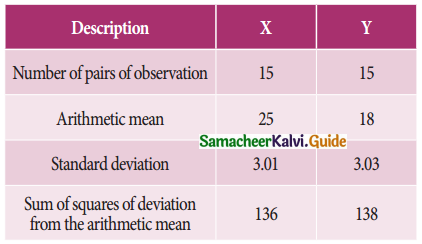
Calculate the coefficient of correlation between X and Y series from the following data:
Samacheer Kalvi 11th Business Maths Guide Chapter 9 Correlation and Regression Analysis Ex 9.1 Q4
The summation of product deviations of X and Y series from their respective arithmetic means is 122.
Solution:
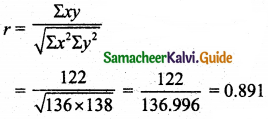
N = 15, \(\overline{\mathrm{X}}\) = 25, \(\overline{\mathrm{Y}}\) = 18, x = X – \(\overline{\mathrm{X}}\), y = Y – \(\overline{\mathrm{Y}}\), Σx2 = 136, Σy2 = 138, Σxy = 122
Correlation coefficient
Samacheer Kalvi 11th Business Maths Guide Chapter 9 Correlation and Regression Analysis Ex 9.1 Q4.1

Question 5.
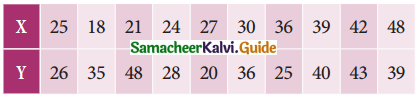
Calculate the correlation coefficient for the following data:
Samacheer Kalvi 11th Business Maths Guide Chapter 9 Correlation and Regression Analysis Ex 9.1 Q5
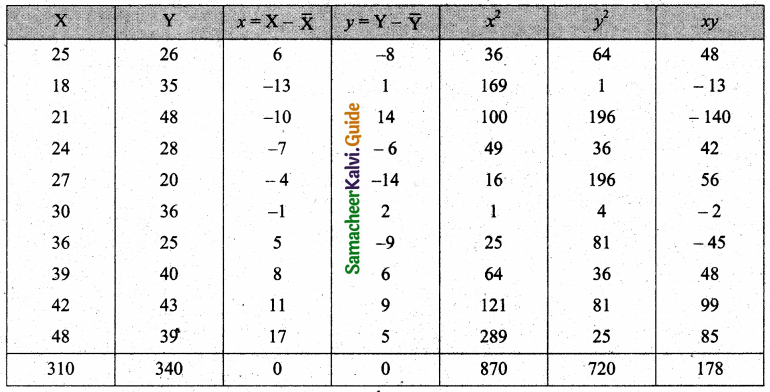
Solution:
Samacheer Kalvi 11th Business Maths Guide Chapter 9 Correlation and Regression Analysis Ex 9.1 Q5.1
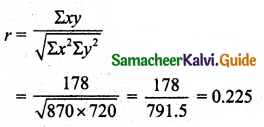
N = 10, ΣX = 310, ΣY = 340, Σx2 = 870, Σy2 = 720, Σxy = 178
Samacheer Kalvi 11th Business Maths Guide Chapter 9 Correlation and Regression Analysis Ex 9.1 Q5.2
Correlation coefficient
Samacheer Kalvi 11th Business Maths Guide Chapter 9 Correlation and Regression Analysis Ex 9.1 Q5.3

Samacheer Kalvi 11th Business Maths Guide Chapter 9 Correlation and Regression Analysis Ex 9.1

Question 6.
Find the coefficient of correlation for the following:
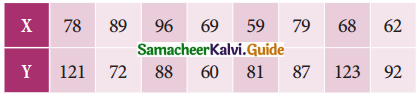
Samacheer Kalvi 11th Business Maths Guide Chapter 9 Correlation and Regression Analysis Ex 9.1 Q6
Solution:
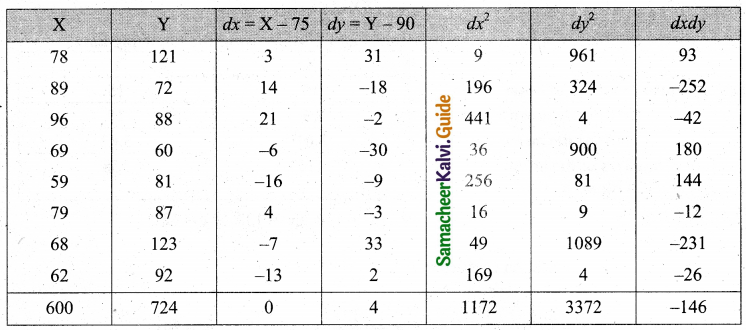
Samacheer Kalvi 11th Business Maths Guide Chapter 9 Correlation and Regression Analysis Ex 9.1 Q6.1
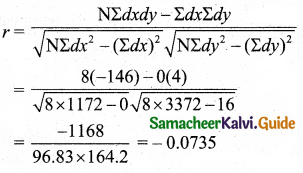
N = 8, ΣX = 600, ΣY = 724, Σdx2 = 1172, Σdy2 = 3372, Σdxdy = -146
Correlation coefficient
Samacheer Kalvi 11th Business Maths Guide Chapter 9 Correlation and Regression Analysis Ex 9.1 Q6.2

Question 7.
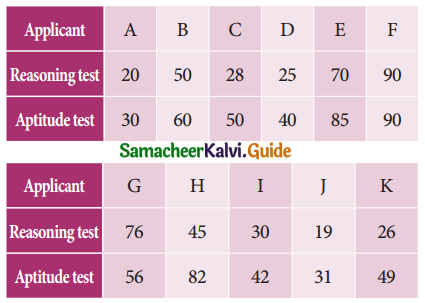
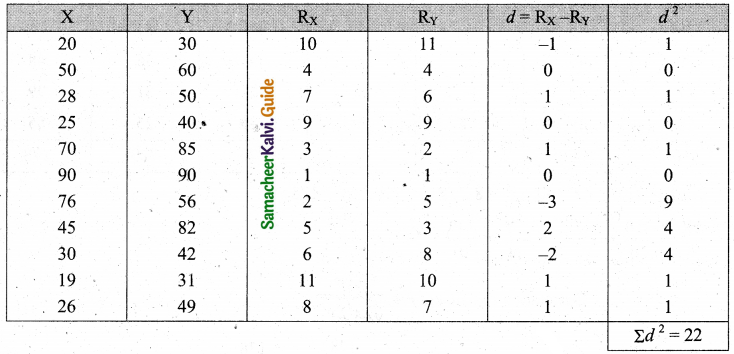
An examination of 11 applicants for an accountant post was taken by a finance company. The marks obtained by the applicants in the reasoning and aptitude tests are given below.
Samacheer Kalvi 11th Business Maths Guide Chapter 9 Correlation and Regression Analysis Ex 9.1 Q7
Calculate Spearman’s rank correlation coefficient from the data given above.
Solution:
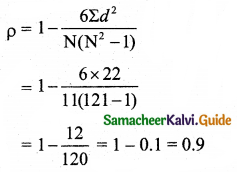
Samacheer Kalvi 11th Business Maths Guide Chapter 9 Correlation and Regression Analysis Ex 9.1 Q7.1
N = 11, Σd2 = 22
Rank correlation
Samacheer Kalvi 11th Business Maths Guide Chapter 9 Correlation and Regression Analysis Ex 9.1 Q7.2

Samacheer Kalvi 11th Business Maths Guide Chapter 9 Correlation and Regression Analysis Ex 9.1

Question 8.
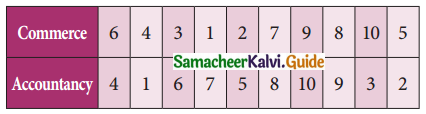
The following are the ranks obtained by 10 students in commerce and accountancy are given below:
Samacheer Kalvi 11th Business Maths Guide Chapter 9 Correlation and Regression Analysis Ex 9.1 Q8
To what extent is the knowledge of students in the two subjects related?
Solution:
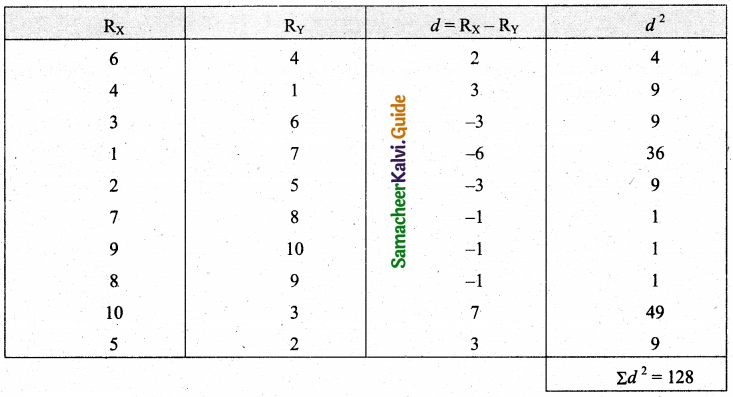
Samacheer Kalvi 11th Business Maths Guide Chapter 9 Correlation and Regression Analysis Ex 9.1 Q8.1
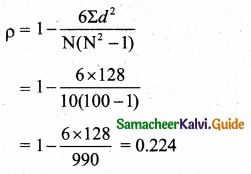
N = 11, Σd2 = 128
Rank correlation
Samacheer Kalvi 11th Business Maths Guide Chapter 9 Correlation and Regression Analysis Ex 9.1 Q8.2

Question 9.
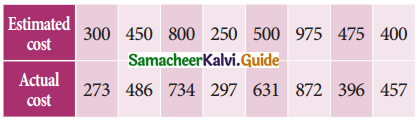
A random sample of recent repair jobs was selected and the estimated cost and actual cost were recorded.
Samacheer Kalvi 11th Business Maths Guide Chapter 9 Correlation and Regression Analysis Ex 9.1 Q9
Calculate the value of spearman’s correlation coefficient.
Solution:
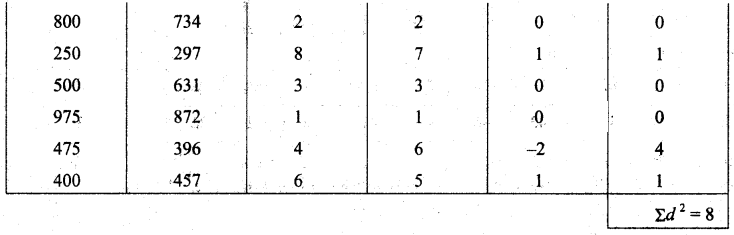
Samacheer Kalvi 11th Business Maths Guide Chapter 9 Correlation and Regression Analysis Ex 9.1 Q9.1
Samacheer Kalvi 11th Business Maths Guide Chapter 9 Correlation and Regression Analysis Ex 9.1 Q9.2
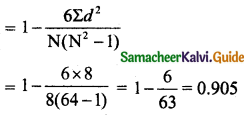
N = 8, Σd2 = 8
Rank correlation
Samacheer Kalvi 11th Business Maths Guide Chapter 9 Correlation and Regression Analysis Ex 9.1 Q9.3

Samacheer Kalvi 11th Business Maths Guide Chapter 9 Correlation and Regression Analysis Ex 9.1

Question 10.
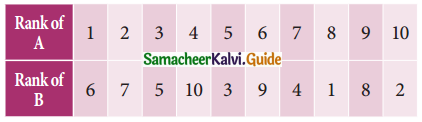
The rank of 10 students of the same batch in two subjects A and B are given below. Calculate the rank correlation coefficient.
Samacheer Kalvi 11th Business Maths Guide Chapter 9 Correlation and Regression Analysis Ex 9.1 Q10
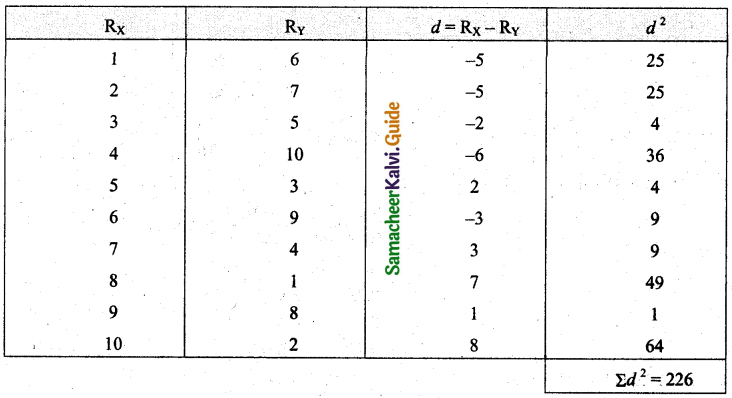
Solution:
Samacheer Kalvi 11th Business Maths Guide Chapter 9 Correlation and Regression Analysis Ex 9.1 Q10.1
N = 10, Σd2 = 226
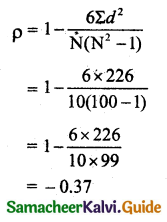
Rank correlation
Samacheer Kalvi 11th Business Maths Guide Chapter 9 Correlation and Regression Analysis Ex 9.1 Q10.2

Samacheer Kalvi 11th Business Maths Guide Chapter 8 Descriptive Statistics and Probability Ex 8.3

Tamilnadu State Board New Syllabus Samcheer Kalvi 11th Business Maths Guide Pdf Chapter 8 Descriptive Statistics and Probability Ex 8.3 Text Book Back Questions and Answers, Notes.

Tamilnadu Samacheer Kalvi 11th Business Maths Solutions Chapter 8 Descriptive Statistics and Probability Ex 8.3

Samacheer Kalvi 11th Business Maths Descriptive Statistics and Probability Ex 8.3 Text Book Back Questions and Answers

Choose the correct answer.

Question 1.
Which of the following is a positional measure?
(a) Range
(b) Mode
(c) Mean deviation
(d) Percentiles
Answer:
(d) Percentiles

Question 2.
When calculating the average growth of the economy, the correct mean to use is?
(a) Weighted mean
(b) Arithmetic mean
(c) Geometric mean
(d) Harmonic mean
Answer:
(c) Geometric mean

Question 3.
When an observation in the data is zero, then its geometric mean is:
(a) Negative
(b) Positive
(c) Zero
(d) Cannot be calculated
Answer:
(c) Zero

Question 4.
The best measure of central tendency is:
(a) Arithmetic mean
(b) Harmonic mean
(c) Geometric mean
(d) Median
Answer:
(a) Arithmetic mean

Question 5.
The harmonic mean of the numbers 2, 3, 4 is:
(a) \(\frac{12}{13}\)
(b) 12
(c) \(\frac{36}{13}\)
(d) \(\frac{13}{36}\)
Answer:
(c) \(\frac{36}{13}\)
Hint:
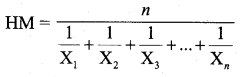
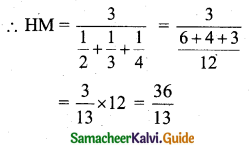
Samacheer Kalvi 11th Business Maths Guide Chapter 8 Descriptive Statistics and Probability Ex 8.3 Q5
Here n = 3
Samacheer Kalvi 11th Business Maths Guide Chapter 8 Descriptive Statistics and Probability Ex 8.3 Q5.1

Question 6.
The geometric mean of two numbers 8 and 18 shall be:
(a) 12
(b) 13
(c) 15
(d) 11.08
Answer:
(a) 12
Hint:
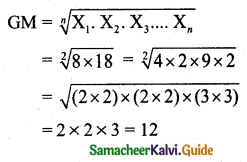
Samacheer Kalvi 11th Business Maths Guide Chapter 8 Descriptive Statistics and Probability Ex 8.3 Q6

Question 7.
The correct relationship among A.M., G.M.and H.M.is:
(a) A.M. < G.M. < H.M.
(b) G.M. > A.M. > H.M.
(c) H.M. > G.M. > A.M.
(d) A.M. > G.M. > H.M.
Answer:
(d) A.M. > G.M. > H.M.

Question 8.
Harmonic mean is the reciprocal of:
(a) Median of the values.
(b) Geometric mean of the values.
(c) Arithmetic mean of the reciprocal of the values.
(d) Quartiles of the values.
Answer:
(c) Arithmetic mean of the reciprocal of the values.

Question 9.
Median is same as:
(a) Q1
(b) Q2
(c) Q3
(d) D2
Answer:
(b) Q2

Question 10.
The median of 10, 14, 11, 9, 8, 12, 6 is:
(a) 10
(b) 12
(c) 14
(d) 9
Answer:
(a) 10
Hint:
The ascending order of 10, 14, 11, 9, 8, 12, 6 is 6, 8, 9, 10, 11, 12, 14.
In this order middle number is 10.
Median = \(\left(\frac{n+1}{2}\right)^{t h}\) value
= \(\left(\frac{7+1}{2}\right)^{th}\)
= 10
∴ Median 10.

Question 11.
The mean of the values 11, 12, 13, 14 and 15 is:
(a) 15
(b) 11
(c) 12.5
(d) 13
Answer:
(d) 13
Hint: The values are in ascending, order.
∴ The mean is the middle value.

Question 12.
If the mean of 1, 2, 3, ….., n is \(\frac{6 n}{11}\), then the value of n is:
(a) 10
(b) 12
(c) 11
(d) 13
Answer:
(c) 11
Hint:
The mean of 1, 2, 3,…., n is \(\frac{6 n}{11}\)
i.e., \(\frac{1+2+3+4 \ldots+n}{n}=\frac{6 n}{11}\)
\(\frac{\frac{n(n+1)}{2}}{n}=\frac{6 n}{11}\)
\(\frac{n+1}{2}=\frac{6 n}{11}\)
11(n + 1) = 2 × 6
11n + 11 = 12n
∴ n = 11

Question 13.
The harmonic mean is better than other means if the data are for:
(a) Speed or rates.
(b) Heights or lengths.
(c) Binary values like 0 and 1.
(d) Ratios or proportions.
Answer:
(a) Speed or rates

Question 14.
The first quartile is also known as:
(a) median
(b) lower quartile
(c) mode
(d) third decile
Answer:
(b) lower quartile

Question 15.
If Q1 = 30 and Q3 = 50, the coefficient of quartile deviation is:
(a) 20
(b) 40
(c) 10
(d) 0.25
Answer:
(d) 0.25
Hint:
Coefficient of quartile deviation is = \(\frac{Q_{3}-Q_{1}}{Q_{3}+Q_{1}}\)
= \(\frac{50-30}{50+30}\)
= \(\frac{20}{40}\)
= 0.25

Question 16.
If median = 45 and its coefficient is 0.25, then the mean deviation about median is:
(a) 11.25
(b) 180
(c) 0.0056
(d) 45
Answer:
(a) 11.25
Hint:
Coefficient of M.D = \(\frac{\mathrm{MD}}{\mathrm{Median}}\)
MD = Coefficient of MD × Median
= 0.25 × 45
= 11.25

Question 17.
The two events A and B are mutually exclusive if:
(a) P(A ∩ B) = 0
(b) P(A ∩ B) = 1
(c) P(A ∪ B) = 0
(d) P(A ∪ B) = 1
Answer:
(a) P(A ∩ B) = 0

Question 18.
The events A and B are independent if:
(a) P(A ∩ B) = 0
(b) P(A ∩ B) = P(A) × P(B)
(c) P(A ∩ B) = P(A) + P(B)
(d) P(A ∪ B) = P(A) × P(B)
Answer:
(b) P(A ∩ B) = P(A) × P(B)

Question 19.
If two events A and B are dependent then the conditional probability of P(B/A) is:
(a) P(A) P(B/A)
(b) \(\frac{P(A \cap B)}{P(B)}\)
(c) \(\frac{P(A \cap B)}{P(A)}\)
(d) P(A) P(A/B)
Answer:
(c) \(\frac{P(A \cap B)}{P(A)}\)

Question 20.
The probability of drawing a spade from a pack of card is:
(a) \(\frac{1}{52}\)
(b) \(\frac{1}{13}\)
(c) \(\frac{4}{13}\)
(d) \(\frac{1}{4}\)
Answer:
(d) \(\frac{1}{4}\)
Hint:
Number of spade cards is 13.
Total number of cards in pack = 52
Probability of drawing a spade card is = \(\frac{13}{52}=\frac{1}{4}\)

Question 21.
If the outcome of one event does’not influence another event then the two events are:
(a) Mutually exclusive
(b) Dependent
(c) Not disjoint
(d) Independent
Answer:
(d) Independent

Question 22.
Let a sample space of an experiment be S = {E1, E2, …., En} then \(\sum_{i=1}^{n} \mathrm{P}\left(\mathrm{E}_{i}\right)\) is equal to:
(a) 0
(b) 1
(c) \(\frac{1}{2}\)
(d) \(\frac{1}{3}\)
Answer:
(b) 1
Hint:
Sum of probabilities is 1
i.e., \(\sum_{i=1}^{n} \mathrm{P}\left(\mathrm{E}_{i}\right)=1\)

Question 23.
The probability of obtaining an even prime number on each die, when a pair of dice is rolled is:
(a) \(\frac{1}{36}\)
(b) 0
(c) \(\frac{1}{3}\)
(d) \(\frac{1}{6}\)
Answer:
(a) \(\frac{1}{36}\)
Hint:
When a pair of dice is rolled number of elements in the sample space is 36.
2 is the only even prime number. (2, 2) is the only event of even prime number on both dice.
Required probabilities \(\frac{1}{36}\).

Question 24.
Probability of an impossible event is:
(a) 1
(b) 0
(c) 0.2
(d) 0.5
Answer:
(b) 0

Question 25.
The probability that at least one of the events A, B occur is:
(a) P(A ∪ B)
(b) P(A ∩ B)
(c) P(A/B)
(d) (A ∪ B)
Answer:
(a) P(A ∪ B)

Samacheer Kalvi 11th Business Maths Guide Chapter 8 Descriptive Statistics and Probability Ex 8.2

Tamilnadu State Board New Syllabus Samcheer Kalvi 11th Business Maths Guide Pdf Chapter 8 Descriptive Statistics and Probability Ex 8.2 Text Book Back Questions and Answers, Notes.

Tamilnadu Samacheer Kalvi 11th Business Maths Solutions Chapter 8 Descriptive Statistics and Probability Ex 8.2

Samacheer Kalvi 11th Business Maths Descriptive Statistics and Probability Ex 8.2 Text Book Back Questions and Answers

Question 1.
A family has two children. What is the probability that both the children are girls given that at least one of them is a girl?
Solution:
Let B denote a boy and G denote a girl.
Then the sample, S = {BG, GB, BB, GG}.
∴ n(S) = 4
Let E be the event that both children are girls.
Let F be the event that atleast one of them is a girl.
Then E = {GG}, n(E) = 1
F = {BG, GB, GG}, n(F) = 3
P(F) = \(\frac{n(\mathrm{F})}{n(\mathrm{S})}=\frac{3}{4}\)
E ∩ F = {GG}, n(E ∩ F) = 1
P(E ∩ F) = \(\frac{n(\mathrm{E} \cap \mathrm{F})}{n(s)}=\frac{1}{4}\)
Required Probability P(F/E) = \(\frac{P(E \cap F)}{P(F)}=\frac{\frac{1}{4}}{\frac{3}{4}}=\frac{1}{3}\)

Samacheer Kalvi 11th Business Maths Guide Chapter 8 Descriptive Statistics and Probability Ex 8.2

Question 2.
A die is thrown twice and the sum of the number appearing is observed to be 6. What is the conditional probability that the number 4 has appeared at least once?
Solution:
When a die is thrown twice, the sample is S = {(1, 1), (1, 2), (1, 3), (1, 4), (1, 5), (1, 6)
(2, 1), (2, 2), (2, 3), (2, 4), (2, 5), (2, 6)
(3, 1), (3, 2), (3, 3), (3, 4), (3, 5), (3, 6)
(4, 1), (4, 2), (4, 3), (4, 4), (4, 5), (4, 6)
(5, 1), (5, 2), (5, 3), (5, 4), (5, 5), (5, 6)
(6, 1), (6, 2), (6, 3), (6, 4), (6, 5), (6, 6)}
n(S) = 36
Let A be the event of getting the sum of the numbers is 6.
Let B be the event of the number 4 has appeared atleast once.
We have to find P(B/A)
A = {(1, 5), (5, 1), (2, 4), (4, 2), (3, 3)}, n(A) = 5
∴ P(A) = \(\frac{5}{36}\)
B = {(1, 4), (2, 4), (3, 4), (4, 4), (5, 4), (6, 4), (4, 1),(4, 2), (4, 3), (4, 5), (4, 6)}
A ∩ B = {(2, 4), (4, 2)}, n(A ∩ B) = 2
P(A ∩ B) = \(\frac{2}{36}\)
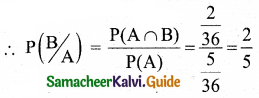
Samacheer Kalvi 11th Business Maths Guide Chapter 8 Descriptive Statistics and Probability Ex 8.2 Q2

Question 3.
An unbiased die is thrown twice. Let the event A be an odd number on the first throw and B the event odd number on the second throw. Check whether A and B events are independent.
Solution:
When a die is thrown twice, the sample space is S = {(1, 1), (1, 2), (1, 3), (1, 4), (1, 5), (1, 6)
(2, 1), (2, 2), (2, 3), (2, 4), (2, 5), (2, 6)
(3, 1), (3, 2), (3, 3), (3, 4), (3, 5), (3, 6)
(4, 1), (4, 2), (4, 3), (4, 4), (4, 5), (4, 6)
(5, 1), (5, 2), (5, 3), (5, 4), (5, 5), (5, 6)
(6, 1), (6,2), (6, 3), (6, 4), (6, 5), (6, 6)}
n(S) = 36
The event A is odd number on the first throw
∴ A = {(1, 1), (1, 2), (1, 3), (1, 4), (1, 5), (1, 6)
(3, 1), (3, 2), (3, 3), (3, 4), (3, 5), (3, 6)
(5, 1), (5, 2), (5, 3), (5, 4), (5, 5), (5, 6)}
n(A) = 18
P(A) = \(\frac{18}{36}=\frac{1}{2}\)
The event B is odd number on the second throw.
B = {(1, 1), (1, 3), (1, 5), (2, 1), (2, 3), (2, 5)
(3, 1), (3, 3), (3, 5), (4, 1), (4, 3), (4, 5)
(5, 1), (5, 3), (5, 5), (6, 1), (6, 3), (6, 5)}
n(B) = 18
P(B) = \(\frac{18}{36}=\frac{1}{2}\)
A ∩ B = {(1, 1), (1, 3), (1, 5)
(3, 1), (3, 3), (3, 5)
(5, 1), (5, 3), (5, 5)}
n(A ∩ B) = 9
P(A ∩ B) = \(\frac{9}{36}=\frac{1}{4}\)
Also P(A) . P(B) = \(\frac{1}{2} \cdot \frac{1}{2}=\frac{1}{4}\)
Thus P(A ∩ B) = P(A) . P(B)
∴ A and B are independent events.

Samacheer Kalvi 11th Business Maths Guide Chapter 8 Descriptive Statistics and Probability Ex 8.2

Question 4.
Probability of solving specific problem independently by A and B are \(\frac{1}{2}\) and \(\frac{1}{3}\) respectively. If both try to solve the problem independently, find the probability that the problem is (i) solved, (ii) exactly one of them solves the problem.
Solution:
Given P(A) = \(\frac{1}{2}\) and P(B) = \(\frac{1}{3}\)
(i) The probability that problem is solved = The probability that atleast one solving the problem
= 1 – P(none of them solving the problem)
= 1 – \(P(\bar{A} \cap \bar{B})\)
= 1 – \(\mathrm{P}(\overline{\mathrm{A}}) \cdot \mathrm{P}(\overline{\mathrm{B}})\)
= 1 – (1 – \(\frac{1}{2}\)) (1 – \(\frac{1}{3}\))
= 1 – (\(\frac{1}{2}\)) (\(\frac{2}{3}\))
= 1 – \(\frac{1}{3}\)
= \(\frac{2}{3}\)
(ii) P(exactly one of them solves the problem)
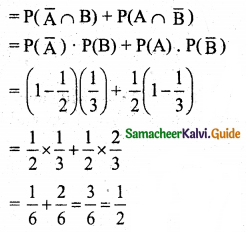
Samacheer Kalvi 11th Business Maths Guide Chapter 8 Descriptive Statistics and Probability Ex 8.2 Q4

Question 5.
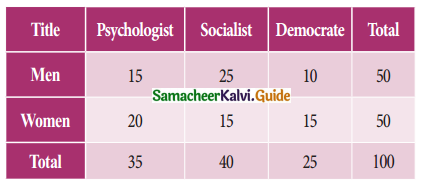
Suppose one person is selected at random from a group of 100 persons are given in the following:
Samacheer Kalvi 11th Business Maths Guide Chapter 8 Descriptive Statistics and Probability Ex 8.2 Q5
What is the probability that the man selected is a Psychologist?
Solution:
Total number of men = 50
Number of men psychologist = 15
The probability of selecting a psychologist given that a man has been already selected is \(\frac{15}{50}=\frac{3}{10}\)

Samacheer Kalvi 11th Business Maths Guide Chapter 8 Descriptive Statistics and Probability Ex 8.2

Question 6.
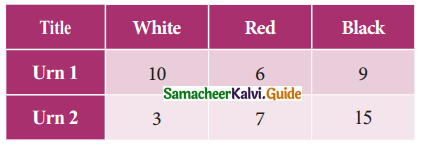
Two urns contain the set of balls as given in the following table.
Samacheer Kalvi 11th Business Maths Guide Chapter 8 Descriptive Statistics and Probability Ex 8.2 Q6
One ball is drawn from each urn and find the probability that (i) both balls are red, (ii) both balls are of the same colour.
Solution:
(i) Let A be the event of drawing a red from urn 1,
P(A) = \(\frac{6}{25}\)
Let B be the event of selecting a red ball in urn 2.
P(B) = \(\frac{7}{25}\)
∴ P(both balls are red) = P(A) . P(B) [∵ the events are independent]
= \(\frac{6}{25} \times \frac{7}{25}\)
= \(\frac{42}{625}\)
Let W1, R1, B1 represents white, red, and black balls drawn from urn 1 and W2, R2, B2 represents white, red, and black balls from urn 2.
P(both balls are of the same colour) = P(W1W2) + P(R1R2) + P(B1B2) [∵ Events are mutually exclusive]
= P(W1) P(W2) + P(R1) P(R2) + P(B1) P(B2) [∵ Events are independent]
= \(\frac{10}{25} \times \frac{3}{25}+\frac{6}{25} \times \frac{7}{25}+\frac{9}{25} \times \frac{15}{25}\)
= \(\frac{1}{625}\) [30 + 42 + 135]
= \(\frac{207}{625}\)

Question 7.
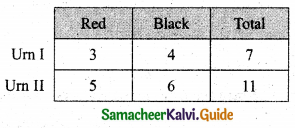
The bag I contain 3 Red and 4 Black balls while another Bag II contains 5 Red and 6 Black balls. One ball is drawn at random from one of the bags and it is found to be red. Find the probability that it was drawn from Bag I.
Solution:
Samacheer Kalvi 11th Business Maths Guide Chapter 8 Descriptive Statistics and Probability Ex 8.2 Q7
Let E1 be the event of choosing the first bag, E2 be the event of choosing the second bag.
Let A be the event of drawing a red ball.
Then P(E1) = \(\frac{1}{2}\), P(E2) = \(\frac{1}{2}\)
Also P(A/E1) = P(Drawing a red ball from bag I) = \(\frac{3}{7}\)
P(A/E2) = P(Drawing a red ball from bag II) = \(\frac{5}{11}\)
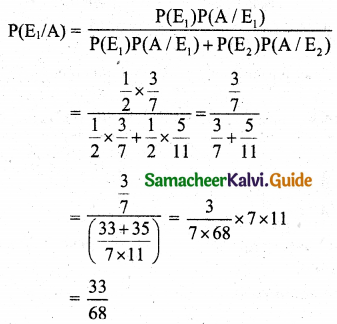
The probability of drawing a ball from bag I, being given that it is red, is P(E1/A)
Samacheer Kalvi 11th Business Maths Guide Chapter 8 Descriptive Statistics and Probability Ex 8.2 Q7.1

Samacheer Kalvi 11th Business Maths Guide Chapter 8 Descriptive Statistics and Probability Ex 8.2

Question 8.
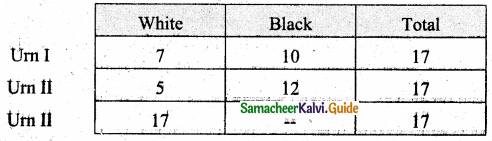
The first of three urns contains 7 White and 10 Black balls, the second contains 5 White and 12 Black balls, and the third “contains 17 White balls and no Blackball. A person chooses an urn at random and draws a ball from it. And the ball is found to be White. Find the probabilities that the ball comes from (i) the first urn, (ii) the second urn, (iii) the third urn.
Solution:
Samacheer Kalvi 11th Business Maths Guide Chapter 8 Descriptive Statistics and Probability Ex 8.2 Q8
Let E1, E2, and E3 be the event of choosing the first, second, and third urn.
Let A be the event of drawing a white ball.
then P(E1) = P(E2) = P(E3) = \(\frac{1}{3}\)
P(A/E1) = P(drawing a white ball from the first urn) = \(\frac{7}{17}\)
P(A/E2) = P(drawing a white ball from the second urn) = \(\frac{5}{17}\)
P(A/E3) = P(drawing a white ball from the third urn) = \(\frac{17}{17}\)
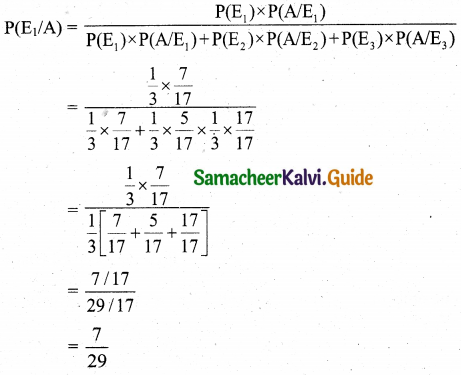
(i) The probability of drawing a ball from the first urn, being given that it is white, is P(E1/A),
Samacheer Kalvi 11th Business Maths Guide Chapter 8 Descriptive Statistics and Probability Ex 8.2 Q8.1
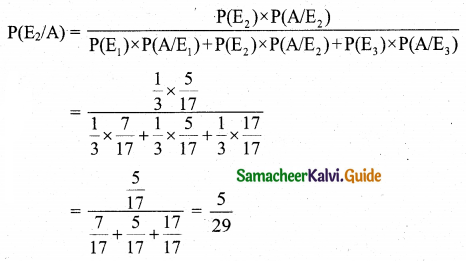
(ii) the second urn
Samacheer Kalvi 11th Business Maths Guide Chapter 8 Descriptive Statistics and Probability Ex 8.2 Q8.2
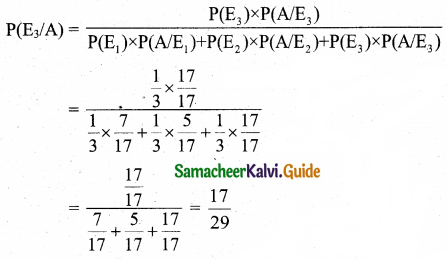
(iii) the third urn
Samacheer Kalvi 11th Business Maths Guide Chapter 8 Descriptive Statistics and Probability Ex 8.2 Q8.3

Question 9.
Three boxes B1, B2, B3 contain lamp bulbs some of which are defective. The defective proportions in box B1, box B2 and box B3 are respectively \(\frac{1}{2}\), \(\frac{1}{3}\) and \(\frac{1}{4}\). A box is selected at random and a bulb is drawn from it. If the selected bulb is found to be defective, what is the probability that box B1 was selected?
Solution:
Given that B1, B2 and B3 represent three boxes.
Then P(B1) = P(B2) = P(B3) = \(\frac{1}{3}\)
Let A be the event of selecting a defective bulb.
Then P(A/B1) = P(drawing a defective bulb from B1) = \(\frac{1}{2}\)
P(A/B2) = P(drawing a defective bulb from B2) = \(\frac{1}{8}\)
P(A/B3) = P(drawing a defective bulb from B3) = \(\frac{3}{4}\)
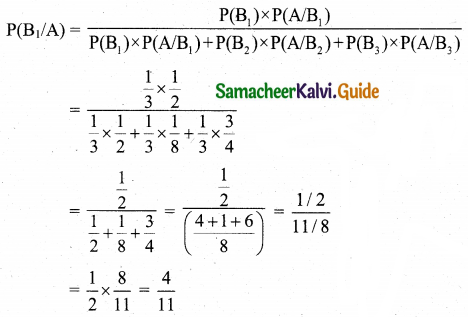
The probability of drawing a defective bulb from B1, being given that it is defective, is P(B1/A).
Samacheer Kalvi 11th Business Maths Guide Chapter 8 Descriptive Statistics and Probability Ex 8.2 Q9

Samacheer Kalvi 11th Business Maths Guide Chapter 8 Descriptive Statistics and Probability Ex 8.2

Question 10.
Three horses A, B, C are in the race. A is twice as likely to win as B and B is twice as likely to win as C. What are their respective probabilities of winning?
Solution:
Given that A is twice as likely to win as B.
Therefore, A : B = 2 : 1
(or) A : B = 4 : 2 …….(1)
Also given that B is twice as likely to win as C.
Therefore, B : C = 2 : 1 ………(2)
From (1) and (2),
A : B : C = 4 : 2 : 1
∴ A = 4k, B = 2k, C = 1, where C is a constant of proportionality.
Probability of A wining is \(\frac{4 k}{7 k}=\frac{4}{7}\)
Probability of B wining is \(\frac{2 k}{7 k}=\frac{2}{7}\)
Probability of C wining is \(\frac{k}{7 k}=\frac{1}{7}\)

Question 11.
A die is thrown. Find the probability of getting (i) a prime number, (ii) a number greater than or equal to 3.
Solution:
Let S be the sample when a die is thrown.
Then S = {1, 2, 3, 4, 5, 6}, n(S) = 6
Let A be the event of getting a prime number.
A = {2, 3, 5}, n(A) = 3
Let B be the event of getting a number greater than or equal to 3.
B = {3, 4, 5, 6}, n(B) = 4
(i) P(a prime number) = \(\frac{n(\mathrm{A})}{n(\mathrm{S})}=\frac{3}{6}=\frac{1}{2}\)
(ii) P(a number ≥ 3) = \(\frac{n(\mathrm{B})}{n(\mathrm{S})}=\frac{4}{6}=\frac{2}{3}\)

Samacheer Kalvi 11th Business Maths Guide Chapter 8 Descriptive Statistics and Probability Ex 8.2

Question 12.
Ten cards numbered 1 to 10 are placed in a box, mixed up thoroughly, and then one card is drawn randomly. If it is known that the number on the drawn card is more than 4. What is the probability that it is an even number?
Solution:
Let S = {1, 2, 3,…, 10}, n(S) = 10
Let A be the event of drawing a number greater than 4.
Then A= {5, 6, 7, 8, 9, 10}, n(A) = 6
∴ P(A) = \(\frac{n(\mathrm{A})}{n(\mathrm{S})}=\frac{6}{10}\)
Let B be the event of getting a even number.
Then B = {2, 4, 6, 8, 10}
Now A ∩ B = {6, 8, 10}, n(A ∩ B) = 3
P(A ∩ B) = \(\frac{3}{10}\)
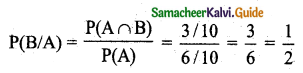
We have to find P (B/A)
Samacheer Kalvi 11th Business Maths Guide Chapter 8 Descriptive Statistics and Probability Ex 8.2 Q12

Question 13.
There are 1000 students in a school out of which 450 are girls. It is known that out of 450, 20% of the girls studying in class XI. A student is randomly selected from 1000 students. What is the probability that the selected student is from class XI given that the selected student is a girl?
Solution:
Number of students = 1000 i.e., n(S) = 1000
Let A be the event of selecting a girl student from class XI.
Let B be the event of selecting a girl student
Number of girls = 450; n(B) = 450
∴ P(B) = \(\frac{n(\mathrm{B})}{n(\mathrm{S})}=\frac{450}{1000}\)
Number df girls studying ih XI is 20% of 450 = \(\frac{20}{100} \times 450\) = 90
i.e., n(A ∩ B) = 90
∴ P(A ∩ B) = \(\frac{n(\mathrm{A} \cap \mathrm{B})}{n(\mathrm{S})}=\frac{90}{1000}\)
We have to find P(A/B)
Samacheer Kalvi 11th Business Maths Guide Chapter 8 Descriptive Statistics and Probability Ex 8.2 Q13

Samacheer Kalvi 11th Business Maths Guide Chapter 8 Descriptive Statistics and Probability Ex 8.2

Question 14.
From a pack of 52 cards, two cards are drawn at random. Find the probability that one is a king and the other is a queen.
Solution:
Number of kings is 4
Number of queens is 4
Two cards are drawn.
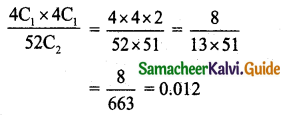
Probability of one king and one queen is,
Samacheer Kalvi 11th Business Maths Guide Chapter 8 Descriptive Statistics and Probability Ex 8.2 Q14

Question 15.
A card is drawn from a pack of playing cards and then another card is drawn without the first being replaced. What is the probability of drawing (i) two aces, (ii) two spades?
Solution:
A number of cards 52.
The number of aces 4.
Number of spades 13
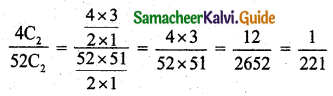
(i) Probability of drawing two aces
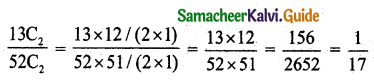
Samacheer Kalvi 11th Business Maths Guide Chapter 8 Descriptive Statistics and Probability Ex 8.2 Q15
(ii) The probability of drawing two spades
Samacheer Kalvi 11th Business Maths Guide Chapter 8 Descriptive Statistics and Probability Ex 8.2 Q15.1

Samacheer Kalvi 11th Business Maths Guide Chapter 8 Descriptive Statistics and Probability Ex 8.2

Question 16.
A company has three machines A, B, C which produces 20%, 30%, and 50% of the product respectively. Their respective defective percentages are 7, 3, and 5. From these products, one is chosen and inspected. If it is defective what is the probability that it has been made by machine C?
Solution:
The probability of the product produced by machine A is P(A) = \(\frac{20}{100}\)
The probability of the product produced by machine B is P(B) = \(\frac{30}{100}\)
The probability of the product produced by the machine C is P(C) = \(\frac{50}{100}\)
Let D be the event of selecting a defective product.
Then P(D/A) = The probability of selecting a defective product produced by the machine A = \(\frac{7}{100}\)
P(D/B) = the probability of selecting a defective product produced by the machine B = \(\frac{3}{100}\)
and P(D/C) = The probability of selecting a detective product produced by the machine C = \(\frac{5}{100}\)
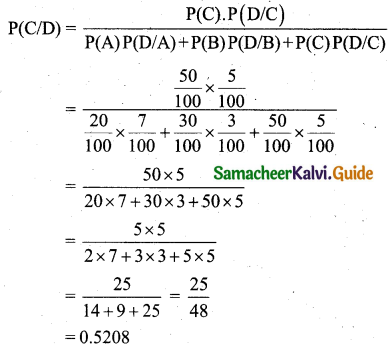
Samacheer Kalvi 11th Business Maths Guide Chapter 8 Descriptive Statistics and Probability Ex 8.2 Q16

Samacheer Kalvi 11th Business Maths Guide Chapter 8 Descriptive Statistics and Probability Ex 8.1

Tamilnadu State Board New Syllabus Samcheer Kalvi 11th Business Maths Guide Pdf Chapter 8 Descriptive Statistics and Probability Ex 8.1 Text Book Back Questions and Answers, Notes.

Tamilnadu Samacheer Kalvi 11th Business Maths Solutions Chapter 8 Descriptive Statistics and Probability Ex 8.1

Samacheer Kalvi 11th Business Maths Descriptive Statistics and Probability Ex 8.1 Text Book Back Questions and Answers

Question 1.
Find the first quartile and third quartile for the given observations.
2, 4, 6, 8, 10, 12, 14, 16, 18, 20, 22.
Solution:
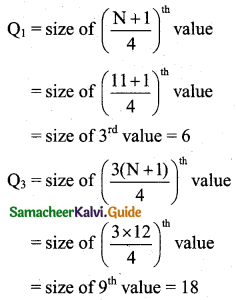
Given data are arranged in ascending order 2, 4, 6, 8, 10, 12, 14, 16, 18, 20, 22.
Here the number of observations is n = 11
Samacheer Kalvi 11th Business Maths Guide Chapter 8 Descriptive Statistics and Probability Ex 8.1 Q1

Question 2.
Find Q1, Q3, D8, and P67 of the following data:
Samacheer Kalvi 11th Business Maths Guide Chapter 8 Descriptive Statistics and Probability Ex 8.1 Q2
Solution:
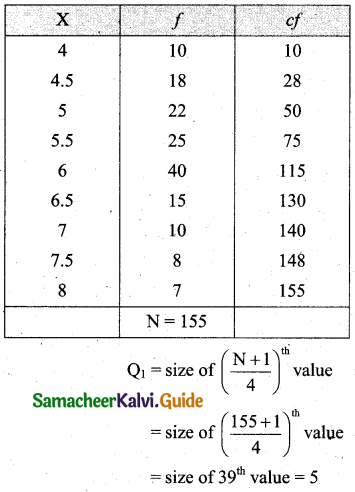
Samacheer Kalvi 11th Business Maths Guide Chapter 8 Descriptive Statistics and Probability Ex 8.1 Q2.1
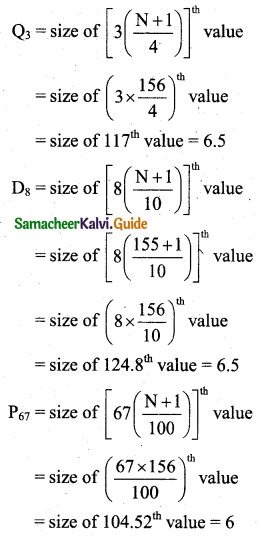
Samacheer Kalvi 11th Business Maths Guide Chapter 8 Descriptive Statistics and Probability Ex 8.1 Q2.2

Question 3.
Find lower quartile, upper quartile, 7th decile, 5th decile, and 60th percentile for the following frequency distribution.
Samacheer Kalvi 11th Business Maths Guide Chapter 8 Descriptive Statistics and Probability Ex 8.1 Q3
Solution:
Samacheer Kalvi 11th Business Maths Guide Chapter 8 Descriptive Statistics and Probability Ex 8.1 Q3.1
Lower quartile, Q1 = size of \(\left(\frac{N}{4}\right)^{\mathrm{th}}\) value
= \(\left(\frac{120}{4}\right)^{\mathrm{th}}\)
= size of 30th value
Q1 lies in the class (40 – 50) and its corresponding values are L = 40, \(\frac{N}{4}\) = 30, pcf = 15, f = 21 and C = 10
Samacheer Kalvi 11th Business Maths Guide Chapter 8 Descriptive Statistics and Probability Ex 8.1 Q3.2
Q3 lies in the class (60 – 70) and its corresponding values are L = 60, \(\frac{3 \mathrm{N}}{4}\) = 90, pcf = 79, f = 32 and C = 10.
Samacheer Kalvi 11th Business Maths Guide Chapter 8 Descriptive Statistics and Probability Ex 8.1 Q3.3
Thus D7 lies in the class (60 – 70) and its corresponding values are L = 60, \(\frac{7 \mathrm{N}}{10}\) = 84, pcf = 79, f = 32 and C = 10.
Samacheer Kalvi 11th Business Maths Guide Chapter 8 Descriptive Statistics and Probability Ex 8.1 Q3.4
Samacheer Kalvi 11th Business Maths Guide Chapter 8 Descriptive Statistics and Probability Ex 8.1 Q3.5
Thus D5 lies in the class (50 – 60) and its corresponding values are L = 50, \(\frac{5 \mathrm{N}}{10}\) = 60, pcf = 36, f = 43 and C = 10.
Samacheer Kalvi 11th Business Maths Guide Chapter 8 Descriptive Statistics and Probability Ex 8.1 Q3.6
Thus P60 lies in the class (50 – 60) and its corresponding values are L = 50, \(\frac{60 \mathrm{N}}{100}\) = 72, pcf = 36, f = 43 and C = 10.
Samacheer Kalvi 11th Business Maths Guide Chapter 8 Descriptive Statistics and Probability Ex 8.1 Q3.7

Question 4.
Calculate GM for the following table gives the weight of 31 persons in the sample survey.
Samacheer Kalvi 11th Business Maths Guide Chapter 8 Descriptive Statistics and Probability Ex 8.1 Q4
Solution:
Samacheer Kalvi 11th Business Maths Guide Chapter 8 Descriptive Statistics and Probability Ex 8.1 Q4.1
Samacheer Kalvi 11th Business Maths Guide Chapter 8 Descriptive Statistics and Probability Ex 8.1 Q4.2
= Antilog (2.1540)
= 142.560
= 142.56 lbs

Question 5.
The price of a commodity increased by 5% from 2004 to 2005, 8% from 2005 to 2006, and 77% from 2006 to 2007. Calculate the average increase from 2004 to 2007?
Solution:
In averaging ratios and percentages, the geometric mean is more appropriate.
Let us consider X represents prices at the end of the year.
Samacheer Kalvi 11th Business Maths Guide Chapter 8 Descriptive Statistics and Probability Ex 8.1 Q5
Here n = 3
Samacheer Kalvi 11th Business Maths Guide Chapter 8 Descriptive Statistics and Probability Ex 8.1 Q5.1
= Antilog (2.1008)
= 126.1246
Average rate of increase of price = 126.1246 – 100
= 26.1246
= 26.1%

Question 6.
An aeroplane flies, along the four sides of a square at speeds of 160, 200, 300, and 400 kilometres per hour respectively. What is the average speed of the plane in its flight around the square?
Solution:
Harmonic mean would he suitable. Harmonic mean of n observations is
\(\mathrm{HM}=\frac{n}{\Sigma \frac{1}{x}}\)
Here n = 4
Samacheer Kalvi 11th Business Maths Guide Chapter 8 Descriptive Statistics and Probability Ex 8.1 Q6

Question 7.
A man travelled by car for 3 days. He covered 480 km each day. On the first day, he drove for 10 hours at 48 km an hour. On the second day, he drove for 12 hours at 40 km an hour, and for the last day, he drove for 15 hours at 32 km. What is his average speed?
Solution:
Total distance covered 480 km.
The first-day distance covered 48 km.
The second-day distance covered 40 km.
Third-day distance covered 32 km.
Number of observations = 3
Average speed = HM
Samacheer Kalvi 11th Business Maths Guide Chapter 8 Descriptive Statistics and Probability Ex 8.1 Q7

Question 8.
The monthly incomes of 8 families in rupees in a certain locality are given below. Calculate the mean, the geometric mean, and the harmonic mean and confirm that the relations among them hold true. Verify their relationships among averages.
Samacheer Kalvi 11th Business Maths Guide Chapter 8 Descriptive Statistics and Probability Ex 8.1 Q8
Solution:
Let us first find AM. Here number of observations, n = 8
AM = \(\frac{70+10+50+75+8+25+8+42}{8}\) = \(\frac{288}{8}\) = 36
Now we will find the geometric mean. (GM)
Samacheer Kalvi 11th Business Maths Guide Chapter 8 Descriptive Statistics and Probability Ex 8.1 Q8.1
Here number of observations is n = 8
GM = Antilog \([latex]\left(\frac{\Sigma \log X}{n}\right)\)[/latex]
= Antilog \(\left(\frac{11.2465}{8}\right)\)
= Antilog 1.4058
GM = 25.4566
Now we will find Harmonic Mean (HM).
Here the number of observations is n = 8.
Samacheer Kalvi 11th Business Maths Guide Chapter 8 Descriptive Statistics and Probability Ex 8.1 Q8.2
Thus AM = 36, GM = 25.466, HM = 17.3385
36 > 25.466 > 17.3385
Hence AM > GM > HM
Thus their relations among them is verified for the given data.

Question 9.
Calculate AM, GM, and HM and also verify their relations among them for the following data:
Samacheer Kalvi 11th Business Maths Guide Chapter 8 Descriptive Statistics and Probability Ex 8.1 Q9
Solution:
Samacheer Kalvi 11th Business Maths Guide Chapter 8 Descriptive Statistics and Probability Ex 8.1 Q9.1
Samacheer Kalvi 11th Business Maths Guide Chapter 8 Descriptive Statistics and Probability Ex 8.1 Q9.2

Question 10.
Calculate AM, GM, and HM from the following data and also find its relationship:
Samacheer Kalvi 11th Business Maths Guide Chapter 8 Descriptive Statistics and Probability Ex 8.1 Q10
Solution:
Samacheer Kalvi 11th Business Maths Guide Chapter 8 Descriptive Statistics and Probability Ex 8.1 Q10.1
Samacheer Kalvi 11th Business Maths Guide Chapter 8 Descriptive Statistics and Probability Ex 8.1 Q10.2

Question 11.
Calculate the quartile deviation and its coefficient from the following data:
Samacheer Kalvi 11th Business Maths Guide Chapter 8 Descriptive Statistics and Probability Ex 8.1 Q11
Solution:
Samacheer Kalvi 11th Business Maths Guide Chapter 8 Descriptive Statistics and Probability Ex 8.1 Q11.1
Samacheer Kalvi 11th Business Maths Guide Chapter 8 Descriptive Statistics and Probability Ex 8.1 Q11.2
Samacheer Kalvi 11th Business Maths Guide Chapter 8 Descriptive Statistics and Probability Ex 8.1 Q11.3

Question 12.
Calculate quartile deviation and its relative measure from the following data:
Samacheer Kalvi 11th Business Maths Guide Chapter 8 Descriptive Statistics and Probability Ex 8.1 Q12
Solution:
Samacheer Kalvi 11th Business Maths Guide Chapter 8 Descriptive Statistics and Probability Ex 8.1 Q12.1
Thus Q1 lies in the class 20 – 30 and corresponding values are L = 20, \(\frac{\mathrm{N}}{4}\) = 17, pcf = 15, f = 13, C = 10.
Samacheer Kalvi 11th Business Maths Guide Chapter 8 Descriptive Statistics and Probability Ex 8.1 Q12.2
Samacheer Kalvi 11th Business Maths Guide Chapter 8 Descriptive Statistics and Probability Ex 8.1 Q12.3
Thus Q3 lies in the class 40 – 50 and corresponding values are L = 40, \(\frac{3 \mathrm{N}}{4}\) = 51, pcf = 46, f = 14, C = 10
Samacheer Kalvi 11th Business Maths Guide Chapter 8 Descriptive Statistics and Probability Ex 8.1 Q12.4
Relative measure, coefficient of QD
Samacheer Kalvi 11th Business Maths Guide Chapter 8 Descriptive Statistics and Probability Ex 8.1 Q12.5

Question 13.
Compute mean deviation about median from the following data:
Samacheer Kalvi 11th Business Maths Guide Chapter 8 Descriptive Statistics and Probability Ex 8.1 Q13
Solution:
Samacheer Kalvi 11th Business Maths Guide Chapter 8 Descriptive Statistics and Probability Ex 8.1 Q13.1
Samacheer Kalvi 11th Business Maths Guide Chapter 8 Descriptive Statistics and Probability Ex 8.1 Q13.2
Mean deviation about median:
Samacheer Kalvi 11th Business Maths Guide Chapter 8 Descriptive Statistics and Probability Ex 8.1 Q13.3

Question 14.
Compute the mean deviation about mean from the following data:
Samacheer Kalvi 11th Business Maths Guide Chapter 8 Descriptive Statistics and Probability Ex 8.1 Q14
Solution:
Samacheer Kalvi 11th Business Maths Guide Chapter 8 Descriptive Statistics and Probability Ex 8.1 Q14.1

Question 15.
Find out the coefficient of mean deviation about median in the following series:
Samacheer Kalvi 11th Business Maths Guide Chapter 8 Descriptive Statistics and Probability Ex 8.1 Q15
Solution:
Samacheer Kalvi 11th Business Maths Guide Chapter 8 Descriptive Statistics and Probability Ex 8.1 Q15.1
The class interval corresponding to cumulative frequency 75 is (40 – 50).
So, the corresponding values from the median class are L = 40, pcf = 56, f = 37, C = 10, N = 75.
Samacheer Kalvi 11th Business Maths Guide Chapter 8 Descriptive Statistics and Probability Ex 8.1 Q15.2
Now we calculate the mean deviation about the median 45.11
Samacheer Kalvi 11th Business Maths Guide Chapter 8 Descriptive Statistics and Probability Ex 8.1 Q15.3

Samacheer Kalvi 11th Business Maths Guide Chapter 7 Financial Mathematics Ex 7.3

Tamilnadu State Board New Syllabus Samcheer Kalvi 11th Business Maths Guide Pdf Chapter 7 Financial Mathematics Ex 7.3 Text Book Back Questions and Answers, Notes.

Tamilnadu Samacheer Kalvi 11th Business Maths Solutions Chapter 7 Financial Mathematics Ex 7.3

Samacheer Kalvi 11th Business Maths Financial Mathematics Ex 7.3 Text Book Back Questions and Answers

Choose the correct answer.

Question 1.
The dividend received on 200 shares of face value ₹ 100 at 8% dividend value is:
(a) 1600
(b) 1000
(c) 1500
(d) 800
Answer:
(a) 1600
Hint:
Dividend = 200 × 100 × \(\frac{8}{100}\) = 1600

Question 2.
What is the amount related is selling 8% stacking 200 shares of face value 100 at 50?
(a) 16,000
(b) 10,000
(c) 7,000
(d) 9,000
Answer:
(b) 10,000
Hint:
Amount = 200 × 50 = 10000

Samacheer Kalvi 11th Business Maths Guide Chapter 7 Financial Mathematics Ex 7.3

Question 3.
A man purchases a stock of ₹ 20,000 of face value 100 at a premium of 20%, then investment is:
(a) ₹ 20,000
(b) ₹ 25,000
(c) ₹ 22,000
(d) ₹ 30,000
Hint:
Investment = Number of shares × Market value
= \(\frac{20000}{100}\) × 120
= 24000

Question 4.
A man received a total dividend of ₹ 25,000 at a 10% dividend rate on a stock of face value ₹ 100, then the number of shares purchased.
(a) 3500
(b) 4500
(c) 2500
(d) 300
Answer:
(c) 2500

Samacheer Kalvi 11th Business Maths Guide Chapter 7 Financial Mathematics Ex 7.3

Question 5.
The brokerage paid by a person on this sale of 400 shares of face value ₹ 100 at 1% brokerage:
(a) ₹ 600
(b) ₹ 500
(c) ₹ 200
(d) ₹ 400
Answer:
(d) ₹ 400
Hint:
Brokerage = 400 × 100 × \(\frac{1}{100}\) = ₹ 400

Question 6.
Market price of one share of face value 100 available at a discount of 9½ % with brokerage ½% is:
(a) ₹ 89
(b) ₹ 90
(c) ₹ 91
(d) ₹ 95
Answer:
(c) ₹ 91
Hint:
Market price = Face value – Discount + Brokerage
= 100 – 9½
= 100 – \(\frac{18}{2}\)
= 100 – 9
= ₹ 91

Samacheer Kalvi 11th Business Maths Guide Chapter 7 Financial Mathematics Ex 7.3

Question 7.
A person brought a 9% stock of face value ₹ 100, for 100 shares at a discount of 10%, then the stock purchased is:
(a) ₹ 9000
(b) ₹ 6000
(c) ₹ 5000
(d) ₹ 4000
Answer:
(a) ₹ 9000
Hint:
Face value = ₹ 100
Discount = 10%
Market price of a share = 100 – 10 = 90
Number of share = 100
Stock purchased = 100 × 90 = ₹ 9000

Question 8.
The Income on 7 % stock at 80 is:
(a) 9%
(b) 8.75%
(c) 8%
(d) 7%
Answer:
(b) 8.75%
Hint:
Income = \(\frac{7}{80}\) × 100
= 0.0875 × 100
= 8.75%

Samacheer Kalvi 11th Business Maths Guide Chapter 7 Financial Mathematics Ex 7.3

Question 9.
The annual income on 500 shares of face value 100 at 15% is:
(a) ₹ 7500
(b) ₹ 5000
(c) ₹ 8000
(d) ₹ 8500
Answer:
(a) ₹ 7500
Hint:
Income = \(\frac{n \times r \times F . V}{100}\)
= 500 × \(\frac{15}{100}\) × 100
= ₹ 7500

Question 10.
₹ 5000 is paid as perpetual annuity every year and the rate of C.I. 10%. Then the present value P of an immediate annuity is:
(a) ₹ 60,000
(b) ₹ 50,000
(c) ₹ 10,000
(d) ₹ 80,000
Answer:
(b) ₹ 50,000
Hint:
Samacheer Kalvi 11th Business Maths Guide Chapter 7 Financial Mathematics Ex 7.3 Q10

Samacheer Kalvi 11th Business Maths Guide Chapter 7 Financial Mathematics Ex 7.3

Question 11.
If ‘a’ is the annual payment, ‘n’ is the number of periods and ‘i’ is compound interest for ₹ 1 then future amount of the annuity is:
(a) A = \(\frac{a}{i}\) (1 + i) [(1 + i)n – 1]
(b) A = \(\frac{a}{i}\) [(1 + i)n – 1]
(c) P = \(\frac{a}{i}\)
(d) P = \(\frac{a}{i}\) (1 + i) [1 – (1 + i)-n]
Answer:
(b) A = \(\frac{a}{i}\) [(1 + i)n – 1]

Question 12.
A invested some money in 10% stock at 96. If B wants to invest in an equally good 12% stock, he must purchase a stock worth of:
(a) ₹ 80
(b) ₹ 115.20
(c) ₹ 120
(d) ₹ 125.40
Answer:
(a) ₹ 80
Hint:
Let x be B stock worth.
Then x × \(\frac{12}{100}\) = \(\frac{10}{100}\) × 96
x × 12 = 10 × 96
x = 80

Samacheer Kalvi 11th Business Maths Guide Chapter 7 Financial Mathematics Ex 7.3

Question 13.
An annuity in which payments are made at the beginning of each payment period is called:
(a) Annuity due
(b) An immediate annuity
(c) perpetual annuity
(d) none of these
Answer:
Annuity due

Question 14.
The present value of the perpetual annuity of ₹ 2000 paid monthly at 10 % compound interest is:
(a) ₹ 2,40,000
(b) ₹ 6,00,000
(c) ₹ 20,40,000
(d) ₹ 2,00,400
Answer:
(a) ₹ 2,40,000
Hint:
Samacheer Kalvi 11th Business Maths Guide Chapter 7 Financial Mathematics Ex 7.3 Q14

Samacheer Kalvi 11th Business Maths Guide Chapter 7 Financial Mathematics Ex 7.3

Question 15.
An example of a contingent annuity is:
(a) Life insurance premium
(b) An endowment fund to give scholarships to a student
(c) Personal loan from a bank
(d) All the above
Answer:
(b) An endowment fund to give scholarships to a student