Samacheer Kalvi 6th Social Science Guide Civics Term 1 Chapter 2 Achieving Equality

Students can download 6th Social Science Term 1 Civics Chapter 2 Achieving Equality Questions and Answers, Notes, Samacheer Kalvi 6th Social Science Guide Pdf helps you to revise the complete Tamilnadu State Board New Syllabus, helps students complete homework assignments and to score high marks in board exams.

Tamilnadu Samacheer Kalvi 6th Social Science Civics Solutions Term 1 Chapter 2 Achieving Equality

Samacheer Kalvi 6th Social Science Achieving Equality Text Book Back Questions and Answers

I. Choose the correct answer

Question 1.
Which one of the following is not the reason for Prejudice?
(a) Socialization
(b) Economic Benefits
(c) Authoritarian personality
(d) Geography
Answer:
(d) Geography

Question 2.
Discrimination done on the basis of gender is referred to as
(a) gender discrimination
(b) caste discrimination
(c) religious discrimination
(d) inequality
Answer:
(a) gender discrimination

Question 3.
Gender-based stereotypes are often portrayed in …………….
(a) films
(b) advertisements
(c) TV serials
(d) All the these
Answer:
(d) All the these

Samacheer Kalvi 6th Social Science Guide Civics Term 1 Chapter 2 Achieving Equality

Question 4.
Name the book/s written by A.P.J. Abdul Kalam
(a) India 2020
(b) Wings of Fire
(c) Ignited Minds
(d) All of these
Answer:
(d) All of these

Question 5.
A.P.J. Abdul Kalam was conferred Bharat Ratna in the year …………….
(a) 1997
(b) 1996
(c) 1995
(d) 1994
Answer:
(a) 1997

Question 6.
Viswanathan Anand became India’s first grandmaster in the year.
(a) 1985
(b) 1986
(c) 1987
(d) 1988
Answer:
(d) 1988

Samacheer Kalvi 6th Social Science Guide Civics Term 1 Chapter 2 Achieving Equality

Question 7.
In which sport Ilavazhagi excels …………….
(a) Chess
(b) Wrestling
(c) Carrom
(d) Tennis
Answer:
(c) Carrom

Question 8.
Which article of the Constitution says discrimination against any citizen on grounds only of religion, race, caste, sex, place of birth or any of them is not permitted?
(a) 14(1)
(b) 15(1)
(c) 16(1)
(d) 17(1)
Answer:
(b) 15(1)

Question 9.
B.R. Ambedkar was conferred Bharat Ratna in the year …………….
(a) 1990
(b) 1989
(c) 1988
(d) 1987
Answer:
(a) 1990

Question 10.
As per the 2011 Census the highest literate district in Tamil Nadu
(a) Namakkal
(b) Salem
(c) Kanyakumari
(d) Sivagangai
Answer:
(c) Kanyakumari

II. Fill in the blanks

  1. People have false belief and ideas on others is called …………….
  2. A.P.J. Abdul Kalam was born in …………….
  3. ……………. was the first recipient of Rajiv Gandhi Khel Ratna award, India’s highest Sport honour.
  4. ……………. was the independent India’s first Law Minister.
  5. As per the 2011 census the lowest Sex ratio was in …………….

Answer:

  1. Prejudice
  2. 1931
  3. Viswanathan Anand
  4. Dr.B.R.Ambedkar
  5. Dharmapuri

III. Match the following

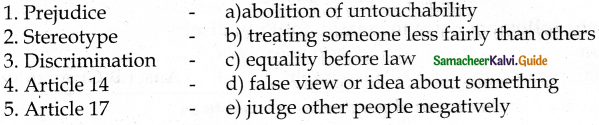
Samacheer Kalvi 6th Social Science Guide Civics Term 1 Chapter 2 Achieving Equalit
Answer:
1. – e
2. – d
3. – b
4. – c
5. – a

IV. Answer the following questions

Question 1.
What is Prejudice?
Answer:

  1. Prejudice means to judge other people in a negative or inferior manner, without knowing much about them.
  2. It happens when people have false beliefs and ideas.

Question 2.
What is a stereotype?
Answer:

  1. A stereotype is a false view or idea about something.
  2. For example, girls are not good at sports.
  3. When prejudice gets stronger, it develops into a stereotype.

Samacheer Kalvi 6th Social Science Guide Civics Term 1 Chapter 2 Achieving Equality

Question 3.
What is discrimination?
Answer:

  1. Discrimination can be defined as negative actions towards people.
  2. Discrimination can happen on the basis of colour, class, religion, and gender, etc.

Question 4.
What are the articles that are discussing equality in the Indian constitution?
Answer:

  1. Article 14 of the constitution
  2. Article 15(1) of the constitution

V. Answer the following in detail

Question 1.
What are the causes of prejudice?
Answer:

  1. Socialization
  2. Conforming behaviours
  3. Economic benefits
  4. Authoritarian personality
  5. Ethno – centrism
  6. Group closure
  7. Conflicts

Samacheer Kalvi 6th Social Science Guide Civics Term 1 Chapter 2 Achieving Equality

Question 2.
Write any two types of discrimination?
Answer:
(a) Gender discrimination:

  1. Gender discrimination refers to health, education, economic and political inequalities between men and women in India.
  2. For example a girl is not allowed to go to college after finishing her schooling.
  3. Most of the girls are not allowed to select a career of their choice, rather they are forced into marriage.
  4. In some families, girls are not allowed to wear modem dresses while boys in such families often wear modem dresses.

(b) Religious discrimination:

  1. Religious discrimination is unequal treatment of an individual or group based on their beliefs.
  2. Religious discrimination has been around for a long time.
  3. There have been problems between people of different religions for thousands of years.
  4. Some people are not allowed to enter in public places; especially the places of worship, because they belong to another religion.
  5. Some religious people often end up in conflict with each other because of their rituals and way of life.

Samacheer Kalvi 6th Social Science Guide Civics Term 1 Chapter 2 Achieving Equality

Question 3.
Explain the solution to the removal of inequality and discrimination in Indian society.
Answer:
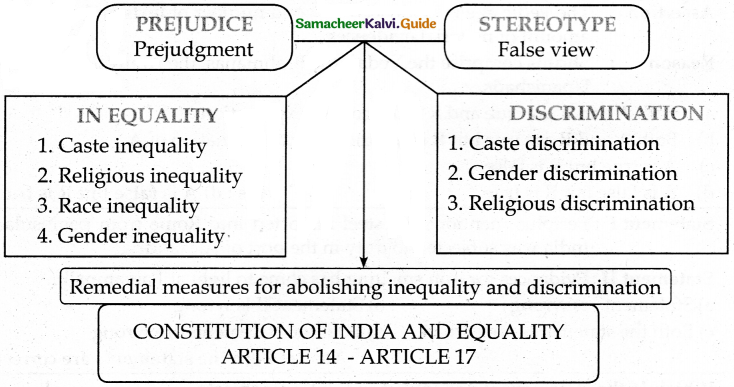
The remedial measures for abolishing inequality and discrimination in Indian society are as follows.

  1. Wider access to quality based services like healthcare and education for all.
  2. Be aware of current gender bias.
  3. Make women more visible in public life and institution to eradicate gender disparity.
  4. Be open to learning about other religions.
  5. Promoting community dining in the classroom may help the students to sit together without any bias of caste, religion, or gender.
  6. Socialise with people of all types outside the home.
  7. Effective implementation of laws.

VI. Projects and Activities

  1. Split the class into small groups, discuss with your peer group on discrimination and write a report on it.
  2. Collect information about any two famous personalities who faced prejudice and discrimination.

VII. HOTS

Question 1.
Various discrimination in India. Discuss.
Answer:

  1. The different forms of inequalities such as caste inequality, religious inequality, race inequality, or gender inequality give rise to discrimination.
  2. Discrimination can happen on the basis of colour, class, religion gender, etc.
  3. Treating dark-skinned people differently from fair-skinned people, giving more importance to people of higher than to those of lower caste, and thinking boys are smarter than girls are all thoughts of discrimination.
  4. Article 15(1) of the constitution states that the State not to discriminate against any citizen on grounds only of religion, race, caste, sex, place of birth, or any of them.

VIII. Life Skill

  1. How can you fight against prejudice and discrimination in your village?

Samacheer Kalvi 6th Social Science Achieving Equality Additional Important Questions and Answers

I. Choose the correct answer

Question 1.
Apartheid was practiced in ……………
(a) Germany
(b) Australia
(c) South Africa
(d) India
Answer:
(c) South Africa

Question 2.
Viswanathan Anand was born in _______
(a) Chennai
(b) Bengaluru
(c) Thiruvananthapuram
(b) Vishakapatnam
Answer:
(a) Chennai

Samacheer Kalvi 6th Social Science Guide Civics Term 1 Chapter 2 Achieving Equality

Question 3.
The chairman of the Drafting Committee of India’s constituent Assembly was ……………
(a) Nehru
(b) Dr. Ambedkar
(c) Mount Batten
(d) Dr. Abdul kalam
Answer:
(b) Dr. Ambedkar

Question 4.
Apartheid, the racist policy was brought to an end by _______
(a) Martin Luther
(b) Nelson Mandela
(c) Mother Theresa
(d) Tagore
Answer:
(b) Nelson Mandela

Question 5.
Mr. Viswanathan Anand won the World Junior Championship in ……………
(a) Chess
(b) Carrom
(c) Cricket
(d) High jump
Answer:
(a) Chess

II. Answer the following questions

Question 1.
Mention the types of prejudice
Answer:

  1. Gender prejudice
  2. Racial prejudice
  3. Class prejudice
  4. Disability prejudice

Question 2.
Name the books written by Dr. APJ Abdul Kaiam.
Answer:
Dr. APJ Abdul Kalam wrote many books. The famous among them are –

  1. India 2020
  2. Wings of Fire
  3. Ignited Minds
  4. The Luminous Sparks
  5. Mission India.

Question 3.
What is meant by constitution?
Answer:
A constitution is a set of rules and regulations guiding the administration of a country.

Samacheer Kalvi 6th Social Science Guide Civics Term 1 Chapter 2 Achieving Equality

Question 4.
What does Article 15(1) of our constitution state about discrimination?
Answer:
The state shall not discriminate against any citizen on grounds only of religion, race, caste, sex and place of birth or any of them.

Question 5.
What does Article 14 of our constitution state about equality?
Answer:
Article 14 provides equality before law or equal protection within the territory of India and prohibits unreasonable discrimination between persons.

III. Mind map
Samacheer Kalvi 6th Social Science Guide Civics Term 1 Chapter 2 Achieving Equalit

Samacheer Kalvi 6th Social Science Guide History Term 1 Chapter 1 What is History?

Tamilnadu State Board New Syllabus Samacheer Kalvi 6th Social Science Guide Pdf History Term 1 Chapter 1 What is History?Text Book Back Questions and Answers, Notes.

Tamilnadu Samacheer Kalvi 6th Social Science Solutions History Term 1 Chapter 1 What is History?

6th Social Science Guide What is History? Text Book Back Questions and Answers

I. Choose the correct answer

Question 1.
What was the step taken by the early man to collect his food?
(a) trade
(b) hunting
(c) painting
(d) rearing of animals
Answer:
(b) hunting

II. Match the statement with the reason. Tick the appropriate answer

Question 1.
Statement: Pre historic man went along with the dog for hunting.
Reason: Dogs with its sniffing power would find out other animals.
(a) Statement is true, but reason is wrong.
(b) Statement and reason are correct.
(c) Statement is wrong, but reason is correct.
(d) Both statement and reason are wrong.
Answer:
(b) Statement and reason are correct

Question 2.
Statement: The objects used by the early man are excavated. They are preserved to know the lifestyle of the people.
Find out which of the following is related to the statement.
(a) Museum
(b) Burial materials
(e) Stone tools
(d) Bones
Answer:
(a) Museum

Samacheer Kalvi 6th Social Science Guide History Term 1 Chapter 1 What is History?

Question 3.
Find out the wrong pair:
(a) Old stone age – Stone tools
(b) Rock paintings – Walls of the caves
(c) Copper plates – A source of history
(d) Cats – First domesticated
Answer:
(d) Cats – First domesticated

Question 4.
Find the odd one:
(a) Paintings were drawn on rocks and caves.
(b) There were paintings depicting hunting scenes.
(c) It was drawn to show his family members about hunting.
(d) The paintings were painted by using many colours.
Answer:
(c) It was drawn to show his family members about hunting.

III. Fill in the blanks

  1. The Old Stone age man lived mostly in ………………
  2. ……………… is the Father of history.
  3. ………………was the first animal tamed by Old Stone Age man.
  4. Inscriptions are ……………… sources
  5. Ashoka Chakra has ……………… spokes.

Answer:

  1. Caves
  2. Herodotus
  3. Dog
  4. archaeological
  5. 24

IV. State True or False

  1. Stone tools belonging to the Old Stone age have been excavated at Athtirampakkam near Chennai.
  2. The materials used by the ancient people are preserved in the museums by the Archaeological Department.
  3. During the period of Ashoka, Buddhism spread across the country.

Answer:

  1. True
  2. True
  3. True

V. Match the following
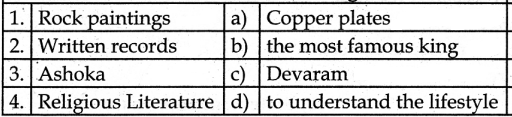
Samacheer Kalvi 6th Social Science Guide Term 1 Chapter 1 What is History

1. – d
2. – a
3. – b
4. – c

VI. Answer in one word

Question 1.
Can you say any two advantages of writing a diary?
Answer:

  1. Diary writing helps to record the events.
  2. It reveals the lifestyle of people of that period.

Samacheer Kalvi 6th Social Science Guide History Term 1 Chapter 1 What is History?

Question 2.
How do we know the people’s lifestyle of the Old Stone Age?
Answer:
We understand the lifestyle of people of the Old Stone Age from used stone tools, their paintings on the rocks and walls of the caves.

Question 3.
Is inscription a written record?
Answer:
Yes. The inscription is a written record.

Question 4.
What is proto history?
Answer:
Protohistory is the period between prehistory and history.

Samacheer Kalvi 6th Social Science Guide History Term 1 Chapter 1 What is History?

Question 5.
Name an epic.
Answer:
Silapadhikaram.

VII. Answer the following

Question 1.
What is history?
Answer:

  1. History is a record of past events in chronological order.
  2. The term History has been derived from the Greek word Istoria which means learning by enquiry.

Question 2.
What do you know about the prehistoric period?
Answer:

  1. The period between the use of the first stone tools and the invention of writing systems is pre-history.
  2. Stone tools excavated materials, and rock paintings are the major sources of pre-history

Question 3.
What are the sources available to know about the prehistoric period?
Answer:
Paintings on the rocks and the walls of the caves, stone tools, excavated materials are the sources available to know about the pre-historic period.

Samacheer Kalvi 6th Social Science Guide History Term 1 Chapter 1 What is History?

Question 4.
Mention the places from where we got pre-historic tools.
Answer:
We find the pre-historic tools at Kondapur, Nevasa, Mehrgash, Rock shelters of Bhimbetka, and Edakkal caves in India. In Tamilnadu Attirampakkam, Ariyalur, Perambulur, Adichanalur are the places where we came across the pre-historic tools.

Question 5.
What are the benefits of a museum?
Answer:

  1. Museums are community centres designed to inform and teach the public.
  2. The educational benefit of a museum is academic learning.
  3. Museums are the caretakers of history as much as they offer connections to history.
  4. Museums are full of stories, and it is interesting for students to hear these stories.
  5. Museums offer opportunities for children to compare and contrast leading to critical thinking skills.
  6. Children’s curiosity comes out in the form of questions.
  7. Students are exposed to new ideas and concepts.
  8. Museums inspire students to wonder, imagine, and dream Of possibilities that are beyond what they know.
  9. Students are exposed to opportunities that spark creative moments.

Question 6.
Name some tools used by early man to hunt animals.
Answer:

  1. Blade cores were used. These were chunks of Sharp rocks.
  2. An end scraper is a tear-drop shaped piece of stone used to scrap fur and fatty tissue from the hides of animals.
  3. Burins were stone tools with a rounded grasping end and at the sharp, razor-like working end.
  4. Awls were small circular stone flakes.

Question 7.
Why were paintings drawn on rocks?
Answer:

  1. Paintings could have been drawn or rocks to convey their lifestyles to future generations.
  2. They might have wished to record their activities through their paintings.

Question 8.
Name any two artifacts.
Answer:
Potteries, Toys, Tools, and Ornaments.

  1. An artefact is something made or given shape by men, such as a tool or a work of art, especially an object of archaeological interest.
  2. Some of the artefacts are potteries, toys, tools, and ornaments.

VIII. HOTS

Question 1.
How dogs were useful to prehistoric man?
Answer:

  1. Dogs with their sniffing power helped them find out other wild animals.
  2. Dog helped them prevent the entry of dangerous animals.
  3. Thus dogs helped them in hunting and protection.

Samacheer Kalvi 6th Social Science Guide History Term 1 Chapter 1 What is History?

Question 2.
Compare the lifestyle of Old. Stone Age man with present-day lifestyle.
Answer:
Old Stone age man

  1. He was a nomad.
  2. Took shelter on branches of trees, in holes and caves.
  3. Wore dresses made out of leaves, the skin of animals, and barks of trees.
  4. Ate vegetables, fruits, and roots which he gathered from jungles.
  5. Not civilized.

Present-day man:

  1. Settled in villages and towns.
  2. Lives in well-built houses.
  3. Wears dresses made out of cotton and other materials.
  4. Eats all kinds of food grains.
  5. Well civilized.

IX. Activity (For Students)

  1. Write down the important events of your family with years. Draw a timeline with the help of your teacher of with your classmates.
  2. Early man used stones as a weapon. Make an album showing the various uses of stone.
  3. Identify the category of the following sources of history.
    • Urns excavated from Adhichanallur.
    • Copper plates of Velvikudi.
    • Mahabharatha.
    • Sanchi Stupa
    • Pattinappaalai.
    • The earthernwares form keezhadi
    • Toys of Indus Civilisation.
    • Big Temple of Thanjavur.

X. Life Skill (For Students)

  1. Make some weapon models used by the old stone Age man using clay.
  2. Discuss with your grandpa, grandma, neighbours, and teachers and collect information about your street, villages, town or school. With the collected data, try to write its history titling your writing as “I am a Historian”.

XI. Answer Grid

Question 1.
Early men scribbled and painted on me Today they used me to build houses and lay roads. Who am I?
Answer:
Rock.

Question 2.
Name any two archaeological sources?
Answer:

  1. Coins
  2. Inscriptions

Question 3.
Name the types of literary sources?
Answer:

  1. Secular literature
  2. Religious literature

Samacheer Kalvi 6th Social Science Guide History Term 1 Chapter 1 What is History?

Question 4.
Expand BC (BCE).
Answer:
Before the common era

Question 5.
What is the meaning of the Greek word “Istoria”?
Answer:
Learning by enquiry

Question 6.
Expand AD (CE).
Answer:
Common era

Question 7.
…………….. is the study of inscriptions..
Answer:
Epigraphy

Question 8.
…………….. is the study of coins.
Answer:
Numismatics

Question 9.
I can help you to talk, see, hear, write, and read. There is no world without me. Who am I?
Answer:
Mobile Phone

6th Social Science Guide What is History? Additional Important Questions and Answers

I. Choose the correct answer

Question 1.
Dhamma is a word.
(a) Prakrit
(b) Sanskrit
(c) Latin
(d) Greek
Answer:
(a) Prakrit

II. Match the statement with the reason

Question 1.
Statement: Ashoka was the first ruler to give up war after victory.
Reason: He was upset and grief-stricken at the sight of the war.
(a) Statement is true but the reason is wrong.
(b) Both statement and reason are correct.
(c) Both statement and reason are wrong.
(d) Statement is wrong but the reason is correct.
Answer:
(b) Both statement and reason are correct

Question 2.
(a) Statement: Archaeological sources help to know about the early man.
Find out which of the following is related to the statement.
(a) Monuments
(b) Pictures
(c) Metals
(d) Books
Answer:
(a) Monuments

Samacheer Kalvi 6th Social Science Guide History Term 1 Chapter 1 What is History?

Question 3.
Find out the wrong pair.
(a) Numismatics – The study of coins
(b) Epigraphy – The study of Inscription
(c) Epic – Pattinapaalai
(d) Copper plates – Velvikudi
Answer:
(c) Epic – Pattinapaalai

Question 4.
Find the odd one.
(a) The dharma chakra has 24 spokes.
(b) It is seen in our National Flag.
(c) It was taken from Sanchi Stupa.
(d) It belongs to the Mauryan period
Answer:
(c) It was taken from Sanchi Stupa

III. Fill in the blanks

  1. The Big Temple is in ……………
  2. The most famous ruler of ancient India was ……………
  3. Istoria means ……………

Answer:

  1. Thanjavur.
  2. Ashoka.
  3. Learning by enquiry.

IV. State True or False

  1. The term History has been derived from the Latin word ‘Istoria’.
  2. We understand the lifestyle of old stone age people from used stone tools.
  3. Thirumalai Nayakkar Mahal is in Thanjavur.

Answer:

  1. False
  2. True
  3. False

V. Match the following

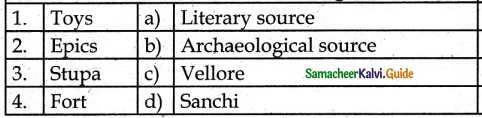
Samacheer Kalvi 6th Social Science Guide Term 1 Chapter 1 What is History
Answer:
1. – b
2. – a
3. – d
4. – c

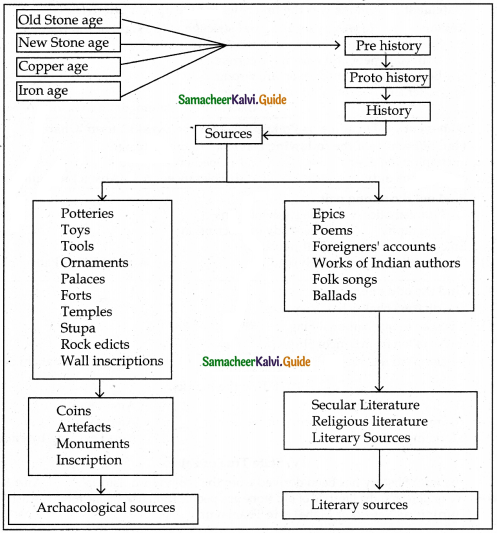
VI. Mind Map

Samacheer Kalvi 6th Social Science Guide Term 1 Chapter 1 What is History

Samacheer Kalvi 6th Social Science Guide History Term 1 Chapter 2 Human Evolution

Students can download 6th Social Science History Term 1 Chapter 2 Human Evolution Questions and Answers, Notes, Samacheer Kalvi 6th Social Science Guide Pdf helps you to revise the complete Tamilnadu State Board New Syllabus, helps students complete homework assignments and to score high marks in board exams.

Tamilnadu Samacheer Kalvi 6th Social Science History Solutions Term 1 Chapter 2 Human Evolution

Samacheer Kalvi 6th Social Science Human Evolution Text Book Back Questions and Answers

I. Choose the correct answer

Question 1.
The process of evolution is …………….
(a) direct
(b) indirect
(c) gradual
(d) fast
Answer:
(c) gradual

Samacheer Kalvi 6th Social Science Guide History Term 1 Chapter 2 Human Evolution

Question 2.
Tanzania is situated in the continent of ________.
(a) Asia
(b) Africa
(c) America
(d) Europe
Answer:
(b) Africa

II. Match the statement with the reason. Tick the appropriate answer:

Question 1.
Statement : Migration of man of different parts of the world resulted in changes of physic and colour
Reason : Climatic changes.
(a) Statement is correct.
(b) Reason is wrong.
(c) Statement and Reason are correct.
(d) Statement and Reason are wrong.
Answer:
(c) Statement and Reason are correct

III. Find out the right pair

(a) Australopithecus – Walked on both legs
(b) Homo habilis – Upright man
(c) Homo erectus – Wise man
(d) Homo sapiens – Less protruding face
Answer:
(c) Homo erectus – Wise man

IV. Fill in the blanks

  1. ………………. unearthed the footprints of humans in Tanzania.
  2. Millions of years ago, our ancestors led a ………………. life.
  3. The main occupations of the ancient humans were ………………. and ……………….
  4. The invention of ………………. made farming easier.
  5. Rock paintings are found at ………………. in Nilgiris.

Answer:

  1. Anthropologist.
  2. Nomadic.
  3. hunting, gathering.
  4. Plough.
  5. Porivarai cave.

V. State True or False

  1. Anthropology is the study of coins.
  2. Homo erectus (Java man) had the knowledge of fire.
  3. The first scientific invention of humans was wheel.
  4. Goat was the first animal to be domesticated by humans.

Answer:

  1. False
  2. True
  3. True
  4. False

VI. Answer in one word

Question 1.
What method is used to find out the age of the excavated materials?
Answer:
Radio Carbon dating method.

Question 2.
What did early humans wear?
Answer:
Hides of animals and barks of trees and leaves.

Samacheer Kalvi 6th Social Science Guide History Term 1 Chapter 2 Human Evolution

Question 3.
Where did early humans live?
Answer:
In caves.

Question 4.
Which animal was used for ploughing?
Answer:
Oxen

Question 5.
When did humans settle in one place?
Answer:
When people began to practice agriculture, life became an organised one. It made the people settle in one place.

VII. Answer the following

Question 1.
What is evolution?
Answer:
Evolution is the process through which humankind changes and develops towards an advanced stage of life.

Question 2.
Write any two characteristics of Homo sapiens,
Answer:

  1. Homo sapiens were wise men.
  2. They migrated out of Eastern Africa settled in different parts of the world.
  3. Their lifestyle also evolved and they made it suitable to the environs in which they lived.

Samacheer Kalvi 6th Social Science Guide History Term 1 Chapter 2 Human Evolution

Question 3.
Why did humans move from place to place?
Answer:
Humans kept on moving in search of food.

Question 4.
Describe the ancient methods of hunting,
Answer:

  1. Collective hunting: Went as a group and hunted the prey
  2. They dung a pit and trapped the animals and hunted.

Question 5.
Why were axes made?
Answer:
The axes were made to cut trees, remove barks, dig pits, hunt animals and remove the skin of animals.

Question 6.
How would you define archaeology?
Answer:

  1. Archaeology is the study of pre-historic humans.
  2. Excavated material remains are the main source for archaeological studies.

Samacheer Kalvi 6th Social Science Guide History Term 1 Chapter 2 Human Evolution

Question 7.
What do you know about anthropology?
Answer:
Anthropology is the study of humans and evolutionary history.

VIII. HOTS

Question 1.
Importance of invention of the wheel from the ancient period to the modern period
Answer:

  1. Early homosapiens realised that round objects could be easily moved by rolling them.
  2. Their descendants advanced this rolling technique into the transportation of large objects on cylindrical logs.
  3. The invention of the wheel and axle allowed a rolling log to be placed through a hole in the wheel to create a cart.
  4. Chariot racing was influential in the evolution of the spoked wheel as it allowed chariots to move much faster.
  5. The invention of air-filled rubber tyres allowed wheels to be much faster, sturdier, and stronger.

IX. Activity ( For Student)

Prepare an album collecting the pictures of ancient humans of different ages.

X. Answer Grid

Question 1.
The invention of …………….. made pot making it easier.
Answer:
Wheel

Question 2.
Barter system means ……………..
Answer:
Exchanging one thing for another.

Samacheer Kalvi 6th Social Science Guide History Term 1 Chapter 2 Human Evolution

Question 3.
Name any two weapons used by early humans for hunting.
Answer:
Stones, bones, and horns of animals.

Question 4.
Which is the best stone for making weapons?
Answer:
chikki – mukki – kal

Question 5.
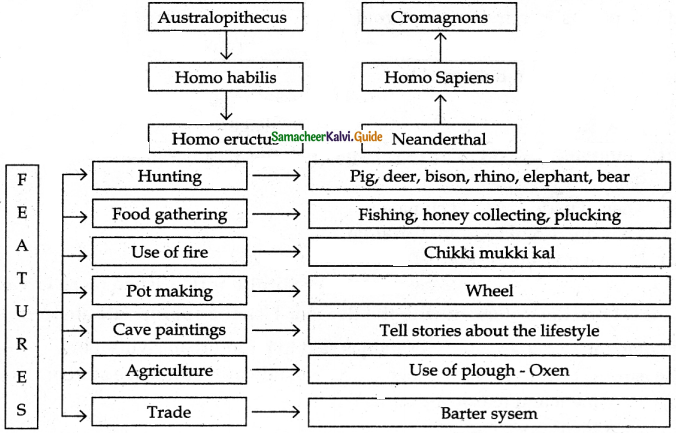
Towns and cities emerged because ……………. of …………….. and.
Answer:
trade, commerce

Question 6.
Which was the first scientific invention of humans?
Answer:
Wheel.

Question 7.
Identify the pictures in rock paintings.
Answer:
Hunting and dancing pictures

Question 8.
Which was the main occupation of early humans? What do cave paintings tell us?
Answer:
Information about the past.

Samacheer Kalvi 6th Social Science Guide History Term 1 Chapter 2 Human Evolution

Question 9.
Where did the early humans live?
Answer:
In caves.

Question 10.
…………….. is related to the field of archaeology.
Answer:
Anthropology

Question 11.
Name any two animals domesticated by an early humans.
Answer:
Dogs and Oxen

XI. Life Skill (For Students)

  1. Make pots and tools by using clay.
  2. Collect different types of moving dolls and tell them to change the wheels with different shapes like square, triangle, etc., and find out how it moves.

Samacheer Kalvi 6th Social Science Human Evolution Additional Important Questions and Answers

I. Choose the correct answer

Question 1.
The word ‘anthropology’ is derived from two …………….. words.
(a) Greek
(b) Latin
(c) Sanskrit
(d) Prakrit
Answer:
(a) Greek

Samacheer Kalvi 6th Social Science Guide History Term 1 Chapter 2 Human Evolution

Question 2.
Harpoons and spear throwers were used by _______
(a) Homo erectus
(b) Homo sapiens
(c) Cromagnons
(d) Homo habilis

II. Match the statement with the reason

Question 1.
Statement: Early humans decided to use guns for hunting.
Reason: It was difficult for them to kill big animals with a stick or stone.
a. Both statement and reason are correct
b. Both statement and reason are the wrong
c. The statement is wrong and the reason is correct.
d. Statement is correct and the reason is wrong.
Answer:
(c) Statement is wrong and the reason is correct.

III. Find out the wrong pair

(a) Homo sapiens – Africa
(b) Homo habits – South Africa
(c) Homo erectus – Asia
(d) Cro – magnons – China
Answer:
(d) Cro – magnons – China

IV. State True or False

  1. The Neanderthal people buried the dead.
  2. During the prehistoric period, horses were used to draw carts. Homo sapiens were wise.
  3. Flintstones were easily available.
  4. Coins made of iron were used by prehistoric people.

Answer:

  1. True
  2. False
  3. True
  4. False
  5. False

V. Answer in brief

Question 1.
Write a short note on the mode of transport in 1850.
Answer:

  1. There were no buses or cycles.
  2. A cart pulled by mules and bullocks were seen on the roads.
  3. A horse-drawn cart was a rare occurrence.

Question 2.
What is meant by the barter system?
Answer:
The early men exchanged the surplus grains with other groups for the other things they were in need of. This is called the barter system.

V. Answer in brief

Question 1.
Write a short note on the mode of transport in 1850.
Answer:

  1. There were no buses or cycles.
  2. A cart pulled by mules and bullocks were seen on the roads.
  3. A horse-drawn cart was a rare occurrence.

Samacheer Kalvi 6th Social Science Guide History Term 1 Chapter 2 Human Evolution

Question 2.
What is meant by the barter system?
Answer:
The early men exchanged the surplus grains with other groups for the other things they were in need of. This is called the barter system.

VI. Mind map
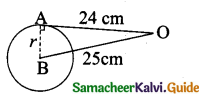
Samacheer Kalvi 6th Social Science Guide History Term 1 Chapter 2 Human Evolution


Tamil Nadu 12th Maths Model Question Paper 5 English Medium

Students can Download Tamil Nadu 12th Maths Model Question Paper 5 English Medium Pdf, Tamil Nadu 12th Maths Model Question Papers helps you to revise the complete Tamilnadu State Board New Syllabus, helps students complete homework assignments and to score high marks in board exams.

TN State Board 12th Maths Model Question Paper 5 English Medium

Instructions:

  1.  The question paper comprises of four parts.
  2.  You are to attempt all the parts. An internal choice of questions is provided wherever applicable.
  3. questions of Part I, II. III and IV are to be attempted separately
  4. Question numbers 1 to 20 in Part I are objective type questions of one -mark each. These are to be answered by choosing the most suitable answer from the given four alternatives and writing the option code and the corresponding answer
  5. Question numbers 21 to 30 in Part II are two-marks questions. These are to be answered in about one or two sentences.
  6. Question numbers 31 to 40 in Parr III are three-marks questions, These are to be answered in about three to five short sentences.
  7. Question numbers 41 to 47 in Part IV are five-marks questions. These are to be answered) in detail. Draw diagrams wherever necessary.

Time: 3 Hours
Maximum Marks: 90

Part – I

I. Choose the correct answer. Answer all the questions. [20 × 1 = 20]

Question 1.
If | adj(adj A) | = |A|9, then the order of the square matrix A is _______.
(a) 3
(b) 4
(c) 2
(d) 5
Answer:
(b) 4

Question 2.
If |z1| = 1, |z2| = 2, |z3| = 3 and |9z1z2 + 4z1z2 + z2z3| = 12, then the value of |z1 + z2+ z3| is ________.
(a) 1
(b) 2
(c) 3
(d) 4
Answer:
(b) 2

Question 3.
The value of \(\left(\frac{1+\sqrt{3} i}{1-\sqrt{3} i}\right)^{10}\) is ________.
Tamil Nadu 12th Maths Model Question Paper 5 English Medium 1
Answer:
(a) cis \(\frac{2 \pi}{3}\)

Question 4.
If \(\cot ^{-1}(\sqrt{\sin \alpha})+\tan ^{-1}(\sqrt{\sin \alpha})=u\), then cos 2u is equal to _____.
(a) tan2 α
(b) 0
(c) -1
(d) tan 2α
Answer:
(c) -1

Tamil Nadu 12th Maths Model Question Paper 5 English Medium

Question 5.
If \(\cot ^{-1} x=\frac{2 \pi}{5}\) for some x∈R, the value of tan-1 x is _______.
Tamil Nadu 12th Maths Model Question Paper 5 English Medium 2
Answer:
(c) \(\frac{\pi}{10}\)

Question 6.
The radius of the circle passing through the point (6, 2) two of whose diameter are x + y = 6 and x + 2y = 4 is ____.
(a) 10
(b) \(2 \sqrt{5}\)
(c) 6
(d) 4
Answer:
(b) \(2 \sqrt{5}\)

Question 7.
The length of the L.R. of x2 = -4y is _______.
(a) 1
(b) 2
(c) 3
(d) 4
Answer:
(d) 4

Question 8.
Distance from the origin to the plane 3x – 6y + 2z + 7 = 0 is ______.
(a) 0
(b) 1
(c) 2
(d) 3
Answer:
(b) 1

Question 9.
The distance from the origin to the plane \(\vec{r} \cdot(2 \vec{i}-\vec{j}+5 \vec{k})=7\) is _____.
Tamil Nadu 12th Maths Model Question Paper 5 English Medium 3
Answer:
(a) \(\frac{7}{\sqrt{30}}\)

Tamil Nadu 12th Maths Model Question Paper 5 English Medium

Question 10.
The number given by the Mean value theorem for the function \(\frac{1}{x}\), x ∈ [1, 9] is ______.
(a) 2
(b) 2.5
(c) 3
(d) 3.5
Answer:
(c) 3

Question 11.
f is a differentiable function defined on an interval I with positive derivative. Then f is ______.
(a) increasing on I
(b) decreasing on I
(c) strictly increasing on I
(d) strictly decreasing on I
Answer:
(c) strictly increasing on I

Question 12.
If we measure the side of a cube to be 4 cm with an error of 0.1 cm, then the error in our calculation of the volume is ________.
(a) 0.4 cu.cm
(b) 0.45 cu.cm
(c) 2 cu.cm
(d) 4.8 cu.cm
Answer:
(d) 4.8 cu.cm

Question 13.
If u(x, y) = \(e^{x^{2}+y^{2}}\), then \(\frac{\partial u}{\partial x}\) is equal to _______.
(a) \(e^{x^{2}+y^{2}}\)
(b) 2xu
(c) x2u
(d) y2u
Answer:
(b) 2xu

Question 14.
The value of \(\int_{0}^{\infty} e^{-3 x} x^{2} d x\) is _______.
(a) \(\frac{7}{27}\)
(b) \(\frac{5}{27}\)
(c) \(\frac{4}{27}\)
(d) \(\frac{2}{27}\)
Answer:
(d) \(\frac{2}{27}\)

Tamil Nadu 12th Maths Model Question Paper 5 English Medium

Question 15.
\(\int_{0}^{a} f(x) d x\) is _____.
Tamil Nadu 12th Maths Model Question Paper 5 English Medium 4
Answer:
(b) \(\int_{0}^{a} f(a-x) d x\)

Question 16.
The integrating factor of the differential equation \(\frac{d y}{d x}\) + P(x) y = Q (x) is x, then P(x) ______.
(a) x
(b) \(\frac{x^{2}}{2}\)
(c) \(\frac{1}{x}\)
(d) \(\frac{1}{x^{2}}\frac{1}{x^{2}}\)
Answer:
(c) \(\frac{1}{x}\)

Question 17.
The order and degree of the differential equation p\(\frac{d^{2} y}{d x^{2}}+\left(\frac{d y}{d x}\right)^{1 / 3}+x^{1 / 4}=0\) are respectively _______.
(a) 2, 3
(b) 3, 3
(c) 2, 6
(d) 2, 4
Answer:
(a) 2, 3

Question 18 .
Which of the following is a discrete random variable?
I. The number of cars crossing a particular signal in a day.
II. The number of customers in a queue to buy train tickets at a moment.
III. The time taken to complete a telephone call.
(a) I and II
(b) II only
(c) III only
(d) II and III
Answer:
(a) I and II

Tamil Nadu 12th Maths Model Question Paper 5 English Medium

Question 19.
If p is true and q is false then which of the following is not true?
(a) p → q is false
(b)p ∨ q is true
(c)p ∧ q is false
(d) p ↔ q is true
Answer:
(d) p ↔ q is true

Question 20.
The operation * defined by a*b = \(\frac{a b}{7}\) is not a binary operation on ______.
(a) Q+
(b) Z
(c) R
(c) C
Answer:
(b) Z

Part – II

II. Answer any seven questions. Question No. 30 is compulsory. [7 × 2 = 14]

Question 21.
Using elementary transformations find the inverse of the following matrix \(\left[\begin{array}{ll}
4 & 7 \\
3 & 0
\end{array}\right]\)
Answer:
Tamil Nadu 12th Maths Model Question Paper 5 English Medium 5

Question 22.
If Z1 = 1 – 3i, z2 = -4i, and z3 = 5, show that (z1 + z2) + z3 = Z1 + (z2 + z3)
Answer:
z1 = 1 – 3i, z2 = 4i, z3 = 5
(z1 + z2) + z3 = (1 – 3i – 4i) + 5(1 – 7i) + 5
= 6 – 7i …..(1)
z1 + (z2 + z3) = (1 – 3i) + (-4i + 5)
= 6 – 7i …..(2)
from(1)& (2)we get
∴ (z1 + z2) + z3 = z1 + (z2 + z3)

Tamil Nadu 12th Maths Model Question Paper 5 English Medium

Question 23.
Find a polynomial equation of minimum degree with rational coefficients, having 2+ \(\sqrt{3}\) i as
a root.
Answer:
Given roots is (2 + \(\sqrt{3}\) i)
∴ The other root is (2 – \(\sqrt{3}\) i), since the imaginary roots with real co-efficient occur as conjugate
pairs.
x2 – x(S.O.R) + P.O.R = 0 ⇒ x2 – x(4) + (4 + 3) = 0
x2 – 4x + 7 = 0.

Question 24.
Evaluate: \(\lim _{x \rightarrow \infty}\left(\frac{x^{2}+17 x+29}{x^{4}}\right)\)
Answer:
This is an indeterminate of the form (\(\frac{\infty}{\infty}\)). To evaluate this limit, we apply l’Hôpital Rule.
Tamil Nadu 12th Maths Model Question Paper 5 English Medium 6

Question 25.
Let g(x, y) = 2y + x2, x = 2r – s, y = r2 + 2s, r, s ∈R. Find \(\frac{\partial g}{\partial r}, \frac{\partial g}{\partial s}\).
Answer:
Tamil Nadu 12th Maths Model Question Paper 5 English Medium 7

Question 26.
Evaluate: \(\int_{0}^{\frac{\pi}{2}}\left(\sin ^{2} x+\cos ^{4} x\right) d x\)
Answer:
Tamil Nadu 12th Maths Model Question Paper 5 English Medium 8

Question 27.
Find the differential equation corresponding to the family of curves represented by the equation y = Ae8x + Be-8x, where A and B are arbitrary constants.
Answer:
y = Ae8x + Be-8x Where A and B are arbitrary constants.
Differentiate with respect to ‘x’
Tamil Nadu 12th Maths Model Question Paper 5 English Medium 9

Tamil Nadu 12th Maths Model Question Paper 5 English Medium

Question 28.
If F(x) = \(\frac{1}{\pi}\left(\frac{\pi}{2}+\tan ^{-1} x\right)\) – ∞ < x < ∞ is a distribution function of a continuous variable X, find P (0 ≤ x ≤ 1).
Answer:
Tamil Nadu 12th Maths Model Question Paper 5 English Medium 10

Question 29.
Show that p → q and q → p are not equivalent.
Answer:
Truth table for p → q
Tamil Nadu 12th Maths Model Question Paper 5 English Medium 11
Truth table for q → p
Tamil Nadu 12th Maths Model Question Paper 5 English Medium 12
The entries in the column corresponding to p → q and q → p are not identical, hence they are not equivalent.

Question 30.
Show that the lines \(\frac{x-1}{4}=\frac{2-y}{6}=\frac{z-4}{12}\) and \(\frac{x-3}{-2}=\frac{y-3}{3}=\frac{5-z}{6}\) are parallel.
Answer:
We observe that the straight line \(\frac{x-1}{4}=\frac{2-y}{6}=\frac{z-4}{12}\) is parallel to the vector \(4 \hat{i}-6 \hat{j}+12 \hat{k}\) and the straight line \(\frac{x-3}{-2}=\frac{y-3}{3}=\frac{5-z}{6}\) is parallel to the vector \(-2 \hat{i}+3 \hat{j}-6 \hat{k}\).
Since \(4 \hat{i}-6 \hat{j}+12 \hat{k}=-2(-2 \hat{i}+3 \hat{j}-6 \hat{k})\) the two vectors are parallel, and hence the two straight lines are parallel.

Part – III

II. Answer any seven questions. Question No. 40 is compulsory. [7 × 3 = 21]

Question 31.
Using elementary transformations find the inverse of the matrix \(\left[\begin{array}{ccc}
1 & -1 & 1 \\
2 & 1 & -3 \\
1 & 1 & 1
\end{array}\right]\)

Question 32.
Find the square roots of – 15 – 8i

Tamil Nadu 12th Maths Model Question Paper 5 English Medium

Question 33.
Find the sum of the squares of the roots of ax4 + bx3 + cx2 + dx + e = 0, a ≠ 0

Question 34.
For what value of x, the inequality \(\frac{\pi}{2}\) < cos-1 (3x – 1) < π holds?

Question 35.
Find the foot of the perpendicular drawn from the point (5, 4, 2) to the line \(\frac{x+1}{2}=\frac{y-3}{3}=\frac{z-1}{-1}\). Also, find the equation of the perpendicular.

Question 36.
Evaluate \(\int_{0}^{\infty} \frac{x^{n}}{n^{x}} d x\), where n is a positive integer ≥ 2.

Question 37.
The engine of a motor boat moving at 10 m/s is shut off. Given that the retardation at any subsequent time (after shutting off the engine) equal to die velocity at that time. Find the velocity after 2 seconds of switching off the engine.

Question 38.
The probability that Mr.Q hits a target at any trial is \(\frac{1}{4}\). Suppose he tries at the target 10 times. Find the probability that he hits the target (i) exactly 4 times (ii) at least one time.

Question 39.
Consider the binary operation * defined on the set A = {a, b, c, d} by the following table:
Tamil Nadu 12th Maths Model Question Paper 5 English Medium 13
Is it commutative and associative?

Tamil Nadu 12th Maths Model Question Paper 5 English Medium

Question 40.
Evaluate the following limit, if necessary use l’Hopital Rule. \(\lim _{x \rightarrow \infty}\left(1+\frac{1}{x}\right)^{x}\)

Part – IV

IV. Answer all the questions. [7 × 5 = 35]

Question 41.
(a) Find the inverse of A = \(\left[\begin{array}{lll}
2 & 1 & 1 \\
3 & 2 & 1 \\
2 & 1 & 2
\end{array}\right]\) by Gauss-Jordan method
[OR]
(b) Find the point of intersection of the lines \(\frac{x-1}{2}=\frac{y-2}{3}=\frac{z-3}{4}\) and \(\frac{x-4}{5}=\frac{y-1}{2}=z\).

Question 42.
(a) Suppose z1, z2 and z3 are the vertices of an equilateral triangle inscribed in the circle.
|z| = 2. If z1 = 1 + i\(\sqrt{3}\), then find z2 and z3.
[OR]
(b) If A = \(\left[\begin{array}{cc}
5 & 3 \\
-1 & -2
\end{array}\right]\) show that A2 – 3A – 7I2 = O2. Hence Find A-1.

Tamil Nadu 12th Maths Model Question Paper 5 English Medium

Question 43.
(a) Solve the equation 3x3 – 16x2 + 23x – 6 = 0 if the product of two roots is 1.
[OR]
(b) The mean and variance of a binomial variate X are respectively 2 and 1.5.
Find (i) P(X = 0) (ii) P(X = 1) (iii) P(X ≥ 1)

Question 44.
(a) Find the value of \(\cos \left(\sin ^{-1}\left(\frac{4}{5}\right)-\tan ^{-1}\left(\frac{3}{4}\right)\right)\)
[OR]
(b) Find, by integration, the volume of the solid generated by revolving about y-axis the region bounded between the curve y = \(\frac{3}{4} \sqrt{x^{2}-16}\), x ≥ 4, the y-axis, and the lines y = 1 and y = 6.

Question 45.
(a) A semielliptical archway over a one-way road has a height of 3m and a width of 12m. The truck has a width of 3m and a height of 2.7m. Will the truck clear the opening of the archway?
[OR]
(b) For the function f(x, y) = \(\frac{3 x}{y+\sin x}\) find the fx, fy, and show that fxy = fyx.

Question 46.
(a) Derive the equation of the plane in the intercept form.
[OR]
(b) Let A be Q\{1}. Define * on A by x * y = x +y – xy. Is * binary on A ? If so, examine the existence of identity, existence of inverse properties for the operation * on A .

Tamil Nadu 12th Maths Model Question Paper 5 English Medium

Question 47.
(a) Find the angle between the rectangular hyperbola xy = 2 and the parabola x2 + 4y = 0.
[OR]
(b) A pot of boiling water at 100° C is removed from a stove at time t = 0 and left to cool in the kitchen. After 5 minutes, the water temperature has decreased to 80° C, and another 5 minutes later it has dropped to 65° C. Determine the temperature of the kitchen.

Tamil Nadu 12th Biology Model Question Paper 5 English Medium

Students can Download Tamil Nadu 12th Biology Model Question Paper 5 English Medium Pdf, Tamil Nadu 12th Biology Model Question Papers helps you to revise the complete Tamilnadu State Board New Syllabus, helps students complete homework assignments and to score high marks in board exams.

TN State Board 12th Biology Model Question Paper 5 English Medium

General Instructions:

    1. The question paper comprises of four parts. Questions for Botany and Zoology are asked separately.
    2. You are to attempt all the parts. An internal choice of questions is provided wherever applicable.
    3. All questions of Part I, II, III and IV are to be attempted separately.
    4. Question numbers 1 to 8 in Part I are Multiple Choice Questions of one mark each. These are to be answered by choosing the most suitable answer from the given four alternatives and writing the option code and the corresponding answer.
    5. Question numbers 9 to 14 in Part II are two-marks questions. These are to be answered in about one or two sentences.
    6. Question numbers 15 to 19 in Part III are three-marks questions. These are to be answered in about three to five short sentences.
    7. Question numbers 20 and 21 in Part IV are five-marks questions. These are to be answered in detail. Draw diagrams wherever necessary.

Time: 2.30 Hours
Maximum Marks: 70

Bio-Botany [Maximum Marks: 35]

Part – I

Choose the correct answer. [8 × 1 = 8]

Question 1.
Choose the correct statement(s) about tenuinucellate ovule
(a) Sporogenous cell is hypodermal
(b) Ovules have fairly large nucellus
(c) Sporogenous cell is epidermal
(d) Ovules have single layer of nucellus tissue
Answer:
(a) Sporogenous cell is hypodermal

Question 2.
The genotype of a plant showing the dominant phenotype can be determined by _______.
(a) Back cross
(b) Test cross
(c) Dihybrid cross
(d) Pedigree analysis
Answer:
(b) Test cross

Tamil Nadu 12th Biology Model Question Paper 5 English Medium

Question 3.
An allo-hexaploidy contains ________.
(a) Six different genomes
(b) Six copies of three different genomes
(c) Two copies of three different genomes
(d) Six copies of one genome
Answer:
(b) Six copies of three different genomes

Question 4.
Match the following column I with column II
Tamil Nadu 12th Biology Model Question Paper 5 English Medium 1
Tamil Nadu 12th Biology Model Question Paper 5 English Medium 2
Answer:
(D) 1 – c, 2 – d, 3 – a, 4 – b

Question 5.
Assertion (A): Incubation is followed by Inoculation.
Reason (R): Explant is inoculated to media.
(a) Both A and R are correct but R is not a correct explanation to A
(b) R explains A
(c) A is correct R is incorrect
(d) Both A and R are incorrect
Answer:
(b) R explains A

Question 6.
Environment of any community is called
(a) Paratope
(b) Biotope
(c) Ecotope
(d) Epitope
Answer:
(b) Biotope

Question 7.
Which of the following is not a sedimentary cycle?
(a) Nitrogen cycle
(b) Phosphorus cycle
(c) Sulphur cycle
(d) Calcium cycle
Answer:
(a) Nitrogen cycle

Tamil Nadu 12th Biology Model Question Paper 5 English Medium

Question 8.
The plants which are grown in silvopasture system are
(a) Sesbania and Acacia
(b) Solanum and Crotolaria
(c) Clitoria and Begonia
(d) Teak and sandal
Answer:
(a) Sesbania and Acacia

Part – II

Answer any four of the following questions. [4 × 2 = 8]

Question 9.
What are multiple alleles? Give an example.
Answer:
Three or more alternative forms of a gene that occupy the same locus and control the expression of a single trait.
E.g: ABO blood group

Question 10.
List out the benefits of herbicide tolerant crops.
Answer:
Advantages of Herbicide Tolerant Crops:

  • Weed control improves higher crop yields.
  • Reduces spray of herbicide.
  • Reduces competition between crop plant and weed.
  • Use of low toxicity compounds which do not remain active in the soil.
  • The ability to conserve soil structure and microbes.

Question 11.
Soil formation can be initiated by biological organisms. How?
Answer:
Soil formation is initiated by the biological weathering process. Biological weathering takes place when organisms like bacteria, fungi, lichens and plants help in the breakdown of rocks through the production of acids and certain chemical substances.

Tamil Nadu 12th Biology Model Question Paper 5 English Medium

Question 12.
Where did Montreal Protocol was held? State its objectives.
Answer:
The International treaty called the Montreal Protocol (1987) was held in Canada on substances that deplete ozone layer and the main goal of it is gradually eliminating the production and consumption of ozone depleting substances and to limit their damage on the Earth’s ozone layer.

Question 13.
What is Heterosis?
Answer:
The superiority of the F1 hybrid in performance over its parents is called heterosis or hybrid vigour. Vigour refers to increase in growth, yield, greater adaptability of resistance to diseases, pest and drought.

Question 14.
Write the cosmetic uses of Aloe.
Answer:
Aloe gel are used as skin tonic. It has a cooling effect and moisturising characteristics and hence used in preparation of creams, lotions, shampoos, shaving creams, after shave lotions and allied products. It is used in gerontological applications for rejuvenation of aging skin. Products prepared from aloe leaves have multiple properties such as emollient, antibacterial, antioxidant, antifungal and antiseptic. Aloe vera gel is used in skin care cosmetics.

Part – III

Answer any three questions in which question number 19 is compulsory. [3 × 3 = 9]

Question 15.
List out the functions of tapetum.
Answer:

  • It supplies nutrition to the developing microspores.
  • It contributes sporopollenin through ubisch bodies thus plays an important role in pollen wall formation.
  • The pollenkitt material is contributed by tapetal cells and is later transferred to the pollen surface.
  • Exine proteins responsible for ‘rejection reaction’ of the stigma are present in the cavities of the exine. These proteins are derived from tapetal cells.

Tamil Nadu 12th Biology Model Question Paper 5 English Medium

Question 16.
What do you mean by Embryoids? Write its application.
Answer:
Somatic embryogenesis is the formation of embryos from the callus tissue directly and these embryos are called Embryoids or from the in vitro cells directly form pre-embryonic cells which differentiate into embryoids.

Applications:

  • Somatic embryogenesis provides potential plantlets which after hardening period can establish into plants.
  • Somatic embryoids can be used for the production of synthetic seeds.
  • Somatic embryogenesis is now reported in many plants such as Allium sativum, Hordeum vulgare, Oryza sativa, Zea mays and this is possible in any plant.

Question 17.
Give a comparative account on Seaweed liquid fertilizer.
Answer:
Seaweed liquid fertilizer (SLF) contains cytokinin, gibberellins and auxin apart from macro and micro nutrients. Most seaweed based fertilizers are made from kelp (brown algae) which grows to length of 150 metres. Liquid seaweed fertilizer is not only organic but also ecofriendly. The alginates in the seaweed that reacts with metals in the soil and form long, crosslinked polymers in the soil.

These polymers improve the crumbing in the soil, swell up when they get wet and retain moisture for a long time. They are especially useful in organic gardening which provides carbohydrates for plants. Seaweed has more than 70 minerals, vitamins and enzymes. It promotes vigorous growth. Improves resistance of plants to frost and disease. Seeds soaked in seaweed extract germinate much rapidly and develop a better root system.

Question 18.
Write a brief note on Detritus food chain.
Answer:
Detritus food chain is a type of food chain which begins with dead organic matter which is an important source of energy. A large amount of organic matter is derived from the dead plants, animals and their excreta. This type of food chain is present in all ecosystems. The transfer of energy from the dead organic matter, is transferred through a series of organisms called detritus consumers (detritivores)- small carnivores – large (top) carnivores with repeated eating and being eaten respectively. This is called the detritus food chain.
Tamil Nadu 12th Biology Model Question Paper 5 English Medium 3

Tamil Nadu 12th Biology Model Question Paper 5 English Medium

Question 19.
Mention the name of man-made cereal. How it is developed?
Answer:
Tamil Nadu 12th Biology Model Question Paper 5 English Medium 4
Triticale, the successful first man made cereal. Depending on the ploidy level Triticale can be divided into three main groups:

  1. Tetraploidy: Crosses between diploid wheat and rye.
  2. Hexaploidy: Crosses between tetraploid wheat Triticum durum (macaroni wheat) and rye.
  3. Octoploidy: Crosses between hexaploid wheat T. aestivum (bread wheat) and rye.

Hexaploidy Triticale hybrid plants demonstrate characteristics of both macaroni wheat and rye. For example, they combine the high-protein content of wheat with rye’s high content of the amino acid lysine, which is low in wheat.

Part – IV

Answer all the questions. [2 × 5 = 10]

Question 20.
(a) Describe the structure of a Cicer seed (dicot seed) with labelled diagram.
Answer:
Structure of a Cicer seed as an example for Dicot seed The mature seeds are attached to the fruit wall by a stalk called funiculus. The funiculus disappears leaving a scar called hilum. Below the hilum a small pore called micropyle is present. It facilitates entry of oxygen and water into the seeds during germination.

Each seed has a thick outer covering called seed coat. The seed coat is developed from integuments of the ovule. The outer coat is called testa and is hard whereas the inner coat is thin, membranous and is called tegmen.
Tamil Nadu 12th Biology Model Question Paper 5 English Medium 5
In Pea plant the tegmen and testa are fused. Two cotyledons laterally attached to the embryonic axis are present. It stores the food materials in pea whereas in other seeds like castor the endosperm contains reserve food and the cotyledons are thin. The portion of embryonal axis projecting beyond the cotyledons is called radicle or embryonic root.

The other end of the axis called embryonic shoot is the plumule. Embryonal axis above the level of cotyledon is called epicotyl whereas the cylindrical region between the level of cotyledon is called hypocotyl. The epicotyl terminates in plumule whereas the hypocotyl ends in radicle.

[OR]

(b) (i) Explain the three types of hyperploidy.
(ii) List out the significance of ploidy.
Answer:
(i) (a) Trisomy: Addition of single chromosome to diploid set is called Simple trisomy (2n+l). Trisomics were first reported by Blackeslee (1910) in Datura stramonium (Jimson weed). But later it was reported in Nicotiana, Pisum and Oenothera. Sometimes addition of two individual chromosome from different chromosomal pairs to normal diploid sets are called Double trisomy (2n + 1 + 1).
(b) Tetrasomy: Addition of a pair or two individual pairs of chromosomes to diploid set is called tetrasomy (2n+2) and Double tetrasomy (2n+2+2) respectively. All possible tetrasomics are available in Wheat.
(c) Pentasomy: Addition of three individual chromosome from different chromosomal pairs to normal diploid set are called pentasomy (2n+3).

(ii)

  • Many polyploids are more vigorous and more adaptable than diploids.
  • Many ornamental plants are autotetraploids and have larger flower and longer flowering duration than diploids.
  • Autopolyploids usually have increase in fresh weight due to more water content.
  • Aneuploids are useful to determine the phenotypic effects of loss or gain of different chromosomes.
  • Many angiosperms are allopolyploids and they play a role in an evolution of plants.

Tamil Nadu 12th Biology Model Question Paper 5 English Medium

Question 21.
a. (i) Define tissue culture.
(ii) Explain the basic concepts involved in plant tissue culture.
Answer:
(i) Growing plant protoplasts, cells, tissues or organs away from their natural or normal environment, under artificial condition, is known as Tissue Culture.

(ii) Basic concepts of plant tissue culture are totipotency, differentiation, dedifferentiation and redifferentiation.
Totipotency: The property of live plant cells that they have the genetic potential when cultured in nutrient medium to give rise to a complete individual plant.

Differentiation: The process of biochemical and structural changes by which cells become specialized in form and function.

Redifferentiation: The further differentiation of already differentiated cell into another type of cell. For example, when the component cells of callus have the ability to form a whole plant in a nutrient medium, the phenomenon is called redifferentiation.

Dedifferentiation: The phenomenon of the reversion of mature cells to the meristematic state leading to the formation of callus is called dedifferentiation. These two phenomena of redifferentiation and dedifferentiation are the inherent capacities of living plant cells or tissue. This is described as totipotency.

[OR]

(b) What is soil profile? Explain the characters of different soil horizons.
Answer:
Soil is commonly stratified into horizons at different depth. These layers differ in their physical, chemical and biological properties. This succession of super-imposed horizons is called soil profile.

HorizonDescription
O-Horizon (Organic horizon) HumusIt consists of fresh or partially decomposed organic matter.
O1 – Freshly fallen leaves, twigs, flowers and fruits.
O2 – Dead plants, animals and their excreta decomposed by micro-organisms.
Usually absent in agricultural and deserts.
A-Horizon (Leached horizon)
Topsoil – Often rich in humus and minerals.
It consists of top soil with humus, living creatures and in-organic minerals.
A1 – Dark and rich in organic matter because of mixture of organic and mineral matters.
A2 – Light coloured layer with large sized mineral particles.
B-Horizon (Accumulation horizon) (Subsoil – Poor in humus, rich in minerals)It consists of iron, aluminium and silica rich clay organic compounds.
C – Horizon (Partially weathered horizon) Weathered rock Fragments – Little or no plant or animal life.It consists of parent materials of soil, composed of little amount of organic matters without life forms.
R – Horizon
(Parent material) Bedrock
It is a parent bed rock upon which underground water is found.

Bio-Zoology [Maximum Marks: 35]

Part – I

Choose the correct answer. [8 × 1 = 8]

Question 1.
Assertion (A): Asexual reproduction is called blastogenic reproduction.
Reason (R): It is accomplished by mitotic and meiotic divisions.
(a) A and R are correct
(b) A is correct but R is incorrect
(c) Both A and R are incorrect
(d) R is the correct explanation for A
Answer:
(b) A is correct but R is incorrect

Question 2.
The mature sperms are stored in the ________.
(a) Seminiferous tubules
(b) Vas deferens
(c) Epididymis
(d) Seminal vesicle
Answer:
(c) Epididymis

Tamil Nadu 12th Biology Model Question Paper 5 English Medium

Question 3.
A contraceptive pill prevents ovulation by _______.
(a) blocking fallopian tube
(b) inhibiting the release of FSH and LH
(c) stimulating the release of FSH and LH
(d) causing immediate degeneration of released ovum.
Answer:
(b) inhibiting the release of FSH and LH

Question 4.
Patau’s syndrome is also referred to as ________.
(a) 13-Trisomy
(b) 18-Trisormy
(c) 21-Trisormy
(d) None of these
Answer:
(a) 13-Trisomy

Question 5.
Cyclosporin – A is an immunosuppressive drug produced from ________.
(a) Aspergillus niger
(b) Manascus purpureus
(c) Penicillium notatum
(d) Trichoderma polysporum
Answer:
(d) Trichoderma polysporum

Question 6.
PCR proceeds in three distinct steps governed by temperature, they are in order of ________.
(a) Denaturation, Annealing, Synthesis
(b) Synthesis, Annealing, Denaturation
(c) Annealing, Synthesis, Denaturation
(d) Denaturation, Synthesis, Annealing
Answer:
(a) Denaturation, Annealing, Synthesis

Question 7.
Match column I with column II
Tamil Nadu 12th Biology Model Question Paper 5 English Medium 6
(a) A – 4, B – 5, C – 2, D – 3, E – 1
(b) A – 3, B – 1, C – 4, D – 2, E – 5
(c) A – 2, B – 3,C – 1, D – 5, E – 4
(d) A – 5, B – 4, C – 2, D – 3, E – 1
Answer:
(a) A – 4, B – 5, C – 2, D – 3, E – 1

Tamil Nadu 12th Biology Model Question Paper 5 English Medium

Question 8.
Total number of mega biodiversity countries in the world is _______.
(a) 12
(b) 15
(c) 17
(d) 19
Answer:
(c) 17

Part – II

Answer any four of the following questions.  [4 × 2 = 8]

Question 9.
Why are the offsprings of oviparous animals are at a greater risk as compared to offsprings of viviparous organisms?
Answer:
Oviparous animals are egg-layers. The eggs containing embryo are laid out of their body and are highly susceptible to environmental factors (temperature, moisture etc.) and predators. Whereas, in viviparous animals, the embryo develops inside the body of female and comes out as young ones. Hence offsprings of oviparous animals are at risk compared to viviparous animal.

Question 10.
What is “let-down reflex”?
Answer:
Oxytocin causes the “Let-Down” reflex the actual ejection of milk from the alveoli of the mammary glands. During lactation, oxytocin also stimulates the recently emptied uterus to contract, helping it to return to pre – pregnancy size.

Tamil Nadu 12th Biology Model Question Paper 5 English Medium

Question 11.
In E.coli, three enzymes β- galactosidase, permease and transacetylase are produced in the presence of lactose. Explain why the enzymes are not synthesized in the absence of lactose.
Answer:
In the absence of lactose, the repressor protein binds to the operator and prevents the transcription of structural gene by RNA polymerase, hence the enzymes are not produced. However, there will always be a minimal level of lac operon expression even in absence of lactose.

Question 12.
Compare relative dating with absolute dating.
Answer:
Relative dating is used to determine a fossil by comparing it to similar rocks and fossils of known age. Absolute dating is used to determine.the precise age of a fossil by using radiometric dating to measure the decay of isotopes.

Question 13.
Write the name of causative agent, infection site, mode of transmission and any two symptoms of Chikungunya.
Answer:
Causative agent – Alpha virus
Infection site – Nervous system
Mode of transmission – Aedes aegypti (Mosquito)
Symptoms – Fever, headache, joint pain and swelling.

Tamil Nadu 12th Biology Model Question Paper 5 English Medium

Question 14.
Define the following terms.
(a) Eutrophication (b) Algal Bloom
Answer:
Eutrophication refers to the nutrient enrichment in water bodies leading to lack of oxygen . and will end up in the death of aquatic organisms. Algal Bloom is an excess growth of algae due to abundant excess nutrients imparting distinct color to water.

Part – III

Answer any three questions in which question number 19 is compulsory. [3 × 3 = 9]

Question 15.
Write a short note on foeto scope.
Answer:
Foetoscope is used to monitor the foetal heart rate and other functions during late pregnancy and labour. The average foetal heart rate is between 120 and 160 beats per minute. An abnormal foetal heart rate or pattern may mean that the foetus is not getting enough oxygen and it indicates other problems. A hand-held doppler device is often used during prenatal visits to count the foetal heart rate. During labour, continuous electronic foetal monitoring is often used.

Question 16.
Under which condition does a microbe gains resistance against antibiotic?
Answer:
Antibiotic resistance occurs when bacteria develop the ability to defeat the drug designed to kill or inhibit their growth. It is one of the most acute threat to public health. Antibiotic resistance is accelerated by the misuse and over use of antibiotics, as well as poor infection prevention control. Antibiotics should be used only when prescribed by a certified health professional.

When the bacteria become resistant, antibiotics cannot fight against them and the bacteria multiply. Narrow spectrum antibiotics are preferred over broad spectrum antibiotics. They effectively and accurately target specific pathogenic organisms and are less likely to cause resistance.

Tamil Nadu 12th Biology Model Question Paper 5 English Medium

Question 17.
State Fisher and Race hypothesis.
Answer:
Fisher and Race hypothesis: Rh factor involves three different pairs of alleles located on three different closely linked loci on the chromosome pair. This system is more commonly in use today, and uses the ‘Cde’ nomenclature.
Tamil Nadu 12th Biology Model Question Paper 5 English Medium 7
In the given figure, three pairs of Rh alleles (Cc, Dd and Ee) occur at 3 different loci on homologous chromosome pair-1. The possible genotypes will be one C or c, one D or d, one E or e from each chromosome. For e.g. CDE/cde; CdE/cDe; cde/cde; CDe/CdE etc. All genotypes carrying a dominant ‘D’ allele will produce Rh+positive phenotype and double recessive genotype ‘dd’ will give rise to Rh negative phenotype.

Question 18.
Extinction of Dodo bird led to the danger of Calvaria tree – Support your answer.
Answer:
An example for co-extinction is the connection between Calvaria tree and the extinct bird of Mauritius Island, the Dodo. The Calvaria tree is dependent on the Dodo bird for completion of its life cycle. The mutualistic association is that the tough homy endocarp of the seeds of Calvaria tree are made permeable by the actions of the large stones in birds gizzard and digestive juices thereby facilitating easier germination. The extinction of the Dodo bird led to the imminent danger of the Calvaria tree coextinction.

Question 19.
Whether PCR can be done for RNA molecules? Yes or No? Explain.
Answer:
The PCR technique can also be used for amplifications of RNA in which case it is referred to as reverse transcription PCR (RT-PCR). In this process the RNA molecules (mRNA) must be converted to complementary DNA by the enzyme reverse transcriptase. The cDNA then serves as the template for PCR.

Part – IV

Answer all the questions. [2 × 5 = 10]

Question 20.
(a) Define the following terms with an example
(i) Hologamy
(ii) Isogamy
(iii) Anisogamy
(iv) Merogamy
(v) Paedogamy
Answer:
(i) Hologamy: In Hologamy, the adult individuals do not produce gametes, but they themselves act as gametes and fuse to form new individuals.
E.g.: Trichonympha

(ii) Isogamy : Fusion of morphologically and physiologically similar gametes.
E.g.: Monocystis

(iii) Anisogamy : Fusion of morphologically and physiologically dissimilar gametes.
E.g.: Vertebrates.

(iv) Merogamy : Fusion of small sized morphologically different gametes (merogametes)

(v) Paedogamy : Fusion of young individuals produced immediately after the mitotic division of adult parent cell.

[OR]

(b) Write in detail about cervical cancer.
Answer:
Cervical cancer is caused by a sexually transmitted virus called Human Papilloma virus (HPV). HPV may cause abnormal growth of cervical cells or cervical dysplasia. The most common symptoms and signs of cervical cancer are pelvic pain, increased vaginal discharge and abnormal vaginal bleeding. The risk factors for cervical cancer include

  1. Having multiple sexual partners
  2. Prolonged use of contraceptive pills

Cervical cancer can be diagnosed by a Papanicolaou smear (PAP smear) combined with an HPV test. X-Ray, CT scan, MRI and a PET scan may also be used to determine the stage of cancer. The treatment options for cervical cancer include radiation therapy, surgery and chemotherapy.

Modem screening techniques can detect precancerous changes in the cervix. Therefore screening is recommended for women above 30 years once in a year. Cervical cancer can be prevented with vaccination. Primary prevention begins with HPV vaccination of girls aged 9-13 years, before they become sexually active. Modification in lifestyle can also help in preventing cervical cancer. Healthy diet, avoiding tobacco usage, preventing early marriages, practicing monogamy and regular exercise minimize the risk of cervical cancer.

Tamil Nadu 12th Biology Model Question Paper 5 English Medium

Question 21.
(a) Point out the differences between active and passive immunity.
Answer:
Active Immunity:

  1. Active immunity is produced actively by host’s immune system.
  2. It is produced due to contact with pathogen or by its antigen.
  3. It is durable and effective in protection.
  4. Immunological memory is present.
  5. Booster effect on subsequent dose is possible.
  6. Immunity is effective only after a short period.

Passive Immunity:

  1. Passive immunity is received passively and there is no active host participation.
  2. It is produced due to antibodies obtained from outside.
  3. It is transient and less effective.
  4. No memory.
  5. Subsequent dose is less effective.
  6. Immunity develops immediately.

[OR]

(b) How is the amplification of a gene sample of interest carried out using PCR?
Answer:
Denaturation, renaturation or primer annealing and synthesis or primer extension, are the three steps involved in PCR. The double stranded DNA of interest is denatured to separate into two individual strands by high temperature . This is called denaturation. Each strand is allowed to hybridize with a primer (renaturation or primer annealing). The primer template is used to synthesize DNA by using Taq – DNA polymerase.

During denaturation the reaction mixture is heated to 95°C for a short time to denature the target DNA into single strands that will act as a template for DNA synthesis. Annealing is done by rapid cooling of the mixture, allowing the primers to bind to the sequences on each of the two strands flanking the target DNA. During primer extension or synthesis the temperature of the mixture is increased to 75°C for a sufficient period of time to allow Taq DNA polymerase to extend each primer by copying the single stranded template.

At the end of incubation both single template strands will be made partially double stranded. The new strand of each double stranded DNA extends to a variable distance downstream. These steps are repeated again and again to generate multiple forms of the desired DNA, This process is also called DNA amplification.
Tamil Nadu 12th Biology Model Question Paper 5 English Medium 8

Samacheer Kalvi 10th Maths Model Question Paper 5 English Medium

Students can Download Samacheer Kalvi 10th Maths Model Question Paper 5 English Medium Pdf, Samacheer Kalvi 10th Maths Model Question Papers helps you to revise the complete Tamilnadu State Board New Syllabus, helps students complete homework assignments and to score high marks in board exams.

Tamil Nadu Samacheer Kalvi 10th Maths Model Question Paper 5 English Medium

Instructions

  • The question paper comprises of four parts.
  • You are to attempt all the parts. An internal choice of questions is provided wherever applicable.
  • All questions of Part I, II, III and IV are to be attempted separately.
  • Question numbers 1 to 14 in Part I are Multiple Choice Quèstions of one-mark each. These are to be answered by choosing the most suitable answer from the given four alternatives and.writing the option code and the corresponding answer.
  • Question numbers 15 to 28 in Part II àre two-marks questions. These are to be answered in about one or two sentences.
  • Question numbers 29 to 42 in Part III are five-marks questions. These are to be answered in about three to five short sentences.
  • Question numbers 43 to 44 in Part IV are eight-marks questions. These are to be answered in detail. Draw diagrams wherever necessary.

Time: 3 Hours
Maximum Marks: 100

PART – I

I. Choose the correct answer. Answer all the questions. [14 × 1 =14]

Question 1.
The range of the relation R = {(x, x2) x is a prime number less than 13} is ………… .
(1) {2, 3, 5, 7}
(2) (2, 3, 5, 7, 11}
(3) {4,9,25,49, 121}
(4) {1, 4, 9, 25, 49, 121}
Answer:
(3) {4,9,25,49, 121}

Samacheer Kalvi 10th Maths Model Question Paper 5 English Medium

Question 2.
If g = {(1,1),(2, 3),(3,5),(4,7)} is a function given by g(x) = αx + β then the values of α and β are ……….. .
(1) (-1,2)
(2) (2,-1)
(3) (-1,-2)
(4) (1,2)
Answer:
(2) (2,-1)

Question 3.
The sum of the exponents of the prime factors in the prime factorization of 1729 is ……….. .
(1) 1
(2) 2
(3) 3
(4) 4
Answer:
(3) 3

Question 4.
The next term of the sequence \(\frac{3}{16}, \frac{1}{8}, \frac{1}{12}, \frac{1}{18}\) is ……….. .
(1) \(\frac{1}{24}\)
(2) \(\frac{1}{27}\)
(3) \(\frac{2}{3}\)
(4) \(\frac{1}{81}\)
Answer:
(2) \(\frac{1}{27}\)

Question 5.
If (x – 6) is the HCF of x2 – 2x – 24 and x2 – kx – 6 then the value of k is ……….. .
(1) 3
(2) 5
(3) 6
(4) 8
Answer:
(2) 5

Question 6.
The solution of (2x – 1)2 = 9 is equal to ……….. .
(1) -1
(2) 2
(3) -1,2
(4) None of these
Answer:
(3) -1,2

Question 7.
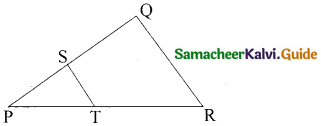
In a given figure ST || QR, PS = 2 cm and SQ = 3 cm. Then the ratio of the area of ∆PQR to the area of ∆PST is ……….. .
Samacheer Kalvi 10th Maths Model Question Paper 5 English Medium - 1
(1) 25 : 4
(2) 25 : 7
(3) 25 :11
(4) 25 : 13
Answer:
(1) 25 : 4

Samacheer Kalvi 10th Maths Model Question Paper 5 English Medium

Question 8.
The slope of the line joining (12, 3), (4, a) is \(\frac { 1 }{ 8 }\). The value of ‘a’ is ……….. .
(1) 1
(2) 4
(3) -5
(4) 2
Answer:
(4) 2

Question 9.
If sin θ + cos θ = a and sec θ + cosec θ = b, then the value of b (a2 – 1) is equal to ……….. .
(1) 2 a
(2) 3 a
(3) 0
(4) 2 ab
Answer:
(1) 2 a

Question 10.
The curved surface area of a right circular cone of height 15 cm and base diameter 16 cm is ……….. .
(1) 60π cm2
(2) 68π cm2
(3) 120π cm2
(4) 136π cm2
Answer:
(4) 136π cm2

Question 11.
The sum of all deviations of the data from its mean is ……….. .
(1) always positive
(2) always negative
(3) zero
(4) non-zero integer
Answer:
(3) zero

Question 12.
If \(\left( \begin{matrix} x+y & x-y \\ 7 & 6 \end{matrix} \right) =\left( \begin{matrix} 10 & 2 \\ 7 & z \end{matrix} \right) \) then x, y, z are ……….. .
(1) 4, 6, 6
(2) 6, 6, 4
(3) 6, 4, 6
(4) 4, 4, 6
Answer:
(3) 6, 4, 6

Question 13.
If the nth term of a sequence is 100n + 10 then the sequence is ……….. .
(1) an A.P.
(2) a G.P.
(3) a constant sequence
(4) neither A.P. nor G.P.
Answer:
(1) an A.P.

Samacheer Kalvi 10th Maths Model Question Paper 5 English Medium

Question 14.
Probability of getting 3 heads or 3 tails in tossing a coin 3 times is ……….. .
(1) \(\frac { 1 }{ 8 }\)
(2) \(\frac { 1 }{ 4 }\)
(3) \(\frac { 3 }{ 8 }\)
(4) \(\frac { 1 }{ 2 }\)
Answer:
(2) \(\frac { 1 }{ 4 }\)

PART – II

II. Answer any ten questions. Question No. 28 is compulsory. [10 × 2 = 20]

Question 15.
Let A = {x ∈ W / x < 2}, B = {x ∈ N / 1 < x ≤ 4} and C = {3, 5} find the value of (A × C) ∪ (B × C)
Answer:
A × C = {0,1} × {3,5}
= {(0,3 (0,5) (1,3) (1,5)}
B × C= (2,3,4) × (3,5)
= {(2,3) (2,5) (3,3) (3,5) (4,3) (4,5)}
(A × C) ∪ (B × C) = {(0,3) (0,5) (1,3) (1,5) (2,3) (2,5) (3,3) (3,5) (4,3) (4,5)}

Question 16.
Find k if fof(k) = 5 where f(k) = 2k – 1.
Answer:
fof(k) = f(f(k)) = 2(2k – 1)-1 = 4k – 3.
Thus, fof(k) = 4k – 3
But, it is given that fof(k) = 5
∴ 4k – 3 = 5 ⇒ k = 2.

Question 17.
Find the sum of the following 6 + 13 + 20 +…. + 97
Answer:
Here a = 6, d = 13 – 6 = 7, l = 97
n = \(\frac{l-a}{d}+1\)
= \(\frac{97-6}{7}+1\) = \(\frac{91}{7}+1\) = 13 + 1 = 14
Sn = \(\frac{n}{2}\)(a + l)
Sn = \(\frac{14}{2}\)(6 + 97) = 7 × 103 = 721

Question 18.
Rekha has 15 square colour papers of sizes 10 cm, 11 cm, 12 cm, …,.24 cm. How much area can be decorated with these colour papers?
Answer:
Area of 15 square colour papers
= 102 + 112 + 122 + …. + 242
= (12 + 22 + 32 + …. + 242) – (12 + 22 + 92)
= \(\frac{24 \times 25 \times 49}{6}-\frac{9 \times 10 \times 19}{6}\)
=4 × 25 × 49 – 3 × 5 × 19
= 4900 – 285
= 4615
Area can be decorated is 4615 cm2

Samacheer Kalvi 10th Maths Model Question Paper 5 English Medium

Question 19.
Simplify \(\frac{x+2}{4 y} \div \frac{x^{2}-x-6}{12 y^{2}}\)
Answer:
Samacheer Kalvi 10th Maths Model Question Paper 5 English Medium - 3
x2 – x – 6 = (x – 3) (x + 2)
= \(\frac{x+2}{4 y} \div \frac{x^{2}-x-6}{12 y^{2}}=\frac{x+2}{4 y}+\frac{(x-3)(x+2)}{12 y^{2}}\)
= \(\frac{(x+2)}{4 y} \times \frac{12 y^{2}}{(x-3)(x+2)}\)
= \(\frac{3 y}{x-3}\)

Question 20.
Solve \(\frac{x}{x-1}+\frac{x-1}{x}=2 \frac{1}{2}\)
Answer:
Let y = \(\frac{x}{x-1}\) then \(\frac{1}{y}=\frac{x-1}{x}\)
Therefore, \(\frac{x}{x-1}+\frac{x-1}{x}=2 \frac{1}{2}\) becomes \(y+\frac{1}{y}=\frac{5}{2}\)
2y2 – 5y + 2 = 0 then, y = \(\frac{1}{2}, 2\)
\(\frac{x}{x-1}=\frac{1}{2}\) we get, 2x = x – 1 implies x = – 1
\(\frac{x}{x-1}=2\) we get, x = 2x – 2 implies x = 2
∴ The roots are x = -1, 2

Question 21.
Construct a 3 × 3 matrix whose elements are given by aij = |i – 2j|
Answer:
aij = |i – 2j|
The general 3 × 3 matrices is
A = \(\left( \begin{matrix} { a }_{ 11 } & { a }_{ 12 } & { a }_{ 13 } \\ { a }_{ 21 } & { a }_{ 22 } & { a }_{ 23 } \\ { a }_{ 31 } & { a }_{ 32 } & { a }_{ 33 } \end{matrix} \right)\)
a11 = |1 – 2(1)| = |1 – 2| = |-1| = 1
a12 = |1 – 2(2)| = |1 – 4| = |-3| = 3
a13 = |1 – 2(3)| = |1 – 6| = |-5| = 5
a21 = |2 – 2(1)| = |2 – 2| = 0
a22 = |2 – 2(2)| = |2 – 4| = |-2| = 2
a23 = |2 – 2(3)| = |2 – 6| = |-4| = 4
a31 = |3 – 2(1)| = |3 – 2| = |1| = 1
a32 = |3 – 2(2)| = |3 – 4| = |-1| = 1
a33 = |3 – 2(3)| = |3 – 6| = |-3| = 3
The required matrix A = \(\left[ \begin{matrix} 1 & 3 & 5 \\ 0 & 2 & 4 \\ 1 & 1 & 3 \end{matrix} \right] \)

Question 22.
The length of the tangent to a circle from a point P, which is 25 cm away from the centre is 24 cm. What is the radius of the circle?
Answer:
Samacheer Kalvi 10th Maths Model Question Paper 5 English Medium - 4
Let the radius AB be r. In the right ∆ ABO,
OB2 = OA2 + AB2
252 = 242 + r2
252 – 242 = r2
(25 + 4) (25 – 24) = r2
r = √49 = 7
Radius of the circle = 7 cm

Samacheer Kalvi 10th Maths Model Question Paper 5 English Medium

Question 23.
If the straight lines 12y = – (p + 3)x + 12, 12x – 7y = 16 are perpendicular then find ‘p’.
Answer:
Slope of the first line 12y = -(p + 3)x + 12
y = \(-\frac{(p+3) x}{12}+1\) (comparing with y = mx + c)
Slope of the second line (m1) = \(\frac{-(p+3)}{12}\)
Slope of the second line 12x – 7y = 16
(m2) = \(\frac{-a}{b}=\frac{-12}{-7}=\frac{12}{7}\)
Since the two lines are perpemdicular.
m1 × m2 = -1
\(\frac{-(p+3)}{12} \times \frac{12}{7}=-1 \Rightarrow \frac{-(p+3)}{7}=-1\)
-(p + 3) = -7
– p – 3 = – 7 ⇒ -p = -7 + 3
– p = -4 ⇒ p = 4
The value of p = 4

Question 24.
Prove that 1 + \(\frac{\cot ^{2} \theta}{1+\csc \theta}\) = cosec θ
Answer:
Samacheer Kalvi 10th Maths Model Question Paper 5 English Medium - 5

Question 25.
Find the standard deviation of first 21 natural numbers.
Answer:
Here n = 21
Standard deviation of the first ‘n’ natural numbers,
= \(\sqrt{\frac{n^{2}-1}{12}}\)
1,2,3,4, ……. , 21 = \(\sqrt{\frac{21^{2}-1}{12}}=\sqrt{\frac{441-1}{12}}=\sqrt{\frac{440}{12}}\)
= \(\sqrt{36.666}\) = \(\sqrt{36.67}\)
= 6.055 = 6.06
Standard deviation of first 21 natural numbers = 6.06

Samacheer Kalvi 10th Maths Model Question Paper 5 English Medium

Question 26.
How many litres of water will a hemispherical tank hold whose diameter is 4.2m?
Answer:
Radius of the tank = \(\frac{4.2}{2}\) = 2.1 m
Volume of the hemisphere = \(\frac{2}{3}\) πr3 cu. unit
= \(\frac{2}{3} \times \frac{22}{7}\) × 2.1 × 2.1 × 2.1 m3
= 19.404 m3
= 19.4o4 × 1000 litre
= 19,4o4 litres

Question 27.
A two digit number is formed with the digits 2, 5, 9 (repetition is allowed). Find the probability that the number is divisible by 2.
Answer:
Sample space (S) = {22, 25, 29, 55, 59, 52, 99, 92, 95}
n(S) = 9
Let A be the event of getting number divisible by 2
A = {22,52,92}
n(A) = 3
P(A) = \(\frac{n(\mathrm{A})}{n(\mathrm{S})}=\frac{3}{9}=\frac{1}{3}\)

Question 28.
Solve √x + 5 = 2x + 3 using formula method.
Answer:
\(\sqrt{x+5}\) = 2x + 3
\((\sqrt{x+5})^{2}\) = (2x + 3)2
x + 5 = 4x2 + 9 + 12x
4x2 + 11x + 4 = 0
Here a = 4, b = 11, c = 5
x = \(\frac{-b \pm \sqrt{b^{2}-4 a c}}{2 a}\)
= \(\frac{-11 \pm \sqrt{121-64}}{8}\)
= \(\frac{-11 \pm \sqrt{57}}{8}\)
∴ x = \(\frac{-11+\sqrt{57}}{8}\) ; x = \(\frac{-11-\sqrt{57}}{8}\)

Samacheer Kalvi 10th Maths Model Question Paper 5 English Medium

PART – III

III. Answer any ten questions. Question No. 42 is compulsory. [10 × 5 = 50]

Question 29.
An open box is to be made from a square piece of material, 24 cm on a side, by cutting equal squares from the comers and turning up the sides as shown. Express the volume V of the box as a function of x.
Samacheer Kalvi 10th Maths Model Question Paper 5 English Medium - 2

Question 30.
Find the greatest number consisting of 6 digits which is exactly divisible by 24,15,36?

Question 31.
The present value of a machine is ₹40,000 and its value depreciates each year by 10%. Find the estimated value of the machine in the 6th year.

Question 32.
The sum of the digits of a three-digit number is 11. If the digits are reversed, the new number is 46 more than five times the old number. If the hundreds digit plus twice the tens digit is equal to the units digit, then find the original three digit number?

Question 33.
Find the square root of the expression \(\frac{4 x^{2}}{y^{2}}+\frac{20 x}{y}+13-\frac{30 y}{x}+\frac{9 y^{2}}{x^{2}}\)

Question 34.
If α, β are the roots of 7x2 + ax + 2 = 0 and if β – α = \(\frac { -13 }{ 7 }\) . Find the values of a.

Question 35.
State and prove Angle Bisector Theorem.

Question 36.
A quadrilateral has vertices at A(-4, -2) , B(5, -1) , C(6, 5) and D(-7, 6). Show that the mid-points of its sides form a parallelogram.

Samacheer Kalvi 10th Maths Model Question Paper 5 English Medium

Question 37.
Two ships are sailing in the sea on either side of the lighthouse. The angles of depression of two ships as observed from the top of the lighthouse are 60° and 45° respectively.
If the distance between the ships is 200 \(\left(\frac{\sqrt{3}+1}{\sqrt{3}}\right)\) meters, find the height of the light house.

Question 38.
A shuttle cock used for playing badminton has the shape of a frustum of a cone is mounted on a hemisphere. The diameters of the frustum are 5 cm and 2 cm. The height of the entire shuttle cock is 7 cm. Find its external surface area.

Question 39.
Two dice are rolled together. Find the probability of getting a doublet or sum of faces as 4.

Question 40.
Given f(x) = x – 2 ; g(x) = 3x + 5; h(x) = 2x – 3 verify that (goh) of = go (hof)

Question 41.
A 20 m deep well with inner diameter 7 m is dug and the earth from digging is evenly spread out to form a platform 22m by 14m. Find the height of the platform.

Question 42.
The mean and standard deviation of 20 items are found to be 10 and 2 respectively. At the time of checking it was found that an item 12 was wrongly entered as 8. Calculate the correct mean and standard deviation.

PART – IV

IV. Answer all the questions. [2 × 8 = 16]

Question 43.
(a) Construct a triangle similar to a given triangle PQR with its sides equal to \(\frac { 7 }{ 3 }\) of the corresponding sides of the triangle PQR (scale factor \(\frac { 7 }{ 3 }\)).

[OR]

(b) Draw a circle of diameter 6 cm from a point P, which is 8 cm away from its centre. Draw the two tangents PA and PB to the circle and measure their lengths.

Samacheer Kalvi 10th Maths Model Question Paper 5 English Medium

Question 44.
(a) Draw the graph of y = x2 – 5x – 6 and hence solve x2 – 5x – 14 = 0.

[OR]

(b) Solve graphically 2x2 + x – 6 = 0.

Tamil Nadu 12th Chemistry Model Question Paper 5 English Medium

Students can Download Tamil Nadu 12th Chemistry Model Question Paper 5 English Medium Pdf, Tamil Nadu 12th Chemistry Model Question Papers helps you to revise the complete Tamilnadu State Board New Syllabus, helps students complete homework assignments and to score high marks in board exams.

TN State Board 12th Chemistry Model Question Paper 5 English Medium

Time: 3 Hours
Maximum Marks: 70

Instructions:

  1. The question paper comprises of four parts
  2. You are to attempt all the parts An internal choice of questions is provided wherever applicable
  3. All questions of Part I, II, III, and IV are to be attempted separately
  4. Question numbers 1 to 15 in Part I are Multiple Choice Questions of one mark each. These are to be answered by choosing the most suitable answer from the given four alternatives and writing the option code and the corresponding answer
  5. Question numbers 16 to 24 in Part II are two-mark questions. These are lo be answered in about one or two sentences
  6. Question numbers 25 to 33 in Part III are three-marks questions. These are to be answered in about three to five short sentences
  7. Question numbers 34 to 38 in Part IV are five-mark Questions These are to answered in detail. Draw diagrams wherever necessary

Part – 1

Answer all the questions. Choose the correct answer. [15 × 1 = 15]

Question 1.
In the extraction of aluminium from alumina by electrolysis, cryolite is added to …………..
(a) Lower the melting point of alumina
(b) Remove impurities from alumina
(c) Decrease the electrical conductivity
(d) Increase the rate of reduction
Answer:
(a) Lower the melting point of alumina

Question 2.
Compound used for propellant is
(a) BN
(b) H2B4O7
(c) B2H6
(d) Borax
Answer:
(c) B2H6

Tamil Nadu 12th Chemistry Model Question Paper 5 English Medium

Question 3.
P4O6 reacts with cold water to give …………..
(a) H3PO3
(b) H4P2O7
(c) HPO3
(d) H3PO4
Answer:
(a) H3PO3

Question 4.
Which one of the following elements show high positive electrode potential?
(a) Ti2+
(b) Mn2+
(c) CO2+
(d) Cr2+
Answer:
(c) CO2+

Question 5.
As per IUPAC guidelines, the name of the complex [Co(en)2(ONO)Cl]Cl is …………..
(a) chlorobisethylenediaminenitritocobalt(III) chloride
(b) chloridobis(ethane-l,2-diamine)nitro k-Ocobaltate(III) chloride
(c) chloridobis(ethane-l,2-diammine)nitrito k-Ocobalt(II) chloride
(d) chloridobis(ethane-l,2-diamine)nitro k-Ocobalt(III) chloride
Answer:
(d) chloridobis(ethane-l,2-diamine)nitro k-Ocobalt(III) chloride

Question 6.
Solid NH3 solid CO2 are examples of …………………..
(a) Covalent solids
(b) polar molecular solids
(c) molecular solids
(d) ionic solids
Answer:
(b) polar molecular solids

Question 7.
After 2 hours, a radioactive substance becomes\(\left(\frac{1}{16}\right)^{4}\) of original amount. Then the half life ( in min ) is ………
(a) 60 minutes
(b) 120 minutes
(c) 30 minutes
(d) 15 minutes
Answer:
(c) 30 minutes
Solution:
Tamil Nadu 12th Chemistry Model Question Paper 5 English Medium - 1

Tamil Nadu 12th Chemistry Model Question Paper 5 English Medium

Question 8.
What is the decreasing order of strength of bases?
Tamil Nadu 12th Chemistry Model Question Paper 5 English Medium - 2
Answer:
Tamil Nadu 12th Chemistry Model Question Paper 5 English Medium - 3

Question 9.
Which electrolyte is used in Leclanche cell?
(a) ZnSO4 + CuSO4
(6) NH4Cl + ZnCl2
(e) NaCl + CuSO4
(d) MnSO4 + MnO2
Answer:
(6) NH4Cl + ZnCl2

Question 10.
The phenomenon observed when a beam of light is passed through a colloidal solution is ………………
(a) Cataphoresis
(b) Eleætrophoresis
(c) Coagulation
(d) Tyndall effect
Answer:
(d) Tyndall effect

Tamil Nadu 12th Chemistry Model Question Paper 5 English Medium

Question 11.
In the following sequence of reactions,
Tamil Nadu 12th Chemistry Model Question Paper 5 English Medium - 4
(a) Butanal
(b) n-butyl alcohol
(c) propan-1-ol
(d) Propanal
Answer:
(c) propan-1-ol

Question 12.
Of the following, which is the product formed when cyclohexanone undergoe’s aldol condensation followed by heating?
Tamil Nadu 12th Chemistry Model Question Paper 5 English Medium - 5
Answer:
(a)
Tamil Nadu 12th Chemistry Model Question Paper 5 English Medium - 6

Question 13.
Tamil Nadu 12th Chemistry Model Question Paper 5 English Medium - 7
Answer:
(a) A – 2, B – 1, C – 4, D – 3

Tamil Nadu 12th Chemistry Model Question Paper 5 English Medium

Question 14.
Insulin, a hormone chemically is ………………..
(a) Fat
(b) Steroid
(c) Protein
(d) Carbohydrates
Answer:
(c) Protein

Question 15.
The role of phosphate in detergent powder is
(a) control pH level of the detergent water mixture
(b) remove Ca2+ and Mg2+ ions from water that causes hardness of water
(c) provide whiteness to the fabric
(d) more soluble in soft water
Answer:
(b) remove Ca2+ and Mg2+ ions from water that causes hardness of water

Part – II

Answer any six questions. Question No. 23 is compulsory. [6 x 2 = 12]

Question 16.
What are all the steps involved in metallurgical process?
Answer:
The extraction of a metal from its ore consists the following metallurgical process.

  • Concentration of the ore
  • Extraction of crude metal
  • Refining of crude metal

Question 17.
Give the uses of Borax.
Answer:

  • Borax is used for the identification of coloured metal ions.
  • In the manufacture optical and borosilicate glass, enamels and glazes for pottery.
  • It is also used as a flux in metallurgy and also acts as a good preservative.

Question 18.
Differentiate primary valency and secondary valency.
Answer:
Primary Valency :

  1. The primary valence of a metal ion positive in most of the cases and zero in certain cases.
  2. The primary valence is always satisfied by negative ions.
  3. The primary valences are non directional
  4. Example: In COCl3.6NH3, the primary valence of cobalt is +3 Example: In CoCl3.6NH3, the secondary valence of cobalt +3

Secondary Valency :

  1. The secondary valence as the coordination number.
  2. The secondary valence is satisfied by negative ions, neutral molecular or positive ions.
  3. The secondary valences are directional
  4. Example: In COCl3.6NH3, the secondary valence of cobalt is 6

Tamil Nadu 12th Chemistry Model Question Paper 5 English Medium

Question 19.
Write a note about molecular solids.
Answer:

  • In molecular solids, the constituents are neutral molecules. They are held together by weak vander waals forces.
  • Molecular solids are soft and they do not conduct electricity. Eg., Solid CO2

Question 20.
What are the limitations of Arrhenius concept?
Answer:

  • Arrhenius theory does not explain the behaviour of acids and base in non-aqueous solvents such as acetone, tetrahydro furan.
  • This theory does not account for the basicity of the substances like ammonia which do not possess hydroxyl group.

Question 21.
Write a note on catalytic poison.
Answer:
Catalytic poison: Certain substances when added to a catalysed reaction, decreases or completely destroys the activity of catalyst and they are often known as catalytic poisons.
For example, in the reaction, 2SO2 + O2 → 2SO3 with a Pt catalyst, the poison is AS2O3. i. e., AS2O3 destroys the activity of pt. AS2O3 blocks the activity of the catalyst. So, the activity is lost.

Question 22.
Convert phenyl magnesium bromide to phenyl methanol (or) How would you prepare phenyl methanol from Grignard reagent?
Answer:
Tamil Nadu 12th Chemistry Model Question Paper 5 English Medium - 8

Question 23.
Identify compounds A,B and C in the following sequence of reactions.
Tamil Nadu 12th Chemistry Model Question Paper 5 English Medium - 9
Answer:
Tamil Nadu 12th Chemistry Model Question Paper 5 English Medium - 10

Tamil Nadu 12th Chemistry Model Question Paper 5 English Medium

Question 24.
Why cannot Vitamin C be stored in our body?
Answer:
Vitamin C is water soluble, therefore it is readily excreted in urine and hence cannot be stored in the body.

Part – III

Answer any six questions. Question No. 29 is compulsory. [6 x 3 = 18]

Question 25.
All ores are minerals, but all minerals are not ores. Explain.
Answer:
A naturally occurring substance obtained by mining which contains the metal in free state or in the form of compounds is called a mineral. In most of the minerals, the metal of interest is present only in small amounts and some of them contains a reasonable percentage of metal. Such minerals that – contains a high percentage of metal, from which it can be extracted conveniently and economically are called ores. Hence all ores are minerals but all minerals are not ores.

Question 26.
Discuss the Commercial method to prepare Nitric acid.
[OR]
How will you prepare nitric acid by Ostwald’s process?
Answer:
Nitric acid prepared in large scales using Ostwald’s process. In this method ammonia from Haber’s process is mixed about 10 times of air. This mixture is preheated and passed into the catalyst chamber where they come in contact with platinum gauze. The temperature rises to about 1275 K and the metallic gauze brings about the rapid catalytic oxidation of ammonia resulting in the formation of NO, which then oxidised to nitrogen dioxide.

4NH3 + 5O2 → 4NO + 6H2O + 120 kJ
2NO + O2 → 2NO2

The nitrogen dioxide produced is passed through a series of adsorption towers. It reacts with water to give nitric acid. Nitric acid formed is bleached by blowing air.

6NO2 + 3H2O → 4HNO3 + 2NO + H2O

Question 27.
Actinoid contraction is greater from element to element than the lanthanoid contraction, why?
Answer:

  • Actinoid contraction is greater from element to element than lanthanoid cintraction. The 5f orbitals in Actinoids have a very poorer shielding effect than 4f orbitals in lanthanoids.
  • Thus, the effective nuclear charge experienced by electron in valence shells in case of actinoids is much more than that experienced by lanthanoids.
  • In actinoids, electrons are shielded by 5d, 4f, 4d and 3d whereas in lanthanoids, electrons are shielded by 4d, 4f only. ,
  • Hence, the size contraction in actinoids is greater as compared to that in lanthanoids.

Question 28.
What are the examples of first order reaction?
Answer:
(i) Decompostion of dinitrogen pentoxide
2N2O5(g) → 2NO2(g) + 1/2 O2(g)

(ii) Decomposition of thionylchloride
SO2Cl2(g) → SO2(g) + Cl2(g)

(iii) Decompostion of H2O2 in aqueous solution.
H2O2(aq) → H2O(l) + 1/2 O2(g)

(iv) Isomerisation of cyclopropane to propene

Question 29.
Complete the following reaction.
Tamil Nadu 12th Chemistry Model Question Paper 5 English Medium - 11
Answer:
Tamil Nadu 12th Chemistry Model Question Paper 5 English Medium - 12

Question 30.
How will you calculate degree of dissociation of weak electrolytes and dissociation constant using Kohlrausch’s law?
Answer:
(i) The degree of dissociation of weak electrolyte can be calculated from the molar conductivity at a given concentration and the molar conductivity in infinite dilution using the formula \(\alpha=\frac{\Lambda_{\mathrm{m}}}{\Lambda_{\mathrm{m}}^{\circ}}\)

(ii) According to Ostwald’s dilution law \(\mathrm{K}_{\mathrm{a}}=\frac{\alpha^{2} \mathrm{C}}{1-\alpha}\)
Substituting α value in the above equation
Tamil Nadu 12th Chemistry Model Question Paper 5 English Medium - 13

Tamil Nadu 12th Chemistry Model Question Paper 5 English Medium

Question 31.
What are the characteristics of adsorption?
Answer:

  • Adsorption can occur in all interfacial faces i.e., the adsorption can occur in between gas – solid, liquid – solid, liquid – liquid, solid – solid and gas – liquid. .
  • Adsorption is always accompanied by decrease in free energy. When AG reaches zero, the equilibrium is attained.
  • Adsorption is a spontaneous process.
  • When molecules are getting adsorbed, there is always decrease in randomness of the molecules.
    ∆G = ∆H – T ∆S where ∆G = change in free energy
    ∆H = change in enthalpy
    ∆S = change in entropy
    .’. ∆H = ∆G + T∆S
  • Adsorption is exothermic and it is a quick process.
  • If simultaneous adsorption and absorption take place, it is termed as ‘sorption’ and sorption of gases on metal surface is called occlusion.

Question 32.
What are the uses of cellulose?
Answer:

  • Cellulose is used extensively in manufacturing paper, cellulose fibres and rayon explosive.
  • Gun cotton – nitrated ester of cellulose an explosive is prepared from cellulose.
  • Cellulose act as food for animals.

Question 33.
How will you prepare PHBV? Give its use?
Answer:
(i) The biodegrable polymer PHBV (Poly hydroxy butyrate-co hydroxyl valerate) is prepared by the polymerisation of monomers 3 – hydroxy butanoic acid and 3 – hydroxy pentanoic acid.
Tamil Nadu 12th Chemistry Model Question Paper 5 English Medium - 14
(ii) It is used in orthopaedic devices and in controlled release of drugs.

Part – IV

Answer all the questions. [5 x 5 = 25]

Question 34.
(a) (i) Which type of ores can be concentrated by froth floatation method?
Give two examples for such ores. (2)
(ii) Explain the variation In E°M3+/M2+ series. (3)
[OR]
(b) (i) Mention the uses of silicon tetrachtoride. (2)
(ii) What are all the conditions that are necessary for catenation? (3)
Answer:
(a) (i) Suiphide ores can be concentrated by froth floatation method.
e.g., (i) Copper pyrites (CuFeS2) (ii) Zinc blende (ZnS) (iii) Galena (PbS)

(ii)

  • In transition series, as we move down from Ti to Zn, the standard reduction potential E° M3+/M2+value is approaching towards less negative value and copper has a positive reduction potential, i.e. elemental copper is more stable than Cu2+
  • M3+/M2+ value for manganese and zinc are more negative than regular trend. It is due to extra stability arises due to the half filled d5 configuration in Mn2+ and completely filled d10 configuration in Zn2+.
  • The standard electrode potential for the M3+ /M2+ half cell gives’the relative stability between M3+ and M2+.
  • The high reduction potential of Mn3+ / Mn2+ indicates Mn2+ is more stable than Mn3+.
  • For Fe3+/Fe2+ the reduction potential is 0.77 V, and this low value indicates that both Fe3+ and Fe2+ can exist under normal condition.
  • Mn3+ has a 3d4 configuration while that of Mn2+ is 3d5. The extra stability associated with a half filled d sub-shell makes the reduction of Mn3+ very feasible [E° = +1.5 IV]

[OR]

(b) (i) Silicon tetrachloride is used in the production of semiconducting silicon.
It is used as a starting material in the synthesis of silica gel, silicic esters, a binder for ceramic materials.

(ii) Essential condition for catenation:

  • The valency of elements is greater than or equal to two.
  • Element should have an ability to bond with itself.
  • The self bond must be as strong as its bond with other elements.
  • Kinetic inertness of catenated compound towards other molecules.

Question 35.
(a) (i) Discuss the manufacture of chlorine. (3)
(ii) What is inert pair effect? (2)
[OR]
(b) (i) Calculate the magnetic moment of Ti3+ and V4+. (2)
(ii) Draw all possible geometrical isomers of the complex [CO(en)2Cl2]+ and identify the optically active isomer. (3)
Answer:
(a) (i) Electrolytic process: When a solution of brine (NaCl) is electrolysed, Na+ and Cl ions are formed. Na+ ion reacts with OH ions of water and forms sodium hydroxide.

Hydrogen and chlorine are liberated as gases.
Tamil Nadu 12th Chemistry Model Question Paper 5 English Medium - 15

Deacon’s process: In this process a mixture of air and hydrochloric acid is passed up a chamber containing a number of shelves, pumice stones soaked in cuprous chloride are placed. Hot gases at about 723 K are passed through a jacket that surrounds the chamber.
Tamil Nadu 12th Chemistry Model Question Paper 5 English Medium - 16
The chlorine obtained by this method is dilute and is employed for the manufacture of bleaching powder. The catalysed reaction is given below,
Tamil Nadu 12th Chemistry Model Question Paper 5 English Medium - 17

(ii) In p-block elements, as we go down the group, two electrons present in the valence s-orbital become inert and are not available for bonding (only p-orbital involves chemical bonding). This is called inert pair effect.

[OR]

(b) (i) Ti (Z = 22) Ti3+3d1
V (Z = 23) V4+ 3d1
.’. \(\mu=\sqrt{1(1+2)}=\sqrt{3}=1.73 \mu_{\mathrm{B}}\) So they are paramagnetic.

(ii) 1. Cis – [Co(en)2Cl2]+
Tamil Nadu 12th Chemistry Model Question Paper 5 English Medium - 18
The coordination complex [Co(en)2Cl2]+ has three isõmers two optically active cis forms and the optically inactive trans form.
Tamil Nadu 12th Chemistry Model Question Paper 5 English Medium - 19

Tamil Nadu 12th Chemistry Model Question Paper 5 English Medium

Question 36.
(a) (i) Calculate the number of atoms in a fee unit cell.
(ii) How do nature of the reactant influence rate of reaction?
[OR]
(b) (i) Account for the acidic nature of HClO4
In terms of Bronsted – Lowry theory, identify its conjugate base.
(ii) IS it possible to store copper sulphate in an iron vessel for a long time?
Given \(\mathbf{E}_{\mathrm{Cu}^{2+} \mathrm{Cu}}^{\circ}=\mathbf{0 . 3 4 V}\) and \(\mathbf{E}_{\mathbf{F e}^{2+} \mathbf{F e}}^{s}=+\mathbf{0 . 4 4 V}\)
Answer:
(a) (i) Number of atoms in a fcc unit cell,
Tamil Nadu 12th Chemistry Model Question Paper 5 English Medium - 20
Tamil Nadu 12th Chemistry Model Question Paper 5 English Medium - 21

(ii) Nature and state of the reactant:
We know that a chemical reaction involves breaking of certain existing bonds of the reactant and forming new bonds which lead to the product. The net energy involved in this process is dependent on the nature of the reactant and hence the rates are different for different reactants.
Let us compare the following two reactions that we carried out in volumetric analysis.

  1. Redox reaction between ferrous ammonium sulphate (FAS) and KMnO4
  2. Redox reaction between oxalic acid and KMnO4

The oxidation of oxalate ion by KMnO4 is relatively slow compared to the reaction between KMnO4 and Fe2+ . In fact heating is required for the reaction between KMnO4 and Oxalate ion and is carried out at around 60°C.

The physical state of the reactant also plays an important role to influence the rate of reactions. Gas phase reactions are faster as compared to the reactions involving solid or liquid reactants. For example, reaction of sodium metal with iodine vapours is faster than the reaction between solid sodium and solid iodine. Let us consider another example that we carried out in inorganic qualitative analysis of lead salts. If we mix the aqueous solution of colorless potassium iodide with the colorless solution of lead nitrate, precipitation of yellow lead iodide take place instantaneously, whereas if we mix the solid lead nitrate with solid potassium iodide, yellow coloration will appear slowly.
Tamil Nadu 12th Chemistry Model Question Paper 5 English Medium - 22

[OR]

(b) (i) HClO4 ⇌ H+ + ClO4

According to Lowry – Bronsted concept, a strong acid has weak conjugate base and a weak acid has a strong conjugate base.

Let us consider the stabilities of the conjugate bases ClO4 , CIO3 , ClO2 and CIO formed from these acid HClO4, HClO3 , HClO2, HOCl respectively. These anions are stabilized to greater extent, it has lesser attraction for proton and therefore, will behave as weak base. Consequently the corresponding acid will be strongest because weak conjugate base has strong acid and strong conjugate base has weak acid.

The charge stabilization increases in the order, ClO < ClO2 < ClO3 < CIO4 . This means ClO4 will have maximum stability and therefore will have minimum attraction for H+. Thus ClO4 will be weakest base and its conjugate acid HClO4 is the strongest acid.

ClO4 is the conjugate base of the acid HClO4.

(ii) E0cell = E0ox + E0red = 0.44 V +0.34 V = 0.78 V
These +ve E0cell values shows that iron will oxidise and copper will get reduced i.e., the vessel will dissolve. Hence it is not possible to store copper sulphate in an iron vessel.

Question 37.
(a) (i) Explain the formation of water with copper catalyst by intermediate compound formation theory. (3)
(ii) O-nitro phenol is slightly soluble in water where as P-nitro phenol is more soluble. Give reason. (2)
[OR]
(b) (i) What happens when the following alkenes are subjected to reductive ozonolysis.
1. propene
2.1-Butene
3. Isobutylene (3)
(ii) What are reducing and non – reducing sugars? (2)
Answer:
(a) (i) Formation of water due to the reaction of H2 and O2 in the presence of Cu can be given as
Tamil Nadu 12th Chemistry Model Question Paper 5 English Medium - 23

(ii) O-nitro phenol is slightly soluble in water and more volatile due to intra molecular hydrogen bonding, whereas P-nitro phenol is more soluble in water and less volatile due to intermolecular hydrogen bonding.

[OR]

(b)
Tamil Nadu 12th Chemistry Model Question Paper 5 English Medium - 24

(ii) Reducing sugars: Those carbonhydrates which contain free aldehyde or ketonic group and reduces Fehling’s solution and Tollen’s reagent are called reducing sugars. All monosacchaides whether aldose or ketone are reducing sugars.

Non-reducing sugars: Cabohydrates which do not reduce Tollen’s reagent and Fehling’s solution are called non-reducing sugars. Example Sucrose. They do not have free aldehyde group.

Question 38.
(a) A dibromo derivative (A) on treatment with KCN followed by acid hydrolysis and heating gives a monobasic acid (B) along with liberation of CO2 (B) on heating with liquid ammonia followed by treating with Br2 /KOH gives (C) which on treating with NaNO2 and HCl at low temperature followed by oxidation gives a monobasic acid (D) having molecular mass 74. Identify A to D. (5)
[OR]

(b) Explain the mechanism of cleansing action of soaps and detergents.(5)
Answer:
Tamil Nadu 12th Chemistry Model Question Paper 5 English Medium - 25

[OR]

(b) Mechanism of cleansing action of soaps and detergents:

  • The cleansing action of both soaps and detergents from their ability to lower the surface tension of water, to emulsify oil or grease and to hold them in a suspension in water.
  • This ability is due to the structure of soaps and detergents.
  • In water a sodium soap dissolves to form soap anions and sodium cations. For example, the following chemical equation shows the ionisation of sodium palmitate.

    Tamil Nadu 12th Chemistry Model Question Paper 5 English Medium - 26
  • A soap anion consists of a long hydrocarbon chain with a carboxylate group on one end. The hydrocarbon chain, which is hydrophobic, is soluble in oils or grease. The ionic part is the carboxylate group which is hydrophilic, is soluble in water.
    Tamil Nadu 12th Chemistry Model Question Paper 5 English Medium - 27
  • In water, detergent dissolves to form detergent anions and sodium cations. For example the following chemical equations show the ionisation of sodium alkyl sulphate and sodium alkyl benzene sulphate.
    Tamil Nadu 12th Chemistry Model Question Paper 5 English Medium - 28

6. The following explains the cleansing action of a soap or detergent on a piece of cloth with a greasy stain:

  • A soap or detergent anion consists of a hydrophobic part and a hydrophilic part.
  • Soap or detergent reduces the surface tension of water. Therefore the surface of the cloth is wetted thoroughly.
  • The hydrophobic parts of the soap or detergents anions are soluble in grease.
  • The hydrophilic parts of the anions are soluble in water.
  • Scrubbing or mechanical agitation helps to pull the grease away from the cloth and the
  • grease is broken into smaller droplets.
  • Repulsion between the droplets causes the droplets to be suspended in water, forming an emulsion.
  • Thus the droplets do not coagulate or redeposit on the cloth. Rinsing washes away the droplets.

Tamil Nadu 12th Chemistry Model Question Paper 4 English Medium

Students can Download Tamil Nadu 12th Chemistry Model Question Paper 4 English Medium Pdf, Tamil Nadu 12th Chemistry Model Question Papers helps you to revise the complete Tamilnadu State Board New Syllabus, helps students complete homework assignments and to score high marks in board exams.

TN State Board 12th Chemistry Model Question Paper 4 English Medium

Time: 3 Hours
Maximum Marks: 70

Instructions:

  1. The question paper comprises of four parts
  2. You are to attempt all the parts An internal choice of questions is provided wherever applicable
  3. All questions of Part I, II, III, and IV are to be attempted separately
  4. Question numbers 1 to 15 in Part I are Multiple Choice Questions of one mark each. These are to be answered by choosing the most suitable answer from the given four alternatives and writing the option code and the corresponding answer
  5. Question numbers 16 to 24 in Part II are two-mark questions. These are lo be answered in about one or two sentences
  6. Question numbers 25 to 33 in Part III are three-marks questions. These are to be answered in about three to five short sentences
  7. Question numbers 34 to 38 in Part IV are five-mark Questions These are to answered in detail. Draw diagrams wherever necessary

Part – 1

Answer all the questions. Choose the correct answer. [15 × 1 = 15]

Question 1.
Depressing agents used to separate ZnS from PbS is …………..
(a) NaCN
(b) NaCl
(c) NaNO3
(d) NaNO2
Answer:
(a) NaCN

Question 2.
The basic structural unit of silicates is
(a)(SiO3)2-
(b) (SiO4)2-
(c) (SiO)
(d) (SiO4)4-
Answer:
(d) (SiO4)4-

Tamil Nadu 12th Chemistry Model Question Paper 4 English Medium

Question 3.
………………… is a pungent smelling gas.
(a) Ammonia
(b) Nitric acid
(c) Fluorite
(d) Sodium chloride
Answer:
(a) Ammonia

Question 4.
Consider the following statement.
(i) All the actinoids are non radioactive.
(ii) Neptunium and other heavier elements are produced by artificial transformation of naturally occurring elements by nuclear reactions.
(iii) Most.of the actinoids have long half lives.
Which of the above statements is/are not correct.
(a) i only
(b) i and ii
(c) ii and iii
(d) i and iii
Answer:
(d) i and iii

Question 5.
How many geometrical isomers are possible for [Pt (Py) (NH3) (Br) (Cl)]?
(a) 3
(b) 4
(c) 0 3
(d) 15
Answer:
(a) 3

Question 6.
Metal excess defect is possible in……………….
(a) AgCl
(b) AgBr
(c) KCl
(d) Fes
Answer:
(c) KCl

Question 7.
The correct difference between first and second order reactions is that ……………………
(a) A first order reaction can be catalysed; a second order reaction cannot be catalysed.
(b) The half life of a first order reaction does not depend on [A0]; the half-life of a second order reaction does depend on [A0].
(c) The rate of a first order reaction does not depend on reactant concentrations; the rate of a second order reaction does depend on reactant concentrations.
(d) The rate of a first order reaction does depend on reactant concentrations; the rate of a second order reaction does not depend on reactant concentrations.
Answer:
(b) The half life of a first order reaction does not depend on [A0]; the half-life of a second order reaction does depend on [A0].
Solution:

For a first order reaction
Tamil Nadu 12th Chemistry Model Question Paper 4 English Medium - 1

Question 8.
Concentration of the Ag+ ions in a saturated solution of Ag2C2O4 is 2.24 × 10⁻⁴ mol L-1 solubility product of Ag2C2O4 is
(a) 2.42 × 10⁻⁸ mol3 L-3
(b) 2.66 × 10⁻¹²mol3 L-3
(c) 4.5 × 10⁻¹¹mol3 L-3
(d) 5.619 × 10⁻¹²mol3 L-3
Answer:
(d) 5.619 × 10⁻¹²mol3 L-3
Solution:
Tamil Nadu 12th Chemistry Model Question Paper 4 English Medium - 2

Tamil Nadu 12th Chemistry Model Question Paper 4 English Medium

Question 9.
Assertion(A): Copper Sulphate can be stored in a Zinc vessel.
Reason (R): Zinc is less reactive than Copper.
(a) Both A and R are correct
(b) Both A and R are wrong
(c) A is correct but R is wrong
(d) A is wrong but R is correct
Answer:
(b) Both A and R are wrong

Question 10.
Fog is colloidal solution of……………..
(a) solid in gas
(b) gas in gas
(c) liquid in gas
(d) gas in liquid
Answer:
(c) liquid in gas

dispersion medium-gas
dispersed phase-liquid

Question 11.
Match the following Column-I with Column-II using the code given below.
cTamil Nadu 12th Chemistry Model Question Paper 4 English Medium - 3
Answer:
(a) A – 2,B – 3, C – 4, D – 1

Question 12.
Tamil Nadu 12th Chemistry Model Question Paper 4 English Medium - 4
(a) anilinium chloride
(b) O – nitro aniline
(c) benzene diazonium chloride
(d) m – nitro benzoic acid
Tamil Nadu 12th Chemistry Model Question Paper 4 English Medium - 5
Answer:
(c) benzene diazonium chloride

Question 13.
Which one of the following is the IUPAC name of CH3 – CH2 – CH2 CN?
(a) Propiono nitrile
(b) Butane cyanide
(c) Isobutyro nitrile
(d) Butane nitrile
Answer:
(d) Butane nitrile

Question 14.
The correct corresponding order of names of four aldoses with configuration given below Respectively is ……………
(a) L-Erythrose, L-Threose, L-Eiythrose, D-Threose
(b) D-Threose, D-Erythrose, L-Threose, L-Erythrose
(c) L-Erythrose, L-Threose, D-Erythrose, D-Threose
(d) D-Erythrose, D-Threose, L-Erythrose, L-Threose
Answer:
(d) D-Erythrose, D-Threose, L-Erythrose, L-Threose

Question 15.
Tranquilisers are substances used for the treatment of ………………
(a) cancer
(b) AIDS.
(c) mental diseases
(d) blood infection
Answer:
(c) mental diseases

Part – II

Answer any six questions. Question No. 22 is compulsory. [6 × 2 = 12]

Question 16.
What are leaching process?
Answer:
This method is based on the solubility of the ore in a suitable solvent and the reactions in aqueous solution. In this method, the crushed ore is allowed to dissolve in a suitable solvent, the metal present in the ore is converted to its soluble salt or complex while the gangue remains insoluble. This process is also called chemical method.

Tamil Nadu 12th Chemistry Model Question Paper 4 English Medium

Question 17.
What happens when PCI5 is heated?
Answer:
On heating phosphorous pentachloride, it decomposes into phosphorus trichloride and chlorine.
Tamil Nadu 12th Chemistry Model Question Paper 4 English Medium - 6

Question 18.
Write the biologically importance of coordination compounds.
Answer:
Biological important of coordination compounds:

(i) Ared blood corpuscles (RBC) is composed of heme group, which is Fe2+– Porphyrin complex, it plays an important role in carrying oxygen from lungs to tissues and carbon dioxide from tissues to lungs.

(ii) Chlorophyll, a green pigment present in green plants and algae, is a coordination complex containing Mg2+ as central metal ion surrounded by a modified Porphyrin ligand called corrin ring. It plays an important role in photosynthesis, by which plants converts CO2 and water into carbohydrates and oxygen.

(iii) Vitamin B12(cyanocobalamine) is the only vitamin consist of metal ion. it is a coordination complex in which the central metal ion is CO+ surrounded by Porphyrin like ligand.

(iv) Many enzymes are known to be metal complexes, they regulate biological processes. For example, Carboxypeptidase is a protease enzyme that hydrolytic enzyme important in digestion, contains a zinc ion coordinated to the protein.

Question 19.
Mention the factors affecting the reaction rate.
Answer:
The rate of the reaction is affected by the following factors.

  • Nature and state of the reactant .
  • Concentration of the reactant
  • Surface area of the reactant
  • Temperature of the reaction
  • Presence of a catalyst

Question 20.
What is meant by standard reduction potential? What is its application?
Answer:

  • The standard reduction potential (E°) is a measure of the oxidising tendency of the species.
  • The greater the E° value means greater is the tendency shown by the species to accept electrons and undergo reduction.
  • So higher the E° values, lesser is the tendency to undergo corrosion.

Question 21.
Give two important characteristics of physisorption.
Answer:
Important characteristics of physisorption:

  • It is reversible
  • It has low heat of adsorption
  • It has weak van der Waals forces of attraction with adsorbent.
  • It increases with increase in pressure.
  • It forms multimolecular layer.

Question 22.
Draw the major product formed when 1-ethoxyprop-l-ene is heated with one equivalent
Answer:
Tamil Nadu 12th Chemistry Model Question Paper 4 English Medium - 7
This reaction follows SN1 mechanism because in this reaction the more stable carbocation is formed that is double bonded carbocation. Therefore, the given molecule reacts with HI to form ethanol and 1-iodo prop-1-ene.
Tamil Nadu 12th Chemistry Model Question Paper 4 English Medium - 8

Tamil Nadu 12th Chemistry Model Question Paper 4 English Medium

Question 23.
Define Tautomerism. Give example. Why tertiary nitro alkanes do not exhibit tautomerism?
Answer:
(i) Tautomerism is an isomerism in which the isomers change into one another with great ease of shifting of proton so that they exist together in equilibrium.
Tamil Nadu 12th Chemistry Model Question Paper 4 English Medium - 9
(ii) Tertiary nitro alkanes do not exhibit tautomerism due to absence of a-H atom.

Question 24.
Why do soaps not work in hard water?
Answer:
Soaps are sodium or potassium salts of long-chain falty acids. Hard water contains calcium and magnesium ions. When soaps are dissolved in hard water, these ions displace sodium or potassium from insoluble calcium or magnesium salts of fatty acids. These insoluble salts separate as scum.
Tamil Nadu 12th Chemistry Model Question Paper 4 English Medium - 10
This is the reason why soaps do not work in hard water.

Part – III

Answer any six questions. Question No. 31 is compulsory. [6 × 3 = 18]

Question 25.
Write the application of Iron (Fe).
Answer:

  • Iron is one of the most useful metals and its alloys are used everywhere including bridges, electricity pylons, bicycle chains, cutting tools and rifle barrels.
  • Cast iron is used to make pipes, valves and pumps stoves etc.
  • Magnets can be made of iron and its alloys and compounds.

An important alloy of iron is stainless steel, and it is very resistant to corrosion. It is used in architecture, bearings, cutlery, surgical instruments and jewellery. Nickel steel is used for making cables, automobiles and aeroplane parts. Chrome steels are used for manufacturing cutting tools and crushing machines.

Question 26.
Give a reason to support that sulphuric acid is a dehydrating agent.
Answer:
Sulphuric acid is highly soluble in water and has strong affinity towards water and hence it can be used as a dehydrating agent. When dissolved in water it forms mono (H2SO4.H2O) and di (H2SO4.H2O) hydrates and the reaction is exothermic.
The dehydration property can also be illustrated by its reaction with organic compounds such as sugar, oxalic acid and formic acid.
Tamil Nadu 12th Chemistry Model Question Paper 4 English Medium - 11

Question 27.
Give evidence that [CO(NH3)gCl]SO4 and [CO(NH3)5SO4]Cl are ionisation isomers.
Answer:
When they are dissolved in water, they will give different ions in the solution which can be
tested by adding AgNO3 solution and BaCl2 solution. When Cl ions are the counter ions, a white precipitate will be obtained with AgNO3 solution. If SO42- ions are the counter ions, a white precipitate will be obtained with BaCl2 solution.
Tamil Nadu 12th Chemistry Model Question Paper 4 English Medium - 12

Tamil Nadu 12th Chemistry Model Question Paper 4 English Medium

Question 28.
For a reaction, X + Y → Product; quadrupling [x] , increases the rate by a factor of 8. Quadrupling both [x] and [y], increases the rate by a factor of 16. Find the order of the reaction with respect to x and y. what is the overall .order of the reaction?
Answer:
Tamil Nadu 12th Chemistry Model Question Paper 4 English Medium - 13z = k [x]m [y]n …… (1)
8z = k [4x]m [y]n…… (2)
I 6z = k [4x]m [4y]n…… (3)
Dividing Eq (2) by Eq (1) we get,
Tamil Nadu 12th Chemistry Model Question Paper 4 English Medium - 14
1.5 order with respect to x.
Dividing Eq (3) by Eq (1) we get,
Tamil Nadu 12th Chemistry Model Question Paper 4 English Medium - 15
16 = 4m . 4n
16 = 42.4n
16/16 = 4n
1 = 4n
∴ n = 0 [Zero order with respect toy]
Overall order of the reaction, ‘
k[x]m[y]n
k [x]1.5 [y]0
Order = (1.5 + 0) = 1.5

Question 29.
Identify the conjugate acid base pair for the following reaction in aqueous solution
Tamil Nadu 12th Chemistry Model Question Paper 4 English Medium - 16Answer:
Tamil Nadu 12th Chemistry Model Question Paper 4 English Medium - 17

  • HF and F , HS and H2S are two conjugate acid – base pairs.
  • F is the conjugate base of the acid HF (or) HF is the conjugate acid of F .
  • H2S is the conjugate acid of HS (or) HS is the conjugate base of H2S.

(ii)
Tamil Nadu 12th Chemistry Model Question Paper 4 English Medium - 18

  • HPO42- and PO43- , SO3-2 and HSO3 are two conjugate acid – base pairs.
  • PO43- is the conjugate base of the acid HPO42- (or)
    HPO42- is the conjugate acid of PO43-.
  • HSO3 is the conjugate acid of SO3-2 (or) SO3-2 is the conjugate base of HSO3

(iii)
Tamil Nadu 12th Chemistry Model Question Paper 4 English Medium - 19

  • NH4+ and NH3, CO32- and HCO3 are two conjugate acid – base pairs.
  • HCO3 is the conjugate of acid CO32- (or) CO32- is the conjugate bases of HCO3
  • NH3 is the conjugate base of NH4+ (or) NH4+ is the conjugate acid of NH3.

Question 30.
In the following fields, how adsorption is applied?
Answer:
(i) Medicine (ii) Metallurgy (iii) Mordant & Dyes (iv) indicators
Answer:
(i) Medicine: – Drugs cure diseases by adsorption on body tissues.

(ii) Metallurgy:- Sulphide ores are concentrated by a process called froth floation in which lighter ore particles are adsorbed by pine oil.

(iii) Mordants and Dyes:- Most of the dyes are adsorbed on the surface of the fabric. Mordants are the substances used for fixing dyes onto the fabric.

(iv) In the precipitation titrations, the end point is indicated by an external indicator which changes its colour after getting absorbed on precipitate. It is used to indicate the end point of filtration.

Tamil Nadu 12th Chemistry Model Question Paper 4 English Medium

Question 31.
Identify A, B, C, and D
Tamil Nadu 12th Chemistry Model Question Paper 4 English Medium - 20
Answer:
Tamil Nadu 12th Chemistry Model Question Paper 4 English Medium - 21
Tamil Nadu 12th Chemistry Model Question Paper 4 English Medium - 22

Question 32.
Draw the structural formula and write the IUPAC name of
(i) N, N-dimethyl aniline (ii) Benzyl amine (iii) N-methyl benzylamine
Answer:
Tamil Nadu 12th Chemistry Model Question Paper 4 English Medium - 23

Question 33.
Differentiate soap and detergents?
Soap :

  1. Soaps are sodium or potassium salt of long chain fatty acid.
  2. Soaps are made from animal (or) plant fats and oils.
  3. Soaps have lesser cleansing action.
  4. Soaps are bio degradable.
  5. Soaps are less effective in hard water.
  6. They have a tendency to form a scum in hard water.
  7. Example: Sodium palmitate.

Detergent :

  1. Detergent is sodium salt of alkyl hydrogen sulphate or alkyl benzene sulphonic acid.
  2. Detergents are made from petrochemicals.
  3. Detergents have more cleansing action.
  4. Detergents are non-bio degradable.
  5. Detergents are more effective even in hard water.
  6. They do not form scum with hard water.
  7. Example: Sodium lauryl sulphate.

Part – IV

Answer all the questions. [5 × 5 = 25]

Question 34.
(a) (i) Explain the role of carbon monoxide in the purification of nickel? (2)
(ii) Describe the structure of diborane. (3)
[OR]
(b) (i) What type of hybridisation occur in 1. BrF5. 2. BrF3 (2)
(ii) Most of the transition metals act as catalyst. Justify this statement. (3)
Answer:
(a) (i) During the purification of Nickel by Mond’s process, carbon monoxide (CO) is used to convert impure nickel to nickel carbonyl.
Nickel carbonyl is an unstable compound. Heating to higher temperature decomposes it to give pure nickel.

(ii) In diborane two BH2 units are linked by two bridged hydrogens. Therefore, it has eight B-H bonds. However, diborane has only 12 valance electrons and are not sufficient to
form normal covalent bonds. The four terminal B-H bonds are normal covalent bonds (two centre – two electron bond or 2c-2e bond). The remaining four electrons have to used for the bridged bonds.
1. e. two three centred B-H-B bonds utilise two electrons each. Hence, these bonds are three centre- two electron bonds. The bridging hydrogen atoms are in a plane as shown in the figure.

In dibome, the boron is sp3 hybridised. Three of the four sp3 hybridised orbitals contains single electron and the fourth orbital is empty. Two of the half filled hybridised orbitals of each boron overlap with the two hydrogens to form four terminal 2c-2e bonds, leaving one empty and one half filled hybridised orbitals on each boron. The Three centre – two electron bonds, B-H-B bond formation involves overlapping the half filled hybridised orbital of one boron, the empty hybridised orbital of the other boron and the half filled Is orbital of hydrogen.
Tamil Nadu 12th Chemistry Model Question Paper 4 English Medium - 24

[OR]

(b) (i) 1. BrF5. is a AX5 type. Therefore is has sp3 d2 hybridisation. Hence, BrF5 molecule has square pyramidal shape.
2. BrF3 is a AX3 type. Therefore it has sp3 d hybridisation. Hence, BrF3 molecule has T-shape.

(ii) Many industrial processes use transition metals or their compounds as catalysts. Transition metal has energetically available d orbitals that can accept electrons from reactant molecule or metal can form bond with reactant molecule using its ‘d’ electrons.

For example, in the catalytic hydrogenation of an alkene, the alkene bonds to an active site by using its n electrons with an empty d orbital of the catalyst.

Question 35.
(a) (i) Why tetrahedral complexes do not exhibit geometrical isomerism. (2)
(ii) Explain about the importance and application of coordination complexes. (3)
[OR]
(b) Explain AAAA and ABABA and ABCABC type of three dimensional packing with the help of neat diagram.
Answer:
(a) (i) In tetrahedral geometry

  • AH the four ligands are adjacent or equidistant to one another.
  • The relative positions of donor atoms of ligands attached to the central metal atom are same with respect to each other.
  • It has plane of symmetry

Therefore, tetrahedral complexes do not exhibit geometrical isomerism.
Tamil Nadu 12th Chemistry Model Question Paper 4 English Medium - 25

(ii) 1. Phthalo blue – a bright blue pigment is a complex of copper (II) ion and it is used in printing ink and packaging industry.

2. Purification of Nickel by Mond’s process involves formation of [Ni (CO)4 ] which yields 99.5% pure on decomposition.

3 . EDTA is used as a chelating ligand for the separation of lanthanides, in softening of hard water and also in removing lead poisoning.

4. Coordination complexes are used in the extraction of silver and gold from their ores
by forming soluble cyano complex. These cyano complexes are reduced by zinc to
yield metals. This process is called Mac – Arthur Forrest cyanide process.

5. Some metal ions are estimated more accurately by complex fonnation. For eg., Ni present in Nickel chloride solution is estimated accurately forming an insoluble, complex called [Ni (DMG)2].

6. Many of the complexes are used as catalyst in organic and inorganic reactions. For e.g.,
(i) Wilkinson’s Catalyst – [(PPh3)3, Rh Cl] is used for hydrogenation of alkenes.
(ii) Ziegler – Natta Catalyst [TiCl4 + Al (C2H5) ]3 is used in the polymerisation of ethene.

7. In photography, when the developed film is washed with sodium thio sulphate solution (hypo), the negative film gets fixed. Undecomposed AgBr forms a soluble complex called sodium dithio sulphate argentate (I) which can be removed easily by washing the film with water.

AgBr + 2 Na2 S2O3 → Na3 [Ag (S2O3)2] + 2NaBr

[OR]

(b) (i) AAAA type of three dimensional packing:
This type of three dimensional packing arrangements can be obtained by repeating the AAAA type two dimensional arrangements in three dimensions, i.e., spheres in one layer sitting directly on the top of those in the previous layer so that all layers are identical. All spheres of different layers of crystal are perfectly aligned horizontally and also vertically, so that any unit cell of such arrangement as simple cubic structure as shown in fig.
Tamil Nadu 12th Chemistry Model Question Paper 4 English Medium - 26

In simple cubic packing, each sphere is in contact with 6 neighbouring spheres – Four in its own layer, one above and one below and hence the coordination number of the sphere in simple cubic arrangement is 6.

(ii) ABABA type of three dimensional packing:
In this arrangement, the spheres in the first layer (A type) are slightly separated and the second layer is formed by arranging the spheres in the depressions between the spheres in layer A as shown in figure. The third layer is a repeat of the first. This pattern ABABAB is repeated throughout the crystal. In this arrangement, each sphere has a coordination number of 8, four neighbors in the layer above and four in the layer below.
Tamil Nadu 12th Chemistry Model Question Paper 4 English Medium - 27

(iii) ABCABC type of three dimensional packing:
In this arrangement (FCC) second layer spheres are arranged at the dips of first layer. Third layer spheres are arranged in a manner such that it cover the octahedral void. Then no longer third layer is similar to first or second layer. Third layer gives different arrangement. Fourth Layer spheres are similar to first layer. If the first, second and third layer are represented as A,B,C then this type of packing gives the arrangement of layers as ABCABC… (Le.,), the first three layers do not resemble first, second and third layers respectively and the sequence is repeated with the addition of more layers.

In this arrangement atoms occupy 74% of the available space and thus has 26% vacant space. The coordination number is 12.

Voids: The empty spaces between the three dimensional layers are known as voids. There are
two types of common voids possible. They are tetrahedral and octahedral voids.

Tetrahedral void:
A void formed by three spheres of a layer in contact with each other and also with a sphere on the top or bottom r Layer a layer is a hole between four spheres. The spheres are arranged at the vertices Layerc of a regular tetrahedron such a hole or void is called tetrahedral void.

Octahedral void:
A hole or void formed by three spheres of a hexagonal layer and another three spheres of the adjacent layer is a hole between six spheres. The spheres are arranged at the vertices of a regular octahedron. Such a hole or void is abc arrangement – ccp structure called octahedral void.
Tamil Nadu 12th Chemistry Model Question Paper 4 English Medium - 28

Tamil Nadu 12th Chemistry Model Question Paper 4 English Medium

Question 36.
(a) (i) The rate constant for a first order reaction is 1.54 × 10⁻³s-1 (2)
Calculate its half life time.
(ii) Explain about protective action of colloid. (3)
[OR]
(b) (i) What is buffer solution? Give an example for an acidic buffer and a basic buffer. (2)
(ii The value of kspof two sparingly soluble salts Ni(OH)2 and AgCN are 2.0 × 10-15 and 6 × 10-17 respectively. Which salt is more soluble? Explain. (3)
Answer:
(a) (i) We know that, t1/2 = 0.693/ k
t1/2= O.693/1.54 ×10-3s -1 = 450s

(ii) 1. Lyophobic sols are precipitated readily even with small amount of electrolytes. But they are stabilised by the addition of small amount of lyophillic colloid.

2. A smaLl amount of gelatine sol is added to gold sol to protect gold sol.

3. Gold number is a measure of protecting power of a colloid. Gold number is defined as the number of milligrams of hydrophillic colloid that will just prevent the precipitation of 10 ml of gold sol on the addition of ImI of 10% NaCI solution. Smaller the gold number, greater the protective power.

[OR]

(b) (i) 1. Buffer is a solution which consists of a mixture of weak acid and its conjugate base (or) a weak base and its conjugate acid.

2. This buffer solution resists drastic changes in its pH upon addition of a small quantities of acids (or) bases and this ability is called buffer action.

3. Acidic buffer solution : Solution containing acetic acid and sodium acetate.
Basic buffer solution : Solution containing NH4O and NH4Cl.

(ii)
Tamil Nadu 12th Chemistry Model Question Paper 4 English Medium - 29
Ni(OH)2 is more soluble than AgCN.

Question 37.
(a) Describe about lead storage battery construction and its uses. (5)
[OR]
(b) (i) What happens when m-cresol is treated with acidic solution of sodium dichromate? (3)
(ii) Formic acid is more stronger than acetic acid. Justify this statement. (2)
(a) Lead storage battery :
1. Anode : Spongy lead
Cathode : Lead plate bearing PbO2
Electrolyte : 38% by mass of H2SO4 with density 1.2 g/ml

2. Oxidation occurs at the anode

Pb(s) → Pb2+ (aq) + 2e …………(1)

The Pb2+ ions combine with SO42- to form PbSO4 precipitate

Pb2+(aq) + SO42- → PbS4(s) …………….(2)

3. Reduction occurs at the cathode

PbO2(s) + 4H+(aq) + 2e – → Pb2+(aq) + 2H2O ………….(3)

The Pb2+ ions also combines with SO42- ions to form sulphuric acid to form PbSO4 Precipitate

Pb2+(aq) + SO42-(aq) → PbSO4 …………..(4)

4. The overall reaction is,
(1) + (2) + (3) + (4)
pb(s) + PbO2(s) + 4H+ + 2SO42-(aq) → 2PbSO4(s) + 2H2O(l)

5. The emf of a single cell is about 2V. Usually six such cells are combined in series to produce 12 volts.

6. The emf of the cell depends on the concentration of H2SO4. As the cell reaction uses SO42- ions, the concentration H2SO4 decreases. When the cell potential falls to about 1,8V, the cell has to be recharged.

7. Recharge of the cell: During recharge process, the role of anode and cathode is reversed and H2SO4 is regenerated.
Tamil Nadu 12th Chemistry Model Question Paper 4 English Medium - 30
The above reaction is exactly the reverse of redox reaction which takes place while discharging.

8. Uses: Lead storage battery is used in automobiles, trains, inverters.

[OR]

(b) (i) When m-cresol is treated with acidic solution of sodium dichromate it gives 4-hydroxy benzoic acid.
Tamil Nadu 12th Chemistry Model Question Paper 4 English Medium - 31

(ii) The electron releasing groups (+1 groups) increase the relative charge on the carboxylate ion and destabilise it and hence the loss of proton becomes difficult.
+I groups are CH3, – C2H5, – C3H7
Tamil Nadu 12th Chemistry Model Question Paper 4 English Medium - 32

Tamil Nadu 12th Chemistry Model Question Paper 4 English Medium

Question 38.
(i) An aromatic compound ‘A’ on treatment with aqueous ammonia and heating
forms compound ‘B’ which on heating with Br2 and KOH forms a compound ‘C’
of molecular formula C6H7N. Write the structures and IUPAC names of compound
A,BandC. (3)
(ii) Lactose act as reducing sugar. Justify this statement. (2)
[OR]
(b) (i) Explain the mechanism of enzyme action? (3)
(ii) Which chemical is responsible for the antiseptic properties of dettol? (2)
Answer:
(a) (i) Step-1: To find out the structure of compounds‘B’and‘C’.
1. Since compound ‘C’ with molecular formula C6H7N is formed from compound ‘B’ on treatment with Br2 + KOH (i.e, ., Hoffmann bromamide reaction). Therefore, compound ‘B’ must be an amide and ‘C’ must be an amine. The only amine having the molecular formula C6H7N is C6H5NH2 (i.e., aniline or benzenamine).

2. Since ‘C’ is aniline, therefore, the amide from which it is formed must be benzamide (C6H5CONH2). Thus, compound ‘B’ is benzamide:
The chemical equation showing the conversion of ‘B’ to ‘C’ is
Tamil Nadu 12th Chemistry Model Question Paper 4 English Medium - 33

Step-2: To find out the structure of compound ‘A’. Since compound ‘B’ is formed from compound ‘A’ by treatment with aqueous ammonia and heating. Therefore, compound ‘A’ must be benzoic acid or benzenecarboxylic acid.
Tamil Nadu 12th Chemistry Model Question Paper 4 English Medium - 34

(ii) Lactose is a disaccharide and contains one galactose unit and one glucose unit.
In lactose, the β-D galactose and β-D glucose are linked by β-1, 4 – glycosidic bond.
The aldehyde carbon is not involved in the glycosidic bond hence it retains its reducing property and is called a reducing sugar.

[OR]

(b) (i) Enzymes are bio catalysts that catalyse a specific bio chemical reaction. They generally activate the reaction by reducing the activation energy by stabilising the transition state.

In a typical reaction, enzyme E binds with the substrate molecule leversity to produce an enzyme substrate complex. During this stage the substrate is converted into product and the enzyme becomes free and is ready to bind to another substrate molecule.
Tamil Nadu 12th Chemistry Model Question Paper 4 English Medium - 35

(ii) (a) Chloroxylenol and (b) Terpineol are the chemicals responsible for the antiseptic properties of dettol. But among these two, chloroxylenol plays more important role. Chloroxylenol is an antiseptic and disinfectant which is used for skin disinfection and cleaning surgical instruments.

Tamil Nadu 12th Maths Model Question Paper 1 English Medium

Students can Download Tamil Nadu 12th Maths Model Question Paper 1 English Medium Pdf, Tamil Nadu 12th Maths Model Question Papers helps you to revise the complete Tamilnadu State Board New Syllabus, helps students complete homework assignments and to score high marks in board exams.

TN State Board 12th Maths Model Question Paper 1 English Medium

Instructions:

  1.  The question paper comprises of four parts.
  2.  You are to attempt all the parts. An internal choice of questions is provided wherever applicable.
  3. questions of Part I, II. III and IV are to be attempted separately
  4. Question numbers 1 to 20 in Part I are objective type questions of one -mark each. These are to be answered by choosing the most suitable answer from the given four alternatives and writing the option code and the corresponding answer
  5. Question numbers 21 to 30 in Part II are two-marks questions. These are to be answered in about one or two sentences.
  6. Question numbers 31 to 40 in Parr III are three-marks questions, These are to be answered in about three to five short sentences.
  7. Question numbers 41 to 47 in Part IV are five-marks questions. These are to be answered) in detail. Draw diagrams wherever necessary.

Time: 3 Hours
Maximum Marks: 90

Part – I

I. Choose the correct answer. Answer all the questions. [20 × 1 = 20]

Question 1.
If A is a non-singular matrix such that A-1 = \(\left[\begin{array}{rr}
5 & 3 \\
-2 & -1
\end{array}\right]\), Then (AT)-1 = _________.
Tamil Nadu 12th Maths Model Question Paper 1 English Medium 1
Tamil Nadu 12th Maths Model Question Paper 1 English Medium 2
Answer:
(d) \(\left[\begin{array}{ll}
5 & -2 \\
3 & -1
\end{array}\right]\)

Question 2.
If Δ ≠ 0 then the system is ________.
(a) Consistent and has unique solution
(b) Consistent and has infinitely many solutions
(c) Inconsistent
(d) Either consistent or inconsistent
Answer:
(a) Consistent and has unique solution

Tamil Nadu 12th Maths Model Question Paper 1 English Medium

Question 3.
The solution of the equation |z| – z = 1 + 2i is _______.
(a) \(\frac{3}{2}\) – 2i
(b) \(-\frac{3}{2}\) + 2i
(c) 2 – \(\frac{3}{2}\) i
(d) 2 + \(\frac{3}{2}\) i
Answer:
(a) \(\frac{3}{2}\) – 2i

Question 4.
The value of e + e-iθ is _________.
(a) 2 cos θ
(b) cos θ
(c) 2 sin θ
(d) sin θ
Answer:
(a) 2 cos θ

Question 5.
The polynomial x3 – kx2 + 9x has three real zeros if and only if, k satisfies __________.
(a) |k| ≤ 6
(b) k = 0
(c) |k| > 6
(d) |k| ≥ 6
Answer:
(d) |k| ≥ 6

Tamil Nadu 12th Maths Model Question Paper 1 English Medium

Question 6.
The domain of the function defined by f (x) = sin-1 \(\sqrt{x-1}\) is ________.
(a) [1, 2]
(b) [-1, 1]
(c) [0, 1]
(d)[-1, 0]
Answer:
(a) [1, 2]

Question 7.
tan-1 (\(\frac{1}{4}\)) + tan-1 (\(\frac{2}{9}\)) is equal to ________.
Tamil Nadu 12th Maths Model Question Paper 1 English Medium 3
Answer:
\(\tan ^{-1}\left(\frac{1}{2}\right)\)

Question 8.
8. The equation of the latus rectum of y2 = 4x is _______.
(a) x = 1
(b) y = 1
(c) x = 4
(d) y = -1
Answer:
(a) x = 1

Question 9.
The circle passing through (1, -2) and touching the axis of x at (3, 0) passing through the point _______.
(a) (-5, 2)
(b) (2, -5)
(c) (5, -2)
(d) (-2, 5)
Answer:
(c) (5, -2)

Question 10.
If the length of the perpendicular from the origin to the plane 2x + 3y + λz = 1, λ > 0 is \(\frac{1}{5}\), then the value of λ is _______.
(a) 2\(\sqrt{3}\)
(b) 3\(\sqrt{2}\)
(c) 0
(d) 1
Answer:
(a) 2\(\sqrt{3}\)

Tamil Nadu 12th Maths Model Question Paper 1 English Medium

Question 11.
The tangent to the curve y2 – xy + 9 = 0 is vertical when ________.
(a) y = 0
(b) y = ± \(\sqrt{3}\)
(c) y = \(\frac{1}{2}\)
(d) y = ± \(\sqrt{3}\)
Answer:
(b) y = ± \(\sqrt{3}\)

Question 12.
The volume of a sphere is increasing in volume at the rate of 3π cm3/sec. The rate of change of its radius when radius \(\frac{1}{2}\) cm _______.
(a) 3 cm/s
(b) 2 cm/s
(c) 1 cm/s
(d) \(\frac{1}{2}\) cm/s
Answer:
(a) 3 cm/s

Question 13.
If we measure the side of a cube to be 4 cm with an error of 0.1 cm, then the error in our calculation of the volume is _______.
(a) 0.4 cu.cm
(b) 0.45 cu.cm
(c) 2 cu.cm
(d) 4.8 cu.cm
Answer:
(d) 4.8 cu.cm

Question 14.
If v (x, y) = log (ex + ey ), then \(\frac{\partial v}{\partial x}+\frac{\partial v}{\partial y}\) is equal to _____.
(a) ex + ey
(b) \(\frac{1}{e^{x}+e^{y}}\)
(c) 2
(d) 1
Answer:
(d) 1

Question 15.
The value of \(\int_{-\frac{\pi}{2}}^{\frac{\pi}{2}} \sin ^{2} x \cos x d x\) is _______.
(a) \(\frac{3}{2}\)
(b) \(\frac{1}{2}\)
(c) 0
(d) \(\frac{2}{3}\)
Answer:
(d) \(\frac{2}{3}\)

Question 16.
The general solution of the differential equation log \(\left(\frac{d y}{d x}\right)\) = x + y is ______.
(a) ex + ey = c
(b) ex + e-y = c
(c) ex + ey = c
(d) ex + e-y = c
Answer:
(b) ex + e-y = c

Tamil Nadu 12th Maths Model Question Paper 1 English Medium

Question 17.
The order and degree of the differential equation \(\frac{d^{2} y}{d x^{2}}+\left(\frac{d y}{d x}\right)^{1 / 3}+x^{1 / 4}=0\) are respectively.
(a) 2, 3
(b) 3, 3
(c) 2, 6
(d) 2, 4
Answer:
(a) 2, 3

Question 18.
If X is a binomial random variable with expected value 6 and variance 2.4, Then P {X = 5} is _______.
Tamil Nadu 12th Maths Model Question Paper 1 English Medium 4
Answer:
(d) \(\left(\begin{array}{c}
10 \\
5
\end{array}\right)\left(\frac{3}{5}\right)^{5}\left(\frac{2}{5}\right)^{5}\)

Question 19.
A random variable X has binomial distribution with n = 25 and p = 0.8 then standard deviation of X is ______.
(a) 6
(b) 4
(c) 3
(d) 2
Answer:
(d) 2

Question 20.
If a*b = \(\sqrt{a^{2}+b^{2}}\) on the real numbers then * is ________.
(a) commutative but not associative
(b) associative but not commutative
(c) both commutative and associative
(d) neither commutative nor associative
Answer:
(c) both commutative and associative

Part – II

II. Answer any seven questions. Question No. 30 is compulsory. [7 × 2 = 14]

Question 21.
Using elementary transformation find the inverse of the matrix \(\left[\begin{array}{cc}
3 & -1 \\
-4 & 2
\end{array}\right]\)
Answer:
Tamil Nadu 12th Maths Model Question Paper 1 English Medium 5

Question 22.
Evaluate the zw if z = 5 – 2i and w = -1 + 3i
Answer:
zw = (5 – 2i) (-1 + 3i) = -5 + 15i + 2i – 6i2 = -5 + 17i + 6 = 1 + 17i

Tamil Nadu 12th Maths Model Question Paper 1 English Medium

Question 23.
Find a polynomial equation of minimum degree with rational coefficients, having 2i + 3 as a root.
Answer:
Given roots is (3 + 2i), the other root is (3 – 2i); Since imaginary roots occur in with real co-efficient occurring conjugate pairs.
x2 – x(S.O.R) + P.O.R = 0 ⇒ x2 – x(6) + (9 + 4) = 0
x2 – 6x + 13 = 0

Question 24.
Is cos-1 (-x) = π – cos-1 x true? Justify your answer.
Answer:
Let θ = cos-1 (-x)
⇒ cos θ = -x ⇒ -cosθ = x
i.e. cos(π – θ) = x
⇒ π – θ = cos-1 x ⇒ π – cos-1 x = θ
i.e. π – cos-1 x = cos-1(-x)

Question 25.
Using the Rolle’s theorem, determine the values of x at which the tangent is parallel to the x – axis for the following functions: f(x) = x2 – x, x ∈ [0, 1]
Answer:
Tangent is parallel to x axis. So \(\frac{d y}{d x}=0\)
f (x) = x2 -x
f’ (x) = 2x – 1
f'(x) = 0 ⇒ 2x – 1 = 0 ⇒ x = \(\frac{1}{2}\) ∈[0, 1]

Question 26.
In each of the following cases, determine whether the following function is homogeneous or not. If it is so, find the degree g (x, y, z) = \(\frac{\sqrt{3 x^{2}+5 y^{2}+z^{2}}}{4 x+7 y}\)
Answer:
Tamil Nadu 12th Maths Model Question Paper 1 English Medium 6
∴ It is homogeneous function of degree 0.

Question 27.
Find, by integration, the volume of the solid generated by revolving about the x-axis, the region enclosed by y = e-2x, y = 0, x = 0 and x = 1.
Answer:
Tamil Nadu 12th Maths Model Question Paper 1 English Medium 7

Tamil Nadu 12th Maths Model Question Paper 1 English Medium

Question 28.
Compute P(X = k) for the binomial distribution, B (n,p) where n = 10, p = \(\frac{1}{5}\), k = 4
Answer:
n = 10, p = \(\frac{1}{5}\), k = 4
∴ q = 1 – p = 1 – \(\frac{1}{5}=\frac{4}{5}\)
P(X = x) =nCx pxqn-x, x = 0, 1, 2, …….n.
P (X = k) = P (X = 4)
Tamil Nadu 12th Maths Model Question Paper 1 English Medium 8

Question 29.
Tamil Nadu 12th Maths Model Question Paper 1 English Medium 9
be any three boolean matrices of the same type. Find A ∧ B
Answer:
Tamil Nadu 12th Maths Model Question Paper 1 English Medium 10

Question 30.
The slope of the tangent to the curve at any point is the reciprocal of four times the ordinate at that point. The curve passes through (2, 5). Find the equation of the curve.
Answer:
Slope of the tangent is the reciprocal of four times the ordinate
i.e., \(\frac{d y}{d x}=\frac{1}{4 y}\)
4∫y dy = ∫ dx
4\(\frac{y^{2}}{2}\) = x + c ⇒ 2y2 = x + c
Passes through (2, 5)
∴ c = 50 – 2 = 48
Equation of the curve is 2y2 = x + 48

Part – III

III. Answer any seven questions. Question No. 40 is compulsory. [7 x 3 = 21]

Question 31.
A man is appointed in a job with a monthly salary of certain amount and a fixed amount of annual increment. If his salary was ₹19,800 per month at the end of the first month after 3 years of service and ₹23,400 per month at the end of the first month after 9 years of service, find his starting salary and his annual increment. (Use matrix inversion method to solve the problem.)

Question 32.
If the equations x2 + px + q = 0 and x2 + p’x + q’ = 0 have a common root, show that it must be equal to \(\frac{p q^{\prime}-p^{\prime} q}{q-q^{\prime}} \text { or } \frac{q-q^{\prime}}{p^{\prime}-p}\)

Question 33.
Find the value of tan-1 (-1) + \(\cos ^{-1}\left(\frac{1}{2}\right)+\sin ^{-1}\left(-\frac{1}{2}\right)\)

Tamil Nadu 12th Maths Model Question Paper 1 English Medium

Question 34.
A camera is accidentally knocked off an edge of a cliff 400 ft high. The camera falls a distance of s =16t2 in t seconds.
(i) How long does the camera fall before it hits the ground?
(ii) What is the average velocity with which the camera falls during the last 2 seconds?
(iii) What is the instantaneous velocity of the camera when it hits the ground?

Question 35.
If the radius of a sphere is measured as 7m with an error of 0.02 m then find the approximate error in calculating its volume.

Question 36.
Find the volume of the solid that results when the ellipse \(\frac{x^{2}}{a^{2}}+\frac{y^{2}}{b^{2}}=1\) (a > b > 0) is revolved about the minor axis.

Question 37.
Verify that the function y = e is a solution of the differential equation \(\frac{d^{2} y}{d x^{2}}+\frac{d y}{d x}-6 y=0\)

Question 38.
Find the mean and variance of the distribution \(f(x)=\left\{\begin{array}{cc}
3 e^{-3 x}, & 0<x<\infty \\
0, & \text { elsewhere }
\end{array}\right.\)

Question 39.
Let A = {a + \(\sqrt{5}\) b : a, b ∈ Z} . Check whether the usual multiplication is a binary operation on A.

Question 40.
If \(\frac{z+3}{z-5 i}=\frac{1+4 i}{2}\) find the complex number z.

Part – IV

IV. Answer all the questions. [7 × 5 = 35]

Question 41.
(a) Solve, by Cramer ’s rule, the system of equations
x1 – x2 = 3, 2x1 + 3x2 + 4x3 = 17,  x2 + 2x3 = 7
[OR]
(b) A manufacturer wants to design an open box having a square base and a surface area of 108 sq.cm. Determine the dimensions of the box for the maximum volume.

Tamil Nadu 12th Maths Model Question Paper 1 English Medium

Question 42.
(a) Solve the equation z3 + 8i = 0, where z ∈ C.
[OR]
(b) Solve (1 + 2ex/y)dx + 2ex/y \(\left(1-\frac{x}{y}\right)\) dy = 0

Question 43.
(a) Find the area of the region bounded between the parabola x2 =y and the curve y = |x|.
[OR]
(b) Find the vector and cartesian equations of the plane containing the line \(\frac{x-2}{2}=\frac{y-2}{3}=\frac{z-1}{-2}\) and passing through the point (-1, 1, -1).

Question 44.
(a) Cross section of a Nuclear cooling tower is in the shape of a hyperbola with equation \(\frac{x^{2}}{30^{2}}-\frac{y^{2}}{44^{2}}=1\). The tower is 150 m tall and the distance from the top of the tower to the centre of the hyperbola is half the distance from the base of the tower to the centre of the hyperbola. Find the diameter of the top and base of the tower.
[OR]
(b) If 2 + i and 3 – \(\sqrt{2}\) are roots of the equation
x6 – 13x5 + 62x4 – 126x3 + 65x2 + 127x – 140 = 0 find all roots.

Question 45.
(a) If u = \(\sin ^{-1}\left(\frac{x+y}{\sqrt{x}+\sqrt{y}}\right)\) show that \(x \frac{\partial u}{\partial x}+y \frac{\partial u}{\partial y}=\frac{1}{2} \tan u\)
[OR]
(b) The cumulative distribution function of a discrete random variable is given by.
Tamil Nadu 12th Maths Model Question Paper 1 English Medium 11
Find (i) the probability mass function (ii) P(X < 3) and (iii) P(X ≥ 2).

Question 46.
(a) Prove that: \(\cos \left[\tan ^{-1}\left\{\sin \left(\cot ^{-1} x\right)\right\}\right]=\sqrt{\frac{x^{2}+1}{x^{2}+2}}\)
[OR]
(b) Verify (i) closure property (ii) commutative property (iii) associative property (iv) existence of identity and (v) existence of inverse for following operation on the given set. m*n = m + n – mn ; m, n ∈ Z

Tamil Nadu 12th Maths Model Question Paper 1 English Medium

Question 47.
(a) Find the equation of the circle passing through the points (1, 1), (2, -1), and (3, 2).
[OR]
(b) Evaluate: \(\int_{0}^{\pi / 2} \frac{d x}{4+9 \cos ^{2} x}\)

Tamil Nadu 12th Chemistry Model Question Paper 3 English Medium

Students can Download Tamil Nadu 12th Chemistry Model Question Paper 3 English Medium Pdf, Tamil Nadu 12th Chemistry Model Question Papers helps you to revise the complete Tamilnadu State Board New Syllabus, helps students complete homework assignments and to score high marks in board exams.

TN State Board 12th Chemistry Model Question Paper 3 English Medium

Time: 3 Hours
Maximum Marks: 70

Instructions:

  1. The question paper comprises of four parts
  2. You are to attempt all the parts An internal choice of questions is provided wherever applicable
  3. All questions of Part I, II, III, and IV are to be attempted separately
  4. Question numbers 1 to 15 in Part I are Multiple Choice Questions of one mark each. These are to be answered by choosing the most suitable answer from the given four alternatives and writing the option code and the corresponding answer
  5. Question numbers 16 to 24 in Part II are two-mark questions. These are lo be answered in about one or two sentences
  6. Question numbers 25 to 33 in Part III are three-marks questions. These are to be answered in about three to five short sentences
  7. Question numbers 34 to 38 in Part IV are five-mark Questions These are to answered in detail. Draw diagrams wherever necessary

Part – 1

Answer all the questions. Choose the correct answer. [15 × 1 = 15]

Question 1.
Wolframite ore is separated from tinstone by the process of
(a) Smelting
(b) Calcination
(c) Roasting
(d) Electromagnetic separation
Answer:
(d) Electromagnetic separation

Question 2.
Tamil Nadu 12th Chemistry Model Question Paper 3 English Medium - 1
Identify A
(a) BN3
(b) B3N
(c) (BN)3
(d) BN
Answer:
(d) BN

Question 3.
Among the following the correct order of acidity is
(a) HClO2 < HCIO < HClO3 < HClO4
(b) HClO4 < HClO2 < HClO < HClO3
(c) HClO3 < HClO4 < HClO2 < HClO
(d) HClO < HClO2 < HClO3 < HClO4
Answer:
(d) HClO < HClO2 < HClO3 < HClO4

Question 4.
Which of the following transition metal is present in Vitamin B12 ?
(a) Cobalt
(b) Platinum
(c) Copper
(d) Iron
Answer:
(a) Cobalt

Tamil Nadu 12th Chemistry Model Question Paper 2 English Medium

Question 5.
A magnetic moment of 1.73BM will be shown by one among the following.
(a)TiCl4
(b) [COCl6]4-
(c) [CU(NH3)4]2+
(d) [Ni(CN)4]2-
Answer:
(c) [CU(NH3)4]2+

Question 6.
Consider the following statements.
(,i) metallic solids possess high electrical and thermal conductivity
(ii) solid ice are soft solids under room temperature
(iii) In non polar molecular solids constituent molecules are held together by strong electrostatic forces of attraction
Which of the above statements is./ are not correct?
(a) (i) & (ii)only
(b) (iii) only
(c) (ii) only
(d) (i) only
Answer:
(b) (iii) only

Question 7.
For a first order reaction, the rate constant is 6.909 min-1.The time taken for 75% conversion
in minutes is …………………………..
Tamil Nadu 12th Chemistry Model Question Paper 3 English Medium - 2
Answer:
(b) \(\left(\frac{2}{3}\right) \log 2\)
Solution:
Tamil Nadu 12th Chemistry Model Question Paper 3 English Medium - 3

Tamil Nadu 12th Chemistry Model Question Paper 2 English Medium

Question 8.
The pH of 10-5 M KOH solution will be ……………….
(a) 9
(b) 5
(c) 19
(d) none of these
Answer:
(a) 9

Solution:
KOH → K+ + OH
10-5M 10-5M 10-5M
[OH]= 10-5M
pH = 14 – pOH
pH = 14 – (-log [OH])
= 14 + log [OH ] = 14 + log10-5
= 14 – 5 = 9

Question 9.
The Lead storage battery is used in
(a) pacemakers
(b) automobiles
(c) electronic watches
(d) flash light
Answer:
(b) automobiles

Question 10.
The coagulation values in millimoles per litre of the electrolytes used for the coagulation of AS2S3 are given below
(I) (NaCl) = 52
(II) (BaCl) = 0.69
(III) (MgSO4) = 0.22
The correct order of their coagulating power is
(a) III > II > I
(b) I > II > III
(c) I > III > II
(d) II > III> I
Hint: coagulating power ± \(\frac{1}{\text { coagulation value }}\)
Answer:
(a) III > II > I

Question 11.
Oxygen atom in ether is
(a) very active
(b) replacable
(c) comparatively inert
(d) less active
Answer:
(c) comparatively inert

Question 12.
During nucleophilic addition reaction, the hybridisation of carbon changes from
(a) sp2 to sp3
(b) sp3 to sp2
(c) sp to sp3
(d) dsp2 to sp3
Answer:
(a) sp2 to sp3

Question 13.
Match the following:
Tamil Nadu 12th Chemistry Model Question Paper 3 English Medium - 4
Answer:
(a) A – 3, B – 4, C – 1, D – 2

Question 14.
Which one of the following is levorotatory?
Tamil Nadu 12th Chemistry Model Question Paper 3 English Medium - 5
Answer:
Tamil Nadu 12th Chemistry Model Question Paper 3 English Medium - 6

Question 15.
Which one of the following structures represents nylon 6,6 polymer?
Tamil Nadu 12th Chemistry Model Question Paper 3 English Medium - 7
Answer:
Tamil Nadu 12th Chemistry Model Question Paper 3 English Medium - 8

Part – II

Answer any six questions. Question No. 23 is compulsory. [6 × 2 = 12]

Question 16.
Carbon monoxide is more effective reducing agent than carbon below 983 K but, above this temperature, the reverse is true -Explain.
Answer:
From the Ellingham diagram, we find that at 983 K, the curves intersect.
Tamil Nadu 12th Chemistry Model Question Paper 3 English Medium - 9
The value of ∆G° for change of C to CO2 is less than the value of ∆G° for change of CO to CO2 Therefore, coke (C) is a better reducing agent than CO at 983K or above temperature. However below this temperature (e.g. at 673K), CO is more effective reducing agent than C.

Question 17.
Mention the uses of the potash alum.
Answer:

  • It is used for purification of water
  • It is also used for water proofing and textiles
  • It is used in dyeing, paper and leather tanning industries
  • It is employed as a styptic agent to arrest bleeding.

Question 18.
Why Gd3+ is colourless?
Answer:
Gd – Electronic Configuration : [Xe] 4f75d1 6s2
Gd3+ Electronic Configuration : [Xe] 4f7
In Gd3+ , no electrons are there in outer d-orbitals. d-d transition is not possible. So it is colourless.

Tamil Nadu 12th Chemistry Model Question Paper 2 English Medium

Question 19.
Ionic solids conduct electricity in molten state but not in solid state. Explain.
Answer:
In the molten state, ionic solids dissociate to give free ions and hence can conduct electricity. However in the solid state, as the ions are not free to move but remain held together by strong electrostatic forces of attraction, so they cannot conduct electricity in the solid state.

Question 20.
What are Lewis acids and bases? Give two example for each.
Answer:
I. Lewis acids:
(i) Lewis acid is a species that accepts an electron pair.
(ii) Lewis acid is a positive ion (or) an electron deficient molecule.
(iii) Example, Fe2+, CO2, BF3 , SiF4 etc…

II. Lewis bases:
(i) Lewis base is a species that donates an electron pair.
(ii) Lewis base is an anion (or) neutral molecule with atleast one lone pair of electrons.
(iii) Example, NH3, F, CH2= CH2 CaO etc….

Question 21.
NH3, CO2 are readily adsorbed where as H2, N2 are slowly adsorbed. Give reason.
Answer:

  • The nature of adsorbate can influence the adsorption. Gases like NH, C02 are easily liquefiable as have greater Van der Waals forces of attraction and hence readily adsorbed due to high critical temperature.
  • But permanent gases like H2. N2 can not be easily liquefied and having low critical temperature and adsorbed slowly.

Question 22.
Alcohol can act as Bronsted base. Prove this statement.
Answer:
Alcohols can also act as a Bronsted bases. It is due to the presence of unshared electron pairs on oxygen which make them to accept proton. So proton acceptor are Bronsted bases. i. e., alcohols are Bronsted bases.
Tamil Nadu 12th Chemistry Model Question Paper 3 English Medium - 10

Question 23. Arrange the following in decreasing order of basic strength
Tamil Nadu 12th Chemistry Model Question Paper 3 English Medium - 11
Answer:
(i) Aliphatic amines are more basic than aromatic amines. Therefore CH3CH2NH2 and CH3NH2 are more basic. Among the ethylamine and methylamine, ethylamine was experienced more +1 effect than methylamine and hence ethylamine is more basic than methylamine.

(ii) Nitrogroup has a powerfol electron withdrawing group and they have both -R effect as well as -I effect. As a result, all the nitro anilines are weaker bases than aniline. In P-nitroaniline
Tamil Nadu 12th Chemistry Model Question Paper 3 English Medium - 12
both R effect and -I effect of the NO2 group decrease the basicity.

(iii) Therefore decreasing order of basic strength is,
Tamil Nadu 12th Chemistry Model Question Paper 3 English Medium - 13

Question 24.
How are biopolymers more beneficial than synthetic polymers?
Answer:
Durability of synthetic polymers is advantageous, however it presents a serious waste disposable problem. In renewal of the disposable problem, biodegradable polymers are useful to us.

Biopolymers are safe in use. They disintegrate by themselves in biological system during a certain period of time by enzymatic hydrolysis and to some extent by oxidation and hence, are biodegradable. As a result, they do not cause any pollution.

Part – III

Answer any six questions. Question No. 26 is compulsory. [6 × 3 = 18]

Question 25.
Explain Aluminothermic process.
Answer:
Metallic oxides such as Cr2O3 can be reduced by an aluminothermic process. In this process, the metal oxide is mixed with aluminium powder and placed in a fire clay crucible. To initiate the reduction process, an ignition mixture (usually magnesium and barium peroxide) is used.

BaO2 + Mg → BaO + Mgo

During the above reaction a large amount of heat is evolved (temperature upto 2400°C, is generated and the reaction enthalpy is : 852 kJ-moF1) which facilitates the reduction of Cr2O3 by aluminium power.
Tamil Nadu 12th Chemistry Model Question Paper 3 English Medium - 14

Question 26.
Give a reason to support that sulphuric acid is a dehydrating agent.
A double salt which contains fourth period alkali metal (A) on heating at 500K gives (B). Aqueous solution of (B) gives white precipitate with BaCl2 and gives a red colour compound with alizarin. Identify A and B.
Answer:
(i) A double salt which contains fourth period alkali metal (A) is potash alum
K2SO4 Al2 (SO4 )3 .24H2O

(ii) On heating potash alum (A) 500 K give anhydrous potash alum (or) burnt alum (B).
Tamil Nadu 12th Chemistry Model Question Paper 3 English Medium - 15

(iii) Aqueous solution of burnt alum, has sulphates ion, potassium ion and aluminium ion.
Sulphate ion reacts with BaCl2 to form white precipitate of Barium Sulphate:
(SO4 )2- + BaCl2 → BaSO4 + 2Cl
Aluminium ion reacts with alizarin solution to give a red colour compound.

Question 27.
[Ti (H2O)6 ]2+ is purple in colour. Prove this statement.
Answer:
(i) In [Ti (H2O)6 ]2+, the central metal ion is Ti3+ which has d1 configuration. This single electron occupies one of the ttgorbitals in the octahedral aqua ligand field.

(ii) When white light falls on this complex, the d electron absorbs light and promotes itself to eg level.

(iii) The spectral data show the absorption maximum is at 20000 cm-1 corresponding to the crystal field splitting energy (∆0) 239.7 kJ mol-1. The transmitted colour associated with this absorption is purple and hence the complex appears in purple in colour.

Tamil Nadu 12th Chemistry Model Question Paper 2 English Medium

Question 28.
Define half life of a reaction. Show that for a first order reaction half life is independent of initial concentration.
Answer:
Half life of a reaction is defined as the time required for the reactant concentration to reach one half of its initial value.
For a first order reaction, the half life is a constant i.e., it does not depend on the initial concentration.
The rate constant for a first order reaction is given by,
Tamil Nadu 12th Chemistry Model Question Paper 3 English Medium - 16

Question 29.
State Kohlrausch Law. How is it useful to determine the molar conductivity of weak electrolyte at infinite dilution.
Answer:
Kohlrausch’s law: It is defined as, at infinite dilution the limiting molar conductivity of an electrolyte is equal to the sum of the limiting molar conductivities of its constituent ions.

Determination of the molar conductivity of weak electrolyte at infinite dilution:
It is impossible to determine the molar conductance at infinite dilution for weak electrolytes experimentally. However, the same can be calculated using Kohlraush’s Law. For example, the molar conductance of CH3COOH, can be calculated using the experimentally determined molar conductivities of strong electrolytes HCl, NaCl and CH3COONa .
Tamil Nadu 12th Chemistry Model Question Paper 3 English Medium - 17
Tamil Nadu 12th Chemistry Model Question Paper 3 English Medium - 18

Question 30.
Explain the following observations.
(a) Lyophilic colloid is more stable than lyophobic colloid.
(b) Coagulation takes place when sodium chloride solution added to a colloidal solution of ferric hydroxide.
(c) Sky appears blue in colour.
AnsweR:
(a) A lyophilic sol is stable due to the charge and the hydration of the sol particles. Such a sol can only be coagulatd by removing the water and adding solvents like alcohol, acetone, etc. and then an electrolyte. On the other hand, a lyophobic sol is stable due to charge only and hence it can be easily coagulated by adding small amount of an electrolyte.

(b) The colloidal particles get precipitated, i.e., ferric hydroxide is precipitated.

(c) The atmospheric particles of colloidal range scatter blue component of the white sunlight preferentially. That is why the sky appears blue.

Question 31.
Mention the uses of formic acid?
Answer:
Formic acid. It is used
(i) for the dehydration of hides.
(ii) as a coagulating agent for rubber latex
(iii) in medicine for treatment of gout
(iv) as an antiseptic in the preservation of fruit juice

Question 32.
Write the structure of all possible dipeptides which can be obtained from glycine and alanine.
Answer:
Tamil Nadu 12th Chemistry Model Question Paper 3 English Medium - 19

Therefore two dipeptides structures are possible from glycine and alanine. They are (i) glycyl alanine and (ii) Alanyl glycine

Question 33.
How the tranquilizers work in body?
Answer:

  • They are neurologically active drugs.
  • Tranquilizer acts on the central nervous system by blocking the neurotransitter dopamine in the brain.
  • This drug is used for treatment of stress anxiety, depression, sleep disorders and severe mental diseases like schizophrenia.

Part – IV

Answer all the questions. [5 x 5 = 25]

Question 34.
(a) (i) How will you purify metals by using iodine?(3)
(ii) Boron does not react directly with hydrogen. Suggest one method to
prepare diborane from BF3(2)
[OR]
(b) (i) Write the reason for the anomalous behaviour of Nitrogen. (3)
(ii) Mn2+ is more stable than Mn4+. Why? (2)
Answer:
(a) (i) This method is based on the thermal decomposition of metal compounds which lead to the formation of pure metals. Titanium and zirconium can be purified using this method. For example, the impure titanium metal is heated in an evacuated vessel with iodine at a temperature of 550 K to form the volatile titanium tetra-iodide.( TiI4 ). The impurities are left behind, as they do not react with iodine.
Ti(s) + 2I2(s) → TiI4 (vapour)

The volatile titanium tetraiodide vapour is passed over a tungsten filament at a
temperature around I 800 K. The titanium tetraiodide is decomposed and pure titanium
is deposited on the filament. The iodine is reused.
TiI4 (vapour) ) → Ti(s) +2I2(s)

(ii) Boron does not react directly with hydrogen. However it forms a variety of hydrides
called boranes. Treatment of gaseous boron triuluoride with sodium hydride around
450 K gives diborane.
Tamil Nadu 12th Chemistry Model Question Paper 3 English Medium - 20

(b) (i) 1. Due to its small size, high electro negativity, high ionisation enthalpy and absence of d-orbitals.

2. N2 has a unique ability to form pπ- pπ multiple bond whereas the heavier members of this group (15) do not form pπ- pπ bond, because their atomic orbitals are so large and diffused that they cannot have effective overlapping.

3. Nitrogen exists a diatomic molecule with triple bond between the two atoms whereas other elements form single bond in the elemental state.

4. N cannot form dπ- dπ bond due to the absence of d-orbitals whereas other elements can.

(ii) The relative stability of different oxidation states of 3d metals is correlated with the extra stability of half-filled and fully filled electronic configurations.
Example: Mn2+ (3d5) is more stable than Mn4+ (3d3)

Tamil Nadu 12th Chemistry Model Question Paper 2 English Medium

Question 35.
(a) (i) Draw all possible stereo isomers of a complex Ca[CO(NH3)Cl(Ox)2] (3)
(ii) What is Bragg’s equation? (2)
(b) (i) What is an elementary reaction? Give the differences between order and molecularity of a reaction. (3)
(ii) In a first order reaction A → products, 60% of the given sample of A decomposes in 40 min. what is the half life of the reaction? (2)
Answer:
(a) (i) Possible stereo isomers of a complex Ca[CO(NH3)Cl(Ox)2]
Tamil Nadu 12th Chemistry Model Question Paper 3 English Medium - 21

(ii) 1. X-ray diffraction analysis is the most powerful tool for the determination of crystal structure.

2. The interplanar distance (d) between two successive planes of atoms can be calculated using the following equation form the X-ray diffraction data 2d sin θ = nλ. The equation is known as Bragg’s equation
Where λ = wavelength of X-ray; d = Interplanar distance
θ = The angle of diffraction n = order of reflection
By knowing the values of λ, λ and n, we can calculate the value of d
\(d=\frac{n \lambda}{2 \sin \theta}\)

Using these values, the edge of the unit cell can be calculated.

[OR]

(b) (i) Elementary reaction: Each and every single step in a reaction mechanism is called an elementary reaction.

Differences between order and molecularity:

Order of a reaction :

  • It is the sum of the powers of concentration terms involved in the experimentally determined rate law.
  • It can be zero (or) fractional (or) integer.
  • It is assigned for a overall reaction.

Molecularity of a reaction :

  • It is the total number of reactant species that are involved in an elementary step.
  • It is always a whole number, cannot be zero or a fractional number.
  • It is assigned for each elementary step of mechanism.

(ii)
Tamil Nadu 12th Chemistry Model Question Paper 3 English Medium - 22

Question 36.
(a) (i) Derive the relation between pH and pOH (3)
(ii) Give three uses of emulsions.(2)
[OR]
(b) How would you measure the conductivity of ionic solutions? (5)
Answer:
(a) (i) pH = -log1o [H3O+] …………..(1)
pOH = -log1o [OH] ……..(2)
Adding equations (1) and (2),
pH + pOH = (-log1o[H3O+]) + (-log1o [OH])
= -[(log10tHO+]) + (logio [OfT])]
pH + pOH = -log10[H3O+] [OH ]
[H3O+] [OH] = Kw
∴ pH + pOH = – log1oKw
pH + pOH = pKw [pkw = -log1oKw]

At 25°C, the ionic product of water Kw =1 x 10-14.
pKw = -log1o10-14 = 14log1o10= 14
pKw = 14
∴ pH + pOH = 14 at 25°C.

(ii)

  1. The cleansing action of soap is due to emulsions.
  2. It is used in the preparation of vanishing cream.
  3. It is used in the preparation of cold liver oil.

[OR]

(b) The conductivity of an electrolytic solution is determined by using a wheatstone bridge arrangement in which one resistance is replaced by a conductivity cell filled with the electrolytic solution of unknown conductivity.

In the measurement of specific resistance of a metallic wire, a DC power supply is used. Here AC is used for this measurement to prevent electrolysis. Because DC current through the conductivity cell leads to the electrolysis of the solution taken in the cell.

A wheatstone bridge is constituted using known resistances P,Q, a variable resistance S and conductivity cell. An AC source (550 Hz to 5 KHz) is connected between the junctions A and C.
A suitable detector is connected between the junctions B and D.
The variable resistance S is adjusted until the bridge is balanced and in this conditions, there is no current flow through the detector.
Tamil Nadu 12th Chemistry Model Question Paper 3 English Medium - 23
Under balanced condition
P/Q = R/S
∴ R = P/Q x S …………(1)
The resistance of the electrolytic solution (R) is calculated from the known resistance values P, Q and the measured S value using the equation (1).

Specific conductance (or) conductivity of an electrolyte can be calculated from the resistance value (R) using the following expression
\(\kappa=\frac{1}{R}\left[\frac{l}{A}\right]\)

The value of cell constant \(\frac{l}{A}\) is usually provided by the cell manufacturer. Alternatively the cell constant may be determined using KC1 solution whose concentration and specific conductance are known.

Tamil Nadu 12th Chemistry Model Question Paper 2 English Medium

Question 37.
(a) (1) What is metamerism? Give the structure and ¡UPAC name of metamers of 2-methoxy propane (2)
(ii) Explain the following reactions.
Tamil Nadu 12th Chemistry Model Question Paper 3 English Medium - 24(2)
(OR]
(b) An organic compound (A) of molecular formula C7H8O on oxidation with alkaline KMnO4 gives (B) of formula C7H6O.
(B) on reaction with Cl2 in the presence of catalyst FeCl3 gives
(C) of formula C7H5OCl. (B) on reaction with Cl in the absence
of catalyst gives C7H5OCl. Identify A,B,C,D and explain the reaction involved.
Answer:
(a) (i) Metamerism: It is a special type of isomerism in which molecules with same formula, same functional group, but different only in the nature of the alkyl group attached to oxygen.
Tamil Nadu 12th Chemistry Model Question Paper 3 English Medium - 25
Ethoxy ethane and 1-methoxy propane are metamers of 2-methoxy propane.

(ii)
Tamil Nadu 12th Chemistry Model Question Paper 3 English Medium - 26

(b)
Tamil Nadu 12th Chemistry Model Question Paper 3 English Medium - 27

Question 38.
(a) (0 Account for the following:
1. Primary amines (R – NH2)have higher boiling point than tertiary amines (R3N).
2. Aniline does not undergo Friedel-Crafts reaction.
3. (CH3)2NH is more basic than (CH3)3N in an aqueous solution. (3)
(H) Name two fat soluble vitamins, their sources and the diseases caused due to
their deficiency in diet. (2)
[OR]
(b) (i) Why ranitidine is a better antacid than magnesium hydroxide? (2)
(ii) What is bakelite? How is it prepared? Give its uses. (3)

(a) (i) 1. Due to maximum intermolecular hydrogen bonding in primary amines (due to presence of more number of H-atoms), primary amines have higher boiling point in comparison to tertiary amines.

2. Aniline does not undergo Friedel-Crafts reaction due to acid-base reaction. Aniline and a Lewis Acid / Protic Acid, which is used in Friedel-crafts reaction.

3. In (CH3)3N there is maximum steric hindrance and least solvation but in (CH3)2NH the solvation is more group; di-methyl amine is still a stronger base than trimethyl amine.

(ii)

VitaminsSources DeficiencyDiseases
Vitamin AFish, liver oil, carrotNight blindness
Vitamin DSunlight, milk, egg yolkRickets and osteomalacia

[OR]

(b) (i) To treat acidity, weak base such as magnesium hydroxide is used. But this weak base make the stomach alkaline and trigger the production of much acid. This treatment only relieves the symptoms and does not control the cause. But ranitine stimulate the secretion of HC1 by activating the receptor in the stomach wall which binds the receptor and inactivate them. So ranitine is a better antacid than magnesium hydroxide.

(ii) 1. Bakelite is a thermo setting plastic. It is prepared from the monomers such as phenol and formaldehyde. The condensation polymerisation take place in the presence of acid or base catalyst.

2. Phenol reacts with methanal to form ortho or para hydroxyl methyl phenols which on further reaction with phenol gives linear polymer called novolac. Novolac on further healing with formaldehyde undergoes cross linkages to form bakelite.
Tamil Nadu 12th Chemistry Model Question Paper 3 English Medium - 28

  • Novolac is used in paints ‘Soft bakelites are used in making glue for binding laminated
    wooden planks and in varnishes
  • Hard bakelites are used to prepare combs, pens.