Samacheer Kalvi 11th Maths Guide Chapter 11 Integral Calculus Ex 11.11

Tamilnadu State Board New Syllabus Samacheer Kalvi 11th Maths Guide Pdf Chapter 11 Integral Calculus Ex 11.11 Text Book Back Questions and Answers, Notes.

Tamilnadu Samacheer Kalvi 11th Maths Solutions Chapter 11 Integral Calculus Ex 11.11

Integrate the following with respect to x:

Question 1.
(i) \(\frac{2 x-3}{x^{2}+4 x-12}\)
Answer:
Let 2x – 3 = A \(\frac{\mathrm{d}}{\mathrm{d} x}\) (x2 + 4x – 12) + B
2x – 3 = A (2x + 4) + B
2x – 3 = 2Ax + 4A + B
2A = 2 ⇒ A = 1
4A + B = – 3
4 × 1 + B – 3 ⇒ B = – 3 – 4 = – 7
2x – 3 = 1 (2x + 4) – 7
Samacheer Kalvi 11th Maths Guide Chapter 11 Integral Calculus Ex 11.11 1
Samacheer Kalvi 11th Maths Guide Chapter 11 Integral Calculus Ex 11.11 2

Samacheer Kalvi 11th Maths Guide Chapter 11 Integral Calculus Ex 11.11

(ii) \(\frac{5 x-2}{2+2 x+x^{2}}\)
Answer:
Let 5x – 2 = A \(\frac{\mathrm{d}}{\mathrm{d} x}\) (x2 + 2x + 2) + B
5x – 2 = A (2x + 2) + B
5x – 2 = 2Ax + 2A + B
2A = 5 ⇒ A = \(\frac{5}{2}\)
2A + B = -2
2 × \(\frac{5}{2}\) + B = -2 ⇒ B = -2 – 5 = -7
5x – 2 = \(\frac{5}{2}\) (2x + 2) – 7
Samacheer Kalvi 11th Maths Guide Chapter 11 Integral Calculus Ex 11.11 3
Put x2 + 2x + 12 = t
(2x + 2) dx = dt
Samacheer Kalvi 11th Maths Guide Chapter 11 Integral Calculus Ex 11.11 4
Put x + 1 = u
dx = du
Samacheer Kalvi 11th Maths Guide Chapter 11 Integral Calculus Ex 11.11 5


Samacheer Kalvi 11th Maths Guide Chapter 11 Integral Calculus Ex 11.10

(iii) \(\frac{3 x+1}{2 x^{2}-2 x+3}\)
Answer:
Let 3x + 1 = A \(\frac{\mathrm{d}}{\mathrm{d} x}\) (2x2 – 2x + 3) + B
3x + 1 = A (4x – 2) + B
3x + 1 = 4Ax – 2A + B
Samacheer Kalvi 11th Maths Guide Chapter 11 Integral Calculus Ex 11.11 6
Samacheer Kalvi 11th Maths Guide Chapter 11 Integral Calculus Ex 11.11 7
Samacheer Kalvi 11th Maths Guide Chapter 11 Integral Calculus Ex 11.11 8

Samacheer Kalvi 11th Maths Guide Chapter 11 Integral Calculus Ex 11.10

Question 2.
(i) \(\frac{2 x+1}{\sqrt{9+4 x-x^{2}}}\)
Answer:
Let 2x + 1 = A \(\frac{\mathrm{d}}{\mathrm{d} x}\) (9 + 4x – x2) + B
2x + 1 = A(4 – 2x) + B
2x + 1 = 4A – 2Ax + B
-2A = 2 ⇒ A = -1
4A + B = 1 ⇒ 4 (-1) + B = 1
B = 1 + 4 = 5
B = 5
2x + 1 = – 1 (4 – 2x) + 5
Samacheer Kalvi 11th Maths Guide Chapter 11 Integral Calculus Ex 11.11 9
Put 9 + 4x – x2 = t
(4x – 2) dx = dt
Samacheer Kalvi 11th Maths Guide Chapter 11 Integral Calculus Ex 11.11 10
Put x – 2 = u
dx = du
Samacheer Kalvi 11th Maths Guide Chapter 11 Integral Calculus Ex 11.11 11

Samacheer Kalvi 11th Maths Guide Chapter 11 Integral Calculus Ex 11.10

(ii) \(\frac{x+2}{\sqrt{x^{2}-1}}\)
Answer:
Let x + 2 = A \(\frac{\mathrm{d}}{\mathrm{d} x}\) (x2 – 1) + B
x + 2 = A (2x) + B
2A = 1 ⇒ A = \(\frac{1}{2}\)
B = 2
Samacheer Kalvi 11th Maths Guide Chapter 11 Integral Calculus Ex 11.11 12
Samacheer Kalvi 11th Maths Guide Chapter 11 Integral Calculus Ex 11.11 13

Samacheer Kalvi 11th Maths Guide Chapter 11 Integral Calculus Ex 11.10

(iii) \(\frac{2 x+3}{\sqrt{x^{2}+4 x+1}}\)
Answer:
Let 2x + 3 = A \(\frac{\mathrm{d}}{\mathrm{d} x}\) (x2 + 4x + 1) + B
2x + 3 = A (2x + 3) + B
2A = 2 ⇒ A = 1
4A + B = 3
4 × 1 + B = 3 ⇒ B = 3 – 4
B = -1
(2x + 3) = (2x + 4) – 1
Samacheer Kalvi 11th Maths Guide Chapter 11 Integral Calculus Ex 11.11 14
Put x2 + 4x + 1 = t
(2x + 4) dx = dt
Samacheer Kalvi 11th Maths Guide Chapter 11 Integral Calculus Ex 11.11 15
Put x + 2 = u
dx = dt
Samacheer Kalvi 11th Maths Guide Chapter 11 Integral Calculus Ex 11.11 16

Samacheer Kalvi 11th Maths Guide Chapter 11 Integral Calculus Ex 11.10

Tamilnadu State Board New Syllabus Samacheer Kalvi 11th Maths Guide Pdf Chapter 11 Integral Calculus Ex 11.10 Text Book Back Questions and Answers, Notes.

Tamilnadu Samacheer Kalvi 11th Maths Solutions Chapter 11 Integral Calculus Ex 11.10

Find the integrals of the following:

Question 1.
(i) \(\frac{1}{4-x^{2}}\)
Answer:
Samacheer Kalvi 11th Maths Guide Chapter 11 Integral Calculus Ex 11.10 1
Samacheer Kalvi 11th Maths Guide Chapter 11 Integral Calculus Ex 11.10 2

Samacheer Kalvi 11th Maths Guide Chapter 11 Integral Calculus Ex 11.10

(ii) \(\frac{1}{25-4 x^{2}}\)
Answer:
Samacheer Kalvi 11th Maths Guide Chapter 11 Integral Calculus Ex 11.10 3

Samacheer Kalvi 11th Maths Guide Chapter 11 Integral Calculus Ex 11.10

(iii) \(\frac{1}{9 x^{2}-4}\)
Answer:
Samacheer Kalvi 11th Maths Guide Chapter 11 Integral Calculus Ex 11.10 4
Samacheer Kalvi 11th Maths Guide Chapter 11 Integral Calculus Ex 11.10 5

Samacheer Kalvi 11th Maths Guide Chapter 11 Integral Calculus Ex 11.10

Question 2.
(i) \(\frac{1}{6 x-7-x^{2}}\)
Answer:
Samacheer Kalvi 11th Maths Guide Chapter 11 Integral Calculus Ex 11.10 6
Samacheer Kalvi 11th Maths Guide Chapter 11 Integral Calculus Ex 11.10 7

Samacheer Kalvi 11th Maths Guide Chapter 11 Integral Calculus Ex 11.10

(ii) \(\frac{1}{(x+1)^{2}-25}\)
Answer:
Samacheer Kalvi 11th Maths Guide Chapter 11 Integral Calculus Ex 11.10 8

Samacheer Kalvi 11th Maths Guide Chapter 11 Integral Calculus Ex 11.10

(iii) \(\frac{1}{\sqrt{x^{2}+4 x+2}}\)
Answer:
Samacheer Kalvi 11th Maths Guide Chapter 11 Integral Calculus Ex 11.10 9
Samacheer Kalvi 11th Maths Guide Chapter 11 Integral Calculus Ex 11.10 10

Samacheer Kalvi 11th Maths Guide Chapter 11 Integral Calculus Ex 11.10

Question 3.
(i) \(\frac{1}{\sqrt{(2+x)^{2}-1}}\)
Answer:
Samacheer Kalvi 11th Maths Guide Chapter 11 Integral Calculus Ex 11.10 11
Samacheer Kalvi 11th Maths Guide Chapter 11 Integral Calculus Ex 11.10 12

Samacheer Kalvi 11th Maths Guide Chapter 11 Integral Calculus Ex 11.10

(ii) \(\frac{1}{\sqrt{x^{2}-4 x+5}}\)
Answer:
Samacheer Kalvi 11th Maths Guide Chapter 11 Integral Calculus Ex 11.10 13

Samacheer Kalvi 11th Maths Guide Chapter 11 Integral Calculus Ex 11.10

(iii) \(\frac{1}{\sqrt{9+8 x-x^{2}}}\)
Answer:
Samacheer Kalvi 11th Maths Guide Chapter 11 Integral Calculus Ex 11.10 14
Samacheer Kalvi 11th Maths Guide Chapter 11 Integral Calculus Ex 11.10 15

Samacheer Kalvi 11th Maths Guide Chapter 11 Integral Calculus Ex 11.9

Tamilnadu State Board New Syllabus Samacheer Kalvi 11th Maths Guide Pdf Chapter 11 Integral Calculus Ex 11.9 Text Book Back Questions and Answers, Notes.

Tamilnadu Samacheer Kalvi 11th Maths Solutions Chapter 11 Integral Calculus Ex 11.9

Integrate the following with respect to x:

Question 1.
ex (tan x + log sec x)
Answer:
Let I = ∫ex (tan x + log sec x) dx
Take f(x) = log sec x
f'(x) = \(\frac{1}{\sec x}\) sec x tan x
f'(x) = tan x
[∫ex [f (x) + f (x)] dx = ex f(x) + c]
∴ I = ex log |sec x| + c

Samacheer Kalvi 11th Maths Guide Chapter 11 Integral Calculus Ex 11.9

Question 2.
Samacheer Kalvi 11th Maths Guide Chapter 11 Integral Calculus Ex 11.9 1
Answer:
Samacheer Kalvi 11th Maths Guide Chapter 11 Integral Calculus Ex 11.9 2
[∫ ex [f (x) + f (x)] dx = ex f(x) + c]
Samacheer Kalvi 11th Maths Guide Chapter 11 Integral Calculus Ex 11.9 3

Samacheer Kalvi 11th Maths Guide Chapter 11 Integral Calculus Ex 11.9

Question 3.
ex sec x (1 + tan x)
Answer:
Let I = \(\mathrm{I}=\int e^{x}(\sec x+\sec x \tan x) d x\)
Take f(x) = sec x
f ‘ (x) = sec x tan x
This is of the form of \(\int e^{x}\left[f(x)+f^{\prime}(x)\right] d x\) = ex f(x) + c
= ex sec x + c

Question 4.
Samacheer Kalvi 11th Maths Guide Chapter 11 Integral Calculus Ex 11.9 4
Answer:
Samacheer Kalvi 11th Maths Guide Chapter 11 Integral Calculus Ex 11.9 5
Take f(x) = tan x
f'(x) = sec2 x
[∫ ex [f (x) + f (x)] dx = ex f(x) + c]
I = ex tan x + c

Samacheer Kalvi 11th Maths Guide Chapter 11 Integral Calculus Ex 11.9

Question 5.
Samacheer Kalvi 11th Maths Guide Chapter 11 Integral Calculus Ex 11.9 6
Answer:
Samacheer Kalvi 11th Maths Guide Chapter 11 Integral Calculus Ex 11.9 7
Put tan-1 x = t
\(\frac{1}{1+x^{2}}\)dx = dt
x = tan t
∴ I = ∫et [1 + tan t + tan2t] dt
= ∫et [1 + tan2 t + tan t] dt
= ∫et [sec2t + tan t] dt
= ∫et [tan t + sec2t] dt
f(x) = tan t
f'(x) = sec2t
[∫ ex [f (x) + f (x)] dx = ex f(x) + c]
∴ I = et tan t + c
I = etan-1(x) . x + c
I = x etan-1(x) + c

Samacheer Kalvi 11th Maths Guide Chapter 11 Integral Calculus Ex 11.9

Question 6.
Samacheer Kalvi 11th Maths Guide Chapter 11 Integral Calculus Ex 11.9 8
Answer:
Samacheer Kalvi 11th Maths Guide Chapter 11 Integral Calculus Ex 11.9 9

Samacheer Kalvi 11th Maths Guide Chapter 11 Integral Calculus Ex 11.8

Tamilnadu State Board New Syllabus Samacheer Kalvi 11th Maths Guide Pdf Chapter 11 Integral Calculus Ex 11.8 Text Book Back Questions and Answers, Notes.

Tamilnadu Samacheer Kalvi 11th Maths Solutions Chapter 11 Integral Calculus Ex 11.8

Integrate the following with respect to x:

Question 1.
(i) eax cos bx
Answer:
Samacheer Kalvi 11th Maths Guide Chapter 11 Integral Calculus Ex 11.8 1

(ii) e2x sin x
Answer:
Samacheer Kalvi 11th Maths Guide Chapter 11 Integral Calculus Ex 11.8 2

Samacheer Kalvi 11th Maths Guide Chapter 11 Integral Calculus Ex 11.8

(iii) e-x cos 2x
Answer:
Samacheer Kalvi 11th Maths Guide Chapter 11 Integral Calculus Ex 11.8 3

Question 2.
(i) e-3x sin 2x
Answer:
Samacheer Kalvi 11th Maths Guide Chapter 11 Integral Calculus Ex 11.8 4
Samacheer Kalvi 11th Maths Guide Chapter 11 Integral Calculus Ex 11.8 5

Samacheer Kalvi 11th Maths Guide Chapter 11 Integral Calculus Ex 11.8

(ii) e-4x sin 2x
Answer:
Samacheer Kalvi 11th Maths Guide Chapter 11 Integral Calculus Ex 11.8 6

Samacheer Kalvi 11th Maths Guide Chapter 11 Integral Calculus Ex 11.8

(iii) e-3x cos x
Answer:
Samacheer Kalvi 11th Maths Guide Chapter 11 Integral Calculus Ex 11.8 7

Samacheer Kalvi 11th Maths Guide Chapter 11 Integral Calculus Ex 11.7

Tamilnadu State Board New Syllabus Samacheer Kalvi 11th Maths Guide Pdf Chapter 11 Integral Calculus Ex 11.7 Text Book Back Questions and Answers, Notes.

Tamilnadu Samacheer Kalvi 11th Maths Solutions Chapter 11 Integral Calculus Ex 11.7

Integrate the following with respect to x:

Question 1.
(i) 9x e3x
Answer:
Samacheer Kalvi 11th Maths Guide Chapter 11 Integral Calculus Ex 11.7 1
Samacheer Kalvi 11th Maths Guide Chapter 11 Integral Calculus Ex 11.7 2

Samacheer Kalvi 11th Maths Guide Chapter 11 Integral Calculus Ex 11.7

(ii) x sin 3x
Answer:
Samacheer Kalvi 11th Maths Guide Chapter 11 Integral Calculus Ex 11.7 3

Samacheer Kalvi 11th Maths Guide Chapter 11 Integral Calculus Ex 11.7

(iii) 25 x e-5x
Answer:
Samacheer Kalvi 11th Maths Guide Chapter 11 Integral Calculus Ex 11.7 4
Samacheer Kalvi 11th Maths Guide Chapter 11 Integral Calculus Ex 11.7 5

Samacheer Kalvi 11th Maths Guide Chapter 11 Integral Calculus Ex 11.7

(iv) x sec x tan x
Answer:
∫ x sec x tan x dx
u = x, u’ = 1 , u” = 0
dv = sec x tan x dx , v = ∫ sec x tan x dx = sec x
v1 = ∫ v dx = ∫ sec x dx = log |sec x + tan x|
v2 = ∫ v1 dx = ∫ log |sec x + tan x| dx
∫ u dv = uv – u’ v1 + u” v2 – u”’ v3 + ………….
∫x sec x tan x dx = x sec x – 1 × log |sec x + tan x| + 0 × ∫ log |x sec x tan x| + c
∫x sec x tan x dx = x sec x – log |sec x + tan x| + c

Question 2.
(i) x log x
Answer:
Samacheer Kalvi 11th Maths Guide Chapter 11 Integral Calculus Ex 11.7 6
Samacheer Kalvi 11th Maths Guide Chapter 11 Integral Calculus Ex 11.7 7

Samacheer Kalvi 11th Maths Guide Chapter 11 Integral Calculus Ex 11.7

Samacheer Kalvi 11th Maths Guide Chapter 11 Integral Calculus Ex 11.7 8

(ii) 27 x2 e3x
Answer:
Samacheer Kalvi 11th Maths Guide Chapter 11 Integral Calculus Ex 11.7 9

Samacheer Kalvi 11th Maths Guide Chapter 11 Integral Calculus Ex 11.7

(iii) x2 cos x
Answer:
Samacheer Kalvi 11th Maths Guide Chapter 11 Integral Calculus Ex 11.7 10

(iv) x3 sin x
Answer:
∫ x3 sin x
u = x3, u’ = 3x2, u” = 6x , u”’ = 6 , u’v = 0
dv = sin x dx ⇒ v = ∫ sin x dx = – cosx
v1 = ∫v dx = ∫- cos x dx = – ∫ cos x dx = – sin x
v2 = ∫ v1 dx = ∫ – sin x dx = – ∫ sin x dx = – (- cos x) = cos x
v3 = ∫ v2 dx = ∫ cos x dx = sin x
v4 = ∫ v3 dx = ∫ sin x dx = – cos x
∫ u dv = uv – u’ v1 + u” v2 – u”’ v3 + u’vv4 – ………..
∫x3 sin x dx = x3 (- cos x) – 3x2 (- sin x) + 6x (cos x) – 6 sin x + 0 (- cos x) + c
= -x3 cos x + 3x2 sin x + 6x cos x – 6 sin x + c

Samacheer Kalvi 11th Maths Guide Chapter 11 Integral Calculus Ex 11.7

Question 3.
(i) Samacheer Kalvi 11th Maths Guide Chapter 11 Integral Calculus Ex 11.7 11
Answer:
Samacheer Kalvi 11th Maths Guide Chapter 11 Integral Calculus Ex 11.7 12
Samacheer Kalvi 11th Maths Guide Chapter 11 Integral Calculus Ex 11.7 13

Samacheer Kalvi 11th Maths Guide Chapter 11 Integral Calculus Ex 11.7

(ii) x5 ex2
Answer:
Samacheer Kalvi 11th Maths Guide Chapter 11 Integral Calculus Ex 11.7 14
Samacheer Kalvi 11th Maths Guide Chapter 11 Integral Calculus Ex 11.7 15

Samacheer Kalvi 11th Maths Guide Chapter 11 Integral Calculus Ex 11.7

(iii) Samacheer Kalvi 11th Maths Guide Chapter 11 Integral Calculus Ex 11.7 16
Answer:
Samacheer Kalvi 11th Maths Guide Chapter 11 Integral Calculus Ex 11.7 17
Samacheer Kalvi 11th Maths Guide Chapter 11 Integral Calculus Ex 11.7 18

Samacheer Kalvi 11th Maths Guide Chapter 11 Integral Calculus Ex 11.7

(iv) Samacheer Kalvi 11th Maths Guide Chapter 11 Integral Calculus Ex 11.7 19
Answer:
Samacheer Kalvi 11th Maths Guide Chapter 11 Integral Calculus Ex 11.7 20

Samacheer Kalvi 12th Maths Guide Chapter 9 Applications of Integration Ex 9.2

Tamilnadu State Board New Syllabus Samacheer Kalvi 12th Maths Guide Pdf Chapter 9 Applications of Integration Ex 9.2 Textbook Questions and Answers, Notes.

Tamilnadu Samacheer Kalvi 12th Maths Solutions Chapter 9 Applications of Integration Ex 9.2

Question 1.
Evaluate the following integrals as the limits of sums:
(i) \(\int_{0}^{1}\) (5x + 4)dx
Solution:
(i) Here f(x) = 5x + 4, a = 0, b = 1
Hence we get
Samacheer Kalvi 12th Maths Guide Chapter 9 Applications of Integration Ex 9.2 1

Samacheer Kalvi 12th Maths Guide Chapter 9 Applications of Integration Ex 9.2

(ii) \(\int_{1}^{2}\) (4x² – 1)dx
Solution:
Here f(x) = 4x² – 1, a = 1, b = 2
We use the formula
Samacheer Kalvi 12th Maths Guide Chapter 9 Applications of Integration Ex 9.2 2

Samacheer Kalvi 12th Maths Guide Chapter 9 Applications of Integration Ex 9.2

Samacheer Kalvi 12th Maths Guide Chapter 9 Applications of Integration Ex 9.1

Tamilnadu State Board New Syllabus Samacheer Kalvi 12th Maths Guide Pdf Chapter 9 Applications of Integration Ex 9.1 Textbook Questions and Answers, Notes.

Tamilnadu Samacheer Kalvi 12th Maths Solutions Chapter 9 Applications of Integration Ex 9.1

Question 1.
Find an approximate value of \(\int_{1}^{1.5}\) x dx by applying the left – end rule with the partition {1.1, 1.2, 1.3, 1.4, 1.5}
Solution:
Here a = 1, b = 1.5, n = 5, f(x) = x
So, the width of each subinterval is
Samacheer Kalvi 12th Maths Solutions Chapter 9 Applications of Integration Ex 9.1 1
The left hand rule for Riemann sum,
S = [f(x0) + f(x1)) + f(x2) + f(x3) + f(x4)] ∆x
= [f(1) + f(1.1) + f(1.2) + f(1.3) + f(1.4)] (0.1)
= [1 + 1.1 + 1.2 + 1.3 + 1.4] (0.1)
= [6] (0.1)
= 0.6.

Samacheer Kalvi 12th Maths Guide Chapter 9 Applications of Integration Ex 9.1

Question 2.
Find an approximate value of \(\int_{1}^{1.5}\) x² dx by applying the right – end rule with the partition {1.1, 1.2, 1.3, 1.4, 1.5}
Solution:
Here a = 1, b = 1.5, n = 5, f(x) = x²
So, the width of each subinterval is
h = Δx = \(\frac{b-a}{n}\) = \(\frac{1.5- 1}{5}\) = 0.1
The partition of the interval is given by
x1 = 1.1
x2 = 1.2
x3 = 1.3
x4 = 1.4
x5 = 1.5
The right – end rule for Riemann sum with equal width Δx is
S = [f(x1) + f(x2) + ….. + f(xn)] Δx
∴ S = [f(1.1) + f(1.2) + f(1.3) + f(1.4) + f(1.5)](0.1)
= (1.21 + 1.44 + 1.69 + 1.96 + 2.25) × 0.1
= 8.55 × 0.1
= 0.855

Samacheer Kalvi 12th Maths Guide Chapter 9 Applications of Integration Ex 9.1

Question 3.
Find an approximate value of \(\int_{1}^{1.5}\) (2 – x) dx by applying the mid – point rule with the partition {1.1, 1.2, 1.3, 1.4, 1.5}
Solution:
Here a = 1, b = 1.5, n = 5, f(x) = 2 – x
So, the width of each subinterval is
h = Δx = \(\frac{b-a}{n}\) = \(\frac{1.5- 1}{5}\) = 0.1
The partition of the interval is given by
The partition of the interval is given b.y
x0 = 1, x1 = 1.1, x2=1.2, x3 = 1.3, x4 = 1.4, x5 = 1.5
The mid – point rule for Riemann sum with equal width Δx is
Samacheer Kalvi 12th Maths Guide Chapter 9 Applications of Integration Ex 9.1 1
∴ S = (0.95 + 0.85 + 0.75 + 0.65 + 0.55) × 0.1
= 3.75 × 0.1
= 0.375

Samacheer Kalvi 12th Maths Guide Chapter 9 Applications of Integration Ex 9.1

Samacheer Kalvi 12th Accountancy Guide Chapter 10 Computerised Accounting System-Tally

Tamilnadu State Board New Syllabus Samacheer Kalvi 12th Accountancy Guide Pdf Chapter 10 Computerised Accounting System-Tally Text Book Back Questions and Answers, Notes.

Tamilnadu Samacheer Kalvi 12th Accountancy Solutions Chapter 10 Computerised Accounting System-Tally

12th Accountancy Guide Computerised Accounting System-Tally Text Book Back Questions and Answers

I Multiple Choice Questions

Choose the correct answer
Question 1.
Accounting report prepared according to the requirements of the user is
(a) Routine accounting report
(b) Special purpose report
(c) Trial balance
(d) Balance sheet
Answer:
(b) Special purpose report

Question 2.
Function key F 11 is used for
(a) Company Features
(b) Accounting vouchers
(c) Company Configuration
(d) None of these
Answer:
(a) Company Features

Question 3.
Which sub menu displays groups, ledgers and voucher type in tally?
(a) Inventory vouchers
(b) Accounting vouchers
(c) Company Info
(d) Account Info
Answer:
(d) Account Info
 Samacheer Kalvi 12th Accountancy Guide Chapter 10 Computerised Accounting System-Tally

Question 4.
What are the predefined Ledger(s) in Tally?
(i) Cash
(ii) Profit & Loss A/c
(iii) Capital A/c
(a) Only (i)
(b) Only (ii)
(c) Both (i) and (ii)
(d) Both (ii) and (iii)
Answer:
(c) Both (i) and (ii)

Question 5.
Contra voucher is used for
(a) Master entry
(b) Withdrawal of cash from bank for office use
(c) Reports
(d) Credit purchase of assets
Answer:
(b) Withdrawal of cash from bank for office use

Question 6.
Which is not the default group in Tally
(a) Suspense account
(b) Outstanding expense
(c) Sales account
(d) Investments
Answer:
(b) Outstanding expense

 Samacheer Kalvi 12th Accountancy Guide Chapter 10 Computerised Accounting System-Tally

Question 7.
Salary account comes under which of the following head?
(a) Direct Incomes
(b) Direct Expenses
(c) Indirect Incomes
(d) Indirect Expenses
Answer:
(d) Indirect Expenses

Question 8.
₹ 25,000 withdrawn from bank for office use. In which voucher type, this transaction will be recorded
(a) Suspense account
(b) Outstanding expense
(c) Sales account
(d) Investment
Answer:
(a) Suspense account

Question 9.
In which vouchers type credit purchase of furniture is recorded in Tally
(a) Receipt voucher
(b) Journal voucher
(c) Purchase voucher
(d) Payment voucher
Answer:
(b) Journal voucher

 Samacheer Kalvi 12th Accountancy Guide Chapter 10 Computerised Accounting System-Tally

Question 10.
Which of the following options is used to view Trial Balance from Gateway of Tally?
(a) Gateway of Tally → Reports → Trial Balance
(b) Gateway of Tally → Trial Balance
(c) Gateway of Tally → Reports → Display → Trial Balance
(d) None of these
Answer:
(c) Gateway of Tally → Reports → Display → Trial Balance

II Very Short Answer Questions

Question 1.
What is automated accounting system?
Answer:
Automated accounting is an approach to maintain up-to-date accounting records with the aid of accounting software.

 Samacheer Kalvi 12th Accountancy Guide Chapter 10 Computerised Accounting System-Tally

Question 2.
What are accounting reports?
Answer:
Accounting report is a compilation of accounting information that are derived from the accounting records of a business concern. Accounting reports may be classified as routine reports and special purpose reports.

Question 3.
State any five accounting reports.
Answer:

  1. Daybooks/Joumal
  2. Ledger
  3. Trial Balance
  4. Income statement
  5. Balance sheet

Question 4.
What is Accounting Information System (AIS)?
Answer:
Accounting Information System (AIS) collects financial data, processes them, and provides information to the various users. To provide information AIS requires data from another information system that is manufacturing, marketing, and human resources. Similarly, other information systems require data from Ais in order to provide information.
 Samacheer Kalvi 12th Accountancy Guide Chapter 10 Computerised Accounting System-Tally

Question 5.
What is a group in Tally.ERP 9?
Answer:
A group is a collection of ledgers of the same nature. There are predefined groups of accounts which are widely used in accounts of any organization. Groups are categorized as primary groups and subgroups.
III Short Answer Questions

Question 1.
Write a brief note on accounting vouchers.
Answer:
A voucher is a document which contains details of transactions. Transactions are to be recorded through voucher entries. Tally has a set of predefined vouchers such as Purchase, Sales, Payment, Receipt and Contra.

To view the list of voucher types:
Gateway of Tally → Masters Accounts Info → Voucher Type →Display
As per the requirements of users, additional voucher type can be created.

Following are some of the major accounting vouchers used in an organisation:

  • Receipt Voucher
  • Payment Voucher
  • Contra Voucher
  • Purchase Voucher
  • Sales Voucher
  • Journal Voucher

 Samacheer Kalvi 12th Accountancy Guide Chapter 10 Computerised Accounting System-Tally

Question 2.
What are the pre-defined ledgers available in Tally.ERP 9?
Answer:
Tally has two predefined ledgers, cash and profit and loss A/c. The user has to create various other ledgers based on their requirements. Predefined group/ledger cannot be deleted.

Question 3.
Mention the commonly used voucher types in Tally.ERP 9?
Answer:
Following are some of the major accounting vouchers used in an organization:

  1. Receipt Voucher
  2. Payment Voucher
  3. Contra Voucher
  4. Purchase Voucher
  5. Sales Voucher
  6. Journal Voucher

 Samacheer Kalvi 12th Accountancy Guide Chapter 10 Computerised Accounting System-Tally

Question 4.
Explain how to view profit and loss statement in Tally ERP 9?
Answer:
F10: A/c Reports > Profit & Loss A/c > AltF1 (detailed)
(or)
Gateway of Tally > Reports > Profit & Loss A/c > AltF1 (detailed)
Samacheer Kalvi 12th Accounts Guide Chapter 10 Computerised Accounting System-Tally 1

Question 5.
Explain any five applications of computerized accounting system.
Answer:
Application of accounting software – Tally

(1) Starting Tally:
Tally can be started in either of the ways given below:
Click on Start > All programs . Tally.ERP 9 > Tally.ERP 9 icon
(Or)
Click Tally.ERP. 9 icon (shortcut) on the desktop

(2) Creation of a company:
It is essential to enter the particulars of the company for which accounts are to be maintained in Tally. In order to create a company, the following steps are to be followed:
Company Info>Create Company

(3) Gateway of Tally:
After creation of a company and whenever Tally is started a screen Gateway of Tally appears. It shows the company selected under List of Selected Companies on the left pane.

Gateway of Tally is shown on the right pane which contains menu options such as Transactions and Reports. The shortcut key for each menu option is a letter from the option’s name, which will be highlighted in red.

Vertical button bar is placed on the extreme right of screen which contains buttons such as F1 and F2 for quick interaction with Tally.ERP 9.

Bottom horizontal information panel displays details of product, version, licence, configuration and calculator.

(4) Closing Tally
The following are the two ways for closing Tally:
Press Esc Key > Press Enter or Y or Click on yes
(or)
Press Ctrl + Q

(5) Select a company
If multiple companies are created, to choose a particular company, after opening Tally, click F1 (Select Cmp) on the vertical button bar. Tally.ERP 9 displays the Select Company screen, with a list of companies that are already created. Select the company for which accounting has to be done.

 Samacheer Kalvi 12th Accountancy Guide Chapter 10 Computerised Accounting System-Tally

IV Exercises

Question 1.
Record the following transactions in Tally.
(a) Devi commenced a business with a capital of ₹ 4,00,000
(b) An account was opened with Indian Bank and deposited ₹ 60,000
(c) Purchased furniture by paying cash ₹ 15,000
(d) Goods purchased on credit from Sumathy for ₹ 50,000
(e) Cash sales made for ₹ 10,000
(f) Goods purchased from Raja for ₹ 5,000 and paid by cheque
(g) Goods sold to Arun on credit for ₹ 70,000
(h) Money is withdrawn from bank for office use ₹ 25,000
(i) Part payment of ₹ 30,000 made to Sumathy by cheque
(j) Arun made part payment of ₹ 10,000 by cash
(k) Salaries paid to staff through ECS ₹ 36,000
(l) Carriage on purchases of ₹ 6,000 paid by cash
(m) Purchased computer from Muthu Ltd. on credit ₹ 44000
Solution
Samacheer Kalvi 12th Accounts Guide Chapter 10 Computerised Accounting System-Tally 2
Samacheer Kalvi 12th Accounts Guide Chapter 10 Computerised Accounting System-Tally 3
Samacheer Kalvi 12th Accounts Guide Chapter 10 Computerised Accounting System-Tally 4

 Samacheer Kalvi 12th Accountancy Guide Chapter 10 Computerised Accounting System-Tally

Question 2.
The following balance sheet has been prepared from the books of pearl on 1 – 4- 2018,
Samacheer Kalvi 12th Accounts Guide Chapter 10 Computerised Accounting System-Tally 5
During the year the following transactions took place.

(a) Wages paid by cash ₹ 4,000
(b) Salaries paid by cheque ₹ 10,000
(c) Cash purchases made for ₹ 4,000
(d) Good purchased on credit from Yazhini ₹ 30,000
(e) Goods sold on credit to Jothi ₹ 40,000
(f) Payment made to Yazhini through NEFT ₹ 6,000
(g) Cash received from Peter ₹ 10,000
(h) Cash sales made for ₹ 4,000
(i) Depreciate buildings at 20%
(j) Closing stock on 31.03.2013 ₹ 9,000

You are required to prepare trading and profit and loss account for the year ended 31-03-2019 and balance sheet as on that using Tally.
Solution
Samacheer Kalvi 12th Accounts Guide Chapter 10 Computerised Accounting System-Tally 6

Samacheer Kalvi 12th Accounts Guide Chapter 10 Computerised Accounting System-Tally 8

12th Accountancy Guide Computerised Accounting System-Tally Additional Important Questions and Answers

III Short Answer Questions

Question 1.
What do you mean by a Computerised Accounting system?
Answer:
Computerized accounting system refers to the system of maintaining accounts using f computers. It involves the processing of accounting transactions through the use of a computer in order to maintain and produce accounting records and reports. Computerized accounting system takes accounting transactions as input that are processed through accounting software to generate various reports.

Question 2.
What are the applications of the Computerised Accounting system?
Answer:
The application of CAS are as follows:
(1) Maintaining accounting records: In CAS, accounting records can be maintained easily and efficiently for the low time period. It does not require a large amount of physical space. It facilitates fast and accurate retrieval of data and information.
(2) Inventory management: CAS facilitates efficient management of inventory. Fast-moving, slow-moving, and obsolete inventory can be identified. Updated information about the availability of inventory, level of inventory, etc., can be obtained instantly.

(3) Payroll preparation: Payroll involves the calculation of the amount due to an employee, pay of an employee may be calculated based on hours/days worked or units produced. CAS records the attendance of employees, computes the amount of salary, makes deductions such as provident fund, income ta, etc.

(4) Report generation: CAS helps to generate various routine and special purpose reports.

(5) Data import/export: Accounting data and information can be imported from or exported to other users within the organization as well as outside the organization.
(6) Taxation: CAS helps to compute various taxes and to deduct these and deposit the same to the Government account.

 Samacheer Kalvi 12th Accountancy Guide Chapter 10 Computerised Accounting System-Tally

Question 3.
What are the steps involved in designing accounting reports?
Answer:
Following are the steps involved in designing accounting reports:

  1. Define the objective of generating the report.
  2. Specify the structure of the report
  3. Creating database queries to interact with the database to retrieve, modify, add, or delete data from the records.
  4. Write notes on the following
    • Contra Voucher
    • Purchase Voucher
    • Journal Voucher

(a) Contra Voucher:
A transaction involving both cash account and bank account is recorded using contra voucher. The transaction may be for deposit of cash into bank account or withdrawal of cash from bank account To record Contra:
Gateway of Tally > Transactions > Accounting Voucher > F4:Contra

(b) Purchase Voucher:
Purchase voucher are used for recording both cash and credit purchases of goods. To record Purchases:
Gateway of Tally > Transactions > Accounting Vouchers > F9:Purchase

(c) Journal Voucher:
Journal voucher are used for recording transactions involving other than cash, bank, purchases and sales such as depreciation, provision for bad bebts.
To record Journal:
Gateway of Tally > Transactions > Accounting vouchers > F7:Journal

Samacheer Kalvi 12th Maths Guide Chapter 8 Differentials and Partial Derivatives Ex 8.8

Tamilnadu State Board New Syllabus Samacheer Kalvi 12th Maths Guide Pdf Chapter 8 Differentials and Partial Derivatives Ex 8.8 Textbook Questions and Answers, Notes.

Tamilnadu Samacheer Kalvi 12th Maths Solutions Chapter 8 Differentials and Partial Derivatives Ex 8.8

Choose the most suitable answer from the given four alternatives:

Question 1.
A circular template has a radius of 10 cm. The measurement of the radius has an approximate error of 0.02 an. Then the percentage error in the calculating the area of this template is
(a) 0.2 %
(b) 0.4 %
(c) 0.04 %
(d) 0.08 %
Solution:
(b) 0.4 %
Hint:
Radius of a circular plate = 10 cm
error in radius dr = 0.02
A = πr²
dA = 2πrdr
Samacheer Kalvi 12th Maths Guide Chapter 8 Differentials and Partial Derivatives Ex 8.8 1

Samacheer Kalvi 12th Maths Guide Chapter 8 Differentials and Partial Derivatives Ex 8.8

Question 2.
The percentage error of the fifth root of 31 is approximately how many times the percentage error in 31?
(a) \(\frac{1}{31}\)
(b) \(\frac{1}{5}\)
(c) 5
(d) 31
Solution:
(b) \(\frac{1}{5}\)
Hint:
(i.e.) the percentage error in the nth root of a number is approximately \(\frac{1}{n}\) times the percentage error in the number.

Question 3.
If u (x, y) = ex2 + y2 then \(\frac{\partial u}{\partial x}\) is equal to
(a) ex2 + y2
(b) 2xu
(c) x²u
(d) y²u
Solution:
(b) 2xu
Hint:
u = ex2 + y2
\(\frac{\partial u}{\partial x}\) = ex2 + y2 (2x) = 2xu

Samacheer Kalvi 12th Maths Guide Chapter 8 Differentials and Partial Derivatives Ex 8.8

Question 4.
If v (x, y) = log (ex + ey), then \(\frac{\partial v}{\partial x}\) + \(\frac{\partial u}{\partial y}\) is equal to
(a) (ex + ey)
(b) \(\frac{1}{e^x+e^y}\)
(c) 2
(d) 1
Solution:
(d) 1
Hint:
v = log (ex + ey)
Samacheer Kalvi 12th Maths Guide Chapter 8 Differentials and Partial Derivatives Ex 8.8 2
= 1

Question 5.
If w (x, y) = xy, x > 0, then \(\frac{\partial w}{\partial x}\) is equal to
(a) xy log x
(b) y log x
(c) y xy-1
(d) x log y
Solution:
(c) y xy-1
Hint:
w(x, y) = xy
\(\frac{\partial w}{\partial x}\) = y xy-1

Samacheer Kalvi 12th Maths Guide Chapter 8 Differentials and Partial Derivatives Ex 8.8

Question 6.
If f (x, y) = exy, then \(\frac{\partial^2 f}{\partial x \partial y}\) is equal to
(a) xy exy
(b) (1 + xy)exy
(c) (1 + y) exy
(d) (1 + x)exy
Solution:
(b) (1 + xy)exy
Hint:
f(x, y) = exy
\(\frac{\partial f}{\partial y}\) = x exy (x) = xexy
\(\frac{\partial^2 f}{\partial x \partial y}\) = x exy (y) + exy = exy(1 + xy)

Question 7.
If we measure the side of a cube to be 4 cm with an error of 0.1 cm, then the error in our calculation of the volume is
(a) 0.4 cu.cm
(b) 0.45 cu.cm
(c) 2 cu.cm
(d) 4.8 cu.cm
Solution:
(d) 4.8 cu.cm
Hint:
Side of the cube = 4 cm
Volume V = x³
dV = 3x²dx
= 3 × 16 × 0.1
= 4.8 cu. cm

Samacheer Kalvi 12th Maths Guide Chapter 8 Differentials and Partial Derivatives Ex 8.8

Question 8.
The change in the surface area S = 6x² of a cube when the edge length varies from x0 to x0 + dx is
(a) 12 x0 + dx
(b) 12 x0 dx
(c) 6 x0 dx
(d) 6 x0 + dx
Solution:
(b) 12 x0 dx
Hint:
Surface Area S = 6x²
dS = 12 × dx
dS = 12 x0 dx

Question 9.
The approximate change in volume V of a cube of side x meters caused by increasing the side by 1% is
(a) 0.3 x m³
(b) 0.03 x m³
(c) 0.03 x² m³
(d) 0.03 x³ m³
Solution:
(c) 0.03 x² m³
Hint:
Volume of the cube V = x³
dV = 3x² dx
= 3x² × 0.01
= 0.03 x² m³

Samacheer Kalvi 12th Maths Guide Chapter 8 Differentials and Partial Derivatives Ex 8.8

Question 10.
If g (x, y) = 3x² – 5y + 2y², x(t) = et and y(t) = cos t then \(\frac{dg}{dt}\) is equal to
(a) 6 e2t + 5 sin t – 4 cos t sin t
(b) 6 e2t – 5 sin t – 4 cos t sin t
(c) 3 e2tt + 5 sin t + 4 cos t sin t
(d) 3 e2t – 5 sint + 4 cos t sin t
Solution:
(a) 6 e2t + 5 sin t – 4 cos t sin t
Hint:
x = et, y = cos t
Samacheer Kalvi 12th Maths Guide Chapter 8 Differentials and Partial Derivatives Ex 8.8 3
= 6 x et + (-5 + 4y) – sin t
= 6 et et + 5 sin t – 4 cos t sin t
= 6e2t + 5 sin t – 4 cos t sin t

Question 11.
If f(x) = \(\frac{x}{x+1}\), then its differential is given by
(a) –\(\frac{x}{(x+1)^2}\) dx
(b) \(\frac{x}{(x+1)^2}\) dx
(c) \(\frac{x}{x+1}\) dx
(d) –\(\frac{x}{x+1}\) dx
Solution:
(b) \(\frac{x}{(x+1)^2}\) dx
Hint:
Samacheer Kalvi 12th Maths Guide Chapter 8 Differentials and Partial Derivatives Ex 8.8 4

Samacheer Kalvi 12th Maths Guide Chapter 8 Differentials and Partial Derivatives Ex 8.8

Question 12.
If u (x, y) = x² + 3xy + y – 2019, then \(\frac{\partial u}{\partial x}\)| (4, -5) is equal to
(a) -4
(b) -3
(c) -7
(d) 13
Solution:
(c) -7
Hint:
u (x, y) = x² + 3xy + y – 2019
\(\frac{\partial u}{\partial x}\) = 2x + 3y
\(\frac{\partial u}{\partial x}\)| (4, -5) = 8 – 15 = -7

Question 13.
Linear approximation for g(x) = cos x at x = \(\frac{π}{2}\) is
(a) x + \(\frac{π}{2}\)
(b) -x + \(\frac{π}{2}\)
(c) x – \(\frac{π}{2}\)
(d) -x – \(\frac{π}{2}\)
Solution:
(b) -x + \(\frac{π}{2}\)
Hint:
linear approximation
Samacheer Kalvi 12th Maths Guide Chapter 8 Differentials and Partial Derivatives Ex 8.8 5

Samacheer Kalvi 12th Maths Guide Chapter 8 Differentials and Partial Derivatives Ex 8.8

Question 14.
If w (x, y, z) = x² (y – z) + y² ( z – x)+ z²(x – y) then \(\frac{\partial w}{\partial x}\) + \(\frac{\partial w}{\partial y}\) + \(\frac{\partial w}{\partial z}\) is
(a) xy + yz + zx
(b) x (y + z)
(c) y (z + x)
(d) 0
Solution:
(d) 0
Hint:
w (x, y, z) = x² (y – z) + y² ( z – x)+ z²(x – y)
Samacheer Kalvi 12th Maths Guide Chapter 8 Differentials and Partial Derivatives Ex 8.8 6
= 2xy – 2xz – y² + z² + x² + 2yz – 2yx – z² – x² + y² + 2zx – 2zy
= 0

Question 15.
If f (x, y, z) = xy + yz + zx, then fx – fz is equal to
(a) z – x
(b) y – z
(c) x – z
(d) y – x
Solution:
(a) z – x
Hint:
f (x, y, z) = xy + yz + zx
\(\frac{\partial f}{\partial x}\) = y + z
\(\frac{\partial f}{\partial z}\) = y + x
fx – fz = y + z – y – x = z – x

Samacheer Kalvi 12th Maths Guide Chapter 8 Differentials and Partial Derivatives Ex 8.8

Samacheer Kalvi 12th Accountancy Guide Chapter 1 Accounts from Incomplete Records

Tamilnadu State Board New Syllabus Samacheer Kalvi 12th Accountancy Guide Pdf Chapter 1 Accounts from Incomplete Records Text Book Back Questions and Answers, Notes.

Tamilnadu Samacheer Kalvi 12th Accountancy Solutions Chapter 1 Accounts from Incomplete Records

12th Accountancy Guide Accounts from Incomplete Records Text Book Back Questions and Answers

I Multiple Choice Questions

Choose the correct answer

Question 1.
Incomplete records are generally maintained by
(a) A company
(b) Government
(c) Small sized sole trader business
(d) Multinational enterprises
Answer:
(c) Small sized sole trader business

Samacheer Kalvi 12th Accountancy Guide Chapter 1 Accounts from Incomplete Records

Question 2.
Statement of affairs is a
(a) Statement of income and expenditure
(b) Statement of assets and liabilities
(c) Summary of cash transactions
(d) Summary of credit transactions
Answer:
(b) Statement of assets and liabilities

Question 3.
Opening statement of affairs is usually prepared to find out the
(a) Capital in the beginning of the year
(b) Capital at the end of the year
(c) Bills payable accepted during the year
(d) Loss occurred during the year
Answer:
(a) Capital in the beginning of the year

Question 4.
The excess of assets over liabilities is
(a) Loss
(b) Cash
(c) Capital
(d) Profit
Answer:
(c) Capital

Samacheer Kalvi 12th Accountancy Guide Chapter 1 Accounts from Incomplete Records

Question 5.
Which of the following items relating to bills payable is transferred to the total creditors account?
(a) Loss
(b) Cash
(c) Capital
(d) Profit
Answer:
(c) Capital

Question 6.
The amount of credit sales can be computed from
(a) Total debtors account
(b) Total creditors account
(c) Bills receivable account
(d) Bills payable account
Answer:
(a) Total debtors account

Question 7.
Which one of the following statements is not true in relation to incomplete records?
(a) It is an unscientific method of recording transactions
(b) Records are maintained only for cash and personal accounts
(c) It is suitable for all types of organisations
(d) Tax authorities do not accept
Answer:
(c) It is suitable for all types of organisations

Question 8.
What is the amount of capital of the proprietor, if his assets Rs. 85,000 and Liabilities Rs 21,000.
(a) ₹ 85,000
(b) ₹ 1,06,000
(c) ₹ 21,000
(d) ₹ 64,000
Answer:
(d) ₹ 64,000
Hint:
Assets = Capital – Liabilities
85,000 = Capital – 21,000
Capital = 85,000 – 21,000
Capital = 64,000

Samacheer Kalvi 12th Accountancy Guide Chapter 1 Accounts from Incomplete Records

Question 9.
When capital, in the beginning, is ₹ 10,000, drawings during the year is ₹ 6,000 profit made during the year is ₹ 2,000 and the additional capital introduced is ₹ 3,000, find out the amount of capital at the end.
(a) ₹ 9,000
(b) ₹ 11,000
(c) ₹ 21,000
(d) ₹ 3,000
Answer:
(a) ₹ 9,000
Hint:

Particulars
Capital at the end9,000
Add: Drawings6,000
15,000
Less: Additional capital3,000
12,000
Less: Opening Capital10,000
Profit2,000

Question 10.
Opening balance of debtors: ₹ 30,000, cash received: ₹ 1,00,000, credit sales: ₹ 90,000; closing balance of debtors is
(a) ₹ 30,000
(b) ₹ 1,30,000
(c) ₹ 40,000
(d) ₹ 20,000
Answer:
(d) ₹ 20,000
Hint:
Samacheer Kalvi 12th Accountancy Guide Chapter 1 Accounts from Incomplete Records 1

II. Very Short Answer Questions

Question 1.
What is meant by incomplete records?
Answer:

  1. When accounting records are not strictly maintained according to the double-entry system, these records are called incomplete accounting records.
  2. Generally, cash accounts and the personal accounts of customers and creditors are maintained fully and other accounts are maintained based on necessity.

Samacheer Kalvi 12th Accountancy Guide Chapter 1 Accounts from Incomplete Records

Question 2.
State the accounts generally maintained by the small-sized sole trader when a double-entry accounting system is not followed.
Answer:
Cash account and the personal accounts of customers and creditors are maintained fully and other accounts are maintained based on necessity.

Question 3.
What is a statement of affairs?
Answer:
A statement of affairs is a statement showing the balances of assets and liabilities on a particular date. The balance of assets is shown on the right side and the balance of liabilities on the left side. This statement resembles a balance sheet. The difference between the total of assets and the total of liabilities is taken as capital.
Capital = Assets – Liabilities.

III Short Answer Questions

Question 1.
What are the features of incomplete records?
Answer:
1. Nature:

  • It is an unscientific and unsystematic way of recording transactions.
  • Accounting principles and accounting standards are not followed properly.

2. Types of accounts maintained – In general only cash and personal accounts are maintained fully. Real accounts and nominal accounts are not maintained properly. Some transactions are correctly omitted.

3. Lack of uniformity – There is no uniformity in recording the transactions among different organizations. Different organizations record their transactions according to their needs and conveniences.

4. Financial statements may not represent true and fair view – Due to the incomplete information and inaccurate records of accounts, the profit or loss calculated from these records cannot be relied upon. It may not represent true profitability. Assets and liabilities may not represent a true and fair view of financial position.

5. Suitability – Only the business concerns which have no legal obligation to maintain books of accounts under the double-entry system may maintain incomplete records. Hence, it may be maintained by small-sized sole traders and partnership firms.

6. Mixing up of personal and business transactions – Generally, personal transactions of the owners are mixed up with the business transactions. For example, the purchase of goods for their own use may be mixed up along with business purchases.

Question 2.
What are the limitations of incomplete records?
Answer:

  • Lack of proper maintenance of records: It is an unscientific and unsystematic way of maintaining records. Real and Nominal accounts are not maintained properly.
  • Difficulty in preparing trial balance: As accounts are not maintained for all items, the accounting records are incomplete. Hence, it is difficult to prepare a trial balance to check the arithmetical accuracy of the accounts.
  • Difficulty in ascertaining true profitability of the business: Profit is found out based on available information and estimates. hence, it is difficult to ascertain true profit as the trading and profit and loss account cannot be prepared with accuracy.

Samacheer Kalvi 12th Accountancy Guide Chapter 1 Accounts from Incomplete Records

Question 3.
State the differences between double-entry system and incomplete records.
Answer:
Samacheer Kalvi 12th Accountancy Guide Chapter 1 Accounts from Incomplete Records 2

Question 4.
State the procedure for calculating profit or loss through the statement of affairs.
Answer:
The difference between the closing capital and the opening capital is taken as profit or loss of the business. Due adjustments are to be made for any withdrawal of capital from the business and for the additional capital introduced in the business.
Adjusting closing capital = Closing capital + Drawings – Opening capital.
Closing capital + Drawings – Additional capital – Opening capital = Proft/Loss.

Samacheer Kalvi 12th Accountancy Guide Chapter 1 Accounts from Incomplete Records

Question 5.
Differentiate between the statement of affairs and the balance sheet.
Answer:
Samacheer Kalvi 12th Accountancy Guide Chapter 1 Accounts from Incomplete Records 3 Samacheer Kalvi 12th Accountancy Guide Chapter 1 Accounts from Incomplete Records 4

Question 6.
How is the amount of credit sale ascertained from incomplete records?
Answer:
For ascertaining the amount of credit sales, the total debtor’s account should be prepared. The specimen of the total dr’s A/c is given below.
Samacheer Kalvi 12th Accountancy Guide Chapter 1 Accounts from Incomplete Records 5

IV Exercise

Question 1.
From the following particulars ascertain profit or loss:

Particulars
Capital_at the beginning of the year(1st April 2018)5,00,000
Capital at the end of the year (31st March 2019)8,50,000
Additional capital introduced during the year1,20,000
Drawings during the year70,000

Solution:
Statement of profit or loss for the year ended 31.03.2019

Particulars
Closing as on 31.03.20198,50,000
Add: Drawing during the year70,000
9,20,000
Less: Additional capital introduced during the year1,20,000
Adjusted closing capital8,00,000
Less: opening_Capital (as on 01.04.2018)5,00,000
Profit ¡nade during the year3,00,000

Answer:
Profit: ₹ 3,00,000

Samacheer Kalvi 12th Accountancy Guide Chapter 1 Accounts from Incomplete Records

Question 2.
From the following particulars ascertain profit or loss :

Particulars
Capital as on 1st January 20182,20,000
Capital as on 31st December 20181,80,000
Additional capital introduced during the year40,000
Drawing made during the year50,000

Solution:
Statement of profit or loss for the year ended 31.12.2018

Particulars
Capital as on 31.12.20181,80,000
Add: Drawing during the year50,000
2,30,000
Less: Additional capital40,000
Adjusted closing capital1,90,000
Less: Opening Capital (as on 01.01.2018)2,20,000
Loss incurred during the year30,000

Answer:
Loss: ₹ 30,000

Samacheer Kalvi 12th Accountancy Guide Chapter 1 Accounts from Incomplete Records

Question 3.
From the following details, calculate the missing figure.

Particulars
Closing capital as on 31.03.201880,000
Additional capital introduced during the year30,000
Drawings during the year15,000
Opening capital on 01.04.2017?
Loss for the year ending 31.03.201825,000

Solution:
Calculation \ of opening capital

Particulars
Closing Capital as on 31.03.201880,000
Add: Drawing during the year15,000
95,000
Less: Additional capital30,000
Adjusted closing capital65,000
Less: Opening Capital (as on 01.01.2018)90,000
Loss incurred during the year25,000

Answer:
Opening capital: ₹ 90,000

Question 4.
From the following details, calculate the capital as on 31st December 2018.

Particulars
Capital as on 1st January 2018Particulars 1,00,000
Goods are withdrawn for personal use by the owner30,000
Additional capital introduced during the year15,000
Profit for the year60,000

Calculation of closing capital

Particulars
Closing Capital as on 31.12.20181,45,000
Add Drawing (goods are withdrawn for personal use)30,000
1,75,000
Less Additional capital15,000
Adjusted closing capital1,60,000
Less opening Capital (as on 01.01.2018)1,00,000
Profit for the year60,000

Answer:
Closing Capital: ₹ 1,45,000

Samacheer Kalvi 12th Accountancy Guide Chapter 1 Accounts from Incomplete Records

Question 5.
From the following details, calculate the missing figure:

Particulars
Capital as on 1st April 201840,000
Capital as on 31st March 201950,000
Additional capital introduced during the year7,000
Profit for the year8,000
Drawing during the year?

Solution:
Calculation of drawings

Particulars
Closing Capital as on 31.03.201950,000
Add: Drawing (bal.fig)5,000
55,000
Less: Additional capital introduced7,000
Adjusted closing capital48,000
Less: Opening Capital (as on 01.04.2018)1,00,000
Profit made during the year8,000

Answer:
Drawings: ₹ 5,000

Question 6.
Following are the balance in th books of thomas as on 31st March 2019.
Samacheer Kalvi 12th Accountancy Guide Chapter 1 Accounts from Incomplete Records 6
Prepare a statement of affairs as on 31st March 2019 and calculate capitals as at that date.
Solution:
Statement of affairs as on 31.3.2019
Samacheer Kalvi 12th Accountancy Guide Chapter 1 Accounts from Incomplete Records 7
Answer :
Capital: ₹ 2,80,000

Samacheer Kalvi 12th Accountancy Guide Chapter 1 Accounts from Incomplete Records

Question 7.
On 1st April 2018 Subha started her business with a capital of ₹ 1,20,000. She did not maintain a proper book of accounts. Following particulars are available from her books as on 31.03.2019.
Samacheer Kalvi 12th Accountancy Guide Chapter 1 Accounts from Incomplete Records 8
During the year she withdraw ₹ 30,000 for her personal use. She introduced further capital of ₹ 40,000 during the year. Calculate her profile or loss.
Solution:
Statement of affairs as on 31.03.2019
Samacheer Kalvi 12th Accountancy Guide Chapter 1 Accounts from Incomplete Records 9

Statement of profit or Loss for year ending 31st March 2019

Particulars
Closing capital as on 31.03.20194,20,000
Add: Drawings30,000
4,50,000
Less: Additional capital40,000
Adjusted closing capital4,10,000
Less: opening Capital (as on 01.04.2018)1,20,000
Profit made during the year2,90,000

Answer:
Closing Capital: ₹ 2,80,000; Profit: ₹ 2,90,000

Samacheer Kalvi 12th Accountancy Guide Chapter 1 Accounts from Incomplete Records

Question 8.
Raju does not keep proper books of accounts. The following details are taken from his records.
Samacheer Kalvi 12th Accountancy Guide Chapter 1 Accounts from Incomplete Records 10
During the year he introduced further capital of ₹ 50,000 and withdraw ₹ 2,500 per month from the business for his personal use. Prepare a statement of profit or loss with the above information.
Solution:
Statement of affairs as on 1.1.2018
Samacheer Kalvi 12th Accountancy Guide Chapter 1 Accounts from Incomplete Records 11
Answer:
Opening Capital: ₹ 2,50,000; Closing capital: ₹ 3,00,000; Profit: ₹ 30,000

Samacheer Kalvi 12th Accountancy Guide Chapter 1 Accounts from Incomplete Records

Question 9.
Ananth does not keep his books under the double-entry system. Find the profit or loss made by him for the year ending 31st March 2019.
Samacheer Kalvi 12th Accountancy Guide Chapter 1 Accounts from Incomplete Records 12

Ananth had withdrawn ₹ 60,000 for his personal use. He had introduced ₹ 17,000 as capital for expansion of his business. Create a provision of 5% on debtors. Plant and machinery is to be depreciated at 10%.
Solution:
Statement of Affairs As on 31.3.2018
Samacheer Kalvi 12th Accountancy Guide Chapter 1 Accounts from Incomplete Records 13 Samacheer Kalvi 12th Accountancy Guide Chapter 1 Accounts from Incomplete Records 14
Answer:
Opening Capital: ₹ 1,93,000; Closing capital: ₹ 1,57,000; Profit: ₹ 7,000

Question 10.
Find out credit sales from the following information.
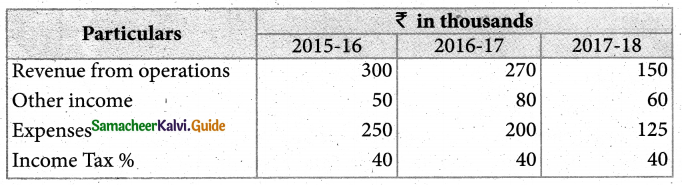
Particulars
Debtors on 1st April, 20181,00,000
Cash received from debtors2,30,000
Discount allowed5,000
Returns inward25,000
Debtors on 31st March 20191,20,000

Solution:
Samacheer Kalvi 12th Accountancy Guide Chapter 1 Accounts from Incomplete Records 15

Samacheer Kalvi 12th Accountancy Guide Chapter 1 Accounts from Incomplete Records

Question 11.
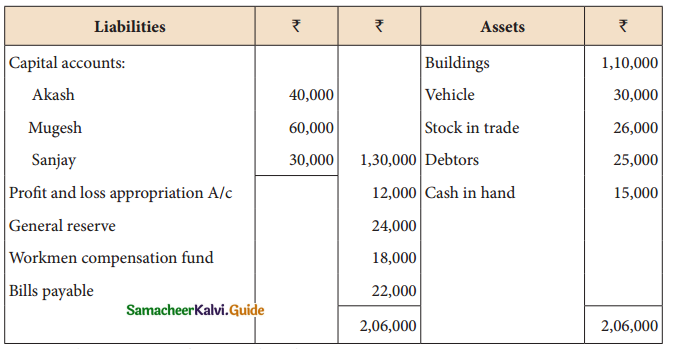
From the following details find out total sales made during the year.

Particulars
Debtors on 1st January, 20181,30,000
Cash received from debtors during the year35,000
Sales returns4,20,000
Bad debts15,000
Debtors on 31st December 20182,00,000
Cash Sales4,60,000

Solution:
Samacheer Kalvi 12th Accountancy Guide Chapter 1 Accounts from Incomplete Records 16
Total sales = Credit Sales + Cash Sales
= 5,40,000 + 4,60,000
Total Sales = Rs. 10,00,000
Answer :
Credit sales : ₹ 5,40,000; Total Sales : ₹ 10,00,000

Question 12.
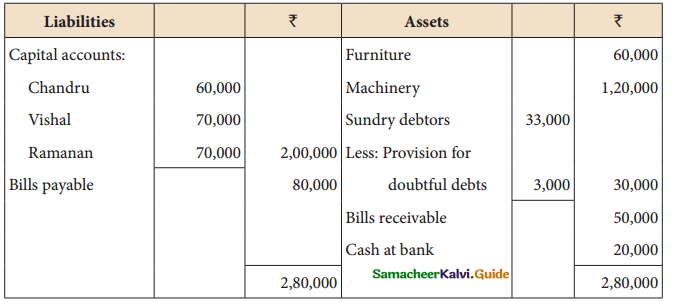
From the following particulars, prepare bills receivable amount and compute the bills received from the debtors.

Particulars
Bills receivable at the beginning of the year1,40,000
Bills receivable at the end of the year2,00,000
Bills receivable at the end of the year3,90,000
Bills received dishonoured30,000

Solution:
Samacheer Kalvi 12th Accountancy Guide Chapter 1 Accounts from Incomplete Records 17
Answer:
B/R received: ₹ 4,80,000;

Question 13.
From the following particulars, calculate total sales.
Samacheer Kalvi 12th Accountancy Guide Chapter 1 Accounts from Incomplete Records 18
Prepare a statement of affairs as on 31st March 2019 and calculate capitals as at that date.
Solution:
Samacheer Kalvi 12th Accountancy Guide Chapter 1 Accounts from Incomplete Records 19
Total sales = Credit Sales + Cash Sales
= 9,85,000 + 3,15,000
Total Sales = Rs. 13,00,000
Answer:
B/R received : ₹ 2,05,000; Credit sales: ₹ 9,85,000; Total sales: ₹ 13,00,000

Samacheer Kalvi 12th Accountancy Guide Chapter 1 Accounts from Incomplete Records

Question 14.
From the following details, calculate credit puchases

Particulars
Opening creditors1, 70,000
Purchase returns20,000
Cash paid to creditors4,50,000
Closing creditors1,90,000

Solution:
Samacheer Kalvi 12th Accountancy Guide Chapter 1 Accounts from Incomplete Records 20
Answer:
Credit sales : ₹ 2,80,000

Question 15.
From the following particulars calculate total purchases.
Samacheer Kalvi 12th Accountancy Guide Chapter 1 Accounts from Incomplete Records 21
Solution:
Samacheer Kalvi 12th Accountancy Guide Chapter 1 Accounts from Incomplete Records 22
Total Purchase = Cr Purchase + Cash Purchase
= 1,55,000 + 2,25,000
Total Purchase = Rs. 3,80,000
Answer:
B/P accepted: ₹ 25,000; Credit purchases: ₹ 1,55,000; Total Purchases: ₹ 3,80,000

Question 16.
From the following details you are required to calculate credit sales and credit purchases by preparing total debtors account, total creditors account, bills receivable account and bills payable account.
Samacheer Kalvi 12th Accountancy Guide Chapter 1 Accounts from Incomplete Records 23
Solution:
Samacheer Kalvi 12th Accountancy Guide Chapter 1 Accounts from Incomplete Records 24
Answers:
B/R received: ₹ 42,000; Credit sales : ₹ 6,59,000; B/P accepted : ₹ 40,000; Credit Purchases: ₹ 4,00,000

Samacheer Kalvi 12th Accountancy Guide Chapter 1 Accounts from Incomplete Records

Question 17.
From the following details of Rakesh, prepare Trading and Profit and Loss account for the year ended 31st March, 2019 and a Balance Sheet as on that date.
Samacheer Kalvi 12th Accountancy Guide Chapter 1 Accounts from Incomplete Records 25
Other details
Samacheer Kalvi 12th Accountancy Guide Chapter 1 Accounts from Incomplete Records 26
Solution:
Samacheer Kalvi 12th Accountancy Guide Chapter 1 Accounts from Incomplete Records 27 Samacheer Kalvi 12th Accountancy Guide Chapter 1 Accounts from Incomplete Records 28
Answer:
Credit Sales: ₹ 13,85,000; Credit purchases: ₹ 11,85,000; Gross profit: ₹ 1,60,000; Net profit: ₹ 50,000, Balance Sheet Total: 8,90,000

Question 18.
Mary does not keep her books under double entry system. From the following details prepare trading and profit and loss account for the year ending 31st March, 2019 and a balance sheet as on that date.
Samacheer Kalvi 12th Accountancy Guide Chapter 1 Accounts from Incomplete Records 29 Samacheer Kalvi 12th Accountancy Guide Chapter 1 Accounts from Incomplete Records 30
Solution:
Samacheer Kalvi 12th Accountancy Guide Chapter 1 Accounts from Incomplete Records 31 Samacheer Kalvi 12th Accountancy Guide Chapter 1 Accounts from Incomplete Records 32

Samacheer Kalvi 12th Accountancy Guide Chapter 1 Accounts from Incomplete Records

Question 19.
Arun carries on hardware business and does not keep his books on double entry basis The following particulars have been extracted from his books.
Samacheer Kalvi 12th Accountancy Guide Chapter 1 Accounts from Incomplete Records 33
Other information for the year ending 31.12.2018 showed the following:
Samacheer Kalvi 12th Accountancy Guide Chapter 1 Accounts from Incomplete Records 34
Total sales during the year were ₹ 7,70,000. Purchases returns during the year were 30,000 and sales returns were ₹ 25,000. Depreciate land and building by 5%. Provide ₹ 1,500 for doubtful debts. Prepare trading and profit and loss account for the year ending 31st December, 2018 and a balance sheet as on that date.
Solution:
Samacheer Kalvi 12th Accountancy Guide Chapter 1 Accounts from Incomplete Records 35 Samacheer Kalvi 12th Accountancy Guide Chapter 1 Accounts from Incomplete Records 36
Answer:
Opening capital: ₹ 3,80,000; Credit purchases: ₹ 6,25,000; Gross profit: ₹ 1,35,000; Net profit:: ₹ 86,000, Balance Sheet Total: ₹ 5,01,000

Question 20.
Selvam does not keep ; books under double entry system. From the following information prepare trading and Profit and loss A/c and Balance Sheet as on 31-12-2018
Samacheer Kalvi 12th Accountancy Guide Chapter 1 Accounts from Incomplete Records 37
Adjustments: Write off depreciation of 10% on machinery Create a reserve of 1% on debtors for doubtful debts.
Solution:
Samacheer Kalvi 12th Accountancy Guide Chapter 1 Accounts from Incomplete Records 38 Samacheer Kalvi 12th Accountancy Guide Chapter 1 Accounts from Incomplete Records 39
Answer:
Opening capital: ₹ 1,50,000; Gross Profit: ₹ 1,11,000; Net profit:: ₹ 69,000, Balance Sheet Total: ₹ 2,46,000

Samacheer Kalvi 12th Accountancy Guide Chapter 1 Accounts from Incomplete Records

12th Accountancy Guide Accounts from Incomplete Records Additional Important Questions and Answers

I. Choose the best answer

Question 1.
Companies must maintain accounting records under double entry system as per
(a) Sec. 128 (1) of Indian Companies Act, 1956
(b) Sec. 128 (1) of Indian Companies Act, 2000
(c) Sec. 128 (1) of Indian Companies Act, 2013
Answer:
(b) Sec. 128 (1) of Indian Companies Act, 2000

Question 2.
Single entry system is an ………………….system of bookkeeping.
(a) incomplete
(b) inefficient
(c) adequate
Answer:
(a) incomplete

Question 3.
Single entry system maintains only ……………. and cash accounts
(a) Real
(b) Personal
(c) Nominal
Answer:
(b) Personal

Question 4.
Single entry system does maintain ………………… and ………………… accounts
(a) Assets & liabilities
(b) Debtors, Creditors
(c) Read, Nominal
Answer:
(c) Read, Nominal

Samacheer Kalvi 12th Accountancy Guide Chapter 1 Accounts from Incomplete Records

Question 5.
Single entry system is not based on …………….. as pect concept
(a) Double Entry
(b) Dual
(c) Single
Answer:
(b) Dual

Question 6.
Incomplete records are those records which are not kept under……………………….
(a) Single Entry
(b) Double Entry
(c) None of the above
Answer:
(b) Double Entry

Question 7.
Credit purchases can be ascertained as a balancing figure in the ……………………
(a) Total Creditors A/c
(b) Debtors A/c
(c) Capital A/c
Answer:
(a) Total Creditors A/c

Question 8.
To know total purchases and total sales under single entry system, one has to depend on
(a) Trading A/c
(b) Copies of invoice and Vouchers
(c) Profit 8c Loss A/c
Answer:
(b) Copies of invoice and Vouchers

Question 9.
Under single entry system, the arithmetical accuracy of………………. cannot be checked.
(a) Trial Balance
(b) Trading A/c
(c) Balance Sheet
Answer:
(a) Trial Balance

Samacheer Kalvi 12th Accountancy Guide Chapter 1 Accounts from Incomplete Records

Question 10.
If the adjusted closing capital is more than the opening capital, it is …………………
(a) Loss
(b) Profit
(c) Asset
Answer:
(b) Profit

Question 11.
If the adjusted closing capital is less than the opening capital, it is…………….
(a) Loss
(b) Profit
(c) Asset
Answer:
(a) Loss

Question 12.
Statement of Affairs resembles a…………………
(a) Balance Sheet
(b) Trading A/c
(c) Profit A/c Loss A/c
Answer:
(a) Balance Sheet

Question 13.
Profit under ……………… Entry system is only an estimate
(a) Double
(b) Single
(c) Income
Answer:
(b) Single

Question 14.
The total assets of a proprietor is Rs. 5,00,000. His liabilities are Rs.3,50,000 His capital in the business is
(a) Rs. 1,50,000
(b) Rs. 8,50,000
(c) Rs. 3,50,000
Hint:
Assets = Capital – Liabilities
5,00,000 = ? – 3,50,000
Capital = 5,00,000 – 3,50,000
= 1,50,000
Answer:
(a) Rs. 1,50,000

Samacheer Kalvi 12th Accountancy Guide Chapter 1 Accounts from Incomplete Records

Question 15.
Statement of affairs method is also called
(a) Conversion method
(b) Net worth method
(c) Adjusted closing capital method
Answer:
(b) Net worth method

II Short Answer Questions

Question 16.
Define single Entry System
Answer:
According to Kohler, Single Entry System is a system of book keeping in which as a rule only records of cash and personal accounts are maintained. It is always incomplete double entry varying with circumstances.

Question 17.
What is conversion method?
Answer:
If it is desired to calculated profit by preparing trading and profit & loss Account under single entry system then it is called conversion method.

Question 18.
State the steps to be followed to prepare final accounts from incomplete records
Answer:
Following are the steps to be followed to prepare final accounts from incomplete records.
1. Opening statement of affairs is to be prepared, to ascertain the opening capital.

2. Missing figures must be found out with the available data.
This can be done by preparing memorandum accounts or by making necessary adjustments to the existing figures. For example,

  • It may become necessary to prepare a cash book to find out the missing items such as cash purchases, cash sales, etc.
  • By preparing total debtors account and total creditors account, credit sales and credit purchases can be ascertained respectively.
  • Bills receivable account and bills payable account are to be prepared to find out the balances of bills receivable received and bills payable accepted respectively.

3. The final step is to prepare trading and profit and loss account and balance sheet.

Samacheer Kalvi 12th Accountancy Guide Chapter 1 Accounts from Incomplete Records

III Exercises

Question 1.
Find out profit or loss from the following information

Particulars
Opening Capital4,00,000
Drawings90,000
Closing Capital5,00,000
Additional Capital during the year30,000

Solution:

Statement of profit or loss
Rs.  ₹
Closing Capital5,00,000
Add: Drawings90,000
5,90,000
Less: Additional Capital30,000
Adjusted closing capital5,60,000
Less: Opening capital4,00,000
Profit for the year1,60,00

Question 2.
Calculate the missing information from the following.

Particulars
Profit made during the year4,800
Capital at the end?
Additional Capital introduced during the year4,000
Drawings2,400
Capital in the beginning9,600

Solution:
Calculation of Closing Capital

Closing capital (Bal. Fig)16,000
Add: Drawings2,400
18,400
Less: Additional Capital4,000
Adjusted closing capital14,400
Less: Opening capital9,600
Profit made during the year4,800

Answer:
Capital at the end Rs. 16,000

Samacheer Kalvi 12th Accountancy Guide Chapter 1 Accounts from Incomplete Records

Note:

Step1: Add Profit of Rs. 4,800 with opening capital Rs. 9,600 = Adjusted closing capital Rs. 14,400
Step2: Add Additional capital of Rs. 4,000 with Adjusted closing capital Rs. 14,400 = Rs. 18,400
Step3: Deduct drawing Rs.2,400 from the total amount arrived (Step 2) Rs. 18,400 = Clsoing Capital Rs. 16,000.

Question 3.
Mr. Suresh Strated business with Rs. 2,00,000 on 1st April 2003. His books are kept under single entry. On 31st March, 2004 his position was as under:
Samacheer Kalvi 12th Accountancy Guide Chapter 1 Accounts from Incomplete Records 40
Ascertain the profit or loss made by Mr.Suresh for the year ended 31st March 2004.
Solution:
Statement of affairs of Mr. Suresh as on 31.03.2004
Samacheer Kalvi 12th Accountancy Guide Chapter 1 Accounts from Incomplete Records 41

Question 4.
Prakash keeps his books by ‘Single Entry System His position on 01.04.2003 and
3 1.03.2004 was as follows.
Samacheer Kalvi 12th Accountancy Guide Chapter 1 Accounts from Incomplete Records 42
He introduced an additional capital of Rs. 8,000 during the financial year. He withdraw Rs.= 14,000 for domestic purpose. Find out the profit for the year ended 3 1.03.2004.
Solution:
i) Calculation of opening capital:
Samacheer Kalvi 12th Accountancy Guide Chapter 1 Accounts from Incomplete Records 43

Question 5.
Mrs. Vanitha keeps her books on singly entry basis. Find out the profit or loss made for the period ending 31. 03. 2004.
Samacheer Kalvi 12th Accountancy Guide Chapter 1 Accounts from Incomplete Records 44
Mrs. Vanitha had withdrawn Rs. 10,000 for her personal use and had intrdocued fresh capital of Rs.4,000. A provision of 5% on debtors is necessary. Write off depreciation of plant at 10% and furniture at 15%.
Solution:
Samacheer Kalvi 12th Accountancy Guide Chapter 1 Accounts from Incomplete Records 45 Samacheer Kalvi 12th Accountancy Guide Chapter 1 Accounts from Incomplete Records 46

Samacheer Kalvi 12th Accountancy Guide Chapter 1 Accounts from Incomplete Records

Question 6.
Ram and Laxman are equal partners in a business in which the books are kept by single entry. On 01.04.2004 their position was as under:
Samacheer Kalvi 12th Accountancy Guide Chapter 1 Accounts from Incomplete Records 47
Solution:
Calculation of closing capital:
Samacheer Kalvi 12th Accountancy Guide Chapter 1 Accounts from Incomplete Records 48 Samacheer Kalvi 12th Accountancy Guide Chapter 1 Accounts from Incomplete Records 49

Question 7.
Find out total purchases and total sales from the following details by making necessary accounts:

Opening balance of Sundry debtors50,000
Opening balance of Sundry creditors30,000
Cash collected from Sundry debtors3,00,000
Discount received1,500
Cash Paid to Sundry creditors20,000
Discount allowed5,000
Return inwards6,000
Return in outwards8,000
Closing balance of Sundry debtors35,000
ciosi balance of Sundry creditors25,000
Cash Purchases12,000
Cish SaIes24,000

Solution:
Samacheer Kalvi 12th Accountancy Guide Chapter 1 Accounts from Incomplete Records 50
Total Purchases = Cash Purchases + Credit Purchases
= Rs. 12,000 + Rs. 24,500
= Rs. 36,500

Total Sales = Cash Sales + Credit Sales
= Rs. 24,000 + Rs. 2,96,000
= Rs. 3,20,000

Samacheer Kalvi 12th Accountancy Guide Chapter 1 Accounts from Incomplete Records

Question 8.
Mr. James commenced business on 1.04.2004 with a Capital of Rs. 75,000. he immediately bought furniture for Rs. 12,000. During the year, he borrowed Rs. 15,000 from his wife as loan. He has withdrawn Rs. 21,600 for his family expenses. From the following particulars you are required to prepare Trading and Profit & Loss A/c and Balance Sheet as on 31.03.2005.

Rs.
Cash received from Sundry debtors1,21,000
Cash paid to Sundry creditors1,75,000
Cash Purchases1,00,000
Cash Sales40,000
Carriage inwards4,500
Discount allowed to Sundry debtors4,000
Salaries5,000
Office Expenses4,000
Advertisement5,000
Closing balance of Sundry debtors75,000
Closing balance of Sundry creditors50,000
Closing Stock35,000
Closing cash balance43,900

Provide 10% depreciationon furnitures
Solution:
Samacheer Kalvi 12th Accountancy Guide Chapter 1 Accounts from Incomplete Records 51 Samacheer Kalvi 12th Accountancy Guide Chapter 1 Accounts from Incomplete Records 52

Question 9.
Mrs. Malathy maintained her account books on single entry system. On 01.04.2003 her Capital was Rs. 2,50,000.
Additional Information:

Opening Stock1,25,000
Cash received from Sundry debtors25,000
Cash Sales1,00,000
Cash Paid to Sundry creditors30,000
Opening Sundry debtors20,000
Opening Sundry creditors91,500
Business expenses60,400
Free hold premises (3 1.03.2004)2,00,000
Furniture (31.03.2004)3,600
Closing Stock1,30,000
Closing Sundry debtors40,000
Closing Sundry creditors1,00,000
Closing cash balance27,500

Prepare trading and profit & loss account for the year ended 31.03.2004 and balance sheet
as on that date.
Solution:
Samacheer Kalvi 12th Accountancy Guide Chapter 1 Accounts from Incomplete Records 53 Samacheer Kalvi 12th Accountancy Guide Chapter 1 Accounts from Incomplete Records 54

Samacheer Kalvi 12th Accountancy Guide Chapter 1 Accounts from Incomplete Records

Question 10.
From the following details, prepare Trading and Profit & Loss account for the period ended 31.03.2004 and a Balance sheet on that date.

Additional Information:
Samacheer Kalvi 12th Accountancy Guide Chapter 1 Accounts from Incomplete Records 55
Solution:
Samacheer Kalvi 12th Accountancy Guide Chapter 1 Accounts from Incomplete Records 56 Samacheer Kalvi 12th Accountancy Guide Chapter 1 Accounts from Incomplete Records 57 Samacheer Kalvi 12th Accountancy Guide Chapter 1 Accounts from Incomplete Records 58